With five pro sports franchises and some seriously good college athletic programs in the region, Philly fans could show their pride for a different team every day of the week. That’s a lot of gear to keep in rotation. Here are 10 picks available from FOCO to keep in your own closet, on your desk, or to give as a gift:
The selections here represent The Inquirer’s picks this holiday season. When you make a purchase through a link in this list, The Inquirer may be paid a commission.
When Keith Critchley and JT O’Brien were looking to buy a restaurant last year, they toured the dining room and kitchen of Georgio’s in downtown Downingtown, which Georgio Malle was selling after more than 30 years.
“Keith and I went to lunch and I said, ‘There’s no way we’re buying this for what he wants. It’s not that big,’” O’Brien said. They went back to negotiate, he said, Malle told them flatly, “My price is my price.”
Crispy chicken sandwich on a doughnut at the Borough in Downingtown.
It quickly became evident that Critchley and O’Brien had not seen the upstairs of the rambling building on Lancaster Avenue. “When I saw the upstairs, I thought, ‘Now I can start thinking of different ideas and concepts that we can do,’” O’Brien said.
They seem to be throwing everything at the Borough, which began opening in phases in recent weeks. There is a 35-seat sports bar/restaurant with 40 TVs, 20 taps, and a full cocktail menu on the ground floor, connected to a large patio through garage doors. Upstairs, there’s a 20-seat bar, a six-seat sushi bar, and a venue hosting live music. Programming such as open-mic nights, karaoke, trivia nights, and comedy shows will ramp up in November. Big brunches — think mimosa towers and full entertainment — will start after Thanksgiving.
Critchley and O’Brien retained pizzaiolo Ptah Akai to set up the pizza kitchen.
Five years ago during the pandemic, the Swarthmore-born Akai noticed that the successful restaurants were offering pizza — “and not because they were making great pizza.”
Consultant Ptah Akai at the Borough in Downingtown.
Akai began teaching himself, using YouTube and setting up an oven in his backyard. By day, Akai, 33, works as an installer for Toast, the restaurant point-of-sale company. He quickly became popular among his neighbors. “It brings people together,” he said. “You can go anywhere in the world and make pizza and probably make a friend.”
A lifelong vegan, Akai wanted to make pizza he could eat himself, and the challenge of making tasty nondairy pizza became motivation. When he learned that Critchley and O’Brien were opening, he offered to get them started. (Georgio’s had a fairly extensive pizza kitchen, including a large mixer.)
Forager pizza at the Borough in Downingtown.
Akai’s pies are beautifully puffy-crusted, sort of neo-Neapolitan, with zero flop and a light char. The sliced garlic gave a subtle roast to a cheeseless tomato pie that he made for me off the menu. His Forager ($23), with basil pesto and three kinds of mushrooms, was balanced and did not sink under the mozzarella. There’s also a plain cheese ($18), pepperoni ($21), and a margherita ($19).
As they did with the other restaurant amenities, Critchley and O’Brien created a something-for-everyone menu, served anywhere in the space. There are pork belly burnt ends ($18); Bavarian pretzel ($13); meat-and-cheese board ($32); crispy chicken sandwich ($16) with a sesame soy glaze and kimchi on a glazed doughnut bun; and a lamb gyro ($19) with sumac red onion and tzatziki on a house-made pita. Rolls make up the sushi menu, and the few entrees include miso striped bass ($34), seared scallops ($36), cauliflower steak ($25), and steak frites ($36).
O’Brien started in hospitality 25 years ago bartending at Reed’s in Blue Bell and counts six years at Seacrets in Ocean City, Md., and 11 years with P.J. Whelihan’s in Downingtown and Montgomeryville in his work history. Critchley, who has no hospitality background, recently sold his business, Lang’s Lawn Care in Malvern, but runs it under the new owners.
Downingtown has always had a solid restaurant scene, with La Sponda, Myrtos, and Jads nearby and R Five Wines and East Branch Brewing Co. across the street from the Borough, and Dressler Estate serving ciders nearby. The other newcomer is mother., with a creative menu of tacos plus beer, wine, and cocktails.
The Borough, 149 E. Lancaster Ave., Downingtown. Hours: 11 a.m. to midnight Sunday to Thursday, 11 a.m. to 1 a.m. Friday and Saturday. Tip: Do not park in the adjacent private lot. Use the municipal lot across the street.
The Top Workplaces program, now in its 17th year of recognizing Philadelphia-area companies that earn high marks from employees, is open for nominations for the 2026 awards at Inquirer.com/nominate.
Any Delaware Valley organization with 50 or more employees is eligible to participate at no cost. Standout companies will be honored in a special section of The Inquirer in September 2026.
To qualify as a Philadelphia Top Workplace, employees evaluate their workplace using a 26-question survey. Companies will be surveyed through April.
The Top Workplaces program returns to the Philadelphia region for 2026.
Energage, the Exton-based research partner for the project, conducts Top Workplaces surveys for media in 65 markets nationwide. For the 2025 awards, over 6,000 organizations in the Delaware Valley were invited to survey their employees. Based on employee survey feedback, 144 earned recognition as Top Workplaces.
“Earning a Top Workplaces award is a celebration of excellence,” said Eric Rubino, CEO of Energage. “It serves as a reminder of the vital role a people-first workplace experience plays in achieving success.”
Anyone can nominate an outstanding company. Nominees can be public, private, nonprofit, a school, or even a government agency. To nominate an employer or for more information on the awards, go to Inquirer.com/nominate or call 484-323-6270.
Can the Eagles finally get Saquon Barkley going? The question feels like it’s the last big one left for the Eagles’ offense to answer this season, which has seen the group go through ups and downs during the first half of the year. But on the heels of the Eagles deploying a more under-center, play-action flavored attack in Minnesota to tap into an explosive passing performance, there’s growing optimism inside the NovaCare Complex that the team is getting closer to unlocking its record-setting running back. The Philadelphia Inquirer’s Jeff McLane examines key reasons why Barkley and the Eagles’ run game have struggled, and whether a rematch with the archrival Giants could prove the right antidote.
00:00 The next big issue to address on offense…
01:42 Are the run game issues all on Saquon Barkley?
06:30 Jordan Mailata breaks down the Eagles’ different run schemes
10:02 The impact of under-center runs
15:42 How Barkley is dealing with his drop in production
20:13 Where health is hurting the Eagles the most
unCovering the Birds is a production of The Philadelphia Inquirer and KYW Newsradio Original Podcasts. Look for new episodes dropping each week throughout the season.
Not only was Jalen Hurts called upon to step up, he got a phone call in the middle of his post-game press conference in Minnesota. “When you win, everyone wants to call you,” he joked. In the Eagles’ 28-22 victory over the Vikings, the star quarterback was certainly a winner, delivering one of the most statistically-impressive performances of his career. The 326 passing yards and three touchdowns were much needed, as Hurts, along with the dynamic receiving duo of A.J. Brown and DeVonta Smith, led the way in getting the Eagles back on track after a two-game slide. What changed on offense, where plenty of criticism has been directed this year? How did a couple of welcomed faces help the defense clamp down? The Philadelphia Inquirer’s Jeff McLane and Marcus Hayes give their takes on the Eagles’ success in Week 7.
00:00 Jalen Hurts: perfection marks major progress
21:25 Concerns about the edge and…Brandon Graham?!?!
unCovering the Birds is a production of The Philadelphia Inquirer and KYW Newsradio Original Podcasts. Look for new episodes throughout the season, including day-after-game reactions.
Michael Days, a pillar of Philadelphia journalism who championed young Black journalists and was beloved among reporters who worked for him at the Daily News and Philadelphia Inquirer, died suddenly on Saturday at 72 in Trenton.
A devout Catholic who grew up in North Philadelphia, Mr. Days was instrumental in developing talent among Philadelphia’s journalism community, leading with a kind but direct approach that nurtured journalists and caused reporters to break out in spontaneous applause when he returned to the Daily News in 2011 after an interim stint at the then-rival Inquirer.
Mr. Days was also respected beyond Philadelphia, receiving Hall of Fame honors from the National Association of Black Journalists and the Pennsylvania News Media Association. He was a past president of the Philadelphia Association of Black Journalists (PABJ) and at the time of his death was president of NABJ-Philadelphia, which formed as an alternative to PABJ.
Mr. Days’ wife, Angela Dodson, said Sunday afternoon she was comforted by the outpouring of support and love from journalists who knew him.
“He was the kind of person who wanted to serve,” Dodson said. “People could talk to him, and he had something wise to say.”
Michael Days (right), Editor, Philadelphia Daily News and Trailblazer Award winner with his wife, Angela Dodson (left)
Dodson, a journalist and author, said she and her husband had a long-running disagreement over where they had first met. She believes it was in Rochester, N.Y., when they were working for rival newspapers. But Mr. Days believed he’d met her a year earlier, at an NABJ convention.
“People loved him,” Dodson said. “He commanded such respect that I used to say, people would elect him president of anything.”
In recent years, Dodson enjoyed listening as her husband took long phone calls from journalists seeking advice. “What we all need is somebody who listens to us, and he was a master at that,” Dodson said.
Former Daily News reporter and current Inquirer journalist Stephanie Farr recounted Mr. Days’ infectious laugh and his habit of adding Post-it notes to clips of reporters’ articles to tell them they had done a good job, sometimes with simple messages like “amazing quote!” that gave reporters a little extra pride in their work.
“You didn’t get one every day, but when you got one, you were on top of the world,” Farr said.
She still has a box full of these “Mike-O-Grams,” as they became known, and many others do, as well. “The small gestures, in the end, are really the big ones,” Farr said.
Tributes and condolences poured in Sunday from journalists who were shaped by Mr. Days’ leadership.
“It is with a very heavy heart that NABJ Philadelphia mourns the sudden passing of our President Michael I. Days, a respected journalist, mentor and cherished friend whose legendary career and commitment to excellence inspired us all,” wrote Inquirer education reporter and NABJ-Philadelphia Vice President Melanie Burney.
NABJ President Errin Haines said she first met Mr. Days when she moved to Philadelphia in 2015 to work for the Associated Press. Haines said she was struck by his seemingly boundless energy for helping younger reporters. She remembered him as a universally respected leader, and someone who had shown other Black journalists a path to success.
“It was seismic in the industry, and a huge point of pride for NABJ,” said Haines.
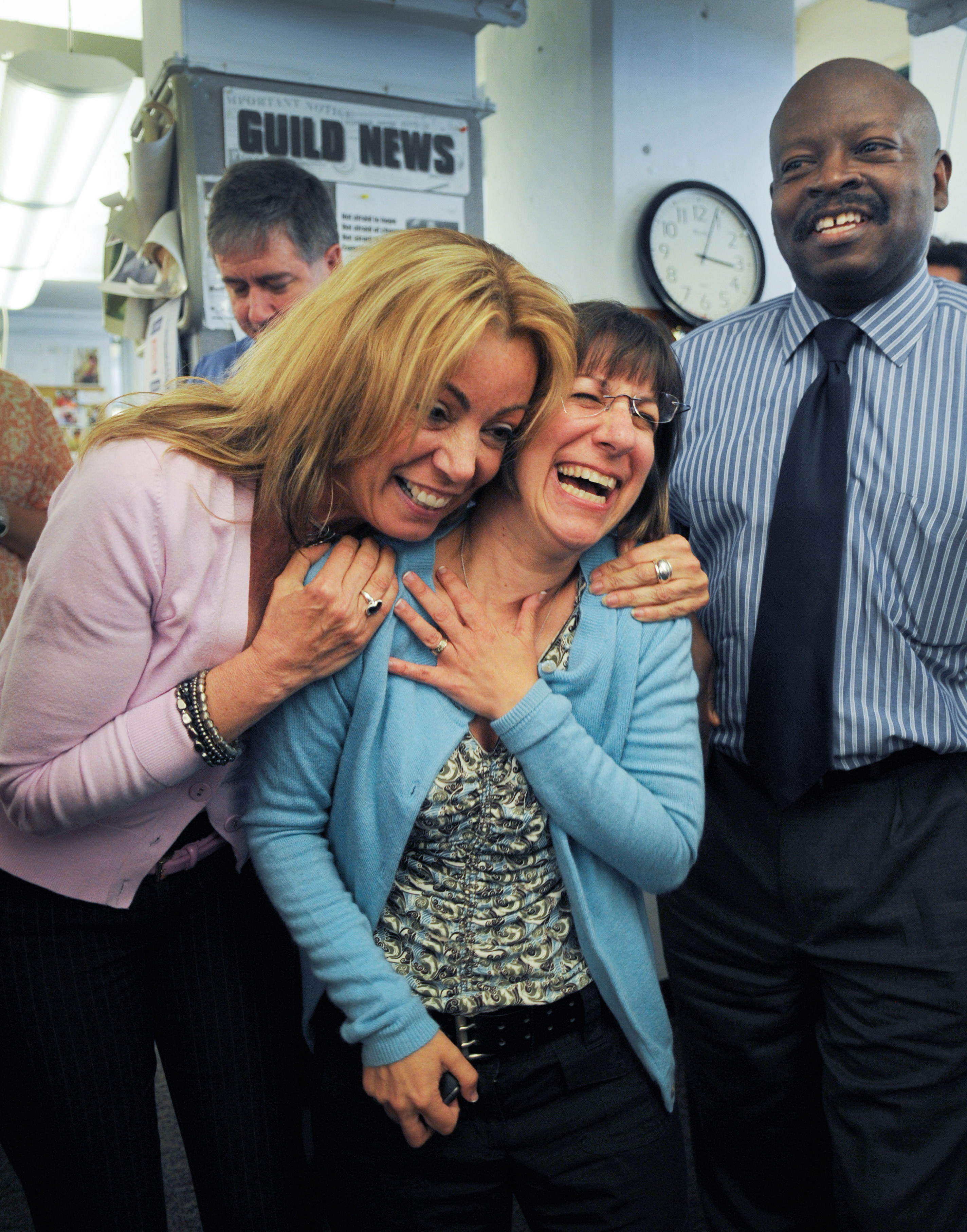
Philadelphia Daily News reporters Barbara Laker (left) and Wendy Ruderman, and editor Michael Days react as they hear the news that the two reporters won the 2010 Pulitzer Prize for investigative reporting.
As editor of the Daily News, Mr. Days played an essential role in the decisions that would lead to its 2010 Pulitzer Prize win for investigative reporting, said Inquirer senior health reporter Wendy Ruderman. She and her colleague Barbara Laker won the prize.
“You could walk into his office anytime and talk to him,” Ruderman said. “He just was very approachable — but also, you respected him.”
Ruderman recounted sitting in Mr. Days’ office late one evening, alongside Laker and a company lawyer, as they discussed whether to move forward with a story about a Philadelphia Police Department narcotics officer. The story, the lawyer said, stood a good chance of getting them sued.
With a “directness and sincerity” that were his hallmark, Mr. Days turned to the reporters.
“He said, ‘I trust my reporters, I believe in my reporters, and we’re running with it,’” Ruderman said. That story revealed a deep dysfunction within the police department, Ruderman said, and led to the newspaper’s 2010 Pulitzer Prize win.
Retired Daily News managing editor Pat McLoone remembered Mr. Days as a quietly authoritative presence, and a leader who brought elegance and class to everything he did — even as he had to preside over the early days of the news industry’s difficult shift from print to digital media.
“He was the best possible boss to work for,” McLoone said. “He was in the 100th percentile as a human being.”
Michael Days (far right) with other former presidents of the Philadelphia Association of Black Journalists in 2021. He served as president in the 1980s.
After graduating from Roman Catholic High School in Philadelphia, Mr. Days earned degrees from College of the Holy Cross and the University of Missouri. He worked at the Wall Street Journal and other newspapers before joining the Daily News as a reporter in 1986.
In 2011, Mr. Days was named managing editor of the Philadelphia Inquirer, where he held several management roles until he retired in October 2020. Inquirer Editor and Senior Vice President Gabriel Escobar said Sunday that Mr. Days was a “leading light in Philadelphia journalism.”
“Mike was a son of Philadelphia, a believer in the power of journalism to do right, and a mentor to scores of young journalists who benefited over many decades from his attentive guidance,” Escobar wrote in an email to Inquirer staff. “He spent his life fighting for better journalism because he understood its limitations and, when it came to diversity, its flaws.”
After his own retirement, Mr. Days’ work mentoring Black journalists didn’t stop, said retired journalist Linda Wright Moore.
“He had all the things you need,” Wright Moore said. “He was steady. Principled. He could do tough. He balanced what the craft demands of all of us with the fact that we’re humans, and not perfect.”
Wright Moore had known Mr. Days when she was a columnist at the Daily News from 1985 to 2000. But they stayed in touch over the years and saw one another every year at the annual NABJ convention.
In August, the NABJ celebrated its 50th anniversary — a historic moment for the organization and for Wright Moore, whose late husband, Acel Moore, was one of the group’s founding members.
For her and Mr. Days, it demonstrated the significance of the group’s survival, a half century later, despite the ongoing dismantling of DEI programs at many organizations.
“I could just feel how proud he was to be there, to have made it to this point,” Wright Moore said.
Mr. Days is survived by Dodson, three adopted sons, Edward, Andrew, and Umi, and three grandchildren. Mr. Days is predeceased by his adopted son Adrian.
Services for Mr. Days will be held Oct. 25, at Sacred Heart Church, 343 S. Broad Street, Trenton, N.J. The Viewing will be held from 10 a.m. to 12 p.m. followed by Mass at noon.
As Vladimir Putin blocks peace talks, Kyiv wants to share with the U.S. and Europe how to counter the AI-driven weapons of the future.
Betsyk, commander for the 3rd Separate Assault Brigade's special battalion for intercepting enemy drones, sits beside downed Russian reconnaissance drones.3rd Separate Assault Brigade
DIRECTION POKROVSK, Ukraine — In a warren of rooms filled with computers, 3D printers, colorful wires, and drone frames, the atmosphere was casual, but the intentions were deadly.
The young men in their 20s and 30s, dressed in cargo pants and T-shirts, wouldn’t have looked out of place at a Silicon Valley start-up. Except they were fighting for their lives — and their country’s survival.
In the basement command center, three of the soldier-techies stared at multiple screens with dozens of views delivered by Ukrainian-made surveillance drones. They were looking for Russian targets in a war that had lasted for three and a half years.
As I peered over their shoulders during a June visit to the rear of the front lines, a moving car was spotted.
Orders were quickly passed to a frontline drone navigator and pilot in a trench or basement who would make the final call as to whether the target was clearly visible and worth destroying — at which point the pilot’s goggles would let him watch the little exploding drone descend until a flash signaled another kill.
It was a slow day, and everyone’s attention had turned to other screens before I could learn the fate of the car. But there were always more targets to find.
By my side, the 31-year-old commander of an elite drone battalion of the 59th Assault Brigade, call sign Condor, told me there are up to 300 targets a day, which can range from a single fighter in the grass to a moving motorcycle to a small Russian dugout covered with branches or nets.
“The orcs outnumber us, and they don’t care about loss of lives,” Condor said, using the name of the grotesque enemy warriors in the Lord of the Rings series to refer to the Russians. “In this new way of war, infantry and artillery and mortars still matter, but everything is controlled by air. Now, a military is just a way of supporting drones.”
For Ukraine, drones are an essential part of why the country has been able to hold out so long against an army four times its size.
Source: Institute for the Study of War and AEI's Critical Threats Project.John Duchneskie/Staff Artist
The technology of unmanned weaponry is advancing at a pace that appears revolutionary — from aerial drones to drones that move by sea, robotic land drones, and long-range drones carrying missiles — all increasingly directed by artificial intelligence.
Sea drones drove Russian ships out of the Black Sea along the Ukrainian coast, and continue to strike at the critical Kerch Bridge connecting Russia to Crimea. In June, Ukrainian security services conducted the amazing Operation Spiderweb, which damaged or destroyed up to 40 Russian warplanes worth billions of dollars, deep inside Russia — all with 117 small drones costing $500 each.
But Russia is catching up. Ukraine needs the funds to massively scale up drone production.
That’s why the most important moment of President Donald Trump’s Monday meeting with Ukraine’s president and top European leaders may have been when Volodymyr Zelensky proposed to share his country’s breakthrough drone technology with the Pentagon.
Kyiv would sell tens of billions of dollars’ worth of advanced Ukrainian-made drones to America, and, in return, would buy double that dollar amount of U.S. weapons systems, financed by Europe. Both countries would then be far better equipped for the challenges of modern conflict.
The success of that proposal could bolster American preparedness for future tech wars, while helping Ukraine survive as a free, sovereign state.
More on Ukraine
Trump’s deference to Putin means only more bloodshed in Ukraine
The president could have used America’s power to force Vladimir Putin to negotiate seriously. Instead, he opened the door to blaming Ukraine for any failed "peace" talks.
Why so? Peace talks are going nowhere. Vladimir Putin has no interest in peace. He thinks he’s winning.
The Russian dictator “has no reason to compromise so long as the president refuses to apply any pressure on Moscow,” as former Russian political prisoner Vladimir Kara-Murza bluntly told MSNBC. “You cannot make peace by placating Russia.”
Despite the effusive red-carpet welcome Trump gave Putin at their recent Alaska summit, the Russian leader has rejected every one of the president’s proposals to end the war.
story continues after advertisement
No ceasefire. No strong security guarantees for Kyiv, as the naive White House negotiator Steve Witkoff claimed Putin had accepted. The Kremlin has already rebuffed a possible bilateral meeting between Putin and Zelensky that Trump has been touting.
Peace talks will become plausible only if the U.S. joins Europe in putting maximum pressure on Russia, convincing Putin he can’t win and can’t afford to fight any longer.
But that would require Trump to recognize what the Europeans already know: Ukraine has been able to hold off the Russians until now because it has pioneered a revolutionary new way of warfare — the war of drones.
So Zelensky’s proposal is in both countries’ interests. The U.S. is way behind in small drone production, but it has weapons systems crucial to Ukraine. A swap would signal to Putin that Trump is not a pushover.
If Trump wants to be a peacemaker, he must recognize that the Ukraine war is about far more than real estate. It is a battle over freedom, geopolitics — and who will win the tech wars of the future.
As I was told by former Ukrainian Minister of Strategic Industries Oleksandr Kamyshin: “This war started like the Second World War with drones. But it will finish as the First World Drone War.”
A pilot with the elite drone unit for HUR, the Ukrainian Defense Ministry’s intelligence service, demonstrates drone control.Trudy Rubin/Staff
In the air
My latest Ukraine visit — my fifth since the fighting began in February 2022 — showed me what it means when unmanned drones take over the battlefield.
Last year, I could still visit artillery emplacements and destroyed villages near the front where army units lived, showered outdoors, and ate outdoors. I could drive on roads to and from towns near the Donetsk front line inside the contested parts of the eastern Donbas region that Ukraine still controls. Military vehicles still sped along those roads.
Those days are over.
The 15 kilometers (roughly nine miles) on each side of the front line have become a kill zone where almost nothing moves on land because it is at risk of being hit by the other side’s drones.
The size of the kill zone keeps expanding.
Tanks are sitting ducks. So are medical evacuation vehicles. Indeed, military vehicles of any kind. No longer are the soldiers who man frontline positions or drone pilots rotated every day or two; they stay in place for days because the roads in and out are so risky.
Supplies are brought in and the wounded taken out by unmanned robotic carts, known as land drones. These robots also lay mines, and some are equipped with machine guns or rockets.
As for Ukraine’s cities, Putin is demonstrating how drones can be used as a cheap, terrifying tool of terror against civilians.
During my stay in Kyiv, the nightly Russian barrage of Shaheds — drones designed in Iran and gifted by the thousands to Putin by the ayatollahs — rained down nightly on civilian targets. I was lucky to be in a hotel with a comfortable basement shelter, but my Ukrainian friends and contacts were up each night huddled in their hallways or bathrooms. They still are.
Natalya Dubchek stands next to a minibus destroyed by a Shahed drone. The fire from the explosion torched her home in Odesa, Ukraine.Trudy Rubin / Staff
In Odesa one morning, I visited a neighborhood where a family of three was incinerated when a Shahed sheared off the top floor of their apartment building in a residential neighborhood. I spoke with a woman whose bungalow burned to its concrete walls, and who barely escaped the flames.
Even after my return to the U.S., I have kept the air raid alerts on my iPhone, which can be set to any city or region. My phone buzzes every time Russia launches another swarm of Shaheds (along with cruise and ballistic missiles) against Kyiv. For hours, the alerts go off every 20 minutes.
Each buzz means Ukrainian civilians, including the elderly and mothers with small children, must decide whether to descend to an underground shelter and spend miserable hours or the entire night there.
The Shaheds, which give off a chilling whine as they fly, are now copied and manufactured inside Russia with Tehran’s technical help. They have been made more lethal with the addition of jet engines, which enable them to fly higher and faster and elude countermeasures. They are meant to terrorize, exhaust, and kill civilians in Ukrainian schools, hospitals, markets, and apartment buildings.
The number of Shaheds in the skies has jumped dramatically since Putin concluded that Trump will never be serious about punishing Russia for its refusal to accept a ceasefire or engage in serious peace talks. And they are affecting morale. If the Russian barrage continues, more Ukrainians may try to leave for abroad.
A Ukrainian officer shows a thermobaric charge from a downed Shahed drone in a research laboratory in an undisclosed location in Ukraine in 2024.Efrem Lukatsky
Yet, despite the daily Shahed carnage and recent Russian gains on long stalemated front lines, Moscow is still not winning this war.
A prime reason is that Ukraine’s war of technology has so far enabled Kyiv to hold its defensive line, but not to take back territory.
Former Ukrainian commander in chief, now ambassador to the U.K., Valerii Zaluzhnyi, told a video forum in Kyiv that the only war Ukraine can wage is a “high-tech war of survival” until it destroys Russia’s military and economic ability to keep fighting over the long run.
The bad news is that Russia is learning from Ukraine and receiving large-scale tech aid, components, and ready-made drones not only from Iran, but from its other allies, China and North Korea.
This alliance of dictators is growing stronger, and its members are watching the Ukraine war for lessons in future drone warfare with the West. Think China and Taiwan.
story continues after advertisement
To shake up the Kremlin, Kyiv needs to vastly scale up its drone production and race to outdo the Russians with innovation, especially interceptors that can destroy Shaheds and fiber-optic drones.
European governments and private companies are entering agreements to jointly produce drones, both in Ukraine and in Europe. They are studying Kyiv’s technological advances, including on the front lines.
Ukraine wants to share its invaluable battle-tested knowledge with Washington, yet Trump still appears hung up on the vain hope that Putin “wants a peace deal,” which he mistakenly believes would entitle him to a Nobel Peace Prize.
So long as he refuses to recognize Kyiv’s importance as a strategic ally, the president undermines not only Ukraine’s security but ours.
A Ukrainian serviceman of 57th motorised brigade controls an FPV drone at the frontline in Kharkiv region, Ukraine in August.Andrii Marienko
Drone expansion
In June 2024, when I first met with then-infantry commander Condor of the 59th Assault Brigade in one of the hottest combat zones in eastern Ukraine, he was struggling to arm his depleted battalion. They were suffering through a terrible “shell hunger,” he told me, after the U.S. Congress had frozen military aid for six months. His men were often reduced to firing one artillery shell for every 10 fired by the Russians.
“Every day of [congressional] delay cost broken lives and deaths,” the former history teacher turned soldier said bitterly, as we sat in a dark, virtually empty cafe in the countryside near Pokrovsk. “So, we had no other choice but to be creative.”
To fend off a brutal Russian adversary with four times their population and massive industrial might, the nation’s techies and grunts turned their front lines and hidden basements into a tech incubator for modern war.
Desperate fighters, like Condor’s unit, were already using simple Chinese-made commercial drones to spy on Russian forces in 2023 and 2024.
Every unit I visited near the front during those years had guys working on benches in abandoned farmhouses or workshops, putting together drones from parts purchased on Amazon with their own salaries, or donated by families, friends, or private charitable foundations.
While Ukraine was well known in peacetime for talented engineers and a deep tech sector, many of those early do-it-yourself builders had no such background, but figured things out as they went.
By the summer of 2024, the men of Condor’s unit had come up with how to turn small commercial or DIY drones into little exploding drones.
Call sign Condor, commander of the UAV Forces Battalion of the 59th Assault Brigade.Trudy Rubin / Staff
“We cut sewage pipes and stuffed them with explosives,” Condor explained. “We did the same with energy drink cans.”
These makeshift mini bombs were then affixed to UAVs, the shorthand for unmanned aerial vehicles, mostly small Chinese DJI MAVIC quadcopters, the kind Americans use to record panoramic overhead views of weddings. The Ukrainians launched them at Russian tanks, artillery positions, and trenches.
“This is the art of war,” Condor said, with a grim smile. “When you have no supplies, you have to innovate.”
The turning point came in 2024, when the U.S.-induced shell hunger spurred a massive expansion of drone use to save Ukraine’s army. The goal was to protect and preserve precious frontline man power in a war in which Russia treats soldiers like cannon fodder — and to do so with weapons far cheaper than what they destroy.
Government and private companies produced two million drones in 2025, and are set to manufacture more than four million next year. They could produce eight million to 10 million, Zelensky has said, if they had enough funds.
Other weaponry still plays an important role, especially air defenses. While drones can hold the defensive line, taking territory still requires infantry. But 80% or more of the Ukrainian strikes on the front line are now made by drones.
More on Ukraine
A funeral for a tattoo artist-turned-soldier shows why Ukraine won’t capitulate to Moscow
The friends of Roman Tarasyuk vow to keep fighting despite Trump's support for Putin.
Those early exploding drones have evolved into larger attack drones with bigger payloads, including sea drones that resemble large rowboats filled with electronics and sometimes carrying rockets. Robotic ground drones are now mounted with machine guns, and larger long-distance drones can carry small missiles. All of these drones are unmanned and directed by pilots and navigators using goggles and tablets.
Anything that can be viewed by FPVs — first-person view drones in which pilots wearing special goggles can see exactly what the drone sees — is now vulnerable to drone attacks, including men, artillery, ships, helicopters, and low-flying planes.
story continues after advertisement
In the process, Ukraine has rewritten the rules of ground, sea, and air conflict.
As the war continues, artificial intelligence is certain to take on more of the piloting responsibilities (although target decisions will still be made by pilots and commanders, for now).
So crucial have drones become to modern warfare that the Ukrainian military has a new branch up and running whose task is coordinating drone warfare, called the Unmanned Systems Forces.
“We are the first country with an unmanned forces command,” I was told by Hanna Gvozdiar, deputy minister for Ukraine’s Ministry for Strategic Industries. She estimated Ukraine now produces 300 different varieties of drones.
Moreover, special drone units within most Ukrainian battalions have become central to every element of the conflict. Not only do many of them design their own drones, but they also provide constant updates to private drone manufacturers so they can stay ahead of Russian defenses.
As for Condor, he moved from commanding infantrymen to leading the UAV Forces Battalion of the same 59th Assault Brigade, one of the top drone units in the country. By the time I saw him in June, he was fighting a totally different war.
A worker inspects a combat drone at Fire Point's secret factory in Ukraine in August.Efrem Lukatsky
Advantage Ukraine
In the “genesis space” of a modern, glass-fronted office building in Kyiv, a group of start-up Ukrainian tech entrepreneurs has come to pitch their products to guests from the European Union — and to anyone who might fund them to scale up.
The program is sponsored by Brave1, a government-supported tech incubator that helps connect drone start-ups with investors and provides seed money for promising new projects.
“We are in a race with the Russian drone ecosystem,” I was told by Artem Moroz, Brave1’s head of international investment. “The Russians don’t need to fundraise for drone production,” he noted, with bitter irony.
“We want to win the war with the help of technology because we can’t compete with man power,” he continued. “Most of the innovation comes from the private sector. We unite 1,500 companies, some in apartments, some operating at a huge scale, providing thousands of drones.”
Before the show-and-tell, I listened to Oleksiy Babenko, one of Ukraine’s best drone producers, make his pitch to foreign investors. Babenko’s company, Vyriy — named for a paradise in pre-Christian Slavic mythology — makes a small FPV drone called Molfar, which can function in swarms and evade Russian electronic jamming.
“Practically every Ukrainian university has a polytech [division] that graduates a lot of talent. We are a technical hub for software development, and young tech entrepreneurs are migrating to the battlefield,” he told the group.
A technician prepares a Shrike drone at the Skyfall military technology company in Ukraine.Andrew Kravchenko
“But this brilliant talent needs investment, domestic or foreign, to scale up production. If we don’t do this, we will die.”
After Babenko came the young entrepreneurs with slide decks and videos: Bravo Dynamics promotes a radio-based mesh network that can connect drones, but could also have civilian uses. Farsight Vision produces software that digests visual data, which could help drone targeting or serve business uses. VMP has a robot model “that will be the main tool for logistics on the front line,” but could be used for civil defense.
There is both pride and a sense of frustration in the room. Ukraine is a start-up nation. These talented innovators, not Ukrainian government bureaucrats, have sparked the drone revolution.
Right now, Ukraine produces 94% of its own drones and is reducing its dependence on Chinese parts. Kyiv is also manufacturing 40% of its other weapons inventory.
But Ukrainian factories are operating at only one-fourth of capacity, according to Kamyshin, the former government minister. “We need $10 billion to $15 billion of necessary capital to produce what is needed,” he told me as we fast-walked through a park near his office so he could work off some of the daily tension. “We are much better innovators than the Russians, but we need to scale up.”
More on Ukraine
Ukraine’s drone attack was more than a morale booster, it showed the new face of modern war
Operation Spiderweb illustrated the brilliance of Ukraine’s technological skills and the flaws of the Russian military.
Private Ukrainian firms lead Europe and the U.S. in producing battle-tested drones, from mass-produced FPVs to highly secret deep strike missile drones. Ukraine seeks not only to intensively scale up its own drone production but to become an international hub for dual-use technology.
However, unlike Russia, which can draw on billions from its (dwindling) sovereign wealth fund, Ukrainians must raise funds to increase government and private drone production to keep up with Russian drone output — which has now expanded to industrial scale.
“Our only chance is to become our own arsenal and the arsenal for Europe,” argued former Ukrainian Defense Minister Andriy Zagorodnyuk over coffee. “The question is, how to organize that.”
European governments are seriously addressing this question of scaling up Ukrainian production, and some private investors are hovering. The question is whether they can act quickly enough to fund joint projects inside Ukraine or based in Europe. Especially now that Trump has decreed Washington will no longer give military aid to Kyiv, but will let Europeans buy weapons to transfer.
There’s no time to waste, as Russia is scaling up its drone output at a frightening rate.
In this photo taken from a video distributed by the Russian Defense Ministry Press Service in May, Russian servicemen train to operate military drones in an undisclosed location.Russian Defense Ministry Press Service via AP
Advantage Russia
Putin has rallied Russia’s entire state-run industrial machine behind the war effort, and the total drone output of its state-run industrial machine now exceeds Ukraine’s. Long-range drone production more than doubled from 2023 to 2025, and has increased fivefold since then.
Prodded by Ukraine’s success in drone technology, Moscow is rushing to build a drone empire, even introducing school curriculums about the development and operations of drones.
Moreover, while Russia receives support from its ever-tightening alliance with China, North Korea, and Iran, Trump is too transactional to see the broader geopolitical threat this drone quartet poses to the United States.
Tehran was the first to partner with Moscow by sending thousands of its long-range Shaheds to Russia in 2022. Since then, Shaheds have become the go-to UAV for terrorizing Ukrainian cities.
Iran also helped Russia set up its own production facilities in Tatarstan (now spread out over the whole country), which mass-produce the killer drones, along with decoy copies to confuse Ukrainian air defenses.
In this photo taken from a video distributed by the Russian Defense Ministry Press Service in August, a soldier launches a reconnaissance drone in an undisclosed location in Ukraine.Russian Defense Ministry Press Service via AP
Equally dangerous, Russia is giving North Korea the technology and production skills to start producing the Russian variants of Iran’s Shaheds, according to Ukraine’s head of military intelligence, Kyrylo Budanov. This will enable the North to strike targets across South Korea, changing the balance of power between the two nations, Budanov warned in an interview with the military news site the War Zone.
Meantime, China, despite its denials, is actively enabling Russia’s drone production, providing basic drones and many critical components. “China uses Russia as a research base,” I was told by Yehor Cherniev, deputy chairman of the Ukrainian parliament’s National Security Committee. “China watches aspects of the new warfare. It is about geopolitical vision on both sides.”
story continues after advertisement
Without Beijing’s aid, Russia would probably be unable to rapidly scale up its production of long-range UAVs.
Moreover, top experts on Russia and China warn that the quartets’ mutual interest in undermining the West should shatter any Trump illusions of splitting Russia from China.
Trump’s coddling of Putin only speeds Russia’s advancement in the new global drone wars, which could boomerang against Washington all too soon.
“The U.S. will be drawn in,” insisted former defense minister Zagorodnyuk. “China and Russia want to destroy Western dominance, starting with Europe and NATO, and leading to a clash with the United States.
“This war is not going to end, but is going to get worse.”
Prime Minister of Denmark Mette Frederiksen lays a wreath during a memorial ceremony, as her husband Bo Tengberg and Ukrainian President Volodymyr Zelenskyy, right, stand behind her at the Field of Mars at Lychakiv Cemetery in Lviv, Ukraine, in 2024.Mads Claus Rasmussen
What Europe understands
On Aug. 3, as Denmark took over the rotating European Union presidency, Danish Prime Minister Mette Frederiksen called on Europeans to “change our mindset” about helping Kyiv.
“Instead of thinking we are delivering weapons to Ukraine,” she stated bluntly, “we have to think of it as a part of rearming ourselves — because right now it is the army of Ukraine that is protecting Europe. I see no signs that Putin’s imperial dreams stop with Ukraine.”
The tough-minded Frederiksen, who stood up to Trump when he threatened to seize Greenland, is now echoed by most other European leaders, none of whom harbor illusions about Putin’s aims. They understand that Ukraine’s army is defending the line between Western democracies and Eurasian adversaries, as Europe’s NATO members struggle to beef up their weak defenses.
Russia has been conducting assassinations, sabotage, and cyberwarfare against European nations for the past several years. The Kremlin clearly seeks to militarize and control the Arctic, which impacts the Nordic states, and to exert its power in the Baltic Sea and the North Atlantic.
The three Baltic states — Estonia, Latvia, and Lithuania — along with other European nations that suffered under Soviet domination, all worry that Putin’s first move should Ukraine fall would be to move on them, perhaps using drones.
The aim would be to prove NATO was a paper tiger and would not come to its members’ defense, leading to the collapse of the alliance.
NATO Secretary General Mark Rutte, left, shakes hands with Ukrainian President Volodymyr Zelensky during their briefing in Kyiv, Ukraine, on Friday.Efrem Lukatsky
Mark Rutte, the former Dutch prime minister and current secretary-general of NATO, has gone one step further, warning that “Russia is reconstituting itself at an incredible pace, and the U.S. is not secure if the Atlantic, Europe, and the Arctic are not secured.”
Rutte has also cautioned that if China’s Xi Jinping attacks Taiwan, the Chinese leader might ask Putin to open a new front in Europe to distract NATO and the United States.
With Trump favoring Putin, the Europeans are moving to bolster Kyiv’s military production, including drones. They know they need Ukraine’s army as a buffer against Moscow. As Zelensky said at the Munich Security Conference in Germany in February, referring to the Russians: “Right now, Ukraine stops them. If not, who will stop them?”
Good question.
story continues after advertisement
Europe is far from ready to defend against drones or other Russian mischief now that the United States has turned its back. “The Europeans are really changing. They are buying time for themselves,” said Zagarodnyuk. “They realize they will be next.”
With that in mind, Frederiksen has pioneered the “Danish model,” a framework whereby Europeans fund drone production by private Ukrainian manufacturers, with Copenhagen vetting the contracts and effectiveness.
Germany, Norway, the Netherlands, Britain, and the European Union are following suit, as is a special fund set up by NATO. Private European weapons manufacturers are looking into joint production and sending representatives to Ukraine to test drones and components. Ukraine, meanwhile, has offered its front line for companies to “Test in Ukraine.”
Ukrainian drone units near the front line tell me they often host European military or civilian manufacturers looking to test drones or components. Few Americans come, they said, and U.S. special forces no longer visit. If Europe coordinates its efforts, that may suffice to fund Ukraine’s drone scale-up and block Russia’s push to dominate drone warfare.
But that goal will be Herculean if Trump continues to back Putin over Europe and Ukraine.
President Donald Trump meets with Ukraine's President Volodymyr Zelensky in the Oval Office at the White House on Aug. 18 in Washington. (AP Photo/Julia Demaree Nikhinson)Julia Demaree Nikhinson
What Trump doesn’t understand
Last fall, the former chairman of the Joint Chiefs of Staff, Mark Milley, and former Google CEO Eric Schmidt sounded the alarm over America’s lack of readiness for the wars of the future.
Writing in Foreign Affairs, the two men warned: “Future wars will no longer be about who can mass the most people or field the best jets, ships and tanks. Instead, they will be dominated by increasingly autonomous weapons systems (largely drones) and powerful algorithms. Unfortunately, this is a future for which the United States remains unprepared.”
Five days after Ukraine’s Operation Spiderweb garnered huge international publicity, Trump signed an executive order calling for “continued American development, commercialization and export of drones.” He called for American “drone dominance.”
What the president did not do was turn to Ukraine, which has extensive combat experience with drones that the U.S. military and its nascent drone manufacturers lack.
To understand whether that makes sense, I turned to Michael Horowitz, director of the University of Pennsylvania’s Perry World House, who served in the Biden administration as U.S. deputy assistant secretary of defense for force development and emerging capabilities. Translated, that means he is an expert on the new drone warfare, where large masses of relatively cheap unmanned drones can deliver precise and deadly strikes.
“The Ukraine war has been transformative to the U.S. military in a couple of ways,” he told me. “It showed how attack drones are now a ubiquitous part of warfare, and ready to scale up today.”
A Ukrainian serviceman operates a drone on the front line in the Zaporizhzhia region of Ukraine in 2024.Andriy Andriyenko
While the Pentagon has used thousands of drones against militants such as the Yemeni Houthis, the new warfare will demand millions, which “requires the U.S. to find a different model than the war on terrorism … drawing from the lessons from Ukraine,” Horowitz said.
There is another lesson at hand. The Pentagon is a slow-moving bureaucracy that normally deals with only a handful of defense contractors that take years to produce small numbers of very expensive ships, tanks, and planes — most (not all) of which are now vulnerable to cheap drones.
Moreover, the U.S. military structure generally emphasizes a rigid top-down command when it comes to weapons, which can make change difficult.
Ukraine, out of necessity, has cast aside this inflexible model, as small military units now do critical drone R&D and modify drones daily to adjust to changes in battlefield conditions. Moreover, private drone firms and their brilliant techies interact directly with the military and test on the battlefront.
More on Ukraine
How Ukraine can still beat Russia — even with Trump getting in the way
The president has spread dangerous myths about Ukraine that obscure that country's importance to our security and global standing. Trudy Rubin is in Ukraine to debunk those myths.
These are lessons yet to be absorbed by a Pentagon roiled by internal politics and reluctant to commit sufficient funds to scaling up small, inexpensive drones and robots that will be at the forefront of new wars.
Yet, lo and behold, a U.S. change agent has entered the picture.
Schmidt, the former Google CEO, has signed an agreement in Denmark with the Ukrainian government to produce hundreds of thousands of AI-enhanced drones this year, and more next year — particularly the desperately needed Shahed interceptors.
Schmidt’s secretive firm, Swift Beat, has already been supplying Ukraine with drones that have downed many Shaheds. Ukraine will have priority on the interceptors, which will be sold at cost.
This major project by a big name like Schmidt may give other U.S. drone firms — and even U.S. investment funds — the needed encouragement to take advantage of the talent and testing opportunities in Ukraine.
Unfortunately, Trump’s blindness to Putin’s motives will probably deter the U.S. military from making use of Ukrainian expertise in confronting Russia’s strategic army of drones. If he rejects cooperation with Ukraine and Europe — including giving a thumbs-down to any form of Zelensky’s proposed drone deal — it will help Russia surge ahead of the U.S. in drone dominance.
Should this course remain unchanged, sooner rather than later, Americans, Europeans, and Ukraine will pay a very high price.
Brace yourselves, Philadelphians. The region’s first prolonged heat wave of the summer is expected to hit in coming days, with temperatures nearing 100 degrees.
On Friday evening, the city’s Department of Public Health declared a heat emergency beginning Sunday at noon through Wednesday at 8 p.m., though the timeframe may be extended if dangerously high temperatures persist. While the declaration is in effect, the city is expected to open centers where people can go to cool off, among other measures.
Philadelphia hasn’t seen 100-degree heat in June since 1994, according to the National Weather Service.
Meteorologists are also predicting oppressive humidity in our region, meaning it will feel even hotter and overnight temperatures will not offer much relief.
Staying healthy during the heat wave comes down to two basic things: drinking water and cooling down as much as possible.
Here is what you need to know about heat-related illnesses:
What are the signs of dehydration?
Water serves critical functions in the body, including cooling it down, maintaining blood volume, and balancing electrolytes.
Dehydration happens when individuals lose more water than they are taking in. Even though it could happen to anyone, dehydration poses a specific risk to children, elderly, and people with chronic illnesses.
The signs of dehydration are dark-colored urine, less frequent urination, fatigue, confusion, and dizziness. With babies, parents should monitor diapers to ensure that they are continuing to provide urine.
Untreated dehydration can contribute to heat exhaustion or heatstroke, reduced blood pressure, fainting, and seizures.
What are the symptoms of heat exhaustion?
As the body remains overheated, it will continue to sweat and further lose liquids. If individuals’ skin becomes cold and pale, they complain of dizziness and headaches, and seem tired or weak, these are all signs they might be suffering from heat exhaustion.
At this stage, consider calling 911 if a person is vomiting, the symptoms get worse, or last longer than one hour.
Heatstroke is when the body can no longer regulate its temperature. People maystop sweating and spike a fever. The cold, pale skin could turn hot and red. In addition to the fever, people may be confused, pass out, and vomit.
If someone is vomiting, unable to drink, or losing consciousness, medical attention is likely needed in an emergency department. Medical staff there can cool the person down and provide intravenous fluids. If you suspect that someone is suffering heatstroke, call 911.
How to prevent and treat dehydration, heat exhaustion, and heatstroke
Water is your best friend during the heat wave. As much as possible, keep hydrated. Adequate water intake for adults is about 11 to 15 cups a day. While water is not the only hydrating drink, avoid caffeinated and alcoholic drinks, which can contribute to dehydration.
Cooling down is also critical. Look for shade, avoid the sun, and when possible, stay inside air-conditioned buildings. This will help the body regulate heat and preserve liquid, especially during the hottest hours of the day in the afternoon.
There are open splash parks and pools throughout the city where people can go to cool down, though if you spend time in the sun, be sure to put on sunscreen to avoid sunburns.
For people who are dehydrated, get them to a shaded and cooler area and have them drink water. If at any point they lose consciousness, vomit, or are unable to drink, seek medical attention immediately.
How to treat heat rash and cramps
Two other potential unpleasant outcomes of heat are rashes and cramps.
When sweat is trapped in the skin, a potentially itchy heat rash can appear. It can be in the form of small blisters to larger lumps. Heat rashes usually resolve without treatment when the body cools down. The CDC recommends keeping the rash dry and using baby powder to soothe itchiness. Go see a healthcare provider if the rash doesn’t go away within a few days, gets worse, or if you develop additional symptoms or are concerned that other health issues are involved.
Heat cramps are involuntary muscle spasms that can occur due to fluid and electrolyte loss, which iscommon when exercising on a hot day. If you have heat cramps, stop any physical activity, move to a cool place, and drink water. A sports drink with electrolytes can also help.
Seek medical attention if the heat cramps last longer than an hour or if you have a heart condition.
The city’s new Neighborhood Wellness Court initiative has been placed on hold amid growing concern from the leadership of Philadelphia‘s courts and judges’ mounting frustration with the city officials tasked with overseeing the program.
Wellness court, which Mayor Cherelle L. Parker’s administration launched in January as a fast-track way to arrest people in Kensington for drug-related offenses and get them into treatment, has not taken any new cases over the last three weeks, city officials said.
Supervising Municipal Court Judge Karen Simmons was nearly ready to shut the program down over frustration with the lack of coordination and communication from the Parker administration with the courts and other city agencies involved, according to sources with knowledge of conversations about the program.
Simmons was concerned that the city was treating people arrested in some neighborhoods differently from others, and that there was inconsistency in how the program was tracking its data and determining who should be eligible for treatment, according to the sources, who spoke on the condition of anonymity to discuss private conversations.
Simmons ultimately gave the city time to fix those issues, asking that officials put together a written manual and streamline the paperwork and intake procedures to ensure fairness, the sources said. The city is expected to make those adjustments so police can resume making arrests and bringing people through the program next week.
A spokesperson for the courts declined to comment and referred questions to the city.
Chief Public Safety Director Adam Geer oversees the office that runs Neighborhood Wellness Court in Kensington.
Chief Public Safety Director Adam Geer, who oversees the city office that runs wellness court, said the delays were related to “administrative protocols” that needed to be resolved but declined to provide specifics.
Geer said that he expects the program to return to normal operations next week and that the city “is fully committed to successfully implementing and sustaining the Neighborhood Wellness Court model.”
Joshu Harris, the city’s deputy director of public safety, is no longer overseeing the program‘s operations, the sources said, and Deputy Mayor Vanessa Garrett Harley is now involved.
“As with all new pilot programs of this kind, adjustments will continually be made to improve operations as time moves forward,” city spokesperson Joe Grace said Thursday.
The pause comes amid long-simmering tension between the courts and the city over how the program was launched, sources said. Leadership of the Philadelphia District Attorney’s Office, the Defender Association of Philadelphia, and even the judges tasked with overseeing the court were largely excluded from the city’s plans for the program and how it would operate, sources said. They have felt like the Parker administration did not want their input.
That conflict spilled into open court this month. Municipal Court Judge Henry Lewandowski III, who has presided over most of the wellness court cases so far, said at a hearing in early April that certain politicians in the city think they can “just wave a wand” and fix Kensington’s long-standing drug problems.
“I care way more than they ever will. They’re fake,” he said, adding that officials are trying to build new programs just so they have something to take credit for.
“If I said what I wanted to say,” he said, “I’d have to resign.”
His frustration was clear again Thursday as he oversaw more than 100 summary offense cases, most for fare evasion amid SEPTA‘s new crackdown on turnstile jumping.
“Who knows what program they’ll start by next week,” he said. “Every Wednesday, there’s new stuff, new programs, new procedures. … I’ve never been more confused, I’ve never been more uncertain what my job is.”
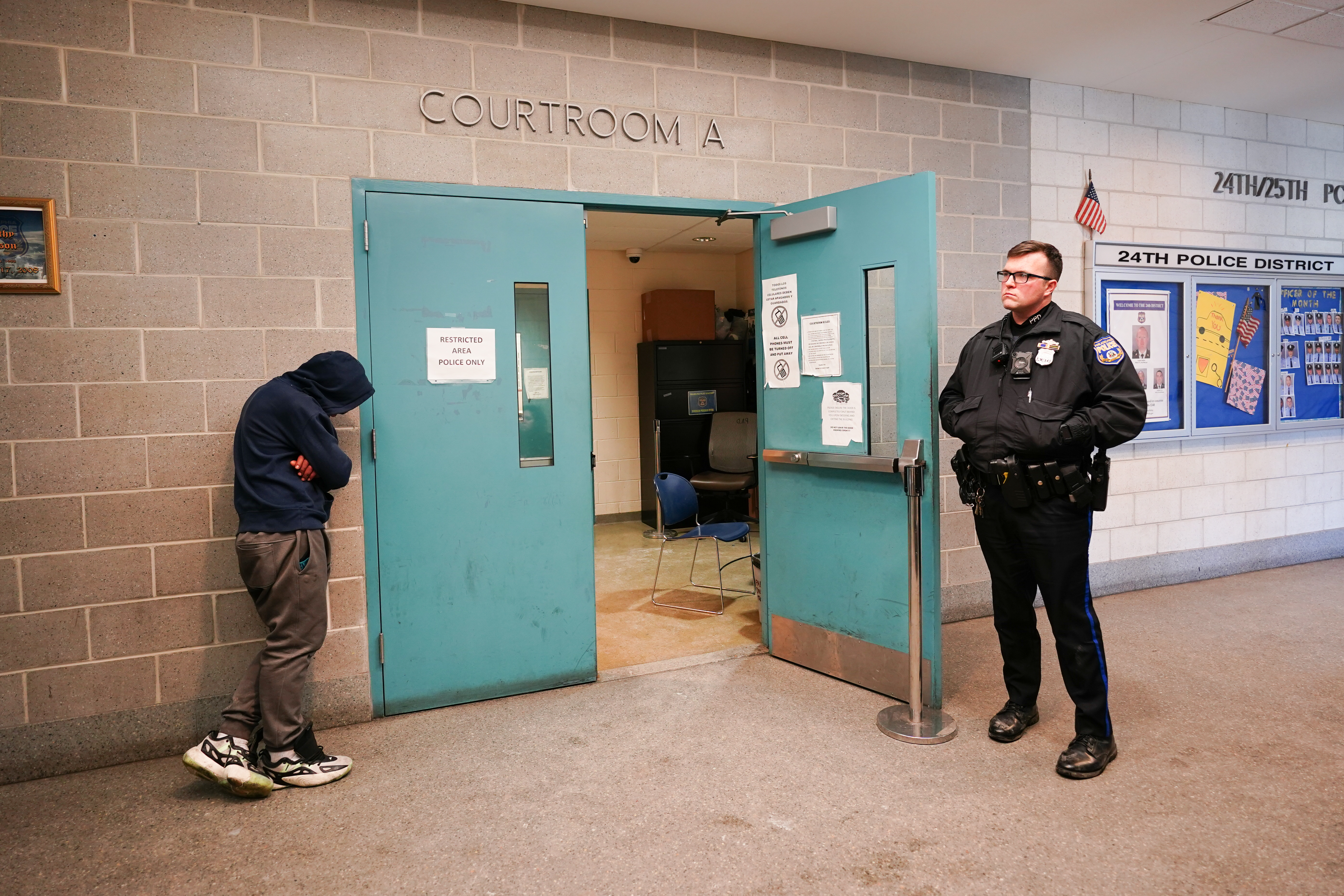
Wellness court takes place every Wednesday inside a courtroom at the 24th / 25th Police District.
Wellness court is a signature part of Parker’s plan to shut down Kensington’s notorious open-air drug market and restore quality of life for neighborhood residents.
The court runs on Wednesday afternoons. First, in the morning, police conduct sweeps of the Kensington area and arrest people in addiction for offenses like sleeping on the sidewalk, gathering around an outdoor fire, or stumbling into the street. They are typically charged with summary offenses like obstructing highways.
Those arrested are then brought to the Police-Assisted Diversion program building on Lehigh Avenue, where they are evaluated by a nurse and an addiction specialist. Officials also attempt to address any outstanding arrest warrants, and connect them with a court-appointed attorney hired by the city to discuss their rights.
Finally, they are brought before a judge — Lewandowski has heard most cases so far — inside the nearby police district. They are offered the opportunity to immediately go to rehab or face a summary trial for their alleged crimes. Those who opt to go into treatment and complete the program and terms set by the city will later have their cases dismissed and expunged.
Few in the program have asked for a same-day trial. Those found guilty have so far been ordered to pay fines and court fees ranging from about $200 to $500.
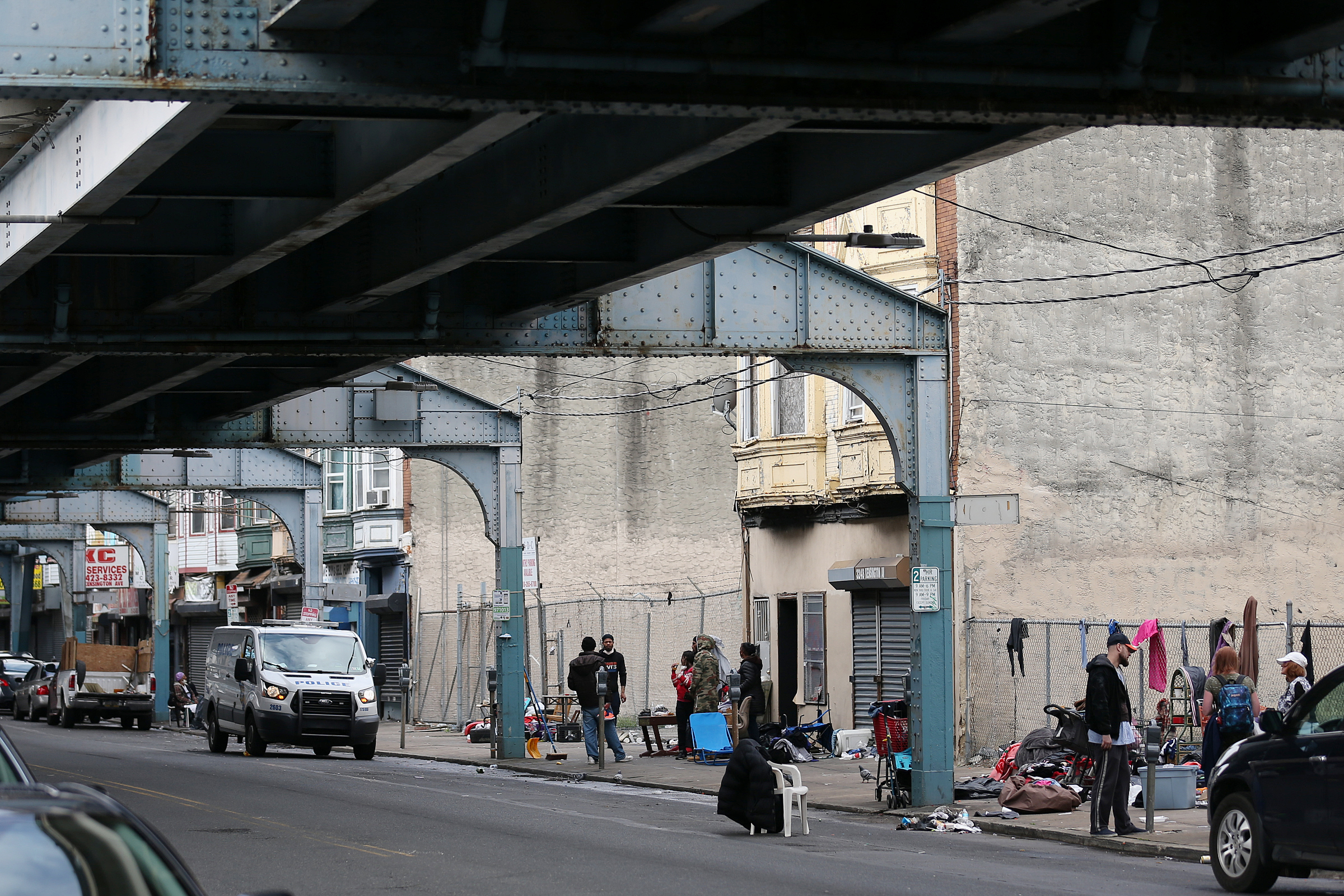
Homelessness and public drug use is widespread in Kensington, the heart of the city’s open-air drug market.
Of the more than 50 people who have come before the court so far, only two had successfully completed treatment as of early April, according to data collected by The Inquirer. The vast majority brought through the program almost immediately leave treatment and do not appear at follow-up hearings, the data show.
The city has declined to share data on wellness court, including with City Council at a recent budget hearing, saying that it is too early to judge the program on numbers alone and that more time is needed to see results.
But the Parker administration said it wants to expand the court and needs more funding for it to succeed. At a recent budget hearing, Geer asked City Council for an additional $3.7 million to operate the court five days a week and hire additional staffers.
The goal, Geer said, is to build a system where people suffering on the streets can immediately be connected with treatment and resources, avoid going to jail, and get housing through the city’s new Riverview Wellness Village. Geer has said that the program will never have a 100% success rate, but that every “touch” the program has with people in addiction increases their likelihood to eventually go into treatment.
But the First Judicial District has said wellness court will not be expanding anytime soon, according to sources.
Civil rights advocates have raised constitutional concerns over the program. In a letter to the Parker administration, the Pennsylvania chapter of the American Civil Liberties Union said the program could pose a threat to drug users’ rights and questioned whether the city could force people to make consequential legal decisions while potentially under the influence of narcotics.
The 42-year-old man in addiction who died inside a Philadelphia jail days after his arrest in Kensington had been flagged as an “emergency” case by an intake worker at the jail, and should have received one-on-one supervision in the hours before he collapsed, according to records from the Department of Prisons.
But that didn’t happen, and instead, Andrew Drury died alone inside the holding cell, without having received a formal behavioral health evaluation by the prison staff, according to the records obtained by The Inquirer. His cause of death remains under investigation, though when he was jailed in the fall, he had been hospitalized multiple times from withdrawal-related health complications.
A spokesperson for the Philadelphia Department of Prisons declined to comment Friday.
Drury had been picked up by Philadelphia police on the night of March 6, after officers encountered him at Kensington Avenue and Somerset Street, and learned he had outstanding bench warrants related to a drug case in Maryland and a 2022 violation of a protection-from-abuse order filed in Philadelphia.
Police said Drury received off-site medical treatment over the next day before he was transferred to Curran-Fromhold Correctional Facility around 2:15 a.m. on March 8. Police declined to say what kind of treatment he received, where he was treated, or how he was cleared for transfer to the jail.
Drury remained in an intake room at the jail until the next afternoon, waiting to be medically evaluated and assigned to a cell block. On March 9, around 9:30 a.m., an intake worker for the prisons assessed Drury and wrote that he was experiencing a range of physical and behavioral health issues and described him as extremely agitated and confused, according to the records.
Andrew Drury, left, and Jennifer Barnes had been homeless and struggling with addiction in Kensington for about two years. Drury died on March 9 inside a Philadelphia jail.
The employee labeled Drury as an emergency case, which, according to the records, should have required that he receive one-on-one supervision until he could be evaluated by a behavioral health worker.
Instead, Drury remained in his intake cell for another six hours. A jail guard walking through the area found him unresponsive at 1:45 p.m., and despite administering two doses of Narcan and other lifesaving measures, he was pronounced dead at 2 p.m., according to a spokesperson for the prison.
The Philadelphia Medical Examiner’s Office said Wednesday that doctors are awaiting toxicology results to determine his cause of death.
Drury had long struggled with an opioid addiction, and had been experiencing homelessness in Kensington for about two years, said his longtime girlfriend, Jennifer Barnes.
In an interview this week, Barnes, 44, said she believes he died from health complications related to withdrawal — something that he has been hospitalized for in the past.
When Drury was arrested in October on bench warrants related to the same cases, he was hospitalized multiple times, including for more than a week, after suffering a mild heart attack and other issues while going through withdrawal in jail, according to Barnes and a source familiar with Drury’s care at the time.
After Drury was released in November, Barnes said he was in and out of the hospital because of ongoing chest pains and shortness of breath.
Barnes said she worried about his health as she watched police arrest him that night.
“The withdrawal, it’s not good for him,” she said she told the officers. “He needs medical attention.”
Jennifer Barnes, whose fiancee Andrew Drury died while in jail, shown here in Philadelphia on Tuesday.
Drury’s death comes as the city ramps up enforcement efforts in Kensington, a section of the city that has long experienced concentrated violence, homelessness, and drug use in and around its massive open-air drug market. Mayor Cherelle L. Parker has said her administration would shut down the drug activity in the area and return a quality of life to the neighborhood’s residents.
But some advocates have warned city and law enforcement officials that the withdrawal effects for people who use opioids can be life-threatening, and that the understaffed jails might struggle to respond to people’s health needs in those circumstances.
Barnes said she and Drury were both from South Philadelphia, and had been dating since 2012 after meeting in a luncheonette in the neighborhood. They were not married, she said, but wore rings as if they were.
Andrew Drury and Jennifer Barnes in a photo before they became homeless in Kensington.
Barnes said she has struggled with addiction since about 2008. Drury also used drugs by the time they had met, she said, his troubles beginning after he underwent a weight loss surgery and got hooked on pain killers. For many years, they were both able to hold jobs and hide their addiction.
They bounced between friends’ and families’ homes, she said, until they were kicked out of Drury’s mother’s house in 2021 and she got a Protection From Abuse order against him. They’ve been on the streets of Kensington since about the summer of 2023, she said.
Drury was funny and loving, she said, and helped protect her from the dangers of living on the streets. They had both recently talked about wanting to go to rehab and getting their lives back on track.
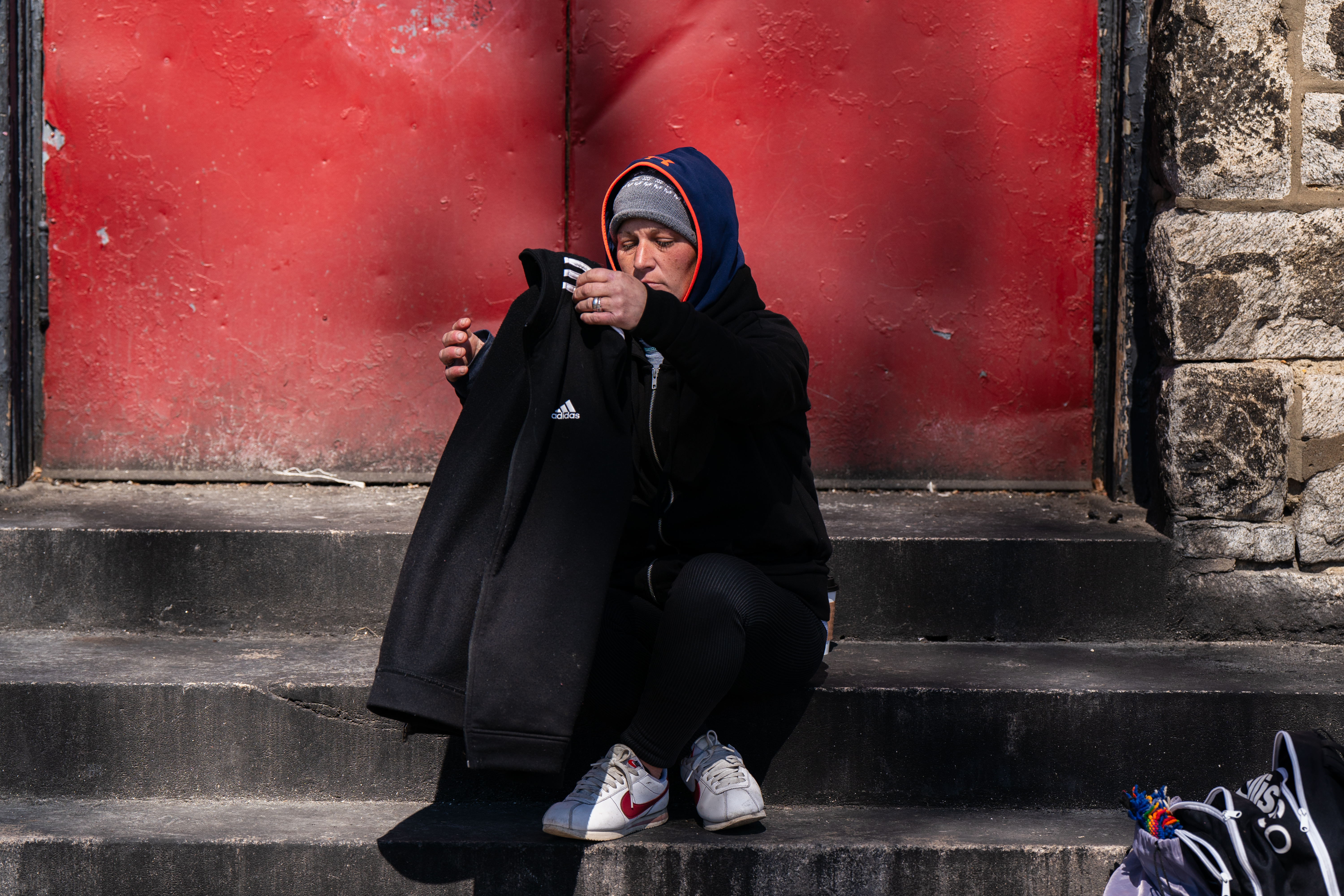
Jennifer Barnes holds the sweatshirt of her longtime boyfriend, Andrew Drury, who died in jail on March 9.
Since his death, she said, she feels in a fog. She has connected with a friend who found a bed for her at a recovery house in South Jersey, and she hopes to go next week.
“For myself, and for him, it’s the best thing to do,” she said. “This way he won’t have to worry anymore.”