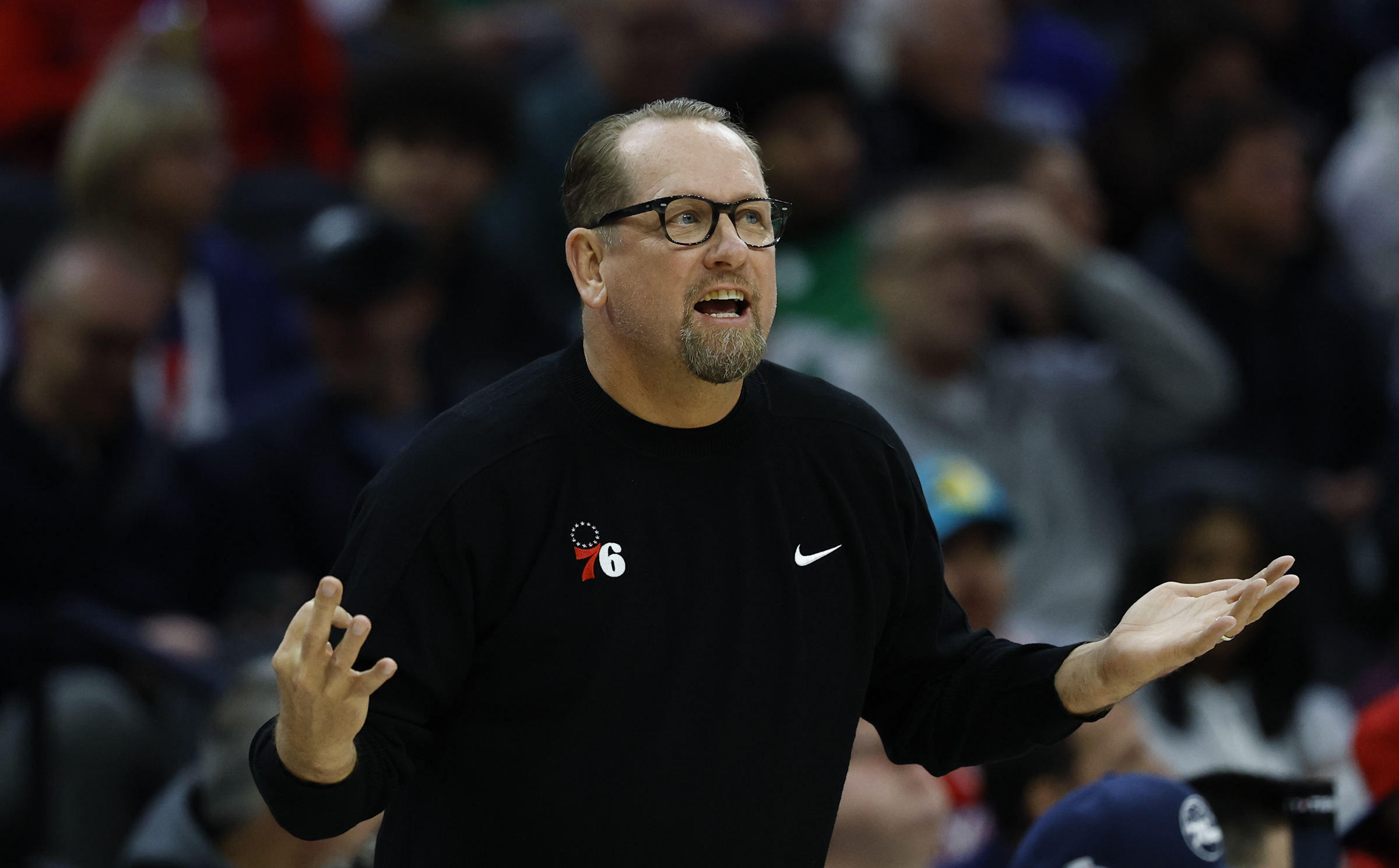
Tyronn Lue chuckled before the reporter could even finish the question.
Do memories of the 2001 NBA Finals — more specifically, being on the wrong end of Allen Iverson’s iconic step-over in overtime of Game 1 — flood back whenever he returns to Philly?
“Every single time,” said Lue, the former Los Angeles Lakers guard who now coaches the Clippers. “You never forget it.”
The 76ers will wear their black throwback jerseys throughout this season, as part of the 25th anniversary celebration of that Eastern Conference championship team. Donning them against the Lakers on Sunday night was most fitting.
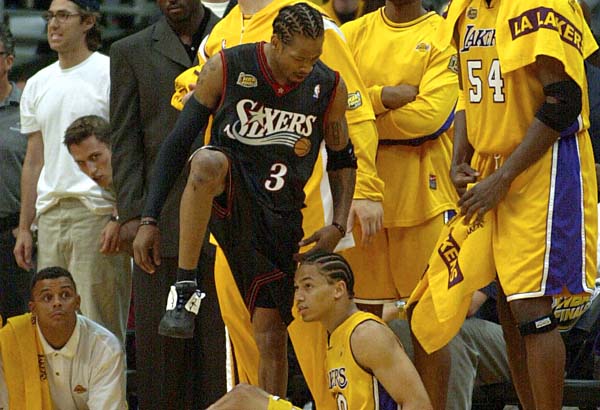
Those jerseys are synonymous with that Finals series, and AI’s signature moment. Iverson sent Lue to the court by pulling back to fire a baseline jumper. After drilling the shot, Iverson stared at — while stepping over — a seated Lue in front of the Lakers’ bench. Though the Lakers won that series, four games to one, as part of the Kobe Bryant-Shaquille O’Neal dynasty, Iverson delivered an all-time highlight play in franchise and NBA history.
The Inquirer recently asked some of today’s Sixers about their memories of that sequence. Kyle Lowry was a North Philly kid at the time. Paul George was growing up in Southern California and would eventually be coached by Lue. Tyrese Maxey, whose exceptional start to the 2025-26 season is drawing comparisons to Iverson, was barely born.
And, of course, Lue also provided his perspective 25 years later.
Kyle Lowry: “I remember everybody driving around, beeping their horns”
Today, Lowry considers Lue “one of my closest friends in the world.”
Yet back in 2001, Lowry was a young teenager feeling like the basketball universe had counted out his Sixers. He was watching the game at home when Iverson went right, created the space for the shot, and “[stomped] with the big dogs,” he said.
“Everybody in the whole city of Philadelphia, at the same time, jumped up and cheered,” Lowry recalled. “ … And then after the game, I remember everybody driving around, beeping their horns.”
Now, it is “special” for Lowry to wear those black jerseys in his return to his hometown to (likely) close out his NBA career. He is tight with Lue, whom Lowry reminded may have changed that Finals series with his ability to guard Iverson full-court.
And Lowry “knows for a fact” that Iverson and Lue have a good relationship today.
“I don’t think it was nothing disrespectful,” Lowry said. “I think it was just a great moment for the game of basketball, and an amazing basketball play for the city of Philadelphia.”
Paul George: “He was the Man in the Arena”
George was an Iverson fan growing up. But as a Southern California kid, he said Bryant “was everything to us.”
So George was rooting for the Lakers during those 2001 Finals. He was “amazed” at how Iverson challenged the team led by his favorite player and the equally dominant O’Neal.
And when the step-over happened, “it kind of was just, like, ‘This smaller guy is a giant,’” George said.
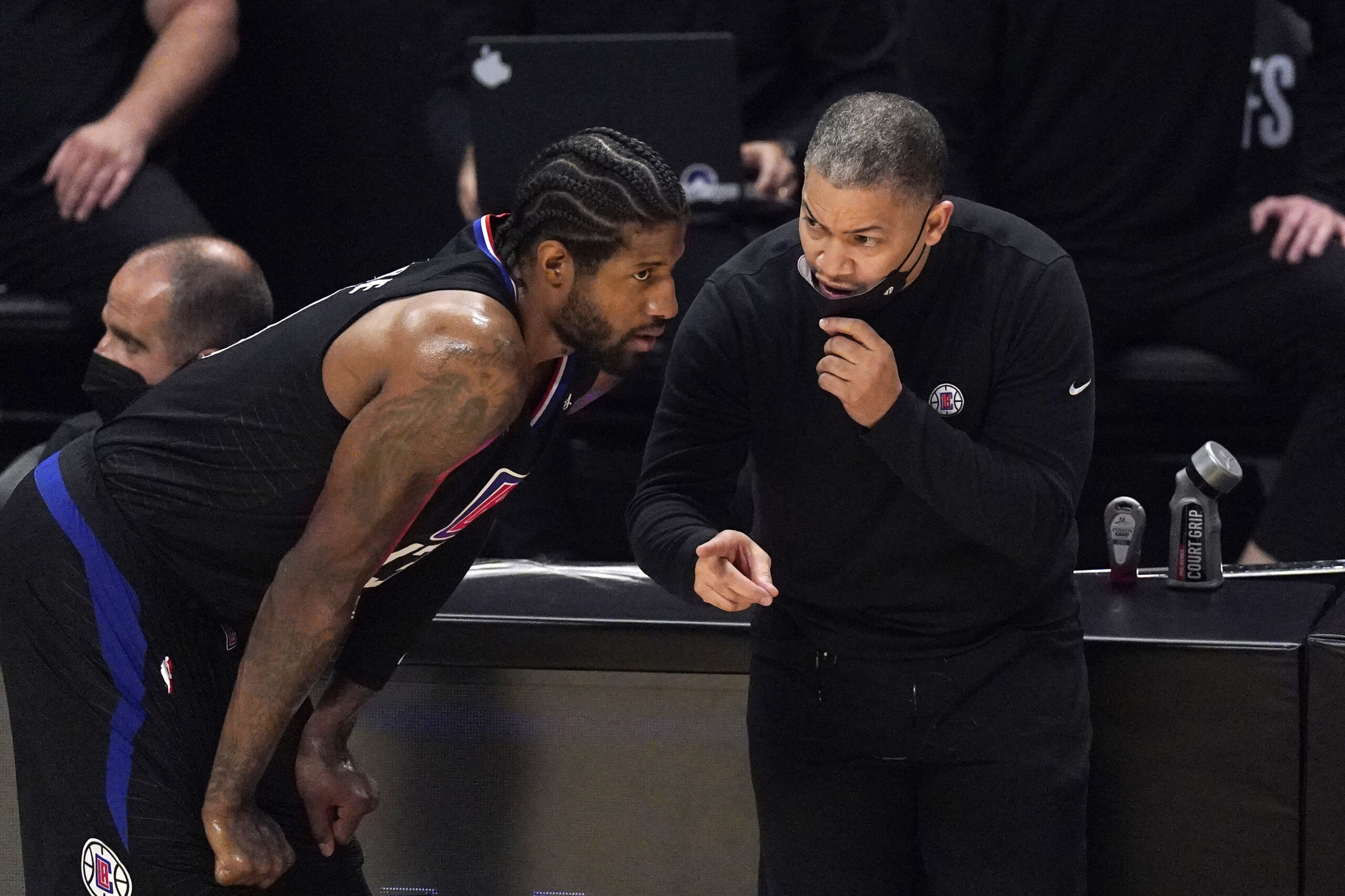
Sixers star Paul George played for Clippers coach Tyronn Lue during his five seasons in Los Angeles.
“It just solidified how good he was and his magnitude and just his swagger,” George said. “That’s what I kind of took away from it, was just his confidence and his swagger. In that moment, he was the Man in the Arena.”
George then was coached by Lue during his five seasons playing for the Clippers. Though George said the step-over never came up in conversation, he is not surprised Lue does not view it as a source of shame.
“Kobe said it best: You play against the best players, you’re going to get embarrassed sometimes,” George said. “It comes with it. It’s fun. I look forward to being embarrassed, because I know I’m going to come back for you the next time. It comes with the territory of being a defender.”
Tyrese Maxey: “That was a crazy play”
Maxey was born Nov. 4, 2000 … aka, during that magical Sixers season.
Which means he obviously has no in-the-moment memory of the step-over. The first time he remembers watching it and “actually [knowing] what’s going on,” he believes, was in middle school.
“That was a crazy play,” Maxey said. “ … A wild moment in history. It will never be forgotten.”
Since becoming a Sixer, Maxey has gotten to know Iverson, who is a regular visitor at games and team functions. As a fellow scoring (and smaller-framed) lead guard, Maxey said Iverson’s best advice has been to “just be ultra-aggressive every single time you step on the court.” And Maxey’s torrid start to the 2025-26 season — through Sunday he ranked third in the NBA in scoring (31.5 points per game), while also averaging 7.2 assists and 4.7 rebounds — has been Iverson-esque.
It is poetic that, during this celebratory season, Maxey dressed up as Iverson for the team Halloween party. Asked why that was his costume of choice, Maxey said, “I just thought it was funny.”
Tyronn Lue: “It couldn’t have happened any better”
Lue said he can now thank Iverson for the step-over. Or, at least, for the opportunity to guard him.
Had the Toronto Raptors advanced to the Finals instead of the Sixers, Lue deduced, he likely would not have played in that series because their starting guards were the bigger-framed Vince Carter and Alvin Williams.
“I could have been out of the league,” Lue said. “ … It definitely was a blessing. Without that matchup [with Iverson], I probably wouldn’t have had as long of a career as I had.”
As that play unfolded, Lue did not think it would become such a “big deal.” After attempting to contest the shot, Lue slipped and fell in front of Iverson’s legs while turning around to see if the ball had splashed through the net. But then “Doug Collins went crazy” on the television broadcast, Lue said, generating even more buzz for those outside the arena.
Lue jokes that he and Iverson were “probably still mad at each other” a couple of years after the play. But since then, Lue confirmed they have become “really good friends.”
“We’re close in age,” Lue, 48, said of the 50-year-old Iverson, “but I still idolized him when I was coming up through college, and when I got to the league. Just idolizing somebody who was only two or three years older than you is kind of crazy, but I looked up to him.
“Having an opportunity to play against somebody you idolized was a great moment for me.”
That moment did propel Lue into a successful career as a complementary player, which spanned 11 seasons across seven teams. He is now regarded as one of the game’s most respected coaches, winning the 2016 championship leading the Cleveland Cavaliers and earning a reputation for impressive tactical adjustments.
Twenty-five years later, Lue looks back on that flashpoint of his career — which some might expect would spurn irritation or embarrassment — with fondness.
“It couldn’t have happened any better,” Lue said. “I tell people all the time, he could step over me 50 times, if I get the opportunity [to guard him] again.”
Inside the 76ers’ celebratory postgame locker room late Thursday, VJ Edgecombe received a phone call from Buddy Hield.
That would not normally occur between two players who had just faced off in a wild thriller. But it is not hyperbole to conclude that Edgecombe may never have made his game-winning plays against the Golden State Warriors — a steal, then a go-ahead putback in the final 8.2 seconds of a night that swung from Sixers blowout, to disastrous collapse, to chaotic 99-98 victory — without attending Hield’s basketball camps in their native Bahamas as a teenager.
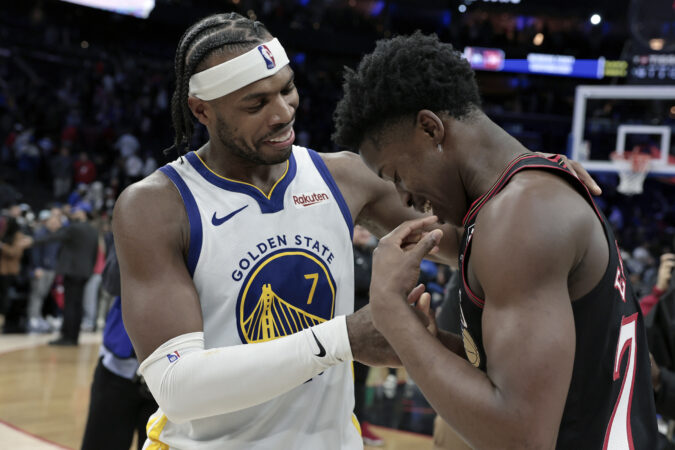
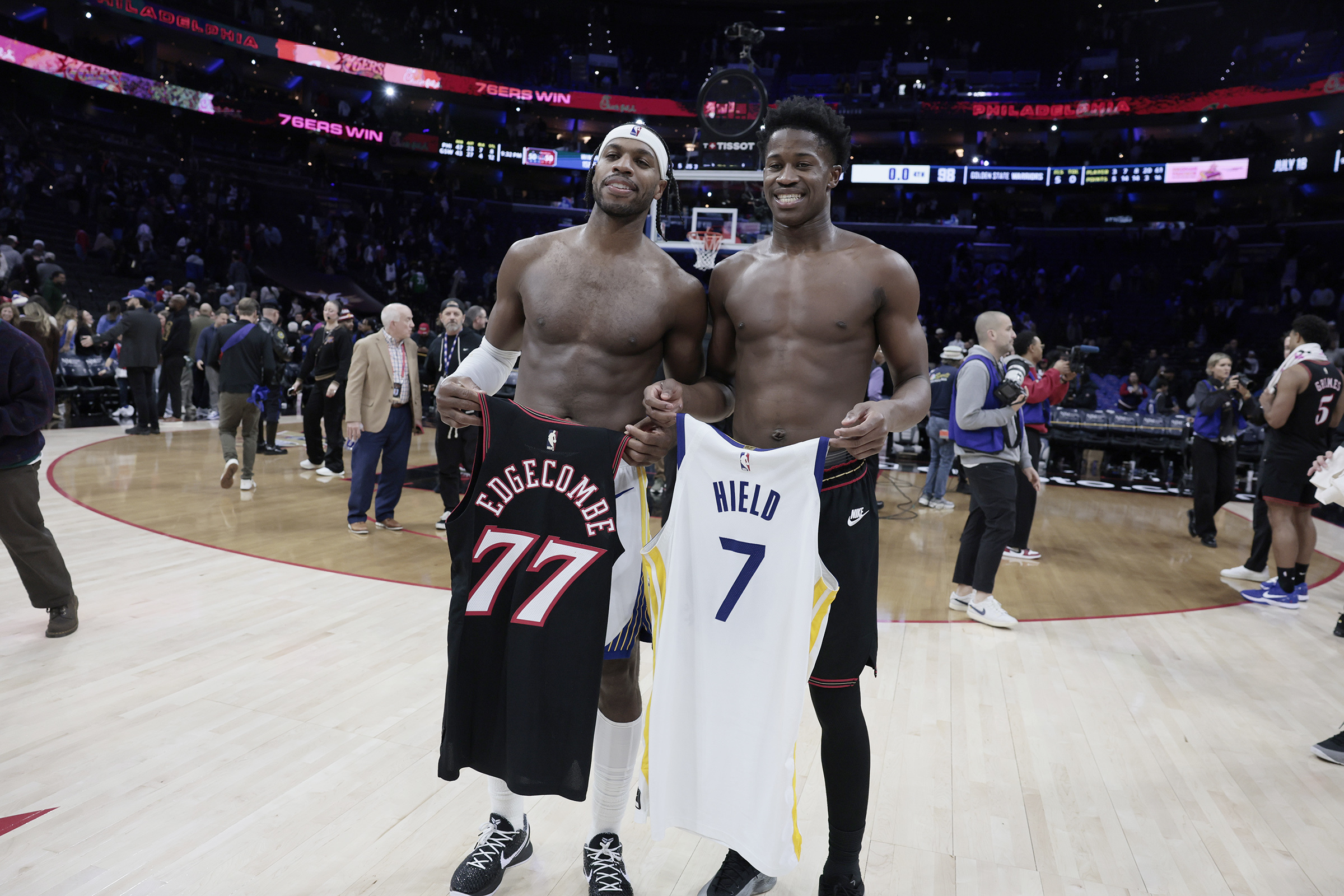
Thursday’s crazy finish capped the first night that Hield, a respected 10-year sharpshooter, and Edgecombe, an electric two-way rookie, shared the floor as NBA peers. Edgecombe finished with 10 points, six rebounds, five assists, and three steals; Hield with 14 points, eight rebounds, and two steals. And as the postgame hubbub continued to swirl around them, Edgecombe and Hield met at center court to exchange jerseys.
“I love Buddy with all my heart,” Edgecombe later told The Inquirer. “ … He always had faith in me, and always was teaching me little points about the game.”
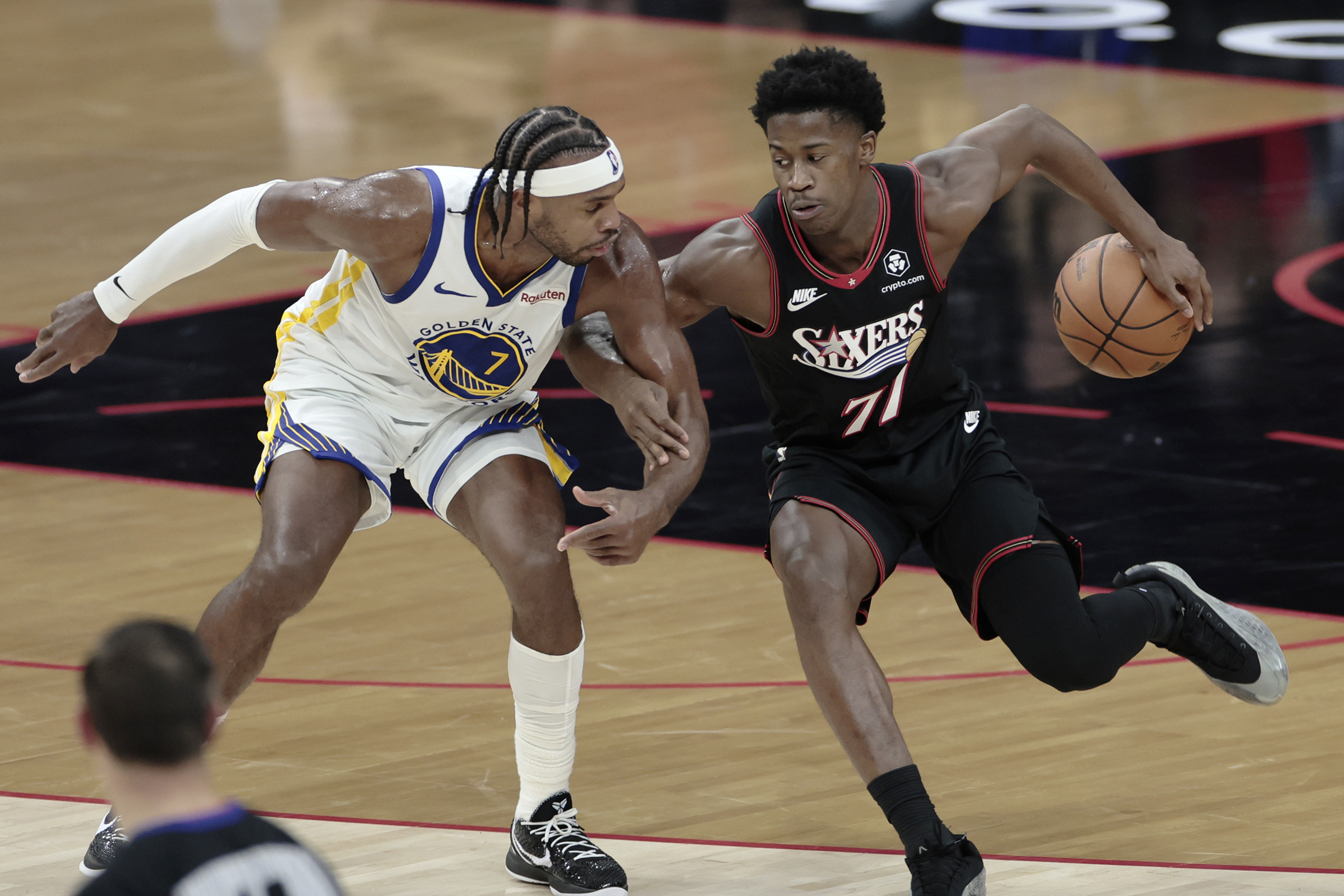
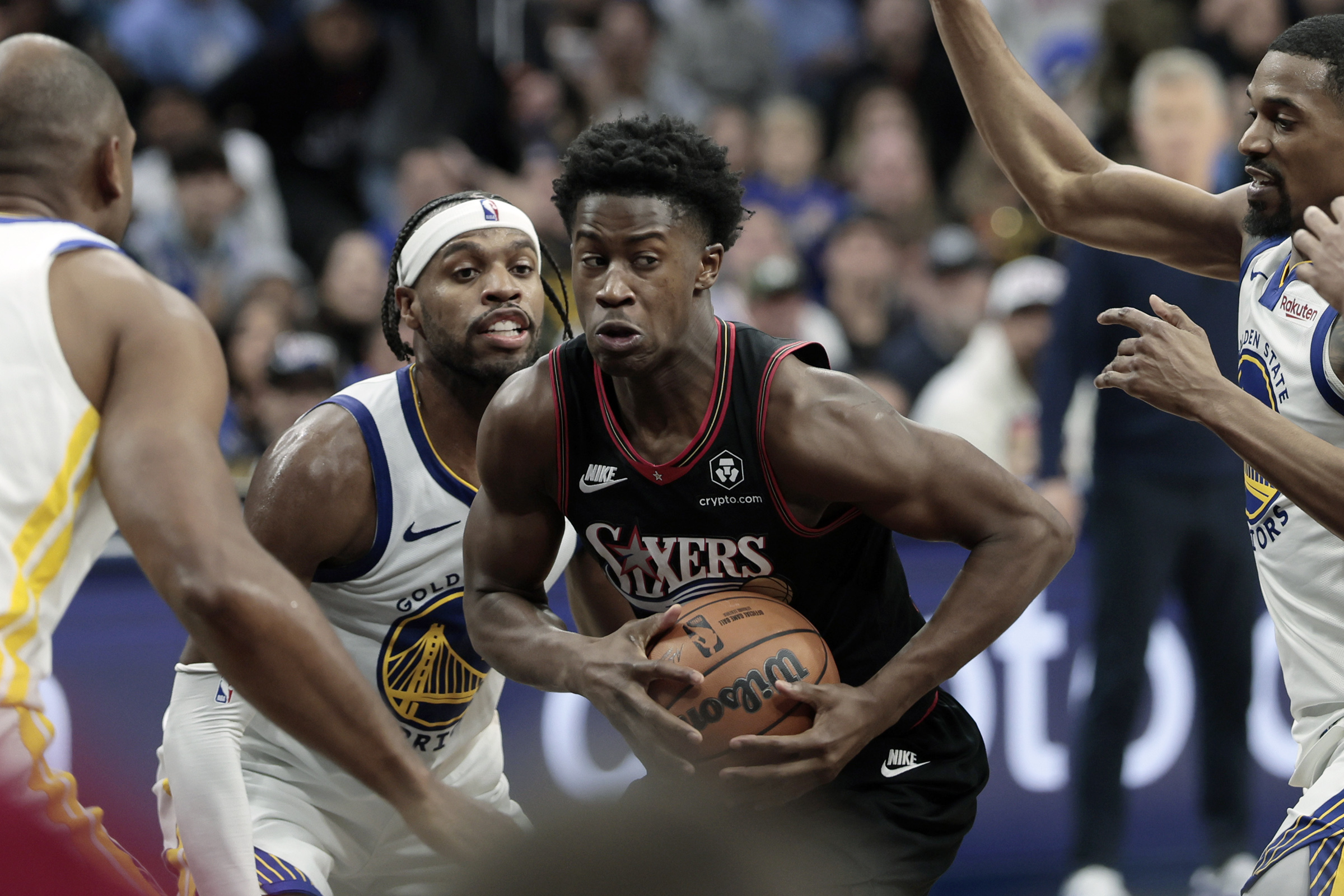
Good friends VJ Edgecombe of the Sixers and Buddy Hield of the Warriors play against each other on Thursday.
This Sixers-Warriors matchup was coincidentally full of reunions. Hield played 32 games for the Sixers after being acquired at the 2024 trade deadline. Tyrese Maxey’s game-saving block after Edgecombe’s bucket came against former teammate De’Anthony Melton, who spent a couple hours at Maxey’s home Wednesday to catch up as friends before making his season debut following knee surgery. Seth Curry and Al Horford are also former Sixers, and received drastically different receptions from the home crowd. So is Jimmy Butler, who sat out Thursday’s game with a knee injury.
But none of those players’ ties boast the roots of Edgecombe and Hield, who both described their relationship as little brother-big brother.
Edgecombe first attended Hield’s camp as a 13-year-old, aka the “smallest kid there” among a group of mostly high school juniors and seniors. But Hield immediately noticed Edgecombe’s skill and eagerness to be good. Then, Edgecombe hit a growth spurt and added muscle to his frame.
“The next year, I see him on the rim dunking on people,” Hield recalled to The Inquirer before Thursday’s game. “I was like, ‘Oh, [expletive]. He’s going to be really good.’”
Throughout the years, Hield kept in touch with Edgecombe to “[make] sure I was always good,” the rookie said. Hield would emphasize staying confident and working hard.
Then, Edgecombe and Hield became Bahamas teammates for the 2024 Olympics Qualifiers. On a roster that also included fellow Sixer Eric Gordon and Los Angeles Lakers center Deandre Ayton, Edgecombe provided “an aggressive downhill energy that we didn’t have,” Hield said. The team would allow a pre-college Edgecombe to run pick-and-roll after pick-and-roll, trusting that he would either draw a foul while attacking the basket or kick out to an open Hield at the three-point arc.
Golden State’s Buddy Hield (left) and the Sixers’ VJ Edgecombe exchanged jerseys after the Warriors played the Sixers on Thursday night.
Edgecombe’s performance in that high-pressure environment, while playing against grown men, helped ignite his ascension to coveted NBA Draft prospect. Then came his successful season at Baylor, an impressive pre-draft process, and becoming the Sixers’ pick at No. 3 overall.
“I was like, ‘Man, I watched this kid grow up,’” Hield said. “That’s kind of dope, you know what I mean?”
Through the first quarter of the regular season, Edgecombe has been one of the league’s top rookies.
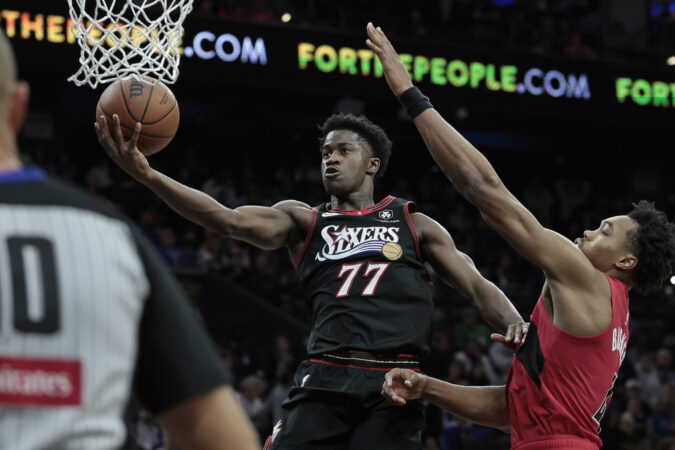
He scored 34 points in a historic NBA debut. He has been an impact player on both ends of the floor for a 12-9 Sixers team that is now guard-heavy and stressing a fast-paced style. He regularly ignites the crowd with his high-flying athleticism. He entered Thursday averaging 14.7 points, 5.8 rebounds, 4.8 assists, and 1.4 steals in 17 games, before some recent limitations due to a calf issue.
Before Thursday’s matchup, a grinning Hield vowed he would “go at [Edgecombe] and test that water.” But other than a 27-second stretch to close the first quarter, they were never on the floor at the same time until that wild final frame. They approached each other when they came back to the court following the quarter break. Edgecombe trash-talked Hield’s “fake defense,” before playfully shoving him to create space to receive the inbound pass.
And though Edgecombe struggled for much of Thursday’s game, coach Nick Nurse put the rookie back in for crunch time. Edgecombe has already earned the Sixers’ trust with his knack for clutch plays.
So while preparing for a defensive possession with his team trailing, 98-97, with 10.1 seconds remaining, Edgecombe knew the Warriors were out of timeouts. He tried to read Pat Spencer’s eyes, because “people tend to telegraph their passes a lot.”
VJ Edgecombe did not have the best game of his rookie season against Buddy Hield (left) and the Warriors, but continued to make a substantial impact.
“He had to throw the ball somewhere,” Edgecombe said. “Everyone was just in that one little spot, and I just dove on the ball, to be honest.”
That gave the Sixers an opportunity for a final-possession shot, with Edgecombe making the inbound pass. His plan was to “give the ball to Tyrese, and get out of the way.” But when Maxey’s fadeaway jumper was tipped by Melton and began to fall well short of the rim, Edgecombe darted in to secure the putback.
Then Edgecombe sprinted the opposite direction as Melton attempted his own breakaway game-winner, and flexed after Maxey swatted the ball away.
“It’s what he does,” Maxey said of Edgecombe. “ … Whatever it takes for us to win the game, I know he’s going to make a play.”
Hield, meanwhile, had already entered the day proud that Edgecombe had become the latest Bahamian who, by making the NBA, could take care of his family and bring joy to his community and home country.
But after that wild finish — which capped the first time Edgecombe and Hield shared the floor as NBA peers — Hield needed to call his little brother.
“It brings more life to the youth, to uplift them,” Hield said of Edgecombe’s success. “For them to be like, ‘Yo, VJ did it. I can do it, too.’ They’re trying to write their stories, too.
“So I just hope he keeps on inspiring young kids, like I did for him.”
The banner made its way to the bottom of the student section, and a crew of security guards soon was hovering. Everyone had to go, they said.
“We were like ‘What?,’” said Luke Butler, who led the crew of Temple students that night at La Salle.
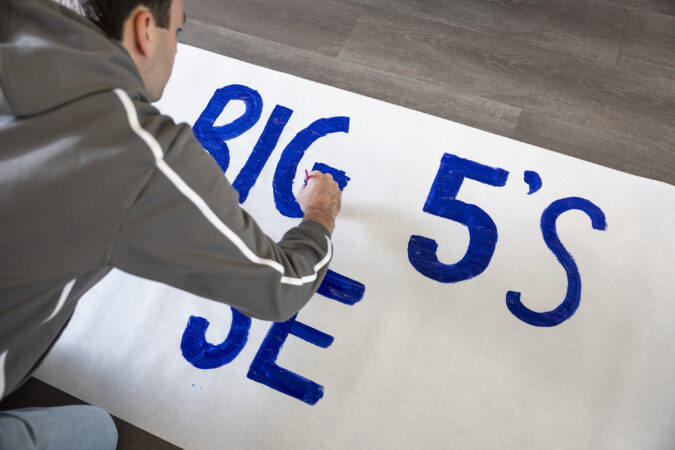
The fans — the Cherry Crusade — spent a few days crafting one-liners to paint onto 30-foot banners that would be rolled out during the Temple-La Salle basketball game. The “rollouts” have been a Big 5 tradition since the 1950s, even surviving a brief ban when the schools thought the messages had become too racy.
The rollouts often are a play on words or innuendoes that make light of the opposing school. You roll out your banner and then hold your breath while the other school shows theirs. Each student body takes turns dissing each other like kids in a schoolyard. The best rollouts, Butler said, are the ones that “twist the knife” just a little.
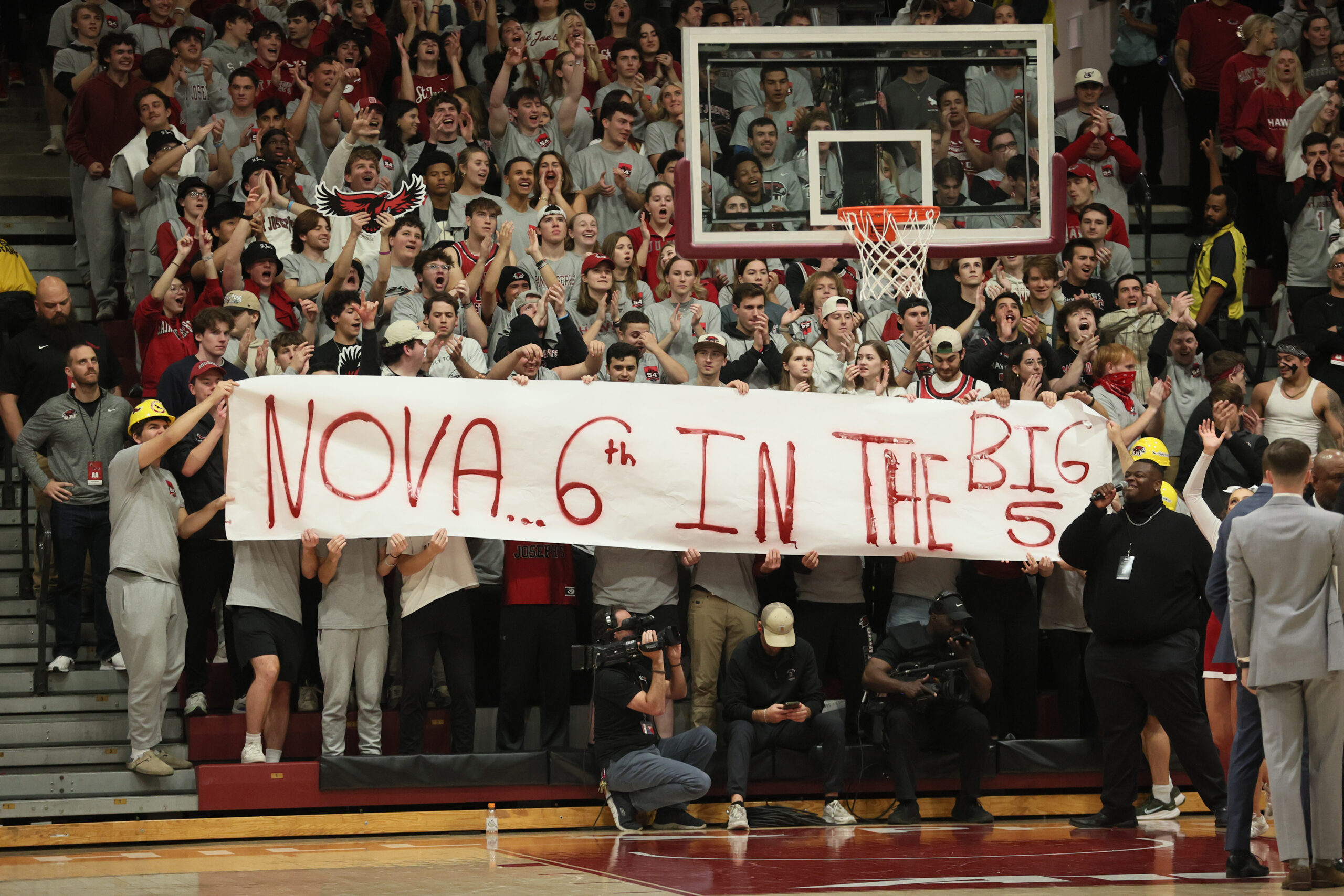
St. Joe’s students unveil a banner referring to Villanova finishing last in the Big 5 Classic last year.
But this one, Butler learned, twisted a little too much.
The Explorers entered that game in February 2010 on a seven-game losing streak, and Ash Wednesday had been two weeks earlier. Temple, down a point at halftime, raced away in the second half. And here came the rollout: “LA SALLE GAVE UP WINNING FOR LENT.”
The Temple students — the same crew who held a “funeral” a year later for the St. Joe’s Hawk — thought it was good banter. But a priest was offended, and security had instructions.
“They were like ‘Father is pissed. You basically affronted their faith, and they don’t want you in the building,’” Butler said. “That was a good example of a rollout where we said ‘This will get a good reaction.’ It did. It just wasn’t the reaction we were thinking of.”
70 years of rollouts
The rollouts trace back to the Palestra, when the building was the home of the Big 5 and basketball doubleheaders. The bleachers were filled, the basketball was good, and the crowds were lively. Philly was the center of the college basketball universe, and the Palestra was a scene.
The “rooters” who sat behind the baskets would roll out banners during the games about opposing schools. The messages were a chance for a student body to take a shot at their rivals from across the court. When La Salle students hung a dummy of their coach in the early 1960s from a campus flagpole, St. Joe’s rolled out a banner a week later that said “We Fly Flags on our Flagpole.”
The messages became more pointed, as the Daily News wrote in January 1966 that “the rollouts wandered from the realm of good taste.” The Big 5 athletic directors agreed to ban them, saying that “certain rollout subject matter has been offensive and detrimental to the best interests and continued success of the Palestra program.”
The president of the St. Joe’s student section protested the decision at the Big 5’s weekly luncheon, telling the athletic directors that they were ruining “the greatest spectator participation event in sports” and the rollouts were part of the “spectacular” that was basketball at the Palestra.
“It’s not a spectacular,” said Jack Ramsay, then the coach and athletic director for St. Joe’s. “We’re down there to play basketball. If the students want to join in, that’s fine.”
No longer allowed to roll out their messages, students at the Palestra began to shout what they would have written. Banner Ball gave way to Chorus Ball, the Daily News wrote. A year later, the students won, and rollouts were welcomed back to the Palestra as long as messaging was preapproved by the school’s athletic office.
The banners became as integral to a Big 5 game as a soft pretzel from the Palestra concession stand. You didn’t miss a basket during a doubleheader, but you also made sure you caught the dig the opposing students made during a timeout about your school.
The banners were the game within the game as the student sections planned their rollouts like a comedian preparing a stand-up skit. The jokes had to be fresh. How many times can you call the other coach ugly before it’s no longer funny? They had to be timely and tap into current events. That scandal involving a prominent alumni from the other school? Fair game. The football team stinks? That’ll work. A basketball player got arrested? There’s a rollout to be made.
And they had to be timed just right. You can’t come out swinging with your best bit. You have to build up the crowd with a few decent banners and then roll out the one you know will hit.
“You could tell from the other alumni if they were like, ‘Whatever,’ or if it really pissed them off,” Butler said. “Ultimately, that’s what you’re looking for. From brainstorming, to the making of them, to rolling them out, you’re looking for that reaction of them saying ‘Ugh.’”
A fading tradition
The rollouts, just like the Big 5, seem to be waning. Student attendance at local games is no longer what it was. The basketball programs have been down, the transfer portal has made players hard to identify, and conference realignment has introduced games with unfamiliar opponents.
Villanova — the lone Big 5 school to make an NCAA Tournament in the last five years — is the only team that regularly draws a large swath of students. Most schools fill up a student section for the marquee games but attract just a small group on most nights. Attracting students to a once-integral aspect of campus life has become a challenge.
Each school is trying to confront the decline of student participation, and Temple decided last year to revamp its student section. The Cherry Crusade does not have a student president, and the rollouts are made by athletic department staffers.
A banner made by the Olney Outlaw’s La Salle Student Section on Thursday.
They sold out their tickets two years ago when they reached the final of the Big 5 Classic and still fill the student section for a big game. The challenge has been to build a consistent presence.
“We want to find those passionate fans to bring back what the Cherry Crusade was,” said Katie Colbridge Ganzelli, Temple athletics’ marketing coordinator for on-campus initiatives. “They’re still there. We’re just trying to find those passionate students who want to be in charge of the student section like it used to be.”
Villanova’s rollouts earlier this week vs. Temple — “Rocky would’ve gone to Villanova,” one said — didn’t twist the knife. Penn’s student section is dormant, forcing the band to provide rollouts. The tradition seems to be fading across the Big 5, but credit La Salle for trying to keep the edge.
The school revived its student section this season, and the Olney Outlaws took aim at a Big 5 coach for being follically challenged and used another rollout to dunk on Villanova and St. Joe’s. They’re twisting the knife in Olney.
“We had noticed a lack of student engagement and thought this would be a fun way to get kids involved,” said Paige Mitchell, a senior marketing major who founded the Olney Outlaws. “I was working in the athletic department, and my boss at the time gave me a project to come up with something that would get everyone more engaged. It’s grown from there.”
Get your rollouts ready.
The road to the Toyota Big 5 Classic starts Saturday and ends at Xfinity Mobile Arena on December 6! 🏀 #Big5IsPhilly
The group of students — “I have a couple guys in the group who are pretty clever,” Mitchell said — brainstorm ideas for the rollout before they meet to paint their signs. They’re ready for Saturday, when La Salle plays Drexel in the Big 5 Classic.
“It’s stressful making sure they get rolled out at the right time,” said Mitchell, who’s also a center forward on the Explorers’ water polo team. “But I love seeing the way the students react. I have a couple friends who were sitting behind the rollout, and they’re blowing up my phone like, ‘What did it say?’ It’s just exciting.”
Perfectly Philly
Butler asked the La Salle security guard if he could talk to the priest, hoping he could ask for absolution. The priest was still steaming as Butler told him it was a misunderstanding. It was just some college kids making a joke, he said. The priest offered Butler penance: the Temple students could stay, but they had to hand over the rest of their banners.
But the Owls were going to clinch the Big 5 title that night, and the Cherry Crusade brought a rollout to celebrate it. Butler pleaded with the priest to allow them to keep that sign. He rolled it out to show the priest and security guard what it said. “Fine,” said the priest. The rollouts, once again, would not be banned. A perfectly Philly tradition lived on.
“There’s something in the Philly culture that rollouts hit a perfect vein,” Butler said. “The thing about people from here is that there is respect if you can dish it and you can take it. People love to twist that knife. When people did good rollouts against us, you were angry, but there was respect there.
“It’s making fun of people who appreciate it, but also hate it, and it gives you an opportunity to be a little bit of an a—. At the end of day, it’s all love. We all love Philly basketball, even though I’ll never root for St. Joe’s and I’ll never root for Villanova. But I still want them around. I want everyone to do well, so then the hate means something.”
NEW YORK — Maggie Doogan turned and launched a three-pointer from the top of the key, then yelled, “What?” when the ball splashed through the net to give Richmond a 13-point lead at Columbia last week. The former Cardinal O’Hara star grinned when she sank another deep shot to continue her team’s fourth-quarter surge.
After a cold shooting start, Doogan was Richmond’s leading scorer (16 points) and added nine rebounds, four assists, and three blocks in a key early-season matchup between mid-major programs that won NCAA Tournament games in March. And when a reporter in the postgame news conference suggested she had struggled offensively in the 77-67 road victory, coach Aaron Roussell playfully responded with, “Tough ‘evals,’ man.”
“I think it’s a pretty good stat line, with all due respect,” Roussell said. “ … I’ll take those ‘off’ nights from her.”
That illustrates the heightened expectations for Doogan, the reigning Atlantic 10 Player of the Year and perhaps the best mid-major player in women’s college basketball. The 6-foot-2 do-everything forward is averaging 23.1 points, 10.9 rebounds, 5.3 assists, and 1.4 blocks through the Spiders’ first seven games. That includes a monster performance in last week’s 72-57 victory over Temple, when she racked up 31 points, 14 rebounds, and nine assists.
Her ascent has coincided with Richmond’s, which last season won a second consecutive A-10 regular-season title and its first March Madness game in program history. The 5-2 Spiders, whose only losses so far are to No. 4 Texas and No. 8 TCU, were ranked in the preseason Associated Press top 25 poll and are receiving votes now.
Doogan acknowledges building this legacy is “not at all” what she envisioned when she signed with Richmond. But Roussell calls her a “perfect model” for player development, with the versatility to anchor the Spiders’ read-and-react offensive system. In this new era of college athletics, Doogan also made an increasingly rare decision to not entertain NIL opportunities from power-conference programs and stay at Richmond for her final season.
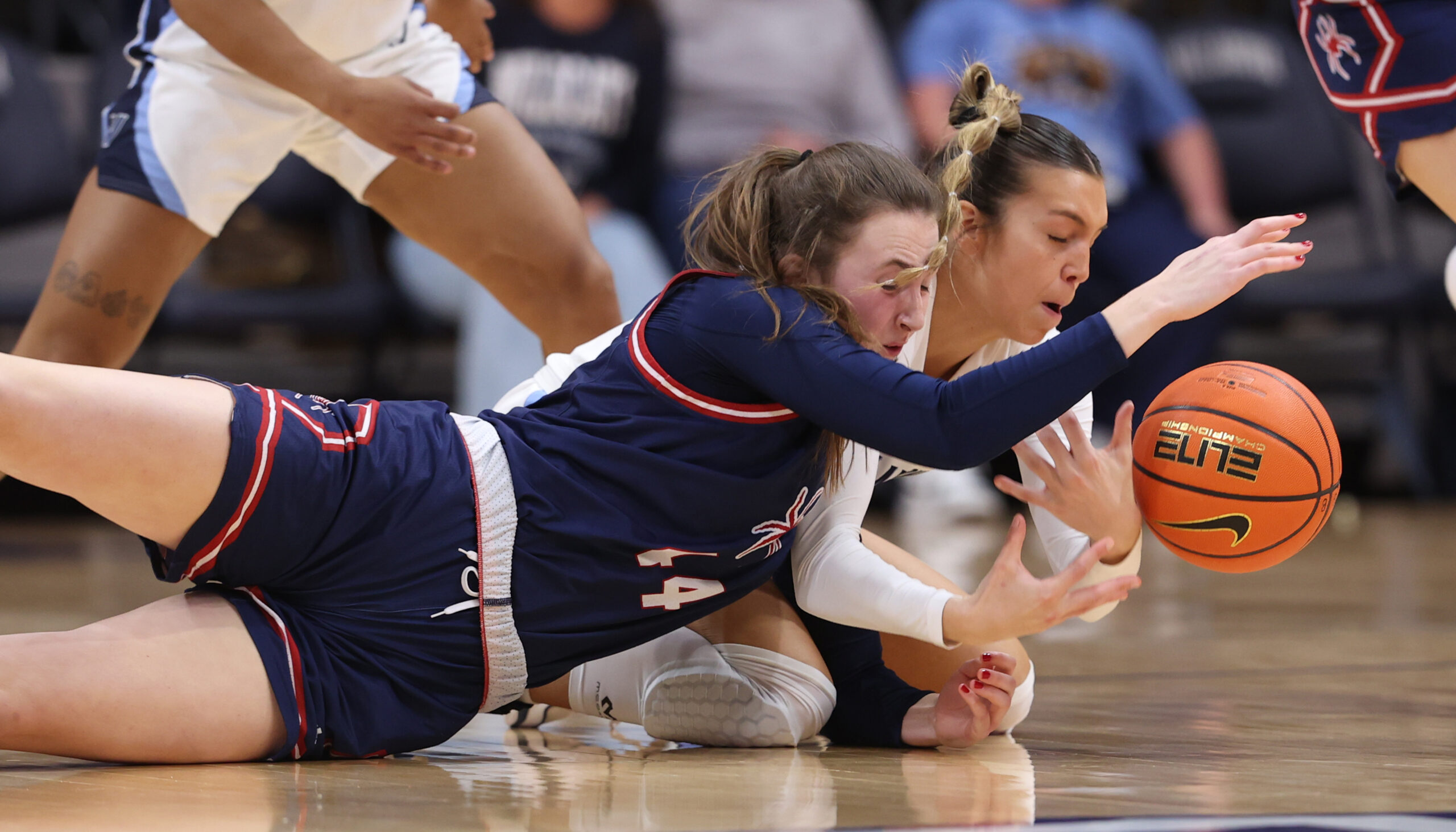
Richmond’s Maggie Doogan dives for a loose ball in a 2023 game against Villanova.
Also fueling Doogan’s rise? Her on-court diligence and quest for basketball intel. That sets the standard for everybody in the Spiders’ program — including its coach.
“You can’t fake anything with her,” Roussell said in a telephone interview last week. “You can’t be a teammate and not work hard around her. You can’t be her coach and not invest in her and not put the time in with the film. Because she’s going to have questions, and you need to be able to answer those.
“That’s probably been different for me coaching her than maybe any other kid that I’ve ever coached.”
Spiders?
When Doogan was a sophomore in high school, her mother, Chrissie, gave her a Richmond T-shirt as an Easter present.
“Mom, I’m not going to a school where Spiders are the mascot,” Maggie jokingly retorted.
But the Doogan family, based in Broomall, already had a connection to the Richmond coaching staff. Assistant Jeanine Radice, then at Marist, had recruited Chrissie (née Donahue) before she became La Salle’s second all-time leading scorer and member of the school’s athletics Hall of Fame. Then they stayed in touch as Chrissie entered coaching at La Salle, Cornell, and Cardinal O’Hara, where she currently is the school’s athletic director.
So Mom initially sent Maggie’s film, which highlighted her basketball IQ, to Radice. Maggie later demonstrated her outstanding shooting at one of Richmond’s camps, Roussell said. And the coach recognized untapped potential.
Maggie, meanwhile, was interested in branching out from the Philly area but remaining within a reasonable driving distance. She wanted strong academics and the opportunity to play right away. And while visiting Richmond’s campus, she fell in love with the “gorgeous” red-brick buildings.
“It was an easy choice once I really looked into it,” she said.
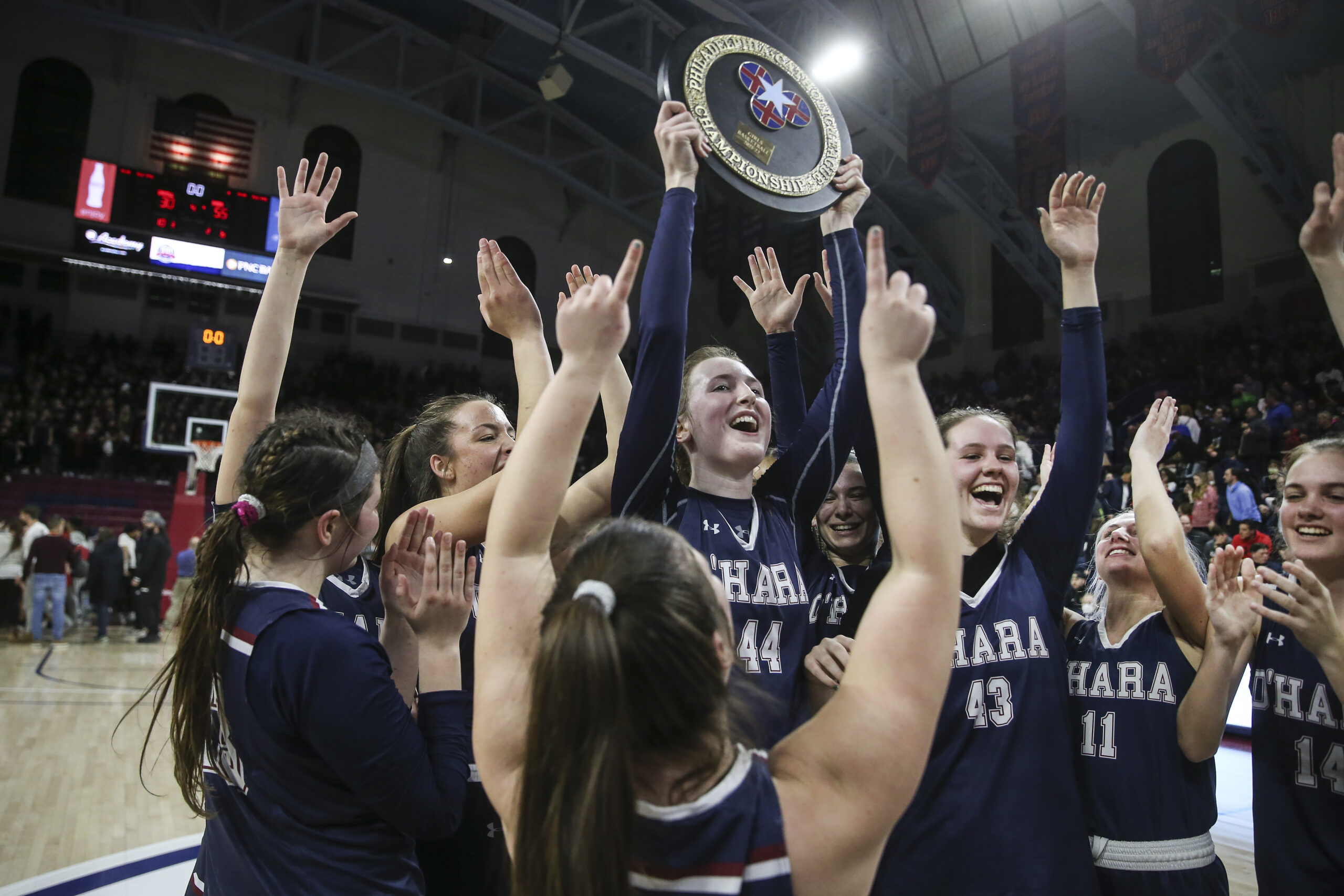
Cardinal O’Hara’s Maggie Doogan holds the the championship plaque as she celebrates with teammates after beating Archbishop Carroll for the Catholic League title in 2022.
Chrissie wondered whether Maggie’s lanky frame would be strong enough when she entered college. Roussell, though, deliberately took her early development slowly, because the coach “really wanted to make her earn” playing time. A broken hand kept Doogan sidelined for about five weeks, forcing her to step back and observe and pick coaches’ brains from the bench.
“I don’t know if they put something magic in my hand,” Doogan said, “but I was just kind of a different player and took that big leap. That kind of just gave me more confidence at the collegiate level.”
Her breakout game fittingly came in a nationally televised overtime victory over St. Joseph’s. Roussell called her “unguardable” as she totaled 28 points, six rebounds, five assists, three blocks, and two steals. By her sophomore season, she was the Spiders’ leading scorer for a team that won 29 games and the first A-10 championship in program history.
In Roussell’s positionless system, Doogan could be viewed as a post player with excellent perimeter shooting and playmaking skills — or a wing who can make an impact inside on both ends of the floor. She not only impressed with her commitment to the weight room and on-court work, but with her film study and tactical aptitude.
Roussell jokingly calls it “stressful” to coach Doogan because of the information she constantly demands. She is not afraid to approach her coach during a shootaround and respectfully ask why they have chosen a specific strategy against an opponent. And the Spiders have changed elements of game plans — before or during a matchup — because of something Doogan observed.
Roussell already says he hopes his “retirement job” is as an assistant coach on Doogan’s future staff.
“The level and the layers of which she thinks about the game is already like a coach,” Russell said. “ … I never want her to be bashful or not tell me what she’s feeling during a game or seeing during a game.”
Those qualities propelled Doogan’s numbers to jump again as a junior, to 17 points, 7.1 rebounds, 3.8 assists, and 1.2 steals per game. She shot 55.5% from the floor, including 40.6% from beyond the arc. She helped Richmond win a second consecutive regular-season A-10 title, and became the program’s first conference player of the year since 1990.
But after a St. Joe’s buzzer-beater upset Richmond in last season’s A-10 tournament — a game during which Doogan took just five shots and scored five points — she and Roussell had “frank conversations” about what the Spiders consistently needed from her. Doogan went home for spring break and “didn’t speak for three days. … She was miserable,” Chrissie said.
Roussell believes that gave Doogan an extra dose of motivation for a monster NCAA Tournament, after Richmond earned a No. 8 seed in an at-large berth.
She racked up 30 points on 5-of-8 shooting from three-point range, along with 15 rebounds and six assists, in a dominant 74-49 victory over ninth-seeded Georgia Tech. She totaled another 27 points on 11-of-18 shooting, seven assists, and six rebounds in an 84-67 loss to top-seeded UCLA, which advanced to the Final Four.
“I had a lot of pride. A lot of pride,” Doogan said of her team’s March Madness run. “ … Once you kind of step back, and a couple weeks later, I was like, ‘Wow, we really did that.’”
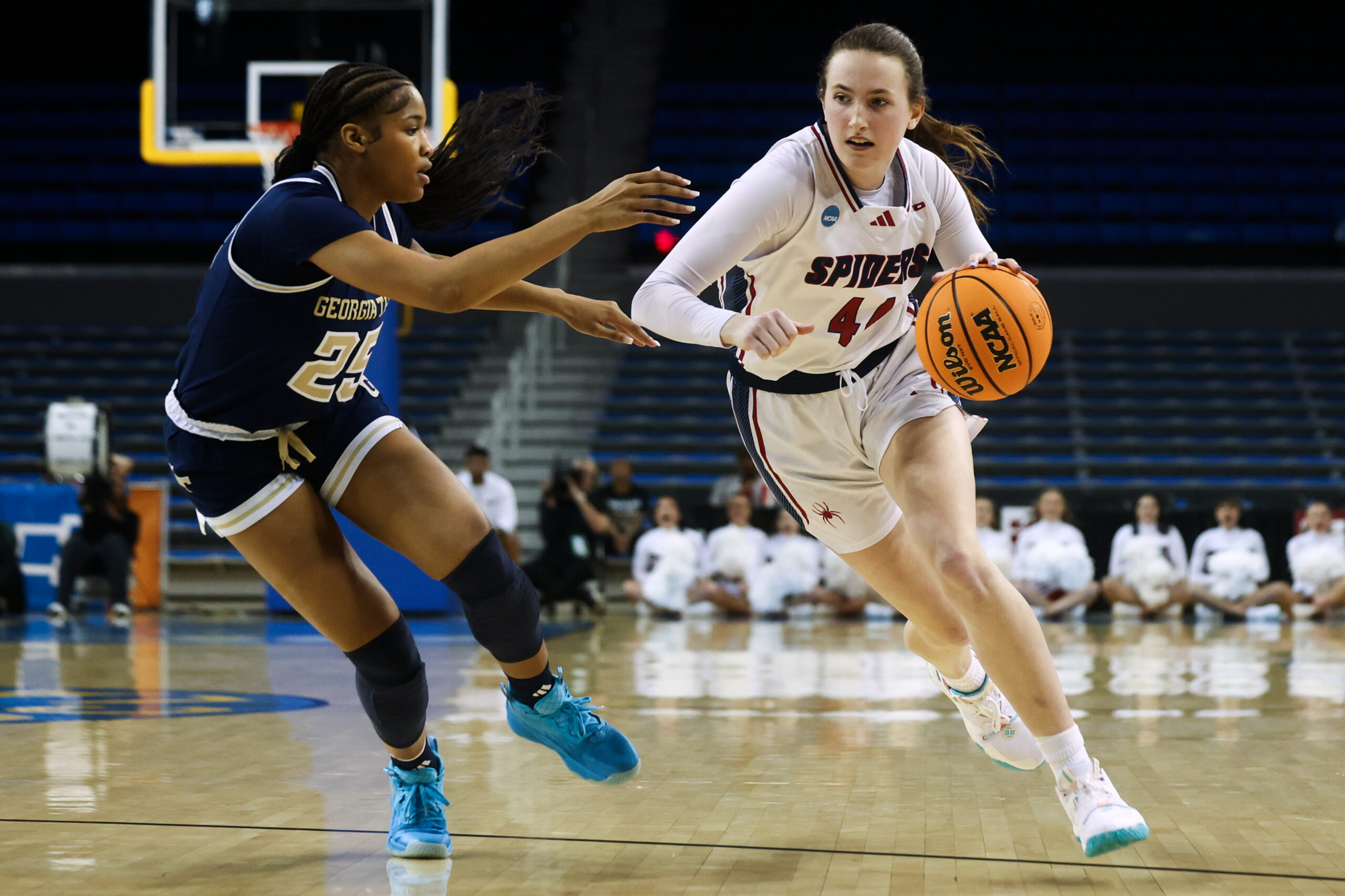
Richmond forward Maggie Doogan toward the basket as Georgia Tech guard Kara Dunn defends during last season’s NCAA Tournament.
Still, “literally the second we got back” from the NCAA Tournament, Roussell said, he and Doogan needed to have another honest discussion about her plans for the 2025-26 season. That is the reality in this transfer-portal era, because mid-major players regularly leave for power-conference programs that can offer more lucrative NIL deals.
Chrissie acknowledges she “got some calls on the side” to gauge Maggie’s interest in exploring options. She had to ask her daughter, “Would you leave for any certain amount?” Though Roussell received no indication from the family that he should be worried, he added, “I’m no dummy. I know the pursuers were out there.”
But Maggie and Roussell were aligned on how special this season could be for the Spiders — and that she wanted to finish her college career where it started.
“Not everybody would have made the decision that she did,” Roussell said. “There was a lot of loyalty involved. Now, do I think this was a great fit for her and this was the right answer? Yeah. But she left money on the table by coming back here, and that’s not something every 21-year-old is doing.”
Added Doogan: “Honestly, it’s home. And I wouldn’t want to spend my last year anywhere else.”
After Richmond’s win at Columbia, Chrissie sent Maggie a text about the two turnovers she committed during the game’s final minute.
“Wow, thanks for the love,” Maggie sarcastically responded.
Consider that evidence that the coach-player aspect of this close mother-daughter bond has never fully dissipated. Neither have other characteristics Maggie says she acquired while growing up as a Philly basketball kid. She immediately highlighted her toughness, that “I don’t really like to take a lot of B.S. from people, and I think I get that from back home.” She also credits her time at O’Hara with fostering her vocal leadership, which was on display while speaking up during timeouts throughout Richmond’s win at Columbia.
“I’m trying to calm everybody down, which hopefully works,” she said after that game. “I kind of know what [Roussell is] thinking, and I’m good at talking with everybody else. I think it’s kind of why I’m on the floor.”
She also is navigating life as a player who, before the season, was ranked among ESPN’s top 25 returners in the country.
She acknowledged after the Columbia game that she felt more defensive “crowding” while in the paint and a greater focus on wherever she was on the floor. Roussell is pleased that Doogan is executing on individual focuses, like better finishing, drawing fouls around the rim, and improving as a playmaker and rebounder. Being invited to last summer’s Team USA’s Women’s AmeriCup team trials, where she competed alongside some of college basketball’s best players, also boosted her confidence, Roussell said.
“She has not hit her apex yet,” Roussell said. “There is really good basketball in her future that will be better than what she is now.”
Yet the Doogan family is embracing Maggie’s final college season, which Chrissie compares to the ending of a book.
A group in Richmond gear swarmed Maggie for hugs following the Columbia win, then posed together for a photo op. Her grandparents make the four-hour drive to Richmond for nearly every home game. And whenever Chrissie visits, she notices children wearing No. 44 jerseys with “Doogan” on the back.
“As a parent, you’re like, ‘Wow, this kid,’” Chrissie said. “People all over Richmond know her.”
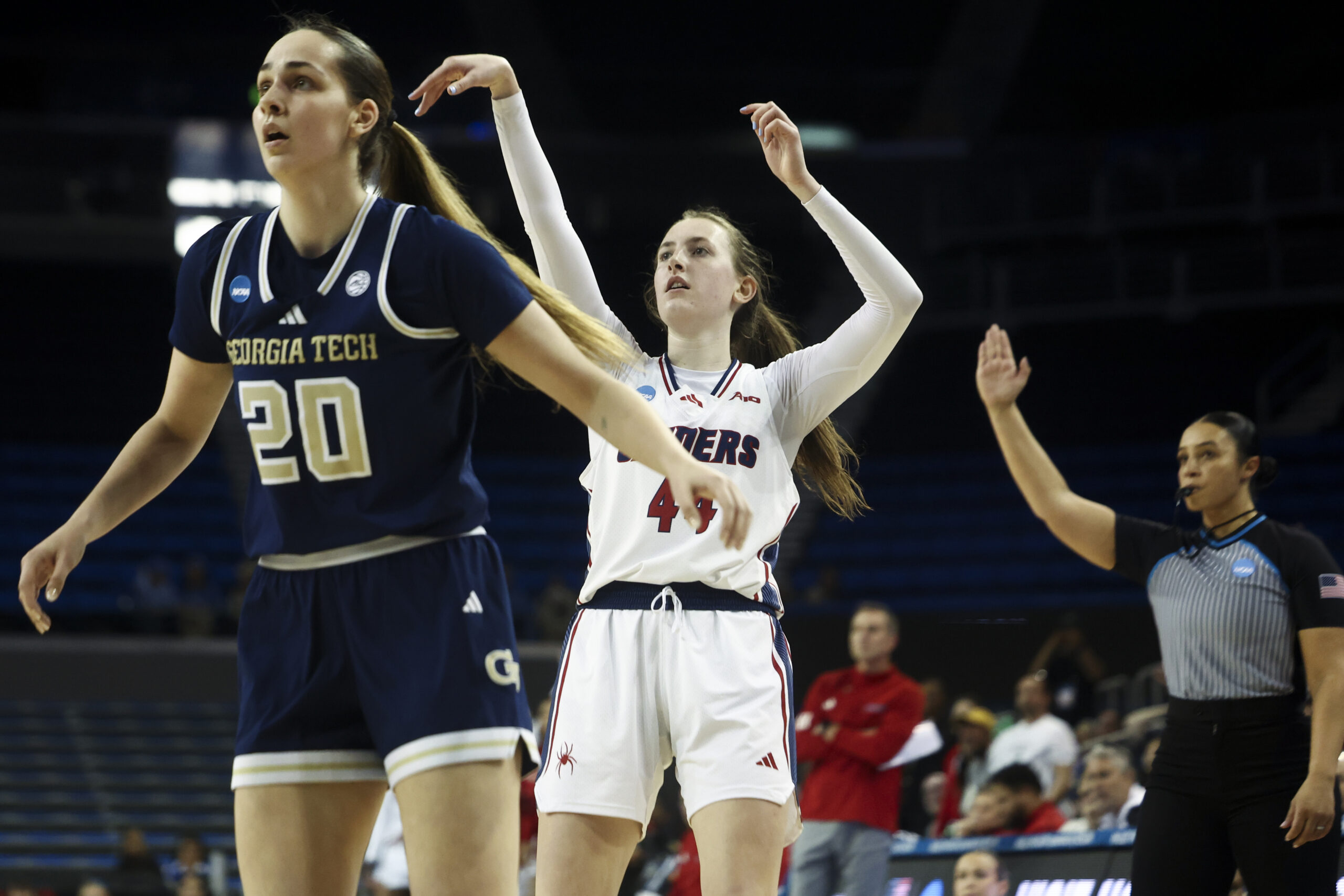
Richmond’s Maggie Doogan looks on after shooting as Georgia Tech center Ariadna Termis watches.
That’s the impact of Doogan becoming a perfect model of development and versatility.
And the player who stayed at her mid-major school through her entire career.
And the person who continues to set the standard for her program’s historic rise.
“It’s going to be awful whenever she takes off that jersey,” Chrissie said of Maggie. “I know there will be tears shed. But she’s got so much to be proud of, and so much to be excited for this season.
“We’re just trying to take it one game at a time, one practice at a time, and enjoy the ride.”
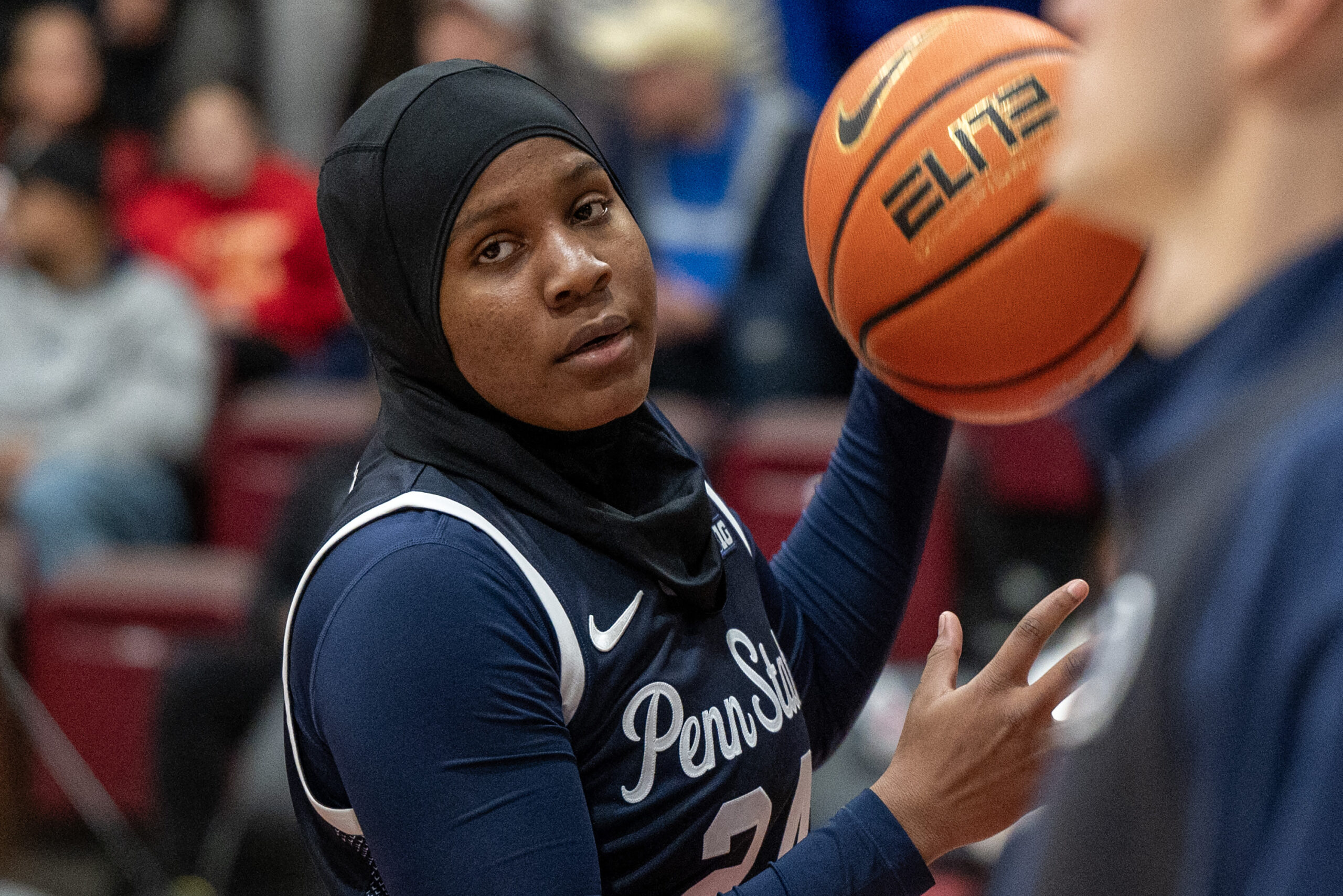
Shayla Smith mingled on the Hagan Arena court Sunday afternoon, posing for a photo with St. Joseph’s guard Kaylinn Bethea.
The brief reunion with a former Philly Rise EYBL teammate was one reason Smith said it felt like “a breath of fresh air” to be back in her hometown. It was her first trip as a Penn State player, after becoming the city’s all-time scoring leader for high school boys’ and girls’ basketball last spring.
“It definitely feels good to be back here,” Smith told The Inquirer. “ … Just coming back home, seeing everybody, all my people.”
An undisclosed injury kept Smith from playing in the Nittany Lions’ 89-77 victory over St Joe’s. Yet the former Audenried superstar is embracing the beginning of her college career, and coach Carolyn Kieger expects Smith to “drastically” help a 4-0 Penn State this season.
“I wish she was 100% to play in her hometown today,” Kieger said postgame. “ … I’ve been really impressed with her work ethic and how she’s kind of been just soaking up learning and growing.
“It’s an unfortunate injury there, but she’ll be back healthy and ready to rock here in no time.”
Smith has played 19 total minutes during two of Penn State’s first four games, going 3-of-7 from the floor for six points along with four rebounds, two assists, two steals, and one block.
But the 5-foot-9 freshman guard believes she has already improved since arriving on campus for summer workouts. Physically, Smith feels stronger and faster. Mentally, she feels more decisive, a necessity in Kieger’s “0.5” offensive system that requires players to begin to shoot, pass, or dribble in less than a second.
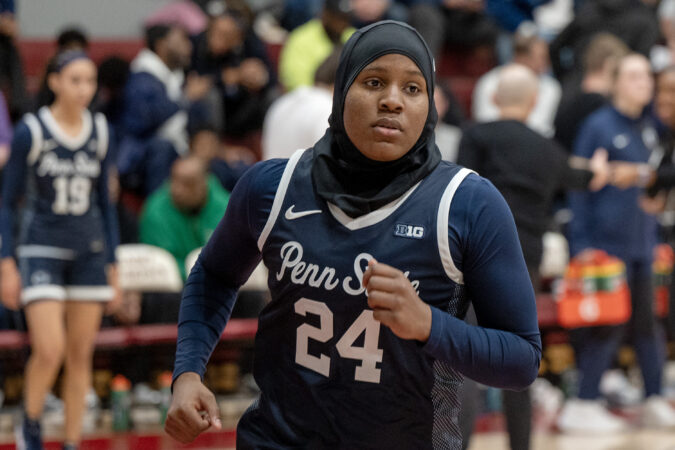
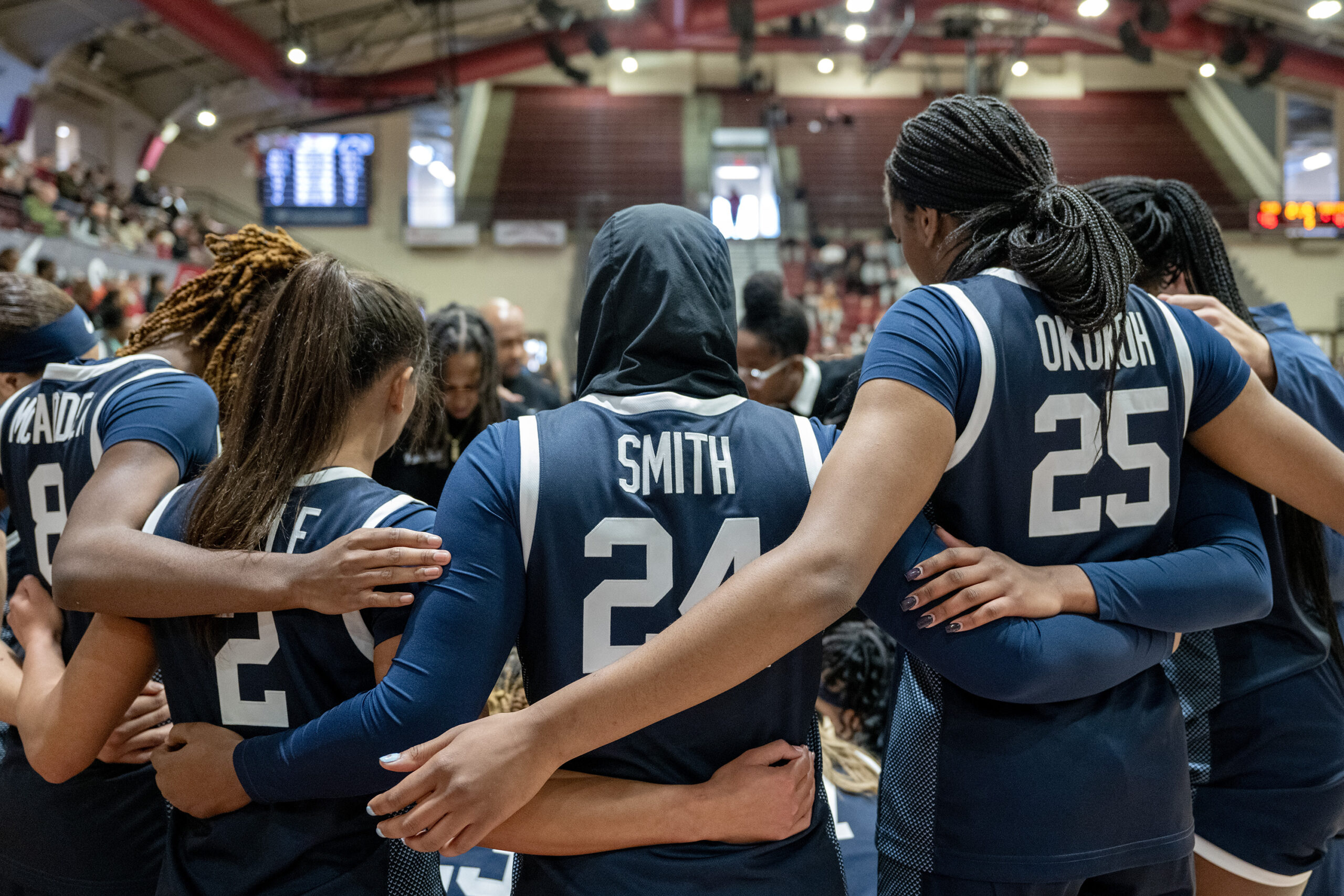
Penn State freshman Shayla Smith (center) has played 19 total minutes this season.
Smith also has concentrated on being a more vocal teammate, a noticeable emphasis while she watched Sunday’s game from the bench. She emphatically clapped when the Nittany Lions surrendered a layup on their opening possession, clearly aiming to motivate those on the floor. She stood up, lifted three fingers, and hollered “Yeah!” when Vitória Santana buried a three-pointer that gave Penn State an 86-74 lead with 1 minute, 37 seconds remaining. Smith applauded as her team dribbled out the final seconds of a game often played at a frenetic pace.
Kieger said she envisions utilizing Smith’s frame and skills on both ends of the floor. She is an obvious three-level scorer who can shoot from beyond the arc and muscle her way inside. Those attributes fueled a decorated high school career in which she amassed a record-breaking 2,691 career points and averaged 27.5 points as a senior. Smith also has the capability to guard multiple positions, Kieger said.
“I’m going to bring my physicality as a guard,” Smith said. “Just my attack mindset. Just embracing my role. Trying to be the best at what they need me to do. … When I get my chances, just do what I can do. Play my game when I get the chance.”
Heading to Happy Valley also has meant adapting to college life. Though Smith quipped that she enjoys “just being able to do whatever I want and nobody saying anything,” these early months have been a test in time management. A diligent gym rat, Smith has been learning when to squeeze her individual workout time in between classes, practices, and other team obligations such as alumni events.
“There’s always something to do,” Smith said. “ … I’ve just got to find the time to work on my craft and still be on top of everything else.”
While recovering from this injury, Smith said she has been trying to make the best of observing how the game unfolds from a pulled-back perspective. That was a rarity when the offense flowed through her as a record-breaking high school player, who was a three-time All-State honoree and anchored Audenried’s three-peat as Public League champions.
Shayla Smith, the former Audenried standout, did not play in Penn State’s win over St. Joseph’s on Sunday because of an injury.
And spending Sunday’s return to Philly on the bench has made her “eager” to truly get her college career underway.
“I just want to be a great teammate [and] master my role,” Smith said. “Bring my physicality. Bring everything that I can. I want to contribute, and help the team make it to the NCAA Tournament and Big Ten championship.”
As VJ Edgecombe prepared to leave the 76ers’ locker room Sunday, following the team’s second set of back-to-back games in less than a week, veteran teammate Andre Drummond noticed the rookie looked “exhausted.”
So Drummond offered direct instructions for Edgecombe heading into the Sixers’ mandatory off day.
“Don’t get up until 6 p.m. tomorrow,” Drummond publicly reiterated in front of reporters a few minutes later. “6 p.m., VJ. So if you see this, keep your [butt] in bed.”
Perhaps no Sixer will benefit more than Edgecombe from this light stretch of the Sixers’ early schedule, when their only game in five days is Friday at the Detroit Pistons. After a torrid scoring start — including a historic 34-point outburst in the Sixers’ opener at the Boston Celtics — Edgecombe has shot 27.9% (17 of 61) from the floor and 25% (5 of 20) from three-point range and averaged 9.4 points during his past five games.
The mini slump is understandable for a rookie going through the demanding 82-game NBA schedule for the first time, and playing heavy minutes for a competitive Sixers team in record (7-4) and in number of “clutch” games played (nine, tied for the NBA lead entering Thursday). And there is no substitution for Edgecombe simply experiencing the grind.
“It’s not weighing on me,” Edgecombe said of his recent struggles. “Why I say it’s not is because it’s an 82-game season. Nobody’s going to remember these games early. I mean, I’m a rookie, man. I’ve got to give myself some grace. Obviously, I set a pretty high standard when I came and had a good debut scoring the ball.
“But at the end of the day, I just want to win. That’s the main thing for me. I just want to win.”
Coach Nick Nurse said that Edgecombe’s “tremendous engine” — the 20-year-old guard can “work really long days, and then do it again the next day,” the coach added — and mental fearlessness have been present since the Sixers drafted him this summer.
Sixers Vj Edgecombe has shot 27.9% from the floor and 25% from three-point range and averaged 9.4 points during his past five games.
That motor has already been put to use. Entering Thursday, Edgecombe ranked second in the NBA in minutes played (37.3 per game), only behind teammate Tyrese Maxey (40.5 per game). And after playing 35 total games his one college season at Baylor — “and 12 of them don’t really count,” Nurse quipped — Edgecombe logged 11 NBA games in less than three weeks. That included three back-to-backs, which Edgecombe acknowledged was “tough for me personally.”
“I don’t know if I can prepare myself for that,” Edgecombe said.
And it is not just the avalanche of games, but everything in between. Last week, the Sixers completed their first multigame road trip to Brooklyn, Chicago, and Cleveland. That typically means leaving one city immediately after a game, landing in the next city in the middle of the night, then needing to be ready to jump into practice or game preparation a few hours later.
Maxey said Tuesday that, in Year 6, he has just begun to figure out a maintenance routine that works for him. Justin Edwards, who was a rookie last season, learned preventive treatment such as sitting in a cold tub, “flush” massages, and red light therapy are crucial.
So far, Edgecombe spends nights without a game sitting on his couch in recovery boots that alleviate leg soreness. On game days, he takes a nap and speaks to his family. His goal is to keep his mind peaceful, following a mantra from high school coach John Buck that “you can’t be grateful and stressed at the same time.”
Edgecombe had already earned the trust of teammates and coaches with his work ethic and temperament. Nurse praised that Edgecombe was “everywhere” the team asked during the offseason, even canceling a visit home to the Bahamas.
That is why Nurse was not hesitant about immediately inserting Edgecome into the starting lineup. Or keeping him with the closing group, even when he struggled with his shot or turnovers earlier in the game. Edgecombe is already one of the Sixers’ better perimeter defenders. He also always has the potential to flash his insane athleticism as a driver or finisher. And he has already shown a knack for knocking down clutch shots, while averaging 15.4 points, 5.5 rebounds, and 4.3 assists so far this season.
“He’s got great composure. He’s calm. He doesn’t make too many mistakes,” Nurse said. “I super believe in him. … He needs to be out there and learn this stuff, and he’s produced.”
Like during the Sixers’ win over Celtics Tuesday night. Edgecombe missed eight of his first nine shots, including an air-balled three-pointer to begin the third quarter that prompted him to mouth “Oh my God” in surprise (or self-deprecation).
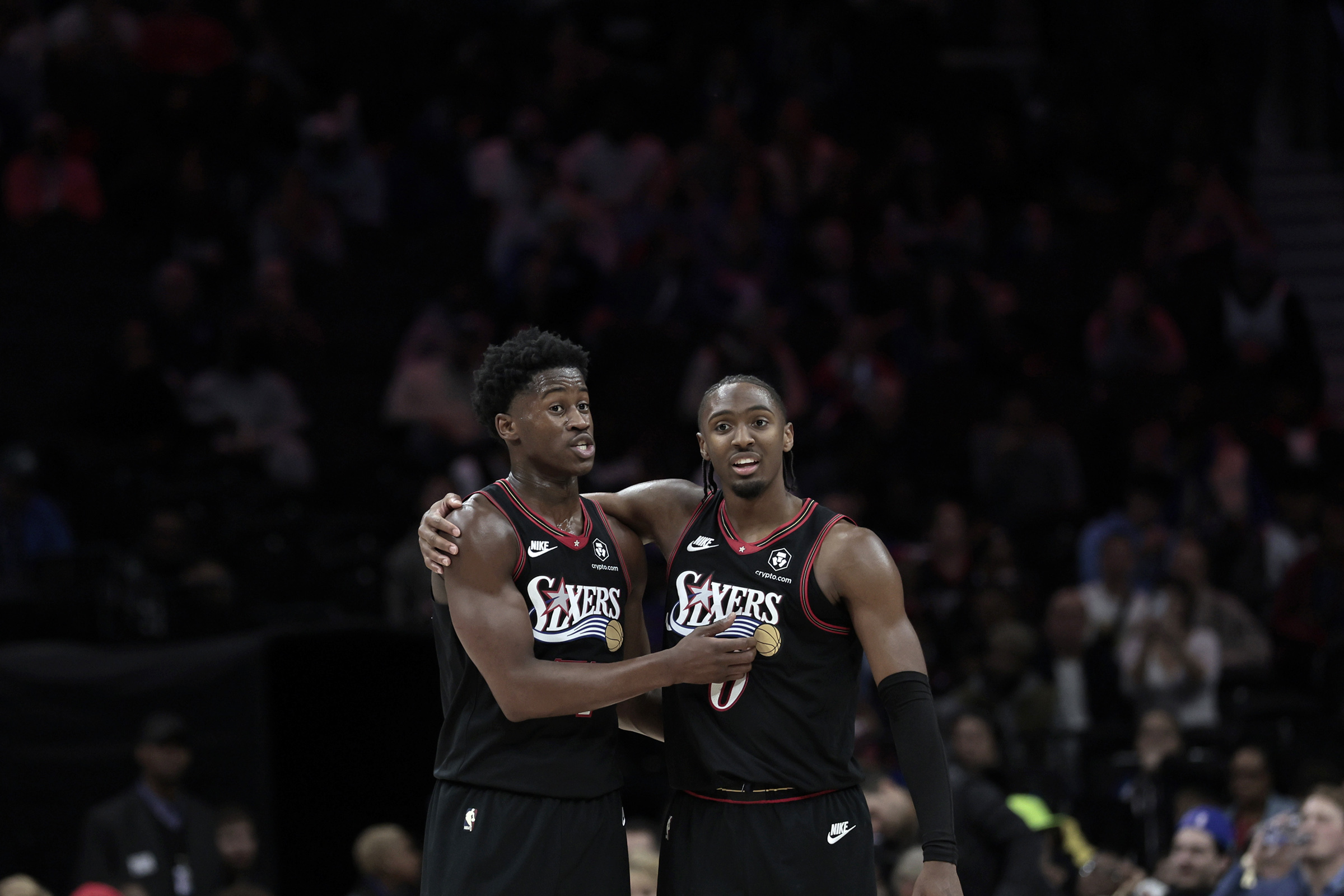
Sixers guards VJ Edgecombe and Tyrese Maxey occupy the NBA’s top two spots in minutes played per game.
But with about five minutes remaining, Edgecombe elevated to block All-Star Jaylen Brown’s dunk attempt, then pushed the ball ahead to Edwards for a three-pointer. Then with 2 minutes, 20 seconds to play, Edgecombe let an open three-pointer fly — and watched it bounce high off the rim and through the net to give the Sixers a four-point lead. Perhaps that was a reward for Edgecombe’s summer work to get more arc on his shot, and “give it a chance to get in the rim,” he said.
“It’s been a rough couple days, but I won’t stop shooting the ball,” Edgecombe said. “I will continue shooting the ball if I’m wide-open, if it’s the right shot.”
That is one of several on-court lessons for Edgecombe during these first 11 games. Another is that he cannot expect to outjump competitors for a rebound, because “they’re 7-foot and they’re gonna get there quicker than me.” Nurse added that Edgecombe must get downhill more aggressively while playing alongside Joel Embiid, in order to draw the defender away from the former MVP and open opportunities for Edgecombe to pass to a rolling or popping Embiid. Even the speedy Edgecombe notices the increased pace at the NBA level, and that he needs to sharpen his defensive positioning.
And though Edgecombe feels empowered by coaches and teammates to be himself on the court, Nurse acknowledged Thursday that the staff can more deliberately put Edgecombe in situations with the ball in his hands.
“Come hell or high water, this is your play,” Nurse said. “Go make something happen.”
After Tuesday’s sputters, Edgecombe believes he is “due for a game to get back on track.” Nurse added that Edgecombe’s past two days have been filled with “constant film work,” which is “still [a] pretty heavy load mentally, no matter if he’s on the court or not.”
But that approach does allow Edgecombe to take Drummond’s advice. On Monday, Edgecombe said he woke up after noon, then was back asleep by 5 p.m. So it is fair to assume he will aim to maximize this lighter early-season stretch, with one game in five days.
“When I get home, in my bed,” Edgecombe said, “that’s the best thing.”
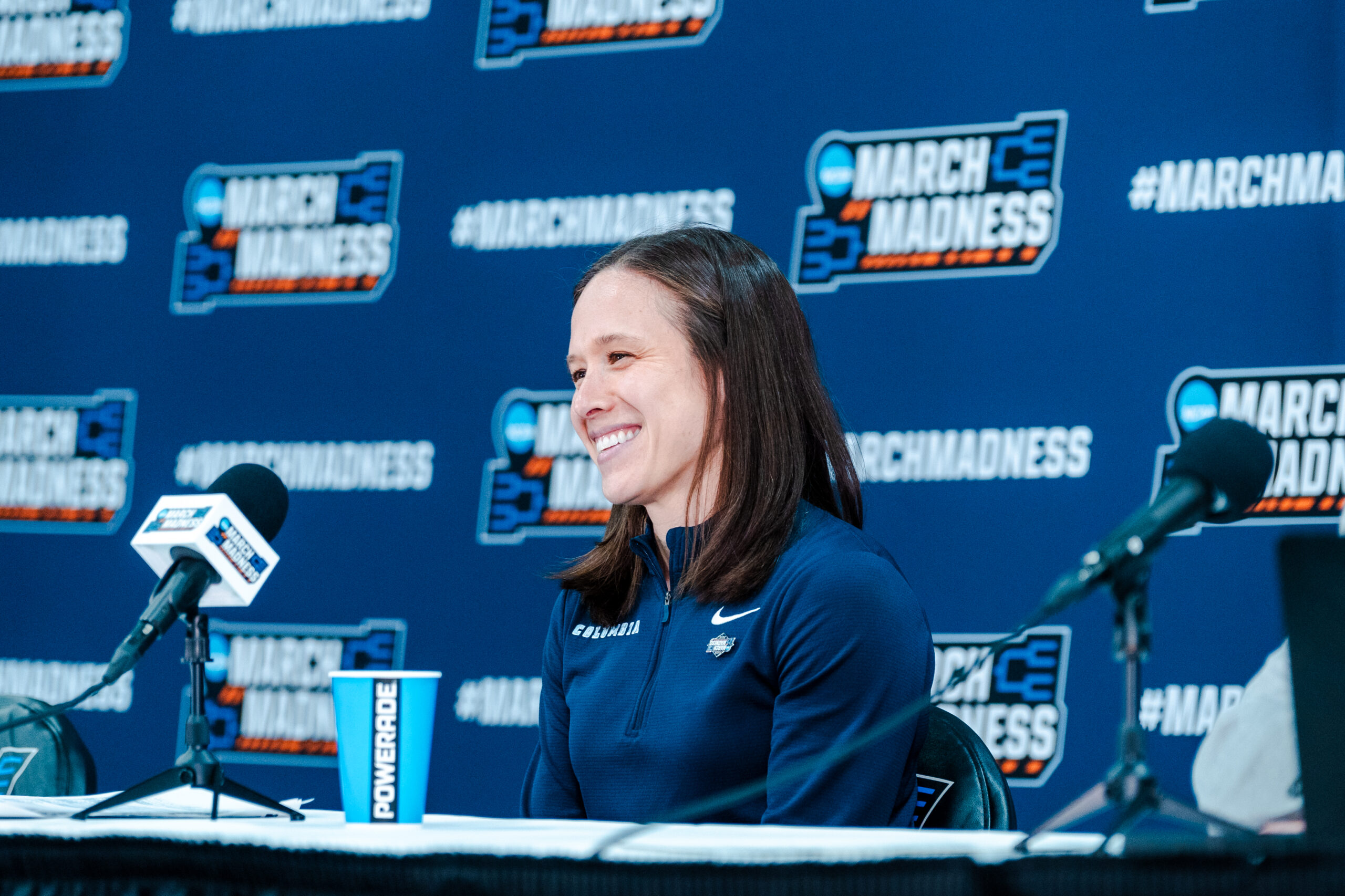
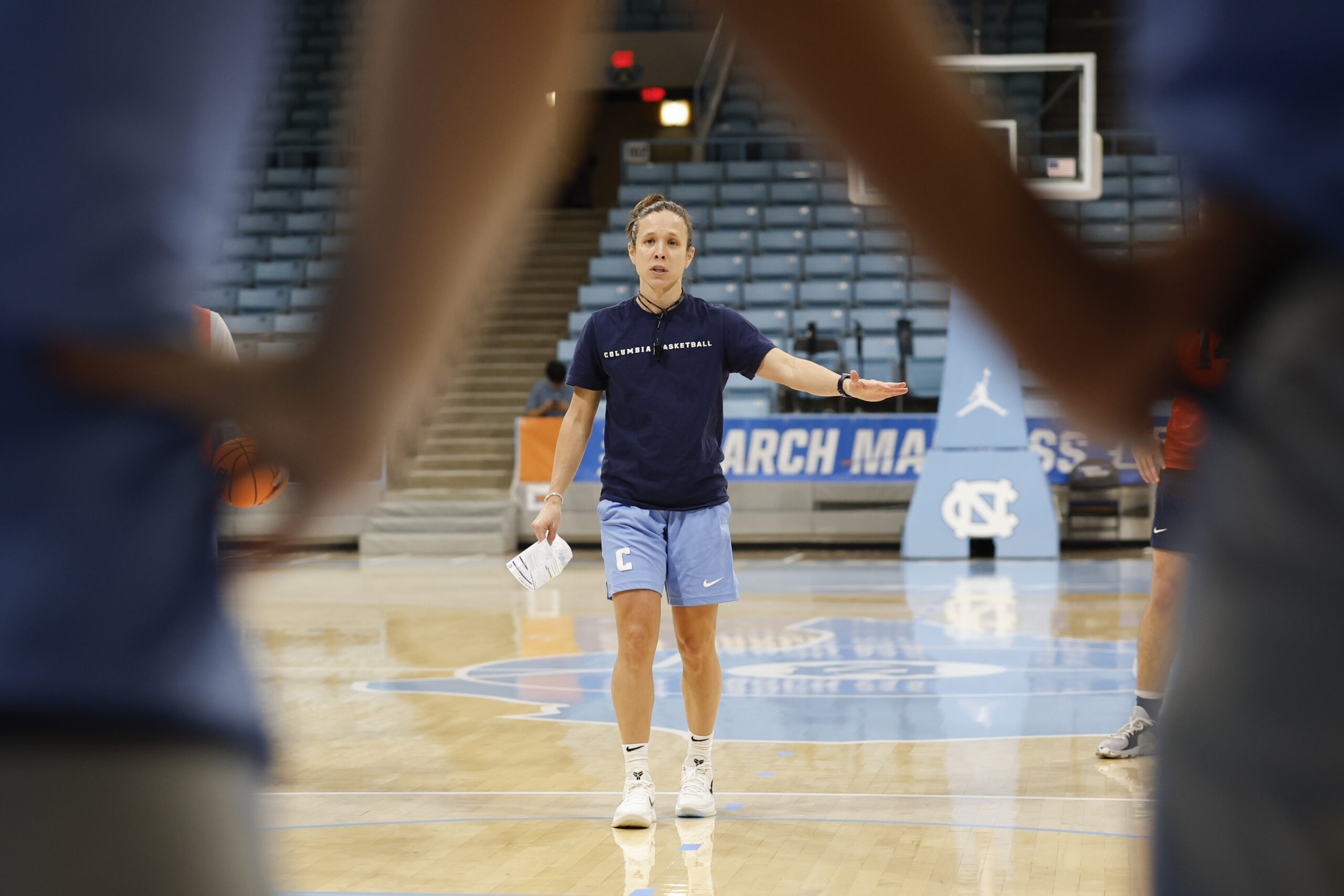
NEW YORK — As a group of Columbia women’s basketball players struggled to break a press defense and advance the ball up the court, Megan Griffith’s voice rang through the gym.
“I need more active participation with your voice!” the coach said. “Can you please get back to playing like us?”
That is one of the go-to phrases that Griffith, a King of Prussia native, reinforces during this October preseason practice. They are all designed to “make things sticky” and keep the team process-focused, Griffith said.
“How you do anything, is how you do everything,” Griffith and standout guard Perri Page will both rattle off within the same hour.
Those callbacks have fueled a remarkable turnaround as Griffith enters her 10th season as the head coach at her alma mater.
Columbia was one of women’s college basketball’s worst programs for decades before clinching at least a share of three consecutive Ivy League regular-season championships and winning its first NCAA Tournament game in school history last season.
And it received an at-large bid to the Big Dance in each of the past two seasons, typically unheard of for Ivy League programs. The Lions are 2-0 to begin the 2025-26 season, heading into a marquee home opener against reigning Atlantic 10 regular-season champion Richmond Saturday night.
Griffith, a finalist last season for the Women’s Basketball Coaches Association’s Coach of the Year award, has displayed her Philly roots while making breakthrough after breakthrough during this rebuild.
There’s the influence of her high school coach, Villa Maria Academy’s Kathy McCartney, whose motivational style Griffith describes in a way that her current players now talk about her. And her childhood being raised by a father from Delaware County and a mother who immigrated from Hong Kong, before they met at Villanova. The emphasis on running a high-powered offensive system spearheaded by dynamic guard play? A no-brainer for a 40-year-old who grew up watching the Allen Iverson Sixers era.
That culture has already elevated Columbia to historic heights, and a stability Griffith and players now strive to protect. Now, the coach has the Lions believing they can — again — become the best team in program history.
“She’s a force,” Page said. “Honestly, do not mess with her. She is going to go out and get whatever she wants. … I can’t see myself playing for any other coach in the country.”
‘A determined little bugger’
Diane and Bob Griffith still are in awe when they watch their daughter coach, or when she speaks during news conferences. She actually was a shy kid in everyday life, taking hold of Dad’s pant leg whenever the family was out in public.
But as soon as there were competitive stakes, Megan turned into “a determined little bugger,” Bob said. Diane remembers a T-ball game when a young Megan rounded third base, and the umpire told Bob, who coached Megan’s youth sports teams, that “this kid can slide better than most adult men can.”
“Once that light turned on or that game clock started, she was tenacious, even as a small kid,” Bob said. “ … When you look back on it, she was probably one of the most aggressive kids out there on the court.”
Megan concedes today that she probably should have pursued soccer (“Look at me. I’m 5-5,” she quips). But she gravitated toward the intimacy of smaller basketball rosters and how the game never stops moving.
Neither did she, because she was fast. When Griffith first arrived at Villa Maria, McCartney remembers the teenage point guard could not always control her dribble in transition … because she literally outran the ball.
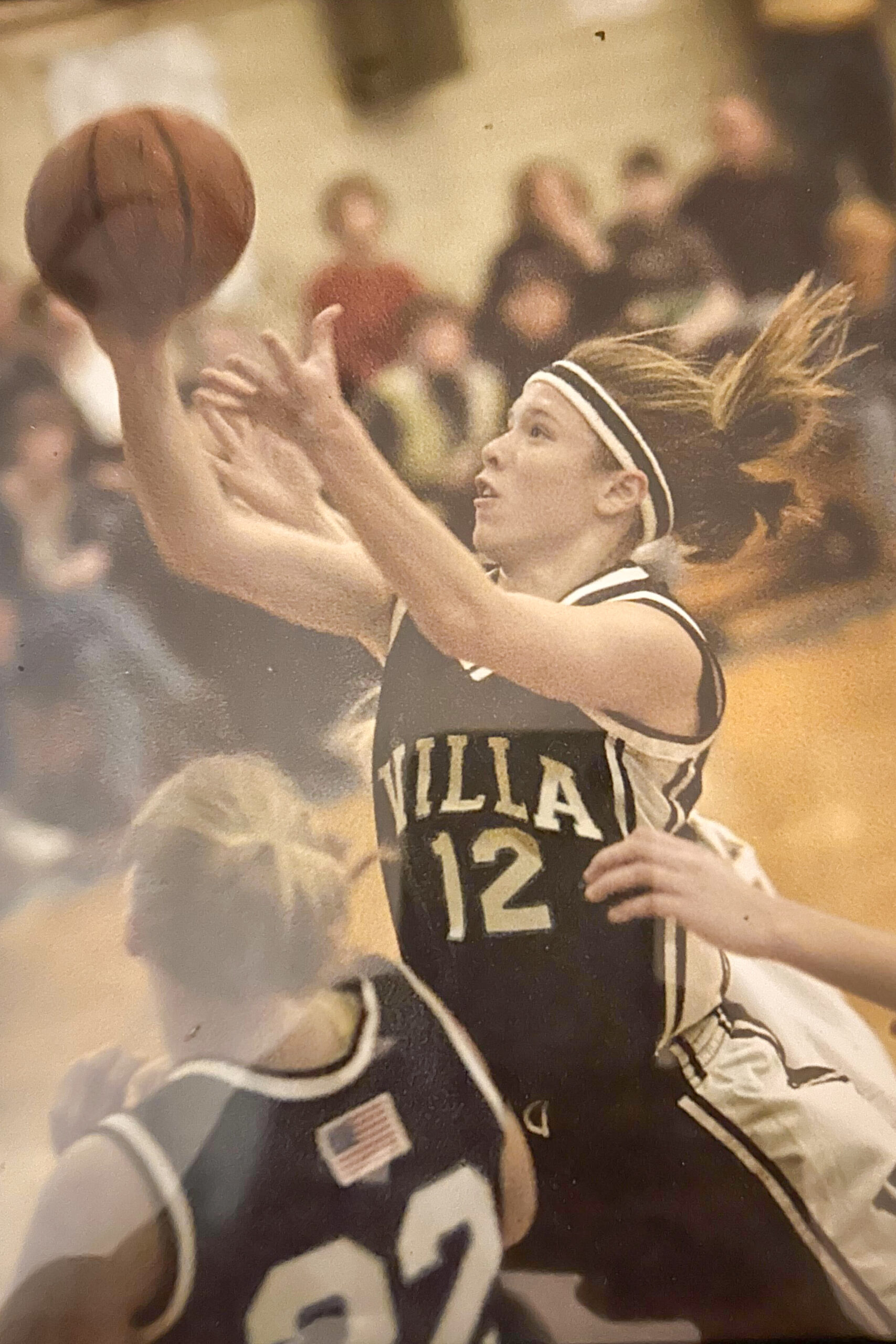
King of Prussia native Megan Griffith played her high school ball at Villa Maria Academy.
So McCartney told a steely eyed Griffith that she was not ready to play on the varsity team as a freshman. She needed to learn how to mold those natural athletic gifts into a ballhandler who could anticipate the defense’s next move. Griffith clocked that, while being coached by a woman for the first time, she was receiving a similar combination of intensity and care that her father provided in those settings.
“When I started getting [that tough love] from somebody else, it was like, ‘Oh, this is also how other people do this,’” Griffith said. “And it just really resonated with me. … That allowed me to really gain the confidence as a young woman, to then take that next step in my career and play college.”
By her senior high school season, Griffith was the point guard and defensive menace for a team that won its first 21 games. She had chosen to play for Columbia, which does not offer athletic scholarships, over an offer from LIU-Brooklyn.
And the hug McCartney and Griffith shared as she walked off the court for the final time as a high schooler has “stuck with me for years,” the coach said.
“It kind of solidified in my head the difference a coach can make,” McCartney said. “And I think — I hope — it has helped her in some way. I remember whispering in her ear, ‘You’ve got big things ahead of you, girl.’”
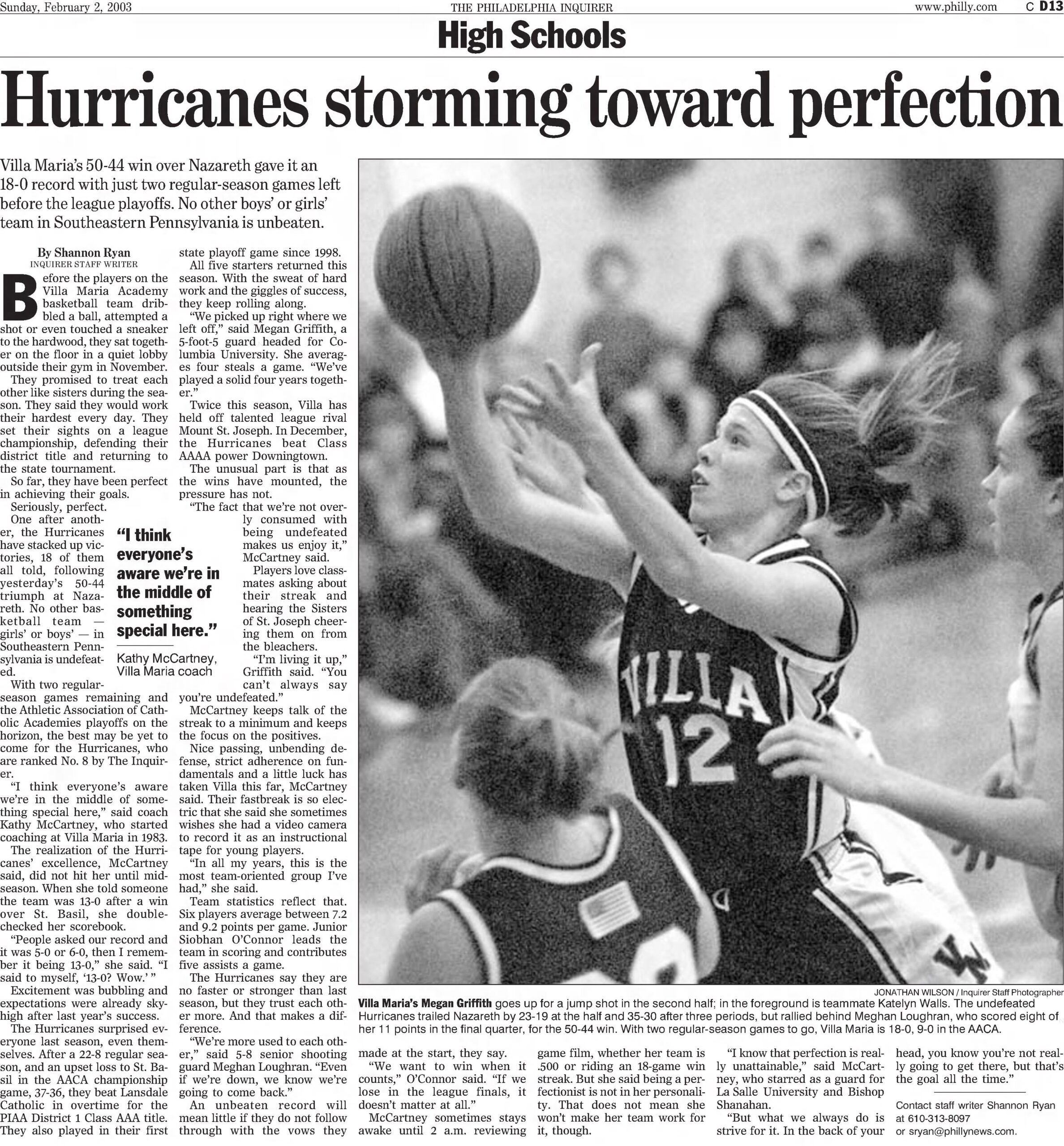
A clipping from the Philadelphia Inquirer sports section of February 2, 2003, showing Megan Griffith driving to the basket for Villa Maria Academy high school. Griffith is now the head women’s basketball coach at Columbia University.
‘I can go prove everybody wrong’
Columbia’s program was in a tumultuous state during Griffith’s playing career, from 2003 to 2007. She had four coaches in four seasons. The Lions’ record during that span was 38-70.
But that is where Griffith learned how to “stack days,” not just with her on-court training but in daily habits such as nutrition and sleep. Bob watched his daughter morph from a “very predictable” freshman who was “trying to please her coach too much,” to a 1,000-point scorer and two-time all-Ivy League selection.
“I was like, ‘Wow, I’ve had it the complete wrong way,’” Megan said. “I was so focused on the results all the time. Starting. Trying to come in as a freshman and change the program. I was like, ‘Wow, if I can just focus on what I can control …’”
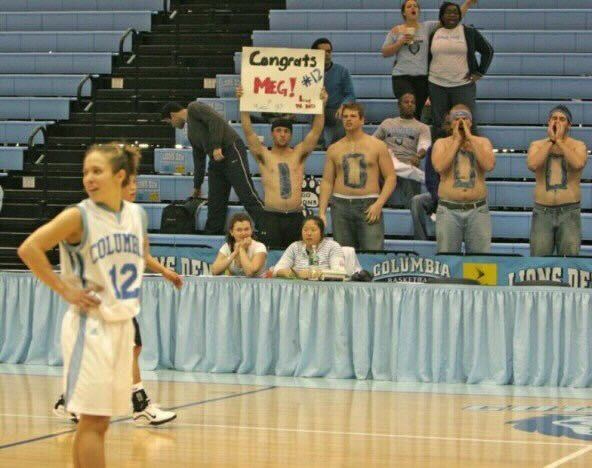
Megan Griffith was an 1,000-point scorer at Columbia. The King of Prussia native now coaches her alma mater.
She also had an Ivy League education and a job lined up at Lincoln Financial in Philly upon graduating with an economics degree. She turned that offer down to continue playing overseas in Finland and then the Netherlands.
Griffith called that experience “transformational.” She leaned into exploring her new surroundings and connecting with her local teammates. An assistant coach began involving her in game-planning and strategizing, which she said “channeled my competitive energy very differently.” She learned enough Dutch to help coach kids. When she came home during off-seasons, she held youth skills clinics.
“I could see just how these kids just looked up to her,” Diane said. “ … I think that was probably the first glimpse of her maybe, possibly becoming a coach.”
When Megan no longer found as much satisfaction in that daily grind, she knew it was time to pivot from playing. She was hired as the director of basketball operations at Princeton, and was intrigued by then-coach Courtney Banghart, who led the program to its first Ivy League title.
Banghart, now the coach at 11th-ranked North Carolina, quickly made Griffith the Tigers’ recruiting coordinator. Griffith was hesitant at first, instead wanting more tactical responsibilities. But she was organized and a people person.
“What I learned there is that, actually, the most important thing is relationships,” Griffith said. “You have to know things and be smart. But at the end of the day, everybody can learn an offense. But what do you do with talent? How do you get talent? How do you get people that are bought into a common language, and an ethos, and a culture?”
In 2016, Columbia’s head-coaching job came open. Griffith, then 30, went to athletic director Peter Pilling with a detailed plan on how she would run her alma mater. And she thought back to conversation in the car with her father, while she was still playing overseas.
“[I said], ‘Dad, I feel I’m meant for something, like, big and different,’” she said. “I didn’t know what that meant at that time. So when this opportunity came up it was like, ‘Wow, I can go prove everybody wrong.’
“And I love that. I love the underdog. That’s who I am at my core.”
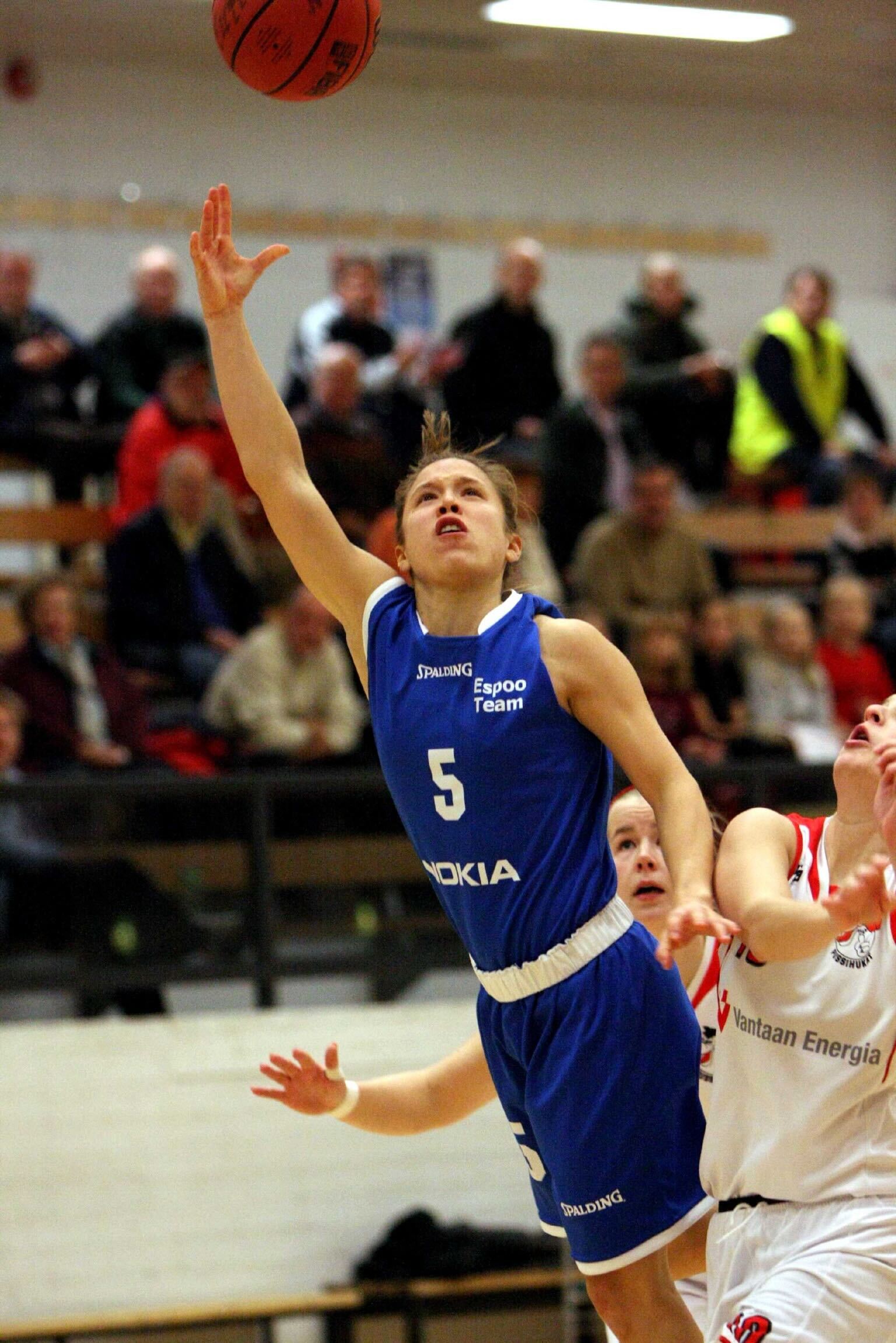
Megan Griffith played professional basketball in Finland.
‘It’s why you do it’
Tyler Cordell was “a little intimidated” the first time she spoke to Griffith. While interviewing for a job as Princeton’s director of basketball operations when Griffith was promoted to assistant coach, Cordell left the phone conversation thinking, “I don’t know if I’m smart enough to follow up in her footsteps.”
Now, Griffith and Cordell have worked together for 14 years. Cordell said it was a “no-brainer” to join Griffith’s staff at Columbia. Griffith calls Cordell an example of the “builders” the program needed.
“You start with the people,” Griffith said.
That meant thorough — and unconventional — recruiting.
The coaching staff went into southern states, such as Florida and Georgia. And internationally, to Spain and Australia. Today, nine players on Columbia’s 2025-26 roster are from outside the United States.
And there was perhaps nobody better to pitch Columbia than Griffith, who experienced the top-tier academics, limited athletic resources, and basketball struggles firsthand.
“It’s not like we’re in the same sandbox as a lot of schools,” Griffith said. ” … But we’ve never been.”
Griffith needed to power through the early on-court woes as a coach, including back-to-back eight-win seasons from 2017 to 2019 that left Diane worried about Megan’s health. Still, accolades began to surface. Their first victories over programs from the Atlantic Coast Conference (Boston College) and Big East (Providence). Their first Ivy League Rookie of the Year in Sienna Durr. The commitments of Abbey Hsu and Kaitlyn Davis, who became “young, hungry freshmen” and, eventually, conference champions and WNBA draft picks.
Those players could emulate an on-court style — with athletic, guard-heavy rosters that could pressure defensively and get out in transition — that led to sustained success for other mid-majors. It evolved into a system that, from 2022 to 2025, averaged more than 70 points per game.
King of Prussia native Megan Griffith has built Columbia women’s basketball into an Ivy League power.
Griffith, meanwhile, strives to make people feel important, even when demands are high. She will get on a player’s case during practice, but then help them make their first resumé or ask about their dog. During the COVID-19 pandemic, when Columbia’s 2020-21 season was canceled, the staff created a space for players to talk. Page actually took her recruiting “visit” on Zoom and was blown away by the staff’s energy and attention to detail in less-than-ideal circumstances.
“That’s what made me say, ‘Wow, they put a lot of thought and effort into everything that they do,’” she said. “ … I was like, ‘If you can make this look good, imagine what it looks like on the court, too.’”
Once the Lions returned to to play, the avalanche of checkpoints continued.
A 2021 signature comeback win at Clemson? Check.
Qualifying for the four-team Ivy League tournament for the first time? Check.
Four consecutive 20-win seasons? Check.
Advancing to the WNIT quarterfinals in 2021, then the championship game the following season? Check.
First Ivy League regular-season titles, as co-champions in 2023 and 2024 and then as the outright winner last season? Check.
First NCAA tournament appearance in 2024, when they lost a tight First Four matchup against Vanderbilt? Check.
“That’s what’s been so cool about our journey,” Cordell said. “Because we haven’t skipped one step.”
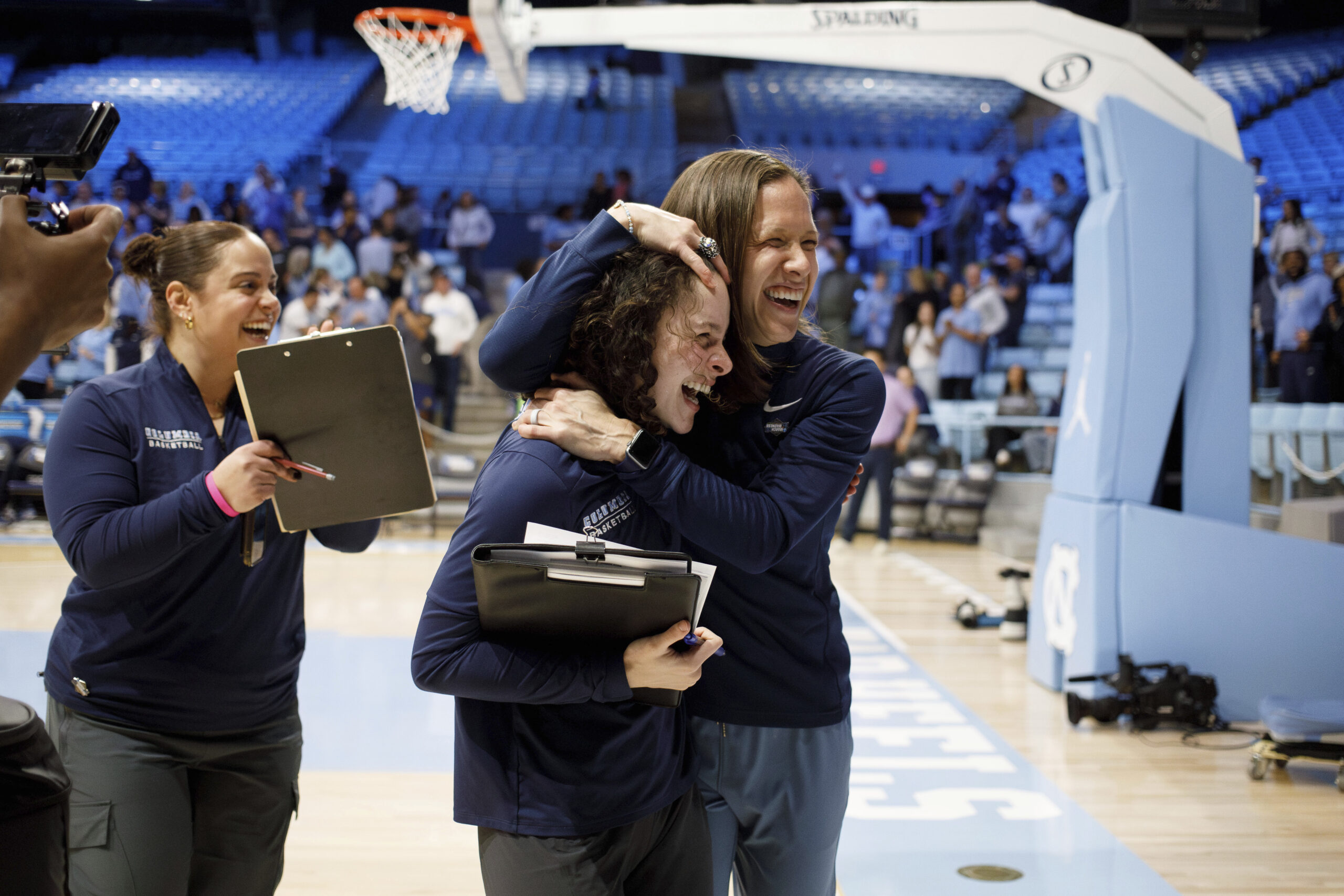
The most recent: Last season’s NCAA First Four. The Lions at halftime flipped how they were guarding Washington’s post players, and rallied from 13 points down to win and advance to the round of 64.
“It was just the next thing we had to do in our journey,” Griffith said. “I feel like we manifested it, but at the same time, it was supposed to happen. …
“When the buzzer sounded, it’s why you do it. It’s why I’ve coached the last nine years — to be in that moment and be able to share that with my staff and this team.”
Columbia head coach Megan Griffith (right) celebrates with assistant coach Cy Lippold after beating Washington in a First Four game in last season’s NCAA Tournament.
‘Coach-led, player-fed’
Those back home also have relished in Griffith’s rise.
McCartney still texts Megan and her parents, and loves telling friends “that’s one of my kids” while watching Columbia play. Megan’s godmother, who lives in Australia, wakes up at 4 a.m. to tune in to games. Supporters are in the stands whenever Columbia plays Penn in Philly, where Griffith takes pride in those who knew her as a player recognizing similar qualities in her teams.
And Diane and Bob are regular visitors to campus. While watching a recent scrimmage, they noticed Megan being “really tough” on the freshmen. Up in the coach’s offices, a veteran told one of those first-year players, “She’s tough, but you have to listen to Coach. She knows what she’s talking about.”
“Yes, she yells at you a lot,” Diane said. “She screams in your face. You think she hates you. But she really does care about you, and she wants to make you a better player and person.”
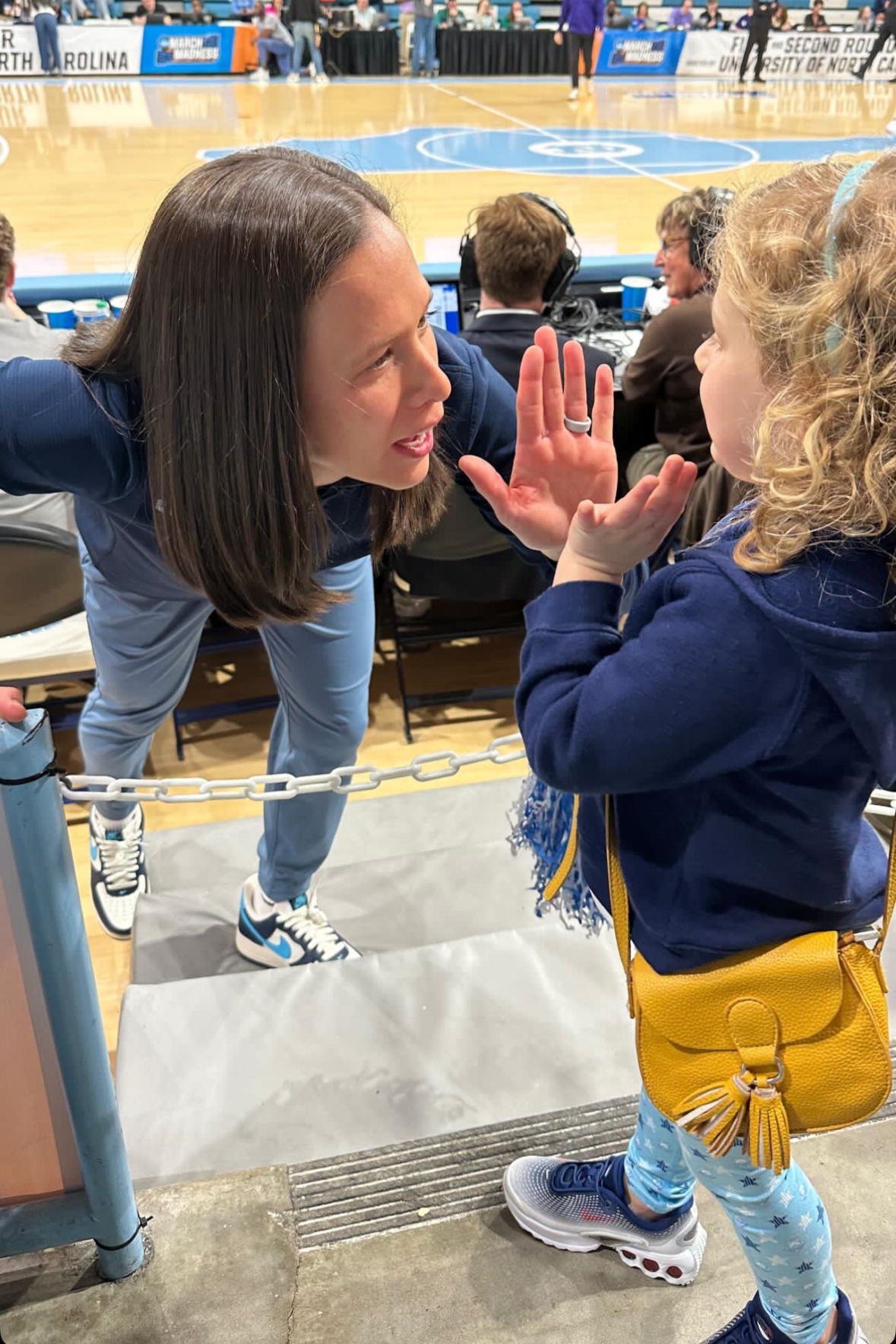
Columbia women’s basketball coach and King of Prussia native Megan Griffith (left) high-fives her niece, Carmen, who calls her Titi.
Like during that October practice, when new assistant coach Kizmahr Grell needed to tell Griffith to take a deep breath. The Lions have a taller roster and fewer ballhandlers this season, forcing some tweaks to their on-court identity. That was particularly apparent with Page sitting out this practice, prompting a direct challenge from Griffith to be a better leader from the sideline.
“It just gets me so fired up, too,” Page said of those interactions. “ … I take it, like, this is my program. This is my baby. When she gives a task, I am ready to attack it, always. Because I want to do right for her, but I want to do right for this program, as well.”
Columbia coach Megan Griffith talks to her team at practice last season.
That’s an example of another Griffith callback: “Coach-led, player-fed.” It’s why a practice that began with harsh words ended with everybody gathering at midcourt for a calm circle, where players individually spoke up to encourage and hold each other accountable. They snapped in agreement of each player’s input. When Griffith asked who got better today, every player raised their hand.
Those mantras have become sticky, establishing Columbia’s foundational culture. They have fueled the Lions’ historic rise.
So what is the next breakthrough, with Griffith’s 10th season underway?
“That’s my big challenge right now, is just continue to teach when the expectations are higher — and self-imposed,” Griffith said. “Nobody here is like, ‘Hey, you need to win more.’ Everybody is like, ‘Look at everything you’ve done,’ but that’s just not who I am.
“I don’t just think we can continue to win Ivy League championships. I think we can make deep runs into March. As long as we keep getting the right people here, why couldn’t we go to the Elite Eight?”
Nick Nurse’s summer mood has long been dictated by how the just-completed season unfolded. So naturally, the 76ers’ coach spent much of this past offseason in a state of, in his words, “[ticked]-off-edness.”
The Sixers’ woeful, injury-plagued 24-58 season sent Nurse and his team home much sooner than they ever would have anticipated months earlier, when they had championship aspirations. The irritation lingered.
And lingered.
“It kind of fatigues you mentally and you’re just kind of constantly thinking about it,” the 58-year-old Nurse recently told The Inquirer. “And then, at some point, you’re like, ‘OK, tomorrow I’m getting up at 5:30, and we’re going to start going to work. We’ve got to make a move here.’
“And then that’s kind of what the rest of the summer becomes.”
That methodical approach has yielded a surprising 4-0 start to the Sixers’ 2025-26 season, even with Paul George and Jared McCain sidelined with injuries and Joel Embiid limited while working his way back from an ongoing knee issue. They rallied from a 19-point deficit to top the Washington Wizards in overtime Tuesday night, already their third double-digit comeback victory of the season.
Last season, it took the Sixers until Nov. 30 to record their fourth win. And though it is far too early to make sweeping declarations of a guaranteed turnaround, the Sixers have flashed an on-court identity — and palpable juice — that make good on Nurse’s public vow that “I want you to walk away from the game saying, ‘Jesus, they played their [butts] off tonight.’ That’s it.”
“You could feel his frustration, feel his pain,” said Minnesota Timberwolves coach Chris Finch, one of Nurse’s close friends. “And, generally, when we’ve all been through a season or a situation like that, there’s an incredible focus on where we need to start going into it the following year. …
“You [could] sense the confidence in their ability to do that when I talked to him this summer.”
Sixers coach Nick Nurse determined that his team needed to play faster this year.
For Nurse, that summer evaluation always begins with a self-debrief, which he acknowledges is not unlike how his brain operates daily. He is constantly thinking about the puzzle of fusing his coaching philosophy — “what you think is the absolute best way of doing anything, regardless” — with roster strengths and weaknesses.
Tactically, Nurse concluded that the Sixers must play a faster-paced, free-flowing offense that could succeed even when Embiid — the perennial All-Star and 2022-23 MVP who has been the franchise’s centerpiece for much of the past decade — inevitably missed time. That emphasis was first raised to dynamic point guard Tyrese Maxey (who totaled another 39 points and 10 assists Tuesday in Washington) during his exit interview with Nurse, president of basketball operations Daryl Morey, and general manager Elton Brand. It became even more imperative when the Sixers drafted VJ Edgecombe, a hyper-athletic guard.
But pace does not only mean how quickly the ball travels up and down the floor. Nurse said he, simply, “just wanted more passing. I just wanted the ball to touch more hands.”
The coaching staff began to implement those concepts — and individual skill development plans aligned with them — with younger players during summer league and workouts in Los Angeles, where assistant Rico Hines stages renowned pickup games. When everybody reconvened in Philly after Labor Day for informal team sessions, Nurse harped on the strength and conditioning required to attack the basket and play relentlessly on both ends of the floor. They scrimmaged without calling fouls, a style veteran center Andre Drummond called “prison ball.”
“All those things that kind of enable you to play with some toughness [and] physicality,” Nurse said, “push through when you think you’re tired, that you’re not.”
Returning players such as Adem Bona and Quentin Grimes described Nurse as more “direct” and “intense” while teaching schemes and principles during training camp practices. Kelly Oubre Jr. added that “Nurse has been putting us through the wringer.”
Yet newcomer Dominick Barlow said Nurse’s style and personality falls between his previous two NBA coaches, San Antonio Spurs legend Gregg Popovich and the Atlanta Hawks’ Quin Snyder. Jabari Walker, who also is in his first season in Philly, said he recently swung by Nurse’s office to thank him for giving him the confidence to shoot three-pointers.
“He stopped practice a couple times, saying, ‘That’s the one I want you to shoot,’” Walker said. “I think that’s just so helpful for players, because we overthink the game and we’re playing with such great guys [that] we don’t know when we should shoot sometimes.
“Having a coach that really believes in you allows you to just take that step back and trust your work. [You] even want to play harder for a leader like that, just because he instills so much in you.”
Sixers head coach Nick Nurse showed early confidence in rookie VJ Edgecombe and it appears to be paying off.
Nurse also can tap back into past experiences on his wide-ranging coaching journey of when a team responded to a disappointing season with a significant bounce-back.
After five years coaching in the British Basketball League, Nurse went 22-28 his first season with the D-League’s Iowa Energy, from 2007-08, while adjusting to a “totally different” playing style and roster “merry-go-round [that] was unlike anything I’ve ever seen.” He flipped that record to 28-22 the following season, won the 2011 league championship, and then was hired to coach the Rio Grande Valley Vipers, the D-League affiliate of the Houston Rockets, then run by Morey. Nurse went 24-26 that first season, before winning the title the next year.
Nurse, though, has been candid about what faces the Sixers this season. They must “earn their way back” into the playoffs, he said on media day. “We’re digging ourselves out of a pretty big hole,” he reiterated following recent practices. When asked before Saturday’s home opener against Charlotte how much pressure he felt entering this season, Nurse said, “Not more than any other time.”
“I’m going into every game trying to win,” Nurse said, “and that’s been going on for 35 years. … That’s really all I think about.”
Even before this impressive start, Nurse could pull optimism from a practice day just before the season opener. When he walked into the Sixers’ facility at 7:30 a.m., the coach said, two players already were watching film in the chairs that line the practice courts. Another was moving through an individual workout.
“It’s not easy to get all that stuff: the work ethic, the togetherness,” Nurse said. “I keep saying I’m happy with it. Am I surprised? A little bit, because it’s not that easy.”
Perhaps those Sixers were mirroring their coach and the way his offseason mood propelled him into 2025-26.
“You go through these [times] as a coach, for sure,” he said. “And you just do all those things I said. You debrief. You regroup. You brush the dust off and get back to work.
“And you let that [ticked]-off-edness fuel you a little bit.”
Gilbert Rolle Jr. and his youth basketball team gathered in Freeport, the Bahamas, on Wednesday, the night before traveling to the nearby Abaco Islands for a tournament.
They were all locked in on a front-room television showing the 76ers’ season opener at the Boston Celtics, where one of their own was making his much-anticipated NBA debut.
It felt like a full-circle moment for Rolle, because the last time he traveled to this tournament, a seventh-grade VJ Edgecombe was with him. Now, there were outbursts of cheers whenever Edgecombe scored for the Sixers, making it feel like “every shot was a 5, 4, 3, 2, 1 … moment,” Rolle said.
Edgecombe’s historic NBA debut — his 34 points were the most in a Sixers rookie’s first game in franchise history, and the most scored in any NBA debut since Wilt Chamberlain’s 43 with the Philadelphia Warriors in 1959 — dazzled those who follow the sport.
But for those with roots on the tiny island of Bimini, who watched Edgecombe grow into this player and man, the pride cannot be overstated.
“It was like, ‘Wow, it was just so inspiring,’” said Rolle, a coach and principal at Gateway Christian Academy. “Because this isn’t somebody we just know. This is somebody who sat in our schools, that we watched him play in the park, walked through the community. We know, know, know, know him. …
“It was so personal, and it was amazing.”
When asked how Edgecombe was ready to make such an instant impact at basketball’s highest level, Rolle and others reached by The Inquirer by phone pointed to the 20-year-old’s maturity and confidence. Those qualities were shaped by Edgecombe’s childhood circumstances, when his family spent time living with a generator for power in their home. And on the basketball court, he played against older kids.
In every way, Rolle said, Edgecombe was “always a notch above his age.”
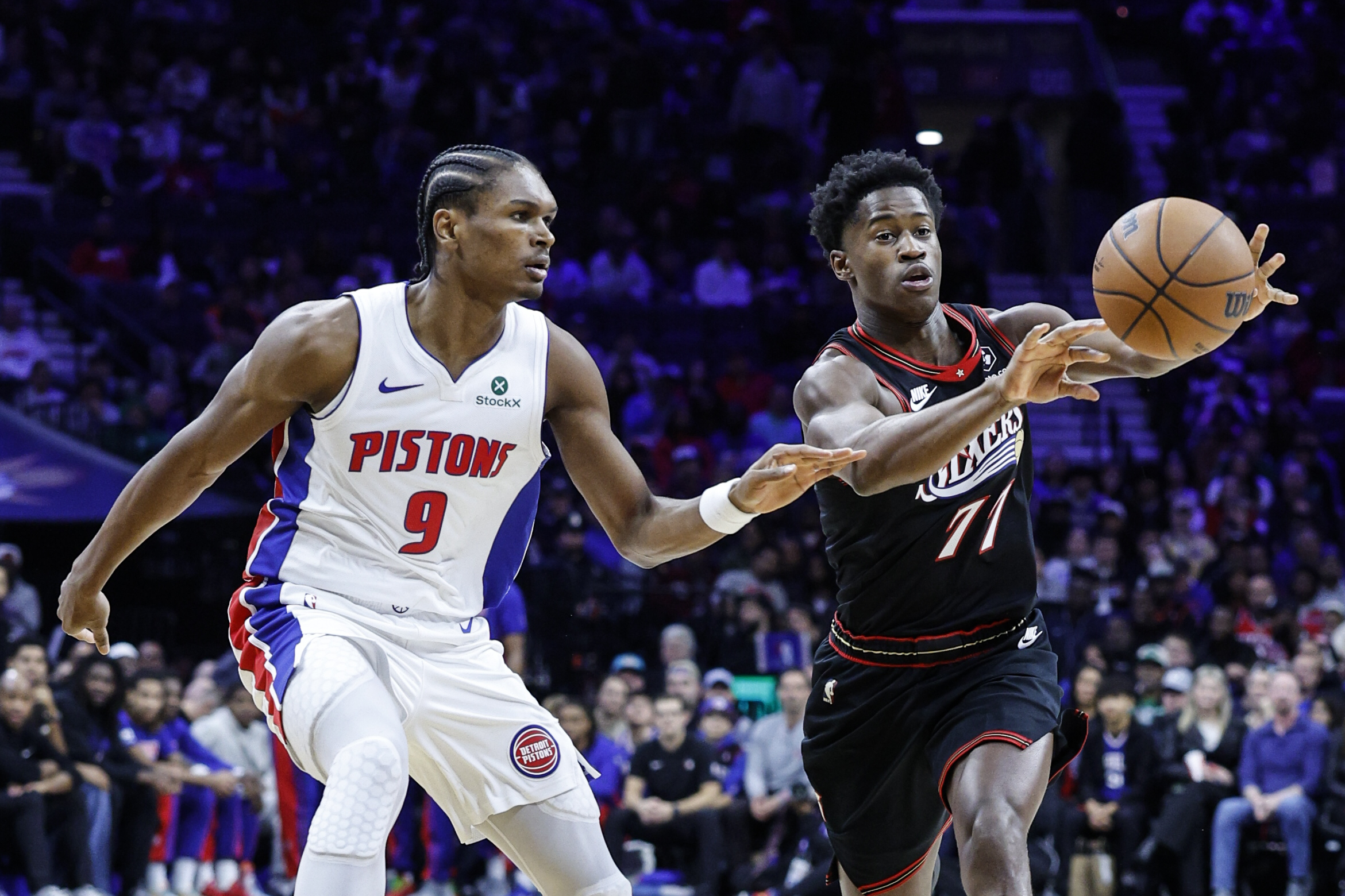
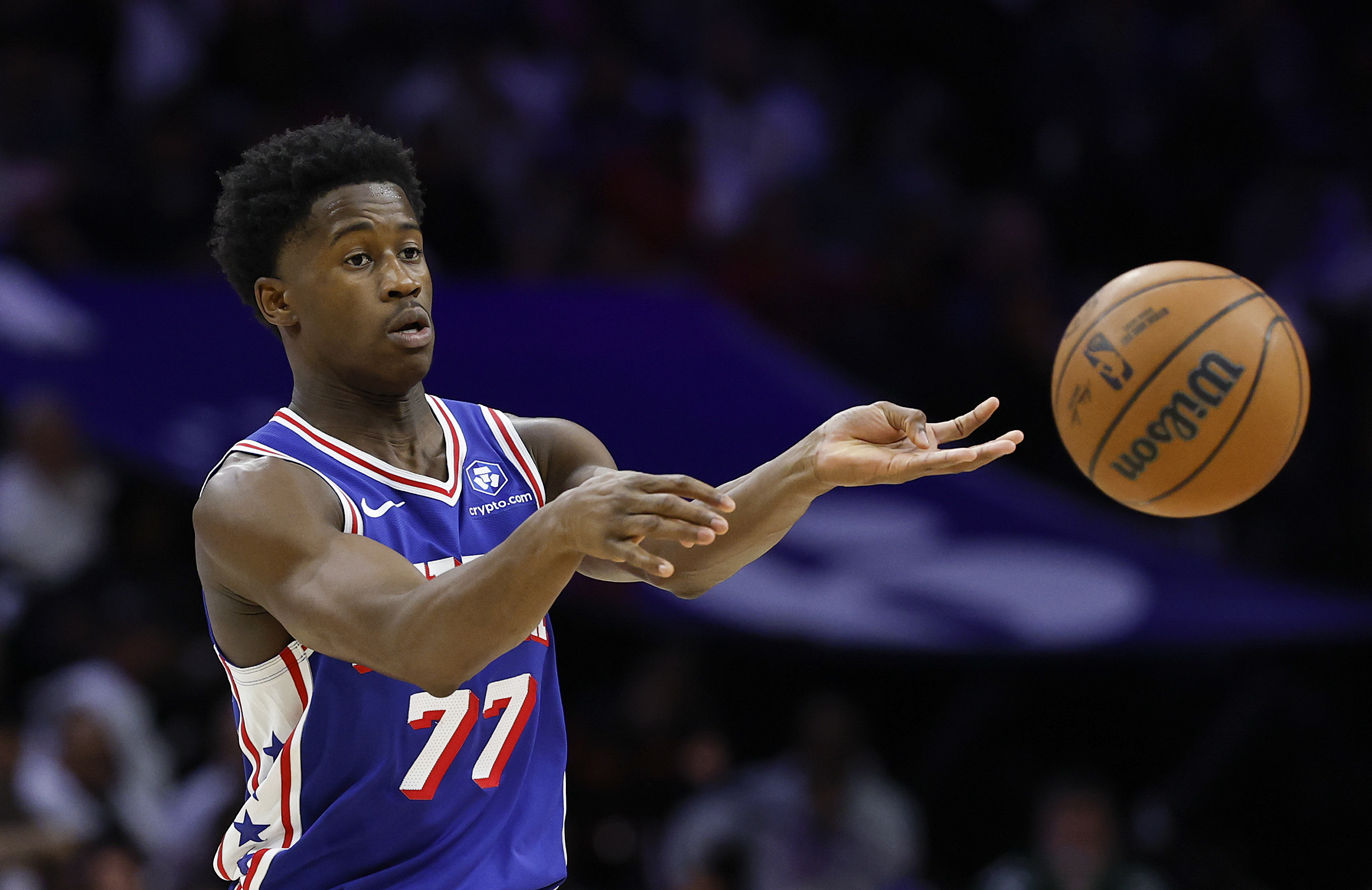
Sixers rookie VJ Edgecombe passes against the Charlotte Hornets on Saturday night at Xfinity Mobile Arena.
Leano Rolle saw this in Edgecombe from the beginning. They are such close friends that they consider themselves cousins or brothers. As kids, they started playing basketball together barefoot on a neighborhood dirt lot, with a makeshift hoop made of a crate and two-by-fours.
When Edgecombe went through his pre-draft process earlier this year, Leano Rolle was still by his side. The night before Edgecombe was selected third overall by the Sixers, tears of disbelief and joy fell from the corners of Leano Rolle’s eyes as he stared at the ceiling while lying in a New York City bed.
“I texted [Edgecombe] and told him how proud of him I was,” Leano Rolle said. “It was so amazing because, where we’re from, you wouldn’t expect nothing to happen like that.”
But the younger Rolle is chasing his own basketball dreams at Southwest Mississippi Community College, and Wednesday’s practice overlapped with the start of the Sixers-Celtics game.
When a team manager alerted Rolle that Edgecombe had 14 first-quarter points, he was in shock. He kept checking his phone for box scores and Instagram dunk highlights as he moved from practice to a mandatory pep rally, convinced that Edgecombe was about to get 50 points.
When Rolle finally returned to his room, Edgecombe called him and their other best friend for a postgame chat.
“Just talking and laughing and telling him how he did,” Rolle said. “Letting him know he went out there and did well, and did what he was supposed to do.”
Also watching that night was LJ Rose, the general manager of the Bahamian national team. He did not realize that Edgecombe took 25 shots against the Celtics, because “he was just flowing.”
Rose, who is also the general manager of the University of Miami’s men’s basketball team, remembers first learning about Edgecombe from a local media member named John Nutt. Nutt persuaded Buddy Hield, the fellow NBA Bahamian and former Sixer, to invite a young Edgecombe to his basketball camp.
“He held his own,” Rose said of Edgecombe. “And ever since then, he’s kind of been on the radar.”
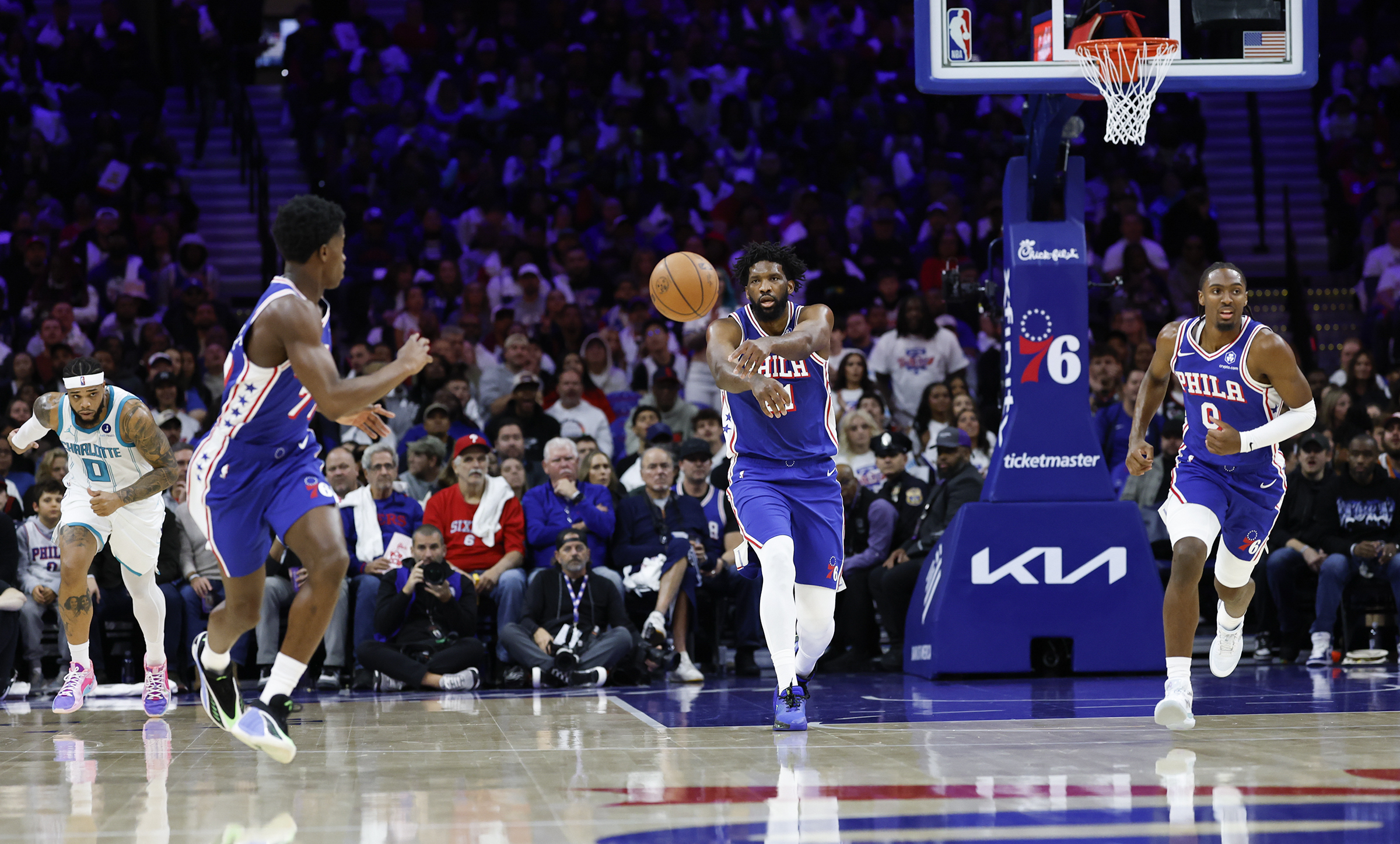
Sixers center Joel Embiid fires a pass to VJ Edgecombe on Saturday.
That buzz only grew when Edgecombe joined the senior national team for an Olympic qualifying tournament last summer. He played alongside NBA players Hield, current Sixer Eric Gordon, and Deandre Ayton, the first time Edgecombe had been surrounded by teammates with more credentials and experience.
Still, Edgecombe “showed up Day 1 and he asserted himself,” Rose said, a testament to Edgecombe’s “everyday” work ethic and temperament. Rose went back to the Houston Rockets, where he was an international scout at the time, and told general manager Rafael Stone, “Hey, we have one.”
“He did not get rattled when he got overseas,” Rose said. “And it was a new environment. Some adversity was coming, but he just kind of kept on plugging away. And I think that just goes back to, it’s the everyday. His consistent grind and just coming from where he’s come from.”
Even during this dramatic life transition to the NBA, Edgecombe has remained connected to those Bimini roots.
Leano Rolle is planning to visit Edgecombe in Philly for Thanksgiving and Christmas. Gilbert Rolle texts Edgecombe at least once per week and said any impromptu phone call would be answered with a, “Hey, what’s up?”
When asked late Saturday — after totaling 15 points, eight assists, and six rebounds in the Sixers’ comeback win over the Charlotte Hornets — about the support he has felt from back home in recent days, a grinning Edgecombe said, “Yeah … I’ve heard from a lot of people.”
Because Edgecombe is still the “humble spirit” that Gilbert Rolle watched cry “as if somebody died” after losing in that Abaco Islands tournament as a seventh grader. To Rolle, that visceral reaction cemented how seriously Edgecombe took the sport.
“He’s not only talented, but he worked for this and he wanted this,” Rolle said. “This was something that he put his mind to do. And every opportunity he had, he went and got up extra shots. Any opportunity he had to get better in his game.
“To see him crying from losing a game, to on TV playing and breaking records, I’m like, ‘He deserves this.’”
And now, Gilbert Rolle has direct evidence of Edgecombe’s hard work to pass along to his current crop of young players. That is one component of the Edgecombe chatter that spread throughout the Bahamas into the weekend, as those close to the rookie revel in his instant success.
And if Edgecombe continues this torrid start to his NBA career?
“The people back home are ready to name the island after him one day,” Leano Rolle said. “That’s VJ Island.”