Several students at Quakertown High School were taken into custody on Friday after a student walkout protesting federal immigration enforcement escalated into a confrontation that left at least one teenager bloodied and in handcuffs, according to witnesses and video footage from the scene.
School officials said the episode began shortly before noon, when dozens of students left campus without permission to demonstrate along Front Street in opposition to the policies of U.S. Immigration and Customs Enforcement. What followed, according to videos posted widely on social media, was a chaotic scene involving students, an unidentified man, and local police officers.
By late afternoon, authorities had released few details about what prompted officers to intervene or how many students were detained.
In a letter to parents, Lisa Hoffman, the acting superintendent of the Quakertown Community School District, said 35 students left school grounds at about 11:30 a.m. to stage the protest. She said district officials were informed by the Quakertown Police Department that the students were “engaging in unsafe and disruptive behavior,” though she did not elaborate on what that behavior entailed.
The school also went on a short lockdown as a precaution, she said.
Quakertown police contradicted the account offered by school officials, saying in a statement that as many as 50 students were involved in the protest, which “began peacefully” but became dangerous when students entered traffic, threw snowballs, kicked cars, and damaged property, including a car’s sideview mirror.
“Officers issued additional warnings to maintain civil,” the statement said, before “confrontation escalated, and some individuals assaulted officers.”
Police said “five to six juveniles and one adult have been taken into custody,” but offered no additional information.
Videos circulating online offer a fragmented glimpse of the confrontation. In one clip, a man is seen grabbing a teenage girl and placing her in a chokehold. A male student rushes in and strikes the man, after which police officers move in and take the student into custody. Other footage shows protest signs scattered across the sidewalk, speckled with blood, and a teenage girl in handcuffs with blood visible along the side of her face.
A woman who was dining inside a restaurant along Front Street said she watched the confrontation unfold just outside the window.
“This man was easily twice her size,” said the woman, who asked not to be identified for fear of reprisal. “She couldn’t have been much more than 100 pounds.”
When a male student stepped in to help the girl, she said, the scene quickly spiraled. Another woman in the restaurant recalled that several adults — including police officers — forced the boy to the ground.
“The situation completely escalated,” said the second woman, who also asked not to be identified out of fear of reprisal. “There were multiple grown men getting in the faces of the children, spit flying out of their mouths.”
It remains unclear what role the man played in the altercation. Both women said they later saw him drive away from the scene in a police vehicle.
The statement by police made no mention of the man, nor did it include details about any injuries sustained by the students.
Messages seeking comment from the school district were not immediately returned Friday afternoon.
The Buck’s County District Attorney’s Office said in a statement Friday that it was aware of the incident and was “gathering information.”
“We are committed to ensuring public safety and will provide updates if and when legally appropriate,” the office said.
By late afternoon, the number of students taken into custody had not been disclosed, and school officials had not said whether any would face disciplinary action.
Videos also showed papers and books scattered on the sidewalk next to dropped and bloodied signs. “These children were thrown around and brutalized by these officers,” said one of the women.
School officials had been aware of the planned student walk-out, according to the high school’s Facebook page, and canceled it Friday morning.
“While we respect students’ rights to express their views, our first priority is to ensure a safe and secure environment for all,” House Principal Jason D. Magditch wrote in a letter posted on the Facebook page. “At this time, we believe canceling the protest is the most appropriate course of action in the interest of student safety and well-being.”
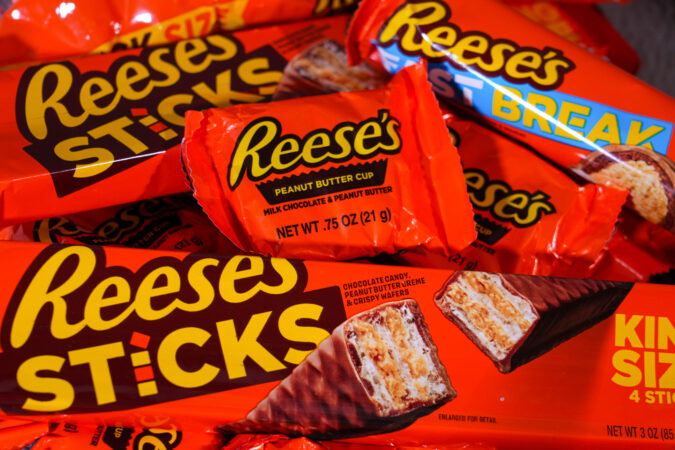
The grandson of the inventor of Reese’s Peanut Butter Cups went viral after penning an open letter to Pennsylvania’s Hershey Company on Feb. 14. But it was far from a valentine.
Brad Reese, 70, accused the confectionery manufacturer of hurting the brand his grandfather H.B. Reese began a century ago, cutting corners with its chocolate quality. Within the week, Reese’s post has sparked discussions about brand integrity, ingredients, and legacy.
In a LinkedIn post, Reese said Hershey’s assortment of Reese’s products (including the valentine heart-shaped ones he had recently sampled) include different, cheaper ingredients, swapping milk chocolate for compound coatings and peanut butter for peanut butter créme.
“How does The Hershey Co. continue to position Reese’s as its flagship brand, a symbol of trust, quality, and leadership, while quietly replacing the very ingredients (Milk Chocolate + Peanut Butter) that built Reese’s trust in the first place?” Reese wrote.
Reese isn’t wrong. Several Reese’s products today — including the valentine’s hearts and the Easter egg-shaped versions — use chocolate-flavored coatings that cannot be legally called “milk chocolate,” a term that’s regulated by the Food and Drug Administration. It’s unclear exactly when the swaps occurred.
The flagship Reese’s Peanut Butter Cups continue to list milk chocolate and peanuts as the first two ingredients.
Still, the product line’s variance represents a shift across the candy industry as cocoa prices continue to rise, driven by a combination of factors, including climate-sparked changes in supply, tariffs, and labor shortages, the New York Times reports. Chocolate companies, including Hershey’s, have responded by making cost-effective ingredient swaps. The Times reported that several chocolate-forward Hershey’s candies no longer listed milk chocolate among their ingredients during last Halloween season.
Hershey doesn’t deny the swaps, but is defending its quality.
The company said in a statement Wednesday that Reese’s Peanut Butter Cups are made the same way they’ve always been, with house-made milk chocolate and roasted peanuts, but that ingredients for some other Reese’s products can vary based on demand.
“As we’ve grown and expanded the Reese’s product line, we make product recipe adjustments that allow us to make new shapes, sizes, and innovations that Reese’s fans have come to love and ask for, while always protecting the essence of what makes Reese’s unique and special: the perfect combination of chocolate and peanut butter,” the company said.
A package of Reese’s Hearts is shown on Tuesday, Feb. 17, 2026, in New Jersey. (AP Photo/Pablo Salinas)
A government database last updated in 2023 shows changes to the ratio of peanuts and milk chocolate used in Reese’s Peanut Butter Eggs over the years. Three years ago, the egg chocolates had more peanuts and milk chocolate than anything else. But the current formula lists sugar and vegetable oil first — and no milk chocolate.
Reese said he thinks Hershey has gone too far this time.
He picked up a bag of Reese’s Mini Hearts for Valentine’s Day, but threw them away after sampling.
“It was not edible,” Reese told The Associated Press. “You have to understand. I used to eat a Reese’s product every day. This is very devastating for me.”
Reese’s grandfather, H.B. Reese, spent two years at Hershey before leaving to form his own company, H.B. Reese Candy Co. in 1919. The company manufactured about 12 types of chocolate, made with ingredients that included real cocoa butter, fresh cream, and freshly roasted peanuts.
He invented Reese’s Peanut Butter Cups in 1928. They were a hit and had wrappers included the slogan: “Made in Chocolate Town, so they must be good.” H.B. Reese died in 1956. His six sons eventually sold his company to Hershey in 1963.
Now, Reese is waging war.
He redesigned his personal website to take on Hershey’s ingredient swaps. The lead photo on the homepage shows an orange cap with the phrase “MAKE REESE’S GREAT AGAIN” stitched on the front. He says the website is devoted to “protecting Reese’s brand integrity.” It includes a list of news coverage his LinkedIn call-out has received to date.
“Right now, the REESE’S story is diverging from what’s inside REESE’S products. And that divergence puts REESE’S and the legacy behind it, at risk,” Reese said on LinkedIn. “As the grandson of the man who created REESE’S Peanut Butter Cups, I’m not asking for nostalgia. I’m asking for alignment. For truth in REESE’S brand stewardship.”
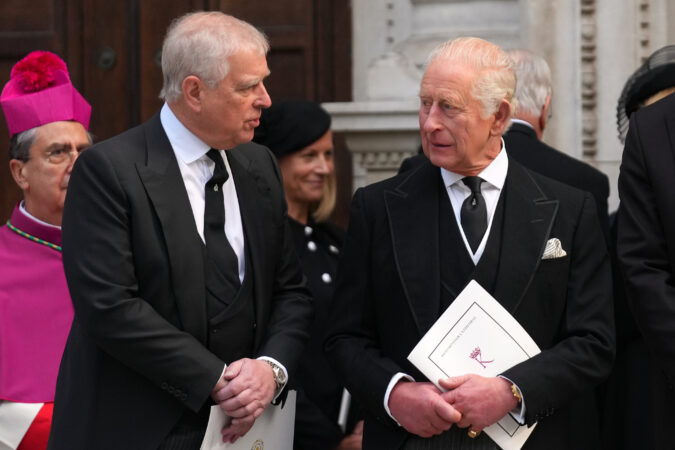
LONDON — The former Prince Andrew was arrested and held for hours by British police Thursday on suspicion of misconduct in public office related to his links to Jeffrey Epstein, an extraordinary move in a country where authorities once sought to shield the royal family from embarrassment.
It was the first time in nearly four centuries that a senior British royal was placed under arrest, and it underscored how deference to the monarchy has eroded in recent years.
King Charles III, whose late mother lived by the motto “never complain, never explain,” took the unusual step of issuing a statement on the arrest of his brother, now known as Andrew Mountbatten-Windsor.
“Let me state clearly: the law must take its course,’’ the king said. “As this process continues, it would not be right for me to comment further on this matter.’’
The Thames Valley Police force said Mountbatten-Windsor was released Thursday evening, about 11 hours after he was detained at his home in eastern England. He was photographed in a car leaving the station near his home on the royal Sandringham Estate.
Police said he was released under investigation, meaning he has neither been charged nor exonerated. Police said they had finished searching Mountbatten-Windsor’s home, but officers were still searching his former residence near Windsor Castle.
The police force, which covers areas west of London, including Mountbatten-Windsor’s former home, said Thursday that a man in his 60s from Norfolk in eastern England, had been arrested and was in custody. Police did not identify the suspect, in line with standard procedures in Britain.
Mountbatten-Windsor, 66, moved to the king’s private estate in Norfolk after he was evicted from his longtime home near the castle earlier this month.
Police previously said they were “assessing” reports that Mountbatten-Windsor sent trade information to Epstein, a wealthy investor and convicted sex offender, in 2010, when the former prince was Britain’s special envoy for international trade. Correspondence between the two men was released by the U.S. Justice Department late last month along with millions of pages of documents from the American investigation into Epstein.
“Following a thorough assessment, we have now opened an investigation into this allegation of misconduct in public office,’’ Assistant Chief Constable Oliver Wright said in a statement.
“We understand the significant public interest in this case, and we will provide updates at the appropriate time,” he added.
Police also said they were searching two properties.
Earlier in the day, pictures circulated online that appeared to show unmarked police cars at Wood Farm, Mountbatten-Windsor’s home on the Sandringham Estate in Norfolk, with plainclothes officers gathering outside.
Mountbatten-Windsor has consistently denied any wrongdoing in his association with Epstein.
The allegations being investigated Thursday are separate from those made by Virginia Giuffre, who claimed she was trafficked to Britain to have sex with the prince in 2001, when she was just 17. Giuffre died by suicide last year.
Still, Giuffre’s family praised the arrest, saying that their “broken hearts have been lifted at the news that no one is above the law, not even royalty.”
The family added: “He was never a prince. For survivors everywhere, Virginia did this for you.”
A ‘spectacular fall from grace’
“This is the most spectacular fall from grace for a member of the royal family in modern times,” said Craig Prescott, a royal expert at Royal Holloway, University of London, who compared it in severity to the crisis sparked by Edward VIII’s abdication to marry American divorcee Wallis Simpson.
“And it may not be over yet,’’ Prescott added.
Thursday’s arrest came a day after the National Police Chiefs’ Council said it had created a coordination group to assist forces across the U.K. that are assessing whether Epstein and his associates committed crimes in Britain. In addition to the concerns about Mountbatten-Windsor ’s correspondence, documents released by the U.S. suggest Epstein may have used his private jet to traffic women to and from Britain.
The documents also rocked British politics. Prime Minister Keir Starmer had to fight off questions about his judgment after the papers revealed that Peter Mandelson, the man he appointed ambassador to the U.S., had a longer and closer relationship with Epstein than was previously disclosed.
London’s Metropolitan Police Service has said it is investigating allegations of misconduct in public office related to Mandelson’s own correspondence with Epstein. Mandelson was fired as ambassador to the U.S. in September.
But it is Mountbatten-Windsor’s relationship with Epstein that brought the scandal to the doors of Buckingham Palace and threatened to undermine support for the monarchy.
The last time a senior British royal was arrested was almost 400 years ago during the reign of King Charles I that saw a growing power struggle between the crown and Parliament.
After the king attempted to arrest lawmakers in the House of Commons in 1642, hostilities erupted into the English Civil War, which ended with victory for the parliamentary forces of Oliver Cromwell.
Charles I was arrested, tried, convicted of high treason, and beheaded in 1649.
The late Queen Elizabeth II forced her second son to give up royal duties and end his charitable work in 2019 after he tried to explain away his friendship with Epstein during a catastrophic interview with the BBC.
But as concern mounted about what the Epstein files might reveal, the king moved aggressively to insulate the royal family from the fallout.
Since October, Charles has stripped his younger brother of the right to be called prince, forced him to move out of the royal estate he occupied for more than 20 years and issued a public statement supporting the women and girls abused by Epstein.
Last week, the palace said it was ready to cooperate with police investigating Mountbatten-Windsor.
Charles was forced to act after Mountbatten-Windsor’s correspondence with Epstein torpedoed the former prince’s claims that he severed ties with the financier after Epstein’s 2008 conviction for soliciting a minor for prostitution.
Instead, emails between the two men show Epstein offering to arrange a date between Mountbatten-Windsor and a young Russian woman in 2010, and the then-prince inviting Epstein to dinner at Buckingham Palace.
Additional correspondence appears to show Mountbatten-Windsor sending Epstein reports from a two-week tour of Southeast Asia that he undertook in 2010 as Britain’s trade envoy.
Danny Shaw, an expert on law enforcement in the U.K., told the BBC that in most cases, suspects are held between 12 and 24 hours and are then either charged or released pending further investigation.
Mountbatten-Windsor will be placed in “a cell in a custody suite” with just “a bed and a toilet,” where he will wait until his police interview.
“There’ll be no special treatment for him,″ Shaw said.
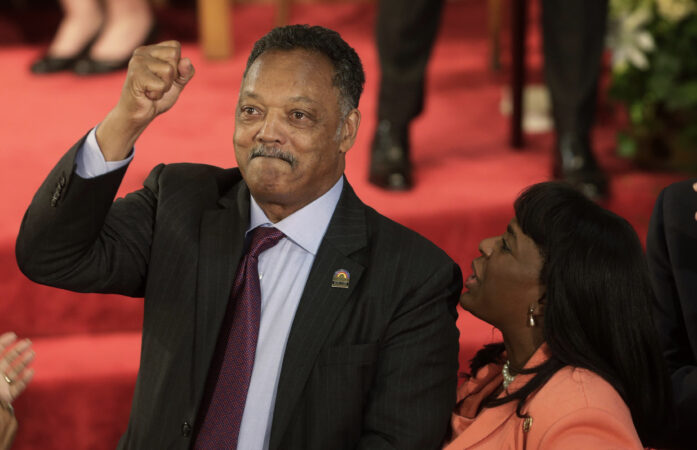
CHICAGO — The Rev. Jesse L. Jackson, a protégé of the Rev. Martin Luther King Jr. and two-time presidential candidate who led the Civil Rights Movement for decades after the revered leader’s assassination, died Tuesday. He was 84.
As a young organizer in Chicago, Rev. Jackson was called to meet with King at the Lorraine Motel in Memphis shortly before King was killed, and he publicly positioned himself thereafter as King’s successor.
Santita Jackson confirmed that her father, who had a rare neurological disorder, died at home in Chicago, surrounded by family.
Rev. Jackson led a lifetime of crusades in the United States and abroad, advocating for the poor and underrepresented on issues, including voting rights, job opportunities, education, and healthcare. He scored diplomatic victories with world leaders, and through his Rainbow/PUSH Coalition, he channeled cries for Black pride and self-determination into corporate boardrooms, pressuring executives to make America a more open and equitable society.
And when he declared, “I am Somebody,” in a poem he often repeated, he sought to reach people of all colors. “I may be poor, but I am Somebody; I may be young; but I am Somebody; I may be on welfare, but I am Somebody,” Rev. Jackson intoned.
It was a message he took literally and personally, having risen from obscurity in the segregated South to become America’s best-known civil rights activist since King.
“Our father was a servant leader — not only to our family, but to the oppressed, the voiceless, and the overlooked around the world,” the Jackson family said in a statement posted online. “We shared him with the world, and in return, the world became part of our extended family.”
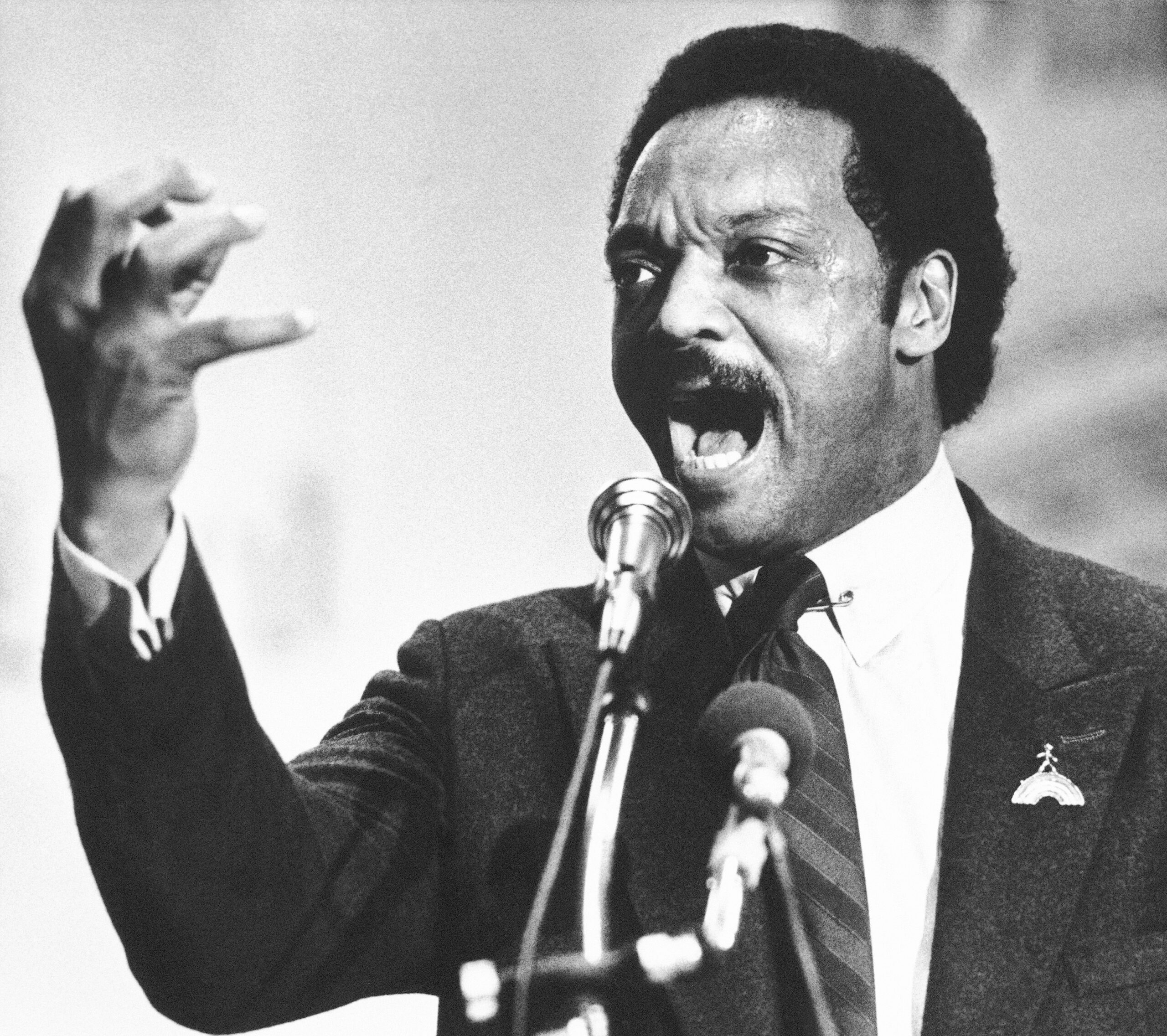
Democratic presidential primary candidate Jesse Jackson speaks to a group of his supporters at a rally held at a Baptist Church in Dayton, Ohio, on April 14, 1984.
Fellow civil rights activist the Rev. Al Sharpton said his mentor “was not simply a civil rights leader; he was a movement unto himself.”
“He taught me that protest must have purpose, that faith must have feet, and that justice is not seasonal, it is daily work,” Sharpton wrote in a statement, adding that Rev. Jackson taught “trying is as important as triumph. That you do not wait for the dream to come true; you work to make it real.”
“Even if we win,” he told marchers in Minneapolis before the officer whose knee kept George Floyd from breathing was convicted of murder, “it’s relief, not victory. They’re still killing our people. Stop the violence, save the children. Keep hope alive.”
Rev. Jackson’s voice, infused with the stirring cadences and powerful insistence of the Black church, demanded attention. On the campaign trail and elsewhere, he used rhyming and slogans such as “Hope not dope” and “If my mind can conceive it and my heart can believe it, then I can achieve it,” to deliver his messages.
Rev. Jackson had his share of critics, both within and outside of the Black community. Some considered him a grandstander, too eager to seek the spotlight. Looking back on his life and legacy, Rev. Jackson told the Associated Press in 2011 that he felt blessed to be able to continue the service of other leaders before him and to lay a foundation for those to come.
“A part of our life’s work was to tear down walls and build bridges, and in a half century of work, we’ve basically torn down walls,” Rev. Jackson said. “Sometimes when you tear down walls, you’re scarred by falling debris, but your mission is to open up holes so others behind you can run through.”
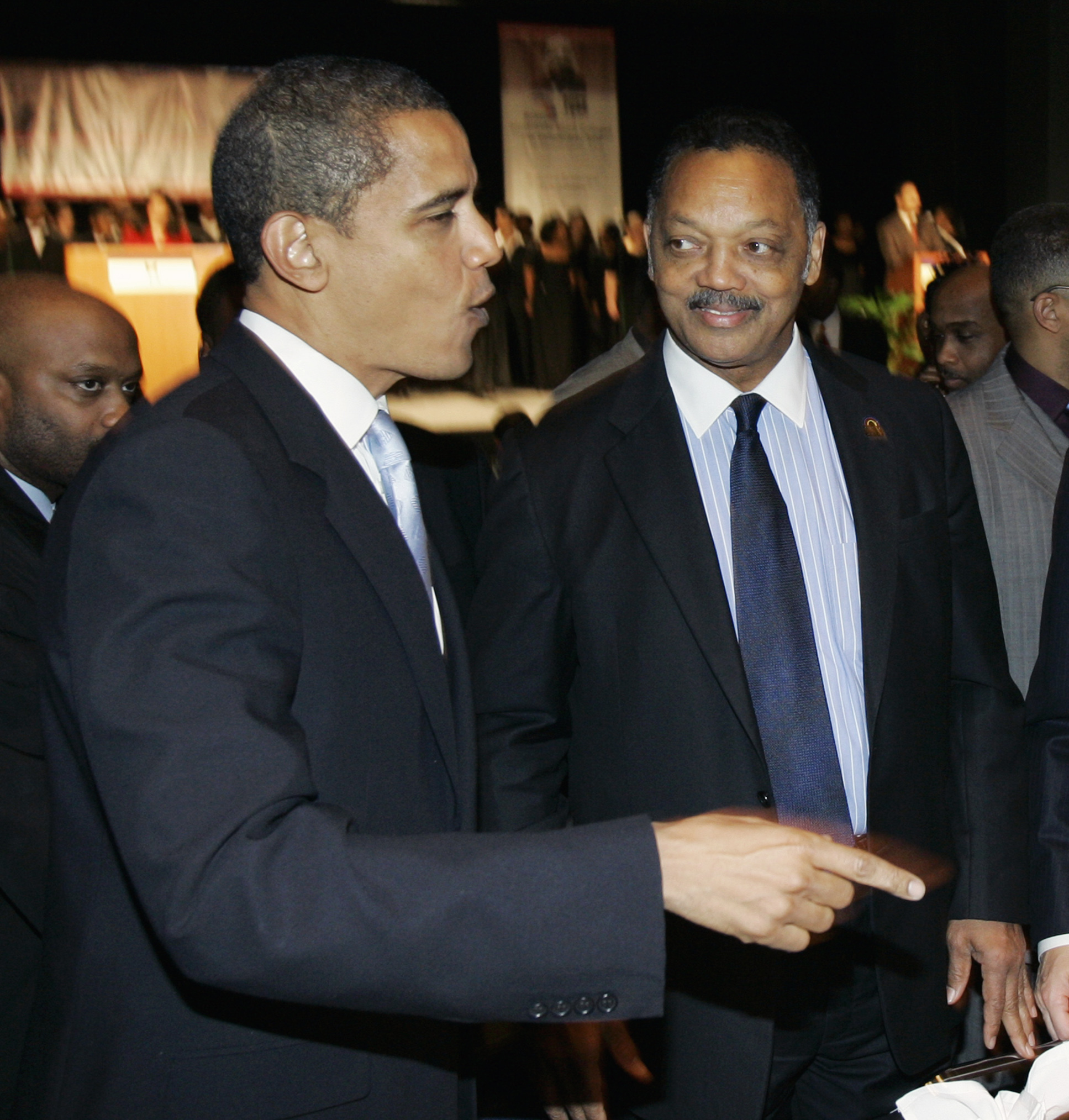
Barack Obama, then a senator. from Illinois, and the Rev. Jesse Jackson are seen at the Rev. Dr. Martin Luther King Jr. Scholarship Awards Breakfast in Chicago on Jan. 15, 2007.
In his final months, as he received 24-hour care, he lost his ability to speak, communicating with family and visitors by holding their hands and squeezing.
“I get very emotional knowing that these speeches belong to the ages now,” his son, Jesse Jackson Jr., told the AP in October.
A student athlete drawn to the Civil Rights Movement
Jesse Louis Jackson was born Oct. 8, 1941, in Greenville, S.C., the son of high school student Helen Burns and Noah Louis Robinson, a married man who lived next door. Jackson was later adopted by Charles Henry Jackson, who married his mother.
Rev. Jackson was a star quarterback on the football team at Sterling High School in Greenville, and he accepted a football scholarship from the University of Illinois. But after reportedly being told that Black people couldn’t play quarterback, he transferred to North Carolina A&T in Greensboro, where he became the first-string quarterback, an honor student in sociology and economics, and student body president.
Arriving on the historically Black campus in 1960 just months after students there launched sit-ins at a whites-only lunch counter, Rev. Jackson immersed himself in the blossoming Civil Rights Movement.
By 1965, he joined the voting rights march King led from Selma to Montgomery, Alabama. King dispatched him to Chicago to launch Operation Breadbasket, a Southern Christian Leadership Conference effort to pressure companies to hire Black workers.
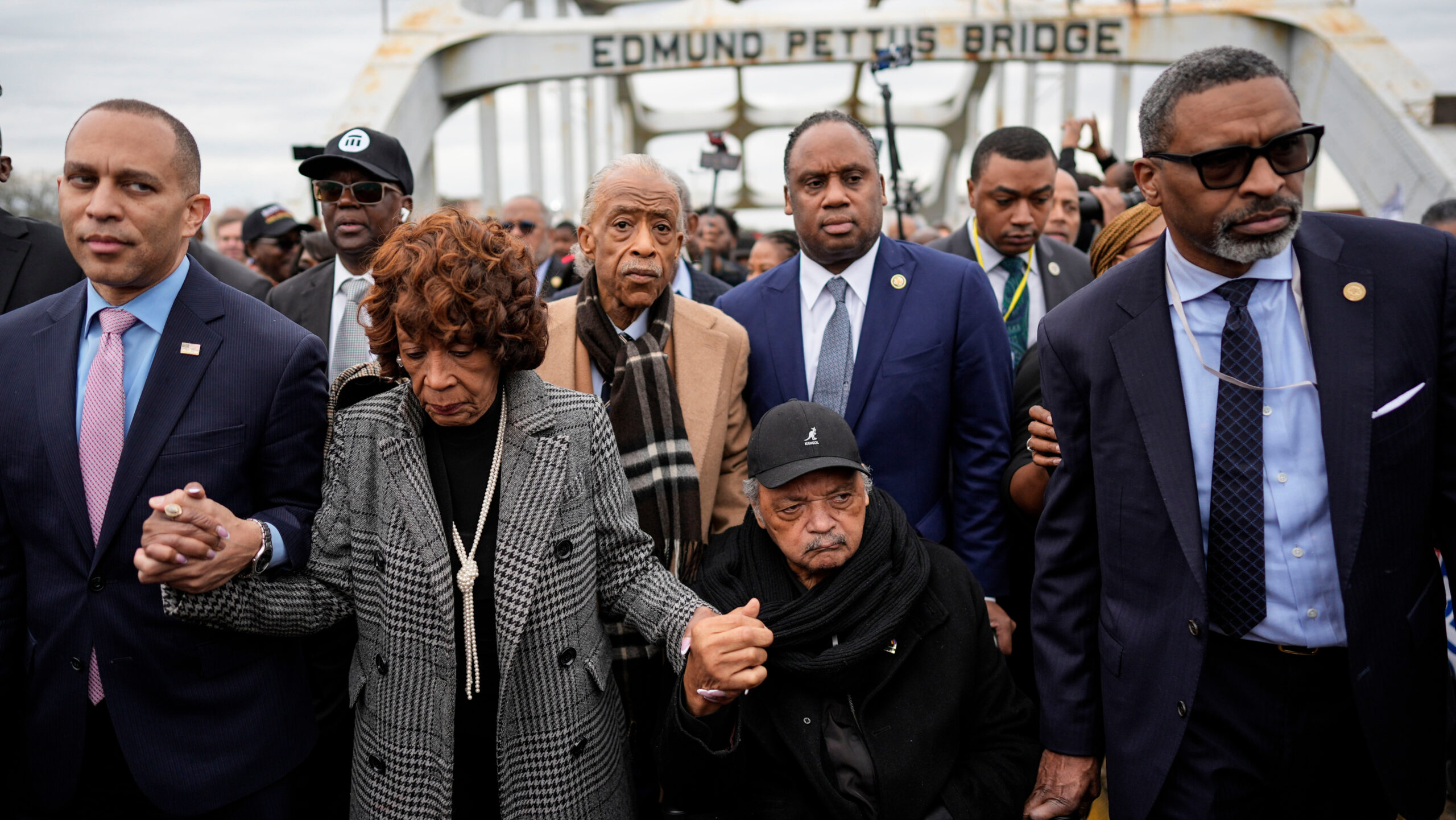
U.S. Rep. Hakeem Jeffries (D., N.Y.), U.S. Rep. Maxine Waters (D., Calif.), the Rev. Al Sharpton, Rev. Jesse Jackson and NAACP President Derrick Johnson walk across the Edmund Pettus bridge in Selma, Ala., on March 9, 2025, during the 60th anniversary of the march to ensure that African Americans could exercise their constitutional right to vote.
Rev. Jackson called his time with King “a phenomenal four years of work.”
Rev. Jackson was with King on April 4, 1968, when the civil rights leader was slain. Rev. Jackson’s account of the assassination was that King died in his arms.
Sharpton said he “always wondered how much trauma that must have been” for Rev. Jackson to witness King’s death. “He never would talk about it too much, but it drove him,” Sharpton said Tuesday. “He said, ‘We’ve got to keep Dr. King’s legacy alive.’”
With his flair for the dramatic, Rev. Jackson wore a turtleneck he said was soaked with King’s blood for two days, including at a King memorial service held by the Chicago City Council, where he said: “I come here with a heavy heart because on my chest is the stain of blood from Dr. King’s head.”
However, several King aides, including speechwriter Alfred Duckett, questioned whether Rev. Jackson could have gotten King’s blood on his clothing. There are no images of Rev. Jackson in pictures taken shortly after the assassination.
In 1971, Rev. Jackson broke with the Southern Christian Leadership Conference to form Operation PUSH, originally named People United to Save Humanity. The organization based on Chicago’s South Side declared a sweeping mission, from diversifying workforces to registering voters in communities of color nationwide. Using lawsuits and threats of boycotts, Rev. Jackson pressured top corporations to spend millions and publicly commit to hiring more diverse employees.
The constant campaigns often left his wife, Jacqueline Lavinia Brown, the college sweetheart he married in 1963, taking the lead in raising their five children: Santita Jackson, Yusef DuBois Jackson, Jacqueline Lavinia Jackson Jr., and two future members of Congress, U.S. Rep. Jonathan Luther Jackson and Jesse L. Jackson Jr., who resigned in 2012 but is seeking reelection in the 2026 midterms.
The elder Jackson, who was ordained as a Baptist minister in 1968 and earned his master’s of divinity degree in 2000, also acknowledged fathering a child, Ashley Jackson, with one of his employees at Rainbow/PUSH, Karen L. Stanford. He said he understood what it means to be born out of wedlock and supported her emotionally and financially.
On Tuesday, Harold Hall joined other mourners who stopped by the family home to pay their respects.
Hall, who once lived in the same Chicago neighborhood as Rev. Jackson, left a bouquet of flowers outside Rev. Jackson’s door and recalled that he helped local street organizations in the late 1960s and early 1970s.
Rev. Jackson “would come out and shoot ball and try to change the minds of many of our young folk,” urging them to stay out of trouble, Hall told reporters. “And in many instances, it happened. It worked.”
Presidential aspirations fall short but help ‘keep hope alive’
Despite once telling a Black audience he would not run for president “because white people are incapable of appreciating me,” Rev. Jackson ran twice and did better than any Black politician had before President Barack Obama, winning 13 primaries and caucuses for the Democratic nomination in 1988, four years after his first failed attempt.
His successes left supporters chanting another Rev. Jackson slogan, “Keep hope alive.”
“I was able to run for the presidency twice and redefine what was possible; it raised the lid for women and other people of color,” he told the AP. “Part of my job was to sow seeds of the possibilities.”
U.S. Rep. John Lewis said during a 1988 C-SPAN interview that Rev. Jackson’s two runs for the Democratic nomination “opened some doors that some minority person will be able to walk through and become president.”
Obama acknowledged Rev. Jackson’s efforts, saying he led some of the most significant movements for change in human history.
Michelle Obama “got her first glimpse of political organizing at the Jacksons’ kitchen table when she was a teenager,” Obama wrote on X. “And in his two historic runs for president, he laid the foundation for my own campaign to the highest office in the world.”
Rev. Jackson “was relentless in his belief that we are all children of God, deserving of dignity and respect,” the post read.
Rev. Jackson also pushed for cultural change, joining calls by NAACP members and other movement leaders in the late 1980s to identify Black people in the United States as African Americans.
“To be called African Americans has cultural integrity — it puts us in our proper historical context,” Rev. Jackson said at the time. “Every ethnic group in this country has a reference to some base, some historical cultural base. African Americans have hit that level of cultural maturity.”
Rev. Jackson’s words sometimes got him in trouble.
In 1984, he apologized for what he thought were private comments to a reporter in which he called New York City “Hymietown,” a derogatory reference to its large Jewish population. And in 2008, he made headlines when he complained that Obama was “talking down to Black people” in comments captured by a microphone he didn’t know was on during a break in a television taping.
Still, when Rev. Jackson joined the jubilant crowd in Chicago’s Grant Park to greet Obama that election night, he had tears streaming down his face.
“I wish for a moment that Dr. King or [slain civil rights leader] Medgar Evers … could’ve just been there for 30 seconds to see the fruits of their labor,” he told the AP years later. “I became overwhelmed. It was the joy and the journey.”
Exerting influence on events at home and abroad
Rev. Jackson also had influence abroad, meeting world leaders and scoring diplomatic victories, including the release of Navy Lt. Robert Goodman from Syria in 1984, as well as the 1990 release of more than 700 foreign women and children held after Iraq’s invasion of Kuwait. In 1999, he won the freedom of three Americans imprisoned by Yugoslav President Slobodan Milosevic.
In 2000, President Bill Clinton awarded Rev. Jackson the Presidential Medal of Freedom, the country’s highest civilian honor.
“Citizens have the right to do something or do nothing,” Rev. Jackson said, before heading to Syria. “We choose to do something.”
In 2021, Rev. Jackson joined the parents of Ahmaud Arbery inside the Georgia courtroom where three white men were convicted of killing the young Black jogger. In 2022, he hand-delivered a letter to the U.S. Attorney’s Office in Chicago, calling for federal charges against former Chicago Police Officer Jason Van Dyke in the 2014 killing of Black teenager Laquan McDonald.
Rev. Jackson, who stepped down as president of Rainbow/PUSH in July 2023, disclosed in 2017 that he had sought treatment for Parkinson’s, but he continued to make public appearances even as the disease made it more difficult for listeners to understand him. Last year, doctors confirmed a diagnosis of progressive supranuclear palsy, a life-threatening neurological disorder. He was admitted to a hospital in November for nearly two weeks.
During the coronavirus pandemic, he and his wife survived being hospitalized with COVID-19. Rev. Jackson was vaccinated early, urging Black people in particular to get protected, given their higher risks for bad outcomes.
“It’s America’s unfinished business — we’re free, but not equal,” Rev. Jackson told the AP. “There’s a reality check that has been brought by the coronavirus, that exposes the weakness and the opportunity.”
You may not have noticed, but that endless snowpack has developed a slow leak — in this case historically slow.
Its endurance continues to climb the charts among the snowpacks of yesteryear — and in at least one way may well be unprecedented in the period of record dating to the late 19th century.
As of 7 a.m. Friday, officially at Philadelphia International Airport, three inches of the snowy and icy remnants of what fell on the region on Jan. 25 had survived.
That made this the most-enduring snowpack of at least three inches in 65 years, said Alex Staarmann, a meteorologist at the National Weather Service in Mount Holly, the office’s climate specialist.
That earlier one, which lasted from Jan. 20 to Feb. 14, 1961, was replenished by multiple significant snowfalls, as did others at the top of the endurance list; the 2026 version was basically one-and-done after 9.3 inches were measured at the airport.
This one — and it still has its sparkle where it hasn’t mutated into frozen sludge — even has bested the snow cover attending the 44 inches that accumulated in a six-day period in February 2010, when at least four inches survived for 17 days.
The latest batch was at four inches for 18 days, good for fourth place all-time.
Not that it hasn’t had some aesthetic benefits. It can be like light therapy in the morning, and a spectacular screen for the tree shadows. It has beautifully entombed all that unfinished yard work.
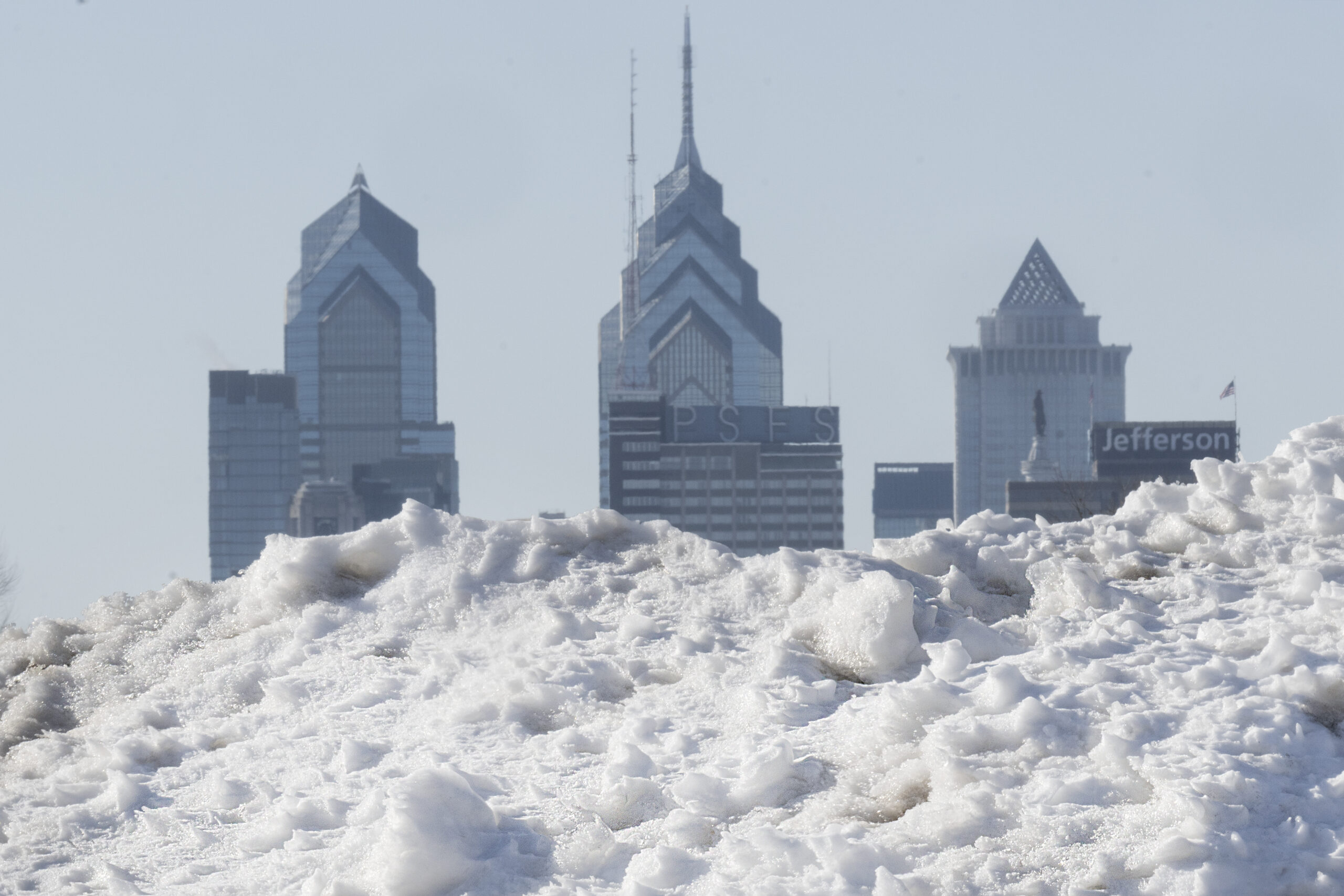
Snow and ice debris is piled along the Camden waterfront in Camden, N.J., framing the Philadelphia skyline across the Delaware River, Thursday, Feb. 5, 2026.
But it’s also been a royal pain throughout the region and begged the question: When it will go away?
When will bare ground emerge in the Philly region?
A farewell tour is likely next week as a snow threat for the holiday weekend remains a remote one, with accumulations only between “wet flakes” and “a dusting” possible, said Staarmann.
And you might keep an eye on Tuesday for a melt watch. Temperatures are forecast to fall below freezing Monday morning, and then stay above 32, even at night, through the workweek.
Highs are expected in the 40s Saturday through Monday, and then 50 or better the next three days.
More significantly for melting, the air will become noticeably more moist on Tuesday, and that should accelerate the melting. Your skin might even notice the difference.
Why has the snowpack been so enduring in Philly?
Since the precipitation ended on Jan. 25, the air has been remarkably dry, an underrated factor in the persistence of the ground cover, along with what happened after the snow stopped that day.
After more than seven inches of snow had fallen, it was topped with several hours of accumulating sleet.
Those miniature ice balls turned out to be a mighty additive: Ice may be way slower to accumulate, but it is also way slower to melt, giving the snowpack staying power.
“If we hadn’t had this much sleet, we might have some evidence of it, but it wouldn’t be this deep or persistent,” said Staarmann.
The Arctic freeze that followed and the consistently arid air have been the ideal preservatives.
Moist air, an efficient melter, has been absent.
When enough invisible water vapor comes in contact with snow and ice, it condenses and gives off latent heat that can liquefy the pack in a hurry.
After Philadelphia’s record 30.7-inch snowfall of Jan. 7-8, 1996, it was a moisture surge 11 days after the snow stopped that had a whole lot to do with erasing the snowpack even before the modest rains that followed, recalled David Robinson, the longtime New Jersey state climatologist.
The melt set off disruptive flooding, but even though rain is in the forecast for midweek, anything resembling a repeat is unlikely this time around.
Is that all there is for the winter of 2025-26?
NOAA’s Climate Prediction Center on Friday had odds favoring above-normal temperatures through Feb. 23, followed by a possible cool down.
Regarding any potential for snow, “We still have a few weeks left of opportunities,” said Staarmann.
As long as computers are operating, snow chances will never die.
However, the February sun is getting stronger by the day and lasting longer. If it does snow again, it’s a near certainty that it won’t match this one for staying power.
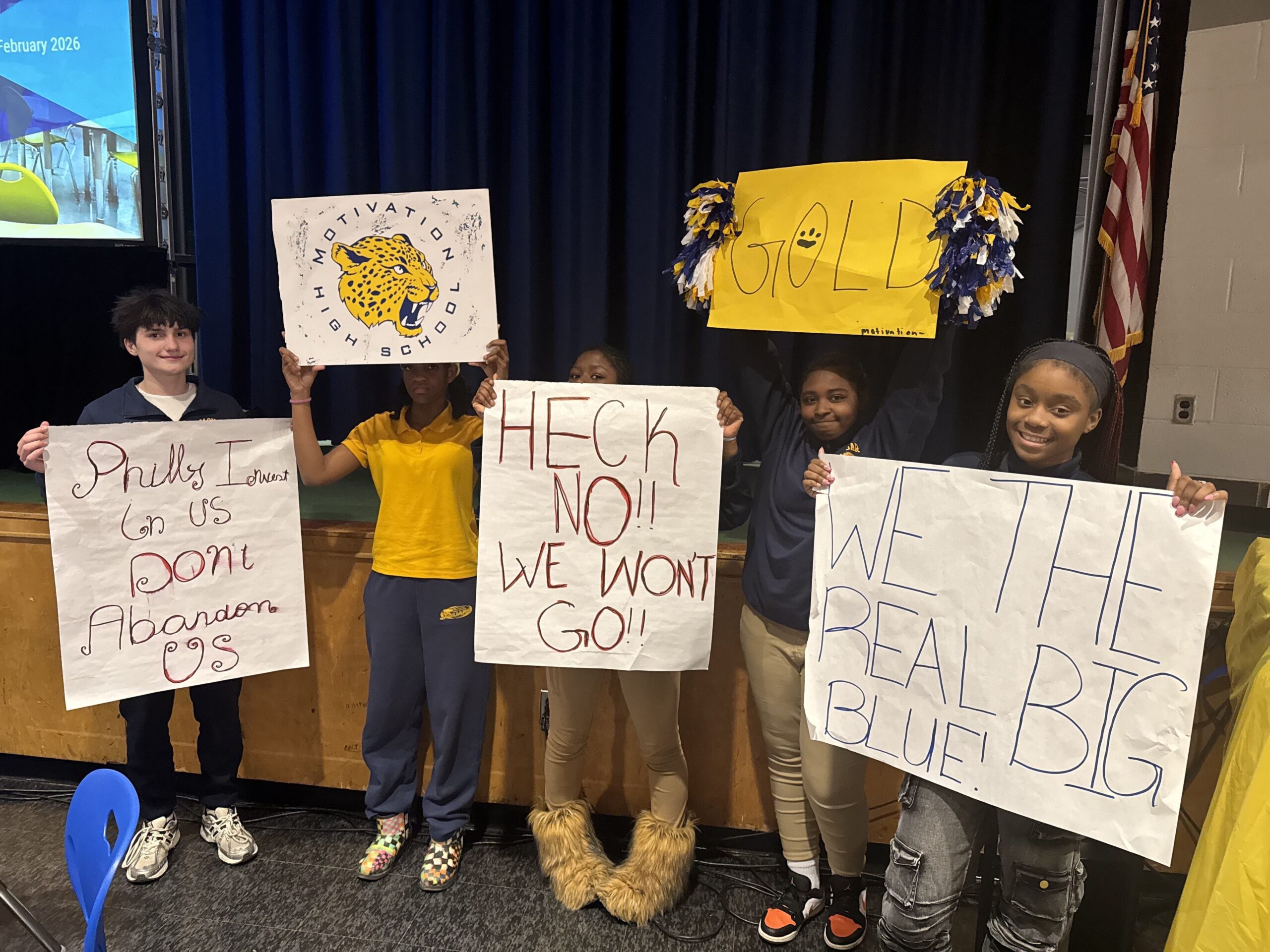
Confronted with the possible closure of their beloved school, the Motivation High community came prepared to fight back.
As community members entered their Southwest Philadelphia school’s auditorium Wednesday night, students waving signs and carrying blue-and-yellow pompoms handed out leaflets: on one side were Motivation’s stats — building condition, graduation rate, attendance, suspensions.
On the other were stats for Bartram High, the school they would be assigned to attend if their school closes in 2027, as proposed under the Philadelphia School District facilities plan. The data for Motivation, a magnet, are stronger across the board, sometimes starkly so — Bartram is a neighborhood school with no admissions criteria, and its attendance and graduation rates are lower, and its suspensions higher.
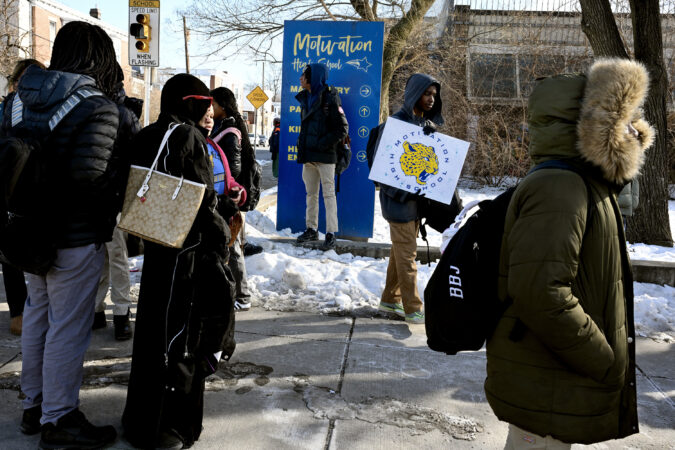
Motivation High students hold signs they made to protest the Philadelphia School District’s planned closure of their school.
Motivation has only 150 students enrolled this year. The school system cited low enrollment as one reason for the closure. But district officials have been clear: The recommendation was also driven by a desire to reinvigorate struggling neighborhood high schools.
“Why are we put in with Bartram to make Bartram look good, when we stand out on our own?” one Motivation student asked district staff pointedly.
The opposition from the Motivation community lays bare an issue at the crux of the school system’s plan: To reach its stated goal of advancing all students, the district says it must displace some. Often, that has pitted communities against one another.
Residents in a restless crowd at Motivation on Wednesday, including one of the state’s most powerful politicians, PennsylvaniaHouse Speaker Joanna McClinton (D., Philadelphia), said they were not having it.
“It’s like you want us to water flowers that just weren’t growing from the beginning,” one parent told officials. “You want to uproot kids who have found their place. You can count my child right out of that plan. She ain’t going to Bartram.”
‘It’s the lottery system’
Motivation began as a Bartram program, housed in a separate building, for academically talented students. But in 2004, Motivation became its own school, eventually moving to the former Turner Middle School building at 59th and Baltimore.
The district that year moved to a centralized lottery system, taking away from principals any discretion over who got admitted to the schools. It said it did so for equity reasons andto solve for demographic mismatches at some schools — though Motivation’s student body had been representative of its neighborhood and the city as a whole.
In the past, schools like Motivation filled most of their ninth-grade classes with students who met the district-set criteria, and also admitted students who were close but came with a strong recommendation from another school, or had compelling personal circumstances that explained why they missed meeting the magnet standards.
Those extra admissions ended with the district policy change, and Motivation’s enrollment plummeted. It was never a huge school, by design — topping out at 400 students prior to the pandemic.
It doesn’t seem fair, said Nehemiah Bumpers, a Motivation 10th grader.
“Why are you guys moving us for having low enrollment scores?” Bumpers said. “It’s the lottery system that drastically changed our enrollment.”
McClinton, who attended the Wednesday meeting, was similarly frustrated.
“When you talk about the enrollment being diminished, it’s because you changed the playbook for principal Teli,” McClinton said of veteran Motivation principal Rennu Teli-Johnson, whom the Housespeaker praised.
“She knows every one of these kids,” said McClinton, whose House district includes both Motivation and Bartram.
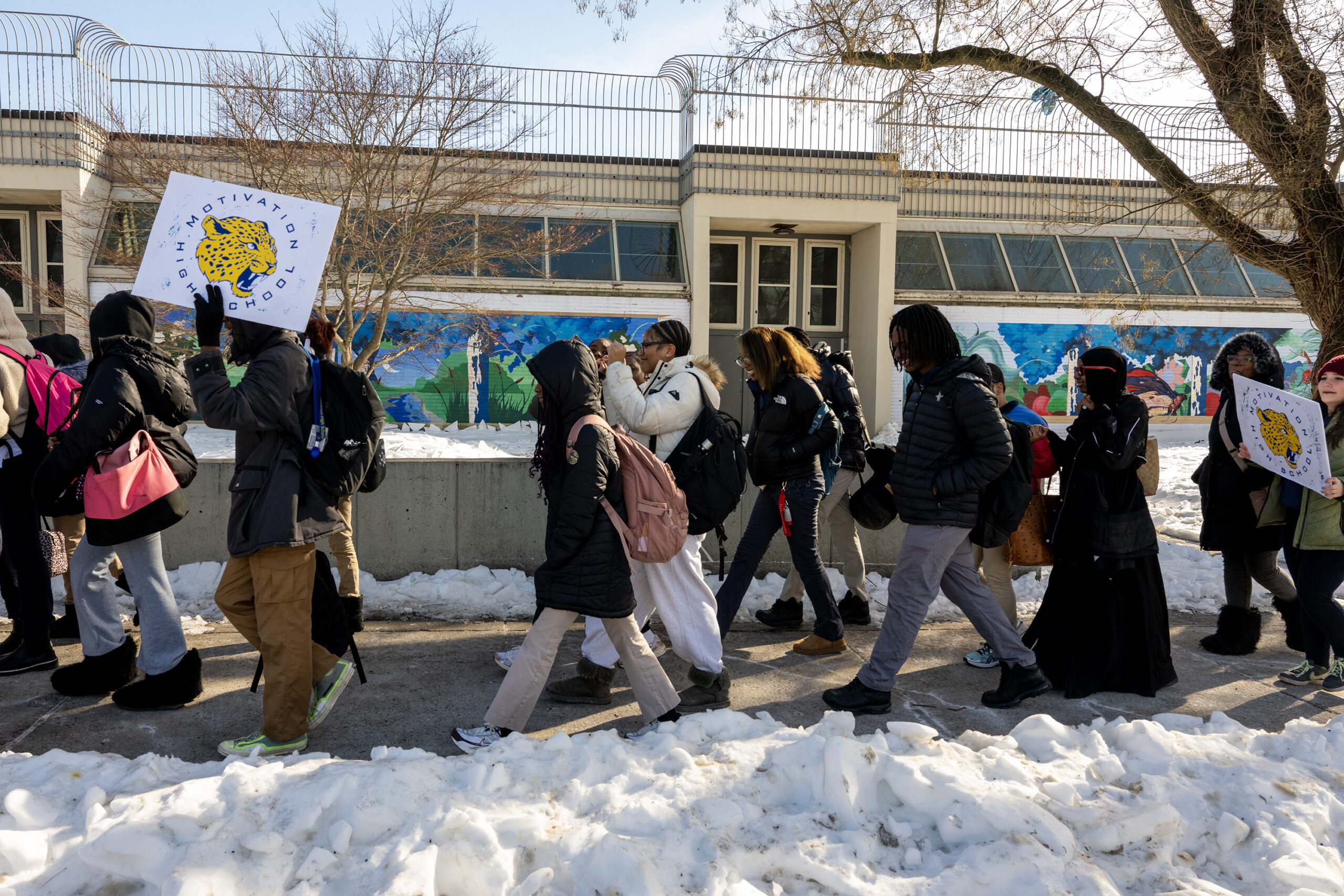
This week, most Motivation students walked out of school, staging a protest over the district’s plan.
Students walk out of Motivation High School in Southwest Philadelphia on Monday, protesting that their school is one of 20 that the Philadelphia School District has tagged for closure.
Zanaya Johnson-Green, an 11th grader, said students were beside themselves, even those who will graduate before the school is planned to be folded into Bartram in the fall of 2027.
“Motivation has given me so many opportunities, and I don’t want to see it go,” Johnson-Green said. “No one wants the school to close. This is having a bad effect on all of us.”
The district has, in recent years, invested millions in sprucing up the Motivation building, which if the school does close would become district “swing space” — a place where schools can move to accommodate building repairs or other overflow needs.
“Why spend all that money just to push us into Bartram and use this school as a swing space?” Bumpers asked.
Motivation High School in Southwest Philadelphia, on Baltimore Avenue in Southwest Philadelphia, is shown in this 2025 file photo.
But much of the energy at the meeting was spent talking about the safety at Bartram — with parents and students pressing the district on how they could guarantee staff and student welfare, and district officials saying they would use a planning year and community wisdom to address concerns.
“Disaster!” someone in the audience shouted when Associate Superintendent Tomás Hanna talked about his hope that those with worries would step up to the plate to help plan for a Bartram transition.
A Motivation student shook her head.
“Why do we have to reap what you sow when you stopped paying attention to neighborhood schools all those years? Why do we have to suffer the consequences, lose opportunities?” the student said.
Monica Allison, a Cobbs Creek neighbor and ward leader, made it clear that though she was fighting against the Bartram closure, wounds inflicted from prior school closures, dating back to John P. Turner Middle School and George Wharton Pepper Middle School, were also on people’s minds.
“You closed John P. Turner and you didn’t ask us,” Allison said. “Now we’re back with another closure. It’s ridiculous. You keep talking about elevating Bartram at the expense of other kids. The neighbors are really tired of this.”
The speaker speaks out
John Young, a Motivation teacher for the last decade, said his students were living their civics lesson by protesting the district’s plan. The district is in a tough spot, he said — coping with the fallout of charter schools that took students from traditional public schools, dealing with its own decision to create greater high school choice.
But, Young said, “this decision is going to continue that trend of pushing our students to homeschool, pushing our students to charter schools. This decision is not going to solve the problem, it is going to hollow us out.”
Pa. House Speaker Joanna McClinton blasted the Philadelphia School District at a public meeting Wednesday night, saying its officials had disadvantaged Motivation High by changing rules around special admissions, then used low enrollment as one reason to close the school.
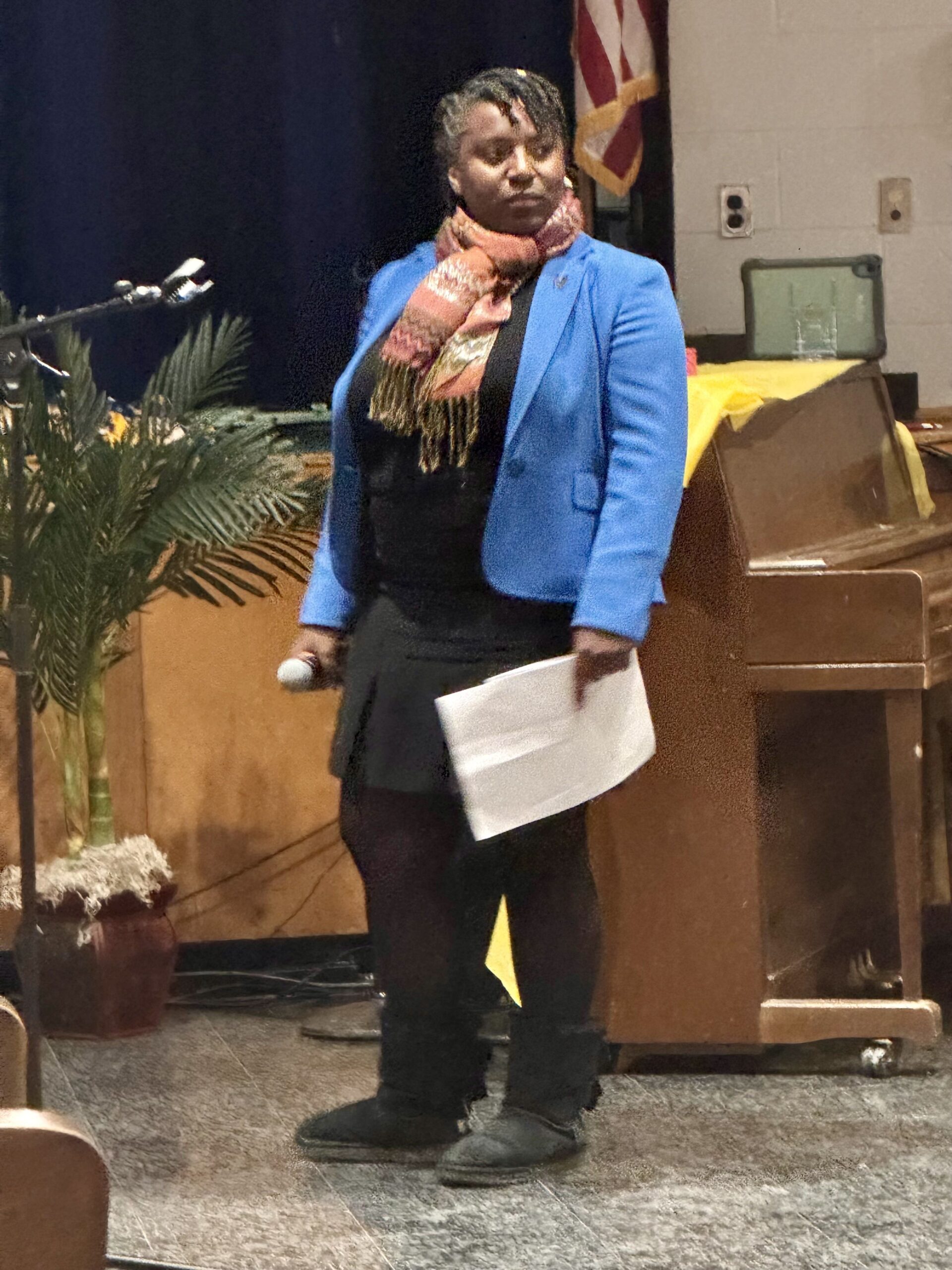
A visibly upset McClinton spoke last on Wednesday night.The district must invest in both schools, she said — not just one.
The district officials she addressed all had good jobs, McClinton emphasized. They could afford to send their children to whatever kind of school they felt was best for them. Southwest Philadelphiaparents might not be wealthy, but they deserve to make choices, too, the speaker said.
“It’s not fair that you’re pitting Black children in Bartram against Black children in Motivation,” McClinton said. “Not one of your children go to Motivation or Bartram. I don’t get millions of dollars in Harrisburg for you to waste it away to make this a swing space.”
As the 76ers entered 2020 draft night, Doc Rivers and Sam Cassell had become enamored with Tyrese Maxey.
The two Sixers coaches at the time — both NBA points guards in a past life — sat together in a “silent panic” as the picks unfolded, hoping Maxey would continue slipping to No. 21.
“It really just fell right into our hands,” said Rivers, now head coach of the Milwaukee Bucks.
That was the final piece that needed to align — amid some bizarre basketball and societal circumstances — for Maxey to become a Sixer.
Tyrese Maxey signed a four-year, $204 million extension with the Sixers in 2024.
The COVID-19 pandemic canceled the 2020 NCAA Tournament, swapping a potential final on-court showcase for Maxey with Kentucky for “working out for, like, [eight] months straight.” Several pre-draft interviews with teams were via videoconference, preventing decision-makers from witnessing Maxey’s work ethic and joyful demeanor in person and making that year’s overall talent evaluation an even more inexact science. And the only reason the Sixers had the 21st overall selection in the first place was because of a game-winning shot in the Orlando restart bubble by the Oklahoma City Thunder’s Mike Muscala, which officially conveyed a traded top-20-protected draft pick to the Sixers.
“People will remember that number [21],” Indiana Pacers coach Rick Carlisle said when asked recently about Maxey. “Because if you redraft that draft, he’s at the very top somewhere, for sure.”
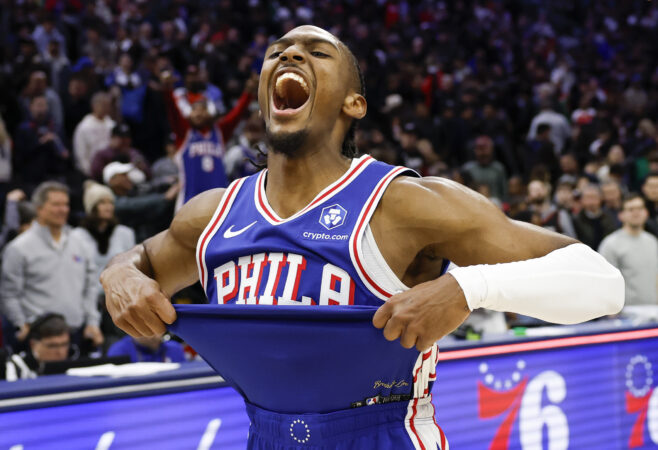
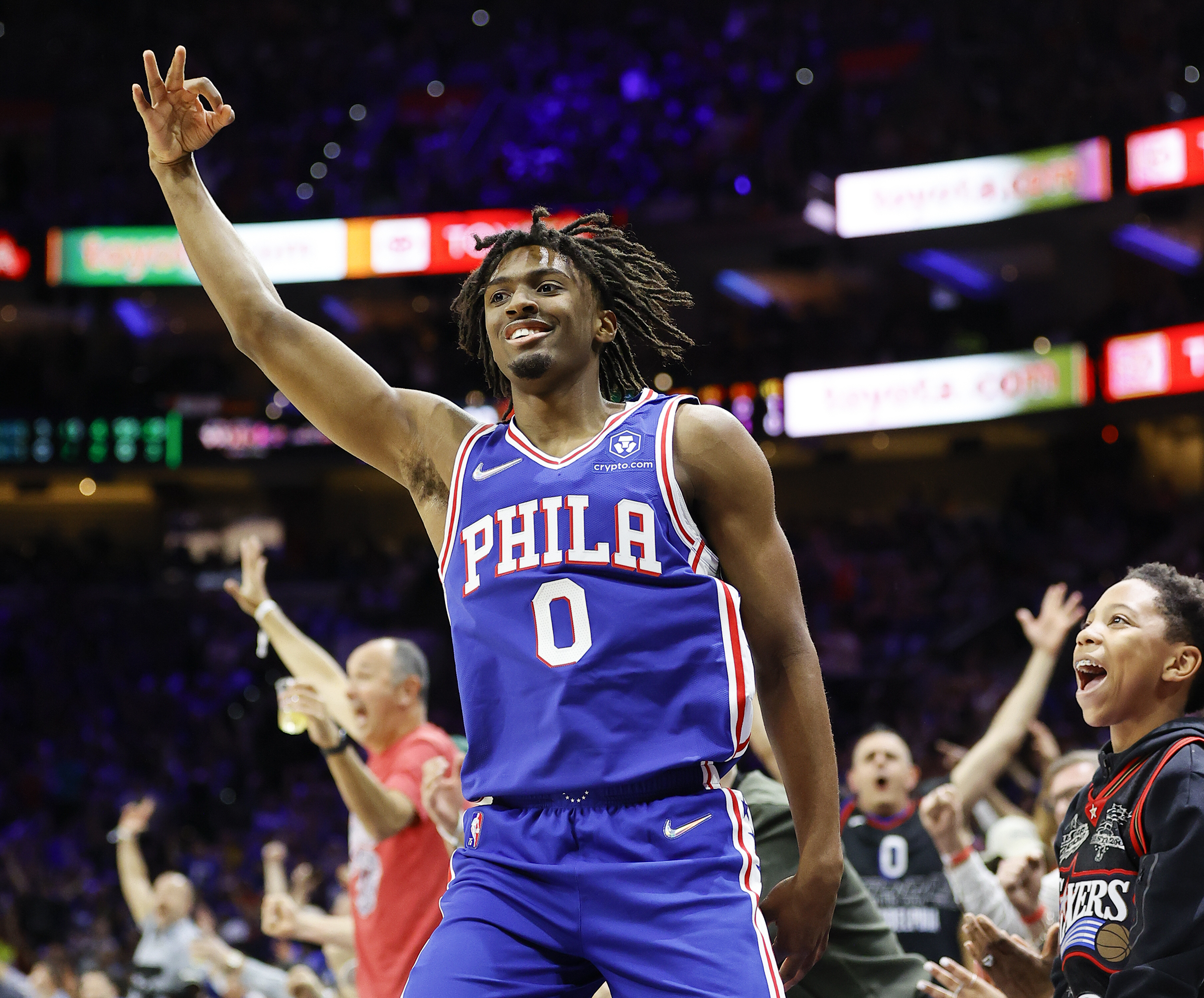
Now Maxey is an All-Star starter, living up to “The Franchise” nickname bestowed upon him by teammate Joel Embiid, a former MVP. The explosive guard entered Thursday ranked sixth in the NBA in scoring average (28.9 points), leading the league in minutes played (38.6), and adding 6.8 assists, 4.1 rebounds, and 2 steals per game. He signed a five-year, $204 million max contract in the summer of 2024.
Does he ever think about the specific series of events needed for his Philly origin story to occur? Yes.
“I’m blessed,” Maxey told The Inquirer last month. “I really got lucky.”
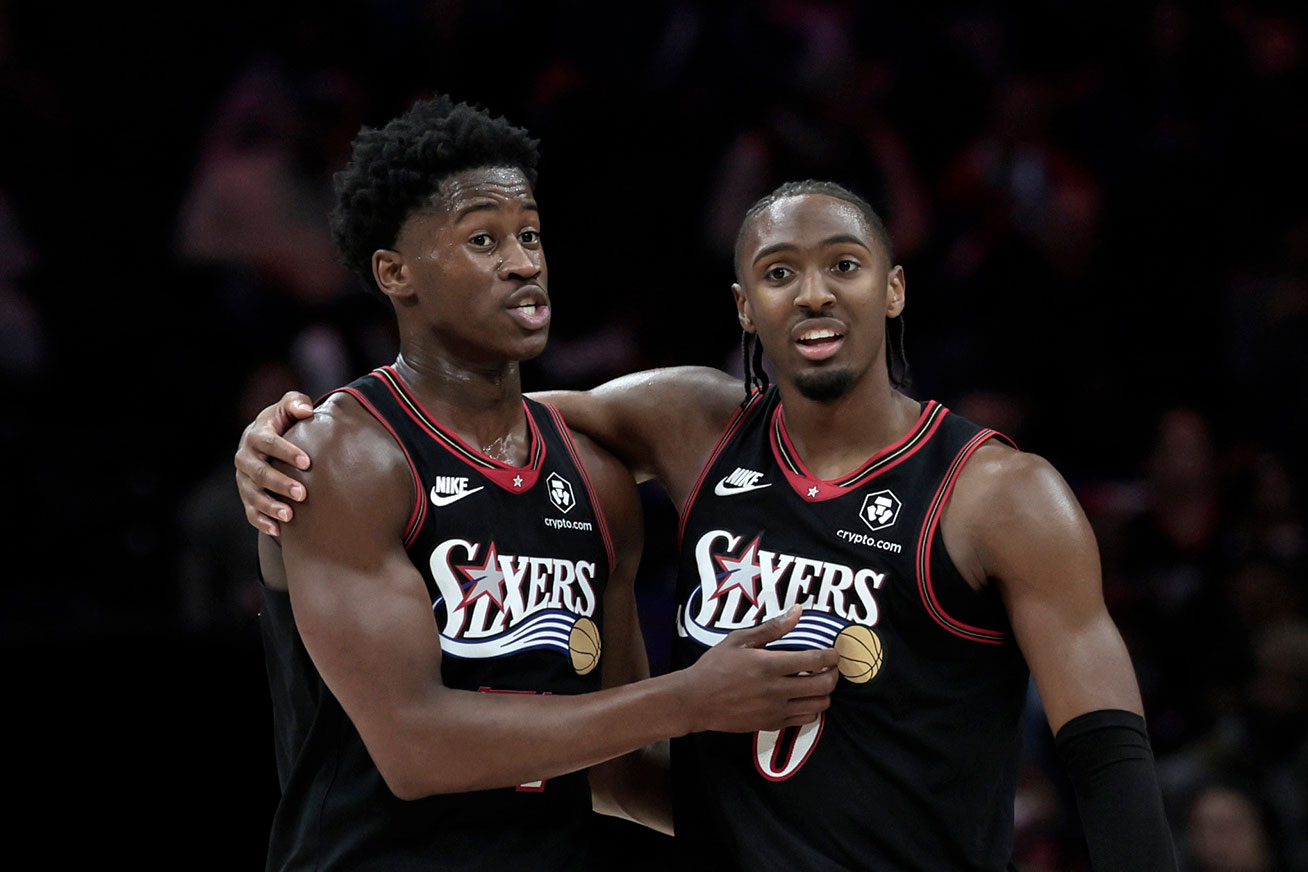
Sixers guards VJ Edgecombe and Tyrese Maxey will travel together to All-Star Weekend to partake in the Rising Stars game and All-Star Game, respectively.
Maxey and his family were at the SEC Tournament in Nashville in March 2020 when the remainder of the college basketball season was canceled because of the pandemic’s onset.
Fueled by Maxey and fellow future NBA guard Immanuel Quickley, Kentucky was a threat to make a deep NCAA Tournament run. March Madness can become a prime stage for an NBA prospect’s draft stock to soar, and missing out left Maxey with a sour “What did you come to college for?” taste.
“I was like, ‘I’m ready to go home and be with my family,’” Maxey said. “My mom came and got me that night.”
Tyrese Maxey fell to the Sixers partly because he couldn’t workout or interview in front of NBA teams.
Maxey went back to his hometown of Garland, Texas, near Dallas and trained with his father, Tyrone, his longtime coach. After signing with Klutch Sports agency, Maxey then went to Los Angeles to work with personal trainer Chris Johnson.
When Maxey learned that Rajon Rondo, a standout NBA point guard and Johnson client, arrived at the gym at 5:30 a.m., Maxey told Johnson, “I’m there.” That daily workout fed into a weightlifting session with performance coach Al Reeser, who today accompanies Maxey with the Sixers. Maxey would return to the gym for a 10 a.m. shooting session with various players, including all-time great LeBron James, before a third workout at 12:30 p.m. With no guidance yet from an NBA team or system he would be stepping into, Maxey drilled all aspects of his game, including shooting touch, passing reads, and three-point accuracy.
Maxey has kept that early-morning routine ever since, believing it now gives him a psychological advantage over competitors.
“I knew then he had everything that it took for him to have a very promising career in the NBA,” Johnson told The Inquirer in 2021. “Whatever franchise was going to get him was going to get somebody that, No. 1, could be coached. No. 2, would be prepared. No. 3, not afraid of hard work — but not just regular hard work. We talk about elite training when your body [doesn’t] feel like it.
“I knew right away, ‘Oh, he’s going to be pretty special.’”
Then Maxey’s parents made him put on a polo shirt for video interviews with team executives, where he hoped his authenticity would pierce through the “kind of awkward” digital setting. Tyrone reminded his son to make sure he conveyed that he had been trained as a point guard, even though he played off the ball at Kentucky.
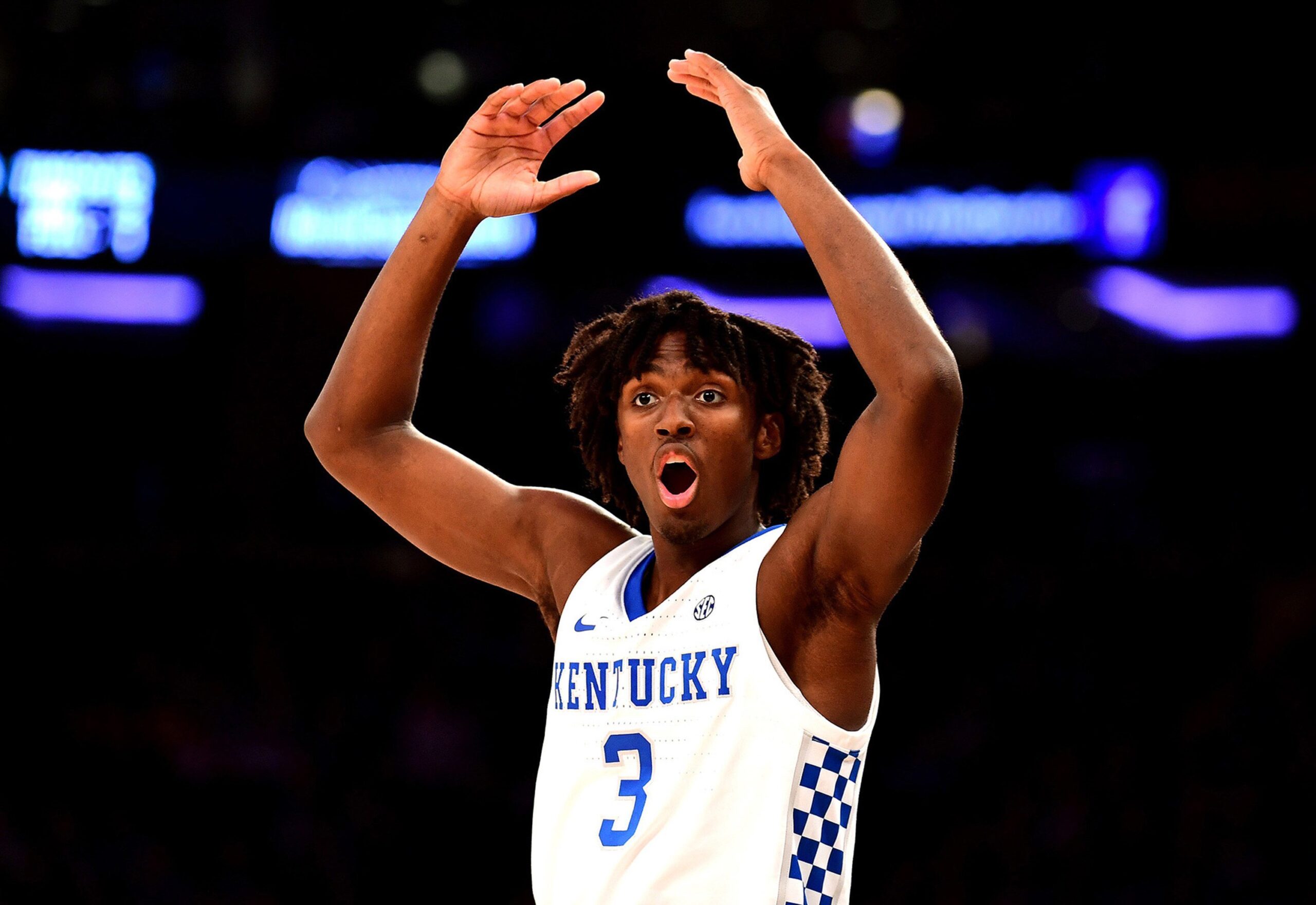
Tyrese Maxey played well at Kentucky but NBA teams believed he wasn’t a great shooter.
The most common feedback Maxey remembers receiving from teams back then was he “can’t shoot,” after he made 29.2% of his three-point attempts at Kentucky. He attempted to change that narrative during a workout with an unnamed team, when Tyrone said Tyrese made 33 consecutive three-pointers and “and they still passed on him” on draft night.
“He was proving he could shoot in front of this team,” said Tyrone, who will watch Maxey compete in the All-Star three-point contest on Saturday. “ … And it’s like, ‘Man, this is crazy.’”
One team Maxey believed had “no chance” to join? The Sixers.
He had “zero” contact with the organization before the draft. But that front office was studying him behind the scenes.
President of basketball operations Daryl Morey credits general manager Elton Brand and the scouting staff for doing the bulk of the evaluation on Maxey before Morey joined the organization from the Houston Rockets in November 2020.
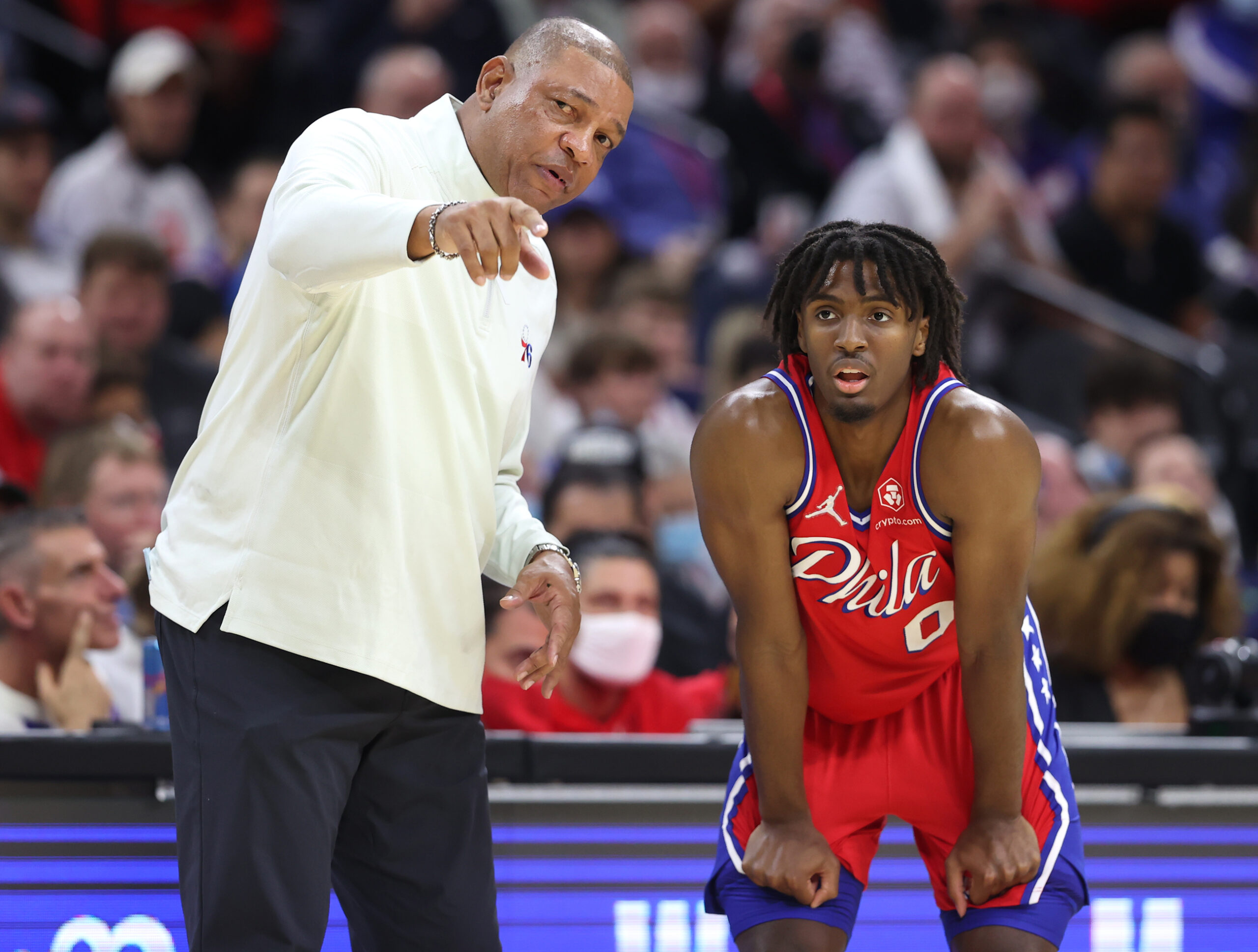
Former Sixers coach Doc Rivers placed trust in Tyrese Maxey when Ben Simmons stepped away from the team. Tyrese Maxey is now an All-Star starter and the top American vote-getter in the All-Star Game.
Maxey’s quickness and finishing around the rim immediately stood out. Morey believed in Maxey’s perimeter shooting mechanics and “secondary indicators” of NBA potential, despite the low three-point percentage in college. Morey also picked up on the pride Maxey took in improving his defense, which has turned him into a legitimate disruptor on that end of the floor in his sixth NBA season.
Morey told The Inquirer in 2021 that Maxey was ranked around 10th on the Sixers’ big board entering the draft.
“A lot of his on-the-surface things didn’t pop at Kentucky,” Morey said, “which is why I think the scouts get a lot of credit on this one.”
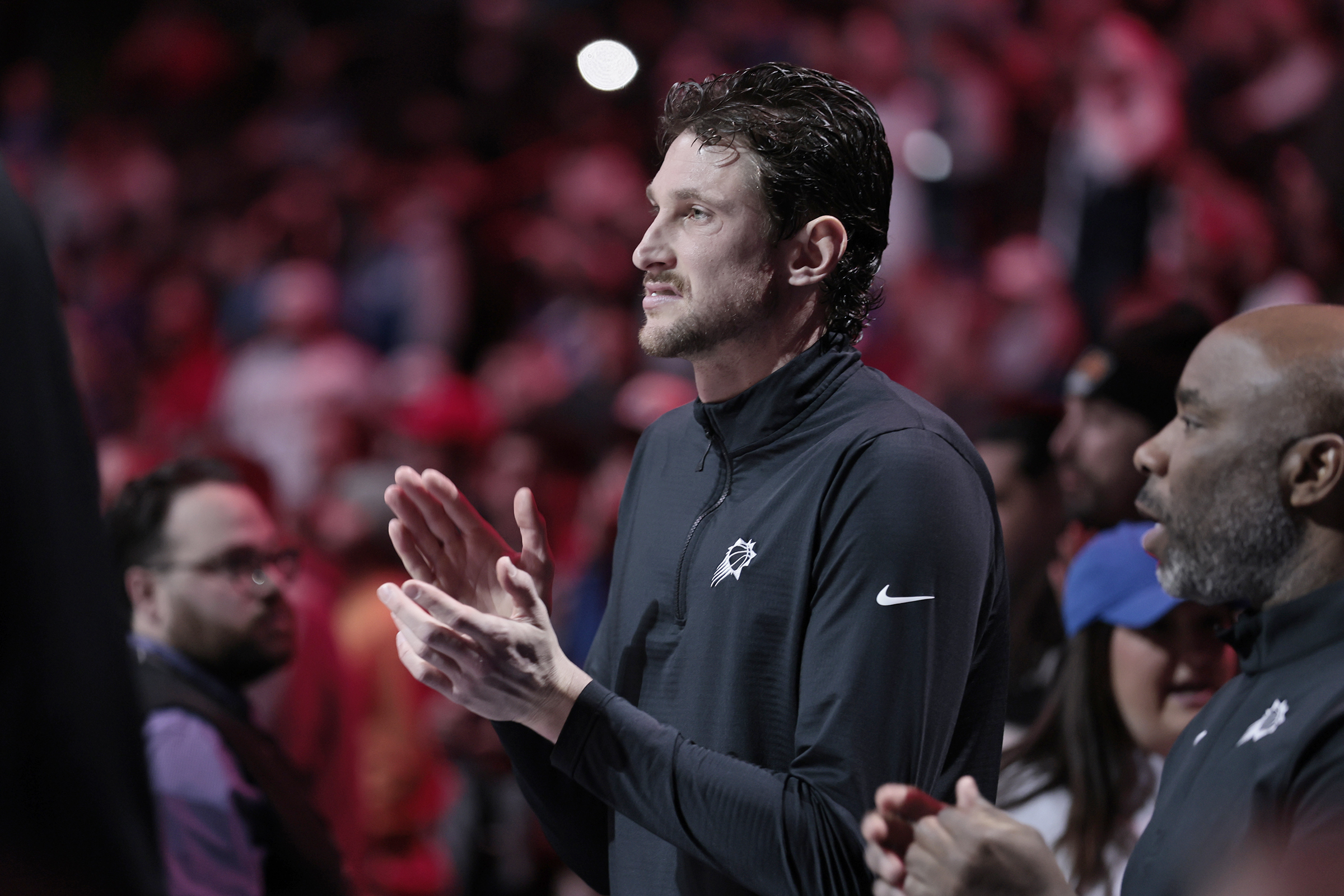
Mike Muscala, a former player with the Sixers and Thunder, is now a Phoenix Suns assistant coach.
To even possess that pick, however, the Sixers needed two fortuitous 3-pointers at Disney World by Muscala, the former Sixer who at that time was a role player for the Thunder.
Those shots beat the Miami Heat in their second-to-last regular-season bubble game, which configured the standings so that the top-20-protected draft pick that Oklahoma City owed the Sixers would convey that year. Muscala told The Inquirer that, as Maxey began his NBA ascension about a year or two later, he began to catch wind from the most-tapped-in Sixers fans of the roundabout impact he had on the team landing its future All-Star.
“It is interesting when you start thinking about different dominoes that fall,” said Muscala, who is now an assistant coach with the Phoenix Suns and said he does not know Maxey.
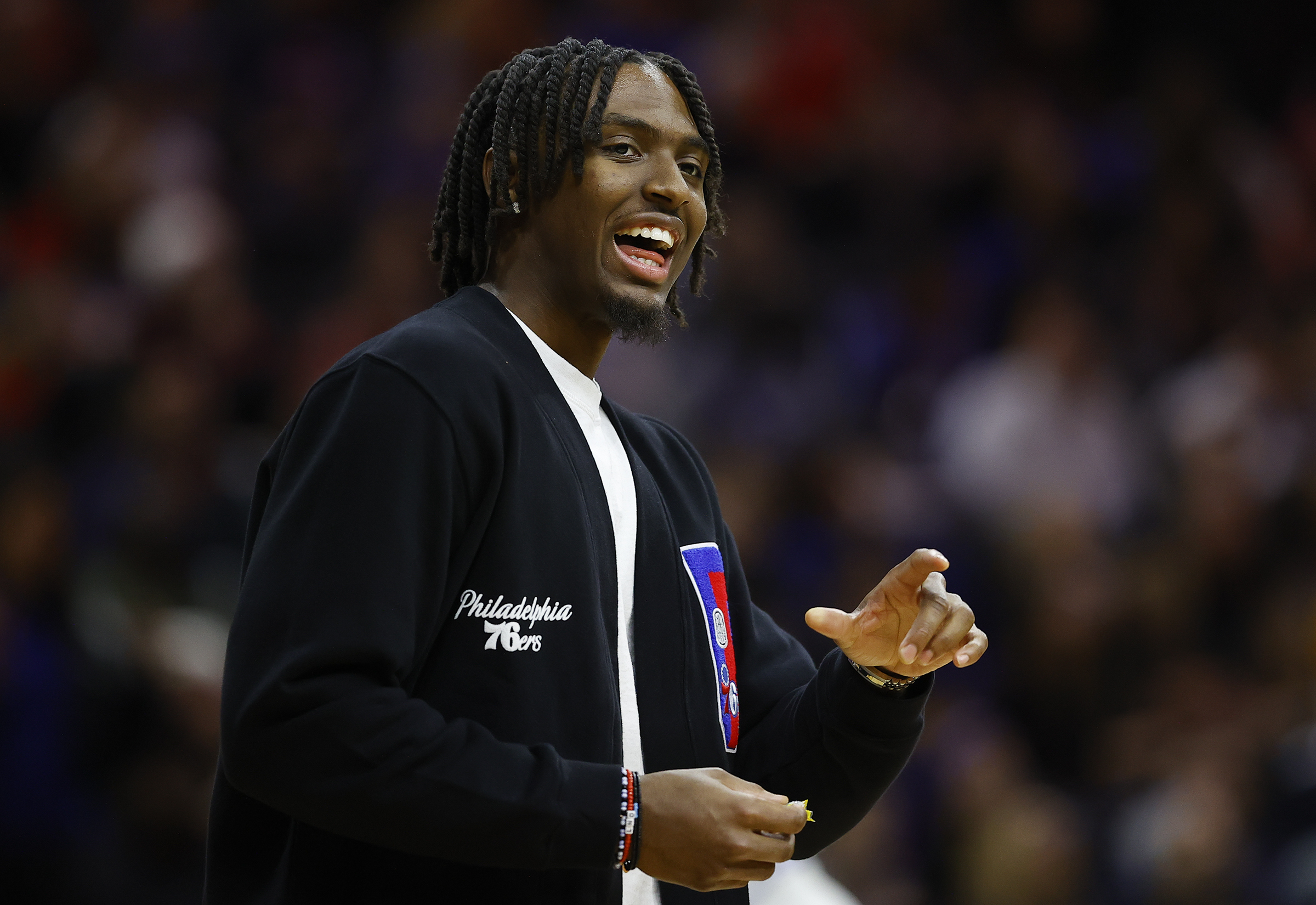
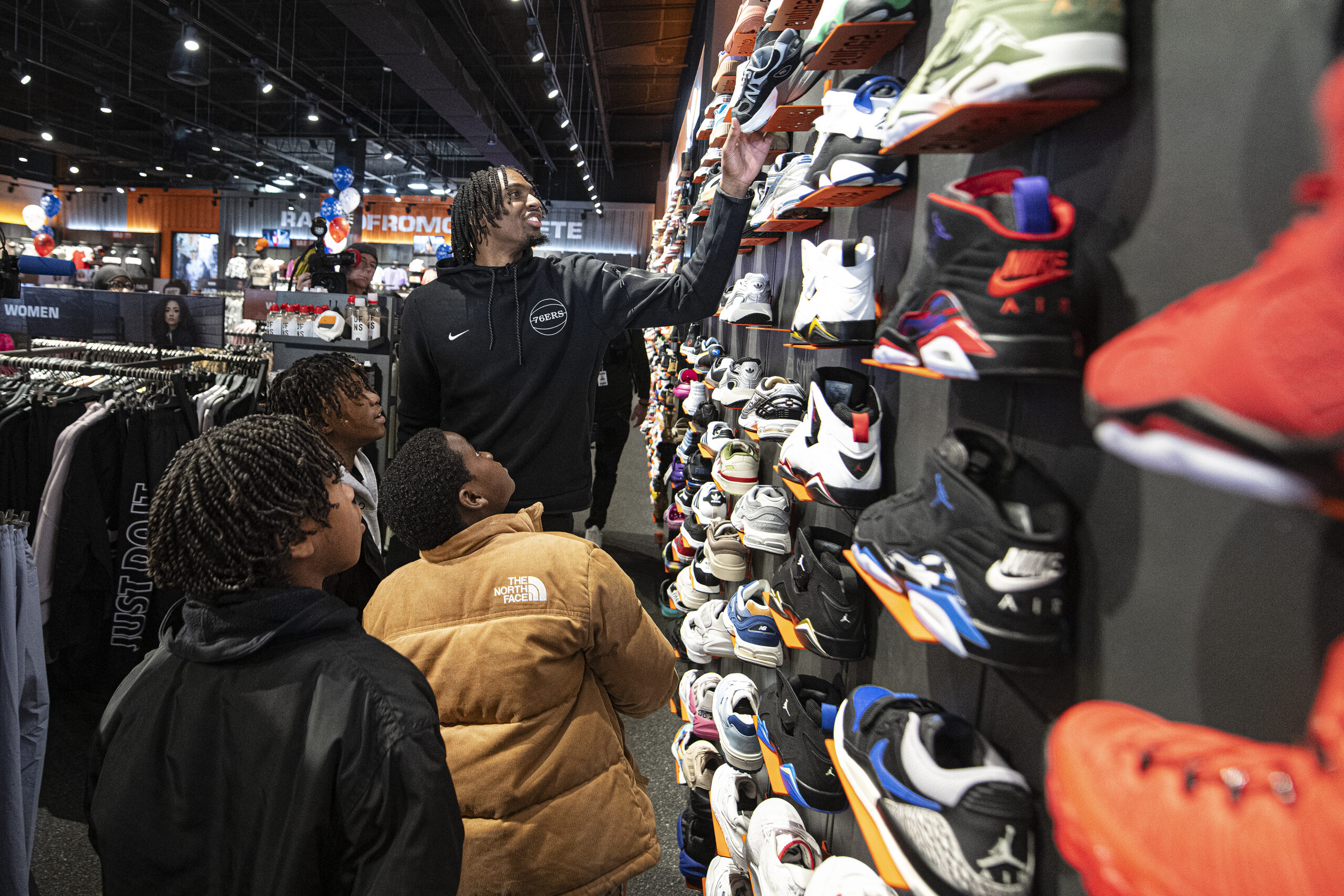
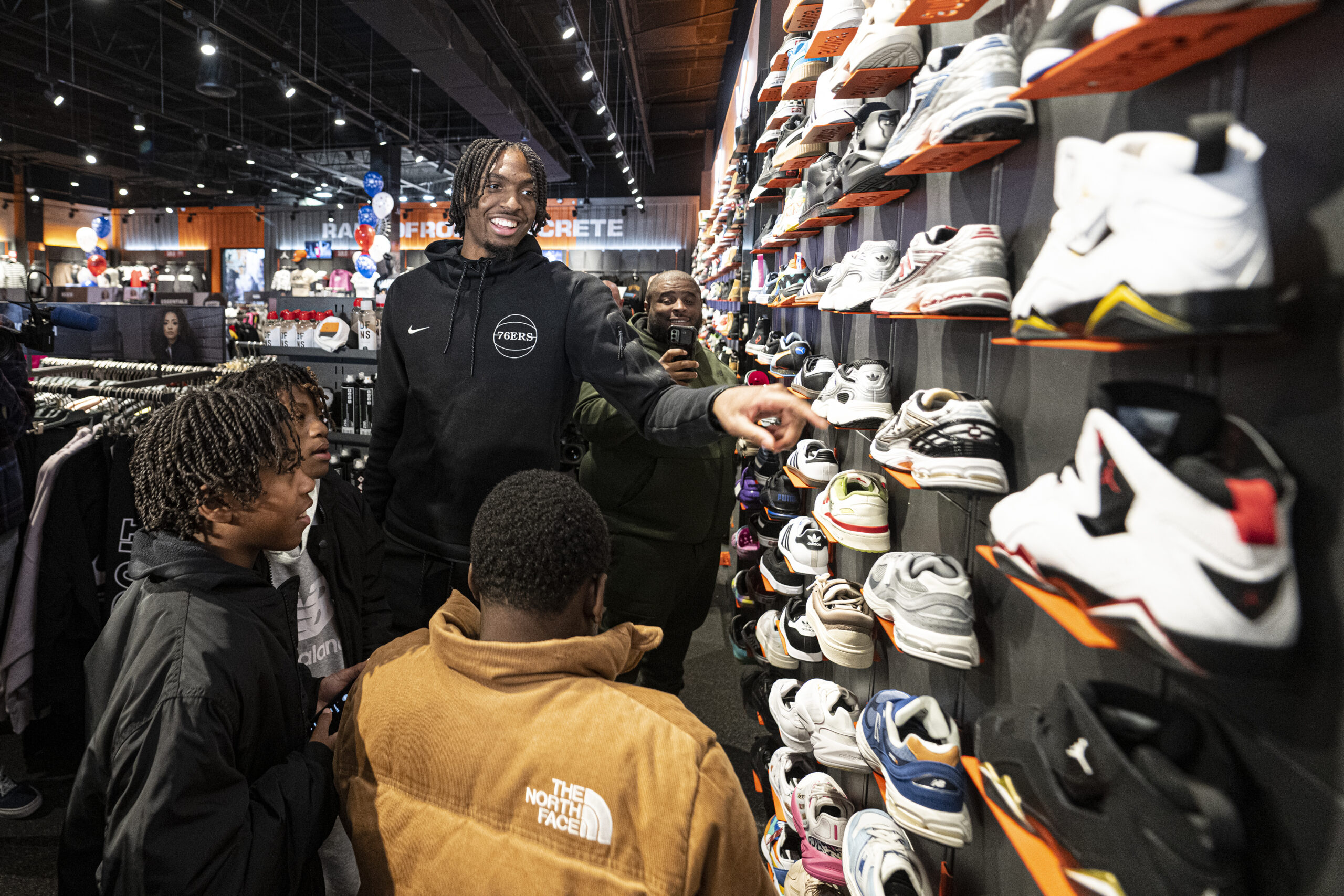
Tyrese Maxey’s energy and joy have endeared him to the city of Philadelphia.Tyrese Maxey has routinely made himself available for Sixers charity events.
“Big shot, thanks!” Maxey said when Muscala’s name resurfaced earlier this week. “Without Mike, I’m not here.”
As the draft approached, Maxey said he believed he would go somewhere in the middle of the first round. That perplexed Tyrone, not only as a proud father but as Maxey’s former AAU coach who “knew everybody in that draft.”
Prominent mock drafts slotted LaMelo Ball and Tyrese Haliburton, who have both become All-Stars, ahead of Maxey. Ditto for Killian Hayes, who quickly flamed out of the NBA. Though those outside evaluations regularly praised Maxey’s crafty finishing and expressed belief in his shooting form, The Ringer’s draft guide also critiqued that he “lacked top-end quickness and acceleration.”
When draft night arrived, Maxey’s mother, Denyse, re-created a green room at their Texas home and asked attending loved ones to take a rapid COVID test at the door. Ball, Haliburton, and Hayes all went off the board in the top 12. When the San Antonio Spurs took Devin Vassell at No. 11 and the Orlando Magic selected Cole Anthony 15th, Maxey “knew I was going to sit for a minute.”
Sixers guard Tyrese Maxey has become a leader for the team in his sixth NBA season. Sixers guard Tyrese Maxey was knighted as “The Franchise” early in his career by former MVP Joel Embiid.
Agent Rich Paul called just before the 20th pick, predicting Maxey would be selected by the Miami Heat or the Sixers.
Morey told The Inquirer in 2021 that the Sixers were considering trading down. But when the Heat took Precious Achiuwa of Memphis and Maxey was still available, Morey wanted to shoot for a high-ceiling player instead of settling for a “solid” one.
“We chose not to [trade back] just because we believed in Tyrese so much,” Morey said then. “ … We were surprised he was there, and really thrilled he was there.”
Maxey joined a team that finished with the Eastern Conference’s best record in his rookie season, making early playing time spotty until a couple of breakout playoff performances. Then the opportunities to flourish began.
Ben Simmons’ holdout forced Maxey into starting point guard duties as a second-year player. He got to learn from future Hall of Famer James Harden, then he took over lead ballhandling duties when Harden forced his way out of Philly early in the 2023-24 season.
Maxey formed a dynamic two-man partnership with Embiid, becoming the NBA’s Most Improved Player and a first-time All-Star in 2024. Embiid’s multiple knee surgeries in recent seasons elevated Maxey into the top offensive role, with the electric skill and playing style that made him the top American vote-getter among fans in this year’s All-Star balloting.
Tyrese Maxey’s parents, Denyse and Tyrone, played a major role in his basketball development.
That all leads to this weekend, when Maxey will be introduced as an All-Star starter on Sunday.
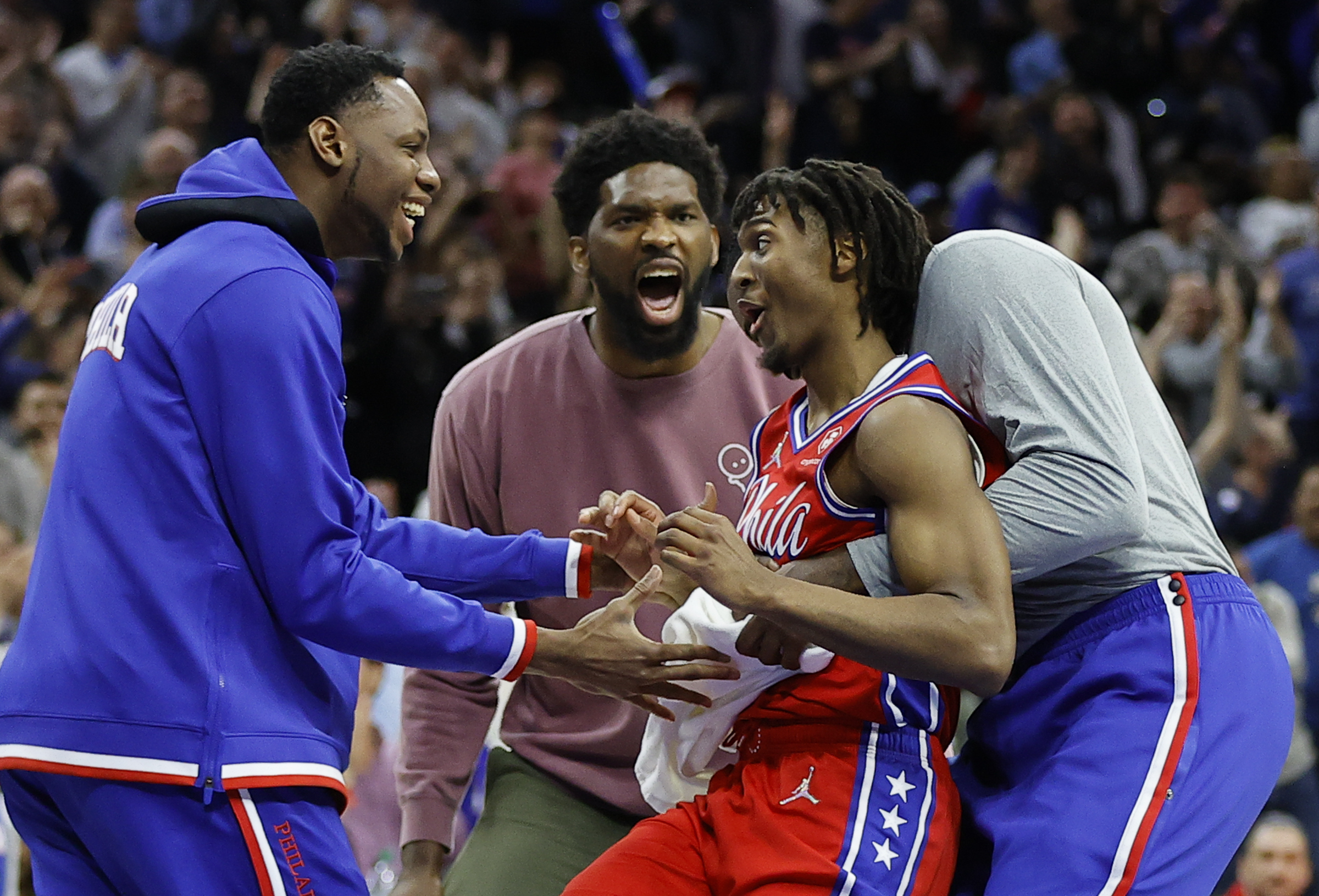
When Maxey was asked earlier this week if he still looks back on the players who went ahead of him in the 2020 draft, an eavesdropping Trendon Watford — Maxey’s teammate and longtime close friend — vigorously nodded.
“I’ve got to let it go,” Maxey conceded. “It’s over.”
Because all of those bizarre basketball and societal circumstances — a pandemic, a Muscala shot, and a slip down draft boards — aligned to make him a Sixer.
“He landed in the right spot,” Tyrone said. “It was all God’s plan.”
SANTA CLARA, Calif. — Defense won this championship.
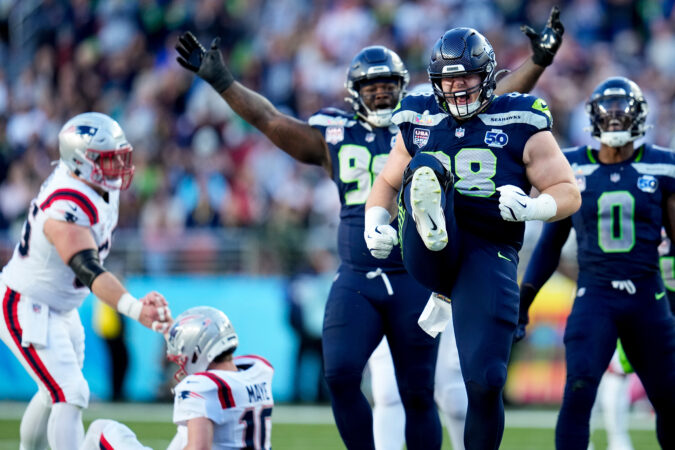
Devon Witherspoon, Derick Hall, Byron Murphy and the rest of Mike Macdonald’s ferocious unit pummeled Drake Maye, and the Seattle Seahawks beat the New England Patriots 29-13 on Sunday to win the franchise’s second Super Bowl.
Sam Darnold threw a touchdown pass to AJ Barner, Kenneth Walker III ran for 135 yards and Jason Myers made all five of his field-goal tries.
Uchenna Nwosu punctuated a punishing defensive performance by snagging Maye’s pass in the air after Witherspoon hit his arm and ran it back 45 yards for a pick-6.
Seattle’s “Dark Side” defense helped Darnold become the first quarterback in the 2018 draft class to win a Super Bowl, ahead of Josh Allen, Baker Mayfield and Lamar Jackson.
Labeled a bust, dumped by two teams and considered expendable by two others, Darnold proved his doubters wrong while helping the Seahawks go 17-3.
After leading the NFL with 20 turnovers in the regular season, Darnold didn’t have any in three playoff games. He wasn’t particularly sharp against a solid Patriots defense but protected the ball and made enough plays, finishing 19 of 38 for 202 yards.
The Seahawks sacked Maye six times, including two apiece by Hall and Murphy. Hall’s strip-sack late in the third quarter set up a short field and Darnold connected with Barner on 16-yard scoring toss to make it 19-0.
Julian Love’s interception set up another field goal that made it 22-7 with 5:35 left.
The Patriots (17-4) punted on the first eight drives, excluding a kneel-down to end the first half.
Some yarn shops around Philadelphia are running low on skeins of red wool, as local knitters and crocheters turn out scads of “Melt the ICE” caps in solidarity with protesters in Minnesota.
The hats don’t feature a patch or logo that says “Melt the ICE.” In fact, they carry no written message at all. What they offer is a deep scarlet hue, a dangling tassel, and a connection to an earlier, dangerous time, when a different people in another land sought to silently signal their unity.
“The hat is really a symbol and reminder,” said knitter Laura McNamara of Kensington, who is making two caps for friends. “People are looking for a sense of community.”
She refused her friends’ offers of payment, asking instead that they not let their involvement start and end with a hat ― but find a means to stand up for civil rights in some specific way.
The original hat was a kind of conical stocking cap, known as a nisselue, worn in Norway during the 1940s as a sign of resistance to the Nazi occupation. The Germans eventually caught on to the symbolism and banned the caps.
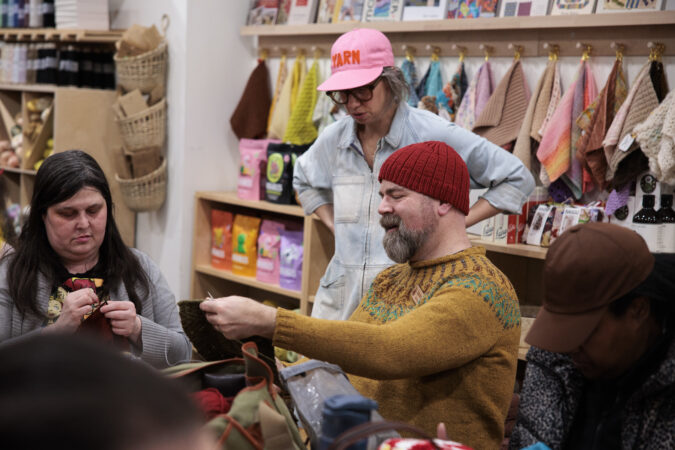
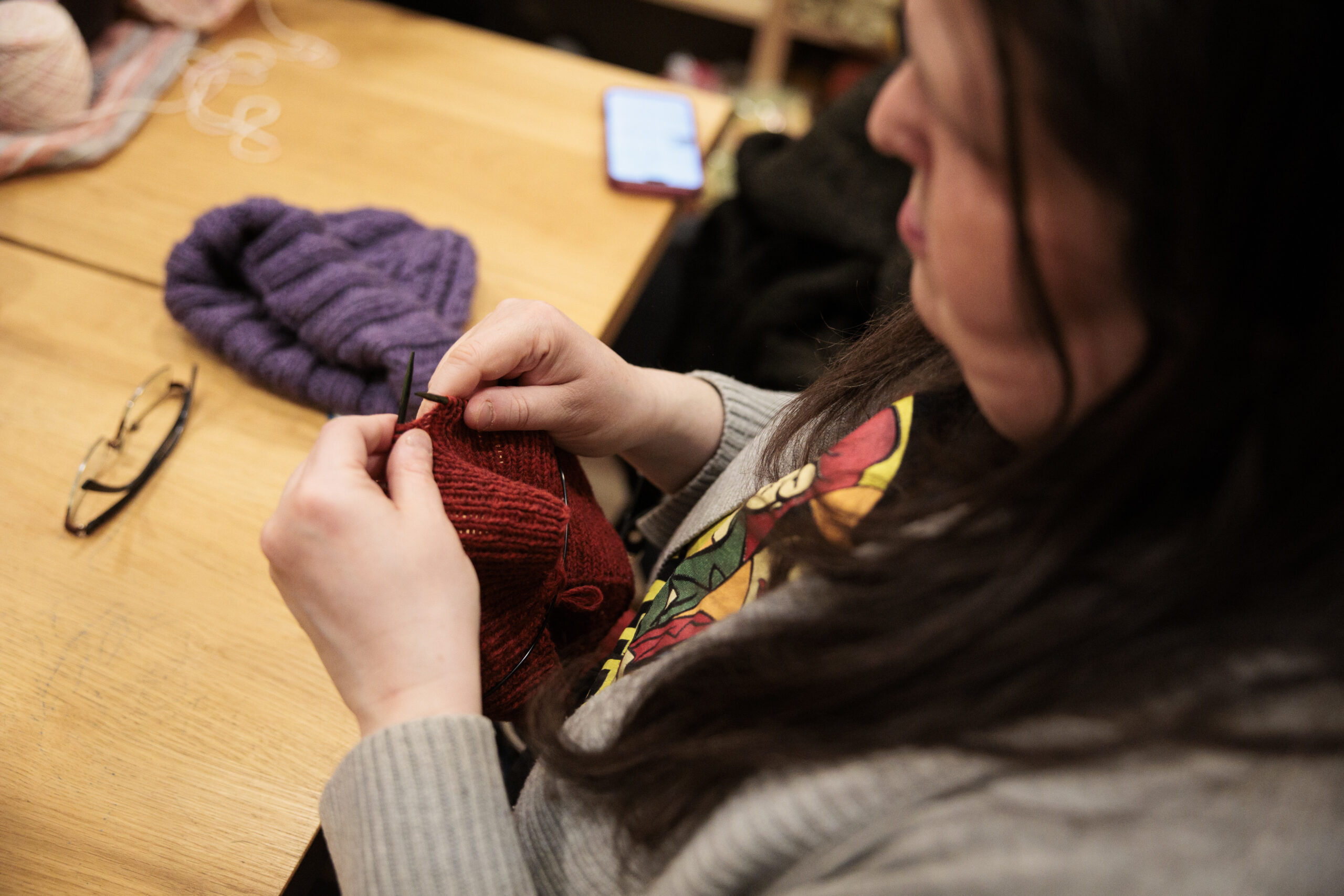
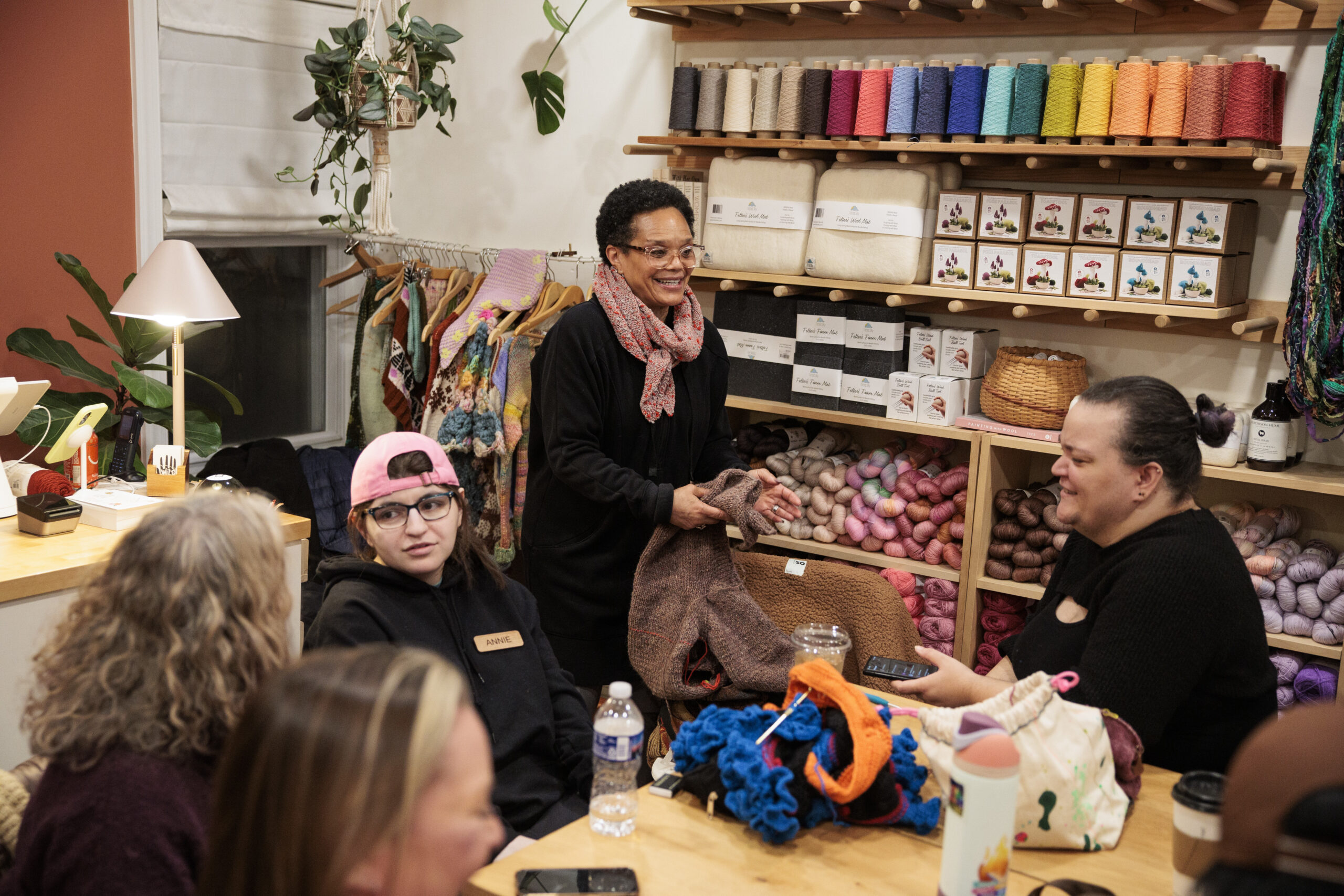
Amanda Bryman works on a red wool hat known as a “Melt the ICE” hat, during Fiber Folk Night at Wild Hand yarn shop in Philadelphia on Wednesday.
Now the new version that originated in a suburban Minneapolis yarn shop is spreading across the country. The hats signal opposition to U.S. Immigration and Customs Enforcement, which surged thousands of agents into Minneapolis, and sadness and anger over the deaths of Minnesotans and U.S. citizens Renee Good and Alex Pretti, who were shot to death by federal agents.
Today, comparisons of ICE agents to Nazis have become both frequent and contentious in American politics, with even some Democrats, including Gov. Josh Shapiro, who is Jewish, rejecting that equivalence as wrong and unacceptable.
ICE officials did not respond to a request for comment.
This is not the first time that the Philadelphia region’s craftivist movement, as it is known, has brought its knitting needles and crochet hooks to bear.
On the eve of Donald Trump’s first inauguration, artisans here turned out scores of cat-eared headgear known as pussy hats, a feline symbol of protest worn at the Women’s March on Washington. The hats aimed to tweak the then-president-elect over his comment about grabbing women by their genitals.
The Melt the ICE caps carry some controversy within the fiber community, as it calls itself. There have been online complaints that it’s easy to tug a red cap over one’s ears, but unless that is accompanied by action it holds no more significance than clicking a “Like” button on Facebook.
“It is just preening,” one person wrote in an internet forum.
Another said that “if your resistance is only this hat, then you have not actually accomplished anything except make a hat.”
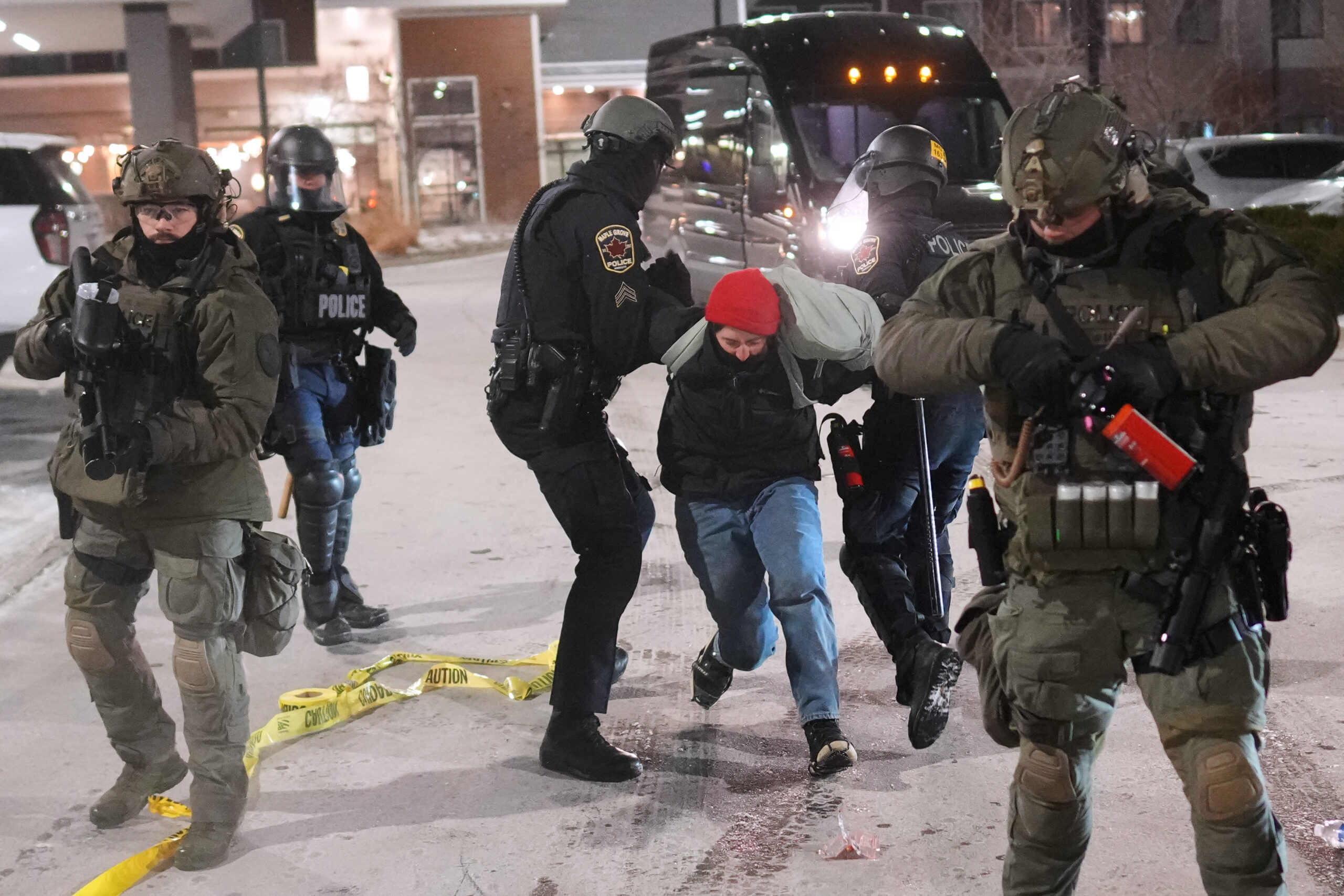
Law enforcement officers detain a demonstrator during a protest outside SpringHill Suites and Residence Inn by Marriott hotels on Jan. 26 in Maple Grove, Minn.
Liz Sytsma, owner of Wild Hand in West Mount Airy, has heard the criticism.
But “the people in our community who are participating in making the hats, this is one of many things they are doing,” she said. That includes taking part in protests, calling elected leaders, and giving money to causes they support.
On Wednesday, more than a dozen people gathered at Wild Hand for the weekly Fiber Folk Night, where crafters gather to knit, crochet, and chat ― and, now, to work on hats.
Damon Davison traveled from Audubon, Camden County, having developed his own hat pattern, with sale proceeds to go to the activist group Juntos in South Philadelphia.
He wants to show solidarity with people “who are expressing resistance to what has been happening in Minneapolis, but also what’s happening here in Philly,” he said. “The idea is to make it a little bit more local.”
The shop has seen a rush on red, sought by about 70% of customers whose purchases have depleted stocks during the last couple of weeks.
“We’re really low,” said store manager Yolanda Booker, who plans to knit and donate a hat. “I want to do whatever small part I can do to help out.”
A single hat can take two or three days to make, though the best and fastest knitters can complete one in a couple of hours.
Store Manager Yolanda Booker, standing, laughs with attendees during Fiber Folk Night at Wild Hand yarn shop in Philadelphia on Wednesday.
In West Mount Airy, Kelbourne Woolens closed its physical doors during the national “ICE Out” strike in late January and donated its onlineprofits of $4,000 to Asian Americans United, Juntos, and New Sanctuary Movement of Philadelphia, said team member Bailey Spiteri. She estimated the store has sold enough red yarn to retailers to make 500 or 600 hats.
At Stitch Central in Glenside, customers donated $1,000 during the strike and the store matched it, with the $2,000 going to Nationalities Service Center in Philadelphia.
“Sometimes people are skeptical. How does wearing a hat or even making a hat make a difference?” asked Allison Covey of Drunken Knit Wits, a local knitting and crocheting organization. “But look at the donations. It does make a difference.”
Veteran knitter Neeta McColloch of Elkins Park thinks the same. She has ordered enough yarn to make eight hats. And she is curious to see how the phenomenon will develop.
“This is probably bigger than I think,” she said. “Knitters tend to be the type of people who in my experience have a strong moral compass. If they can combine something they love to do with something in which they can make a statement, that’s important to them.”
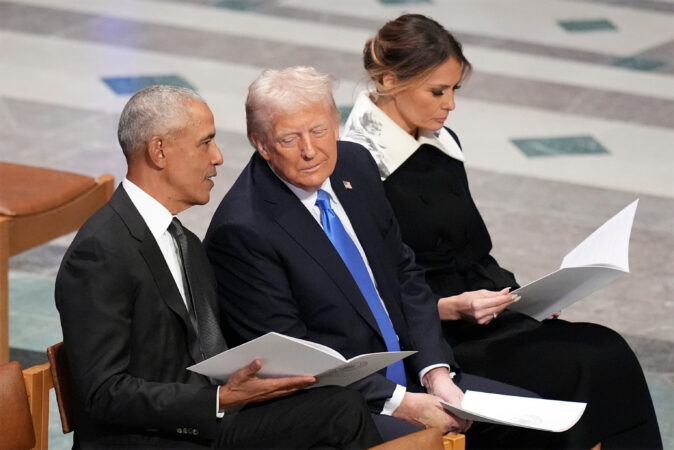
WASHINGTON — President Donald Trump’s racist social media post featuring former President Barack Obama and his wife, Michelle Obama, as primates in a jungle was deleted after a backlash from both Republicans and Democrats who criticized the video as offensive.
Trump said later Friday that he won’t apologize for the post. “I didn’t make a mistake,” he said.
The Republican president’s Thursday night post was deleted Friday and blamed on a staffer after widespread backlash, from civil rights leaders to veteran Republican senators, for its treatment of the nation’s first Black president and first lady. The deletion, a rare admission of a misstep by the White House, came hours after press secretary Karoline Leavitt dismissed “fake outrage” over the post. After calls for its removal for being racist — including by Republicans — the White House said a staffer had posted the video erroneously and it had been taken down.
The post was part of a flurry of social media activity on Trump’s Truth Social account that amplified his false claims that the 2020 election was stolen from him, despite courts around the country and a Trump attorney general from his first term finding no evidence of fraud that could have affected the outcome.
Trump has a record of intensely personal criticism of the Obamas and of using incendiary, sometimes racist, rhetoric — from feeding the lie that Obama was not a native-born U.S. citizen to crude generalizations about majority Black countries.
The post came in the first week of Black History Month and days after a Trump proclamation that cited “the contributions of black Americans to our national greatness and their enduring commitment to the American principles of liberty, justice, and equality.”
An Obama spokeswoman said the former president, a Democrat, had no response.
‘An internet meme’
Nearly all of the 62-second clip, which was among dozens of Truth Social posts from Trump overnight, appears to be from a conservative video alleging deliberate tampering with voting machines in battleground states as the 2020 presidential votes were tallied. At the 60-second mark is a quick scene of two primates, with the Obamas’ smiling faces imposed on them.
Those frames were taken from a separate video, previously circulated by an influential conservative meme maker. It shows Trump as “King of the Jungle” and depicts a range of Democratic leaders as animals, including Joe Biden, who is white, as a jungle primate eating a banana.
“This is from an internet meme video depicting President Trump as the King of the Jungle and Democrats as characters from The Lion King,” Leavitt said by text.
Disney’s 1994 feature film that Leavitt referenced is set on the savannah, not in the jungle, and it does not include great apes.
“Please stop the fake outrage and report on something today that actually matters to the American public,” Leavitt added.
By noon, the post had been taken down with responsibility placed on a Trump subordinate.
The White House explanation raised additional questions about the control of Trump’s social media account, which has also been used to levy import taxes, threaten military action, make domestic policy announcements, and intimidate political rivals. The president often signs his name or initials after policy announcements.
The White House did not immediately respond to questions about its process for vetting posts and how it guarantees that the public knows when Trump himself is posting.
Mark Burns, a pastor and a prominent Trump supporter who is Black, said Friday afternoon on X that he had spoken “directly” with Trump about the post. He recommended to Trump that he fire the staffer who posted the video and publicly condemn what happened.
“He knows this is wrong, offensive, and unacceptable,” Burns posted.
Yet while it was still up, Trump’s post drew condemnation from across the political and ideological spectrum — and demands for an apology that had not come by the early afternoon.
The Rev. Bernice King, daughter of the assassinated civil rights icon the Rev. Dr. Martin Luther King Jr., resurfaced her father’s words: “Yes. I’m Black. I’m proud of it. I’m Black and beautiful.” She praised Black Americans as “diverse, innovative, industrious, inventive” and added, “We are beloved of God as postal workers and professors, as a former first lady and president. We are not apes.”
The U.S. Senate’s lone Black Republican, Tim Scott of South Carolina, called on Trump to take down the post. “Praying it was fake because it’s the most racist thing I’ve seen out of this White House,” Scott, who chairs Senate Republicans’ midterm campaign arm, said on social media.
Another Republican, Sen. Roger Wicker of Mississippi, is white but represents the state with the largest percentage of Black residents. Wicker called the post “totally unacceptable” and said the president should apologize.
Some Republicans who face tough reelections this November voiced concerns, as well, feeding an unusual cascade of intraparty criticism for a president who often has enjoyed a stranglehold over fellow Republicans who stayed silent over some of Trump’s previous controversial statements or fear a public spat with the president or losing his endorsement in a future campaign.
NAACP President Derrick Johnson pointed to Trump’s wider political concerns, asserting that Trump is trying anything to distract from economic conditions and attention on the Jeffrey Epstein case files.
“Donald Trump’s video is blatantly racist, disgusting, and utterly despicable,” Johnson said in a statement. “You know who isn’t in the Epstein files? Barack Obama,” he continued. “You know who actually improved the economy as president? Barack Obama.”
A long history of racism
There is a long history in the U.S. of powerful white figures associating Black people with animals, including apes, in demonstrably false and racist ways. The practice dates back to 18th-century cultural racism and pseudo-scientific theories in which white people drew connections between Africans and monkeys to justify the enslavement of Black people in Europe and North America, and later to dehumanize freed Black people as an uncivilized threat to white people.
Thomas Jefferson, author of the Declaration of Independence, wrote in his famous text “Notes on the State of Virginia” that Black women were the preferred sexual partners of orangutans. President Dwight Eisenhower, discussing the desegregation of public schools in the 1950s, once argued that white parents were concerned about their daughters being in classrooms with “big Black bucks.” Obama, as a candidate and president, was featured as a monkey or other primate on T-shirts and other merchandise.
In his 2024 campaign, Trump said immigrants were “poisoning the blood of our country,” language similar to what Adolf Hitler said to dehumanize Jews in Nazi Germany.
During his first White House term, Trump referred to a swath of developing nations that are majority Black as “shithole countries.” He initially denied using the slur but admitted in December 2025 that he did say it.
When Obama was in the White House, Trump advanced the false claims that the 44th president, who was born in Hawaii, was born in Kenya and was constitutionally ineligible to serve. Trump, in interviews that helped endear him to many conservative voters, repeatedly demanded that Obama produce birth records and prove he was a “natural-born citizen” as required to become president.
Obama eventually released his Hawaii records. Trump finally acknowledged during his 2016 campaign, after having won the Republican nomination, that Obama was born in Hawaii. But he immediately said, falsely, that his Democratic rival Hillary Clinton started those birtherism attacks on Obama.