A month after Keon King was charged with breaking into his ex-girlfriend’s home and attempting to strangle her, police say, his violence escalated: In January, he returned to her home with a gun, then kidnapped and assaulted her.
A warrant for his arrest was issued days later.
In the weeks that followed, King twice appeared in Philadelphia court and stood before a judge in the initial strangulation case. But no one in the courtroom seemed to know he was wanted for kidnapping.
So both times, King walked out.
In February, despite the warrant for King’s arrest, prosecutors — seemingly unaware that police said he had recently attacked their key witness — withdrew the burglary and strangulation case when the victim failed to appear in court.
Police did not go to either hearing to take him into custody, and do not appear to have alerted the prosecutor about the new arrest warrant.
And King was not formally charged with the kidnapping until April, when, for reasons that are unclear, he turned himself in.
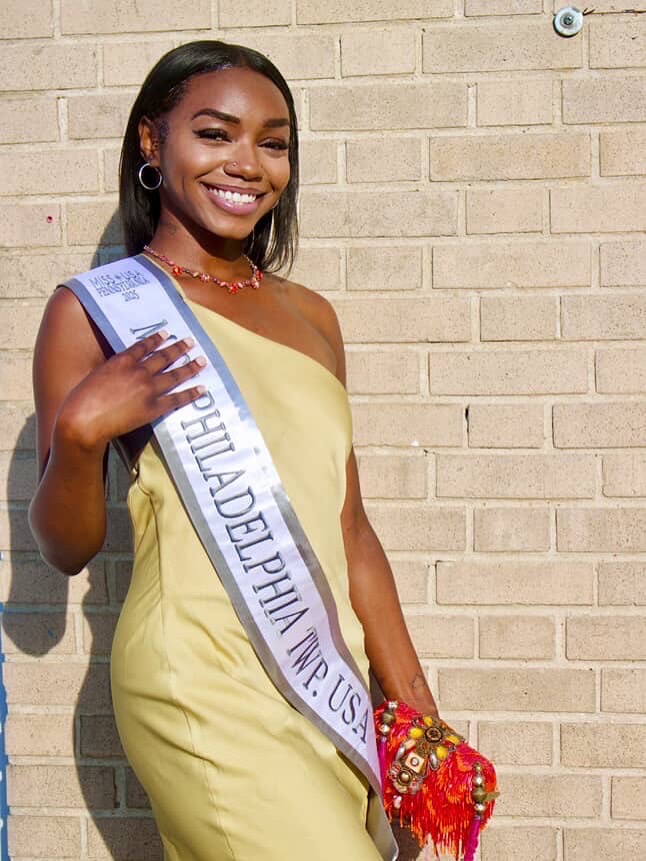
Kada Scott, 23, was abducted from outside her workplace on Oct. 4, police said.
A review of King’sprevious criminal cases raises questions about whether police and prosecutors could have been more vigilant in holding him accountable for the earlier crimes they say he committed.
City Council has since vowed to hold a hearing examining how the city’s criminal justice system handles cases of domestic violence.
But even before the charges were withdrawn, police and court records show, there were missteps.
Marian Grace Braccia, a former Philadelphia prosecutor who is a law professor at Temple University, said she found it alarming that law enforcement failed to take King into custody when he twice stood before them in court while wanted for a violent felony.
“If this is supposed to be a collaborative effort — if there is a shared mission of public safety and victim advocacy — it sounds like everyone dropped the ball,” she said.
Detectives and prosecutors, she said, should have been aware of the arrest warrant and had officers take him into custody.
Then, she said, prosecutors could have cited the alleged kidnapping to ask a judge to increase King’s bail and keep him behind bars.
Instead, she said, “it passed by everybody, and he came in and walked out, and slipped through the cracks of the Philadelphia legal court system.”
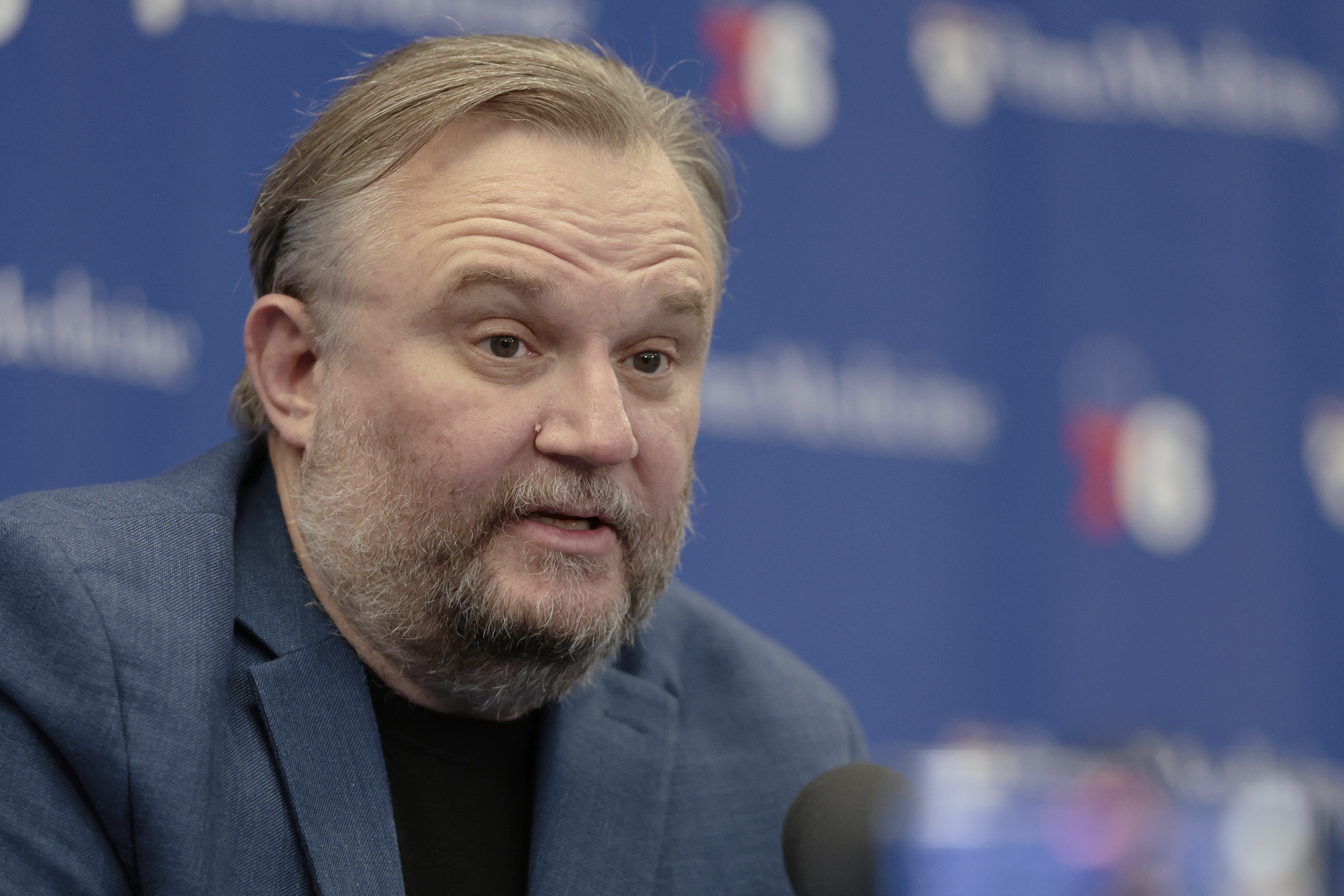
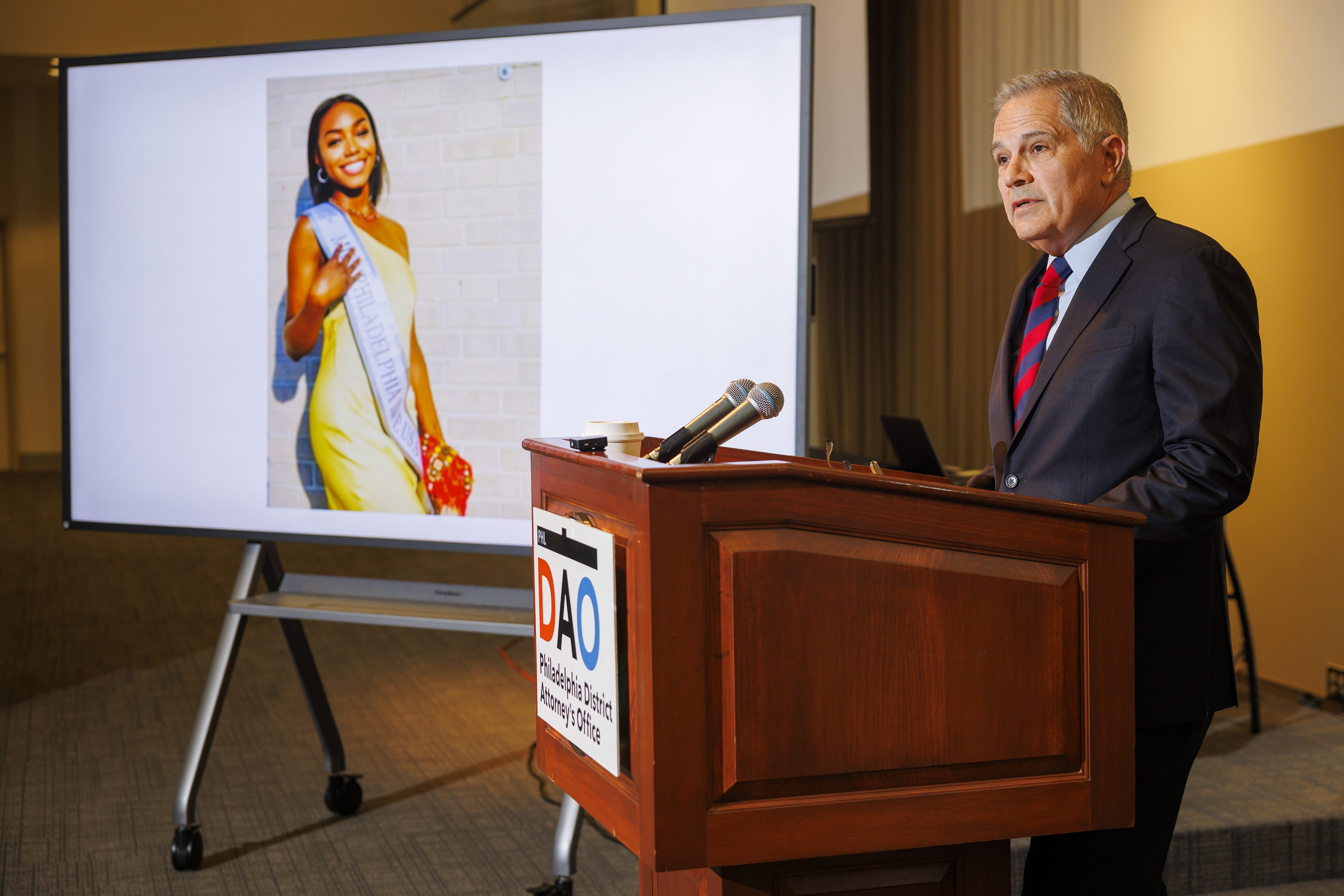
Philadelphia District Attorney Larry Krasner discusses the killing of Kada Scott at a news conference earlier this week.
Krasner said there is no system to automatically notify prosecutors when a defendant in one of their cases is arrested anew.
Similarly, there is no system to let police know that suspects in new cases have outstanding criminal matters, said Philadelphia Police Department spokesperson Sgt. Eric Gripp.
“Detectives are not automatically notified when a wanted subject is physically present in court on a different active case,” he said.
Krasner said the issues in the case underscore a lack of communication among law enforcement agencies that happens in part because their digital information systems are decades old. He said his office and other law enforcement agencies should work to update those systems.
“That is something that we can all improve together if we have the will and if we have the resources,” he said.
A wanted man walks free
Police said King first attacked his ex-girlfriend in early November of last year. He broke into her Strawberry Mansion home, then tried to strangle her, according to the affidavit of probable cause for his arrest.
He was taken into custody in December and charged with burglary and strangulation, and bail was set at $50,000. King immediately posted the necessary 10%, $5,000, and was released.
About a month later, police said, King returned to the woman’s home and tried to break in. When he could not gain entry, they said, he waited for her to step outside, then grabbed her by the hair and dragged her into his car. He drove for at least four miles, beating her along the way, before dropping her off in Fishtown, according to the affidavit for probable cause for his arrest.
A judge approved the warrant for King’s arrest on charges of kidnapping, strangulation, and related crimes on Jan. 19, court records show.
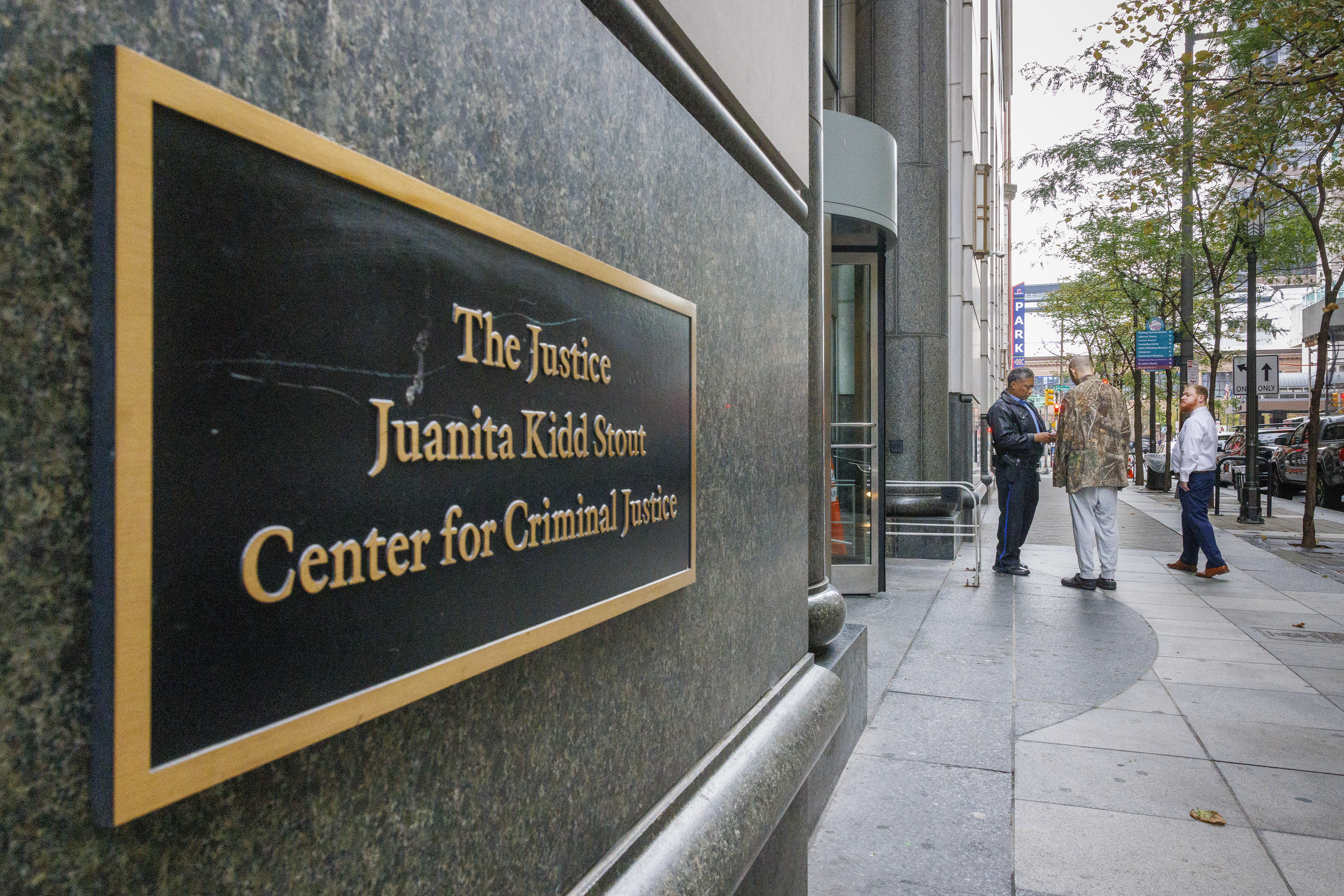
The Justice Juanita Kidd Stout Center for Criminal Justice in Philadelphia.
King — now wanted for a violent felony — appeared in court the following week for a preliminary hearing in the earlier burglary case, records show. But when the victim did not show up in court a second time, Municipal Court Judge Jacquelyn Frazier-Lyde ordered that the case had to proceed at the next listing. Prosecutors agreed.
King left court.
Meanwhile, police said, officers tried at least once to arrest him. On Feb. 11, Gripp said, police went to a home where they thought King might be, but he was not there.
Two weeks later, King was again in court for the burglary case — but police did not go there to arrest him. Once again, the victim did not show up, and prosecutors withdrew the charges
King walked out of court a free man.
Braccia, the Temple law professor, said the detective assigned to the case should have been aware of the hearing. When seeking to charge King for the kidnapping, she said, the detective should have pulled up King’s arrest history and noticed the ongoing case. He then could have flagged it to the prosecutor in the first case and gone to the hearing to arrest him.
At the same time, she said, the prosecutors who approved the kidnapping charges against King should have noticed the earlier case and told the prosecutor — particularly because it involved the same victim.
In April, King turned himself in to police to be charged with kidnapping, strangulation, and related crimes in connection with the January attack. Prosecutors asked for bail of $999,999, but the magisterial judge, Naomi Williams, set bail at $200,000, court records show. King posted the necessary $20,000 and was released.
The following month, after the victim again did not appear in court at two hearings, the kidnapping charges were also withdrawn.
Since prosecutors have refiled the charges, Krasner’s office said it has been back in touch with the woman and hopes she will testify. She declined to comment about King’s alleged crimes and the previous handling of the cases by police and prosecutors.
Six months later, King is back in custody, this time charged with murder. He is being held without bail.
We’ve all been there. The game is finished, now it’s time for you to run your own play: Escape the Linc. So what’s the fastest way out of the sports complex? Naturally we decided to settle this age-old debate with a race.
On Sunday, Oct. 5, Inquirer staffers braved the post-Eagles game crowds to test five ways to beat the rush. They began on foot at Xfinity Gate and their destination was a neutral location far enough to test postgame traffic across the city – Dalessandro’s in Roxborough, where they would be rewarded with a bracket-winning cheesesteak.
story continues after advertisement
Meet our racers and their modes of transportation:
ARIEL SIMPSON
Ariel grabbed a rideshare.
HENRY SAVAGE
Henry parked in Lot Q.
JASEN LO
Jasen hopped on his bike.
JULIE ZEGLEN
Julie parked in FDR Park.
JOHN DUCHNESKIE
John rode SEPTA.
Loading…
TIME ELAPSED
ARIEL
HENRY
JASEN
JOHN
JULIE
ARIEL
HENRY
JASEN
JOHN
JULIE
Five minutes after the conclusion of the Eagles’ 21-17 loss to the Denver Broncos, fans rush out of Lincoln Financial Field and it’s time to Escape the Linc. The race is on and our competitors head their separate ways.
JASEN
Bicycle
I strategically locked my bike to a street sign just a few feet away from the starting point. I’m motivated by my stinging defeat two years ago in the Race to the Shore, when I finished last despite a two-hour head start. I’m feeling good about my chances today though.
ARIEL
Rideshare
Weaving my way through fans, I order an Uber at the corner of the rideshare lot and quickly receive a call from my Uber driver. “I’m across the street, can you just meet me here?” the driver asks.
Of course, I agree. First place is starting to feel more achievable. Skipping the rideshare lot entirely, I am in his car four minutes later. I have never been this lucky getting an Uber after a game.
JOHN
SEPTA
I scurry to NRG Station, along with some of the 15,000 to 17,000 fans who use the Broad Street Line to get home after Eagles games. I make it to the station in 10 minutes. The intercom is announcing that one of the 10 Sports Express trains is now boarding. The express train is packed. There’s a single standing-room spot by one of the train doors, and I snag it. The doors close, and a sweaty mass of disappointed Eagles fans is off.
HENRY
Car from Q Lot
I parked in Lot Q specifically due to its distance from the major traffic chaos, and if you can beat the rush, you can get out of the direct stadium traffic. But I’m taking a car on I-95, so getting out of stadium traffic is only the beginning.
story continues after advertisement
JULIE
Car from FDR Park
I’m a pretty fast walker, but it takes me 17 minutes to get back to FDR Park, where I’d paid $50 to park. Henry has probably already left Lot Q! Though I’m not-so-secretly rooting for John and public transportation to win it all, I’d like to beat the other driver, for the sake of my pride.
Also, something I hope other competitors aren’t contending with: angry drivers, like the guy behind me who appears to be screaming as he pounds on his steering wheel. But let’s be real, they probably are. That game sucked.
ARIEL
Rideshare
It’s never gone this smoothly leaving an event at the South Philadelphia Sports Complex. Because of the speed and location of my Uber pickup, at the end of the normal pickup area, I am able to avoid most of the Eagles traffic. We made it onto I-95 less than 15 minutes after the race started and now we’re quickly making our way north toward the Vine Street Expressway.
It’s been 20 minutes since our racers set off from Xfinity Gate and the contestants are spread across the city. Jasen is out ahead, but Ariel is close behind. John is already at City Hall and about to transfer to Regional Rail. But our drivers, Julie and Henry, are still making their way toward I-76 and I-95, respectively.
JOHN
SEPTA
Feeling good about my chances, I stroll into Jefferson Station, look up at the board for the train schedules, and see that the 5:10 p.m. Regional Rail train on the Manayunk-Norristown Line is canceled. My heart sinks. It’s all over. I’ll be the biggest loser.
The Route 32 bus could be my lifeline, but it’s scheduled to leave City Hall in two minutes. I rush outside onto Market Street, and then, to my surprise, I’m doing something I’ve tried to avoid my entire life. I’m running.
JASEN
Bicycle
I bypass the Schuylkill River Trail in favor of MLK Drive, which is closed to motorized traffic on the weekends during the warm-weather months. Instead of having to pass pedestrians and slower cyclists on the trail, I can safely speed as fast as I can in pursuit of cheesesteak victory. My plan is only made possible thanks to the timely opening of the MLK Bridge, which reopened to the public in September, after three years of refurbishment.
ARIEL
Rideshare
We hit some traffic as we get onto I-76, and I take in the scenes of the Philadelphia Art Museum as we slow to a crawl on the Schuylkill Expressway. The slowdown hardly matters though, and we are already approaching Manayunk.
JOHN
SEPTA
Why does it seem that the only time a SEPTA bus is on time is when you need it to be late?
I miss the 4:56 p.m. bus leaving City Hall, and my options are dwindling. My best bet is to stay where I am and wait for the next Route 32 bus to roll around in about a half hour. That would get me to Dalessandro’s after 6 p.m., when I presume my fellow contestants will be polishing off their cheesesteaks.
JULIE
Car from FDR Park
It takes about 15 minutes to get from Pattison Avenue to Penrose Avenue to 26th Street. From there, my co-pilot, Ben, and I make our way to I-76 fairly easily, albeit slowly. This is not fun! There’s definitely residual game traffic, even farther out. But at least we’re moving.
HENRY
Car from Q Lot
The ride – or wait – along Oregon Avenue takes nearly 20 solid minutes of standstill traffic. Drivers are constantly speeding past lines of cars only to try and nudge their way back into the lane farther down the road. It takes seven minutes just to traverse the exit from Front Street onto I-95.
JULIE
Car from FDR Park
We pass the University City exit and I briefly fantasize about ditching the competition and heading home to West Philly. The will to beat Henry wins out. I really should have eaten before embarking on this trek. I start to feel carsick.
Meanwhile, SEPTA is causing its own chaos for John. And farther north, Ariel and Jasen are leading the pack.
ARIEL
Rideshare
I arrive at Dalessandro’s in just 48 minutes. The ride cost $73.47, before tip. Despite an Eagles loss, the cheesesteak sure did taste sweet after the win.
JASEN
Bicycle
I can’t help but think that the race planners chose Dalessandro’s just because it sits on a steep hill range, the same one that cycling legends have climbed in the storied Philadelphia International Cycling Classic. I’m only less than a mile away, but climbing up Ridge Avenue is tough going given the roughly 250 feet of elevation gain.
JASEN
Bicycle
Coming down Walnut Lane, I wait to cross Henry Avenue at a stoplight — for what feels like an eternity, thanks to the ridiculous configuration of this four-lane highway. As soon as the light turns green, I zip across and catch my first glimpse of our photographer. Mistakenly thinking my legs had won the day, I hoot and holler — only to spot Ariel taking a video of me. Private equity takes the crown today. I’ll settle for second. My ride took 56 minutes.
JOHN
SEPTA
At 5:32 p.m. — and right on time, despite my low expectations — my chariot arrives.
story continues after advertisement
JULIE
Car from FDR Park
Henry and I are neck-and-neck, according to the Slack chat where we’re sharing updates, and Dalessandro’s is in view. Ben and I hit a red light at the intersection of Walnut Lane and Henry Avenue and have a quick decision to make: turn left onto Henry, or stay straight for another block. I’m seized by a sudden, urgent, competitive rush. I will roll out of this car to get third place! The light changes. Ben follows Google Maps and says it’ll be easier to find parking on Wendover Street. He’s right, but we waste precious seconds making two (!) left turns.
JULIE
Car from FDR Park
We park halfway down the block. I throw open the car door and sprint up Wendover. I round the corner and see Jasen, Ariel — and no Henry. Victory is mine! That’s bronze, baby.
HENRY
Car from Q Lot
It’s the final leg and the final boss of this race in a car — finding a parking spot near one of the top cheesesteak tourist traps. I pass the restaurant and am lucky to find a spot across the street. Little did I know that right as I passed the restaurant, Julie was making her final sprint up Wendover Street.
Henry arrives at Dalessandro’s 1 hour and 14 minutes after leaving the Linc.
While the other racers celebrate with cheesesteaks (in Henry’s case, a vegan cheesesteak he picked up from Triangle Tavern), John steadily brings up the rear on the bus.
JOHN
SEPTA
Finally. After a smooth and uneventful 36-minute ride, I hop off the bus, steps away from Dalessandro’s. My fellow contestants have been waiting for me, with a curious mix of relief and pity. I realize that if I had gone straight to the bus stop after getting off the subway, I would have come in third — behind Ariel with her expensive Uber trip and Jasen on his bicycle, but ahead of Julie and Henry with their cars.
In a shocking upset, at least in the mind of trending sports reporter ARIEL SIMPSON, the rideshare won. She was in her rideshare within 10 minutes of the start of the race. She finished in first place, making it to Dalessandro’s in just 48 minutes. All for the low price of $73.47, before tip … one way.
Riding his bike, JASEN LO was close behind, finishing in 56 minutes. If you’re able to bike to the game, you’ll avoid pedestrian and vehicle traffic. Although some hills in Philly can prove to be a serious workout.
JULIE ZEGLEN and HENRY SAVAGE both drove and paid $50 to park. Julie walked about a mile to her car and had to deal with less stop-and-go traffic than Henry. Henry was parked closer to the stadium, but spent half of his trip crawling through traffic. The difference was marginal, though. Julie’s trip took 1 hour and 12 minutes and Henry’s trip took 1 hour and 14 minutes.
John Duchneskie regales his competition with tales from his journey on SEPTA.Bastiaan Slabbers
After a strong start on the Broad Street Express, a canceled train stalled JOHN DUCHNESKIE and he had to wait 30 minutes for the next bus to take him north to Manayunk. His trip took 1 hour and 43 minutes.
After this completely scientific test, how should you Escape the Linc? You’re going to need some combination of luck, money, or physical exertion. For everyone else, there are traffic jams and the seemingly endless wait for the Route 32 bus.
Staff Contributors
Design and Development: Aileen Clarke
Reporting: Ariel Simpson, Henry Savage, Jasen Lo, John Duchneskie, Julie Zeglen
Editing: Sam Morris, Aileen Clarke, and Matt Mullin
Photography: Bastiaan Slabbers
Photo Editing: David Maialetti
Copy Editing: Jim Swan
Subscribe to The Philadelphia Inquirer
Our reporting is directly supported by reader subscriptions. If you want more journalism like this story, please subscribe today
“;if(e)return Promise.resolve(i);if(t){t(null,i);return}return i}if(e)return Promise.reject(n);if(t){t(n);return}throw n}}function yn(r,e){return(t,n,i)=>{typeof n==”function”&&(i=n,n=null);let s={…n};n={…m.defaults,…s};let o=pi(n.silent,n.async,i);if(typeof t>”u”||t===null)return o(new Error(“marked(): input parameter is undefined or null”));if(typeof t!=”string”)return o(new Error(“marked(): input parameter is of type “+Object.prototype.toString.call(t)+”, string expected”));if(ui(n),n.hooks&&(n.hooks.options=n),i){let a=n.highlight,l;try{n.hooks&&(t=n.hooks.preprocess(t)),l=r(t,n)}catch(c){return o(c)}let u=function(c){let f;if(!c)try{n.walkTokens&&m.walkTokens(l,n.walkTokens),f=e(l,n),n.hooks&&(f=n.hooks.postprocess(f))}catch(p){c=p}return n.highlight=a,c?o(c):i(null,f)};if(!a||a.length{a(c.text,c.lang,function(f,p){if(f)return u(f);p!=null&&p!==c.text&&(c.text=p,c.escaped=!0),h–,h===0&&u()})},0))}),h===0&&u();return}if(n.async)return Promise.resolve(n.hooks?n.hooks.preprocess(t):t).then(a=>r(a,n)).then(a=>n.walkTokens?Promise.all(m.walkTokens(a,n.walkTokens)).then(()=>a):a).then(a=>e(a,n)).then(a=>n.hooks?n.hooks.postprocess(a):a).catch(o);try{n.hooks&&(t=n.hooks.preprocess(t));let a=r(t,n);n.walkTokens&&m.walkTokens(a,n.walkTokens);let l=e(a,n);return n.hooks&&(l=n.hooks.postprocess(l)),l}catch(a){return o(a)}}}function m(r,e,t){return yn(Z.lex,N.parse)(r,e,t)}m.options=m.setOptions=function(r){return m.defaults={…m.defaults,…r},Vr(m.defaults),m};m.getDefaults=gn;m.defaults=ee;m.use=function(…r){let e=m.defaults.extensions||{renderers:{},childTokens:{}};r.forEach(t=>{let n={…t};if(n.async=m.defaults.async||n.async||!1,t.extensions&&(t.extensions.forEach(i=>{if(!i.name)throw new Error(“extension name required”);if(i.renderer){let s=e.renderers[i.name];s?e.renderers[i.name]=function(…o){let a=i.renderer.apply(this,o);return a===!1&&(a=s.apply(this,o)),a}:e.renderers[i.name]=i.renderer}if(i.tokenizer){if(!i.level||i.level!==”block”&&i.level!==”inline”)throw new Error(“extension level must be ‘block’ or ‘inline’”);e[i.level]?e[i.level].unshift(i.tokenizer):e[i.level]=[i.tokenizer],i.start&&(i.level===”block”?e.startBlock?e.startBlock.push(i.start):e.startBlock=[i.start]:i.level===”inline”&&(e.startInline?e.startInline.push(i.start):e.startInline=[i.start]))}i.childTokens&&(e.childTokens[i.name]=i.childTokens)}),n.extensions=e),t.renderer){let i=m.defaults.renderer||new ye;for(let s in t.renderer){let o=i[s];i[s]=(…a)=>{let l=t.renderer[s].apply(i,a);return l===!1&&(l=o.apply(i,a)),l}}n.renderer=i}if(t.tokenizer){let i=m.defaults.tokenizer||new ve;for(let s in t.tokenizer){let o=i[s];i[s]=(…a)=>{let l=t.tokenizer[s].apply(i,a);return l===!1&&(l=o.apply(i,a)),l}}n.tokenizer=i}if(t.hooks){let i=m.defaults.hooks||new le;for(let s in t.hooks){let o=i[s];le.passThroughHooks.has(s)?i[s]=a=>{if(m.defaults.async)return Promise.resolve(t.hooks[s].call(i,a)).then(u=>o.call(i,u));let l=t.hooks[s].call(i,a);return o.call(i,l)}:i[s]=(…a)=>{let l=t.hooks[s].apply(i,a);return l===!1&&(l=o.apply(i,a)),l}}n.hooks=i}if(t.walkTokens){let i=m.defaults.walkTokens;n.walkTokens=function(s){let o=[];return o.push(t.walkTokens.call(this,s)),i&&(o=o.concat(i.call(this,s))),o}}m.setOptions(n)})};m.walkTokens=function(r,e){let t=[];for(let n of r)switch(t=t.concat(e.call(m,n)),n.type){case”table”:{for(let i of n.header)t=t.concat(m.walkTokens(i.tokens,e));for(let i of n.rows)for(let s of i)t=t.concat(m.walkTokens(s.tokens,e));break}case”list”:{t=t.concat(m.walkTokens(n.items,e));break}default:m.defaults.extensions&&m.defaults.extensions.childTokens&&m.defaults.extensions.childTokens[n.type]?m.defaults.extensions.childTokens[n.type].forEach(function(i){t=t.concat(m.walkTokens(n[i],e))}):n.tokens&&(t=t.concat(m.walkTokens(n.tokens,e)))}return t};m.parseInline=yn(Z.lexInline,N.parseInline);m.Parser=N;m.parser=N.parse;m.Renderer=ye;m.TextRenderer=Pe;m.Lexer=Z;m.lexer=Z.lex;m.Tokenizer=ve;m.Slugger=Re;m.Hooks=le;m.parse=m;var vs=m.options,ys=m.setOptions,ws=m.use,xs=m.walkTokens,bs=m.parseInline;var ks=N.parse,Ss=Z.lex;var wn=1,Xe=class{constructor(e){this.el=e,this.contentPosition=”default”,this.possibleSteps=new Array,this.currentStep=null,this.offset=window.innerHeight*.9,this.focus={},this.zoom={},this.instanceOfSteps=wn,wn++,this.setPossibleSteps(),this.updateContent(),this.bindings()}setPossibleSteps(){this.el.querySelectorAll(“.js-steps-step”).forEach(e=>{e.dataset.step&&(this.possibleSteps.push(e.dataset.step),this.focus[“is-“+e.dataset.step]=e.dataset.focus.split(“,”).map(t=>t.trim()),this.zoom[“is-“+e.dataset.step]=e.dataset.zoom)})}bindings(){window.addEventListener(“scroll”,()=>{this.updateContent()}),window.addEventListener(“resize”,()=>{this.updateContent()})}updateContent(){this.updateCurrentStep(),this.findExactTime()}updateCurrentStep(){let e;if(this.el.querySelectorAll(“.js-steps-step”).forEach((n,i)=>{n.getBoundingClientRect().top{let o=”is-“+i,a=”is-“+s;this.possibleSteps.indexOf(i)s.dataset.step==this.currentStep.replace(“is-“,””)),n=e[t],i=e[t+1];if(i){let s=n.getBoundingClientRect().top,o=i.getBoundingClientRect().top,a=o-s,u=1-(o-this.offset)/a,h=parseInt(n.dataset.time),f=parseInt(i.dataset.time)-h,p=Math.round(f*u),b=h+p;Q.updateTime(b)}else{let s=parseInt(n.dataset.time);Q.updateTime(s)}}else{let e=this.el.querySelector(“.js-steps-step”),t=parseInt(e.dataset.time);Q.updateTime(t)}}},xn={init:()=>{document.querySelectorAll(“.js-steps”).forEach(r=>{new Xe(r)})}};var gi=(r,e,t)=>{document.querySelectorAll(“.js-subscribe”).forEach(n=>{n.classList.toggle(“is-unsubscribed”,!r),n.classList.toggle(“is-preview”,e),n.classList.toggle(“is-dev”,t)})},bn={init:()=>{gi(ke(),Se(),ue())}};var di=()=>{},kn={init:()=>{di()}};var Sn={init:()=>{ct.init?.(),ie.init?.(),yt.init?.(),bt.init?.(),Tt.init?.(),Q.init?.(),xn.init?.(),bn.init?.(),kn.init?.(),X.init?.()}};var mi=()=>{},Tn={init:()=>{mi()}};var vi=document.querySelector(“.js-inno”),zn=()=>{Sn.init(),Tn.init()};vi?zn():new MutationObserver((e,t)=>{if(document.querySelector(“.js-inno”)){t.disconnect(),zn();return}}).observe(document,{attributes:!0,childList:!0,subtree:!0});})();
The Sixers have figured out the key to a stress-free life.
You can’t let anybody down if they don’t have any expectations.
It would be a fitting twist if this was the year the Sixers finally lived up to the hype of the last decade. They spent eight years as a Snapchat-filter contender, entering each season with the unsubstantiated energy of a team that desperately wants to speak its self-image into existence but at the same time understands that the teams that win NBA titles usually aren’t the ones trying to channel Ben Affleck in Boiler Room. The problem with the whole “act as if” mindset is that you need to stop acting at some point or else you just become an act.
The tricky thing about the Sixers is that it is tough to pinpoint when, exactly, they became that act, given the preponderance of options. I would argue that it was when James Harden held a birthday party at which women held signs that said, “Daryl Morey is a liar.” But you could just as easily argue that it happened a year earlier, when the Sixers traded a guy who was too scared to throw down an open dunk in a decisive playoff game for a guy who showed up to a playoff press conference wearing a designer coat that looked like it was constructed from the pelt of a Teletubby.
Morey has taken the brunt of the blame for the last couple of seasons, mostly because it was his name on the marquee. If you don’t like the circus, you either blame Barnum or you blame Bailey. In selling Harden and then Paul George, Morey’s message was the classic “Don’t believe your eyes.” The scariest part of Dave Dombrowski’s press conference last week was when he channeled Morey and suggested that older players don’t get old the same way they used to. Whatever truth there is to it — and I could lay out a very strong case that there isn’t much — the marvels of modern sport science still haven’t managed to solve a conundrum that each of us encounters at some physiological age. Once you get old, there is no getting un-old. The only question is whether you can slow down the decay.
Funny thing about Morey, though. While his more vocal critics have written him off as little more than a salesman, they are giving his sales proficiency way too much credit. He has been much better at his actual job, which, let’s not forget, began five years ago with inheriting a roster that was assembled on the premise that Al Horford and Josh Richardson could be the missing pieces that would enable Joel Embiid, Ben Simmons, and Tobias Harris to win a title. Back then, people felt a lot like they did by the end of last season. The Sixers’ best chance had already passed them by.
Sixers president Daryl Morey is entering his sixth season with the franchise.
What the interim has wrought is in the eye of the beholder. It has been easiest to focus on Morey’s yearly quest to push the Sixers over the top, his annual reshuffling of the deck, from Simmons to Harden to George, each one falling short of even reaching the conference finals. The Sixers have not come close to achieving the ultimate goal, but they have made a sport of it, taking the Celtics to Game 7 in 2023 and the Knicks to Game 6 in 2024 before landing George as part of a free-agent bonanza last summer. Yet even as they have tried and failed — and flailed — they somehow manage to enter 2025-26 with a roster that actually looks like the one the Sixers thought they had in those first post-Process years, long before Morey arrived. Morey drafted Tyrese Maxey and then Jared McCain and just five months ago VJ Edgecombe, who may have the most potential of them all.
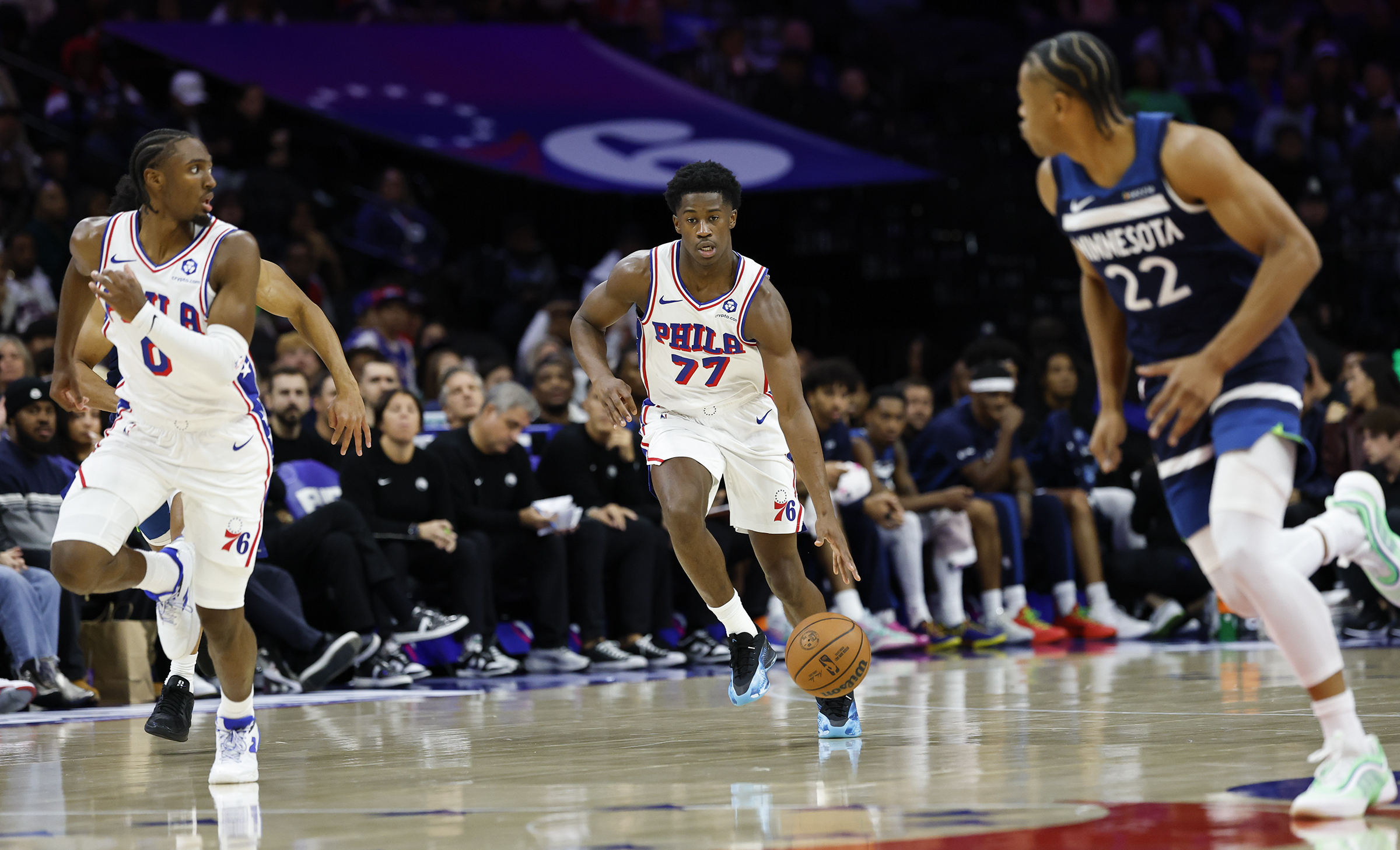
You watched the Sixers this preseason and you saw the makings of the team they never actually had. The first quarter of their 126-110 win over the Timberwolves on Friday was eye-opening. Early in the quarter, Edgecombe crashed the weak-side glass and corralled a Kelly Oubre miss for an easy putback. Edgecombe and Maxey spent the period running the court like it was crumbling behind them, pushing the pace after makes as well as misses, displaying an uncanny connection for teammates whose partnership can be measured in months.
After going hard to the basket and finishing his textbook footwork with a contested layup off a fastbreak pass from Maxey, Edgecombe stole the ball from Johnny Juzang at the other end of the court, sparking another break that resulted in a free-throw trip for Quentin Grimes. But the most instructive play might have been one that failed: a cross-court, alley-oop pass from Maxey near the hash to Edgecombe on the weak-side block. They did not convert, but they came close enough to project that they will finish plenty of them.
Even without McCain, who quickly worked his way to the top of the rotation last season and who will be there again soon, the Sixers looked a lot like the kind of team people always wished they would be instead of steadily growing older, slower, and more difficult to watch.
For the first time in a long time, the Sixers have the makings of a team that is, at the very least, a fun team to root for. It remains to be seen how well it will translate into wins. It will translate into more than people think if Embiid can consistently be the guy he was in his preseason debut. Healthy. Light on his feet. Knocking down elbow jumpers and charging to the rim. Whatever they get from George will be a bonus.
And, who knows, maybe that will be enough in a wide-open Eastern Conference where two top contenders are taking gap years. Injuries to the Celtics’ Jayson Tatum and the Pacers’ Tyrese Haliburton have created a power vacuum. You can’t completely discount the Sixers’ chances of filling it.
Sixers guard VJ Edgecombe brings the ball upcourt alongside Tyrese Maxey during Friday’s preseason game against the Timberwolves.
For now, the reason to watch this team is for an early look at what the future will look like. Edgecombe has a chance to become the Sixers’ most electric star since Allen Iverson. Maxey is Maxey, and McCain is almost as fun to watch. It is a fascinating dynamic, one that complicates the more cynical narratives about the Sixers’ trajectory over the last five years.
The safe play is to not expect much out of the Sixers. But you can expect them to be fun.
The spirits of the pets come first, treading home on soft, shadowy paws, making their way by the light of altar candles and guided by the eternal tie of love.
They are welcomed with offerings of favorite treats and fresh water, and by the careful placement of old toys and worn collars that have become cherished mementos.
It’s a new tradition connected to the Day of the Dead, the ancient Mexican holiday where people honor and celebrate the lives of family members at a time when the wall between worlds melts.
Now, in Philadelphia and elsewhere, people have begun to recognize not just human relatives but those with wings and whiskers, the departed dogs, cats, birds, and other animals that enriched their lives. And who, like family, continue to be mourned and missed.
The souls of pets are said to return on Oct. 27, a few days before the Dia de Muertos on Nov. 1 and 2.
“The day,” said Gerardo Coronado Benitez, manager of the Association of Mexican Business Owners of Philadelphia, “is not about death, but about celebrating and remembering people, keeping memories alive. Of course many people want to keep alive the memories of their pets.”
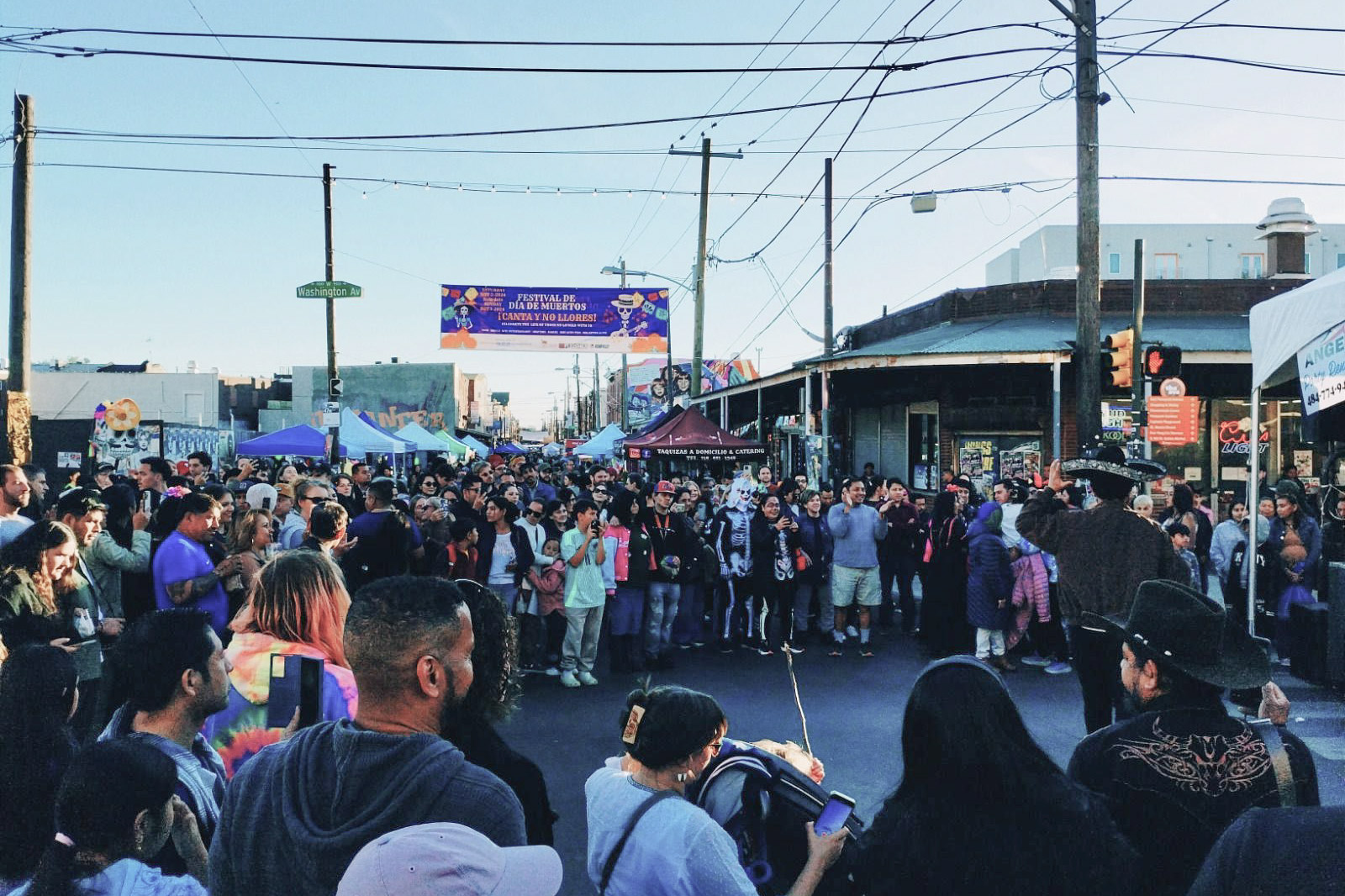
He is helping organize a big Day of the Dead event at the Italian Market on Nov. 2, where people will be able to place photos of relatives and pets on a community ofrenda ― a decorated altar ― at Ninth Street and Washington Avenue.
A crowd gathers at last year’s Day of the Dead celebration at the Italian Market in South Philadelphia.
Others have set up altars in their homes. These ofrendas may be adorned with traditional marigolds, with candy skulls, paper skeletons, and photographs. But they may also feature a snatch of fur or a whisker left behind.
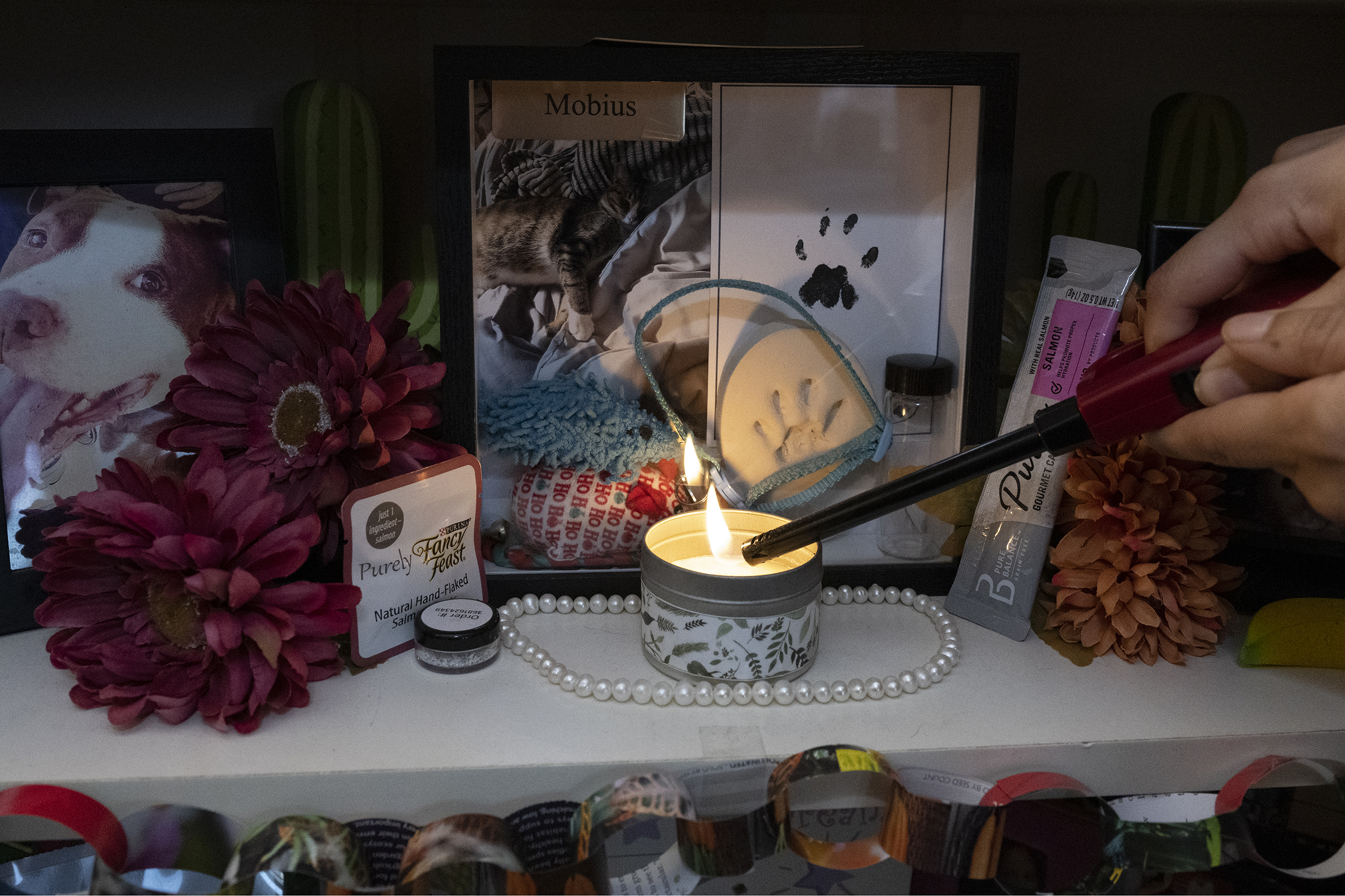
Genesis Pimentel-Howard created an ofrenda for her cat, Mobi, on a bedroom shelf of the West Philadelphia home she shares with her husband, Yaphet Howard.
It’s hard for her to talk about Mobi, who died suddenly in May at only 4 years old.
He was, she said, an adorable menace. Mobi loved to poke at and play with the couple’s other cat, Sannin, though Sannin didn’t always appreciate the attention.
Mobi sometimes stole food from the trash. And he managed to push over and break Pimentel-Howard’s flat-screen TV. Still, she said, he followed her everywhere. She couldn’t even use the bathroom without him trailing her inside.
“A sweet momma’s boy,” she said. “Always next to me.”
On the ofrenda, Pimentel-Howard placed her grandmother’s pearls. And photos of her family dogs, Ella and Red, and her hamster, Shia LaBeouf. She added a shadow box that holds Mobi’s collar and an impression of his paw.
“I’ll stay up as late as Ican to welcome him,” she said. “I like to think he’ll be around.”
Genesis Pimentel-Howard lights a candle for her late cat, Mobi, beside a lovingly crafted ofrenda in her Philadelphia home on Monday. The altar glows with candlelight, welcoming the spirits of her beloved departed pets. The ritual is part of a growing tradition tied to Día de los Muertos.
The roots of the Day of the Dead go back 3,000 years, to Aztec and Mayan traditions. It is celebrated not only in Mexico but also in wider Latin America and in communities across the United States.
Dogs have always played an important role. The ancients considered them sacred, guides that led souls through the afterlife. They revered the Mexican Hairless dog, the Xoloitzcuintle, or Xolo for short.
It’s a Xolo dog, Dante, that guides Miguel to meet his ancestors in Coco, the popular animated Disney movie. And it’s a song from the movie, “Remember Me,” that has become the soundtrack for countless social media posts about departed pets.
In Philadelphia, the Italian Market festival welcomes all who wish to take part in its Day of the Dead event to South Ninth Street between Federal and Christian Streets from 11 a.m. to 5 p.m. on Nov. 2
The Fleisher Art Memorial in South Philadelphia also will hold a big Day of the Dead celebration. Everyone is invited to help with final preparations for the ofrenda from 2 to 9 p.m. on Oct. 31, and to come to the Day of the Dead event the next day.
“The animals, that’s family, too,” said María De Los Angeles Hernández Del Prado, the artist who led the creation of the Fleisher’s large, three-part ofrenda, which includes a section devoted to pets. “They’re the same as us, they just don’t talk the same language.”
Pimentel-Howard knew after Mobi died that she would find a way to honor him, along with the other animals she has loved.
“You don’t know what it’s like to lose an animal,” she said, “until you’ve lost one.”
After the Eagles won Super Bowl LIX, Jeffrey Lurie told some NFL folks close to him that his greatest concern for the upcoming season had little to do with the talent level that would return, even with personnel losses looming. He didn’t worry about the salary cap, though it presented gnarly challenges, nor did he worry about the draft, though their title meant they were scheduled to pick last in every round.
He worried about a void in leadership. He worried about life after defensive end Brandon Graham.
He’s coming back because the Birds don’t have enough good defensive ends and edge rushers. Nolan Smith and Ogbo Okoronkwo are hurt, Za’Darius Smith retired, and rookie Jihaad Campbell isn’t ready. Only four teams have fewer than the Eagles’ 11 sacks — only 3½ have come from edge rushers — and they rank 22nd against the run.
Worse, though, the defense often plays without focus, discipline, and physicality. That’s where leadership comes in. That’s where Brandon Graham comes in.
“I think they got everything they need,” he said during his comeback announcement on his podcast.
He knows that’s not true. He knows the Birds lack playmakers and professionalism. He hopes to deliver both.
Will he be enough?
Through seven games this season, no one has stepped into the roles vacated by Graham, the hero of the franchise’s first Super Bowl win, and cornerback Darius Slay.
Slay, a bubbly personality and a master of his craft, spent the last five of his 12 full seasons in Philadelphia, starring and mentoring and bringing in banana pudding before the Eagles cut him in the offseason for salary-cap purposes. He’s in Pittsburgh now.
Eagles defensive end Brandon Graham was playing some good football last season before his injury.
Graham played more games than any other player over his 15 years in Philadelphia. He endured injuries; he endured comparisons to Earl Thomas and Jason Pierre-Paul, a star safety and a star defensive end drafted immediately after him in 2010; he endured lining up too far from the quarterback in Jim Washburn’s “wide-9” configuration, then endured lining up too far from the line of scrimmage in Bill Davis’ 3-4 scheme.
He hated most of it, but he did it all at 100%, and did it all with a smile, and he went all-out every practice and every game and every play. Moreover, he encouraged his teammates to buy in, too. He dragged them through the mud.
Why? Because he knew that anything less would lead to losing, and even when the team lost, BG was a winner.
— broad street sufferer (EXTEND SCHWARBER) (@bstreetsufferer) August 2, 2024
Graham was a playmaker who loved to play, loved the game, and loved Philly. That guy does not exist today in the Eagles locker room. That guy will exist tomorrow in the Eagles locker room, in his cubicle stuffed with shoes and bobbleheads and an outrageous number of colognes.
For the next 12 weeks and beyond, he will fill the void he left.
It’s not like they completely lack leaders.
Quarterback Jalen Hurts has a steady hand and a matchless work ethic, but he has deficiencies in his game and he will forever be a chilly teammate; it is his nature. Jordan Mailata, who took over Graham’s weekly radio show, is every bit the person and player Graham is, but he’s an offensive lineman. So is Lane Johnson, a strong, silent type, Mailata’s bookend at tackle and his polar opposite in personality.
The issue, of course, is that all three of those high-character, high-output players play offense.
Where are the defensive leaders?
Leadership was supposed to start coming from third-year defensive tackle Jalen Carter, but between a shoulder injury, a heel injury, poor conditioning, and an ejection for yet another foolish act, Carter clearly is not ready for the responsibility. He spat on Dak Prescott on national TV before the first snap of the first game, which earned him the expulsion and lost him the trust of his coaches. He then committed a penalty in each of the next four games and leads defensive linemen with five penalties.
How about fourth-year DT Jordan Davis? Well, it’s tough to present leadership when it takes you three years to lose the weight you should have lost in the first year, and it’s tough to carry clout in the locker room when you’ve forced one fumble and managed just 5½ sacks in your first 3½ seasons.
Both of those players have the capacity to be leaders. They just aren’t there yet.
Who is? Reed Blankenship, an undrafted, undecorated safety on the last year of his deal? Nakobe Dean, who’s missed half the Eagles’ last 44 games at linebacker because of injury? Zack Baun, who’s been a full-time starter for just 1½ of his six seasons?
No.
Not yet, anyway.
Maybe Graham’s return will speed their development.
The Eagles hope some of Brandon Graham’s leadership and professionalism will rub off on star DT Jalen Carter.
The Delco-set crime thriller Task came to a gut-wrenching end on Sunday, tying up loose plot lines, killing off the bad guys, catching the mole, and granting the most aggrieved characters happy endings.
The finale was also a real tearjerker, thanks to a profound and powerful performance by Mark Ruffalo.
The veteran actor, who recently joked about being in his “sad dad” era, is the central patriarch in a show that — underneath all the gunfighting and backstabbing — provides a brooding, layered examination of fatherhood in various forms.
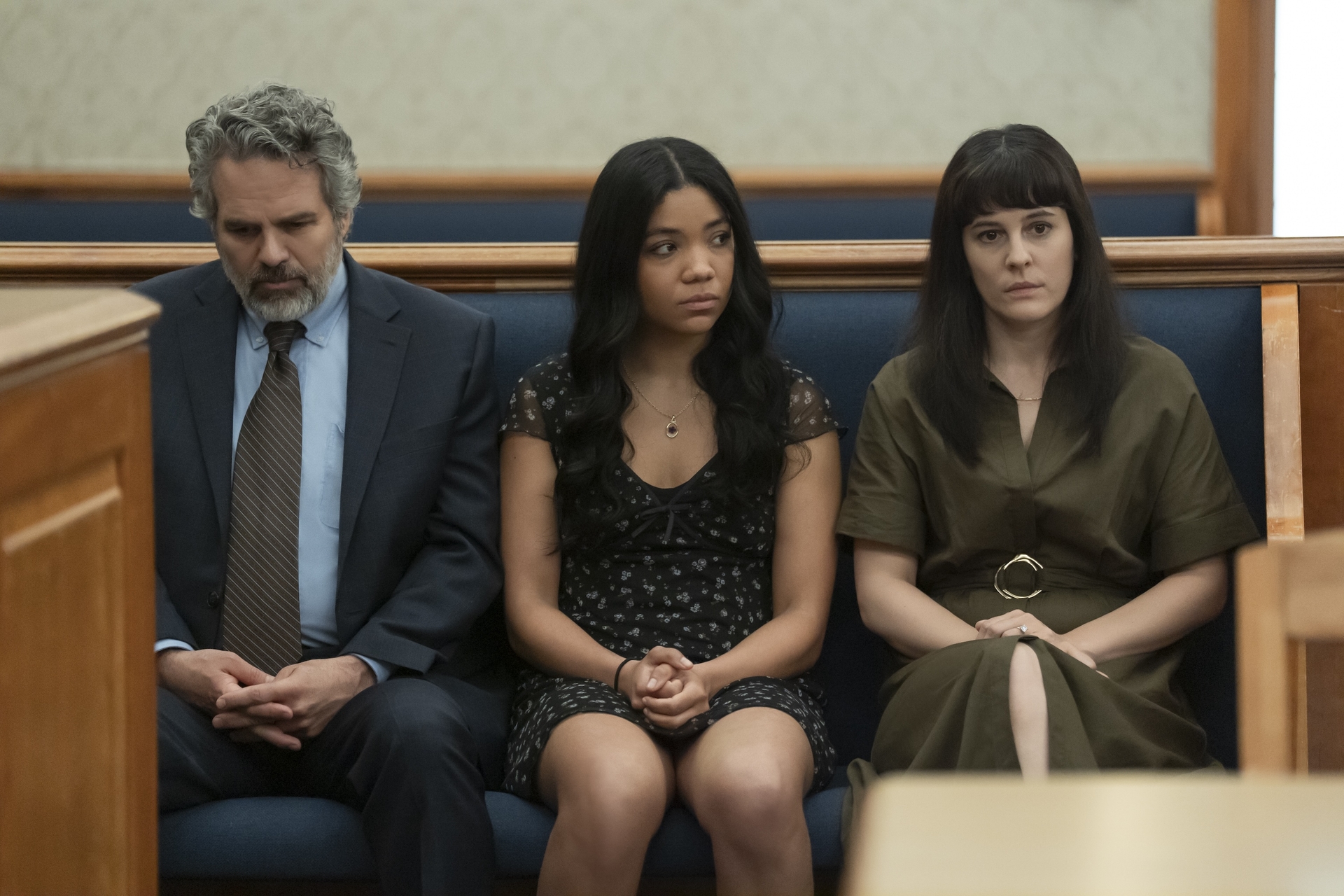
Tom (Mark Ruffalo), Emily (Silvia Dionicio), and Sara (Phoebe Fox) in “Task.”
After months of wallowing in a Phillies souvenir cup full of vodka, Ruffalo’s Tom Brandis promises to be a better father to his adopted teen daughter Emily (Silvia Dionicio). To prove it, Tom steps up to deliver the long-debated family statement at his adopted son Ethan’s (Andrew Russel) court hearing, where he was being tried for accidentally killing his mother during a schizophrenic episode.
All season, Tom struggles to face Ethan. But he, finally, stops running away and tells the judge about the difficulties and joys of Ethan’s childhood before asking his son to look him in the eye.
“Ethan, I don’t want you to live with the shame anymore,” says Tom. “I forgive you. I love you. I’m not here today to tell the court when my son should be released. That’s not up to me. I’m here today to let you know, Ethan, that when that day comes, I’ll be ready. Come straight home. I’ll be there waiting for you.”
Meanwhile, Tom has acted like a father figure to another boy — Sam (Ben Doherty), the gentle boy who was kidnapped by Robbie (Tom Pelphrey). Tom, a registered foster parent, decides to bring Sam, an orphan, home from a shelter. They develop a close bond; though Tom insists that it’s a temporary situation, there’s a possibility Sam could stay with the Brandis family long-term.
Tom (Mark Ruffalo) and Sam (Ben Doherty) in ‘Task.’
When a family is found for Sam, though, Tom confronts the painful question of whether the boy should go. His priest friend Daniel (Isaach de Bankolé) suggests that Tom might not be in a good place to raise a young kid, especially once Ethan returns home.
“Have you done that good thing for the boy, or for yourself?” asks Daniel. He tells Tom to be “unselfish” with his love and “recognize that what’s best for you may not be what’s best for the boy.”
Ultimately, Tom makes the heartbreaking decision to let Sam go. It’s a plot choice that creator Brad Ingelsby fought to keep, though he anticipates it might upset some viewers.
“I’m a little nervous about the ending, because I feel like people probably want Sam to stay with Tom. But I also felt like the story was about Tom and Ethan, and that has to be what Tom is ready for at the end,” said Ingelsby, also the creator of Mare of Easttown. “We had to fight HBO on that.”
Executives at the network thought it would be better to end the finale after the courtroom scene, but Ingelsby believed that would be a “betrayal of Tom as a character.”
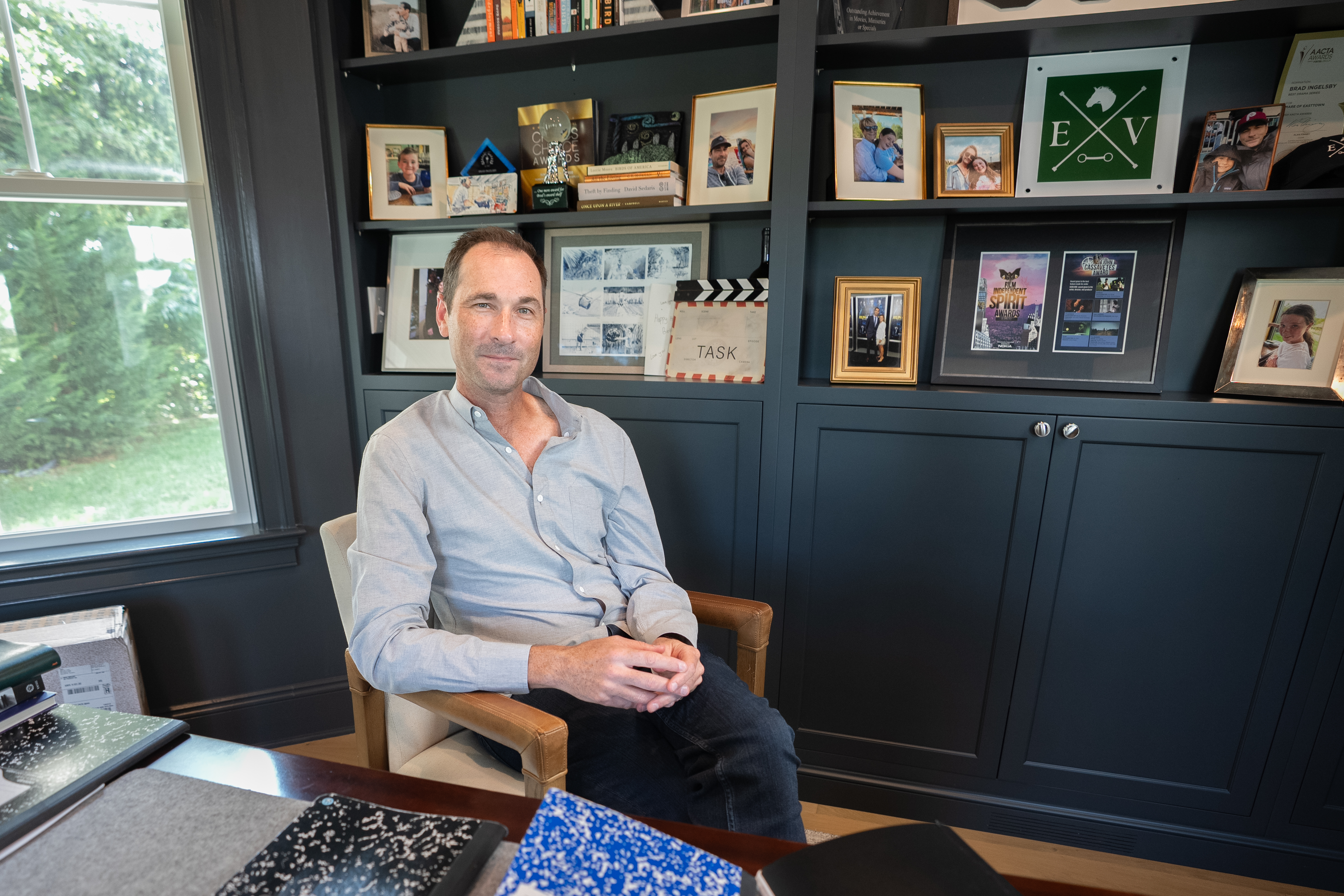
Brad Ingelsby in his office in Berwyn.
“I really wanted [Tom’s answer] to be, ‘No, I’m getting ready for my son. I’m not replacing him with this boy, who’s this cute little kid that everyone loves.’ Nope. We have to do something better than that,” said Ingelsby. “I’m sure we’ll catch some slack, like, ‘Why didn’t he just keep the boy?’ Which I know people will want — but I just couldn’t.”
Parenting requires sacrifice, and the fathers in Task exemplify that. Tom gives up Sam so he can dedicate himself to his biological daughter, Sara (Phoebe Fox), Emily and, eventually, Ethan. Robbie sacrifices himself to ensure that his niece Maeve (Emilia Jones) and his kids could live comfortably after his death. Within the biker gang, Perry (Jamie McShane), can’t bring himself to kill Jayson (Sam Keeley), whom he considers a son, despite receiving multiple commands to do so. Even after Jayson stabs him, Perry, with his dying breath, warns him of an impending betrayal.
It may be a bittersweet ending, but that’s just as Ingelsby intended.
LOS ANGELES — Inside a North Hollywood police precinct late on March 9, 1977, before the cops began questioning her about her father, Carol Steindler noticed a young woman sitting outside an office. The word HOMICIDE was stripped across the room’s pebbled-glass door, but Steindler didn’t think anything of it, didn’t see the straight line linking those three things: the word and the woman and her father. How could she see it? She didn’t know yet that he was dead.
What she did know was that Howie Steindler, 72, the owner of the Main Street Gym and a respected boxing manager, had not come home that night. Her mother, Ann, had telephoned her in a panic. Your daddy still isn’t here. Howie often stopped at his favorite bar, the Redwood, after a long day of work, but something this time made Ann “insanely upset,” Carol said recently, “more upset than usual.” Ann was so unsettled that she also called boxing promoter Don Fraser, Howie’s best friend. Fraser in turn called the police, who told him to get himself and at least one member of the Steindler family to the precinct.
The nature and timing of Howie’s disappearance were strange. Over the previous month, Ann, who tended toward the eccentric, had become convinced that something terrible was going to happen to her husband, telling Carol and others, My Howie’s gonna die. My Howie’s gonna die. Carol had stopped by her parents’ condominium in Encino, Calif., one day in February to find Howie, who had always handled the couple’s finances, teaching Ann how to write checks. “Are you sick?” Carol asked him, fearing that her father might be suffering from a fatal disease. No, he replied. It was just time for Ann to learn.
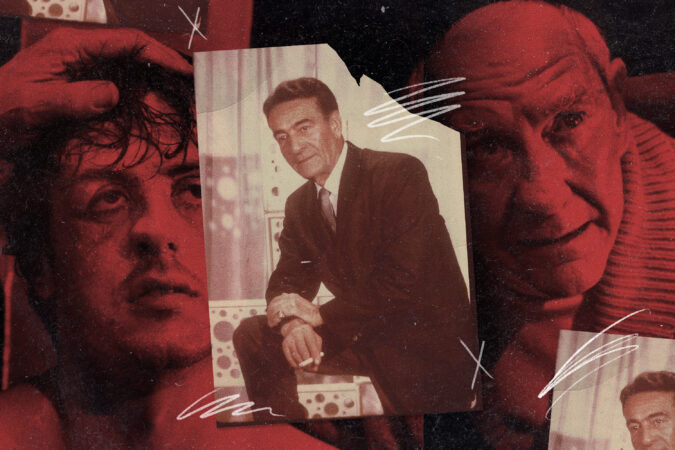
Those puzzling incidents were piling up while Steindler was approaching what promised to be the apex of his career in boxing. Looming over LA’s skid row neighborhood, the Main Street Gym was an institution, and Steindler was a popular member of the sport’s community, 5-foot-6 and slim but tough, hot-tempered yet softhearted, with few apparent enemies if any at all. He was so well regarded, in fact, that when the cast and crew of a low-budget movie — about an underdog Philadelphia fighter who gets an improbable shot at the heavyweight title — decided to use the gym as a location to shoot several scenes, one of the film’s stars had sought him out.
For two weeks in 1975, Burgess Meredith had shadowed Steindler, observing how he spoke to fighters and ran the gym, soliciting insights and advice from him, so he could better portray Mickey Goldmill, the wise and grouchy trainer who prepares Rocky Balboa to go the distance against Apollo Creed in Rocky. The Academy Awards would be held on March 28, 1977, and among the film’s 10 nominations was Meredith’s, for best actor in a supporting role. If he won, the chances were good that Meredith, in front of millions of viewers on ABC, would thank Steindler in his acceptance speech.
That moment of worldwide recognition for Steindler would never materialize, and not merely because Jason Robards, for playing Washington Post editor Ben Bradlee in All the President’s Men, won the best supporting actor Oscar that year and Meredith did not. Instead, Howie Steindler’s name would be left, for those who remember it, cloaked in sadness and mystery. Fraser picked up Carol and drove to the police station. The two of them sat together, waiting for an answer about his whereabouts, as the clock ticked toward midnight.
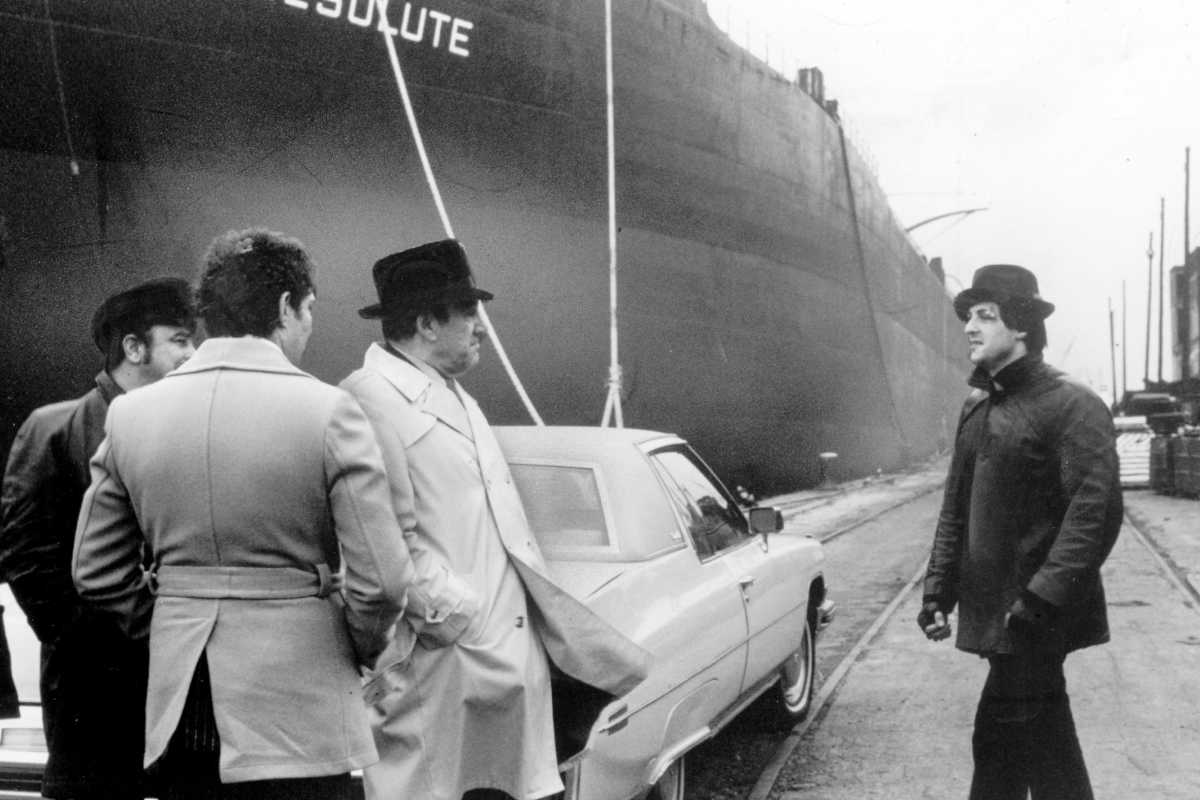
Sylvester Stallone on location while filming the original “Rocky” in Philadelphia.
A troubled heart of gold
Sylvester Stallone was anonymous in Hollywood, with just $106 to his name, before writing the script for Rocky and insisting, at the risk of scuttling the entire project, that he play the titular character. Rocky’s true star, the biggest name in the movie at the time, was Meredith.
He had earned an Oscar nomination for best supporting actor the previous year for his performance as a salesman/ex-vaudevillian in The Day of the Locust, and his lengthy career as a stage and screen actor, coupled with his deserved reputation as a ladies’ man, had made him a frequent source of copy in newspaper entertainment sections and gossip pages. (“Showgirl is 4th Wife of Burgess Meredith” was the headline of a brief United Press International story in January 1951.)
He was one of 41 actors who either auditioned or was considered for the role of Mickey; Lee J. Cobb, Art Carney, and George Burns were among the others. When producer Bob Chartoff approached him about the part, though, Meredith was skeptical.
“Chartoff came to Dad’s house,” Meredith’s son Jonathan said. “‘Look, we’re making a film about a boxer with Sylvester Stallone, and we’d like you to be in it. We think it’s really going to be a great film, so what we’d like to do is give you a piece of the production and then pay you less.’ And Dad says, ‘Well, I don’t know. I’d rather have the money because no one’s gonna watch a film about a boxer.’ And then, of course, it became a hit.”
Meredith accepted the role for a salary of $20,000, and the Main Street Gym was an obvious choice for Stallone, Chartoff, coproducer Irwin Winkler, and director John Avildsen as an essential location for Rocky, its grimy interior and creaky floors lending Stallone’s training scenes with Meredith an atmosphere fit for any Philly neighborhood.
The gym, on the second floor of an old concrete theater, hovered above a parking garage at the intersection of Third and Main Streets. Its entrance adorned with a sign that read “World Rated Boxers Train Here Daily,” it shared the building with a luggage store. Jim Murray, the renowned Los Angeles Times sports columnist, described the gym’s setting as “losers’ turf, the crossroads of hopelessness and despair, the home base of a lot of guys who have quit in their corners of life.”
It was the perfect place for the hardest men on earth to harden themselves. Rocky Marciano, Muhammad Ali (when his name was Cassius Clay), Jack Dempsey, Floyd Patterson, Joe Louis, George Foreman: All of them and more trained there. Steindler himself managed Danny Lopez to the World Boxing Council featherweight championship in November 1976 — the same month that Rocky premiered. Lopez’s title fight was held in Ghana, and Steindler, sick at the time, couldn’t accompany him on the trip.
Still, he was so proud of his contribution to Lopez’s championship that he invited several friends and reporters to the Redwood one night, then had them listen to a recording of the radio broadcast of the bout. He’d sip a bottle of brandy immediately after Lopez’s fights to calm his nerves, and having taken over the gym in 1960, he kept a ledger, on a yellow notepad, of all the money he had loaned to fighters — two dollars here, three dollars there, 10 dollars sometimes — and never collected.
“Even with the gruff exterior,” Carol said recently, “he had a heart of gold.”
Jimmy Gambina, who played Mike, Mickey’s assistant, and whose father, Ralph, was an accomplished manager, spent weeks teaching, or trying to teach, Stallone proper boxing technique for the film. “I got him in condition to be a tough guy,” Gambina said, “not a good boxer, just a banger, a Joe Frazier type who weighed less.” Steindler served a different function, simply by being himself. He was Meredith’s model.
Jimmy Gambina, who played Mike, Mickey’s assistant in “Rocky.”
The first time he met Steindler, at the gym, Meredith was dressed in what he called his “broken-down outfit” to play Mickey: ratty sweatshirt, pilled cardigan, cotton balls stuffed in his cheeks, makeup cauliflowering his ears, 17 fake stitches zigzagging near his eyes. He asked Steindler if he could use the phone. The costume fooled Steindler, who told him, You think I’m running a hotel here? There’s a phone down on the street. I got other things to do.
“He thought I was one of the bums, and he gave it to me,” Meredith once told the Los Angeles Times. “Later, when I went out, one of the rather slow-minded pugs around there must’ve got to his ear and said, ‘That’s one of the stars of this thing.’”
Meredith wasn’t much of a boxing fan. Loving the sport required a “love of the brutal,” he once said, that he didn’t possess. But Steindler “gave me the mind of the man,” meaning Mickey. “I’d stay around that office and listen to him crack. He’s quite a fella.”
Rudy Tellez, who apprenticed under Steindler before becoming a longtime trainer and manager himself, said that Meredith and Steindler would sit down for long conversations, and Meredith would watch Steindler’s facial expressions intently: “That’s where he picked up all that dialogue and persona.”
There’s no public record of Steindler ever saying, Women weaken legs or You’re gonna eat lightning, and you’re gonna crap thunder, as Mickey did. But it wouldn’t have been out of character if he had. “He used to call me ‘schmuck’ or ‘putz’ or all other kinds of crazy Jewish names,” Tellez said. “He meant it with love, though.” He kept a wad of cash, as much as $400, on him at all times because he didn’t trust banks. He wore a special 14-karat-gold diamond ring and drove a gold ’76 Cadillac. His office was barely big enough to store a couple of brooms, and he decorated it with photos of chimpanzees with people’s names under them. He refused to list the gym’s phone number because he didn’t want to be bothered with “too many annoying calls.”
Homeless men, their bottles of wine and beer wrapped in paper bags, sometimes slipped inside the foyer and staggered up the staircase, following the aromas of fresh sweat, dried blood, and liniment. On those occasions, Steindler might grab the billy club that hung on one of the walls.
“I run this place, y’see,” he told an LA writer in February 1976; by then, his health deteriorating, he was carrying an oxygen tank with him. “I pay the rent, and this is the most famous gym in the world. Y’might hear remarks that this is a dingy neighborhood, but no gym in the world has a tenth the traffic or a hundredth of the number of fighters.
“Sure, we got troubles sometimes, but it’s nothing. Everybody’s being hit by the same trouble. We got characters floating around — the screwballs find their way up here — but I run a strict place. This is one establishment that stays the way it was established.”
Some of those characters were more dangerous, and some of the potential troubles more serious, than Steindler implied. Crime boss Mickey Cohen, who as a teen had trained at Main Street and fancied himself a budding featherweight contender, was a presence in the LA boxing scene until his death, from complications from stomach cancer surgery, in July 1976. Fraser tried to keep Cohen and the rest of his kind at a distance, according to his daughter Denise.
“Dad would say, ‘Don’t ever have the mob do anything for you because you’ll owe them for the rest of your life,’” she said. But boxing has always been seamy, stained with corruption. There’s no cleaning it. There never has been. All you do is live with it, if you can.
“Ex-gangsters, Mafia, I met a few,” Tellez said. “They’d come up and see Howie.”
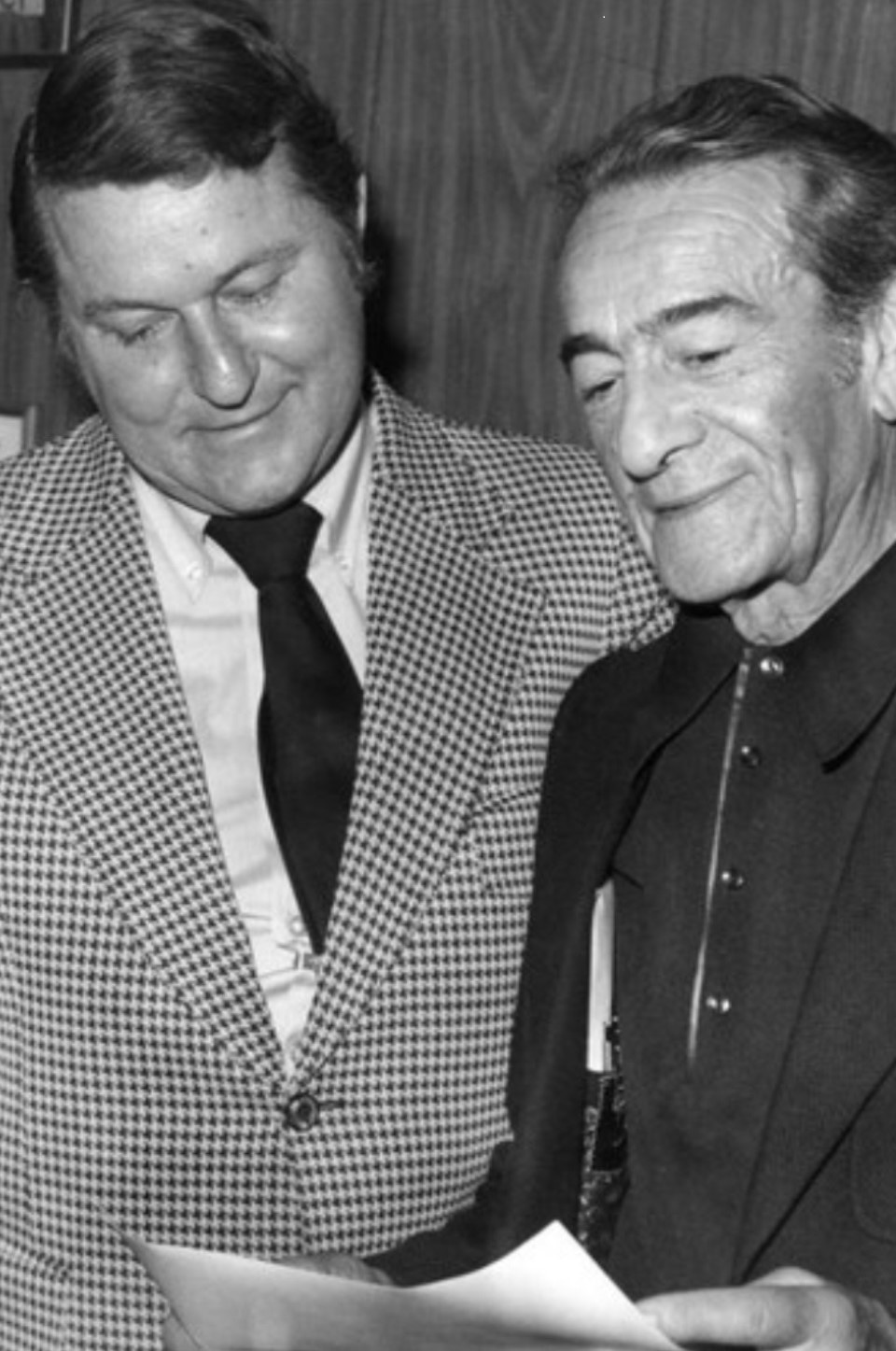
Howie Steindler (right), who was Burgess Meredith’s model for the character Mickey in the movie “Rocky,” had a close friendship with promoter Don Fraser.
A critical error
The day of Steindler’s death began in its ordinary way: the click of a key into a lock, the clomping of feet up steps. Tellez had been worried about Steindler for a while, had heard him arguing on the phone frequently. The previous afternoon, in fact, Steindler had called a state senator to talk about problems he was having with the state athletic commission. He had another loud, anxious phone conversation that morning; with whom, Tellez didn’t know. When Steindler hung up the phone, Tellez asked him, Are you OK?
Yeah, schmuck, he mumbled. I’m all right.
Tellez wouldn’t let Steindler lock up the gym alone. They left together that night. He never saw his mentor again.
At the precinct, Carol thought perhaps her father had gotten into an argument or fight with another motorist, a road-rage-style incident, or maybe he had been arrested on DUI charges. The word murder didn’t cross her mind until the police separated her and Fraser and brought her into an office to question her.
“When I got in the room there,” she said, “you would have thought I killed my father. They treated you like that. ‘What time do you get home? What time did your husband get home? Where were you?’ And yet, they haven’t told me anything about my father. Finally, I said to the guy, ‘You’d better’ — and I used some not-so-nice words — ‘tell me what’s going on or I’m not telling you another thing.’”
So they told her: A highway patrol officer had come across Howie’s Cadillac on the shoulder of Ventura Freeway, five miles from the Steindlers’ house. His body was in the backseat, his feet dangling out an open door. He had sustained a horrible beating. Three of his ribs and a vertebra were broken. He had bruises on his head, chest, and right leg and a puncture wound to his right temple. Fraser identified the body to spare Carol the sight. The official cause of death was “suffocation by apparent smothering”; the police speculated that the killers had pushed Steindler’s face into the car-seat cushion.
His wallet, his keys, his identification papers, and his gold diamond ring were missing. There was a dent on the back of Steindler’s car and a hole slicing through the bumper, indications that someone had rear-ended him.
A witness had told police that two men had attacked Steindler as he stood near his Cadillac a block from his home, punching him before shoving him in the back of the car and driving away. At first, the observer had thought the victim was female, because Steindler was so small and slight. The witness drove past the scene once, then again, then left when one of the assailants started to approach her, but she described the men’s car as being older and gray.
The young woman. Carol now understood why the young woman had been sitting near the HOMICIDE door. She was the witness. And she had made one critical mistake: Instead of noticing the license plate of the old, gray car, she remembered the license plate of Steindler’s: HOWIE-5.
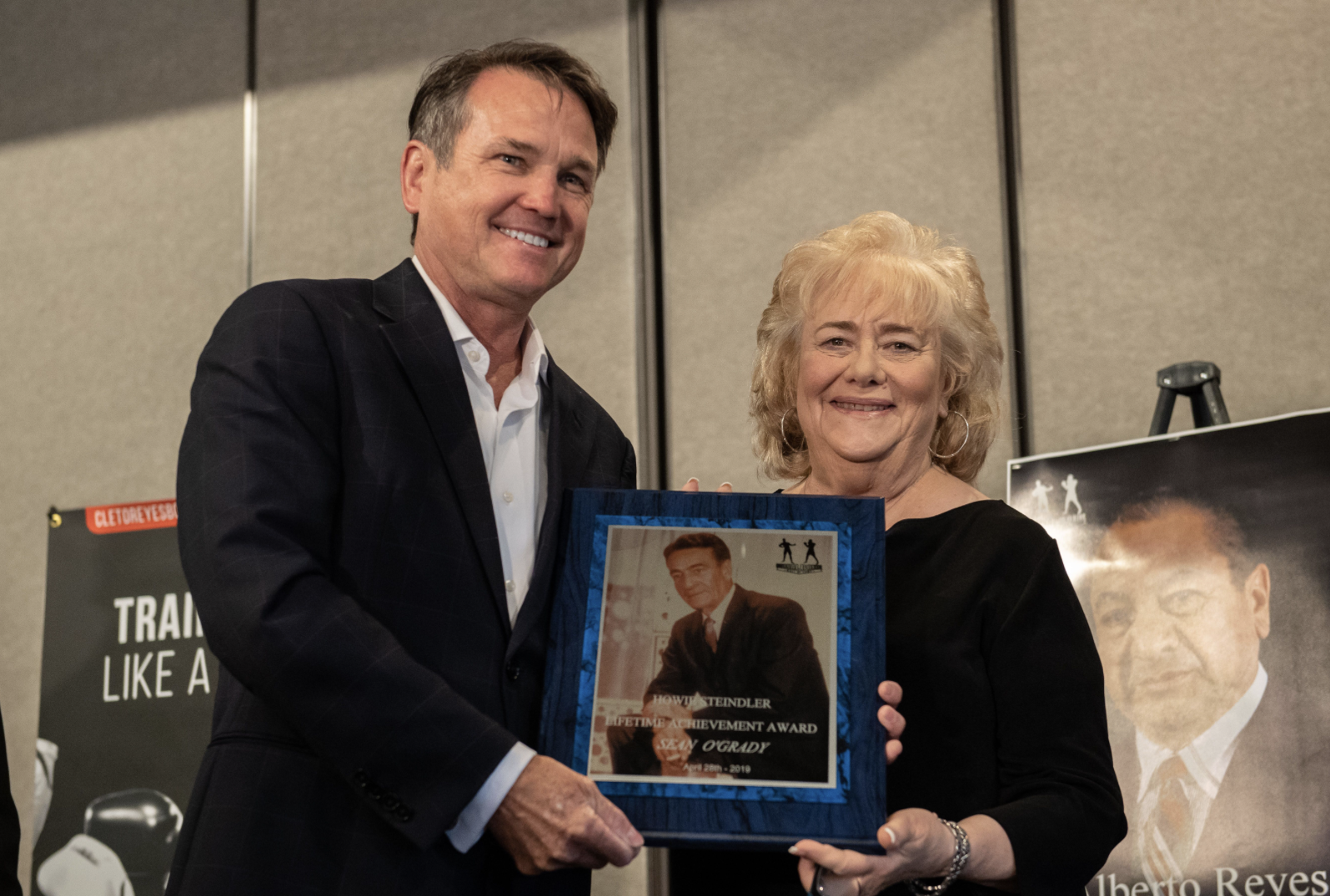
Carol Steindler, with former lightweight champion Sean O’Grady, has maintained a close connection to the National Boxing Hall of Fame, which gives out an award in her father’s honor.
‘You never know’
From that beginning, a lack of evidence — and competing theories of the crime — made the case difficult to solve. Marv Engquist, the detective who led the investigation, believed that Steindler had been a random victim, that the killers had collided with his Cadillac to draw him into a confrontation and rob him. The MO fit other unsolved murders in the same vicinity and time frame, and Steindler’s feistiness, his refusal to back down from anyone, could have escalated a robbery into something more deadly.
Carol has long been skeptical of that theory. “The police, the homicide detectives, all thought it was a bump-and-run,” she said, “and I kept saying, ‘No, it’s something else. My father and mother were acting really strange for two weeks.’ I don’t think it’s just a bump-and-run. I think they knew something.”
Gambina and Tellez still believe that the mob was responsible for Steindler’s murder. They raised and discussed that possibility in hushed tones and with measured words. “The fight game,” Gambina said. “You never know what’s going to happen with people.”
Carol took over the Main Street Gym and ran it until 1984, when it was razed to build a parking lot. She and her sister, Bobbi Beatty, would from time to time speak to a newspaper or TV reporter, usually on the anniversary of their father’s death, to reawaken interest in and awareness of the case. But the odds that it will be solved are less than slim. Detectives compiled suspects but never made an arrest. Carol, who lives in Thousand Oaks, Calif., is 86. Bobbi died of cancer in 2004. Those who were involved or might know what happened — even the killers themselves — have either died or aged into inertia.
“Unfortunately,” William Beatty, Bobbi’s widower, said in a phone interview, “it’s like you’re trying to find out if there are any witnesses to the Civil War.”
After 48 years, with so many questions still lingering unanswered and unanswerable, one detail remains especially haunting. Nine months after her husband’s car and body were discovered, Ann Steindler received a strange package in the mail: Howie’s wallet, Howie’s keys, Howie’s credit cards. No cash, no return address, no fingerprints.
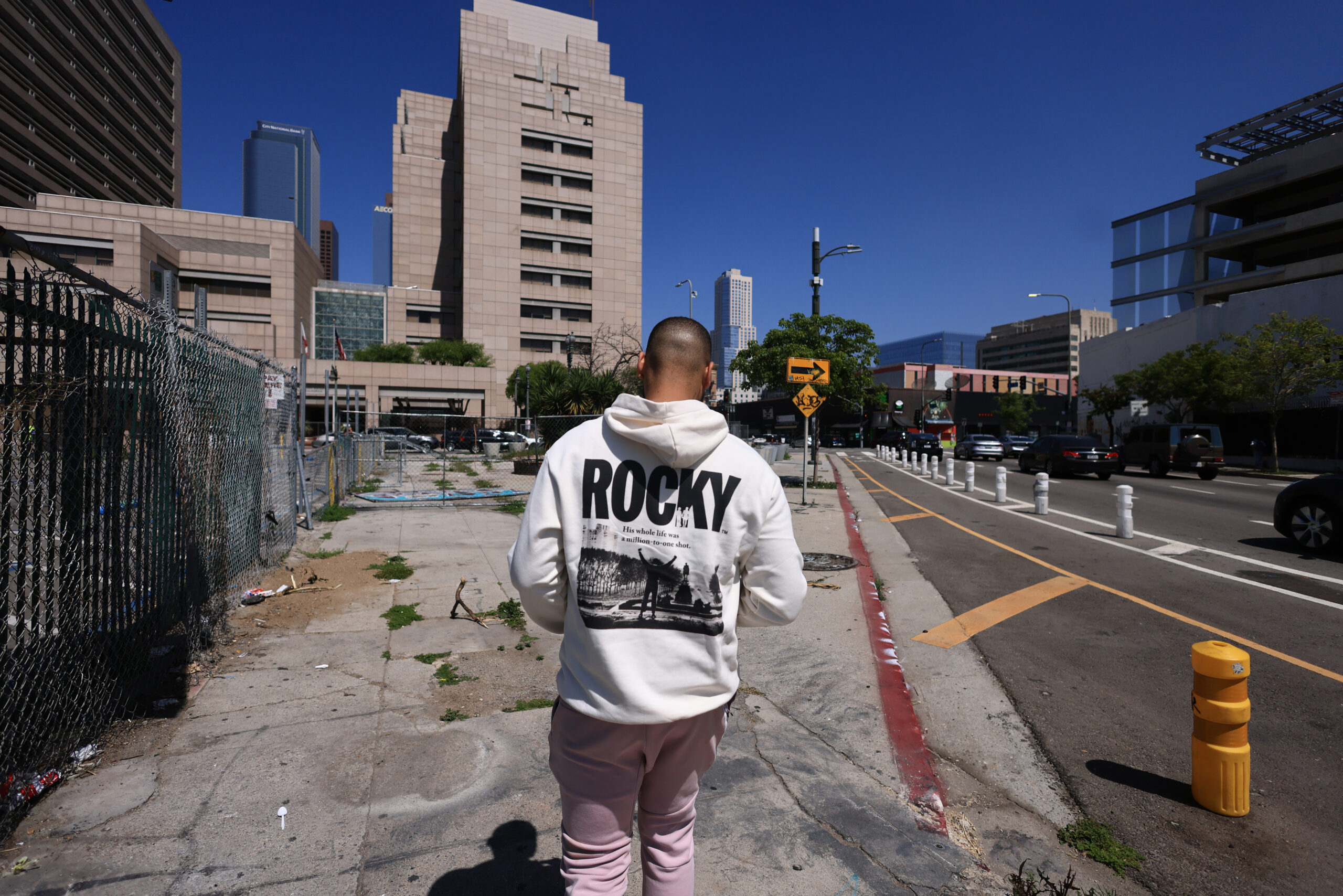
True Rice, a Los Angeles transplant from Baltimore, walks by a site where “Rocky” was filmed, coincidentally wearing an appropriate hoodie.
What has changed and what hasn’t
Three hundred parking spots, give or take, cover the piece of land where the Main Street Gym once stood. In some ways, little has changed about the neighborhood. Weeds and tufts of grass burst up from the concrete. Walls and telephone poles are psychedelic with graffiti.
On a recent morning, a man in a red plaid shirt stretched out on a ledge near a palm bush and slept. A few feet away, another man, dressed in ratty black, crouched down, put his hands on the sides of his head, and began screaming. A pair of white sneakers dangled from a wire stretched above, giving the lot a Philadelphian flavor. Around the corner, a dog had dropped something in the middle of the sidewalk that its owner, if the animal even had an owner, hadn’t bothered to scoop up.
There was no historical marker commemorating the gym. No artwork invoking Rocky, Stallone, or Meredith. No acknowledgment of one of the most inspirational films ever made … or the dark story connected to it.
Then, as if by magic, there was something. There was someone. True Rice strolled through the lot, heading back to his apartment after grocery shopping. Twenty-nine and a native of West Baltimore, he moved to Los Angeles in 2020 to try to make it in modeling and music.
“Came out here with 60 dollars in my pocket,” he said, “looking for a change.”
The striking aspect about him wasn’t what he did but what he wore: a white, hooded sweatshirt that he had bought the day before. Plastered across the back were the words “ROCKY: His whole life was a million-to-one shot” and a depiction of Stallone atop the Art Museum steps.
Did Rice have any idea about the history of where was walking and what that history represented? The lot … the gym … the men … the movie … the murder … the stories and the scenes, exhilarating and evil.
He said what anyone would have expected him to say. He said what even those few who remember Howie Steindler and his death would have to admit. He stood in the middle of a grim city block with no memory, and he said he didn’t know.



 Loading…