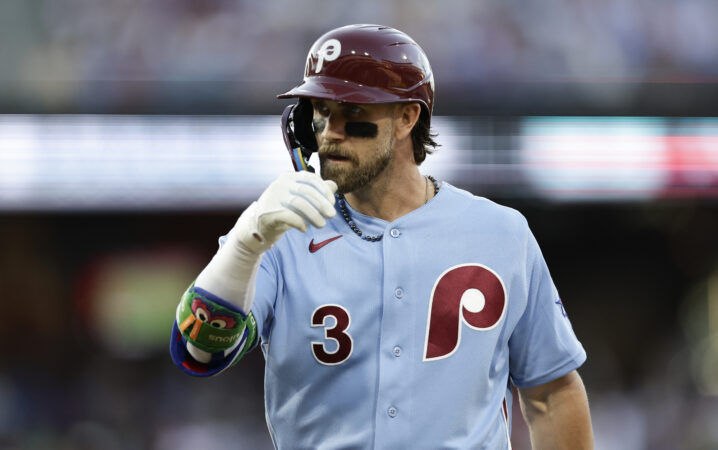
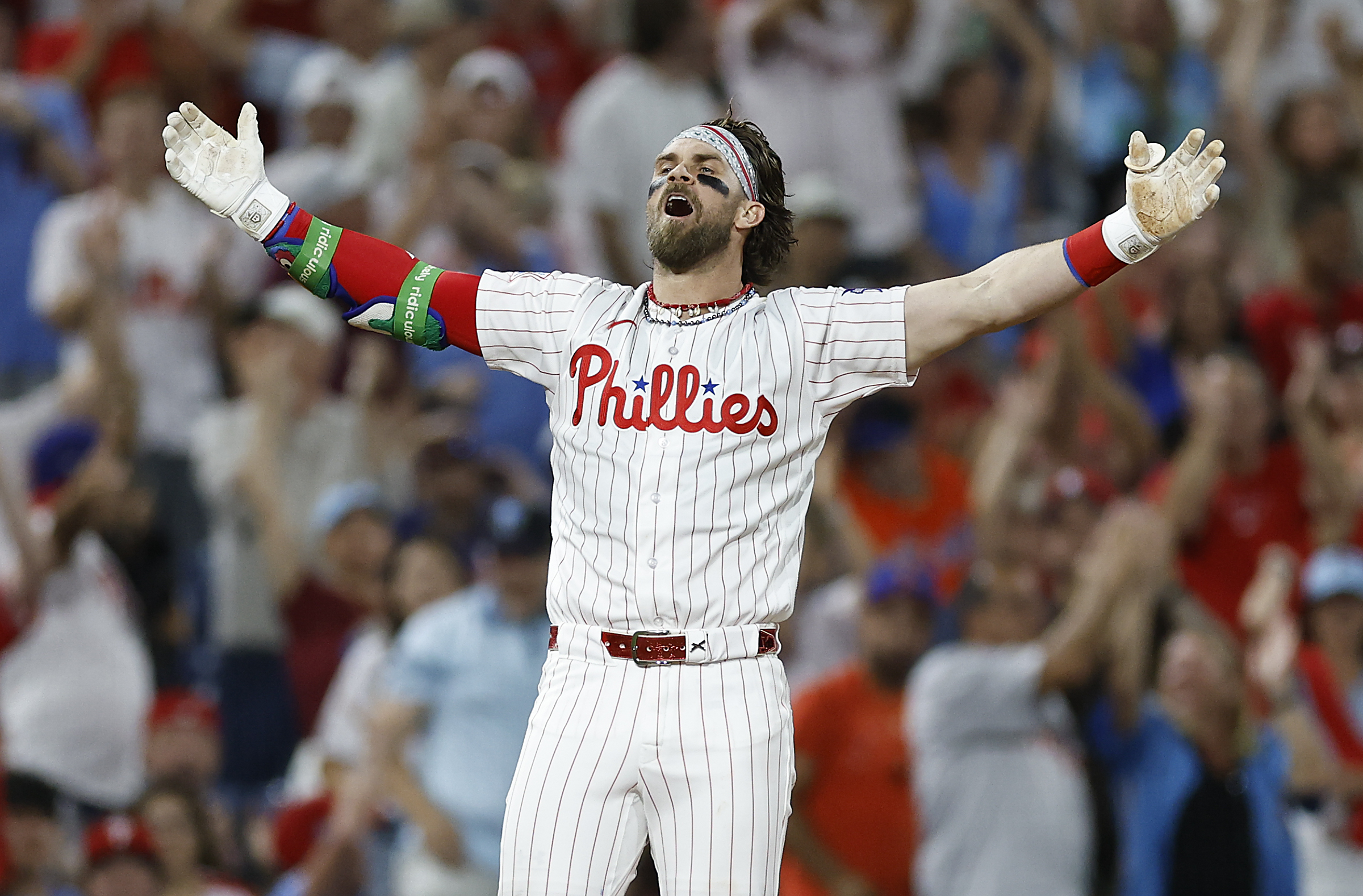
Bryce Harper on Thursday declined to discuss an Inquirer report about a personalized video of the Philadelphia Phillies star that FanDuel Sportsbook sent in November 2024 to a VIP bettor who had a gambling addiction.
The Inquirer obtained a copy of the 21-second video, which is marked with a blue FanDuel logo and shows Harper offering a greeting to the bettor, Terry Thompson, and Thompson’s son.
Harper is not wearing FanDuel merchandise but mentions that he was reaching out at the request of Thompson’s VIP manager — “your host Bryttanni at FanDuel” — who wanted to ensure that he had an “extra special Thanksgiving.”
There is no evidence that Harper had a partnership with FanDuel, nor that he had any indication that Thompson was suffering from an addiction.
FanDuel on Thursday released the following statement:
“FanDuel is committed to fostering a culture of responsible gaming and protecting our customers. Unlike illegal offshore sportsbooks, FanDuel employees are trained to recognize and flag signs of problem gambling and offer resources and tools, and we continue to review and strengthen our policies to ensure we have the industry’s strongest consumer protection initiatives.”
The Inquirer previously shared the video of Harper with his agent, Scott Boras, as well as the Phillies and Major League Baseball.
Each declined to comment.
The Phillies were in Cincinnati on Thursday, preparing to play the Reds. It was there that Harper declined through the team to address the video before a reporter could directly ask him about it. Later in the day, Harper announced on Instagram that he had decided to participate in the All-Star Home Run Derby, which will be held Monday at Citizens Bank Park.
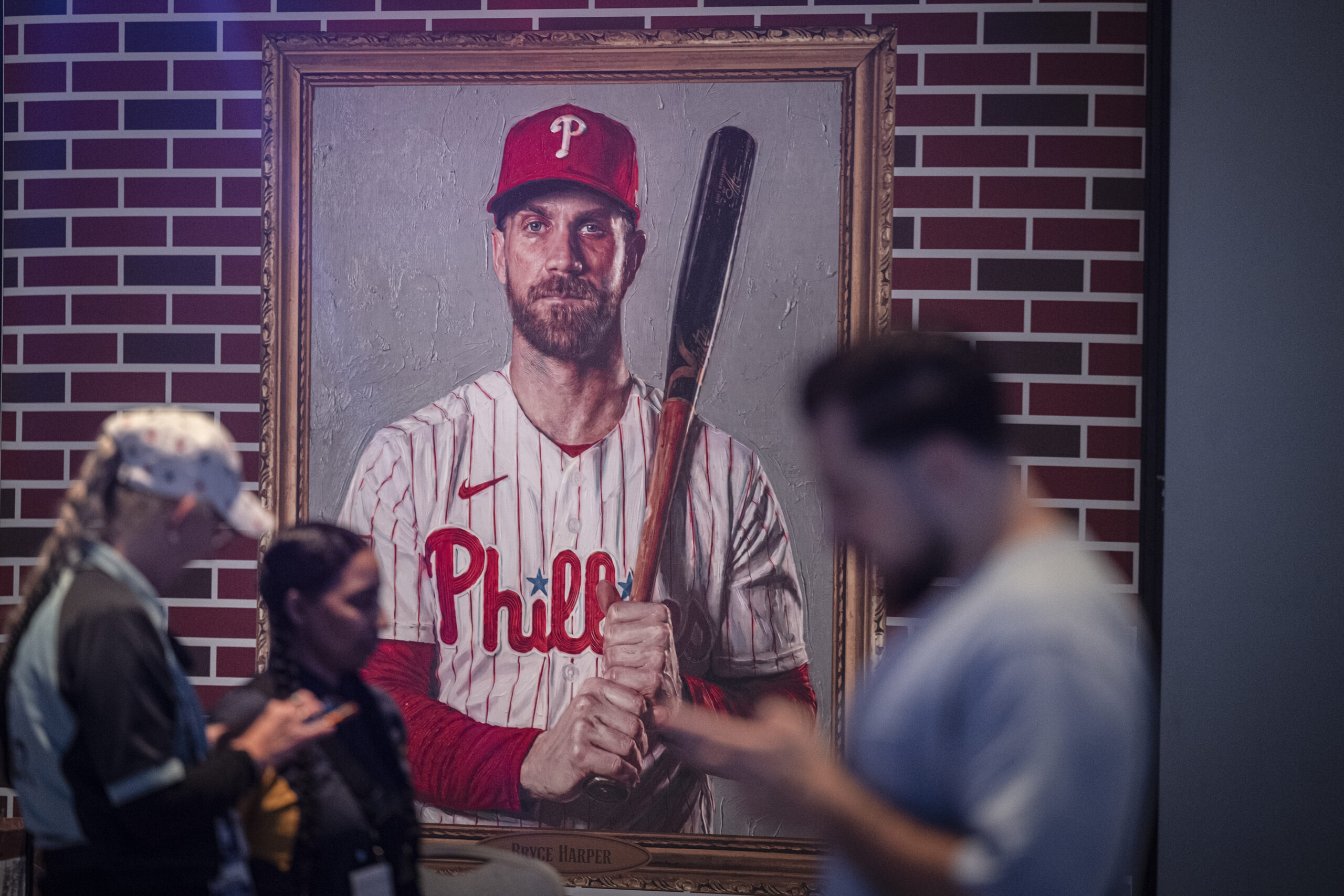
A portrait of Bryce Harper is on display at the 2026 MLB All-Star Village inside the Pennsylvania Convention Center in Philadelphia. The All-Star Game will be held next week at Citizens Bank Park.
Independent experts said the FanDuel video does not appear to be a violation of MLB’s current collective bargaining agreement, which allows athletes to appear in advertisements or make personal appearances for casinos, racetracks, or sportsbook companies, so long as the ballplayers do not encourage betting on baseball.
The current policy, which is scheduled to expire in December, does not specifically addresses interactions with VIP programs or bettors.
Still, the episode raises ethical questions about the league’s relationship with gambling companies, whose business practices are facing increasing scrutiny from state and federal lawmakers, said Jodi Balsam, a former NFL attorney who now works as the director of the Sports Law Clinic at Brooklyn Law School.
“Is this the kind of activity that either the union or the league want their players to be associated with,” Balsam said, “if it leads to addictive and self-destructive behaviors by a fan?”
Beginning in 2020, Thompson wagered $18.5 million with FanDuel and lost $1.5 million, according to a lawsuit that the Public Health Advocacy Institute filed in March in Common Pleas Court in Philadelphia on behalf of Thompson and against FanDuel and DraftKings, to which Thompson also lost money.
Harper is not named as a defendant in the lawsuit.
Thompson’s attorneys allege that he became addicted to placing microbets — in-game wagers on something as minor as the speed of a pitch during a baseball game — until he gambled away his final $10,000 on a DraftKings parlay bet in February.
Broke and afraid of disclosing the scope of his losses to his family, Thompson contacted his therapist and indicated that he planned to take his life.
He typically announces new endorsement deals, which in the past have included companies such as Under Armour, Gatorade, and Dairy Queen.
The circumstances of how Harper came to appear in the video for Thompson, and whether he received any compensation, remain unclear.
Staff writer Lochlahn March contributed to this article.
The Inquirer will continue to report on issues related to the growth of gambling addiction — among teens and adults — across Pennsylvania. If you, or someone you know, would like to speak with a reporter, please contact David Gambacorta or William Bender at dgambacorta@inquirer.com or wbender@inquirer.com
It may be a while before the drought advisories disappear, but since Monday Philadelphia has had more rain than in any entire month since March 2025. And the city of Camden has been clocked well over a half-foot of rain.
In both instances, if it seemed like most of that came in a hurry, it did.
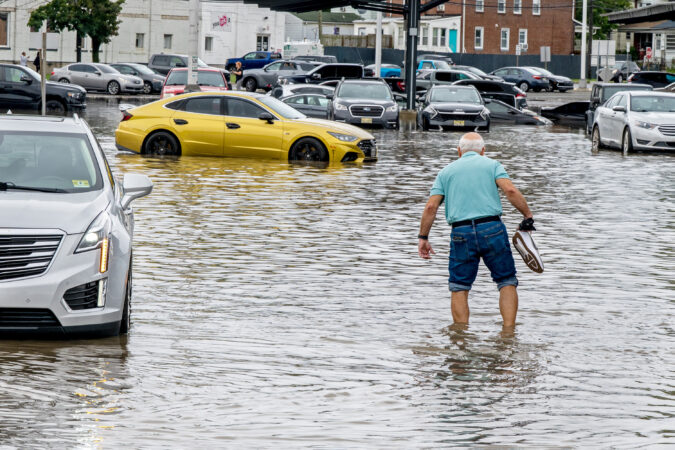
On Thursday, for the second time in a week, downpours set off a flood of warnings in the city, the neighboring counties and Delaware.
And more showers are possible Friday and Saturday, but the atmosphere isn’t expected to upstage its performance since it turned off last weekend’s 100-degree heat.
Thursday’s downpours wrung out 2 and 3 inches of rain in several towns across the region.
Flooding was reported along numerous roads, with vehicles stranded, including in the vicinity of the Ben Franklin Bridge, the National Weather Service said. The rains could continue until 7 or 8 p.m. Thursday, said Alex Staarmann, meteorologist inthe Mount Holly office.
Multiple water rescues have been reported in Wilmington.
Philadelphia broke a 74-year-old record for a July 9 with 2.61 inches of rain measured officially, according to the weather service.
At one point flood warnings had been posted for the city and in all seven neighboring counties.
But the rain lately has been random. And in the grand casino of the atmosphere, that was the case Thursday, and not every place got the soakings.
The drought conditions are likely to persist despite the storms
In the weekly inter-agency U.S. Drought Monitor update posted Thursday, some degree of drought conditions persisted in all of New Jersey, Philly, and the neighboring Pennsylvania counties.
The drought monitor has most of the region was in “moderate drought,” with some improvement in Burlington, Camden, and Gloucester Counties.
But all of Chester County and most Montgomery County were in “severe drought.” Southeastern New Jersey, including the Shore towns, were in “extreme drought.”
Soil moisture levels will remain significantly below normal during the next week, according to the National Oceanic and Atmospheric Administration’s Climate Prediction Center.
(function(){function e(){window.addEventListener(`message`,function(e){if(e.data[`datawrapper-height`]!==void 0){var t=document.querySelectorAll(`iframe`);for(var n in e.data[`datawrapper-height`])for(var r=0,i;i=t[r];r++)if(i.contentWindow===e.source){var a=e.data[`datawrapper-height`][n]+`px`;i.style.height=a}}})}e()})();
And it appears the atmospheric faucets are going to shut after Saturday.
Said Joseph DeSilva, meteorologist at the weather service’s Mounty Holly office, “Next week looks pretty dry.”
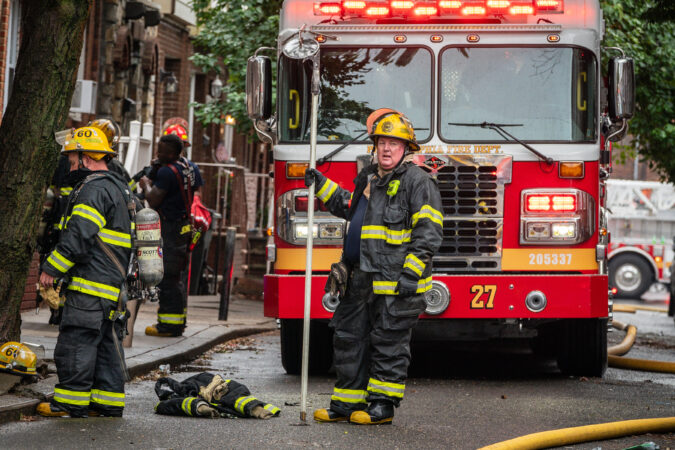
The union that represents more than 2,000 Philadelphia firefighters and paramedics says its members will, for the first time in two decades, receive a wage increase lower than police officers did — a contract provision they see as the end of years of pay parity among the city’s first responders.
Mayor Cherelle L. Parker’s administration announced Wednesday that a panel of arbitrators had issued a two-year contract award for Local 22 of the International Association of Fire Fighters after its members had gone more than a year without a contract.
Local 22 was the last of the city’s four major municipal unions to reach a multiyear agreement with the Parker administration. The other unions agreed to their contracts last year.
Parker said in a statement that the contract award recognizes the contributions of the city’s firefighters and emergency medical personnel “while supporting the city’s efforts to remain fiscally responsible.”
The contract award was issued by a three-member arbitration panel, a process governed by state law because emergency workers do not have the right to strike. The deal includes 3% raises annually for the next two years, plus a 1% wage increase in recognition of mandatory physical evaluations that members must receive biannually.
Those raises total a 7% pay increase over two years for union firefighters, paramedics, and emergency medical personnel. In the city’s contract with police inked about a year ago, members of the Fraternal Order of Police Lodge 5 received a 9% wage increase in total over the same time period, plus a $3,000 signing bonus.
Local 22 president Mike Bresnan said Parker’s administration did not adequately advocate for pay parity between police and firefighters. He said he is lobbying members of City Council to consider legislation that would require Council approval for the mayor to appeal firefighters’ contracts in the future.
“Mayor Parker likes to run around putting her one index finger up as ‘we’re all one,’” Bresnan said. “Well, she just put her middle finger up to every firefighter and paramedic in the city.”
He added: “If there’s somebody out there that’s thinking about running for mayor, we’d like to have a conversation with them.”
The firefighters union has historically played a relatively minimal role in city elections compared with more politically active labor groups like those that represent construction workers. The union did not back a candidate in the 2023 mayor’s race, which Parker won.
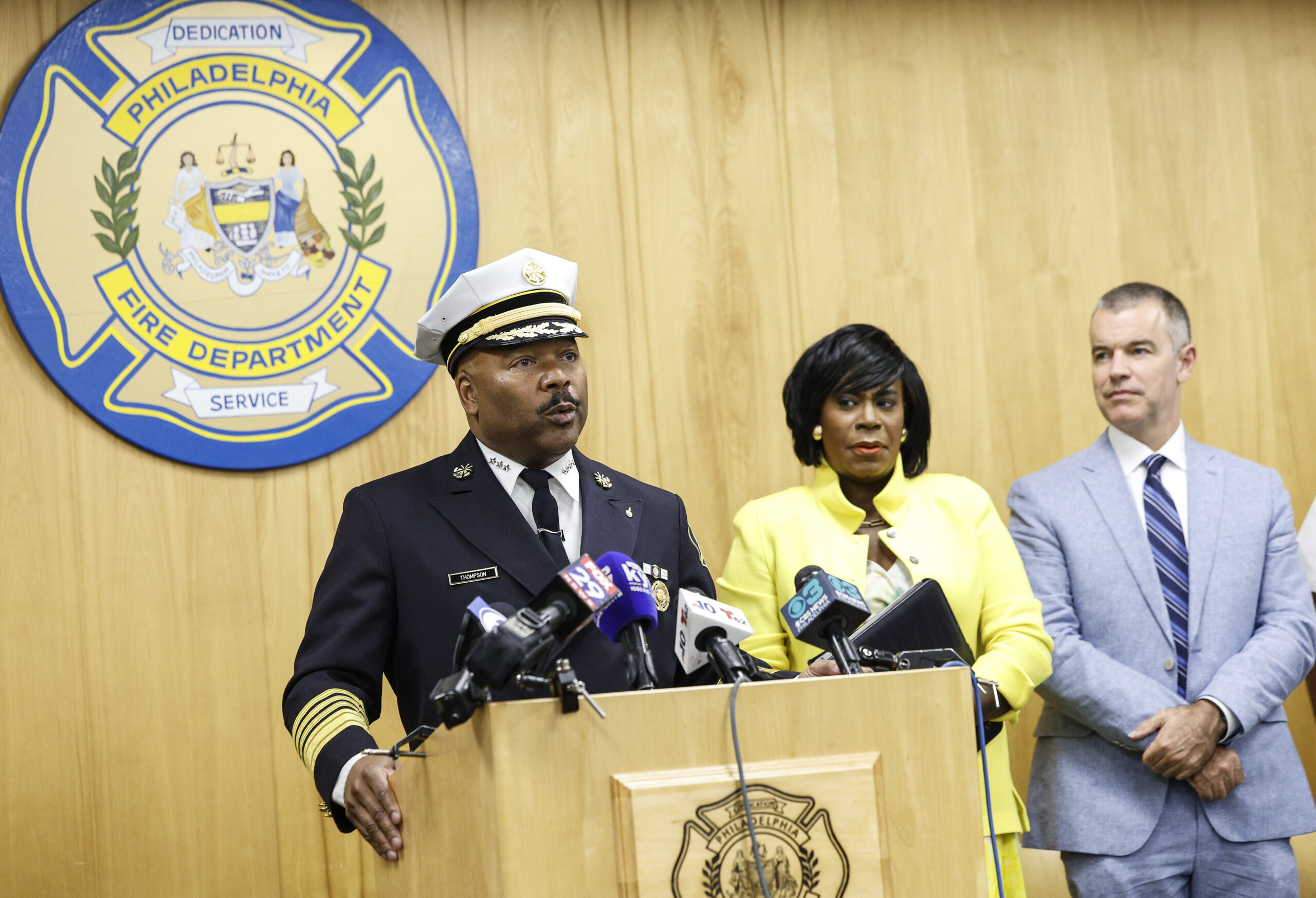
In this 2024 file photo, Fire Commissioner Jeffrey W. Thompson stands, at left, with Mayor Cherelle L. Parker with Managing Director Adam Thiel at the fire administration building in Spring Garden.
The FOP contract, similar to the firefighters’, included 3% annual raises. The difference was that police received an additional 1.5% annual wage increase because their union agreed to a process called “civilianization,” meaning some roles held by uniformed officers would be transitioned to ones held by civilians.
The raise, according to the contract, was in recognition of the “operational flexibility” that the civilianization process would achieve. It did not identify the number of positions that would be civilianized or if the effort would save the city money.
The arbitration panel that drafted the firefighters’ contract is made up of one appointee each from the city and the union, plus a neutral arbitrator. The panel wrote that while there has, in general, been pay parity in raises for police and firefighters, that “has never meant identical awards.”
In this case, the panel reasoned, the civilianization-related raise was unique to the police department and the city did not need to match it for the firefighters.
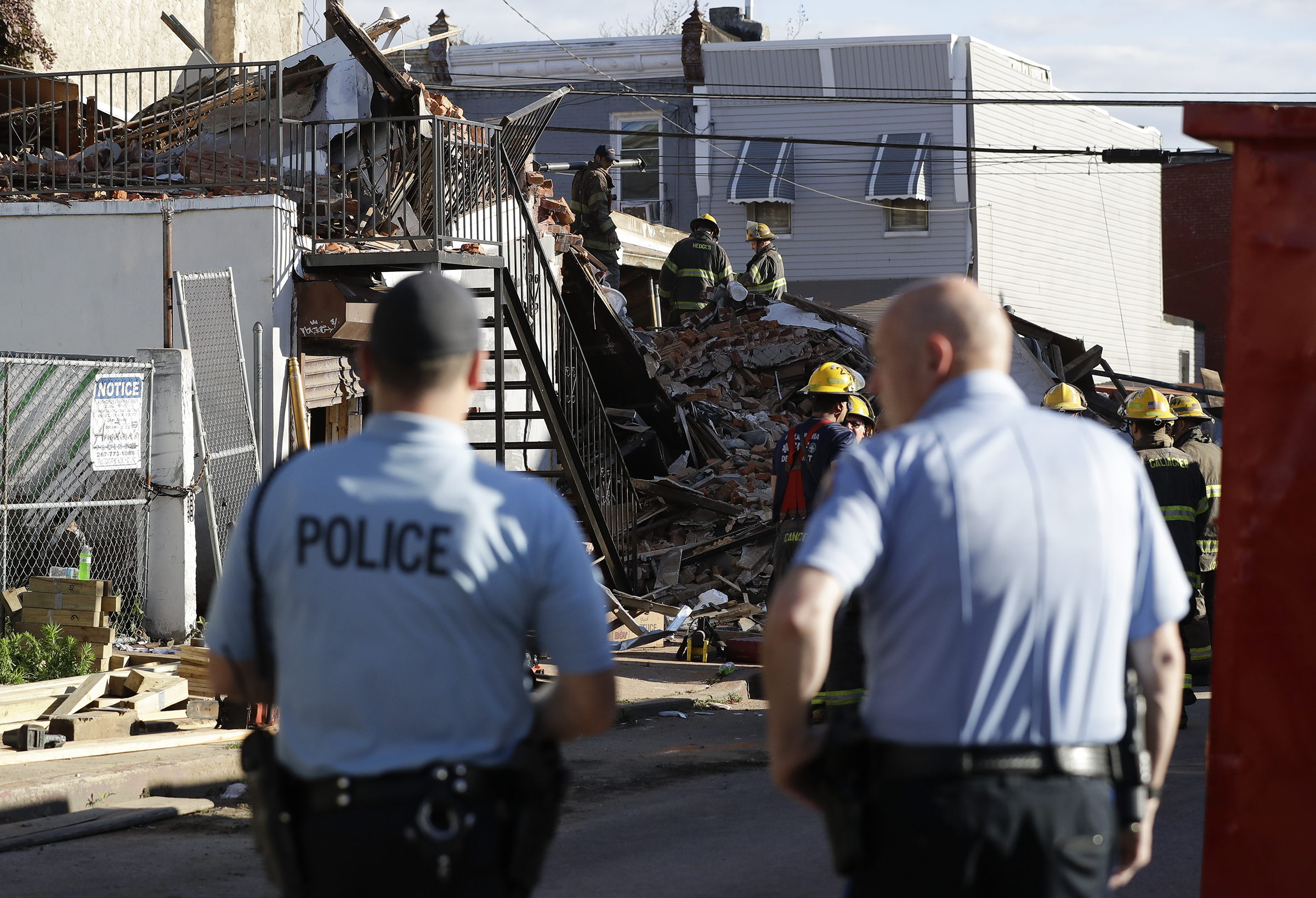
In this 2022 file photo, Philadelphia firefighters examine the remains of a collapsed building along the 300 block of West Indiana Street in the Fairhill section of Philadelphia as Philadelphia police officers look on.
Marc Gelman, the union’s appointed arbitrator, issued a scathing dissent, writing that the contract award was ultimately a “rubber-stamp to the city’s desired economic wishlist” and provided firefighters with “a dramatically lower wage increase than the police.”
He argued that the city could afford a higher wage increase for firefighters because it is operating from a place of fiscal strength, citing its substantial surplus in this year’s budget.
However, the city will have to tap into reserves or make adjustments to its existing five-year budget plan to cover the firefighters’ contract. That is because the administration already exhausted its $550 million labor reserve to cover contracts with the city’s other major municipal unions.
The Parker administration did not estimate how much money the firefighters’ contract award will cost.
Gelman wrote that the labor reserve was exhausted through the city’s “mismanagement and inability to plan.”
“The city now cries poor,” he wrote, “and expects the members of Local 22 to suffer for its ineptitude.”
Bresnan said pay parity is critical because the police and firefighters unions are unique in that “members can leave for work in the morning and not come home at night to their family.”
“We’re out there shoulder-to-shoulder on these emergencies in the city,” he said. “Every mayor prior recognized this and kept the peace. Now they’ve created a fracture between the first responders in the city.”
An Oregon man on Thursday was ordered to spend 30 years in prison for fatally stabbing a beloved South Jersey veterinarian at the vet’s Cherry Hill home.
During Custodio-Aquino’s sentencing before Camden County Superior Court Judge Judith Charny, Anthony’s family members spoke tearfully of late veterinarian, who they described as kind, wickedly funny, and a devoted father to his sons.
Above all, they grappled for answers as to why Custodio-Aquino murdered Anthony that morning on his front lawn.
“You took all of the future moments that should have belong to him,” said Patricia Anthony Gershefski, one of Anthony’s sisters.
Anthony Gershefski said her brother was warm and sensitive, even moving his veterinarian practice just to be closer to his children.
The brutal nature of the crime confounds the family to this day.
In her career as a professional psychologist, Anthony Gershefski said, she has found “no diagnostic category for the deliberate destruction of another person’s life in this savage and grotesque manner.”
Kyle Bartsch, Anthony’s partner, said in a statement read by prosecutors that Anthony had filled their home on Sharrowvale Road with love and laughter.
His death, Bartsch said, leaves “a permanent void in the lives of those who knew him.”
While Custodio-Aquino’s attorneys had previously suggested that prosecutors did not have enough evidence to convict their client of murder, they were mum throughout the proceeding.
In addition to the eyeglasses investigators linked to the Peru native, license plate readers captured Custodio-Aquino’s car entering and exiting Anthony’s neighborhood that morning, and forensic experts later recovered a sample of the veterinarian’s blood from the vehicle.
Prosecutors believe Custodio-Aquino traversed the country in a fit of jealousy that fall before killing Anthony.
He had previously dated Anthony’s partner, Bartsch, and once lived with the man in Haddon Township before the couple separated in 2021 after a domestic dispute, according to prosecutors.
Custodio-Aquino, given the opportunity to address the court, spoke so softly that Charny asked that he repeat himself.
Raising his voice, he said: “I do agree that the world is less than without Michael Anthony.”
He was sentenced to 30 years in a state correctional facility without parole. Charny offered few words on the ruling beyond wishing Custodio-Aquino good luck.
It was Henry Anthony, Anthony’s teenage son, who saved some of the most biting remarks for his father’s killer.
“Your life is officially over,” Anthony said, turning to look at Custodio-Aquino. “I honestly wonder what your reason for living will be for the next 30 years.”
Students in the Pennsylvania State System of Higher Education will face a 4.3% tuition hike — the largest percentage increase in a decade — if the system does not get a boost in state funding.
PASSHE’s board of governors voted unanimously Thursday on the plan, which would enact the tuition increase if the system does not receive a 5%, or $31 million, increase in its state appropriation, which currently stands at $625 million. Gov. Shapiro has proposed flat funding for the system, and budget negotiations are continuing.
Tuition would rise to $8,338 annually, up $344 from $7,994.
“We’re all disappointed to … have to make this motion,” board chair Cynthia Shapira said. “We hope we do get the increase.”
The 10 universities in the system are Cheyney, West Chester, Commonwealth, East Stroudsburg, Indiana, Kutztown, Lock Haven, Millersville, Penn West, and Shippensburg. Collectively, they enrolled 83,005 students last academic year, when the system experienced its first enrollment increase in 15 years. About 90% of students are Pennsylvania residents.
The vote to increase tuition came one day after Temple University approved a budget thatincreased tuition an average of 3.4% for next year.
Rutgers University also on Thursday voted to increase tuition 3% for in-state and out-of-state students, which the school touted as its lowest increase in four years. Tuition for a typical in-state, full-time arts and sciences undergraduate will increase on average $448 for the year, rising from $14,933 to $15,381, the school said. Meals and housing on average will rise 4%, from $15,332 to $15,945.
Earlier this year, the University of Pennsylvaniaincreased its total costs by 3.8% for 2026-27. Pennsylvania State University, which approves tuition increases a year in advance, hiked tuition 2% for in-state students at University Park for 2026-27 and froze it for those attending Commonwealth campuses.
The resolution approved by the PASSHE board calls for the increase to be rolled back “if sufficient funding in state appropriation is received.”
System chancellor Christopher Fiorentino said the tuition increase would cover the $31 million gap if the system does not get the increase. The board of governors took the same action last year and did not roll back a 3.6% tuition hike because the state held its funding flat.
“We’re still really the most affordable four-year option that’s out there,” Fiorentino said in an interview before the meeting, comparing PASSHE schools to state-related universities like Temple and Penn State where tuition is more than twice that amount.
Until 2025, the system had kept tuition at the same rate for seven years; if it had enacted inflationary increases, tuition would be $1,800 higher now, Fiorentino said. Preceding the freeze, tuition hikes were 2.5% in 2016-17, 3.5% in 2017-18, and 3% in 2018-19.
Fiorentino said he continues to make the system’s case to legislators for more funding.
“Our graduates earn 65% more over their careers than people without college degrees, which is about a million dollars in lifetime earnings,” he said. “Ninety percent of our students are from Pennsylvania, and 80% of them take their first job in Pennsylvania after they graduate. Investing in the PASSHE system … is truly an investment in the workforce of the Commonwealth of Pennsylvania.”
System to launch new ‘last dollar’ scholarships
The system also announced that beginning in fall 2027, it would provide “last dollar” scholarships to all Pennsylvania students who receive federal Pell and state Pennsylvania Higher Education Assistance Agency grants. For many students from the lowest-income families, the grants cover full tuition, but some families in the middle range who receive smaller amounts of aid are still on the hook for part of the cost, the chancellor said.
“They’re the ones that tend to get caught in a bind, and they’re the ones that we’ve been worried about,” he said. “We’re going to cover the balance of their tuition” and make sure they are not affected by future tuition increases.
Fiorentino said he hopes that donors will want to contribute to the effort so the level of aid can be expanded.
The new scholarship program, called the PASSHE Pledge, will not cover room and board or fees.
He did not have an estimate of how many students would qualify, but said system officials have been worried about losing them. And that would add to the enrollment decline at a time when the system, like other colleges, already is challenged by a shrinking pool of available high school students.
“We’re hoping this is going to increase our enrollment numbers,” Fiorentino said.
It is too early to predict fall enrollment, he said, but some of the system’s 10 universities are doing better with deposits than last year, some the same, and some a little worse.
“We’re cautiously optimistic that we’re going to be stable,” he said.
The system is partnering with community colleges to streamline the transfer process and concentrating on bringing students with some college credits and no degree back into the system, he said.
“We will continue to work hard to maintain and grow our enrollments,” he said.
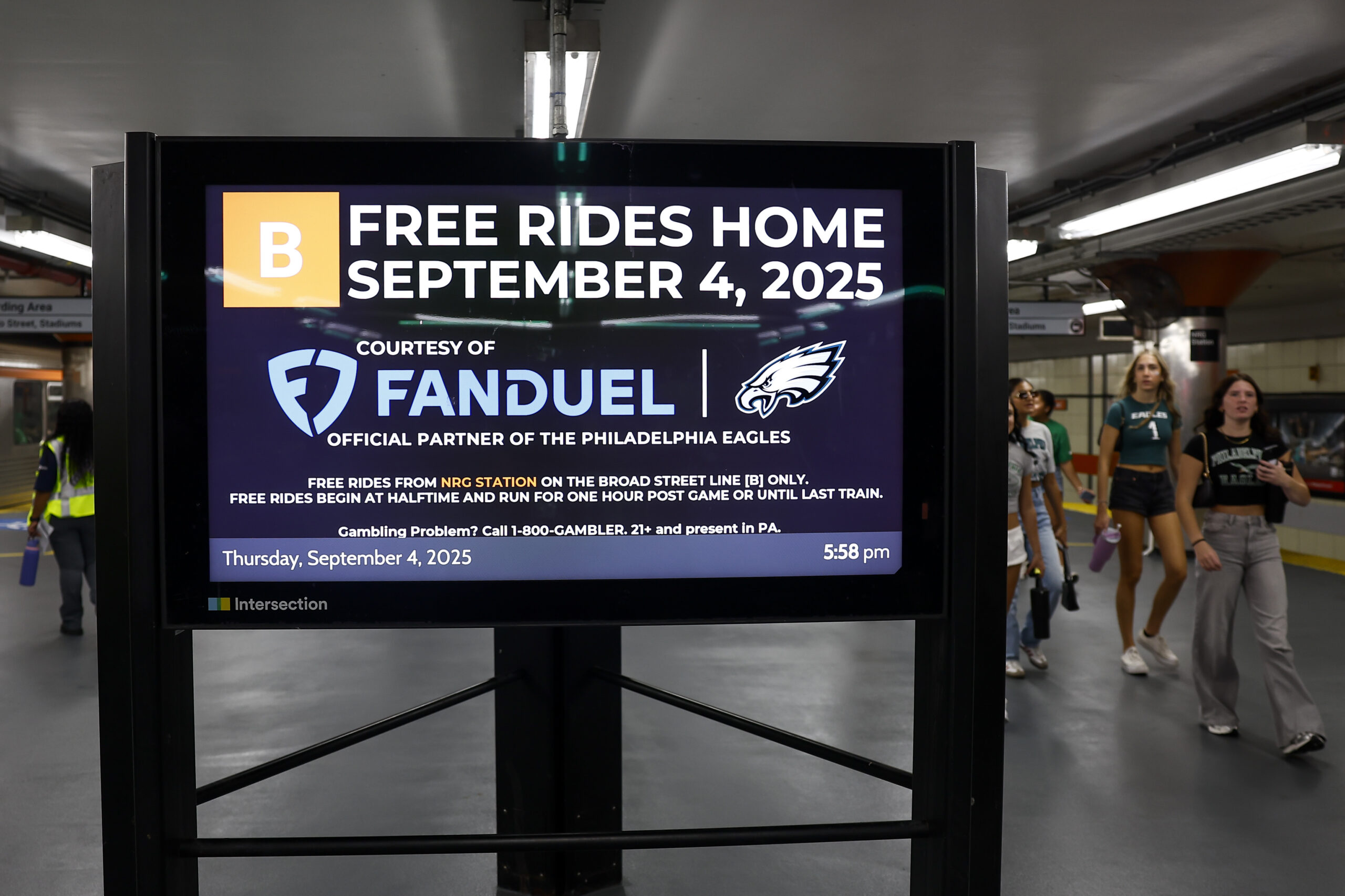
As the 2020 NFL season kicked off, Terry Thompson picked up his phone and placed a wager with FanDuel Sportsbook on his favorite team, the Philadelphia Eagles.
It was his first time gambling through an app, and he soon started placing microbets, which are in-game wagers on something as small as whether the next play would be a pass or run.
He grew addicted to the effortless, rapid-fire action. Every game, every quarter, every play — click, click, click. Thompson would ultimately wager $18.5 million with FanDuel, earning him VIP status with the company. That meant exclusive perks, from champagne to Super Bowl tickets, which made him feel important and enticed him to continue gambling.
By late November 2024, Thompson had incurred steep losses and resorted to desperate measures to fund his addiction. Then, one afternoon, he flicked open his phone and received a FanDuel reward that momentarily distracted him from his debts: a personalized video message from Philadelphia Phillies superstar Bryce Harper.
The Inquirer obtained a copy of the 21-second video. In it, Harper addresses Thompson by name and acknowledges Thompson’s young son. Harper ends by thanking Thompson for his support.
Harper is not wearing any FanDuel merchandise, but the video is marked with the company’s logo, and Harper mentions that he was reaching out at the request of Thompson’s VIP manager, “your host Bryttanni at FanDuel,” who wanted to ensure that Thompson had an “extra special Thanksgiving.”
Professional sports leaders had long recoiled at having any association with gambling. But the U.S. Supreme Court ruled in 2018 that states could legalize sports betting, and each league now has lucrative partnerships with sportsbook companies, whose advertisements can be easily found in stadiums and arenas, and during game broadcasts.
Still, league officials preach about the importance of protecting the integrity of their games and have rules that are designed to maintain distance between professional athletes and bettors. Although Major League Baseball’s policy does not explicitly reference interactions with VIP gamblers, Harper’s personal message to a bettor — apparently arranged by an employee of a major sportsbook — is a unique test of how cozy the league will allow players to get with gambling companies.
There is no evidence that Harper has an official partnership with FanDuel, or was aware that Thompson had an addiction.
The Inquirer could find no other examples of an active athlete recording a personal message to a sportsbook VIP customer who, by definition, had to be regularly betting large sums of money.
The Inquirer shared the video with Scott Boras, Harper’s longtime agent, and asked if he or Harper would discuss how FanDuel had obtained the video.
Boras declined to comment.
The Inquirer also shared the video with the Phillies and MLB. Both declined to comment, and the players union did not respond to a request for comment.
Multiple experts familiar with the fraught intersection of professional sports and the gambling industry said that while Harper does not explicitly encourage gambling in the video, it still raises concerns.
Danny Funt, who researched sportsbook VIP programs for his 2026 book, Everybody Loses: The Tumultuous Rise of American Sports Gambling, said in an email that VIP bettors sometimes get to hang out with former athletes. He cited former San Diego Charger LaDainian Tomlinson, who worked in retirement for DraftKings, as one example.
But the Harper video is entirely different, he said.
Harper, a nine-time All-Star and two-time MVP, has been one of baseball’s most marketable stars throughout his 15-year career.
“I’ve never heard of an active player, let alone a former MVP, doing something like this,” Funt said.
Leigh Steinberg — an agent who represents Kansas City Chiefs quarterback Patrick Mahomes, and whose past clients included MLB All-Stars Manny Ramirez and Will Clark — called the Harper video “bad for sports.”
Steinberg said if one of his clients approached him about doing promotional work of any kind for a sportsbook company, he would advise them to walk away.
“It’s not good for your brand,” he said. “It’s exploitative and it’s not the sort of activity you want to be associated with.”
MLB’s collective bargaining agreement, which is set to expire in December, allows athletes to appear in advertisements or make personal appearances for casinos, racetracks, or sportsbook companies, so long as the ballplayers do not encourage betting on baseball.
NFL players are prohibited from marketing or promoting “any form of gambling” under the league’s current collective bargaining agreement.
The NBA, meanwhile, allows its players to own a passive ownership stake — less than 1% — in sportsbook and prediction market companies, and engage in promotional work for gambling companies, provided they do not encourage betting on basketball. As a member of the Los Angeles Lakers, LeBron James appeared in advertisements for DraftKings.
Harper, 33, has been one of baseball’s most marketable players throughout his 15-year career. He has had endorsement deals with many companies, including Under Armour, Gatorade, Dairy Queen, and Blind Barber, a chain of barbershops and lounges of which Harper owns an equity stake.
He has also been famously unafraid of the spotlight, openly discussing everything from his Mormon faith — which prohibits gambling and alcohol use — to perceived criticism from his boss.
Professional sports leagues that once vehemently opposed any association with gambling enterprises have now embraced lucrative partnerships with sportsbook operators.
Jodi Balsam, a former NFL attorney who is now a sports law professor at Brooklyn Law School, said even if Harper’s video does not violate baseball policy, it raises ethical questions about the league’s relationship with gambling companies, whose business practices are facing increasing scrutiny from state and federal lawmakers.
“The first question I would have is, was [the Harper video] done by the sportsbook company precisely because they know they have an addicted gambler on their hands, and they’re trying to wring every cent out of him that they can?” Balsam asked.
FanDuel did not respond to a request for comment.
Balsam’s question is at the center of a lawsuit that attorneys for the nonprofit Public Health Advocacy Institute filed in March in Common Pleas Court in Philadelphia on behalf of Thompson and another plaintiff. The suit alleges that FanDuel and DraftKings, another sportsbook company, use their products and VIP services to intentionally maximize addiction.
Harper is not named in the lawsuit.
Thompson, whose attorneys declined to make him available for this story, details the depths of his gambling addiction in his lawsuit.
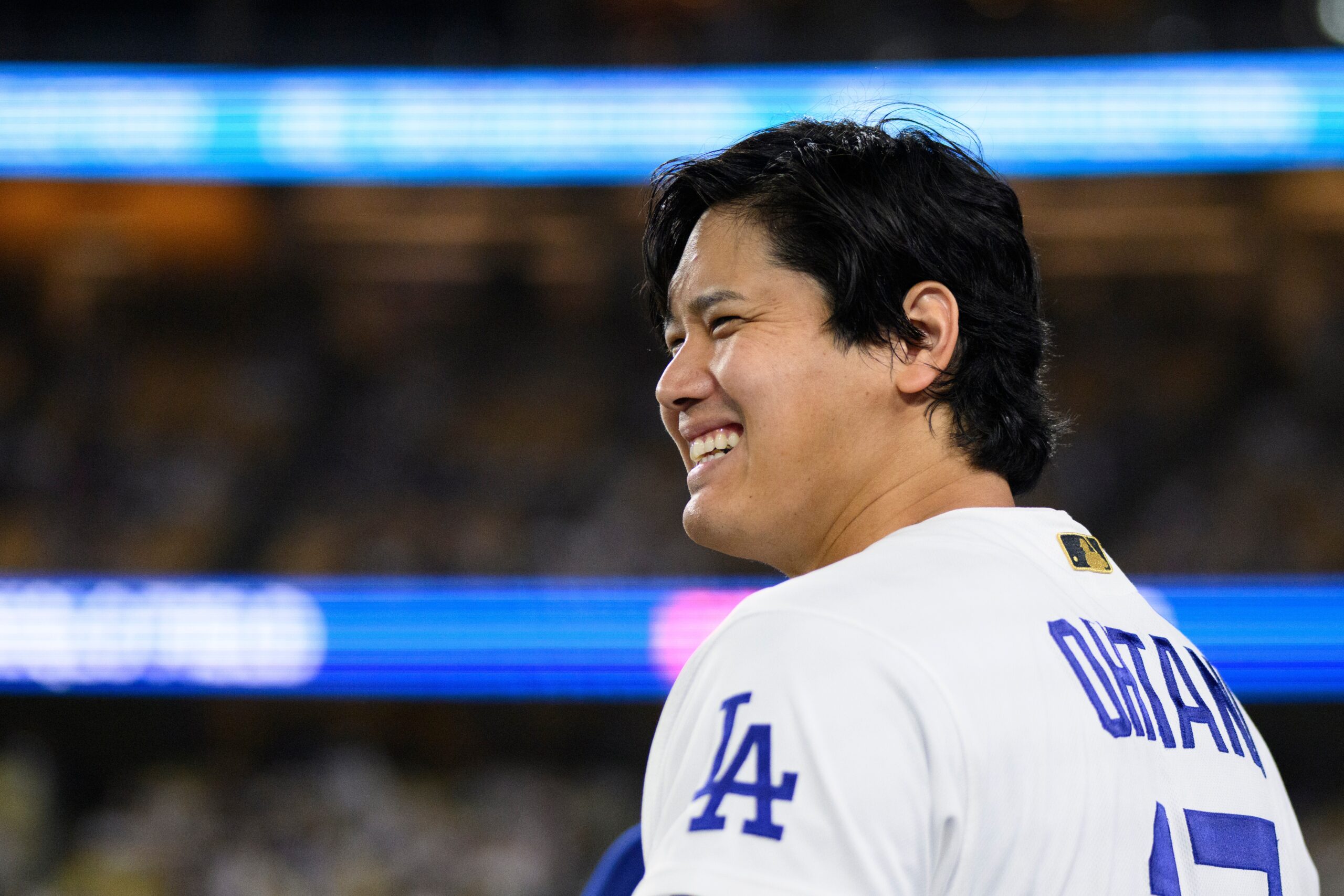
Los Angeles Dodgers star Shohei Ohtani’s former interpreter, Ippei Mizuhara, was sentenced in 2025 to 57 months in federal prison for illegally transferring nearly $17 million from Ohtani’s bank accounts to pay off gambling debts.
He alleges that he covered his losses by taking out second and third mortgages on his home, which later fell into foreclosure, and then sold his shares of an investment company that he had run for two decades.
By late February, Thompson’s suit claims, he wagered and lost his last $10,000 on a DraftKings parlay bet.
His losses totaled nearly $2 million, according to the lawsuit. Desperate and feeling like he could not confess the scope of his financial ruin to his family, Thompson texted his therapist, who then contacted the police. Officers raced to Thompson’s home and prevented him from harming himself.
Balsam said Thompson’s tragic story should give sports leagues and its players pause.
“Is this the kind of activity that either the union or the league want their players to be associated with,” Balsam said, “if it leads to addictive and self-destructive behaviors by a fan?”
How MLB’s betting stance changed
“People know gambling is deadly,” Allan H. “Bud” Selig said. “I don’t have to conduct focus groups.”
It was November 2012, and Selig, then MLB’s commissioner, was being deposed for nearly three hours in Milwaukee. A lawsuit instigated by then-New Jersey Gov. Chris Christie sought to overturn a longstanding federal law that restricted legal sports betting to just four states.
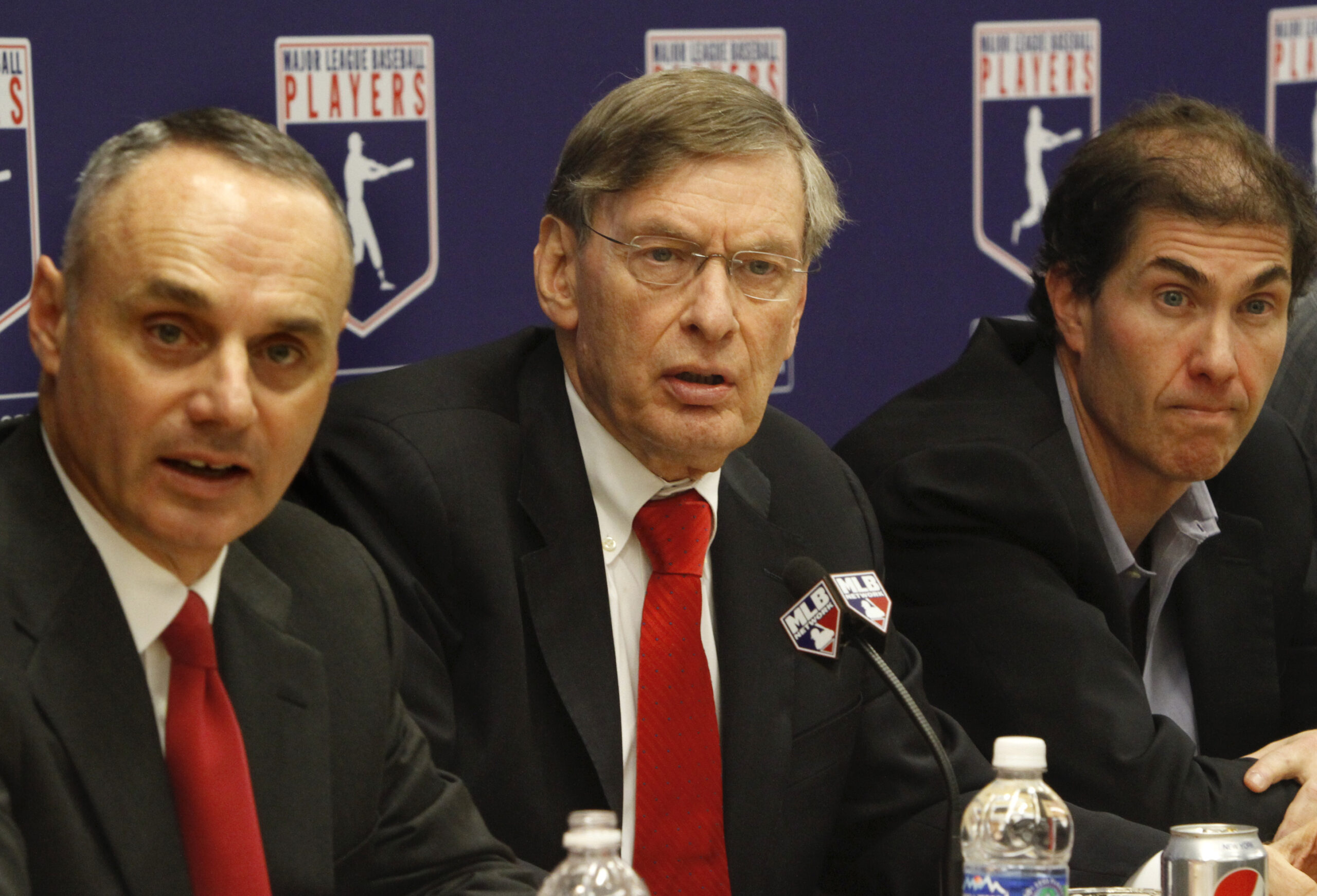
Major League Baseball longtime commissioner Bud Selig (center) argued in a 2012 deposition that widespread legalized sports gambling would be harmful to baseball. He was later succeeded by Rob Manfred (left), who has overseen partnerships between the league and sportsbook companies.
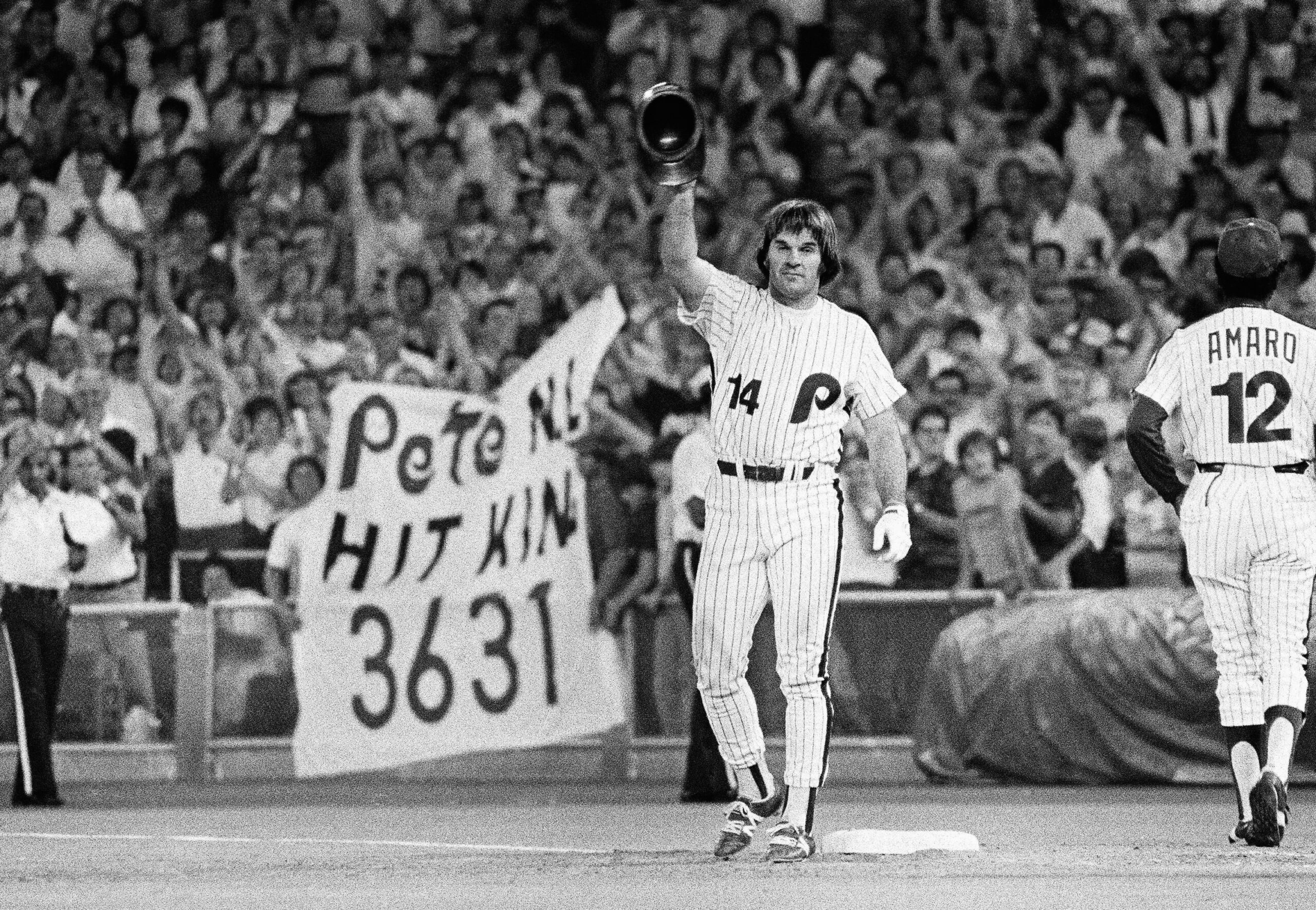
Baseball’s leaders had sought for decades to avoid recurrences of past gambling scandals that had threatened the integrity of the sport. Selig had maintained the hard line of his predecessors, perhaps most notably by upholding the league’s 1989 lifetime ban of former Phillies first baseman Pete Rose, who was found to have bet on baseball while managing the Cincinnati Reds.
Selig said he understood why state lawmakers would welcome the tax revenue that widespread legalized sports gambling could generate. But he argued such a development could only increase the odds of new baseball betting crises, which would be “the end of your sport.”
“I’m just — guess I have to say to you that I’m appalled,” Selig said in the deposition. “I’m really appalled.”
In 2019, MLB — led by a new commissioner, Rob Manfred — entered into its first partnership agreement with FanDuel.
Manfred sent a memo to players outlining the league’s gambling policy. At that time, it prohibited players from performing services “in any capacity involving sports betting for any third party,” a categorization that included “promoting or endorsing sports betting products or services.”
A new collective bargaining agreement, reached in 2022, allowed players to do promotional work for sportsbooks. Colorado Rockies outfielder Charlie Blackmon soon became the first professional baseball player to secure a deal as a brand ambassador for a sportsbook company.
Not everyone affiliated with MLB has welcomed the new relationships between the league and gambling entities.
“We’re entering a very delicate and, dare I say, dangerous world here,” Tony Clark, then president of the players union, told reporters in 2022.
MLB gave a lifetime ban in 1989 to former Phillie Pete Rose for betting on baseball while he was the manager of the Reds.
Two years later, MLB Players Inc. — a licensing and marketing subsidiary of the players union — filed a lawsuit that accused DraftKings of using without permission or compensation photos of MLB stars on its betting app and in social media posts. FanDuel and Bet365 were also named as defendants in the suit.
Harper figured prominently in the lawsuit. The complaint against DraftKings, filed in U.S. District Court in the Eastern District of Pennsylvania, included images of Harper’s face on the DraftKings app and a reference to a hypothetical wager on Harper hitting two home runs in a game. Attorneys also mentioned Harper in later courtroom arguments.
Being able to control how their names, images, and likenesses are used is a “crucial return on their substantial career investment,” the players’ attorneys wrote in the complaint. “It also enables athletes to avoid being associated with companies, commercial products, and industries that they do not wish to be perceived as supporting and endorsing.”
(The union ultimately dropped its case against FanDuel, and the lawsuit was settled earlier this year for undisclosed terms.)
In May 2024 — five months before FanDuel sent Harper’s video message to Terry Thompson — Manfred fired umpire Pat Hoberg for sharing a sportsbook account with a professional poker player who placed bets on baseball.
An investigation found no evidence that Hoberg himself had bet on baseball, Manfred later said. But the existence of the shared account — and the fact the umpire had deleted Telegram messages between himself and the poker player — created the “appearance of impropriety that warrants imposing the most severe discipline.” Hoberg appealed his dismissal but lost.
A year later, Bud Selig’s stark warning materialized.
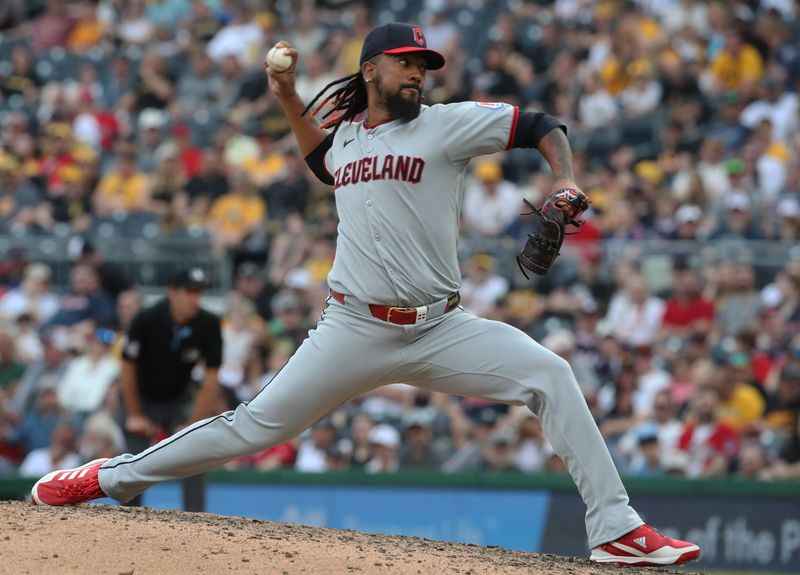
Former Cleveland Guardians pitcher Emmanuel Clase has been accused by federal investigators of conspiring with bettors in exchange for financial kickbacks.
Federal authorities indicted Cleveland Guardians pitchers Emmanuel Clase and Luis L. Ortiz, and accused each of conspiring with bettors.
Clase and Ortiz “agreed to throw specific types and speeds of pitches” prior to games, and bettors wagered on those pitches, the indictment states. In exchange, the bettors wired thousands of dollars to the pitchers through a third party in the Dominican Republic. Clase and Ortiz have each pleaded not guilty to wire fraud conspiracy and related charges and are awaiting trial. MLB has placed them on paid nondisciplinary leave.
That same year, Ippei Mizuhara, a former translator for Los Angeles Dodgers star Shohei Ohtani, was sentenced to 57 months in federal prison for illegally transferring nearly $17 million from Ohtani’s bank account to pay Mizuhara’s gambling debts.
Those episodes have not resulted in baseball’s demise, as Selig had once imagined. But they also did not rupture MLB’s relationship with gambling entities, which collected a record $165 billion in sports wagers in 2025.
As part of negotiations over a new collective bargaining agreement with MLB, the players union recently asked the league for to grant players more freedom to seek endorsements from sportsbook operators and prediction markets, ESPN reported.
The VIP treatment
FanDuel awards five points for every dollar that a bettor pays on a contest entry fee. To achieve VIP status, bettors must amass 600,000 points, which expire after a year of inactivity.
“But don’t worry,” the company explains on its website, “it’s easy to stay active.”
Terry Thompson earned a FanDuel VIP manager, Bryttanni Morgan, in 2021, court records show.
Morgan texted Thompson often about the fortunes of the Eagles, commiserating over the team’s ups and downs. Their conversations also veered into more personal terrain — favorite restaurants, travel plans, and family.
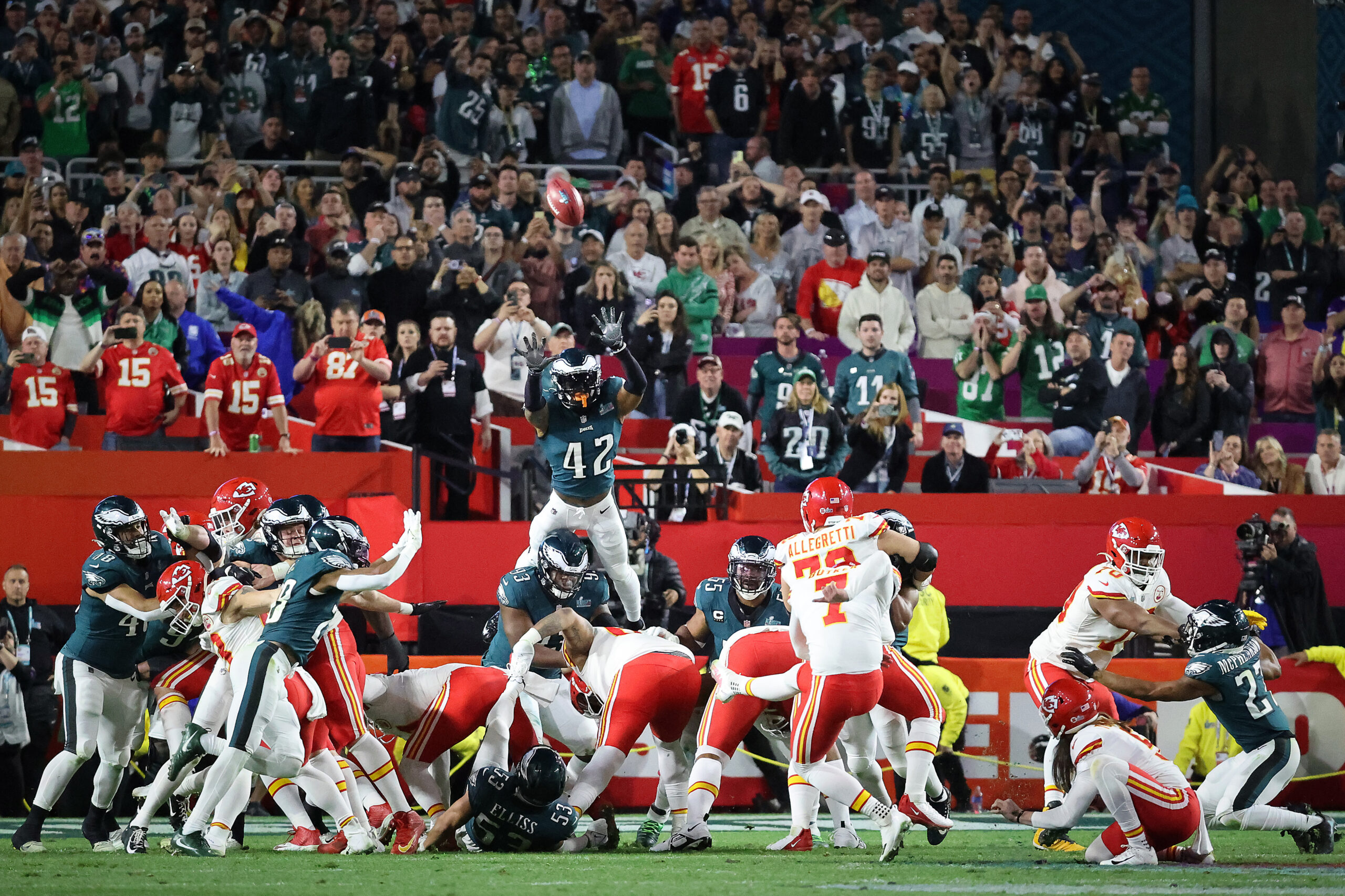
A FanDuel VIP manager allegedly offered tickets to Super Bowl LVII to bettor Terry Thompson, an Eagles fan who had a gambling addiction.
FanDuel’s intention, Thompson’s attorneys allege, was for Thompson to believe that Morgan was his friend.
Their exchanges often returned to Thompson’s betting activity. Morgan encouraged him to place more wagers, even when he showed signs of financial strain, the lawsuit states.
Morgan is named as a defendant in Thompson’s lawsuit. Her attorney could not be reached for comment.
In late December 2022, after Thompson had suffered more losses, Morgan texted him: “Are we gonna take a little break and start fresh in the New Year?”
“I’ll try,” Thompson wrote back, adding a smiley face symbol.
A few weeks later, on Jan. 13, 2023, Morgan offered a FanDuel VIP perk: two tickets to Super Bowl LVII in Arizona — where Thompson’s beloved Eagles would face the Kansas City Chiefs — along with free transportation, and tickets to Sports Illustrated and FanDuel parties.
On other occasions, Morgan provided Thompson with tickets to Eagles, Flyers, and Sixers games. FanDuel also flew Thompson and his son to Super Bowl LVI in California, with pregame access to the playing field and celebrities like Chris Rock.
Funt, the author, said he has major concerns about how the VIP programs are used to ensnare gamblers.
“They exist to egg on a reckless and potentially dangerous style of betting, using perks and other incentives that would be borderline irresistible for many sports fans,” he said. “I can only imagine how someone who loves Bryce Harper would feel indebted (no pun intended) to a sportsbook that facilitated a personalized video from him.”
Leigh Steinberg said he had not heard of other instances of sportsbook companies using active athletes to send greetings to a bettor.
“Because it’s not public, it’s hard to understand whether it’s ubiquitous or an exception,” he said.
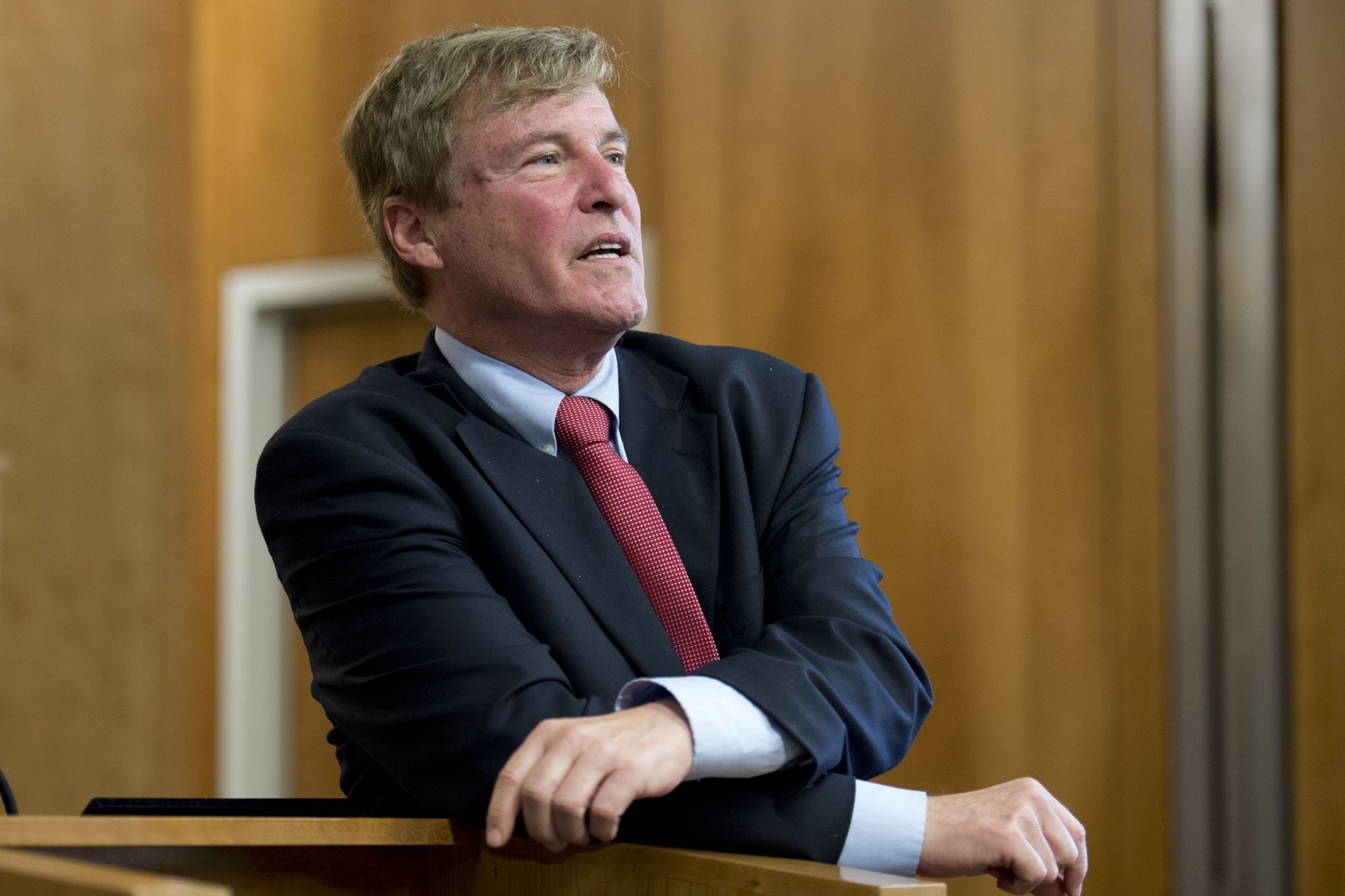
Leigh Steinberg has represented numerous NFL stars, from Chiefs quarterback Patrick Mahomes to NFL Hall of Famers Troy Aikman and Steve Young.
But Steinberg, who publicly struggled with an addiction to alcohol, argues that interactions between athletes and bettors who wager heavily on sports are inherently problematic.
“Getting a phone call or a zoom or a Cameo from a highly placed player is so flattering,” he said. “It’s stacking the deck unfairly in favor of continuing addicting behavior.”
The glamour of Thompson’s Super Bowl trips and brushes with celebrities had long since faded when he reached the nadir of his gambling earlier this year.
There were no more offers of free betting credits to be had, or microbets to chase.
Broke and broken, Thompson entered a psychiatric facility to undergo treatment for gambling addiction.
The Inquirer will continue to report on issues related to the growth of gambling addiction — among teens and adults — across Pennsylvania. If you, or someone you know, wants to speak with a reporter, please contact David Gambacorta or William Bender at dgambacorta@inquirer.com and wbender@inquirer.com
Correction: An earlier version of this story misstated the university where Jodi Balsam works as a law professor. She works at Brooklyn Law School.
Philadelphia almost certainly will have set more temperature records over the next two days — but maybe not during the steam-bath afternoons.
Nature’s natural cooling system, nightfall, is having a hard time getting it done with the atmosphere so swollen with water vapor. It didn’t get lower than 82 Friday morning and an encore is expected the morning of the Fourth.
Both would be record-high minimum temperatures for the dates in Philadelphia. That record bar is considerably lower than for the high-temperature records — 104 degreesfor Friday, and 103 forSaturday — set during the sizzling 1966 Independence week. A late-day thunderstorm could knock back Saturday’s temperatures, and storms Saturday night are “likely.”
Thursday’s high, 103, tied the record set in 1901, when the nation was a mere 125 years old.
Those potential century-plus readings are attention-getting, but health officials have long held that for heat-related mortality, consistently warm nights are more dangerous than the days, particularly for older people who live alone in brick rowhouses in the city. As a former Philadelphia health official has observed, without nighttime cooling, they can become “brick ovens.”
“The intensity and length of the extreme heat will exacerbate impacts to both people and infrastructure,” the weather service warned.
The sequence of hot nights “are particularly harmful because the body doesn’t have a chance to recover,” said Kraftin Schreyer, associate professor of emergency medicine at Temple University’s Lewis Katz School of Medicine. Extreme heat can exacerbate circulatory and lung conditions, and certain mental disorders, she added.
But she and other health experts say the detrimental effects may be modified by the heat the region already has experienced this year.
The Philly forecast for the 250 climax
Friday’s high is expected to challenge the reigning champ, the 104 set during a blistering heat wave in 1966, when the nation was a mere 190 years old.
On Saturday, when Philly celebrates the nation’s 250th birthday, the high may fall just short of 100, said Matt Benz, senior meteorologist with AccuWeather, as the high pressure “heat dome” covering much of the nation loses some of its protective power over Philly.
That also could be a window for “ring of fire” thunderstorms that could be nasty. The federal Storm Prediction Center sees a 15% chance that any storms on Saturday could become “severe,” with wind gusts up to 60 mph. The National Weather sees a 60% chance of storms Saturday night.
By Sunday, highs will be backing off to the 90s, however the sequence of warm nights probably will persist, at least in areas of Philadelphia most affected by the urban heat island effect.
The urban heat island and heat-health dangers
The world has been getting warmer, but cities long ago got the jump on climate change, and their impacts on temperature were observed in the 19th century and documented in a famous experiment in the 1950s by legendary climatologist Helmut Landsberg.
Landsberg, who observed temperatures had fallen in some European cities after World War II bombings destroyed buildings, set up instrument arrays in an area of Maryland that was undergoing rapid development. As surfaces were paved and structures erected, he recorded significant localized temperature increases.
In Philly, dense neighborhoods can be several degrees warmer than other areas even within the city. Urban areas reduce cooling at night because they are efficient at storing the sun’s energy and slower to release heat after sunset.
The heat-death tolls in Paris in 2003, Chicago in 1995, and Philadelphia in 1993 underscored the urban heat hazards.
It’s warmer, but heat deaths have dropped dramatically in Philly
“We’ve been really lucky,” said Samuel Eldrich, medical director of the Temple Health-Chestnut Hill Hospital Emergency Department
The decline has a lot do with Philadelphia and that summer of 1993, Eldrich added.
That year, Philadelphia was under fire because it was the only major Eastern city reporting significant numbers of heat deaths. The medical examiner’s office was using forensic evidence, such as closed windows, in determining heat deaths.
The reasoning: With so many people dying, doctors wouldn’t be able to get to the bodies in time to verify core body temperatures of 105 degrees, the standard for hyperthermia. The Centers for Disease Control later decreed Philadelphia’s method was correct, and it was adopted elsewhere.
The dramatically high death toll was the impetus for the city’s emergency response plan, lauded by CDC and the National Oceanic and Atmospheric Administration that lauded as a national prototype.
It includes opening cooling centers and nudging residents to look in on older neighbors, and having the Philadelphia Corporation for the Aging operate a “heat line,” 215-765-9040. It will be operating daily from 8:30 a.m. to 8:30 p.m., and the agency “can also assist callers reporting concerns about vulnerable neighbors, family members, or community members,” said spokesperson Bill Conallen.
Citing Census figures, the Corporation for Aging says about 95,000 people 65 and older live alone in the city.
‘This is temporary’
Subject to change, the heat wave is due to end Monday, with highs in the lower 80s (remember when that seemed hot?).
In the meantime the experts are offering coping tips, the three most-important being hydrate, hydrate, hydrate.
How much water should you drink? More than you think, said Schreyer. Men should drink about a gallon a day, women three quarts, but four to eight cups additional wouldn’t hurt. Sip, don’t guzzle, she said.
At a time when everyone wants to be outside, it’s critical to take breaks in air-conditioned stores, malls, or wherever, even for a few minutes, Eldrich said. “It gives your body a chance to recover,” he said.
Sunny G. Hallowell, associate professor of nursing at Villanova University, recommends cool showers and tepid baths. Also, especially with storms threatened, be prepared for power outages. She suggested storing damp towels in the refrigerator or freezer as a quick cool-down resource should the A/C go off.
She also recommends keeping a cool attitude. “This is temporary,” she said, and if the temperature hits a record, that’s “something to brag about.”
And if you’ve had it with the heat, think back to your misery during the Arctic freezes, and think that with the heat, “You got your wish.”
The region may be getting some significant drought relief during the weekend, and then it may be some time before it gets relief from heat that could persist through July Fourth.
Rounds of showers — possible Friday night into Saturday evening when Croatia and Ghana meet in a World Cup match in South Philly — should be more widespread across the region than Monday’s scattershot downpours, said Brian Hurley, senior branch forecaster with the Weather Prediction Center, in College Park, Md.
The severe storms likely would stay well to the south of Washington, D.C. However, “you always have potential” for a few thunderstorms, he said.
Then, after two decent days Sunday and Monday, what is looking like the longest-lasting hot spell of the season to date is due to get underway Tuesday as temperatures head to the mid-90s.
“That’s going to be main story,” said Hurley.
The wild card for the duration would be the possibility of “ring of fire” thunderstorms, forecasters said, which might have temporary cooling effects. Those are storms that form along the boundaries of high-pressure heat domes, and Philly may be near the eastern edge.
How hot might it get next week in Philly?
Expect some tweaking during the next few days, but with “increasing confidence” the National Weather Service in Mount Holly was seeing heat indexes in the triple figures next week.
Come Tuesday, daytime temperatures should be “off to the races,” said Bill Deger, senior meteorologist with AccuWeather Inc., which has forecast highs up to 98 degrees late in the workweek.
It also will be steamy, and that will inhibit nighttime cooling as water vapor slows the escape of daytime warning. Readings are unlikely to get lower than the 70s Wednesday through at least next Saturday.
The heat could lap into the following week, said Deger. “It shows some staying power,” he said.
The region already has had 14 days with official temperatures of 90 or higher in 2026, about half the average total for an entire year.
The potential for those ring-of-fire storms would be a wild card, said Hurley and Deger.
Cooling thunderstorms can break heat waves, although they may come with a price. Ring-of-fire storms in July 2020 wrung out as much as 6 inches of rain that set off widespread flooding.
As drought continues, the Philly region could use more rain
Six inches might be a bit over the top, but the region could use more rain to ease the ongoing drought conditions.
Some areas received close to 2 inches on Monday and Tuesday; however, the jackpot zones eluded areas where the dry conditions have been most intense — parts of South Jersey and Chester County.
The entire region remained in some state of drought according to the interagency U.S. Drought Monitor, but Chester County was in “severe drought,” along with small pieces of Bucks and Delaware Counties. In “extreme drought” were all of Cape May County, other Jersey Shore towns, and areas bordering Delaware Bay.
In an analysis based on a network of measuring stations throughout the counties, the weather service’s Middle Atlantic River Forecast Center calculated that Cape May County received less than a half inch of rain, and Cumberland and Salem Counties about 0.6 inches.
In contrast, Burlington, Camden, and Gloucester Counties weighed in with well over an inch.
On the other side of the river, Philly’s total was 1.28 inches, compared with 0.71 for Chesco, which, like New Jersey, is under a state-declared drought emergency.
What is Philadelphia music? If you've been following along all week, you've finally reached our answer: the top 10 songs on our list.
It’s the Sound of Philadelphia: Kenny Gamble and Leon Huff, as well as Thom Bell, their fellow songwriter-producer who completed the triumvirate known as the Mighty Three.
It’s hometown heroes like Harold Melvin & the Blue Notes and the Stylistics; out of towners pulled into the city’s orbit such as the O’Jays, Spinners, and David Bowie; and the musicians at Joe Tarsia’s Sigma Sound Studios who made the city a music mecca in the 1970s.
But of course, Philly music is much more than the rugged, sophisticated “soul music in a tuxedo” sound. It’s the street-forged rap of Schoolly D, Freeway, and Meek Mill; the luxurious strings of the Philadelphia Orchestra; and the 21st century indie rock of Kurt Vile, Dr. Dog, and Japanese Breakfast.
Philadelphia is a foundational jazz city, from South Philly’s Eddie Lang — the “Father of Jazz Guitar” — in the 1920s to John Coltrane writing Giant Steps in Strawberry Mansion in the 1950s to pianist McCoy Tyner, who’s represented with a “West Philly Tone Poem.”
Philly music means Chubby Checker and the teen idols of American Bandstand, rock singers who grew up on soul music like Hall and Oates and Todd Rundgren, soul singers par excellence like Teddy Pendergrass, Patti LaBelle, Jazmine Sullivan, Jill Scott, and irrepressible pop stars like Pink.
It’s a musician’s city that birthed the world’s greatest hip-hop band — the Roots — whose best known and loved member is the drummer. A gospel singer’s city that’s home to powerhouse vocalist Clara Ward with a concert hall named after a classical contralto — Marian Anderson — who also sang spirituals and broke racial barriers.
Timed to the celebration of the nation’s 250th birthday in the city where it was founded, what follows is an annotated list of the 76 most essential Philadelphia songs.
Are they also the best? For the most part, in my subjective opinion, yes. But along with quality, many of these songs — that are not always made by Philadelphians — are included mainly because they say something about Philadelphia, and who we are as Philadelphians.
And some are on the list due to ubiquity. They’ve become part of the fabric of daily life. You might hear them on your TV, on Broad Street on New Year’s Day, at any time of year at the sports complex, or in the summertime as an ice cream truck rounds the corner.
I made most of the decisions myself, but my colleague Peter Dobrin contributed when it came to all matters concerning classical music, and some of his choices are better described as pieces of music rather than songs, per se.
He knows far more about classical music than I do, so — like Rocky and Adrian in Rocky — we will fill each other’s gaps. So be on the lookout for Peter’s picks, and also for where the “Theme From Rocky” is going to land on the top 76.
You may think you've never heard Cliff Nobles’ “The Horse.” But if you’ve ever been to a high school football or basketball game, the pep band has probably played it.Courtesy of the artist
Cliff Nobles’ voice is not heard on his biggest song. After moving to Philadelphia, the Mobile, Ala., born singer recorded the single “Love Is All Right” for Phil-La of Soul Records in 1968. In a session at Virtue Recording on North Broad Street that Nobles didn’t attend, guitarists Bobby Eli and Norman Harris, sax player Mike Terry, bassist Ronnie Baker, and drummer Earl Young — all future members of Philadelphia International Records house band MFSB — jammed on an instrumental version of “Love Is All Right” that became the B-side. DJs preferred that version without words, and “The Horse” became a No. 2 pop hit. You might not think you know it, but if you’ve ever been to a high school football or basketball game, the pep band has probably played it.
75
Bahamadia, “Uknowhowwedu”
Antonia D. Reed, aka Bahamadia, was born in Philadelphia and started rapping when she was still in high school.Courtesy of Michael Branscom
Stone-cold classic from the underappreciated — though not by hip-hop heads — rapper Bahamadia, from her 1996 debut album Kollage. The artist born Antonia Reed made her debut with a guest verse on the Roots’ “Proceed III” in 1994. Here, she samples A Tribe Called Quest and Schoolly D and displays her verbal dexterity on a song that’s a flashback to a memorable Philly hip-hop era, as she name checks 215 rappers and DJs of the day, including the Roots, Ram Squad, Cash Money, Kolby Kolb, Cosmic Kev, and “Illadell” itself.
74
John Philip Sousa, “Liberty Bell March”
We let Monty Python’s Flying Circus borrow it for a while, but the piece is ours. Originally written for an operetta left unfinished, the piece wraps our resident bell in Sousa’s usual uplifting military garb. Tubular bells — and an optional ship’s bell — are used to suggest the famous one near Independence Hall that no longer rings. — Peter Dobrin
73
Mannequin Pussy, “Drunk II”
(Left to right) Colins “Bear” Regisford, Maxine Steen, Marisa Dabice, and Kaleen Reading, bandmates in Philly punk (and pop) band Mannequin Pussy, at Penn Treaty Park in Philadelphia on Feb. 15, 2024.Jessica Griffin / Staff Photographer
Mannequin Pussy identifies as a punk band, and for good reason. The group can whip up a righteous racket and singer Marisa Dabice’s lyrics seethe with capitalist critiques and feminist rage. But it’s also a pop band whose earworms are as musically pleasing as they are lyrically subversive. This 2019 song alternates between outer- and inner-directed anger, from a great Philly band representative of this time and place. So much so that when Mare of Easttown creator Brad Ingelsby created a fictional Delco rock band, he had them sing Mannequin Pussy songs.
72
Bill Doggett, “Honky Tonk, Parts 1 and 2”
Huge 1956 instrumental pop and R&B smash from Doggett, who was born in Philly in 1916 and played piano in Lucky Millinder’s Orchestra in the 1940s, when he cowrote “Shout, Sister, Shout!” for Sister Rosetta Tharpe, who will appear higher up on the Philly 76. Doggett was an innovator of the Hammond B-3 organ, and “Honky Tonk” was such a runaway hit that it was covered by Buddy Holly and the Beach Boys. It also pointed ahead to the great Philadelphia organ jazz tradition that includes Jimmy Smith, Jimmy McGriff, Trudy Pitts, Shirley Scott, and Papa John & Joey DeFrancesco.
71
Lee Andrews & the Hearts, “Long Lonely Nights”
Lee Andrews Thompson’s impact goes well beyond cocreating his son, Roots drummer Ahmir “Questlove” Thompson. (And his lineage goes back further: Lee Andrews’ father Beechie Thompson sang with Philly gospel greats the Dixie Hummingbirds.) In the late 1950s, when the Hearts were managed by influential Philly DJ Douglas “Jocko” Henderson, the band scored a series of heart-rending doo-wop hits. “Long Lonely Nights” is the one that hurts the most.
70
Evelyn “Champagne” King, “Shame”
The Phillie Phanatic dances with singer Evelyn "Champagne" King after she threw out the first pitch on June 21, 2013.Charles Fox / Staff Photographer
Evelyn King was discovered as a teenager singing in a bathroom at the Philadelphia International Records offices. “Champagne” was added to make her name sound less grown-up and give it the extra fizz suited to the disco explosion, which, in 1977, the song arrived in the middle of. Raymond Earl of Philly band Instant Funk plays bass, recently deceased Philadelphia International Records great Dexter Wansel plays keys, and Sam Peake is on sax.
69
Bobby Rydell, “Wildwood Days”
Bobby Rydell speaks about his experiences in Wildwood after the dedication of his “Icon of the Wildwoods” mural, in May 2014.Michael S. Wirtz / Staff Photographer
Bobby Rydell had a big 1963. Not only did the South Philly musician — originally a drummer, who played in a teenage band with guitar great Pat Martino — costar in Bye Bye Birdie, he also scored a hit with “Forget Him.” “Wildwood Days” is the summertime excursion that has stood the test of time. It’s featured in Season 2 of Upper Darby native Tina Fey’s Netflix series The Four Seasons. Sixty-three years after its release, the song still soundtracks a summer down the Shore, where “Every day’s a holiday, and every night’s a Saturday night.”
68
Woody Guthrie, “Philadelphia Lawyer”
Woody Guthrie in March 1943 with his guitar.Courtesy of Library of Congress
Woody Guthrie’s cowboy ballad is not about a personal injury attorney who advertises on billboards on I-95 and the Schuylkill Expressway luring clients with a big sack of money. But it could be: The protest and folk singer who wrote the words “This Machine Kills Fascists” on his guitars characterizes Philadelphia lawyers as slick, not to be trusted operators. So when the title character gets repaid in blood for romancing a Nevada cowboy’s sweetheart, no tears are shed. Willie Nelson and the Maddox Brothers and Rose also do fine versions.
67
Santigold, “Creator”
Santigold performs on the Rocky Stage during the Made In America Music Festival along the Benjamin Franklin Parkway on Sept. 2, 2012.Yong Kim / Staff Photographer
Mount Airy-raised Santi White is a Philly all-star going back to her days leading Stiffed, the New Wave and ska rock band she fronted in the early ‘00s. After moving to New York, she soon broke through with a 2008 album that stylishly mixed, dub, electro, punk, hip-hop, and pop and made her an avatar of 21st-century cool. “I’m the creator, thrill is to make it up,” she singjays on “Creator,” which found its audience in part through exposure on Gossip Girl and a Bud Light Lime ad.
66
Blind Willie Dunn’s Gin Bottle Four, “Jet Black Blues”
Salvatore Massaro changed his name twice. As Eddie Lang, the South Philly native was known as the Father of Jazz Guitar. Then he called himself Blind Willie Dunn so he could break the music industry color line and team with jazz and blues guitarist Lonnie Johnson at a time when Black and white players making music together was taboo. This 1929 song is important music that’s also delightful; and also tinged with tragedy as Lang would die in 1933 at age 30 from complications from a tonsillectomy that his friend Bing Crosby urged him to have.
65
McCoy Tyner, “West Philly Tone Poem”
In this July 14, 2009, file photo, jazz pianist McCoy Tyner performs during the 43rd Montreux Jazz Festival in Montreux, Switzerland.Courtesy of AP
The giant of jazz piano, known for his thunderous playing and early collaborations with John Coltrane, sounds soft and lovely here. He is accompanied on bowed bass by a Philly jazz great of a younger generation, Southwest Philly’s Christian McBride.
64
Blue Magic, “Sideshow”
Written by MFSB guitarist Bobby Eli with Vinnie Barrett, and produced by Norman Harris, “Sideshow” is an achingly beautiful song with a soaring vocal by lead singer Ted “Wizard” Mills, released on Atco Records. It demonstrates just how rich the Philly soul scene was in the 1970s, with Sigma Sound players like Eli and Harris scoring No. 1 R&B hits on Philly artists outside of the Philadelphia International family.
63
The Dovells, “Bristol Stomp”
Vocal group the Dovells pose for a portrait in 1961.Courtesy of Getty Images
Dance music culture in Philadelphia in the early days of rock and roll was at such a fever pitch that a song about a teen dance craze in Bucks County could — with the help of American Bandstand — become a No. 2 national pop hit. Len Borisoff, the lead singer of the Dovells, who also had a smash with “You Can’t Sit Down,” later went on to solo fame as Len Barry, with the divine 1965 hit “1-2-3.”
62
The Menzingers, “Anna”
Tom May, co-frontman of the Menzingers, at Union Transfer on Nov. 24, 2018, for the “After The Party Tour.”Courtesy of Kristen Balderas
Like any power pop band worth its salt, Scranton-born and Philly-based the Menzingers excel at yearning. The thing they’re longing for in 2019’s “Anna” is quality time with their significant other. “Anna, I have so much to tell ya” rhymes with “Please come back to Philadelphia.”
61
Rachmaninoff, “Symphonic Dances”
Undated photo of pianist, conductor, and composer Sergei Rachmaninoff (left) and Eugene Ormandy.Courtesy of Marston
“Unquestionably, they are the finest orchestral combination in the world,” Rachmaninoff said of the Philadelphia Orchestra in 1931. Among the works he wrote specifically for the ensemble is his Symphonic Dances, his last major work and one of the most colorful and emotionally far-reaching. — Peter Dobrin
60
Sheer Mag, “Point Breeze”
Christina Halladay (left), Hart Seely, and Kyle Seely (right), sit in their rehearsal space on Grays Avenue in Southwest Philadelphia on Tuesday, Aug. 21, 2019. The three are part of the band Sheer Mag, which was formed in Philadelphia.Margo Reed / Staff Photographer
Anti-gentrification rock and roll! The Christina Halladay-fronted hard-rock quartet draws inspiration from 1970s bands like Thin Lizzy and the Clash. “Point Breeze,” from the band’s 2014 debut EP makes pointed reference to an OCF Realty office and notes that “the streets are changing, a white breeze is blowing through.”
59
Jim Croce, “You Don’t Mess Around With Jim”
Jim Croce, a South Philly native and Villanova grad.
South Philly native and Villanova grad Jim Croce met a “pool shootin’ son of a gun” named Big Jim Walker in a West Philly bar. The title cut to Croce’s 1972 breakout album was also the blueprint for his 1973 hit “Bad, Bad Leroy Brown,” which Philly troubadour Kenn Kweder sang in tribute to Croce at the Philly Music Alliance gala this spring.
58
The American Dream, “Frankford El”
What was true in 1970 remains so today: “You can’t get to heaven on the Frankford El.” The reason why is succinctly explained on this ramshackle tune by one of the leading Philadelphia rock bands of the countercultural era, whose one and only album was the first to be produced by Todd Rundgren: “Because the Frankford El goes straight to Frankford.”
57
Lady B, “To the Beat, Y’all”
DJ Lady B in the WRNB studio in 2011, her 30th year in hip-hop.Courtesy of Laurence Kesterson
As a pioneering Power 99 DJ, Wendy Clark boosted the careers of Schoolly D, Run-DMC, and especially DJ Jazzy Jeff and the Fresh Prince. But she also made music history in 1979 when she recorded this snappy single, the first rap song released by a Philadelphia artist or female artist anywhere. In 2015, Vibe called her “maybe the most influential female in hip-hop radio history.”
56
Marah, “Christian Street”
In a photo from 1999, Serge Bielanko (right) of the group Marah goes through a sound check. To his left is his brother Dave, who is also a member of the band.Peter Tobia / Staff Photographer
A tour down the South Philly artery, from the Conshohocken-raised Bielanko brothers’ scrappy Springsteen-y band's 2000 album Kids in Philly. “Saint Paul’s is for soul salvage, 9th Street for my fennel and leek,” Dave Bielanko sings, while shouting out Rocky Balboa and Angelo Bruno. “Stop by Snockey’s for a short Amaretto, when the moon comes up rising like a giant pizelle.” From the smell of pepper and egg sandwiches to the corner payphone “for bettin’ the numbers,” the song — and entire album — teem with life and capture a fleeting turn-of-the-millennium moment.
55
Al Ham & the Hillside Singers, “Move Closer To Your World”
The Action News theme song, composed by jingle writer Al Ham, with lyrics by former 6abc exec Walt Liss, is still everyday listening in Philadelphia living rooms, 54 years after its release. Honorable mention in the category of songs that seem to be in the air, if not the wooder: the Mister Softee ice cream truck jingle, written by Les Waas, which has been omnipresent on the streets of Philadelphia since 1960.
54 to 33
54
Low Cut Connie, “Boozophilia”
Low Cut Connie’s Adam Weiner performs at the Fillmore Philadelphia on Oct. 14, 2021.Elizabeth Robertson / Staff Photographer
Barack Obama might have put this Low Cut Connie song on his inaugural presidential playlist in 2025 because Adam Weiner calls out “the South Side of Chicago.” But the raucous workout by the Philly rock and soul band — which has a patriotic protest album called Livin In the USA due July 4 — is also a song of 215 pride. “Where do we live?” Weiner asks when the band rips it up onstage. “We live in South Philly!”
53
Japanese Breakfast, “Everybody Wants To Love You”
Japanese Breakfast’s Michelle Zauner performs during the “Melancholy Tour” stop at the Met Philadelphia on May 15, 2025.Elizabeth Robertson / Staff Photographer
The coat check that Michelle Zauner once operated at Union Transfer was named in her honor in 2021, and the H Mart that gave a name to her best-selling memoir, Crying In H Mart, about grief and her Korean identity is in Elkins Park. This super sticky love song was originally recorded for Zauner’s Bryn Mawr College band Birthday Girls before finding its audience on the 2016 Japanese Breakfast album Psychopomp.
52
George Crumb's “Black Angels”
George Crumb’s “Black Angels” is absolutely hair-raising stuff.Courtesy of George Crumb
There’s a reason Crumb’s piece was dropped into The Exorcist. It is absolutely hair-raising. The Philadelphia composer, who died in 2022, was perhaps unmatched in bringing unusual sounds into Western classical music — sitar, Tibetan prayer stones, toy piano, and pretty much anything he heard and liked. Black Angels uses an electrified string quartet, and as frightening as the work was as the soundtrack to a demon presence, its original, real-life reference was even more horrifying. Written into the 1970 score are the Latin words In tempore belli (“in time of war”), a reference to the piece as a lament of the Vietnam War.
— Peter Dobrin
51
Beanie Sigel and Eve, “Remember Them Days”
Rapper Beanie Sigel performs for a crowd at the 50th Anniversary of Hip-Hop celebration hosted at Lou and Choo's Lounge in North Philadelphia on July 1, 2023.Ed Newton / For The Inquirer
This gets the nod over “Philly, Philly,” this duo’s more on-the-nose 215 track, simply because it’s a much better song. The two rappers are nostalgic for the good old days when times were bad, with a Good Times reference: “Welfare and white landlord, that life ain’t easy / The only ones movin’ up was George and Weezy.”
50
Young Gunz, “Can’t Stop, Won’t Stop”
At the Project Brotherly Love Concert, Young Neef, of the group Young Gunz, jumped into the crowd and sang during the concert.Vicki Valerio / Staff Photographer
The 2003 debut single from hip-hop duo Young Gunz — part of Beanie Sigel’s State Property crew — rides a minimalist groove and brims with youthful self-confidence. Rappers Young Chris and Neef Buck sound giddy: “The girls, the girls, they love us / ‘Cause we stay fresh to death, we the best, nothing less.” An ode to the hip-hop hustler’s life also lent its name to author Jeff Chang’s history of the culture.
49
The Intruders, “Cowboys To Girls”
The IntrudersCourtesy of the Artist
My mother would be disappointed that I didn’t pick “I’ll Always Love My Mama,” a single I’m proud to say I bought in 1973. The Intruders’ first big Gamble- and Huff-penned hit arrived in 1968 and was recorded pre-Sigma Sound at Cameo Parkway studio on South Broad Street. The group’s delicate harmonies and Bobby Martin’s gossamer arrangement are a perfect fit for the sweet innocence of the coming-of-age lyric.
48
Lee Morgan, “The Sidewinder”
American Art Blakey's Jazz Messengers with Lee Morgan, Jymie Merritt, and Art Blakey, Copenhagen, Denmark, December 1960.Courtesy of Getty Images
Named not for a venomous snake but a TV villain, “The Sidewinder” was then-25-year-old Philly trumpeter Lee Morgan’s comeback record; a jaunty, burst of soul-jazz with a boogaloo beat that put him back on track after a battle with heroin addiction. Its infectious energy and irresistible groove made it the high mark of Morgan’s career until he was tragically shot to death by his common-law wife in 1972. The song was added to the Library of Congress National Recording Registry in 2024.
47
Lil Uzi Vert, “XO Tour Llif3”
Lil Uzi Vert performs on the Liberty Stage in 2022.Heather Khalifa / Staff Photographer
“Push me to the edge, all my friends are dead”: Is that a dark look into the abyss, or a proud boast that Lil Uzi’s wallet is stuffed with Dead Presidents? The artist born Symere Woods, who grew up in the Francisville section of the city, is the only Philadelphia artist to ever release three consecutive albums to reach No. 1 on the pop charts. This dark, dreamy, addictive song sent the first of those, 2017’s Luv Is Rage 2, straight to the top.
46
Dr. Dog, “Where’d All The Time Go?”
Dr. Dog – (from left) Dmitri Matos (kneeling), Eric Slick, Scott McMicken, Frank McElroy, Zach Miller, and Toby Leaman.David Swanson / Staff Photographer
As a rock band that built a wide audience with a 1960s inspired buoyant sound, which helped put the Philly music scene on the map this century, Dr. Dog unquestionably belongs on the list. But what song from an 11-album run? This Scott McMicken-sung deep cut from 2010’s Shame, Shame cuts the band's easy charm with an undercurrent of dread. Thanks to TikTok, it’s far and away their most frequently streamed track, with over 600 million clicks. Honorable mention: “Philadelphia Lights,” by the band’s drummer, Eric Slick.
45
Billie Holiday, “Strange Fruit”
Billie Holiday singing at the Downbeat in New York, circa February 1947.Courtesy of Library of Congress
Billie Holiday was born in Philadelphia General Hospital in West Philly’s Black Bottom neighborhood in 1915. She grew up in Baltimore, but often stayed at the Douglass Hotel at 1409 Lombard St. when performing at the Showboat venue in the hotel basement. “Strange Fruit,” her harrowing anti-lynching protest song written by Abel Meeropol, was named song of the century by Time in 1999. It's also the name of a Zoe Leonard art installation at the Philadelphia Museum of Art, inspired by Holiday’s song.
44
Soul Survivors, “Expressway To Your Heart”
Soul Survivors, the soul-rock band founded by Charlie Ingui and his late brother RichieCourtesy of Getty Images
In 1967, Kenny Gamble and Leon Huff penned and produced this R&B hit for the soul-rock band founded by Charlie Ingui and his late brother Richie. Charlie still regularly performs with David Uosikkinen’s In The Pocket, whose entire repertoire consists of Philly songs like those found on this list. Inspired by I-76, the highway that bifurcates the City of Brotherly Love. Then as now: It’s much too crowded!
43
Sun Ra, “Space Is The Place”
Marshall Allen on the saxophone and vocalist Tara Middleton (right) perform during the Sun Ra Arkestra: Marshall Allen Birthday Celebration at the Lounge at World Cafe Live on May 27, 2023.Elizabeth Robertson / Staff Photographer
Interplanetary avant-jazz from the Afro-Futurist bandleader born Herman Poole Blount, who lived in Philadelphia from 1968 until his death in 1993. His steadily gigging sui generis Arkestra — fronted by the remarkable 102-year-old sax player Marshall Allen — still calls Germantown home.
42
The Orlons, “South Street”
The Orlons in the 1960s. The "South Street" singers were inducted into the Philadelphia Music Alliance Walk of Fame in 2025.Courtesy of the Artist
It’s where “the hippest,” not the hippies meet. Hippies weren’t a thing in 1963, when the Orlons released the song. The unorthodox vocal group, named after a synthetic fabric, had three female singers in lead vocalist Rosetta Hightower, Shirley Brickley, and Marlena Davis plus Stephen Caldwell. The song was written by Kal Mann and Dave Appell, who also penned hits by the Dovells and Bobby Rydell on this list.
41
Pink, “Get The Party Started”
Pink performs at Citizens Bank Park on September 18, 2023.Steven M. Falk / Staff Photographer
Doylestown’s own Alecia Moore didn’t write this song — Linda Perry of 4 Non Blondes did. But it was a smash hit that kick-started the success of Pink’s 2001 artistic breakthrough Mizzundaztood. And its irrepressible dance-pop energy helped create the enormously likable Pink persona that’s carried her to stadium-size aerial acrobatic superstardom.
40
Sister Rosetta Tharpe, “This Train”
Sister Rosetta Tharpe jams with (from left) Hot Lips Page, Duke Ellington and Cab Calloway in August 1939 at Burris Jenkins Studio in New York City.
Sanctified gospel singer and electric guitar pioneer Sister Rosetta Tharpe was born in Cotton Plant, Ark., and scored her most influential hits, like “Strange Things Happening Every Day” and “Rock Me,” years before she moved to Philadelphia in 1960. But she resided here until her death in 1973, and is buried in Northwood Cemetery in West Oak Lane, so we’re claiming her. “This Train” was recorded in 1939 and remained a staple of her concerts through her Philly years, including the 1964 tour of Europe witnessed by British guitar heroes like Keith Richards and Jimmy Page. Take a listen to Bruce Springsteen’s “Land of Hope and Dreams” and hear the echo of “This Train.”
39
James A. Bland, “Oh, Dem Golden Slippers”
A portrait of composer and minstrel performer James A. Bland (1854–1911) at the Mummers Museum on Dec. 29, 2025.Tom Gralish / Staff Photographer
The minstrelsy song that soundtracks the Mummers Parade in Philadelphia every New Year’s Day was written by a Black man and prolific songwriter who often had to wear blackface himself while performing in minstrel shows.
Bland’s “Oh, Dem Golden Slippers” was written in 1878 as a parody of the spiritual “Golden Slippers,” popularized by the Fisk Jubilee Singers, which celebrated the finery believers expected to wear in the afterlife after ascending to heaven. Bland moved to Philadelphia in 1901 and four years later, his second most famous song — he also wrote “Carry Me Back to Old Virginny” — was first performed by parading Mummers. In 1911, he died penniless. He’s buried in Merion Memorial Park in Bala Cynwyd, where the great Mississippi bluesman Skip James is also interred.
38
Charlie Gracie, “Fabulous”
Charlie Gracie in the 1950s.Courtesy of the Charlie Gracie Family
Philadelphia’s first rock-and-roll star scored two rockabilly hits that topped the pop charts in 1957: the sweetly romantic “Butterfly” and this hiccuping gem which was a Top 10 hit in England, and had a profound effect on a 15-year-old Paul McCartney.
37
“Fly, Eagles, Fly,” “Here Come The Sixers,” and “High Hopes”
Richard Sherwood, Terry Rocap, Randy Childress, Frank McDonnell, and Joe Sherwood when they were in a rock band called Wellington Arrangement. Rocap, Childress, and Joe Sherwood later formed Fresh Aire and wrote "Here Come The Sixers."Courtesy of Randy Chi
OK, we’re cheating here. This is a Philly sports music three for one. “Fly, Eagles, Fly,” the battle cry penned by 1950s admen Charles Borelli and Roger Courtland has been covered by the Roots and Coldplay, and is sung not only at Eagles games but at concerts and other sporting events by Philadelphians eager to express their love for their Iggles and their city. It’s the musical way to say: “Go Birds!”
Catchier still is “Here Come The Sixers,” the disco-ish ditty that counts down — “10, 9, 8, 76ers! … 3, 4, 5, Sixers!” — heard at Xfinity Mobile Arena in the closing seconds of every home win. “Play the song!” means victory has been secured. And “High Hopes” is the Jimmy Van Heusen-Sammy Cahn song sung by Frank Sinatra in the 1959 A Hole In the Head, which the late Phillies announcer Harry Kalas shows up to sing on the big screen at Citizens Bank Park at the close of every win. Go Phils!
36
Clara Ward and the Ward Sisters, “How I Got Over”
Gospel singer Clara Ward (at the piano) and Gertrude Ward (left) rehearse in a studio circa 1955.Courtesy of Getty Images
The classic gospel hymn and civil rights anthem that Ward wrote in 1951 was sung by Mahalia Jackson at the March on Washington in 1963. It also inspired the title track to the Roots’ 2010 album of the same name.
35
Elton John, “Philadelphia Freedom”
English pop singer Elton John in a flamboyant stage outfit of white suit with feather trim and rhinestone encrusted glasses, circa 1973.Courtesy of Terry O’ Neil Iconic Images
It’s not the greatest Philadelphia song by a British rock superstar — that would be David Bowie’s “Young Americans.” But this one was written by John and lyricist Bernie Taupin for Billie Jean King, then player/coach of the mixed gender World Team Tennis franchise, the Philadelphia Freedoms. An inscription on the label of the 45 reads “To B.J.K. and the Soulful Sounds of Philadelphia.”
Released in 1975, it became a Bicentennial anthem, a No. 1 hit, and later, a gay pride anthem. At the time, however, John saw it as an example of his overexposure: “I wish the bloody thing would piss off,” he told an interviewer about the song. “I can see why people get sick and tired of me. In America I get sick and tired of hearing myself on AM radio.”
34
Barbara Mason, “Yes, I’m Ready”
Singer Barbara Mason at Sigma Sound Studios in the 1970s, with (left to right) Norman Harris, Bobby Eli, Earl Young, and an unknown musician.Courtesy of Arthur Stoppe
Freeway, left, and Beanie Sigel perform at Gillie Fest 2023 at Franklin Music Hall in Philadelphia on Saturday, July 29, 2023.Heather Khalifa / Staff Photographer
The lead single for the 2003 debut album by Freeway — also known as Philly Freeway, also known as Leslie Pridgen Jr. — features Jay-Z, and was produced by Just Blaze. It samples Creative Source’s 1974 “I Just Can’t See Myself Without You,” which provides the song’s memorable morally conflicted hook about carrying on with sketchy activities “even though what we do is wrong.”
32 to 11
32
MFSB, featuring the Three Degrees, “T.S.O.P. (The Sound of Philadelphia)”
Earl Young seated on the right at the front in an early 1970s photo of MFSB (Mother, Father, Sister, Brother), the group of musicians who regularly played on songs produced by Kenny Gamble, Leon Huff and Thom Bell that were recorded at Sigma Sound Studios in Philadelphia.Courtesy of Earl Young
The studio musicians based at Sigma Sound Studios, who were in essence the Philadelphia International Records house band, called themselves Mother, Father, Sister, Brother. In 1974, the band built around the rhythm section of Ronnie Baker, Norman Harris, and Earl Young topped the charts with this largely instrumental number which became the theme to Soul Train. Vocals are by the Three Degrees, the trio that scored a hit that year with “When Will I See You Again,” and who — fun fact! — was the favorite group of then Prince and now King Charles.
31
The Hooters, “All You Zombies”
The Hooters, founded by Rob Hyman and Eric Bazilian, who met in 1971 as students at the University of Pennsylvania.Courtesy of Michael Dwornik
It’s a toss-up between this and “And We Danced” for the definitive Hooters song. The Rob Hyman- and Eric Bazilian-led band, who played Live Aid and defined Philly rock in the 1980s, is still kicking it with a robust fan base today. The biblical, reggaefied “Zombies” gets the nod for sheer weirdness, and Hyman and Bazilian deserve props for other songwriting successes such as Hyman’s “Time After Time” for Cyndi Lauper and Bazilian’s Joan Osborne hit “One Of Us.”
30
The Dead Milkmen, “Punk Rock Girl”
American satirical punk rock band The Dead Milkmen perform on stage at Cabaret Metro on March 3, 1989 in Chicago, Illinois, USA. Left to right: Dean Clean (Dean Sabatino), Joe Jack Talcum (Joe Genaro), Dave Blood (Dave Schulthise, 1956 – 2004) and singer Joe Jack Talcum (Rodney Linderman).Courtesy of Getty Images
Guitarist Joe Genaro takes the lead with singer Rodney Anonymous only occasionally chiming in on this 1988 juvenile delinquent ditty that nicely encapsulates the band’s bratty aesthetic. It’s a love song about a couple who meet at Zipperhead, the famed South Street punk rock emporium that closed in 2005 (but its unzipped facade remains). They then head out in search of Mojo Nixon records as they refuse, as always, to take themselves seriously.
29
The Philadelphia Orchestra and Leopold Stokowski, “Fantasia”
Conductor Anthony Parnther leads the Philadelphia Orchestra and The Crossing during the world premiere performance of “A Hundred Years On” at the Highmark Mann Center in Philadelphia on Wednesday, June 17, 2026.Elizabeth Roberston / Staff Photographer
The Philadelphia Orchestra and Leopold Stokowski recorded most of the soundtrack to the 1940 Disney film, including the conductor’s towering orchestration of Bach's Toccata and Fugue in D Minor. Stoki made it OK to take liberties with Bach (and others), a practice that only makes the rich Philadelphia Sound more convincing as the musical herd today follows the orthodoxy of early instruments and historical accuracy. — Peter Dobrin
28
The War On Drugs, “I Don’t Live Here Anymore”
War on Drugs frontman Adam Granduciel performs during the group’s “A Drugcember To Remember" show at Johnny Brenda's in Fishtown on Friday, December 19, 2025.Yong Kim / Staff Photographer
For the most part, the War On Drugs don’t live here anymore, though keyboard player Robbie Bennett and drummer Charlie Hall reside in the area, and Hall has a major impact as a bandleader and producer. Drugs main man Adam Granduciel decamped to Los Angeles a number of years ago.
This terrific 2021 song isn’t about departing Philadelphia — it’s about moving on to new creative places. Its title does call attention, though, to a pattern that’s shaped the Philly music scene this century. (Relatively) cheap rent and a vibrant musical community created conditions for young bands to thrive. When they make it big — like the Drugs, or Japanese Breakfast — they frequently move on, but still consider themselves Philly bands, because the city crept into their DNA.
27
Samuel Barber, “Adagio for Strings”
Samuel Barber circa 1932, when he was a student at Curtis.Courtesy of Curtis Archives
It had its beginnings as one movement in a string quartet, and then the string orchestra version became our national soundtrack to grief. Barber was a product of the Curtis Institute of Music, and though he went on to make incredibly valuable contributions to American music — Knoxville: Summer of 1915 on a text of James Agee is perhaps the high point — nothing has become as ingrained in the country’s consciousness as the Adagio. Billy Joel once said: “I hope before I can’t write anymore, I can create music like that.” — Peter Dobrin
26
Bill Conti, “Gonna Fly Now (Theme From ‘Rocky’)”
Music Director for the 78th Academy Awards Bill Conti at the Capitol Records building in Hollywood during rehearsals for the 78th Academy Awards on February 27, 2006.Courtesy of Getty Images
The music that scored Sylvester Stallone’s scamper up the Art Museum steps in Rocky caps off one of the most irresistible inspirational scenes in Hollywood history. The film score composer and conductor lifted the trumpet intro from an anonymous 17th-century Italian sonatina. Fitting enough for the hortatory theme music for the Italian Stallion, and the city of Philadelphia itself.
25
The Trammps, “Disco Inferno”
The Trammps (from left) Stanley Wade, Harold Wade, Earl Young, Robert Upchurch, and Jimmy Ellis.Courtesy of Atlantic Records
This absolute burner of a disco-defining hit was inspired by the 1974 disaster movie The Towering Inferno. It features an incendiary vocal by Jimmy Ellis and archetypal four-on-the-floor drumming by drummer Earl Young, the MFSB member and Trammps founder who also sings a bass vocal on the track. It was a modest hit when it came out in 1976, but gained in popularity when a 10-minute plus version was included on the Saturday Night Fever soundtrack. Burn, baby, burn!
24
William DeVaughn, “Be Thankful For What You Got”
William DeVaughn poses for a studio portrait in 1974 in the United States.Courtesy of Gilles Petard
William DeVaughn was a one-hit wonder. But what a hit that one hit was! DeVaughn was a government employee in Washington and he paid $900 to get his song, originally called “A Cadillac Don’t Come Easy,” recorded at Joe Tarsia’s Sigma Sound with MFSB member John Davis’ Omega Sound production company.
“Be Thankful”’s simple message of gratitude is timeless, and it doesn’t hurt that DeVaughn sounds so much like Curtis Mayfield that the song is often misunderstood to be one of Mayfield’s own.
And while the 1974 song’s message is ultimately anti-materialist, its slinky groove and repeated lyric — “Diamond in the back, sunroof top, diggin’ the scene with a gangsta lean” — has made it irresistible to hip-hop producers.
It was sampled by N.W.A. in “Gangsta, Gangsta,” and scores of others, including De La Soul, A Tribe Called Quest, and A$AP Rocky. And in Bill Nicoletti’s Sigma documentary, The Philly Sound: Heard ’Round the World, Tarsia’s status as a major player in creating the Sound of Philadelphia is underscored as as he cruises around Philly with DeVaughn’s No. 1 R&B hit pumping out of the speakers.
23
The Spinners, “Could It Be I’m Falling In Love”
The Spinners’ members were from Detroit, but became one of the shining lights of Philly soul when producer-arranger Thom Bell took on the challenge of turning the journeyman vocal group into 1970s top 40 stars. He succeeded magically, perhaps never more so than with this elegant, bewitching ballad. It’s marked by Bell’s delicate musical embellishments, Bobby Smith and Philippe Wynne’s dazzling lead vocals, and backup singers including Linda Creed and the trio of Barbara Ingram, Carla Benson, and Evette Benton, who were known as the Sweethearts of Sigma.
22
Ween, “Spirit of ’76”
Ween group portrait: Dean Ween, Gene Ween, Claude Coleman Jr, and Andrew Weiss. Hof Ter Lo, Antwerp, Belgium, March 27 1995.Courtesy of Getty Images
What better way to celebrate Philadelphia’s role in the founding of the U.S. than with Gene and Dean Ween? New Hope DIY music savant duo of Aaron Freeman and Mickey Melchiondo is a master of many styles. On this single, the two create a Philly soul music pastiche that's not only highly amusing but also — as is Ween’s wont — musically on point.
The video features the duo stealing the Liberty Bell, and with Freeman’s falsetto in fine form. “Fairmount Park in the summer, lookin’ good on the street,” he sings. “Mannequin was filmed at Woolworth’s, Boyz II Men still keepin’ up the beat.”
(Mannequin was actually filmed at Wanamakers, but Boyz II Men were, in fact, doing their part…)
21
Todd Rundgren, “Hello, It’s Me”
Todd Rundgren on stage at the Spectrum, Oct. 23, 2009.David M. Warren / Staff Photographer
Upper Darby’s finest! Todd Rundgren got his start in the Philadelphia music scene in the 1960s, first with bluesy Woody’s Truck Stop and power-pop band the Nazz, whose “Open My Eyes” probably deserves a spot on this list as well.
Rundgren’s list of credits as a producer is staggering: Patti Smith, XTC, Meatloaf, the Cars. He was raised on the radio by legendary Philly DJs like Jerry Blavat, Jimmy Bishop, and Georgie Woods. “I grew up listening to the Geator,” he told an audience at a Philly Music Walk of Fame gala in 2019. “He played the music that would have been called race records at the time. And that’s why so many white kids in Philly grew up wanting to sing R&B.”
“Hello, It’s Me” introduced Rundgren to the world. It was the first song he ever wrote. Its music was shaped by Rundgren’s reaction to Philly jazz organ great Jimmy Smith’s introduction to a version of “When Johnny Comes Marching Home.” It first appeared as a Nazz song as the B-side of “Open My Eyes” in 1968 and then on a different, more uptempo version on Rundgren’s 1972 double album solo debut Something/Anything?
20
Patti LaBelle, “If Only You Knew”
American R&B singer Patti Labelle sings with emotion during the Live Aid famine relief concert at JFK Stadium in Philadelphia, Pa., July 13, 1985.Courtesy of AP
There are so many Patti LaBelle eras. Her early ‘60s days with Patti LaBelle and the Blue Belles, the 1970s “Lady Marmalade” period in the group Labelle with Sarah Dash and Nona Hendryx and New Orleans producer Allen Toussaint, as well as the trio’s contributions to Laura Nyro’s classic Philly soul album Gonna Take A Miracle.
This song, written by Dexter Wansel and Cynthia Briggs, came at a key moment in her career, when she had joined Philadelphia International Records and was in need of a hit. She got a 1983 No. 1 R&B chart-topper with this subtle love song that starts off restrained before cutting loose with full Ms. Patti force. It set the stage for “New Attitude” the next year, and her showstopping performance at Live Aid in 1985.
19
DJ Jazzy Jeff and the Fresh Prince, “Summertime”
Jazzy Jeff & the Fresh Prince, Will Smith, c. 1990Courtesy of Getty Images
A truly iconic track in Philly hip-hop culture. Why did the Roots feel compelled to move its annual festival to Belmont Plateau this year? Of course, because the Fairmount Park hilltop with a view of the Center City skyline was a favorite hip-hop hangout in the 1980s and 1990s. But also because that era was immortalized and made famous by “Summertime.”
“Back in Philly we be out in the park,” Will Smith rhymes on the breezy, laidback track, which samples “Summer Madness” by Kool & the Gang. “A place called the plateau is where everybody go.”
Smith, who was 23 at the time, was already missing his carefree youth: “As I think back, makes me wonder how the smell of the grill could spark up nostalgia.”
Now, it’s the sound of this song that does the trick.
18
Boyz II Men, “Motownphilly”
Boyz II Men members, from left, Wanya Morris, Nathan Vanderpool, Shawn Stockman and Mike McCary pose at the American Music Awards in Los Angeles, Calif., on Jan. 25, 1993.Courtesy of AP
Boyz II Men came together in the late 1980s at South Philly’s High School for the Creative and Performing Arts. (Amazingly, they overlapped at CAPA with Black Thought and Questlove, and also jazz greats Christian McBride and Joey DeFrancesco.)
Released in 1991, it was the first single from the quartet’s Cooleyhighharmony debut. It’s not the band’s biggest song — both “End Of The Road” and “One Sweet Day,” with Mariah Carey, were even bigger later in the decade. But “Motownphilly” put the band on the map. The quartet of Shawn Stockman, Michael McCary, Nathan Morris, and Wanya Morris revived the Philly vocal harmony concept that harkens back to the street-corner soul sounds of the 1950s updated as modern “doo wop-hip-hop.”
17
Kurt Vile, “Pretty Pimpin”
Kurt Vile performs during a show at Anchor Rock Club in Atlantic City, NJ on Saturday, January 15, 2022.Miguel Martinez / For The Inquirer
Kurt Vile’s stream of consciousness songwriting and guileless self-regard are at their most appealing on this single from 2015’s B’lieve I’m Goin Down. In this song, the singer-guitarist encounters his reflection in the mirror and isn’t sure who he sees. But then he carries on as always, in pursuing his raison d’etre: “All I wanted to do was have some fun, and live my life like a son of a gun.”
Vile, who has his own mural in Northern Liberties, always reps his hometown hard — his new album is called Philadelphia’s Been Good To Me.
16
Schoolly D, “P.S.K. What Does It Mean?”
Rapper Schoolly D, aka Jesse Weaver, poses inside Taylor's cafe in Philadelphia, PA on May 17, 2017.David Maialetti / Staff Photographer
P.S.K. stands for Park Side Killas, which was the name of a West Philly gang that Schoolly D (aka Jesse Weaver) was affiliated with when, along with DJ Code Money, he made the massively influential reverb-drenched single. This 1985 track and its “Gucci Time” flipside are rightly considered to be the first gangsta rap recordings.
Schoolly has gone on to have an intriguing career: scoring films for Abel Ferrara, and making music for Aqua Teen Hunger Force. But if “P.S.K. What Does It Mean?” was all he ever did, his impact would still have been enormous.
The murky, unexpurgated content opened the door for West Coast rappers like Ice-T and Eazy-E, then East Coast MCs such as Notorious B.I.G. The sheer number of acts who sampled the chilling, spooky Roland TR-909 drum machine beat is staggering; that list includes Siouxsie & the Banshees, DJ Khaled, Eminem, and more.
15
Stylistics, “You Make Me Feel Brand New”
The Stylistics were one of Philadelphia's best known groups in the 1970s. Known for their smooth ballads, The Stylistics produced such hits as "You Make Me Feel Brand New" and "Betcha By Golly, Wow."Courtesy of The Artist
The Stylistics toss-up comes down to two compositions from Thom Bell (who posthumously went into the Rock & Roll Hall of Fame in 2025) and Linda Creed (who will be inducted this year). The quandary is between this one, from 1974, and “Betcha By Golly, Wow,” which was originally recorded under another title by Connie Stevens in 1970 before the Philly vocal group led by Russell Thompkins Jr. did it two years later.
Both are sublime. But I’ll go with “You Make Me Feel Brand New,” because Thompkins and his bandmate Airrion Love, who share vocal duties, make heartfelt sentiments like “Without you, life has no reason or rhyme / Like notes to a song out of time,” ringing true as their voices float about Bell’s feathery orchestrations. And also because Creed wrote the lyrics for Bell, and it’s such a tender expression of personal connection between the two halves of one of soul music's all-time greatest songwriter teams.
14
John Coltrane, “Giant Steps”
John Coltrane started playing the saxophone at age 13, and came to Philadelphia from North Carolina after high school to try to make it in music.Courtesy of AP
John Coltrane was born in North Carolina, but spent most of the 1950s in a house on North 33rd Street in Strawberry Mansion that the former Navy seaman bought in 1952 with a grant from the G.I. Bill. It was there that he wrote much of Giant Steps, the landmark album where he pioneered the wildly expressive “sheets of sound” approach to melodic phrasing that transformed modern jazz.
Other Giant Steps classics include “Cousin Mary,” about his cousin Mary Lyerly Alexander who lived in the Strawberry Mansion house for decades after Coltrane’s death in 1967. “Naima,” written for his then-wife Juanita Naima Grubbs, is a lovely ballad that has been covered by many artists, including a gorgeous live version recorded at the Tin Angel in Old City by the Philadelphia jazz guitar virtuoso Pat Martino.
13
David Bowie, “Young Americans”
David Bowie, from "Who Can I Be Now? 1974-1976." One album in the set was recorded at Philadelphia's Sigma Sound Studios.Courtesy of David Bowie Archive
David Bowie came to Sigma Sound Studios in 1974 seeking Philadelphia soul. The English rock star, shapeshifting out of a glam-rock phase, came away with his version of the Philly sound, which he called “plastic soul.” He, however, used his own musicians, rather than the Philly musicians of MFSB.
The Bowie Sigma sessions are the stuff of legend. There was a studio visit from Bruce Springsteen, who took the bus from Jersey and whose music Bowie was enamored of at the time. Then they recorded versions of “Growin’ Up” and “It’s Hard To Be A Saint In the City.”
Then there are the “Sigma Kids,” who slept outside the 12th Street studio to get a glimpse of their hero, with Bowie eventually inviting them in. Decades later, the ardor of those fans is undiminished, with Sigma Kid Patti Brett being the force behind January’s annual Philly Loves Bowie Week.
“Young Americans” is a remarkable track, with a sashaying groove featuring Carlos Alomar’s guitar, David Sanborn’s honking saxophone, and backup vocals by a young Luther Vandross and Ava Cherry, Bowie’s girlfriend at the time.
The song’s lyrics about a honeymooning couple for whom things are not going so well — “It took him minutes, took her nowhere” — is full of stream of consciousness impressions of American culture on the eve of the celebration of the country’s 200th birthday in Philadelphia. Richard Nixon, Ford Mustang, and Soul Train all get referenced.
12
Billy Paul, “Me and Mrs. Jones”
Billy Paul, back in 1975.
“We got a thing, goin’ on….” Kenny Gamble and Leon Huff got the idea for what might be the greatest cheating song of all time when they noticed a couple cozying up on a daily basis in the downstairs bar at the Schubert Building on South Broad Street. That building is also where the songwriters met in an elevator in a chance encounter years before. (It now houses the Miller Theater.)
Paul was a veteran jazz-soul singer who had recorded first for the Gamble label and then Gamble and Huff’s Neptune label, before having success with 360 Degrees of Billy Paul, his second album for Philadelphia International. It came out in 1972 and included “Me and Mrs. Jones,” which packs an emotional wallop when the moody instrumentation drops out and Paul sounds equally tortured and enraptured as he belts out the song’s title.
“Me and Mrs. Jones” topped the pop and R&B charts and won Paul a Grammy, but its follow-up single, the Gamble and Huff-penned “Am I Black Enough For You?” was judged to be “too militant” by radio stations and was a commercial failure. Schoolly D then sampled it on a song of the same name in 1989.
11
Marian Anderson, “Deep River”
Marian Anderson sings on the steps of the Lincoln Memorial on Easter 1939. In 1936, she had been prohibited from performing in Washington's Constitution Hall by its owners, the Daughters of the American Revolution.Courtesy of AP
Deep is the operative word here — a deep (and exceedingly rare) contralto voice, and a deep well of yearning. The South Philadelphia-born Anderson brings not just introspection to the spiritual, which was arranged and popularized by Harry T. Burleigh, but also tremendous authority. When she sings of “that promised land, where all is peace,” you are there. — Peter Dobrin
10 to 1
10
Jill Scott, “A Long Walk”
Jill Scott performs at The Met on March 16, 2023.Charles Fox / Staff Photographer
Philly rowhouse culture gets spotlighted in “A Long Walk,” a standout single from Jill Scott’s 2002 debut album Who Is Jill Scott? Words & Sounds Vol.1., which established her as a multi-hyphenate singer-poet-songwriter-actress. This year, she is part of the city’s July Fourth celebration, and has three shows coming up at the Met in July.
The video to this signature song finds Jilly from North Philly getting up from her steps to contemplate the possibilities of a relationship that would include “conversation, verbal elation, stimulation,” and might be helped along by a stroll around the park in hopes of finding “a spot for us to spark.”
9
Bruce Springsteen, “Streets of Philadelphia”
Bruce Springsteen and the E Street Band perform during The River Tour (#TheRiverTour) at Citizens Bank Park in Phila.,Pa. on September 7, 2016.Elizabeth Robertson / Staff Photographer
“Streets of Philadelphia” was written for Jonathan Demme’s Tom Hanks and Denzel Washington-starring 1994 film Philadelphia, which was one of the first mainstream Hollywood movies to deal with the HIV/AIDs epidemic in the U.S.
It’s a moody Bruce number, a sturdy march with his zoned out vocals cushioned by synthesizers in a spare, somber arrangement that soundtracks a man alone, his body ravaged by disease wondering if anyone will come to his aid.
“I was bruised and battered, couldn’t tell what I felt / I was unrecognizable to myself,” Springsteen sings, with his vocal bolstered by the voice of Little Jimmy Scott, ghostly in the background. “Oh brother, are you going to leave me wastin’ away, on the streets of Philadelphia?”
The song won an Oscar — beating out Neil Young’s “Philadelphia” from the same film — as well as four Grammys. It was Springsteen’s biggest hit of the ‘90s, and though it seemed like an isolated one-off, Springsteen fans learned last year that the Boss had actually recorded an entire Streets of Philadelphia Sessions album that was included in last year’s Tracks II box.
With its video that opens with an overhead shot of City Hall and shots of the Boss walking in Port Richmond, Camden, and by the Sacks Playground in South Philly, “Streets” is an obvious choice for the Springsteen Philly song. There are other options though, like “The Fever,” the unreleased track that became a radio hit on WMMR-FM (93.3) after Springsteen’s DJ pal Ed Sciaky put it in heavy rotation. And “Atlantic City,” the down the Shore corollary to “Streets” that has become the most popular Springsteen choice for artists to cover when they come through Philly.
8
Chubby Checker, “The Twist”
Chubby Checker, 20-year-old Philadelphia entertainer who started the "Twist" dance craze that has swept the nation, shows just how it's done with a hip-swiveling demonstration at a press reception in London, England, Dec. 14, 1961.Courtesy of AP
Until it was dethroned by the Weeknd’s “Blinding Lights” in 2020, Chubby Checker’s 1960 hit “The Twist” was ranked by Billboard as the No. 1 single on its all-time Hot 100 chart.
That’s 60 years at the top for the song that democratized dance culture. As Checker — who finally was inducted into the Rock & Roll Hall of Fame in 2025 — has pointed out, the hip-swiveling anyone-can-do-it dance meant anyone could do it on their own. You didn’t need a partner to do “The Twist.”
The song’s origin story has many … well, twists. It was written by Hank Ballard and was a No. 28 hit for him and his band the Midnighters in 1960. (Though Midnighters member Lawson Smith claimed Ballard stole it from its real author, Nathaniel Bills of the Gospel Consolators.)
Baltimore TV host Buddy Deane — whose dance show inspired John Waters’ 1988 movie Hairspray — recommended the song to Dick Clark, who tried to book Ballard on American Bandstand.
When Ballard was unavailable, Clark needed a substitute and landed on the teenager called Ernest Evans. Cameo Parkway songwriter Kal Mann first noticed the kid when Evans was working at Farm Fresh Poultry in the Italian Market, and would sing to entertain customers.
When Clark’s wife Barbara heard Evans’ impression of Fats Domino, she suggested the stage name Chubby Checker. His version of “The Twist” went to No. 1 after he performed it at the Rainbow Club in Wildwood and on Bandstand in the summer of 1960. It topped the chart again in 1962 after he performed it on TheEd Sullivan Show. It wasn’t Checker’s only dance craze hit: He also scored with “The Fly,” “Litbo Rock,” and of course “Let’s Twist Again.”
7
The Roots feat. Erykah Badu and Eve, “You Got Me”
(L-R) Erykah Badu, Black Thought of the Roots, and Eve perform at the Hennessy Artistry concert series on October 14, 2010 in New York City.Courtesy of Johnny Nunez
The best known song by the Roots — second place would go to “The Seed (2.0)” with Cody Chesnutt — was very much a group effort. Not just by the Roots themselves, but also by the trio of women that gave the heady hip-hop ballad its hooky chorus and pop appeal.
The song is the first single off Things Fall Apart, the 1999 release named after the 1958 novel by Nigerian author Chinua Achebe that is widely considered to be the band’s best album, and is a collaboration with Jill Scott, Erykah Badu, and Eve.
Scott wrote the melody and the words to the song's hypnotic hook about the challenges of a long distance relationship: “Baby don’t worry you know that you got me.” But the band’s label, MCA, wanted a bigger name to sing it because she was little known outside Philly. Badu was already an established star with a blockbuster 1997 album in Baduizm, which was largely recorded with the Roots at Sigma Sound Studio in Philadelphia. So she was brought in to sing the hook.
Up and coming rapper Eve Jeffers — then known as Eve of Destruction before her debut album came out later that year — portrayed Black Thought’s love interest in the song and acquitted herself with aplomb. But because of a technical error, she wasn’t awarded a Grammy when “You Got Me” won for best rap performance in 2000. That was finally rectified when she finally got her trophy in 2026.
6
Hall and Oates, “She’s Gone”
From left, John Oates, G.E.Smith and Daryl Hall perform collectively as Hall and Oates onstage at JFK Stadium in Philadelphia Pa. for the Live Aid famine relief concert July 13, 1985.Courtesy of AP
So many hits, it’s impossible to pick.
I considered “Fall in Philadelphia” but then I thought: I can't go for that, no can do. Because that’s a song — from the duo’s 1972 debut Whole Oats — that’s really about having had enough of the City of Brotherly Love, and needing to get away from a city of “seven million people without a hope.”
Like Gamble and Huff, Daryl Hall and John Oates met in an elevator, but in their case, at the Adelphi Ballroom in West Philly. The soul-pop band went on to become the most commercially successful duo in history.
Though they are currently at odds with one another and appear to be broken up for good — they last performed together in 2022 — they had a remarkable run, scoring 16 top ten hits, with songs like “You Make My Dreams,” “Sara Smile,” and “Maneater” all bearing the influence of the Philly soul and Motown records they grew up on.
“She’s Gone” was on their 1973 album Abandoned Luncheonette and initially stiffed in as a single, but was a hit when it was re-released in 1976. The duo teamed up on the heartbroken verses, and Hall sings the chorus (which Oates wrote) with a soaring vocal that makes it sound like something cataclysmic has occurred: “She gone, and she’s gone / Oh why, what went wrong?!”
5
The Delfonics, “La-La (Means I Love You)”
The Delfonics in the late 1960s.Handout
Choosing just one song by the sweet soul singing Delfonics, who recorded for Stan Watson’s Philly Groove label, is not an easy task. Thom Bell wrote this 1968 hit with William “Poogie” Hart. The late great producer-arranger told me in 2020 that credit should also have gone to Hart’s toddler son who heard the melody and started muttering gibberish that turned into the title.
Other contenders with parenthetical titles include “Ready or Not Here I Come (Can’t Hide From Love),” which the Fugees interpolated in “Ready Or Not,” from their 1996 album The Score, released on Conshohocken’s Ruffhouse Records. Just as tender and equally great is “Didn’t I (Blow Your Mind This Time),” which has a classic needle drop moment in a fabulous scene between Robert Forster and Pam Grier in Quentin Tarantino’s 1997 crime film Jackie Brown.
4
Harold Melvin & the Blue Notes, “If You Don’t Know Me By Now”
Sharon Paige with Harold Melvin (to her right) and the Blue Notes.Courtesy of Gamble Huff Entertainment
Teddy Pendergrass grew up in North Philadelphia and was ordained as a minister when he was 10 years old. He started off as a drummer, then took over lead vocals duties for Harold Melvin & the Blue Notes after the bandleader realized the extent of his talent.
“If You Don’t Know Me By Now,” the first single from the Blue Notes 1972 Philadelphia International debut album I Miss You, was originally offered to Labelle, Patti LaBelle’s early 1970s group with Nona Hendryx and Sarah Dash. For whatever reason, they passed on it and it fell to Melvin, a journeyman band leader with a new, super talented singer.
In Pendergrass’ hands, the song became the quintessential Sound of Philly power ballad. The strings soar, the horns carry the lover’s quarrel forward, and the singer roars; a soul man whose raw, raspy power has rarely been equalled.
Fans of the song include Bob Dylan, who included a strange chapter on it in his 2022 book The Philosophy of Modern Song. LaBelle has frequently performed it in concert, and British singer Mick Hucknall of Simply Red had a No. 1 hit with it in 1989.
Pendergrass leaned further into his lover man persona after leaving the Blue Notes in 1975, including treating women to white chocolate and lollipops at his “Ladies Only” concerts. Starting with his 1977 self-titled solo album, he released five consecutive million-selling albums for PIR, becoming the first artist ever to do so.
3
Meek Mill, “Dreams and Nightmares”
Meek Mill closes day 2 of the Roots Picnic 2025 while performing on the Fairmount Park Stage at the Mann Center on Sunday, June 1, 2025.Yong Kim / Staff Photographer
It’s a city of underdogs. Since Meek Mill dramatically introduced himself by opening his debut album of the same name with “Dreams and Nightmares” in 2012, the song’s status as the ultimate statement of Philly hip-hop’s can’t stop won’t stop pride and self-determination has only grown.
It’s such a brazen way to start an album, and a career. Though to be fair, Meek — who was born Robert Rihmeek Williams and raised in South and North Philly — was already a mixtape sensation and, as the song points out, had worked with Mariah Carey.
But for his official beginning as a recording artist, Meek began with a 3 minute 50 second manifesto that begins thoughtfully and then turns into a torrent of aggression, backed by a beat from producer Tone the Beat Bully. There's no chorus, no hook, no sampled sweetness. In a genre where “realness” and authenticity are prized, you couldn’t question Meek’s seriousness of purpose.
“I used to pray for times like this, to rhyme like this,” he starts off dreamily. “So I had to grind like that, to shine like this.” Along the way, he spent some time “on some locked up s—,” he raps, not knowing at the time that he had real legal troubles ahead.
In 2017, he was sentenced to two to four years in prison for violating his parole from an earlier gun charge, and was still in prison in February 2018 when the Eagles first used “Dreams and Nightmares” as a motivational anthem before winning a Super Bowl. It worked for the team again in 2025.
He was released on bail in April of that year and went straight via helicopter from the State Correctional Institution to the Wells Fargo Center for a Sixers playoff game. There, he rang a faux Liberty Bell and “Dreams and Nightmares” pumped up the building.
And perhaps the most dramatic “Dreams and Nightmares” scenario came later that year, when Meek headlined Jay-Z’s Made In America festival on the Ben Franklin Parkway. Returning to the city’s iconic stage as a free man, he declared himself “the king of the city.” Whenever “Dreams and Nightmares” plays and everyone in the room rhymed along in unison, it feels like he is.
2
The O’Jays, “Back Stabbers”
From left: Kenny Gamble, Leon Huff and Thom Bell. The songwriters and producers, known as 'The Mighty Three,' have their stories told in the documentary 'The Sound Of Philadelphia.'Courtesy of Philadelphia International Records
Among the O’Jays’ many Sound of Philadelphia classics, which one takes the prime position, or in this case, the second spot overall on this 76 Songs list?
“For The Love of Money”? No, sorry, that one is counted out due to The Apprentice theme song overexposure. (Though the 1973 Kenny Gamble, Leon Huff, and Anthony Jackson song’s assertion that “money is the root of all evil” seems as on point as ever these days.)
How about “Love Train?” No, for all of its locomotive power, it’s too Pollyanna-ish for these fractured times. Also: too many Coors Light commercials.
Instead, it’s a song that takes a darker view of human nature. “Back Stabbers,” the title cut from the first Philadelphia International album by the O’Jays. Its members hailed from Canton, Ohio, but became synonymous with the Philly Sound as Gamble and Huff realized Eddie Levert’s gruff vocalizing was perfect for the tough yet elegant music they were producing at PIR.
The song begins with Leon Huff’s piano being joined by Thom Bell’s shimmering string arrangement and gathers steam before it comes to a halt and Levert, Walter Williams, and William Power ask a musical question: “What they do?”
The answer is “smile in your face, all the time they want to take your place.” That dead-on assessment of the duplicity that makes the world go round was partly inspired by “Smiling Faces Sometimes,” the 1971 Motown hit by the Undisputed Truth that’s alluded to in a “Back Stabbers” lyric.
1
McFadden & Whitehead, “Ain’t No Stoppin’ Us Now”
Gene McFadden and John Whitehead when they performed on the Oprah Winfrey Show in 2002.Peter Tobia / Staff Photographer
Let’s finish up this list with a little positivity.
I didn’t plan this segue, but there’s no stopping it now. Gene McFadden and John Whitehead were house songwriters at Philly International, writing “Back Stabbers” together with Leon Huff, as well as Harold Melvin & the Blue Notes’ “Wake Up Everybody,” which was later covered by John Legend and the Roots.
As the 1970s wore on, however, the duo grew frustrated with working in the background and hoped to step in the limelight. They did so, and then some, with “Ain’t No Stoppin’ Us Now,” which Gamble suggested they give to the O’Jays. But McFadden and Whitehead chose to keep it for themselves and used it as the lead track to their self-titled 1979 solo album.
Good decision.
Before his death in 2004, Whitehead said that “if anything, the song was a declaration of independence from Gamble.” But “Ain’t No Stoppin’ Us Now,” which the duo cowrote with keyboard player Jerry Cohen, plays as something musically bigger than that; as a grand, joyous declaration to let “nothing, nothing stand in your way.”
As such it stands as a perfect distillation of Philly fighting spirit, an inspirational thumper that is the flip side of “Back Stabbers” in that it refuses to stand for negativity and instead, gears up for the good times.
“We won’t let nothing hold us back,” Whitehead sings on the song that became an anthem for the Sixers’ 1983 NBA championship run and Barack Obama’s 2008 presidential campaign. “We’re gonna get ourselves together, we’re polishing up our act.”
So by the time Barbara Ingram, Carla Benson, and Evette Benton — the Sweethearts of Sigma — join in on to repeat the song's title and the promise that “we’re on the move,” there can be no doubt that indeed, nothing can stop us.
More from this series
76 neighborhood gems that make Philadelphia Philly
A collection of recommendations from people who spend their days exploring Philadelphia.
More from this series
The top ten most iconic Philly foods revealed
The countdown ends with The Inquirer's list of Philadelphia's 10 most iconic dishes — the foods, traditions, and restaurant creations that helped define the city.
story continues after advertisement
Staff Contributors
Design: Julia Duarte
Development: Julia Duarte and Charmaine Runes
Reporting: Dan DeLuca and Peter Dobrin
Editing: Ann Applegate, Bedatri D. Choudhury and Sam Ruland
Photo Editing: Jasmine Goldband
Subscribe to The Philadelphia Inquirer
Our reporting is directly supported by reader subscriptions. If you want more journalism like this story, please subscribe today
Peco workers plan towalk off the jobon the Fourth of Julyif they don’t have a contract by then, their union announced Thursday.
IBEW Local 614, whichrepresents roughly 1,500 Peco employees including gas and electric field workers and call center staff, has been negotiating for a new contract for months. They include employees who work to restore electricity during power outages.
The workers voted at the end of May to authorize a strike if their union called for it, with over 1,000 participating in the vote.It would be the first worker strikein the company’s history.
“We’ve exhausted every avenue to reach a deal,” IBEW Local 614 president Larry Anastasi said in a statement Tuesday. “If Peco won’t invest in the workers who keep the lights on, we’ve got no choice but to stand together and demand the respect we’ve earned.”
Under its most recent contract, the union is required to provide Peco with at least seven days’ notice before going out on strike. A large crowd, including leaders of other area unions, gathered at Washington Square Park on Thursday morning for the union’s strike date announcement.
Peco spokesperson Candice Womer said in a statement Thursday morning ahead of the strike date announcement that the company is committed to negotiating in good faith for an agreement that “is fair to our employees, while supporting the long-term needs of our customers and the communities we serve.”
“We have presented a strong, market-competitive compensation and benefits package,” Womer said.
Customers should not expect delays or interruptions in service, said Nicole LeVine, Peco’s chief operating officer.
“We’re an emergency response company,” LeVine said. “We’ve been working on contingency planning in the event of a strike, and we were well prepared to execute our plan if needed.”
LeVine said some workers who would be called on during a strikeare “familiar with our specific system,” and others “are coming in from outside of the region.” She declined to say how many workers are part of the contingency plan.
Jim McGill, a union representative with local 614 (holding microphone), speaks to workers and union representatives who gathered in Washington Square Park on Thursday.
The union workers’ most recent five-year contract expired March 31, and negotiations, which started in January, have led to some tentative agreements, Peco has said. But sticking points have emerged around wages and benefits, the union says.
The most recent bargaining session was June 19, and the next one is scheduled for July 2, LeVine said. She noted that the company would like to conduct that session sooner.
Peco has suggested using a federal mediator to reach an agreement, LeVine said. “If we get a mediator in here, he can help making sure both parties are participating in negotiations, and we can reach a good deal,” she said.
Hundreds of Peco workers and supporters met in Washington Square Park on Thursday, a little after 11 a.m., some holding signs that read “Ready to strike. Ready to win.”
When Anastasi, the local president, announced that workers would go out on strike at 12:01 a.m. on the Fourth of July, the crowd behind him erupted in cheers. Anastasi said the union had not made the decision lightly.
“We didn’t want to do this,” Stephen Giorgio, a Peco employee for nearly three years, said after the news conference. But, he added, the union has been negotiating for months, and “enough’s enough.”
Giorgio, who works in the western suburbs, is part of a Peco team that gets called upon when a customer’s power is out.
“We’re out there day and night, weekends, holidays,” he said. “My wife forgets what I look like sometimes.”
His line of work is dangerous, he says, and can include climbing a 60-foot pole in the rain — but he wouldn’t trade it for another job.
“I love this job,” Giorgio said. “I can never see myself doing anything else. Took me 10 years to get here, and now I’m here, and I don’t ever plan on looking back.”