Tag: hp-topper

  • The Phillies have made progress, but still haven’t signed a player out of Japan. Will that change soon?

    The Phillies have made progress, but still haven’t signed a player out of Japan. Will that change soon?

    Twenty-four hours after throwing 96 pitches to shove the World Series to a seventh game, the Dodgers’ Yoshinobu Yamamoto ran in from the bullpen to this: ninth inning, one out, winning run at second base.

    It was a legend-making moment.

    Halfway around the world, Tora Otsuka chuckled.

    In 2023, his first season as a Japan-based scout for the Phillies, Otsuka hosted three team officials, including assistant general manager Jorge Velandia, on a scouting visit. Among their stops: Chiba, a short drive from Tokyo, to watch Yamamoto pitch for the Orix Buffaloes.

    “He threw a no-hitter in that game,” Otsuka said this week, laughing into the phone from Japan. “We had all our people watching this one game, and he threw a no-hitter. Only special players do that, you know? I feel like some players have ‘it.’ He’s one of those guys that has ‘it.’”

    Otsuka laughed some more.

    “When I saw that,” he continued, “I was like, ‘Yeah, I know he will do good in the States.’”

    Just not for the Phillies.

    Oh, they tried. The Phillies took a Bryce Harper-size swing at signing Yamamoto two years ago. They flew a seven-person delegation to Southern California to meet him and make a $300 million guarantee, plus add-ons that boosted the offer to more than $325 million, multiple sources said at the time.
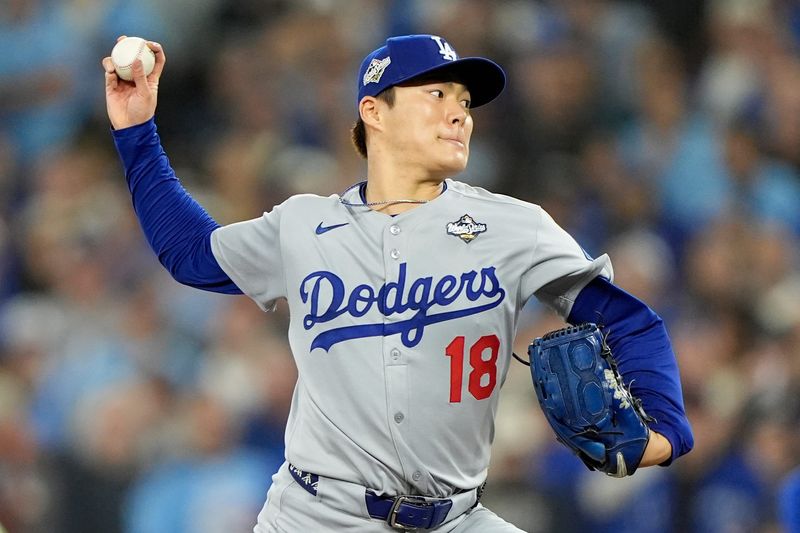
    The Phillies tried hard to sign Yoshinobu Yamamoto as a free agent out of Japan two years ago.

    But the Phillies have never signed a player out of Japan to a major league contract.

    And Yamamoto wasn’t interested in being the first.

    It’s a common sentiment. When Shohei Ohtani was courted by teams in 2017, he famously told MLB.com that he wanted to snap a selfie with the Rocky statue but didn’t want to play here. Last year, right-handed phenom Roki Sasaki wouldn’t even meet with the Phillies, a snub that owner John Middleton described as “hugely disappointing.”

    And with a trio of Japanese stars available this offseason — right-hander Tatsuya Imai entered the posting system this week, joining slugging infielders Munetaka Murakami and Kazuma Okamoto — the Phillies are at a disadvantage relative to teams that have been active in Japan over the years, notably the Dodgers but also the Mets, Yankees, Cubs, Mariners, and Red Sox.

    “Well, you still compete,” Phillies president of baseball operations Dave Dombrowski said. “Sometimes there’s a little bit more of an obstacle we’re facing. Maybe [Philly] is not the No. 1 place, first and foremost. But you don’t give in to that. You try to create an atmosphere that people want to join, and you’re hopeful that at some time it works out for you.“

    Dombrowski maintains that the Phillies have made inroads, even though it’s difficult to see. They employ two full-time scouts in Japan now after years with one or none. Otsuka, the son of former major league pitcher Akinori Otsuka, is based near Tokyo; Koji Takahashi, hired away from the Twins, lives 300 miles to the southwest in Osaka.

    With Otsuka and Takahashi building connections on the ground, at the amateur level and especially within Nippon Professional Baseball, the Phillies believe they’re better positioned to attract players.

    But when?

    “I feel like it’s going to happen sooner or later for the Phillies,” Otsuka said. “Timing-wise, it just hasn’t happened yet. We’re very close, I would say.”
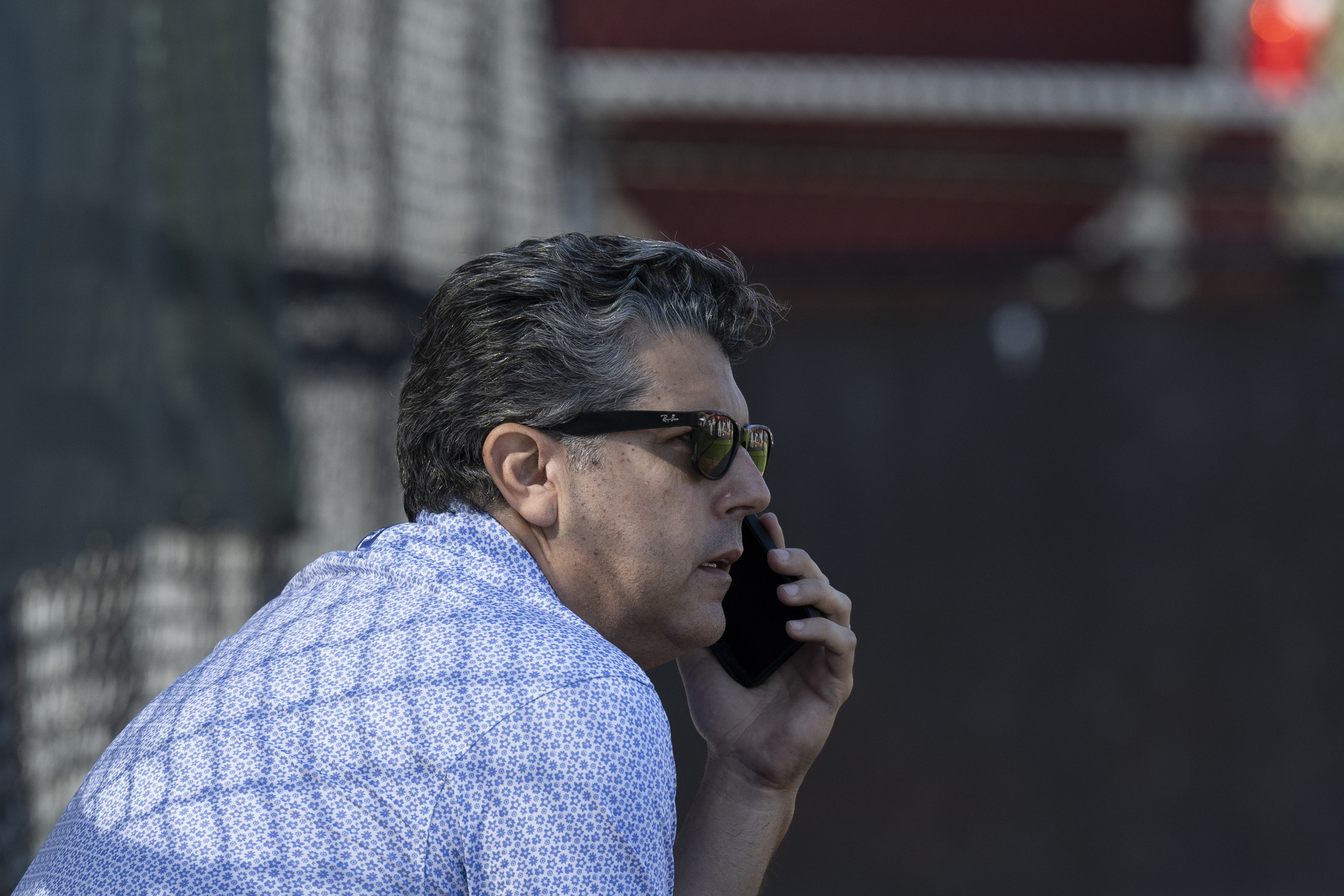
    Assistant general manager Jorge Velandia heads up the Phillies’ international scouting efforts, including in Japan.

    Playing catch up

    It all started with “Nomomania.”

    Hideo Nomo signed with the Dodgers in 1995, bringing a distinctive pitching style that translated into major league success. Since then, 72 players have gone from NPB to MLB, with seven teams (Mets, Dodgers, Mariners, Red Sox, Cubs, Yankees, and Rangers) accounting for more than half those deals.

    Conversely, the Phillies, Rockies, Astros, and Marlins have been shut out. (Second baseman Tadahito Iguchi and outfielder So Taguchi played for the Phillies. But Iguchi was traded over from the White Sox in 2007, and Taguchi signed as a free agent a few months later after six seasons with the Cardinals.)

    The Phillies fell behind other teams in scouting Japan. After getting hired in December 2020, Dombrowski felt that he lacked adequate information about available Japanese players. He appointed Velandia to lead international scouting, with a directive to “build a better infrastructure in how we approach the Far East.”

    Velandia tasked scouting director Derrick Chung with interviewing talent evaluators. Chung, who joined the Phillies in 2017 as an interpreter for South Korean outfielder Hyun Soo Kim before moving into scouting, recommended Takahashi.

    Otsuka was clinging to hopes of playing professionally in Japan when Chung met him at a tryout for an independent league team. A former outfielder for the University of San Diego, Otsuka impressed Chung with his knowledge of the game and fluency in both Japanese and English.

    After a formal interview process, the Phillies hired Otsuka, now 27, as a full-time scout.
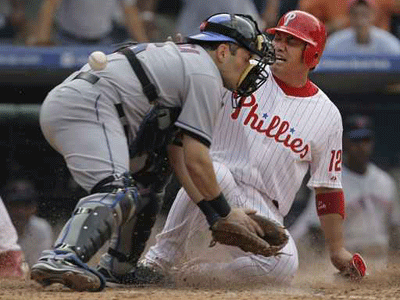
    Tadahito Iguchi became the Phillies’ first player from Japan after being acquired from the White Sox in a 2007 trade.

    Velandia and Chung each make two or three trips per year to Japan. The Phillies send their special assignment scouts, too. Otsuka said this was a “very busy year, with scouts coming in and out” to watch Imai, Murakami, and others in “a very, very solid class of guys.”

    “The stuff we were doing three years ago and now, I’d say we have gotten better just understanding more about the market,” Otsuka said. “We’re more dialed in now compared to maybe before. We send scouts all the time to come to Japan. Just the process of everything has gotten smoother and smoother as the years have gone by.”

    Otsuka claims that the Phillies’ brand recognition has improved in Japan, too. Amid four consecutive playoff appearances, and with popular stars such as Harper and Kyle Schwarber, the Phillies are often featured on television in Japan.

    They aren’t the Dodgers, of course. For 30 years, from Nomo through pitchers Kazuhisa Ishii, Takashi Saito, Hiroki Kuroda, Yu Darvish, and Kenta Maeda, Japanese baseball culture has extended to Los Angeles. And after signing Ohtani, Yamamoto, and Sasaki in the last two years, the Dodgers might as well be Japan’s national team.

    The connection extends to the players. Yamamoto cited a desire to play with Ohtani as a reason for choosing the Dodgers’ $325 million over similar offers from the Mets, Yankees, and Phillies. Sasaki made no secret that he wanted to be alongside Ohtani and Yamamoto.

    And social media was buzzing this week over a photo of Murakami, who holds Japan’s single-season record with 56 home runs, dining with Yamamoto.

    “There is the difficulty of we have not had a player straight from Japan,” Otsuka said. “Players do talk with each other, saying what is a good organization, what is not a good organization. It would be nice to have one player be signed from Japan who plays in the big leagues to have more viewership from the Japan side for the Phillies.”

    For a brief time last winter, Otsuka thought he might have found that player.
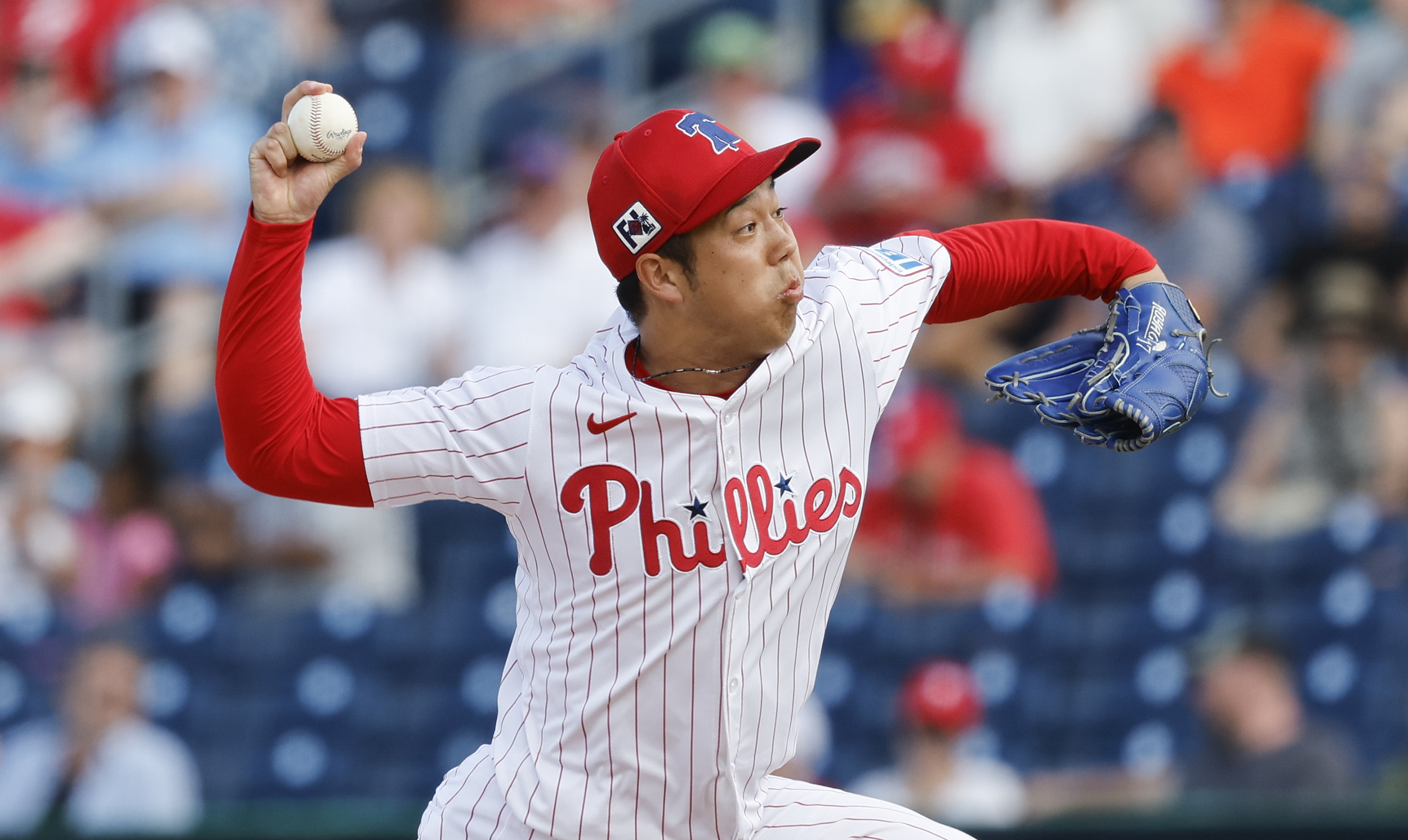
    The Phillies signed Japanese reliever Koyo Aoyagi to a minor league contract last winter but released him in July after he struggled in triple A.

    Chicken-or-egg situation

    Koyo Aoyagi was a three-time all-star in nine NPB seasons. He won a gold medal in the 2020 Olympics. Three years later, he started Game 7 of the Japan Series and spun 4⅔ scoreless innings for the champion Hanshin Tigers.

    But his dream was to play in the majors.

    At 31, coming off a 2024 season that he said didn’t meet his standards, Aoyagi signed a minor-league contract with the Phillies. The side-arming reliever attended major league camp but agreed to go to triple A.

    Upon arriving in spring training — his first visit to the United States — Aoyagi said through an interpreter that he “wasn’t too aware” of the Phillies’ inability to break through in Japan. But he also acknowledged that “me pitching on the big-league mound will definitely bring some attention to the Phillies that would be able to recruit Japanese players more.”

    It was a low-risk, high-reward union of player and team.

    And it didn’t work out.

    Aoyagi struggled to throw strikes all spring, and it carried into the season. He had a 7.45 ERA with 23 walks in 19⅓ innings in triple A. After getting demoted to double A, he posted a 6.91 ERA and 15 walks in 14⅓ innings. The Phillies released him in July.

    But Otsuka, who recommended that the Phillies take a flier on Aoyagi, stands by the team’s process. He also believes in what Aoyagi represented.

    “Even though he didn’t make it to the big leagues, just him being on the team [in spring training], that still brought some attention in Japan,” Otsuka said. “I see a lot more Phillies hats walking around town. That’s all I can say. And I hear a lot of people talking about the Phillies just being a really good, strong team.”
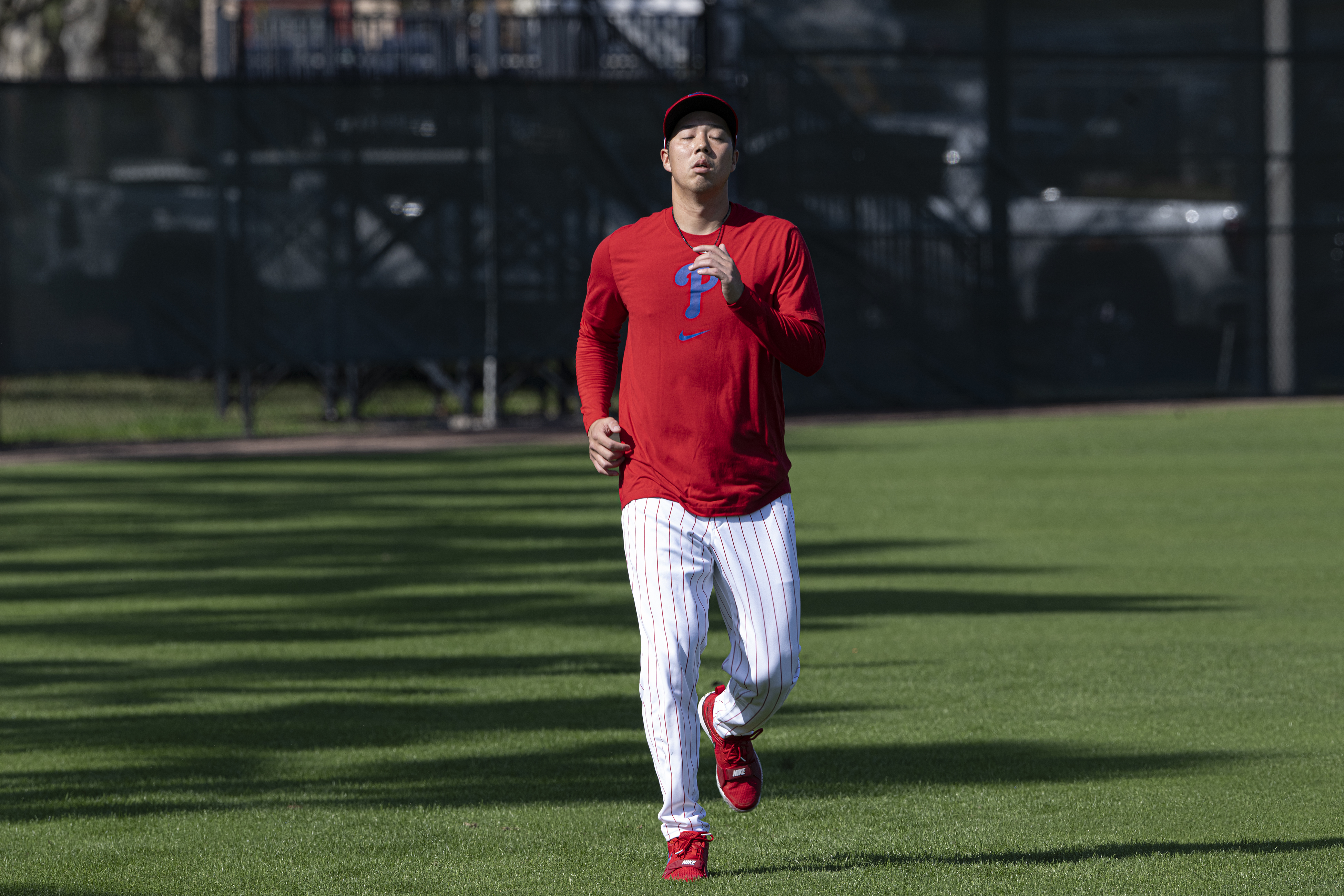
    Japanese reliever Koyo Aoyagi pitched in the minors for the Phillies last season before getting released.

    Maybe. But the Aoyagi experience re-raised a chicken-or-egg conundrum: Do the Phillies have to gain more traction in Japan in order to attract an impact player? Or must they sign a Japanese player to a major league contract in order to really penetrate the Far East market?

    “I really can’t honestly answer that,“ Dombrowski said. ”Because I don’t know.”

    The answer might not be found in this year’s class.

    Murakami, 26, has prodigious left-handed power but also strikes out a lot and is a poor defender at third base. Okamoto, 30, is a right-handed hitter with less upside than Murakami who also profiles best at first base.

    Imai, 28, draws intriguing comparisons to Yamamoto. The Phillies aren’t prioritizing the rotation. But that was the case in each of the last two offseasons, and they made a mega offer to Yamamoto and discussed trading for Garrett Crochet before acquiring Jesús Luzardo.

    “When most teams talk to me about Imai, they say, ‘Oh my,’” agent Scott Boras said at the recent GM meetings. “He’s that kind of guy. … He loves big markets. We go through a list of places he may want to play, and, believe me, he is someone who wants to be on a winning team and compete at the highest level.”

    But whether it’s now or in the future, the Phillies’ biggest challenge in mining talent from Japan is selling players on Philadelphia.

    Velandia said the pitch highlights the city’s restaurants, doctors, and other resources that would make a Japanese player feel comfortable. Otsuka likes to emphasize the area’s golf courses, such as Pine Valley and Merion East.

    The fact is, though, Philadelphia has a smaller Japanese population than many other major league cities. As one team official said, it makes sense that a Japanese player coming to the U.S. would be drawn to L.A. or New York, just as an American soccer player going to Spain would focus on Barcelona or Madrid.

    “We just spit out all the good things about Philly,” Otsuka said. “We give the most information about Philadelphia, where it is as a city, what it’s like to play for the Phillies. It’s not like the worst sell ever. It has its difficulties, but it’s good. We can make it work.”

    It might take a trail blazer, a player who wants to forge his own path. Otsuka intends to find him.

    “That’s actually one of those selling points, that you could be ‘The Guy,’” Otsuka said. “You can be the first. When they think about Phillie Japanese players, you could be that player. Definitely the right player’s out there, the player that we want to go after.

    “When the time’s right, it’s going to happen. It’s just a matter of time. We have the right processes. We’re doing everything possible now. I think we have all the necessary resources now to actually make it happen. I’m not frustrated about it. I’m just patiently waiting.”

  • Philly has had a ‘soda tax’ since 2017. One lawmaker wants the city to consider repealing it.

    Philly has had a ‘soda tax’ since 2017. One lawmaker wants the city to consider repealing it.

    City Councilmember Jimmy Harrity wants to revisit the contentious debate that led to the 2017 creation of Philadelphia’s sweetened beverage tax, arguing that the levy has cost the city jobs and will eventually prove insufficient to pay for the programs it was enacted to support, such as subsidized prekindergarten.

    “We‘re going to keep on pulling more money out of the general fund each year, taking away from other programs,” Harrity, a Democrat, said Monday at a hearing of Council’s Labor and Civil Service Committee, which he chairs. “If we were in business and these numbers were the numbers of the business, we wouldn’t be in business long.”

    The tax, which is paid by distributors of sweetened beverages sold in Philadelphia, is 1.5 cents per ounce. Council approved it in 2016 despite vociferous opposition from the beverage industry and Teamsters Local 830, which testified Monday the tax has led to 1,000 of its members who drove trucks for distributors losing work.

    Harrity, an ally of the Teamsters, noted that revenue from the tax has declined as Philadelphians either drink fewer sweetened beverages or find ways to purchase them outside the city. The tax produced about $73.4 million in the 2023 fiscal year, but only $64.4 million last year, he said.

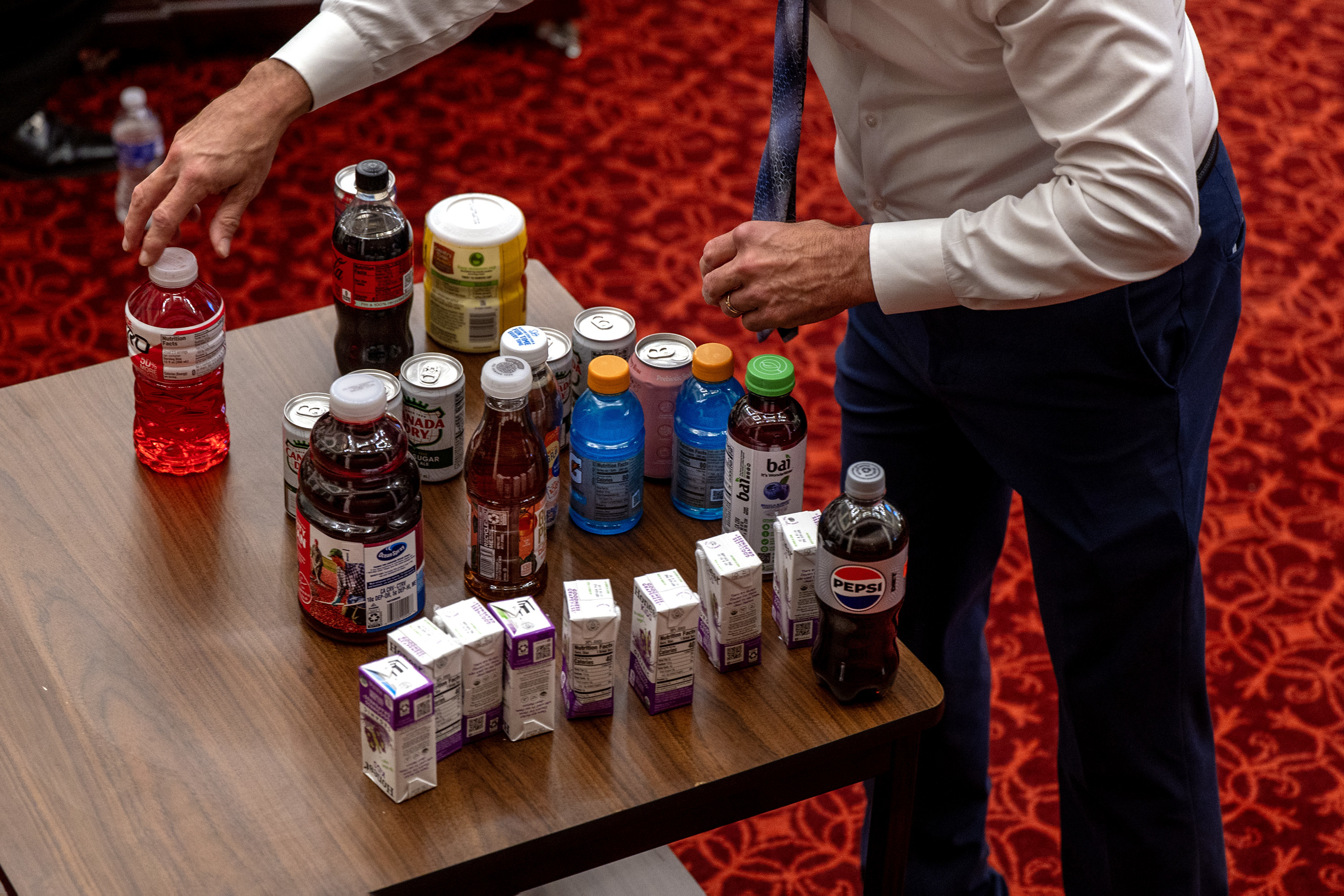
    A Council staffer arranges a table of sugary drinks before Councilmember Jimmy Harrity (not shown) holds a hearing in City Council Monday, Oct. 27, 2025 on former Mayor Jim Kenney’s tax on sweetened beverages.

    For Harrity, that means that the city should consider eliminating the “soda tax,” as it is widely known, in favor of a more “sustainable” funding stream. He did not offer any alternatives.

    But based on his colleagues’ reactions, it is unlikely the tax will be reconsidered in a serious way any time soon.

    Several Council members, public health advocates, and childcare industry representatives defended the tax, which was championed by former Mayor Jim Kenney. They noted that research by the University of Pennsylvania indicates it has been a public health success story that has helped to keep down obesity rates.

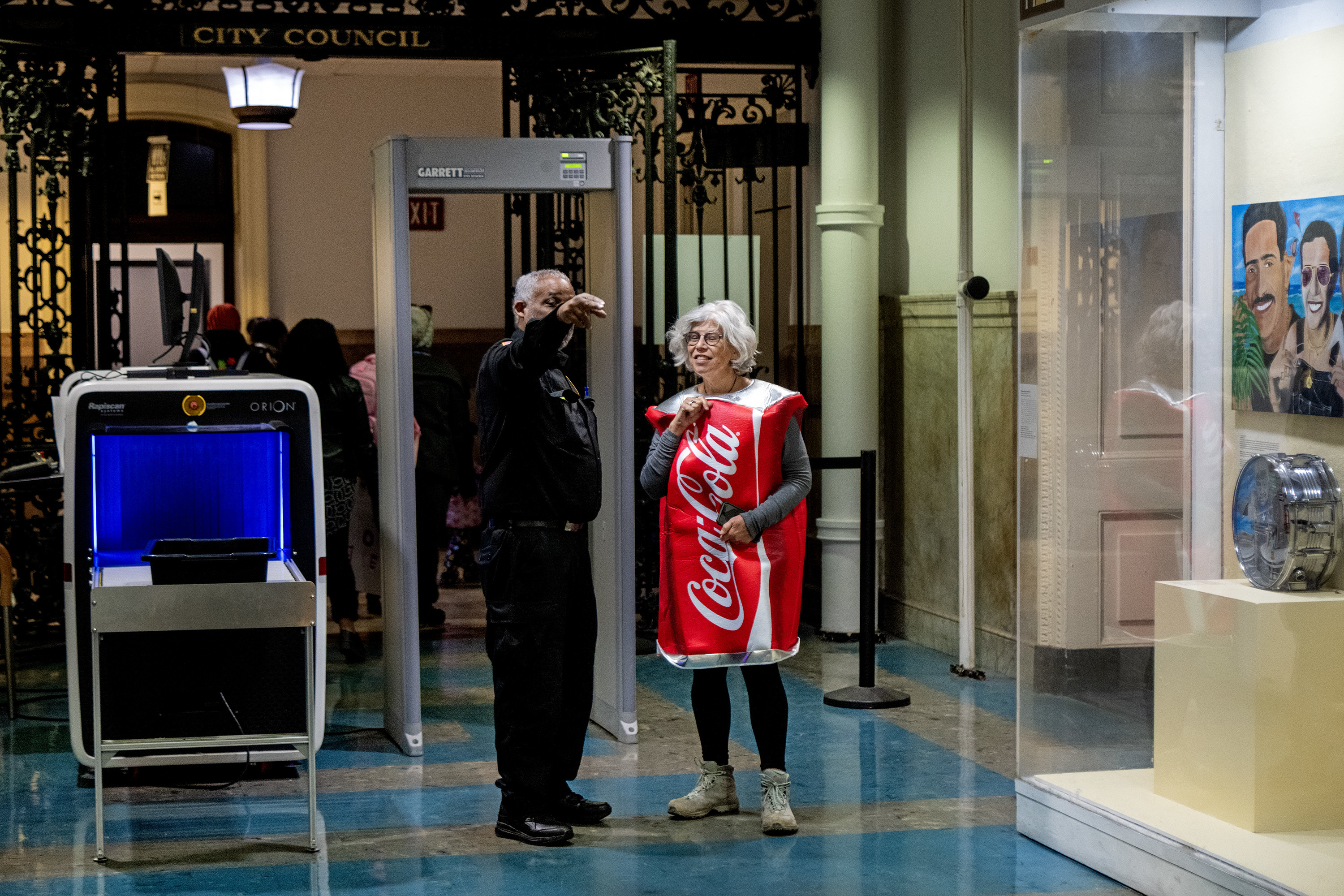
    Marcy Boroff with Children First dresses as a coke can for a City Council hearing Monday, Oct. 27, 2025 on former Mayor Jim Kenney’s tax on sweetened beverages. She was there to support the tax. Children First advocates for policy changes to improve child health, education, and welfare, especially for low-income children. .

    And they stressed its critical role in paying for the three initiatives that Kenney launched alongside the tax: PHL Pre-K, which provides free childcare to 5,250 kids; community schools, which offer a multitude of services to families in 20 Philly schools; and the Rebuild program, which renovates and improves recreation centers and playgrounds.

    “We have to make tough decisions that will actually benefit the greater good, and that’s what we did here,” Democratic Councilmember Rue Landau said during the hearing, adding that “the majority of us up here on this panel think this is a great investment.”

    ‘What we always intended’

    Mayor Cherelle L. Parker, a Democrat who voted for the tax as a Council member, also remains supportive of it.

    “We would not have been able to fund these programs without that beverage tax money,” said city Finance Director Rob Dubow, who has held his role under Parker, Kenney, and former Mayor Michael A. Nutter. Nutter twice tried unsuccessfully to implement a “soda tax” before Kenney succeeded.

    Dubow told lawmakers that the decline in the tax’s revenue over time was always part of the plan and that city leaders intended for the regular city budget to make up the difference for funding Rebuild, pre-K, and community schools when they created the tax. The moment when the soda tax began taking in less money than the city pays out for the three programs it helped launch was the 2024 fiscal year, he said.

    “We pay for it out of the general fund, which is what we always intended we would do,” Dubow said.

    This year, Rebuild, pre-K, and community schools are projected to cost $110 million, Dubow said. Of that, $73 million pays for the 5,250 slots in the city’s pre-K program.

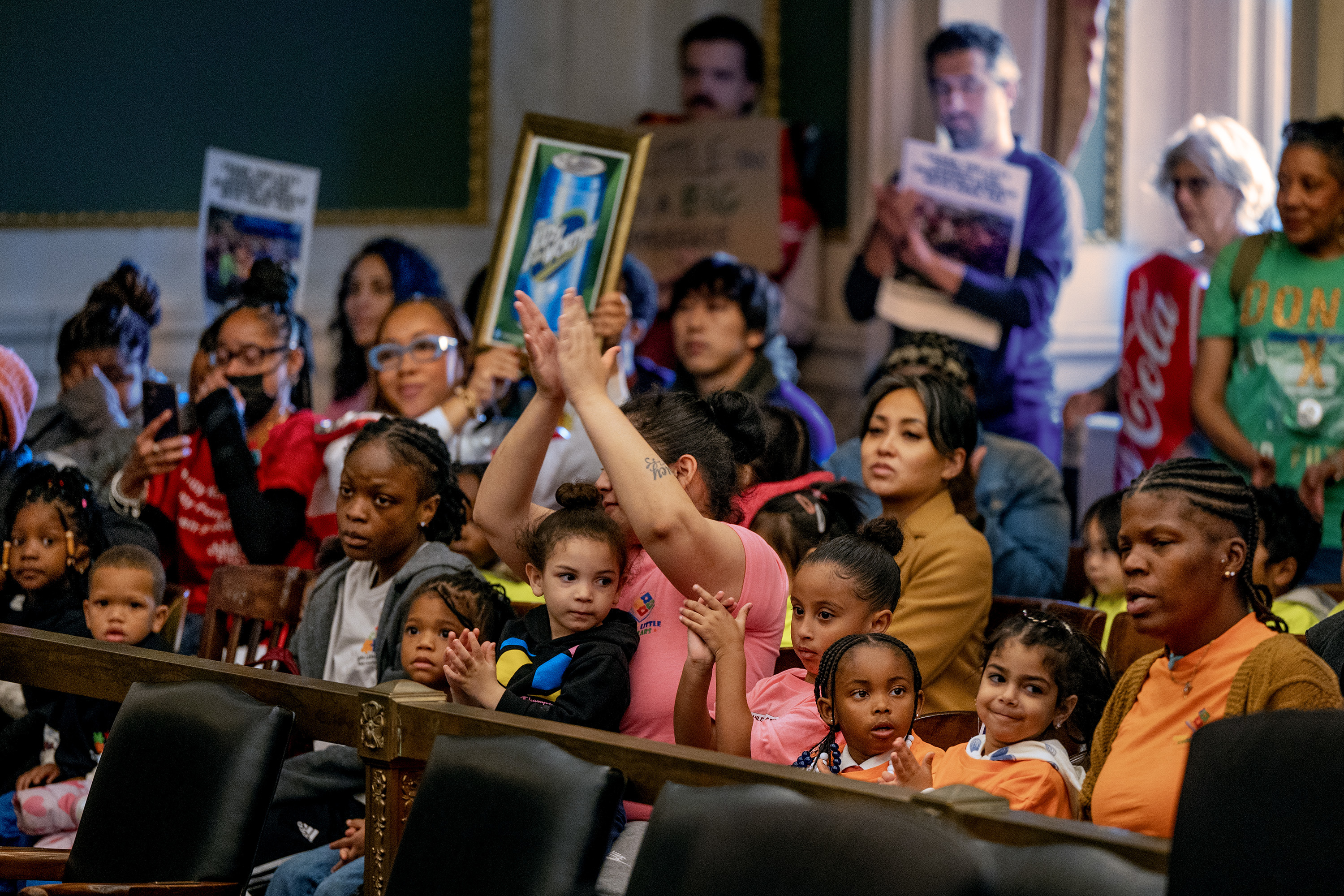
    Preschoolers and their caregivers attend a City Council hearing held by Councilmember Jimmy Harrity Monday, Oct. 27, 2025 on former Mayor Jim Kenney’s tax on sweetened beverages. The tax funds the city’s universal pre-kindergarten program

    ‘Why not Taj Mahals?’

    Councilmember Brian O’Neill was the only other Council member besides Harrity to vocally criticize the tax at Monday’s hearing.

    O’Neill, Council’s lone Republican, noted that Council members have traditionally had control over capital funding for Philadelphia Parks and Recreation projects in their districts. That money, he noted, is split evenly among the 10 district Council members.

    Rebuild, he lamented, instead gives the power to decide which projects move forward to the mayor’s administration. Consequently, he said, the program has produced uneven results and overbudget and unnecessarily ambitious playground and recreation center renovations.

    “This program — Rebuild, they call it — they didn’t decide to bring playgrounds up to some minimum level where people over the years may not have spent their money well,” O’Neill said. “They decided to build Taj Mahals in many cases. … You know what happens when you build a playground and spend tons of money on it? … All the playgrounds around it look terrible.“

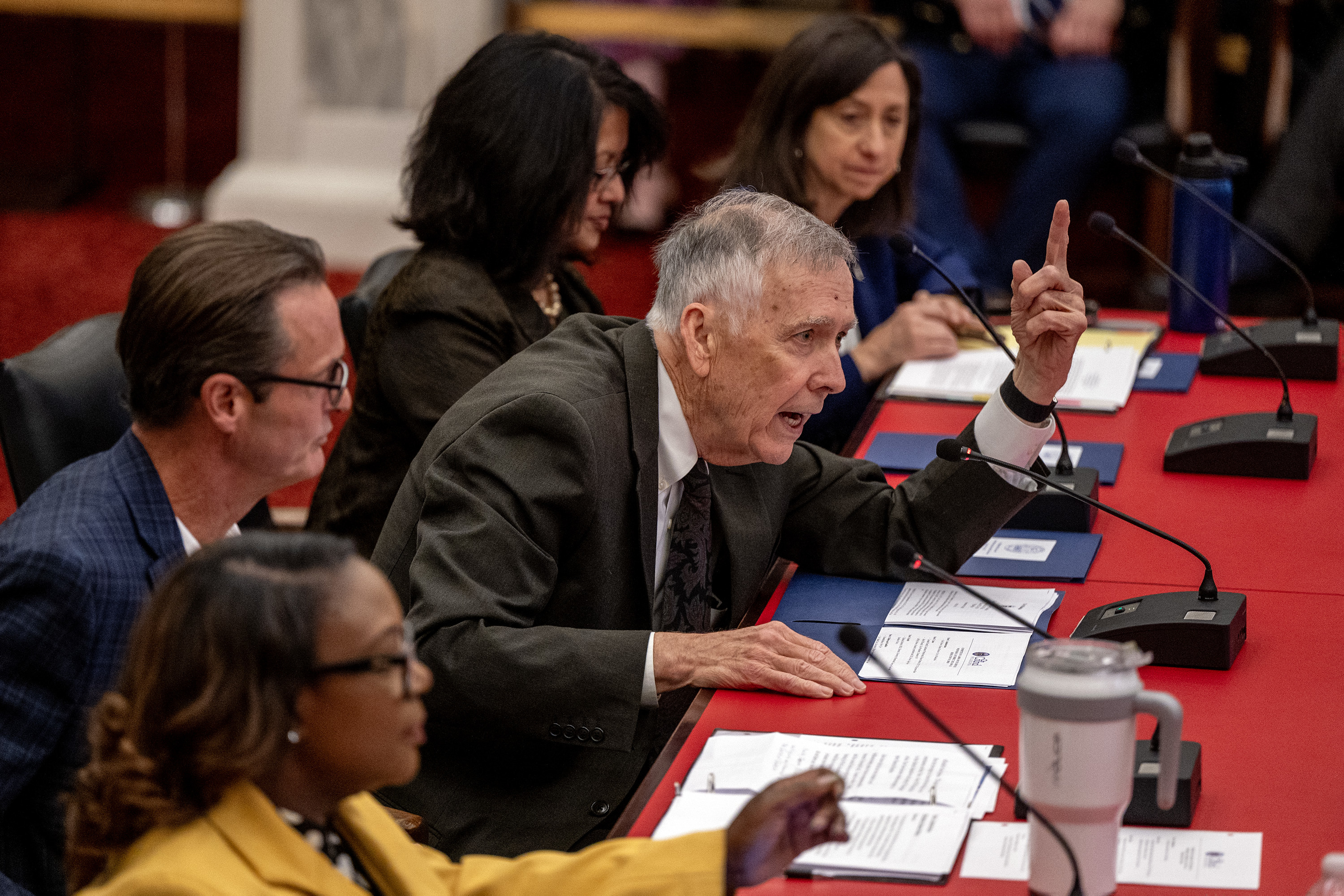
    Councilmember Brian J. O’Neill (center) speaks during a hearing in City Council Monday, Oct. 27, 2025 on former Mayor Jim Kenney’s tax on sweetened beverages. Behind him, front to rear, are: Councilmembers Kendra Brooks, Jimmy Harrity, Nina Ahmad, and Rue Landau.

    That comment did not go over well with some of his colleagues.

    “My community benefited from a rec center that was through the Rebuild program,” said Councilmember Kendra Brooks, a member of the progressive Working Families Party who lives in Nicetown. “It’s not a Taj Mahal. It’s a quality rec center in the middle of North Philadelphia. It does not have everything, because I personally went and bought a refrigerator.”

    And Councilmember Nina Ahmad, a Democrat, questioned why building grandiose rec centers would be a problem in the first place.

    “Why not Taj Mahals for all our folks? Why not have the best-quality rec centers so our children want to go there, our children want to spend time there?” Ahmad said. “We live in a first-world country and yet we are begging for scraps for our youngest citizens.”

  • Billions of gallons of raw sewage from Philly are released into the Delaware annually

    Billions of gallons of raw sewage from Philly are released into the Delaware annually

    Philadelphia discharges 12.7 billion gallons of raw, diluted sewage into the Delaware River’s watershed each year, with Camden County adding to the mix, according to a new report.

    That’s a problem, say the report’s authors at the nonprofit advocacy group PennEnvironment. Philadelphia and Camden border the river, and significant recreational potential is blocked for part of the year because of pollution from both, the authors say.

    A waterway can remain unsafe for recreation for up to 72 hours after an overflow. That suggests local waterways could be unsafe for recreation up to 195 days per year, or more than half the year.

    Five decades after the Clean Water Act mandated that waterways be made safe for swimming and fishing, combined sewer overflows (CSOs) continue to pollute during wet weather when untreated sewage and runoff surge into nearby creeks and rivers, creating the potential to sicken recreational users.

    David Masur, executive director of PennEnvironment, said the group included Camden County in its most recent report “to get a more holistic view.” PennEnvironment’s first report on CSOs in 2023 focused only on Philly.

    The pollution “affects the waterway, the environment, and public health,” Masur said. “The river is the border between the two states, and people on both sides use it a lot.”

    PennEnvironment acknowledges that both Philly and Camden County have programs to reduce overflows and is calling on federal officials for increased funding to put proper infrastructure into place.

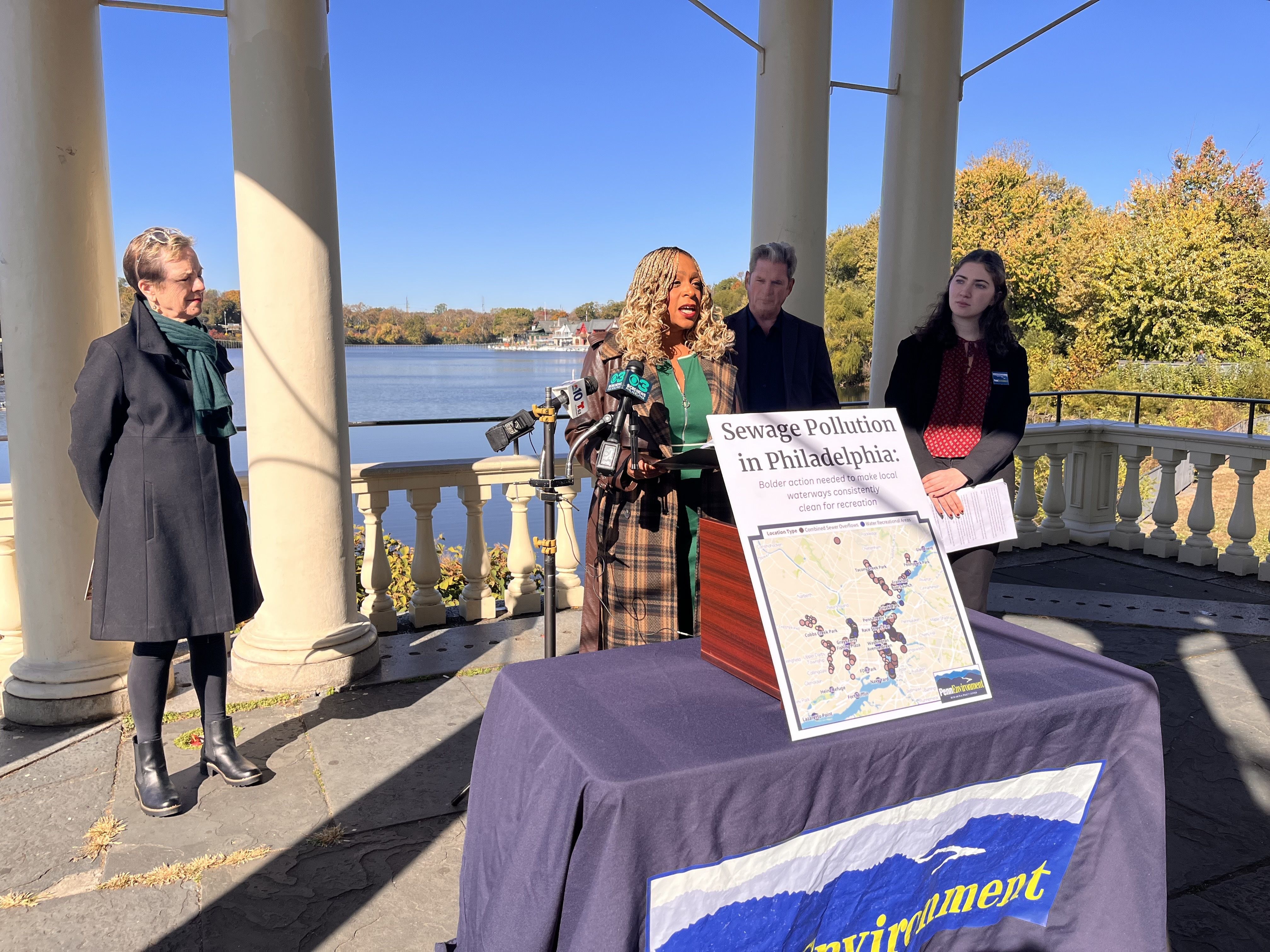
    Philadelphia Council member Jamie Gauthier (center) spoke Monday about PennEnvironment’s report on pollution from combined sewer overflows. To her left is Margaret Meigs, president, Friends of the Schuylkill Navy. And to her right is Tim Dillingham, senior adviser, American Littoral Society, and Hanna Felber, clean water associate at PennEnvironment Research & Policy Center.

    Frequent overflows, high volume in Philly

    Roughly 60% of Philadelphia is served by a combined sewer system, which has 164 outfalls — really large metal or concrete openings — that discharge pollution into waterways. A CSO system uses a single pipe to collect and transport sewage from homes and businesses as well as stormwater runoff from streets and sidewalks.

    During dry weather, the system can handle the volume before safely releasing it back into the rivers. But during heavy rainfall, the system discharges untreated, though highly diluted, sewage mixed with stormwater directly into waterways.

    Despite the Philadelphia Water Department’s ongoing Green City, Clean Waters project — a 25-year plan focusing on green infrastructure to reduce overflows — the frequency and volume remain alarmingly high, the report states.

    Overall, CSOs dumped an average of 12.7 billion gallons of raw sewage mixed with polluted stormwater per year into local waterways from 2016 to 2024, the authors of the report stated. They included an online map to show the location of the outfalls and annual overflow.

    Half the sewage came from just 10 CSOs.

    window.addEventListener(“message”,function(a){if(void 0!==a.data[“datawrapper-height”]){var e=document.querySelectorAll(“iframe”);for(var t in a.data[“datawrapper-height”])for(var r,i=0;r=e[i];i++)if(r.contentWindow===a.source){var d=a.data[“datawrapper-height”][t]+”px”;r.style.height=d}}});

    Still, the numbers are a slight improvement over the 15 billion gallons a year released into local rivers, as PennEnvironment reported in 2023.

    Philadelphia gets its drinking water from the rivers, but the CSOs are downstream of the city’s treatment plants on the Delaware and the Schuylkill.

    The report used publicly available data to show that five of six waterways in Philly produced at least one overflow 65 times or more per year on average between 2016 and 2024. Those were the Delaware River, the Schuylkill, and Cobbs, Frankford and Tacony Creeks.

    In better news: The average volume of overflow per inch of precipitation declined by about 16% from previous periods, but progress is slow and threatened by increased rainfall and rising sea levels due to climate change, the authors say.

    PWD could not be reached for comment.

    window.addEventListener(“message”,function(a){if(void 0!==a.data[“datawrapper-height”]){var e=document.querySelectorAll(“iframe”);for(var t in a.data[“datawrapper-height”])for(var r,i=0;r=e[i];i++)if(r.contentWindow===a.source){var d=a.data[“datawrapper-height”][t]+”px”;r.style.height=d}}});

    Camden County

    The report also found persistent overflows in Camden County. The cities of Camden and Gloucester, along with the Camden County Municipal Utilities Authority (CCMUA), operate combined sewer systems that frequently overflow into the Delaware River and its tributaries, including the Cooper River and Newton Creek.

    The report found that systems on the Camden County side of the river overflowed into local waterways an average of 76 days per year from 2016 to 2024.

    window.addEventListener(“message”,function(a){if(void 0!==a.data[“datawrapper-height”]){var e=document.querySelectorAll(“iframe”);for(var t in a.data[“datawrapper-height”])for(var r,i=0;r=e[i];i++)if(r.contentWindow===a.source){var d=a.data[“datawrapper-height”][t]+”px”;r.style.height=d}}});

    The highest-frequency outfall for the Cooper River released sewage for an average of 118 days annually during that period.

    The Delaware River received sewage overflows for an average of 94 days annually from its highest-frequency outfall.

    The authors said gaps in data leave them unable to show the total volume of diluted sewage released from Camden. But they said that the amount of “solids/floatables” collected at each outfall is an indicator a waterway is polluted.

    Dan Keashen, a spokesperson for Camden County, said officials have been making strides.

    He said that crews recently cleaned 30 miles of pipe and that a $26 million project is underway to physically separate the combined sewer service area of Pennsauken that flows into Camden. Officials are also studying how to better achieve compliance for the largest outfall in the system, a project estimated to cost $40 million to $150 million when complete.

    What can be done?

    The report concludes that current plans by Philadelphia and Camden County are insufficient to achieve the goal of a clean Delaware River watershed.

    The report was written by John Rumpler, clean water director for Environment America, PennEnvironment’s parent organization, and Elizabeth Ridlington, associate director of the Frontier Group, a nonprofit research group that is part of the Public Interest Network, an environmental advocacy organization.

    The authors call for officials to accelerate action to end all sewer overflows, set a hard deadline, and find new ways to pay for necessary infrastructure upgrades.

    Philadelphia Councilmember Jamie Gauthier, chair of the committee on the environment, called overflows “a public health crisis” and urged PWD’s new commissioner, Benjamin Jewell, to act. She said elected officials in Harrisburg and Washington also need to step up.

    PWD is separately under pressure by a new Environmental Protection Agency regulation that seeks to improve the amount of dissolved oxygen in the Delaware by ordering a large-scale reduction of ammonia at the city’s three water pollution control plants. PWD estimates that the price for compliance is $3.6 billion and would cost households an additional $265 annually on their water bills.

    The authors of the PennEnvironment report concede the CSO task is daunting. But they say Portland and Boston faced similar situations, invested in infrastructure, and managed to make CSO overflows infrequent. Washington, D.C., they said, is on track to reduce sewage overflows by 96% in 2030.

    Hanna Felber, a PennEnvironment advocate, said that PWD needs to use creative funding, such as floating longer-term bonds to finance projects, and that its engineers need to find more creative solutions, such as installing larger stormwater tunnels that flow separately from sewage.

    “Unfortunately, our new report on sewage pollution in Philadelphia shows that on far too many days each year, the Philadelphia Water Department’s pipes and sewer systems dump huge volumes of raw sewage into our beautiful waters, harming our environment and depriving the public of a safe place to fish, boat, and float,” Felber said.

  • A former Philly probation officer and an ex-cop ran an illegal gambling operation together, feds say

    A former Philly probation officer and an ex-cop ran an illegal gambling operation together, feds say

    A former Philadelphia probation officer and a former city police officer have been charged with illegally connecting bettors to an overseas sports gambling website that allowed them to place hundreds of thousands of dollars in bets over nearly a decade, according to federal authorities.

    Joseph Moore and James P. DeAngelo Jr. each face one count of conducting an illegal gambling business, court records show. Moore, the former probation officer, pleaded guilty in federal court Monday.

    DeAngelo, the former police officer, is scheduled to appear in court later this week and has been charged by information, which typically indicates that a defendant intends to plead guilty.

    Prosecutors said in charging documents that Moore ran the scheme from 2017 to 2025 — operating “block pools” based on NFL or NCAA basketball games, or helping bettors place ordinary wagers on different sporting events. He would sometimes send mass emails to hundreds of bettors advertising pools he was running, the documents said, with entry fees of a few hundred dollars and payouts in the thousands for winners.

    Moore often collected 10% of the winners’ earnings as a “tip,” prosecutors said, and he sometimes allowed bettors to place wagers on credit even if they had incurred multiple losses.

    He conducted some of his business from his probation office, the documents said, and saved records from the operation on his work computer. At one point, prosecutors said, he recruited another probation officer to help collect and transfer money from bettors using peer-to-peer apps such as Venmo and Cash App.

    DeAngelo, meanwhile, helped maintain the operation’s access to the overseas gambling site, prosecutors said, and he sometimes accepted wagers from individual bettors.

    Prosecutors did not specify whether the investigation led either man to lose his job. But in charging documents, prosecutors said Moore ran the operation until February 2025, and Martin O’Rourke, a spokesperson for the First Judicial District, said Monday that Moore resigned from the probation department that month.

    A police spokesperson did not immediately respond to a request for comment Monday, and DeAngelo did not have an attorney listed in court records.

    The case was unsealed Monday, just days after federal prosecutors in New York unveiled two sweeping indictments charging several NBA figures with participating in illegal gambling schemes, one of which involved a player allegedly providing inside information to bettors about specific games.

    The fallout from that scandal has come quickly, with some commentators questioning whether sports leagues have grown too close to the betting industry, and Congress requesting a briefing from the NBA’s commissioner, Adam Silver.

  • For Eagles, the bye week ‘sets you up for some things for the rest of the season,’ Nick Sirianni says

    For Eagles, the bye week ‘sets you up for some things for the rest of the season,’ Nick Sirianni says

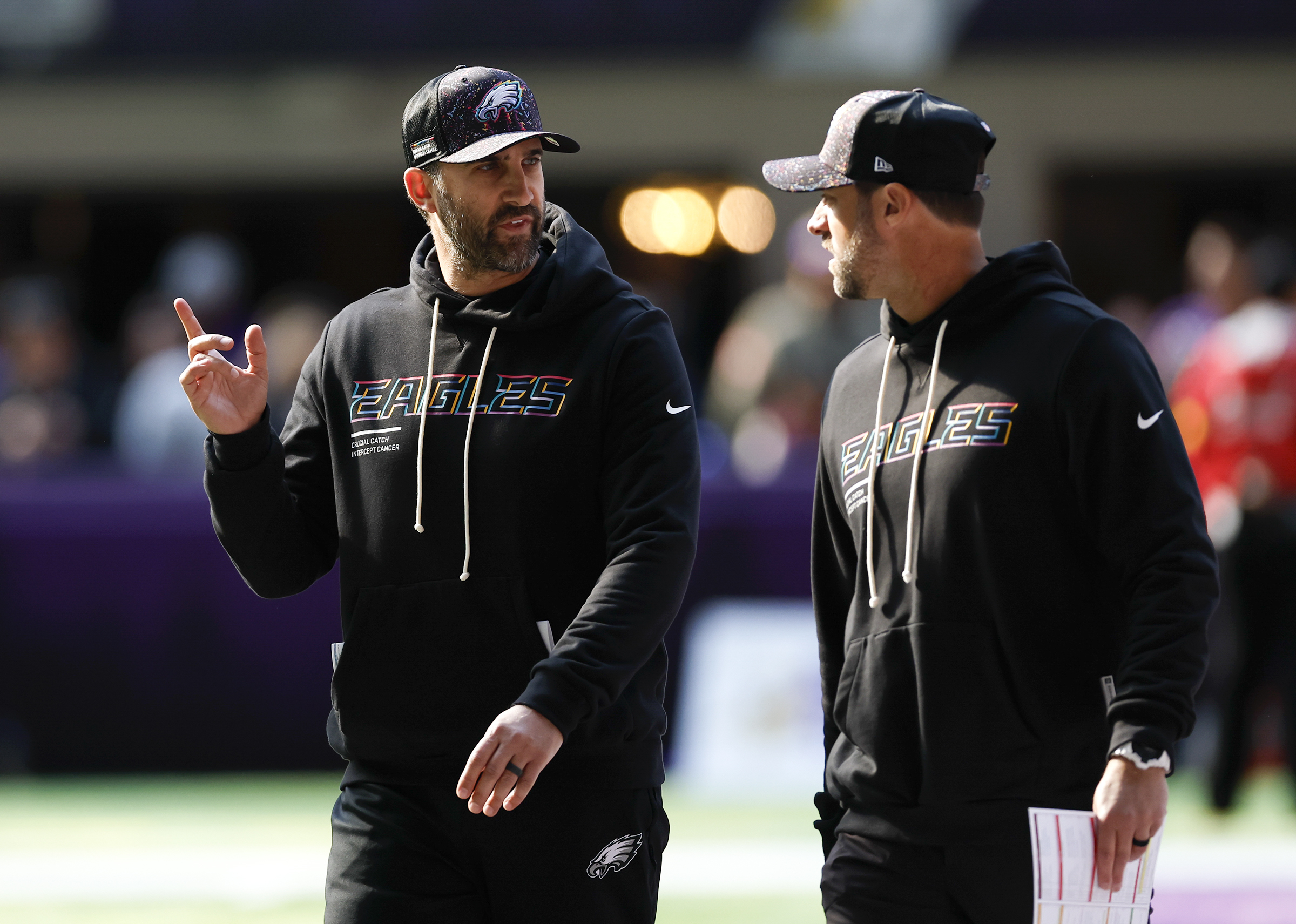
    Bye weeks have come in all shapes and sizes during Nick Sirianni’s five seasons leading the Eagles.

    In 2021, the Eagles waited until December and Week 14 for their week off. In 2022, the bye came in Week 7. In 2023, it was Week 10. And in 2024, the Eagles had the first bye of the season in Week 5 on the heels of their long travel to Brazil for Week 1.

    Is Week 9, basically the midway point of a 17-game regular season, the perfect time?

    “I don’t think you can ever really say, ‘Hey, this is the perfect time for a bye,’” Sirianni said Monday, a day after his Eagles beat the New York Giants, 38-20, to hit the bye week with a 6-2 record. “Last year, in 2024, Week 4 was our perfect time for the bye. Our mindset will be, this year, this is the perfect time for a bye. And when we play a Friday afternoon game coming up [Nov. 28 vs. Chicago], that will be the perfect time for a Friday afternoon game.

    “You handle every situation and control what you can control.”

    The constant through four bye weeks under Sirianni has been winning after the lull. The Eagles are 4-0 after the bye during Sirianni’s tenure. Last week in Minnesota, they improved to 10-3 over the last five seasons in games that come at least 10 days after their previous contests (including playoff games).

    Extending that 4-0 streak and improving upon that 10-3 extended rest record will be a difficult task for the Eagles, who come off the bye for a Week 10 Monday night game at Green Bay, which leads the NFC with a .786 winning percentage. After that is a home game on a shorter week against the 5-2 Detroit Lions.

    The bye comes just two weeks after the Eagles had a productive mini-bye following their Week 6 loss to the Giants. It was a second consecutive defeat and one that dropped the Eagles to 4-2. But the Eagles have emerged from that week with consecutive victories and won a lopsided affair Sunday. Is the state of the union different now compared to how Sirianni felt two Fridays ago? If it is, Sirianni wouldn’t say so.

    “We don’t live week-to-week with results,” he said. “Obviously, we’re paid to win football games and find ways to get better, but we don’t live week-to-week. You work like crazy to get better, you work like crazy to win each football game, but then win, lose, or draw, you’re on to the next and you’re doing the same thing all over again.”

    The message for the coaching staff this week, Sirianni said, is to be “completely locked in and focused on finding ways to get better, identifying issues, identifying strengths, and this is a really important week.

    “We’ve benefited from this week in the past, whether that be going into the playoffs or whether it’s in the regular season,” he said. “It’s that same motivation and that same hunger to do everything that we can do to help improve the football team.”

    For the players, the message is to get some rest, heal up, but remain mentally focused on what’s ahead.

    “This bye week sets you up for some things for the rest of the season,” Sirianni said.

    It certainly did last year, when the Eagles hit the bye with a 2-2 record, made some tweaks, and won 10 consecutive games after the break.

    Patullo’s growth

    Maybe the bye week is coming at a bad time. Who wouldn’t want to keep it rolling after the offense put together arguably its best four-quarter performance under new coordinator Kevin Patullo?

    The Eagles put together a complete effort Sunday and finally found success running the football and passing it during the same game. They schemed up the pin-and-pull blocking game and showed their under-center versatility.

    It has been a bumpy first eight games for Patullo after taking the reins from Kellen Moore. But Sunday — which followed a strong showing with the aerial attack last week — showed the Eagles might be on a better path.

    Coach Nick Sirianni believes offensive coordinator Kevin Patullo is getting better each week.

    “I think he’s done a good job of continuing to get better, just like our players,” Sirianni said of Patullo. “Every team is a new team, so there’s a growth period whether there’s a first-time play caller or not. There’s a growth period within each year for the players, for the coaches, everything. That’s what the first weeks of the season are for, is to find ways to win, find ways to get better, and really be in that continual growth mindset all the way through so you’re playing your best football in November, December, January hopefully.”

    Trade deadline looming

    The trade deadline will have passed the next time the Eagles take the field for a practice. The deadline is Nov. 4 at 4 p.m., and the Eagles aren’t due back at the NovaCare Complex until after that.

    It could be an active deadline period for the Eagles, who have a few positions of need to address. Does not having a game to prepare for ahead of the deadline make life easier for Sirianni when it comes to working closely with Howie Roseman on improvements? The coach said it’s no different.

    “We find time to do the things that are necessary to help the team win, help the team get better,” Sirianni said.

  • Chester County prosecutors still trying to determine motive, identify suspects in Lincoln University shooting

    Chester County prosecutors still trying to determine motive, identify suspects in Lincoln University shooting

    A Wilmington man brought his mother’s gun to Lincoln University’s campus Saturday, prosecutors said, and was still holding the loaded weapon when a deadly shooting tore through the school’s homecoming celebration.

    Zecqueous Morgan-Thompson, 21, has not been charged in connection with the shooting, only with possessing the weapon without a concealed-carry permit. But investigators said they were still working Monday to determine whether his firearm was used in the incident at the historically Black university, which left one person dead and six others wounded.

    Morgan-Thompson remained in custody Monday in lieu of $25,000 bail.

    Chester County District Attorney Chris de Barrena-Sarobe said his office is trying to determine if more than one shooter was involved. Morgan-Thompson was arrested on the campus in the aftermath of the gunfire, holding a loaded Glock 28 .380-caliber handgun, according to the affidavit of probable cause for his arrest.

    The shots rang out about 9:30 p.m. Saturday on the campus in Lower Oxford Township. De Barrena-Sarobe has said he does not believe the shooting was a coordinated attack targeting the school, but instead took place as the crowd swelled on the campus.

    The motive for the shooting remained under investigation.

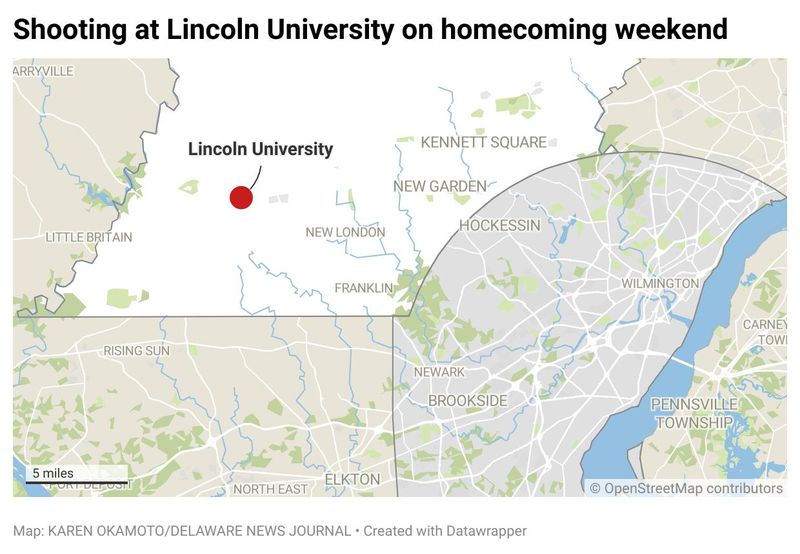
    Gunfire rang out just before 9:30 p.m. Oct. 25 at Lincoln University in the parking lot of the International Cultural Center in Lower Oxford Township in Chester County, Pennsylvania. The university is about 15 miles from Hockessin.

    Jujuan Jeffers, 20, of Wilmington, died after being shot in the head. It was unclear if Jeffers had any affiliation with Lincoln — investigators have said the victims included one alumnus and one current student.

    Jeffers’ brother declined to speak with a reporter when contacted Monday.

    The student who was hurt was recovering well, but obviously shaken, according to Chester County Commissioner Josh Maxwell, who is an adjunct professor at the school. Her injuries, he said, were not life-threatening.

    Lincoln University canceled classes Monday in light of the shooting.

    “Gun violence happens far too often in our country, and we are heartbroken that Lincoln University and its students are among the latest victims of such senseless violence,” the school said in a statement.

    The rural campus was quiet Monday afternoon as students gathered for a vigil that gave members of the university community a chance to grieve and heal.

    The service was not open to the media, and gates at various entrances to Lincoln’s campus were locked.

    Geslande Sanne, a Lincoln University junior from Oregon, was in her dorm Monday morning, still coming to terms with the chaotic scene she experienced Saturday night.

    “A lot of us on campus are processing it in our own different ways,” said Sanne, a political science and French major. “We are all reaching out to each other. Our professors are talking to each other and to us. Some students went home to be with their families. Some people are just resting.”

    She said she intended to attend the university’s community healing session on campus at noon and later go to the hospital to visit her friend, who was the only Lincoln student shot during the incident.

    Sanne recalled that she and a group of friends were on the outskirts of the crowd when they heard gunshots.

    “Everybody started running and we started running, too,” she said. “We were confused. Did something really happen? After a few minutes, the music stopped, and we knew something really happened.”

    She and her friends made a plan to get back to their dorms so they would be safe, but then decided to seek shelter inside the International Cultural Center building, not far from where the shooting took place.

    After people started banging on the windows, she said, Sanne and her friends left there and walked carefully back to their dorms.

    It all happened in about 20 minutes, she estimated.

    Sanne said she chose to attend Lincoln because she wanted to go to an HBCU and was impressed by all its prominent graduates. She said she has received much encouragement and many opportunities at the school.

    “It’s really inspired me,” she said, “that I can be a part of something positive despite everything going on in the country.”

    She said she has always felt safe on Lincoln’s rural campus, safer than she does anywhere else. And Saturday night’s shooting hasn’t changed that.

    “It wasn’t Lincoln’s fault,” said Sanne, who wants to be an international lawyer. “We do the best we can with the resources we have. It shouldn’t be an excuse to leave or disinvest in Lincoln. It’s a reason to pour in more resources and support these schools even more.”

    Staff writer Jesse Bunch contributed to this article.

  • No, the Eagles aren’t better without A.J. Brown, but for one game they were

    No, the Eagles aren’t better without A.J. Brown, but for one game they were

    A.J. Brown stood on the sideline with a kelly green hoodie pulled over his head, which was also wrapped in a towel. The Eagles led the New York Giants, 31-13, late in the fourth quarter, despite the absence of their No. 1 wide receiver.

    But it wasn’t the passing game, nor Brown’s replacements, that had the offense looking its most efficient this season. It was the resurrection of running back Saquon Barkley and the ground attack that carried the torch.

    Eagles receivers other than DeVonta Smith had just one catch for 3 yards by the time quarterback Jalen Hurts dropped back on third-and-6 with just over six minutes remaining. But Hurts went to Jahan Dotson even though he had no separation against man coverage, on the type of jump ball that Brown has mastered the art of catching.

    And he’d probably like to see Hurts throw to him more often.

    But Dotson was the target on this 50-50 opportunity, and he made the best of it, hauling in the 40-yard heave for a touchdown. Brown, out with a hamstring injury, raised his right arm and pumped his fist. He hung back near the bench reserved for receivers and greeted Dotson with a smile and a handshake after his score.

    “It’s tough when you’re missing not only the best receiver on your team, but one of the best receivers in the league,” Dotson said of Brown, who missed his first game of the season. “We have this motto in our room: There’s no drop-off, no matter who goes out there.”

    Make no mistake, the Eagles need Brown if they are to make a deep postseason run and repeat as Super Bowl champions. Sunday’s lopsided 38-20 win might suggest otherwise, because a balanced offense scored its most points and gained its most yards.

    But the Giants offered the perfect remedy. They had embarrassed the Eagles just 17 days earlier, but a perfect storm of a short turnaround following a choke job to the Denver Broncos, untimely injuries, and an offense still wandering in the identity wasteland contributed to an uncharacteristic loss.

    The Eagles should have taken advantage of the Giants’ run defense deficiencies in the first meeting. They got behind, and Hurts and the drop-back passing game couldn’t compensate. But Eagles coaches wanted to establish the run two weeks later, and Barkley’s 65-yard touchdown dash on the second play from scrimmage meant they could stick with it and open the playbook.

    A diversity of run calls and directions — and even personnel — helped spring Barkley for 150 rushing yards on 14 carries and reserve Tank Bigsby for 104 yards on just nine carries.

    “That’s my all-time favorite way to win,” Eagles coach Nick Sirianni said during his postgame speech in the home locker room at Lincoln Financial Field.

    It was a vintage performance in a Sirianni era full of rushing records. The Eagles’ 276 yards on the ground ranked second in the last five years (behind 363 yards vs. the Green Bay Packers in 2022) and their 8.4 yards per carry were first over that span (ahead of an 8.2 average against the Giants, also in 2022).

    Sirianni’s Eagles with Hurts at quarterback are normally at their best when the run offense is humming. He was never going to abandon the cause with Barkley as his bell cow and the offensive line, despite injuries, superior to most.

    But Brown’s absence, at least for one week, allowed the Eagles to focus more on getting Barkley back on track. It meant having one less potent mouth to feed in the pass offense, but also one that can be vocal about his hunger.

    “Obviously, any time you lose a player like A.J. for a game, it changes some things as far as how you go about putting guys in different positions,” Sirianni said. “But if you have faith in the guys that you have that are backing him up, whether that’s receiver or O-line, you’ve still [got to] go about doing what they can do the best, but also putting them in a position to make plays.”

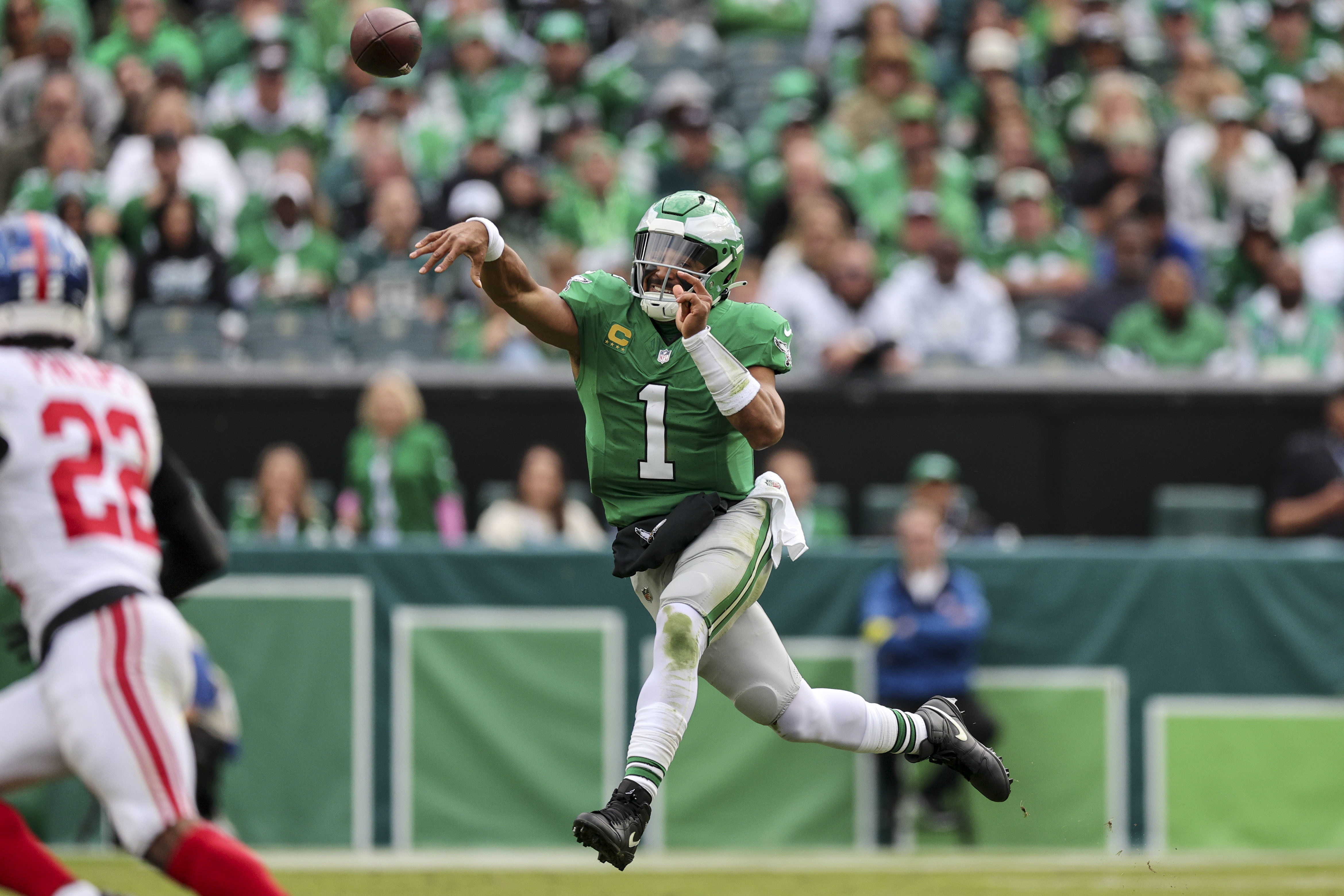
    Eagles quarterback Jalen Hurts completed 15 of 20 passes for 179 yards and four touchdowns on Sunday against the Giants.

    Hurts still dropped back to throw. But Smith was far and away his primary target, catching six of nine passes for 84 yards. Barkley was next with four grabs, with one coming on the oft-neglected screen pass. Tight end Dallas Goedert had three receptions with two resulting in red zone touchdowns.

    Overall, Hurts completed 15 of 20 passes for 179 yards and four touchdowns. There were still struggles against pressure and four sacks that appeared to fall on him more than anyone else. But it was a methodical day after an explosive aerial showing against the Minnesota Vikings last week.

    “It’s definitely a different rhythm, because you get a flow of playing with A.J. and Smitty and Dallas and you have your crew,” Hurts said, before adding: “But when we are able to run the ball like we did, it creates more of a balance and free will of how we attack people.”

    Aside from three victory-formation kneels, and one Tush Push, the run-pass ratio was an equal 50-50. Offensive coordinator Kevin Patullo had maybe his best play-calling day, and mixed in variety with Hurts under center, run-pass options, and outside runs on gap schemes.

    Offensive linemen Landon Dickerson and Jordan Mailata said the game plan called for more diversity in the running game. Sirianni countered that claim. “That doesn’t mean we haven’t had them in,” he said.

    Whatever the case, not getting to them before required patience from Barkley and the O-line after weeks of frustration.

    “I think it’s just being professional,” Barkley said of finally breaking loose. “Knowing that every week’s not going to be how you learn to be sometimes, but you can’t lose faith.”

    It could be a lesson for Brown, who has expressed his disappointment with the passing offense, both publicly in interviews and cryptically on social media. Few have objected when he has stood in front of microphones and, in so many words, said he wants the ball. He should. He’s one of the best receivers in the NFL.

    Even his post on X after the Tampa Bay Bucs game last month — when he quoted Scripture about not being listened to — was understood by many because he and Hurts had mainly failed to hook up in Tampa.

    But Brown’s most recent post — “using me but not using me” — after he caught four passes for 121 yards and two touchdowns in Minnesota probably took whatever discontent he may have to uncharted territory within the Eagles organization.

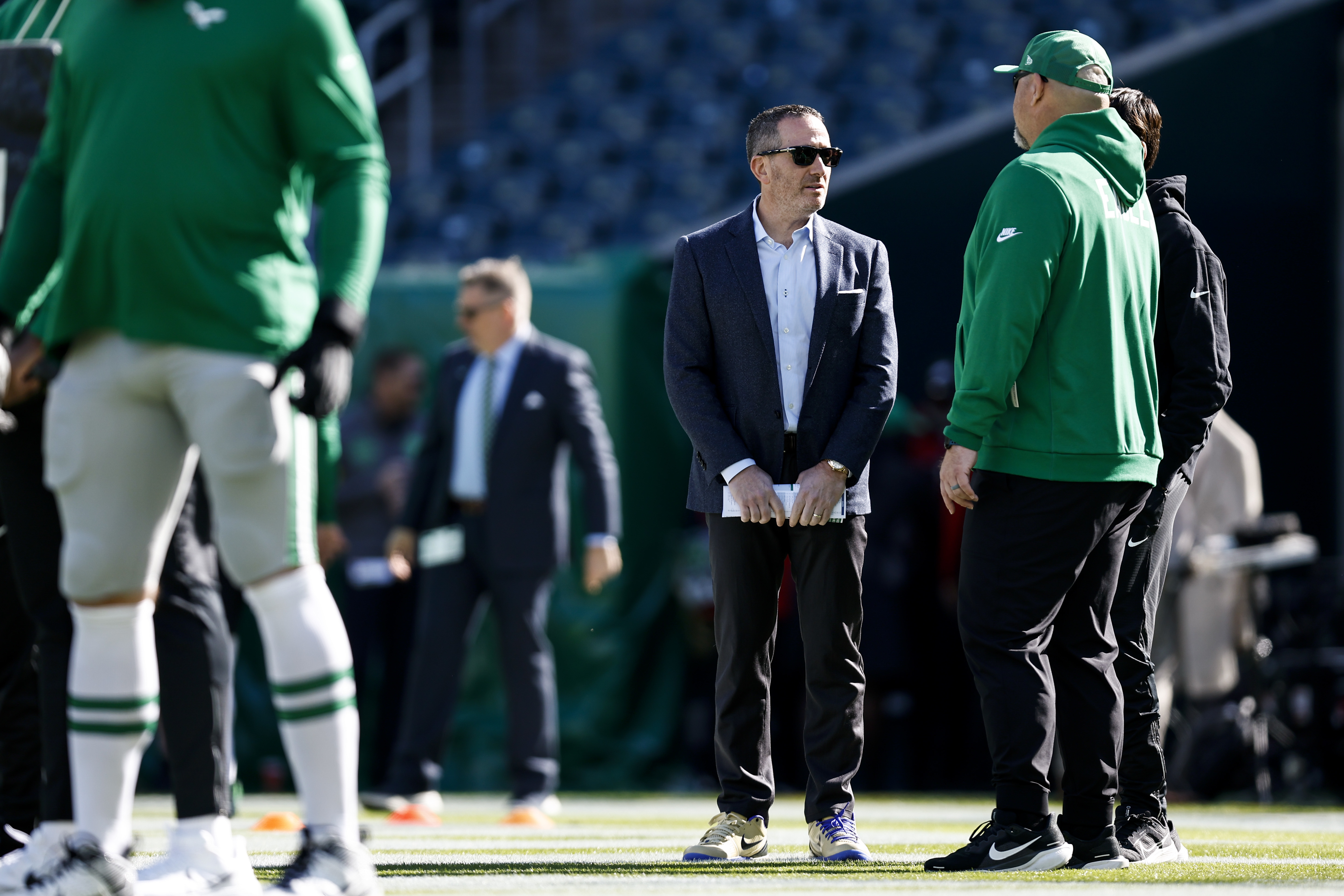
    Eagles general manager Howie Roseman, shown before his team’s win on Sunday, is unlikely to move A.J. Brown ahead of next week’s trade deadline.

    He is well-liked in the locker room, by the coaching staff, and the front office. But every player is expendable. The Eagles are unlikely to trade Brown ahead of next Tuesday’s deadline. There’s an astronomical dead-money hit, and Howie Roseman would need blockbuster compensation to even consider it.

    The Eagles general manager also isn’t known for trading players in their prime who are crucial to winning titles. Brown may not be pleased with whomever — most likely, Hurts — but it makes little sense for him to want to be moved. At least now.

    Hurts, to his credit, went out of his way to praise the receiver several times during his Wednesday news conference last week. But it would behoove the quarterback to make Brown happy on the field and off. His success raises all ships.

    “I think the best is yet to come,” Hurts said when asked about Sunday’s run offense explosion.

    He sounds like he knows something. Getting Brown more involved would help.

  • Remote work is on the decline in 2025, but these Philadelphia business leaders are sticking with it

    Remote work is on the decline in 2025, but these Philadelphia business leaders are sticking with it

    Debra Andrews’ marketing firm, Marketri, gets mail and phone calls out of a Market Street address in Center City. But none of her employees work in the Philadelphia area. Neither does she.

    When she started the business in 2004, having a small office in Doylestown gave the new firm a feeling of “legitimacy,” she says. But she gave up the space in 2008 when she learned the building would be converted into homes.

    “I only really at that time had one employee based in Philly and decided, well, let’s just do this remote,” said Andrews. Now she has 15 employees working across 11 states.

    The share of employees working remotely in Philadelphia has declined, according to U.S Census data, and several large employers in the region have been pushing for more in-office time. But for employers that have remained remote, some are finding that it can provide positive returns.

    For Andrews, offering remote work has allowed her to hire the best person for a role regardless of where they live, but it doesn’t mean workers get to set their own hours — they’re expected to be on from roughly 8:30 a.m. to 4:30 p.m. in their time zones, she says.

    “We run very much like a normal business, we just happen to work from our homes,” said Andrews.

    ‘An empty building is not a problem’

    Coming out of the pandemic, some businesses in the area have downsized their leased office space. Both Philadelphia and the suburbs are experiencing high office vacancy rates.

    The National Board of Medical Examiners (NBME), which has been based in Philadelphia for over 100 years and owns a building on Market Street, redesigned its space to have more collaborative areas and fewer offices, as the organization committed to allowing more remote work. It’s also leased part of the building.

    “An empty building is not a problem — it’s a challenge to solve. It’s not a reason to bring people back,” said Janelle Endres, NBME’s vice president of human resources.

    The nonprofit creates tests for healthcare professionals, and employs about 575 people, most of whom are in Pennsylvania, Delaware, New Jersey, and Maryland. Prior to the pandemic, NBME offered a hybrid work model to most employees, and it has since “doubled down” on remote work, said Endres, adopting a “remote first” approach in 2024 — as many other employers were stiffening or increasing their requirements for in-office work.

    Staff was as productive or more so when working remotely during the pandemic, and employees appreciated the setup, Endres said. Going back to pre-pandemic work norms could have created “an employee satisfaction problem,” she said.

    Some 60% of NBME employees are eligible for remote positions and choose to work remotely. Others chose to be hybrid.

    “Nobody’s raking in big bonuses here, so we have to think about: What are the things that really set us apart and make us a unique employer?” said Endres. “Work-life balance and flexible schedules [are among] those things.”

    In exchange for flexibility, Endres said, “We expect that you will contribute in really strong ways, that you’ll perform well, that you’ll give back just as much as we’re giving.”

    “Give the people what they want, and they’re going to be like, ‘I better do a good job. I don’t want to lose this job,’” Endres said.

    But committing to a remote workplace didn’t mean “everyone’s just automatically happy,” said Endres. The organization plans some in-person days throughout the year as well as digital programming to foster culture, said Jenna Mierzejewski, manager of employee experience.

    Endres acknowledged that NBME has encountered some instances where an employee seems underproductive or distracted: “We say that’s a management challenge. That’s not a remote-work challenge.”

    Remote work ‘before it was cool’

    Casey Benedict, CEO and founder of Maverick Mindshare, says her agency has been remote since “before it was cool.”

    She has a P.O. Box in Malvern so she doesn’t have to list her home address as her business location. Beyond privacy, it’s also for professionalism, she said.

    “It’s to create a little bit of a buffer between home life and business life,” said Benedict, who leads an agency focused on influencer marketing that has been remote since it launched in 2010.

    Casey Benedict, CEO and founder of Maverick Mindshare, works from her home office.

    She wants her staff to feel like they can attend to their personal needs, whether that’s picking up a child from the bus stop or going to a doctor’s appointment, says Benedict. She has three employees who are “core to the organization.”

    “They can fully show up when they have more ownership and more control over the other parts of their lives that may pull them away from their desk,” she said.

    Allowing that kind of flexibility avoids conflict, she says. And, it pays off for the company.

    “The result is my team really does overdeliver and they enjoy what they do,” said Benedict. “They bring so much of themselves into it because they know that the structure is set up in a way to support them fully.”

    Losing the commute

    Three years before the pandemic started, three of Wendy Verna’s employees asked if they could work remotely. They told her there wasn’t enough in-person collaboration to make the commute to their South Street office worthwhile, she said.

    Verna, president and founder of marketing firm Octo Design Group, initially said no. But six months later, they started trying out remote work.

    “It wasn’t working for me,” said Verna, a self-ascribed “type A” person who likes to get out of the house and go to work. But she stuck with it because her employees were happy, and the remote setup worked for the company.

    Ultimately she figured out why she was miserable leading a remote team. “It was a control thing for sure,” she said. “I felt like, if I don’t know where you are, what are you doing?”

    She has established clear expectations for what remote work should look like at her firm. Cameras should be on for video calls, and employees should be ready to work during business hours, she says. And if employees plan to be out of town, they should let Verna know so she can determine how in-person tasks get done.

    “They’re at home, but they cannot look like they rolled out of bed, because it’s just not my brand,” said Verna.

    Verna is in the office three to four days a week, but 98% of the time, her five full-time employees, who live in the Philadelphia area, work remotely.

    Wendy Verna’s employees asked her to go remote three years before the pandemic. While she still goes to the office often, her employees spend most of their time working remotely.

    While she and her company have adjusted, Verna is still concerned about what employees lose by working remotely.

    A commute can be useful to prepare for the workday in the morning or process the day in the evening, she says. During pandemic-related office closures she would walk around the block a few times before and after work to get a similar effect.

    “When they sign off and you’re working from home, you run downstairs, well, all of a sudden, you’ve got chicken in the oven,” said Verna. “You don’t have time for that kind of debrief to yourself.”

    She’s also concerned about how the remote lifestyle will affect young people looking for jobs, saying, “You’re only as good as your network.”

    “This remote work is eliminating role models, and is eliminating mentors,” Verna said, “because I can’t mentor you behind a screen.”

  • Sad-sack Giants lost this one before it started. Next time, don’t poke the bear (or Saquon)

    Sad-sack Giants lost this one before it started. Next time, don’t poke the bear (or Saquon)

    Two weeks ago, Brian Daboll stood in front of his locker room and labeled a blowout win over the Eagles as “The Standard.”

    Since then, the Giants head coach has become reacquainted with The Usual.

    The Eagles accomplished their biggest objective on Sunday afternoon. It was to leave no doubt. Jaxson Dart would not be high-fiving any referees. Kayvon Thibodeaux would not be telling anybody to “[bleep] the Eagles.” And the Giants social media team most definitely would not be sharing any victorious videos of Daboll making grandiose proclamations to his players.

    “For sure, we definitely saw how they celebrated when they beat us last time,” running back Saquon Barkley said after his 65-yard touchdown run on the second play from scrimmage catapulted the Eagles to a 38-20 win on Sunday.

    It is never wise to poke the bear, but it is especially unwise to poke the bear when you know you will be seeing the bear again in 17 days. If you are going to do it, you’d better pack some extra whistles. Or, failing that, some A.1.

    What the Giants seem to have forgotten is that they are not a good football team. In fact, they are the kind of football team that makes a sport of their not being good. Ten days after they stunned the Eagles with a 34-17 rout on Thursday Night Football, they raced out to a 19-point lead over the Broncos and then allowed 25 points in the last six minutes to lose, 33-32. It takes a special team to lose a game in that fashion. But, then, the Giants are a special team. They lose games the way Bob Ross painted pictures. With breathtaking creativity and speed.

    On Sunday, the movable object met the unstoppable force. The Eagles came out in their kelly green uniforms and they did it in vintage fashion. On their second play of the game, the offensive line opened up a weakside lane so wide that Barkley and Tank Bigsby both could have run through it. Never has a 65-yard touchdown looked so inevitable. Nor did the 189 yards that followed from Barkley and Bigsby. After the game, more than one Eagles offensive lineman noted how good the Giants’ front four was. You got the sense that they were noting it with glee.

    “We came in, we made the adjustments based off of what they gave us the last game, and we called plays to win,” guard Landon Dickerson said.

    The rest of the NFC can blame the Giants if this was the game in which the Eagles truly got their groove back. They entered Week 8 having gone five straight weeks without breaking 90 yards rushing. Not once had they reached 400 total yards of offense. On Sunday, they finished with 276 and 427. Barkley and Bigsby both cracked 100 yards and averaged 10-plus yards per carry. This, on an afternoon when Jalen Hurts threw four touchdown passes.

    “For us, it wasn’t about a weight being lifted off our shoulders,” said left tackle Jordan Mailata. “We just wanted to be the more physical team. It didn’t matter what it looked like.”

    It shouldn’t surprise anybody at this point.

    The Eagles have won a lot of games over the last four years by rag-dolling opponents, often saving their best for teams that have previously offended their sensibilities. We saw it in last year’s NFC championship game, when they road-graded the Commanders for 229 yards on the ground one month after Washington handed them one of their three regular-season losses. We saw it in last year’s Super Bowl, when they avenged their last-second loss two years earlier, to an extent that was almost uncomfortable.

    Give the Giants credit. They are a more competitive team than they have been throughout most of Daboll’s tenure at the helm. For all of Dart’s weird Gen-Z energy, he clearly has the touch and poise that can win behind a competent offensive line. Rival NFL general managers should take notice if Act I ends up going the way of Baker Mayfield in Cleveland. He has a keen sort of talent that cannot be measured or quantified, although it probably cannot make up for wholesale dysfunction around him. You saw it even on Sunday, when he kept the Giants within striking distance despite relentless pressure and a no-name receiving corps and a gruesome injury to running back Cam Skattebo.

    But the Eagles are operating on a different level. It is easy to lose sight of that fact given that they are operating on a lesser level than last season. The last couple of weeks have left little doubt, though. At 6-2 headed into the bye, they remain the most complete team in the NFC.

    More than anything, Sunday’s win was a reminder that rumors of Barkley’s demise have been greatly exaggerated. Even after his 65-yard touchdown run, the veteran running back gained 85 yards on his last 13 carries before leaving the game with what was labeled a groin injury but mostly was precaution.

    “I wasn’t worried about it,” Barkley said. “I came off, but I’ve dealt with this before. Nothing crazy. It’s a long season. I try my best to listen to the trainers, listen to the coaches.”

    Did he fight to go back in?

    “I went out swinging,” he said. “Let’s say that.”

    With these Eagles, you wouldn’t expect anything else.

  • Eagles’ A.J. Brown ruled out for Giants game with hamstring injury

    Eagles’ A.J. Brown ruled out for Giants game with hamstring injury

    Receiver A.J. Brown (hamstring) has been ruled out for the Eagles’ rematch against the New York Giants on Sunday, according to the team’s final injury report released Friday afternoon.

    Brandon Graham (not injury related), cornerback Jakorian Bennett (pectoral/injured reserve), center Cam Jurgens (knee), cornerback Adoree’ Jackson (concussion), and outside linebacker Azeez Ojulari (hamstring) also have been ruled out against the Giants. Receiver Darius Cooper (shoulder/injured reserve), whose 21-day practice window opened on Thursday, is questionable.

    Brown did not practice this week as he recovers from a hamstring injury, an ailment that popped up on the injury report in the aftermath of the win over the Minnesota Vikings. It is unclear when Brown sustained the injury, as he played 46 offensive snaps (92%) against the Vikings.

    He was on the field until the final passing play of the game, in which he caught a 45-yard pass from Jalen Hurts on third-and-9 with 1 minute, 45 seconds remaining. Brown has dealt with hamstring injuries before, most recently during training camp when he was sidelined for eight practices.

    “Obviously, he’s a great player,” receiver DeVonta Smith said on Friday before the final injury report was released. “We hope for him to be out there. But we’ll have to adjust if that’s the case that he’s not out there. We’ll have to adjust, and everyone’s going to have to study a little harder. Guys are going to be moving around in different spots and things.”

    Brett Toth likely will fill in at center for the injured Cam Jurgens against the Giants on Sunday.

    With Jurgens ruled out, Brett Toth likely will take his place as the starting center, just as he did in spot duty against the Vikings. Toth, the 6-foot-6, 304-pound depth offensive lineman, filled in for Jurgens at center in practice on Thursday during individual drills with the rest of the starters on the offensive line.

    Toth has started one game this season — the Week 6 matchup against the Giants, in which he took the place of the injured Landon Dickerson at left guard. He has taken 77 career regular-season snaps at center over the course of five seasons (four with the Eagles, one with the Carolina Panthers). The majority of his experience as a backup has come at guard (178 snaps at left guard, 27 at right) and right tackle (102 snaps).

    “A big thing in between the different positions in controlling, setting the point [as a center],” Toth said Friday. “Everyone’s job relies on you putting everyone in the right position to do their job. A lot of communication at both spots. But at center, it all starts there. Conducting the band kind of deal.”

    Meanwhile, even though Graham won’t return to action on Sunday, he was a full participant in practice all week. The 37-year-old defensive end came out of retirement on Tuesday. He said “everything’s going good right now,” even if he isn’t playing against the Giants.

    “Just being able to go three, four plays without really feeling, like, dog tired and really pushing,” Graham said Friday. “But I’d just say just a credit to the work that you put in during the offseason, and then for me, just making sure that if I am sore, we’re communicating. I mean, I was sore the next day. It felt like training camp. But it wasn’t a bad sore. It was a good sore, that first day of school.”

    Kelee Ringo is the next man up to start in place of the injured Jackson. He has started two games this season (seven games total) at the outside cornerback spot opposite Quinyon Mitchell, conceding 11 receptions for 172 yards, according to Pro Football Focus. He also has registered a pass breakup and 22 tackles.

    Tight end Grant Calcaterra (oblique), Dickerson (ankle/back), tight end Dallas Goedert (calf), defensive tackle Moro Ojomo (shoulder), and linebacker Jeremiah Trotter Jr. (ankle) have been removed from the injury report and are available to play. This will be Calcaterra’s first game since Week 5 against the Denver Broncos.