Tag: Immigration

  • For almost 40 years, Esperanza has served ‘the least of these’ and those who ‘just need a break’ | Philly Gives

    For almost 40 years, Esperanza has served ‘the least of these’ and those who ‘just need a break’ | Philly Gives

    Talk to most nonprofit chief executives, and they’ll be able, on cue, to recite a heartwarming story about someone their organizations helped.

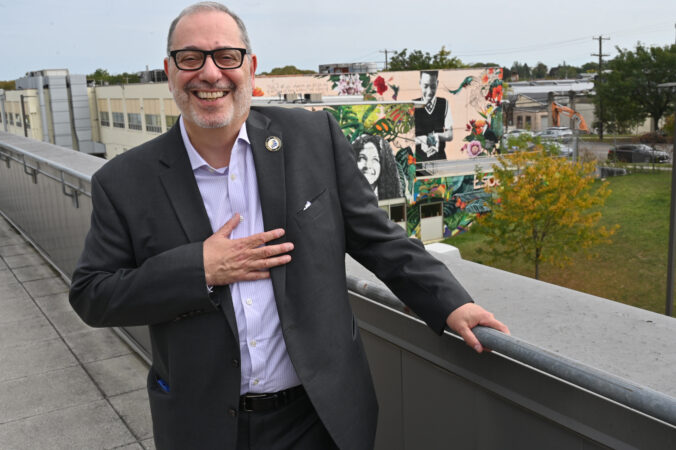
    And the Rev. Luis Cortés Jr., Esperanza’s founder and chief executive, can do it, too.

    But he’d rather talk about a sin he committed as a little boy — a sin that impacted his thinking for a lifetime and allowed him to understand how to build a $111.6 million organization with 800 employees that educates, develops, uplifts, and houses 35,000 people a year in the heart of North Philadelphia’s predominantly Hispanic Hunting Park neighborhood.

    When Cortés was 12, he stole a Snickers candy bar from the bodega his father owned in New York City’s Spanish Harlem.

    Oh, his father figured it out, and quickly, too, because he began to ask little Luis some important questions:

    Did the 12-year-old know how many Snickers bars the bodega would have to sell to break even — not only on the box of Snickers, but on the taxes and utilities for the entire store? More importantly, how many Snickers bars would be required to turn a profit — a profit that could be reinvested?

    “You need to understand finance, whether it’s a box of Snickers or a multimillion-dollar bond to build a school. Where is the money coming from, and what’s the repayment structure?” Cortés said.

    Outside, as he spoke, a crane moved materials in what will soon become a new culinary school.

    “Understanding finance is important, and understanding culture is important, and you have to understand the relationship between the two.”

    So, yes, Cortés can and did tell the story about the mother who came to Esperanza to learn English skills, who got help to get a job and a house, who sent her daughter to Esperanza’s charter school and to Esperanza’s college, and now that same daughter is getting a house thanks to Esperanza’s mortgage counseling help.

    Students Jayliani Casioano, Oryulie Andujar, Derek Medina, and Natalia Kukulski use an interactve anatomy table. The students are members of is the Health Occupations Students of America (HOSA).

    All good. But this is what Cortés really wants people to know:

    “If people trust us with their funds,” he said, “we’re putting the money into institutions, and institutions build culture.”

    That’s why Esperanza has a K-12 charter school, a cyber school, a two-year college that’s a branch campus of Eastern University, a 320-seat theater, an art gallery, computer labs, an immigration law practice, a neighborhood revitalization office, a CareerLink office for workforce development and job placement, a music program, a youth leadership institute, housing and benefit assistance, and a state-of-the-art broadcasting facility.

    Cortés even likes to brag about the basketball court. “Three inches of concrete, maple wood flooring, fiberglass backboards — NBA standards.”

    “Think about Paoli. It has a hospital, a public school, a theater. Paoli has all of that, and it’s understood that that’s the quality of life. We have to have access to those same things at a different price point,” he said. “Notice I didn’t say different quality. I said different price point.

    “We want to create an opportunity community, where people can have a good life — with arts, housing, healthcare, financial literacy, education, all those pieces — regardless of your family income,” he said.

    “What’s important here and what’s different is that in all our places, all our facilities are first class,” Cortés said.

    “I grew up in a low-income community where people were always telling you to step up, but step up to what?” he asked. “Where is the vision? What is possible to even have? How can anyone know unless they can see it?”

    So, when people from the community visit Esperanza, “you can see that you can have the best facilities with state-of-the-art equipment. As a provider of services, we have to step up,” he said, in turn always giving people the tools and resources they need to step up.

    For example, on Citizenship Day, Sept. 20, Anu Thomas, an attorney and executive director of Esperanza’s Immigration Legal Services, trained a dozen volunteer lawyers and law students on the fine points and recent pitfalls in the process of applying for citizenship.

    Soon, the room was crowded with people coming for help.

    Watching from the sidelines was Charlie Ellison, executive director of the city’s Office of Immigrant Affairs, who noted that an estimated 60,000 legal residents of Philadelphia are eligible to apply for citizenship.

    “Clinics like these are critically important to helping people who might be facing barriers,” including the cost of getting legal help. “This bridges a lot of gaps. It’s a vital mission, now more than ever,” he said.

    For Neury “Tito” Caba, a men’s fashion designer, tailor, and director of green space at Historic Fair Hill, citizenship help from Esperanza was a family affair. Through Esperanza, he, his grandmother, and his mother all became citizens.

    “Now I can vote, and that’s the most positive thing I can do,” he said. “And also, things being the way they are, it gives me some sort of protection.”

    Fashion designer Neury “Tito” Caba talks about his citizenship experience at Esperanza.

    Earlier this fall at Esperanza’s CareerLink branch, counselor Sylvia Carabillo helped Luis Rubio on the computer. He was trying to extend his unemployment benefits and looking for a job as a security guard. Agueda Mojica was being tutored in Esperanza’s most popular workforce class: Introduction to Computers.

    “I want to become more independent to be able to do anything on a computer,” she said in Spanish, speaking through a translator. “I was always working and never had time to learn.”

    Much of Esperanza’s staff is bilingual in Spanish, but to help people from the neighborhood, Esperanza also hired counselors who speak Ukrainian and Kreyòl for Haitians who live nearby.

    In Esperanza College classrooms a few weeks ago, Esperanza Academy high schoolers enrolled as college students had just finished a chemistry exam. When they graduate from high school, they’ll already have associate degrees on their résumés.

    For them, Esperanza represents a future.

    There’s Oryulie Andujar, 18, who wants to study sonography because an ultrasound technician found a cyst in her mother’s uterus. “We could have lost her. That was very impactful for me.”

    Jayliani Casiano, 17, wants to go into anesthesiology. The oldest of seven, she witnessed her mother giving birth to several younger siblings. “She was in a lot of pain. It was interesting. I want to do everything after seeing her through that process.”

    Derek Medina, 18, said the opportunity to go to college “made me rethink my whole life.” He had been getting into trouble in school, but now wants to combine a love of mathematics and a desire to help people by going into the field of biomedical engineering.

    Recently, on Nov. 14, Esperanza College hosted its Ninth Annual Minorities in Health Sciences Symposium, designed to acquaint high schoolers with medical careers.

    Construction will soon begin to convert a former warehouse space into a center to teach welding and HVAC in an apprenticeship program.

    Next month, it’ll be time for “Christmas En El Barrio” with music, food, and community in Teatro Esperanza — admission is free. In January, the Philadelphia Ballet will perform there. Tickets are $15 and free for senior citizens and students.

    “My worst seat — in Row 13 — would be $250 at the Academy of Music,” Cortés said. He wants to offer the arts at a price and a time available to a mother of three, who may not be able to afford even the cheapest seats in downtown venues, plus bus fare, “and heaven forbid the child wants a soda,” Cortés said.

    All this adds up to culture, which brings him back to the Snickers bar, and not just breaking even, but investing.

    Other groups, Cortés said, had to build their own institutions when mainstream organizations put up barriers. Howard University helped Black people, Brandeis served Jewish people, and Notre Dame provided education to the Irish.

    Building an institution is his investment goal with Esperanza, and he takes as his mentors famous Philadelphia pastors such as the Rev. Leon Sullivan, who founded Progress Plaza in North Philadelphia, and the Rev. Russell Conwell, the Baptist minister who founded Temple University.

    “Philadelphia has a tradition that its clergy don’t just do clergy things,” he said, admitting that he doesn’t have the patience for a more traditional pastor’s role. “As clergy here, it’s understood that we snoop around everything.”

    Cities sometimes brag that their poverty rates have declined, he said, when in reality, rates have declined because people with low incomes were forced to move away.

    Philadelphia, he said, has a chance to be different — to lower the poverty level both by raising people’s incomes and improving their standards of living. “There should be Esperanzas in every neighborhood,” he said.

    “How can we focus on helping the people who just need a break?” Cortés said, referencing Jesus’ admonishment to “help the least of these.”

    “This city has the opportunity to make this a win-win,” he said, “to show the rest of the country and Washington, D.C. — especially Washington, D.C. — that people who are different, and people who are `the other’ can be supported, so that they are not only part of the fabric of the city, but economic drivers of the city.”

    This article is part of a series about Philly Gives — a community fund to support nonprofits through end-of-year giving. To learn more about Philly Gives, including how to donate, visit phillygives.org.

    For more information about Philly Gives, including how to donate, visit phillygives.org.

    About Esperanza

    People Served: 35,000

    Annual Spending: $111.6 million across all divisions

    Point of Pride: Esperanza empowers clients to transform their lives and their community through a diverse array of programs, including K-14 education, job training and placement, neighborhood revitalization and greening, housing and financial counseling, immigration legal services, arts programming, and more.

    You Can Help: Esperanza welcomes volunteers for community cleanups, plantings, and other neighborhood events. Some programs also need volunteers with specific skills (lawyers, translators, etc.).

    Support: phillygives.org

    What Your Esperanza Donation Can Do

    • $25 covers the cost of one private music lesson for a young student through our Artístas y Músicos Latinoamericanos program.
    • $50 provides printing and distribution of 30 “Know Your Rights” brochures to immigrant families.
    • $100 pays for five hours of training for a new mentor fellow at the Esperanza Arts Center, preparing a young person for a career in arts production through hands-on learning.
    • $275 funds the planting of one street tree in a neighborhood that desperately needs additional tree cover to address extreme heat.
    • $350 covers tuition and books for one English as a second language student at the Esperanza English Institute.
    • $550 supports the cost of the initial work authorization for an asylum-seeker.
  • Party soul-searching, the Latino vote, and a South Jersey strategy: Takeaways from Tuesday’s election

    Party soul-searching, the Latino vote, and a South Jersey strategy: Takeaways from Tuesday’s election

    A Navy pilot in New Jersey. A democratic socialist in New York City. Three Pennsylvania jurists who never wanted to hit the campaign trail in the first place.

    The Democrats who scored big wins in Tuesday’s elections came from across the political spectrum and succeeded in disparate campaign environments.

    The results were momentous for a party hungry for wins in President Donald Trump’s second term. But they are also likely to revive longstanding debates on how the party should present itself to the American people going into the 2026 midterms and 2028 presidential race.

    Should Democrats embrace a bold vision and tack left? Are left-of-center candidates with bipartisan appeal still the way to win statewide races? Or could the party simply embrace the reality of being a big-tent party?

    Here are five takeaways from Tuesday’s elections, including the state of play for both parties’ soul-searching exercises.

    Democrats gained momentum, but received no clear signs about the future of the party

    The energy is clearly there.

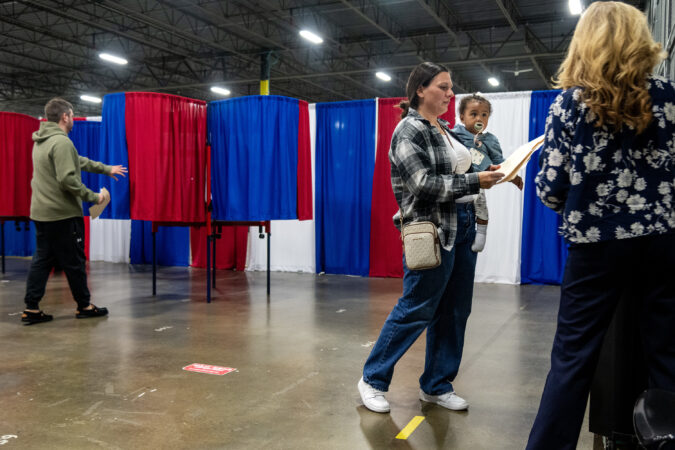
    Turnout soared on Tuesday, despite being an off-year election, and Democrats won by surprisingly large margins up and down the ballot.

    Even Montgomery County, where there were no competitive elections for county offices, saw its highest-ever off-year turnout at 50.7% of registered voters, and Democrats flipped every contested school board race.

    At the top of the ticket, New Jersey’s Mikie Sherrill and Virginia’s Abigail Spanberger, both U.S. representatives with national security backgrounds, ran up the scores in their gubernatorial races while portraying themselves as pragmatists.

    window.addEventListener(“message”,function(a){if(void 0!==a.data[“datawrapper-height”]){var e=document.querySelectorAll(“iframe”);for(var t in a.data[“datawrapper-height”])for(var r,i=0;r=e[i];i++)if(r.contentWindow===a.source){var d=a.data[“datawrapper-height”][t]+”px”;r.style.height=d}}});

    Zohran Mamdani, meanwhile, handily defeated former Gov. Andrew Cuomo in the New York City mayor’s race by promising radical change and progressive policy solutions.

    So where does that leave Democrats as they try to find a recipe for success in next year’s congressional races?

    For Philadelphia’s progressive District Attorney Larry Krasner, who won a third term Tuesday, the answer is clear.

    “There’s a new politics,” Krasner said Wednesday. “It’s pretty clear that the American people, Philadelphians, are tired of insiders who promise them things they don’t do. They’re tired of political dynasties.”

    window.addEventListener(“message”,function(a){if(void 0!==a.data[“datawrapper-height”]){var e=document.querySelectorAll(“iframe”);for(var t in a.data[“datawrapper-height”])for(var r,i=0;r=e[i];i++)if(r.contentWindow===a.source){var d=a.data[“datawrapper-height”][t]+”px”;r.style.height=d}}});

    Democratic strategist Brendan McPhillips, who has worked for progressive candidates as well as Joe Biden’s and Kamala Harris’ campaigns in Pennsylvania, said the party should embrace the ideological diversity of its constituencies.

    “People have tried to ask this question of who represents the soul of the party, and I just think it’s a bad question,” he said. “The party is a huge tent, and last night proves you can run for Democratic office in New York City and New Jersey and Bucks County and Erie, Pa., and each of those races can look entirely different.”

    Democrats made gains with Latino voters

    One of the more worrying signs for Democrats in the Trump era has been the president’s increasing popularity among Latino voters.

    They flipped that narrative Tuesday.

    After 10 months of aggressive U.S. Immigration and Customs Enforcement raids under Trump that are seen by many in the Latino community as indiscriminate and cruel, Democrats appear to have undone some of Trump’s gains in what has long been a blue constituency.

    In New Jersey, the two counties where Sherrill made the biggest gains compared with Harris in the 2024 presidential election were Passaic and Hudson, both of which are more than 40% Hispanic, according to the U.S. Census.

    Sherrill won Hudson by 50 percentage points, which represents a 22-point swing from Harris. And she won Passaic by 15 percentage points after Trump surprisingly carried the county with a 3-point margin in 2024.

    In Philadelphia, Krasner won eight wards that the more conservative Patrick Dugan — Krasner’s opponent in both the general election and the Democratic primary — had won in their first round in May.

    All were in or near the Lower Northeast, and the biggest swing came in the heavily Latino 7th Ward, which includes parts of Fairhill and Kensington. Krasner’s share of the vote there grew from 46% in the primary to 86% in the general.

    It’s really hard to unseat Pennsylvania judges

    Only one Pennsylvania Supreme Court justice since 1968 has failed to win a retention election, in which voters face a yes-or-no decision on whether to give incumbents new 10-year terms, rather than a choice between candidates.

    Tuesday’s results will be discouraging for anyone hoping to increase that number soon.

    Hoping to break liberals’ 5-2 majority on the state’s highest court, Republicans spent big in an attempt to oust three justices who were originally elected as Democrats. Democratic groups then poured in their own money to defend the incumbents.

    In the end, Justices Christine Donohue, Kevin Dougherty, and David Wecht all won by more than 25 percentage points.

    Ciattarelli’s South Jersey strategy failed

    In his third attempt to become governor, Republican Jack Ciattarelli bet big on South Jersey, the more conservative but less populous part of the Garden State.

    It didn’t work.

    In his 2021 campaign against Democratic Gov. Phil Murphy, Ciattarelli carried Atlantic, Cape May, Cumberland, Gloucester, and Salem Counties with a combined 56.8% of the vote. Trump then went on to sweep all five counties last year.

    But on Tuesday, Ciattarelli performed 8 percentage points worse in the region, giving Sherrill a narrow lead in South Jersey, where she won three of the five counties south of Camden.

    (function() { var l = function() { new pym.Parent( ‘sj-shift__graphic’, ‘https://media.inquirer.com/storage/inquirer/ai2html/sj-shift/index.html’); }; if(typeof(pym) === ‘undefined’) { var h = document.getElementsByTagName(‘head’)[0], s = document.createElement(‘script’); s.type = ‘text/javascript’; s.src = ‘https://pym.nprapps.org/pym.v1.min.js’; s.onload = l; h.appendChild(s); } else { l(); } })();

    Republicans now face their own soul-searching question: How to win without Trump?

    In 2024, Trump’s coattails helped Republicans win control of Congress and other elected offices across the country — including in two Pennsylvania swing districts.

    With the president in his second and final term, how will the GOP win without him on the ballot?

    For Jim Worthington, the Trump megadonor and owner of the Newtown Athletic Club in Bucks County, Tuesday’s results show that the GOP needs to do more work on the ground if it wants to succeed without the man who has dominated Republican politics since 2015.

    Elections, he said, are “not about the policies as much they’re just turnout. Red team, blue team.”

    The blue team won Tuesday, he said, because the red team didn’t do enough of the legwork needed to get its voters to cast mail ballots and to drive in-person turnout on Election Day. Worthington said the results left him concerned about Republican Treasurer Stacy Garrity’s chances of unseating Democratic Gov. Josh Shapiro next year.

    “If we don’t get a robust vote-by-mail, paid-for program, it’s going to be very difficult, very difficult, if not impossible for Stacy Garrity to win,” Worthington said. “During this whole 2025 year when we could have been building this toward 2026, we lost a year because we didn’t do it.”

    Staff writer Anna Orso contributed to this article.

    This suburban content is produced with support from the Leslie Miller and Richard Worley Foundation and The Lenfest Institute for Journalism. Editorial content is created independently of the project donors. Gifts to support The Inquirer’s high-impact journalism can be made at inquirer.com/donate. A list of Lenfest Institute donors can be found at lenfestinstitute.org/supporters.

  • Bucks Sheriff-elect Danny Ceisler says he’ll act quickly to end controversial ICE alliance

    Bucks Sheriff-elect Danny Ceisler says he’ll act quickly to end controversial ICE alliance

    Bucks County voters on Tuesday did what protest and legal action could not, halting a controversial sheriff’s office alliance with ICE by electing a Democrat who has pledged to end the partnership.

    Sheriff-elect Danny Ceisler said Wednesday that he will issue a moratorium barring deputies’ cooperation with ICE on his first day in office. From there, he said, he will figure out how to disentangle the sheriff’s office from the agreement signed by his predecessor.

    Ceisler beat incumbent Republican Fred Harran by more than 10% of the vote in unofficial returns.

    Ceisler and a cadre of immigration activists ― who saw an ACLU-led lawsuit falter ― had portrayed the election as the last chance to kill the affiliation, after a Bucks judge ruled last month that it had been legally implemented and could proceed.

    Ceisler, an Army veteran who held a public-safety leadership post in Gov. Josh Shapiro’s administration, pledged during his campaign to “end this deportation partnership once and for all” if elected.

    Army veteran Danny Ceisler won the hotly contested Bucks County sheriff race Tuesday night.

    Harran, who led the Bensalem Police Department before being elected sheriff four years ago, said Wednesday that Ceisler will “have to answer for a person who becomes victimized by an individual that should have been deported. And he’ll have to sleep with that, and it’ll be on his head, not mine.“

    His said his plans around the program had been misrepresented.

    “Everyone knows my intentions. It was never making car stops on people who were dark-colored. My career speaks for itself in terms of my partnerships with the community.”

    He had staunchly defended his decision to assist ICE, insisting it would make residents safer and even potentially bring new funding and police equipment to the county.

    Ceisler called immigration the single biggest issue in this election.

    “My goal was to provide an alternative which was a no-nonsense, reasonable approach to public safety,” Ceisler said Wednesday, noting that it was now “my responsibility to deliver on that.”

    Officials with U.S. Immigration and Customs Enforcement declined to comment.

    The partnership, which recently became active after months of planning, provoked backlash, including the lawsuit, public demonstrations outside the courthouse, and a repudiation by the Democratic-led Bucks County Board of Commissioners.

    Nationally, only a few police agencies that signed on with ICE have dropped out of those agreements.

    Ceisler’s victory was part of a Democratic sweep of county positions in a critical swing county that narrowly voted to elect President Donald Trump last year.

    “I am walking on air,” said Laura Rose, a leader of Bucks County Indivisible, which supports immigrants and progressive causes. “Bucks County voters soundly rejected Sheriff Harran and his plan to turn county deputies into de facto ICE agents.”

    In the spring, Harran and ICE officials signed what is called a 287(g) agreement, named for a section of a 1996 immigration law. It enables local police to undergo ICE training, then assist the agency in identifying, arresting, and deporting immigrants.

    “Ceisler’s victory proves what we’ve always known ― 287(g) agreements don’t make us safer, they divide our community,” said Diana Robinson, co-executive director of Make the Road Pennsylvania, a plaintiff in the lawsuit.

    The agreement with ICE “put Bucks County at risk,” and the election showed that “voters reject fear-based policies,” she said Wednesday.

    Robinson and other opponents insist that turning local officers into immigration agents breaks community trust with the police and puts municipal taxpayers at risk of paying big legal settlements. ICE officials, however, say the program helps protect American communities, a force-multiplier that adds important staff strength to an agency workforce that numbers about 20,000 nationwide.

    The number of participating police agencies has soared under Trump, with ICE having signed 1,135 agreements in 40 states as of Wednesday. Seven states, including New Jersey and Delaware, bar the agreements by law or policy.

    The number of new agreements increases almost every day, and Trump has pushed hard for greater local involvement. On his first day in office he directed the Department of Homeland Security to authorize local police to “perform the functions of immigration officers” to “the maximum extent permitted by law.”

    Shortly before the government shutdown, ICE was poised to begin backing its recruitment efforts with money, announcing that it would reimburse cooperating police agencies for costs that previously had been borne by local departments and taxpayers.

    But activists focused on the difference between what Harran said he intended to do and the much broader powers conferred within the agreement with ICE.

    Harran signed up for the “Task Force Model,” the most far-reaching of the three types of 287(g) agreements. It allows local police to challenge people on the streets about their immigration status and arrest them for violations.

    Harran said his deputies would not do that. Instead, he said, they would electronically check the immigration status of people who have contact with the sheriff’s office because of alleged criminal offenses. Those found to be in the country illegally would be turned over or transported to ICE, if the federal agency desires, he said.

    This suburban content is produced with support from the Leslie Miller and Richard Worley Foundation and The Lenfest Institute for Journalism. Editorial content is created independently of the project donors. Gifts to support The Inquirer’s high-impact journalism can be made at inquirer.com/donate. A list of Lenfest Institute donors can be found at lenfestinstitute.org/supporters.

  • Going green: Why frogs are appearing at ICE protests

    Going green: Why frogs are appearing at ICE protests

    The frogs are all over social media, playing and prancing in front of the ICE building in Portland, Ore. The demonstrators in big, green inflatable costumes have grown from local oddity to symbol of the resistance, undermining President Donald Trump’s claim that “war ravaged” Portland is under siege by “domestic terrorists.”

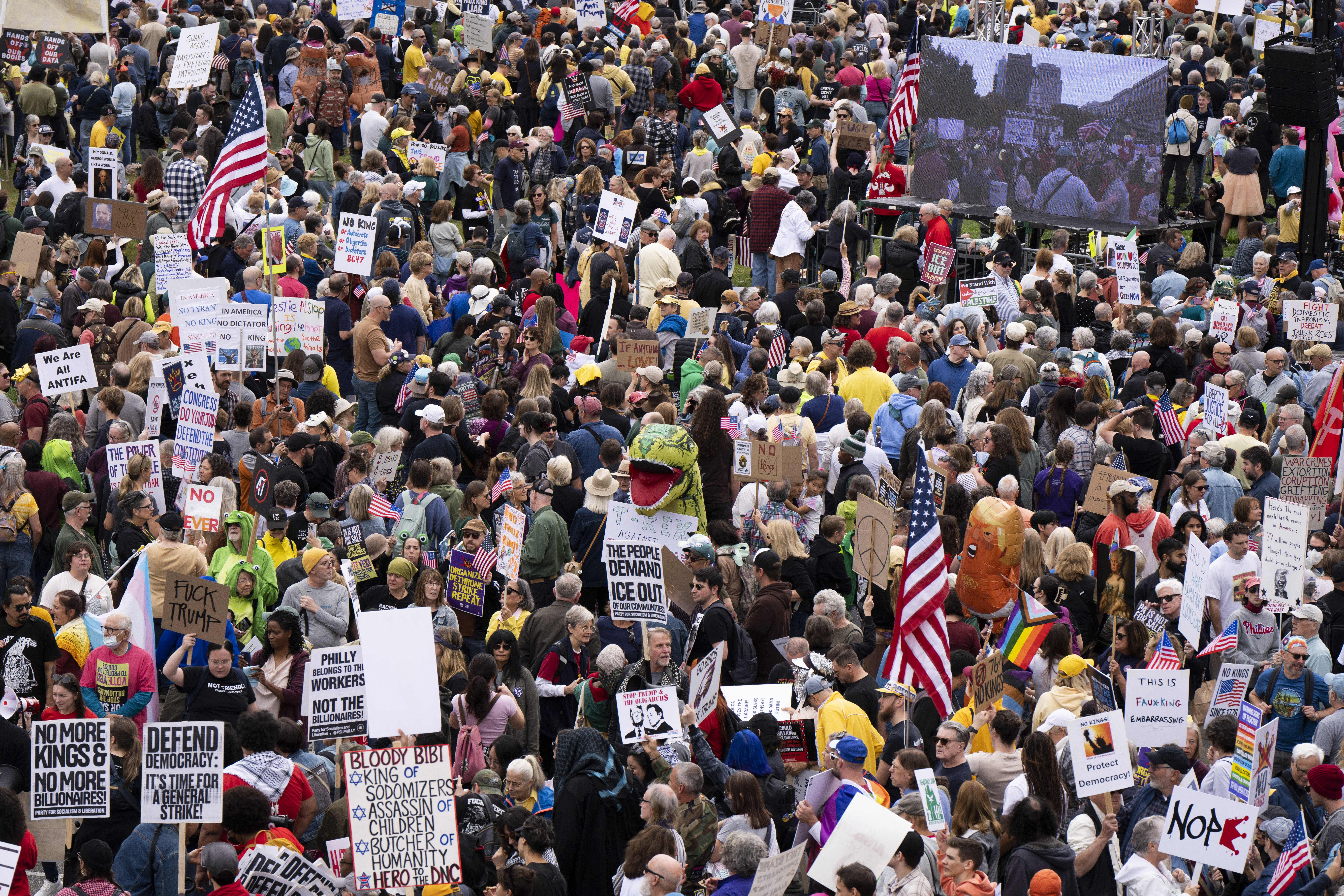
    Protests that started with a single amphibian have in recent weeks expanded into full ponds, particularly after a viral video showed officers pepper-spraying a demonstrator through the air-intake of his costume. The frog corps there has been joined by a shark, giraffe, chicken, and raccoon, and during the recent nationwide “No Kings” marches expanded its web-toed footprint to places including Philadelphia.

    Demonstrators gather for a ’No Kings’ rally in Philadelphia on Saturday, Oct. 18, 2025.

    Why has the frog become so popular?

    People following the news on the internet and TV see the paramilitary might of helmeted ICE agents arrayed against … frogs. And unicorns. And other dancing creatures.

    For demonstrators, it’s a way to make the other side look ridiculous by embracing ridiculousness ― a staple of effective political street theater, said Temple University professor Ralph Young, an expert on protest and dissent.

    “Trump saying Portland is occupied by terrorists, it’s so over the top,” Young said. “How do you respond? I guess you put on a frog outfit.”

    What has made Portland a center of immigration protest?

    Demonstrators oppose Trump’s effort to deport millions of people. And Portland has long been a target of the president, who last week again falsely claimed that the city was “burning down.”

    He wants to deploy National Guard troops in response to the protests outside the city’s Immigration and Customs Enforcement facility. An appeals court last week reversed an earlier ruling and said that deployment could proceed.

    Wearing animal costumes “dismantles their narrative a little bit,” chicken-suited protester Jack Dickinson told Willamette Week. “[Homeland Security Secretary] Kristi Noem is up on the balcony staring over the ‘Antifa Army’ and it’s, like, eight journalists and five protesters and one of them is in a chicken suit.”

    Laura Murphy, 74, wears a handmade tiara inspired by a Portland, Oregon, protester’s frog costume, on her way to the No Kings protest on Oct. 18 in Philadelphia.

    Where did the idea for the frogs come from?

    The frogs, Temple’s Young said, come out of a court jester tradition. In ancient times, jesters could speak to the king in ways that might get someone else beheaded. They offered what others might be unwilling to say ― the truth, cloaked in humor.

    Since that time there have been many other instances of truth-in-comedy protests.

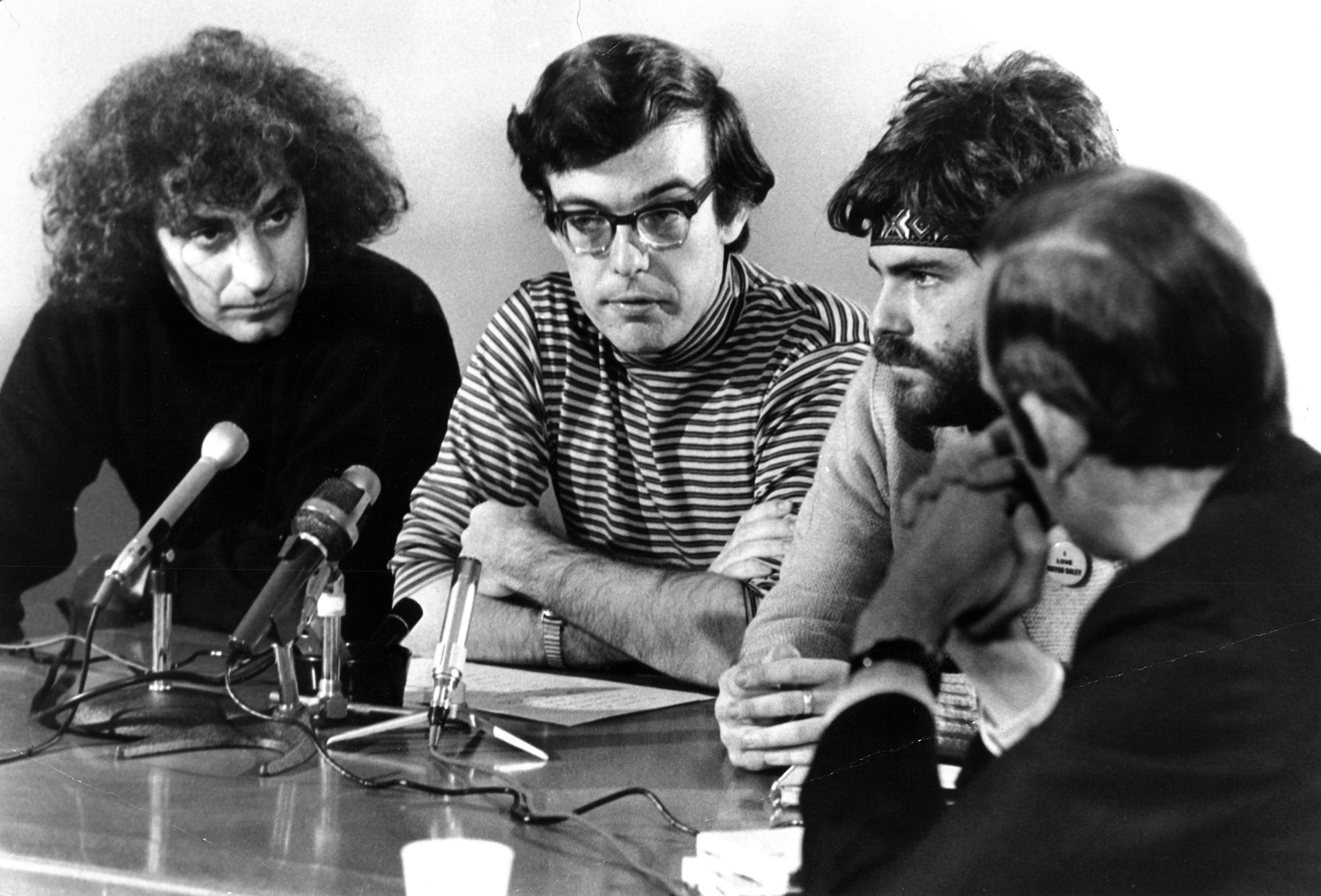
    At the 1968 Democratic National Convention, the Youth International Party, the Yippies, nominated a 145-pound pig for president. Pigasus, sarcastically named for the winged horse Pegasus, served to protest the political establishment and the sorry choice many voters felt they faced in choosing between Richard Nixon and Hubert Humphrey. The pig’s campaign slogan: “If we can’t have him in the White House, we can have him for breakfast.”

    Here on trial as part of the Chicago Seven, Abbie Hoffman (left) and Jerry Rubin (right), with beard and headband, helped nominate a pig for president. In center in striped shirt is defendant Rennie Davis. They’re picture here on Oct. 23, 1969, at the Federal Building in Chicago.

    The same year, the New York Radical Women attracted huge news coverage at the Miss America pageant when they dumped bras, makeup, and girdles into a “Freedom Trash Can” set up on the Atlantic City Boardwalk. The demonstrators were labeled “bra-burners,” though organizers insisted no bras were actually burned.

    Have frogs been spotted in Philadelphia?

    Yes, including at the recent “No Kings” protest that drew thousands onto city streets. One person carried a sign endorsing “Amphifa,” or “Amphibians Against Fascism.”

    Frogs are appearing on posters and T-shirts in a variety of poses: Raising the U.S. flag at Iwo Jima, with the help of a chicken and a unicorn. And as the subject of the famous Barack Obama campaign portrait, this one captioned not “HOPE” but “HOP.”

    So far the ICE field office in Philadelphia has not been the target of sustained protests, though the exterior of the building is now guarded by heavy concrete blocks. The group No ICE Philly plans to hold an all-day, Halloween Eve demonstration on Thursday, complete with costumes, live music, art, and free food.

    A demonstrator wearing a frog costume stands outside a U.S. Immigration and Customs Enforcement facility on Tuesday, Oct. 7, 2025, in Portland, Ore. (AP Photo/Ethan Swope)

    Is it true the frogs are meant as a biblical reference?

    Let’s not get carried away. But, yes, some people have posted social media photos of the Portland frogs captioned with a verse from Exodus 8:2-6: “If you refuse to let them go, I will bring a plague of frogs on your whole country. … The frogs will jump on you, on your people, and on all your officials.”

    Staff writer Michelle Myers contributed to this article.

  • This is what is happening to immigrants and citizens in Chicago right now

    This is what is happening to immigrants and citizens in Chicago right now

    Just before 9 p.m. on Oct. 15, Tracy pulled up outside the townhouse on the west side of Chicago. She ushered Juliana and her 6-year-old, Yori, into the back seat and headed for Union Station — the overnight train to New York City, their best shot at safety.

    For a month, mother and daughter had barely opened the door of their one-room apartment. Yori stopped attending first grade. Juliana stopped cleaning houses. Neighbors left groceries at the threshold.

    In mid-September, during a construction site raid, U.S. Immigration and Customs Enforcement (ICE) agents detained José, Juliana’s husband and Yori’s father, and deported him to Venezuela. He was “lucky”: at least he wasn’t lost in detention purgatory or sent to a prison in El Salvador.

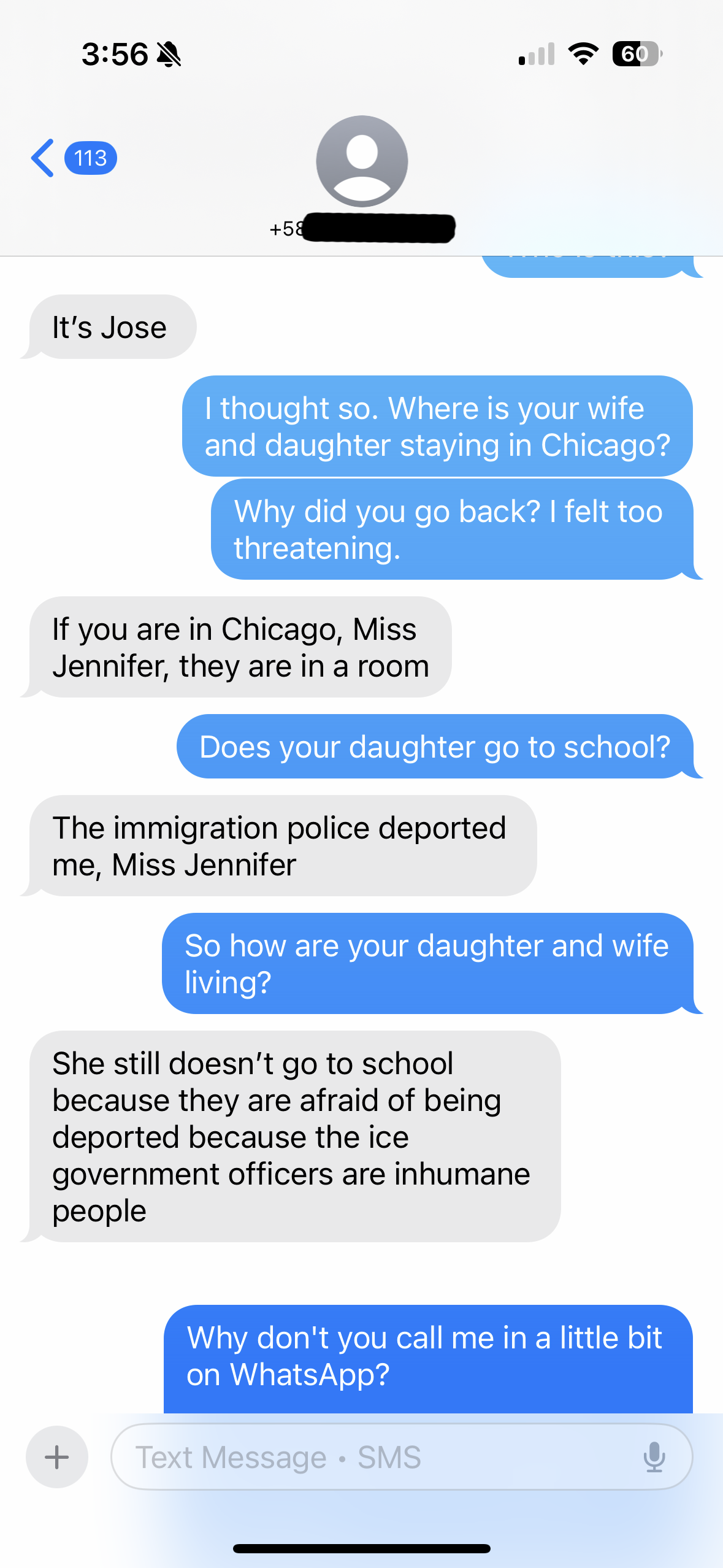
    From Venezuela, José texted me about conditions at the Broadview Detention Center, where he had been held before deportation, calling them inhumane.

    He asked for only one thing: “Please help my family leave Chicago. It’s too dangerous for them there.”

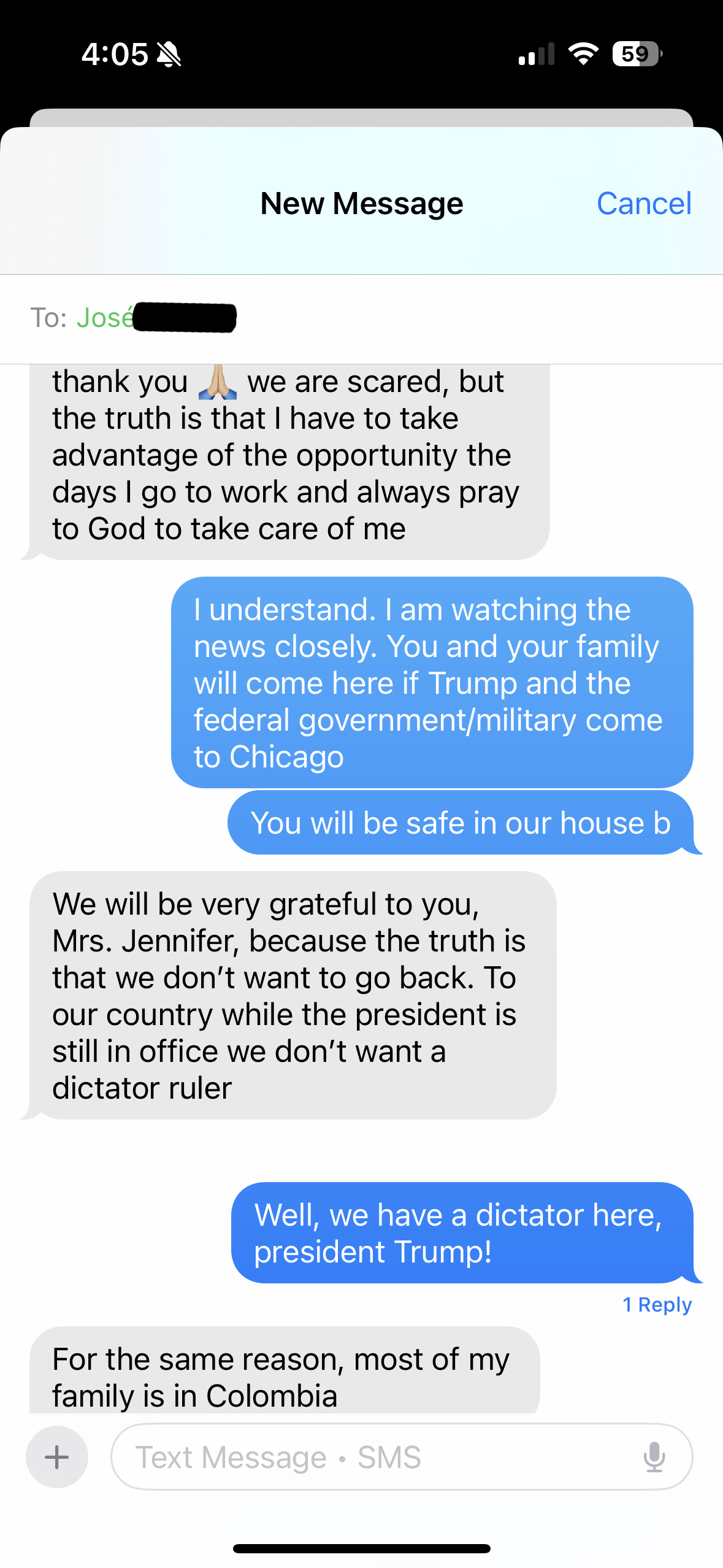
    One of the text messages between José and the author, after José had been deported to Venezuela. His phone number has been obscured by The Inquirer, leaving Venezuela’s international country code as verification of the provenance of the call.

    I first met José outside my local grocery store, Jewel-Osco, in Wilmette, one of Chicago’s North Shore communities. He held up a sign, seeking odd jobs. Many Venezuelan immigrants who congregated around the Jewel ended up there when Texas Gov. Greg Abbott bused them to Wilmette shortly after they crossed the border in late 2023.

    I spoke with José and hired him to do some repairs and painting. He traveled by subway two hours each way for work, Juliana and Yori in tow. While José worked, I drew with Yori.

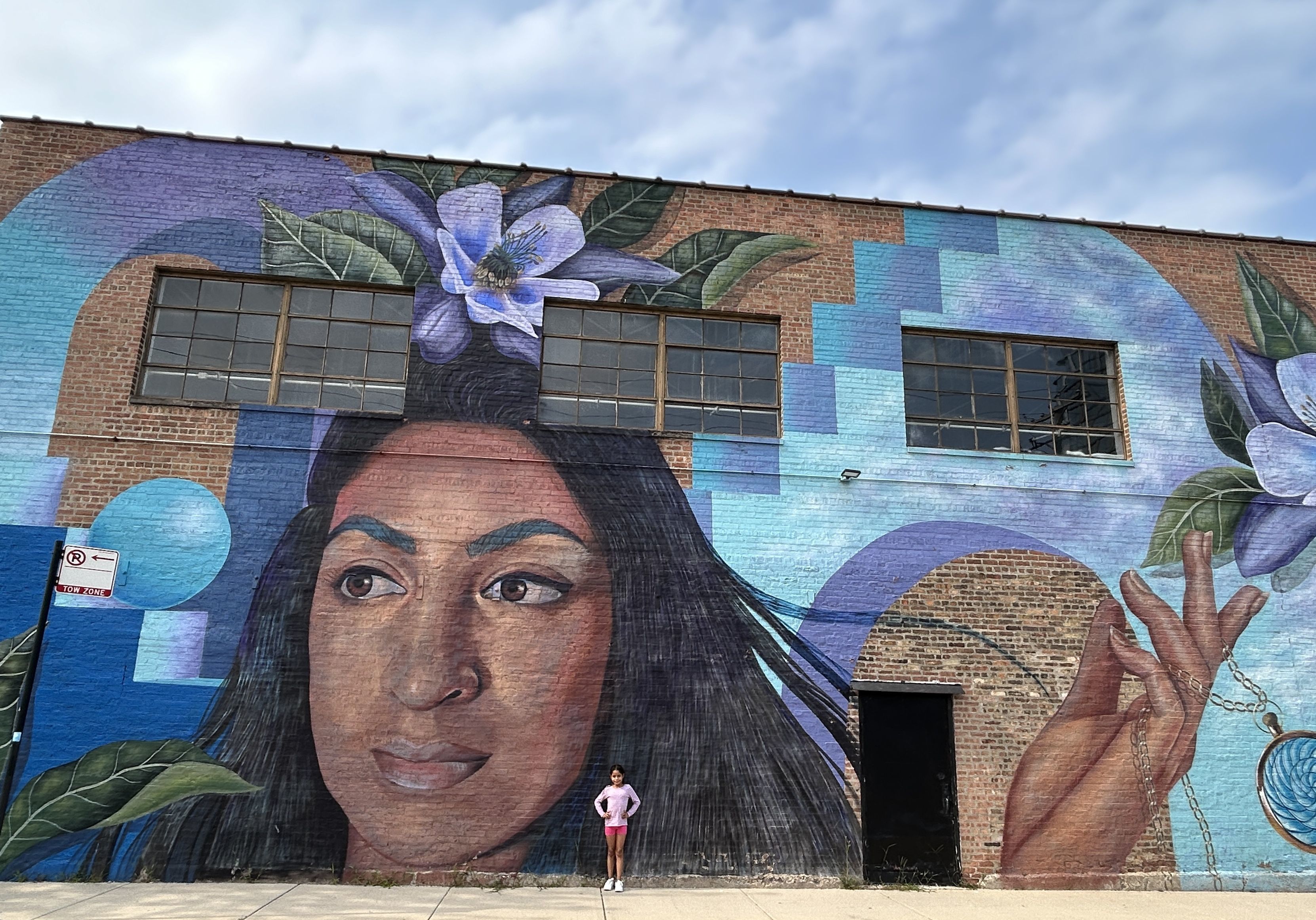
    Yori explored the West Loop of Chicago in July with Tracy, one of the residents of Wilmette. Yori was drawn to the impressive mural of a woman who looked like her and her family. She loved posing in front of it, and the mural made her feel more at home in her new city.

    One warm summer day after José finished working, we all walked to the edge of Lake Michigan, where Yori made sand castles.

    These were good people who faced difficult circumstances. It felt right to help them.

    José was a proud craftsman, and I recommended him to other friends, including Tracy — one of the three of us who would later make sure Juliana and Yori had some money and helped arrange their transportation to New York after José’s deportation.

    What happened last month is not the 1930s. But as a Jewish woman, I can’t ignore the echo of that dark period.

    In Adolf Hitler’s Berlin, families packed by day and moved quietly toward the border by night, clutching papers that might open a path to New York, a city that, for many, meant survival.

    José helps with a neighborhood construction project.

    They wrote to cousins, begged for affidavits, queued at consulates, and measured hope in stamps and signatures. The promise was simple: make it to New York, and you can gain freedom from terror.

    Our family, led by my great-uncle Max Berg, had settled in New York City after immigrating from Poland. On the eve of World War II, letters began arriving from people in Europe desperate to escape Hitler. They wrote because they shared his last name — Berg — hoping for a connection that might save them.

    The author’s great-uncle, Max Berg, standing, third from right, was a Jewish immigrant from Poland, the third of seven children. He became a successful lawyer in New York and, on the eve of World War II, sponsored 49 families to enter the U.S. These individuals wrote to him because they shared a common last name, though it remains unclear whether they were actual relatives. Many of those he sponsored became judges, writers, and leaders in their respective fields.

    Max never knew whether any of the 49 families were actually relatives, but he sponsored them all, buying their passage and covering their first month’s rent so they could begin new lives.

    The differences matter, of course. Hitler engineered annihilation; today’s migrants are not facing that. But the moral test feels painfully familiar.

    When government policy makes ordinary life like work, school, or a doctor’s visit unsafe for families who pose no threat, do we widen the circle of protection or narrow it? In the 1930s, too many Germans hid behind drawn curtains rather than opening their doors.

    As residents of Philadelphia and other American cities steel themselves for the possible deployment of immigration agents, Chicago offers a bleak preview of this chilling and shameful moment in our nation’s history.

    My hometown has faced an onslaught of immigration enforcement as part of Operation Midway Blitz. Chicago has responded to the crisis by widening its circle of protection. Our neighbors are already organizing.

    Yori, who loves to draw, illustrates her spelling lessons.

    Rapid-response networks canvass homes and storefronts, sharing “know your rights” cards and training witnesses to safely document encounters with ICE — even here in the affluent North Shore, where there are few immigrant residents but many immigrant workers.

    We also hold peaceful protests, which include clergy and citizens from across Illinois, to exercise our right of free speech.

    An ICE agent watches protesters as a Lenco BearCat vehicle drives to the scene in the Brighton Park neighborhood of Chicago, on Saturday, Oct. 4, 2025, after protesters learned that U.S. Border Patrol shot a woman Saturday morning on Chicago’s Southwest Side.
    Protesters stand and chant in the Brighton Park neighborhood of Chicago earlier this month, after protesters learned that U.S. Border Patrol agents shot a woman hours earlier on the city’s Southwest Side.

    And we record encounters whenever possible. In some instances, Chicagoans have faced down multiple ICE agents wielding weapons during an attempted arrest. In one such incident, a man, once pinned to the ground, was released because bystanders gathered to document and demand accountability.

    However, ICE agents are using aggressive tactics, often crossing the line into violence directed at protesters and people who document their activities.

    On Sept. 19, federal agents, who appeared like snipers perched on a rooftop at the Broadview Detention Center, shot a local pastor in the head with a pepper ball and then teargassed him.

    A federal agent throws a tear gas canister toward protesters in Chicago earlier this month.

    In recent footage, rows of agents in tactical gear surround protesters and push their faces into the pavement. On Oct. 10, a producer with a local television news program was thrown to the ground, handcuffed, and detained without cause.

    These are not “isolated incidents,” but rather tactics intended to intimidate and provoke. Chicago feels combustible — one itchy trigger finger from our own Kent State massacre.

    The real suffering isn’t confined to the protesters, of course, but to the detainees inside Broadview’s walls. In Lake County, Ill., immigration attorney Kimberly Weiss described the case of her client, Juan — who, like all the immigrants included in this commentary, was willing to be included in this essay only if his surname was withheld. (Likewise, some of the native-born U.S. citizens I interviewed agreed to participate only if their surnames were withheld, for fear of retribution.)

    Juan is a widowed father of four U.S.-born children, ages 12 to 20, detained by ICE outside his home. “His children contacted me terrified,” Weiss said.

    That same night, she filed emergency motions to stop his deportation and request bond, with a hearing set for the next morning. “It would have been a strong case,” she said. “He entered legally, held valid documents, like a work permit, Social Security number, and driver’s license. He’s a union roofer, a widower caring for his U.S. citizen children. He qualified for lawful status under a widower petition.”

    But before the hearing could take place, Juan was gone. Weiss said her client described Broadview Detention Center as so inhumane that he couldn’t endure another night. Detainees had no access to water. The air was so thick and suffocating that Juan witnessed others gasping for breath.

    Officers threatened Juan into signing his deportation papers, using an ICE agent as a “translator” to deceive him. Without his glasses and terrified, he finally signed. By the next afternoon, Juan was across the border.

    “There’s no accountability for what happens inside Broadview,” Weiss said. “It’s overcrowded, filthy, and cruel. There is no oversight, even when the conditions amount to torture.”

    Stories like these ripple far beyond detention centers. Dread doesn’t stop at the gates of Broadview. Anxiety seeps into neighborhoods, workplaces, and schools, touching even those who are U.S. citizens.

    During a recent nighttime raid in a South Shore neighborhood, Blackhawk helicopters dropped armed federal agents on top of an apartment building, as dozens of masked ICE agents arrived in trucks.

    Hundreds of agents moved through the building, kicking in doors, setting off flash-bang grenades, and rounding up residents as they slept. Children were separated from parents, zip-tied, and held in vans for hours.

    Imagine being a child, awakened in the middle of a peaceful slumber, snatched from your parents, and restrained. The U.S. Department of Homeland Security proudly boasts about the raid, but dozens of those arrested were U.S. citizens.

    We’ve now reached the point where friends of mine, Indian American physicians named Shila and Ravi, make sure they and their 14-year-old daughter always leave the house with their driver’s licenses and U.S. passports, in case they are stopped by ICE.

    “Show me your papers” is a demand one might expect from the Gestapo, Hitler’s secret police, but as Americans, we do not expect this, and should never accept it.

    “Being a brown-skinned woman in America means constantly proving my right to belong,” Shila told me recently. “My citizenship and contributions never seem enough to erase the question — ‘Where are you from?’ — that marks me as foreign. I’ve learned to live with this othering, but seeing my child inherit it breaks my heart.”

    “What was once an occasional ‘Go back home’ has become a deeper threat: ‘I’ll make sure you get home,’” she added. “But where is home when this is the only one we’ve ever known? Nothing can shield us from the fear that belonging can be questioned or revoked at any moment.”

    When ICE occupied Los Angeles and the National Guard was deployed, José and I exchanged texts so that I could better understand his asylum case.

    José then called me at the end of August. I could feel his embarrassment reaching through my phone, but he asked: Could he and his family move in with us? He’d heard about the planned ICE buildup and wondered whether his family would be safe in the predominantly Latino neighborhood where they were living.

    I declined. I thought of families in Europe who hid neighbors in attics and back rooms, and felt the weight of closing my door to him. My daughters were still home from college, and there wasn’t space for anyone else. I also wanted time with my girls before they left.

    And truthfully, I wasn’t sure José and his family would be any safer in my predominantly white suburb. I suspected my next-door neighbors were Trump supporters, and worried they would report him.

    One of the text messages between José and the author, before José’s deportation. His last name has been obscured by The Inquirer.

    Still, I told myself that by mid-September, when the girls returned to school, I would offer them refuge.

    But when I finally texted him, it was too late. He had already disappeared.

    When Juliana and Yori finally arrived at Penn Station, they carried two small suitcases with everything they could fit. They left behind their clothes, furniture, toys, traces of a life they built from nothing.

    With the help of an acquaintance, they found a family shelter in New York City, a place that feels more like exile than arrival. The noisy streets outside, thick with strangers and sirens, overwhelm them. Yori cries every day; she misses her father. Juliana leaves the room only to buy food. She had hoped to find work, but even mastering the city’s subway system seems like an impossible task.

    She once dreamed her daughter would breathe freely, run in the open air, play on a jungle gym. Instead, they live in a small room where safety feels borrowed.

    Yori playing in the park in Chicago before her father was deported.

    Watching Juliana and Yori struggle to rebuild their lives, I realize that what failed them wasn’t only my courage, but our collective conscience. The duty to offer refuge doesn’t belong to governments alone; it begins in the smallest places — on our streets, in our homes, within ourselves. Compassion is not a policy, but a choice, a door we decide to open or keep closed. The question is no longer who will offer them refuge, but who we become when we hide behind our curtains.

    I still replay that call, wondering whether borders are drawn only on maps, or instead, inside of us.

    Jennifer Obel is a founding member of the New Trier Rapid Response Team and coleader of Sukkat Shalom’s immigration task force.

  • Protesters rally outside Philly ICE office as Catholics launch ‘One Church, One Family’ campaign for immigrants

    Protesters rally outside Philly ICE office as Catholics launch ‘One Church, One Family’ campaign for immigrants

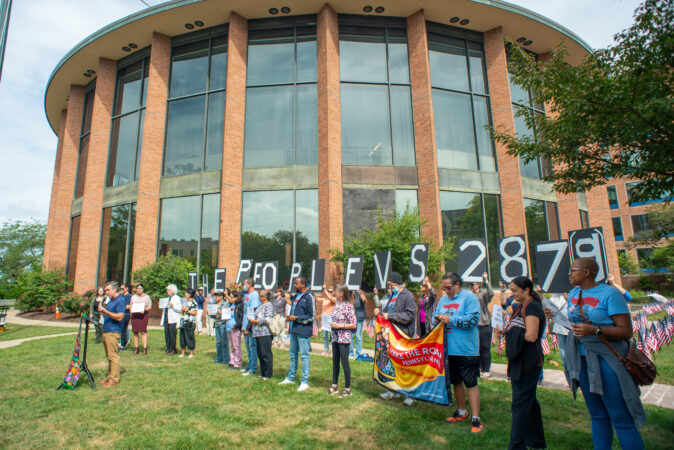
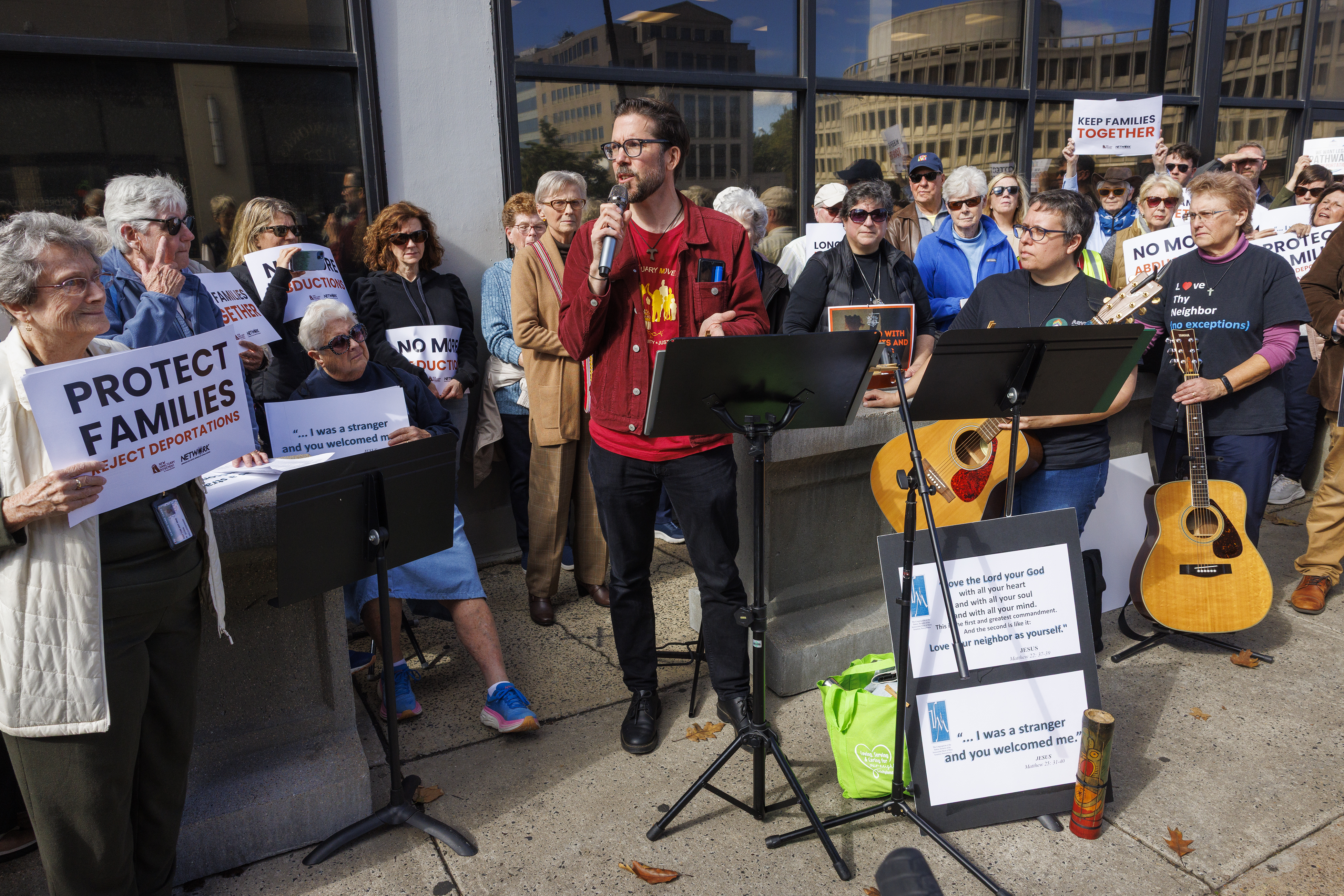
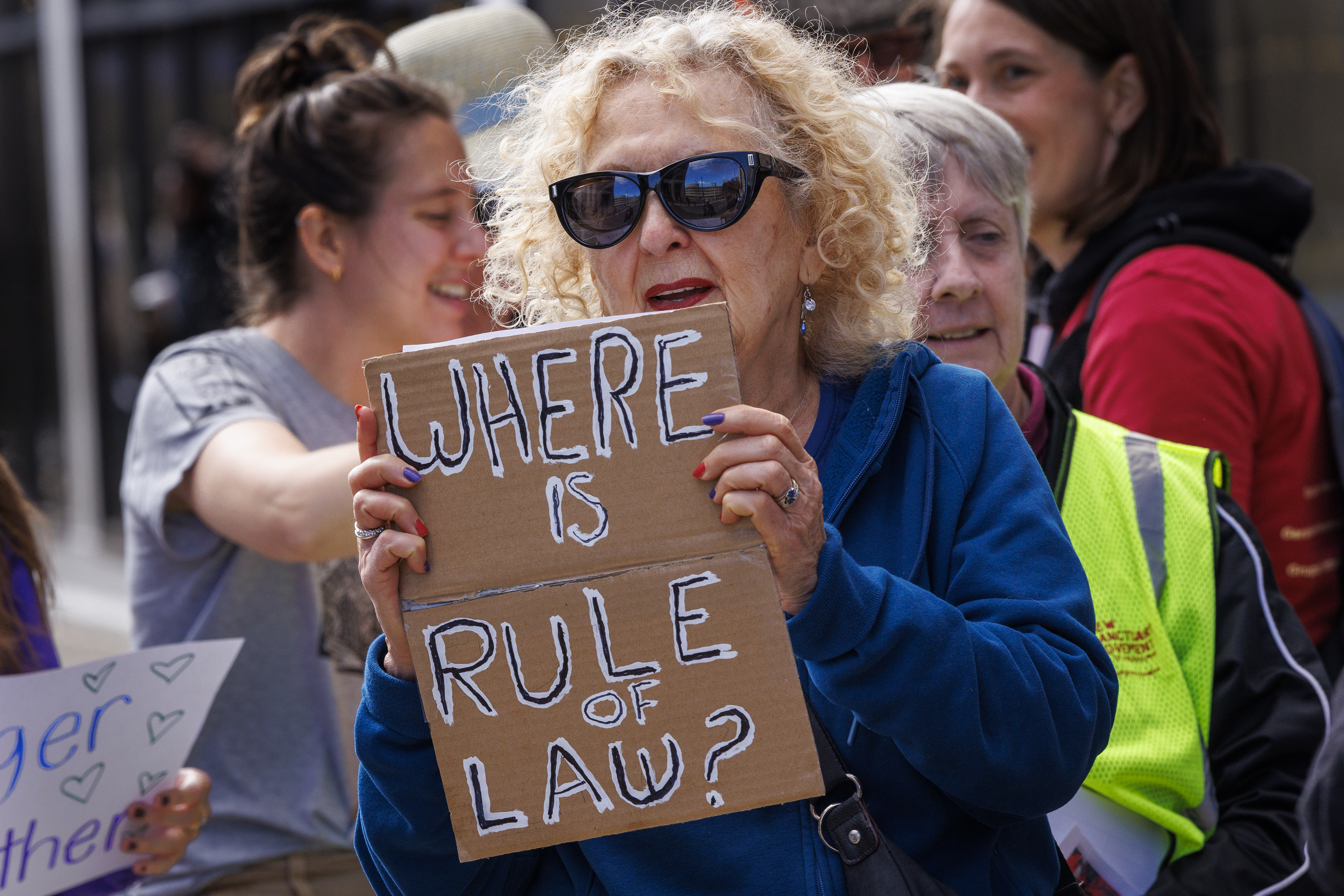
    Lifted by song, prayer, and Scripture, dozens of Philadelphia-area Catholics rallied outside the Center City ICE office on Wednesday, joining a pro-immigrant push undertaken by fellow church groups around the country.

    Catholic priests, nuns, and other supporters prayed and sang outside the field office near Eighth and Cherry Streets, joining a nationwide show of solidarity with migrant families, refugees, and asylum-seekers.

    “We reject the culture of fear that dehumanizes,” Michelle Cimaroli of Handmaids of the Sacred Heart of Jesus, an international community of Catholic women, told the crowd of about 50 people. “As Catholics, we stand with immigrants.”

    Speakers called on people to see the face of God in every human face. And to be as confident as Jesus in sharing the truth.

    Catholic organizations across the country are taking part in a campaign called One Church, One Family: Catholic Public Witness for Immigrants. The movement invites parishes, schools, and faith-based groups to host prayerful public events that proclaim the dignity of every person.

    U.S. Immigration and Customs Enforcement officials said in a statement: “ICE respects the rights of individuals to peacefully protest.”

    A second day of prayer is planned for Nov. 13, timed to coincide with the feast of St. Frances Xavier Cabrini, an Italian immigrant who became the first U.S. citizen to be declared a saint, according to the National Catholic Reporter.

    Peter Pedemonti of the New Sanctuary Movement addressing Catholics gathered outside ICE office at Eighth and Cherry Streets on Wednesday. They are protesting against the detaining and incarceration of immigrants.

    “I want us to take a moment to just let our hearts break,” Peter Pedemonti, codirector of New Sanctuary Movement of Philadelphia, told the crowd in Center City. “That we don’t let the daily barrage of bad news harden us.”

    He and other advocates said they believed ICE arrested four people in Philadelphia on Wednesday, including a man at the Italian Market.

    “We’re trying to get Catholics across the country to listen to Pope Leo’s message: Migrants lead us, they lead us to a true set of values,” said Jerry Zurek, who serves as local co-organizer of NETWORK, the Catholic social-justice group, and who took part in the Philadelphia rally.

    This month the pope described migrants and refugees as “privileged witnesses of hope through their resilience and trust in God,” maintaining their strength while seeking a better future “in spite of the obstacles that they encounter,” Catholic News Service reported.

    Big and small protests continue to take place in the Philadelphia area and around the county in opposition to President Donald Trump’s effort to deport millions of people. The number of people arrested by ICE in Delaware, New Jersey, and Pennsylvania has surged since the agency reportedly implemented a 3,000-arrests-a-day quota in late May.

    Arrests doubled from an average of 26 a day since Trump took office through May 21, to an average of 51 a day between May 22 and June 26 for the three states. At the same time, the proportion of people arrested without a criminal record or pending criminal charges soared, up two-thirds since the directive to ICE was issued.

    “As Catholics and people of deep faith, we reject the culture of fear and silence that dehumanizes, and we choose instead to stand with migrants,” local organizers said in a statement, pledging “to defend the dignity of our neighbors, family members, fellow parishioners, classmates, coworkers, and friends.”

    Vicki Guinta-Abbott, a concerned citizen and a Catholic, gathers with others outside the ICE office at Eighth and Cherry Streets on Wednesday.

    The body of U.S. bishops, individual bishops, and Catholic organizations have been speaking out against what they call inhumane policies that go against church teachings on immigration.

    Local leaders said the campaign is sponsored by the United States Conference of Catholic Bishops Migration and Refugee Services, the Leadership Conference of Women Religious, Jesuit Refugee Service/USA, and many others.

  • John Fetterman sides with Republicans on ending the filibuster to reopen the government: ‘The only losers are the American people now’

    John Fetterman sides with Republicans on ending the filibuster to reopen the government: ‘The only losers are the American people now’

    Sen. John Fetterman (D., Pa.) said he would back a Republican plan to override the Senate filibuster if it meant passing a bill to reopen the government.

    In an interview with The Inquirer on Tuesday, Fetterman admonished fellow Democrats who balk at the notion of using the so-called nuclear option to end the filibuster: “When I ran for Senate, everyone, including myself, said we’ve got to get rid of the filibuster. I don’t want to see any Democrats clutching their pearls about it now.

    “If we’d had our way, the filibuster wouldn’t have been around for years.”

    A staple of the Senate that has long been debated, the filibuster requires 60 votes to pass most legislation in the chamber.

    Republicans have long vowed to protect the filibuster, noting that the 60-vote threshold presents a check on Democrats when they have the majority, but it’s now the rule standing in the way of their government funding bill. And in recent months, leaders have made moves to further weaken the minority party’s power, including bypassing the need to get Democratic support to confirm a slate of President Donald Trump’s nominees last month. Senate Majority Leader John Thune (R., S.D.) has thus far said he won’t use the same tactic to reopen the government.

    Fetterman’s comments on Tuesday followed several Republicans floating the idea of getting rid of the filibuster in recent days.

    Fetterman is one of three members of the Democratic caucus who voted with Republicans to reopen the government earlier this month, joining Sens. Catherine Cortez Masto of Nevada and Angus King, a Maine independent.

    “If you look at my record, I’ve been voting the Democratic line, but this is different now. The tactic is wrong,” Fetterman said.

    He said his main concern is the possibility that people in the state and across the country would face hunger if the federal government shutdown continues and Americans lose their Supplemental Nutrition Assistance Program (SNAP) benefits beginning Nov. 1.

    “Nobody checks their political party when they’re hungry,” he said. “It’s not about a political side blinking. The only losers are the American people now.”

    Fetterman added that he is in favor of extending tax credits, as Democrats are demanding during the shutdown. With those tax credits set to expire, people are going to start seeing higher prices when they sign up for health insurance come open enrollment in November, experts say.

    “I don’t want people clobbered,” Fetterman said. “But Democrats designed them to expire this year. We passed these things when we were in the majority.”

    Seeing room for dialogue, Fetterman said Thune “is an honorable man, and I believe a productive conversation to extend tax credits can be had with him.”

    Sen. Andy Kim (D., N.J.) said he had multiple conversations with Senate Republicans on Tuesday who said they would “adamantly oppose” ending the filibuster.

    “That’s been a huge part of how they’ve been able to lock down power here in D.C. before,” Kim said.

    He said from his perspective, Senate Democrats are focused on getting the House back to work to negotiate a deal that includes the extended healthcare subsidies in a government funding bill.

    “This is not an issue of Senate procedure. This is an issue of just doing our job.” Kim did not comment on Fetterman’s support for a filibuster carveout to end the shutdown.

    In 2022, according to the media and politics site Mediaite, every Senate Democrat with the exceptions of then-Sens. Joe Manchin of West Virginia and Kyrsten Sinema of Arizona voted to eliminate the filibuster in a failed effort to pass former President Joe Biden’s elections overhaul.

    A sometimes contrary figure, Fetterman has taken controversial stands in the past and is one of few Democrats who actively works with Republicans.

    He has been criticized by progressives for his unwavering support of Israel in its war against Hamas.

    And Fetterman garnered the enmity of some Democrats (and the praise of President Donald Trump) when he defended Immigration and Customs Enforcement by saying fellow Democrats’ calls to abolish the agency were “inappropriate and outrageous.”

  • Philadelphia’s immigration court now rejects three in four asylum cases under Trump

    Philadelphia’s immigration court now rejects three in four asylum cases under Trump

    Asylum denials in Philadelphia’s immigration court have spiked through the first seven months of President Donald Trump’s administration, according to an Inquirer analysis of the latest available government data.

    The court has denied 74% of asylum claims in the first seven months of Trump’s second term, compared with a 61% denial rate during the last seven months of the Biden administration, mirroring national trends.

    The data were published by the Transactional Records Access Clearinghouse (TRAC), a data gathering and research organization that regularly acquires and analyzes such data from the Executive Office for Immigration Review (EOIR), the agency responsible for overseeing the nation’s immigration courts system.

    window.addEventListener(“message”,function(a){if(void 0!==a.data[“datawrapper-height”]){var e=document.querySelectorAll(“iframe”);for(var t in a.data[“datawrapper-height”])for(var r,i=0;r=e[i];i++)if(r.contentWindow===a.source){var d=a.data[“datawrapper-height”][t]+”px”;r.style.height=d}}});

    And it’s not just that denials are up: The volume of cases has risen substantially as well. The Philadelphia court heard twice as many cases over Trump’s first seven months, compared with Biden’s final seven: 1,059 vs. 513.

    Local immigration attorneys say that’s no coincidence.

    “Absolutely. They’re pushing cases to go forward,” said Brennan Gian-Grasso, founding partner of Philadelphia’s Gian-Grasso & Tomczak Immigration Law Group, when asked whether the two trends may be connected. “Additionally — and I think this is probably the big difference — prosecutorial discretion.”

    Under the Biden administration, Gian-Grasso said, immigration officials often gave asylum seekers who may not have necessarily qualified for asylum the opportunity to remain in the United States by putting a case on hold or otherwise allowing individuals to continue to stay in the United States so long as they did not have a criminal record or other derogatory characteristics.

    “That’s gone,” said Gian-Grasso. “Every case is going forward now.”

    The administration has been open about its efforts to push cases through the system. Last month, EOIR issued a news release trumpeting a shrinking backlog of immigration court cases — claiming a decrease of 450,000 pending cases since Trump’s inauguration. TRAC data indicate a slight decrease for Philadelphia’s backlog since the start of the current fiscal year last October.

    Emma Tuohy, a partner at Philadelphia’s Landau, Hess, Simon, Choi & Doebley and a recent past president of the American Immigration Lawyers Association’s Philadelphia chapter, suggested the rising number of decisions and denial rates were connected to another recent trend: surging arrests and detentions by Immigration and Customs Enforcement (ICE).

    “Denials in detained settings have always been higher,” Tuohy said, explaining that attorneys face particular obstacles when representing detained clients.

    The Inquirer reported in August that the number of people detained in ICE custody in New Jersey and Pennsylvania was up about 68% in July compared with figures at the start of Trump’s administration.

    Historically, asylum denial rates are vastly higher for those individuals who were in custody at the time a decision was rendered in their cases. Since the start of the 2000 fiscal year, about 99% of detained individuals in Philadelphia’s immigration court were denied asylum, compared with 63% of individuals who were detained at some point but later released and 58% of those who were never detained since the start of fiscal 2000. Similar, though smaller, gaps exist nationally.

    window.addEventListener(“message”,function(a){if(void 0!==a.data[“datawrapper-height”]){var e=document.querySelectorAll(“iframe”);for(var t in a.data[“datawrapper-height”])for(var r,i=0;r=e[i];i++)if(r.contentWindow===a.source){var d=a.data[“datawrapper-height”][t]+”px”;r.style.height=d}}});

    “[Cases] move much, much quicker — within just a couple months — as opposed to non-detained cases which can take a few years. It’s a much shorter timeline to put together extensive documentation and it’s obviously quite a bit harder to work with clients, given they are not as accessible as normal,” said Tuohy. “It’s much harder for individuals in detention to collect documents, to call people they need to speak with, to prepare their statements, to request letters from witnesses. We’re relying mostly on families that are outside and they may not have all the information nor access.”

    Officials at EOIR did not respond to requests for comment.

    A flurry of policy changes have made winning cases tougher

    The substantial increase in denial rates since Trump’s inauguration has been accompanied by a succession of policy changes at EOIR.

    The first came in a February memo issued by Sirce Owen, the Trump-appointed acting director of EOIR. Unlike typical federal judges, immigration court judges are not independent judicial branch officials but executive branch employees within EOIR. The directive rescinded a 2023 memo meant to better ensure that individuals in asylum proceedings are provided with adequate interpretation and translation services.

    Gian-Grasso explained that access to interpretive services can be critical to an asylum seeker’s ability to properly plead their case.

    “Just in my own experience, I’ve had clients who could not speak a word of English — and were illiterate even in their own language — but in translation during testimony could very, very effectively and intelligently articulate their fear of return to their country and their asylum case,” he said.

    Gian-Grasso worried the policy shift would put some asylum seekers at a severe disadvantage.

    “Limiting that kind of access dooms asylum cases because if you can’t tell your story, what does the judge have to go on?” he said.

    Historically, asylum denial rates are significantly higher for those individuals who don’t speak English. In Philadelphia’s immigration court, about 62% of non-English speakers were denied asylum, compared with 51% of English speakers, since the start of fiscal 2000.

    window.addEventListener(“message”,function(a){if(void 0!==a.data[“datawrapper-height”]){var e=document.querySelectorAll(“iframe”);for(var t in a.data[“datawrapper-height”])for(var r,i=0;r=e[i];i++)if(r.contentWindow===a.source){var d=a.data[“datawrapper-height”][t]+”px”;r.style.height=d}}});

    Attorneys have cited a second memo, issued in April, as likely to have an even greater effect on asylees.

    That memo essentially encouraged immigration judges to order an asylum seeker removed before providing them with an opportunity for a full hearing of their case — an action known as pretermission — if a judge believes that an applicant has failed to present sufficient corroborating evidence at the outset of their proceedings.

    Tuohy described the practical effect of the policy as telling judges to throw out cases over paperwork errors.

    “These [cases] are not being pretermitted because there’s not corroborating evidence or there’s not an affidavit or there’s a credibility issue where they don’t believe a person’s story on the merits,” Tuohy said. “This is just because someone has not fully filled out a form.”

    Gian-Grasso said the new memo will likely be particularly difficult on individuals navigating the immigration system without an attorney.

    “Asylum is highly technical. It’s very difficult to put together an asylum case,” Gian-Grasso said. “You can have a valid asylum case, but if you don’t know how to put it together legally — now judges are being told to look to pretermit in these situations.”

    Historically, asylum denial rates are markedly higher for those individuals who don’t have access to an attorney. In Philadelphia’s immigration court, about 82% of asylum applicants without representation were denied asylum, compared with 57% of those who did. An even larger gap exists nationally.

    window.addEventListener(“message”,function(a){if(void 0!==a.data[“datawrapper-height”]){var e=document.querySelectorAll(“iframe”);for(var t in a.data[“datawrapper-height”])for(var r,i=0;r=e[i];i++)if(r.contentWindow===a.source){var d=a.data[“datawrapper-height”][t]+”px”;r.style.height=d}}});

    Denial rates vary by president, and, locally, by judge

    While recent denial rates are the highest on record, increases and decreases in the rate of asylum denials are nothing new.

    While Philadelphia’s recent denial rate marks the highest since data became available a quarter century ago, rates have fluctuated over time, with notable shifts depending on who’s in the White House.

    window.addEventListener(“message”,function(a){if(void 0!==a.data[“datawrapper-height”]){var e=document.querySelectorAll(“iframe”);for(var t in a.data[“datawrapper-height”])for(var r,i=0;r=e[i];i++)if(r.contentWindow===a.source){var d=a.data[“datawrapper-height”][t]+”px”;r.style.height=d}}});

    In addition to notable partisan gaps, the data reveal another factor in success for an asylum speaker: the judge assigned to the case.

    From the 2019 through 2024 fiscal years, the Philadelphia judge with the lowest denial rate denied asylum in 33% of cases, compared with the judge with the highest denial rate, 85%.

    Tuohy expressed frustration over that chasm in case outcomes.

    “There’s just absolutely no way that those judges are being assigned such fundamentally different cases that their grant rates should be so different so unfortunately yes, it makes a huge difference what judge you get assigned to,” Tuohy said.

    Gian-Grasso agreed, arguing it’s one more reason that asylees without an attorney are penalized.

    “You know as an attorney what you’re getting when you go in with these judges and how to structure your case,” said Gian-Grasso. “But, again, that goes back to our [unrepresented asylum seekers]. They have no idea and they’re similarly disadvantaged for having this lack of knowledge at the end of the day.”

  • Judge rules Bucks County sheriff’s agreement to cooperate with ICE was ‘reasonable and necessary’

    Judge rules Bucks County sheriff’s agreement to cooperate with ICE was ‘reasonable and necessary’

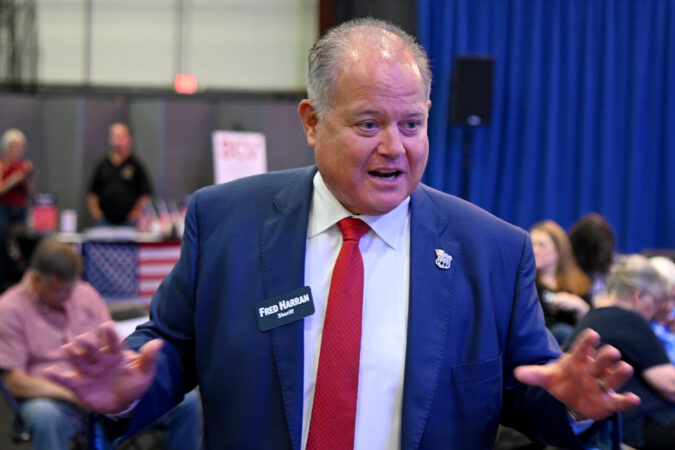
    Bucks County Sheriff Fred Harran acted legally in signing up to have his deputies help ICE enforce federal immigration laws, a judge ruled Wednesday in a case that has riled residents on both sides of a contentious issue.

    Bucks County Court Judge Jeffrey Trauger said Harran’s cooperation with the agency was “clearly lawful under Pennsylvania jurisprudence,” and both “reasonable and necessary” in fulfilling his lawful duty to keep the citizens of Bucks County safe.

    What the judge called “intergovernmental cooperation of law enforcement” is no different under the law at the county, state, or federal level, he wrote.

    The ACLU of Pennsylvania and other plaintiffs had asked Trauger to issue an injunction blocking the partnership from moving forward.

    Reached by phone Wednesday, Harran said he was pleased with the decision and expected his partnership with U.S. Immigration and Customs Enforcement to be fully operational by the end of next week.

    “I knew from the time I started this that I was in the right, that the county commissioners do not control the office of the sheriff,” Harran said.

    A spokesperson for Bucks County said the county intended to appeal.

    Those who sought to block Harran’s efforts said they would continue to battle.

    “This decision doesn’t mean that we’ll stop fighting to hold Sheriff Harran accountable,” said Diana Robinson, co-executive director of Make the Road Pennsylvania, an advocacy group that was one of the plaintiffs. ”Indeed, we will redouble our efforts in this case and continue to fight for what is right.”

    She said an alliance between Harran’s department and ICE was aimed at “turning our neighborhoods into surveillance zones” and “weaponizing local law enforcement to carry out ICE’s harmful agenda.”

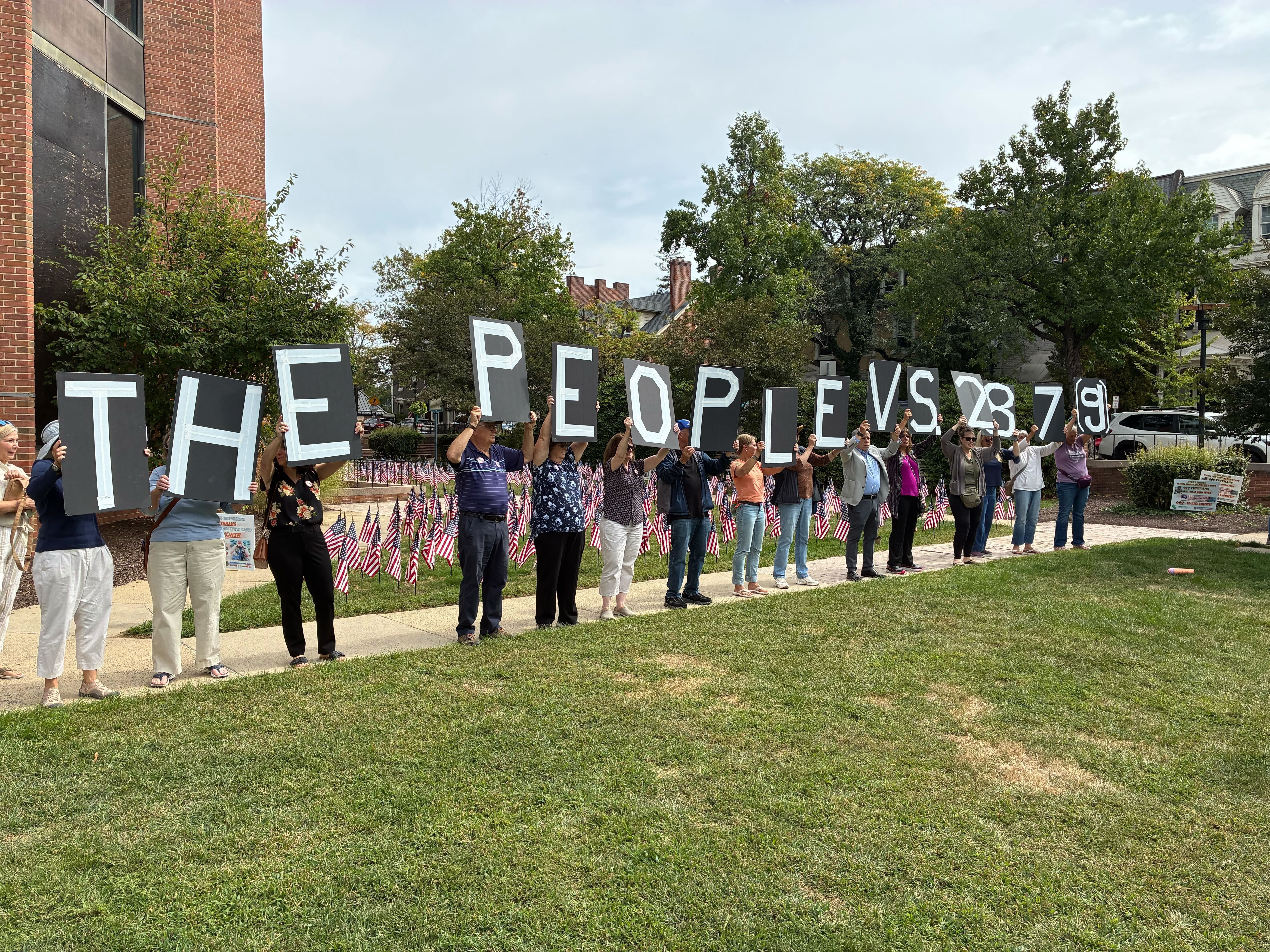
    Community members rally in Bucks County before civil rights groups asked a judge to block Sheriff Fred Harran’s controversial partnership with ICE.

    In his opinion, the judge said it did not appear that Make the Road, NAACP Bucks County, or Buxmont Unitarian Universalist Fellowship as organizations had clear standing to sue under Pennsylvania law.

    While individual members might have standing if they were caused harm by the sheriff’s office, he said, the injuries they alleged were “not immediate or substantial,” and their complaint was based in part on speculation about what might happen.

    ACLU of Pennsylvania attorney Stephen Loney, who helped lead the court fight, said Wednesday that he disagreed with the decision.

    “In the most respectful way I could possibly say it, I think the judge got it totally wrong,” he said. “It’s unfortunate.”

    He said the ACLU would appeal the decision.

    ICE officials did not immediately offer comment.

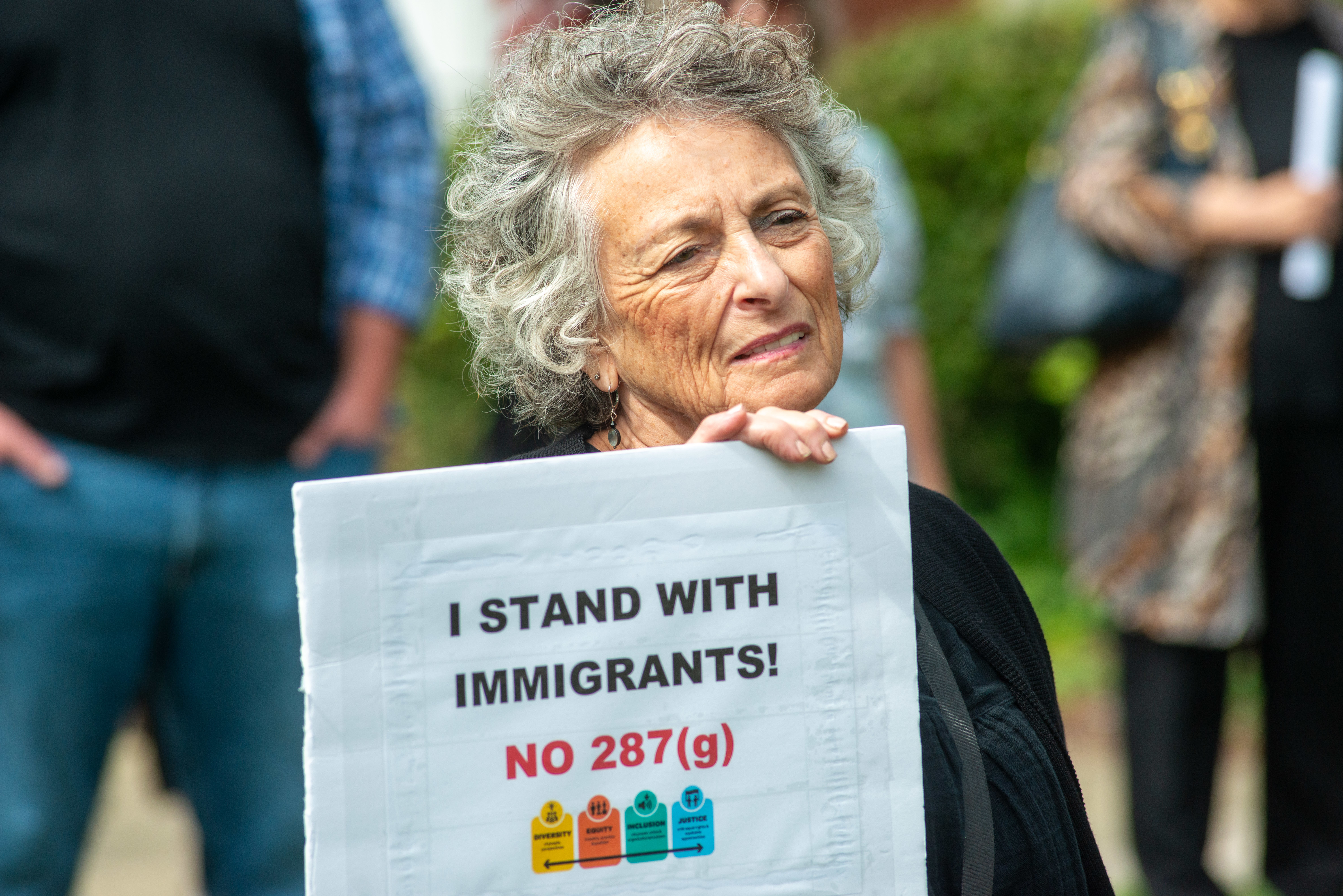
    Melanie Goldstein holds a sign as demonstrators rally outside the Bucks County Administration building before a hearing last month during which the ACLU and other organizations sought an injunction to stop the Bucks County sheriff from going through with his plan to help ICE enforce immigration laws.

    Laura Rose, an organizer with Indivisible Bucks County, said the group was “deeply disappointed in Judge Trauger’s decision” to let Harran proceed “without guardrails.”

    She called the ruling “a profound failure to protect both the immigrants and taxpayers of Bucks County.”

    Rose called on voters to end the local alliance with ICE by voting Harran out of office on Nov. 4.

    Harran’s lawyer, Wally Zimolong, called the decision “a victory for the rule of law and for the safety of Bucks County residents,” and accused the ACLU of maligning the sheriff with false claims.

    “Frankly,” he said, “it is mind-boggling that anyone would oppose this. It is also a vindication for Sheriff Harran, a good and honorable man and dedicated public servant. … It is a proud day when people of good character, like Sheriff Harran, prevail over those that lack it.”

    In the spring, Harran and ICE officials signed what is called a 287(g) agreement, a controversial program named for a section of a 1996 immigration law. It enables local police to undergo ICE training, then assist the agency in identifying, arresting, and deporting immigrants.

    The number of police agencies participating in the program has soared to more than 1,000 under President Donald Trump. Seven states, including New Jersey and Delaware, bar the agreements by law or policy.

    Shortly before the government shutdown, ICE was poised to begin backing its recruitment efforts with money, announcing that it would reimburse cooperating police agencies for costs that previously had been borne by local departments and taxpayers.

    Harran, who is seeking reelection in November, has pledged “zero cost” to local taxpayers.

    He insists the alliance with ICE will prevent crime and keep people safe. Civil rights groups say the sheriff is inviting racial profiling, taxpayer liability, and a loss of trust between police and citizens.

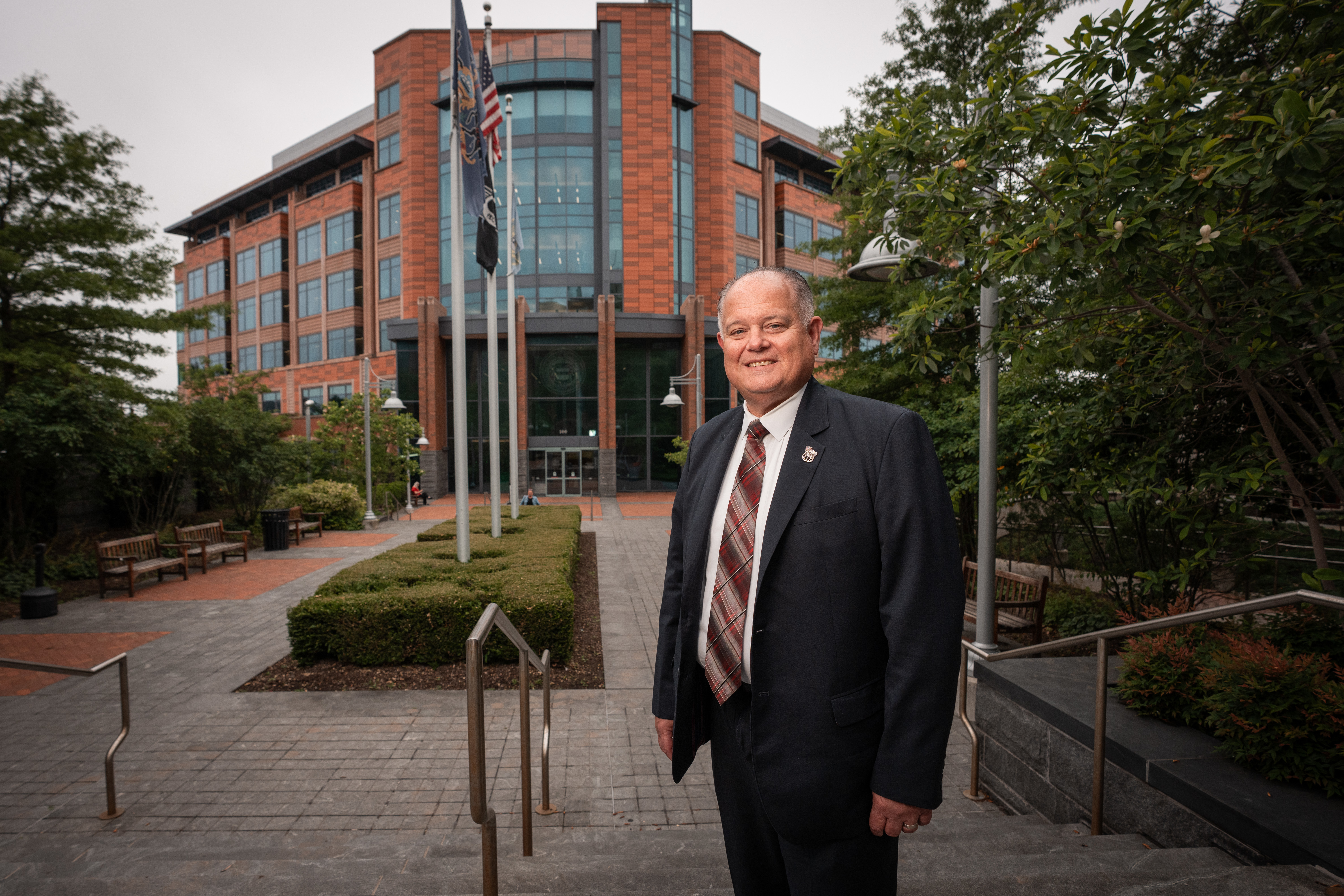
    Bucks County’s sheriff Fred Harran, outside the courthouse in Doylestown, PA, June 9, 2025.

    Contentious legal hearings have come against a backdrop of name-calling and rancor outside the courtroom.

    The Democratic-led Bucks County Board of Commissioners has disavowed Harran’s actions, voting 2-1, with the lone Republican opposed, to approve a resolution that declared the agreement with ICE “is not an appropriate use of Bucks County taxpayer resources.”

    The ICE issue has become central to Democrats’ effort to oust Harran, a Republican, while the sheriff says his intentions have been misconstrued by political opponents and the news media.

    “A judge ruling that he has the authority to enter into this deportation agreement does not make this any less dangerous,” Harran’s Democratic opponent, Danny Ceisler, said in a statement Wednesday.

    The last opportunity to end the partnership, Ceisler said, is by winning the election next month.

    A key issue has been the difference between what Harran says he intends to do and the much broader powers conferred within the agreement with ICE.

    Harran signed up for the “Task Force Model,” the most far-reaching of the three types of 287(g) agreements. It allows local police to challenge people on the streets about their immigration status and arrest them for violations.

    Harran said his officers won’t do that.

    Wednesday’s ruling, Harran said, recognized the limited scope of his plans, and he suggested that every county should partner with ICE.

    “I’m only interested in making the county safer, and I’m only interested in dealing with those folks that are in this country illegally that have committed crimes,” Harran said. “I am not the immigration police. I am not Immigration and Customs Enforcement.”

    Harran has said staff will electronically check the immigration status of people who have contact with the sheriff’s office because of alleged criminal offenses. Those found to be in the country illegally will be turned over or transported to ICE, if the federal agency desires, he said.

    Harran testified in court last month that he planned to create a sheriff’s office policy to specify the limits of his deputies’ powers but had not yet done so.

    He insisted that his office would take only the actions he has described.

    “We will not be stopping people to ask them on immigration status,” he said under cross-examination. “I know what I am doing, and that’s all I intend to do.”

    This suburban content is produced with support from the Leslie Miller and Richard Worley Foundation and The Lenfest Institute for Journalism. Editorial content is created independently of the project donors. Gifts to support The Inquirer’s high-impact journalism can be made at inquirer.com/donate. A list of Lenfest Institute donors can be found at lenfestinstitute.org/supporters.