Tag: Immigration

  • Trump’s assault on free and fair elections continues | Editorial

    Trump’s assault on free and fair elections continues | Editorial

    There are many things Donald Trump could regret about the aftermath of the 2020 election.

    Perhaps it could be his nonstop lying about voter fraud, or how he was recorded asking Georgia election officials to “find” him the votes he needed. Maybe he has remorse about inciting the mob that attacked the U.S. Capitol, violence that led to seven deaths and more than 100 injured law enforcement officers.

    But no. What the president “regrets,” as he told the New York Times recently, is not ordering the National Guard to confiscate voting machines in swing states he lost.

    If the idea of military reservists marching into Philadelphia polling places and walking out with the pesky will of the people seems far-fetched — just another of Trump’s rambling musings — then consider that he and his enablers are already laying the groundwork to undermine future elections.

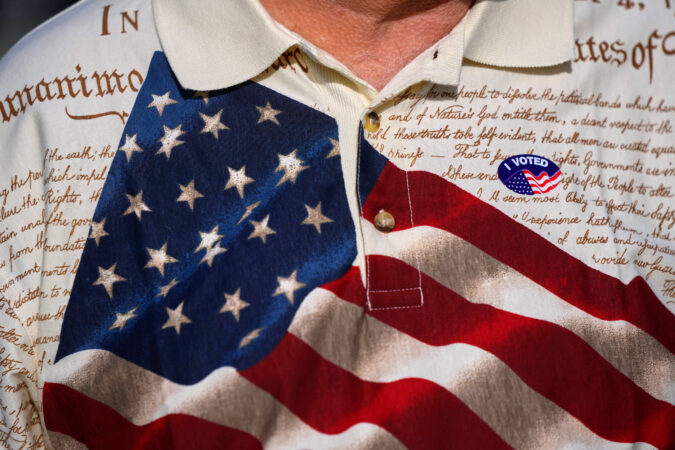
    With the midterms less than a year away, local and state officials must remain steadfast in their defense of free and fair elections, and voters must demand that their rights are protected.

    The administration’s assault on the franchise began in March, when Trump issued an executive order seeking to exert control over election law that the Constitution does not grant the president, including demanding states avoid counting mail ballots postmarked by Election Day but received after.

    The courts have so far stopped the order from taking effect, but it is worth noting that a new U.S. Postal Service rule changes when a piece of mail is postmarked — no longer when it is dropped off, but when it is processed. That means procrastinating voters in states where a ballot counts if mailed by Election Day can no longer take for granted their vote will be tallied.
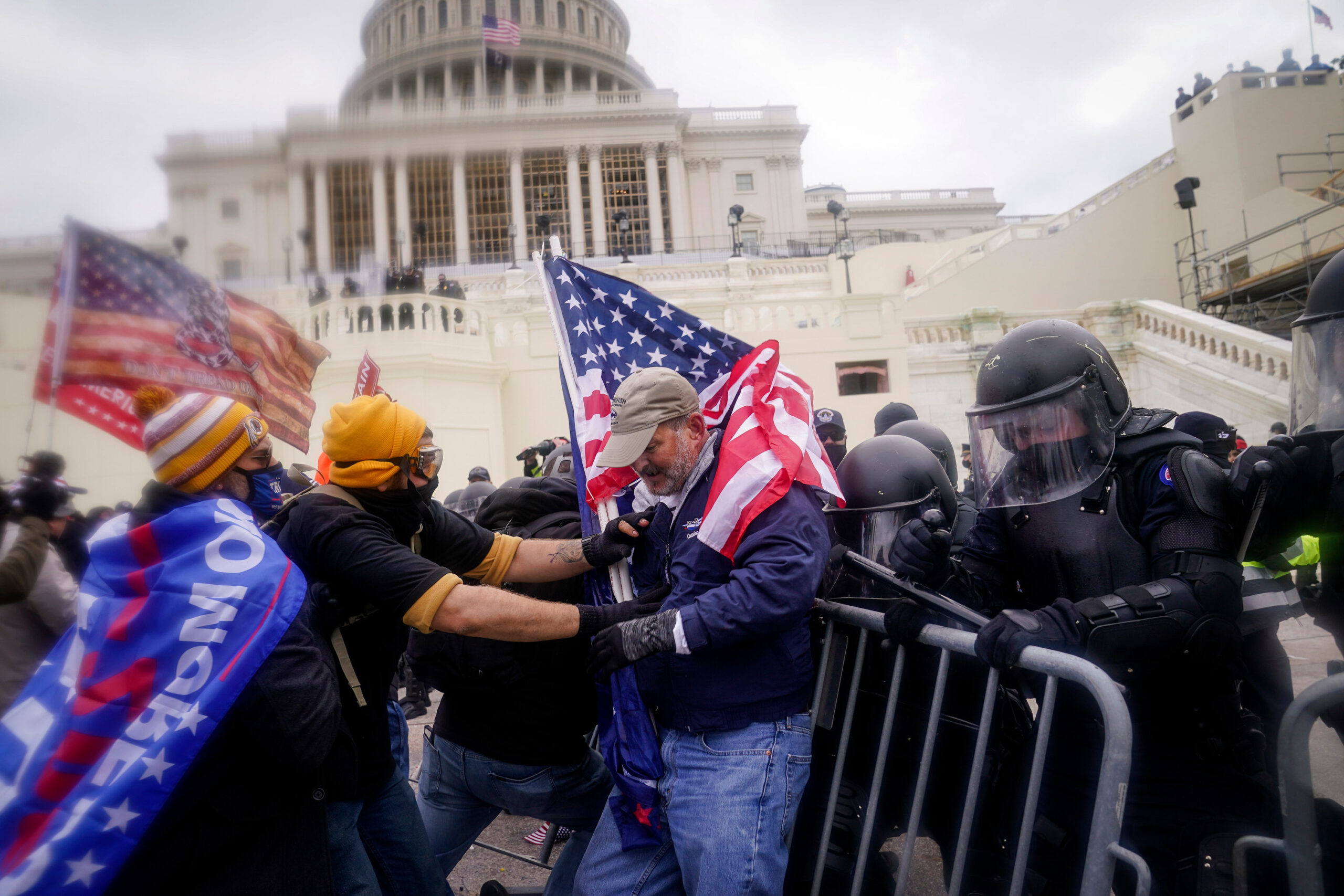
    Rioters try to break through a police barrier at the U.S. Capitol on Jan. 6, 2021.

    Trump has claimed he will target mail-in ballots and voting machines as part of his effort to “help bring HONESTY to the 2026 Midterm Elections.” He has also threatened election officials who oversaw the 2020 election with prosecution while pardoning the Jan. 6, 2021, rioters who sought to interfere with the certification of Joe Biden’s electoral victory.

    Meanwhile, starting in May, the U.S. Department of Justice demanded that states turn over their complete voter registration lists. Many states have declined to comply, including Pennsylvania, and are being sued by the government. This is sensitive data that includes Social Security numbers, dates of birth, and home addresses.

    Along with privacy concerns, there are fears that the Trump administration may seek to cast doubt on voter eligibility and pressure states to purge people from voting rolls. Already, there are examples of people being falsely identified as noncitizens by federal databases.

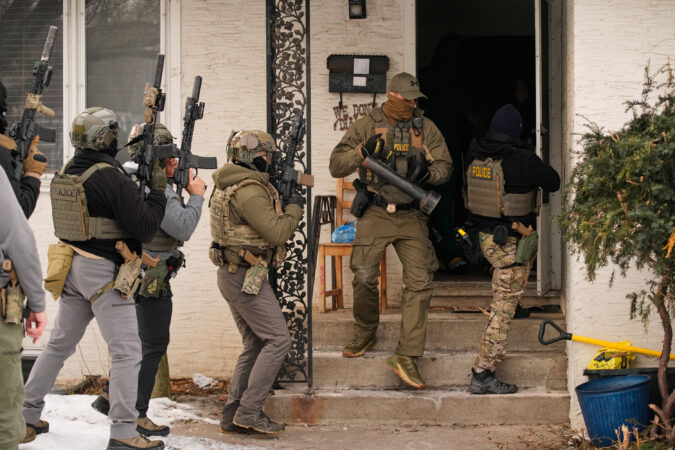
    It is sadly not much of a leap to imagine Trump claiming widespread voting by noncitizens requires U.S. Immigration and Customs Enforcement agents be stationed at polling places. Of course, noncitizens can’t vote, but one does not need to be an immigrant to be intimidated by gun-toting masked forces who have shown they will fire first and expect no questions later.

    The president has also successfully lobbied some Republican-controlled states to remake congressional maps to favor the GOP, regardless of their potential illegality. In Texas, the U.S. Supreme Court allowed 2025 redistricting maps to be used for the upcoming election, even as a legal challenge moves forward over racial gerrymandering. The high court’s conservative members are also likely to strike a blow against the Voting Rights Act this term, further emboldening voter suppression efforts.

    The administration’s unprecedented machinations have fortunately run into the wisdom of the founders, who charged the states with running elections, not the federal government. The same decentralization that sometimes frustrates widespread election reform and the implementation of best practices also limits a wholesale takeover.

    State election officials — Republicans and Democrats — have shown they take their charge seriously and are honor-bound to do their duty. Still, as Trump continues to consolidate power in the executive and stoke fears of widespread fraud, ensuring free and fair elections will require keeping the federal government from overstepping its authority.
  • Americans take their heroes where they can get them, but they should look past Philly’s sheriff | Shackamaxon

    Americans take their heroes where they can get them, but they should look past Philly’s sheriff | Shackamaxon

    This week’s column talks about heroes with feet of clay, SEPTA’s starts and stops, and America’s 250th birthday celebrations.

    No one’s hero

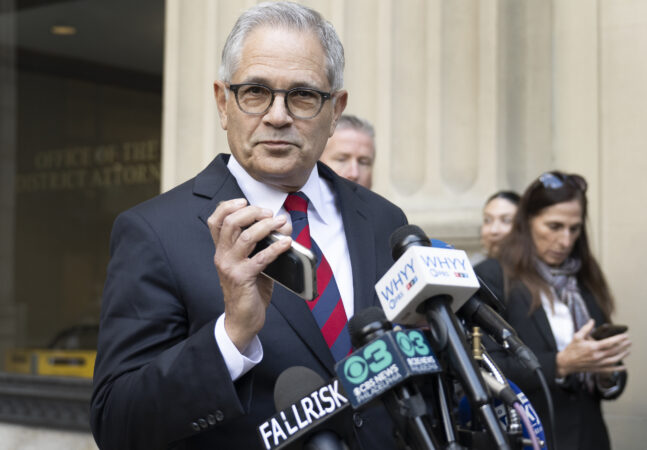
    Philadelphia Sheriff Rochelle Bilal is having her 15 minutes of fame this week, with her comments at a news conference alongside District Attorney Larry Krasner spreading across social media. After the killing of Renee Good by U.S. Immigration and Customs Enforcement agent Jonathan Ross in Minneapolis, Krasner stated that he would hold federal officers accountable for any violation of the law. Bilal warned that the feds “don’t want that smoke” and called ICE “fake wannabe law enforcement.” She even scored an interview with CNN’s Erin Burnett.

    That’s all well and good, but there’s one big problem with Bilal’s position: The sheriff ultimately has no ability to protect Philadelphians from ICE.

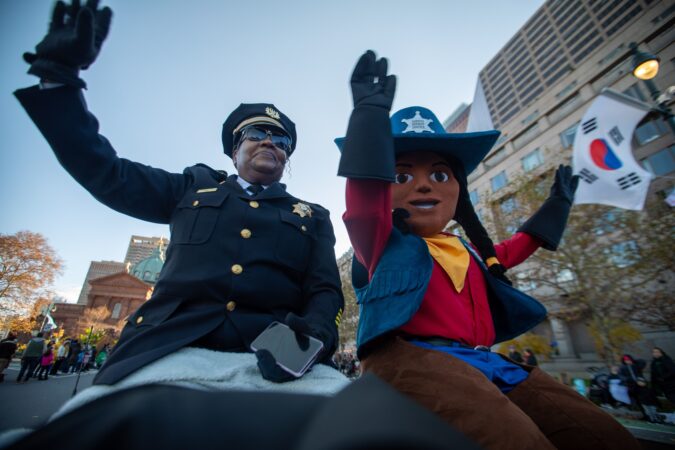
    Despite her title and natty uniform, it is Police Commissioner Kevin J. Bethel who serves as the city’s top law enforcement official, not Bilal. This is a good thing because the sheriff’s track record is disastrous.

    Despite running for the office in 2019 as a reformer, Bilal began her tenure by firing Brett Mandel, her chief financial officer, just five weeks into his tenure. Mandel had flagged her use of what he described as a slush fund. A longtime good government advocate, Mandel objected to using city funds to pay for things like parking tickets and six-figure media consulting contracts.

    Things haven’t improved in the years since. Bilal was publicly criticized by the city’s judges for her failure to protect courtrooms, turning over foreclosure sales to an online operator with little notice, covering up the theft of a department-issued vehicle, one of her deputies was caught selling guns illegally, and her office wasted nearly $10,000 on a new mascot no one asked for. The list goes on, yet city officials have mostly steered clear of criticizing the sheriff for her missteps.

    While Bilal was basking in the media spotlight of talking tough against ICE, Bethel was not amused. Given Mayor Cherelle L. Parker’s clear strategy to avoid poking the orange bear, Bilal’s comments forced the commissioner to make clear in a statement that it is the Philadelphia Police Department that runs law enforcement in the city, not the sheriff.

    If people are looking for a genuine local hero in the national crisis over immigration enforcement, why not opt for Keisha Hudson instead? Hudson, who leads the local Defenders Association, has put together a new unit specializing in immigration cases. An immigrant from Jamaica herself, Hudson has both the right job and the right life experience to help residents who have been mistreated by ICE.

    Bilal, on the other hand, can’t even keep ICE from turning the courts she’s responsible for into a hunting ground for the feds.

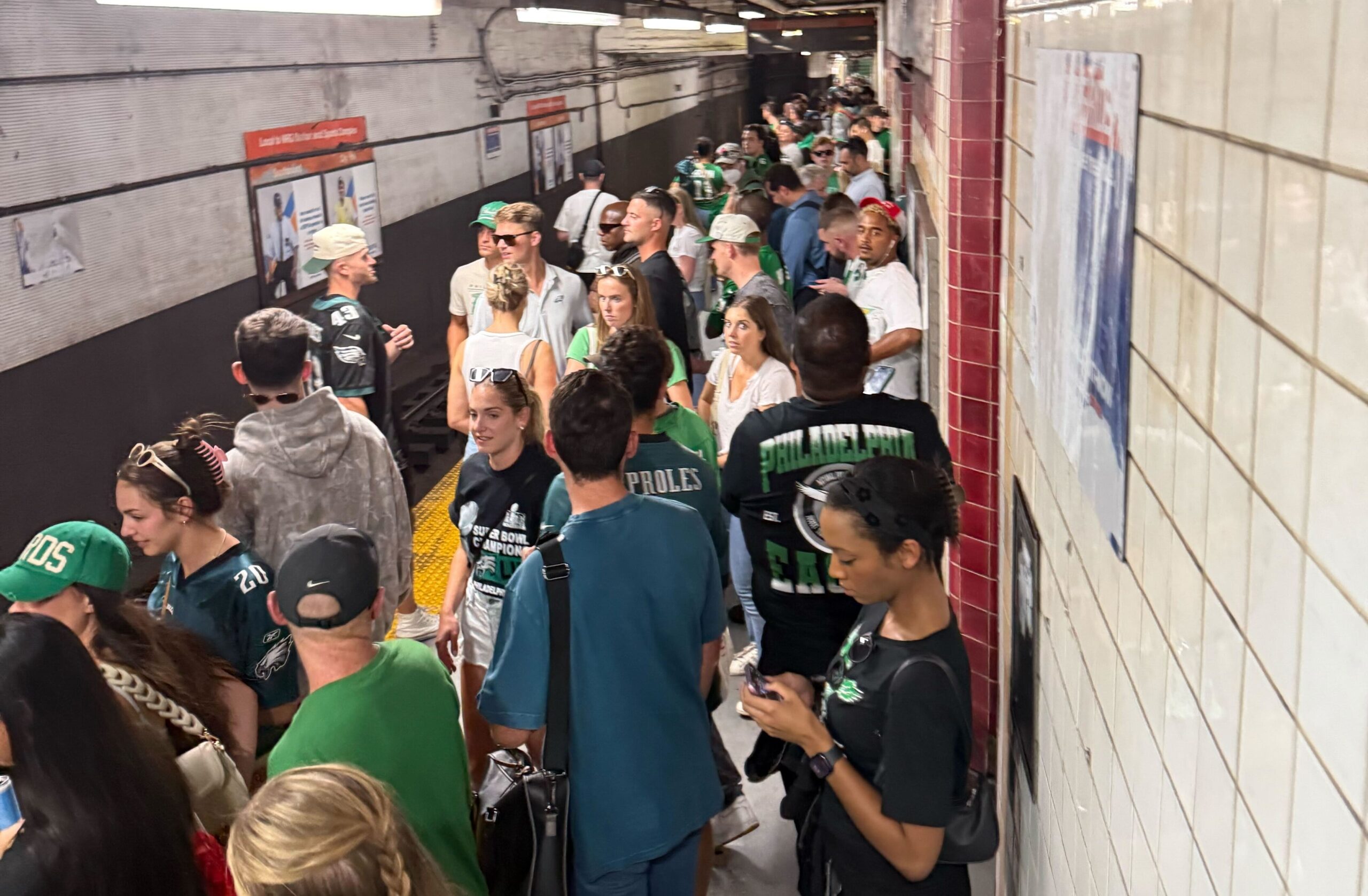
    Eagles fans wait for a Broad Street Line train at City Hall station.

    The wheels on the bus

    During the yearslong debate over transit funding in Pennsylvania, one consistent drumbeat is that SEPTA needed to become more efficient if it wanted to get more support.

    Of course, SEPTA already does more with less when compared with other major agencies, with cost-per-ride lower than in Boston and Washington, D.C. Additionally, trying to save money can sometimes cost agencies in the long run, or at the very least cost scarce political capital.

    In fact, most of the current crises SEPTA faces are the result of trying to save money or insufficient political will. For example, better capitalized agencies would have replaced the Regional Rail fleet a decade or so ago. Meanwhile, the weekslong closure of the trolley tunnel happened because the agency tried using a new part — in the hope that it would be replaced less frequently and cost less.

    Perhaps the Broad Street Line felt left out of the chaos because operations there have become a new pain point for riders. The 1980s Kawasaki trains are well-built. They are also nearly 45 years old. When I first started at The Inquirer five years ago, then-SEPTA General Manager Leslie Richards told me she hoped to avoid replacing the trains until the 2040s. Recent issues on that line make me question that timeline.

    For weeks, the trains have struggled with mechanical issues. Riders have reported jam-packed trains that have been forced to skip stops, line adjustments, and other delays. According to a spokesperson, door faults and general vehicle malfunctions have contributed to the problems.

    It all came to a head at the end of Sunday’s Eagles game.

    After a door issue disabled a train near Snyder Station, already dejected fans were forced to wait until 9 p.m. to catch a ride home. SEPTA is spending $5 million to upgrade the traction motors, which should help. What’s really needed, however, are new trains.

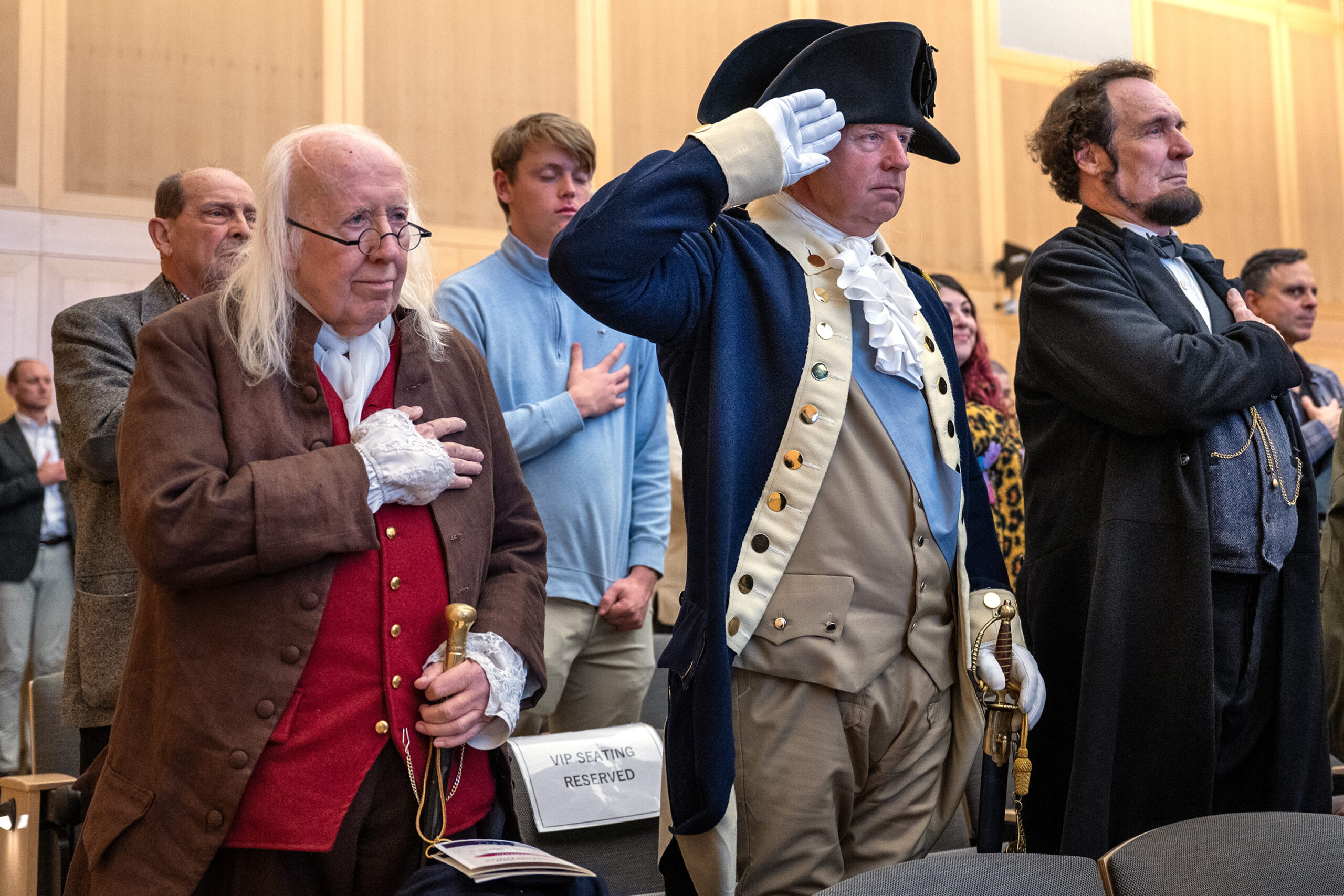
    Historical interpreters (from left) Benjamin Franklin, Gen. George Washington, and President Abraham Lincoln stand with other audience members for the Presentation of the Colors, as the U.S. Mint unveils new coins for the Semiquincentennial at the National Constitution Center in Philadelphia in December.

    Let’s get this party started

    The United States is celebrating a big one this year. America’s big 250th birthday party is here … can you tell?

    I can’t. While big events like the World Cup are planned for later this year, there is currently little to indicate that 2026 is any different from 2025. The patriotic bunting that sprouted all over Philadelphia during the Civil War and the Centennial has yet to appear.

    Still, help is on the way. City and state officials announced an $11.5 million initiative to remove graffiti, plant flowers, and otherwise beautify the city.

    At that price, we should probably do it every year.

  • Judicial district says decisions on ICE presence at Philly courthouse are the sheriff’s ‘sole responsibility’

    Judicial district says decisions on ICE presence at Philly courthouse are the sheriff’s ‘sole responsibility’

    The judicial district that oversees the Philadelphia court system says that the authority for managing ICE’s controversial presence at the Criminal Justice Center rests on Sheriff Rochelle Bilal and that decisions around that are her “sole responsibility.”

    That follows a Wednesday morning news conference where the sheriff joined local elected and community leaders who suggested that court officials or legislators needed to address the ongoing turmoil around courthouse immigration arrests. They called for meetings with court leaders to discuss how to set guardrails on ICE activity.

    The First Judicial District responded with a statement late Wednesday:

    “The First Judicial District is always willing to discuss matters of mutual concern with our justice partners, but managing security in court buildings ― which includes managing ICE’s presence ― is the sole responsibility of the sheriff. These decisions are the sheriff’s to make.”

    The Philadelphia Sheriff’s Office responded Thursday that it was “ready to execute all lawful judicial orders.”

    “To be clear,” its statement said, “security inside court facilities is the responsibility of the Sheriff’s Office. … Areas outside of court facilities are public spaces, where individuals retain their First Amendment rights, including the right to assemble and protest. Those areas are not under the operational control of the Sheriff’s Office.”

    The sheriff’s office added that it is committed to maintaining order and safety while upholding the rights of all who enter, and that it remains open to dialogue to ensure “clarity, coordination, and public safety.”

    The sheriff has said her office does not cooperate with ICE, does not assist in ICE operations, and does not share information with the agency. She has not directly addressed whether she believes she has authority to bar ICE agents from the property.

    Her supporters have defended the sheriff by insisting that she does not have that power, that she could only carry out orders issued by a judge or legislature.

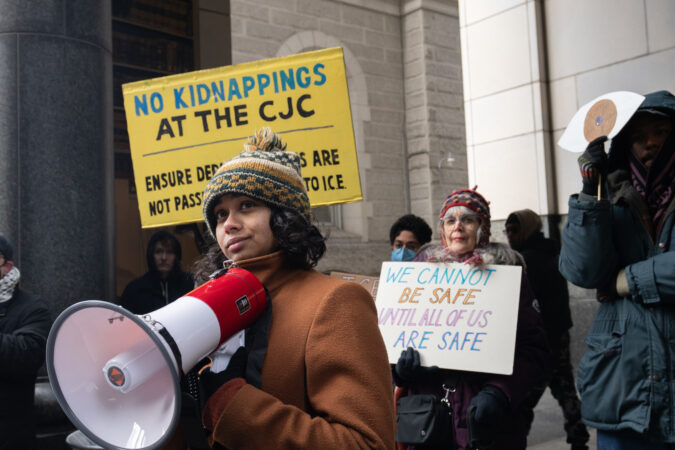
    Meanwhile, the presence of ICE in and around the Criminal Justice Center has provoked demonstrations and controversy, with activists charging that the sheriff has allowed ICE to turn the property into a “hunting ground” for immigrants.

    U.S. Immigration and Customs Enforcement officials did not reply to a request for comment on Thursday.

    The group No ICE Philly has castigated the sheriff, saying that by not barring ICE — as judges and lawmakers in some other jurisdictions have done — she has helped enable the arrest of 114 immigrants who were trailed from the courthouse and arrested on the sidewalk.

    That group and others say ICE agents have been allowed to essentially hang out at the Center City courthouse, waiting in the lobby or scouring the hallways, then making arrests outside.

    Many people who go to the courthouse are not criminal defendants ― they are witnesses, victims, family members, and others in diversionary programs. But they have been targeted and arrested by ICE, immigration attorneys and government officials say, causing witnesses and victims to stay away from court and damaging the administration of justice in Philadelphia.

    Aniqa Raihan, a No ICE Philly organizer who has helped lead courthouse protests, said she was not encouraged by the First Judicial District’s statement.

    “We already know that Sheriff Bilal is not doing all she can to protect people at the courthouse,” she said Thursday. “However, the First Judicial District is not powerless. The court can make its own policy, like the court in Chicago did, barring civil arrests on and around the courthouse. … What we’re seeing is a lot of blame-shifting and finger-pointing from our leaders at a time when we desperately need teamwork.”

    The issue around ICE access is complicated by the fact that courthouses are public buildings, generally open to everyone. And sidewalks outside the buildings are generally considered public property.

    Last week the sheriff garnered national headlines ― and condemnation ― for calling ICE “fake, wannabe law enforcement” and for sending a blunt warning to agency officers.

    “If any [ICE agents] want to come in this city and commit a crime, you will not be able to hide,” Bilal said in viral remarks. “You don’t want this smoke, ’cause we will bring it to you. … The criminal in the White House would not be able to keep you from going to jail.”

    On Wednesday, at the news conference at the Salt and Light Church in Southwest Philadelphia, Bilal said her office follows the law and would obey judicial orders and legislative statutes around courthouse security.

    District Attorney Larry Krasner ― whose office led the event, and who reiterated his pledge to prosecute ICE agents who commit crimes ― said victims and witnesses are not showing up for cases due to fear of ICE.

    About half a dozen elected officials and community leaders gathered, with some calling for ICE to get out of Philadelphia.

    They asked for the court system to establish rules and protections for immigrants seeking to attend proceedings at the Criminal Justice Center, and for state court administrators to meet with the district attorney, the sheriff, the chief public defender, City Council members, and others.

    Krasner said Thursday that his office and the other parties “look forward to meeting with the leadership of the courts to discuss lawfully regulating ICE activity in and around the Criminal Justice Center. We will be corresponding with the courts to schedule monthly meetings immediately.”

    At the same time, “we will continue to do all we can to prioritize safety and justice for victims, witnesses, and families who are navigating the criminal justice system,” he said. “Unlawful and unnecessary ICE activity in and around the CJC is deeply traumatizing to those who are already navigating pain and unfortunate circumstances.”

  • Is ICE still in Philly? As Bucks ends its alliance, here’s how local officials are (or aren’t) working with federal agents.

    Is ICE still in Philly? As Bucks ends its alliance, here’s how local officials are (or aren’t) working with federal agents.

    Top officials across the Philadelphia region are taking a stand against partnerships with ICE.

    On Wednesday, newly inaugurated Bucks County Sheriff Danny Ceisler terminated a 287(g) agreement with ICE initiated by his Republican predecessor that enabled deputies to act as immigration enforcement officers. Haverford Township also passed a resolution barring participation in a 287(g) agreement.

    And in Philadelphia, elected officials in the so-called sanctuary city have been continuously pushing back against ICE’s presence, with some on Wednesday calling for federal immigration agents to get out of the city.

    These developments come as protests escalate against President Donald Trump’s deployment of U.S. Immigration and Customs Enforcement agents to U.S. cities, after an agent shot and killed Renee Nicole Good in Minneapolis last week. Good, a poet and mother of three, was in her SUV when the agent fired into the vehicle.

    Also on Wednesday, Trump said on his social media platform, Truth Social, that federal funding would be cut from any states that have sanctuary cities. These jurisdictions, which limit local law enforcement cooperation with ICE, have been increasingly targeted by the president’s administration.

    As local leaders continue to grapple with the ever-changing and escalating Trump immigration policy, here’s what to know about how local governments are interacting with federal immigration authorities:

    Philadelphia

    Is ICE still in Philadelphia?

    Yes, ICE is still active in Philadelphia, but Trump has not sent troops or a large swaths of federal immigration agents as he has to other major, Democratic-led cities across the U.S.

    Everyone has a theory as to why that might be: Could Trump be avoiding the largest city in the most important swing state? Has Mayor Cherelle L. Parker’s decision to refrain from publicly criticizing Trump played a role?

    Is Philadelphia still a sanctuary city?

    Yes, but city officials have formally started calling Philadelphia a “welcoming city,” as sanctuary has become an increasingly toxic word because of Trump’s intention to target cities with that label.

    But regardless of the name, a 2016 executive order signed by former Mayor Jim Kenney on ICE cooperation remains in place under Parker’s administration. The directive orders city authorities to not comply with ICE-issued detainer requests to hold people in custody unless there is a judicial warrant.

    Philadelphia District Attorney Larry Krasner speaks at a news conference outside the Philadelphia Field Office for Immigration Customs Enforcement in Center City in August.

    What are local leaders saying about ICE?

    District Attorney Larry Krasner, a progressive in his third term, and members of Philadelphia City Council have been among the most routinely outspoken opponents of ICE deployments. But comments by Sheriff Rochelle Bilal went viral last week when she called ICE “fake, wannabe law enforcement.”

    Bucks County

    The sheriff terminated a 287(g) agreement with ICE — what does that mean?

    Essentially, it means that sheriff deputies are no longer allowed to act as immigration authorities.

    Last April, Ceisler’s predecessor, Fred Harran, a Trump-aligned Republican, signed on to the partnership with ICE, stirring up controversy in the swing county. Ceisler, a Democrat who defeated Harran in November, made terminating the agreement a focal point of his campaign.

    No one in Bucks had been detained under the 287(g) agreement, Ceisler said.

    On Wednesday, Ceisler signed another order that prohibits deputies from asking crime victims, witnesses, and court observers their immigration status.

    Does Bucks County still work with ICE?

    Yes. Bucks County is not a sanctuary county and, in the words of Ceisler, “will never be.”

    The Bucks County Department of Corrections will continue to share information with law enforcement agencies, including ICE. The federal agency will also continue to have access to county jails and Bucks will honor judicial warrants from immigration enforcement.

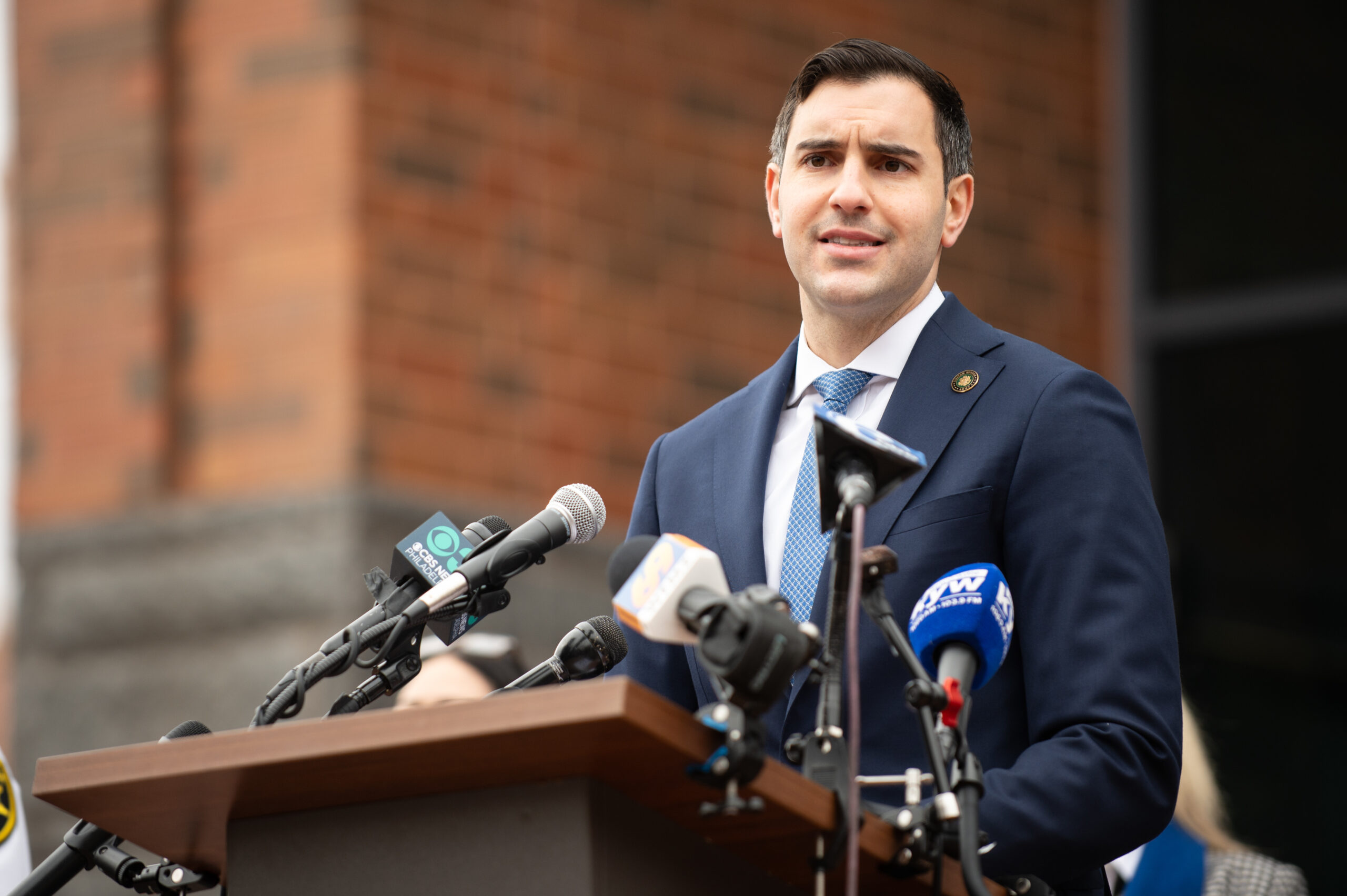
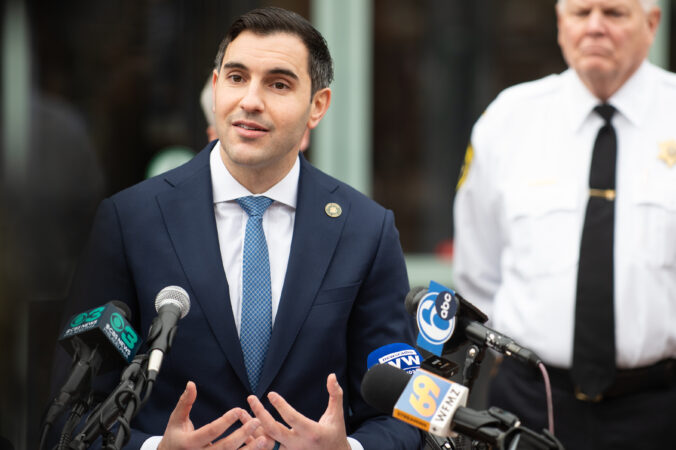
    Bucks County Sheriff Danny Ceisler announces the termination of the county’s partnership with ICE, an agreement formally known as 287(g), during a press conference at the Bucks County Justice Center in Doylestown, Pa., on Wednesday, Jan. 14, 2026.

    “It’s sporadic, it’s reports,” Ceisler said of ICE’s presence in Bucks.

    “I can’t get ICE out of Bucks County,” he added. “I have no authority over them. All I can do is prevent 16 deputies from participating in a program that enables them to perform immigrant enforcement in the community.”

    Bucks County was the only county in the Philadelphia region that did not appear on an initial list published by the Trump administration of sanctuary jurisdictions that could have federal funding at risk. That list was later deleted. The most recent list, published by the administration in August, also does not feature Bucks.

    Haverford Township

    Will Haverford Township participate in a 287(g) agreement?

    On Monday evening, township commissioners in the Delaware County suburb approved a resolution that said Haverford police officers and resources would not be used to give local law enforcement immigration authority. Other municipalities in the county, like Radnor, have also passed resolutions limiting cooperation with ICE.

    While the police department has not requested to enter an alliance with ICE, township commissioners passed the resolution as a preventive measure.

    Montgomery County

    What is Montgomery County’s policy on immigration?

    Montgomery County’s Democratic commissioners have not passed a formal ordinance or a resolution labeling Montco a sanctuary or welcoming county, citing limits to their power, concerns about creating a false sense of security, and a preference for internal policy changes.

    In early 2025, county officials approved a policy that limits communication between county employees and ICE officials and said they would not answer prison detainer requests without warrants.

    Montgomery County activists hold a news conference about ICE incidents in the county last month.

    What do Montco residents think about it?

    County residents have urged individual municipalities within the county to limit collaboration with ICE, especially as the county has become a hot spot for immigration enforcement. Norristown, a heavily Latino community, has specifically become a target for ICE.

    “ICE has created a crisis in our neighborhoods, and we cannot afford silence, mixed signals, or leadership that only reacts once harm has already happened,” Stephanie Vincent, a resident and leader of Montco Community Watch, said last month during a news conference at a West Norriton church.

    As of early December, local organizers estimated that only six out of 62 municipalities had enacted policies, though they consider some to be lackluster.

    Staff writer Katie Bernard contributed to this article.

  • From Spotify to Avelo, economic pressure is melting ICE — but we can do more

    From Spotify to Avelo, economic pressure is melting ICE — but we can do more

    When the Rev. Jack Perkins Davidson and other parishioners in his socially active Spring Glen Church in Connecticut learned last year that budget carrier Avelo Airlines — with a major hub at nearby Tweed New Haven Airport — was also operating U.S. government deportation flights, the pastor kept thinking about one thing.

    What would the Rev. Dr. Martin Luther King Jr. do?

    Davidson said King’s 1955 Montgomery bus boycott against segregation — the iconic protest that launched the civil rights movement of the mid-20th century — was an inspiration as he and a coalition of activists pressured Avelo to stop aiding U.S. Immigration and Customs Enforcement and its mass deportation campaign.

    “I often think about how the Montgomery bus boycott was a very local action, but it became national news,“ Davidson told me by phone recently. ”Sometimes when I feel so overwhelmed by the state of the world, I take hope in that example — that acting in the local level is a way to create national impact.”

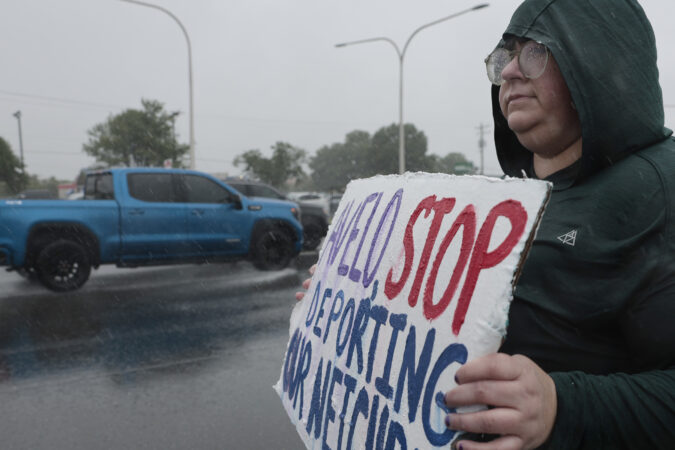
    Davidson and his congregation’s allies, like Connecticut Students for a Dream and the New Haven Immigrant Coalition, spent nine months pressuring Avelo to drop ICE — staging noisy protests, but also doing what the minister called “the unglamorous work” of gathering petition signatures and attending airport board meetings. Last summer, New Haven’s mayor signed their petition as the city banned official travel on Avelo.

    The Connecticut crusaders were joined by activists at other Avelo hubs, including Wilmington. It’s impossible to know exactly how much boycotting air travelers hurts the bottom line of the private, Texas-based corporation, but earlier this month, Avelo made a U-turn. A spokesperson said the airline would halt working with ICE, which “ultimately did not deliver enough consistent and predictable revenue to overcome its operational complexity and costs.”

    Avelo’s exit from the ugly business of flying often handcuffed and shackled migrants out of the United States was a huge win for the growing movement against the Trump regime’s mass deportation raids — but it was not an isolated incident.

    In recent days, the leading music streamer Spotify announced it was no longer running recruitment ads for new ICE agents. The spots urged would-be applicants to “fulfill your mission to protect America,” but sparked outrage among listeners opposed to the agency’s masked goons and its violent raids that have roiled cities from New Orleans to Minneapolis.

    As with Avelo, Spotify’s ties to ICE — the U.S. Department of Homeland Security paid the Swedish-based streamer $74,000, according to Rolling Stone — sparked a nationwide campaign for a boycott that was led by Indivisible, a leading organizer of the massive “No Kings” protests.

    Thousands canceled their paid subscriptions, and some artists pulled their music from Spotify to protest both the ICE ads and the company’s ties to a defense contractor.

    These economic wins come amid a deadly and chaotic start to 2026 that has battered America’s already damaged national psyche. The stunning Jan. 7 Minneapolis murder of Renee Nicole Good, a 37-year-old poet and mother of three, by an ICE agent has only upped the anxiety and the stakes.

    Tuesday night, the shooting of a Venezuelan refugee by federal agents in north Minneapolis triggered a chaotic night of protest that has Donald Trump now threatening to invoke the Insurrection Act and send in troops, escalating a constitutional crisis.

    Although the immigration raids are exactly what Trump promised the nation before his narrow 2024 election victory, Good’s murder and daily viral videos of federal agents smashing windows or flash-banging peaceful citizens have turned a majority of Americans against ICE and everything it stands for.

    A new Quinnipiac Poll released this week showed that 57% of Americans now disapprove of the way ICE and other federal agencies are enforcing immigration laws, with 53% saying Good’s killing was not justified. A separate Economist/YouGov survey found respondents favoring the abolition of ICE by a 46%-43% majority — a first for that political hot-button question.

    So, as you can imagine, in a healthy functioning democracy like the United States, the opposition party Democrats are forming a united front in working to abolish ICE, including the withholding of money in the latest budget battle on Capitol Hill, right?

    Right?

    Um, not exactly. To be sure, Good’s murder and the appalling scenes in Minnesota have triggered a more radical response from some Democrats, including more than 50 members, so far, who’ve signed on for the impeachment of DHS Secretary Kristi Noem. But many in Congress are insisting ICE can somehow be reformed — including an utterly bizarre proposal to put scannable QR codes on immigration agents so the public can identify them. It’s an echo of the tepid reform ideas that failed to stop police brutality after George Floyd’s 2020 murder.

    “Clearly, significant reform needs to take place as it relates to the manner in which ICE is conducting itself,” House Minority Leader Hakeem Jeffries of New York told MS Now on Tuesday night — minutes before agents in Minneapolis reportedly shot a flash-bang grenade into a moving car and injured six children, including a baby.

    You don’t significantly reform the brand of fascism that we can all see on the icy streets of the Twin Cities. You fight it like the existential crisis for American democracy that it is. Millions of everyday Americans are both feeling that urgency and dismayed that the institutions they thought would oppose autocracy — Congress, the media, the U.S. Supreme Court — aren’t standing with them.

    No wonder people are fighting with the only real ammunition they have under late-stage capitalism: their dollars.

    Nearly one year into the second coming of Trump, many of the major victories by citizens resisting his regime have come through the fingertips of everyday folks clicking on a “cancel” button.

    The best-known example came last summer when Disney-owned ABC briefly suspended late-night host Jimmy Kimmel in a flap over some (fairly tame) comments he made after the assassination of right-wing activist Charlie Kirk. The network raced to put Kimmel back on the air after the cancellation rates for two lucrative Disney-owned streaming services, Disney+ and Hulu, doubled. And Disney recently extended the contract of Trump’s least-favorite comic by another year.

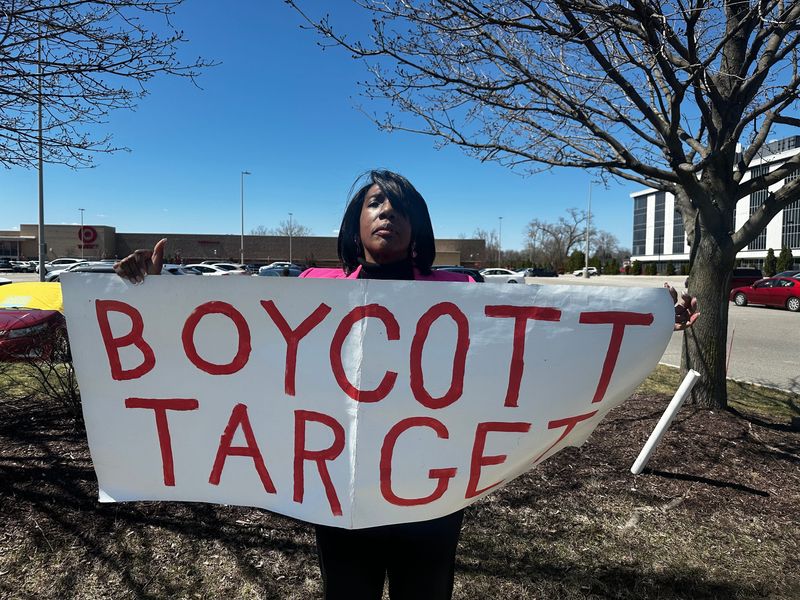
    Other economic pressure campaigns have badly damaged U.S. brands without getting results … yet. The best example is the giant retailer Target, whose decision to end its diversity initiatives after Trump’s inauguration sparked calls for a boycott by prominent Black activists and some labor unions. Since then, foot traffic at Target stores has dropped (while increasing at more “woke” rival Costco), and the stock price of the Minnesota-based company has plunged by 33%.

    This hasn’t yet inspired Target’s management to fully restore its diversity initiatives, and it more recently has angered some activists by insisting it has no power to stop ICE agents from using its parking lots and even entering its stores to make arrests. None of this should deter the public from keeping the pressure on Target.

    Allison Folmar of West Bloomfield joined the protesters who advocated for a boycott against Target in April.

    The weeks of Minnesota mayhem have focused attention on a new corporate bête noire: Hilton Worldwide Holdings. Two of the hotel chain’s properties in Greater Minneapolis have been the scene of noisy, all-night protests after reports that out-of-town ICE agents are staying there. And Hilton further infuriated activists and sparked calls for a boycott by delisting a third Minneapolis hotel after an employee said ICE was not welcome.

    I will not stay at any Hilton hotel as long as the company thinks it’s OK to host masked thugs who are snatching laborers off the street and shooting or tear-gassing anyone who objects to that, and I hope you would consider doing the same.

    As New Haven’s Davidson rightly said, using economic pressure to end injustice takes time and hard work that isn’t always glamorous or made for the cable-TV cameras. Some 71 years ago in Montgomery, Ala., the King-led bus boycott took 381 days and a lot of sacrifice from unsung heroes like Claudette Colvin, who died this week at age 86, and working-class Black people who walked or carpooled to their jobs until claiming victory.

    The bottom line has not changed since MLK’s time. The color that matters most to corporate America is the color of money. The pursuit of profit is why cowardly law firms or TV networks like CBS are aiding American dictatorship instead of fighting it. But it’s also what makes them reverse course when they realize that hate is actually bad for business in a consumer society.

    Boycotts aren’t the only solution, but in a world where feckless institutions have given up, they have become an essential tool. Spend your dollars with any company that still believes in a decent, diverse America, and put the collaborators out of business. Consider it an early birthday present for Dr. King.

  • Haverford Township bars police from cooperating with ICE in noncriminal immigration enforcement

    Haverford Township bars police from cooperating with ICE in noncriminal immigration enforcement

    Haverford Township officials voted this week to bar the township’s police department from cooperating with U.S. Immigration and Customs Enforcement in the agency’s civil deportation efforts.

    Township commissioners overwhelmingly approved the resolution, which says Haverford police officers and resources will not be made available for ICE’s 287(g) program. The nationwide initiative allows local police departments to perform certain federal immigration duties, should they choose to enter an agreement with the agency.

    The Monday evening vote came after a weekend of anti-ICE protests in cities across the country spurred by the fatal shooting of 37-year-old Renee Good by an immigration agent during an enforcement operation in Minneapolis.

    On Wednesday, Bucks County’s sheriff ended the department’s own 287(g) agreement with ICE, saying the “public safety costs” of the partnership vastly outweighed the benefits.

    “The last thing I want to see happen is that our relationship with our police department be hurt by the reckless and criminal activity of ICE,” Haverford Commissioner Larry Holmes said before the vote. “We have the power to prevent that.”

    Local law enforcement agencies that enter a 287(g) agreement with ICE are offered a variety of responsibilities and trainings, such as access to federal immigration databases, the ability to question detainees about their immigration status, and authority to issue detainers and initiate removal proceedings.

    The program is voluntary and partnerships are initiated by local departments themselves, though some Republican-led states are urging agencies to enter them. The Department of Homeland Security recently touted that it has more than 1,000 such partnerships nationwide, as the Trump administration continues to make a sweeping deportation effort the focus of its domestic policy.

    Critics such as the American Civil Liberties Union say the program turns local departments into an “ICE force multiplier” and that the agreements, which require officers to shift from local to federal duties, are a drain on time and resources.

    Haverford Township’s police department has not made any request to initiate such an agreement with ICE, according to commissioners, who called the resolution a preemptive measure. While ICE has ramped up enforcement in Philadelphia and in surrounding communities like Norristown, there have not been sizable operations in Delaware County.

    Judy Trombetta, the president of the township’s board of commissioners, said the resolution was about protecting the civil liberties of those living in Haverford, as well as the township’s public safety.

    In Trombetta’s view, a 287(g) agreement could mean those without legal immigration status could be deterred from reporting crimes to Haverford police or showing up to court hearings, while leaving officers confused about their own responsibilities.

    And as a township, she said, it is “not our role” to act as federal immigration agents.

    “It’s our job as a township to keep people safe, [to] uphold the Constitution,” Trombetta said.

    Commissioners voted 7-2 to approve the resolution.

    The motion still requires Haverford police to cooperate with federal immigration agencies in criminal investigations. But because many cases involving those living in the country illegally are civil offenses, much of ICE’s activities are exempt.

    Commissioner Kevin McCloskey, voicing his support for the resolution, said the week after Good’s killing had been “incredibly taxing on the American people,” and in his view, it was important to adopt the resolution even if ICE wasn’t active in the community.

    But for Commissioner Brian Godek, one of the lone holdout votes, that reality made the resolution nothing more than “political theater.”

    Tensions over Good’s killing were on full display during the meeting, as both the resolution’s supporters and detractors filled the seats of Haverford’s municipal services building.

    “I do not want my tax dollars or Haverford’s resources to be used to support a poorly trained, unprofessional, and cruel secret police force that is our current federal U.S. Immigration and Customs Enforcement agency,” said resident Deborah Derrickson Kossmann.

    Brian Vance, a resident and a lawyer who opposed the resolution, said he was approaching the matter like an attorney. He questioned whether noncompliance with a federal department would open up the possibility of lawsuits, or the federal government withholding funds for the township.

    “It’s legal, it’s proper, whether we agree with it or not,” Vance said of ICE’s authority.

    After the vote, McCloskey, the commissioner, made a plea for unity to those divided over the issue.

    That included residents who said the resolution’s supporters had gotten caught up in the “emotion” of the Minneapolis shooting.

    “I just ask that you take a step back,” McCloskey said. “On some level, we should all be able to appreciate that none of us wanted to see a 37-year-old mother in a car get shot.”

  • It’s time to address ICE activity at the Philly courthouse, elected and community leaders say

    It’s time to address ICE activity at the Philly courthouse, elected and community leaders say

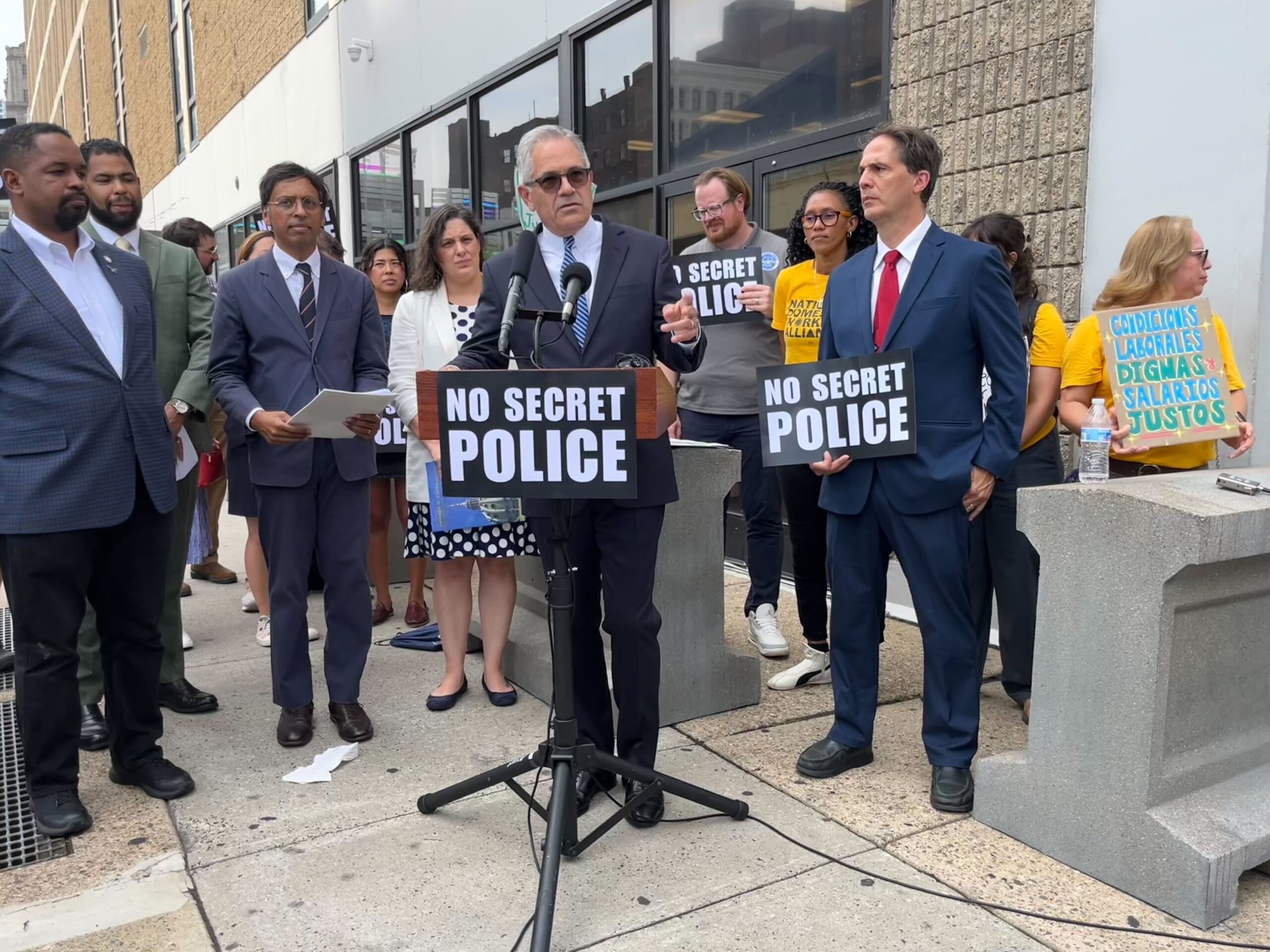
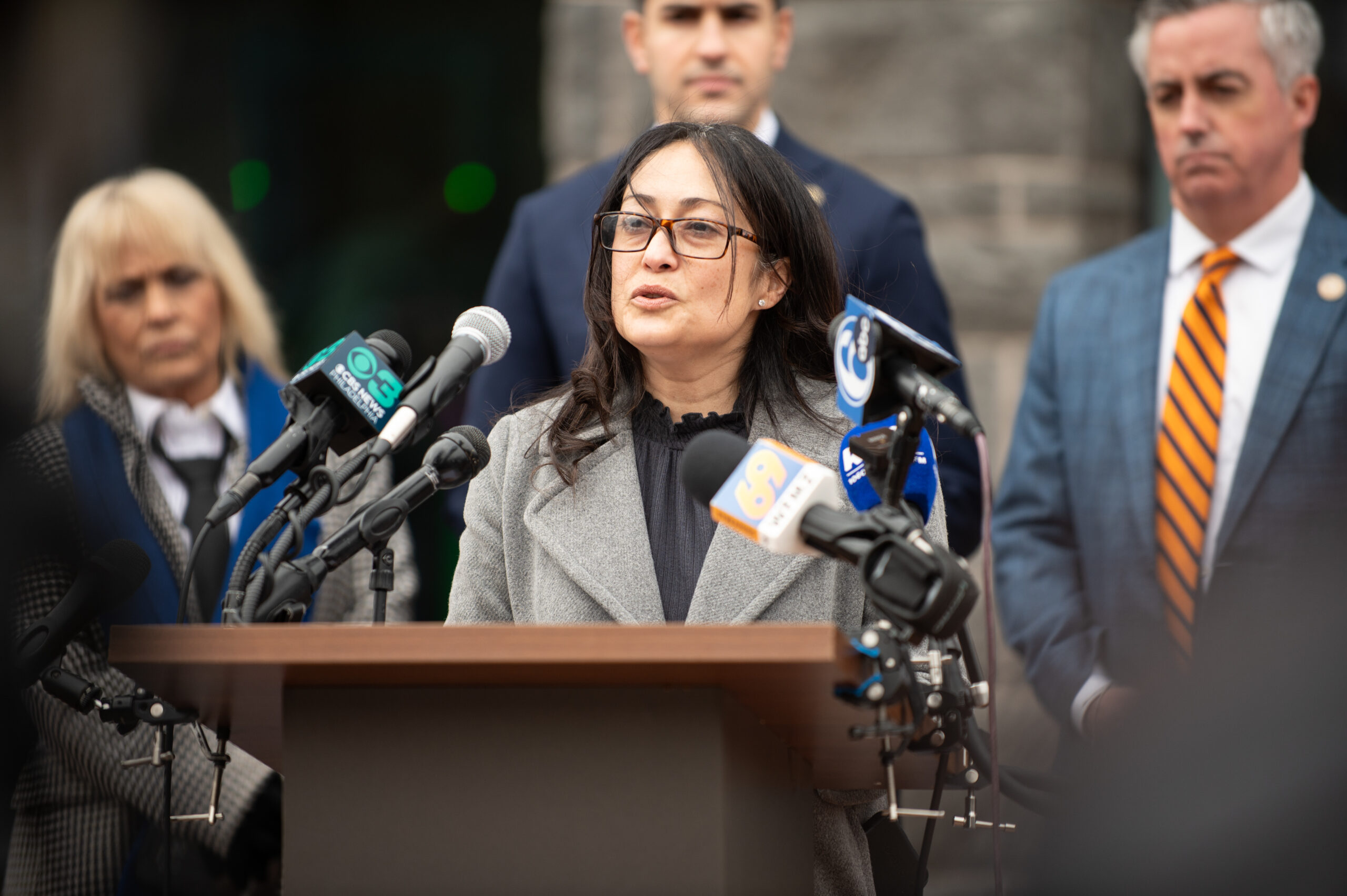
    Some elected city officials and community leaders called for ICE to get out of Philadelphia on Wednesday, saying agents had become a threat to safety and to the orderly administration of justice.

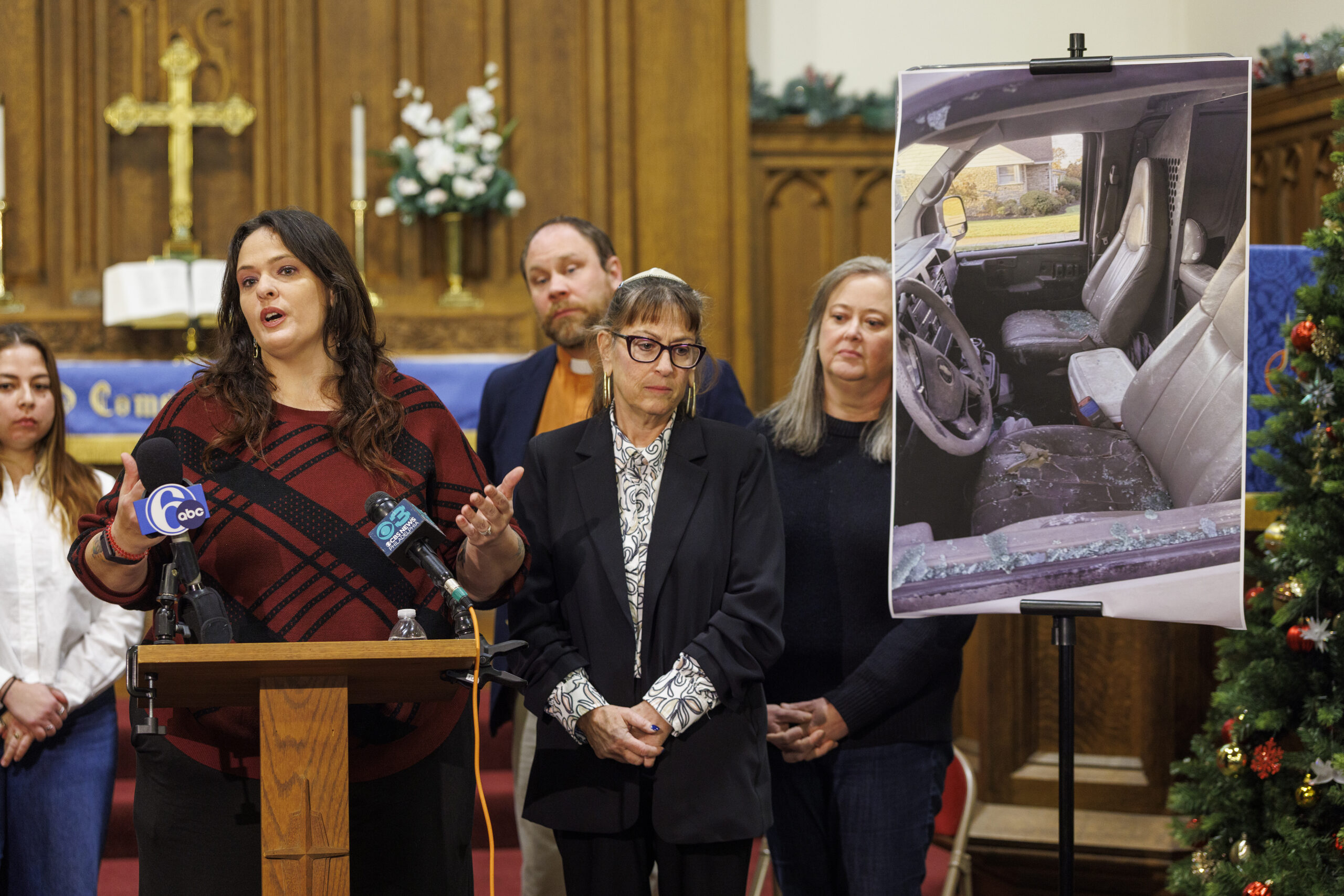
    They asked the court system to establish rules and protections for immigrants seeking to attend proceedings at the Criminal Justice Center ― which advocates say has been allowed to become an ICE “hunting ground.”

    They asked for state court administrators to meet with the district attorney, the sheriff, the chief public defender, City Council members and others, and suggested that in the meantime, court staff must be better trained to understand the difference between court- and ICE-issued orders, that they do not carry equal weight nor require equal obedience.

    “People should be able to come to court without fear,” said Keisha Hudson, chief defender of the Defender Association of Philadelphia. “Without fear that doing what the law requires will put them at risk.”

    District Attorney Larry Krasner ― whose office led the news conference, and who reiterated his pledge to prosecute ICE agents who commit crimes ― said victims and witnesses are not showing up for cases. And community leaders said residents’ lives were being diminished.

    “Across Philadelphia, the increase in ICE raids is tearing the fabric of our community,” said Thi Lam, deputy director of the Southeast Asian Mutual Assistance Association Coalition, which serves refugees and immigrants, leaving people afraid to go to work, to seek medical care, and to take their children to school.

    “As Philadelphians, we demand policies that protect due process,” he said. “We object to the violent way that this immigrant process has turned. We invite all Philadelphians to speak up. Speak up, Philadelphians!”

    ICE officials did not immediately reply to a request for comment.

    The news conference at the Salt and Light Church in Southwest Philadelphia came as protests and confrontations continue in Minnesota and other cities over the fatal ICE shooting of a Minneapolis wife and mother, Renee Good. Daily ICE activity and arrests in Philadelphia and surrounding towns continue to rile and frighten immigrant communities and those who support them.

    Krasner called the shooting of Good “murder,” and said “that collection of people who left their Klan hoods in the closet” to become ICE agents will face prosecution for any crimes committed in Philadelphia.

    Meanwhile, in Atlantic City on Wednesday, Mayor Marty Small and other officials gathered to support local immigrant communities, and to assert their willingness to ensure that ICE agents “continue to do the job under the legal letter of the law.

    “Some of the footage that we’ve seen has been horrifying, and I understand, and I empathize with that community. And as your mayor, this city has your back,” Small said, flanked by Atlantic City Police Chief Jim Sarkos, Director of Public Safety Sean Riggin, and Cristian Moreno-Rodriguez from the immigrant advocacy organization El Pueblo Unido of Atlantic City.

    Atlantic City police, they noted, do not assist ICE in immigration enforcement. Under the 2018 Immigrant Trust Directive, New Jersey state and local police agencies are limited in how they can cooperate with ICE.

    Riggin clarified, however, that local police will assist ICE in cases where agents are in danger or a crime is being committed.

    “We will respond, we’re going to assess the situation, and we’re going to act accordingly in compliance with that directive,” Riggin said. “So, just because somebody sees us with ICE does not mean we’re doing immigration enforcement.”

    In Philadelphia, immigrant advocates have made the courthouse and Sheriff Rochele Bilal a target of protest, insisting that ICE has wrongly been given free roam of the property.

    The group No ICE Philly has castigated Bilal, saying that by not barring U.S. Immigration and Customs Enforcement from the courthouse — as judges and lawmakers in some other jurisdictions have done — she has helped enable the arrest of at least 90 immigrants who were trailed from the building and arrested on the sidewalk.

    That group and others say ICE agents have been allowed to essentially hang out at the Center City courthouse, waiting in the lobby or scouring the hallways, then making arrests outside, a pattern they say has been repeated dozens of times since President Donald Trump took office in January 2025.

    Many people who go to the courthouse are not criminal defendants ― they are witnesses, crime victims, family members, and others already in diversionary programs.

    The sheriff says her office does not cooperate with ICE, does not assist in ICE operations and does not share information with ICE. Last week she garnered national headlines and condemnation for calling ICE “fake, wannabe law enforcement” and for sending a blunt warning to its officers.

    “If any [ICE agents] want to come in this city and commit a crime, you will not be able to hide, nobody will whisk you off,” Bilal said in now-viral remarks. “You don’t want this smoke, cause we will bring it to you. … The criminal in the White House would not be able to keep you from going to jail.”

    On Wednesday she said her office follows the law, and would obey orders from judges or statues from lawmakers concerning courthouse security.

    The news conference followed an announcement of the Defender Association of Philadelphia’s new initiative to help people facing immigration consequences both inside and outside the justice system.

    The agency’s Immigration Law Practice is expected to grow to up to 11 staff members, arriving as the Trump administration pursues aggressive new enforcement and even minor legal cases can put undocumented city residents at risk of detention, family separation, or deportation.

    Councilmember Jamie Gauthier told news reporters that guardrails must be set around ICE behavior at the Criminal Justice Center, and that the agency “is making us less safe by scaring away witnesses.”

    Councilmember Kendra Brooks said constituents were phoning her office, asking how to get ICE out of their neighborhoods.

    “ICE needs to get out of our city, for the safety of all of us,” Brooks said, calling on the city government and the court system to act. “Something needs to be done. … People can’t safely come to courts ― that’s a threat to all of us.”

    Councilmember Rue Landau asked people to imagine a domestic-violence case, where victims and witnesses were afraid to go near the courthouse.

    “We will not have some masked, unnamed hooligans from out of town come here and attack Philadelphians,” she said. “We are saying ICE out of Philadelphia. … Out of our courts, out of our city.”

  • Bucks County sheriff terminates controversial alliance with ICE, prohibits deputies from asking about immigration status

    Bucks County sheriff terminates controversial alliance with ICE, prohibits deputies from asking about immigration status

    Bucks County Sheriff Danny Ceisler terminated his office’s controversial partnership with ICE Wednesday, citing negative impacts on public safety and immigrants’ trust of law enforcement.

    The partnership, known as a 287(g) agreement, which enabled 16 sheriff deputies to act as immigration enforcement, was initiated by former Sheriff Fred Harran, the Trump-aligned Republican who Ceisler defeated in November.

    Ceisler said Wednesday that he signed two orders, one revoking the 287(g) partnership, and another that prohibited deputies from asking crime victims, witnesses, and court observers about their immigration status.

    “Bucks County is home to over 50,000 immigrants … those immigrants are our neighbors,” said Ceisler, a Democrat who took office last week, during a news conference outside of the Bucks County Justice Center Wednesday. “They are our friends. They are taxpayers and they deserve the protection of law enforcement in this community.”

    Ceisler’s decision to terminate 287(g) was expected, but his announcement comes amid a nationwide reckoning over federal immigration agents’ deployments to U.S. cities as ordered by the Trump administration. Protests against U.S. Immigration and Customs Enforcement escalated across the country, including in Philadelphia, after an ICE agent shot and killed a woman in Minnesota last week.

    Wednesday’s decision “has nothing to do with what’s going on in Minneapolis,” Ceisler said.

    Other officials in the region have spoken out directly in response to the Minnesota incident. Philadelphia Sheriff Rochelle Bilal’s comments calling ICE “fake, wannabe law enforcement” went viral.

    Ceisler, on Wednesday, called Bilal’s comments “completely counterproductive, and said she was the “wrong messenger for them.”

    The Bucks sheriff was adamant Wednesday that his order does not make Bucks County a so-called sanctuary jurisdiction, which have been increasingly targeted by President Donald Trump.

    The president announced Wednesday morning that on Feb. 1 he would cut off federal funding to states that have cities with sanctuary policies, which prohibit local law enforcement cooperation with ICE. Ceisler’s directive prohibits sheriff deputies from acting as immigration authorities, but does not cut off the county’s cooperation with ICE.

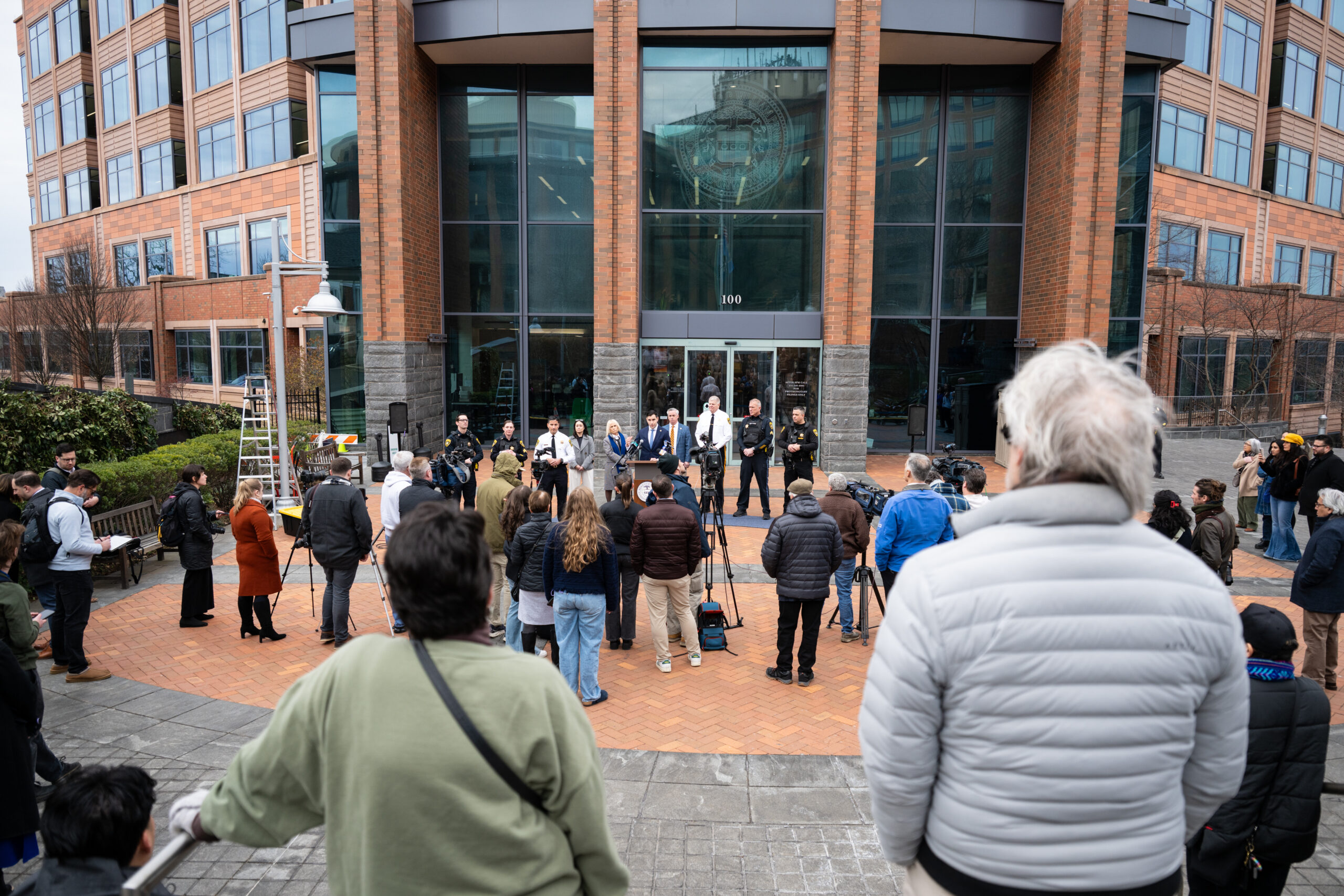
    People and press gather at a press conference announcing the termination of Bucks County’s partnership with ICE.

    “Bucks County has not, has never been, and will never be a so-called sanctuary county,” Ceisler said. “Our county has not severed all ties with ICE, nor precluded future partnership with ICE when it comes to dangerous criminals. Instead, we are returning to a level of partnership we’ve been operating under for decades.”

    Bucks was the only county in the Philadelphia area that wasn’t named as a sanctuary jurisdiction by the Trump administration last year when it rolled out an initial list of state and local governments in danger of losing funding — which was later deleted. Officials from the other collar counties disputed the designation at the time.

    Democratic Gov. Josh Shapiro downplayed concerns about Trump’s Feb. 1 funding threat during a Wednesday appearance at the Pennsylvania Farm Show in Harrisburg.

    “We don’t pay attention to the bluster, we pay attention to what’s written in the directive,“ Shapiro told reporters. ”Pennsylvania’s not a sanctuary state. I would anticipate us not losing funding at the state level unless they wanna be punitive.”

    The sheriff said that the county Department of Corrections will continue to share information with law enforcement agencies, including ICE. Federal immigration agents will also continue to have access to county jails and honor judicial warrants to hold individuals who are incarcerated for immigration enforcement.

    The motivation for the sheriff’s orders Wednesday were in response to “heartbreaking feedback” from Bucks’ immigrant community that they were afraid to report crimes or engage with law enforcement, Ceisler said

    “To the members of our immigrant communities, you are safe to call 911, you are safe to report crime and you are safe to come into this courthouse and testify,” Ceisler said.

    Heidi Roux, an immigration advocate, said her “community is breathing a collective sigh of relief” by ending the 287(g) agreement, but noted that continuing to partner with local law enforcement is crucial to public safety.

    “I believe criminal activity can be addressed while simultaneously supporting the human rights and dignity of our residents,” Roux said.

    Heidi Roux, executive director at Immigrant Rights Action, speaks at a press conference about the termination of Bucks County’s partnership with ICE.

    The 287(g) affiliation stirred up controversy when then-Sheriff Harran announced the department’s alliance with ICE in April of last year. The agency had 455 agreements with police authorities in 38 states across the country.

    Since then the number has exploded, to 1,318 in 40 states, with 11 additional agreements pending as of Monday, according to ICE.

    ICE says the program helps protect American communities, a force-multiplier that adds strength to an agency workforce that numbers about 20,000 nationwide. Opponents, however, insist that turning local officers into immigration agents breaks community trust with the police and puts municipal taxpayers at risk of paying big legal settlements.

    In Pennsylvania, the number of participating agencies has grown from 39 in September to 52 today.

    Seven states, including New Jersey and Delaware, bar the agreements by law or policy.

    The growth in Pennsylvania and across the nation has been driven by Trump, who has pumped incentive money into the program as he pursues plans to arrest and deport millions of immigrants.

    On Trump’s first day in office in January, he directed the Department of Homeland Security to authorize local police to “perform the functions of immigration officers” to “the maximum extent permitted by law.”

    In the Philadelphia area, Harran’s decision to collaborate with ICE sparked public protests and a lawsuit – and may have cost him his job in a hard-fought November election.

    No one had yet been detained under that program, but opponents saw Ceisler’s election as the last chance to stop the Sheriff’s Department’s alliance with ICE, and the Democrat said he would act quickly to end the alliance.

    The former sheriff said his only goal was to make the community safer, that the department would not conduct random immigration checks or broad enforcement but “those who commit crimes must face the consequences regardless of immigration status.”

    The Democratic-led Bucks County Board of Commissioners warned county employees that they could be personally liable for helping ICE, passing a resolution that said the alliance was “not an appropriate use of Bucks County taxpayer resources.” Democratic Commissioners Diane Ellis-Marseglia and Bob Harvie were at Wednesday’s news conference but did not speak.

    In October, however, Bucks County Court Judge Jeffrey Trauger ruled that Harran’s cooperation with ICE was “clearly lawful under Pennsylvania jurisprudence,” and both “reasonable and necessary” in fulfilling his lawful duty to keep the citizens of Bucks County safe.

    Ceisler said that terminating the agreement is the first step to regaining trust of the county’s immigrant communities. Next, he said, comes getting out into the communities.

    “It’s about letting people know that they are safe,” he said.

    Staff writer Gillian McGoldrick contributed reporting.

  • Philly public defender launches new immigration unit amid growing federal arrests and deportations

    Philly public defender launches new immigration unit amid growing federal arrests and deportations

    The Defender Association of Philadelphia has launched a new initiative to help people facing immigration consequences both inside and outside the criminal-justice system.

    The move comes as the Trump administration pursues aggressive new enforcement, where even minor legal cases can put undocumented city residents at risk of detention, family separation, or deportation.

    The agency’s Immigration Law Practice is expected to grow to up to 11 staff members. Its creation is to be officially announced at a news conference on Wednesday.

    “This is necessary right now,” Chief Defender Keisha Hudson said in an interview. “We’re going to have to sustain this work and expand this work if we’re going to meet the moment.”

    The practice will be led by veteran immigration attorney Lilah Thompson, who often represents migrants facing complex legal challenges. She said the work would be done in collaboration with trial attorneys, social workers, and mitigation specialists to shape defense strategies that protect clients and their families.

    One area of concentration will be on clients who are in immigration detention despite having no criminal charges, another on people who could face serious immigration repercussions because of what are often minor offenses.

    In Philadelphia, attorneys say, people have been arrested by Immigration and Customs Enforcement as they’re enrolling in diversionary programs or heading to court to plead not guilty.

    The Trump administration maintains it is arresting dangerous immigrants, though figures show 74% of all those held in detention have no criminal convictions.

    The Defender Association also expects to handle more cases that push back against Trump administration efforts around mandatory detention. Federal judges in Philadelphia have ruled dozens of times against an administration policy that mandates detention for nearly all undocumented immigrants, joining a nationwide wave of decisions criticizing the government.

    A challenge is that those cases must be filed individually, and many of those in detention have neither a lawyer nor the money to hire one.

    The new practice consolidates and builds on work that was done at the Nationalities Service Center and the Pennsylvania Immigrant Family Unity Project, or PAIFUP.

    Thompson said the immigration practice will make sure that clients have accurate information, strong advocacy, and a chance to protect their futures.

    “The work changes every day, with the twists and turns of this administration, and the cruelty it inflicts on noncitizens,” she said. “We have to respond to the moment.”

  • ‘A turning point’: Anti-ICE protests reach the Philadelphia suburbs

    ‘A turning point’: Anti-ICE protests reach the Philadelphia suburbs

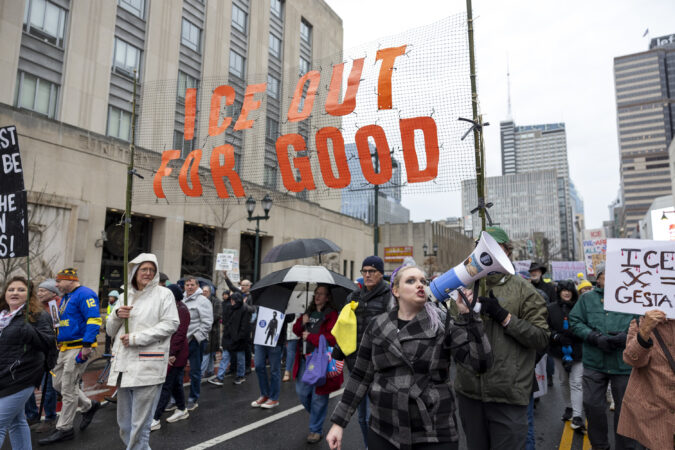
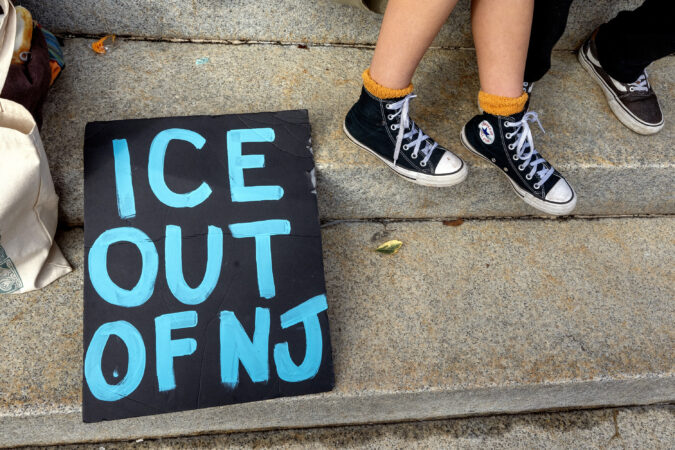
    Legions of suburbanites decried federal ICE actions on Sunday in a series of vigils and protests across the Philadelphia area, signaling the breadth of opposition to a central part of President Donald Trump’s agenda.

    Expressions of anger, sadness, and resistance poured out into the streets of major cities nationwide this weekend in response to the killing of 37-year-old Renee Good by an ICE officer in Minnesota. But that dysphoria also spilled into small towns — including in places like Gloucester County, New Jersey, where voters favored Trump in 2024.

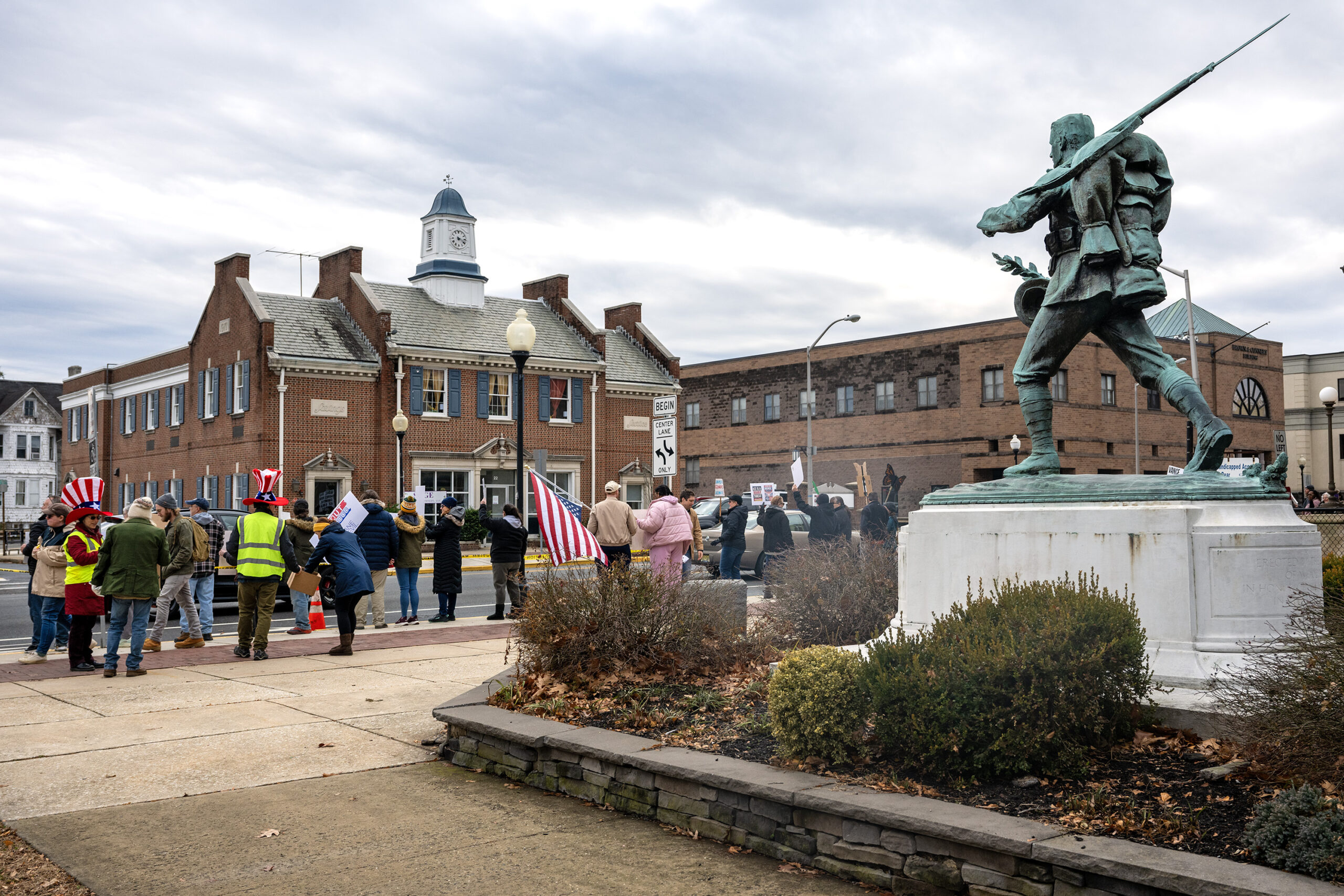
    “I’ve been quiet and timid my whole life, and now I’m just trying to speak up,” said Cristen Beukers, one of more than 100 people who attended a demonstration in Gloucester’s county seat, Woodbury, a city of about 10,000. Gathered along North Broad Street, near the Gloucester County Courthouse, participants’ signs, whistles, and bullhorn-led protest chants were met with beeping car horns and the supportive shouts of drivers.

    Beukers, 40, of nearby Paulsboro, called for a proper investigation into the shooting death of Good, a mother and poet, on Wednesday.

    Mi Casa Woodbury and Cooper River Indivisible hold a “roadside rally” in downtown Woodbury, N.J., in support of immigrants and to protest ICE on Sunday, Jan. 11, 2026, as protests against Trump administration actions spread in the suburbs.

    Thousands of ICE agents and federal troops have swarmed blue American cities as part of Trump’s unprecedented campaign to arrest and deport millions of immigrants. Good was shot three times in the driver’s seat of her SUV after a brief confrontation with ICE agents on a residential Minneapolis street. Trump administration officials insist ICE agent Jonathan Ross fired out of self-defense; video footage appears to show he was not in the vehicle’s path when he fired.

    “It’s an S.O.S.,” said Alex Baji, 31, of Woodbury, who said he’s a former IRS auditor laid off last year by the Department of Government Efficiency, overseen by billionaire Elon Musk. “Masked goons murdering U.S. citizens — and the vice president says it’s perfectly justified.”

    The turnout in Woodbury suggested a new level of urgency for the tight-knit suburban community, said Kaitlin Rattigan. Rattigan is a community organizer with Mi Casa Woodbury, a group that formed in response to ICE activity in their neighborhoods. Mi Casa has held a demonstration every Sunday since mid-November, even if just a few people attended.

    “I think it’s a turning point for many people — and frankly for white people,” Rattigan, who is white, said.

    According to a recent poll conducted by Pew Research Center, 50% of American adults surveyed in October disapproved of the Trump administration’s approach to immigration, while 39% approve. (Some participants responded “neither.”) While 53% of respondents said the country is doing “too much” when it comes to immigration enforcement, a large majority continue to say at least some people living in the United States should be deported.

    Trump has derided and propagandized protesters as “paid insurrectionists,” “domestic terrorists,” or radical leftists — people who are not representative of mainstream Americans, Steve McGovern, a political science professor at Haverford College, said in an interview. Anti-ICE rhetoric in the suburbs threatens Trump’s narrative, according to McGovern. Trump’s 2024 win was fueled by key gains in Philadelphia’s suburbs, an Inquirer analysis found.

    “The popular image of suburbia continues to be a place where lots of middle-class, mainstream people live and work,” he said. “If suburbanites take to the streets and in large numbers, that would send — I think — a powerful message that a strong majority of the country is increasingly fed up with the outrageous, lawless, and even murderous behavior of ICE agents.”

    At least one Republican observer was skeptical. Guy Ciarrocchi, a GOP analyst, said in a statement these protests no longer influence independent voters, nor intimidate Republicans.

    “Unfortunately, these ‘rallies’ are political theatre — plug [and] play crowds with professional signs for any ‘cause.’ Tools to rally extremist Democrat voters,” he said. “Ms. Good’s death was a tragedy. And, ICE’s work is important and necessary. No ‘rent a rally’ will change either of those truths.”

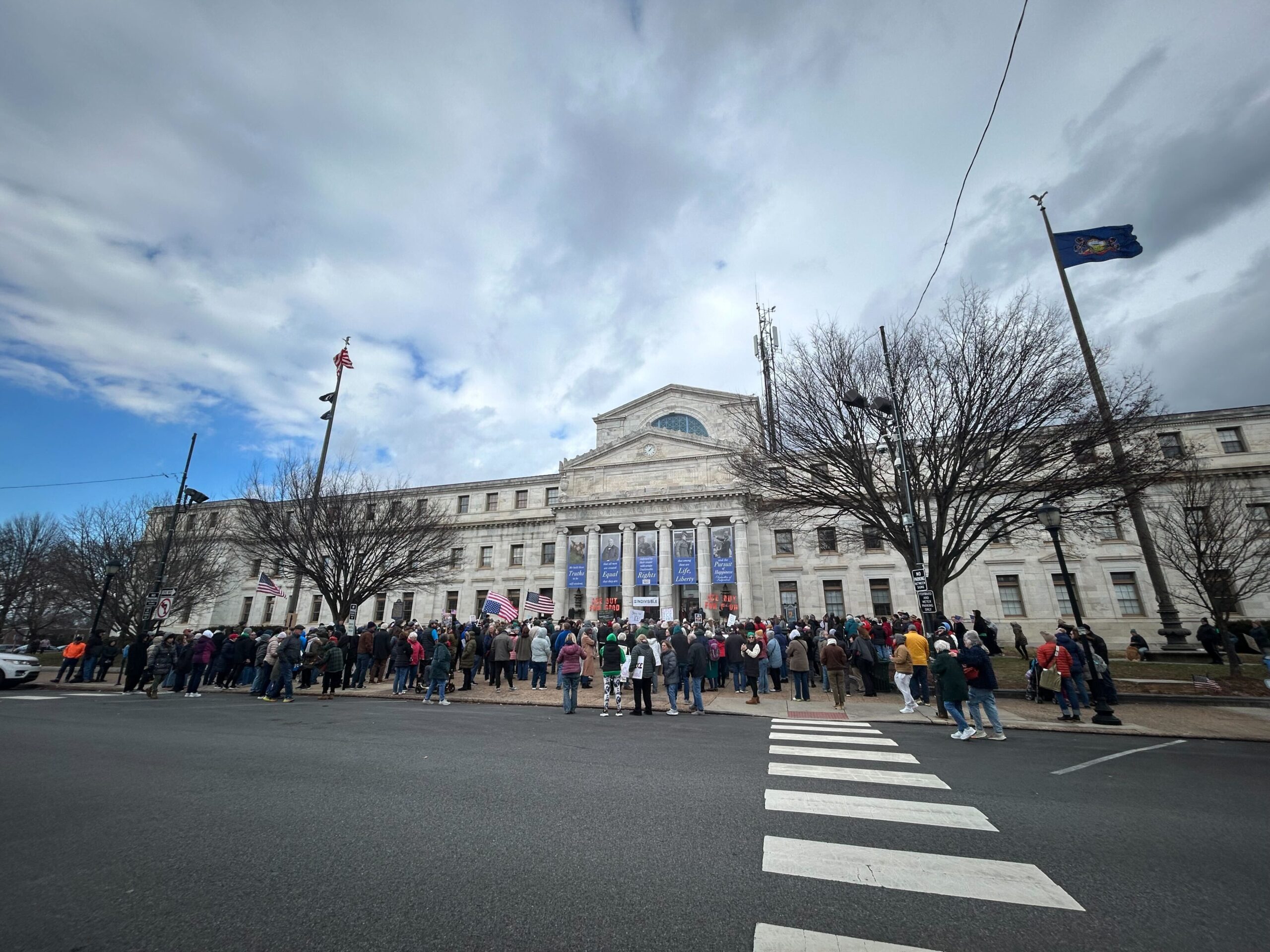
    Outside the Delaware County Courthouse in Media, hundreds shouted into the bitter wind: “United we stand, divided we fall.” The voices came from attendees of all ages — older people in wheelchairs, young parents pushing babies in strollers, and children holding crayon-drawn signs etched with messages like “ICE Cream, not ICE” and “NO ICE because it’s cruel.”

    “The entire nation is watching Pennsylvania,” said U.S. Rep. Mary Gay Scanlon, a Delaware County Democrat. “We can reject Trumpism at the state and federal levels this year. … We will not be bullied out of the future that we and all our children deserve.”

    Area residents hold what organizers called a “vigil for peace on our communities” on Jan. 11, 2026, in Media, Pa.

    In the increasingly blue suburban county — that not long ago was solidly red — the vocal opposition to Trump has grown louder in recent years, said Cathy Spahr, coleader of Delco Indivisible, which organized Sunday’s vigil for Good.

    “We didn’t have this during the first [Trump] administration,” she said of the event’s turnout. Spahr said she was especially heartened by the attendance given that the vigil was announced only days before — and ended an hour before the Eagles’ first playoff game of the year.

    But Spahr and several attendees said there’s something special about coming together closer to home. And logistically, it’s easier.

    Corinne Fiore, 75, of Media, and her 4-year-old Doberman, Laser, cherish the opportunity to be involved in the anti-Trump movement in Delaware County.

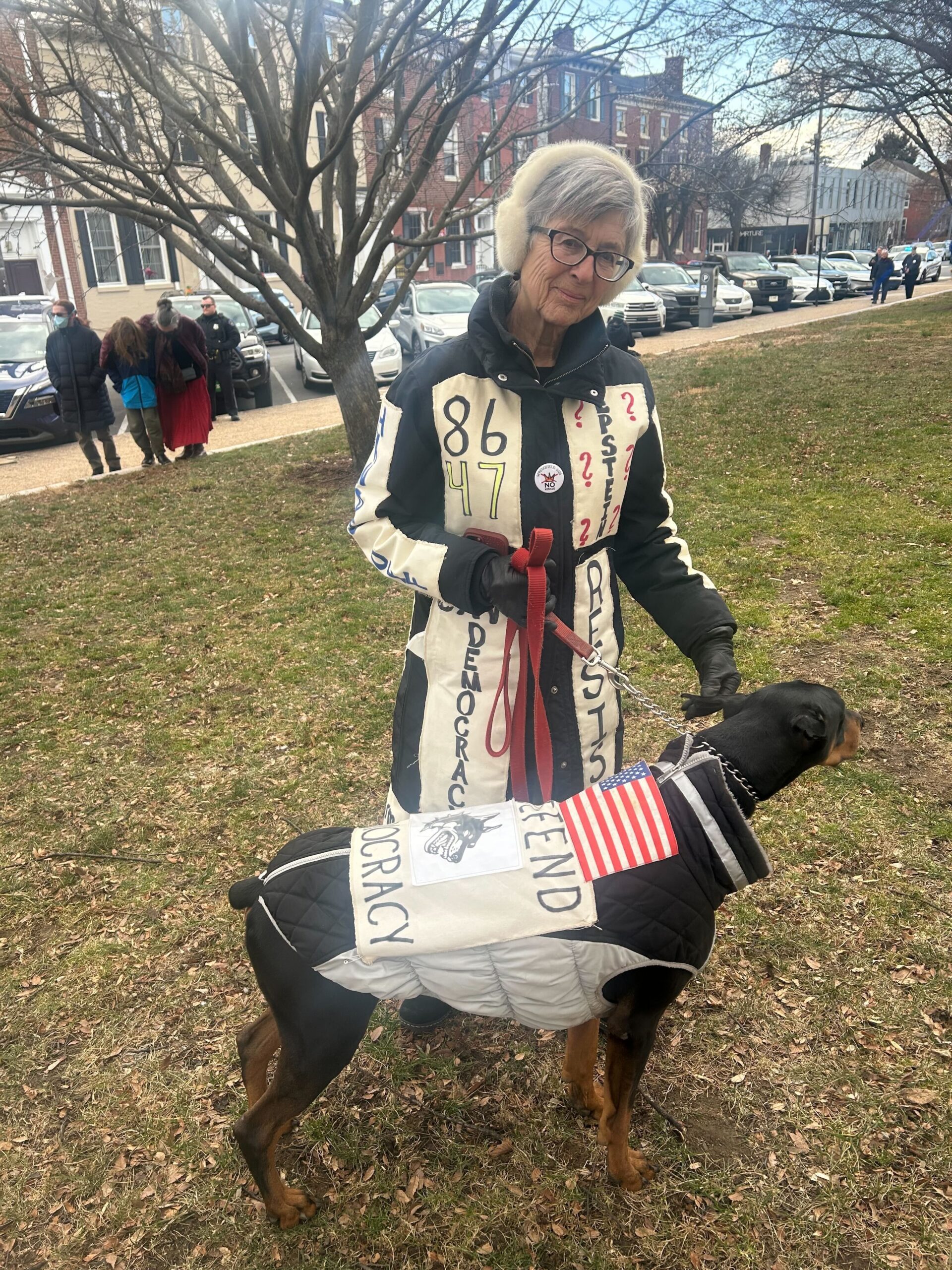
    Corinne Fiore, 75, of Media, poses with her 4-year-old Doberman, Laser, who wears a “Defend Democracy” vest to local rallies and events, on Jan. 11, 2026, outside of the Delaware County Courthouse in Media, Pa.

    “I just can’t get in a car and go for 10 hours somewhere,” she said. She’s thankful she doesn’t have to. “Delaware County has a lot of responsible people in it. They’re good and kind people. Patriotic people.”

    For families with young children, the Media vigil also presented a convenient opportunity to teach their children the importance of standing up for their neighbors.

    “I want to show them it’s important to stand up to a bully,” said Candice Carbone Bainbridge, 42, of Wallingford. Nearby, her 8-year-old daughter, Cora, held a sign with pink and purple lettering that read: “Be a good human. It’s not that hard!”

    Sixteen miles southeast, in Bellmawr, N.J., dozens gathered along Black Horse Pike, hoisting signs, cheering on supportive honks from passing commercial trucks, and dancing to the Rascals’ 1968 anthem, “People Got to Be Free.” One poster read, “American foundations are being destroyed, no one is safe, stand up now.”

    Karen Kelly, 72, who drove 40 minutes and DJed the demonstration, said she’s frustrated by apathy and disengagement.

    “All the people staying home — doing nothing — have to get the heck up,” Kelly said.

    Residents in the outskirts of Philadelphia expressed similar sentiments to their suburban counterparts.

    “This is not law enforcement, this is brutality,” said Susan MacBride, 84, at a protest in Roxborough, which was largely attended by residents of Cathedral Village, a retirement community in Northwest Philadelphia. Tired of what she described as the Trump administration’s cruelty and disrespect, MacBride felt compelled to put a pause on her retirement and join the 160-person rally at Ridge Avenue and Cathedral Road.

    “Kids need to know this isn’t normal; it’s a period of disruption, but we can’t let them get used to this,” she said.

    Nearby neighbor Lorraine Webb, 73, agreed with MacBride.

    “This isn’t what we are about, we need to do better,” Webb said. “We need to show up because this isn’t just a Center City issue; it’s a Philadelphia issue.”