The Plaza Grande apartment complex, part of a Cherry Hill housing development that took almost two decades to complete, is now on the market.
The apartments in the 55+ housing complex near the former Garden State Park Racetrack were listed for sale last month, as first reported by the Philadelphia Business Journal. The 507 rental units across 16 buildings are located just south of the Cherry Hill Mall between Routes 70 and 38 and were completed last year.
The residential Plaza Grande at Garden State Park was the last piece of a $1 billion redevelopment of the former Garden State Park horse racing track and surrounding area. The mixed-use complex spans hundreds of acres and is known for Wegmans, Trader Joe’s, restaurants, and other stores.
Home construction at the 34-acre Plaza Grande portion began in 2007, and 101 condos were built. But several builders failed to finish the project in the face of hurdles that included the Great Recession and lawsuits.
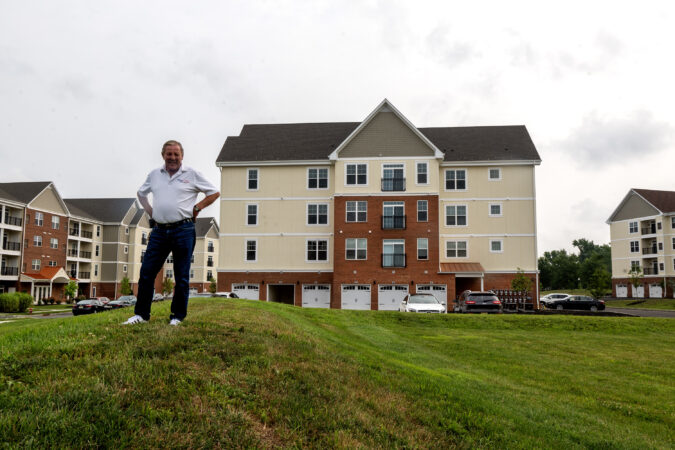
A few years ago, New York-based investor and developer William “Billy” Procida stepped in. He completed construction on the remaining283 of the 507 apartments last summer, and the units are now 80% leased.
“We’re not in the business of holding property,” he said. “But this one, I put so much blood, sweat, and tears in it, it’s a hard one to let go.”
Developer William “Billy” Procida poses in the lobby of the clubhouse at Plaza Grande at Garden State Park in Cherry Hill on Aug. 6, 2025.
He said he’d like to find a buyer “who’s going to treat it really nice.”
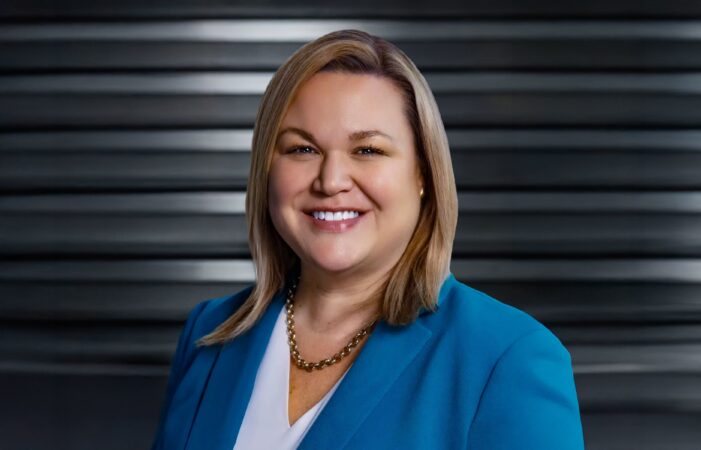
Offers are due in a month, said Samantha Kupersmith, senior director at JLL Capital Markets, which is handling the sale. The property listing does not include an asking price, as is generally the case for properties JLL handles, she said.
The property is in “such a good location with a lot of scale,” which makes this “a unique deal,” Kupersmith said.
One- and two-bedroom apartments at the Plaza Grande are currently available starting at $2,200 and $2,800 per month, respectively. Five three-bedroom apartments started at $5,500 but allare leased.
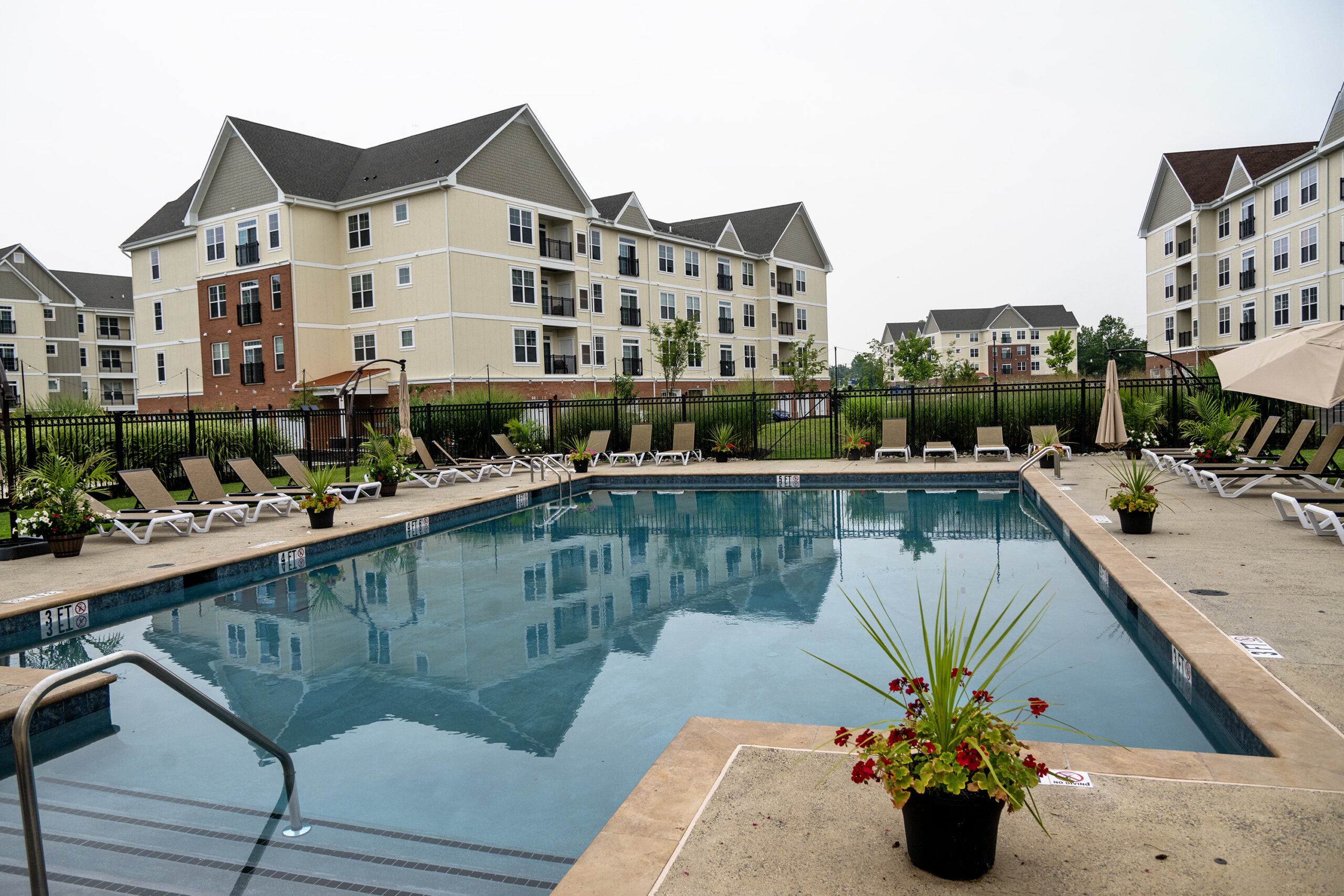
The property has an 18,500-square-foot clubhouse and offers programming such as cooking and fitness classes, concerts, and wellness events. Condo owners and renters have access to amenities that include a movie theater, a gym, tennis and pickleball courts, indoor and outdoor pools, and indoor golf.
Procida’s company announced last month that it had chosen Millstone Property Management to oversee operations at the apartment complex starting March 21. Millstone Property Management specializes in managing multifamily properties across Pennsylvania, New Jersey, Delaware, and Florida.
The newest rental apartments at Plaza Grande at Garden State Park in Cherry Hill are reflected in the clubhouse pool on Aug. 5, 2025.
Chester County has appointed a new top administrator after the county’s chief executive officer left his position Monday, officials said.
David Byerman, who served as the county’s CEO for just over a year, left Monday. Erik Walschburger was immediately appointed to replace him, and will be overseeing the county’s staff and budget under the title of “county administrator” rather than CEO, a spokesperson said.
Staff were informed of the changes Monday afternoon in an email from the county’s commissioners. The message, which announced Walschburger’s appointment, didn’t mention Byerman. His staff page was removed by Monday afternoon.
The county did not give a reason for Byerman’s departure. He did not answer a phone call seeking comment.
Walschburger comes into the role having served as deputy county administrator since 2022, with more than 15 years of experience in the county. As deputy, he oversaw the internal day-to-day operations. Prior to joining the county’s administrative side, he worked in the district attorney’s office, prosecuting criminal cases, managing diversionary programs, writing grants, and defending convictions on appeal.
The email from the commissioners also said Megan Moser, the county’s chief experience officer, will continue in her role under a new title —the “deputy county administrator.” Moser joined the county last year, and has been involved with the response to multiple election errors in recent months.
The county is searching for an acting deputy county administrator for operations to replace Walschburger, the email said.
Byerman was appointed as CEO in November 2024, after years serving as the director of Kentucky’s legislative research commission and as the secretary of the state Senate in Nevada. As county CEO, Byerman oversaw the county’s more than 2,600 employees and managed the annual budget of roughly $730 million.
“We look forward to working with the entire leadership team — and all of you — to establish and sustain a culture of collaboration and mutual support as we continue to provide the highest quality services to the residents of Chester County,” the commissioners said in their email to staff.
This suburban content is produced with support from the Leslie Miller and Richard Worley Foundation and The Lenfest Institute for Journalism. Editorial content is created independently of the project donors. Gifts to support The Inquirer’s high-impact journalism can be made at inquirer.com/donate. A list of Lenfest Institute donors can be found at lenfestinstitute.org/supporters.
Main Line Health appointed Anna Michelle Brandt president of its Lankenau Medical Center in Wynnewood, the nonprofit health system announced Monday.
Brandt mostly recently worked as chief operating officer at University Hospital, a 519-bed academic medical center in Newark, N.J., which Main Line’s new CEO Ed Jimenez led before taking over at Main Line.
The new Lankenau president also worked previously with Jimenez at UF Health Shands Hospital in Florida.
Brandt succeeds Katie Galbraith, who left Lankenau in September after about three years to lead New England Baptist Hospital in Boston.
Lankenau, a level 2 trauma center, sits in Lower Merion Township at the intersection of West Philadelphia and Montgomery and Delaware Counties.
Elizabeth Killough remembers the beginning of Media’s Fair Trade history as follows: She was sitting at her desk at UnTours, an unconventional Media-based travel company, next to her boss and UnTours founder Hal Taussig.
Taussig, sitting in his beloved rickety desk chair, began to share a vision with Killough: What if his hometown of Media could become a hub for Fair Trade, a global trading system that prioritizes quality products and fair wages for farmers in the developing world? What if Media’s shops and restaurants could stock products made and sold with equity and respect?
“I couldn’t even begin to imagine what that would be [like],” Killough remembers.
To humor Taussig, she googled “Fair Trade towns” (the internet was remarkably slow in the mid-2000s, so it took a few minutes to populate the results, she said). An email for Bruce Crowther, the father of Fair Trade in Garstang, England, popped up. Killough sent him a note. Despite the fact that it was 10 p.m. in England, Crowther wrote right back. He wanted to help make Taussig’s dream a reality.
In the months that followed, Taussig and Killough would help spearhead an effort to make Media the first Fair Trade town in the United States, a push that took the cooperation of local business owners, civic leaders, and borough council members. As Media marks 20 years of its Fair Trade Town status, Fair Trade products, and Taussig’s formidable footprint, can be found all over the Delaware County community.
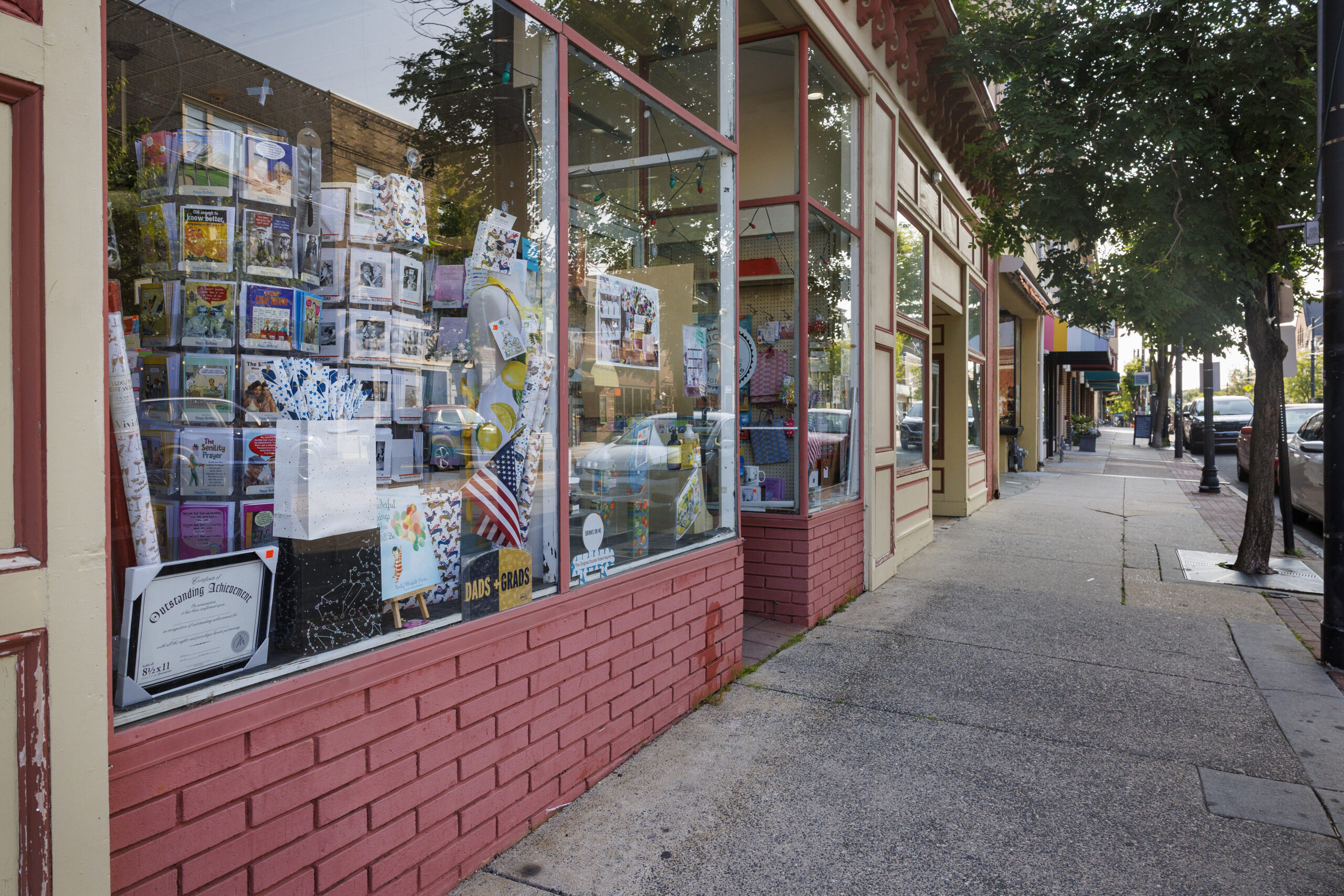
State Street, near Olive Street, on Wednesday, June 4, 2025, in Media, Pa. Businesses that sell Fair Trade products dot Media’s main commercial artery, a sign of the enduring legacy of Hal Taussig and Media’s Fair Trade advocates.
What is Fair Trade?
Fair Trade is a global trading arrangement under which farmers are paid higher wages in exchange for assurances that they will use eco-friendly practices, ensure safe working conditions, and invest in their communities. The trading practice seeks to uplift producers in the developing world, where environmental exploitation and forced labor can be common in the agriculture business. Common Fair Trade products include coffee, chocolate, and bananas.
Fair Trade guarantees farmers can charge minimum prices for goods, acting as a safety net against market instability. Some Fair Trade suppliers receive a “premium fund,” or an additional sum of money put aside to invest in education, healthcare, infrastructure, or business improvement products in their communities. In exchange for economic security, Fair Trade producers must provide workers with reasonable work hours, safe working conditions, and maternity leave, and are barred from using child and forced labor.
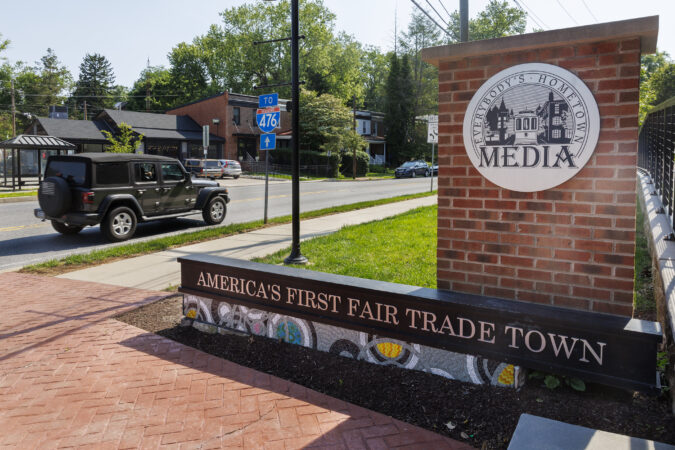
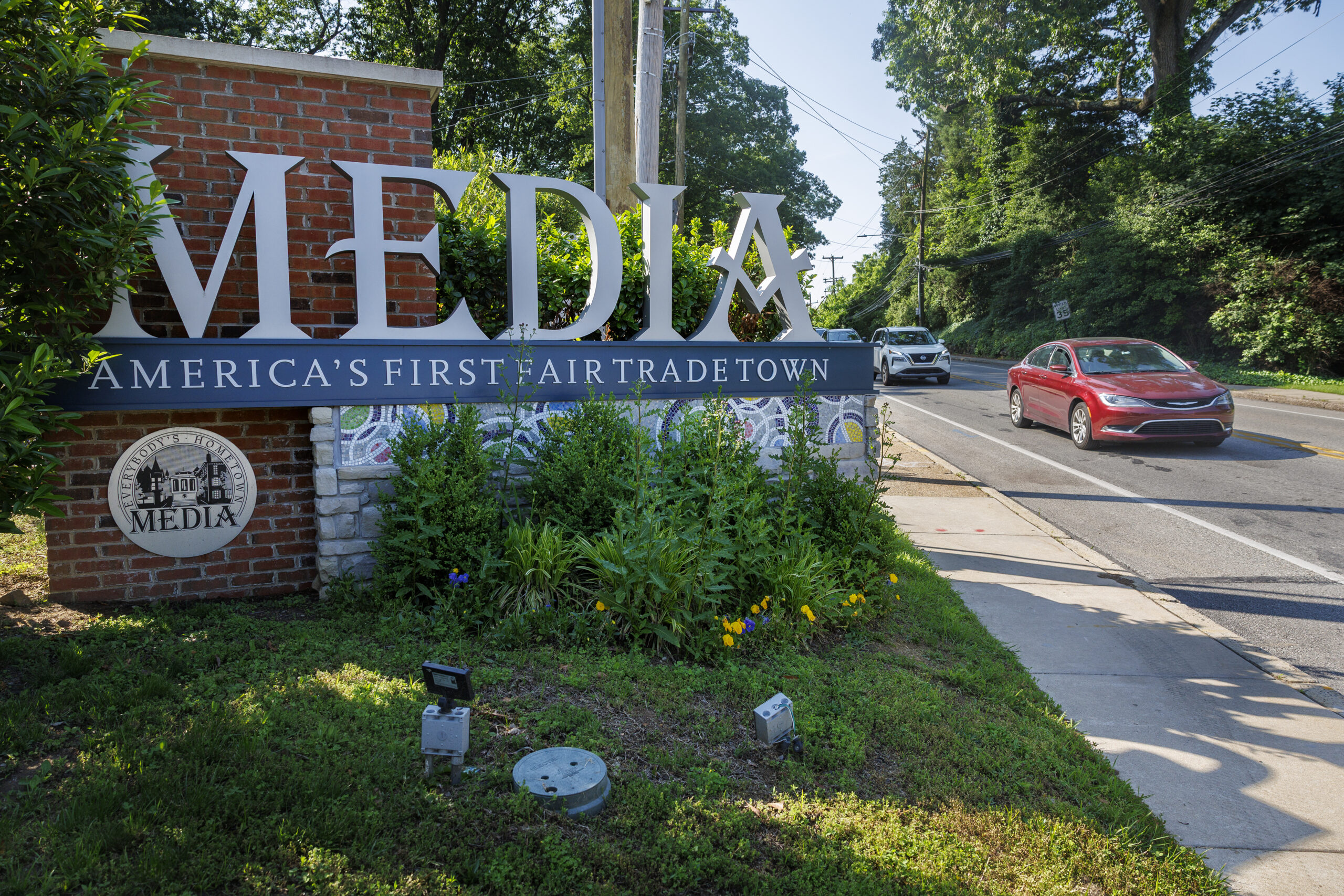
Killough’s email to Crowther set off a monthslong campaign to make Media the United States’s first Fair Trade Town, a moniker now proudly displayed on “Welcome to Media” signs on the borough’s outskirts.
Taussig had been thinking about sustainability in the global economy for decadesbefore Media’s formal designation. In 1992, Taussig and his wife, Norma, founded UnTours, an unconventional “slow travel company” that helped people connect to faraway lands through community engagement and sustainable tourism practices. Friends described Taussig as unique and empathetic. He was famously averse to making a profit, sharing UnTours’ returns with customers, staff, and, later, the UnTours Foundation, which invests in sustainable business ventures.
Taussig, who died in 2016, was “a really sweet man that cared about the world a lot,” said Ira Josephs, the executive director of the Media Fair Trade Committee.
Taussig and Killough began meeting with a group of stakeholders who shared the goal of bringing Fair Trade to Media. At the time, there was no organization overseeing Fair Trade communities in the U.S., so the Media group decided to “self-declare” under the criteria used by Garstang, the first Fair Trade Town in the world. They needed to persuade a certain number of Media retailers to sell Fair Trade-certified items and ask local schools and businessesto use Fair Trade goods. The guidelines also required Media to establish a Fair Trade committee; have an elected body pass a resolution supporting Fair Trade; and promote media coverage and education around Fair Trade.
A number of stores in Media already carried Fair Trade products, and many of its churches and Quaker meetinghouses used Fair Trade coffee and sugar. The working group made a website and brought on board Monica Simpson, a borough council member who helped convince the governing body to pass a Fair Trade resolution. The borough council saw it as a way for “this local community to make an international connection,” Killough said.
Once all of the criteria were met, “we just self-declared that we were the first Fair Trade town,” Josephs said.
At the time, New York City and Los Angeles were working on their own Fair Trade proposals. Yet Media, a 5,000-resident borough in the heart of Delco, beat them to the punch.
“It was rebellious,” Josephs said.
On July 12, 2006, Media held a public ceremony unveiling its status as a Fair Trade town.
Many of Media’s businesses got on board.
When Tara and Brent Endicott, the owners of downtown Media’s Burlap & Bean, first got into the coffee business, they knew they wanted “to feel like we were making a difference,” Tara Endicott said.
All of the coffee sold at Burlap & Bean is Fair Trade-certified and organic, a decision the Endicotts made in 2006 when they opened their first location in nearby Newtown Square,inspired in part by Media’s Fair Trade push.
Though their coffee-industry friends told them they were crazy for stocking only Fair Trade products, which are more expensive and harder to source, the Fair Trade beans won over the coffee purveyors and their Media-area customers.
Signage that reads, America’s First Free Trade Town, Media, PA., Wednesday, June 4, 2025. This sign is at N. Providence Road where it crosses N. Monroe Street.
Fair Trade in Media, two decades later
Fair Trade lives on in the stores, restaurants, and coffee shops that dot Media’s bustling downtown.
All of the international products at Earth & State, a pottery and craft shop, are from Fair Trade groups. Bittersweet Kitchen, a pizza and brunch spot, serves Fair Trade hot chocolate and coffee. Mom-and-daughter-owned yarn shop Homesewn sells yarn from Fair Trade Federation members and other companies that follow Fair Trade principles. Even Trader Joe’s, located in Media’s old armory building, stocks Fair Trade coffee.
On Valentine’s Day, the Media Fair Trade Committee hosted its annual Fair Trade chocolate tasting. The committee also hosts an annual juggling contest with Fair Trade soccer balls at Dining Under the Stars.
Fair Trade’s future is not entirely certain.
Fair Trade groups have come under scrutiny in recent years for corporatizing a once mission-driven practice. It has been hard at times to get businesses to splurge on Fair Trade goods, first during the 2008 recession and then again during the pandemic, Killough said. As rents rise in Media, there is a “constant turnover of store owners and restaurateurs,” Killough added, making it an ongoing effort to keep Fair Trade practices alive.
“It’s going to continue to require a lot of work, a lot of commitment, and a lot of education,” she said.
Last year was “the worst year financially that we’ve ever had,” Tara Endicott of Burlap & Bean said. Despite having the highest customer counts in Burlap & Bean’s history, high coffee prices and tariffs left the Endicotts taking home meager profits at the end of the day. They have thought about opening up their business to non-Fair Trade coffee but have not yet, relying on the hope that economic conditions will improve.
Ultimately, Brent Endicott said, he and his wife are proud to be in Media and to be serving Fair Trade beans.
“We’re thrilled to be able to do our part to help Media stay a certified Fair Trade town,” he said.
This suburban content is produced with support from the Leslie Miller and Richard Worley Foundation and The Lenfest Institute for Journalism. Editorial content is created independently of the project donors. Gifts to support The Inquirer’s high-impact journalism can be made at inquirer.com/donate. A list of Lenfest Institute donors can be found at lenfestinstitute.org/supporters.
When Nora Murphy Kramp walked away from her veterinary assistant career to pet sit full time, she didn’t expect that years later, a large chunk of her clientele would be chickens.
And goats. And pigs. Oh, my.
“It’s more common than not,” said Murphy Kramp, founder of Chester County Canines, based near Malvern. “Basically, if it’s, ‘Hey, come take care of my dogs,’ if they happen to have a nice backyard, a year later, it’s like, ‘Oh, hey, come take care of my dogs. We have six chickens now — them, too.’”
But for some of her clients, chickens are just the start: Some have added goats and sheep to their little homesteads, too.
Chester County is a ripe place for it, merging its strong agricultural past and the growing number of residents.
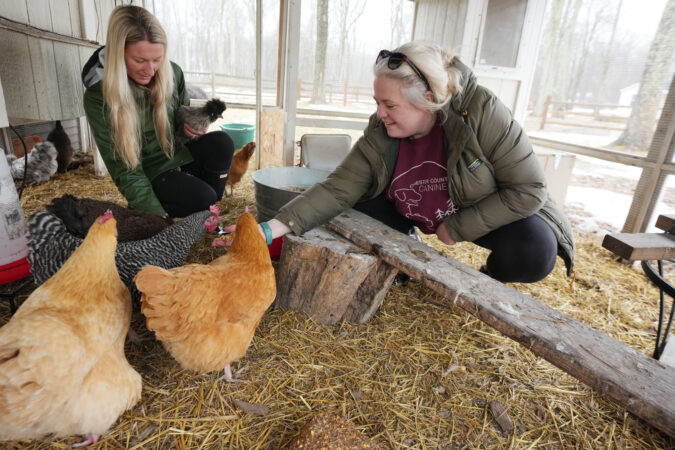
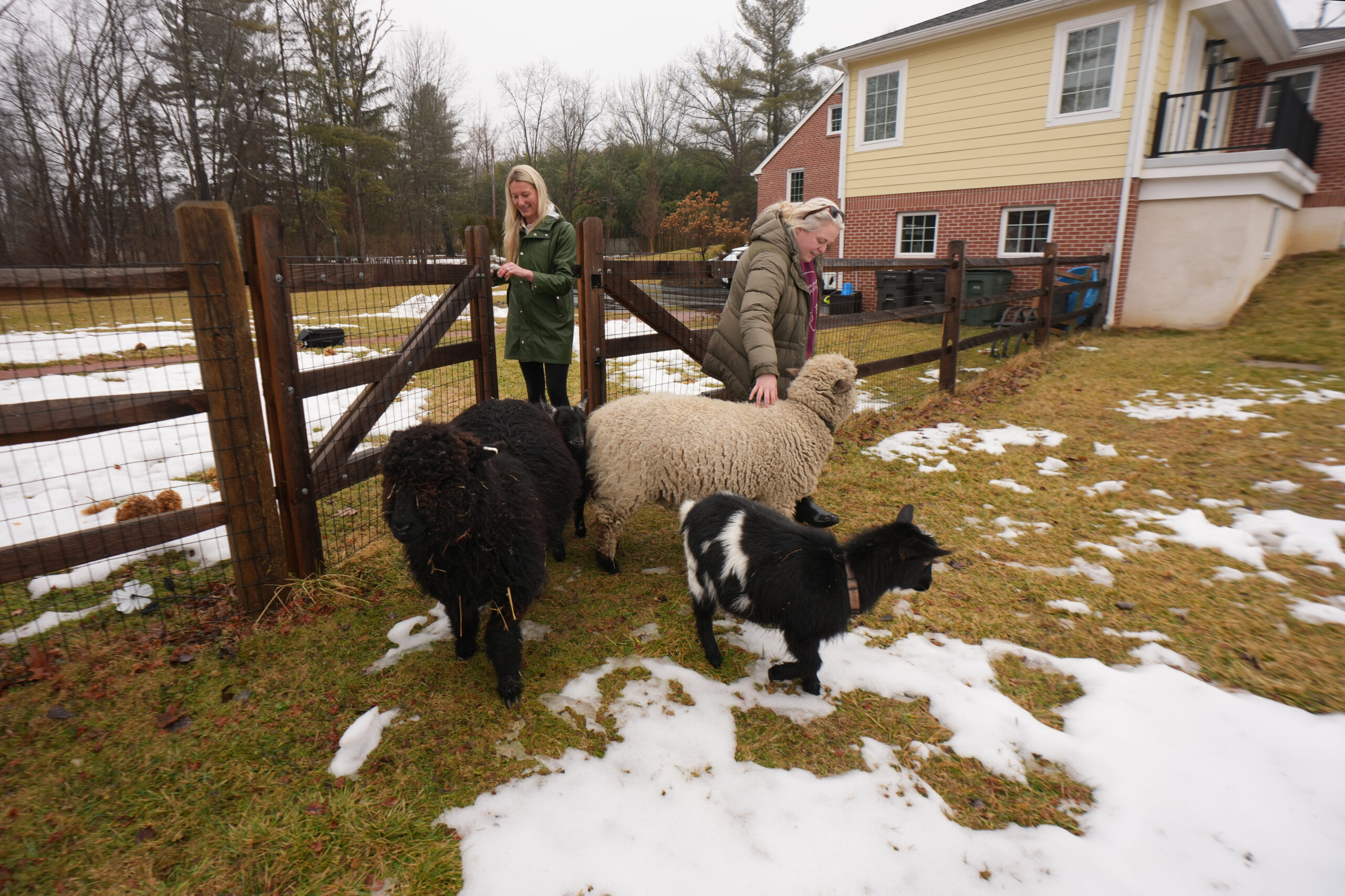
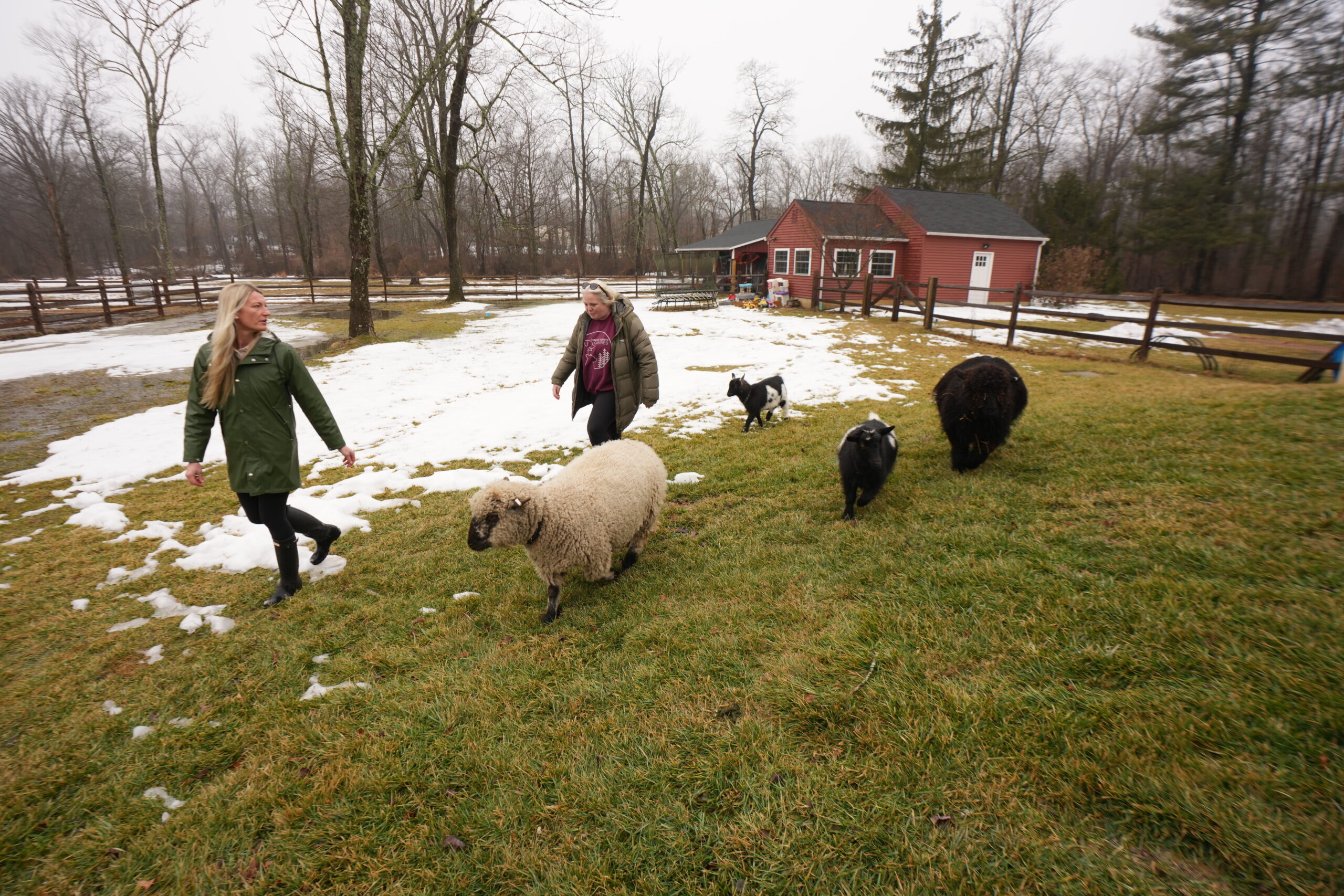
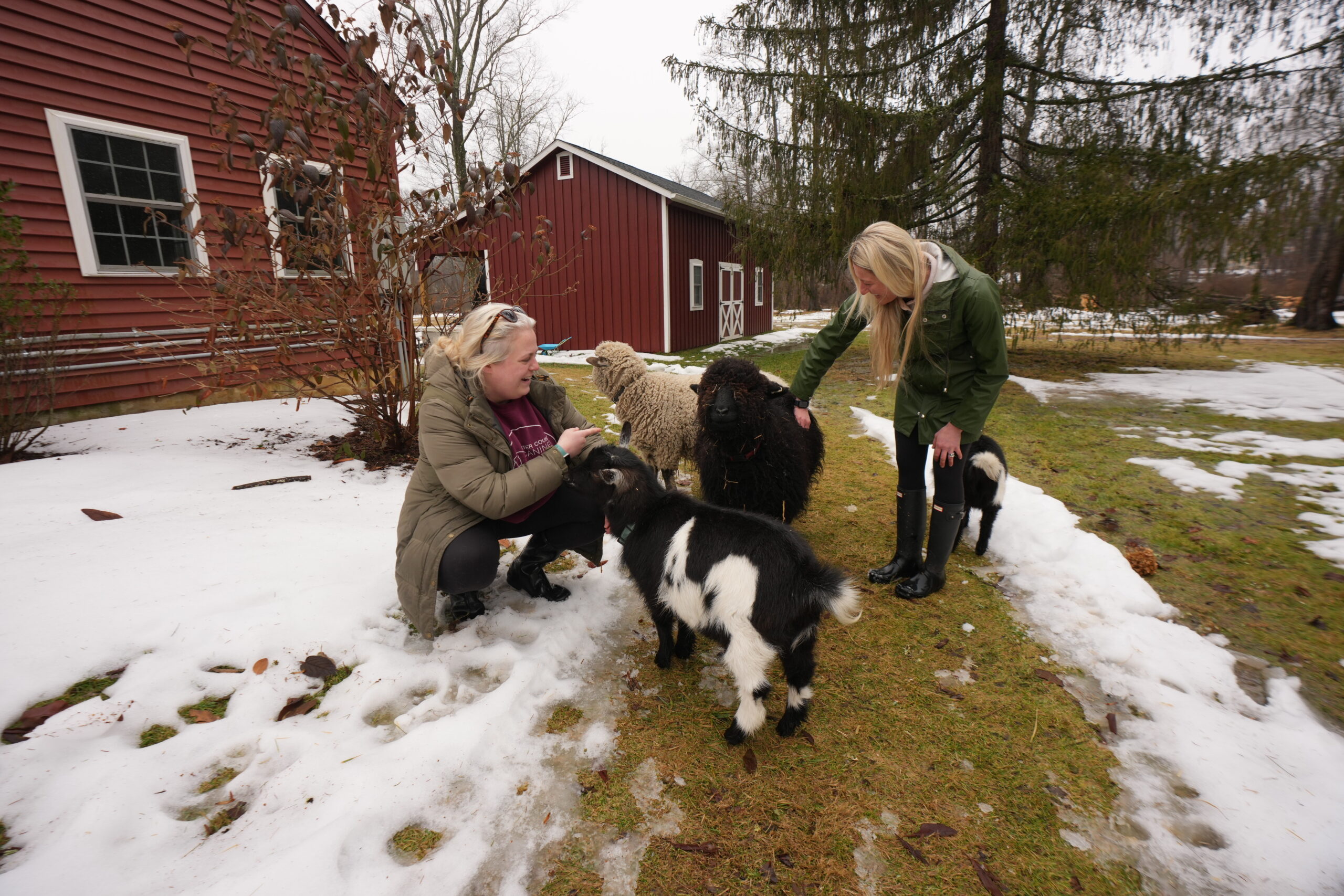
Julie Gunderson, left, and her pet sitter Nora Murphy Kramp, right, at Gunderson’s house with her farm animals, in Chester County, Pa., Feb. 20, 2026.
Over time, development has increased along with population — the county is one of the fastest-growing in the state — bringing all the amenities one could ask for. But with many municipalities having ordinances friendly to homesteading, allowing residents to farm animals with enough acreage, or chickens if the coop can be far enough from the house, more and more people have been embracing the so-called country life. (Murphy Kramp had to enter a “chicken lottery” to secure her own chickens last spring, due to the surge in popularity. A study last year found that there are more than 85 million backyard chickens nationwide, rivaling the population of cats and dogs.)
When people leave Philadelphia, with its tightly packed rowhouses or apartments, getting chickens can be one of the first things they do, observed Shiena Powelson, the owner of I Sit, They Stay, a pet-sitting business based in Chester County near Pottstown.
“There’s a lot of open spaces out this way, where there’s purposely no building going on, so it allows people to have these animals without being on top of the neighbor,” Powelson said. “On my road, I have these young families that have the chicken coops, but then there’s also a 15-acre horse farm four houses down from me. It’s a nice mix.”
Powelson, who grew up in an animal-loving family that ran a pet store in Pottstown, started her career as an educator at the Philadelphia Zoo. On the side, she fostered her pet-sitting business, and movedto it full time about 15 years ago. From the jump, she has had an interesting assortment of pets to care for: reptiles and exotic birds. She used to sit for full-on farms, mucking horse stalls or caring for sheep, but now she is finding more of a hybrid: people who live in residential communities but have chickens, ducks, and even pot-bellied pigs.
Julie Gunderson, left, and her pet sitter Nora Murphy Kramp, right, at Gunderson’s house with her farm animals in Chester County.
“When you pull in this development, you would never expect there would be two pot-bellied pigs living in the development,” she said.
Chickens, she has found, tend to be a familial thing, where parents teach their kids where the food comes from and how to care for the animals.
John Marshall, one of Powelson’s clients, grew up in Montgomery County and had a friend whose family had chickens. He thought it was awesome. With his own land, he decided to get his own. Now, the 54-year-old has had chickens on his couple of acres in the Pottstown area for about 30 years.
“It’s amazing, because it’s like having a dog. People just fall in love,” Marshall said. “They just become your little buddies. A lot of people think they’re real hard to take care of, but they’re not, if you set the coop up right.”
Caring for farm animals requires a different part of Powelson’s brain — digging back into her zoo background. Does she have her boots for muddy coops? Does she have her heavy jacket to work outside when it’s 10 degrees?
Nora Murphy Kramp, left, and her client Julie Gunderson, right, at Gunderson’s house with her farm animals, in Chester County, Pa, Feb. 20, 2026.
“It feels very different when I’m going to let someone’s dog out and can just hang out with them,” she said. “It’s a nice variety.”
With chickens and other farm critters, there are stalls to clean and muck. Murphy Kramp gets there at the crack of dawn to feed the animals.
During one hot summer, she told a client, Julie Gunderson, that she probably needed a fan for the chicken coop. From vacation, Gunderson ordered one, and Murphy Kramp assembled it and set it up. It gave Gunderson peace of mind, knowing someone was that hands-on with her chickens while she was away.
“I had talked to a lot of people along the way who have slightly bigger operations — still backyard farms — but they would tell me, ‘Oh, you’ll never get away together, someone’s always going to have to stay home to take care of the animals,’” Gunderson said. “I just feel very fortunate to have found Nora. I really trust her.”
Gunderson, 38, didn’t grow up on a farm, or with pets other than dogs. But she had an early appreciation of farm animals, spending time at the barn with her grandfather in Rhode Island. She decided to give chickens a try during the COVID-19 pandemic, after she went from working full time to staying at home with her first child to everything shutting down in rapid succession.
With five acres of land, and a county friendly to backyard farms like hers, it felt seamless to add two goats and two sheep a few years later.
It has been a way for her to learn a new skill, and to do something with her family, she said.
“It was kind of just like, how do I kind of get something new that educates me and teaches me something similar to how I felt when I was working, where I feel like I’m growing in some way,” she said.
With her three kids, all under age 6, they gather eggs and clean up the goat and sheep barn.
“If people are on the fence, I say do it,” she said. “There are plenty of pet sitters to help you when you need to get away.”
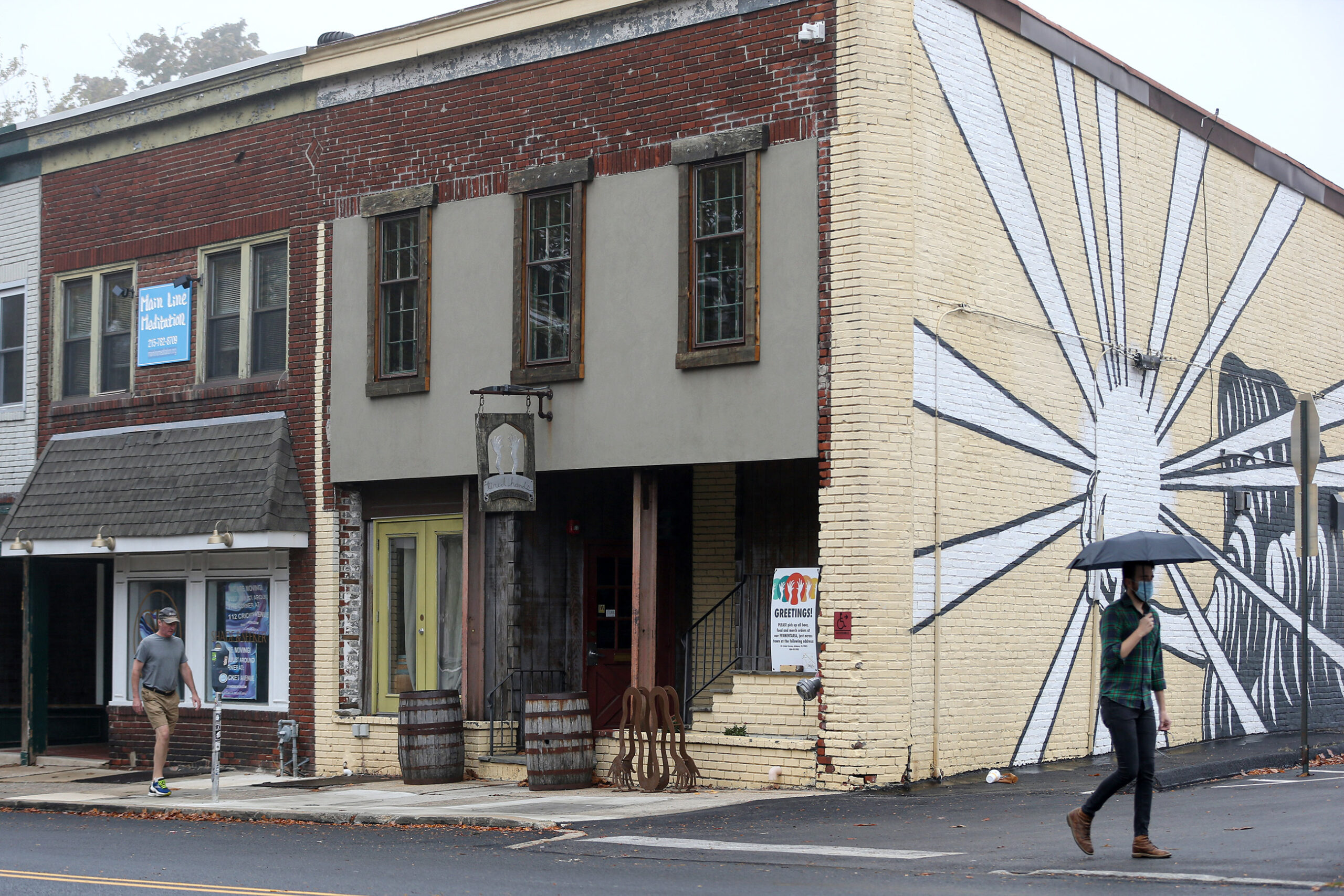
Ardmore Brewing Company is now a private event space as Tired Hands plots its next steps.
Tired Hands Brewing Company, the owner of Ardmore Brewing Company, has transformed the 16 Ardmore Ave. spot into a private event space for the time being.
Despite rebranding the space, previously known as BrewCafe, having two Tired Hands locations just a short distance apart in Ardmore was confusing for customers, the owner says. Paired with changes to the brewing industry landscape, additions to Ardmore’s food scene, and construction in the area, owner Jean Broillet decided it was time for a change.
While he says the location will be open to the public again in the future, he hasn’t specified in what form, The Inquirer’s Denali Sagner reports.
A former part-time police officer in Delaware County was fatally shot by Lower Merion police yesterday morning after exchanging gunfire with officers near Old Lancaster Road and City Avenue in Bala Cynwyd. When LMPD officers confronted Francis Connell Collier, 38, who was wanted on charges of rape and other sex crimes involving children, he shot at them, police say. Read more about what we know about the incident.
The region saw widely ranging snowfall totals from the storm earlier this week thanks to heavy banding. Penn Wynne saw 10.5 inches, according to a figure reported to the National Weather Service. See a map of how much snow fell near you.
Hair stylist Artur Kirsh is opening a salon in Narberth in April after Saks Fifth Avenue’s parent company announced it would be closing the Bala Cynwyd location, where he had long operated. Artur Kirsh Hair Studio will be located at 948 Montgomery Ave. and have what he described as a “fun and intimate” vibe. Kirsh also plans to open a second location at Boyds in Center City this fall.
Lower Merion is among the top 25 wealthiest spots in the Philadelphia area based on median household income between 2020 and 2024, according to the latest U.S. CensusAmerican Community Survey, which compiles self-reported income data. Township residents reported a median annual household income of $176,500, which puts it at No. 21 in the region. That’s more than $20,000 higher than the prior survey that looked at data from 2010 to 2014. Narberth comes in at No. 109 with a $124,000 median household income.
After an initial decision earlier this month to maintain pool fee pricing this year at the Ardmore Avenue and Belmont Hills pools for both residents and visitors, the board of commissioners last week approved a motion to increase fees 6.5% for non-residents this summer.
The former headquarters of Bryn Mawr Trust at 801 W. Lancaster Ave. is going to be converted into a financial literacy center. Real estate investor and developer Michael Karp said the project to convert the roughly 46,000-square-foot property will take 18 to 24 months and he envisions it including classroom and exhibition space where local students can learn. A WSFS bank branch in the building will remain there. (Philadelphia Business Journal)
The community is mourning the death of longtime former Wynnewood resident and local culinary pioneer Charlotte Ann Albertson, who died earlier this month at the age of 90. Albertson taught fifth and sixth grade English at the former Wynnewood Road School, before launching Albertson Cooking School, where she recruited high-profile chefs like Georges Perrier of Le Bec-Fin fame to teach. As the school grew, Albertson gave back by supporting philanthropic organizations like the Ronald McDonald House and Alex’s Lemonade Stand Foundation.
🏫 Schools Briefing
Lower Merion School District is hosting the fourth and final community meeting about its 2026-2031 strategic plan on Tuesday from 6:30 to 8:30 p.m. at the Lower Merion High School cafeteria.
Registration opens tomorrow for new students entering second through 12th gradein the 2026-27 school year. Find more information about registration here.
Tonight is the Lower Merion High School Black Student Union’s fourth annual “Shades of Black” showcase, featuring dancing, singing, and spoken word performances.
Spring sports start on Monday, there’s an emergency bus evacuation drill on Tuesday, and on Wednesday, Black Rock will host a special education parent information meeting. Penn Wynne Elementary School is hosting its “Taste of Penn Wynne” event next Thursday from 6:30 to 8 p.m., when families will showcase different cultures through displays and cuisine. See the district’s full calendar here.
🍽️ On our Plate
Joseph Amrani, an owner of Delice et Chocolat, which has locations in Ardmore and Wayne, appeared on PHL17’s Positively Philly recently, showcasing some of the French shop’s pastries and chocolates, including the “crookie,” a cross between a cookie and a croissant. He was joined by Alec Hersh, executive director of Downtown Ardmore District, which recently rebranded from The Ardmore Initiative and Destination Ardmore. See the segment here.
🎳 Things to Do
🦁 The Lion King: Catch a screening of the 1994 animated Disney classic. ⏰ Saturday, Feb. 28, 11 a.m. 💵 $6.75-$7.75 📍Bryn Mawr Film Institute
🖨️ Community Scanning Day: Have older documents or photos you want to digitize? This event will convert up to 10 files and provideattendees with a flash drive. Registration is required. ⏰ Saturday, Feb. 28, noon-3 p.m. 💵 Free 📍Ardmore Library
✡️ Purim Fest 2026: Celebrate the Jewish holiday at this family-friendly event that includes games, crafts, and other entertainment. ⏰ Sunday, March 1, 11 a.m.-2:30 p.m. 💵 $40 per family in advance, $48 at the door 📍Kaiserman JCC
🎨 Holi Crafternoon: Celebrate the colorful Hindu festival by making themed crafts at this drop-in event. ⏰ Wednesday, March 4, 3-5 p.m. 💵 Free 📍Gladwyne Library
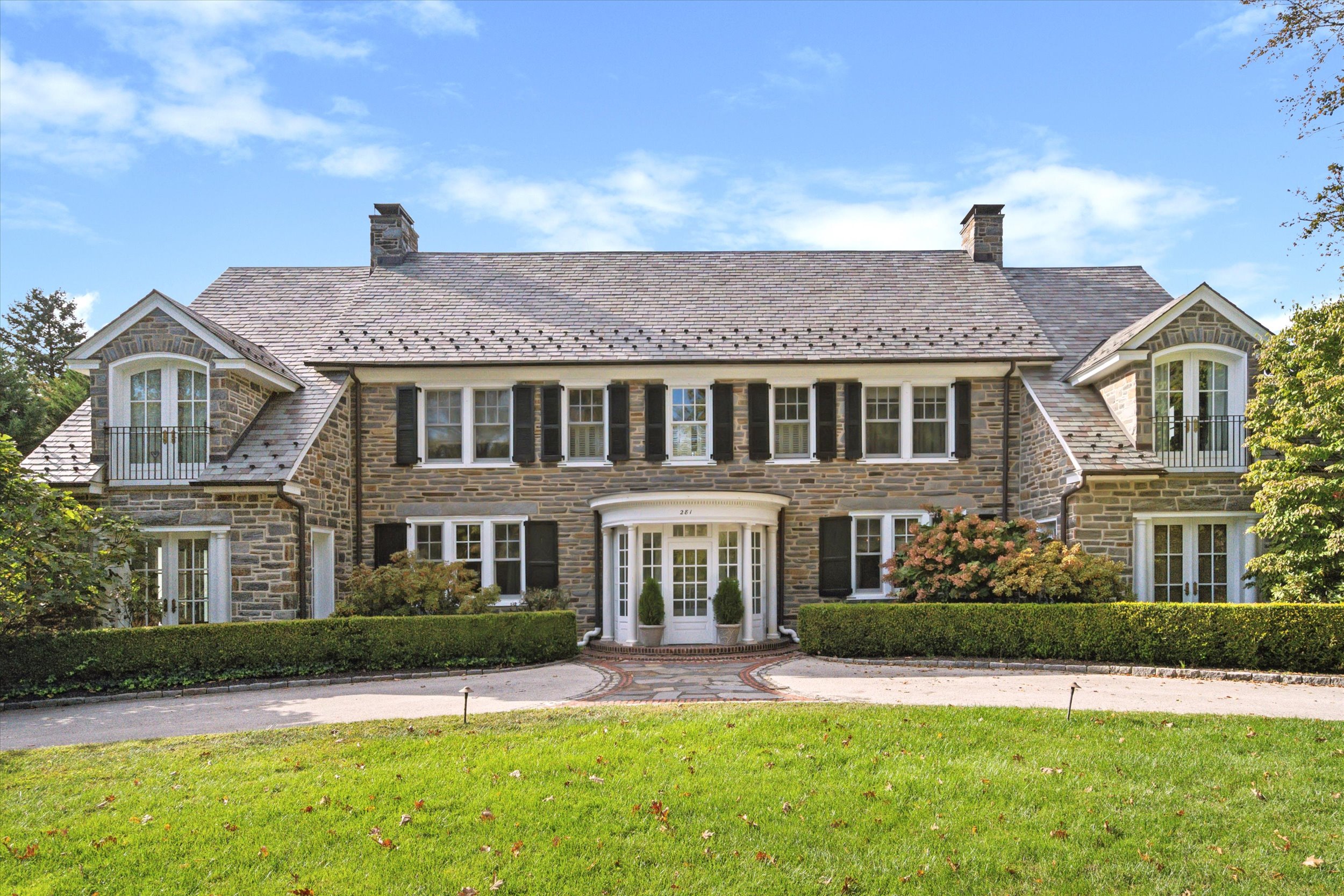
Built in 1925 and updated in recent years, this classic stone Merion Station home has multiple amenities like a pool, a home theater, a temperature-controlled wine cellar, and an elevator that stops at each floor. The first floor features formal living and dining rooms, a sunroom, and a kitchen with an island, black soapstone countertops, and stainless steel appliances. The home has six bedrooms, including a primary suite with its own dressing room and a bathroom with a whirlpool tub. The third floor has an additional bedroom, plus living space, while the basement features the home theater, a wine cellar, and a rec room.
By submitting your written, visual, and/or audio contributions, you agree to The Inquirer’s Terms of Use, including the grant of rights in Section 10.
This suburban content is produced with support from the Leslie Miller and Richard Worley Foundation and The Lenfest Institute for Journalism. Editorial content is created independently of the project donors. Gifts to support The Inquirer’s high-impact journalism can be made at inquirer.com/donate. A list of Lenfest Institute donors can be found at lenfestinstitute.org/supporters.
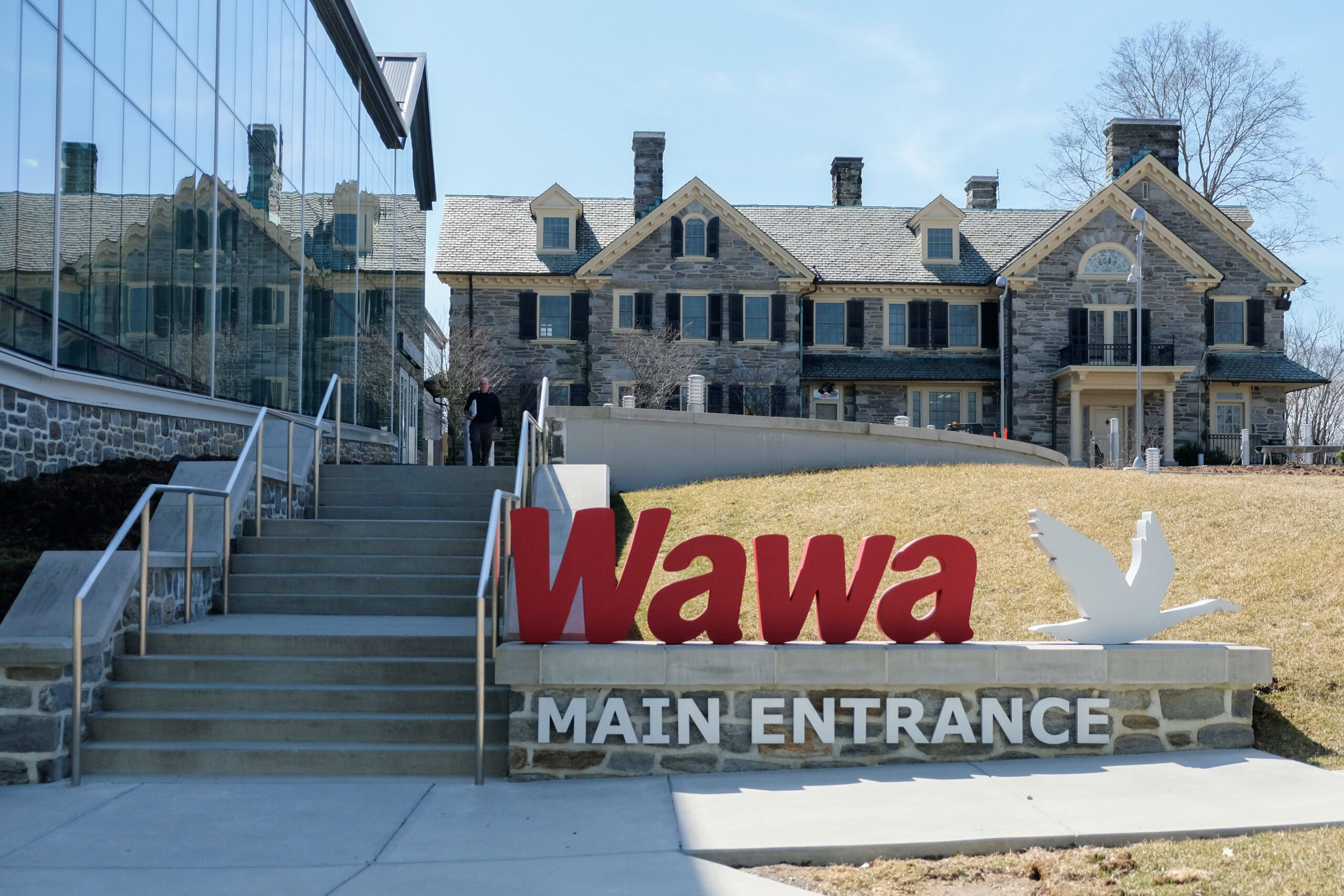
Wawa’s corporate headquarters is located in Delaware County.
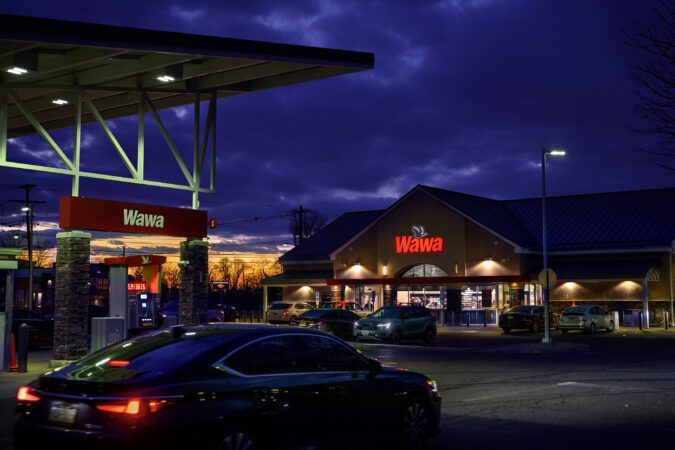
Wawa’s stores and menu offerings look quite different than they did a couple of decades ago, but despite the many changes the Delco-rooted company has made over the years, leadership says it’s still taking cues from its hometown base.
“For a lot of people, it’s their daily routine,” CEO Chris Gheysens told The Inquirer’s Erin McCarthy recently.
While some bemoan the loss of freshly sliced meats (more on that below), other changes to Wawa have been consumer-driven, like introducing coffee, adding gas, and delivering protein-packed menu items.
Wawa has expanded to nearly 1,200 stores across 13 states and Washington, D.C., and some wonder if it’s lost a little bit of its luster all these years later.
Three Inquirer staffers recently shared what they still love about the convenience chain and what they miss (including the freshly sliced deli meat and the spicy cherry relish).
The region saw widely ranging snowfall totals from the storm earlier this week thanks to heavy banding, but Nether Providence and Swarthmore topped the lists locally, according to figures reported to the National Weather Service. Both recorded a foot of snow, while Media clocked in at 7.8 inches. See a map of how much snow fell near you.
Middletown Township is not moving forward with plans for the proposed “loop road” that was intended to be built behind the Chick-fil-A and CVS to ease congestionnear the busy intersection of Route 1 and Pennell Road. With PennDot planning to widen the road and add turn lanes, the project would be unnecessary. (Daily Times)
Delaware County Council voted last week to end a disaster emergency related to Prospect Medical’s closure of Crozer Health last year, including Crozer-Chester Medical Center. Council enacted the resolution last summer, allowing it to allocate funds that ensured residents had continued access to emergency medical services, such as ambulances. It also gave local municipalities time to establish their own EMS contracts, which, according to council, all have since done.
Swarthmore College President Valerie Smith announced this week that she will step down from her role in June 2027, when her contract ends. Smith has served as president since 2015, leading the liberal arts school through the pandemic, student protests, and funding threats from the federal government.
Eight Swarthmore College students face possible expulsion after distributing a “zine” criticizing seven members of the college’s board of managers for their ties to companies invested in Israel. The school says the students used imagery and language that “threatened, intimidated, and/or promoted potential violence on campus.” (WHYY)
Heads up for trolley riders: Trips on the D1 line, which starts at Orange Street in Media, could be up to 15 minutes longer after SEPTA launched a new safety system this week. The new system includes upgraded signals that require more gradual accelerations and decelerations, which are aimed at improving safety.
Media Mayor Joi Washington said she knows that her office carries weight beyond policy-making. The first woman and person of color to be mayor of Media, she said in a recent interview with CBS News Philadelphia, “What I want young Black girls to see, what I want Black residents to see, is that we’re still here. There are a lot of things that are stacked against us, but we can’t succumb to negativity.”
Swarthmore Borough residents can purchase a tree to go along or near their curb through March 9. Trees are $250 and include mulching and planting.
📸 Local residents embrace the snow
Josh Jordan and his 3 year-old daughter, Louise, took advantage of the snow earlier this week to build a snowman near their home in Media.
🏫 Schools Briefing
On Tuesday, Wallingford-Swarthmore School District’s board approved a reorganization plan that would eliminate nearly 20 jobs as it looks to trim spending. The plan, which goes into effect in July, is expected to save the district about $2 million byeliminating five administrative positions, some instructional assistants, and other roles. The measure comes as the district faced a budget deficit for the 2027-28 school year.
WSSD is hosting a pair of community conversations today at Strath Haven Middle School at 9 a.m. and 6 p.m. to discuss the budget development for next school year.
Also in Wallingford-Swarthmore, tomorrow is Strath Haven Middle School’s sixth and seventh grade dance, and Monday is the start of pre-season for spring athletics. There’s a policy committee meeting Tuesday night. See the district’s full calendar here.
In Rose Tree Media School District, there’s a school board meeting tonight at 6:30 p.m. at Penncrest High School, and Springton Lake Middle School’s musical kicks off tonight and runs through Saturday. Tomorrow, there’s a pep rally and science fair atIndian Lane. There are early dismissals for elementary school students on Wednesday for parent-teacher conferences. See the district’s full calendar here.
🍽️ On our Plate
Media Restaurant Week is just a few weeks away, and eateries are offering special pricing for the occasion. See the restaurants that have signed up so far here.
🎳 Things to Do
🎷 Tino Serrano and His Latin Jazz Quintet: Hear the band play Latin jazz tunes as part of the Friday Night Live Concert series. ⏰ Friday, Feb. 27, 7-9:30 p.m. 💵 $10-$15 📍Community Arts Center, Wallingford
😂 Delco Improv Night: ComedySportz Philadelphia returns for another unscripted night of comedy. ⏰ Saturday, Feb. 28, 7:30-9 p.m. 💵 $20.50 📍Park Avenue Community Center, Swarthmore
🎵 Rust: Hear tunes from the Neil Young tribute band. ⏰ Saturday, Feb. 28, 8:30 p.m. 💵 Free 📍Shere-e-Punjab
Built in 1950, this four-bedroom Media ranch hasmid-century elements but has also been updated and expanded. Brick walls and original oak flooring give nods to the past, along with a brick fireplace that has space for wood storage, while stainless steel appliances, granite countertops, and a peninsula with seating give the kitchen a 21st-century feel. The home has a living room, family room with vaulted ceilings, a dining room with a dry bar area, and an office. There’s also a three-season room, a back patio, and a fenced yard.
By submitting your written, visual, and/or audio contributions, you agree to The Inquirer’s Terms of Use, including the grant of rights in Section 10.
This suburban content is produced with support from the Leslie Miller and Richard Worley Foundation and The Lenfest Institute for Journalism. Editorial content is created independently of the project donors. Gifts to support The Inquirer’s high-impact journalism can be made at inquirer.com/donate. A list of Lenfest Institute donors can be found at lenfestinstitute.org/supporters.
But six years later, some sprawling campuses in suburbs like Horsham, Plymouth Meeting, and Wayne have soaring vacancies — andthere are only a couple suburban conversions underway.
Developers agree that the primary challenge is the buildings themselves, which have more difficult floor plans for residential development than their urban counterparts, making demolition easier than conversion in many cases.
“Transforming an office building tucked inside a suburban office park is a completely different equation than converting a building on Walnut Street steps from Rittenhouse Square,” said Sarah Maginnis, executive director of the Philadelphia chapter of the Commercial Real Estate Development Association. “Location, context, and building design all matter a lot.”
The lack of suburban office redevelopment is partly due to the fact that many of the highest-vacancy buildings are in remote, less desirable corners of the region. The patchwork quilt of hyperlocal zoning regulations across dozens of municipalities is a challenge, too, as builders have to negotiate with officials on almost every project.
“A lot of townships are fighting residential development because it comes with burdens on the school systems. Office buildings don’t do that,” said Glenn Blumenfeld, principal with Tactix Real Estate Advisors. “Zoning is more liberal in the cities [which is why residential conversion] has not come to the suburbs.”
Architectural challenges of conversion
Most suburban office buildings date to an era when office and residential structures began to look very different from each other.
When office work began to move into undeveloped land surrounding cities in the mid-20th century, developers generally built out instead of up, taking advantage of the abundant space. Almost everyone commuted by car, so vast parking lots were required.
Suburban office buildings often have a lot of dark interior space. The windows that do exist mostly cannot be opened because of ubiquitous air-conditioning. The parking lots that wreath the buildings make for unsightly and dull vistas.
In large rectangular glass buildings, residential conversion would entail what longtime suburban developer Eli Kahn calls “bowling-alley-shaped apartments … that just don’t work.”
“In the city, a 30-story office tower doesn’t look a whole lot different from an apartment building,” said Kahn, president of E. Kahn Development Corp.
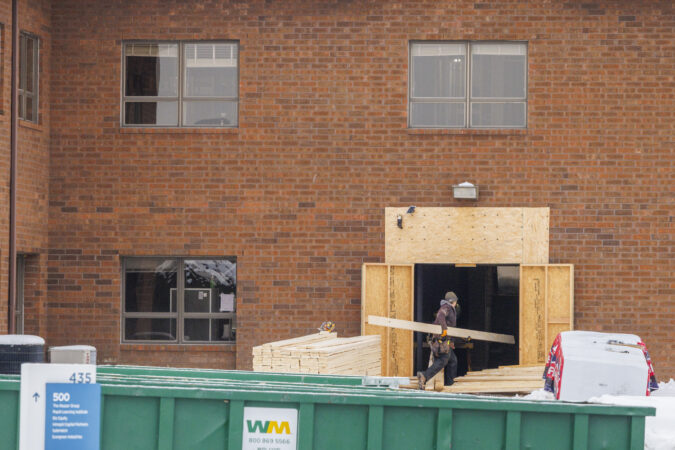
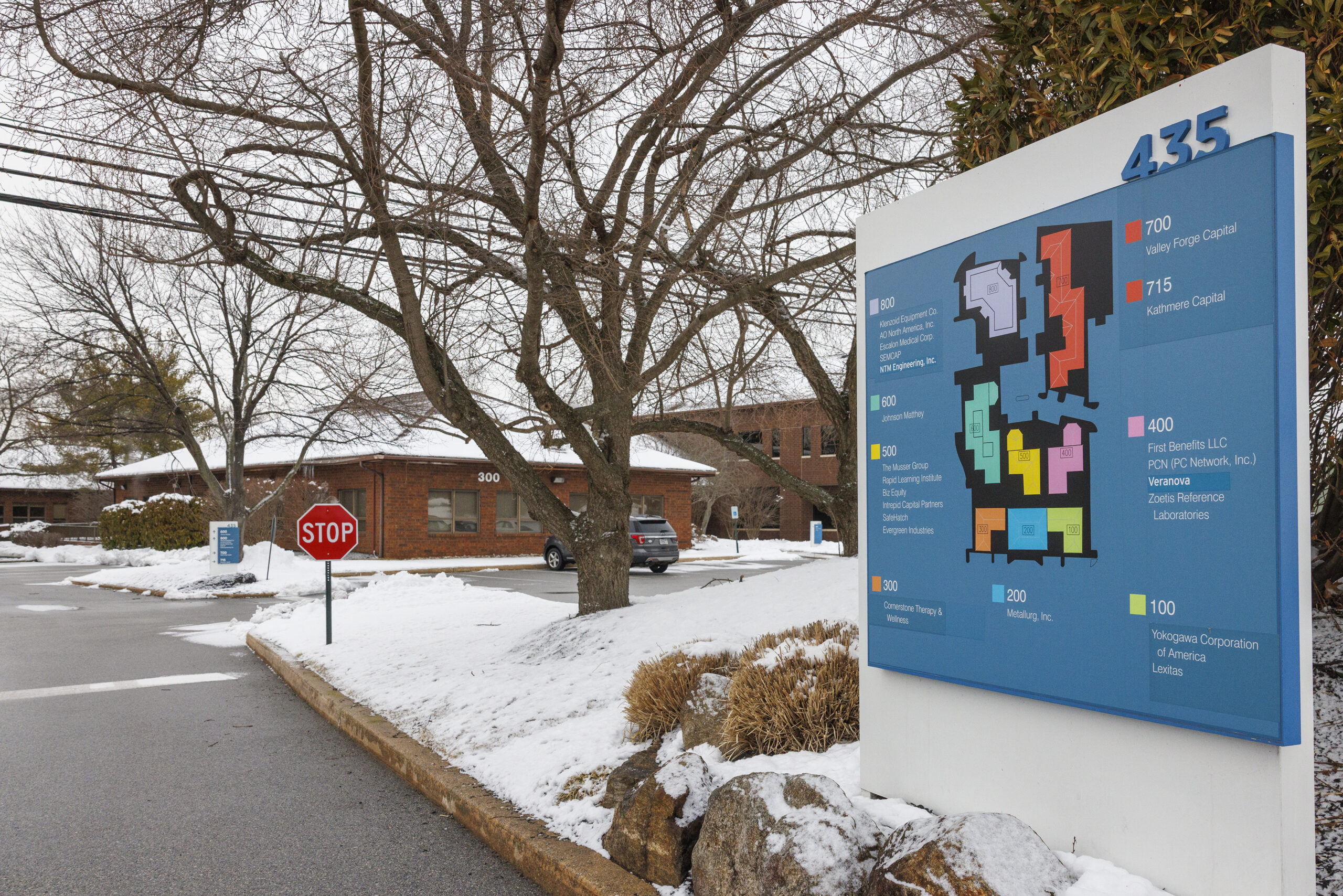
One of the eight two-story buildings at 435 Devon Park Dr. that have been used as offices and are being turned into apartments.
An exceptional suburban conversion
The redevelopment of an eight-building office complex at 435 Devon Park Dr. in Chester County’s Tredyffrin Township is one of the only suburban office-to-residential conversions underway right now.
Notably, none of its former office structures are big glass rectangles.
“This just happened to be perfect for conversion,” said Mark Thomson, founder of Love Communities, which is developing the project in partnership with E. Kahn Development Corp. and Triple Crown Corp.
“It’s going to be the largest garden-style suburban conversion in the whole Northeast, maybe even a bigger area than that,” Thomson said.
Kahn also is part of the team behind the conversion of 435 Devon Dr., and he developed the complex when it was built in the 1980s.
This office park broke from the standard big glass box model of suburban offices and instead offered two-story, L-shaped buildings with brick facades and windowsthat open.
That makes conversion cheaper, too. To make those big box buildings livable, the glass facade would need to be torn off and windows installed that actually open.
“The most expensive part of construction is the windows,” Thomson said. “If we had to do that, it would probably make this not economically feasible.”
The project is also able to move forward because it accords with the goals of local political leadership, who are wary of family-size apartments.
The 162-unit office-to-residential project will be largely composed of studio and one-bedroom apartments in an attempt to appease concerns about strains on the school district and to produce unsubsidized affordable housing in this wealthy township.
Zoning rules everything
In many suburbs, building apartments, townhouses, and other more modestly scaled housing is often not allowed by zoning laws. Office parks are usually zoned to exclude residential development.
That’s a sharp contrast with Philadelphia, which has few barriers to office-to-residential conversion in Center City, and a citywide10-year property tax abatement is available for building renovations. Wilmington also offers a variety of incentives.
In Tredyffrin, officials were opposed to the idea of either very high density apartments — at almost 10 acres, the site could support hundreds of units — or new single-family homes.
So to make 435 Devon Park Dr. work, the developers knew they couldn’t demolish the buildings and construct new homes.
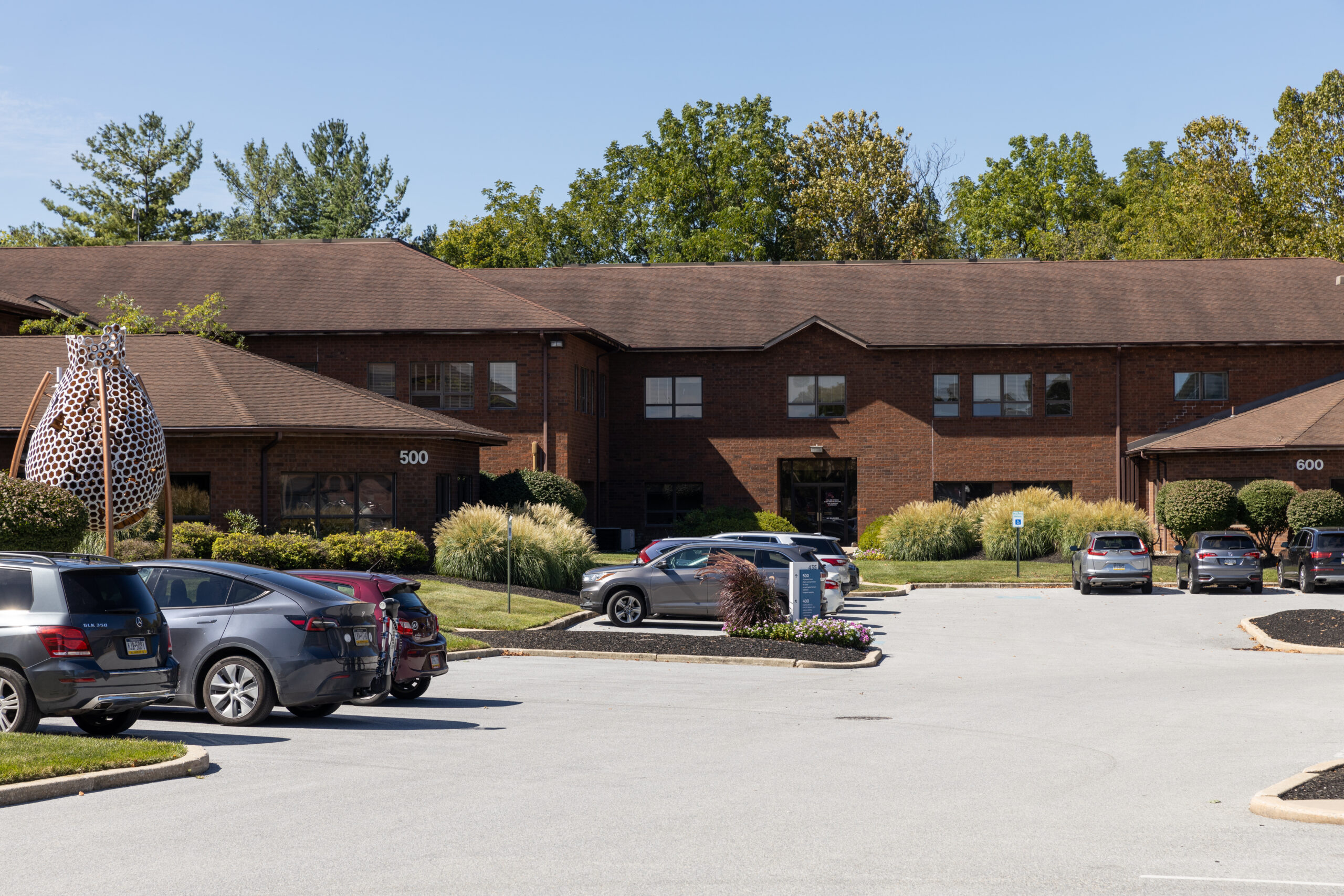
The entrance to 435 Devon Park Dr. with the brick office buildings, which are planned to be converted to residential in the background.
Instead, the developers pitched the conversion not as luxury apartments, but as affordable homes for nurses, teachers, and other middle-income workers in Tredyffrin. They also plan to convert some parking lots into green space for residents.
The units can be priced more affordably because of the relatively small scope of the conversion and because the developers essentially purchased the campus for its land value.
Working in partnership with Triple Crown Corp. also helps because the company has in-house contractors and architects.
The paucity of multi-bedroom units lowers rental costs, too, and assuages fears about overburdening schools.
“None of these communities have made it easy like Philadelphia, because they’re all their own fiefdoms,” Kahn said. “But if you make the right argument and you show them how it’ll benefit them financially, they generally come around.”
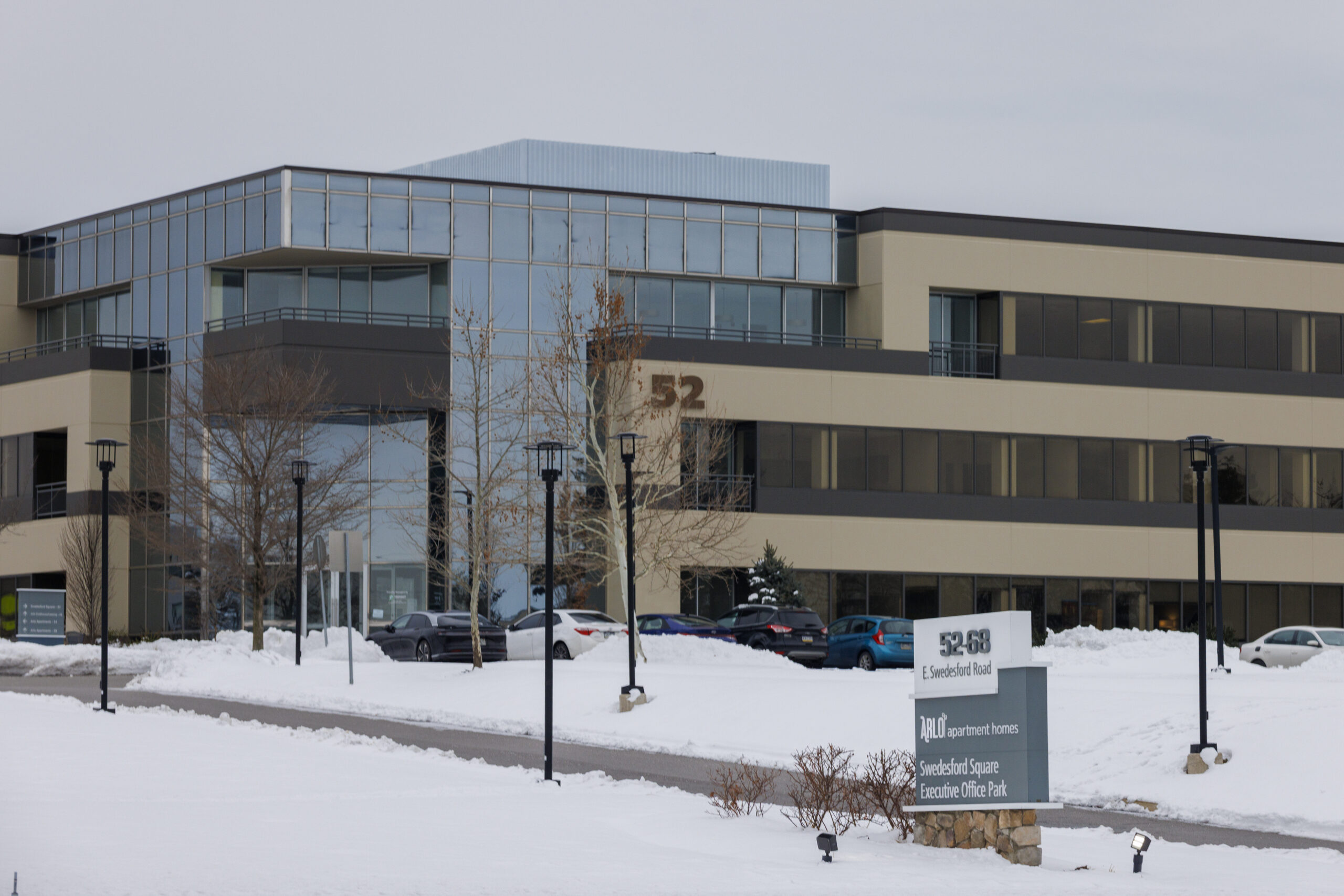
The East Whiteland office building at 52 Swedesford Rd., which is slated by TriPoint Properties for demolition and replacement with apartments.
The future of (some) suburban offices
There are few other conversion projectsunderway in Philadelphia’s suburbs.
Keystone Property Group has a more traditional office-to-apartment tower in the works at the Plymouth Meeting Mall. The Parkview Tower next to the Valley Forge casino was consideredfor conversion last year. The Buccini Pollin Group is weighing a conversion project at BNY Mellon’s old headquarters in Bellevue State Park, north of Wilmington, and is looking at opportunities in the Pennsylvania suburbs.
But it is more common for developers to consider demolishing old office buildings to make way for something new.
In Chester County’s East Whiteland Township, which contains the Great Valley Corporate Center, office-to-residential conversion proposals have met a chilly reception.
“The proposals to rezone large vacant office buildings for direct conversion to apartments were really viewed negatively,” said Scott Lambert, chairman of the East Whiteland Township Board of Supervisors. The plans were seen as “short-term fixes that created long-term challenges.”
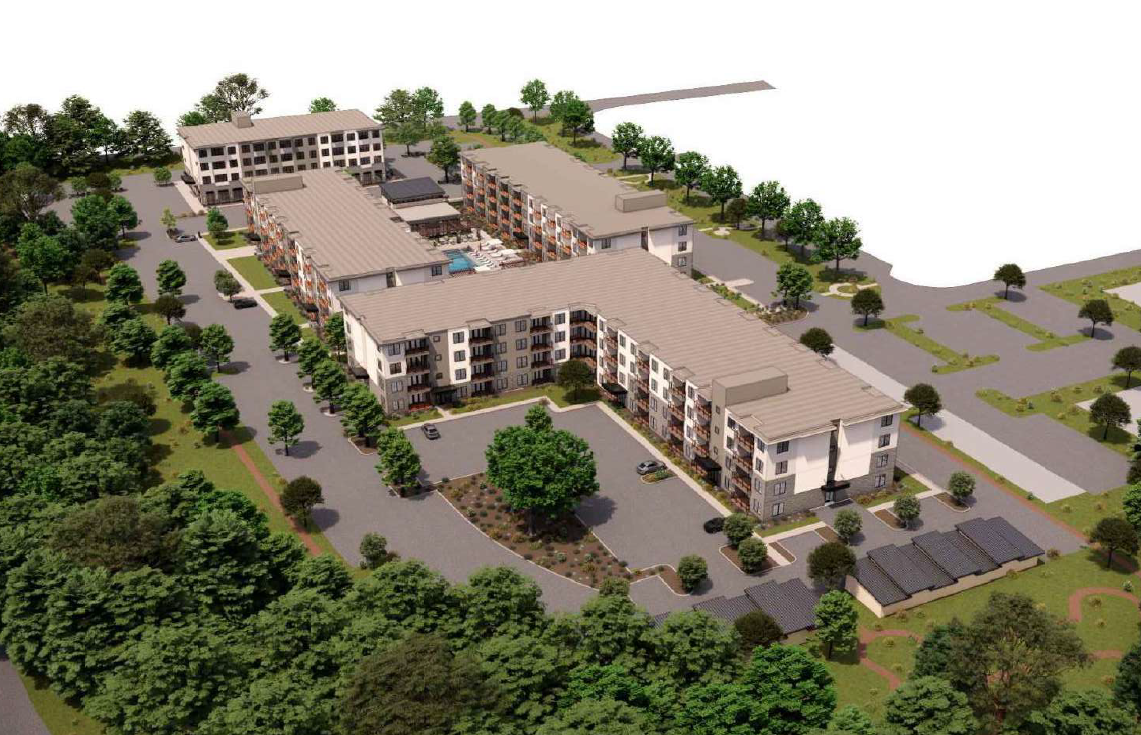
An overhead rendering of the 250-unit apartment project that will replace an old office building at 52 Swedesford Rd.
East Whiteland’s government looked more kindly on Tripoint Properties’ proposal to demolish a standalone office building at 52 Swedesford Rd. — outside the corporate center — and replace it with 250 apartments.
The vacant office building is surrounded by four-lane roadways, which eased congestion concern. Developers also proposed mostly small apartments, with 30 rented for below market rate, which helped earn support from the township.
“On the school side, they were OK with limiting the units to either one- or two-bedroom apartments,” Lambert said. “We would like to be in a position to limit the number of three-bedroom apartments in the township because of the impact it has on schools.”
But some real estate experts say eventually, municipalities will need to replace the tax revenue lost from dead office buildings.
“The centerpiece of tax bases in commercial areas has been office space,” Kahn said. “If the tax base goes down, and they can’t pay for the schools, who gets the burden? A couple years of 30% property tax increases on your constituents, you’re going to get voted out of office real quick.”
A former Morton Borough police officer is dead after Lower Merion police shot and killed him when he exchanged gunfire with officers in Bala Cynwyd Wednesday morning, authorities said.
Francis Connell Collier, 38, who previously served as a part-time officer in the Delaware County borough, was wanted on charges of rape and other sex crimes involving children at the time of the shooting.
Authorities said Lower Merion police spotted Collier’s vehicle on Old Lancaster Road in the Bala Cynwyd section of the township around 3:48 a.m. When they saw him return to his car, police said, officers confronted him, and he shot at the officers, who returned fire, fatally wounding him.
The officers had not been serving a warrant for Collier’s arrest at the time of the shooting, but the department was aware of the charges against him, said Lower Merion Police Capt. John Tucci.
Charges in the rape case had been filed Tuesday in Upper Darby, according to a spokesperson for the Attorney General’s Office, which brought the case against him.
In addition to serving in Morton, Collier was previously a member of the Delaware County District Attorney’s Office’s Child Abuse and Exploitation Task Force, a spokesperson for District Attorney Tanner Rouse said.
Collier’s appointment in 2022 was not made during Rouse’s tenure, and he was removed from the task force the following year during a leadership change within the unit, the spokesperson said.
When the sex abuse allegations against Collier were reported to authorities late last year, Rouse’s officeinitially investigated, but later referred the case to state prosecutors because of a conflict of interest.
In a statement on Collier’s shooting death Wednesday, the Delaware County DA’s Office said he ”reportedly engaged in actions that led to what has been described as ‘suicide by cop.’”
Police have not released the names of the officers involved in the shooting, which is under investigation by the Montgomery County District Attorney’s Office. It was unclear whether the officers had been placed on leave, as is customary, as the inquiry continues.
Morton Borough police learned of the criminal investigation in December, department officials said, and Collier was placed on unpaid administrative leave.
He resigned from the department on Dec. 19, they said.
The criminal case against Collier began late last year, authorities said, when Delaware County investigators learned that he may have sexually abused children.
Two women told investigators Collier had touched them inappropriately in the early 2000s, when they were five and six years old and Collier was a teenager, according to the affidavit of probable cause for his arrest. The women said the abuse began in 2001 and 2003, the affidavit said.
Collier was 15 when he assaulted the first victim the document said.
The second woman said Collier had assaulted her as well, framing the abuse as a “game” that involved sex toys and sex acts. She said she told her mother at the time that Collier was touching her inappropriately but when confronted, she said, he denied the abuse.
Years later, the women said, they learned that Collier worked with Delaware County’s child abuse task force, which investigates sex crimes against children. They said they grew worried when they saw social media posts showing Collier posing with children, the document said.
When investigators interviewed Collier about the allegations in early December, the affidavit said, he failed a polygraph test, but told detectives he “never intentionally touched the girls inappropriately.”
Investigators referred the case to the Pennsylvania Attorney General’s Office that month because of a possible conflict or interest, the affidavit said. State investigators later interviewed people who said the women had told them of the abuse years ago when they were children, and prosecutors filed the criminal charges against Collier on Tuesday, just hours before his death.
Lower Merion police said the shooting took place in the area of Old Lancaster Road and City Avenue, a block from St. Joe’s University and not far from Edgehill Court, the apartment complex where Collier lived.
A neighbor, Liam Riley, said he heard at least seven shots ring out when police confronted Collier.
“I saw a officer run up, grab something out of his trunk, and then run back up to [Collier’s] car,” Riley, a St. Joe’s University senior, said. “Then I heard them yelling to the guy, ‘Put your hands out of the window, put your hands out of the window.”
Juliette Palasol, a student at Drexel University who lives a block away with her family, said they didn’t hear the early morning gunfire, but her father left for work at 5 a.m. to find that many of the neighborhood roads closed.
“I couldn’t believe it — my brother, my cousins — none of us heard it,” Palasol said, outside the Edgehill Court. “I was just surprised to see police bring out firetrucks, drones, and robotic dogs to the scene.”
Around noon on Wednesday, police officers, assisted by Union Fire Association, raised a ladder to Collier’s third-story apartment, where officers broke through the window and piloted a drone inside to conduct an initial search of his residence. Officers also used a robotic dog to search the apartment “out of an abundance of caution,” police said.
She didn’t even like diamonds. That was the funny thing. Costume jewelry, yes. A pair of handmade earrings, certainly. Diamonds, well, she’d always found them a bit showy.
She liked this one, though, because it had been Jim’s.
It was a man’s ring, a 1.3-carat diamond, round cut, set on a simple gold band, and when her husband, Jim, passed away a few years ago, Cindy Ware made it hers.
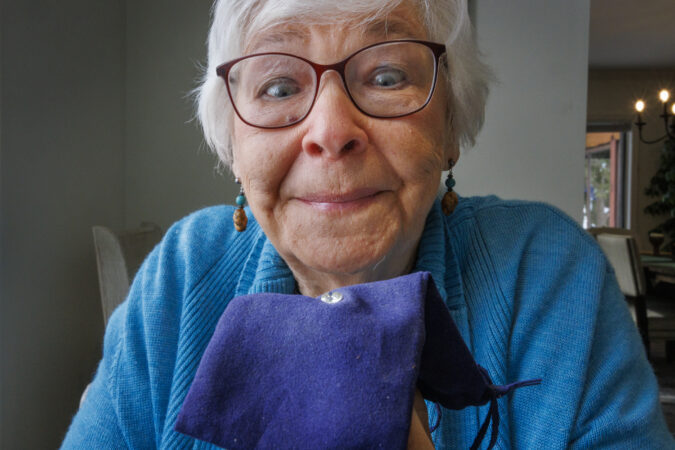
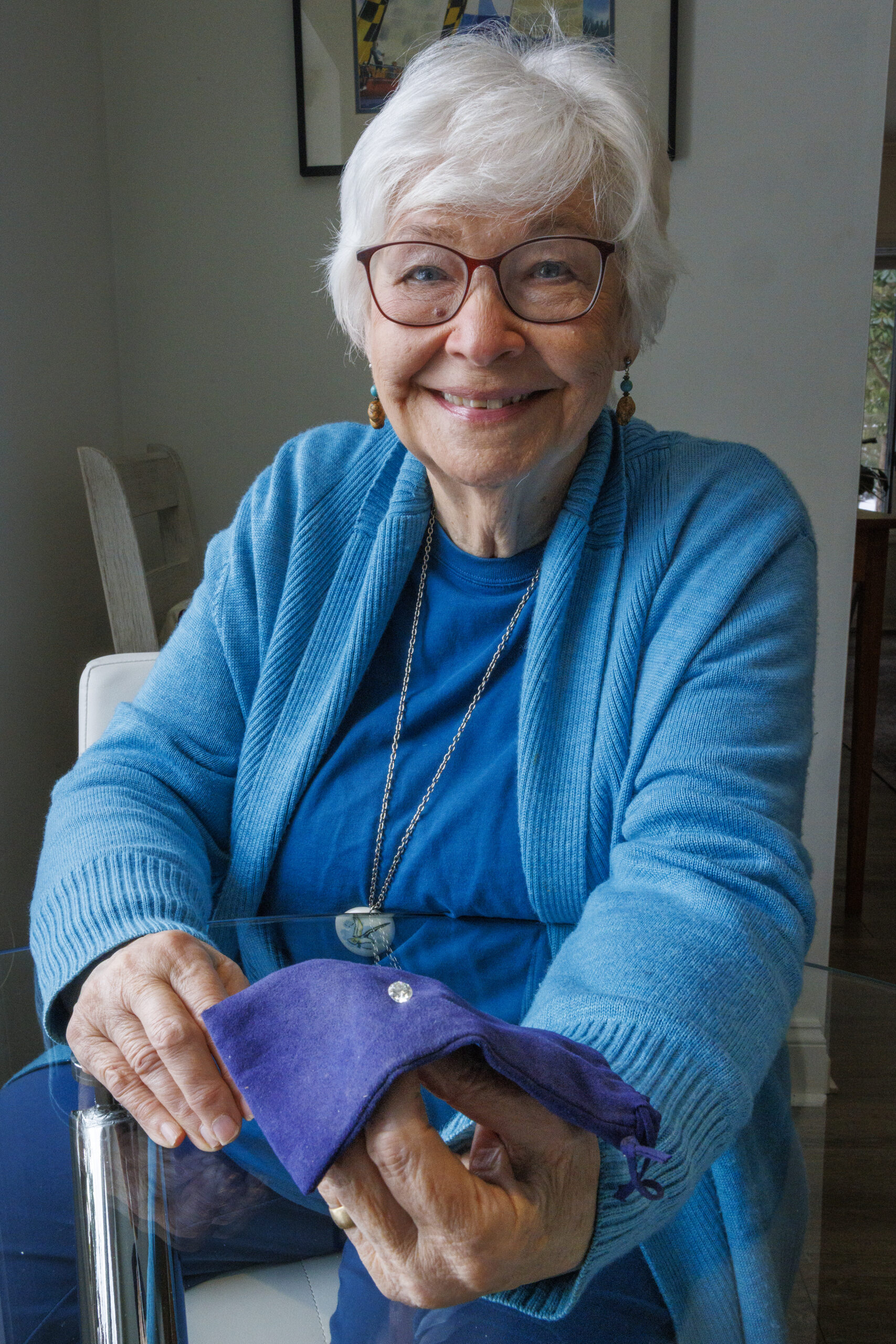
Cindy Ware of Kennett Square with diamond inherited by her late husband, Jim. She lost it but it was discovered embedded in a neighbors shoe in Florida. Photograph taken at her home on Wednesday, Feb. 25, 2026.
She wore it everywhere — to the grocery store, to lunch with friends, to her morning water aerobics class. It brought her comfort. A few times a day, she would look down at it, think of Jim, and smile.
“I never took it off,” says Cindy, who is 82 and impossibly sweet and sometimes wears a sweatshirt that says I’m often mistaken for an adult because of my age.
So when the diamond went missing last December, shortly before Christmas, Cindy was devastated. She felt sick, like she’d let Jim down.
She thought to herself: “Cindy, you just lose everything that’s important.”
A 60-year love story
Cindy Ware met the man she would marry in Pinkie Patterson’s second-grade class. This was in Mount Holly, N.C., in 1951. On Valentine’s Day of that year, while out sick with the mumps, Cindy had been allowed to come to the school parking lot to collect her Valentines.
The teacher sent a little boy out to deliver a box of treats.
He had a buzzcut and a little cowlick and his name was Jim.
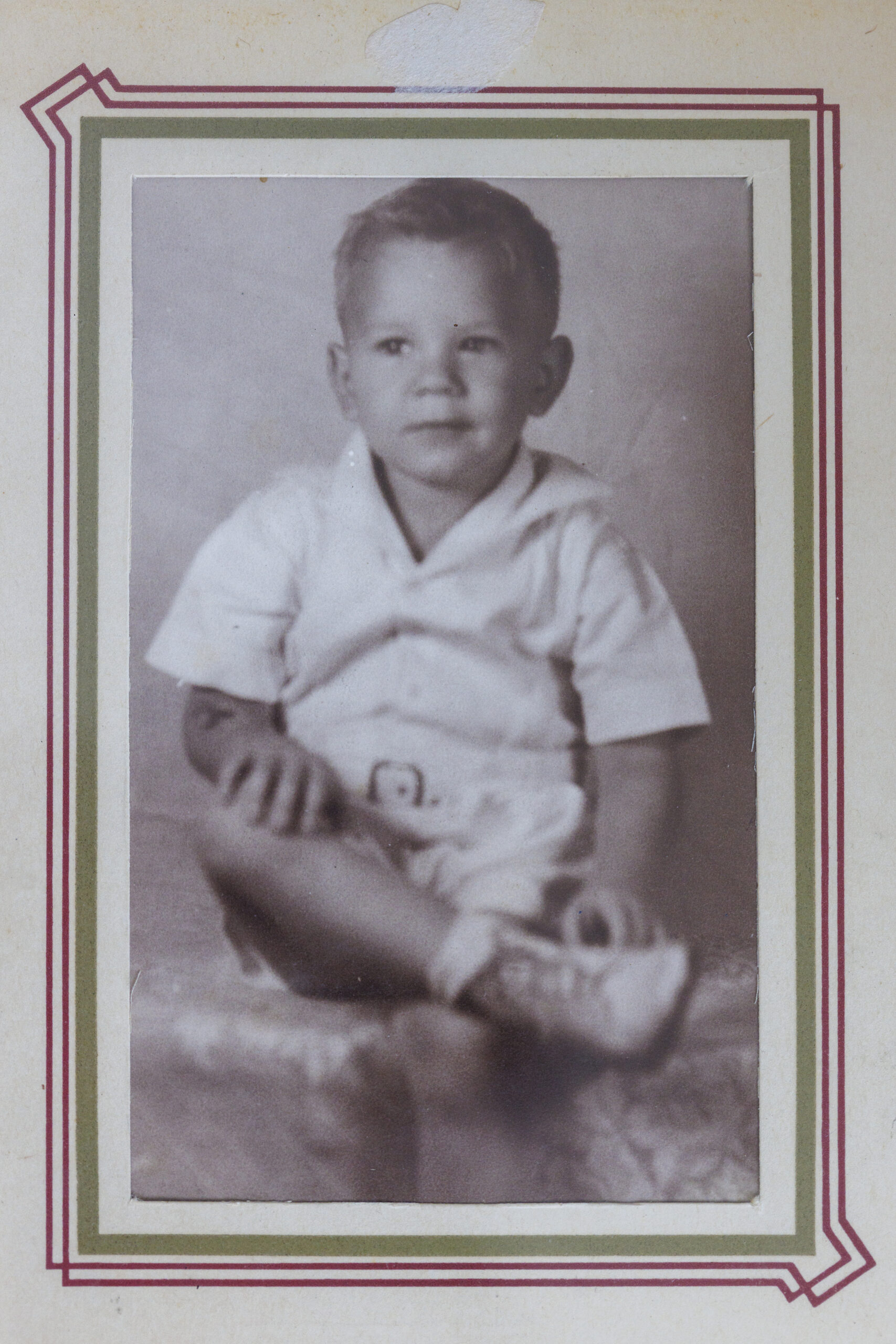
Childhood photograph of Jim Ware the late husband, Cindy Ware of Kennett Square. She lost the diamond he inherited but it was discovered embedded in a neighbors shoe in Florida. Photograph taken at her home on Wednesday, Feb. 25, 2026.
Well, Cindy’s mother thought Jim was about the most precious little boy she had ever seen. And Cindy — who until that point hadn’t given it much thought — soon decided that maybe she agreed.
By high school, they were an item — inseparable, Cindy explains, “except when we were mad at each other and dated other people.”
They got together for good during college, and theirs was a 60-year love story.
They married in 1965. They moved to New Jersey, then to Pennsylvania. They raised three boys. Their boys grew up and had children of their own. A few years ago, they settled into a retirement community in Kennett Square, where they liked to take morning walks and eat pizza with mushrooms and pepperoni.
“We never needed a lot of anything else,” Cindy says. “Just the two of us.”
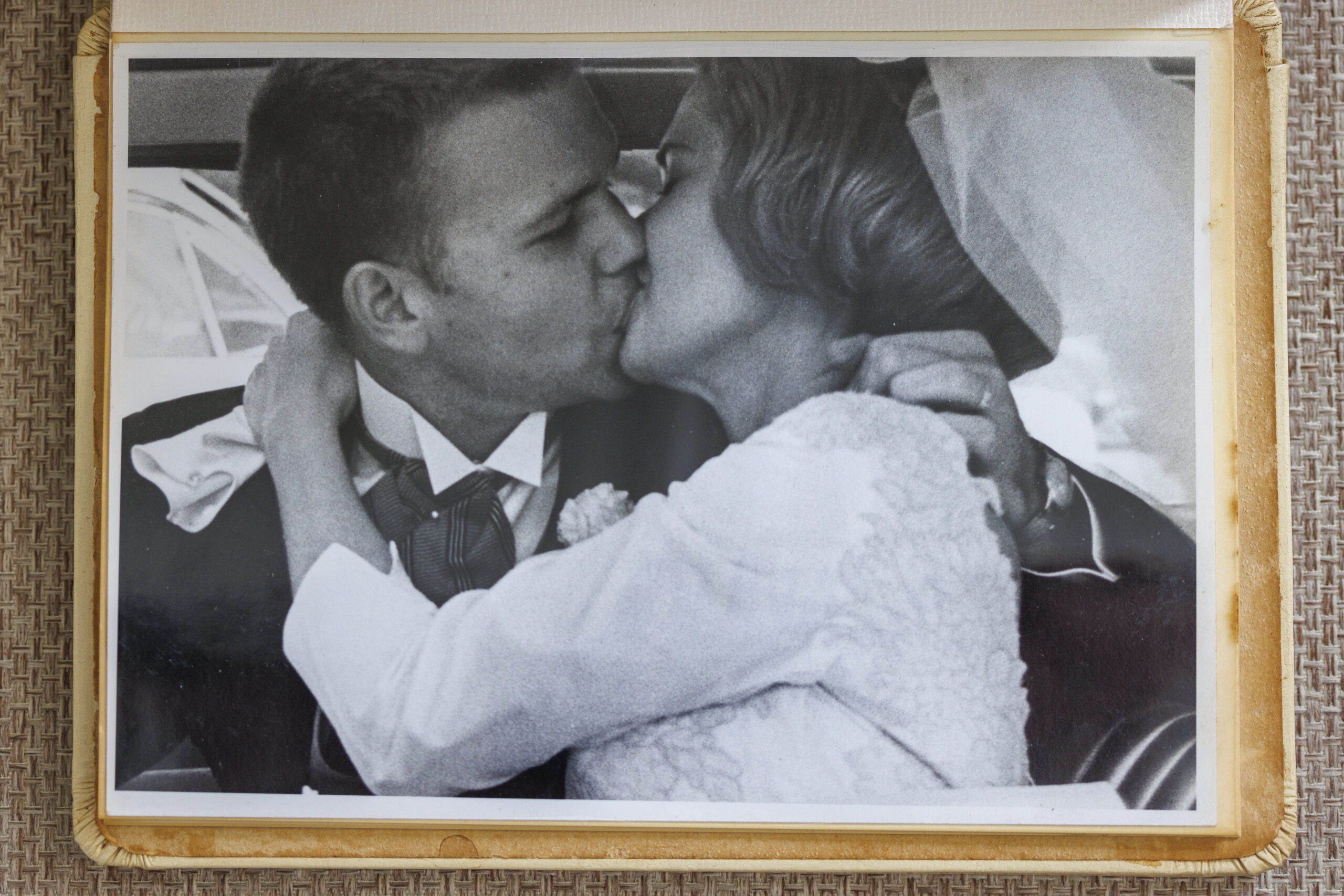
Wedding photograph of Jim (late) and Cindy Ware of Kennett Square. She lost a diamond he inherited but it was discovered embedded in a neighbors shoe in Florida. Photograph taken at her home on Wednesday, Feb. 25, 2026.
When Jim got sick, in 2020, it was horrible.Months of doctor’s visits, then specialist visits. Then, finally, hospice.
“The worst year of my life,” Cindy says.
Not long after Jim passed, in 2023, Cindy was getting the family’s affairs in order. One day, at a local bank, she opened an old lockbox and discovered a diamond ring — an heirloom that had been passed down through generations of Jim’s family.
Back when she and Jim married, and they didn’t have much money, he had told her she could have her pick: a ring or a car. “That’s a no-brainer,” she had replied. “I want a car.”
Still, something about the diamond spoke to her.
She plucked it from the lockbox and slid it onto her middle finger, and that’s where it remained for the next three years.
The missing diamond
She was having lunch with a friend last December when she glanced down and realized it was gone.
The diamond had dislodged from the setting, and it was nowhere to be found.
“I was just bereft,” Cindy says.
It could have been anywhere. In her car. In the grass outside her home.
At one point, she wondered whether she had lost it during her water aerobics class at the retirement community’s swimming pool. Things could get a little intense with the arm exercises. Maybe it had jostled loose and sunk to the bottom.
But what could be done? Even if they drained the pool, the likelihood of them ever finding the diamond was minuscule.
Her sons urged her not to worry, assured her that it was OK. There was always the chance that it might still turn up.
But weeks passed, then months.
Eventually, she resigned herself to the fact that the diamond was never coming back.
‘That might be a diamond’
One afternoon a couple weeks ago — on a pool deck 1,100 miles from Kennett Square — a man named Coleman looked down and noticed, lodged in the tread of his Lands End pool shoe, what appeared to be a small piece of glass.
Or wait. Maybe it was some kind of gem.
At a pool in South Florida earlier this month, a Pennsylvania man looked down at his pool shoe and discovered what at first appeared to be a gem or piece of glass stuck in the tread.
For days he had been wearing the pool shoes — to the pool, through locker rooms. He had stuffed them into his gym bag, into a suitcase. Earlier that day, he had worn them on a walk in the gritty sand of a South Florida beach.
He also wore them back home in Kennett Square, where he lived in a retirement community. In the afternoons — after the ladies finished their morning water aerobics — Coleman’s group played pool volleyball. He always wore his pool shoes during games.
Now, sitting poolside in Florida, Coleman’s husband, John, examined the stone and said, “Uh, that might be a diamond.”
Intrigued, but not yet convinced, the couple went the following day to a Pompano Beach jeweler.
Nine times out of 10, the jeweler told them, when people think they’ve found a diamond, it turns out to be nothing.
This was not one of those times.
Yes, the jeweler said, it was a diamond, all right — 1.3 carats, nicely colored, likely from the 1950s or ’60s. Probably worth a bit of money.
Tickled, Coleman posted a photo of the diamond to Facebook.
A diamond in the sole of his shoe
Back in Pennsylvania, Cindy was on the phone with her good friend.
It was Valentine’s Day, and the two were chatting about this and that, and at the end of their conversation, in passing, her friend mentioned a man from their neighborhood, Coleman, who had just posted a photo from Florida.
Apparently, he had found a diamond lodged in his shoe.
As it happened, Cindy and Coleman knew each other well. They lived just a couple streets apart, worked out in the same pool. Once, when Jim was in hospice, Coleman and his husband had brought her flowers.
Cindy tracked down the photo. Saw the small gem lodged in her neighbor’s pool shoe.
Impossible, she thought.
She dialed Coleman’s number.
“Hello,” she said, “I think you have my diamond.”
The return
It was confirmed a day later.
Back from Florida, Coleman delivered the diamond to Cindy’s house, along with a collection of yellow roses. Neither of them could stop smiling.
Best they can tell, the diamond fell to the bottom of the community pool, where Coleman — while playing pool volleyball — happened to step on it, just right. How it had remained lodged in his shoe’s tread for days or weeks or months — across multiple states — was anyone’s guess.
“It could never happen in a million thousand years,” Cindy says.
Says Coleman, “It does make you sit back and think for a minute about what is going on here.”
As you might imagine, their story has been the talk of their retirement community. Everyone, it seems, wants to talk about the little diamond that traveled halfway across the country in a shoe.
As for the diamond itself, Cindy has decided that it‘s time to pass it on, to her oldest son.
“I can no longer be trusted,” she jokes.
In the meantime, she has stopped wearing it to water aerobics.