Tag: Jamie Gauthier

  • City Council took a rare stand against Mayor Parker by allotting more housing funds to the poorest Philadelphians

    City Council took a rare stand against Mayor Parker by allotting more housing funds to the poorest Philadelphians

    Philadelphia City Council on Tuesday amended the initial budget for Mayor Cherelle L. Parker’s signature housing initiative to direct more money to programs that will help the lowest-income Philadelphians, a move that sparked one of the most notable confrontations between Parker and city lawmakers since she took office almost two years ago.

    The amendment, which followed a weekslong standoff between the executive and legislative branches, represents a rare act of defiance for a Council that has otherwise been largely compliant with Parker’s agenda, and it appeared at first to be a major win for Philly progressives.

    But Parker is not giving up the fight, and she said Tuesday night that the amendment may have had unintended consequences that could hold up much of the housing initiative for months.

    The changes to the legislation, she said, may trigger additional procedural steps that will prevent the city from issuing $400 million in bonds to fund the initiative until March or later. The mayor did not hold back from laying the blame for the delays at Council’s feet.

    “The resolution that City Council passed out of the Committee of the Whole today contained language that our bond lawyers have repeatedly advised would prevent the administration from being able to issue the bonds,” Parker said in a statement. “That means homes are not being restored. It means homes are not being built or repaired.”

    In an unusually blunt statement late Tuesday night, Council President Kenyatta Johnson pushed back against the administration’s analysis of the situation.

    “Council’s responsibility is not to rubber-stamp legislation, but to ensure that any multi-billion-dollar public investment is legally sound and targeted to the Philadelphians who need it most,” Johnson said.

    But he also vowed to have Council quickly introduce new legislation that could ameliorate the procedural problem Parker identified, tacitly conceding that additional legislation was needed hours after lawmakers approved the resolution with no mention of that possibility.

    Johnson said Council would “resolve remaining legal and policy issues swiftly,” and that a new measure to legalize lawmakers’ most recent changes could be introduced this week.

    Council wants “shovels in the ground” and “homes repaired,” he said, but ”refuses to rush into issuing $800 million in debt without iron-clad legal protections and clear guarantees.”

    “Council members repeatedly raised concerns — directly and in good faith — about accountability, neighborhood equity, homeowner protections, and the long-term impact of the H.O.M.E legislation,” he said. “Council’s action today strengthened the H.O.M.E resolution, not sabotaged it.”

    The late-night war of words between Parker and Johnson came hours after a celebratory Council committee meeting in which lawmakers took a victory lap for standing up to the administration.

    After the vote, Councilmember Jamie Gauthier and Councilmember Rue Landau, respectively the chair and vice chair of the Committee on Housing, Neighborhood Development and the Homeless, said the amended resolution means “working and low-income families will finally be able to get the support they need sooner.”

    “With roughly $30 million in federal homelessness funding at risk, it is more important than ever that this multiyear, $800 million investment begins by prioritizing the more than 200,000 Philadelphia households on the brink of losing their homes,” Gauthier and Landau said in a joint statement, referring to a federal policy change proposed by President Donald Trump’s administration that could cost the city millions in funding for anti-homelessness programs.

    Council pushes for policy changes

    Parker, who has long championed the city’s “middle neighborhoods,” structured her sweeping Housing Opportunities Made Easy, or H.O.M.E, initiative to ensure that the myriad programs funded or created by the program would be available to homeowners and renters at a variety of income levels.

    But Johnson — in an unexpected break from his usual alignment with Parker — stood with Gauthier and other progressives who fought to ensure the neediest city residents were prioritized in the budget resolution, which sets the first-year spending allocations for H.O.M.E. The distribution of funding must be approved by Council before the administration can issue the first of two planned $400 million tranches of city bonds that will finance much of the initiative.

    Council’s Committee of the Whole, which includes all members, approved the amendment and advanced the resolution in a pair of unanimous voice votes Tuesday afternoon following hours of testimony.

    The measure would now head to the Council floor for a final passage vote in the next two weeks. Parker’s statement, however, could mean Council has additional work to do before getting the measure over the finish line. Johnson’s office said the vote is still scheduled for Dec. 11.

    “The majority of the members of City Council want to focus on the issues of those who are poor here in the city of Philadelphia when it comes to housing and equality,” Johnson told reporters after the vote.

    It’s unclear whether the vote represents a serious rupture in the tight relationship between Parker and Johnson, who have worked closely together since both took office in January 2024. Council approved the most important pieces of legislation Parker proposed as part of the H.O.M.E initiative earlier this year, and the changes adopted Tuesday do not alter the fundamentals of the program, which Parker hopes will achieve her goal of creating or preserving 30,000 units of housing in her first four-year term.

    “We support the H.O.M.E. plan,” Johnson said. “And I think the mayor did a good job in investing close to $1 billion … in supporting the issue of housing inequality here in the city of Philadelphia. This amendment represents the will of the members. … We want to specifically focus on those who are the most least well-off, those who are poor.”

    But after reading about Parker’s statement in the evening, Johnson’s attitude toward the administration sharpened. His lengthy statement included the most critical language the Council president has directed at the mayor since they were inaugurated.
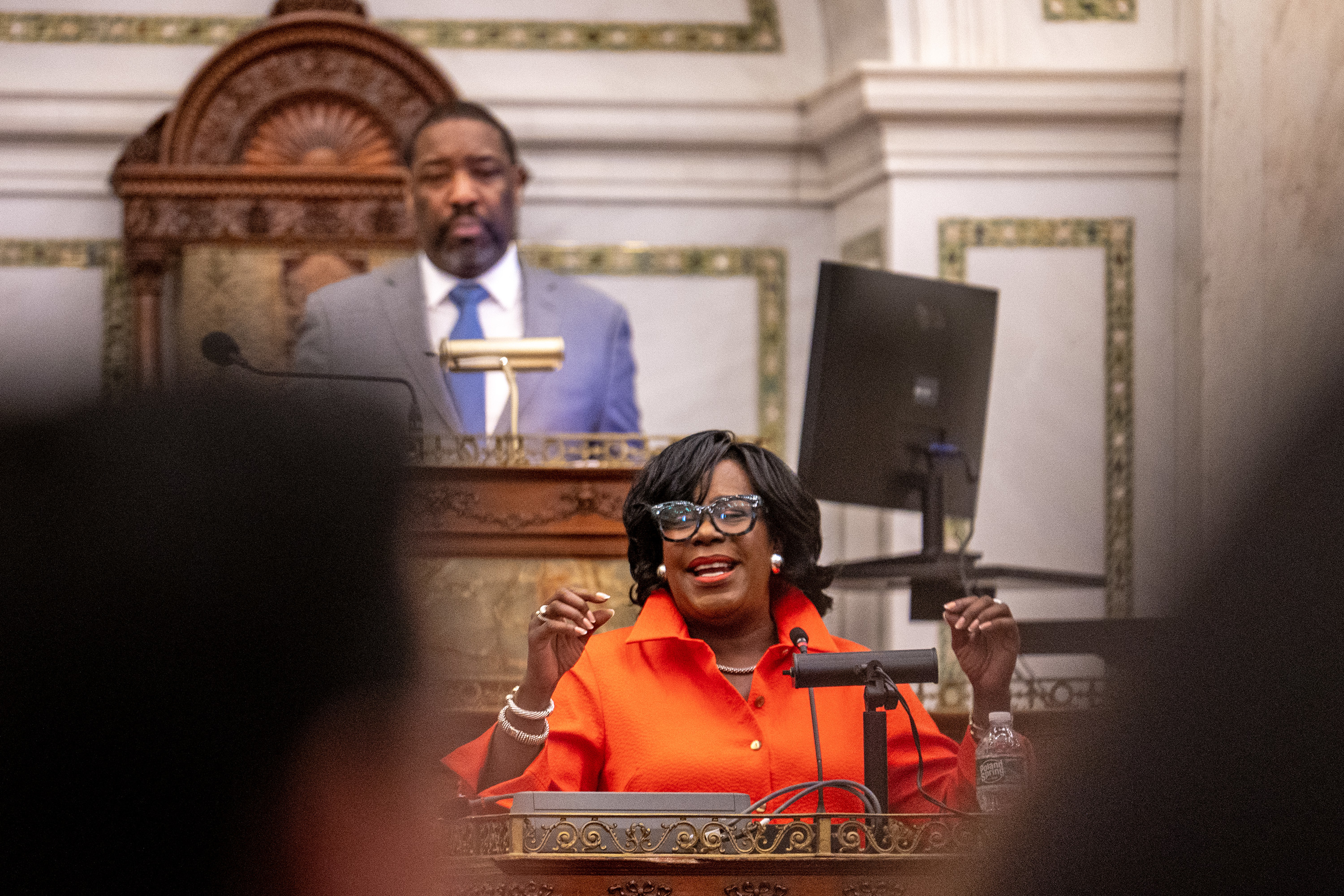
    Mayor Cherelle L. Parker unveils her long-awaited plan to build or preserve 30,000 units of housing during a special session of City Council Monday, Mar. 24, 2025. Council President Kenyatta Johnson is behind her.

    Johnson rejected Parker’s claim that the legislative delays could cause the popular Basic Systems Repair Program to temporarily run out of funding, saying that there is plenty of money in the current city budget to cover shortfalls.

    “Threatening residents with a shutdown of the Basic Systems Repair Program and assigning blame does not move this process forward,” he said. “Collaboration and working together does.”

    The amendment increases the first-year budget for spending the bond proceeds from $194.6 million to $277.2 million. The increased price tag, however, does not represent new money in the housing budget; it merely allows the administration to spend more of the $400 million in bond proceeds in the initiative’s first year.

    The changes include increases in funding for housing preservation from $29.6 million to $46.2 million, and housing production from $24.3 million to $29.5 million. Additionally, the amendment boosted funding for homelessness prevention programs from $3.8 million to $8.8 million.

    But perhaps more importantly, Council altered the income eligibility levels for several programs.

    Parker, for instance, had proposed that the H.O.M.E. funding for the Basic Systems Repair Program, which subsidizes critical home improvements to prevent residents from being displaced by the costs of needed repairs, be open to any homeowner who makes Philadelphia’s area median income, or AMI, which is about $119,400 for a family of four.

    Council’s amendment, however, requires 90% of the new funding to go to families making 60% of AMI or less, about $71,640 for a family of four.

    The administration initially planned to issue the first $400 million in bonds this fall, and Parker sent Johnson’s office a first draft of the budget resolution in July. Council then delayed the committee vote on the resolution several times as Johnson negotiated with Parker on potential changes.

    The amendment adopted Tuesday appears to largely mirror Gauthier’s priorities for the spending plan, rather than a negotiated compromise, the first sign that Johnson had moved forward despite not reaching a deal with Parker.

    Bond sales potentially delayed again

    Parker’s plan to sell the initial round of bonds this fall appeared to be on schedule when Council in June approved the most important pieces of legislation associated with the H.O.M.E. initiative, including an $800 million bond authorization.

    But lawmakers at that time inserted a provision into the bond legislation that required the administration to get Council approval of its H.O.M.E. budget each year before it can spend the bond proceeds. For the initiative’s first year, that provision means the city cannot take the bonds to market at all without Council signing off on the budget resolution, city Finance Director Rob Dubow has said.

    The latest potential delay, which could set Parker’s schedule back months more, stems from the amendment approved in committee Tuesday.

    Parker did not elaborate on the procedural issue that could cause the latest delay, but her comments indicated what it may be: Because the resolution, which dictates how the bond proceeds can be spent, now includes significant differences from the bond authorization bill Council approved months ago, the city may not be able to rely on the original bill as its legal basis for taking out debt and selling the bonds.

    To make them align, Council may have to approve a new bond authorization bill, or abandon some of its changes to the spending resolution.

    In his statement Tuesday night, Johnson indicated Council has chosen the former route.

    “City Council is preparing to introduce an amendment to the H.O.M.E bond ordinance as early as this week’s Council session,” he said.

    It’s unclear if the resolution could pass by the end of the year. But Johnson’s reference to the potential of the current city budget’s surplus covering shortfalls in housing programs indicates that might not be possible.

    Council’s last meeting is scheduled for Dec. 11. Lawmakers can vote to suspend Council rules and fast-track legislation as needed.

    This story was updated to include Council President Kenyatta Johnson’s response to Mayor Cherelle L. Parker’s statement.
  • People who are self-employed could become exempt from paying a Philly business tax | City Council roundup

    People who are self-employed could become exempt from paying a Philly business tax | City Council roundup

    Philadelphia-based independent contractors and others who are self-employed could soon become exempt from paying certain business taxes as part of a measure aimed at easing tax burdens on small businesses.

    City Councilmember Mike Driscoll, a Democrat who represents parts of Northeast Philadelphia, introduced legislation Thursday to carve out entrepreneurs, sole proprietorships, and businesses that have only one employee from having to pay the city’s business income and receipts tax, commonly known as BIRT.

    Also on Thursday, members floated legislation to address the rising cost of water bills and introduced a bill to make it easier for restaurants to secure outdoor dining permits.

    What was the meeting’s highlight?

    Relief for the small(est) businesses: The bill is likely to find support in Council, where lawmakers have been searching for ways to provide relief to small businesses after earlier this year eliminating a popular tax break that allowed companies to exclude their first $100,000 in income from business taxes in Philadelphia.

    That exemption effectively meant that thousands of small businesses did not have to pay the tax. However, Mayor Cherelle L. Parker’s administration in June successfully moved to eliminate the exemption, saying the city was likely to lose a court battle over the matter.

    The change came after a medical device manufacturer sued the city, saying the exemption violated state law, which includes a “uniformity” clause that prohibits municipalities from creating different classes of taxpayers.

    Now, thousands of businesses newly have to pay the BIRT beginning with 2025 tax bills that are due in April. If Driscoll’s measure is adopted, it would begin in the 2026 tax year, meaning that eligible business owners would see the exemption when paying taxes due in April 2027.

    He said the legislation addresses concerns from small businesses that the impending tax bills will be financially unsustainable for them.

    “A $50,000 business should not face a $3,200 tax hike,” Driscoll said. “That is not policy. That is displacement.”

    Driscoll said that the city’s law department approved his legislation and that he is confident it does not violate the uniformity clause.

    What else happened this week?

    Making water more affordable: Council will consider a package of legislation to address rising water bills. Councilmember Jamie Gauthier of West Philadelphia introduced three measures:

    • A bill that expands eligibility for payment assistance programs to people who earn up to 300% of the federal poverty level. (This year, the FPL is $32,150 for a family of four.) There is currently a tiered assistance structure for people who earn up to 250%.
    • A bill requiring that the city reduce a resident’s water bill if it rose because of a water meter failure that lasted more than a year.
    • A resolution to hold hearings on whether lawmakers can expand assistance programs to renters. The Philadelphia Water Department does not allow bills to be in renters’ names.

    A spokesperson for Gauthier said the package of legislation has 10 cosponsors — a majority of Council — making it likely to pass.

    Parker opposes incineration ban: A Council committee on Monday advanced a bill to ban the city from incinerating trash, over the objections of Parker’s administration.

    Currently, the city sends about two-thirds of the trash it collects to landfills and one-third to a waste-to-energy incinerator in Chester operated by Reworld, formerly known as Covanta.

    Both of those contracts expire June 30, and Gauthier wants to prohibit the Parker administration from signing a new deal.

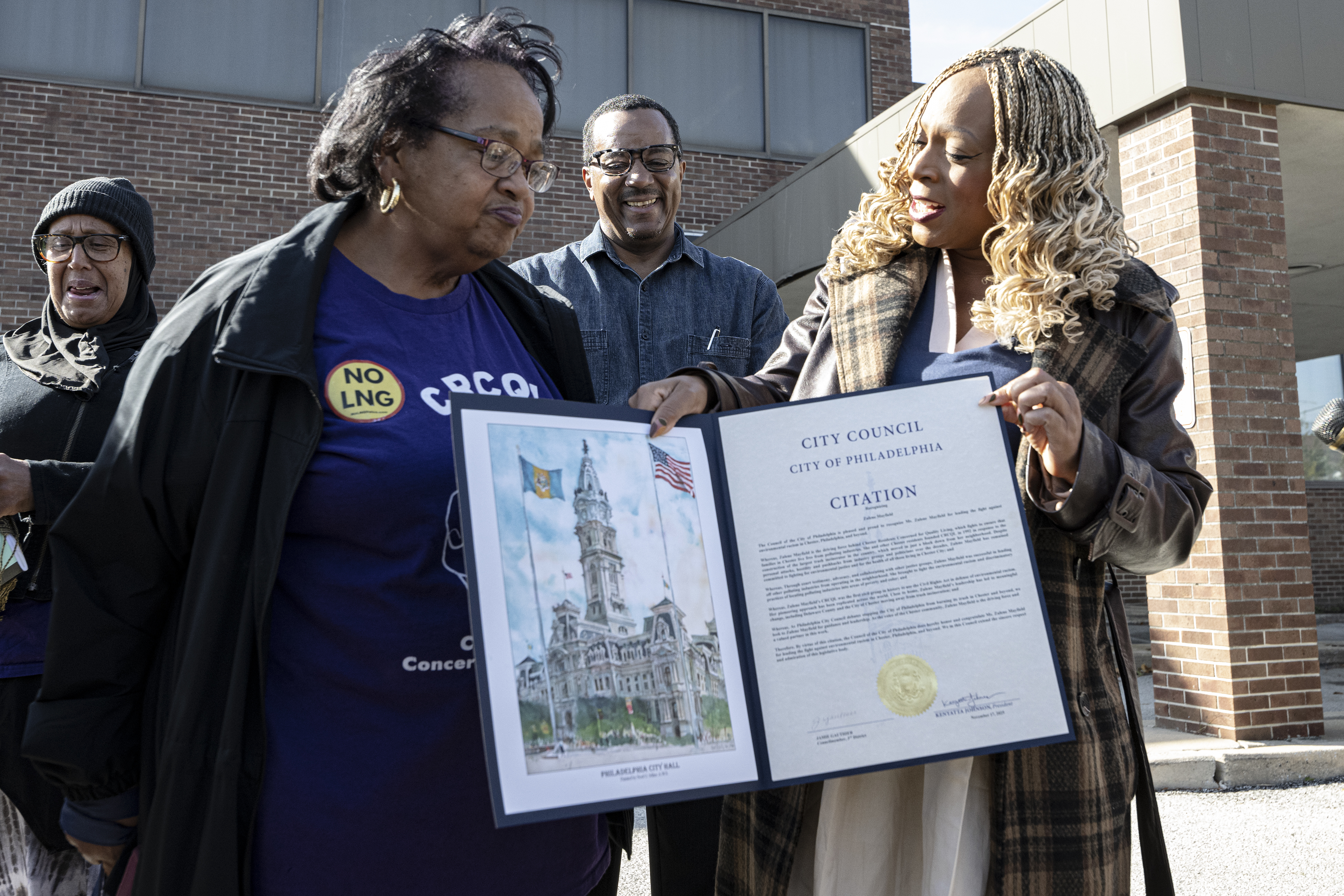
    Chester resident Zulene Mayfield, left, Philadelphia Councilmember Jamie Gauthier, right, and Chester Mayor Stefan Roots meet to discuss Gauthier’s “Stop Trashing Our Air Act,” which would ban the city from incinerating waste, during a visit with lawmakers and staff in Chester, Pa., on Friday, Nov. 7, 2025.

    On Monday, Chester officials pleaded with Philly to end its relationship with the facility, saying it contributes to high rates of illness.

    Reworld defended its record, saying it exceeds government regulations.

    Carlton Williams, who leads the Philadelphia Office of Clean and Green Initiatives, asked lawmakers to hold off approving a ban on incineration to allow the city time to study the issue.

    But the committee approved the measure, sending it to the full Council for a vote as early as Dec. 4.

    Dining out: Council is taking another crack at streamlining the city’s drawn-out permitting process for outdoor dining.

    The outdoor dining area at Booker’s Restaurant and Bar at 5021 Baltimore Ave. in 2021.

    Councilmember Rue Landau, who represents the city at-large, said it can take more than a year and a half for restaurants to get licensed if they are not in areas around Center City and a handful of commercial corridors in other neighbors.

    Beyond those locations, restaurants must get their district Council person to sponsor zoning legislation, which can take months.

    Landau introduced legislation Thursday to expand the “by-right” areas where sidewalk cafes can exist without special zoning. Where the areas are expanded to will be up to district Council members.

    Quote of the week

    Danny Garcia trains for an upcoming fight in August 2024.

    All in the family: Council members on Thursday honored boxer Danny Garcia, a North Philly native and an illustrious fighter who is retiring from the sport. He appeared in Council chambers to thank members and tell the city how much he loves it back.

    Staff writers Jake Blumgart and Beatrice Forman contributed to this article.

  • Funding for Mayor Cherelle Parker’s H.O.M.E. initiative will be delayed until next year

    Funding for Mayor Cherelle Parker’s H.O.M.E. initiative will be delayed until next year

    Mayor Cherelle L. Parker promised to build or preserve 30,000 homes in her first term. But much of her plan to reach that goal now won’t get underway until her four-year term is more than halfway over.

    City Council this week again delayed a key piece of legislation that needs to pass before the Parker administration can sell hundreds of millions of dollars in city bonds, the primary source of funds for the myriad housing programs being created or expanded through the mayor’s Housing Opportunities Made Easy initiative, or H.O.M.E.

    The delay comes as lawmakers negotiate to amend the legislation — a resolution setting the first-year budget for H.O.M.E. — to increase spending levels beyond the currently proposed $195 million and to lower income eligibility thresholds for some programs, prioritizing poorer residents.

    The most recent setback came this week, when Council President Kenyatta Johnson canceled a Monday hearing to advance the resolution and declined to reschedule it before Thursday’s regular Council meeting, when the administration said the proposal would need to receive final approval for the first $400 million round of bonds to be sold in 2025. (The city plans to sell a second and final $400 million tranche of bonds in 2027.)

    The administration sent Johnson’s office an initial draft of the resolution in July, but the Council president has repeatedly delayed advancing the measure throughout the fall.

    “It is critically important to get the first-year spending plan right because what is agreed upon in the first year will influence all future spending for the H.O.M.E. program,” Johnson said in a statement explaining the cancellation of Monday’s hearing. “It is also essential that the final legislation include spending priorities important to City Councilmembers.”

    Parker is known as a hard-line negotiator who rarely cedes ground, and Johnson’s delays might be meant to send the signal that if she doesn’t bend on Council’s demands, he won’t meet her timelines.

    The saga marks a rare moment of discord between Parker and Johnson, who have worked hand in glove on most issues since both took office in January 2024 — including the passage of the initial package of legislation related to H.O.M.E. last spring.

    At left is Council president Kenyatta Johnson speaking with Philadelphia Mayor Cherelle L. Parker before start of her press conference regarding her first budget in Philadelphia City Hall on Thursday, June 6, 2024.

    In a hearing last week, Johnson appeared to side with lawmakers, led by Housing Committee Chair Jamie Gauthier, who were pushing for the administration to lower income thresholds for some H.O.M.E. programs, saying the city should prioritize the neediest Philadelphians.

    Parker has proposed expanding income eligibility requirements in some cases so that the programs can also be accessible to middle-class residents, saying she does not want to pit “the have-nots vs. the have-a-littles.”

    ‘Pit one against the other’

    Even with the bonds delayed until next year, the mayor does not appear to have given up the fight to maintain her vision for the housing initiative. At an unrelated Council hearing on the school district on Tuesday, Parker brought up the H.O.M.E. initiative unprompted.

    She then called out four Council members who have middle-class constituencies that are likely to benefit from increased income thresholds for housing programs: Curtis Jones Jr., whose district includes Roxborough and Overbook; Anthony Phillips, who represents East Mount Airy and West Oak Lane; Mike Driscoll, of the Lower Northeast; and Katherine Gilmore Richardson, who represents the city at large but is a Democratic ward leader for Wynnefield.

    “I am unapologetic about making sure that constituents represented by you … should not be left out of any investment that we make in the city of Philadelphia,” Parker said. “Every community can be lifted up with the work that we are doing, so I won’t let us pit one against the other.”

    The remarks, however, effectively pitted members with poorer constituencies against those with middle-class bases. Johnson represents Southwest Philadelphia and the western half of South Philly; Gauthier’s district covers much of West Philadelphia.

    Despite the dustup, it remains unlikely that a lasting fissure has emerged in Parker and Johnson’s relationship, given that they still share many policy priorities and can benefit each other politically.

    “Council President Kenyatta Johnson and I have an amazing working relationship,” Parker, a former Council member, said in an interview Monday. “Council has a right to do its due diligence. If I hadn’t been there, if I wasn’t a former staffer in there, maybe it would be foreign [to me]. No. We’re going through the process, and I have to trust the process.”

    Additionally, Johnson standing up for Council members’ concerns over the H.O.M.E. budget may help shield him from questions about whether he is overly compliant with the mayor’s agenda.

    “Both branches of government remain committed to ensuring the H.O.M.E. program is implemented transparently, equitably, and in a way that maximizes benefits to Philadelphia residents,” Johnson said in his statement. “Taking extra time to finalize these critical elements will result in a stronger, more effective program.”

    Tracking progress

    The administration is not waiting for the H.O.M.E. bonds to be sold to start notching wins for Parker’s 30,000 housing units goal. The city’s Philly Stat 360 website has already begun tallying units built and preserved during her tenure.

    To be sure, some of the mayor’s strategies for the H.O.M.E. initiative do not require bond money. For instance, Parker has led a shake-up of the Land Bank, which she hopes will accelerate the redevelopment of unoccupied city-owned parcels into housing, and she won Council approval last spring for zoning changes meant to streamline building.

    But the potential infusion of $800 million is undoubtedly the centerpiece of the initiative. The money will help launch programs like Parker’s One Philly Mortgage, which aims to provide 30-year fixed-rate loans to qualified homebuyers, and will buttress existing ones like the Basic Systems Repair Program, which has been credited with preventing the displacement of low-income residents who end up moving if they cannot afford needed home repairs.

    “It’s never been done in the history of our city, and we do that together in partnership with each other, and that’s what we’re working to do right now,” Parker said.

    Staff writers Jake Blumgart, Kristen A. Graham, and Anna Orso contributed to this article.

  • West Philly affordable housing project could finally advance, almost 6 years after it was proposed

    West Philly affordable housing project could finally advance, almost 6 years after it was proposed

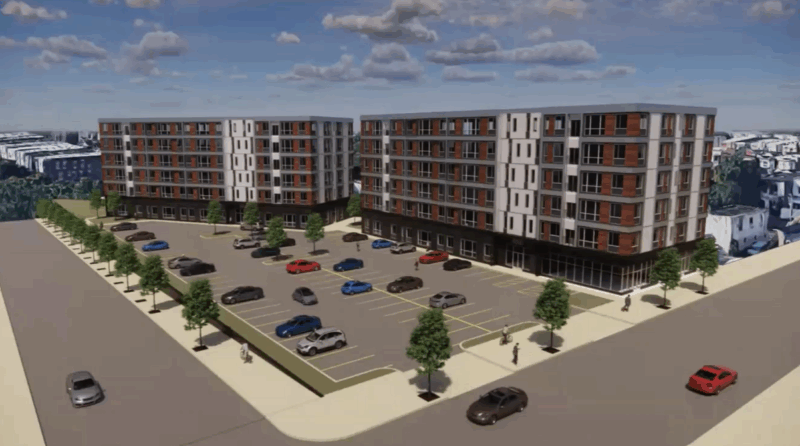
    An affordable housing project slated for a junkyard in Cedar Park took a step forward Wednesday, when a Philadelphia judge rejected a neighbor’s challenge. The courtroom victory brings the 104-unit, two-building project, which was conceived in 2020, closer to reality.

    Common Pleas Court Judge Idee Fox ruled that the new zoning of a triangular group of parcels on Warrington Avenue, which allows for buildings up to seven stories, was legal.

    Melissa Johanningsmeier, who lives next to the planned development, sued the city to stop the project in 2023, arguing that the building was inconsistent with the city’s goal of preserving single-family homes in Cedar Park.

    Johanningsmeier said in court filings she would be harmed by the parking, traffic, and loss of green space if the project were to proceed.

    The homeowner told Fox during a two-day October bench trial that there was widespread discontent with the project in the neighborhood.

    The judge seemed skeptical, as Johanningsmeier’s attorney didn’t provide witnesses or evidence to support claims of widespread backlash to the project that has been promoted by City Councilmember Jamie Gauthier.

    It was not for her to decide whether the project was the best idea, Fox said, but whether the zoning was constitutional.

    “If the community is unhappy with what’s being done, they have the right to express their concerns to the councilwoman at the ballot box,” Fox said.

    Junkyard controversy

    The project dates to 2020, when New York affordable housing developer Omni formulated plans to add 174 reasonably priced apartments to the West Philadelphia neighborhood.

    But the developer’s plans for the junkyard at 50th and Warrington met opposition due to the proposed buildings’ height — six stories — and parking spaces for less than a third of the units.

    Omni’s plan required permission from the Zoning Board of Adjustment to move forward, which was more likely to succeed with neighborhood support. So they compromised.

    A new design unveiled in 2021 pushed the buildings back to the edge of the site, to avoid putting neighboring homes in shadow. A surface parking lot would offer 100 spaces for the 104 affordable apartments.

    These concessions appeased almost all of the critical neighbors and community groups. Many of them supported Omni before the Zoning Board of Adjustment, which granted the project permission to move forward.

    But Johanningsmeier remained a critic. She lives on the border of the property and challenged the zoning board’s ruling in Common Pleas Court. Judge Anne Marie Coyle ruled in her favor, arguing the new building “would unequivocally tower over the surrounding family homes.”

    In the aftermath, Gauthier passed a bill to allow the project to move forward without permission from the zoning board. Johanningsmeier then sued over that legislation as well.

    Councilmember Jamie Gauthier in City Council in 2024.

    Affordable housing and fruit analogies

    The issue at the heart of the case was whether a zoning change to allow for large multifamily buildings was considered spot zoning on the small parcel, which Johanningsmeier’s lawyer argued was inconsistent with the types on buildings on surrounding properties.

    Just because the “mega apartment buildings” are for residential use doesn’t make the project similar to the surrounding zoning, which mostly allows single-family homes and duplexes, Edward Hayes, a Fox Rothschild attorney representing Johanningsmeier, told Judge Fox on Wednesday.

    “A cranberry and a watermelon are fruit,” Hayes said. “They are not the same.”

    And while affordable housing is a laudable cause, the attorney said, that doesn’t mean that the city should “shove it down the throat of a community” in the form of large buildings that are out of character with the rest of the neighborhood.

    An attorney representing the developer, Evan Lechtman of Blank Rome, told the judge existing buildings of similar height are nearby, across the railroad track in Kingsessing.

    “We are transforming a blighted, dilapidated junkyard into affordable housing,” the developer’s attorney said.

    Johanningsmeier’s lawyer, Hayes, declined to comment after the ruling, which could be appealed.

    Gauthier celebrated the outcome as a victory against gentrification.

    “Lower-income neighbors belong in amenity-rich communities like this one, where they can easily access jobs, healthcare, groceries, and other necessities,” said Gauthier. ”I hope the court’s ruling puts an end to gratuitous delays.”

    Housing advocates note that the years of neighborhood meetings and lawsuits over the project are an example of why housing, and especially affordable units, has become so expensive to build in the United States.

    In the face of determined opposition from even a single foe, projects can incur millions in additional costs.

    “It’s a travesty that one deep-pocketed opponent has been able to block access to housing for over 100 families in my neighborhood for years,” said Will Tung, a neighbor of the project and a volunteer with the urbanist advocacy group 5th Square. “It’s more expensive than ever to rent or buy here, and this project would be a welcome change to its current use as a derelict warehouse.”

  • Billions of gallons of raw sewage from Philly are released into the Delaware annually

    Billions of gallons of raw sewage from Philly are released into the Delaware annually

    Philadelphia discharges 12.7 billion gallons of raw, diluted sewage into the Delaware River’s watershed each year, with Camden County adding to the mix, according to a new report.

    That’s a problem, say the report’s authors at the nonprofit advocacy group PennEnvironment. Philadelphia and Camden border the river, and significant recreational potential is blocked for part of the year because of pollution from both, the authors say.

    A waterway can remain unsafe for recreation for up to 72 hours after an overflow. That suggests local waterways could be unsafe for recreation up to 195 days per year, or more than half the year.

    Five decades after the Clean Water Act mandated that waterways be made safe for swimming and fishing, combined sewer overflows (CSOs) continue to pollute during wet weather when untreated sewage and runoff surge into nearby creeks and rivers, creating the potential to sicken recreational users.

    David Masur, executive director of PennEnvironment, said the group included Camden County in its most recent report “to get a more holistic view.” PennEnvironment’s first report on CSOs in 2023 focused only on Philly.

    The pollution “affects the waterway, the environment, and public health,” Masur said. “The river is the border between the two states, and people on both sides use it a lot.”

    PennEnvironment acknowledges that both Philly and Camden County have programs to reduce overflows and is calling on federal officials for increased funding to put proper infrastructure into place.

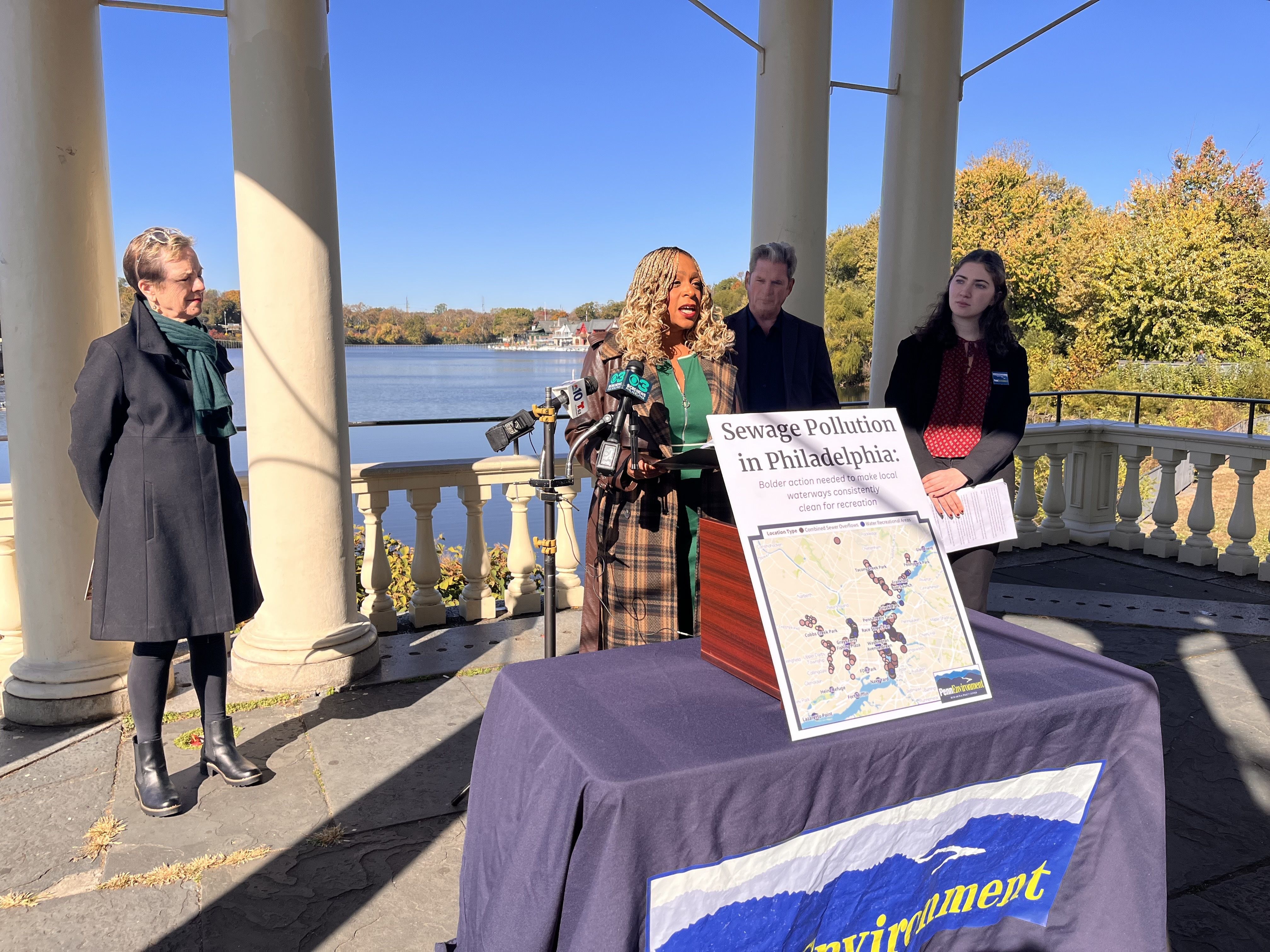
    Philadelphia Council member Jamie Gauthier (center) spoke Monday about PennEnvironment’s report on pollution from combined sewer overflows. To her left is Margaret Meigs, president, Friends of the Schuylkill Navy. And to her right is Tim Dillingham, senior adviser, American Littoral Society, and Hanna Felber, clean water associate at PennEnvironment Research & Policy Center.

    Frequent overflows, high volume in Philly

    Roughly 60% of Philadelphia is served by a combined sewer system, which has 164 outfalls — really large metal or concrete openings — that discharge pollution into waterways. A CSO system uses a single pipe to collect and transport sewage from homes and businesses as well as stormwater runoff from streets and sidewalks.

    During dry weather, the system can handle the volume before safely releasing it back into the rivers. But during heavy rainfall, the system discharges untreated, though highly diluted, sewage mixed with stormwater directly into waterways.

    Despite the Philadelphia Water Department’s ongoing Green City, Clean Waters project — a 25-year plan focusing on green infrastructure to reduce overflows — the frequency and volume remain alarmingly high, the report states.

    Overall, CSOs dumped an average of 12.7 billion gallons of raw sewage mixed with polluted stormwater per year into local waterways from 2016 to 2024, the authors of the report stated. They included an online map to show the location of the outfalls and annual overflow.

    Half the sewage came from just 10 CSOs.

    window.addEventListener(“message”,function(a){if(void 0!==a.data[“datawrapper-height”]){var e=document.querySelectorAll(“iframe”);for(var t in a.data[“datawrapper-height”])for(var r,i=0;r=e[i];i++)if(r.contentWindow===a.source){var d=a.data[“datawrapper-height”][t]+”px”;r.style.height=d}}});

    Still, the numbers are a slight improvement over the 15 billion gallons a year released into local rivers, as PennEnvironment reported in 2023.

    Philadelphia gets its drinking water from the rivers, but the CSOs are downstream of the city’s treatment plants on the Delaware and the Schuylkill.

    The report used publicly available data to show that five of six waterways in Philly produced at least one overflow 65 times or more per year on average between 2016 and 2024. Those were the Delaware River, the Schuylkill, and Cobbs, Frankford and Tacony Creeks.

    In better news: The average volume of overflow per inch of precipitation declined by about 16% from previous periods, but progress is slow and threatened by increased rainfall and rising sea levels due to climate change, the authors say.

    PWD could not be reached for comment.

    window.addEventListener(“message”,function(a){if(void 0!==a.data[“datawrapper-height”]){var e=document.querySelectorAll(“iframe”);for(var t in a.data[“datawrapper-height”])for(var r,i=0;r=e[i];i++)if(r.contentWindow===a.source){var d=a.data[“datawrapper-height”][t]+”px”;r.style.height=d}}});

    Camden County

    The report also found persistent overflows in Camden County. The cities of Camden and Gloucester, along with the Camden County Municipal Utilities Authority (CCMUA), operate combined sewer systems that frequently overflow into the Delaware River and its tributaries, including the Cooper River and Newton Creek.

    The report found that systems on the Camden County side of the river overflowed into local waterways an average of 76 days per year from 2016 to 2024.

    window.addEventListener(“message”,function(a){if(void 0!==a.data[“datawrapper-height”]){var e=document.querySelectorAll(“iframe”);for(var t in a.data[“datawrapper-height”])for(var r,i=0;r=e[i];i++)if(r.contentWindow===a.source){var d=a.data[“datawrapper-height”][t]+”px”;r.style.height=d}}});

    The highest-frequency outfall for the Cooper River released sewage for an average of 118 days annually during that period.

    The Delaware River received sewage overflows for an average of 94 days annually from its highest-frequency outfall.

    The authors said gaps in data leave them unable to show the total volume of diluted sewage released from Camden. But they said that the amount of “solids/floatables” collected at each outfall is an indicator a waterway is polluted.

    Dan Keashen, a spokesperson for Camden County, said officials have been making strides.

    He said that crews recently cleaned 30 miles of pipe and that a $26 million project is underway to physically separate the combined sewer service area of Pennsauken that flows into Camden. Officials are also studying how to better achieve compliance for the largest outfall in the system, a project estimated to cost $40 million to $150 million when complete.

    What can be done?

    The report concludes that current plans by Philadelphia and Camden County are insufficient to achieve the goal of a clean Delaware River watershed.

    The report was written by John Rumpler, clean water director for Environment America, PennEnvironment’s parent organization, and Elizabeth Ridlington, associate director of the Frontier Group, a nonprofit research group that is part of the Public Interest Network, an environmental advocacy organization.

    The authors call for officials to accelerate action to end all sewer overflows, set a hard deadline, and find new ways to pay for necessary infrastructure upgrades.

    Philadelphia Councilmember Jamie Gauthier, chair of the committee on the environment, called overflows “a public health crisis” and urged PWD’s new commissioner, Benjamin Jewell, to act. She said elected officials in Harrisburg and Washington also need to step up.

    PWD is separately under pressure by a new Environmental Protection Agency regulation that seeks to improve the amount of dissolved oxygen in the Delaware by ordering a large-scale reduction of ammonia at the city’s three water pollution control plants. PWD estimates that the price for compliance is $3.6 billion and would cost households an additional $265 annually on their water bills.

    The authors of the PennEnvironment report concede the CSO task is daunting. But they say Portland and Boston faced similar situations, invested in infrastructure, and managed to make CSO overflows infrequent. Washington, D.C., they said, is on track to reduce sewage overflows by 96% in 2030.

    Hanna Felber, a PennEnvironment advocate, said that PWD needs to use creative funding, such as floating longer-term bonds to finance projects, and that its engineers need to find more creative solutions, such as installing larger stormwater tunnels that flow separately from sewage.

    “Unfortunately, our new report on sewage pollution in Philadelphia shows that on far too many days each year, the Philadelphia Water Department’s pipes and sewer systems dump huge volumes of raw sewage into our beautiful waters, harming our environment and depriving the public of a safe place to fish, boat, and float,” Felber said.

  • Is 2025 Philadelphia’s year of the parking garage?

    Is 2025 Philadelphia’s year of the parking garage?

    Three large stand-alone parking garages have been proposed in Philadelphia this year, unusual projects in a city where parking operators have long complained that high taxation makes it difficult to run a business.

    The latest is a 372-unit garage near Fishtown and Northern Liberties at 53-67 E. Laurel St. near the Fillmore concert hall and the Rivers Casino.

    The developers see it as a strong bet for an area of the city that has seen a surge of apartment construction, which, due to Philadelphia’s parking laws, requires developers to only build spaces to serve a fraction of the units.

    “There’s been about 2,500 units that have come online within a 5- to 10-minute walk” of the planned garage, said Aris Kufasimes, director of operations with developer Bridge One Management. “When you’re building those on 7-1 [apartments to parking spaces] ratios, that leaves a massive hole. Where is everybody going to put their vehicles?”

    Despite central Philadelphia’s walkability and high levels of transit access, two other developers have made similar calculations this year.

    In the spring, Children’s Hospital of Philadelphia (CHOP) revealed plans for a 1,005-space parking garage in Grays Ferry along with a shuttle service to spirit employees to the main campus a mile away.

    In August, University Place Associates unveiled plans for a 495-unit garage. About a fourth of it will be reserved for the use of the city’s new forensic lab, but the rest will be open to the public.

    All three projects have baffled environmentalists and urbanists, who thought Philadelphia was moving away from car-centric patterns of late 20th-century development.

    It’s also surprised parking operators in the city, who say national construction cost trends and high local taxation make it difficult to turn a profit.

    Legacy parking companies in Philadelphia like E-Z Park and Parkway Corp. have been selling garages and surface lots for redevelopment as anything other than parking. They say the city has lost 10,000 publicly available spaces in the last 15 years, bringing the total to about 40,000 in Center City.

    “I don’t think I’ll ever build another stand-alone parking facility,” said Robert Zuritsky, president of Parkway Corp. and board chair of the National Parking Association. “It doesn’t make any sense.”

    Zuritsky and other parking companies have long noted that operators in Philadelphia, who often have unionized workforces, get hit with parking, wage, property, and the Use and Occupancy Tax.

    When combined with the soaring cost of building new spaces across the nation, it’s difficult to turn a profit in Philadelphia.

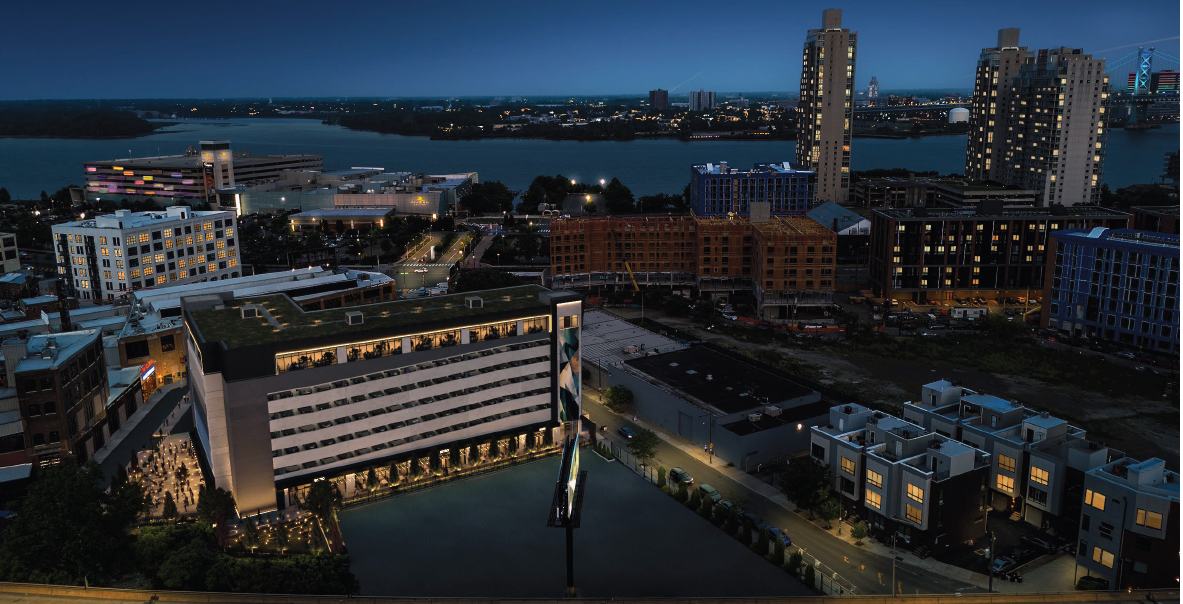
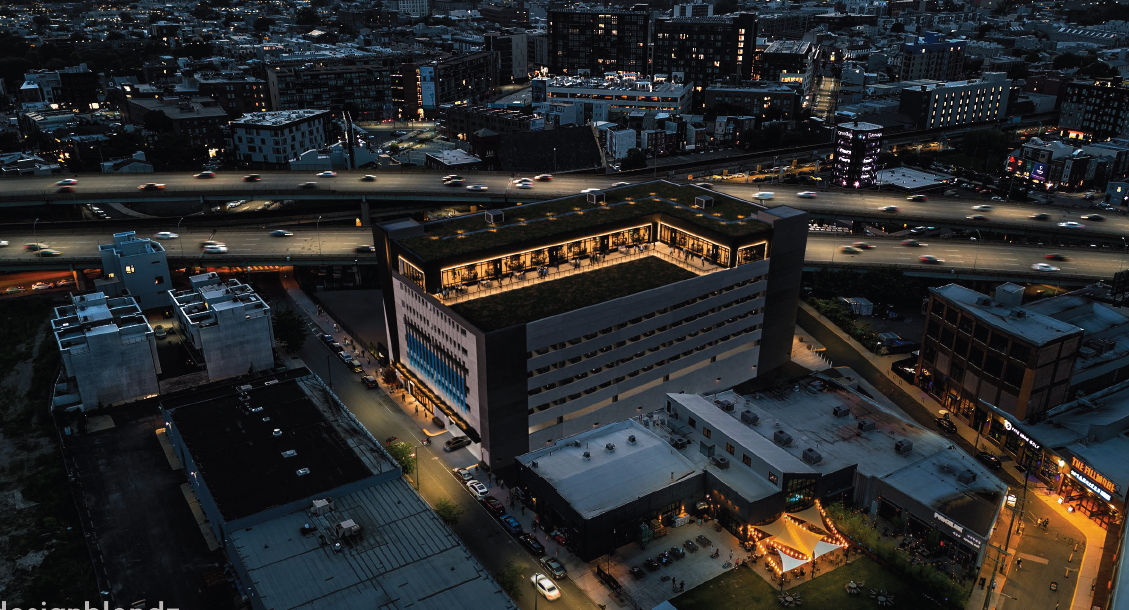
    A rendering of the Fishtown garage, looking towards the Delaware River.

    Zuritsky says it costs $60,000-$70,000 a space to build an aboveground lot in today’s environment and $100,000 to $150,000 below ground.

    “It’s like building a house for a car,” he said.

    Depending on hyperlocal peculiarities, Zuritsky says that taxation in Center City can eat up to 60% of the money they bring in and that to profit from new construction, an operator would have to charge $3,000 per space a month.

    “I wish people luck, the ones that are moving in,” said Harvey Spear, president of E-Z Park. “Between taxes, insurance, and labor, it comes to, like, 70-some percent of what we take in. We have more equipment now that does away with a lot of labor; we’re trying to compensate with that.”

    Urbanist and environmental advocates, meanwhile, have condemned the new garage projects, arguing that they will add to carbon emissions, air pollution, and traffic congestion.

    “A massive parking garage less than half a mile from the El [in Fishtown] is the wrong direction for any city that claims to take climate action seriously,” said Ashlei Tracy, deputy executive director with the Pennsylvania Bipartisan Climate Initiative. “SEPTA is already working to get more people out of cars and onto transit, but projects like this one and the one from CHOP only make that harder.”

    Here are the parking projects in the pipeline.

    Fishtown: 372 spaces

    The garage, with architecture by Philadelphia-based Designblendz, doesn’t just contain parking. It includes close to 14,000 square feet of commercial space on the first floor, which the developer hopes to rent to a restaurant — or two — on the edges of one of Philadelphia’s hottest culinary scenes.

    Another over 16,000-square-foot restaurant space is planned for the top floor, with views of the skyline and river. Both the top and bottom floors also could be used as event spaces.

    Kufasimes says that this aspect of the project could partly offset the kinds of costs that parking veterans warn of.

    “Our due diligence team went through those numbers and vetted them pretty thoroughly: The returns are what they needed to be,” Kufasimes said. “It’s got a multifunction of income streams, so we think that that really will help play a larger role.”

    Kufasimes also said a parking garage made sense in an area that’s seen more development than almost any other corner of Philadelphia. When investors purchased the land at 53-67 E. Laurel St. and approached his company for ideas, they met with other stakeholders in the neighborhood and determined parking would be appreciated.

    “It wasn’t necessarily all about the profit,” Kufasimes said. “A lot of people this day and age, that is their number-one goal. If this is a slightly lower return in the long run but can be better accepted by the community as a whole, we think that actually raises the value of the asset.”

    An overhead-perspective rendering of the Fishtown garage.

    At an October meeting of the Fishtown Neighbors Association, that argument appeared to pay off. Unlike most community meetings where a large new development is proposed, there were no adamant opponents of the project. The project also includes a 20,000-square-foot outdoor space, a green roof, and a to-be-decided public art component. All of that helped, too.

    “It’s nice seeing a parking garage, of all things, be as pedestrian-friendly and thoughtful as this,” one speaker said during the Zoom meeting.

    University City: 495 spaces

    The garage at 17 N. 41st St. is part of a larger complex of developments in a corner of West Philadelphia’s University City.

    Dubbed University Place 5.0, it largely exists because of a major expansion of the municipal bureaucracy west of the Schuylkill.

    For years the city has sought a new location for its criminal forensics laboratory. The debate became heated in City Hall, with numerous Council members making the case for locations within their districts.

    Councilmember Jamie Gauthier pushed for its location in University City Place 3.0, a newly built, state-of-the-art life sciences building that was coming online just as its intended industry was slowing down in the face of higher interest rates.

    To get the crime lab, Mayor Cherelle L. Parker’s administration said the police department would need ample parking. That’s where the new garage comes in.

    In June, Gauthier passed a zoning overlay that cleared away the regulatory hurdles to the project. Six weeks later, the developers revealed University City Place 5.0, which has 29 parking spaces on the ground floor reserved for official use by forensics vehicles and 100 spaces reserved for city employees.

    A rendering of the proposed University City parking garage as seen from 42nd and Filbert Streets.

    Designed by Philadelphia-based ISA Architects, the garage is also meant to serve University Place Associate’s other large developments in the area. Akin to the Fishtown garage, they have also sought to make the development pedestrian friendly, with a dog park, green space, and public art.

    The local community group, West Powelton Saunders Park RCO, also embraced the proposal.

    “The community met regarding this project back in August, and … they were all in support of this project,” Pamela Andrews, president of the West Powelton Saunders Park RCO, said at the city’s September Civic Design Review meeting. “We have a tremendous problem with parking, and the community members felt this was a much needed and welcome addition.”

    Grays Ferry: 1,005 parking spaces

    CHOP’s thousand-car parking garage by far has been the most controversial of the proposals. But it also makes the most economic sense for the owner. Unlike the other garages — or those owned by Parkway and E-Z Park — it will be owned by a nonprofit and exempted from many of the taxes that make it so expensive to own parking in Philadelphia.

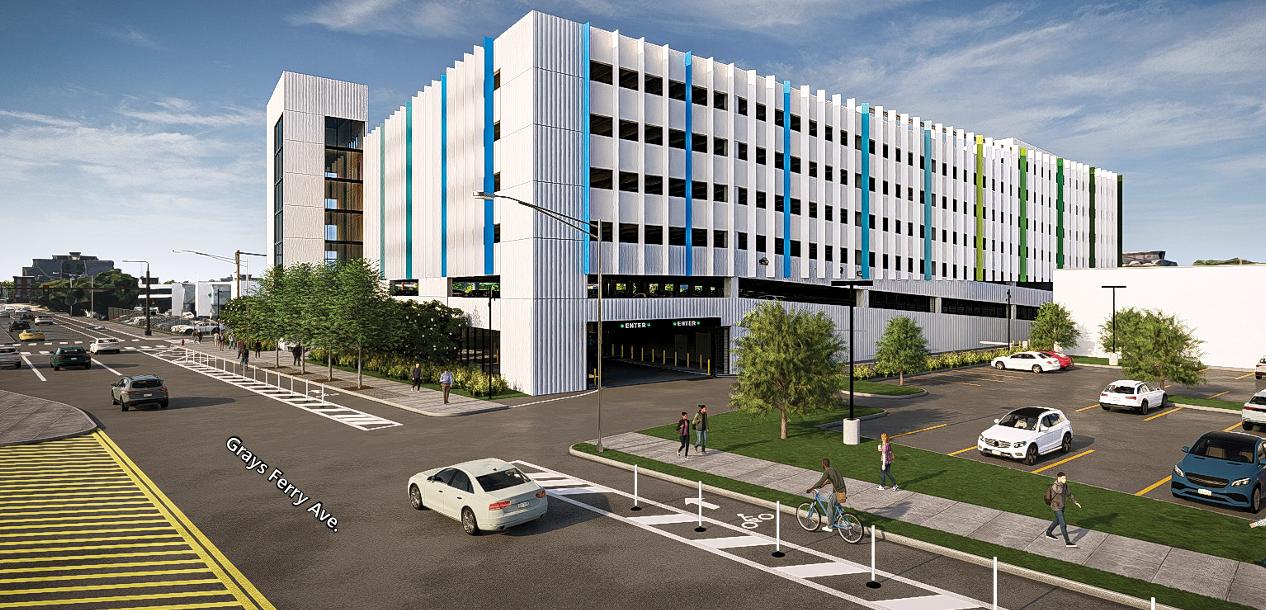
    A rendering of the new parking garage CHOP plans for Grays Ferry.

    The hospital purchased the property at 3000 Grays Ferry Ave., next to the Donald Finnegan Playground, for almost $25 million last year.

    The seven-story development, which, plans show, would have far fewer amenities than its University City and Fishtown counterparts, is meant to serve CHOP’s new research facilities in Fitler Square and the new patient tower set to open in 2028.

    “We recently secured permits and have begun construction on the new parking garage at 3000 Grays Ferry Ave.,” a CHOP spokesperson said. “The full construction is expected to go through the fall of 2026. CHOP continues to engage with the community by providing support, timely updates and addressing feedback during construction.”

    At the time of its unveiling, CHOP argued that the massive garage was needed as SEPTA threatened to become unreliable due to a political funding crisis in Harrisburg. But detractors appeared almost immediately to denounce the hospital for worsening air quality in a lower-income neighborhood that is already a hot spot for asthma.

    The project’s design was derided at the city’s advisory Civic Design Review panel and has attracted protest rallies, unlike its counterparts in University City or Fishtown.

    There are no regulatory hurdles to the development, but changes in the political or economic landscape could make it difficult to embark on a large capital project. Notably, the University of Pennsylvania proposed an 858-space garage in 2023 for the nearby Pennovation Center and has never broken ground.

  • Councilmember Gauthier pursues more red tape for university land sales in West Philly

    Councilmember Gauthier pursues more red tape for university land sales in West Philly

    Philadelphia Councilmember Jamie Gauthier has made it clear that she is unhappy with St. Joseph’s University.

    The school sold much of its West Philadelphia campus to Belmont Neighborhood Educational Alliance, a nonprofit led by Michael Karp, a developer of student housing.

    In City Council on Tuesday, St. Joe’s confirmed that the sale has closed.

    In reaction, Gauthier had authored legislation that sought to require more community oversight when large institutions make significant land sales in University City, which is part of her district. She thinks this sale might not be the last, given the turbulent state of higher education.

    Her original legislation was deemed legally dubious by the city’s law department and by most zoning attorneys consulted by The Inquirer.

    Gauthier amended the bill and got the new version passed by City Council’s Rules Committee on Tuesday.

    “It is an indisputable fact that college campuses significantly impact the communities that surround them,” Gauthier said at the hearing.

    “As higher education undergoes its most significant change in our lifetime,” she continued, “we must ensure that land-use decisions are made with their communities in mind, and recent actions by multiple universities prove this will not happen without legislative action.”

    The original bill sought to regulate how higher education institutions use their land, which is illegal. Zoning concerns land use generally, not only land use of specific actors.

    Gauthier amended the bill so it is triggered not by a change in ownership from a university to a non-higher education buyer, but by a proposed change away from educational use on lots over 5,000 square feet.

    So if a university sold land to a housing developer, the law would be triggered. It is not clear it would be triggered by what St. Joe’s did, which was selling land used for university purposes to another educational provider that claims to want to start a teaching college.

    The amendments also removed clauses that would have required neighborhood residents to join the Philadelphia City Planning Commission when it reviews land-transfer proposals, as is required by this bill.

    Gauthier pushed back against arguments that her bill is an overreach by noting that it simply requires a meeting with neighborhood groups, a review by the planning commission, and a demolition moratorium if there are no permits for new construction.

    “This bill doesn’t cripple anyone’s property values,” Gauthier said. “It doesn’t restrict anyone’s use or density rights. It adds more eyes and more transparency to land-use decisions for major properties that change entire neighborhoods. The idea that this could ever be wrong is simply preposterous.”

    The IPEX building at St. Joseph’s University in Philadelphia on Sept. 12.

    Representatives from a host of West Philadelphia neighborhood groups testified in support of Gauthier’s bill. They detailed their anxieties about living in the shadow of large institutions with expensive real estate portfolios and their frustrations with what they felt had been duplicity by St. Joe’s during a public engagement campaign about the sale.

    During neighborhood meetings earlier this year, attendees detailed their desire for a community college, health clinic, parking, or affordable housing on a post-sale St. Joe’s campus.

    They said they felt that the university ignored their feedback.

    “This thing about community engagement, we feel as though it was false,” said Jacquelyn Owns, a committeeperson in the 27th Ward. “It was just something to keep the community quiet while they did exactly what they wanted to do.”

    St. Joe’s representatives argued that Karp’s plans for the site are in keeping with the neighborhood’s broad desires, given that his Belmont organization runs charter schools.

    St. Joe’s also noted that it will still retain some property in the area affected by Gauthier’s bill and contended that the legislation would have deleterious effects on higher education institutions in University City.

    “It probably would devalue our real estate holdings, which, in turn, would then devalue our balance sheet, which would then restrict our ability to offer financial aid,” said Joseph Kender, senior vice president at St. Joe’s. “It would restrict our ability to start new construction projects. It would restrict our ability to offer new academic programs.”

    A lawyer for St. Joe’s, Ballard Spahr zoning attorney Matthew McClure, said that even the amended bill might still be illegal.

    Despite the protests by St. Joe’s, Council’s Rules Committee passed the amended bill.

    That may be the last movement on the controversial legislation for a while. At its October meeting, the planning commission requested a 45-day hold on the bill to consider its ramifications more thoroughly. That means the full City Council will not be able to consider it until late November.

  • Philly lawmakers want to ‘clamp down’ on smoke shops. Their landlords could be next.

    Philly lawmakers want to ‘clamp down’ on smoke shops. Their landlords could be next.

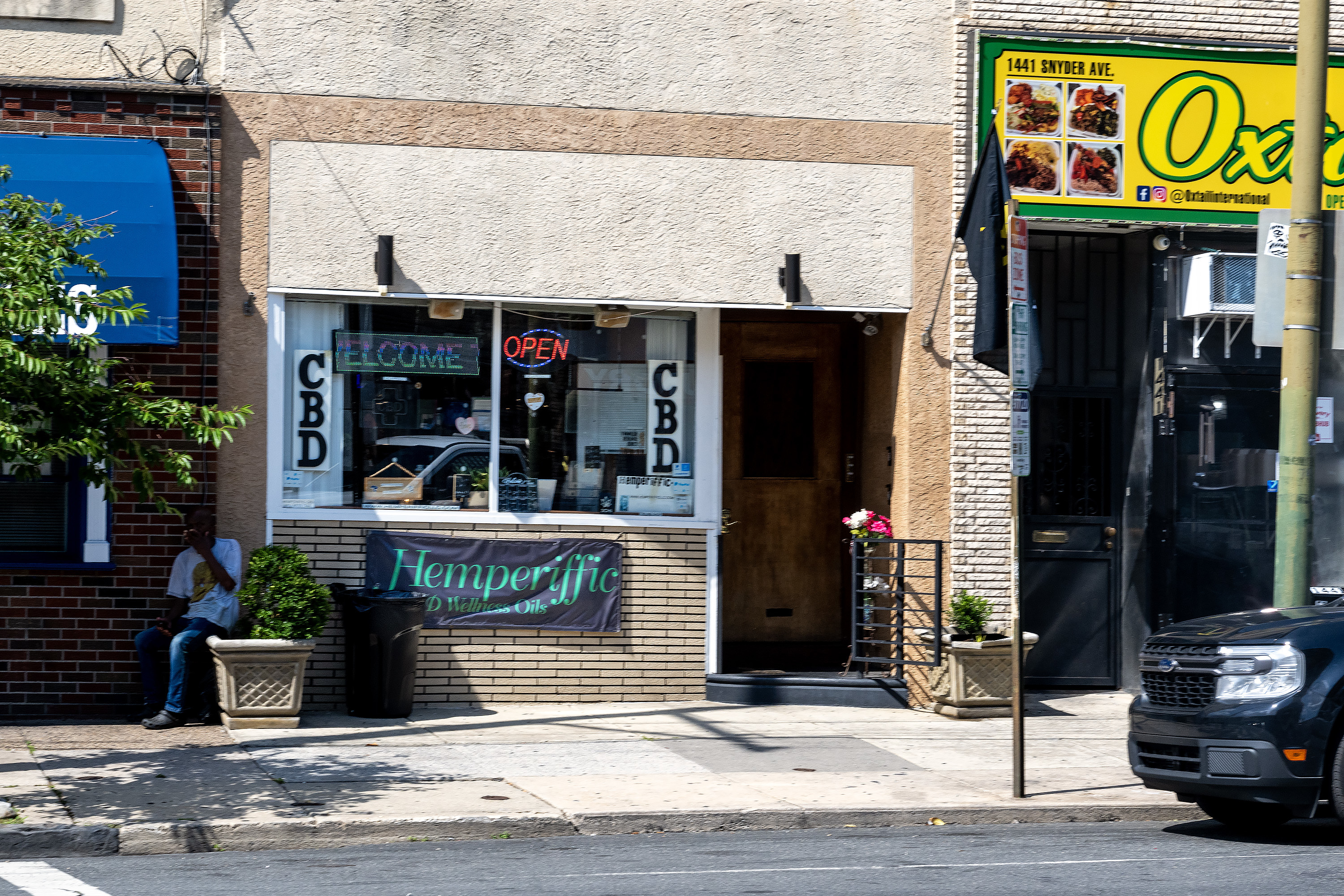
    There’s a smoke shop in North Philly peddling recreational drugs across the street from a daycare. A West Philly storefront that sells loose cigarettes on a residential block. A convenience store in Spring Garden that advertises urine to people looking to pass a drug test.

    These are among the so-called nuisance businesses that City Council members and neighborhood association leaders cited Monday as lawmakers advanced legislation to make it easier for the city to shut down stores that sell cannabis and tobacco products without licenses.

    And legislators said their next target could be the landlords who rent space to those businesses.

    “We have to work with our city departments and our state partners to clamp down on these businesses,” said City Council Majority Leader Katherine Gilmore Richardson, who represents the city at-large. “We’re just being inundated.”

    Members of Council’s Committee on Licenses and Inspections passed two bills Monday that city officials say seek to close loopholes store owners exploit to avoid being cited for failing to obtain proper permits.

    In introducing the legislation earlier this year, Gilmore Richardson cited an Inquirer report about Pennsylvania’s unregulated hemp stores, which sell products advertised as legal hemp that are often black market cannabis or contaminated with illicit toxins.

    One bill makes it easier for the city to shut down nuisance businesses by removing language that classifies some violations as criminal matters, requiring that the police investigate them as crimes rather than civil violations that are quicker to adjudicate.

    The second piece of legislation makes it illegal for businesses to essentially reorganize under a new name but conduct the same operations as a means of evading enforcement.

    Both pieces of legislation could come up for a full vote in the Democratic-dominated City Council in the coming weeks. Members of Mayor Cherelle L. Parker’s administration testified in favor of them, meaning the mayor is likely to sign both.

    A smoke shop in South Philadelphia.

    Neighborhood association leaders also testified Monday in favor of the changes, but several said more aggressive enforcement is needed. They said smoke shops in particular have popped up throughout their commercial corridors, as have convenience stores that don’t even have licenses to operate as businesses, let alone sell recreational drugs.

    “We’ve seen firsthand the selling of illegal drug paraphernalia and [loose cigarettes], many of which children walk past in order to get to the candy bars and seniors walk past to get to the milk,” said Heather Miller, of the Lawncrest Community Association. “We need to address this.”

    Elaine Petrossian, a Democratic ward leader in Center City and a community activist, called for “much” higher fines and penalties for landlords. She cited progress the municipal government has made in New York City, where authorities cracked down on building owners who knowingly rented space to tenants selling cannabis or tobacco without licenses to do so.

    Several lawmakers said they’d support a similar approach. Councilmember Mark Squilla, who represents a district that spans from South Philadelphia to Kensington, said landlords must be held “more accountable.”

    “If they had some skin in the game, maybe they’d think twice about renting to an illegal operation,” he said.

    Councilmember Jamie Gauthier, who represents parts of West Philadelphia, agreed. She said she recently attempted to meet with a building owner who rents space to a problematic smoke shop in her district, but was rebuffed.

    “He was like, ‘These people pay me rent, and that’s the extent to which I basically care,’” Gauthier said. “We need something that forces property owners to be more accountable than that, because neighbors are suffering.”

    Staff writers Max Marin and Ryan W. Briggs contributed to this article.