Tag: JD Vance

  • Indiana Republicans defy Trump and reject his House redistricting push in the states

    Indiana Republicans defy Trump and reject his House redistricting push in the states

    INDIANAPOLIS — Indiana’s Republican-led Senate decisively rejected a redrawn congressional map Thursday that would have favored their party, defying months of pressure from President Donald Trump and delivering a stark setback to the White House ahead of next year’s midterm elections.

    The vote was overwhelmingly against the proposed redistricting, with more Republicans opposing than supporting the measure, signaling the limits of Trump’s influence even in one of the country’s most conservative states.

    Trump has been urging Republicans nationwide to redraw their congressional maps in an unusual campaign to help the party maintain its thin majority in the House of Representatives. Although Texas, Missouri, Ohio, and North Carolina went along, Indiana did not — despite cajoling and insults from the president and the possibility of primary challenges.

    “The federal government should not dictate by threat or other means what should happen in our states,” said Spencer Deery, one of the Republican senators who voted no on Thursday.

    When the proposal failed, cheers could be heard inside the chamber as well as shouts of “thank you!” The debate had been shadowed by the possibility of violence, and some lawmakers have received threats.

    The proposed map was designed to give Republicans control of all nine of Indiana’s congressional seats, up from the seven they currently hold. It would have effectively erased Indiana’s two Democrat-held districts by splitting Indianapolis among four districts that extend into rural areas, reshaping U.S. Rep. André Carson’s safe district in the city. It would’ve also eliminated the northwest Indiana district held by U.S. Rep. Frank Mrvan.

    District boundaries are usually adjusted once a decade after a new census. But Trump has described redistricting as an existential issue for the party as Democrats push to regain power in Washington.

    “If Republicans will not do what is necessary to save our Country, they will eventually lose everything to the Democrats,” Trump wrote on social media the night before the vote.

    The president said anyone who voted against the plan should lose their seats. Half of Indiana senators are up for reelection next year, and the conservative organization Turning Point Action had pledged to fund campaigns against them.

    Inside the state Senate chamber, Democratic lawmakers spoke out against redistricting ahead of the vote.

    “Competition is healthy my friends,” said Sen. Fady Qaddoura. “Any political party on earth that cannot run and win based on the merits of its ideas is unworthy of governing.”

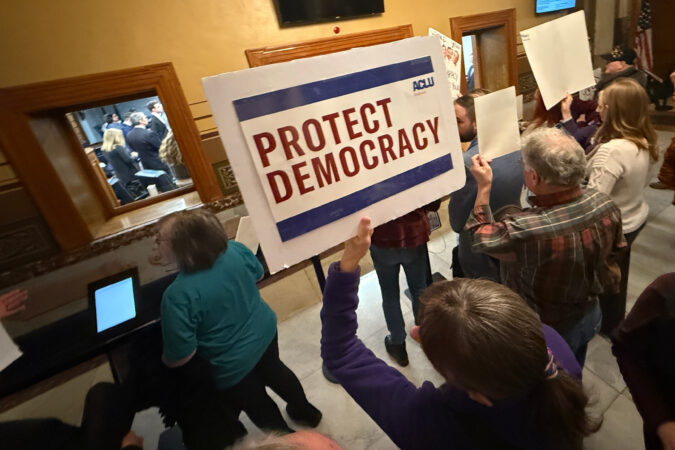
    In the hallways outside, redistricting opponents chanted “Vote no!” and “Fair maps!” while holding signs with slogans like “Losers cheat.”

    Three times over the fall Vice President JD Vance met with Republican senators — twice in Indianapolis and once in the White House — to urge their support. Trump joined a conference call with senators on Oct. 17 to make his own 15-minute pitch.

    Behind the scenes, James Blair, Trump’s deputy White House chief of staff for political affairs, was in regular touch with members, as were other groups supporting the effort such as the Heritage Foundation and Turning Point USA.

    “The administration made a full-court press,” said Republican Sen. Andy Zay, who was on the phone with White House aides sometimes multiple times per week, despite his commitment as a yes vote.

    Across the country, mid-cycle redistricting so far has resulted in nine more congressional seats that Republicans believe they can win and six more congressional seats that Democrats think they can win. However, some of the new maps are facing litigation.

    In Utah, a judge imposed new districts that could allow Democrats to win a seat, saying Republican lawmakers violated voter-backed standards against gerrymandering.

    Despite Trump’s push, support for gerrymandering in Indiana’s Senate was uncertain. A dozen of the 50 senators had not publicly committed to a stance ahead of the vote.

    Republican Sen. Greg Goode signaled his displeasure with the redistricting plan before voting no. He said some of his constituents objected to seeing their county split up or paired with Indianapolis. He expressed “love” for Trump but criticized what he called “over-the-top pressure” from inside and outside the state.

    Sen. Michael Young, another Republican, said the stakes in Washington justify redistricting, as Democrats are only a few seats away from flipping control of the U.S. House in 2026. “I know this election is going to be very close,” he said.

    Republican Sen. Mike Gaskill, the redistricting legislation’s sponsor, showed Senators maps of congressional districts around the country, including several focused on Democratic-held seats in New England and Illinois. He argued other states gerrymander and Indiana Republicans should play by the same rules.

    The bill cleared its first hurdle Monday with a 6-3 Senate committee vote, although one Republican joined Democrats in opposing it and a few others signaled they might vote against the final version. The state House passed the proposal last week, with 12 Republicans siding with Democrats in opposition.

    Among them was state Rep. Ed Clere, who said state troopers responded to a hoax message claiming a pipe bomb outside his home Wednesday evening. Indiana state police said “numerous others” received threats but wouldn’t offer details about an ongoing investigation.

    In an interview, Clere said these threats were the inevitable result of Trump’s pressure campaign and a “winner-take-all mentality.”

    “Words have consequences,” Clere said.

  • Why these red state Republicans are resisting Trump’s efforts to expand GOP power

    Why these red state Republicans are resisting Trump’s efforts to expand GOP power

    INDIANAPOLIS — In 44 years in Indiana’s legislature, Vaneta Becker had never before had a call with the White House.

    President Donald Trump was on the line that day in October, urging her and her GOP colleagues to redraw the state’s congressional map to help Republicans in next year’s midterm elections. She told the White House she opposed the idea, and a week or so later got a voice message from an aide asking for a follow-up conversation. Becker called back to leave a message of her own.

    “I’m not going to change my position,” Becker, 76, recalled saying. “You’re wasting your time on me, so just focus on somebody else.”

    Indiana, a state Trump won by 19 percentage points last year, is serving up an unusual amount of resistance to his plan to carve up congressional districts around the country. Since this summer, Republicans in four other states have rejiggered their maps to give their party as many as nine more seats part of a larger plan aimed at retaining power in Congress after next year’s elections.

    But in Indiana, a contingent of GOP state senators has politely but persistently said no. The GOP opponents told Trump and Gov. Mike Braun (R) they weren’t on board and last month 19 of them voted with Democrats to end a legislative session without acting on redistricting. Trump and his allies kept pressing, and the state House passed a plan last week that would likely give Republicans all nine of the state’s congressional districts, two more than they have now.

    The leader of the State Senate, Rodric Bray, agreed to bring the senators back to the state capitol to take up the issue even though he was among those who had voted to end the session. They are expecting to vote Thursday.

    Opponents include longtime Republican lawmakers like Becker who got involved in politics years before the rise of Trump and his Make America Great Again movement. Hoosiers bristle at meddling from Washington, even when it comes from allies, the opponents say.

    The state senators have been increasingly on edge in recent weeks as they endured intimidation — political and physical — and a stream of hoax police reports that seemed designed to draw large law enforcement responses to their homes.

    States draw their congressional districts after the census, and lawmakers from both parties often try to maximize their advantage. Years of litigation sometimes follow, but state lawmakers typically don’t redraw their lines in the middle of the decade unless a court orders it. Trump has rejected the usual way of doing business, demanding Republican-led states make immediate changes.

    So far, Republicans have not netted as many seats as they’d hoped because Democrats have counteracted them by adopting a new map in California and are trying to do the same in Virginia and other states. Opponents of a new GOP-friendly map in Missouri submitted more than 300,000 signatures to the state to try to block it from going into effect until a referendum on it can be held.

    But the GOP resistance in Indiana stands apart, in large part because Republicans across the country have readily acquiesced to Trump’s demands and threats on a range of issues.

    Trump may yet prevail. But the rare instance of pushback here could offer warning signs to Trump that his grip on the party may be loosening amid slides in his public approval rating. A vote against a new map in Indiana would add to his woes as Republicans fret over their ability to hold onto the House next year.

    What happens in Indiana will have effects elsewhere. If Republicans reject the map here, Trump may put more pressure on officials in other states. If they go along with the plan, Democrats in Illinois and Maryland who have resisted redistricting may feel they need now to jump into the fight.

    Time is running short because election officials, candidates and voters need to know where the lines are well ahead of next year’s primaries. But the fight over maps will continue for months. Republicans in Florida are poised to draw a new map and GOP lawmakers in Utah are trying to reverse a court decision that is expected to give Democrats one of the state’s districts.

    In Indiana, lawmakers have been debating whether to redraw the lines since August, but they didn’t see the proposed map until the House unveiled it last week. The map would break Marion County, the home to Indianapolis and the state’s largest African American population, into four districts, diluting Democratic votes. It would likely doom the reelection chances of Democratic Reps. Frank J. Mrvan and André Carson, the only Black member of Indiana’s congressional delegation.

    Trump has hosted Indiana officials at the White House. He’s dispatched Vice President JD Vance to the state twice. In October, he and his aides held their conference call with Indiana state senators to talk up redistricting. At the end of the call, the senators were told to press a number on their phone to indicate whether they supported redrawing the map, even though they were yet to see how the lines would change.

    On Wednesday night, Trump lashed out at the State Senate leader on Truth Social, calling Bray “the only person in the United States of America who is against Republicans picking up extra seats” and warning that lawmakers who oppose the changes were at risk of losing their seats.

    A White House official said earlier that Trump’s team is “not arm twisting. Just outlining the stakes and reminding them western civilization stands in the balance of their decision.”

    About 800 of Becker’s constituents in southwestern Indiana have told her they are against the plan and about 100 have told her they’re for it, she said. Sitting in her wood-paneled cubicle Tuesday in the state capitol, she slid a constituent’s letter out of its envelope.

    “Mid-decade redistricting at the request of President Trump will unnecessarily intensify the already deep partisan divisions in our country,” the man wrote. “Even bringing this topic up in the Indiana legislature will ratchet up the antagonism.”

    Voters know the push is coming from Trump, and many are not afraid to criticize him for it, even if they otherwise support the president, she said. Becker declined to say whether she’d voted for Trump but said she’s “not crazy about him,” especially after the Jan. 6, 2021, attack on the U.S. Capitol.

    Trump is not letting up on his push. Last month the president called out State Sen. Greg Goode (R) in a post on Truth Social, saying he was “very disappointed” that he opposed redistricting even though Goode had not taken a position. Later that day, Goode said, someone falsely told police he had murdered his wife and barricaded himself in his house. Police kicked in the door just after Goode got out of the shower, while his wife and son were getting Christmas decorations in the basement, and officers pointed their guns at Goode’s chest, he said.

    Goode, who serves as the state director for U.S. Sen. Todd Young (R., Ind.), said he didn’t blame Trump for the incident. He got a call from Trump the next day, which he described as polite. Trump called Goode again on Monday, as the state senator was listening to the redistricting debate in committee.

    “It was not a pressured call at all,” Goode said. “The overarching message really from day one is the importance for the Republican Party to maintain control of the United States House of Representatives.”

    Goode said he won’t decide how he’s voting until he hears the final debate among the senators. He’s voted for Trump three times and takes his opinion seriously, but also is listening closely to his constituents, who have overwhelmingly told him they oppose redistricting, he said.

    On Friday, hours after the State House passed the map, Trump named Goode and eight other state senators in a social media post as needing “encouragement to make the right decision.” The conservative group Turning Point Action has claimed it will team up with other Trump-aligned organizations to spend $10 million or more on primaries in 2026 and 2028 against GOP state senators in Indiana who vote against the map. Several Republicans, including Becker, said they’re skeptical the groups would spend so much against members of their own party.

    State Sen. Travis Holdman (R) got a call from the White House a couple of weeks ago asking if he would come to Washington to talk about redistricting, but he declined because he couldn’t miss work as a banking consultant. Adopting a new map now would be unfair, he said, and he doesn’t think the president’s team could change his mind.

    “I voted for Donald Trump in every election,” he said. “I really agree with his policies. We just disagree on this issue.”

    Republicans control the State Senate 40-10, and at least 16 of them would need to vote with Democrats to sideline the map.

    Supporters of the altered map said they want to ensure Republicans hold onto Congress and are responding to districts Democrats drew favoring their party years ago in states they control. Indiana State Sen. R. Michael Young told his colleagues on Monday that the Supreme Court had blessed letting states draw districts for partisan advantage, holding up a recent decision that upheld a new map in Texas.

    “For all those people who think they’re lawyers in Indiana, who think it’s against the law or wrong, the Supreme Court of the United States says different,” he said.

    Others have made their opposition clear, with some saying they’re pushing back on what they call bullying. State Sen. Mike Bohacek (R) grew incensed last month when Trump called Minnesota Gov. Tim Walz (D) “seriously retarded” in a social media post. Bohacek, who has a daughter with Down syndrome, said in a social media post that Trump’s “choice of words have consequences.”

    “I will be voting NO on redistricting, perhaps he can use the next 10 months to convince voters that his policies and behavior deserve a congressional majority,” Bohacek wrote in his post.

    In the State House, Rep. Ed Clere was among 12 Republicans to vote against the map. He believes Trump’s MAGA movement is starting to crack, but doesn’t think that’s what’s behind the GOP resistance to redistricting in Indiana. It stems from a sense of independence that is, he said, “part of Indiana’s DNA.”

    Becker agrees.

    “Hoosiers are very independent,” she said. “And they’re not used to Washington trying to tell us what to do.”

    GRAPHIC

  • WTF? Embracing profanity is one thing both political parties seem to agree on

    WTF? Embracing profanity is one thing both political parties seem to agree on

    WASHINGTON — As he shook President Barack Obama’s hand and pulled him in for what he thought was a private aside, Vice President Joe Biden delivered an explicit message: “This is a big f— deal.” The remark, overheard on live microphones at a 2010 ceremony for the Affordable Care Act, caused a sensation because open profanity from a national leader was unusual at the time.

    More than 15 years later, vulgarity is now in vogue.

    During a political rally Tuesday night in Pennsylvania that was intended to focus on tackling inflation, President Donald Trump used profanity at least four times. At one point, he even admitted to disparaging Haiti and African nations as “shithole countries” during a private 2018 meeting, a comment he denied at the time. And before a bank of cameras during a lengthy cabinet meeting last week, the Republican president referred to alleged drug smugglers as “sons of bitches.”

    While the Biden incident was accidental, the frequency, sharpness, and public nature of Trump’s comments are intentional. They build on his project to combat what he sees as pervasive political correctness. Leaders in both parties are seemingly in a race now to the verbal gutter.

    Vice President JD Vance called a podcast host a “dips—” in September. In Thanksgiving remarks before troops, Vance joked that anyone who said they liked turkey was “full of s—.” After one National Guard member was killed in a shooting in Washington last month and a second was critically injured, top Trump aide Steven Cheung told a reporter on social media to “shut the f— up” when she wrote that the deployment of troops in the nation’s capital was “for political show.”

    Among Democrats, former Vice President Kamala Harris earned a roar of approval from her audience in September when she condemned the Trump administration by saying “these motherf— are crazy.” After Trump called for the execution of several Democratic members of Congress last month, Sen. Chris Murphy (D., Conn.) said it was time for people with influence to “pick a f— side.” Senate Democratic leader Chuck Schumer of New York said the administration cannot “f— around” with the release of the Jeffrey Epstein files. Democratic Rep. Jasmine Crockett, who on Monday announced her Senate campaign in Texas, did not hold back earlier this year when asked what she would tell Elon Musk if given the chance: “F— off.”

    The volley of vulgarities underscore an ever-coarsening political environment that often plays out on social media or other digital platforms where the posts or video clips that evoke the strongest emotions are rewarded with the most engagement.

    “If you want to be angry at someone, be angry at the social media companies,” Utah Gov. Spencer Cox, a Republican, said Tuesday night at Washington National Cathedral, where he spoke at an event focused on political civility. “It’s not a fair fight. They’ve hijacked our brains. They understand these dopamine hits. Outrage sells.”

    Cox, whose national profile rose after calling for civility in the wake of conservative activist Charlie Kirk’s assassination in his state, approved an overhaul of social media laws meant to protect children. A federal judge has temporarily blocked the state law.

    Tough political talk is nothing new

    Tough talk is nothing new in politics, but leaders long avoided flaunting it.

    Recordings from Democrat Lyndon B. Johnson’s administration, for instance, revealed a crude, profane side of his personality that was largely kept private. Republican Richard Nixon bemoaned the fact that the foul language he used in the Oval Office was captured on tape. “Since neither I nor most other Presidents had ever used profanity in public, millions were shocked,” Nixon wrote in his book In the Arena.

    “Politicians have always sworn, just behind closed doors,” said Benjamin Bergen, a professor at the University of California-San Diego’s Department of Cognitive Science and the author of What the F: What swearing reveals about our language, our brains, and ourselves. “The big change is in the past 10 years or so, it’s been much more public.”

    As both parties prepare for the 2026 midterm elections and the 2028 presidential campaign, the question is whether this language will become increasingly mainstream. Republicans who simply try to imitate Trump’s brash style do not always succeed with voters. Democrats who turn to vulgarities risk appearing inauthentic if their words feel forced.

    For some, it is just a distraction.

    “It’s not necessary,” said GOP Rep. Don Bacon of Nebraska, who is retiring next year after winning five elections in one of the most competitive House districts. “If that’s what it takes to get your point across, you’re not a good communicator.”

    There are risks of overusing profanity

    There also is a risk that if such language becomes overused, its utility as a way to shock and connect with audiences could be dulled. Comedian Jerry Seinfeld has talked about this problem, noting that he used swear words in his early routines but dropped them as his career progressed because he felt profanity yielded only cheap laughs.

    “I felt like well I just got a laugh because I said f— in there,” he said in a 2020 interview on the WTF podcast with fellow comedian Marc Maron. “You didn’t find the gold.”

    White House spokesperson Liz Huston said Trump “doesn’t care about being politically correct, he cares about making America great again. The American people love how authentic, transparent, and effective the President is.”

    But for Trump, the words that have generated the most controversy are often less centered in traditional profanity than slurs that can be interpreted as hurtful. The final weeks of his 2016 campaign were rocked when a tape emerged of him discussing grabbing women by their genitals, language he minimized as “locker room talk.” His “shithole” remark in 2018 was widely condemned as racist.

    More recently, Trump called Bloomberg reporter Catherine Lucey “piggy,” comments that his press secretary, Karoline Leavitt, defended as evidence of a president who is “very frank and honest.” Trump’s use of a slur about disabled people prompted an Indiana Republican whose child has Down syndrome to come out in opposition to the president’s push to redraw the state’s congressional districts.

    On rare occasions, politicians express contrition for their choice of words. In an interview with The Atlantic published last week, Pennsylvania Gov. Josh Shapiro, a Democrat, dismissed Harris’ depiction of him in her book about last year’s presidential campaign by saying she was “trying to sell books and cover her a—.”

    He seemed to catch himself quickly.

    “I shouldn’t say ‘cover her a—,” he said. “I think that’s not appropriate.”

  • New U.S. National Security Strategy slams Europe as greater threat than Russia or China

    New U.S. National Security Strategy slams Europe as greater threat than Russia or China

    Ordinarily, I wouldn’t recommend perusing the annual National Security Strategy of the United States of America. It generally summarizes the foreign policy direction in which the current administration is headed, and makes for lengthy, dry reading.

    But the new 33-page document is so shocking — even given what we already know about this administration’s behavior — that Americans need to pay attention.

    The NSS 2025 ignores the real security threats the U.S. faces in favor of praising white nationalist policies at home and demanding our democratic allies adopt the same. It promotes the myth that President Donald Trump can create a stable world by doing “deals” with authoritarian Moscow and Beijing.

    As for Russia’s invasion and brutalization of Ukraine, no word, except for chastising Europe for obstructing Trump’s efforts to force a pro-Russian “peace” plan on Kyiv. No wonder Kremlin spokesperson Dmitry Peskov quickly announced that the report was “largely consistent with our vision.”

    The document envisions a world in which Trump, Vladimir Putin, and Xi Jinping dominate the globe in concert, each controlling his own sphere of influence; it labels Trump’s intended control over the Western Hemisphere the “Monroe Doctrine Trump Corollary.”

    In reality, if Trump pursues this megalomaniacal mirage, he will facilitate the efforts of China and Russia to undermine U.S. security, destroy U.S. alliances, and dominate the world.

    What’s so revealing about the NSS is how much it has changed from the 2017 version released after Trump’s first year in office. Back then, the strategy referenced “the revisionist powers of China and Russia [who] want to shape a world antithetical to U.S. values and interests.” Russia, the document added, “aims to weaken U.S. influence in the world and divide us from our allies and partners.”

    The security threat from both countries has only worsened since then. What has changed is the personnel around the president.

    Gone are the professionals and knowledgeable advisers (except for Secretary of State Marco Rubio, who has largely been pushed to the sidelines). Present are the sycophants who flatter Trump’s brilliance and advance the white nationalist MAGA line.

    It’s no wonder there’s no reference to rising Chinese military threats to Taiwan. Or to massive Chinese cyberattacks on our country. One, called Salt Typhoon by U.S. intelligence agencies, has compromised U.S. telecommunications networks; another has penetrated U.S. infrastructure, including water supply plants, electricity grids, and transportation.

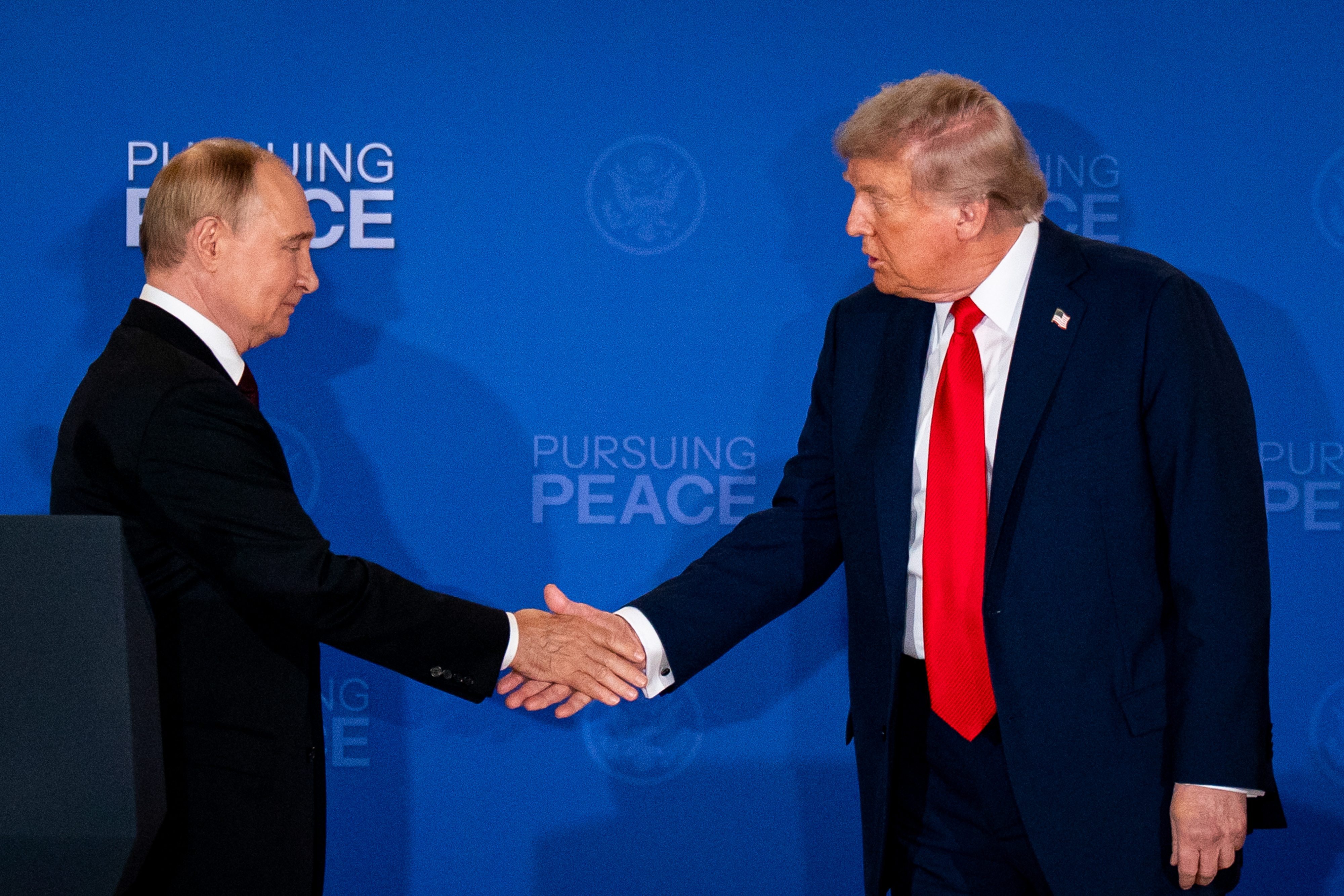
    Vladimir Putin and Donald Trump.

    Yet, in typical contradictory behavior, the Trump administration just halted plans to impose sanctions on China’s Ministry of State Security in response to Salt Typhoon.

    The security plan devotes pages to Trump’s penchant for trade deals and tariffs with Beijing, which it claims will ensure U.S. superiority in advanced technology.

    In another capitulation, however, Trump just agreed that Nvidia can sell advanced H200 chips to China, threatening that very U.S. superiority in advanced technology. Trump apparently wants to avoid displeasing Xi before traveling to Beijing for a summit in April. The president doesn’t want to interfere with his hopes of closing a brilliant trade deal.

    In other words, national security can be ignored when it contradicts the prospect of illusory economic gains — whether it be deals with China or Russia. And the president counts on his brilliance to secure both with his pals Putin and Xi (although he has repeatedly been bested by each of them).

    This fatal flaw is at the heart of NSS 2025.

    But the uglier and more gut-wrenching flaw is the document’s attack on Europe, its democratic values, and its support for Ukraine.

    The 2017 NSS read: “A strong and free Europe is of vital importance to the United States. We are bound together by our shared commitment to the principles of democracy, individual liberty, and the rule of law.”

    The “Promoting European Greatness” section of the new NSS echoes Vice President JD Vance’s tirade against European democracies, which I heard firsthand at the Munich Security Conference in February. Rather than speaking about the Russian war on Ukraine that threatens all of Europe, Vance denounced Germany for not inviting the extreme right, neo fascist Alternative für Deutschland party into a governing coalition.

    The 2025 NSS contends that Europe is on the verge of “civilizational erasure” because of immigration policies; instead, it promotes (white) nationalist, anti-immigration political parties. It slurs the European Union for its multilateralism (which the United States promoted after World War II, and which brought political and economic stability to the continent).

    And instead of supporting NATO allies as Russia attacks them with drones, cuts their underwater cables, and conducts sabotage and assassinations on European soil, the White House blames the Europeans for “regarding Russia as an existential threat.”

    “Our goal,” the document reads, “should be to help Europe correct its current trajectory.”

    There is something truly sick here.

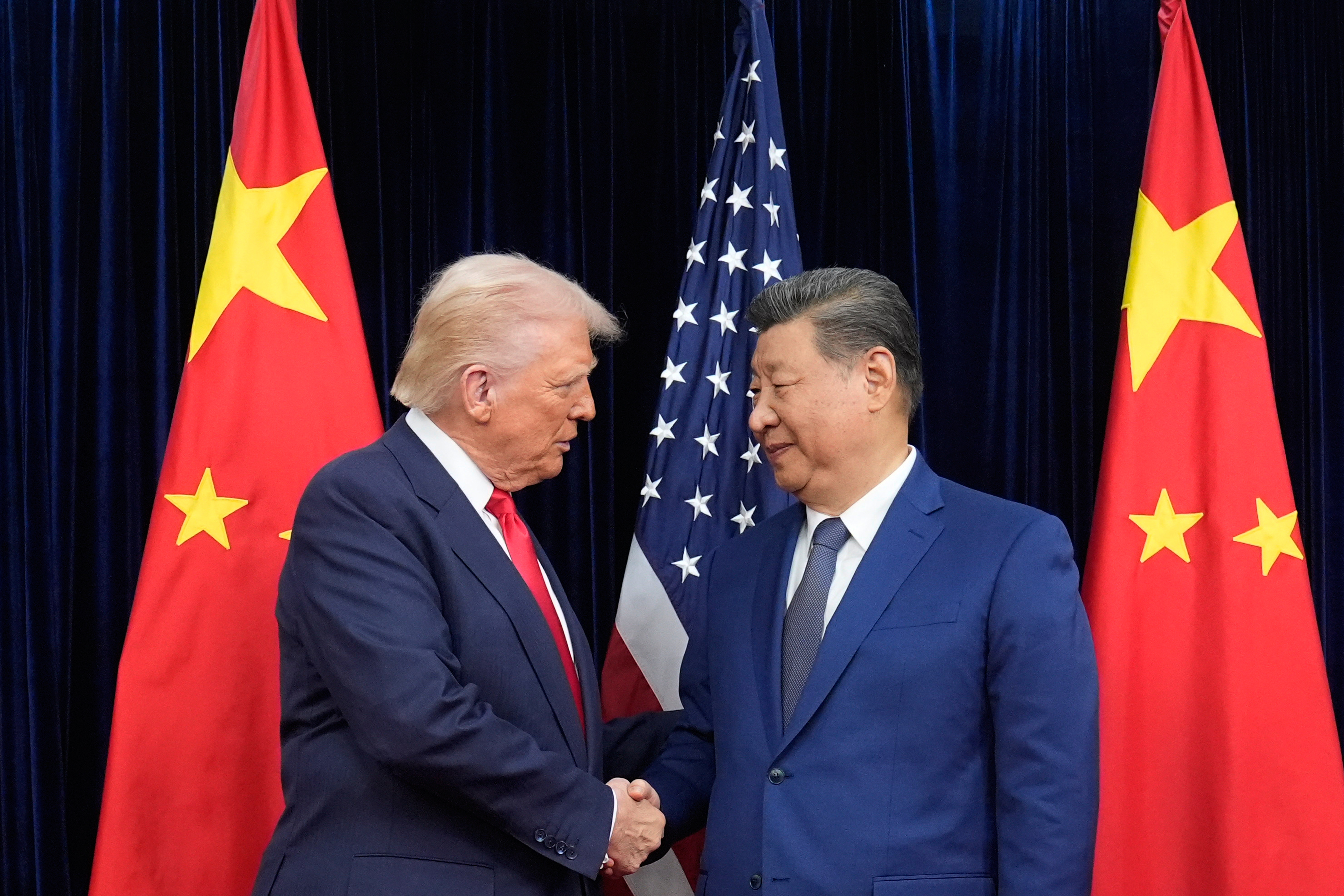
    President Donald Trump and Chinese President Xi Jinping shake hands before their meeting at Gimhae International Airport in Busan, South Korea, in October.

    Trump thinks China and Russia are his potential partners, while Europe is in the way — on Ukraine, on human rights, on warnings about Russia, on its own regulation of technology. Forget about common values or shared commitment to the principles of democracy and the rule of law.

    Unabashed to intervene in domestic European politics, the document calls on Europeans to restore “strategic stability” with Russia, meaning pressure Kyiv into signing a deal that consigns Ukraine to permanent domination by Moscow.

    And the U.S. wants Europe to take over most of NATO’s conventional defense capabilities, from intelligence to missiles by 2027, an impossible feat.

    Moreover, the White House is actively promoting as part of its “security strategy” the success of radical white nationalist parties in Britain, France, Germany, and elsewhere that are pro-Moscow and eager to do any and all business with Beijing. In other words, a Europe led by parties that are hostile to American security interests.

    The NSS 2025 envisions an alliance of authoritarian governments and their imitators, including Russia, China, the United States – and far-right European parties that dislike NATO, want to end the European Union, and prefer deals with dictators to defending democracy.

    This is what Trump advocates, although he doesn’t grasp that it would destroy him as well as his country.

    Fortunately, Europe won’t capitulate, nor will our allies in Asia. Nor would most Americans, I believe, if they only knew what the Trump national security policy is all about.

  • Ale Ayiti: Philly’s Haitian Americans celebrate a rare World Cup bid

    Ale Ayiti: Philly’s Haitian Americans celebrate a rare World Cup bid

    The first World Cup I remember was in 1970. I was a kid in Guatemala, and my brothers and I were so excited. It was the year the Brazilian seleção included Pelé, Jairzinho, Rivellino, Tostão, Gérson, and Zé Maria — there may be no more beautiful example of the sport of soccer than what they showed us.

    The Guatemalan team was not in the World Cup that year (or ever 😢), but El Salvador was, and although they were unlikely to advance very far, we felt a lot of Central American solidarity and rooted for them — the underdoggiest of the underdogs.

    I expect to root for the underdog again next year, when Brazil and Haiti take the field in World Cup play in Philadelphia. Brazil is a five-time world champion; Haiti last competed at this level 52 years ago.

    Philly’s Haitian community doesn’t care if it’s a little lopsided.

    “Most Haitians adore Brazil,” the Rev. Dr. Josephys Dafils told me via email, “and now Haiti will face the mighty Brazil on American soil. This is the thrill and magic of soccer. Haitians and Haitian Americans will travel to be part of this historic moment. Many of us will gather for a tailgate celebration outside the stadium, even without tickets, which are extremely expensive. We will bring food, music, vendors, and a traditional Haitian band called rara.”

    Numa St. Louis agreed: “For Haitian Americans, this event is more than just a game; it’s a moment of immense pride and emotion. As a Haitian American and die-hard soccer fan, the feelings that arise from witnessing Haiti step onto the world stage are overwhelming. It represents a long-cherished dream; a chance for a nation often faced with adversity to showcase its talent, passion, and spirit on an international platform.”

    “The joy of supporting Haiti, coupled with the opportunity to share the occasion with Brazilian fans,” he told me via email, “underscores the camaraderie found in the beautiful game.”

    Dafils, who at one time served as a youth soccer coach in Haiti, said that for the national team to make it to the World Cup at all, they had to overcome almost insurmountable obstacles.

    “Armed groups have taken control of nearly 85% of [Haiti’s] capital, as well as major cities across the country. More than one million Haitians have been forced to flee their homes,” he said. “Many people no longer have access to electricity, clean running water, or food. Families are constantly moving from one neighborhood to another in search of safety. [And] amid this dire situation, the Haitian national soccer team has accomplished the extraordinary.”

    An example of that? They had to play all the qualifying matches outside of Haiti.

    Haiti’s Leverton Pierre controls the ball during a CONCACAF Gold Cup soccer match in June against the United States in Arlington, Texas.

    “I have cried tears of joy since Nov. 18, 2025 — the day Haiti qualified for the 2026 World Cup,” Dafils told me. “Nov. 18 also marks the anniversary of the Battle of Vertières in 1803, when Haiti secured its independence from France. The symbolism is profound.”

    St. Louis makes another historic connection: Next year’s tournament will also coincide with America’s 250th anniversary, adding another layer of significance.

    The Haitian community has a long history in Philadelphia. Hundreds of white slaveholders and those they enslaved fled the Haitian Revolution, first arriving in Philadelphia in 1793; many of those enslaved people gained their freedom here in the years between 1793 and 1796. The community grew and saw waves of immigration throughout the 20th and 21st centuries, prompted by political turmoil and natural disasters.

    It’s estimated that some 12,000 members of the community are currently legally residing under temporary protected status.

    Those Haitian immigrants, like their peers across the U.S., have felt the impact of the singularly ugly lies JD Vance and Donald Trump fabricated about Haitians during the campaign, and after Trump became president, the decision to not renew protected status when it expires in February.

    The shadow of Trump’s immigration policies “loom large” — even over an event like the World Cup match, according to St. Louis.

    “The cancellation of the Temporary Protected Status program threatens to strip many Haitians of their legal ability to remain in the United States, leaving them vulnerable to deportation,” he said. “Furthermore, Haiti is among the 19 countries whose citizens are banned from entering the U.S., which will hinder potential visitors from attending the matches.”

    But he and Dafils always return to the thrill and magic of the World Cup match.

    “It has taken 52 years for Haiti to return to the World Cup. None of us know when we will see this again. I was not yet born in 1974, and I never thought I would witness such a moment,” Dafils said.

    “This match symbolizes hope,” St. Louis said, “a celebration of cultural connections that transcend borders. Even amid political challenges and the looming impact of immigration policies, this gathering promises to foster unity among diverse communities, showcasing the power of sports to uplift and inspire.”

    “As the day approaches, the anticipation grows for what promises to be an exhilarating clash, filled with heartwarming moments, passionate displays, and the acknowledgment of Haiti’s journey,” he added.

    What a beautiful game. Ale Ayiti!

  • Pete Hegseth faces deepening scrutiny from Congress over boat strikes

    Pete Hegseth faces deepening scrutiny from Congress over boat strikes

    WASHINGTON — Pete Hegseth barely squeaked through a grueling Senate confirmation process to become secretary of defense earlier this year, facing lawmakers wary of the Fox News Channel host and skeptical of his capacity, temperament and fitness for the job.

    Just three months later, he quickly became embroiled in Signalgate as he and other top U.S. officials used the popular Signal messaging application to discuss pending military strikes in Yemen.

    And now, in what may be his most career-defining moment yet, Hegseth is confronting questions about the use of military force after a special operations team reportedly attacked survivors of a strike on an alleged drug boat off the coast of Venezuela. Some lawmakers and legal experts say the second strike would have violated the laws of armed conflict.

    “These are serious charges, and that’s the reason we’re going to have special oversight,” said Sen. Roger Wicker of Mississippi, the Republican chair of the Senate Armed Services Committee.

    The scrutiny surrounding Hegseth’s brash leadership style is surfacing what has been long-building discontent in Congress over President Donald Trump’s choice to helm the U.S. military. And it’s posing a potentially existential moment for Hegseth as the congressional committees overseeing the military launch an investigation amid mounting calls from Democratic senators for his resignation.

    Hegseth vowed a ‘warrior culture,’ but lawmakers take issue

    Since working to become defense secretary, Hegseth has vowed to bring a “warrior culture” to the U.S. government’s most powerful and expensive department, from rebranding it as the Department of War to essentially discarding the rules that govern how soldiers conduct themselves when lives are on the line.

    Hegseth on Tuesday cited the “fog of war” in defending the follow-up strike, saying that there were explosions and fire and that he did not see survivors in the water when the second strike was ordered and launched. He chided those second-guessing his actions as being part of the problem.

    Yet the approach to the operation was in line with the direction of the military under Hegseth, a former infantry officer with the Army National Guard, part of the post-Sept. 11 generation, who was deployed to Iraq and Afghanistan and earned Bronze Stars.

    During a speech in September, he told an unusual gathering of top military brass whom he had summoned from all corners of the globe to the Quantico Marine Corps Base in Virginia that they should not “fight with stupid rules of engagement.”

    “We untie the hands of our warfighters to intimidate, demoralize, hunt and kill the enemies of our country,” he said. “No more politically correct and overbearing rules of engagement, just common sense, maximum lethality and authority for warfighters.”

    But now lawmakers and military and legal experts say the Sept. 2 attack borders on illegal military action.

    “Somebody made a horrible decision. Somebody needs to be held accountable,” said Sen. Thom Tillis, a North Carolina Republican who in January held out support for Hegseth until only moments before casting a crucial vote for his confirmation.

    “Secretary Talk Show Host may have been experiencing the ‘fog of war,’ but that doesn’t change the fact that this was an extrajudicial killing amounting to murder or a war crime,” said Sen. Chris Van Hollen, D-Md. “He must resign.”

    Rep. Don Bacon, a Republican who served 30 years active duty in the Air Force, finishing his career at the rank of brigadier general, said he hasn’t been a fan of Hegseth’s leadership. “I don’t think he was up to the task,” Bacon said.

    Will Hegseth keep Trump’s support?

    Trump, a Republican, has largely stood by his defense secretary, among the most important Cabinet-level positions. But the decisions by Wicker, alongside House Armed Services Chair Mike Rogers of Alabama and the top Democrats on the committees, to open investigations provide a rare moment of Congress asserting itself and its authority to conduct oversight of the Trump administration.

    Senate Majority Leader John Thune, R-S.D., who shepherded the defense secretary’s nomination to confirmation, has said the boat strikes are within Trump’s authority as commander in chief — and he noted that Hegseth serves at the pleasure of the president.

    “I don’t have, at this point, an evaluation of the secretary,” Thune said at the start of the week. “Others can make those evaluations.”

    But Hegseth also has strong allies on Capitol Hill, and it remains unclear how much Republicans would actually be willing to push back on the president, especially when they have spent the first year in his administration yielding to his various demands.

    Vice President JD Vance, who cast a rare tiebreaking vote to confirm Hegseth, has vigorously defended him in the attack. And Sen. Eric Schmitt, another close ally to Trump, dismissed criticism of Hegseth as “nonsense” and part of an effort to undermine Trump’s focus on Central and South America.

    “He’s not part of the Washington elite,” said Schmitt, R-Mo. “He’s not a think tanker that people thought Trump was going to pick. … And so, for that reason and others, they just, they don’t like him.”

    Tension between some Republican lawmakers and the Pentagon has been rising for months. Capitol Hill has been angered by recent moves to restrict how defense officials communicate with lawmakers and the slow pace of information on Trump’s campaign to destroy boats carrying drugs off the coast of Venezuela.

    As he defends his job, Hegseth has spoken to both Wicker and Rogers, the top lawmakers overseeing the military. Rogers said he was “satisfied” with Hegseth after that conversation, while Wicker said that he told Hegseth that he would like him to testify to Congress.

    Hegseth at first tried to brush aside the initial report about the strike by posting a photo of the cartoon character Franklin the Turtle firing on a boat from a helicopter, but that only inflamed criticism of him and angered lawmakers who felt he was not taking the allegations seriously.

    Senate Democratic leader Chuck Schumer of New York called Hegseth a “national embarrassment,” adding the defense secretary’s social media post of the cartoon turtle is “something no serious leader would ever think of doing.”

    What information will Congress get?

    Later this week, the chairs of the armed services committees, along with the top Democrats on the committees, will hear private testimony from Navy Vice Adm. Frank “Mitch” Bradley, who the White House has said ordered the second strike on the survivors.

    Republicans have been careful to withhold judgment on the strike until they complete their investigation, but Democrats say that these problems with Hegseth were a long time coming.

    Sen. Tim Kaine, a Virginia Democrat, pointed back to Hegseth’s tumultuous confirmation hearing, at which issues were raised with his management of nonprofits, as well as allegations of a sexual assault and abuse, and drinking on the job. Hegseth had vowed not to consume alcohol if confirmed.

    “You don’t suddenly change your judgment level or change your character when you get confirmed to be secretary of defense,” Kaine said. “Instead, the things that have been part of your character just become much more dire and existential.”

  • Trump’s pro-Kremlin ‘peace’ plan for Ukraine will encourage Putin to wage more war

    Trump’s pro-Kremlin ‘peace’ plan for Ukraine will encourage Putin to wage more war

    The made-in-Moscow 28-point “peace” plan President Donald Trump has been trying to force on Ukraine will never bring peace.

    Even the revisions after last week’s international uproar over the outrageously pro-Russian document haven’t resolved key issues. Putin has already made clear this week that he won’t accept less than Ukrainian surrender.

    Trump is ready to press Ukraine to bow to a plan that guarantees further Russian destruction. Let’s hope the backlash to the proposal stiffens the backbone of GOP supporters of Ukraine against the pro-Russian White House crowd.

    The drama hasn’t ended yet.

    The 28-point plan was cooked up by Trump’s feckless negotiator, Steve Witkoff, and first son-in-law Jared Kushner. Two real estate moguls with zero knowledge of Ukraine wrote a draft plan based heavily on input from Kremlin insider Kirill Dmitriev.

    Dmitriev is Putin’s representative for economic cooperation and has wooed Witkoff and Kushner with fantasies of joint U.S.-Russian investment. The three men met for secret talks in October in Miami, at Witkoff’s home.

    The resulting document reads like Kremlin talking points; some Russia experts point out that the English syntax sounds as if it were google translated directly from the Russian text.

    “Even Neville Chamberlain would blush at this,” said Rep. Don Bacon (R-NE), referencing the British prime minister who infamously appeased Adolph Hitler. “It’s embarrassing to our country.”

    Painfully true.

    The deal demands suicidal concessions from Ukraine, the victim of Russian aggression, but none from the Russia invader. The points echoed a Putin wish list, and green-light Moscow’s complete subordination of Ukraine, by shrinking Kyiv’s army, limiting its alliances and weapons, and leaving it wide-open to future Russian attacks.

    Trump was — and still is — ready to sell out Kyiv in pursuit of an imaginary Nobel Peace Prize along with lucrative business deals with Moscow and predatory deals for Ukrainian minerals (both are touted in the plan).

    In clear evidence of Russian untrustworthiness, Dmitriev leaked the proposal last week to journalist Barak Ravid of Axios in order to box in the Americans before consultations with Ukraine. Yet Trump quickly endorsed this capitulation document.

    Dmitriev’s betrayal alone should disqualify him from further negotiations, but there’s no sign Witkoff will abandon his new Russian pal. As for Witkoff and Kushner, Trump is rewarding their blunders by sending them to meet Putin next week.

    Russian President Vladimir Putin’s envoy Kirill Dmitriev (left) and President Donald Trump’s special envoy Steve Witkoff attend talks in St. Petersburg, Russia, in April.

    How do we know for sure that Dmitriev was the leaker? Because Witkoff posted on X, “He [Axios’ Ravid] must have got this from K …,” meaning Kirillov. Apparently, Witkoff thought he was sending a private message, another sign he isn’t up to the job.

    Equally egregious, Secretary of State Marco Rubio, who does know something about Russia, was kept out of the loop by Witkoff. After the leak, he got a firestorm of complaints from upset European counterparts and GOP supporters of Ukraine. That led him to call Sen. Mike Rounds (R., N.D.), who was at an international security conference in Halifax, Nova Scotia, along with a bipartisan Senate delegation.

    Rounds recounted to journalists that Rubio described Witkoff’s plan as a Russian “wish list” and not an actual U.S. proposal. Under White House pressure, Rubio soon reversed himself and posted online that the senators were mistaken. A State Department spokesperson falsely accused the senators of lying

    I spoke to Sen. Chris Coons (D., Del.), who was with the delegation during the call (although not on the phone). “I heard what [my colleagues] said immediately after the call,” he told me. “They couldn’t have been clearer about what Marco said, and what the complications were. I hope after today we’ll see a proposal which enables Ukraine to remain free and sovereign and defend itself in the future.”

    With this White House, don’t hold your breath.

    The pushback from GOP backers of Ukraine, as well as from the EU and Kyiv, was so intense, however, that Rubio rushed to “update” the document in weekend negotiations with Ukrainian officials in Geneva.

    Very sensitive issues remain unresolved, yet Trump is still pressuring Kyiv to sign on this month. There is an acute danger that he and Vice President JD Vance may try again to bushwhack Ukraine’s Volodymyr Zelensky, who will probably visit the White House this month.

    European allies, who were not consulted on the deal, have been desperately trying to bolster Zelensky and get Trump’s ear.

    In this image taken from video provided by Russian Presidential Press Service on Nov. 20, Russian President Vladimir Putin speaks as he visits one of the command posts of the West group of Russian Army in an undisclosed location.

    But given the president’s eagerness for a “deal” — any deal, no matter how fatal to Ukraine — Trump is more likely to squeeze Kyiv than press Putin for concessions. Russian Foreign Minister Sergey Lavrov made clear this week that Putin is only interested in the original pro-Russian points, and not any revision that protects Ukraine from future attack.

    It’s important for Americans to understand why the Putin-Trump 28-point deal wouldn’t stop Russian aggression and would only encourage Moscow to continue the war.

    As former Ukrainian Defense Minister Andriy Zagorodnyuk pointed out: “Ukraine has never attempted to seize Russian territory. Russia, on the other hand, has repeatedly invaded Ukraine and continues to strike Ukrainian cities daily.”

    The bottom line for achieving peace is that any plan must strengthen Ukraine’s defenses and provide concrete U.S. guarantees that Russia won’t destroy the Ukrainian state in the future. The 28-point plan does just the opposite (and the revisions aren’t strong enough.)

    The Kirillov proposal shrinks the size of the Ukrainian army by a third while putting no limits on Russia’s army, which is roughly twice the size of Ukraine’s. It prevents Ukraine from ever joining NATO and forbids NATO peacekeepers on its soil.

    Imagine if Franklin Delano Roosevelt had endorsed a peace plan between Winston Churchill and Hitler in 1940 that left Hitler free to expand his army while demanding Churchill halve his forces, ground his Spitfires, and promise never to ask the Yanks for help.

    Which brings us to the ugliest part of Trump’s fake peace efforts. There is a lot of loose verbiage about “guarantees” against a future Russian invasion in the 28 points, and in a side letter offering Kyiv a “security assurance modeled on the principles of [NATO’s] Article 5.” Note the weasel words.

    Let me assure you, I have read and reread the texts, and they offer Ukraine no firm U.S. or allied commitment to intervene if Russia attacks again.

    The real hint of the worthlessness of this Kremlin-born document comes with point 16, which proclaims: “Russia will enshrine in law its policy of non-aggression toward Europe and Ukraine.”

    Does Trump not know Putin has violated every accord he or his predecessors signed with Kyiv. That includes the 1994 Budapest Memorandum by which Ukraine surrendered its nuclear weapons in exchange for guarantees of sovereignty from the U.S., the U.K., and Russia? We know how much those paper assurances have been worth.

    POTUS refuses to face reality: Putin respects only strength; there will be no peace until the costs of war are more than the Russian economy and military can bear.

    Peace negotiations are worthless unless backed by tougher U.S. sanctions and sales of U.S. air defense systems and missiles to Ukraine.

    By his continual concessions to Moscow, Trump has convinced the Russian leader that he is a weak pushover. That guarantees that Russia will continue the war.

  • Vance criticizes Israel’s parliament vote on West Bank annexation, says the move was an ‘insult’

    Vance criticizes Israel’s parliament vote on West Bank annexation, says the move was an ‘insult’

    JERUSALEM — U.S. Vice President JD Vance criticized on Thursday a symbolic vote in Israel’s parliament the previous day about annexing the occupied West Bank, saying it amounted to an “insult” and went against the Trump administration policies.

    Hard-liners in the Israeli parliament had narrowly passed a preliminary vote in support of annexing parts of the West Bank — an apparent attempt to embarrass Prime Minister Benjamin Netanyahu while Vance was still in the country.

    The bill, which required only a simple majority of lawmakers present in the house on Wednesday, passed with a 25-24 vote. But it was unlikely to pass multiple rounds of voting to become law or win a majority in the 120-seat parliament. Netanyahu, who is opposed to it, also has tools to delay or defeat it.

    Before departing Israel, Vance also unveiled new details about U.S. plans for Gaza, saying he expected reconstruction to begin soon in some “Hamas-free” areas of the territory. But he warned that rebuilding the territory after a devastating two-year war could take years.

    “The hope is to rebuild Rafah over the next two to three years and theoretically you could have half a million people live (there),” he said, speaking of the strip’s southernmost city.

    That would account for about a quarter of Gaza’s population of roughly 2 million, 90% of whom were displaced from their homes during the war. Out of every 10 buildings that stood in Gaza prewar, eight are either damaged or flattened. An estimated cost of rebuilding Gaza is about $53 billion, according to the World Bank, the U.N. and the European Union.

    Vance says the vote was an ‘insult’

    The Israeli parliament’s vote has stirred widespread condemnation, with over a dozen countries — including Egypt, Qatar and Saudi Arabia — rebuking it in a joint statement that called all Israeli settlements in the West Bank a violation of international law.

    Netanyahu’s office said in a statement that the “vote on annexation was a deliberate political provocation by the opposition to sow discord.”

    Netanyahu is struggling to stave off early elections as cracks grow more apparent between factions in Israel’s right-wing parties, some of whom were upset over the ceasefire and the security sacrifices it required of Israel.

    Vance said that if the Knesset’s vote was a “political stunt, then it is a very stupid political stunt.”

    “I personally take some insult to it,” Vance said. “The policy of the Trump administration is that the West Bank will not be annexed by Israel.”

    The deputy Palestinian ambassador to the United Nations, Majed Bamya, told the U.N. Security Council on Thursday that Palestinians “appreciate the clear message” the Trump administration has sent in opposition to annexation.

    While many members of Netanyahu’s coalition, including his Likud Party, support annexation, they have backed off those calls since U.S. President Donald Trump said last month that he opposes such a move.

    The Palestinians seek the West Bank and the Gaza Strip, captured by Israel in the 1967 Mideast war, for a future independent state. Israeli annexation of the West Bank would all but bury hopes for a two-state solution between Israel and the Palestinians — the outcome supported by most of the world.

    Analysts like Amichai Cohen, a senior fellow at the Israel Democracy Institute, say that a “de-facto annexation of very large parts” of the West Bank is already underway, referring to the growing number of Israelis living in settlements in the Palestinian territory — even without any law supporting annexation.

    Intense U.S. push toward peace

    Earlier this week, Vance announced the opening of a civilian military coordination center in southern Israel where some 200 U.S. troops are working alongside the Israeli military and delegations from other countries planning the stabilization and reconstruction of Gaza.

    The United States is seeking support from other allies, especially Gulf Arab nations, to create an international stabilization force to be deployed to Gaza and train a Palestinian force.

    “We’d like to see Palestinian police forces in Gaza that are not Hamas and that are going to do a good job, but those still have to be trained and equipped,” U.S. Secretary of State Marco Rubio said ahead of his trip to Israel.

    Rubio, who was meeting with Netanyahu on Thursday evening, has also criticized Israeli far-right lawmakers’ effort to push for the annexation of the West Bank.

    Israeli media referred to the nonstop parade of American officials visiting to ensure Israel holds up its side of the fragile ceasefire as “Bibi-sitting.” The term, utilizing Netanyahu’s nickname of Bibi, refers to an old campaign ad when Netanyahu positioned himself as the “Bibi-sitter” whom voters could trust with their kids.

    Gaza’s dire need for medical care and aid

    In the first medical evacuation since the ceasefire began on Oct. 10, the head of the World Health Organization said Thursday the group has evacuated 41 critical patients and 145 companions out of the Gaza Strip.

    In a statement posted to X, Tedros Adhanom Ghebreyesus called on nations to show solidarity and help some 15,000 patients who are still waiting for approval to receive medical care outside Gaza.

    His calls were echoed by an official with the U.N. Population Fund who on Wednesday described the “sheer devastation” that he witnessed on his most recent travel to Gaza, saying that there is no such thing as a “normal birth in Gaza now.”

    Andrew Saberton, an executive director at UNFPA, told reporters how difficult the agency’s work has become due to the lack of functioning or even standing health care facilities.

    Another major challenge since the ceasefire began has been getting enough aid into Gaza — and distributed — to the meet the huge demand.

    “We expected Gaza to be flooded with aid the moment the ceasefire began. But that’s not what we’re seeing,” said Bushra Khalidi, who oversees the Palestinian territories division at Oxfam, a nonprofit focused on global poverty.

    More crossings into Gaza need to be opened in order to allow in more trucks, said Antoine Renard, head of the World Food Program in the Palestinian territories.

    “With only two crossings that are open, you are facing clearly congestion,” he said.

    The WFP has 36 distribution centers operating in Gaza, and aims to increase that to 145. Since Oct 11, the U.N. tracking system has recorded 949 aid trucks that were offloaded in Gaza.

  • Vance expresses optimism about the ceasefire in Gaza while noting ‘very hard’ work to come

    Vance expresses optimism about the ceasefire in Gaza while noting ‘very hard’ work to come

    KIRYAT GAT, Israel — Vice President JD Vance on Tuesday called progress in Gaza’s fragile ceasefire better than anticipated but acknowledged during an Israel visit the challenges that remain, from disarming Hamas to rebuilding a land devastated by two years of war.

    Vance noted flare-ups of violence in recent days but said the ceasefire between Israel and Hamas that began on Oct. 10 is going “better than I expected.” The Trump administration’s Middle East envoy, Steve Witkoff, added that “we are exceeding where we thought we would be at this time.”

    They visited a new center in Israel for civilian and military cooperation as questions remain over the long-term plan for peace, including when and how an international security force will deploy to Gaza and who will govern the territory after the war.

    Vance tried to downplay any idea that his visit — his first as vice president — was urgently arranged to keep the ceasefire in place. He said he feels “confident that we’re going to be in a place where this peace lasts,” but warned that if Hamas doesn’t cooperate, it will be “obliterated.”

    Jared Kushner, President Donald Trump’s son-in-law and one of the architects of the ceasefire agreement, noted its complexity: “Both sides are transitioning from two years of very intense warfare to now a peacetime posture.”

    Vance is expected to stay in the region until Thursday and meet with Israeli Prime Minister Benjamin Netanyahu and other officials.

    On Tuesday, Netanyahu fired his national security adviser, Tzachi Hanegbi, but gave no reason for the decision. Israeli media said Hanegbi had opposed the renewal of Israel’s Gaza offensive in March, and Israel’s failed attempt to assassinate Hamas’ leadership in an airstrike in Qatar in September. In a statement, Hanegbi noted “times of disagreement” with Netanyahu.

    Hamas hands over remains of 2 more hostages

    Late Tuesday, Israel’s military said the remains of two more Gaza hostages had been returned to Israel, where they would be identified.

    Since the ceasefire began on Oct. 10, the remains of 15 hostages have been returned to Israel. Another 13 still need to be recovered in Gaza and handed over.

    On his visit to Israel Tuesday, Vance urged a “little bit of patience” amid Israeli frustration with Hamas’ pace of returning the hostages.

    “Some of these hostages are buried under thousands of pounds of rubble. Some of the hostages, nobody even knows where they are,” Vance said.

    Israel is releasing 15 Palestinian bodies for the remains of each dead hostage, according to Gaza’s Health Ministry. It said Tuesday that Israel had so far transferred 165 bodies since earlier this month.

    As he faced journalists’ questions over the ceasefire’s next steps, he said “a lot of this work is very hard” and urged flexibility.

    “Once we’ve got to a point where both the Gazans and our Israeli friends can have some measure of security, then we’ll worry about what the long-term governance of Gaza is,” he said. ”Let’s focus on security, rebuilding, giving people some food and medicine.”

    Although some 200 U.S. troops were recently sent to Israel, Vance emphasized that they would not be on the ground in Gaza. But he said officials are beginning to “conceptualize what that international security force would look like” for the territory.

    He mentioned Turkey and Indonesia as countries expected to participate. The flags of Jordan, Germany, Britain, and Denmark were on the stage where he spoke. Britain said late Tuesday it would send a small contingent of military officers to Israel to assist in monitoring the ceasefire.

    While the ceasefire has been tested by fighting and mutual accusations of violations, both Israel and Hamas have said they are committed to the deal.

    Aid into Gaza increases, while prices rise

    International organizations said they were scaling up humanitarian aid entering Gaza, while Hamas-led security forces cracked down against what it called price gouging by private merchants.

    The World Food Program said it had sent more than 530 trucks into Gaza in the past 10 days, enough to feed nearly half a million people for two weeks. That’s well under the 500 to 600 that entered daily before the war.

    The WFP also said it had reinstated 26 distribution points across Gaza and hopes to scale up to its previous 145 points as soon as possible.

    Residents said prices for essential goods soared on Sunday after militants killed two Israeli soldiers and Israel responded with strikes that killed dozens of Palestinians. Israel also threatened to halt humanitarian aid.

    At a market in the central city of Deir al-Balah, a 55-pound package of flour was selling for more than $70 on Sunday, up from about $12 shortly after the ceasefire. By Tuesday, the price was around $30.

    Mohamed al-Faqawi, a Khan Younis resident, accused merchants of taking advantage of the perilous security situation. “They are exploiting us,” he said.

    On Monday, Hamas said its security forces raided shops across Gaza, closing some and forcing merchants to lower prices. Hamas also has allowed aid trucks to move safely and halted looting of deliveries.

    Nahed Sheheiber, head of Gaza’s private truckers’ union, said there was no stealing aid since the ceasefire started.

    But other significant challenges remain as Gaza’s financial system is in tatters. With nearly every bank branch and ATM inoperable, people pay exorbitant commissions to a network of cash brokers to get money for daily expenses.

    On Tuesday, dozens of people in Deir al-Balah spent hours in line at the Bank of Palestine hoping to access their money but were turned away.

    “Without having the bank open and without money, it does not matter that the prices [in the market] have dropped,” said Kamilia Al-Ajez.

    Gaza doctors say bodies returned with signs of torture

    A senior health official in Gaza said some bodies of Palestinians returned by Israel bore “evidence of torture” and called for a United Nations investigation.

    Muneer al-Boursh, the health ministry’s general director, said on social media late Monday that some had evidence of being bound with ropes and metal shackles, and had deep wounds and crushed limbs.

    It was not immediately clear if any of the bodies had been prisoners; they are returned without identification or details on how they died. The bodies could include Palestinian detainees who died in Israeli custody or bodies taken out of Gaza by Israeli troops during the war.

    The Israel Prisons Service denied that prisoners had been mistreated, saying it had followed legal procedures and provided medical care and “adequate living conditions.”

    Israeli hostages released from Gaza have also reported metal shackles and harsh conditions, including frequent beatings and starvation.

    In the 2023 attack on Israel that started the war, Hamas-led militants killed around 1,200 people, mostly civilians, and abducted 251 people as hostages.

    The Israel-Hamas war has killed more than 68,000 Palestinians, according to Gaza’s Health Ministry, which does not distinguish between civilians and combatants in its count. The ministry maintains detailed casualty records that are seen as generally reliable by U.N. agencies and independent experts. Israel has disputed them without providing its own toll.