While America has been obsessing over Jeffrey Epstein, Vladimir Putin has been making dangerous headway in Ukraine — and expanding his war into Europe.
Under such circumstances, genuine peace negotiations are impossible because Putin thinks he is winning. America’s top foreign policy priority should be to reverse the Russian leader’s mindset by increasing military sales to Ukraine — which the Europeans will pay for.
Instead, the Trump team and Russian officials together have drawn up a new 28-point “peace” plan, without first consulting Ukraine or European allies. This pro-Russian plan calls for major Ukrainian concessions and would leave the country naked to further Russian aggression.
The White House has already denied Ukraine the weapons that could still stop the Russians, thereby effectively helping Putin slaughter Ukrainian civilians nightly with missiles and drones that target apartment buildings and heating systems.
In pursuit of his mythical Nobel Peace Prize, Trump appears poised, yet again, to sell out Ukraine. If so, he will also be selling out our European allies — and the United States.
Most Americans don’t realize Russia is already at war with Europe. This new mode of hybrid warfare is carried out on land, air, and sea, but without ground troops — yet. Moscow is frequently using drones to shut down airports in Germany, Denmark, Norway, Belgium, and Poland. Russian hackers are attacking European networks.
Russian ships are cutting Europe’s underwater cables, its warplanes are invading European airspace and buzzing military planes, and its saboteurs are carrying out assassinations and arson attacks, including failed plans to bring down European airliners.
Because this war is unconventional, and hitting individual countries in Europe, the European Union and its members haven’t yet figured out how to respond.
Putin seeks not only to frighten Europeans but to unnerve Americans, as well. U.S. intelligence agencies concluded last year that failed Russian arson attempts on planes were a “test run” for using similar devices on transatlantic cargo shipments, according to the Washington Post. And Putin frequently hints at nuclear war against the West.
Has Trump denounced such behavior, or warned Putin to stop his attacks on U.S. allies? Nyet. Only occasional grumbling has been heard from the White House.
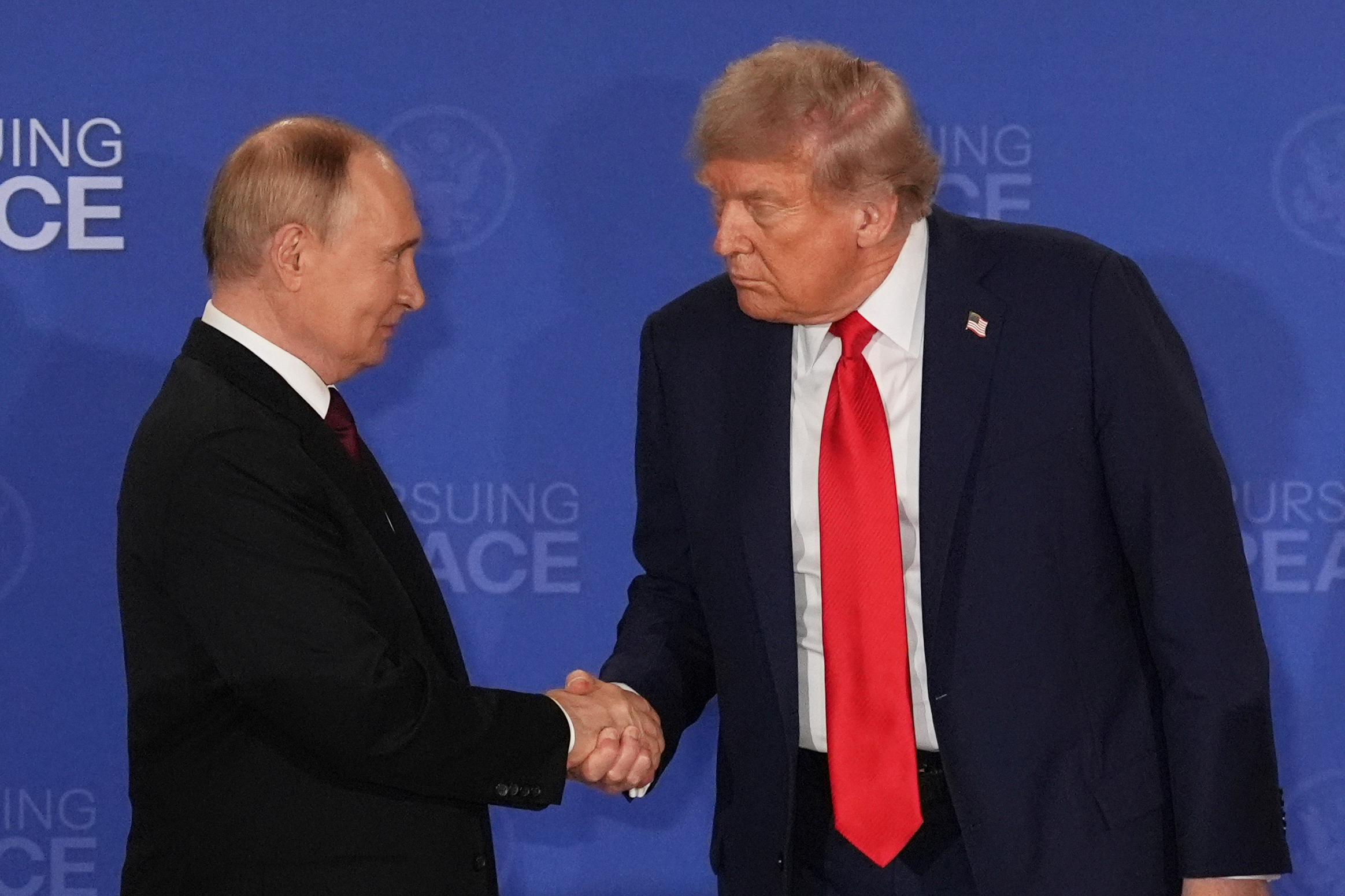
President Donald Trump shakes the hand of Russia’s President Vladimir Putin during a joint press conference at Joint Base Elmendorf-Richardson, Alaska, in August.
The president probably never even took briefings on Russian sabotage. Anything negative about Putin is rebuffed as the “Russia, Russia, Russia hoax.”
Instead, Trump has been busy misusing U.S. forces to threaten war on Venezuela (which poses no military threat to America, and contrary to Trump’s claims, ships no fentanyl to U.S. shores). Perhaps this wag-the-dog war is meant to scare a weak Nicolás Maduro.
But Trump has made clear he doesn’t dare (or want to) stand up to Putin.
His new secondary sanctions on Russian oil sales haven’t been seriously pursued against India or China, which buy huge and increasing shares of Russian oil and gas.
Moreover, as Moscow takes advantage of Ukraine’s dire shortage of man power, air defenses, and long-range missiles, Trump refuses to help. Even though Europe has pledged to pay for key weapons systems for Kyiv, Trump won’t sell them.
Although Ukraine makes an array of drones, they can’t shoot down ballistic missiles or cope with Russia’s current mass production of drones, helped by thousands of North Korean workers and endless shipments of parts from China.
Promised U.S.-made Patriot air defense systems, which could take out the ballistic missiles, have never arrived in Ukraine. Only this week, after a nine-month delay, did Washington permit Kyiv to once again fire long-range U.S.-made ATACMS missiles. Defense Secretary Pete Hegseth had banned their use early this year.
And most cowardly, after hinting for months that he would send desperately needed long-range Tomahawk missiles to Ukraine, Trump finally came out with a big “No Tomahawks.”
There’s more. Although Ukraine is a world champion producer of all varieties of drones, and the United States lags far behind in unmanned warfare, Trump has yet to conclude a much-discussed drone deal with Volodymyr Zelensky, whereby Ukraine would swap drones, technology, and testing for U.S. weapons.
Such White House blindness — and weakness — convinces Putin he can get away with destroying Ukraine.
Russian President Vladimir Putin and President Donald Trump’s special envoy Steve Witkoff (right) shake hands during their meeting in Moscow in August.
And so the Russian leader is doing with a disastrous plan pushed by Trump’s supremely naive negotiator, real estate mogul Steve Witkoff, who has has no grasp of Putin’s history or goals and seems to swallow his lies whole.
Witkoff’s draft plan would reportedly require Ukraine to give up the 14 per cent of the Donbas region it still controls, and cut the size of its armed forces by half. It would require Ukraine to abandon key categories of weapons, endorse a permanent rollback of vital U.S. assistance including long-range weapons, and ban foreign troops from basing on Ukrainian soil.
And the deal provides no U.S. guarantees except lip service to protect against Putin’s certain violations in the future.
Trump might as well say publicly that he endorses Putin’s dream of swallowing Ukraine. He is effectively telling Ukraine and Zelensky: Drop Dead.
Putin isn’t fighting for a piece of land. He wants to absorb Ukraine back into the Russian empire.
Viktor Medvedchuk, a Ukrainian traitor and close Putin ally, whom the Russian president wanted to install in Zelensky’s place after the invasion, recently spelled out Kremlin goals to the official TASS newswire. He said that Ukraine will not “survive as a state” in the future, and Moscow considers the reunification of Ukraine with Russia a strategic goal.
Trump clearly doesn’t care.
The administration is pushing to strip language from an annual U.N. General Assembly Human Rights Committee resolution that recognizes Ukraine’s territorial integrity and rights as a sovereign nation. The U.S. delegation will vote against anything that condemns Putin.
Trump has made clear he believes Putin bears no blame for invading Ukraine (it’s all Zelensky’s fault or even Joe Biden’s). He has crossed over totally to the Russian dictator’s camp.
Unless he wakes up from his Putin-induced trance, he is incapable of making peace.
Although things look bleak for Ukraine, I believe its fighters will manage to hold back the Russians this winter, but at a brutal cost to civilians’ and soldiers’ lives. Trump will bear much blame for the suffering to come.
But after the Epstein-induced awakening of GOP members of Congress, I hope some Republican senators will find the courage to denounce Trump’s attempt to hand over Ukraine to Russia.
They should recognize that the retort of Rep. Marjorie Taylor Greene (R., Ga.) after Trump called her a traitor also applies to his position on Ukraine.
“Let me tell you what a traitor is. A traitor is an American [who] serves foreign countries and themselves,” Greene said. With his heedless pursuit of Putin and a peace prize, Trump is serving the Kremlin, in service to his ego, as he attempts to sacrifice Ukraine.
The turning point in Pennsylvania’s budget impasse, by Gov. Josh Shapiro’s telling, came just before Halloween, when he and leaders in Harrisburg gathered in his stately, wood-paneled office to meet twice daily to hash out a deal to end the bitter, monthslong stalemate.
The long grind eventually led to compromises 135 days in, and a deal Shapiro said he thinks is far better than what national Democrats, hoping to extend healthcare subsidies, got in Washington at the end of the federal shutdown.
“Sometimes you’ve got to show that you’re willing to stay at the table and fight and bring people together in order to deliver,” Shapiro told The Inquirer in an interview Friday, touting the state budget agreement finally signed that week.
“I think it’s a stark contrast, frankly, with what happened in D.C., where they didn’t stay at the table, they didn’t fight, and they got nothing,” he said.
Washington is controlled by Republicans, while in Pennsylvania, Democrats control the state House and governorship, and Republicans hold a majority in the Senate.
Both state and federal budgets were signed the same day, offering Pennsylvanians relief from more than a month of government dysfunction at two levels. But for Shapiro — an exceedingly popular Democratic governor facing reelection in 2026 as whispers swirl over his potential 2028 presidential ambitions — the moment was bigger than a procedural win. In the end, Shapiro, preaching his oft-used slogan of “getting things done,” cast the outcome as proof he can muscle through gridlock of a divided legislature, cut deals under pressure, and hold firm where others cave.
So what if it took almost five months? Shapiro argues. At least he didn’t fold.
“I would have hoped to have gotten this budget done, you know, 100 or so days earlier,” Shapiro said, putting pen to paper in the state Capitol building’s baroque reception room last week. “But I think what you also saw was the result of having the courage to stay at the table and keep fighting for what you believe in. And we got a lot more than we gave in this budget.”
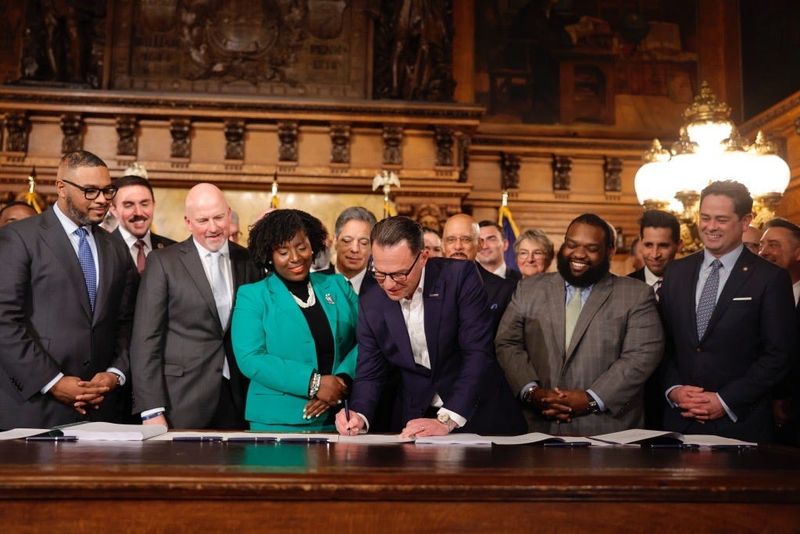
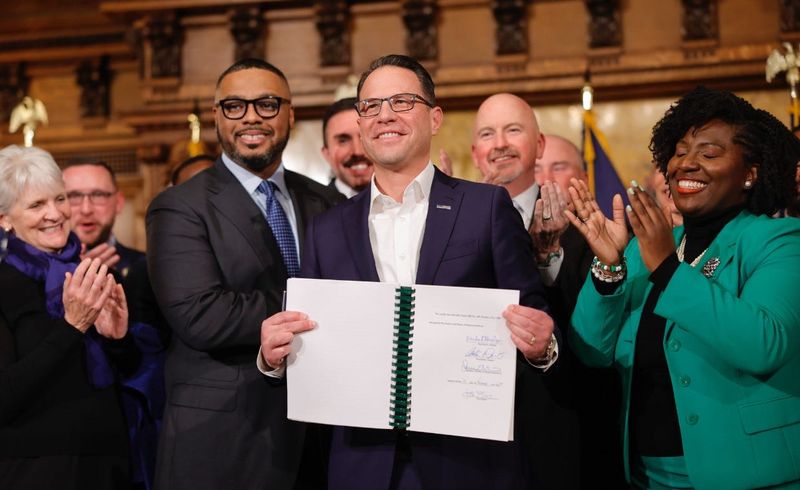
Gov. Josh Shapiro signs the fiscal year 2025-26 budget surrounded by General Assembly members on Nov. 12 at the Capitol in Harrisburg. The state budget had been due June 30, and Pennsylvania the final state in the country to approve a funding deal.
Critics are quick to note it took the self-proclaimed dealmaker so long to get a deal. Counties, school districts, and nonprofits struggled through four months without state payments while officials remained at loggerheads.Pennsylvania was the last state in the nation to pass a spending plan for the 2025-26 fiscal year.
“He’s five months late. He’s the governor of the fifth-biggest state in the country and the last state to get a budget done,” GOP consultant Vince Galko said. “It’s not a failing grade because it got done, but it’s still a D.”
‘A tremendous cost’
The $50.1 billion budget includes several key priorities for Shapiro and Democrats: significant increases in public education funding, a new tax credit for lower- and middle-income residents, continuation of a popular student-teacher stipend, and other economic and workforce development initiatives.
House Speaker Joanna McClinton (D., Philadelphia) heaped praise on Shapiro during a Monday news conference celebrating the budget’s new Working Pennsylvanians tax credit. “I am grateful that here in Harrisburg we have a hero among us for working families, and his name is Josh Shapiro.”
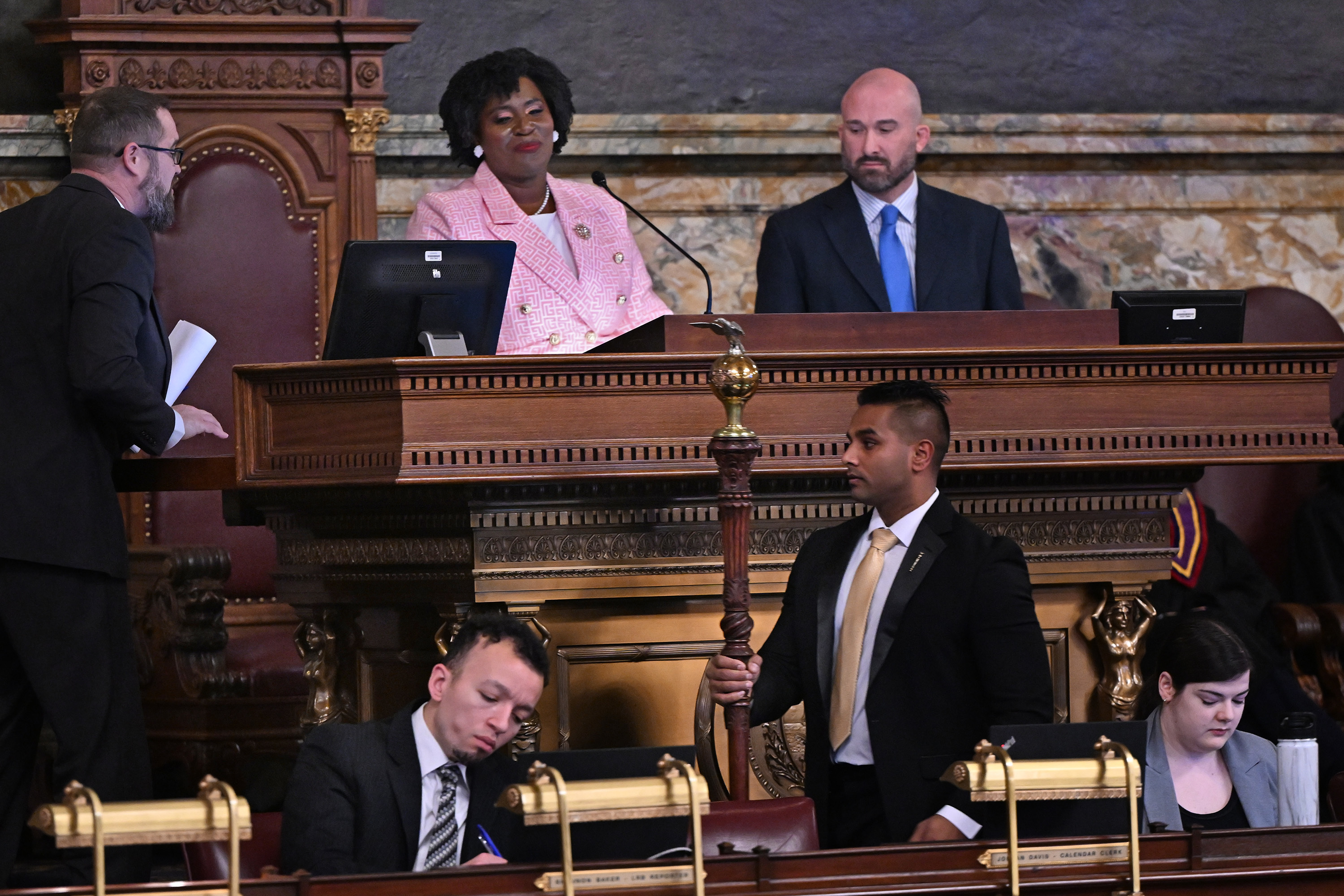
State Rep. Joanna McClinton (D., Philadelphia) is on the rostrum in the House chamber on Jan. 7 after she was reelected speaker of the House despite an initial 101-101 tie vote along party lines.
State Sen. Nikil Saval, a progressive lawmaker who represents part of Philadelphia, was one of a handful of Democrats to vote against the bipartisan Pennsylvania budgetbill that was largely lauded by Democrats and Republicans in Harrisburg and beyond. Saval applauded the school funding, anti-violence grant funding, and childcare support but slammed the absence of transit funding and Democrats’ agreement to end their pursuit to join a key climate program.
“Unfortunately, it comes at this tremendous cost,” he said.And ultimately, Saval said, the finished product didn’t seem to justify the time it took to get there.
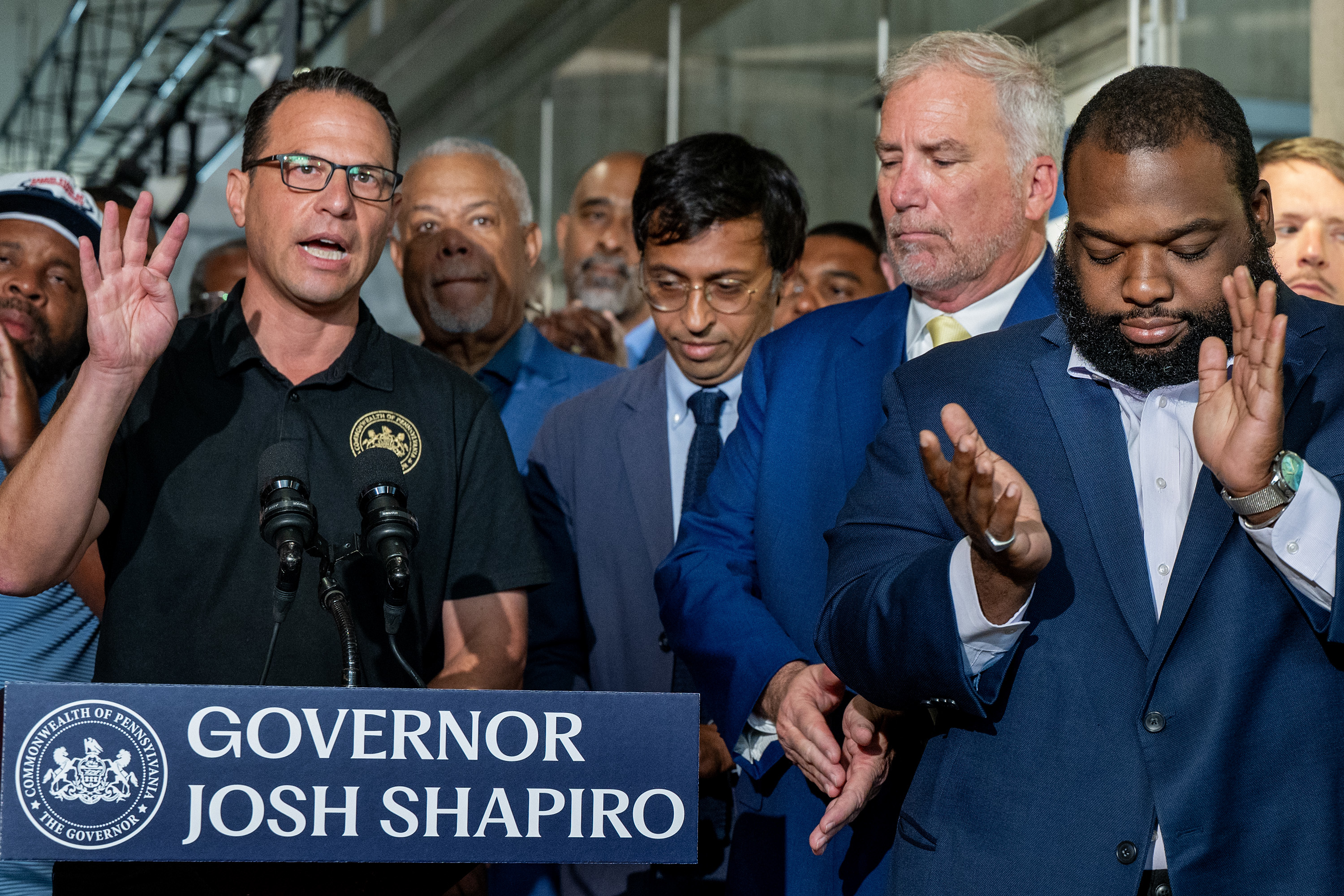
Gov. Josh Shapiro visits SEPTA headquarters on Aug. 10 to discuss funding for the transit agency. To his right, from left, are state Democratic legislators Sen. Anthony H. Williams; Sen. Nikil Saval; Rep. Ed Neilson; and Rep. Jordan Harris.
It was not just transit funding that took a back seat to get the budget deal over the line. To thedelight of Republicans — and the chagrin of some progressive Democrats and the climate-conscious — the deal also pulled the state out of the Regional Greenhouse Gas Initiative, a cooperative among states to reduce carbon emissions.
“For years, the Republicans who have led the Senate have used RGGI as an excuse to stall substantive conversations about energy,” Shapiro said. “Today, that excuse is gone.”
The powerful Pennsylvania Building and Construction Trades Council had lobbied heavily for lawmakers to walk away from the initiative, and it was a top win for state Republicans, who have long said the state should not join the multistate cap-and-trade emissions program they see as hamstringing Pennsylvania’s energy industry from accessing the state’s plentiful natural resources.
‘Two-a-days’
Shapiro said he spent months “running back and forth” to broker a deal between Senate Majority Leader Joe Pittman (R., Indiana) and House Majority Leader Matt Bradford (D., Montgomery). The three met on-and-off in private talks, attempting to hammer out a compromise between the Democratic House and Republican-controlled Senate. But the week of Oct. 27, more than four months into the stalemate, Shapiro said a “breakthrough” finally came when he broadened the talks to include McClinton and Ward.
Minority leaders Rep. Jesse Topper (R., Bedford) and Sen. Jay Costa (D., Allegheny) also joined the group, as it became clear that neither of the tightly controlled chambers would have the votes needed to pass a final budget deal.
The group met twice daily in a conference room in Shapiro’s office. Shapiro, always a fan of the sports metaphor, called the meetings “two-a-days.”
“We would come in the morning, go over the issues. We’d have our homework for a few hours, then come back in the afternoon and talk about, you know, the progress that we made,” Shapiro said. Coming out of that week, the governor said, leaders “had a clear direction on where we were going to go.”
Pennsylvania Lt. Gov. Austin Davis and Gov. Josh Shapiro show a budget document moments after it was signed Nov. 12 while surrounded by legislators at the state Capitol. A deal struck Nov. 12 ended a budget delay that lasted more than four months.
At the negotiating table, Shapiro served as “referee and facilitator” between House Democrats and Senate Republicans, McClinton said in an interview Monday.
“The man is nothing if not dogged and determined,” Bradford said of Shapiro last week.
Two officials in the closed-door talks said Topper’s presence, as the House minority leader who understands House Democrats and Senate Republicans, helped change the dynamic and got leaders on track toward a deal. Other officials in negotiations noted that once the state’s two top leaders — McClinton and Ward, who are both the first women to serve in their roles — the breakthrough deal swiftly came together.
Topper, for his part, didn’t try to take credit for striking the final budget deal, calling himself “a neutral arbiter” and “someone all sides can trust to have an honest dialogue.”
There were other signs of tensions easing as the legislators worked through the fall. Ward, a top critic of Shapiro since he reneged on a promise he made over school vouchers during his first budget negotiations, joined the conversations. The two had not met in person since 2023, and had barely communicated. Suddenly, they were sitting across from one another.
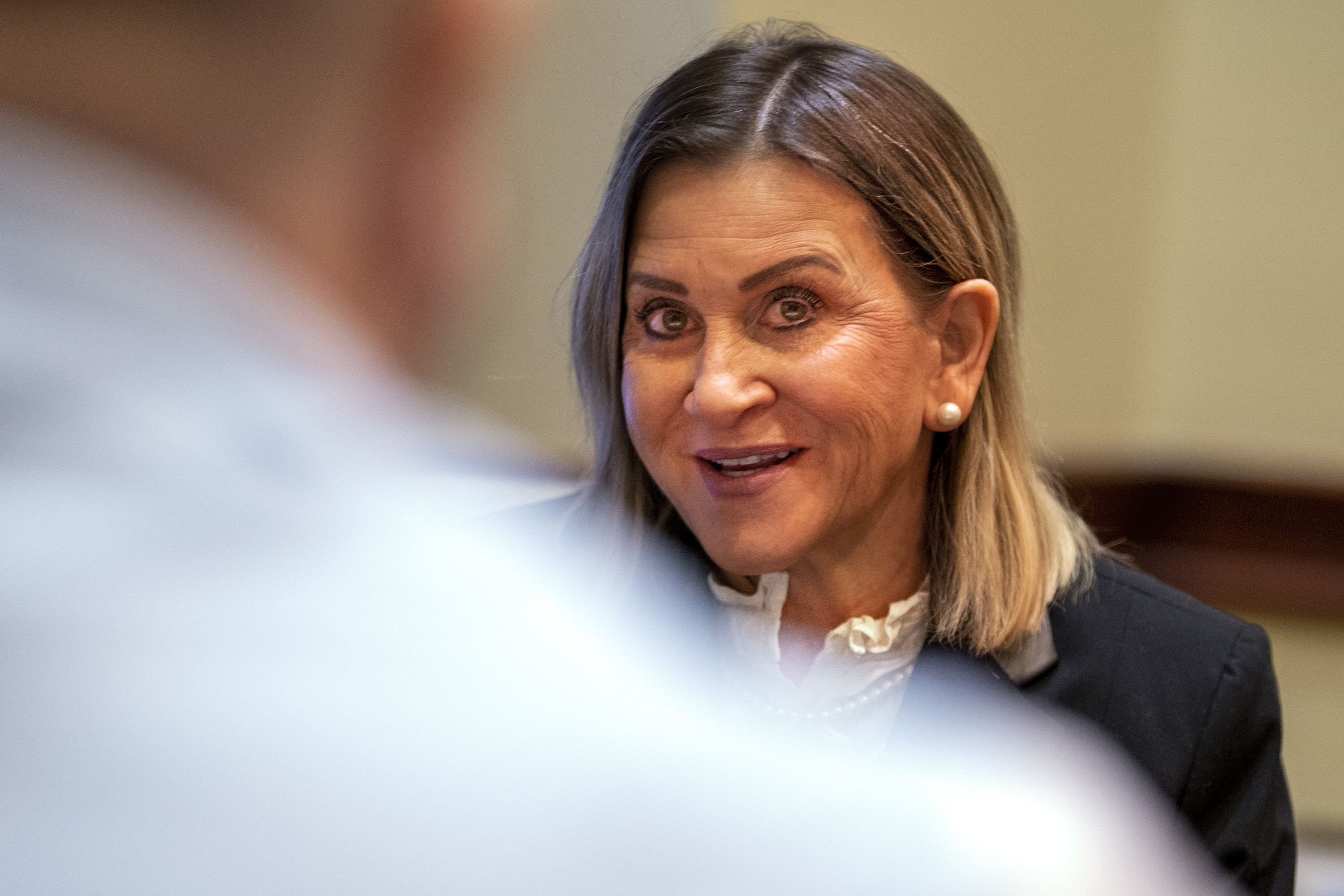
Kim Ward, president pro tempore of the Pennsylvania Senate, talks with her chief of staff Rob Ritson in her office Tuesday, Jan. 17, 2023, before heading out to preside over the swearing-in of Lt. Gov. Austin Davis in the Senate chambers.
Ward said her criticisms of Shapiro still stand — she wants him to be more transparent, among other disagreements. But she described the conversations as “very cordial, very professional.” And there were moments of levity that helped, said the top Republican leader in the Senate, who is known for her wry humor.
“He did leave me a sugar sprinkle heart [cookie] one day at my seat, and I told him, ‘You know, I’m too old for you, and we’re both married,’” she joked.
“I can’t understand why all these legislators think they did a great job,” she said on The Conservative Voice radio program, breaking with GOP leaders, like Ward and Pittman, who lauded the deal. “… Next year, they’re going to have to dip into the Rainy Day Fund to plug a budget, and then taxes are going to go up.”
Because of how long this budget took to finalize, Shapiro will already need to introduce his next budget in just three months, and in proximity to the 2026 midterms and Pennsylvania governor’s election. But it’s unclear whether those negotiations will be as fraught, given budgets tend to get resolved faster in election years with both parties eager to focus on the campaign trail.
“In this day and age, I would not downplay the fact that there was compromise,” said Berwood Yost, a pollster with Franklin and Marshall College. “People want their problems solved. They want politicians to do things that help their everyday lives and that, for most people, means some kind of compromise. Getting this problem solved fits with his narrative.”
Galko, the GOP consultant, looked further ahead to a potential 2028 presidential election. The budget impasse, he said, could provide material for Democratic rivals on the national stage. The possible field is filled with other governors, several from blue states, like Gov. JB Pritzker of Illinois and Gov. Gavin Newsom of California, where in-state dealmaking is easier among a uniform legislature.
“If he’s unable to negotiate with the Pennsylvania Senate, what’s he gonna do when he goes up against China or Russia?” Galko asked, previewing the possible attack.
Ultimately, history suggests Shapiro’s political success is likely to hinge less on the nuts and bolts of a budget only some Pennsylvanians — and even fewer outside Pennsylvania — are familiar with, and more on his ability to bolster his image as a bipartisan governor in a purple state.
On Friday morning in South Philadelphia, Shapiro sported a bomber jacket while posing for selfies with Eagles fans, nodding along to a rock band’s cover of “Santeria” in a tent outside the Xfinity Mobile Arena at an event hosted by radio station WMMR.
Casually, almost as a throwaway line, Shapiro mentioned to radio hosts Preston and Steve during an interview that he planned to bring Michigan Gov. Gretchen Whitmer — a fellow swing-state governor seen, too, as a possible 2028 Democratic contender — as his guest to the Eagles-Lions game at the Linc that Sunday.
“She actually said, ‘Is it OK if I wear Lions stuff?’” Shapiro told the kelly green-clad crowd in Philadelphia, riffing on the friendly football rivalry — the undercurrents of national politics left unspoken. “And I’m like, ‘No problem. You’re on your own in the parking lot. I can’t protect you.’”
Michigan Gov. Gretchen Whitmer joined Pennsylvania Gov. Josh Shapiro at Sunday’s game between the Eagles and Detroit Lions at Lincoln Financial Field.
The event was a food drive but also served as a tribute to the station’s beloved late host, Pierre Robert. Shapiro brought along a commendation from the governor’s office for the occasion.
“He created community, created joy, brought people together,” Shapiro said of Robert. “You think about just how divided we are as a world, there’s a few things that still bring us together, right?”
“By the way, I’ve learned those lessons. That’s what I try and do governing with a, you know, divided legislature.”
Music and sports, the governor mused before the crowd of Philadelphia fans, are two things that bridge the gap. “Go Birds,” he added with a grin.
Staff writer Katie Bernard contributed to this article.
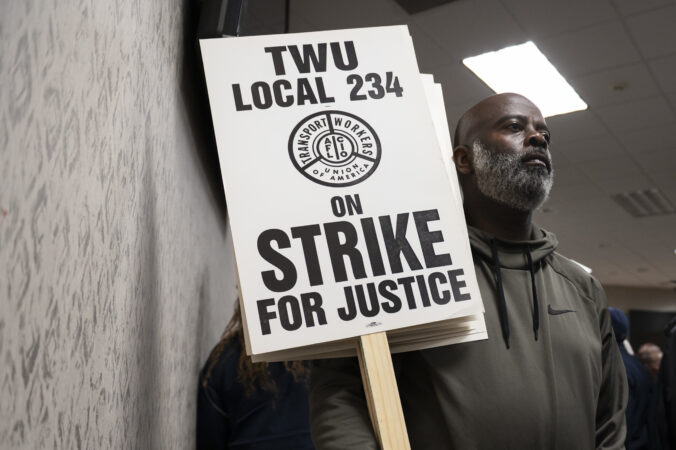
Members of the Transport Workers Union Local 234 on Sunday, Nov. 16 voted to authorize a strike if union and SEPTA negotiators can’t reach an agreement on a new contract.
Shortly before the current contract ran out at 11:59 p.m. on Nov. 7, TWU’s new president, Will Vera, urged union members to stay on the job. In an unusual move, he delayed a strike vote at the time of contract expiration, saying he had hope that a deal could be reached without the usual brinksmanship.
“We’re asking you to please continue to come to work and put money aside. We want you to be prepared in case we have to call a work stoppage,” he told members in a video at the time.
Local 234 leaders say they’re prioritizing a two-year deal with raises and changes to what the union views as onerous work rules, including the transit agency’s use of a third party that Vera said makes it hard for members to use their allotted sick time.
In a statement, SEPTA said it was aware of the authorization vote and is committed “to continue to engage in good-faith negotiations, with the goal of reaching a new agreement that is fair.”
2023 Fraternal Order of Transit Police Lodge 109 (three days)
SEPTA police officers walked off the job after bargaining with the transit agency for almost nine months, largely over the timing of a 13% pay raise for members. The agreement, partially brokered by Gov. Josh Shapiro, came amid heightened fears about safety on public transit and a funding crisis for SEPTA.
TWU Local 234 walked off the job for six days; the biggest issue was retirement benefits. SEPTA’s contributions toward union members’ pensions did not rise in tandem with wages when workers made more than $50,000. Managers’ pension benefits were not capped. The union also wanted to reduce out-of-pocket health-care costs and win longer breaks for bus, trolley, and subway operators between shifts and route changes.
SEPTA and the union reached an agreement Nov. 7, the day before the general election. Democrat Hillary Clinton’s presidential campaign was worried about voter turnout, and the city sought an injunction to end the strike. It proved unnecessary.
Talk about leverage. TWU was ready to strike just before the first home game of the World Series between the Phillies and the New York Yankees. Gov. Ed Rendell pushed the two sides to continue talking, and the transit workers waited to walk out until three hours after the end of Game 5, the last in the series played at Citizens Bank Park.
It was a bitter strike, coming just a year after the stock market’s meltdown started the Great Recession. TWULocal 234 President Willie Brown called himself “the most hated man” in Philadelphia. Mayor Michael Nutter was harshly critical. Brown called him “Little Caesar.”
The strike was settled Nov. 7 with a deal on a five-year contract. Transit workers got a $1,250 bonus, a 2.5% raise in the second year, a graduated increase in SEPTA pension contributions from 2% to 3.5%, and the maximum pension benefit was raised to $30,000 from $27,000.
2005: TWU Local 234 and United Transportation Union Local 1594 (seven days)
Negotiations collapsed mostly over SEPTA’s insistence that workers pay 5% of medical insurance premiums. At that point, the authority paid 100% of the workers’ premiums for family coverage.
In the end, it was solved by Gov. Rendell, a Democrat who had been Philadelphia mayor in the 1990s. He agreed to give promised state money to SEPTA early, so it could pay premiums in advance, reducing its costs.
In the resulting four-year deal, the unions had to pay for 1% of their medical premiums. They also received 3% yearly raises.
Pedestrians and cars in a chaotic dance at the intersection of Market and 30th Streets during the afternoon commute on the first day of the SEPTA city workers’ strike Nov. 1, 2016.
1998: TWU Local 234 (40 days)
City transit workers’ contract expired in March, but they did not strike until June — and then stayed out for 40 days. The two sides reached an agreement in July, but it fell apart. TWU members had returned to their jobs and kept working under an extension of their old contract. A final agreement was signed Oct. 23.
The union agreed to SEPTA’s demand that injured-on-duty benefits be limited. The old contract gave them full pay and benefits while on leave after a work injury. SEPTA wanted to hire an unlimited number of part-time workers. The union agreed to 100 part-timers to drive small buses.
SEPTA’s chief negotiator was David L. Cohen, famous for reining in unions representing city workers during Philadelphia’s bankruptcy in 1992, as Rendell’s mayoral chief of staff.
A two-week strike stilled city buses, trolleys and subways until an agreement was reached April 10. Transit workers would get 3% raises per year over the three-year span of the new contract, as well as increases in pension benefits and sick pay.
The union agreed to several cost-reduction measures, including a restructuring of SEPTA’s workers compensation policies.
Mayor Ed Rendell, a villain to many in labor for winning givebacks from city unions in 1992, pushed SEPTA to offer more generous terms to TWU than it had initially. Cohen, who was his chief of staff, crunched the numbers to make it work. Three years later, out of the city administration and working as a lawyer, he was hired as SEPTA’s chief negotiator.
1986: TWU Local 234 (four days) and UTU Local 1594 (61 days)
When TWU struck the city transit division in March 1986 over a variety of economic issues and work rules, some bus drivers pulled over mid-route and told passengers to dismount, The Inquirer reported.
Members were particularly incensed at what they considered SEPTA’s draconian disciplinary procedures. Union leaders said the issue was a basic lack of respect. The strike was settled in four days.
Drivers for 23 suburban bus routes, two trolley lines in Delaware County and the Norristown High-Speed Line — all members of the United Transportation Union — struck for just over two months, affecting about 30,000 passengers a day.
Employees in what was then known as SEPTA’s Red Arrow Division — after the private transit company that used to own the routes and lines — made considerably less than their city counterparts and had weaker pension benefits. They won raises and pension changes that brought them closer to parity.
1983: Regional Rail (108 days)
Thirteen separate unions walked off the job on the commuter rail lines that SEPTA had taken over at the beginning of the year from Conrail, successor to the bankrupt Pennsylvania and Reading Railroads.
In addition to wages, a key issue was SEPTA’s demand that union train conductors accept pay cuts. The authority had already cut the number of those workers by more than half.
Eventually SEPTA reached deals with a dozen of the unions. The 13th local, which represented 44 railroad signalmen, held out longer. Main issue: Whether SEPTA had the right to contract with outside firms for some types of signal work.
The Regional Rail strike remains SEPTA’s longest work stoppage since 1975.
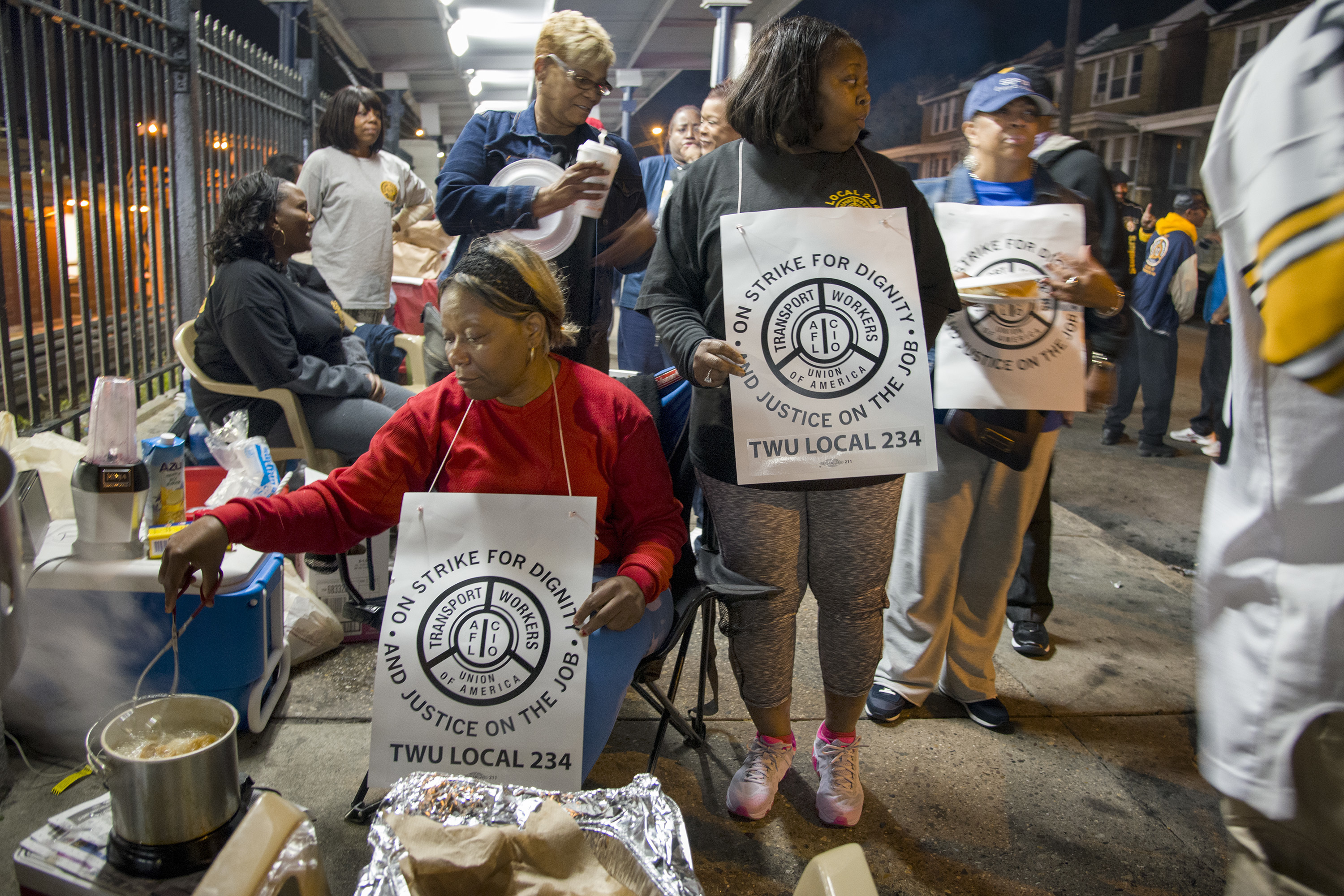
Joyce Woodford (center), a 25-year veteran cashier on SEPTA’s Broad Street Line, serves up fried fish for her fellow striking cashiers outside the Fern Rock Transportation Center during dinnertime on the third day of the SEPTA strike in 2016.
1982: TWU Local 234 (34 days)
About 36 suburban bus drivers and mechanics operating routes primarily in Montgomery County, and some routes in Bucks, won an 8.5% wage increase over three years.
The bus routes were the descendants of the Schuylkill Valley Lines and the Trenton-Philadelphia Coach Lines, which SEPTA acquired in 1976 and 1983, respectively. Service has grown, and the collection of bus routes is known as the Frontier Division today.
1981: TWU Local 234 (19 days) and UTU Local 1594 (46 days)
Transit workers shut down buses, trolleys and subways in the city on March 15, seeking job security in the form of a no-layoff clause, wage increases and a bar on SEPTA hiring part-time workers.
And the Red Arrow division went out for 46 days seeking higher wages and better medical benefits. SEPTA also backed down a demand for permission to hire private contractors for some work on the suburban buses, trolleys, and the Norristown High Speed Line.
1977: TWU Local 234 (44 days)
After a bitter strike, union members who run the city transit division got higher wages and more benefits, after rejecting an arbitrator’s proposed contract that was portrayed in news reports as generous.
A furious Mayor Frank Rizzo told reporters the strike “can last 10 years for all I care.” He said of the union’s rejection of the earlier offer: “It is outrageous, and I hope the people won’t forget it.”
1975: TWU Local 234 (11 days)
Transit workers, concerned about the ravages of inflation, wanted a clause giving them cost-of-living increases and enhancements to health-care benefits. Those were granted after Rizzo agreed to add $7.5 million to the city’s annual SEPTA contribution. Perhaps that’s one reason the mayor was so annoyed two years later.
Staff writer Erica Palan contributed to this article.
The undergraduateclass at the University of Pennsylvania vigorously discussed the use of affirmative action in college admissions, half the room charged with arguing one side and half the other.
Their task, informed by the 2023 U.S. Supreme Court decision that ended the use of race-conscious college admissions, was to brief and advise a popular governor of a swing state who had not yet taken a position on the issue.
“Guess who is the governor?” said their professor, Amy Gutmann. “I am the governor.”
And for 90 minutes, the entirety of the class period, Gutmann guided a lively discussion in which students talked as much as she did.
While never a governor, Gutmann has quite the leadership portfolio. She was president of Penn for a record 18 years, leaving in 2022 to become U.S. ambassador to Germany under former President Joe Biden, a post she held until 2024. She is also a Harvard-educated political scientist who cowrote the book The Spirit of Compromise and in 2018 was called one of the world’s 50 greatest leaders by Fortune magazine.
Now, for the first time in about 25 years — since she was a politics professor at Princeton — Gutmann is back in the classroom teaching a full course this semester in the Annenberg School for Communication. Sarah Banet-Weiser, dean of Annenberg, who initially came up with the idea for the course, is her co-teacher.
For students, the professorial star power was hard to pass up. There was a waiting list for the class.
“It’s kind of a power duo,” said Evan Humphrey, 21, a senior communications major from Seattle. “Got to take that class.”
Senior Evan Humphrey said she was drawn to enroll in the class because of the two professors and their distinguished careers.
Focusing on teaching — the heart of a university — has been especially meaningful to Gutmann, and to Banet-Weiser, too, at a time when higher education has had its federal funding threatened and its approaches attacked.
“It literally gives me life every week,” Banet-Weiser said.
Gutmann, 75,who said she aspired to be a teacher since she was 5, said it has made her feel productive “in a way that goes to the heart of what a university is about.”
“We should never lose sight of that heart of the university and how valuable it is,” she said.
The goal of the class, called “The Art and Ethics of Communication in Times of Crisis,” is “to learn how and why to communicate with greater insight and understanding across differences,” while creating space “for free and open dialogue about controversial issues.”
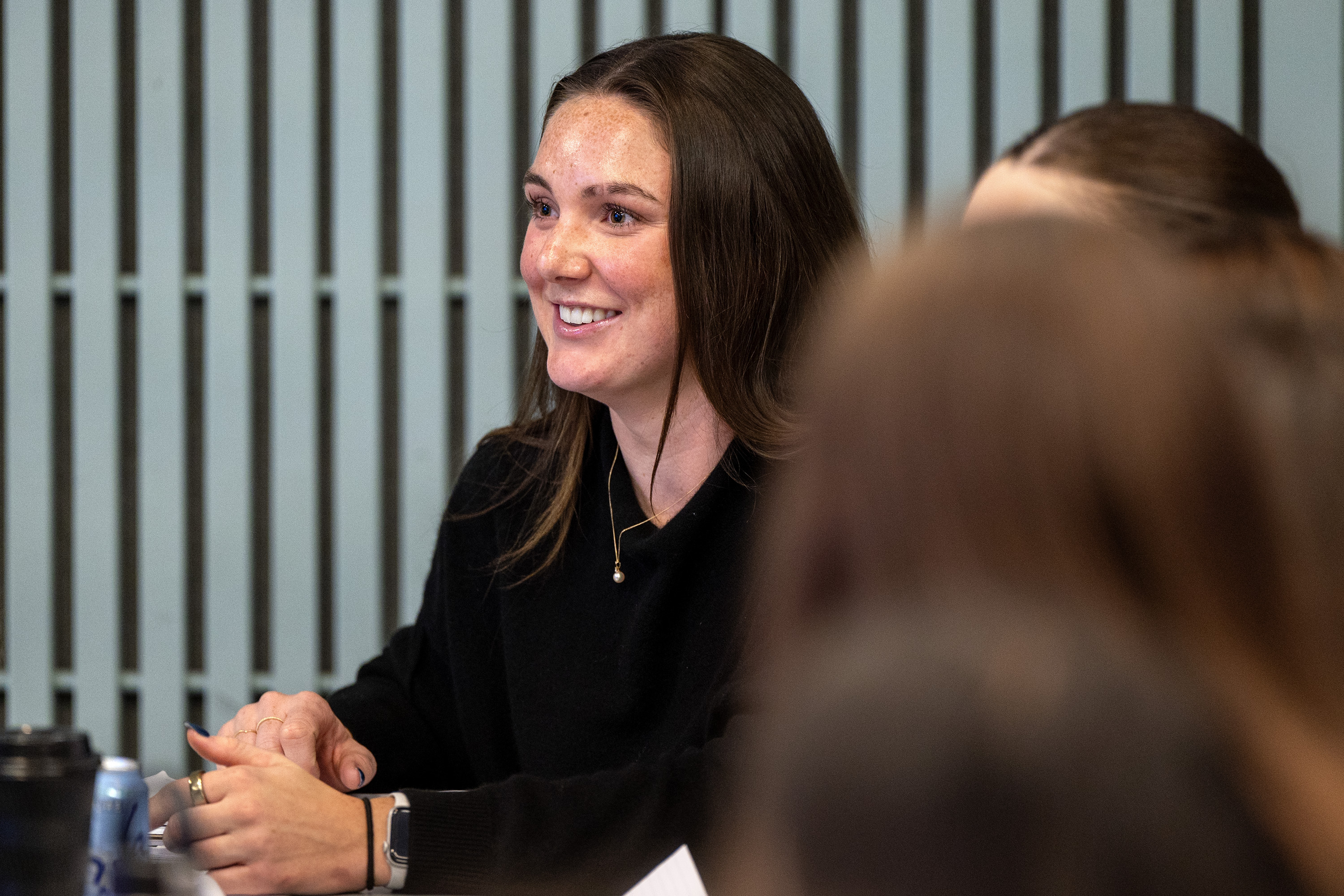
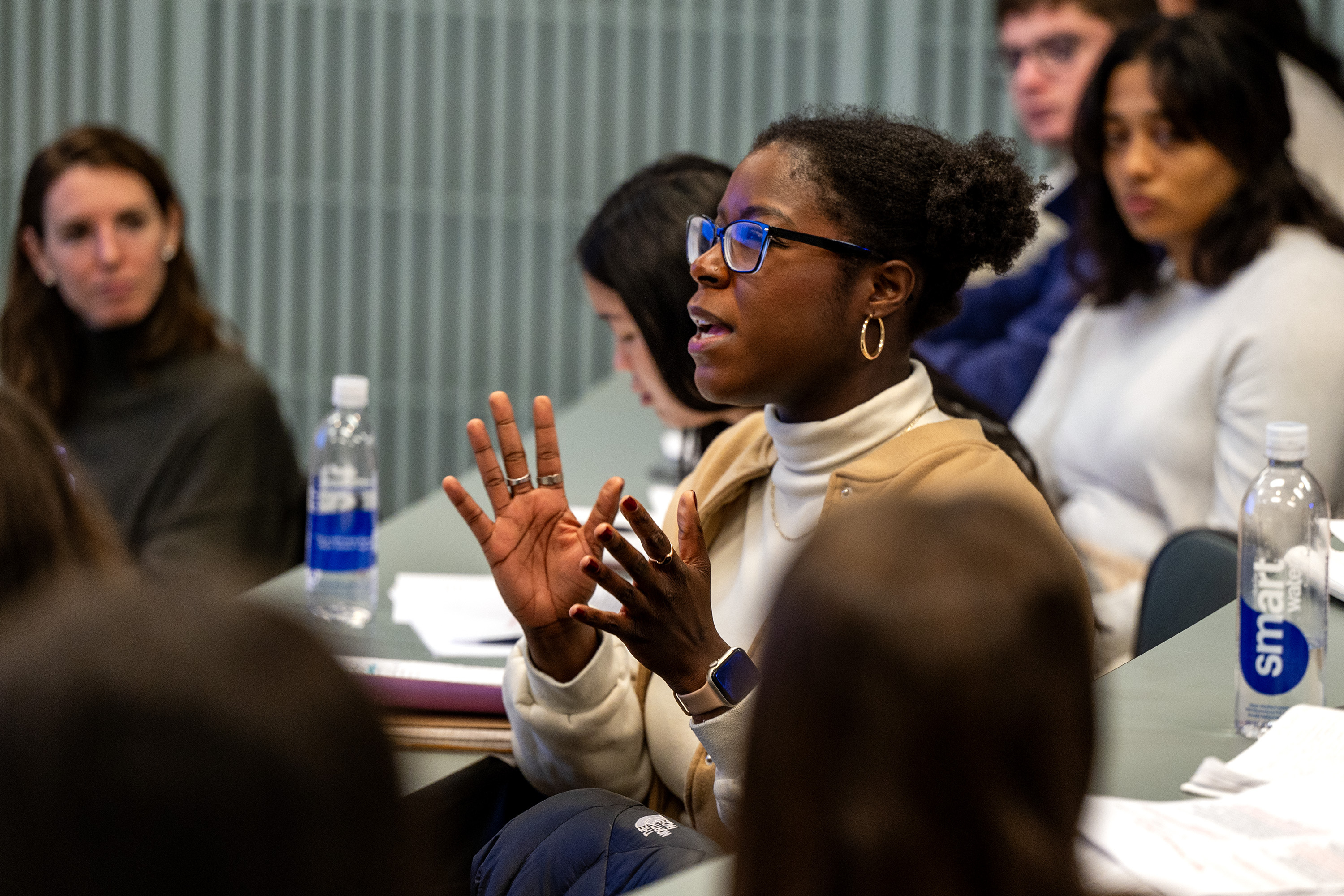
Seniors Luiza Louback (left) and Sarah Usandivaras (right) participate in the class discussion.
It could be a primer for the politically divided nation.
“My pitch is that you can’t really know what you believe if you don’t know what people who disagree with you believe and what their reasons are,” Gutmann said in an interview. “I always say I don’t care what your position is. I care that you can give reasons for it and understand the strongest arguments on the other side.
“That’s the method to search for truth, and it’s the way we serve a democracy.”
Bringing experience to the classroom
During class, Gutmann frequently drew on her experiences as a first-generation college student, a young professor at Princeton, a college president, and an ambassador.
When she got her first teaching job, a male colleague congratulated her, but later she learned he told someone she got the job because she was a woman.
“Did I take that as a compliment? Mm-mm,” Gutmann told the class.
Humphrey said she especially likes hearing about Gutmann’s vast experiences.
“She’s like, ‘Well, when I was the president here, this is something I dealt with,’” Humphrey said. “It’s really interesting knowing the experience she has and her background and the perspective she brings.”
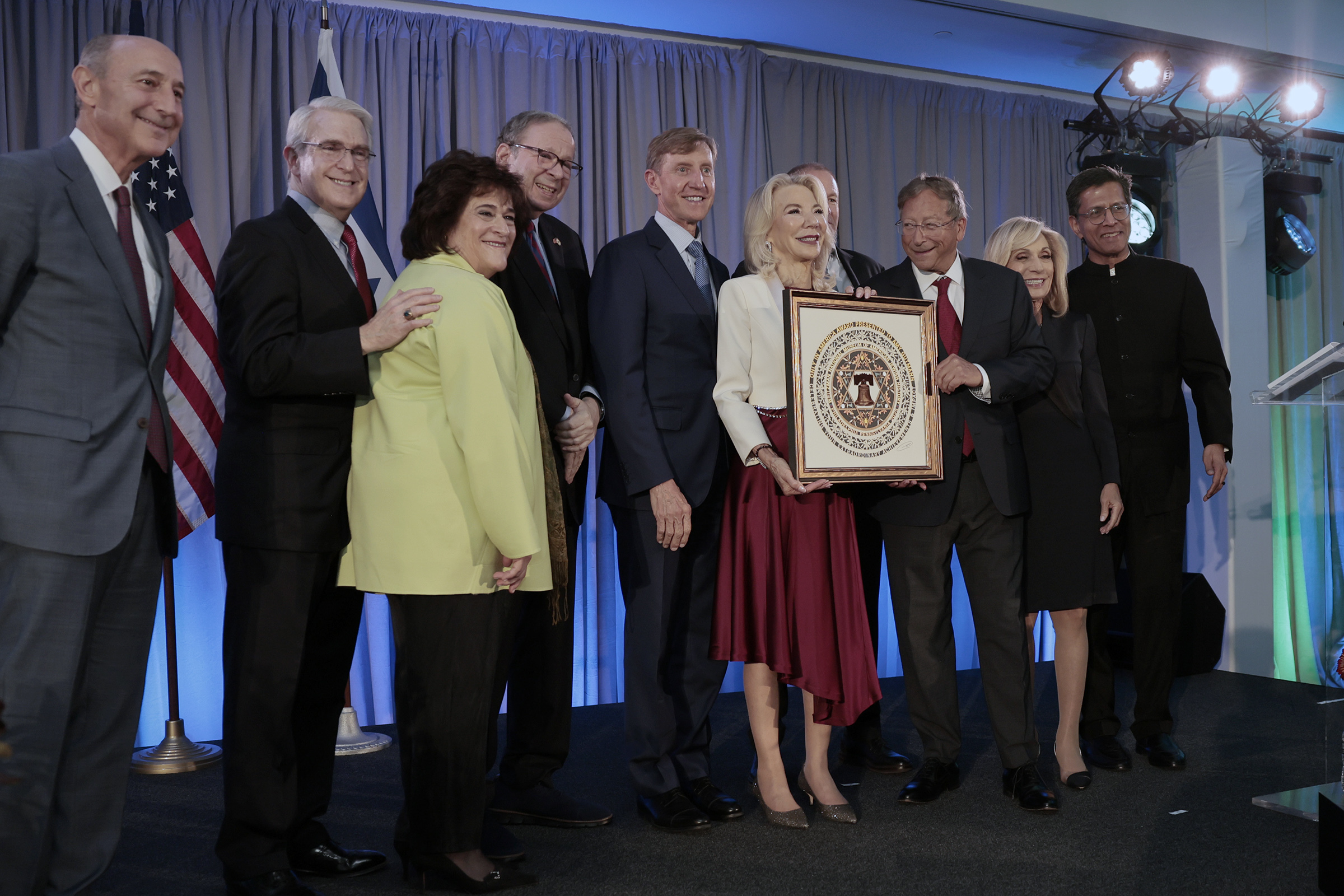
Amy Gutmann (center), president emerita of the University of Pennsylvania and former U.S. ambassador to Germany, is presented with the Weitzman National Museum of American Jewish History’s Only in America® Award during a gala at the museum this month. The award recognizes “Jewish Americans who have made enormous contributions to our world … often despite facing antisemitism and prejudice.” Among those posing with her are Ramanan Raghavendran (far right), chair of Penn’s board of trustees, veteran journalist Andrea Mitchell (next to Raghavendran), Penn President J. Larry Jameson, (to the immediate left of Gutmann), and David Cohen, former Penn board chair, (next to Jameson.)
Gutmann’s life outside class continues to be full, too. After class Wednesday, Gutmann, whose father fled Nazi Germany, flew to Berlin to receive the Prize for Understanding and Tolerance from the Jewish Museum Berlin.
Having returned to Philadelphia to live after leaving Germany, Gutmann said it wasn’t hard to find her stride again in the classroom. She had given one-off lectures as Penn’s president.
“I have a lot of muscle memory on teaching,” she said.
Her style has changed from her early days at Princeton, where she worked from 1976 to 2004. She said readinga student’s notebook left behind and open after one of her ethics and public policy lectures was a major turning point.
“‘That’s not what I said,’” Gutmann thought. “And I realized it’s not what you teach them, it’s what they learn. At that point, I realized I needed feedback.
“So I changed from doing the 45-minute [lecture] thing to doing five or 10 minutes, max, and then asking them questions. Then I got them to argue with one another, and once I found that, I found what I really discovered worked for learning.”
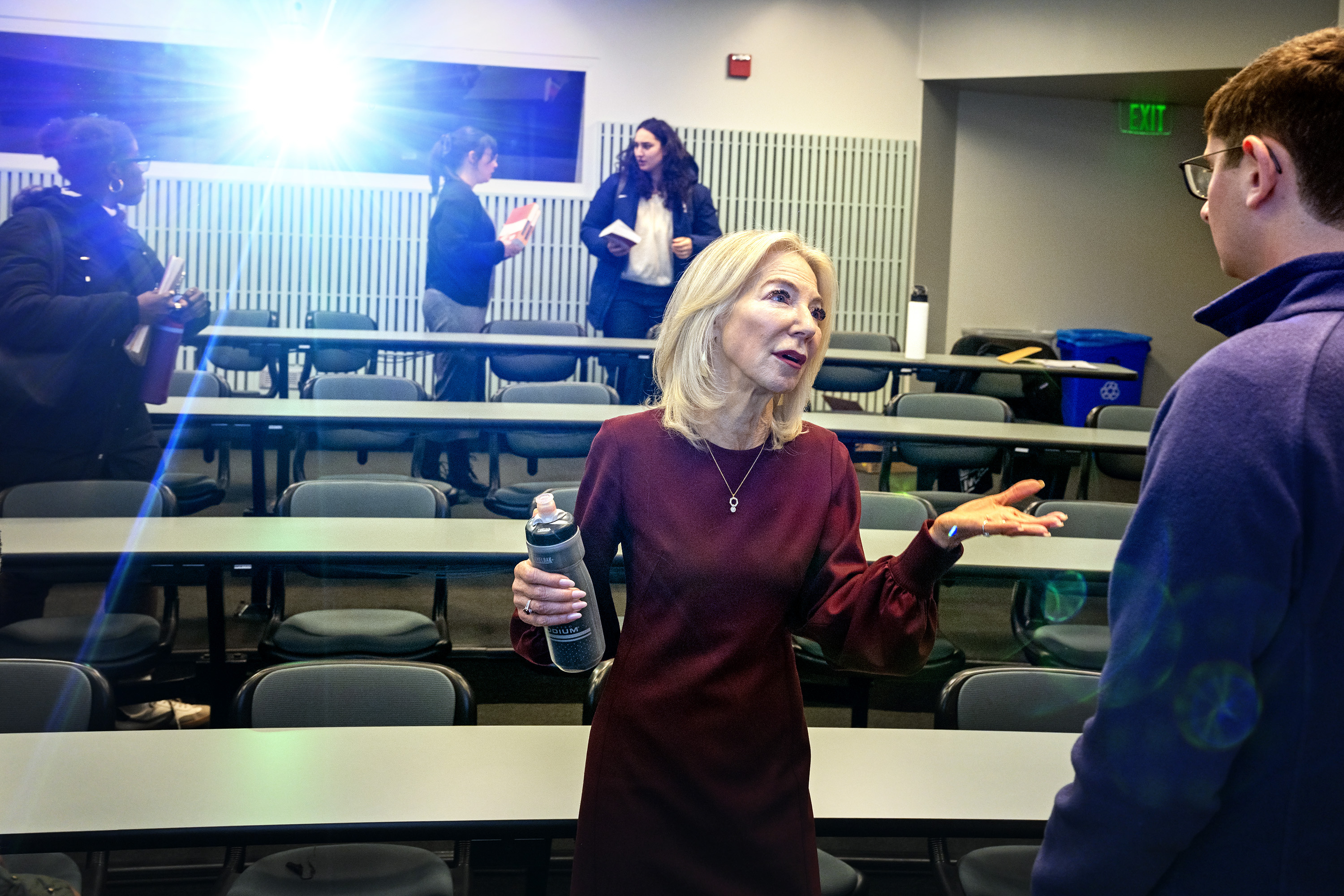
Amy Gutmann talks with sophomore Brian Barth (right) at the end of class she co-teaches at Penn’s Annenberg School for Communication.
Gutmann said she spends Fridays and weekends preparing for the class, which meets twice a week.
“It’s a ton of work,” she said. “I’m really delighted to be doing it.”
The class comes against the backdrop of fraught times for colleges. Penn earlier this year scrubbed its website of diversity initiatives after President Donald Trump’s administration threatened funding to schools employing diversity, equity, and inclusion efforts. In the summer, the school struck an agreement with the administration over the past participation of former transgender swimmer Lia Thomas, and Penn was one of nine schools originally asked to sign a compact that would have given the school preferential consideration for federal funding in exchange for complying with certain mandates affecting admissions, hiring, and other university operations. Penn declined.
‘One-of-a-kind’ discussions
Gutmann and Banet-Weiser do not allow laptops, phones, or any electronic devices in class so that students completely focus on the conversation. To prepare for the affirmative action discussion, students were assigned related readings and review of the court cases.
The two professors interacted with each other and prompted discussion among students with deep questions: Is treating people equal the same as treating them equally? Is it right to use affirmative action for only one racial group? What about other forms of affirmative action or preference, including for athletes, low-income students, and legacies whose parents attended the university?
The approach resonated with students.
“I wanted to take a class where I would really be encouraged to step out of my comfort zone and be able to learn not only how to understand my own beliefs and values but understand the beliefs and values of others,” said Sarah Usandivaras, 21, a senior communications and political science major who was born in New York and grew up in Paraguay.
She found it in Gutmann and Banet-Weiser’s classroom.
“It’s a one-of-a-kind,” she said.
Ariana Zetlin, a doctoral student in Penn’s Graduate School of Education, is auditing the class to observe its approach.
“The discussion and the debates are so much deeper and stronger than what I’m seeing in classrooms that don’t necessarily have these structures,” said Zetlin, 30, who is from New York.
During class, those on both sides found common ground.
Senior Angele Diamacoune said she was learning from the day’s lesson.
“So I’m hearing agreement that diversity is a good thing but disagreement on how you get it,” Gutmann said.
She asked students how many believed that having low-income and racially diverse students in class contributed to their learning. Every hand went up.
“That to me is really striking,” Gutmann said. “There aren’t that many things that we can get unanimity on.”
She asked students how they would advise colleges to teach the issue.
“It would be good to teach with activities like this,” said Angele Diamacoune, 21, a senior communications major from Allentown.
Should last week’s election results make Brian Fitzpatrick nervous?
Bucks County Democrats think so.
The Republican lawmaker has been like Teflon in the 1st Congressional District, which includes all of Bucks County and a sliver of Montgomery County. He persistently outperforms the rest of his party and has survived blue wave after blue wave. First elected in 2016, he has remained the last Republican representing the Philadelphia suburbs in the U.S. House.
But Democrats pulled something off this year that they hadn’t done in recent memory. They won each countywide office by around 10 percentage points — the largest win margin in a decade — and for the first time installed a Democrat, Joe Khan, as the county’s next top prosecutor.
“This year was unprecedented, and sitting here a year before the midterm, you have to believe that next year is going to be unprecedented as well,” State Sen. Steve Santarsiero, who is also the county party’s chair, said Wednesday.
Eli Cousin, a spokesperson for the Democratic Congressional Campaign Committee, predicted a “perfect storm brewing for Democrats” to beat Fitzpatrick. “He and Trump’s Republican Party are deeply underwater with Bucks County voters; he has failed to do anything to address rising costs, and we will have a political juggernaut in Gov. Josh Shapiro at the top of the ticket,” Cousin said.
There are several reasons Democrats may be exhibiting some premature confidence: Despite a spike in turnout for an off-year election, far fewer voters turn out in such elections than do in midterms. Fitzpatrick is extremely well-known in Bucks, where his late brother served before he was elected to the seat. He has won each of his last three elections by double digits.
But Tuesday was a sizable pendulum swing in the bellwether. Some of the communities, like Bensalem, that drove Trump’s victory flipped back to blue.
The last time Democrats had won a sheriff’s race in the county was 2017, a year after Trump was elected the first time. That year, Democrats won by smaller margins, and a Republican incumbent easily won reelection as district attorney. The following year, Fitzpatrick came the closest he has yet to losing a race, but still won his seat by 3 percentage points.
This year’s landslide, Democrats say, is a warning sign.
“There were Democratic surges in every place that there’s a competitive congressional seat, and that should be scaring the s— out of national Republicans,” said Democratic strategist Brendan McPhilips, who managed Democratic Sen. John Fetterman’s campaign in the state and worked on both of the last Democratic presidential campaigns here.
“The Bucks County seat has always been the toughest, but it’s certainly on the table, and there’s a lot there for Bob Harvie to harness and take advantage of.”
Bucks County Democratic Commissioner Bob Harvie speaks during an Oct. 5 rally outside the Middletown Township Police Department and Administrative Offices in Langhorne.
Harvie, a high school teacher-turned-politician, leapt on the results of the election hours after races were called, putting out a statement saying, “There is undeniable hunger for change in Bucks County.”
“The mood of the country certainly is different,” Harvie said in an interview with The Inquirer on Thursday. “What you’re seeing is definitely a referendum.”
Lack of GOP concern
But Republicans don’t appear worried.
Jim Worthington, a Trump megadonor who is deeply involved in Bucks County politics, attributes GOP losses this year to a failure in mail and in-person turnout. Fitzpatrick, he said, has a track record of running robust mail voting campaigns and separating himself from the county party apparatus.
“He’s not vulnerable,” Worthington said. “No matter who they run against him, they’re going to have their hands full.”
Heather Roberts, a spokesperson for Fitzpatrick’s campaign, noted that the lawmaker won his last election by 13 points with strong support from independent voters in 2024 — a year after Democrats performed well in the county in another off-year election. She dismissed the notion that Harvie would present a serious challenge, contending the commissioner “has no money and no message” for his campaign.
Fitzpatrick is also a prolific fundraiser. He brought in $886,049 last quarter, a large amount even for an incumbent, leading Harvie, who raised $217,745.
“Bob Harvie’s not going to win this race,” said Chris Pack, spokesperson for the Defending America PAC, which is supporting Fitzpatrick. “He has no money. He’s had two dismal fundraising quarters in a row. That’s problematic.”
Pack noted Harvie’s own internal poll, reviewed by The Inquirer, showed 57% of voters were unsure how they felt about him.
“An off-off-year election is not the same as a midterm election,” Pack said, adding he thinks Fitzpatrick’s ranking as themost bipartisan member of Congress will continue to serve him well in Bucks County.
“He’s obviously had well-documented breaks on policy with the Republican caucus in D.C., so for Bob Harvie to try to say Brian Fitzpatrick is super far right, no one’s gonna buy it,” Pack said. “They haven’t bought it every single election.”
On fundraising, Harvie said he had brought in big fundraising hauls for both of his commissioner races, and said he would have the money he needed to compete.
Of the four GOP-held House districts Democrats are targeting next year in the state, Fitzpatrick’sseat is by far the safest. That raises the question: How much money and attention are Democrats willing to invest in Pennsylvania?
“Who’s the most vulnerable?” asked Chris Nicholas, a GOP consultant who grew up in Bucks County. The other three — U.S. Rep. Scott Perryand freshmanU.S. Reps. Rob Bresnahan, in the Northeast, and Ryan Mackenzie, in the Lehigh Valley — won by extremely narrow margins last year. “If you’re ranking the four races, you have Rob Bresnahan at the top and Fitzpatrick at the bottom,” Nicholas said.
National Democrats seldom invest as much to try to beat Fitzpatrick as they say they will, Nicholas said. And he pointed to 2018, a huge year for Democrats, when they had a candidate in Scott Wallace who was very well-funded, albeit far less known than Harvie, and still came up short.
Democrats see Harvie as the best shot they have had — a twice-elected commissioner, with name ID from Lower Bucks County, home to many of the district’s swing voters. And the 1st District is one of just three in the country that is held by a Republican member of Congress where Vice President Kamala Harris won last year.
And then there’s Shapiro, who Democrats think will give a boost to candidates like Harvie as he runs for reelection next year. Shapiro won the district by 20 points in 2022.
Following the playbook used by successful candidates this year, Democrats are likely to argue to voters that Fitzpatrick has done little to push back on Trump — while placing cost-of-living concerns at the feet of the Republican Party.
“A lot of people are, you know, upset with where we are as a nation,” Harvie said. “They grew up expecting that if you worked hard and played by the rules, you’d be able to have all the things you needed and have a good life. And that’s not happening for them.”
“The big thing Democrats throw against Republicans is you’re part and parcel of Trump and MAGA, and Fitzpatrick voted against Trump,” Nicholas said.
Over nearly 10 years in Congress, Fitzpatrick has been a rare Republican who pushes back on Trump, though often subtly. Fitzpatrick, who cochairs the bipartisan Problem Solvers Caucus, was the lone Pennsylvania Republican to confirm former President Joe Biden’s electoral victory in 2020. A former FBI agent who spent a stint stationed in Ukraine, he is among the strongest voices of support for Ukraine in Congress, consistently pushing the administration to do more to aid the country as it resists a yearslong Russian invasion.
Fitzpatrick was also one of just two House Republicans to vote against Trump’s signature domestic policy package, which passed in July. He voted for an earlier version that passed the House by just one vote, which Democrats often bring up to claim Fitzpatrick defies his party only when it has no detrimental impact.
“He’s good at principled stances that ultimately do nothing,” said Tim Persico, an adviser with the Harvie campaign. “That is what has allowed him to defy gravity in the previous cycles. … Now the economy is doing badly. … People feel worse about everything, and Fitzpatrick isn’t doing anything to help with that. I think it makes it harder to defy gravity.”
Trump has endorsed every Republican running for reelection in Pennsylvania next year except Fitzpatrick. While the Bucks County lawmaker has avoided direct criticism of the president, in an appearance in Pittsburgh over the summer, Trump characterized the “no” vote on the domestic bill as a betrayal.
Fitzpatrick has faced more conservative primary challengers in the past, but no names have surfaced so far this cycle, a sign that even the more MAGA-aligned may see him as their best chance to hold onto the purple district.
Keeping his distance from Trump, and limiting Democrats’ opportunities to tie the two together, may remain Fitzpatrick’s best path forward.
“Anybody who wants to align themselves with an agenda of chaos and corruption and cruelty ought to be worried,” said Khan, Bucks County’s new district attorney-elect.
This suburban content is produced with support from the Leslie Miller and Richard Worley Foundation and The Lenfest Institute for Journalism. Editorial content is created independently of the project donors. Gifts to support The Inquirer’s high-impact journalism can be made at inquirer.com/donate. A list of Lenfest Institute donors can be found at lenfestinstitute.org/supporters.
A Navy pilot in New Jersey. A democratic socialist in New York City. Three Pennsylvania jurists who never wanted to hit the campaign trail in the first place.
The results were momentous for a party hungry for wins in President Donald Trump’s second term. But they are also likely to revive longstanding debates on how the party should present itself to the American people going into the 2026 midterms and 2028 presidential race.
Should Democrats embrace a bold vision and tack left? Are left-of-center candidates with bipartisan appeal still the way to win statewide races? Or could the party simply embrace the reality of being a big-tent party?
Here are five takeaways from Tuesday’s elections, including the state of play for both parties’ soul-searching exercises.
Democrats gained momentum, but received no clear signs about the future of the party
The energy is clearly there.
Turnout soared on Tuesday, despite being an off-year election, and Democrats won by surprisingly large marginsup and down the ballot.
Even Montgomery County, where there were no competitive elections for county offices, saw its highest-ever off-year turnout at 50.7% of registered voters, and Democrats flipped every contested school board race.
At the top of the ticket, New Jersey’s Mikie Sherrill and Virginia’s Abigail Spanberger, both U.S. representatives with national security backgrounds, ran up the scores in their gubernatorial races while portraying themselves as pragmatists.
window.addEventListener(“message”,function(a){if(void 0!==a.data[“datawrapper-height”]){var e=document.querySelectorAll(“iframe”);for(var t in a.data[“datawrapper-height”])for(var r,i=0;r=e[i];i++)if(r.contentWindow===a.source){var d=a.data[“datawrapper-height”][t]+”px”;r.style.height=d}}});
“There’s a new politics,” Krasner said Wednesday. “It’s pretty clear that the American people, Philadelphians, are tired of insiders who promise them things they don’t do. They’re tired of political dynasties.”
window.addEventListener(“message”,function(a){if(void 0!==a.data[“datawrapper-height”]){var e=document.querySelectorAll(“iframe”);for(var t in a.data[“datawrapper-height”])for(var r,i=0;r=e[i];i++)if(r.contentWindow===a.source){var d=a.data[“datawrapper-height”][t]+”px”;r.style.height=d}}});
Democratic strategist Brendan McPhillips, who has worked for progressive candidates as well as Joe Biden’s and Kamala Harris’ campaigns in Pennsylvania, said the party should embrace the ideological diversity of its constituencies.
“People have tried to ask this question of who represents the soul of the party, and I just think it’s a bad question,” he said. “The party is a huge tent, and last night proves you can run for Democratic office in New York City and New Jersey and Bucks County and Erie, Pa., and each of those races can look entirely different.”
Democrats made gains with Latino voters
One of the more worrying signs for Democrats in the Trump era has been the president’s increasing popularity among Latino voters.
They flipped that narrative Tuesday.
After 10 months of aggressive U.S. Immigration and Customs Enforcement raids under Trump that are seen by many in the Latino community as indiscriminate and cruel, Democrats appear to have undone some of Trump’s gains in what has long been a blue constituency.
In New Jersey, the two counties where Sherrill made the biggest gains compared with Harris in the 2024 presidential election were Passaic and Hudson, both of which are more than 40% Hispanic, according to the U.S. Census.
Sherrill won Hudson by 50 percentage points, which represents a 22-point swing from Harris. And she won Passaic by 15 percentage points after Trump surprisingly carried the county with a 3-point margin in 2024.
In Philadelphia, Krasner won eight wards that the more conservative Patrick Dugan — Krasner’s opponent in both the general election and the Democratic primary — had won in their first round in May.
All were in or near the Lower Northeast, and the biggest swing came in the heavily Latino 7th Ward, which includes parts of Fairhill and Kensington. Krasner’s share of the vote there grew from 46% in the primary to 86% in the general.
It’s really hard to unseat Pennsylvania judges
Only one Pennsylvania Supreme Court justice since 1968 has failed to win a retention election, in which voters face a yes-or-no decision on whether to give incumbents new 10-year terms, rather than a choice between candidates.
Tuesday’s results will be discouraging for anyone hoping to increase that number soon.
Hoping to break liberals’ 5-2 majority on the state’s highest court, Republicans spent big in an attempt to oust three justices who were originally elected as Democrats. Democratic groups then poured in their own money to defend the incumbents.
In his third attempt to become governor, Republican Jack Ciattarelli bet big on South Jersey, the more conservative but less populous part of the Garden State.
It didn’t work.
In his 2021 campaign against Democratic Gov. Phil Murphy, Ciattarelli carried Atlantic, Cape May, Cumberland, Gloucester, and Salem Counties with a combined 56.8% of the vote. Trump then went on to sweep all five counties last year.
But on Tuesday, Ciattarelli performed 8 percentage points worse in the region, giving Sherrill a narrow lead in South Jersey, where she won three of the five counties south of Camden.
(function() { var l = function() { new pym.Parent( ‘sj-shift__graphic’, ‘https://media.inquirer.com/storage/inquirer/ai2html/sj-shift/index.html’); }; if(typeof(pym) === ‘undefined’) { var h = document.getElementsByTagName(‘head’)[0], s = document.createElement(‘script’); s.type = ‘text/javascript’; s.src = ‘https://pym.nprapps.org/pym.v1.min.js’; s.onload = l; h.appendChild(s); } else { l(); } })();
Republicans now face their own soul-searching question: How to win without Trump?
In 2024, Trump’s coattails helped Republicans win control of Congress and other elected offices across the country — including in two Pennsylvania swing districts.
With the president in his second and final term, how will the GOP win without him on the ballot?
For Jim Worthington, the Trump megadonor and owner of the Newtown Athletic Club in Bucks County, Tuesday’s results show that the GOP needs to do more work on the ground if it wants to succeed without the man who has dominated Republican politics since 2015.
Elections, he said, are “not about the policies as much they’re just turnout. Red team, blue team.”
The blue team won Tuesday, he said, because the red team didn’t do enough of the legwork needed to get its voters to cast mail ballots and to drive in-person turnout on Election Day. Worthington said the results left him concerned about Republican Treasurer Stacy Garrity’s chances of unseating Democratic Gov. Josh Shapiro next year.
“If we don’t get a robust vote-by-mail, paid-for program, it’s going to be very difficult, very difficult, if not impossible for Stacy Garrity to win,” Worthington said. “During this whole 2025 year when we could have been building this toward 2026, we lost a year because we didn’t do it.”
Staff writer Anna Orso contributed to this article.
This suburban content is produced with support from the Leslie Miller and Richard Worley Foundation and The Lenfest Institute for Journalism. Editorial content is created independently of the project donors. Gifts to support The Inquirer’s high-impact journalism can be made at inquirer.com/donate. A list of Lenfest Institute donors can be found at lenfestinstitute.org/supporters.
In his first term, Donald Trump appointed four judges to the Philadelphia-based U.S. Court of Appeals for the Third Circuit — flipping the court’s ideological balance firmly to the right.
The 14-member court, which hears appeals from Pennsylvania, New Jersey, and Delaware, routinely handles disputes of national importance.
President Joe Biden had a chance to tip the balance back.
His nominee, Adeel Mangi, would have become the first Muslim American to serve on any federal appellate court. But facing bad-faith Republican attacks and tepid Democratic support, Mangi’s nomination was left to die on the Senate floor.
That failure, and Trump’s return to power, cleared the way for the rapid installation of two MAGA loyalists, Emil Bove and Jennifer Mascott, cementing an 8-6 conservative majority.
Less than a year into his second term, Trump has finished what he started in his first. His MAGA makeover of the Third Circuit is complete — and the people of Pennsylvania, New Jersey, and Delaware, and perhaps the country as a whole, will be living with its consequences for decades to come.
Emil Bove: The hatchet man
Trump’s first pick for the Third Circuit is also his most dangerous: Emil Bove.
Bove, the president’s former criminal defense attorney, lacks the culture war credentials required of nearly every other Trump judicial nominee. He never sued the Biden administration, or opposed same-sex marriage, or defended a state abortion ban. But he has one quality in spades: loyalty to Donald Trump.
Once installed in the U.S. Department of Justice, Bove wasted little time proving to Trump that he would do whatever it took to advance Trump’s agenda.
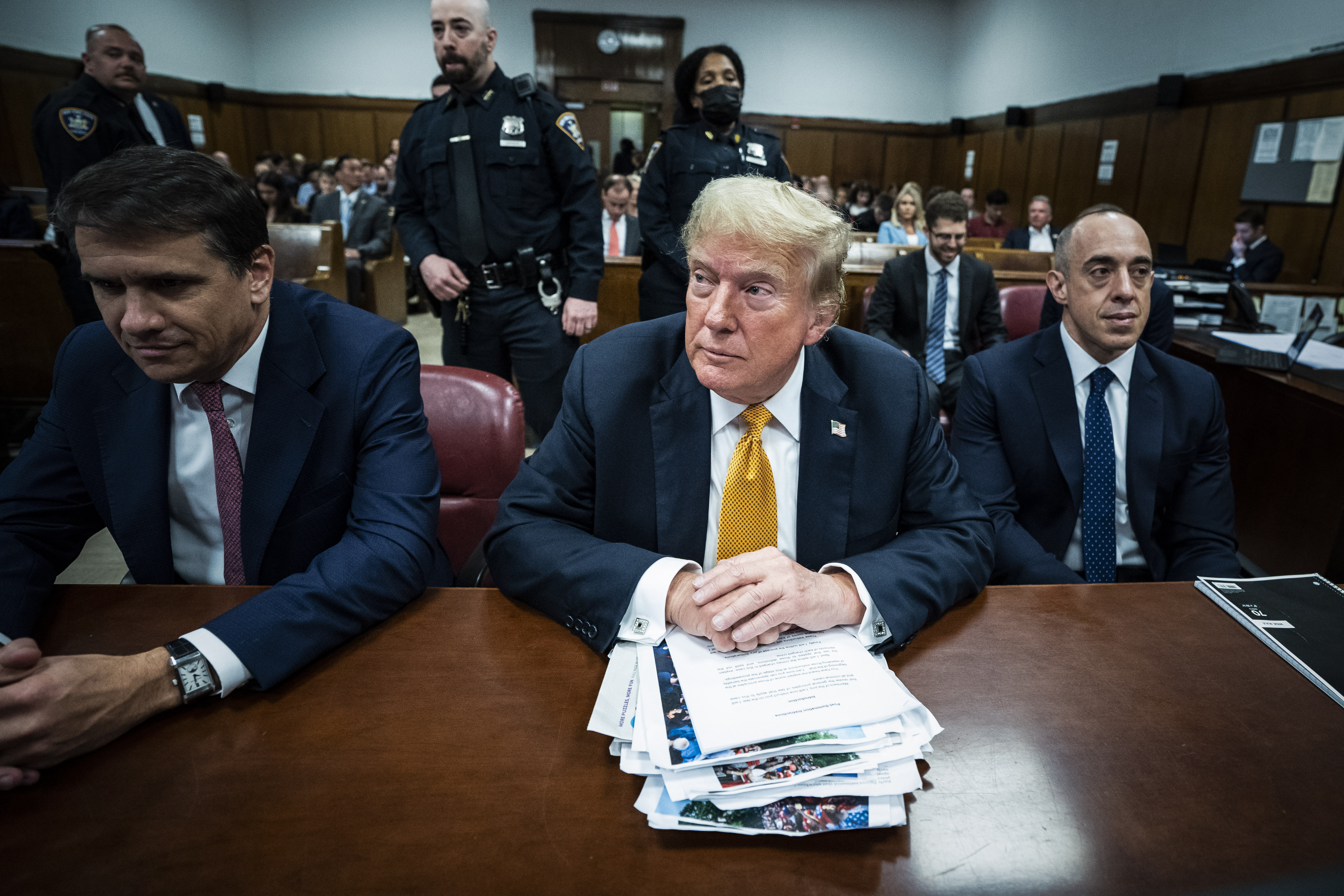
Donald Trump, flanked by attorneys Todd Blanche and Emil Bove (right), at his criminal trial in Manhattan in 2024.
He fired the federal prosecutors and FBI agents who pursued cases against the Jan. 6, 2021, insurrectionists. He clumsily sought to dismiss charges against New York City Mayor Eric Adams to coerce him to aid Trump’s immigration crackdown. And, according to multiple credible whistleblower allegations, Bove told other DOJ lawyers that if courts tried to stop the administration’s deportations, they should tell “the courts ‘fuck you.’”
Now that Bove is on the Third Circuit — he was confirmed in July by a razor-thin 50-49 vote — he is moving with similar speed to show Trump he’s still on his side.
This week, in what appears to be Bove’s first vote as a circuit judge, he joined four other Trump appointees dissenting from the full court’s decision to deny the request of various Republican organizations to rehear the case holding Pennsylvania’s date requirement for mail-in ballots unconstitutional.
Of course, there never should have been a vacancy for Bove to fill.
Back in November 2023, President Biden nominated Mangi to the seat Bove now holds. Mangi had all the sterling credentials you’d expect from an appellate court nominee — degrees from Oxford and Harvard Law, and a long career at a white-shoe law firm.
But all Republicans could see was that he was Muslim, and they pulled out every Islamophobic trick in their very big book to disingenuously paint him as some antisemitic radical.
And what’s worse, some Senate Democrats fell for it, sinking Mangi’s nomination and handing this critical vacancy to Trump.
Jennifer Mascott: Am MAGA, will travel
Over the summer, Trump also nominated Catholic University law professor Jennifer Mascott to a second Third Circuit vacancy in Delaware.
Mascott’s résumé is dripping with connections to Trump and the MAGA legal movement. She clerked for then-D.C. Circuit Judge Brett Kavanaugh (one of Trump’s appointees to the Supreme Court) and Justice Clarence Thomas (one of Trump’s favorite justices).
Before joining Catholic Law last year, she taught at George Mason’s Antonin Scalia Law School, one of the most conservative in the country.
In the first Trump administration, she worked in Trump’s Justice Department and helped with Justice Amy Coney Barrett’s last-minute confirmation.
This time, she went to work directly for Trump as senior counselor to the president in the White House Counsel’s Office.
What Mascott lacks, however, is any genuine connection to Delaware.
She lives in Maryland and works in Washington, D.C. She is not admitted to the Delaware Bar, and she has little, if any, experience with Delaware’s sophisticated corporate law regime.
But Mascott admitted in her Senate Judiciary Committee questionnaire that she made clear to Trump that she was willing to take any judgeship in which he “would be interested in having [her] serve,” historical tradition and judicial propriety be damned.
Even the timing of her confirmation reeks of political gamesmanship.
Mascott leapfrogged a half dozen other judicial nominees so she could join the Third Circuit in time to participate, and potentially cast the deciding vote, in a major Second Amendment case about New Jersey’s assault weapons ban.
With Bove and Mascott now seated, the Third Circuit may become the venue of choice for Trump’s allies looking to legitimize his most extreme policies, as right-wing litigants know they’ll find sympathetic ears in Philadelphia.
What was once a court known for its independence and moderation could soon become a proving ground for Trump’s legal movement — a place where loyalty trumps the law.
The only question left is how long it will take before the rest of the country starts feeling the consequences of the Third Circuit’s new MAGA majority.
John P. Collins Jr. is an associate professor at George Washington University Law School, where he researches and writes about federal judicial nominations.
City Controller Christy Brady, seeking her first full term as Philadelphia’s independently elected fiscal watchdog, is being challenged by Republican Ari Patrinos in the Nov. 4 general election.
The controller’s office is charged with auditing the city’s finances and investigating fraud, waste, and abuse.
But despite that critical role, there hasn’t been much drama in this year’s race.
Patrinos, a former stockbroker and Philadelphia public school teacher, acknowledged the odds are against him in heavily Democratic Philadelphia and said he has no particular complaints about Brady’s performance.
Instead, he said, he ran because “it was important that somebody run on the ticket.”
“The truth is nobody wanted to run, and my ward leader asked me if I would run,” said Patrinos, who has not reported raising any money for his campaign. “I didn’t have any specific attacks on Brady. My concern is that the city is too single-party, and I think the city functions better when you have a two-party system.”
Brady, a Democrat who has a $250,000 campaign war chest she likely won’t need to use this year, has the support of much of the local political establishment, including the Democratic City Committee and the building trades unions.
A 30-year veteran of the controller’s office, Brady has struck a notably conciliatory tone during her tenure, striving to work collaboratively with Mayor Cherelle L. Parker’s administration rather than butt heads with the executive branch, as many of her predecessors have done.
“Because of my experience when I took office two years ago, I hit the ground running,” she said.
Seeking a full four-year term for the first time, Brady this year ran uncontested in the Democratic primary.
“The biggest question I get [on the campaign trail] is: What does a controller do?” she said. “And so I’m getting out there and spreading the word of what we’re currently working on and what we do in the office.”
The controller earns an annual salary of $171,000 and oversees an office with more than 120 employees and a budget of about $11.8 million.
Patrinos also had no opponent in the May primary. He said he has been spending much of his time on the campaign trail promoting Pat Dugan’s campaign for district attorney.
“I spend like half my time when I campaign advocating for Dugan because I’m very concerned about the crime,” Patrinos said.
From Philly to Harvard and back
Patrinos, who lives in Chestnut Hill, said he was a Democrat until about four years ago, adding that he voted for Joe Biden in the 2020 presidential election.
His conversion was prompted primarily by his alma mater, Harvard College, which he felt had too enthusiastically embraced a “woke” stance.
“The immediate driving factor was on the cultural front. It was what was going at Harvard,” he said. “I’m a little bit of an anti-woke warrior. … 2020 was peak woke.“
Academia’s leftward trajectory and the Biden administration’s “terrible” handling of the pandemic combined to leave Patrinos with the feeling that he had no place in the Democratic Party, he said.
“These Ivy League liberal types who really don’t have a sense of what’s going on in the lives of average Americans — they seemed to be so indifferent to the negative effects of their policies,” he said.
He became involved in local Republican politics and helped boost President Donald Trump’s Philadelphia campaign in 2024.
“I’m not a MAGA guy, so I didn’t join [the GOP] because of Trump,” he said, “but honestly I’m very happy with the higher education stuff, the hardcore stand he’s taken with Harvard.”
Patrinos, a Central High School graduate who also has a master’s degree in political science from the University of Chicago, was a stockbroker in New York City before moving back to Philly about 15 years ago.
He then became a math and history teacher and worked at West Philadelphia High School and Strawberry Mansion High School. Patrinos said he suffered a seizure several years ago that temporarily limited his employment opportunities, but is now seeking other jobs should he come up short against Brady.
If elected, Patrinos said, he would audit the Philadelphia Department of Licenses and Inspections (L&I), examine whether SEPTA could do a better job preventing fare evasion, and push the school district to prepare more students for careers in information technology.
Controller and mayor on the same page
Brady’s approach to the mayor’s administration is the exception when it comes to the recent history of her office.
A decade ago, then-City Controller Alan Butkovitz’s relationship with Mayor Michael A. Nutter became so toxic that Nutter at one point issued a statement calling Butkovitz “a sad and sick person.”
Their successors, Kenney and Rhynhart, started off with widespread expectations that they might have a better working partnership, given that Rhynhart served as a top executive branch official under Nutter and, briefly, Kenney. But the relationship soured in a matter of months after Rhynhart publicly criticized the administration’s bookkeeping, prompting a call from Kenney that reportedly “got personal” and the cancellation of their planned monthly meetings.
Cherelle L. Parker, then a candidate for mayor of Philadelphia, stops to greet a group, including Christy Brady,(center seated), during election day lunch at Famous 4th Street Deli in Philadelphia on Tuesday, May 16, 2023.
That outcome does not appear likely with Brady and Parker.
Brady shares many political allies with Parker, especially the Philadelphia Building and Construction Trades Council, a coalition of unions that spends big on elections and has reason to be pleased with both Brady and Parker’s tenures so far.
Brady, for instance, touts her office’s audit of L&I that revealed inspectors often failed to confirm that construction sites were being run by licensed contractors — providing ammunition to the trades unions, which often rail against “fly-by-night” contractors that do not employ their members. And the mayor last year split the department into two agencies, with one focused largely on enforcing construction regulations.
Brady said her healthy relationship with the Parker administration should not be confused with a reticence to call out fraud and waste.
“I am an independently elected official. I am not afraid to stand up for what’s right,” she said. “I believe in the rules and regulations in city government.”
Her approach to the executive branch, she said, is designed to advance the aim of any auditor: ”getting management to implement your recommendations.”
“In my experience in the controller’s office, when you fight, they’re not going to listen to your recommendation,” said Brady, a certified public accountant who graduated from the Philadelphia College of Textiles and Science, now Jefferson University. “When we issue our reports, the mayor has been thanking me for the recommendations. And I really appreciate that relationship because I believe that we can make change.”
Staff writer Ryan W. Briggs contributed to this article.
Sen. John Fetterman (D., Pa.) said he would back a Republican plan to override the Senate filibuster if it meant passing a bill to reopen the government.
In an interview with The Inquirer on Tuesday, Fetterman admonished fellow Democrats who balk at the notion of using the so-called nuclear option to end the filibuster: “When I ran for Senate, everyone, including myself, said we’ve got to get rid of the filibuster. I don’t want to see any Democrats clutching their pearls about it now.
“If we’d had our way, the filibuster wouldn’t have been around for years.”
A staple of the Senate that has long been debated, the filibuster requires 60 votes to pass most legislation in the chamber.
Republicans have long vowed to protect the filibuster, noting that the 60-vote threshold presents a check on Democrats when they have the majority,but it’s now the rule standing in the way of their government funding bill. And in recent months, leaders have made moves to further weaken the minority party’s power, including bypassing the need to get Democratic support to confirm a slate of President Donald Trump’s nominees last month. Senate Majority Leader John Thune (R., S.D.) has thus far said he won’t use the same tactic to reopen the government.
Fetterman’s comments on Tuesday followed several Republicans floating the idea of getting rid of the filibuster in recent days.
Fetterman is one of three members of the Democratic caucus who voted with Republicans to reopen the government earlier this month, joining Sens. Catherine Cortez Masto of Nevada and Angus King, a Maine independent.
“If you look at my record, I’ve been voting the Democratic line, but this is different now. The tactic is wrong,” Fetterman said.
He said his main concern is the possibility that people in the state and across the country would face hunger if the federal government shutdown continues and Americans lose their Supplemental Nutrition Assistance Program (SNAP) benefits beginning Nov. 1.
“Nobody checks their political party when they’re hungry,” he said. “It’s not about a political side blinking. The only losers are the American people now.”
Fetterman added that he is in favor of extending tax credits, as Democrats are demanding during the shutdown. With those tax credits set to expire, people are going to start seeing higher prices when they sign up for health insurance come open enrollment in November, experts say.
“I don’t want people clobbered,” Fetterman said. “But Democrats designed them to expire this year. We passed these things when we were in the majority.”
Seeing room for dialogue, Fetterman said Thune “is an honorable man, and I believe a productive conversation to extend tax credits can be had with him.”
Sen. Andy Kim (D., N.J.) said he had multiple conversations with Senate Republicans on Tuesday who said they would “adamantly oppose” ending the filibuster.
“That’s been a huge part of how they’ve been able to lock down power here in D.C. before,” Kim said.
He said from his perspective, Senate Democrats are focused on getting the House back to work to negotiate a deal that includes the extended healthcare subsidies in a government funding bill.
“This is not an issue of Senate procedure. This is an issue of just doing our job.” Kim did not comment on Fetterman’s support for a filibuster carveout to end the shutdown.
In 2022, according to the media and politics site Mediaite, every Senate Democrat with the exceptions of then-Sens. Joe Manchin of West Virginia and Kyrsten Sinema of Arizona voted to eliminate the filibuster in a failed effort to pass former President Joe Biden’s elections overhaul.
A sometimes contrary figure, Fetterman has taken controversial stands in the past and is one of few Democrats who actively works with Republicans.
He has been criticized by progressives for his unwavering support of Israel in its war against Hamas.
And Fetterman garnered the enmity of some Democrats (and the praise of President Donald Trump) when he defended Immigration and Customs Enforcement by saying fellow Democrats’ calls to abolish the agency were “inappropriate and outrageous.”
Former President Joe Biden completed a round of radiation therapy at a Penn Medicine cancer center in Philadelphia Monday as part of his treatment for prostate cancer, according to a family representative.
Biden, 82, announced in May that he had been diagnosed with an aggressive form of the disease that had spread to his bones.
A spokesperson for the Bidens, Kelly Scully, said that following his treatment over the course of several weeks, Biden “rang the bell” at Penn, alongside his wife, Jill Biden, his daughter Ashley Biden and grandchildren, Hunter and Finnegan.
Ringing the bell at Penn typically signifies that a patient has completed cancer treatment, according to the health system.
But Biden has not yet made a statement on his treatment, and it wasn’t immediately clear if the former president would need additional treatment.
Ashley Biden posted a story on her Instagram of the bell-ringing moment alongside a woman who Scully confirmed was Biden’s doctor at Penn. Another photo showed the doctor with a bouquet of flowers standing with Biden.
“Dad has been so damn brave throughout his treatment,” Ashley Biden wrote in her post. “Grateful.”
A Penn spokesperson directed questions to the Biden family.