Earlier this month, the Federal Transit Administration ordered SEPTA to inspect its trolley power system after four incidents, including two times trolleys stalled in the Center City tunnel, requiring 415 passengers to be evacuated.
The budget impasse
Shapiro said he was forced to act for the second straight year because Senate Republicans wouldn’t support additional recurring funding for mass transit operations in the state budget.
“They’ve come up with a ton of excuses, but they haven’t come up with the funding,” Shapiro said.
After the governor decided in September that no budget agreement on transit funding was possible, PennDotallowed SEPTA to tap $394 million in state money allocated for future capital projects to pay for two yearsof operating expenses.
The transit agency was facing a $213 million recurring deficit in its operating budget.
Yet the problems with the rail cars and trolleys served to underscore the risks of using capital funds for day-to-day operations.
“A history of chronic underinvestment has led us to this point,” said Chester County Commissioner Marian D. Moskowitz, who is vice chair of SEPTA’s board.
She noted that SEPTA has a much smaller capital budget than other large transit agencies.
$95 million for electrical system upgrades, overhauled propulsion motors and more on the Silverliner IV train cars and the newer Silverliner V models.
$48.4 million to update the overhead catenary wires in the trolley tunnel, along with three new catenary-maintenance cars for the tunnel and along trolley lines, and on long Regional Rail lines.
$51.5 million to upgrade 13 escalators at SEPTA stations, install AI-powered inspection cameras to catch potential problems earlier, and technology improvements at SEPTA’s Control Center
$8 million to install replacement parts for Broad Street Line and Norristown High Speed Line cars.
“These funds are going to make a significant difference in our efforts to overcome the current crises,” SEPTA general manager Scott Sauer said, and to help avoid future ones.
He thanked the governor and pledged “a comprehensive effort to identify potential problems sooner before they grow and lead to delays, cancellations, or shutdowns.”
Shapiro had proposed an increase in the share of general sales-tax revenue devoted to transit subsidies over five years.
Leaders of the GOP-controlled Senate said the $1.5 billion price tag was too high and proposed shifting capital money to operating subsidies for the state’s transit systems and roads — an idea partially reflected in the Shapiro administration’s temporary solution.
“I am glad the Governor continues to take our advice and use existing resources to support public transit,” Senate Majority Leader Joe Pittman (R., Indiana) said in a statement.
“It’s unfortunate that just one year ago, he took $153 million of funding from critical [road] infrastructure projects to fund transit, neglecting the needs of those who use our roadways every single day,” Pittman said.
Republicans also argued that SEPTA had been mismanaged and needs change.
As the next state budget cycle nears, the debate is likely to continue.
“I want you to know I’m going to be a continue to be a governor who supports mass transit, who gives a damn about SEPTA, who cares about those 800,000 people that rely on SEPTA every single day,” Shapiro said.
Rape crisis centers in the Philadelphia region are sounding the alarm that the slight increase in funding in the recently passed state budget won’t be enough to sustain or improve crucial services for survivors of sexual assault.
The Pennsylvania Coalition to Advance Respect (PCAR), which funds rape crisis centers via the state allocation, estimates centers will only see an average increase of $5,300 from the state to support their work assisting victims of sexual violence.
The Philadelphia Center Against Sexual Violence had to lay off most of its staff and reduce services due to the nearly five-month state budget impasse. And while leaders in the region appreciate the funding — the first increase for rape crisis centers in years — it’s only a fraction of what Philly’s only rape crisis center says it needs to survive.
“Even with the budget now passed, the funding increase is minimal compared to the overwhelming need,” said LaQuisha Anthony, senior manager of advocacy at the center, in a news release last week. The center is known as WOAR, the initials of its former name, Women Organized Against Rape.
Now advocates in Philadelphia and the suburbs are turning their focus to next year’s budget, pushing for an $8 million increase in state funding to rape crisis centers, which, among other services, offer victim advocacy, legal services, and crisis hotlines. A surge in funding will help provide stability for survivors and adequately compensate staff who dedicate their lives to this work.
“An $8 million increase would help ensure that every survivor across the Commonwealth, urban, suburban, and rural, has access to care, advocacy, and prevention,” said Joyce Lukima, coalition director and chief operating officer at PCAR, in a statement.
More than $12 million of a $50.1 billion state budget was allocated to rape crisis this year, a $250,000 increase from last year. Lukima said this $250,000 will be split among 47 rape crisis centers in the state.
In a statement, a spokesperson for the Pennsylvania Department of Human Services, which oversees rape crisis center funding, highlighted Gov. Josh Shapiro’s history of support for survivors of sexual violence.
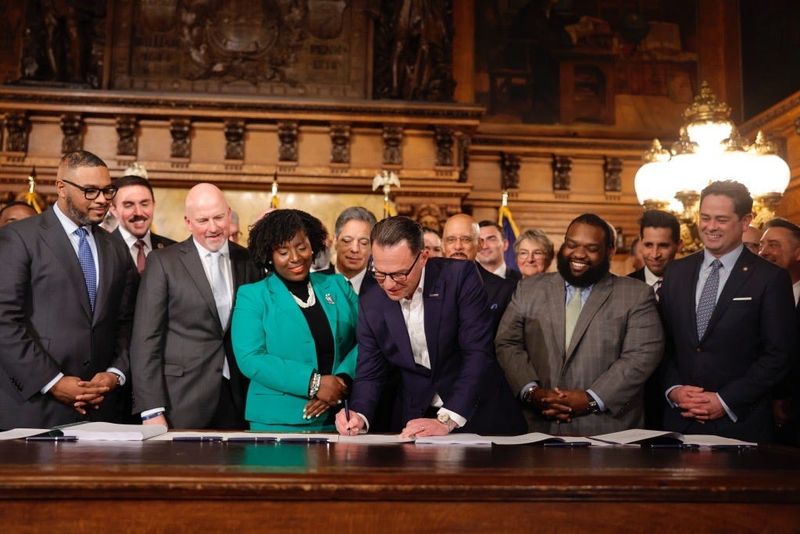
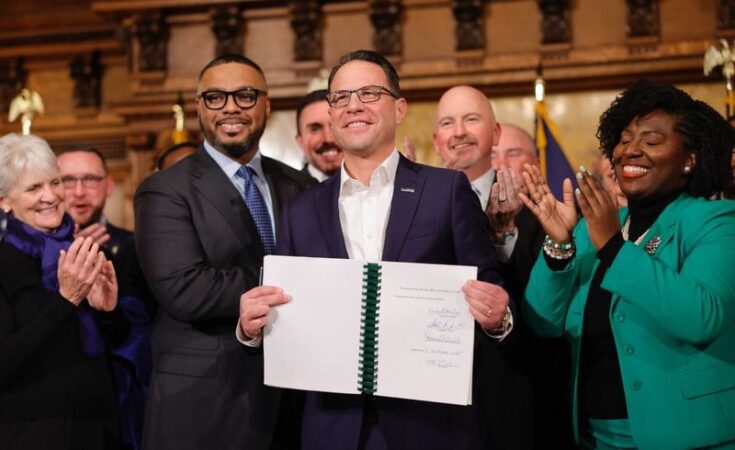
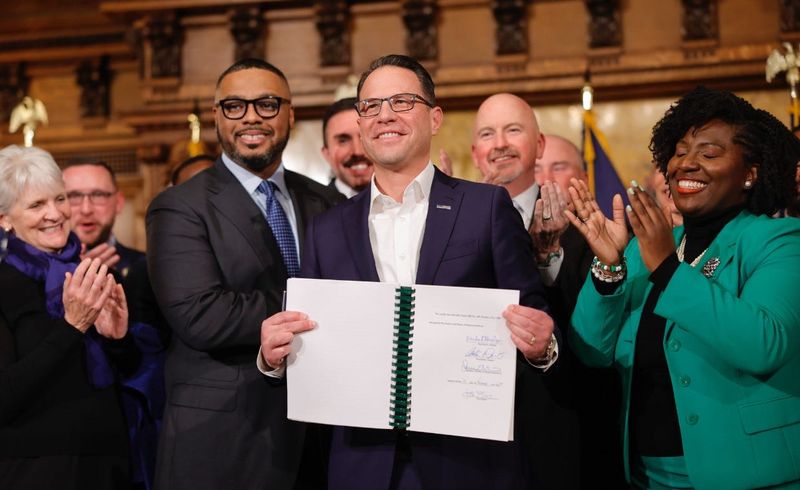
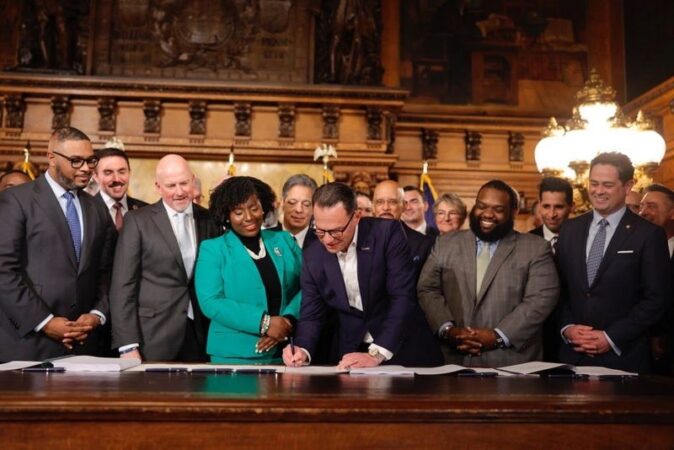
Gov. Josh Shapiro signs the fiscal year 2025-26 budget surrounded by General Assembly members on Nov. 12 at the Capitol in Harrisburg. The state budget had been due June 30, and Pennsylvania is the final state in the country to approve a funding deal.
“The final budget reflects the realities of working with one of the only divided legislatures in the entire country – but Gov. Shapiro will continue to fight for survivors and the Commonwealth’s rape crisis centers,” said Ali Fogarty, the DHS spokesperson.
Victim services centers in the suburbs, which also offer rape crisis services, are echoing WOAR and PCAR’s message, highlighting the urgent need for greater funding. These suburban centers receive funding from additional sources because they support victims of other crimes.
“For now, we’re doing OK, but another year of no increase in funding while the cost of living is going up has a significant impact on our staff as well as our organization,” said Penelope Ettinger, executive director of Network of Victim Assistance – Bucks County.
Trying to stay afloat
While Pennsylvania lawmakers were failing to come to an agreement on a far overdue state budget last month, rape crisis centers in Philadelphia and the suburbs were trying to make ends meet and provide services to survivors of sexual violence.
For instance, the Victim Services Center of Montgomery County had to use a line of credit, delay bill payments, institute a hiring freeze, increase the number of interns, and commit to “triaging services,” said Mary Onama, executive director.
“If they hadn’t passed the budget the time that they did, by December or January, we would have had to close, because we couldn’t go much longer,” Onama added.
At the Crime Victims’ Center of Chester County, it “added a layer of stress to an already very stressful job,” though the center did not have to reduce services, said Christine Zaccarelli, the organization’s CEO.
WOAR’s release last week said the closure of therapy and counseling services left “106 individuals wait-listed, 33 group clients waiting for services to resume, and eight child clients referred elsewhere for care.”
The center has been serving Philadelphia since 1971 and was one of the first rape crisis centers in the United States, according to the organization. Between January and October, the center said it responded to 3,820 calls on its crisis hotline.
The dysfunctional approval of the state budget, though, will have lingering effects on WOAR, warning in the news release that without a “long-term, sustainable investment,” the center won’t be able to meet a rising demand for resources.
The Bridge Loan, from the Pa. Treasury Department, provided WOAR funding owed for July through September, but it still wasn’t enough to return WOAR to full capacity, said Demetrius Archer, PCAR’s communications director. The center also brought back two employees this month, but it’s still in need of community support and is hoping to bring back more staff when possible.
“When services are underfunded, survivors and entire communities feel the impact,” said Fontan in the news release. “In a city as large and diverse as Philadelphia, every minute counts when someone is in crisis. Survivors deserve to know that when they reach out for help, someone will be there to answer.”
All eyes on Harrisburg
At Temple University’s campus Tuesday, student advocates bundled up in their coats, hats, and scarves and gathered at the Bell Tower to discuss an anti-sexual violence state bill they helped develop.
The Every Voice Bill, which primarily focuses on sexual violence prevention resources on college campuses, is even more important now that survivor services from WOAR are “unstable,” said Bella Kwok, a senior criminal justice major and president of Temple’s Student Activists Against Sexual Assault, in an interview prior to Tuesday’s event
“This bill would ensure that stability at least on an institutional level,” Kwok said.
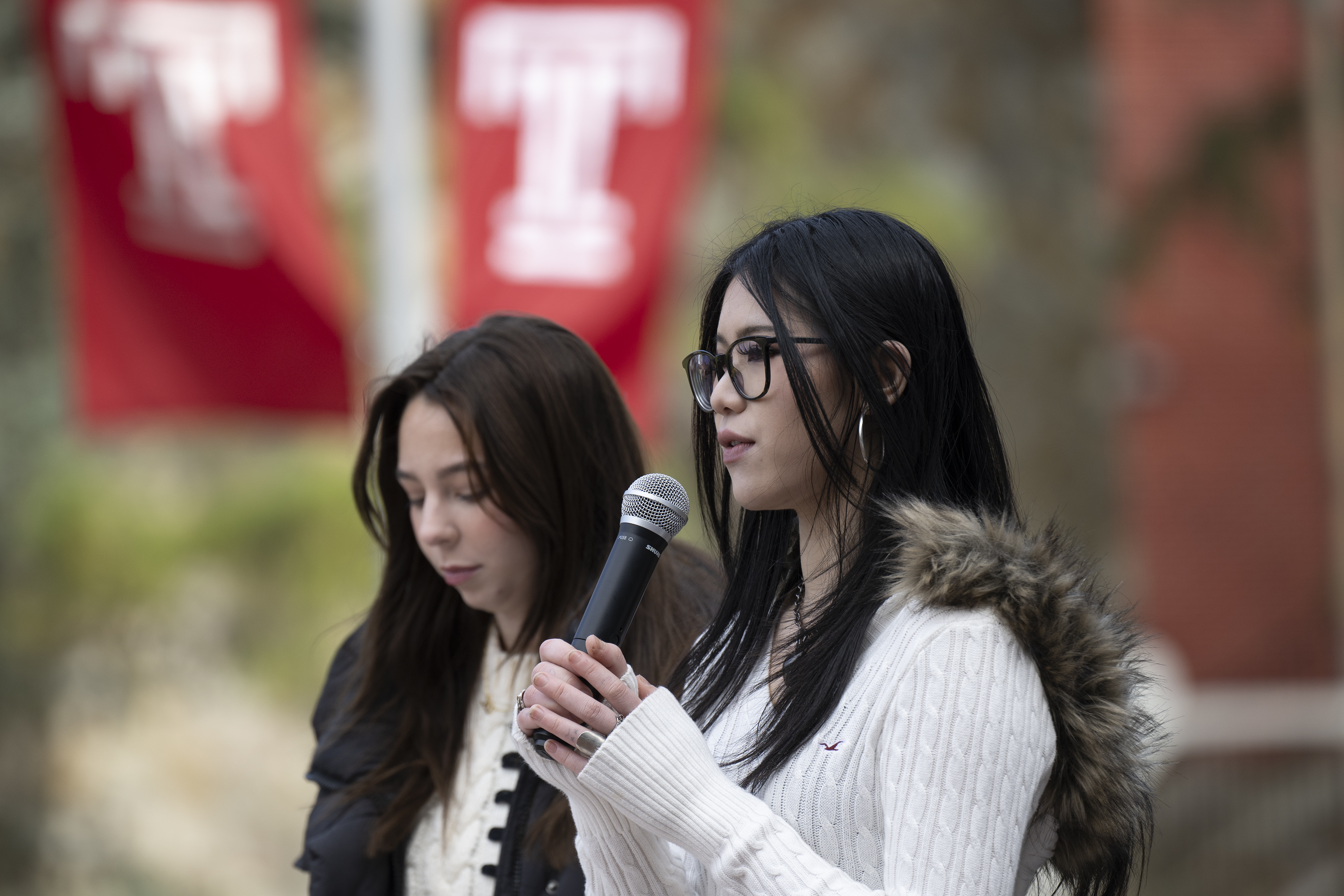
Temple University students Emma Wentzel, left, and Bella Kwok speak at a podium on Polett Walk on Tuesday, Nov. 18, 2025, about campus sexual assault and a state bill they helped craft to strengthen protections against sexual violence at colleges.
Kwok is not the only one who is turning their attention to Harrisburg. PCAR and other rape crisis centers are continuing their push for next year’s budget to include an $8 million increase in the Pa. DHS line item for rape crisis.
As the first increase for rape crisis centers in a few years, the new budget’s funding gives advocates “hope,” even if the amount is “disappointing,” said Zaccarelli, of the Crime Victims’ Center of Chester County.
“Maybe our advocacy is making a little bit of a difference and shining a light on survivors and their needs and how important our centers are in the community,” Zaccarelli said.
Ettinger said that Bucks County’s state lawmakers have been supportive of NOVA Bucks, which had to place a hiring freeze on some positions and issue “significant” restrictions on spending due to the impasse, but that a lack of increased funding from the state is “very telling.”
“I believe that the fact that the state did not allocate a significant increase is very telling to what they believe, where they put it on the priority list,” Ettinger said.
For his part, Shapiro signed Act 122 in October 2024, which aimed to increase transparency by requiring a statewide electronic system to track evidence kits for sexual assaults, Fogarty, the DHS spokesperson said. And in December 2023, he signed Act 59, which aims to improve access to treatment for survivors of sexual assault.
It’s a “societal” problem, not a government problem, said Vincent Davalos, interim executive director of the Delaware County Victim Assistance Center.
“When we talk about sexual violence, the first thought is, of most people, is to say ‘Maybe this didn’t happen,” Davalos said. “And even if they do believe it happens… it’s just a really difficult topic for people to engage and talk about it plainly.”
This week, victim services leaders across Pennsylvania will gather in Harrisburg for an annual conference to address funding challenges among other concerns, Davalos said, noting that with more funding, his center could improve staff retention.
But this year, the newly passed state budget is likely to be top of mind.
“I think money is going to be a big topic,” Davalos said.
The U.S. Department of Energy will loan $1 billion to help finance the reopening of Three Mile Island, a nuclear power plant in Pennsylvania that has been renamed the Crane Clean Energy Center.
The nuclear plant is owned by Constellation Energy Corp. and located on an island in the Susquehanna River just outside Harrisburg. The federal loan will lower Constellation’s price tag to get the mothballed plant running again, an effort that was already put on an accelerated timeline with the support of Democratic Gov. Josh Shapiro over the summer.
“Constellation’s restart of a nuclear power plant in Pennsylvania will provide affordable, reliable, and secure energy to Americans across the Mid-Atlantic region,” Secretary of Energy Chris Wright said in a statement. “It will also help ensure America has the energy it needs to grow its domestic manufacturing base and win the AI race.”
Constellation announced last year that it planned to spend $1.6 billion to reopen the plant as the demand for energy increases. The company announced a 20-year agreement with Microsoft to buy the power for its data centers.
Shapiro has supported that plan and touted pushing grid operator PJM to approve an early interconnection request for the site. Constellation employees celebrated with the governor in July with news that the plant’s last working reactor would be slated to open as early as 2027, a year ahead of schedule.
Joe Dominguez, president and CEO of Constellation, said in a statement this week that the DOE and Federal Energy Regulatory Commission have “made it possible for us to vastly expedite this restart without compromising quality or safety.”
Constellation spokesperson Mark Rodgers said Thursday the loan “supports” the already-existing plan.
When asked for comment on the federal loan, Shapiro did not mention the federal financing or the Trump administration at all, focusing instead on his own administration’s efforts.
“In Pennsylvania, we’re doubling down on our legacy of energy leadership by taking big, decisive steps to build new sources of power,” Shapiro said in a statement. “As an all-of-the-above energy Governor, my Administration is supporting new energy projects from all sources —from natural gas and solar to geothermal and nuclear.”
“The Crane Clean Energy Center takes advantage of our Commonwealth’s energy assets and brings more energy onto the grid, creating jobs and more opportunity for Pennsylvanians,” he added.
Trump’s administration has said bolstering nuclear power and artificial intelligence are among its priorities.
Constellation is working to restore equipment for the plant, including the turbine, generator, main power transformer and cooling and control systems. Its 835-megawatt reactor can power the equivalent of approximately 800,000 homes, according to the DOE.
The agency said in a statement that the reactor “will provide reliable and affordable baseload power,” in turn helping to lower electricity costs, strengthen the reliability of the energy grid, and “advance the Administration’s mission to lead in global AI innovation and restore domestic manufacturing industries.”
Sen. Dave McCormick, a Republican who has championed embracing tech and energy in Pennsylvania, said in a statement that the state is “leading America’s energy independence and the AI revolution by providing safe, clean, reliable nuclear power.” He said the center brings 3,400 jobs and “carbon-free electricity operating 24/7 to meet our increasing energy demands and economic growth across the region.”
The loan is being issued under an existing $250 billion energy infrastructure program initially authorized by Congress in 2022. Neither the department nor Constellation released terms of the loan.
The plan to restart the reactor comes during a sort of renaissance for nuclear power, as policymakers are increasingly looking to it to shore up the nation’s power supply, help avoid the worst effects of climate change, and meet rising power demand driven by data centers.
After being stuck in committee for four years, the Pennsylvania Senate passed the CROWN Act Wednesday with a vote of 44-3.
Passage of the act — an acronym for Create a Respectful and Open World for Natural Hair — means employers and school officials can’t bar people from jobs or schools for wearing their hair as it grows out naturally or choosing styles — box braids, twists, locs, or cornrows — that protect it.
The law applies to all Pennsylvanians, but especially impacts Black people. Black men who opt to wear locs or braids at work and school instead of close cropped Afros are often forced to cut them off.
But Black women, who, are often compelled and required to straighten their naturally curly coils in professional and school settings are the most will benefit the most from the new legislation.
“This law takes discrimination head on,” said Sen. Vincent Hughes (D-Pa.). “Natural hair is beautiful. This law protects Pennsylvanians by abolishing any notion that natural hairstyles are not appropriate in professional, educational, or public settings.”
Black women use scorching hot metal combs, flat irons, or blow dryers to press their manes into smooth styles. The hair remains straight until it gets wet and then it curls back up.
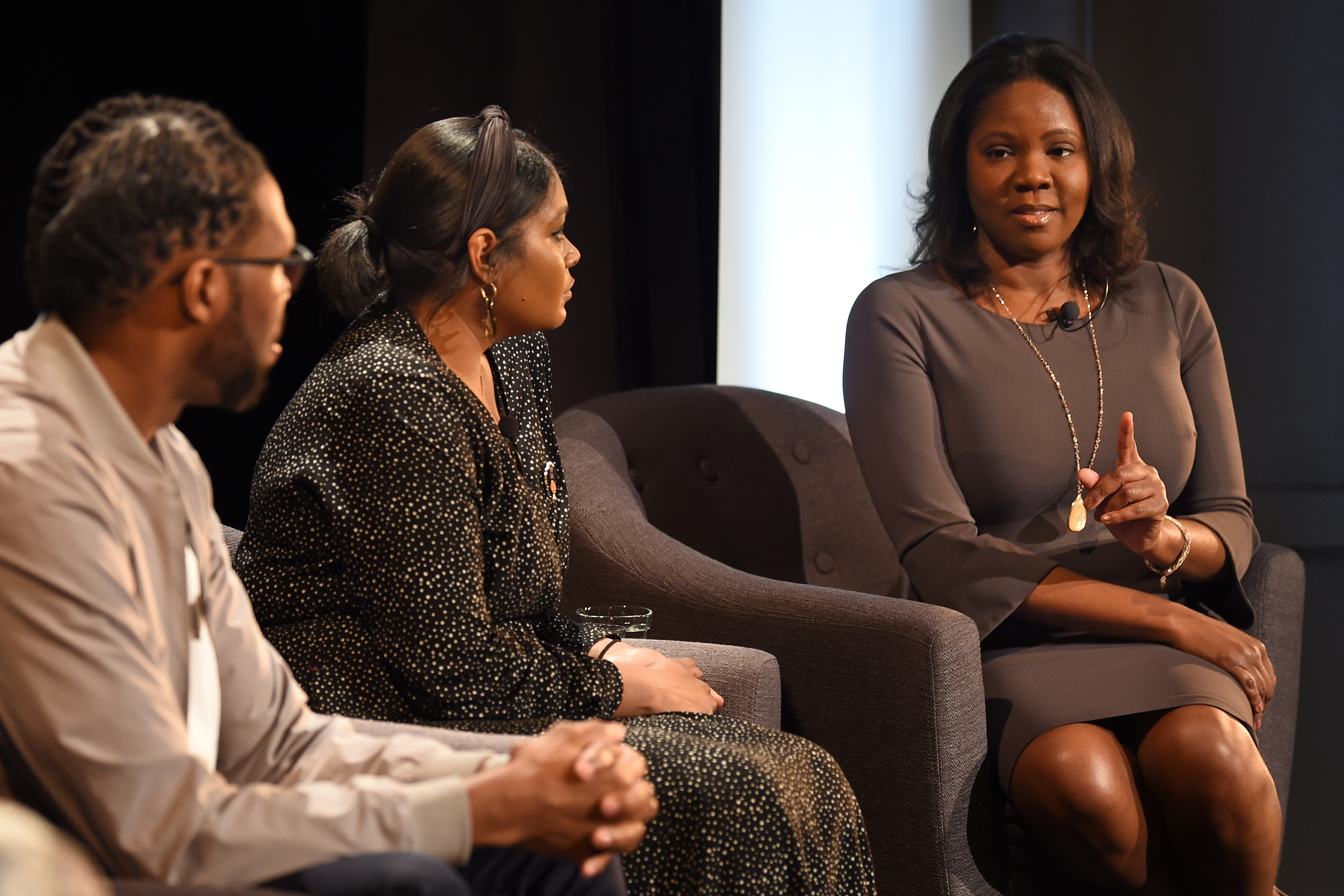
Political strategist and advocate Adjoa B. Asamoah (right) participates on a panel with the Oscar-winning Hair Love filmmakers at the National Museum of Women and the Arts in Washington, DC Feb. 23, 2020.
Some use relaxers. Stylists apply chemicals to the scalp to straighten the hair at the root, causing painful burns. This is a more permanent method, but the chemicals must be reapplied every few weeks when natural hair grows out.
Asamoah worked with attorneys to draft legislation, and champions the bill in legislative houses around the country.
“I shouldn’t have to increase my likelihood of developing cancer to be upwardly mobile. That can’t be the cost,” she said.
Fed up with hair discrimination, Asamoah began working with lawyers on the CROWN Act in 2018.
California, New York, and New Jersey were the first states to pass the CROWN Act the following year. The U.S. House of Representatives passed the CROWN Act in 2020, but it got stalled in the Senate.
Pennsylvania is the 28th state to pass anti-hair discrimination laws joining New York, New Jersey, Delaware, and Maryland. Both Pittsburgh and Philadelphia enacted ordinances banning hair discrimination in 2020, but the Pennsylvania ruling protects people throughout the state.
Gov. Josh Shapiro is expected to sign the bill into law in the coming months.
The Pennsylvania bill amended the Human Relations Act, clarifying the term of race to include traits such as hair texture and protective hairstyles. The House passed the CROWN Act in 2023 but was later assigned to a Senate committee where it lay buried.
It passed the State House again in March, with a vote of 194-8, signaling strong bipartisan support. This time House Speaker Joanna McClinton (D., Phila.) a prime sponsor of the bill, refused to leave its fate up to chance. She worked with Republican Senate president pro tempore Kim Ward to move the bill to the Senate as part of the state’s budget negotiations.
“I told her the CROWN Act was an important piece of legislation for people in all the communities that we serve,” said McClinton, who wears her hair in natural protective styles. “I’m excited about what the future holds for women in the Commonwealth of Pennsylvania who won’t have to face another barrier to succeeding in the work place.
Former first Lady Michelle Obama recently reignited the discussion of Black women’s natural hair during interviews about her book The Look.
Obama didn’t wear braids during Barack Obama’s presidential term because she feared they would be a distraction, she recently told Sherri Shepherd on her daytime talk show.
However, upon returning to the White House in 2022 to unveil her official portrait, she wore braids gathered into a bun at the nape of her neck.
“I wanted to make a statement, ‘Y’all get out of our heads,’” Obama said. “I don’t want any man in any HR department making decisions about what is appropriate, how we look, [to be able to determine] our ability to wear wigs, locs, braids and extensions … Don’t hire or fire somebody based on something you know nothing about.”
Her comments drew ire of Republicans including Megyn Kelly who countered, saying the drama was all in Obama’s head.
That kind of disconnect, Asamoah said, is why the CROWN Act is needed.
“People have been discriminating against Black people’s hair for decades, and yes, it’s still happening,” Asamoah said.
“The important thing is that Black women can no longer be fired, passed over for a promotion, or have a job offer rescinded if we wear our hair in locks, braids, or twists … If someone tells you need to straighten your hair at your job, that’s now a violation.”
Nearly 1 million Pennsylvanians are expected to qualify for a new state tax credit that is meant to ease the burden of making ends meet.
The new Working Pennsylvanians Tax Credit will allow eligible low- and moderate-income filers to receive a state tax credit that is equal to 10% of what they qualify for through the federal Earned Income Tax Credit (EITC). Like the EITC, the state credit will depend on income and number of children. The highest credit will be $805 and, according to Gov. Josh Shapiro’s office, the average credit will be around $240.
In Philadelphia alone, 175,393 people are estimated to benefit from the new state tax credit totaling $41.7 million, according to Shapiro’s office. Statewide, it is expected to provide a total of $193 million in tax relief to 940,000 Pennsylvanians.
The policyhad bipartisan support since 2023, and was led by State Rep. Christina Sappey, a Chester County Democrat. Sappey and a team of Democrats sponsored a bill that passed the Democratic-led House in May that would have allowed a 30% credit, but that figure waslowered to 10% as a result of budget negotiations with the Republican-led Senate and Shapiro.
It’s one of the measures being hailed as a major win for Democrats in the $50.1 billion state budget deal, which was approved last week after a more than four-month impasse.
Sappey saidthat she was approached by the United Way of Pennsylvania “several years ago” about the idea.
“I think of all of the folks who are really just struggling right now to make ends meet — but they’re working,” Sappeytold The Inquirer.
“They get thrown a curveball, like an unexpected healthcare expense, get in a car accident, need a giant car repair, something like that,” she added. “They really get kind of knocked off the rails, and then they kind of spiral.”
At a news conference on Tuesday, Shapiro listed examples of Pennsylvanians who will qualify for the tax credit.
“That single mom who’s raising three kids whose making about $25,000 a year as a waitress, she can get $770 back on her state taxes on top of whatever relief she was going to get from the federal government,” Shapiro said.
“This isn’t some giveaway … we’ve come together on a bipartisan basis to say, ‘If you’re working, if you’re doing everything right by the book, we’re going to put money back in your pockets,’” he added.
Who is the Working Pennsylvanians Tax Credit for?
The tax credit is designed for working Pennsylvanians with a total income up to $61,555 if filing alone, and up to $68,675 if filing jointly as a married couple, according to the IRS guidelines for the EITC.
Eligibility for the state credit is based on thefederal EITC, which is meant for low- to moderate-income workers. Workers with kids can qualify for a bigger credit that increases with the number of children up to three or more kids.
Individuals must be employed and earn income to qualify.
Households that can benefit from this program may earn too much to qualify for public assistance while not earning enough to be able to handle an unplanned financial emergency, according to the United Way. About 28% of Pennsylvanians fall into this group, according to testimony from the United Way of Pennsylvania president Kristen Rotz.
How does the tax credit work, and how much is it for?
Pennsylvania’s state credit will be 10% of the EITC amount a filer qualifies for. Filers will automatically qualify for the state credit.
“This is probably one of the more easy tasks you’re going to have to deal with as you’re helping people fill out their taxes,” Shapiro told a group of Widener University students Tuesday.
The program will begin for tax year 2025, so Pennsylvanians can use it this forthcoming tax season. The credit is refundable, so taxpayers will get money back if the credit exceeds how much they owe.
The credit amount initially increases based on how much money the earner makes and then decreases after it reaches a certain amount, resembling a bell curve, said Montgomery County accountant David Caplan. That “tipping point” differs depending on the tax filer’s status and number of dependents, he said.
The maximum state credit for filers with no kids is $65, and about 261,739 Pennsylvanians are expected to fall in that tier, according to the Office of state House Speaker Joanna McClinton, a Philadelphia Democrat.
That maximum raises to $432 for households with one child, $715 for two children, and $805 for households with three or more kids. About 133,641 Pennsylvanians are expected to fall in that maximum credit tier, according to McClinton’s office.
There were 802,000 claims for the federal EITC in Pennsylvania for the 2023 tax year, totaling $2.086 billion, according to the IRS. The average federal credit amount was $2,600. Under the new state credit, that would amount to $260.
“While it’s not much, it’s certainly a help, and that’s something that’s tangible,” said State Rep. Tarik Khan, a Democrat who cosponsored the state tax credit bill and represents parts of Philadelphia.
Do other states have a credit like this?
According to the National Conference of State Legislatures, 31 states, D.C., Guam, Puerto Rico, and some municipalities have their own version of the EITC.
Most of those states calculate their credit as a percentage of the federal program, ranging from 4% in Wisconsin to 125% in South Carolina, according to the group.
Neighboring New Jersey offers a 40% credit and Delaware has 4.5% refundable and 20% nonrefundable credits.
State Rep. Steve Samuelson, a Northampton County Democrat who chairs the House Finance Committee and cosponsored the tax credit bill, called the credit a “commonsense” measure. He pointed out how existing states have varying political leanings, from the redder Oklahoma, Indiana, and Kansas to bluer states like New York, Hawaii, and California.
“Better now than never,” Samuelson said.
Is a 10% tax credit the right amount?
Sappey and other Democrats see the 10% credit as a starting point. They hope to increase the size of the credit in future years.
“If this is a program that both sides can agree to, getting a program established is more important than, you know, how big it is at the beginning,” she said in an interview.
Caplan, who chairs the Pennsylvania Institute of Certified Public Accountants’ Local Tax Thought Leadership Committee, said he believes the 10% tax credit could be higher, but maybe not as high as the 30% initially approved by the House.
“I don’t think the 10% is outrageously low that it’s kind of chintzy,” he said. “I think it’s just a nice thing to do.”
Sen. Lynda Schlegel Culver, a Republican from Northumberland County who said she championed the policy, lauded the program for helping taxpayers who work.
“This credit rewards work, strengthens household stability, and helps those doing everything right, working, paying their bills, and supporting their families,” she said in a statement. “This is a commonsense investment in both our workforce and the future of our Commonwealth.”
Concerns from other Republicans about the program were related to the cost and its size.
Sappey said “that’s legitimate” but contends that the program helps people “increase their earning power” and that the hope is, in turn, for them to no longer be eligible for the credit. And when they get it, she argues, “they are spending it in really good ways.”
“We’re keeping people in the workforce, we’re generating revenue, and we’re keeping them out of social safety net programs,” she said.
Rotz, of the United Way, said in her testimony that EITC recipients often spend their credit on grocery stores, vehicle and home repairs, paying off debt, and sometimes education.
Khan lauded HouseDemocratic leaders for holding onto the tax credit in negotiations — and compared their long-delayed negotiations to the Eagles’ season, which has seen the team rack up wins despite offensive struggles.
“You love them, and then you watch the game, and you’re like, ‘Goddamn it. Why can’t you just play like a normal team?’ But then they win in the end, and you’re like, ‘You know what? That was a tough game, but damn it, I’m so happy right now,’ and so that’s how I feel with this.”
I’m always reluctant to talk about upcoming columns, because in this twisted era everything changes at the drop of a MAGA hat, and I hate to jinx things. But as of now, I’m booked for a trip to Charlotte (or Raleigh?…I’ve already jinxed it, maybe) this coming weekend, where I hope to report from the front lines of the Border Patrol’s latest big-city invasion that has terrorized the immigrant community in North Carolina. So I’m going to spend a couple days reading up on what to do in a tear-gas attack, and I’ll see you again this weekend.
Fearless college kids are saving journalism. Grown-ups? Not so much
Editions of the Indiana Daily Student in the student media area in Franklin Hall on Indiana University’s campus on Oct. 14.
In American journalism’s year of the bended knee, nobody would have been surprised if the student editors of the Harvard Crimson followed the sorry example of major outlets like CBS News or the Washington Post in groveling before the rich and powerful — in this case, their ex-university president and still plugged-in professor Larry Summers.
Earlier this month, Summers took to social media (the Elon Musk-owned X, of course) with a rant against the student-run paper at the Ivy League school he once helmed, linked to an article by conservative commentator (and former Crimson editor) Ira Stoll accusing the Crimson of biased coverage in favor of Palestine. Summers said ominously, “I do hope alumni trustees will investigate and take any necessary steps lest a problematic situation deteriorate any further.”
But instead ofbacking down, Harvard’s student journalists stepped up. When the emails of the late financier and sex fiend Jeffrey Epstein, released last week by a House committee, proved to be riddled with his communications with Summers — long after Epstein had pleaded guilty to teen sex trafficking in Florida — the Crimson produced the most in-depth takedown of any media outlet, anywhere.
“As Summers Sought Clandestine Relationship With Woman He Called a Mentee, Epstein Was His ‘Wing Man’” was the blistering headline on the article by undergraduates Dhruv T. Patel and Cam N. Srivastava. It described, in excruciating detail, the married Summers’ missives to Epstein about his efforts to woo a much younger Chinese economist on campus whom he was mentoring (and whom the former U.S. treasury secretary and his felonious friend code-named, with a racism they thought would remain forever private, as “peril.”)
Take that to the alumni trustees, Mr. Summers!
With a devastating kicker that shows Summers still emailing Epstein up until 1:27 p.m. of the day before his pal was busted on new federal sex charges in 2019, the Crimson article went viral over the weekend. By Monday morning, Massachusetts U.S. Sen. Elizabeth Warren was calling for Summers’ ouster from his faculty post. By Monday night, a “deeply ashamed” Summers announced that he’s pulling back from his public commitments, although he plans to continue teaching.
The students’ reporting was another win for truth, justice, and the American way — but not an isolated incident. In recent years, as mainstream journalism looks increasingly weak and flabby in the face of U.S. authoritarianism, and with college campuses on the front lines of a culture war, scribes in their teens and early 20s — burning with youthful idealism and the freedom of not much to lose — have raced into the void.
Some 3,000 miles from Harvard Square, the student journalists at the Stanford Daily stood their ground after one of its reporters was charged with three felonies, at the behest of a top university administrator, for attempting to cover a pro-Palestinian protest on the California campus. Under increasing public pressure, the charges were dropped in March — another triumph for the paper whose 2022 investigative reporting into research irregularities took down the university president.
In the heartland, the editors of the Indiana Daily Student at that state’s flagship public university last month stood up to school administrators banning their print editions, blasting the move in a front-page editorial that said “telling us what we can and cannot print is unlawful censorship.” The students, who worked with their peers at nearby Purdue University to publish a special issue that circumvented the ban, rallied support from prominent alums and got the school to reverse course.
“I think that many of these college journalists are laser-focused on their beats, are developing great sources among administrators, faculty and students, and are unfazed by the possibility that their stories might piss off a valued source or two,” Columbia Journalism School professor Bill Grueskin, who covered the Stanford fracas for Columbia Journalism Review, told me Monday. “In other words, they’re doing the things that the best reporters do. They’re just not able to buy a beer (legally, at least) when their story shakes up the world.”
I know what some of you are thinking here. Investigating corruption or misconduct among university leaders, or fighting for a free press…aren’t these college students just doing what any journalist worth their saltwould do? Well, yes and no.
Consider those Epstein emails that continue to dominate the news. It turns out that two prominent journalists corresponded frequently with the convicted sex creep: the “palace intrigue” access journalist Michael Wolff, and a soon-to-be-fired New York Times business reporter, Landon Thomas Jr. The missives suggest they had zero interest in reporting on Epstein’s proclivity for underage girls but very much wanted the access to the rich and famous that jeevacation@gmail.com offered.
And it gets worse. Thomas actually solicited a $30,000 donation from Epstein to a favored charity — a severe ethical breach that cost him his job in America’s most prestigious newsroom. Wolff, meanwhile, was offering Epstein advice on how to leverage — in essence, blackmail — the sitting U.S. president, Donald Trump. At the same time, he was pushing a business venture that would link him not only with Epstein but another man later convicted of sex crimes, filmmaker Harvey Weinstein. It seems like both conflicted journalists wanted to play in the big leagues with the much richer people they were supposed to watchdog.
This is something that too many elite journalists share with the increasingly conflicted corporations that employ them: a desire to comfort the comfortable in return for access, or prestige, or money — and to avoid getting sued, which might jeopardize those first three things.
How else to explain major TV networks like CBS or ABC, owned by corporations with myriad issues before the federal government, settling frivolous lawsuits by Trump for millions of dollars, or the similarly conflicted Jeff Bezos telling his Washington Post to spike its endorsement of Kamala Harris, or the mealy-mouthed “both sides” reporting on rising authoritarianism that plagues so many elite newsrooms of the traditional media?
The late, great Kris Kristofferson told us that freedom’s just another word for nothing left to lose, and maybe that simple explanation has a lot to do with the bravery of college journalists — that they are freer to question authority than folks with a mortgage and worries about paying for their own kids to attend a top school.
Still, it’s important to understand that most of the rot in modern mainstream journalism — too much consolidation in the hands of too few conglomerates with too much at risk to be seen as anti-regime — is institutional. We should strive to make something great out of the fact that the next generation of American journalists has arrived with smarts, savvy, and a moral compass yet to be worn down by late-stage capitalism.
Our challenge, as a society, is to tear down the decrepit structures of the corrupted old media and build a new one that rewards independent journalists who actually afflict the comfortable, and offers them incentives to keep doing that instead of cutting venture-capitalism deals with the folks they allegedly cover. Most of today’s college journalism majors would never trade emails with the likes of Jeffrey Epstein — except to take him down.
Yo, do this!
The stroke of timing behind Ken Burns’ latest documentary epic, The American Revolution, which is currently running this week on PBS stations like WHYY here in Philadelphia and also streaming, was supposed to be the 250th anniversary of the conflict that created the United States. But the project has taken on much greater relevance in a fraught present, when folks are heatedly arguing just what the Founders’ American Experiment is really all about. Critics have praised Burns and his skilled team for blending the ideals and leadership of the George Washingtons and Thomas Paines with the realities faced by everyday folk, including indigenous and enslaved people.
Personally, I’ve been embroiled in my nostalgia for a more recent revolution — the cultural and musical explosions that occurred in 1966. I’ve been listening to the audiobook about that tumultuous year — 1966: The Year the Decade Exploded — by the British author Jon Savage, whose later book on the year 1971 was the basis for an outstanding but largely ignored documentary series on Apple TV, But 1971’s classic rock wouldn’t have happened without the cultural pioneers and a youthful clamor for liberation that came five years earlier. The book is an engrossing reminder that change is possible.
Ask me anything
Question: Now that People Magazine has revealed the disgusting “piggy” story, why isn’t this atop every news outlets coverage? We spent 3 full weeks on Biden’s age, a week on his pardon of his son with such moral outrage from every outlet. This doesn’t even get covered? — BigTVFan (@bigtvfan.bsky.social) via Bluesky
Answer: The episode that BigTVFan is referring to occurred with a gaggle of journalists about Air Force One, but just started getting viral attention Monday night. It is, indeed, shocking to watch. When a Bloomberg woman journalist pressed Donald Trump on the Epstein files, the president erupted. “Quiet! Quiet, Piggy!” Yes, this should be a front-page story in the traditional media, and not only because of the stunning sexism (when the subject is Epstein, no less!) and the regal arrogance, but also this: the man who’s followed around by the nuclear suitcase seems to be losing his grip on reality. Monday afternoon, Trump spoke to a gathering of franchisees of the fast-food addiction that may be just one reason why nobody believes he only weighs 16 ounces more than Jalen Hurts, McDonald’s, and was at times beyond incoherent. Yet Trump’s rapidly deteriorating mental state remains mostly off-limits for the elite media. It’s a massive error of omission that the world will look back on and regret.
What you’re saying about…
It’s funny how one week can feel like a decade in 2025. Last week’s question about the eight senators (seven Democrats and an independent) who cut a deal to end the long government shutdown drew a huge response from folks fired up about an issue that now almost feels like ancient history after the Epstein email release. Readers were passionate but divided. Certainly many felt the eight senators had caved in the worst possible way. An outraged Freddi Carlip wrote that “most people wanted to do what was best for Americans who are hurting and that is to stand up to bullies.” But a number of you thought the opposition had few real options but to deal from a weak hand. “This was always going to end with the government opening under the black flag of the Big Ugly Bill,” wrote Kent Dietz. “Oft repeated but true: elections have consequences.”
📮 This week’s question: It’s all Epstein all the time, so let’s talk about it. Do you think Trump has sincerely flip-flopped and the relevant files will soon be released? Or is the White House still playing a long game aiming to keep Epstein’s secrets buried with him? Please email me your answer and put the exact phrase “Epstein files” in the subject line.
History lesson on ‘Charlotte’s Web’…and fascism
U.S. Border Patrol Commander at large Gregory Bovino, right, looks on as a detainee sits by a car Monday, in Charlotte, N.C.
Nobody reads any more, at least not to the end. That’s been driven home this autumn by several efforts from tech bros and other leaders of our dystopia falling flat on their face with their attempts at literary allusions. A viral post on Bluesky recently mocked the Icarus Flying Academy, whose founders may be blissfully unaware that their Greek mythological namesake flew too close to the sun and crashed. On Monday, gazillionaire Jeff Bezos also invoked ancient Greece by announcing his AI startup Project Prometheus, invoking an inventor who was ultimately bound to a rock by Zeus for his overreaching. Then there’s the bad people behind the U.S. Border Patrol and its inhumane mass deportation drive, who took their horror show to North Carolina this past weekend with their “Operation Charlotte’s Web.”
The “brains” behind the BP’s masked goon squad, Gregory Bovino, named the operation — which netted 81 detainees in its first Saturday during a chaotic surge through suburban lawns and Home Depot parking lots — after the 1952 classic children’s novel by E.B. White about a farm, a pig, and the compassionate spider, Charlotte, who saves the pig’s life. Why? Because Bovino’s secret police force are ensnaring scores of immigrants in their web. In Charlotte, N.C. Get it? Bovino even took to social media’s X with a wildly out-of-context quote from the novel: “Wherever the wind takes us. High, low. East, west. North, south. We take to the breeze, we go as we please.”
In a viral essay, the writer Chris Geidner of the excellent site LawDork demolished Bovino’s literary aspirations for his police-state operation. His piece went well beyond the obvious point that a children’s novel that centers on a spider’s quest to protect someone different from her — a pig — from his human predators is the 180-degree polar opposite from the web of inhumanity that Team Bovino is spinning in Charlotte, terrorizing the Latino community there. Geidner notes that much of E.B. White’s wider work was in opposition to the very fascism that’sbehind the mass deportation drive of Bovino and his ultimate boss, Donald Trump.
Geidner quotes White from a 1940 essay, as Adolf Hitler’s stormtroopers were advancing across Europe: “I am in love with freedom and that it is an affair of long standing and that it is a fine state to be in, and that I am deeply suspicious of people who are beginning to adjust to fascism and dictators merely because they are succeeding in war. From such adaptable natures a smell rises. I pinch my nose.”
White, and his fictional Charlotte, would have done more than pinch their nose from the stench of this operation in a proud city that shares its name with a heroic spider. For sure, Bovino’s crimes against literature pale in comparison to his ongoing crimes against humanity. But he may discover that the rapidly spinning American thread of community and common decency that is resisting mass deportation is the true sequel to Charlotte’s Web.
What I wrote on this date in 2018
It was Mississippi’s most famous writer, William Faulkner, who wrote, “The past is never dead. It’s not even past.” Seven years ago on this date, I wrote about how a justice-denied 1955 murder of a Black man trying to deliver absentee ballots to the county courthouse in Brookhaven, Miss., haunted the modern Senate campaign of that town’s GOP U.S. Sen. Cindy Hyde-Smith. I wrote: “Four years after [Lamar Smith] was killed, a baby girl was born in Brookhaven named Cindy Hyde. Over the next 59 years, she immersed herself in the politics of a community that bitterly refuses to concede the just cause that Lamar Smith died for.” Read the rest from Nov. 18, 2018: “Why the blood of a 1955 Mississippi murder drenches today’s U.S. Senate race.”
Recommended Inquirer reading
Only one column this week, and as you might expect it drilled deeply into the true meaning of the Jeffrey Epstein emails that have dominated the headlines. I went beyond the suggestive comments about Donald Trump to look at the deeper moral decay of the rich and famous who continued to seek out Epstein and his connections years after his Florida guilty plea to child prostitution charges. The missives from billionaires and political insiders also reveal their growing — and justified — worries that the public may be reaching for pitchforks.
The John Fetterman saga never ends, nor does Pennsylvania readers’ bottomless fascination with his decade-plus odyssey from outspokenly progressive mayor of struggling Braddock, Pa., to the U.S. Senate, where he is increasingly at odds with his fellow Democrats about practically everything. The Inquirer’s coverage of revelations in Fetterman’s new autobiography, including his long-running feud with Gov. Josh Shapiro, was one of the most widely read stories last week. So was what happened next, as renewed heart problems caused Fetterman to fall flat on his face and again be hospitalized. There’s three more years until the end of Fetterman’s term and an all-but-certain primary challenge from his political left. No one is going to cover this better than The Inquirer, so why not subscribe today?
By submitting your written, visual, and/or audio contributions, you agree to The Inquirer‘s Terms of Use, including the grant of rights in Section 10.
The turning point in Pennsylvania’s budget impasse, by Gov. Josh Shapiro’s telling, came just before Halloween, when he and leaders in Harrisburg gathered in his stately, wood-paneled office to meet twice daily to hash out a deal to end the bitter, monthslong stalemate.
The long grind eventually led to compromises 135 days in, and a deal Shapiro said he thinks is far better than what national Democrats, hoping to extend healthcare subsidies, got in Washington at the end of the federal shutdown.
“Sometimes you’ve got to show that you’re willing to stay at the table and fight and bring people together in order to deliver,” Shapiro told The Inquirer in an interview Friday, touting the state budget agreement finally signed that week.
“I think it’s a stark contrast, frankly, with what happened in D.C., where they didn’t stay at the table, they didn’t fight, and they got nothing,” he said.
Washington is controlled by Republicans, while in Pennsylvania, Democrats control the state House and governorship, and Republicans hold a majority in the Senate.
Both state and federal budgets were signed the same day, offering Pennsylvanians relief from more than a month of government dysfunction at two levels. But for Shapiro — an exceedingly popular Democratic governor facing reelection in 2026 as whispers swirl over his potential 2028 presidential ambitions — the moment was bigger than a procedural win. In the end, Shapiro, preaching his oft-used slogan of “getting things done,” cast the outcome as proof he can muscle through gridlock of a divided legislature, cut deals under pressure, and hold firm where others cave.
So what if it took almost five months? Shapiro argues. At least he didn’t fold.
“I would have hoped to have gotten this budget done, you know, 100 or so days earlier,” Shapiro said, putting pen to paper in the state Capitol building’s baroque reception room last week. “But I think what you also saw was the result of having the courage to stay at the table and keep fighting for what you believe in. And we got a lot more than we gave in this budget.”
Gov. Josh Shapiro signs the fiscal year 2025-26 budget surrounded by General Assembly members on Nov. 12 at the Capitol in Harrisburg. The state budget had been due June 30, and Pennsylvania the final state in the country to approve a funding deal.
Critics are quick to note it took the self-proclaimed dealmaker so long to get a deal. Counties, school districts, and nonprofits struggled through four months without state payments while officials remained at loggerheads.Pennsylvania was the last state in the nation to pass a spending plan for the 2025-26 fiscal year.
“He’s five months late. He’s the governor of the fifth-biggest state in the country and the last state to get a budget done,” GOP consultant Vince Galko said. “It’s not a failing grade because it got done, but it’s still a D.”
‘A tremendous cost’
The $50.1 billion budget includes several key priorities for Shapiro and Democrats: significant increases in public education funding, a new tax credit for lower- and middle-income residents, continuation of a popular student-teacher stipend, and other economic and workforce development initiatives.
House Speaker Joanna McClinton (D., Philadelphia) heaped praise on Shapiro during a Monday news conference celebrating the budget’s new Working Pennsylvanians tax credit. “I am grateful that here in Harrisburg we have a hero among us for working families, and his name is Josh Shapiro.”
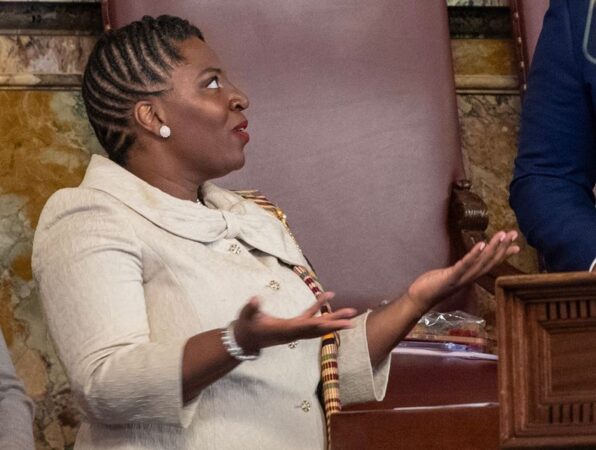
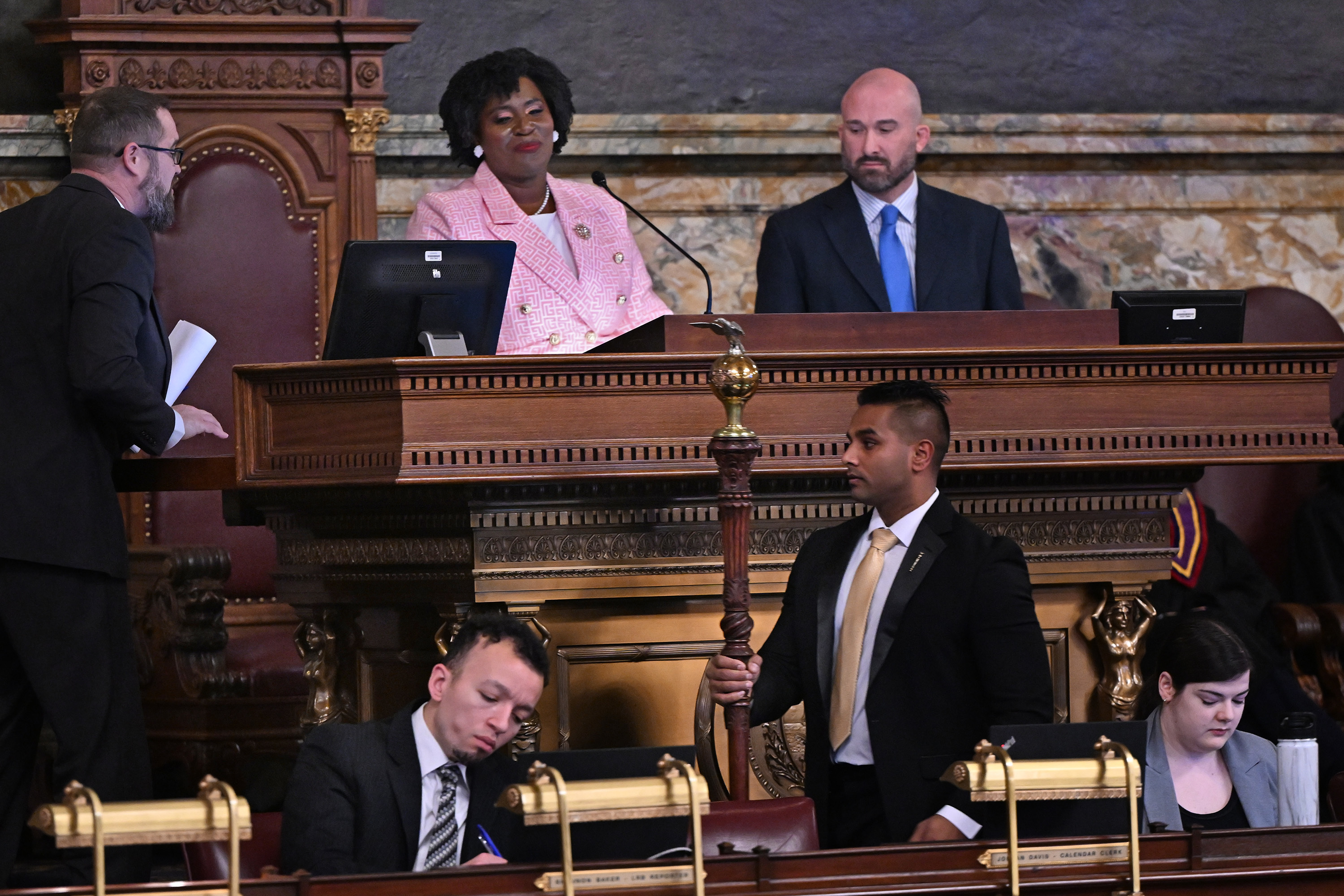
State Rep. Joanna McClinton (D., Philadelphia) is on the rostrum in the House chamber on Jan. 7 after she was reelected speaker of the House despite an initial 101-101 tie vote along party lines.
State Sen. Nikil Saval, a progressive lawmaker who represents part of Philadelphia, was one of a handful of Democrats to vote against the bipartisan Pennsylvania budgetbill that was largely lauded by Democrats and Republicans in Harrisburg and beyond. Saval applauded the school funding, anti-violence grant funding, and childcare support but slammed the absence of transit funding and Democrats’ agreement to end their pursuit to join a key climate program.
“Unfortunately, it comes at this tremendous cost,” he said.And ultimately, Saval said, the finished product didn’t seem to justify the time it took to get there.
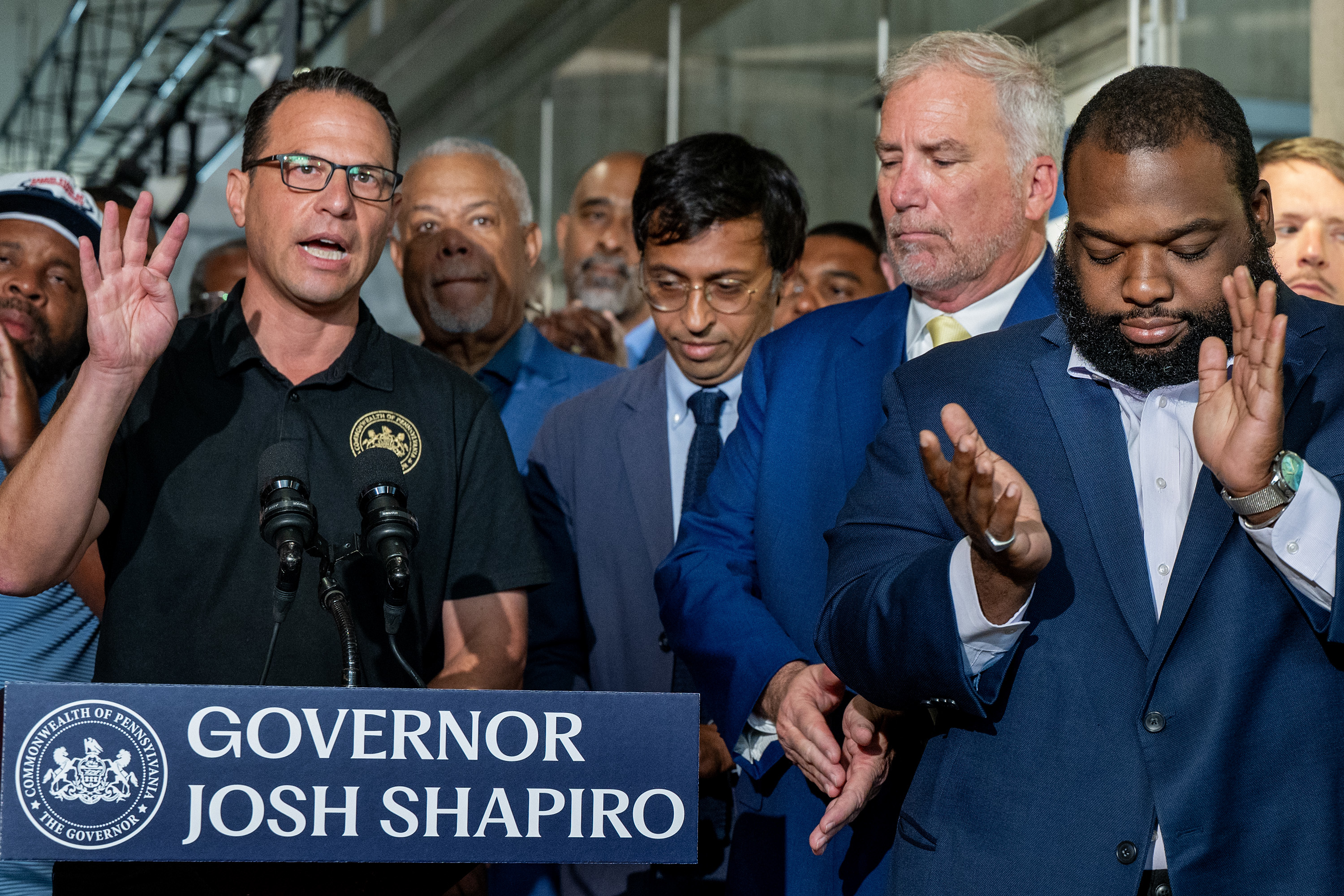
Gov. Josh Shapiro visits SEPTA headquarters on Aug. 10 to discuss funding for the transit agency. To his right, from left, are state Democratic legislators Sen. Anthony H. Williams; Sen. Nikil Saval; Rep. Ed Neilson; and Rep. Jordan Harris.
It was not just transit funding that took a back seat to get the budget deal over the line. To thedelight of Republicans — and the chagrin of some progressive Democrats and the climate-conscious — the deal also pulled the state out of the Regional Greenhouse Gas Initiative, a cooperative among states to reduce carbon emissions.
“For years, the Republicans who have led the Senate have used RGGI as an excuse to stall substantive conversations about energy,” Shapiro said. “Today, that excuse is gone.”
The powerful Pennsylvania Building and Construction Trades Council had lobbied heavily for lawmakers to walk away from the initiative, and it was a top win for state Republicans, who have long said the state should not join the multistate cap-and-trade emissions program they see as hamstringing Pennsylvania’s energy industry from accessing the state’s plentiful natural resources.
‘Two-a-days’
Shapiro said he spent months “running back and forth” to broker a deal between Senate Majority Leader Joe Pittman (R., Indiana) and House Majority Leader Matt Bradford (D., Montgomery). The three met on-and-off in private talks, attempting to hammer out a compromise between the Democratic House and Republican-controlled Senate. But the week of Oct. 27, more than four months into the stalemate, Shapiro said a “breakthrough” finally came when he broadened the talks to include McClinton and Ward.
Minority leaders Rep. Jesse Topper (R., Bedford) and Sen. Jay Costa (D., Allegheny) also joined the group, as it became clear that neither of the tightly controlled chambers would have the votes needed to pass a final budget deal.
The group met twice daily in a conference room in Shapiro’s office. Shapiro, always a fan of the sports metaphor, called the meetings “two-a-days.”
“We would come in the morning, go over the issues. We’d have our homework for a few hours, then come back in the afternoon and talk about, you know, the progress that we made,” Shapiro said. Coming out of that week, the governor said, leaders “had a clear direction on where we were going to go.”
Pennsylvania Lt. Gov. Austin Davis and Gov. Josh Shapiro show a budget document moments after it was signed Nov. 12 while surrounded by legislators at the state Capitol. A deal struck Nov. 12 ended a budget delay that lasted more than four months.
At the negotiating table, Shapiro served as “referee and facilitator” between House Democrats and Senate Republicans, McClinton said in an interview Monday.
“The man is nothing if not dogged and determined,” Bradford said of Shapiro last week.
Two officials in the closed-door talks said Topper’s presence, as the House minority leader who understands House Democrats and Senate Republicans, helped change the dynamic and got leaders on track toward a deal. Other officials in negotiations noted that once the state’s two top leaders — McClinton and Ward, who are both the first women to serve in their roles — the breakthrough deal swiftly came together.
Topper, for his part, didn’t try to take credit for striking the final budget deal, calling himself “a neutral arbiter” and “someone all sides can trust to have an honest dialogue.”
There were other signs of tensions easing as the legislators worked through the fall. Ward, a top critic of Shapiro since he reneged on a promise he made over school vouchers during his first budget negotiations, joined the conversations. The two had not met in person since 2023, and had barely communicated. Suddenly, they were sitting across from one another.
Kim Ward, president pro tempore of the Pennsylvania Senate, talks with her chief of staff Rob Ritson in her office Tuesday, Jan. 17, 2023, before heading out to preside over the swearing-in of Lt. Gov. Austin Davis in the Senate chambers.
Ward said her criticisms of Shapiro still stand — she wants him to be more transparent, among other disagreements. But she described the conversations as “very cordial, very professional.” And there were moments of levity that helped, said the top Republican leader in the Senate, who is known for her wry humor.
“He did leave me a sugar sprinkle heart [cookie] one day at my seat, and I told him, ‘You know, I’m too old for you, and we’re both married,’” she joked.
“I can’t understand why all these legislators think they did a great job,” she said on The Conservative Voice radio program, breaking with GOP leaders, like Ward and Pittman, who lauded the deal. “… Next year, they’re going to have to dip into the Rainy Day Fund to plug a budget, and then taxes are going to go up.”
Because of how long this budget took to finalize, Shapiro will already need to introduce his next budget in just three months, and in proximity to the 2026 midterms and Pennsylvania governor’s election. But it’s unclear whether those negotiations will be as fraught, given budgets tend to get resolved faster in election years with both parties eager to focus on the campaign trail.
“In this day and age, I would not downplay the fact that there was compromise,” said Berwood Yost, a pollster with Franklin and Marshall College. “People want their problems solved. They want politicians to do things that help their everyday lives and that, for most people, means some kind of compromise. Getting this problem solved fits with his narrative.”
Galko, the GOP consultant, looked further ahead to a potential 2028 presidential election. The budget impasse, he said, could provide material for Democratic rivals on the national stage. The possible field is filled with other governors, several from blue states, like Gov. JB Pritzker of Illinois and Gov. Gavin Newsom of California, where in-state dealmaking is easier among a uniform legislature.
“If he’s unable to negotiate with the Pennsylvania Senate, what’s he gonna do when he goes up against China or Russia?” Galko asked, previewing the possible attack.
Ultimately, history suggests Shapiro’s political success is likely to hinge less on the nuts and bolts of a budget only some Pennsylvanians — and even fewer outside Pennsylvania — are familiar with, and more on his ability to bolster his image as a bipartisan governor in a purple state.
On Friday morning in South Philadelphia, Shapiro sported a bomber jacket while posing for selfies with Eagles fans, nodding along to a rock band’s cover of “Santeria” in a tent outside the Xfinity Mobile Arena at an event hosted by radio station WMMR.
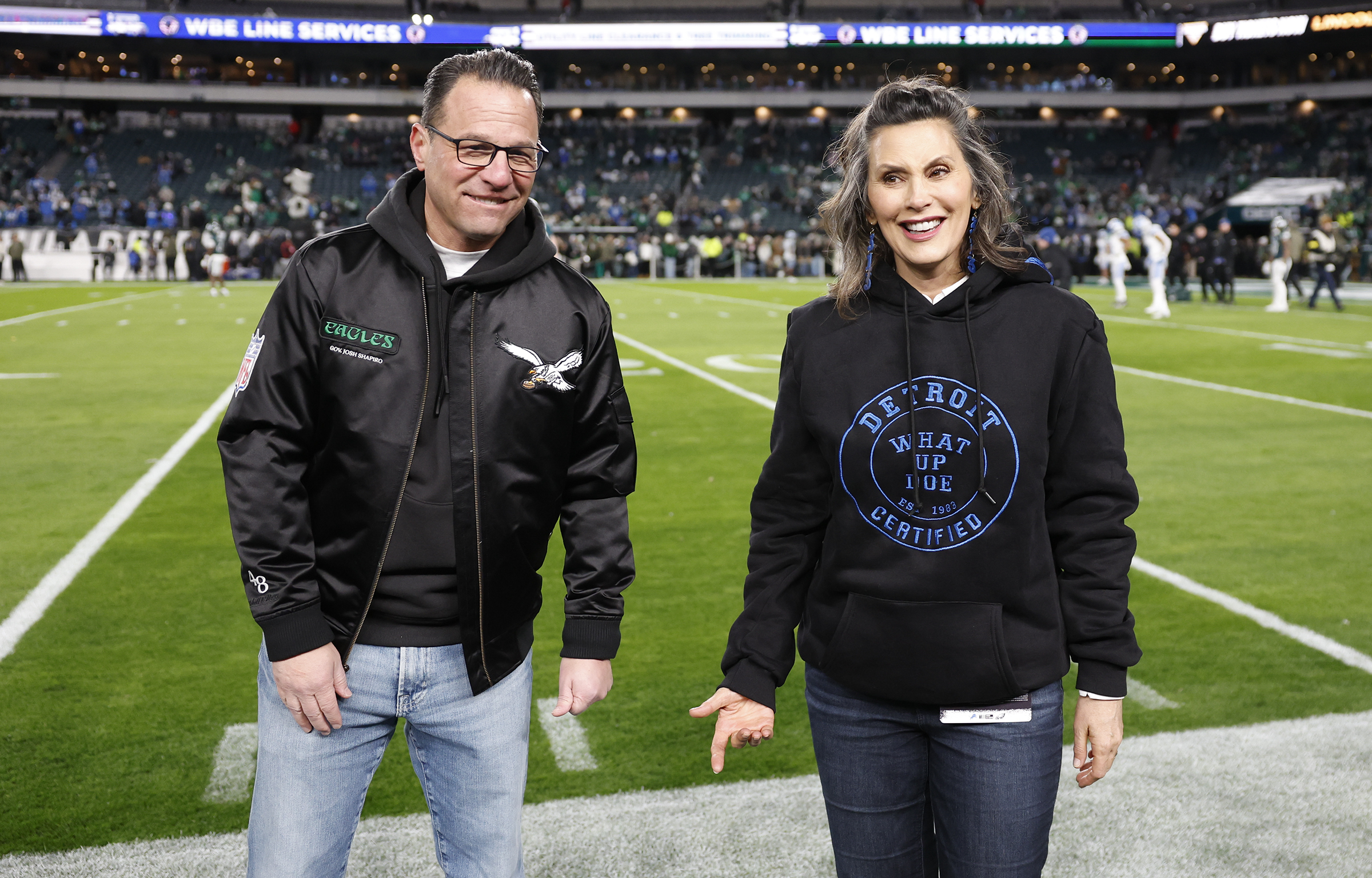
Casually, almost as a throwaway line, Shapiro mentioned to radio hosts Preston and Steve during an interview that he planned to bring Michigan Gov. Gretchen Whitmer — a fellow swing-state governor seen, too, as a possible 2028 Democratic contender — as his guest to the Eagles-Lions game at the Linc that Sunday.
“She actually said, ‘Is it OK if I wear Lions stuff?’” Shapiro told the kelly green-clad crowd in Philadelphia, riffing on the friendly football rivalry — the undercurrents of national politics left unspoken. “And I’m like, ‘No problem. You’re on your own in the parking lot. I can’t protect you.’”
Michigan Gov. Gretchen Whitmer joined Pennsylvania Gov. Josh Shapiro at Sunday’s game between the Eagles and Detroit Lions at Lincoln Financial Field.
The event was a food drive but also served as a tribute to the station’s beloved late host, Pierre Robert. Shapiro brought along a commendation from the governor’s office for the occasion.
“He created community, created joy, brought people together,” Shapiro said of Robert. “You think about just how divided we are as a world, there’s a few things that still bring us together, right?”
“By the way, I’ve learned those lessons. That’s what I try and do governing with a, you know, divided legislature.”
Music and sports, the governor mused before the crowd of Philadelphia fans, are two things that bridge the gap. “Go Birds,” he added with a grin.
Staff writer Katie Bernard contributed to this article.
When a western diamondback rattlesnake sinks its fangs into your hand, and it swells up like a purplish water balloon for days in a Texas hospital, it might be a sign for a career change.
But Clyde Peeling, who was born in Muncy, Lycoming County, in 1942, had already been bitten by the proverbial bug long before the rattlesnake bit him while he was stationed in Texas with the Air Force. Peeling, 83, still loved snakes, despite that close call, and went on to become the reptile king of Pennsylvania.
“I’ve pretty much known what I wanted to do with my life since I was 14,” Peeling said recently, from his beloved zoo near Williamsport.
A snake-necked turtle is shown in an aquarium at Clyde Peeling’s Reptiland in Allenwood, Pa., on Saturday, Nov. 1, 2025.
It wouldn’t be the last time he’d be bitten, either, in a career that has spanned more than half a century.
“Let’s see, once by a copperhead, a viper, and four other rattlesnakes. I don’t say that with any bravado,” Peeling said. “That was a very serious bite.”
Today, Clyde Peeling’s Reptiland is home to enormous Komodo dragons with uncanny eyes, poisonous Gila monsters, anacondas thicker than most thighs, and Aldabra tortoises that can live up to 150 years.
“Some of these tortoises were just five pounds when we got them,” he said, in their hot enclosure.
Today, the tortoises look like boulders.
Clyde Peeling, 83, talks about his experiences at his reptile zoo, Clyde Peeling’s Reptiland.
Reptiland opened on US-15 in Allenwood, Union County, in 1976. It joined an American tradition of roadside attractions ushered in by the post-World War II auto boom and the urge to hit the highway.
U.S. Route 15 bisects Pennsylvania, from the Maryland border, north to New York, passing through Williamsport and Harrisburg. Still, Peeling said it was far from bustling back then.
“I remember sitting there hoping one car would pass by. I was too egotistical to think I’d made a mistake, but I had a lot of naysayers,” he recalled.
In the timeless tradition of late-night television, Peeling has brought wild animals to visit Conan O’Brien, Jay Leno, Jon Stewart, and others.
Reptile parks, serpentariums, and alligator farms dot the American landscape. Peeling wanted to elevate Reptiland beyond those hokey roadside shacks.
In 1986, his facility received a key and difficult-to-obtain accreditation by the Association of Zoos & Aquariums and it’s held that status ever since. Peeling said the inspection process, which takes place every five years, is grueling and every facet of the business is scrutinized, everything from record keeping, to veterinary care, aesthetics, and visitor services.
“We would have been accredited in 1985, but we were hit by a tornado that nearly flattened us,” he said.
Over the decades, Peeling expanded with a parakeet-feeding aviary and a large, outdoor dinosaur exhibit. More renovations are in the works, too. If you’d like parakeets to land on your head, you’ll have a blast. The park hosts a “Wino & Dinos” event outdoors, during the summer, for adults only.
At Clyde Peeling’s Reptiland, life-size animated dinosaurs give visitors a perspective on life in the Mesozoic Era.
Peeling, with his sons, has visited, lectured, and collected in dozens of countries.
“That skull is from a crocodile in Borneo,” he said in his office.
Peeling’s son Chad, a right-hand man in the family business, died from brain cancer in 2019. Peeling himself fought non-Hodgkin’s lymphoma. Tornadoes have damaged the property, and the COVID-19 pandemic has hurt, too.
Peeling hasn’t guided a trip since his son died but won’t rule out doing it one more time.
It's been 30 years since I've been back to Clyde Peeling's Reptiland in Union County and I wish I had come back sooner. Thanks for having us, Clyde! pic.twitter.com/5RKP9AbuWM
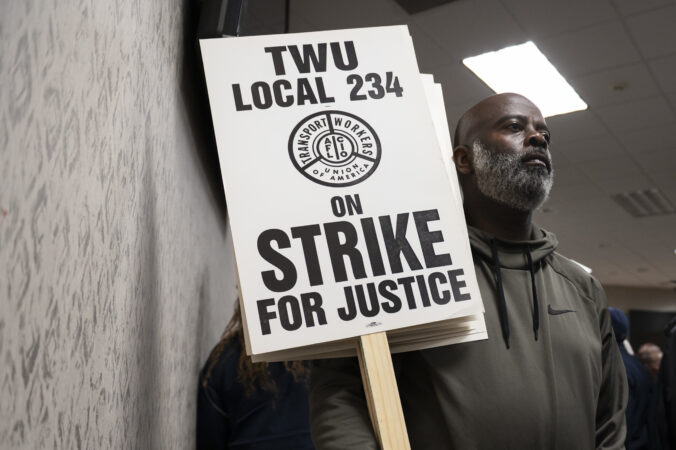
Members of the Transport Workers Union Local 234 on Sunday, Nov. 16 voted to authorize a strike if union and SEPTA negotiators can’t reach an agreement on a new contract.
Shortly before the current contract ran out at 11:59 p.m. on Nov. 7, TWU’s new president, Will Vera, urged union members to stay on the job. In an unusual move, he delayed a strike vote at the time of contract expiration, saying he had hope that a deal could be reached without the usual brinksmanship.
“We’re asking you to please continue to come to work and put money aside. We want you to be prepared in case we have to call a work stoppage,” he told members in a video at the time.
Local 234 leaders say they’re prioritizing a two-year deal with raises and changes to what the union views as onerous work rules, including the transit agency’s use of a third party that Vera said makes it hard for members to use their allotted sick time.
In a statement, SEPTA said it was aware of the authorization vote and is committed “to continue to engage in good-faith negotiations, with the goal of reaching a new agreement that is fair.”
2023 Fraternal Order of Transit Police Lodge 109 (three days)
SEPTA police officers walked off the job after bargaining with the transit agency for almost nine months, largely over the timing of a 13% pay raise for members. The agreement, partially brokered by Gov. Josh Shapiro, came amid heightened fears about safety on public transit and a funding crisis for SEPTA.
TWU Local 234 walked off the job for six days; the biggest issue was retirement benefits. SEPTA’s contributions toward union members’ pensions did not rise in tandem with wages when workers made more than $50,000. Managers’ pension benefits were not capped. The union also wanted to reduce out-of-pocket health-care costs and win longer breaks for bus, trolley, and subway operators between shifts and route changes.
SEPTA and the union reached an agreement Nov. 7, the day before the general election. Democrat Hillary Clinton’s presidential campaign was worried about voter turnout, and the city sought an injunction to end the strike. It proved unnecessary.
Talk about leverage. TWU was ready to strike just before the first home game of the World Series between the Phillies and the New York Yankees. Gov. Ed Rendell pushed the two sides to continue talking, and the transit workers waited to walk out until three hours after the end of Game 5, the last in the series played at Citizens Bank Park.
It was a bitter strike, coming just a year after the stock market’s meltdown started the Great Recession. TWULocal 234 President Willie Brown called himself “the most hated man” in Philadelphia. Mayor Michael Nutter was harshly critical. Brown called him “Little Caesar.”
The strike was settled Nov. 7 with a deal on a five-year contract. Transit workers got a $1,250 bonus, a 2.5% raise in the second year, a graduated increase in SEPTA pension contributions from 2% to 3.5%, and the maximum pension benefit was raised to $30,000 from $27,000.
2005: TWU Local 234 and United Transportation Union Local 1594 (seven days)
Negotiations collapsed mostly over SEPTA’s insistence that workers pay 5% of medical insurance premiums. At that point, the authority paid 100% of the workers’ premiums for family coverage.
In the end, it was solved by Gov. Rendell, a Democrat who had been Philadelphia mayor in the 1990s. He agreed to give promised state money to SEPTA early, so it could pay premiums in advance, reducing its costs.
In the resulting four-year deal, the unions had to pay for 1% of their medical premiums. They also received 3% yearly raises.
Pedestrians and cars in a chaotic dance at the intersection of Market and 30th Streets during the afternoon commute on the first day of the SEPTA city workers’ strike Nov. 1, 2016.
1998: TWU Local 234 (40 days)
City transit workers’ contract expired in March, but they did not strike until June — and then stayed out for 40 days. The two sides reached an agreement in July, but it fell apart. TWU members had returned to their jobs and kept working under an extension of their old contract. A final agreement was signed Oct. 23.
The union agreed to SEPTA’s demand that injured-on-duty benefits be limited. The old contract gave them full pay and benefits while on leave after a work injury. SEPTA wanted to hire an unlimited number of part-time workers. The union agreed to 100 part-timers to drive small buses.
SEPTA’s chief negotiator was David L. Cohen, famous for reining in unions representing city workers during Philadelphia’s bankruptcy in 1992, as Rendell’s mayoral chief of staff.
A two-week strike stilled city buses, trolleys and subways until an agreement was reached April 10. Transit workers would get 3% raises per year over the three-year span of the new contract, as well as increases in pension benefits and sick pay.
The union agreed to several cost-reduction measures, including a restructuring of SEPTA’s workers compensation policies.
Mayor Ed Rendell, a villain to many in labor for winning givebacks from city unions in 1992, pushed SEPTA to offer more generous terms to TWU than it had initially. Cohen, who was his chief of staff, crunched the numbers to make it work. Three years later, out of the city administration and working as a lawyer, he was hired as SEPTA’s chief negotiator.
1986: TWU Local 234 (four days) and UTU Local 1594 (61 days)
When TWU struck the city transit division in March 1986 over a variety of economic issues and work rules, some bus drivers pulled over mid-route and told passengers to dismount, The Inquirer reported.
Members were particularly incensed at what they considered SEPTA’s draconian disciplinary procedures. Union leaders said the issue was a basic lack of respect. The strike was settled in four days.
Drivers for 23 suburban bus routes, two trolley lines in Delaware County and the Norristown High-Speed Line — all members of the United Transportation Union — struck for just over two months, affecting about 30,000 passengers a day.
Employees in what was then known as SEPTA’s Red Arrow Division — after the private transit company that used to own the routes and lines — made considerably less than their city counterparts and had weaker pension benefits. They won raises and pension changes that brought them closer to parity.
1983: Regional Rail (108 days)
Thirteen separate unions walked off the job on the commuter rail lines that SEPTA had taken over at the beginning of the year from Conrail, successor to the bankrupt Pennsylvania and Reading Railroads.
In addition to wages, a key issue was SEPTA’s demand that union train conductors accept pay cuts. The authority had already cut the number of those workers by more than half.
Eventually SEPTA reached deals with a dozen of the unions. The 13th local, which represented 44 railroad signalmen, held out longer. Main issue: Whether SEPTA had the right to contract with outside firms for some types of signal work.
The Regional Rail strike remains SEPTA’s longest work stoppage since 1975.
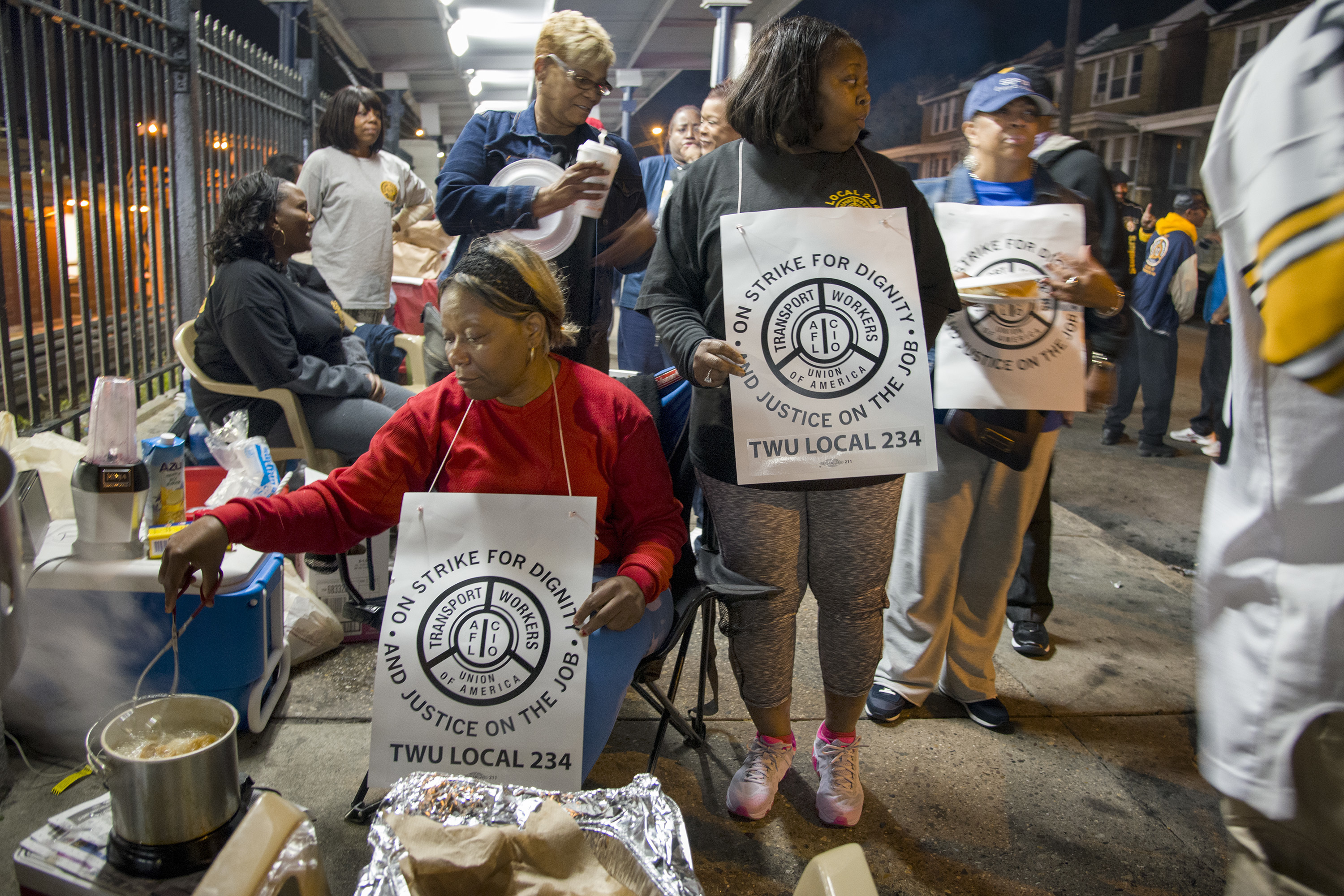
Joyce Woodford (center), a 25-year veteran cashier on SEPTA’s Broad Street Line, serves up fried fish for her fellow striking cashiers outside the Fern Rock Transportation Center during dinnertime on the third day of the SEPTA strike in 2016.
1982: TWU Local 234 (34 days)
About 36 suburban bus drivers and mechanics operating routes primarily in Montgomery County, and some routes in Bucks, won an 8.5% wage increase over three years.
The bus routes were the descendants of the Schuylkill Valley Lines and the Trenton-Philadelphia Coach Lines, which SEPTA acquired in 1976 and 1983, respectively. Service has grown, and the collection of bus routes is known as the Frontier Division today.
1981: TWU Local 234 (19 days) and UTU Local 1594 (46 days)
Transit workers shut down buses, trolleys and subways in the city on March 15, seeking job security in the form of a no-layoff clause, wage increases and a bar on SEPTA hiring part-time workers.
And the Red Arrow division went out for 46 days seeking higher wages and better medical benefits. SEPTA also backed down a demand for permission to hire private contractors for some work on the suburban buses, trolleys, and the Norristown High Speed Line.
1977: TWU Local 234 (44 days)
After a bitter strike, union members who run the city transit division got higher wages and more benefits, after rejecting an arbitrator’s proposed contract that was portrayed in news reports as generous.
A furious Mayor Frank Rizzo told reporters the strike “can last 10 years for all I care.” He said of the union’s rejection of the earlier offer: “It is outrageous, and I hope the people won’t forget it.”
1975: TWU Local 234 (11 days)
Transit workers, concerned about the ravages of inflation, wanted a clause giving them cost-of-living increases and enhancements to health-care benefits. Those were granted after Rizzo agreed to add $7.5 million to the city’s annual SEPTA contribution. Perhaps that’s one reason the mayor was so annoyed two years later.
Staff writer Erica Palan contributed to this article.
HARRISBURG — The contentious — and, at times, bitter — Pennsylvania budget stalemate has finally ended.
Gov. Josh Shapiro signed the nearly $50.1 billion state budget Wednesday, as part of a breakthrough bipartisan deal that ends a key climate initiative and increases public school funding. Schools, counties, and social service providers will soon receive four months of withheld state payments, lapsed after the budget deadline passed at the start of the new fiscal year on July 1, providing the much-needed relief that some say will come too late.
The long-awaited budget deal involving Shapiro, House Democrats, and Senate Republicans marks the first time Pennsylvania’s state budget has topped $50 billion. State spending and revenue earnings have skyrocketed in the post-COVID-19 years due to federal cash infusions. The budget is a 4.7% increase in spending over the prior fiscal year and includes no new tax increases. Lawmakers and Shapiro agreed to tap into underutilized special funds and use the state’s surplus to address a budget shortfall, as Pennsylvania is on track to spend more than it brings in this fiscal year and in the future.
Democrats (left) stand to applaud a tax cut proposal while Republicans (right) remain seated as Gov. Josh Shapiro delivers his third budget address to a joint session in the House chambers at the State Capitol Tuesday, Feb. 4, 2025. Shapiro, a Democrat, will need to negotiate with a split legislature.
Both Republican and Democratic leaders celebrated the budget’s passage as a “true compromise,” noting that neither party got everything it wanted in the final deal. The spending plan includes significant energy and permitting changes cheered by Republicans and an earned-income tax credit and revisions to cyber charter funding long sought by Democrats, among other policy wins revealed Wednesday.
“Today is a good day,” Shapiro said, opening his remarks before signing the budget bills into law in the Capitol building, flanked by Democratic lawmakers.
“I would have loved to have stood here in this room with all of you on June 30, but as you know, Pennsylvania is just one of only three states in the country with a divided legislature,” Shapiro, a Democrat, said. “It requires all of us to compromise, to have tough conversations, and, ultimately, to find common ground.”
Several leaders said the budget deal approved Wednesday would not have been possible months ago, as debate had devolved into partisan finger-pointing over who was responsible for the budget deadlock and who might benefit politically from it.
Big GOP win: An end for RGGI
Among the top wins for Senate Republicans is the end of the state’s efforts to join the Regional Greenhouse Gas Initiative, which former Democratic Gov. Tom Wolf entered without legislative approval in 2019 and has been tied up in litigation ever since. The program has drawn the ire of Republicans, and in floor remarks Wednesday, House Minority Leader Jesse Topper (R., Bedford) called it the “No. 1 issue holding Pennsylvania back from economic growth.” The 12-state program, known as RGGI, is an interstate cap-and-trade initiative that charges power plants for the amount of carbon emissions they release into the air.
House Minority Leader Jesse Topper (R., Bedford) speaks on Jan. 7, 2025, on the first day of the 2025-2026 legislative session.
Ahead of a final budget deal, some Democratic lawmakers and environmental groups spoke out against ending Pennsylvania’s involvement in RGGI as a threat to the environment. In the end, most Democratic lawmakers voted in favor of the omnibus budget bill that ended the state’s pursuit to join the initiative.
House Majority Leader Matt Bradford (D., Montgomery), a top negotiator of the budget deal, told The Inquirer on Wednesday that Democrats’ agreement to leave RGGI was part of a broader compromise to end the impasse.
“I’m one who believes there should be a price on carbon, but I recognize the reality of the situation and compromise is required,” Bradford added.
House Majority Leader Matt Bradford (D., Montgomery) speaks on the first day of the 2025-2026 legislative session.
Shapiro and Democratic leaders were able to persuade Republicans, in turn, to spend more than they had wanted to this fiscal year. That additional spending allowed Democrats to invest more in public education, a new earned-income tax credit targeted toward working Pennsylvanians, and more.
“It’s much more money than we want to spend, and it took a lot longer than we wanted, but I think it was worth the wait,” said Senate President Pro Tempore Kim Ward (R., Westmoreland) in floor remarks Wednesday. “I am actually excited to vote for this budget.”
Dems win new funding for schools, but not mass transit
The budget deal includes more than $665 million in new funding for public schools, approximately $562 million of which would be funneled through the state’s adequacy and tax equity formulas as part of an effort to close what experts call a $4 billion “adequacy gap.“ These formulas were created last year in response to a 2023 court ruling that found Pennsylvania’s public education funding system unconstitutionally deprives students from poorer districts of an adequate and equitable education.
Senate Minority Appropriations Chair Vince Hughes (D., Philadelphia) applauded the budget agreement for its investments in public school funding, gun violence prevention, and the student-teacher stipend, among other things.
“This budget has good work in it that helps address … the issue of affordability, which sang loud and clear in the most recent election as a predominant issue that Pennsylvanians want us to address,” Hughes said on the Senate floor Wednesday.
In addition, the budget includes changes long sought by Democrats to how Pennsylvania funds and oversees its cyber charter schools. Cyber charter school leaders warned that the changes might lead to closures and mass layoffs for the virtual schools, which often serve the state’s most vulnerable populations, but they were resoundingly celebrated by Democrats and public education experts.
“We finally reformed our cyber charter school system,” Shapiro said to boisterous applause. “If a parent wants to send their child to a cyber school, that’s fine. That’s their prerogative. But we shouldn’t be overfunding them at the expense of Pennsylvania’s public schools.”
The deal, however, does not include any additional funding for mass transit, another major Democratic priority. Democrats removed mass transit from the budget negotiation table in September, after a lawsuit required SEPTA to undo its service cuts and Senate Republicans appeared unwilling to make a long-term investment in mass transit. Instead, Shapiro approved SEPTA’s use of its capital funds to help fill the budget deficit of the state’s largest mass transit agency for the next two years.
Bradford told reporters thatsecuring a long-term revenue stream for transit agencies remains a top priority for his caucus in future budgets.
Inflamed, in part, by the mass transit debate, negotiations over the budget had been stalled for months until the end of October, when Shapiro convened top legislative leaders to return to talks. The renewed budget negotiations included House Speaker Joanna McClinton (D., Philadelphia) and Ward, who are the highest-ranking officials in their respective chambers but had usually stayed out of the budget talks led by Bradford and Senate Majority Leader Joe Pittman (R., Indiana).
Counties are still hurting from the late budget
Unlike the federal government, Pennsylvania’s state government does not entirely shut down when a budget has not been approved. Lawmakers and state employees continued to be paid throughout the 135-day impasse. But the late budget had significant impacts on school districts, counties, and social service providers — all of which are awaiting billions in expected state payments that should begin flowing again soon.
The lack of state funding has required schools, counties, and service providers to cut jobs, take out expensive loans, or stop services altogether.
Over the course of the more than four-month impasse, Pennsylvania’s counties spent millions to make up for the loss of state dollars. In Montgomery County, officials estimated the county had spent between $40 million and $50 million from budget reserves to maintain services. Chester County officials estimated they spent $40 million in reserves, while Delaware County officials spent $12 million each month until October, when they had to reduce payments on some of their bills in the absence of state funding. Counties expect to be reimbursed for those expenses, but it is unclear when the reimbursements will come.
“Counties are at the breaking point, financially speaking,” said Kyle Kopko, the executive director of the County Commissioners Association of Pennsylvania. If reimbursements are not delivered swiftly, Kopko added, it could force additional nonprofits that provide social services to shutter.
Even as county leaders were grateful for an end to the impasse, some expressed frustration over the contents of the final budget deal. The agreement, Kopko said, included a 2% cut to mental health services statewide, though he said the cut likely would not affect payments to counties. And it left other funds counties rely on to pay their bills — like 911 fees — stagnant, despite inflation.
Counties in Pennsylvania can increase their revenue only by raising property taxes. By failing to provide additional funds for social services, county officials argued Wednesday, lawmakers had created a situation in which counties would immediately or eventually have to raise property taxes.
The combination of the cuts and the failure to increase funds for public transit and other needs, Delaware County Councilmember Christine Reuther said, meantthe state had essentially passed the buck to the counties.
“They’re not solving problems. They’re not saving people from tax increases,” she said. “They’re just making somebody else do their dirty work.”
This suburban content is produced with support from the Leslie Miller and Richard Worley Foundation and The Lenfest Institute for Journalism. Editorial content is created independently of the project donors. Gifts to support The Inquirer’s high-impact journalism can be made at inquirer.com/donate. A list of Lenfest Institute donors can be found at lenfestinstitute.org/supporters.