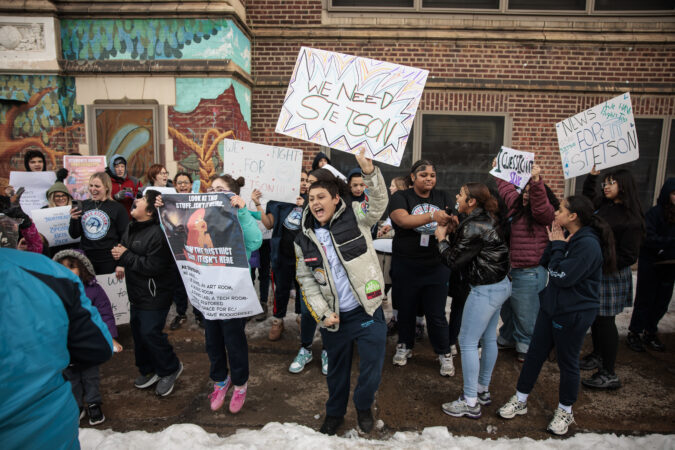
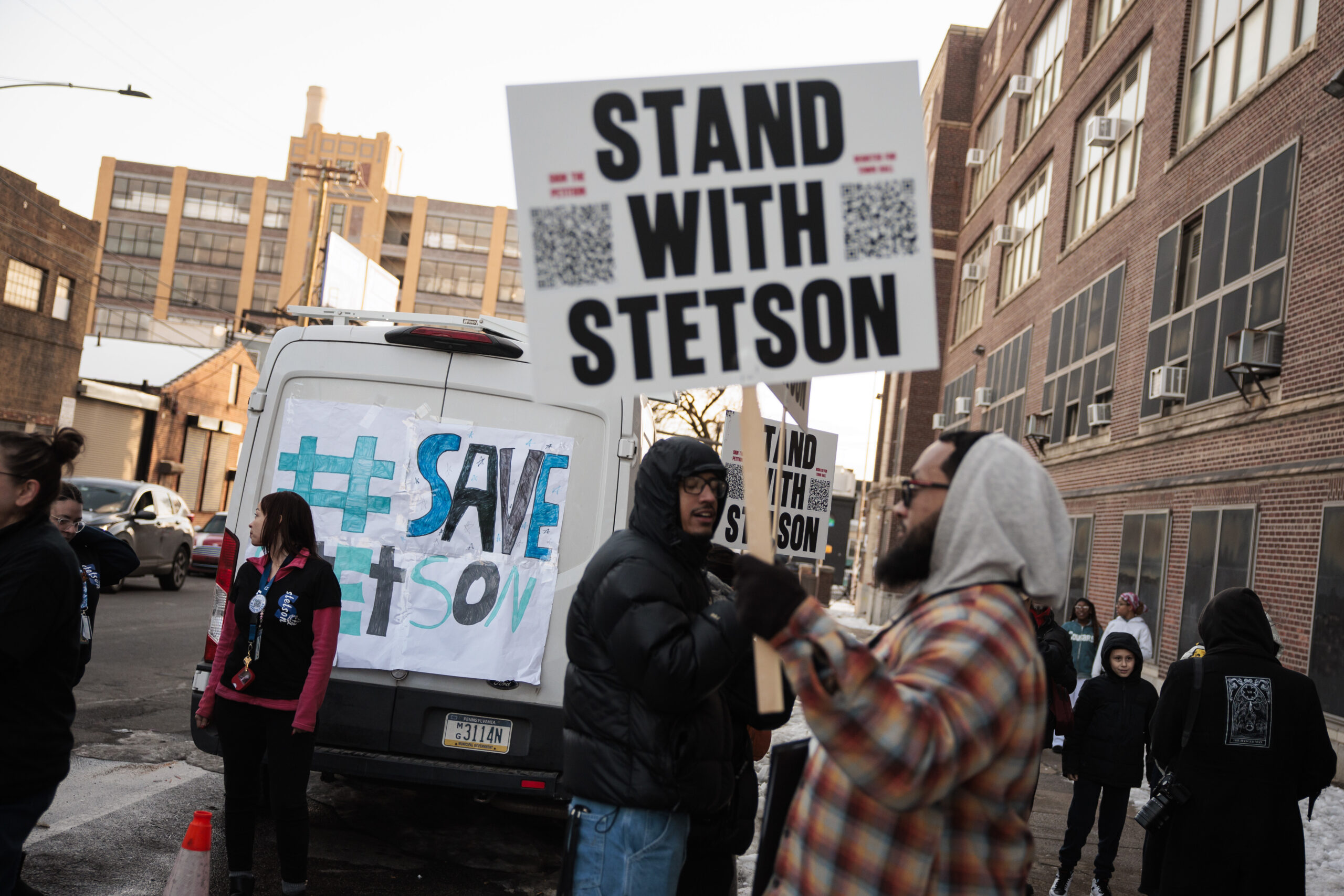
As cars whizzed by on B Street, one student banged a drum and another struck a cymbal. Others waved signs and marched in circles.
“Save our school!” the group of about 50 middle schoolers shouted outside Stetson Middle School in Kensington last week. “Save Stetson!”
Stetson is one of 20 schools Superintendent Tony B. Watlington Sr. has proposed closing as part of a $2.8 billion facilities plan. Officials say closures are necessary to improve educational outcomes and equity system-wide, and to balance enrollment in a district that has 70,000 empty seats.
Love Letters to Stetson decorate the hallway during a community meeting at John B. Stetson Middle School in Kensington last week. Stetson is one of 20 Philly public schools facing closure.
But Stetson isn’t going down without a fight.
The school is 59% occupied, by the district’s calculations, and its building is in “unsatisfactory” condition. Stetson also scored “poor” on program alignment, a measure that takes into account a school’s ability to offer “appropriate spaces” for things like art, music, physical education, and career and technical education.
Its supporters say Stetson has been left to languish and that their neighborhood is overrepresented on the closure list. The district, they say, is taking away a community that’s been a constant for families in a struggling neighborhood at the center of the city’sopioid crisis.
“You tell this community that they are not worth investment,” one Stetson studentsaid at a meeting at the school last week. “How is it equitable to shut a school in a neighborhood that already lost so much? If this building needs repair, fix it for the children, not for the administration.”
Twelve requests to fix a leaky roof
The district has said it plans to hold on to the Stetson building and operate it as “swing space” — a building that can be used to relocate students from other schools that must temporarily shut down to accommodate repairs.
Instead of closing soon, the district is proposing phasing Stetson out gradually. The school would stop accepting new fifth graders in 2028, and close in 2030.
Students who previously would have gone to Stetson will go to Cramp and Elkin elementaries, which will grow to accommodate middle grades. Both schools are less than a mile from Stetson.
Students, teachers and supporters rally before a community meeting at John B. Stetson Middle School on Thursday, Feb. 12, 2026 in Philadelphia. Stetson is one of 20 Philly public schools facing closure.
Officials have also said the move to shut downStetson is part of a larger strategy of movingaway from middle schools and focusing instead onK-8 schools.
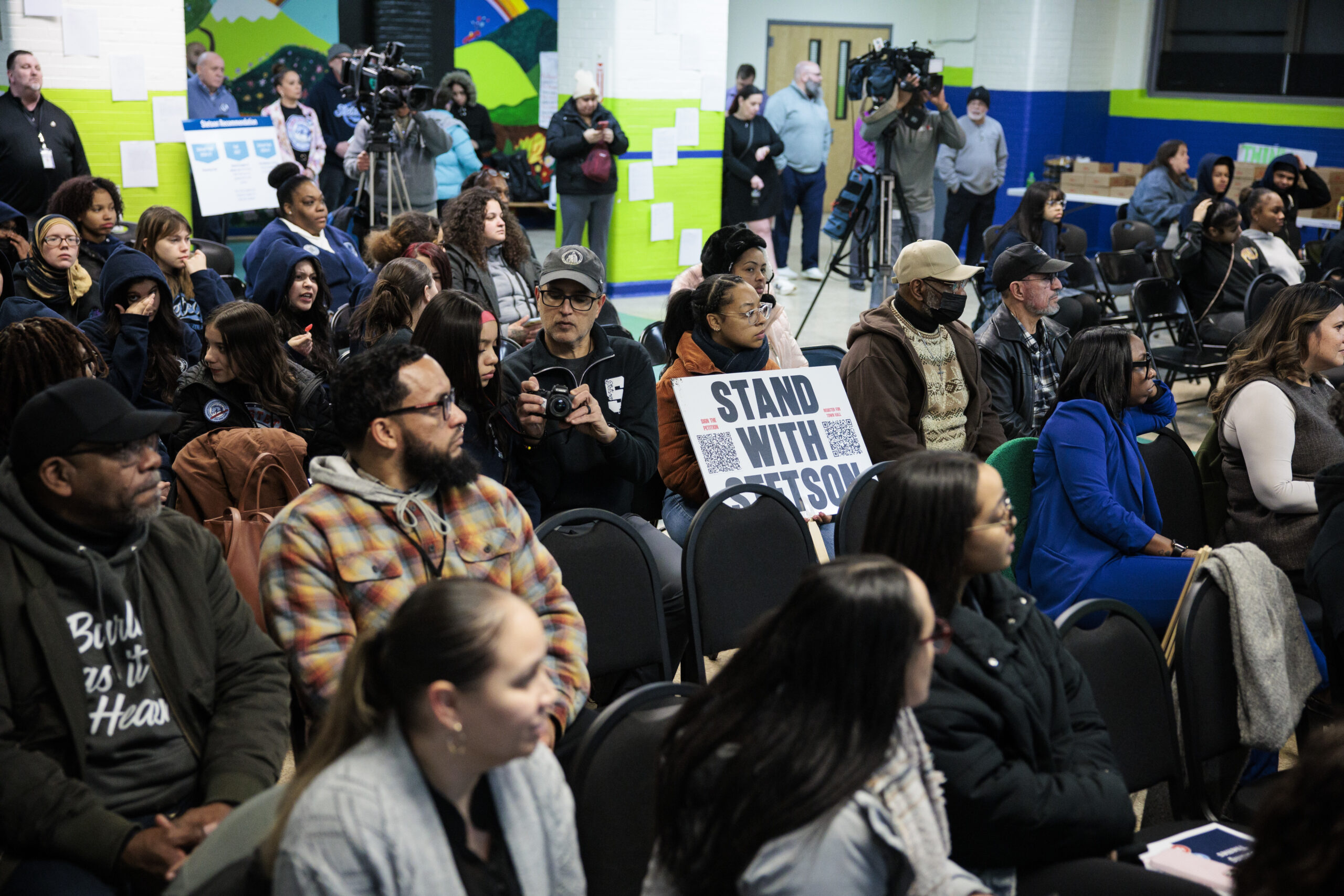
Community angst spilled over at the closing meetinglast week, with audience members booing district officials who were there to present information and answer questions, and applauding for those who spoke up for Stetson.
If the district has money to spend on fixing up buildings, why not spend on Stetson’s building, students asked.
Students and attendees listen during a community meeting at John B. Stetson Middle School last week.
“We have a fourth floor,” one sixth grader said. “Y’all could just fix that, y’all could fix the pipes, y’all could fix everything.”
Another student said she was frustrated by mold in the school, and a leaky roof.
“I heard that it’s your fault,” the student said.
Later, at a Tuesday City Council hearing, Councilmember Quetcy Lozada told Superintendent Tony B. Watlington Sr. that Stetson staff have put in 12 separate requests to fix the leaking roof.
“That roof is still leaking,” a frustrated Lozada said. “Can I have someone please today commit to going to Stetson and checking their leaking roof?”
Watlington said he would “make that happen.”
‘The void that it’s going to leave behind’
The district got the Stetson call wrong, said Kathryn Lajara, a special-education teacher at the school.
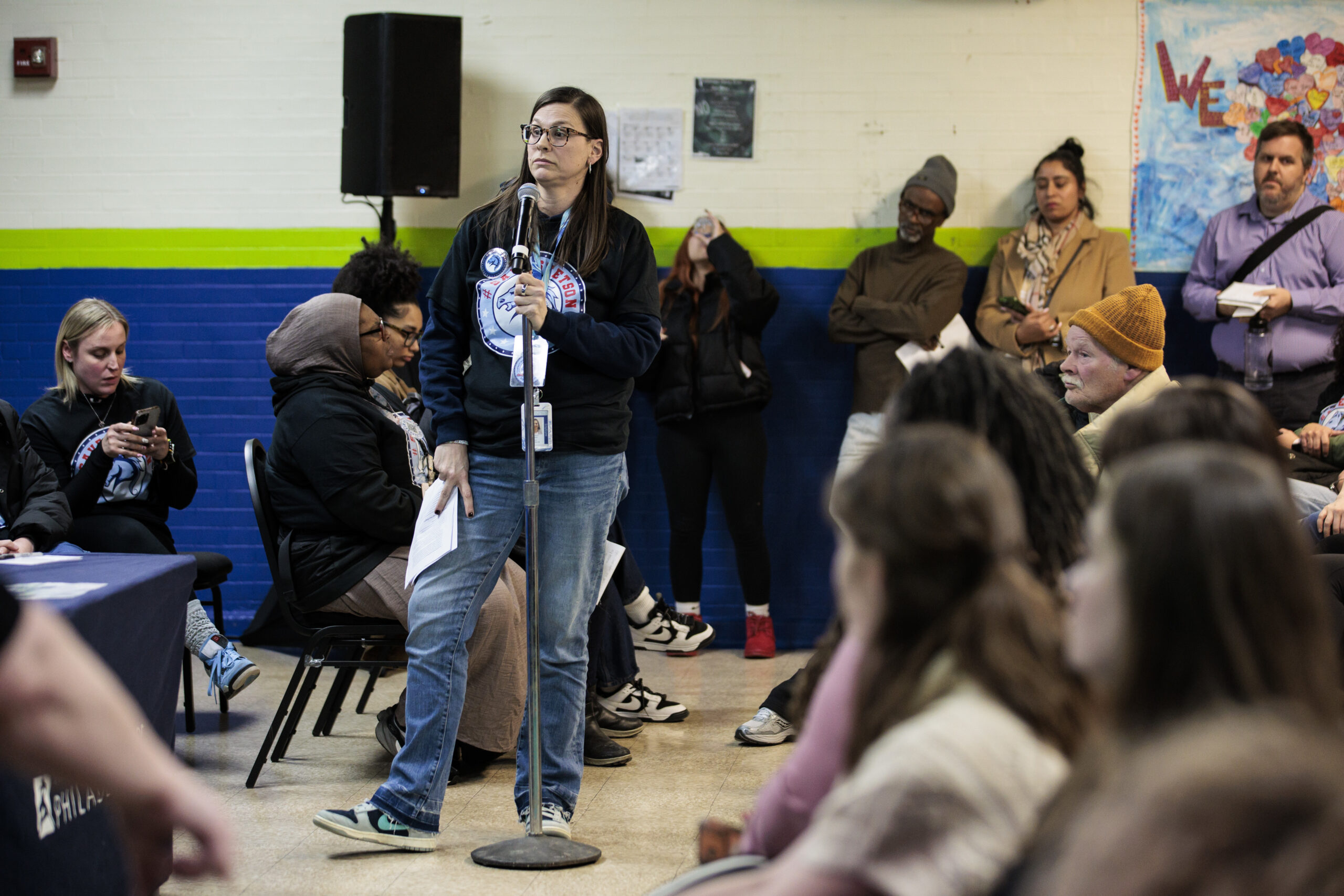
“Our school is being penalized for allegedly lacking space — P.E., special education, art,” Lajara said. “These conclusions are based on incomplete and misleading information, not on lived reality of what happens in our building every single day.”
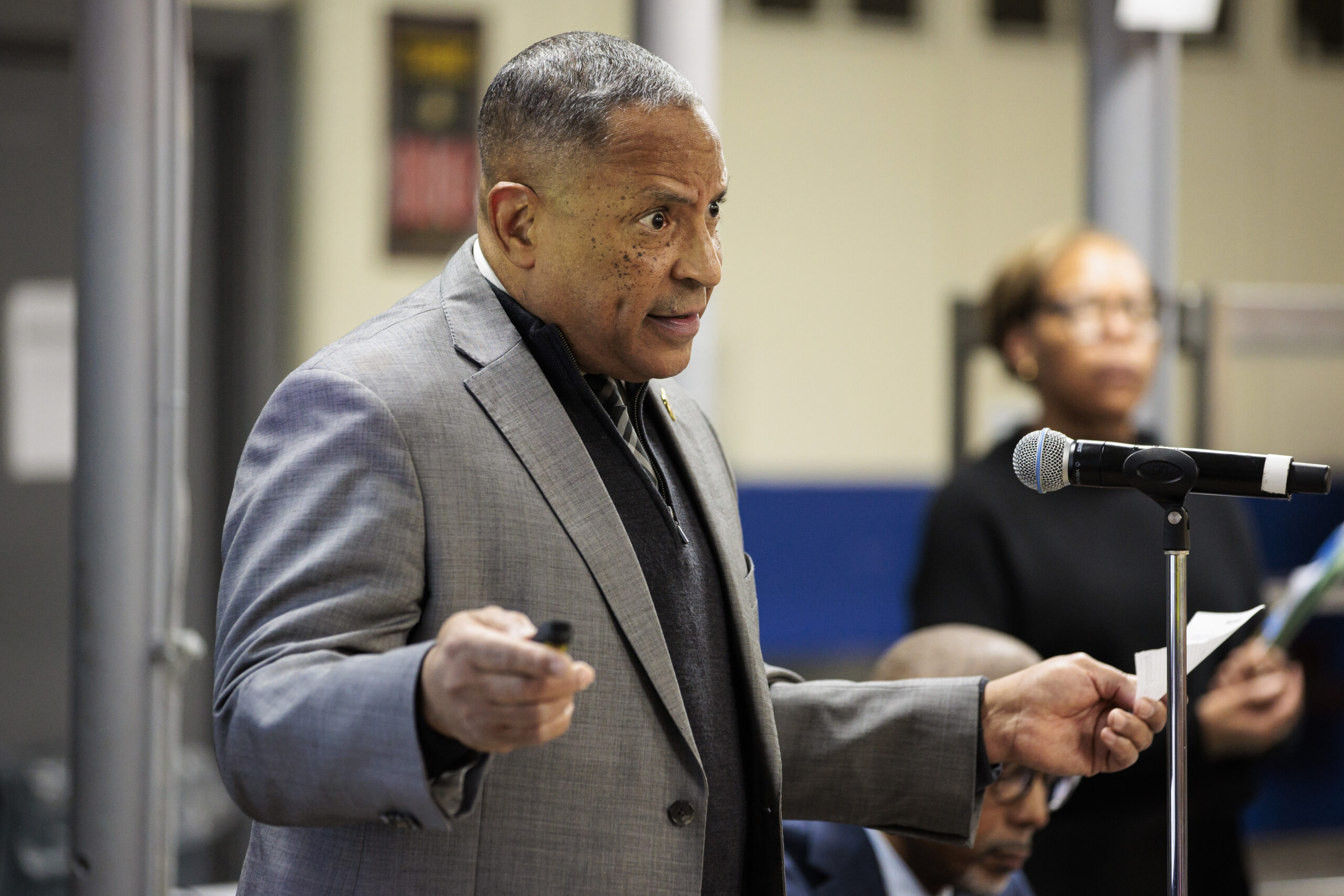
Special ed coordinator Kathryn Lajara speaks during a community meeting at John B. Stetson Middle School last week. Lajara and others spoke out against the recommendation to close the school in Kensington.
Stetson has an art lab, rooms for piano class, dance, a music room, anda photography room, Lajara said. And it serves 140 students with disabilities, despite the district saying it had inadequate special-education spaces.
Lajara was also frustrated by the district’s upkeep of the building.
“We fight the dripping water every day from the roof that you continue to neglect,” Lajara told district officials at the community meeting.
“I’m going to admit to you: We have neglected this building over decades,” Deputy Superintendent Oz Hill told the audience.
Lajara looked at Hill.
“Instead of continuing to neglect, how about we decide that our community and our students are best to invest in?” she said.
Deputy Superintendent Oz Hill speaks during a community meeting at John B. Stetson Middle School last week.
Crystal Pritchett, another Stetson teacher, suggested the district’s decision to send students to Cramp and Elkin was not in tune with neighbors’ wishes about safety and comfort.
Families have safety concerns about sending their kids to other schools, Pritchett said.
“You know nothing about this community,” Pritchett said. “You aren’t listening.”
Stetson opened in 1915 and was a district schoolfor nearly 100 years. It turned into a charter school runby the nonprofit Aspira in 2010, but the district took it backin 2022 after Aspira failed to meet district standards.
Abandoning it altogether is unthinkable, said the Rev. David Orellana, a pastor at CityReach Church in Kensington.
“I don’t think we’re taking into account the negative impact and the void that it’s going to leave behind,” Orellana said. “Taking Stetson away is taking the heartbeat of this community.”
When Mayor Cherelle L. Parker stood in the city’s emergency management center last month and announced that her administration was preparing for the worst winter storm Philadelphia had seen in years, she was flanked by the police commissioner, the head of public schools, and a dozen other deputies.
Missing from the news conference of Philadelphia’s top officials was Managing Director Adam K. Thiel, whose job it is to oversee the delivery of city services.
It wasn’t the only time over the last year that Thiel, Philadelphia’s No. 2 public official, was noticeably absent.
Thiel, who is effectively the city’s chief operating officer, was out of office last year for a total of nearly five months, much of which he spent on military leave, according to 2025 payroll register records obtained by The Inquirer. His increasingly low profile in Philadelphia City Hall has generated frustration and fueled questions about his job performance among some lawmakers, especially as the city faced criticism over the recent snow cleanup.
Almost half of Thiel’s $316,200 city salary last year was for paid time off, according to payroll records. He is one of the highest-paid officials in the government and made more than Parker, who last year earned $280,000.
In addition to his top city role, Thiel is a major in the U.S. Army Reserves. He joined the reserves in August 2024, eight months after beginning his job as managing director.
Thiel also holds other positions outside government. In 2024, while he was managing director, he made more than $300,000 working as a consultant, according to financial disclosures. He is an adjunct faculty member at two universities and sits on several nonprofit boards.
Five City Council members told The Inquirer that it has been months since they interacted directly with Thiel.
“The managing director of the city is an extremely important job,” said Councilmember Jamie Gauthier, a Democrat from West Philadelphia. “I do not understand how someone who is absent as much as Thiel is able to carry out this job effectively.”
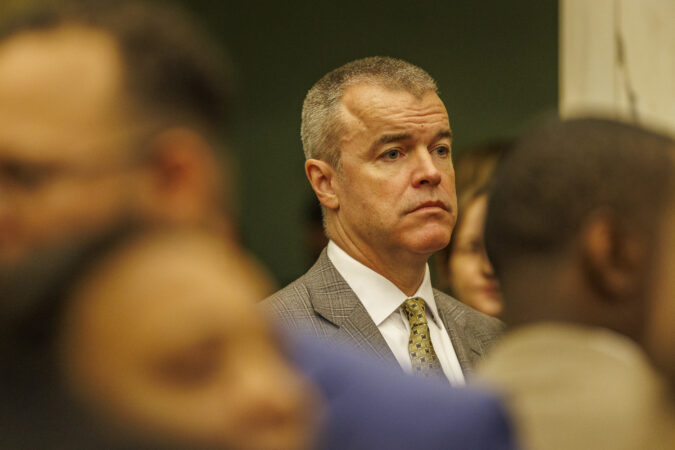
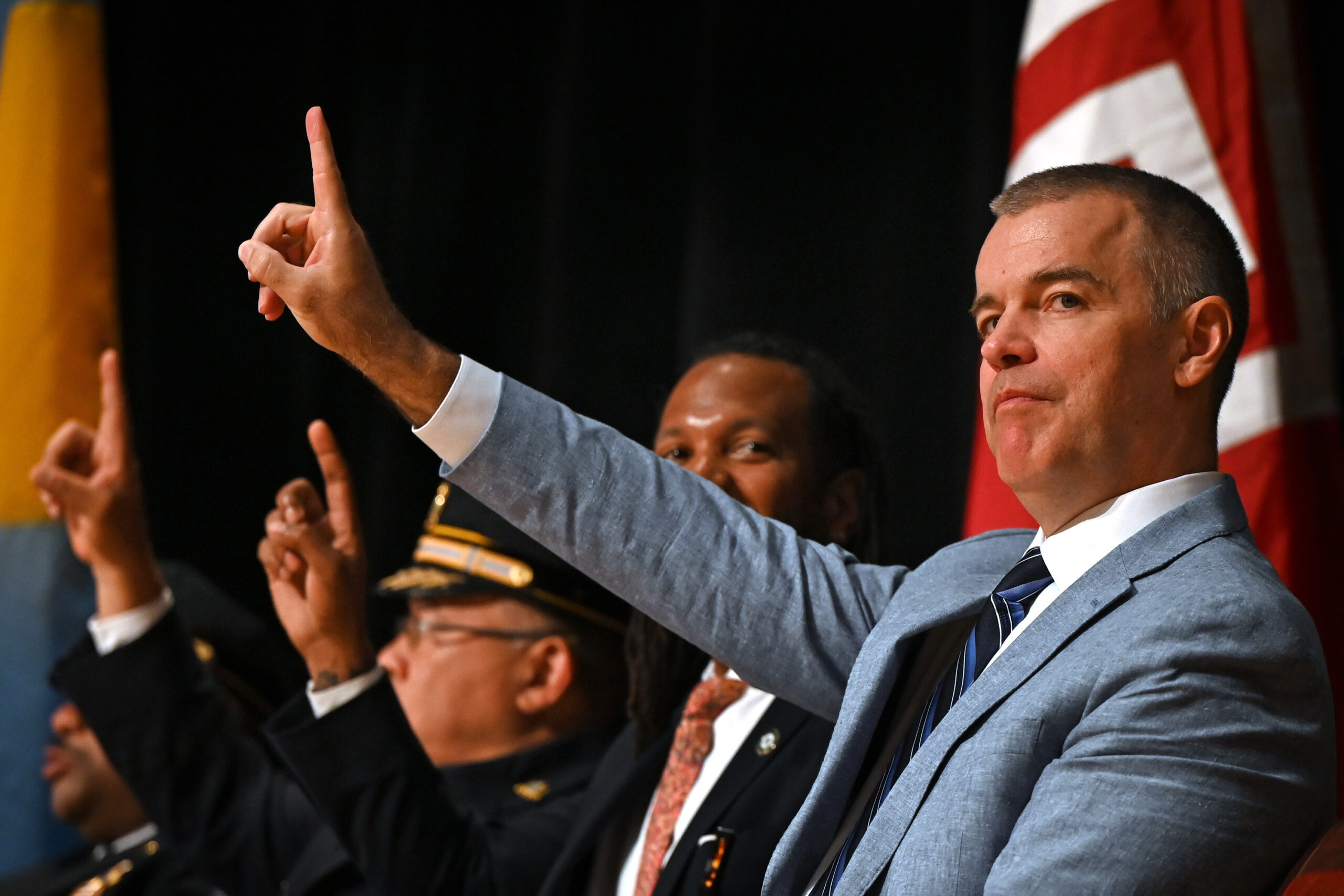
Managing Director Adam Thiel during graduation ceremonies for the police academy Class #402 of the Philadelphia Police Department and Temple University Police Department at Temple University Performing Arts Center June 17, 2024.
The administration declined requests to interview Thiel and Parker for this article. In a statement, Thiel thanked Parker for her “continued support of our city of Philadelphia employees who also serve the United States of America.”
Sharon Gallagher, a spokesperson for the managing director’s office, said in a statement that Thiel has been employed by the city for nearly 10 years and “earns leave offered by the city the same way as other city employees accrue vacation, sick days, family, medical, military and other leave categories.”
Payroll records show that Thiel logged six weeks of military leave time last year — the maximum amount the city offers employees. Gallagher said he also used 11 weeks of accrued vacation time to cover additional military assignments.
The administration declined to answer questions about Thiel’s military service, including details about his location and unit. His LinkedIn page says he “helps provide emergency management subject matter expertise to combatant commands and partner nations.”
Thiel is also founding partner of one consulting firm and the president of a second, though the specific nature of that work is not known and he has declined to disclose his clients publicly.
In 2024, Thiel said his consulting work took fewer than 10 hours per week. Gallagher said Tuesday that “nothing has changed” since then.
The Parker administration did not publicly announce when Thiel was on leave last year, but officials acknowledged it once asked by reporters last summer. At the time, Deputy Managing Director Michael Carroll filled in on an interim basis.
Thiel, 53, is a nationally recognized expert in emergency management. He held a variety of firefighting, public safety, and disaster preparedness roles across the country before coming to Philadelphia in 2016 to serve as fire commissioner and deputy managing director under former Mayor Jim Kenney.
Thiel said in a statement Tuesday that Williams was “the best choice to lead our city’s unified response to the recent snowstorm operation and is the right leader for future snow and ice events.”
Gauthier said the city’s handling of the storm “needed a higher-level emergency response.” She said while she respects Thiel’s military service, she raised his consulting work as a concern.
“A decision needs to be made what he wants to do. Does he want to serve locally, or does he want to do other things?” Gauthier said. “We need a managing director who will serve full time.”
The administration did not answer questions about whether Thiel was in town through the duration of the city’s 26-day winter emergency response.
Parker’s chief of staff, Tiffany W. Thurman, said in a statement that the city is proud to offer benefits such as military and administrative leave that support employee well-being and professional development.
Thurman said Thiel “is always reachable and fulfills the responsibilities of his position as needed based on the situation.”
“His leadership — as is the case with the leadership team of any large city — is not limited by time designated as leave,” she said.
The purpose of the Philadelphia managing director
The authors of the 1950s-era Philadelphia Home Rule Charter created the position of managing director to serve as a barrier between the mayor’s political appointees and the city’s operational departments.
The idea was that having a bureaucrat at the helm would ensure city service delivery would be apolitical, and the mayor cannot fire the managing director without cause.
In reality, different mayors have granted their managing directors varying levels of power.
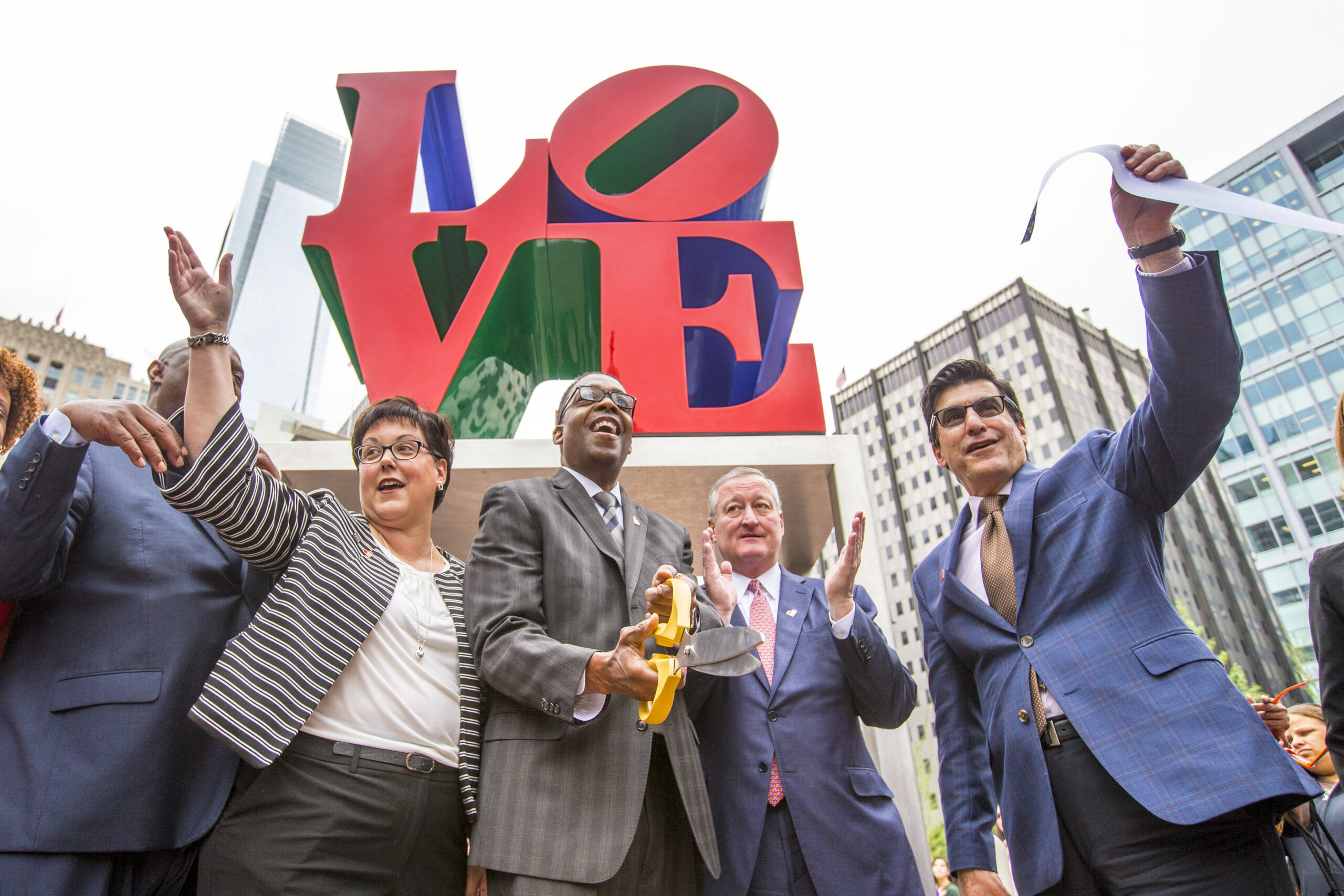
In this 2018 file photo, LOVE Park is by (left to right) then-Philadelphia Parks and Recreation Commissioner Kathryn Ott Lovell, former City Council President Darrell Clarke, former Philadelphia Mayor Jim Kenney and then-Managing Director Michael DiBerardinis.
For example, former Mayor Michael Nutter dispensed with decades of tradition and assigned robust portfolios to several deputy mayors. While his managing directors were important figures in his administration, they oversaw fewer operating departments than their predecessors.
Kenney, Parker’s immediate predecessor, sought to re-empower the city’s managing director position, while his deputy mayors took on advisory roles. He reassigned almost all departmental oversight to the managing director’s office.
“We’re going to have a managing director that’s actually a managing director,” Kenney said before he took office.
Council members who were in office before Parker’s 2024 swearing-in became used to the managing director being accessible. Several lawmakers said that under Kenney’s administration, they routinely communicated about constituent services matters with ex-Managing Director Tumar Alexander and his predecessor, Brian Abernathy.
That hasn’t been the case with Thiel in the role.
“Since the beginning of this administration, I have gone to Carlton Williams,” said Councilmember Jeffery “Jay” Young Jr., a freshman Democrat who represents parts of North Philadelphia.
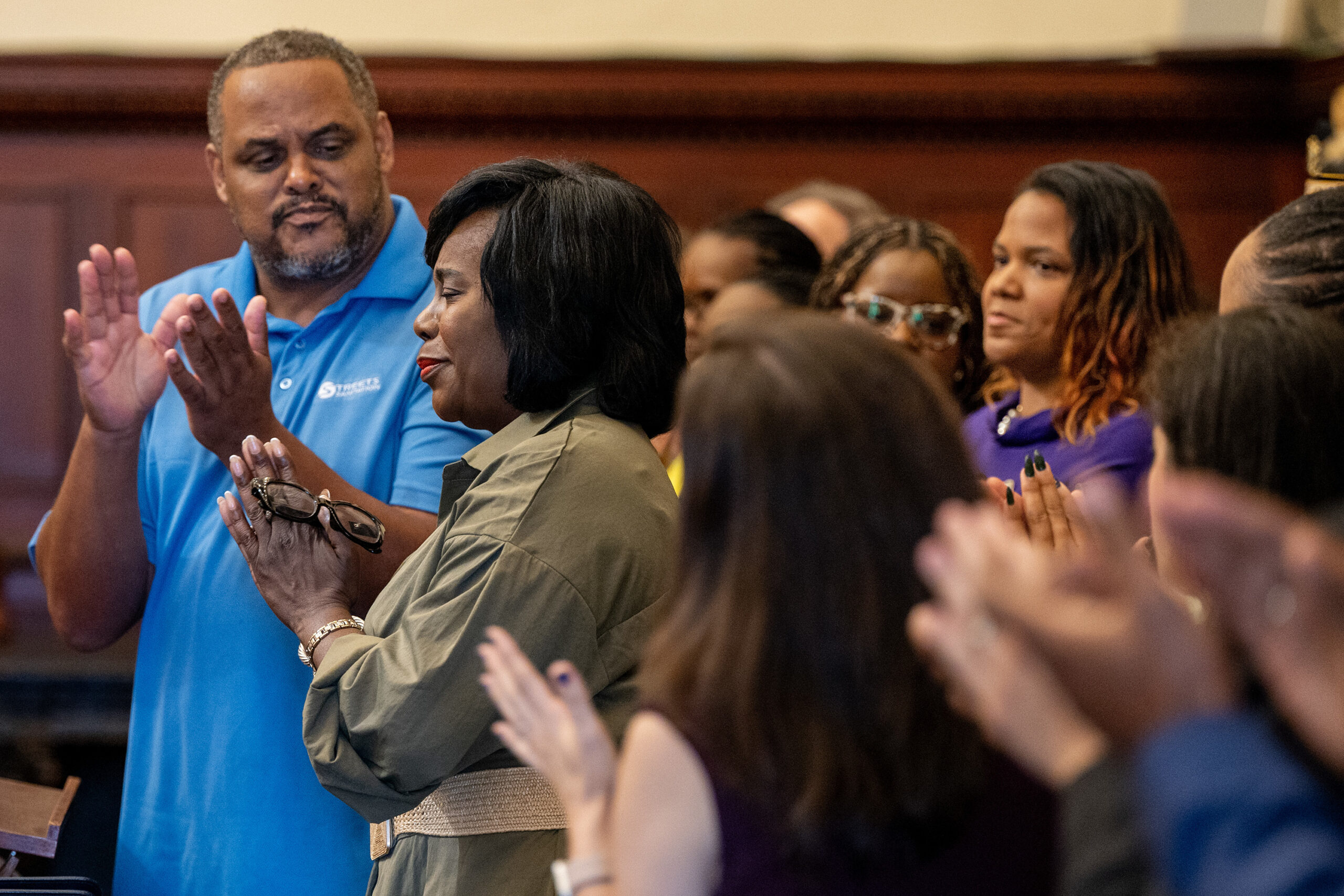
Mayor Cherelle L. Parker is applauded by members of her administration at City Hall Wednesday, Jul. 9, 2025, hours after reaching a tentative contract agreement with District Council 33 leaders overnight, ending the workers’ strike. At left is Carlton Williams, director of the Office of Clean and Green Initiatives and Chief Deputy Mayor Sinceré Harris is behind the mayor at right.
Several other members said that instead of going to the managing director’s office, they take administrative needs to legislative affairs staff, agency heads, or Thurman.
“Almost everything goes through Tiffany, and she’s able to get things done,” said one Council member who spoke on the condition of anonymity to preserve relationships with the administration.
Parker doesn’t deny that little happens at the top rungs of city government without Thurman’s involvement. The mayor has come to see her chief of staff as the central figure in her administration and calls her the city’s “chief air traffic controller.”
Phil Goldsmith, who served as managing director for two years under former Mayor John F. Street, said Thiel’s minimized public role may be because Parker appears to favor “a very strong mayor’s office.”
“It seems to me that the managing director may have to go through more hoops to get things done than, for example, I had to do,” Goldsmith said. “That’s just a function of what a mayor wants and feels comfortable with.”
Fading out of public view
Thiel’s lack of public appearances over the last year has been unusual for a managing director.
It has been 10 months since he testified before City Council, despite the managing director in previous administrations being a mainstay in hearings to answer lawmakers’ questions about city services ranging from street repaving to emergency preparation.
And in December, when a half-dozen top Parker administration officials spoke during the mayor’s State of the City event, Thiel was not on the roster.
The decrease in visibility marks a departure from his first year in office, when Thiel had a more consistent public presence and was often seen beside the mayor.
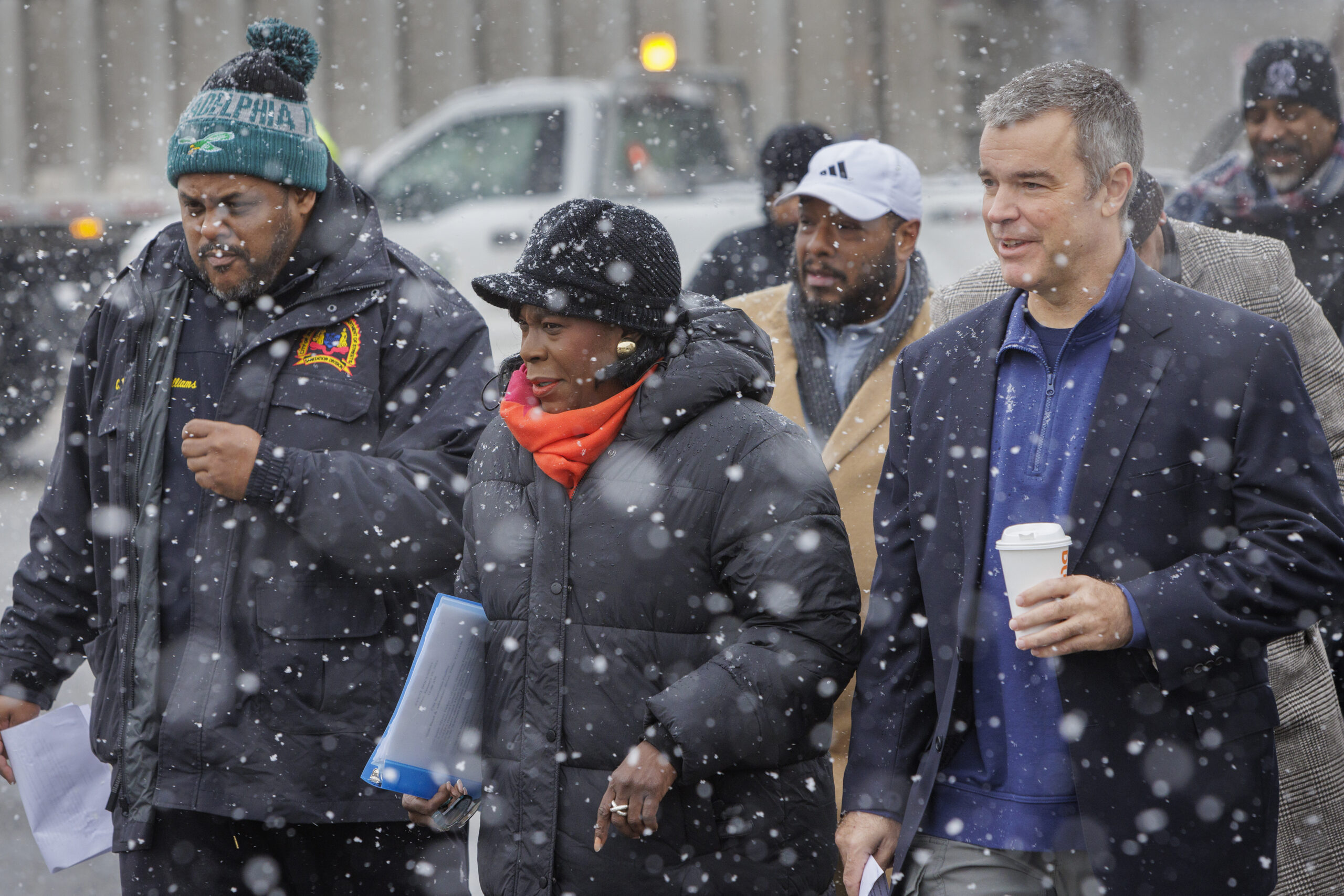
Ahead of a snowstorm in January 2024, Thiel stood with Parker during a news conference about preparations. He donned a suit while snowflakes fell, and he reassured the city that the administration was ready for the service disruptions that bad weather can bring.
Mayor Cherelle L. Parker (center) with Managing Director, Adam Thiel (right) and at left Carlton Williams, Director of Clean & Green Initiatives, at a news conference with city officials in Northeast Philadelphia on Friday, Jan. 19, 2024 to share the city’s response to the snowstorm.
Through his first year in the position, Thiel also faced scrutiny as the face of some of the mayor’s most controversial initiatives.
He took a leading role in Parker’s efforts to end the open-air drug market in the city’s Kensington neighborhood, and he oversaw the development of the Riverview Wellness Center, a new city-owned recovery house for people with substance use disorder.
Today, much of Kensington initiative is overseen by the public safety director, who reports directly to Parker. A new head of community wellness is leading development at Riverview, and Williams was the face of the storm response.
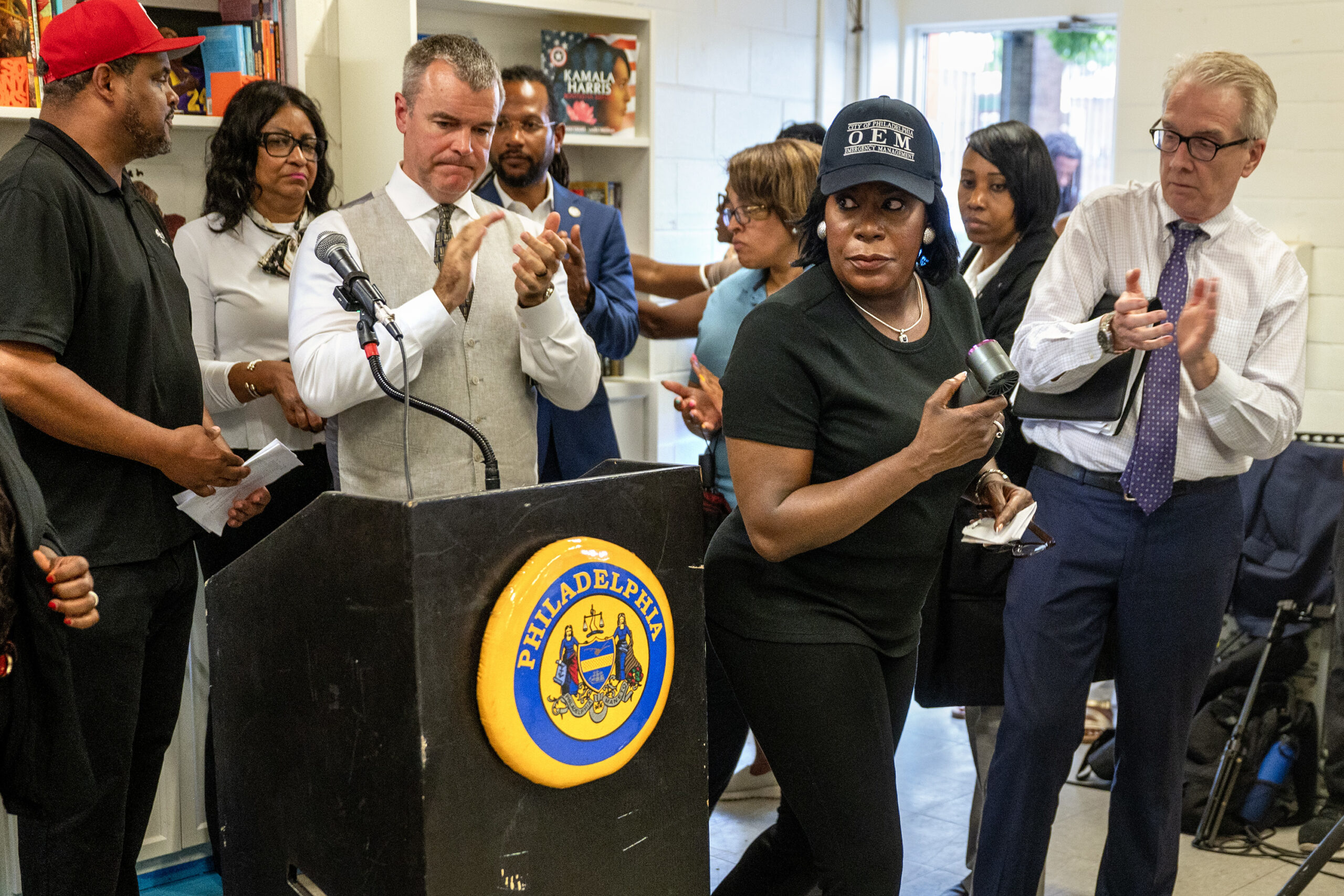
Mayor Cherelle L. Parker finishes a news media briefing with her leadership team at the Tustin Playground at 60th St. and W Columbia Ave. Tuesday, Jul, 1, 2025, on the first day of the strike by District Council 33. At left are Carlton Williams (Phillies cap), Director of Clean and Green Initiative with the Dept. of Streets Sanitation Division; and Managing Director Adam Thiel (at lectern).
But by the time the strike was resolved, Thiel had faded from public view, departing from his city job for one of his stints on military leave. After Parker reached an agreement with the union, she held a news conference with 20 top deputies and thanked each of them by name.
Thiel, absent from the City Hall news conference, was not one of them.
Staff writers Ryan W. Briggs and Sean Collins Walsh contributed to this article.
Philadelphia City Council may not have a vote on Superintendent Tony B. Watlington Sr.’s sweeping facilities plan, but it indicated Tuesday that it will have a say in school closings.
As a packed hearing began in Council’s chambers Tuesday morning, both Council President Kenyatta Johnson and Isaiah Thomas, chair of the Education Committee, said Council refused to be a “rubber stamp” to Watlington’s proposal to close 20 schools, colocate six, and modernize 159.
“I’m infuriated that we don’t get a say,” Councilmember Jimmy Harrity said, warning the district officials who appeared before him. “But, Council president, you and I both know we do get a say, because budget’s coming. And we will be looking. Mindful is the word I would use for today — be mindful.”
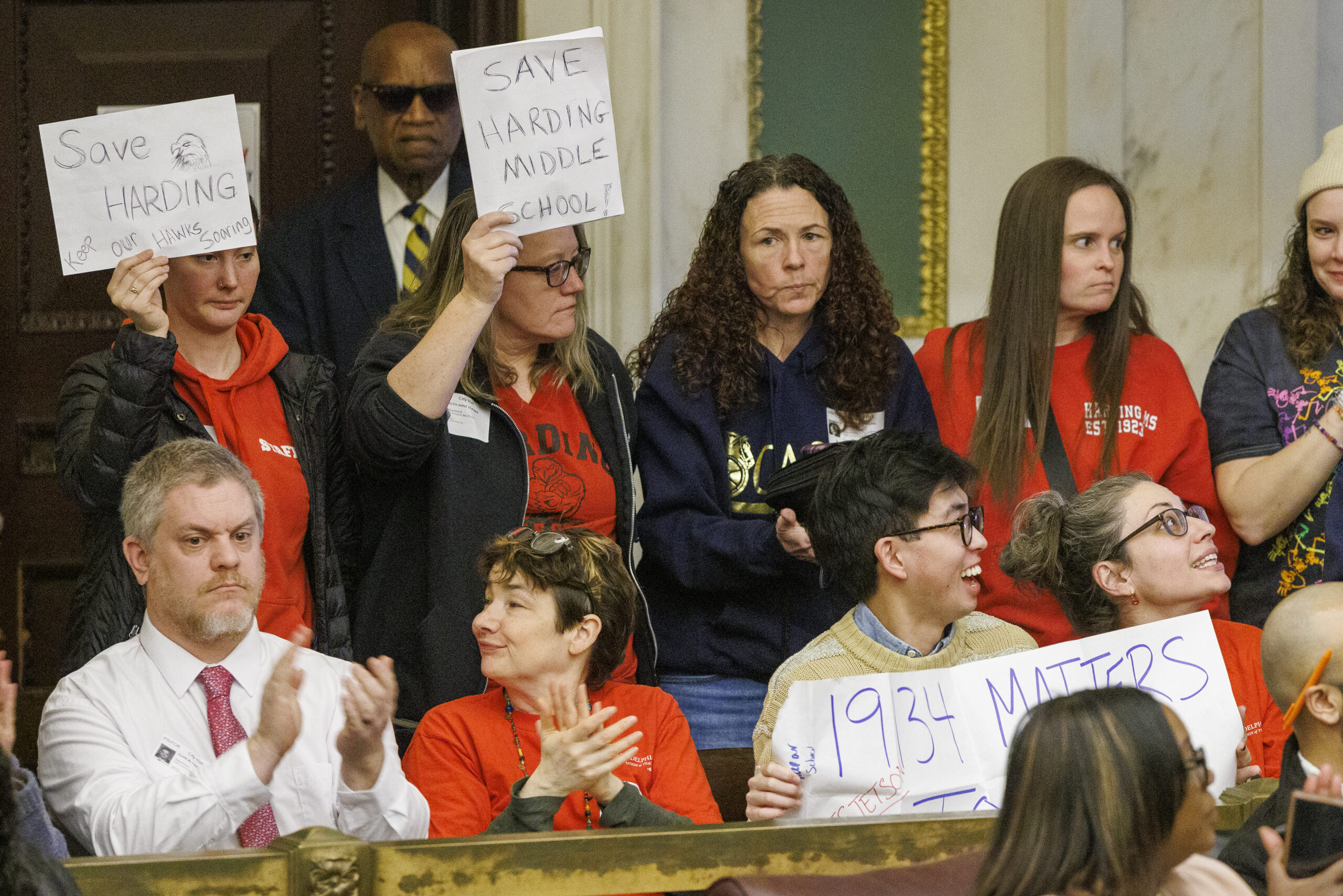
Concerned citizens stand with signs in support of Harding Middle School before the start of a Philadelphia City Council hearing Tuesday at City Hall on the school district’s plan to close 20 schools.
About 40% of the district’s nearly $5 billion budget comes from local revenue and city funding, which City Council and Mayor Cherelle L. Parker must approve in the annual city budget by the end of June.
Harrity, an at-large Council member, said he was “tired that every time cuts come, they come from a certain neighborhood. You know, I live in Kensington, in the 7th District. I talk to these kids. They’re good kids. They deserve everything that other kids in other neighborhoods are getting. … You can see that this isn’t what our people want.” Watlington has proposed closing four schools in the 7th District.
More than 100 community members holding babies and waving signs opposing the facilities plan filled Council chambers on the fourth floor of City Hall on Tuesday as Council members spent hours grilling Watlington and other district officials.
Watlington, meanwhile, stood by his plan in testimony to Council on Tuesday, sayingthat 20 closings was a much smaller number than he could have settled on.
“We could have come here and presented a plan that closed twice as many schools and been able to defend it,” Watlington said.
A once-in-a-lifetime opportunity?
District officials have said thefacilities process is not about saving money, but about optimizing education and equity for the city’s 115,000 students.
But it was clear Tuesday that finances played a part: The district has lost 15,000 students in the last 10 years, and over 80,000 since 1997, when charter schools were first authorized in Pennsylvania. It has 300 buildings, many of them 75 years and older and in poor repair, and some schools with more than 1,000 empty seats, while others are overcrowded.
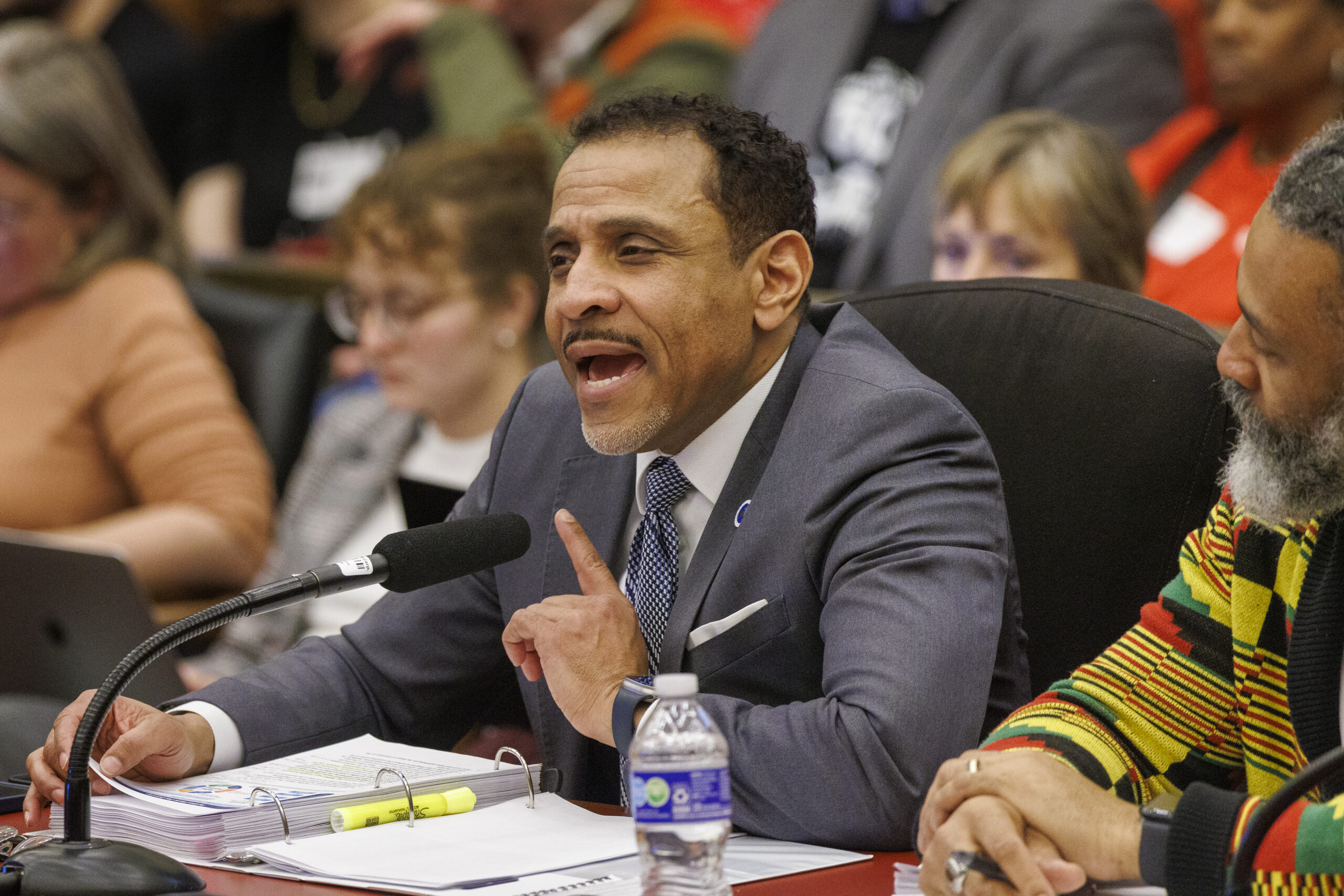
Tony B. Watlington Sr., superintendent of School District of Philadelphia, speaks at a City Council hearing Tuesday on his proposal to close 20 schools.
“We’ve got to be very careful with our limited resources in a historically underfunded district,” Watlington told Council.
Watlington and board president Reginald Streater, who also testified, pitched the plan as a way to add things the district cannot now offer — Advanced Placement courses in every high school, the opportunity for all eighth graders to take algebra, more prekindergarten, and career and technical education programs.
“I do not believe we’ll get this opportunity again in our lifetime,” Watlington said.
The superintendent dropped a few previously undisclosed facts about the facilities road map, indicating that his recommendations could shift slightly before he presents the plan to the school board on Feb. 26. No date has been set for the board’s final vote, which is expected later this winter.
“It’s premature to say how the final recommendations will land,” Watlington said.
But, the superintendent said, “if there are schools that Council wants me to take off the list, and add others on that list, we are open to you telling me what those are, but we cannot get to a place where we address our 35% non-utilization rate in buildings if no changes are made.”
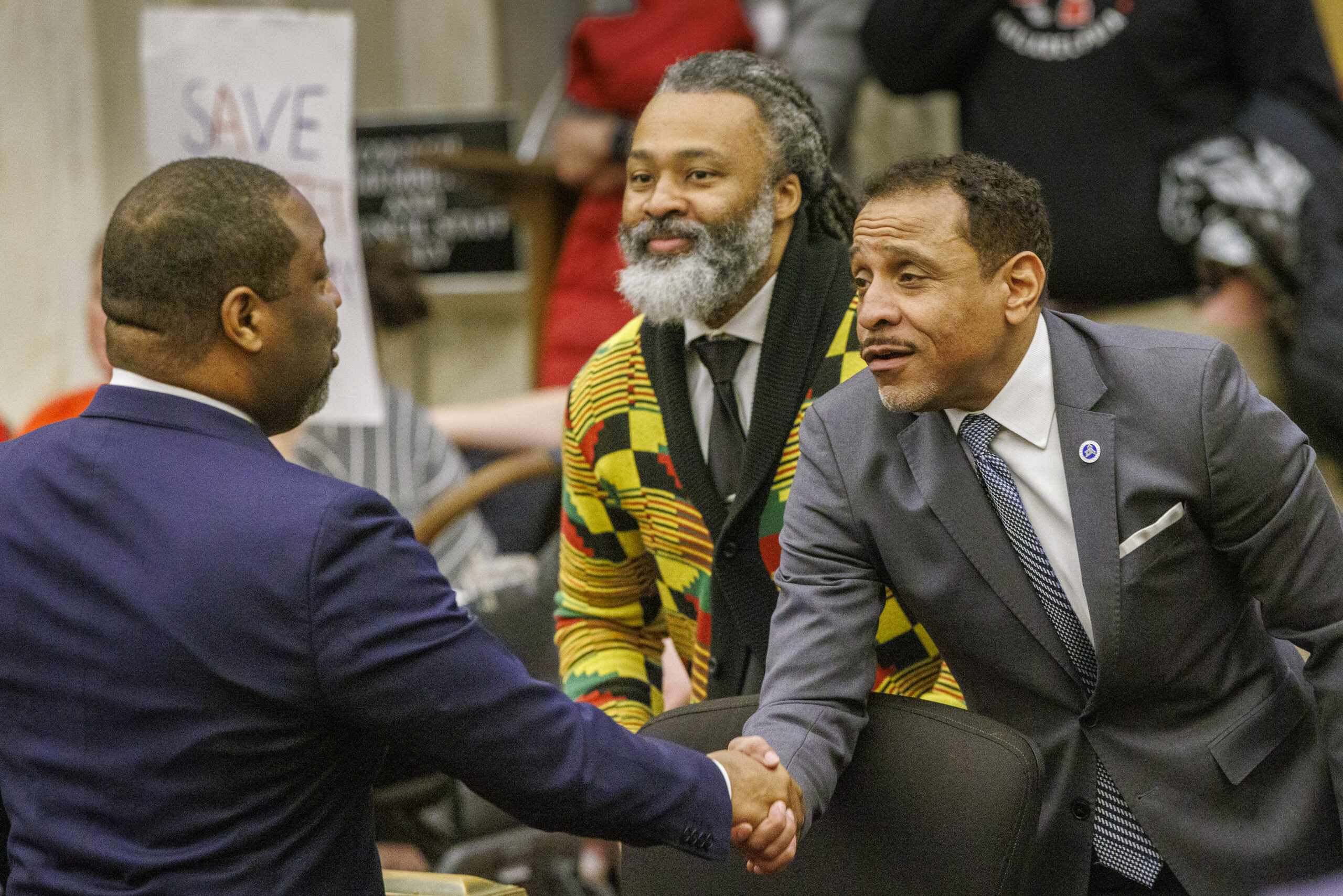
Philadelphia City Council President Kenyatta Johnson (left) greets Dr. Tony Watlington, Superintendent of School District of Philadelphia Philadelphia City Council holds hearing with board members of School District of Philadelphia, Tuesday, Feb. 17, 2026. Reginald L. Streater, Esq., President Board of Education. (center)
Debora Carrera, the city’s chief education officer, who spent three decades as a district teacher and administrator, told Council that Parker believes “the current district footprint is unsustainable.”
Carrera said her own experience as principal of Kensington High School for Creative and Performing Arts shows that it is right for the district to focus resources on neighborhood high schools.
“My high school was a small high school,” Carrera said. “I could only offer my children two AP courses, when other schools like Central — where my son went — could offer them over 20-plus AP courses.“
‘Breaking down of public education’
The hearing got tense at times.
“I feel like this is the breaking down of public education in Philadelphia,” said Councilmember Cindy Bass, who said some of the district’s own decisions had led to closures.
Several members of Council raised questions about the plan’s price tag. Prior district and city estimates put the cost just under $8 billion, but members of Watlington’s team said they could they could actually do the work for $2.8 billion — $1 billion from district capital funds, and $1.8 from yet-unpromised state and philanthropic sources.
In the past, the district had made public detailed facilities condition assessments for every school in the district, Councilmember Rue Landau noted.
Residents could look up their school and see exactly what the condition of every system in the building was, and how much money would be required to fix those that needed repair.
“We don’t have any of those details,” said Landau, who went so far as to say she believed the district should be spending more than $2.8 billion on the plan. “What is the increased investment, and why don’t we have any of those details? They are not out there in the public for us, so none of us have any understanding as to why this is happening, This should all be public so all of the public can see.”
“You need much more money than that,” Roseman told Council. “We need more money than this plan comes close to.”
Some Council members pushed the district and the board on the plan’s timing.
The city has been asking for a long-range facilities plan for years, Councilmember Quetcy Lozada pointed out.
“It’s taken us all this time,” Lozada said. “Now, you guys have come up with a plan, and now we want to rush through it. Now all of a sudden there’s this urgency to get through this plan, which I don’t understand.”
Streater said the board is moving forward with hearing Watlington’s plan on Feb. 26, but won’t vote until it hears more feedback.
But ultimately, he said, the board will vote on “a plan that is dynamic, that can evolve over time. … I think that we all understand that things change, facts change, funding changes, enrollment trends change.”
And, Streater said, there will also likely be policy changes based on redrawing some catchment areas, or boundaries that determine which neighborhood schools children attend.
Streater, who introduced himself at the beginning of the hearing as “Reggie from Germantown,” underscoring his history as a graduate of two district schools that closed — Germantown High and Leeds Middle School — said that changes must be made.
“I think if we continue doing the same thing, expecting a different result — which I would argue is chronic underachievement — we are doomed.”
The long vacant industrial building at 1807 Huntingdon St. in East Kensington is moving toward redevelopment after seven years of setbacks.
Philadelphia-based Smith & Roller has been eyeing the faded brick structure since 2019 but struggled with funding following the COVID-19 pandemic and the loss of a lender after Silicon Valley Bank’s collapse in 2023.
But last week New Jersey-based Ellavoz Impact Capital announced that it was acquiring the building in partnership with Smith & Roller, allowing the developers to move forward with their plans near SEPTA’s Huntingdon stop on the Market-Frankford line.
Developers Tayyib Smith and Jacob Roller see the project as a catalyst for change around the elevated train station, which is haunted by the opioid crisis.
“I’ve always imagined connecting nodes of vitality and then seeing how it almost has a regenerative spring of people looking at a neighborhood differently,” Smith said.
“I can imagine that block having a different feel, a different type of lighting, a different type of walkability, more socio-economic diversity, more eyes on the corridor,” he added.
The developers plan to break ground on the project in about six months.
Smith & Roller’s neighboring development, 1801 Huntingdon, will transform a historic bank building into a banquet hall and commissary kitchen for Black-owned caterer Strother Enterprises, which has been expanding elsewhere in the city recently. That development will need approvalby the city’s Zoning Board of Adjustment and is on a longer timeline.
Over the years, the project at 1807 Huntingdon has added more housing and cut back on space for businesses.
The current version of the project includes 109 residential units and 8,600 square feet of commercial space. According to Ellavoz Impact Capital’s news release, the commercial space has been preleased, but the tenant list is not public yet.
A rendering of the redeveloped factory building, as a mixed-use apartment building.
An earlier version of the project, reviewed by the city’s Civic Design Review committee in 2022, would have contained 80 apartments and 38,000 square feet of light industrial space.
That’s partly because the federal program Smith & Roller originally planned to use, New Market Tax Credits, requires that at least a fifth of a mixed-use project be devoted to commercial development.
But the project at 1807 Huntingdon has been in process for so long that this part of Kensington no longer qualifies for the federal incentive, which is meant to spur investment in struggling areas.
The project is still in a Keystone Opportunity Zone (KOZ), however, which will give state tax breaks to businesses at the 1807 and 1801 Huntingdon projects.
That policy is also meant to incentivize development in lower-income areas, but there are many examples of its application to parts of Philadelphia like the Navy Yard and University City.
“I don’t know many [KOZs] that are in neighborhoods like Kensington,” Smith said, “where there’s somebody trying to use it in the spirit and intent of how the legislation was written.”
The project will include both the redeveloped factory with additional space above it and an adjacent parking lot, which will have multiple stories of housing on top.
It will include a mix of studios, one-bedroom, and a few two-bedroom apartments, along with loft-style units that can be rented out as either short-term rentals or office space.
Sixty percent of the units will be set aside for households earning 80% of area median income, or almost $67,000 for one person.
“We don’t have a direct subsidy, like a Low Income Housing Tax Credit or anything like that,” Roller said. “In some cases, it’s not that different a number than a market rent in the neighborhood.”
Jacob Roller (left) and Tayyib Smith last June outside the historic bank they plan to turn into a base for Black-owned businesses, which is next to the apartment project farther down Huntingdon Street.
Roller said the project is inspired in unit mix and general location by the success of Shift Capital’s mixed-use project at 3400 J St., home to Càphê Roasters. Smith & Roller was a junior partner in that project.
The Huntingdon Street project will be the firm’s largest project by unit count.
“I am extremely impressed by the work of Smith & Roller,” Jeffrey Crum, president of Ellavoz Impact Capital, said in the news release. “They have proven themselves as professional and experienced urban redevelopers who have a unique vision for revitalizing neighborhoods in partnership with local communities.”
The proposal has been presented to the East Kensington Neighbors Association several times over the years, and the community group is supportive of Smith & Roller’s proposal.
The group also sees the development project as a means to bring new life to the block, where the current dilapidated state of the buildings often attracts opioid users from nearby open-air drug markets on Kensington Avenue.
“The block has been challenged for a long time,” said John Theobald, president of the East Kensington Neighbors Association. “It’s really where a lot of the Kensington Avenue activity impacts the neighborhood, so hopefully more people living there and less vacancy will help.”
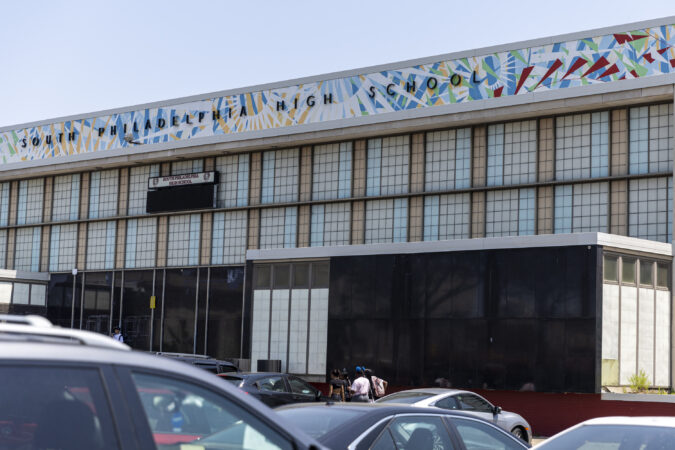
Nearly $58 million for South Philadelphia High School. Over $27 million for Forrest Elementary in the Northeast. Almost $55 million for Bartram High in Southwest Philadelphia.
Ahead of a Tuesday City Council hearing on the Philadelphia School District’s proposed facilities master plan, district officials have dangled the carrot that would accompany the stick of 20 school closings.
The district released Monday morning how much it would spend onmodernization projects at schools in each City Council District if Superintendent Tony B. Watlington Sr.’s plan is approved by the school board this winter.
The totals range from $443 million in the 9th District — which includes parts of Olney, East and West Oak Lane, Mount Airy, and Oxford Circle — to nearly $56 million for the 6th District in lower Northeast Philadelphia, including Mayfair, Bridesburg, and Wissinoming.
The district’s announcement comes as the plan has already raised hackles among some Council members, and City Council President Kenyatta Johnson has said he’ll hold up the district’s funding “if need be” if concerns are not answered to Council’s satisfaction.
Tailoring the release to Council districts — including highlighting one major project per district — appears to be an effort to calm opposition ahead of Tuesday’s hearing.
Details on every school that would get upgraded under Watlington’s plan — 159 in total — have not yet been released.
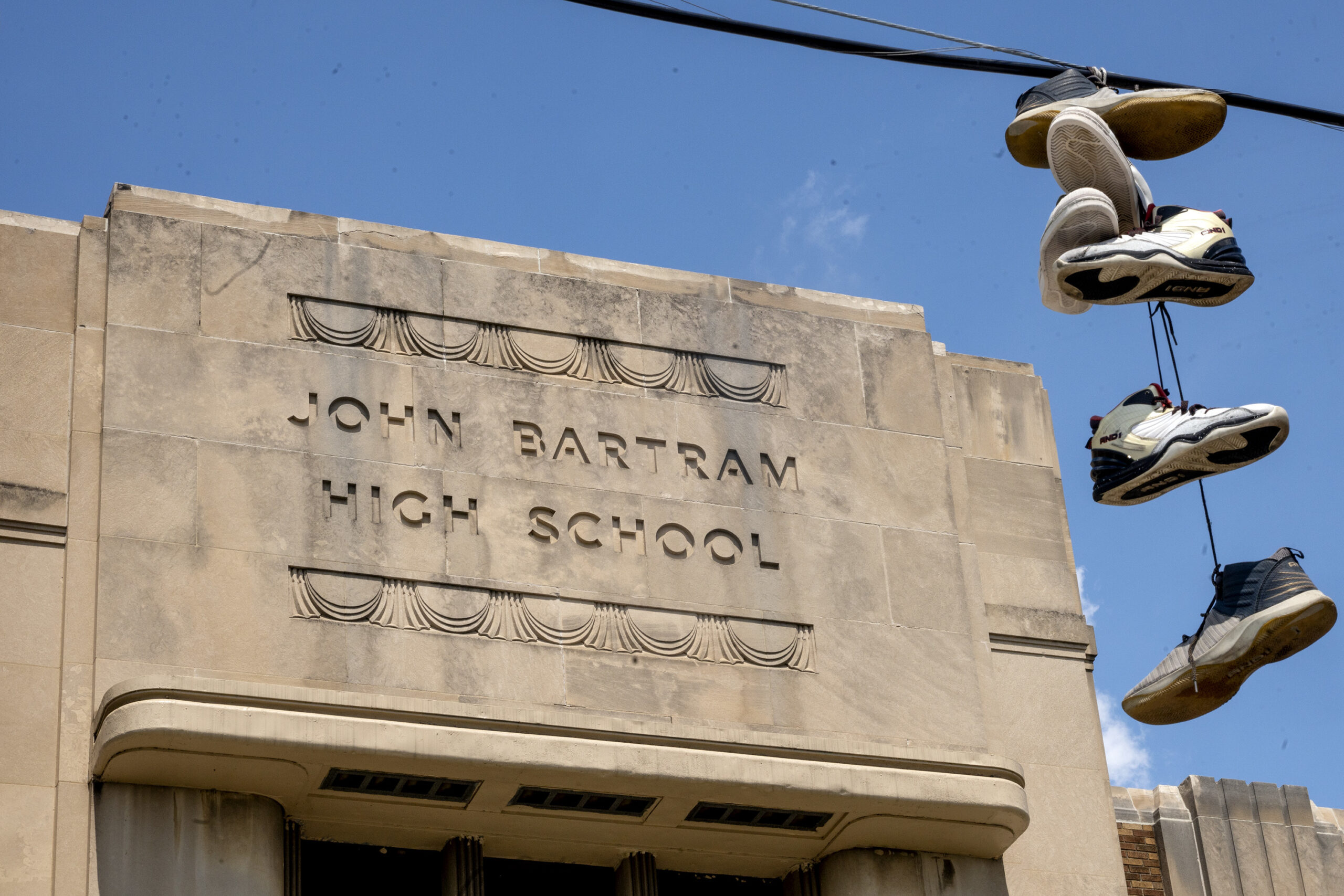
John Bartram High School at 2401 S. 67th St in Southwest Philadelphia.
Watlington has stressed that the point of the long-range facilities plan is not closing schools, but solving for issues of equity, improving academic programming, and acknowledging that many buildings are in poor shape, whilesome are underenrolled and some are overenrolled.
“This plan is about ensuring that more students in every neighborhood have access to the high-quality academics, programs, and facilities they deserve,” Watlington said in a statement. “While some of these decisions are difficult, they are grounded in deep community engagement and a shared commitment to improving outcomes for all public school children in every ZIP code of Philadelphia.”
But at community meetings unfolding at schools across the city that are slated for closure, Council members have expressed displeasure about parts of the plan — a preview, perhaps, of Tuesday’s meeting.
Councilmember Quetcy Lozada, represents the 7thDistrict, including Kensington, Feltonville, Juniata Park, and Frankford. Four schools in her district — Stetson,Conwell, Harding, and Welsh —are on the chopping block.
“The fact that they are being considered for closure is very concerning to me,” Lozada said at a meeting at Stetson Middle School on Thursday.
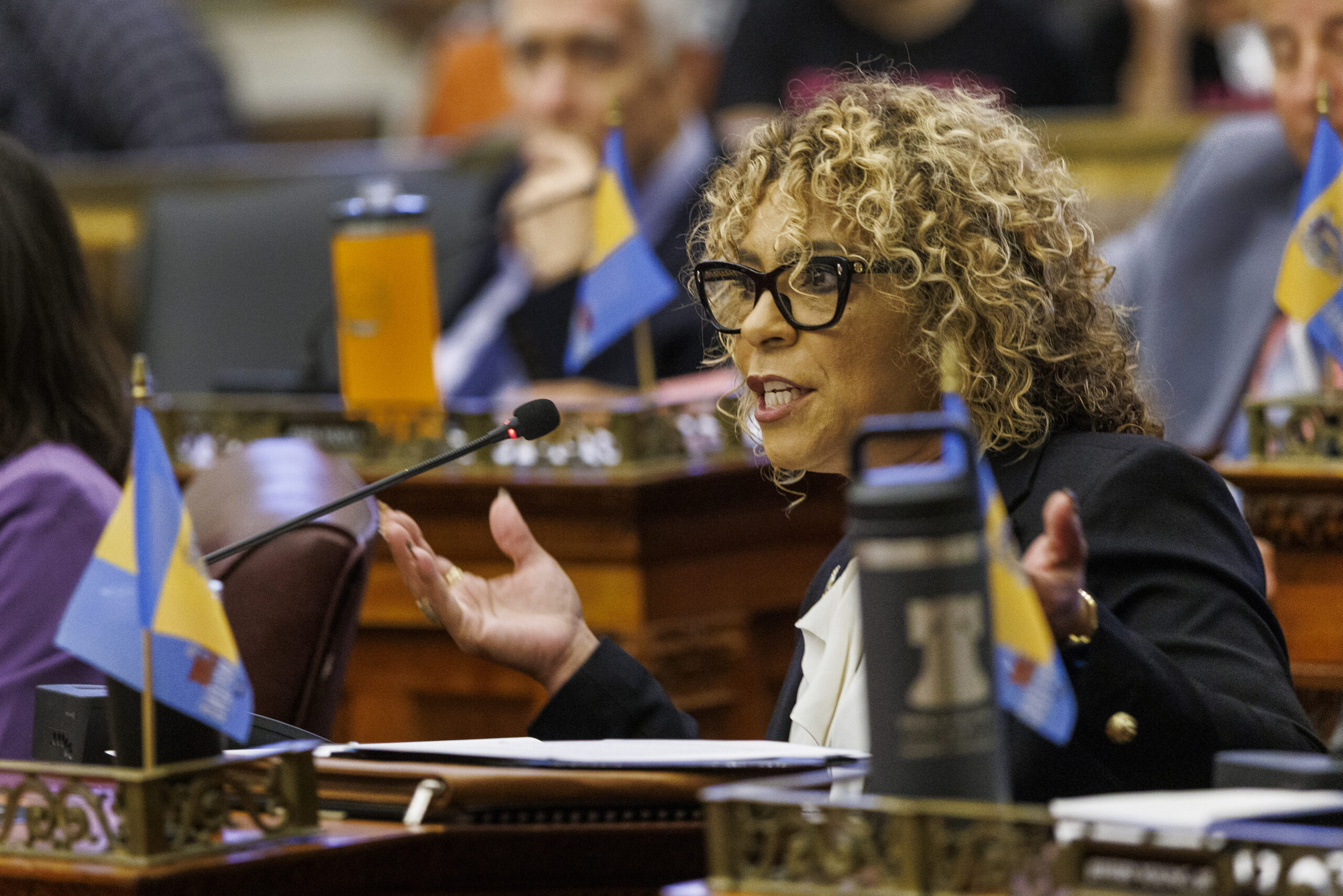
Councilmember Quetcy Lozada is shown in a 2025 file photo.
Councilmember Cindy Bass, speaking at a Lankenau High meeting, objected to closing schools that are working well. (Three schools in Bass’ 8th District, Fitler Elementary, Wagner middle school, and Parkway Northwest High School, are proposed for closure. Lankenau is in Curtis Jones Jr.’s district but has citywide enrollment.)
“I do not understand what the logic and the rationale is that we are making these kinds of decisions,” said Bass.
While Council members will not have a direct say on the proposed school closures or the facilities plan, Council wields significant control over the district’s budget. Funding for the district is included in the annual city budget that Council must approve by the end of June.
Local revenue and city funding made up about 40% of the district’s budget this year, or nearly $2 billion. Most of that is the district’s share of city property taxes which, unlike other school systems in Pennsylvania, are levied by the city and then distributed to the district.
(function() {
var l2 = function() {
new pym.Parent(‘schools_districts2’,
‘https://media.inquirer.com/storage/inquirer/projects/innovation/arcgis_iframe/schools_districts2.html’);
};
if (typeof(pym) === ‘undefined’) {
var h = document.getElementsByTagName(‘head’)[0],
s = document.createElement(‘script’);
s.type = ‘text/javascript’;
s.src = ‘https://pym.nprapps.org/pym.v1.min.js’;
s.onload = l2;
h.appendChild(s);
} else {
l2();
}
})();
Where will the money go?
Despite city and schools officials saying in the past that the district has more than $7 billion in unmet facilities needs, Watlington has said the district could complete its plan — including modernizing 159 schools — for $2.8 billion.
Officials said further details about modernization projects and the facilities plan will be released before the Feb. 26 school board meeting, where Watlington is expected to formally present his proposal to the school board.
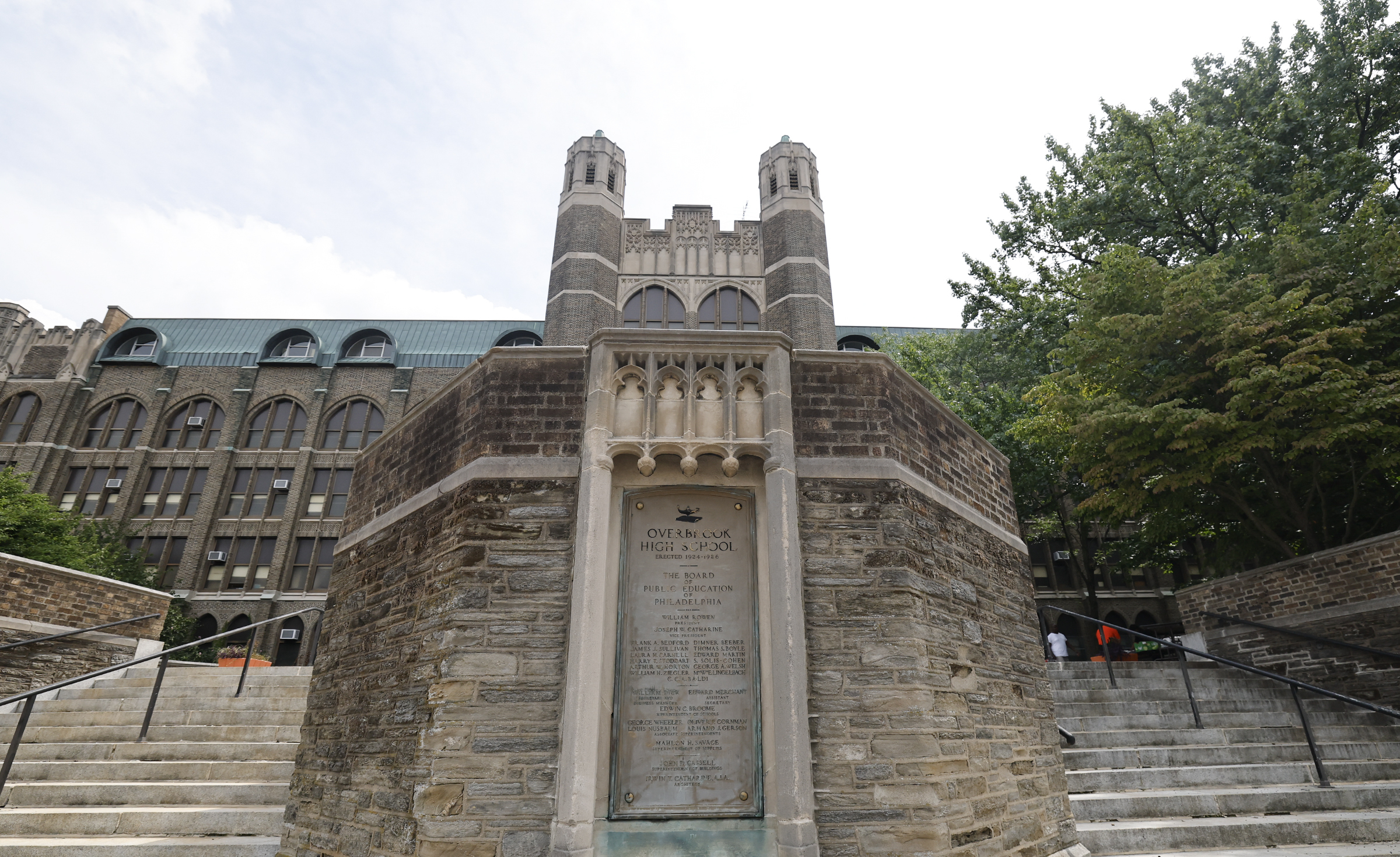
Overbrook High School, in West Philadelphia, will get major renovations in preparation for The Workshop School, a small, project-based district school, colocating inside the building.
Here are the total proposed dollar amounts per Council district and the 10 big projects announced Monday:
1st District: $308,049,008. Key project: $57.2 million for South Philadelphia High, turning the school into a career and technical education hub and modernizing electrical, lighting, and security systems.
2nd District: $302,284,081. Key project: $54.6 million for Bartram High, to renovate the school and grounds, career and technical education spaces, restroom and accessibility renovations, new painting, and new athletic fields and facilities (on the site of nearby Tilden Middle School, which is slated to close). Motivation High School would close and become an honors program inside Bartram.
3rd District: $204,947,677. Key project: $19.6 million for the Sulzberger site, which currently houses Middle Years Alternative and is proposed to house Martha Washington Elementary. (It currently houses MYA and Parkway West, which would close.) Improvements would include heating and cooling and electrical systems, classroom modernizations, andthe addition of an elevator and a playground.
4th District: $216,819,480. Key project: $50.2 million for Overbrook High School, with updates including new restrooms, accessibility improvements, and refurbished automotive bays. (The Workshop School, another district high school, is colocating inside the building.)
5th District: $290,748,937. Key project: $8.4 million for Franklin Learning Center, with updates including for exterior, auditorium, and restroom renovations, security cameras, accessibility improvements, and new paint.
6th District: $55,769,008. Key project: $27.2 million for Forrest Elementary, including modernizations that will allow the school to grow to a K-8, and eliminate overcrowding at Northeast Community Propel Academy.
7th District: $388,795,327. Key project: $32.3 million at John Marshall Elementary in Frankford to add capacity at the school, plus a gym, elevator, and schoolwide renovations.
8th District: $318,986,215. Key project: $42.9 million at Martin Luther King High in East Germantown for electrical and general building upgrades and accommodations for Building 21, a school that will colocate inside the King building.
9th District: $442,934,244. Key project: $42.2 million at Carnell Elementary for projects including an addition to expand the school’s capacity, restroom renovations, exterior improvements, and stormwater management projects.
10th District: $275,829,539. Key project: at Watson Comly Elementary in the Northeast, an addition to accommodate middle grade students from Loesche and Comly, and building modernizations. District officials did not give the estimated cost of the Comly project.
What’s next?
The facilities Council hearing is scheduled for 10 a.m. Tuesday at City Hall. It will also be livestreamed.
Members of the public also have the opportunity to weigh in on the facilities plan writ large at three community town halls scheduled for this week: Tuesday at Benjamin Franklin High from 4:30 to 6:30 p.m., Friday at Kensington CAPA from 4:30 to 6:30 p.m., and a virtual meeting scheduled for 2 p.m. on Sunday.
Meetings at each of the schools proposed for closure continue this week, also; the full schedule can be found on the district’s website.
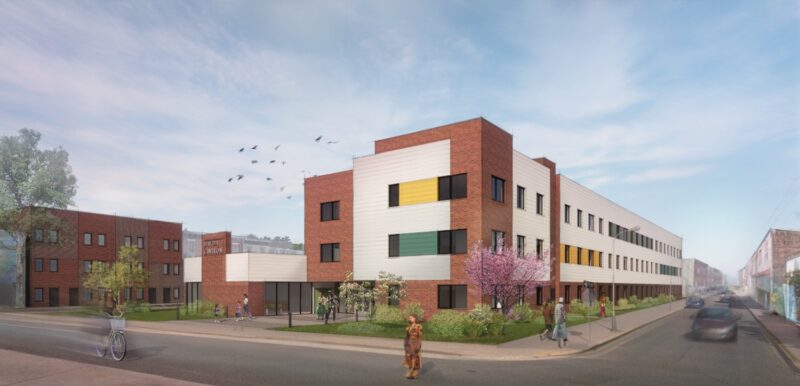
The Women’s Community Revitalization Project is planning a 34-unit apartment building, flanked by two triplexes, on city-owned land in Kensington.
All of the units will be available to those below 60% of area median income, or almost $72,000 for a family of four.
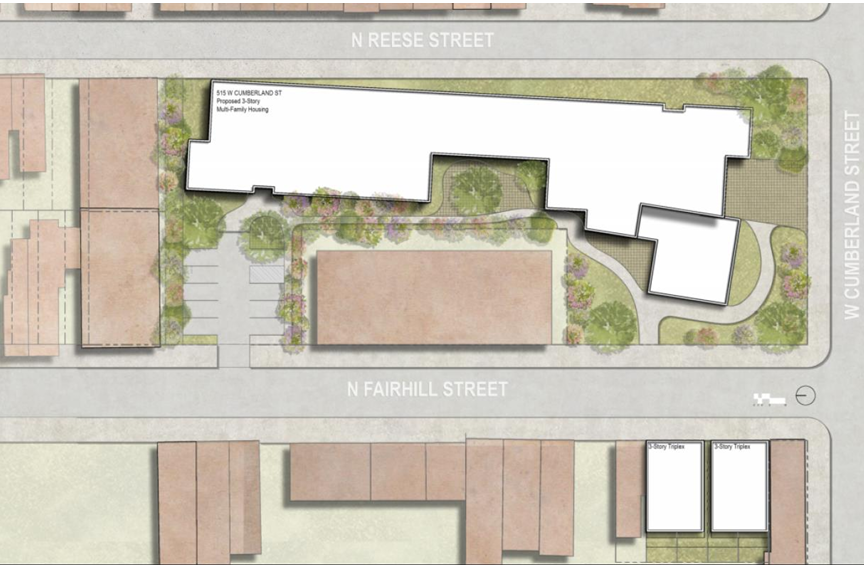
The apartment building at Cumberland and Reese Streets is designed at an angle slashing across the lot, using only a portion of the city-owned land.
“Having a solid wall of building directly across [from rowhouses], we just felt wasn’t really contextual to the neighborhood,” said Lorissa Luciani, who has been the executive director of Women’s Community Revitalization Project (WCRP) for the last nine months. “Then there’s height limitations so we couldn’t go any higher.”
The project is funded through federal Low Income Housing Tax Credits (LIHTC), which the nonprofit group obtained in 2025. The land will be obtained for a nominal cost from the city.
WCRP has been meeting with local community groups since 2024. Luciani said organizations such as Xiente, APM, and the 19th Ward RCO have been supportive of this project.
The development, designed by Philadelphia-based CICADA Architecture & Planning, will cost over $26 million and is slated for completion 18 months after the group settles on the land. It will include 10 parking spaces.
On Tuesday, the Philadelphia Land Bank’s board voted to approve the sale of the property to WCRP. The plan also has the backing of Councilmember Quetcy Lozada, which is essential because she will need to introduce legislation to move the property out of the Land Bank.
“It’s an amazing project,” Lozada said. “We are in need of partners like the Women’s Community Revitalization Project who understand the need for not just affordable housing, but deeply affordable housing.”
Without Lozada’s support, the project would be impossible.Final passage of the legislation could come as soon as later this month.
The three buildings being developed by WCRP can be seen from above, highlighted in white, with the apartment project’s slanted angle readily seen from above.
Luciani said WCRP would close on the project in the fall.
This will be Luciani’s first ground-up development with the organization. She joined the nonprofit in 2025 after WCRP’s longstanding executive director and founder Nora Lichtash retired from her leadership role with the group after 35 years. She still works for the group as a consultant.
WCRP was founded in 1986 to serve Fishtown, Kensington, and other neighborhoods in North Philadelphia east of Broad Street. Since then, it has developed projects in other corners of the city, such as Germantown and Point Breeze.
“My predecessor has a substantial amount of experience and relationships with many of these organizations” in Kensington, Luciani said.
“I’m trying to work to have my own relationships with them,” Luciani said. “They’re a really organized, sophisticated community that really understands their needs, and they’ll fight for it as hard as they need to.”
Luciani previously worked in New Jersey local and state government and planning for decades and has a deep familiarity with subsidized housing policy.
“I grew up in public housing in North Jersey,” Luciani said. “So it’s been a personal and professional lens that I utilize to try and continue the good work that helped my family in the hopes of helping others.”
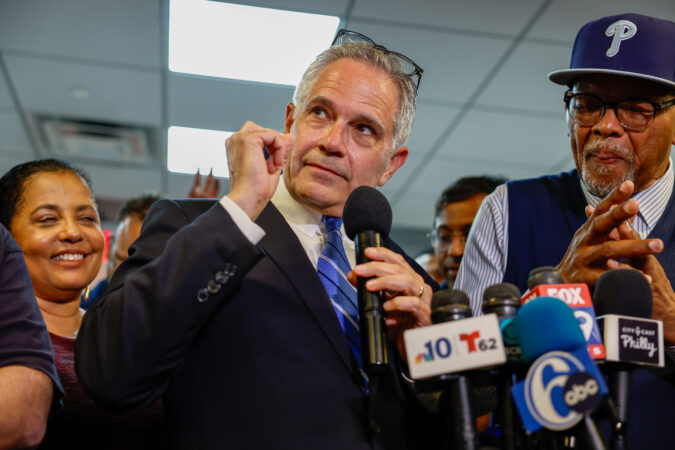
Philadelphia District Attorney Larry Krasner on Wednesday dismissed rumors that he may challenge Mayor Cherelle L. Parker when she will face reelection next year, and he said in a statement that he is focused on his job as the city’s top prosecutor.
Krasner, who last year won his third term as district attorney and has cultivated a national brand,told The Inquirer that talk he might challenge the incumbent divides the city’s leadership.
His statement came after the news website Axios Philly reported that some political insiders were floating Krasner’s name as a potential mayoral contender.
“Especially in these times, all Philadelphia residents need to stand together and work together for Philly,” Krasner said. “Not sure whose agenda this narrative serves, but there’s nothing new about insiders stirring things up to benefit themselves at the expense of everyone else.”
Talk of Parker facing a potential primary challenge ramped up in recent days after the mayor’s political action committee filed a campaign finance report showing she had raised $1.7 million last year, a striking sum for a sitting mayor two years out from a reelection bid.
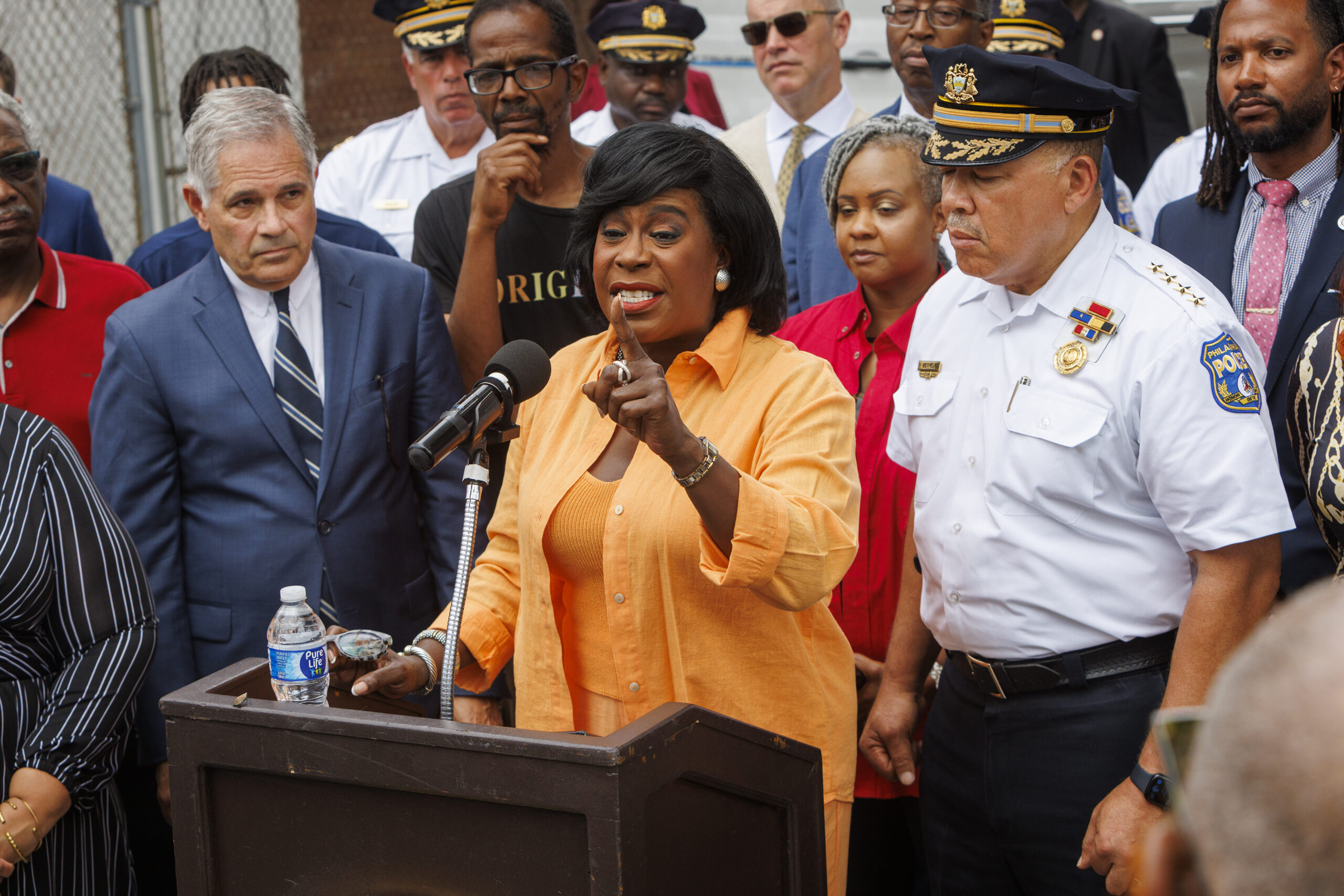
In this 2024 file photo, Philadelphia Mayor Cherelle L. Parker is flanked by Police Commissioner Kevin Bethel and District Attorney Larry Krasner during a news conference.
The fundraising report fueled speculation among the city’s political class that Parker, a centrist Democrat who is backed by much of the party establishment, may be expecting a challenge in the primary.
Krasner, 64, is the most prominent progressive in the city. He won reelection last year in landslide fashion, and he has positioned himself as the city’s most vocal Trump opponent, often drawing comparisons between the federal government and 20th-century fascism.
And several past district attorneys have run for mayor, including Ed Rendell, who went on to serve two terms in City Hall and then was elected governor of Pennsylvania.
But for Krasner, any run at Parker would be tricky.
Krasner, who is white, has been successful in electoral politics in large part because of support from the city’s significant bloc of Black voters, politicians, and clergy. Those groups are also key to the base of support that has backed Parker, who comes from a long line of Black politicians hailing from the city’s Northwest.
Allies of the district attorney say a better fit — if he decided to seek higher office — could be running for a federal seat.
Political observers have suggested a handful of Democrats, including Krasner, could run for the U.S. Senate seat currently occupied by Sen. John Fetterman. The Democratic senator, who will be up for reelection in 2028, has an independent streak and has angered many in the party for at times siding with Republicans.
Several other Democrats have been floated as potential contenders for the seat, including U.S. Reps. Brendan Boyle, of Philadelphia, and Chris Deluzio, whose Western Pennsylvania district includes Allegheny County. Some have also speculated that former U.S. Rep. Conor Lamb, also of Western Pennsylvania, could run.
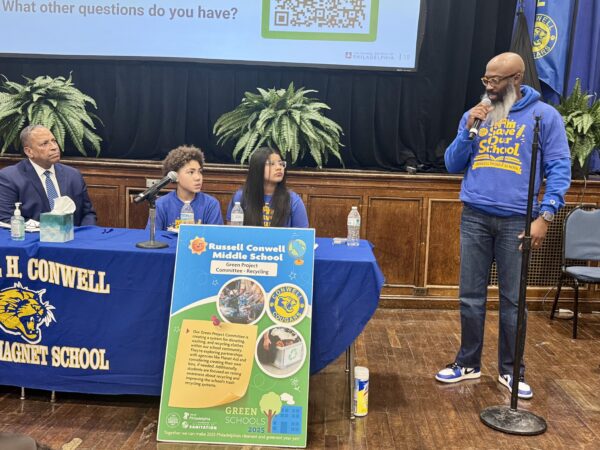
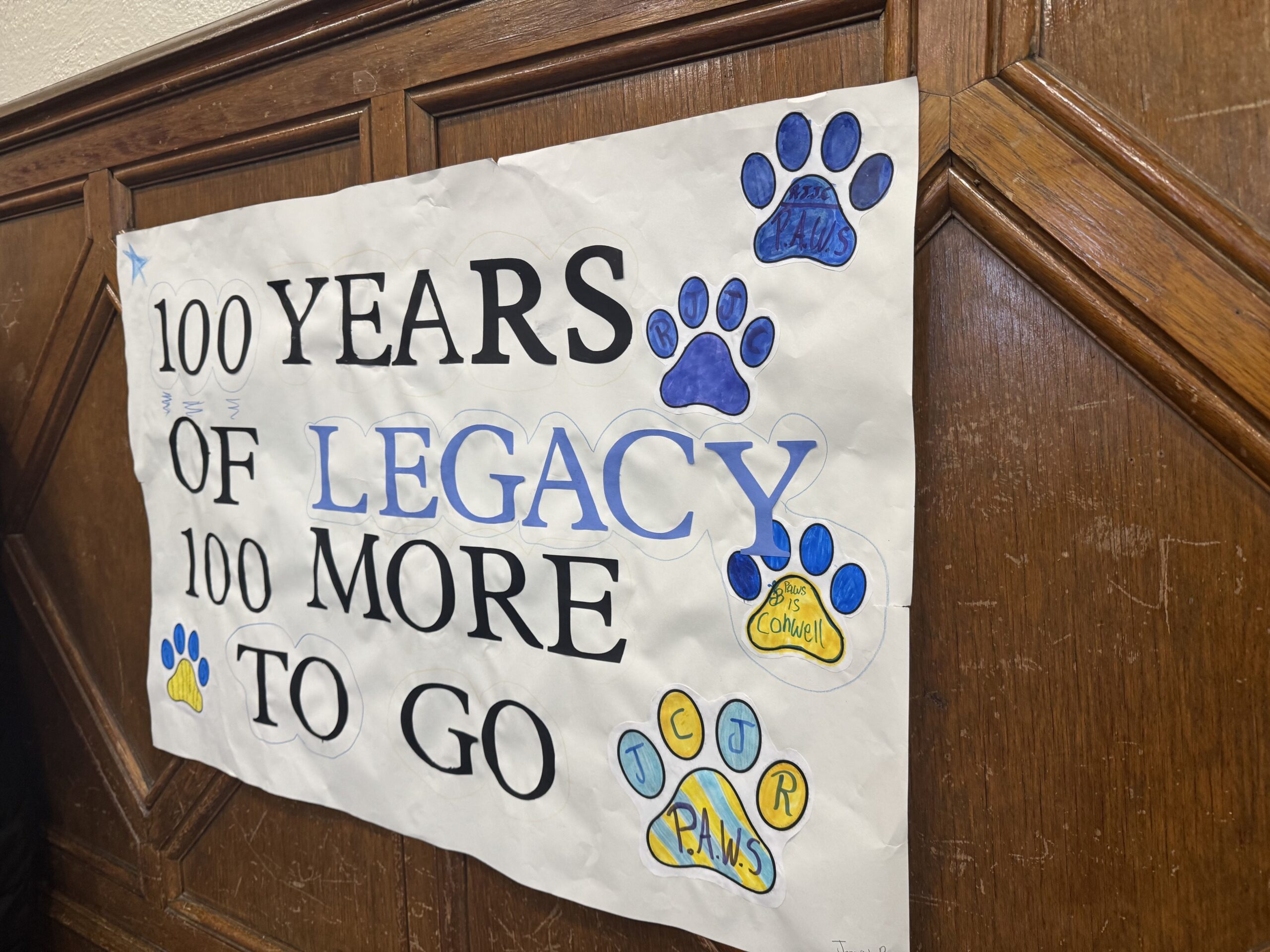
A student-made sign hangs in the Conwell Middle School auditorium. The Philadelphia School District is attempting to close Conwell, a magnet 5-8 school in Kensington, and 19 other schools. The community is fighting the closure.
Conwell, in Kensington, is a very small school by any standard. This year, just 109 students are enrolled in a building that holds 500. That’s down from 490 students in the 2015-16 school year and 806 in 2009-10. The school used to occupy two buildings; it has since shrunk to one.
But it is also a rarity — a standalone magnet middle school. Community members and local officials are mounting a fight against closing the school, which they say has committed teachers and staff members who help students excel against the odds.
The district’s plan, which the school board is expected to vote on this winter, calls for Conwell students to move to AMY at James Martin, another citywide admissions magnet in Port Richmond, which just opened in a new building with only 200 students. Meanwhile, the district has proposed closing its only other free-standing magnet middle school, AMY Northwest. No changes have been proposed for Philadelphia’s four other magnet middle schools, all of which are attached to high schools.
Neighborhood issues, enrollment declines
Conwell’s enrollment issues are tied closely to its setting.
The building sits on Clearfield Street in the heart of Kensington. Fewer and fewer parents have been choosing to send their kids into ground zero of the city’s opioid epidemic, despite Conwell’s myriad partnerships, the outside investments it has attracted into its facility in recent years, and the school’s long history of excellence.
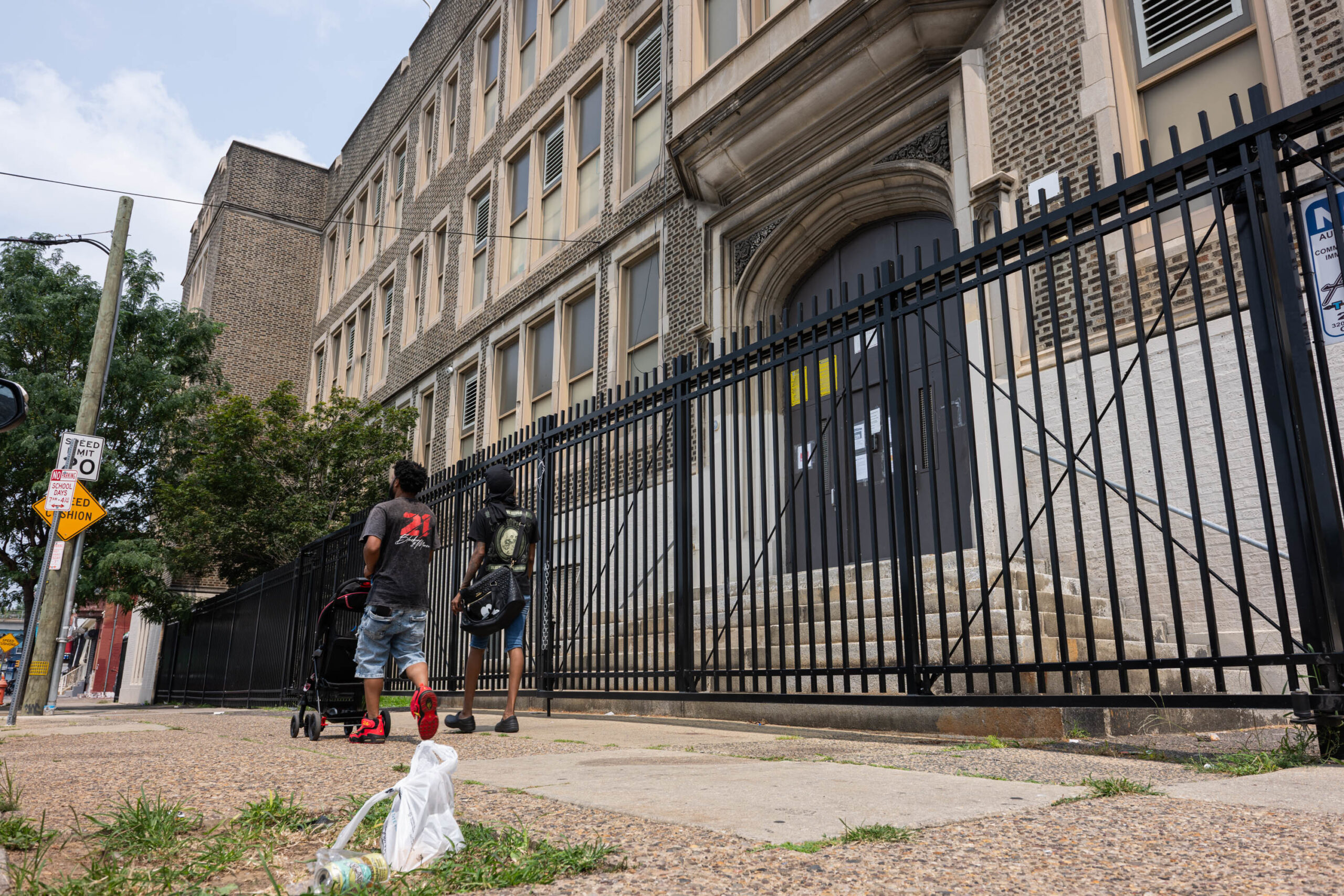
The exterior of Conwell Middle School in Kensington, photographed in August.
Parents, neighbors, students, and politicians, however, are furious that the district is choosing to abandon Conwell and the neighborhood.
“If this school closes, it won’t just be students who feel the loss,” Conwell student Nicolas Zeno told officials at a district meeting Thursday. “It’ll be the community. If the concern is safety, then invest. If the concern is environment, then repair.”
Community member Vaughn Tinsley, who runs Founding Fatherz, a nonprofit mentoring group, suggested closing Conwell would harm its students.
“These students have been victims,” Tinsley said. “These students have seen and witnessed things they shouldn’t have witnessed. Most adults haven’t seen some of the things that these kids have seen, and yet still they come here, yet they’re still committed to excellence, yet they still stand up and still do what they’re supposed to do in the classroom. How dare we take that away from them?”
Watlington has proposed using Conwell as “swing space” — district property that other schools can move into temporarily if their buildings require repairs.
Tosin Efunnuga, Conwell’s nurse, wiped tears from her eyes as she beseeched district officials to keep the school open.
“To have those doors close would be such a disservice,” Efunnuga said. “We need 100 years more.”
Councilmember Quetcy Lozada, whose district includes Conwell, said she was “angry” and “frustrated” by the recommendation to close the school.
“It’s underutilized because of what’s happening on the outside,” Lozada said at the Conwell meeting. “There’s nothing wrong with what is happening on the inside other than successful academic learning, support for families. We are saying to these families, we are punishing them because as a city, we can’t respond to the public safety issues that we have on the outside, and that is just not fair.”
‘What are y’all doing?’
Emotions ran high inside the Conwell auditoriumlast week.
Even before Deputy Superintendent Oz Hill finished his presentation about the rationale for the closures and the specific plan for Conwell, parents burst out with concerns.
“What are y’all doing? Y’all making a mess,” one parent shouted. “You say the building is old. So what? It’s clean in here.”
Another said her child would not be going to AMY at James Martin, formerly known as AMY5.
“I don’t think you understand how much of a battle there is between Conwell and AMY5,” the parent said. “You don’t know the battles these kids have with each other.”
Conwell has a strong alumni network — a rarity for a middle school — that has turned out in force to support the school since the proposed closure was announced.
Alexa Sanchez, Class of 2017, grew up in Kensington and came to Conwell as a bright but unruly student — sheacknowledges that she got in fights, egged the school, and disrespected teachers. But Conwell is rooted in its neighborhood, Sanchez said, with dedicated staff who helped her rise to earn a college degree and a good job in business.
“They didn’t give up on students like me,” Sanchez said. “My future didn’t look promising at first, but in the long run, it did. You shouldn’t really close the school on a community that doesn’t look promising if you’re not from here.”
Other alumni, including Robin Cooper, president of the district’s principals union, and Councilmember Isaiah Thomas, chair of Council’s Education Committee, have spoken out for Conwell.
Conwell “shows up” for Kensington and the city, running a food pantry, hosting Police Commissioner Kevin Bethel’s swearing-in ceremony and an event marking Cherelle L. Parker’s 100th day as mayor, noted Erica Green, the school’s award-winning principal. Staff and students participate in neighborhood cleanups and advocate for help amid the opioid crisis.
“We are what the city needs,” Green told the school board recently. During Green’s tenure, she has helped win money for a new schoolyard, a new science, technology, engineering, and math lab, and more.
“These investments were made for Kensington students,” Green said. “We owe it to them, to their neighborhood. Do not push them out once the neighborhood changes and thrives. Conwell’s success is rooted in its people, its history, and its impact.”
Mayor Cherelle L. Parker speaks during an event to mark her 100th day in office at Conwell Middle School in Kensington in April 2024.
In many cultures, Chinese New Year, which falls on Feb. 17 this year, is a holiday spent at home. It’s a time to get together with one’s family, preparing auspicious dishes that represent wealth, like spring rolls that mimic the appearance of gold bars and dumplings that are shaped like ancient gold ingots.
Here in Philadelphia, it is the perfect opportunity to get out and about within the wider Pan-Asian community. Several restaurants are joining forces to celebrate the Year of the Horse, collaborating on menus that combine different New Year’s traditions, while others have special one-offs and time-limited offerings to mark the event.
Philly observes a truly global version of Chinese New Year, whichissometimes called the Spring Festival, celebrating the end of winter and onset of spring. Chinese New Year is also known more inclusively in the U.S. as Lunar New Year, though not every East Asian or Southeast Asian community celebrates the New Year at the same time (or for the same length of time). For instance, Khmer New Year occurs between April 14 and 16 this year, and Tibetan New Year, or Losar, is Feb. 18. In Vietnam, Tết is celebrated for several weeks (longer than in most Chinese cultures).
The Year of the Snake is celebrated in Chinatown Sunday, Feb. 2, 2025, bringing in the Lunar New Year with a parade, lion dancers and fireworks.
If you’re celebrating at home, Chinatown’s grocery store shelves are well-stocked with essential New Year foods like seeds and nuts for good beginnings and plants that are considered lucky, like mandarin trees and bundles of willow branches. Vendors are now selling red envelopes for lai see, or lucky money, and red scrolls denoting traditional well wishes on most Chinatown street corners. Expect some restaurants to be closed for the holiday.
Here are some noteworthy opportunities to celebrate.
This list may be updated as new information becomes available.
Dinner series and collaborations
Lunar New Year dishes for a special collaboration dinner between Gabriella’s Vietnam and Ember and Ash.
Ember & Ash and Gabriella’s Vietnam’s “Smoke meets Saigon”
Scott and Lulu Calhoun, the owners of Passyunk’s Ember & Ash, are hosting their fifth annual Lunar New Year celebration, this time welcoming Gabriella’s Vietnam chef Thanh Nguyen. There will be Vietnamese street food-inspired bites to start, then meat and fish cooked over live fire, along with noodle dishes (denoting long life) and rice and vegetable sides.
Dinner is $75 per person (not inclusive of tax and a 20% auto-gratuity) and will be served family-style starting at 5 p.m. in staggered seatings throughout the evening. Reservations, available on Resy, are strongly encouraged.
Thanh Nguyen of Gabriella’s Vietnam and Lulu Calhoun of Ember and Ash test Lunar New Year recipes.
The Muhibbah dinner at BLDG39 at the Arsenal
The Muhibbah Dinner series was started by chef Ange Branca of Kampar in 2017 to celebrate diversity and raise money for immigrant and refugee nonprofits in Philadelphia. Its next iteration is on Feb. 16. While it isn’t strictly a New Year’s celebration, dinner will commence with a prosperity yee sang salad, which diners traditionally toss in the air with chopsticks.
Dinner is BYOB and tickets are $170 per person. Sales will benefit Puentes de Salud, a nonprofit that promotes the health and wellness of Philadelphia’s Latinx immigrant population. Tickets are available at muhibbahdinners.org/tickets.
Feb. 16, BLDG39 at the Arsenal, 5401 Tacony St., 215-770-6698, bldg39arsenal.com
Com.unity’s Tết collaboration dinner at Yakitori Boy
Ba Le Bakery, Cafe Nhan, Le Viet, Miss Saigon, and more are teaming up for Com.unity’s third annual Tết dinner, hosted this year at Yakitori Boy in Chinatown. After dinner, guests can walk over to the Lunar New Year Parade presented by the Chinatown PCDC and the Philadelphia Suns. Áo dài, or traditional Vietnamese outfits, and other formal garment are strongly encouraged.
There will be one 60-seat seating, with doors opening at 6:30 p.m. A cash bar will be available for the LNY cocktail menu from the Yakitori Boy team. Dietary restrictions cannot be accommodated. Dinner tickets are $108 per person and can be booked via a link accessed through Com.unity’s Instagram profile.
Feb. 16, Yakitori Boy, 211 N. 11th St., 215-923-8088, yakitoriboy.com
Chicken and ginger wontons from The Wonton Project by Ellen Yin.
Hot Pot at the Bread Room
Ellen Yin’s the Wonton Project will host Lunar New Year Hot Pot parties at the Bread Room for groups of six to eight ($125 per person, excluding tax and gratuity). The parties are inspired by an event the Bread Room hosted with Natasha Pickowicz, the author of the cookbook Everybody Hot Pot.
Diners will cook Lunar New Year menu staples together, such as noodles for longevity, Shanghai rice cakes, and dumplings for prosperity. There will also be whole fish on the menu and spring rolls. It will be available to book on OpenTable.
Feb. 17-21, the Bread Room, 834 Chestnut St., Suite 103, 215-419-5820, thebreadroomphl.com
Buddakan’s Lunar New Year brunch
Stephen Starr’s Buddakan will be serving a tasting menu of modern interpretations of traditional Chinese New Year dishes like trotter-stuffed spring rolls, Dungeness crab longevity noodles, whole fish with black bean sauce, as well as a horse-themed dessert (for the Year of the Horse). Brunch runs from 11 a.m. to 2 p.m. Seats are $75 per person (excluding tax or gratuity), with a four-person minimum for reservations. Reservations can be made on OpenTable. The Lunar New Year menu will also be available a la carte for parties of any size.
The Kensington-based Vietnamese coffee roaster and cafe will serve two specialty drinks based on Tết treats: a black sesame hojicha, consisting of black sesame paste, hojicha (roasted green tea), milk of choice, condensed milk, and topped with salted foam. “This drink reminds us of kẹo mè đen, which is a black sesame taffy usually found in the traditional Vietnamese Mứt Tết tray (the tray of dried fruits and candies),” said owner Thu Pham. They’re also making a black sesame banana matcha (black sesame paste, matcha, milk of choice, condensed milk, and topped with banana foam), reminiscent of kẹo chuối, a banana taffy also found in the traditional Vietnamese Mứt Tết candy tray.
Black sesame banana matcha and black sesame hojicha from Càphê Roasters for Lunar New Year 2026.
Luk Fu at Live! Casino
Luk Fu is serving an a la carte menu of very traditional Chinese New Year dishes such as braised pork trotters ($38), whole pompano ($48), and a New Year’s stir fry with spring vegetables and auspicious ingredients like snow peas, wood ear mushrooms, and sweet lapchong, or Chinese sausage ($28). Reservations are available on OpenTable.
At this Washington Avenue institution, you can pick up Tết essentials like the cylindrical bánh tét ($20) and square-shaped bánh chưng ($25), savory rice cakes made with mung beans and pork belly and wrapped in banana leaves. Takeout only. Order online.
Available now until Feb. 18 (or until sell-out), Ba Le Bakery, 606 Washington Ave., 215-389-4350, balebakery.com
Philadelphia’s top lawmaker said he’s willing to hold up city funding to the Philadelphia School District over concerns about the recently released closure and consolidation plan, a warning that signals City Council intends to leverage its biggest bargaining chip as members fight to keep schools in their neighborhoods open.
City Council President Kenyatta Johnson said in an interview Friday that multiple members oppose proposed closures in their districts, and some want more robust investments in schools slated for consolidation in exchange for their support.
Johnson’s primary concern, he said, is “making sure that the issues and concerns that we would like to see addressed with the facilities plan are reflected in the final recommendations.”
Asked if he’d be willing to hold up the city’s contribution to the school district if their concerns are not met, Johnson said: “If need be.”
Schools Superintendent Tony B. Watlington Sr. has proposed sweeping changes to schools across the city, including closing 20 schools, ordering six others to share buildings, and modernizing 159 buildings. His plan is subject to approval by the school board, which will likely vote sometime this winter.
Oz Hill (left), Superintendent Tony B. Watlington Sr. (center), and Claire Landau at a news conference to announce plans for the first draft of the Philadelphia facilities master plan during a news conference at the Philadelphia School District Headquarters in Philadelphia on Jan. 20.
Johnson’s public insistence that Council members exercise veto power over parts of the district’s long-awaited facilities master plan is notable, and it raises the stakes ahead of a Feb. 17 hearing, during which every Council member will have the opportunity to question district officials about the proposal.
The Council president — a Democrat who is typically even-keeled and does not often speak publicly about legislative strategies — wields significant control over the fate of the city budget, which members must pass by the end of June. Mayor Cherelle L. Parker will unveil her proposed budget in March.
Local revenue and city funding made up about 40% of the district’s budget this year, or nearly $2 billion. Most of that is the district’s share of city property taxes which, unlike other school systems in Pennsylvania, are levied by the city and then distributed to the district.
In addition, the city makes a separate, direct contribution to the district, which this year was nearly $285 million.
Johnson’s opposition to elements of the plan could also position lawmakers somewhat at odds with Parker and Watlington. The pair have operated in lockstep since Watlington last month unveiled his proposal.
The plan did not appear to go over well in Council, with several members expressing immediate concerns. The day the plan was released publicly, Johnson endorsed another member’s legislation to amend the city’s governing document and grant Council power to remove members of the school board at will.
Councilmember Cindy Bass at City Council’s first session of the year on Jan. 23, 2025, in City Hall.
Some Council members said they plan to fight proposed closures and advocate for more investment in struggling schools.
Speaking at a meeting at Lankenau High School in Upper Roxborough last week, Councilmember Cindy Bass pushed back against the notion of closing Lankenau, a well-regarded magnet outside of her district, and other strong schools, including Fitler Academics Plus and Parkway Northwest in her district.
“When budget time comes up, I’ll be asking about these decisions that the school district is making,” Bass, a Democrat who represents parts of North and Northwest Philadelphia, told an emotional crowd of more than 100. “We don’t support them and we don’t understand them. They have not been rationalized.”
At Conwell Middle School in Kensington, Councilmember Quetcy Lozada, a Democrat who represents the neighborhood, said she was “having a really hard time understanding how the decisions were made.”
Closing Conwell, a magnet school whose enrollment has fallen to just over 100 because of parent concerns over neighborhood safety, was particularly galling, Lozada said.
“We are saying to these families, ‘We are punishing them because, as a city, we can’t respond to the public safety issues that we have on the outside,’” Lozada said. “And that is just not fair.”
Johnson said he wanted to see a clear safety plan for students being asked to travel to schools in new neighborhoods.
He also floated rebuilding consolidated schools as “all-in-one” campuses that are co-located with parks, recreation centers, and other city services.
“It would be in the best interest of the school district and the school board to think outside the box in terms of how they move forward, besides just saying, ‘We’re going to be closing down schools,’” Johnson said. “And those are conversations that we’re having right now.”