Tag: Larry Krasner

  • Judicial district says decisions on ICE presence at Philly courthouse are the sheriff’s ‘sole responsibility’

    Judicial district says decisions on ICE presence at Philly courthouse are the sheriff’s ‘sole responsibility’

    The judicial district that oversees the Philadelphia court system says that the authority for managing ICE’s controversial presence at the Criminal Justice Center rests on Sheriff Rochelle Bilal and that decisions around that are her “sole responsibility.”

    That follows a Wednesday morning news conference where the sheriff joined local elected and community leaders who suggested that court officials or legislators needed to address the ongoing turmoil around courthouse immigration arrests. They called for meetings with court leaders to discuss how to set guardrails on ICE activity.

    The First Judicial District responded with a statement late Wednesday:

    “The First Judicial District is always willing to discuss matters of mutual concern with our justice partners, but managing security in court buildings ― which includes managing ICE’s presence ― is the sole responsibility of the sheriff. These decisions are the sheriff’s to make.”

    The Philadelphia Sheriff’s Office responded Thursday that it was “ready to execute all lawful judicial orders.”

    “To be clear,” its statement said, “security inside court facilities is the responsibility of the Sheriff’s Office. … Areas outside of court facilities are public spaces, where individuals retain their First Amendment rights, including the right to assemble and protest. Those areas are not under the operational control of the Sheriff’s Office.”

    The sheriff’s office added that it is committed to maintaining order and safety while upholding the rights of all who enter, and that it remains open to dialogue to ensure “clarity, coordination, and public safety.”

    The sheriff has said her office does not cooperate with ICE, does not assist in ICE operations, and does not share information with the agency. She has not directly addressed whether she believes she has authority to bar ICE agents from the property.

    Her supporters have defended the sheriff by insisting that she does not have that power, that she could only carry out orders issued by a judge or legislature.

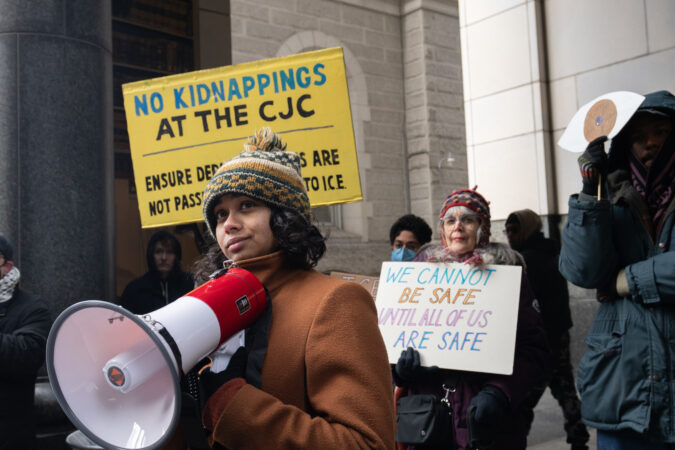
    Meanwhile, the presence of ICE in and around the Criminal Justice Center has provoked demonstrations and controversy, with activists charging that the sheriff has allowed ICE to turn the property into a “hunting ground” for immigrants.

    U.S. Immigration and Customs Enforcement officials did not reply to a request for comment on Thursday.

    The group No ICE Philly has castigated the sheriff, saying that by not barring ICE — as judges and lawmakers in some other jurisdictions have done — she has helped enable the arrest of 114 immigrants who were trailed from the courthouse and arrested on the sidewalk.

    That group and others say ICE agents have been allowed to essentially hang out at the Center City courthouse, waiting in the lobby or scouring the hallways, then making arrests outside.

    Many people who go to the courthouse are not criminal defendants ― they are witnesses, victims, family members, and others in diversionary programs. But they have been targeted and arrested by ICE, immigration attorneys and government officials say, causing witnesses and victims to stay away from court and damaging the administration of justice in Philadelphia.

    Aniqa Raihan, a No ICE Philly organizer who has helped lead courthouse protests, said she was not encouraged by the First Judicial District’s statement.

    “We already know that Sheriff Bilal is not doing all she can to protect people at the courthouse,” she said Thursday. “However, the First Judicial District is not powerless. The court can make its own policy, like the court in Chicago did, barring civil arrests on and around the courthouse. … What we’re seeing is a lot of blame-shifting and finger-pointing from our leaders at a time when we desperately need teamwork.”

    The issue around ICE access is complicated by the fact that courthouses are public buildings, generally open to everyone. And sidewalks outside the buildings are generally considered public property.

    Last week the sheriff garnered national headlines ― and condemnation ― for calling ICE “fake, wannabe law enforcement” and for sending a blunt warning to agency officers.

    “If any [ICE agents] want to come in this city and commit a crime, you will not be able to hide,” Bilal said in viral remarks. “You don’t want this smoke, ’cause we will bring it to you. … The criminal in the White House would not be able to keep you from going to jail.”

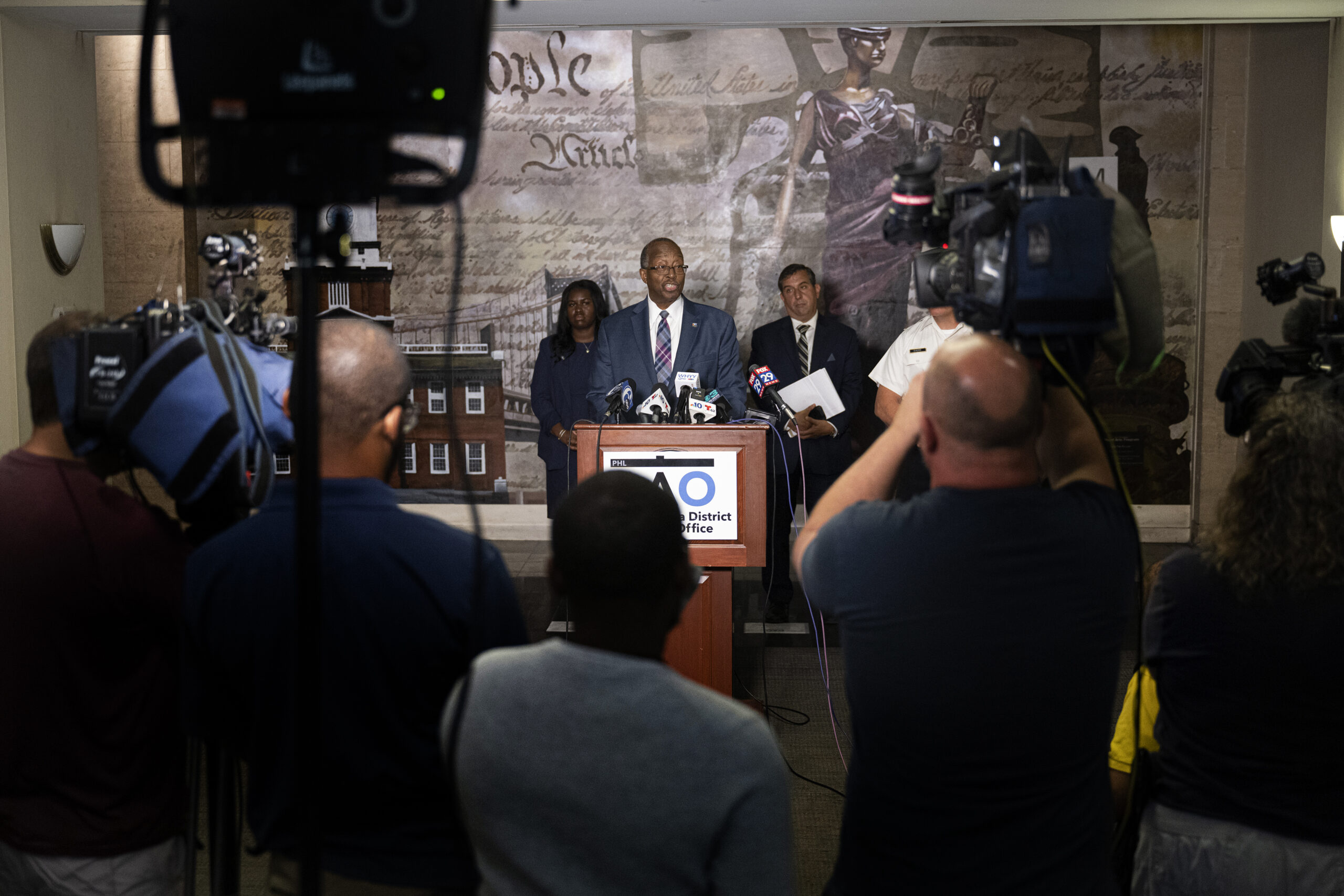
    On Wednesday, at the news conference at the Salt and Light Church in Southwest Philadelphia, Bilal said her office follows the law and would obey judicial orders and legislative statutes around courthouse security.

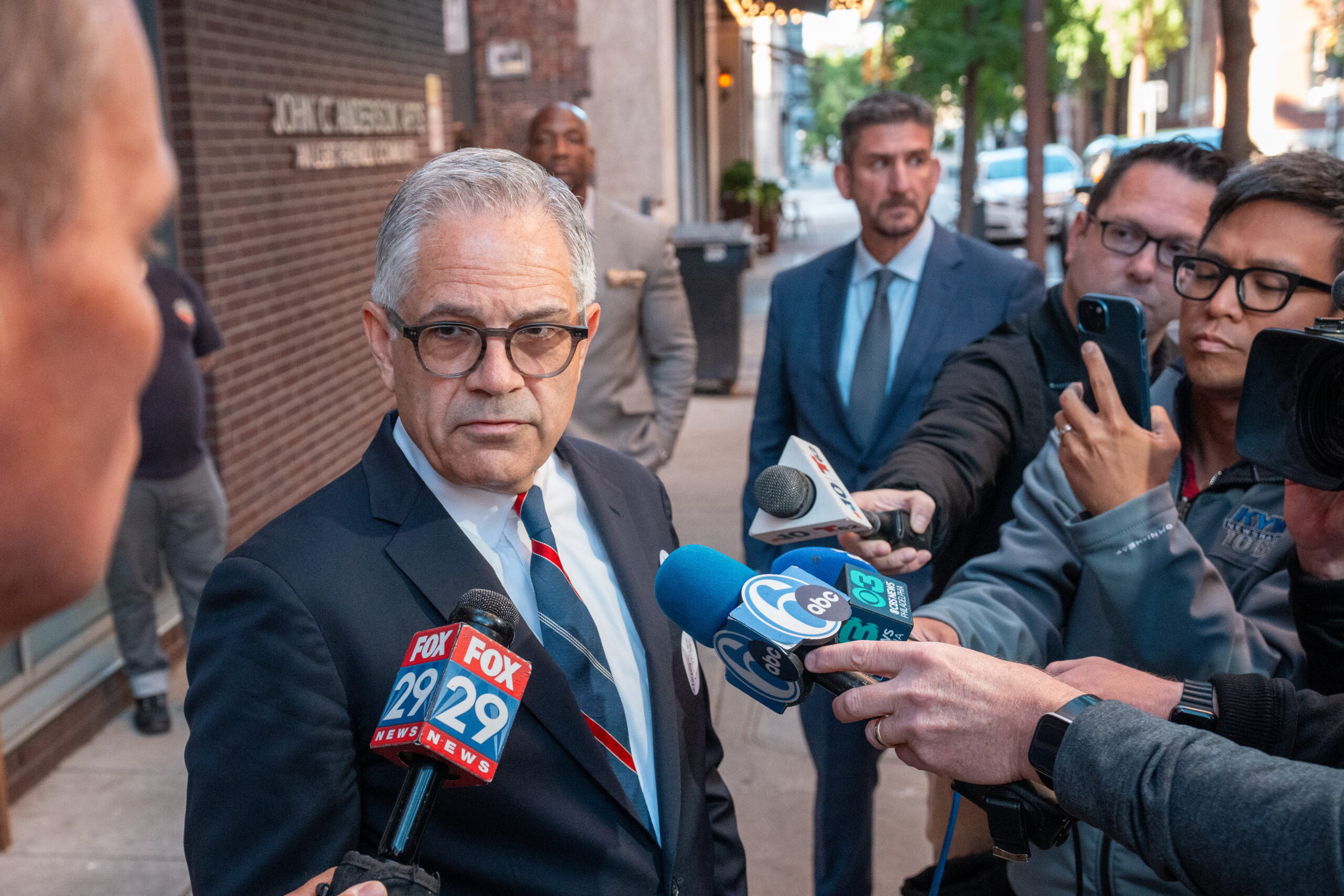
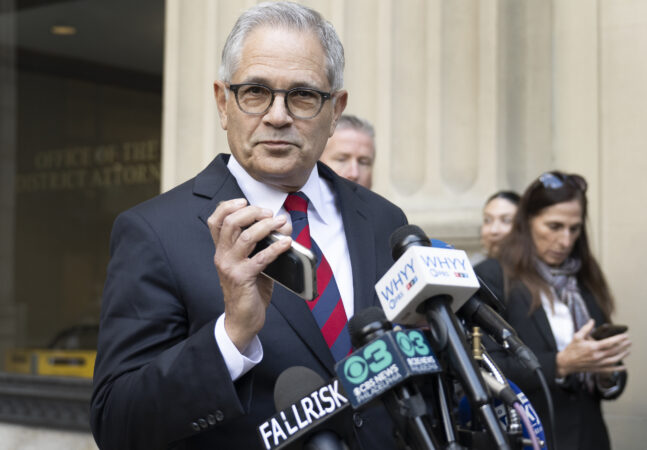
    District Attorney Larry Krasner ― whose office led the event, and who reiterated his pledge to prosecute ICE agents who commit crimes ― said victims and witnesses are not showing up for cases due to fear of ICE.

    About half a dozen elected officials and community leaders gathered, with some calling for ICE to get out of Philadelphia.

    They asked for the court system to establish rules and protections for immigrants seeking to attend proceedings at the Criminal Justice Center, and for state court administrators to meet with the district attorney, the sheriff, the chief public defender, City Council members, and others.

    Krasner said Thursday that his office and the other parties “look forward to meeting with the leadership of the courts to discuss lawfully regulating ICE activity in and around the Criminal Justice Center. We will be corresponding with the courts to schedule monthly meetings immediately.”

    At the same time, “we will continue to do all we can to prioritize safety and justice for victims, witnesses, and families who are navigating the criminal justice system,” he said. “Unlawful and unnecessary ICE activity in and around the CJC is deeply traumatizing to those who are already navigating pain and unfortunate circumstances.”
  • It’s time to address ICE activity at the Philly courthouse, elected and community leaders say

    It’s time to address ICE activity at the Philly courthouse, elected and community leaders say

    Some elected city officials and community leaders called for ICE to get out of Philadelphia on Wednesday, saying agents had become a threat to safety and to the orderly administration of justice.

    They asked the court system to establish rules and protections for immigrants seeking to attend proceedings at the Criminal Justice Center ― which advocates say has been allowed to become an ICE “hunting ground.”

    They asked for state court administrators to meet with the district attorney, the sheriff, the chief public defender, City Council members and others, and suggested that in the meantime, court staff must be better trained to understand the difference between court- and ICE-issued orders, that they do not carry equal weight nor require equal obedience.

    “People should be able to come to court without fear,” said Keisha Hudson, chief defender of the Defender Association of Philadelphia. “Without fear that doing what the law requires will put them at risk.”

    District Attorney Larry Krasner ― whose office led the news conference, and who reiterated his pledge to prosecute ICE agents who commit crimes ― said victims and witnesses are not showing up for cases. And community leaders said residents’ lives were being diminished.

    “Across Philadelphia, the increase in ICE raids is tearing the fabric of our community,” said Thi Lam, deputy director of the Southeast Asian Mutual Assistance Association Coalition, which serves refugees and immigrants, leaving people afraid to go to work, to seek medical care, and to take their children to school.

    “As Philadelphians, we demand policies that protect due process,” he said. “We object to the violent way that this immigrant process has turned. We invite all Philadelphians to speak up. Speak up, Philadelphians!”

    ICE officials did not immediately reply to a request for comment.

    The news conference at the Salt and Light Church in Southwest Philadelphia came as protests and confrontations continue in Minnesota and other cities over the fatal ICE shooting of a Minneapolis wife and mother, Renee Good. Daily ICE activity and arrests in Philadelphia and surrounding towns continue to rile and frighten immigrant communities and those who support them.

    Krasner called the shooting of Good “murder,” and said “that collection of people who left their Klan hoods in the closet” to become ICE agents will face prosecution for any crimes committed in Philadelphia.

    Meanwhile, in Atlantic City on Wednesday, Mayor Marty Small and other officials gathered to support local immigrant communities, and to assert their willingness to ensure that ICE agents “continue to do the job under the legal letter of the law.

    “Some of the footage that we’ve seen has been horrifying, and I understand, and I empathize with that community. And as your mayor, this city has your back,” Small said, flanked by Atlantic City Police Chief Jim Sarkos, Director of Public Safety Sean Riggin, and Cristian Moreno-Rodriguez from the immigrant advocacy organization El Pueblo Unido of Atlantic City.

    Atlantic City police, they noted, do not assist ICE in immigration enforcement. Under the 2018 Immigrant Trust Directive, New Jersey state and local police agencies are limited in how they can cooperate with ICE.

    Riggin clarified, however, that local police will assist ICE in cases where agents are in danger or a crime is being committed.

    “We will respond, we’re going to assess the situation, and we’re going to act accordingly in compliance with that directive,” Riggin said. “So, just because somebody sees us with ICE does not mean we’re doing immigration enforcement.”

    In Philadelphia, immigrant advocates have made the courthouse and Sheriff Rochele Bilal a target of protest, insisting that ICE has wrongly been given free roam of the property.

    The group No ICE Philly has castigated Bilal, saying that by not barring U.S. Immigration and Customs Enforcement from the courthouse — as judges and lawmakers in some other jurisdictions have done — she has helped enable the arrest of at least 90 immigrants who were trailed from the building and arrested on the sidewalk.

    That group and others say ICE agents have been allowed to essentially hang out at the Center City courthouse, waiting in the lobby or scouring the hallways, then making arrests outside, a pattern they say has been repeated dozens of times since President Donald Trump took office in January 2025.

    Many people who go to the courthouse are not criminal defendants ― they are witnesses, crime victims, family members, and others already in diversionary programs.

    The sheriff says her office does not cooperate with ICE, does not assist in ICE operations and does not share information with ICE. Last week she garnered national headlines and condemnation for calling ICE “fake, wannabe law enforcement” and for sending a blunt warning to its officers.

    “If any [ICE agents] want to come in this city and commit a crime, you will not be able to hide, nobody will whisk you off,” Bilal said in now-viral remarks. “You don’t want this smoke, cause we will bring it to you. … The criminal in the White House would not be able to keep you from going to jail.”

    On Wednesday she said her office follows the law, and would obey orders from judges or statues from lawmakers concerning courthouse security.

    The news conference followed an announcement of the Defender Association of Philadelphia’s new initiative to help people facing immigration consequences both inside and outside the justice system.

    The agency’s Immigration Law Practice is expected to grow to up to 11 staff members, arriving as the Trump administration pursues aggressive new enforcement and even minor legal cases can put undocumented city residents at risk of detention, family separation, or deportation.

    Councilmember Jamie Gauthier told news reporters that guardrails must be set around ICE behavior at the Criminal Justice Center, and that the agency “is making us less safe by scaring away witnesses.”

    Councilmember Kendra Brooks said constituents were phoning her office, asking how to get ICE out of their neighborhoods.

    “ICE needs to get out of our city, for the safety of all of us,” Brooks said, calling on the city government and the court system to act. “Something needs to be done. … People can’t safely come to courts ― that’s a threat to all of us.”

    Councilmember Rue Landau asked people to imagine a domestic-violence case, where victims and witnesses were afraid to go near the courthouse.

    “We will not have some masked, unnamed hooligans from out of town come here and attack Philadelphians,” she said. “We are saying ICE out of Philadelphia. … Out of our courts, out of our city.”

  • Jefferson and Temple join wide-ranging litigation over high insulin pricing

    Jefferson and Temple join wide-ranging litigation over high insulin pricing

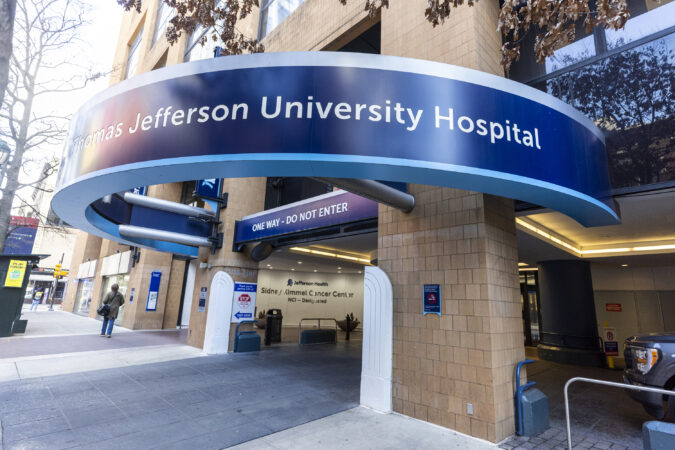
    Temple University Health System and Jefferson Health are the latest area health systems to sue pharmaceutical companies and pharmacy benefit managers over high insulin pricing.

    The move follows similar lawsuits filed in recent years by the University of Pennsylvania, the city of Philadelphia, Philadelphia District Attorney Larry Krasner, and Bucks County, as well as hundreds of other municipalities, companies, and unions around the country.

    Temple filed its suit last week, and Jefferson sued just before the new year.

    Eli Lilly, CVS Caremark, and Sanofi are among the major companies named in the suits, which accuse drugmakers and pharmacy benefit managers, or PBMs, of conspiring to drive up profits on diabetes drugs.

    PBMs work with drug manufacturers, insurers, and pharmacies, negotiating prices and developing formularies — lists of prescription drugs that are available on a given insurance plan.

    The health systems and other plaintiffs say drugmakers inflate prices for their insulin products in order to secure lucrative placements on formularies. Then, they pay a portion of the resulting profits back to PBMs, according to the lawsuits.

    Jefferson and Temple officials said they are paying more for employees’ insulin as a result, impacting the health systems’ budgets and hurting their ability to “provide necessary services […] to the larger Philadelphia community.”

    Representatives from both health systems declined to comment.

    Eli Lilly has worked for years to reduce out-of-pocket costs for insulin, the company said in a statement, noting that some plaintiffs filing the lawsuits are choosing higher-priced medications over more affordable options.

    Lilly capped insulin prices at $35 per month, the statement said, and in 2024 the average monthly out-of-pocket cost for its insulin was less than $15.

    CVS Caremark said pharmaceutical companies “alone are responsible” for pricing their drugs in its latest statement, released after Philadelphia officials joined the litigation last month. The company said it would welcome lower prices on insulin.

    “Allegations that we play any role in determining the prices charged by manufacturers for their products are false, and we intend to vigorously defend against this baseless suit,” they wrote in an email.

    A statement from Sanofi said that the company has always complied with the law when it comes to drug prices and works to lower prices. PBMs and insurers sometimes negotiate savings on drugs, but those are “not consistently passed through to patients in the form of lower co-pays or coinsurance,” the statement read.

    “As a result, patients’ out-of-pocket costs continue to rise while the average net price of our insulins declines.”

  • The first assistant to DA Larry Krasner is retiring. He has some advice for his boss.

    The first assistant to DA Larry Krasner is retiring. He has some advice for his boss.

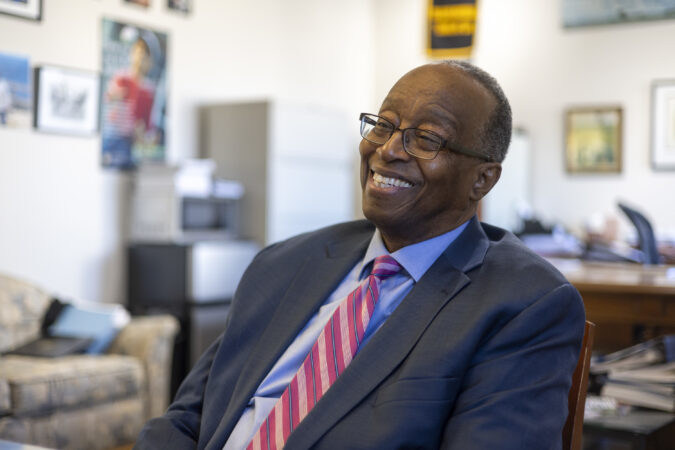
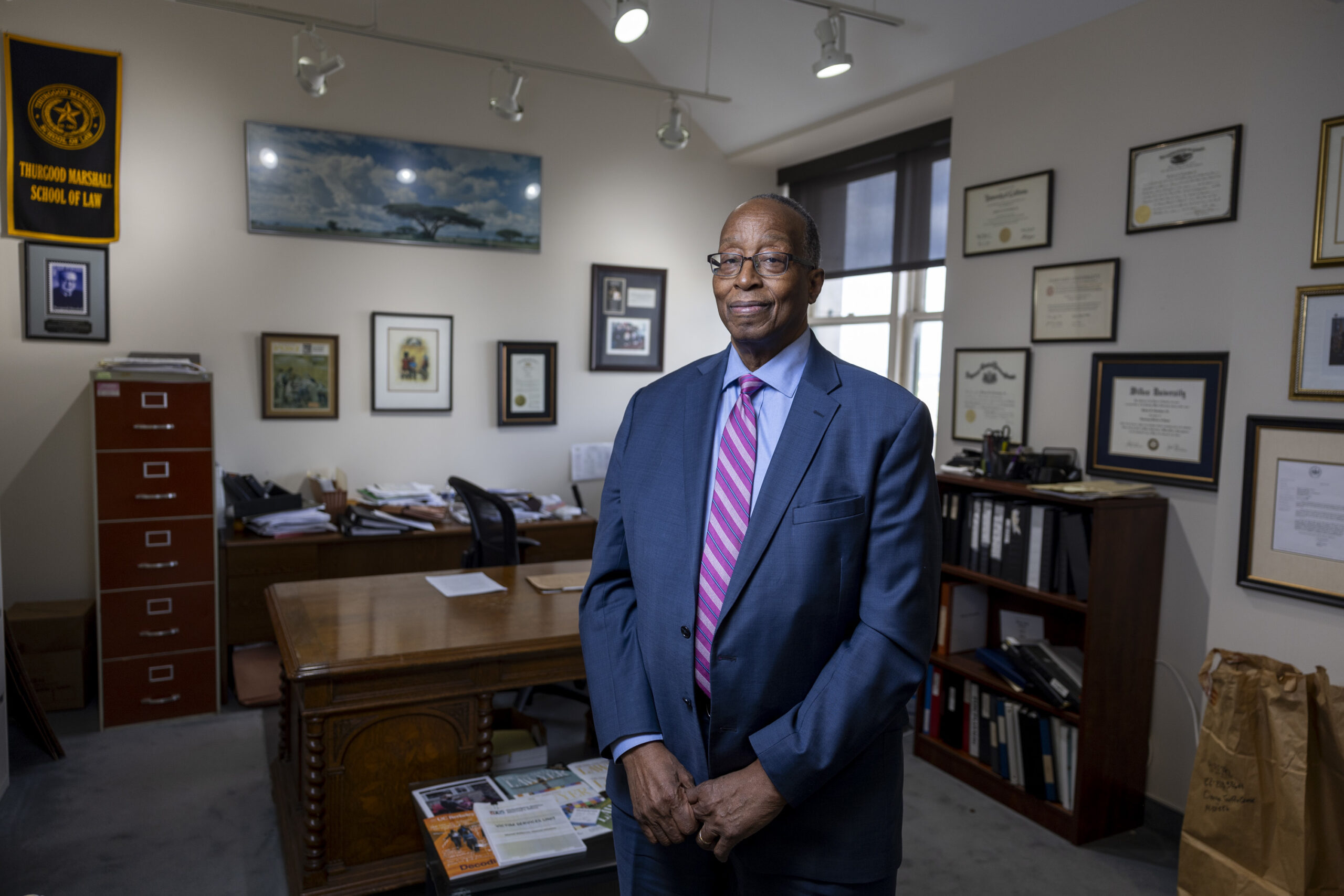
    Robert Listenbee, the first assistant district attorney under Larry Krasner and a largely behind-the-scenes enforcer of the office’s progressive agenda, is retiring after nearly eight years as the office’s second-in-command.

    Listenbee, 77, is expected to announce Friday that he is stepping down, marking the first shift in Krasner’s leadership team as the top prosecutor begins his third term.

    A longtime public defender and juvenile justice advocate, Listenbee joined the administration at the outset of Krasner’s first term in 2018 — even as Krasner openly questioned whether the role of first assistant was necessary beyond its statutory requirement.

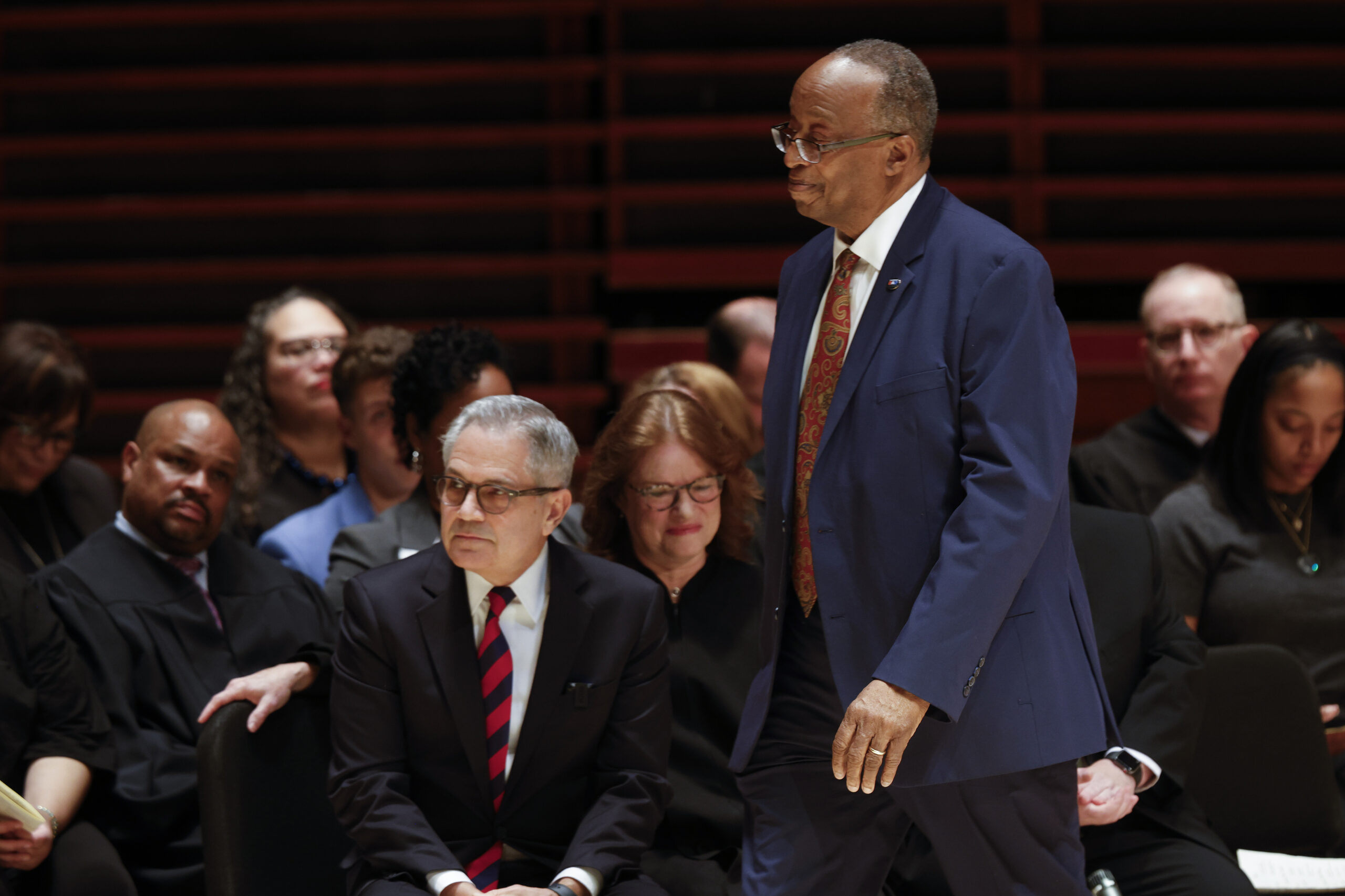
    Robert Listenbee joined District Attorney Larry Krasner at the 2026 inaugural ceremony.

    Over the course of Krasner’s tenure, Listenbee rarely served as the public face of the office on major cases, focusing instead on juvenile work, recruitment, and personnel matters.

    Some prosecutors in the office said that often translated into a lack of visible management compared to previous first assistants, and that he served more as an internal messenger of Krasner’s often controversial agenda than the traditional day-to-day overseer of the office.

    Listenbee has said his role was never set up to operate traditionally, and his goal was to carry out Krasner’s vision and reform the office.

    Krasner declined to say who might replace him but he said he was evaluating candidates.

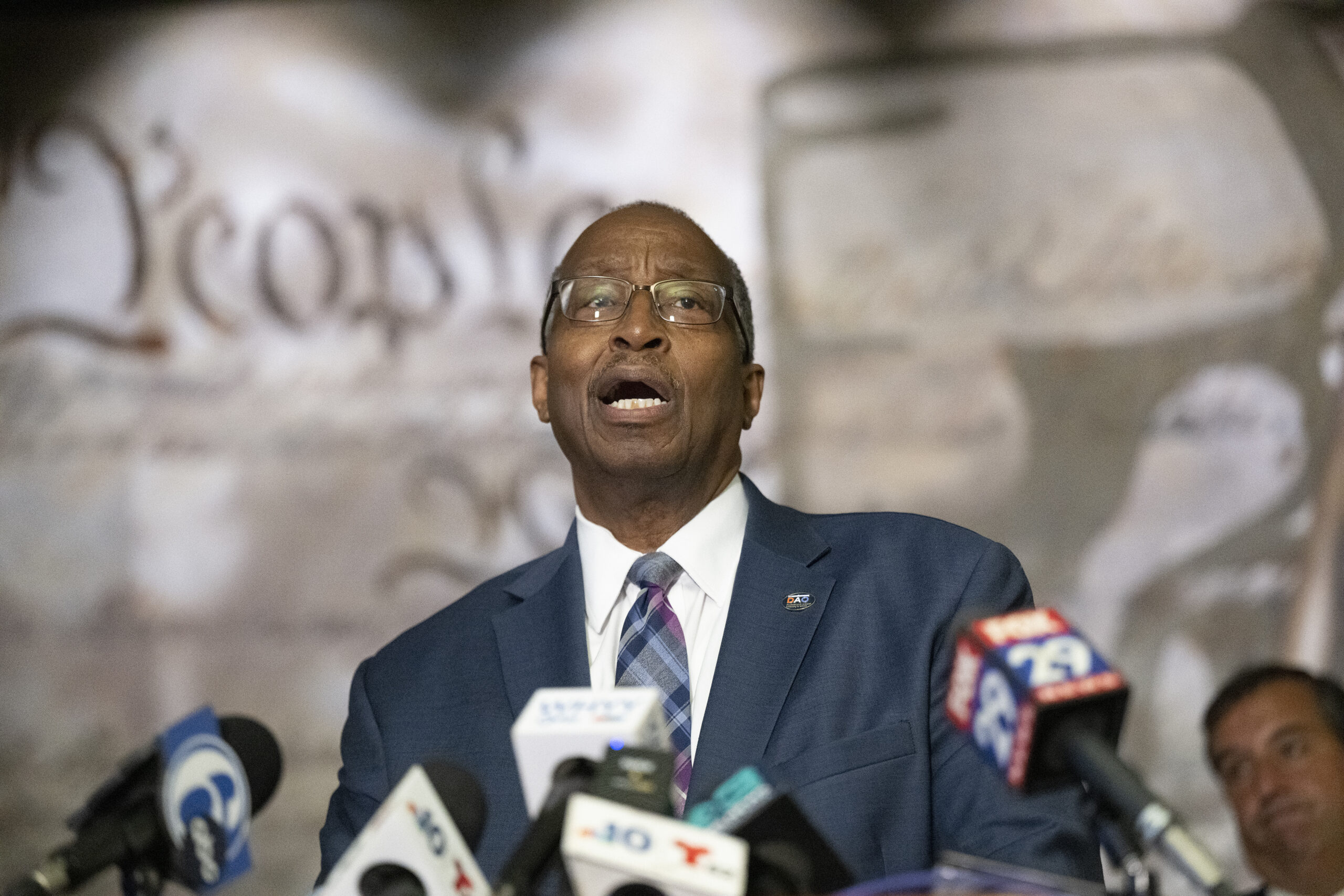
    Robert Listenbee, first assistant district attorney, announced developments in the case against a West Philadelphia teen who was planning a terrorist attack.

    Before joining the district attorney’s office, Listenbee spent decades as a public defender, including 16 years as chief of the juvenile unit at the Defender Association of Philadelphia. He later led the U.S. Department of Justice’s Office of Juvenile Justice and Delinquency Prevention during the Obama administration, and worked at Drexel University before returning to Philadelphia to join Krasner’s team.

    We spoke with Listenbee about his unconventional path to the law, his years reshaping juvenile justice, internal tensions within the DA’s office, and his advice for Krasner’s third term.

    This interview has been edited for length and clarity.

    Tell me about your life growing up.

    I was raised in Mount Clemens, just north of Detroit. My father worked in the auto industry. We were poor and lived in the projects. I went to a public high school, and was the first in my family to go to college.

    I came from a small African American community where people look out for one another. This community saw something in me very early. When I was only planning to go to Kalamazoo College, a mom at my school decided my life was going to be different. She contacted the recruiter at Harvard University, and they visited me out in my little home in the projects when I hadn’t even applied. I got a full ride to Harvard.

    I was among the first large group of African Americans at Harvard. It was 1966. We were in the middle of the Civil Rights Movement and the Vietnam War.

    How was that?

    There was total upheaval in this nation. Demonstrations everywhere, college campuses being taken over.

    I worked on the committee that helped establish the African American Studies Department at Harvard, one of the first in the nation.

    This was also at a time when African countries were becoming independent. I spent 16 months as a teacher in the rural area in western Kenya.

    Robert Listenbee spent 16 months in Africa teaching English, and then traveled the continent before going to law school.

    Instead of coming back from Africa, I decided to hitchhike around the world. I spent six months in Asia — Thailand, Laos, even as the war was going on. I rode a motorcycle into the Mekong Delta in Vietnam and had experiences that make me grateful to be alive. I hitchhiked across Africa and traveled 8,000 miles by train across India. I did all of this on about $600.

    After a two-year gap year, I returned to Harvard and finished my degree.

    I ended up getting a full-ride scholarship to Berkeley law school.

    Where did you go after law school?

    I had job offers but I had this crazy idea that I wanted to build a road across Africa, from Nairobi to Lagos, but I was broke and needed money to do it.

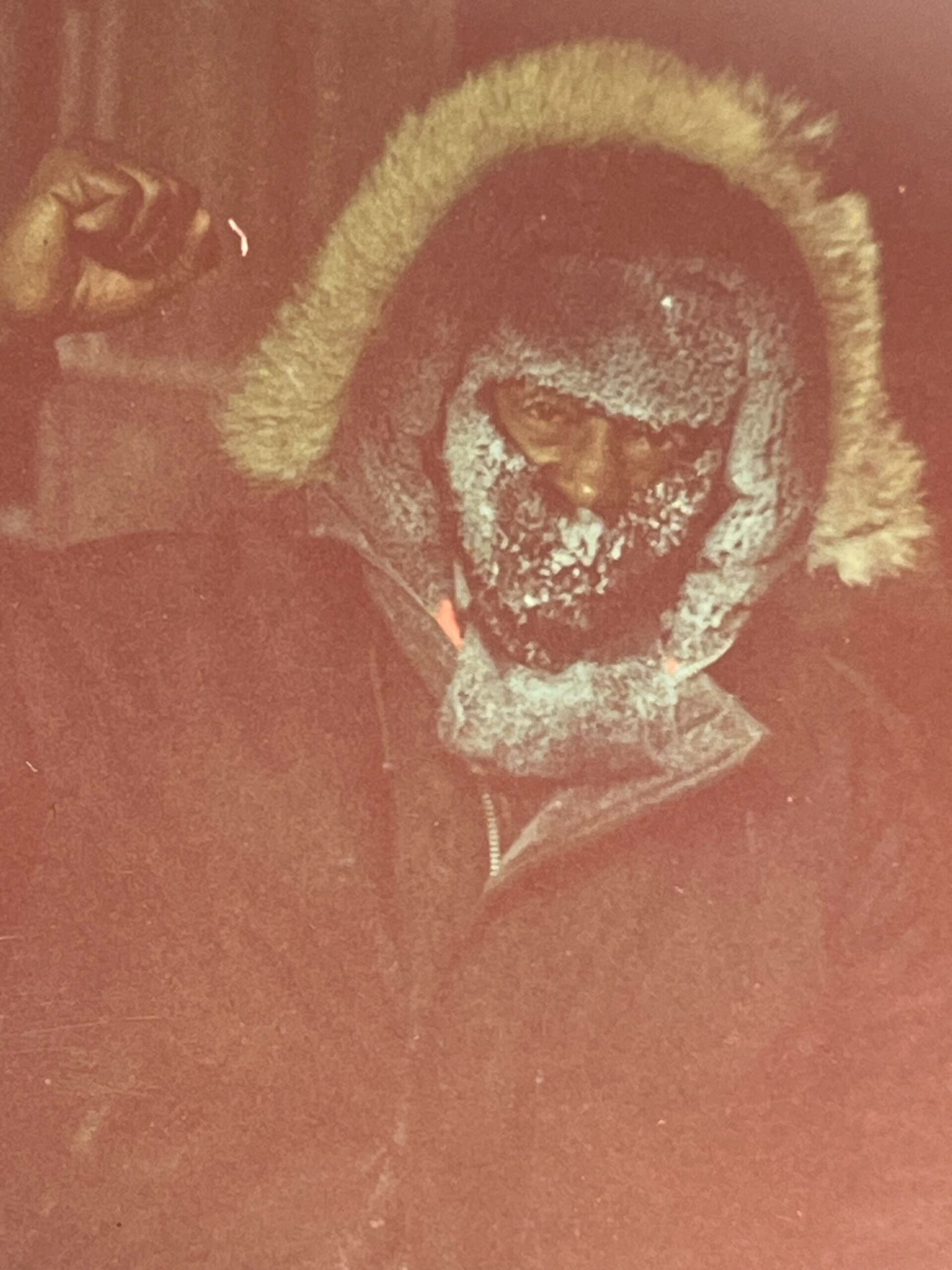
    This was when the pipeline was being built across the North Slope of Alaska, and you could make gobs of money in a short period of time. So in 1976, I went to Anchorage without a job and lived in the YMCA. I shoveled snow, washed dishes, and worked at McDonald’s.

    Robert Listenbee worked in the oil fields building the pipeline on the North Slope of Alaska for several years beginning in 1976.

    Finally, I got a job on the pipeline.

    I was there for a couple of years. I was a laborer in the oil fields. I worked trucks that rode across the Arctic Ocean in the middle of the winter. I worked on wildcat wells 50 miles from base camp. I had to relieve pressured gas to keep it from blowing up. It was 50 degrees below zero.

    Robert Listenbee worked in the oil fields building the pipeline on the North Slope of Alaska for several years beginning in 1976.

    I got into fights. People were trying to kill me at different points in time, and I was trying to kill other people, too. So I mean, the reason I know a little bit about criminal justice is because I was almost a criminal.

    I never built the road in Africa. I eventually came back to Philadelphia, and worked construction until 1986.

    So what about being a lawyer?

    After my construction company failed, I was broke again. I ended up going back to legal work, and got a job working at the Defender Association.

    You were the head of the juvenile unit for 16 years, and then you finished your career here on the other side — going from defending young people to prosecuting them. How was that transition for you?

    Working for the U.S. Department of Justice’s Office of Juvenile Justice and Delinquency Prevention under President Obama helped prepare me for prosecutorial work.

    I was adamant I would never work for this office. I thought it was corrupt. Krasner called me three times before I agreed to join as first assistant.

    We were engaging in culture change. Some of the behavior of the people who were here was absolutely outrageous, especially in the homicide unit. They had a sense that this office belonged to them. It didn’t belong to the people. They were willing to cheat and do it and hide evidence in the process of doing it. That’s the feeling that I had when I first got here, and that’s what we found.

    Robert Listenbee, first assistant district attorney, takes questions from the media after announcing developments in the case against a West Philadelphia teen who investigators say purchased materials including chemicals, wiring, and tactical equipment associated to become a terrorist.

    There has been criticism of your juvenile work — some have said that it was too lenient during the period of intense gun violence and that kids went on to commit worse crimes. Others say the office hasn’t gone far enough to treat kids as kids. How do you assess your record?

    We’ve reduced the number of kids in out of home placements. We’ve expanded juvenile diversion programs. In 2024, we created a juvenile homicide unit to review all cases of juveniles charged with murder.

    I’m satisfied that we’re being as fair as we can and taking the time to carefully evaluate every issue in a case.

    The first assistant is typically the person who manages the office day-to-day. Some prosecutors have said that, in this administration, that role functioned differently — that much of the management flowed directly from Krasner. Do you think that perception is fair, and how did you approach leadership in that environment?

    The DA did not want the imperial first assistant that had been here before. He would prefer a flat structure to a hierarchical structure, which means you get assigned a lot of odd jobs depending on what he wants you to do.

    If I were running the office, I would have run it completely differently. But I have to tell you that, having been here as long as I have, we never would have gotten this far without the DA’s serious concerns about what people around here were doing, whether they were implementing his policy or not. His skepticism, his oversight, is what’s kept this place moving in the direction that he wanted to go in. I wasn’t tuned in enough to the office to understand that from the very beginning, but I listened to him.

    We hire people, we fire people, we move people around. That’s happened a lot. We sometimes end up with younger and inexperienced supervisors, because we haven’t really developed a program for training supervisors really well. We’re working on that.

    Do you have any regrets in the position?

    We’ve gotten better with victim communication, particularly when police are killed.

    I wish I had worked on juvenile issues earlier than I did.

    District Larry Krasner speaks with the media after casting his vote in the 2025 primary.

    What’s your advice for the next first assistant?

    You have to understand the DA’s goals and purposes and how he operates.

    So, listen to Larry?

    Not that. The DA is not a micromanager. But there’s no written directives on most of the things he wants, and there’s no organizational chart or hierarchy. If we have issues, we often go to him.

    Do you have a piece of advice for Krasner in his third term?

    This is a city that has a chip on its shoulder. The DA is a person who has a chip on his shoulder. They respect him for that when he speaks out. A lot of the things he says may not be politically astute, but they’re things he believes in. They like that about him.

    He is the Donald Trump of the progressive era.

    He needs to continue surrounding himself with people who can understand him and help him implement his policies.

    A lot of people don’t like him, and I understand that. A lot of people don’t like me because I work for him. A lot of people don’t like what we do. That never mattered to me. I know that the people we have seen in court, the victims and the defendants and the witnesses, I know that we’re doing right by them. That’s my North Star.

    Robert Listenbee, the first assistant to District Attorney Larry Krasner, retired on Friday.
  • DA Krasner condemns fatal ICE shooting in Minneapolis, says officers who commit crimes in Philly will ‘be convicted’

    DA Krasner condemns fatal ICE shooting in Minneapolis, says officers who commit crimes in Philly will ‘be convicted’

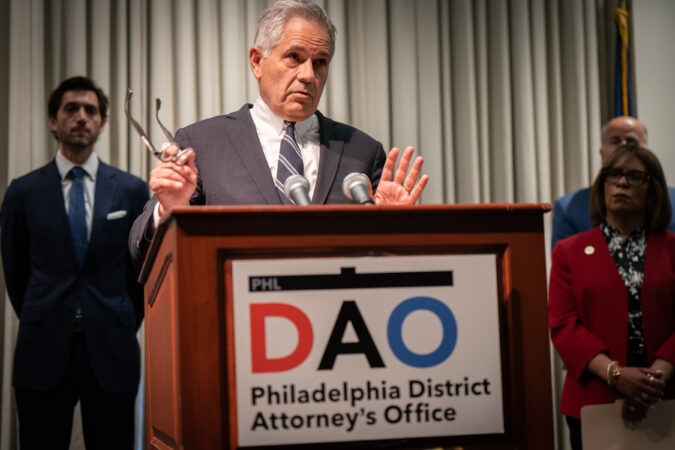
    District Attorney Larry Krasner, responding to the killing of a 37-year-old woman by an ICE agent in Minneapolis, vowed to prosecute law enforcement officers who commit crimes in the city of Philadelphia.

    “You will be arrested, you will stand trial, you will be convicted,” Krasner said during a news conference Thursday.

    His remarks came a day after a masked ICE agent shot Renee Nicole Good multiple times in her SUV.

    In widely circulated videos of the incident, Good appears to be driving away from a group of immigration agents as they order her to get out of her vehicle.

    President Donald Trump and top White House officials offered a starkly different view, saying Good tried to run over the officer with her car.

    Department of Homeland Security Secretary Kristi Noem said the officer, identified Thursday as Jonathan Ross, was justified in shooting the woman because he feared for his life. She said Good, a mother of three, had committed an act of domestic terrorism.

    Minnesota officials have called for an investigation into the conduct of the officer, who has not been charged with any crimes.

    But Krasner, flanked by a group of Philadelphia City Council members and the sheriff, called the actions criminal.

    The top prosecutor said that he has family ties to Minneapolis, and that he had reviewed the videos of the shooting, about a mile from where George Floyd was killed by police in 2020. He held a moment of silence for Good and displayed her photo before leading the group in a chant of her name.

    “We have to use our voices to call out people who commit terrible crimes,” Krasner said. “Or who justify them.”

    That last part was aimed at Trump, whom Krasner has sharply and repeatedly criticized.

    The progressive prosecutor often uses his platform to openly decry the president and his policies, most recently when he urged Philadelphians to film ICE agents who have ramped up immigration enforcement since Trump’s return to office.

    He said that tactic had been a success in Minneapolis because the video brought widespread attention to the incident.

    After Good’s killing, Krasner said, “The first thing out of Trump’s mouth was a lasagna of lies.”

    “She behaved horribly,” Trump told reporters. “And then she ran him over.”

    Krasner said he could not even be certain that Good was blocking officers from the roadway, as some officials have suggested. Had Good done so, Krasner said, she would have been engaging in an act that “protesters have done forever.”

    And that behavior, he said, does not justify a fatal shooting.

    Any law enforcement agent inclined to behave similarly in Philadelphia should “get the eff out of here,” Krasner said. And should such an incident happen in the city, the DA said, he would charge the offending officer in state court, where presidential pardons have no effect.

    “There are honest decent moral law enforcement officers by the bushel — this is not for you,” Krasner said of his warning. “This is for any one of your colleagues who thinks they are above the law.”

  • City Controller Christy Brady promises to examine Mayor Cherelle Parker’s H.O.M.E. plan and Philly’s port in new term

    City Controller Christy Brady promises to examine Mayor Cherelle Parker’s H.O.M.E. plan and Philly’s port in new term

    After being sworn in to her first full four-year term, City Controller Christy Brady on Monday vowed to examine spending related to Mayor Cherelle L. Parker’s signature housing program and to probe whether Philadelphia is maximizing economic opportunities at its waterfront and port.

    “In my next term, I will be expanding my oversight of the mayor’s housing program to ensure every dollar borrowed is used as intended and is properly accounted for,” Brady said of Parker’s Housing Opportunities Made Easy, or H.O.M.E., initiative during a swearing-in ceremony at the Kimmel Center for the Performing Arts.

    “And with our waterfront and ports being one of our strongest economic assets, we will be focusing on efforts to ensure they can deliver the greatest financial impact,” Brady said.

    The Port of Philadelphia, or PhilaPort, recently launched an ambitious expansion plan, but its terminal operator Holt Logistics has faced questions about whether it has prioritized profits over maximizing growth.

    Holt denies that it has engaged in anticompetitive conduct, and a company spokesperson said growth is “vitally important to the future of our business and our region.”

    “Holt Logistics has been a key driver of the Port’s growth over the last decade, as witnessed by the fact that in the last month alone, two new lines of business have chosen to call Philadelphia, largely because of the service they receive,” spokesperson Kevin Feeley said.

    Additionally, Brady promised to help prevent fraud in city spending related to this year’s Semiquincentennial festivities. (Parker has pledged to dole out $100 million, focusing on neighborhood-based programming across the city, for major events in 2026, including the nation’s 250th birthday.)

    And in her capacity as chair of the Philadelphia Gas Commission, Brady said she would “conduct a thorough review of PGW’s operations.”

    Brady also sits on the city Board of Pensions and Retirement and said she would “collaborate with [City] Council to adjust benefit structures.”

    The controller’s office audits city agencies and investigates allegations of fraud, waste, and abuse.

    Brady was appointed by former Mayor Jim Kenney to serve as acting controller in late 2022 when Rebecca Rhynhart resigned to run for mayor. Brady in 2023 won a special election to serve the remaining two years of Rhynhart’s term.

    Seeking her first four-year term, Brady ran unopposed in the May 2024 Democratic primary and easily defeated Republican Ari Patrinos in the November general election. She was sworn in Monday with District Attorney Larry Krasner, who is beginning his third term, and city judges who were on the ballot last year.

    Philadelphia Common Pleas Court Judge Natasha Taylor-Smith introduced Brady and administered her oath of office.

    Many past controllers have had less-than-friendly relationships with the mayors they served alongside, a natural dynamic for an office tasked with investigating the executive branch. The post has also served as a springboard for many politicians with higher aspirations.

    Rhynhart, for instance, repeatedly clashed with Kenney by publishing critical reports on city accounting practices and a lack of accountability in spending on anti-violence groups. She touted those probes to brand herself as a reformer while running in the 2023 mayor‘s race, finishing second behind Parker in the Democratic primary.

    Brady’s background and leadership style are different. She has spent three decades rising through the ranks in the controller’s office and was deputy controller in charge of the audit division before being appointed to the top job. And since becoming controller, she has made a point of working collaboratively with Parker’s administration.

    Dignitaries and elected officers before start of 2026 Inaugural Ceremony at the Kimmel Center Performing Arts on Monday.

    On the campaign trail last year, Brady said she adopted that approach to ensure that her office’s relationship with the administration wouldn’t deteriorate to the point where the city ignored the findings and recommendations included in the controller‘s reports.

    “As promised, I hit the ground running. We’ve achieved far more than many thought was possible,” Brady said. “A key to that success has been collaboration with Mayor Parker and Council President [Kenyatta] Johnson to ensure that our recommendations resulting from the findings in each report, review, and audit that we issue are implemented.”

    Parker acknowledged their collaboration in her remarks during Monday’s ceremony.

    “Controller Brady, thank you for not being wrapped up in politics and staying focused on the work of the controller’s office,” Parker said. “You do it by communicating with our office. No ‘gotcha’ moments.”

    In her relatively short political career, Brady has received strong support from influential groups in local politics, especially the building trades unions and the Democratic City Committee. On Monday, she gave shout-outs to numerous politicos, including former U.S. Rep. Bob Brady, who chairs the city’s Democratic Party and is not related to her.

    “I want to thank the people who have made this possible, including my friends in labor, Congressman Bob Brady, my friends in the Democratic Party, the business community, and all the voters who put their trust in me,” Christy Brady said.

    Her term ends in January 2030.

  • A Philly man whose murder conviction was overturned is now a suspect in two more homicides and a shooting, police say

    A Philly man whose murder conviction was overturned is now a suspect in two more homicides and a shooting, police say

    A Philadelphia man whose murder conviction was overturned because of its connection to disgraced former homicide detective Philip Nordo is now a suspect in two new homicides, and he was arrested this weekend after authorities say he committed yet another violent crime.

    Arkel Garcia, 32, had been on the run since November, when police said he beat an elderly acquaintance to death inside an apartment complex in the city’s Stenton section. Authorities described that crime as a robbery, and issued an arrest warrant for Garcia on murder charges.

    Weeks after that, authorities in Florida said they were seeking to question Garcia in connection with another killing there, on Nov. 28 in St. Lucie County. The sheriff’s office said a victim — whom it did not identify — died from blunt force trauma and smoke inhalation after a residence was intentionally set ablaze. Authorities did not provide many additional details about the crime, but said Garcia was considered a person of interest “based on evidence recovered at the crime scene and witness interviews.”

    The most recent incident occurred Sunday afternoon, when police said Garcia, back in Philadelphia, shot a 34-year-old man in the arm inside a residence on the 5200 block of Germantown Avenue. Another man, age 37, then stabbed Garcia, police said, and began struggling with Garcia over his firearm, at which point the gun went off and struck Garcia.

    Responding officers found Garcia suffering from gunshot and stab wounds in a nearby parking lot and took him to a hospital, where he was to be treated before being arraigned on murder charges. He had not been arraigned as of Tuesday afternoon.

    The string of crimes occurred about a year after Garcia was released from prison after the collapse of his earlier murder case — an outcome prosecutors said was necessary because of Nordo’s misconduct.

    In 2015, a jury had found Garcia guilty of fatally shooting Christian Massey, a 21-year-old man with special needs who was killed in Overbrook over a pair of Beats by Dre headphones. Garcia was sentenced to life in prison.

    But four years later, District Attorney Larry Krasner’s office charged Nordo with raping and sexually assaulting male witnesses he met on the job. And as part of that investigation, prosecutors said they uncovered emails and recorded phone calls showing that Nordo had pursued secret sexual relationships with key witnesses while seeking to compile evidence implicating Garcia.

    A confidential informant who spoke to Nordo about the Garcia case later told The Inquirer Nordo sexually assaulted him and also failed to protect his identity in the neighborhood. The informant was later convicted of killing someone after he said he was threatened because of being labeled a snitch.

    In 2021, prosecutors persuaded a judge to overturn Garcia’s murder conviction in the Massey killing, and Krasner’s office declined to retry him.

    But Garcia was not released from prison right away. After being found guilty of Massey’s murder, he fought with a sheriff’s deputy in the courtroom and was later convicted of aggravated assault. A judge sentenced him to five to 10 years in prison for that crime, and he remained incarcerated for it until he was paroled in October of 2024.

    (Nordo, meanwhile, was convicted of sex crimes in 2022 and sentenced to 24½ to 49 years in prison.)

    Late last year — while Garcia was still on parole — police said he fatally beat 68-year-old David Weinkopff inside an apartment on the 4900 block of Stenton Avenue. Weinkopff was wheelchair-bound, authorities said, and neighbors told police they’d seen Garcia going into and out of the building before the crime.

    About two weeks after a murder warrant was issued in that case, authorities in Florida announced they were seeking to question Garcia over a homicide in Fort Pierce, a coastal city about an hour north of West Palm Beach.

    Detectives there believe Garcia may have come to the area to visit estranged relatives, but are not sure how or why he killed the 51-year-old victim found dead on the 600 block of South Market Avenue. By the time authorities said they were seeking to question Garcia, they said he may have been attempting to return to Philadelphia by bus.

    Still, Garcia remained on the lam until Sunday, when police said he got into an argument with several people inside a residence in Germantown.

    Witnesses said the episode turned violent when Garcia fired his gun, according to Deputy Police Commissioner Frank Vanore, and officials said Garcia was the only one with a firearm.

    Vanore said Garcia was expected to face charges including aggravated assault, illegal gun possession, and reckless endangerment — in addition to the murder charges he will face for the killing on Stenton Avenue in November.

    A relative of Massey’s, who asked not to be identified to discuss Garcia’s new arrest, said she and her relatives had felt “let down” by the system — and were heartbroken that Garcia, whom she still believes killed Massey, had been freed to hurt other people.

    “This is a violent individual,” she said. “How is that not clear?”

  • DA Larry Krasner takes more shots at Trump as he’s sworn in to third term amid major drop in crime

    DA Larry Krasner takes more shots at Trump as he’s sworn in to third term amid major drop in crime

    When Larry Krasner was sworn in to his second term as district attorney four years ago, Philadelphia was in a public safety crisis: Murders and shootings were at an all-time high and the homicide clearance rate was at a historic low.

    On Monday, Krasner was inaugurated to a third, four-year term in remarkably different circumstances. The city in 2025 recorded the fewest homicides in 59 years, and police are solving killings at the highest rate in more than 40 years.

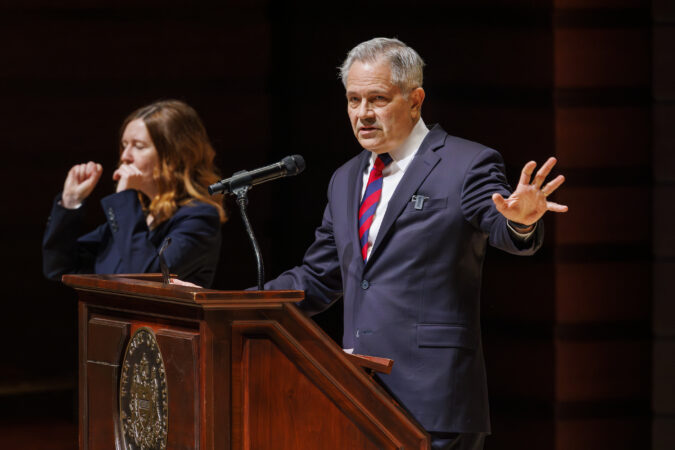
    Krasner, 64, took the oath of office alongside his wife, former Common Pleas Court Judge Lisa M. Rau, and one of his two sons inside the grand auditorium of the Kimmel Center for the Performing Arts.

    More than two dozen city judges, as well as City Controller Christy Brady, were also sworn in.

    Krasner is now one of the longest-serving district attorneys in modern Philadelphia history. Lynne M. Abraham, the tough-on-crime Democrat who in the 1990s was dubbed “deadliest DA” by the New York Times because she so frequently sought the death penalty, is the only other top prosecutor in the city to serve more than two terms.

    Krasner cruised to reelection in November after handily defeating former Municipal Court Judge Patrick F. Dugan with about 75% of the vote. Krasner’s campaign often focused more on attacking President Donald Trump than specifying what, if anything, he might do differently with another four years.

    He struck similar tones on Monday.

    Across a nearly 20-minute speech, Krasner did not lay out a coming agenda, saying that was “not for today,” but instead recounted what he said were his accomplishments over the last eight years: building what he said was a more morally intact staff, investing in forensic advancements to help take down violent gangs, and providing grants to community organizations.

    “It will be headed towards more safety. It will be headed towards more freedom,” he said of his office in the next four years.

    And he took a few shots at Trump.

    “Sometimes people ask me, ‘Why are you talking about Trump so much? Why do you keep bringing up Trump?’” he said.

    While City Council members and state lawmakers have “tremendous power,” he said, “they don’t have the obligation, as I just swore in front of you, to uphold the Constitution and the laws of the United States from someone … whose intent is, without question, the overthrow of democracy in the United States of America.”

    District Attorney Larry Krasner displays a political cartoon by Pat Bagley during a news conference in August 2025 to lament President Trump’s deployment of the National Guard to D.C. streets. Bagley is staff cartoonist for the Salt Lake Tribune in Salt Lake City, Utah.

    He also noted that Trump has not deployed the National Guard to Philadelphia, as the president has done in other Democratic cities like Chicago, San Francisco, and Los Angeles, and seemed to acknowledge Cherelle L. Parker’s hotly debated strategy of avoiding confrontation with Trump.

    “If that has any part in the reality that we have not seen Trump’s troops, Trump’s tanks in the City of Philadelphia — I don’t know if it does or not, but if it has anything to do with that, then I’m glad, and I intend to work closely, always, with other elected officials.”

    Parker, who earlier congratulated Krasner in her introductory remarks, stared ahead stoically during his comments about Trump.

    Krasner ended by promising to continue making Philadelphia safer, and then returned to one of his favorite themes.

    “We all got to this point of achievement together, and this is no time to retreat. It is no time to surrender. It is time to push on so that Philadelphia goes from being known as chronically violent to being known as consistently safe for decades to come,” he said.

    “And if anybody — including the guy in D.C. — doesn’t want that, if they want to F around, then they’re gonna find out.”

  • Philadelphia records the fewest homicides in nearly 60 years, plus other insights to 2025’s crime

    Philadelphia records the fewest homicides in nearly 60 years, plus other insights to 2025’s crime

    For the first time in more than half a century, Philadelphia has recorded fewer than 225 homicides in a single year.

    In 2025, 222 people were killed — the fewest since 1966, when there were a fraction of as many guns in circulation and 178 homicides.

    It is a milestone worth commemorating — and mourning: Violence has fallen to its lowest level in decades, yet 222 deaths in a single city is still considered progress.

    window.addEventListener(“message”,function(a){if(void 0!==a.data[“datawrapper-height”]){var e=document.querySelectorAll(“iframe”);for(var t in a.data[“datawrapper-height”])for(var r,i=0;r=e[i];i++)if(r.contentWindow===a.source){var d=a.data[“datawrapper-height”][t]+”px”;r.style.height=d}}});

    The drop mirrors a national reduction in violence and follows years of sustained declines after Philadelphia’s annual homicide totals peaked during the pandemic, and it reflects a mix of likely contributing factors: Tech-savvy police are solving more shootings, violence prevention programs have expanded, and the city has emerged from pandemic instability.

    No single policy or investment explains it, and officials caution that the gains are fragile.

    “The numbers don’t mean that the work is done,” said Adam Geer, the city’s director of public safety. “But it’s a sign that what we’re doing is working.”

    The impact is tangible: fewer children losing parents, fewer mothers burying sons, fewer cycles of retaliation.

    “We are saving a life every day,” District Attorney Larry Krasner said.

    Still, the violence hit some. Victims ranged from a 2-year-old girl allegedly beaten to death by her mother’s boyfriend to a 93-year-old grandfather robbed and stabbed in his home. They included Ethan Parker, 12, fatally shot by a friend playing with a gun, and Said Butler, 18, killed just days before starting his first job.

    Police say street-level shootings and retaliatory violence fell sharply, in part because some gang conflicts have burned out after key players were arrested or killed. Killings this year more often stemmed from long-standing drivers — arguments, drugs, and domestic violence — and were concentrated in neighborhoods that have borne the brunt of the crisis.

    “These same communities are still traumatized,” said Police Commissioner Kevin Bethel. “One gunshot is a lot. We can’t sit or act like we don’t see that.”

    window.addEventListener(“message”,function(a){if(void 0!==a.data[“datawrapper-height”]){var e=document.querySelectorAll(“iframe”);for(var t in a.data[“datawrapper-height”])for(var r,i=0;r=e[i];i++)if(r.contentWindow===a.source){var d=a.data[“datawrapper-height”][t]+”px”;r.style.height=d}}});

    The number of domestic-related killings nearly doubled this year compared with last, making up about 20% of homicides, Geer said. The disappearance and killing of Kada Scott, a 23-year-old woman from Mount Airy, was among them, and led to a citywide outcry and renewed scrutiny of how authorities handle violence against women.

    And mass shootings on back-to-back holiday weekends — 11 people shot in Lemon Hill on Memorial Day, and 21 shot in a pair of incidents in South Philadelphia over July Fourth — left residents reeling.

    Still, a 2025 survey from Pew Charitable Trusts showed that a majority of Philadelphians feel safer in their neighborhoods than they have in years.

    <iframe title="Philadelphians’ Perceptions of Safety at Night" aria-label="Line chart" id="datawrapper-chart-GRrTN" src="https://datawrapper.dwcdn.net/GRrTN/1/" scrolling="no" frameborder="0" style="width: 0; min-width: 100% !important; border: none;" height="556" data-external="1"></iframe><script type="text/javascript">window.addEventListener("message",function(a){if(void 0!==a.data["datawrapper-height"]){var e=document.querySelectorAll("iframe");for(var t in a.data["datawrapper-height"])for(var r,i=0;r=e[i];i++)if(r.contentWindow===a.source){var d=a.data["datawrapper-height"][t]+"px";r.style.height=d}}});</script>

    The progress comes even as the police department remains 20% below its budgeted staffing levels, with about 1,200 fewer officers on the force than 10 years ago.

    The city’s jail population has reached its lowest level in recent history. It dipped below 3,700 in April for the first time in at least a decade, and remains so today.

    <iframe title="Philadelphia’s Jail Population" aria-label="Line chart" id="datawrapper-chart-73NZP" src="https://datawrapper.dwcdn.net/73NZP/1/" scrolling="no" frameborder="0" style="width: 0; min-width: 100% !important; border: none;" height="527" data-external="1"></iframe><script type="text/javascript">window.addEventListener("message",function(a){if(void 0!==a.data["datawrapper-height"]){var e=document.querySelectorAll("iframe");for(var t in a.data["datawrapper-height"])for(var r,i=0;r=e[i];i++)if(r.contentWindow===a.source){var d=a.data["datawrapper-height"][t]+"px";r.style.height=d}}});</script>

    And arrests citywide, particularly for drug crimes, have cratered and remain far below pre-pandemic levels, mirroring a nationwide trend.

    Experts say the moment demands persistence.

    “We can’t look at this decline and turn our attention to other problems that we have to solve. We have to keep investing and keep pushing to get this number even lower, because it could be even lower,” said Jason Gravel, an assistant professor of criminal justice at Temple University.

    ‘Unheard of’ clearance rates

    After shootings exploded during the pandemic, and Philadelphia recorded 562 homicides in 2021 — the most in its history — violence began to decline, slowly at first.

    But then, from 2023 to 2024, killings fell by 35% — the largest year-over-year reduction among U.S. cities with the highest homicide rates, according to an analysis by Pew.

    The decline continued into 2025.

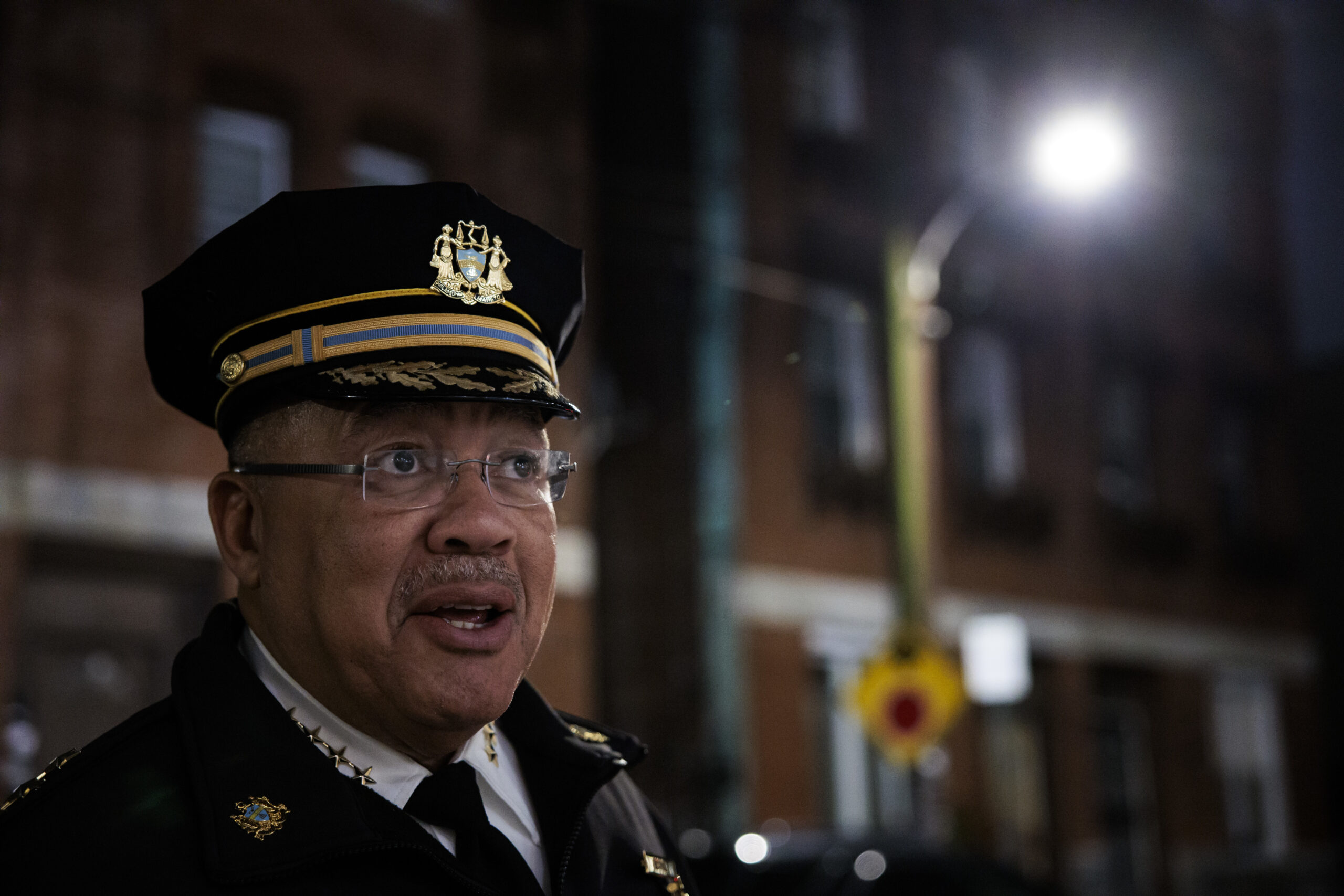
    Police Commissioner Kevin Bethel arrives at a North Philadelphia community meeting on Dec. 2.

    Bethel has pointed to a host of potential reasons for the decline: the reopening of society post-pandemic — kids returned to school and adults reconnected with jobs, courts, and probation officers — as well as police resources focused in hot spot crime areas and improved coordination among city leaders.

    Most notably, he said, detectives are making more arrests in nonfatal shootings and homicides. Experts say that arresting shooters is a key violence-prevention strategy — it prevents that shooter from committing more violence or from ending up as a victim of retaliation, sends a message of accountability and deterrence, and improves the relationship between police and the community.

    The homicide clearance rate this year ended at 81.98%, the highest since 1984, and the clearance of nonfatal shootings reached 39.9%.

    “That’s unheard of,” said Geer, the public safety director. “The small amount of people who are committing these really heinous, violent crimes in our neighborhood[s] are being taken off the street.”

    window.addEventListener(“message”,function(a){if(void 0!==a.data[“datawrapper-height”]){var e=document.querySelectorAll(“iframe”);for(var t in a.data[“datawrapper-height”])for(var r,i=0;r=e[i];i++)if(r.contentWindow===a.source){var d=a.data[“datawrapper-height”][t]+”px”;r.style.height=d}}});

    Still, more than 800 killings from between 2020 and 2023 remain without an arrest, according to an Inquirer analysis.

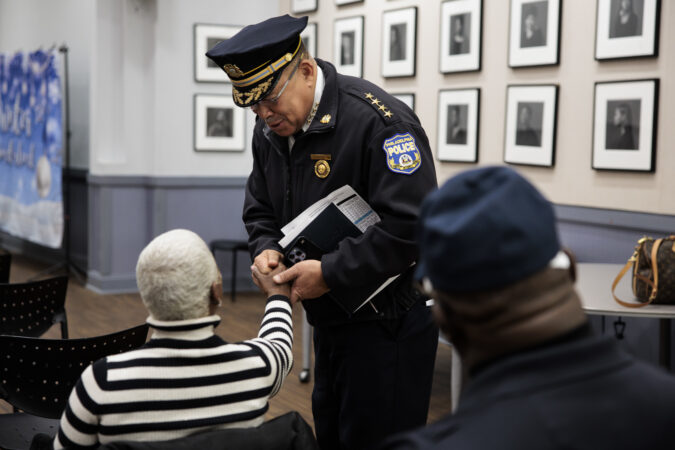
    That has had a significant impact on the police department’s relationship with the community over the years, something Bethel has sought to repair since he was appointed commissioner in 2024.

    In 2025, he created an Office of the Victim Advocate, hired a 20-person team to communicate with and support victims, and hosted 35 meetings with residents of the most challenged neighborhoods.

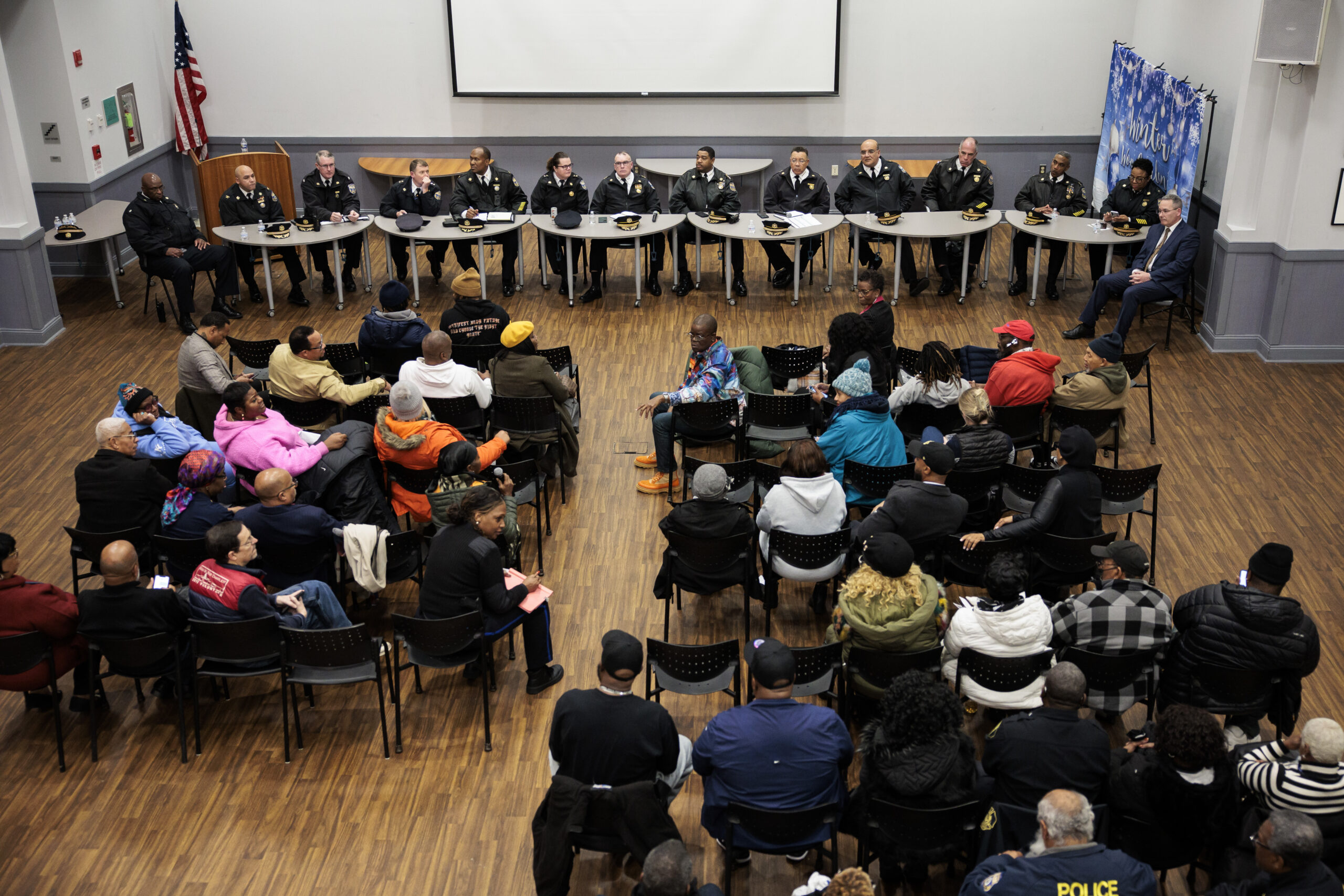
    A few dozen community members gathered with top police brass in North Philadelphia on Dec. 2.

    Yet Bethel has grappled with the challenge of convincing residents that the city is safer today than four years ago, while questioning whether today’s gains can outweigh years of devastation.

    That challenge was on display on a recent cold December night, as Bethel gathered with a few dozen residents inside a North Philadelphia church and asked what they wanted him to know.

    Person after person stood and told him what gun violence had taken from them in recent years.

    My son. My brother. My nephew.

    Both of my sons.

    Investing in violence prevention

    The city’s network of violence prevention strategies has expanded greatly since 2020, when the city began issuing tens of millions of dollars in grants to grassroots organizations.

    Early on, the city faced criticism that its rollout of the funds was chaotic, with little oversight or infrastructure to track impact. Today, Geer said, the city has stronger fiscal oversight, better organizational support, and a data-driven approach that targets neighborhoods experiencing the most violence.

    In 2024, Community Justice, a national coalition that researches violence-intervention strategies, said that Philadelphia had the most expansive violence-prevention infrastructure of the 10 largest U.S. cities. When evaluating 100 cities, it ranked Philadelphia as having the third-best public-health-centered approach to preventing violence, falling behind Washington and Baltimore.

    Geer said the work will continue through 2026. Starting in January, the city will have a pool of about $500,000 to help cover the funeral expenses for families affected by violence.

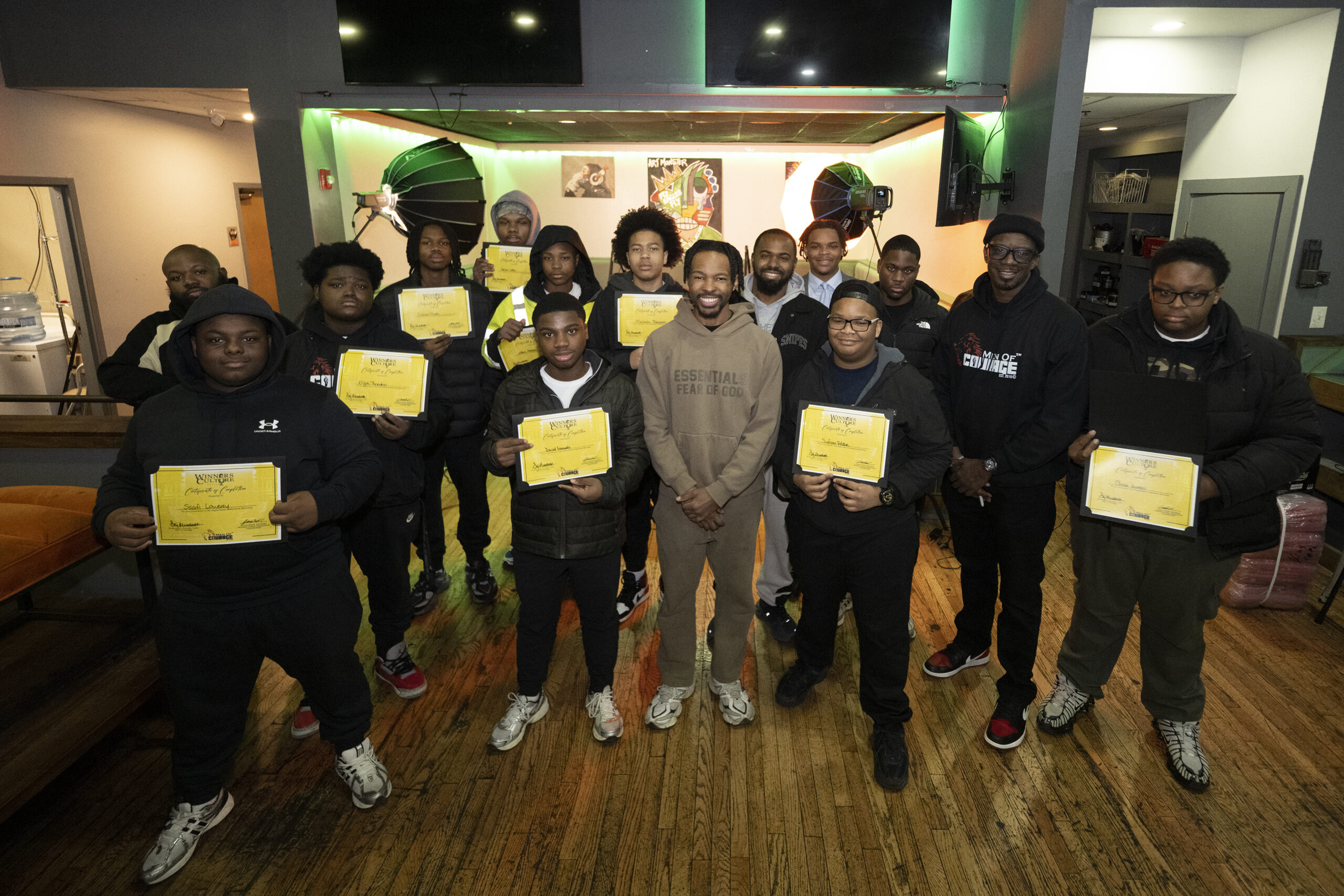
    Members of Men of Courage pose with the certificates of accomplishment after completing a 16-week program on multi-media work and podcasting, one of multiple programs the community organization uses to help Black teens build their confidence.

    One of those organizations that has benefited from the city’s funding is Men of Courage, a Germantown-based group that mentors young Black men ages 12 to 18 and focuses on building their confidence, resilience, and emotional intelligence.

    “We want them to know that one decision can affect your entire life,” said founder Taj Murdock. “Their environment already tells them they’ll be nothing. … We have to shift their mindsets.”

    Arguments are a leading cause of shootings, and teaching teens how to de-escalate conflicts and think through long-term consequences can prevent them from turning disputes violent, he said.

    Isaiah Clark-White, second to left, and David Samuel, middle, pose for a photo with other members of Men of Courage before recording a podcast.

    Isaiah Clark-White, 16, a sophomore at Hill Freedman World Academy in East Mount Airy, said that in his three years working with Men of Courage, he has grown more confident and has improved his public speaking.

    And David Samuel, 15, of Logan, said he has learned how to better control his emotions and identify those of the people around him. Both said they feel safer today than three years ago, but remain vigilant of their surroundings.

    Samuel said his dad watches the news every day and talks about the overnight crimes and shootings.

    “He’s always telling me,” he said, “‘David, I don’t want this to happen to you.’”

  • Philly’s new U.S. attorney has largely avoided the chaos swirling around other parts of Trump’s Justice Department

    Philly’s new U.S. attorney has largely avoided the chaos swirling around other parts of Trump’s Justice Department

    When President Donald Trump announced earlier this year that he was nominating David Metcalf to be Philadelphia’s U.S. attorney, it initially seemed as if the move was in line with Trump’s chaotic and contentious attempt to upend the nation’s justice system.

    The decision was abrupt, apparently made without advanced input from Sen. Dave McCormick (R., Pa.), who’d set up a commission to identify candidates to serve as the region’s top federal prosecutor.

    Metcalf was 39 and, unlike many of his predecessors, didn’t have deep roots in the region — but did have some reported ties to officials who’d sought to help Trump adviser Roger Stone years earlier.

    And the appointment was announced as Trump was openly pledging to “clean house” in the Justice Department and pull the agency more directly in line with the White House.

    But in the months since Metcalf has assumed control over the office and its 140 lawyers, what has stood out so far has been the serious temperament the veteran prosecutor has brought to the role, and the relative lack of drama he’s overseen — particularly in comparison to nearby jurisdictions, where U.S. Attorney’s Offices have been embroiled in controversies over leadership appointments and whether to indict Trump critics.

    During a recent interview with The Inquirer at his Center City office, his first since being appointed in March, Metcalf said his deliberate approach toward his first few months in the job has been influenced by his decade-plus career as a Justice Department lawyer — one that included stints in Baltimore, Philadelphia, and Washington, D.C.

    He has met with a host of other local stakeholders since taking over — including Police Commissioner Kevin J. Bethel, District Attorney Larry Krasner, and federal judges — and has avoided ushering in drastic upheaval within his office.

    U.S. Attorney David Metcalf outside the federal courthouse in July, with Police Commissioner Kevin Bethel standing behind him.

    Instead, he said, a key focus has been to encourage his prosecutors to pursue large, ambitious, complex investigations targeting violent crime, synthetic opioid abuse, and healthcare fraud — subjects he said were critical to public safety in the Philadelphia region.

    “I do not feel some personal impulse to burn my brand on this office by restructuring and reorganizing it,” he said, later adding: “The greatest offices and the greatest cases come from prosecutors who are hunting them down and competing for them … and that’s the breed of prosecutor we’re trying to create here.”

    Composed and self-assured, Metcalf was uninterested in commenting on the broader political landscape surrounding his job. He instead concentrated on the work of his office, whose lawyers prosecute matters including drug trafficking, political corruption, and terrorism across nine counties from Philadelphia to Allentown and west past Reading. They also litigate civil matters on behalf of the federal government.

    “I don’t want to say that I’m … bound by precedent or a devotee to the status quo,” he said. “But I do believe in stability, and I’m certainly not going to change things just for the sake of changing them.”

    That approach has been generally well-received by many lawyers in his office, particularly given the volatile environment across other parts of the Justice Department.

    Even Krasner — an outspoken progressive Democrat who rarely misses an opportunity to criticize Trump, and who was engaged in a long-running feud with a Trump-appointed U.S. attorney four years ago — said he had a “professional and pleasant lunch” with Metcalf earlier this year.

    “We have always worked well with the career prosecutors at the U.S. Attorney’s Office, and our teams seem to be continuing to work well together,” Krasner said in an interview.

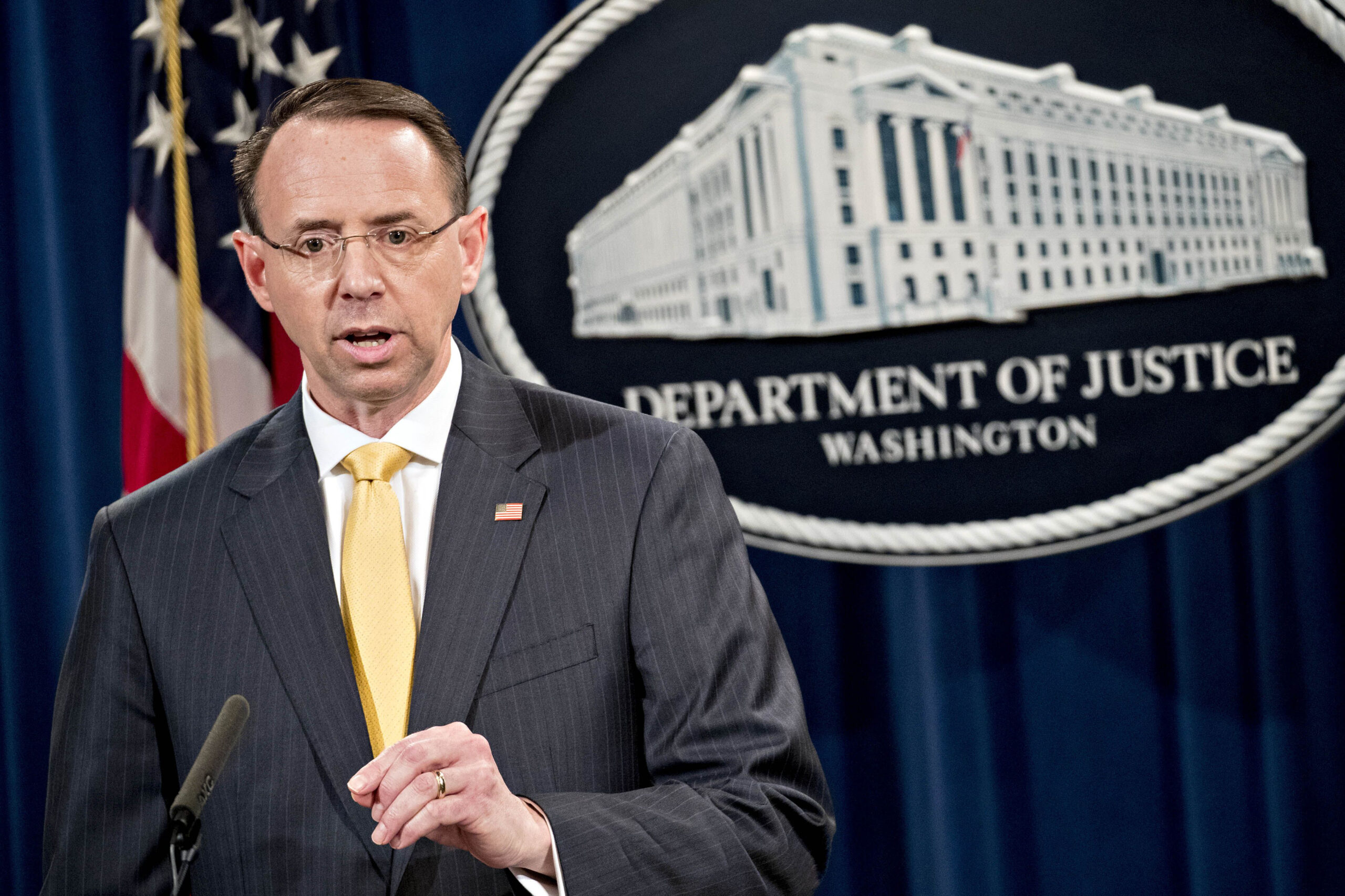
    Rod Rosenstein, who was the deputy attorney general during Trump’s first term, said in an interview that he hired Metcalf a decade ago, when Rosenstein was the U.S. attorney in Maryland. And their paths continued to intersect over the years as their careers wound through the Justice Department.

    Rosenstein said Metcalf had “superb legal skills” and “excellent judgment” — two qualities he views as critical for leading a U.S. attorney’s office.

    “I think people recognize he’s got the right qualifications,” Rosenstein said.

    U.S. Attorney David Metcalf in his Center City office.

    ‘An exhilarating vocation’

    Metcalf grew up in northern Virginia and graduated from The Wakefield School, a private prep school about an hour west of Washington, D.C. His father was once an Army colonel, he said, and his grandfather was Joseph Metcalf III, the Navy vice admiral who led the 1983 invasion of Grenada.

    Metcalf was a standout soccer player in high school, and was recruited to play by more than 80 college teams, the Washington Post reported in 2003. He used the situation to his advantage, the paper reported — making a deal with his mother that he could let his hair grow down past his shoulders once Division I colleges started sending him letters.

    He ended up attending Princeton — playing soccer all four years — and then went on to graduate from the University of Virginia’s law school.

    After clerking for U.S. Circuit Judge Albert Diaz, Metcalf spent a few years in private practice before becoming an assistant U.S. attorney in Maryland under Rosenstein.

    Metcalf said he didn’t have a single epiphany that made him realize he wanted to become a prosecutor. But he said he was quickly drawn to the work, which he found more interesting and important than other legal jobs.

    “I thought it was really just an exhilarating vocation in a profession that doesn’t always have the most glamorous applications,” he said.

    High-profile connections

    From 2015 through 2022, Metcalf worked as a line prosecutor in Baltimore and, later, in Philadelphia — the office he now leads. The two years he spent here were unusual, he said, because they unfolded during the peak of the pandemic, when many aspects of the court system were disrupted and most people were working from home.

    Metcalf also spent time during the first Trump administration in Washington, D.C. While there, he worked closely with prominent Justice Department officials including Rosenstein; Deputy Attorney General Jeffrey A. Rosen; Timothy Shea, the onetime U.S. Attorney for Washington, D.C.; and then-Attorney General William Barr.

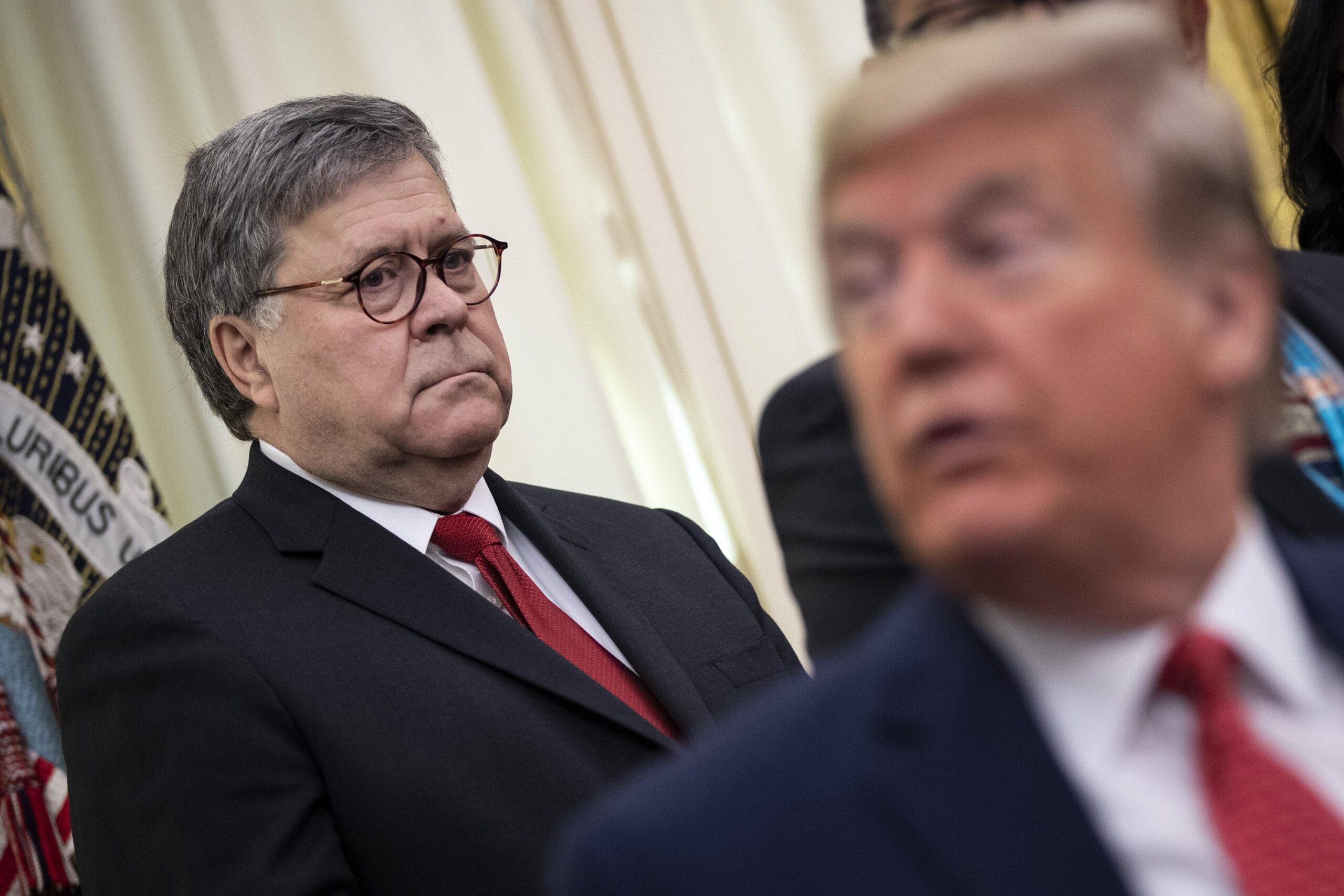
    Attorney General William Barr and President Donald Trump in the Oval Office of the White House on Nov. 26, 2019.

    Metcalf’s name was briefly in the news in 2020, when Barr and Shea, Metcalf’s then-boss, intervened in the prosecution of Stone, Trump’s longtime ally, who had been convicted of lying to Congress. After the trial prosecutors wrote in court documents that Stone should be sentenced to at least seven years in prison, Barr and Shea ordered them to walk that back and reduce their recommendation.

    Some assigned to the case viewed that as political interference and an attempt to placate Trump. A Justice Department investigation later faulted “ineffectual” leadership by Shea for how the episode unfolded, not politics.

    In 2022, Metcalf left the public sector and went to work as a corporate counsel for Amazon. But this March — after Trump was reelected for a second term — Metcalf was suddenly thrust back into the Justice Department, as the White House announced it was nominating him to be Philadelphia’s U.S. attorney.

    From nominee to confirmation

    The decision came as something of a surprise.

    McCormick, Pennsylvania’s newly elected GOP senator, had made a point of publicly announcing that he’d formed a committee to review and vet potential candidates for federal law enforcement positions across the state. And other GOP-connected lawyers in the region had been jockeying for months to try to figure out who might be able carve a path toward the coveted position.

    When the White House named Metcalf its permanent nominee, the process was effectively short-circuited.

    Metcalf said he couldn’t speak to how or why the process played out the way it did. He said he applied for the job, and “had relationships with folks in the Trump administration” due to his time in Washington during Trump’s first term.

    He didn’t specify who those people were. And some of his former bosses — particularly Barr — had fallen out of favor with Trump after his first term.

    But Rosenstein said “it’s a mistake to think that people are the people they work for. It’s a big government, and not everyone agrees all the time.”

    And in any case, Rosenstein said, he believed Metcalf was nominated “on merit, not on connections.”

    Rod Rosenstein, deputy attorney general during President Donald Trump’s first term, says Metcalf has “superb legal skills” and “excellent judgment.”

    William McSwain, who served as U.S. attorney during Trump’s first term, said he believed Metcalf was “extremely well-qualified for the position.”

    It took the U.S. Senate six months to vote to confirm Metcalf along with a host of other Trump nominees, but by then, the Philadelphia region’s federal judges had already voted to extend Metcalf’s appointment indefinitely while the process played out.

    That move stood in contrast to several other jurisdictions, including New Jersey, where the judiciary declined to extend the tenure of Trump’s nominee, Alina Habba. For months afterward, that office was thrust into turmoil as questions swirled about who could legally serve as its leader.

    Pursuing notable cases

    During his tenure so far, Metcalf said, he’s been seeking to focus his prosecutors on finding what he called “nationally significant” cases, particularly those targeting violence, drugs, and healthcare fraud, which he views as priorities for the region.

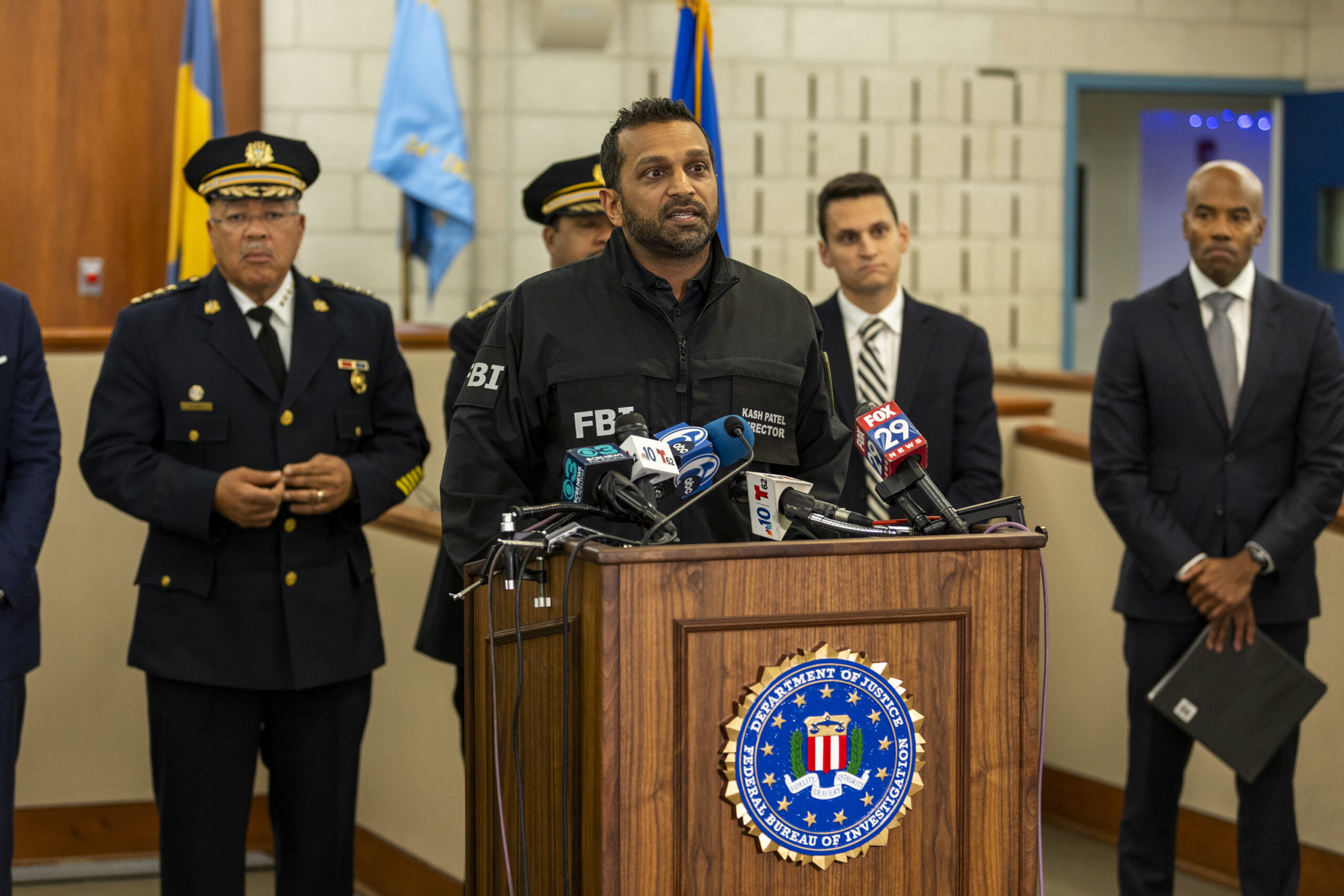
    One of the first big indictments he announced was in October when FBI Director Kash Patel visited Philadelphia to help reveal that 33 people had been charged with being part of a Kensington-based drug gang. Metcalf said the case was the largest single prosecution in the region in at least two decades.

    FBI Director Kash Patel helping announce the arrest of dozens of suspects in a Kensington drug case.

    He also helped create a new program dubbed PSN Recon, an initiative designed to help Philadelphia Police more readily share intelligence with state and federal agencies about which groups or suspects should be investigated.

    Prosecutions overall have increased on his watch, according to the Transactional Records Access Clearinghouse (TRAC), a research organization that collects federal courts records.

    So far this fiscal year, prosecutions in the Eastern District of Pennsylvania were up 32% compared to last year, TRAC found, and were on their highest pace since 2019. The most common types of cases charged this year were immigration violations, drug offenses, and illegal firearm possession, according to TRAC.

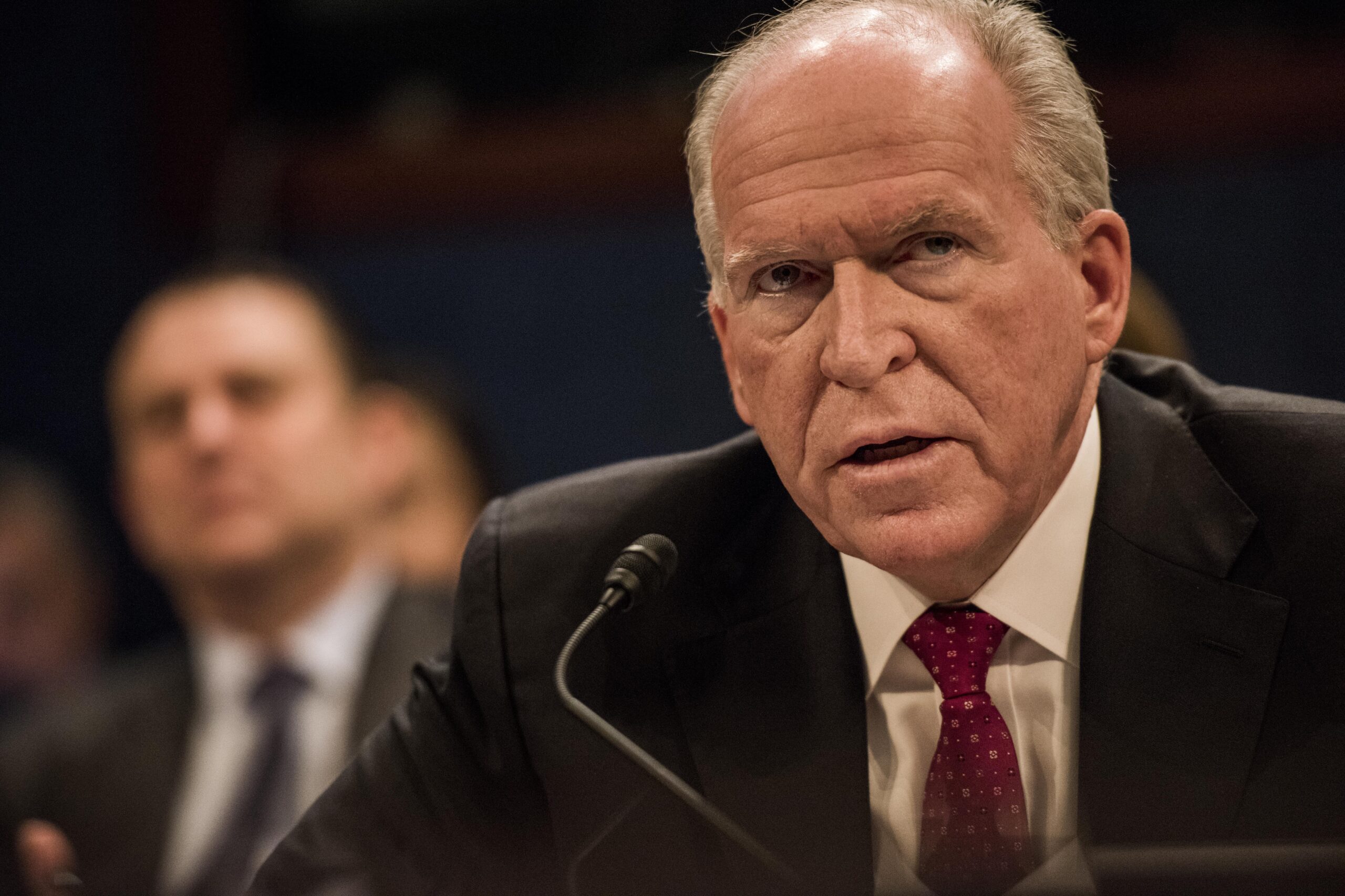
    Earlier this year, Metcalf was reportedly involved in one particularly significant case: an investigation into former CIA Director John Brennan and his role in producing an intelligence assessment about Russian interference in the 2016 election. Brennan went on to become a prominent Trump critic.

    Former CIA director John Brennan testifies before the House Intelligence Committee in 2017.

    National outlets including Axios and the New York Times reported that Metcalf had been leading the probe, and that he had concerns about its viability — a notable development given Trump’s public demands to prosecute other adversaries, including former FBI Director James Comey.

    Metcalf never commented publicly on his purported involvement in the Brennan case, and declined to do so again during his interview with The Inquirer. The investigation is now reportedly being handled by federal prosecutors in Florida.

    Metcalf did allow a short peek into his professional mindset when he was asked more broadly if he’d ever felt pressure from Washington to sign off on a decision he didn’t agree with.

    After declining to comment on any discussions he may or may not have had with Justice Department leaders, he paused for a moment and added one final point.

    “I will also say that I would be very surprised if that ever happened to me,” he said. “I don’t see it as a problem here.”