Tag: LGBTQ+

  • Proposed rule could gut American science, Penn researcher warns

    Proposed rule could gut American science, Penn researcher warns

    As an undergraduate researcher at the University of Pennsylvania, I spend my time outside of class studying how a protein called tau destroys the brain cells of Alzheimer’s patients. This research happens at Penn’s Center for Neurodegenerative Disease Research (CNDR), it is funded by the National Institutes of Health, and it is the reason I want to spend my life as a physician-scientist.

    It is also exactly the kind of research a new federal proposal could quietly undermine.

    On May 29, the White House’s Office of Management and Budget (OMB) published a 100-page proposed rule that would fundamentally restructure how the federal government administers research grants. The comment period closes July 13.

    Most Americans have never heard of it. That needs to change.

    The rule has several alarming impacts. For instance, it would allow political appointees to override scientific peer review in grant decisions, upending the meritocratic, rigorous system that has pushed American science forward since World War II.

    Perhaps most critically, it would permit the government to terminate any active federal grant at any time, for any reason — including the vague, undefined justification that a study is no longer in the “national interest.” Furthermore, it would effectively ban federal funding for research into health disparities across racial populations, with a stated exception so narrow it is meaningless in practice.

    Let me put that in perspective with specific examples. Over seven million Americans currently live with Alzheimer’s disease, and that number will nearly double by 2050. The research that underpins our understanding of this disease — including discovery of biomarkers, assembly of databases, and clinical trial frameworks — took decades of sustained, longitudinal federal investment to build. The Alzheimer’s Disease Neuroimaging Initiative, launched in 2004, required over 20 years of continuous funding and investment prior to producing any comprehensive datasets that now drive clinical trials.

    Under the proposed rule, however, a political appointee or administrator with no scientific background could have decided at any point in that 20-year window that the study was no longer in the “national interest” and ended the study. The harm this vague, sweeping rule would do is not hypothetical. Much biomedical and clinical research, including in the field of neurodegenerative diseases, is longitudinal, and progress is not always immediately visible.

    I’m reminded of what the late John Trojanowski, a former leader of the lab I now work in, said in regard to his research on the proteins behind Alzheimer’s:

    “We asked our mentors, ‘Is this something we should do?’ They all said, ‘No. It’s a swamp, and you’ll ruin your careers because so little is known.’ What they saw as a swamp, we saw as a huge challenge and opportunity that has led to an engaging career.”

    Trojanowski’s partner in that research was Virginia Lee, whose work on tauopathies I have the privilege of contributing to today.

    Their “swamp” turned out to be an oasis of discovery that likely would’ve remained untouched if these two experts in their field had not trusted in themselves and decades of training. If even their mentors — senior scientists in their own right — had dismissed these field-defining ideas, imagine the damage administrators and political appointees can inflict on similar revolutionary discoveries simply because they deem them “not in the national interest.”

    The ban on research into racial disparities will compound this harm. Black Americans are diagnosed with Alzheimer’s at roughly twice the rate of white Americans. Population differences in disease risk, progression, and biomarkers are not ideological claims, but instead are observed, replicated findings in the scientific literature.

    For example, research has found that the relationship between the APOE4 gene (a major genetic risk factor for Alzheimer’s disease) and brain pathology inherently differs across racial groups. More specifically, some studies have found different patterns of tau protein markers in Black and Hispanic populations compared with the predominantly white cohorts that comprised much of the foundational, preexisting literature.

    As currently written, this provision reaches much further than OMB’s framing of eliminating unlawful DEI policies suggests, and instead directly threatens legitimate biomedical research.

    From a student perspective, I also want to acknowledge something that institutional press releases may not: This rule falls hardest on the people least able to absorb the blow.

    If a principal investigator or faculty member loses a grant, it is by all means a loss, but they are more likely to have tenure, salary, or institutional support. If a graduate or doctoral student loses a grant mid-project, they potentially lose their publication, graduation timeline, and may face an altered career trajectory. And yet, trainees are never once mentioned in this proposal.

    Doctoral students at the Delaware Center for Cognitive Aging study the impact of cardiovascular function on brain tissue integrity and cognitive aging.

    So what can those of us who want to ensure we have the tools to effectively treat future pandemics and that our children benefit from world-class health research do?

    Congress has little practical recourse here. The Congressional Review Act exists, but in the current political climate, a veto-proof majority to overturn an OMB rule is a fantasy.

    Yet, our voice still matters.

    I do not say this as a mere platitude. The Federal Register, where this document was published, contains a form for anyone to leave a comment for OMB. Unlike the “contact me” forms on senators’ and representatives’ pages that you rarely receive a response from, the comments here are public — and they also carry legal weight. When this proposal gets challenged in court — and it almost certainly will — judges will look at the administrative record, which includes every single comment.

    If OMB does not meaningfully engage with a substantive objection raised during the comment period, that provides grounds to vacate the rule. Your comment doesn’t just go into a void. It becomes part of the legal ammunition.

    Physicians and healthcare workers: Share the stories of your patients who benefited from federally funded studies. Scientists and students: Explain your research and the progress made from it. Attorneys and legal scholars: Challenge the principles and wording in this sweeping, overarching proposal.

    To those whose careers do not directly involve science, this is your fight, too.

    Comment on your medical condition that’s been treated. Chances are that treatment was only possible due to federally funded basic science. And if you or a loved one suffers from a disease or illness for which we do not yet have a cure, it is all the more important that you speak up with us.

    Stable and comprehensive funding allows scientists to develop treatments for both rare illnesses and widespread ones like neurodegenerative diseases.

    This is also a fight for our underrepresented racial and ethnic populations, the LGBTQ+ community, and the marginalized in our city. The decision to fund research on medical disparities is a decision to invest in the people who need it most.

    As we in Philadelphia celebrate our nation’s Semiquincentennial, America’s first hospital and medical school, and the great scientific advancements of our city, it would be wrong not to recognize the benefit biomedical research has received from federal funding.

    This legacy is now in danger. If we want to see another 250 years of great American science, now is the time to act.

    Ayaan Shah is a sophomore at the University of Pennsylvania studying neuroscience and an undergraduate research assistant at Penn’s Center for Neurodegenerative Disease Research.
  • America’s rich tradition of July Fourth protest is worth recalling

    America’s rich tradition of July Fourth protest is worth recalling

    No Kings and other protests opposing the policies and executive overreach of the Trump administration continue to draw crowds across the country, most recently on Flag Day, June 14, which was also the president’s 80th birthday. While critics have denounced these demonstrators as un-American — House Speaker Mike Johnson called a 2025 No Kings march a “hate America rally” — those voicing dissent, pushing for change and speaking truth to power are, in fact, participating in a tradition at our nation’s core.

    That tradition dates back to July 4, 1776, when the Continental Congress, citing a list of grievances, declared independence from the rule of a would-be despot, King George III. The founders’ act of resistance set an example that ordinary Americans would follow. According to historian David Waldstreicher, citizens in the early republic used celebrations not just to commemorate independence, but to lay claim to the lofty principles expressed in the Declaration of Independence, namely that all are created equal, that they have unalienable rights, and that government is instituted to secure those rights, deriving its just powers from the consent of the governed.

    The custom continued for two-plus centuries, with Americans regularly marching, picketing, or otherwise taking to the streets on the Fourth to realize a more perfect union.

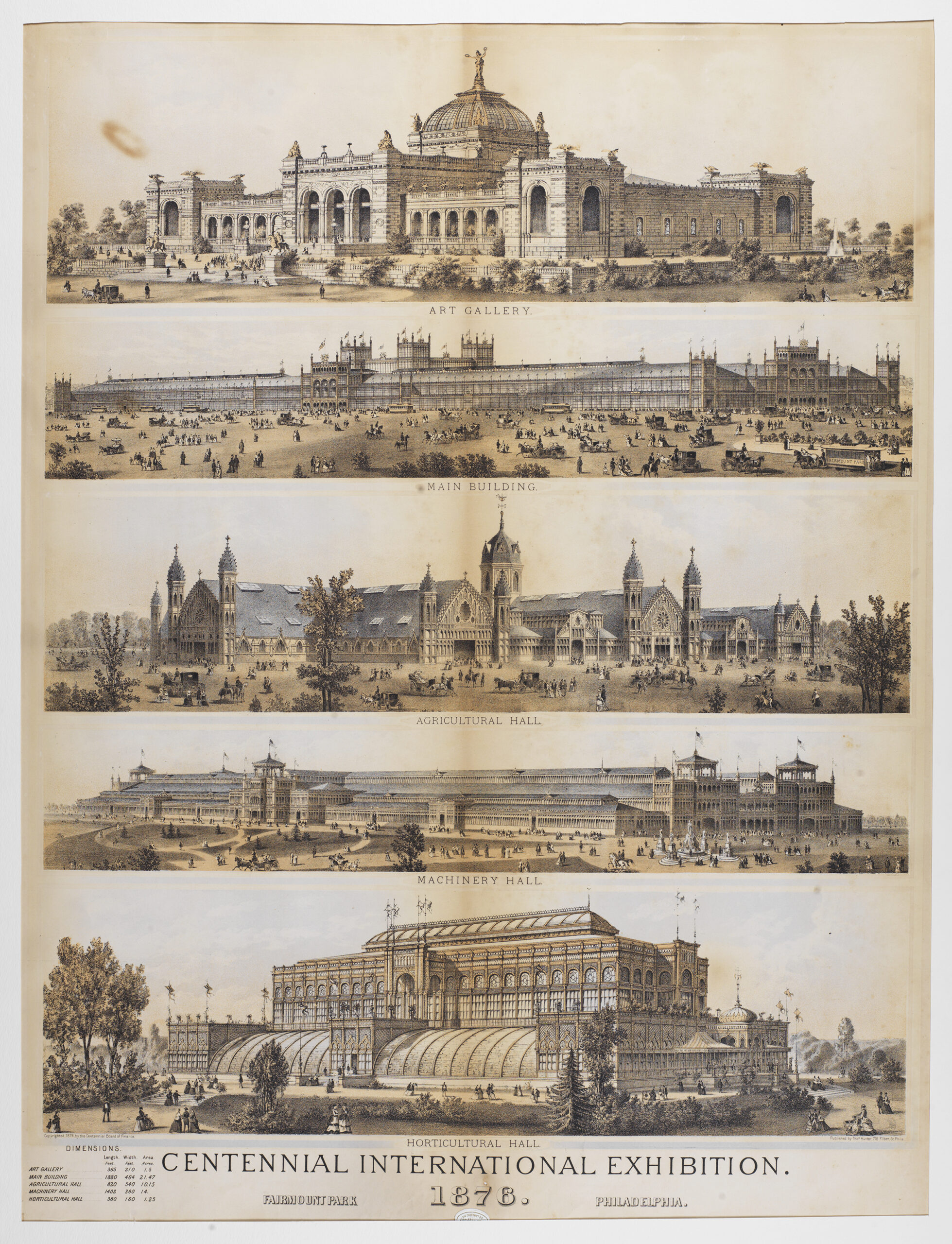
    Centennial International Exhibition, 1876.

    Perhaps the most famous Independence Day protest occurred in 1876 in Philadelphia. As tens of thousands gathered for the Centennial International Exhibition in Philadelphia’s Fairmount Park to celebrate a century of American progress in the arts, in industry, and in economic development, Susan B. Anthony protested the fact that half the nation, women, remained unable to vote and were thus without the unalienable rights named in the declaration.

    Anthony and a determined group of suffragists attempted to introduce a statement drafted by the National Woman Suffrage Association into the exhibition’s official proceedings. When Joseph Hawley, president of the United States Centennial Commission, prevented the women from doing so, Anthony led a procession to Independence Hall, where she read aloud the suffragists’ “Declaration of Rights of the Women of the United States” to a crowd that quickly gathered around her. Patterned after the original declaration, the text condemned the government for denying women the franchise, before ending with a clear demand: “We ask justice, we ask equality, we ask that all the civil and political rights that belong to citizens of the United States, be guaranteed to us and our daughters forever.”

    It took decades of nonviolent action before Congress passed the 19th Amendment, granting women the constitutional right to vote. But Anthony’s principled stance contributed to a rich history of July Fourth protests that continued a century later, as the nation prepared to mark the Bicentennial.

    On July 4, 1976, approximately 10,000 to 15,000 demonstrators massed in Washington, D.C., on America’s 200th birthday. Assembled by the People’s Bicentennial Commission, a New Left group, near the Jefferson Memorial, they marched to the U.S. Capitol under a banner reading, “Independence from Big Business.”

    The group’s populist call for economic democracy resonated in the mid-1970s, when the country was still reeling from a divisive war (Vietnam), a constitutional crisis (Watergate), and an economic recession that saw both inflation (5.97% in July 1976) and unemployment (7.6%) soar. Many people signed the commission’s “Declaration of Economic Independence” calling for limits on concentrated corporate power in the interest of the common good. “We, therefore, the Citizens of the United States of America,” the declaration stated, “hereby call for the abolition of these giant institutions of tyranny … to provide for the equal and democratic participation of all American Citizens in the economic decisions … that effect … our Nation.”

    Other protests occurred across the country, in Detroit and Chicago, as well as Los Angeles, San Francisco, and Seattle. Even Salt Lake City witnessed a small demonstration — albeit on Saturday, July 3, so as not to disturb the Christian Sabbath.

    Marchers with the Rich Off Our Backs Coalition demonstrate at Penn’s Landing in Philadelphia on July 3, 1976.

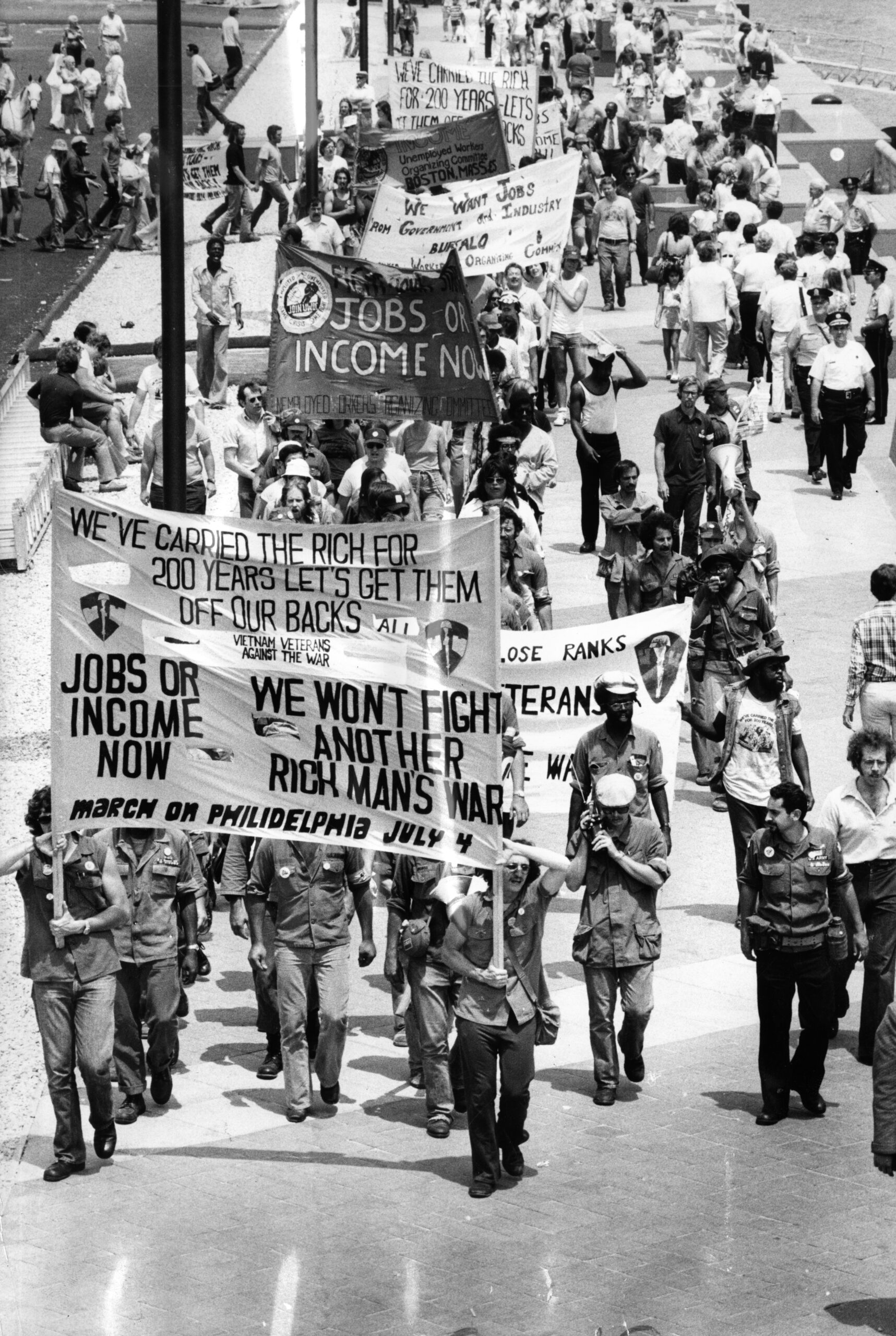
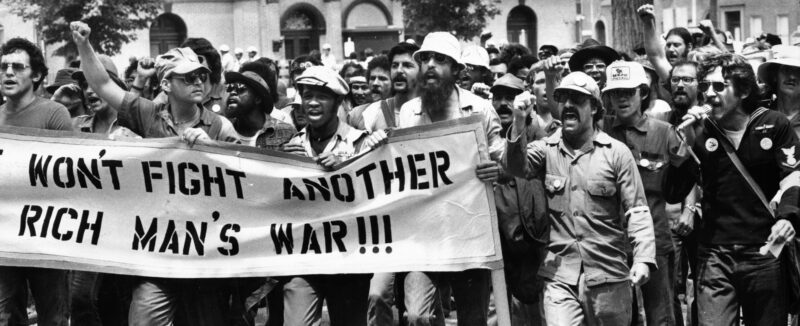
    The largest gatherings, though, were in Philadelphia, where more than 3,000 demonstrators gathered in Norris Square, under the auspices of a group called the Rich Off Our Backs Coalition, to march for jobs and income and economic justice — backed by fatigue-wearing Vietnam Veterans Against the War, who chanted: “One, two, three, four, we won’t fight a rich man’s war.”

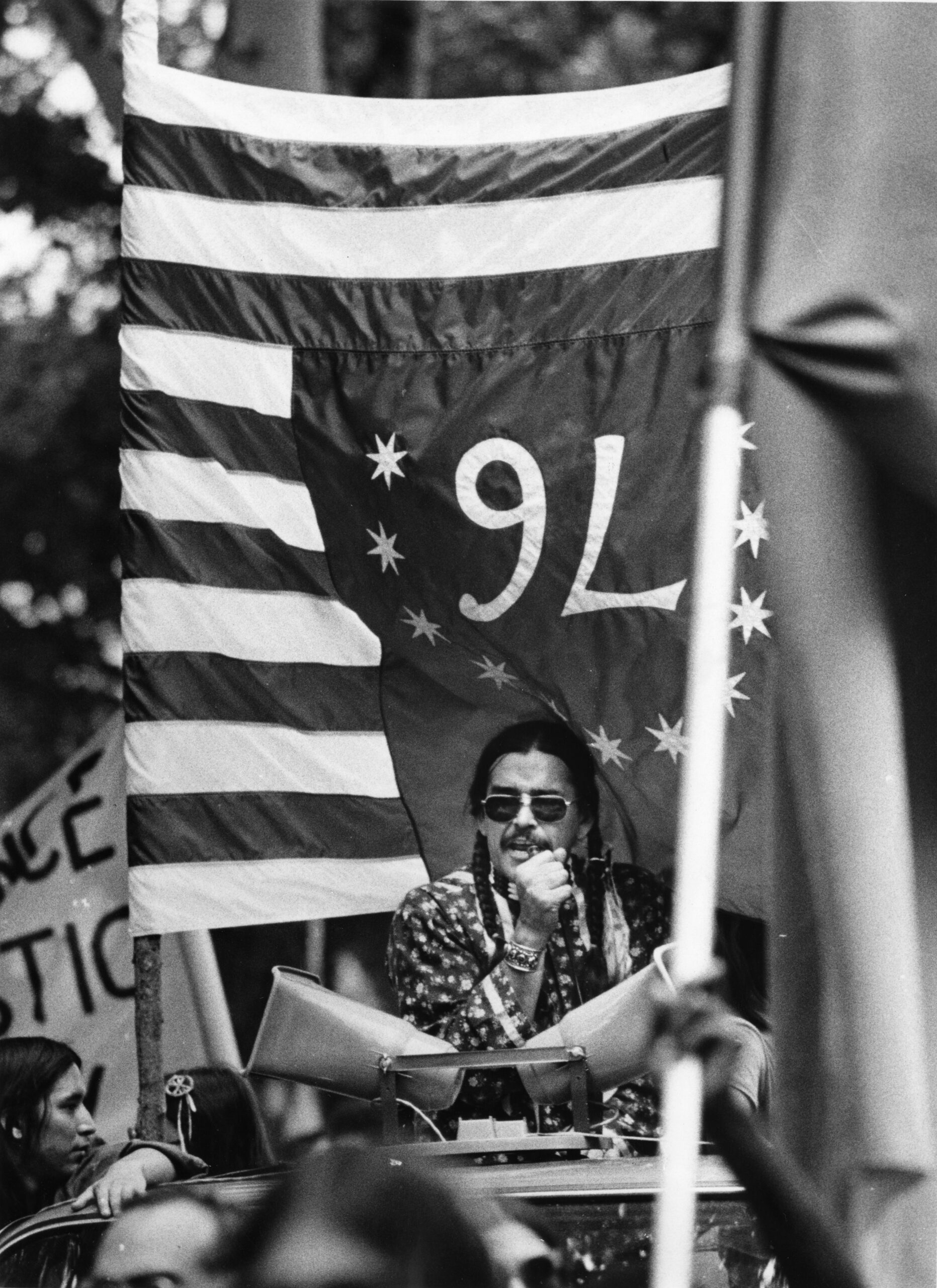
    Another group, the July 4th Coalition, rallied 30,000-plus in Fairmount Park, site of the Bicentennial, to demand Puerto Rican independence, greater rights for Black Americans, Native Americans, and members of the LGBTQ+ community, and much else. Karen DeCrow, president of the National Organization for Women, reread the declaration Susan B. Anthony had introduced a century earlier to flag the limited progress the nation had made toward gender equity since 1876. Black Panther leader Elaine Brown, a native Philadelphian, decried America’s 200-year history of racism.

    A group of Native Americans leads a July 4th Coalition protest parade at 33rd and Diamond Streets in Philadelphia on July 4, 1976.

    Despite opposition — Mayor Frank Rizzo famously requested 15,000 federal troops to maintain order — the demonstrations remained peaceful. Organizers won plaudits even from those who did not necessarily agree with their critiques. Protesters had a right, The Inquirer editors agreed, to call attention to America’s shortcomings, as they saw them. Dissent was as integral to the Fourth of July as bunting and brass bands: Its existence confirmed “the strength and genius of American democracy.”

    Today, according to polls, Americans typically mark Independence Day by barbecuing, shooting fireworks, going to the beach, viewing a parade, traveling, watching patriotic movies, or relaxing at home. Participating in a protest, demonstration, rally, or other nonviolent action does not rate a mention.

    That’s certainly understandable. These days are exhausting, and we all just want a break, a moment to have a laugh with family and friends.

    Yet, America’s rich tradition of July Fourth protest is worth recalling, especially at a time when the nation’s democratic institutions are under stress, for it once served as an essential tool that enabled Americans to hold their leaders to account for the words of 1776. We, the people, have never quite realized those words — written principally by a slave owner, Thomas Jefferson.

    But for 250 years and counting, the Declaration of Independence has set a “moral standard,” as historian Pauline Maier has argued, to which not only feminists and civil rights activists but civil libertarians and laborers have turned time and again in pursuit of liberty from their oppressors, be those would-be tyrants, foreign or domestic.

    M. Todd Bennett, a professor of history at East Carolina University, and David McKean, former director of policy planning in the U.S. Department of State, are the authors of “The Flag Was Still There: A History of the American Experiment in Five Anniversaries” (PublicAffairs, 2026).

    Made By History takes readers beyond the headlines with articles written and edited by professional historians. Opinions expressed do not necessarily reflect the views of The Inquirer.

    Made By History sponsors.
  • Philly’s queen of Gay Bingo hangs up her heels after 30 years and $5 million raised for AIDS research

    Philly’s queen of Gay Bingo hangs up her heels after 30 years and $5 million raised for AIDS research

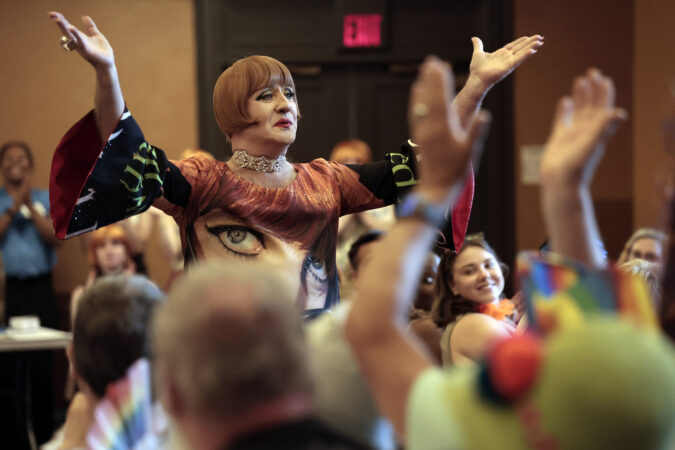
    The legendary redheaded drag queen Carlota Ttendant donned a baby-blue Eva Gabor-inspired gown — its plunging neckline revealing tasteful chest hair — and sensible black heels.

    At 65, arthritis stifles her strut in stilettos.

    “Drag is a young girl’s game,” she said.

    This was her swan song. At the close of its 30th season this Pride Month, the man behind the makeup, Michael Byrne, hung up his heels and bid adieu to his drag persona and his longtime gig hosting Gay Bingo, the camp, irreverent, slightly profane, and undoubtedly silly monthly HIV/AIDS fundraiser.

    “I know it’s time,” Byrne said. And, “I’m excited to never wear Spanx ever again.”

    Across three decades, Carlota Ttendant has called hundreds of games and elicited endless laughs, all while raising millions for people living with HIV/AIDS across the Delaware Valley. She helped steer a community through crisis, providing a respite to those experiencing immense loss and stigma. Even as medicine has advanced and HIV/AIDS has become manageable, she’s crafted a safe space for queer Philadelphians. For one night each month, she’s been an entertainer and an equalizer, responsible for uniting people — gay and straight, from Haddonfield to Phoenixville — around a common goal.

    And since Carlota came into Byrne’s life, she’s taught him to lead with courage, practice gratitude, and be unabashedly unafraid. He’s gone from being the “worst waiter ever” and selling cosmetics, to being a performer, licensed clinical social worker counseling older LGBTQ+ folks through their own next phases of life, and president of Philly AIDS Thrift’s board.

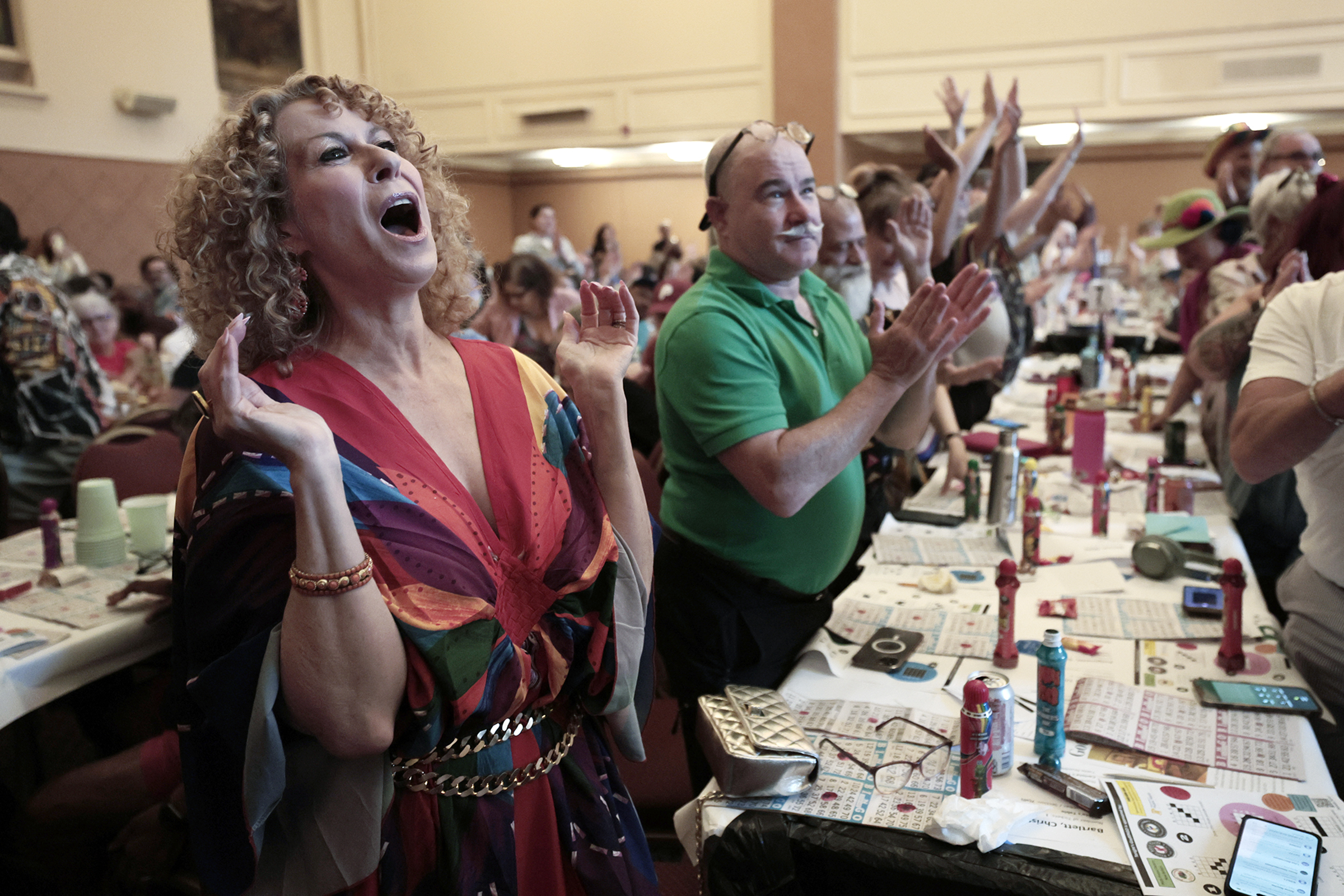
    “None of it would have been possible without all of you,” Carlota told the 400-person crowd — the biggest turnout in years — at her last Gay Bingo on June 13 in the basement ballroom at Congregation Rodeph Shalom. “In the ’90s there was horror happening, and today there is horror happening.

    “But please, let’s do some laughing,” Carlota said.

    “Let’s play bingo!”

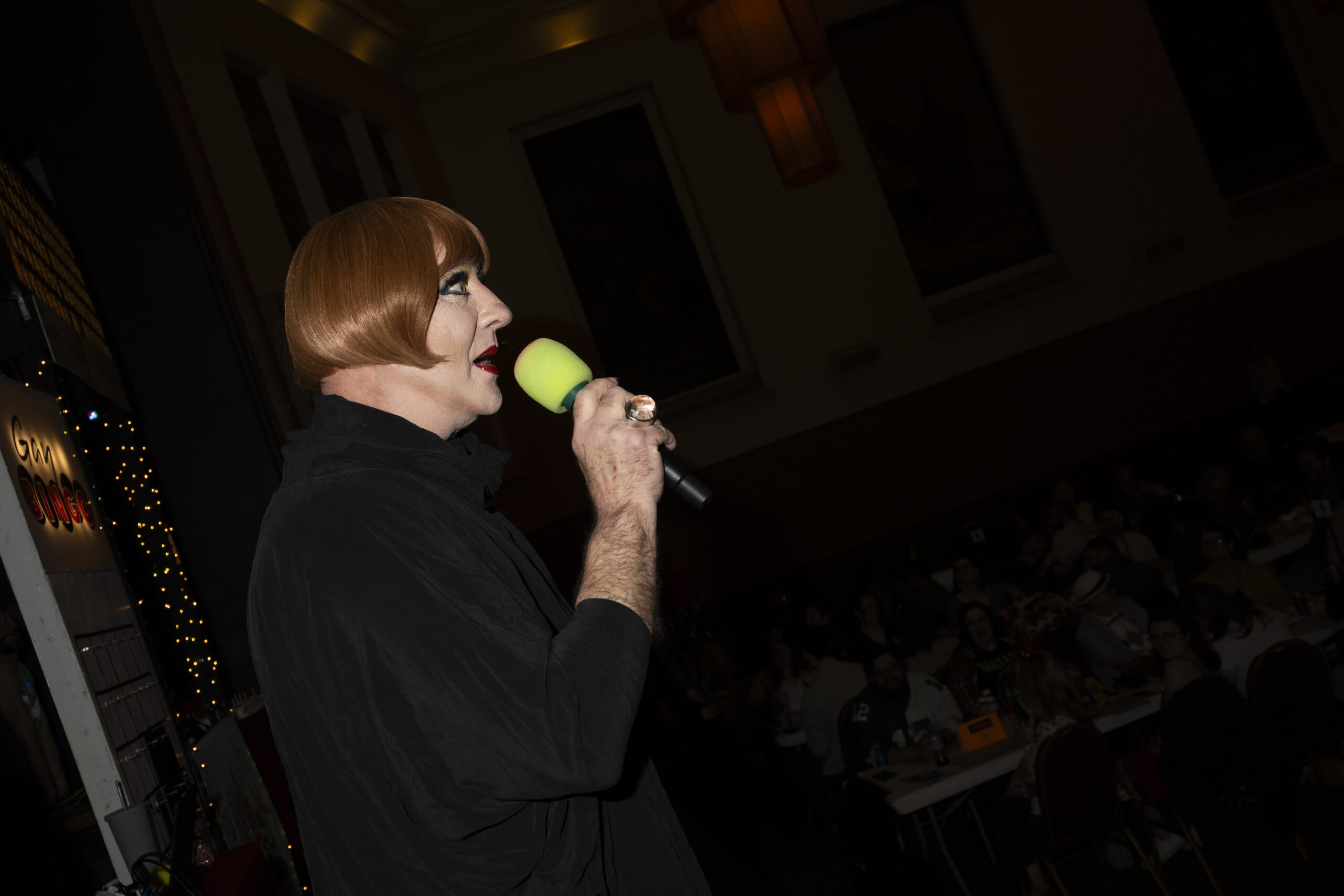
    Michael Byrne, as his drag persona Carlota Ttendant, during Gay Bingo on Saturday, May 9, 2026, at Congregation Rodeph Shalom in Philadelphia.

    Act I

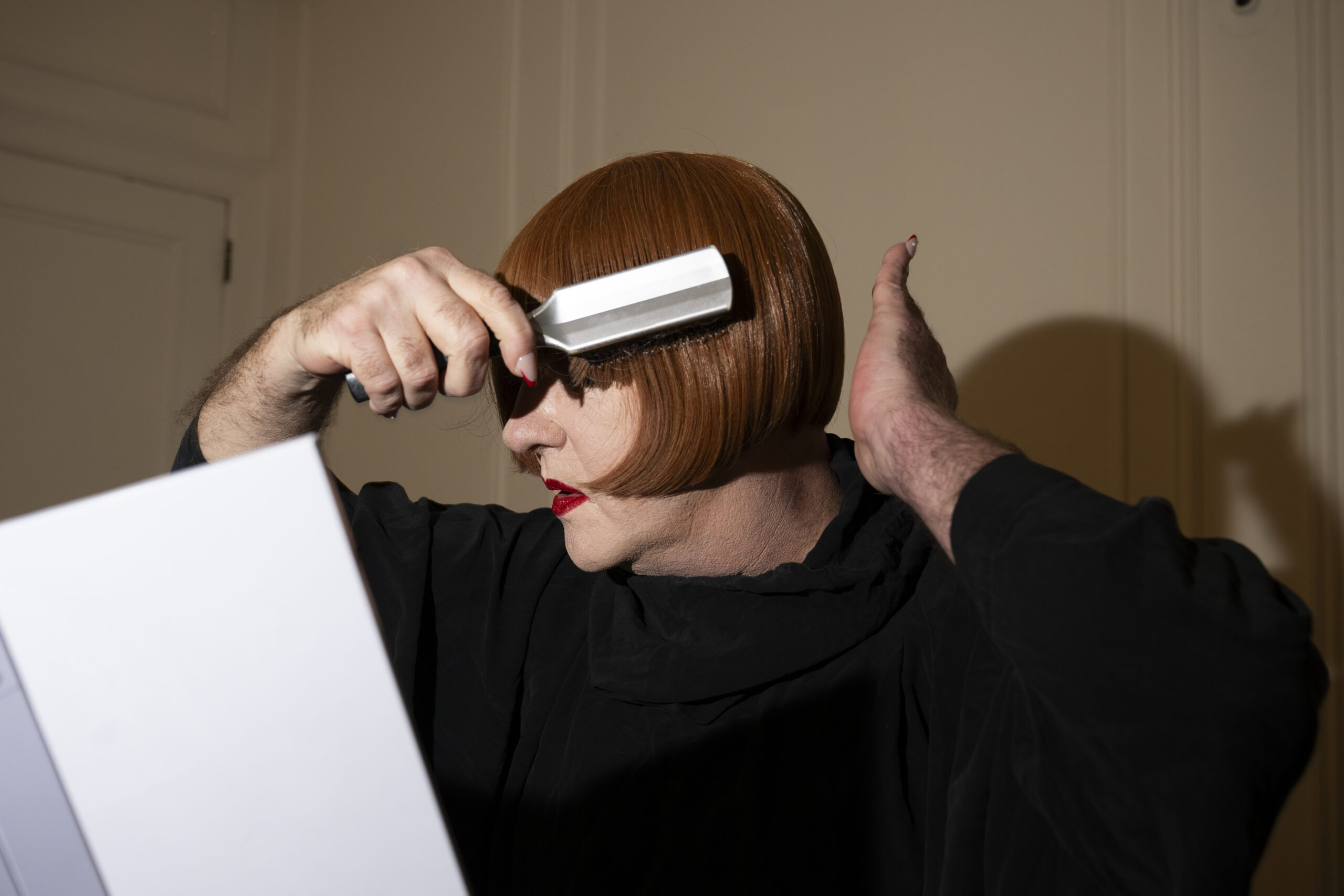
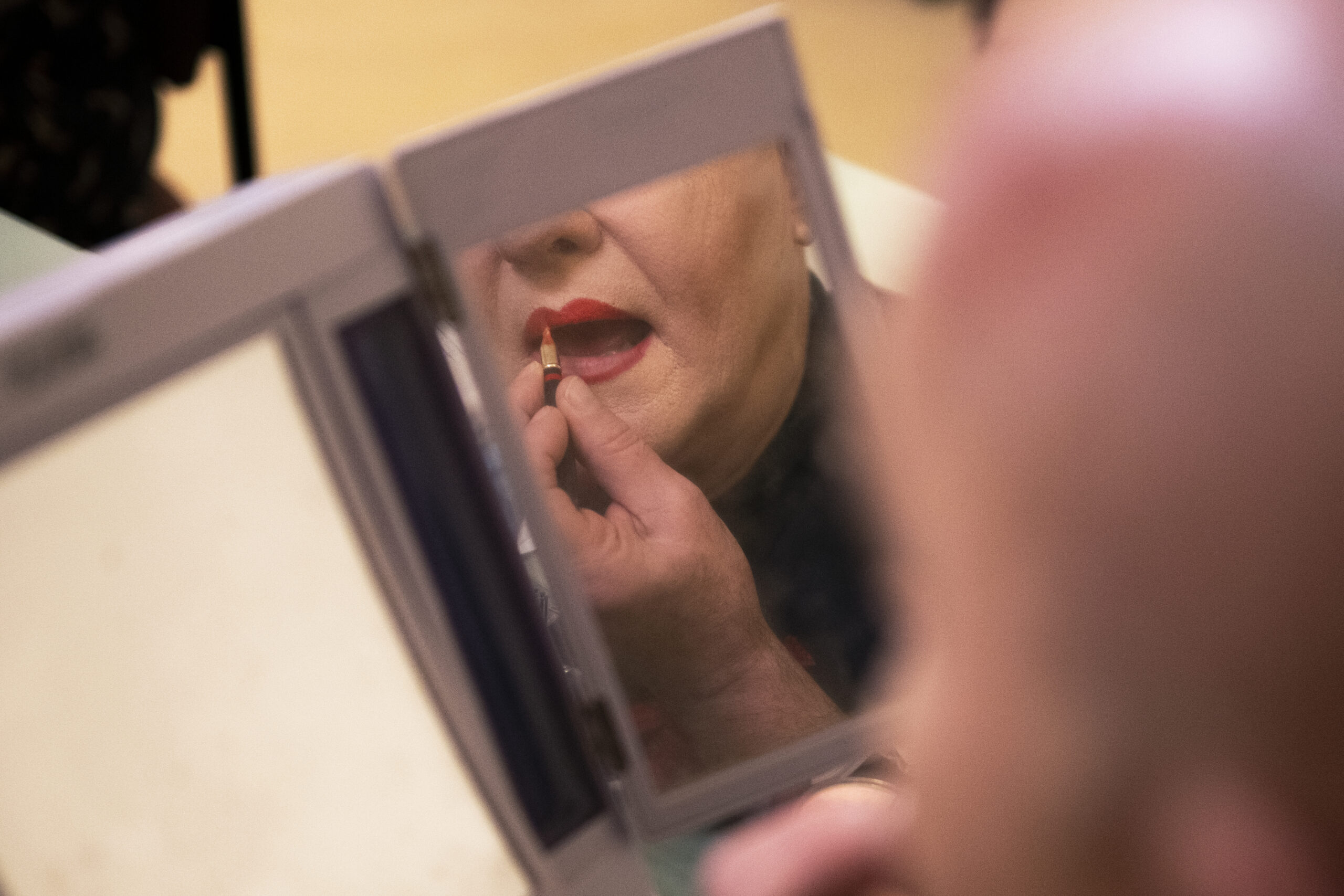
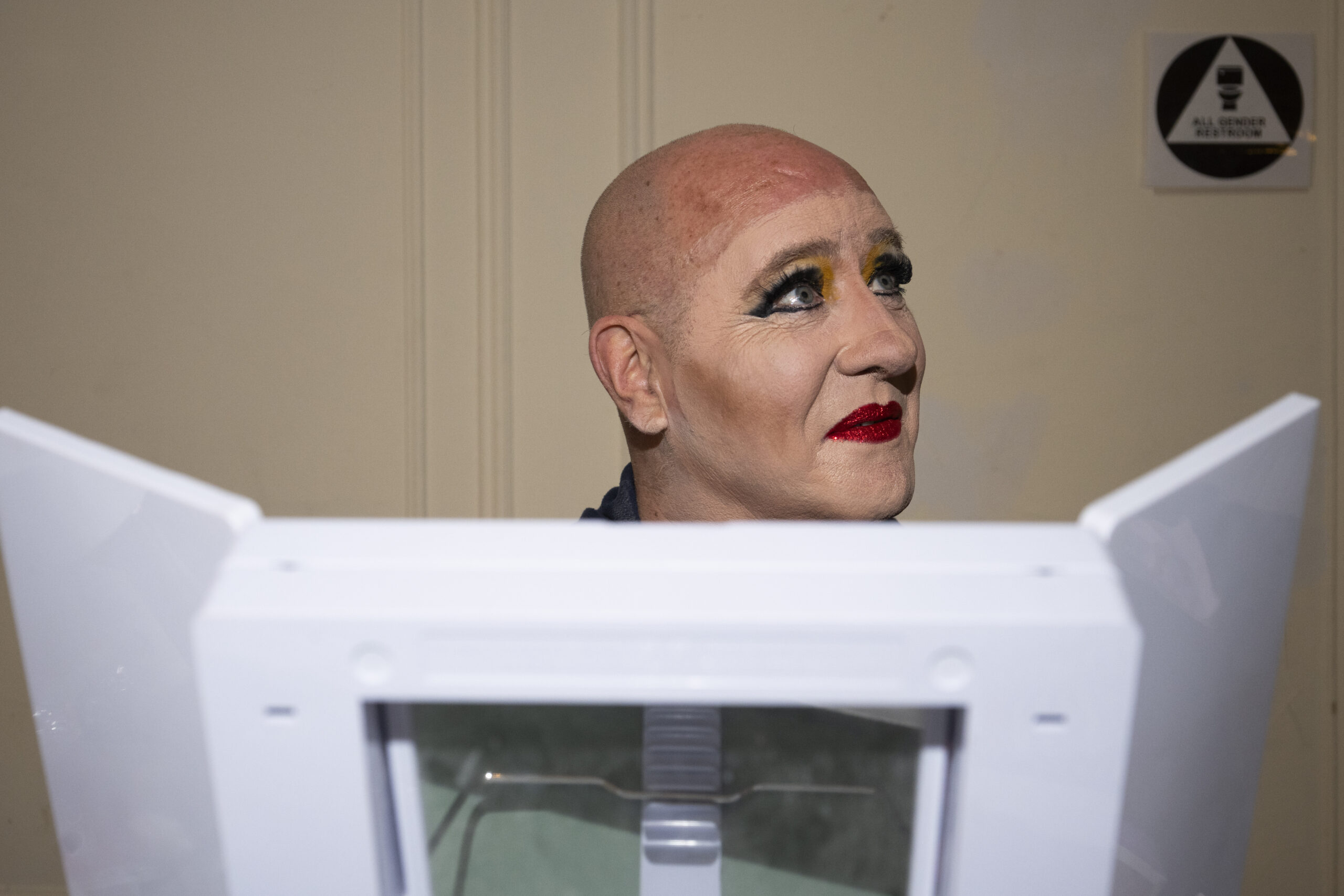
    Like so many Saturdays before, Byrne, on June 13, slathered his face with foundation, carved out his cheeks, deepened his eyes, and painted on his red lip. There was haze — from the dusting of loose setting powder, bronzer, and blush — and musk — from sweat and heat and hairspray — in a Rodeph Shalom classroom, which moonlights as a bridal suite and a boudoir for the Bingo Verifying Divas or BVDs. At 10 minutes till curtain, he futzed with his press-on nails, shimmied into a mod swing dress, straightened the back seams of his tights, and dabbed on some glitter. With each gender-bending step, he transformed into his “twin sister,” Carlota.

    Michael Byrne transforms into his drag persona Carlota Tendant ahead of Gay Bingo on May 9 at Congregation Rodeph Shalom in Philadelphia.

    Like all classy ladies, Carlota’s exact age is lost to time. In the 1990s, Byrne was organizing a fundraiser for Big Mess Theatre, an avant-garde troupe that he helped establish as the spinning axis of Philadelphia’s alternative performance scene, complete with vaudeville acts, an oompah orchestra, and live auction with a striptease routine. Byrne was to host and make his drag debut, and Carlota Ttendant (read as car lot attendant) was conjured up over bourbon and blackjack. (He learned, years later, that there was a ’60s stripper at the famed Trocadero Theatre with the same name.)

    Byrne never aimed to create a perfect, feminine illusion with Carlota. He left his chest unshaven and unstuffed, but short, thrifted dresses showed off his long and feminine legs. Carlota’s makeup was an extension of the exaggerated theater paint Byrne, who has been on stages since he was 10, knew; cheap wigs hid his sideburns. Nothing could mask his deep, raspy, anything-but-ladylike voice.

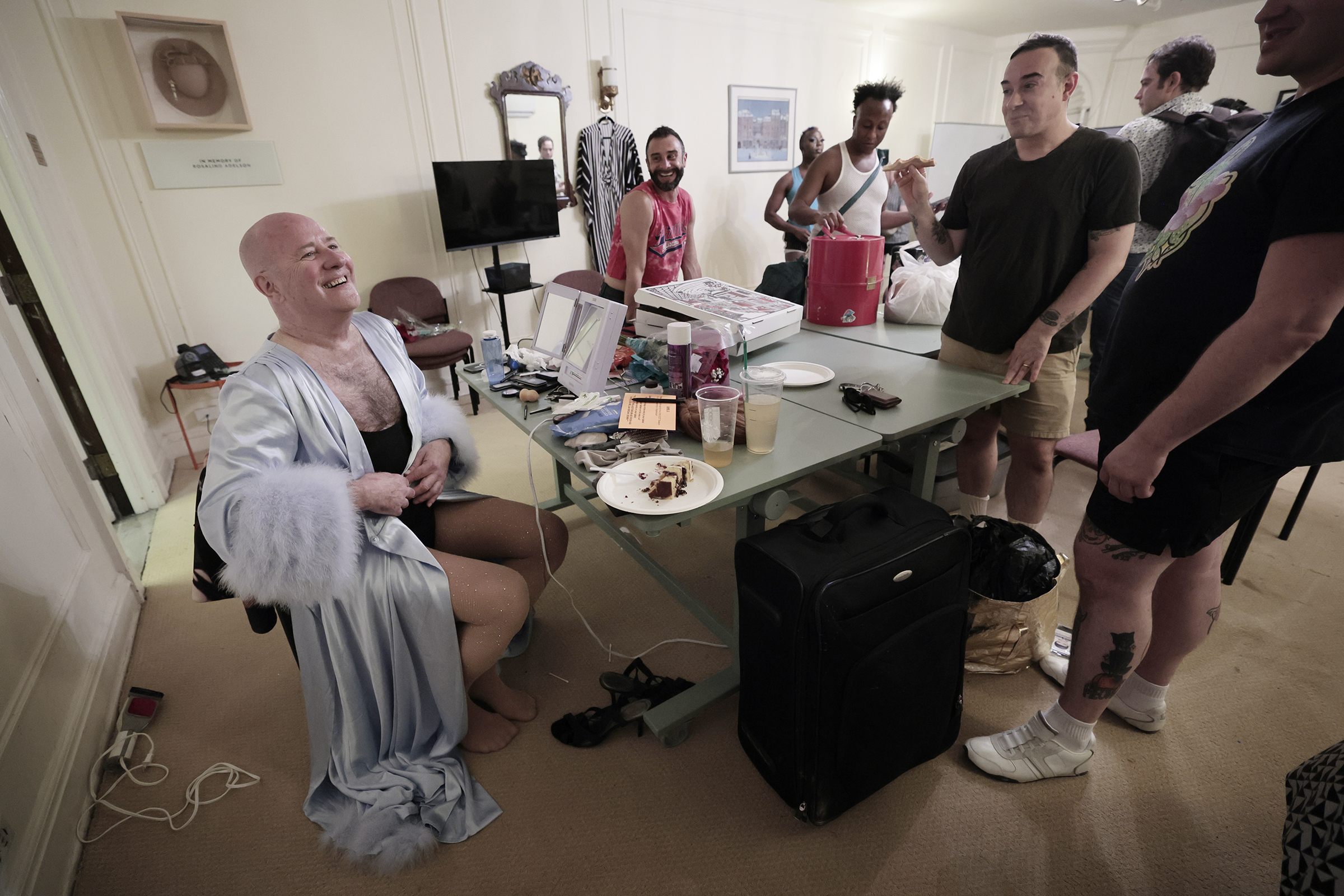
    Carlota Ttendant (Michael Byrne) (at left) laughs with friends and fellow performers after Carlota’s final evening cohosting Gay Bingo at Congregation Rodeph Shalom in Philadelphia on June 13.
    Michael Byrne transforms into his drag persona Carlota Ttendant ahead of Gay Bingo on May 9 at Congregation Rodeph Shalom in Philadelphia.

    Carlota could be bossy and profane but never vulgar; she could poke fun at audiences without being cruel. She became the “drag queen you could bring your grandma to,” Byrne said.

    Around the time Carlota came to be, the number of new AIDS diagnoses and deaths peaked in Philadelphia. In 1992, new AIDS cases surpassed 1,500; in 1994, AIDS deaths topped 900, according to city data.

    (function(){function e(){window.addEventListener(`message`,function(e){if(e.data[`datawrapper-height`]!==void 0){var t=document.querySelectorAll(`iframe`);for(var n in e.data[`datawrapper-height`])for(var r=0,i;i=t[r];r++)if(i.contentWindow===e.source){var a=e.data[`datawrapper-height`][n]+`px`;i.style.height=a}}})}e()})();

    Misinformation about the disease, which strips the body of its natural defenses and leaves it vulnerable to life-threatening infections and ailments, was rampant. People alienated gay men, wrongly fearing HIV/AIDS could be transmitted through a handshake, a hug, or across a dinner table, The Inquirer and Philadelphia Daily News wrote. Diagnostic testing took weeks; what rudimentary treatments were available sometimes made people sicker; and HIV often progressed to AIDS within a few years.

    “It was not unusual to have people dying every month,” said Kevin Burns, who as a case manager with the nonprofit ActionAIDS (now called Action Wellness) connected clients to hospice care. Burns later served as Action Wellness’ executive director.

    The need for resources was rife, and in 1996, Philly’s nonprofit AIDS Fund set out to supplement the money it made from its annual AIDS Walk, according to Sandra Thompson, former chair of its board of directors. An article in City Paper about an irreverent bingo-drag night sweeping Seattle — which, by one report in the Seattle Times, raised $10,000 a night — caught the attention of Mark “Chumley” Singer, then a fledgling events producer, who pitched the idea to the AIDS Fund. (The fund folded in 2024 due to the decrease in new AIDS cases, and turned ownership of Gay Bingo over to Action Wellness.)

    Singer recalled thinking at the time: “I’ve been doing sad, mopey, candlelight vigil fundraisers. … Why can’t we raise money and have fun?”

    Singer and Byrne had never met before the latter was tapped to host Gay Bingo, but their chemistry was kismet.

    “There was never a show where we weren’t having more fun than everybody,” said Singer, who cohosted until the early aughts. Byrne and Singer left Gay Bingo around that time, but Byrne later returned.

    Byrne remembers the magic of those early years of Gay Bingo. He remembers when 600 seats would sell out in 10 minutes, and he remembers doing his glittered red lip from the floor of the Gershman Y’s mirrored dance studio. He remembers two-show Saturdays and how six hours in heels would make him catatonic on Sunday. He remembers riffing with and ribbing Singer and the laughs their off-color jokes and mild profanity elicited. He remembers the constant movement of the bold and bawdy BVDs, on Rollerblades, or the electricity when O-69 was called and hundreds stood up, shaking and shouting with the fervor of their libidos.

    But Byrne also remembers the solemn moments: the steelworker who told a documentarian about watching his bodybuilder son become emaciated; the families who sponsored games on the anniversary of their loved one’s death; the pharmacist who learned all he could about HIV drugs; Byrne’s own friends who were infected.

    “Our community was in crisis,” Byrne said, “while we focused on it, we also focused on being fun and laughing.

    “And we all needed that at that point.”

    Act II

    The “Rainbow Bombshell” Gay Bingo on June 13 doubled as a Pride extravaganza and an homage to all things Carlota. Her first outfit of the night was crafted from a promotional banner from her years hosting the Philadelphia Orchestra’s Halloween Concert. Alongside her, the BVDs dressed as Big Mess-era Carlota, Norma Kamali-inspired Carlota, Phillies Carlota, and fuzzy caftan-wearing Carlota. Attendees, ushers, volunteers, and even the American Sign Language interpreter wore that signature red bob — wigs that Action Wellness bought in bulk. One wore a T-shirt that read, “Dibs on the ginger.”

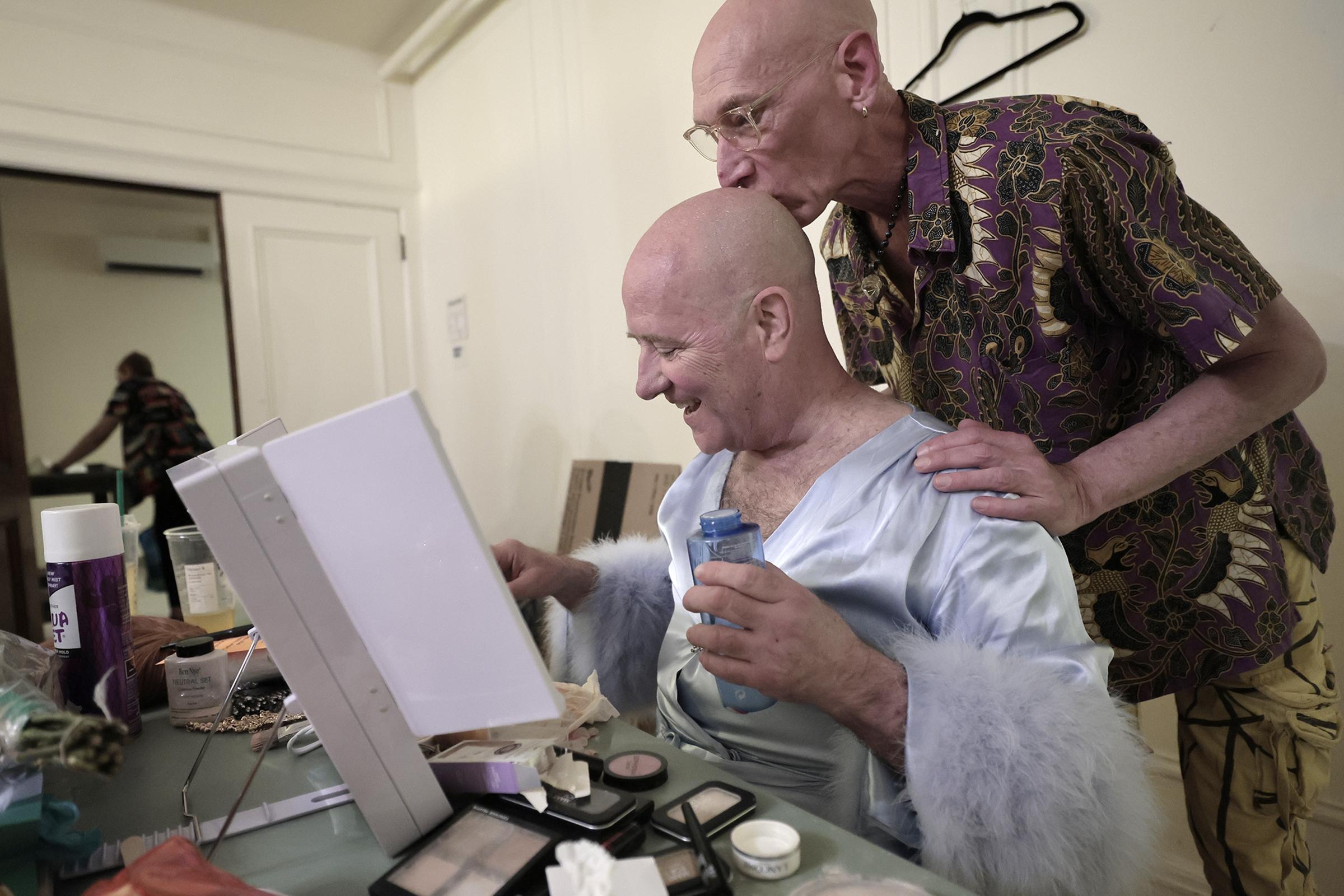
    In the dressing room, Tess Tickle (Paul Struck) kisses Carlota Ttendant (Michael Byrne) on the head after Rainbow Bombshell Gay Bingo at Congregation Rodeph Shalom in Philadelphia on Saturday, June 13, 2026. “I love him” said Struck as he walked out of the dressing room.
    Carlota Ttendant (Michael Byrne) puts on a favorite crystal ring and fake nails before cohosting Rainbow Bombshell Gay Bingo on June 13.

    “Are we ready to win some money?” Carlota said, hyping up the crowd before the first of 12 rounds of bingo. Councilmember Rue Landau, the Philadelphia City Council’s first openly LGBTQ+ member, called the first game:

    I-28.

    I-26.

    G-52.

    B-14.

    O-63.

    B-3.

    “Bingo!” someone cried out, as the audience let out an audible wave of disappointment, exasperation, and defeat, and the BVDs rushed over to authenticate.

    “Did you just get bingo, girl?” Carlota wisecracked.

    For 30 years, these Gay Bingo players have pledged each month to “keep on playing Gay Bingo until this crisis is over.” And today, HIV/AIDS deaths and new diagnoses have stagnated, according to the most recently available health department data, and drug cocktails have made it so people with HIV can live long, healthy lives and may never pass the disease onto others or have their illness advance to AIDS. Preventative medications, like PrEP, can also dramatically decrease the risk of becoming infected.

    Michael Byrne, as his drag persona Carlota Ttendant, on May 9 at Congregation Rodeph Shalom in Philadelphia.

    But there are still obstacles to ending the epidemic. HIV/AIDS disproportionately affects Black and brown communities and low-income people who experience barriers to healthcare, according to Action Wellness executive director Mary Evelyn Torres. The geographic disparities are also stark: Current drug regimens may be readily available in well-resourced countries, like the United States, but access is scarce in the world’s vulnerable pockets. These problems have only been exacerbated by President Donald Trump’s proposed cuts to domestic and foreign HIV/AIDS programs. The withdrawal of American dollars overseas, United Nations officials warned, could lead to more than 4 million AIDS-related deaths and 6 million more HIV infections by 2029.

    (function(){function e(){window.addEventListener(`message`,function(e){if(e.data[`datawrapper-height`]!==void 0){var t=document.querySelectorAll(`iframe`);for(var n in e.data[`datawrapper-height`])for(var r=0,i;i=t[r];r++)if(i.contentWindow===e.source){var a=e.data[`datawrapper-height`][n]+`px`;i.style.height=a}}})}e()})();

    Meanwhile, the Trump administration and state legislatures are attempting to roll back protections for LGBTQ+ people. In Philadelphia, Pride celebrations this month in the Gayborhood were disrupted after Philadelphia police pushed and confronted revelers using what some have called outsized and aggressive crowd-control tactics, although Police Commissioner Kevin Bethel said his department’s actions had nothing to do with Pride. City Council has since announced it will hold public hearings to examine the police response.

    “We’ve come a long way, but there’s still work to be done,” Torres said, “and that work is being threatened by this administration.”

    As the epidemic has changed, so has Gay Bingo: The money raised — more than $5 million since its inception — now goes toward Action Wellness’ social services and programming. The BVDs ditched their roller skates at the Gershman Y (because of the new, carpeted venue). Tickets cost $50-$60, compared to $10-$12 in May 1996, and these days, attendance averages between 150 and 200 a month.

    Drag has evolved, too. Spending centuries on the periphery as proto-punk-beatniks and after-midnight acts, queens disrupted and challenged the mainstream with wit and wonder. Then, the exploding popularity of RuPaul’s Drag Race, a drag reality-TV competition, seismically changed the culture, snubbing scrappiness for silicon and kitsch for couture. The show ushered drag into the zeitgeist: Its lingo became commonplace and its contestants turned into social media stars, with businesses, makeup brands, books, and podcasts, as the art form continues to face political bans and threats nationwide.

    The show “has taken everything to a whole other planet,” Byrne said, “and that’s amazing and that’s really great.

    “That’s also not what I do.”

    Carlota was never concerned with “affecting female mannerisms” or “trying to be this woman or this drag queen,” Singer said. To Byrne, she’s come to embody the fiercest, most unafraid, and righteous versions of himself. But “Michael was never far from Carlota,” Singer said.

    Janie Lopez of Philadelphia cheers for her friend Carlota Ttendant during Gay Bingo at Congregation Rodeph Shalom.

    To those who know Byrne, Carlota’s come to represent someone purer and more singular, a testament to what joyful resistance and defiant resilience can achieve amid tragedy. Her ingenuity and authenticity have made her synonymous with Gay Bingo, according to Action Wellness event planner and cohost Tim Johnson (otherwise known as Stella D’Oro); her playfulness is what’s engaging, Burns said; the safe space she’s cultivated for the queer community is what keeps people coming back season after season, said regulars Cat Johnson, 47, and Katie Dickerson, 38, of Roxborough.

    “It’s going to be really different without Carlota,” Johnson said. “No one’s going to fill her shoes, but I think that the vibe and the energy is going to live on.”

    “It’s a lot easier to raise money when everyone is having fun,” said Amber Schlesman, 38, of Point Breeze, who’s been coming to Gay Bingo since its Gershman Y days. “And for the shoes, I’m guessing it’s a size 12.”

    All those shoes will be donated to Philly AIDS Thrift soon enough, Byrne said.

    Epilogue

    Byrne’s voice cracked as he thought of the people who made Carlota’s run possible: the AIDS Fund organizers, Singer, the original cast of BVDs, the volunteers, those who came back monthly, the victims, their families. Many sent her off June 13 with a trove of well wishes, notes that read, “thanks for the memories,” and “so proud of all you’ve done.” They told her, “I love you,” and “hang up those high heels, baby.”

    At the end of the night, Byrne’s best friend gifted him a throw pillow.

    “Don’t be a lady,” it said. “Be a legend.”

    Michael Byrne transforms into his drag persona Carlota Ttendant ahead of Gay Bingo on Saturday, May 9, 2026, at Congregation Rodeph Shalom in Philadelphia.
  • Philadelphia opens new LGBTQ+ visitor center, one of few in country

    Philadelphia opens new LGBTQ+ visitor center, one of few in country

    It is a simple, sleek storefront in the Gayborhood. And it is now a welcoming spot.

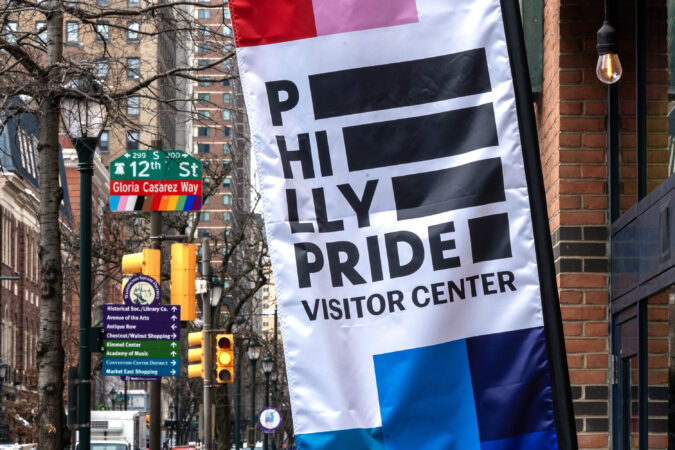
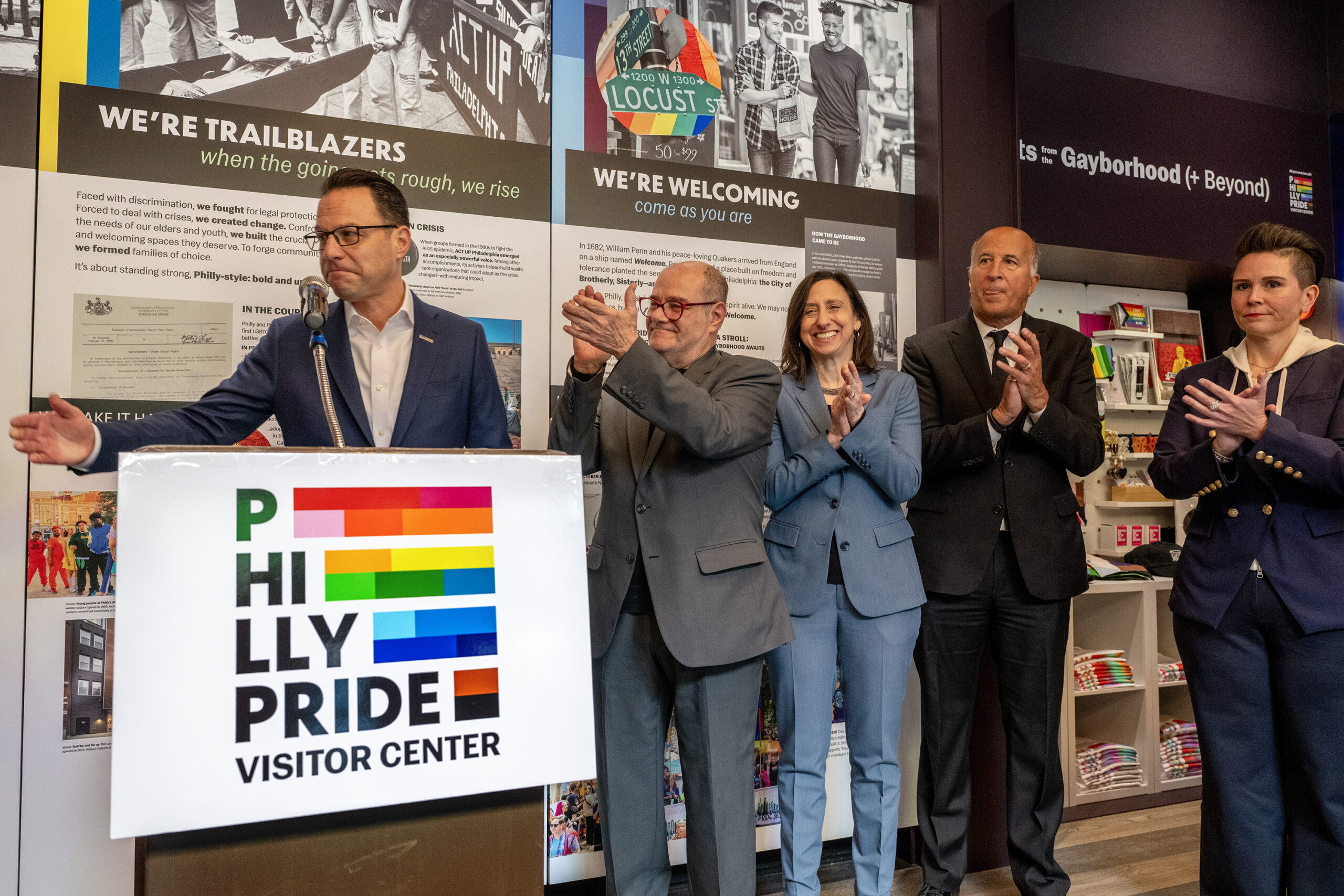
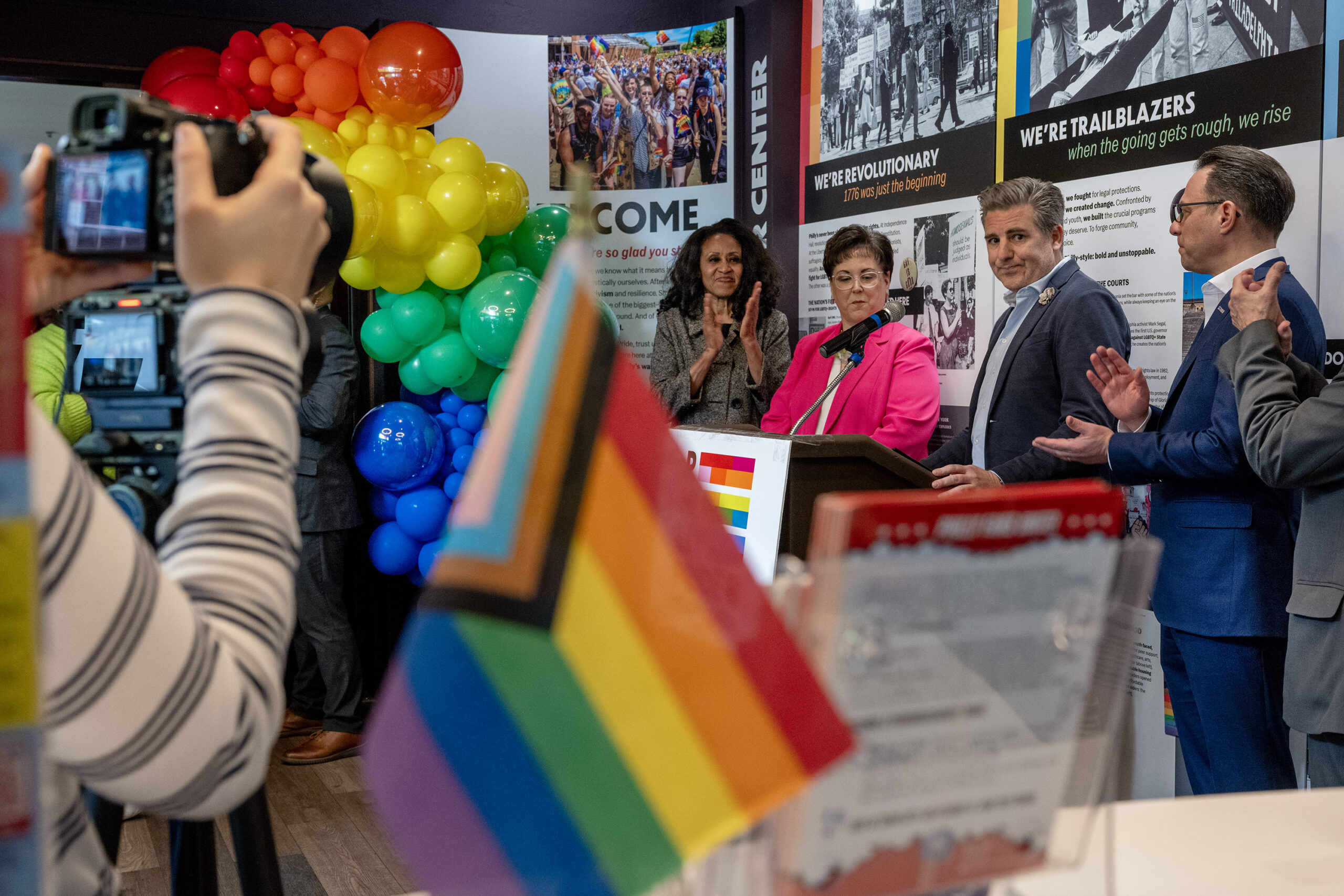
    On Wednesday, Gov. Josh Shapiro, city tourism and marketing leaders, and LGBTQ+ advocates officially opened the Philadelphia Pride Visitor Center, one of the country’s first LGBTQ+ visitor centers.

    “We need happy things in the world,” Shapiro said, during a ribbon cutting at the center. “And we need places like this that bring people together. That is the Pennsylvania way.”

    Gov. Josh Shapiro opens the Philly Pride Visitor Center Wednesday, Feb. 25, 2026, in the heart of the city’s Gayborhood at 12th & Locust. With him, from left, are Mark Segal, Philadelphia Gay News founder; City Councilmembers Rue Landau and Mark Squilla; and Anne Ryan, Pennsylvania Deputy Secretary of Tourism.

    The Philly Pride Center is now just one of a handful of LGBTQ+-dedicated visitor centers in America, including ones in New York and Miami. Opening ahead of Philadelphia’s big summer celebrations for the 250th anniversary of America in 2026, also known as the Semiquincentennial, officials described the center as a symbol that Philadelphia, the city of the nation’s birth, welcomes all.

    “At a time when other states are walking away from their LGBTQ+ community, we are walking toward it,” Shapiro said. “At a time when other states are saying ‘no’ to pride-based tourism, we are embracing it.”

    Located near 12th and Locust Streets, in a storefront connected to Knock Restaurant and Bar, the center offers visitor services, including itinerary planning, attraction ticketing, and travel information, with a focus on LGBTQ+-affirming destinations, businesses, and cultural institutions. Souvenirs made by LGBTQ+-owned businesses and artists are on sale.

    Neil Frauenglass (second from right), chief marketing officer with Visit Philadelphia, is recognized for his work during grand opening of the Philly Pride Visitor Center Wednesday, Feb. 25, 2026, in the heart of the city’s Gayborhood at 12th & Locust. With him, from left, are Donna Jackson Stephans, Philadelphia’s chief diversity, equity and inclusion officer; Philadelphia Visitor Center President and CEO Kathryn Ott Lovell; and Gov. Josh Shapiro.

    “The Philly Pride Center reflects something we believe with all of our hearts,” said Kathryn Ott Lovell, president and CEO of Philadelphia Visitor Center Corp., which will run the new center. “That every visitor should feel like they are welcome and that they belong. We want the Philly pride visitor center to be both a very practical resource and a very visible statement about who we are as a city.”

    More than a year in the making — and now open Thursday through Monday, noon to 6 p.m., at 1130 Locust Street — the site will represent Philly’s fifth visitor center, including ones at Independence Mall, City Hall, Love Park, and the Parkway Visitor Center & Rocky Shop.

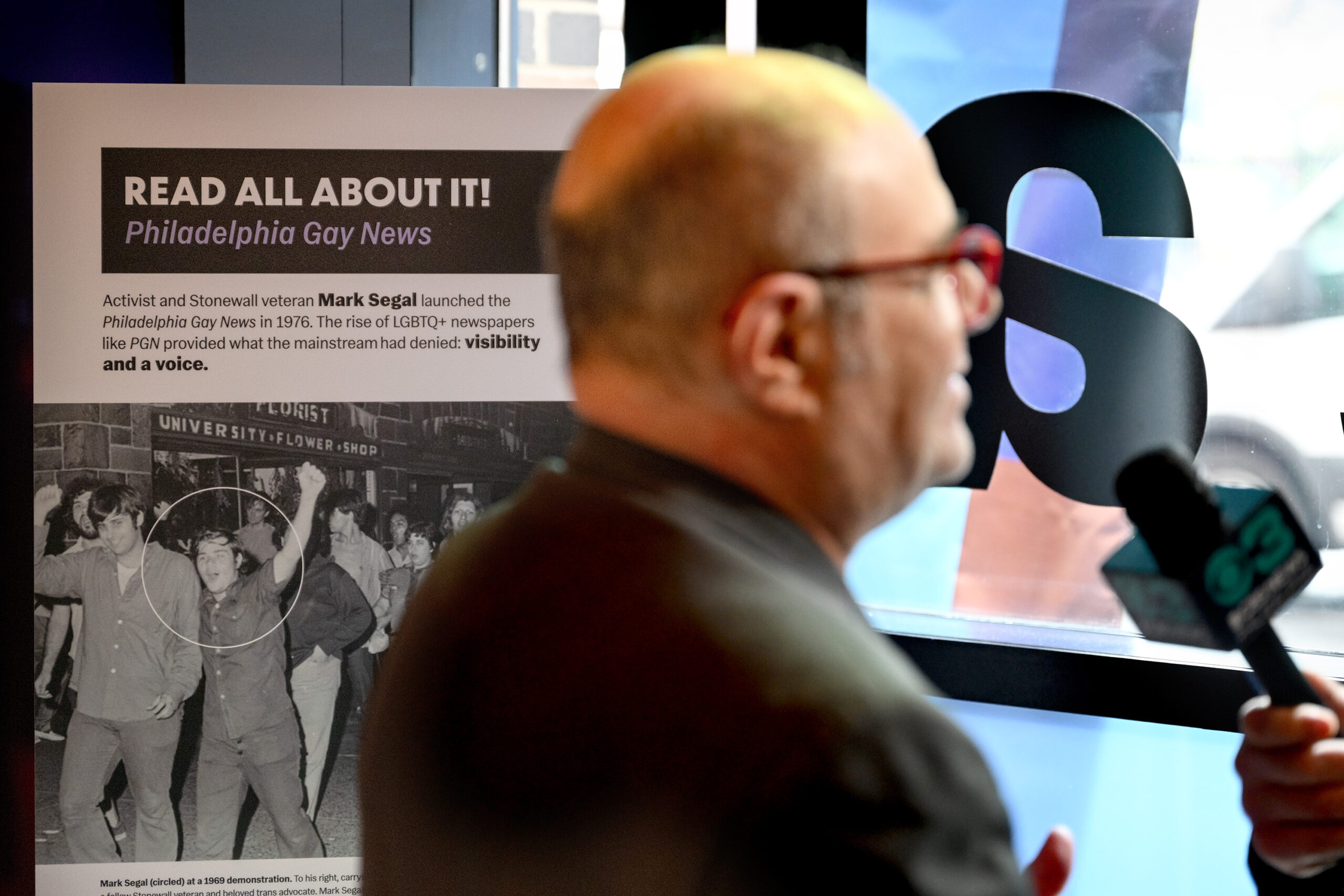
    “Philadelphia’s LGBTQ+ history helped shape this country’s story, and the Philly Pride Center brings that legacy forward in a powerful and visible way,” said Angel Val, president and CEO of Visit Philadelphia, which helped found the center, along with Mark Segal, founder and publisher of Philadelphia Gay News. Segal, an activist and author, who was part of the seminal riots at the Stonewall Inn in Greenwich Village in 1969, curated the historical information exhibited at the center, telling of Philly’s long and powerful LGBTQ+ legacy.

    Mark Segal, Philadelphia Gay News founder and publisher is interviewed during the grand opening of the Philly Pride Visitor Center Wednesday, Feb. 25, 2026. At left is a photo (circled) of him demonstrating for Gay rights in 1969, part of his newspaper’s 50th Anniversary.

    It is a point of pride, Segal said, that the Philly Pride Visitor Center comes at a time when many scholars and activists believe the Trump administration is attempting to sanitize American history.

    “At this time in history, there are many people who are trying to erase us and erase our history,” Segal said. “But today, by opening a new Pride Center, which yells and screams ‘visibility and take pride in who you are,’ we’re saying, ‘No, we’re not going to allow anyone to put us back in the closet ever again.’”

  • History and conservation groups are suing the Trump administration over censorship at national parks

    History and conservation groups are suing the Trump administration over censorship at national parks

    A new lawsuit filed by a group of conservation and history organizations is challenging President Donald Trump’s executive order to remove historic information from national parks.

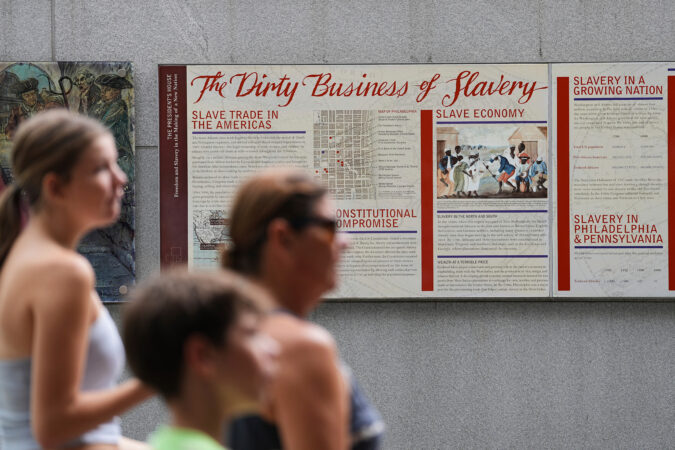
    It comes a day after a federal judge ordered restoration of the slavery exhibits at the President’s House in Philadelphia and marks the latest chapter in a showdown between historical transparency versus censorship.

    On Tuesday, the National Parks Conservation Association filed a lawsuit in Massachusetts federal court against the Department of Interior, challenging Trump’s 2025 executive order that forced national parks to change or strip displays tied to topics ranging from slavery and racism to LGBTQ+ rights and climate change.

    “Plaintiffs are organizations committed to protecting the national parks, preserving history, promoting access to high quality scientific information, and providing high quality interpretive materials — including exhibits, signs, brochures, and other educational materials — that bridge the gap between physical objects and human understanding for park visitors,” the lawsuit says.

    “They and their members — including avid users of national parks and historians whose research is being erased — have been injured by these actions and seek to ensure that the administration does not wash away history and science from what the National Park Service has recognized is ‘America’s largest classroom.’ ”

    The coalition, which includes the American Association for State and Local History, the Association of National Park Rangers, the Coalition to Protect America’s National Parks, the Society for Experiential Graphic Design, and the Union of Concerned Scientists, is asking the court to declare Trump’s executive order unlawful and to order removed materials to be restored.

    “In filing this litigation together, we are taking a stand for the soul of our national parks,” Alan Spears, senior director of cultural resources at the National Parks Conservation Association, said. “Censoring science and erasing America’s history at national parks are direct threats to everything these amazing places, and our country, stand for.”

    In Philadelphia, U.S. District Judge Cynthia M. Rufe issued a ruling Monday requiring the federal government to restore the President’s House site to its original state. The removed exhibits paid tribute to the enslaved people who lived in George Washington’s home during his presidency.

    In her 40-page opinion, Rufe — who is a George W. Bush appointee — does not mince words. She compared the federal government’s argument that it can unilaterally control the exhibits in national parks to the dystopian totalitarian regime in George Orwell’s 1984.

    The plaintiff’s group for the Massachusetts suit is being represented by Democracy Forward, a progressive nonprofit that challenges government actions it views as harmful.

    “You cannot tell the story of America without recognizing both the beauty and the tragedy of our history,” Skye Perryman, Democracy Forward’s president and CEO said in a statement. “The president’s effort to erase history and science in our national parks violates federal law, and is a disgrace that neither honors our country’s legacy nor its future.”

    Beyond Philadelphia, the lawsuit also mentions other examples of Trump’s executive order in action, including the removal of an interactive display mentioning climate change at Fort Sumter in South Carolina, short films on labor history being scrapped at Lowell’s National Historical Park in Massachusetts, and the removal of displays discussing negative impacts tourists, settlers, and cattle ranchers have on the Grand Canyon National Park.

    The lawsuit goes on to point out the irony of Trump’s executive order aiming to avoid “disparaging Americans,” despite the president’s own new signage at the White House, which takes jabs at former President Joe Biden and others along his West Wing “Walk of Fame.”

    The parties are asking a judge to order that national parks must be allowed to present the full historical and scientific picture without censorship and for their court costs to be paid for.

  • CHOP, Nemours targeted by Trump administration over transgender care

    CHOP, Nemours targeted by Trump administration over transgender care

    Escalating President Donald Trump’s fight against transgender rights, a top official at the Department of Health and Human Services on Thursday asked the department’s inspector general to investigate two Philadelphia-area children’s hospitals over their gender-affirming care for transgender children.

    Children’s Hospital of Philadelphia (CHOP) and Nemours Children’s Health in Wilmington are among a dozen hospitals that HHS general counsel Mike Stuart said in posts on X he had referred to the agency’s Office of the Inspector General (OIG) in recent days.

    A CHOP spokesperson declined to comment on Friday, and Nemours did not respond to a request for comment.

    Both hospitals treat children and teens with gender dysphoria — a medical condition in which a person’s body does not match their gender identity. Doctors can prescribe hormone therapy and puberty blockers to treat the condition, although Nemours has already limited its use of these treatments in response to threats from the Trump administration.

    The administration has targeted CHOP and other hospitals that treat transgender youth with subpoenas demanding patients’ medical records, including their dates of birth, Social Security numbers, and addresses, as well as every communication by doctors — emails, voicemails, and encrypted text messages — dating back to January 2020.

    CHOP filed legal action in response, asking a federal judge in Philadelphia to block the parts of the subpoena that sought detailed medical records of patients. In November, the judge ruled in CHOP’s favor.

    The Trump administration appealed the decision Friday. It has argued that it needs the records as part of its investigation into possible healthcare fraud or potential misconduct by the hospitals.

    Stuart said in a Thursday post on X that the administration is investigating hospitals in order to safeguard children from “sex-rejecting procedures,” adding: “There is no greater priority than protecting our children.”

    Corinne Goodwin, executive director of the Eastern Pennsylvania Trans Equity Project, called Stuart’s post part of the Trump administration’s ongoing efforts to intimidate doctors and hospitals that provide gender-affirming care to those under 19.

    “This action by the Department of Health and Human Services is yet another attempt to intimidate healthcare providers and to harm young people who simply want access to proven healthcare that helps them to live happy and productive lives,” said Goodwin, whose nonprofit organization provides services to transgender people in 42 counties, including Montgomery, Bucks, and Delaware.

    In the last year, the president has signed a slew of executive orders aimed at transgender Americans.

    The administration has said it recognizes only two genders, limited research into LGBTQ+ health, and phased out gender-affirming care at the Department of Veterans Affairs.

    Directly targeting children’s hospitals, HHS Secretary Robert F. Kennedy Jr. issued a declaration in December rejecting gender-affirming procedures for minors, including puberty blockers, hormone therapy, and surgeries.

    The American Academy of Pediatrics and other major medical associations, citing research, widely accept such care as safe, effective, and medically necessary for the patients’ mental health.

    HHS’s OIG declined Friday to confirm or deny the existence of an investigation.

    Last month, the U.S. Senate confirmed Thomas “March” Bell to serve as inspector general over HHS. During his confirmation hearing, Bell submitted written testimony saying, “If confirmed as inspector general, I will examine, evaluate, audit, and investigate to support the initiatives of President Trump and Secretary Kennedy.”

    An ongoing legal battle

    CHOP runs one of the nation’s largest clinics providing medical care and mental health support for transgender and nonbinary children and teens and their families. Each year, hundreds of new families seek care at CHOP’s Gender and Sexuality Development Program, created in 2014.

    Nemours’ Gender Wellness Clinic, launched in 2018, provided hormone therapy and puberty blockers, as well as mental health support, to transgender patients in Delaware, and Nemours is the only hospital in the state that provides gender-affirming care for children.

    Starting last July, its clinic began accepting only new patients who need behavioral healthcare. Existing patients receiving hormones or puberty blockers at the clinic were allowed to continue their treatment, the hospital said at the time.

    On Thursday, Stuart wrote on X that CHOP and Nemours “appear to continue to operate outside recognized standards of healthcare and entirely outside @SecKennedy’s declaration that sex-rejecting procedures for children and adolescents are neither safe nor effective.”

    Kennedy’s December declaration says that these procedures “do not meet professionally recognized standards of health care.” Doctors who perform such procedures could be barred from participating in federally funded healthcare programs like Medicaid and Medicare, he said.

    More than a dozen state officials from around the country, including Pennsylvania Gov. Josh Shapiro, filed a lawsuit in late December to block the declaration’s enforcement.

    The lawsuit says that Kennedy has no authority to define “a national standard of care,” and that any substantive changes to Medicare rules are legally required to be subjected to a decision-making process that includes 60 days of public comment.

    Officials at the Centers for Medicaid and Medicare Services have started that process, announcing alongside Kennedy’s declaration that they are proposing a rule that would bar hospitals from Medicaid and Medicare if they offer gender-affirming care to children under 19. They also proposed that Medicaid should not cover gender-affirming care for minors.

    But those rules have not yet been instituted, and the lawsuit alleges that Kennedy’s declaration is skirting the law by immediately imposing restrictions on gender-affirming care in hospitals.

    The Public Interest Law Center, a Philadelphia-based nonprofit that advocates for the civil, social, and economic rights of marginalized communities, is representing five parents of transgender children in legal motions seeking to protect their medical records.

    Mimi McKenzie, PILC’s legal director, said the federal judge in Philadelphia was “very clear and on firm ground” when he ruled in November that the DOJ had no authority to issue the sweeping subpoena and that it violated the privacy rights of children.

    She noted that six other courts around the country have similarly ruled that DOJ “has no right to rifle through children’s medical records.”

    “Gender-affirming care is legal in Pennsylvania and endorsed by every leading medical association,” McKenzie said. “This is just another tactic in their ongoing attack against providers and patients.”

  • Abington Library has offered a safe space for LGBTQ+ kids for years. It’s now the subject of a far-right social media campaign.

    Abington Library has offered a safe space for LGBTQ+ kids for years. It’s now the subject of a far-right social media campaign.

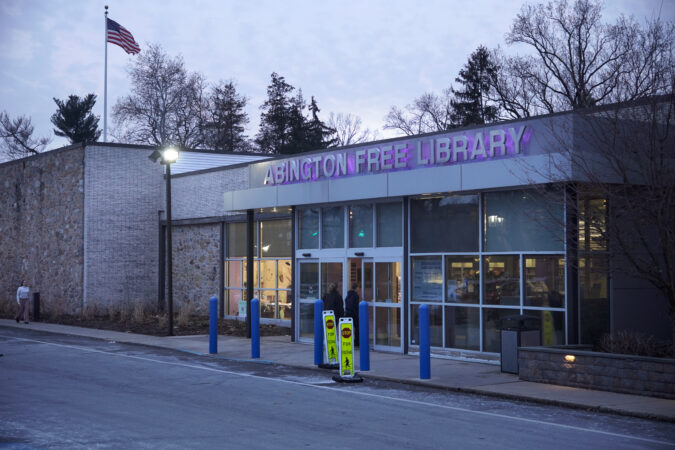
    For more than four years, dozens of LGBTQ+ kids and their families have joined the Abington Township Public Library for Rainbow Connections, a monthly Zoom program, to read children’s books, craft, make new friends, and meet interesting people, such as “Jeopardy!” super champ Amy Schneider.

    But within the past week, the program — the only one of its kind in Montgomery County libraries — has become a target of a right-wing social media campaign that has circulated misinformation and directed threatening language at the program, prompting the library to release a statement Monday setting the record straight, said Library Director Elizabeth Fitzgerald in an interview Tuesday.

    “Rainbow Connections is not a sexual education class. Sexual health, reproduction, puberty, and intimate relationships are not discussed,” the statement said in part.

    Though it’s “not different from any other story time or library program,” Fitzgerald says, Rainbow Connections’ mission is to foster a welcoming and intentional environment for LGBTQ+ kids in grades K-5, including those who may be struggling to make friends at school. Its virtual format has allowed families from around the country to join.

    “Ultimately just a space where the kids could attend a library program and feel safe,” Fitzgerald said.

    Comments attacking the program appeared on the library’s Facebook page early last week. A day later, LibsofTikTok, a controversial far-right social media account founded by Chaya Raichik, as identified by the Washington Post, posted about Rainbow Connections.

    LibsofTikTok, which frequently targets LGBTQ+ people nationwide, spurred misinformed outrage from its millions of followers about the program’s upcoming events.

    The account’s posts have often provoked real-life consequences. In 2024, after posting about the William Way Community Center, an LGBTQ+-focused nonprofit in Philadelphia, Democratic Sen. John Fetterman and former Democratic Sen. Bob Casey signed a letter requesting to withdraw federal funding from a renovation project that would have made the center’s headquarters more accessible and expanded William Way’s programming space.

    “These are difficult times, and I think that the commentary that took off on social media underscores the reason why we need to create spaces where members of the LGBTQ community feel safe,” Fitzgerald said.

    Library staff established the program in November 2021 after a community member reached out and asked if the library would help address a need for a safe space for LGBTQ+ kids.

    According to anonymous comments from families provided by the library to The Inquirer, parents are profoundly grateful for the safe environment that Rainbow Connections has created for their children. Names were withheld by the library to protect families’ safety and privacy.

    “My children live in a two-mom household, so I thought it would be a great program to connect with other kids and possibly see other families that look like ours,” one parent said.

    Another parent said they had “tears in my eyes listening to [the kids] introduce themselves, awed by their bravery and vulnerability.”

    A family who lives in North Carolina said Rainbow Connections helped their child better understand their identity and build community — “Your program brought us light, hope and education when we were feeling isolated, confused and hopeless.”

    The social media ambush against Rainbow Connections comes amid an increasingly hostile environment for the LGBTQ+ community. For instance, President Donald Trump signed an executive order recognizing only two genders, and his administration has proposed a plan to prevent hospitals from offering gender-affirming care to minors.

    In Abington, it’s not the first time that events related to the LGBTQ+ community have been disparaged, said Township Commissioner John Spiegelman, who represents the area where the public library is located. The township’s yearly raising of the Pride flag has provoked a lawsuit against Spiegelman and other members of the board, he said.

    “Is it getting worse here and everywhere? Certainly it is,” Spiegelman said.

    In the aftermath of the social media posts, Fitzgerald said Rainbow Connections will be contacting parents to say the program will continue and that “their safety is ensured.”

    “It is my hope that the children who participate don’t have any idea that this is going on,” Fitzgerald added.

    Since the online backlash, the Montgomery County community has rallied around the library and Rainbow Connections, which has served as a model for other Pennsylvania libraries’ programming for LGBTQ+ youth.

    “More communities should embrace programs like Rainbow Connections,” said Jason Landau Goodman, board chair of the Pennsylvania Youth Congress, an LGBTQ+ advocacy organization, in a statement. “Young students today read books that feature all types of people because diverse stories reflect the real world we live in.”

    “Some students experience bullying or harassment based on who they are — and many still do not get opportunities to see themselves reflected in the stories they learn from,” added Goodman, who is also running for state representative in Montgomery County.

    The Abington Human Relations Commission said in a statement Monday that they stand in “solidarity” with the library and encouraged community members to “seek information directly from reliable sources and to engage in dialogue grounded in respect and understanding.”

    Fitzgerald said that in spite of the derogatory comments snowballing online, the library has been receiving an onslaught of supportive calls and emails.

    “That’s really meant the world to us,” she said. “Just to know that the people who don’t want this program to exist, they’re a vocal, small, nonlocal majority, and that I believe there’s a much larger number of residents who love the library and who care about their neighbors and fellow community members.”

  • Lies feed pervasive attacks on transgender and nonbinary people

    Lies feed pervasive attacks on transgender and nonbinary people

    Roughly two out of every 100 people in the U.S. identify as transgender or nonbinary.

    As 2026 opens, it is a fitting time to consider how disproportionately small that number is when viewed in light of the proliferation of news about anti-transgender talking points and policy initiatives, lethal anti-transgender violence, and recent years’ epidemic of transgender youth suicidality.

    The disinformation campaign launched by prominent Republicans against transgender and nonbinary people has become pervasive in public discourse. By repeatedly casting aspersions upon the tiny fraction of competitive athletes who are transgender, a moral panic about “fair play” and locker rooms has been amplified in the absence of scientific evidence to support the validity of the histrionic claims being made.

    The U.S. Department of Health and Human Services is threatening to shutter hospitals providing medically approved care for transgender youth endorsed by the American Medical Association and the American Academy of Pediatrics. The recently passed House bill criminalizing gender-affirming healthcare for minors is making its way to the Senate for a vote. The Food and Drug Administration is targeting private companies that market body positive products for gender affirming self-presentation with legal threats.

    A protest at an event honoring Florida Gov. Ron DeSantis over his antigay policies. The right has targeted trans people, in particular.

    Meanwhile, the abundance of research demonstrating that transgender people suffer disproportionate violent victimization, homelessness, and suicide has remained largely unaddressed.

    Moderate politicians’ concern with appealing to wider audiences in these divisive times exacts a cost: to trans kids’ health, safety, and dignity in their schools and communities.

    Ambivalent Democrats

    Rather than forging alliances to protect the safety and constitutional rights of transgender citizens, some of the most influential members of the Democratic Party — from Kamala Harris to Pete Buttigieg to Rahm Emanuel to Gavin Newsom — have at least partially capitulated before the political tidal wave of anti-transgender disinformation, complete with all of the red herrings it washes ashore.

    When powerful Dems take the bait, they brand the abandonment of their platform’s core values as political pragmatism. In doing so, they weaken the alliances that could bolster the very ground upon which they wish to reestablish their standing.

    Yet, despite the political caution that fuels the Democratic Party’s lack of moral courage on trans issues, passive complicity in response to the right’s virulent anti-trans rhetoric has actually not proven to be a winning strategy for them — as last November’s election results reillustrated.

    More importantly, by keeping to the intentionally distorted discourse about transgender people — rather than countering sensationalized falsehoods and vitriolic rhetoric with integrity and conviction — politicians end up appealing to and emboldening constituencies who lean into disinformation out of fear. This isn’t only cynical, it’s dangerous. FBI hate crime statistics tell a bleak story of the rise in vigilante violence against transgender Americans, coinciding with a steep rise in political antagonism and targeted scapegoating.

    A recent effort led by U.S. Reps. Sarah McBride (D., Del.), Mark Takano (D., Calif.), and members of the Congressional Equality Caucus calls upon House Speaker Mike Johnson (R., La.) to enforce the rules of decorum in Congress by holding those who defame and denigrate the trans community to account. As of this writing, no response has been issued.

    A path forward

    The only ethical and effective path forward demands that we fundamentally reframe the political conversation about transgender people in factual terms that are grounded in foundational democratic principles, credible science, and a commitment to the protection of civil rights and civil liberties of all Americans.

    There is some hope to be found in the lawsuit filed this week by 19 Democratic states to block the federal government’s efforts to ban gender-affirming care nationally.

    Ideally, we would see more leadership on both sides of the aisle to protect the safety, freedom, and human dignity of all LGBTQ+ people, as demonstrated in the introduction of the bipartisan Global Respect Act by McBride and U.S. Rep. Brian Fitzpatrick (R., Pa.) to protect LGBTQ+ people around the world from identity-based violence, torture, and persecution.

    Regressive political forces have always sought to isolate and villainize minoritized groups, to paint them as threats to the majority by virtue of whatever marks them as somehow “different” from those in power — and therefore less deserving of the same rights and protections.

    Consider that during the civil rights movement in the 1960s, boycotts of segregated lunch counters and department stores were underway in Southern communities when New York U.S. Rep. Adam Clayton Powell famously corrected a reporter who queried if he was advocating for “Negroes” to stay out of segregated national chain stores in solidarity with the boycotts.

    “Oh no, that’s not true,” Powell countered. “I’m advocating that American citizens interested in democracy stay out of chain stores.” With that sentence, he turned the conversation inside out to reveal its core: Civil rights and civil liberties are the central pillars of a democratic society — not exclusive privileges to be hoarded by any one set of citizens so as to dehumanize and disadvantage another.

    A genuine commitment to our democracy demands that we shift our discursive paradigm from one that impugns the existence of transgender people to one that impugns the de jure and de facto denial of transgender people’s humanity, dignity, civil rights, and personal safety.

    It is long past time to reset the terms and reclaim the narrative on the equal protections and constitutional rights of transgender Americans. The political leadership we need in this moment requires the clarity, intentionality, and fortitude to do just that.

    Ashley C. Rondini is an associate professor of sociology at Franklin and Marshall College.

  • CBS Philadelphia anchor Jim Donovan set the Guinness record for largest sock collection

    CBS Philadelphia anchor Jim Donovan set the Guinness record for largest sock collection

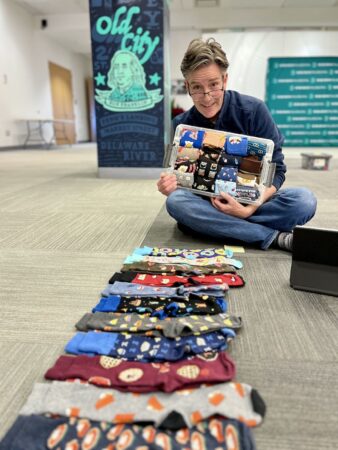
    At 9 years old, Jim Donovan would share with his parents his dreams of becoming a journalist. Around that time, he also flicked through the Guinness Book of World Records, thinking it would be cool to set one himself one day.

    Both dreams culminated last month, after Donovan retired from a nearly 40-year broadcast journalism career and set the Guinness World Record for the largest collection of socks.

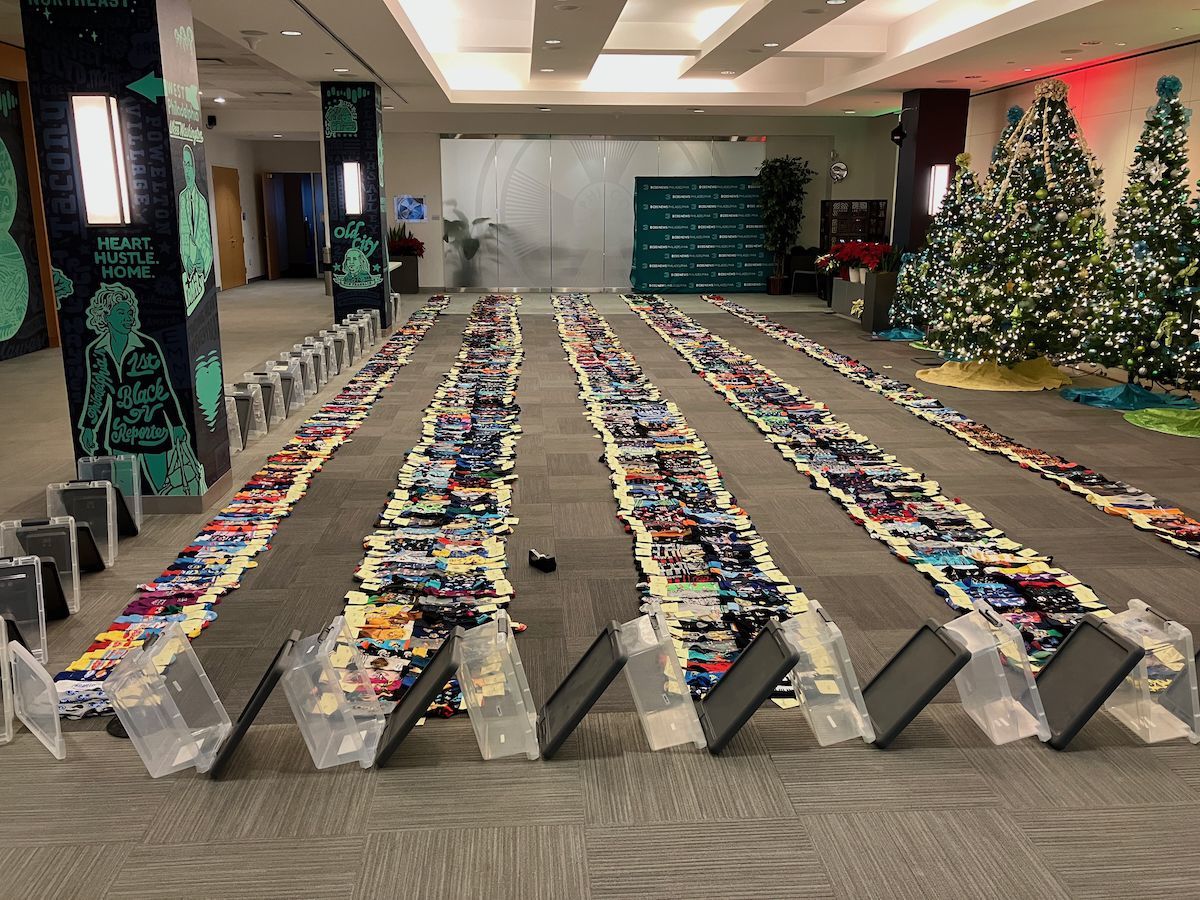
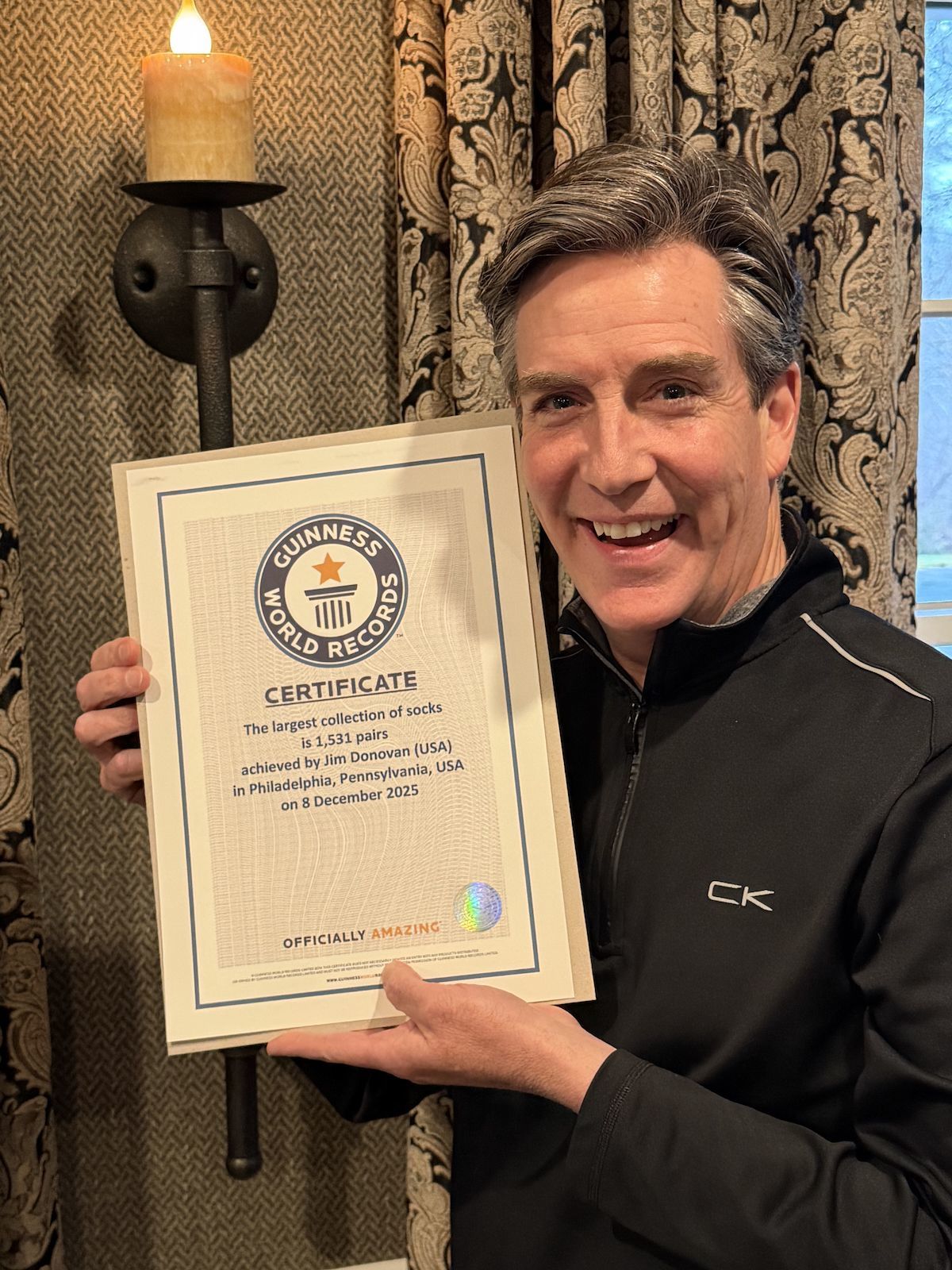
    Guinness World Records verified on Dec. 8 that the 15-time Emmy winner is now the owner of the world’s largest sock collection at 1,531 pairs, many of which have eccentric designs, including Friends and Star Trek-themed socks, and every color of the rainbow. Donovan announced the achievement before his final day on-air at CBS Philadelphia on Dec. 19.

    The previous record holder, Rex J. Pumphrey II, at 1,165 pairs of socks, achieved the feat just a few months before Donovan.

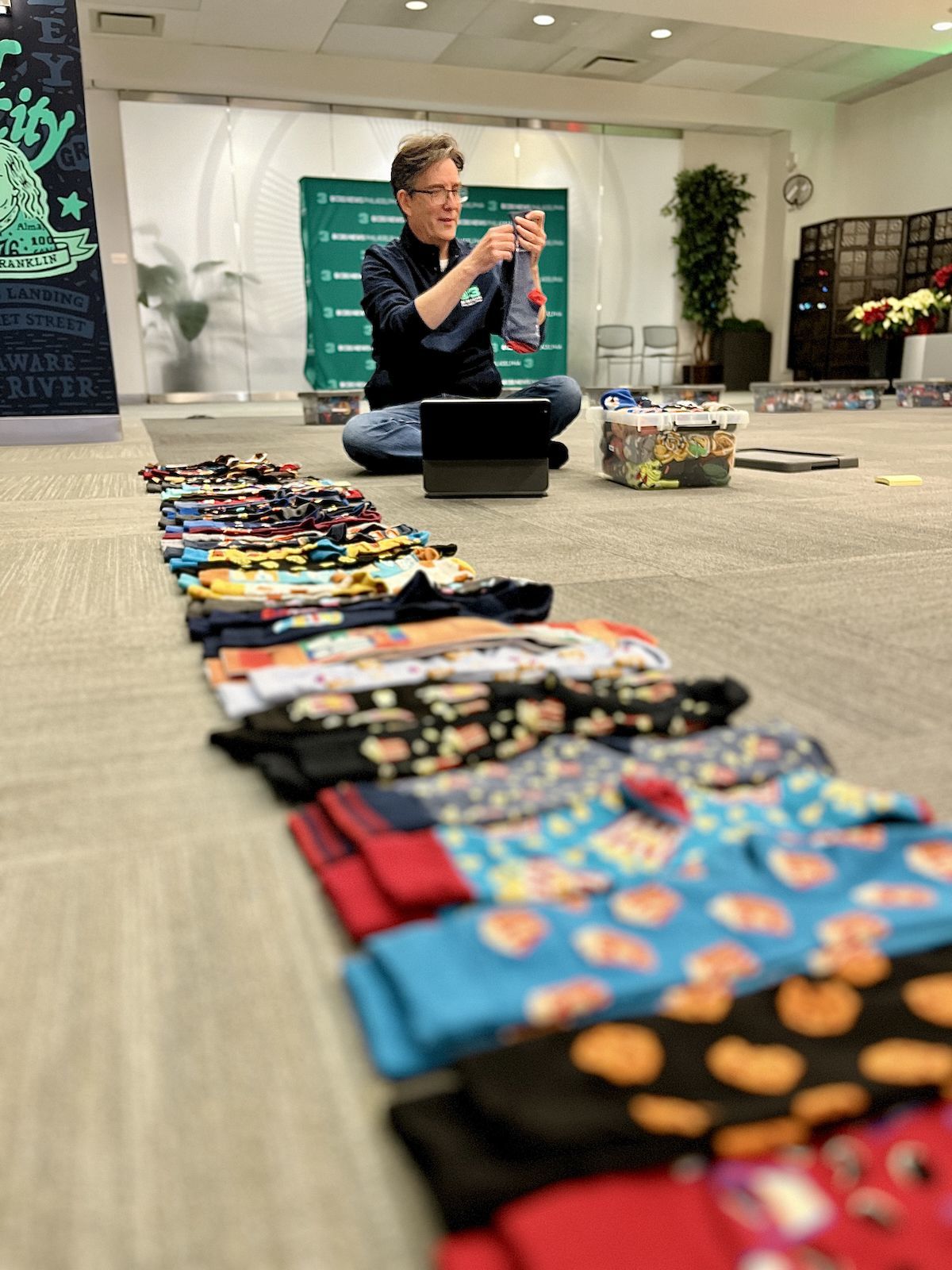
    Jim Donovan’s 1,531 pairs of socks laid out on the floor of CBS Philadelphia studios while Donovan and two independent experts counted each sock on camera to be submitted to the Guinness World Records.

    While Donovan said he’s immensely grateful for a ceremonious end to a long career — a feat he admits can be rare in the world of journalism — preparing his Guinness World Record application was also a difficult project.

    “I’ve done major investigation pieces and consumer stories over four decades of TV, and this was the thing that nearly pushed me over the edge,” he said of the nearly 40 hours of inventory work required to painstakingly document each pair of socks.

    Jim Donovan takes inventory of the thousands of socks he submitted for a Guinness World Record. After 40 years in broadcast journalism, he will be retiring. But, not before receiving the world record on Dec. 8, 2025.

    Donovan questioned himself at times when the hours of inventory work became overwhelming, but he remembered that this record was, in part, meant to thank his fans for their decades of support.

    Guinness requires applicants to have two independent third-party experts oversee the counting of the world records. Two members of Thomas Jefferson University’s fashion merchandising and management program, Juliana Guglielmi-DeRosa and Jeneene Bailey-Allen, stepped up to facilitate Donovan’s counting. Together, the two experts and Donovan recorded the counting of socks for more than an hour inside CBS Philadelphia studios, without interruptions or editing of the footage, as required by Guinness.

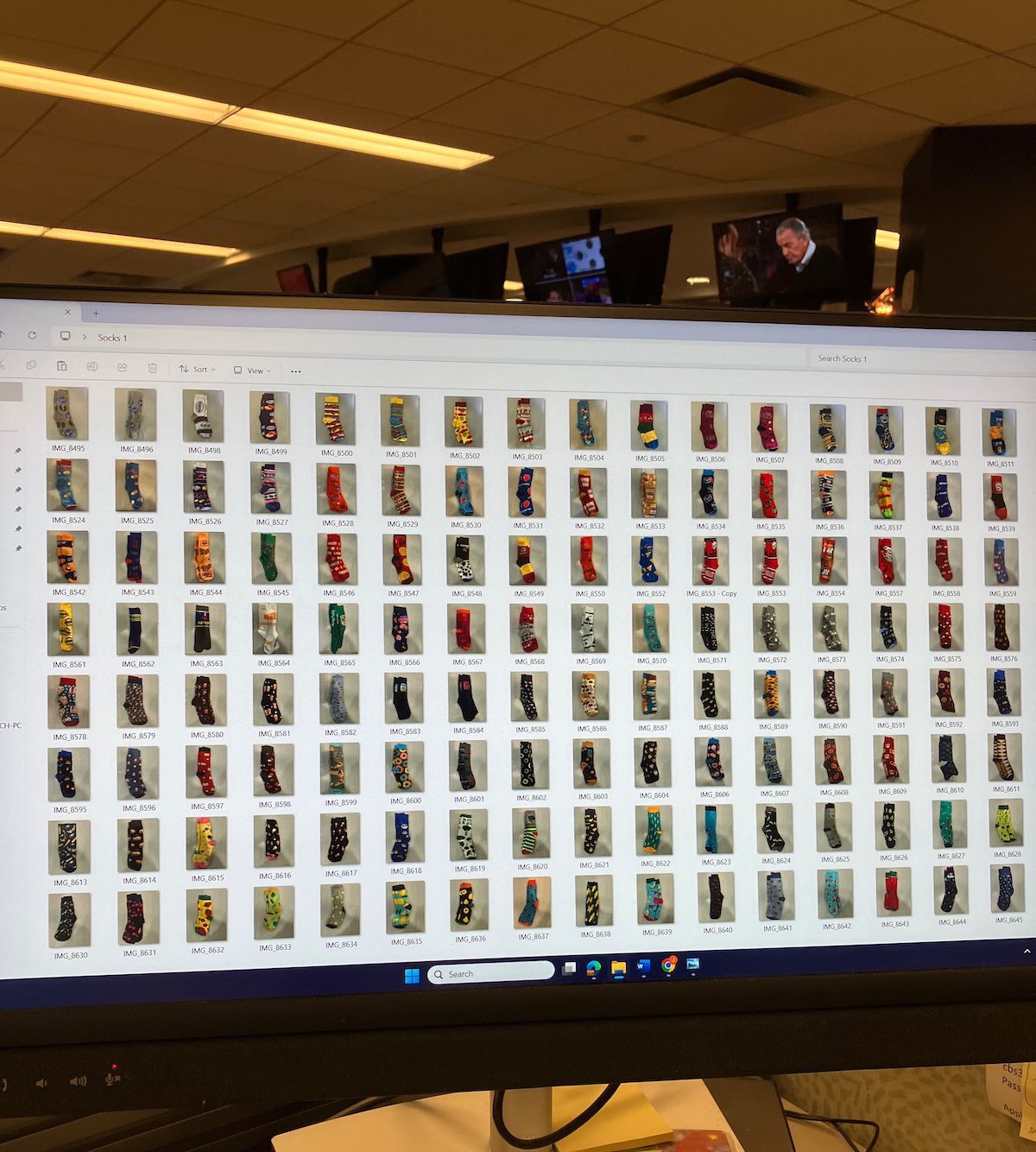
    Digital images of Jim Donovan’s socks that he submitted for a Guinness World Record. He received recognition for his 1,531 pairs of socks on Dec. 8, 2025.

    Donovan would then embed pictures and descriptions of each sock into what became a 262-page spreadsheet so that Guinness inspectors could verify the count at a later date. During the final count, Guglielmi-DeRosa and Bailey-Allen gifted Donovan an additional pair of socks, bringing the unofficial total to 1,532, but there was no way he was going to redo the spreadsheet, Donovan said.

    “I just remember when I was a kid looking in that Guinness World Records book and thinking, ‘Boy, it would be cool to do this.’ And here I am now, 59 years old, and I finally checked off one of those kid bucket list items,” Donovan said.

    Storing thousands of socks is no small feat, either. Folded and stacked inside dozens of bins, with 48 pairs per bin, Donovan has an entire closet dedicated to the socks. Each box contains different categories, from animals to food to holidays, and more.

    Jim Donovan holds his Guinness World Records plaque verifying that he owns the largest sock collection in the world at 1,531 pairs of socks. He received the recognition on Dec. 8, 2025.

    The first openly LGBTQ+ news anchor in Philadelphia, Donovan garnered a loyal fan base with whom he frequently chatted during his daily Facebook livestreams outside of his regular broadcasts. Around eight years ago, fans noticed Donovan’s penchant for socks with bold colors and designs, and started sending the journalist socks to wear on-air.

    During the winter holidays, it was Santa socks; birthdays, it was socks with his face on them; and randomly, folks would get creative, Donovan said, sending him Spock socks (complete with Spock ears), flamingos playing golf, and Superman socks with a cape.

    In his final week on-air at CBS Philadelphia, where he was for 22 years, the station celebrated each day as part of a “Week of Jim.” In retirement, Donovan plans to spend more time with his father, who lives on Staten Island, N.Y., and dive into volunteering and nonprofit work.

    Now he’ll be enjoying retirement as a world-record holder. Donovan said he’s even starting to get messages from other Guinness World Record holders welcoming him to the club.

  • As Russia’s war grinds on, its society is fraying

    As Russia’s war grinds on, its society is fraying

    OLKHOVATKA, Russia — The bus from the front lines ground to a halt outside the roadside kitchen, and the soldiers on board limped out into the winter mud.

    Most were missing feet or a leg.

    A water bottle filled with blood swung precariously from a plastic tube attached to one soldier’s stomach as he was helped toward a bench. Another stared blankly at the bloodied stump where his right hand had once been.

    “I would never have signed a contract if I’d known what it’s like out there. Our television is lying to us,” said Fyodor, a young soldier from Siberia. Like others in this article, he is not being identified by his full name to protect him from repercussions for criticizing the war.

    Fyodor’s lower leg had been blown off by a mine two days previously during an advance on Lyman in Ukraine with what remained of his unit. He said he was one of just 10 people left of the 110-strong unit he joined two years ago.

    He had no regrets over the loss of his leg. “It means that I can finally go home — alive.”

    “We’re fighting for fields that we cannot even take,” interjected a fellow soldier, Kirill, also in his 20s, laughing wryly. “This war will never end. … It feels like it’s only just begun.”

    Scenes like this one remain invisible to most Russians, erased by state propaganda and glossy government projects supporting returning veterans. But inside the country, fatigue and resentment are festering beneath the suppression of dissent.

    There is no outlet for public frustration and no relief from the mounting national exhaustion with a nearly four-year-long war that is corroding the country from within and making society more dysfunctional, broken, and paranoid, according to observers and those interviewed for this article.

    Over the last year, the Russian economy has lurched from spectacular growth to near-stagnation. Russia’s digital repression and isolation are deepening as more apps and platforms are banned. According to Western intelligence, more than a million Russian fighters have been killed or wounded — many in battles for marginal gains. And as Moscow’s search for internal enemies intensifies, its machine of repression is turning on its own children and patriots.

    During Russian President Vladimir Putin’s meeting with his Human Rights Council this month, film director Alexander Sokurov spoke out against censorship, the country’s suffocating foreign agent laws, the rising cost of living, and the lack of opportunities for young people. “If Russia doesn’t change how it works with young people, it faces a dead end,” he said. Putin said he would respond later to his grievances.

    A former senior Kremlin official told the Washington Post that he was “very worried” about the “dark picture inside Russia.”

    “We can’t turn the clock back easily; political will is needed to reverse this, and it simply does not exist,” the former official said, speaking on the condition of anonymity to freely discuss sensitive matters.

    Bearing the brunt

    In Belgorod, a Russian border city that once enjoyed close links to Ukraine’s Kharkiv — just 46 miles to the southwest — the price of this war is particularly tangible.

    Daily drone attacks have long become part of the routine here. Mud-spattered ambulances and camouflaged air-defense units tear through the center of town. The city’s volunteer networks — integral parts of the war effort that have supported the troops with clothing, food, and equipment where the government has failed — continue to work around the clock, with retirees sewing anti-drone netting and 3D-printing plastic bomb casings for drones.

    Despite the suffering and mass destruction taking place just across the border, Belgorod regards itself as the main victim of this war. The city illustrates the widening gap in Russian society between the indifferent, metropolitan majority and the “warring” few.

    On a cold November afternoon, a group of volunteers helping deliver supplies to the army huddled around a table to eat soup. They told the Post that they felt abandoned by Moscow.

    “They have absolutely no idea what is going on here!” exploded Edik, 52. “In Moscow there are parties, people having fun, going on vacations. How is that possible? Here blood is being spilled, and there they’re celebrating. How can they reconcile that?”

    Several volunteers said they had noticed a lull in donations since the start of the year, as many expected the war to end soon. Yevgenia Gribova, 35, who coordinates a center in Belgorod, said the volunteer movement is facing a crisis. In the first year, she said, people were spending the last of their rubles to support the troops, working constantly, without days off or vacation.

    “Now people want to rest. They want to spend money on themselves rather than on materials for the front lines,” she said.

    But while people said they want to see an end to the conflict, some also spoke of their desire to keep fighting and the need to end the war under the “right” conditions.

    “Everyone still wants to take Odesa. It’s a common opinion: People want to go to Odesa on vacation again,” Gribova said. “For us, this is a civil war between Russians and Russians who have forgotten a bit that they are Russians, that’s all.”

    Belgorod and residents of Russia’s regions bordering Ukraine form part of what pro-Kremlin sociologist Valery Fyodorov, the director of VCIOM polling institution, has defined as “warring Russia”: a minority of the country — roughly 20% — consisting of soldiers, their families, patriotic volunteers, and workers in military factories who consider the war vital for Russia’s survival and who are pushing for victory. The rest, he says, are passively loyal, indifferent to the war, opposed to it but taking refuge in their private lives, or living in exile.

    Dmitry, a deputy commander of a grenade-launcher platoon in Russia’s 116th special purpose brigade, said that Russia would fight for a very long time and “with sticks, if necessary.”

    “Everyone wants to go home. Everyone wants all of this to end. But even tired people carry out their tasks,” he said.

    Return of the heroes

    How does a nation sell to its people a war that is destroying the country — and how does it ensure that it continues?

    To keep the war effort rolling and to stave off discontent, the Kremlin has poured money into projects supporting soldiers and veterans, including the nationwide Defender of the Fatherland State Foundation, which was established in 2023 by Putin and is led by his niece, Deputy Defense Minister Anna Tsivaleva.

    For their sacrifice, soldiers are rewarded with financial benefits, social prestige, and significant employment and education opportunities for themselves and their children.

    Denis Poltavsky lost the sight in his right eye after he was swarmed by drones in battle last year. Unwilling to share many details about his time on the front, Poltavsky said he suffered from extreme PTSD, haunted by nightmares and insomnia.

    But without a doubt, he says, his life has materially improved since returning home. “The support is very extensive. The state is doing everything for veterans and soldiers. … They didn’t abandon us. They keep track of you and provide everything.”

    Poltavsky was paid an initial $51,000 for his injury, plus insurance and a military pension. He has access to free transportation, and tickets to museums and theaters. He recently completed Belgorod’s Time of Our Heroes management and leadership training, and hopes to soon receive a grant for his metalworking business.

    Veterans also have access to round-the-clock support from psychologists, doctors, and volunteers; they are given tax breaks and secure employment, even with disabilities. Belgorod’s program is even offering veterans free land on which to build a house.

    Middlebury College professor Will Pyle, who studies Russia’s economy, has found that in some regions a larger share of Russians report being satisfied with their lives than at any time during the decade preceding the February 2022 invasion. The finding is based on analysis of data from the Russian Longitudinal Monitoring Survey, which is maintained by Moscow’s Higher School of Economics.

    According to Pyle’s research, conducted with the Bank of Finland, the increase in reported life satisfaction is especially pronounced in regions whose economies have benefited from wartime and military-adjacent industrial production.

    This mirrors Fyodorov’s research. “The more depressed the region, the more people have noticed their improvement in life,” he said.

    But underneath the lionizing of the soldiers and this temporary uptick in prosperity is the darker impact of returning veterans and the longer-term social consequences of the invasion. Already, horrific crimes including murders and rapes have been committed by returning soldiers, and many of the convicted criminals who signed contracts to win their freedom have returned home to commit more crimes.

    “Every governor in Russia knows that a wave of problems is coming with the soldiers returning home from the front with serious post-traumatic stress disorder,” said a Kremlin insider, speaking on the condition of anonymity because of the sensitivity of the issue. “And they know the responsibility to deal with this will fall to them.”

    The patriots and the teens

    Since the start of the war, Russia has gone after its dissenters, pursuing LGBTQ+ people, artists, and opposition figures, and made criticism of the conflict and the military illegal. But now, some of the state’s most fervent supporters are running into trouble as well.

    The vocal, ultrapatriotic “Z” military bloggers, initially a backbone of support for Putin’s invasion, have gone on to criticize corruption and shortcomings in the army. The most radical of their leaders, such as ultranationalist hawk Igor Strelkov, were initially jailed. But this fall, they saw their ranks swept by an unexpected purge as the whole movement became the focus of repression.

    In September, authorities branded Roman Alyokhin, a prominent blogger with 151,000 subscribers on Telegram, a foreign agent, a label usually reserved for liberal opposition figures. In October, blogger Tatyana Montyan was declared a “terrorist and extremist.” Another, Oksana Kobeleva, was detained by the police. All had publicly criticized senior officials or other propagandists. The Z community has since turned on itself, with bloggers racing to denounce one another.

    “The moment of unity did not last very long, and after almost four years, we are seeing how people begin to oppose each other as well, deciding which of them is more patriotic,” said military blogger Mikhail Zvinchuk, the founder of the Rybar Telegram channel, which has links to the Defense Ministry.

    He added that the movement became corrupt and embezzled funds that were raised to support the troops. “Over the years, there have been a number of crooks who are trying to exploit the war.”

    In Russia’s second city, St. Petersburg, security services have found a different target: teenagers.

    At the Izmailsky courthouse last month, masked police officers escorted two teenage musicians from their hearing to the secret service cars waiting outside. The pair, 18-year-olds Diana Loginova and Alexander Orlov — from the street band Stoptime — had just had their arrest extended for a third time. Orlov, the guitarist, fist-bumped one of his friends as he exited the courthouse. Officially, they stood accused of blocking the entrance to a metro station during an impromptu street concert this autumn, but their true crime was their viral performances of anti-war songs.

    To many, the consequences of Stoptime’s performances were inevitable. But the young musicians’ case sent a chill through this still-liberal Baltic city, where street performances are an integral part of local culture.

    Copycat acts and musicians performing in solidarity with the imprisoned band members in the Urals and other cities in Russia were also arrested and charged as security services moved swiftly to crack down on the slightest flicker of dissent. Now, even singing the wrong kind of music can get you jailed, a development many regard as a return to the days of the Soviet Union.

    The hearing in St. Petersburg was tense, at times Kafkaesque, as the defense lawyer unpacked the details of the performance in question. “There are approximately 47 meters between the entrance to the metro and the spot where they were performing. It is therefore impossible that the people who stood in a circle around Stoptime could have blocked that space,” she said.

    Loginova, known by her stage name, Naoko, spent the last 20 minutes in the courtroom clasping her mother’s hands. “I really hope this is the last time they arrest me,” she whispered. Irina, her mother, smiled and held her daughter close, looking dazed. “Don’t you remember that they said that they would let you go on the first night? It’s now been a month.”

    What made Stoptime’s rebellious music performances so striking was that they came at a time when free, creative spaces and opportunities to escape are fading fast.

    “The very fact that they performed such songs was captivating,” said Ivan, 26, a history teacher, who attended many of their performances. “It was like an echo of normal life in our time. These are songs you want to listen to: They are kind, they’re meaningful, they promote universal human values, they remind that you can overcome things.”

    He said in Russia right now the state is trying to build a strict loyalty based on behaving a certain way “in order to simply exist.” Around him he has watched people accept a situation they were once horrified by and shift into a survival mode.

    On Nov. 23, the Stoptime musicians were secretly and unexpectedly released, and they immediately fled the country. They were spotted in early December in Yerevan, Armenia, performing the same opposition songs that got them arrested.

    Others have not been so lucky.

    Tatiana Balazeikina’s 19-year-old son, Yegor, is three years into his seven-year sentence for terrorism after he attempted to throw a Molotov cocktail at a local military registration office in 2023. Yegor is one of hundreds of teenagers and children arrested for anti-war protests, sabotage, or treason since the war began.

    “Stoptime were singing what so many people already had on the tip of their tongues,” Balazeikina said from her home an hour south of St. Petersburg. “This is dissent. And the only way for this state to remain what it is is to cut off all these signs of dissent right at the root.”

    She believes young people present a special kind of threat to the Kremlin.

    “These young people who essentially have nothing to lose except their freedom are very dangerous,” she said. “And if those young people are not only capable of thinking but can also sing what they think … that’s an even bigger threat.”