Tag: no-latest

  • Delaware’s acting U.S. attorney resigns amid fight over Trump’s appointees

    Delaware’s acting U.S. attorney resigns amid fight over Trump’s appointees

    President Donald Trump’s U.S. attorney in Delaware abruptly resigned Friday amid a growing standoff over the administration’s authority to install loyalists in powerful prosecutorial roles while bypassing Senate confirmation and the courts.

    Julianne Murray, a former chair of the Delaware Republican Party whom the Justice Department had appointed as interim U.S. attorney in the state this summer, announced her departure in a statement posted to social media. She said a recent ruling by the U.S. Court of Appeals for the 3rd Circuit disqualifying Trump’s U.S. attorney in New Jersey, Alina Habba, had made it clear to her she could no longer stay in her role.

    Habba resigned from her post on Monday after the court ruled she had been unlawfully appointed through a process that administration officials had also used to keep Murray in her role. The Philadelphia-based 3rd Circuit handles appeals arising from Pennsylvania, New Jersey, Delaware, and the U.S. Virgin Islands, and its rulings extend throughout that jurisdiction.

    “I naively believed that I would be judged on my performance and not politics,” Murray said in her statement. “Unfortunately that was not the case.”

    Murray said she will continue to work for the Justice Department in a different capacity but did not indicate what her new job might be. Her former office will now be overseen by her first assistant U.S. attorney, Ben Wallace, who has worked as a prosecutor in the office since 2023.

    Murray’s initial appointment in July drew controversy given her lack of prosecutorial experience and the fact that she was still serving as head of the Delaware Republican Party when she was named interim U.S. attorney. She resigned from that role shortly afterward.

    Her statement Friday saying she would step down as U.S. attorney used many of the same turns of phrase as the resignation letter she submitted to the state party five months earlier. In both, she said she refused to allow her office “to be used as a political football.”

    While the nation’s 93 U.S. attorneys are appointed through a political process and are often affiliated with the president’s party, their jobs have traditionally been viewed as largely apolitical. Most come from traditional legal backgrounds, not openly partisan roles.

    Since Trump’s return to the White House, his administration has made installing loyalists in these position a priority.

    In addition to Murray and Habba, his former personal lawyer, the Justice Department has appointed other controversial allies to U.S. attorney roles on an interim basis. They included Bill Essayli, a former GOP state assemblyman named U.S. attorney in Los Angeles; Sigal Chattah, a former GOP committeewoman in Nevada; and Lindsey Halligan, another former Trump lawyer, in Eastern Virginia.

    Federal law limited each of their interim appointments to a period of 120 days and empowered the federal courts to appoint a replacement if there was no Senate-confirmed nominee by that deadline. But when the terms of Murray, Habba and the others expired, the Justice Department sought to keep Trump’s picks in their roles through complex maneuvers that the 3rd Circuit has ruled were illegal.

    In Murray’s case, Delaware’s chief U.S. district judge, Colm Connolly, a Trump appointee, began soliciting applications for her replacement weeks before her 120 days were up. The move drew a sharp rebuke from Deputy Attorney General Todd Blanche, another former Trump attorney who now serves in the Justice Department’s No. 2 position.

    When Murray’s interim term expired in November, Delaware’s judges declined to reappoint her but did not immediately name a replacement. The Justice Department responded by changing Murray’s title to “acting” U.S. attorney and maintained that the president had the authority to keep her in her job indefinitely.

    Within hours of Murray’s resignation, the judges on Friday posted notice that they were appointing Wallace as acting U.S. attorney.

    Unlike Habba, Chattah, Essayli, and Halligan, whose appointments federal courts have all ruled to be unlawful, Murray had not drawn a legal challenge questioning her legitimacy. In her statement Friday, she blamed Delaware’s U.S. senators — Chris Coons and Lisa Blunt Rochester, both Democrats — of sinking her prospects in the job.

    Normally, the president must formally nominate his U.S. attorney picks, and they must be approved in a Senate vote. In the case of Murray and the others, their home-state senators — all Democrats — had said they would withhold their support should Trump formally nominate them to the role.

    That decision effectively killed any chance of their nominations moving forward under a Senate custom known as the “blue slip,” which allows senators to veto judicial and U.S. attorney nominees for their states.

    Trump has railed against the blue slip tradition, saying it interferes with his ability to install his chosen candidates. Sen. Chuck Grassley — the Iowa Republican who chairs the Senate Judiciary Committee — has resisted pressure from the president to abandon the custom, saying it gives senators of both parties an important voice in deciding who will fill powerful law enforcement roles in their states.

    Coons and Blunt Rochester said they had concluded Murray “was not the right person” for the job after interviewing her and a number of other potential candidates.

    “I look forward to working with the District Court’s appointed U.S. Attorney, Ben Wallace, and remain willing to work with the Trump administration to identify and confirm a mutually agreeable candidate,” Coons said in a statement.

    Murray called the blue slip process “highly politicized” and “incredibly flawed,” saying it cost Delaware a U.S. attorney.

    “The people that think they have chased me away will soon find out that they are mistaken,” she wrote. “I did not get here by being a shrinking violet.”


  • George Washington’s living quarters back on display after restoration

    George Washington’s living quarters back on display after restoration

    Only keen-eyed visitors will notice some of the subtle changes to George Washington’s Mount Vernon home, like a new finishing on the mantle in the former president’s study or the reworked underground framing of the house.

    But curators say each minuscule change to the sprawling Virginia estate can help visitors better understand the nation’s past, and therefore their place in the world today.

    Construction fences have lined the back of the mansion for the better part of two years as work continues on a $40 million project to restore the building to its 18th century integrity. Though work is ongoing, the first and second floor of the home are now open to the public for the first time since January 2024.

    A worker at the estate Wednesday, the day of an event marking the reopening of the first and second floors to the public.

    Heading into America’s 250th anniversary, Mount Vernon President and CEO Doug Bradburn said bolstering authenticity at the estate is more important than ever.

    “You cannot understand the United States of America’s founding without the indispensable George Washington,” Bradburn said. “You can’t understand him without Mount Vernon.”

    Washington lived at the estate along the Potomac River with his wife, Martha, for the last 45 years of his life. When he inherited the mansion, it stood at about 3,500 square feet. The serene view of the Potomac welcomed Washington home after he led American forces to victory in the Revolutionary War. He retired to Mount Vernon after serving as the nation’s first president.

    By the time Washington died in 1799, he had expanded the dwelling to more than triple that size, with more than 20 rooms. Most of the work was performed by people enslaved on the estate, officials have said.

    A bust of George Washington at the estate.

    The estate passed down through family members after Washington’s death until the Mount Vernon Ladies Association secured it in 1860. Since then, the nonprofit has worked to restore the remaining 500 acres of property to how it appeared when Washington died. The association has never accepted any government funding, and it solely relies on earned income and donations.

    Nearly 1 million people visit Washington’s home, located about 20 miles south of the nation’s capital, each year.

    “We believe in the power of place,” said Anne Neal Petri, regent of the Mount Vernon Ladies Association. “We want to engage the visitor in ways that the history books just can’t achieve.”

    This bout of rehabilitation is the largest in Mount Vernon’s history. Born from necessity after centuries of termite damage detached the building from its foundation, there wasn’t a single piece of original 18th century woodwork left underground, said Thomas Reinhart, director of the estate’s preservation.

    Only parts of Mount Vernon closed during the restoration. The extensive grounds, Washington’s tomb and the quarters for enslaved people remained open. The renovations focused only on Washington’s living quarters, called the mansion.

    To rebuild the mansion’s wooden frame, workers harvested white oak from the property, similar to how Washington would have sourced wood for the original construction. Only now, every piece of wood that touches masonry has added termite shields.

    “Termites are quite tenacious,” Reinhart said.

    From preservation carpenters, engineers, archaeologists and collection curators, it’s estimated about 350 people have worked on the restoration so far. Besides the structural changes, specialists throughout the house restoration performed paint analysis on doorframes and trims to make them accurate.

    Painters at Mount Vernon on Wednesday.

    The most noticeable visual differences are on the second floor, in the most intimate area of the house.

    Step into Washington’s bedroom, and visitors will see walls newly enveloped by a soft blue wallpaper with a bright floral design featuring a birdbath and two bright orange lovebirds.

    After referencing preserved documents, Amanda Isaac, a curator at the estate, said historians chose a replica 1790s French wallpaper based on a design that existed when Washington remodeled the home.

    She said with the most recent changes — which also included tearing the walls down to the studs and replastering them with historically accurate techniques — is a room that most resembles how the home looked when the Washingtons lived at Mount Vernon. It has nine of the original furnishings of the room, including the exact bedframe Washington died on.

    George and Martha Washington’s bedroom.

    Perhaps the largest undertaking is still ongoing.

    Underground, droves of people are still working to restore a cellar spanning the entire footprint of the house. That part of the home is being refinished to look like it did when it housed the enslaved Lee family, who served the Washingtons as valet, cook and butler. The estate is also adding an underground bunker to store an upgraded HVAC system created to better preserve and maintain the home.

    Though it’s been centuries since Washington walked the property, signs of his life are still littered around the land. While excavating the cellar, archaeologists discovered 35 glass bottles of preserved berries, 20 of which are still intact and now on display at the Mount Vernon museum.

    As the country looks to the future, Mount Vernon serves as a fixture of the past, forever reminding the nation how far it has come.

    “You can’t go to Rome without seeing the Colosseum, and you can’t go to Washington, D.C., without seeing Mount Vernon,” Bradburn said.

    Today’s rehabilitation is the largest in Mount Vernon’s history.
  • House Democrats release photos of Trump, Clinton, and Andrew from Epstein’s estate

    House Democrats release photos of Trump, Clinton, and Andrew from Epstein’s estate

    WASHINGTON — House Democrats released a selection of photos from the estate of Jeffrey Epstein on Friday, including some of Donald Trump, Bill Clinton, and the former Prince Andrew.

    The 19 photos initially released by Democratic lawmakers on the House Oversight Committee were a small part of more than 95,000 they received from the estate of Epstein, who died in a New York jail cell in 2019 while awaiting trial on sex trafficking charges. They released roughly 70 more photos later Friday, including images of his home, Epstein taking a bath, a photo of him with a swollen lip, and a photo of him posing with a book about the scandal.

    The photos released Friday were separate from the case files that the Department of Justice is now under compulsion to release, but anticipation is growing as the Trump administration faces a deadline next week to produce the Epstein files that have been the source of conspiracy theories and speculation for years.

    The photos were released without captions or context and included a black-and-white image of Trump alongside six women whose faces were blacked out.

    This undated, redacted photo released by Democrats on the House Oversight Committee shows Donald Trump standing with a group of women.

    Rep. Robert Garcia, the top Democrat on the House Oversight Committee, did not say whether any of the women in the photos was a victim of abuse, but he added, “Our commitment from day one has been to redact any photo, any information that could lead to any sort of harm to any of the victims.”

    White House spokesperson Abigail Jackson accused Democrats of “selectively releasing cherry-picked photos with random redactions to try and create a false narrative” and called it part of a “Democrat hoax against President Trump.”

    Many of the photos have already circulated in the public. Democrats pledged to continue to release photos in the days and weeks ahead, as they look to pressure Trump over his Republican administration’s earlier refusal to release documents in the Epstein probe. Garcia said his staff had looked through about a quarter of the images it had received from Epstein’s estate, which included photos that were sent to him or that he had in his possession.

    “Donald Trump right now needs to release the files to the American public so that the truth can come out and we can actually get some sense of justice for the survivors,” Garcia added.

    This undated, redacted photo released by Democrats on the House Oversight Committee shows Steve Bannon (left) talking with Jeffrey Epstein.

    Trump, once a close friend of Epstein, has said that he parted ways with him long before he faced the sex trafficking charges. Clinton, too, has minimized his relationship with Epstein, acknowledging that he traveled on Epstein’s private jet but saying through a spokesperson that he had no knowledge of the late financier’s crimes. Clinton also has never been accused of misconduct by Epstein’s known victims. However, Republicans on the House committee are pushing him and Hillary Clinton to testify in their investigation.

    A spokesperson for the Republican-controlled committee also said that nothing in the documents the committee has received shows “any wrongdoing” by Trump.

    Andrew lost his royal titles and privileges this year amid new revelations of his ties to Epstein, though he has denied wrongdoing.

    The photo release also included images of the right-wing political operative Steve Bannon, billionaires Richard Branson and Bill Gates, filmmaker Woody Allen, former Treasury Secretary Larry Summers, and law professor Alan Dershowitz. The men have denied any wrongdoing in their associations with Epstein, who kept many high-profile figures in his circle of friends.

    Amid an earlier release of emails between Summers and Epstein, Summers stepped away from his teaching position at Harvard University and faced other fallout to his standing in academic circles.

    Allen has faced allegations from his adopted daughter, Dylan Farrow, of molesting her as a child. He has denied the allegations.

    Some lawmakers, however, believe that other high-powered figures could be implicated in Epstein’s abuse if the full case files from the Justice Department are released.

    Rep. Thomas Massie, a Kentucky Republican who was instrumental in passing a bill to require the public release of the files, said it was a good sign that the Department of Justice has sought to have grand jury material released from several courts.

    “The grand jury material is just a small fraction of what the DOJ needs to release, because the FBI and DOJ probably has evidence that they chose not to take to the grand jury because the evidence they’re in possession of would implicate other people, not Epstein or Maxwell,” he said.

  • Thai and Cambodian leaders have agreed to renew a ceasefire after days of deadly clashes, Trump says

    Thai and Cambodian leaders have agreed to renew a ceasefire after days of deadly clashes, Trump says

    WASHINGTON — President Donald Trump said Friday that Thai and Cambodian leaders have agreed to renew a truce after days of deadly clashes had threatened to undo a ceasefire the U.S. administration had helped broker earlier this year.

    Trump announced the agreement to restart the ceasefire in a social media posting following calls with Thai Prime Minister Anutin Charnvirakul and Cambodian Prime Minister Hun Manet.

    “They have agreed to CEASE all shooting effective this evening, and go back to the original Peace Accord made with me, and them, with the help of the Great Prime Minister of Malaysia, Anwar Ibrahim,” Trump said in his Truth Social posting.

    Thai and Cambodian officials offered no immediate comment following Trump’s announcement. Anutin, after speaking with Trump but before the U.S. president’s social media posting, said he reiterated to Trump that Thailand’s position was to keep fighting until Cambodia no longer poses a threat to its sovereignty.

    Trump, a Republican, said that Ibrahim played an important role in helping him push Thailand and Cambodia to once again agree to stop fighting.

    “It is my Honor to work with Anutin and Hun in resolving what could have evolved into a major War between two otherwise wonderful and prosperous Countries!” Trump added.

    The original ceasefire in July was brokered by Malaysia and pushed through by pressure from Trump, who threatened to withhold trade privileges unless Thailand and Cambodia agreed. It was formalized in more detail in October at a regional meeting in Malaysia that Trump attended.

    Despite the deal, the two countries carried on a bitter propaganda war and minor cross-border violence continued.

    The roots of the Thai-Cambodian border conflict lie in a history of enmity over competing territorial claims. These claims largely stem from a 1907 map created while Cambodia was under French colonial rule, which Thailand maintains is inaccurate. Tensions were exacerbated by a 1962 International Court of Justice ruling that awarded sovereignty to Cambodia, which still riles many Thais.

    Thailand has deployed jet fighters to carry out airstrikes on what it says are military targets. Cambodia has deployed BM-21 rocket launchers with a range of 19-25 miles.

    According to data collected by public broadcaster ThaiPBS, at least six of the Thai soldiers who were killed were hit by rocket shrapnel.

    The Thai army’s northeastern regional command said Thursday that some residential areas and homes near the border were damaged by BM-21 rocket launchers from Cambodian forces.

    The Thai army also said it destroyed a tall crane atop a hill held by Cambodia where the centuries-old Preah Vihear temple is located, because it allegedly held electronic and optical devices used for military command and control purposes.

    Trump has repeatedly made the exaggerated claim that he has helped solve eight conflicts, including the one between Thailand and Cambodia, since returning to office in January, as evidence of his negotiating prowess. And he’s not been shy about his desire to be recognized with a Nobel Peace Prize.

    In an exchange with reporters later Friday, Trump credited his administration with doing a “a very good job” with its push to stem the renewed fighting.

    “And we got it, I think, straightened out today,” Trump said as he hosted members of the 1980 U.S. men’s hockey team in the Oval Office. “So Thailand and Cambodia is in good shape.”

    Another ceasefire that Trump takes credit for working out, between the Democratic Republic of Congo and Rwanda, is also under strain — just after the leaders of the African nations traveled to Washington to sign a peace deal.

    A joint statement released by the International Contact Group for the Great Lakes expressed “profound concern” over the situation in Congo’s South Kivu region, where new deadly violence blamed on the Rwandan-backed M23 militia group has exploded in recent days.

    The Great Lakes contact group — which includes Belgium, Britain, Denmark, France, Germany, the Netherlands, Sweden, Switzerland, the United States, and the European Union — has urged all sides “to uphold their commitments” under the deal signed last week and “immediately de-escalate the situation.”

    And Trump’s internationally endorsed plan to end the Israel-Hamas war in Gaza is still not finalized and in limbo, with sporadic fighting continuing while a critical second phase remains a work in progress.

  • Secret meetings between FBI and Ukraine negotiator spark concern

    Secret meetings between FBI and Ukraine negotiator spark concern

    Secret meetings between Ukraine’s top peace negotiator and FBI leaders have injected new uncertainty into the high-stakes talks to end the war there, according to diplomats and officials familiar with the matter.

    Over the last several weeks, President Volodymyr Zelensky’s lead negotiator, Rustem Umerov, flew to Miami three times to meet with President Donald Trump’s top envoy, Steve Witkoff, and discuss a proposal to end the nearly four-year conflict with Russia.

    But during his time in the United States, Umerov also held closed-door meetings with FBI Director Kash Patel and Deputy Director Dan Bongino, according to four people, who like some others spoke on the condition of anonymity to discuss confidential conversations.

    The meetings have caused alarm among Western officials who remain in the dark about their intent and purpose. Some said they believe Umerov and other Ukrainian officials sought out Patel and Bongino in the hopes of obtaining amnesty from any corruption allegations the Ukrainians could face. Others worry the newly established channel could be used to exert pressure on Zelensky’s government to accept a peace deal, proposed by the Trump administration, containing steep concessions for Kyiv.

    Ukrainian Ambassador to Washington Olha Stefanishyna confirmed Umerov’s meeting with the FBI and told the Washington Post he “only covered national security related issues” that could not be disclosed publicly.

    An FBI official said the Umerov meetings included discussion of the two countries’ shared law enforcement and national security interests. The topic of white collar corruption in Ukraine came up in one of the meetings but was not the main focus, the official said. Any suggestion that Patel’s discussions were inappropriate is “complete nonsense,” the official added.

    The two FBI leaders have criticized Ukraine in various public comments. Patel in March questioned the scale of U.S. aid to Ukraine and urged Congress to investigate whether any U.S. funds sent there were misused. Bongino has accused Zelensky of covering up the allegedly corrupt activities of President Joe Biden’s son, whose board seat on a Ukrainian energy company has faced intense scrutiny. Trump “is very suspicious of Zelensky, because of what he and some of the people in his government did to sweep under the rug the Joe Biden madness,” Bongino said in February.

    A White House official said “U.S. officials regularly communicate with world leaders about national security issues of shared interest.” The official added that Trump’s national security team has been “speaking with both the Russians and the Ukrainians to facilitate a deal to end the war” and that anyone raising concerns about the FBI meetings “are not privy to these diplomatic conversations and have no idea what they are talking about.”

    A representative of Zelensky’s office declined to comment on any specific meetings but insisted that “it is stupid to link everything to ‘corruption.’”

    The New York Post noted Umerov’s meeting with Patel in an article published Nov. 28. Bongino’s meeting with Umerov has not been previously reported.

    The discussions are happening at a critical moment for Ukraine. It is under pressure by the Trump administration to agree to an end-of-war proposal with huge implications for the country’s borders and territorial integrity.

    It is also facing its most far-reaching corruption scandal since Zelensky took office in 2019. Ukrainian investigators alleged last month that $100 million had been stolen from the country’s energy sector through graft and kickbacks.

    Eight people, including Zelensky’s former business partner, are accused of embezzlement, money laundering and illicit self-dealing. Zelensky’s top aide, Andriy Yermak, the second most powerful person in Ukraine, resigned in late November after his house was raided. Another close former ally of Zelensky, Oleksiy Chernyshov, who served as deputy prime minister, is accused by Ukrainian authorities of receiving $1.3 million in kickbacks.

    “They do have a massive corruption situation going on there,” Trump told reporters this week, noting that the scandal was generating calls for elections in Ukraine. “People are asking this question: When do they have an election?”

    Russia’s full-scale invasion of Ukraine in 2022 prompted Kyiv to enact martial law, including the postponement of presidential and parliamentary elections.

    There is speculation inside and outside Kyiv over whether Umerov, who also serves as Ukraine’s national security adviser, may be implicated in the expanding embezzlement investigation, particularly as the country’s anti-corruption officials expand their probe into the defense sector. Umerov previously served as Ukraine’s defense minister.

    “I was surprised they sent him to negotiate given what’s being said about his potential involvement in the scandal,” said Angela Stent, a former intelligence officer in the George W. Bush administration and scholar at Georgetown University.

    Ukrainian opposition lawmaker Volodymyr Ariev told the Post that it was irresponsible to keep Umerov on as top negotiator while he’s under a cloud of suspicion. “A person who has grown a tail with corruption allegations shouldn’t chair fateful negotiations until they cut the tail,” Ariev said.

    Umerov’s defenders say he is an asset to Kyiv: His easygoing demeanor and proficient English have created a better rapport with U.S. officials than they had with Yermak, whom Zelensky relied on heavily before he resigned.

    But his FBI meetings have raised suspicion among Ukraine’s Western backers given the presence of Patel, who became a focal point of Trump’s first impeachment, which centered on the president’s threat to revoke U.S. aid to Ukraine to extract information on Hunter Biden’s activities in the country. Trump was acquitted by the Senate.

    Fiona Hill, a former Trump administration official, testified before Congress that Patel had involved himself in Ukraine issues in a manner that went beyond the scope of his job as a White House adviser, according to what she was told by colleagues. The impeachment report released by House Democrats also highlighted Patel’s discussions with Rudy Giuliani before the Trump administration’s suspension of $400 million in military aid to Ukraine.

    Hill told the Post for this report that Patel’s reemergence is “likely to be viewed with even more concern and consternation in Europe.”

    Patel has always denied he had a back channel with Trump on Ukraine during his first term and said his discussions with Giuliani were unrelated to Ukraine.

    FBI officials have worked for years with Ukraine’s National Anti-Corruption Bureau, or NABU, to help the government in Kyiv overcome endemic corruption stemming from its Soviet past. But high-level meetings between a top Ukrainian negotiator and the director of the FBI are not common.

    “It is unusual for someone in that job to have a meeting with the leadership of the FBI,” said Sam Charap, a former State Department official and scholar at the Rand Corporation.

    A common theme of Trump’s Ukraine diplomacy, particularly as he has expressed frustration about delays in getting to a deal, is expanding the number of aides assigned to work on the issue. Besides Secretary of State Marco Rubio and Witkoff, a real estate magnate and longtime friend, Trump has also enlisted his son-in-law Jared Kushner and Army Secretary Daniel Driscoll, an ally of Vice President JD Vance.

    The growing number officials involved in the talks has caused miscommunication and confusion surrounding the deal’s terms and what the United States supports.

    Several U.S. officials support a proposal in which Ukraine withdraws from Donetsk in eastern Ukraine in exchange for other areas under Russian control, such as the Zaporizhzhia nuclear power plant.

    Earlier this week, Zelensky pushed back against the idea of Ukraine relinquishing any territory. “Under our laws, under international law — and under moral law — we have no right to give anything away,” Zelensky said after meeting with top European leaders. “That is what we are fighting for.”

    But as negotiations have stalled, Russian forces have made advances in the East, exploiting Ukraine’s shortages in ammunition and fighters. It also continues to bomb Ukraine’s electrical infrastructure, triggering rolling blackouts and raising fears of widespread outages this winter.

    Trump has made clear his patience is wearing thin, and that if Ukraine doesn’t negotiate for land it could end up losing even more on the battlefield.

    “You’re losing thousands of people a week,” Trump said. “It’s time to get that war settled.”

  • Chileans are divided in a presidential runoff tilted toward the far right

    Chileans are divided in a presidential runoff tilted toward the far right

    SANTIAGO, Chile — Ask many Chileans how their country fared in the past several years and they’ll describe a descent into disaster: Venezuelan gangs surged across porous borders, bringing unprecedented kidnappings and contract killings to one of the region’s safest nations. A social uprising unleashed violent chaos on once-sleepy streets. An economy long vaunted for its rapid growth sputtered into a stall.

    These are the voters who hope to elect their country’s most right-wing president since its military dictatorship on Sunday.

    Former lawmaker José Antonio Kast, 59, they argue, can bring back the simple, stable life that Chileans lost to rising crime, uncontrolled migration, and left-wing excesses. Kast’s rival in this runoff presidential election is their worst fear: a communist.

    “We need to go back in time to when Chile meant peace and quiet, when there weren’t so many Venezuelans and Colombians in the streets, when you didn’t have to look over your shoulder every second,” said Ernesto Romero, 70, shucking corn at his vegetable stall in Chile’s capital of Santiago.

    A deeply polarized electorate

    Ask the same question to other Chileans and they’ll recount an opposite reality: A shorter workweek, higher minimum wage, and more generous pension system made one of Latin America’s most unequal countries more livable, they say. The homicide rate declined in the last two years, official figures show. A defiant foreign policy — outspoken about Venezuelan President Nicolas Maduro‘s repression, President Donald Trump’s crackdown on immigrants, and Israel’s actions against Palestinians — made Chile a regional champion of democracy and human rights.

    These are the voters who hope, against heavy odds, to elect their country’s most left-wing president since its return to democracy in 1990.

    Jeannette Jara, 51, they argue, can save Chile from the wave of far-right populism that has upended politics across the world. Jara’s rival is their worst fear: the son of a Nazi party member with a fondness for Gen. Augusto Pinochet’s brutal dictatorship.

    “We need to go forward,” said Lucía Poblete, a 32-year-old engineer at Jara’s rally late Wednesday. “Kast will erase all the progress we’ve made for women, for labor rights, for civil freedoms.”

    The chasm between Chilean perspectives on the status quo underscores not only the depth of Chile’s divisions but also the stakes of Sunday’s showdown, which Kast is expected to win after 70% of voters backed right-leaning parties in the first round.

    Kast vows to make Chile safe again

    Today, Kast is hoping the third time’s the charm, and his presidential run has so far been a much more effective endeavor than the previous two. That’s largely thanks to fears of organized crime and immigration driving voters to the right.

    “Jara seems more grounded, more sensible. But it’s not the time for that. It’s time for drastic measures, for shows of force,” said Eduardo Marillana, 48, a former Jara supporter who jumped ship for Kast after his truck was stolen a few weeks ago. “Whether we like it or not, we need the far right now.”

    In 2021, the Catholic father of nine lost the runoff election to current President Gabriel Boric, a former firebrand student protest leader who rattled investors with his promises to “bury neoliberalism” but appealed to millions of ordinary Chileans sick of fiscal austerity, angry about social inequality, and eager to reexamine Chile’s traumatic past.

    Kast’s family ties to the Nazi party sparked an uproar at the time — as did his apparent nostalgia for Gen. Pinochet (who he said “would vote for me if he were alive”) and his fierce opposition to same-sex marriage and abortion without exception.

    This time, Kast has dodged questions about his social views, pivoting to the more politically palatable issues of insecurity and mass migration that have ginned up voter anxiety and boosted the right from Washington to Paris.

    Taking a page from Trump’s playbook, Kast vows mass deportations of the estimated 337,000 migrants in Chile without legal status — mostly Venezuelans who arrived from their crisis-stricken country in the last seven years.

    Studying the crime-fighting tactics of El Salvador’s popular autocratic president, Nayib Bukele, Kast proposes boosting the power of police and expanding maximum-security prison capacity.

    Borrowing from Argentina’s radical libertarian President Javier Milei, Kast aims to slash red tape, shrink the public payroll, and cut state spending by $6 billion within just 18 months of taking office.

    His economic team on Thursday pushed back against criticism that such a budget cut was unrealistic — or unnecessary as Chile’s budget strains pale next to Argentina’s economic shambles.

    But it acknowledged to the Associated Press that it might be “preferable to allow for an adjustment over a longer period.”

    Underdog Jara faces tough odds

    Perhaps at any other moment, Jara would have a lot going for her.

    She engineered Boric’s most significant welfare measures as his minister of labor. Her humble origins selling hot dogs and toilet paper to get through school makes for a compelling up-from-nothing story rare in Chile’s elite circles of power. She has a strong record of negotiating with rivals to get things done.

    But experts say it’ll take a miracle for her to pry a victory from Kast.

    “There are just too many things stacked against her,” said Robert Funk, associate professor of political science at the University of Chile.

    The most glaring: being a communist. Although her proposals to boost foreign investment and promote fiscal restraint hardly smack of communism, analysts say her membership in the party since age 14 undercuts efforts to lure moderate conservatives.

    “Just the name ‘Communist Party scares people,” said Lucía Dammert, a sociologist and Boric’s first chief of staff.

    Then there’s the challenge of representing a government with a 30% approval rating in a country where citizens have voted out incumbent leaders at every election since 2005. Add to that the difficulty of appearing tough on crime next to Kast.

    “This campaign is among the most difficult I’ve ever run, by far,” Ricardo Solari, Jara’s campaign strategist and a former minister, told the AP.

    What keeps Jara in the game, he insisted, is her appeal as a bulwark against the sort of right-wing radicalism that has eroded the rule of law elsewhere.

    “The right exaggerates insecurity to convince people that the only possible response is extreme force,” Solari said. “We’ve seen elsewhere in Latin America that when that happens, ultimately what gets imprisoned is democracy itself.”

  • Best-selling British writer Joanna Trollope has died at 82

    Best-selling British writer Joanna Trollope has died at 82

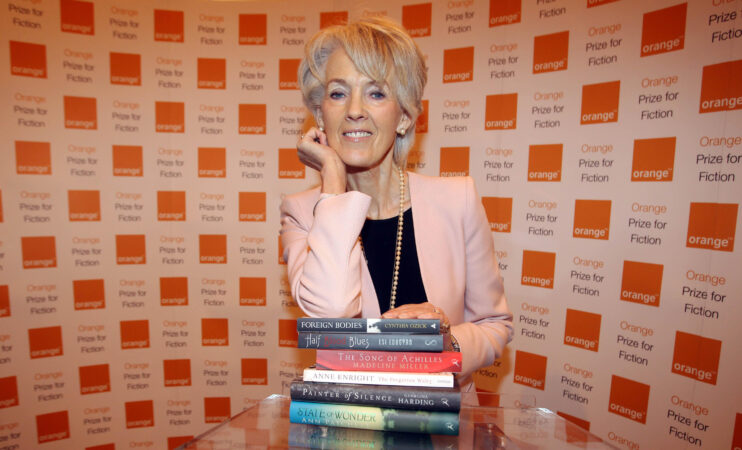
    LONDON — British writer Joanna Trollope, whose best-selling novels charted domestic and romantic travails in well-heeled rural England, has died, her family said Friday. She was 82.

    Ms. Trollope’s daughters, Antonia and Louise, said the writer died peacefully at her home in Oxfordshire, southern England, on Thursday.

    Ms. Trollope wrote almost two dozen contemporary novels, including The Rector’s Wife, Marrying the Mistress, Other People’s Children, and Next of Kin. They were often dubbed “Aga sagas,” after the old-fashioned Aga ovens found in affluent country homes.

    Ms. Trollope disliked the term, noting that her books tackled uncomfortable subjects including infidelity, marital breakdown, and the challenges of parenting.

    “That was a very unfortunate phrase and I think it’s done me a lot of damage,” she once said. ”It was so patronizing to the readers, too.”

    Ms. Trollope’s most recent novel, Mum & Dad, examined the “sandwich generation” of middle-aged people looking after both children and elderly parents.

    Ms. Trollope also published 10 historical novels under the pseudonym Caroline Harvey.

    Ms. Trollope, a distant relative of Victorian novelist Anthony Trollope, was born in Minchinhampton in the west of England in 1943. She studied English at Oxford University, then worked in Britain’s Foreign Office and as a teacher before becoming a full-time writer in 1980. She became a household name after The Rector’s Wife was adapted for television in 1991.

    Ms. Trollope’s novel Parson Harding’s Daughter won a novel of the year award from the Romantic Novelists’ Association in 1980. In 2010, the association gave her a lifetime achievement award for services to romance.

    In 2019, she was made a Commander of the Order of the British Empire, or CBE, by Queen Elizabeth II.

    Her literary agent, James Gill, called Ms. Trollope “one of our most cherished, acclaimed and widely enjoyed novelists.

    “Joanna will be mourned by her children, grandchildren, family, her countless friends and — of course — her readers,” Gill said.

  • Iran arrests Nobel Peace Prize laureate Narges Mohammadi, supporters say

    Iran arrests Nobel Peace Prize laureate Narges Mohammadi, supporters say

    DUBAI, United Arab Emirates — Iran has arrested Nobel Peace Prize laureate Narges Mohammadi, her supporters said Friday.

    A foundation in her name said she was detained in Mashhad, about 420 miles northeast of the capital, Tehran, while attending a memorial for a human rights lawyer recently found dead under unclear circumstances.

    A local official reportedly acknowledged arrests had been made, but did not directly name Mohammadi, 53. It wasn’t clear if authorities would immediately return her to prison, where she had been serving a sentence until her temporary release in December 2024 for medical purposes.

    However, her detention comes as Iran has been cracking down on intellectuals and others as Tehran struggles with sanctions, an ailing economy and the fear of a renewed war with Israel. Arresting Mohammadi may spark increased pressure from the West at a time when Iran repeatedly signals it wants new negotiations with the United States over its nuclear program — something that has yet to happen.

    Activist detained at ceremony for dead lawyer

    Her supporters on Friday described her as having been “violently detained earlier today by security and police forces.” They said other activists had been arrested as well at a ceremony honoring Khosrow Alikordi, a 46-year-old Iranian lawyer and human rights advocate who had been based in Mashhad.

    “The Narges Foundation calls for the immediate and unconditional release of all detained individuals who were attending a memorial ceremony to pay their respects and demonstrate solidarity,” a statement read. “Their arrest constitutes a serious violation of fundamental freedoms.”

    Alikordi was found dead earlier this month in his office, with officials in Razavi Khorasan describing his death as a heart attack. However, a tightening security crackdown coincided with his death, raising questions. Over 80 lawyers signed a statement demanding more information.

    “Alikordi was a prominent figure among Iran’s community of human rights defenders,” the New York-based Center for Human Rights in Iran said Thursday. “Over the past several years, he had been repeatedly arrested, harassed and threatened by security and judicial forces.”

    Footage purportedly of the ceremony showed Mohammadi on a microphone, calling out to the crowd gathered without wearing a hijab, or headscarf. She started the crowd chanting the name Majidreza Rahnavard, a man whom authorities hanged from a crane in a public execution in 2022.

    Footage published by her foundation also showed her without a hijab, surrounded by a large crowd.

    Hasan Hosseini, the city governor of Mashhad, said prosecutors ordered security officials to temporarily detain a number of participants at the ceremony after the chanting of “norm-breaking” slogans, Iranian state television reported.

    Hosseini described the detentions as preventive to protect those there from others in the crowd, but did not address claims that security forces used violence in making the arrests.

    Other anti-government chants could be heard in purported video footage of the event.

    Mohammadi had been on furlough for months

    Supporters had warned for months that Mohammadi was at risk of being put back into prison after she received a furlough in December 2024 over medical concerns.

    While that was to be only three weeks, Mohammadi’s time out of prison lengthened, possibly as activists and Western powers pushed Iran to keep her free. She remained out even during the 12-day war in June between Iran and Israel.

    Mohammadi still kept up her activism with public protests and international media appearances, including even demonstrating at one point in front of Tehran’s notorious Evin prison, where she had been held.

    Mohammadi had been serving 13 years and nine months on charges of collusion against state security and propaganda against Iran’s government. She also had backed the nationwide protests sparked by the 2022 death of Mahsa Amini, which have seen women openly defy the government by not wearing the hijab.

    Mohammadi suffered multiple heart attacks while imprisoned before undergoing emergency surgery in 2022, her supporters say. Her lawyer in late 2024 revealed doctors had found a bone lesion that they feared could be cancerous that later was removed.

    “Mohammadi’s doctors recently prescribed an extension of her medical leave for at least six more months to conduct thorough and regular medical examinations, including monitoring the bone lesion which was removed from her leg in November, physiotherapy sessions to recover from the surgery and specialized cardiac care,” the Free Narges Coalition said in late February 2025.

    “The medical team overseeing Mohammadi’s health has warned that her return to prison — especially under stressful conditions of detention and without adequate medical facilities — could severely worsen her physical well-being.”

    An engineer by training, Mohammadi has been imprisoned 13 times and convicted five. In total, she has been sentenced to over 30 years in prison. Her last incarceration began when she was detained in 2021 after attending a memorial for a person killed in nationwide protests.

  • This musician taught an octopus to play the piano

    This musician taught an octopus to play the piano

    The white package that arrived at Mattias Krantz’s home in Sweden after a five-hour flight contained an octopus that Krantz saved from becoming someone’s meal.

    Krantz’s hopes for the octopus, which he named Takoyaki, were high — maybe unreasonably so. Within about six months, Krantz wanted Takoyaki to play the piano so well that the animal could perform “Under the Sea” and the theme from the movie Jaws.

    Krantz, who typically makes YouTube videos playing instruments he modifies, had long wanted to teach piano to an animal. Krantz said octopuses, whose eight arms can each act somewhat independently because of the neurons inside them, had the most potential.

    But the task proved more difficult — and fulfilling — than Krantz imagined, requiring hundreds of hours and a wealth of patience. His YouTube video detailing the teaching process has more than 6 million views.

    “It was probably the worst thing I’ve ever done, and maybe the coolest thing, but also the worst ever,” Krantz, 28, told the Washington Post. “I never pushed myself to such limits.”

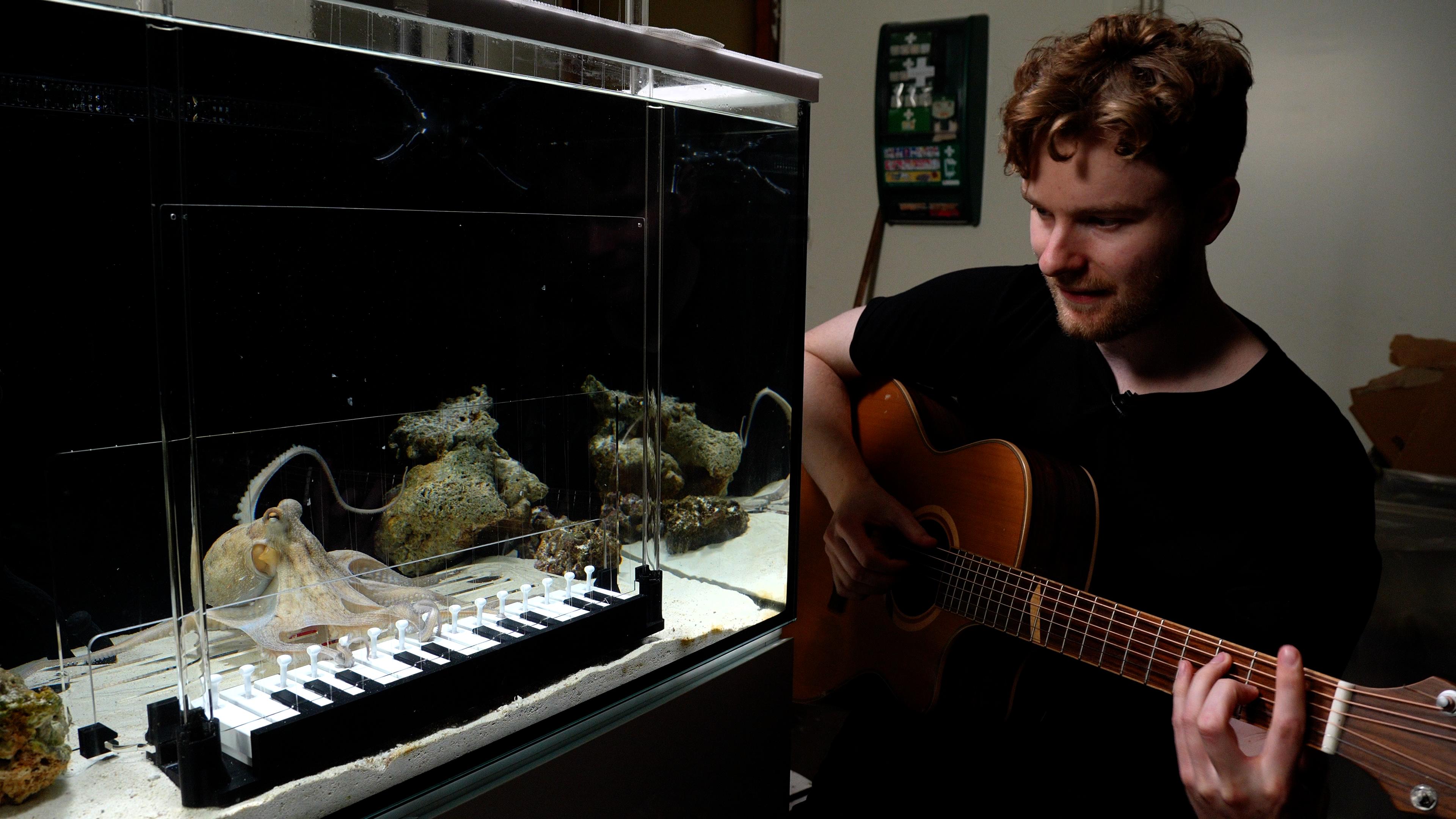
    Takoyaki, an octopus, played piano keys while Mattias Krantz played an acoustic guitar.

    Krantz purchased Takoyaki from a Portuguese fishery in March; he did not buy the octopus from a Korean market as is depicted in his YouTube video. Once Krantz got the octopus into his home, he dumped the creature into a roughly 110-gallon tank containing rocks, sand, and dog toys. The tank was connected to machines that filtered water and removed octopus waste.

    “You’re going to be the greatest pianist the sea has ever known,” Krantz told Takoyaki, which he nicknamed Tako.

    Mattias Krantz bought Takoyaki, an octopus, from a Portuguese fishery in March.

    But first, Krantz had to earn Tako’s trust.

    On the first day in its tank, Tako hid behind rocks and didn’t eat the small crabs and mussels Krantz had fished off Sweden’s southern coast. Tako began eating on the second day, and soon Krantz gave Tako a simple task to judge whether the octopus was up for the piano challenge: Take a plastic lid off a glass jar containing crab and shrimp. Tako passed the test after about three days.

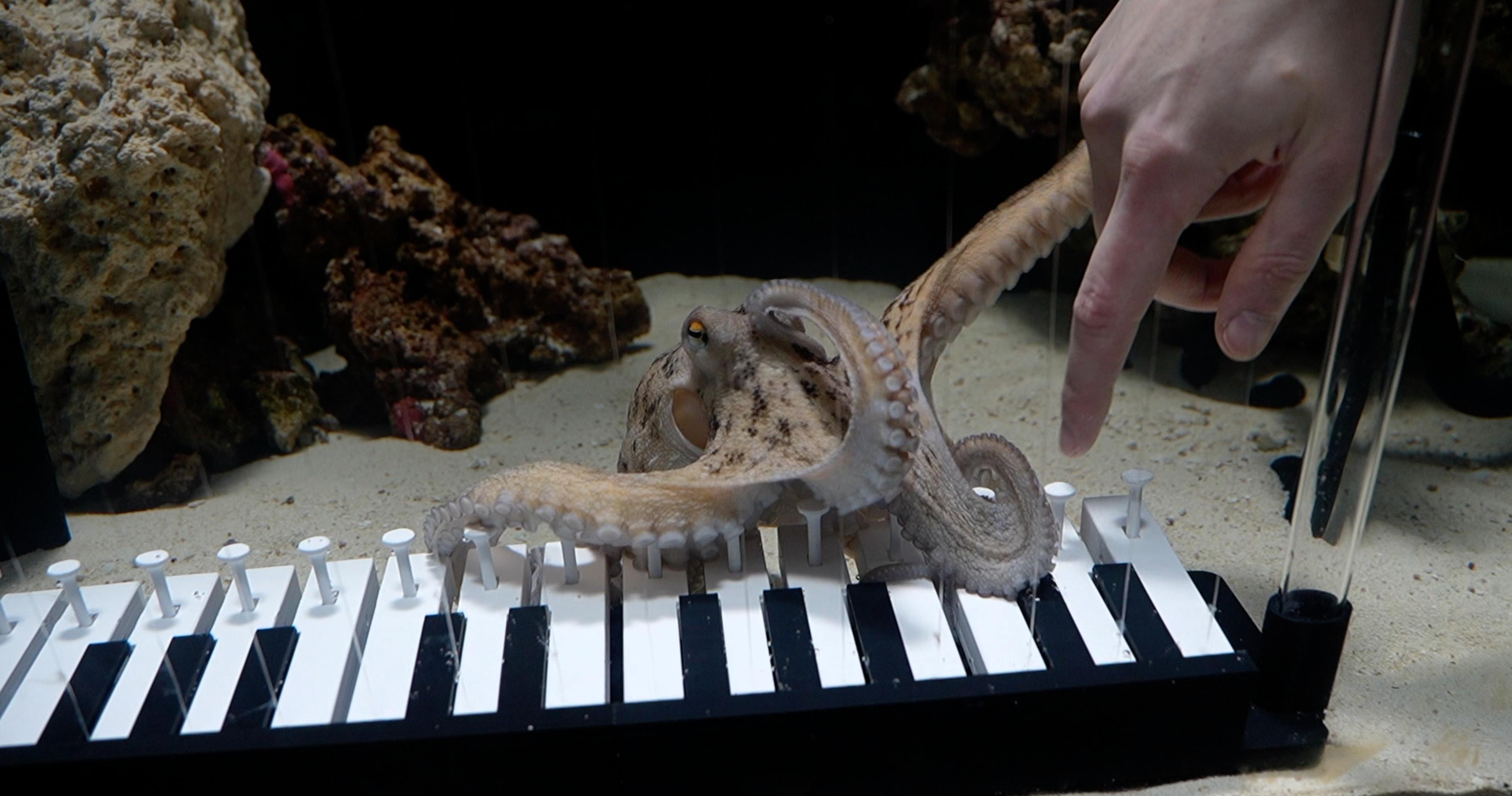
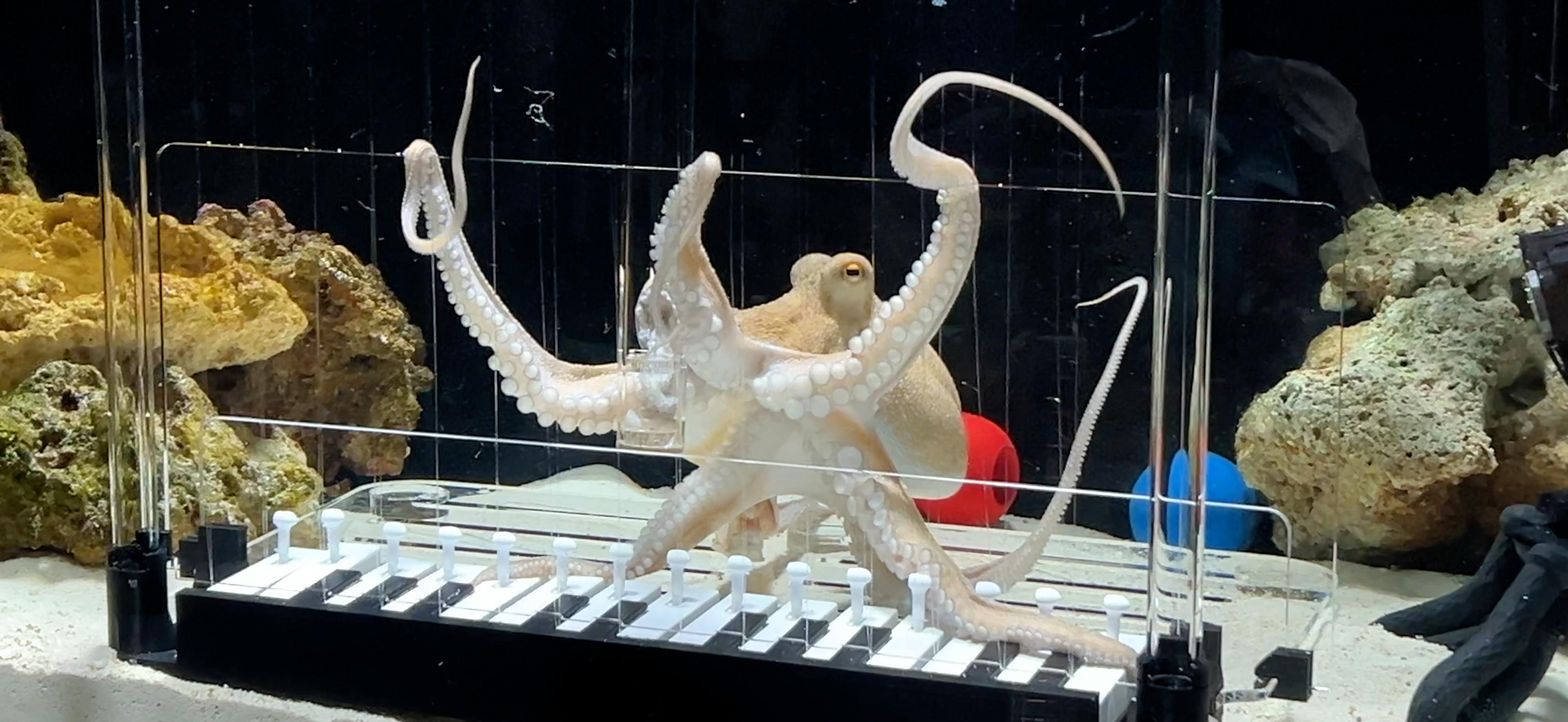
    Krantz then designed a piano key on his computer, 3D-printed it and set it down in the tank. When Tako touched the key on the second day, Krantz gave the octopus a treat. But Krantz wanted Tako to push the key to play a note, so he added a white lever that Tako wrapped its arms around and pulled to make a sound (Tako also broke the key off its mount a few times and hid it under rocks).

    After that first success, Krantz built Tako a 15-key piano — a process Tako seemed to watch closely by pressing its body against the glass. But when Krantz placed the piano in the tank, Tako sat on it instead of playing it.

    One of Takoyaki’s first tasks was to open a plastic lid off a glass jar.

    So Krantz tried different approaches.

    First, he added a blue underwater speaker that allowed Tako — whose species has poor hearing — to feel a vibration when the octopus played a key. Tako began playing random notes, Krantz said, but he wanted Tako to play particular keys to form a melody.

    Krantz added symbols to the keys he wanted Tako to play — circles, crosses, and stripes — which Tako didn’t respond to. Krantz even added pictures of an orange crab to the keys. The octopus was interested in the pictures but not in playing the keys.

    Takoyaki took the piano key Mattias Krantz made.

    But one thing seemed to grab Tako’s attention: movement. When a bubble formed in the tank, Tako chased it.

    So, with fishing wire, Krantz wiggled the lever on the keys he wanted Tako to play. It worked — despite Tako also spending time playing the wires like a harp. (Marine scientist Jenny Hofmeister said octopuses are attracted to movement because it might signal prey.)

    After a week, Tako played two notes in a row. After two weeks, Tako played a pair of notes simultaneously.

    After Mattias Krantz built Takoyaki a 15-key piano, the octopus seemed to resist Krantz pointing to the keys from inside the tank.

    But in the following weeks — after about four months of training — Tako plateaued.

    Plus — as expected from an octopus — Tako wasn’t focused on learning the instrument. Tako wrapped its arms around the GoPro camera in its tank, squirted water at Krantz, and, once, escaped the tank and hid in a cupboard.

    Krantz lost hope that Tako could learn to play.

    Takoyaki sometimes squirted water outside of the tank.

    But Tako stared at the piano, which sat on the ground beside the tank, throughout the day, appearing to want to play at the usual 6 p.m. training time, Krantz said. So Krantz experimented with a new strategy.

    “The one thing I’m really good at is insane stubbornness,” Krantz said.

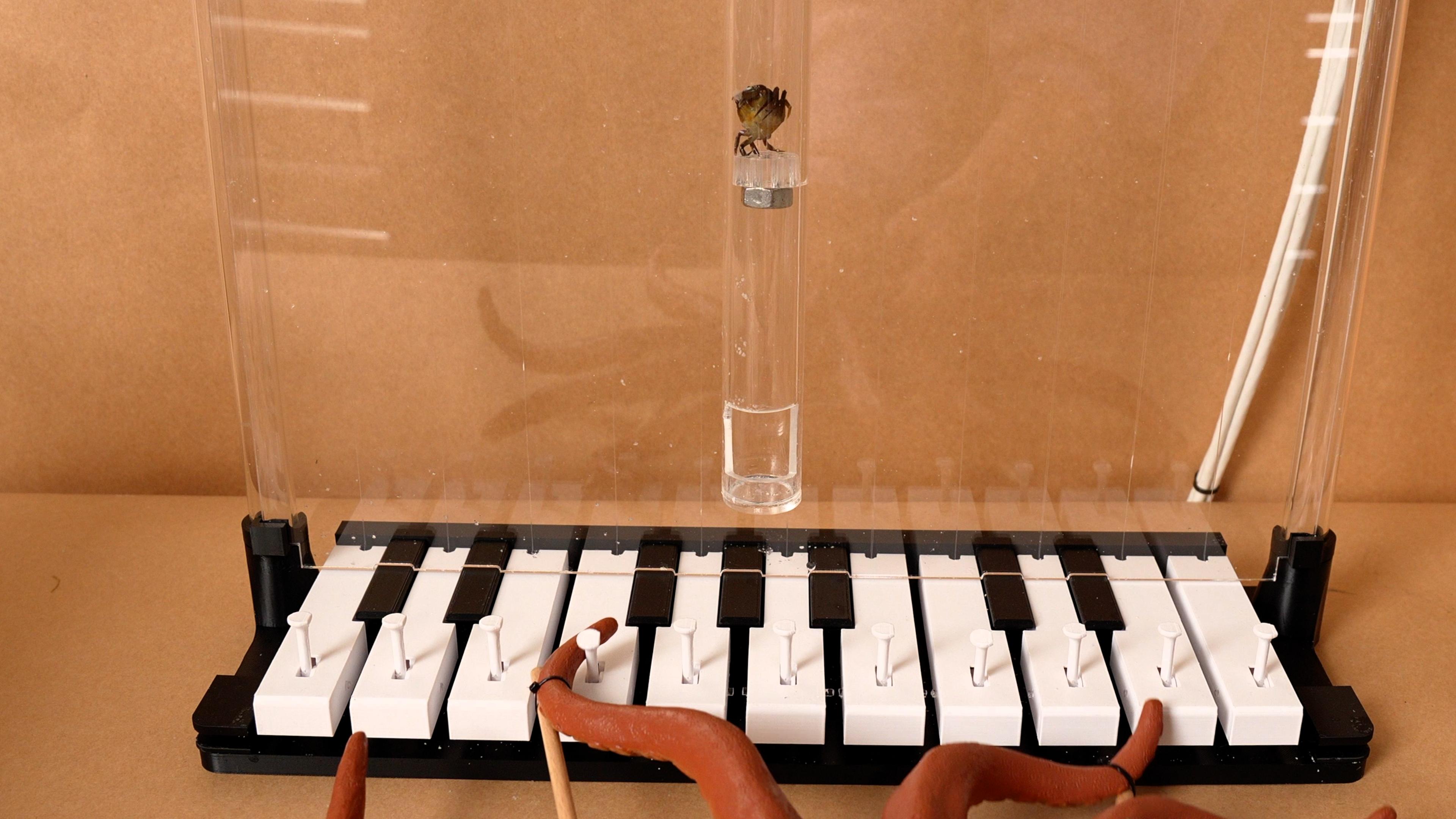
    In early August, he placed an acrylic tube inside the tank and inserted a crab — Tako’s favorite treat — at the top. When Tako played a key, Krantz lowered the crab closer to the bottom of the tube. Krantz called his device the “crab elevator.”

    Mattias Krantz built a “crab elevator” for his octopus, Takoyaki.

    Tako initially tried to retrieve the crab by swimming into the tube and attempting to pull the crab down. But once Tako saw the crab inch closer after playing a note, the octopus became more motivated to play. After a few weeks, Krantz gave Tako the crab once the octopus played seven or eight keys.

    In mid-August, Krantz began playing chord progressions on his acoustic guitar and simultaneously wiggled keys for Tako to play so they could perform together. Krantz fed Tako after each recital.

    Krantz never taught Tako to consistently play the right keys at the right times. Sometimes the piano sounded good; other times, not so much. Tako played the keys to “Baby Shark” — even if it was off tempo, Krantz said.

    “I can’t believe I sit here and play with an octopus,” Mattias Krantz said.

    But the fact that Tako could play keys at all was like a “fever dream,” Krantz said.

    Hofmeister, the marine scientist, said Tako probably didn’t know he was playing the piano; he was motivated by food.

    Octopuses are smart in their own ways: They change colors based on their surroundings, build dens with stones, use makeshift weapons, throw objects at targets, and eject ink clouds when they’re in danger.

    Takoyaki, an octopus, seemed to enjoy playing piano keys.

    “The octopus is not perceiving rhythm,” Hofmeister said. “It’s not perceiving, you know, tempo. It wants to do the steps it has to do to get the crab.”

    She said teaching an octopus to play the piano perfectly is nearly impossible.

    But in addition to creating music, Krantz received another benefit from the process: a friend. He has kept Takoyaki — the name means grilled octopus — as a pet.

    Takoyaki still plays the piano about every other day.

    Octopuses typically live for a year or two, and Krantz said Tako, which he estimated to be about 14 months old, now sleeps most of the day. But that hasn’t stopped Tako from continuing to practice its unique skill; the octopus plays piano about every other day.

    The recitals still leave Krantz in awe.

    “I can’t believe I sit here,” Krantz said last week, “and play with an octopus.”

  • Federal judge issues order to prohibit immigration officials from detaining Kilmar Abrego Garcia

    Federal judge issues order to prohibit immigration officials from detaining Kilmar Abrego Garcia

    BALTIMORE — A federal judge blocked U.S. immigration authorities on Friday from re-detaining Kilmar Abrego Garcia, saying she feared they might take him into custody again just hours after she had ordered his release from a detention center.

    The order came as Abrego Garcia appeared at a scheduled appointment at an Immigration and Customs Enforcement field office roughly 14 hours after he walked out of immigration detention facility in Pennsylvania.

    His lawyers had sent an urgent request to the judge, warning that ICE officials could immediately place him back into custody. Instead, Abrego Garcia exited the building after a short appointment, emerging to cheers from supporters who had gathered outside.

    Speaking briefly to the crowd, he urged others to “stand tall” against what he described as injustices carried out by the government.

    Abrego Garcia became a flashpoint of the Trump administration’s immigration crackdown earlier this year when he was wrongly deported to a notorious prison in El Salvador. He was last taken into custody in August during a similar check-in.

    Officials cannot re-detain him until the court conducts a hearing on the motion for the temporary restraining order, U.S. District Judge Paula Xinis in Maryland said. She wrote that Abrego Garcia is likely to succeed on the merits of any further request for relief from ICE detention.

    “For the public to have any faith in the orderly administration of justice, the Court’s narrowly crafted remedy cannot be so quickly and easily upended without further briefing and consideration,” she wrote.

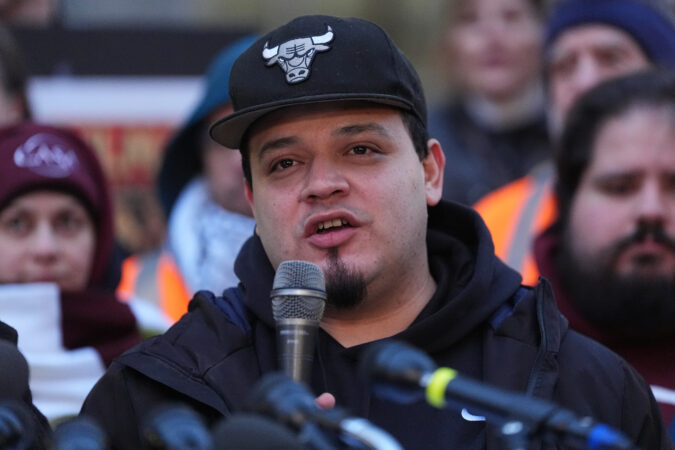
    Abrego Garcia on Friday stopped at a news conference outside the building, escorted by a group of supporters chanting “We are all Kilmar!”

    Abrego Garcia says he has ‘so much hope’

    “I stand before you a free man and I want you to remember me this way, with my head held up high,” Abrego Garcia said through a translator. “I come here today with so much hope and I thank God who has been with me since the start with my family.”

    He urged people to keep fighting.

    After Abrego Garcia spoke, he went through security at the field office, escorted by supporters.

    When Abrego Garcia’s attorney, Simon Sandoval-Moshenberg, announced to the crowd assembled outside that his client would walk back out the field office’s doors again, he stressed that the legal fight was not over.

    “Yesterday’s order from Judge Xinis and now the temporary restraining order this morning represent a victory of law over power,” Sandoval-Moshenberg said.

    The agency freed him just before 5 p.m. on Thursday in response to a ruling from Xinis, who wrote federal authorities detained him after his return to the United States without any legal basis.

    Kilmar Abrego Garcia waits with Lydia Walther-Rodriguez of Casa in Maryland, left, to enter the building for a mandatory check at the Immigration and Customs Enforcement office in Baltimore, Friday, Dec. 12, 2025, after he was released from detention on Thursday under a judge’s order. (AP Photo/Stephanie Scarbrough)

    Mistakenly deported and then returned

    Abrego Garcia is a Salvadoran citizen with an American wife and child who has lived in Maryland for years. He immigrated to the U.S. illegally as a teenager to join his brother, who had become a U.S. citizen. In 2019, an immigration judge granted him protection from being deported back to his home country, where he faces danger from a gang that targeted his family.

    While he was allowed to live and work in the U.S. under ICE supervision, he was not given residency status. Earlier this year, he was mistakenly deported and held in a notoriously brutal Salvadoran prison despite having no criminal record.

    Facing mounting public pressure and a court order, President Donald Trump’s Republican administration brought him back to the U.S. in June, but only after issuing an arrest warrant on human smuggling charges in Tennessee. He has pleaded not guilty to those charges and asked a federal judge there to dismiss them.

    A lawsuit to block removal from the U.S.

    The 2019 settlement found he had a “well founded fear” of danger in El Salvador if he was deported there. So instead ICE has been seeking to deport him to a series of African countries. Abrego Garcia has sued, claiming the Trump administration is illegally using the removal process to punish him for the public embarrassment caused by his deportation.

    In her order releasing Abrego Garcia, Xinis wrote that federal authorities “did not just stonewall” the court, “They affirmatively misled the tribunal.” Xinis also rejected the government’s argument that she lacked jurisdiction to intervene on a final removal order for Abrego Garcia, because she found no final order had been filed.

    ICE freed Abrego Garcia from Moshannon Valley Processing Center, about 115 miles northeast of Pittsburgh, on Thursday just before the deadline Xinis gave the government to provide an update on Abrego Garcia’s release.

    He returned home to Maryland a few hours later.

    Immigration check-in

    Check-ins are how ICE keeps track of some people who are released by the government to pursue asylum or other immigration cases as they make their way through a backlogged court system. The appointments were once routine but many people have been detained at their check-ins since the start of Trump’s second term.

    The Department of Homeland Security sharply criticized Xinis’ order and vowed to appeal, calling the ruling “naked judicial activism” by a judge appointed during the Obama administration.

    “This order lacks any valid legal basis, and we will continue to fight this tooth and nail in the courts,” said Tricia McLaughlin, the department’s assistant secretary.

    Sandoval-Moshenberg said the judge made it clear that the government can’t detain someone indefinitely without legal authority.

    Abrego Garcia has also applied for asylum in the U.S. in immigration court.

    Charges in Tennessee

    Abrego Garcia was hit with human smuggling and conspiracy to commit human smuggling charges when the U.S. government brought him back from El Salvador. Prosecutors alleged he accepted money to transport within the United States people who were in the country illegally.

    The charges stem from a 2022 traffic stop in Tennessee for speeding. Body camera footage from a Tennessee Highway Patrol officer shows a calm exchange with Abrego Garcia. There were nine passengers in the car, and the officers discussed among themselves their suspicions of smuggling. However, Abrego Garcia was eventually allowed to continue driving with only a warning.

    A Department of Homeland Security agent testified at an earlier hearing that he did not begin investigating the traffic stop until after the U.S. Supreme Court said in April that the Trump administration must work to bring back Abrego Garcia.