KYIV, Ukraine — Ukrainian drones hit more Russian oil facilities and set two oil tankers ablaze in the Sea of Azov on Thursday, a day after President Donald Trump pledged to grant Kyiv a license to manufacture the Patriot air defense systems to protect its cities.
A top Ukrainian official, meanwhile, cautioned that it could take a year or more for the country to produce Patriot interceptor missiles.
The Kremlin said the license deal reflected what it called Washington’s “ambivalence” but noted it appreciated Trump’s efforts to help broker a peace deal to end the war, which Russia launched over four years ago.
Ukraine’s drone strikes on oil refineries and other infrastructure across Russia have triggered a widespread fuel crisis with gasoline shortages and rationing in multiple regions and motorists waiting for hours to fill their tanks. Moscow has responded by intensifying its bombardment on Kyiv and other cities, exposing Ukraine’s vulnerability to ballistic missile strikes.
Ukrainian President Volodymyr Zelensky described the latest strikes on Russia’s infrastructure as part of Kyiv’s campaign of “long-range sanctions” carried out in response to Moscow’s refusal to halt the fighting.
“We have long proposed that Russia end this war, and every day of delay should bring the feeling of war to where it all began — to Russia,” Zelensky said.
Ukraine hits oil depots in western Russia and tankers at sea
A Ukrainian drone strike triggered a fire at an oil depot in the western Russian city of Tver, according to acting Gov. Vitaly Korolyov.
Oil reservoirs also were set ablaze by drones in Vyazniki, in the southern Stavropol region, said Gov. Vladimir Vladimirov, forcing the evacuation of several apartment buildings near the facility.
In the Sea of Azov, Ukrainian drones set two oil tankers on fire, according to Rostov Gov. Yuri Slusar, who said one of the ships was still burning and its crew evacuated.
The attack was the latest in a series of strikes on oil tankers in the area in recent days, part of Ukraine efforts to cut fuel supplies to the Crimean Peninsula, which Russia illegally annexed in 2014.
In addition to strikes on oil facilities in Stavropol and Tver, Zelensky said Ukrainian forces hit fuel infrastructure deep inside Russia, including one in Ufa, as well as an oil-loading terminal in the Rostov region closer to Ukraine.
Russia’s Defense Ministry said its defenses downed 73 Ukrainian drones from late Wednesday into early Thursday.
Ukraine’s air force said Russia fired 94 long-range strike drones and two ballistic missiles. While 72 drones were jammed or intercepted, 19 drones and both missiles damaged 13 locations, it said.
Ukraine says Patriot production will take months
During Wednesday’s meeting with Zelensky on the sidelines of the NATO summit in Turkey, Trump said the U.S. will meet a longstanding request from Ukraine and give it a license to make the Patriot air defense systems. He also praised Zelenskyy for doing “an amazing job” — a sharp change in tone from past criticisms of the Ukrainian leader.
But setting up domestic production of the mobile, surface-to-air systems will take many months, said Serhii Beskrestnov, an adviser to Ukraine’s defense minister.
A production license would typically come with technical process documentation, training for specialists, supplier contacts and foreign consultants to help launch manufacturing, Beskrestnov wrote on his Telegram messaging app.
The main obstacle would be time, rather than Ukraine’s technical or organizational capacity, he added.
Recent media reports pointed to two likely bottlenecks: the long production cycle for some subcontracted components, which could take 12 to 24 months, and limited global output of key parts, including components supplied by Boeing and L3Harris, Beskrestnov added.
The Pentagon had signed contracts to expand production capacity, he said, but added that the timeline for those contracts to translate into increased output remained unclear.
Germany also has a license to produce Patriot systems, and in 2022, Raytheon and MBDA Deutschland announced they planned to manufacture Patriot GEM-T missiles in the country, according to a news release at the time. The goal was to produce them in a German facility and ultimately provide them to other European allies.
The facility is expected to open in September with its first missiles scheduled to be delivered next year, with Ukraine as the first recipient, according to Defense Express, an online Ukrainian military-oriented publication.
Kremlin: Ukrainian strikes won’t hasten peace
Commenting on Trump’s statement about the Patriot missile licenses, Kremlin spokesman Dmitry Peskov offered a vague response, saying Moscow is aware of the U.S. military support for Ukraine but appreciates Washington’s declared commitment to help achieve peace.
“The U.S. position is somewhat ambivalent,” Peskov said in a call with reporters. “Still, unlike the Europeans, the United States maintains a desire to facilitate a move toward a peace process. They may be misguided or mistaken at times, but we see that desire as sincere. We welcome it, and we hope that once the Americans manage to resolve the situation regarding Iran despite the significant complications involved their efforts on the Ukrainian track will resume.”
Asked about Trump’s comment that Ukrainian attacks deep inside Russia could hasten a peace settlement, Peskov reaffirmed that the more strikes Kyiv launches, the broader “security zone” Moscow will seek to carve out in Ukraine via what the Kremlin calls its “special military operation.”
“It’s a mistake to think that escalation and military pressure could pave the way to a peaceful settlement,” Peskov said. “Further escalation may prolong the special military operation, we can’t say precisely to what extent, but it will force us to create a larger security zone, a larger buffer zone. Therefore, inciting tensions and taking escalatory action will in no way contribute to the peace process.”
Ukraine has urged the U.S. and other allies to provide binding security guarantees as part of any prospective peace deal, including the deployment of NATO forces. Russia has strongly warned against the presence of any NATO troops in Ukraine, saying it would view them as legitimate targets.
Asked Wednesday if he would be ready to enact a no-fly zone over Ukraine as part of security guarantees, Trump responded by saying “if it’s necessary, yeah,” but he argued that it might not be needed if a peace deal is reached.
“When we have a deal, we’re going to have a deal, security guarantee or no security guarantee,” Trump said as he sat next to Zelensky.
Commenting on the issue, Peskov warned that an attempt to establish a no-fly zone would amount to “NATO military forces being active on the territory of Ukraine — exactly what the special military operation is being waged against.”
Peskov said President Vladimir Putin is “open to dialogue” and ready for another phone call with Trump.
HANCOCK, Maine — They told him that he was “the guy.”
Last July, in a small town in coastal Maine, three progressive, self-styled recruiters of economic populists showed up at the blue-shingled house of Graham Platner, a little-known oyster farmer and Marine veteran who lived largely off government benefits.
They knew his name from local labor organizers and activists, and they had watched a video on the internet of him talking about oysters. Struck by his left-leaning ideology, his working-class affect and his gravelly voice, they became convinced that he could win a Senate seat in Maine — and quickly persuaded Platner of the same.
The recruiters — Dan Moraff, Leanne Fan and Morris Katz — told Platner he was “the one,” a “hero of the movement,” “a historical figure” who could be “leading a revolution,” according to half a dozen people with knowledge of their conversations.
But a clutch of people who cared about Platner were telling him something else. They worried about his mental health, amid his ongoing efforts to heal from post-traumatic stress disorder after tours in Iraq and Afghanistan. They feared this trio of out-of-state operatives was a dangerous combination of inexperienced and overconfident. The worst-case scenario, they thought, wasn’t running for Senate and losing — it was destroying the life he worked hard to build.
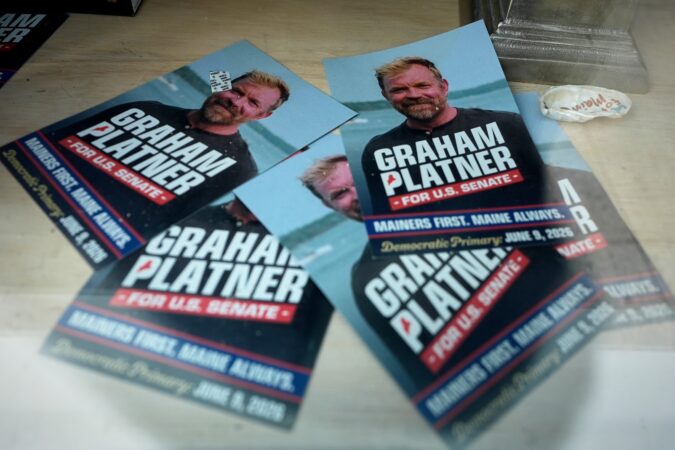
Until recently, Platner had seemed to prove the worriers wrong. His campaign was pumping out viral videos and broadcasting scenes from crowded town halls. He easily pushed a sitting governor out of the Democratic primary as voters embraced his message of economic populism and overlooked his checkered past. Progressives across the country heralded him as a new left-wing hero and saw him as their best opportunity to defeat Sen. Susan Collins, a Republican, in a race that could decide control of the Senate.
But behind the scenes, his campaign was messy, disorganized and haphazardly run. Platner did not disclose explosive, politically damaging secrets to key members of his team. And he was guarded by an insular and zealously protective inner circle of advisers who did not always seem to grasp the seriousness — or strangeness — of what quickly became a steady drip of scandal, according to party strategists, Democratic officials and former staff members.
Repeatedly, Platner promised there was nothing else damaging from his past to come. And each time, he was wrong.
Platner, said Ronald Holmes III, his former national finance director, was “seriously flawed.” But he faulted Platner’s team for failing to “ask the right questions and get honest answers.”
In a statement, the campaign disputed the idea that there was a lack of planning or infrastructure as “simply false,” and said that the team “built the operation, strategy, and organization needed to create one of the strongest grassroots campaigns Maine has ever seen.”
This report is based on interviews with more than 30 people who interacted with the campaign or Platner, many of whom were granted anonymity to discuss sensitive matters.
In June, as rumors swirled about a damaging story coming from The New York Times featuring several of Platner’s ex-girlfriends, Katz called a top national Democratic strategist, insisting that there were no issues in Platner’s past concerning his treatment of women, according to a person with direct knowledge of the conversation.
Katz said he had asked Platner directly and repeatedly whether anyone had made sexual assault allegations against him and the candidate had said no, according to two people familiar with the discussion who described it on the condition of anonymity.
“It’s been a slow-rolling disaster instead of all happening at once — it’s been really drawn out and painful and difficult to watch,” added Holmes, who resigned last fall after raising concerns about the professionalism of the campaign’s senior leadership. “It’s like we’ve been watching a mile-long train derail at four miles an hour.”
That train finally crashed this week, when a woman who had dated Platner accused him of rape. He denied the allegation, but released a video saying he was taking time to “reflect” on his path forward.
Within roughly 24 hours, Democrats at every level had called for him to withdraw, and the Maine Democratic Party was on a war footing with its own nominee. Ambitious politicians were taking steps to try to succeed him on the ticket. And Democrats across the country wondered how one of their best chances to flip a Senate seat had imploded.
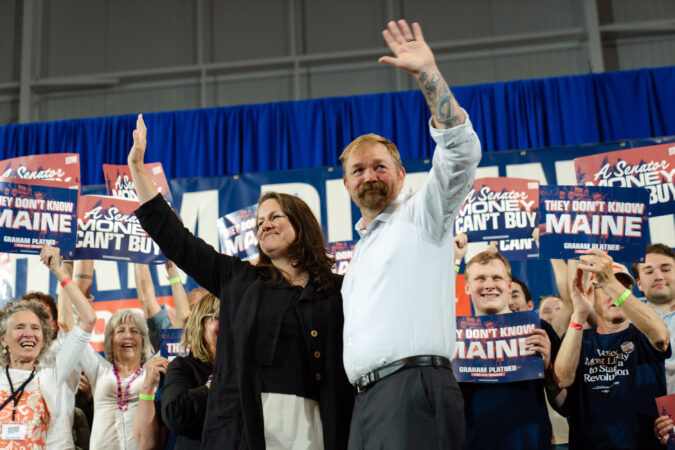
Graham Platner, Democratic candidate for U.S. Senate, speaks at a campaign event Friday, June 5, 2026, in Bar Harbor, Maine.
A ‘Totenkopf’ tattoo
Before Platner became the Democrats’ biggest headache, his most ardent supporters spoke about him in strikingly lofty terms.
As his campaign was getting off the ground, Moraff likened him to Barack Obama in conversations with senior Democratic officials, according to two people with knowledge of the private conversations.
But there were early signs that Platner had serious political liabilities. Less than two weeks after he announced his bid, his wife, Amy Gertner, approached a top campaign aide. She wanted to disclose that Platner had been exchanging sexual messages with multiple women.
Platner was about to hold a campaign event with Sen. Bernie Sanders, his first major endorser and a personal hero. Gertner told Genevieve McDonald, then the campaign’s political director, that she worried Sanders would think less of her husband if he later found out about the exchanges with other women, McDonald recalled.
Was that the extent of the controversy in Platner’s personal life or was there more to worry about? Campaign officials appeared not to know.
A top Platner adviser had promised a national Democratic strategist that they would not launch a campaign without completing a full investigation of Platner’s background. But, according to two people familiar with the campaign’s operations, no extensive effort was undertaken in one of the marquee races of the midterm cycle.
Instead, they conducted an expedited review, resulting in a short risk-assessment memo.
Platner’s campaign said that a research firm produced a vetting memo of nearly 50 pages that included searches of news reports, social media posts and public documents. They did not do exhaustive interviews with Platner.
“I said, ‘None of this will or should stop him from becoming a U.S. senator,’” Moraff told The Wall Street Journal.
But others had access to significantly more damaging information about Platner’s past.
In Northern Virginia, Lyndsey Fifield, a former girlfriend of Platner’s, texted a private group chat of friends last summer about a tattoo on his chest widely recognized as a Nazi symbol. He had gotten it while serving in the military and referred to it, she has said, as “my Totenkopf.”
The “Nazi tattoo on his chest,” Fifield suggested, was going to be a problem.
The existence of the tattoo, however, did not immediately become public. In the meantime, Platner’s campaign began to find an audience. He drew bigger and bigger crowds, crisscrossing the state for events and spending hours gabbing on podcasts.
Yet controversies kept arising. In October, CNN and other news outlets uncovered a trove of incendiary online posts that Platner had written between 2009 and 2021, which included dismissive comments about rape and sexual assault in the military.
Platner apologized, and has urged the public not to judge him for his worst moments on the internet.
The lack of disclosure about his past made McDonald, a former state legislator and lobbyist, uncomfortable. She quit the campaign in October.
Around the same time, photos of Platner’s tattoo from his wife’s Facebook account began leaking to news organizations.
The Platner team, hoping to defuse the potential damage, released video footage of a shirtless Platner with the tattoo visible to Pod Save America, a liberal podcast that supported his bid.
In a friendly interview, Platner dismissed the issue as little more than pearl-clutching by his opponents. “I am not a secret Nazi,” he said. “Lifelong opponent.”
At the time, Platner said in a statement that he did not know that his tattoo resembled a Nazi symbol until it became a campaign issue.
More staffers, including Holmes, left the campaign.
FILE – A worker enters the campaign headquarters for US Senate candidate Graham Platner, Tuesday, Nov. 4, 2025, in Ellsworth, Maine.
‘It’s not that complicated’
For months, there was little indication that any of the controversy was seriously hurting his candidacy.
As Platner’s star rose through the winter and early spring, Katz was privately promoting him as a future presidential candidate for as soon as 2028, if he won his Senate bid.
When Janet Mills, his chief Democratic primary opponent, produced tough ads featuring his comments about women and rape, it did little to change the trajectory of the race. Poll after poll showed Platner leading Mills, a two-term governor who was supported by national Democratic leaders, by double-digits.
Platner built a movement-like following, emerging as one of his party’s most powerful online fundraisers. His campaign constructed an image of a working-class combat veteran who had returned to Maine to rebuild his life, who spoke movingly about the failings of U,S, foreign policy and rallied voters with his promises to take on a political system dominated by corporations and billionaires. Democrats flocked to his town hall meetings.
Publicly, at least, the candidate expressed nothing but bravado.
In an April interview, he dismissed any jitters about going up against Mills — a former prosecutor — in a series of planned public debates.
Platner had debated before, he said, in college classes. His preparations, he said, were “standard run-of-the mill debate prep.”
“Honestly, I’ve seen enough and read enough about politics that it looks and sounds very much like what debate prep usually looks like,” he said.
He added: “Standing up and talking about the things you believe in, it’s not that complicated.”
Platner’s theory about debating would never be tested. The next morning, Mills dropped out the race, saying she lacked the funds to compete.
But by June, Platner was trailing far behind Collins in campaign funds. Platner’s campaign had just $1.3 million in the bank when he exited the race, a fraction of Collins’ $9.7 million war chest as of late May. A person familiar with the campaign’s finances said the amount of cash available to spend was even lower — under $100,000.
The campaign raised nearly $9 million last quarter, said a campaign official, more than doubling the previous quarter’s haul. While the campaign successfully focused on attracting small-dollar donations, it struggled to recruit and retain big-dollar donors.
Campaign aides told top Democratic strategists that donors kept raising concerns about the tattoo and his other controversies. Their requests for help assuaging donors’ concerns were met with silence from the national committee, according to three people familiar with discussions.
Last week, Platner kicked off a call with a new national finance committee — a first, if belated, step to bundle checks from wealthy donors, according to an invitation seen by the Times. And the campaign took its worries about money public, warning on a call with reporters that he was being swamped on the airwaves.
Estimates showed they were set to be outspent by 2-to-1 on advertising by Collins and her allies through Election Day, according to data from the media tracking firm AdImpact.
“I was training with my jujitsu buddies at my kids’ class yesterday,” Ben Chin, Platner’s campaign manager, told reporters. “There were these radio ads that were coming on as we were listening, and people were starting to give me a hard time, like, ‘Oh, where are your radio ads?’”
A campaign in crisis
The campaign’s money troubles were exacerbated by a series of even more damaging revelations about his personal conduct and treatment of women. In May, the Journal and the Times published stories detailing sexual text exchanges with women that had worried McDonald and Gertner nearly 10 months earlier.
In early June, Platner found himself in a private meeting in Washington facing questions from senators about whether more damaging revelations were yet to come. He promised that there was nothing else, according to a person familiar with the discussion.
But it became clear that Platner and his team were in crisis mode. He flew home to Maine, and frantically dialed ex-girlfriends to find people who would testify to his good character.
He called Rep. Ro Khanna, an early supporter from California, to warn him that the Times was going to publish a story that would detail his “toxic relationships.” He was a “terrible boyfriend” and made misogynistic comments, he said, according to someone familiar with the discussion, but nothing worse.
Days later, the Times published accounts from three women who had been in romantic relationships with Platner for years. They said he could be demeaning to women and, in at least one case, even physically threatening.
In the immediate aftermath, many activists and politicians went to their partisan corners.
“There are no saints in the United States Senate,” Sanders said.
But other prominent Democrats started speaking out more bluntly. In private meetings, even strong supporters began raising concerns.
“I look forward to the day where I am not answering every single week a question about bad behavior by another dude,” said an exasperated Sen. Elissa Slotkin, D-Mich., in an interview on MS Now.
By late June, Platner found what he hoped would be a powerful answer to critics: an endorsement by Planned Parenthood Action Fund at a splashy rally, portraying him as a champion of abortion rights.
Planned Parenthood officials knew their endorsement was a political risk, according to someone familiar with internal discussions. But they desperately wanted to defeat Collins.
Before they offered their endorsement, Alexis McGill Johnson, the chief executive of the group’s political arm, had posed to Platner the question that so many others had asked: Was there anything else that would come out about him?
Again, he said no. She responded with an ultimatum. If anything worse were to come out about him, he should not expect the women’s groups to clean up after him.
On Monday evening, as news that he had been accused of rape ricocheted across the country, the group quickly withdrew its support.
By midweek, as Democratic officials pushed for Platner to rapidly exit the race, the besieged candidate and a handful of aides, including Katz, hunkered down in his blue-shingled house and tried to challenge establishment politics one last time. Journalists trailed them to the local convenience store, where “The Graham,” a roast beef and pepper-jack sub, has been a popular deli counter order.
On Wednesday night, his campaign released a video in which Platner suspended his campaign and blamed his loss on the “corporate media system” and “political establishment.”
“We did it the right way,” he said. “And we won and now they are not going to let us have it. Not if it’s me.”
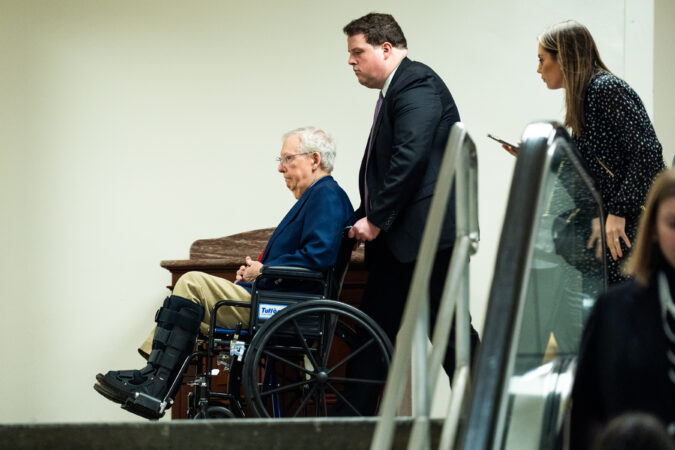
Sen. Mitch McConnell’s current health condition and ongoing absence threatens to complicate the U.S. Senate’s return to business next week.
Congress is returning from recess on Monday and faces a limited number of days left before the Sept. 30 deadline to fund the government for fiscal year 2027. McConnell (R., Ky.) plays a crucial role as a member of the Senate Appropriations Committee.
Republicans and Democrats on the committee have been at a stalemate that began over disagreements about defense funding. If the two sides can’t come to an agreement, Republicans will likely need McConnell’s support to advance any spending bills out of the committee amid Democratic opposition.
The Trump administration has requested Congress provide an additional $87.6 billion in supplemental funding for the Pentagon and other agencies, largely to cover needs related to the war with Iran, which reignited this week.
McConnell, 84, leads the Senate Defense Appropriations Subcommittee, which has jurisdiction over that military spending. He has not cast a vote on the Senate floor since June 11. He was admitted to the hospital on June 14. While members of Senate leadership said they have since spoken to him, McConnell’s office has offered limited details about his condition and he has not been seen publicly.
Democrats have refused to support the increase in defense funding Republicans have put forward without a comparable boost for domestic programs. That disagreement is part of the reason the committee, which normally advances these measures on a bipartisan basis, has not yet advanced any legislation for fiscal year 2027.
The Senate Appropriations Committee planned to begin hearings the week of June 22 to review some of the nondefense bills, after previous delays related to the defense spending. But those plans were canceled due to McConnell’s absence, according to a Republican aide, who spoke on the condition of anonymity to share internal deliberations.
A separate Republican congressional aide, who also spoke on the condition of anonymity to share internal deliberations, argued that the delays with the appropriations process “predate” McConnell’s hospitalization and blamed the delays on Senate Democrats.
McConnell’s continued absence could make it harder for the Senate Appropriations Committee to pass budget bills, by eliminating Republicans’ one-seat majority on the panel. Without McConnell, the Appropriations committee is split evenly between Republicans and Democrats, and tied votes tend to sink legislation in committees.
Republicans could move forward with hearings to markup the nondefense bills, but Democrats have indicated they would not support any funding measures without an agreement on overall spending levels.
Lawmakers will have to pass a temporary stopgap funding bill to prevent a government shutdown if they cannot get the fiscal year spending bills done in time.
McConnell’s office declined a request for comment about McConnell’s role in delaying the budget process, referring The Post to the appropriations committee. The appropriations committee pointed to a statement by its chair, Sen. Susan Collins (R., Maine), who has said there would be a hearing on the defense supplemental request.
McConnell’s absence is attracting more concern outside of Washington. Kentucky Gov. Andy Beshear, a Democrat, sent a letter on Wednesday to McConnell’s office asking for an update on his health.
“Over the last several weeks, Kentuckians have grown increasingly concerned about the current state of your health and well-being, and ability to hold office in the United States Senate,” Beshear said in the letter. “As public officeholders, we have made a commitment to our constituents to do our best to represent them and to always be transparent. I believe this requires clear communication about one’s ability to serve.”
WASHINGTON — President Donald Trump said on Wednesday that he would ask the Supreme Court to reconsider its decision to strike down his executive order that aimed to revoke birthright citizenship, a request that the justices are highly unlikely to take up.
The declaration, made in a social media post, showed the president’s continued frustration with the court’s decision last week, when a majority of justices ruled that the citizenship given to nearly all children born on U.S. soil was enshrined in the Constitution.
Trump claimed that signs and billboards were being placed along the southern border and in Mexico advertising the right, and that citizenship would be granted to “anyone willing to pay.”
The president appeared to be referring to a Fox News report that identified a hospital in Texas that had advertised paying for “Birth Packages in South Texas” on billboards in Mexico. The outlet reported that Gov. Greg Abbott of Texas, a Republican, had ordered an investigation into the hospital, which told Fox News that “marketing materials regarding maternity services are no longer in use due to any unintended misunderstanding.”
“We do not support or facilitate any unlawful activity and work to comply with all applicable federal and state laws and regulations,” the hospital added in a statement to the outlet.
On Wednesday, Trump said that he would ask for a “rehearing” of the case “IMMEDIATELY,” and that the justices would “destroy America if they don’t change their absolutely insane decision.” As of Wednesday evening, administration lawyers had not filed a request with the court.
Under Supreme Court rules, parties can ask the justices to rehear a so-called merits case after it has already been decided. But it is exceptionally rare for the court to grant such requests.
The last time the court granted a rehearing request after it had announced a decision in an argued case was in 1965. The court has only once reversed itself after rehearing a case, according to Stephen I. Vladeck, a professor at Georgetown University Law Center. That reversal happened in a 1956 case examining military tribunal jurisdiction for civilian spouses of service members.
Trump, who attended the oral arguments in the Supreme Court citizenship case, has continued to lash out at the court over its ruling, which was delivered by Chief Justice John Roberts.
“Citizenship, then and now, was the right to have rights — to freely participate in our political community,” Roberts wrote in the decision. “The framers of the 14th Amendment extended that promise to ‘every freeborn person in this land.’”
The 6-3 decision capped a more than decadelong effort by Trump to use the issue as a political tool. In the immediate aftermath, he urged Congress to take up the issue with legislation, incorrectly asserting that “no long and unwieldy Constitutional Amendment is necessary.”
Several days later, the decision received renewed attention after Trump intervened in an officiating decision in the men’s World Cup on behalf of a U.S. player with foreign-born parents.
He called Gianni Infantino, the president of the body overseeing the tournament, to protest a red card that was given to Folarin Balogun, a star player who was born in the United States while his parents, who were born in Nigeria and lived in London, were on a trip.
FIFA, the World Cup governing body, reversed the referee’s decision, which would have prohibited Balogun from playing in a match against Belgium; the United States lost the game, 4-1, on Monday.
Trump said that he had decided to act when he learned of the implications of the red card, saying that “when they take your best player, or just about,” it is “very unfair.”
BEIJING — A fire broke out at a shoe factory in the eastern Chinese province of Fujian on Thursday, killing 28 people, the official Xinhua News Agency said.
Chinese President Xi Jinping on Thursday demanded “an all-out search and rescue effort.” He urged swift investigation of the incident and to “strictly hold those responsible accountable.”
The blaze started at a factory by the Huiteng shoe company in the city of Jinjiang, also known as China’s shoe capital, the city’s fire department said in a statement. The cause of the fire was not immediately known, and it was unclear whether more people were injured in one of the deadliest fires in China in recent years. Local media reports said people had been trapped on the rooftop.
Xinhua said the factory’s owner and others in charge have been taken into custody and the company’s accounts have been frozen.
Video by the state broadcaster CCTV shows the facade of a building of several floors charred black and covered in white smoke. Earlier footage shows fires were burning on multiple floors and the building shrouded in thick, black smoke.
BAR HARBOR, Maine — Graham Platner’s announcement late Wednesday that he was suspending his Senate run in Maine plunged Democrats into a foggy, fast-paced search for a replacement — with a growing group of contenders already jostling to become the party’s new nominee.
On Thursday morning, Dr. Nirav Shah, a public health researcher who led Maine’s response to the coronavirus pandemic and finished second in the primary for governor, became the latest Democrat to officially enter the contest, joining a fast-growing field.
In early June, Platner won the Senate nomination after more than 150,000 Democratic primary voters cast ballots for him. Now, with Platner having dropped out of the race after a rape allegation he denies, the state’s Democratic Party has been left to find a new candidate with a process it is creating on the fly.
To formally remove himself from the ballot, Platner must submit a signed request to the Maine Secretary of State’s Office by a July 13 deadline. As of Thursday morning, he had not submitted one, said Jana Spaulding, the deputy secretary of state for communications.
The party has said it will pick a new candidate through a nominating convention before a July 27 deadline set by state law. The timing and specifics of the convention had not been set as of early Thursday. But there was talk of allowing hundreds of Maine Democrats to vote on the nominee.
The Democrat who emerges from the process will carry the party’s hopes of unseating Sen. Susan Collins, a Republican incumbent, in a race that Democrats see as key to their chances of taking back the Senate in November.
After Platner, a progressive, populist oysterman, departed the race Wednesday, a small group of ambitious Democrats quickly moved to join the contest to replace him.
Troy Jackson, a former president of the Maine Senate favored by some progressives, said he was running. He came up short in the Democratic primary for governor in Maine last month.
“There is a powerful movement of working-class people in the state of Maine, and millions more across America who are ready to send a progressive fighter to the Senate,” Jackson, a fifth-generation logger from Allagash in northern Maine, said in a statement. He added, “I’m in.”
Hours before he entered, he secured the endorsement of Rep. Ro Khanna, a California progressive who was once one of Platner’s most vocal supporters.
Jordan Wood, another progressive, also said he was entering the race. A former congressional staff member, Wood narrowly lost in the House primary in northern Maine’s swing congressional district last month.
“I’m running for U.S. Senate because to beat Susan Collins, Democrats need a candidate who can provide a true contrast and run an unapologetically progressive campaign,” he said in a text message late Wednesday. He had briefly entered the Democratic Senate primary in Maine last year before pivoting to the congressional race.
Earlier Wednesday, Dan Kleban, a founder of a brewery, said he was joining the contest, writing on Substack that Maine voters “deserve a Senator who will fight for us, not one who enables Trump at every turn.” He also had a short-lived bid for the Senate last year.
Shah, in his Thursday announcement, wrote on social media that “establishment politicians have failed us” and that “to defeat Susan Collins, we need an outsider.”
It was not immediately clear how the candidates might distinguish themselves from one another. And they might soon have more company.
Also weighing a candidacy was Shenna Bellows, the Maine secretary of state and a former state lawmaker. Like Shah and Jackson, Bellows ran for governor of Maine this year and fell short. Others may also join the contest.
The Maine Democratic Party voted Wednesday to approve the convention in a meeting with more than 100 state party members. Leaders in the state party were expected to meet again Thursday to move toward finalizing the process.
“We are going to have a nominating convention,” Charles F. Dingman, chair of the Maine Democratic Party, said Wednesday night. “And it is going to be representative.”
Another question was how involved Platner might be. On Tuesday, he received pushback from the state party, which accused him of trying to intervene in the effort to replace him before he had even exited the campaign.
“We have repeatedly reiterated to Graham Platner’s team that they have no role in determining our U.S. Senate nominee,” Devon Murphy-Anderson, the party’s executive director, said in a video on social media.
In a statement made by hand-held video that he issued Wednesday, announcing that he was suspending his candidacy, Platner said he was “not trying to dictate to anyone” who his replacement should be. But he argued that the process should reflect “the will and the values of the people that built” his political movement.
Many of his supporters said they felt defeated by the turn in the race. “I am hugely disappointed,” said Kat Higgins, 64, a retired nurse. “I really, really liked what he said. I think everything has to change.”
Platner spent the final hours before his exit holed up with campaign advisers in his faded blue Greek Revival farmhouse in the wooded, seaside hills of Sullivan, Maine. His campaign released his video statement as the sun was setting over the Atlantic coast.
A half dozen journalists were gathered on the street outside the home, but Platner did not emerge to address them. A single light illuminated a mudroom on the first floor.
Bonnie Tyler, the gravelly voiced, Grammy-nominated Welsh pop star best known for singing the chart-topping power ballad “Total Eclipse of the Heart” in 1983, and seeing new generations succumb to its bombastic charms during solar and lunar eclipses, has died. She was 75.
Tyler died unexpectedly in a hospital in Portugal where she was being treated for an illness, her family said Thursday in a statement on her website. She was hospitalized in May in Faro, where she had a home, for emergency intestinal surgery. She had been placed in an induced coma for a period but was reportedly improving last month and expected to make a good recovery.
“Bonnie’s family and team are heartbroken to announce that Bonnie unexpectedly passed away last night in hospital in Portugal as a result of the illness that she was being treated for,” her family said.
Tyler earned three Grammy nods, represented Britain at the Eurovision Song Contest 2013, where she came in 19th. She was honored as a Member of the Order of the British Empire for her services to music by Queen Elizabeth II in 2022, all largely thanks to “Total Eclipse of the Heart,” which has had more that 1 billion streams, boosted by real eclipses in 2017 and 2024.
The song spent four weeks at No. 1, and when Stereogum reevaluated it in 2020, the music outlet declared it an “extinction-level event rendered in musical form.”
“It’s pop music as heart-pounding, chest-thumping, blood-gargling, heavens-falling passion explosion. It’s sheer spectacle. It’s fireworks and lasers and lightning and thunder. It soars and swoops and barrel-rolls,” the site said.
The song has never really gone away, covered by the English singer Nicki French in 1995, and the band Westlife in 2006. Cate Blanchett sang it while hitting Billy Bob Thornton with her car in 2001’s “Bandits,” it appeared in a wedding scene in 2003’s “Old School” and One Direction sang it in 2010 on a U.K. version of “The X Factor.”
Early life
Tyler was born — as Gaynor Hopkins — a coal miner’s daughter in public housing with an outside toilet in Skewen, Wales, about 7 miles (11 kilometers) outside Swansea. She grew up with three sisters and two brothers.
She adored the Beatles and her first album was “A Hard Day’s Night.” The first song she bought was “Hippy Hippy Shake” by the Swinging Blue Jeans at 13 and watched “Top of the Pops” religiously, according to her memoir, “Straight From the Heart.”
She would record “Top of the Pops” on a reel-to-reel two-track recorder and write down the lyrics of songs she loved. Her favorites were songs by Janis Joplin, Nina Simone, Tina Turner, Wilson Pickett and Otis Redding.
“I used to sing them into my hairbrush for hours and hours, and that’s how it all started for me. I fell in love with singing just from doing that. Looking back, even then my voice had a husky tone to it, but I didn’t think much of it. I thought everyone’s voices were different from each other’s,” she wrote.
In 1976 she had to have surgery to remove nodules on her throat, leaving her with that trademark vocal sound. Changing her name to Sherene Davis, she was fronting a soul band when she was discovered by talent scout Roger Bell, who brought her to London for demo sessions. Then she waited for a label until RCA said it was interested.
Under her new RCA-sanctioned name Bonnie Tyler, her debut album “The World Starts Tonight” in 1977 contained her first chart hit, “Lost in France,” and she was nominated for a breakthrough artists award at the Brits Awards. She then had a No. 3 hit in 1978 with “It’s a Heartache,” but soon drifted. She then signed with Sony and saw Meat Loaf perform “Bat Out of Hell” on the BBC. Impressed, she requested to work with Meat Loaf songwriter and producer Jim Steinman.
‘Total Eclipse of the Heart’
Steinman introduced her to his song “Total Eclipse of the Heart,” which would become the debut single for her fifth studio album, “Faster Than the Speed of Night.” He borrowed one of the song’s lyrics — “Turn around, bright eyes” — from his 1969 musical “The Dream Engine,” written as a student at Massachusetts’ Amherst College. He told her the song was from a prospective musical version of “Nosferatu.”
“Jim liked to put down a basic rhythm track, do nine takes of the song, choose the best one and then put the kitchen sink on there, like Phil Spector used to,” Tyler told The Guardian in 2023. “He gave me a cassette to listen to in my hotel and we both preferred take two.”
Featuring E Street Band members Roy Bittan on piano and Max Weinberg on drums, “Total Eclipse” is a rumination on lost love: “Once upon a time there was light in my life/But now there’s only love in the dark,” she sings.
The video, a staple of early-days MTV, was shot in a frightening gothic former asylum in Surrey, where the guard dogs apparently wouldn’t set foot in the rooms downstairs where they used to give people electric shock treatment. The visuals included slow-motion tossed doves, candles, dancing ninjas, dancing greasers, Tyler in frighteningly big shoulder pads, fencers, gymnasts, wind machines and shirtless boys wearing swim goggles being doused with water.
“Faster Than the Speed of Night” earned a Grammy nomination for best rock vocal performance — losing to Pat Benatar’s “Love Is a Battlefield” — and Tyler got another nod for “Total Eclipse of the Heart” in the best pop vocal performance category, losing to Irene Cara’s “Flashdance — What a Feeling.”
After the ‘Eclipse’
Tyler never reached such dizzying heights again but stayed current with such movie soundtrack singles as “Holding Out For a Hero” — from 1984’s “Footloose” — and “Here She Comes” from “Metropolis” also in 1984.
Her 2019 disc “Between the Earth and the Stars” featured duets with Rod Stewart, Cliff Richard and Status Quo’s Francis Rossi, and she ended that year performing a Vatican Christmas concert before Pope Francis.
In 2013, she switched gears to make a country-flavored record in Nashville, “Rocks and Honey,” which included the Vince Gill duet “What You Need From Me” and a little ballad called “Believe in Me,” written by American songwriter Desmond Child and British songwriters Lauren Christy and Christopher Braide. “Believe in Me” was picked to represent the United Kingdom at that year’s Eurovision Song Contest in Sweden.
“It was an absolutely wonderful atmosphere there,” she told the San Francisco Examiner in 2023. “I was being interviewed every 15, 20 minutes, and when I walked out onstage behind the British flag, I thought the roof was going to come off! It was awesome, just awesome!”
In 2017, she joined Joe Jonas’ band DNCE for a performance on the cruise ship Oasis of the Seas as part of a “Total Eclipse Cruise.” When the moon passed in front of the sun, they played “Total Eclipse of the Heart.”
Tyler was married to property developer and former Olympic judo competitor Robert Sullivan.
You wake up to your 7 a.m. alarm feeling relatively refreshed and ready to tackle the day ahead. But when you check your smartwatch, you’re surprised to see a low sleep score staring back at you.
You start trying to remember the night before. Did you toss and turn more than you thought? Why is your watch telling you that you’re exhausted when you feel fine? When your head hits the pillow that night, you lie wide awake worrying about getting a good night’s sleep until the wee hours of the morning.
If this scenario feels familiar, you may have orthosomnia, a fixation on achieving “perfect” sleep, often fueled by sleep trackers, that tends to result in worse sleep.
“Orthosomnia is, at its core, a form of insomnia triggered by obsessive tracking of sleep data and the use of sleep wearables,” said Andrew Spector, a sleep medicine specialist at Duke Health in North Carolina. “It’s essentially trouble falling asleep for artificial reasons.”
Many people rely on technology to fix their problems, but as it turns out, in this situation, these gadgets may backfire. Read on to learn more about orthosomnia and what to do if you think you might have it.
What causes orthosomnia?
At the root of orthosomnia is the popularity and ubiquity of sleep trackers. And while they can be useful tools at times — for example, some can screen for signs of sleep apnea, such as breathing disturbances — they can interfere with your ability to listen to your body, according to Amy Morin, a Florida-based psychotherapist and author of The Mental Strength Playbook.
“Instead of thinking about how well rested you feel, you might look at an app or device to tell you if you’re getting enough sleep,” Morin said. Over time, this can undermine your trust in how you feel after a night of sleep and lead you to put too much weight on what a tracker says. “This can cause increased anxiety about sleep and can lead to more sleep problems,” she said.
For instance, you may start to depend on tech to tell you how you feel, as opposed to listening to your own body’s cues, according to Morin. People are impressionable, and if your wearable is telling you that you didn’t get enough sleep, you might start to convince yourself that you’re more tired than you actually are.
“You may start to feel sluggish. Then, you’ll act sluggish. Consequently, you’ll become sluggish,” Morin said. This may lead you to pass up an opportunity to do something later on in the day because you’ve allowed your tech to convince you that you’re too tired, she said.
Additionally, someone who wakes up feeling well rested but sees their sleep tracker telling them they woke up often during the night may spend all morning thinking about how they’re going to feel exhausted later, Morin said. They then may be so worried about getting adequate rest that, ironically, they can’t sleep when they try to wind down for the day, Morin explained.
Keep in mind that sleep trackers aren’t always accurate. These devices base their metrics on imperfect factors such as how much you moved during the night, Morin said. “That doesn’t always correlate to actual sleep time or sleep stages,” she said. “It’s important to know that these devices are just estimating how much sleep you got, and they’re not pinpointing your stages of sleep accurately.”
People with anxiety or perfectionism may be especially susceptible to orthosomnia, according to Morin. “They may want perfect sleep, and a tracking app may create stress that shows them not every night is going to be perfect,” Morin said.
How do you know if you have orthosomnia?
According to Spector, a telltale sign of orthosomnia is checking your sleep tracker immediately after you wake up and analyzing all the data.
“Your sleep tracker will give you a summary of your night. If you look at the summary and move on with your day, that’s fine,” Spector said. “But are you going minute by minute through the night and analyzing the little details of the report? That’s a red flag to me.”
Another indication of orthosomnia is not being able to get to sleep because you’re worried you won’t get a good sleep score that night, Spector said.
You may also start thinking about getting a good sleep score as your reason for wanting to sleep well as opposed to the actual benefits that come with adequate shut-eye — including improved mood, better focus, and reduced risk of health conditions such as heart disease, stroke, diabetes, and high blood pressure.
Tips to manage orthosomnia
There are a few ways to manage — and overcome — orthosomnia, according to experts:
Establish good sleep hygiene habits, like avoiding screen time before bed, creating a bedtime routine that helps you wind down and ensuring your room is dark and quiet, said Morin.
Focus on tuning into your body and recognizing when you need more rest and adjust your bedtime accordingly, according to Morin.
Recognize that your beliefs about sleep will greatly impact your performance, Morin said. If you assume a difficult night’s sleep will make it nearly impossible to function, you’ll have trouble functioning, she said. If, however, you believe you can still function just fine after a rough night, you’ll probably do much better.
Consider therapy if sleep becomes a source of anxiety that you can’t manage on your own, Spector said.
If you find yourself obsessing over your sleep data, try ditching your tracker for a month, Morin suggested. During that time, focus on good sleep hygiene and pay attention to how your body feels.
Once you can more confidently trust your body, you might decide to reintroduce wearable tech. Or, maybe you’ll realize you don’t really need it after all.
“Wearable tech is helpful if it gives you information you need to make the best health decisions. But it becomes a problem when it interferes with your ability to read your body’s cues,” Morin said. It’s unrealistic to expect perfect sleep every night, and accepting that might put your mind at ease just enough for you to drift off easily.
For the past decade, scarcity was the U.S. housing industry’s most powerful marketing tool. The less there was to buy, the greater the urgency to keep bidding, even as prices hit record highs.
Demand was supercharged by record-low pandemic-era mortgage rates that sparked bidding wars and sent prices soaring, crushing affordability. Recent estimates of the national housing shortage have ranged from 1.5 million to 7.3 million units.
But a new era may be dawning, in which a shortage of buyers, not homes, is the defining feature, according to a new white paper from the Mortgage Bankers Association. Starting in 2030, deaths in the U.S. are projected to outnumber births, meaning that without immigration — now being throttled by the Trump administration’s crackdown — the population would begin to shrink, according to the Congressional Budget Office.
“The next decade is likely to be quite different,” said Mike Fratantoni, the MBA’s chief economist and a coauthor of the paper. “We’re moving from a time of rapid household formation to one where there’s a slowdown.”
That outlook is far from certain given all the variables such as a future administration that could decide to expand immigration and a stronger labor market that could boost household incomes.
For now, affordability remains the market’s biggest constraint. Many young adults don’t have the money to buy a home and, in some cities, struggle to rent without roommates or financial help from family.
Affordability has become a rallying cry so loud that it has bridged the political divide. Last month, Republicans and Democrats worked together to pass a bipartisan housing bill designed to address the shortage in affordable housing and lower costs for buyers and renters. The bill’s fate is uncertain after President Donald Trump abruptly canceled its signing.
Still, the forces that fueled the housing market frenzy are now reversing. Mortgage rates, in the mid-6% range, aren’t likely to return anytime soon to the sub-3% levels of late 2020. The country’s fertility rate has fallen to a record low. Baby boomers, the oldest of whom are 80, are poised to start adding to supply as they downsize or die. In addition, immigration is severely restricted and deportations have cut net international migration by half in 2025 and likely even more this year.
Many builders currently have too much inventory, especially in Sun Belt states such as Texas, Arizona, and Florida, where they’ve been most active. Multifamily completions hit a 38-year high in 2024, flooding the market just as demand is cooling. The rental vacancy rate rose to 7.3% in 2025 from 5.6% in 2022, according to the MBA report.
Fratantoni and his coauthors warn that a shrinking population will upend conventional thinking about “housing supply adequacy” and raise doubts that “the supply shortage that defined the post-2010 housing narrative will remain the right framework for the decade ahead.”
National house prices are starting to adjust. After rising 55% from 2020 to 2025, a shrinking pool of potential buyers has the MBA projecting growth of only 1% in 2026 and flat home prices over the next two years.
Even if it’s not a recipe for a broad market crash, continued construction could cause values to drop in some places. For the mortgage industry, oversupply and falling prices would mean fewer loans for new purchases and less demand for refinancing.
Other analysts are seeing similar evidence of changing demand for housing. An assessment released last month by Harvard University’s Joint Center for Housing Studies found that household growth fell to 1.1 million in 2025 from 2 million in 2021, the third straight year of decline as young people double up with roommates or live with family rather than go out on their own.
“The demand slowdown is coming,” said Alexander Hermann, senior research associate at the Joint Center. “That’s a real thing.”
But a weaker appetite for homes overall doesn’t mean everyone can find one. According to the National Low Income Housing Coalition, 11 million extremely low-income renter households are competing for just 3.8 million homes within their reach.
There remains a severe shortage of units for households in the lower- and middle-income brackets, Hermann said. “I don’t think we’ve made any progress on that,” he said. “If anything, that circumstance has only worsened.”
A few months ago, Ali Wolf, chief economist at homebuilding consultancy Zonda, spoke before a gathering of clients and laid out a sobering picture: The country was still adding jobs, but at a slower pace, and the population was still growing, but at one of the slowest rates on record.
A builder asked a question that caught her attention.
“He said, ‘If job growth is slow and if population growth is slow, how do we grow our business?’” Wolf said.
Since then, she’s been marshaling resources to answer it, building an index that ranks nearly 100 metropolitan areas on expectations for long-term demand. Her team is meeting with builders to explain what it means for their regions.
When the immigration crackdown began, builders braced for the obvious blow: the loss of the workers who frame their houses and pour their foundations. But a drop in apartment construction since then has eased that pressure.
“We thought we were going to get hit by labor supply,” Wolf said. “And actually, our biggest concern has been housing demand.”
Donald Trump has turned a questionable red card call in a soccer game into a red herring in international sports — just by using his position, as a humble fan, to give the FIFA president a quick call. He is laughing at the whole world now, not just us Americans, at the simplicity of shocking heads around the world. His shamelessness is costly, and we Americans pay dearly for it. In our domestic politics, GOP politicians no longer speak of deficits, small government, law and order, or even family values. In foreign relations, with Trump’s leadership, the “shining city upon a hill” is fading. Coming to America is less attractive to those yearning to be free, and our nation’s version of diplomacy is doing little more than showing the rest of the world that America is an unreliable gadabout.
Wayne Williams,Malvern
. . .
Last week, after a FIFA World Cup referee issued a harsh, game-disqualifying red card to the U.S.’s star player, Folarin Balogun, President Donald Trump quickly stepped in. After his complaints to FIFA leadership, the call was shockingly reversed. As is almost always the case with his gratuitous intrusions, every possible ill-considered outcome occurred. A joyous, global festival of sport became contentious, and the underdog U.S. team was diminished and tainted. This was a lose-lose situation for the U.S. team — regardless of the outcome. Think about it: If the U.S. won with Balogun on the pitch, the soccer world could say: ”Of course they won. The bully Trump got them their best player back.” If they lost, the response would be, “They couldn’t even win after Trump unfairly put his hand on the scale for them.” On Monday night, they did lose to Belgium, their exciting, unifying 2026 FIFA World Cup run now only a footnote to the Trump-generated red card debacle. As usual, with his reflexive, unwarranted interference in any situation, everyone loses.
Joseph B. Baker,Honey Brook
. . .
The mob boss tried to rig the game, but it backfired — and he gave the opposition all the motivation they needed. Plus, he put his favored team in an untenable situation, making it a game they couldn’t win, regardless of the outcome. They played like they knew it. Karma is tough to overcome.
Bill Maginnis,North Wales
The people prevail
It is refreshing to witness the way Americans have embraced the international soccer community in our cities and towns. Coming together to welcome visitors from all over the world for this event is the kind of civic engagement we are capable of if left to our own instincts. When compared with the divisive rhetoric, the self-dealing, and the self-aggrandizing fiascos of our current president, it becomes evident that things work out better for us as long as Donald Trump is not involved. It is sad to think that the president of the United States — who holds a position long regarded as the most respected in the world — must now be prevented from ruining what’s left of the White House and the grand democratic experiment that it represents. But at the same time, it is truly amazing to experience the spirit of friendship and generosity of the actual people of this republic.
Patrick J. Ream,Millville
Join the conversation: Send letters to letters@inquirer.com. Limit length to 150 words and include home address and day and evening phone number. Letters run in The Inquirer six days a week on the editorial pages and online.