Tag: no-latest

  • Undermanned Sixers can’t keep up with Magic in 144-103 loss

    Undermanned Sixers can’t keep up with Magic in 144-103 loss

    Anthony Black scored 27 of his career-high 31 points in the first half, Franz Wagner added 21 points and the Orlando Magic routed the injury-depleted 76ers 144-103 in an NBA Cup game on Tuesday night.

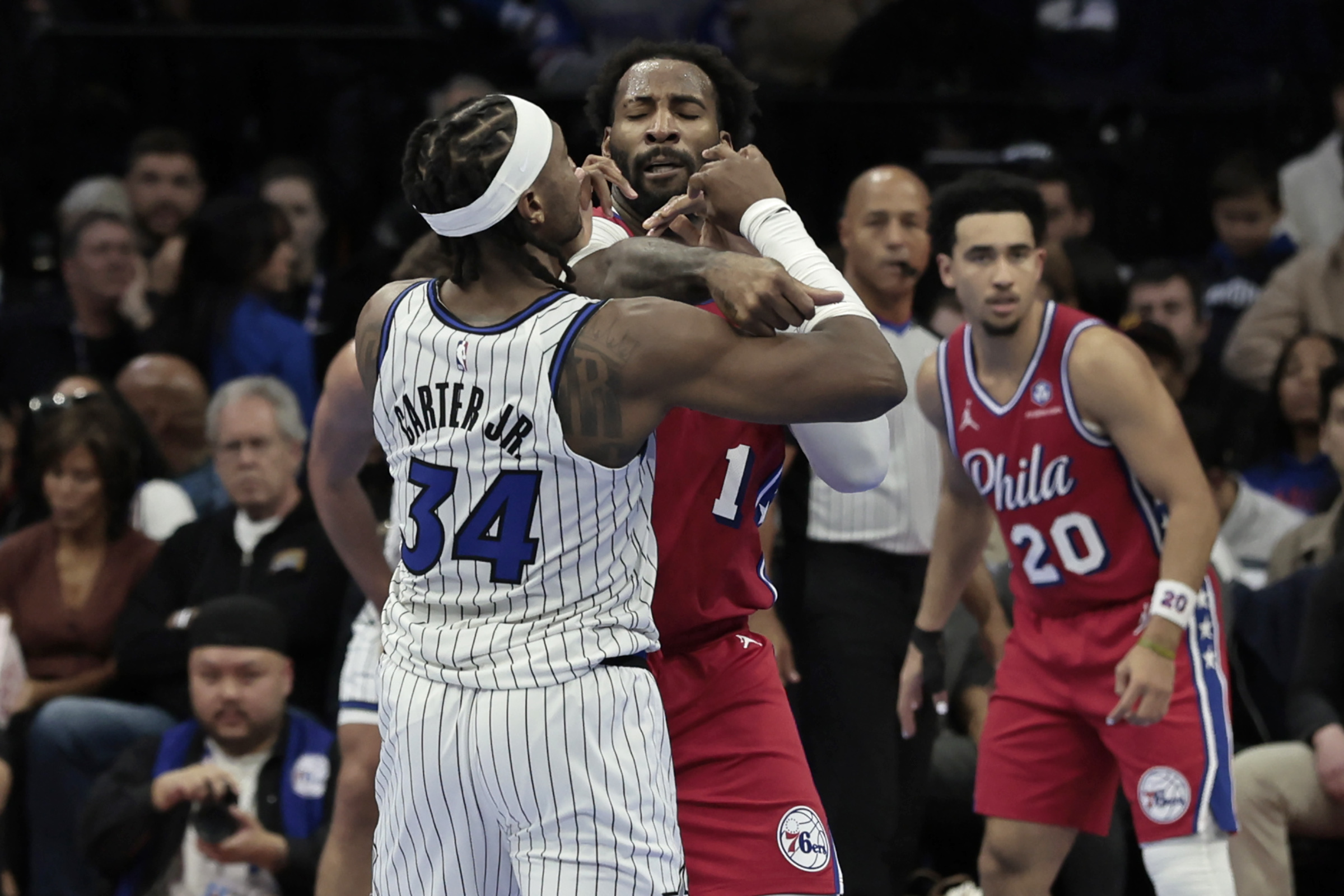
    Orlando’s Jalen Suggs was ejected with 27 seconds left in the first half after receiving two technicals during a heated altercation between the teams.

    Tyrese Maxey scored 20 points to lead the Sixers, whose absences included Joel Embiid (right knee injury management), Paul George (right ankle sprain) and rookie VJ Edgecombe (left calf tightness).

    Orlando improved to 3-0 in the Cup and the Sixers dropped to 0-3.

    The game was tied at 35-all after the first quarter before the Magic took control in the second period. Philadelphia fans started showering boos on the court when Orlando went up 17 points with 5½ minutes left.

    The frustration spilled onto the court with 27 seconds before the break when the altercation led to Suggs’ ejection.

    A scuffle between Sixers’ Andre Drummond and Magic’s Wendell Carter Jr. led to Jalen Suggs’ ejection.

    The Magic dominated the second quarter, outscoring Philadelphia by 26 points in the period to take an 86-60 lead at halftime.

    Trendon Watford limped to the bench with just over four minutes left in the first half and did not return due to a left adductor strain.

    Embiid missed his eighth game in a row and 11th this season. The seven-time All-Star and 2023 MVP began the season recovering from left knee surgery, limiting him to 20-to-25 minutes when available, but has since had issues with his right knee.

    George, who signed a four-year, $212 million deal with Philadelphia prior to last season, made his season debut on Nov. 17 after offseason knee surgery. He missed the following game, played the next two before sitting out against Orlando.

    For Orlando, Paolo Banchero was sidelined for his seventh consecutive contest with a left groin strain.

    Up Next

    The Sixers travel to Brooklyn to face the Nets on Friday night (7:30 p.m., NBCSP).

  • FIFA lays out the rules for the World Cup draw

    FIFA lays out the rules for the World Cup draw

    GENEVA — The 2026 World Cup draw next week will reward the four highest-ranked teams — Spain, Argentina, France and England — who will be placed in separate sections of a new tennis-style seeded tournament bracket.

    FIFA said Tuesday the top four teams in the latest men’s rankings will, if they finish top of their respective round-robin groups, avoid each other until the semifinals of the June 11-July 19 tournament being co-hosted by the United States, Canada and Mexico.

    Defending champion Argentina with Lionel Messi and top-ranked European champion Spain with Lamine Yamal therefore can ensure they do not meet until the final at MetLife Stadium near New York.

    “To ensure competitive balance, two separate pathways to the semifinals have been established,” FIFA said in a statement, aiming to reward teams whose consistent good results have raised their world ranking.

    Lionel Messi celebrates scoring a goal for Argentina in September.

    At previous World Cups, the path for teams into and through the knockout phase was decided by which group they were drawn into.

    The draw ceremony for the first 48-team World Cup will be held Dec. 5 at the Kennedy Center in Washington, D.C., in the presence of U.S. President Donald Trump.

    The 42 teams that already qualified include Iran and Haiti which FIFA expects will play exactly where they are drawn regardless of complicated politics those countries have with the U.S. The 16 host venues for the 104 games include 11 cities with NFL stadiums in the U.S., three in Mexico and two in Canada.

    The other six entries will be decided in March when European and global playoffs brackets are scheduled, and those teams all will come out of the draw pot of lowest-ranked teams.

    Spain’s Lamine Yamal (right) is the soccer world’s new superstar.

    That means four-time champion Italy could be a dangerous option in the draw on Friday of next week that will set the match schedule by placing teams in 12 round-robin groups of four teams each.

    Europe has 16 teams in the lineup and a maximum of two can be drawn into any one group. The other 32 teams in the tournament cannot be drawn in a group with a team from the same continent.

    The three co-hosts are among the 12 top seeds in the draw, which is scheduled to take about 45 minutes during a show lasting about an hour and a half, FIFA said. The U.S. will open on June 12 against a team from pot 3, then face a team from pot 2 and close the group stage against a team from pot 4.

    Kylian Mbappé led France to the 2018 World Cup title and the 2022 final.

    World Cup draw seedings

    Pot 1: Spain, Argentina, France, England, Brazil, Portugal, Netherlands, Belgium, Germany, United States, Mexico, Canada.

    Pot 2: Croatia, Morocco, Colombia, Uruguay, Switzerland, Japan, Senegal, Iran, South Korea, Ecuador, Austria, Australia.

    Pot 3: Norway, Panama, Egypt, Algeria, Scotland, Paraguay, Tunisia, Ivory Coast, Uzbekistan, Qatar, Saudi Arabia, South Africa.

    Pot 4: Jordan, Cape Verde, Ghana, Curacao, Haiti, New Zealand, European playoff winner 1, European playoff winner 2, European playoff winner 3, European playoff winner 4, Intercontinental playoff winner 1, Intercontinental playoff winner 2.

  • Oklahoma State to hire North Texas’ Eric Morris as new football coach

    Oklahoma State to hire North Texas’ Eric Morris as new football coach

    Oklahoma State has chosen North Texas’ Eric Morris as its new head football coach, the school announced Tuesday.

    Morris has been the head coach at North Texas since 2023. The program went 5-7 his first season, but now is 10-1 and contending for a American Conference championship and College Football Playoff berth. The Mean Green are No. 21 in the Associated Press’ Top 25 poll.

    Morris has a reputation for helping quarterbacks, having coached, developed or recruited Patrick Mahomes, Baker Mayfield, John Mateer, Cam Ward, Chandler Morris and Drew Mestemaker.

    “For many reasons, including the kind of person he is and the lasting relationships he builds with his players, Coach Morris is the perfect fit as the next leader of Cowboy Football,” Oklahoma State athletic director Chad Weiberg said. “The future is bright for OSU Football and I look forward to introducing him and his family to our team, our former players and all Cowboy fans.”

    The hire is pending board approval.

    North Texas leads the country in scoring offense and total offense this year, and the team has reached the AP Top 25 for the first time since 1959. Mestemaker, a redshirt freshman walk-on, leads the FBS in yards passing.

    North Texas quarterback Drew Mestemaker leads college football in passing yards.

    North Texas said in a news release that Morris will coach through this season.

    “On behalf of the University of North Texas, I want to express our deep gratitude to Eric for everything he has done for Mean Green Football over the past three seasons,” North Texas athletic director Jared Mosley said.

    Morris will step in for Mike Gundy, who was fired in September during his 21st season. Doug Meacham is 0-8 as the interim coach. Oklahoma State is 1-10 heading into its season finale at home against Iowa State on Saturday.

    Morris was head coach at Incarnate Word for four seasons, then was an assistant at Washington State before becoming head coach at North Texas. He was offensive coordinator at Texas Tech, his alma mater, from 2015 to 2017 and has been an assistant at Houston.

    North Texas will host Temple (5-6, 3-5 American) on Friday (3:30 p.m., ESPN).

  • U.S. consumer confidence deteriorates in November

    U.S. consumer confidence deteriorates in November

    WASHINGTON — U.S. consumer confidence sagged in November as households worried about jobs and their financial situation, likely in part because of the recently ended government shutdown.

    The Conference Board said on Tuesday its consumer confidence index dropped to 88.7 this month from an upwardly revised 95.5 in October.

    Economists polled by Reuters had forecast the index edging down to 93.4 from the previously reported 94.6 in October.

    “Consumers’ write-in responses pertaining to factors affecting the economy continued to be led by references to prices and inflation, tariffs and trade, and politics, with increased mentions of the federal government shutdown,” said Dana Peterson, chief economist at the Conference Board.

    “Mentions of the labor market eased somewhat but still stood out among all other frequent themes not already cited. The overall tone from November write-ins was slightly more negative than in October.”

  • The FBI is seeking interviews with congressional Democrats who warned the military about illegal orders, official says

    The FBI is seeking interviews with congressional Democrats who warned the military about illegal orders, official says

    WASHINGTON – The FBI has requested interviews with six Democrats from the U.S. Congress who told members of the military they must refuse any illegal orders, a Justice Department official told Reuters on Tuesday.

    The move, reported earlier by Fox News, comes a day after the Pentagon threatened to recall Senator Mark Kelly, a Navy veteran and one of the six lawmakers, to active duty potentially to face military charges over what Secretary of Defense Pete Hegseth described as “seditious” acts on social media.

    The other lawmakers, who made the comments in a video released last week, include Senator Elissa Slotkin, a former CIA analyst and Iraq war veteran, and Representatives Jason Crow, Maggie Goodlander, Chris Deluzio and Chrissy Houlahan, all military veterans.

    The legislators created the video amid concerns from Democrats — echoed privately by some U.S. military commanders — that the Trump administration is violating the law by ordering strikes on vessels purportedly carrying suspected drug traffickers in Latin American waters.

    The Pentagon has argued the strikes are justified because the drug smugglers are considered terrorists.

    Trump accused Democratic lawmakers of sedition

    President Donald Trump accused the six Democrats of sedition, saying in a social media post that the crime was punishable by death.

    His administration has shattered longstanding norms by using law enforcement, including the Justice Department, to pursue his perceived enemies.

    The Justice Department official, who spoke on condition of anonymity, said the interviews were to determine “if there’s any wrongdoing and then go from there.”

    The FBI did not immediately respond to a request for comment.

    In a statement on Monday, Kelly dismissed the Pentagon’s threat as an intimidation tactic.

  • Ukraine backs ‘essence’ of peace deal with Russia but sensitive issues linger

    Ukraine backs ‘essence’ of peace deal with Russia but sensitive issues linger

    WASHINGTON/KYIV — Ukraine on Tuesday signaled support for the framework of a peace deal with Russia but stressed that sensitive issues needed to be fixed at a meeting between President Volodymyr Zelensky and U.S. President Donald Trump.

    Kyiv’s message hinted that an intense diplomatic push by the Trump administration could be yielding some fruit but any optimism could be short-lived, especially as Russia stressed it would not let any deal stray too far from its own objectives.

    U.S. and Ukrainian negotiators held talks on the latest U.S.-backed peace plan in Geneva on Sunday. U.S. Army Secretary Dan Driscoll then met on Monday and Tuesday with Russian officials in Abu Dhabi, a spokesperson for Driscoll said.

    U.S. and Ukrainian officials have been trying to narrow the gaps between them over the plan to end Europe’s deadliest and most devastating conflict since World War Two, with Ukraine wary of being strong-armed into accepting a deal largely on the Kremlin’s terms, including territorial concessions.

    “Ukraine — after Geneva — supports the framework’s essence, and some of the most sensitive issues remain as points for the discussion between presidents,” a Ukrainian official said.

    Zelensky could visit the United States in the next few days to finalize a deal with Trump, Kyiv’s national security chief Rustem Umerov said, though no such trip was confirmed from the U.S. side.

    White House press secretary Karoline Leavitt said on X that over the past week the U.S. had made “tremendous progress towards a peace deal by bringing both Ukraine and Russia to the table.” She added: “There are a few delicate, but not insurmountable, details that must be sorted out and will require further talks between Ukraine, Russia, and the United States.”

    Oil prices extended an earlier decline after reports of Ukraine potentially agreeing to a war-ending deal.

    Underlining the high stakes for Ukraine, its capital Kyiv was hit by a barrage of missiles and hundreds of drones overnight in a Russian strike that killed at least seven people and again disrupted power and heating systems. Residents were sheltering underground wearing winter jackets, some in tents.

    Zelensky will discuss sensitive issues with Trump

    U.S. policy towards the war has zigzagged in recent months.

    A hastily arranged summit between Trump and Russian President Vladimir Putin in Alaska in August raised worries in Kyiv and European capitals that the Trump administration might accept many Russian demands, though the meeting ultimately resulted in more U.S. pressure on Russia.

    The 28-point plan that emerged last week caught many in the U.S. government, Kyiv and Europe alike off-guard and prompted fresh concerns that the Trump administration might be willing to push Ukraine to sign a peace deal heavily tilted toward Moscow.

    The plan would require Kyiv to cede territory beyond the almost 20% of Ukraine that Russia has captured since its February 2022 full-scale invasion, as well as accept curbs on its military and bar it from ever joining NATO — conditions Kyiv has long rejected as tantamount to surrender.

    The sudden push has raised the pressure on Ukraine and Zelensky, who is now at his most vulnerable since the start of the war after a corruption scandal saw two of his ministers dismissed, and as Russia makes battlefield gains.

    Zelensky could struggle to get Ukrainians to swallow a deal viewed as selling out their interests.

    He said on Monday the latest peace plan incorporated “correct” points after talks in Geneva. “The sensitive issues, the most delicate points, I will discuss with President Trump,” Zelensky said in his nightly video address.

    Zelensky said the process of producing a final document would be difficult. Russia’s unrelenting attacks on Ukraine have left many skeptical about how peace can be achieved soon.

    “There was a very loud explosion, our windows were falling apart, we got dressed and ran out,” said Nadiia Horodko, a 39-year-old accountant, after a residential building was struck in Kyiv overnight.

    “There was horror, everything was already burning here, and a woman was screaming from the eighth floor, ‘Save the child, the child is on fire!’”

    Macron warns against European capitulation

    Russian Foreign Minister Sergei Lavrov said an amended peace plan must reflect the “spirit and letter” of an understanding reached between Putin and Trump at their Alaska summit.

    “If the spirit and letter of Anchorage is erased in terms of the key understandings we have established then, of course, it will be a fundamentally different situation (for Russia),” Lavrov warned.

    A group of countries supporting Ukraine, which is known as the coalition of the willing and includes Britain and France, was also set to hold a virtual meeting on Tuesday.

    “It’s an initiative that goes in the right direction: peace. However, there are aspects of that plan that deserve to be discussed, negotiated, improved,” French President Emmanuel Macron told RTL radio regarding the U.S.-proposed plan. “We want peace, but we don’t want a peace that would be a capitulation.”

    In a separate development, Romania scrambled fighter jets to track drones that breached its territory near the border with Ukraine early on Tuesday, and one was still advancing deeper into the NATO-member country, the defense ministry said. (Reporting by Idrees Ali, Phil Stewart, Devika Nair, Tom Balmforth, Pavel Polityuk, Alessandro Parodi, Michel Rose, Luiza Ilie and Sergiy Karazy; writing by Matthias Williams; editing by Frances Kerry and Mark Heinrich)

  • Letters to the Editor | Nov. 25, 2025

    Letters to the Editor | Nov. 25, 2025

    Grow the pie

    As your recent editorial noted, the central sticking point in negotiations between City Council and the mayor on the best and fairest way to focus limited housing funds appears to be how to divide that pie between the neediest and those who have just a little bit more. One way of addressing this dilemma is to increase the size of the pie. This could be done, not by borrowing more, which would just jack up the already eye-popping amount we’ll have to pay back in interest, but by utilizing resources from the city’s $8 billion pension fund. For decades, our neighbors in New York City have directed 2% of the investments by their pension fund to local housing. As a result, the fund has produced almost 100,000 affordable units. One of the groups they invest in is the AFL-CIO Housing Investment Trust, whose sole purpose is to invest public and union pension funds in the construction and rehabilitation of housing. Let’s get some of our pension fund’s billions working here in the city, and reap the rewards of more affordable housing for all.

    Pamela Haines, Philadelphia, pamelahaines1@gmail.com

    Protect the planet

    I am troubled by potential funding cuts at the Environmental Protection Agency. I want my children, grandchildren, and great-grandchildren to live on a planet where the air is safe for them to breathe, where fruits and vegetables are safe for them to eat, and where the water is clean and safe to drink. I’m sure all of you want the same. If we don’t do something immediately, the generations after us will not be able to turn things around because of the terrible things we have done — and continue to do — to the earth’s air, water, and soil. Our planet, and everything on and around it, needs our protection.

    Please write your senators and representatives and ask them to make clear their strong support for the EPA when funding decisions are being made.

    Becky Comer, Gilbertsville

    Review resign-to-run rule

    We should press for a no vote on City Councilmember Isaiah Thomas’ proposed amendment to the resignation-to-run rule. If Thomas gets his way, Council members would be allowed to stay in office while running for state or federal elections.

    This is just a step toward eventually letting city officials stay in their official capacities while running for another city office.

    How about letting them use their own money, or campaign funding, to support their efforts while campaigning for a higher or different office?

    Or maybe a compromise could be that they wouldn’t be paid their city salary if they run for local, state, or federal elections?

    Michael Miller Jr., Philadelphia

    Abortion stance unbrotherly

    I was both shocked and disheartened to learn that the City Council of Philadelphia, where I was born and raised, has recently passed a resolution declaring abortion a “human right.” This decision prompts serious reflection on the meaning of human rights and who they truly protect.

    Human rights, by their very definition, are meant to be universal and encompass all individuals, including the unborn child. These children in the womb are among the most vulnerable members of our community, yet they have become the victims of an industry that regards the termination of their lives as necessary for controlling population growth in our city.

    In light of this, I propose that our City Council consider a new resolution: to remove the long-standing moniker “City of Brotherly Love” from Philadelphia. It is a contradiction to celebrate brotherly love while simultaneously excluding and disregarding the rights of the most defenseless among us. How can we claim to embody brotherly love if we do not extend it to every member of our population?

    Patricia Dowling, Philadelphia

    Join the conversation: Send letters to letters@inquirer.com. Limit length to 150 words and include home address and day and evening phone number. Letters run in The Inquirer six days a week on the editorial pages and online.

  • Horoscopes: Tuesday, Nov. 25, 2025

    ARIES (March 21-April 19). Your personal journey also happens to be very relatable. Though what you’re doing feels specific to you, it will become meaningful to others, too, if communicated well. The first step is to read the room and adjust your vibes to match it.

    TAURUS (April 20-May 20). Life is like a bubbly drink. Down it on the fresh pour and enjoy the effervescence. If you wait, it goes flat. The sparkle is fleeting, and that’s what makes it precious. Taste the moment.

    GEMINI (May 21-June 21). After a string of intense days, the quiet feels strange but sacred. The body exhales first; the mind lags behind, replaying everything. Let yourself land. Stillness isn’t the absence of motion; it’s the moment your spirit catches up to you.

    CANCER (June 22-July 22). To those who know how to read the signals, body language often tells a deeper truth than words. You are such a person. You may not know exactly what’s being expressed, but you read the tension and it makes you curious about getting a fuller story, which you’re sure to do today.

    LEO (July 23-Aug. 22). People like you, but that’s not what’s important here. External approval or popularity isn’t the real reward. It’s nice, but secondary. The point is, your contribution is making a difference. It’s meaningful and will have an impact beyond your control or awareness.

    VIRGO (Aug. 23-Sept. 22). There are those who will keep taking for as long as they are allowed. With these types, you need to state the boundaries and then refer to them multiple times. Being assertive is the kindest thing to do.

    LIBRA (Sept. 23-Oct. 23). The day’s events remind you that you are in a phase of self-improvement and discernment — not a phase of comfort. Because you want growth, you will opt for the more challenging lessons and teachers.

    SCORPIO (Oct. 24-Nov. 21). Follow the muse. She speaks in posters and puffy clouds. She speaks in street art and store windows. She beckons with song and draws you into detours that will be better than the main road.

    SAGITTARIUS (Nov. 22-Dec. 21). There were times you distanced yourself from the decision-making process just to keep things simple for the group. But right now, they need your leadership. Gather the relevant information and leap back in.

    CAPRICORN (Dec. 22-Jan. 19). You’ll receive appreciation, emotional rewards, creative satisfaction — the nonmonetary kinds of payment that make life rich. But it’s the financial compensation that allows you to keep going. Material stability keeps the whole system functioning.

    AQUARIUS (Jan. 20-Feb. 18). Some people can’t meet your playfulness. Humor is intimacy in disguise. When you make someone laugh, you’ve shown them your rhythm, your timing, your view of the world. That can be terrifying for the person who’s used to controlling the scene.

    PISCES (Feb. 19-March 20). Are you starting to notice a pattern? Something repeating in a relationship or a little habit of yours that’s not doing you any good? If you knock it off soon, it will be quick and painless with a rich reward.

    TODAY’S BIRTHDAY (Nov. 25). Welcome to your Year of Community Magic. You’ll step into a circle where your gifts uplift many, and the group returns the energy tenfold. You’ll attract collaborators who challenge and stretch you, helping your career blossom in directions you couldn’t map alone. More highlights: financial stability through a smart partnership, an artistic triumph and an adventure that changes your worldview. Aries and Gemini adore you. Your lucky numbers are: 6, 15, 22, 40 and 13.

  • Dear Abby | Message about new husband arrives anonymously

    DEAR ABBY: I’ve been married to my husband for two months. I haven’t told anyone I’m married except my close friends and family. Someone recently messaged me about my husband, stating that he has Asperger’s. They know my name and have my phone number. I don’t know who this person is or why they would tell me this now.

    I already suspected my husband has Asperger’s, so I’m not shocked, but this is eating me up inside. I can’t sleep. I can’t think. I recently lost my mom to cancer. Now I’m facing this. I previously dated a narcissist who used to lie regularly. But after all that heartbreak and torment, I’m now with someone who lies to me again? I’m so confused and upset. I really do want to ask my husband to get assessed. I don’t think I can trust him anymore. Do you have advice for me?

    — LOSING AGAIN IN CANADA

    DEAR LOSING: Let me point out that individuals who write anonymous letters usually are not trying to be helpful and instead may be trying to cause trouble in your marriage. Before asking your husband to be assessed for Asperger’s, go online and read as much information about it as you can. You might also consider contacting the Association for Autism and Neurodiversity (aane.org), which has been mentioned in my column before.

    If what you learn from reliable resources indicates that it could be your husband’s problem, then by all means suggest he be assessed. He may not necessarily be “lying” to you as much as being in denial. This does not have to destroy a marriage. Many successful people are on the spectrum.

    ** ** **

    DEAR ABBY: My best friend and co-worker is 57. I’m 32. Her husband died two years ago, leaving her and her 22-year-old son alone. We’ve been best friends and co-workers for the last six years, but over the last few months, I’ve been realizing she’s a lot more to me than just a friend.

    I am nervous about trying to make advances because I don’t know if the feelings are mutual or how she views our age difference. I don’t want to risk ruining our friendship. I just know that my heart skips a few beats when our eyes meet or our fingers accidentally touch. I’ve realized these last few months that I’m falling hard for her, and I’m afraid to let her know. If I don’t, however, my feelings are going to eat me alive. What should I do?

    — FALLING FOR HER IN KANSAS

    DEAR FALLING: Ask your best friend (and co-worker) to join you for a casual lunch or dinner. Keep it light but tell her how much you enjoy her company and ask if the age difference between you bothers her. If the answer is no, explain that you care very much for her and wonder if she’d be open to the idea of dating you.

    If she says yes, and there are rules at your job that discourage “fraternizing,” you may have to find another place to work. If she responds that dating would be awkward, let her know you will always be her friend because you think she is special.

  • Helping Philadelphia’s Children Heal

    Helping Philadelphia’s Children Heal

    For more than five decades, Philadelphia’s Children’s Crisis Treatment Center (CCTC) has opened its doors to vulnerable young people and families who have been impacted by violence, loss, and adversity. “Helping a child heal doesn’t just change their life. It strengthens their family, their extended network, and, in a very real way, their community,” the organization’s CEO Antonio “Tony” Valdés, 61, said. “That’s what continues to inspire me: understanding that the work we do at CCTC ripples outward, touching countless lives beyond the one child sitting in front of us.” Since taking the helm in 1997, Valdés has transformed CCTC from a small local agency into a cornerstone of children’s mental health care in the greater Philly region, helping the nonprofit expand from four programs to 15, to reach more than 3,500 young people each year.

    Valdés has spent his career focused on the guiding belief that every child, no matter their circumstances, deserves the chance to feel safe, seen, and supported. Under his leadership, CCTC has redefined what community-based care looks like, meeting families where they are, honoring their cultures and experiences, and building systems of care rooted in empathy and equity. In this Q&A, Valdés reflects on the urgent mental health needs facing Philadelphia’s children, the evolution of trauma-informed care, and how CCTC continues to offer hope where it’s needed most.

    What inspired you to do the work you do today?

    I think it has a lot to do with how I grew up. I was very fortunate as a child. My parents are immigrants, my father from Cuba, my mother from the Dominican Republic. When I was young, my dad started his own business and we moved from the States back to the Dominican Republic. Living in another country as a teenager gave me a deeper sense of perspective.

    It made me think about culture as the environment we live and grow in, the “soup,” so to speak, that shapes our narratives and defines how we experience the world. That way of seeing things naturally led me to think about systems: families, neighborhoods, schools, and how they all influence children’s lives.

    So when I began working in mental health, I was already thinking in those systemic terms. A few years later, I had the chance to work with children and it immediately clicked. I realized that the earlier you reach a child, the greater the impact you can have.

    Helping a child heal doesn’t just change their life. It strengthens their family, their extended network, and, in a very real way, their community. That’s what continues to inspire me: understanding that the work we do at CCTC ripples outward, touching countless lives beyond the one child sitting in front of us.

    What do you bring to this job that is unique?

    First, I’m very persistent. Once I decide to go down a path, I keep pushing forward. Second, I’m personable and social. I interact casually with people, which makes me approachable. Finally, I bring a practical, analytical approach to the work. Many CEOs in this field come from operations or program backgrounds, and I do too, but I also have a knack for numbers and finance. That combination allows me to manage the business side of CCTC effectively while staying deeply connected to our programs and the families we serve.

    Right now, our annual budget is about $30-35 million, and managing that while staying true to our mission requires both persistence and practicality.


    You’ve talked about the importance of early intervention. Why does that matter so much?

    The earlier you intervene and support families, the better. A lot of our work at CCTC focuses on helping parents and caregivers understand what their children are experiencing, what we call “psychoeducation.” We help them see that many behaviors, even the difficult ones, make sense in light of what a child has lived through. It’s not “bad behavior.” It’s a natural response to trauma. It’s actually not normal for a child to go through terrible things and show no signs of distress.

    Science now backs this up. The landmark Adverse Childhood Experiences (ACEs) study, conducted more than 20 years ago, revealed powerful connections between early trauma and long-term health outcomes, including not only behavioral issues or substance use problems, but even higher rates of heart disease and cancer. What we’ve learned since then, through brain imaging and neuroscience, is that trauma in early childhood can actually shape how the brain develops. The brain adapts to prioritize survival, and other areas, the ones that regulate learning, relationships, and emotion, can be underdeveloped as a result.

    That’s why early, loving, consistent relationships are so crucial. The most powerful protective factor is the presence of caring, dependable adults in a child’s early life. The next is a sense of belonging and community. When those are strong, children build resilience.

    Some adversity can actually help children grow, as long as that balance tips toward safety, love, and connection.

    How has CCTC evolved since its early days?

    The people who founded CCTC in the early ’70s probably wouldn’t have used the language we use today, but they were clearly responding to a growing awareness that children’s behavior was often rooted in trauma. That early insight has shaped CCTC from the beginning. Over the years, the field has evolved, and so have we. About 18 years ago, we made a major shift by embedding trauma-informed principles into every part of the organization. It changed not only how we treat children, but how we support staff, collaborate with partners, and engage with the community. It became a core philosophy, not just a clinical model.

    That focus has kept us true to our mission. We’re not trying to be all things to all people. We’re a children’s behavioral health agency and everything we do aligns with that purpose. Staying disciplined in that way allows us to build stronger partnerships and deliver deeper impact.

    Today, we serve children from about 18 months through 18 years old, but most of the kids we work with are between three and 13. Roughly 75% are 10 or younger. That’s really where our heart is: early and elementary-age children, because that’s where we can make the greatest difference.

    What’s been the biggest challenge for CCTC over the years?

    One of the biggest challenges has been working within systems that are incredibly complex, whether that’s government, insurance, or even community and political structures. These systems often tend to move toward the least common denominator: keeping things steady, avoiding risk. Innovation doesn’t always get rewarded.

    But CCTC has always been an organization that looks ahead. We’re constantly asking: What’s next? Where do we need to be two, three, four years from now? That kind of thinking sometimes puts us at odds with the larger system, and that can be frustrating. There have been times when we knew an idea would make a real difference, but it took years before the funding or policy landscape caught up.

    A good example is care coordination, or what some call “case management.” We’ve always believed in helping families navigate all the challenges that can prevent them from engaging in treatment: housing instability, food insecurity, lost utilities, lack of transportation. For years, that kind of work wasn’t funded or even recognized as essential. But to us, it was obvious, since if a family’s basic needs aren’t met, therapy alone won’t change much.

    What’s a big goal for CCTC’s future?

    One of our biggest goals is to bring what we do directly into the natural settings where children and families already are. That’s where real access happens: in schools, recreation centers, community programs, and other places that feel familiar and safe.

    When mental health care is part of everyday life, it becomes normalized. We’re already doing some of this, placing parenting groups and educational programs in community settings, to help families better understand the roots of behavioral challenges. Many parents we meet are doing their best, but no one’s ever helped them recognize how their own childhood experiences might still be shaping their parenting today.

    What transformations have you seen in the development of children who have come to CCTC?

    I look at it on two levels: observable outcomes and how a child functions in their life. On the surface, success shows up in things like fewer suspensions or detentions, reduced fights, and improved grades.

    But real success goes beyond behavior. It’s about helping children make sense of what happened to them. Kids who’ve experienced trauma should never simply forget it. They need to learn how to live with it, understand its impact, and gain the skills to respond differently. That helps them manage triggers, regulate emotions, and gain self-awareness.

    What misconceptions about trauma or mental and behavioral health do you most want to challenge?

    There are a few. The first is one that still lingers. The idea that “kids are young, they’ll forget.” That’s just not true. When a child experiences something terrible at four years old and starts acting out at nine, those behaviors are often connected. Ignoring that link does a real disservice to the child.

    The second misconception is about resilience. People sometimes say, “She’s stronger because of what she went through.” Trauma doesn’t make you stronger; protective factors do. Maybe that person had strong family support, stable housing, or a teacher who cared. Those things build resilience, not the trauma itself.

    And the third is about the multigenerational nature of trauma. When harmful behaviors aren’t addressed, they echo through families. A parent who grew up with abuse or neglect might not repeat the same actions, but the emotional patterns of anger, control, and detachment can still carry forward. Recognizing that connection across time, generations, and communities is key to breaking the cycle.

    What is your mantra?

    I try to live by the idea of focusing on what you can actually impact. I stay focused on what makes the biggest difference.


    PHILLY QUICK ROUND

    Favorite Philly food? For Dominican food, I really like Mamajuana in Fishtown and a few spots in North Philly, like El Meson and Barú.

    Sports team you love: I’ve been a Phillies fan my whole life.

    What you wish people knew about those who call Philly home: What I wish people knew about Philadelphians is how much the city has changed over the past 20 years. Many outsiders still see Philly as it was 25-30 years ago, but today it’s far more diverse, not just in food and restaurants, but across neighborhoods.

    Greatest Philadelphian of all time? My pick for greatest Philadelphian of all time is easy: Ben Franklin.

    Favorite thing to do when you have free time in and around Philly: I love exploring new restaurants I haven’t tried yet, especially with friends.


    Lucy Danziger is a journalist, an author, and the former editor-in-chief of Self Magazine, Women’s Sports & Fitness, and The Beet.