Tag: no-latest

  • Historians reject White House’s criticism of Smithsonian museum

    Historians reject White House’s criticism of Smithsonian museum

    On July 4, the White House posted a lengthy report condemning the Smithsonian Institution’s National Museum of American History, accusing it of promoting “extreme ideological activism” while denigrating the nation’s founders and its founding.

    Historians have started to reply with failing grades of their own.

    The Organization of American Historians, the nation’s largest group of scholars of U.S. history, blasted the report in a statement Monday, accusing the administration of presenting a partisan ideological attack in the guise of historical critique.

    “The National Museum of American History interprets America’s history through its vast collection,” it said. “This report’s objective is to punish it for doing that in a way that makes U.S. history accessible to and reflective of all Americans. The report is only the latest chapter in a broader, systematic campaign that now targets an institution that was never meant to answer to any single administration.”

    The group accused the administration of ignoring decades of scholarship and trying to “erase the conflict, struggle, and diversity — the complexity — that have always defined the American experience.”

    “Make no mistake: The report represents an attempt to turn back the clock to a time when U.S. history was taught as the history of white Christian men who conquered a continent, U.S. military leaders who rarely lost a battle and U.S. presidents who were single-handedly responsible for national greatness, all under the cover of ‘anti-DEI’ and ‘anti-woke’ crusading,” it said.

    The White House report presents a wide array of charges, including that the museum promotes transgender issues and engages in “pro-illegal immigrant activism.” But at its core is a complaint that it fails to tell an “inspiring and unifying” national story that focuses on the heroism of the founders and acknowledges Christianity’s “constructive role” in “shaping the nation and its freedoms.”

    In a separate email to the New York Times, the president of the Organization of American Historians, Marc Stein, questioned the symbolic timing of the report.

    “Released on July 4, 2026, the 250th birthday of the U.S. Declaration of Independence, the report is a declaration of independence from history,” he said.

    Stein, a history professor at San Francisco State and the author of a recent history of the 1976 Bicentennial, defended the museum’s director, Anthea M. Hartig, a scholar of architectural history and cultural heritage who took over that role in 2019.

    The report “mischaracterizes and misrepresents the words of Anthea Hartig, who has consistently worked to educate and inform visitors to the museum with innovative exhibits and inspirational programs,” he said. (Hartig is a past president of the Organization of American Historians.)

    Some historians have questioned the accuracy of some of the report’s claims, including that the museum largely ignores the American Revolution and figures such as George Washington.

    Sarah Weicksel, the executive director of the American Historical Association, which has more than 10,000 members, noted in an email that the museum includes some “extraordinary” Revolutionary-era objects, like the newly restored gunboat Philadelphia, which it is highlighting for the nation’s 250th anniversary.

    Weicksel questioned some of the report’s criticisms of specific wall labels — for example, one about the history of U.S. education that refers to portraits of George Washington that have hung in many classrooms to promote patriotism. The report faults the label for not including biographical information about Washington and why he is important.

    “Studies of museum visitation have shown that labels should be presented no higher than an eighth-grade reading level and that most visitors will read no more than a brief label,” she said. “If every label that mentions Washington or Lincoln needs to recount a rote interpretation of their importance to the country, visitors will never learn anything new.”

    This article originally appeared in the New York Times.

  • Jalen Brunson has left wrist surgery, Knicks star expected back on court this summer, AP source says

    Jalen Brunson has left wrist surgery, Knicks star expected back on court this summer, AP source says

    NEW YORK — Jalen Brunson has undergone left wrist surgery and is expected to be back on the court when the New York Knicks begin defense of their NBA title, a person with knowledge of the details said Tuesday.

    The NBA Finals MVP is expected to resume basketball activities later this summer, the person told The Associated Press on condition of anonymity because there was no announcement about Brunson’s procedure.

    Brunson’s surgery was first reported by SNY.

    Brunson, who is left-handed, didn’t let the wrist injury slow him down on the Knicks’ run to their first championship since 1973. The former Villanova standout scored 45 points when the Knicks won the title in Game 5 in San Antonio, after finishing with 36 when they made a record-setting comeback from a 29-point deficit in Game 4. The point guard averaged 32.6 points in the finals.

  • Repression turns to rage after quakes in Venezuela

    Repression turns to rage after quakes in Venezuela

    LA GUAIRA, Venezuela — As postquake efforts in Venezuela start shifting from rescue to recovery, a crack has opened in Venezuelan society, and people are speaking out against their repressive government with a force and openness that has not been seen in years.

    Across La Guaira, the northern state hardest hit by the twin quakes, grieving citizens have shouted down police officers and national guard members, accusing them of standing by as civilians and international aid workers dig for the living, and now, the dead.

    In interviews, Venezuelans are openly criticizing the country’s ruling party and its leader, Delcy Rodríguez, something that would have been unthinkable just a year ago.

    They are also turning their anger toward the Trump administration, which has spent the last few months facilitating economic deals between U.S. companies and Venezuela, and has stood by the government’s management of the disaster.

    Inside Venezuela, fears of imprisonment, torture, and forced exile, once powerful incentives for silence, are being pushed aside as feelings of frustration and impotence grow.

    “Why would I be afraid?” said José Silva, 47, who on Friday was resting on a sidewalk not far from a giant public housing complex now turned to rubble. Some 700 families had lived inside.

    Silva’s clothes were drenched with sweat; it was evening, only partway through his 10th day pulling survivors and bodies from under slabs of concrete. He lashed out at the government: the police were rescuing only their own, he said, and the government had sent only “second rate” tools.

    “Why would I be afraid,” to speak out, he said, “if I was born to die?”

    This anger runs parallel to growing political tension over the leadership of Rodríguez. When U.S. forces captured her predecessor, Nicolás Maduro, in January and greenlit her ascension from vice president to president, the Trump administration characterized Rodríguez as a force of stability.

    Before the quake, President Donald Trump said that she was doing a “very good job” running the country.

    But criticism of her government’s response to the disaster, particularly in the critical first 72 hours when victims are most likely to be rescued alive, and the growing fury in the streets, has raised questions about whether she can cement that stability.

    The public outrage could also complicate the Trump administration’s strategy of supporting Rodríguez so the United States can benefit from Venezuela’s resources.

    Trump’s envoy to Venezuela, John Barrett, has supported Rodríguez, saying in a television interview after the quakes that Washington had “a great deal of confidence” in the Venezuelan authorities.

    But in recent days a chorus of hard-line congressional Republicans have doubled down on criticism of her management, calling for political change as soon as possible.

    “They’re failing at their job right now,” Rep. Carlos Gimenez (R., Fla.) said in an interview with CNN, calling Rodríguez an “interim dictator.”

    Venezuelans have gathered outside the U.S. Embassy, pleading with Barrett to do more to help victims. One man, yelling into news media microphones outside the embassy recently, harangued Barrett for sitting with government officials the United States had once deemed criminals and terrorists, while victims suffered “just two blocks away.”

    “The grievance is indeed directed at John Barrett,” he shouted. “Why has he not sat with Venezuelan civil society — the honest ones, the ones who haven’t stolen anything?”

    Maria Corina Machado, the country’s popular opposition leader, has been trying to get back into the country, but she does not have a passport, or permission from Rodríguez or the United States, to enter Venezuela.

    At a news briefing on Thursday, Rodríguez defended her government’s response to the disaster, saying she had immediately dispatched 4,000 government workers to respond to the quakes, a number that had grown to 19,000.

    “What happened in Venezuela on June 24 was a natural tragedy of a scale we never imagined,” she said.

    In response to accusations of a poor state response, Rodríguez asserted repeatedly that “media laboratories” were inventing a narrative of chaos.

    As evidence of the government’s mobilization, official social media accounts have heavily publicized a handful of state-supported rescues, including one in which dozens of well-equipped emergency workers from Chile rescued a man who had survived a week in the rubble. Rodríguez visited the man at the hospital.

    But these videos contrast sharply with the reality in La Guaira, where civilians in sneakers and T-shirts are doing a vast amount of the rescue and recovery work, using shovels and pickaxes and their bare hands to pull friends, neighbors, children, spouses, siblings, and parents from the rubble. Some lack masks to protect themselves from the dust and stench of decomposing bodies.

    Rodríguez was widely criticized in Venezuela as out of touch after she was photographed wearing a luxury ski jacket, a logo of the Italian brand Moncler on her arm, to visit quake victims.

    “It’s a lie that the government is helping,” Silva said.

    Soon after he spoke, darkness fell. Not far way, a group of men had just discovered five bodies in a hole they had dug in the side of the mountain of broken concrete.

    The men wrapped the bodies in sheets and then laid them gently on the ground. Survivors looking for relatives crowded around, pulling back the sheets to try to identify the deceased. One was the body of a little girl. The others were unrecognizable.

    Thousands of people are now homeless, and the death toll, officially over 3,500, is likely to be far greater. In the coming weeks, the government will be under intense pressure to address an increasingly complex humanitarian crisis.

    Outside of another collapsed public housing building, Kimberling León, 39, a resident of the complex, described the government response in the hours and days after the quakes hit.

    She was searching for her sons, ages 9 and 13, who she believed were trapped in the rubble.

    “The police came by, normal, filming, they didn’t help us,” she said, her voice flat, like a person still in shock.

    “We said to them: ‘help us, help us,’ they didn’t come to our aid. We started digging with our hands, but the smoke was too much, the flames rose high, the gas tanks had exploded.”

    The second or third day, a shovel and pickax arrived, she said.

    “We started digging, digging, digging. We called for machines to help, but they just passed us by, headed to the private buildings” where people could pay, she said.

    Silence has been one of the most valuable commodities in La Guaira, as rescuers try to make out the taps and calls of any living that might still be buried in the rubble.

    Often, rescuers shoot a fist in the air and call for quiet, instructing drivers to cut motors and people to stop walking.

    On a recent day, profanities rained down on the interior ministry workers who rolled past a silent zone with sirens blaring. Civilians banged on the car in anger.

    While the quakes have opened space for people to vent years of pent up fury, this public outcry could also spur a crackdown, leading to questions about how the United States would respond to any repression.

    The last major social outburst was in 2024, after the ruling party stole a presidential election.

    Venezuelan officials halted protests in a matter of days by sending the military into the streets, killing protesters and locking up civilians accused of minor expressions of dissent.

    Last week, a volunteer rescuer named Wilmer Cruz who had been filmed speaking out about the government response disappeared, according to human rights groups.

    When activists publicly accused the government of retaliating against Cruz, the authorities released him from prison.

    Oscar Murillo, who leads Provea, a human rights group, said the arrest highlighted for him that the quakes have not changed the “authoritarian model” in Venezuela.

    This article originally appeared in the New York Times.

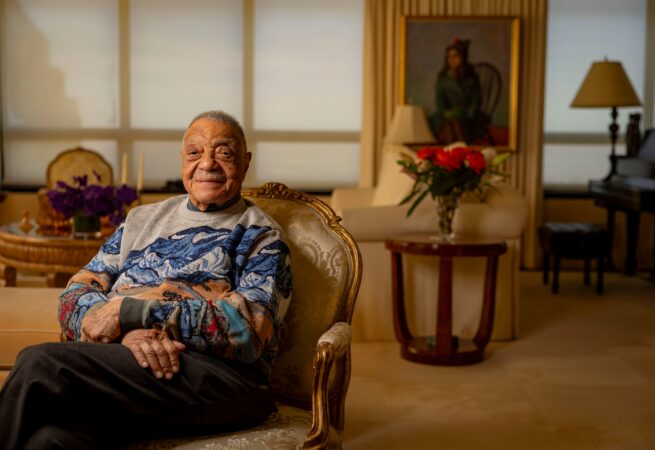
  • George E. Johnson, who built a Black hair care empire, dies at 99

    George E. Johnson, who built a Black hair care empire, dies at 99

    George E. Johnson, a hair care magnate who rose from a sharecropper’s cabin to found, with his wife, Joan, what was said to be the first Black-owned company listed on a major American stock exchange, and who made a fortune on products like Ultra Sheen and Afro Sheen, died on Monday at his home in Chicago. He was 99.

    His death was confirmed by his second wife, Madeline Murphy Rabb, who said the cause was respiratory illness.

    Long before sports figures, entertainers, and Fortune 500 executives commanded sky-high salaries, the Johnson Products Company, which sold Black hair products and cosmetics, made its founder, Mr. Johnson, one of the nation’s wealthiest African Americans.

    He also helped found one of the first, and largest, Black-owned banks, the Independence Bank of Chicago, where he served as chairperson until it was sold in 1995. And for decades, Johnson Products indirectly influenced pop culture through its sponsorship of the nationally syndicated television dance show Soul Train.

    Johnson Products originated in the laboratory of Samuel B. Fuller, a Black cosmetics entrepreneur, where Mr. Johnson worked after dropping out of high school. Up to that point, his experience — starting at the age of 9, when an aunt gave him a shoeshine box — had been menial jobs.

    Mr. Johnson started at Fuller Products as a salesperson — “carrying the black bag,” as he put it — though he initially found it distressing to peddle pomade and face powder amid urban deprivation.

    “I had a problem with it unless I really needed money,” he said in an interview for this obituary. “Then I would sell like hell.”

    After requesting to work indoors, Mr. Johnson created his first product, a hair relaxer for men he called Ultra Wave. With Fuller’s blessing, Mr. Johnson teamed up with his wife and a barber to found Johnson Products in 1954.

    After one branch of a finance company rejected his request for a business loan as a “ridiculous” idea, Mr. Johnson secured the $250 in seed money from another branch by saying he needed the funds to take Joan on a vacation to California. Those early financing troubles later inspired him to help start a bank.

    He found himself on the road again to peddle his product when his partnership with the barber soured. From his station wagon, he sold Ultra Wave and other products to barbers from the Upper Midwest to New York City.

    But he soon found that barbers were not loyal. “They couldn’t resist the next deal that came along, although it involved poor quality, cheaper stuff,” Mr. Johnson told the New York Times in 1976.

    So he started eying beauty shops, where he observed women using hot combs and mineral oil to straighten hair, a smoky and unhealthful process. He modified Ultra Wave for the women’s market, creating Ultra Sheen, which he said reduced smoke by as much as 75% and could be used in the home.

    Sales took off. In the 1960s, the company had an estimated 80% of the Black hair care market, and by 1970 it had annual sales of $12.6 million, or more than $100 million today. The company listed on the American Stock Exchange in January 1971.

    Johnson Products spent heavily on advertising in its heyday — $5 million in 1975, or more than $31 million today — and was the first Black-controlled company to sponsor a national television program, Soul Train, which aired weekly for almost 35 years, until 2006.

    (Johnson Products is not related to Johnson Publishing Company of Chicago, the former publisher of Ebony and Jet magazines. Nor is it related to Robert L. Johnson, a co-founder of Black Entertainment Television.)

    Cultural and regulatory challenges — and even severe weather — exacted a toll on Johnson Products, which was struggling for survival by the late 1970s and posted its first loss in the mid-1980s.

    The company, which relied on straighteners, was late to adapt to the growing popularity of Afro hairstyles in the 1960s. Near the end of that decade, its reformulation of Ultra Sheen as Afro Sheen resulted in a poor product for long, curly hair, Mr. Johnson acknowledged.

    In the 1970s, a Federal Trade Commission investigation into the marketing of hair straighteners disrupted the industry, and in 1976 Johnson Products negotiated a consent order to add a warning that its products containing sodium hydroxide, or lye, and could cause scalp irritation and eye injury. This was over a year before Revlon, its far larger competitor, agreed to similar warning labels, a lag that may have given Revlon an edge with Black consumers.

    While African Americans made up a small part of Revlon’s market, they represented almost all of Johnson Products’, and its share of the relaxer market skidded to 45% from 85% in two years.

    Mr. Johnson also said he faced racial discrimination, contending that distributors “don’t seem to want Black products to be exposed to all Americans.”

    In early 1979, a heavy snowstorm in Chicago brought the company to a near standstill for more than a month, blocking truckers from transporting supplies or shipments and damaging its plant.

    George Ellis Johnson was born June 16, 1927, in a sharecropper’s shack in Richton, Miss., and moved to Chicago with his mother, Priscilla, when he was 2. Although his education ended in 11th grade, he was awarded nine honorary doctorates over his lifetime.

    Last year, Mr. Johnson published Afro Sheen: How I Revolutionized an Industry with the Golden Rule, From ‘Soul Train’ to Wall Street, a memoir, written with Hilary Beard.

    Joan Johnson wound up with control of the company when the couple divorced in 1989. After some disruptions, including the departure of her son Eric as president and CEO, she sold Johnson Products to the Ivax Corporation in 1993, netting about $32 million, or about $75 million today.

    The Johnsons remarried in 1995. She died in 2019.

    In addition to Rabb, whom he married in 2022, Mr. Johnson is survived by his sons, Eric, John, and George Jr.; his daughter, Joan; 10 grandchildren; and seven great-grandchildren.

    Ivax sold the company to Procter & Gamble in 2004 before it was bought by a consortium of African American investment firms in 2009.

    “When I think about pioneers, the real pioneers are the people who are able to make a path where none exists,” Eric Johnson told CNN after his mother died in 2019. “Johnson Products in many ways was that company. She and my father had no provided path. They created a path where there was none.”

    This article originally appeared in the New York Times.
  • Democrats begin to clash over who replaces Platner even before he exits

    Democrats begin to clash over who replaces Platner even before he exits

    The implosion of Graham Platner’s campaign for Senate in Maine after an accusation of rape has ripped open divisions inside the Democratic Party as its progressives and moderates battle to pick his successor even before he has said he will step aside.

    National Democrats have grown alarmed that a seat seen as crucial to winning control of the Senate could be slipping from the party’s grasp. Platner had survived a series of controversies — about a tattoo with Nazi symbolism, inflammatory old Reddit posts, and his relationships with women — but many in the party abandoned him after the rape accusation, including the leaders of the Maine Democratic Party and Senate Minority Leader Chuck Schumer.

    They have demanded that Platner step down before a Monday deadline for him to be replaced on the ballot to find a new Democrat to run against Sen. Susan Collins, a longtime Republican fixture in the state. The main super political action committee for Democratic Senate candidates said it would redirect $24 million in ad reservations to other states if he remained.

    Sen. Bernie Sanders (I., Vt.), one of Platner’s earliest and most prominent backers, joined the chorus on Tuesday afternoon.

    “I have spoken with Graham Platner about the best path forward for Maine,” Sanders said in a statement. “In light of these very serious allegations, I have recommended that he step aside.”

    Platner, who has denied the allegation, said on a private call with his campaign staff on Monday evening that he believed he still had leverage to influence which candidate would replace him on the ticket, according to three people familiar with the conversation. On the call, he did not announce plans to withdraw but implied such a decision would be coming, the people said.

    Platner’s campaign had stopped running ads on Meta’s platforms, such as Facebook and Instagram, as of Tuesday, according to the company’s ad disclosure database. He had been running multiple ads as recently as Monday evening.

    The drama comes almost exactly two years after the Democratic Party was roiled by the exit of Joe Biden, then the president, from his reelection race and the speedy anointment of Vice President Kamala Harris as the Democratic nominee. That process — and Democrats’ ultimate loss in 2024 — has left deep scar tissue for many in the party.

    Many on the left — including, it appears, Platner himself — want any replacement to come from the progressive wing of the party after he won the primary over Gov. Janet Mills, a moderate two-term Democrat, who withdrew over a month before the election.

    “To the Democratic establishment: This is not your opening,” said Joseph Geevarghese, executive director of Our Revolution, a group that emerged from Sanders’ 2016 presidential campaign. Referring to Senate Democrats’ campaign arm, he added, “Mainers did not vote by an overwhelming margin against Janet Mills and the DSCC’s handpicked pick just to be handed another status-quo candidate anyway.”

    On the flip side, many in the party establishment believe those on the left should show some humility after Platner’s collapse.

    A range of Democratic groups and activists engaged in the politics of “I told you so.”

    “When women raise the alarm, listen,” said a social media post from EMILY’s List, a group that works to elect Democratic women and that had backed Mills. “Graham Platner’s behavior is disqualifying (AS WE HAVE SAID THIS WHOLE DAMN TIME), and he should end his campaign.”

    On Tuesday morning, more Democrats who are ideological allies of Platner called for him to step aside, including New York City Mayor Zohran Mamdani.

    “I believe that it’s time for him to drop out of the race,” Mamdani said when asked at a news conference. “I think the focus of today should be to respond to the gravity of what so many of us have read, and I think the only appropriate response is for the campaign to come to an end.”

    Mamdani and Platner share several advisers, including Morris Katz and Rebecca Katz of the Fight Agency.

    The progressive group MoveOn also dropped its endorsement.

    As the situation in Maine threatened to spiral out of control, Schumer and the Democratic Senatorial Campaign Committee are set to host major donors this week for a fundraising retreat at the Broadmoor in Colorado Springs. Donors are asked to contribute $44,300 to attend, according to a copy of the invitation.

    The event, which was previously scheduled, was billed as a “special weekend to discuss the DSCC’s strategy and campaigns for taking back the Democratic Senate majority,” but now talk is likely to be consumed by the developments in Maine.

    Platner can be replaced as the Democratic nominee if he withdraws voluntarily by Monday. The state Democratic Party would then have until July 27 to pick his replacement, under state law. But the law does not dictate how the state party itself needs to pick Platner’s replacement.

    What that would look like remains unclear. The options under discussion include a convention or a statewide caucus in late July.

    “We ask for your patience as this work continues,” Devon Murphy-Anderson, the state party’s executive director, wrote in a message to committee members on Tuesday, adding: “Whatever process is ultimately adopted must reflect our Democratic values. It should be open, inclusive, transparent, and fair.”

    A range of candidates are being discussed, with some early attention on those who ran and lost the primary for governor this year. Those Democrats include Troy Jackson, a former president of the Maine Senate; Nirav Shah, a former director of Maine’s public health agency; and Shenna Bellows, Maine’s secretary of state. But some Democrats were concerned about elevating someone who just lost.

    Supporters of Jackson, who had backed Platner in the primary, created a Draft Troy website, and he filed paperwork with the Federal Election Commission for a Senate exploratory committee. Shah put out a statement that said he had received “hundreds of encouraging messages,” adding that anyone who ran for the nomination should commit to a televised debate and “multiple town halls across every corner of the state.”

    Another possible candidate is Dan Kleban, a co-founder of the Maine Beer Co., a brewery outside Portland. He briefly ran for Senate last year before dropping out and endorsing Mills. But like Platner, he has never held elected office or been through the rigors of a campaign.

    Yet another possibility is Jordan Wood, who also previously ran for Senate and dropped out. Wood ran instead in the primary for Rep. Jared Golden’s House seat and lost.

    Golden, a moderate Democrat and veteran who holds the most pro-Trump House seat of any Democrat in Congress, is retiring and previously said he was ready to step away from elected office.

    In recent days, Golden has fielded calls gauging his interest in a run for Senate, according to two people familiar with those conversations who spoke on the condition of anonymity to describe private discussions.

    Golden has not commented since the latest allegations against Platner emerged.

    More unconventional picks were being bandied about, as well. One Democratic firm in recent days included actor Patrick Dempsey in a poll. (He was viewed favorably by 52% of voters in the survey.) Others floated the popular liberal historian Heather Cox Richardson, who is based in Maine.

    Some Democrats erupted after the news emerged that Platner wanted a replacement who was aligned with him politically. One person familiar with the Platner campaign’s internal discussions said Monday that Platner would seek a guarantee he would be replaced by someone in agreement with “the values and vision and policy agenda” that he had pressed.

    Others argued that under the circumstances, Platner’s support would be damaging.

    Joe Baldacci, a state senator who ran and lost in the primary for Golden’s House seat this year, said the idea that Platner would bless a replacement would be the equivalent of “tying a lead weight” to the person.

    “After you have put the Democratic Party in a shambles and undermined all Democratic candidates running for office in Maine then you should have no say in who will be your successor,” Baldacci wrote on social media. He added, “Any connections to Platner will doom that person’s campaign from the very beginning.”

    This article originally appeared in the New York Times.

  • Judge rejects Justice Department attempt to get names of 2020 election workers in Fulton County

    Judge rejects Justice Department attempt to get names of 2020 election workers in Fulton County

    ATLANTA — The U.S. Department of Justice cannot have the names and personal contact information for every person who worked during the 2020 election in Georgia’s Fulton County, a federal judge ruled Tuesday.

    The Justice Department in April obtained a grand jury subpoena seeking the names and personal contact information of county employees and volunteer poll workers. President Donald Trump has long claimed without evidence that widespread voter fraud in Georgia’s most populous county, a Democratic stronghold, cost him victory in the state in 2020.

    Fulton County asked a judge to quash the subpoena, arguing it was meant to “target, harass, and punish the President’s perceived political opponents” and that it was “grossly over broad and untethered to any reasonable need.”

    “Given the low need for the subpoenaed information and the highly burdensome nature of the disclosure of the same, the Subpoena is unreasonable and must be quashed,” U.S. District Judge William Ray wrote in his ruling, calling the scope of the request “staggering.”

    Emails seeking comment were sent to both the Justice Department and Fulton County.

    While grand juries often work with federal prosecutors to investigate alleged crimes, “that does not give the DOJ the right to use the Grand Jury to do whatever the DOJ wants,” he wrote.

    Even if the records sought by the Justice Department could help find people who worked for the county during the 2020 election who support the theory that the election was unfair, the information couldn’t be used to charge anyone, Ray wrote.

    “That is because the statute of limitations for any possible crime arising from the 2020 Election has long expired,” he wrote.

    The subpoena came after the FBI in January served a search warrant at the Fulton County election hub and seized hundreds of boxes of ballots and other documents from the 2020 election. A federal judge in May denied the county’s request to force the federal government to return the ballots.

    The Justice Department argued in a court filing that the subpoena was the “next step in the normal investigative process” and that it seeks “records identifying persons with relevant knowledge.”

    Kamal Ghali, a lawyer for the county, argued that the subpoena “will chill participation by election workers” and that the statute of limitations for any of the alleged misconduct had already lapsed.

    Justice Department lawyer William McComb argued the statute of limitations issue is not relevant at the investigative stage. The point of the investigation is to figure out what charges can be brought, he said.

    “My point is, as we sit here now, we are not sure what charges can be brought. That’s the whole point of the investigation,” he said.

    The request for election workers’ contact information, McComb said, “would simply be a pathway to determine and speak with and interview certain individuals who worked at the polls who may have seen, heard or done something in and of themselves.”

    The judge noted that the Justice Department had expressed concern about possible criminal actions in the years that followed the election, including an alleged failure by the county to preserve electronic ballot images. But he pointed out that the subpoena seeks information related to what happened during the 2020 election and its immediate aftermath.

    “In these hyper-political times in which we currently live, there are sure to be some who disagree with this decision because they believe the allegations of fraud in the 2020 Election and believe that ‘light’ should be brought to those claims,” Ray wrote.

    He added that nothing prevents continued investigation into those allegations by people who believe those claims — such as Congress or even the Justice Department — but the power of the grand jury, “which exists to investigate potential crimes and to bring viable indictments,” cannot be used for that purpose. Otherwise, anyone in power could use the grand jury process to subpoena personal information of citizens “with no legitimate law enforcement purpose,” he wrote.

    “Thus, everyone, whether you support the President or you do not, or whether you believe the 2020 Election was fair or believe that it was not, should be concerned about the DOJ’s ability to utilize the power of the Grand Jury to appropriate your private information without a legitimate purpose,” Ray wrote.

  • NATO unveils billions in arms deals to prove its firepower as Trump again demands Greenland

    NATO unveils billions in arms deals to prove its firepower as Trump again demands Greenland

    ANKARA, Turkey — President Donald Trump on Tuesday insisted that the United States should be in control of Greenland rather than NATO ally Denmark, renewing tensions in Europe even as the trans-Atlantic military alliance was announcing billions in arms deals at a summit in an attempt to appease the mercurial U.S. leader.

    Trump called the semiautonomous island “an important part” for the United States, as he repeated the false claim that it’s surrounded by Chinese and Russian ships and said he won’t let Greenland be threatened.

    “That should be controlled by the United States, not by Denmark,” Trump told reporters during a meeting with Turkish President Recep Tayyip Erdogan in Ankara.

    The NATO alliance was founded on the principle that its 32 members will defend each others’ territory and not threaten to seize it. At the summit, European countries and the alliance’s secretary-general, Mark Rutte, were already working overtime to address another longstanding Trump complaint: that European allies do not spend enough on their own defense.

    Separately, Trump announced that the U.S. will lift sanctions on Turkey that were issued after Ankara purchased a Russian missile defense system that led to the country being kicked out of the F-35 fighter jet program — in a nod to his warm ties with summit host Erdogan.

    Trump cites Erdogan ‘chemistry’ as he lifts obstacle on F-35s

    Turkey’s purchase in 2019 of Russian-made S-400 missile defense systems sparked years of tensions, despite the warm personal relationship between Trump and Erdogan dating back to the U.S. president’s first term.

    Legal hurdles remain before Turkey could be fully admitted back to the U.S. F-35 program, but the removal of sanctions issued under the Countering America’s Adversaries Through Sanctions Act would help ease that process. Regaining access to the F-35s is a top goal of Erdogan.

    “We’re going to be taking the sanctions off, OK?” Trump said in response to a question, saying Secretary of State Marco Rubio, Treasury Secretary Scott Bessent, and Defense Secretary Pete Hegseth were working on the issue.

    Trump said the possibility of selling F-35s to Turkey is “something certainly we’d consider” given the countries’ relationship, and that “Turkey’s been, in many ways, much more loyal than other countries that we think would be loyal.”

    Erdogan expressed hope that the U.S. will sell the F-35s, saying the U.S. president always stands by his word.

    Trump and Erdogan showed off their fondness for each other. Erdogan greeted Trump with an elaborate ceremony involving military officials on horseback and jets overhead emitting red, white, and blue smoke.

    Asked what makes their relationship so strong, Trump said there’s “a chemistry that works between us,” adding that “Sometimes you get along with the toughest people, like him.”

    Turkey’s access to U.S. F-35s could complicate relationships elsewhere. Israeli Prime Minister Benjamin Netanyahu said he has urged Trump not to sell the fighter jets to Turkey, saying it would put Israel in danger.

    “This is not a force for peace and stability,” Netanyahu said on CNN. “When you give them that power, you’re going to see aggression its wake.”

    There is also opposition among U.S. lawmakers to Turkey having the F-35s as long as the Russian missile defense system remains in its possession. Even if sanctions are lifted, the Trump administration still faces restrictions under U.S. law that prevent Turkey from being able to purchase the fighter jets if it owns the S-400s.

    NATO has ‘moment of great pride’ on defense

    Earlier in the day, NATO showcased military projects worth billions of dollars — an investment Rutte called “money well spent” and one clearly meant to try to satisfy Trump.

    Rutte was speaking to government ministers and defense industry officials at a forum billed as NATO’s “big reveal,” to the thrum of techno music.

    NATO does not own weapons — these are the property of member countries — but it has 14 AWACS early warning radar surveillance planes that are about 50 years old, along with newer surveillance drones.

    A deal to replace the aging planes was announced Tuesday. Swedish manufacturer Saab will supply up to 10 new GlobalEye surveillance aircraft for a 10-nation consortium, Swedish Prime Minister Ulf Kristersson announced.

    “It’s a moment of great pride,” he said.

    Some projects will be paid for with funds from a system of cheap loans for defense purposes set up by the European Union, comprising up to $170 billion raised on capital markets.

    Representatives from 15 nations announced a multinational effort to buy air-to-air refueling and transport planes from Airbus. Then Rutte announced a four-country effort to purchase as many as five new Triton surveillance drones.

    Rutte had told reporters on the eve of the two-day summit that “we will announce tens of billions in new contracts.” However, at Tuesday’s event, no dollar figures were given and the display included some projects long since agreed upon.

    Ukraine’s Zelensky pushes for NATO entry

    Separately, Ukrainian President Volodymyr Zelensky made a fresh appeal for his country to be allowed to join the alliance, saying his country’s armed forces are highly experienced and would boost NATO’s defense capabilities.

    He highlighted Ukraine’s ability to strike deep inside Russia and hit oil refineries and other energy targets. He said Ukraine’s armed forces are “eliminating” on average 30,000 Russian troops every month. He is set to meet with Trump on Wednesday in Ankara.

    “Frankly we take no pride in this,” Zelensky said, noting that the war with Russia — now in its fifth year — is one “we did not seek but one we are forced to fight.”

    Concern is mounting among some European countries that Russia might be preparing a hybrid attack — a combination of conventional warfare with tactics like cyberattacks — on the continent as Russian President Vladimir Putin struggles to secure victory in Ukraine.

    Yet a senior NATO official, speaking on the summit’s sidelines, said that despite some “reckless” actions by Russia, including airspace violations over Poland, Romania, and Estonia, the alliance has been successful in deterring Moscow from any potential attack on a member country. The official insisted on anonymity to brief reporters.

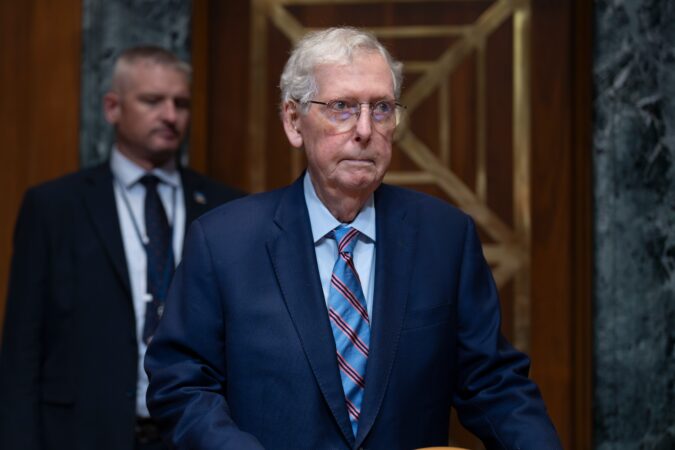
  • McConnell speaks to Republican leaders as speculation swirls about his health, remains hospitalized

    McConnell speaks to Republican leaders as speculation swirls about his health, remains hospitalized

    WASHINGTON — The Senate’s top two Republicans have spoken individually to Kentucky Sen. Mitch McConnell, according to aides, as the former GOP leader remains in the hospital more than three weeks after being admitted for undisclosed health issues.

    Aides to McConnell have declined to release any information about his condition, fueling speculation about his prognosis and whether he will be healthy enough to be at the Capitol when the Senate returns to Washington next week after a two-week recess. McConnell, 84, is retiring at the end of his term in January.

    A spokesperson for Senate Majority Leader John Thune (R., S.D.) said he had spoken with McConnell by phone on Monday and that the two had a “lengthy and substantive conversation that covered a variety of topics, including national security.” As leader, Thune is generally kept up to date on illnesses and absences in his conference as he has to navigate vote counts and his narrow 53-47 majority.

    Wyoming Sen. John Barrasso, the No. 2 Senate Republican, had a 20-minute conversation with McConnell on Tuesday, according to a spokesperson. The two discussed Senate races ahead of the midterm elections, the Supreme Court, and other topics, the statement said.

    “Senator McConnell was fully engaged and is eager to get back to the Senate,” said Barrasso spokesperson Kate Noyes.

    Another McConnell ally, Republican strategist Scott Jennings, posted on X that he had also talked to McConnell for 20 minutes on Tuesday, and that “he’s still recovering in the hospital.” Jennings said they spoke about politics, foreign policy, “and even a little bit of Senate history.”

    Few details released as McConnell remains in the hospital

    McConnell was admitted to the hospital on June 14, according to a statement from his office that only said he was “receiving excellent care.”

    A statement a week later said that he would not be voting that week. And on Thursday, a new statement said that he ”appreciates the outpouring of support he’s receiving while he continues his recovery in the hospital.”

    “The Senator continues to improve, and is working closely with his staff on Kentucky and Senate matters while the Senate is out of session,” the statement said.

    A spokesperson for McConnell released the same statement again on Tuesday, with no updates.

    McConnell has a history of health troubles

    The senator’s unspecified health issues come after several hospitalizations in recent years.

    While he was still Republican leader, McConnell was hospitalized with a concussion in March 2023 and missed several weeks of work after falling in a Washington hotel. He twice froze up during news conferences after he returned, staring vacantly ahead before colleagues and staff — including Barrasso, who is a doctor — came to his assistance.

    A year later, he fell and sprained his wrist while walking out of a GOP luncheon.

    McConnell had polio in his early childhood and he has long acknowledged some difficulty as an adult in walking and climbing stairs. He also tripped and fell in 2019 at his home in Kentucky and underwent surgery for a fractured shoulder.

    The Kentucky senator was first elected to the Senate in 1984 and was the Republican leader from 2007 until last year, serving as both majority and minority leader during that period. He has remained active as a rank-and-file senator, showing up for work when the chamber is in session, often using a wheelchair to get around.

  • Judge rules for the Washington Post in $3.8B defamation suit brought by Trump Media

    Judge rules for the Washington Post in $3.8B defamation suit brought by Trump Media

    A federal judge on Thursday ruled in favor of the Washington Post, throwing out a $3.8 billion defamation lawsuit filed in 2023 by President Donald Trump’s social media company, Trump Media and Technology Group.

    U.S. District Judge Thomas Barber, who is based in Tampa, wrote in a summary docket entry — known as a minute order — that Trump Media “failed to present evidence that would allow a jury to find by clear and convincing evidence” that the Post “published the allegedly defamatory statements with actual malice.” Barber granted the Post’s motion for summary judgment and denied one from Trump Media.

    The judge said in his ruling Thursday that a full opinion is forthcoming.

    Public figures who sue for defamation in U.S. courts generally must demonstrate that the defendants acted with actual malice — disseminating information they know is false, or acting with reckless disregard for the truth — under the standard set by the landmark 1964 Supreme Court case New York Times Co. v. Sullivan.

    In the complaint, lawyers for Trump’s social media company alleged a “yearslong crusade” by the Post that culminated in an “egregious hit piece.”

    The article, published on May 13, 2023, focused on Trump Media’s effort to obtain financing ahead of a merger to take the company public. The deal, a merger with a special purpose acquisition company, or SPAC, called Digital World Acquisition, received sign-off from federal securities regulators in February 2024. One month later, in March, the company debuted under the ticker symbol DJT on the Nasdaq stock exchange.

    “We are pleased with the court’s decision and look forward to reviewing its written order upon release,” a Post spokesperson wrote in a statement.

    After discovery concluded in the case, the Post published a correction to the original piece, appended with a hyperlink on May 22, 2026 — three years after it was published.

    The correction noted that “[d]iscovery in the ongoing litigation has established that Trump Media didn’t pay a loan referral fee of $240,000, as was stated in the article and was based on The Post’s reporting at the time of publication.”

    Trump Media said the correction was a win and said it is considering appealing the court loss.

    “After three years, The Washington Post finally admitted its harmful story was false,” a spokesperson for Trump Media wrote in a statement on Monday. “We believe a jury should decide whether these falsehoods were actionable and will evaluate whether to appeal last week’s ruling in due course. We will also continue to hold the media accountable.”

  • The accused is in court but conspiracy theories still swirl around Kirk case

    The accused is in court but conspiracy theories still swirl around Kirk case

    PROVO, Utah — Outside the state District Court where the preliminary hearing for a man charged with shooting Charlie Kirk was about to begin its first day, Houston-based podcaster Keli Rabon laughed sheepishly when asked if that man, Tyler Robinson, was guilty.

    “You’re going to think I’m crazy,” Rabon replied, “but I think Charlie’s still alive.”

    Robinson, she went on, “was at most a spotter” at the scene of the crime at Utah Valley University last September. Rabon suggested that Kirk, a 31-year-old conservative activist, was currently at an undisclosed location and that he, along with his wife, President Donald Trump, and other government officials, were potentially involved in the “psy-op.”

    Rabon is one of several conspiracy theorists at the Provo courthouse. Camping out overnight to be the first member of the public allowed into the courtroom, Selena Armitage, too, had questions. A true-crime enthusiast living 45 miles away in West Valley City, Armitage said of Kirk’s killing, “I don’t think we’ve even scratched the surface.”

    The proceeding this week to weigh evidence against Robinson will seek to impose judicial norms on a case that seems likely to test those standards to the breaking point. Kirk’s death, after all, is the first assassination of a prominent American political figure in the internet age. Any straightforward prosecution of Robinson will require navigating a parallel universe of conspiracy theories turbocharged by social media.

    The cramped district courtroom has just 14 seats available to the public, and some will be occupied by people including Rabon and Armitage, who are of the view that the state’s case is far from the complete picture. They will be reinforced by untold watchers of the hearing’s livestream.

    The shooting was, in effect, nationally televised. The moment a bullet pierced Kirk’s neck was captured on mobile phones and posted in real time.

    As straightforward as the horrific footage was, internet sleuths were not taking it at face value: Where is the exit wound? Where is the blood? Who are the adults in the campus audience? Is one of them gesturing just before the shot? Why do some of the staff members of Turning Point USA, Kirk’s political organization, seem to react without alarm to his slumping body? Why are several men in the crowd wearing maroon shirts?

    The first two days of testimony have offered additional fodder. The prosecution’s opening witness, a former Utah Valley special officer named Chris Bagley, testified Monday that his body camera’s battery died while he was investigating the rooftop where police say Robinson fired his lethal shot.

    Under cross-examination by defense attorney Kathryn Nester, Bagley also acknowledged that his report did not include any mention of a rifle case that surveillance video showed the shooter carrying. Nor had he identified a plainclothes officer with a badge who had accompanied Bagley to the rooftop. Nor had he secured an empty pistol holster that he saw lying abandoned on the grassy area near where Kirk was killed.

    On Tuesday morning, Nester elicited from the lead investigator in the case, David Hull from the State Bureau of Investigation, the facts that no shell casings had been found on the rooftop, while at least two other firearms were discovered at the crime scene below. Hull also admitted that he had not interviewed two individuals who claimed that their own rooftop video featured an individual whose clothing and build did not match those of Robinson.

    Such vagaries are common in criminal investigations. Evidence is rarely conclusive, eyewitness accounts seldom 100% reliable, confessions not always ironclad. But such nuance can be lost on the judges and juries of social media.

    Right-wing social media influencers have foraged on Kirk’s assassination with particular zeal, chief among them Candace Owens, a former Turning Point USA star turned antagonist who has devoted dozens of podcast episodes to the subject.

    “I feel confident stating that Tyler Robinson did not murder Charlie Kirk,” Owens said recently. In her view, Robinson was “a total patsy” who was not even on campus that day.

    Owens has at various times implicated the victim’s widow, Erika Kirk, Turning Point USA staff, and even the Israeli government, but only with tantalizing questions and dots for her audience to connect, not a true alternative scenario.

    Erika Kirk and other Turning Point officials have expressed outrage, but privately, they have acknowledged the far right’s susceptibility to such theories, owing to a suspicion of traditional news sources and hostility toward the left.

    Kirk himself regularly argued that the 2020 presidential election was stolen and that Democrats were purposely opening the border to reshape the electorate.

    Such theories may lack evidence, but they have an audience. By far the biggest media presence at the Utah preliminary hearing is Fox News Channel, which has more than a dozen employees in Provo. And as Rabon acknowledged outside the courtroom, conspiracy theories are popular — some more than others. Her podcast was eight months old and already had 7,500 YouTube subscribers, a figure that she said would be higher if she were to embrace a more alluring conspiracy theory, such as the belief that Kirk was killed by an incendiary device in his microphone.

    “I’m doing ‘fake death,’” Rabon said. “If I was doing ‘exploding microphone,’ the algorithms would like me better.”

    This article originally appeared in the New York Times.