SACRAMENTO, Calif. — More than a dozen states sued the Trump administration Tuesday over its rollback of vaccine recommendations for children, calling the move an illegal threat to public health.
The states argue that the Centers for Disease Control and Prevention put children’s lives at risk when it announced last month that it would stop recommending all children get immunized against the flu, rotavirus, hepatitis A, hepatitis B, some forms of meningitis, and RSV. Under the new guidance, which was met with criticism from medical experts, protections against those diseases are recommended only for certain groups deemed high risk or when doctors recommend them in what’s called “shared decision-making.”
The new vaccine recommendations ignore long-standing medical guidance and will make states have to spend more to protect against outbreaks, the states, including Arizona and California, said.
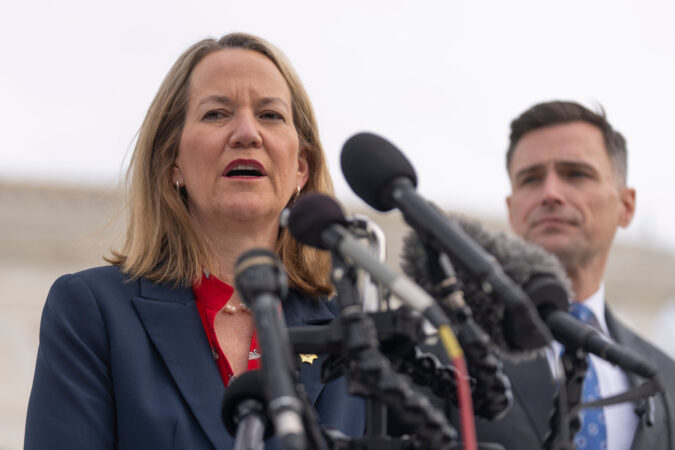
“The health and safety of children across the country is not a political issue,” Arizona Attorney General Kris Mayes, a Democrat, said at a news conference. “It is not a culture war talking point.”
Emily G. Hilliard, press secretary for the Department of Health and Human Services, blasted the complaint as a “publicity stunt dressed up as a lawsuit.”
Pennsylvania, New Jersey, and Delaware all joined the Arizona-led lawsuit.
“Every Pennsylvanian deserves accurate information to make their own healthcare decisions when consulting with their doctors — and science, not politics, will continue to guide our healthcare decisions here in the Commonwealth,” said Gov. Josh Shapiro, a Democrat who has repeatedly joined litigation against the Trump administration since last year.
The lawsuit escalates an ongoing battle between Democratic-led states and Republican President Donald Trump’s administration over the federal government’s changes to public health policy under Health Secretary Robert F. Kennedy Jr. The Trump administration has laid off thousands of workers at federal public health agencies, cut funding for scientific research and altered government guidance on fluoride and other topics.
Kennedy last year ousted every member of a vaccine advisory committee and replaced them with his own picks, which Tuesday’s complaint alleges was unlawful.
The lawsuit comes months after the Democratic governors of California, Washington state, and Oregon launched an alliance to establish their own vaccine recommendations. The governors said the Trump administration was risking people’s health by politicizing the CDC.
States, not the federal government, have the authority to require vaccinations for schoolchildren, though the CDC’s requirements typically influence state regulations.
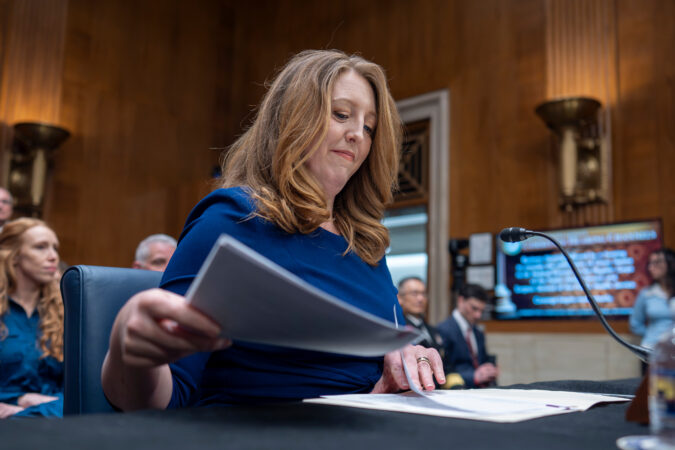
After over a year without a surgeon general, the Senate Health Committee is grilling Casey Means on vaccinations, herbusiness entanglements, and past comments on pesticides, as they weigh whether she should serve as the nation’s top doctor.
Means wrote the book considered the bible of theMake America Healthy Again movement with her brother, Calley Means, a Trump administration official. As surgeon general, she could amplify many of her messages around healthy eating and exercise, although she has faced criticism for some of her ties to wellness products.
Means is drawing fire and praise from both sides of the aisle, reflecting the MAHA coalition’s crosscutting appeal. Her messages on food found favor with both sides, while Democrats and the panel’s GOP chair probed her views on vaccinations and a Republican senator raised questions on how her stance on pesticides could impact American farmers.
Means highlighted the nation’s chronic illness rates and a path to how she hopes to change them in her opening remarks.
“Public health leaders must address the evidence-based, modifiable drivers of chronic diseases which include ultra-processed foods, industrial chemical exposure, lack of physical activity, chronic stress and loneliness, and overmedicalization,” Means said. “As surgeon general, I would call on every American and the Public Health Service to join in a great national healing — one that halts preventable chronic disease, makes healthy living the easiest choice, honors the body’s connection to the environment, and puts America back on the road towards wholeness and health.”
Her initial confirmation hearing was delayed after she gave birth in the fall. This hearing is also a referendum on the controversial moves of her political patron, Health Secretary Robert F. Kennedy Jr., who has overhauled federal vaccine guidelines and upended the public health system. Means, like Kennedy, has publicly questioned the number of vaccines included in the childhood vaccine schedule, as well as the hepatitis B shot. Public health experts say the vaccine schedule is safe and effective.
Vaccine questions
At the beginning of the hearing, Chairman Bill Cassidy (R., La.) cautioned that as the nation’s top doctor, Means would have a responsibility to fight back against the vaccine skepticism rising across the country “at a time when so many, for whatever reason, sow distrust and confusion.”
Sen. Bernie Sanders (Ind., Vt.), the panel’s ranking minority-party member, went further, accusing Trump and Kennedy of spreading misinformation on vaccines and pleading with Means to take a stand against them.
Cassidy later peppered Means with questions around immunizations, pointing to children who have died of vaccine-preventable disease. Means emphasized that while she supports vaccines, she believes parents and patients must speak to their physicians. She also refused to explicitly say vaccines do not cause autism when pressed, instead saying that no stones should be left unturned in the search for the causes of autism. As health secretary, Kennedy instructed the Centers for Disease Control and Prevention to remove from its website the long-settled scientific conclusion that vaccines do not cause autism.
In his questioning, Sanders started by pointing out the overlap between his and Means’s interest in fighting against ultra-processed food, before pivoting to further press Means on the scientific community’s determination that vaccines don’t cause autism.
“Anti-vaccine rhetoric has never been a part of my message,” Means said, adding that the nation should study when children are getting many medications.
Business ties and pesticides
A Washington Post examination last year found that Means had made over half a million dollars from partnerships with companies that her financial forms described as selling “diagnostic testing,” “herbal remedies and wellness products,” and “teas, supplements, and elixirs” from 2024 into the summer of 2025, according to her financial disclosures. Legal and advertising experts told the Post last fall that they were concerned about whether Means clearly disclosed her ties to some brands.
Sen. Tammy Baldwin (D., Wis.) grilled Means on some of her connections to wellness products: “It seems to me that you’ve spent your career sort of making money off the flaws” in the healthcare system.
Sen. Chris Murphy (D., Conn.) said he was concerned that Means was in “willful violation” of Federal Trade Commission rules, recommending products without telling followers she was sponsored by such products.
Means pushed back on the allegations and said she “would rectify that immediately” if it has inadvertently happened.
“I take conflicts of interest incredibly seriously,” Means said.
While many Republicans spoke highly of Means’s approach to improving American diets and fighting chronic disease, some others did not hold back in their questioning of her past remarks on psilocybin, pesticides, and other items.
Pesticides are a hot-button issue among the MAHA movement after Trump issued an executive order protecting a key ingredient in a weed killer.
She wrote in a newsletter sent in 2024: “How can we help bring a pesticide-free world to fruition? It starts with each of us prioritizing eating organic food as much as possible and standing firmly against buying or serving food sprayed with pesticides.”
Sen. Jon Husted (R., Ohio) stressed that he has heard questions from Ohio farmers about her comments on pesticides, calling them critical for the food supply and farmers’ stability.
Means called her thoughts on pesticides a core belief that was important to understand the impact pesticides could be having on Americans’ bodies, but noted she understood change could not happen overnight to destabilize the farming ecosystem.
Means also got in a testy exchange with Sen. Patty Murray (D., Wash.) over birth control, with Means stressing that it’s important to highlight the possible risks including stroke for women. Means has a history of disparaging birth control, which has been under fire from wellness and right-wing influencers.
Bucking the medical mainstream
Secretary Kennedy has championed Means’s nomination.
“She has an extraordinary capacity to communicate to the American public. That is the function of the surgeon general,” Kennedy said at an event Monday, saying Means would be a medical and “moral” authority for the public and he hoped she would be confirmed very soon.Means’ credentials — attending Stanford for her undergraduate education and medical school, racking up academic honors, writing scientific papers and working on research at top institutions — came up in the hearing.
Means left her medical residency over seven years agoand has encouraged Americans to ask questions of their doctors — positions Kennedy has said led to her nomination.
Means, a physician, has a medical license in Oregon that she voluntarily placed in inactive status, according to the state medical board, which means she cannot practice medicine in Oregon as of the beginning of 2024. Sen. Andy Kim (D., N.J.) raised concerns about Means’s medical license. Means pushed back on him by noting she practiced medicine and sees her background as “a feature, it’s not a bug.
MAHA supporters have lauded her for challenging the medical mainstream.
Public health experts have raised questions about some of her advice. In her book Good Energy, Means writes that “the ability to prevent and reverse” a variety of ailments, including infertility and Alzheimer’s, “is under your control and simpler than you think.”
Medical experts have said that while there is significant evidence that diet and exercise can lower the risk of some chronic conditions and slow the progression of diseases, Means overstates the science when she says it can reverse many of them.
WASHINGTON — President Donald Trump started in sales mode, using his State of the Union address to deliver an upbeat vision of the U.S. economy.
But that portrayal collides with the sentiment of Americans who remain anxious about their finances and feel they haven’t benefited from Trump’s policies. He took the high road to honor the gold medal-winning U.S. men’s Olympic hockey team and a war hero before pivoting abruptly to a darker tone as he ridiculed Democrats.
Trump’s ‘roaring’ economy is at odds with sour public sentiment
Much of the nation is worried about the direction of the economy, but Trump says the good times are here, insisting repeatedly that rising costs are no longer a problem.
“The roaring economy is roaring like never before,” he said. He cheered the lower cost of gasoline, mortgage rates, prescription drug prices, and the rising stock market: “Millions and millions of Americans are all gaining.”
Such optimism, as so many Americans are feeling economic strains, risks painting Trump as out of touch. Just 39% of U.S. adults approved of Trump’s handling of the economy in February, according to AP-NORC polling.
Still, the president focused much of the first hour of his speech on the economy, something Republicans had urged him to do as they head into the midterm elections.
First lady Melania Trump awards World War II Navy pilot Capt. Royce Williams the Congressional Medal of Honor as President Donald Trump delivers the State of the Union address to a joint session of Congress.
Trump wraps himself in the flag
For a president who always seems to be spoiling for a fight, Trump also tried to summon Americans’ innate patriotic impulses. In addition to the hockey team, he singled out war heroes and those who had taken brave stands in other countries, using the moment to bestow numerous presidential medals in an effort to give the address a more positive gloss.
It underscored the president’s media savvy and understanding that even if a moment isn’t appreciated completely in real time, it can have an afterlife in the days following speech, especially on social media.
Yet in one revealing moment, Trump lamented why he couldn’t give a congressional medal to himself.
Taking aim at Democrats
Tributes to the Olympic hockey team and a World War II veteran didn’t unify the room for long.
The Republican president soon took aim at Democrats and blamed them for many of the nation’s ills.
Trump said rising healthcare premiums are “caused by you,” suggested Democrats “are not protecting” Social Security and blamed them for the nation’s affordability crunch. “You caused that problem. You caused that problem,” Trump said as he glared at the Democratic side of the room.
He seemed to get angrier as the speech progressed.
“These people are crazy, I’m telling you, they’re crazy,” he said. “Democrats are destroying this country.”
Trump’s MAGA base loves such aggression. It’s unclear, however, if the rest of the country feels the same.
Secretary of State Marco Rubio (from left), Chief Justice John Roberts, Justice Elena Kagan, Justice Brett Kavanaugh, and Justice Amy Coney Barrett applaud before President Donald Trump delivers the State of the Union address Tuesdy to a joint session of Congress in the House chamber at the U.S. Capitol.
The Supreme Court’s ‘unfortunate’ decision
By Trump’s standards, he held his tongue when it came to the Supreme Court.
After the court struck down his tariff policy last week, Trump said the justices who voted against one of his signature issues were an “embarrassment to their families.” By Tuesday, he simply called the ruling “unfortunate.”
Trump sought to treat the ruling with indifference, insisting that tariff revenues were “saving” the U.S., ignoring the fact that the levies haven’t made a significant dent in government debt. He said the tariffs were paid by foreign countries even as virtually every study concludes that costs have been paid by U.S. firms and consumers.
At one point, he seemed to take the long view that history would ultimately vindicate him even if the Supreme Court would not.
“As time goes by, I believe the tariffs paid by foreign countries will, like in the past, substantially replace the modern day system of income tax, taking a great burden off the people that I love,” he said.
That is unlikely. The federal income tax is authorized by the 16th Amendment to the Constitution and the power to collect revenue is ultimately defined by Congress, not the president.
Trump vows action on election ‘cheating’
The president also used the speech to reprise his attack on the integrity of U.S. elections.
“Cheating is rampant in our elections,” Trump said.
Trump has made such claims for years, focused on his 2020 election loss, claims rejected by dozens of courts and his own attorney general at the time.
But the timing of Tuesday’s prime-time claims, less than nine months before voters across America are scheduled to decide control of Congress, was noteworthy. So, too, was Trump’s suggestion that he would take action to address a problem that doesn’t appear to exist.
“They want to cheat. They have cheated, and their policy is so bad that the only way they can get elected is to cheat,” Trump said of Democrats. “And we’re going to stop it. We have to stop it.”
Trump is calling on Congress to pass a bill requiring voters to show a photo ID before casting ballots. But he also recently vowed to enact an executive order to address the issue, although the White House has not clarified what it might entail.
No mention of Minneapolis
Sometimes what’s not said is as notable as what is.
Trump has highlighted immigration since the very first speech in which he announced his 2016 presidential campaign. And on Tuesday night, he revived much of the same language he’s used throughout the past decade, blasting “criminal aliens” and warning of “drug lords, murderers all over our country.”
What he didn’t mention: the most aggressive immigration enforcement tactics that threatened to bring the U.S. to the brink earlier this year. He didn’t mention the deaths of two U.S. citizens in Minneapolis last month at the hands of federal agents.
Indeed, it was Rep. Rashida Tlaib (D., Mich.), who shouted that “Alex wasn’t a criminal,” referring to Alex Pretti, one of the U.S. citizens killed in Minneapolis.
During her Democratic rebuttal, Virginia Gov. Abigail Spanberger said law enforcement must work to build trust in communities and said Trump “every minute spent sowing fear is a minute not investigating murders.”
Trump said nothing of his administration’s shift in tactics, including a drawdown of agents in the Twin Cities. And he made no acknowledgment of the broad concerns in the U.S. about Trump’s approach on immigration, as demonstrated by the 60% of U.S. adults who disapproved of his handling of the issue in February, according to AP-NORC polling.
Drumbeat for war gets louder
Trump has already built up the largest U.S. military presence in the Middle East in decades. And in his speech, he outlined a rationale for using those forces to launch a major military strike against Iran.
The president said that Iran and its proxies have “spread nothing but terrorism, death and hate,” adding that its leaders killed at least 32,000 protesters in recent weeks, which is at the further end of estimates over the death toll. The U.S.-based Human Rights Activist News Agency has so far counted more than 7,000 dead and believes the death toll is far higher. Iran’s government offered its only death toll on Jan. 21, saying 3,117 people were killed.
Trump also warned that the nation has developed missiles that can threaten Europe and is working on missiles “that will soon reach” the U.S.
“My preference is to solve this problem through diplomacy. But one thing is certain, I will never allow the world’s number one sponsor of terror, which they are, by far to have a nuclear weapon. Can’t let that happen.”
On brand, the speech was the longest SOTU ever
The president, ever mindful of records that allow him to say he was the first, the best or had done the most, succeeded clearly on one thing: he beat his own record for the longest, clocking in at just under 1 hour, 48 minutes.
After a grueling year of chemotherapy, surgery, and radiation to treat breast cancer, Sadia Zapp was anxious — not the manageable hum that had long been part of her life, but something deeper, more distracting.
“Every little ache, like my knee hurts,” she said, made her worry that “this is the end of the road for me.”
So Zapp, a 40-year-old communications director in New York, became one of millions of Americans to start taking an anxiety medication in recent years. For her, it was the serotonin-boosting drug Lexapro.
“I love it. It’s been great,” she said. “It’s really helped me manage.”
The proportion of American adults who took anxiety medications jumped from 11.7% in 2019 to 14.3% in 2024, with most of the increase occurring during the COVID pandemic, according to survey data from the Centers for Disease Control and Prevention. That’s 8 million more people, bringing the total to roughly 38 million, with sharp increases among young adults, people with a college degree, and adults who identify as LGBTQ+.
Even as psychiatric medications gain public acceptance and become easier to access through telehealth appointments, the rise of a class of antidepressants called selective serotonin reuptake inhibitors, known as SSRIs, has triggered a backlash from supporters of the “Make America Healthy Again” movement who argue they are harmful. Doctors and researchers say medications such as Prozac, Zoloft, and Lexapro are front-line treatments for many anxiety disorders, including generalized anxiety disorder and panic disorder, and are being misrepresented as addictive and broadly harmful even though they’ve been proved safe for extended use.
Health and Human Services Secretary Robert F. Kennedy Jr. has decried broadening SSRI use. During his confirmation hearing, he said he knows people, including family members, who had a tougher time quitting SSRIs than people have quitting heroin. More recently, he said his agency is studying a possible link between the use of SSRIs and other psychiatric medications and violent behavior like school shootings.
Food and Drug Administration Commissioner Marty Makary speaks at the White House on Oct. 16. MUST CREDIT: Demetrius Freeman/The Washington Post
Food and Drug Administration Commissioner Marty Makary has also suggested that SSRI use among pregnant women could lead to poor birth outcomes.
For many people, however, the side effects are mild and tolerable and the benefits of treating chronic anxiety are worth it, said Patrick Kelly, president of the Southern California Psychiatric Society. “The statements about SSRIs were just not grounded in any sort of evidence or fact,” Kelly said of Kennedy’s comments.
A recent comprehensive study showed that over half of people with generalized anxiety disorder taking an SSRI saw their anxiety symptoms reduced by at least 50%. Side effects prompted about 1 in 12 to stop taking an SSRI.
“When it’s being done right and when you’re also using appropriate therapy techniques, SSRIs can be really, really helpful,” said Emily Wood, a psychiatrist who practices in Los Angeles.
MAHA blames anxiety on poor diet, lack of exercise
Supporters of MAHA have partly blamed poor dietary choices and the increase of a sedentary lifestyle for the rise of a number of health problems, including anxiety, depression, and other mental health disorders. As a remedy, they have called for measures such as reducing consumption of ultraprocessed foods, which studies inrecent yearshave connected to depression and anxiety, and cutting back on screen time in favor of exercise.
Psychiatrists often encourage a healthy diet and exercise as an adjunctive therapy for anxiety and depression. Wood said those who can manage anxiety without medication should also consider talk therapy. The proportion of American adults using mental health counseling boomed from 2019 to 2024 as teletherapy grew in popularity, federal data shows. “Anxiety disorders are amongst our psychiatric disorders that really respond well to cognitive behavioral therapy,” she said.
But medication can help.
Studies show the risks of taking SSRIs during pregnancy are low for mother and child. By contrast, “depression increases your risk for every complication for a mother and a baby,” Wood said, adding that recent statements by government officials about SSRI use during pregnancy are “potentially leading to real harm for these women.”
Addiction, though, is a possibility with benzodiazepines such as Xanax that are often a second line of treatment for anxiety. These controlled substances can also increase the risk of opioid overdose in patients taking both types of drugs. During congressional hearings last year, Kennedy also decried benzodiazepine overuse as a problem.
While benzodiazepines are effective for short-term use, they require monitoring and care, Wood said.
“Those are really great meds for acute anxiety and not great as long-term anxiety medications, because they are habit-forming over time,” Wood said. “If you’re taking them on a daily basis, you’ll need more and more to get the same effect, and then you have to come down from them in a tapered way.”
And an increasing number of people are also occasionally taking beta-blockers such as propranolol for anxiety. Some people use beta-blockers to prevent a racing heart before a public speech or other big moments, even though they are not FDA-approved for treating anxiety and are prescribed “off-label.”
Beta-blockers can cause dizziness and fatigue, but they are “nonaddictive, really helpful for bringing down the autonomic nervous system, going from fight or flight to something more neutral, and really safe,” Wood said.
Social shifts drive increased use of anxiety meds
A number of leadingtheories could explain why so many more people are taking anxiety medication, including increased social media use, more isolation, and heightened economic uncertainty, physicians and researchers say.
Plus, the medicines are relatively easy to get. Many people obtain SSRI and benzodiazepine prescriptions from their primary care physician. Others obtain the medications after a brief teletherapy appointment.
Many social media influencers talk abouttheirmental health struggles, easing some stigma among young people and encouraging them to get help. About a third of teens in a recent study said they get mental health information via social media.
Still, increased access to anxiety medication can be a problem when combined with a trend of self-diagnosis based on social media trends. A Google search for “buy Xanax online” leads to sponsored promises of same-day treatment, though fine-print disclaimers clarify that a prescription is not guaranteed.
“I think increased access is good, but that’s not the same thing as, you know, ordering Xanax online,” Kelly said.
Young adults are largely driving an increase in anxiety medication use. The proportion of Americans ages 18 to 34 taking anxiety medication rose from 8.8% in 2019 — the first year such survey data became available — to 14.6% in 2024. By contrast, the rate didn’t change much among adults 65 and older, CDC data shows.
The pandemic and COVID lockdowns greatly increased stress among many American adults, particularly young adults.
And data shows more women than men take anxiety medication. Jason Schnittker, a department chair and professor of sociology at the University of Pennsylvania, said that’s because they’re more likely to need them. They are also likelier than men to report when they feel anxious, and doctors are “inclined or see anxiety more readily in their female patients than their male patients,” Schnittker added.
Broader trends could also be at work. Schnittker said studies have shown anxiety growing more prevalent among ensuing generations for much of the 20th and 21st centuries. Schnittker, author of Unnerved: Anxiety, Social Change, and the Transformation of Modern Mental Health, said growing income inequality could be partly to blame, with people feeling stress over improving their economic status. Social and religious activities have been replaced by more isolation. And people have become more suspicious of others, creating a sense of unease around strangers.
Sadia Zapp started taking anxiety medication after surgery and treatment for breast cancer. She says it has helped reduce the noise in her mind, allowing her to focus again. (Jackie Molloy for KFF Health News)
For Zapp, the cancer survivor, it took a few months on Lexapro before she started seeing clear results. When she did, she said, it felt like her mind was less noisy, making it easier to focus. She also underwent talk therapy, but now her chronic anxiety is stabilized on medication alone.
“It definitely helped me get back to my day-to-day in a way that was productive and not just riddled with my anxieties throughout the day,” she said.
Zapp, a communications director in New York, is one of millions of Americans to start taking an anxiety medication in recent years. “It’s really helped me manage,” she says.
KFF Health News’ Holly Hacker, Maia Rosenfeld, and Lydia Zuraw contributed to this report.
KFF Health News is a national newsroom that produces in-depth journalism about health issues and is one of the core operating programs at KFF — the independent source for health policy research, polling, and journalism.
And New Jersey state lawmakers just got a 67% pay increase, their first raise in more than two decades. They still make less than their peers in Harrisburg — and most have other jobs, too.
Philly has been home to vending machines selling cheese, yarn, pastries, Narcan, and tiny art since the first Horn & Hardart in the United States opened on Chestnut Street in 1902.
🥟 There’s a new entry in the automated snack category: empanadas.
🥟 The dough dispensary at 30th Street Station comes via Empanadas United, a local company founded by a former Comcast designer and now expanding with national partners.
🥟 The machine is satiating travelers’ hunger amid yearslong renovations at the city’s SEPTA and Amtrak hub, as well as at other travel hubs around the country — but not yet Philadelphia International Airport.
Elected officials in New Jersey’s state House and Senate just got their first pay raise in 25 years.
By the numbers: The lawmakers received a nearly 70% pay bump, from $49,000 to $82,000, after a law signed in 2024 took effect in January. That’s still lower than the state’s median household income, and at least $31,000 lower than what Pennsylvania legislators make.
Salary stakes: Garden State lawmakersare considered part-time, though some members say the job is a full-time commitment and most have other employment. At least one is also a public schoolteacher.
Better pay, better lawmaking? Some experts argue that the higher pay means more New Jerseyans will be able to run for office — not just those who are already wealthy or can otherwise afford to make the salaries offered — and that legislators will be able to commit more time to the job. Others aren’t so sure it will make a big enough difference.
In other state government news: Pennsylvania spent $397 million in overtime last year. Here’s why state workers are logging such long hours.
What you should know today
Candidates vying to succeed U.S. Rep. Dwight Evans asked each other questions in a Monday forum, offering hints as to which rivals they view as most threatening.
Five teenagers arrested during a protest in Quakertown last week face charges of aggravated assault and related crimes after a judge ruled Tuesday that prosecutors had presented sufficient evidence for the case against them to proceed, sources told The Inquirer.
A grey seal pup was rescued Tuesday from the middle of a snowy Jersey Shore road. “They beach themselves to sun themselves,“ Harvey Cedars’ police chief said. ”Maybe she was sick and tired of the weather, trying to find another place.”
Quote of the day
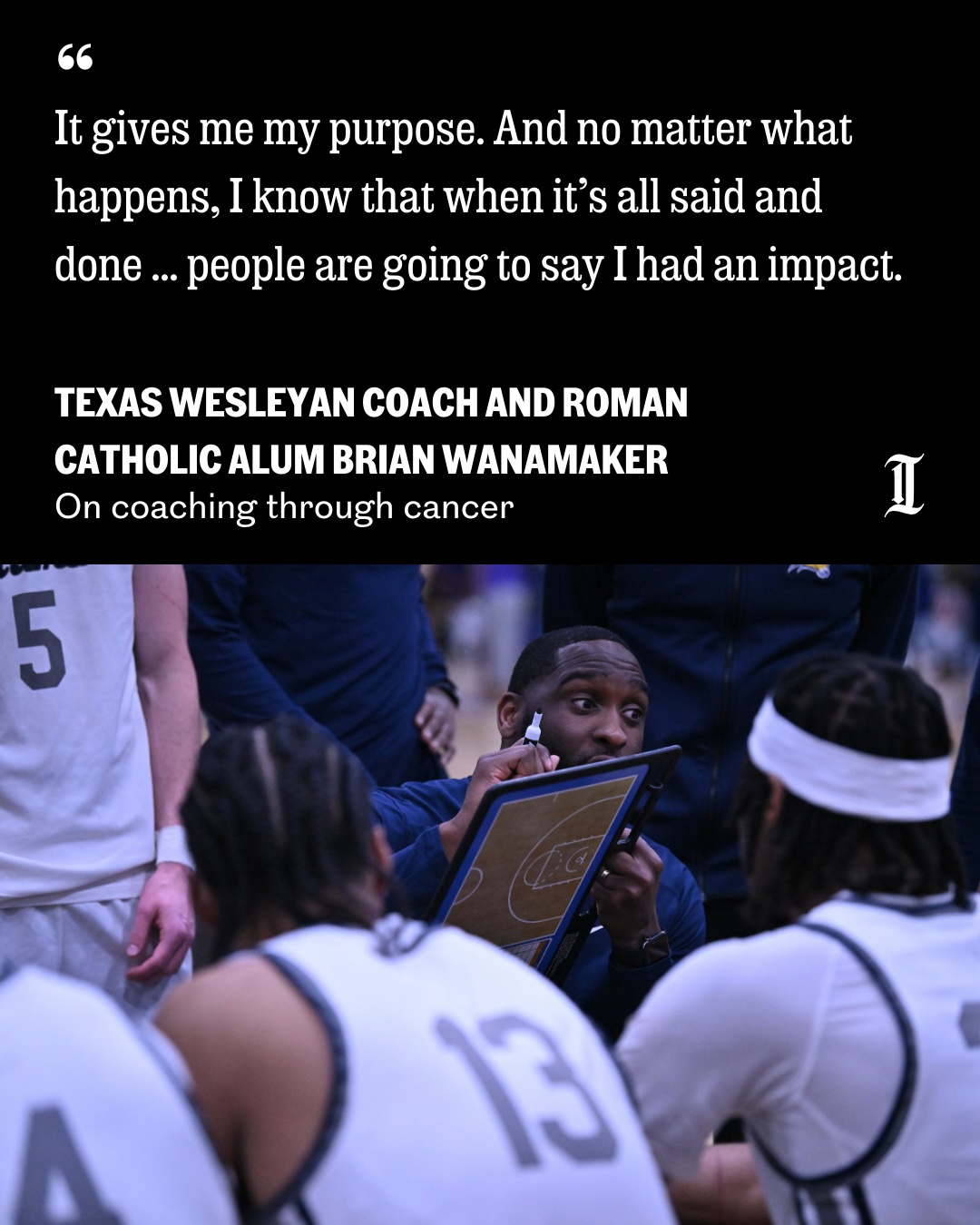
North Philadelphia native Brian Wanamaker has an incurable cancer. It hasn’t stopped him from turning Texas Wesleyan University’s men’s basketball team into a winner.
🧠Trivia time
Philadelphia’s Department of Planning and Development has identified three possible locations for a permanent intercity bus station. Which is not one of them?
A) The former Greyhound terminal at 10th and Filbert streets
B) A pair of parking lots on Arch Street near Eighth Street
C) The Philadelphia Gateway Garage on Vine Street near 15th Street
D) A parking lot near 30th Street Station on Arch Street
Cheers to Sonia Tupone, who solved Tuesday’s anagram: Scranton. The Flyers will bring the (fictional) Dunder Mifflin from its Northeast Pennsylvania hometown to South Philly for The Office theme night next month.
Photo of the day
James Walker with Valley Forge Flowers places baby’s breath on a large overhead sweeping, twisting root structure at the Convention Center on Tuesday while setting up for the Philadelphia Flower Show.
Thanks for starting your day with The Inquirer. Until the city’s (outdoor) trees bloom once again, be well.
By submitting your written, visual, and/or audio contributions, you agree to The Inquirer’s Terms of Use, including the grant of rights in Section 10.
DEAR ABBY: I’ve been with my boyfriend for 17 years. He has a friend, “Byron,” whom he hangs out with multiple times a week, sometimes up to six days. Byron’s wife, “Crystal,” (married 22 years) is always attached to Byron’s hip. They do everything together.
Crystal needs to be the center of attention. She constantly brags about herself and speaks louder so she gets all the attention. She’s always texting my boyfriend, even sending him pictures of herself. My boyfriend says it’s harmless and that there’s nothing to be worried about because “she’s his friend’s wife.” To me, that means nothing. Crystal is very competitive, and I feel like she’s trying to win him over. I’m about ready to let her win because I’m not a confrontational person.
I hang out with them often, so I can distract her and let my boyfriend talk to Byron without her. But I get so exhausted. It’s nonstop. She’s definitely going out of bounds, treating my boyfriend like her man.
I’ve mentioned my dislike of the situation but have been told it’s my problem (I’m jealous), not his. My boyfriend says I’m acting too clingy now because I always want to be there to keep them separated, but it’s wearing on me. Am I reading too much into this?
— ENCROACHED ON IN VERMONT
DEAR ENCROACHED: No, I think you have probably read Crystal, and her insatiable need for attention, right. Because trying to shield your boyfriend from her attempts to monopolize him hasn’t worked, it may be time for a change in tactics. By that, I mean stop tagging along so often. Give him space, while you use the time to get together with friends, family or some other activity you enjoy. If you do, you and your boyfriend will have more to talk about when he returns from these marathons. As I see it, you have nothing to lose and possibly something to gain by trying it.
** ** **
DEAR ABBY: I am in the process of leaving my husband of 15 years. He has admitted that he used to have sex with me while I was sleeping and when I was passed out drunk back when I had a drinking problem. He’s aware that I was molested when I was younger and that most of it took place when I was sleeping and I would wake up to it happening. He doesn’t see anything wrong with it. He says he was gentle and it was OK because I’m his wife and it’s better than cheating on me. This has permanently scarred me. I don’t know how to handle it. Please help.
— TRAUMATIZED IN NEW YORK
DEAR TRAUMATIZED: You have my sympathy. If you haven’t sought counseling, I hope you will do it to help you process the fact that the assaults you have described were spousal rape. Sex with a person who is unable to give consent is illegal in all 50 states. For the sake of your mental health, please talk with a psychotherapist, who can help you to heal as well as report this to the police. A helpful resource that has been mentioned in my column many times is RAINN, the Rape, Abuse, Incest National Network. You will find it at rainn.org.
ARIES (March 21-April 19). It is not worth spending time fixing problems that you will not even have once you do things correctly from the beginning. A do-over is your new teacher. A different recipe, plan or relationship has great potential.
TAURUS (April 20-May 20). Stars encourage an active expansion of your social circle. Listening to different voices keeps you from getting stuck in your own head or in a single narrative. Uplifting relationships balance your perspective and mood.
GEMINI (May 21-June 21). You’re getting validation, and it feels good. The feedback is positive, the responses are what you aimed for, and the outcome is what you’d hoped. Now ask, does it actually solve the problem? And what’s the responsible next move?
CANCER (June 22-July 22). Most people are too focused on their own journey to judge yours, and that’s a good thing. The ones who care will be supportive. So there’s no need to overpolice your every step. Do it like nobody’s watching.
LEO (July 23-Aug. 22). You’ll be in a position to take charge. For you, leadership is cultivation. You want to help others, not control them or make them dependent on you. You’ll clear a path, show the way and teach what you know.
VIRGO (Aug. 23-Sept. 22). You play many roles: friend, worker, helper, leader and partner. Each one asks for certain behaviors, but none of them captures your whole self. They’re expressions, not definitions. A role is something you do, not someone you are.
LIBRA (Sept. 23-Oct. 23). The option on the table today is not the only one that will be offered and taking it could alter your course. Things may work on paper, but that doesn’t mean they really fit. The ideal arrangement? Try before you buy.
SCORPIO (Oct. 24-Nov. 21). Don’t bend for someone who will take advantage of your good nature. You can show said good nature by good-naturedly saying, “Ha! No way.” It’s the swift timing, lightness and the gleam in your eye that sells it.
SAGITTARIUS (Nov. 22-Dec. 21). The stressful situation will pass, the problem will be solved and the transaction finalized. It’s all coming together very soon, too, so proceed as though you know this is going your way.
CAPRICORN (Dec. 22-Jan. 19). Today’s issue is a snowball rolling down a mountain. You might be able to stop it at the top while it’s tiny, but once it gets near the bottom, it’s a fast-moving, giant wrecking ball.
AQUARIUS (Jan. 20-Feb. 18). Talent plus merit is the golden ticket. But if you could only choose one, merit always wins out. With work, the job is learned. The real talent is a desire to put in the work it takes to be good.
PISCES (Feb. 19-March 20). You do have high expectations today, but it’s appropriate because you are ready for the challenge. You’ve done the preparation, and now it’s just a matter of surrendering to action. You can trust yourself, and the universe, implicitly.
TODAY’S BIRTHDAY (Feb. 25). Step into your Year of Whispered Intuition, when incredible timing and subtle influence guide you to wonderful places. Your insight and generosity will be cherished and make a difference in the lives of those you love and those you don’t even know. More highlights: You’ll experience an unexpected windfall, you’ll acquire a lucrative skill, and you’ll give dozens of lauded performances. Leo and Scorpio adore you. Your lucky numbers are: 6, 22, 37, 10 and 41.
INDIANAPOLIS — Joel Embiid had 27 points in his return to the lineup after missing five games with right shin soreness and right knee injury management, Tyrese Maxey scored 32 points, and the 76ers beat the Indiana Pacers 135-114 on Tuesday night.
Embiid scored 20 points in the first half, sinking 11 of 17 shots in 26 minutes. VJ Edgecombe chipped in with 23 points on 9-of-13 shooting for the 76ers, who shot 58%.
Andrew Nembhard and Micah Potter each scored 23 for the Pacers. Quenton Jackson had 15 points and rookie Kam Jones added a career-high 13 points.
Pacers leading scorer Pascal Siakam was out with a left wrist sprain. The Pacers also were without Aaron Nesmith, who missed his third consecutive game with right ankle sprain.
Indiana shot 42% from the field and committed 16 turnovers. The Sixers held a 44-41 rebounding edge with Maxey leading the way with nine rebounds. Jarace Walker had 10 rebounds for the Pacers.
The 76ers showed their dominance inside with a 82-52 edge in points in the paint.
Sixers guard Tyrese Maxey (center) had a game-high 32 points against Indiana.
The Pacers led 38-30 after the first quarter, but the 76ers answered with a 17-0 spurt to open the second quarter and take a 47-38 lead. Philadelphia shot 64% to take a 75-65 lead at halftime.
Maxey scored 13 points in the third quarter as the 76ers took complete control, expanding the lead to 106-85 after three quarters.
The Sixers led by 28 points in the fourth quarter before emptying the bench. They will return to Xfinity Mobile Arena next to face the Miami Heat on Thursday (7 p.m., NBCSP).
WASHINGTON — Defense Secretary Pete Hegseth gave Anthropic’s CEO a Friday deadline to open the company’s artificial intelligence technology for unrestricted military use or risk losing its government contract, according to a person familiar with their meeting Tuesday.
Defense officials warned they could designate Anthropic a supply chain risk or use the Defense Production Act to essentially give the military more authority to use its products even if it doesn’t approve of how they are used, according to the person familiar with the meeting and a senior Pentagon official, who both were not authorized to comment publicly and spoke on condition of anonymity.
The development, which was reported earlier by Axios, underscores the debate over AI’s role in national security and concerns about how the technology could be used in high-stakes situations involving lethal force, sensitive information, or government surveillance. It also comes as Hegseth has vowed to root out what he calls a “woke culture” in the armed forces.
“A powerful AI looking across billions of conversations from millions of people could gauge public sentiment, detect pockets of disloyalty forming, and stamp them out before they grow,” Amodei wrote in an essay last month.
The person familiar called the tone of the meeting cordial but said Amodei didn’t budge on two areas he has established as lines Anthropic won’t cross — fully autonomous military targeting operations and domestic surveillance of U.S. citizens.
The Pentagon objects to Anthropic’s ethical restrictions because military operations need tools that don’t come with built-in limitations, the senior Pentagon official said. The official argued that the Pentagon has only issued lawful orders and stressed that using Anthropic’s tools legally would be the military’s responsibility.
Anthropic will no longer be the only AI company approved for classified military networks
The Pentagon announced last summer that it was awarding defense contracts to four AI companies — Anthropic, Google, OpenAI, and Elon Musk’s xAI. Each contract is worth up to $200 million.
Anthropic was the first AI company to get approved for classified military networks, where it works with partners like Palantir. Musk’s xAI company, which operates the Grok chatbot, says Grok also is ready to be used in classified settings, according to the senior Pentagon official.
The official noted that the other AI companies were “close” to that milestone. SpaceX, Musk’s space flight company that recently merged with xAI, didn’t immediately return a request for comment Tuesday.
Hegseth said in a January speech at SpaceX in South Texas that he was shrugging off any AI models “that won’t allow you to fight wars.”
Hegseth said his vision for military AI systems means that they operate “without ideological constraints that limit lawful military applications,” before adding that the Pentagon’s “AI will not be woke.”
The defense secretary said that Grok would join the secure but unclassified Pentagon AI network, called GenAI.mil. The announcement came days after Grok — which is embedded into X, the social media network owned by Musk — drew global scrutiny for generating highly sexualized deepfake images of people without their consent.
OpenAI announced in early February that it, too, would join GenAI.mil, enabling service members to use a custom version of ChatGPT for unclassified tasks.
Anthropic calls itself more safety-minded
Anthropic said in a statement after Tuesday’s meeting that it “continued good-faith conversations about our usage policy to ensure Anthropic can continue to support the government’s national security mission in line with what our models can reliably and responsibly do.”
The uncertainty with the Pentagon is putting those intentions to the test, according to Owen Daniels, associate director of analysis and fellow at Georgetown University’s Center for Security and Emerging Technology.
“Anthropic’s peers, including Meta, Google, and xAI, have been willing to comply with the department’s policy on using models for all lawful applications,” Daniels said. “So the company’s bargaining power here is limited, and it risks losing influence in the department’s push to adopt AI.”
In the AI craze that followed the release of ChatGPT, Anthropic closely aligned with President Joe Biden’s Democratic administration in volunteering to subject its AI systems to third-party scrutiny to guard against national security risks.
Amodei, the CEO, has warned of AI’s potentially catastrophic dangers while rejecting the label that he’s an AI “doomer.” He argued in the January essay that “we are considerably closer to real danger in 2026 than we were in 2023″ but that those risks should be managed in a “realistic, pragmatic manner.”
Anthropic has been at odds with the Trump administration
This would not be the first time Anthropic’s advocacy for stricter AI safeguards has put it at odds with President Donald Trump’s administration. Anthropic needled chipmaker Nvidia publicly, criticizing Trump’s proposals to loosen export controls to enable some AI computer chips to be sold in China. The AI company, however, remains a close partner with Nvidia.
Trump’s Republican administration and Anthropic also have been on opposite sides of a lobbying push to regulate AI in U.S. states.
Trump’s top AI adviser, David Sacks, accused Anthropic in October of “running a sophisticated regulatory capture strategy based on fear-mongering.”
Sacks was responding on X to Anthropic cofounder Jack Clark, writing about his attempt to balance technological optimism with “appropriate fear” about the steady march toward more capable AI systems.
Anthropic hired a number of ex-Biden officials soon after Trump’s return to the White House, but it’s also tried to signal a bipartisan approach. The company recently added Chris Liddell, a former White House official from Trump’s first term, to its board of directors.
The Pentagon’s “breakneck” adoption of AI shows the need for greater AI oversight or regulation by Congress, particularly if AI is being used to surveil Americans, said Amos Toh, senior counsel at the Brennan Center’s Liberty and National Security Program at New York University.
“The law is not keeping up with how quickly the technology is evolving,” Toh wrote in a post on Bluesky. “But that doesn’t mean DoD has a blank check.”
BUCHA, Ukraine — From her wooden schoolroom seat, Katya, 15, carefully eyes the assault rifles laid across the desks up front.
Her mind flashes to the Russian checkpoint four years ago.
She is crammed in the back of a neighbor’s car clutching her aunt’s cat as fear rises to her throat. Russian soldiers are pressed up against the car window, seething with anger, fingers on the triggers of their black guns.
The teacher’s voice snaps her back to the present.
“God willing, none of you will ever need the knowledge you gain here, not even once. But if, God forbid, it happens that you do need it — that you cross paths with these situations — it’s better that you know what needs to be done at any given moment,” he says. “Understood?”
Katya nods. She looks again at the training guns. She isn’t scared anymore. Scared is for 11-year-old Katya in the back seat of that car. Scared is for the little girl trembling in the basement, whose mother covered her with her body while Russian war planes circled overhead.
If Russian troops ever return to Bucha, Katya doesn’t want to be scared. She intends to be ready.
The teacher asks for volunteers to try loading a rifle. Katya’s hand shoots up.
As Russia’s full-scale invasion entered its fifth year Tuesday, Ukrainians were yearning for peace but also readying a new generation of defenders — a somber recognition that the Kremlin is still bombing civilians every night and pushing maximalist demands at the negotiating table. The war could go on for years, and even if a ceasefire is achieved, the Russian threat will live next door.
Katya and her classmates have come of age during wartime.
Denys Kovalenko shows how to apply bandages on Varvara Koval, 15.
In 2022, as tweens, they survived Russian occupation, made harrowing escapes from the front lines, and returned to find the bloodstained suburb of Bucha forever changed by the Russian massacre that unfolded on its streets in the first weeks of the war.
Now 15 and 16, they are still too young to enlist to fight but old enough to understand they soon may be called upon to join their parents and older siblings in protecting their country from a nuclear-armed neighbor intent on denying them an independent future.
While the United States escalates pressure on Kyiv to agree to a negotiated settlement, Ukraine is insisting on ironclad security guarantees — while preparing society to defend itself long term. That includes intensifying efforts to train its children on wartime readiness.
In classrooms across Ukraine, more than 385,000 teenagers are enrolled in a revamped, mandatory course on handling weapons, battlefield tactics, emergency medicine, mine safety, radio communication, and how to respond to attacks on energy infrastructure.
The course, called Protecting Ukraine, replaced a decades-old program that taught high-schoolers some basic weapons awareness but was largely a relic of the Soviet era that also involved dry lectures on military hierarchy and learning to march.
That curriculum was developed long before school hallways were adorned with photos of students and teachers killed by Russia, before air alerts sent children scrambling into basements, before sandbags lined school windows to protect them from blasts or classes were held in subways.
Ukraine’s Education Ministry invested $2.3 million in training teachers on the Protecting Ukraine program last year. “Our task was to form a defense mentality,” Education Minister Oksen Lisovyi said. “The need appeared, first of all of course, because of the military confrontation, terrorist threats and because Russia systematically terrorizes the civilian population.”
Students learn “how to protect one’s self, how to protect those who are close to you, how the Ukrainian army works, which role you could find for yourself if you’d choose to take that path,” Lisovyi said. “But first of all, of course, it’s about the preparation of the civilian population.”
Marina Kyziminska, 16, works with an assault rifle during class.
Rifles, tourniquets, and CPR
Most students in Katya’s classroom were in or near Bucha when Russian forces rampaged the Kyiv region in 2022, executing civilians before retreating from their failed campaign to seize the capital.
When the instructor tells the students just how quickly a green, or safe, zone can turn red, they know exactly what he means.
Katya shivered in a basement, replaying the happiest moments of her life as explosions shook her neighborhood.
Zhenya walked miles along the railway tracks to reach Ukrainian-controlled territory as Russian warplanes circled overhead.
A shell struck the eighth floor of Kyrylo’s apartment building but didn’t explode.
Vasylisa remembers fleeing her hometown in the eastern Donetsk region as a toddler, only to resettle outside Kyiv and watch the sky turn red as streets burned in 2022.
The instructor runs through the basics of trauma medicine: different kinds of tourniquets, how to put pressure on a major wound. He describes types of land mines, explains why radios are still used in an age of phones. He asks for volunteers for a CPR lesson. Katya and Vasylisa step to the front of the room. They giggle as Vasylisa lies down and Katya tips her chin back, opens her mouth, checking for obstruction.
Zhenya Grebelna (left) Varvara, Katya and Ria Shapirko learn how to use a tourniquet.
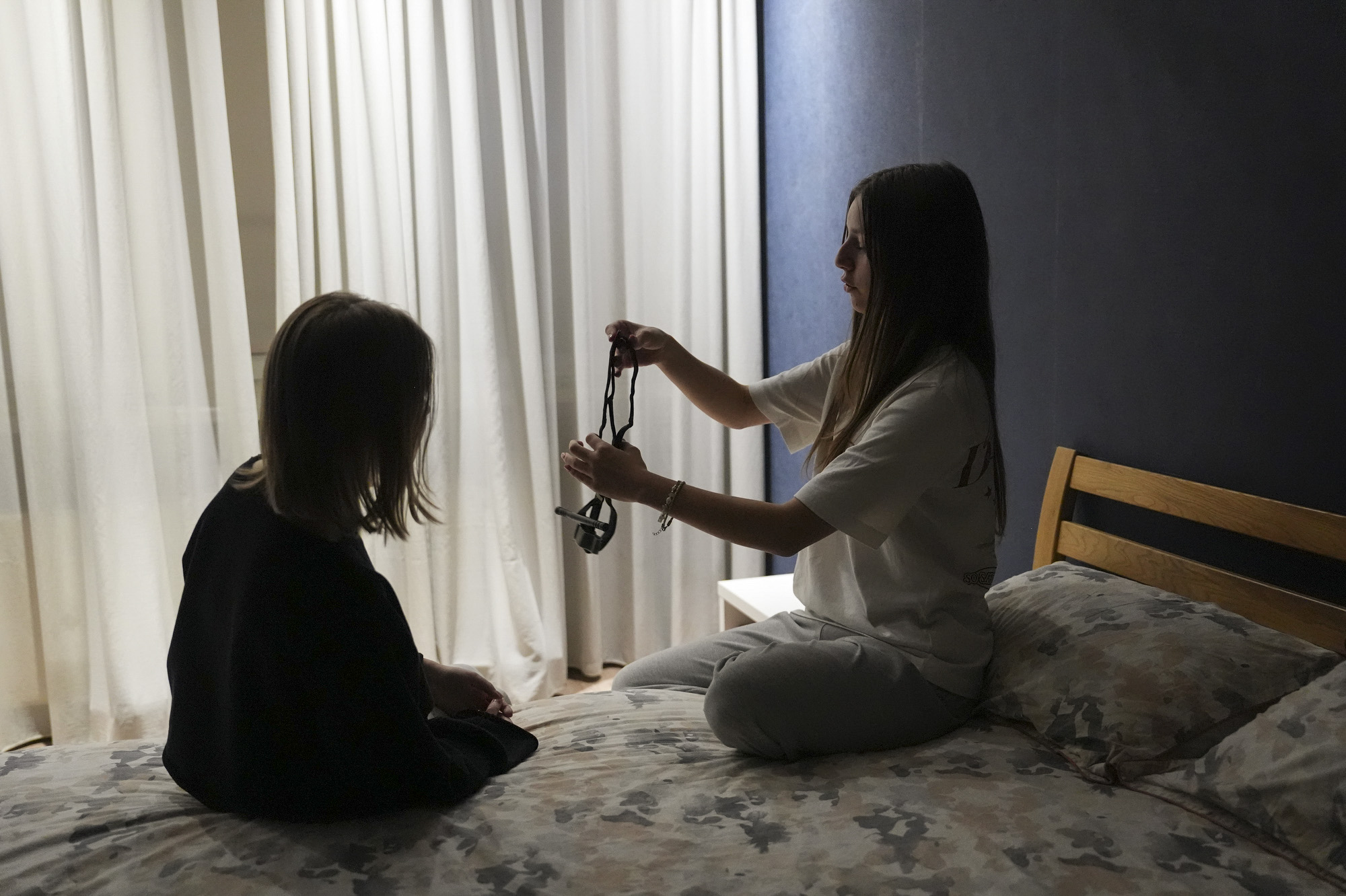
The students tie tourniquets to one another’s arms and practice twisting until they’re so tight they hurt. They remind each other to write down the time. They know that a tourniquet left on too long can lead to amputation.
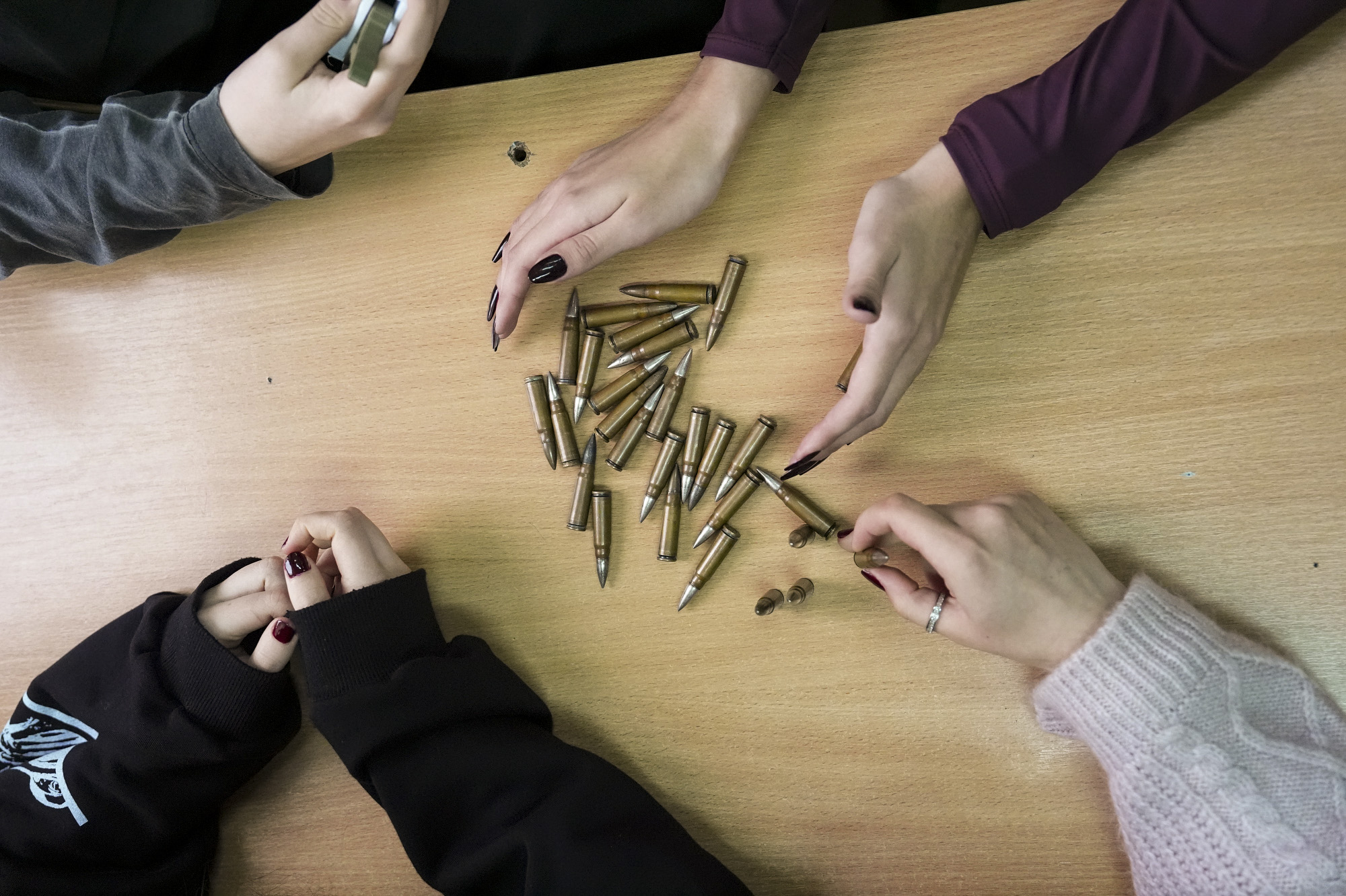
When they go to load rifles, Katya is confident. She shows the other girls how it’s done while a group of boys plays with their phones in the back. Other students race to see who can load bullets into a magazine fastest.
“I’m going to be dreaming about this already,” Katya says. Her friend Ria chimes in: “Like this, Katya: You wake up and we’re assembling a rifle on your bed!” The girls laugh. Their friend Varvara Koval takes a turn. Katya corrects her approach, takes the magazine and attaches it herself.
Bullets used in the weapons training.
The girls know that in schools in Russia, children their age are learning the same techniques. They know those kids are being taught that Ukraine is the aggressor, that Russia is liberating their territory by destroying it. They know that boys just a few years older than their classmates are being fitted for uniforms, crossing the border, killing Ukrainians and dying on Ukrainian land.
“While they are being taught how to properly plant mines, we are being taught how not to step on them,” Katya says of how she pictures Russian students. In a better world, she acknowledged, it would not be normal to load an assault rifle at school or tie a tourniquet on your friend’s arm.
“If no one were attacking our territory, or if Russia followed all the rules and conventions of conducting war, maybe we wouldn’t be learning this,” she adds. “But since they are striking civilian children just like us, we have to know all of this.”
Vasylisa shows younger sister Stasia how to apply a tourniquet at home.
Lost childhood
Katya grew up in this school. Her mom is a teacher here. She knows Bucha like the back of her hand. Vasylisa was never supposed to be here. Born in the eastern Donetsk region, she always dreamed of graduating from the same school as her father. War pushed her family out in 2014. They moved again and again, eventually settling in Irpin, just outside Kyiv.
On Feb. 23, 2022, as Russian forces massed on Ukraine’s borders, Vasylisa’s dad told her and her younger sister, Stasia, to prepare for the worst. Stasia, who was 9, burst out laughing.
The next morning, Russia invaded. Little information trickled in through their unstable internet connection, and what did was terrible: executions. Whole families shot as they tried to flee. Just across the field from them, they could hear a Ukrainian machine gun picking off Russian troops.
Bohdana Kolesnikova, right, with daughters Vasylisa and Stasia at home.
In early March, they fled, packing their dog, guinea pig and several neighbors into their car. The girls thought they were taking a so-called “green corridor” — a safe path toward Kyiv. Their parents knew no such route existed. The trip was a dangerous leap of faith.
Everything seemed to be on fire. They passed the mayor of Irpin hanging out of a car, a rifle in his hands. They eventually made it west, where their dad was quickly drafted to the military. The girls and their mom were stunned.
Back then, Vasylisa thought of the military almost as an extracurricular activity — something to do after school or work. “And now he was taken away, and there was a war,” she said. “I was afraid that … well, I was afraid for Dad. I was crying, talking to him, and he was trying to calm me down, but that only made me cry more.”
Eventually, the family settled into a new rhythm. They returned to the Kyiv region and moved to Bucha, where their dad is now based. Not everything Vasylisa is learning about war in school is new. Her dad taught her and Stasia some field medicine and asked them to always carry tourniquets when they go out. Last summer, they attended a camp where they practiced shooting.
Stasia, at 12, can already assemble and disassemble an AK M-479 in less than a minute.
“I get really upset when I realize that my teenage years are just slipping away like this and passing,” Vasylisa said through tears. “I’m now looking at my sister, who is 12 — the age I was then. And when I realize that she already feels kind of grown up, it makes me sad that I lost some years.”
Their dad has seen Russia’s war come to his family home twice. His daughters, he said, might still be children. But in an emergency, they should be ready to act as adults.
Vasylisa and Stasia with their dad.
Sounds of war
At school, the military lesson ends in the early afternoon. The class disperses, and the students zip up their backpacks, push past the younger kids through the hallways. Vasylisa goes to an English class. The other girls gather on the steps outside.
The first stop after school is the grocery store for cookies, candies, and tea. Varvara’s mom isn’t home from work yet, but she agreed the girls can hang out at their apartment so long as Varvara runs upstairs first to clean.
They kick their shoes off at the door and rush for the kitchen. They boil water. They crowd around the table. They hear an air raid siren and ignore it. They move to Varvara’s room, sit on her bed and floor. They don’t talk about guns or drones or soldiers or war. They talk about boys and girls and crushes and relationships.
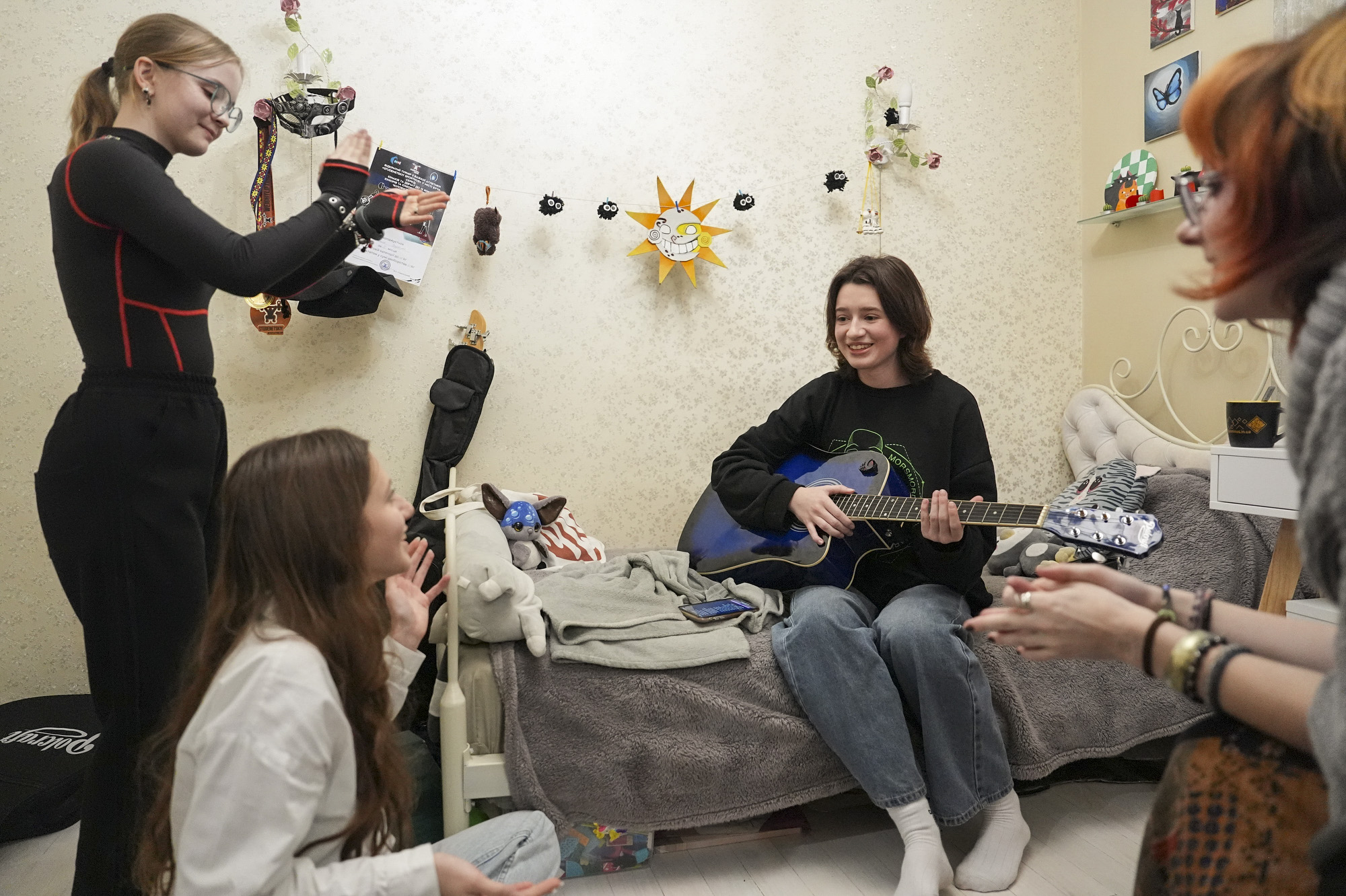
The girls in Varvara’s room.
They laugh at Varvara’s cat, Masha. Eventually, Ria picks up Varvara’s blue acoustic guitar and starts to strum. The girls quiet down. She begins to sing. They all join in.
When the song ends, they cheer and rush to hug her.
The air alert has stopped. For this moment, safe in Varvara’s room, they are just teenagers. They are young and happy and free. They could almost be anywhere.
But later that night, the sirens blare again. Russian missiles and drones soar overhead and crash into apartments and houses and a hospital and energy infrastructure. Four people are killed. Several children are wounded. Varvara moves from her bed to sleep on a bean bag in the hall. The girls all hope to survive another night, and meet in school again tomorrow.