Tag: no-latest

  • Letters to the Editor | Feb. 26, 2026

    Letters to the Editor | Feb. 26, 2026

    Wrong lesson

    Quakertown’s response to Friday’s student walkout is a disgrace. When teenagers leave school to protest, the role of police is to protect life and de-escalate. Keep students out of traffic, keep bystanders safe, and help everyone get home. It is not to turn a civic act into a street fight. Videos and witness accounts from Quakertown show a chaotic, physical confrontation between officers and students, exactly the kind of escalation law enforcement should be trained to prevent. Even if some students acted irresponsibly, adults with badges are held to a higher standard. Force against minors should be the last resort, not the first tool.

    Most alarming is that detained students were held through the weekend. That is punitive, unnecessary, and indefensible. These are children. They should have been released immediately to their families. Bucks County’s independent investigation must be thorough, transparent, and swift. But the moral line is already clear. Quakertown’s young people deserved calm supervision and guidance. They got aggression and detention.

    Brandon McNeice, head of school and CEO, Cornerstone Christian Academy, Philadelphia

    Using kid gloves

    Being a police officer is difficult. It comes with risk, demands courage, and requires split-second decision-making. Policing youth is even more difficult. One would then assume that this incredibly difficult assignment would be subject to intense training and that clear standards would exist to guide every interaction. Unfortunately, when it comes to policing youth, that is not the case. The typical law enforcement officer, at most, receives several hours of training directed at juvenile law.

    But how many of them train on the developmental differences between adults and young people? Not near enough. To the detriment of both the community and the officer, these interactions are ripe for undesirable, yet predictable, outcomes. There is no dispute that youth are different from adults. We all know this. That is not political or controversial. Yet, as a community, we have not required change. Maybe the recent events in Quakertown are enough to demand it. We do not accept other professional specialties to just figure it out with kids; we shouldn’t with police, either. Not for them, and not for us.

    Anthony V. Pierro, executive director, Strategies for Youth, Raleigh, N.C.

    Voting issues

    A recent Inquirer article regarding U.S. Sen. Dave McCormick addressing the voting issues in Chester County last year states there is “no evidence that voters were turned away,” yet also reports that some voters “voluntarily left” when their names were missing from the pollbook. That may be legally accurate if provisional ballots were offered. But if an eligible voter shows up, can’t find their name, and leaves without voting — for any reason — the system did not function as it should. The issue isn’t only whether anyone was formally denied. It’s whether the process worked smoothly and clearly for every voter. In a less affluent area, where voters may not be able to return later, the outcome could reasonably be viewed as disenfranchisement. Technical compliance matters. So does operational competence.

    Jeffrey Williams, Malvern

    Join the conversation: Send letters to letters@inquirer.com. Limit length to 150 words and include home address and day and evening phone number. Letters run in The Inquirer six days a week on the editorial pages and online.

  • Dear Abby | Family’s black sheep could use a little help now and then

    DEAR ABBY: I was always the wild child and did pretty much what I wanted. My four siblings stuck to the straight and narrow. We stayed close and loving, though. We are old now, and they all lead very comfortable lives. I, however, became injured and gravely ill. I could no longer work and now live on supplemental security income and food stamps.

    My siblings all give generously to food banks and homeless charities, even putting some homeless people up in hotels, which is great. But not one of them thinks to ask me if I have enough food or anything. I’m really hurt. Luckily, my affordable housing will offer some food for the residents, so I’m OK.

    Should I say anything to my siblings? Occasionally, in the past, they have helped me, like buying me a chest of drawers or some other minor thing. They could easily support me if they wanted to. Should I just be grateful for that?

    — UNDERPERFORMING IN CALIFORNIA

    DEAR UNDERPERFORMING: Your relatives are not mind readers. If you need help, speak up, explain the problem and ask for help in plain English. The worst they can do is refuse, and you will be no worse off than you are.

    ** ** **

    DEAR ABBY: I’m worried about my husband’s grief response. His mom collapsed and died in our driveway. At the time, I responded quickly. I made sure everyone was fed and paid for the funeral service. That was all fine. But now, I don’t understand why he’s not grieving. I love my husband very much, but this has me confused. Please advise.

    — LETTING IT OUT IN OREGON

    DEAR LETTING IT OUT: Please accept my sympathy for the shocking loss of your mother-in-law. We are not clones in the way we respond to death. Everyone does it differently, including your husband. If his mother was a strong influence in his life, he will feel her absence. If he’s still eating and sleeping well and is able to concentrate, do not let this absence of emotion worry you. This is his journey, and if anything changes, your doctor can refer him to a grief support group.

    ** ** **

    DEAR ABBY: I am a disabled person. When I go to doctors’ offices or restaurants, there are usually two doors to get in. Sometimes, if someone is coming in or out, they will hold the door open for me. However, when they do, almost every time, another person will push past me, almost knocking me down.

    What can I say to them about their rudeness? One of these days they might be in my position and need someone to hold the door for them. The next time it happens, I’m going to tell them “The door was held open for the disabled person, not for you. Be glad you can walk well!” What would you say, Abby? I can’t believe how rude the country is getting.

    — TRYING TO GET THROUGH IN VIRGINIA

    DEAR TRYING: A better word than “rude” to use would be “entitled.” If it happened to me, I would say loudly that the door was held for me because of my disability. Then I would add how fortunate I felt not to have been injured again this time.

  • Horoscopes: Thursday, Feb. 26, 2026

    ARIES (March 21-April 19). Just as it’s easy to regard a cute child with love, you can notice your inner self affectionately. Self-awareness brings good fortune. You’ll notice your patterns and interpretations without judgment.

    TAURUS (April 20-May 20). Keep imagining yourself reaching a goal. You can envision this from many angles and really get into the feeling of it. The more you see it, the more real it becomes in your mind’s eye and soon in everyone else’s eyes, too.

    GEMINI (May 21-June 21). The uncertain task is before you. Until you get a few experiences under your belt, it’s totally normal to be angsty about new circumstances. But with every step completed, you develop a stronger belief in your ability to handle challenges.

    CANCER (June 22-July 22). It’s one of those days when the body moves before the mind weighs in. There’s a noble velocity to it — bags grabbed, words already forming, attention fully oriented. Duty as muscle memory.

    LEO (July 23-Aug. 22). You’ll make a sale, not because you’re persuasive, but because what you have is a good match for someone who needs it. Your sincere desire is to help people out, and they can feel the truth in this.

    VIRGO (Aug. 23-Sept. 22). You have built much in your life, but some relationships can’t be built so much as they’ll be allowed and experienced as they come together in a way that can’t be forced, only observed and accepted.

    LIBRA (Sept. 23-Oct. 23). Oh, the fascinating minutiae of an unfolding relationship. As much as you love an intellectual approach to getting acquainted, you’re very much aware of multiple aspects and factors in play as you decide how this is going to go.

    SCORPIO (Oct. 24-Nov. 21). Even when people don’t tell you what they want, you can usually figure it out. But today, not knowing makes you guess answers, some right (fun!) and others wrong (even more fun!).

    SAGITTARIUS (Nov. 22-Dec. 21). To be in conflict is to be engaged. Don’t forget that negative attention is still attention, and many find it preferable to the absence of attention. Remember that attention (regardless of what kind) is powerful in its ability to grow things.

    CAPRICORN (Dec. 22-Jan. 19). The journey is long, and when you take it at a comfortable stride, you avoid missteps, injury and weariness. And though you can’t stand it when others tell you to “relax,” you will very much enjoy the message as a self-direction.

    AQUARIUS (Jan. 20-Feb. 18). Aim your dreams to the clouds while working in the trenches. Groundwork is essential to your success. Not only does it give you a solid foundation, but it also gives you the wisdom to be an excellent steward of your rewards.

    PISCES (Feb. 19-March 20). You never know who is hurting or who can be helped or even saved by a little kindness. So you do it before it’s an obvious need. You treat strangers with friendliness, loved ones with tenderness and yourself with the utmost love and respect.

    TODAY’S BIRTHDAY (Feb. 26). It’s your Year of Playful Alchemy when your daring mixes and bespoke formulas transform common elements into the extraordinary and rare. Work develops purposely and pays you better too. New studies lead to applied skill and will open social realms, too. More highlights: Art bursts into form. Romantic encounters inspire and your generosity returns threefold. Cancer and Virgo adore you. Your lucky numbers are: 11, 30, 5, 42 and 14.

  • Justice Department says it’s reviewing whether any Epstein-related records were mistakenly withheld

    Justice Department says it’s reviewing whether any Epstein-related records were mistakenly withheld

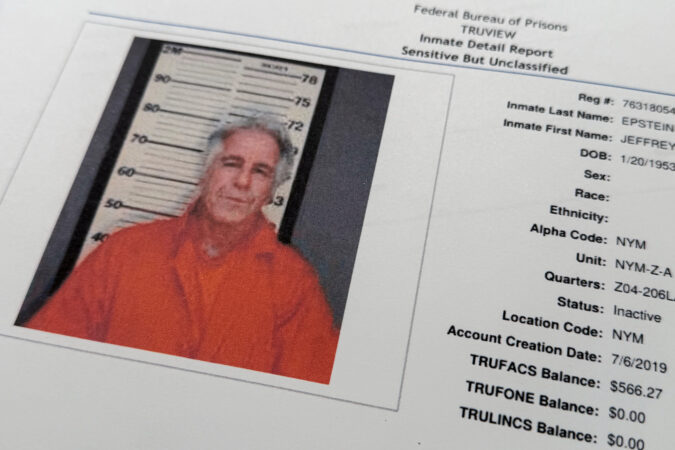
    WASHINGTON — The Justice Department said Wednesday that it was looking into whether it improperly withheld documents from the Jeffrey Epstein files after several news organizations reported that some records involving uncorroborated accusations made by a woman against President Donald Trump were not among those released to the public.

    The announcement followed news reports saying that a massive tranche of records released by the Justice Department did not include several summaries of interviews that the FBI conducted with an unidentified woman who came forward after Epstein’s 2019 arrest and claimed to have been sexually assaulted by both Trump and Epstein when she was a minor in the 1980s.

    “Several individuals and news outlets have recently flagged files related to documents produced to Ghislaine Maxwell in discovery of her criminal case that they claim appear to be missing,” the Justice Department said in a post on X. “As with all documents that have been flagged by the public, the Department is currently reviewing files within that category of the production.” Maxwell, Epstein’s longtime confidant, is serving a 20-year prison sentence on a sex trafficking conviction.

    It said that if any document is found to have been improperly withheld and is responsive to the federally enacted law mandating the files’ release, “the Department will of course publish it, consistent with the law.”

    At issue is a series of interviews said to have been conducted in 2019 with a woman who made an allegation against Trump, who has consistently denied any wrongdoing in connection with Epstein. News reports from recent days say the accuser was interviewed four times but a summary of only one of those interviews was included in the publicly released files.

    The missing records were earlier reported by the journalist Roger Sollenberger on Substack and NPR, and have since been documented by other news organizations, including the New York Times, MS Now, and CNN.

    Rep. Robert Garcia, the top Democrat on the House Oversight Committee, said in a statement that his panel would investigate the withheld records. He said he had reviewed unredacted evidence logs and “can confirm that the DOJ appears to have illegally withheld FBI interviews” with the accuser.

    The Justice Department last month said it was releasing more than 3 million pages of records related to Epstein, who took his own life in a New York jail cell in 2019 while awaiting trial on sex trafficking charges. The department said at the time that, though it was attempting to be transparent, it was also entitled to withhold records that exposed potential abuse victims, were duplicates or protected by legal privileges, or related to an ongoing criminal investigation.

    “Some of the documents contain untrue and sensationalist claims against President Trump that were submitted to the FBI right before the 2020 election. To be clear, the claims are unfounded and false, and if they have a shred of credibility, they certainly would have been weaponized against President Trump already,” the department said in a statement last month as it released the records.

    The redaction process was quickly revealed to have been flawed, with the department withdrawing some materials identified by victims or their lawyers, along with a “substantial number” of documents identified independently by the government.

    Lawyers for Epstein accusers told a New York judge last month that the lives of nearly 100 victims had been “turned upside down” by sloppy redactions in the government’s latest release of records. The exposed materials include nude photos showing the faces of potential victims as well as names, email addresses, and other identifying information that was either unredacted or not fully obscured.

    Other uncorroborated claims against Trump and other public figures were included in the publicly available files. The department did not say in its social media post Wednesday why records related to this specific accusation might have been withheld.

  • Vance says administration is pausing some Medicaid funding to Minnesota because of fraud concerns

    Vance says administration is pausing some Medicaid funding to Minnesota because of fraud concerns

    WASHINGTON — Vice President JD Vance announced Wednesday that the Trump administration would “temporarily halt” some Medicaid funding to the state of Minnesota over fraud concerns, as part of what he described as an aggressive crackdown on misuse of public funds.

    Vance, who made the announcement with Mehmet Oz, the administrator for the Centers for Medicare and Medicaid Services, said the administration was taking the action “in order to ensure that the state of Minnesota takes its obligations seriously to be good stewards of the American people’s tax money.”

    Oz, who referred to people committing fraud as “self-serving scoundrels,” said the federal government would hold off on paying $259.5 million to Minnesota in funding for Medicaid, the healthcare safety net for low-income Americans.

    “This is not a problem with the people of Minnesota, it’s a problem with the leadership of Minnesota and other states who do not take Medicaid preservation seriously,” Oz said.

    Wednesday’s move is part of a larger Trump administration effort to spotlight fraud around the country. That effort comes after allegations of fraud involving daycare centers run by Somali residents in Minneapolis prompted a massive immigration crackdown in the Midwestern city, resulting in widespread protests. President Donald Trump, in his State of the Union address on Tuesday, announced Vance would spearhead a national “war on fraud.”

    Trump also recently nominated Colin McDonald to serve as the first assistant attorney general in charge of a Justice Department division dedicated to rooting out fraud.

    Oz said the administration was simultaneously notifying Minnesota’s Democratic Gov. Tim Walz as he was making the announcement publicly. Messages sent to spokespeople for Walz, former Vice President Kamala Harris’ 2024 running mate, were not immediately returned.

    “We will give them the money, but we’re going to hold it and only release it after they propose and act on a comprehensive corrective action plan to solve the problem,” Oz said.

    He said Walz would have 60 days to respond and advised healthcare providers and Medicaid beneficiaries who were concerned to contact Walz’s office.

    A spokesperson for Minnesota Attorney General Keith Ellison, whose office investigates Medicaid fraud, referred questions to the state Department of Human Services, which administers Medicaid in the state, A department spokesperson said the agency was preparing a statement.

    Earlier Wednesday, Ellison held a news conference to promote legislation that would give his office more staff and new legal tools to combat Medicaid fraud.

    Oz said the Centers for Medicare and Medicaid Services were also taking action to crack down on fraud in Medicare, the healthcare system relied upon by millions of older adults.

    He said CMS for six months would block any new Medicare enrollments for suppliers of durable medical equipment, prosthetics, orthotics or other supplies used to treat chronic conditions or assist in injury recovery.

    The Office of the Inspector General for the U.S. Department of Health and Human Services found last year that Medicare improperly paid suppliers nearly $23 million for durable medical equipment from 2018 through 2024. But it found that most of that was before January 2020, when changes to the system were implemented.

    Oz also announced a new crowdsourcing effort he said would help “crush fraud” by soliciting Americans’ tips and suggestions.

    “All of us are smarter than any one of us,” he said.

    In a news release accompanying the announcement, CMS said the funding being paused in Minnesota included some $244 million in unsupported or potentially fraudulent Medicaid claims and about $15 million in claims involving “individuals lacking a satisfactory immigration status.”

    Immigrants who are not living in the U.S. legally, as well as some lawfully present immigrants, are not allowed to enroll in the Medicaid program that provides nearly-free coverage for health services.

    CMS said in the release that if Minnesota fails to satisfy its requirements, it may defer up to $1 billion in federal funds to the state over the next year.

    A CMS spokesperson didn’t immediately respond to an inquiry about what the agency will require from Minnesota in order to restart the deferred funding.

    The administration has threatened to cut off funding for various programs for some Democratic-run states over fraud concerns over the last few months.

    One judge blocked those actions and required that payments flowing to Minnesota and four other states — California, Colorado, Illinois and New York — for a variety of social service programs. The government had said that there was “reason to believe” that those states were granting benefits to people in the country illegally. It did not initially explain where that information came from, but a government lawyer told the judge it was largely in reaction to news reports about possible fraud.

    Another judge said she would not let it cut off funding for administrative costs for 22 states that have refused to hand over information about applicants and recipients of food aid through the Supplemental Nutritional Assistance Program.

    The latest action was prompted in part by a series of fraud cases, including a nonprofit called Feeding Our Future accused of stealing pandemic aid meant for school meals. Prosecutors have put the losses from that case at $300 million.

    Since then, Trump has targeted the Somali diaspora in Minnesota with immigration enforcement actions and has made a series of disparaging comments about the community. During his State of the Union address on Tuesday, Trump said “pirates” have “ransacked Minnesota.”

    Federal agencies have also been enlisted to assist in targeting fraud in Minnesota.

    Last December, the U.S. Treasury Department issued an order requiring money wire services that people use to send money to Somalia to submit additional verification to the Treasury.

    The Center for Medicare and Medicaid Services told Minnesota in January that it intended to freeze parts of payments for some Medicaid programs that were deemed high-risk. The state said that those cuts would add up to more than $2 billion annually if they lasted and made an administrative appeal.

  • Larry Summers will resign from teaching at Harvard during review of Epstein ties, university says

    Larry Summers will resign from teaching at Harvard during review of Epstein ties, university says

    Former U.S. Treasury Secretary Larry Summers will resign from teaching at Harvard University amid a campus review of his ties to the late convicted sex offender Jeffrey Epstein, the university announced Wednesday.

    Summers, who has been on leave since November and whose name appeared hundreds of times in newly released Epstein files, will step down at the end of the school year, according to a statement from Harvard spokesperson Jason Newton.

    “Professor Summers has announced that he will retire from his academic and faculty appointments at Harvard at the end of this academic year and will remain on leave until that time,” Newton said.

    In a statement, Summers said it was a difficult decision and expressed gratitude to the students and colleagues he worked with over 50 years.

    “Free of formal responsibility, as President Emeritus and a retired professor, I look forward in time to engaging in research, analysis, and commentary on a range of global economic issues,” Summers said.

    The Justice Department’s latest release has rippled through academia, uncovering Epstein’s ties to numerous researchers who sought his funding and his friendship even after he became a convicted sex offender. Summers’ resignation follows that of Richard Axel, a Nobel laureate, who on Tuesday announced he would step down as co-director of Columbia University’s Zuckerman Mind Brain Behavior Institute.

    Summers served as treasury secretary under former President Bill Clinton and went on to lead Harvard as president for five years starting in 2001. Summers also has Philly-area roots. He grew up in Penn Valley and attended Lower Merion schools, graduating from Harriton High School in the early 1970s.

    A trove of files released by the government cast new light on Summers’ relationship with Epstein, which spanned years and included visits to one another at their homes in Massachusetts and New York. The two traded emails on topics ranging from politics and the economy to women and romance.

    Summers, who has been married for 20 years, consulted Epstein on a separate relationship with a woman he was tutoring in economics, according to emails from 2018 and 2019. Epstein described himself as Summers’ “wing man” and encouraged persistence. In a 2018 email, Summers said the woman was never his student but he had “known her father for 20 plus years as Chinese economic official.”

    “I have a very good life w Lisa kids etc.,” Summers said in a 2018 email, referencing his wife. “Easy to put at risk for something that might not materialize at all or if it does might prove transient.”

    In a 2016 email, Summers appeared to use a slur for Asian people while discussing an upcoming meeting between Epstein and an official from a Chinese university.

    Responding to previous revelations, Summers last year said he had “great regrets in my life” and that his association with Epstein was a “major error in judgment.”

    Harvard officials have publicly said little about Summers’ relationship. When Summers went on leave last year, the university said it was reviewing “individuals at Harvard” who were in the Epstein documents “to evaluate what actions may be warranted.”

    Epstein’s ties to Harvard were the focus of a 2020 campus report finding that the financier gave more than $9 million to the Ivy League school, mostly for a center founded by math and biology professor Martin Nowak. The report did not mention Summers’ relationship with Epstein. Nowak was later disciplined by Harvard.

    In December, Summers was dealt a lifetime ban from the American Economic Association, a nonprofit scholarly association dedicated to economic research, over his Epstein ties.

    At Columbia, Axel said in a statement Tuesday that he regretted his association with Epstein, calling it a “serious error in judgment.” He said he is also giving up his position as an investigator at the Howard Hughes Medical Institute but will continue to research and teach in his laboratory at the Zuckerman Institute in Manhattan.

    Axel was one of the 2004 winners of the Nobel Prize in physiology or medicine for discoveries related to the human olfactory system. His name appears more than 600 times in Justice Department files reviewed by the Associated Press, including in emails he exchanged with Epstein and on schedules noting their meetings, dinners and lunches.

    In a news article published in 2007, while Epstein was initially under investigation in Florida, the scientist praised Epstein’s intellect, telling New York magazine: “He has the ability to make connections that other minds can’t make. He is extremely smart and probing.”

    The resignations are the latest fallout from the Justice Department’s recent release of millions of pages of records pertaining to Epstein and his longtime confidant and former girlfriend Ghislaine Maxwell. Resignations have rippled across the academic, legal and business communities.

    In Britain, former Prince Andrew and ex-diplomat Peter Mandelson were arrested because of their connections to Epstein and Maxwell.

  • Daniela Petroff, AP’s longtime fashion and Vatican reporter, has died at 80

    Daniela Petroff, AP’s longtime fashion and Vatican reporter, has died at 80

    ROME — Daniela Petroff, who helped shape the Associated Press’ fashion and Vatican coverage for nearly four decades with style, authority and wit, has died in Rome. She was 80.

    Ms. Petroff died Tuesday at home, where she was recovering from a fall, said her husband, Victor Simpson, the retired AP Rome bureau chief.

    Ms. Petroff worked for the Chicago Tribune and Time magazine in Rome before moving onto the AP as a Vatican reporter and Milan fashion correspondent. She launched what became a mainstay of the AP’s culture report, covering the four weeks of menswear and womenswear each year.

    In 1985, the Simpsons endured an unfathomable tragedy: Their 11-year-old daughter, Natasha, was killed during the Dec. 27, 1985, terrorist attack at Rome’s airport that also wounded their son, Michael. When their youngest daughter, Debbie, was born two years later, Pope John Paul II called to congratulate Ms. Petroff.

    In announcing Ms. Petroff’s death, Simpson wrote that she had gone to sleep after lunch and decided not to wake up, “to finally embrace again her beloved Natasha.”

    Led AP’s Milan fashion coverage

    Fluent in Italian, German, French and English, Ms. Petroff spearheaded AP’s Milan fashion coverage just as Giorgio Armani was becoming an international figure, setting the pace for other reporters with informative, succinct, fact-based dispatches that stayed away from opinion and reviews.

    “She had a gift for putting the facts into kind of a very artful context,” said Lisa Anderson, who covered Milan fashion for the Chicago Tribune for nearly a decade starting in the mid-1980s. “She looked at that industry, which often takes itself too seriously, with a lot of amusement as well as respect, which is probably the right combination of qualities to approach fashion reporting.”

    Ms. Petroff’s last AP byline appeared in September, when her authoritative profile of Armani was published following the designer’s death.

    “Starting with an unlined jacket, a simple pair of pants and an urban palette, Armani put Italian ready-to-wear style on the international fashion map in the late 1970s, creating an instantly recognizable relaxed silhouette that has propelled the fashion house for half a century,” Ms. Petroff wrote.

    She covered the rise of Gianni Versace, Gucci in the Tom Ford era, Karl Lagerfeld at Fendi, and the Missoni fashion dynasty, and often put her fashion knowledge and smart wordsmithing to work on the Vatican beat.

    In one 2014 story about Pope Francis’ new batch of cardinals, she mused: “But with the ‘slum pope’ now calling the sartorial shots, fashionistas and Vaticanistas are wondering how his new cardinals — who hail from some of the poorest places on Earth, including Haiti, Burkina Faso and Ivory Coast — will dress themselves for their new role.”

    In between those assignments, Ms. Petroff covered some of the biggest cultural events in Italy, including the 2003 reopening of Venice’s La Fenice opera house after a devastating fire. “True to its namesake the phoenix, La Fenice has risen up from the ashes,” she wrote at the reopening.

    Early life in Paris, New York

    Born in 1945 in Mecklenburg, Germany, Ms. Petroff grew up first in Paris and then New York, where she attended the all-girl Convent of the Sacred Heart Catholic school. An only child, her parents and she moved to Rome for Ms. Petroff’s final two years of high school, which she completed at Marymount International School.

    After attending Manhattanville College in New York, Ms. Petroff returned to Rome and graduated from La Sapienza University with a degree in modern languages. In Rome, she soon met the new AP news editor, Victor Simpson. They were married in 1973.

    A childhood friend from New York, Gail Willett Bejarano, recalled ice-skating in Central Park, afterschool ice cream at Schraftt’s, and pushing the rules with the nuns at Sacred Heart. While Ms. Petroff was a top student, she was also part of the posse of girls who would go to ogle the boys at nearby Loyola, “hike your uniform up and put lipstick on, all forbidden,” Bejarano recalled.

    After retiring from AP in 2017, Ms. Petroff dedicated herself to her alma mater, Marymount, where she served as chair of the board.

    A private funeral is scheduled Thursday. A memorial service is planned for Monday at Marymount.

    In addition to Simpson, Ms. Petroff is survived by her son, Michael, and daughter, Debbie.

  • Trump floats new retirement benefit for 54 million workers

    Trump floats new retirement benefit for 54 million workers

    President Donald Trump, in his State of the Union address Tuesday night, suggested a major new retirement benefit for tens of millions of American workers, embracing an economic policy that proponents say could bolster the federal retirement safety net.

    Speaking to congressional lawmakers, Trump pledged to extend to private-sector workers the same type of retirement plan already available to federal employees. He also said the government would kick in up to $1,000 per year to their accounts, presumably in matching benefits. Roughly 54 million workers in the private sector have no workplace retirement benefits and do not benefit from stock market gains, according to research cited by the Economic Innovation Group, a Washington-based think tank, as part of what some experts have termed a “retirement crisis” in America.

    “Half of all of working Americans still do not have access to a retirement plan with matching contributions from an employer,” Trump said. “To remedy this gross disparity, I’m announcing that next year, my administration will give these often forgotten American workers — great people, the people that built our country — access to the same type of retirement plan offered to every federal worker. We will match your contribution with up to $1,000 each year.”

    The announcement was celebrated by Trump supporters as a major new economic policy heading into the 2026 midterm elections, but critics pointed out some problems with Trump’s pledges, and are skeptical it will substantially boost savings for working-class Americans.

    The most obvious challenge is that it’s not clear how much Trump can do on his own. Under existing authorities, the administration can create portable retirement accounts — modeled on the Thrift Savings Plan used by federal employees — and make them available to workers who currently lack a workplace plan. But the government cannot compel employers or workers to automatically enroll, nor can it unilaterally appropriate funds to provide a universal $1,000 match to all eligible workers.

    Instead, the administration can facilitate take-up of a benefit that already exists. The bipartisan Secure 2.0 bill, signed by President Joe Biden in 2022, created a “Saver’s Match” — a federal contribution of up to $1,000 annually for qualifying workers who put $2,000 in an eligible retirement account. One problem has been that many eligible workers have had nowhere to put their contributions. Trump’s executive action could create additional account infrastructure, but eligibility would still be constrained. Only workers who make less than $25,000 per year, or roughly $41,000 for couples, are eligible.

    More impactful would be if Trump’s comments spur congressional action. A White House official suggested that the administration will support bipartisan legislation to automatically enroll eligible workers in federal accounts, provide the $1,000 federal match for low- and moderate-income workers, and make those accounts portable across jobs. One bill is backed by a coalition that spans Charles Schwab, AARP, DoorDash, and Uber.

    White House economist Kevin Hassett has backed a similar kind of approach. Of the more than $200 billion in annual income tax expenditures related to retirement savings, less than 1% flows to workers in the bottom income quintile, according to the Economic Innovation Group. This would move some of those benefits down the income distribution.

    “Since we’ve had the 401(k) system this has always been the problem: A huge share of the workforce has not been participating and doesn’t have access to these benefits. Closing that gap is a big first step,” said John Lettieri, cofounder of the Economic Innovation Group. “It’s a long-run exercise to get people into the market, engaged in long-term savings and investment behavior with matching benefits. That’s a proven way of building wealth over time, including for low-income savers.”

    That said, there are reasons to doubt that even the legislation being debated in Congress would do much to increase retirement security for low-income workers. Low-income Americans often do not have enough to live on already, much less an extra $2,000 per year to put into retirement accounts, said Matt Bruenig, founder of the People’s Policy Project, a left-leaning think tank.

    The Survey of Consumer Finances suggests that fewer than 12% of people who earn below $43,000 save for retirement.

    “Almost no low-income people have retirement accounts. This is not because they are disallowed from having them,” Bruenig said. “It’s because they can barely pay their bills. Nothing in the president’s plan changes that.”

  • Fact check: A look at Trump’s false and misleading claims in his State of the Union speech

    Fact check: A look at Trump’s false and misleading claims in his State of the Union speech

    WASHINGTON — On inflation, immigration, tariffs, and matters of war and peace, President Donald Trump presented a frequently distorted account of the state of the nation Tuesday as he claimed a “turnaround for the ages” and myriad achievements that don’t pass scrutiny.

    Trump has spent the last year boasting of his accomplishments while mocking the record of his predecessor, Joe Biden. But much of this bluster has been based on misinformation, which he again fell back on during his State of the Union address.

    Here’s a closer look at the facts:

    The economy

    Claim: “When I last spoke in this chamber 12 months ago, I had just inherited a nation in crisis, with a stagnant economy.”

    The facts: Not quite. Voters were unhappy with high inflation in the 2024 election, but the U.S. economy was far from stagnant. The U.S. gross domestic product rose 2.8% in 2024 after adjusting for inflation. That’s a stronger pace of growth than the 2.2% achieved last year during the start of Trump’s second term.

    Trump: “Incomes are rising fast, the roaring economy is roaring like never before.”

    The facts: Not so. After-tax incomes, adjusted for inflation, rose just 0.9% in 2025, down from 2.2% in 2024, Biden’s last year in office. The annual gain in Trump’s first year is the smallest since 2022, when inflation soared and caused Americans’ inflation-adjusted income to drop.

    Wages and salaries are the largest component of incomes, and their growth has slowed as companies have sharply slowed hiring. Workers typically command smaller wage gains in such an environment.

    Investment

    Claim: “I secured commitments for more than $18 trillion pouring in from all over the globe.”

    The facts: Trump has presented no evidence that he’s secured this much domestic or foreign investment in the U.S. Based on statements from various companies, foreign countries, and the White House’s own website, that figure appears to be exaggerated, highly speculative, and far higher than the actual sum. The White House website offers a far lower number, $9.6 trillion, and that figure appears to include some investment commitments made during the Biden administration.

    A study published in January raised doubts about whether more than $5 trillion in investment commitments made last year by many of America’s biggest trading partners will actually materialize and questions how it would be spent if it did.

    Jobs

    Claim: “More Americans are working today than at any time in the history of our country.”

    The facts: Yes, but the number of Americans with jobs always rises as the population grows. The relevant figure is the proportion of Americans with jobs, which has fallen significantly in the last quarter-century, partly because the workforce is aging and more people are retired. The proportion of Americans with jobs peaked at 64.7% in April 2000, and was 59.8% in January.

    The unemployment rate is a low 4.3%, but was lower when Biden left office in January 2025, at 4%. During Biden’s presidency, the rate fell to a 50-year low of 3.4%.

    Foreign wars

    Claim: “My first 10 months I ended eight wars.”

    The facts: This statistic, which Trump frequently cites, is highly exaggerated.

    Although he has helped mediate relations among many nations, his impact isn’t as clear-cut as he makes it seem. In at least two instances of peace he claims credit for achieving, there were no wars to end: no fighting between Serbia and Kosovo, and friction rather than fighting between Egypt and Ethiopia over the Grand Ethiopian Renaissance Dam.

    The other wars Trump counts as those that he has solved were between Israel and Hamas, Israel and Iran, India and Pakistan, Rwanda and Congo, Armenia, and Azerbaijan, and Cambodia and Thailand. His influence varied in those conflicts.

    Tariffs

    Claim: Tariff revenues are “saving our country, the kind of money we’re taking in.”

    The facts: Though Trump has imposed massive tax hikes on imports, they’re not sizable enough to make a dent in the government’s annual budget deficits. Nor have the tariffs corresponded with manufacturing job gains.

    Before the Supreme Court struck down Trump’s tariffs based on an emergency declaration, the Congressional Budget Office estimated that his new taxes would raise $3 trillion over 10 years, or $300 billion annually.

    That’s not enough to cover the cost of his $4.7 trillion in tax cuts, including additional interest cuts, that favored companies and the wealthy. Nor is it enough to pay down an annual budget deficit that last year was $1.78 trillion.

    Claim: “Tariffs paid for by foreign countries will, like in the past, substantially replace the modern day system of income tax.’’

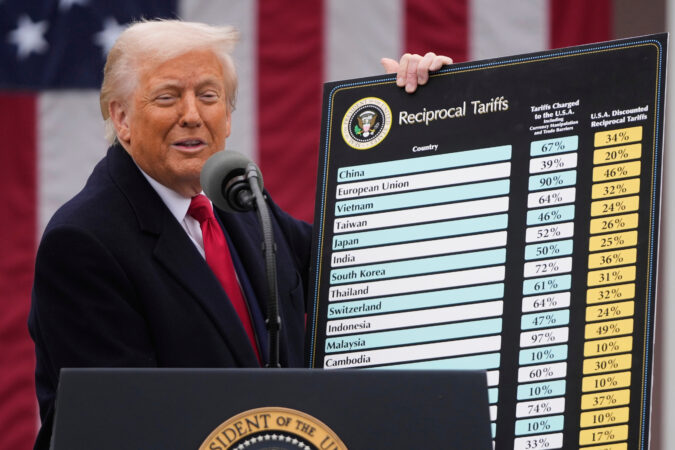
    The facts: Not likely. Under Trump, tariff revenues have swelled — to $195 billion in the budget year that ended Sept. 30 from $77 billion the year before. But the import taxes accounted for less than 4% of federal revenue. Income taxes and payroll taxes that finance Social Security and Medicare account for 84%.

    Medicine

    Claim: “I took prescription drugs, a very big part of healthcare, from the highest price in the entire world to the lowest. That’s a big achievement. The result is price differences of 300, 400, 500, 600% and more.”

    The facts: This is impossible. Although the Trump administration has taken steps to lower drug prices, cutting them by more than 100% would theoretically mean that people are being paid to take medications.

    Geoffrey Joyce, director of health policy at the University of Southern California’s Schaeffer Center, said in August that this claim is “total fiction” by the president. He agreed that it would amount to drug companies paying customers, rather than the other way around.

    Crime

    Claim: “Last year, the murder rate saw its single largest decline in recorded history. This is the biggest decline. Think of it in recorded history, the lowest number in over 125 years.”

    The facts: Trump takes credit for a significant decrease in violent crime during 2025, claiming the murder rate in the U.S. dropped to its lowest in 125 years. But this is misleading. Crime had already been trending down in recent years.

    A study released in January by the independent Council on Criminal Justice, which collected data from 35 U.S. cities on homicides, showed a 21% decrease in the homicide rate from 2024 to 2025.

    The report noted that when nationwide data for jurisdictions of all sizes is reported by the FBI later this year, there is a strong possibility that homicides in 2025 will drop to about 4 per 100,000 residents. That would be the lowest rate ever recorded in law enforcement or public health data going back to 1900.

    FBI reports for 2023 and 2024 show significant reductions in violent crimes.

    Crime surged during the coronavirus pandemic, with homicides increasing nearly 30% in 2020 over the previous year, the largest one-year jump since the FBI began keeping records. But violent crime dropped to near pre-pandemic levels around 2022 when Biden was president.

    Immigration

    Claim: “We will always allow people to come in legally, people that will love our country and will work hard to maintain our country.”

    The facts: Trump has actually taken steps to restrict who can emigrate to the U.S., often in the name of protecting national security.

    He suspended the refugee program on his first day in office and in October resumed the program but only in limited numbers for white South Africans.

    Trump has also placed restrictions on who can travel or emigrate to the U.S. from nearly 40 countries around the world. Many of those countries are in Africa.

    Taxes

    Claim: “With the great big beautiful bill, we gave you no tax on tips, no tax on overtime and no tax on Social Security.”

    The facts: Though the president frequently says his big tax cut bill means no tax on Social Security, that’s not true for everyone. Not all Social Security beneficiaries will be able to claim the deduction, which lasts until 2029.

    Those who won’t be able to do so include the lowest-income seniors who already don’t pay taxes on Social Security, those who choose to claim their benefits before they reach age 65 and those above a defined income threshold. The deductions also phase out as income increases.

    Elections

    Claim: “I’m asking you to approve the Save America Act to stop illegal aliens and other who are unpermitted persons from voting in our sacred American elections. The cheating is rampant in our elections.”

    The facts: He and his allies have never produced evidence of rampant election cheating. Experts say voter fraud is extremely rare, and very few noncitizens ever slip through the cracks.

    For example, a recent review in Michigan identified 15 people who appear to be noncitizens who voted in the 2024 general election, out of more than 5.7 million ballots cast in the state. Of those, 13 were referred to the attorney general for potential criminal charges. One involved a voter who has since died, and the final case remains under investigation.

    1776

    Claim: “The revolution that began in 1776 has not ended. It still continues because the flame of liberty and independence still burns in the heart of every American patriot.”

    The facts: To be clear, the American Revolution started the previous year, on April 19, 1775. The colonies declared independence in 1776. It ended Sept. 3, 1783.
  • Trump administration hits Iran with new sanctions as nuclear talks near

    Trump administration hits Iran with new sanctions as nuclear talks near

    WASHINGTON — The Trump administration on Wednesday imposed another tranche of sanctions on people and companies accused of enabling Iran’s ballistic missile program, drone production, and illicit oil sales as the U.S. presses Tehran to make a deal ahead of nuclear talks this week.

    The sanctions against 30 people, companies, and ships come as President Donald Trump has massed the largest U.S. buildup of warships and aircraft in the region in decades and has threatened to use military action in a bid to get Iran to constrain its nuclear program.

    The latest round of talks between U.S. officials, including envoy Steve Witkoff, and Iranian negotiators via mediator Oman are scheduled for Thursday in Geneva.

    The new sanctions imposed by the Treasury Department’s Office of Foreign Assets Control include a list of ships accused of being part of Iran’s “shadow fleet,” which refers to rusting oil tankers that smuggle oil for countries facing stiff sanctions.

    Also targeted are drone manufacturing firms, including Qods Aviation Industries, which has supplied drones “to all branches of the Iranian military and buyers in Africa and Latin America,” the Treasury Department said.

    Among other things, sanctions deny the people and firms access to any property or financial assets held in the U.S. and prevent American companies and citizens from doing business with them. However, they are largely symbolic because many of them do not hold funds with U.S. institutions.

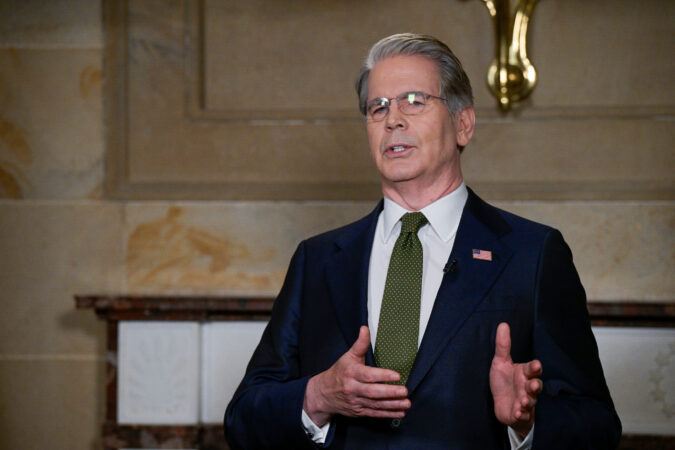
    “Treasury will continue to put maximum pressure on Iran to target the regime’s weapons capabilities and support for terrorism, which it has prioritized over the lives of the Iranian people,” Treasury Secretary Scott Bessent said in a statement.

    Trump and other top administration officials insist that Iran cannot be allowed to develop a nuclear weapon and ramped up pressure months after U.S. strikes in June on three Iranian nuclear sites.

    Iran long has maintained its nuclear program is peaceful. It had been enriching uranium up to 60% purity before the June attack — a short, technical step away from weapons-grade levels of 90%.

    “We wiped it out and they want to start all over again. And they’re at this moment again pursuing their sinister ambitions,” Trump said during his State of the Union speech Tuesday night. “We are in negotiations with them. They want to make a deal, but we haven’t heard those secret words: We will never have a nuclear weapon.”