Tag: no-latest

  • The hypothetical nuclear attack that escalated the Pentagon’s showdown with Anthropic

    The hypothetical nuclear attack that escalated the Pentagon’s showdown with Anthropic

    As a standoff between artificial intelligence firm Anthropic and the Pentagon deepened this week, the two sides offered starkly different accounts of a key discussion about a hypothetical nuclear strike against the United States, revealing the intensity of their showdown over the American military’s potential use of lethal autonomous weapons.

    A defense official said the Pentagon’s technology chief whittled the debate down to a life-and-death nuclear scenario at a meeting last month: If an intercontinental ballistic missile was launched at the United States, could the military use Anthropic’s Claude AI system to help shoot it down?

    It’s the kind of situation where technological might and speed could be critical to detection and counterstrike, with the time to make a decision measured in minutes and seconds. Anthropic chief executive Dario Amodei’s answer rankled the Pentagon, according to the official, who characterized the CEO’s reply as: You could call us and we’d work it out.

    An Anthropic spokesperson denied Amodei gave that response, calling the account “patently false,” and saying the company has agreed to allow Claude to be used for missile defense. But officials have cited this and another incident involving Claude’s use in the capture of Venezuelan leader Nicolás Maduro as flashpoints in a spiraling standoff between the company and the Pentagon in recent days. The meeting was previously reported by Semafor.

    A face-to-face meeting Tuesday between Amodei and Defense Secretary Pete Hegseth escalated the situation, the Washington Post reported. The two sides are now careening toward a defining power struggle over whether the U.S. government should have the freedom to spy on or kill humans using the potent new technology, based in part on extreme hypotheticals and games of telephone.

    The Pentagon had given Anthropic until 5:01 p.m. Friday to drop its objections to using Claude in relation to autonomous weapons and mass surveillance of U.S. citizens. If not, officials had said they may use government authority to force Anthropic to hand over the technology anyway — while also blacklisting the company from future defense work.

    Sean Parnell, the Pentagon’s chief spokesman, said in an X post Thursday that the department had no interest in conducting mass domestic surveillance nor deploying autonomous weapons, but wanted to use AI for “all lawful purposes.”

    “This is a simple, common-sense request that will prevent Anthropic from jeopardizing critical military operations and potentially putting our warfighters at risk,” Parnell said.

    Amodei said in a statement late Thursday that his company was ready to continue working with the Pentagon, but would not change its stance. Current AI systems are not reliable enough to power robotic weaponry without putting troops and civilians alike at risk, he said, and existing laws on domestic surveillance do not account for the sweeping potential of AI snooping tools.

    “In a narrow set of cases, we believe AI can undermine, rather than defend, democratic values,” Amodei said in his first public comments on the battle. “Two such use cases have never been included in our contracts with the Department of War, and we believe they should not be included now.”

    Anthropic did not expect to end up in a fight with Pentagon leaders when it became the first major AI lab to strike a deal to work on classified U.S. military networks in late 2024. But the dispute highlights how the startup, founded in 2021 by safety-minded refugees from ChatGPT-maker OpenAI, has struggled to deftly navigate Washington in the second Trump administration. (The Washington Post has a content partnership with OpenAI.)

    Anthropic recently added a former deputy chief of staff to President Donald Trump to its board and explored taking investment from a fund led by Donald Trump Jr., according to people familiar with the pitch. Yet its leaders have also repeatedly clashed with the White House in public.

    In a coruscating post on X in October, David Sacks, Trump’s top AI adviser, accused the company of “fear-mongering” and pursuing “regulatory capture” in an attempt to bend the government to its will. Anthropic leaders have criticized one of the administration’s key AI policies in recent weeks, even as the dispute with the Pentagon was brewing.

    “There’s the subtext of Anthropic not being aligned with the MAGA agenda,” said Steven Feldstein, a senior fellow at the Carnegie Endowment, who researches the use of AI in war. “This is as much of a political fight as a military use issue.”

    Experts say the outcome of the clash could shape the trajectory of the burgeoning relationship between the AI industry and the U.S. military, potentially signaling to other leading firms that the cost of doing business with the Pentagon could be losing control of their innovations.

    Unlike a gun or a jet engine, the uses that AI might find on future battlefields keep changing. The U.S. already pushes autonomy into its weapons and AI-enabled systems are a part of almost every drone, ship, or aircraft under production or envisioned in the future force. The Trump administration is embarking upon a vast expansion of the military’s use of AI.

    But leading figures in the development of the technology have long had ethical and legal concerns about giving AI the power to make life-and-death decisions or turbocharging surveillance.

    Emil Michael, a former Uber executive who is now undersecretary of defense for research and engineering, has taken the lead in the discussions with Anthropic. He has argued the government and not individual tech firms should have the final say in how the technology is used, according to a person familiar with the discussions, who spoke on the condition of anonymity to describe internal deliberations. Michael did not respond to a request for comment.

    To the Pentagon that means having a policy permitting what Parnell called “all lawful purposes.” Amodei has held firm that Anthropic has red lines around autonomous weapons and surveillance, a stance that has won support from his employees and could serve as a recruiting tool for idealistic engineers as the company heads toward an expected initial public offering.

    Late Thursday, Michael accused Amodei of having a “God-complex” in a post on X. “He wants nothing more than to try to personally control the US Military and is OK putting our nation’s safety at risk,” Michael wrote.

    The escalating dispute has baffled people who study how the military uses AI.

    Dean Ball, a former Trump administration AI adviser, said he hoped the two sides could still find a way to step back from the brink. “The solution to that problem is to cancel the contract,” Ball said. “Going on a jihad against Anthropic is whole other layer of escalation.”

    Leapfrogging off Amazon

    Anthropic owes its head start at the Pentagon in part to a partnership the intelligence community forged with Amazon in 2013, which paved the way for classified material to be handled in Amazon’s cloud. Over the course of the next several years, the tech giant built out secure computing infrastructure for the intelligence community, beating out rivals for coveted contracts to house classified and top secret data.

    In 2023 and 2024, Amazon invested billions into Anthropic. The relationship greased the AI start-up’s path into the military’s closely guarded systems, according to a person familiar with the relationship, who spoke on the condition of anonymity to describe it. Amazon declined to comment. (Amazon founder Jeff Bezos owns the Post.)

    Anthropic also found an ally in software analytics firm and longtime defense contractors Palantir, which in 2024 teamed up with the AI firm and Amazon to offer Claude on its systems used by military and spy agencies. Anthropic said the partnership would boost the military’s ability to process huge amounts of data and make good decisions, saying it was proud to take on the work.

    Anthropic has “first mover status and their product is good,” said another person familiar with the military’s work with AI companies, who spoke on the condition of anonymity to describe sensitive issues relating to national security.

    Since Claude’s deployment with the Pentagon, Anthropic said Thursday, its technology has been put to use analyzing intelligence, planning operations and in cyberwarfare. The company has deepened its work with the government since Trump returned to office and pushed federal agencies to rapidly scale up their use of AI. In July it signed a $200 million contract with the Defense Department and made a deal the following month to provide its system to civilian agencies for a dollar apiece.

    But the company’s advantage has eroded as competitors like Google, OpenAI and xAI make deals of their own with the Pentagon. Officials say the other leading firms have agreed to its “all lawful purposes” policy for unclassified work, and that xAI has also signed a deal for classified systems. The three companies did not respond to requests for comment.

    Anthropic has differed from its rivals in simultaneously courting the administration for contracts while opposing it in other areas of policy.

    When the White House was pushing an executive order that would preempt restrictive state-level AI laws this winter, Anthropic was promoting a safety-oriented AI bill in California.

    Amodei has also criticized the Trump administration’s drive to allow exports of American AI chips to China. On the sidelines of the World Economic Forum in Davos, Switzerland last month, Amodei compared the policy to “selling nuclear weapons to North Korea.” After meeting with Amodei this month on Capitol Hill, Sen. Elizabeth Warren (D., Mass.) said she would introduce legislation to sharply limit any exports.

    Anthropic has also hired several former Biden administration officials.

    “The administration just wants everyone to bend the knee and [Amodei] won’t,” said an investor who works on defense technology, who spoke on the condition of anonymity to avoid getting into conflicts with any of the parties.

    In the past year, Anthropic has made moves that could smooth its relationship with the Trump administration. The company ramped up its lobbying in Washington, spending $3.1 million and bringing on a former senior aide to Secretary of State Marco Rubio, according to disclosures compiled by transparency group Open Secrets. It announced this month that it was adding Chris Liddell to its board, a former tech executive who served in the first Trump White House.

    The company also recently explored an investment from the Trump-allied venture capital firm 1789 Capital for funding, but was turned down, according to two people familiar with the pitch, who spoke on the condition of anonymity to describe private business discussions. Donald Trump Jr. is a partner at the firm, alongside Chris Buskirk, an ally of Vice President JD Vance.

    ‘Once and for all’

    Insiders in the world of defense technology argue that the current fight between the Pentagon and Anthropic appears to be more philosophical than technical, and that the administration had already soured on the AI company — even as rank-and-file military personnel were finding its services increasingly useful.

    “The administration and the Republicans are looking for ways to get rid of Anthropic once and for all,” the person familiar with the military’s work with AI companies said. The Pentagon clash could provide an opportunity to carry that through. In January, Hegseth issued a directive for the military to embrace AI as though the country were at war.

    The U.S. has committed to some guardrails on autonomous weaponry. France, the United Kingdom, China, and the U.S. all previously said they would require a human to be involved in all decisions to deploy nuclear weapons. In a statement to the Post, the Pentagon said the Trump administration intends to maintain that pledge.

    “It remains the Department’s policy that there is a human in the loop on all decisions on whether to employ nuclear weapons,” a senior defense official said. “There is no policy under consideration to put this decision in the hands of AI.”

    But that still leaves room for AI to influence decisions on targets and speed of response. In a recent nuclear war game at King’s College London, many leading language models including versions of ChatGPT, Claude and Google’s Gemini all quickly favored launching warheads. That could influence a human’s decision to fire, said Paul Dean, vice president of the global nuclear program at the nonprofit Nuclear Threat Initiative.

    “It’s not simply ensuring that there’s a human being in the decision-making loop,” Dean said. “The question is, to what extent will AI impact that human decision-making?”

    Neither side in this week’s faceoff knows for certain what AI’s use in war will ultimately look like, but both seem unwilling to trust in the other’s future decisions.

    “The Pentagon does not trust that Anthropic will be a reliable vendor, and Anthropic worries about misuse of its technology,” said Michael C. Horowitz, a director at the University of Pennsylvania who oversaw AI weapons policy during the Biden administration.

    Because Claude is already in use across the Defense Department, exiling Anthropic and switching to a rival could prove costly. Although Defense officials have suggested they could use the Defense Production Act to force the AI company to share its systems, experts are split on whether the law could be applied.

    Doing so would send a chilling message to the AI firms the Pentagon hopes to lean on that they may risk of having their own innovations seized if the government sees something it wants.

    That would cross a troubling line, said Katie Sweeten, a former liaison for the Justice Department to the Pentagon, and a partner at Scale LLP. “This is a literal nuclear option which I think rightfully companies should be very concerned about.


  • Jeff Galloway, Olympic runner who inspired ‘Jeffing’ technique, has died at 80

    Jeff Galloway, Olympic runner who inspired ‘Jeffing’ technique, has died at 80

    Jeff Galloway, an Olympic distance runner who inspired hundreds of thousands of Americans to exercise by extolling the virtues of taking walking breaks during races — or “Jeffing,” as adherents called his signature method — died Feb. 25 in Pensacola, Fla. He was 80.

    Mr. Galloway died in a hospital after suffering a stroke, his son Westin Galloway told the Washington Post.

    Mr. Galloway described himself as an average runner as a teen who enrolled in his first marathon in Atlanta “because of the size of the trophy” and, by persistence more than talent, ascended to the U.S. Olympic team. For the 1972 Olympics in Munich, he qualified for the 10,000-meter race and was an alternate for the marathon. The next year, he set a U.S. record in the 10-mile road race.

    Despite reaching the peaks of his grueling discipline, Mr. Galloway became most widely known for a training program with an everyman philosophy that spoke to reluctant runners and preached, of all things, walking.

    Mr. Galloway began pioneering what he called a “Run Walk Run” technique — taking breaks to walk during training runs and even races — in the 1970s as he taught running to beginners. He championed the method as a way to reduce injury, control fatigue and, most importantly, motivate newcomers to “get off of the couch and run.”

    Legions of new runners did just that. Mr. Galloway’s philosophy, espoused in books and an online training program, has reached more than a million people, his organization has said, and changed how athletes approach distance running.

    Mr. Galloway had “the ability to empower runners, or people that didn’t even see themselves as runners,” his son Westin said, “giving them the space to be the athlete or the person that they never thought they could be through the benefits of exercise.”

    John Franks Galloway was born in Raleigh, N.C., on July 12, 1945. His father was an educator and a sailor in the Navy; his mother worked at a private school in Atlanta that his father founded.

    Mr. Galloway, who grew up in Atlanta, was not initially a prodigious running talent. He enrolled in a track conditioning program in eighth grade because his school required sports participation each quarter and the track coach was rumored to be the most lenient of the sports instructors, he wrote on his website.

    “I can identify with the struggles of sedentary, overweight adults and kids, for I was one,” Mr. Galloway wrote.

    Two months of running through forest trails got him hooked. Mr. Galloway qualified for the state high school championships in Georgia his senior year, then attended Wesleyan University, where he studied history and was an all-American runner.

    Mr. Galloway served for three years in the Navy after college, a tour that sent him to Vietnam. Upon returning to the United States in 1970, he enrolled in graduate school at Florida State University with the goal of qualifying for the upcoming Olympics.

    Even after years of training, it felt like a long shot, Mr. Galloway wrote. On a 90-degree summer day at the 1972 national championship in Seattle, he squeaked onto the 10,000-meter Olympic team in a close race — perhaps because he took it slow.

    “Many of the runners had started too fast, and I did not,” Mr. Galloway recalled on his website. “I found myself catching up to the stragglers, passing one, then another.”

    As a fitness boom took hold in the U.S. after the Munich Olympics, Mr. Galloway founded a running store, Phidippides, opened vacation fitness camps, and wrote several books about running. “Jeffing,” or “the Galloway method,” became his most famous innovation.

    At running clinics across the country, Mr. Galloway promoted his framework. Giving runners permission to take walking breaks while training encouraged beginners, he said, and the staggered runs could help even veteran marathoners improve their times. His charm and relentless focus on reaching novice runners set him apart from other instructors, Westin Galloway said.

    “A lot of coaches were very focused on faster times and pushing people’s bodies to do the best that they could,” he said. “And he kind of looked at it from the other perspective of, running has an amazing way of changing a person’s life, and if he could get more people out there doing it, the world would be a better place.”

    Mr. Galloway remained a fixture of the running community and continued to run and help organize races as he grew older. At 70, he ran the Marine Corps Marathon in Arlington in honor of a Marine killed in the 2015 Chattanooga, Tenn., shooting at a Navy operations center. He returned to running after suffering a heart attack in 2021 that kept him hospital-bound for almost a month.

    In the months before his death, Mr. Galloway had been fixated on run-walking another race at the age of 80. He had planned to run the Honolulu Marathon in December but fell and broke his kneecap. That didn’t discourage him, either, he told the New York Times in December.

    “Doing another marathon, to me, feels like the strongest goal I’ve ever had in my life,” Mr. Galloway said to the Times.

    Mr. Galloway is survived by his wife, Barb, 72; his sons Westin and Brennan; and six grandchildren. They are all runners, and Westin manages Mr. Galloway’s organization that continues to share his training program with runners around the world.

    “Jeffing” has recently seen a renewed surge of interest, Westin Galloway said, as more people have taken up running since the coronavirus pandemic. Asked whether the influx of new adherents made Mr. Galloway proud, Westin demurred.

    “He was happy talking to a single individual,” Westin said. “He didn’t care about numbers. He didn’t care about getting on the news or having big stories published about him. He cared about helping one person at a time.”

  • The Trump administration is detaining and questioning refugees already admitted to the U.S.

    The Trump administration is detaining and questioning refugees already admitted to the U.S.

    ST. PAUL, Minn. — Their family spent years opposing Venezuela’s socialist system.

    The government retaliated by sending men to beat the father, a state oil company worker whom it accused of being uncooperative. Other relatives were threatened.

    The situation became so untenable that the family fled the country for the United States in 2021 after it obtained refugee status, according to one of the daughters, a 24-year-old clothing salesperson who was interviewed by The Associated Press.

    The six siblings and their parents settled in Minnesota in 2023, living peaceful lives until the Trump administration said it was casting new scrutiny on refugees. One priority is those admitted to the U.S. under former President Joe Biden, whom the government accuses of prioritizing quantity over detailed screening and vetting, with an initial focus on 5,600 refugees who settled in Minnesota and are not yet permanent residents, making them particularly vulnerable.

    Last month, three masked officers got out of a black SUV with tinted windows outside a St. Paul apartment complex, handcuffed the Venezuelan woman and her mother and told them their legal status was under review, according to the woman, who asked for anonymity for fear of retaliation.

    Overturning years of precedent, immigration authorities have arrested or questioned dozens of refugees in Minnesota, attorneys and advocates say, with more detentions likely to come nationwide.

    In January, a federal judge ordered a temporary halt to the arrest and detention of refugees in Minnesota while a lawsuit challenging the “revetting” continues. The judge ordered the immediate release of all refugees detained in Minnesota, and those taken to Texas.

    Three refugees told The Associated Press that whatever happens, the rounds of inconclusive interviews with immigration authorities well after they thought their status was safe has them questioning their futures in the U.S. and living in constant fear.

    The young woman from Venezuela hasn’t returned to her job at a clothing factory. A man who fled persecution in Myanmar won’t walk on the streets of Minneapolis without a letter from his church appealing for immigrants to “be treated humanely.” A Congolese refugee arrested in St. Paul despite her refugee status says “everything that’s happened feels like a movie.”

    A change in US treatment of refugees

    Welcoming refugees has been a source of bipartisan agreement in the U.S. since Congress passed the Refugee Act with overwhelming support in 1980.

    The act helped make refugee applications some of the immigration system’s most heavily scrutinized. Government decisions that someone was persecuted for who they are or what they believe are rarely second-guessed, and revisiting refugee status that’s already been granted is a major blow to legal tradition, advocates say.

    “They’ve been heavily vetted and were admitted by the government with approval,” said Beth Oppenheim, chief executive officer of HIAS, a major refugee aid group.

    Once a refugee is admitted to the U.S. through the resettlement program, the only way to strip them of their status is to prove that they should never have been admitted, Oppenheim said. That is why the Trump administration is interviewing people again, she said.

    Matthew Tragesser, a spokesman for U.S. Citizenship and Immigration Services, said in a written statement refugees “are REQUIRED to be subject to a full inspection after a year within the United States.”

    “This is not novel or discretionary; it is a clear requirement in law,” he wrote.

    While it is correct that refugees must apply for green cards one year after admission — a change of status that brings a renewed layer of scrutiny — the administration is breaking with decades of tradition by revisiting initial decisions to admit people as refugees, and then detaining them while they are under review.

    “Arresting, detaining, and rescreening refugees are all new changes which will inflict grave harm on vulnerable populations,” said Smita Dazzo, deputy director of U.S. programs at HIAS.

    Venezuela to Minnesota to Houston and back

    In January, U.S. Immigration and Customs Enforcement took the Venezuelan women to Houston on a flight where migrants were shackled at the wrists and ankles and forbidden from talking. The daughter said she was told she was there for green card interviews and isolated in a cold room with no food, water or anything warm to cover her. She said she refused to sign documents without an attorney present.

    “They told us, ‘Your status is worthless. You’re illegal,’” she said. “What we went through is something I wouldn’t wish on anyone … We were supposed to arrive in this country with refugee status, and we thought we would be protected here. But right now, at this moment, it is quite the opposite.”

    The women were released after successfully filing habeas corpus petitions in federal court, part of a flood of last-ditch attempts at freedom under a Trump policy denying bond hearings in immigration court. Friends of their attorney drove them back to Minnesota at their own expense. Since then, the younger woman has been too afraid to leave the house.

    The pastor who received a letter and went to the interview

    Saw Ba Mya James, a 46-year-old ethnic Karen father of three who fled military persecution in Myanmar, arrived in St. Paul last year after obtaining refugee status with help from a local church.

    Despite a pending green card application, the Anglican pastor did not attend church for weeks after friends advised him to avoid going outside.

    “I was told to stay at home, so I listened, and I prayed to God with my family,” James said.

    James received a letter Feb. 2 ordering a “post-admissions refugee reverification” at the U.S. Citizenship and Immigration Services St. Paul field office, according to a copy reviewed by The Associated Press.

    During an interview that lasted several hours, an officer pressed James with questions he said he already addressed extensively before being admitted to the U.S. The officer said the review was needed because an inexperienced employee handled James’ initial vetting.

    Within two weeks of the interview, James got another letter asking that he and his family provide fingerprints, which his attorney took as a positive sign.

    Still, James remains wary of being detained. He faithfully carries his church sponsors’ letter appealing for him and other immigrants to “be treated humanely as fellow image-bearers of God.”

    The Congolese refugee arrested arriving at work

    A Congolese woman settled in the Twin Cities area in November 2024 with refugee status, working in the hospitality business as the breadwinner for her husband and four children.

    She said an immigration officer approached her parked car when she arrived for work at 7 a.m. on Jan. 14 in St. Paul, saying he knew her name and that she was a refugee. After telling her to exit the vehicle to answer questions, he handcuffed her despite her efforts to show a work authorization document and identification.

    The woman, who spoke on condition of anonymity because she fears reprisals, was flown to Houston to be questioned in detail about her experiences in the Congo, Uganda and the United States. She and other refugees refused to sign documents to be sent back to their home countries. She was released Jan. 18 without any ID documents to book a flight to Minneapolis. A manager at her company flew to Houston and drove her 17 hours back home.

    “If I told you I’m feeling OK, I’d be lying to you,” she said.

  • What is ‘Jeffing’? This walk-run technique can help you get in shape.

    What is ‘Jeffing’? This walk-run technique can help you get in shape.

    If you’ve ever watched a race, you may have seen some runners whiz by, others resolutely jog forward — and a sizable group slow down to a walking pace, sometimes just a few minutes after passing the start line.

    No, they don’t need your cheers to “just keep going!” Rather, it’s likely those walk breaks are calculated. It’s all part of a time-honored technique known as “Jeffing,” and runners have been using it for decades in training runs and in major races like the New York City Marathon.

    While this method is pretty well known among runners, it’s not only for those looking for personal records. Rather, it can be a great way for people to add a little oomph to their walking workouts and gain even more health-promoting benefits. Here’s everything you need to know.

    What is ‘Jeffing’?

    Simply put, Jeffing is a technique that intersperses walk breaks with running bouts to help ward off fatigue and boost endurance. This type of cardio, or aerobic, workout goes by many different names in the running community — run-walk, run-walk-run, the Galloway method, and, of course, Jeffing.

    The last two are nods to Olympian Jeff Galloway, who began using this method in 1973 while instructing a beginner running class at a university. (Galloway himself has no particular preference for which term is used. “I’m honored to be a verb,” he said.)

    Galloway ran weekly with the 22 students in the program, who naturally divided into three pace groups based on their abilities. “Whenever anybody started huffing and puffing in any group, I would have everybody walk.” Galloway said.

    All of the participants stuck with the program for the entire 10 weeks, and all were able to complete their final goal: finishing either a 5K or 10K race. The walk breaks, Galloway believed, played a vital role in that.

    In this earliest iteration of Jeffing, there was no set timing on when to start walking and for how long to do so. But after further refining, it soon became clear to Galloway that the important part is to slot in walking breaks before you feel gassed.

    “Because you’re taking those walk breaks from the beginning, before you’re tired, before you need them, it feels great,” said Chris Twiggs, the chief training officer of Galloway Training. “It really does feel like you’re cheating because you’re pushing the fatigue toward the end.” When Twiggs used the method for the first time at the 1995 Walt Disney World Marathon, he ended up with about a 15-minute personal record.

    The 30-30 method — a 30-second run and 30-second walk — is one of the most popular ways to approach Jeffing, said Galloway. However, if a 30-second run is too challenging, you can scale it back: Twiggs often has walkers start with a 10-second run, 50-second walk, and then adjust from there.

    “There’s an almost unlimited way to go about it,” said Kate Baird, a certified running coach and exercise physiologist at the Hospital for Special Surgery. That’s part of what makes it so beginner-friendly.

    What are the benefits of the run-walk method?

    First and foremost, run-walk is a type of aerobic workout that helps improve heart health, said Neel Chokshi, the medical director of the Sports Cardiology and Fitness Program at Penn Medicine. Consider it “interval training-lite,” he said. “The benefits of run-walk mirror general interval training in terms of the gains that people can get.” Specifically, alternating between high- and low-intensity efforts allows you to push hard when it’s time.

    Over time, your heart will adapt to those repeated exposures to higher intensities, Chokshi said. Adaptations include being able to pump more blood with each heartbeat, a reduction in resting heart rate, and increased blood flow through the arteries.

    Interval training also improves your VO2 max, or how efficiently your body uses oxygen during exercise. This results in better endurance and is also linked to longevity, said Chokshi.

    Another great thing about Jeffing is that you can get all of these heart-health benefits while reducing the amount of high-impact stress you’re putting on your muscles, tendons, and ligaments. When Galloway first tried this method in the university’s beginner running course, a huge takeaway was that not one participant got injured during the program. That’s big, since beginner runners are at higher risk — they get injured at more than twice the rate as more experienced ones, according to a 2019 study out of the Netherlands.

    Finally, you can’t ignore the mental benefits. If you want to scale up your cardio workouts but are daunted by the idea of running nonstop, Jeffing is a great way to overcome that mental hurdle, said Chokshi. Knowing you will have walk breaks coming can help you build the confidence that you can complete your workout — and finish it strong, said Twiggs.

    Here’s how to try the run-walk method yourself

    While there’s no set way to use the method, there are a few things you should keep in mind to make the most of it.

    1. Get the right shoes

    Because running brings a higher impact than walking, proper gear becomes even more important, said Twiggs. You might need more cushioning than a walking shoe, or some kind of motion control if your foot rolls inward or outward with each stride, he said. A running specialty store can help you pick out a pair that works for your anatomy and biomechanics.

    2. Start small

    While folks use run-walk in multihour marathons and training runs, these workouts don’t need to be nearly as long — and they shouldn’t be if you’re a beginner. Anywhere from 10 to 30 minutes is a great starting place, said Baird. Once you’re more comfortable with it, you can shoot for 30 to 45 minutes, Twiggs said.

    3. Warm up your body

    Getting your blood flowing before a workout can loosen up your muscles and gradually increase your heart rate, Chokshi said. You want to do a general, full-body warmup, since running includes pretty much every muscle in your body, including those in your lower body, upper body, and core. Moves like hamstring sweeps, lunges with thoracic rotation, and cat-cows are solid choices.

    4. Choose your intervals

    The 30-second run, 30-second walk tends to be the most popular utilization of the program, but “there’s no perfect run-walk ratio that everyone should be aspiring to,” said Twiggs. If you feel like you can’t catch your breath when running for 30 seconds, you can shorten that segment. If you feel strong, you can bump it up to 40 seconds, 60 seconds, or even a few minutes and see how your body reacts.

    5. Slow down

    Your run effort shouldn’t be a heart-pumping sprint — you want to keep it more moderate so you have the energy to do it all over again during your next interval. “A really good gauge is if you can carry on a conversation,” Twiggs said.

    6. Make time for recovery

    Even if you feel great after a workout, you shouldn’t do it every day. “Take one to two days between those workouts when it’s new,” Baird said. If you feel sore or tight in one particular spot, that might be your cue to give that area some extra attention during your warmup or next strength-training workout.

    7. Don’t consider it a means to an end

    The more you run-walk, the more you may want to play with your intervals, gradually increasing your run efforts as you gain more endurance. But it’s important to remember that you don’t have to use this method to reach a continuous running goal if that’s not what you want, said Galloway. You can stick with run-walk and still reap the benefits of running.

  • Letters to the Editor | Feb. 27, 2026

    Letters to the Editor | Feb. 27, 2026

    No union in address

    It is clear by now that Donald Trump does not consider himself to be the president for all Americans, but only for his MAGA supporters. He has sown division, not unity, which serves only to make our country weaker. Some Democrats have criticized U.S. Sen. John Fetterman for not always voting along party lines. However, the senator recognizes that Pennsylvania is a purple state, and his charge is to represent the interests of all Pennsylvanians, not just those who voted for him. In contrast, U.S. Sen. Dave McCormick, who won the 2024 election by less than 0.5%, votes according to the MAGA agenda, ignoring the preferences of the 48% of Pennsylvanians who voted for his opponent.

    Joseph Micucci, Philadelphia

    Memory keeping

    For Jews, Feb. 27 is Shabbat Zachor, the Sabbath of Remembrance. On that day, we are commanded to remember how the tribe of Amalek mercilessly attacked the most vulnerable Israelites following their exodus from Egypt thousands of years ago. Memory is central to Jewish identity. During the first year of the Trump administration, we are witnesses to a relentless assault on memory.

    Perhaps the most egregious example is the White House webpage on Jan. 6, 2021, which proudly hails the president’s decision to grant a sweeping pardon to some 1,600 rioters. The people who battered law enforcement officers and took over the U.S. Capitol by force that dark day are described as peaceful and patriotic Americans rightfully protesting a stolen election.

    Donald Trump’s lies about the results of the 2020 election, which fueled the tragic events of Jan. 6, continue unabated. The brazen historical revisionism of what Republican U.S. Rep. Brian Fitzpatrick called an “attempted coup,” sadly, is deceiving more and more Republicans. As America approaches its 250th anniversary, we all have a sacred obligation to remember the reality of Jan. 6 that we saw with our own eyes, only a little over five years ago. Zachor.

    Martin J. Raffel, Langhorne

    Plan for success

    If Mayor Cherelle L. Parker wants to succeed, and not merely “hope to boost new business and job creation” by offering “white glove treatment to companies who need help navigating the city’s regulatory labyrinth,” as she claimed in her recent Chamber of Commerce of Greater Philadelphia speech, there are several fundamentals that need to change.

    1) Let the minimum wage float. This allows entry-level employees to learn on the job, then earn a raise, vs. not even being offered a job. 2) Require that every job and contract, especially those supported with taxes, be bid between union and nonunion suppliers. This boosts confidence for all new businesses and creates great competitive jobs. 3) On the first day of kindergarten, start inculcating a Philadelphia school culture that instills good behavior, manners, language, and respect for classmates, adults, and teachers. For the separate $4.6 billion in taxpayer money, our mayor must declare as her mission that 100% of our students will graduate as very well prepared for whatever the next step is in their lives. 4) Do not add yet another committee, which would simply add more employees to the 100-plus existing city departments, agencies, and committees, half of which are obsolete, meander in circles, and waste taxes. Eliminate the half-dragging anchor against the great progress our mayor wants, without adding yet another one.

    These are the fundamentals we must change for our city’s improvement and for Parker to succeed. And, yes, we want our mayor to succeed beyond her wildest dreams.

    Gardner A. Cadwalader, Philadelphia

    ICE whistleblower

    On Feb. 23, Ryan Schwank, a former U.S. Immigration and Customs Enforcement lawyer, testified as a whistleblower before a Senate Democratic forum about the egregious lack of required training for all new ICE agents. He testified that Homeland Security has eliminated the most important policing training in the use of firearms, use of force, the proper arrest and detention techniques, the limits on an agent’s authority, and the Constitution — including that they could violate the Fourth Amendment to enter a home without a judicial warrant. Schwank stated that the training curriculum has been reduced from 584 hours by nearly half to fulfill Donald Trump’s order to get an additional 12,000 agents on the streets of America by year’s end. He testified that DHS lied when it asserted that no critical instruction had been eliminated. Is it any wonder people have been, and will be, murdered, beaten, and illegally detained? This testimony must be given before the whole Senate and the House of Representatives, as well as a more public airing.

    Morrie Wiener, Cherry Hill

    History as guide

    The recent report regarding U.S. Customs and Immigration Enforcement’s plan to warehouse detained immigrants is another bellwether in Donald Trump’s assault on human decency. ICE’s plans should be viewed in the context of the Holocaust Memorial Museum’s key facts about Nazi concentration camps: “Officials established the first concentration camp in Dachau … for political prisoners. It was later used as a model for an expanded and centralized concentration camp system. What distinguishes a concentration camp system from a prison (in the modern sense) is that it functions outside of a judicial system. The prisoners are not indicted or convicted of any crime by a judicial process.” The museum’s website further notes that such camps are ones in which “people are detained … usually under harsh conditions and without regard to legal norms of arrest and imprisonment that are acceptable in a constitutional democracy.”

    The majority of detained immigrants have not been indicted for or convicted of a criminal offense. Most were employed at the time of their seizure, paying their way. Many of their jobs then went unfilled. Rather than being productive, they are confined in squalid conditions where healthcare is frequently insufficient. Spending an additional $45 billion to expand detention centers, with additional staffing costs, in pursuit of an inhumane policy that is being inhumanely implemented, will no more make America great than the town’s eponymous camp made Dachau great.

    Stewart Speck, Wynnewood, speckstewart@gmail.com

    Missed importance

    I respectfully object to the front-page headline on Saturday’s Inquirer (“Trump slams Supreme Court after stinging defeat on tariffs”). Learning Resources v. Trump is a case of constitutional and historic significance, yet the headline highlights Donald Trump’s reaction. If the U.S. Supreme Court had affirmed the Trump tariffs despite clear language in the Constitution that only Congress can impose a tax, then who knows what other presidential powers would be exercised at the expense of Congress. The media has largely ignored the case’s significance. A reader could infer that Trump’s reaction is more important than the court’s decision. Democrats have said that if they take control of the House and Senate, then they will initiate impeachment proceedings against the president. If there is an impeachment trial, the presiding officer will be Chief Justice John Roberts (who wrote the court’s majority opinion).

    Jim McErlane, Malvern

    Join the conversation: Send letters to letters@inquirer.com. Limit length to 150 words and include home address and day and evening phone number. Letters run in The Inquirer six days a week on the editorial pages and online.

  • NYC police arrest man after officers were pelted during a snowball fight

    NYC police arrest man after officers were pelted during a snowball fight

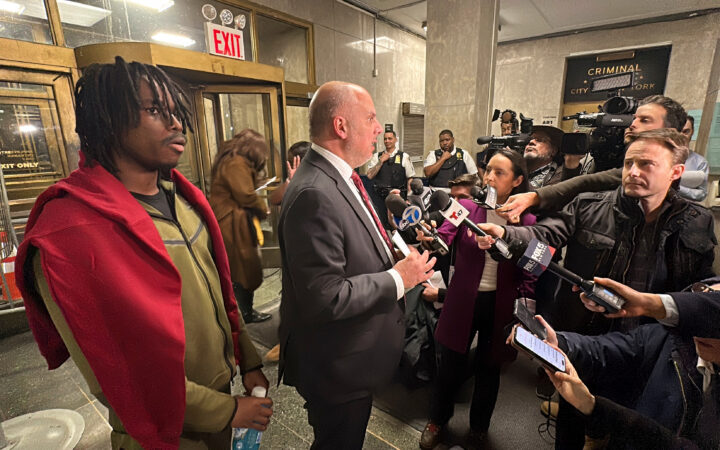
    NEW YORK — A social media content creator was arrested Thursday after New York City police said he was one of a number of people who pelted officers with snow and ice during a massive snowball fight in Washington Square Park this week.

    Gusmane Coulibaly, 27, was charged with obstructing governmental administration, a misdemeanor, and harassment, a non-criminal violation.

    He appeared in handcuffs and wearing an olive-green sweat suit during his arraignment Thursday evening in Manhattan criminal court. He wasn’t asked to enter a plea, and was released, pending his next court date on April 9.

    Coulibaly didn’t speak during the brief hearing, which was attended by at least a dozen uniformed police officers and police union officials.

    But George Vomvolakis, his attorney, told the judge that the “circumstances surrounding his arrest have been politicized.” He suggested Coulibaly was caught in the middle of a rift between the police department and City Hall.

    “I don’t want to minimize what happened to the officers, but I think the police department is using this because of their dislike or disdain for the mayor,” Vomvolakis said. “I think they’re taking it out on Mr. Coulibaly. They want to pick a fight with the mayor.”

    Mayor Zohran Mamdani, a Democrat, played down the fracas earlier this week as a “snowball fight that got out of hand” and suggested he did not think criminal charges were warranted.

    Monday’s snowball fight, which appeared to be organized by social media content producers, caused a chaotic scene as a large crowd amassed at the popular park to wing snowballs at each other during a winter storm.

    Prosecutors said in court that officers arrived at the park after a 911 call about a disorderly group, including people climbing on a roof.

    Video from the incident shows a large group of people following police officers, showering them with snowballs and jeering, as they retreat to their vehicles outside the park. Videos also showed officers shoving at least two people to the ground while getting hit from all directions by snowballs.

    “The notion that this was a playful snowball fight obviously is not true,” Patrick Hendry, a police union president, told reporters after the proceeding. “This was an attack on the uniform that these police officers wear so proudly every day. They came after these police officers, pelting them with ice, rocks.”

    Hendry said he was disappointed prosecutors didn’t charge Coulibaly with assaulting an officer — the felony offense police originally proposed.

    “It sends a horrible message to these police officers right here that the mayor is not going to have our backs,” he said, standing alongside other officers. “You’re putting a target on these police officers’ backs.”

    Vomvolakis maintained there was no evidence that rocks or ice were packed into the snowballs.

    “What I saw in the video didn’t look like an attack,” Vomvolakis said. ”Did it go a little past, you know, jokes and fun? Was it possibly a little disrespectful to the police? Yes.”

    Assistant District Attorney Victoria Notaro said video showed Coulibaly throwing a snowball that struck Officer Nicholas Johnson in the face, but prosecutors did not find evidence showing that the officer’s injuries were caused “directly by this defendant’s conduct.”

    The officer sustained injuries including redness, tenderness, and pain to his eye, head and neck, Notaro said.

    “We will continue to investigate,” she added.

    Vomvolakis said Coulibaly is a content creator who makes “elaborate videos” including a recent one in which he approached a stranger in a Bronx subway, acted as if he knew him and said he was owed money.

    That interaction got Coulibaly arrested for attempted robbery — a charge that Vomvolakis said he was confident would be dismissed.

    Coulibaly has hundreds of thousands of followers across Instagram, TikTok, YouTube, Snapchat, and other social media platforms, where he posts under the moniker Diaper Man.

    The city’s police department has released images of three other people it is seeking in connection with the snowball fight. Police Commissioner Jessica Tisch has called the treatment of officers at the fight “disgraceful” and “criminal.”

  • Dear Abby | Girlfriend hits the road amid man’s rough stretch

    DEAR ABBY: I’m a senior man who has been married and divorced twice. For the last eight years, I have been in a relationship with an amazing woman. She has always had some control issues, but because of the love we share, I was able to look past them.

    I’ve always been the one who paid for everything. I recently had some heart issues and was unable to work my part-time job, so my income was reduced. I was no longer able to continue to do the things she was used to. She recently retired and wants to do more traveling, which, at this time, I can’t afford. This has caused friction.

    Two years ago, I put a ring on her finger, which she accepted with reservation, telling me she never wanted to get married or live together. She likes things the way they are. She recently told me she’s no longer in love with me the way she had been.

    I don’t want to think badly of her, but I think it’s because of my health and financial issues. This hurts so bad. For some reason, I still love her and can’t move on. I’m a hopeless romantic and a true gentleman. I’m gun-shy about trying again at 70, but I hate being alone and depressed. What do you suggest?

    — DISILLUSIONED IN NEW JERSEY

    DEAR DISILLUSIONED: I am sorry you are depressed and hurting. From what you have written, I can only conclude that when you were paying for everything, your ladylove liked the ride she was on. Now that things have changed financially, she has jumped off, so to speak. You may not believe this right now, but you are lucky she has shown her true colors.

    You do not have to stay alone and depressed. You also do not have to participate in relationships that are all give and no take. With this in mind, look for women who are independent and willing to share some of the financial costs of a relationship. You may be surprised to find that there are many out there.

    ** ** **

    DEAR ABBY: My wealthy uphill neighbor and I share a retaining wall, which has been damaged by her reckless irrigation practices. Since the damage can be seen only from my side, she’s not concerned.

    An inspector recommended excavating on her side to allow waterproofing the wall and installing a drainpipe. I wanted to bring in a wall contractor to get an estimate, but she would not allow it. Evidently, she doesn’t want any of the plants in her backyard disturbed.

    Two weeks ago, she notified me by certified mail that she would no longer communicate with me. The city says it doesn’t get involved in beefs between neighbors. I’m at my wits’ end. Any advice?

    — HOG-TIED IN CALIFORNIA

    DEAR HOG-TIED: Because water causes erosion, it is only a matter of time before your property is affected by your neighbor’s drainage. She may have sent you that certified letter on advice from her lawyer. This is why you now need to engage legal counsel of your own. She’s a difficult person, and you need to protect yourself and your property.

  • Horoscopes: Friday, Feb. 27, 2026

    ARIES (March 21-April 19). You’re instinctually motivated by a primal and unconscious strategy — a knowing that has been inside you since birth. It’s the same instinct your ancestors have had for thousands of years, and you can trust your modern interpretation.

    TAURUS (April 20-May 20). Today’s social moments are full of fast, emotional shorthand. You can catch it all when you’re relaxed. Once you get out of your head and start observing without the distraction of having to earn anyone’s approval, you’re golden.

    GEMINI (May 21-June 21). Life will improve, yes. But don’t push or become so focused on a better tomorrow that you don’t see what’s around you now. Don’t waste the good things in this moment. Fully engage.

    CANCER (June 22-July 22). Emotional intelligence is your superpower today. You sense what’s needed without being told and respond with just the right mix of care and restraint. And though this kind of attunement sometimes goes unacknowledged, you will be buoyed by the evidence that you helped.

    LEO (July 23-Aug. 22). You don’t have to think absolutely everything through. Let yourself be spontaneous. Today it’s an attractive shift. Say yes to the fun option. Go where the energy is, do what feels good and enjoy the company that comes with it.

    VIRGO (Aug. 23-Sept. 22). The amateur tries to squeeze out the effects of chance. The pro skillfully positions to accept chance’s graces. Go easy. If you win this, great. If you don’t, onto the next. This easy attitude attracts Lady Luck and improves your odds.

    LIBRA (Sept. 23-Oct. 23). Harmony isn’t something you have to manufacture; it’s already present in the way things are naturally unfolding today, and you’ll love that you don’t even have to put your hands on the wheel, make corrections or do much at all besides being true to yourself.

    SCORPIO (Oct. 24-Nov. 21). You marvel at the natural world. But if everything existed in its natural state, what would creative people do with themselves? Today you’ll entreat good fortune as you honor your strong need to change, heighten and improve things.

    SAGITTARIUS (Nov. 22-Dec. 21). Curiosity leads the way. A conversation, idea or invitation opens a fresh perspective that just feels fun to you. You may realize you’ve been unnecessarily constricted in some way, and now you get the chance to expand and exhale in the form of laughter.

    CAPRICORN (Dec. 22-Jan. 19). Steady effort is paying off — really! You’re building something real, even if today’s progress seems to take place in mind or theory more than with tangible results. Those are coming. Trust that your consistency is working beautifully.

    AQUARIUS (Jan. 20-Feb. 18). There’s a call to action, maybe as simple as a deadline or a challenge. You don’t experience urgency as pressure or stress; rather, it’s clarity. When it’s go time, you’re already in motion, leading the team, organizing the moment so no one is alone inside it.

    PISCES (Feb. 19-March 20). Along your merry way, there’s an ember of excitement gleaming under the surface of this ordinary day. It’s like you know on some level that good things are coming. You don’t know the where, when or how of it, and that’s half the fun!

    TODAY’S BIRTHDAY (Feb. 27). It’s your Year of Creative Courage when inspiration, skill and resources converge. Your efforts bloom into tangible accomplishments, recognition and financial rewards. More highlights: A special relationship takes you to new places both close to home and far away. A new income stream requires little work. A festive friend group meets periodically. Virgo and Scorpio adore you. Your lucky numbers are: 12, 2, 4, 39 and 15.

  • Vance: ‘No chance’ U.S. will be in drawn-out war in Middle East

    Vance: ‘No chance’ U.S. will be in drawn-out war in Middle East

    ABOARD AIR FORCE TWO — Vice President JD Vance said Thursday that while military strikes against Iran remain under consideration by President Donald Trump, there is “no chance” that such strikes would result in the United States becoming involved in a yearslong, drawn-out war.

    Speaking with the Washington Post on Thursday, Vance said he does not know what Trump will decide to do about Iran, describing possibilities that include military strikes “to ensure Iran isn’t going to get a nuclear weapon,” or solving “the problem diplomatically.”

    But if Trump proceeds with another round of strikes on Iran — which some U.S. officials have suggested could be more comprehensive than the bombing of nuclear sites in June — Vance said confidently that it would not turn into the kind of conflict the vice president has harshly criticized.

    “The idea that we’re going to be in a Middle Eastern war for years with no end in sight — there is no chance that will happen,” he told the Post in an interview as he returned to Washington from an event in Wisconsin, effectively pushing back against predictions by some foreign policy experts that there would be no easy out if America got involved in a bigger conflict with Iran.

    Vance noted that last year’s operation in Iran and the January capture of Venezuelan President Nicolás Maduro were “very clearly defined.”

    Vance, a 41-year-old Marine veteran who served in the Iraq War, once said from the Senate floor that he had been “lied to” about the reasons for the United States’ involvement there. He said Thursday that he still sees himself as a “skeptic of foreign military interventions,” a description he believes continues to apply to Trump.

    “I think we all prefer the diplomatic option,” Vance said. “But it really depends on what the Iranians do and what they say.”

    Talks between the United States and Iran continued Thursday in Geneva amid a large-scale buildup of U.S. forces around Iran, though no resolution was reached, and mediators said the negotiations would continue next week.

    Trump has openly acknowledged that he is interested in bringing about regime change to topple Iran’s supreme leader, Ayatollah Ali Khamenei, telling reporters this month that it “would be the best thing that could happen.” The current presence of U.S. military forces in the region is among the largest in more than two decades, since before the Iraq War began in 2003.

    Asked whether, in his days as a commentator and senator offering criticisms of the Iraq War, he could have foreseen being attached to a presidency interested in bringing about a foreign regime change, the vice president chuckled.

    “Well, I mean, look. Life has all kinds of crazy twists and turns,” Vance said. “But I think Donald Trump is an ‘America First’ president, and he pursues policies that work for the American people.

    “I do think we have to avoid repeating the mistakes of the past. I also think that we have to avoid overlearning the lessons of the past. Just because one president screwed up a military conflict doesn’t mean we can never engage in military conflict again. We’ve got to be careful about it, but I think the president is being careful.”

    Prominent commentators within the conservative movement have spent months publicly quarreling over U.S. involvement in the Middle East, including debating what America’s attitude should be toward Israel.

    A growing number of conservatives — particularly young people — have soured on continued military support for the U.S. ally. Traditional conservatives have excoriated some of those voices, meanwhile, fueling a debate on the right about not only foreign policy but antisemitism as well.

    Vance has advocated for Israel-skeptical voices to be heard in the intraparty debate — a conversation that has upset Republican dogma of recent decades — while maintaining that he sees the nation as a strategic ally.

    The divide was apparent last week when former Fox News host Tucker Carlson, who now has his own podcast and frequently criticizes fellow conservatives’ deference to Israel, interviewed Mike Huckabee, the U.S. ambassador to Israel.

    Carlson, who has been a close ally of Vance, and Huckabee, a high-profile U.S. diplomat, have each found themselves in hot water for statements made during the filmed discussion. Huckabee said it would “be fine” if Israel took over other Middle Eastern countries whose land is referenced in Scripture, and Carlson suggested genetic testing to determine the true descendants of Abraham.

    Vance, an active peruser of X, said he had not yet watched the entire interview but had “seen a couple of clips here and there.” Despite calls from some pro-Israel conservative activists and even two Republican members of Congress for the White House to condemn Carlson, who visited the White House on Monday, Vance described the interview as a positive development.

    “I guess my takeaway is it’s a really good conversation that’s going to be necessary for the right, not just for the next couple years but for long into the future,” he said.

    What he has always liked about the political right — “even the people that I find annoying on our side” — is that “there is a real exchange of ideas,” Vance said.

    “And if you think of the Trump coalition in 2024 — and the way that I put it is, you had Joe Rogan, Mark Levin, Sean Hannity, Tucker Carlson, and JD Vance and a coalition of people … but to do that, you have to be willing to tolerate debate and disagreement,” he said. “And I just think that it’s a good thing.”

  • Crowds of Chicago mourners pay respects to Jesse Jackson at start of cross-country memorial services

    Crowds of Chicago mourners pay respects to Jesse Jackson at start of cross-country memorial services

    CHICAGO — A line of mourners streamed through a Chicago auditorium Thursday to pay final respects to the Rev. Jesse Jackson Sr. as cross-country memorial services began in the city the late civil rights leader called home.

    The protégé of the Rev. Martin Luther King Jr. and two-time presidential candidate will lie in repose for two days at the headquarters of the Rainbow PUSH Coalition before events in Washington, D.C., and South Carolina, where he was born.

    Family members wiped away tears as the casket was brought into the stately brick building. Flowers lined the sidewalks where people waiting to enter watched a large screen playing video excerpts of Jackson’s notable speeches. Some raised their fists in solidarity.

    Inside, Jackson’s children, Chicago Mayor Brandon Johnson, and the Rev. Al Sharpton were among those who stood by the open casket to shake hands and hug those coming to view the body of Jackson, dressed in a suit and blue shirt and tie.

    “The challenge for us is that we’ve got to make sure that all he lived for was not in vain,” Sharpton told reporters. “Dr. King’s dream and Jesse Jackson’s mission now falls on our shoulders. We’ve got to stand up and keep it going.”

    Jackson died last week at age 84 after battling a rare neurological disorder that affected his mobility and ability to speak in his later years.

    Remembrances have already poured in from around the globe, and several U.S. states, including Minnesota, Iowa, and North Carolina, are flying flags at half-staff in his honor.

    But perhaps nowhere has his death been felt as strongly as in the nation’s third-largest city, where Jackson lived for decades and raised his six children, including a son who is a congressman.

    Bouquets have been left outside the family’s Tudor-style home on the city’s South Side for days. Public schools have offered condolences, and city trains have used digital screens to display Jackson’s portrait and his well-known mantra, “I am Somebody!”

    His causes, both in the United States and abroad, were countless: Advocating for the poor and underrepresented on issues including voting rights, job opportunities, education, and healthcare. He scored diplomatic victories with world leaders, and through his Rainbow PUSH Coalition, he channeled cries for Black pride and self-determination into corporate boardrooms, pressuring executives to make America a more open and equitable society.

    “We honor him, and his hard-earned legacy as a freedom fighter, philosopher, and faithful shepherd of his family and community here in Chicago,” the mayor said in a statement.

    Next week, Jackson will lie in honor at the South Carolina Statehouse, followed by public services. According to Rainbow PUSH’s agenda, Gov. Henry McMaster is expected to deliver remarks; however, the governor’s office said Thursday that his participation wasn’t yet confirmed. Jackson spent his childhood and started his activism in South Carolina.

    Details on services in Washington have not yet been made public. However, he will not lie in honor at the United States Capitol rotunda after a request for the commemoration was denied by the House Speaker Mike Johnson’s office.

    The two weeks of events will wrap up next week with a large celebration of life gathering at a Chicago megachurch and finally, homegoing services at the headquarters of the Rainbow PUSH Coalition.

    Family members said the services will be open to all.

    “Our family is overwhelmed and overjoyed by the amazing amount of support being offered by common, ordinary people who our father’s life has come into contact with,” his eldest son, Jesse Jackson Jr., said before the services began. “This is a unique opportunity to lay down some of the political rhetoric and to lay down some of the division that deeply divides our country and to reflect upon a man who brought people together.”

    The services included prayers from some of the city’s most well-known religious leaders, including Chicago Cardinal Blase Cupich. Mourners of all ages — from toddlers in strollers to elderly people in wheelchairs — came to pay respects.

    Video clips of his appearances at news conferences, the campaign trail and even Sesame Street also played inside the auditorium.

    Claudette Redic, a retiree who lives in Chicago, said her family has respected Jackson, from backing his presidential ambitions to her son getting a scholarship from a program Jackson championed.

    “We have generations of support,” she said. “I’m hoping we continue.”