Tag: no-latest

  • Horoscopes: Sunday, March 1, 2026

    ARIES (March 21-April 19). No path is inherently better or worse, only different. You needn’t agonize over finding the absolute best route, nor should you feel pressured to make a good choice. You’re the one who makes the choice good.

    TAURUS (April 20-May 20). They want you to buy what you don’t need, and some of it is downright bad for you. Consumerism pulls your focus into systems optimized for someone else’s goals. Power flows toward whoever sets the frame — let that be you.

    GEMINI (May 21-June 21). No person can be entirely summed up by what they do. The roles and responsibilities describe what you manage, not who you are. Someone is trying to know your interior life — your imagination, longings, contradictions and more.

    CANCER (June 22-July 22). The one who said, “Truth does not blush” wasn’t paying close attention. Today’s truth is bright red — impossible to miss. Still, you might pretend not to notice to help someone save face, which is a noble kindness.

    LEO (July 23-Aug. 22). Connections often don’t start in showy, obvious ways. You may be fuzzy on the details of how some of your favorite people came into your life. Just know that it’s happening again. New bonds are forming now, growing organically out of a life circumstance.

    VIRGO (Aug. 23-Sept. 22). Nothing brings out a person’s potential like the problem that requires more work than anticipated, more talent than you knew was there or more generosity than was thought available. Dig deeper. You’re living fully.

    LIBRA (Sept. 23-Oct. 23). When you get frustrated, try not to stay there for long. You can use this feeling as a signal you read and then heed. It’s telling you something needs to change here. Usually, it’s the time frame or the tools. Investigate your options.

    SCORPIO (Oct. 24-Nov. 21). Relationships can only be as free as the circumstances around them allow. Social norms and expectations, roles and alliances, emotional complexities and more can limit your options. But today, these limits make the story more interesting.

    SAGITTARIUS (Nov. 22-Dec. 21). You’ll be reminded how the simple, obvious choice can bring the most joy, relief or benefit. For instance, exercise, sunshine, hydration, human contact and a healthy lunch are the stuff of a good life.

    CAPRICORN (Dec. 22-Jan. 19). You’ve got your poker face on, and your cards are close to the vest. But there’s someone who knows you so well that they seem to read your mind and vibes. To this person, your silence speaks.

    AQUARIUS (Jan. 20-Feb. 18). The relationship was a fully illuminated house, but now you’re in the dark, patting the walls to find the light switch that won’t turn on. Power outages happen. But when you can’t see the way, other senses come alive.

    PISCES (Feb. 19-March 20). Your steadiness doesn’t come from swagger, cleverness or control. It comes from a deep, reliable decency that’s built into you. Kindness isn’t something you perform or ration — it’s your default. It shows up today both deliberately and spontaneously, in ideas and in action.

    TODAY’S BIRTHDAY (March 1). Welcome to your Year of Grounded Goodwill. Your orientation toward people is generous, and others follow your lead, which creates a culture of kindness around you with ever-expanding connections doing remarkable work in the world. More highlights: Fantastic gifts come by way of a blind box, random surprise or stroke of dumb luck. Each season features love, celebration and just what you need to live beautifully. Cancer and Leo adore you. Your lucky numbers are: 4, 29, 14, 3 and 16.

  • Hundreds of thousands of travelers stranded by flight disruptions after attack on Iran

    Hundreds of thousands of travelers stranded by flight disruptions after attack on Iran

    LONDON — America and Israel’s attack on Iran disrupted flights across the Middle East and beyond Saturday as countries around the region closed their airspace and three of the key airports that connect Europe, Africa, and the West to Asia halted operations.

    Hundreds of thousands of travelers were either stranded or diverted to other airports after Israel, Qatar, Syria, Iran, Iraq, Kuwait, and Bahrain closed their airspace. There also was no flight activity over the United Arab Emirates, flight tracking website FlightRadar24 said, after the government there announced a “temporary and partial closure” of its airspace.

    That led to the closure of key hub airports in Dubai, Abu Dhabi, and Doha, and the cancellation of more than 1,800 flights by major Middle Eastern airlines. The three major airlines that operate at those airports — Emirates, Qatar Airways, and Etihad — typically have about 90,000 passengers per day crossing through those hubs and even more travelers headed to destinations in the Middle East, according to aviation analytics firm Cirium.

    Then later on Saturday officials at Dubai International Airport — the largest in the United Arab Emirates and one of the busiest in the world — said four people were injured as the Emirates condemned what it called a “blatant attack involving Iranian ballistic missiles.” Strikes were also reported at other commercial airports in the region, including Kuwait International.

    “For travelers, there’s no way to sugarcoat this,” said Henry Harteveldt, an airline industry analyst and president of Atmosphere Research Group. “You should prepare for delays or cancellations for the next few days as these attacks evolve and hopefully end.”

    Airlines that are crossing the Middle East will have to reroute flights around the conflict with many flights headed south over Saudi Arabia. That will add hours to those flights and consume additional fuel, adding to the costs airlines will have to absorb. So ticket prices could quickly start to increase if the conflict lingers.

    The added flights will also put pressure on air traffic controllers in Saudi Arabia who might have to slow traffic to make sure they can handle it safely. And the countries that closed their airspace will miss out on the overflight fees airlines pay for crossing overhead.

    But Mike McCormick, who used to oversee air traffic control for the Federal Aviation Administration before he retired and is now a professor at Embry-Riddle Aeronautical University, said over the next few days these countries might be able to reopen parts of their airspace once American and Israeli officials share with the airlines where military flights are operating and how capable Iran remains of firing missiles.

    “Those countries then will be able to go through and say, OK, we can reopen this portion of our space but we’ll keep this portion of our airspace closed,” McCormick said. “So I think what we’ll see in the next 24 to 36 hours how the use of airspace evolves as the kinetic activity gets more well defined and as the capability of Iran to actually shoot missiles and create additional risk is diminished due to the attacks.”

    But it is unclear how long the disruption to flight operations could last. For comparison, the Israeli and U.S. attack on Iran in June 2025 lasted 12 days.

    ‘No one knows’

    The situation was changing quickly and airlines urged passengers to check their flight status online before heading to the airport.

    Some airlines issued waivers to affected travelers that will allow them to rebook their flight plans without paying extra fees or higher fares.

    Jonathan Escott and his fiancé had arrived at the airport in Newcastle, England, on Saturday only to find out that his direct flight to Dubai on Emirates airline was canceled, leaving everyone on the flight stuck there.

    Escott left to go back to where he was staying with family, about an hour from the airport, but has no idea when he may be able to travel.

    “No one knows,” Escott said. “No one really knows what’s going on with the conflict, really. Not Emirates, Emirates don’t have a clue. No one has a clue.”

    At least 145 planes that were en route to cities like Tel Aviv and Dubai early Saturday were diverted to airports in cities like Athens, Istanbul, or Rome, according to FlightAware. Others turned around and returned to where they had taken off. One plane spent nearly 15 hours in the air after leaving Philadelphia and getting all the way to Spain before turning around and returning to where it started.

    Numerous airlines canceled international flights to Dubai through the weekend, as India’s civil aviation agency designated much of the Middle East — including skies above Jordan, Saudi Arabia, and Lebanon — as a high security risk zone at all altitudes.

    Air India canceled all flights to Mideast destinations. Turkish Airlines said flights to Lebanon, Syria, Iraq, Iran, and Jordan were suspended until Monday and flights to Qatar, Kuwait, Bahrain, the United Arab Emirates, and Oman were suspended.

    The airline said additional cancellations may be announced, and many other airlines were suspending flights into the region through the weekend.

    Travelers advised to be ‘very creative’

    U.S.-based Delta Air Lines and United Airlines suspended flights to Tel Aviv at least through the weekend. Dutch airline KLM had already announced earlier in the week that it was suspending flights to and from Tel Aviv.

    Airlines including Lufthansa, Air France, Transavia, and Pegasus canceled all flights to Lebanon, while American Airlines suspended flights from Philadelphia to Doha.

    Virgin Atlantic said it would avoid flying over Iraq, meaning flights to and from India, the Maldives, and Riyadh could take slightly longer. The airline already was not flying over Iran and said all flights would carry appropriate fuel in case they need to reroute on short notice.

    British Airways said flights to Tel Aviv and Bahrain will be suspended until next week, and flights to Amman, Jordan, were canceled Saturday.

    “Travelers should anticipate that there will be a lot of disruptions,” Harteveldt said. “To be honest, if you haven’t left home, chances are you won’t be leaving home if you’re supposed to travel to or through these destinations for at least several days, if not longer. And if you are returning home, you will have to be very creative about how you get home.”

  • Juan Valdez, 88, the last Marine to leave Vietnam, has died

    Juan Valdez, 88, the last Marine to leave Vietnam, has died

    Standing on the U.S. Embassy roof as tanks rumbled toward Saigon and gunfire rang out below, Juan Valdez wondered if he and his fellow Marines might have actually been forgotten.

    Working through the night, as a mob of desperate people pressed against the compound’s gates and spilled over its walls, he had helped evacuate nearly 2,100 Americans and Vietnamese fleeing the collapse of South Vietnam. But after Ambassador Graham Martin was airlifted to safety with the embassy’s American flag, the helicopter evacuation had been canceled — the result of a misunderstanding, as air staff didn’t realize a group of Marines was still waiting to be picked up.

    A call for help went out. And Master Sgt. Valdez waited for what “seemed like an eternity” for the last helicopter to arrive.

    When it landed, he nearly didn’t make it on board. After telling his 10 fellow Marines to get on, and waiting to ensure they boarded safely, he slipped as he stepped onto the ramp. The helicopter began to take off as one of the Marines, Mike Sullivan, did a head count. They were one man short.

    “I remember looking at the ramp, and two hands were over the top of it,” Sullivan recalled in Last Days in Vietnam, an Oscar-nominated 2014 documentary. Master Sgt. Valdez was yanked on board as the chopper departed.

    It was 7:58 a.m. on April 30, 1975, just a few hours before the North Vietnamese burst through the gates of the presidential palace, hoisted a Viet Cong flag, and celebrated the end of a war that had lasted 20 years, costing the lives of more than 58,000 Americans and untold Vietnamese.

    Master Sgt. Valdez, the last Marine to leave Vietnam, was 88 when he died Feb. 15 in Tucson, Ariz., where he was living. To the leathernecks who served under him, it was only fitting that he was the last of their unit to depart Saigon.

    “He was a model leader, always looking after his troops,” said one of those Marines, Doug Potratz. “When I went to his house 40 years after the fall of Saigon, he had all our individual ID pictures on the mantel of his fireplace. He never forgot us.”

    “In some ways he was like a dad to us,” said Dave Norman, one of the 11 Marines on the last helicopter out of Saigon. “But in other ways he was like a principal. If you screwed up, you didn’t want to be in the principal’s office.”

    Mr. Valdez spent 32 years in the Marine Corps, retiring in 1987 as a master gunnery sergeant. Even then, he remained intimately involved with the Corps, working as a civilian in the housing office of Camp Pendleton, the primary Marine base on the West Coast.

    “He was always a Marine, taking care of Marines,” Potratz said.

    During his first tour in Vietnam, from 1965 to 1967, Mr. Valdez served as a platoon sergeant in an amphibious assault vehicle unit. He returned to the country in September 1974 as the top noncommissioned officer — affectionately known as “Top” — in the embassy’s Marine security guard detachment, with a commander, Maj. James Kean, who was based out of Hong Kong before being summoned to Saigon.

    Following the departure of American combat troops in 1973, the embassy Marines were among the last U.S. service members in Vietnam. “We were there to protect American lives, as well as American property. It was just a day-to-day job,” Mr. Valdez said.

    As the North Vietnamese advanced toward the capital, he and Kean played a critical role evacuating Americans and their allies. More than 50,000 people were flown out of Tan Son Nhut Air Base before rocket and artillery fire made the flights unsafe. Some 7,000 others were then airlifted as part of Operation Frequent Wind, the final stage of the evacuation, which the U.S. military later called the largest helicopter evacuation in history.

    At the embassy, helicopters landed every 10 minutes on the roof or in the parking lot, where Marines chopped down a tamarind tree to expand the makeshift landing zone.

    The operation got underway on April 29, 1975, after two of the detachment’s young Marines, Darwin Judge and Charles McMahon, were killed in a predawn rocket attack at Tan Son Nhut. Later that day, Armed Forces Radio delivered a not-so-secret signal to indicate that the airlift was on.

    “The temperature in Saigon is 105 degrees and rising,” an announcer intoned. Then the station played the holiday song “White Christmas.”

    Master Sgt. Valdez and Kean “didn’t pull any punches,” Potratz said in a phone interview. “They got us in the conference room after Judge and McMahon were killed. They said, ‘There are almost 100,000 North Vietnamese surrounding the city. We don’t know if they’re going to evacuate us or not. But if we die, we die like Marines.’ That kind of stuck to us. After that, we stuck together and did the best we could.”

    As thousands of people rushed to the embassy, Master Sgt. Valdez and other Marines guarded the perimeter. He later recalled lifting people over the gates, helping them inside the compound before realizing there wouldn’t be enough helicopters to evacuate everyone.

    “Please, at least take my children out,” he was told by parents. “I’ll stay, but take my little girl now.”

    Those who were allowed into the compound were searched for weapons — guns were thrown into the embassy pool — before being escorted to a helicopter.

    According to Kean’s after-action report, some 10,000 people eventually breached the embassy gates. Master Sgt. Valdez and the remaining Marines prepared to be evacuated while locking down the elevators and barricading doors, using fire extinguishers and other equipment to block off the rooftop.

    For many, images of the chaotic withdrawal came to symbolize the futility of a war that should never have been prolonged, let alone started.

    Mr. Valdez said that the departure was painfully resonant in 2021, when the U.S. withdrawal from Afghanistan ended in chaos and bloodshed. As he saw it, the U.S. had repeated some of the same mistakes in both wars.

    “We spent so much money, so many weapons, and so many Marine and Army deaths, and for what?” he asked in an interview with Noticias Telemundo. “For what?”

    Juan Jose Valdez was born in San Antonio, Texas, on Aug. 19, 1937. His father was a landscaper, and his mother was a homemaker from Mexico. He enlisted in the Marines in 1955, at age 17.

    Mr. Valdez died of pneumonia, said his sons Anthony and Michael Valdez. In addition to his children, survivors include a brother; two sisters; a grandson; and three great-granddaughters.

    Late in life, Mr. Valdez participated in frequent reunions with his Vietnam detachment, including in a 2015 trip to Saigon — now Ho Chi Minh City — where a plaque was dedicated to McMahon and Judge, the last Americans killed in action on the ground in Vietnam. The unit’s surviving members had reconnected in 2000, when they traveled to Judge’s Iowa hometown for a memorial service honoring their fallen comrades.

    “For a period I went through survivor guilt,” Mr. Valdez said in prepared remarks for the service. “Why wasn’t it me instead. Why did I, who had been in country longer, and had already served a previous tour in Vietnam, lived and these two men died. There were, and still are, no easy answers.”

    But “more than anything else,” he added, “we need one another now. Each of us grieves, and when we grieve together, the healing begins.”

  • War powers debate intensifies after Trump orders attack on Iran without approval by Congress

    War powers debate intensifies after Trump orders attack on Iran without approval by Congress

    WASHINGTON — Key members of Congress are demanding a swift vote on a war powers resolution that would restrain President Donald Trump’s military attack on Iran unless the administration wins their approval for what they warn is a potentially illegal campaign that risks pulling the United States into a deeper Middle East conflict.

    Both the House and Senate, where the president’s Republican Party has a slim majority, had already drafted such resolutions long before the strikes Saturday. Now they are ready to plunge into a rare war powers debate next week that will serve as a referendum on Trump’s decision to go it alone on military action without formal authorization from Congress.

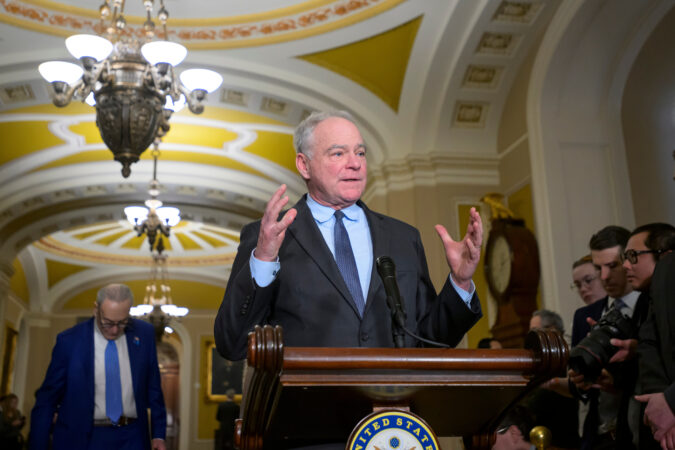
    “Has President Trump learned nothing from decades of U.S. meddling in Iran and forever wars in the Middle East?” said Sen. Tim Kaine (D., Va.), a leader in the bipartisan effort. He said the strikes on Iran were “a colossal mistake.”

    In the House, Reps. Ro Khanna (D., Calif.) and Thomas Massie (R., Ky.) are demanding Congress go on record with a public vote on their own bipartisan measure. “Congress must convene on Monday to vote,” Khanna said, “to stop this.”

    Massie blasted Trump’s own presidential campaign slogan and said: “This is not ‘America First.’”

    But most Republicans, particularly their leaders, welcomed Trump’s move against Iran. Many cited the longtime U.S. adversary’s nuclear programs and missile capabilities as requiring a military response.

    “Well done, Mr. President,” said Sen. Lindsey Graham (R., S.C.). “As I watch and monitor this historic operation, I’m in awe of President Trump’s determination to be a man of peace but at the end of the day, evil’s worst nightmare.”

    War powers debate tests Congress

    The administration’s decision to launch, with Israel, what appears to be an open-ended joint military operation aimed at changing the government in Tehran is testing the Constitution’s separation of powers in deep and dramatic ways. Nearly two months earlier, Trump ordered U.S. strikes that toppled Venezuelan leader Nicolás Maduro.

    While presidents have the authority as the commander in chief to conduct certain strategic military operations on their own, the Constitution vests Congress with the power to wage war. Before the Iraq War began in March 2003, Republican President George W. Bush made a monthslong push to secure congressional authorization. No such vote was attempted on Iran, and an earlier Senate effort to halt Trump’s actions after last summer’s strike on Iran failed.

    The congressional debate over war powers would mostly be symbolic. Even if a resolution were to pass the narrowly split Congress, Trump likely would veto it and Congress would not have the two-thirds majority needed to overturn that rejection. Congress has often failed to block other U.S. military actions, including in a Senate vote on Venezuela, but the roll calls stand as a public record.

    Republican leaders back Trump’s action

    The response by House Speaker Mike Johnson reflected the party’s long-standing views. Iran, he said, is facing “the severe consequences of its evil actions.”

    Johnson (R., La.) said the leaders of the House and Senate and the respective intelligence committees had been briefed in detail earlier in the week that military action “may become necessary” to protect U.S. troops and citizens in Iran. He said he received updates from Secretary of State Marco Rubio and will stay in “close contact” with Trump and the Defense Department “as this operation proceeds.”

    Senate Majority Leader John Thune (R., S.D.) commended Trump “for taking action to thwart these threats.”

    Thune said he looked forward to administration officials briefing all senators — a signal that lawmakers are seeking more answers to their questions about Trump’s plans ahead.

    Democrats warn strikes are illegal

    Many Democrats are calling the operation illegal, saying the Constitution gives Congress alone the power to declare war. To them, the administration has failed to lay out its rationale or plan for the military strikes, and the aftermath.

    Sen. Chris Van Hollen, who serves on the Senate Foreign Relations Committee, said the president has undertaken “illegal, regime-change war against Iran.”

    “This is not making us safer & only damages the US & our interests,” Van Hollen (D., Md.) said in a social media post. “The Senate must immediately vote on the War Powers Resolution to stop it.”

    House Democratic leader Hakeem Jeffries of New York said while Iran is a “bad actor and must be aggressively confronted” for its human rights abuses and the threat it poses to the U.S. and allies, the administration ”must seek authorization for the preemptive use of military force that constitutes an act of war.”

    New York Sen. Chuck Schumer, the Democratic leader, demanded that Congress be briefed immediately on the administration’s plans.

    “Iran must never be allowed to attain a nuclear weapon but the American people do not want another endless and costly war in the Middle East when there are so many problems at home,” he said.

  • Musk asked Epstein for ‘the wildest party,’ but now he claims to stand up for victims

    Musk asked Epstein for ‘the wildest party,’ but now he claims to stand up for victims

    During an explosive feud with President Donald Trump last spring, Elon Musk reached for the nuclear button. “Time to drop the really big bomb,” he wrote on X in June, “@realDonaldTrump is in the Epstein Files.”

    “The truth will come out,” the Tesla CEO added. He later deleted the posts and reconciled with Trump. In the months since, Musk has issued a steady drum beat of X posts calling for the arrest or prosecution of people linked to Jeffrey Epstein, a convicted sex offender who cultivated relationships with powerful figures in tech, finance, and politics.

    But when the Justice Department released what it said were millions of pages of documents last month from its investigation of the deceased financier, Musk featured prominently in the files.

    The entrepreneur had repeated email exchanges with Epstein, as did Kimbal Musk, his brother and fellow Tesla board member, the documents show. Elon Musk’s messages included inquiries about parties. Musk and Epstein also discussed arranging to meet on Epstein’s island and their assistants arranged a visit for the two at the entrepreneur’s rocket maker, SpaceX. On Christmas Day in 2012, Musk wrote to Epstein and asked: “Do you have any parties planned?” He added that “I’ve been working to the edge of sanity” and wanted to “let loose.”

    The revelations have thrust Musk in the awkward position of trying to cast himself as a stalwart defender of Epstein’s victims while also defending his own interactions with the convicted sex offender. Epstein pleaded guilty in 2008 to two charges of soliciting prostitution, including one involving a minor. He was arrested on federal sex trafficking charges in 2019 and died in federal custody later that year. Judges and lawmakers say that he abused, trafficked, and molested scores of girls over decades.

    In recent weeks, Musk has taken aim in online posts at other political and business figures over their alleged interactions with Epstein — including LinkedIn co-founder Reid Hoffman, former Trump chief strategist Stephen K. Bannon, and billionaire Les Wexner.

    “The big difference between you and me, Reid, is that you went and I did not,” Musk said in a post on X directed at Hoffman in early February, referring to Epstein’s island, adding later, “UNLIKE YOU, I came to my senses and declined to go.” Hoffman has acknowledged visiting Epstein’s island, as part of work to help the Massachusetts Institute of Technology “fundraise from Epstein,” and said that he regretted ever interacting with the sex offender.

    Wexner told Congress this month that he had been “duped” by Epstein and was not aware of his crimes. Bannon did not respond to a request for comment. Musk has refrained from making further allegations against Trump and stayed silent about the Justice Department files linking administration figures to Epstein, including Commerce Secretary Howard Lutnick, who told Congress this month that he once took his family to lunch on Epstein’s island but “did not have any relationship with him.”

    Musk has written on X that he “REFUSED” to visit Epstein’s island, even as the documents show him appearing to seek a visit. “When should we head to your island on the 2nd?” Musk asked Epstein on Christmas Day in 2013, in an apparent reference to a visit for the following January, the documents show.

    Musk and his brother, Kimbal Musk, did not respond to requests for comment for this story. Appearing in the documents released by the Justice Department does not indicate wrongdoing.

    At times, Musk’s attempts to focus on his preferred narrative about Epstein have backfired. Earlier this month, the billionaire reshared an X post from Mohamad Safa, executive director of the human rights group Patriotic Vision. “As someone works in human rights, I’ve never seen anything like the Epstein files in my 15-year career,” Safa wrote. “I don’t understand how we’re not having a global revolution right now.”

    After Musk distributed that message to his around 235 million followers on X, Safa responded to point out that the billionaire was overlooking something.

    “Elon, you’ve got it wrong,” Safa wrote. “It’s a revolution against every person in the Epstein files.”

    Safa told the Washington Post that the Tesla CEO was wrongly trying to lump himself in with the human rights community demanding accountability in relation to Epstein.

    “Elon bought Twitter to mislead the public on global issues, and he is now using it to mislead about his connection to Jeffrey Epstein,” Safa said.

    After the release of the latest trove of files raised new questions about the extent of Musk’s contact with Epstein over the years, Musk issued a late-night statement on X last month in a 1:50 a.m. Eastern reply to a user known as “DogeDesigner.”

    “No one pushed harder than me to have the Epstein files released and I’m glad that has finally happened,” Musk wrote. “I had very little correspondence with Epstein and declined repeated invitations to go to his island or fly on his ‘Lolita Express’,” he said, referring to Epstein’s airplane, “but was well aware that some email correspondence with him could be misinterpreted and used by detractors to smear my name.”

    Musk added, “I don’t care about that, but what I do care about is that we at least attempt to prosecute those who committed serious crimes with Epstein, especially regarding heinous exploitation of underage girls.”

    The Justice Department files reviewed by the Post, including dozens that refer to Musk or his brother Kimbal, paint a vastly different picture of Epstein’s relationship with the Tesla CEO.

    “What day/night will be the wildest party on your island?” Elon Musk asked Epstein in an email from November 2012, as he sought to plan a visit accompanied by actor Talulah Riley — Musk’s ex-wife — the files show. A month later, he wrote to Epstein again about partying.

    “Do you have any parties planned?” he asked. “I’ve been working to the edge of sanity this year and so, once my kids head home after Christmas, I really want to hit the party scene in St Barts or elsewhere and let loose.”

    Musk added, “The invitation is much appreciated, but a peaceful island experience is the opposite of what I’m looking for.”

    The newly released correspondence appears to show the entrepreneur interacting and making plans with Epstein over a period of more than a year that took place several years after Epstein pleaded guilty in 2008.

    In 2013, Musk and Epstein’s assistants planned a visit for the disgraced financier to SpaceX, Musk’s rocket building company. The visit included a scheduled lunch for Musk and Epstein. Epstein was scheduled to travel with three female assistants — one South African and two Russian — whose passports were vetted by SpaceX, a government contractor, for security clearance reasons, according to the emails. While the visit took place as planned, according to the emails, it was not immediately clear whether the two men met for lunch.

    Musk has said he blocked and ultimately “ghosted” Epstein.

    The files also show that Kimbal Musk corresponded with Epstein about an apparent romantic partner whom another person warned him not to mistreat. “Jeffrey: Message received wide and clear. ;)” Kimbal Musk replied, in a message on which he copied Epstein.

    Years later, Epstein wrote in an email: “I gave another girl to kimball and he is thrilled.”

    Kimbal Musk said in a statement that Epstein did not introduce him to his romantic partner at the time of the earlier emails, and that she was an adult.

    “In 2012 I started dating a woman who was 30 years old,” Kimbal Musk posted on X. “I met her through a friend. Epstein did not introduce us. My only meeting with that demon was in his New York office during the day. I never met with him again and I never went to his island.”

    He added that Epstein subscribed to a newsletter of his, leading his email address to appear in searches of the Epstein files numerous times.

    “My heart goes out to the many victims of Jeffrey Epstein, as it does for all who have suffered any kind of sexual abuse or harassment,” Kimbal Musk said.

    Soon after the Justice Department’s release of files last month, the nonprofit organization behind Burning Man, a massive cultural festival held annually in the Nevada desert, announced that Kimbal Musk was no longer on its board of directors. That decision was made by Kimbal Musk “based on other commitments and priorities” and came “well before” the revelations, the organization said.

    Elon Musk, meanwhile, continues to face an uphill battle to convince skeptics that his support for Epstein victims is genuine.

    Scott Berkowitz, president and founder of RAINN, a nonprofit organization aimed at ending sexual violence, said he did not know what is in Musk’s heart, but said one way the entrepreneur could effect change for victims of sexual abuse would be by reining in the Grok chatbot offered by his company xAI, which recently came under fire for allowing the creation of nonconsensual sexualized images of real people.

    “RAINN is working to make the country safer from sexual violence. If Elon Musk wants to be a part of that and to use his influence to make life safer, there’s a long list of ways that he could be part of the solution,” Berkowitz said. “Partner with us to make Grok the model for AI safety and ensure it never creates another nonconsensual image, whether child or adult.”

    On X, many have lobbed criticism at Musk over his messaging on the Epstein files, seeing it as an effort to reframe the narrative around his involvement.

    Given “Elon Musk’s involvement with Epstein and his lies about it, it feels dirty to use this platform, which increasingly feels like his own propaganda machine and PR agency” Fred Lambert, the editor in chief of Electrek, an electric vehicle-focused publication, said in an X post last week.

    Safa, of Patriotic Vision, said he is not convinced by Musk’s sudden interest in accountability. “He should be investigated like any other individual whose name has been mentioned, regardless of social, political, or financial status,” Safa said, adding, “Why did he wait until now to speak out?”


  • Vatican removes salty white film coating Michelangelo’s ‘The Last Judgment’

    Vatican removes salty white film coating Michelangelo’s ‘The Last Judgment’

    VATICAN CITY — Michelangelo’s The Last Judgement is getting a facial, with restorers removing a chalky white film of salt that has accumulated over the Renaissance masterpiece since its last major renovation three decades ago.

    The Vatican on Saturday gave the media a sneak peak to the cleaning operation, which is taking place on a floor-to-ceiling scaffolding that has obscured the imposing fresco of heaven and hell that dominates the front of the Sistine Chapel.

    The cleaning operation is expected to be completed by Easter, in the first week of April. The public can continue to visit in the meantime, but will have to settle for a reproduction of The Last Judgment superimposed on a screen that covers the scaffolding.

    Vatican Museum officials on Saturday described a simple but important cleaning operation to remove the white film of salt that has accumulated on the fresco thanks to the nearly 25,000 people who pass through the Vatican Museums each day.

    “This salt is created because, above all, when we sweat, we emit lactic acid, and unfortunately lactic acid reacts with the calcium carbonate present on the wall,” said Fabio Moresi, in charge of the scientific research team at the Vatican Museums that is overseeing the cleaning.

    Climate change also has a role to play, since the visitors who do come tend to sweat more, creating even more humidity that reacts with the fresco, he said.

    Vatican Museums chief Barbara Jatta described the film as a “cataract” that is easy enough to remove: Restorers dip sheets of Japanese rice paper into distilled water and apply them to the fresco, and carefully wipe away the salt film.

    Viewed up close on Saturday on the scaffolding, the difference between before and after is remarkable: Sections of the fresco that haven’t been cleaned look as if they are coated in a chalky dust; the cleaned sections show the vibrant colors and detail of the original. On the figure of Jesus, for example, at the center of the fresco, a privileged visitor can see how Michelangelo painted his hair and the wounds of his crucifixion.

    The Sistine Chapel is named after Pope Sixtus IV, an art patron who oversaw the construction of the main papal chapel in the 15th century.

    But it was a later pontiff, Pope Julius II, who commissioned Michelangelo to paint the famous ceiling, the Creation of Adam showing God’s outstretched hand, between 1508 and 1512. A later pontiff, Pope Clement VII, commissioned Michelangelo in 1533 to return to paint The Last Judgment.

    The other frescos of the Sistine Chapel, where Pope Leo XIV was elected in May, undergo yearly cleaning with restorers working at night on cherry-pickers that can be removed each morning before the public arrives.

    But such machines can’t access all of The Last Judgement because the fresco is located behind the altar, which is itself raised up on marble steps. That logistical impediment required the mounting of a fixed scaffolding to access the full fresco to clean it.

    The Sistine Chapel underwent a complete restoration between 1979 and 1999, when centuries of smoke, grime, and wax buildup was removed. The Vatican has left small patches of the pre-restored fresco intact to show the difference, which are now visible on the upper floors of the scaffolding and show a nearly blackened wall.

    Rather than radically reduce the number of visitors who can access the Sistine Chapel, the Vatican is studying ways to address humidity levels, through filtration systems and other technologies, so that the salty film doesn’t form again.

  • Pentagon assault on Anthropic sends shockwaves across Silicon Valley

    Pentagon assault on Anthropic sends shockwaves across Silicon Valley

    The Trump administration’s declaration that AI company Anthropic would be cut off from all government contracts shook the tech industry late Friday, hardening political and cultural battle lines across Silicon Valley over military use of artificial intelligence.

    President Donald Trump ordered government agencies to “immediately cease” using Anthropic’s technology, in a post on Truth Social on Friday, and Defense Secretary Pete Hegseth labeled the company a “supply chain risk to national security” in his own post on X, after the company refused to allow its technology to be used for domestic surveillance and autonomous weapons.

    The Trump administration’s assault on Anthropic appeared to put the company on course to lose billions of dollars of potential revenue, although the startup said in a blog post late Friday that it would challenge Hegseth’s designation in court.

    The firm’s conversational assistant, Claude, is being deployed or tested in at least five government agencies, including the Pentagon, the Department of Health and Human Services, the Department of Homeland Security, and the Department of Energy, according to recent disclosures of AI use mandated by law and an executive order.

    Friday’s aggressive moves by the Trump administration put all of Silicon Valley on notice that tech companies seeking Pentagon contracts risk massive political and business fallout if they don’t back administration policies and cede control of how their technology is used. Rivals of Anthropic including Elon Musk and other tech allies of Trump seized on the conflict to pledge that their own companies would not question Pentagon policies, positioning themselves as loyal patriots.

    Conflict has bubbled between Anthropic and the Trump administration since last year. The company leveraged its relationship with investor Amazon to become the first company to be integrated into classified systems.

    But Anthropic, co-founded in 2021 by CEO Dario Amodei, his sister Daniela, and other former employees of ChatGPT-maker OpenAI, also rankled tech allies of Trump by positioning itself as more safety conscious than other AI developers. (Amazon founder Jeff Bezos owns the Washington Post, which has a content partnership with OpenAI.)

    In the fall, Trump’s AI and crypto czar David Sacks accused Anthropic of attempting to manipulate the government with “fearmongering” about AI technology. Around the same time, Semafor reported that Anthropic displeased the White House by raising ethical objections to how the administration wanted to use its technology, including for surveillance.

    Those tensions flared into an unprecedented public fight between the Pentagon and the tech company this week. Frantic talks between the two sides continued right up until Hegseth’s announcement late Friday that he was declaring Anthropic a risk to national security, according to an X post from Emil Michael, the Pentagon’s technology chief, and a person familiar with the talks.

    Michael was on the phone with Anthropic, suggesting that the company agree to allow analysis of some bulk data on Americans, at the same moment Hegseth said in his X post that Anthropic had been designated a supply chain risk, according to the person, who spoke on the condition of anonymity to discuss the talks.

    Anthropic said in a statement responding to Hegseth on Friday that it would legally challenge his declaration against the company, suggesting that the dispute is far from over. Experts said that Anthropic had strong legal grounds for a challenge.

    A company can only be designated a supply chain risk through a legal process, said Steven Feldstein, a senior fellow at the Carnegie Endowment for International Peace who researches the use of AI in war. “It isn’t legally sufficient to simply proclaim or label [a supply chain risk] and have this be the final word,” he said. “It’s a major overreach.”

    Jessica Tillipman, an associate dean at George Washington University’s law school, said Anthropic could probably make a strong argument in court that it had been unfairly targeted. “This is on incredibly shaky ground,” she said of Hegseth’s declaration on Friday. “I don’t think you have seen a case for more politicized use.”

    Hegseth’s post also asserted that all companies that do business with the U.S. military are now prohibited from doing any commercial activity with Anthropic. Although the legal basis for that sweeping ban was unclear, it could have disastrous consequences for Anthropic, which has received billions of dollars in investment from partners like Amazon, Microsoft, and Nvidia that also supply the military. The companies didn’t respond to requests for comment.

    Should the Pentagon prevail, the U.S. military will need to adapt fast. Claude is deeply integrated into the Maven Smart System, an AI tool built with the technology company Palantir that runs on Amazon’s cloud. It provides troops with a unified picture of intelligence streaming in from multiple sensors, said retired Air Force Lt. Gen. Jack Shanahan, who served as the first director of the Pentagon’s Joint Artificial Intelligence Center and is now an adjunct senior fellow at the Center for a New American Security, a think tank.

    After the U.S. seizure of Venezuelan strongman Nicolás Maduro, an image circulated that showed Claude operating alongside Maven during the operation, Shanahan said, which prompted Anthropic officials to ask Palantir questions about its use in the operation.

    Claude is the “single most widely deployed AI system in the U.S. military,” Shanahan said. He added that it wouldn’t make sense to try to extract the AI tool from all of the Defense Department systems it helps, just as service members are getting skilled with the technology.

    In Silicon Valley, debate raged Friday over whether Anthropic should be celebrated for taking a stand, criticized as unpatriotic, or scoffed at for being strategically naive.

    Right-leaning leaders such as Palmer Luckey, founder of the defense startup Anduril, and investor Keith Rabois posted in support of the military’s decision. Anthropic employees cheered its moves in online posts, and hundreds of employees of Google and OpenAI signed a public letter backing the company’s stance.

    Anthropic’s rivals were poised and at the ready to take advantage of its blunders.

    OpenAI chief executive Sam Altman wrote in a memo to all staff late on Thursday that he had been negotiating with the Pentagon, according to a copy reviewed by the Post. The memo was first reported by the Wall Street Journal.

    Altman wrote that the dispute between Anthropic and the Pentagon had become “an issue for the whole industry,” and that the spat was not about the use of AI but about “control.” The country, he said, “absolutely needs help with AI for defense if we want to continue to enjoy peace and prosperity.”

    But Altman added that he was seeking a deal with the Defense Department that would find middle ground. It would see OpenAI agree to cover any use except those that are “unlawful or unsuited to cloud deployments, such as domestic surveillance and autonomous offensive weapons,” he wrote. And he said the company could deploy technical safeguards and personnel “to partner with the government to ensure things are working correctly.”

    Late on Friday, Altman wrote in a post on X that he had reached such an agreement with the Defense Department to deploy OpenAI’s technology in classified U.S. networks.

    “Two of our most important safety principles are prohibitions on domestic mass surveillance and human responsibility for the use of force, including for autonomous weapon systems,” Altman wrote. The Pentagon “agrees with these principles, reflects them in law and policy, and we put them into our agreement.”

    Jeremy Lewin, under secretary of state for foreign assistance, humanitarian affairs, and religious freedom, wrote in a post on X that the new OpenAI deal permitted the Pentagon the freedom of “all lawful use” of AI that it had sought from Anthropic. The agreement represented “a compromise that Anthropic was offered, and rejected,” he wrote.

    Musk, whose company xAI was certified to work with classified military systems this week, also stepped into the fray. “Anthropic hates Western civilization,” he wrote in a post Friday on his social network X. Musk and xAI did not respond to requests for comment.

    Lewin held up the billionaire as showing a better way for AI firms to engage with the government.

    “Elon and xAI have already agreed to the ‘all lawful uses’ principle — meaning that he’s already agreed not to shut off U.S. systems for nonlegal prudential discretionary reasons,” Lewin, a former staffer for Musk’s government efficiency initiative, the U.S. DOGE Service, wrote on X. “So there’s your difference. Anthropic wants to add additional conditions — Elon has agreed to promise he won’t pull the plug for our systems.”

  • European leaders call for resumption of U.S.-Iran negotiations

    European leaders call for resumption of U.S.-Iran negotiations

    BRUSSELS — How long will it last? Will it grow? What will it mean to us — and to global security overall? Those questions echoed across the Middle East and the planet Saturday as world leaders reacted warily to U.S. and Israeli strikes on Iran that sowed concerns of a broader conflict. The U.N. Security Council scheduled an emergency meeting.

    Perhaps cautious about upsetting already strained relations with U.S. President Donald Trump, many nations abstained from commenting directly or pointedly on the joint strikes but condemned Tehran’s retaliation. Similarly to Europeans, governments across the Middle East condemned Iran’s strikes on Arab neighbors while staying silent on the U.S. military action.

    Other countries were more explicit: Australia and Canada expressed open support for the U.S. strikes, while Russia and China responded with direct criticism.

    The U.S. and Israel launched a major attack on Iran on Saturday, and Trump called on the Iranian public to “seize control of your destiny” by rising up against the Islamic theocracy that has ruled the nation since 1979. Iran retaliated by firing missiles and drones toward Israel and U.S. military bases in the Middle East.

    Some leaders urge resumption of talks

    In a statement, British Prime Minister Keir Starmer, French President Emmanuel Macron, and German Chancellor Friedrich Merz called on the U.S. and Iran to resume talks and said they favored a negotiated settlement. They said their countries didn’t take part in the strikes on Iran but are in close contact with the U.S., Israel, and partners in the region.

    The three countries have led efforts to reach a negotiated solution over Iran’s nuclear program.

    “We condemn Iranian attacks on countries in the region in the strongest terms. Iran must refrain from indiscriminate military strikes. We call for a resumption of negotiations and urge the Iranian leadership to seek a negotiated solution. Ultimately, the Iranian people must be allowed to determine their future,” they said.

    Later, at an emergency security meeting, Macron said France was “neither warned nor involved” in the strikes. He called for intensified efforts for a negotiated solution, saying “no one can think that the questions of Iran’s nuclear program, ballistic activity, regional destabilization will be settled by strikes alone.”

    The 22-nation Arab League called the Iranian attacks “a blatant violation of the sovereignty of countries that advocate for peace and strive for stability.” That coalition of nations has historically condemned both Israel and Iran for actions it says risk destabilizing the region.

    Countries that maintain diplomatic ties with Israel — including Morocco, Jordan, and the United Arab Emirates — denounced Iranian strikes targeting U.S. military bases in the region including in Kuwait, Bahrain, Qatar, and the Emirates.

    Saudi Arabia said it “condemns and denounces in the strongest terms the treacherous Iranian aggression and the blatant violation of sovereignty.” Oman, which has been mediating the talks between Iran and the U.S., said in a statement that the U.S. action “constitutes a violation of the rules of international law and the principle of settling disputes through peaceful means, rather than through hostility and the shedding of blood.”

    Careful wording is (mostly) the order of the day

    Countries in Europe and the Middle East used careful wording, avoiding perceptions that they either support unilateral American action or are directly condemning the United States.

    Others were more blunt. Russia’s Foreign Ministry called the strikes “a pre-planned and unprovoked act of armed aggression against a sovereign and independent U.N. member state.” The ministry accused Washington and Tel Aviv of “hiding behind” concerns about Iran’s nuclear program while actually pursuing regime change.

    Similarly, China’s government said it was “highly concerned” about the U.S. and Israeli strikes on Iran and called for an immediate halt to the military action and a return to negotiations. “Iran’s sovereignty, security and territorial integrity should be respected,” a Chinese Foreign Ministry statement said.

    Meanwhile, Australian Prime Minister Anthony Albanese said his country supports the United States in its effort to stop Iran from obtaining an atomic bomb. He described Iran’s current leadership as a destabilizing force and noted two attacks on Australian soil that were blamed on Tehran. Last August, Australia cut off diplomatic relations with Iran and expelled its ambassador after accusing it of orchestrating two antisemitic attacks in the country.

    Despite recent tensions with the U.S., Canada too expressed its support for the military action. “The Islamic Republic of Iran is the principal source of instability and terror throughout the Middle East,” Prime Minister Mark Carney said.

    The United Nations chief condemned the U.S.-Israeli airstrikes on Iran and called for an immediate return to negotiations “to pull the region, and our world, back from the brink.”

    Secretary-General António Guterres told an emergency meeting of the U.N. Security Council on Saturday that everything must be done to prevent further escalation. “The alternative,” he warned, “is a potential wider conflict with grave consequences for civilians and regional stability.”

    Guterres also condemned Iran’s retaliatory attacks for violating the sovereignty and territorial integrity of Bahrain, Iraq, Jordan, Kuwait, Qatar, Saudi Arabia, and the United Arab Emirates.

    Israel’s U.N. Ambassador Danny Danon, speaking to reporters before the meeting, said it was “hypocrisy” to condemn the airstrikes. He said Iran is responsible for the actions of its proxies in the Middle East and for its nuclear and missile programs, and Israel and the U.S. acted “to prevent an irreversible and immediate threat.”

    Concerns expressed for ‘new, extensive’ war

    Palestinians in the occupied West Bank said they were largely unfazed as war erupted Saturday, barely pausing as booms echoed across the sky from Israel’s Iron Dome intercepting missiles overhead.

    Unlike Israel, Palestinian cities have no warning sirens or bomb shelters, despite the risk of falling debris or errant missiles. As people sheltered less than 10 miles away in Jerusalem, streets in Ramallah swarmed with shoppers browsing meat counters, vegetable stalls, and Ramadan sweets, some stopping to record the sounds of distant sirens and missile interceptions.

    But as Israel closed checkpoints to the movement of people and goods on Saturday, gas stations saw longer-than-usual lines as residents filled spare canisters in case of supply disruptions.

    Nervousness is perceptible across multiple countries as people fear a full-scale war engulfing the region. Norwegian Foreign Minister Espen Barth Eide told Norwegian broadcaster NRK that he was concerned the failure of negotiations between the U.S. and Iran meant a “new, extensive war in the Middle East.”

    The Nobel Peace Prize-winning International Campaign to Abolish Nuclear Weapons condemned the U.S. and Israeli strikes on Iran in harsher words. “These attacks are totally irresponsible and risk provoking further escalation as well as increasing the danger of nuclear proliferation and the use of nuclear weapons,” said its executive director, Melissa Parke.

    EU leaders issued a joint statement Saturday calling for restraint and engaging in regional diplomacy in hopes of “ensuring nuclear safety.”

    “We call on all parties to exercise maximum restraint, to protect civilians, and to fully respect international law,” the statement from European Commission President Ursula von der Leyen and European Council President António Costa said.

    The Arab League, too, appealed to all international parties “to work towards de-escalation as soon as possible, to spare the region the scourge of instability and violence, and to return to dialogue.”

  • Horoscopes: Saturday, Feb. 28, 2026

    ARIES (March 21-April 19). True: There are things you can’t unsee. Truer: Nothing you see can be unseen. Each vision that goes into your beautiful brain is stored on some level, conscious or unconscious. So put yourself where the sights will fortify and inspire you.

    TAURUS (April 20-May 20). Pleasure with purpose is the theme. It’s as though the universe knows you are meant for beauty, deserving of loyalty and the perfect candidate for enjoying the comforts bestowed upon you — so savor the day.

    GEMINI (May 21-June 21). In matters of fun, comedy and entertainment, playing it safe can be boring. Take some chances. Up the ante. It’s ironic. Once you start creating more excitement, you’ll see that it’s not even a risky thing to do. It’s something they welcome.

    CANCER (June 22-July 22). You experience your feelings as information, not instructions, and you’ll find them to be especially articulate today, telling you what is and is not working for you lately. Listen closely, then respond with care instead of reflex.

    LEO (July 23-Aug. 22). You’re not chasing the spotlight, but it finds and follows you anyway. Lead with playfulness and you’ll get the attention that makes the game fun. Fortune favors bold joy over polished performance. Let laughter be your authority.

    VIRGO (Aug. 23-Sept. 22). Some plans seem to come together by magic, but of course “magic” is often a trick a long time in the making and one which takes an even longer time to practice and perfect. You’re doing the work and your “ta-da” moment is coming.

    LIBRA (Sept. 23-Oct. 23). There’s part of you working overtime to get it right. It’s admirable. Useful! Until it starts crowding the moment with second-guessing. Bypass the trouble by staying with what you’re doing instead of judging it. That’s when productivity gets fun.

    SCORPIO (Oct. 24-Nov. 21). Relationships may be hard work, but they are also delicate work best done with precision instruments. A light touch is most effective. As you already know, it’s best to work from the heart instead of building intellectual arguments and strategies.

    SAGITTARIUS (Nov. 22-Dec. 21). Home is a starting place. It’s where the story begins. As Dorothy learned from her shoes, even when you’re far from your origins, they are with you in every single step. Three clicks and you’re back.

    CAPRICORN (Dec. 22-Jan. 19). The emphasis is on reciprocal and uplifting relationships where energy flows both ways. They’ll leave you feeling happier. When your world includes variety and mutuality, your thoughts even out, your emotions regulate and life feels lighter.

    AQUARIUS (Jan. 20-Feb. 18). Your fears and doubts are seductive. But so are your dreams. Keep coming back to your fantasies and plans. The more you add to them, change, tweak and refine them, the more they will excite and empower you.

    PISCES (Feb. 19-March 20). You’ve gathered the information you needed, and you’re making right moves. Repeat this enough and it will become second nature. Remember, mistakes don’t mean you owe yourself admonishment. This is all a learning process.

    TODAY’S BIRTHDAY (Feb. 28). Step into your Year of Charm and Serendipity when your magnetism draws opportunity and everything you need to thrive falls right into your hands. Conversations, meetings and fleeting moments have potential — and you have follow-through. More highlights: Family makes you proud. You’ll hit financial markers set long ago. A special person has you saying “yes” to adventure and fun. Scorpio and Taurus adore you. Your lucky numbers are: 24, 2, 15, 33 and 7.

  • Dear Abby | Visiting relatives stayed high the whole time

    DEAR ABBY: I just concluded a five-day visit hosting some young relatives. Both are adults in their early 30s. They have full-time jobs and make decent money, although they spend it as fast as they get it. My concern is their pot smoking. Recreational marijuana is legal here as well as where they live. During their visit, they smoked joints before breakfast, mid-morning, after lunch, before dinner, after dinner and before bed.

    I would estimate they smoked five to seven joints a day apiece. They repeatedly commented that what they bought here was much stronger than what they could get at home. I suggested maybe they should, therefore, smoke a bit less, but I got a “we’re on vacation” response. They interspersed the smoking with high-caffeine energy drinks. Both exhibited a lot of anxiety and paranoia. Multiple times, they drove their rented car after smoking, and they would have gotten a DUI had they had been stopped for any reason.

    I said nothing about their pot consumption during the visit, but then I thought that if they had seen me with a fresh glass of wine in my hand at breakfast, followed by five or six more over the course of the day, they would have been concerned about my habits. Am I crazy to be concerned about theirs?

    I don’t know if this is how they spend their regular days off from work, or if this was a vacation binge. Should I keep my mouth shut and just let it go, or should I try to discuss it with them now that their visit is concluded?

    — OBSERVER IN OREGON

    DEAR OBSERVER: How these fully employed relatives spend their money is not a subject you should raise. However, you do have the right to tell them you were concerned about not only the amount of pot they were smoking during their visit, but also the fact that they were driving under the influence. Marijuana may be legal, but that does not make it advisable to use in every situation. Being stoned slows down reaction time and puts them and other drivers at risk.

    ** ** **

    DEAR ABBY: My fiance and I have been living with his parents for the past two years. We are ready to move, but it feels like his parents want us to live with them forever. I’m ready to just leave, but I don’t want to cause drama. His father calls me rude names and fights with my fiancé. I don’t want my daughter living this way anymore. Should I just walk out, or should I explain to them first what our plans are and then leave?

    — HAD ENOUGH IN THE SOUTH

    DEAR HAD ENOUGH: I suspect there is at least one chapter and verse missing from your letter. Rather than leave in a huff or sneak away with no explanation, you and your fiance should thank his parents for allowing you to live with them for the last two years, tell them you have found a place of your own now and leave as pleasantly as possible.