Tag: no-latest

  • Formal U.S. withdrawal from WHO is decried as ‘scientifically reckless’

    Formal U.S. withdrawal from WHO is decried as ‘scientifically reckless’

    The United States formally withdrew from the World Health Organization on Thursday, one year after President Donald Trump announced plans to pull out of the preeminent global health alliance.

    Trump justified the move based on what he viewed as the “mishandling” of the coronavirus pandemic, a failure to adopt changes and inappropriate political influence from some members.

    The departure stunned global health experts and international authorities because the U.S. had been the most influential member of the 194-member organization and played a key role in its establishment in 1948. It had also historically been the organization’s largest financial contributor.

    “Withdrawing from the World Health Organization is scientifically reckless,” Ronald Nahass, president of the Infectious Diseases Society of America, said in a statement. “It fails to acknowledge the fundamental natural history of infectious diseases. Global cooperation is not a luxury; it is a biological necessity.”

    In announcing the withdrawal, the Department of Health and Human Services said the U.S. will remain a global leader in health, but through “existing and new engagements directly with other countries, the private sector, nongovernmental organizations, and faith-based entities.”

    During a briefing with reporters, a senior HHS official said U.S.-led global health efforts going forward will rely on the presence that federal health agencies, such as the Centers for Disease Control and Prevention, the National Institutes of Health and the Food and Drug Administration, already have in 63 countries and bilateral agreements with “hundreds of countries.”

    “I just want to stress the point that we are not withdrawing from being a leader on global health,” the official said, speaking on the condition of anonymity under ground rules for the briefing.

    All U.S. personnel and contractors assigned to or embedded with WHO offices have been recalled. All U.S. government funding to the WHO has been terminated, nearly $280 million, according to a person familiar with the government funding who spoke on the condition of anonymity because they were not authorized to discuss the matter on the record. The State Department and HHS did not respond to questions about the funding.

    According to the WHO, the U.S. must meet its financial obligations before withdrawing and the organization’s executive board is set to consider the matter at its February meeting.

    Public health experts have questioned how the U.S. can continue to be a global public health leader.

    Health Secretary Robert F. Kennedy Jr. said in June that the U.S. would no longer contribute to Gavi, an independent public-private financing group that buys vaccines and distributes them in low- and middle-income countries. As part of sweeping HHS staffing cuts last year, the CDC’s Global Health Center lost its director and some other employees.

    “It’s almost laughable that the Trump administration thinks they can lead in global health,” said Lawrence Gostin, a law professor at Georgetown University and director of a WHO Collaborating Center for National and Global Health Law. “They’ve decimated the global health capacities of the CDC. They’ve slashed global health funding around the world.”

    It’s unclear how the formal withdrawal will affect some key meetings where U.S. officials have historically played a major role. Next month, the WHO is scheduled to convene a global meeting of influenza experts to decide which virus strains should be included in next season’s flu vaccine, a process that guides vaccine production months in advance.

    Scientists from WHO collaborating centers, including the CDC, other countries’ public health agencies and academic laboratories, review global surveillance data, genetic sequencing and laboratory analyses to assess which influenza strains are spreading and how they are changing.

    In February 2025, CDC scientists were allowed to participate in the WHO meeting. Asked whether CDC scientists would be able to take part next month, the senior HHS official told reporters that there are ongoing conversations and that an announcement will come “in the near future.”

  • House Republicans barely defeat war powers resolution to check Trump’s military action in Venezuela

    House Republicans barely defeat war powers resolution to check Trump’s military action in Venezuela

    WASHINGTON — The House rejected a Democratic-backed resolution Thursday that would have prevented President Donald Trump from sending U.S. military forces to Venezuela after a tied vote on the legislation fell just short of the majority needed for passage.

    Democrats forced the vote on the war powers resolution to direct the president to remove U.S. troops from the South American nation, bringing up a debate in the Republican-controlled Congress on Trump’s aggressions in the Western Hemisphere.

    The Trump administration told senators last week that there are no U.S. troops on the ground in Venezuela and committed to getting congressional approval before launching major military operations there. But Democrats argued that the resolution is necessary after the U.S. raid to capture Venezuelan leader Nicolás Maduro and since Trump has stated plans to control the country’s oil industry for years to come.

    Thursday’s vote was the latest test in Congress of how much leeway Republicans will give a president who campaigned on removing the U.S. from foreign entanglements but has increasingly reached for military options to impose his will in the Western Hemisphere. So far, almost all Republicans have declined to put checks on Trump through the war powers votes.

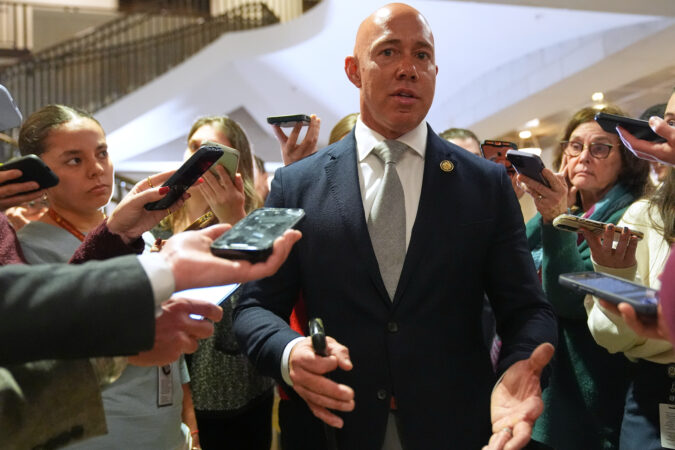
    Rep. Brian Mast, the Republican chair of the House Armed Services Committee, accused Democrats of bringing the war powers resolution to a vote out of “spite” for Trump.

    “It’s about the fact that you don’t want President Trump to arrest Maduro, and you will condemn him no matter what he does, even though he brought Maduro to justice with possibly the most successful law enforcement operation in history,” Mast added.

    Still, Democrats stridently argued that Congress needs to assert its role in determining when the president can use wartime powers. They have been able to force a series of votes in both the House and Senate as Trump in recent months ramped up his campaign against Maduro and set his sights on other conflicts overseas.

    “Donald Trump is reducing the United States to a regional bully with fewer allies and more enemies,” New York Rep. Gregory Meeks, the top Democrat on the House Foreign Affairs Committee, said during a floor debate. “This isn’t making America great again. It’s making us isolated and weak.”

    Last week, Senate Republicans were only able to narrowly dismiss a Venezuela war powers resolution after the Trump administration persuaded two Republicans to back away from their earlier support. As part of that effort, Secretary of State Marco Rubio committed to a briefing next week before the Senate Foreign Relations Committee.

    Response to Trump’s foreign policy

    When the House voted on a similar Venezuela war powers resolution last month, three Republican House members — Reps. Don Bacon of Nebraska, Thomas Massie of Kentucky, and Marjorie Taylor Greene of Georgia, who has since resigned from Congress — joined Democrats in voting for the legislation. Trump has since carried out the attack on Venezuela to seize Maduro, as well as turned his ambitions to possessing Greenland.

    Trump’s insistence that the U.S. will possess Greenland over the objections of Denmark, a NATO ally, has alarmed some Republicans on Capitol Hill. They have mounted some of the most outspoken objections to almost anything the president has done since taking office.

    Trump this week backed away from military and tariff threats against European allies as he announced that his administration was working with NATO on a “framework of a future deal” on Arctic security.

    But Bacon still expressed frustration with Trump’s aggressive foreign policy and planned to vote for the war powers resolution, even though it only applies to Venezuela.

    “I’m tired of all the threats,” he said.

    Trump’s recent military actions — and threats to do more — have reignited a decades-old debate in Congress over the War Powers Act, a law passed in the early 1970s by lawmakers looking to claw back their authority over military actions.

    The war powers debate

    The War Powers Resolution was passed in the Vietnam War era as the U.S. sent troops to conflicts throughout Asia. It attempted to force presidents to work with Congress to deploy troops if there hasn’t already been a formal declaration of war.

    Under the legislation, lawmakers can also force votes on legislation that directs the president to remove U.S. forces from hostilities.

    Presidents have long tested the limits of those parameters, and Democrats argue that Trump in his second term has pushed those limits farther than ever.

    The Trump administration left Congress in the dark ahead of the surprise raid to capture Maduro. It has also used an evolving set of legal justifications to blow up alleged drug boats and seize sanctioned oil tankers near Venezuela.

    Democrats question benefits from Venezuelan oil licenses

    As the Trump administration oversees the sale of Venezuela’s petroleum worldwide, Senate Democrats are questioning who is benefitting from the contracts.

    In one of the first transactions, the U.S. granted Vitol, the world’s largest independent oil broker, a license worth roughly $250 million. A senior partner at Vitol, John Addison, gave roughly $6 million to Trump-aligned political action committees during the presidential election, according to donation records compiled by OpenSecrets.

    “Congress and the American people deserve full transparency regarding any financial commitments, promises, deals, or other arrangements related to Venezuela that could favor donors to the President’s campaign and political operation,” 13 Democratic senators wrote to White House Chief of Staff Susie Wiles Thursday in a letter led by Democratic Sen. Adam Schiff of California.

    The White House has said it is safeguarding the South American country’s oil for the benefit of both the people of Venezuela and the U.S.

  • Trump appointees ask about White House ballroom’s design and scale — and want to see models

    Trump appointees ask about White House ballroom’s design and scale — and want to see models

    Some of Donald Trump’s handpicked appointees who have a say in his White House ballroom project asked questions Thursday about its “immense” design and scale, even as they broadly endorsed the president’s vision for a massive expansion.

    The Commission on Fine Arts discussion, which also included a brief review of mostly negative public comments on Trump’s plans, revealed no immediate threat to Trump’s overall idea, which historic preservationists are separately asking a federal court to slow down. But it demonstrated the sensitivity and political controversy involved since the president approved the demolition of the East Wing after unveiling designs that would more than double the square footage the White House as it was before.

    “This is an important thing to the president. It’s an important thing to the nation,” said the new Fine Arts chairman, Rodney Mims Cook Jr., in the panel’s first public hearing on Trump’s proposal.

    “You can’t have the United States of America entertaining people in tents,” Cook said, noting that administrations long before Trump complained about having to host State Dinners and major events in temporary structures. The question, the chairman added, is “if we can do this in a way that this building remains” true to its fundamental character and still “take care of what the president wants us to do.”

    3D scale models requested by Fine Arts commissioners

    After lead architect Shalom Baranes presented renderings during Thursday’s online meeting, commissioners asked him to return to a future, in-person session with 3D scale models of the White House complex with the proposed addition. Baranes said an in-person presentation, per commissioners’ request, also would include include scale models of the Treasury Department building to the east of the presidential mansion and the Eisenhower Executive Office Building to the west.

    Baranes and commissioners alike came into meeting aware of concerns about the project’s scale and whether it can be incorporated well enough into the White House, even as Trump remains undeterred.

    “President Trump is working 24/7 to Make America Great Again, including his historic beautification of the White House,” said West Wing spokesman Davis Ingle.

    The total addition would be almost 90,000 square feet, Baranes confirmed, with 22,000 of that the ballroom itself. The White House was about 55,000 square feet before the East Wing, first built in 1902 and expanded in the 1940s, was demolished.

    Thomas Luebke, the commission’s executive director, told the group that public comments received online ahead of the meeting were “almost all” negative “in some way,” criticizing the process, the design or both.

    Luebke read one comment that he described as “more positive” because it complimented the design and style shown in renderings. Yet even that commenter, Luebke said, wrote that “the scale appears oversized, making the main structure dominated.” Nodding to the criticism, Baranes emphasized that current plans call for the addition’s north boundary to be set back from the existing North Portico — essentially the front porch — and for the top of the new structure to be even with the primary facade of the White House and its residence.

    The view of the White House

    Baranes, whose firm has worked on other federal buildings, said this is to ensure the view of the White House from Pennsylvania Avenue would not change fundamentally. A new east side colonnade connecting the main structure to the ballroom addition also would be two stories, rather than the single story that was demolished. This would add to the continuity of the new design, Baranes said.

    He added that architects have contemplated a similar second story atop the West Wing to address concerns about symmetry. But he said during questioning that is merely a concept. There has been no structural analysis of the existing West Wing, he said, to determine if it could support another level.

    Some commissioners said they appreciated Baranes’ effort to address scale and symmetry on the north side of the White House, which front Pennsylvania Avenue. But they noted that still doesn’t address how much the design might change the view from the South Lawn. Renderings show a 10-column, multistory porch on the south side of the addition that looks more like the Treasury Department edifice than any part of the White House.

    “It’s immense,” Cook said to Baranes. “If the president just wants cover, do you think you might be able to tone down that element?”

    The architect answered: “We looked at ways of covering it at different scales with different numbers of columns, and there’s a president’s desire to proceed with this one.”

    The meeting Thursday was part of a series of meetings and public hearings with the Fine Arts panel and the National Capital Planning Commission, both of which have roles in assessing and approving federal construction projects in Washington.

    A judge could suspend the project

    Historic preservationists are seeking a court order for the Trump administration to suspend construction of its $400 million ballroom project. U.S. District Judge Richard Leon didn’t rule from the bench on Thursday after hearing arguments from attorneys for the government and the National Trust for Historic Preservation.

    Leon, who was nominated to the bench by Republican President George W. Bush, said he hopes to issue a decision sometime next month on the group’s request for a preliminary injunction. But he acknowledged that his decision likely will be appealed no matter how he rules.

    Plaintiff’s attorney Thad Heuer said the president — a temporary occupant of the White House — needed and didn’t have congressional approval before embarking on a project of this magnitude and cost.

    “He isn’t the landlord,” Heuer said. “He is a steward.”

    Government lawyer Jacob Roth argued that the president has the statutory authority and broad discretion to modify the White House. Stopping in the middle of the project would create problems, including security concerns for the president, Roth said.

    “I don’t think there’s any question that this modernization is in the public’s interest,” he told the judge.

  • House approves final spending bills as Democrats denounce ICE funding

    House approves final spending bills as Democrats denounce ICE funding

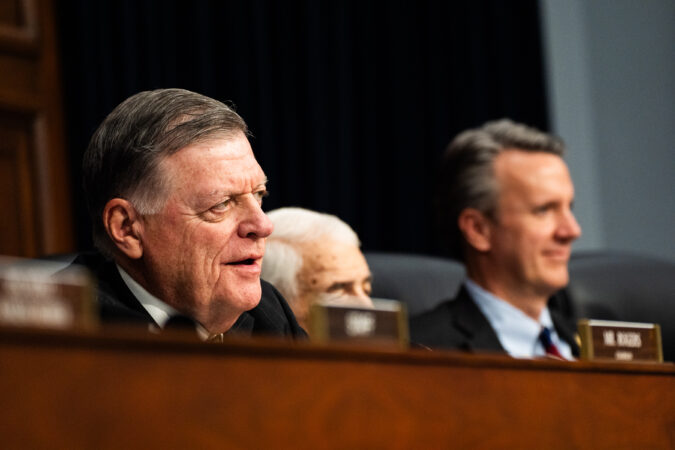
    WASHINGTON — The House passed this year’s final batch of spending bills on Thursday as lawmakers, still smarting from last fall’s record 43-day shutdown, worked to avoid another funding lapse for a broad swath of the federal government.

    The four bills total about $1.2 trillion in spending and now move to the Senate, with final passage needed next week before a Jan. 30 deadline to avoid a partial government shutdown.

    Three of the bills had broad, bipartisan support. They funded Defense and various other departments, including Education, Transportation and Health and Human Services. A fourth bill funding the Department of Homeland Security was hotly disputed as Democrats voiced concerns that it failed to restrain President Donald Trump’s mass deportation efforts.

    Republicans were able to overcome the Democratic objections and muscle the Homeland Security bill to passage in a 220-207 vote. The broader package, which funds a 3.8% pay raise for the military, passed in a 341-88 vote.

    Before the votes, House Democratic leaders announced their opposition to the Homeland Security bill as the party’s rank-and-file demanded a more forceful stand in response to the Republican president’s immigration crackdown. Trump’s efforts have recently centered in the Minneapolis area, where more than 2,000 officers are stationed and where a U.S. Immigration and Customs Enforcement officer fatally shot Renee Good, a mother of three.

    In a joint statement, the Democratic leaders said Trump promised the American people that his deportation policy would focus on violent felons in the country illegally, but instead, ICE has targeted American citizens and law-abiding immigrant families.

    “Taxpayer dollars are being misused to brutalize U.S. citizens, including the tragic killing of Renee Nicole Good. This extremism must end,” said the statement from Democratic leader Hakeem Jeffries, Democratic Whip Katherine Clark and Democratic Caucus Chair Pete Aguilar.

    Democrats had limited options

    Democrats had few good options to express their opposition to Homeland Security funding.

    Lawmakers, when confronting a funding impasse, generally turn to continuing resolutions to temporarily fund agencies at their current levels. But doing so in this case would simply cede more Homeland Security spending decisions to Trump, said Connecticut Rep. Rosa DeLauro, the top Democrat on the House Appropriations Committee.

    Also, there was concern that a failure to fund Homeland Security would hurt disaster assistance programs and agencies such as the Transportation Security Administration, while ICE and Customs and Border Protection would simply carry on. They could use funding from Trump’s big tax cut and immigration bill to continue their operations. ICE, which typically receives about $10 billion a year, was provided $30 billion for operations and $45 billion for detention facilities through Republicans’ “one big beautiful bill.”

    This year’s Homeland Security bill holds the annual spending that Congress provides ICE roughly flat from the prior year. It also restricts the ability of Homeland Security Secretary Kristi Noem to unilaterally shift funding and allocate federal dollars as she sees fit. The bill also allocates $20 million for the purchase and operations of body cameras for ICE and CBP officers interacting with the public during immigration enforcement operations. And it will require Homeland Security to provide monthly updates on how it plans to spend money from Trump’s bill.

    “It’s not everything we wanted. We wanted more oversight. But look, Democrats don’t control the House. We don’t control the Senate or the White House. But we were able to add some oversight over Homeland,” said Rep. Henry Cuellar (D., Texas), a member of the Appropriations panel.

    Republicans countered that the Homeland Security bill helps lawmakers accomplish their most important duty — keeping the American people safe.

    “This legislation delivers just that and upholds the America first agenda,” said Rep. Tom Cole, the Republican chairman of the House Appropriations Committee.

    Republicans also celebrated the avoidance of a massive, catchall funding bill known as an omnibus as part of this year’s appropriations process. Such bills, often taken up before the holiday season with lawmakers anxious to return home, have contributed to greater federal spending, they say. This year’s effort, while a few months behind schedule, manages to keep non-defense spending just below current levels, they emphasized.

    “It sends a clear, powerful message back home — the House is back at work. We are back to governing,” said Rep. Mark Alford (R., Mo.).

    Anger on the House floor

    One by one, Democratic lawmakers lined up to voice their opposition to the Homeland Security bill with a particular focus on ICE, which has been rapidly hiring thousands of new deportation officers to carry out the president’s mass deportation agenda.

    Rep. Betty McCollum (D., Minn.) said residents of her state were being racially profiled on a mass scale and kidnapped from their communities.

    “Masked federal agents are seizing parents, yes, in front of terrified children,” McCollum said. “And many of these people we’re finding had no record and were here legally.”

    “I will not fund an agency that acts like an American gestapo,” said Rep. Jerrold Nadler (D., N.Y.).

    “This is about the political retribution of a vengeful president,” said Clark of Massachusetts. “I will not rubberstamp the federal government’s use of political violence against its own people and I ask every member to join me in voting no.”

    Cole decried some of the comments about ICE on the House floor.

    “It’s reckless, encouraging people to believe that we have masses of bad actors in a particular agency,” Cole said.

    In a last-minute add to the package, the House tacked on a provision that would repeal the ability of senators to sue the government over the collection of their cellphone data as part of special counsel Jack Smith’s investigation into the Jan. 6, 2021, attack on the Capitol.

    Senators had previously allowed suits claiming up to $500,000 in damages in an earlier funding bill, but the provision drew sharp criticism. The House unanimously agreed to block it.

  • Vance lands in Minneapolis blaming the ‘far left’ for turmoil over White House deportation efforts

    Vance lands in Minneapolis blaming the ‘far left’ for turmoil over White House deportation efforts

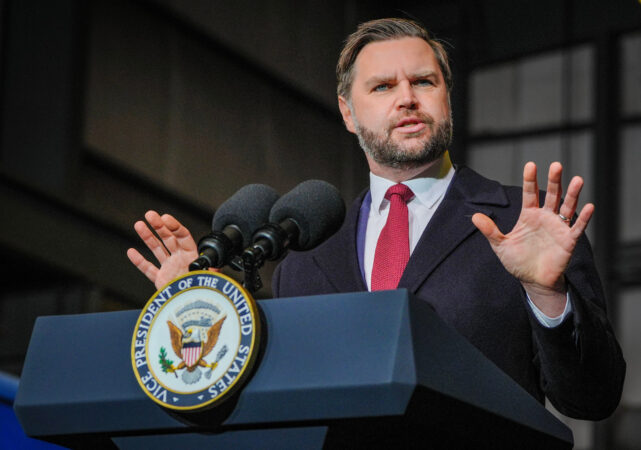
    MINNEAPOLIS — Insisting that he was in Minnesota to help “lower the temperature,” Vice President JD Vance on Thursday blamed “far-left people” and state and local law enforcement officials for the chaos that has convulsed the state during the White House’s aggressive deportation campaign.

    He also defended federal agents who detained a 5-year-old boy while making an immigration arrest.

    The recent turmoil “has been created, I think, by a lot of very, frankly, far-left people, also by some of the state and local law enforcement officials who could do a much better job in cooperating,” the Republican vice president said.

    “We’re doing everything that we can to lower the temperature,” Vance said, adding that he wants “state and local officials to meet us halfway.”

    The Justice Department is investigating Minnesota’s Democratic leaders, including Gov. Tim Walz and Minneapolis Mayor Jacob Frey, over whether they have obstructed or impeded law enforcement through their public statements. Walz and Frey have described the investigation as an attempt to bully the political opposition.

    Federal officers stood in a row behind Vance as he spoke, and there were two Immigrants and Customs Enforcement vehicles emblazoned with the slogan “Defend the Homeland.”

    His visit follows weeks of aggressive rhetoric from the White House, including President Donald Trump, who has threatened to invoke the Insurrection Act — and send in military forces — to crack down on unrest in the state. Asked about that option, Vance said, “Right now, we don’t think that we need that.”

    Trump dispatched thousands of federal agents to Minnesota after reports of child care fraud by Somali immigrants. Minneapolis-area officials, including Frey, as well as the police, religious leaders and the business community have pushed back, and outrage grew after an agent fatally shot Renee Good, a mother of three, during a confrontation this month.

    Vance defends actions by ICE agents

    Vance has played a leading role in defending that agent, and the vice president previously said Good’s death was “a tragedy of her own making.” On Thursday, he repeated claims that Good “rammed” an agent with her car, an account that has been disputed based on videos of the incident.

    Minnesota faith leaders, backed by labor unions and hundreds of Minneapolis-area businesses, are planning a day of protests Friday. Nearly 600 local business have announced plans to shut down, while hundreds of “solidarity events” are expected across the country, according to MoveOn spokesperson Britt Jacovich.

    Vance pushed back against such criticism and defended ICE agents who detained the young boy as he was arriving home from preschool.

    “When they went to arrest his illegal alien father, the father ran,” Vance said. “So the story is that ICE detained a 5-year-old. Well, what are they supposed to do?”

    The boy, who was taken by federal agents along with his father to a detention facility in Texas, was the fourth student from his Minneapolis suburb to be detained by immigration officers in recent weeks.

    During an appearance in Ohio earlier in the day, Vance praised the arrest of protesters who disrupted a church service in Minnesota on Sunday and said he expects more prosecutions to come. The protesters entered the church chanting “ICE out” and “Justice for Renee Good.”

    “They’re scaring little kids who are there to worship God on a Sunday morning,” Vance said. “Those people are going to be sent to prison so long as we have the power to do so.”

    He added: “Just as you have the right to protest, they have a right to worship God as they choose. And when you interrupt that, that is a violation of the law.”

    The economy and the midterms

    Vance’s stop in Ohio was focused primarily on bolstering the Republican administration’s positive economic message on the heels of Trump’s appearance at the World Economic Forum in Davos, Switzerland. The vice president also took the opportunity to boost some of Republicans’ important statewide candidates in this fall’s midterm elections, including gubernatorial contender Vivek Ramaswamy and U.S. Sen. Jon Husted.

    Convincing voters that the nation is in rosy financial shape has been a persistent challenge for Trump during the first year of his second term. Polling has shown that the public is unconvinced that the economy is in good condition and majorities disapprove of how Trump’s handling of foreign policy.

    Vance urged voters to be patient on the economy, saying Trump had inherited a bad situation from Democratic President Joe Biden.

    “You don’t turn the Titanic around overnight,” Vance said. “It takes time to fix what is broken.”

  • Federal officers detain a 5-year-old boy who school official says was used as ‘bait’

    Federal officers detain a 5-year-old boy who school official says was used as ‘bait’

    A 5-year-old boy arriving home from preschool in Minnesota was taken by federal agents along with his father to a detention facility in Texas, school officials and the family’s lawyer said, making him the fourth student from his Minneapolis suburb to be detained by immigration officers in recent weeks.

    Federal agents took Liam Conejo Ramos from a running car while it was in the family’s driveway on Tuesday afternoon, Columbia Heights Public Schools Superintendent Zena Stenvik said during a news conference Wednesday. The officers then told him to knock on the door to his home to see if other people were inside, “essentially using a 5-year-old as bait,” she said.

    Stenvik said the family has an active asylum case and has not been ordered to leave the country.

    “Why detain a 5-year-old?” she asked. “You cannot tell me that this child is going to be classified as a violent criminal.”

    Department of Homeland Security spokesperson Tricia McLaughlin said in a statement that “ICE did NOT target a child.”

    She said Immigration and Customs Enforcement was conducting an operation to arrest the child’s father, Adrian Alexander Conejo Arias, who McLaughlin said is from Ecuador and in the U.S. illegally. He ran, “abandoning his child,” she said.

    “For the child’s safety, one of our ICE officers remained with the child while the other officers apprehended Conejo Arias,” McLaughlin said, adding that parents are given the choice to be removed with their children or have them placed with a person of their choosing.

    Liam Conejo Ramos, 5, is detained by U.S. Immigration and Customs Enforcement officers after arriving home from preschool Tuesday in a Minneapolis suburb.

    Stenvik said another adult who lives at the home was outside when the father and son were taken, but agents wouldn’t leave Liam with that person. DHS didn’t immediately respond to an email Thursday asking if Conejo Arias had asked to keep his son with him.

    Liam and his father were being held in a family holding cell in Texas, Marc Prokosch, the family’s lawyer, said during the news conference.

    “Every step of their immigration process has been doing what they’ve been asked to do,” Prokosch said of the family’s asylum claim. “So this is just cruelty.”

    During a Thursday visit to Minneapolis where he met with local leaders, Vice President JD Vance said he heard the “terrible story” about Liam but later learned the boy was only detained, not arrested.

    “Well, what are they supposed to do? Are they supposed to let a 5-year-old child freeze to death? Are they not supposed to arrest an illegal alien in the United States of America?” said Vance, noting that he’s the parent of a 5-year-old.

    Vance wasn’t asked about why immigration officers allegedly wouldn’t leave the boy with the other adult who lives at the home and offered to take him.

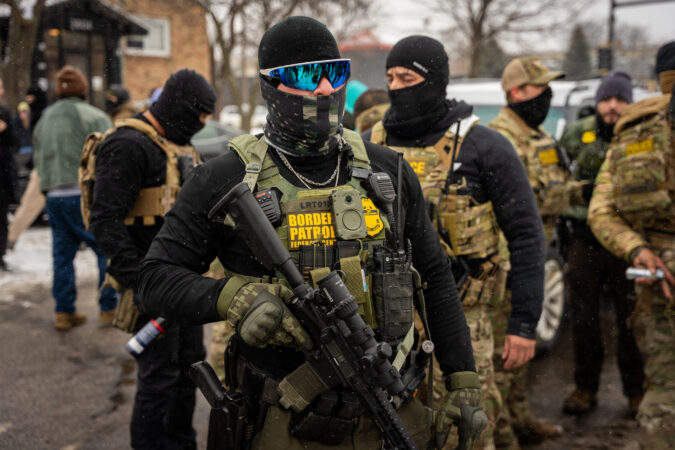
    Minnesota has become a major focus of immigration sweeps by DHS-led agencies. Greg Bovino, a U.S. Customs and Border Protection official who has been the face of the crackdowns in Minneapolis and other cities, said immigration officers have made about 3,000 arrests in Minnesota in the last six weeks.

    Julia Decker, policy director at the Immigrant Law Center of Minnesota, said advocates have no way of knowing whether the government’s arrest numbers and descriptions of the people in custody are accurate.

    Liam is the fourth student from Columbia Heights Public Schools who has been detained by ICE in recent weeks, said Stenvik. A 17-year-old student was taken Tuesday while heading to school, and a 10-year-old and a 17-year-old have also been taken, she said.

    The district is made up of five schools and about 3,400 students from pre-K to 12th grade, according to its website. The majority of the students come from immigrant families, according to Stenvik.

    She said they’ve noticed their attendance drop over the past two weeks, including one day where they had about one-third of their students out from school.

    Ella Sullivan, Liam’s teacher, described him as “kind and loving.”

    “His classmates miss him,” she said. “And all I want is for him to be safe and back here.”

  • Venezuela opens debate on an oil sector overhaul as Trump seeks role for U.S. firms

    Venezuela opens debate on an oil sector overhaul as Trump seeks role for U.S. firms

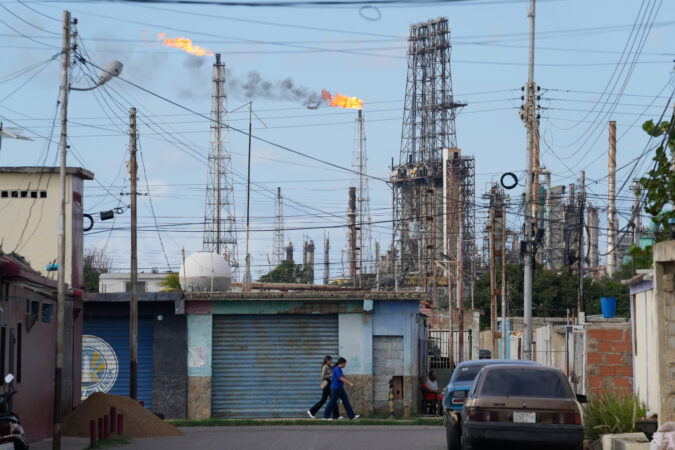
    CARACAS, Venezuela — Venezuela’s legislature opened debate Thursday on a bill to loosen state control over the country’s vast oil sector in the first major overhaul since the late socialist leader Hugo Chávez nationalized parts of the industry in 2007.

    The legislation would create new opportunities for private companies to invest in the oil industry and establish international arbitration for investment disputes.

    Following the U.S. capture of former President Nicolás Maduro earlier this month, the Trump administration has ramped up pressure on acting President Delcy Rodríguez and other allies of the ousted leader to invite greater investment from U.S. energy companies in Venezuela’s flagging oil industry.

    A draft of the proposed legislation, a copy of which was seen by The Associated Press, represents a sharp turn away from the resource nationalism of Chávez, who accused multinationals of colonial exploitation and considered the country’s oil wealth to be state property.

    In apparent response to demands from U.S. oil executives, the proposed legislation would allow private companies to independently operate oil fields, market their own crude output and collect the cash revenues despite remaining, on paper, minority partners to the state oil company.

    “The operating company shall assume the comprehensive management of the execution of the activities, at its sole cost, expense and risk,” the draft says, adding that portions of production volumes “may be directly commercialized by the operating company, once governmental obligations have been fulfilled.”

    Crucially, the bill also would let companies settle legal disputes through arbitration in international courts rather than only local courts.

    The legislation also would keep the current 30% royalty rate, but let the government cut royalties and taxes to as low as 15% for expensive or hard-to-develop oil projects, so that companies would be more willing to invest.

    The president of Venezuela’s National Assembly and the acting president’s brother, Jorge Rodríguez, told lawmakers at the start of Thursday’s debate that the bill aims to “allow an accelerated increase in production” of oil in Venezuela.

    “Oil under the ground is useless,” he said, referring to the need to boost oil production and open up new exploration opportunities.

    Pushed by Delcy Rodríguez, the bill is expected to advance swiftly through the ruling party-dominated legislature. Lawmakers concluded the initial discussion of the bill on Thursday after around two hours and advanced the legislation to a second round of debate, yet to be scheduled.

    During the session, Orlando Camacho, a lawmaker and head of Venezuela’s national Fedeindustria business association, told the assembly that the bill would ensure that Venezuela’s oil industry “remains the engine of the country.”

    The proposed legal guarantees — ensuring that foreign companies can bring claims against Venezuela before international bodies — are necessary to attract private investment, he said.

    Even as President Donald Trump looks to lure American companies to reboot Venezuela’s oil sector, many remain concerned about the financial and legal risks of pouring billions of dollars into the country.

    Plenty of investors have been burned before, their assets seized as Chávez nationalized parts of Venezuela’s lucrative oil industry in 2007. Firms like Exxon have been trying to get the Venezuelan government to compensate them for their billions of dollars in losses ever since, to no avail.

    The current political uncertainty also worries investors. There is no timeline for holding democratic elections in Venezuela after Maduro’s ouster as Rodríguez, long Maduro’s loyal second in command, seeks to consolidate control. The Trump administration also hasn’t said when it will lift the crippling sanctions imposed to weaken Maduro’s government, which further restrict foreign operations in the country’s oil sector.

  • 3 people involved in a Minnesota church protest are arrested

    3 people involved in a Minnesota church protest are arrested

    MINNEAPOLIS — A prominent civil rights attorney and at least two other people involved in an anti-immigration enforcement protest that disrupted a service at a Minnesota church have been arrested, Trump administration officials said Thursday, even as a judge rebuffed related charges against journalist Don Lemon.

    The developments unfolded as Vice President JD Vance arrived in the state.

    Attorney General Pam Bondi announced the arrest of Nekima Levy Armstrong in a post on X. On Sunday, protesters entered the Cities Church in St. Paul, where a local official with U.S. Immigration and Customs Enforcement serves as a pastor. Bondi later posted on X that a second person had been arrested, followed by a third arrested announced by FBI Director Kash Patel.

    The Justice Department quickly opened a civil rights investigation after the group interrupted services by chanting “ICE out” and “Justice for Renee Good,” referring to the 37-year-old mother of three who was fatally shot by an ICE officer in Minneapolis earlier this month.

    “Listen loud and clear: WE DO NOT TOLERATE ATTACKS ON PLACES OF WORSHIP,” the attorney general wrote on X.

    Cities Church belongs to the Southern Baptist Convention and lists one of its pastors as David Easterwood, who leads the local ICE field office. Many Baptist churches have pastors who also work other jobs.

    Attorneys representing the church hailed the arrests.

    “The U.S. Department of Justice acted decisively by arresting those who coordinated and carried out the terrible crime,” said Doug Wardlow, director of litigation for True North Legal, which calls itself a public interest civil rights firm, in a statement.

    Meanwhile, a magistrate judge rejected federal prosecutors’ bid to charge Lemon related to the church protest, a person familiar with the matter said Thursday.

    The person spoke on the condition of anonymity because they were not authorized to publicly discuss the ongoing investigation.

    Lemon, a former NBC10 reporter and anchor, was among those on who entered the church. Lemon has said he is not affiliated with the protest organizers and was there chronicling as a journalist.

    “Once the protest started in the church we did an act of journalism which was report on it and talk to the people involved, including the pastor, members of the church and members of the organization,” Lemon said in a video posted on social media. “That’s it. That’s called journalism.”

    It wasn’t immediately clear what the Justice Department would do after the judge’s decision. Authorities could return to a magistrate judge to again seek a criminal complaint or an indictment against Lemon before a grand jury.

    CNN, which fired Lemon in 2023, first reported the ruling.

    Vance threatens the protesters with prison

    Levy Armstrong, a civil rights attorney and prominent local activist, had called for the pastor affiliated with ICE to resign, saying his dual role poses a “fundamental moral conflict.”

    “You cannot lead a congregation while directing an agency whose actions have cost lives and inflicted fear in our communities,” she said Tuesday. “When officials protect armed agents, repeatedly refuse meaningful investigation into killings like Renee Good’s, and signal they may pursue peaceful protesters and journalists, that is not justice — it is intimidation.”

    Prominent leaders of the Southern Baptist Convention have come to the church’s defense, arguing that compassion for migrant families affected by the crackdown cannot justify violating a sacred space during worship.

    Vance, speaking in Toledo ahead of his Minnesota visit, warned the church protesters: “Those people are going to be sent to prison so long as we have the power to do so. We’re going to do everything we can to enforce the law.”

    Arrests follow DOJ civil rights investigation

    A longtime activist in the Twin Cities metropolitan area, Levy Armstrong has helped lead local protests after the high-profile police-involved killings of Black Americans, including George Floyd, Philando Castile and Jamar Clark. She is a former president of the NAACP’s Minneapolis branch.

    Homeland Security Secretary Kristi Noem posted a photo on X of Levy Armstrong with her arms behind her back next to a person wearing a badge. Noem said she faces a charge under a statute that bars threatening or intimidating someone exercising a right.

    FBI Director Kash Patel posted on X that Chauntyll Louisa Allen, the second person Bondi said was arrested, is charged under the Freedom of Access to Clinic Entrances Act, which prohibits physically obstructing or using the threat of force to intimidate or interfere with a person seeking reproductive health services or seeking to participate in a service at a house of worship. Patel said William Kelly has also been arrested.

    It’s unclear which attorneys would represent Allen and Kelly.

    Saint Paul Public Schools, where Allen is a member of the board of education, is aware of her arrest but will not comment on pending legal matters, according to district spokesperson Erica Wacker.

    Allen and Levy Armstrong are part of a community of Black Minnesota activists who have protested the deaths of African Americans at the hands of police.

    Kelly defended the protest during a news conference Tuesday, criticizing the church for its association with a pastor who works for ICE.

    The Justice Department’s swift investigation into the church protest stands in contrast to its decision not to open a civil rights investigation into the killing of Good. Deputy Attorney General Todd Blanche said last week there was “no basis” for a civil rights investigation into her death.

    Administration officials have said the officer acted in self-defense and that the driver of the Honda was engaging in “an act of domestic terrorism” when she pulled toward him. But the decision not to have the department’s Civil Rights Division investigate marked a sharp departure from past administrations, which have moved quickly to probe shootings of civilians by law enforcement officials.

    The Justice Department has separately opened an investigation into whether Minnesota officials impeded or obstructed federal immigration enforcement though their public statements. Prosecutors this week sent subpoenas to the offices of Gov. Tim Walz, Attorney General Keith Ellison, Minneapolis Mayor Jacob Frey, St. Paul Mayor Kaohly Her and officials in Ramsey and Hennepin counties, according to a person familiar with the matter.

    VP visits Minnesota

    Vance, a Republican, arrived amid tense interactions between federal immigration law enforcement authorities and residents. State and local elected officials have opposed the crackdown that has become a major focus of Department of Homeland Security sweeps.

    His visit comes less than a month after Good was killed. He has called Good’s death a “tragedy of her own making.”

    Vance said early Thursday that the “far left” has decided the U.S. shouldn’t have a border.

    “If you want to turn down the chaos in Minneapolis, stop fighting immigration enforcement and accept that we have to have a border in this country. It’s not that hard,” Vance said.

    A federal appeals court this week suspended a decision that barred immigration officers from using tear gas or pepper spray against peaceful protesters in Minnesota. The 8th U.S. Circuit Court of Appeals froze the ruling that had barred retaliation, including detaining people who follow agents in cars.

    After the court’s stay, U.S. Border Patrol official Greg Bovino, who has commanded the administration’s big-city immigration campaign, was seen on video repeatedly warning protesters on a snowy Minneapolis street “Gas is coming!” before tossing a canister that released green smoke into the crowd.

    Bovino, speaking Thursday during a news conference, urged better cooperation from local and state officials in Minnesota, and blamed an “influx of anarchists” for the anti-ICE sentiment.

    “The current climate confronting law enforcement … is not very favorable right now in Minneapolis,” he said. The Associated Press left messages for the Minneapolis Police Department requesting its response to Bovino’s comments.

  • Jack Smith defends his Trump investigations at a public congressional hearing

    Jack Smith defends his Trump investigations at a public congressional hearing

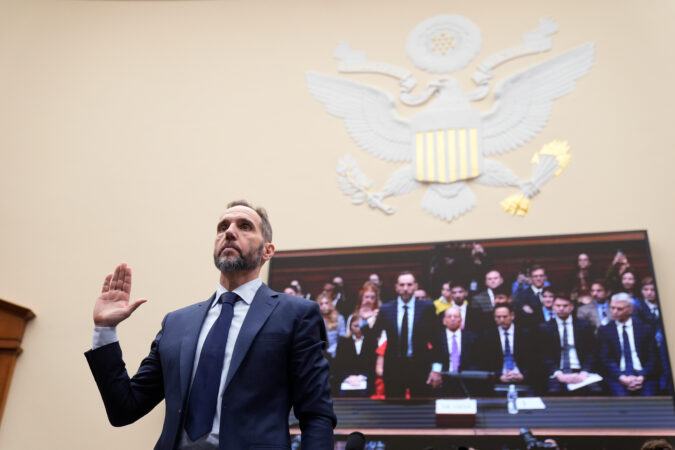
    WASHINGTON — Former Justice Department special counsel Jack Smith on Thursday defended his investigations of Donald Trump at a public congressional hearing in which he insisted that he had acted without regard to politics and had no second thoughts about the criminal charges he brought.

    “No one should be above the law in our country, and the law required that he be held to account. So that is what I did,” Smith said of Trump.

    Smith testified behind closed doors last month but returned to the House Judiciary Committee for a public hearing that provided the prosecutor with a forum to address Congress and the country more generally about the breadth of evidence he collected during investigations that shadowed Trump during the 2024 presidential campaign and resulted in indictments. The hourslong hearing immediately split along partisan lines as Republican lawmakers sought to undermine the former Justice Department official while Democrats tried to elicit damaging testimony about Trump’s conduct and accused their GOP counterparts of attempting to rewrite history.

    “It was always about politics,” said Rep. Jim Jordan of Ohio, the committee’s Republican chairman.

    “Maybe for them,” retorted Rep. Jamie Raskin, the panel’s top Democrat, during his own opening statement. “But, for us, it’s all about the rule of law.”

    The hearing was on the mind of Trump himself as he traveled back from the World Economic Forum in Davos, Switzerland, with the president posting on his Truth Social account that Smith was being “DECIMATED before Congress” — presumably reference to the Republican attacks he faced. Trump said Smith had “destroyed many lives under the guise of legitimacy.”

    Smith told lawmakers that he stood behind his decisions as special counsel to bring charges against Trump in separate cases that accused the Republican of conspiring to overturn the 2020 presidential election after he lost to Democrat Joe Biden and hoarding classified documents at his Mar-a-Lago estate in Palm Beach, Fla., after he left the White House.

    “Our investigation developed proof beyond a reasonable doubt that President Trump engaged in criminal activity,” Smith said. “If asked whether to prosecute a former president based on the same facts today, I would do so regardless of whether that president was a Republican or a Democrat.”

    Republicans, Smith spar over phone records

    Republicans from the outset sought to portray Smith as an overly aggressive, hard-charging prosecutor who had to be “reined in” by higher-ups and the courts as he investigated Trump. They also seized on revelations that the Smith team had collected and analyzed phone records of more than a half-dozen Republican lawmakers who were in contact with Trump on Jan. 6, 2021, as his supporters stormed the Capitol in a bid to halt the certification of his 2020 election loss.

    The records revealed the length and time of the calls but not the content of the communications, but Rep. Brandon Gill, a Texas Republican, said the episode showed how Smith had “walked all over the Constitution.”

    “My office didn’t spy on anyone,” Smith said, explaining that collecting phone records is a common prosecutorial tactic and necessary in this instance to help prosecutors understand the scope of the conspiracy.

    Smith describes a wide-ranging conspiracy on 2020

    Under questioning, Smith described what he said was a wide-ranging conspiracy to overturn the results of the election that Trump lost to Democrat Joe Biden and alleged how the Republican refused to listen to advisers who told him that the contest had in fact not been stolen. After he was charged, Smith said, Trump tried to silence and intimidate witnesses.

    Smith said one reason he felt confident in the strength of the case that prosecutors had prepared to take to trial was the extent to which it relied on Republican supporters of Trump.

    “Some of the most powerful witnesses were witnesses who, in fact, were fellow Republicans who had voted for Donald Trump, who had campaigned for him and who wanted him to win the election,” Smith said.

    The hearing unfolded against the backdrop of an ongoing Trump administration retribution campaign targeting the investigators who scrutinized the Republican president and amid mounting alarm that the Justice Department’s institutional independence is eroding under the sway of the president.

    In a nod to those concerns, Smith said: “I believe that if we don’t call people to account when they commit crimes in this context, it can endanger our election process, it can endanger election workers and, ultimately, our democracy.”

    Smith was appointed in 2022 by Biden’s Justice Department to oversee investigations into Trump, who has denied any wrongdoing. Both investigations produced indictments against Trump, but the cases were abandoned by Smith and his team after Trump won back the White House because of longstanding Justice Department legal opinions that say sitting presidents cannot be indicted.

    GOP says Smith wanted to wreck Trump’s White House bid

    Republicans for their part repeatedly denounced Smith, with California Rep. Kevin Kiley accusing him of seeking “maximum litigation advantage at every turn” and “circumventing constitutional limitations to the point that you had to be reined in again and again throughout the process.”

    Another Republican lawmaker, Rep. Ben Cline of Virginia, challenged Smith on his efforts to bar Trump from making incendiary comments about witnesses. Smith said the order was necessary because of Trump’s efforts to intimidate witness, but Cline asserted that it was meant to silence Trump in the heat of the presidential campaign.

    And Jordan, the committee chairman, advanced a frequent Trump talking point that the investigation was driven by a desire to derail Trump’s candidacy.

    “We should never forget what took place, what they did to the guy we the people elected twice,” Jordan said.

    Smith vigorously rejected those suggestions and said the evidence placed Trump’s actions squarely at the heart of a criminal conspiracy to undo the 2020 election.

    “The evidence here made clear that President Trump was by a large measure the most culpable and most responsible person in this conspiracy,” Smith said. “These crimes were committed for his benefit. The attack that happened at the Capitol, part of this case, does not happen without him. The other co-conspirators were doing this for his benefit.”

  • The decision to move ISIS prisoners from Syria to Iraq came at the request of Baghdad, officials say

    The decision to move ISIS prisoners from Syria to Iraq came at the request of Baghdad, officials say

    BAGHDAD — The decision to move prisoners of the Islamic State group from northeast Syria to detention centers in Iraq came after a request by officials in Baghdad that was welcomed by the U.S.-led coalition and the Syrian government, officials said Thursday.

    American and Iraqi officials told The Associated Press about the Iraqi request, a day after the U.S. military said that it started transferring some of the 9,000 IS detainees held in more than a dozen detention centers in northeast Syria controlled by the Kurdish-led Syrian Democratic Forces, or SDF, in northeast Syria.

    The move to start transferring the detainees came after Syrian government forces took control of the sprawling al-Hol camp — which houses thousands of mostly women and children — from the SDF, which withdrew as part of a ceasefire. Troops on Monday seized a prison in the northeastern town of Shaddadeh, where some IS detainees escaped and many were recaptured, state media reported.

    The SDF said on Thursday that government forces shelled al-Aqtan prison near the northern Syrian city of Raqqa with heavy weapons, while simultaneously imposing a siege around the prison using tanks and deploying fighters.

    Al-Aqtan prison, where some IS prisoners are held, was surrounded by government forces earlier this week and negotiations were ongoing on the future of the detention facility.

    Concerns about escapes

    With the push by government forces into northeast Syria along the border with Iraq, Baghdad became concerned that some of the detainees might become a danger to Iraq’s security, if they managed to flee from the detention centers amid the chaos.

    An Iraqi security official said that the decision to transfer the prisoners from Syria to Iraq was an Iraqi decision, welcomed by the U.S.-led coalition and the Syrian government. The official said that it was in Iraq’s security interest to detain them in Iraqi prisons rather than leaving them in Syria.

    Also Thursday, a senior U.S. military official confirmed to the AP that Iraq “offered proactively” to take the IS prisoners rather than the U.S. requesting it of them.

    A Syrian foreign ministry official said that the plan to transfer IS prisoners from Syria to Iraq had been under discussion for months before the recent clashes with the SDF.

    All three officials spoke on condition of anonymity because they weren’t authorized to comment publicly.

    Over the past several years, the SDF has handed over to Iraqi authorities foreign fighters, including French citizens, who were put on trial and received sentences.

    The SDF still controls more than a dozen detention facilities holding around 9,000 IS members, but is slated to hand the prisons over to government control under a peace process that also is supposed to eventually merge the SDF with government forces.

    U.S. Central Command said that the first transfer on Wednesday involved 150 IS members, who were taken from Syria’s northeastern province of Hassakeh to “secure locations” in Iraq. The statement said that up to 7,000 detainees could be transferred to Iraqi-controlled facilities.

    Iraq has beefed up patrols along its border with Syria. On Thursday, tanks lined up along the frontier in the northern province of Sinjar.

    Members of the Yazidi minority in Sinjar have been particularly fearful of a repeat of 2014 when IS militants overran the area and launched particularly brutal attacks on Yazidis, considered by the extremist group to be heretics. Militants killed Yazidi men and boys and sold women into sexual slavery or forced them to convert and marry militants.

    Stark warning

    IS declared a caliphate in 2014 in large parts of Syria and Iraq, attracting large numbers of fighters from around the world.

    The militant group was defeated in Iraq in 2017, and in Syria two years later, but IS sleeper cells still carry out deadly attacks in both countries. As a key U.S. ally in the region, the SDF played a major role in defeating IS.

    Also Thursday, the SDF accused the government of violating a four-day truce declared on Tuesday. It said Syrian government forces pounded the southern outskirts of the northern town of Kobani, which recently became besieged after the government’s push in the northeast over the past two weeks.

    A commander with the Kurdish women’s militia in Syria, speaking from inside Kobani, told reporters during an online news conference that living conditions there are deteriorating.

    Nesrin Abdullah of the Women’s Protection Units, or YPJ, said that if the fighting around Kobani continues, thousands of people “will be massacred.”

    She said that there was no electricity or running water in the town, which a decade ago became the symbol of resistance against IS. The militants at the time besieged it for months before being pushed back.

    “The people here are facing a genocide,” she said. “We have many people in hospitals, and hospitals cannot continue if there is no electricity.”

    U.N. Assistant Secretary-General Khaled Khiari told the U.N. Security Council Thursday that clashes were taking place in parts of Hassakeh province and also on the outskirts of Kobani, an enclave controlled by the SDF, and that the situation on the ground elsewhere was “very tense.”