Tag: no-latest

  • 8 backcountry skiers found dead and 1 still missing after California avalanche

    8 backcountry skiers found dead and 1 still missing after California avalanche

    NEVADA CITY, Calif. — Crews found the bodies of eight backcountry skiers near California’s Lake Tahoe and were searching for one more after they were caught in an avalanche, the nation’s deadliest in nearly half a century, authorities said Wednesday.

    Authorities said the skiers had little time to react.

    “Someone saw the avalanche, yelled avalanche, and it overtook them rather quickly,” said Capt. Russell “Rusty” Greene, of the Nevada County sheriff’s office.

    Six from the guided tour were rescued six hours after the avalanche hit Tuesday morning during a three-day trek in Northern California’s Sierra Nevada, as a monster winter storm pummeled the West Coast.

    Nevada County Sheriff Shannan Moon said investigators would look into the decision to proceed with the trip despite the forecast for relentless weather.

    Authorities have told the families the mission has moved from rescuing people to recovering bodies, Moon said during a news conference.

    The victims, including three guides, were found fairly close together, Greene said. The dead and missing include seven women and two men, ranging in ages from 30 to 55. The crews have not yet been able to remove the victims from the mountain because of the extreme conditions, the sheriff said.

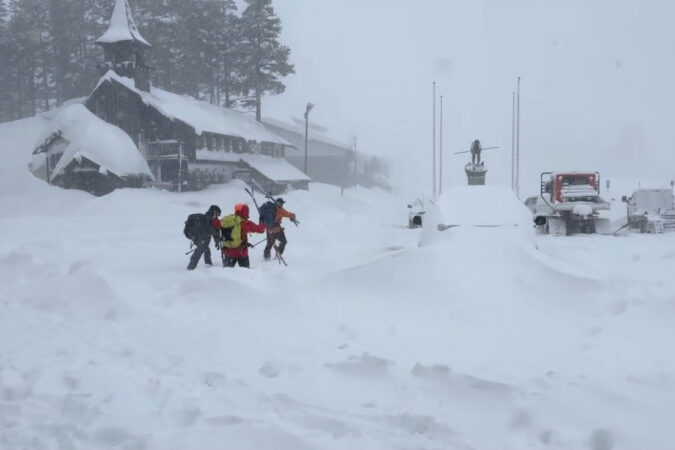
    Three to six feet of snow has fallen since Sunday, when the group started its trip. The area was also hit by subfreezing temperatures and gale force winds. The Sierra Avalanche Center said the threat of more avalanches remained Wednesday and left the snowpack unstable and unpredictable in an area known for its steep, craggy cliffs.

    Rescuers were guided by beacons and a cell phone in dangerous conditions

    Rescuers reached the survivors just before sunset on Tuesday.

    The skiers all had beacons that can send signals to rescuers and at least one of the guides was able to send texts, but it wasn’t clear if they were wearing avalanche bags, which are inflatable devices that can keep skiers near the surface, Greene said.

    While they waited to be rescued, the survivors used equipment to shelter themselves and fend off temperatures dipping below freezing. The survivors located three others who had died during the wait, Moon said.

    Rescuers used a snowcat to get within 2 miles of the survivors, then skied in carefully so they didn’t set off another avalanche, the sheriff said.

    One of those rescued remains in a hospital Wednesday, Moon said.

    The area near Donner Summit is one of the snowiest places in the Western Hemisphere and until just a few years ago was closed to the public. It sees an average of nearly 35 feet of snow a year, according to the Truckee Donner Land Trust, which owns a cluster of huts where the group was staying near Frog Lake.

    The avalanche is the deadliest in the U.S. since 1981, when 11 climbers were killed on Mount Rainier, Wash. Each winter, 25 to 30 people die in avalanches in the U.S., according to the National Avalanche Center.

    It was the second deadly avalanche near California’s Castle Peak this year, after a snowmobiler was buried by one in January.

    Skiers were heading for the trailhead when the avalanche struck

    Greene said authorities were notified about the avalanche by Blackbird Mountain Guides, which was leading the expedition, and the skiers’ emergency beacons. The sheriff’s office said Tuesday night that 15 backcountry skiers had been on the trip, not 16 as initially believed.

    One skier had pulled out at the last minute, Moon said.

    Authorities were waiting to release the victims’ names to give the families time. “They’re still reeling,” Moon said. “I could not imagine what they’re going through.”

    The skiers were on the last day of the backcountry trip and had spent two nights in the huts, said Steve Reynaud, an avalanche forecaster with the Sierra Avalanche Center. He said the area requires navigating rugged mountainous terrain. All food and supplies need to be carried to the huts.

    Reaching the huts in winter takes several hours and requires backcountry skills, avalanche training and safety equipment, the land trust says on its website.

    The area near Donner Summit was closed for nearly a century before it was reopened by the land trust and its partners in 2020. Donner Summit is named for the infamous Donner Party, a group of pioneers who resorted to cannibalism after getting trapped there in the winter of 1846-1847.

    Blackbird Mountain Guides said in a statement that the group, including four guides, was returning to the trailhead when the avalanche occurred.

    When asked what went through her mind as her staff and volunteers responded to the scene, Moon said she was hoping they would be able to make it there safely. Once they did, she said she was “immediately thinking of the folks that didn’t make it, and knowing our mission now is to get them home.”


  • Trump officials limit FEMA travel to disaster areas amid funding lapse, emails show

    Trump officials limit FEMA travel to disaster areas amid funding lapse, emails show

    The Department of Homeland Security has halted almost all travel amid the ongoing standoff over its funding, restricting the ability of hundreds of Federal Emergency Management Agency staff members to move in and out of disaster-affected areas, according to emails and documents obtained by the Washington Post.

    Much of the department ran out of money over the weekend after negotiations stalled between the White House and Democratic lawmakers over restrictions on federal immigration enforcement. It is normal for the department to stop employees from traveling across the country for various assignments, such as trainings, during a funding lapse, 10 current and former FEMA officials said. But it is unusual for a government shutdown to impede ongoing disaster recovery efforts, the officials explained, saying it further reflects sweeping policies instituted under Homeland Security Secretary Kristi L. Noem.

    Typically, FEMA staffers who work on disasters are able to travel to and from ongoing recovery projects regardless of DHS funding issues. And a current veteran officials said that disaster travel is always allowed because it is mission-critical.

    In a statement, DHS criticized Democratic lawmakers over the stalled funding negotiations and said the department and FEMA are coordinating closely to “ensure effective disaster response under these circumstances.”

    “During a funding lapse, FEMA prioritizes life safety and property protection. FEMA continues mission-essential operations for active disasters, including immediate response and critical survivor assistance,” FEMA spokesperson Daniel Llargués said in the statement. “While some non-essential activities will be paused or scaled back, FEMA remains committed to supporting communities and responding to incidents like Hurricane Helene.”

    Congressional Democrats have demanded new restrictions on federal immigration agents after federal personnel killed Alex Pretti and another U.S. citizen, Renée Good, in Minneapolis in January.

    On Tuesday night, DHS sent out an email ordering a stop to all travel, including for disaster-related work, sparking confusion across FEMA as teams continue to respond to 14 ongoing disaster declarations as a result of brutal winter storms that hit parts of the country last month. In another message obtained by the Post, a FEMA official said that “ALL travel stopped” and noted that 360 people who were slated to go to trainings and other assignments had to stand down. People who were supposed to deploy could begin some work virtually, but DHS now had to sign off on their in-person assignment, the message said.

    The next morning, officials within DHS and FEMA had to scramble and negotiate guidance for how disaster-specific workers could continue to travel, according to an official familiar with the situation.

    “In most cases, FEMA’s ability to deploy staff to active disaster response and recovery operations is not impacted by a DHS funding lapse,” said former FEMA administrator Deanne Criswell. “Those personnel are funded through the Stafford Act’s Disaster Relief Fund, which is specifically designed to ensure continuity of operations during emergencies. If DHS experiences a shutdown, FEMA employees supported by the Disaster Relief Fund should still be able to travel and carry out response missions.”

    Emails and documents obtained by the Post show that FEMA officials must submit a justification to DHS headquarters explaining why a staffer needs to travel during the funding lapse, including employees who are paid through the Disaster Relief Fund. Officials also have to state whether the travel is “mission essential,” meaning it involves the “safety of human life or protection of property.”

    “DHS imposing restrictions on FEMA’s ability to deploy our response/recovery workforce slows us down and limits our ability to respond quickly and effectively to the needs of impacted states and communities,” said one official in a region still cleaning up from the heavy onslaught of sleet and snow.

    According to one email sent Tuesday night, agency staff members currently deployed in another region that was hit particularly hard can continue assisting communities. But those who were slated to travel to these locations after Thursday can no longer do so. Employees who were on a rotation — perhaps home for a week to see family or go to the doctor — are not able to return to their job under the order.

    These rotations are critical to disaster work because they enable people who have been working nonstop to take a break and then come back to their work. FEMA is also required to relieve employees who have been working too long in a state where they do not live.

    In the email, FEMA staff members who had not yet begun their deployments or returns from rotation were directed to cancel their travel and notify their point of contact to “receive updated reporting instructions.”

    “Additional agencywide information will be forthcoming,” it read.

    The snag with some FEMA employees being unable to travel for disaster work, take breaks or relieve their colleagues adds to the beleaguered agency’s long list of operational issues since President Donald Trump took office for a second time and his appointees implemented significant changes in how the agency functions.

    The travel pause has also halted some of FEMA’s other critical work, such as leading exercises and assessments for emergency plans and procedures at nuclear facilities, and flood-mapping meetings with communities, according to an email obtained by the Post and an agency official familiar with the situation. That “will delay flood map updates, which directly impacts people waiting on new maps for any number of reasons,” the official said.

    As the winter storms barreled in last month, Noem, who has been spearheading many of FEMA’s staffing reductions and reforms, was particularly hands-on, embedding at the agency’s headquarters, hosting a call with governors to show her support and holding news conferences with FEMA staff members in front of maps laying out where the weather would hit.

    DHS also made a big push to pre-position teams, millions of ready-made meals and liters of water, blankets, and hundreds of generators in several states that were expected to be slammed.

    That’s why instituting travel restrictions when staffers are still working on these storm responses is even more frustrating, several current employees said.

    “They are just trying to make it hurt, and the only people they are hurting are survivors and FEMA employees,” one veteran official said. “They just pull new rules out every day.”

  • White House taps Jay Bhattacharya, CDC critic, to lead agency for now

    White House taps Jay Bhattacharya, CDC critic, to lead agency for now

    Jay Bhattacharya, a top Trump administration health official and an outspoken critic of the Centers for Disease Control and Prevention’s response to the coronavirus pandemic, will lead the CDC on an acting basis, according to four people who spoke on the condition of anonymity to describe personnel moves.

    Bhattacharya, who will continue his role as director of the National Institutes of Health, replaces Jim O’Neill, who had served as the CDC’s acting director. O’Neill, who had also served as the deputy secretary of the Department of Health and Human Services, will be nominated to run the National Science Foundation after he declined a potential ambassadorship to the Organization for Economic Cooperation and Development, two of the people said.

    The installation of Bhattacharya at the CDC is the latest move by the White House and Health Secretary Robert F. Kennedy Jr. to shake up HHS’s leadership team ahead of the midterms, as the Trump administration seeks to stabilize a department rattled by internal fights and controversial messages.

    The New York Times first reported that Bhattacharya would serve as the acting head of CDC, which is charged with protecting Americans from health threats and issues recommendations on vaccines and other public health matters. Trump officials have said they are planning to find a full-time CDC director, a post that requires Senate confirmation. Susan Monarez, who was confirmed as CDC director in July, was ousted less than a month later after clashing with Kennedy over his plans to change vaccine policies.

    Bhattacharya, a Stanford University physician and economist, rose to prominence during the pandemic by arguing that the government’s response to the outbreak was too harsh, a stance that put him at odds with public health leaders who said his proposals would imperil the most vulnerable Americans. He co-wrote the Great Barrington Declaration, which was published in October 2020 and called for an end to coronavirus shutdowns. The declaration drew rebukes from government officials — a clash that ultimately boosted his profile and helped draw the support of Kennedy, a fellow critic of the government’s pandemic response.

    “The CDC peddled pseudo science in the middle of a pandemic,” Bhattacharya wrote on X in 2024, criticizing agency leaders’ past claim that widespread masking could end the coronavirus outbreak.

    As CDC’s acting head, Bhattacharya is poised to oversee the agency’s vaccine recommendations, which have emerged as a political flash point as Kennedy has worked to roll them back over the objections of public health leaders. A KFF poll published this month found that 47% of U.S. adults now trust CDC for reliable information on vaccines, down from 85% in early 2020.

    Bhattacharya has said he supports vaccination for childhood diseases.

    “I think the best way to address the measles epidemic in this country is by vaccinating your children for measles,” Bhattacharya said at a Senate hearing this month.

    Bhattacharya and other NIH leaders in January also published a commentary in the journal Nature Medicine that criticized the public health response to the pandemic led by other agencies.

    “Many of the recommended policies, including lockdowns, social distancing, school closures, masking, and vaccine mandates, lacked robust confirmatory evidence and remain the subject of debate regarding their overall benefits and unintended consequences,” they wrote. “Where enforced, vaccine mandates contributed to decreased public confidence in routine voluntary immunizations.”

  • Ousted South Korean president faces death penalty in insurrection case

    Ousted South Korean president faces death penalty in insurrection case

    SEOUL — A South Korean court is set to issue its verdict Thursday in the insurrection case against the country’s impeached president, who declared martial law in an alleged power grab in late 2024, and now faces the death penalty or life imprisonment if convicted.

    The impeached president, Yoon Suk Yeol, has been on trial for his failed attempt to install a military-led government in the democratic country late one night in December 2024. Yoon is charged with numerous crimes, including organizing an insurrection — which under South Korean criminal law carries possible sentences of life imprisonment, with or without labor, or death.

    Prosecutors have requested the death sentence.

    The case marks a pivotal moment in South Korea’s relatively young democratic history, which dates to 1987 after a democratic uprising toppled a brutal military-led government under Chun Doo-hwan. Chun was sentenced to death in 1996 after being convicted on similar insurrection charges for seizing power during a coup in 1979. On appeal, the sentence was commuted to life imprisonment, and he was later pardoned.

    Yoon’s conviction would uphold the rule of law and reaffirm the nation’s democratic system and principles, democracy advocates and experts say.

    “The conviction of an ex-president demonstrates that no one is above the law,” said Andrew Yeo, a senior fellow at Brookings Institution’s Center for Asia Policy Studies in Washington, adding: “The conviction of Yoon through the judicial process reflects South Korea’s democratic resilience.”

    If convicted, Yoon, too, ultimately could be spared execution.

    South Korea has not carried out an execution since 1997 and is widely regarded as a country where, for all practical purposes, the death penalty is banned.

    A death sentence for Yoon, nonetheless, would be highly symbolic as delivering accountability for a head of state who went rogue and attempted to use military force to halt operations of the legislature, seize control of the National Election Commission and arrest political opponents.

    “In practical terms, a death sentence would almost certainly remain symbolic, but the symbolism would be immense,” said Hannah Kim, a political scientist at Sogang University in Seoul. “It would reflect a judicial judgment that a ‘palace coup’ led by the constitutional guardian of the state is not just political misconduct, but a direct attack on constitutional sovereignty and the democratic order.”

    A lesser sentence of life in prison would still convey the seriousness of Yoon’s actions but would reflect “a degree of pragmatism among the justices,” Yeo said, especially in a deeply polarized country still reeling from the fallout of the declaration of martial law.

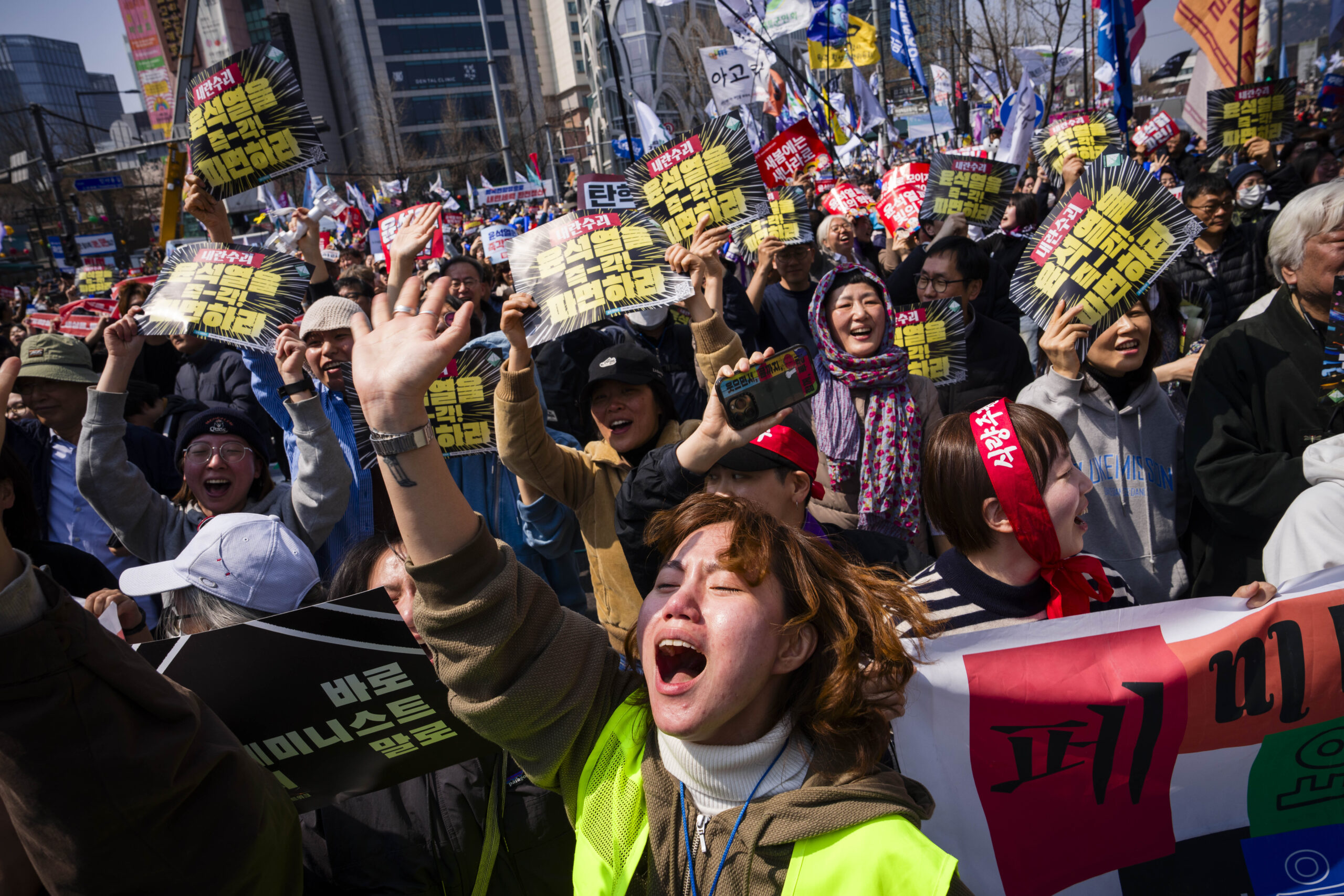
    Jeong Hye-won (center) and other protesters celebrate on April 4, 2025, in Seoul after the removal of Yoon from power by South Korea’s Constitutional Court.

    Two top aides to Yoon have been convicted on charges related to the decree of martial law. Former Prime Minister Han Duck-soo was sentenced last month to 23 years in prison for his role. Han is appealing the ruling. And former Interior Minister Lee Sang-min last week was sentenced to seven years in prison. He is also appealing the ruling, according to national media reports.

    In both cases, the court deemed the declaration of martial law an act of insurrection, which legal experts said was a key determination that could seal Yoon’s conviction Thursday.

    Yoon is facing eight separate trials stemming from his decree, but the insurrection case to be decided Thursday is the most consequential. Last month, a Seoul court sentenced him to five years in prison for abuse of power, obstruction of justice and falsifying documents, meaning Yoon will not go free even if acquitted.

    For many South Koreans, Yoon’s insurrection trial may feel familiar.

    Yoon is expected to stand in Courtroom 417 of the Seoul Central District Court, the same room where Chun, wearing a light blue prison jumpsuit, was sentenced to death nearly 30 years ago.

    During their sentencing request last month, prosecutors argued Yoon deserved the harshest possible penalty, citing the need to stop “history from repeating itself.” They referred to Chun’s case and South Korea’s authoritarian past.

    Yoon has denied all charges and contends that martial law was a legitimate exercise of the president’s emergency powers. Yoon has said that he declared martial law to confront the opposition-controlled National Assembly, which he said was paralyzing his administration through repeated efforts to impeach top officials. He has denied that the brief deployment of troops to the National Assembly was an act of insurrection.

    Yoon’s late-night decree on Dec. 3, 2024, made in a televised address, prompted thousands of protesters to mass outside the National Assembly and demand a return to democratic governance.

    As soldiers and police surrounded the National Assembly complex, lawmakers scaled the walls to bypass them. In defiance of the decree’s ban on political activity, they voted to reverse Yoon’s decision. And despite a gag order on the press, reporters from traditional and independent media alike flooded the scene and delivered live reports.

    Yoon lifted his order six hours later, but the incident shocked and outraged the nation — now a thriving democracy where political protests and marches of all stripes are a weekly occurrence — and it spurred South Korea’s most harrowing political crisis in decades.

    Yoon was impeached with his presidential powers suspended less than two weeks later, and ultimately removed from office.

    Yoon, formerly the nation’s top prosecutor, was a divisive president during his more than 2½ years in power. Rather than seeking to unify the deeply divided nation, Yoon instead appealed to his conservative base, exacerbating polarization and often deadlocking with opposition lawmakers.

    South Korean presidents are often disgraced. Nearly every president since South Korea’s democratization has become embroiled in scandals involving corruption, bribery, embezzlement, or abuse of power.

    Yoon’s downfall, however, stands apart even by South Korean standards, as the first democratically elected president to impose martial law and the first sitting president to face a criminal investigation.

  • Talks end in Geneva with no end to Russia’s war or hard-line demands

    Talks end in Geneva with no end to Russia’s war or hard-line demands

    U.S.-mediated talks between Moscow and Kyiv in Geneva, Switzerland, broke off on Wednesday without any significant progress or indication that Russia was ready to step back from its maximalist demands for subjugating Ukraine.

    The head of the Russian delegation, Vladimir Medinsky, tersely said the talks had been “difficult but businesslike” and had ended after just two hours of discussions on Wednesday following longer conversations the previous day.

    The reappearance of Medinsky, known to be a hard-line aide to Russian President Vladimir Putin, as head of the Kremlin’s delegation had signified that Russia was digging in its heels on core demands — including significant cuts to the Ukrainian military, the dismantling of Ukrainian President Volodymyr Zelensky’s government and guarantees for Ukraine’s neutrality, analysts said.

    Moscow has insisted that these steps are required to address what it describes as the “root causes” of the war. Ukraine’s position is that Russia’s invasion was unprovoked and that Moscow should end its illegal war of aggression and remove its troops that are occupying Ukrainian territory.

    Russian analysts said Moscow’s demands encompassed a far wider spectrum of issues than the territorial swaps proposed by President Donald Trump’s administration as a path to end the war.

    “As long as there is an armed anti-Russia on Ukrainian territory, there can be no peace,” said Sergei Markov, a pro-Kremlin political analyst. “I don’t think anyone had any big hopes that the talks would end in success. The positions are very, very far from each other.”

    “The idea of territorial swaps for peace is not Russia’s idea,” Markov added. “It is Trump’s.”

    Proponents of territorial exchanges envision that Russia would withdraw from some areas it occupies in Ukraine in exchange for Ukraine withdrawing its military from parts of the heavily fortified Donbas area, which Putin has failed to capture during four years of full-scale war.

    Zelensky’s administration has previously said it could agree to withdraw troops from the Donbas area. But Kyiv has said it would agree to a pullback only if the region becomes a demilitarized zone and if the United States first provides legally watertight security guarantees.

    Zelensky told reporters on Wednesday that the talks on “political” issues such as Russian demands for Ukraine to withdraw its forces from “the east” were “not easy” and that differences remain. But Zelensky also sought to put a positive spin on some of the trilateral discussions between Russia, the United States and Ukraine in Geneva, saying they had been “constructive” on ways to monitor any potential ceasefire.

    Zelensky appealed again at the Munich Security Conference over the weekend for U.S.-backed guarantees before he signs on to any deal with Russia to end the war. “Those guarantees answer the main question: how long there will be no war again,” he said then.

    The direct talks between Russia and Ukraine have stalled for weeks over core differences, namely territorial concessions, control of Europe’s largest nuclear power plant, which is occupied by Russia in Ukraine’s Zaporizhzhia region, and questions about Western guarantees for Kyiv, according to two European diplomats who spoke on the condition of anonymity to discuss sensitive diplomacy.

    “So far the Russian position is no boots on the ground from NATO allies, so there are outstanding points: territory, security guarantees and the future of the Zaporizhzhia plant,” one of those diplomats said. “Those are the big sticking points, so we need to see if it really happens.”

    In meetings with U.S. officials late last year, Ukraine’s chief European backers were encouraged by the U.S. interest in playing a role in securing a settlement to the war. France and Britain have led a coalition of allies planning ways to provide Ukraine with a U.S.-backed bulwark against future attack, including with some European troops and air or sea power.

    Still, the Trump administration appeared to want to sign a deal before fully committing, while Kyiv has maintained it needs the Western protection baked into any settlement, the diplomats said. Russia, meanwhile, has ruled out any presence of Western soldiers in Ukraine.

    Zelensky, who met with Secretary of State Marco Rubio over the weekend, has stressed Kyiv’s refusal to cede territory in the east that Russia does not militarily control and said Ukraine could only hold elections if there is a ceasefire.

    Analysts said it was clear the Kremlin had no intention of making any concessions.

    “As long as Putin is in power, Russia isn’t paralyzed by widespread protests, and there is at least some money left in the budget for weapons, the war will continue,” said Tatiana Stanovaya, a senior fellow at Carnegie Russia Eurasia Center, in a post on X. “The Kremlin will not make significant concessions even if faced with a protracted financial and economic crisis.”

    “That means there will be no final settlement either now or in the foreseeable future,” Stanovaya added. “Negotiations may intensify, a short-term ceasefire is possible, and documents may even be signed. But overall, this simulation of negotiations can only lead to the simulation of a ceasefire and the simulation of a settlement.”

    Russia has been facing increasing economic pressure after the U.S. administration imposed tough new sanctions on Russia’s two biggest oil companies, Rosneft and Lukoil, in October.

    The measures caused Russian oil revenue to plummet as Moscow was forced to accept discounts of more than $20 per barrel on its exports. Economists have warned of a nonpayment crisis as the economy grinds to a halt amid high inflation and high interest rates of 15.5% imposed by the Central Bank.

    Analysts say there are concerns in the Kremlin that Moscow could face a narrowing window to reach an advantageous deal because the Trump administration could grow distracted as midterm elections near — and then potentially could be weakened by the results.

  • Late-night host Stephen Colbert isn’t backing down from public dispute with CBS bosses

    Late-night host Stephen Colbert isn’t backing down from public dispute with CBS bosses

    Stephen Colbert isn’t backing down in an extraordinary public dispute with his bosses at CBS over what he can air on his late-night talk show.

    On The Late Show Tuesday, Colbert said he was surprised by a statement from CBS denying that its lawyers told him he couldn’t show an interview with Democratic Texas Senate candidate James Talarico — which the host said had happened the night before.

    He then took a copy of the network statement, wrapped it in a dog poop bag, and tossed it away.

    Colbert had instead shown his Talarico interview on YouTube, but told viewers why he couldn’t show it on CBS. The network was concerned about FCC Chairman Brendan Carr trying to enforce a rule that required broadcasters to give “equal time” to opposing candidates when an interview was broadcast with one of them.

    “We looked and we can’t find one example of this rule being enforced for any talk show interview, not only for my entire late-night career, but for anyone’s late-night career going back to the 1960s,” Colbert said.

    Although Carr said in January he was thinking about getting rid of the exemption for late-night talk shows, he hadn’t done it yet. “But CBS generously did it for him,” Colbert said.

    Not only had CBS been aware Monday night that Colbert was going to talk about this issue publicly, its lawyers had even approved it in his script, he said. That’s why he was surprised by the statement, which said that Colbert had been provided “legal guidance” that broadcasting the interview could trigger the equal time rule.

    “I don’t know what this is about,” Colbert said. “For the record, I’m not even mad. I really don’t want an adversarial relationship with the network. I’ve never had one.”

    He said he was “just so surprised that this giant global corporation would not stand up to these bullies.” CBS is owned by Paramount Global.

    Colbert is a short-timer now at CBS. The network announced last summer that Colbert’s show, where President Donald Trump is a frequent target of biting jokes, would end in May. The network said it was for economic reasons but others — including Colbert — have expressed skepticism that Trump’s repeated criticism of the show had nothing to do with it.

    This week’s dispute with Colbert also recalls last fall, when ABC took late-night host Jimmy Kimmel off the air for a remark made about the killing of conservative activist founder Charlie Kirk, only to reinstate him following a backlash by viewers.

    As of Wednesday morning, Colbert’s YouTube interview with Talarico had been viewed more than five million times, or roughly double what the comic’s CBS program draws each night. The Texas Democrat also reported that he had raised $2.5 million in campaign donations in the 24 hours after the interview.

  • Hospital price posting mostly benefits industry

    Hospital price posting mostly benefits industry

    Republicans think patients should be shopping for better healthcare prices. The party has long pushed to give patients money and let consumers do the work of reducing costs. After some GOP lawmakers closed out 2025 advocating to fund health savings accounts, President Donald Trump introduced his Great Healthcare Plan, which calls for, among other policies, requiring providers and insurers to post their prices “in their place of business.”

    The idea echoes a policy implemented during his first term, when Trump suggested that requiring hospitals to post their charges online could ease one of the most common gripes about the healthcare system — the lack of upfront prices. To anyone who’s gotten a bill three months after treatment only to find mysterious charges, the idea seemed intuitive.

    “You’re able to go online and compare all of the hospitals and the doctors and the prices,” Trump said in 2019 at an event unveiling the price transparency policy.

    But amid low compliance and other struggles in implementing the policy since it took effect in 2021, the available price data is sparse and often confusing. And instead of patients shopping for medical services, it’s mostly health systems and insurers using the little data there is, turning it into fodder for negotiations that determine what medical professionals and facilities get paid for what services.

    “We use the transparency data,” said Eric Hoag, an executive at Blue Cross Blue Shield of Minnesota, noting that the insurer wants to make sure providers aren’t being paid substantially different rates. It’s “to make sure that we are competitive, or, you know, more than competitive against other health plans.”

    Not all hospitals have fallen in line with the price transparency rules, and many were slow to do so. A study conducted in the policy’s first 10 months found only about a third of facilities had complied with the regulations. The federal Centers for Medicare & Medicaid Services notified 27 hospitals from June 2022 to May 2025 that they would be fined for lack of compliance with the rules.

    The struggles to make healthcare prices available have prompted more federal action since Trump’s first effort. President Joe Biden took his own thwack at the dilemma, by requiring increased data standardization and toughening compliance criteria. And in early 2025, working to fulfill his promises to lower health costs, Trump tried again, signing a new executive order urging his administration to fine hospitals and doctors for failing to post their prices. CMS followed up with a regulation intended to up the fines and increase the level of detail required within the pricing data.

    So far, “there’s no evidence that patients use this information,” said Zack Cooper, a health economist at Yale University.

    In 2021, Cooper co-authored a paper based on data from a large commercial insurer. The researchers found that, on average, patients who need an MRI pass six lower-priced imaging providers on the way from their homes to an appointment for a scan. That’s because they follow their physician’s advice about where to receive care, the study showed.

    Executives and researchers interviewed by KFF Health News also didn’t think opening the data would change prices in a big way. Research shows that transparency policies can have mixed effects on prices, with one 2024 study of a New York initiative finding a marginal increase in billed charges.

    The policy results thus far seem to put a damper on long-held hopes, particularly from the GOP, that providing more price transparency would incentivize patients to find the best deal on their imaging or knee replacements.

    These aspirations have been unfulfilled for a few reasons, researchers and industry insiders say. Some patients simply don’t compare services. But unlike with apples — a Honeycrisp and a Red Delicious are easy to line up side by side — medical services are hard to compare.

    For one thing, it’s not as simple as one price for one medical stay. Two babies might be delivered by the same obstetrician, for example, but the mothers could be charged very different amounts. One patient might be given medications to speed up contractions; another might not. Or one might need an emergency cesarean section — one of many cases in medicine in which obtaining the service simply isn’t a choice.

    And the data often is presented in a way that’s not useful for patients, sometimes buried in spreadsheets and requiring a deep knowledge of billing codes. In computing these costs, hospitals make “detailed assumptions about how to apply complex contracting terms and assess historic data to create a reasonable value for an expected allowed amount,” the American Hospital Association told the Trump administration in July 2025 amid efforts to boost transparency.

    Costs vary because hospitals’ contracts with insurers vary, said Jamie Cleverley, president of Cleverley and Associates, which works with healthcare providers to help them understand the financial impacts of changing contract terms. The cost for a patient with one health plan may be very different than the cost for the next patient with another plan.

    The fact that hospital prices might be confusing for patients is a consequence of the lack of standardization in contracts and presentation, Cleverley said. “They’re not being nefarious.”

    “Until we kind of align as an industry, there’s going to continue to be this variation in terms of how people look at the data and the utility of it,” he said.

    Instead of aiding shoppers, the federally mandated data has become the foundation for negotiations — or sometimes lawsuits — over the proper level of compensation.

    The top use for the pricing data for healthcare providers and payers, such as insurers, is “to use that in their contract negotiations,” said Marcus Dorstel, an executive at price transparency startup Turquoise Health.

    Turquoise Health assembles price data by grouping codes for services together using machine learning, a type of artificial intelligence. It is just one example in a cottage industry of startups offering insights into prices. And, online, the startups’ advertisements hawking their wares often focus on hospitals and their periodic jousts with insurers. Turquoise has payers and providers as clients, Dorstel said.

    “I think nine times out of 10 you will hear them say that the price transparency data is a vital piece of the contract negotiation now,” he said.

    Of course, prices aren’t the only variable that negotiations hinge on. Hoag said Blue Cross Blue Shield of Minnesota also considers quality of care, rates of unnecessary treatments, and other factors. And sometimes negotiators feel as if they have to keep up with their peers — claiming a need for more revenue to match competitors’ salaries, for example.

    Hoag said doctors and other providers often look at the data from comparable health systems and say, “‘I need to be paid more.’”

    KFF Health News is a national newsroom that produces in-depth journalism about health issues and is one of the core operating programs at KFF — the independent source for health policy research, polling, and journalism.

  • Letters to the Editor | Feb. 18, 2026

    Letters to the Editor | Feb. 18, 2026

    Are new voting rules needed?

    Regardless of frequently repeated claims, voter fraud is exceptionally rare, and the Safeguard American Voter Eligibility, or SAVE America Act, would only prevent an extremely small number of ineligible votes. While the GOP claims the SAVE Act is an attempt to preserve voter integrity, they know statistically that this will create difficulties for certain classes of voters who often vote for Democrats. Studies have shown, for example, that documentation requirements will place a disproportionate burden on communities of color and those with low incomes. Restrictions on vote by mail are likely to suppress the vote from hourly and shift workers, the elderly, those with disabilities, and people who do not have easy access to transportation to the polls. In this same vein, not allowing people to vote by mail forces them to vote in person, where in some places they may have to deal with voter intimidation and harassment (threats from others, long lines without water, etc.). For years, Republicans have pursued harsh penalties for poll workers — a move that may discourage participation by volunteers and slow down voting on Election Day, which may deter some folks from voting (again, long election lines).

    Let’s call it what it is: This is intentional voter suppression and an attack on our democracy.

    Kent Kingan, Malvern

    . . .

    The League of Women Voters is absolutely correct in stating that the SAVE America Act, just passed by the U.S. House of Representatives, would add a burden on voters to present documentary proof of citizenship and voter eligibility, a burden that could be substantial for many, to solve a problem that does not meaningfully exist. However, the organization goes too far in stating that Pennsylvania already has safeguards to ensure only eligible citizens vote, because federal law requires voters to attest to their citizenship when they register and “[e]lection officials verify identity and eligibility.” I have been a judge of elections in Philadelphia for more than a decade. With the exception of voters who must present identification because they have not previously voted in my election division, the only means election officials have to verify the identity and eligibility of someone seeking to vote is to ask for their name and address, confirm that that name and address is in our poll book of eligible voters, and then compare their signature with the signature that appears in the poll book, which is a copy of a signature recorded at the time the person with that name and address registered to vote. For some people, the two signatures are an easy match. But for others — indeed, the majority — not so much. This is especially the case with respect to people who registered years ago. And the problem has compounded since we started using electronic poll books, and voters are signing what is essentially an iPad, usually using a finger. Should I prohibit a person from voting because their signature on Election Day does not match the signature they recorded at the time they registered? Should I tell them they can only vote by provisional ballot? If I do not, can I honestly say I have verified the identity and eligibility of that person?

    Jeff Braff, Philadelphia

    Join the conversation: Send letters to letters@inquirer.com. Limit length to 150 words and include home address and day and evening phone number. Letters run in The Inquirer six days a week on the editorial pages and online.

  • Horoscopes: Wednesday, Feb. 18, 2026

    ARIES (March 21-April 19). Each group of people has its own little culture. Families, neighborhoods, workplaces, classrooms — all have rules worth learning, habits worth noticing, so you can decide to follow, bend or ignore them.

    TAURUS (April 20-May 20). Today’s theme: the intelligence in repetition. Routines conserve energy. Sure, there are a lot of different ways to play the day, but grooves come with momentum of their own and require much less of you.

    GEMINI (May 21-June 21). You can disagree without voicing it. And when you must voice it, you do so without provocation. That’s diplomacy: choosing negotiation over conflict, making agreements that protect everyone involved and presenting a unified front.

    CANCER (June 22-July 22). You help others through their feelings. You wish your loved ones were spared every bad feeling. If you could take it on instead, you totally would. And you really want the good feelings to last. You’re a true, strong ally, and they feel it.

    LEO (July 23-Aug. 22). People process experiences at different speeds. Some reflect quietly, some act quickly and some need time to sort through emotions before they respond. Today, someone doesn’t respond in the way you would, but they are feeling something similar inside.

    VIRGO (Aug. 23-Sept. 22). The job looks like it’ll be a real grind, but that’s OK. A grind has its benefits. The knife gets sharp, the stone is polished, and it’s how you make the coffee, the bread and, of course, the money.

    LIBRA (Sept. 23-Oct. 23). You’ll be proud of yourself for trusting in a slow accumulation process. Affection grows steadily. Savings add up. Work builds. Collections expand. Each careful decision stacks on the last. In a few months, you’ll have a tower of power.

    SCORPIO (Oct. 24-Nov. 21). Your focus is your superpower. It’s not about doing more than anyone else but about doing the exact thing that matters. You learn fast, study deeply and work without distraction. Your attention carries more weight than words ever could.

    SAGITTARIUS (Nov. 22-Dec. 21). You’re being pulled in two directions at once, which makes it more challenging to decide who and what should get your time. Just remember, there’s a third option: opt out and do what (SET ITAL)you(END ITAL) want.

    CAPRICORN (Dec. 22-Jan. 19). An unrelentingly positive attitude can be as toxic as negativity because it negates certain inalienable realities, such as gravity, shadows and human imperfection. Aim for realism with a 20% pump of hope — a perfect recipe.

    AQUARIUS (Jan. 20-Feb. 18). You’re no stranger to soft sales, attraction-based strategies, roundabout methods, paying your dues and various other routes to “manifesting.” But today’s most effective tactic for getting what you want is simpler: just ask.

    PISCES (Feb. 19-March 20). Quiet is a sanctuary. Yes, the sacred wisdom that visits the wooded trail, the cathedral and the library is rather obvious. But chaos can be its own kind of enlightening hum. Your instinct will find truth between the vibrations.

    TODAY’S BIRTHDAY (Feb. 18). Welcome to your Year of Dancing Lights, when fleeting moments sparkle into lasting wonder, taking forms such as lifelong friendship, gambles that pay for years and luck that fortifies your relationships and domestic life. Magic and serendipity are the norm. More highlights: playful romance, a creative success that feels almost fated and a paper deal or certificate that gives you financial security. Libra and Sagittarius adore you. Your lucky numbers are: 8, 27, 14, 39 and 5.

  • Dear Abby | Single woman finds herself drawn to her stalker

    DEAR ABBY: I am 57 and have never been married. I have had many relationships (some good, some bad). Although in the past I experienced heartbreaks, I am now open to meeting someone new.

    I recently ended a relationship with “Bill,” a man I met at a resort casino three years ago. I was happy in the beginning, until things started to take a turn.

    Because we go to the same places all the time, it was hard to break it off. I tried, but Bill would run back to me, and I always took him back, mostly because I felt guilty for hurting him. I finally ended things for good four months ago, after he did something very rude. A neighbor later told me that Bill was stalking me. Bill denies this, even though I have proof.

    Abby, I am writing because, for some reason, I’m still drawn to him. He’s the only man in my life who ever told me he loves me. I’m afraid no one will ever love me the way he does. I know the stalking is a sign that he is mentally unwell, yet we keep bumping into each other, which has caused this pull to want to be with him.

    I can’t afford therapy right now, so any advice you can give me to move beyond this “pull” I have for him would be appreciated.

    — HEART RULING THE HEAD

    DEAR HEART: Honey, if you no longer frequent the places you used to frequent together and keep running into him anyway, has it occurred to you that it’s happening BECAUSE HE’S STILL STALKING YOU? If you’re still going to the same places, it’s time to change your routine. This troubled individual may be the only person who has said “I love you,” but he won’t be the last if you open yourself to other relationships.

    You say you can’t afford therapy, but please be aware that free or low-cost counseling is available from your county’s department of mental health services or a local college or university with a psychology department.

    ** ** **

    DEAR ABBY: I’ve been talking to a famous pro wrestler who is having marriage problems. He has been hitting on me through Google Chat. I just want to be a supportive friend whom he can vent to. He says his wife “is getting too old for him,” if you know what I mean. They have a joint bank account, but he says it’s frozen. He has asked me for an Apple card. I told him no and to ask his extended family instead.

    Abby, I need my money to help out my brothers and sister. I’d prefer he be like a friend or big brother to me. I need major advice, please, because it feels like my life is going out of control.

    — UNCERTAIN IN IDAHO

    DEAR UNCERTAIN: People must exercise caution when communicating with strangers online. “Famous pro wrestlers” usually have enough money that they aren’t reduced to hitting up women they meet on the internet for Apple cards. Your life will not “go out of control” unless you allow it to. Regain control by ghosting and blocking this person. He’s a scammer, and he, not you, should figure out his own financial problems.