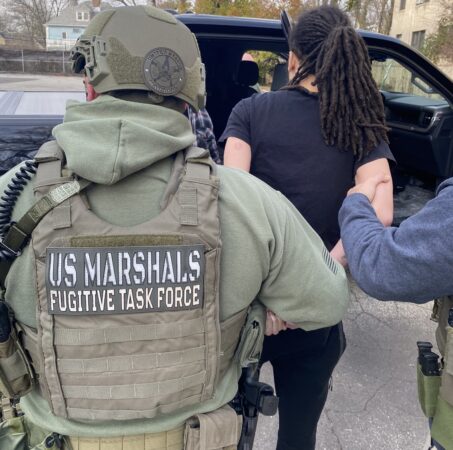
A North Philadelphia street-gang hit man wanted in connection with three killings, including the execution-style shooting of a 16-year-old boy, was taken into custody Wednesday morning in Delaware County, officials said.
Tyvine “Blumberg Eerd” Jones, 25, was apprehended by U.S. marshals in an apartment where he had been hiding at the Stratford Court complex in Lansdowne, authorities said. Jones was considered one of the city’s most wanted fugitives, and in October, marshals issued a $5,000 reward for information leading to his arrest.
Eric Gartner, the United States marshal for the Eastern District of Pennsylvania, said Jones’ “unrestrained existence serves only to diminish our great city,” and his arrest demonstrates the agency’s commitment to keep Philadelphians safe.
Investigators say Jones is a suspect in three slayings that took place between 2020 and 2022: the killings of Heyward Garrison, 16, Wesley Rodwell, 20, and Ryan Findley, 23.
Jones is a self-identified member of the Blumberg gang, which federal prosecutors say operates in the area around the now-shuttered Norman Blumberg Apartments on Oxford Street in North Philadelphia.
Members of the gang, including its onetime leader, Edward Stinson, have been convicted of drug trafficking in that area, and others have been tied to assaults and shootings.
Stinson, federal prosecutors wrote in court filings, ran a round-the-clock crack cocaine distribution ring that sucked in teenagers, single mothers, and other vulnerable people.
Like Jones, Watson, 21, was sought by investigators as a suspect in Garrison’s killing, but he was gunned down in an unrelated shooting after a year on the run.
Garrison was found shot multiple times in the back of a Honda Pilot parked near 22nd and Diamond Streets in August 2020.
Two years later, in May 2022, Rodwell was slain on Erie Avenue near 16th Street in a broad-daylight shooting.
And in September 2022, Findley was killed on Creston Street near Oakland in Oxford Circle.
Investigators say Jones was involved in all three killings. When announcing the reward for his arrest, Supervisory Deputy U.S. Marshal Robert Clark called Jones “the very worst society has to offer” and said he demonstrated a complete disregard for human life.
A judge said this week that arguments questioning the legality of Joyce Wilkerson’s seat on the Philadelphia school board had merit, and directed the board to halt nonrenewal proceedings for two charter schools.
Philadelphia Common Pleas Court Judge Christopher R. Hall granted a preliminary injunction to People for People Charter School and KIPP North Philadelphia Academy on Monday, saying that a lawsuit against the school board can continue because lawyers had presented sufficient evidence.
The charters claim that board member Wilkerson — who is perceived to be anti-charter schools — tainted the votes against them this year and should not be on the board.
City Council declined to approve Wilkerson last yearas a school board member, but Mayor Cherelle L. Parker asked her to serve until she named areplacement.
People for People’s initial lawsuit complaint, filed in September, said that Wilkerson is an “illegally and unlawfully seated member of the BOE” and that her participation in the nonrenewal deliberations tainted and ultimately invalidated them.
The city and the board have said that the city’s Home Rule Charter allows Wilkerson to continue to serve — without Council approval — until a replacement is named.
Reginald Streater, the school board president, said the ruling overshadows the underlying issues.
“The board’s decision to begin the process of nonrenewal was on the merits of each board member’s independent assessment of the schools’ outcomes,” Streater said in a statement. Board members’ concerns were aired publicly over months.
Any delay slows the board’s ability to give the schools full hearings, with testimony and the ability to present evidence, he said.
“Our schools, families, and children deserve resolution,” Streater said. “We remain committed to transparency and to continuing this work in the best interest of the community.”
(Nonrenewal does not equal closure, though it is the first step on that path. It triggers an extensive nonrenewal hearing, after which an officer makes a recommendation; then the board votes again on whether to non-renew the school.)
Lawyers for the charters argued that Wilkerson essentially poisoned the votes, and the judge wrote in his order that there was enough evidence to move forward with the injunction.
“This leaves the question whether Ms. Wilkerson’s participation in the pertinent BOE meetings without color of right tainted its vote [on the charter nonrenewals]. Plaintiffs have shown it likely did,” Hall wrote.
Hall’s order means that nonrenewal hearings cannot proceed, but the board had not yet scheduled them.
What was Wilkerson’s role on the People for People and KIPP votes?
Wilkerson, Hall noted in his order, “was the first to press” to issue a nonrenewal notice to the schools at a June board meeting, and in August called for a vote on the nonrenewal notice.
The KIPP North Philadelphia nonrenewal vote passed unanimously; board member Whitney Jones was the onlyvote against the People for People non-renewal.
But Wilkerson, a former school board president and School Reform Commission chair, was not the only board member with concerns about the two charter schools.
Board member Cheryl Harper said People for People is “failing our children. How long do we allow them to keep failing our children? I have an issue with these schools not being able to succeed for our children.”
Board vice president Sarah-Ashley Andrews cited issues with KIPP North Philadelphia’s “failure to deliver for our students,” specifically calling out its academics and suspension rates.
Streater, the board president, called KIPP’s performance “unacceptable.”
What’s next?
Thecourt case will now proceed, andis likely to drag on for months.
But Hall’s legal ruling on Wilkerson’s school board seat could mean open season for other parties that are unhappy with decisions the board has made and are willing to challenge those rulings legally.
As to whether Wilkerson will remain on the board, Parker has staunchly stood by her in the past.
When the People for People suit was first filed, a member of her administration said she stood by Wilkerson as “an official member of the Philadelphia Board of Education” who “has the full support of Mayor Cherelle L. Parker.”
What was the reaction?
Mark Seiberling, a lawyer for People for People, said the ruling was an important one.
“We are pleased with Judge Hall’s thoughtful and well-reasoned decision following a lengthy hearing at which multiple witnesses from the School District of Philadelphia were called to testify,” Seiberling said in a statement. “We look forward to Ms. Wilkerson’s replacement being nominated and confirmed in accordance with Philadelphia’s Home Rule Charter.”
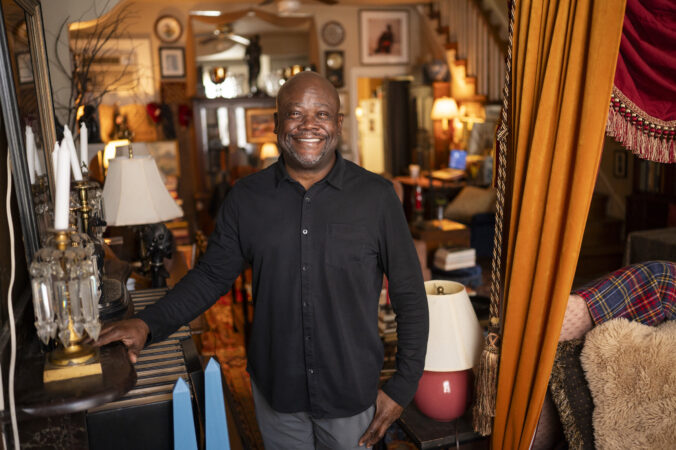
Before moving into his North Philadelphia home 13 years ago, Abel Tootle Jr. had rented small apartments, all under 800 square feet. He decided to make the leap to homeownership to pursue his passion for interior design and create a space that reflects his personal style.
“The timing was perfect,” said Tootle. And so, he moved into his circa-1910, three-bedroom, 1,200-square-foot house. Becoming a homeowner meant full freedom in designing his space — and no more lugging clothes to the laundromat, a feature of which he is most appreciative, he said.
His home’s look has been evolving since.
“I truly believe a home is never done. I was given every opportunity to paint, carpet, and design as I wish; however, I did not make any structural changes at all,” Tootle said. “My focus remains on creating a very English-country-house feel with special attention to my culture and interests.”
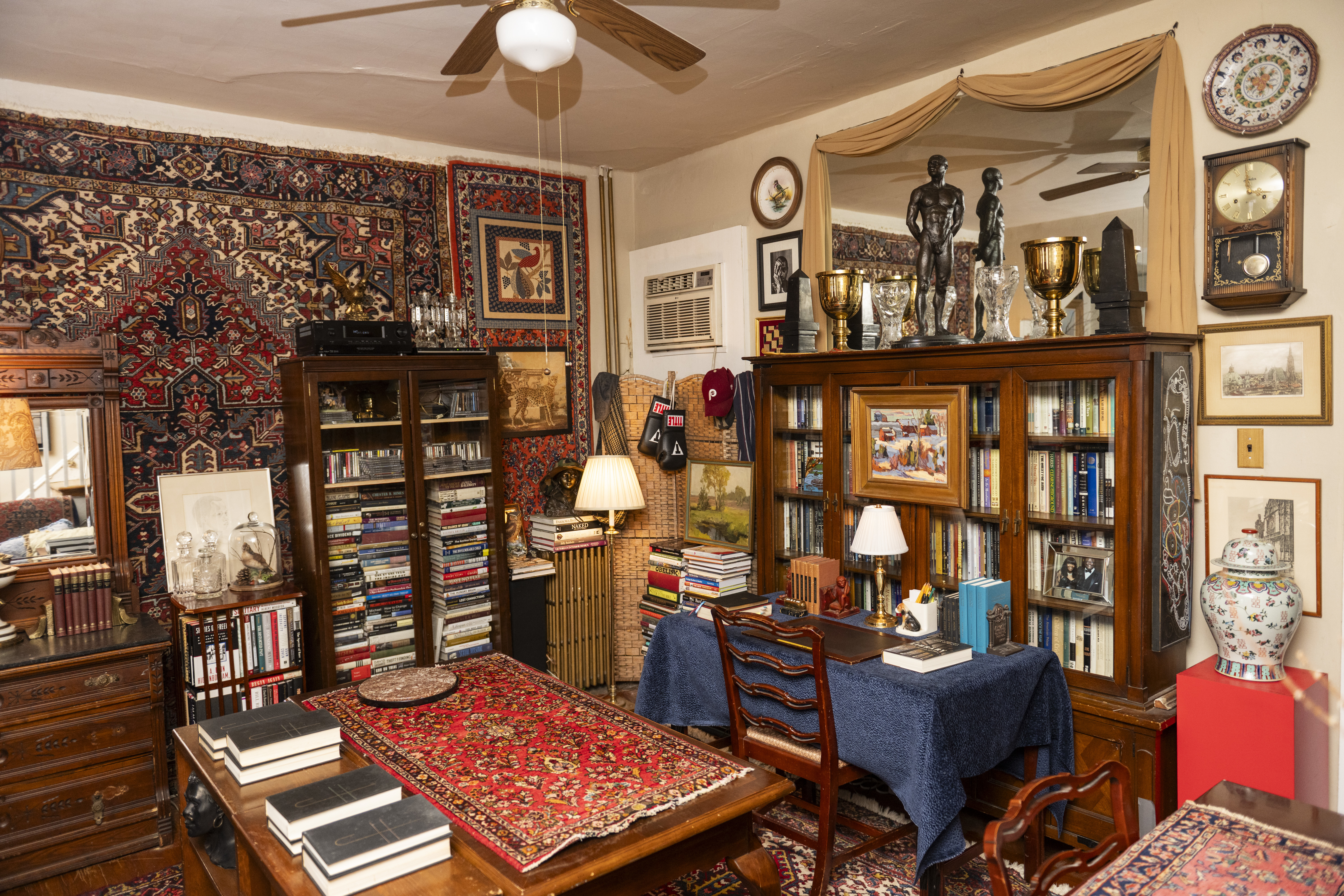
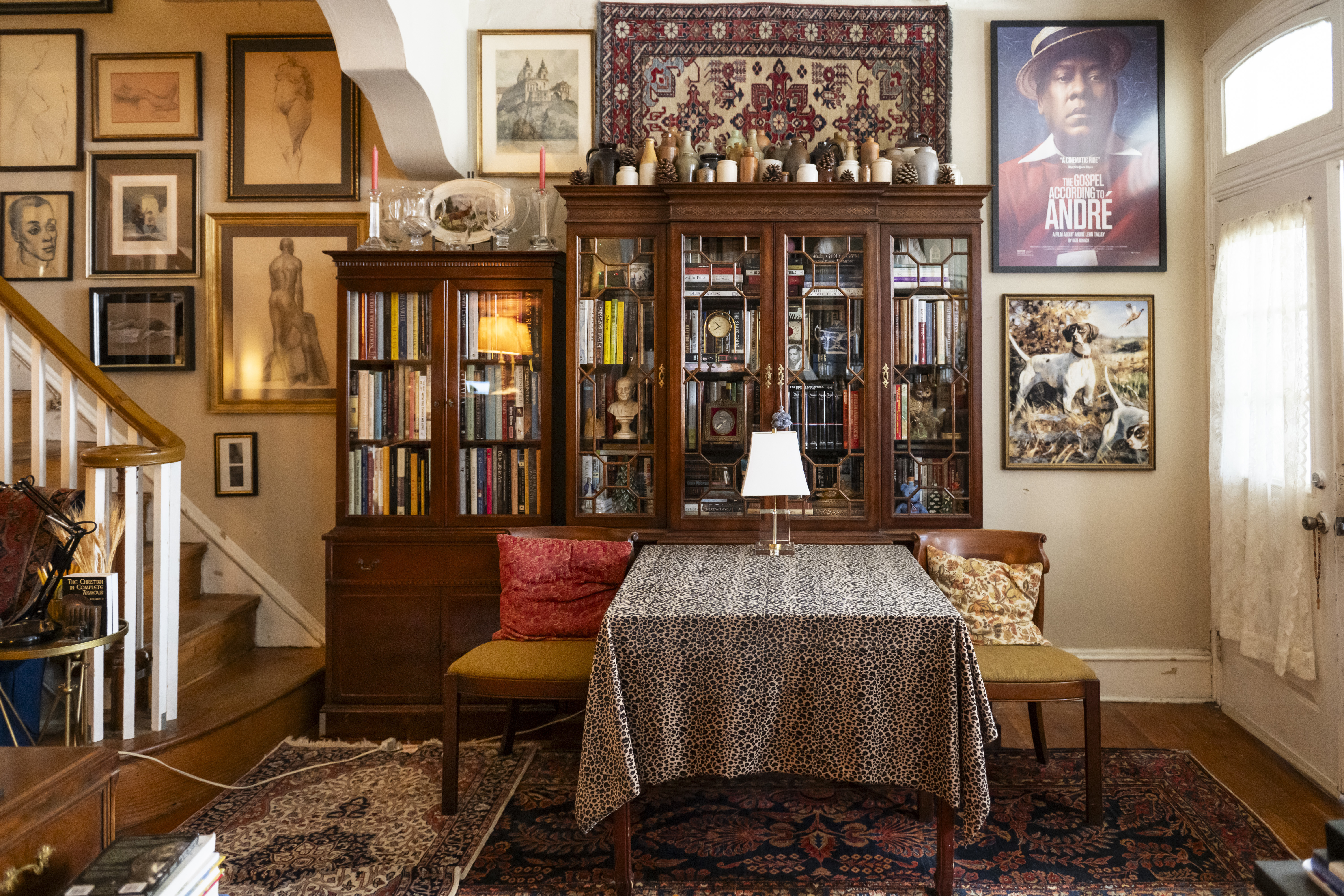
He favorite design elements include books — there are dozens and dozens displayed throughout the home, not just on shelves but arranged intentionally on and under tables, and stacked in towers rising from the red-pine-hardwood floors — as well as antiques, colorful area rugs in various sizes, art, lighting, and mirrors.
Colorful patterned rugs adorn not just the floors, but tabletops and walls as well. Tootle says his interior designs are “layered.”Books fill a glass-doored cabinet and art covers the wall at the foot of the stairs.A desk is topped with a book-filled cabinet, adjacent to the canopy bed.The canopy bed in Tootle’s double parlor room in his North Philadelphia home.
Tootle was initially attracted to his home’s location because he worked at Girard Medical Center. The commute was 15 minutes by bicycle or a 30-minute walk.
“I was raised not too far from my current address as a teenager; hence, I am very familiar with the neighborhood,” he noted. He also appreciates the sense of community, being minutes from Center City, and the architecture of the neighborhood.
“The classic brick and stone rowhomes, the spacious interiors of the three-story houses, and the rich history of music, art, and civil rights,” Tootle said. “Shopping, arts, and eateries are other reasons I love where I live, and I especially love the many libraries and museums,” added Tootle.
Tootle’s career is in social work and he has experience in psychotherapy, individual and group therapy, trauma counseling, grief counseling, and drug and alcohol counseling. In his spare time, he enjoys reading, antiquing, and going to the gym.
Books are a central focus in his home — he estimates he owns about 3,000.
Tootle sits in his double parlor surrounded by books and antiques.
“My library is the culmination of 40-plus years of book collecting, trading, and selling. I have purchased books from bookstores, auctions, flea markets, libraries, thrift stores — anywhere books were sold,” he said.
The bulk of the collection focuses on psychology, spirituality, history, art, and interior design, but it also includes poetry, fiction, and science. His favorite writers include James Baldwin, Toni Morrison, Peter Gomes, Ellen Langer, Carl Jung, and W.E.B. Du Bois, he said.
“Essentially, I’d like to think my home references the three places I’ve always wanted to live in as a child: a library, a church, and an art gallery or museum — without the pretension,” said Tootle.
Stacks of books overflow from the shelves and tables and onto the floor.Tootle’s S-rolltop desk is one of his most prized antiques.
He’s especially fond of 19th-century antiques.
“I am a sucker for antique lighting and furnishings of this period and have frequently found gems at auctions, estate sales, flea markets, thrift stores, and on the curbs of sidewalks,” he said.
One special acquisition is an antique 60-inch-wide Tiger Oak S-rolltop desk, which he bought from a dealer in Bucks County. It was produced in the late Victorian Era, he said, in the 1890s.
Tootle frequently tries different design layouts by rearranging furniture, changing lighting, and experimenting with colors, patterns, and textures.
“My design ethos is very intentional and, hence, curatorial. I am a maximalist at heart,” continued Tootle. “My interiors are very layered.”
Also, he’s planning on featuring more theatrical elements.
“This includes incorporating more velvets, tassels, deep saturated colors, and sculpture — in the tradition of the late Renzo Mongiardino. Not as a copy, but inspiration,” he said.
In the backyard, he wants to make a mixed-use space.
The exterior of Tootle’s home.
“I would like to have the soil paved over and start a container garden with trees, shrubs, herbs, and vegetables with a small round table accommodating two to four people,” said Tootle. “I rarely use it as it currently stands.”
Is your house a Haven? Nominate your home by email (and send some digital photographs) at properties@inquirer.com.
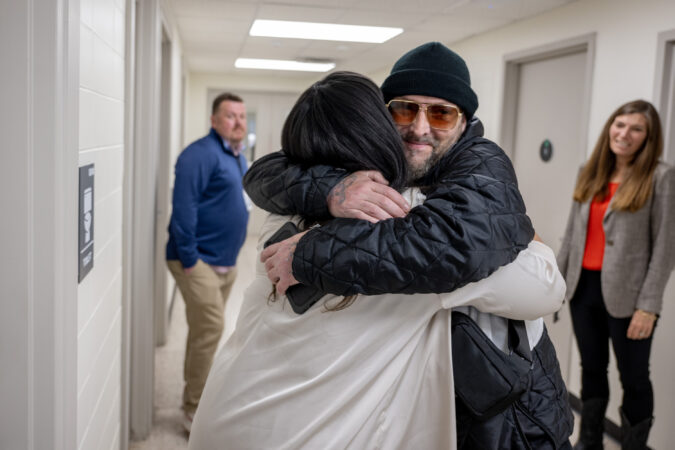
Kevin Bean was a frail 125 pounds last February when he entered a brand-new recovery house, a facility where he landed after spending four years in the throes of addiction — at times on the streets of Kensington, the epicenter of the city’s drug crisis.
The Frankford native was one of the first residents to enter the Riverview Wellness Village, the 20-acre recovery facility that Mayor Cherelle L. Parker’s administration opened in Northeast Philadelphia nearly a year ago as part of City Hall’s efforts to address opioid addiction and the Kensington drug market.
Bean, now 46 and boasting a healthier frame, just celebrated one year of sobriety and is preparing to move out of Riverview early next year.
He described his transition simply: “whole new life.”
Much of the mayor’s agenda in Kensington has been visible to the neighborhood’s residents, such as increased law enforcement and a reduction in the homeless population. But the operations and treatment outcomesat Riverview, located down a winding road next to the city’s jail complex, happen largely outside of public view. Last spring, some city lawmakers complained that even they knew little about the facility operations.
An inside look at the Riverview complex and interviews with more than a dozen residents and employees showed that, over the last year, the city and its third-party healthcare providers have transformed the facility. What was recently a construction zone is now a one-stop health shop with about 75 staff and more than 200 residents, many of whom previously lived on Kensington streets.
Those who live and work at Riverview said the facility is plugging a hole in the city’s substance use treatment landscape. For years, there have not been enough beds in programs that help people transition from hospital-style rehab into long-term stability. The recovery house industry has been plagued with privately run homes that are in poor condition or offer little support.
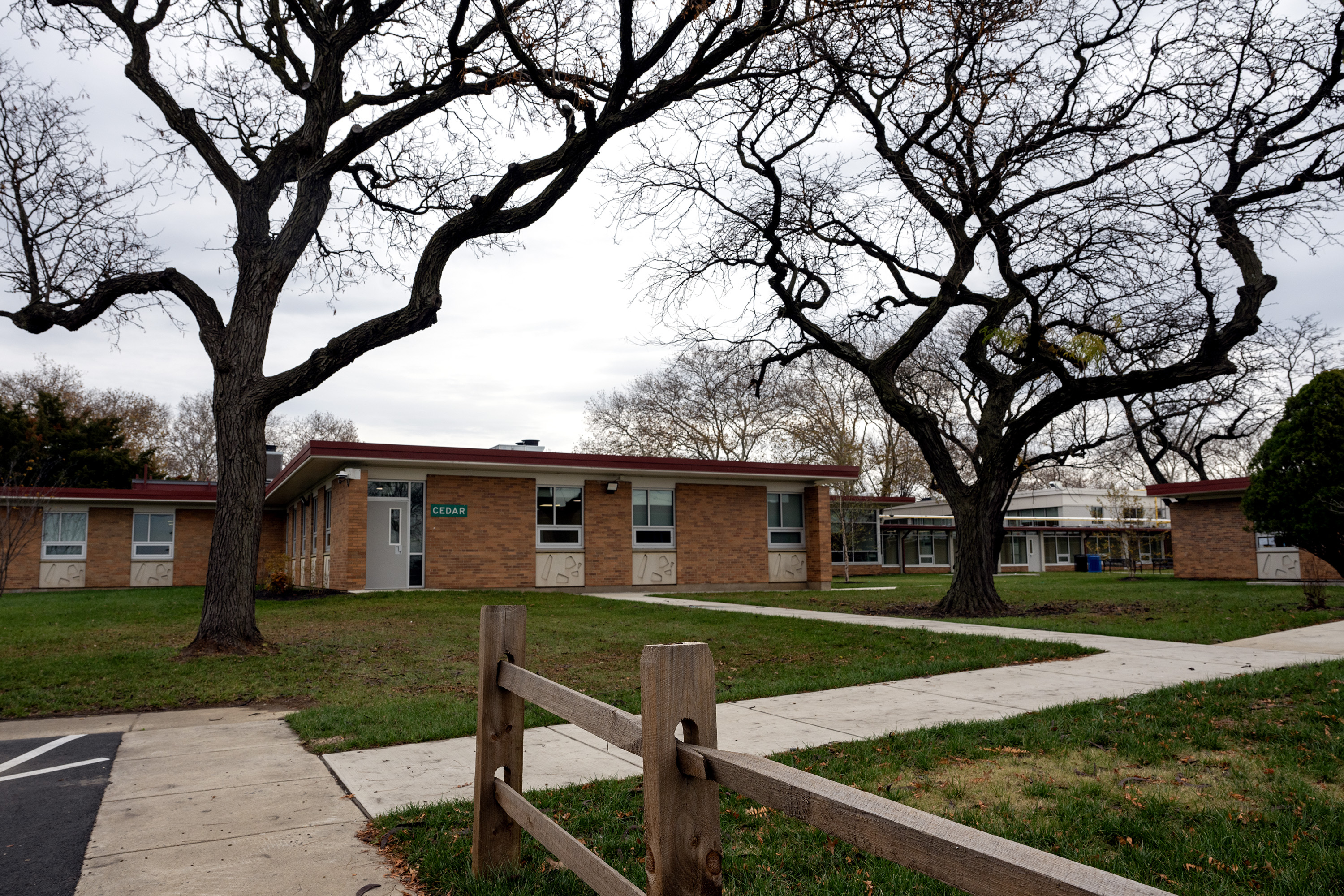
The grounds and residence buildings at Riverview Wellness Village, a city-owned drug recovery home in Northeast Philadelphia.
At its current capacity, Riverview has singularly increased the total number of recovery house beds in the city by nearly 50%. And residents — who are there voluntarily and may come and go as they please — have much of what they need on the campus: medical care, mental health treatment, job training, and group counseling.
They also, as of last month, have access to medication-assisted treatment, which means residents in recovery no longer need to travel to specialized clinics to get a dose of methadone or other drugs that can prevent relapse.
Arthur Fields, the regional executive director at Gaudenzia, which provides recovery services to more than 100 Riverview residents, said the upstart facility has become a desirable option for some of the city’s most vulnerable. Riverview officials said they aren’t aware of anywhere like it in the country.
“The Riverview Wellness Village is proof of what’s possible,” Fields said, “when we work together as a community and move with urgency to help people rebuild their lives.”
While the facility launched in January with much fanfare, it also faced skepticism, including from advocates who were troubled by its proximity to the jails and feared it would feel like incarceration, not treatment. And neighbors expressed concern that the new Holmesburg facility would bring problems long faced by Kensington residents, like open drug use and petty theft, to their front doors.
But despite some tenets of the mayor’s broader Kensington plan still facing intense scrutiny, the vocal opposition to Riverview has largely quieted. Parker said in an interview that seeing the progress at Riverview and the health of its residents made enduring months of criticism “well worth it.”
“I don’t know a Philadelphian who, in some way, shape, or form, hasn’t been touched by mental and behavioral health challenges or substance use disorder,” said Parker, who has spoken about how addiction shaped parts of her own upbringing. “To know that we created a path forward, to me, I’m extremely proud of this team.”
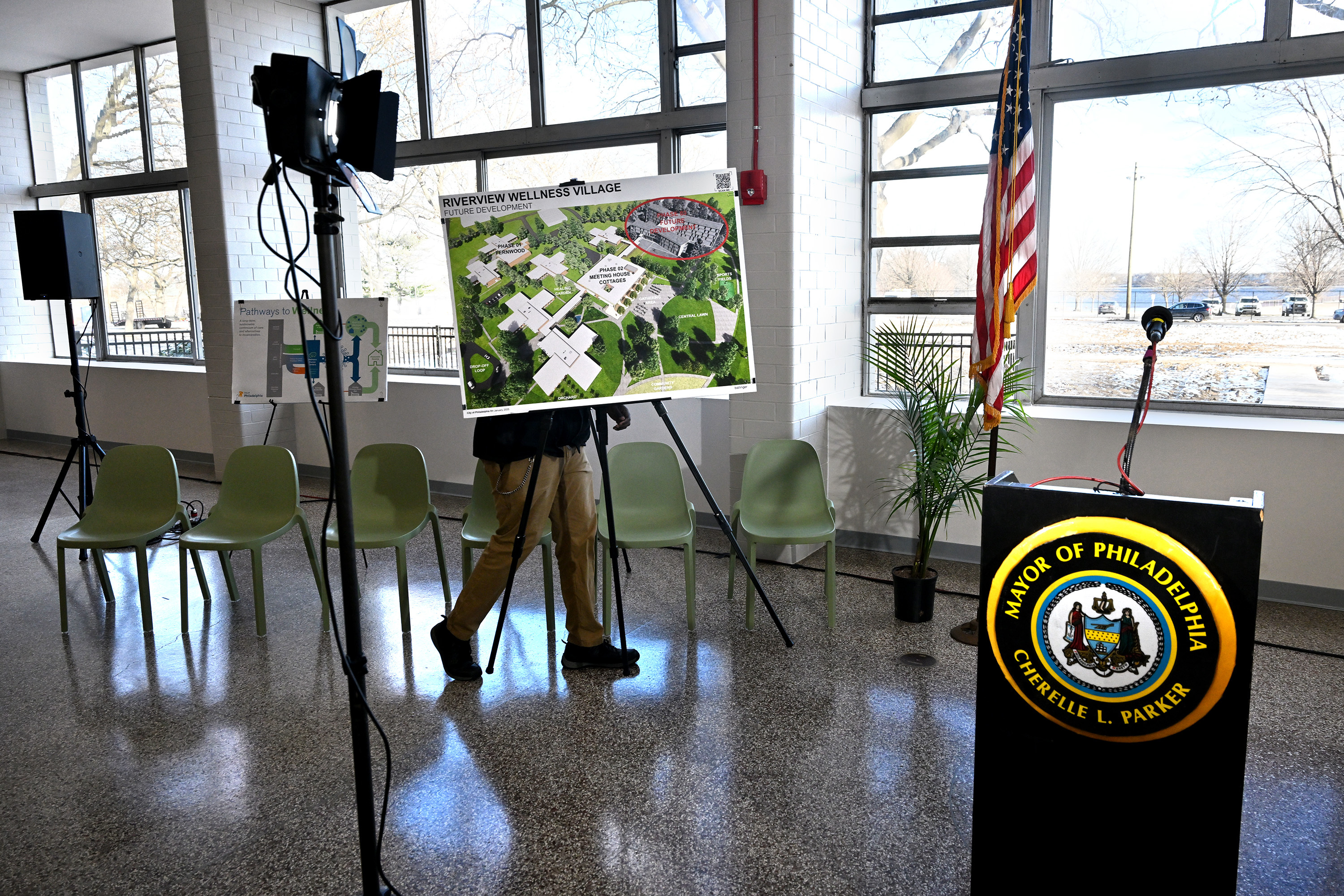
Mayor Cherelle L. Parker places a new block on the scale model of the Riverview Wellness Village on Wednesday, Jan. 8 during the unveiling of Philadelphia’s new city-operated drug treatment facility. At left is Managing Director Adam Thiel. City Councilmember Michael Driscoll is at right.Isabel McDevitt, executive director of the Office of Community Wellness and Recovery, points to a model with upcoming expansion at Riverview Wellness Village, a city-owned drug recovery home in Northeast Philadelphia on Nov. 25.Staffers move photos into place at the Riverview Wellness Village on Jan. 8 before the unveiling of Philadelphia’s new city-operated drug treatment facility.
Meanwhile, neighbors who live nearby say they have been pleasantly surprised. Pete Smith, a civic leader who sits on a council of community members who meet regularly with Riverview officials, said plainly: “There have been no issues.”
“If it’s as successful as it looks like it’s going to be,” he said, “this facility could be a model for other cities throughout the country.”
Smith, like many of his neighbors, wants the city’s project at Riverview to work because he knows the consequences if it doesn’t.
His son, Francis Smith, died in September due to health complications from long-term drug use. He was 38, and he had three children.
Getting a spot at Riverview
The sprawling campus along the Delaware River feels more like a college dormitory setting than a hospital or homeless shelter. Its main building has a dining room, a commercial kitchen, a gym, and meditation rooms. There are green spaces, walking paths,and plans for massive murals on the interior walls.
Katherine Young, director of Merakey at Riverview Wellness Village, talks with a resident at the city-owned drug recovery home in Northeast Philadelphia on Nov. 25.
Residents live and spend much of their time in smaller buildings on the campus, where nearly 90% of the 234 licensed beds are occupied. The city plans to add 50 more in January.
Their stays are funded through a variety of streams. The city allocated $400 million for five years of construction and operations, a portion of which is settlement dollars from lawsuits against pharmaceutical companies that manufactured the painkillers blamed for the opioid crisis.
(function() {
var l2 = function() {
new pym.Parent(‘RIVERVIEW_MAP2.html’,
‘https://media.inquirer.com/storage/inquirer/projects/innovation/arcgis_iframe/RIVERVIEW_MAP2.html’);
};
if (typeof(pym) === ‘undefined’) {
var h = document.getElementsByTagName(‘head’)[0],
s = document.createElement(‘script’);
s.type = ‘text/javascript’;
s.src = ‘https://pym.nprapps.org/pym.v1.min.js’;
s.onload = l2;
h.appendChild(s);
} else {
l2();
}
})();
To get in to Riverview, a person must complete at least 30 days of inpatient treatment at another, more intensive care facility.
(function() { var l = function() { new pym.Parent( ‘riverview-flowchart__graphic’, ‘https://media.inquirer.com/storage/inquirer/ai2html/riverview-flowchart/index.html’); }; if(typeof(pym) === ‘undefined’) { var h = document.getElementsByTagName(‘head’)[0], s = document.createElement(‘script’); s.type = ‘text/javascript’; s.src = ‘https://pym.nprapps.org/pym.v1.min.js’; s.onload = l; h.appendChild(s); } else { l(); } })();
Still, residents at Riverview have come from more than 25 different providers, according to Isabel McDevitt, the city’s executive director of community wellness and recovery. The bulk were treated at the Kirkbride Center in West Philadelphia, the Behavioral Wellness Center at Girard in North Philadelphia, or Eagleville Hospital in Montgomery County.
They have ranged in age from 28 to 75. And they have complex medical needs: McDevitt said about half of Riverview’s residents have a mental health diagnosis in addition to substance use disorder.
She said offering treatment for multiple health conditions in one place allows residents to focus less on logistics and more on staying healthy.
“Many of the folks that are at Riverview have long histories of substance use disorder, long histories of homelessness,” she said. “So it’s really the first time a lot of people can actually breathe.”
When new residents arrive, they go through an intake process at Riverview that includes acute medical care and an assessment for chronic conditions. Within their first week, every resident receives a total-body physical and a panel of blood work.
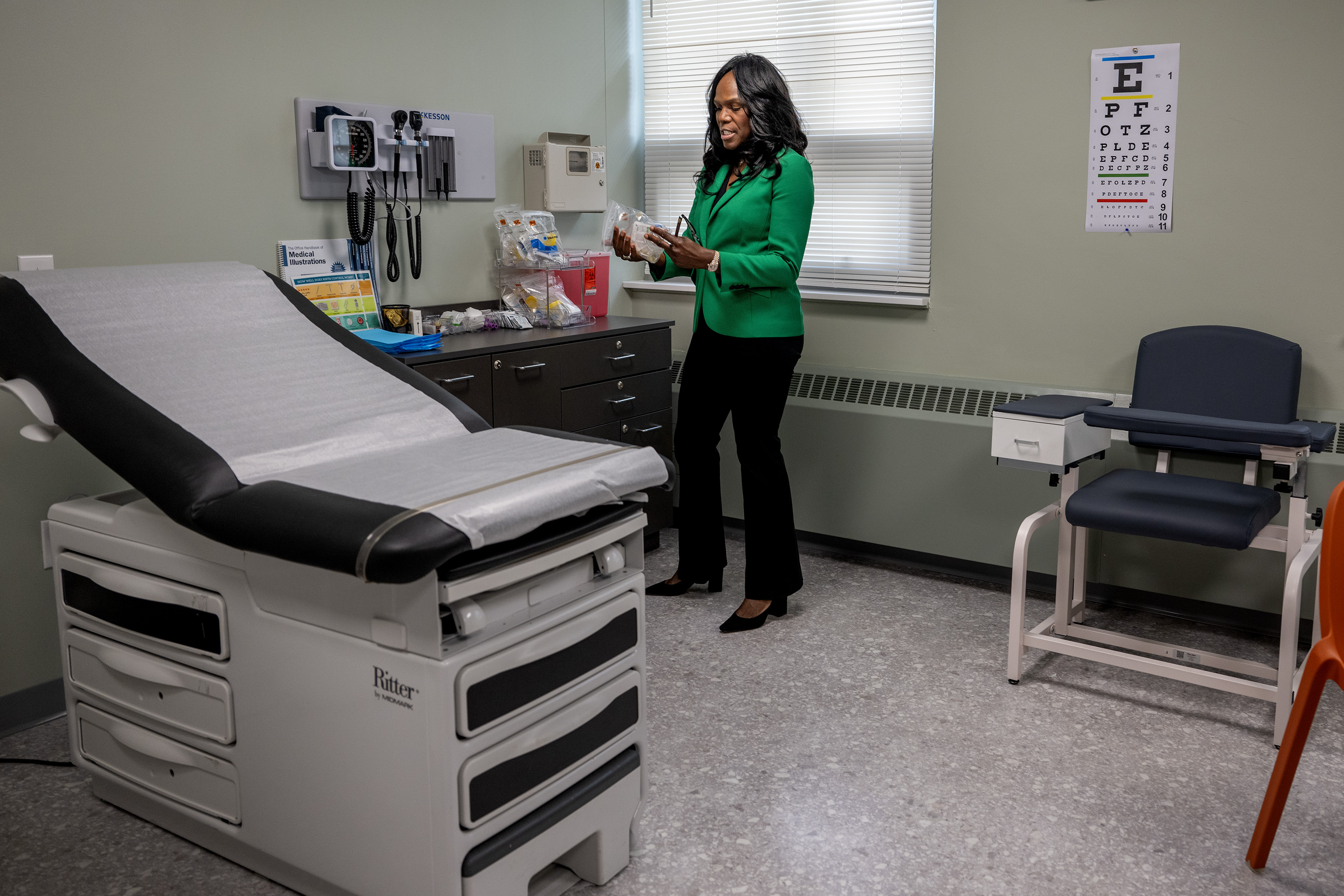
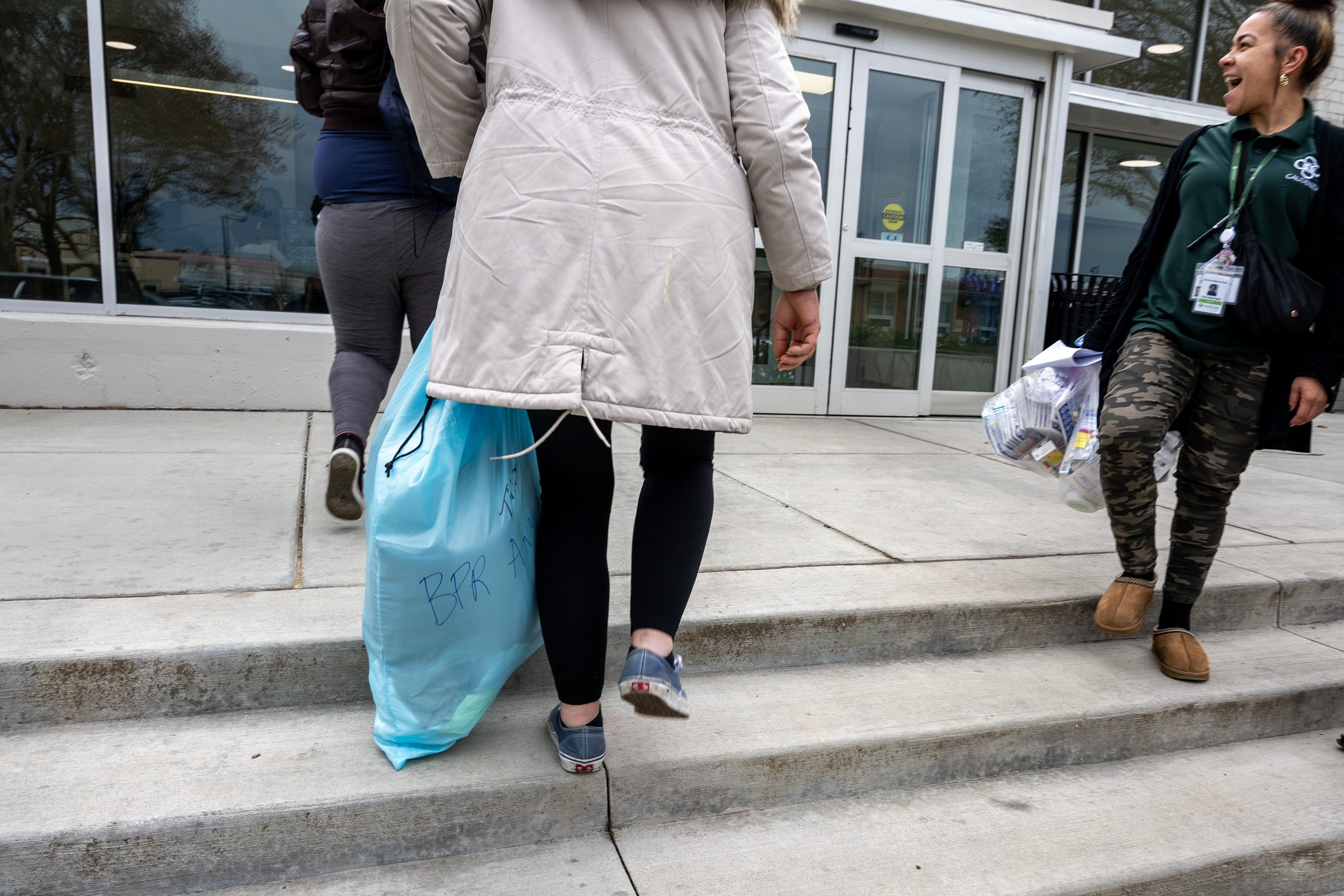
“They literally arrive with all of their belongings in a plastic bag and their medications and some discharge paperwork,” said Ala Stanford, who leads the Black Doctors Consortium, which provides medical services at Riverview. “We are the ones who greet them and help get them acclimated.”
Stanford — who this fall announced a run for Congress — said doctors and nurses at Riverview have diagnosed and treated conditions ranging from drug-related wounds to diabetes to pancreatic cancer. And patients with mental health needs are treated by providers from Warren E. Smith Health Centers, a 30-year-old organization based in North Philadelphia.
Physician Ala Stanford in an examination room at the primary medical care center run by her Black Doctors Consortium at Riverview Wellness Village, a city-owned drug recovery home in Northeast Philadelphia, on Nov. 25.Francesca Colon (right), a recovery support professional with Gaudenzia, brings people in recovery to the main entrance of the Meetinghouse at Riverview Wellness Village on Nov. 25.
Residents’ schedules are generally free-flowing and can vary depending on their wants and needs. About 20% have jobs outside the campus. Culinary arts training will be available in the next month or so. And residents can meet with visitors or leave to see family at any time.
They also spend much of their time in treatment, including individual, family, and group therapy. On a recent day, there were group sessions available on trauma recovery, managing emotions, and “communicating with confidence.”
Vernon Kostic, a 52-year-old Port Richmond native who said he has previously been homeless, has been in and out of drug treatment facilities for years.
He said he’s been content as a Riverview resident since July, and called it “one of the smartest things that the city has ever done.”
“We have the doctor’s office right over here,” he said. “They’ve got counseling right here. Everything we need. It’s like a one-stop recovery place.”
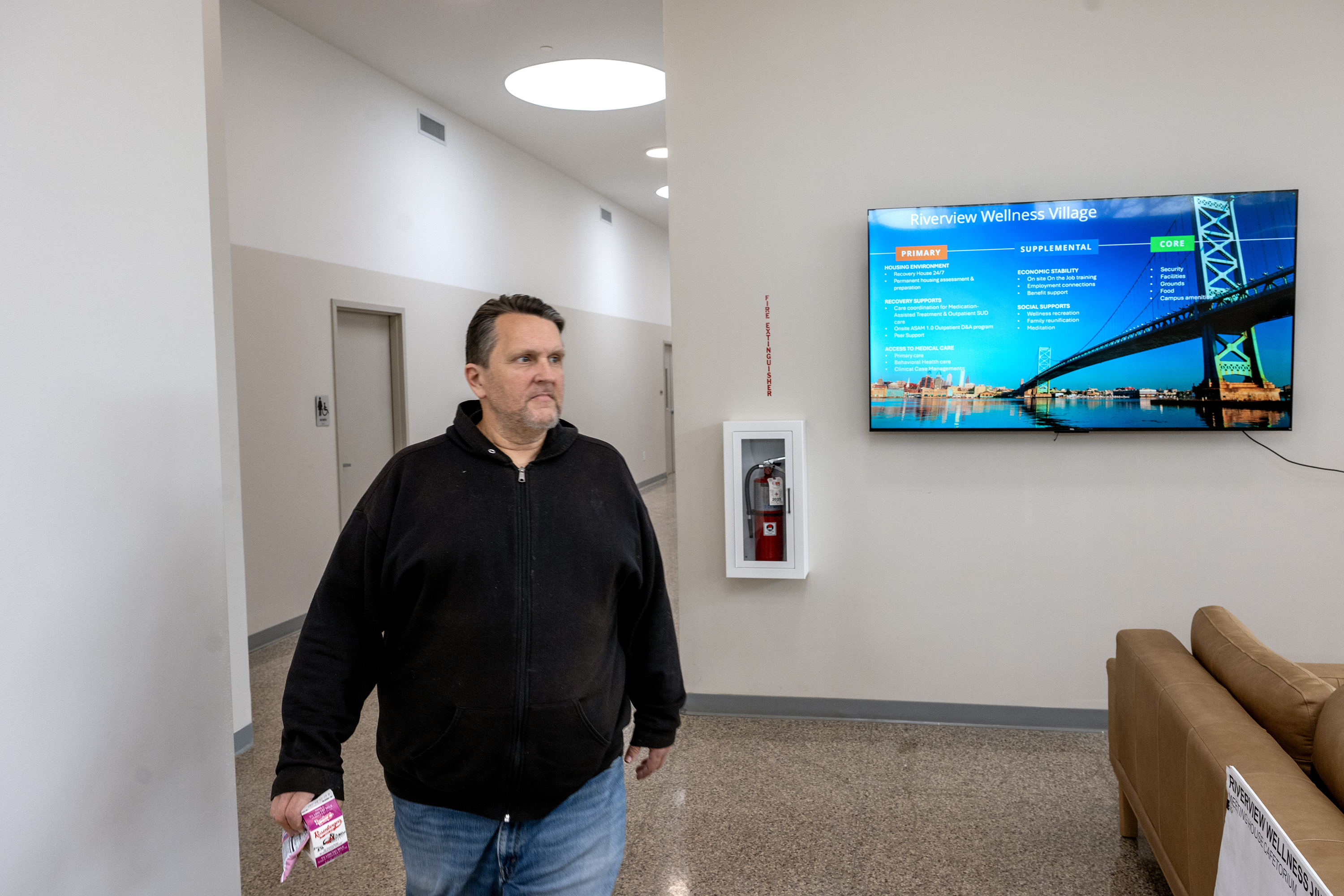
Resident Vernon Kostic heads to a group meeting at Riverview Wellness Village on Nov. 25.The dining room and meeting room in the Meetinghouse at Riverview Wellness Village. At rear left is a brand-new, industrial, restaurant-quality kitchen that was not operational yet on Nov. 25.
Finding ways to stay at Riverview
Finding success in recovery is notoriously hard. Studies show that people who stay in structured sober housing for at least six months after completing rehab see better long-term outcomes, and Riverview residents may stay there for up to one year.
But reaching that mark can take multiple tries, and some may never attain sobriety. McDevitt said that on a monthly basis, about 35 people move into Riverview, and 20 leave.
Some who move out are reunited with family and want to live at home. Others simply were not ready for recovery, McDevitt said, “and that’s part of working with this population.”
Fields said a resident who relapses can go back to a more intensive care setting for detoxification or withdrawal management, then return to Riverview at a later time if they are interested.
“No one is punished for struggling,” he said. “Recovery is a journey. It takes time.”
Providers are adding new programming they say will help residents extend their stays. Offering medication-assisted treatment is one of the most crucial parts, said Josh Vigderman, the senior executive director of substance use services at Merakey, one of the addiction treatment providers at Riverview.
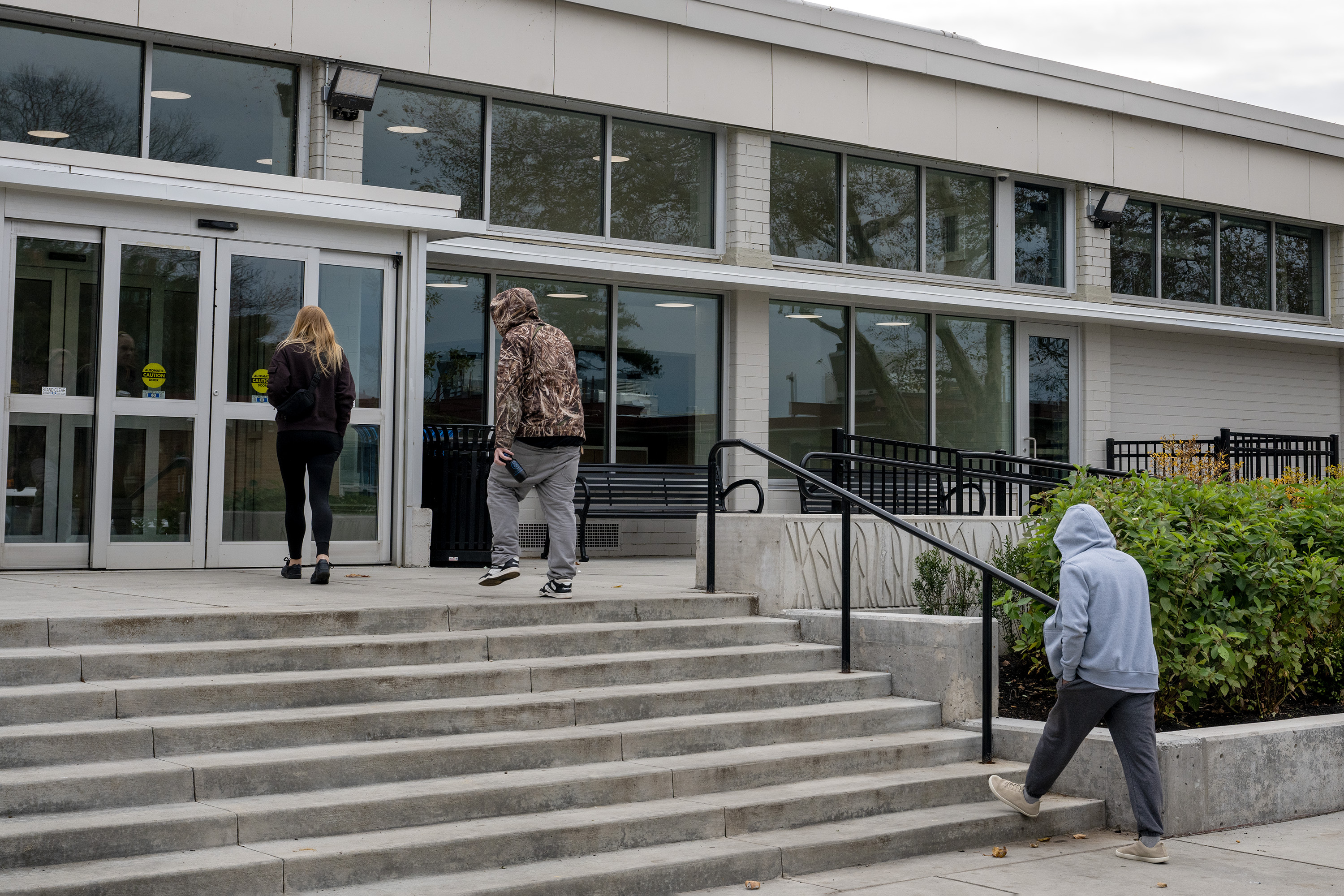
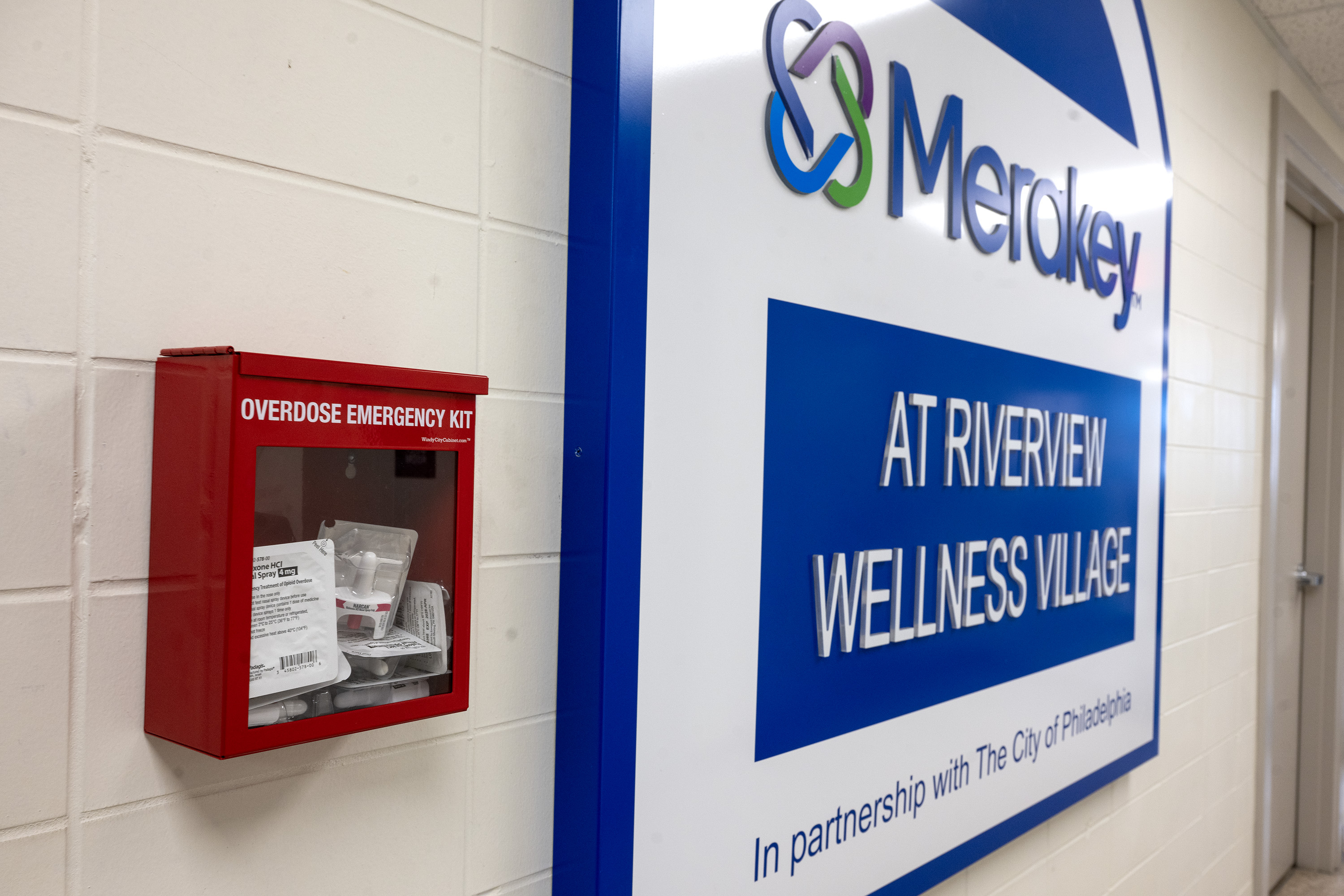
Entry to the primary medical care center run by the Black Doctors Consortium at Riverview Wellness Village.The main entry Meetinghouse at Riverview Wellness Village.Naloxone (Narcan) in an “overdose emergency kit” at Riverview Wellness Village.
In the initial months after Riverview opened its doors, residents had to travel off campus to obtain medication that can prevent relapse, most commonly methadone and buprenorphine, the federally regulated drugs considered among the most effective addiction treatments.
Typically, patients can receive only one dose of the drug at a time and must be supervised by clinicians to ensure they don’t go into withdrawal.
Vigderman said staff suspected some residents relapsed after spending hours outside Riverview, at times on public transportation, to get their medication.
This fall, Merakey — which was already licensed to dispense opioid treatment medications at other locations — began distributing the medications at Riverview, eliminating one potential relapse trigger for residents who no longer had to leave the facility’s grounds every day.
Interest in the program has been strong, Vigderman said, with nearly 80 residents enrolling in medication-assisted treatment in just a few weeks. Merakey is hiring more staff to handle the demand.
What’s next at Riverview
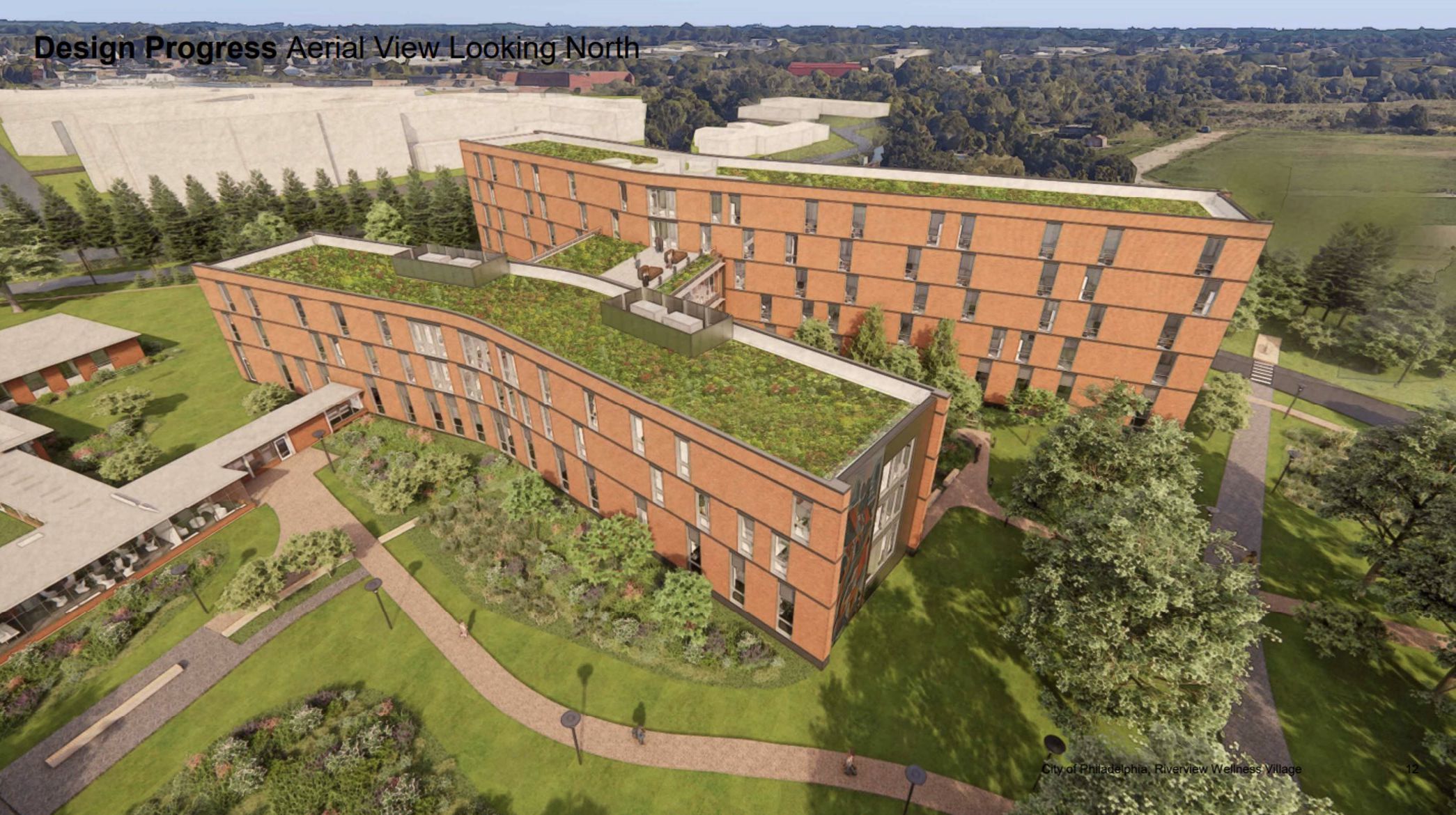
The city is eying a significant physical expansion of the Riverview campus, including a new, $80 million building that could double the number of licensed beds to more than 500. That would mean that about half of the city’s recovery house slots would be located at Riverview.
Parker said the construction is “so important in how we’re going to help families.” She said the process will include “meticulous design and structure.”
“The people who come for help,” she said, “we want them to know that we value them, that we see them, and that we think enough of them to provide that level of quality of support for them.”
In the meantime, staff are working to help the center’s current residents — who were among the first cohort to move in — plot their next steps, like employment and housing.
A rendering of the new, $80 million five-story building to be constructed on the campus of Riverview Wellness Village. It will include residences and medical suites.
That level of support, Vigderman said, doesn’t happen in many smaller recovery houses.
“In another place, they might not create an email address or a resumé,” he said. “At Riverview, whether they do it or not is one thing. But hearing about it is a guarantee.”
Bean is closing in on one year at Riverview. He doesn’t know exactly what’s next, but he does have a job prospect: He’s in the hiring process to work at another recovery house.
“I’m sure I’ll be able to help some people,” he said. “I hope.”
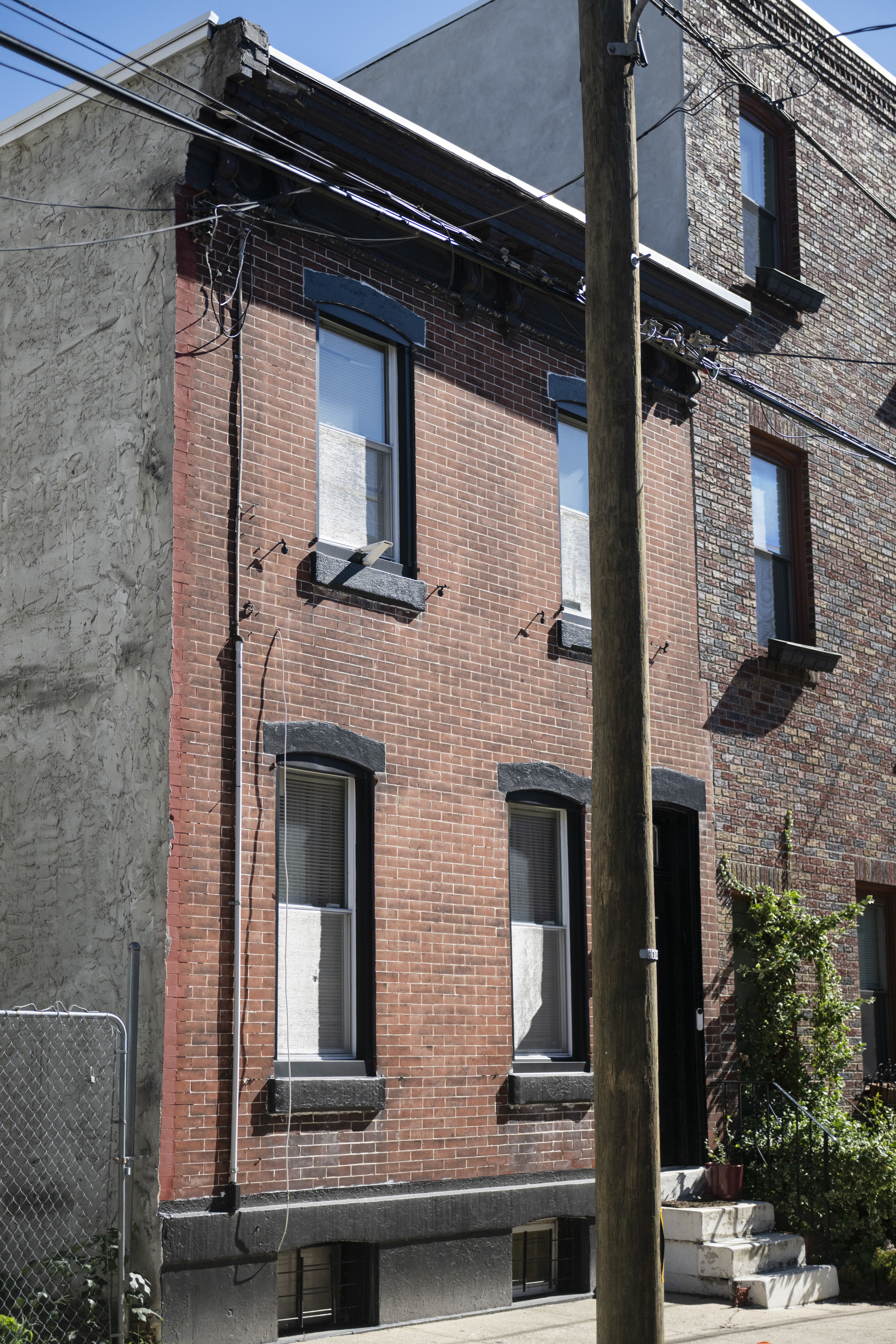
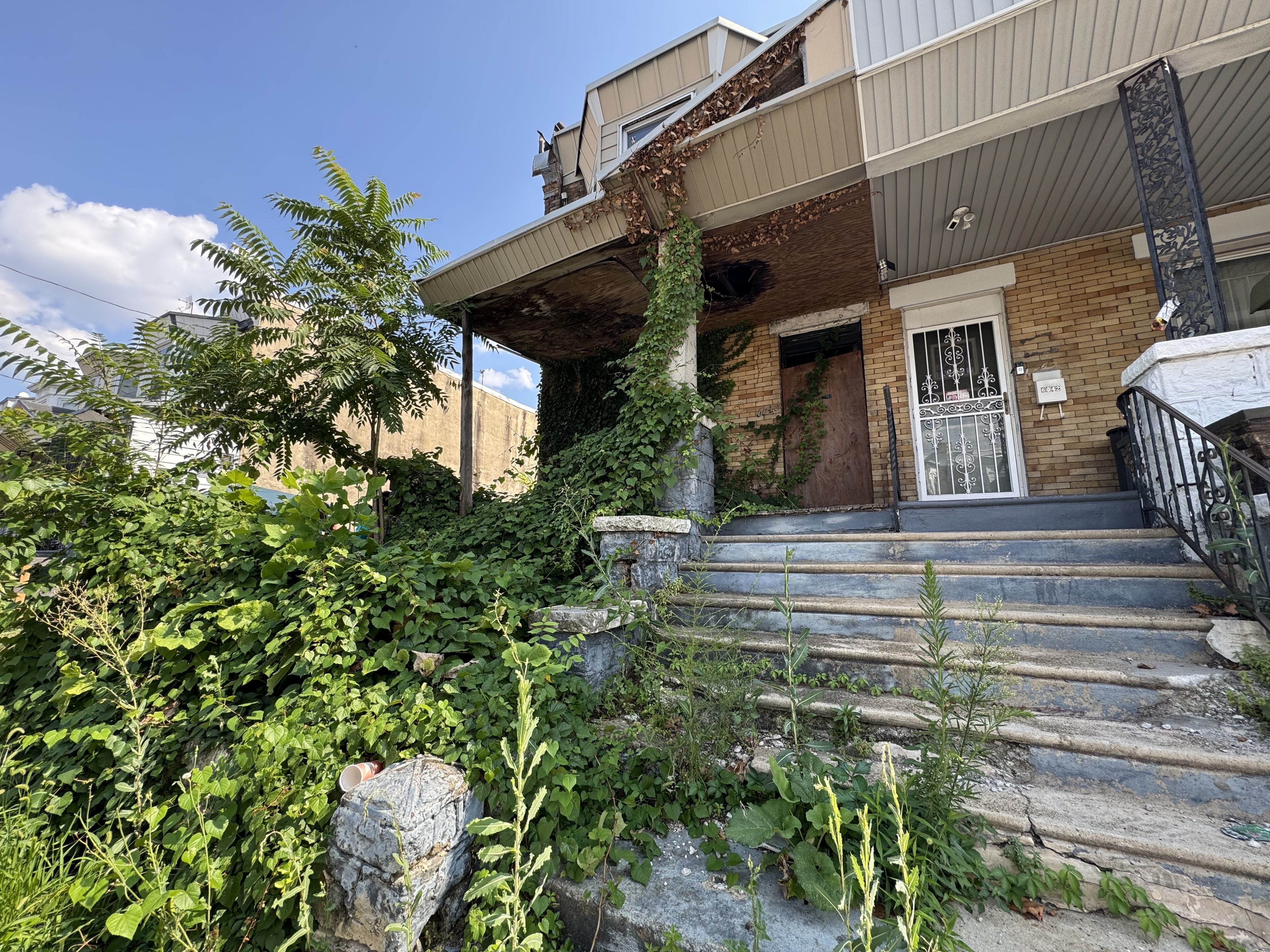
Emily Phillips and her family never slam doors or walk too heavily inside their North Philadelphia rowhouse. They’re afraid of what too much movement could do to the vacant house next door.
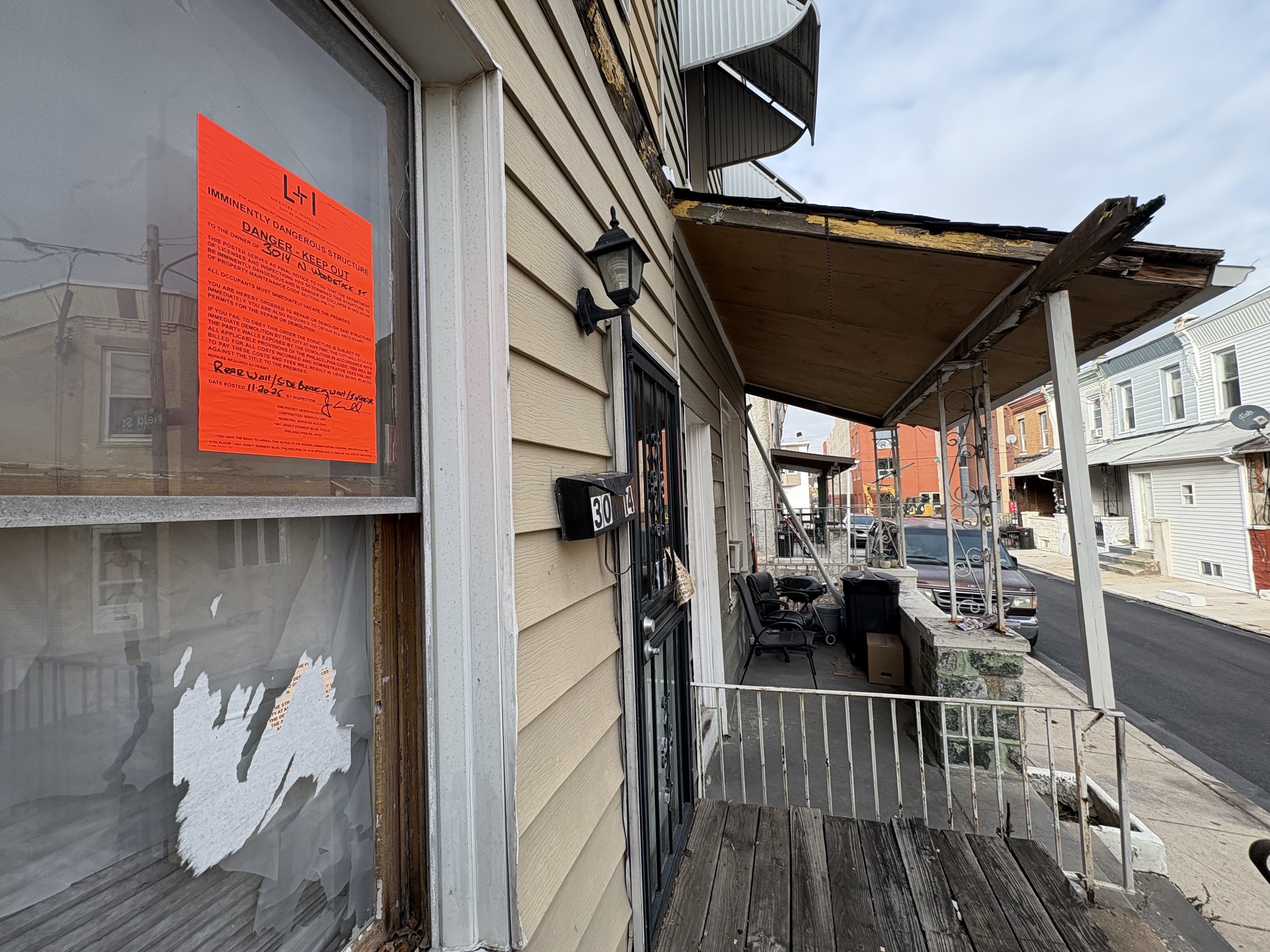
In early August, a back window and part of a wall came crashing down during harsh winds and rain. An inspector for the city’s Department of Licenses and Inspections declared the vacant rowhouse “imminently dangerous,” which means it is at risk of collapsing.
“I never know when something’s going to actually happen,” Phillips said in late October. “We know it’s just a matter of time. … I’m so scared right now.”
Across Philadelphia, families are living in a limbo of anxiety next to buildings that the city has determined are unsafe or imminently dangerous. The buildings at greatest risk of collapse are usually vacant.
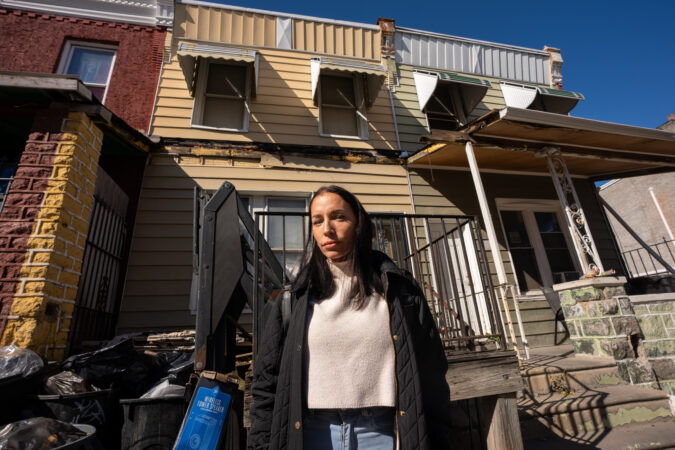
Renters Emily Phillips (left) and Dayani Lemmon examine the basement wall that their home shares with the abandoned and dangerous rowhouse next door.
Philadelphians rely on the city to keep an eye on vacant properties that are or could become dangerous. And in 2016, the city rolled out a method for determining which properties were likely to be vacant. L&I’s commissioner at the time said the inventory tool was making the department more proactive in protecting the public from deteriorating vacant buildings.
But L&I officials now say the department no longer uses the tool. They said the department mainly relies on residents’ complaints and its list of vacant property licenses — which L&I admits is a massive undercount — to monitor empty buildings.
(function() {
var l2 = function() {
new pym.Parent(‘imm_dang_map’,
‘https://media.inquirer.com/storage/inquirer/projects/innovation/arcgis_iframe/imm_dang_map.html’);
};
if (typeof(pym) === ‘undefined’) {
var h = document.getElementsByTagName(‘head’)[0],
s = document.createElement(‘script’);
s.type = ‘text/javascript’;
s.src = ‘https://pym.nprapps.org/pym.v1.min.js’;
s.onload = l2;
h.appendChild(s);
} else {
l2();
}
})();
L&I points out that property owners are responsible for securing vacant properties and repairing dangerous buildings, and the department steps in as resources and laws allow.
Around the time Inquirer reporters spoke with Phillips, the city’s spreadsheet of likely vacant properties listed about 8,000 vacant buildings — a potentially serious threat to their neighbors. An Inquirer analysis of the city’s list of imminently dangerous buildings showed that 79% of those also appeared on the list of likely vacant buildings.
Just under half of those vacant and imminently dangerous buildings were rowhouses, which are especially risky to neighbors because of shared walls. This risk is not borne equally by all of Philadelphia’s residents.
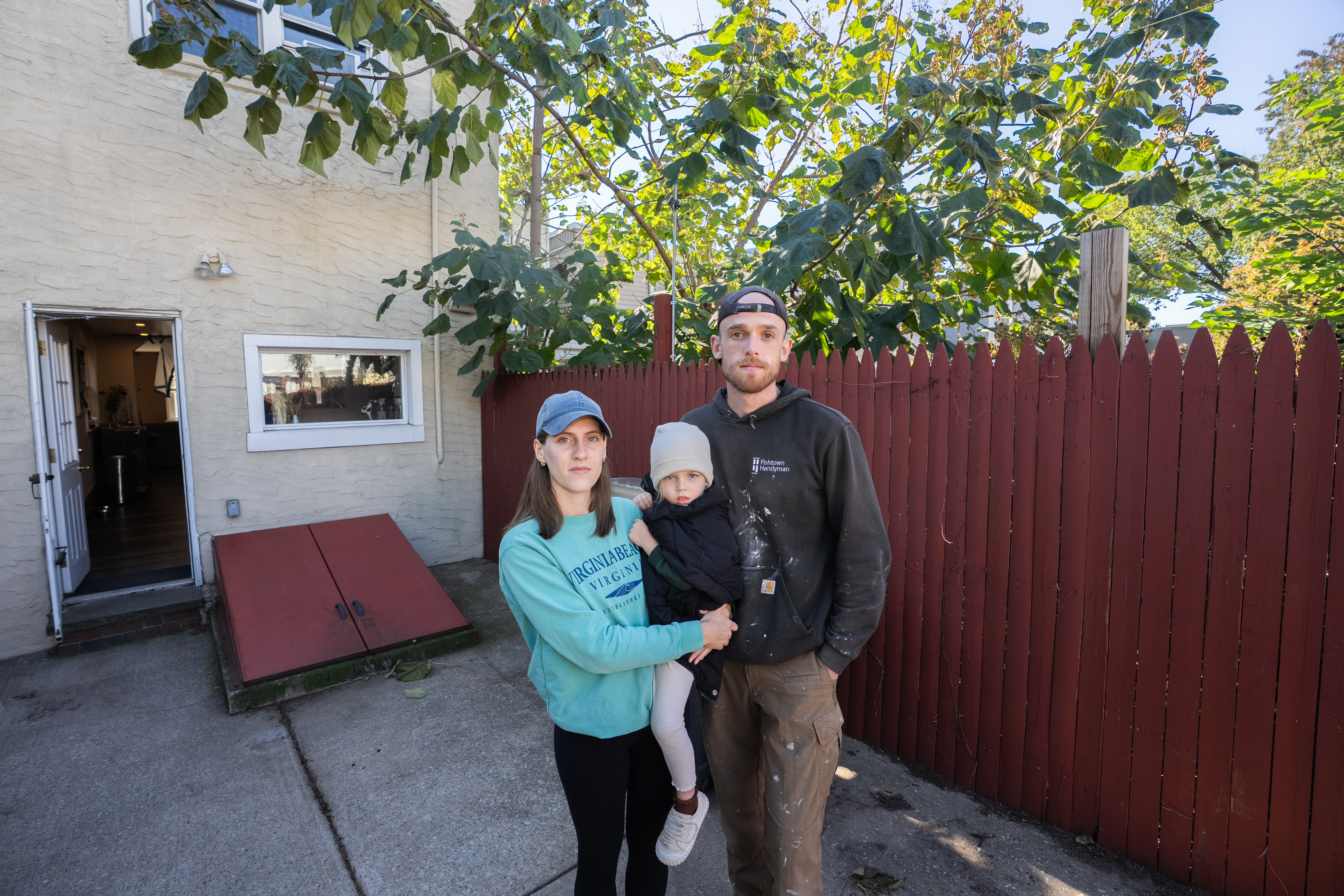
Emily Phillips and her landlord, Samantha Wismann, stand next to a neighboring abandoned rowhouse, where part of a wall collapsed and a tree grows inside.
Nearly eight in 10 of all such rowhouses are in the poorest 25% of the city’s zip codes. The zip code with the most such rowhouses — 19132, where Phillips lives — has a median income of $31,000, according to the latest Census Bureau data. Philadelphia’s median household income is $61,000.
Seven in 10 vacant rowhouses that the city identified as imminently dangerous are in the 34% of the city’s zip codes that are predominantly Black. Roughly nine in 10 residents in 19132 are Black.
Dianna Coleman, a community activist who lives in Southwest Philadelphia, called vacant properties “one of Philadelphia’s most pressing and overlooked crises.”
This summer, a hole opened in the back of an abandoned rowhouse that is connected to a North Philadelphia house owned by Samantha Wismann.
When Coleman and a group of residents in Southwest and West Philadelphia came together last summer to organize around quality of life issues, residents’ top concern was fixing vacant properties. They partnered with the grassroots social justice nonprofit OnePA and launched their first campaign — asking the city to deal with abandoned buildings and vacant lots.
“While we recognize that the city has taken steps — demolishing some buildings, addressing some lots — the pace is way too slow, the resources too scarce, and the strategy too weak,” Coleman, cochair of OnePA West/Southwest Rising, said at a news conference this summer. “Unsafe buildings are left standing for years, growing more hazardous, pulling down property values, and pushing people out of their homes.”
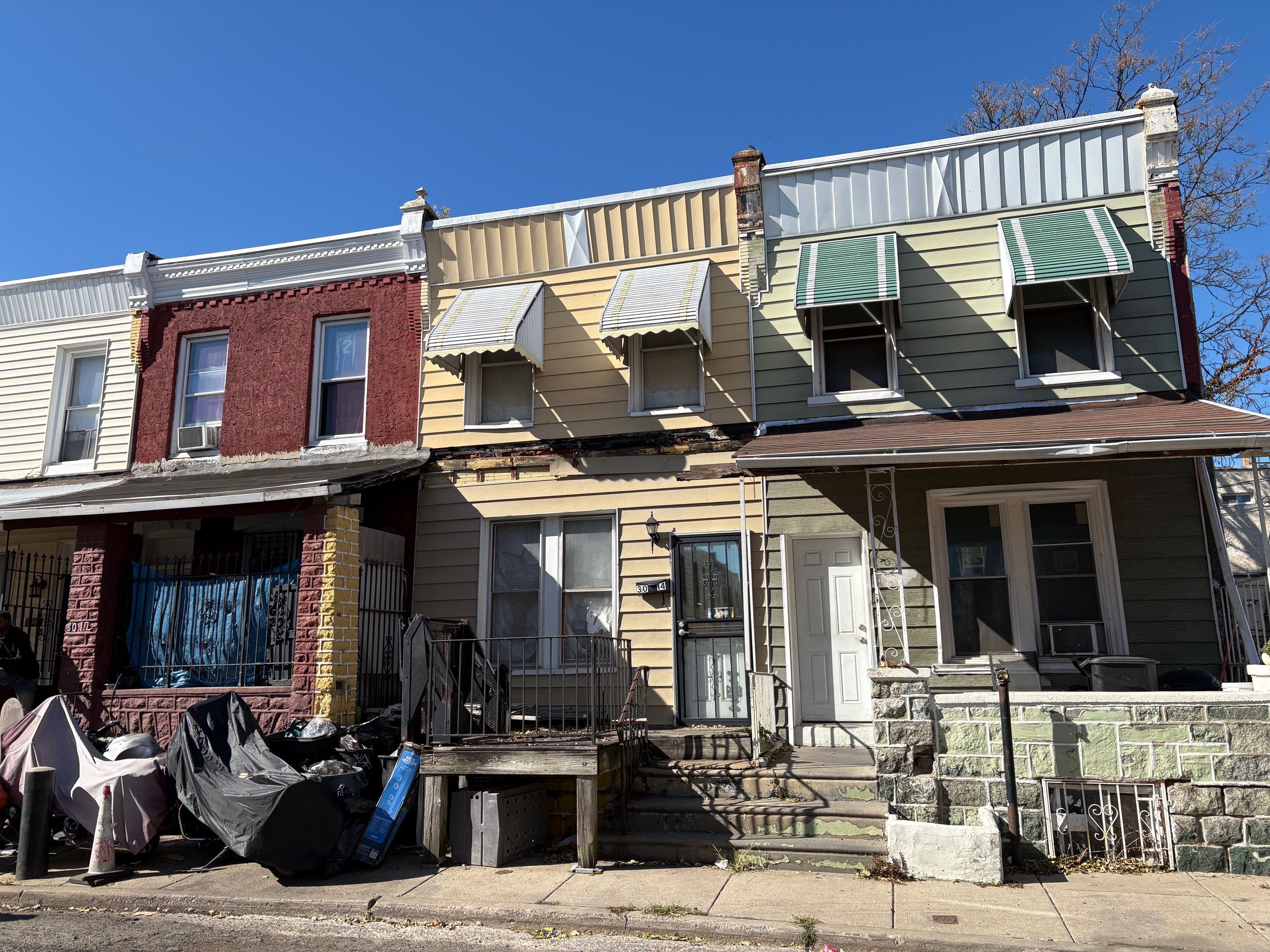
The vacant rowhouse next to Emily Phillips’ North Philadelphia home had its collapsing porch roof removed, but the rest of the home remains in disrepair.
The city’s questionable vacancy data
About a decade ago, the city started using an algorithm that takes feeds from a variety of datasets (such as whether a property has had its water cut off) to determine whether a property is likely to be vacant.
City officials celebrated the tool when it launched.
“Protecting the public from deteriorating vacant, abandoned properties as they grow more and more likely to collapse is critical to L&I’s mission,” former L&I Commissioner David Perri said in a 2016 news release announcing the index. “The Vacant Property Model and dataset are making us more proactive and strategic in carrying out that mission.”
But the reliability of the city’s list of likely vacant buildings and lots was recently called into question by individuals who have worked closely with the tool and collaborated with city officials in the past.
For more than three years, Clean & Green Philly, a nonprofit that — until its closure earlier this year — used data to help Philadelphians deal with vacant properties in their neighborhoods, relied on the city’s tool in combination with other data to identify vacant properties in greatest need of addressing.
But last year, founder Nissim Lebovits and the organization’s former executive director, Amanda Soskin, noticed something was wrong.
For years, the city’s list of suspected vacant properties had hovered somewhere around 40,000 records — buildings and land combined. But then, according to Lebovits and Soskin, that number plunged to around 24,000 in June 2024.
“And at first I was like, ‘OK. Something’s probably broken,’ and we looked into it,” Lebovits said. “And we realized that the city’s actual underlying datasets were no longer reporting the same number of vacant properties.”
window.addEventListener(“message”,function(a){if(void 0!==a.data[“datawrapper-height”]){var e=document.querySelectorAll(“iframe”);for(var t in a.data[“datawrapper-height”])for(var r,i=0;r=e[i];i++)if(r.contentWindow===a.source){var d=a.data[“datawrapper-height”][t]+”px”;r.style.height=d}}});
The spreadsheet was showing only about 14,000 records as of this June, according to Lebovits and Soskin.
Then at some point between June and early November, the index grew to about 37,000 total properties.
Inquirer reporters began investigating the connection between vacancy and structural deficiencies in buildings after the April collapse of an abandoned rowhouse in Sharswood. At that time, L&I offered the vacancy index while asserting it could not provide detailed information about the data and referring reporters to CityGeo, the department that developed and maintains the index.
At no point during an hour-long interview with the department’s chief data officer in early June did city officials mention any concerns about the reliability of the data.
Reporters learned about issues with the data when Lebovits and Soskin wrote an article for The Inquirer’s opinion section later that month detailing their concerns. They wrote that city sources told them the process of collecting and publishing vacancy estimates “was quietly discontinued after [Mayor Cherelle L.] Parker took office.”
In an email, a CityGeo spokesperson said the city has not stopped updating the index, asserted that its accuracy depends on continued updates from various departments, and noted that CityGeo pauses updates “every few years” for “a month or so” to ensure the tool continues to work, most recently this past summer.
The spokesperson did not respond to questions about why the index’s size had varied so greatly recently. Lebovits and Soskin told The Inquirer that nobody from the city reached out to them after their article was published.
“My big takeaway here is that the lack of transparency around this dataset is a major liability,” Lebovits wrote in an email. “Having so little accountability regarding data production and quality seriously hampers any community groups trying to use these data and undermines the credibility of the City’s vacancy work.”
The tree inside an abandoned North Philadelphia rowhouse towers above the roofs of the house and its neighbor, owned by Samantha Wismann.
‘Very, very scary’
When Phillips’ landlord, Samantha Wismann, bought the house on North Woodstock Street in 2020, she didn’t know that its neighbor was vacant.
Wismann noticed the house looked a little shabby, but it wasn’t until Phillips moved in the following year that the women saw no one lived there. They didn’t know how long it had been vacant, but they watched it quickly deteriorate.
Most pressing back then was the collapsing porch roof, which was dragging down the roofs of the porches on either side of it.
Someone eventually tore it down. But the rest of the home remains in disrepair.
“It’s very, very scary,” Wismann said in October, “because eventually, if it’s not handled, it’s gonna come down.”
Cracks snake between the homes.
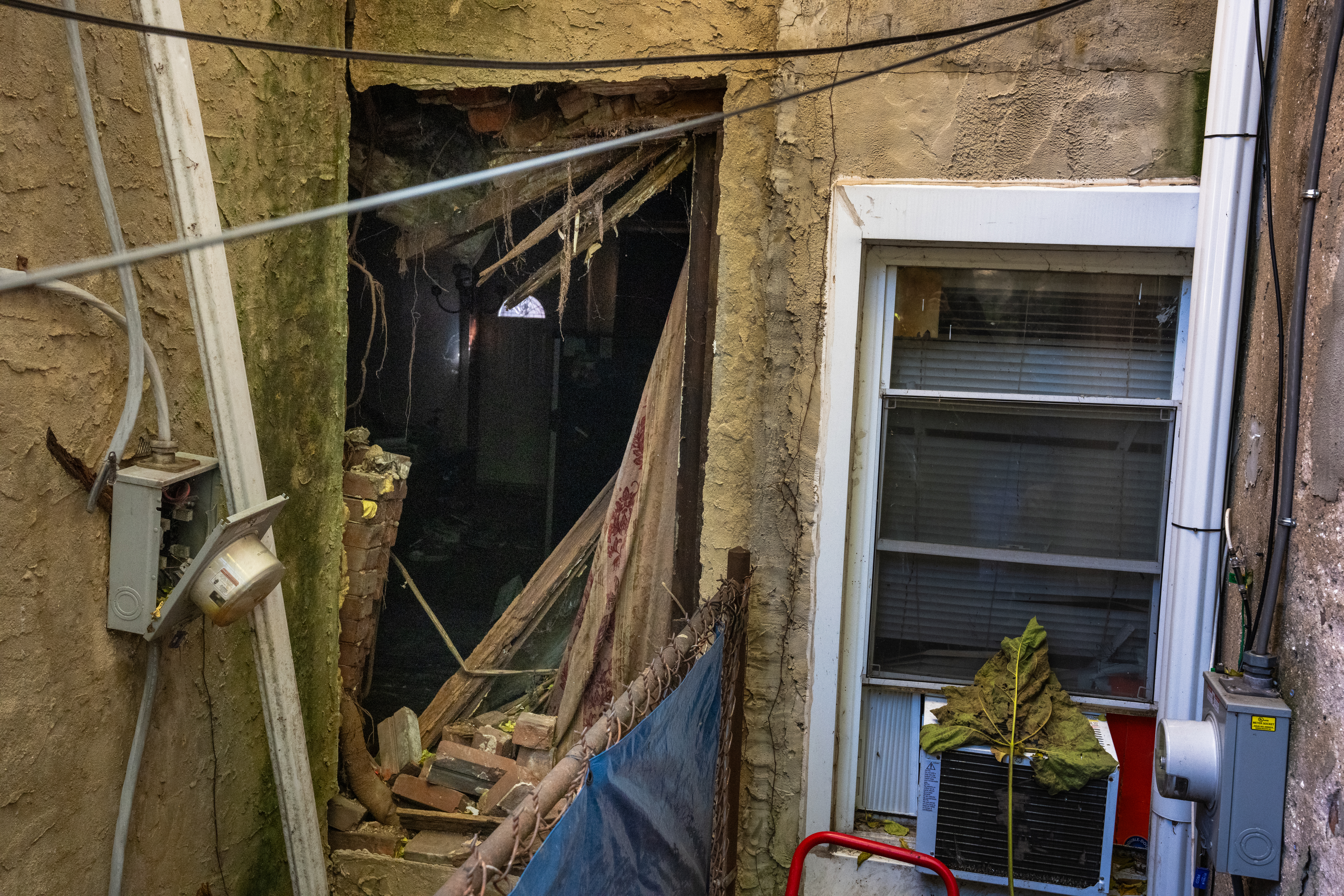
From the women’s backyard, through the door-sized hole in the back of the neighboring house, they can see past splintered beams and an abandoned refrigerator, beyond the staircase that leads to the second floor, and straight through to the front door.
Then there’s the tree that’s growing inside the vacant house. It has pushed outward through bricks and plaster and busted a second-story window. The tree’s branches tower over the homes, and some have reached the window of the bedroom where Phillips’ grandchildren stay.
L&I’s Contractual Services Unit is responsible for inspecting unsafe and imminently dangerous properties and administers the city’s demolition program. The unit has 10 members and openings for two more inspectors, said Basil Merenda, commissioner for L&I’s Inspections, Safety & Compliance division.
“We’re out there doing our job,” he said. “We’re out there making sure that these unsafe and [imminently dangerous] properties are properly addressed through procedures and that public safety is always being maintained.”
Renter Dayani Lemmon looks at the abandoned property located next door to his home in North Philadelphia.
But a 2024 report by the City Controller’s Office said the unit used to have 15 inspectors, which the office said was not enough to keep up with inspections of unsafe and imminently dangerous properties.
Merenda said L&I is “making do with what we have” and mobilizes inspectors in other units when needed.
After L&I declares a property to be unsafe or imminently dangerous, it must issue notices to the property owner, who is responsible for repairs. The department can take unresponsive owners to court and pursue demolition in emergency situations, such as when a property is likely to collapse, is next to an occupied building, and has recent structural failures, Merenda said. The city demolishes imminently dangerous buildings in order of the risk officials determine they pose.
A tree can be seen growing inside the vacant North Philadelphia rowhouse through a hole in the back wall, which partially collapsed this summer.
The city charges owners for tear-down costs and places liens on properties if they do not pay.
L&I was unable to say how many such tear-downs the department has conducted this year and referred questions about the cost of demolitions — and the proportion of those costs recouped from owners — to the city’s Department of Revenue. The revenue department did not provide any figures to The Inquirer.
“In many, many cases, property owners surface at the last minute and request a continuance, request a temporary restraining order from us going in and demolishing the property,” Merenda said. “And you know, that’s the purview of the courts. It’s beyond us.”
In the meantime, people living next to dangerous properties are left in the dark.
Kate and Dan Thien and their daughter stand in the backyard of their Port Richmond home, the foundation of which is cracking because of weed trees next door.
Frustrated with L&I
After the back of the abandoned rowhouse on North Woodstock Street opened up this summer, Phillips led an L&I inspector through her home so he could see.
“He went in the backyard, he looked over and was like, ‘My god!’” Phillips said. “I said, ‘Yeah, I can see right through their house.’ And he looked up and was like, ‘It’s a tree!’ I said, ‘Yeah, the tree is pushing the house out.’”
The inspector put an orange “imminently dangerous” notice on a front window, and Phillips and her landlord thought they wouldn’t have to worry much longer. But days after the notice went up, it was ripped down.
Weeds from the neighboring vacant property surround Kate and Dan Thien’s home in Port Richmond.
The property has attracted rats and mice. Water leaked into Phillips’ basement until her landlord reinforced the shared wall with concrete.
For months, her landlord got no response from the city to her calls and emails asking for help.
On Nov. 20 — 3 ½ months after the partial collapse — an L&I inspector visited the vacant rowhouse to post a “final notice” that the owner must repair or demolish the home or else the city will have it demolished.
Kate and Dan Thien are trying to live with the vacant property next to their rowhouse in Port Richmond as they wait for the city to respond to their 311 complaints.
When they bought their house in February 2024, they saw that the neighboring backyard was a mess, but they didn’t know the house was vacant.
Renters who had lived in what is now the Thiens’ home had used and maintained the neighboring backyard. But it quickly became overgrown. Neighbors later told the Thiens that the home had been vacant for more than a decade.
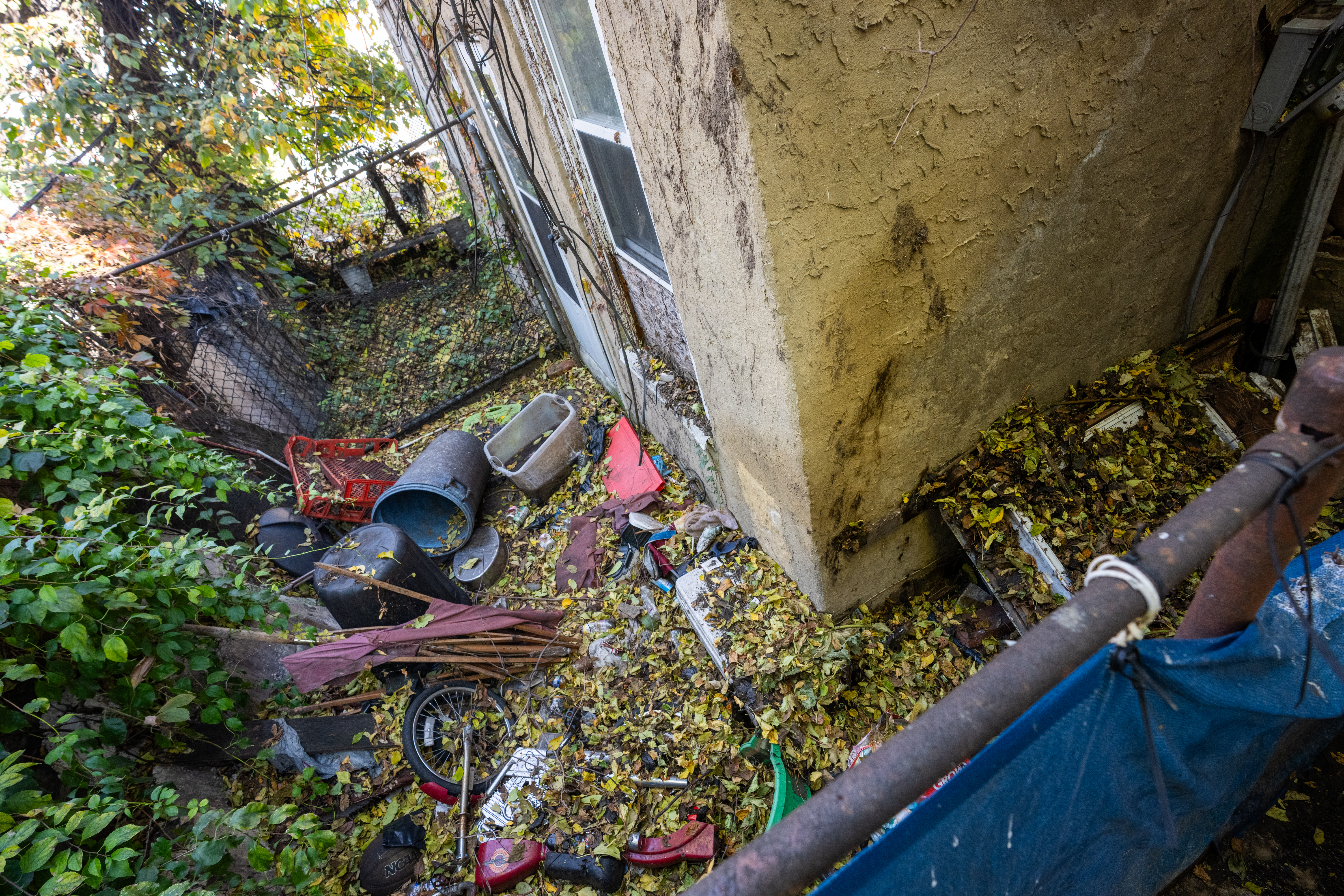
The backyard of the abandoned North Philadelphia rowhouse is full of debris.
“Pretty much the entire neighborhood knows about this house,” Kate Thien said.
She and neighbors on the other side have filed complaints with the city. The property has racked up 19 violations since 2012. Public records show that the city cited the property for “high weeds” last fall and most recently inspected it last December. The property passed inspection.
A year later, a weed tree’s branches stretch above and behind the Thiens’ two-story home. Tree roots are growing into their home’s foundation and cracking the concrete. Trees are “very rapidly growing” as Thien waits for the city to do something, she said. She worries about her home’s property value as the situation worsens.
This abandoned property on Spruce Street in West Philadelphia, pictured on July 30, was one of the houses on a list of problem vacant properties compiled by OnePA West/Southwest Rising.
“It’s not going away,” she said.
Annette Randolph and her husband, Dennis, live in a Point Breeze rowhouse next to a home that’s been vacant for more than a decade and that the city classifies as unsafe, a step below imminently dangerous. Four generations of her family have lived in her home. She hopes she’s not the last.
A tree growing inside the vacant house burst through its back roof, next to a tarp-covered hole. Randolph has had to repair her own roof because of damage from next door. Water gets into her basement.
The home’s legal owners are dead. A scheduled sheriff’s sale in 2011 for overdue property taxes gave Randolph hope for a resolution. But right before the sale, someone paid part of the tax bill to stop it.
On Nov. 20, an inspector with Philadelphia’s Department of Licenses and Inspections posted a final notice on the vacant North Philadelphia rowhouse that says owners must repair or demolish the home.
Now, “for sale” signs hang in the front windows, and a contractor showed up last week. Randolph hopes any work on the house won’t damage the one she’s called home for 66 years.
She has lost track of the number of times she’s called 311 about the situation. She’s felt helpless. When she needed new homeowner’s insurance, companies told her they wouldn’t insure her or would charge more because of the attached vacant and unsafe house.
“L&I and the city I blame for allowing this type of stuff to happen,” Randolph said.
Merenda said L&I hears neighbors’ complaints, “and we’re going to try to take action as efficiently and properly as possible.”
“I want to make, during my watch, L&I more accessible, responsive, and accountable to the neighbors, stakeholders, contractors, developers, average citizens, the City Council,” he said.
A collapsing roof was removed but the rest of the vacant rowhouse was left to deteriorate.
Neighbors band together
In September 2024, OnePA West/Southwest Rising launched its campaign to get the city to deal with abandoned properties.
The group created a list of 20 of the worst ones as submitted by neighbors. Among the vacant buildings, some had collapsing porches, one’s basement had flooded and damaged a neighbor’s house, and one’s walls were crumbling. Some had squatters, including a property where human waste was dumped in the backyard.
City Councilmember Jamie Gauthier’s office got the group a meeting with staff at L&I this January.
As a result, this summer, the group celebrated successes: five lots cleaned by the Pennsylvania Horticultural Society, three properties cleaned and sealed by the city, five properties whose owners the city took to court, and three properties that were repaired and returned to use.
The group believes it was able to get L&I to act because it had the weight of a Council member behind it.
“I do think L&I is overwhelmed. I don’t think they have enough staff to really stay on top of this,” said Eric Braxton, project director for OnePA West/Southwest Rising. “But clearly there are people in leadership that care about our communities and are trying to do the right thing.”
Now the group plans to push for systemic change. It wants the city to make small repairs to stabilize vacant buildings and charge the owners.
“There’s a gap in the system when it comes to dealing with unsafe abandoned buildings,” Braxton said. “The result of that is that those buildings just get worse and worse until they are imminently dangerous and have to be demolished.”
For more than an hour, one domestic violence survivor after another stepped up to the microphone with tales of pain and resilience.
“When people get close to me, I flinch because I’m afraid they are going to abuse me,” said one woman, speaking in Spanish, her words translated into English by a staffer at Congreso de Latinos Unidos, a nonprofit social services agency in North Philadelphia that provides help with housing, education, medical needs, workforce training, and after-school activities for youngsters.
Congreso is celebrating its 48th year in operation, and for 30 of those years, it has maintained a program to support people dealing with, and trying to escape from, domestic violence.
“I was never allowed to go outside. He would show up at my job,” the woman continued in a room decorated with purple balloons, the color symbolizing domestic violence. Each year, Congreso honors survivors and mourns, in a few moments of poignant silence, the people who lost their lives to domestic violence. Last year, in Pennsylvania, there were 102.
“He would bruise my face so I couldn’t see my family. I worked in a nightclub, and he would drag me out … No one wanted to get involved,” she said.
No one, until Congreso did and helped relocate her to a new home.
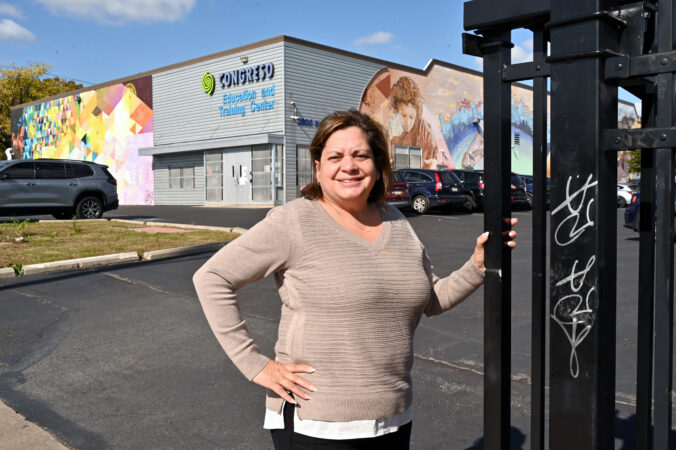
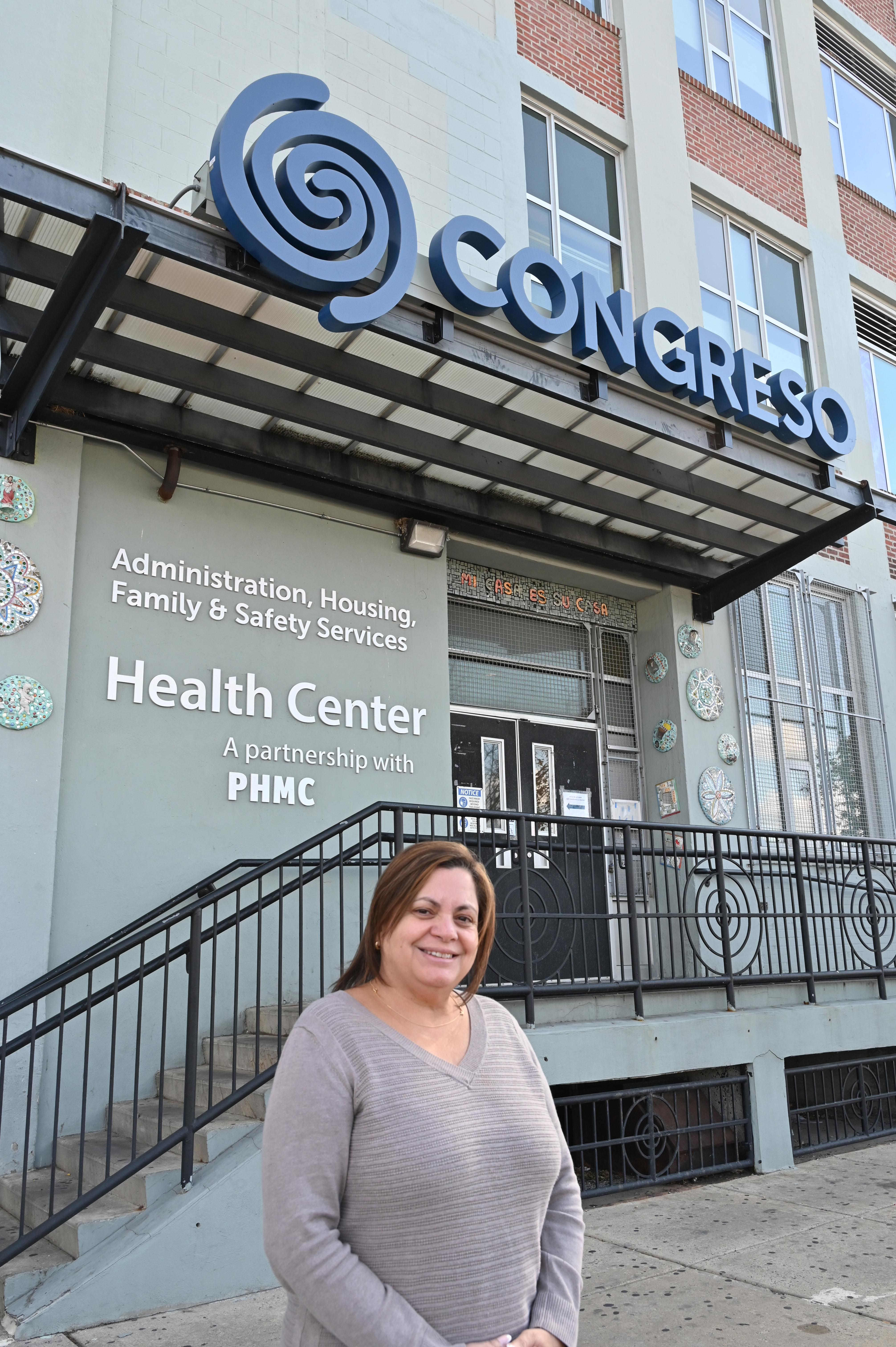
Jannette Diaz, president and CEO of Congreso, outside the group’s offices in North Philadelphia.“We’re all feeling the crunch,” she said of recent funding challenges.
“It takes a lot of courage to come up here and share your story,” Ramona Peralta, Congreso’s director of family wellness, said as the woman finished speaking. “We’re very proud of you, and we are here for you all the way.”
In the main room, the mood vacillated between the heavy silence of shared pain and the cheerful clamoring of babies. Later, there was music, and before, a friendly lunch of rice with pork and chicken.
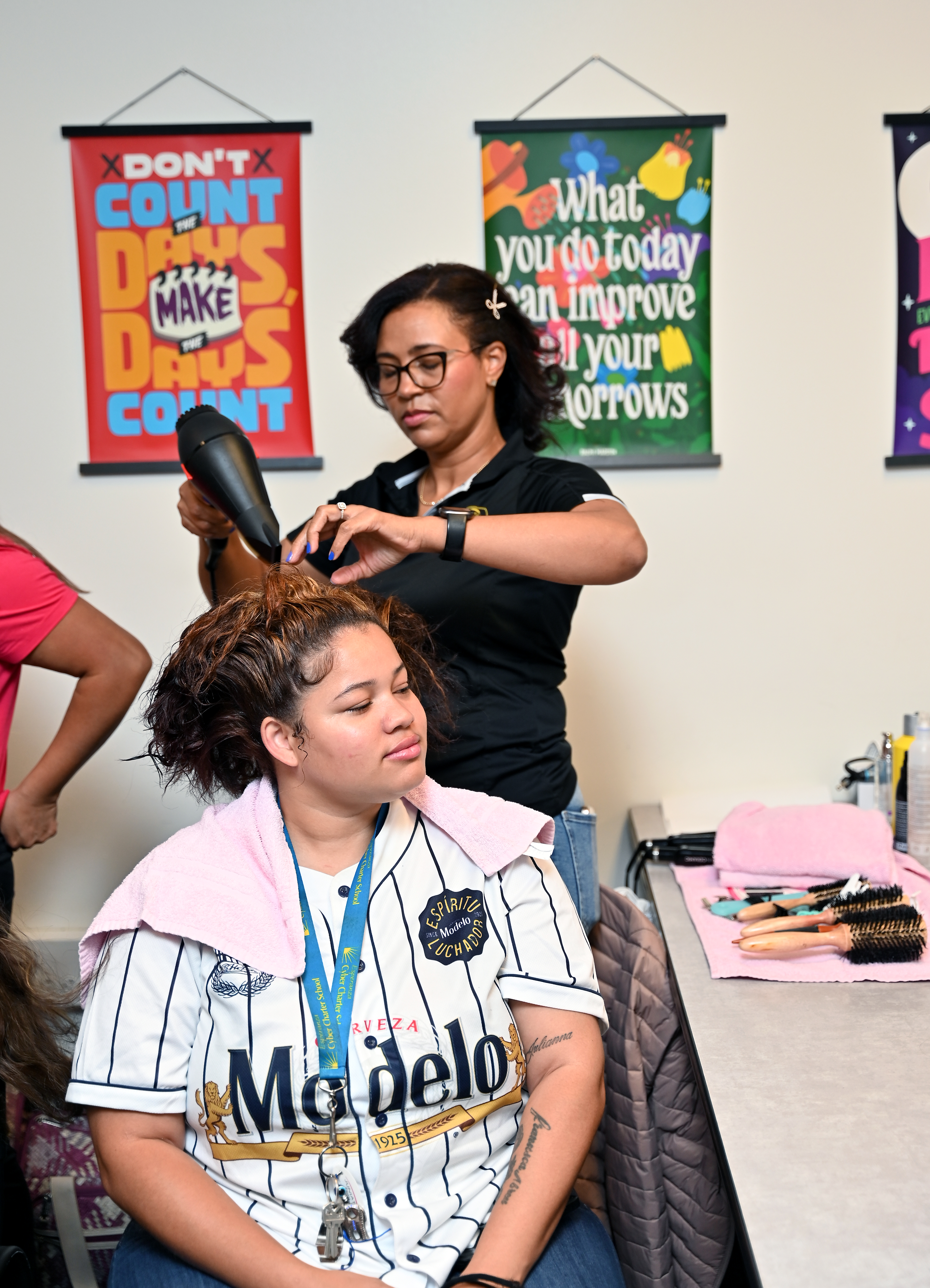
Across the hall, members of the Asociación de Cosmetologas de Pennsylvania offered free hairstyling to the women who attended the celebration.
Congreso, as part of its program to teach police, educators, social workers, and others to recognize signs of domestic abuse, had trained this group, as well, and because of the intimacy of their work, the stylists were uniquely positioned to do so. More than most, beauty salon operators could readily see the bruises hidden under hair and makeup. They could feel the cuts and scars on the scalp. And then there were the confidences confessed during shampoos and stylings.
Wanda Gómez, of the Blessings of God beauty salon, styles Franyeimi Abreu’s hair at Congreso’s offices.
Among the volunteers was Wanda Gómez, owner of the Blessings of God beauty salon in Northeast Philadelphia. “Thank God, I’m no longer in that situation,” she said, speaking through a translator. But because she survived domestic violence, she said she’s in a better position to help others. She tells them about Congreso.
Elisa Zaro Doran, owner of Dominican Divas Beauty Salon in Olney, twisted a strand of hair around a curling iron as she styled Maria Rodriguez’s long, dark hair. Like Gómez, Doran survived domestic abuse. “The first time, when he hit me, we were having a lot of problems, so I thought it was normal,” Doran said.
He’d even come into her beauty salon and hit her. “My clients would try to defend me,” she said. Eventually, when her son tried to protect her, she knew she had to take the necessary steps to get away and be safe — for herself and her children.
Rodriguez was there yesterday to support her daughter, who survived domestic violence, but still lives in fear — which is the reason she would only agree to be interviewed if her name was not used. “He told me that it doesn’t matter how many years — he will come and burn down my house with me in it,” she said.
Hairdresser Domaris Rodriguez shows her artistry on Raquel Mendez’s hair.
Rodriguez’s daughterturned to Congreso for help after Thanksgiving a few years ago. Her oldest son told her that day that he would no longer live with her, because every night he dreamed of killing his father. He couldn’t stay and watch the beatings or watch his father, in a rage, destroy the furniture in their home.
“I don’t know how many dining room tables I bought,” the daughter said.
On that Thanksgiving, she told her husband he had to leave. It was the end of the relationship, but the beginning of a new nightmare. He followed her to work and even stood in the pharmacy, watching her as she managed the office.
Counseling at Congreso helped her name her situation for what it was — abuse. “They made me see that I was in danger,” and that what she thought was normal was anything but. In group sessions, she learned a critical lesson: “I understood that I wasn’t the only one. They made me know it wasn’t my fault.”
She’s still afraid to leave her home. “I’m going through anxiety, PTSD. It still affects me.”
As she watched her mother get her hair styled, Rodriguez’s daughter hoped her mother would absorb a lesson from the stories she would hear. The daughter wanted her mother to understand the intergenerational legacy of abuse because she believes her mother also suffered from domestic violence.
That abuse, Rodriguez’s daughter believes, impacted both her and her sister, whose abuser stopped hitting her only when he thought she was dead. She teaches her sister lessons learned from counseling at Congreso. Counseling includes helping women develop a safety plan.
Rodriguez’s daughter brings her own little girl, 13, to Congreso’s counseling groups for children impacted by domestic violence. “I’m saving my sister’s life, and I’m saving my daughter’s life,” she said. As for her sons, “I’m not raising abusers,” as she reminds them to respect their girlfriends.
Last month’s celebration in honor of the survivors of domestic abuse took center stage that day at Congreso, but Congreso’s programming benefits many more people in the community, 75% of whom are Latino, said Jannette Diaz, president and chief executive.
Diaz grew up a few blocks from Congreso, and her father relied on the nonprofit for help with the family’s utility bills.
These days, she spends time working on strengthening relationships with fellow nonprofit agencies and with Congreso’s friends in the donor community.
“We’re all feeling the crunch,” Diaz said, describing a double whammy in mid-October of the state’s failure to pass a budget as the national government moved into another week of shutdown. Congreso gets much of its funding from government reimbursements for services provided.
At Congreso, “we’re very mindful of our spending. So far, we’re continuing to provide services at 100%, but there’s only so much we can do, tapping into our reserves and our line of credit.”
“Sometimes it’s heavy, but I’m also hopeful,” Diaz said, explaining that the twin state and federal budget crises required a sharper focus even as demand for services increases. Changes in Medicaid regulations may impact finances at Congreso’s health center, for example.
But, she said, donors can be confident their dollars are being spent wisely.
Why? Because as nonprofits come and go, Congreso has survived, thanks to providing trauma-informed and culturally responsive services that are informed by data to its clients, Diaz said.
“We’ve been around for 48 years, and there’s a reason for that. And that is how we operate within our community,” she said. “We forge a trusting relationship, and we try our best to do what they need. It’s important that we make sure our programs have impact.”
And that impact, Diaz said, goes beyond help given directly to clients. When Congreso assists a first-time home buyer in qualifying for and landing a mortgage, that homeowner becomes a Philadelphia taxpayer, benefiting the community.
When someone like Gary DeJesus-Walker earns a CDL truck-driving license through Congreso’s workforce training program, he can go on to build a trucking business. Now he employs three people.
“Congreso — they changed my life,” he said. “From trucking, I started two other companies.” With Congreso’s CDL program, “if you need a second chance, you can have one for the rest of your life. This is a way you can provide for and feed your family, forever.”
The stories are an inspiration to Diaz.
“Even in this season,” she said, “we can strategize and design services that our community needs. We’re not paralyzed by this crisis, and in terms of moving the needle forward, we’re progressing.”
This article is part of a series about Philly Gives — a community fund to support nonprofits through end-of-year giving. To learn more about Philly Gives, including how to donate, visit phillygives.org.
For more information about Philly Gives, including how to donate, visit phillygives.org.
About Congreso de Latinos Unidos
Mission: To enable individuals and families in predominantly Latino neighborhoods to achieve economic self-sufficiency and well-being.
People served: 13,435 unique clients served in fiscal year 2025.
Annual Spending: $30 million
Point of Pride: Trademarked Primary Client Model that drives Congreso’s bilingual and bicultural approach to delivering services in a client-centered, data-informed, and culturally responsive way, whether a community member is receiving support in education, workforce development, housing, health, or family services.
You can help: Become a monthly donor, a member of Congreso’s Corporate Advisory Council, or a volunteer in the Congreso Cares Program. Volunteers help with participating in program initiatives like Congreso’s free tax preparation, supporting program and agency events, and assisting with fundraising.
A second woman is accusingPhiladelphia doctor John Smyth Michel, the medical director and owner of Excel Medical Center, of sexual abuse. She said Michel touched her inappropriately when she worked for him several years ago, according to a recent court filing by the Philadelphia District Attorney’s Office.
Prosecutors charged Michel with felony rape and sexual assault earlier this yearafter a female patient said he raped her during an October 2024 office visit.
Michel, 55,of Jenkintown, told police and state medical licensing authorities that he had sex with the 39-year-old patient, but he claimed it was consensual, criminal and state licensing records show.
The new accusations involve a former female employee who worked for Michel as a medical assistant from 2015 to 2019 at his East Mount Airy office on Stenton Avenue and at another location in Germantown on Chelten Avenue.
She recently told law enforcement authorities that beginning in 2018 Michel touched her breasts over her clothing on multiple occasions while she was working in the office. He additionally groped her vagina over her clothing before she quit in 2019.
The accusations have not resulted in new charges at this time, but the investigation remains ongoing, according to Marisa Palmer, a spokesperson for the DA’s office.
Prosecutors are seeking to introduce the groping accusations as evidence to bolster its sexual assault case against Michel, given there were no witnesses to the alleged rape.
“The incidents reveal a common plan, scheme or design on the part of the defendant to engage in unlawful and similar nonconsensual sexual conduct with vulnerable women in his medical offices,” Assistant District Attorney Eamon Kenny wrote in a Nov. 24 court motion.
The judge presiding over the criminal case must decide whether to grant Kenny’s motion and put the 34-year-old former employee’s accusations before jurors at trial.
The Inquirer does not identify alleged victims of sexual assaultwithout their permission.
Michel did not return phone calls and emails from The Inquirer this week. His criminal defense lawyer, Andrew Gay Jr., declined to comment Wednesday.
Michel founded Excel Medical Center, whichgrew to more than a dozen medical clinics located throughout the city, with about 20,000 patients and 200 employees.
Last month, Excel’s general manager wrote a letter to patients informing them the practice “will be ceasing operations” as of Dec. 1. “We truly value the trust you have placed in us for your care,” the manager stated in the Nov. 11 letter obtained by The Inquirer.
A woman who answered the phone at Excel’s main location in West Mount Airy on Thursday said the practice was not taking any new patients in preparation of closing. She said the practice might resume operations and accept new patients after the new year. Michel’s lawyer declined to comment when asked about the practice’s status.
The criminal case, which is pending in Common Pleas Court, involves a then-38-year-old patient.
According to police and court records, she accused Michel of kissing her during a May 2024 exam at his East Mount Airy location.
She told him “no,” left the office, and did not report the kissing incident.
About five months later, she went to an appointment at Michel’s North Philadelphia office on West Diamond Street. During the Oct. 14, 2024, visit, she says Michel raped her with such force that her head banged twice against the exam room wall.
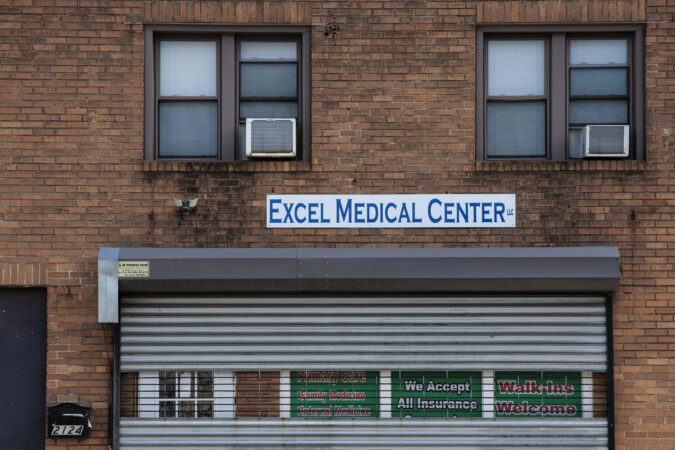
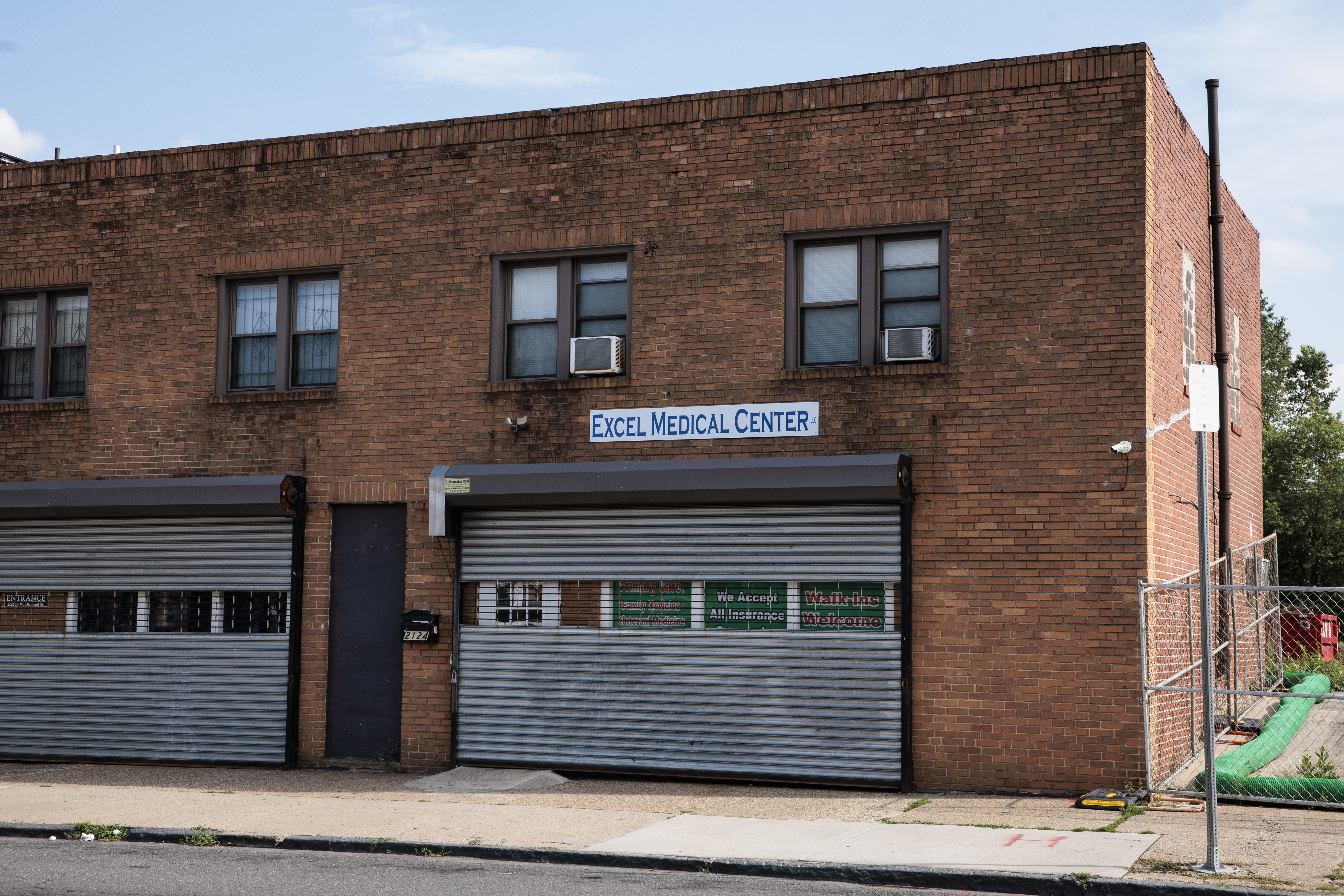
The exterior of Excel Medical Center at 2124 Diamond Street in Philadelphia.
In early November 2024, she told her husband what had happened and subsequently filed a police report. Michel was arrested and charged about three months later.
Michel’s trial was initially slated for Dec. 9, but during a hearing on Monday, a judge postponed it until Feb. 17 after the DA’s office asked for more time to investigate, court records show.
Michel’s suspension nears end
In June, the State Board of Osteopathic Medicine, which regulates and oversees licensure of osteopathic doctors like Michel, disciplined him for having sex with a patient — a violation of state regulations.
He apologized to the board in a letter, saying, “I fully acknowledge that I crossed a professional boundary” and is “profoundly contrite.”
The board suspended his medical license for six months, followed by 18 months of supervised probation, and fined him $4,000. Michel’s suspension is set to end on Dec. 11.
If convicted in the criminal case, Michel could permanently lose his medical license.
In an e-mailed statement on Thursday, the Pennsylvania Department of State, which oversees professional licensing boards, said its prosecution division “continues to closely monitor Dr. Michel’s criminal charges and review his compliance with the terms of the consent agreement.”
Abuse in office hallways
The accusations outlined in Kenny’s motion include new details of sexual misconduct. The former employee said Michel approached her from behind to “grab her breast over her shirt.”
She was stunned and “hated the feeling,” but she feared losing her job so she didn’t say anything to him.
Once, he simultaneously “cupped” her breast and vagina over her clothes with his hands. She turned around and screamed at him to stop touching her, according to the motion. He replied, “`You know you want it and you know you like it,’” she recounted.
She said she couldn’t quit because she needed the income and told her co-workers about the abuse. Those colleagues helped her “avoid him” while at work. She also told her husband, though she persuaded him not to confront Michel.
She resigned in 2019 after landing a new job. They had no contact until this year when he texted her.
When she asked why he wanted to talk to her after so much time had passed, Michel texted nevermind, the former medical assistant told prosecutors. She then wrote back, “explaining how she felt about his abuse all these years later, that the thoughts of it still traumatized her.”
Inquirer staff writer Chris Palmer contributed to this article.
The fix was needed because Council earlier this week amended a separate but related piece of legislation — called the H.O.M.E. budget resolution — that sets the first-year spending levels for the housing programs funded or created by the initiative.
Council’s changes, which Parker largely opposed, were significant enough that the budget resolution no longer aligns with the bond authorization bill Council approved in June, meaning the administration cannot rely on the original legislation as its legal basis for taking out city debt.
The new bond bill introduced Thursday reflects Council’s changes, which include increasing the first-year H.O.M.E. budget from $194.6 million to $277.2 million and changing eligibility requirements for some programs to make sure the lowest-income Philadelphia households were prioritized.
“We want to make sure that this is a H.O.M.E. plan that supports everyone, but obviously members of Council had an issue and concern about making sure those most in need are supported throughout this process,” Johnson said.
The bill now heads to committee, and Johnson said negotiations could lead to further changes. Next week is Council’s final meeting of the year, and Johnson on Thursday ruled out adding an extra session, meaning the bill likely will not pass until January at the earliest.
“Working with Council President Johnson and the Members of City Council, we are laser-focused on building, repairing and restoring 30,000 units of housing and making H.O.M.E. a reality for the people of Philadelphia,” Parker said in a statement Thursday.
‘That’s my sister’: Johnson says relationship with Parker still strong
Parker-Johnson pact intact: The Council president on Thursday downplayed his spat with Parker that saw both issue pointed statements Tuesday night blaming the other for delays in issuing the bonds.
But Johnson said Thursday their relationship remains the same and has always involved disagreements — just not ones that have spilled out into public view.
City Council President Kenyatta Johnson and Mayor Cherelle L. Parker have maintained a close working relationship.
“That’s my sister,” Johnson said. “Most of the time, when we do have disagreements, y’all just don’t see it. We meet every week, so you don’t get a chance to see the back-and-forth. But at the end of the day, the mission is to move the city of Philadelphia forward together.”
Council makes it harder to open convenience stores and pharmacies in Kensington
The bill, authored by Councilmember Quetcy Lozada, forces any new “sundries, pharmaceuticals, and convenience sales” businesses in her 7th District — which covers much of Kensington and parts of North and Northeast Philadelphia — to get approval from the Philadelphia Zoning Board of Adjustment. That process is notoriously long and can be expensive for applicants.
Lozada has said that the bill is targeted at corner stores and smoke shops, not chain businesses like CVS and 7-Eleven.
The legislation is part of the body’s broader war on so-called nuisance businesses, which lawmakers say attract crime and disrupt neighborhoods. And it comes in addition to a controversial 11 p.m. business curfew in Lozada’s district that took effect earlier this year.
City Councilmember Quetcy Lozada represents Kensington.
It’s one of several legislative remedies lawmakers have undertaken to curb small businesses like smoke shops and convenience stores that have unregulated slot machine-like “skill games,” sell marijuana-like products, and peddle drug paraphernalia without a license to do so.
Seriously … no nuisances, please: Lozada was not the only lawmaker taking aim at “nuisance” businesses Thursday, when Council approved two bills by Majority Leader Katherine Gilmore Richardson on the same topic.
One measure makes it easier for the Philadelphia Department of Licenses and Inspections to issue stop-work and cease-operations orders to businesses violating city regulations. The other is aimed at closing loopholes that “let nuisance business owners avoid enforcement by changing their name or ownership, ensuring those with similar ownership or operations remain accountable for past violations,” Gilmore Richardson’s office said.
The measures, which were both approved 16-0, were aimed at stopping “the spread of dangerous and destructive businesses and the need for further action to address their impact on our communities,” Gilmore Richardson said.
“While I am encouraged by the steps we are taking today, I am also working on additional legislation to more aggressively crack down on these businesses and the bad actors behind them,” she said.
“Anybody that knew Paul will tell you he really was that guy, that guy who would give you the shirt off his back,” Harrity said. “He’s the only person I truly knew never lost faith in me, even when I was at my lowest 10 years deep in my addiction.”
Councilmember Curtis Jones Jr. thanked Harrity, who often gives impassioned speeches, for his heartfelt tribute to Staico.
“I want to shout out Jimmy Harrity for making crying in Council cool,” Jones said. “Nobody does it better, brother.”
Staff writer Jake Blumgart contributed to this article.
City officials and housing advocates want Philadelphia to close a loophole in its tax code that allows people who forge deeds and steal homes to get a refund for taxes they paid to commit their crimes.
Thieves commit deed fraud when they illegally transfer a property’s ownership and record a fraudulent deed with the city.
This fraud often occurs after a homeowner dies but remains the legal owner of a property. Thieves use deceptive means, such as posing as fake heirs and forging documents, to take and sell properties, often flipping them to developers for large profits.
To record a deed, property owners — including fraudsters — need to pay a realty transfer tax. If a judge later determines that a sale was fraudulent, the person who paid the tax can request a refund from the city. That includes thieves.
“It’s a nightmare for victims of deed fraud, and while we can’t necessarily improve the situation, we can help to ease some of their financial burden,” Gilmore Richardson said during a Council hearing Wednesday.
Philadelphia’s portion of the realty transfer tax is 3.578% of the value of a home sold. So for a stolen $100,000 home, a victim could receive a refund of about $3,500.
A longstanding issue
Deed fraud is a persistent problem in Philadelphia. The city’s records department received about 130 reports of deed fraud in 2023 and about 110 reports in 2024.
Investigations by The Inquirer have shown that deed theft grew alongside gentrification in Philadelphia, as property values rose in neighborhoods that became more desirable. Victims of deed fraud disproportionately are people of color and seniors.
James Leonard, commissioner of the Philadelphia Department of Records, said the Parker administration supports the Council bill, which “addresses a gap in how we help victims of deed fraud.”
“We see these cases regularly,” he said. “They devastate families, they undermine confidence in our property system, and they impose significant costs on victims, who must fight in court to reclaim what was always rightfully theirs.”
Victims face a long legal battle in which they must prove that a deed is fraudulent and often must pay attorney fees. And they have to keep paying mortgages while they fight to reclaim properties.
“When they finally win, they get their property back. But they’re often financially and emotionally devastated by the process,” Leonard said.
The new Council legislation allows a victim who gets a court order that voids a fraudulent deed to request a refund of the realty transfer taxes that a thief paid. Leonard estimates the city will see at most 25 to 50 cases per year, a “modest” fiscal impact for the city.
And under current law, the city keeps tax payments that it never would have received if not for the deed fraud, he said, so the city has been benefiting from fraudsters’ payments.
“From an equity standpoint, this bill is the right thing to do,” he said.
Vincent Gilliam and his family were victims of deed fraud when his deceased mother’s home in North Philadelphia was stolen. Between the belongings that deed thieves took and the fight to reclaim the home, he estimates that the ordeal cost his family at least $5,000.
He told Council members that getting some money back from the city through a realty transfer tax refund “would be a tremendous help.”
Kate Dugan, a divisional supervising attorney at the legal aid nonprofit Community Legal Services of Philadelphia, said the problem of deed theft “is expensive and complicated to fix.”
“Even when free representation is available, which is normally not the case, victims are stuck paying for costs like repairs, changing locks, filing fees … out of their own pockets,” she said. “It’s rare for a deed fraud victim to collect any meaningful money damages or restitution.”
On Wednesday, Council’s Finance Committee sent the bill to the full Council for consideration.
As charming and ebullient as Nephtali Andujar is (lots of hugs, compliments, and gifts of his homemade pottery), the 61-year-old is also pretty blunt about why people should give to Project HOME, one of the city’s largest nonprofit housing agencies.
Because of Project HOME, said Andujar, who spent years living on the streets, he is no longer desperate — desperate to get money to feed a heroin addiction, desperate to scrape $5 together to pay someone to let him drag a discarded mattress into an abandoned house for a night’s sleep out of the rain.
“It’s not just giving someone an apartment,” said Andujar, who sheepishly described a past that included stealing cars and selling drugs. “It’s the snowball effect.
“You are not just helping the homeless,” he said. “You are helping the city. You are helping humanity.”
In the agency’s name, the letters HOME are capitalized, because each letter stands for part of the multipronged approach that Project HOME takes in addressing homelessness and combating poverty for the 15,000-plus people it serves each year.
There’s H, for Housing — not only housing in the literal sense, but also in the teams of outreach workers who comb through the city’s neighborhoods looking for people like Andujar. One outreach worker found Andujar in 2021 at a critical moment in his life — clean, just out of the hospital for liver treatment, and back on the streets of Kensington ready to begin anew.
“We know we have to do the most we can to preserve these resources that we’ve come to rely on,” says Donna Bullock, president and CEO of Project Home.
For Andujar, it was a race. What would find him first?
Would it be heroin, as it had so often been in the past? It was tempting. It’s painful being on the street — cold, hungry and dirty, ashamed and alone. “When you do heroin, you don’t feel the cold. It kills the hunger,” he said. “When you use the drugs, you don’t have to suffer for hours. Heroin numbs you.”
Instead, though, it was the outreach worker — someone who had been through Project HOME’s recovery program — who plucked Andujar off the street in the nick of time and took him to a shelter.
A year later, that same outreach worker helped Andujar move to his own room at Project HOME’s Hope Haven shelter in North Philadelphia.
“You get tired of the streets. They were killing me,” Andujar said.
Next Andujar found Project HOME manager JJ Fox, who helped him get a birth certificate and other documents, and arranged for him to stay. But he needed more than a warm bed.
The problem with getting straight after a heroin addiction, Andujar explained, is finding a new purpose and direction. For so long, life was focused on a repeat cycle of getting the next fix and then becoming numb to pain while it was working.
So when he got to Project HOME, he needed a new direction, which is where both the O and E in HOME came in for Andujar.
“JJ Fox gave me direction,” he said, and so did Project HOME employment specialist Jamie Deni.
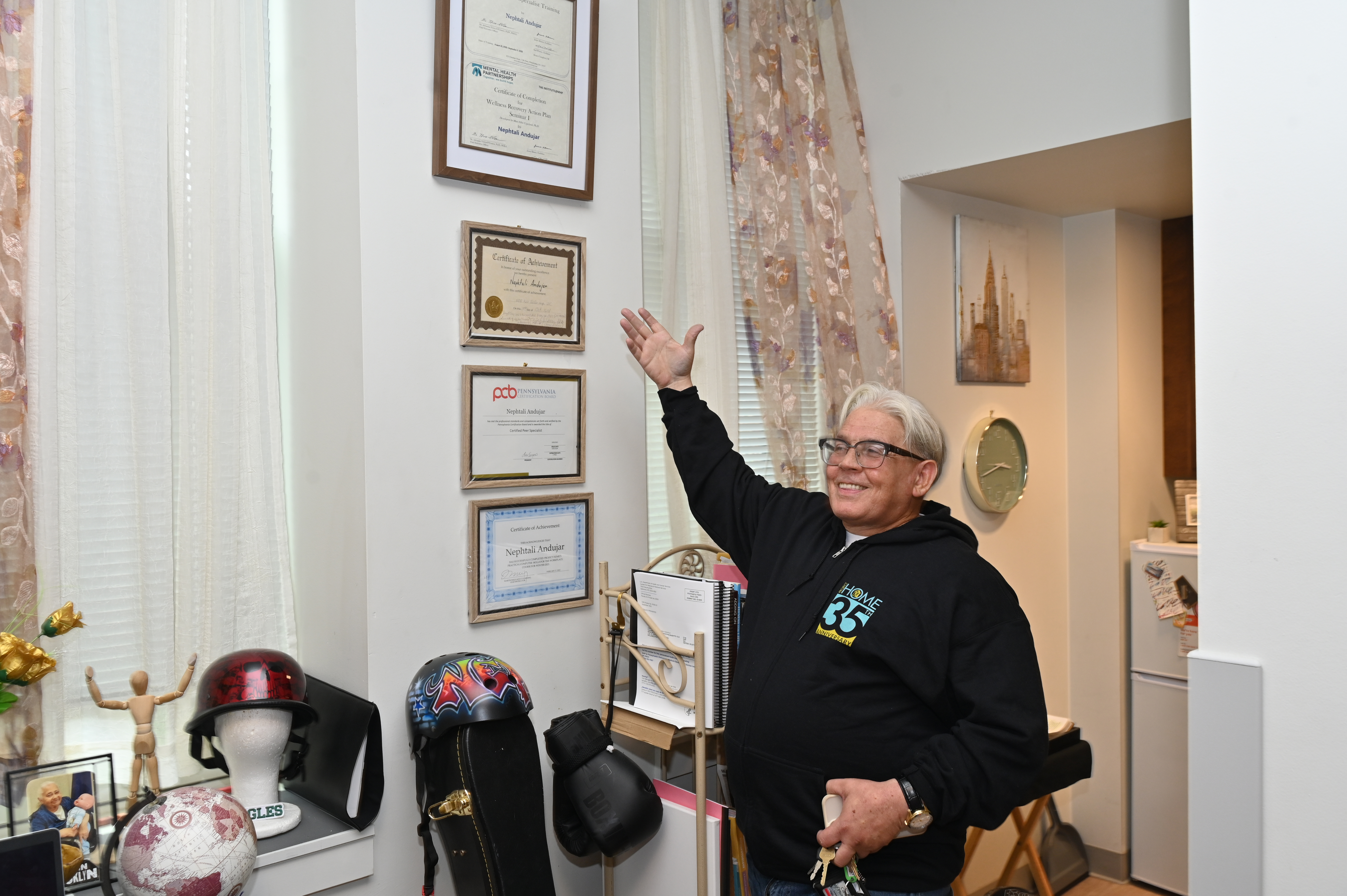
Training certificates cover a wall in Nephtali Andujar’s studio apartment in Project HOME’s Inn of Amazing Mercy in Kensington.
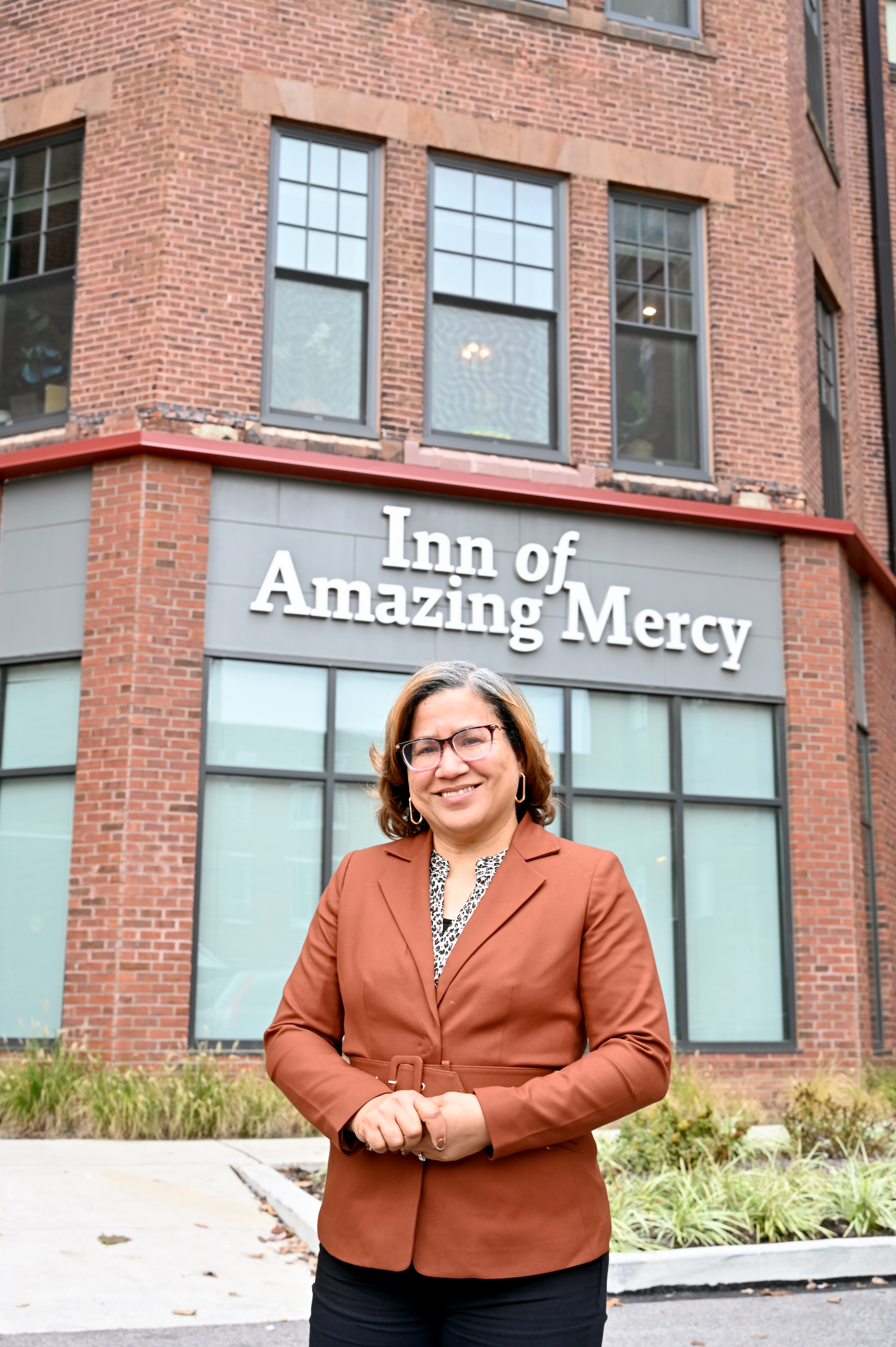
The “O” in HOME has to do with Opportunities for employment. Certificates cover one wall in Andujar’s studio apartment in Project HOME’s Inn of Amazing Mercy, a 62-unit apartment building and offices in a former nursing school dormitory in Kensington. He can point to his accomplishments in computer skills, barbering, and training as a peer specialist to help others the way the outreach worker helped him.
But Andujar is not in good health, as vigorous as he appears. His addictions will someday exact their price, even though with cirrhosis of the liver, he is already living years beyond what his doctor predicted.
Full-time work is not an option. So Andujar is part of the “E,” as in Education. Deni helped him get a grant to take art classes at Community College of Philadelphia. She helped him understand CCP’s education software so he could turn in his homework.
Project HOME offers classes in graphic design, music production training, ServSafe food handling, forklift and powered industrial trucks certification, and website building, among other courses.
The M stands for Medical. Project HOME doctors, nurses, and other health practitioners treat 5,000 people a year, both in a fully equipped health center and by sending medical teams into the streets, caring for people, literally, where they live.
“My dad always told me that you need three things — housing, food, and love. You get all that here,” Andujar said.
And for him, it goes beyond that. During a stable period in his life, Andujar had a partner and a child. His daughter is now 14 and living with her aunt in New Jersey. Her mother, who was also stable for many years, fell into addiction but is clean now. She is living in another Project HOME apartment.
Like Andujar, Omayru Villanueva, 49, another resident at the Inn of Amazing Mercy, recalls her first night of homelessness.
She remembered a cold slushy rain.
She remembered sweeping every corner of her house, determined to leave it clean, no matter what. Her husband had been convicted and jailed for a federal crime. She couldn’t make the payments on the house, so she sold or stored all of her belongings and prepared to leave.
On her last morning at home, she and her school-age twin sons walked out the door before the sheriff came. Her older daughter was able to find a place in a shelter. Her second daughter, just under 18, said she was living with a boyfriend, but it turned out that she had been trafficked.
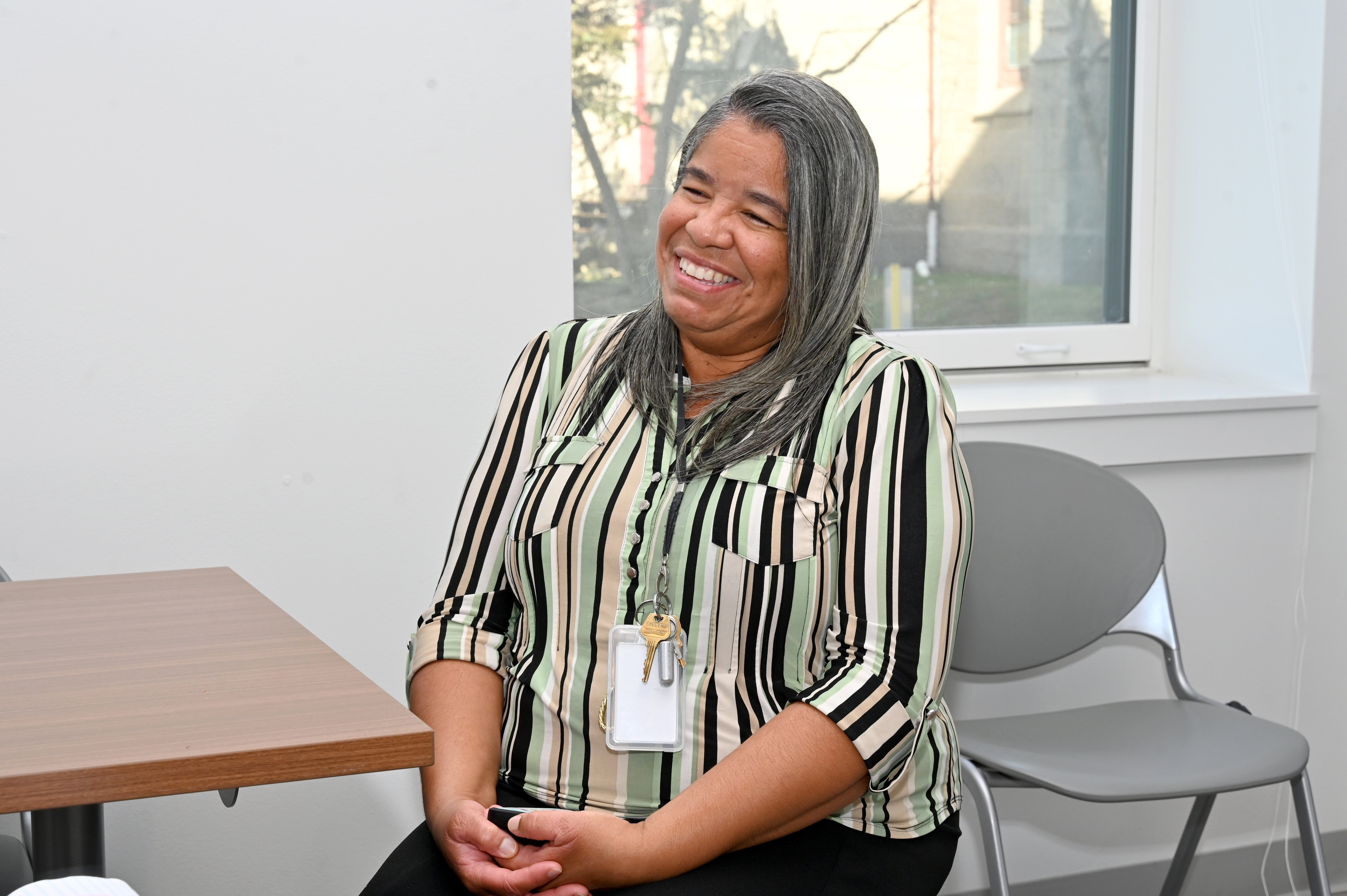
“There’s a sense of dignity and respect when you have your own place,” says Omayra Villanueva, another resident of the Inn of Amazing Mercy.
By that evening, Villanueva was desperate. She took her boys to a hospital emergency room. At least they could sit indoors while she figured out something. “I was crying inside.” Finally, she called a friend from church who took her and her sons in.
From there, they moved from shelter to shelter, and ultimately to a Project HOME apartment with two bedrooms.
“That night we had a pizza party. We were so happy,” she said. “There’s a sense of dignity and respect when you have your own place. You can take your worries away from having a place to live, and you can focus on other things.”
She remembered lying in her new bed, “thanking God and rubbing my feet against the mattress.” The next day, she woke up, opened the window, and listened to the birds. Then she asked her sons what they wanted for breakfast. “When you are in a shelter, you eat what they give you.”
Three of her four children, scarred from the experience, have also been homeless and living on the street. Her two sons, now 23, are in Project HOME apartments. Both daughters are now fairly well-established.
Villanueva appreciates the medical help she has been given at Project HOME, particularly for mental illness stemming from the trauma she has experienced with her ex-husband’s arrest and homelessness.
“Anybody can end up being homeless,” she said. “I wasn’t a drug addict. I wasn’t an alcoholic. It can happen to anybody.”
She thinks of her daughter, who has a house, a job, and a car. But if something happens to the car, her daughter won’t be able to get to work. She won’t be able to pay her mortgage, and she could wind up homeless. It’s that simple.
“It’s important to donate because people can help break the cycle of homelessness,” Villanueva said.
“It’s about housing and education. It’s about medical help. It’s about employment,” she said. “Project HOME helped me a lot.”
The truth is that every person in Project HOME has a story. Those stories keep Donna Bullock, president and chief executive, motivated to preserve and protect the agency founded just over 35 years ago by Sister Mary Scullion and Joan Dawson McConnon.
She worries about how the city will respond to federal executive orders amounting to the criminalization of homelessness. Will there be tightened requirements for agencies that provide shelter?
Project HOME is reimbursed for some of the medical care it provides, but Bullock worries that new rules involving Medicaid reimbursement will impact the agency’s budget, while cutbacks in services increase demand.
“It’s terrifying,” she said. “We know we have to do the most we can to preserve these resources that we’ve come to rely on.
“In this job, I’ve learned to appreciate the humanity of folks — the residents and the stories they tell and the contributions they make to our community.”
Sometimes, she said, Project HOME residents walking the path of recovery slip and fall away. Sometimes the results are tragic, the losses devastating.
“We’re experiencing all these moments — communal grief and communal celebrations as well. We talk a lot about how every journey of recovery is unique. Everyone walks their own journey. We can’t do the walk for you, but we can walk with you,” she said.
Bullock invites others to the journey, promising that when people give to Project HOME, they can be assured that their money is carefully managed. “We’re good stewards of the resources entrusted in our care. We know how to leverage the resources given to us.
“Folks expect a return on their investment, and the return is the difference in individual lives and also building a community,” she said. “Your investment is magnified 10 times over.”
This article is part of a series about Philly Gives — a community fund to support nonprofits through end-of-year giving. To learn more about Philly Gives, including how to donate, visit phillygives.org.
For more information about Philly Gives, including how to donate, visit phillygives.org.
About Project HOME
Mission: To empower adults, children, and families to break the cycle of homelessness and poverty, to alleviate the underlying causes of poverty, and to enable all of us to attain our fullest potential.
People served: More than 15,000 annually — with street outreach, housing, opportunities for employment, medical care, and education.
Annual spend: $49.06 million
Point of pride: Project HOME, which operates 1,038 housing units, broke ground in October for construction of 45 new apartments; also under construction are 20 respite beds. In the pipeline are an additional 44 apartments. Project HOME also operates the Honickman Learning Center Comcast Technology Labs, Stephen Klein Wellness Center, Helen Brown Community Center, and Hub of Hope.
You can help: Volunteers tutor students, serve meals, participate in neighborhood cleanups, and organize donation drives at their organizations for household items or other items useful to families or people still experiencing street homelessness.
Here are some ways that a gift can help the people we serve:
$25 provides warm clothing and new socks for a visitor at the Hub of Hope.
$50 supports a behavioral health counseling visit.
$100 provides a month’s worth of hygiene products and toiletries for a family.
$250 provides a welcome basket for a new resident complete with sheets, towels, and cooking supplies.
$500 supports five dental visits at the Stephen Klein Wellness Center.
$1,000 funds six weeks of summer camp at the Honickman Learning Center Comcast Technology Labs, keeping a child’s mind active during the summer and supporting moms who work.
$1,500 funds a certification program through the Adult Education and Employment program leading to employment readiness.