The head of the Pew Charitable Trusts is stepping down.
Susan K. Urahn, president and CEO, is expected to retire in early 2027 after a search for a successor is completed and the new leader has begun working at the organization, a Pew spokesperson said.
Urahn, 72, began at Pew in 1994 and took the top job in 2020 following the retirement of longtime chief Rebecca W. Rimel.
Neither Urahn nor board chair Christopher Jones were made available for interviews. But, in a statement posted on Pew’s website, Urahn said she was fortunate to work with colleagues and a board “all dedicated to finding common ground and using facts as the foundation for discussion and action.”
“Under Sue’s leadership, Pew has become even better and stronger,” read a statement attributed to Jones.
Pew — which has offices in Philadelphia, Washington, D.C., and other cities — is a combination foundation/think tank, conducting research and disbursing grants to nonprofit organizations.
In Philadelphia, it awards money to arts groups through the Pew Center for Arts and Heritage. Its D. C-based Pew Research Center provides research on demographic trends and social issues, as well as polling on matters like politics, religion, climate change, and the role of technology in daily life.
Pew’s work is funded through seven charitable trusts established between 1948 and 1979 by the children of Sun Oil Co. founder Joseph Newton Pew and his wife, Mary Anderson Pew. As of June 2024, the collective value of the trusts was $6.1 billion, a spokesperson said.
In addition to funding Philadelphia arts groups and individual artists, Pew has sometimes taken a more activist role by partnering with other philanthropists on large civic projects costing tens of millions of dollars, such as the 2012 move by the Barnes Foundation from Merion to the Ben Franklin Parkway. In 2008, Pew contributed millions toward a bailout of the Kimmel Center that relieved it of debt left over from the arts center’s construction phase.
Urahn, most recently based in D.C., worked her way through several posts — including director of Pew’s planning and evaluation division; director of the Pew Center on the States; and executive vice president for Pew’s work on state policy, economics and healthcare.
A search for a new president is expected to begin in January.
Three men were convicted of first-degree murder and related crimes for a 2023 shooting at a North Philadelphia playground that left three people dead and one injured, prosecutors said Wednesday.
Tyyon Bates, 21, Quaza Lopez, 22, and Eric Reid, 23, were all found guilty this week for their roles in the crime, which brought chaos to a basketball court at Eighth and Diamond Streets on a hot summer night as children played outside.
Nyreese Moore, 22, Nassir Folk, 24, and Isaiah Williams, 22, were killed. A fourth person was shot in the abdomen and survived.
In addition to murder, Bates, Lopez, and Reid were convicted of conspiracy to commit murder, recklessly endangering others, and firearms offenses, prosecutors said.
A jury found a fourth suspect, Sufyann Kinslow, not guilty of murder and related charges, court records show. And a jury could not reach a verdict in the trial of a fifth suspect, Tynel Love, on similar charges, though prosecutors say they intend to retry that case.
Prosecutors said the Aug. 11, 2023, shooting stemmed from “vengeance” over a 2018 shooting that left Bates’ brother, Tyree, dead just several blocks away at Fourth and Diamond Streets.
“The motivation was for ‘Ree,’ Tyree Bates,” said Assistant District Attorney Cydney Pope. “And Tyyon Bates made sure he got his ‘get-back’ for him — and bragged about it.”
Investigators recovered more than 100 pieces of ballistic evidence from what prosecutors said was an unusually large crime scene involving six shooters. Surveillance video from the recreation center and a nearby vacant lot helped investigators link the men to the crime, Pope said.
Bates, Lopez, and Reid were sentenced by Common Pleas Court Judge Glenn Bronson to three consecutive life sentences in prison plus an additional 24 to 48 years in custody.
Prosecutors said that their work is not finished and that they plan to bring charges against two more people involved in the crime.
Mayor Cherelle L. Parker is shaking up the board of the Philadelphia Land Bank, which helps control the sale of city-owned land but hasn’t been moving fast enough to advance her housing priorities.
Parker’s first land bank board chair, Herb Wetzel, has been asked to step down as well as board member Majeedah Rashid, who leads the Nicetown Community Development Corp. The board has 13 members.
Angela D. Brooks, who serves as the city’s chief housing officer, will be joining the board. Earlier this year Parker appointed Brooks to lead the mayor’s campaign, Housing Opportunities Made Easy, or H.O.M.E., to build or renovate 30,000 houses over the course of her administration.
The mayor has long championed the Turn the Key program as part of that plan, a policy that depends on getting inexpensive city-owned land to developers so they can build houses that are affordable to working and middle-class families.
Rashid is being replaced by Alexander Balloon, who formerly served on the Land Bank’s board and is the executive director of the Passyunk Avenue Revitalization Corp.
“It is clear from the Land Bank’s success with its Turn The Key program: A strong and effective Land Bank is essential for reaching the H.O.M.E. initiative’s goal to produce and preserve 30,000 homes,” Parker said in a statement.
Several Turn the Key proposals have been held up by the Land Bank board, which has been riven between factions that are either more or less friendly to private-sector developers.
Rashid and other board members who come from a nonprofit development background have argued that scarce city-owned land should be earmarked for affordable housing, community gardens, and similar projects.
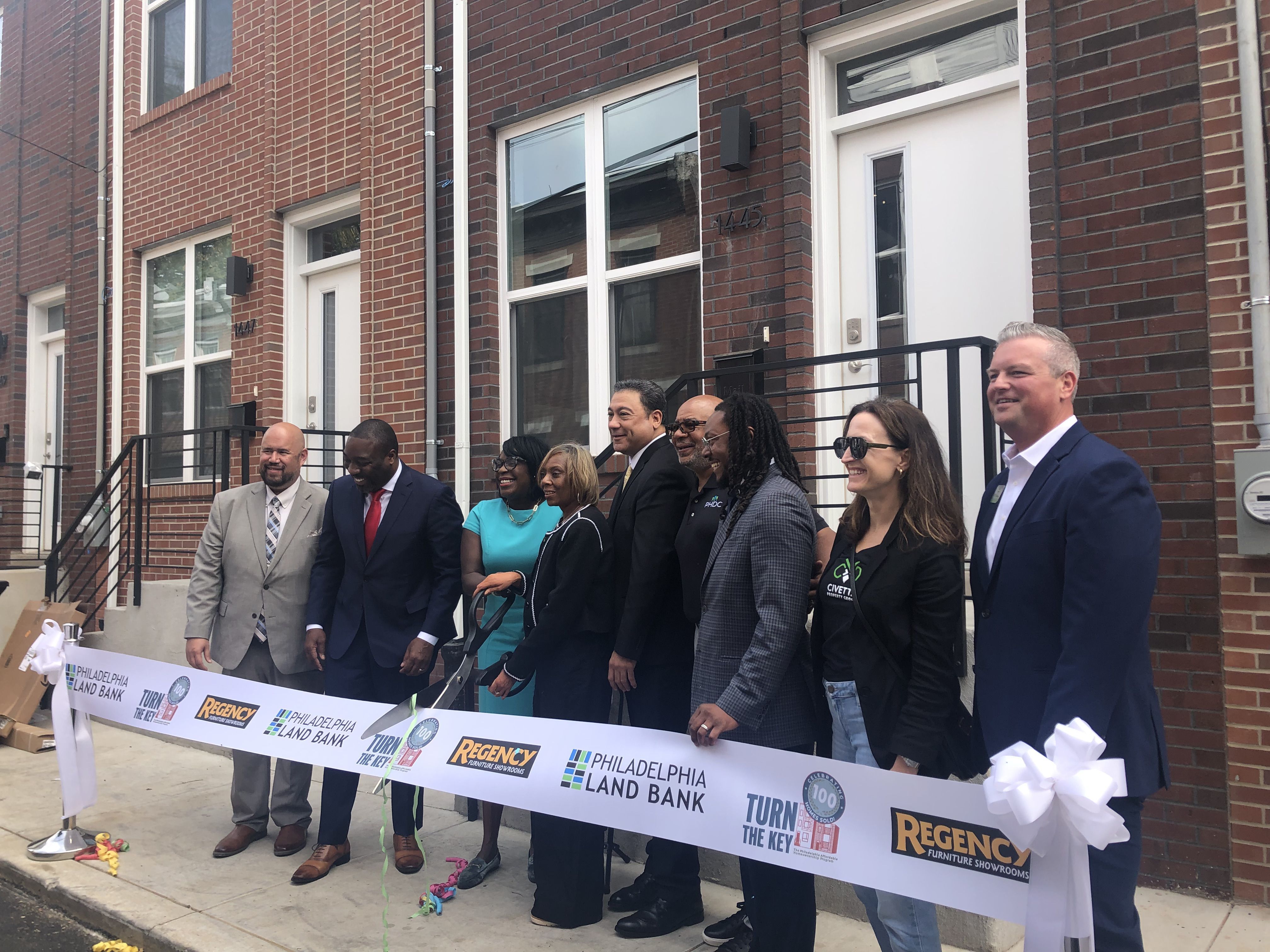
Mayor Cherelle L. Parker and Turn the Key’s 100th homebuyer hold giant scissors as they prepare to cut a ceremonial ribbon.
Although the Turn the Key program produces units that are more affordable than market-rate homes, many of the projects are built by private-sector developers and still unaffordable to Philadelphians with low incomes.
“Majeedah Rashid has worked with me on economic development issues dating to my time in the Pennsylvania General Assembly, and her advice has been invaluable,” Parker said in a statement. “Our city is stronger for Herb’s and Majeedah’s public service.”
Rashid did not respond to a request for comment.
During Balloon’s previous tenure on the board, he was among members who pushed for vacant city-owned land to be put back into productive use as quickly as possible because empty lots attract crime and litter and are a drag on city services.
Private-sector developers often can build more — and faster — than their nonprofit counterparts because they are less reliant on public funds, which are increasingly unreliable from the federal level.
“I’m excited to rejoin the Philadelphia Land Bank and help Mayor Parker deliver on her bold vision to build and preserve 30,000 homes across our city,” Balloon said in an email statement. “This is an inspiring moment for Philadelphia’s growth and the success of the Turn the Key program and other initiatives.”
“Herb Wetzel has been a subject matter expert for me on any housing issue that I’ve worked on throughout my career as an elected official, and I have always relied on his counsel,” Parker said in a statement. “He will continue to be part of my circle of advisers on housing issues, just in a different capacity.”
But according to three City Hall sources, who did not have permission to speak to the media, Parker’s team felt Wetzel sought to play peacemaker between the factions and was not always able to get their favored Turn the Key projects moving. As a recent arrival to the city and leader of the administration’s housing initiative, Brooks is expected to pursue the mayor’s priorities.
Brooks said in an interview that her appointment was no reflection on Wetzel’s performance and that he would continue to serve on the H.O.M.E. advisory board.
“I don’t have any thoughts on what he didn’t do or didn’t other than he’s been a great supporter of both the mayor and me and this housing plan,” Brooks said. “He’ll continue to be a part of that as we move it forward. [It’s just that] historically, we have had a city staff person to sit on the Land Bank board, and since I’m spearheading the H.O.M.E. Initiative, it seemed to be time.”
Frequent stalemates on the board were not the only challenge facing Turn the Key projects. Under the tradition of so-called councilmanic prerogative, the Land Bank requires action from City Council to release property for development even if the mayor backs a particular proposal.
For example, the administration sent over a 50-unitTurn the Key proposal in North Philadelphia to City Council last November, and District Councilmember Jeffery Young simply never introduced it, effectively killing the deal.
Or in Kensington, Councilmember Quetcy Lozada declined to endorse several Turn the Key proposals, leading developers to abandon them.
Parker sought to loosen Council’s grip on some city-owned land during budget negotiations earlier this year, but the campaign was largely unsuccessful. National land bank experts have long argued that land banks like Philadelphia’s are much less effective than counterparts that do not have political veto checkpoints.
During budget hearings this year, Council asked for an organization assessment of the Land Bank, and some members questioned why its staff wasn’t more robust.
Brooks said that an assessment will be released soon from the consultant group Guidehouse and that the Land Bank “is in the process of filling positions.”
When it opened in 1973, Ada H.H. Lewis Middle School was a source of deep pride for East Germantown, the kind of state-of-the-art educational facility that only suburban kids had at the time.
But on Saturday, when police found Kada Scott’s corpse buried in a shallow grave in the woods of the long-ago vacated school grounds, ending a two-week search for the missing23-year-old Mount Airy woman, the Rev.Chester H. Williams saw only decades of failure.
“It’s a disgrace,” said Williams, a pastorwho runs a neighborhood civic group. “We were very hurt to hear that this happened.”
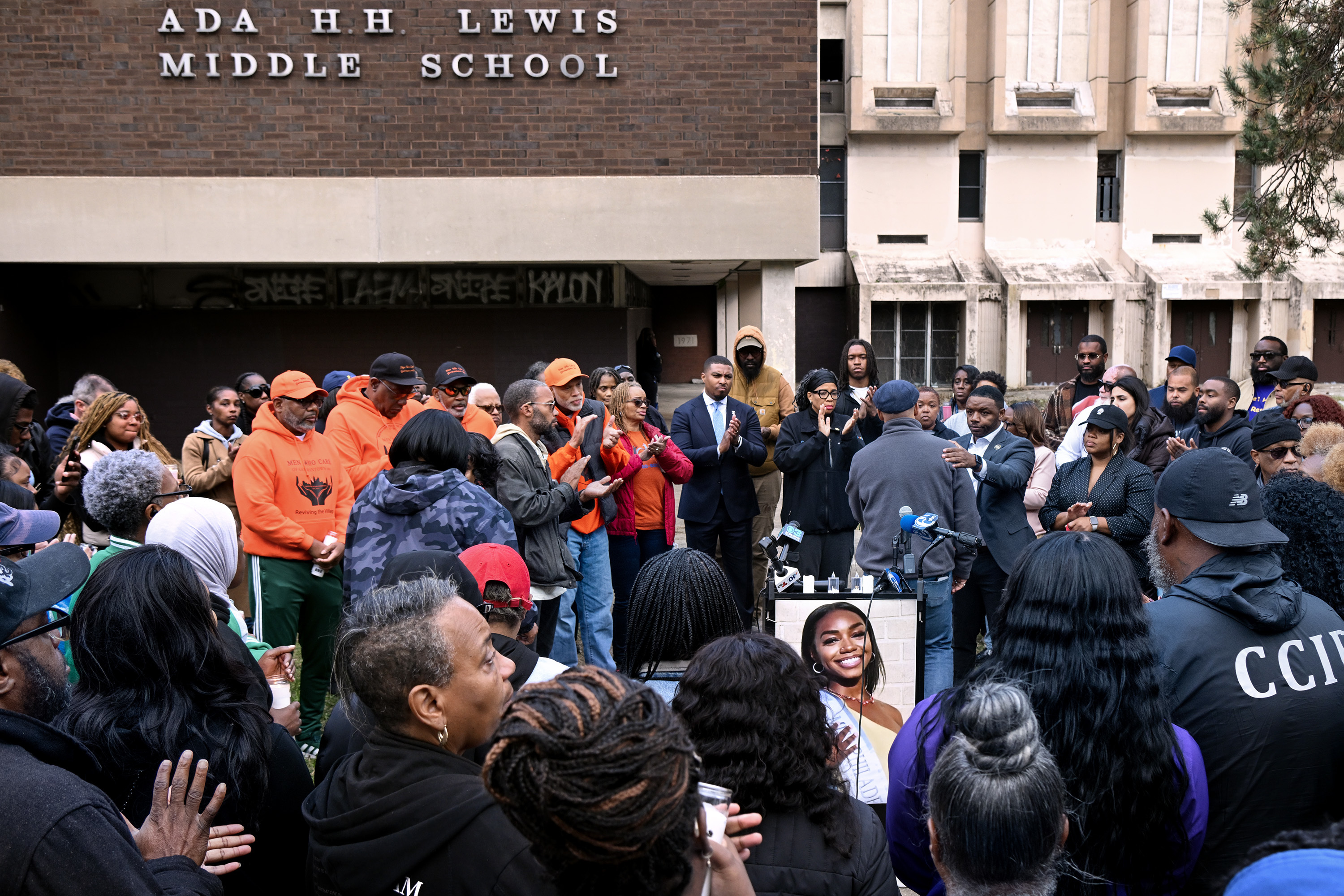
Community members gather for a candlelight vigil in memory of Kada Scott on Monday at Ada H.H. Lewis Middle School.
On top of the shock, Scott’s kidnapping and murder has renewed animus in some quarters aboutthe Philadelphia School District‘s failure to repurpose the blighted property, one of dozens of schools shuttered by the district over the last 20 years.
Since Lewis closed in 2008, local officials and civic leaders said the sprawling seven-acre campus has become a magnet for squatting, illegal dumping, and other criminal activity. City officials have cited the school district 10 times since 2020 for overgrown weeds, graffiti, and piles of trash that blanketed the property, public records show. And four years ago, the district passed on an opportunity to reverse course on the blight.
A proposal to redevelop the land into new homes, championed by neighborhood leaders like Williams, sat before the school board for approval. But the district abandoned the plan at the eleventh hour without public explanation, which the developer alleged was due to meddling byCity Councilmember Cindy Bass — a contention Bass denies.
“The school district, for some reason, we don’t know why, they put a block on anything being built there,” Williams said.
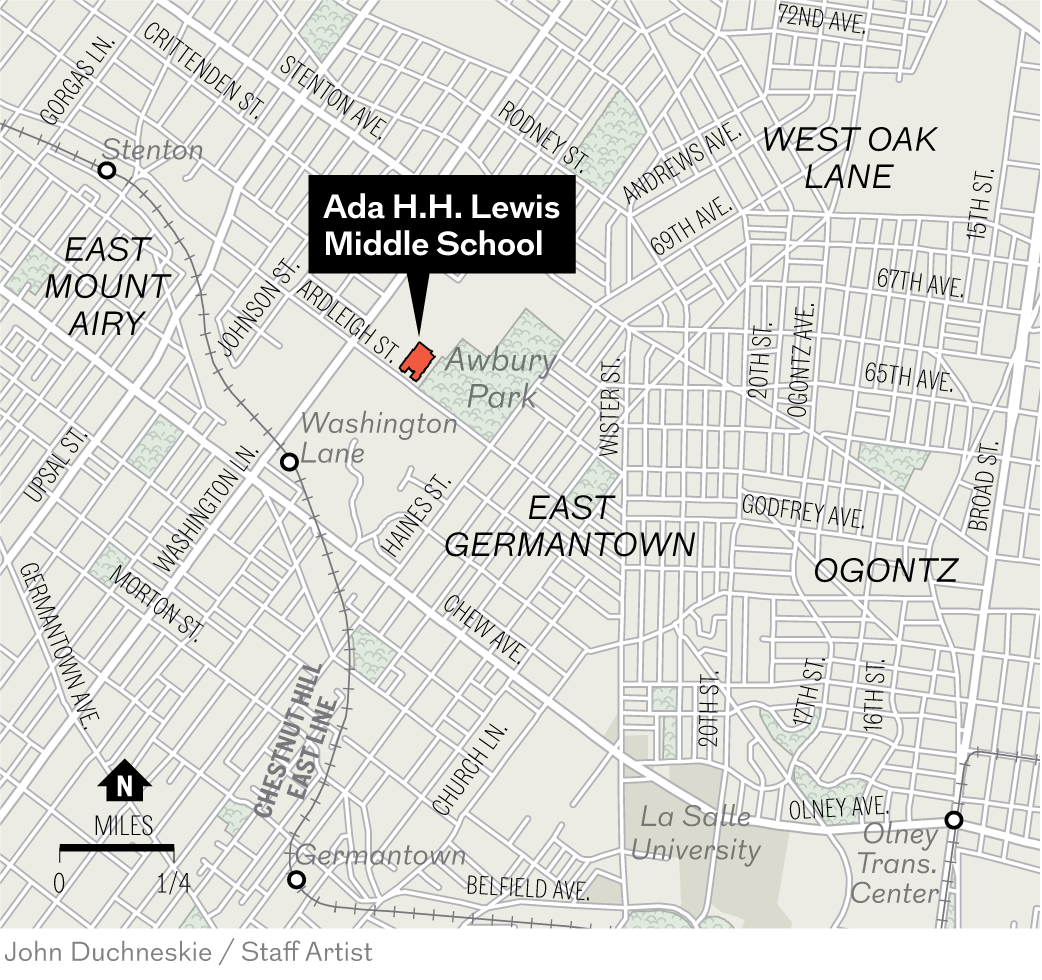
Map of the former Ada H.H. Lewis Middle School in East Germantown
Philadelphia Superintendent Tony B. Watlington Sr. extended “deepest sympathies” to Scott’s family and friends in a statement, and said the district’s operations and safety departments will review the vacant-property portfolio “to create and maintain safe and healthy spaces in every neighborhood.”
While some call Lewis “abandoned,” the district is careful to call the building “vacant,” one of 20 such properties in the district’s portfolio. It says maintenance and inspection logs are kept about work on vacant properties; details were not immediately available.
The debate over Lewis comes at a crucial time for the district: It is preparing to release recommendations about its stock of 300-plus buildings — and likely add to the list of decommissioned schools-turned-vacant public buildings. The district’s master planning process will contain recommendations for school closures and combining schools under one roof, officials have warned.
Butkovitz, in a report released that year, said district inaction around such structures was dangerous and noted that the schools were magnets for criminal activity.
Just before the pandemic hit in 2020, after years of pushback over Ada Lewis, the school district began accepting applications to redevelop the crumbling middle school. Germantown developer Ken Weinstein was one of three developers to place bids. He sought to buy the property for $1.4 million and build 76 new twin homes, at a density that neighbors felt complemented the surrounding area and resolved concerns about density brought by apartment buildings.
Weinstein said he gathered letters of support from 60 neighborhood residents and elected officials, including U.S. Rep. Dwight Evans and then-State Rep. Stephen Kinsey. The school board seemed eager to move ahead and set a final vote for the proposal in May 2021.
The vote never happened. The only explanation given that day was that “the Board had concern” about “what the long-term plan is for developing schools for the 21st century,” according to a district spokesperson.
According to Weinstein, some school board members received calls from Bass asking them to table the vote. Bass has faced criticism for interfering in development projects, including other proposals made by Weinstein, as vacant properties languished for years in her district. Her district includes the Lewis property andparts of North and Northwest Philadelphia, where Weinstein has focused his development work.
Bass, in an interview Monday, denied meddling in the vote. She acknowledged that she did not support Weinstein’s proposal because of the price of the homes — averaging around $415,000 — which she said would have triggered “immediate gentrification in the neighborhood.” But she said she had no involvement in the board’s reversal.
“That was up to the school district,” Bass said. “I don’t sit on the school board.”
While community groups in her district supported Weinstein’s project in 2021, Bass said she objected to market-rate housing as the sole alternative for East Germantown, arguing that it amounted to the district and developers saying “you should just take any old thing just so it’s not vacant.”
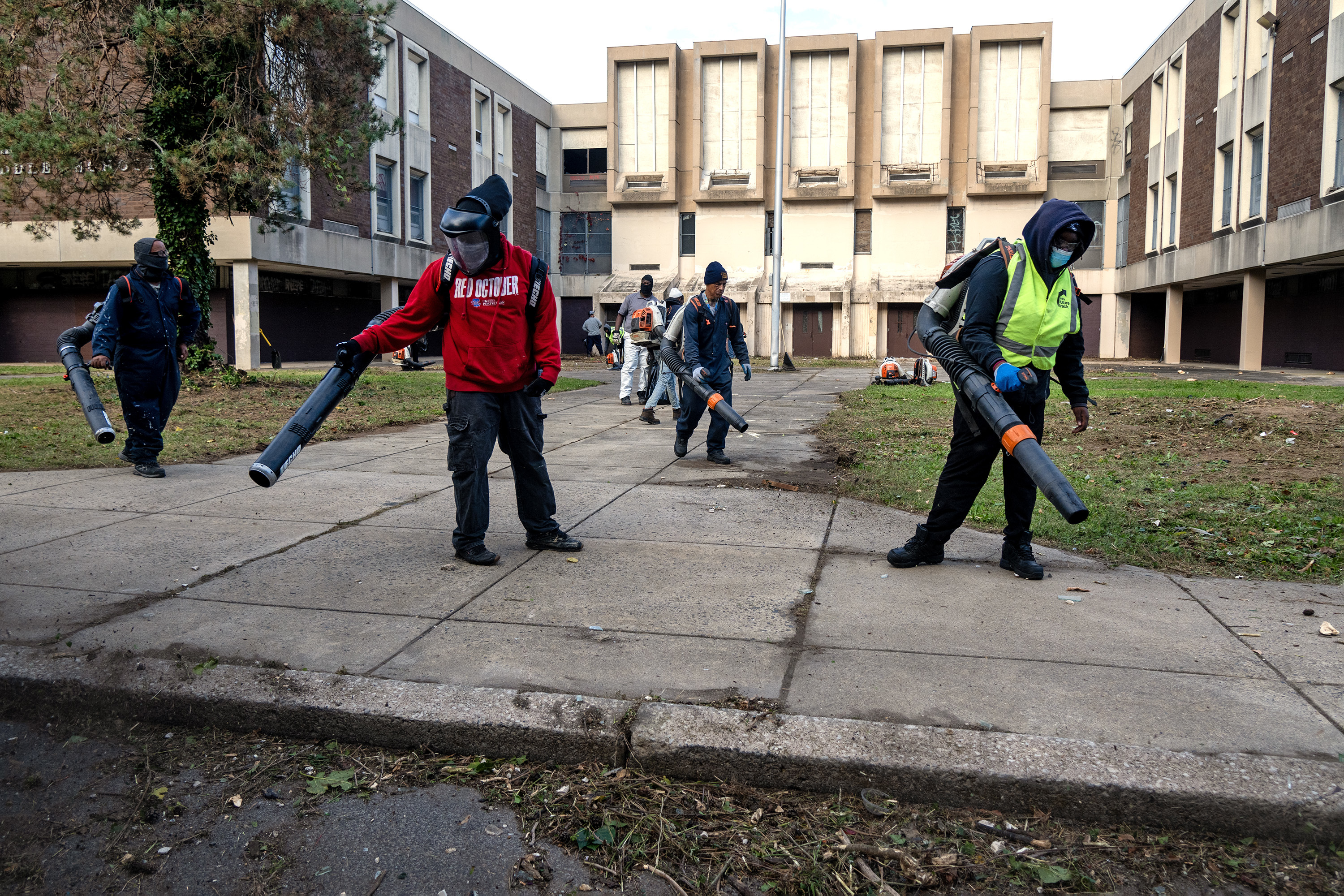
City workers clean up in front of the vacant Ada H.H. Lewis Middle School Monday, just minutes before the start of a community candlelight vigil in memory of Kada Scott.
A tragic turn for the property
In a letter dated Friday, Bass called on the school district to demolish the vacant school, saying she was troubled by the evidence that led investigators to the property during the search for Scott.
“The continued presence of this unsecured and deteriorating structure is simply unacceptable,” the Council member wrote in a statement, noting the site is now associated with “tragic violence.”
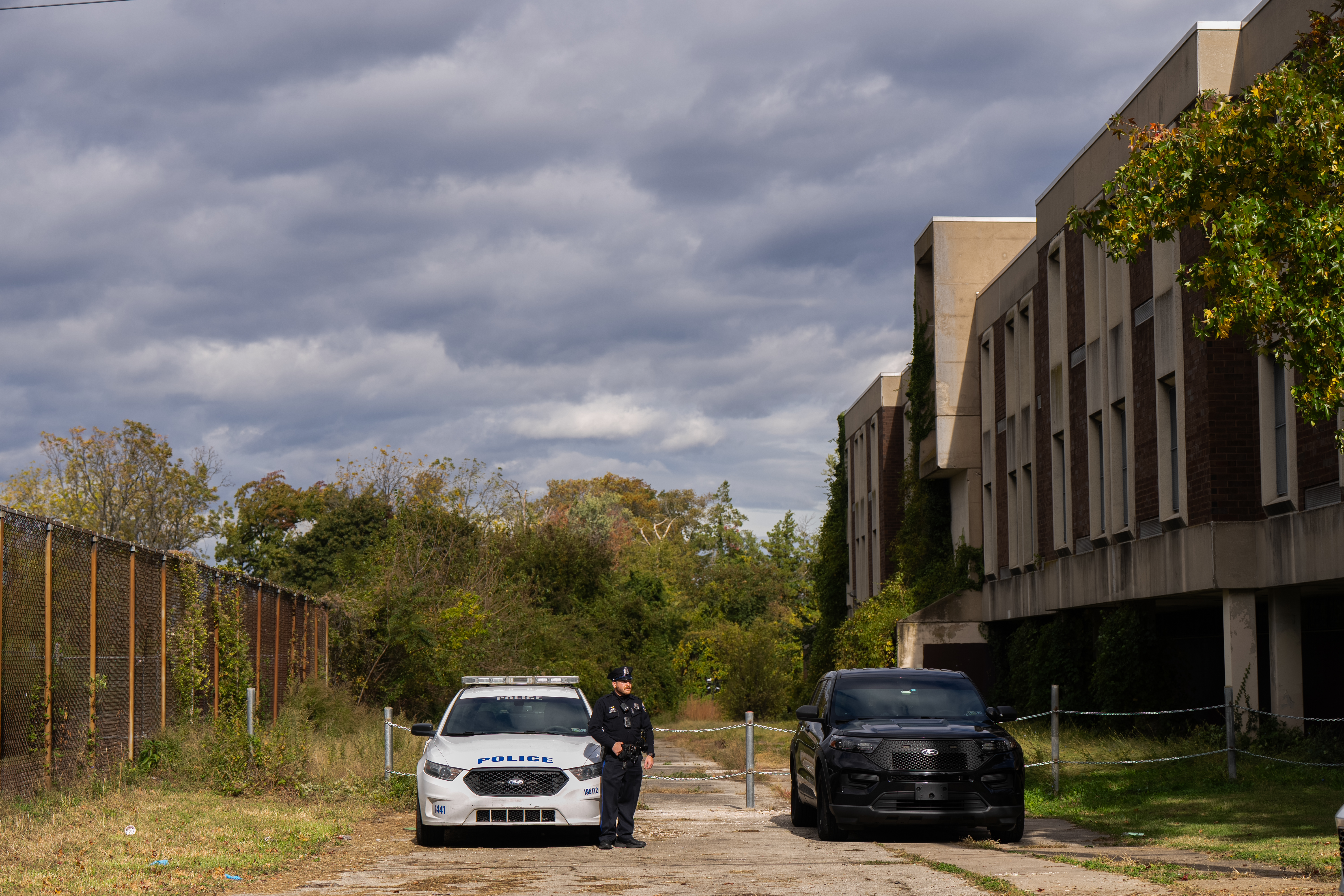
Cell phone records and tips from the public first led police to the former Ada Lewis school last week, where they found Scott’s pink phone case and debit card, but nothing else. Then, late Friday, police received a new tip saying that they had missed something on their first search of the grounds, and that they should look along the wooden fence that divides the school from the neighboring Awbury Recreation Center. Officers returned to the property Saturday and found Scott’s body, buried in a shallow grave in a wooded area behind the school.
Prosecutors expect to charge Keon King, 21, with the murder, though police continue searching for others who they believe may have helped dispose of evidence.
Bass took office in 2012,when the school wasalready vacant. She said she pushed the school district for several years to take action, as nuisances piled up at the property. She said shestill hopes that another “institution” could replace Lewis.
“I think that having something that the community wants is not hard to figure out,” Bass said. “This is what the community’s interested in — they’re interested in another institution.”
She said a proposal for a charter school is now in the works, though she said she was unable to provide details.
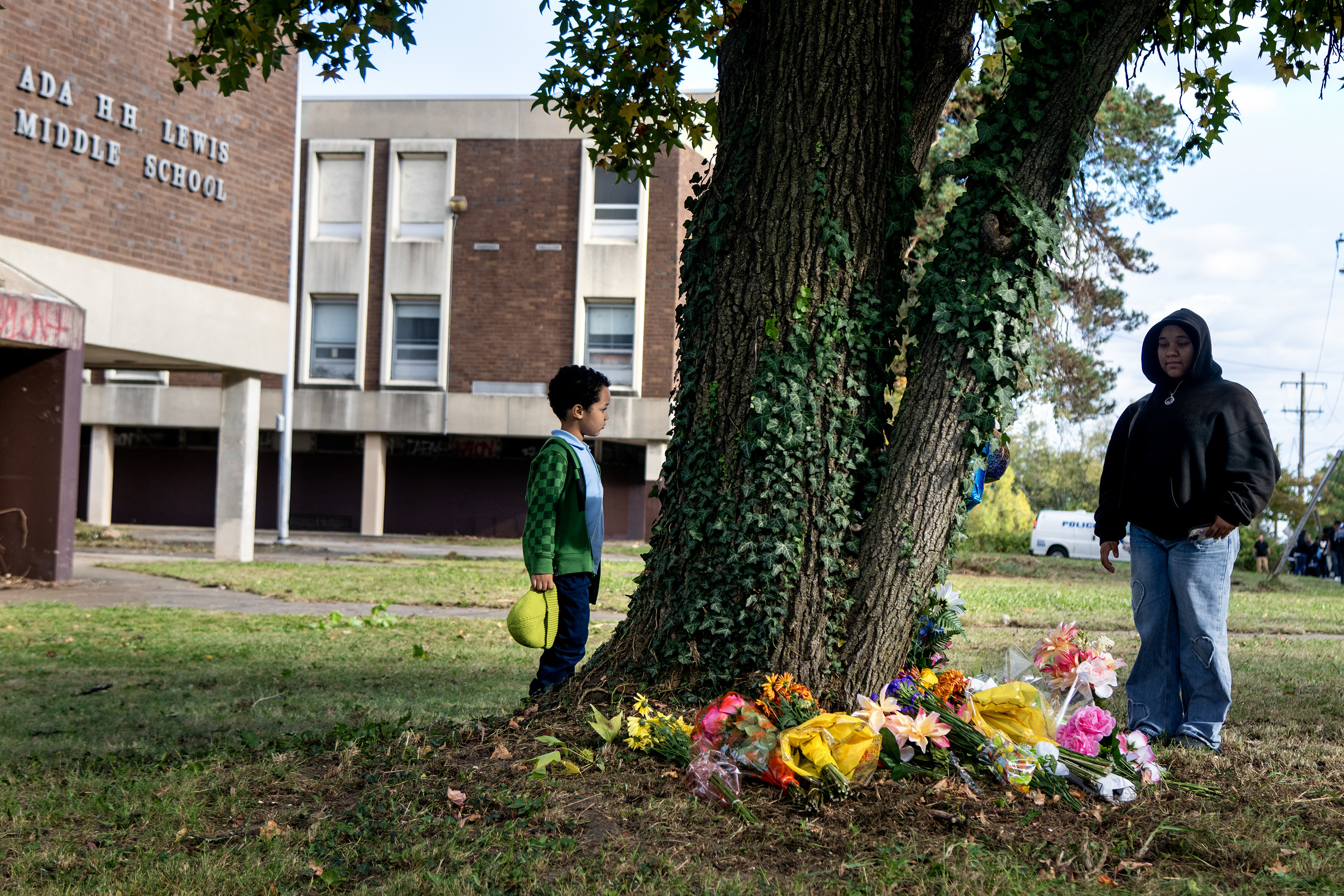
Julius Peden, 5, and Jaihanna Williams Peden (right), 14, pause at a memorial for Kada Scott on Monday.
A glut of vacant schools
The school district still views Lewis as a potential “swing space” — a building that could be used to house students if another district building is closed due to environmental problems.
There is precedent: The district has used other school buildings for such purposes, like Anna B. Pratt in North Philadelphia, which was also closed in 2013, to house early-childhood programs, and then students from other North Philadelphia schools whose buildings were undergoing renovation.
Still, it remains unclear how much it would cost to bring the Lewis building back to an inhabitable state.
The school system currently has about 70,000 more seats throughout the city than students enrolled. Though officials have said their first preference is to have closed schools reused for community benefit, it’s unlikely that all will be able to serve that purpose. And the timetable will surely be slow.
City officials at times have expressed frustration with the pace at which the district is making decisions about how to manage its buildings. School leaders have said the wait is necessary given the district’s capacity and the need to make correct choices and not rush the process.
Weinstein said the tragedy that culminated at Lewis reflected the conventional wisdom that blight breeds crime.
“There’s always consequences to shutting down a proposal that the community supports,” Weinstein said. “In most cases, nothing bad happens. In this case, something very bad happened.”
Staff writer Ellie Rushing contributed to this article.
For years, students at Temple University’s College of Public Health trekked to classes and met professors across two campuses and 10 buildings in North Philadelphia.
That changed this school year when the college finally moved into its own building, the first dedicated to public health since its founding in 1966.
Paley Hall is an expansion and renovation of the former Samuel L. Paley Library, which sat at the heart of Temple’s main campus on North Broad Street.
Jennifer Ibrahim, the college’s dean, spoke with The Inquirer about the new building and amenities designed for public health studies, including a “simulation” space with a replica park, restaurant, emergency room, and even a rowhouse where students can act out interactions with patients. The interview was lightly edited for length and clarity.
Why did Temple pick the former Paley library for the new College of Public Health building?
About eight years ago, we started the conversations about renovating Paley to become the new home of the School of Public Health. It’s at the center of campus, and public health has so many collaborations with medicine, with dentistry, with public policy, with law, that it felt really special and appropriate, given how collaborative and interdisciplinary we are.
Once Paley Hall was gutted, the beauty of the building was that it was created to hold books — to bear the weight of books. That allowed us to add two more floors and extend an east wing and a west wing, significantly increasing the square footage, and that made the building large enough for our different academic units to move into.
How does consolidating academic departments into one space help students and faculty?
We have so many different disciplines — public health, social work, nursing, speech, physical therapy, occupational therapy, athletic training, recreational therapy. And we have been in as many as 11 buildings over the history of the college on the main campus, but also on the health science campus [farther north on Broad Street]. It’s not that far, but it does create challenges for collaboration.
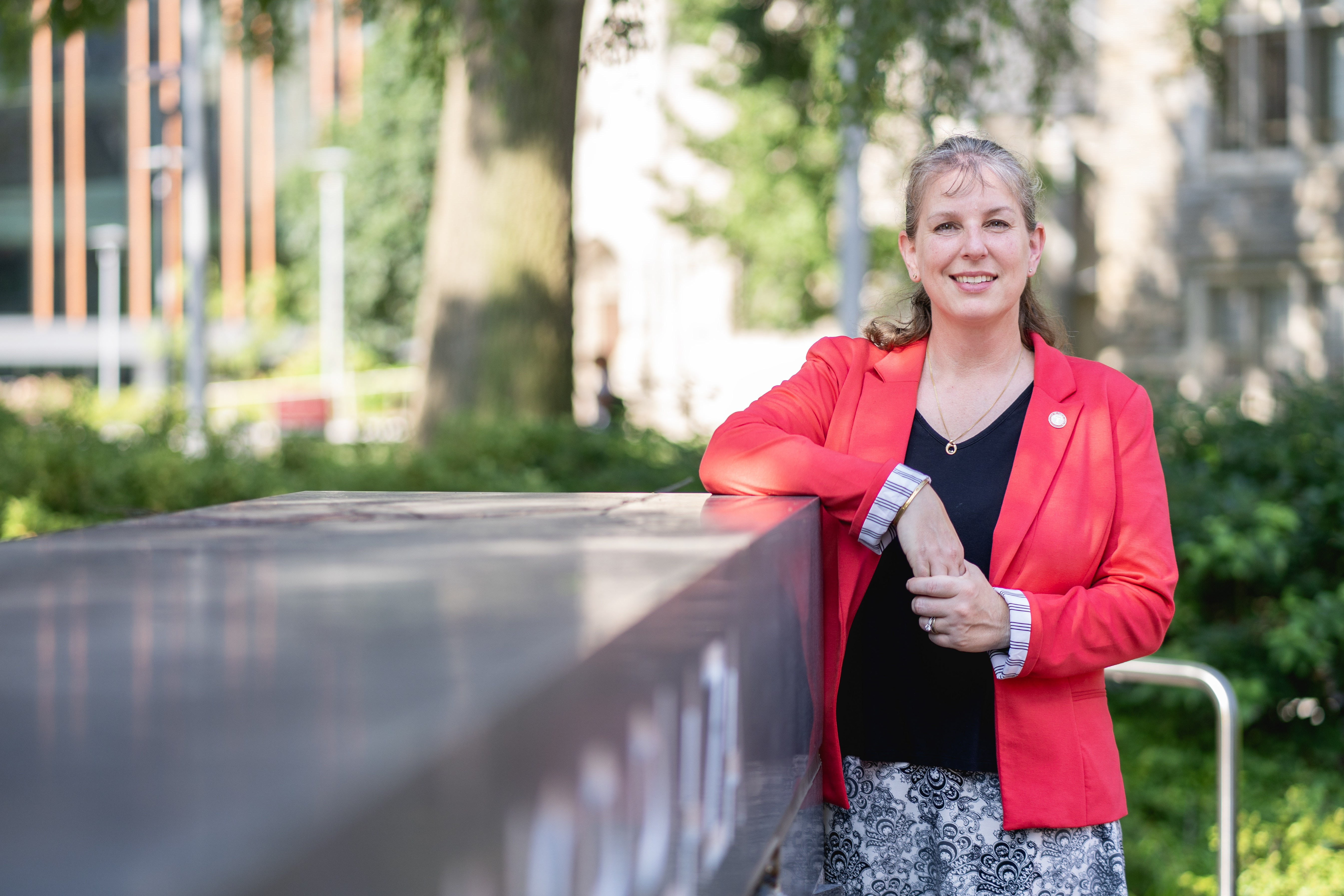
Jennifer Ibrahim, dean of Temple University’s College of Public Health, spoke with The Inquirer about the college’s new headquarters on Temple’s main campus.
That ability to bump into one another in the same physical space — just having those impromptu conversations brings a warmer human element to the interactions that we have.
What are some of the amenities in the new building?
There’s a couple of interesting spaces in the building. We have four classrooms in the building, and then we have the Aramark Community Teaching Kitchen, which is a kitchen space with capacity for 24 students to be learning.
The simulation center is at the heart of it. This was a collaboration from faculty across all of our disciplines.
When individuals have an acute injury, or a chronic condition, what we aim to do is get them back into the community and back into their social support system.
So about 40% of our simulation center is a community. There’s an ambulance bay, there’s a park, there’s a restaurant, there’s a corner grocery store, there’s a replica rowhouse, there’s a street, there’s a sidewalk — all of that allows students to practice safely before they go out and work with our community partners, to learn and to receive feedback.
The other half of our simulation center is more traditional. We have an inpatient and an outpatient area where students will be interacting with simulated patients as well as mannequins to help them learn [bedside manner].
We’re really excited for our disciplines to come together and get creative about ways that we can better prepare students for what it’s going to be like when they enter the workforce. We also feel that we have an obligation to our local and regional workforce, that we are putting out the best-prepared students to hit the ground running.
What does Temple’s investment in a project like Paley Hall say about its commitment to public health as a profession?
We know that there is an evidence base for what works and what doesn’t work.
We have an obligation to educate the public.
We have an obligation to conduct research to advance the evidence of what we know does and does not work.
We have an obligation to develop policy with our elected officials to figure out what can we do to protect the population in any way that we can.
I think Temple’s investment in this space is a statement about the importance of public health and health professionals more broadly.
Now is the time that we have to double down on our investments in public health, and Temple has done just that.