Tag: Northeast Philadelphia

  • A veto-proof majority of Philadelphia City Council members have signed onto the ‘ICE Out’ proposal

    A veto-proof majority of Philadelphia City Council members have signed onto the ‘ICE Out’ proposal

    All but two of Philadelphia’s 17 City Council members have sponsored a package of legislation aimed at limiting ICE operations in the city, a level of support that could ensure the measures become law even if they are opposed by the mayor.

    The 15 cosponsors, confirmed Thursday by a spokesperson for Councilmember Kendra Brooks, indicate a potentially veto-proof majority of lawmakers back the sweeping “ICE Out” effort.

    Brooks and Councilmember Rue Landau, the proposal’s authors, on Thursday formally introduced the seven bills in the package, which includes measures that would codify Philly’s “sanctuary city” status, ban U.S. Immigration and Customs Enforcement from operating on city-owned property, and prohibit employment discrimination on the basis of immigration status.

    Landau said that “reaching a majority sends a clear message.”

    “Philadelphia stands with our immigrant communities,” she said in a statement. “At a moment when the federal government is using fear and violence as governing strategies, this level of support shows that Council will do everything we can to protect our immigrant neighbors.”

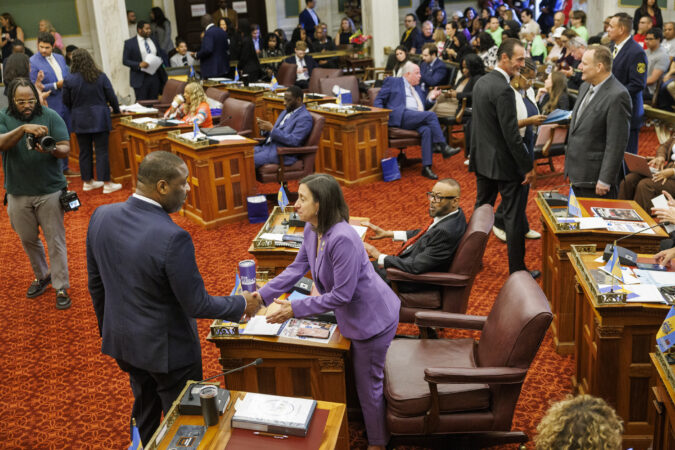
    Advocates and protesters call for ICE to get out of Philadelphia, in Center City, January 27, 2026.

    The 15 lawmakers on board with Brooks and Landau’s proposal have each cosponsored all seven bills, Brooks’ spokesperson Eric Rosso said. Only Councilmembers Mike Driscoll, a Democrat, and Brian O’Neill, Council’s lone Republican, declined to cosponsor the legislation, he said.

    Driscoll, who represents lower Northeast Philadelphia, said in a statement that the shootings of Renée Good and Alex Pretti by federal agents in Minneapolis this month “caused real pain and fear” and “deserve serious attention.”

    But he indicated that he had concerns about whether the “ICE Out” legislation would hold up in court. Similar legislation, including a California ban on law enforcement officers wearing masks, has faced legal challenges.

    “Locally, we should aim for immigration policies that are focused, proactive and aimed at practical, long-term solutions that ultimately hold up in court,” he said.

    Driscoll said he is open to amended versions of the legislation.

    O’Neill, whose district covers much of Northeast Philadelphia, could not immediately be reached for comment.

    The developments Thursday prompted Mayor Cherelle L. Parker to make one of her first public comments about President Donald Trump’s mass deportation campaign, saying in a statement that her administration “understand[s] the public’s fear of the unknown as it relates to federal policy associated with immigration.”

    “We have a comprehensive approach to public safety, and we will always be prepared for any emergency, as we have consistently demonstrated and will continue to demonstrate,” Parker said. “I have a great deal of faith in our public safety leaders — our subject matter experts — who I asked to be a part of this team and we’re going to do our best to work in an intergovernmental fashion, along with City Council, to keep every Philadelphian safe.”

    Parker said she and her team are reviewing the legislation.

    Advocates and protestors call for ICE to get out of Philadelphia, in Center City, January 27, 2026.

    The mayor has largely avoided confrontation with Trump’s administration over immigration policy, a strategy some have speculated has helped keep Philadelphia from the National Guard deployments or surges of ICE agents seen in Minneapolis, Chicago, Los Angeles, and elsewhere.

    But the popularity of the “ICE Out” package among Council members may force her to wade into the issue. Administration officials will testify when the bills are called up for committee hearings. If they are approved, Parker will have the choice of signing the bills into law, vetoing them, or letting them become law without her signature.

    Council bills require nine votes for passage, and 12 votes are needed to override mayoral vetoes. With 15 Council members already signaling their approval for the bills, chances appear strong that the city’s legislative branch has the numbers to override any opposition.
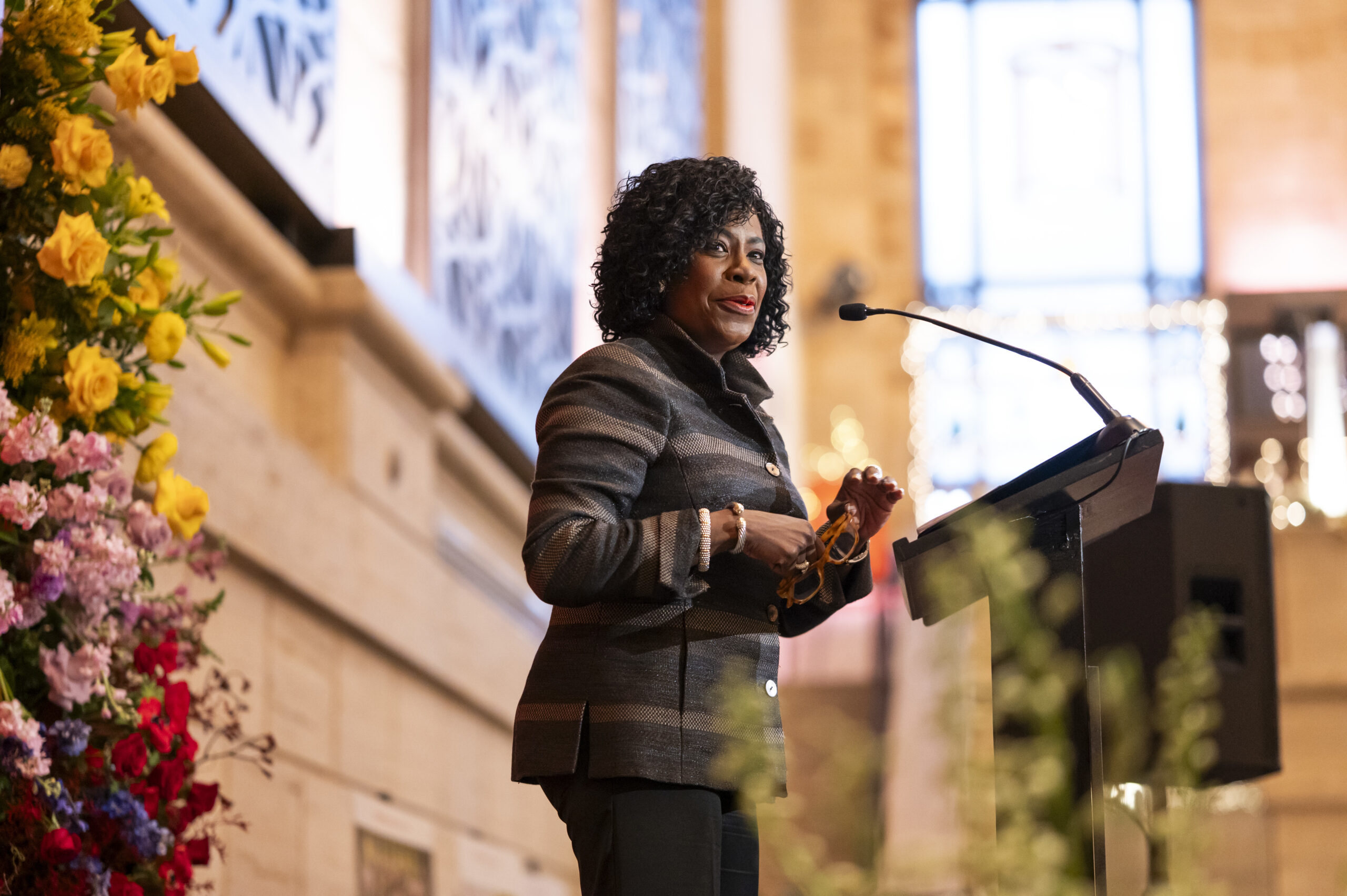
    Mayor Cherelle L. Parker has avoided confrontation with the White House on immigration issues.

    In a Council speech, Brooks addressed the debate over whether the legislation would draw Trump’s ire.

    “Staying silent is not an option when people are being publicly executed in the streets and the federal government is covering up their murders,” Brooks, of the progressive Working Families Party, said. “I want to be clear: ICE is already here. We don’t want a Minneapolis situation, but I reject the claim of those who are pretending we don’t already have a problem.”

    Council President Kenyatta Johnson, a centrist Democrat and an ally of Parker, shared a similar view.

    “From my perspective, the Trump administration has already been looking at the city,” Johnson told reporters. “Overall, the majority of members of City Council support the legislation, and so we see this legislation being successfully voted out of committee.”

    ICE agents have been arresting suspected undocumented immigrants in the city before and during Trump’s tenure, and his administration has canceled grants for the city and educational and medical institutions in Philadelphia. But the city has not seen a mass deployment of ICE agents or federalized troops.

    Councilmember Anthony Phillips, also a centrist and Parker ally, represents the 9th District, from which the mayor hails.

    “What the ’ICE Out’ legislation ultimately says to Donald Trump,” Phillips said, “is that no matter what you try to do to undermine the health and safety and well-being of Philadelphia citizens, we will stand up to you.”

    Johnson suggested potential legal issues could be ironed out through amendments if needed.

    “The reality is this: This is a moral issue, right?” he said. “And if there are any legality issues that has to be addressed as a body, we’ll work with our members to address it.”

    Next, Johnson will refer the legislation to committee, where members will hold one or more hearings featuring testimony from administration officials, experts, stakeholders, and the public. Council members can also amend the bills in committee.
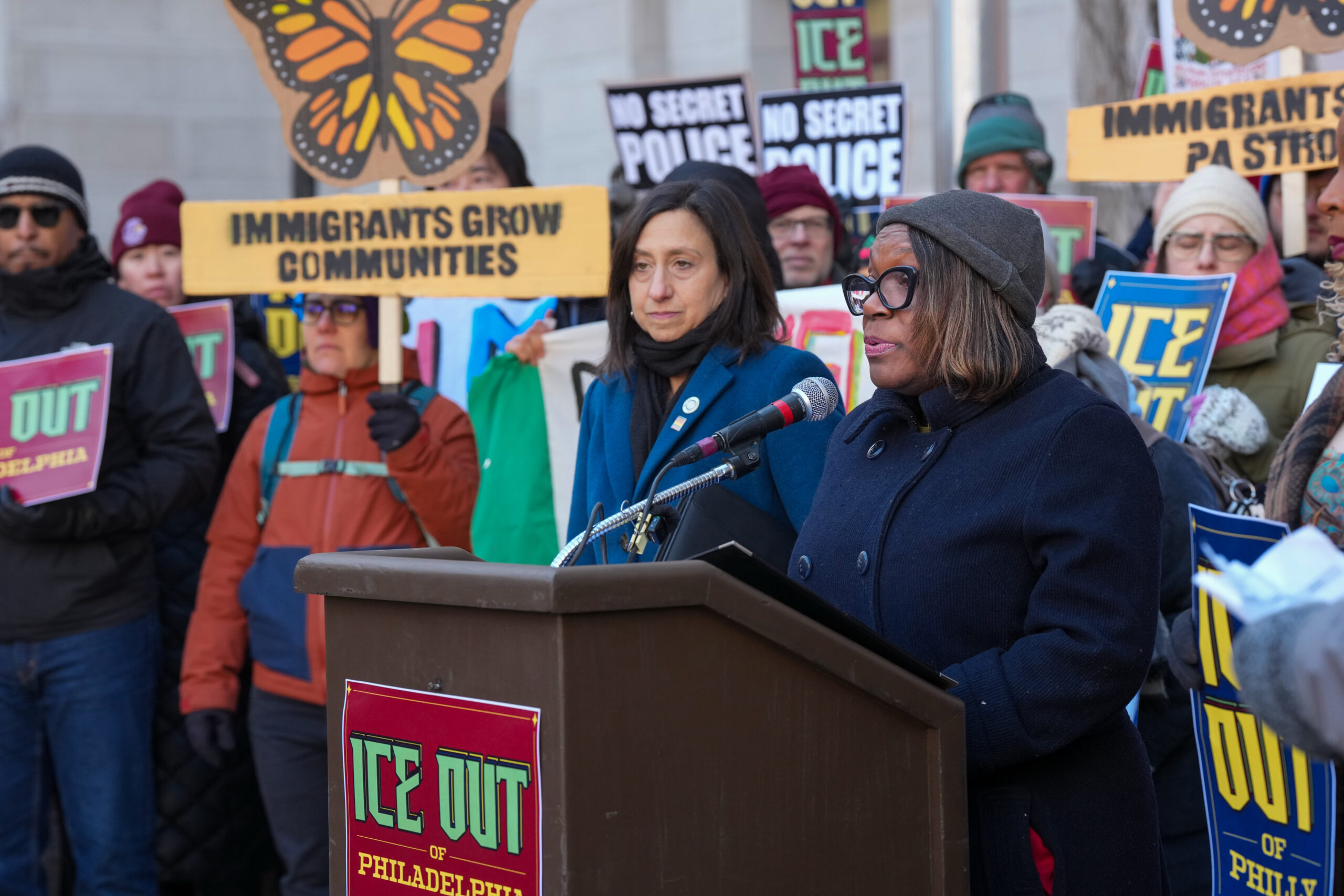
    Kendra Brooks shown here during a press conference at City Hall to announce a package of bills aimed at pushing back against ICE enforcement in Philadelphia, January 27, 2026.

    Supporters of the legislation packed Council chambers Thursday morning, and many spoke during public comment, ranging from leaders of advocacy organizations to a former immigration judge to immigrants who tearfully pleaded for Council to pass the package swiftly.

    Several Spanish-speaking residents spoke through interpreters; other residents testified on behalf of friends or family members who are undocumented and were fearful to come to City Hall themselves. A school nurse told Council members that her students have asked her what tear gas feels like.

    “The traumatic effects of these [ICE] raids on our children and our families and our communities will last for years and generations to come,” said Jeannine Cicco Barker, a South Philadelphia psychologist who said she is the daughter of immigrants. “These times call for bold, brave new measures to protect our community, and you have a chance to do some of that here. Philly urgently needs these protections.”

    Ethan Tan, who said he is an immigrant and a father of two, said he is fearful for his family and community.

    “To this administration, fear is the point. Alienation is the point. Isolation is the point,” he said. “The ‘ICE Out’ package says to me and immigrants that we may be afraid, but we can show solidarity and resolve anyway.”


  • How Philly helicopter makers cope with uncertainty at today’s Pentagon

    How Philly helicopter makers cope with uncertainty at today’s Pentagon

    Helicopter manufacturer Leonardo has nearly doubled employment at its Northeast Philadelphia factory since the Rome-based multinational aerospace company began winning U.S. military orders for that factory in the late 2010s.

    But the company, whose owners include the Italian government and U.S. investment funds such as BlackRock and Vanguard, has learned what dominant U.S. defense contractors like Boeing have long known: Military planners, policy, and political shifts can stop, delay, or revive long-term contracts, leaving managers scrambling to keep workers and factories busy.

    Given the complexity of parts supply, skilled labor, and other aspects of helicopter production, “it is destabilizing and difficult if you don’t know if you are going to build two or 16 aircraft for a given program year after year,” said Andrew Gappy, vice president of Leonardo Helicopters USA Inc., a retired Marine whose duties included flying Presidents Bill Clinton and George W. Bush on Marine One helicopters.

    In 2018, Leonardo and Boeing celebrated a signal victory. The Air Force ordered 84 MH-139A Grey Wolf helicopters, worth an expected $2.4 billion.

    Grey Wolf is based on Leonardo’s civilian, two-engine AW139, part of a movement by military planners to speed production and streamline costs by basing more big-ticket military machines on large-production civilian products and private-sector construction managers. It’s a model that Korea-based Hanwha hopes to use in winning Navy contracts for its shipyard in Philadelphia.

    More than half the Grey Wolfs would defend nuclear weapons bases in several western U.S. states. Most of the rest would be used to ferry political leaders around Washington in case of an attack on the nation’s capital, replacing aging UH-1N Huey helicopters on duty since the 1970s.

    So far, 19 of those helicopters have been paid for and delivered. Another 12 are funded and nearing completion. But funding for future construction hit unexpected snags.

    After Air Force design changes and a challenge by Lockheed Martin’s Sikorsky unit, which had proposed rival helicopters of its own, Leonardo and Boeing said they started production on the first Grey Wolfs in 2023.

    They planned to keep building a dozen a year for seven years — about a quarter of the Leonardo plant’s annual output. They hoped to win more contracts along the way.

    Last year, the partners had expected to fund future production with $173 million in appropriations as laid out in President Donald Trump’s 2025 budget, plus $210 million in his Big Beautiful Bill, backed by the two Republican senators from North Dakota, home to Minot Air Force Base.

    But those payments didn’t materialize on schedule. The Big Beautiful Bill payments were held up, frustrating the Grey Wolf partners.

    And then in November, Congress’ new National Defense Authorization Act listed more than $100 million retrofitting previously-delivered Lockheed-built helicopters to transport VIPs but just $10 million for the Grey Wolf program — not enough to build a single helicopter.

    The Air Force had justified upgrades of unused aircraft in a budget proposal earlier last year as a cheaper way to acquire helicopters. Grey Wolf defenders objected that the Air Force studies had already verified the new helicopter would be much less expensive to operate.

    The cuts would “starve” the Grey Wolf program, Mike Cooper, Leonardo’s government relations chief, said in December. “It’s hard for businesses to plan, when competitively bid procurements can be abruptly and unilaterally changed.”

    Last fall, a bipartisan group of five Congress members, headed by Rep. Donald Norcross (D., N.J.), whose South Jersey constituents include workers at Boeing and Leonardo, sent Air Force Secretary Troy Meink a letter that they were “troubled” to hear reports that the Air Force was now planning to update old helicopters for VIP transport and evacuation missions, instead of funding the new ones.

    They noted that the Air Force already had selected the Boeing-Leonardo aircraft over two proposals from Lockheed Martin.

    They called the switch an “unprecedented change in procurement,” which “undermines the integrity of the acquisition process, calls into question the criteria” for the original selection, “and raises concern about why an otherwise performing program would be truncated without clear explanation to Congress” or the companies that agreed to the contract.

    They asked the Air Force for any studies it had made to justify the more expensive Jolly Green program, which they said would cost far more to buy and operate. They also noted the impact on workers, suppliers, and finances at Boeing in Ridley Park, Leonardo in Northeast Philly, Leonardo’s Florida testing site, and contractors who had already invested in the program the Air Force has now failed to fund.

    Congress members who represented districts that include additional Boeing or Leonardo facilities support Norcross’ effort. They are Reps. Carlos Gimenez (R., Fla.), Salud Carbajal (D., Calif.), Robert J. Pittman (R., Va.), and John J. McGuire III (R., Va.).

    Lockheed Martin officials said they hadn’t taken business from Leonardo. The military planned to convert older helicopters to VIP carriers by adding new seating at Air Force bases, not at the company’s Sikorsky military helicopter factories in Connecticut or New York.

    Sikorsky’s civilian helicopter plant in Coatesville, Pa., closed in 2022. It was taken over in 2024 by Piasecki Aviation, a Delaware County-based company that has had its own federal contracting and hiring hopes deferred by government and private-sector contracting delays, according to industry sources. Piasecki didn’t respond to inquiries.

    “The MH-139 Grey Wolf is vital to our national defense and supports American jobs,” Norcross said in a statement Jan. 15. “Congress funded the MH-139 because it offers major improvements in speed, range, and survivability.”

    He said the Air Force had not directly responded, “but I will continue pressing the administration.”

    The same week, a key Air Force commander confirmed in an Air Force publication that the first Grey Wolfs had completed their first Minuteman III convoy operation between two Western air bases, noting they are significantly faster, fly farther, and lift more than the helicopters they replace.

    Two sources familiar with the program said the first payments from Congress’ $210 million have been received since that test.

    And on Jan. 20, a new federal appropriations proposal added $60 million to the Grey Wolf program — not the whole $173 million, but more than the $10 million in the earlier law.

  • A Bucks County bust that ‘dismantled’ a drug ring yielded 8 guns and $4 million in drugs, officials say

    A Bucks County bust that ‘dismantled’ a drug ring yielded 8 guns and $4 million in drugs, officials say

    Bucks County prosecutors charged a man who fired a gun at police during a narcotics operation this month with attempted murder and related crimes, authorities said Tuesday. It was the latest development in a multistate investigation that led to the recovery of eight firearms and $4 million in drugs.

    Police arrested the man, Nicholas Sperando, 26, of Philadelphia, on Jan. 15 after the shooting at his rowhouse on Fairdale Road in Northeast Philadelphia, according to Bucks County District Attorney Joe Khan’s office.

    Sperando’s home was one of several locations involved in an extensive drug-trafficking organization, officials said.

    After announcing their intent to serve a warrant at Sperando’s home that day, agents with the Pennsylvania Attorney General’s Office and Pennsylvania state troopers prepared to breach Sperando’s door with a battering ram.

    Instead, they were met with gunfire from inside the home.

    After firing a round, Sperando fired a second shot through the front door, “directly targeting the position where the officers had been standing,” officials said.

    No officers fired their weapons or were injured in the operation.

    “This cowardly act against our officers was an attack on the rule of law, and our office will always protect those who risk their lives to protect us, even when that happens across county lines,” Khan said when announcing the charges.

    Sperando surrendered during the incident and is being held without bail on two counts of attempted murder and attempted murder of a law enforcement officer, as well as three counts of aggravated assault and related drug crimes.

    The arrest, Khan’s office said, was the culmination of a monthslong investigation that “dismantled” a multimillion-dollar trafficking organization.

    For months, authorities said, undercover officers had purchased drugs from Sperando in Levittown and Northeast Philadelphia. Bucks County officials asserted control of the Philadelphia jurisdiction for the sake of their investigation, according to officials.

    Investigators searched Sperando’s residence and recovered a FN Herstal 5.7 pistol that they said was used in the shooting — including a live round jammed in the gun, which, in prosecutors’ view, likely prevented fatalities among law enforcement officers.

    Meanwhile, authorities said, investigators found a variety of controlled substances and other weapons located across Sperando’s residence, his place of work on James Street, and a stash house on Day Street.

    At the Day Street house, officers arrested another man, David Tierney, who they say was also involved in the operation.

    Investigators said they seized an AR-style rifle, a Glock handgun with extended magazine, and bulk quantities of marijuana and proceeds from drug sales from Sperando’s home, while the alleged stash house yielded a firearm found under a pillow and a trailer containing “enormous quantities” of marijuana and THC vaporizers.

    At Sperando’s workplace, which officials did not name, officers recovered a Mossberg pump shotgun, a Ruger .380 pistol, and a “significant supply” of psilocybin mushrooms and edibles, authorities said.

    In all, officials said, the operation yielded 300 pounds of marijuana and 17,000 vaporizers, as well as 80 pounds of THC concentrate, 600 bags of THC edibles, 15 pounds of mushrooms, 75 mushroom edibles, 300 Adderall pills, and two ounces of cocaine.

    Sperando is being held in custody without bail. Tierney is being held on $250,000 bail. A third suspect in the operation, Nicholas Keenoy, surrendered to authorities on Tuesday.

  • All Amazon Fresh stores, including six in the Philly area, are closing

    All Amazon Fresh stores, including six in the Philly area, are closing

    Amazon will be closing all its physical Amazon Fresh stores, including six in the Philadelphia region, as it expands its Whole Foods footprint and grocery delivery services.

    The e-commerce giant made the announcement in a statement Tuesday, noting that it would convert some Amazon stores into Whole Foods Markets.

    “While we’ve seen encouraging signals in our Amazon-branded physical grocery stores, we haven’t yet created a truly distinctive customer experience with the right economic model needed for large-scale expansion,” the company said.

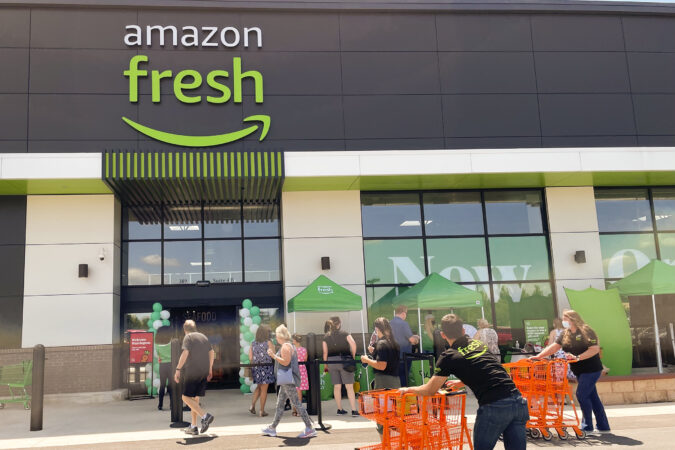
    People shop inside the Amazon Fresh in Warrington in August 2021. The store and all other Amazon-branded grocers are closing.

    The statement did not specify which Amazon Fresh stores would become Whole Foods, and company spokespeople did not answer questions about whether any Philadelphia-area locations would be converted.

    Amazon Fresh has stores in Broomall, Bensalem, Langhorne, Northern Liberties, Warrington, and Willow Grove. The Northern Liberties location on Sixth and Spring Garden Streets opened this summer after years of construction.

    Two more potential Amazon Fresh stores seemed to be in the works in Havertown and Northeast Philadelphia as of the summer, according to PhillyVoice.

    Customers use the Amazon Dash Cart at the Amazon Fresh grocery store in Warrington in 2021.

    Smaller-format Amazon Go stores, the closest of which are in New York, will also be shuttered or converted.

    As the company winds down its Amazon-branded physical stores, it says it will “double down” on online grocery delivery, including by expanding its same-day services to more communities.

    Amazon’s same-day delivery has been available in the Philadelphia market since 2009. Since December, Amazon has been testing “Amazon Now” delivery — which aims to get groceries to customers in 30 minutes or less — in parts of Philadelphia and Seattle.

    Amazon also said it plans to invest more in physical Whole Foods stores, adding more than 100 stores nationwide in the coming years.

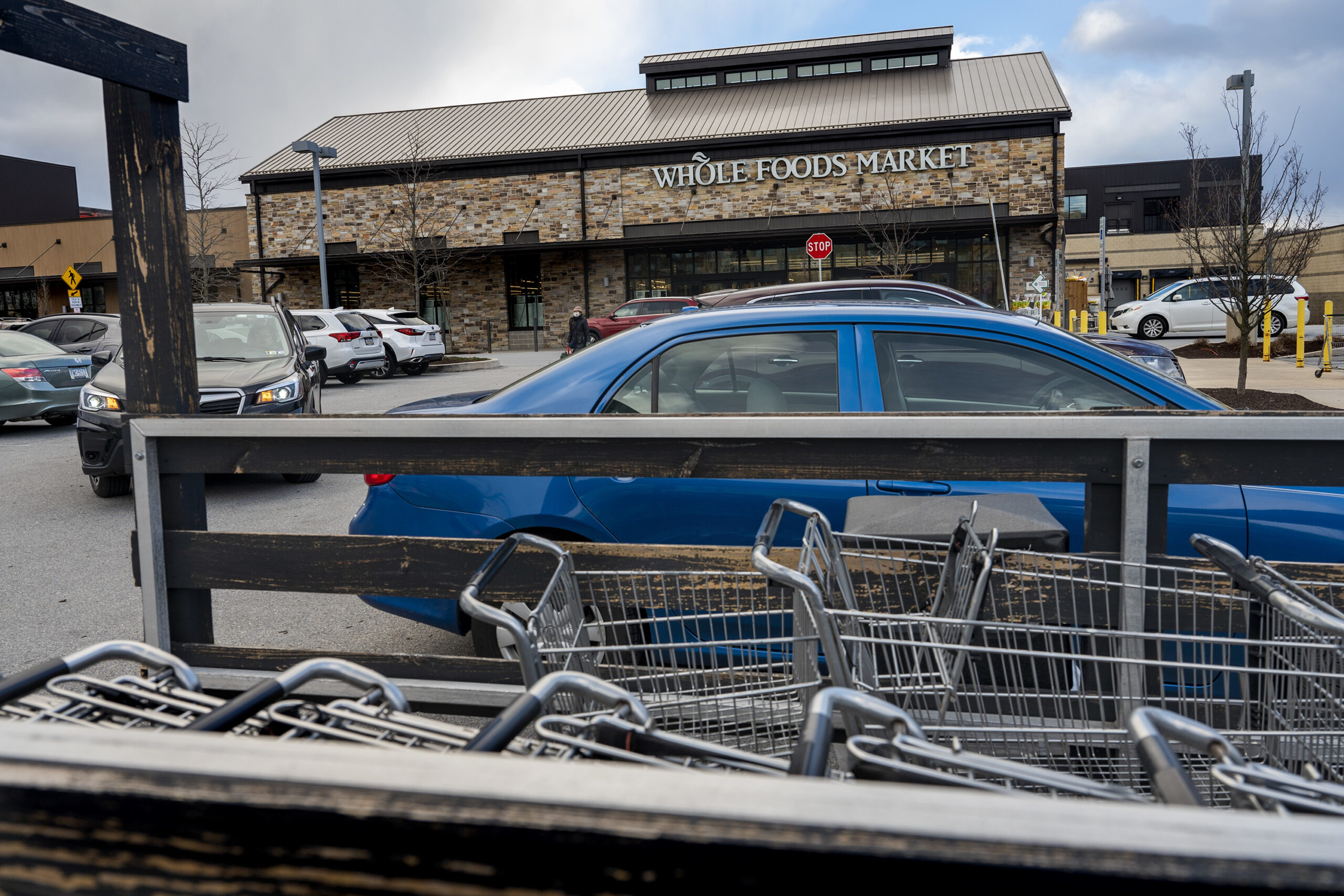
    The Whole Foods store in Exton, as pictured in 2022.

    Amazon said Tuesday that Whole Foods has seen a 40% growth in sales since Amazon purchased the organic-grocery chain in 2017.

    Whole Foods has 550 locations nationwide, including more than a dozen in the Philadelphia area. Amazon spokespeople did not answer questions about whether more Whole Foods stores were in the works in the Philly region.

    Amazon also expects to open at least five more smaller-format Whole Foods Market Daily Shop stores by the end of the year. The company said that decision was based on “strong performance” at the five existing shops in the New York City area and Arlington, Va.

    The Center City Whole Foods Market as pictured in February 2025.

    The online retailer said it plans to continue to experiment with new ways of shopping at its physical stores.

    In its statement, Amazon gave a shout-out to one such test in the Philadelphia area: “The store within a store” experience at the Whole Foods in Plymouth Meeting.

    Since November, customers at that store have been able to browse the physical aisles of Whole Foods, while digitally ordering unique products from Amazon and Whole Foods. The orders are then packaged in minutes in an automated micro-fulfillment center within the grocer’s back-of-house area.

  • How some Philly-area workers make $100,000 without a bachelor’s degree

    How some Philly-area workers make $100,000 without a bachelor’s degree

    Can you make $100,000 a year in the Philadelphia area without a four-year college degree?

    Yes. But it’s not common.

    “There is no magic wand to get to a six-figure salary,” said Cynthia Figueroa, who leads workforce development nonprofit JEVS Human Services. “There’s a lot of steps that have to happen along the way.”

    Companies including IBM, Delta, and Google have dropped degree requirements in recent years. Locally, Pennsylvania Gov. Josh Shapiro slashed college degree requirements for most state jobs in 2023, and Mayor Cherelle L. Parker has advanced an effort to do the same for some city jobs. Meanwhile, more are pursuing vocational training, the Wall Street Journal reported, as some in Gen Z turn to the trades amid the rising cost of college.

    Data center technicians are increasingly in demand, don’t require a college degree, and can make a six-figure salary after some experience. And store managers at Walmart, who often don’t have college degrees, can make $128,000 before bonuses.

    But who actually makes $100,000 or more in the Philadelphia area without a four-year degree and what does that path look like? The Inquirer took a look at the data.

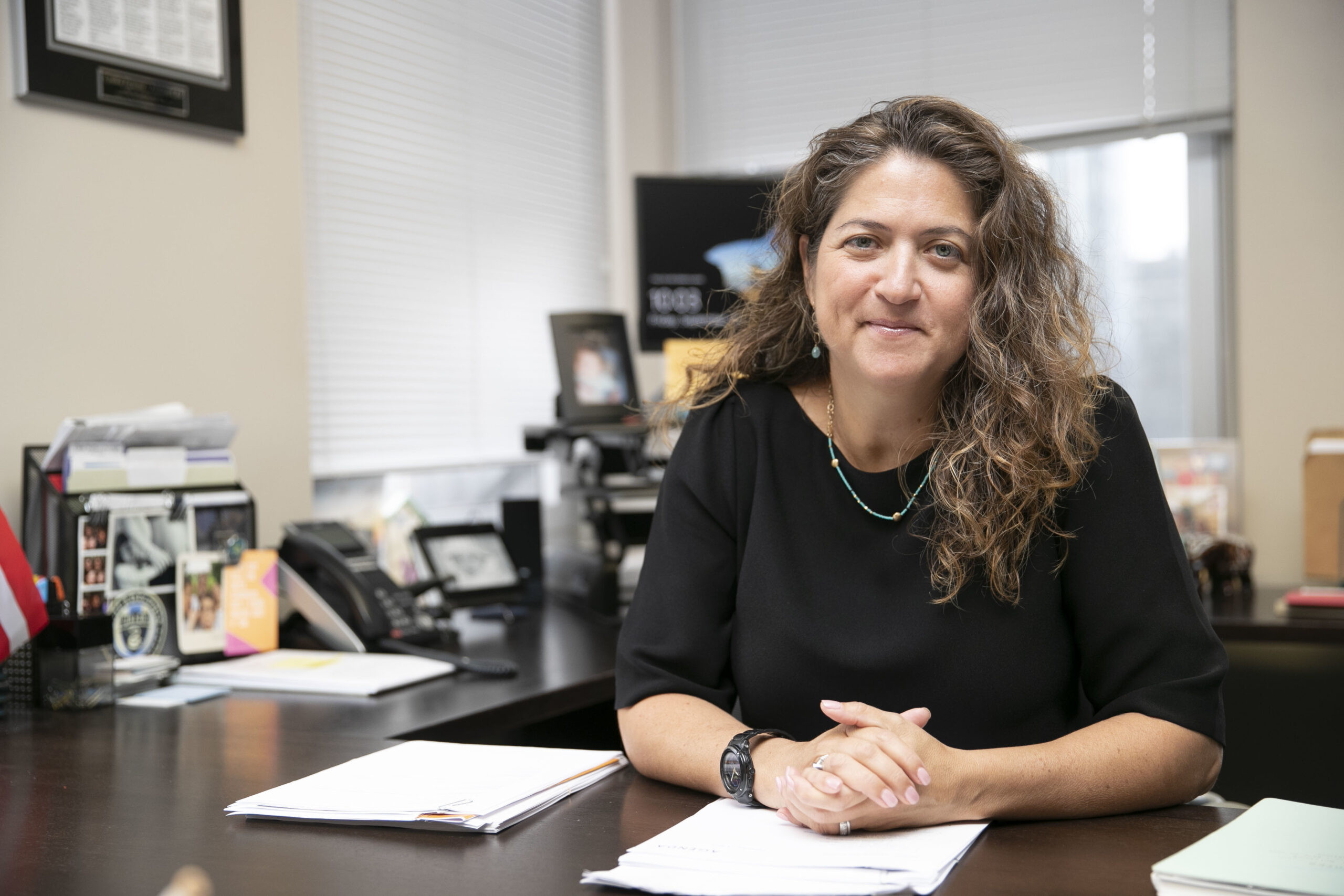
    Cynthia Figueroa poses for a portrait in Philadelphia in 2019. She is the CEO and president of JEVS Human Services.

    What industries pay $100,000-plus without a bachelor’s degree?

    Among the Philadelphia metro area’s 3.97 million workers, the vast majority who make a six-figure salary have at least a bachelor’s degree, according to Census data compiled by IPUMS USA at the University of Minnesota. The metropolitan area includes 11 counties in Pennsylvania, New Jersey, Delaware, and Maryland.

    Roughly 159,000 people made $100,000 or more without a four-year college degree in 2024, the data indicates. (That includes people with an associate’s degree.)

    window.addEventListener(“message”,function(a){if(void 0!==a.data[“datawrapper-height”]){var e=document.querySelectorAll(“iframe”);for(var t in a.data[“datawrapper-height”])for(var r,i=0;r=e[i];i++)if(r.contentWindow===a.source){var d=a.data[“datawrapper-height”][t]+”px”;r.style.height=d}}});

    “There is potential” for high earning without college, but it’s not typical, said Sean Vereen, president and CEO of career-focused education nonprofit Heights Philadelphia.

    “We know that not everybody wants to go to college, but particularly the way the economy in this region is constructed, that college degree still is very useful,” said Vereen.

    But the majority of the workforce in the Philadelphia metro area lacks a bachelor’s degree. Only about 7% of them reach the high-earning $100,000-plus bracket.

    It’s more common in jobs where salaries overall tend to be higher, such as management, business, and finance. About 51,000 Philly-area people in those jobs with less than a bachelor’s degree earned $100,000 or more in 2024.

    window.addEventListener(“message”,function(a){if(void 0!==a.data[“datawrapper-height”]){var e=document.querySelectorAll(“iframe”);for(var t in a.data[“datawrapper-height”])for(var r,i=0;r=e[i];i++)if(r.contentWindow===a.source){var d=a.data[“datawrapper-height”][t]+”px”;r.style.height=d}}});

    What industries are adding more $100,000 jobs?

    Still, more opportunities for people without a four-year degree could be on the horizon.

    Shipbuilding is having a resurgence in Philadelphia’s Navy Yard, and more electricians, carpenters, and welders will be needed, said Figueroa.

    Among Philadelphia construction workers, including carpenters and welders, more than 11,000 do not have a bachelor’s degree and make at least $100,000 annually.

    Hanwha plans to expand its shipbuilding operations in Philadelphia and will need to hire. That includes positions requiring considerable math skills, said Figueroa, of JEVS. The organization is currently figuring out how to get job-training graduates into opportunities.

    Philadelphia Works, the city’s workforce development board, is working closely with Hanwha, CEO and president H. Patrick Clancy said.

    “Our goal is to do more of the pre-apprenticeship,” Clancy said. “They have a lot of people interested in applying for their roles, but not all of them are passing the math and reading [requirements].”

    The newly repainted Goliath Crane is shown July 16, 2025, at the Hanwha Philly Shipyard in Philadelphia.

    Last year, a Brookings Institution report highlighted enterprise digital solutions (business software), specialized manufacturing (like producing parts for medical devices or industrial electronics), and biomedical commercialization (life sciences businesses) as areas where Philadelphia residents should be able to find good jobs. Many jobs in those sectors don’t require a college degree.

    “We need to be focused on creating the right kinds of jobs,” said Chellie Cameron, CEO and president of the Chamber of Commerce for Greater Philadelphia, which is now focusing on the areas Brookings identified.

    The right kinds of jobs, Cameron said, are not minimum-wage positions. They “start at a place where people can earn a family-sustaining wage and have access to pathways for promotion and making more money over the course of their career.”

    Paths and training for high-earning jobs

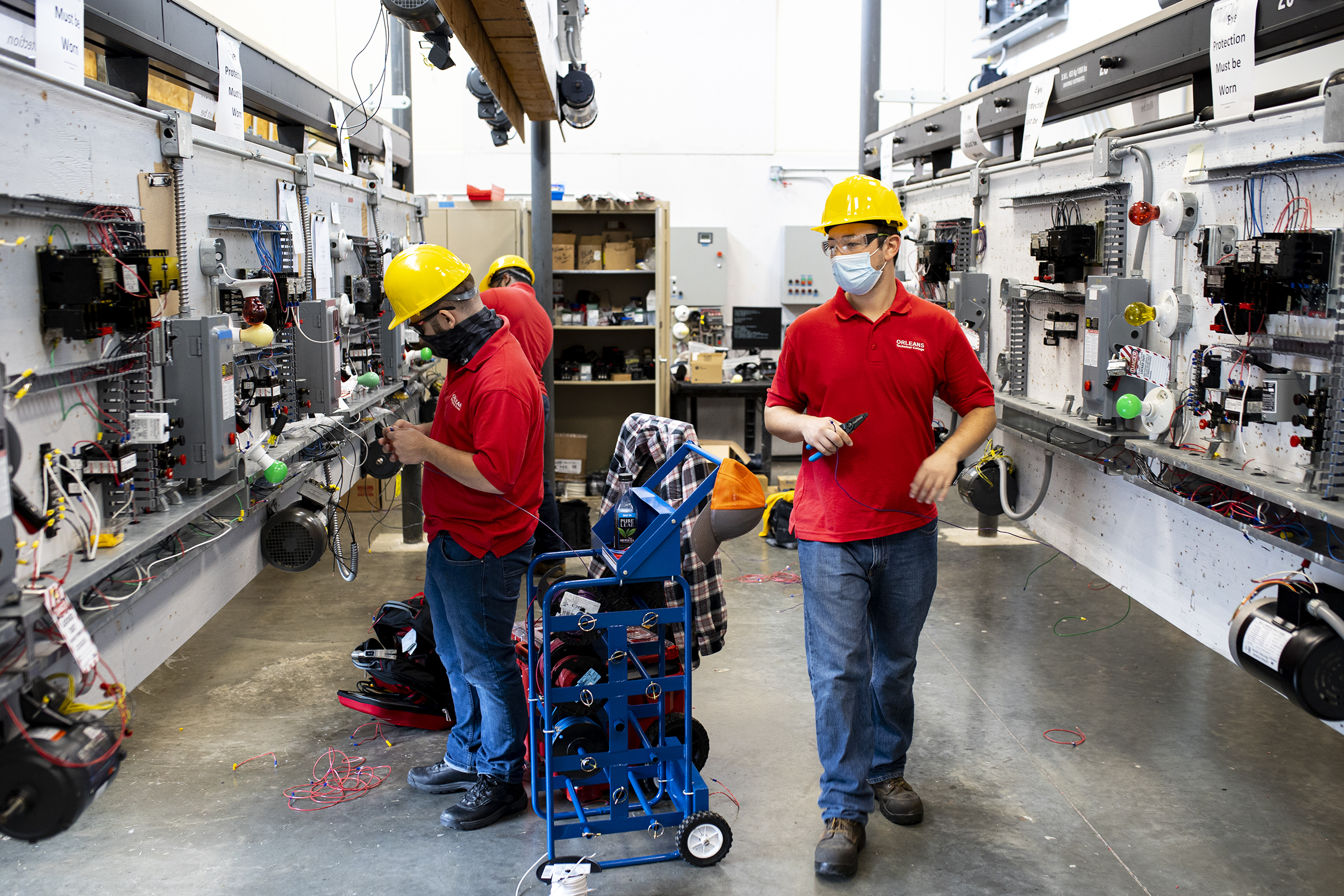
    Orleans Technical College in Northeast Philadelphia, run by JEVS, trains people for building trades and healthcare professions. It had 379 students last year. Tuition ranges from roughly $13,000 to $25,000, but most students get financial assistance and typically leave with $6,000 or less in debt.

    Residential and commercial electrician Dan Finke, 25, of Abington, (right), is learning about motor controls with fellow classmates at Orleans Technical College, in Northeast Philadelphia on a Friday in September 2020.

    “There’s still very much the physical application of running wire, bending metal,” said Figueroa, and many medical tasks seem to be AI-proof for now. “At the end of the day, you need somebody who is taking the blood pressure next to the bed, and who is drawing the blood.”

    Construction management and HVAC students can expect starting salaries around $75,000 and $60,000 respectively. Those who work overtime can make even more, Figueroa noted, and pay also increases over the course of a career.

    That’s not a six-figure salary on Day One, she acknowledged. But college graduates can make a similar amount in their first job, and “they have this enormous debt” from their schooling.

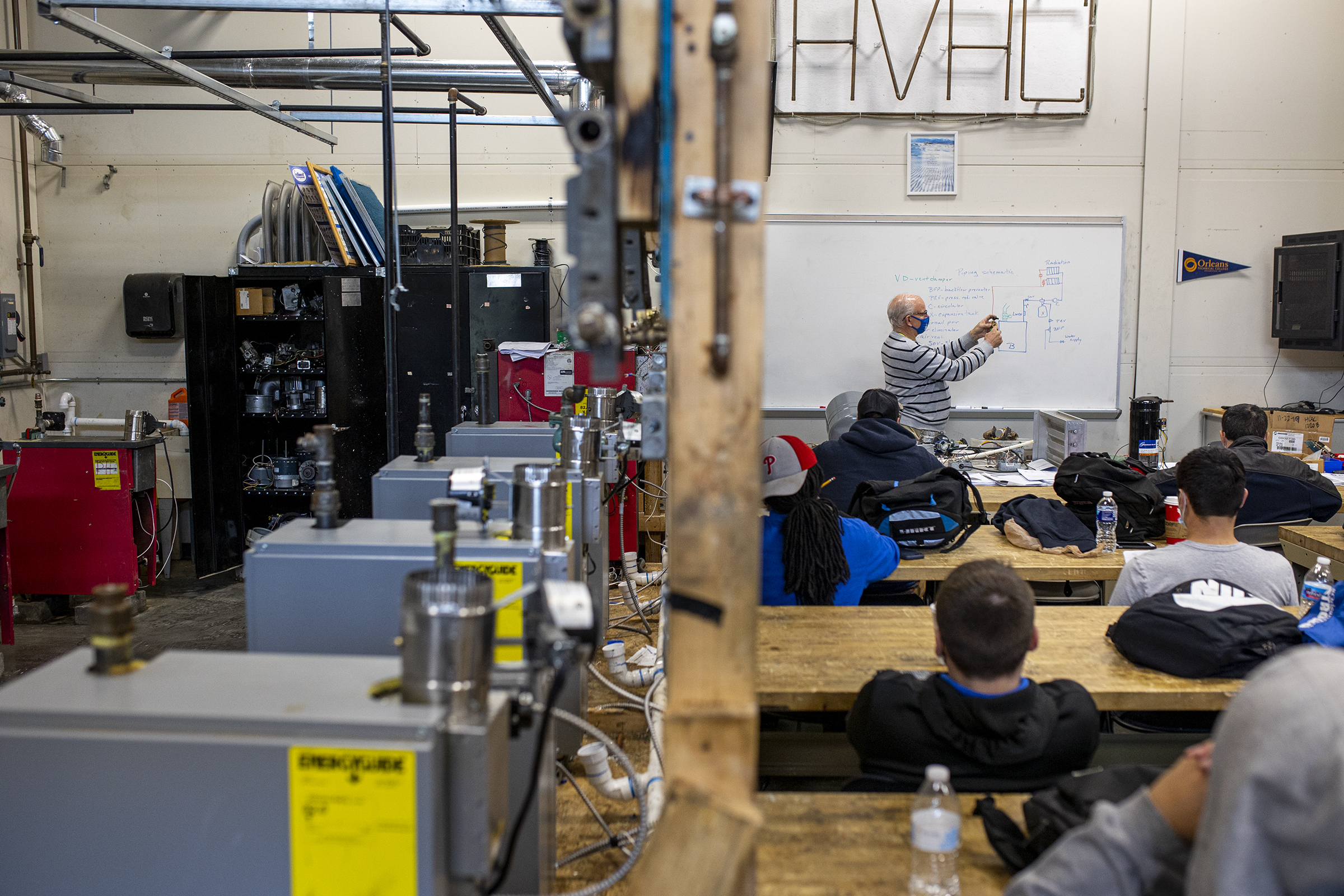
    Lou Abruzzese, HVAC Instructor, is teaching his class about hydronics at Orleans Technical College, in Northeast Philadelphia on Friday, Sept. 25, 2020.

    Orleans also offers healthcare training for clinical medical assistants and practical nursing. Starting salaries for those jobs are generally around $44,000 and $64,000 respectively.

    “Going from an hourly wage — at like a Target, McDonald’s, Walgreens, what have you — to salaried, hopefully with benefits, is a huge first step,” Figueroa said.

    Connecting people to employment also means addressing barriers like lacking a driver’s license, needing childcare, financial literacy, or housing support, says Clancy. Pursuing training might mean going without paid work for weeks or months, which can be a challenge. Philadelphia Works has some funds available to pay people during their training.

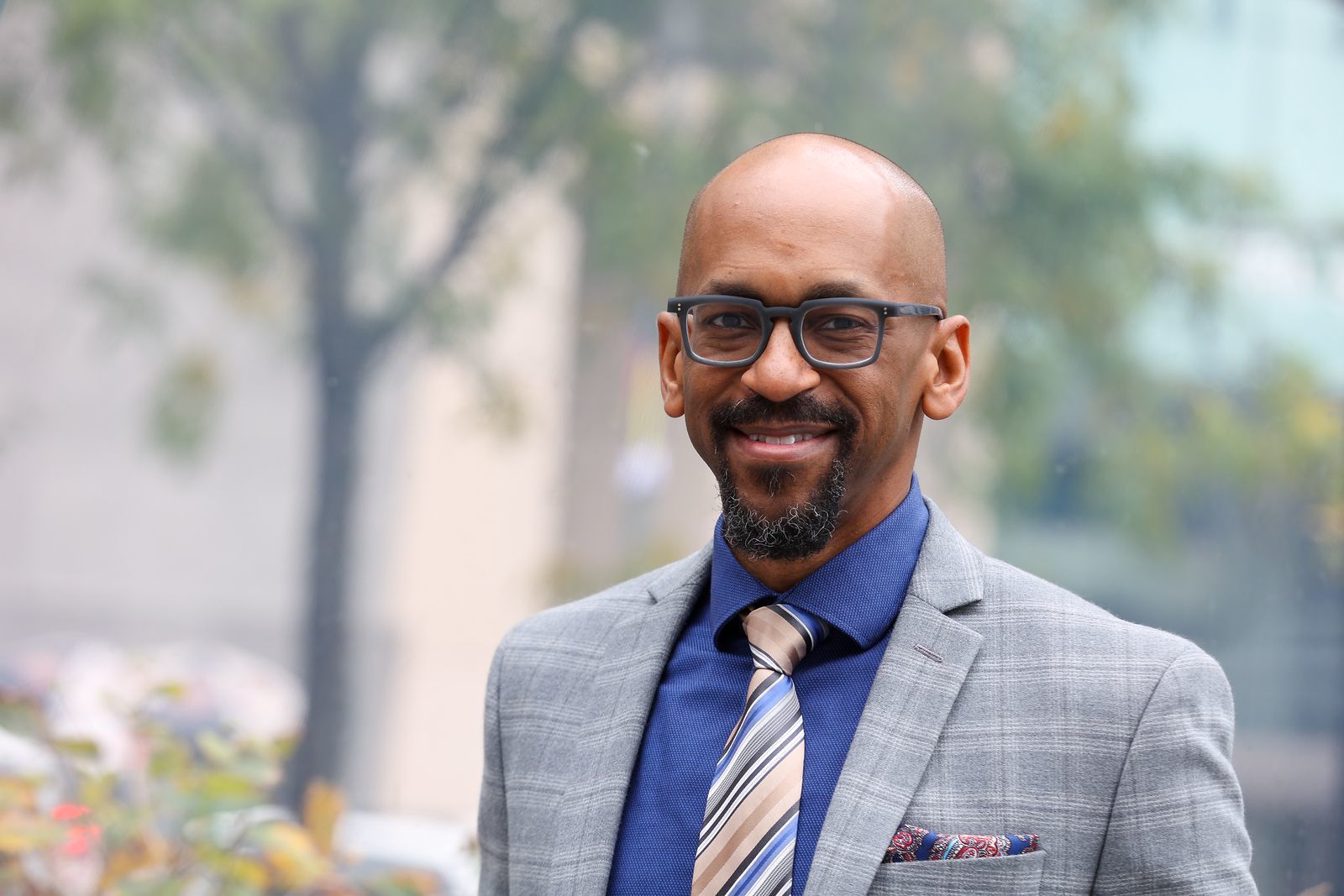
    Sean Vereen is the president and CEO of Heights Philadelphia.

    Young adults need to be aware of opportunities, too, said Vereen. For instance, he said, sterilization technician is a good job within a hospital, but young people may not know it’s a path available to them without going to college.

    And sometimes young people need to catch up before training for jobs in the trades, Vereen says. “We’ve heard things like, ‘The kid coming from the school district doesn’t have strong enough math skills to take the test for the building trades,’” he said.

    “You need basic academic skills that are about math and reading and reading comprehension,” he said. “We don’t get away from giving kids basic knowledge.”

  • ‘He reached his limit.’ Immigrant father of 5-year-old with brain cancer accepts deportation to Bolivia after months in ICE detention.

    ‘He reached his limit.’ Immigrant father of 5-year-old with brain cancer accepts deportation to Bolivia after months in ICE detention.

    In the end, the pressure on the family simply became too great.

    Johny Merida Aguilara, the detained immigrant father of a 5-year-old son with brain cancer, has decided to drop efforts to stay in the United States and accept deportation to Bolivia.

    His wife and three American-citizen children will also leave the country, though they are not required to do so, departing their Northeast Philadelphia home to reunite with their husband and father in the central Bolivian city of Cochabamba.

    The decision to go comes as Merida Aguilara, 48, approaches his fifth month in immigration detention ― with no end in sight. The family’s forced separation has been emotionally devastating, friends and supporters said. And with Merida Aguilara in custody and unable to work, the financial situation for his wife and children was growing desperate.

    Merida Aguilara had been a main caregiver for his son, Jair, who has been treated at Children’s Hospital of Philadelphia, and whose future is now deeply uncertain. Quality healthcare can be lacking in Bolivia, where the U.S. State Department warns that “hospitals cannot handle serious conditions.”

    Jair has autism and a severe eating disorder, surviving on PediaSure nutrition drink delivered through a plastic syringe. He generally would accept food only from his father, and Merida Aguilara would leave work during the day to feed his son.

    The father was arrested by ICE for an immigration violation during a September traffic stop on Roosevelt Boulevard near Hunting Park Avenue, having lived in the United States without official permission for nearly 20 years.

    “I am tired,” Gimena Morales Antezana, his wife, said in an interview with The Inquirer. “We have been trying to survive, but it is difficult with the children because they miss their dad so much.”

    U.S. Immigration and Customs Enforcement officials did not reply to a request for comment on Thursday.

    The family has received strong community support, Morales Antezana said, but that could not continue indefinitely, and at this point she can no longer afford rent, water, or heat,

    Son Matias, 7, cries himself to sleep most nights, calling out for his father to come home. His sadness deepened after Christmas, turning into anger when Morales Antezana finally revealed that his father was not away on an extended work trip, but was being held by immigration authorities at the Moshannon Valley Processing Center, an ICE facility in central Pennsylvania.

    Gimena Morales Antezana and Johny Merida Aguilar’s wedding photos hang on the wall at their home in Northeast Philadelphia.

    Daughter Melany, 13, now feels unsafe in the U.S., her mother said. Teenage insecurities have bloomed into a persistent sense of danger, and she told her mom that leaving might be the only way to feel comfortable again.

    Jair cries inconsolably every time he sees or hears his father on the phone, asking why his dad can’t be home, Morales Antezana said.

    All three children were born in this country and are U.S. citizens by law.

    Some good news came this month. Doctors told Morales Antezana that Jair’s brain tumor had not grown, allowing time to try to find care in Bolivia.

    “This is going to be a constant struggle every day until God decides,” Morales Antezana said. “It’s scary to think that if something happens we don’t have a hospital to take him to, but knowing his dad will be there makes it a little lighter to bear.”

    Morales Antezana, 49, had to stop working in 2020 to handle the nearly full-time demands of Jair’s health, taking him to see specialists and undergo treatments while also caring for Melany and Matias.

    Jair Merida, 5, posed for a portrait at home in October. His father, Johny Merida Aguilar, was stopped and arrested by ICE in September.

    She has not been ordered deported while she has pursued legal means to stay in the country. Mother and children plan to voluntarily depart this month, while the precise timing of Merida Aguilara’s deportation is uncertain.

    “He couldn’t do it anymore; he reached his limit,” said Philadelphia immigration attorney John Vandenberg, who represents the family. “It’s a tough environment in the jail.”

    Vandenberg won relief in the U.S. Court of Appeals for the Third Circuit, which issued a Sept. 30 order to temporarily block Merida Aguilar’s deportation. The lawyer also applied on Morales Antezana’s behalf for a T visa, which can bestow a path to citizenship on victims of human trafficking and their families.

    But time has gone on with no sign from the government as to when that visa application might be considered.

    Merida Aguilar and his wife were given permission to legally work in the U.S. under her 2024 claim for asylum, which could enable both to live here permanently if granted. The Trump administration, however, has made it increasingly difficult for people to succeed on those claims.

    Vandenberg said Merida Aguilar has no criminal record in the U.S., and Bolivian authorities provided documentation showing he had committed no offenses in that country.

    His efforts to remain in the U.S. have been complicated by a previous deportation, when he tried to enter the U.S. east of San Diego in 2008. Immigration officials sent him to Mexico, but Merida Aguilar secretly crossed back into the U.S. almost immediately.

    Now he and his wife want their children to be in Bolivia in time for the new school year, which starts in February.

    “I want to make sure our kids can study,” Morales Antezana said, “so they can decide who they want to be in the future, and come back [to the U.S.] as professionals with a different story than us.”

    Her parents, and a son from a previous relationship, are eager to see them in Bolivia.

    She said she is looking forward to what many people might take for granted ― hugging her partner, watching him play with their children, enjoying a meal as a family. That helps ease the pain of saying goodbye to a city she sees as home and to the friends who tried to help.

    “They kept me strong and helped me not get more depressed,” Morales Antezana said. “I’m going to miss everything about Philadelphia. It hurts a lot to have to leave because there are good people here.”

  • A former nun and her husband give $5 million to Neumann University for its nursing program

    A former nun and her husband give $5 million to Neumann University for its nursing program

    When Jackie Fegley, a former nun, got married 51 years ago, money was tight. So she borrowed a dress from a friend.

    And when her husband looked at her nurse’s salary the first year he did her taxes, he said: “Do you know you’re borderline poverty?”

    But all that changed over the ensuing decades, and on Friday, Jackie and her husband Bill Fegley Jr., who made his career in accounting, gave a $5 million gift to Neumann University. Jackie is a 1971 graduate of Neumann — then called Our Lady of Angels College.

    She also spent 10 years as a nun with the Sisters of St. Francis of Philadelphia, which founded Neumann in 1965.

    It’s the largest single gift Neumann — a Catholic university in Aston, Delaware County — has received from an individual, and the university in recognition named its nursing college The Jacquelyn Wilson Fegley ’71 College of Nursing.

    “Bill and I were both lucky to receive a good education,” said Jackie, 81, who lives in Blue Bell with her husband, a Drexel University graduate. “So we decided that’s where we’d really like to give our money.”

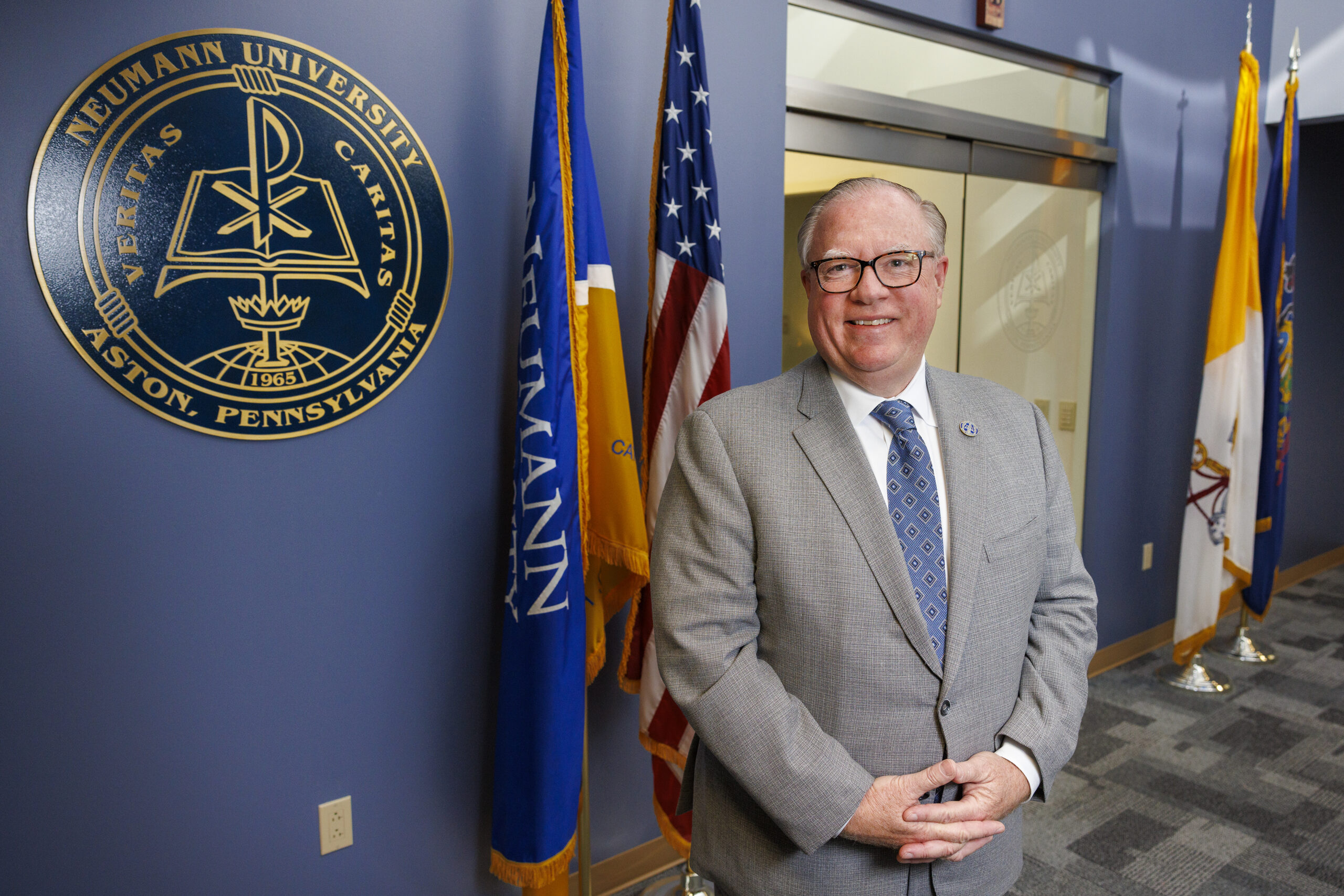
    Chris Domes, president of Neumann University

    Neumann President Chris Domes said $4.5 million will be used for undergraduate nursing scholarships for students with the most need and highest achievement, and the other $500,000 for lab equipment. The scholarships will begin to be awarded in the fall, with 22 to 25 students benefiting each year and continuing to get the funds over four years.

    Nursing is the largest major at Neumann, with 368 undergraduate and graduate students enrolled. That’s about 17% of the 2,174-student body.

    “If the scholarships give somebody an opportunity to change their life, it’s amazing,” said Bill, 78, who started his public accounting career with Arthur Young and then founded his own firm, Fegley & Associates, in 1975.

    Domes said he hopes the gift encourages others to invest in higher education.

    “It sends a signal that Neumann is a place that is financially strong and getting stronger,” he said. “It’s a real sign from Bill and Jackie that they believe in what we are doing here.”

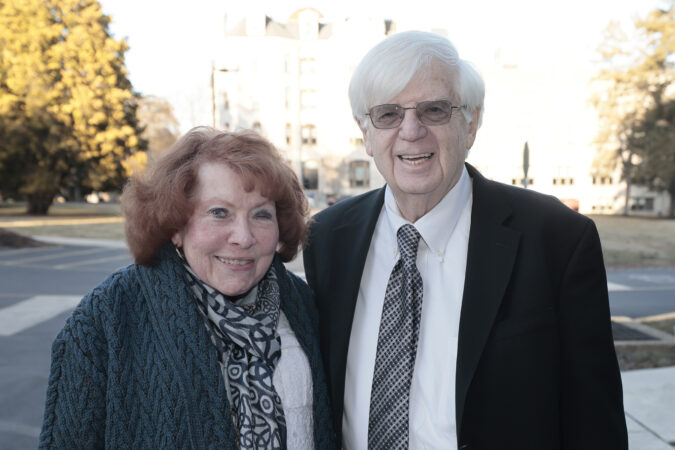
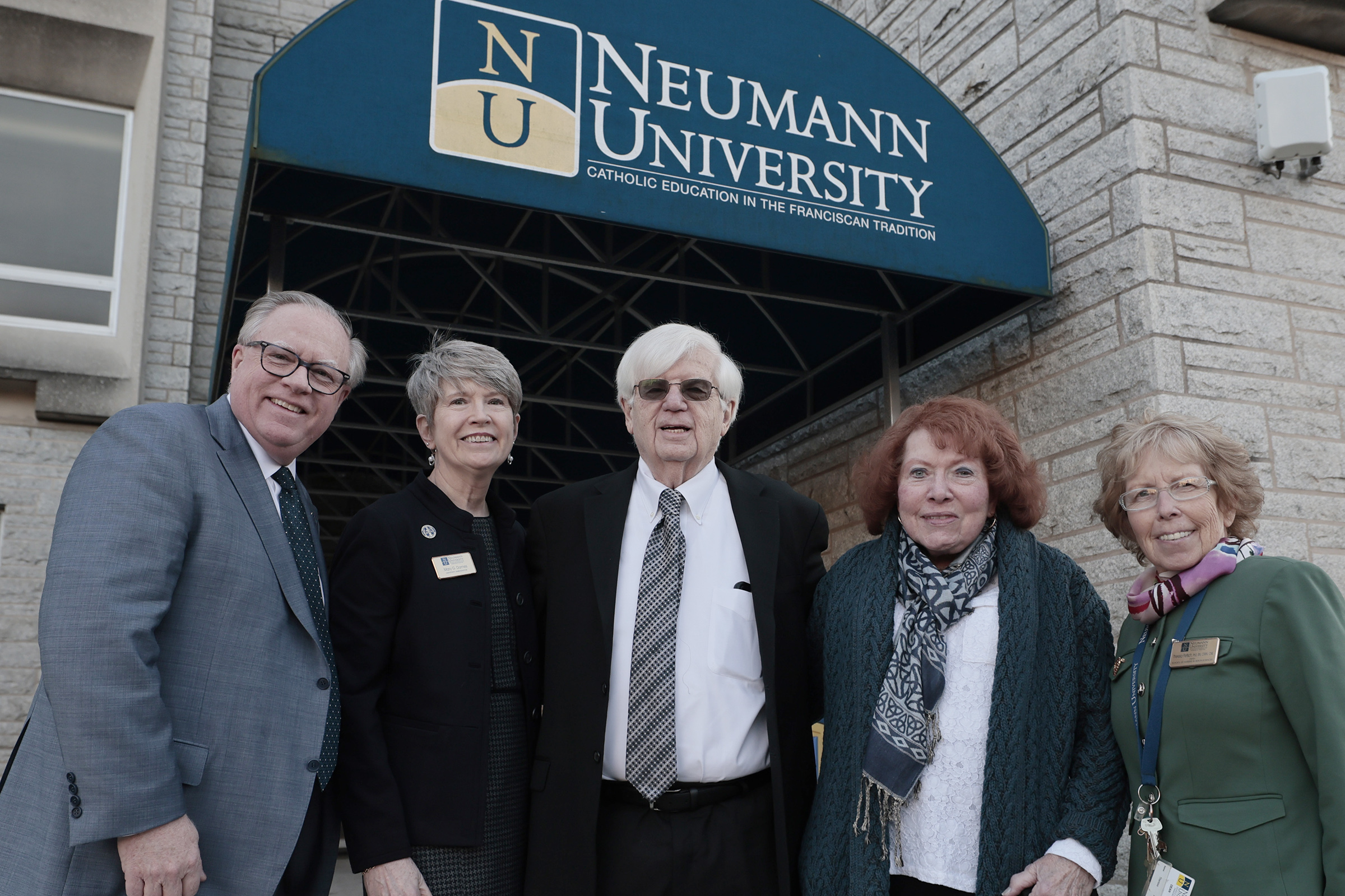
    Neumann University President Chris Domes (from left) and his wife Mary Domes, William Fegley Jr. and his wife Jacquelyn Fegley, of Blue Bell and Neumann’s Nursing Health Sciences Dean Theresa Pietsch at Neumann University in Aston, Pa. on Friday, Jan. 16, 2026.

    Born in Chester, Jackie said she grew to admire the Franciscan sisters at her local parish and stayed in touch with them through high school. When she graduated from Notre Dame High School in Moylan in 1962, she joined the order.

    During her decade there, she taught grade school, including one year at an orphanage where the children ranged in age from 3 to 9. She said that’s when she started to think she wanted a family.

    She got her bachelor’s degree while in the order, first taking classes at St. Joseph’s University and then moving over to Our Lady of Angels when it opened. She was part of the college’s second nursing graduating class.

    “I think there were 10 of us in the class,” she said, including other nuns and lay people. “It was a wonderful experience integrating everyone together.”

    After leaving the convent, she worked as a nurse at Holy Redeemer Hospital in Meadowbrook and Nazareth Hospital in Northeast Philadelphia. In January 1974, she met Bill, who grew up in Tamaqua, at a dance at a local pub. In September of that year, they married.

    They have five children, now ages 40 to 50, who work as accountants, a personal trainer, a doctor, and a minimart operator.

    Jackie has remained in contact with the sisters through the years.

    “I love the sisters,” she said. “I still consider myself a Franciscan, just not a Franciscan sister.”

    Bill — whose accounting firm has since merged with Morison Cogen LLP, where he continues to serve as a partner — has served on the foundation board for the Sisters of Saint Francis and has chaired it for about four-and-a-half years. And nine months ago, he joined Neumann’s board of trustees. He also has served as a lecturer at the University of Pennsylvania and an adjunct professor at Drexel and Pennsylvania State University.

    The couple has visited Neumann to see how the educational program has grown and were pleased to see its Franciscan spirit thriving.

    “I was really thrilled to see that this was how it was progressing,” Jackie said.

    The couple attended the naming celebration and gift announcement at Neumann on Friday.

    “We’re just pleased that God put us in a position that we’re able to do this,” Bill said.

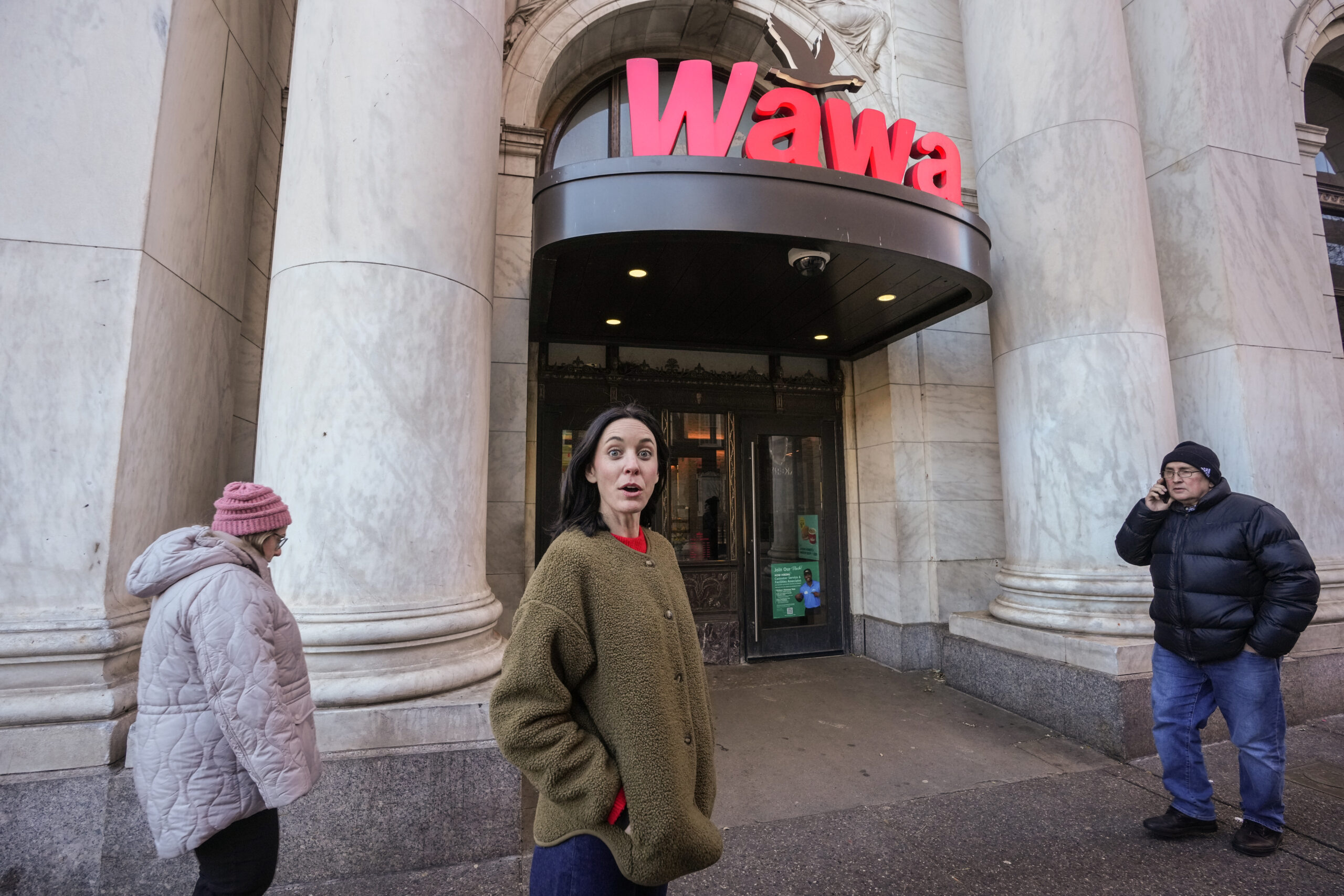
  • She moved home and started whispering about Wawa. Then she went viral.

    She moved home and started whispering about Wawa. Then she went viral.

    Of all the things Betsy Kenney thought she might go viral for, whispering about Wawa wasn’t one of them. But the 38-year-old comedian’s Philly “ASMR” videos have taken off on TikTok and Instagram, turning Kenney — who spent more than a decade pursuing a comedy career in New York City — into an unlikely local celebrity.

    If you aren’t familiar with ASMR, which stands for Autonomous Sensory Meridian Response, it’s a relaxing sensation triggered by soft sounds or repetitive patterns. People watch ASMR videos of soft tapping, scratching, whispering, or crinkling to unwind. A video of someone getting a scalp massage? Pure bliss. A video of someone with a strong Philly accent asking if you know their cousin while scraping a spoonful of Rita’s water ice? Less so. And therein lies the joke. “People find the Philly accent to be like nails on a chalkboard,” Kenney said. “And I thought it would be funny to combine the two.” The contrast clicked immediately.

    Kenney’s videos have racked up millions of views, circulating through group chats and comment sections thick with recognition and debate. They’ve drawn fans far beyond the region and even earned an endorsement from Kylie Kelce, who rated Kenney’s Philly accent an 11. For Kenney, the sudden attention has been somewhat surreal, considering it only arrived after she stopped chasing it.

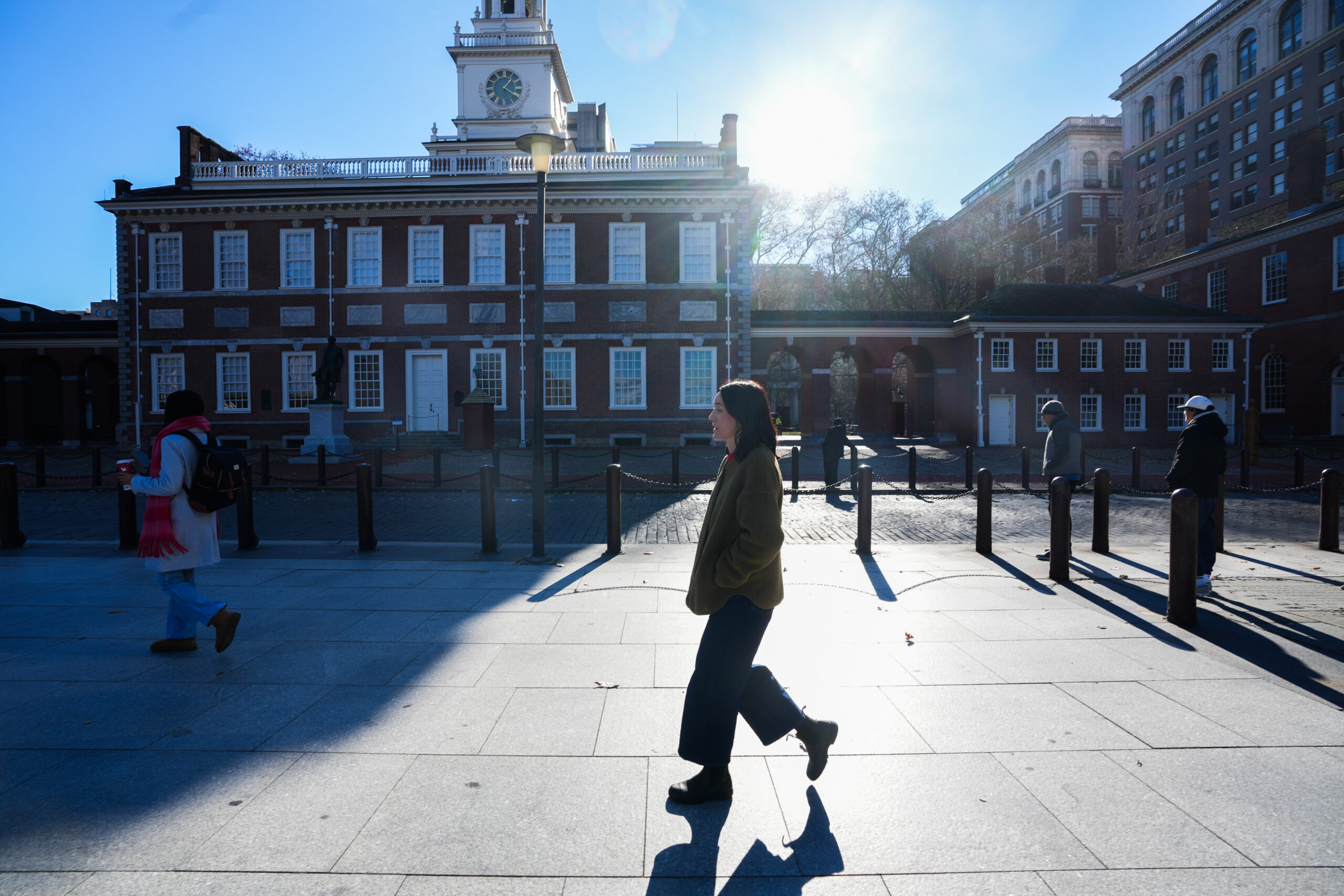
    Betsy Kenney, the woman behind Philly ASMR, in Philadelphia, December 11, 2025.

    For years, she had been grinding through the familiar comedy circuit in New York. She took improv classes at the Upright Citizens Brigade, acted in commercials to stay afloat, and wrote constantly. “I really wanted to do comedy as a living,” Kenney said. “And it turns out it’s really hard.” There were moments of traction. Kenney and her writing partner had a short film debut at the Tribeca Film Festival. They created a web series that was acquired by IFC. They hosted a podcast that found a sizable audience. “That was big,” she said. But none of it added up to stability. Then came COVID, two babies, and a move to Kenney’s hometown of Philadelphia, a return that quietly reshaped how she worked.

    Back home, the pressure shifted. Kenney was no longer measuring every idea against an imagined career outcome. She was tired, busy, and short on time, and that looseness made room for something new. In September, she posted her first TikTok: an impression of “Phillies Karen,” aka the lady who stole a baseball from a kid at a Phillies game. It went viral. Before that, she said, she’d always been too self-conscious to post comedy online. Now, with less to prove and less time to overthink, she kept going.

    She began posting whenever inspiration struck. Ideas surfaced in the slivers of time she had to herself, like in her car after school drop-off, or before pickup. Some of her best brainstorming happens in the shower, which is why her hair is often still wet in her videos. “I’m not trying to do a soaking wet Kim K thing,” Kenney said. “It’s literally the only time I have.” (Kenney is a full-time parent.)

    A few days after “Phillies Karen” took off, she posted her first Philly ASMR video. Then came her impression of Ms. Rachel if she were from Philly. She tried non-Philly bits, too, but they didn’t land the same way. Viewers were clearly responding to the specificity of her hometown voice.

    Betsy Kenney, the woman behind Philly ASMR, in Philadelphia, December 11, 2025.

    Kenney isn’t the only creator to build a fan base on the back of the Philly accent. There’s also Olivia Herman, whose no-nonsense impression of a Philly mom has attracted over 200,000 followers and a brand deal with Burlington Coat Factory. But where Herman leans into parody, Kenney aims for recognition. The humor doesn’t come from exaggerating the accent, but from treating it as ordinary. That’s no small task considering how difficult the Philly accent is to fake. “It has one of the most complex vowel systems of American English dialects,” said Betsy Sneller, a professor of linguistics at Michigan State University, which makes it difficult to imitate if you didn’t grow up with it.

    Kenney did. She was born and raised in Northeast Philadelphia by two parents from the area. “Philly is all I knew,” she said. Sneller said that familiarity is evident in Kenney’s use of Philly-specific phrasing — “it’s so expensive anymore,” “youse” — and regional slang and cultural references like Mom-moms, bo-bos, and the Roosevelt Mall. “There’s such an identifiable feeling of place,” Sneller said. “It feels so specific.”

    In fact, Kenney has found that the more specific she is, the more people connect with her work. In the comments section of a video where she asks which parish “Father John ended up at,” viewers pile on with recognition. “Wow, so we all had a Father John then, lol,” wrote one. “We all Father John in eastern PA,” wrote another. Even the Eagles chimed in: “My kinda ASMR.”

    Now that she’s back in Philadelphia, the specific details her audience loves are easier to access. Kenney improvises most of her videos, following associations as they surface. So a trip to Franklin Mills might trigger a memory about a childhood birthday, which turns into a video about Stock’s pound cake. Her family is another steady source of material, especially her father, who works in a Philly courtroom as a stenographer and comes over every week with fresh stories. “If I ever need inspiration,” Kenney said, “there it is.”

    Back home, surrounded by the people and places that fuel the work, Kenney isn’t in a hurry to turn her TikTok success into something bigger. She isn’t chasing the next step the way she once did in New York. “This is the first time in my comedy career that I’m just having fun,” she said. “And now that I’m back in Philly, and that’s what’s blowing up, I’m just really happy.”

  • What the Saks bankruptcy means for Philly-area shoppers

    What the Saks bankruptcy means for Philly-area shoppers

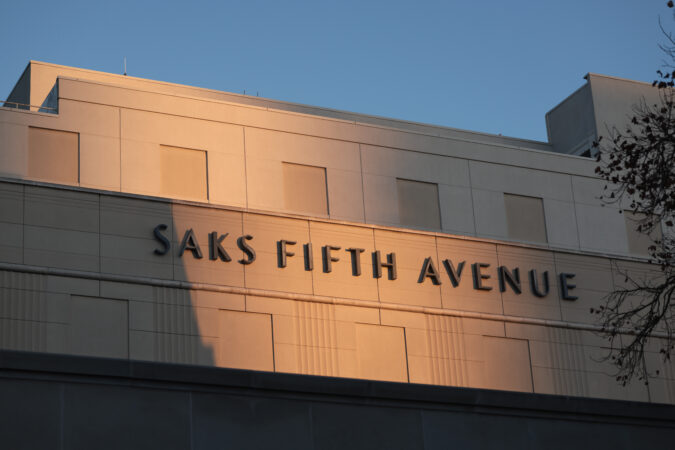
    Saks Global, which operates Saks Fifth Avenue and Neiman Marcus, has filed for bankruptcy.

    The high-end clothing retailer announced the move on Wednesday, saying in a statement that the Chapter 11 filing will “facilitate its ongoing transformation.”

    In the Philadelphia region, Saks Global has long operated an expansive Saks Fifth Avenue store off City Avenue in Bala Cynwyd. The company also has a Neiman Marcus at the King of Prussia Mall, as well as Saks Off 5th discount outlets at the Franklin Mall in Northeast Philadelphia and at the Metroplex shopping center in Plymouth Meeting.

    Both local Saks Off 5th locations are slated to close soon, as was reported this fall by several news outlets, including the Philadelphia Business Journal.

    Here’s what the bankruptcy filing means for local Saks shopper.

    Is Saks Fifth Avenue in Bala Cynwyd closing?

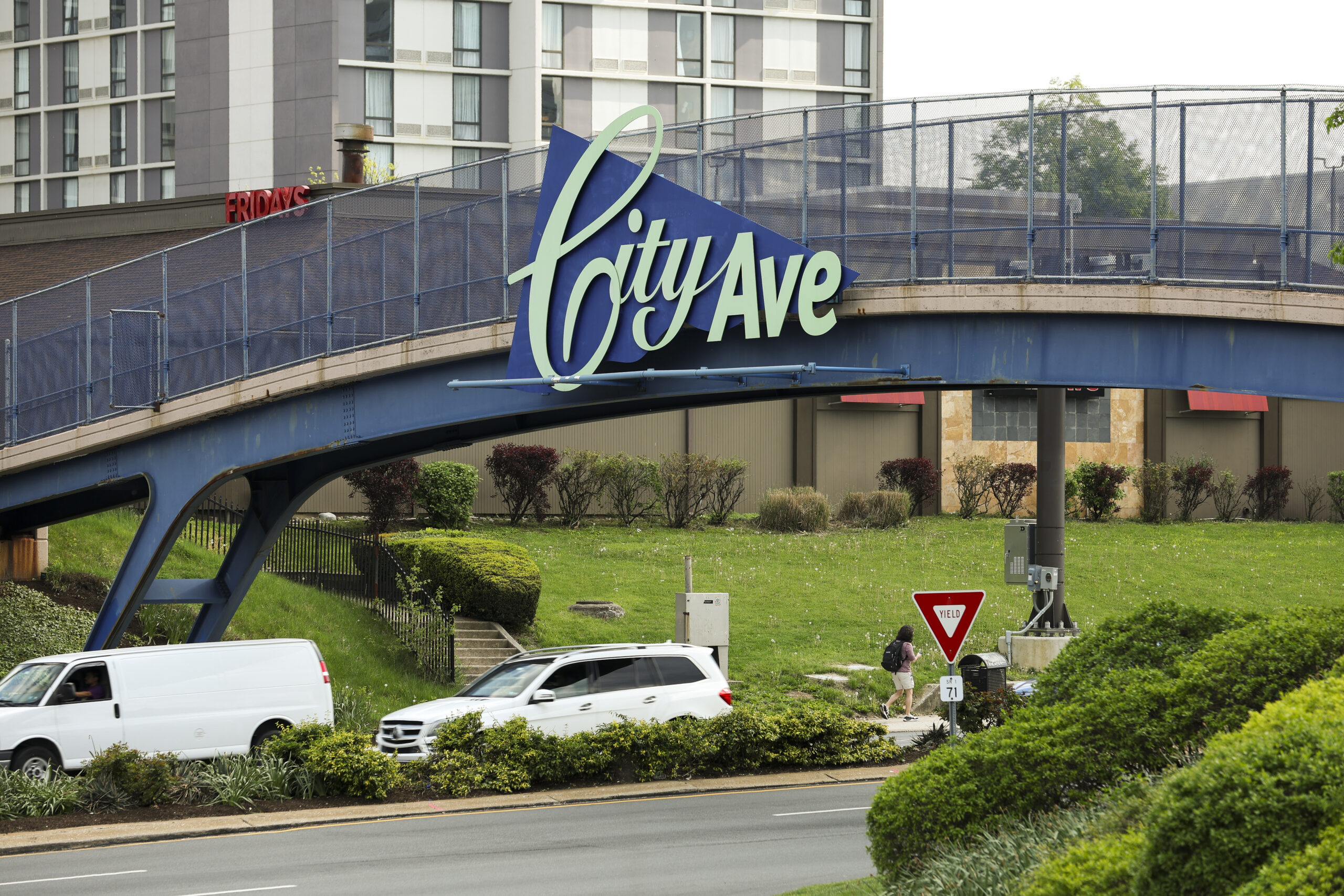
    Saks Fifth Avenue has been a retail success along City Avenue in Bala Cynwyd, as shown in April 2024.

    No. At least not in the immediate future.

    Saks has filed for Chapter 11 bankruptcy, which means the company intends to reorganize financially and stay in business. That’s opposed to Chapter 7 bankruptcy — as is the Iron Hill Brewery case — through which businesses liquidate all their assets and close locations.

    “To be clear, a Chapter 11 filing does not mean that Saks Global is going out of business,” Saks wrote in a bankruptcy FAQ on its website.

    But when companies reorganize through bankruptcy, they sometimes do close stores, particularly underperforming ones.

    Saks executives alluded to the possibility of this in its statement, which read in part: “As part of the Chapter 11 process, the company is evaluating its operational footprint to invest resources where it has the greatest long-term potential. This approach reflects an effort to focus the business in areas where the company’s luxury retail brands are best positioned for sustainable growth.”

    The Saks Fifth Avenue opened in Bala Cynwyd decades ago. It is now the retailer’s only location in the Philadelphia region and is called “Saks Philadelphia” on the company’s website.

    The Inquirer reported in 2024 that business at the store was strong and that the chain had resisted offers to move to King of Prussia, according to the City Ave District.

    In response to questions from The Inquirer about the future of Philadelphia-area stores, Saks Global said: “Our footprint evaluation is underway, and we have already begun to work collaboratively with our real estate partners to find future-facing solutions, where possible, to achieve a stable and sustainable business model and optimized portfolio on the other side of this process.”

    Is Neiman Marcus in King of Prussia closing?

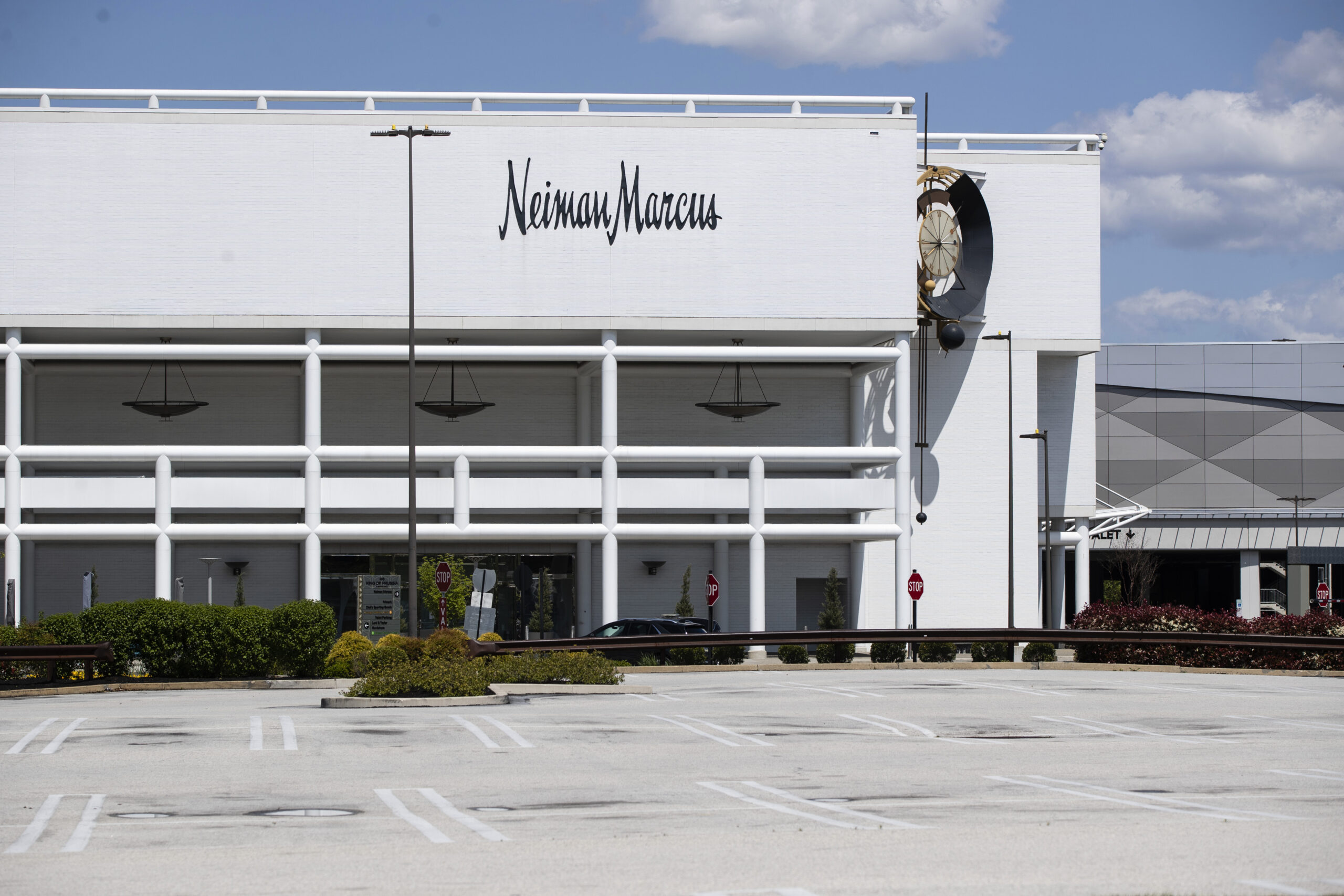
    The Neiman Marcus store in King of Prussia, as shown in May 2020.

    Also not in the immediate future.

    King of Prussia Mall has long been a go-to spot for retailers. Even after the challenges of the pandemic, and amid competition from online retailers, the center remains among the region’s thriving shopping destinations.

    In 2024, Saks Global bought Neiman Marcus in a $2.65 billion deal after Neiman Marcus filed for Chapter 11 bankruptcy during the pandemic.

    Are Saks credit cards or gift cards impacted by the bankruptcy?

    No, the company says.

    “There are no changes to our credit card programs and rewards, with customers continuing to shop, earn and redeem benefits as usual,“ the company wrote in the FAQ. ”We continue to accept payments as usual, including credit cards and gift cards, with no changes to how customers transact with us.”

    Are Saks’ return policies impacted by the bankruptcy?

    No, according to the company.

    “Our refund and exchange policy is expected to remain unchanged, with refunds and exchanges being accepted and issued as usual,” the company wrote.

    I am waiting on a package from Saks. Will my order still arrive?

    Yes, all current and future orders will be delivered as usual, the company said.

    What’s next for Saks?

    In New York, Saks Fifth Avenue’s holiday light show and window was revealed in November.

    The company says it is not going anywhere.

    “Saks Global is firmly focused on the future, and we look forward to continuing to serve customers and deliver for our stakeholders,” the company wrote in the FAQ.

    As of Wednesday, Saks was waiting for court approval of a $1.75 billion financing deal that would come with an immediate $1 billion debtor-in-possession loan from an investor group.

    If approved, the deal “will provide ample liquidity to fund Saks Global’s operations and turnaround initiatives,” the company said in a statement.

    Saks estimates its assets and liabilities at between $1 billion and $10 billion, according to court documents filed in U.S. Bankruptcy Court in Houston. Saks has between 10,001 and 25,000 creditors, including luxury brands like Chanel, to which Saks owes $136 million, according to the documents.

    To lead the company during this transition, Saks also announced a new chief executive, with former Neiman Marcus CEO Geoffroy van Raemdonck replacing Richard Baker.

    Saks said it hopes to emerge from bankruptcy later this year.

    The company said in its FAQ: “With new capital and a stronger financial foundation on the other side of this process, we are confident that we can play a central role in shaping the future of the luxury retail industry while delivering the elevated shopping experience our customers expect from our dedicated team.”

  • Drive-by shooting in Northeast Philadelphia leaves one dead, another injured, police say

    Drive-by shooting in Northeast Philadelphia leaves one dead, another injured, police say

    A man was killed and a woman was injured Sunday night after two shooters fired into a tow truck parked in Northeast Philadelphia, police said.

    The man, 25-year-old Aaron Whitfield, died at the scene of the shooting on the 2100 block of Knorr Street, police said. A 21-year-old woman struck in the leg by a bullet survived.

    According to police, Whitfield, who works as a tow-truck driver, and the woman were inside the vehicle when the shooters drove up to the truck’s passenger side and opened fire at 7:52 p.m.

    Officers who responded to a report of gunshots found Whitfield inside the tow truck. He’d been shot multiple times in his head and body, police said, and attempts by medics to resuscitate him failed.

    The woman, whose name was not released by police, was transported to Jefferson Einstein Philadelphia Hospital. Police said that she was stable.

    Investigators collected 17 bullet casings at the scene, police said. Bullets also struck nearby buildings, but no one else was injured, police said.

    No arrests had been made in the shooting as of midday Monday. Police said a motive for the killing has not yet been determined, and it’s unknown whether either Whitfield or the woman were intentionally targeted.