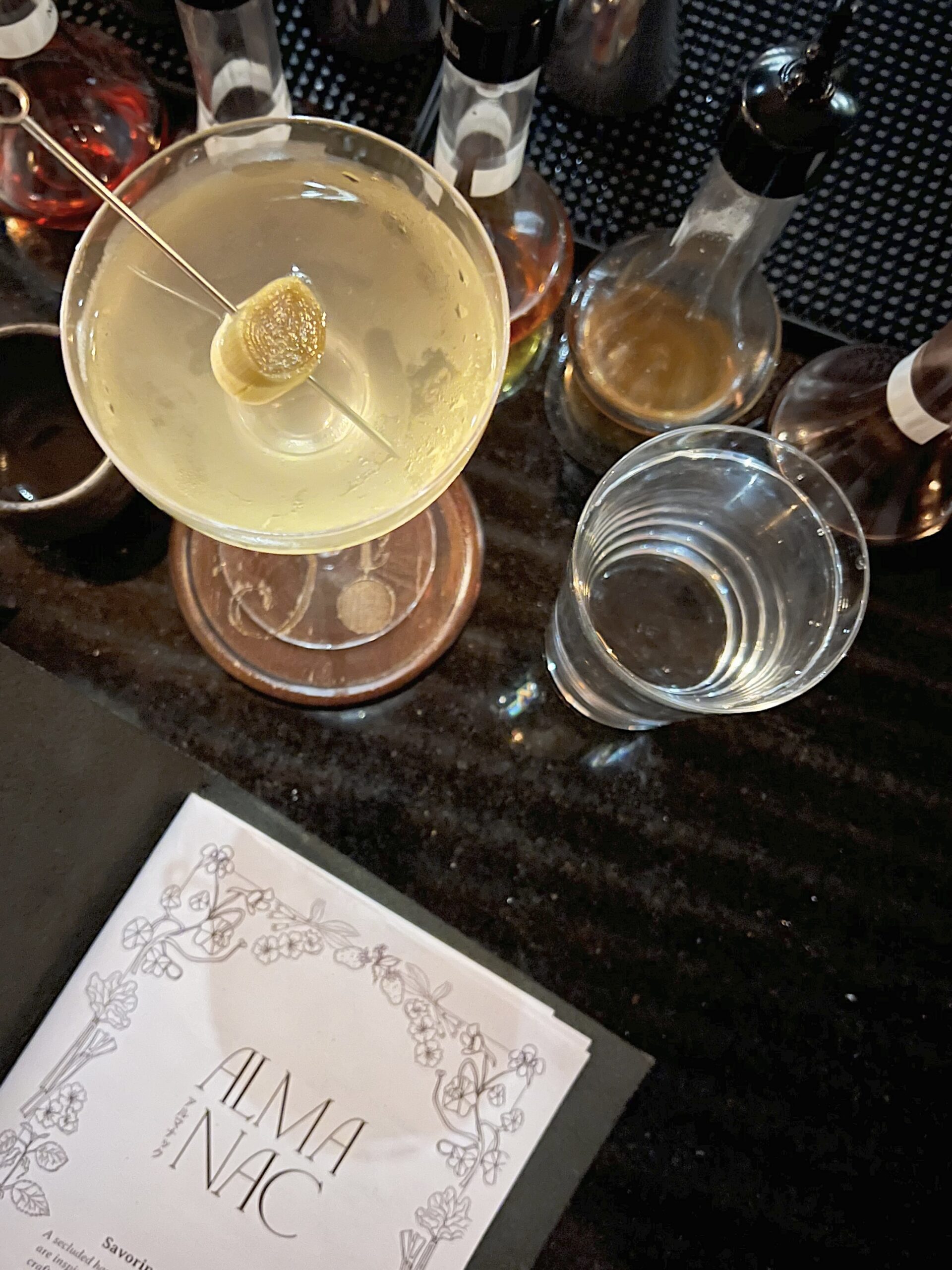
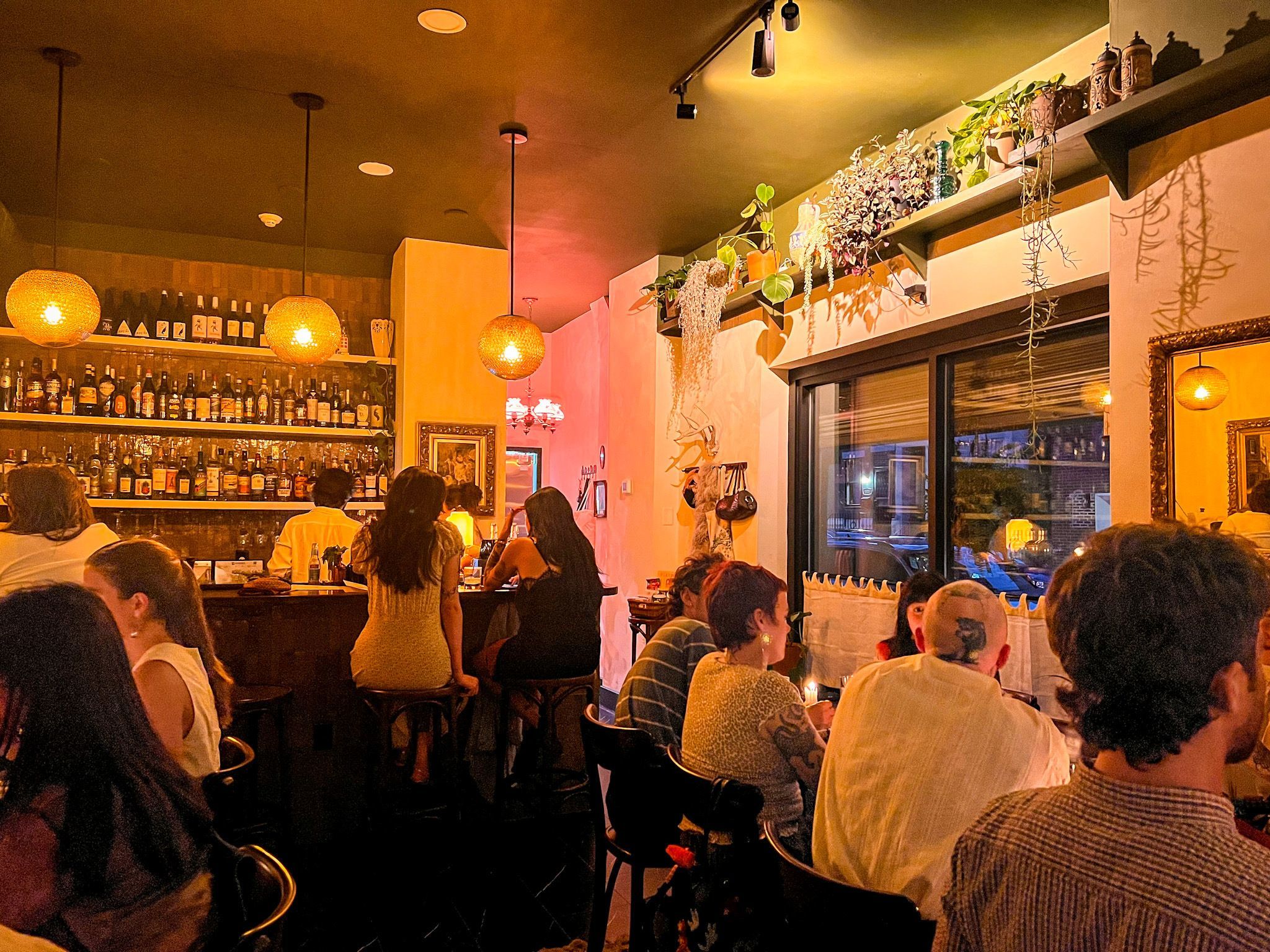
Unless you’re paying close attention while flipping through the extensive menu at Almanac, Old City’s Japanese American cocktail bar, you might overlook some of the painstaking work that went into it. The leather-bound book’s deep green color is meant to evoke the interior of the bar. The borders of the pages hint at the seasonal ingredients that go into each cocktail, and the thin newsprint pages depicting glassware illustrations of Almanac’s complex cocktails are meant to both be a guide and evoke opening an old book.
“Design is part of the holy trinity in the food service industry,” Silvestri said. “There’s the food. There’s the hospitality, and then there’s the design.”
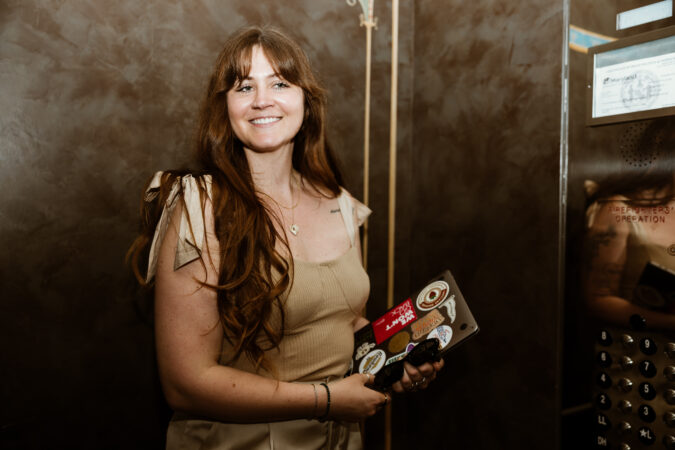
Almanac’s menu, designed by Kylie Silvestri.
Menus help set the stage for each customer’s meal, and play a big role in bringing the restaurant’s story to life.
“The second a customer sits down — before they even taste the food/beverage — they are holding a menu in hand,” she explained. “How does the menu feel, tactilely? How does it look? It all adds to the experience and helps to tell that story. So, for me, designing them is about building the puzzle pieces together in a way that connects and relays the message eloquently, from chef-owner to customer.”
Silvestri didn’t begin her career with a roster of small hospitality clients. She previously worked for startup groups and larger hospitality companies. In 2021, she started freelancing to build her own company, called Kylie Creative, where she developed branding for predominantly women-owned entrepreneurial businesses in the wellness industry.
As her clientele grew, she would pick up serving shifts at restaurants in the city, including Osteria, and build connections with industry folks. Soon, a friend at the restaurant introduced Silvestri to Amanda Rucker (River Twice, Little Water), who commissioned her to design flyers for a 2022 fundraising event to support abortion access. The following year, Rucker reached out to Silvestri for branding and menu development for Little Water.
“I naturally pivoted my design work to focus on the hospitality industry — because once you start, you never leave,” she said.
While designing menus is just a part of her restaurant branding business, the process can take up to a month for each restaurant. There are five key steps to ensure a final product that owners are happy with.
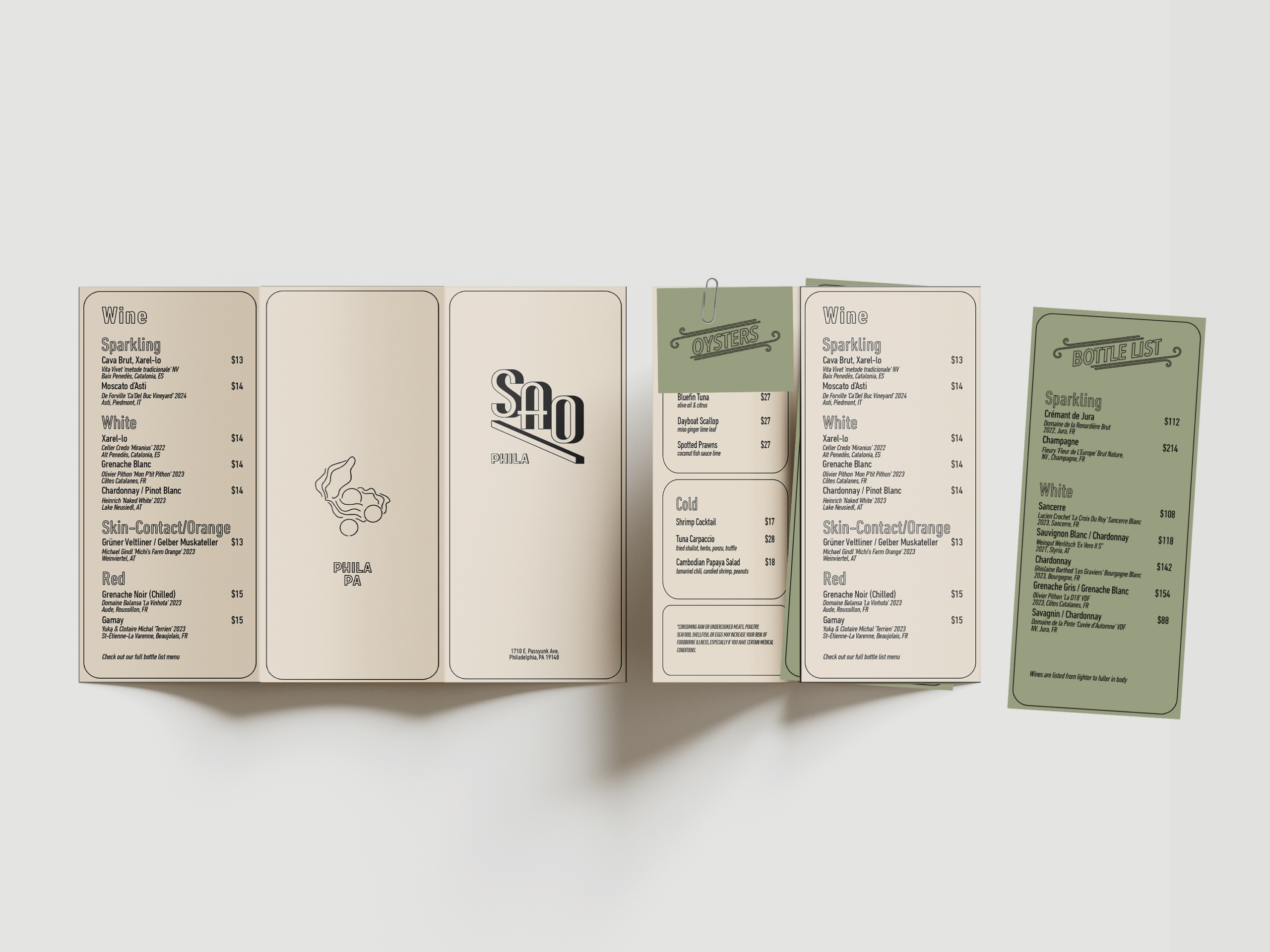
Sao menu, by Kylie Silvestri.
First, Silvestri takes time to understand the owners/chefs’ vision for the menu. Then, she determines a menu system and layout with brand fonts and drawings. Walk-throughs of the restaurant/bar (in person or via renderings if it’s not built yet) help her connect the menu design to the physical space. Once the vision is mapped out, Silvestri likes to settle down at a local coffee shop to create the menus on Adobe Illustrator and InDesign. The final step is sharing paper stock samples with owners/chefs for feedback on design and tactility.
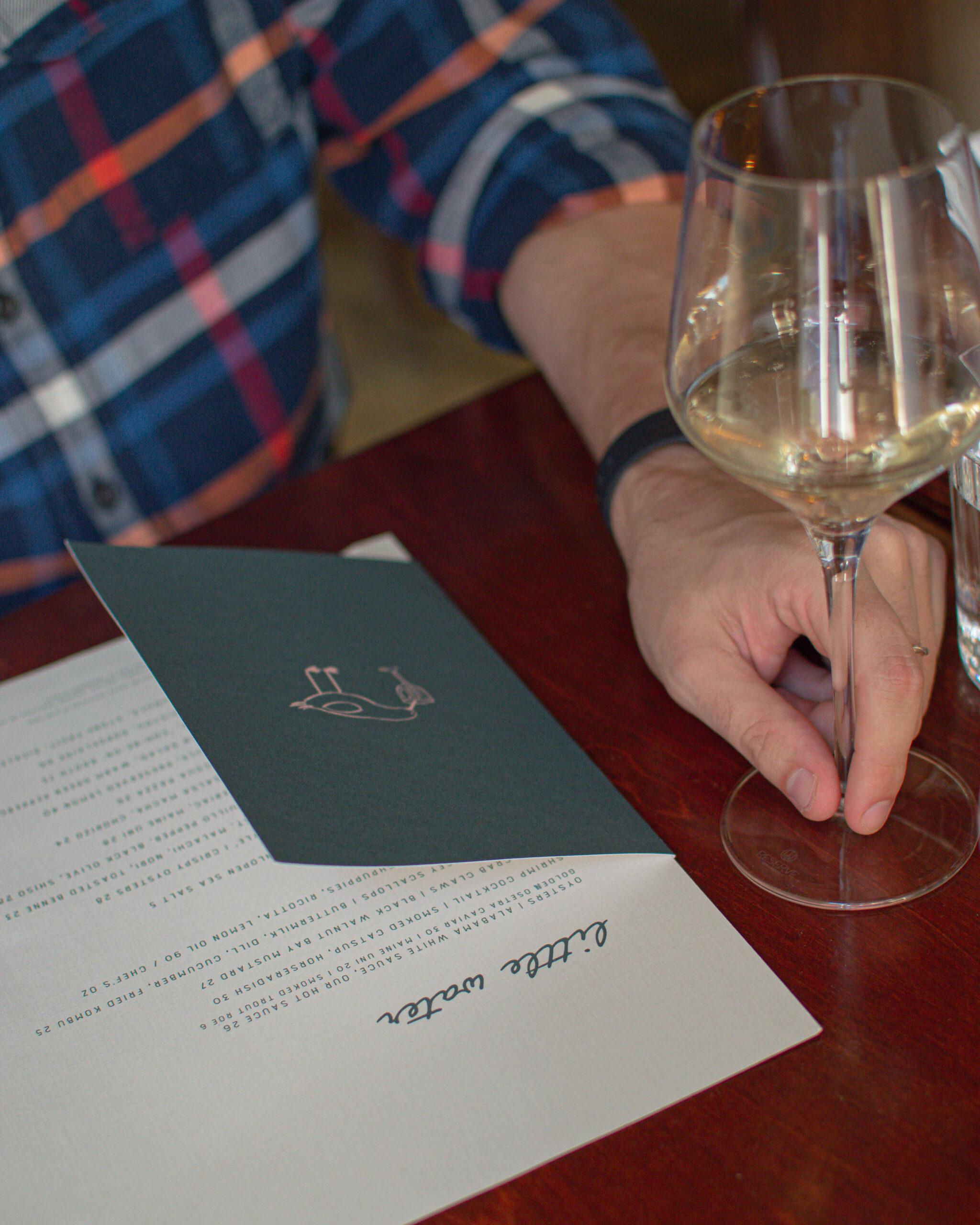
At Little Water, the linen-textured menu was the answer to conversations surrounding technique and locale, reinforcing the feeling of the coast with dishes offering the breadth of the Gulf to Cape Cod. An illustration of a little sandpiper sipping out of a cocktail on the drinks menu showcases the personality of restaurant owners Randy and Amanda Rucker. “We tied the design to that nautical experience and having this playfulness — Randy always says that ‘We don’t take ourselves seriously; we take our food seriously,’“ Silvestri said.
At Sao, the menu was inspired by Rachel Lorn’s family’s business down the Shore, featuring a takeout menu style that sections off the dishes in categories. There are outlines of vintage signage by Philly-based artist Darin Rowland.
Little Water menu, by Kylie Silvestri.
For Habibi Supper Club and Field Day, the menus — like the restaurants — are still in development. On a recent Wednesday, Silvestri visited Field Day to chat with co-owner Katie Childs about the new bar’s branding and later chatted on the phone with Miled Finianos of Habibi Supper Club for his new cafe’s menu design.
The menus, Silvestri explained, are “time capsules of culture, time, and space,” so every choice, from paper stock to illustration style, is made to capture that particular restaurant’s moment.
Philly’s aim lately is on chef-owned restaurants, “or rather a focus on who is behind what,” she said, which means storytelling is more important than ever.
“Philly’s food scene is incredibly versatile. … Each story is unique to the chef/beverage professional at the heart of the concept, making it an incredible city to work in,” she said. “I will never get tired of exploring new design styles and never feel pigeonholed to follow a specific one.”
Philadelphia historian, author, and educator Michelle Craig McDonald knows her coffee. Especially the revolutionary kind.
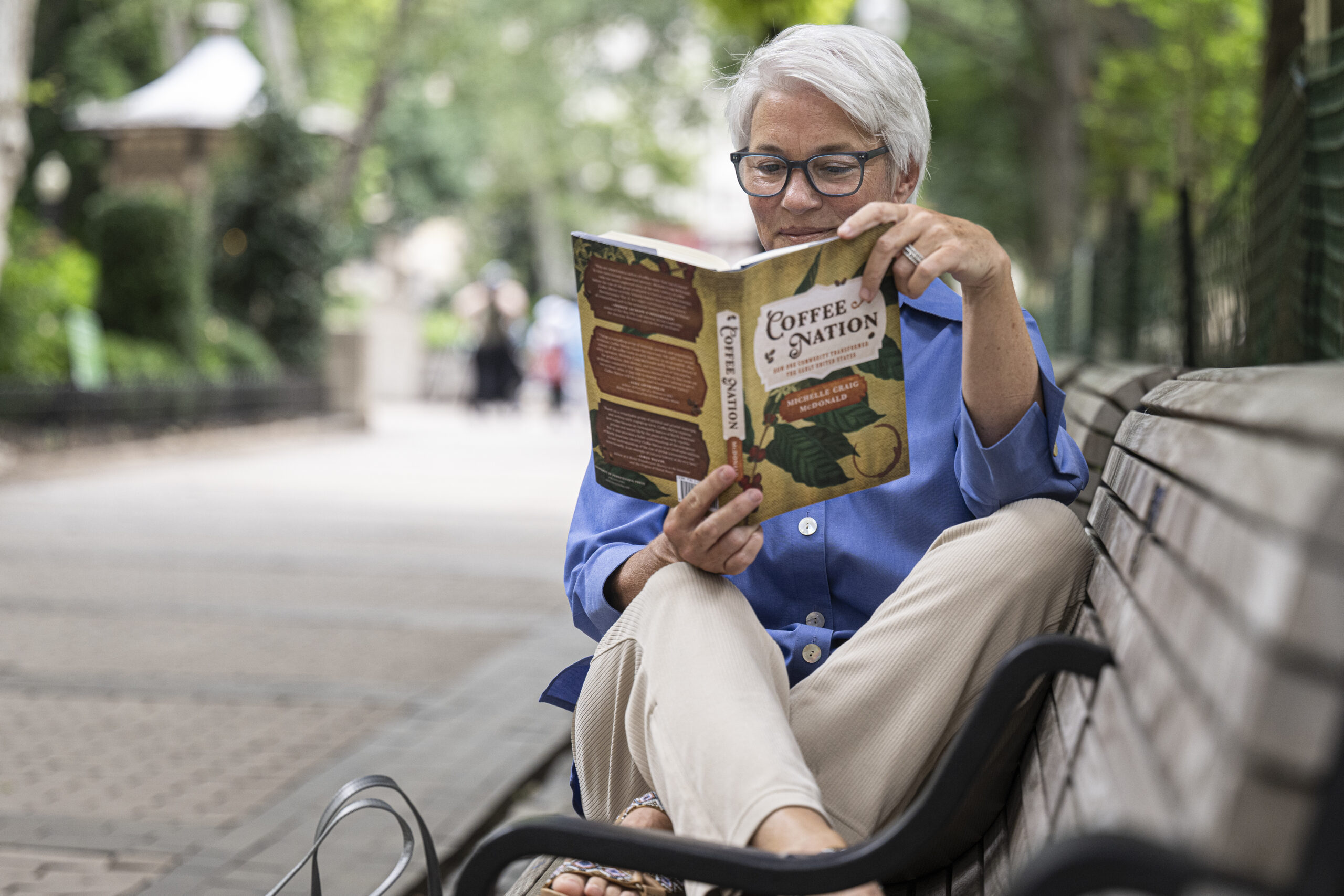
McDonald, who serves as an academic adviser for PBS’s series Drive By History, is the author of the new book, Coffee Nation: How One Commodity Transformed the Early United States.
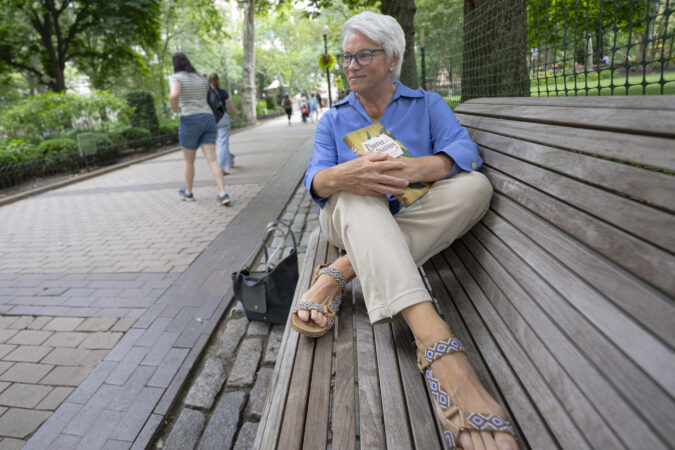
Philly historian and educator Michelle Craig McDonald enjoys reading in Rittenhouse Square Park. She is the author of “Coffee Nation: How One Commodity Transformed the Early United States.”
Telling the story of America and coffee, McDonald traces the bean’s beginnings from slavery-based plantations of the Caribbean and South America in the early 1700s through its prominence in Colonial life to the rebranding of the exotic good as an American staple. McDonald details the emergence of coffee shops, like the Old London Coffee House at Front and Market Streets, as critical Revolutionary-era hubs for politics and business.
“Within 50 years of our independence, the United States becomes one of the largest suppliers of coffee to the world — but we can never grow it,” said McDonald. So in this moment, when we think about independence, coffee really reminds us that the United States remains deeply tied and deeply embedded with the economies of the region. It was not just a self-sustaining nation that looked inward.”
Given the nature of her research, it’s no surprise that McDonald’s Perfect Philly Day revolves around food and drink. McDonald, a Southern California native who lives in Rittenhouse Square with her husband and fellow historian, Roderick A. McDonald, said her perfect day includes lots of coffee and cooking, a great Philly workout, and reading crime novels in Rittenhouse Square.
6:30 a.m.
My coffee pot is my first spot. I’m going to need fortification if I’m going to tackle the day’s news. I just go with the tried and true Colombian roast from Trader Joe’s.
When we are down the Shore, my favorite comes from Remedee Coffee, started by two sisters who source their beans from Colombia. It’s a great small business.
On a perfect day, this is when we do our New York Times games — like Connections or Wordle — which we do together. My sister says it’s cheating. I like to say it’s “collaborating.”
8:30 a.m.
I love cooking of all kinds, but baking is my first love. My go-to on a perfect day is a batch of scones. I have a recipe that I got online from a website called Love and Lemons. It’s a base recipe. You can make anything you want. Cranberry, orange walnut, apricot, ginger almond, or my brother-in-law’s favorite, which I know because he buys the ingredients every time I visit, blueberry lemon.
I used to head over to Metropolitan Bakery on 19th Street, which I am still mourning the loss of.
I loved their Millet Muffins and raisin walnut bread. My freezer is stuffed with both because I bought as many as I could before they closed. And I’m slowly rationing them so I don’t lose them quickly.
9:30 a.m.
We have a solid division of labor in the household. I do the cooking. But my husband does the shopping. While the scones are in the oven, he may well be on his way down to the Italian Market on his vintage 1962 Schwinn bicycle — expertly serviced by Curtis at Via Bicycle on Broad Street. He’s a fan favorite!
My husband is the provisioner of the house. I get to take what he brings back from the list — and sometimes not from the list. It feels like my own personal version of Chopped. He comes home with five ingredients and says, “What can you do with this?’”
10 a.m.
I’m hitting the gym. I do love eating, which means I need to pay the piper. I go to Pure Barrein Center City. It’s wonderful. It’s a class — a core-based workout that does weightlifting, planks, pushups. An hour there, any day I can get it, gives me enough brownie points for the rest of the day’s culinary adventures.
If the weather is nice, we might substitute a bike ride down the Schuylkill River Trail. Manayunk is a great destination.
Noon
That’s when Small World Seafood is in the area with deliveries. It’s an Old City business that was born out of necessity. The owner provided fresh seafood to restaurants during the COVID-19 pandemic. Then he began an online business selling directly to customers. You can get anything — halibut, skate steaks, steelhead trout, oysters, clams — for a lazy cooking night.
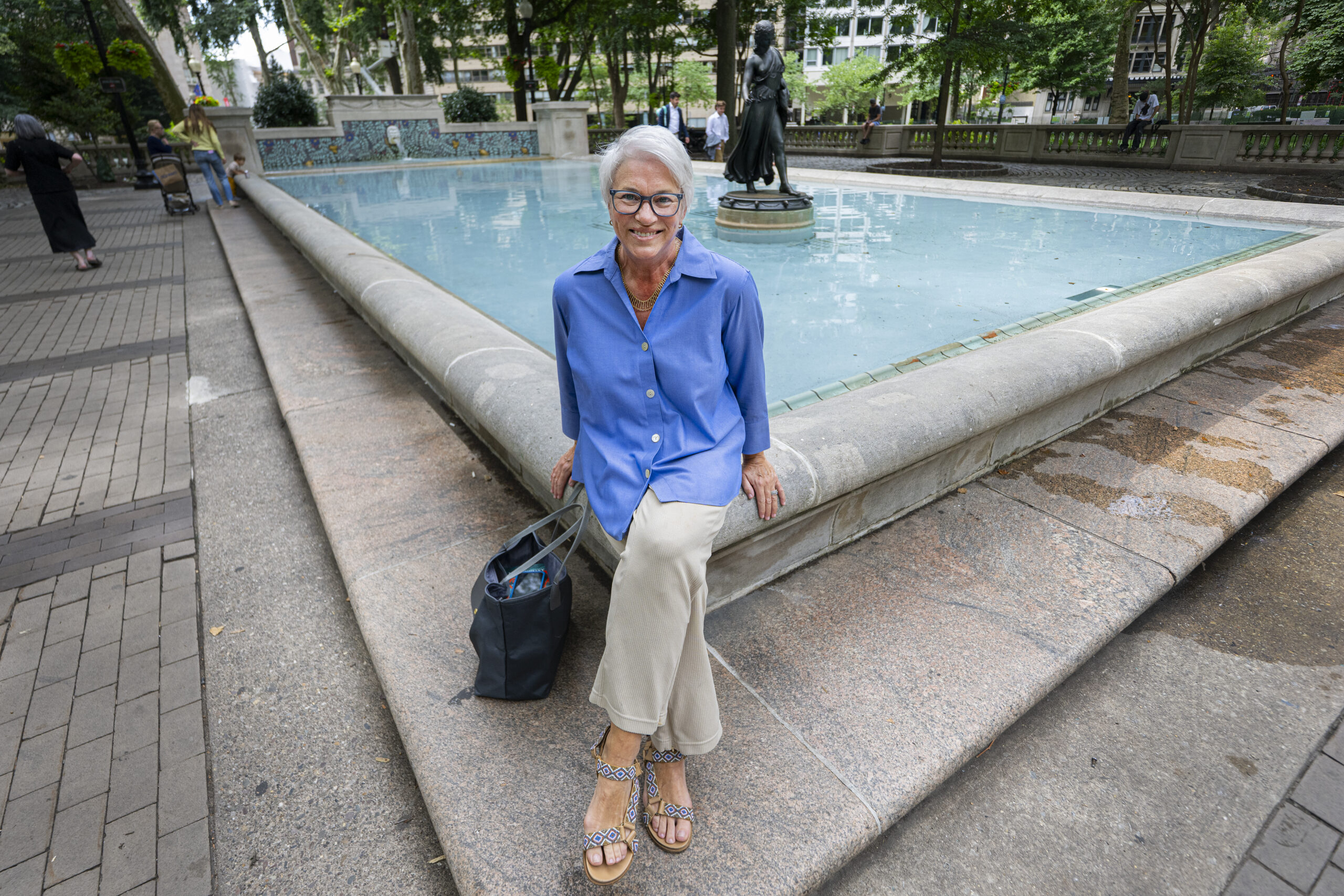
Michelle Craig McDonald’s perfect Philly day includes lots of coffee and cooking, a great Philly workout, and reading crime fiction in Rittenhouse Square.
1 p.m.
I’ve got the fish and I’m marinating it for dinner. Steelhead trout is one of my favorites, so super easy, a little bit of soy, a little bit of orange, a little bit of brown sugar, a little bit of maple, and garlic.
2 p.m.
On a perfect day, when I can while my time away, you will find me reading in Rittenhouse Square. I have an abiding passion for crime fiction. Ann Cleeves. Donna Leon.
And if it’s not great weather, you could still find me reading, but probably in one of any of a dozen coffee shops that are within walking distance of my house.
There was a great article that just ran recently in The Inquirer about the rise of Yemeni coffee shops in the city, such as Moka & Co.
3 p.m.
This is where it’s going to get busy. I would be remiss if I didn’t bring a little history and culture into this day. The American Philosophical Society has a wonderful project called “The Revolutionary City: A Portal to the Nation’s Founding.” It’s a partnership where five Philadelphia historical institutions — the APS, the Library Company of Philadelphia, the Historical Society of Pennsylvania, the Kislak Center at Penn Libraries, and the Museum of the American Revolution — came together to plan for 2026, and all their exhibits build on each other. Now I know that’s a long afternoon. Readers can pick and choose and see the others on their second favorite perfect Philly day [laughter].
6 p.m.
My husband and I cook together. If it’s Saturday, the compulsory listen is “The Many Moods of Ben Vaughn.” Cooking is my way to unwind and my husband is an excellent sous chef.
8 p.m.
We tend to have a leisurely meal with a glass of wine or two, and review the day’s exploits. An episode of television in the evening is a good escape. We are huge PBS fans. We love British crime dramas. We are huge fans of Shetland, a Scottish crime drama, and Vera, an old British crime drama with a curmudgeonly police detective.
10 p.m.
I am not a night owl. But I will confess to a wee dram of bourbon most evenings. Then, a little more light reading. And it’s time for lights out.
This interview has been edited for length and clarity.
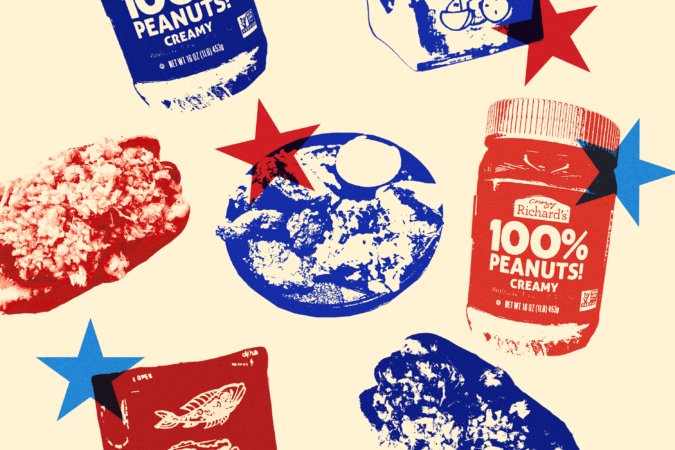
We knew that a list of 76 iconic Philadelphia foods would leave something out. It did. After hearing from readers — and revisiting a few of our own debates — we had to mention six items that deserve a place in the city’s culinary canon. They don’t replace the original 76; they just expand the conversation.
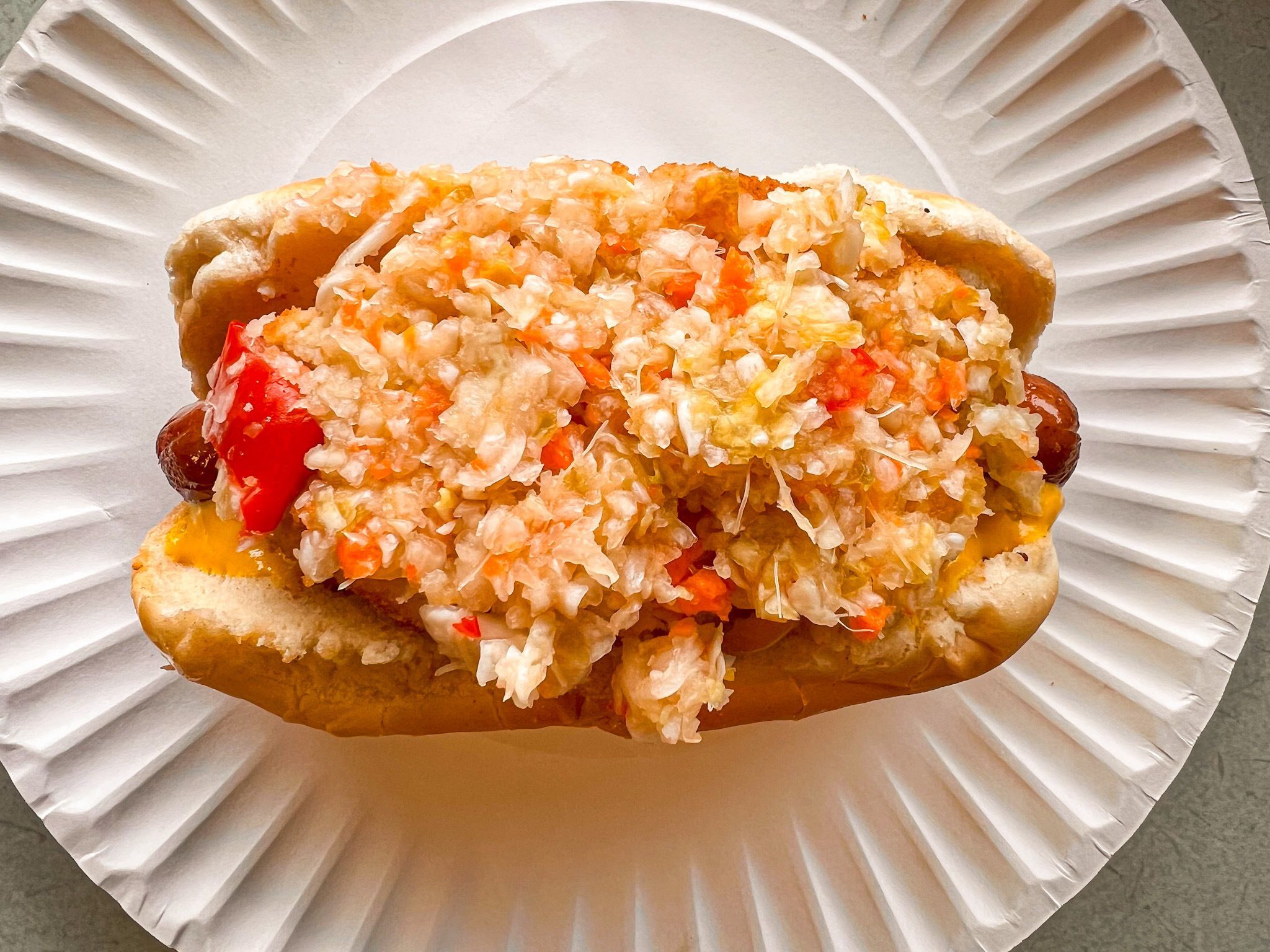
The ‘combo’: Hot dog and fishcake on a roll
The hot dog-fish cake combo topped with pepper hash at Lenny’s Hot Dogs in Feasterville.
Long before Philadelphia claimed the cheesesteak as its signature sandwich, another pairing drew a following: the hot dog and fishcake combo. Culinary historians generally agree that Abe Levis (rhymes with “crevice”) created it in 1895 by pressing a fried fish cake atop a grilled frank on the same bun at his luncheonette on Sixth Street near Lombard.
Instant surf-and-turf!
Levis also created Champ Cherry, the bright-red, cider-like soda that became the combo’s traditional companion. The Old Original Levis shop changed hands several times, spawned a few short-lived offshoots, and finally closed in 1992 under owner Elliott Hirsh, who later revived Levis as a store in Abington from 2012 to 2017 while marketing Champ Cherry in cans.
But tastes have changed and the brands are moribund, as Hirsh, now 80, acknowledged: “I’ve been actively trying to find someone that wants to take it over. And not even sell it. Just take it over. I’d hate to die and take it with me, but that’s what we’re going to do.”
The hot dog-fishcake combo, at least, survives. Just after World War II, Levis rival Lenny’s Hot Dogs also sold them from a stand nearby at Fifth and Passyunk.
Lenny’s secret sauce was the pepper hash — a sweet-and-sour relish of cabbage and bell peppers that cuts through the richness of the dish— created by owner Lenny Kravitz’s mother, Ida.
Kravitz expanded Lenny’s to several locations from Mount Airy to Margate, N.J. In the 1980s, he sold his final shop, at 6620 Castor Ave. in the Northeast, to Wayne Knapp. Kravitz died in 1998.
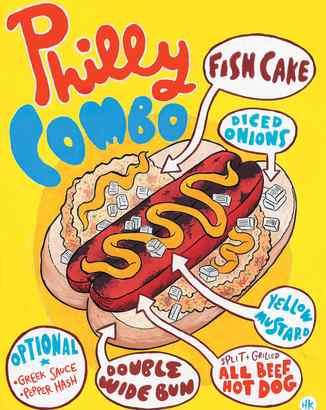
Hawk Krall’s illustration of the “surf ’n turf” Philly combo (fishcake and frank) was originally done for SeriousEats.com.
Knapp later relocated Lenny’s to Feasterville. That shop as well as Johnny Hot’s, John Danze Jr.’s truck stop on Delaware Avenue in Fishtown, are among the few standard-bearers of this classic. Be sure to add a squirt of yellow mustard and a smattering of diced onions, as illustrator Hawk Krall suggested in his 2009 poster print of the sandwich.
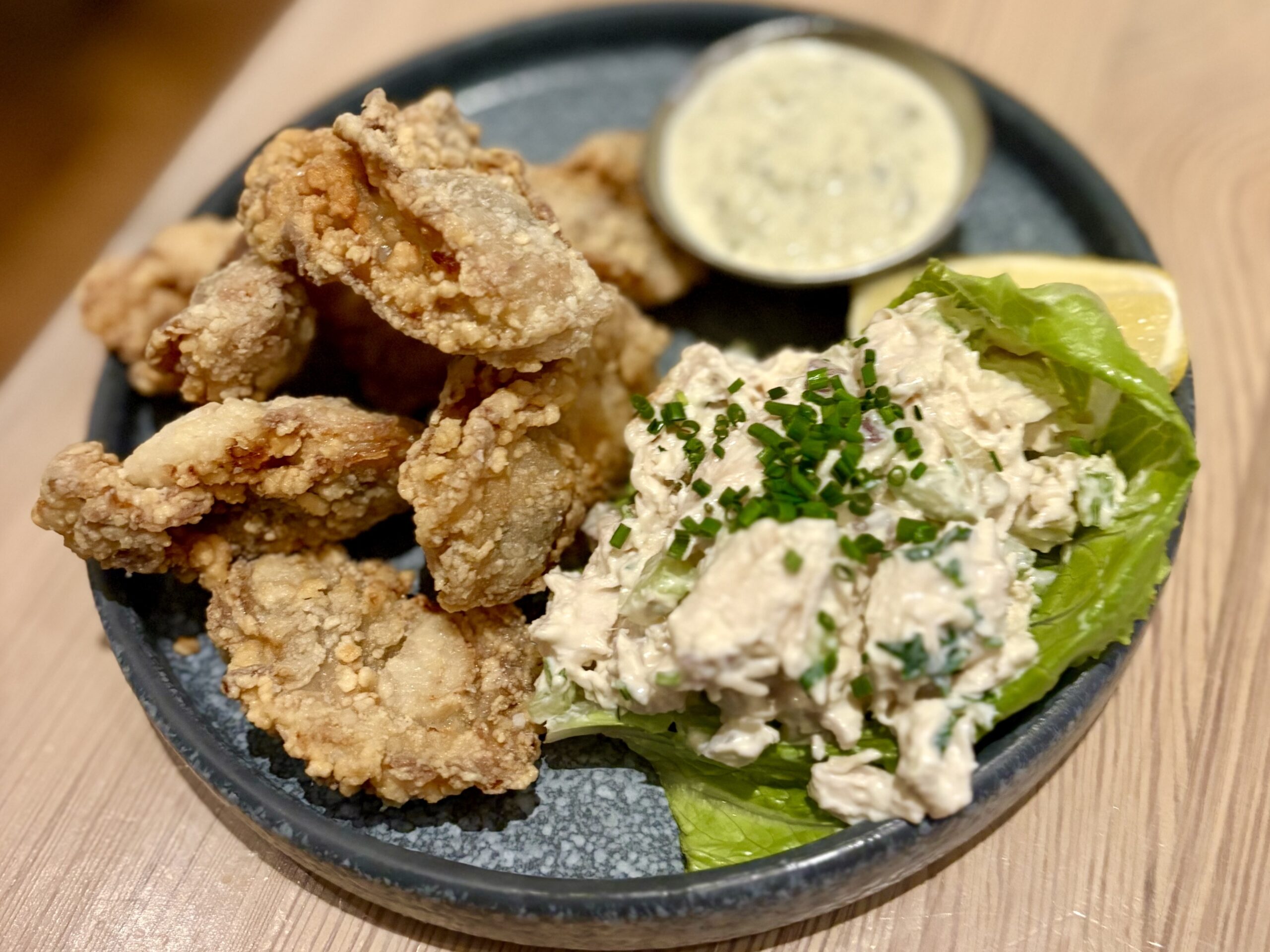
Chicken salad and oysters
Fried oysters with chicken salad from Oyster House.
As for another curious combo, only in Philadelphia would someone look at cool, creamy chicken salad and crunchy fried oysters and think, “Of course those belong together.”
The unlikely pairing has been a local specialty for well over a century, dating to the city’s grand oyster houses, hotels, and taverns in the late 1800s. One popular explanation of its origin holds that tavern keepers paired cheap, plentiful oysters with more expensive chicken to stretch a serving. Food historian William Woys Weaver has noted that Philadelphia’s finest hotels elevated the dish, serving chicken salad dressed with tarragon mayonnaise and encircled by crisp fried oysters. More humble versions turned up in neighborhood brew houses and lunch counters across the city.
Similar dishes appeared in New York, Baltimore, and Boston, and some historians believe that Philadelphia’s influential Black catering families helped popularize the combination. What is certain is that chicken salad and oysters were served at an organizing meeting of Philadelphia’s Union League in 1862.
The combo’s popularity has ebbed in recent years, and its primary home is now Oyster House near Rittenhouse Square, whose family ownership dates back nearly 80 years.
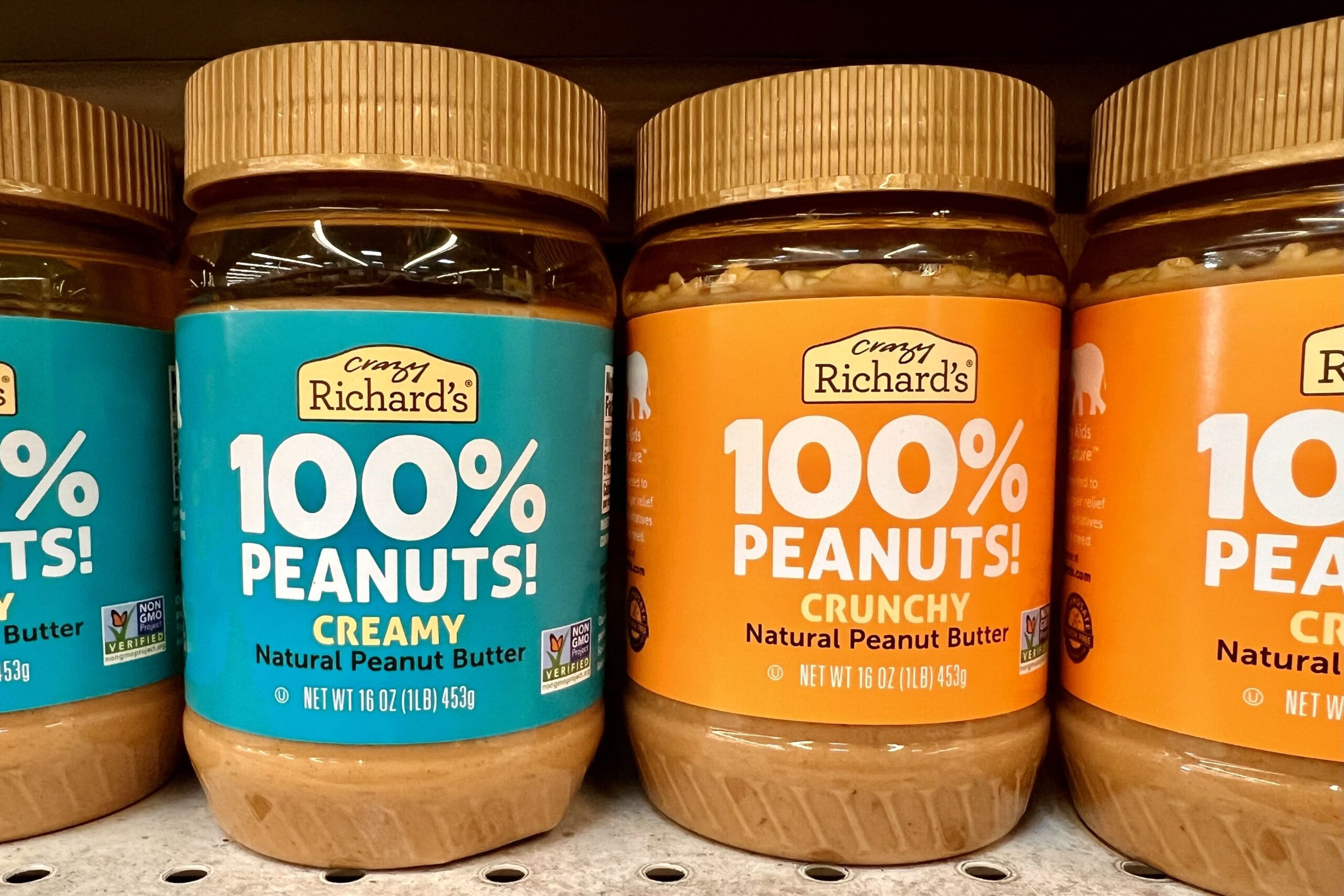
Crazy Richard’s Peanut Butter
Crazy Richard’s Peanut Butter, founded in 1972, is still available on grocery shelves.
Life was all Skippy and Jif in the early 1970s when a Philadelphia music teacher decided to grind peanuts in his kitchen because he couldn’t find peanut butter that tasted the way he remembered.
Richard Marcus was a conductor, pianist, radio host, and founder of the Society Hill School of Music & Art. Frustrated by the sweetened, homogenized spreads that dominated grocery shelves, he bought five pounds of peanuts at Reading Terminal Market, roasted them, and blitzed them in his blender. The result was nothing more than peanuts — no sugar, salt, or oils.
Friends loved it. By 1972, they convinced him to package it. Marcus produced an initial run of about 144 jars, selling them through Philadelphia delis and health-food stores. He called it Crazy Richard’s, his wink to skeptics who thought he was nuts for marketing a peanut butter that separated naturally and required stirring.
Word of mouth did the rest. Marcus eventually gave up his music school to run the business full time, first contracting production in Conshohocken before opening plants in Pennsauken and later Bellmawr. At its peak under his ownership, Crazy Richard’s sold about 750,000 jars a year throughout the Mid-Atlantic and Northeast and by mail. Marcus insisted that there was no secret recipe: “It’s just ground peanuts.”
In 1991, Ohio’s Krema Nut Co. bought Crazy Richard’s and kept Marcus’ one-ingredient recipe intact. Today, 12 years after his death, the brand is sold nationwide. The “Crazy Richard” on the label is still the Philadelphia musician who proved that sometimes the simplest ideas stick.
Fishtown Iced Tea
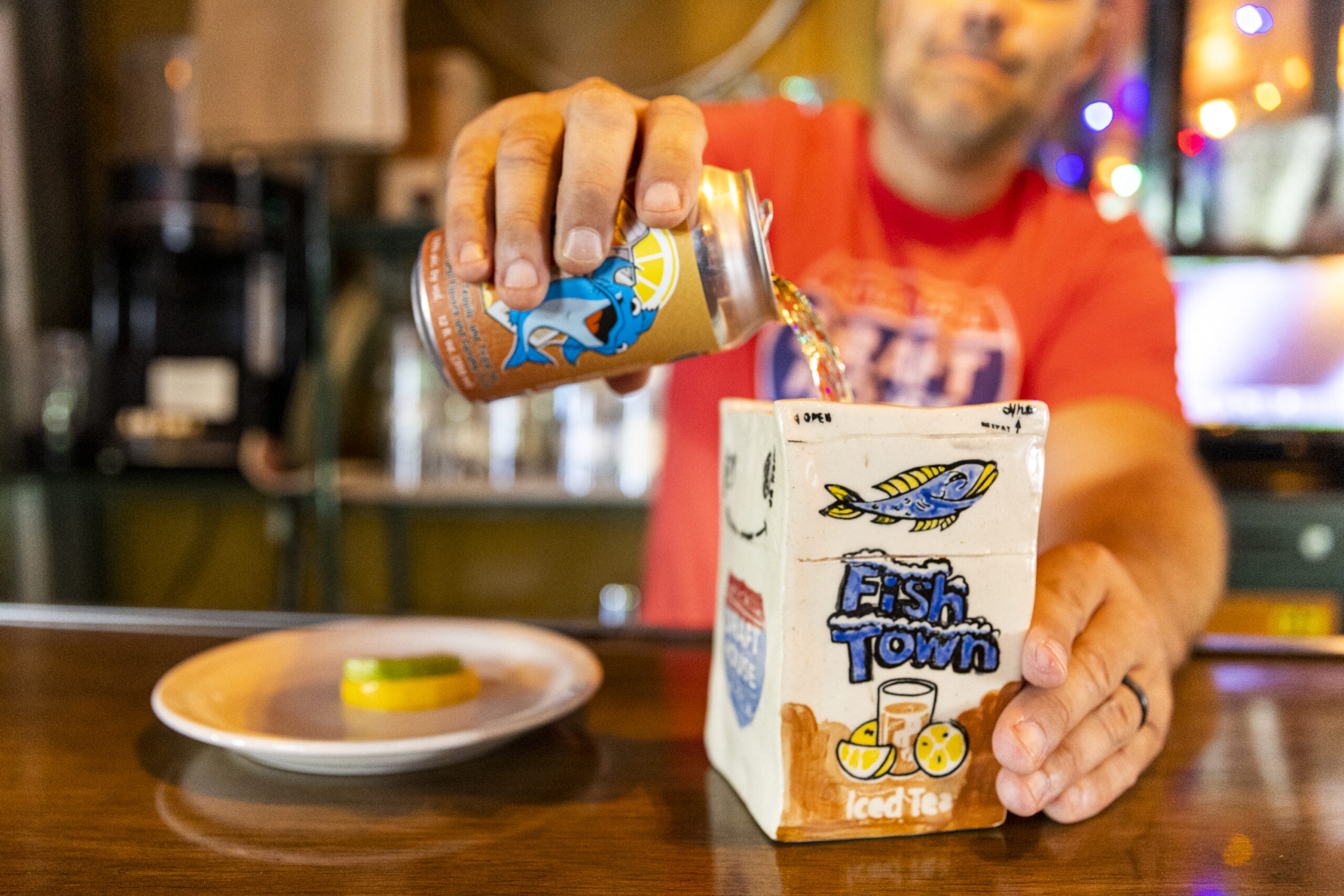
Canned Fishtown Iced Tea is poured by Interstate Drafthouse co-owner Mike McCloskey into a custom-made ceramic carton.
Long Island has its iced tea. Why shouldn’t Fishtown? Created in 2013 at Interstate Drafthouse on Palmer Street, Fishtown Iced Tea spikes a 16-ounce carton of Arctic Splash iced tea with a shot of Jim Beam bourbon, turning a childhood lunchbox staple into an adult version of the sugary, dangerously smooth cocktail. Its roots are distinctly regional. Besides milk, Lehigh Valley Dairy, Wawa, Swiss Farms, and Turkey Hill also sold iced tea in pint cartons that generations of Philadelphians grew up drinking.
During the pandemic, when Pennsylvania temporarily allowed to-go cocktails, Interstate sold enough Fishtown Iced Tea to keep the bar afloat. In 2022, the popularity inspired a canned version from Rectified Spirits, made with vodka, rum, tequila, and triple sec instead of bourbon.
In a twist, the ready-to-drink cocktail debuted just as Lehigh Valley discontinued Arctic Splash cartons, ending an era for the drink that inspired it.
Edamame dumplings from Buddakan
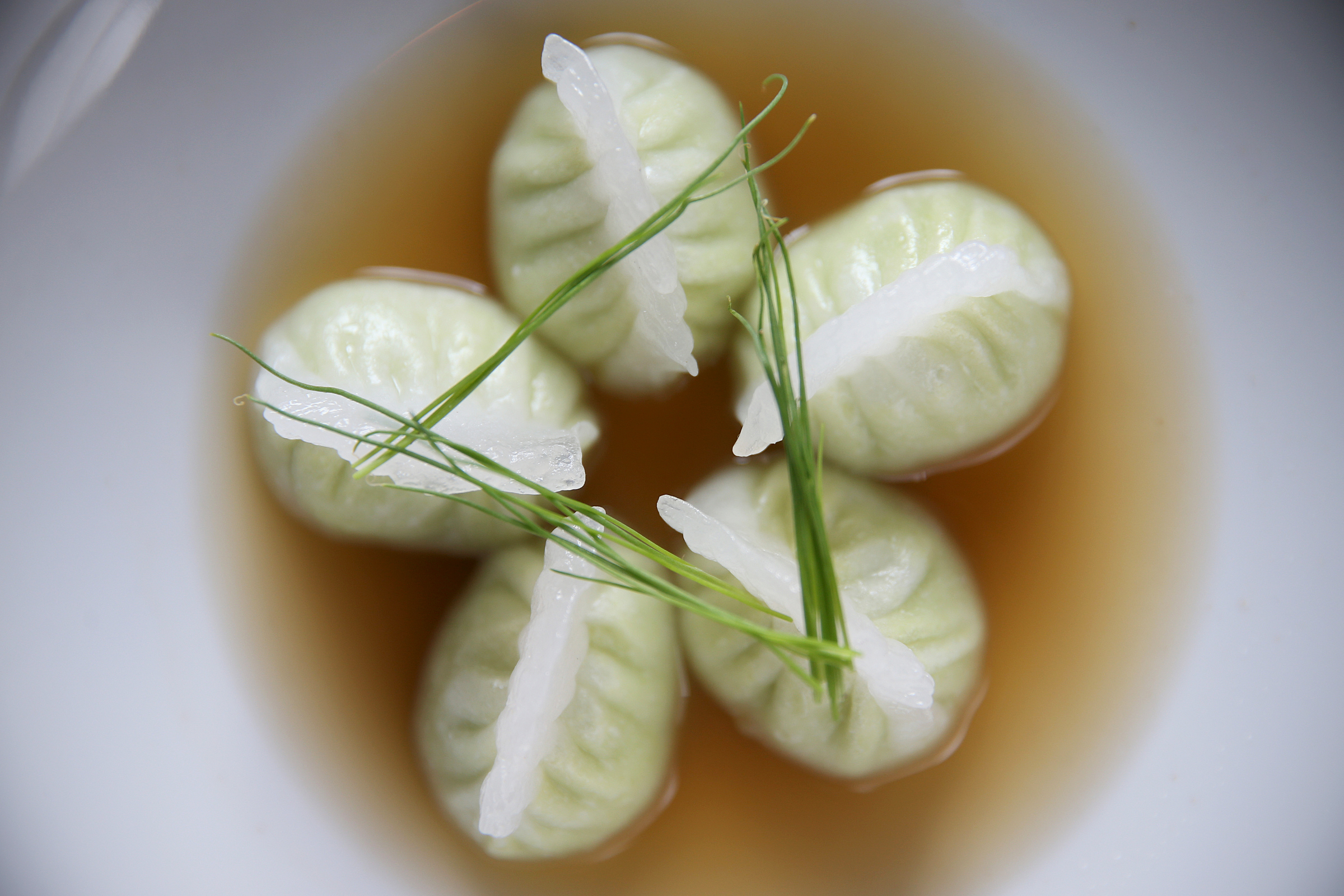
The edamame dumplings at Buddakan.
One of Buddakan’s signature dishes is the edamame dumpling, filled with mashed soybeans and served in a truffled Sauternes-shallot broth. Michael Schulson, then chef de cuisine at Stephen Starr’s Old City destination, came up with the idea in 2000 while developing the menu for Starr’s next project, Pod, whose opening in University City was six months away. “Every dish I made, Stephen would say, ‘We’re putting this on the menu at Buddakan,’” Schulson said. “I’d say, ‘What about Pod?’”
The original version was an edamame ravioli, featuring a yellow pasta wrapper in a caramelized Sauternes-shallot broth, transforming what was then an unfamiliar ingredient to many American diners — young Japanese soybeans — into one of Buddakan’s signature dishes. (It made it onto Pod’s menu, too.) When Buddakan New York opened in 2006 with Schulson leading the kitchen, the ravioli evolved into the translucent har gow-style dumpling that has since become its best-known form, before it later arrived on the menu in Philadelphia. It’s still a bestseller.
After leaving Starr, Schulson adapted the concept at his restaurant Sampan, serving edamame dumplings in a caramelized shallot and sake broth, and later at Double Knot with truffles.
Cheesesteak egg rolls
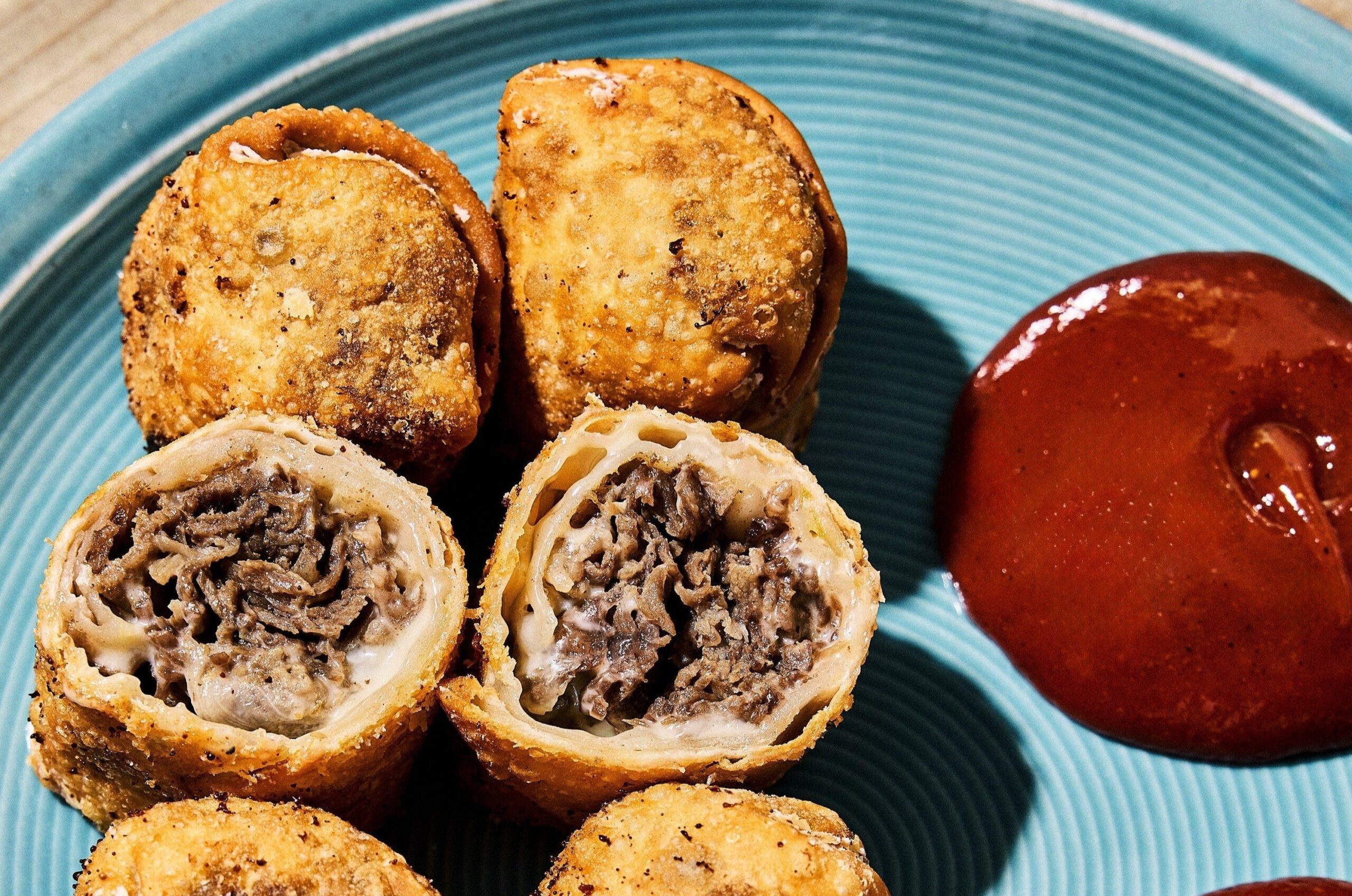
The cheesesteak egg roll from Continental Mid-town.
Stuff steak and cheese into an egg-roll wrapper, deep-fry it, and you’ve got one of Philadelphia’s signature mashups: the cheesesteak egg roll.
They’re everywhere now, from neighborhood pubs to white-tablecloth steakhouses, and go by “spring rolls” at some places, but their rise can be traced to two nearly simultaneous Philadelphia stories in the mid-1990s.
One unfolded at the old Four Seasons Hotel on the Parkway. Former chef David Jansen said that after preparing a banquet for the New York Rangers in 1994 or 1995, prep cook Mui Lim put leftover cheesesteak filling into spring roll wrappers and fried them as a snack for the kitchen crew. They went on the menu soon after at the hotel’s Swann Lounge. Today’s Four Seasons Philadelphia, now at the Comcast Technology Center, serves wagyu cheesesteak spring rolls with sweet-and-spicy pepper relish.
The other story played out in Old City, where the novelty became a menu staple at the Starr-owned Continental. In 1996, Starr hired Sam “Chef Sammy D” DeMarco to develop dishes for the year-old restaurant. DeMarco already served a Philly cheesesteak dumpling at First, his New York restaurant, but Starr wanted something original.
DeMarco turned the dumpling into a cheesesteak spring roll. “It was taking a classic, nostalgic American snack and presenting it in a fresh way,” said DeMarco, now executive chef at Bungalows Resort in Scottsdale, Ariz.
Like the old Buzz Aldrin cocktail, the roll became a classic. Starr said Continental Mid-town, near Rittenhouse Square, now sells 500 a week.
From the Continental, the idea spread rapidly. Davio’s owner Steve DiFillippo was joining staff for a preshift meal at his former Center City Philadelphia location shortly after it opened in 1999 when chef David Boyle served cheesesteak egg rolls that his wife had made at home. DiFillippo insisted that they be added to the bar menu, overruling managers who felt that they were too déclassé for a posh steakhouse. The Boston-based Davio’s turned the line into a frozen-food item, selling millions through supermarkets and QVC until rising beef prices during the pandemic made them impractical, DiFillippo said. They’re still on the restaurant menus in King of Prussia and elsewhere.
Though DiFillippo copyrighted the name “Philly Cheese Steak Spring Rolls” in 2002, “I’m not going to claim I invented anything,” he said. “But I was the first one to take them into stores and really commercialize them.”
This is the birthplace of democracy, and with it, comes the responsibilities that America’s founders left behind.
“The founders made clear that we have a real responsibility to do the work to constantly perfect our union,” Shapiro said in an interview this week, ahead of his speech before the ceremonial meeting of Congress, marking 250 years since the Declaration of Independence was signed in that same building. “And that the Congress of the United States has a unique responsibility in that to be a check on the executive branch.”
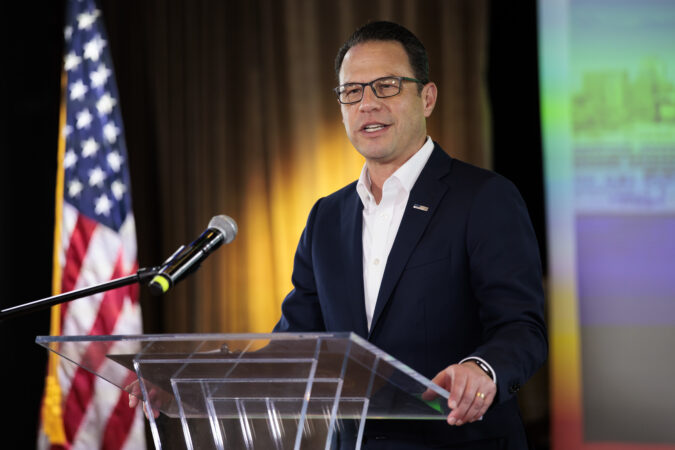
Those words come at a critical inflection point in America’s history, amid a tumultuous presidency, and as Shapiro is rumored to have aspirations of a White House bid in 2028. The first-term Democratic governor will appear before approximately 40 bipartisan members of Congress in Old City at the event convened by U.S. Rep. Brendan Boyle (D., Pa.), speaking to the lawmakers from across the country about their collective duty to the public. Shapiro will attend numerous other 250th celebrations across Philadelphia in the coming days, during which he said he plans to share his optimism for America’s future and deep concerns that President Donald Trump has led the nation astray from its founders’ design.
“I don’t think patriotism belongs to one party. I don’t think it should ever be partisan,” Shapiro said. “Unfortunately, Donald Trump routinely divides us, routinely injects partisanship into his definition of patriotism, and his actions, in many ways, are the opposite of patriotism.”
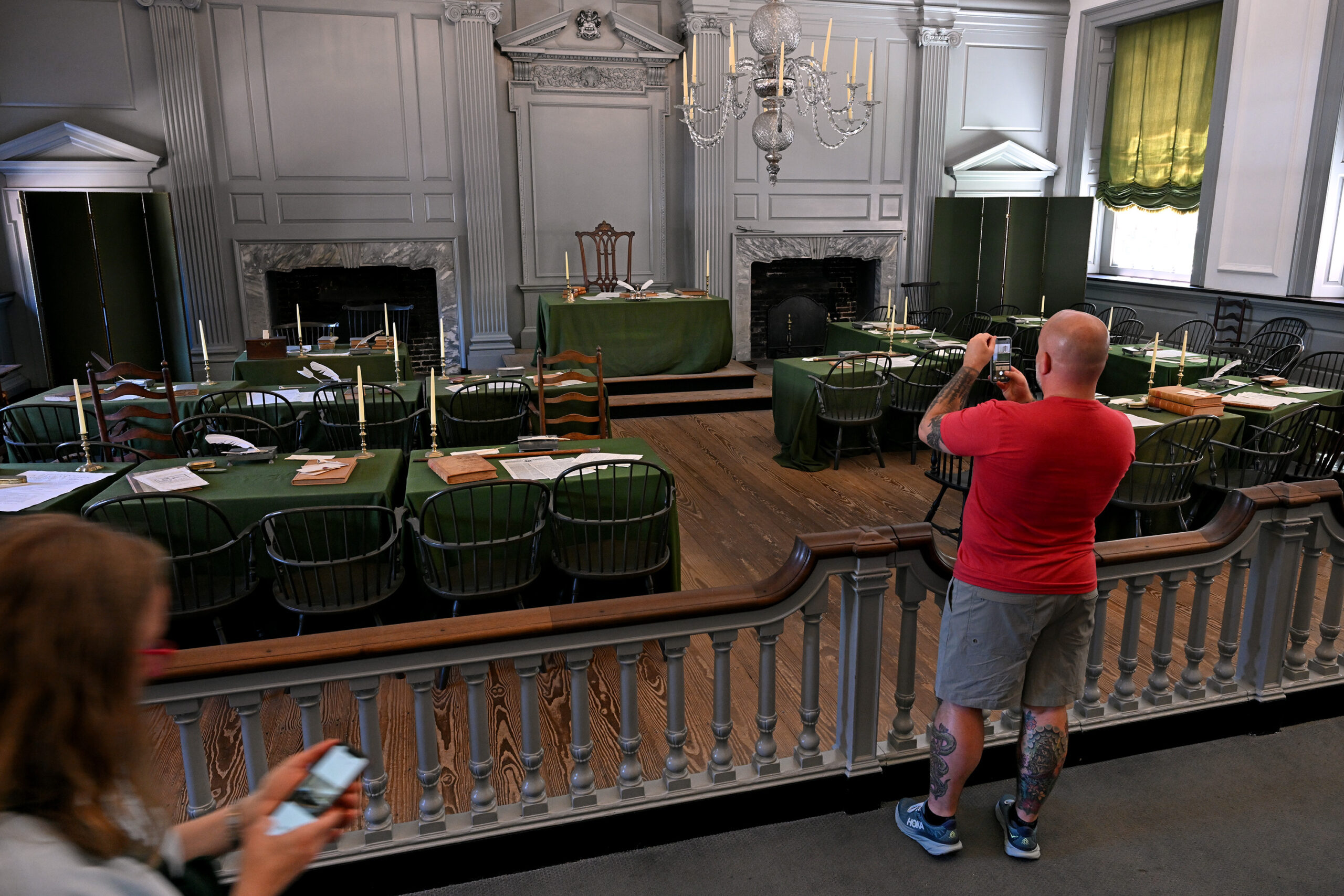
Assembly Room in Independence Hall (Pennsylvania State House) Monday, June 15, 2026. This is the exact space where the Second Continental Congress met and the Declaration of Independence was adopted.
As Trump plans to spend America’s 250th birthday hosting a politicalrally on the National Mall — with no plans to visit Philadelphia, the city where the nation was founded — Shapiro sees his own role as a unifier, and in direct contrast to Trump. As attention shifts to Philadelphia this weekend, he’ll appear on the national stage from sunup to sundown at events and on frequent TV hits — all with a home-turf advantage for his 2028 presidential prospects, as the governor of the nation’s quintessential swing state and also most important to the country’s founding.
“[Celebrating the 250th] allow the spotlight to shine on Shapiro, even though it’s not entirely about him,” said Alison Dagnes, a political-science professor at Shippensburg University. “Do I think that helps his ambitions? Sure.”
‘Direct contrast’
Sitting with Shapiro in his Harrisburg office earlier this week, it’s undeniable that he’s a history nerd — another reason why he was built for the moment.
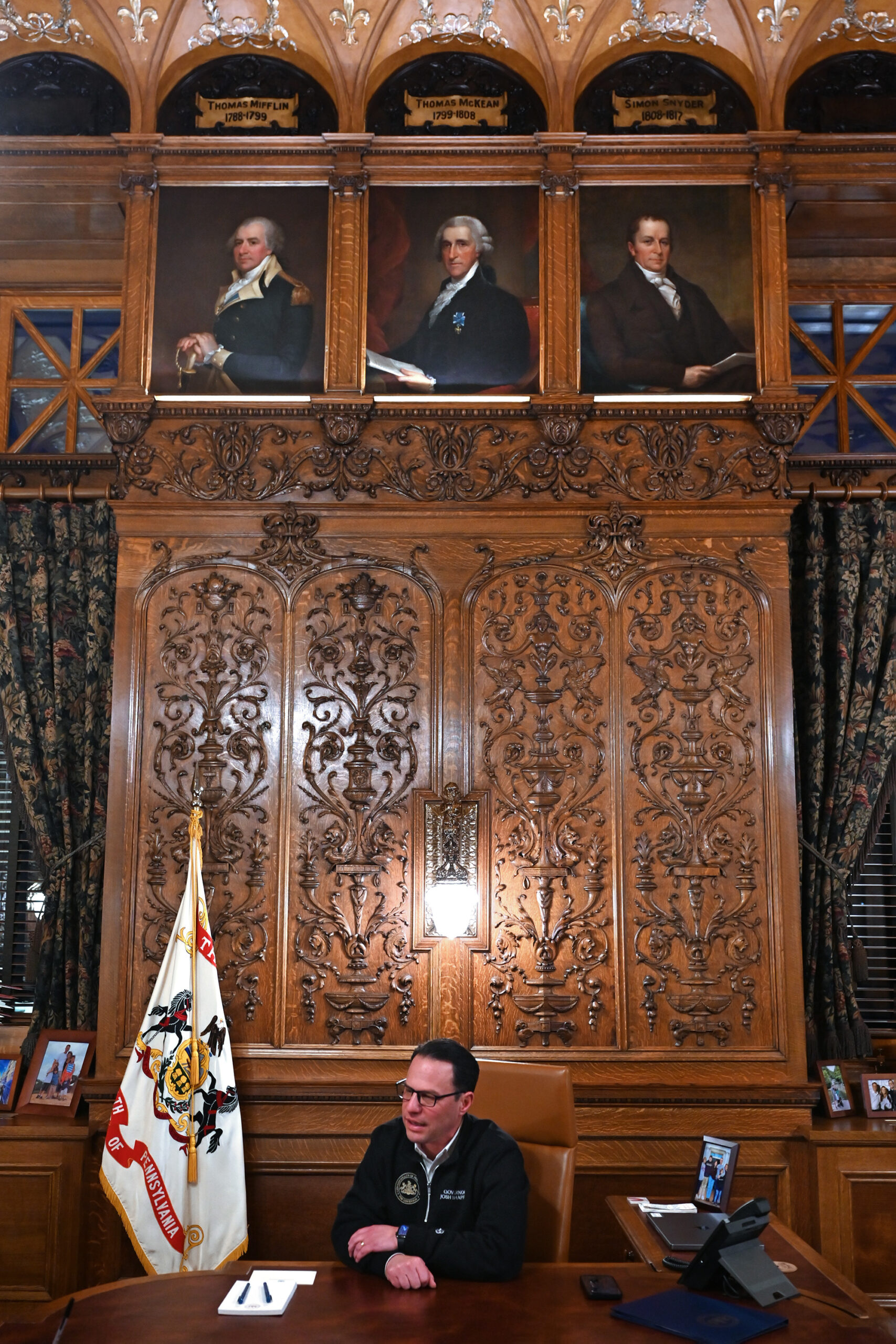
He casually quotes segments of The Federalist Papers, and references his favorite story about Benjamin Franklin‘s fixation on a half-sun on the back of George Washington’s chair during the 1787 Constitutional Convention, which Franklin remarked during the U.S. Constitution signing that “it is a rising and not setting sun.” Without having to look for its location, he points to his right to a portrait of Franklin, one of his predecessors as governor of Pennsylvania, hanging on his office wall. He notes lesser-known Pennsylvanians who played an important role inthe nation’s founding whom he plans to highlight over the coming days.
“You know, I hate to quote a guy not from Pennsylvania,” Shapiro said, returning to The Federalist Papers to recite James Madison’s concerns about giving an executive too much power.
Gov. Josh Shapiro in the Capitol in Harrisburg Feb. 21, 2023.
“If Madison were here today, he’d be really concerned about how one man has accumulated so much power and is wielding it in really dangerous ways, and I hope that at this 250-year mark we find our way back to that balance and back to the constraints on the people who lead our government,” he said.
Shapiro sees his leadership style as a “direct contrast” to Trump’s, especially at this moment.
“[Trump] restricts peoples’ freedom and liberties,” the governor added. “He whitewashes our history. That doesn’t further a sense of community, that doesn’t further patriotism. All that does is divide us, and I refuse to participate in that.”
But for the next few days, Shapiro said his approach to the 250th celebrations is to: “Celebrate America, find ways to bring people together, and to have some fun in the process.”
Fair games
Despite his overtures of political unity, Shapiro has faced accusations from Republicans in recent days for playing partisan games over Pennsylvania’s participation in Trump’s 16-day Great American State Fair. Shapiro, in addition to several other Democratic governors last week, announced that Pennsylvania would not take part in the fair due to his administration being unable to secure any state businesses to sponsor the exhibit. Staffing and sponsoring the exhibit on the state’s dime would have cost $700,000 that would be better spent on in-state 250th events, he said this week.
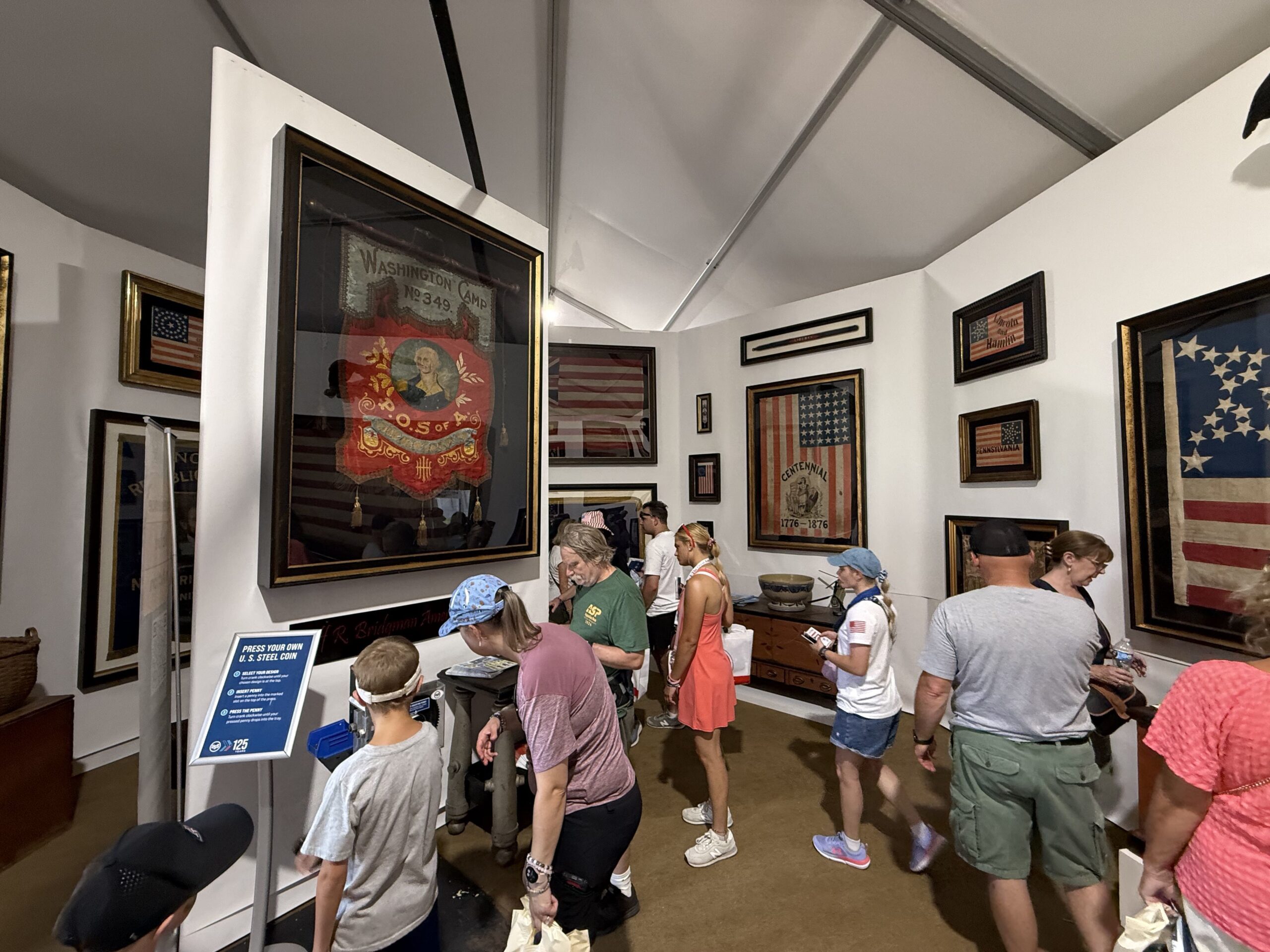
In the weekend that followed, Pennsylvania’s U.S. senators, Republican Dave McCormick and Democrat John Fetterman, made a push to fill the state’s empty exhibit. By Tuesday, it was filled with antique flags lent by a York County man, bags of potato chips from Snyder County, and a Christmas tree display from Fayette County, among other Pennsylvania-centric items.
Pennsylvania’s pavilion showcases state history and memorabilia at the Great American State Fair on June 30, 2026, in Washington, D.C.
Some of the businesses originally told Shapiro’s office they didn’t have enough time to participate. But when McCormick and Fetterman approached them with the idea to fill the empty pavilion, they joined in.
“They obviously had a change of heart at the last minute. That’s fine,” Shapiro said about the revived Pennsylvania pavilion.
State Treasurer Stacy Garrity — Shapiro’s Republican challenger for governor, who has aligned herself with Trump — in a statement called Shapiro the “only career politician who has politicized America 250.”
“Josh Shapiro put his political ambitions above his commonwealth and his nation when he pulled Pennsylvania out of the national celebration of our 250th birthday in a pitiful attempt to score cheap political points with the liberal wing of his party,” Garrity said.
Beyond the 250th
Shapiro’s strength as a politician has always been his ability to appear “harmonizing” and bringing people together, dating back to his days as a Montgomery County commissioner, Dagnes said.
A careful politician, Shapiro is known to stick to his message and has faced criticism from some fellow Democrats for his well-rehearsed statements.
When Shapiro delivers his messages of unity and freedom to a broader audience in the coming days, voters are likely toview them as authentic — one of the most important qualities to any presidential hopeful, she added.
“If [California Gov.] Gavin Newsom is the guy who’s gonna punch Trump in the face, then Shapiro is going to be the guy who’s like, ‘No, let me offer you an alternative,’” Dagnes said.
“It’s what he should be doing right now, because this is what America is about,” she added.
We all have a mental image of Benjamin Franklin, thanks to the $100 bill: balding, middle-aged, with tiny glasses and a stern look.
But what if he had a full head of hair poking out the sides of his tricorn? What if we saw Franklin singing and jamming on a guitar?
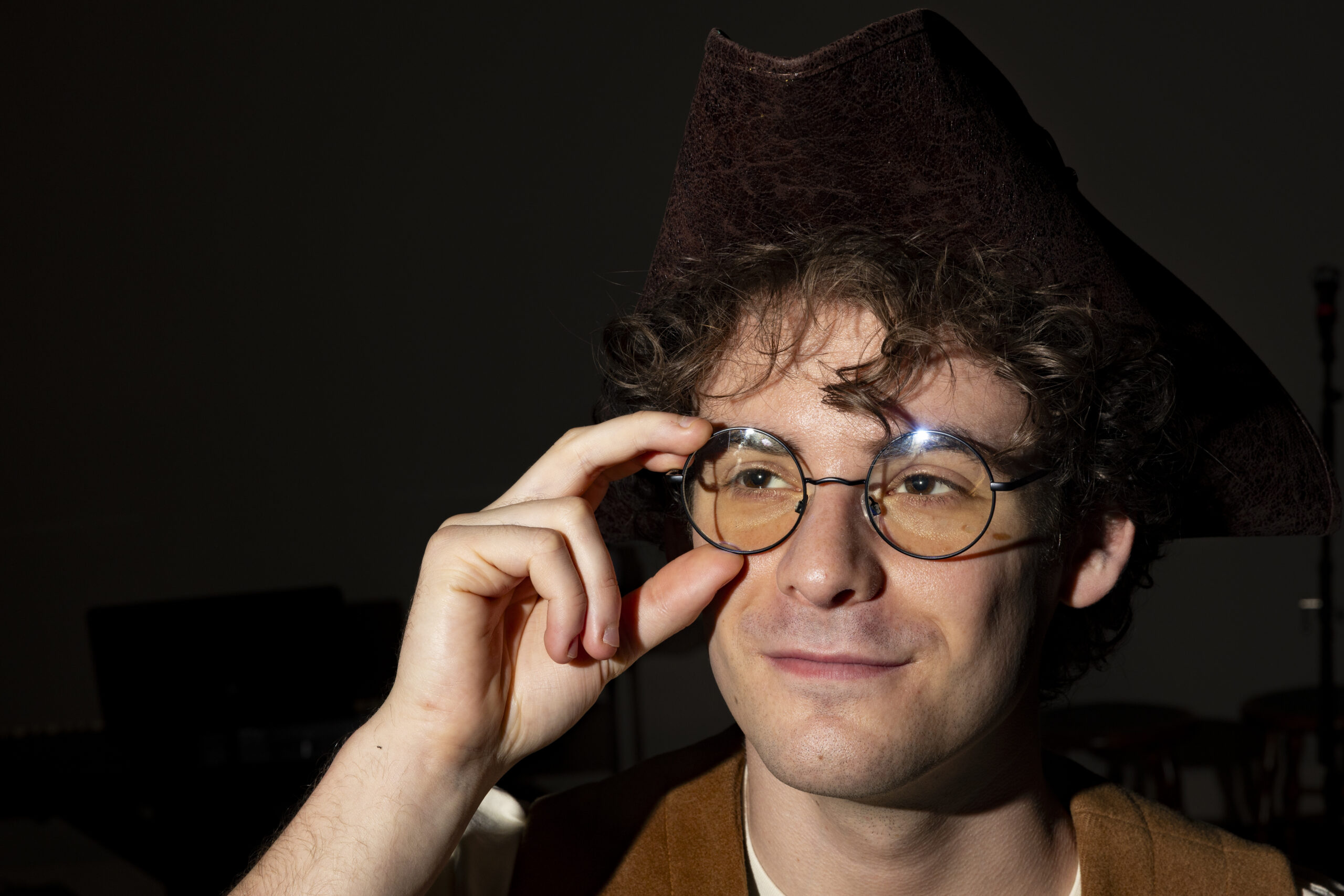
The Sound of America, a new musical showing at FringeArts this month, imagines Franklin as a young man: America’s very first rock star who finds fame after discovering electric rock and roll from the power of a lightning strike.
In the musical, he gains fame and fortune as a rock star. But stardom sweeps him up and pulls him away from the people and values that once defined him as a struggling musician, leaving him to question his true identity.
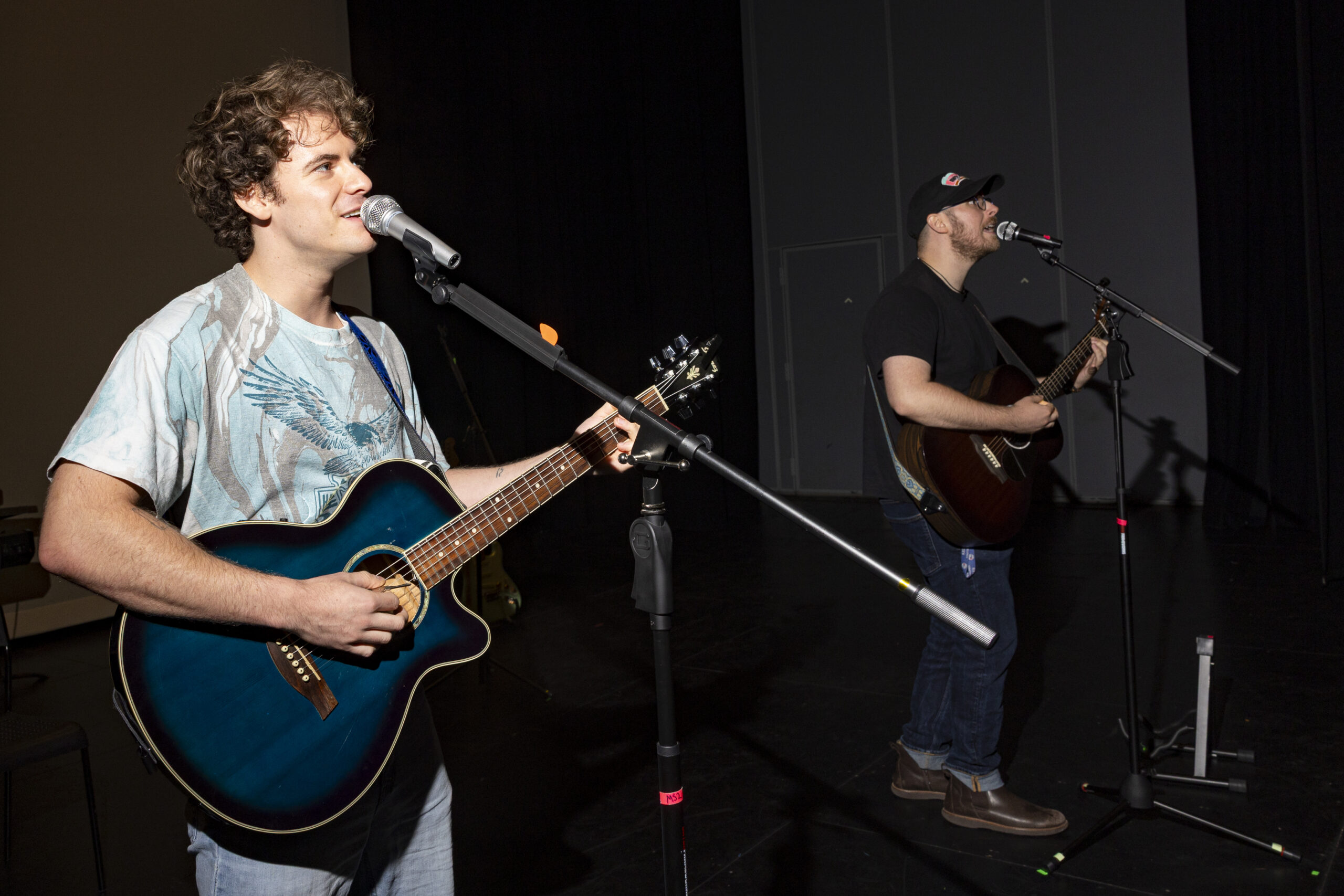
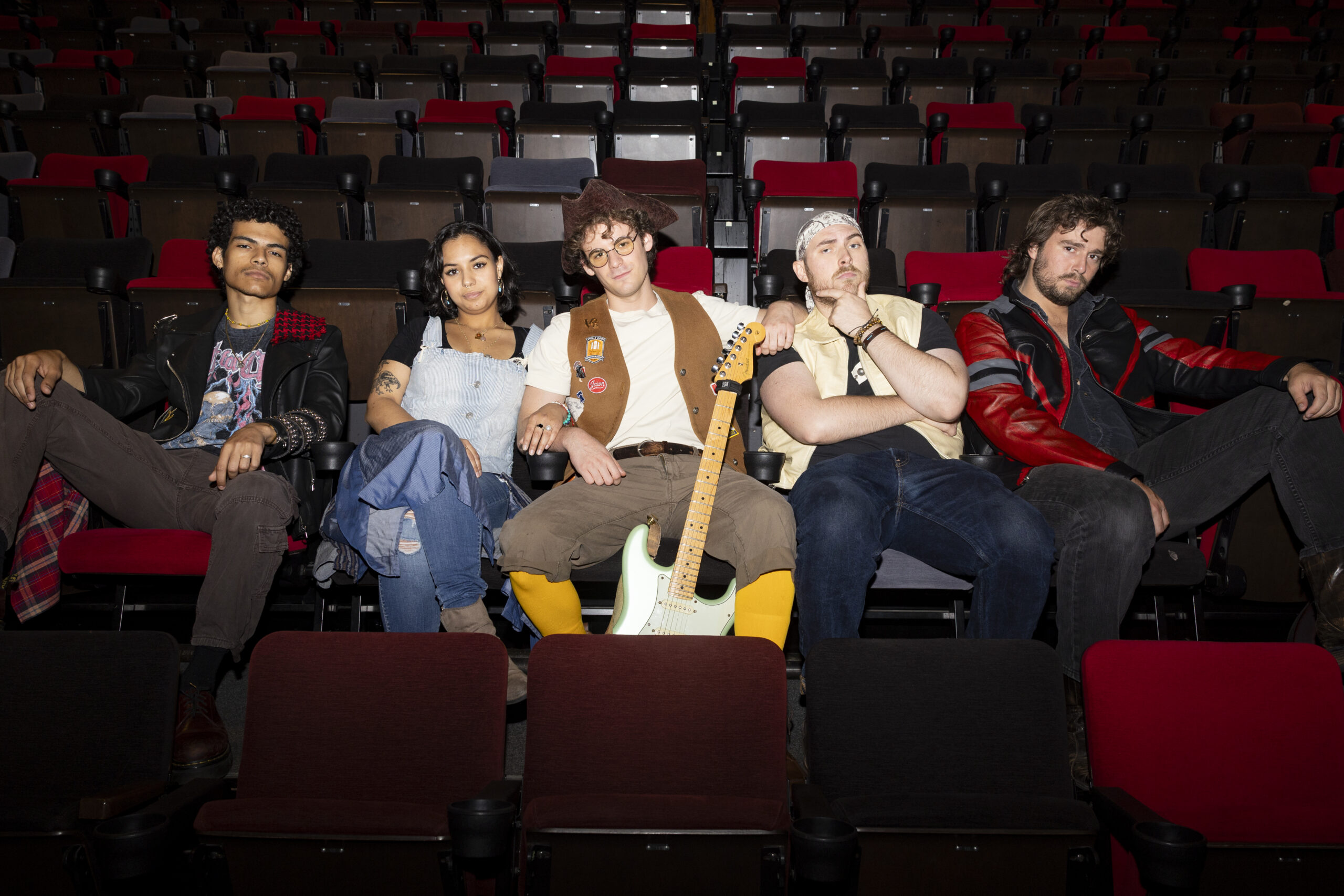
Leading the ensemble cast is a newly minted Temple musical theater graduate, Kohl Pilgrim. Last week, he stood with fellow actors Federica Andino-Vega and Jameson May, who play Franklin’s wife Deborah Read and his best friend Hugh Meredith, respectively.
Pilgrim and cast play their instruments live, serving as both performers and a band.
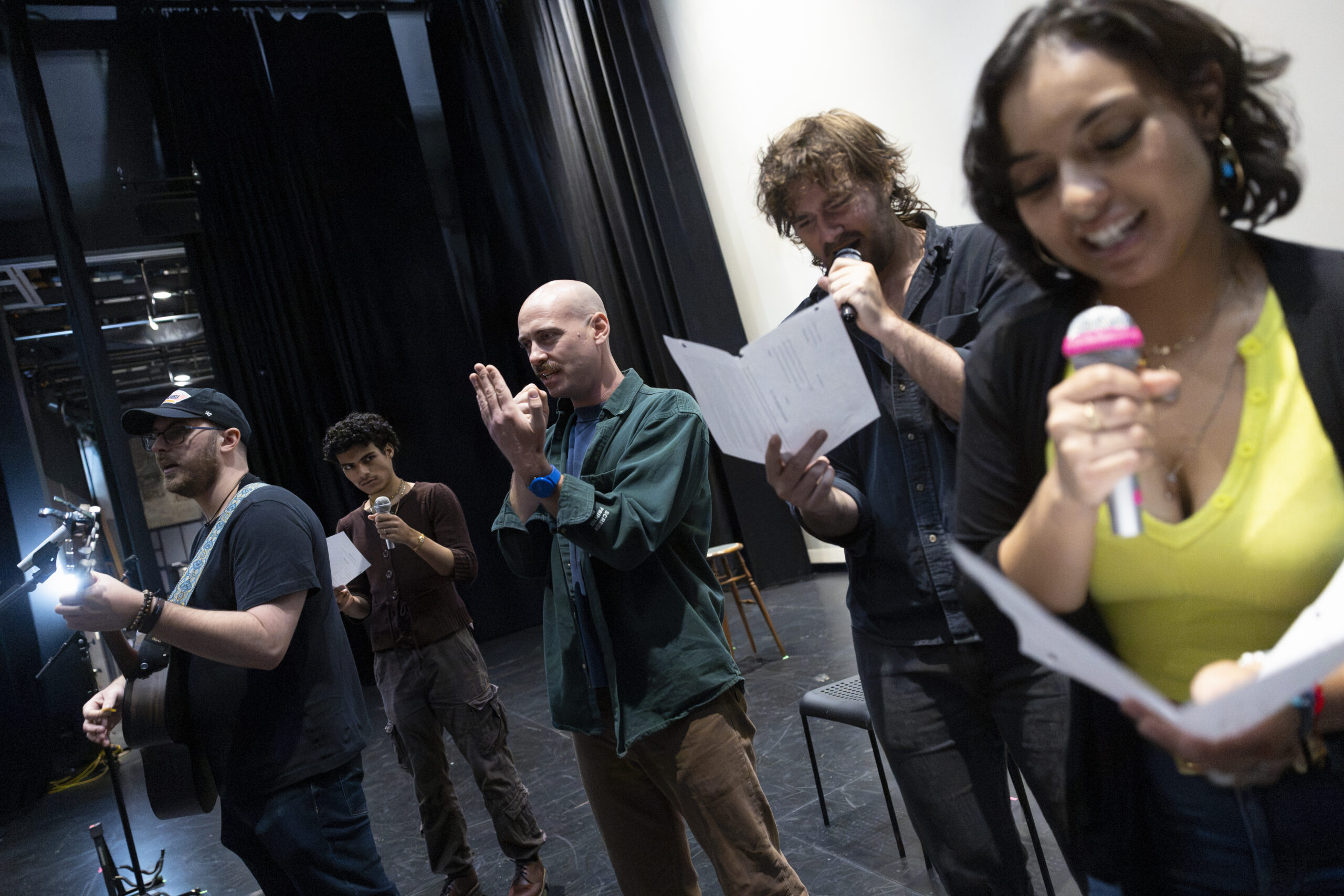
Delivering their lines and singing at microphone stands, Nashville Bluebird Cafe-style, the three practiced blocking the scene where Franklin and Read first meet. After a flirty exchange, a naive and confused Franklin finds out Read is married to a man who has disappeared without evidence of his death.
“We tend to see [Founding Fathers] as these infallible perfect people who created the perfect society,” director and Temple professor Kyle Metzger said. “It’s exciting to see a young Founding Father making mistakes and being complex and messy. It’s important to remember these were people, too, who didn’t have all the answers and were trying their best.”
Setting out to write a write a rock musical, the choice of protagonist was a no-brainer for the musical’s cocreator and Emmy-award winning producer Randall Lane and longtime friend and singer-songwriter Todd Schwartz.
“Under Poor Richard, he was the lyricist for colonial America,” said Lane, referring to Franklin’s pseudonym under which he published a yearly almanac. “And then when he discovered the lightning rod, he literally became the first American who was world famous, and toured the world.”
Just like a young rock star.
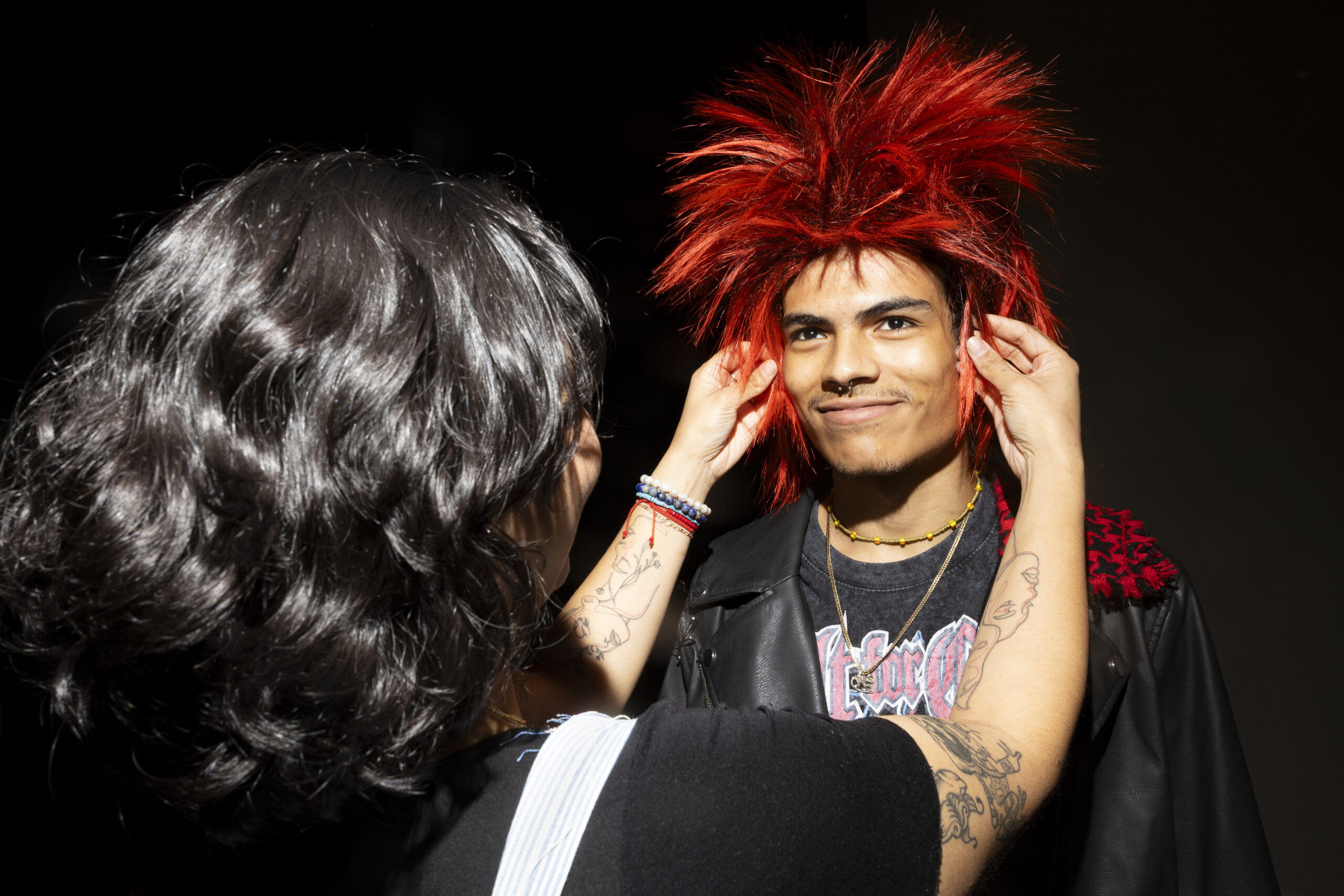
Federica Andino-Vega (left), who plays Franklin’s wife Deborah Read, adjusts Gerson Malave’s wig during a dress rehearsal for “The Sound of America” on June 24.
Lane, who is also the editor in chief of Forbes magazine, lives in Saratoga Springs but feels deeply connected to Philadelphia through the years he went to Penn to study history and political science.
For him, Franklin “checked every box.”
“He was a teenage fugitive who ran away from home and every Friday he was hanging out [at] the Leather Apron Club,” the mutual-improvement society Franklin and his friends founded in 1727, said Lane.
Every week, they’d meet in taverns, “jamming out intellectual ideas,” said Lane. In the case of his musical, they create a garage band.
Franklin, after all, invented the glass harmonica.
The musical’s soundtrack includes 23 original songs cowritten by Lane and Schwartz, influenced by Queen, Nirvana, Bruce Springsteen, and the Beatles. Metzger describes the production as “80% rock concert, 20% musical.”
Kyle Metzger (center), the director for “The Sound of America,” directs the cast inside FringeArts for the forthcoming musical on June 24.
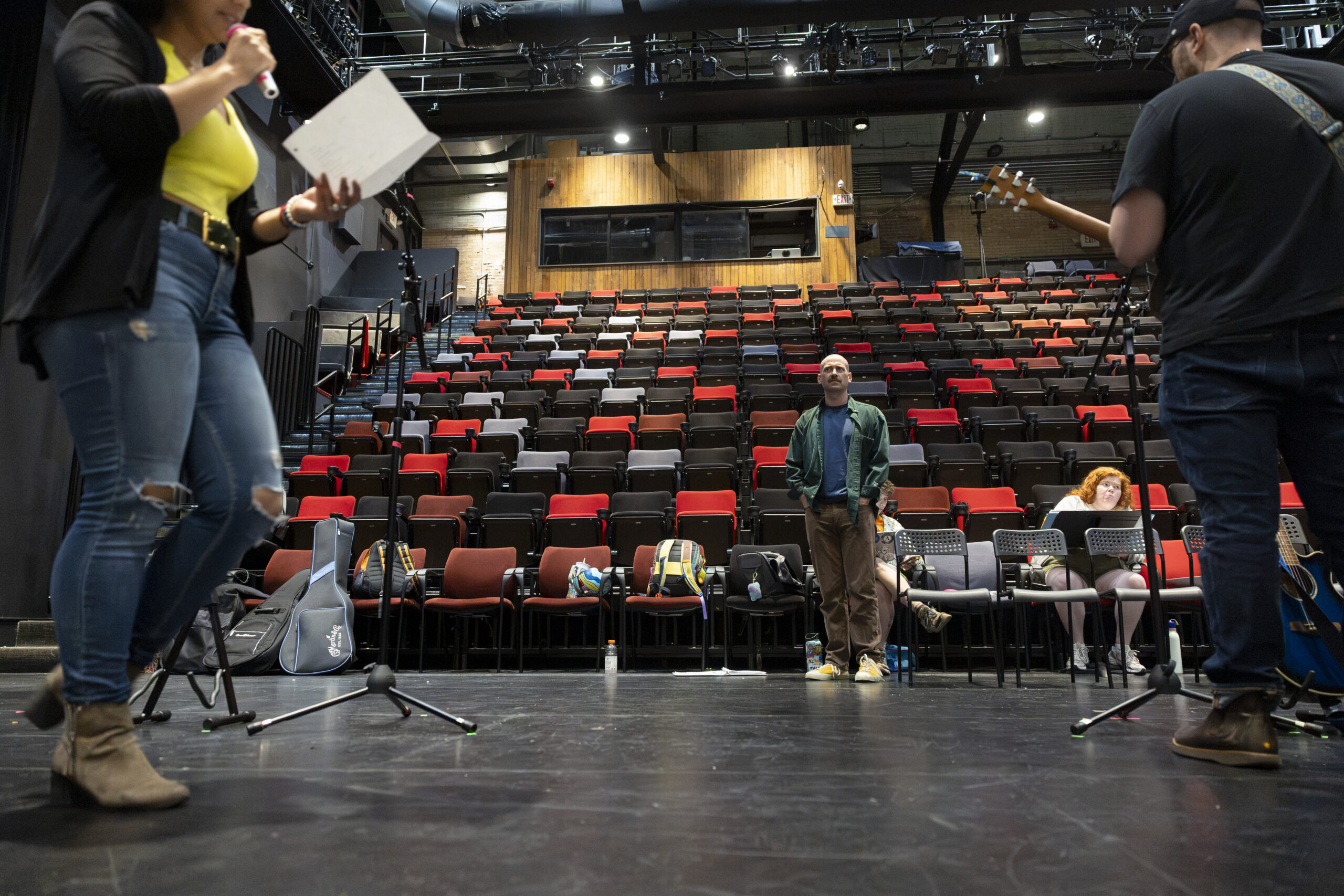
The cast will serve as narrators at the front of the stage, while a live band plays behind them. Floor seats will be available and swaying arms and singing along will be highly encouraged. It’s meant to feel like a concert and not just another historical “rock” musical (sorry, Hamilton).
“I’m always drawn to theater that’s untraditional or pushing into other mediums or incorporating other art forms,” Metzger said.
True to style, The Sound of America also doubles as a walking tourled by Pilgrim, still in character as Benjamin Franklin. After curtain call, audiences can participate in a tour of Franklin’s Old City house and grave, a short walk away from the FringeArts venue.
Needless to say, Pilgrim has had to really pack on the homework for this portion of the show.
“Most of my free time when I am not in rehearsal or with friends, I am home reading his autobiography,” he said. “I am reading anything I possibly can because there’s probably going to be a kid that’s like ‘What’s his favorite food? Did he like burgers?’ So I’m researching that, too.”
Barrymore award-winning director Kyle Metzger is also a professor in Temple’s Musical Theater program.
When asked about Franklin’s favorite drink, Pilgrim was certain it was wine. As for his hypothetical Jersey Shore vacation spot, Pilgrim named Cape May.
“I think he would like the houses,” he said.
“I want to pay homage to how honest, wise, and hard-working he was,” said the actor, who sought inspiration from iconic rock figures like David Lee Roth, Elvis Presley, and Sir Roger Daltrey, frontman of the Who.
Daltrey, in fact, makes a remote cameo in the musical, in support of Teen Cancer America, the nonprofit he founded along with Who bandmate Pete Townshend.
Lane and Schwartz’s royalties will be donated to the charity, which partners with Children’s Hospital of Philadelphia (CHOP). The production is also collaborating with Federal Donuts & Chicken for a specialty doughnut called “The Ben”; a portion of its sales will benefit the cause.
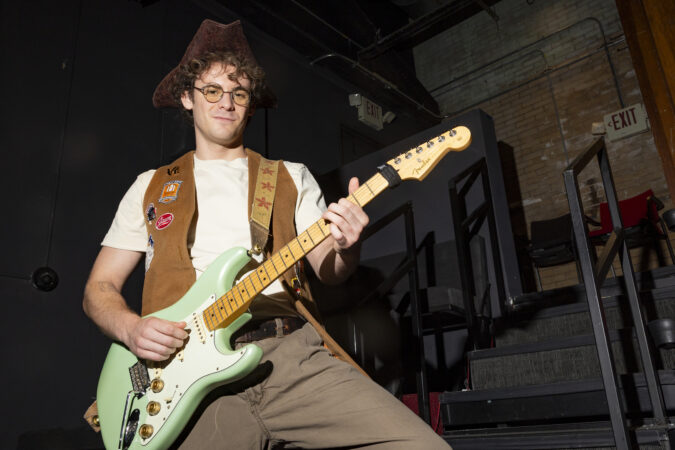
Kohl Pilgrim, the actor bringing Ben Franklin’s rock and roll persona to life, inside FringeArts.
“We want this to be a really big win to fight cancer, but we think that it’s also super true to the spirit of Benjamin Franklin,” Lane said. “He was a rock star in all the senses, but he was also somebody who really cared about where he lived, and we want to leave Philadelphia better than we found it.”
But as with any rock star, Franklin’s story would be nothing without his entourage.
In addition to wife Read and bestie Meredith, the ensemble cast includes British antagonist Lord Wedderburn, played by Kaedon Knight and Franklin’s illegitimate son William Temple Franklin (aka “WTF”), played by Gerson Malave.
Read is the only female character in the show, accompanying Franklin on his journey to stardom. Though she is often forgotten in history, her common-law marriage to Franklin saw her holding down the Franklin household and publishing company with a shotgun during the unrest of the Stamp Act.
“She was a baddie, the baddie on Market Street,” Andino-Vega said. “But [Franklin] got most of the spotlight just because she was very shy and a bit illiterate. I want to shine a light on those special ladies that have been forgotten, and bring them up a little more in a way where they can also be seen like Ben Franklin.”
The cast of “The Sound of America” are committed to delivering a rock concert, not just a musical.
The cast and crew, largely Philadelphia-based and/or raised, are deeply committed to reflecting the grit of the city through this unique portrayal, especially in light of the 250th anniversary of the nation.
“It’s almost like Ben was talking to us saying this year’s really important and this summer is important to Philadelphia,” Lane said. “It gives everybody that visits Philly a reminder that Philadelphia was the birthplace of democracy and it’s the soul of America.”
The Sound of America runs July 1-Aug. 1 at FringeArts, 140 N. Christopher Columbus Blvd. Tickets start at $60. soundofamericamusical.com, 215-413-1318, or hello@fringearts.com.
A previous version of the article misidentified the actors playing Hugh Meredith and Lord Wedderburn. Jameson May and Kaedon Knight play the characters respectively.
🍦 Stella’s Ice Cream out of Idaho (yes, Idaho) just opened on Front Street in Fishtown/Kensington, and Bea has the early scoop.
🍦 Winners, rocking a feel-good message, is new on South Street in Graduate Hospital. As Kiki Aranita says, Winners’ appeal is more than just the flavors, like Sweet Success S’mores.
🍦Our guide to our favorite ice cream is right here.
Critic Craig LaBan is back from his annual Jersey Shore exploration, and he’s shaking the sand out of his notebook. In Part One of his roundup, he heads to the mainland to find some gems. Read that here.
Looking ahead: Part Two, Craig’s reviews from Long Beach Island and thereabouts, will be online this weekend. On July 11, he’ll share his discoveries from points farther south in Part Three.
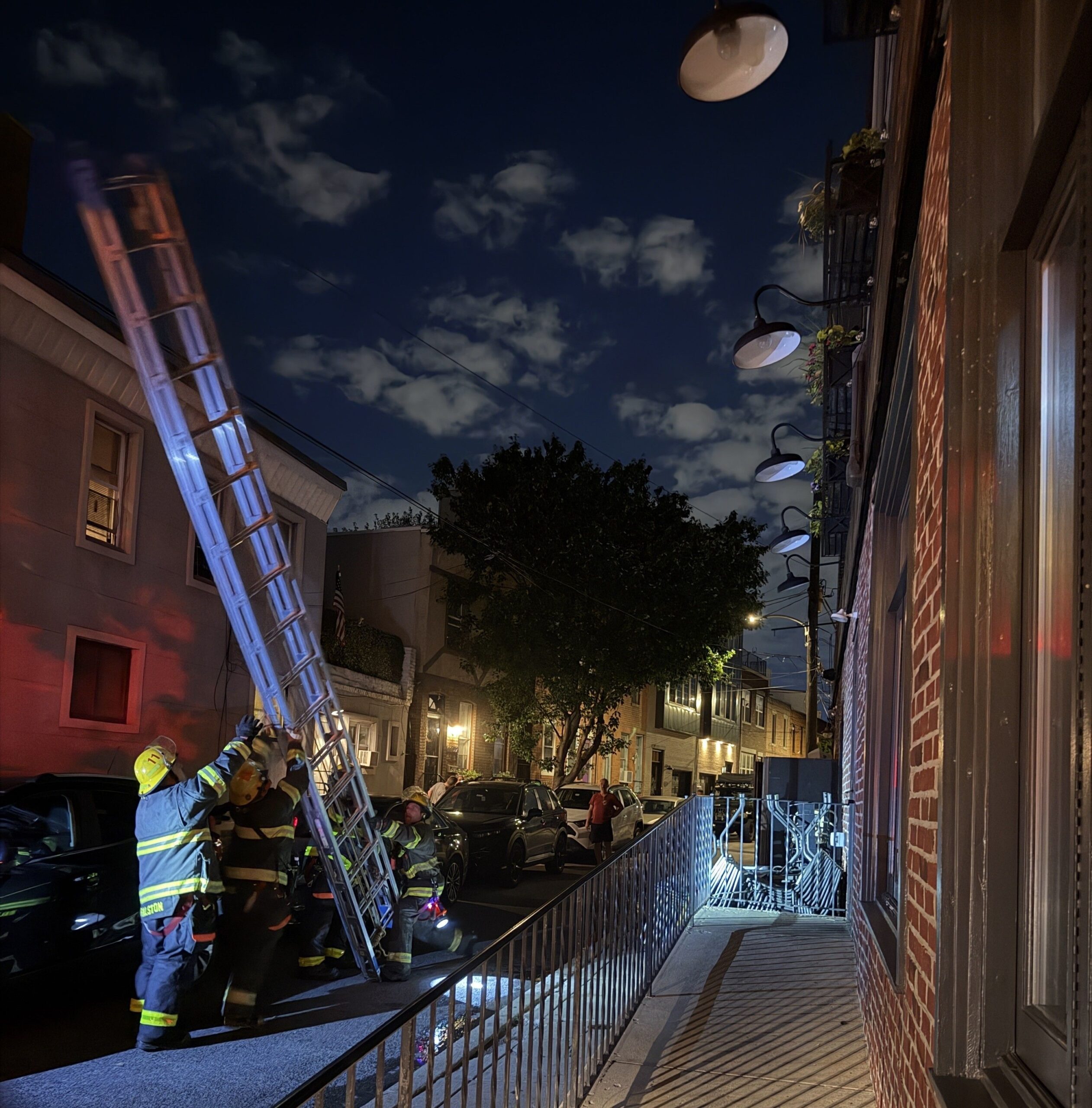
Ember & Ash on East Passyunk Avenue will be closed for an undetermined period after smoke and flames shot up through the ventilation last week just after closing time. No injuries were reported.
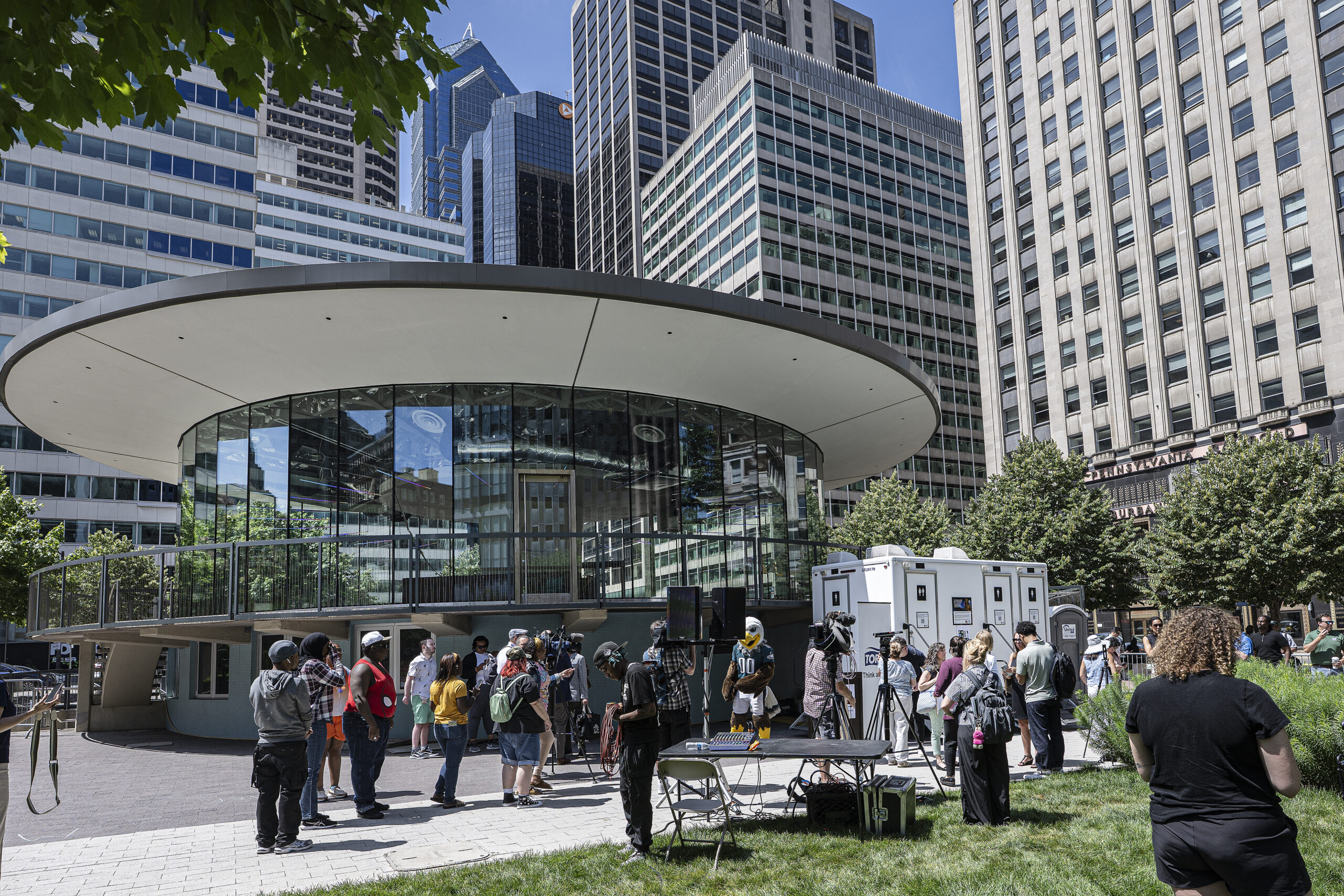
This weekend will see the debut of Broad Street Beer Garden at LOVE Park, the first phase of a planning reuse of the so-called flying saucer building at 16th and JFK. Here’s the long history of the city landmark.
We munched on fried silverfish that reminded us of French fries in Little Saigon, Argentine empanadas in West Philly, and a vegan po’ boy in Old City that tasted like the original.
Scoops
Intrigue! Albert Zheng, whose holdings include Javelin in Fairmount, is backing a yet-to be-named dual concept on the way to 808 Chestnut St., formerly a Dunkin’ Donuts. In front, the feature will be wagyu omakase, while the rear will be what he calls a Cambodian speakeasy. He says it’s six or seven months out.
Mylar Bar, a cocktail bar inspired by the spirit of South Philly’s Dino’s Party Center, is expected to open later this summer from hospitality veterans Liv Arterbridge and Gina Piccari. They bought the former building at Ninth and Morris Streets where Dino’s sold balloons, decorations, and party supplies for decades before it moved across the street. “We want the whole thing to feel like a party,” Arterbridge said. “Nostalgic, fun, a little silly, intentionally unserious — but not a theme bar,” Piccari said. Cocktails will include martinis, punches, and classic drinks, alongside draft beer and familiar favorites. A full kitchen, led by chef Colin White, formerly of Sally and Emmett, will serve shareable “party snacks” and larger plates. They plan to offer late-night desserts, so food will be available until 1 a.m. with the bar wrapping at 2. Arterbridge, whose resume includes Cry Baby, Poison Heart, and a.bar, met Piccari while working at Boot & Saddle, where Piccari was manager. Piccari is now behind the bar at Le Virtù.
Restaurant report
Sixteen restaurants, bakeries, cafes, and bars — including Lillian’s, shown above — are opening in July. Read on for the rundown.
Penny’s Bagels, on its way (for the last two years) to 212 Kings Highway East in Haddonfield, will hand out 250 red, white, and blue bagels on July 3 at the borough’s parade. The shop is eyeing an August opening, says owner Chris Fetfatzes.
Maru, a fast-casual Korean-inspired restaurant from David Backhus and the team behind the now-closed Oori, is expected to open in August in what is now Collective Coffee & Bakery, which Backhus also owns, at 2922 Conestoga Rd. in Glenmoore. Maru’s menu will feature Korean fried chicken sandwiches, wings, tenders, house-made mochi doughnuts, and specialty coffee, while continuing to serve Collective Coffee and honor existing coffee subscriptions.
Briefly noted
Ota-Ya in Newtown has announced that Friday will be its last day after 30 years with the retirement of owners Jeff Wong and Cindy Tam.
PETA is launching its “Nice Cream Trail,” highlighting 10 shops across the state serving vegan ice cream, and there are five local spots on the list: Dreams Ice Cream Factory in Glenside, Lu & Aug’s in Ardmore, the Main Freeze in Lansdale, Milk Jawn in South Philadelphia and Northern Liberties, and Scoop DeVille in Center City and Queen Village. The first Pennsylvania resident to complete the trail by visiting all 10 participating shops through August will win a vegan ice cream party with PETA’s “iScream” truck for themselves and up to 50 guests. Details are here.
Two local BBQ chefs, Matt Groark (Medford Lakes, N.J.) and Maxwell McGibbon (Newark, Del.), are competing on Food Networks’ Pitmasters, premiering July 13 at 9 p.m.
Diner en Blanc registration is still open. This year’s version of the pop-up picnic is Aug. 20.
Miller’s Ale House, in the shopping center next to the Home Depot in Springfield, Delaware County, closed this week after 13 years, while Fishtown is abuzz with speculation that Bottle Bar East, which opened at 1308 Frankford Ave. around the same time in late 2012, has closed. The phone is down, and owners could not be reached for comment
When is Adda ever going to open in Fishtown? — Rich C.
True, Adda has been a long time coming, since I initially wrote about it in June 2025 with an end-of-2025 target. Adda — from New York City’s Unapologetic Foods, whose establishments are acclaimed for their bold, no-holds-barred approach to Indian cooking — is now looking at a late-fall opening at 1700 Frankford Ave., the new building across from the Fishtown post office.
Corrigendum: Reader Stephanie points out that Kalaya is the third Philadelphia restaurant, not the second, to win the James Beard Award for outstanding restaurant, as I wrote two weeks ago. Zahav was the first in 2019, while Friday Saturday Sunday won in 2023.
📮 Have a question about food in Philly? Email your questions to me at mklein@inquirer.com for a chance to be featured in my newsletter.
By submitting your written, visual, and/or audio contributions, you agree to The Inquirer’s Terms of Use, including the grant of rights in Section 10.
I’ve driven across the Ben Franklin Bridge countless times but until last week I’d never walked across it, and I walked across the Brooklyn Bridge once, so I’ve quietly carried that shame with me for years.
When I received a news release about the bridge turning 100 on July 1 and a subsequent anniversary party on July 11 that will close it to vehicles for public use for the first time since Pope Francis’ visit in 2015, I wanted to finally check walking across it off my Philly bucket list before the event.
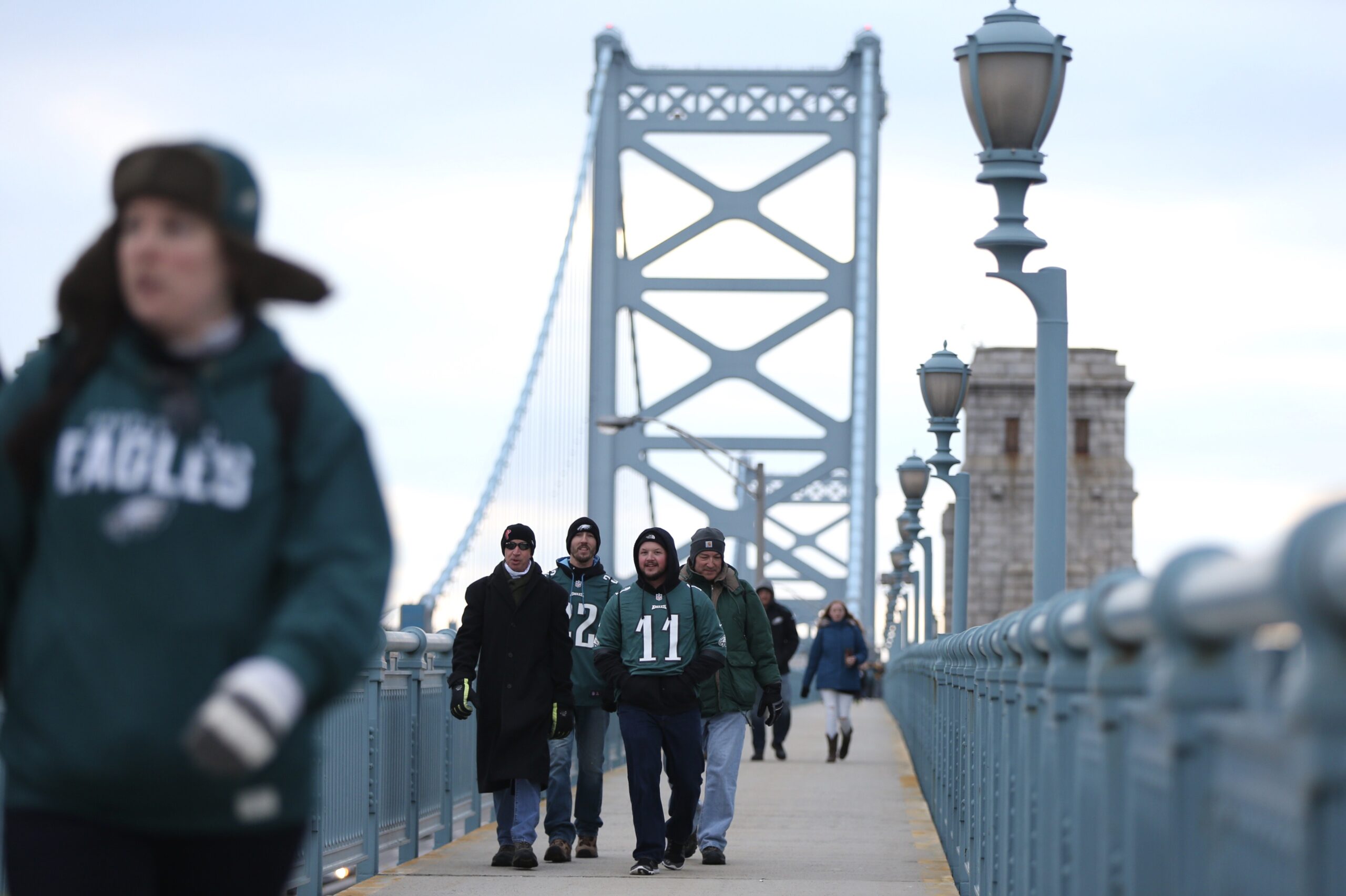
Fans cross the Ben Franklin Bridge into Philadelphia on the morning of the Eagles’ Super Bowl parade in 2018.
I was going to go it alone, but I decided to reach out to Mike Williams, spokesperson for the Delaware River Port Authority (DRPA), which manages the bridge, and he offered to schedule a walkway tour of it for me with DRPA principal engineer Michael Howard.
I met both men at Fifth and Race Streets at the base of the bridge on the Philly side, but as luck would have it, we showed up on opposite sides of the heavily-trafficked span. We waved at each other across the cars and as I tried to figure out how to Frogger my way over to them, Howard and Williams disappeared.
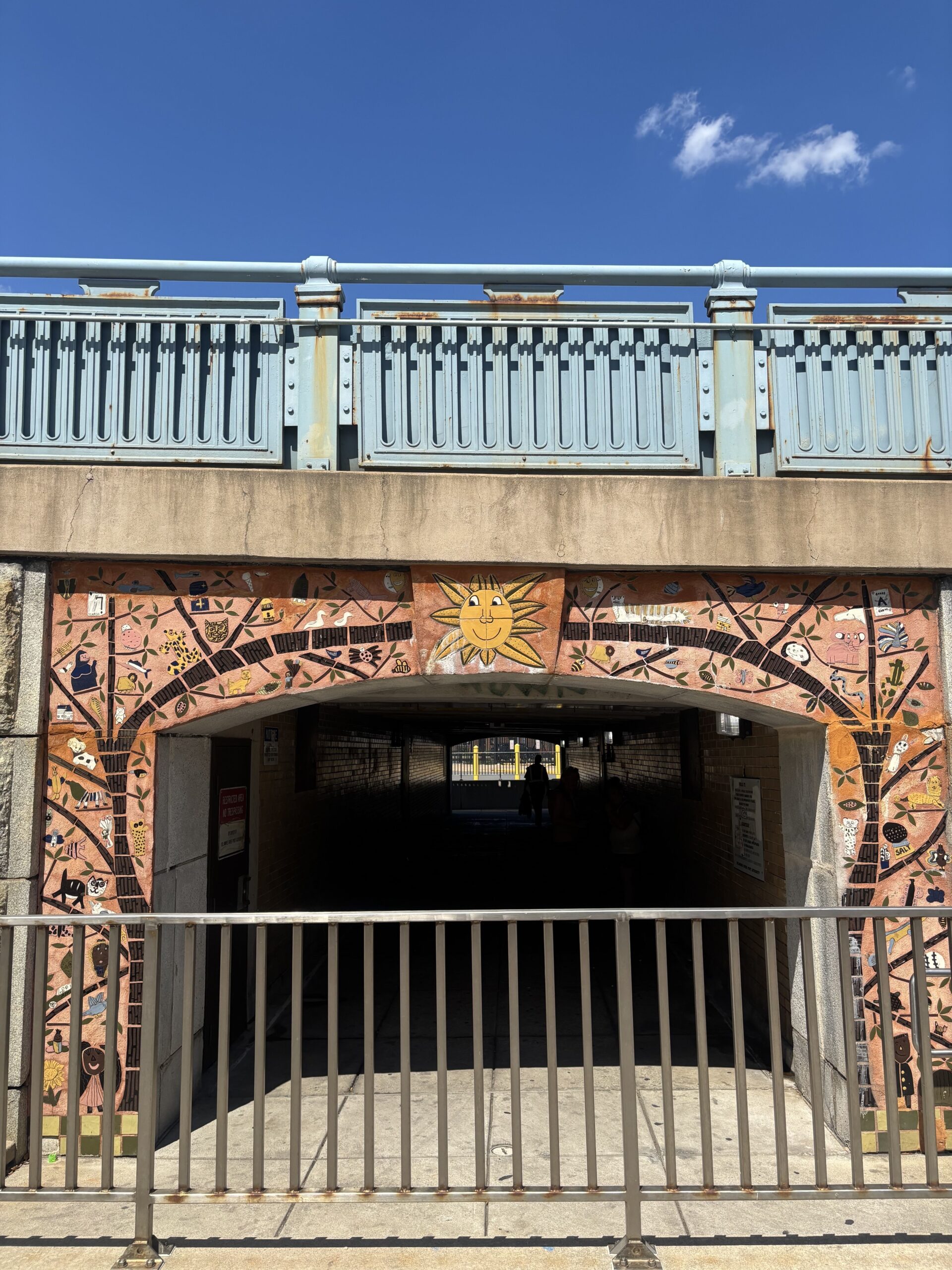
The men popped up out of a stairwell right next to me, having used the Fifth Street pedestrian tunnel under the bridge.
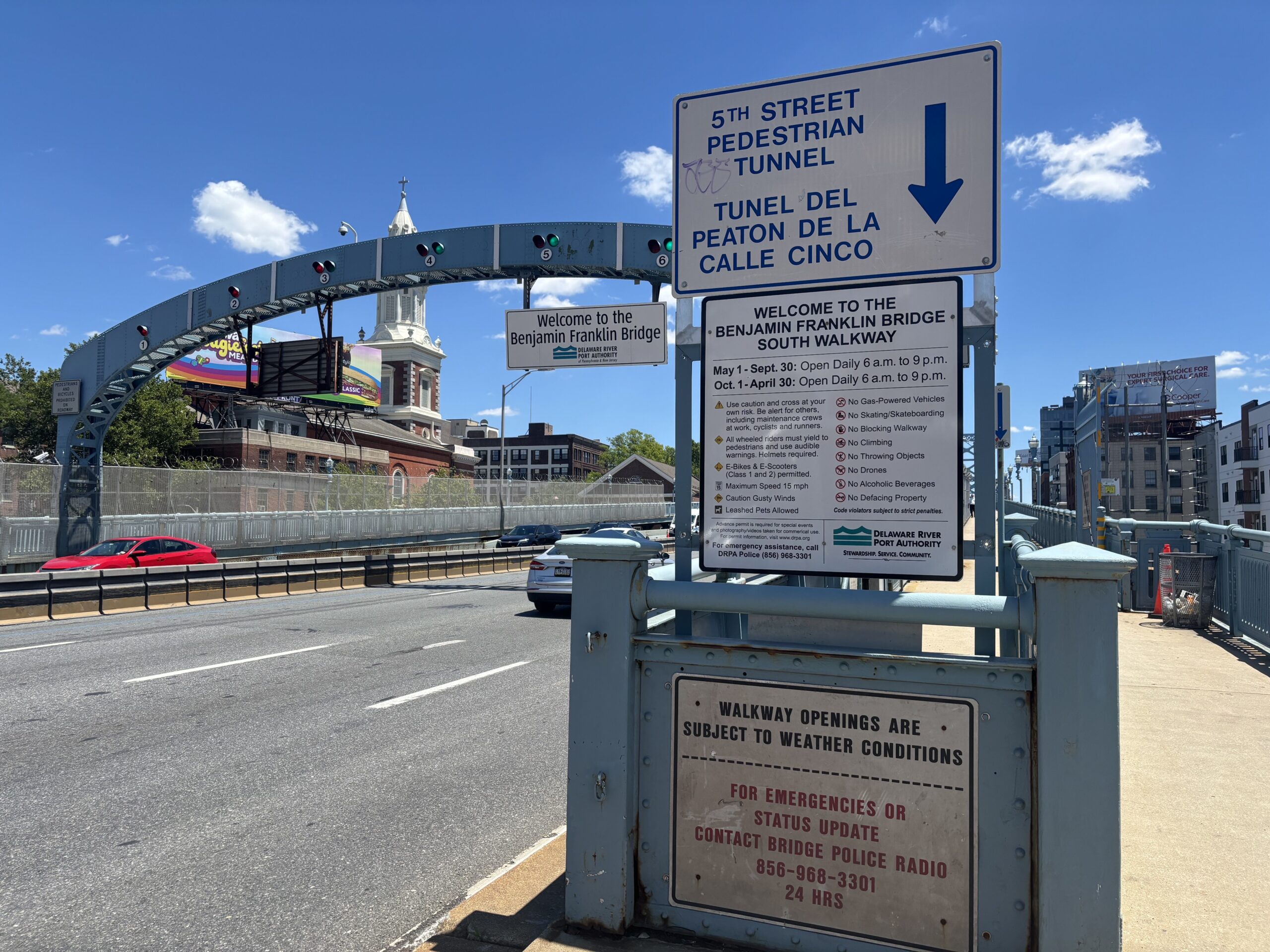
The entrance to the Fifth Street pedestrian tunnel on the south side of the Ben Franklin Bridge in Philadelphia.
“This was one of the original things that we incorporated into the bridge because we didn’t want people to try to walk across the traffic — because they would, you know,” Howard said, and I agreed.
Obviously, it was the first place I wanted to check out.
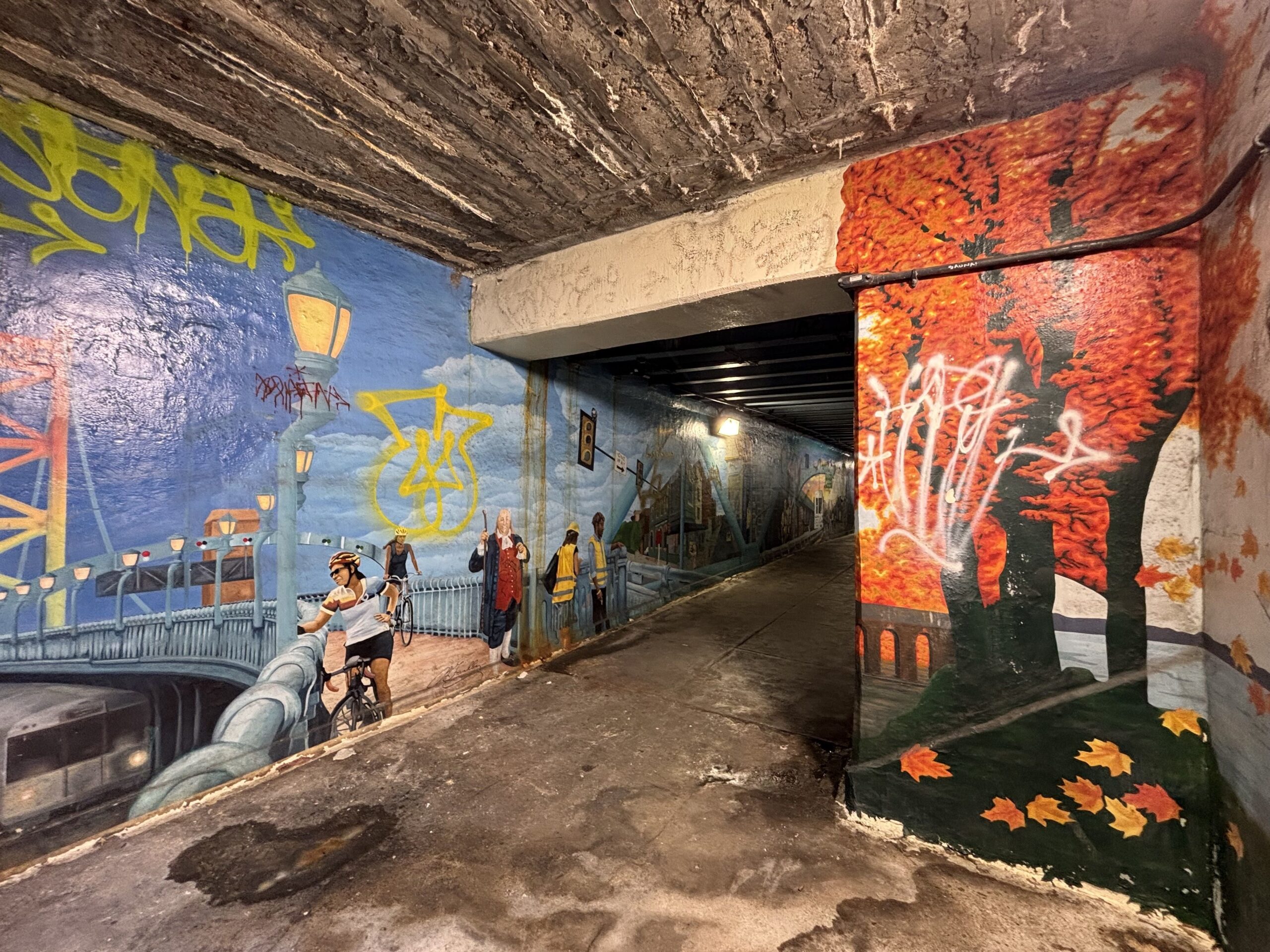
The “Building Connections through Time” mural inside of the Fifth Street pedestrian tunnel on the Philadelphia side of the Ben Franklin Bridge.
The entire length of the 91-foot-long tunnel was painted with a vibrant Mural Arts Philadelphia work by Brad Carney and Melissa Mandel. Created in 2018, Building Connections through Time shows people using the bridge, the building of it, and images of its early years. There are also paintings of Independence Hall, Benjamin Franklin, and other bridges that span the Delaware River.
Finding one of the city’s most secluded murals felt like finding one of those wonderful Philly secrets the city gives sometimes, if you never stop exploring it.
Come along with me as I explore one of Philly’s most secluded murals.
Back on the surface, Howard said that while the bridge has two pedestrian walkways, for operational reasons, only one side is open at a time and it’s usually the south side. The walkway has restricted hours, so be sure to check the signs (currently, it’s open from 6 a.m. to 9 p.m.).
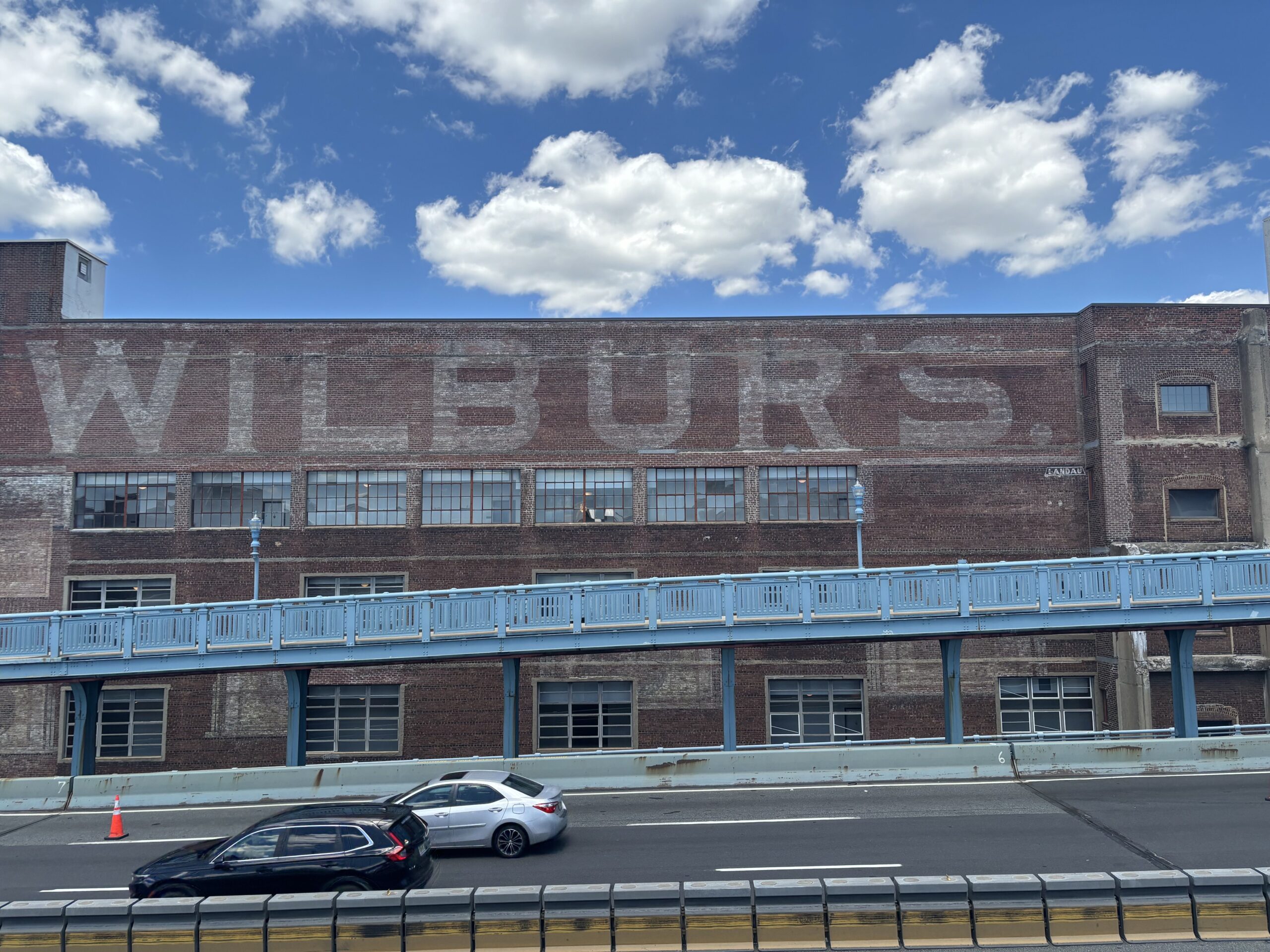
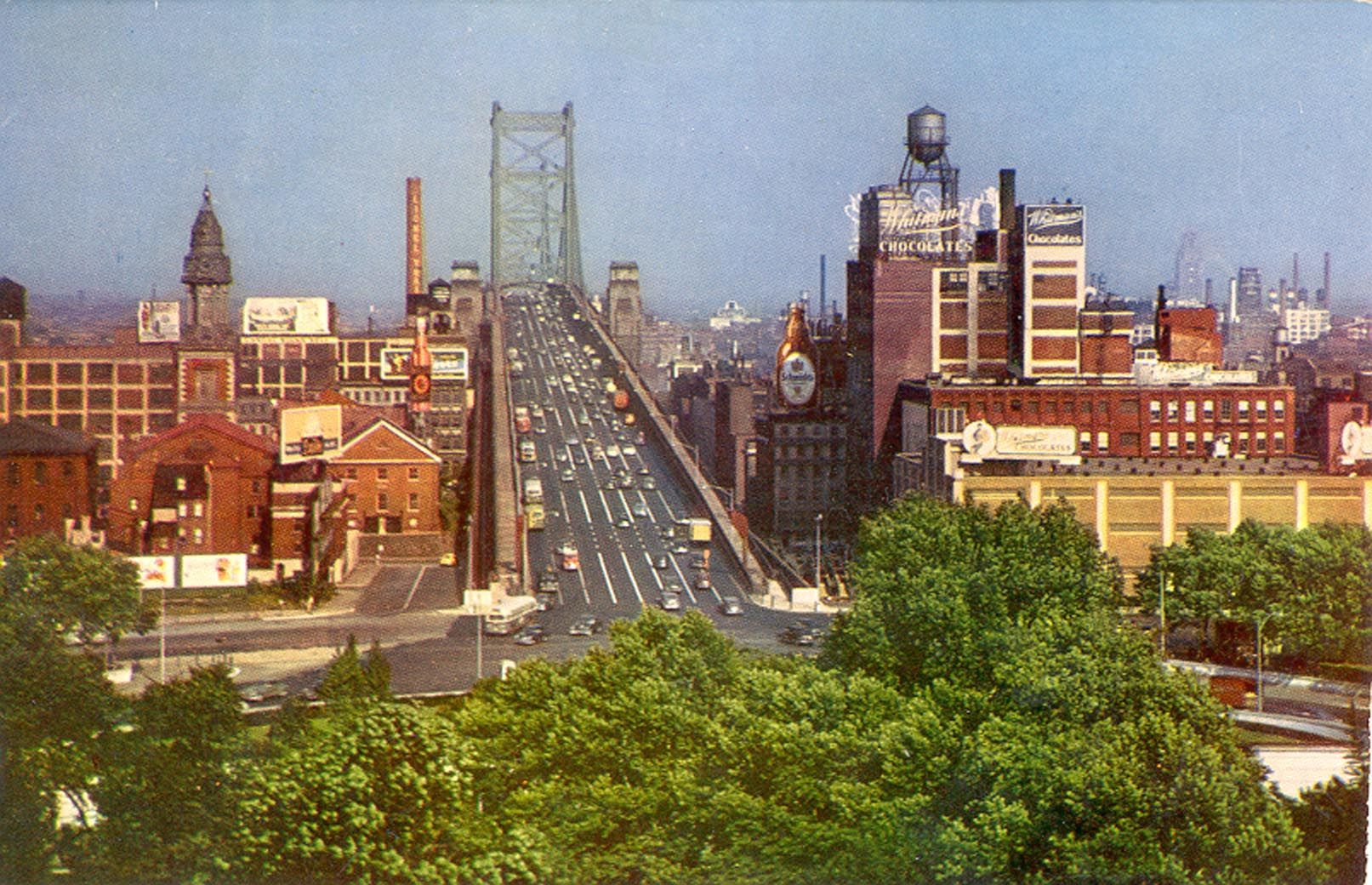
Howard pointed out the old Wilbur Chocolate factory on Third Street and explained that a part was sliced off to make way for the bridge.
“One of the things that we had to do when we were constructing was kind of take a surgeon’s scalpel to the area because you know with Old City, everything’s tightly packed and we wanted to make sure we took the bare minimum of structures,” he said.
A piece of the former Wilbur’s Chocolate Factory had to be sliced off to make way for the Benjamin Franklin Bridge.
Also under threat when the bridge was built was nearby St. George’s United Methodist Church on Fourth Street. Opened in 1769, it’s the country’s oldest Methodist church in continuous service.
“Luckily, the engineers were able to just adjust the angle of the approach ever so slightly to avoid encountering the building,” Howard said.
I marveled as I looked at the mere 14 feet that still separates St. George’s from Philly’s big Ben. The engineers left just enough room for the Holy Spirit.
‘Bridge angels’
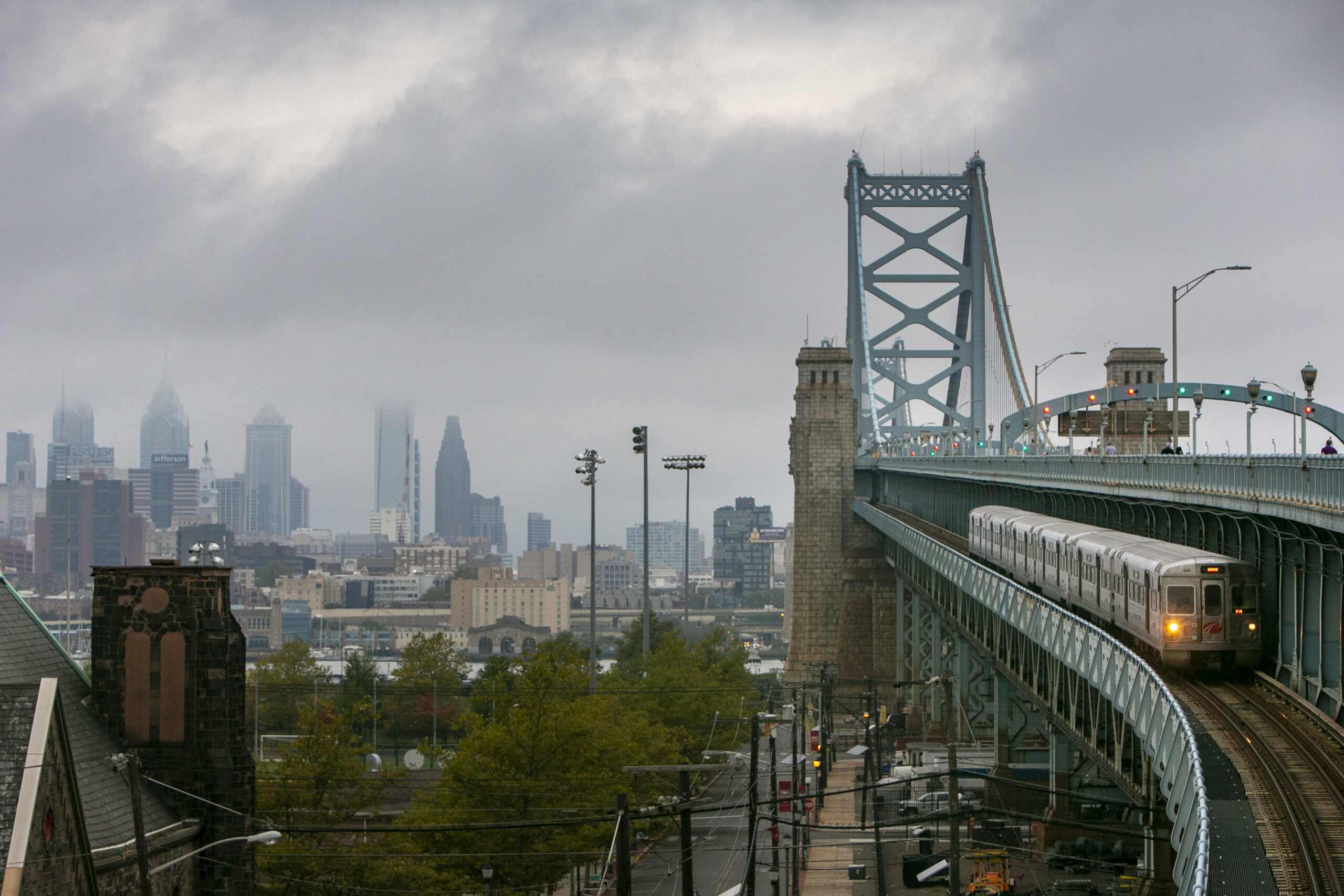
As we began our journey across the bridge, Howard said it took about four-and-a-half years to build and it was designed by architect Paul Philippe Cret, who also designed Philly’s Rodin Museum. The bridge was constructed with eight lanes — six for traffic and two for trolleys, as well as two tracks for heavy rail.
But in the time it took to build it, trolleys went out of fashion and buses came in. The trolley tracks sat unused until the 1940s, when they were paved over. A vast, empty space for a never-opened trolley station remains under the Bolt of Lightning sculpture near the base of the bridge.
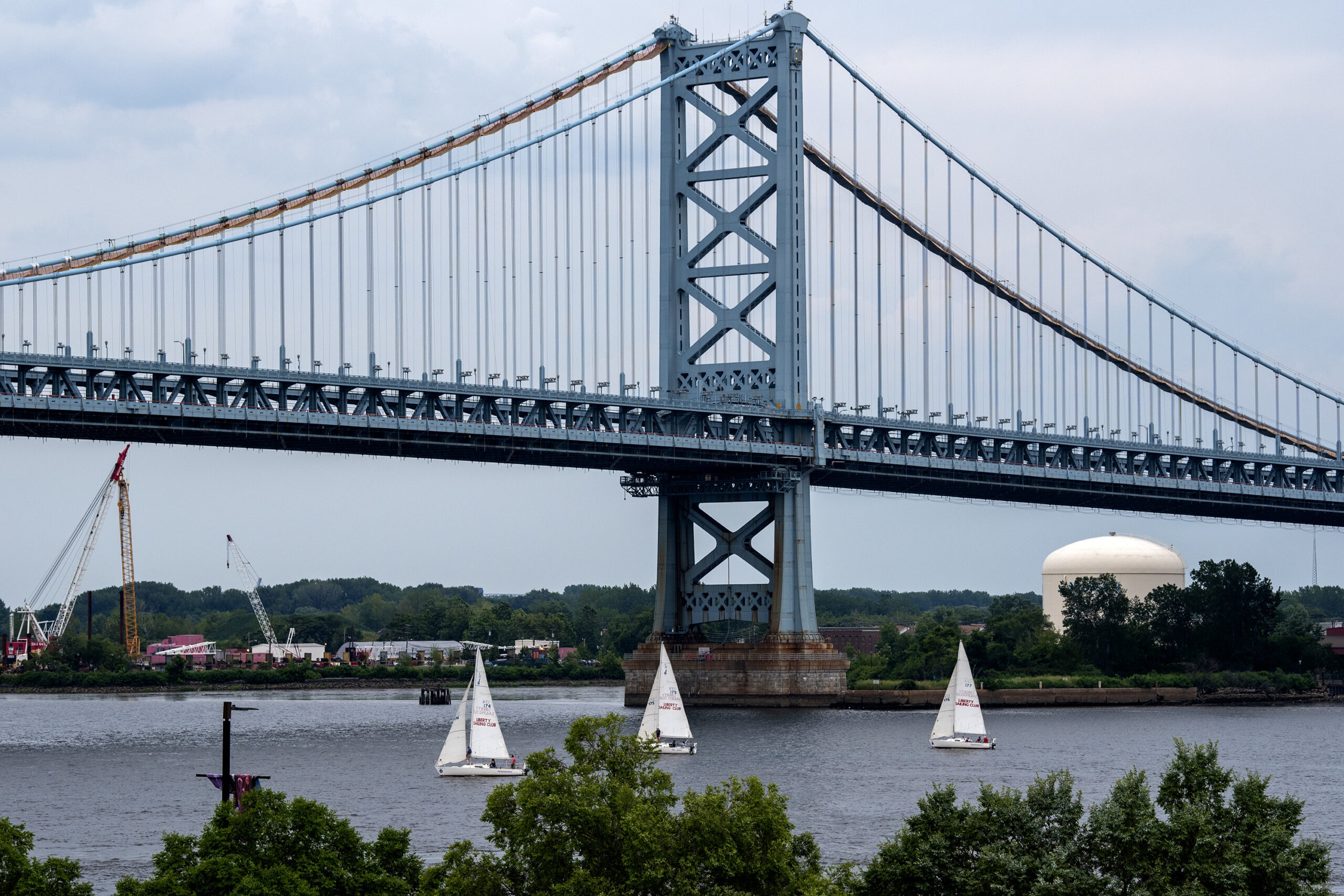
Sailboats pass under the Ben Franklin Bridge in 2020.
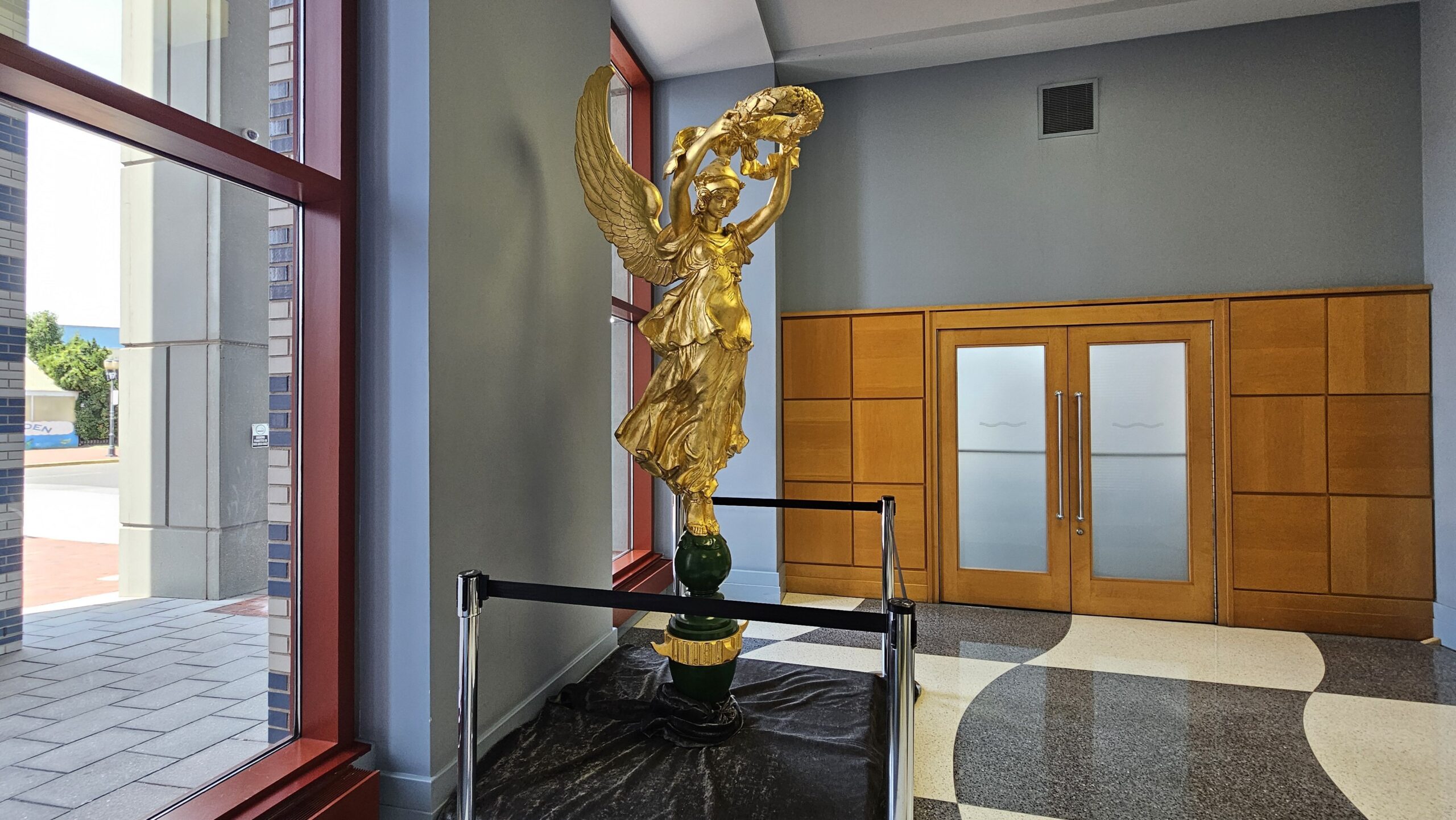
Another original component lost when the trolley tracks were paved over were four 75-foot-tall pylons — two on either side of the bridge — that were topped with bronze angel statues called Winged Victory.
One of the angel statues is in the lobby of DRPA’s headquarters and three are in storage, but one will be displayed at the upcoming 100th anniversary celebration, according to Williams.
One of the four “Winged Victory” statues that used to decorate the Ben Franklin Bridge is now on display at the Delaware River Port Authority’s headquarters.
‘A living beast’
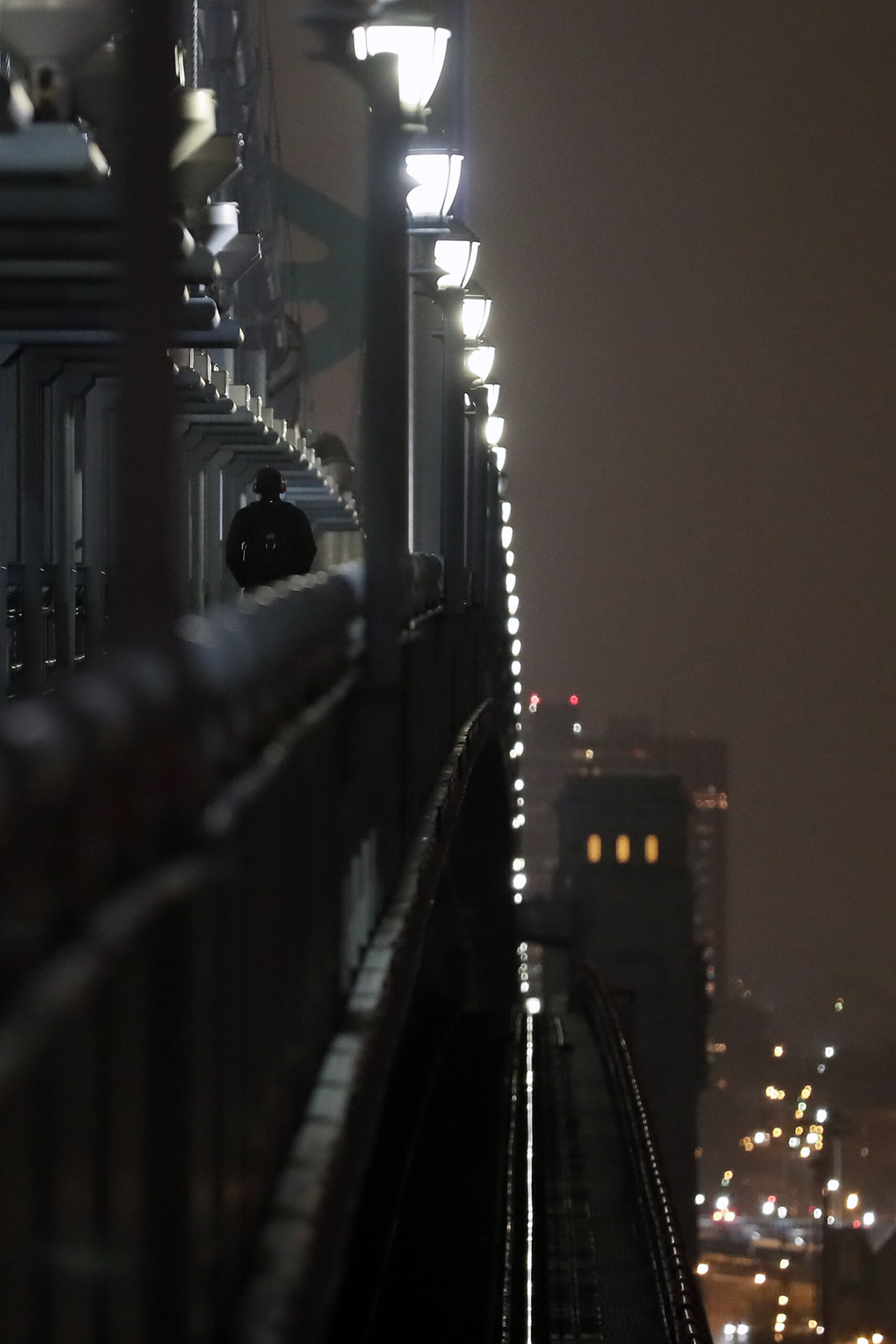
Shortly after we began our trek on the 1.3-mile walkway, I felt a PATCO train speeding beneath my feet and the bridge move ever so slightly.
“The bridge is dynamic, almost like a living beast because the steel expands when it gets warm out and with traffic, it bounces,” Howard said.
A PATCO train travels from Philadelphia to Camden underneath the pedestrian walkway of the Ben Franklin Bridge.
I got used to the sensations within minutes. That being said, I’m not afraid of heights. It could be unnerving if you are.
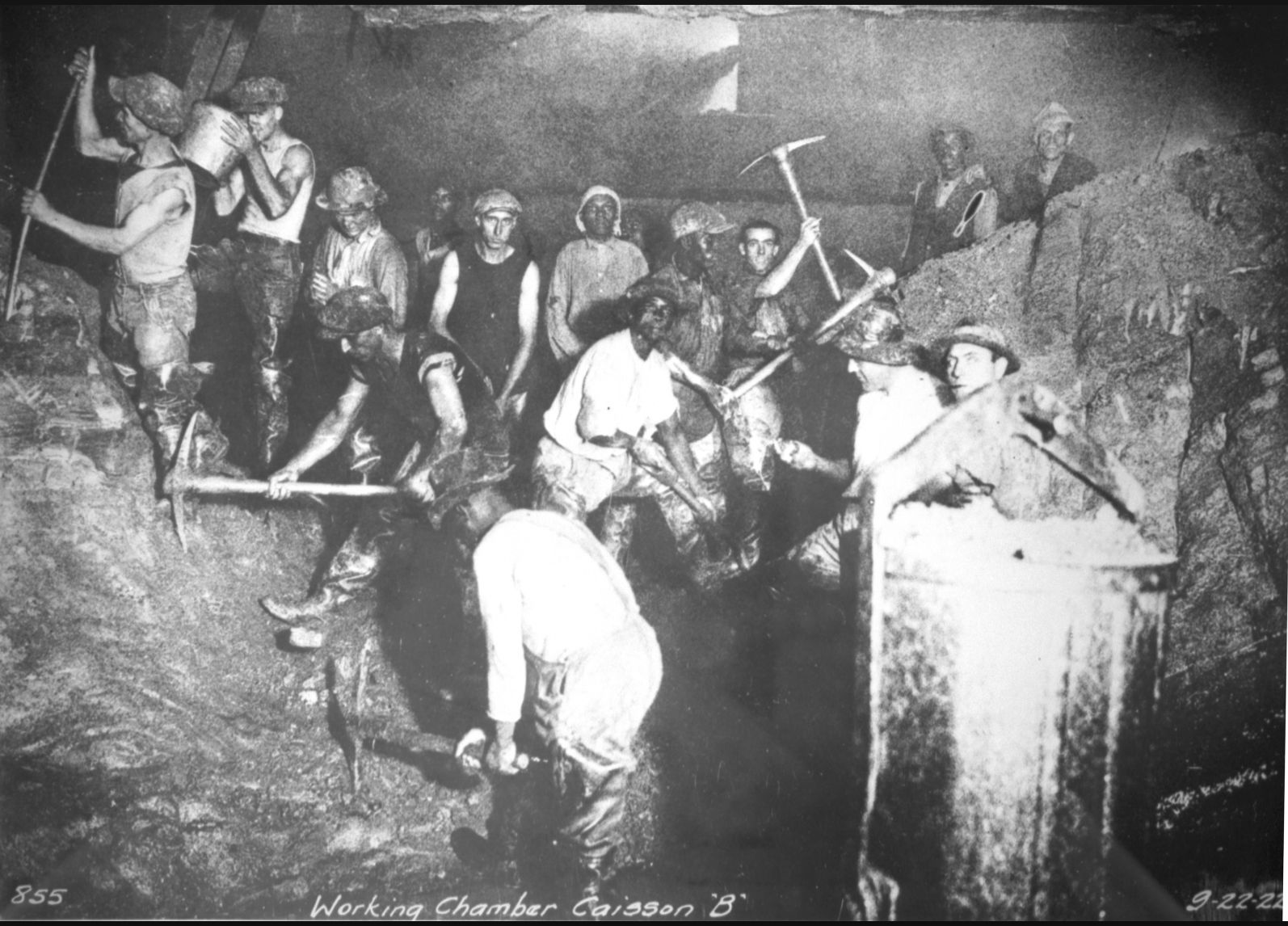
It took $36 million and 1,300 people to build the 376-foot-tall bridge that extends an additional 100 feet or so below the river, Howard said. Guys known as “sand hogs” worked in submerged watertight structures called caissons where temps sweltered into the 90s, even in winter, to dig down to the bedrock of the Delaware River.
In a photo dated 1922, men known as “sand hogs” work in a submerged watertight structure called a caisson to dig down to the bedrock of the Delaware River during the construction of the Benjamin Franklin Bridge.
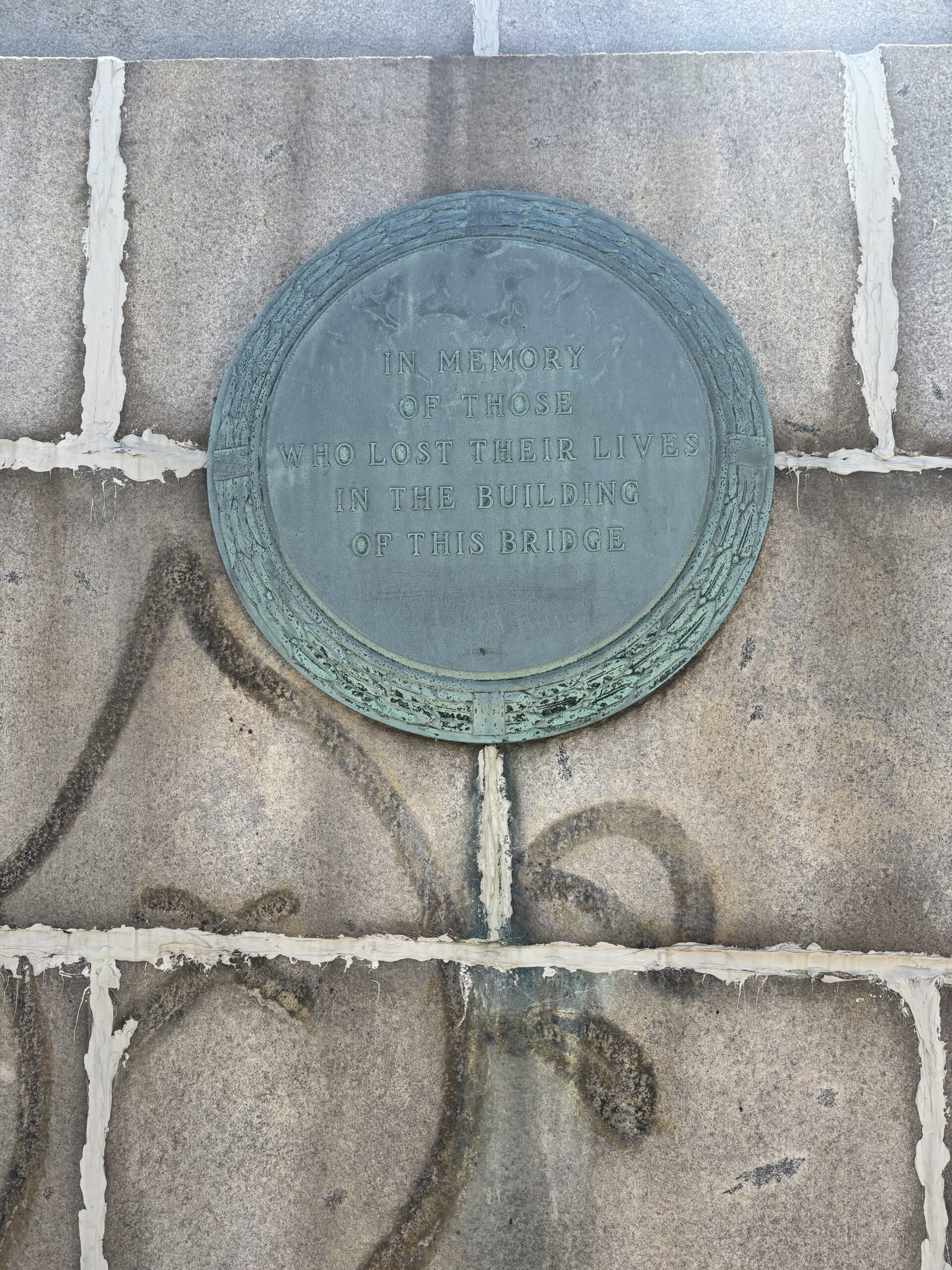
Fifteen workers died in the construction of the bridge. We passed a circular plaque in their memory as we walked. I wondered who they were, how they died, and how they lived.
“Unfortunately, the rule of thumb at the time was for every million dollars you’re spending, you expect to lose a life … so by that rationale you could have had 36 fatalities.” Howard said. “Nowadays, you know, one injury is unacceptable.”
A plaque on the Benjamin Franklin Bridge is dedicated in memory of those who lost their lives while building it.
Unique elements
Our pace was a steady stroll, so we were often passed by runners, walkers, and cyclists. Some appeared to be having a good time, and others looked like they were going through tough times. Some talked to themselves and some stopped to take photos. It was a microcosm of Philly and Camden, suspended high above the river.
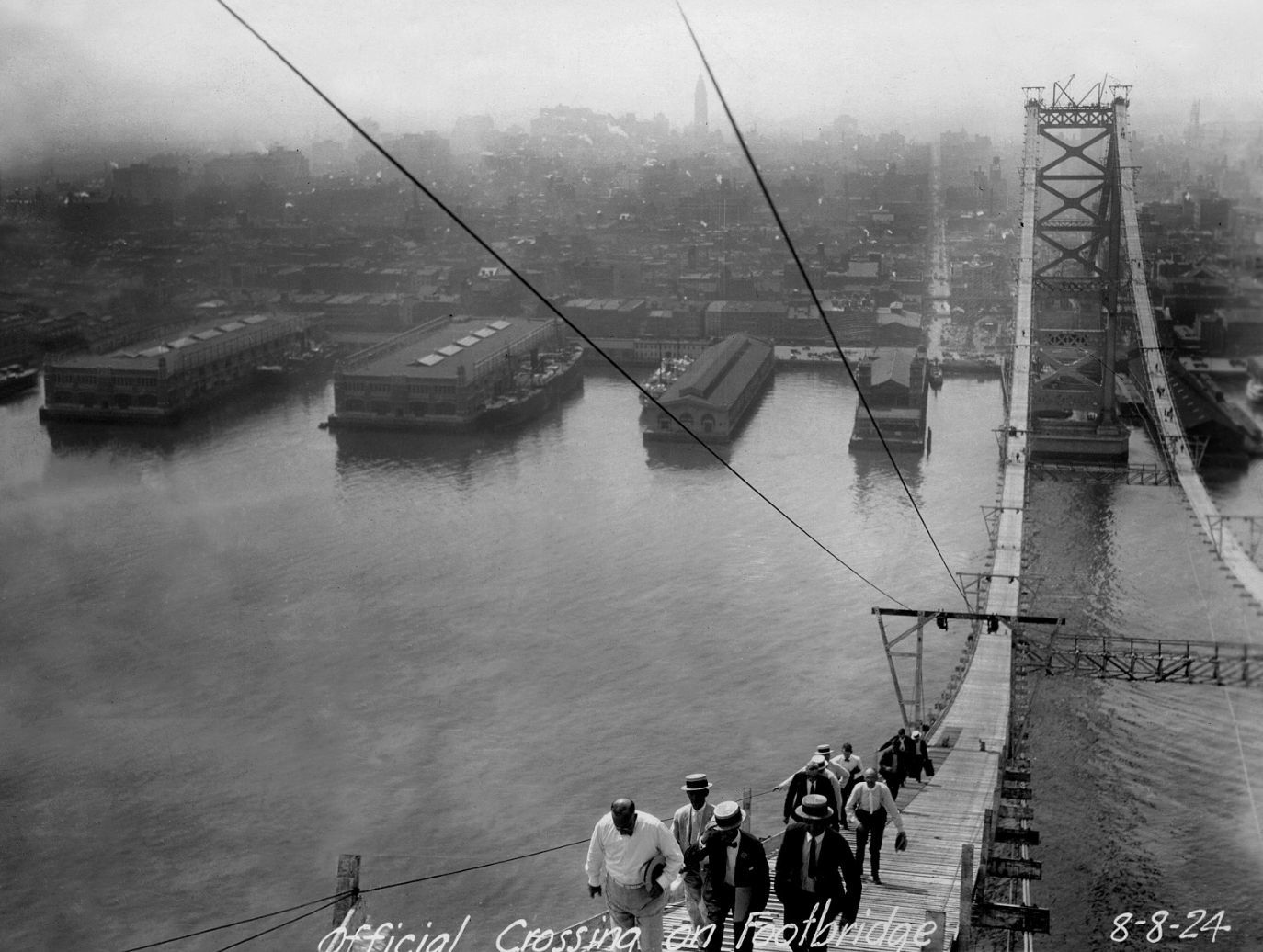
Howard said when the bridge was built, its chief engineer believed the walkways wouldn’t be used “in an increasingly or completely motorized age.”
A photo dating from 1924 shows the first official crossing of the Benjamin Franklin Bridge’s pedestrian walkway prior to the 1926 opening of the bridge.
“But you see today the amount of people that are using this walkway and it’s one of the unique elements of this bridge,” he said.
I looked ahead to Camden and then back to Philly. I was so grateful for this walkway and this view. I couldn’t imagine not having it and I couldn’t believe it took me so long to see the city from this new perspective.
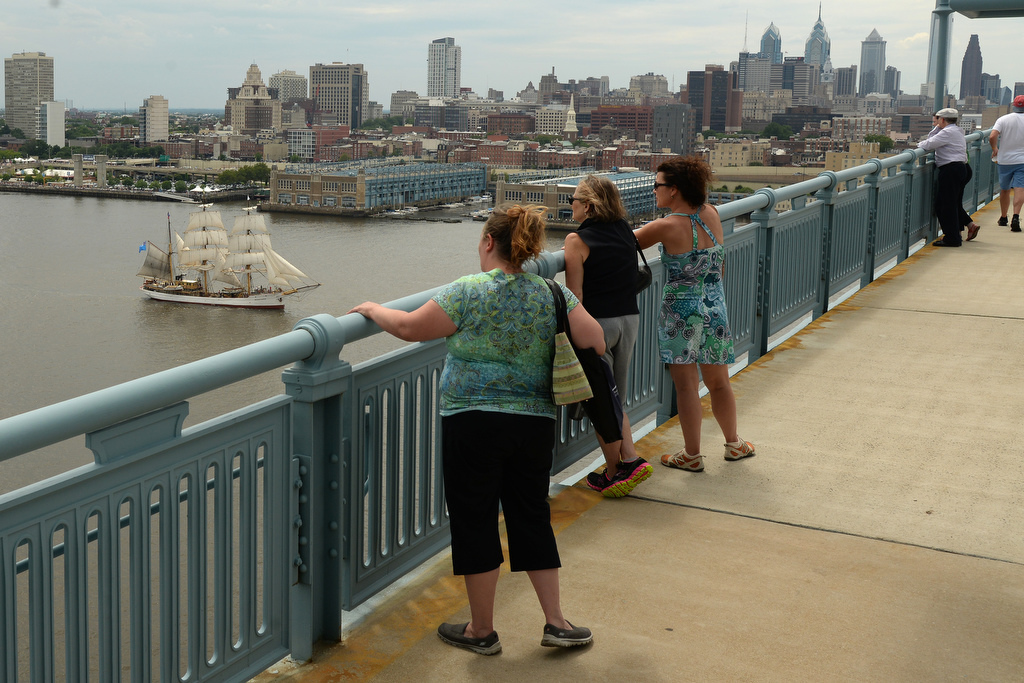
Spectators watch from the Ben Franklin Bridge pedestrian walkway as the Picton Castle sails up the Delaware River in 2015 during the Parade of Tall Ships.
The only thing I found worrisome and the thing that kept all three of us looking over our shoulders, were the e-bike and e-scooter riders we didn’t always hear zooming behind us. Skateboards and rollerblades aren’t allowed, but certain classes of e-bikes and e-scooters are. Gas-powered vehicles are also prohibited on the walkway, but a guy on a dirt bike definitely zoomed by at one point.
In the bridge’s early days, horses and carriages were allowed on the main span alongside cars, according to Howard, but their slow pace proved dangerous and their excrement, troublesome, so they were banned in the 1940s.
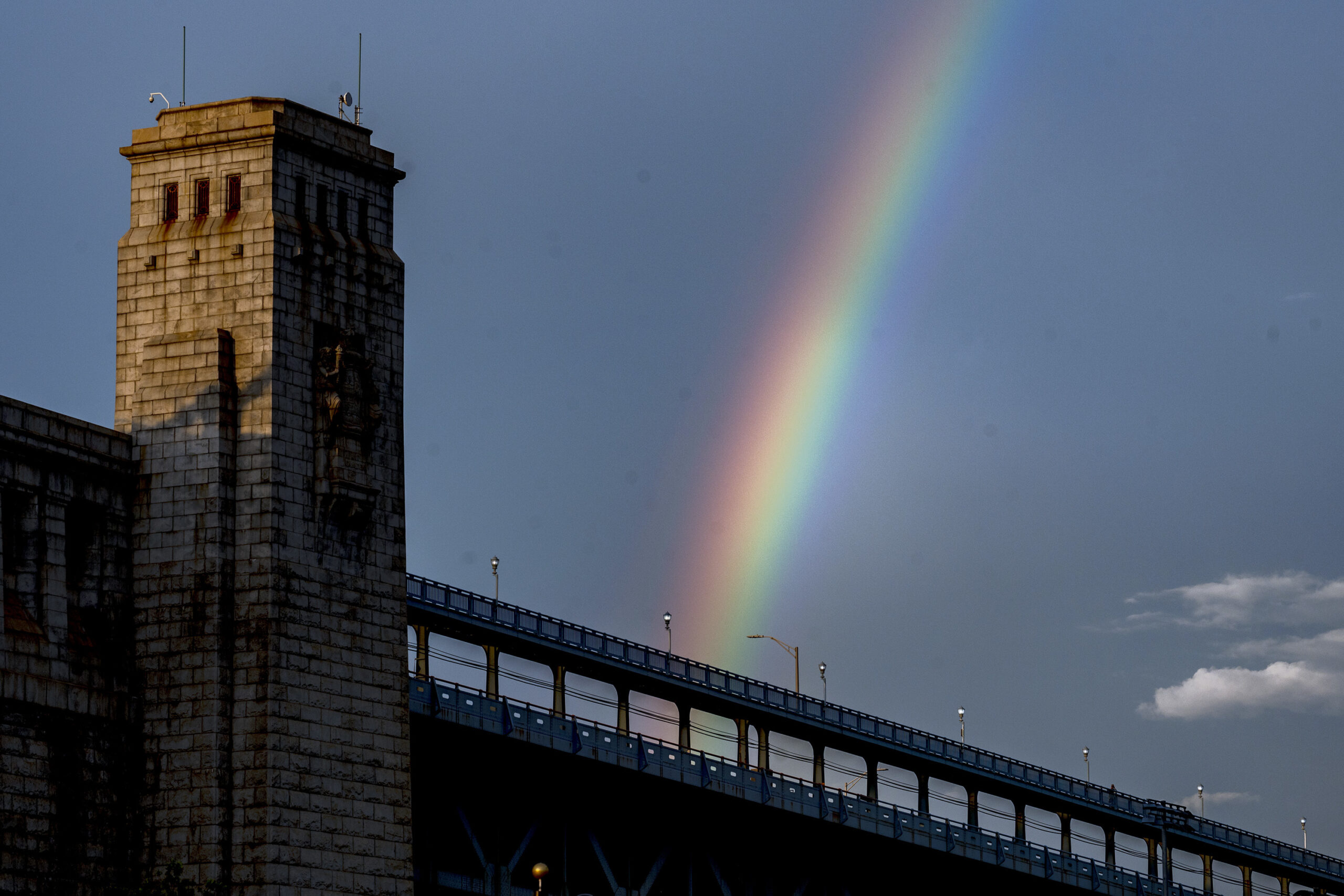
A rainbow appears behind the Camden anchorage of the Ben Franklin Bridge after an early evening rainstorm passes through.
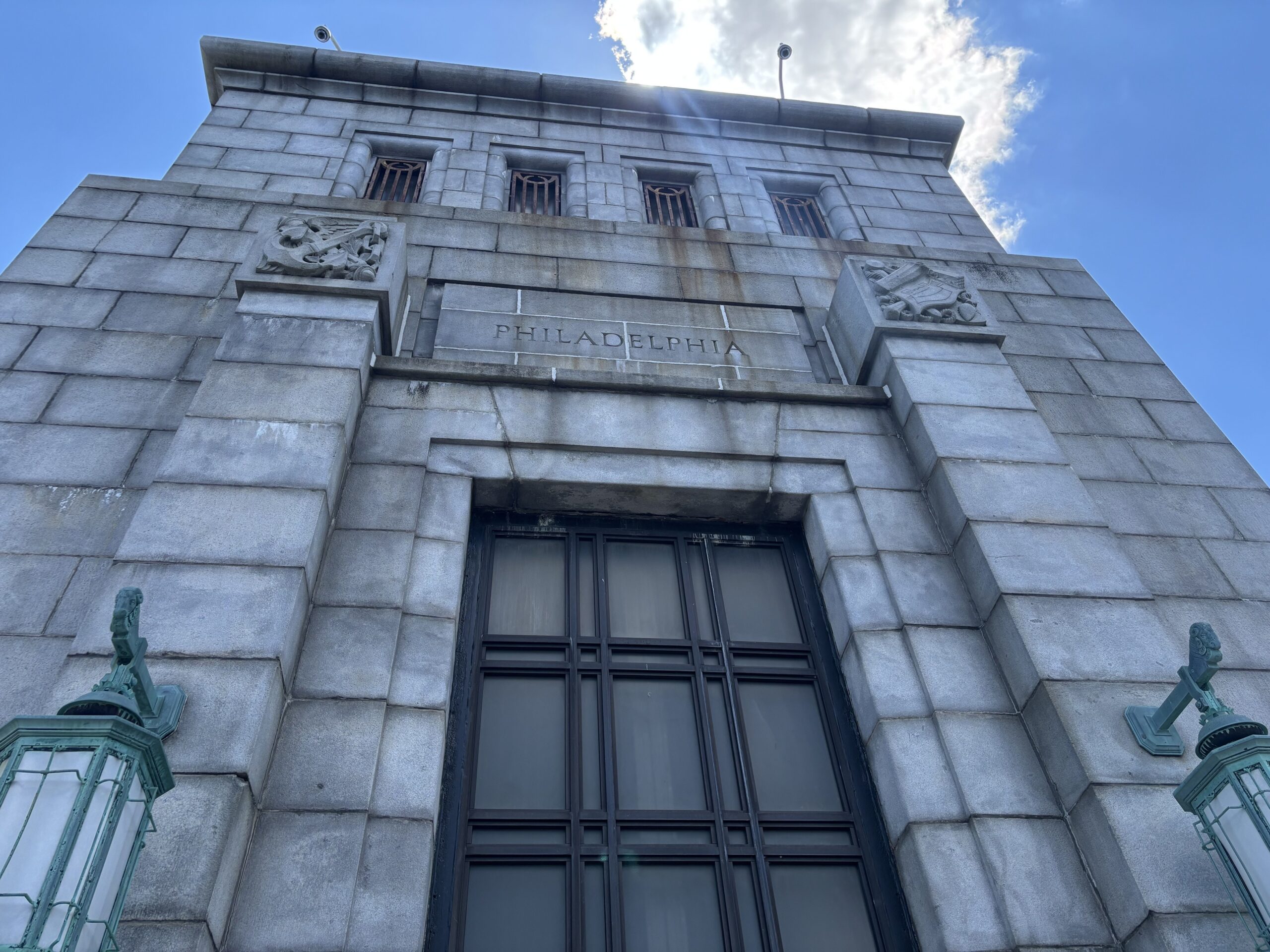
We stopped at one of the Philadelphia anchorages, the massive concrete-and-granite structures where the bridge’s cables are anchored.
These structures were made to house elevators for the trolleys. Alas, the anchorages are off-limits spaces, but Howard told me that each of the four have the same seven artistic tiles inside commemorating milestones in transportation, from one of a Conestoga wagon to one of the USS Shenandoah, the ill-fated dirigible that crashed before the bridge even opened.
One of the anchorages on the Philadelphia side of the Benjamin Franklin Bridge as seen from the pedestrian walkway.
Another name
The Ben Franklin Bridge was the longest suspension span in the world, with a distance of 1,750 feet between the two towers, when it opened on July 1, 1926.
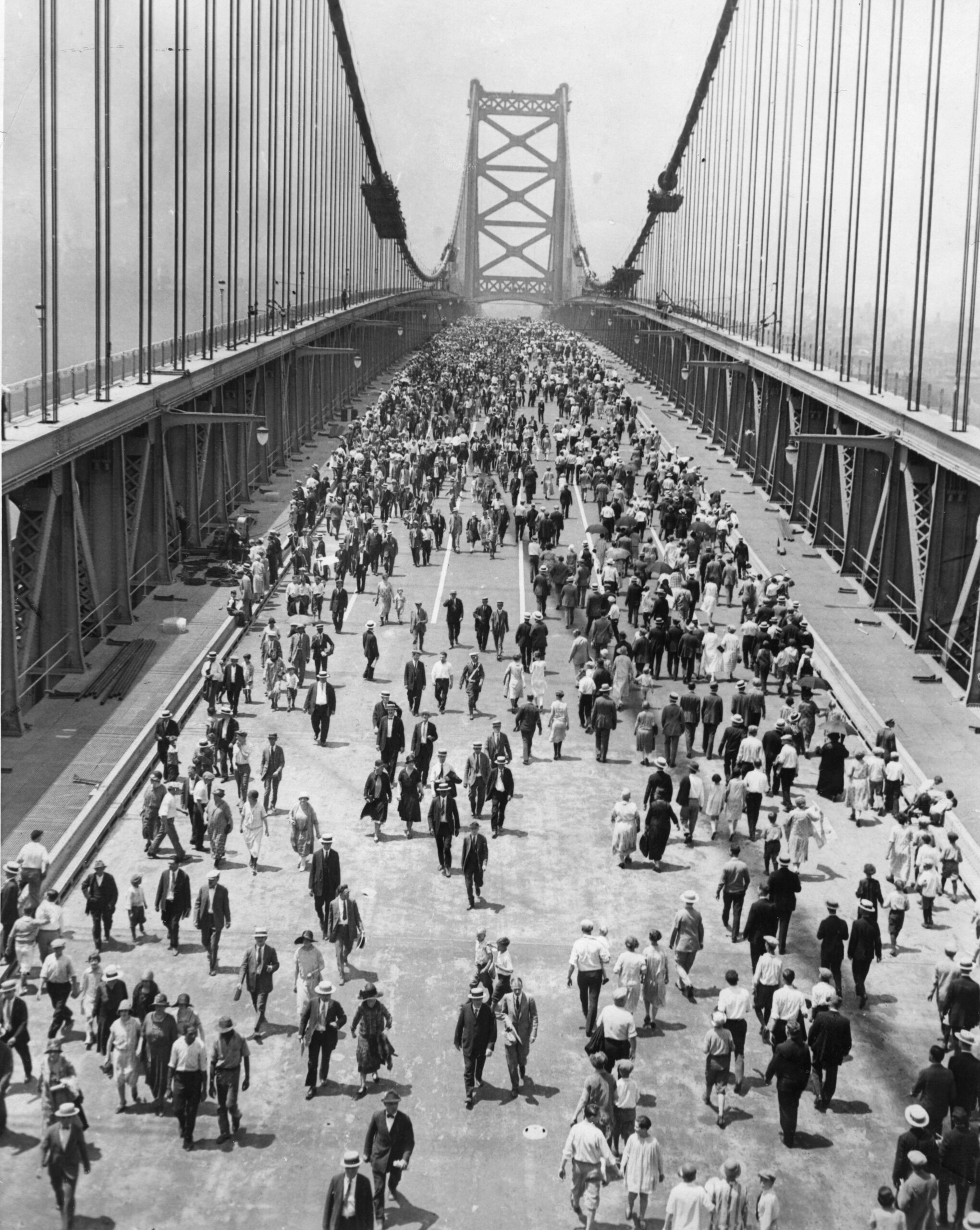
In a front-page Inquirer report, journalist Richard J. Beamish noted 250,000 people crossed the bridge on foot opening day and that the structure was “beautiful as gossamer web and seemingly as frail.”
Pedestrian cross the Delaware River Bridge on its opening day in 1926.
Howard, who quoted that report to me, then asked: “When do you think our first accident was?”
I guessed July 2, 1926. I guessed wrong.
“It was the day it opened,” he said. “People were jockeying to be one of the first to cross the bridge, and over in Camden, you had a fender bender.”
Back then, the span also had a different name — the Delaware River Bridge. It was rechristened in 1956 to avoid confusion when the Walt Whitman Bridge was also built over the Delaware River.
A view of the Benjamin Franklin Bridge in the 1950s.
The Ben Franklin Bridge wasn’t always blue, either. It was originally gray and was repainted to its current color just ahead of the Bicentennial, Howard said.
‘Calm and serene’
As we stood talking, a man jogging by in Rocky Run T-shirt asked if we’d take a photo of him with the Philly skyline.
Jim Bach of Voorhees works in Camden and likes to run the bridge during his lunch break.
“It’s fantastic. I mean the views that you get when you’re up here, it’s just calm and serene,” he said.
I too felt serene. It was quiet and peaceful on the bridge and being atop it helped me see the city I love in a new way.
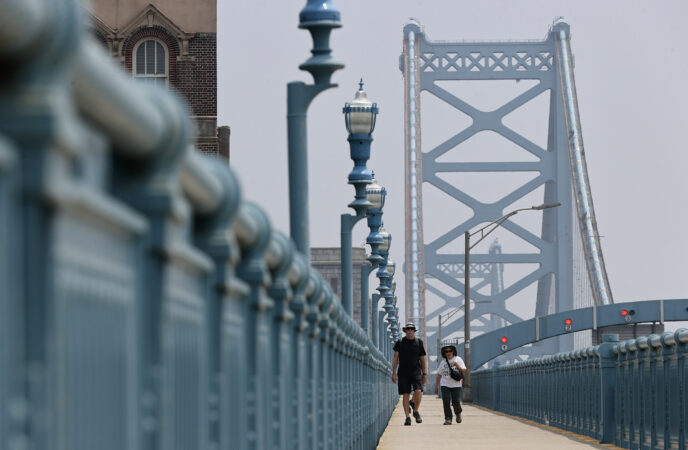
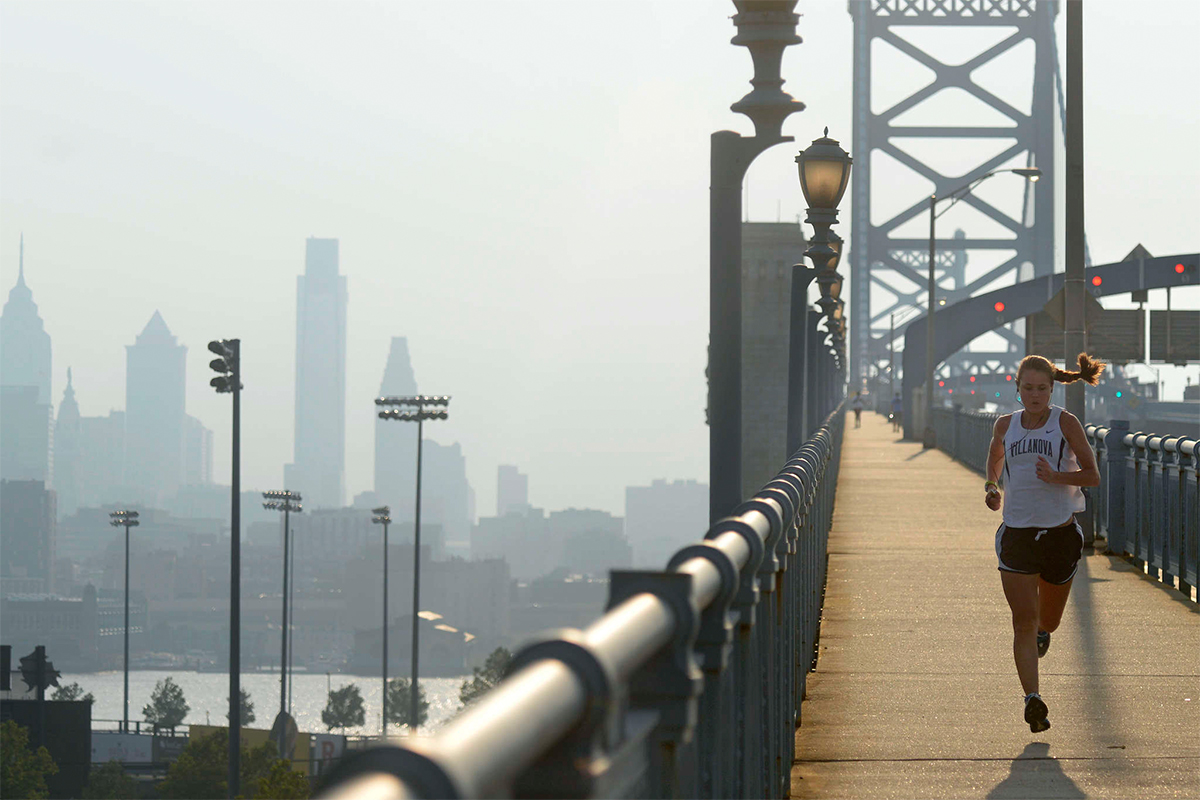
A jogger runs across the Ben Franklin Bridge in an Inquirer file photo.
Howard also helped me to see something else — the Betsy Ross, Walt Whitman, and Commodore Barry Bridges are all visible from the top of the Ben Franklin.
“All bridges essentially become monuments to the area,” he said. This was most true of the one we were standing on.
We talked about the Ben Franklin’s many appearances in television and movies, from Blow Out to 12 Monkeys.
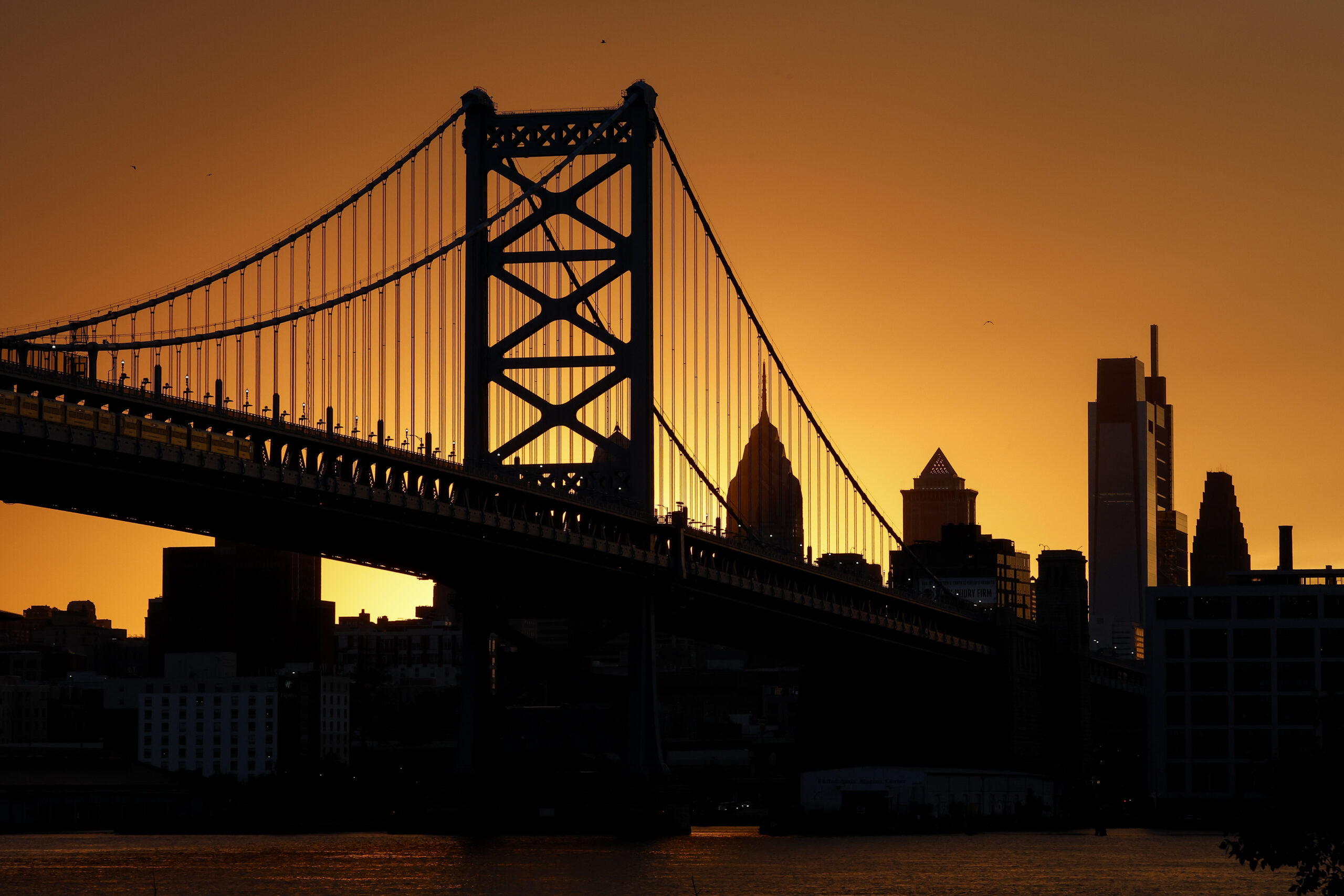
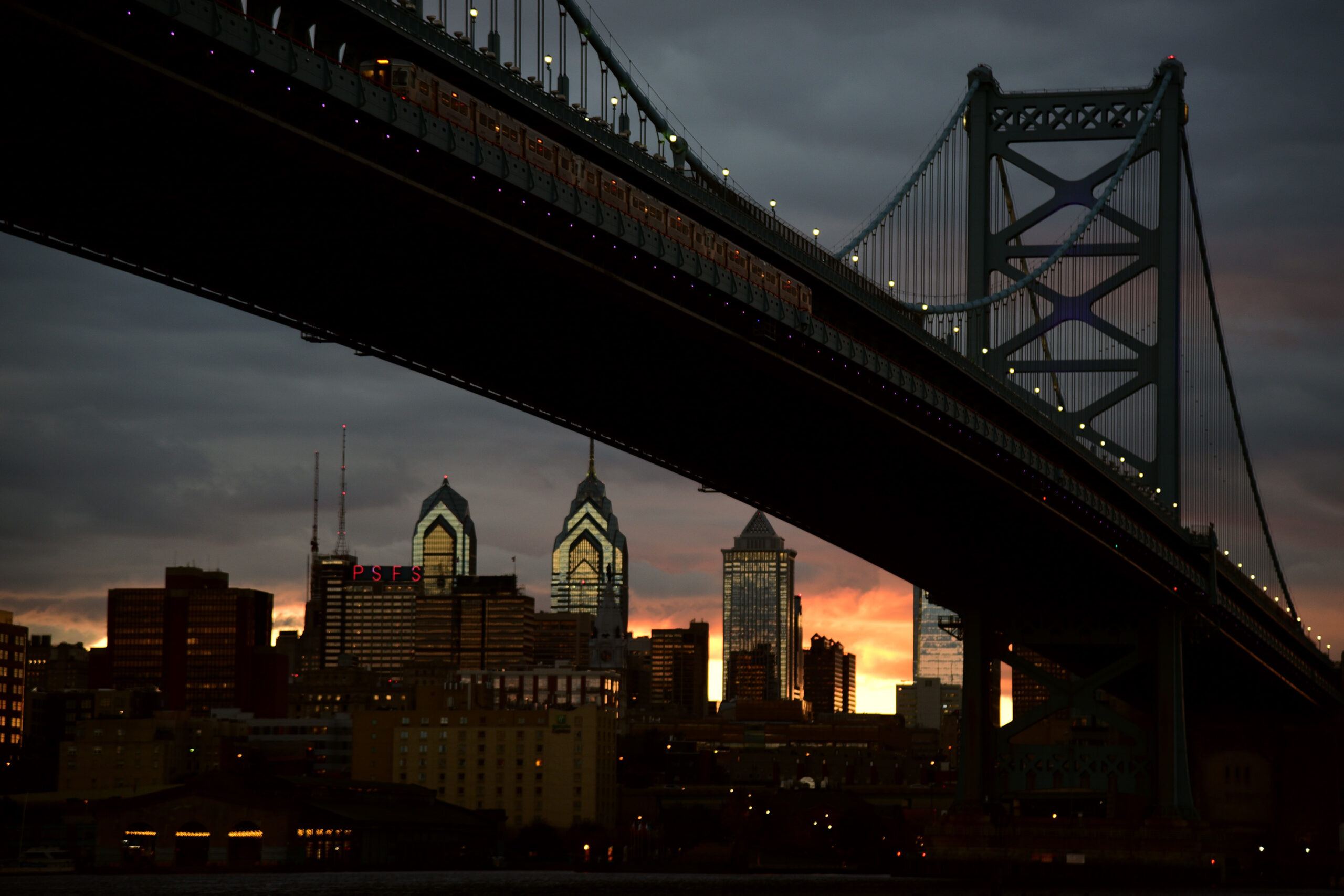
The sun sets behind the Ben Franklin Bridge, seen from Cooper’s Poynt Park on Tuesday, Sept. 30, 2025 in Camden, NJ.
“Last year they kept coming back from commercial breaks during Monday Night Football and they showed one of three things — the Liberty Bell, someone making cheesesteaks, or the bridge,” Howard said.
In its 100 years, the bridge has become a visual touchstone for the region. You see it and you know you’re in Philly, whether you’re watching a movie or coming back from a road trip. It’s given Philly its sense of place as much as the LOVE sculpture or Independence Hall.
A great connector
When we got to Camden, we walked through the pedestrian tunnel on that end, too. It doesn’t have a mural, but the exterior is decorated with a bright mosaic of birds and animals created by Camden schoolchildren in the early 2000s.
A mosaic created by Camden schoolchildren decorates the exterior of the pedestrian tunnel on the Camden side of the Benjamin Franklin Bridge.
On our return walk, I asked Howard if he had a moment on the bridge that’s stuck with him. He said a few years ago, while he was leading a tour, there was a commotion on the Philly side. A kitten found its way onto the bridge and police were called. The feline then crawled into the engine compartment of a police cruiser, which had to be taken apart to get it freed.
“I was like, ‘Yeah, so I gotta go adopt it,’” Howard said.
And so he did, and he named the furry little girl Beanie.
I thought of a poignant moment I had once on the bridge. I was a passenger in a vehicle years ago, when I looked over and saw that the car I was in was traveling at relatively the same speed as the PATCO train next to us.
The sun sets over the Philadelphia Skyline behind the Benjamin Franklin Bridge looking southwest from Cooper’s Point Waterfront Park in Camden in this Inquirer file photo.
I locked eyes with a woman on the train, who looked a lot like me. We smiled at each other and I waved and she waved back. It’s a brief moment that’s always stuck with me. Maybe it’s because I felt like I could have been her in another life, or she could have been me.
Walking the bridge and hearing its stories, I realized that it connects so much more than just Camden and Philly. It connects all of us to each other — in big and small ways — and it connects our future with our history.
Today, I have a new story about the Benjamin Franklin Bridge, the day I walked across it. If you haven’t done so yet, I encourage you to walk it, too, and make a new memory with one of Philadelphia’s great old structures.
A man walks across the Ben Franklin Bridge towards Camden in an Inquirer file photo.
The anniversary celebration for the Ben Franklin Bridge will take place from 10 a.m. to 2:30 p.m. July 11. Details can be found at drpa.org/bfb100/.
Daniel Martino didn’t set out to build an empire of pie shops. He just wanted somewhere to get coffee without leaving the neighborhood.
When he bought his home in Port Richmond in 2013, the closest coffee shop was an hour round trip, he said. “Selfishly, I thought, I can put a little coffee shop here.”
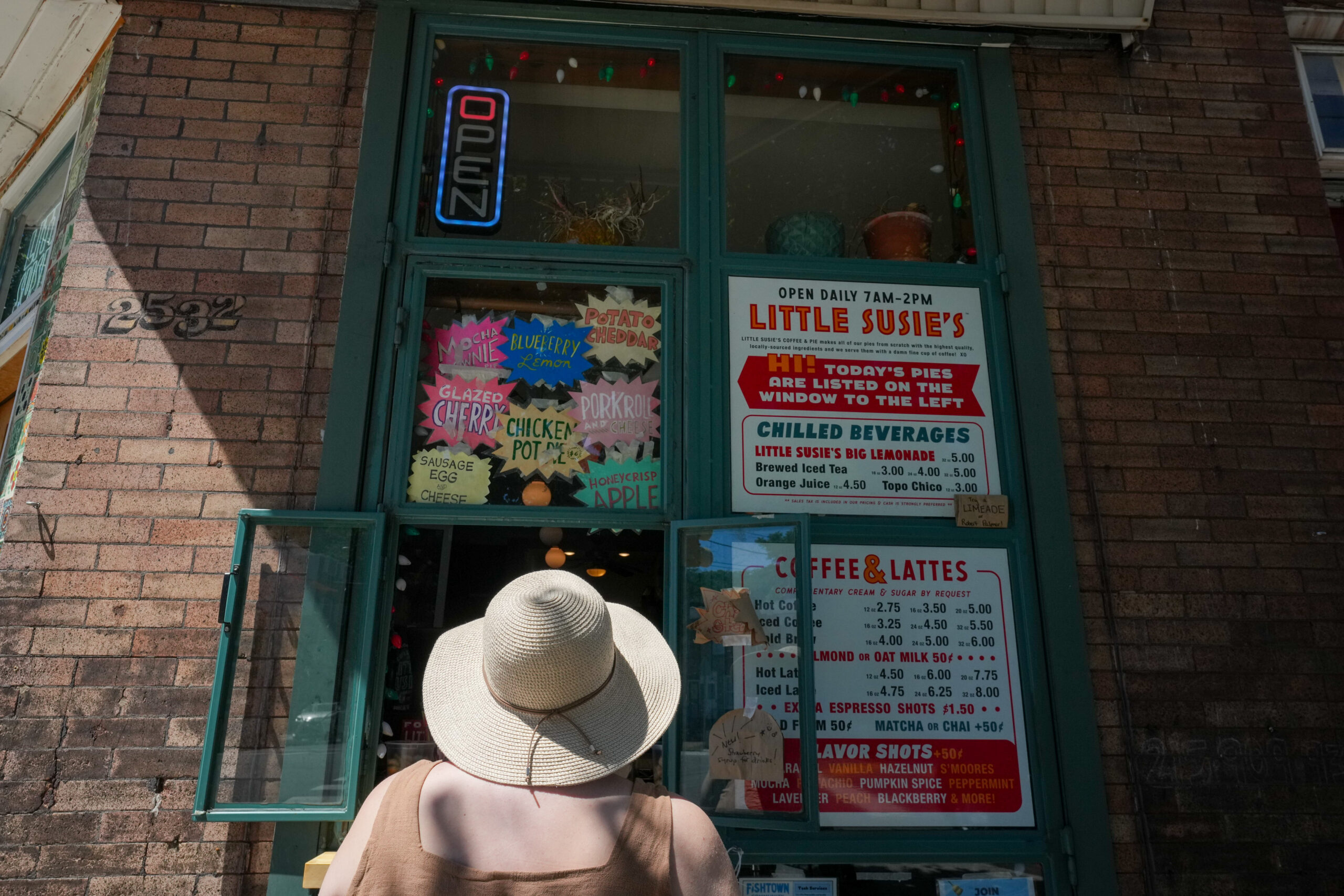
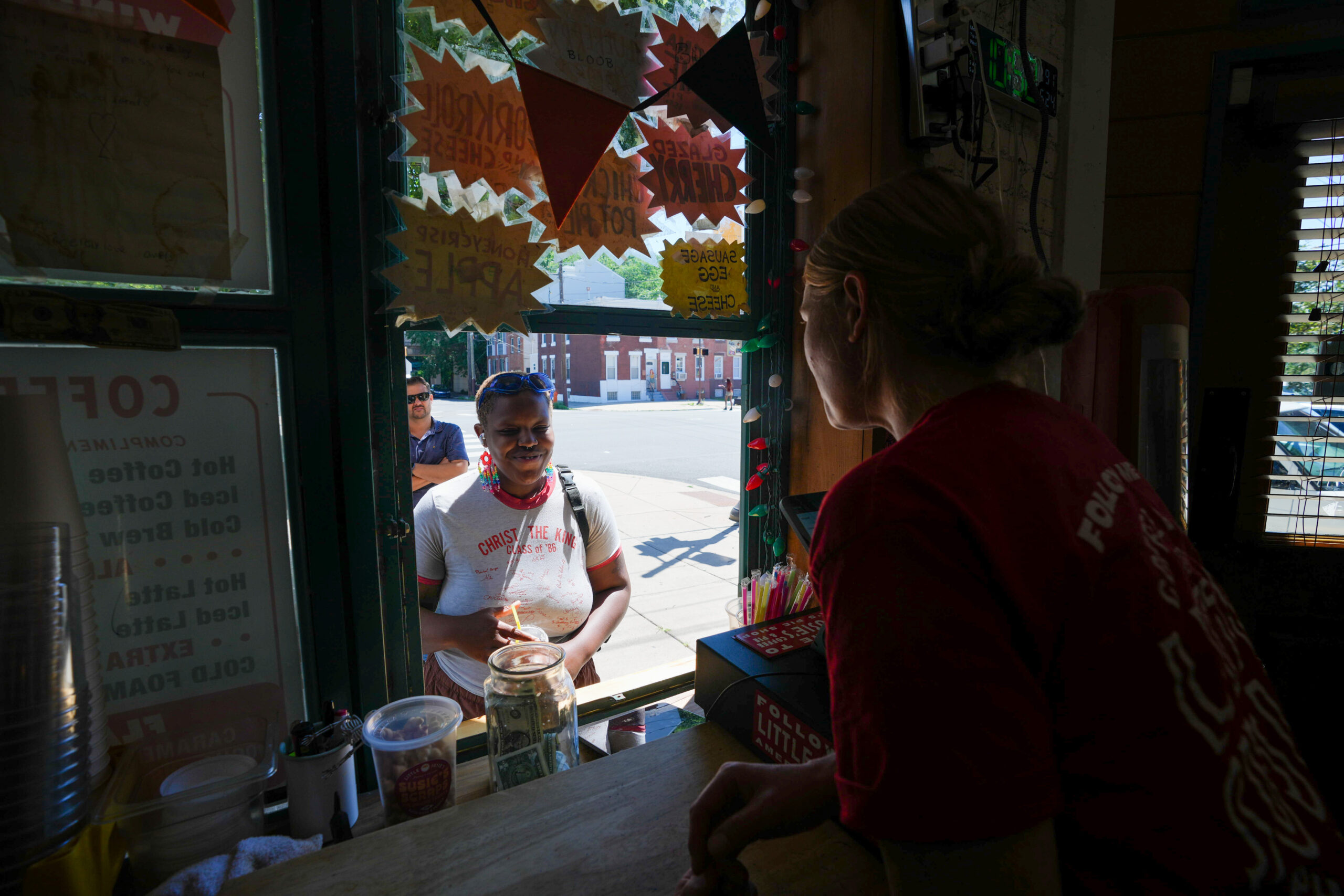
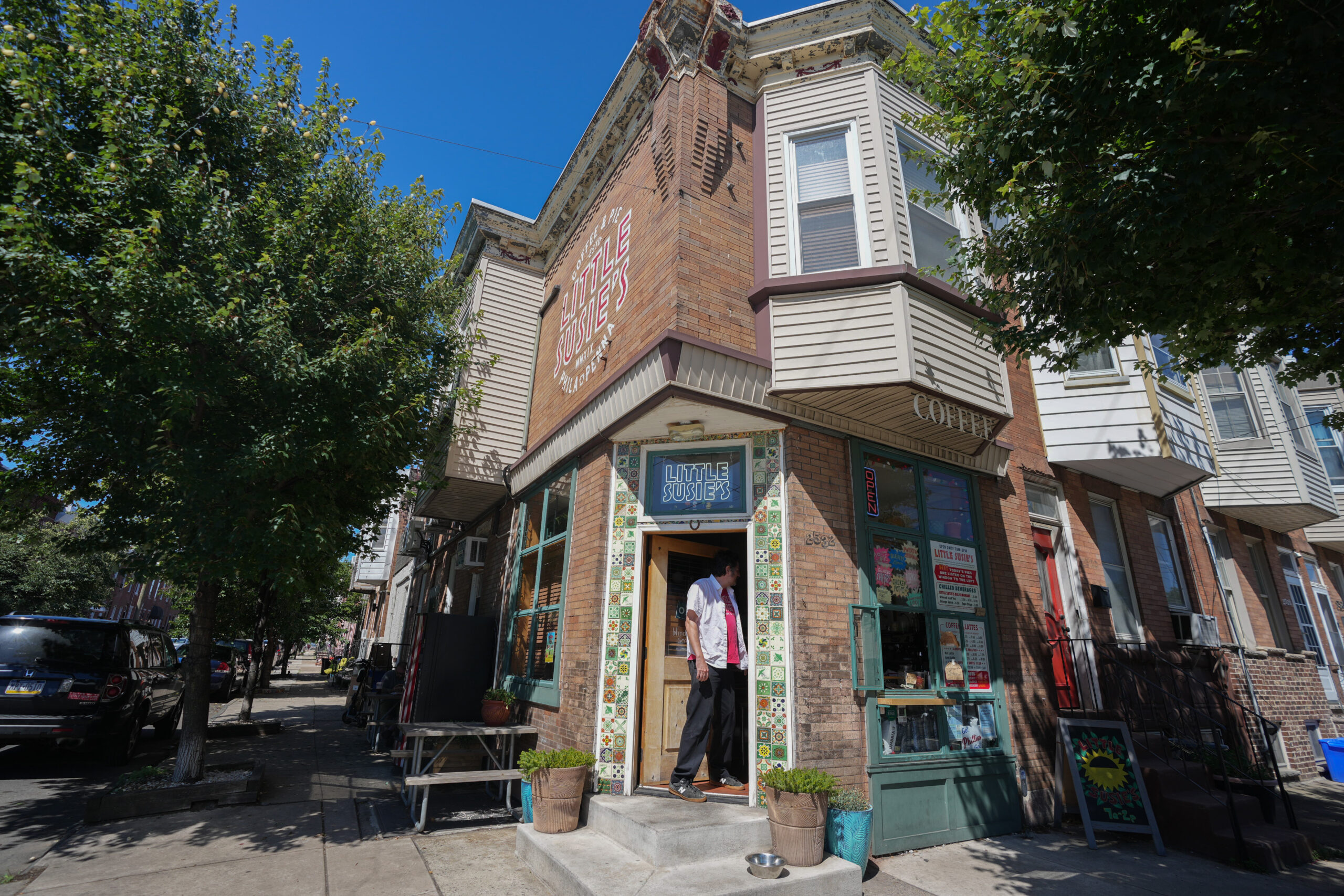
The takeout window at Little Susie’s flagship location at 2532 E. Lehigh Ave.
And what goes better with a cup of coffee than pie? He had a recipe he’d been baking for family get-togethers.
Seven years after Martino opened Little Susie’s Coffee & Pie in the building next door to his house, his modest idea has grown into four Philadelphia locations, with a fifth expected to open Friday at the former Pop’s Bun Shop in Bella Vista, a franchise headed to Milwaukee, and plans for additional shops in Fairmount and Northern Liberties. All his stores run from takeout windows, requiring little more than coffee stations and electric ovens.
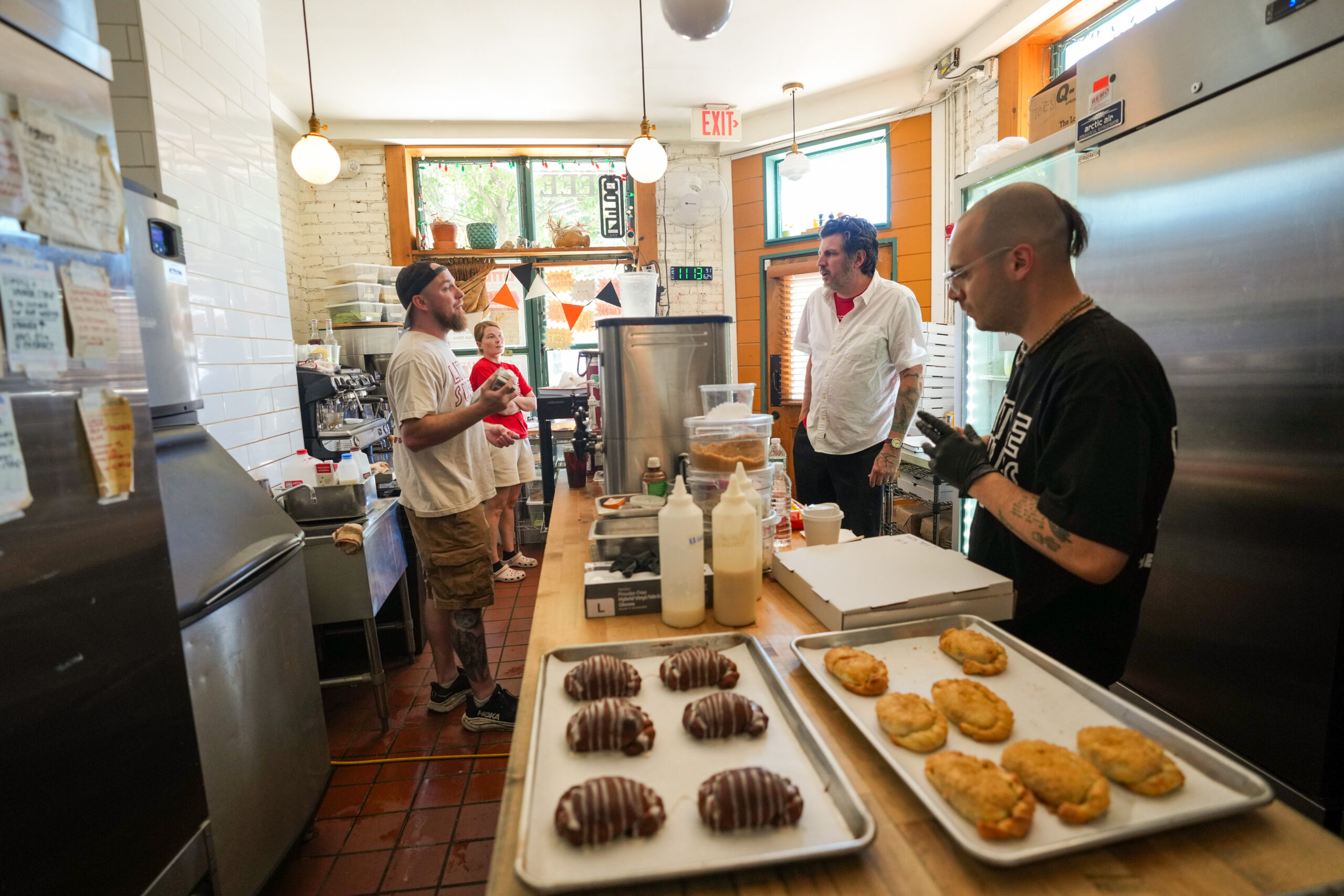
Today, the company employs 28 people and turns out about 1,200 pies a day from a bakery occupying two cramped rooms in the corner rowhouse on Lehigh Avenue.
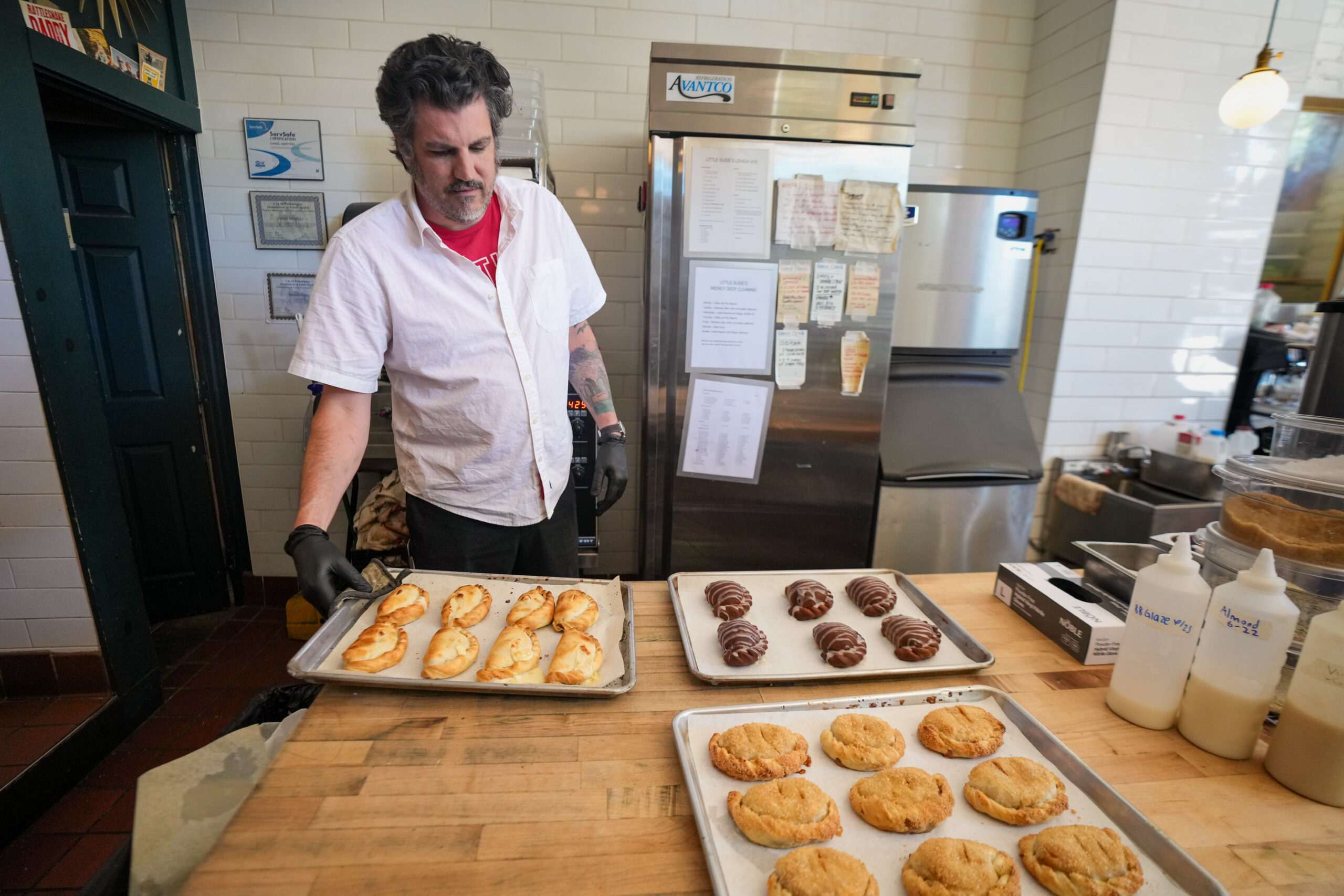
Owner Daniel Martino with trays of pies at Little Susie’s.
Martino, 46, who grew up in Northeast Philadelphia, has spent much of his working life around food. As a teenager, he worked at a swim club snack bar before taking a kitchen job at what is now Jefferson Torresdale Hospital.
After studying film at Temple University, he joined Public House Investments, which ran City Tap House, as a DJ before becoming the hospitality company’s creative director, designing menus, logos, ads, and marketing material.
When the property next door to his house became available, Martino said he used a home-equity line of credit to buy it before securing a Small Business Administration loan to renovate it.
The takeout window at Little Susie’s. Hand-lettered signs advertise the specials.
By the time Little Susie’s opened in December 2019, he said, “I had maxed out every credit card I had. I even had to go to the bank, hat in hand, and sign a signature loan for the last $10,000 just to get it open.”
His shop offered a simple menu, little more than coffees and lattes and four kinds of pies. There was a counter for seating. The first day brought in about $180, and “it was the greatest day of my life,” Martino said.
Then the pandemic arrived. When COVID-19 restrictions shut down indoor dining, Little Susie’s shifted to window service. Customers called in orders, paid over the phone, and picked up coffee and pies outside. Even after restrictions were lifted, the shop never reopened indoors.
It wasn’t what Martino had imagined. His idea was ”Cheers with coffee — the neighbors and the mailman talking about the weather,” he said.
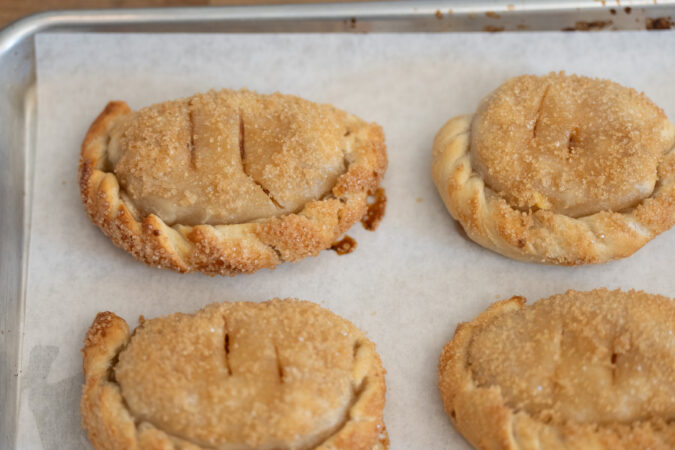
Instead, customers embraced the walk-up model and the seating at a picnic table beneath a maple tree. The pies especially quickly caught on. The signature is the crust. Rather than trimming away the excess dough, workers twist it around each pie by hand, creating what Martino calls “a fluffiness that the fork doesn’t provide — that flaky tenderness you want in a pie crust. The twist is its own special treat in and of itself.”
Owner Daniel Martino (rear, right) with staff and pies at Little Susie’s, set up in a rowhouse.
The pies, which are baked and not fried, are made with a simple crust of flour, butter, sugar, and salt. It’s a 48-hour process. Dough is mixed at the company’s Kensington location, where a 20-quart mixer runs nearly all day. The dough rests for 24 hours before it is brought to Port Richmond, where it is sheeted, filled, twisted, frozen, and delivered to the other stores to be baked to order.
Little Susie’s first menu included only blueberry, pork roll, apple, and mushroom Swiss fillings. Today, it offers about a dozen varieties, with eight available year-round and others rotating seasonally. “You can practically throw anything in this pie crust,” Martino said. “I haven’t been disappointed yet.”
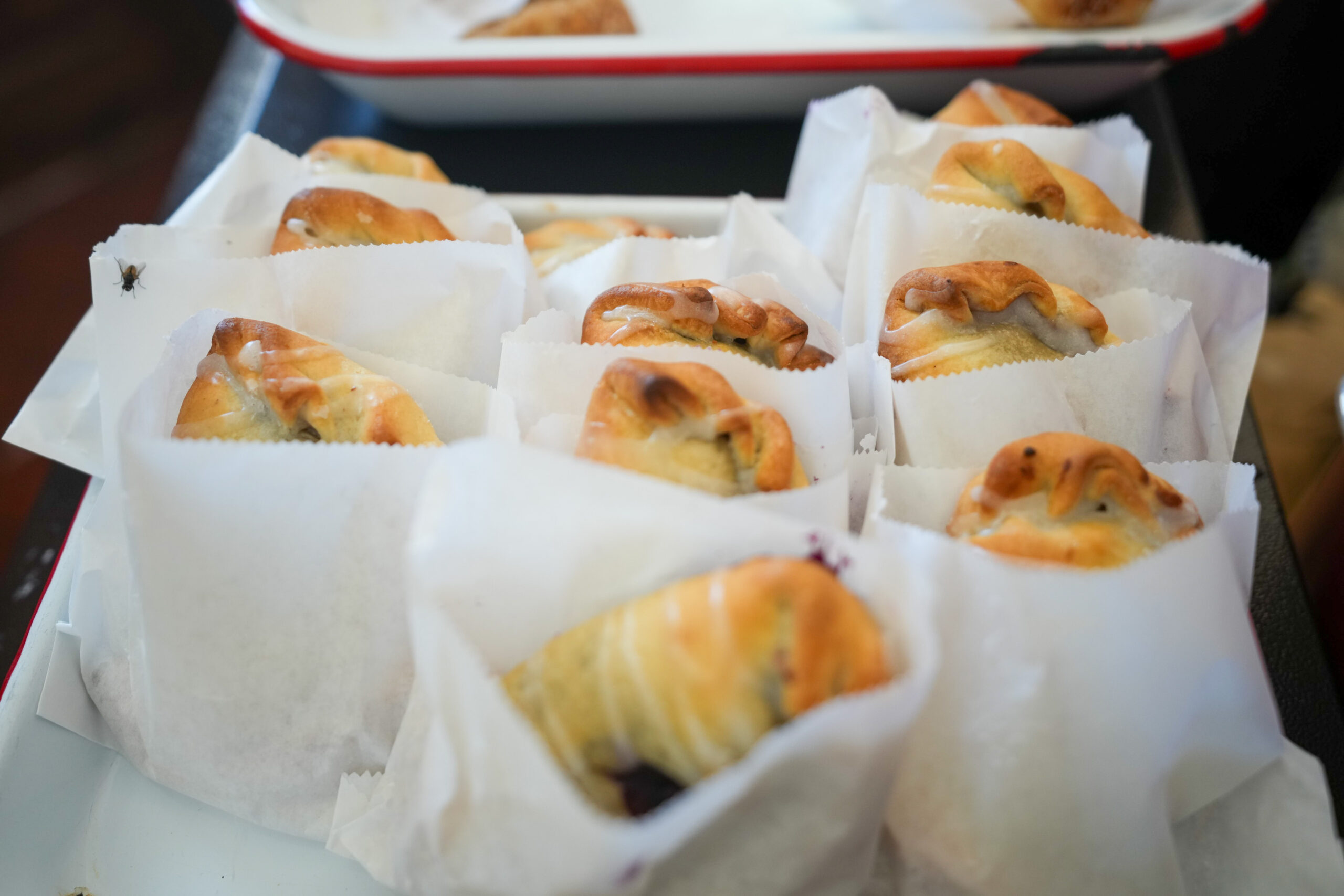
Pies at Little Susie’s.
Pork roll remains the top seller, followed by apple, and a sausage, egg, and cheese breakfast pie encrusted with everything bagel seasoning. Seasonal flavors have included ham and Brie, chocolate-covered strawberry, and Cajun crab and corn. None are gluten-free because of the shop’s limitations, he said.
Not every idea works. “We tried to make a cannoli pie, but the cream just melted right out,” he said.
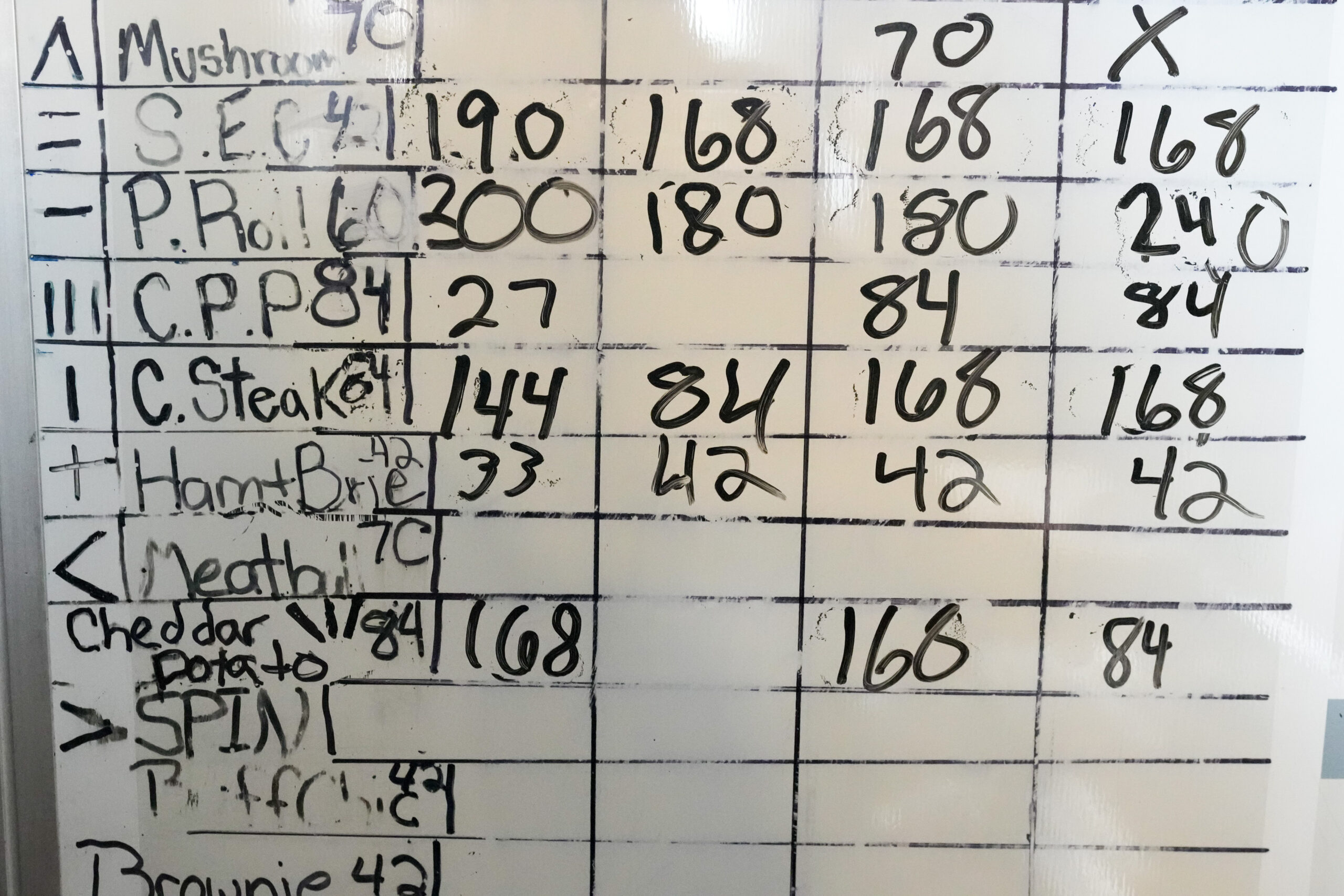
Each shop sells 200 to 300 pies a day. The production kitchen now employs 11 bakers, who track production on a whiteboard nicknamed “the Pieble.” Each variety get its own knife mark on top; an inverted V, for example, denotes mushroom Swiss.
The “Pieble” at Little Susie’s, the flagship pie takeout place located at 2532 E. Lehigh Ave., in Philadelphia, June 24, 2026.
Lena Hurchick, who has worked at Little Susie’s for three years, said she enjoys “the competition of filling all the shops” and watching customers eat pies she helped make.
“Susie” was the name of the dog that belonged to the former owner of the building. “When we had the community meeting here, I said, ‘I’m thinking Little Susie’s,’ and people started crying,” he said.
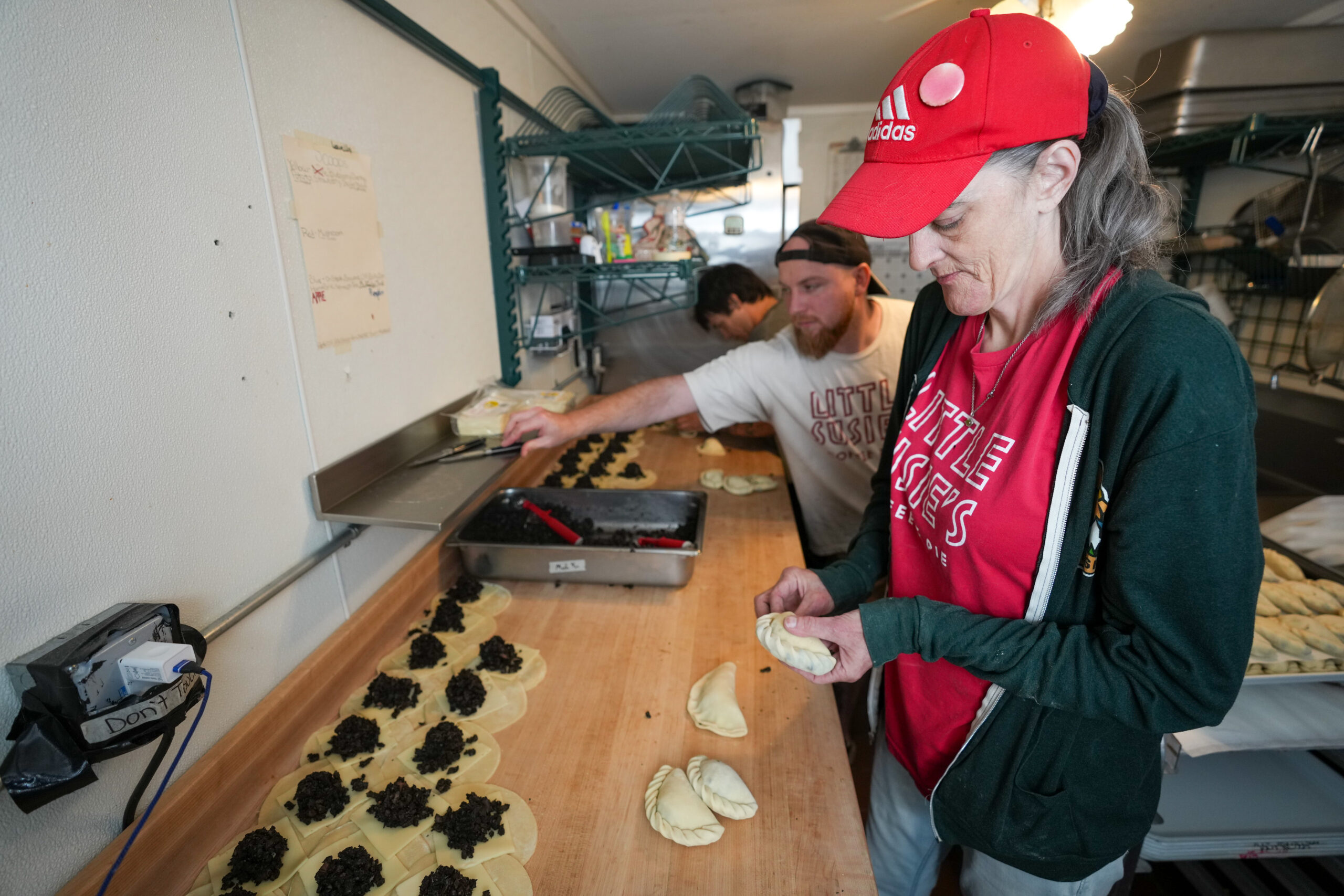
Lena Hurchick crimps mushroom pies at Little Susie’s.
Expansion has brought complications. A planned Fairmount location was nearly ready to open before the city determined that the property required zoning approval for food sales. “The city does not make it easy,” he said, adding that it will take months to get onto the zoning board’s calendar.
Even so, he expects the company to keep growing. He has a handshake deal for a spot in Northern Liberties. Milwaukee is planned as the first franchise — operated by a friend — while Martino has begun thinking about a larger bakery in Philadelphia.
“We’re basically bursting at the seams,” he said. “We’re probably going to need a 10,000-square-foot facility.”
Owner Daniel Martino at Little Susie’s.
He wants that growth to remain slow enough that the pies are still made fresh every day. “I don’t want to get too far away from making them every day, because then it just becomes some frozen-food empire,” he said.
Little Susie’s Coffee & Pies’ locations are at 2532 E. Lehigh Ave. in Port Richmond, Second and Chestnut Streets in Old City, 1772 N. Front St. in Kensington, and 1754 S. Chadwick St. in Point Breeze. A fifth, at 800 S. Ninth St. in Bella Vista, is due to open Friday. Hours are 7 a.m. to 2 p.m. daily.
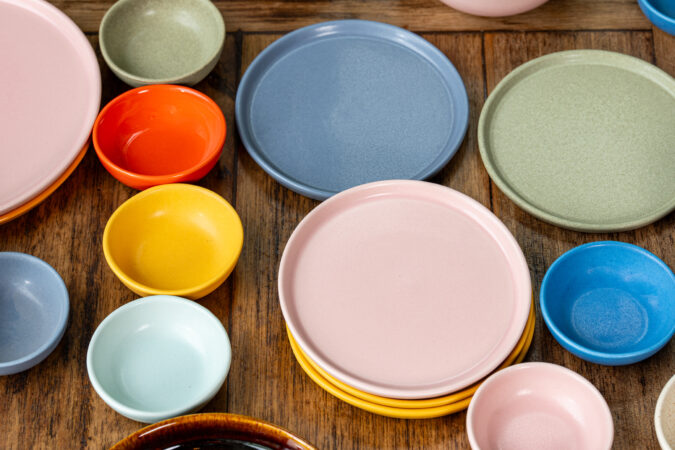
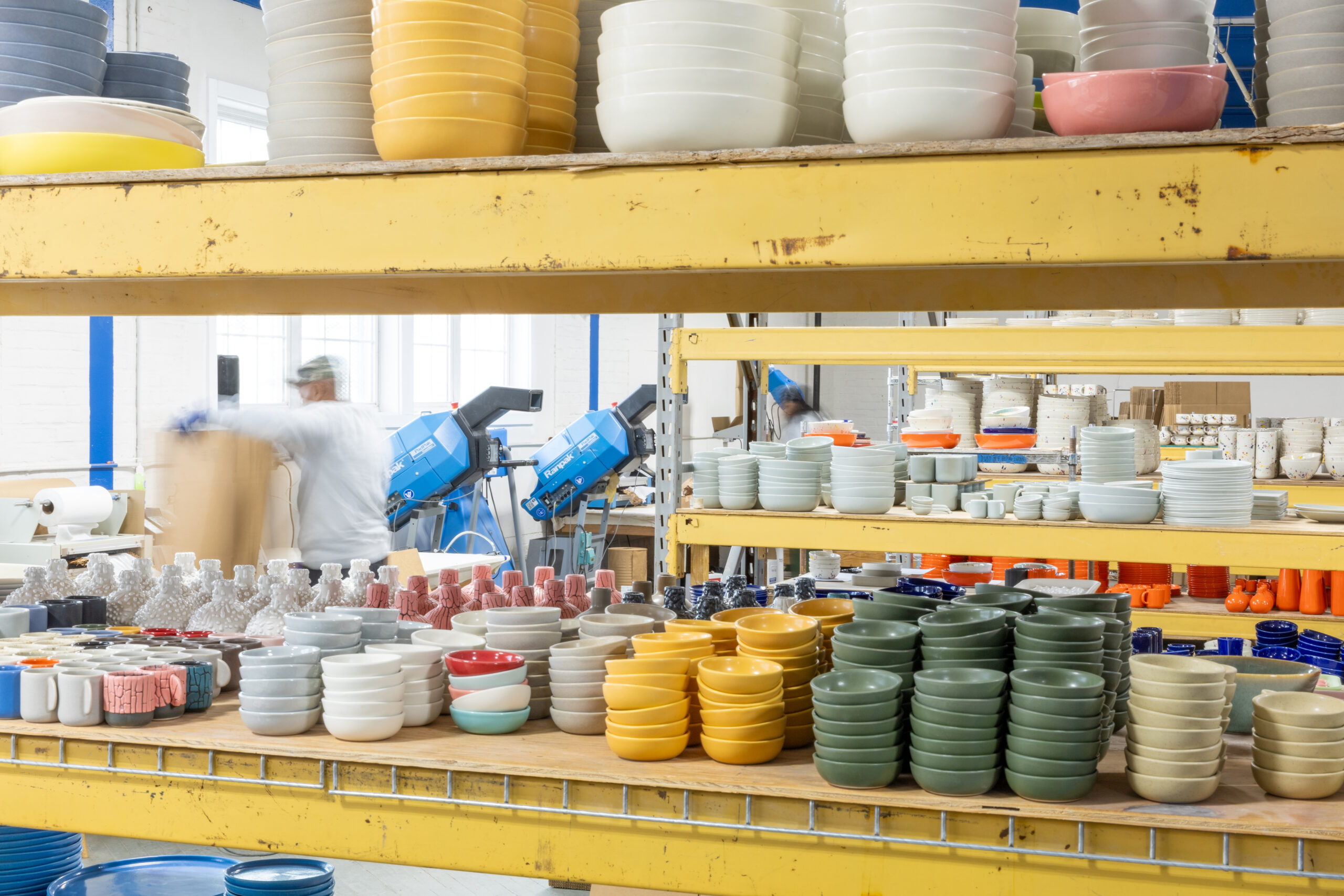
The vibrant, paint-flecked, confetti-esque glazed bowls are Philly icons. But at the end of January, these and hundreds of other ceramic dishes lay in ruins inside Felt and Fat’s kiln.
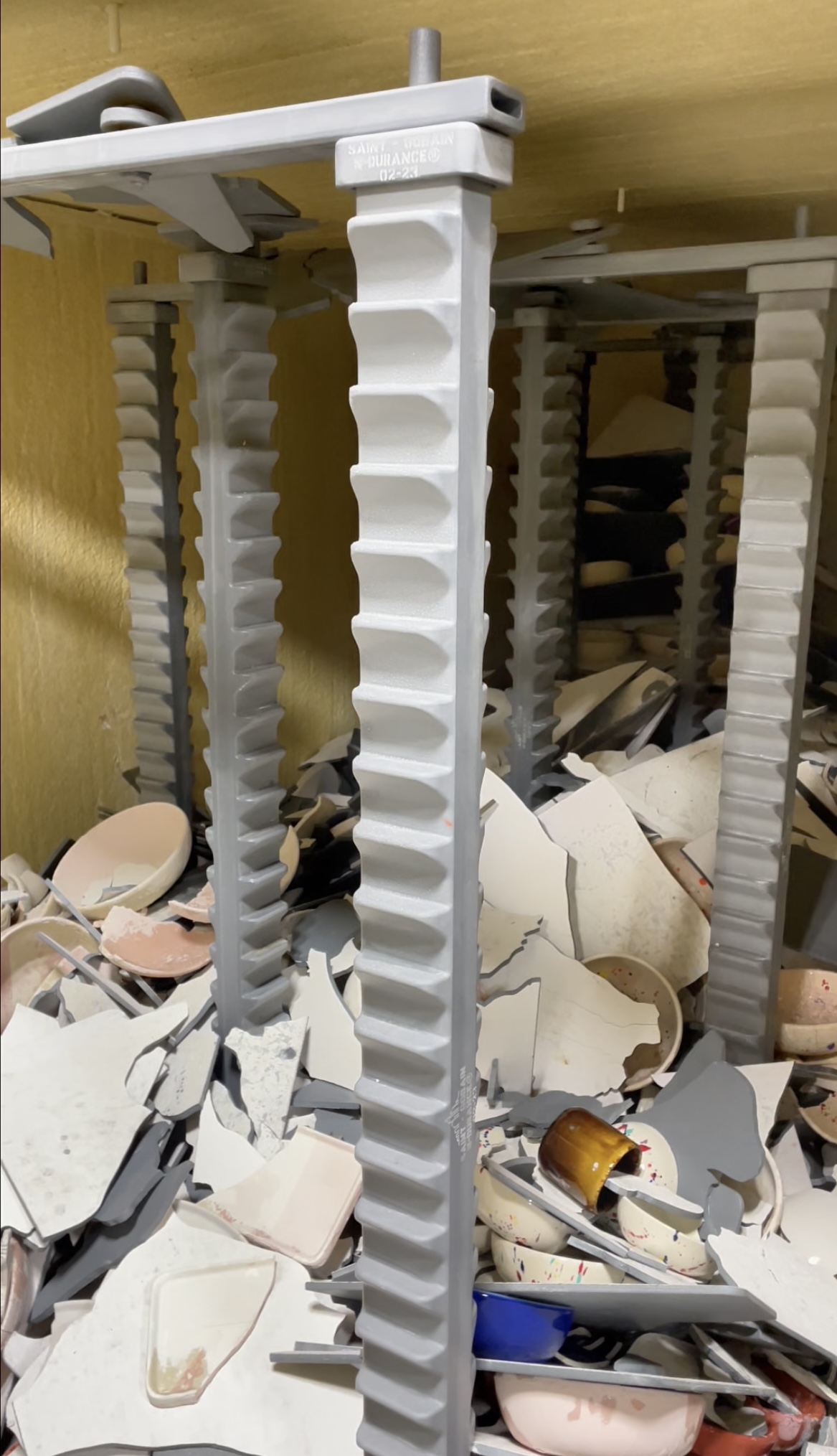
The wreckage after a winter cold snap destroyed Felt and Fat’s kiln in January 2026.
Philly’s back-to-back snowstorms and cold temperatures froze the ceramic producer’s warehouse’s sprinkler lines, causing sprinkler heads to crack.
Mist blanketed Felt and Fat’s kiln — and kilns are not supposed to ever get wet — for 12 hours. The kiln was just over a year old, custom-ordered from the Netherlands. It cost over $300,000 and was the keystone of founder Nate Mell’s plans for expansion.
The kiln took a year to arrive and was outfitted with a specialized rack system that made loading and unloading pieces — up to 250,000 per year — easy.
“The kiln company told us they couldn’t repair it and with high-pressure gas going into the kiln, even if they could, they couldn’t speak for it in terms of liability,” said Mell, 40. The electrical components were all soaked and frozen. The inside was completely destroyed. “We still haven’t quantified our revenue loss,” he said, despite getting his old kiln back in use about a month after the disaster.
The kiln explosion came on the heels of Felt and Fat filing for Chapter 11 bankruptcy. “We were really struggling in 2024 and 2025, which was a terrible time to raise money. The early 2020s for us were all about growth,” said Mell.
To get out of bankruptcy, Mell had to come up with a reorganization plan for his creditors. It required getting back to Felt and Fat’s roots.
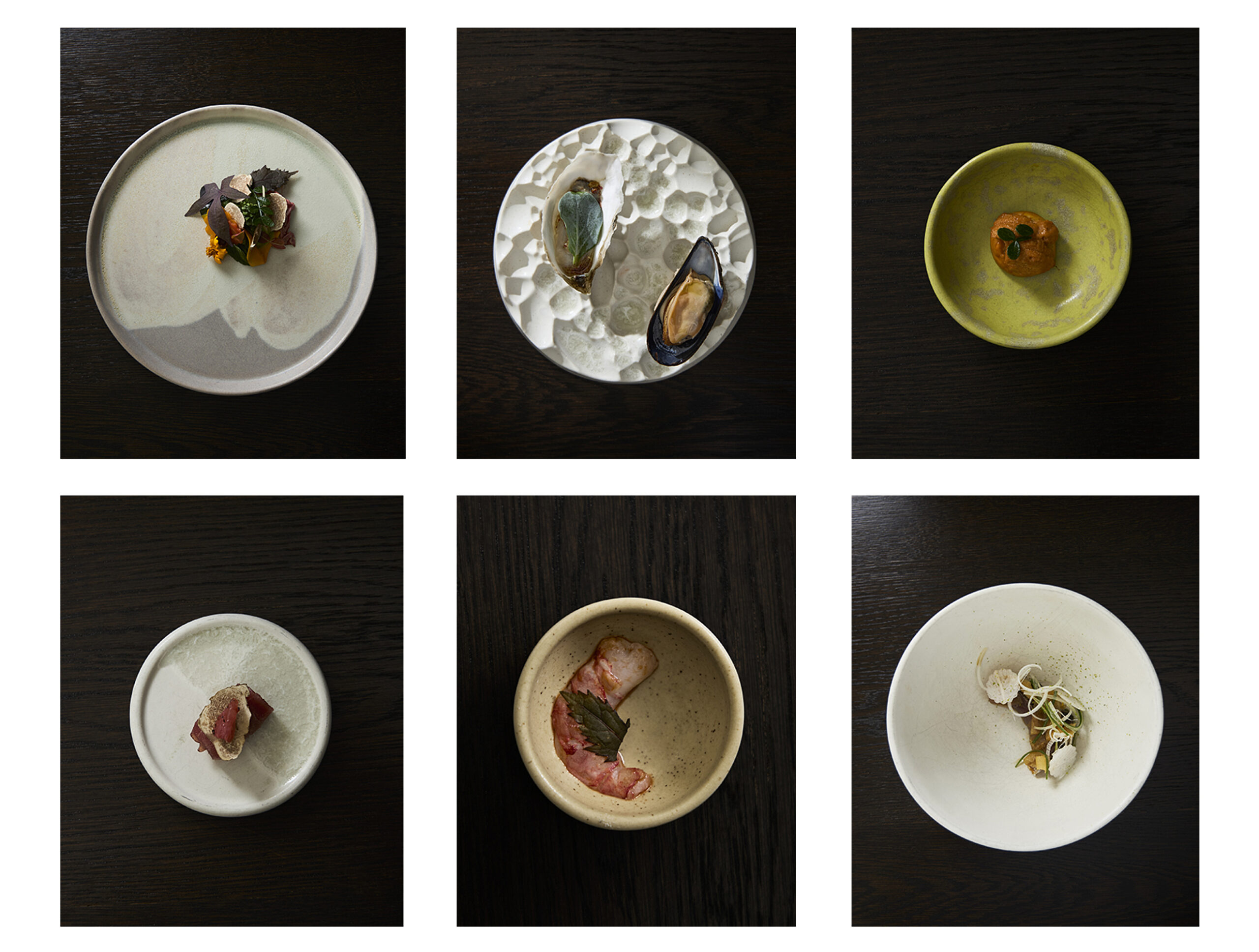
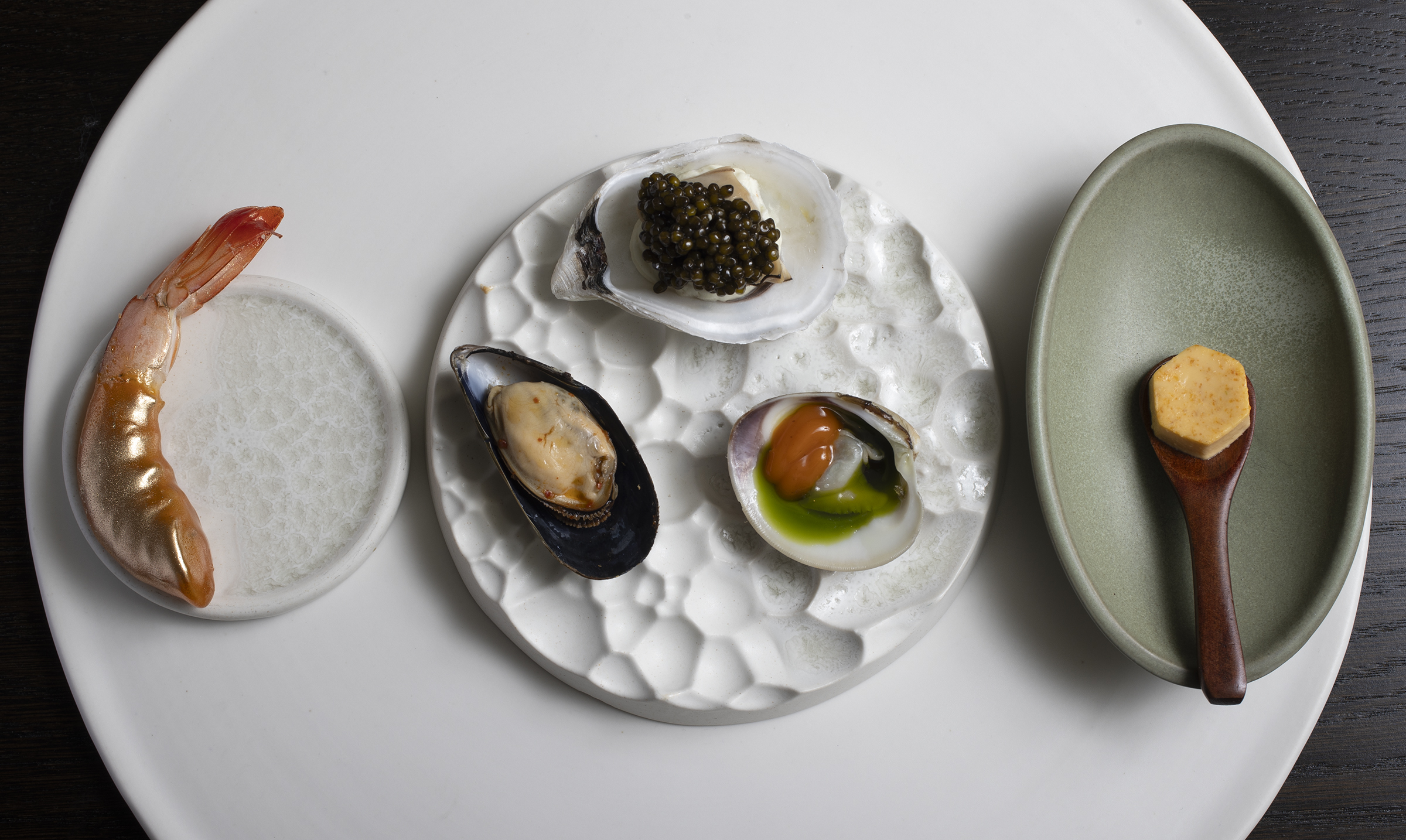
It all started in 2013, when Ellen Yin and Eli Kulp commissioned custom ceramics from Mell for the original High Street restaurant, which opened in September of that year. He officially formed the business in 2014, and over the next decade, Felt and Fat grew from a two-person ceramics studio — encompassing Mell and former business partner Wynn Bauer, who left the company in 2017 — into one of the region’s most recognizable dinnerware manufacturers. Their plates were seemingly at every award-winning Philadelphia restaurant, from River Twice to Tesiny to the now-closed Laurel.
“We had been growing the same way everyone else grows: build a factory, add people, add machines,” said Mell, a Temple grad who admitted that this trajectory had little to do with what he had been trained in. “I went to the Tyler School of Art and Architecture and studied glass but took classes in ceramics. I worked as a server in Philadelphia restaurants for eight years and started delving deeper into ceramics by working part-time at the Clay Studio back when it was in Old City.”
Felt and Fat provides Provenance with custom ceramic dinnerware.
He realized that what he and his team does well is “great design, really interesting glaze work with relatively low minimum-order quantities, and interesting collaborations.” His expansion plans were taking him away from that design and glaze work. “The bulk of what we were doing, and what every other factory does, is taking clay and turning it into a shape.”
Collection of canapés served at Provenance in 2024 on Felt and Fat ceramic dinnerware.
He reached out to an old contact, the company Anfora, located outside of Mexico City, which has been making ceramics for over a century. “They do massive volume, making stuff the way we do. They treat their people well and make the same quality dinnerware with the same porcelain clay we use.”
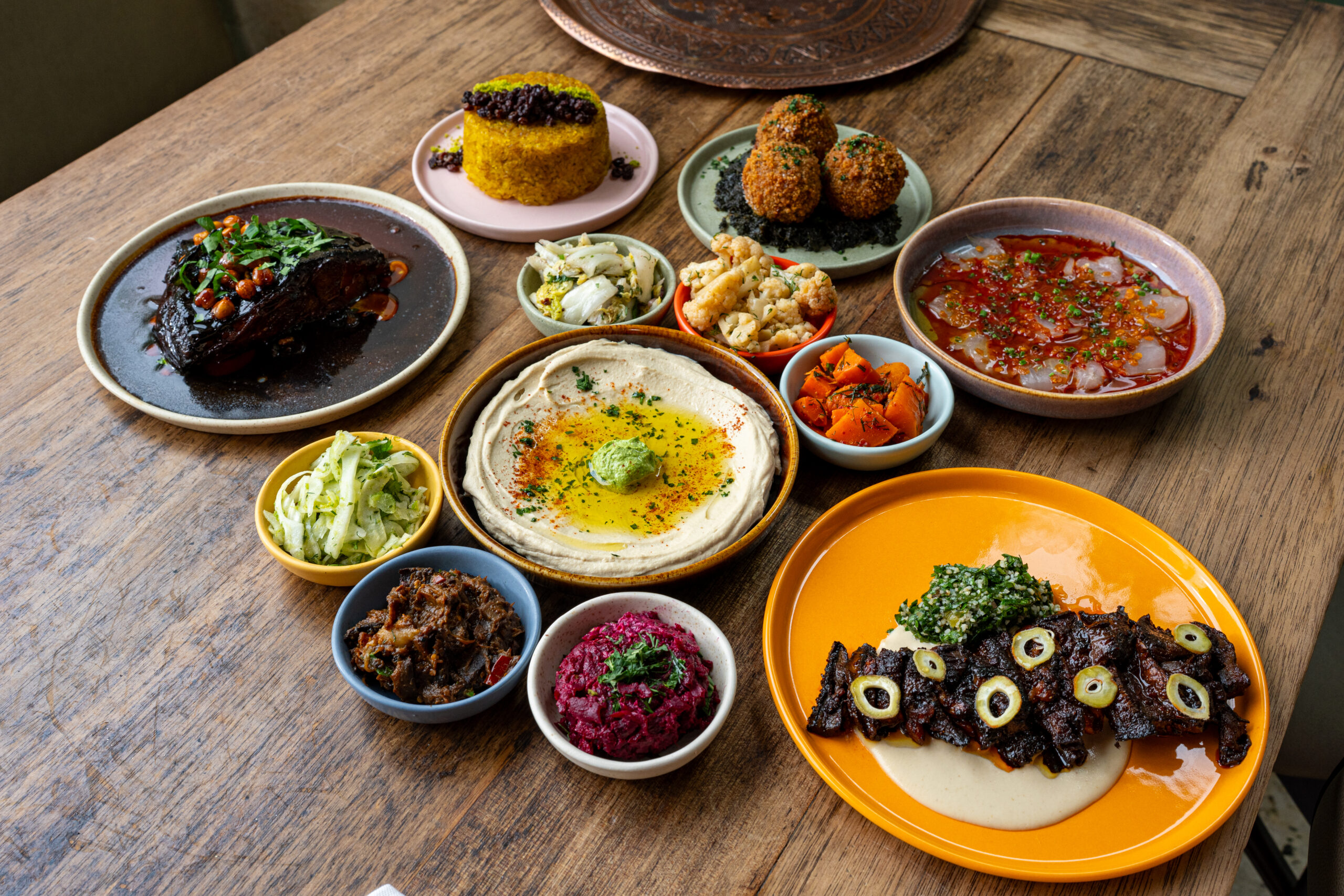
Food from Zahav on Felt and Fat dishes.
His restructuring plan meant Anfora would produce the shapes for Felt and Fat, and they would be glazed by hand in Philadelphia. Mell has just received the first of his shapes from Anfora, with more to come.
“We’re going to have our standard shapes formed at Anfora. But we’re going to expand our high-touch, low-output forming — hand thrown and slip cast,” he said. “We’re going to be even more handmade than we were before. And we’ll be able to lean into that. But we’ll also have the consistency of our standard pieces.”
Felt and Fat dishes are stacked and lined up at the ceramic company’s Kensington facility.
These days, Felt and Fat has just seven employees, including Mell. “Everybody gets their hands in everything. We’re a tight little team,” said Mell, though he hopes to add more employees at a more sustainable rate than before.
“The two years leading up to this were tortuous,” said Mell. But he hopes the future will be brighter, with slower, more purposeful growth.
Felt and Fat’s studio is open for browsing by appointment from Monday to Friday, 9 a.m. to 4 p.m. at 3750 M St., Philadelphia, Pa., 19124. To make an appointment, email support@feltandfat.com or call 215-259-8773. Orders can also be placed online at Felt and Fat’s website and picked up at the studio.
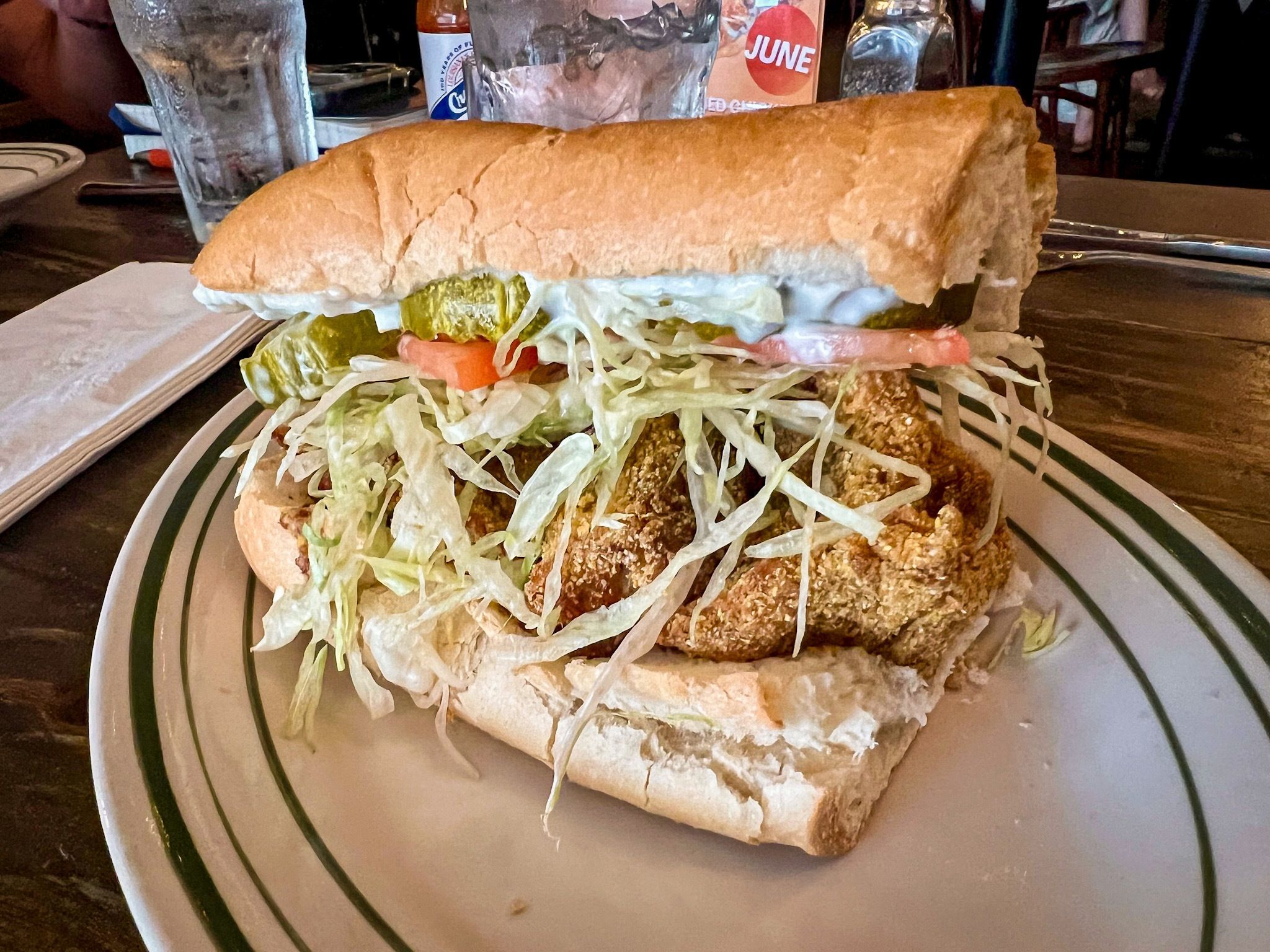
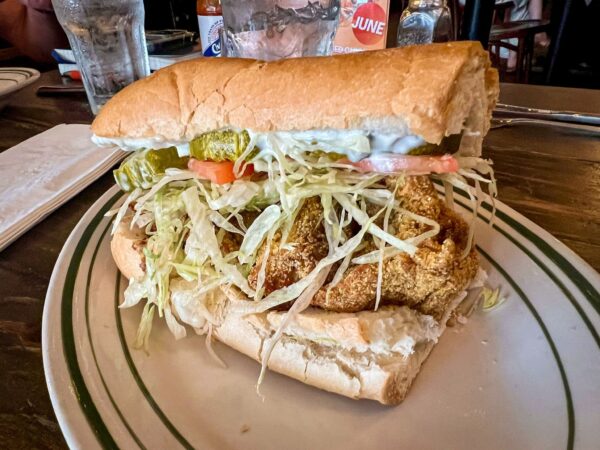
The good times roll at Khyber Pass Pub in Old City, where the menu of New Orleans-style comfort food includes a hearty share of vegan items. The chicken-style po’ boy, for example, delivers crispy, thinly breaded seitan while keeping the classic New Orleans formula intact. Served on a crackly Leidenheimer roll, it’s dressed with shredded lettuce, tomato, pickles, vegan mayo, and Creole mustard, delivering a satisfying mix of crunch, tang, and subtle heat. It’s a convincing plant-based rendition that feels like a true po’ boy, not a compromise. Khyber Pass Pub, 56 S. Second St., 215-238-5888, khyberpasspub.com
— Michael Klein
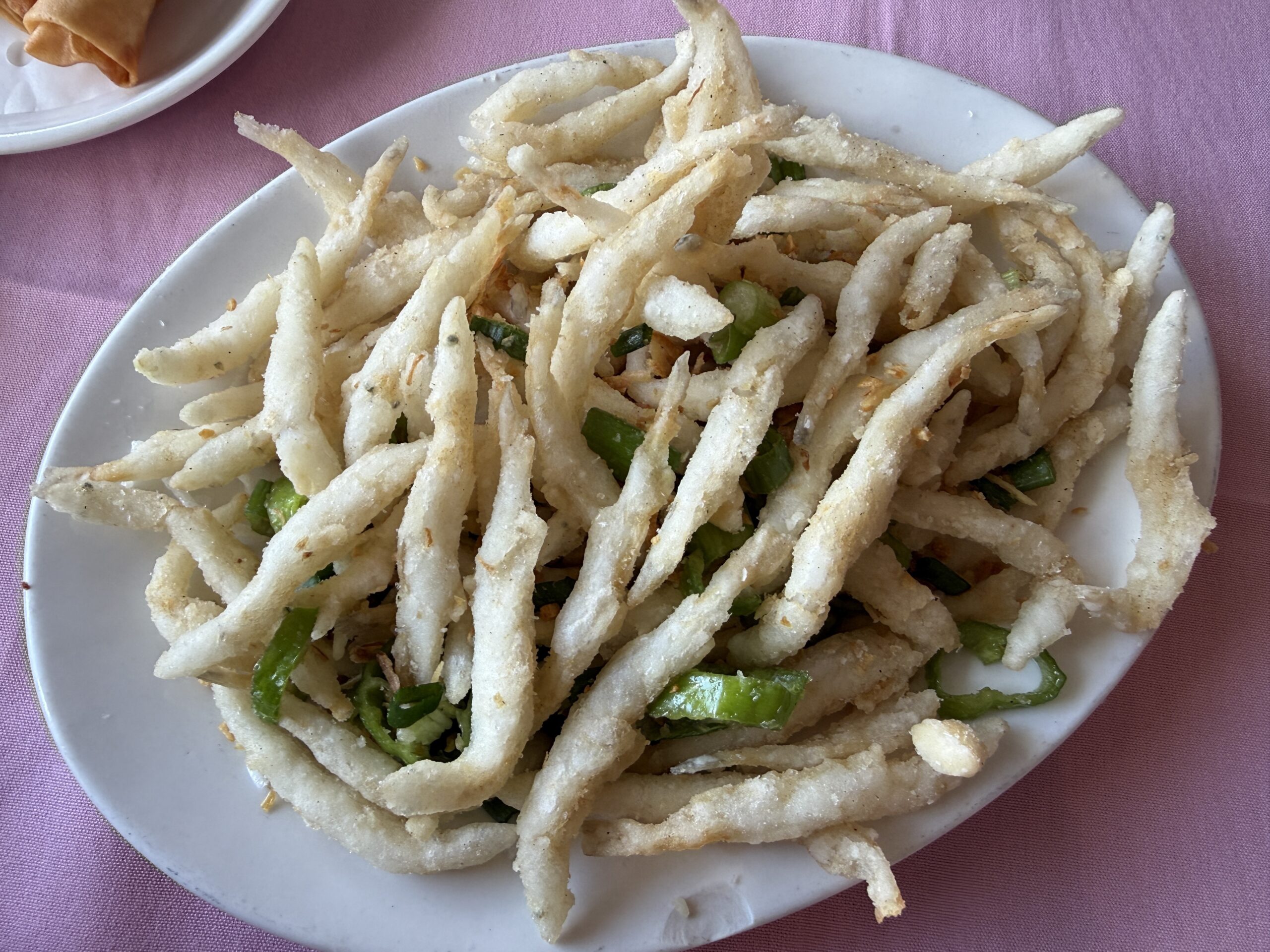
Fried silverfish — a Cantonese delicacy that’s pretty similar to a French Fry — at Grand Palace, 600 Washington Ave. #3B.
Fried Silverfish at Grand Palace
Weekend dim sum at Grand Palace in South Philly’s Little Saigon is a party where the whole family (second cousins and all) is invited, so the party-sized portions of Cantonese delicacies deserve special attention. The rice-flour-battered and fried silverfish (also known as noodlefish or whitebait) are generously sized and hopelessly addictive. More delicious than any French fry — though similarly salty, crunchy, and thin — the tiny fish are lightly funky and just barely scented with jalapeños and scallions. I haven’t stopped thinking about them since. Grand Palace Restaurant, 600 Washington Ave. #3B, 215-645-0079, grandpalacechineserestaurant.com
— Kiki Aranita
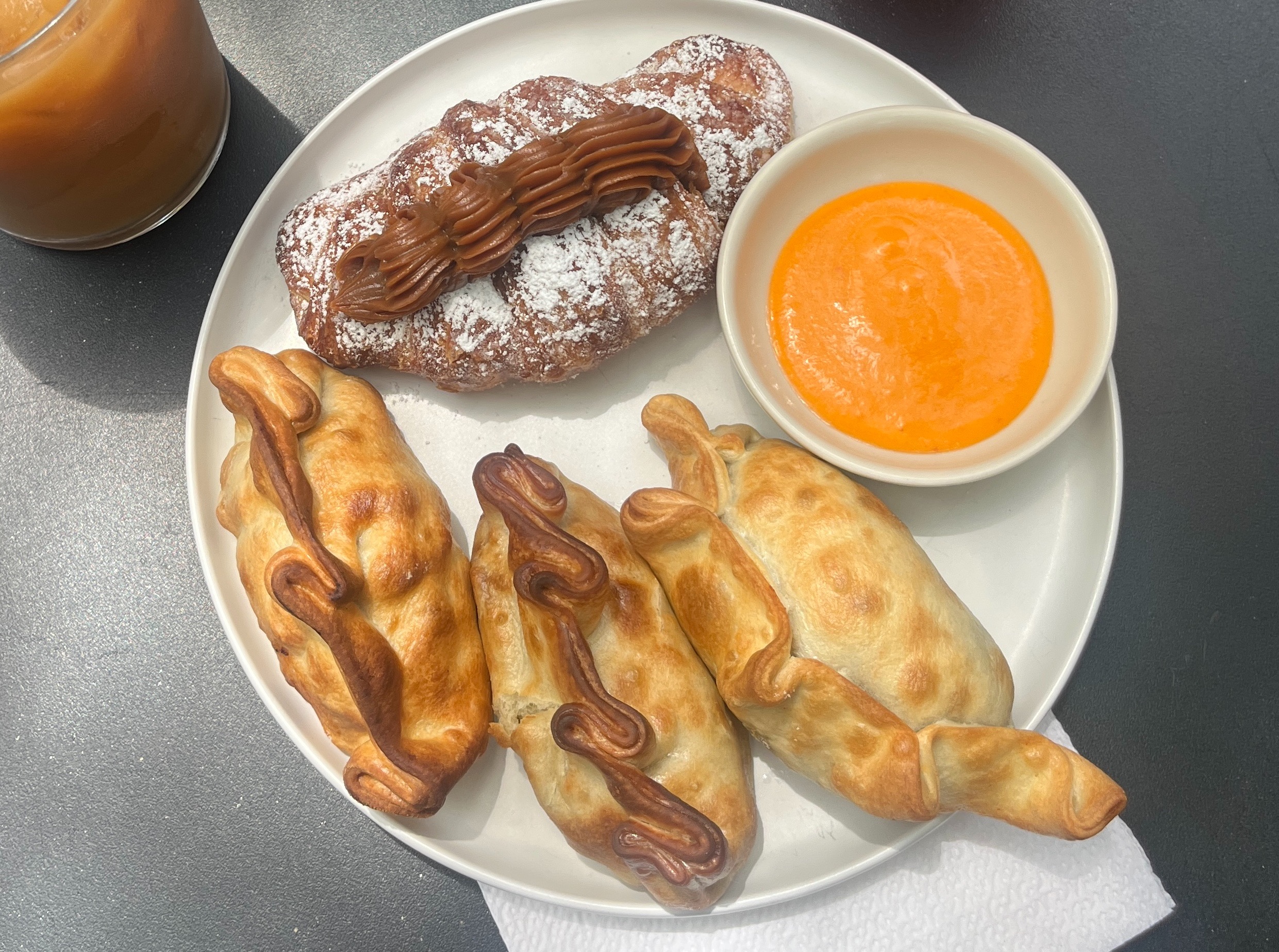
An array of empanadas and a dulce de leche medialuna at Jezabel’s in West Philadelphia.
Empanadas and a dulce de leche medialuna at Jezabel’s
Empanadas are the main attraction at Jezabel Careaga’s eponymous West Philly cafe, where the open-concept kitchen feeds into a dining room that allows customers to watch bakers knead, shape, and pack the dough tight with fillings. The lineup is special, but simple: a stewed chicken empanada lightly seasoned with aji dulce; a vegetarian version stuffed with leeks and gooey white cheese; and a vegan version packed with a summery lentil and corn salad. Careaga’s empanadas are baked — not fried — and so light that it’s easy to snack on several in one sitting.
Even more excellent are the cafe’s medialunas, an Argentinian pastry that sits somewhere between brioche and a croissant. The dulce de leche version is ultra-decadent, its butter crescent-shaped layers peeling apart to reveal a core of caramel cream. When Careaga returns to Fitler Square with a second location — likely opening this fall, I’m told — it’ll still be empanadas and medialunas galaore. Thank goodness. Jezabel’s, 206-208 S. 45th St., 215-554-7380, jezabelsphl.com