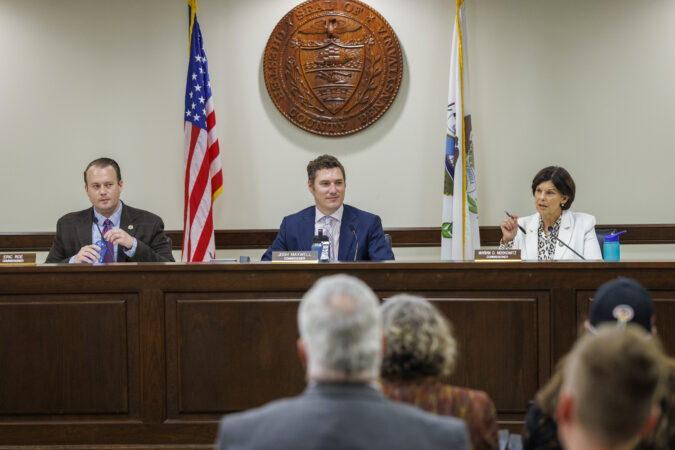
The Chester County Board of Commissioners apologized to voters Wednesday after an error forced independent and third-party voters to cast provisional ballots through much of Election Day.
Speaking at their twice-monthly board meeting, Democratic Commissioners Josh Maxwell and Marian Moskowitz and Republican Commissioner Eric Roe promised to determine how the error was made and ensure it doesn’t happen again.
“Know that we will look into this. We need to finish the election first,” Maxwell said.
Election officials in Chester County sent poll books to precincts that included only the names of registered Republicans and Democrats, omitting all other voters.
The error meant poll workers had no way to ensure voters not affiliated with a major party were eligible when they arrived to vote Tuesday morning. As a result, those voters cast provisional ballots until supplemental poll books were delivered to each precinct by around 3:45 in the afternoon.
Provisional ballots will be counted, but they are counted slower as election officials must first verify they were cast by an eligible voter who had not already voted.
The county left polling places open for an additional two hours Tuesday, allowing voters who arrived after 8 p.m. to cast provisional ballots. About 75,000 voters in Chester County are not registered with either party. The error likely affected far fewer people, as many voters had cast mail ballots and odd-year elections tend to have lower turnout.
To get through the day, Maxwell said, Philadelphia’s election office delivered a “truckload” of provisional ballots to the suburban county.
While some online have called for the resignation or firing of Chester County’s director of voting services, Karen Barsoum, Maxwell said discussions of personnel matters were premature.
“We have a lot of very good people who are very well-intentioned who set a very high standard for themselves,” Maxwell said, adding that the county had had to increase security for some staff members in response to online threats.
Roe and Moskowitz each thanked poll workers who managed a chaotic, and longer than normal, day at the polls.
County officials said they would work to better understand how the error occurred after they have finished tallying votes and certifying the election.
“We will be working on it,” Roe said. “We will get to the bottom of it. Accountability will come.”
This suburban content is produced with support from the Leslie Miller and Richard Worley Foundation and The Lenfest Institute for Journalism. Editorial content is created independently of the project donors. Gifts to support The Inquirer’s high-impact journalism can be made at inquirer.com/donate. A list of Lenfest Institute donors can be found at lenfestinstitute.org/supporters.
Democrats swept Delaware County Council elections for the fifth consecutive election, further solidifying their dominance in the former Republican stronghold in the suburbs.
In statements early Wednesday morning, the Democrats thanked their supporters.
“I will continue to work hard and fight for the residents in our County. I look forward to working together with all parties to make Delaware County one of the strongest counties in the Commonwealth,” Womack said in a statement.
With all but one precinct reporting Wednesday, Republican challengers Brian Burke and Liz Piazza each trailed Womack and Phillips by roughly 50,000 votes.
In a statement Wednesday, Frank Agovino, the chair of the Delaware County GOP, said it appeared local issues were a “secondary concern” for Democrats this year.
“The State wide retention initiative was uncharted waters and it feels as though Dem turnout was positively impacted. Additionally, the Unrealistic disdain for the President from the majority of Democrats was also an undeniable factor,” Agovino wrote.
Democrats have held all five seats on the Delaware County Council since 2020, when the party took control of the county for the first time since the Civil War. Democrats flipped the county as part of a national trend of suburbs shifting left, which was accelerated during President Donald Trump’s first term in office. With Tuesday’s results, they will keep their supermajority for the next two years.
In the years since Democrats took control in Delaware County, they say they have worked to enhance county services and repair infrastructure. That has included establishing a health department — Delaware County was the largest county in Pennsylvania without one at the onset of the COVID-19 pandemic — and de-privatizing the county prison following a series of scandals.
Last year, the county increased property taxes 23%, citing the loss of federal pandemic relief dollars and inflation driving up salaries. Republicans made that increase the base of their campaign, telling voters that the Democrats were overspending and that more tax increases were on the way.
Republicans wanted voters to give the GOP a voice on the board, even though the party wouldn’t have the majority, to push back on budgetary decisions and hold the Democrats accountable.
But in the heavily Democratic county, that message was not enough to sway the independent and Democratic voters Republicans needed to win seats. Instead, voters demonstrated continued trust in the current county leadership.
“I truly respect Richard and Joanne as members of Council and hope they will listen to the voices of our residents and help bring to light some of their concerns,” Piazza said in a statement Wednesday.
On Election Day, Donald and Esther Newton, a Chester couple who have been married for more than 55 years, said they believed it was about time their city received more care and investment through property taxes.
“Our infrastructure needs to be fixed, and that takes money,” Esther Newton said.
Democrats swept all countywide races Tuesday.District Attorney Jack Stollsteimer, who was among the first Democrats to win countywide office in Delaware County, won a seat on Delaware County Court. He will have to step down from his current role to take the seat.
Staff writer Nate File contributed to this article.
This suburban content is produced with support from the Leslie Miller and Richard Worley Foundation and The Lenfest Institute for Journalism. Editorial content is created independently of the project donors. Gifts to support The Inquirer’s high-impact journalism can be made at inquirer.com/donate. A list of Lenfest Institute donors can be found at lenfestinstitute.org/supporters.
Democrats swept two law enforcement races in Bucks County, ousting the incumbents and signalingthe swing county has soured on President Donald Trump just a year after voting for him.
Democrat Danny Ceisler, an Army veteran who held a public safety role in Gov. Josh Shapiro’s administration, led Republican Sheriff Fred Harran by 12 percentage points with all precincts reporting Wednesday morning. The sheriff race centered on Harran’s controversial decision to partner his agency with ICE as Trump ramps up immigration enforcement nationwide.
And former Bucks County Solicitor Joe Khan led Republican District Attorney Jen Schorn by eight percentage points. Democrats believe Khan is the first member of their party to ever be elected to the office.
Bucks County Democrats declared victory just after midnight Wednesday morning — sweeping every countywide race. The victories came in what appeared to be a blue wave election as voters rejected Republican candidates in Pennsylvania, New Jersey, and Virginia.
“What’s going on with our federal government is not normal, and voters saw that creeping into local offices, and they overwhelmingly rejected it,” Ceisler said Wednesday. “Bucks County doesn’t let extremism come inside.”
The hotly contested Bucks County races centered on some of the most contentious issues in national politics — Trump, crime, and immigration. Democrats sought to paint the incumbents as Trumpian ideologues, while Republicans warned voters of an influx of “Philly crime” if Democrats took office, even as the violent crime rate in the city has dropped from its pandemic peak.
Voters opted for a change, delivering both offices to Democrats and, as result, spelling the end to a controversial partnership between the sheriff’s office and U.S. Immigration and Customs Enforcement.
Bucks was the only county in the Philadelphia area to go for Trump last year and will be a key battleground in 2026 when Shapiro runs for reelection. Tuesday’s wins will give Democrats momentum going into the midterms.
Democrats, Khan said, had to work to prove to voters they could be trusted with public safety. They were aided by a favorable dynamic as voters rejected Trumpism.
“It was a campaign not about attacking somebody else but, really, making really clear that we deserve better than what we’ve got,” Khan said.
Voters at the polls persistently expressed frustration with Trump, and a sense that anyone from his party should not be trusted in office.
“They’re subject to his control, regardless of how they feel on issues,” said Stephanie Kraft of Doylestown. “And that affects everything, from our local courts on up to the higher courts in the state.”
The effort succeeded, indicating that Bucks voters are already disenchanted with the president they voted for just a year ago. The vote may set off alarm bells among Republicans as they prepare for next year’s election, when Republican Treasurer Stacy Garrity seeks to oust Shapiro and Republican U.S. Rep. Brian Fitzpatrick stands for reelection.
The Democratic victory is “on everything that Trump is doing to undermine the institutions of democracy, but it’s also on Trump’s failure to really reverse inflation,” said State Sen. Steve Santarsiero, the chair of the Bucks County Democratic Party.
Even so, for several voters, Harran’s partnership with ICE was the final straw.
Jill Johnson worried it would result in the targeting of Latino citizens, including her half-Mexican son, who is away at college.
“My biggest fear is that someone in a mask is going to come up and grab him because they think he’s here illegally,” Johnson said. “It’s scary. These are law-abiding people who have done nothing wrong.”
The partnership, which recently became active after months of planning, provoked backlash, including a lawsuit, public demonstrations outside the courthouse, and a repudiation by the Democratic-led board of commissioners.
Ceisler said Wednesday that he will issue a moratorium barring deputies’ cooperation with ICE on his first day in office. From there, he said, he will figure out how to disentangle the sheriff’s office from the agreement signed by his predecessor.
For his part, Harran said Wednesday that Ceisler will “have to answer for a person who becomes victimized by an individual that should have been deported. And he’ll have to sleep with that, and it’ll be on his head, not mine.”
Officials with U.S. Immigration and Customs Enforcement declined to comment.
Harran, an outspoken Republican who endorsed Trump last year and frequently clashes with the Democratic commissioners, was elected sheriff in 2021 after more than a decade leading Bensalem’s police department.
The Republican has expanded the role of the sheriff’s department, adding a K-9 unit and partnering with immigration officials, but faced criticism that he was failing to complete the basic duties of his job, such as executing warrants and protecting the courthouse.
Ceisler advocated taking politics out of the office, saying he would focus on domestic violence and pledging to end the partnership with ICE. He argued his experience in the Army and in a public safety leadership post under Shapiro prepared him to serve as sheriff — though Harran argued Ceisler would be unprepared for the job, having never worked in a sheriff’s office or police department.
“Being the sheriff isn’t on-the-job training,” Harran said at a Bristol polling place Tuesday. “You need knowledge and experience.”
Ceisler said he had spoken to Harran after the results came in and the incumbent promised to assist with a smooth transition.
Schorn, a veteran Bucks County prosecutor, lost in her bid for a full term after being appointed district attorney last year when her predecessor became a judge.
She had been an assistant district attorney in the county since 1999, prosecuting some of the county’s most high-profile cases. When she became district attorney, Schorn started a task force in the county to investigate internet crimes against children.
Khan, a former county solicitor and federal prosecutor, argued Schorn ran the office under “Trump’s blueprint” and criticized her decisions not to recuse herself when a Republican committeeperson was charged with voter fraud and not to prosecute alleged child abuse at Jamison Elementary School.
Schorn has said she was unable to discuss the details of the Jamison Elementary School case due to rules governing prosecutors, but Khan argued her explanations were insufficient as parents sought answers.
Schorn performed slightly better than her GOP counterparts in Bucks County on Tuesday. But, while many voters said they had no issue with Schorn’s policies, her political party was a turnoff.
“I just feel the Democrats would be better right now; I’m down on all Republicans,” said Marybeth Vinkler, a Doylestown voter who said she had no problems with how Schorn had run the district attorney’s office. “Everything happening in D.C. is trickling down around us.”
Schorn did not immediately comment on the results Wednesday.
Jim Worthington, who has run pro-Trump organizations in Bucks County, said Republicans failed to turn out voters on Election Day even as data showed Democrats held a significant lead on mail voting ahead of Tuesday.
“This is where the GOP was asleep at the wheel,” Worthington said.
Traditionally, voters trust Republicans more with law and order. The resounding victories for Democrats defied that trend.
“We now have an obligation to deliver and to show that Democrats can lead on the issue of safety,” Ceisler said.
“The ball is in our hands, and we’re ready to run with it.”
Staff writer Jeff Gammage contributed to this article.
This suburban content is produced with support from the Leslie Miller and Richard Worley Foundation and The Lenfest Institute for Journalism. Editorial content is created independently of the project donors. Gifts to support The Inquirer’s high-impact journalism can be made at inquirer.com/donate. A list of Lenfest Institute donors can be found at lenfestinstitute.org/supporters.
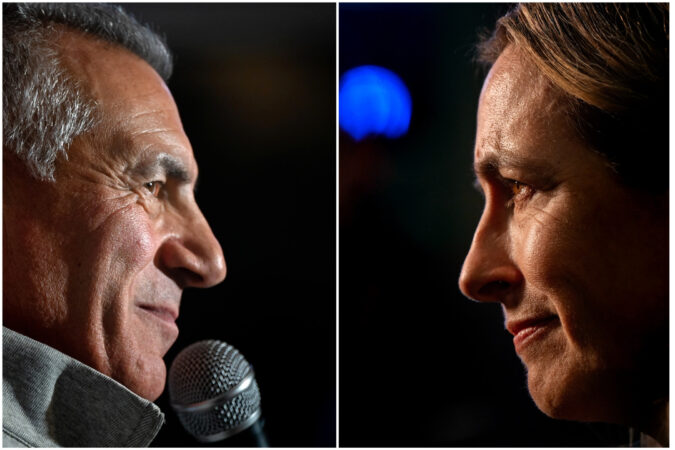
The results of the tight race could be a barometer, nationally, for which party has an edge, and signal the type of messaging and candidate that can win over New Jersey voters in an increasingly purple state.
The race has attracted national attention and resources from both parties — especially Democrats who see the seat as a critical opportunity to build momentum and safeguard the state from the policies of President Donald Trump.
Ciattarelli spent his final campaign week rallying with Puerto Rican voters in Passaic County and taking his “It’s Time” bus tour around the state. He held meet-and-greets, rallies, and diner stops over the weekend in Monmouth, Ocean, Union, and Bergen Counties.
Sherrill, who would be only the second woman elected governor in the state should she prevail on Tuesday, rallied with former President Barack Obama on Saturday in Newark and with Sens. Cory Booker and Andy Kim on Sunday in Camden and Mount Laurel Township. The events followed a week that included a “Driving Down Costs” bus tour and appearances with former Transportation Secretary and presidential candidate Pete Buttigieg and Philadelphia Mayor Cherelle L. Parker.
Along with her promise to take on landlords “colluding to raise rents” and to tackle pharmaceutical prices, Sherrill reiterated her campaign promise to freeze utility rate hikes on her first day in office at the rally with Obama on Saturday.
“New Jersey, I’m not playing,” she told the audience. “I’m not writing a strongly worded letter and I’m not starting up a working group. I am not doing a 10-year study. I’m declaring a state of emergency.”
For decades, New Jerseyans had voted blue at the national level while electing Republicans to the governor’s mansion. Democrats have a voter registration advantage of about 850,000 voters in New Jersey, but 2.2 million voters are registered unaffiliated. And GOP registrations have outpaced Democratic ones since the 2024 presidential election, when Trump swung the state significantly redder, losing by only 6 points.
Ashley Koning, the director of the Rutgers Center for Public Interest Polling, said either candidate has a “very plausible path to victory.”
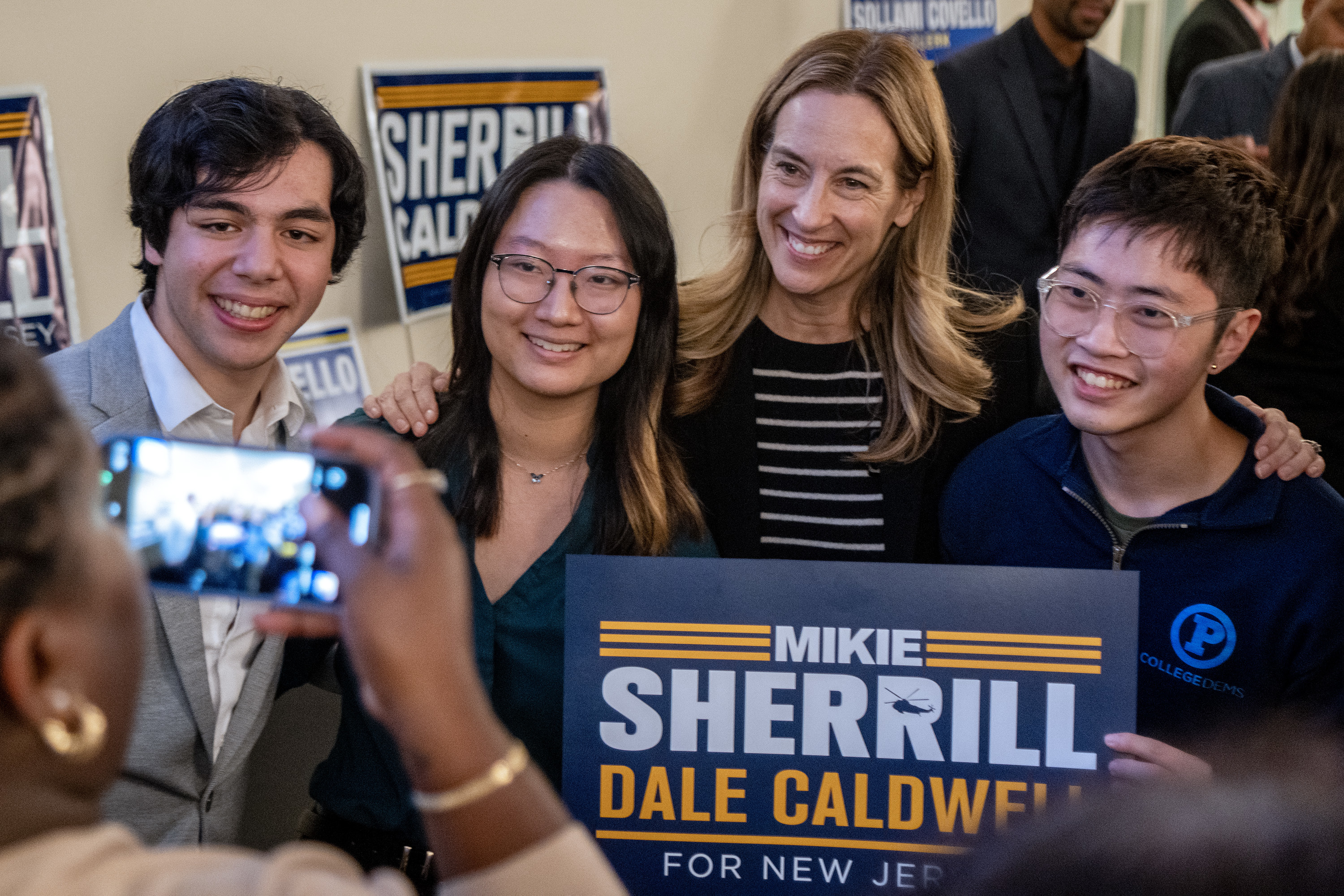
Democratic candidate for governor U.S. Rep. Mikie Sherrill poses with members of the Princeton College Democrats as she appears at a Mercer County Democrats GOTV Rally at the Mercer Oaks Golf Course in West Windsor Thursday, Oct. 23, 2025. From left are: Julian Danoff; Michelle Miao; and Paul Wang. (The group’s motto: “Bringing blue values to the Orange Bubble.”)
Dueling headwinds
There are dueling headwinds at play in the contest for New Jersey governor, too. Both Trump and Murphy are unpopular with about half of New Jersey voters. New Jersey hasn’t elected the same party to a third term for the governorship since 1961, but Republicans have also not won the office while their party has held the White House since 1985.
Once the votes are tallied in Tuesday’s election, New Jersey political history will be made either way.
Ken Martin, the chair of the Democratic National Committee, said he expects the race to be a close win for Democrats, noting “a win is a win.”
He resisted the critiques from some fellow Democrats that Sherrill played her campaign too safe, “in an era of brash bravado, machismo, and Donald Trump, and these candidates basically saying whatever the hell they want.”
“I think what she’s been doing is putting out a pretty compelling message to New Jerseyans and campaigning everywhere to make sure that they understand what she’s focused on,” he said.
The party’s vice chair, Pa. State Rep. Malcolm Kenyatta (D., Philadelphia) predicted a good night for Democrats in New Jersey. “There’s that famous saying that ‘Trenton makes, the world takes,’ and I think Trenton is going to make a lot of momentum that we are going to take into 2026 and beyond.”
“I feel it, you know, I feel it on the ground,” said Sen. Andy Kim (D., N.J.) who campaigned with Sherrill in between fielding questions from fellow Democrats in Washington about what the race looks like back home.
“Everyone I talked to knows what’s at stake,” Kim said.
Chris Russell, Ciattarelli’s political strategist, argued that Ciattarelli has garnered support from voters who have traditionally supported Democrats by delivering them a clearer message on affordability.
“We put a significant amount of time and resources, driven and led by Jack, to be present in minority communities like the Hispanic community and the Black community, and we believe that effort is going to pay off,” he said.
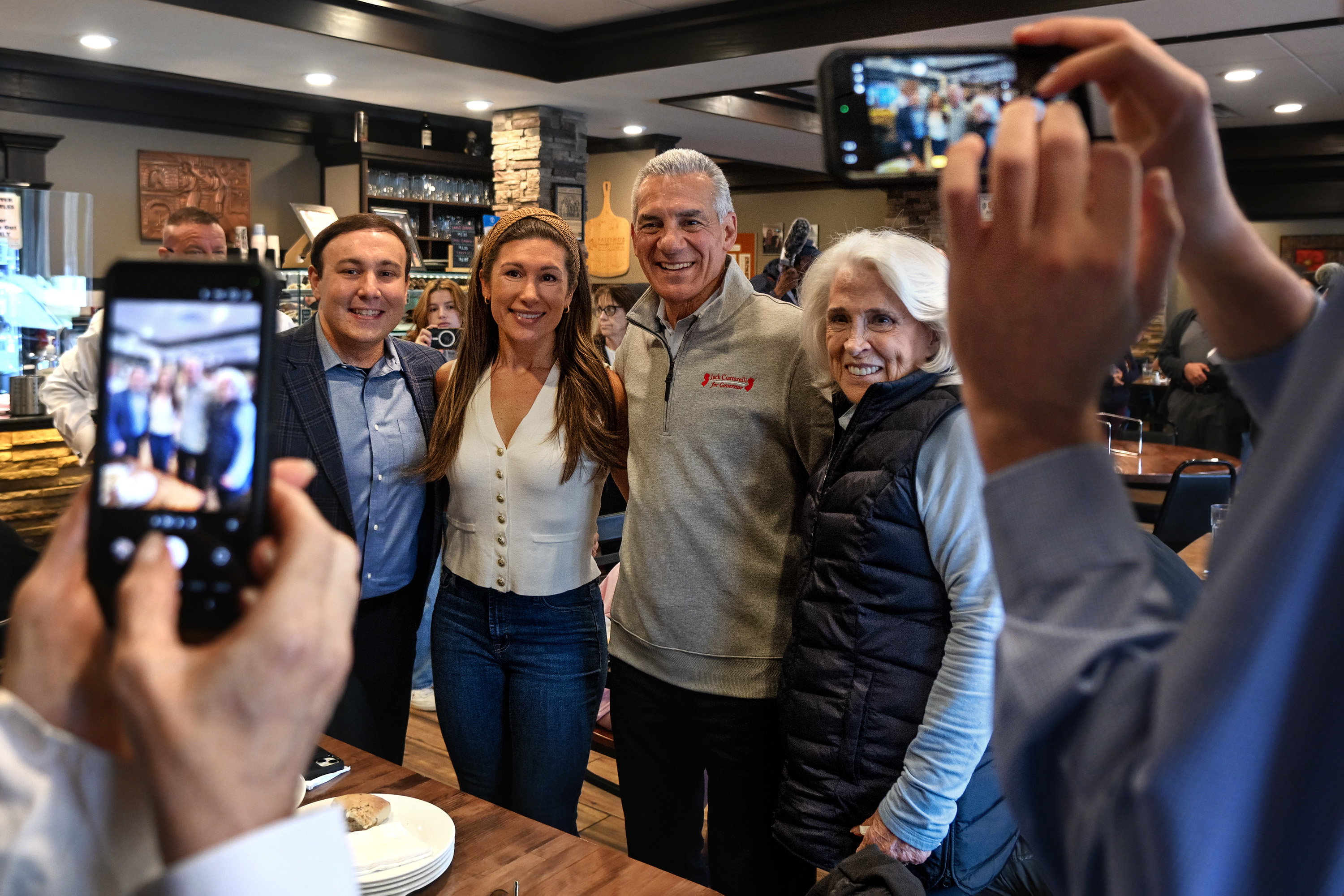
Republican candidate for governor Jack Ciattarelli poses with members of the Pascucci family as he greets supporters at Palermo’s Pizza in Bordentown Monday, Oct.13, 2025 while campaigning in South Jersey.
‘A totally different vibe’
As the candidates made their final burst of media appearances in the countdown to Election Day, Ciattarelli, in a town hall with Fox News’ Sean Hannity on Thursday night, said the Republican campaign energy “is electric.” Ciattarelli said he was encouraged by early-vote and vote-by-mail numbers, which, while trailing Democrats, had surpassed 2021 GOP turnout numbers.
“We go after those one out of four Republicans … who typically only vote in presidential years,” Ciattarelli said on Hannity’s program. “We’ve done a magnificent job, our local Republican organizations have, in getting those people to vote by mail or vote early.”
State Sen. Latham Tiver, a South Jersey Republican, said Ciattarelli’s campaign stops are a “totally different vibe” than his last run in 2021. He recalls Ciattarelli introducing himself table to table, but now, Tiver said when the candidate enters the room, people flock to him.
“Jack’s doing everything he can. … He’s pounding the pavement, he’s meeting more and more people, and we’re all out there doing the same thing for him,” Tiver said.
As the candidates make their final push to lead New Jersey, the outcome will likely depend on who shows up at the polls Tuesday.
Both campaigns have motivated bases, but the election could come down to the less engaged and whether they decide to vote. Despite a record amount of spending in the state, only about 2% of voters remained undecided in polls.
“I don’t think people give enough credit — pollsters, political wonks — to just how burnt out the average American is,” said Jackie Cornell, who previously ran field operations for Obama’s campaign in New Jersey.
“They just don’t want to hear anything about any of this any more, and I worry that will be the deterrent more so than anything else.”
“Bottom line, the well has run dry,” the USDA notice says. “At this time, there will be no benefits issued November 01. We are approaching an inflection point for Senate Democrats.”
The shutdown, which began Oct. 1, is now the second-longest on record. While the Republican administration took steps leading up to the shutdown to ensure SNAP benefits were paid this month, the cutoff would expand the impact of the impasse to a wider swath of Americans — and some of those most in need — unless a political resolution is found in just a few days.
The administration blames Democrats, who say they will not agree to reopen the government until Republicans negotiate with them on extending expiring subsidies under the Affordable Care Act. Republicans say Democrats must first agree to reopen the government before negotiation.
Democratic lawmakers have written to Agriculture Secretary Brooke Rollins requesting to use contingency funds to cover the bulk of next month’s benefits.
But a USDA memo that surfaced Friday says “contingency funds are not legally available to cover regular benefits.” The document says the money is reserved for such things such as helping people in disaster areas.
It cited a storm named Melissa, which has strengthened into a major hurricane, as an example of why it’s important to have the money available to mobilize quickly in the event of a disaster.
Some states have pledged to keep SNAP benefits flowing even if the federal program halts payments, but there are questions about whether U.S. government directives may allow that to happen. The USDA memo also says states would not be reimbursed for temporarily picking up the cost.
Other states are telling SNAP recipients to be ready for the benefits to stop. Arkansas and Oklahoma, for example, are advising recipients to identify food pantries and other groups that help with food.
Sen. Chris Murphy, D-Conn., accused Republicans and Trump of not agreeing to negotiate.
“The reality is, if they sat down to try to negotiate, we could probably come up with something pretty quickly,” Murphy said Sunday on CNN’s “State of the Union.” “We could open up the government on Tuesday or Wednesday, and there wouldn’t be any crisis in the food stamp program.”
A few years ago, he was driving with his then-11-year-old daughter when she asked where roads came from.
“The government,” Gibbons responded.
“What’s the government?” his daughter asked.
That led to a longer explanation and eventual father-daughter trip to a Gloucester Township meeting so she could see the government in, ah, action. Having covered many local government meetings and school boards long ago, I can attest that Gibbons went beyond any parental or civic duty.
Gibbons continued to attend the meetings when a proposal to dissolve the Municipal Utilities Authority (MUA) caught his attention. He feared the township was planning to sell the water and sewer system.
But during sworn oral testimony in a May 2023 teleconference, an attorney representing the township said there was no expectation the utilities would be sold within the next five years. Mayor David Mayer agreed.
Yet, a year later, the township council voted to sell the sewer system to the highest bidder.
“They lied to us,” Gibbons said.
The township received two bids from large for-profit water companies: Aqua offered $52 million, and New Jersey American Water bid a whopping $143 million, plus a promise to make an additional $90 million in capital improvements to a system that only needed an estimated $25 million in repairs.
Something didn’t smell right. Even for a sewer system.
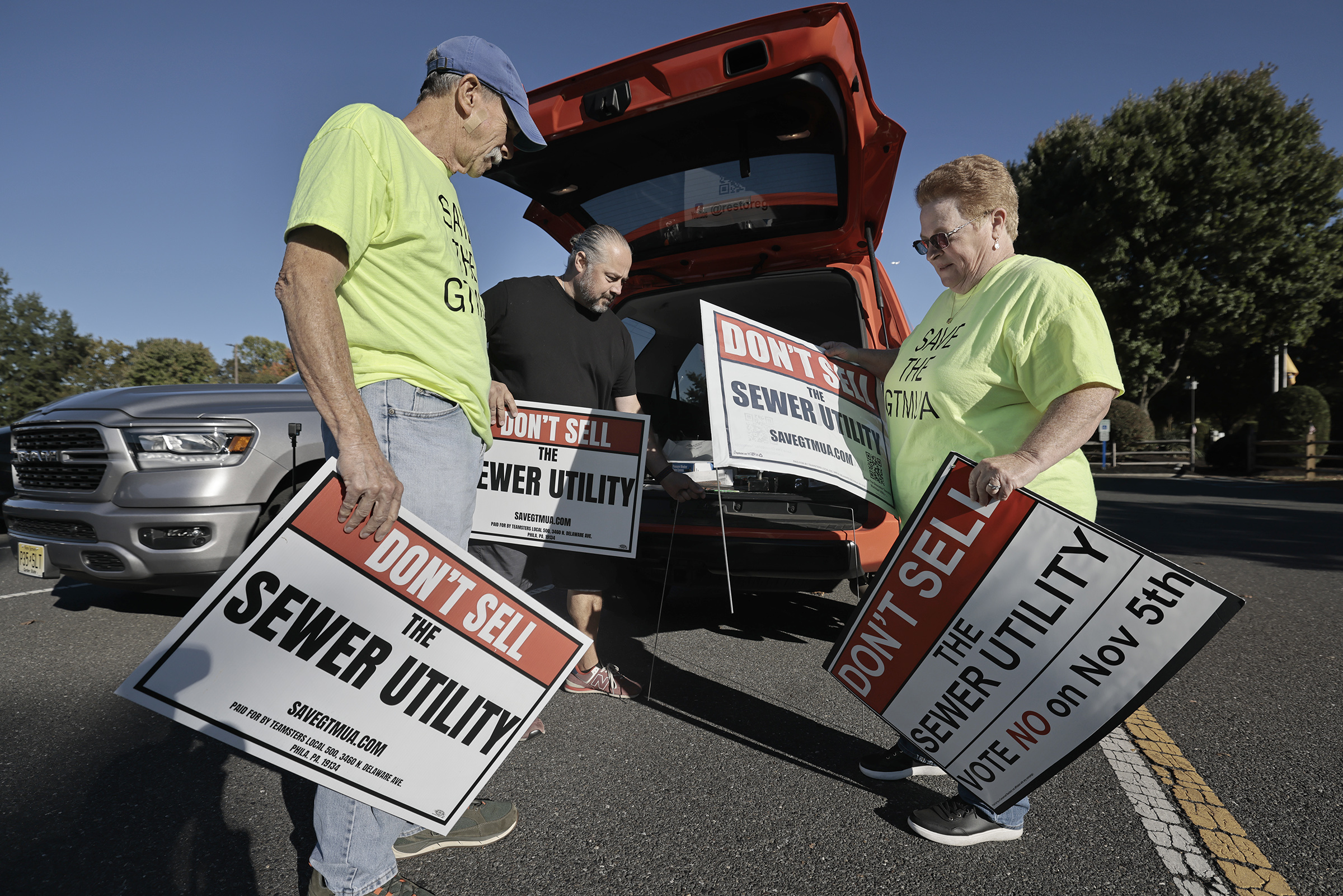
Keith Gibbons (middle) joined Ira Eckstein and Denise Coyne at a rally opposing a plan to sell a South Jersey sewer and water utility in October 2024.
Coincidentally, Mayor Mayer worked for American Water. In addition to his job as director of government affairs at the water company, his mayoral salary is $52,000.
To guard against any conflict of interest, Mayer recused himself from any discussion regarding the sewer sale.
Even still, American Water’s lucrative offer raised eyebrows. But generous bids are part of the for-profit playbook. Aqua offered Bucks County $1.1 billion for its sewer system, but the commissioners backed away after fierce public opposition.
For-profit water companies have been throwing big money at small towns in New Jersey, Pennsylvania, and beyond in an effort to scale up. The utility systems may not seem sexy, but they are mini monopolies that generate steady cash flow.
In Pennsylvania, a 2016 change in the law essentially opened the door for local utilities to be sold at higher prices. Local politicians are often happy to get the utility systems off the books and use the windfall to fund other projects or avoid tax increases.
But often left out of the negotiations are the ratepayers.
After the sales go through, the for-profit companies often jack up the rates. In some towns, after a brief rate freeze, the water bills have increased by 100%.
Rates have also increased at government-owned utility companies, but not by nearly as much. For example, Philadelphia recently increased water rates by 9%.
As utility bills grow, residents have nowhere to turn. Aging infrastructure, climate change, and increased demand, including to cool computer data centers, are expected to further drive up water prices in the years to come.
From left: Denise Coyne, Nancy Kelly Gentile, Gloucester Township independent mayoral candidate Keith Gibbons, and Ira Eckstein canvass supporters in Clementon, N.J., in September.
For-profit companies say they offer professional management and resources to make long-deferred upgrades, as well as the ability to purchase materials in bulk and spread the risk across systems as they grow.
Mayer said in an interview that the sewer sale would have enabled Gloucester to reduce property taxes, eliminate its debt, and make other improvements.
But critics argue that handing control to for-profit companies seeking quick returns on investments is shortsighted and results in higher costs to consumers. After all, water and sewer utilities are supposed to be a long-term public good, not a profit center.
To its credit, Gloucester Township scheduled a referendum last November to let residents vote on whether to sell the sewer system or not. A public vote should be a requirement, but most towns avoid referendums because the last thing they want is for taxpayers to have a say in the utility system they own.
The referendum gave Gibbons time to mount a grassroots campaign against the sale. He knocked on doors, handed out yard signs, and used a podcast to raise awareness.
But Gibbons seemed overmatched. His group spent roughly $3,000 opposing the sale, while New Jersey American Water spent about $1 million.
Yet, David beat Goliath in a landslide. More than 80% voted against the sale.
Gibbons, 48, a Cinnaminson High grad, who ran a Christmas tree farm and worked for Live Nation but is now self-employed and serves on the school board, became somewhat of a local hero in a town of 66,000 residents.
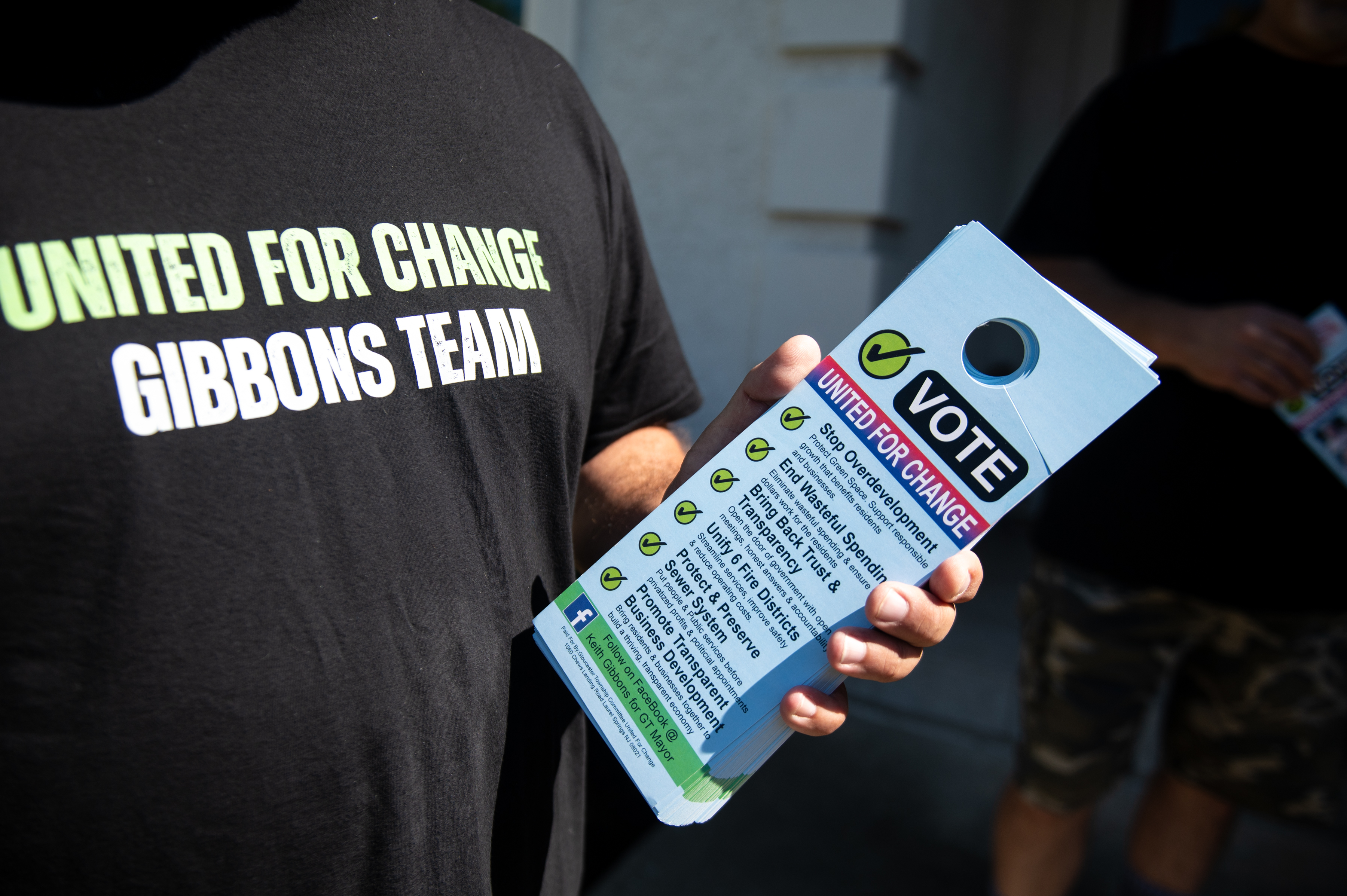
Gloucester Township independent mayoral candidate Keith Gibbons holds promotional materials encouraging constituents to vote for him.
Residents soon urged him to run for mayor.
Gibbons, a former Republican, is running as an independent against Mayer, who has spent his life in South Jersey politics, working for former U.S. Rep. Rob Andrews in the 1990s before becoming chief of staff in the Camden County Clerk’s Office.
He also served as a New Jersey assemblyman before getting elected mayor in 2010. Mayer’s wife is a Camden County freeholder.
Mayer is part of the Democratic machine that has controlled South Jersey for decades, but has recently shown signs of losing its grip on power. In Gloucester Township, there are still twice as many registered Democrats as Republicans.
The election has turned nasty. There are allegations that the Democrats tried to recruit a “phantom candidate” to run as a Republican to siphon votes away from Gibbons.
Mayer said Gibbons has been on the school board for three years, and “I don’t know what he’s touting as his accomplishments.”
Other attempts to muddy Gibbons indicate that the Democratic establishment may be nervous.
Is it because Gibbons has a sophisticated field operation?
“I don’t even have a campaign manager,” he said.
Does Gibbons have deep-pocketed donors?
“I’ve spent about $5,000 on the election,” he said.
What’s his campaign message?
“I’m not a political person,” Gibbons said. “I just want to fix local problems.”
Can an outsider with no political experience win?
Gibbons believes voters are fed up with South Jersey’s entrenched political machine, in which jobs and contracts often go to cronies. He argues no one is looking out for taxpayers who are often too busy to get involved, or believe they can’t do anything to change the system.
But his efforts to block the sewer sale show that one person — and a motivated electorate — can make a difference.
Mayer counters that he is proud to be a Democrat, and that the party’s strength has benefited South Jersey. He pointed to a list of accomplishments as mayor, from creating community policing to adding open space, attracting new businesses, and opening an office for veterans, adding that no party boss tells him what to do.
For his part, Gibbons said he supports term limits and smart development. He plans to focus on fiscal responsibility and government transparency. If elected, he promised the water and sewer system would not get sold to a for-profit company whose main mission is to maximize shareholder value.
“I don’t claim to know everything, but I do know enough,” Gibbons said.
Now there’s a campaign slogan for an accidental candidate.
Senate Majority Leader John Thune earlier this week announced the measure, Senate Bill 3012, as hundreds of thousands of federal workers will miss their paychecks, while the military, while paid Oct. 15, face missing their Oct. 31 paychecks. This as families face food security issues, with SNAP benefits stretched thin.
Senate Bill 3012, known as the S. 3012, is a measure that would pay federal employees who are working through the shutdown, including members of the military and contractors who support “excepted” work.
Majority Whip Sen. John Barrasso, a Wyoming Republican, said live on the Senate floor on Thursday, Oct. 23, that there was “no single argument against passing it immediately” since it would pay the troops, Coast Guard, Border Patrol, members of ICE, air traffic controllers, TSA agents at airports, and Capitol police officers in Washington, D.C.
The bill would provide “such sums as are necessary” to pay non-furloughed workers; however, Democrats have argued that all federal workers, including those on furlough, should be paid.
The bill, sponsored by GOP Sen. Ron Johnson of Wisconsin, applies only to “excepted” federal employees whose work is considered essential during a period of prolapsed funding. Those employees continue to work but cannot get back pay until the shutdown is over. Nonessential workers are placed on furlough, and also get back pay.
The bill was first proposed by Senate Majority Leader John Thune this week. The legislation requires the backing of Democrats, but some have warned the bill would give power to President Donald Trump.
“We know what will happen — any agencies that he doesn’t like won’t get paid,” Sen. Chris Murphy, a Connecticut Democrat, told reporters earlier this week, per CBS News.
In his first term, Donald Trump appointed four judges to the Philadelphia-based U.S. Court of Appeals for the Third Circuit — flipping the court’s ideological balance firmly to the right.
The 14-member court, which hears appeals from Pennsylvania, New Jersey, and Delaware, routinely handles disputes of national importance.
President Joe Biden had a chance to tip the balance back.
His nominee, Adeel Mangi, would have become the first Muslim American to serve on any federal appellate court. But facing bad-faith Republican attacks and tepid Democratic support, Mangi’s nomination was left to die on the Senate floor.
That failure, and Trump’s return to power, cleared the way for the rapid installation of two MAGA loyalists, Emil Bove and Jennifer Mascott, cementing an 8-6 conservative majority.
Less than a year into his second term, Trump has finished what he started in his first. His MAGA makeover of the Third Circuit is complete — and the people of Pennsylvania, New Jersey, and Delaware, and perhaps the country as a whole, will be living with its consequences for decades to come.
Emil Bove: The hatchet man
Trump’s first pick for the Third Circuit is also his most dangerous: Emil Bove.
Bove, the president’s former criminal defense attorney, lacks the culture war credentials required of nearly every other Trump judicial nominee. He never sued the Biden administration, or opposed same-sex marriage, or defended a state abortion ban. But he has one quality in spades: loyalty to Donald Trump.
Once installed in the U.S. Department of Justice, Bove wasted little time proving to Trump that he would do whatever it took to advance Trump’s agenda.
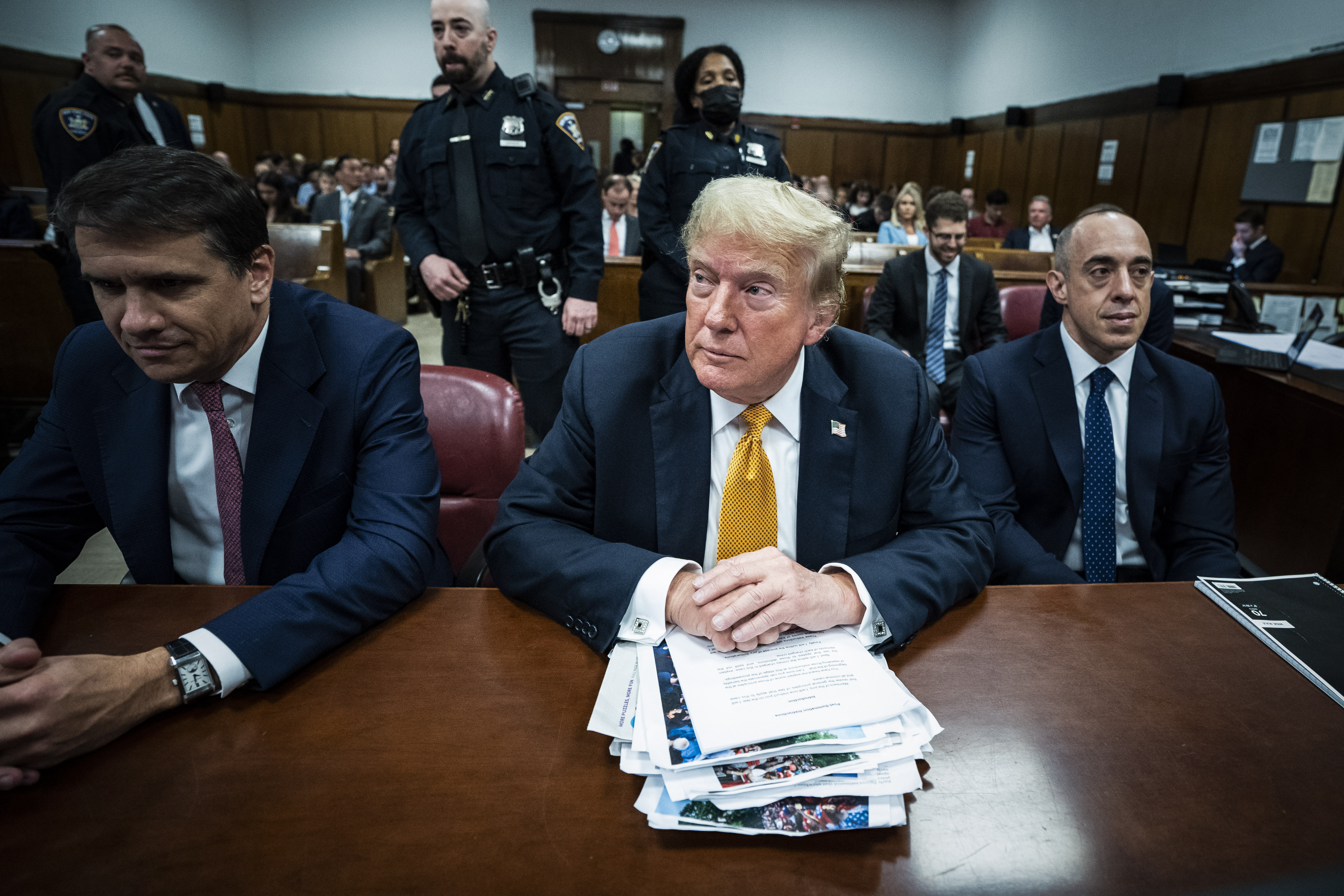
Donald Trump, flanked by attorneys Todd Blanche and Emil Bove (right), at his criminal trial in Manhattan in 2024.
He fired the federal prosecutors and FBI agents who pursued cases against the Jan. 6, 2021, insurrectionists. He clumsily sought to dismiss charges against New York City Mayor Eric Adams to coerce him to aid Trump’s immigration crackdown. And, according to multiple credible whistleblower allegations, Bove told other DOJ lawyers that if courts tried to stop the administration’s deportations, they should tell “the courts ‘fuck you.’”
Now that Bove is on the Third Circuit — he was confirmed in July by a razor-thin 50-49 vote — he is moving with similar speed to show Trump he’s still on his side.
This week, in what appears to be Bove’s first vote as a circuit judge, he joined four other Trump appointees dissenting from the full court’s decision to deny the request of various Republican organizations to rehear the case holding Pennsylvania’s date requirement for mail-in ballots unconstitutional.
Of course, there never should have been a vacancy for Bove to fill.
Back in November 2023, President Biden nominated Mangi to the seat Bove now holds. Mangi had all the sterling credentials you’d expect from an appellate court nominee — degrees from Oxford and Harvard Law, and a long career at a white-shoe law firm.
But all Republicans could see was that he was Muslim, and they pulled out every Islamophobic trick in their very big book to disingenuously paint him as some antisemitic radical.
And what’s worse, some Senate Democrats fell for it, sinking Mangi’s nomination and handing this critical vacancy to Trump.
Jennifer Mascott: Am MAGA, will travel
Over the summer, Trump also nominated Catholic University law professor Jennifer Mascott to a second Third Circuit vacancy in Delaware.
Mascott’s résumé is dripping with connections to Trump and the MAGA legal movement. She clerked for then-D.C. Circuit Judge Brett Kavanaugh (one of Trump’s appointees to the Supreme Court) and Justice Clarence Thomas (one of Trump’s favorite justices).
Before joining Catholic Law last year, she taught at George Mason’s Antonin Scalia Law School, one of the most conservative in the country.
In the first Trump administration, she worked in Trump’s Justice Department and helped with Justice Amy Coney Barrett’s last-minute confirmation.
This time, she went to work directly for Trump as senior counselor to the president in the White House Counsel’s Office.
What Mascott lacks, however, is any genuine connection to Delaware.
She lives in Maryland and works in Washington, D.C. She is not admitted to the Delaware Bar, and she has little, if any, experience with Delaware’s sophisticated corporate law regime.
But Mascott admitted in her Senate Judiciary Committee questionnaire that she made clear to Trump that she was willing to take any judgeship in which he “would be interested in having [her] serve,” historical tradition and judicial propriety be damned.
Even the timing of her confirmation reeks of political gamesmanship.
Mascott leapfrogged a half dozen other judicial nominees so she could join the Third Circuit in time to participate, and potentially cast the deciding vote, in a major Second Amendment case about New Jersey’s assault weapons ban.
With Bove and Mascott now seated, the Third Circuit may become the venue of choice for Trump’s allies looking to legitimize his most extreme policies, as right-wing litigants know they’ll find sympathetic ears in Philadelphia.
What was once a court known for its independence and moderation could soon become a proving ground for Trump’s legal movement — a place where loyalty trumps the law.
The only question left is how long it will take before the rest of the country starts feeling the consequences of the Third Circuit’s new MAGA majority.
John P. Collins Jr. is an associate professor at George Washington University Law School, where he researches and writes about federal judicial nominations.
Despite the public fall from grace, the voter said he missed John Dougherty’s leadership in Philadelphia, adding that he believed Dougherty had been good for workers in the city. They are brothers, Kevin Dougherty confirmed.
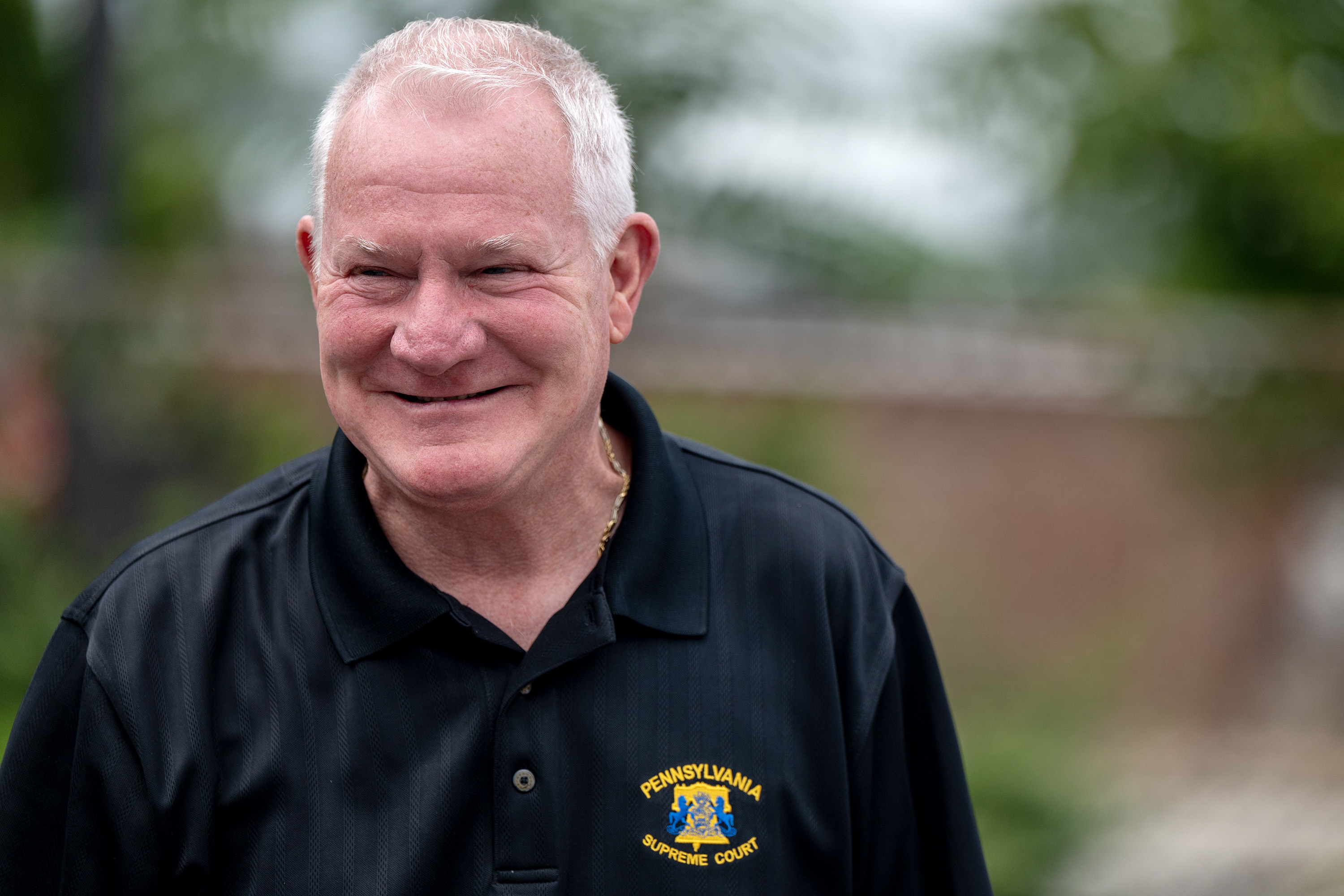
Justice Kevin Dougherty (left) canvasses with his son, State Rep. Sean Dougherty (center) in Fox Chase Sunday Sept. 7, 2025, stopping at the home of a voter. The elder Dougherty is one of three Pennsylvania Supreme Court justices up for retention.
But in this year’s unusually high-profile state Supreme Court retention race, the connection has, in some circles, become unavoidable. Republicans seeking to oust Kevin Dougherty and two of his colleagues, all initially elected as Democrats, have sought to tie the judge to his brother’s misdeeds. The justice, a son of South Philadelphia who previously led Philadelphia’s Family Court, has sought to distance himself, and has seen the continued support of labor unions in his retention campaign.
“Over the course of 25 years as a judge, including ten years as a Justice on the Supreme Court, Justice Dougherty has had the privilege and the benefit of meeting a multitude of Pennsylvanians including the working men and women of organized labor,” Shane Carey, Kevin Dougherty’s campaign manager, said in a statement. “Our campaign is proud to receive their support, as well as the support from almost 5,000 other individual donors.”
How Johnny Doc helped elect his brother to the Supreme Court in 2015
Kevin Dougherty didn’t choose to be related to one of the city’s most prominent power brokers, but he certainly benefited from his brother’s former union’s help, with significant support from the politically powerful Local 98 during his 2015 campaign for the state bench.
Local 98, where John Dougherty was the longtime business manager, contributed more than $620,000 during Kevin Dougherty’s 2015 campaign for the Pennsylvania Supreme Court. Local 98’s spokesperson at the time also served as Kevin Dougherty’s campaign manager and appears from campaign finance filings that year to have been paid by Local 98. The union also spent more than $480,000 on in-kind contributions for “professional services,” mailers, merchandise,and more.
Justice Kevin Dougherty talks with volunteers before they head out the canvass in Fox Chase Sunday Sept. 7, 2025. Dougherty is one of three Pennsylvania Supreme Court justices up for retention.
Kevin Dougherty is the only justice up for retention from Southeastern Pennsylvania. The other justices, Christine Donohue and David Wecht, live in Pittsburgh. They will each appear on the November ballot with no party and no home county. Voters will simply be asked “yes” or “no” whether each individual justice should be retained for another term.
Republicans working to oust the three justices this year have tried to leverage Kevin Dougherty’s past support from his brother to encourage voters to oppose his retention.
Scott Presler, an influencer aligned with President Donald Trump who has more than 2.4 million followers and runs a political action committee aimed at registering Republican voters, posted an AI-generated image of John Dougherty behind bars, tying, without evidence, Local 98’s contributions to Kevin Dougherty’s 2015 campaign to his brother’s convictions.
“Coincidence?” Presler wrote.
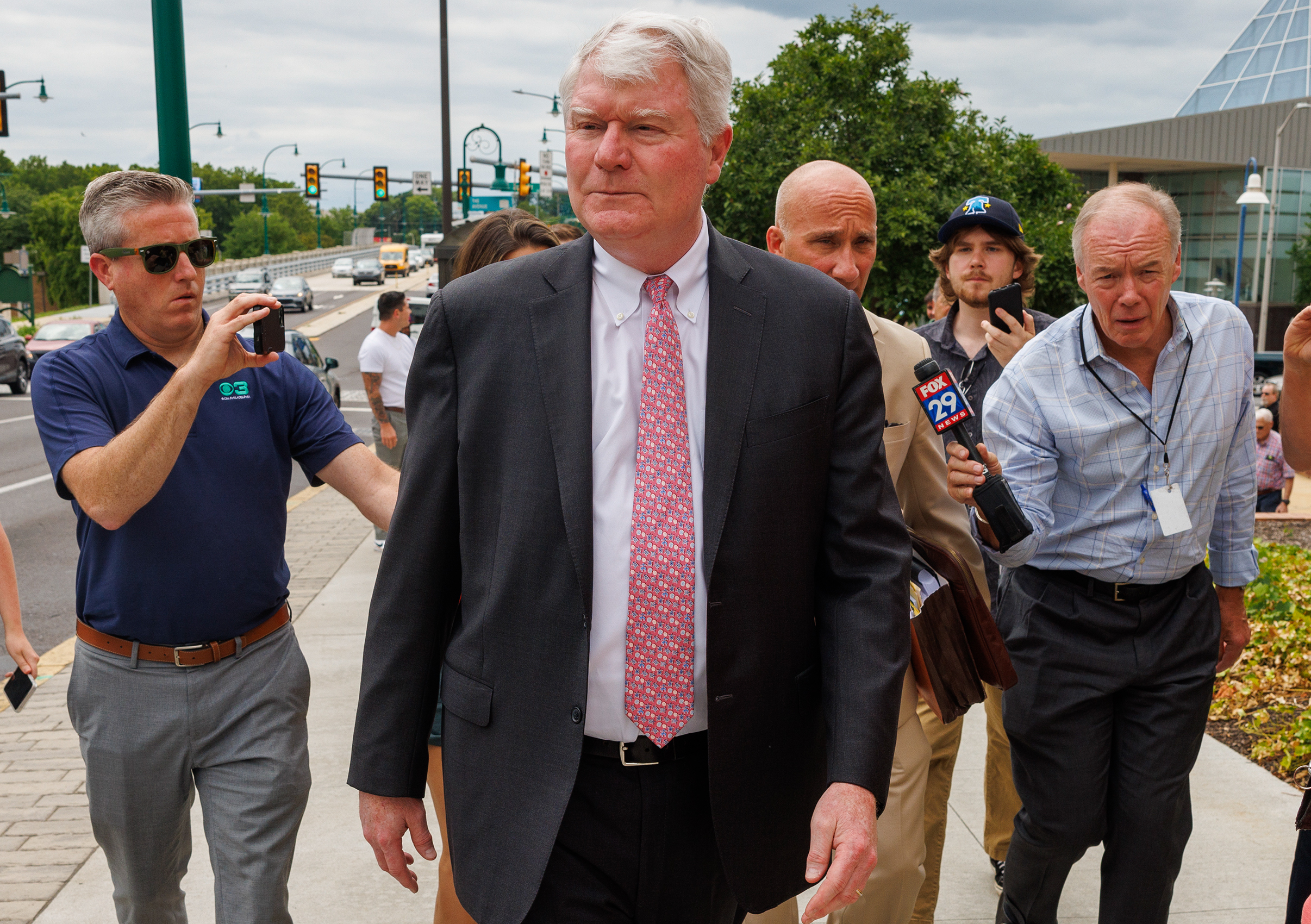
Johnny Dougherty, the former IBEW business manger, and his attorney Gregory J. Pagano as they leave the U.S. District Court, Reading, Pa. on the day he was sentenced to 6 years in prison Thursday, July 11, 2024.
For months, the conservative influencer has posted on social media urging followers to vote against retaining Kevin Dougherty and his colleagues, citing the times his name was mentioned during John Dougherty’s trials, such as when prosecutors alleged the justice received free home repairs or snow removal on the union’s dime. Kevin Dougherty’s lawyer at the time of the embezzlement trial said the judge never knowingly accepted services paid for with union funds.
While door-knocking in September, Kevin Dougherty dismissed attacks against him related to his brother as “misinformation,” noting his decades-long career as a judge.
Kevin Dougherty, 63, spent more than a decade as a Common Pleas Court judge in Philadelphia before his election to the state Supreme Court. During his tenure on the state’s highest court, he has authored majority opinions and is leading a statewide initiative to improve how Pennsylvania’s judicial system interacts with people with behavioral health issues.
“I spent close to a quarter of a century being a judge,” Dougherty said on a sidewalk in Northeast Philly. “I just don’t accept people’s comments and judgment. I want to know what the motive behind those comments are. Some of these comments are just partisan … and I believe in my reputation.”
The justice should be vetted on his own merits, said John Jones, a former U.S. District Court judge for the Middle District of Pennsylvania who was appointed to the bench by former President George W. Bush.
“You can pick your friends, but you can’t pick your relatives,” Jones, now president of Dickinson College, added. “You have to judge the justice on his own merits. This is not a country where we favor guilt by association.”
Kevin Dougherty still has broad union support, including from Local 98
With John Dougherty no longer at the helm of Local 98, labor unions in Pennsylvania this year still overwhelmingly supported the justice for retention, contributing $665,000 to Kevin Dougherty’s campaign as of September. While trades unions contributed the most of any interest group to all three justices — for a total of $903,000 as of the latest filings — Kevin Dougherty is the largest beneficiary of that support.
Among those contributors: Local 98. The union, which has reorganized and distanced itself from John Dougherty since he was first convicted in 2021, gave $70,000 to Kevin Dougherty’s retention campaign.
“IBEW Local 98 does not support candidates based on personal relationships,” said Tom Lepera, Local 98’s political director, in a statement. “We support candidates who understand and stand up for the needs of working men and women in organized labor. Justice Dougherty, along with Justices Donohue and Wecht, have consistently demonstrated their commitment to protecting the rights and interests of middle-class workers across this commonwealth.”
Kevin Dougherty’s campaign did not respond to several questions this weekabout his brother’s role in his 2015 campaign or whether his brother’s reputation has influenced the retention campaign.
Anti-retention material featuring President Donald Trump as Uncle Sam was on display at Republican rally in Bucks County last month headlined by Treasurer Stacy Garrity, a candidate for governor. The material is from Early Vote Action, a group led by GOP influencer Scott Presler.
Union leaders insist their support for Kevin Dougherty this year has nothing to do with his brother and is a reflection of his quality work in the judiciary. Labor unions often support Democratic candidates, who are often seen as more beneficial to unions and their priorities.
“It’s about keeping good judges on the bench,” said Ryan Boyer, leader of the Philadelphia Building and Construction Trades Council, an umbrella organization of local trades unions once commanded by John Dougherty. This year, the building trades gave just over $33,000 to each justice.
“We don’t live on Mars where we don’t know that sometimes familial connections can be there,” Boyer said, “and they try to exploit those things.”
Nonpartisan and Democratic groups favor Dougherty’s tenure on the bench
Like his colleagues running for retention, Kevin Dougherty has earned broad support from nonpartisan and partisan groups alike.
Lauren Cristella, CEO of the Committee of Seventy, the Philadelphia-based good-government group, noted that the justice was never charged or found guilty of wrongdoing.
Justices David Wecht, Christine Donohue and Kevin Dougherty sit onstage during a fireside chat at Central High School on Monday, Sept. 8, 2025 in Philadelphia.
“The Committee of Seventy relies on the findings of law enforcement and professional oversight organizations, such as the Bar Association, when evaluating judicial candidates. This year, the Pennsylvania Bar Association has evaluated Justice Dougherty and recommended him for retention. Our focus remains on transparency, accountability, and maintaining public trust in Pennsylvania’s courts,” Cristella said in a statement.
Dougherty and his fellow justices have also gained the support of Gov. Josh Shapiro, Pennsylvania’s popular Democratic governor, who in a fundraising email to Pennsylvania Democrats on Thursday urged voters to mark “yes” on retaining Dougherty, Donohue, and Wecht.
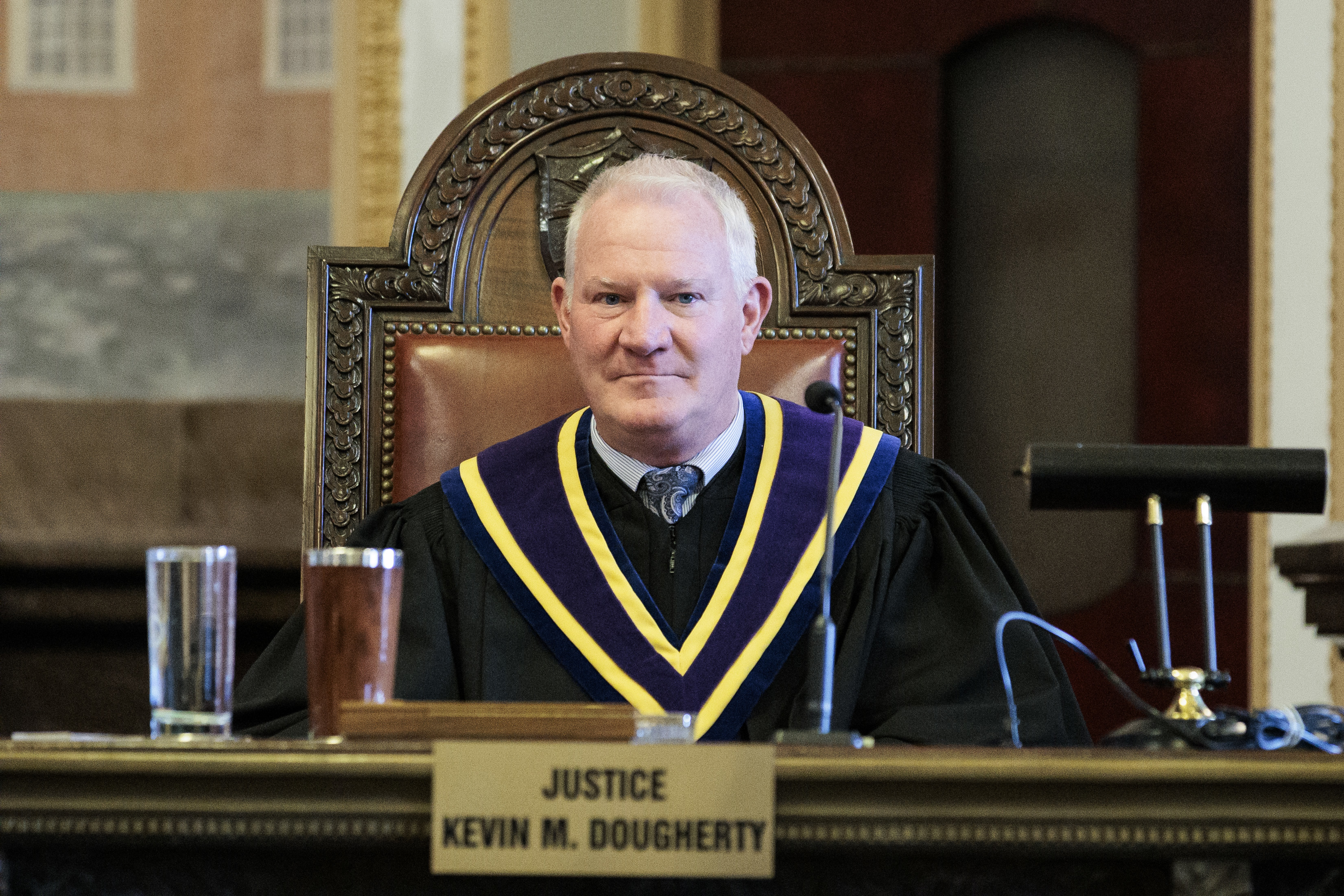
Justice Kevin M. Dougherty listens during a Courtroom Dedication Ceremony at the Supreme Court Courtroom in Philadelphia City Hall on Tuesday, Sept. 9, 2025 in Philadelphia.
“The threats to our freedoms are coming from all directions, and we need a Court that stands up for what’s right,” Shapiro said in the email. “Justices Donohue, Dougherty, and Wecht have proven that we can count on them to protect freedom, reproductive rights, and the rule of law.”
In a statement to The Inquirer, Kevin Dougherty didn’t mention his brother by name.
“With regard to my personal relationship I love my big brother. For obvious reasons, my brother is not participating in my Retention campaign,” he said.
Democrats have dominated Delaware County government since the 2019 election.
As suburban communities across the nation flipped from red to blue, Democrats took control of the county council for the first time since the Civil War — the result of long-term shifts accelerated by President Donald Trump’s first administration. The party has held all five seats on the governing board ever since, easily retaining seats in 2021 and 2023.
Two seats on the five-member board are on the ballot in November. Democrats argue tax increases were necessary to make up for decades of underinvestment by Republicans.
But Republicans insist spending is out of control. While they cannot take control of the board this year, they are asking voters to give them a voice to push back against the Democrats.
“The money tree in the backyard does not exist,” said Brian Burke, one of two Republicans running for council.
Burke, a union steamfitter, was first elected to Upper Darby’s township council in 2019 as a Democrat. He became a Republican to unsuccessfully run for mayor of the township in 2023 following years of feuds with the Democratic administration. While on the township council, Burke worked in conjunction with Republicans on the board as well as two other Democrats to challenge Democratic leadership in Upper Darby. He said this experience would aid him as he worked to hold Democratic leadership in Delaware County accountable.
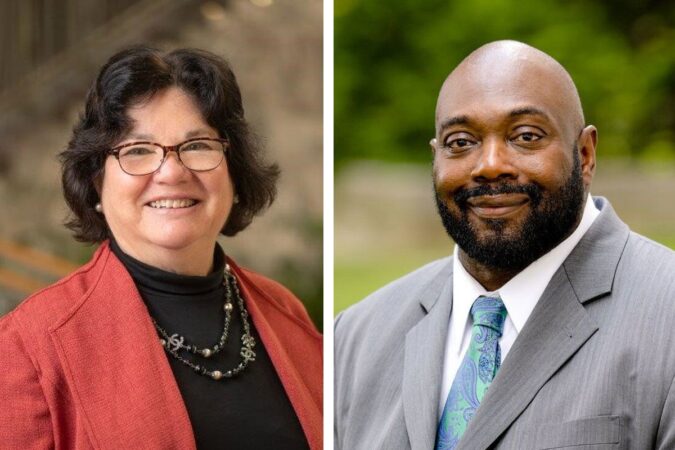
Piazza worked for decades in Delaware County Court’s domestic relations department, where she ran the warrant division and served as a liaison for judges and attorneys. Running for council, Piazza has been vocal about wanting to devote opioid settlement funds toward grandparents caring for the children of those struggling with addiction.
Womack was first elected to the council in 2021 after spending 10 years on the Darby Township Board of Commissioners. Womack spent years as an advocate in the labor movement, including serving as an adviser on community and religious affairs for the national AFL-CIO.
Burke and Piazza are urging voters to elect them to “stop the spend.”
After the council raised property taxes by 23% last year, the pair of Republicans argued the taxes were a result of out-of-control spending in the county. They say there needs to be a voice on the council acting as a check on spending.
“There’s a lot that needs to be cut. There’s a lot of spending,” Piazza said.
If elected, the two Republicans would not have control over county spending, but they would have votes on the five-member board to oppose new spending and work to sway their Democratic counterparts.
What is the Democratic platform?
Womack and Phillips are largely defending the actions of the Democratic council over the last five years. Republican leadership, they argue, did not raise taxes for 12 years and allowed county infrastructure to fall into disrepair. As a result, they say, Democrats had to increase taxes to fund county services and infrastructure improvements.
No one wanted to increase taxes, Womack said, but it was unavoidable.
“Our county has really been underserved for many decades,” Womack said. “In the long run, it costs you a lot more money to repair than if you had taken care of things gradually.”
If elected, Phillips says she would like to do more public vetting of contracts and work to increase development in Delaware County so that the local tax base can be increased without more tax hikes. Womack has said he wants to work on expanding affordable housing options in the county.
Why were taxes raised? Will there be another hike?
The county council voted last year to increase property taxes by 23%, which comes out to roughly $185 annually for the owner of a home assessed at the county average. The county had used pandemic relief funds to stave off significant tax increases in prior years, but those funds were running dry and additional dollars were needed to cover employee salaries amid inflation, council members said at the time.
Piazza and Burke insist that another double-digit tax increase is on the way. Too much of the current budget, they argue, still depends on short-term federal pandemic relief funds or transfers from other county funds.
“They’re going to come out after November 4th election and basically tell the residents of Delaware County, ‘You’ve got another 20% increase,’” Burke said.
Womack, the sole member of the county council who voted against the increase, said that he anticipated another tax hike but that he could not imagine it would reach 20%.
The incumbent spearheaded a citizens budget task force that has spent the year seeking areas to cut spending.
“It’s kind of hard to really project what we’re looking at right now,” Womack said. He noted that, amid a federal government shutdown, details on state and federal aid are unclear.
However, the county is not expecting to release its preliminary budget until mid-November, after the election. Last year, the county did not release its proposed budget until Dec. 3.
Where do Republicans want to cut?
Republicans have identified three primary areas they argue represent overspending: the county health department, the prison, and outside legal assistance.
Republicans in the county have long argued it was an unnecessary expense. Though the $18 million department is currently funded entirely by state and federal grant dollars, Burke argued it will eventually cost taxpayers.
“In my eyes, that [money] could have been used somewhere else,” Burke said.
In 2020, the council voted to explore options to retake control of the county prison from the private firm that had run it. Phillips, who was controller at the time, argued the decision was in the county’s best interest and has better served inmates and staff.
But Republicans argued that the county’s costs have gone up too much and that the county opened itself up to litigation that it would not have been vulnerable to if the prison had remained privately run. The union representing prison employees often clashed with the first warden the county chose to lead the prison.
In an interview, Burke argued the county could find significant savings if it put the prison back in private hands. In 2025, the prison cost the county over $59 million. The county’s last contract with GEO, which managed the prison privately, paid the company $259 million over five years.
Phillips said the health department and public prison, while significant expenses, will save the county and its residents in the long run. Even when the prison was run privately, she said, infrastructure repairs were on the county and the private operators sought to maximize the number of inmates in the building.
“Government should take care of its people,” Phillips said.
Finally, Republicans point to the ballooning cost of legal counsel to the county. Last year, the county paid more than $4.4 million to outside legal counsel, including a firm that once employed Phillips and County Councilwoman Christine Reuther. Republicans argue this represents misuse of funds and political cronyism.
Phillips and Womack instead point to the county’s small in-house legal team and the growing number of cases brought against the county, including defending against frivolous suits filed by election deniers, as well as managing complex legal issues, such as the Prospect Medical Holdings bankruptcy filing that closed two major hospitals in the county.
Even if they won both seats, Republicans would hold the minority on the council for at least the next two years. This means they would have to persuade Democrats to come along with them on any policy changes or budget cuts.
“I would love to win the seat and get in there and get into the nitty-gritty and kind of see what goes on behind closed doors and have a voice for the residents and be there for them,” Piazza said.
This suburban content is produced with support from the Leslie Miller and Richard Worley Foundation and The Lenfest Institute for Journalism. Editorial content is created independently of the project donors. Gifts to support The Inquirer’s high-impact journalism can be made at inquirer.com/donate. A list of Lenfest Institute donors can be found at lenfestinstitute.org/supporters.