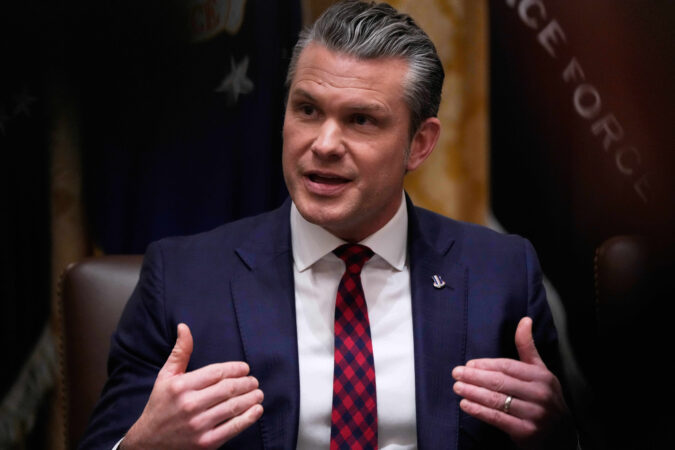
Defense Secretary Pete Hegseth previously emphasized the samemilitary law that the Trump administration has been calling Pennsylvania lawmakers seditious for citing.
Hegseth notedthe military rule not to obey unlawful orders during a forum in 2016,when he was a Fox News contributor, in recorded remarks CNN unearthed on Tuesday.
Hegseth spoke at length about his views on the military — and criticism of former President Barack Obama — in a talk titled “The US Military: Winning Wars, Not Social Engineering.” The talk was shared online by the Liberty Forum of Silicon Valley and was marked as taking place on April 12, 2016. Hegseth, an Army veteran, had a book coming out that he promoted at the event.
The moderator asked him a question from an attendee: “Can you comment on soldiers who are being held at Leavenworth Prison for being soldiers?”
Hegseth argued that some prisoners at the facility did not deserve to be there but that others were facing the consequences for their unlawful actions.
“There are some guys at Leavenworth who made really bad choices on the battlefield, and I do think there have to be consequences for abject war crimes,” he said. “If you’re doing something that is just completely unlawful and ruthless, then there is a consequence for that.”
“That’s why the military said it won’t follow unlawful orders from their commander in chief,” he added. “There’s a standard, there’s an ethos, there’s a belief that we are above what so many things that our enemies or others would do.”
It is the same policy that a group of six Democratic members of Congress cited in a video that enraged President Donald Trump.
On his social media website, Truth Social, Trump said they were committing sedition “punishable by DEATH” and shared other posts attacking the lawmakers, including one calling for them to be hanged. Hegseth called them the “seditious six.”
“Encouraging our warriors to ignore the orders of their Commanders undermines every aspect of ‘good order and discipline,’” Hegseth said in a social media post. “Their foolish screed sows doubt and confusion — which only puts our warriors in danger.”
When asked for comment by CNN, spokespersons for the Pentagon and the White House further criticized the Democratic lawmakers who made the video.
Pentagon spokesperson Kingsley Wilson also told CNN that the military “has clear procedures for handling unlawful orders” and defended Trump’s orders as legal.
White House spokesperson Anna Kelly told CNN that Hegseth’s position has remained consistent and that his remarks were “uncontroversial.”
Sean Timmons, a Houston-based attorney specializing in military law who served as an active-duty U.S. Army captain in the U.S. Army Judge Advocate General (JAG) program, told The Inquirer that service members can get in trouble for refusing orders and that it is largely up to commanders to determinewhether orders are lawful or not. While the military rules specify not to follow obviously illegal orders, such as war crimes, they also say to presume orders are lawful.
Houlahan expressed disappointment in her Republican colleagues for largely not defending the Democratic lawmakers, though U.S. Rep. Brian Fitzpatrick, a Bucks County Republican, said he stood by his Democratic colleagues when asked by The Inquirer.
The fallout from the video has gone beyond rhetoric on X and Truth Social.
Hegseth also said in his 2016 talk that he believed U.S. Sen. Ted Cruz (R., Texas), Trump’s top rival for the GOP nomination that year, would be the best president at fighting wars, but that he believed Cruz and Trump would both “unleash war fighters and get the lawyers out of the way, which is really a big impediment to how we fight wars.”
The Democratic lawmakers did not cite specific orders in their video announcement, but Trump’s involvement of the National Guard in U.S. cities and the Pentagon’s strikes in the Caribbean have drawn legal debate.
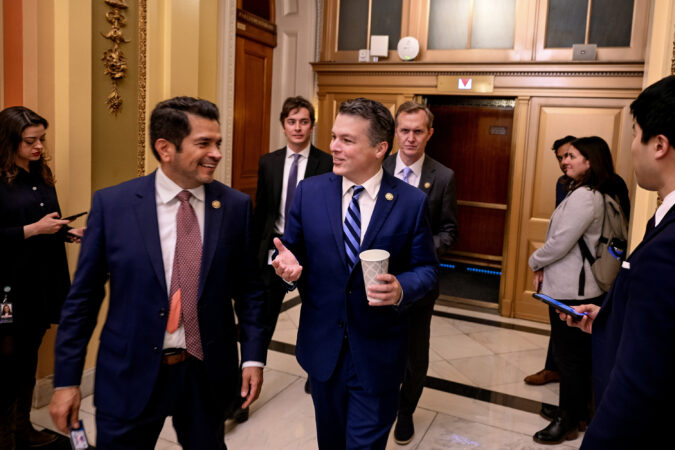
WASHINGTON — Ahead of a morning Budget Committee meeting, U.S. Rep. Brendan Boyle gathered his senior advisers in a brightly lit conference room just off the Capitol to settle on a simple strategy.
“Let’s keep the main thing the main thing,” he said. “Fifteen million Americans are gonna lose their healthcare because Republicans care more about tax breaks for billionaires. It’s accurate. You can describe it in a sentence.”
Boyle, a six-term lawmaker, is the most veteran of Pennsylvania’s eight Democrats in Washington. He has been the ranking member of the House Budget Committee since 2023, meaning he is the top Democrat playing defense as the Republican-controlled Congress ushers through GOP spending priorities. It can be a futile exercise in shouting into a void — until the yelling starts to echo outside.
“He’s one of our best messengers who appropriately comes across as both strong and authentic at the same period of time,” House Minority Leader Hakeem Jeffries (D., N.Y.) said in an interview late last month.
Jeffries credited Boyle with homing inon a key statistic: Taken together, Trump’s reconciliation bill andthe expiration ofAffordable Care Act tax credits represent the largest cut to Medicaid in American history.
“That one observation became core to our arguments in pushing back against that toxic piece of legislation, and it’s also one of the reasons I believe that the law is so deeply unpopular amongst the American people,” Jeffries said.
Democrats have been recently on a roller coaster — securing big wins in the November election and then splitting over how long to withstand the government shutdown, with eight senators ultimately crossing the aisle to end the impasse. But Boyle’s messaging war is ongoing, and he thinks it is his party’s best bet for winning key midterm races in his home state, where Democrats are targeting four Republican-held seats in swing areas.
If Democrats reclaim Congress in next year’s election, Boyle would shift from ranking member to chair of the powerful Budget Committee — becoming the first Pennsylvanian to lead it since Philadelphian Bill Gray, a Democratwho chaired it from 1985 to 1989. It would be another resumé builder for the 48-year-old lawmaker whose role in Washington keeps growing and who has not ruled out a potential Senate run in 2028, when Democratic Sen. John Fetterman’s seat would be up.
“I get asked a lot: How do you keep this message going for the next year?” Boyle said in an interview in his Washington office. “Well, we started this five months ago, and actually more people know about it today than over the summer. Every single day, continuing to talk about healthcare, continuing a broader conversation about affordability, is absolutely what we have to do.”
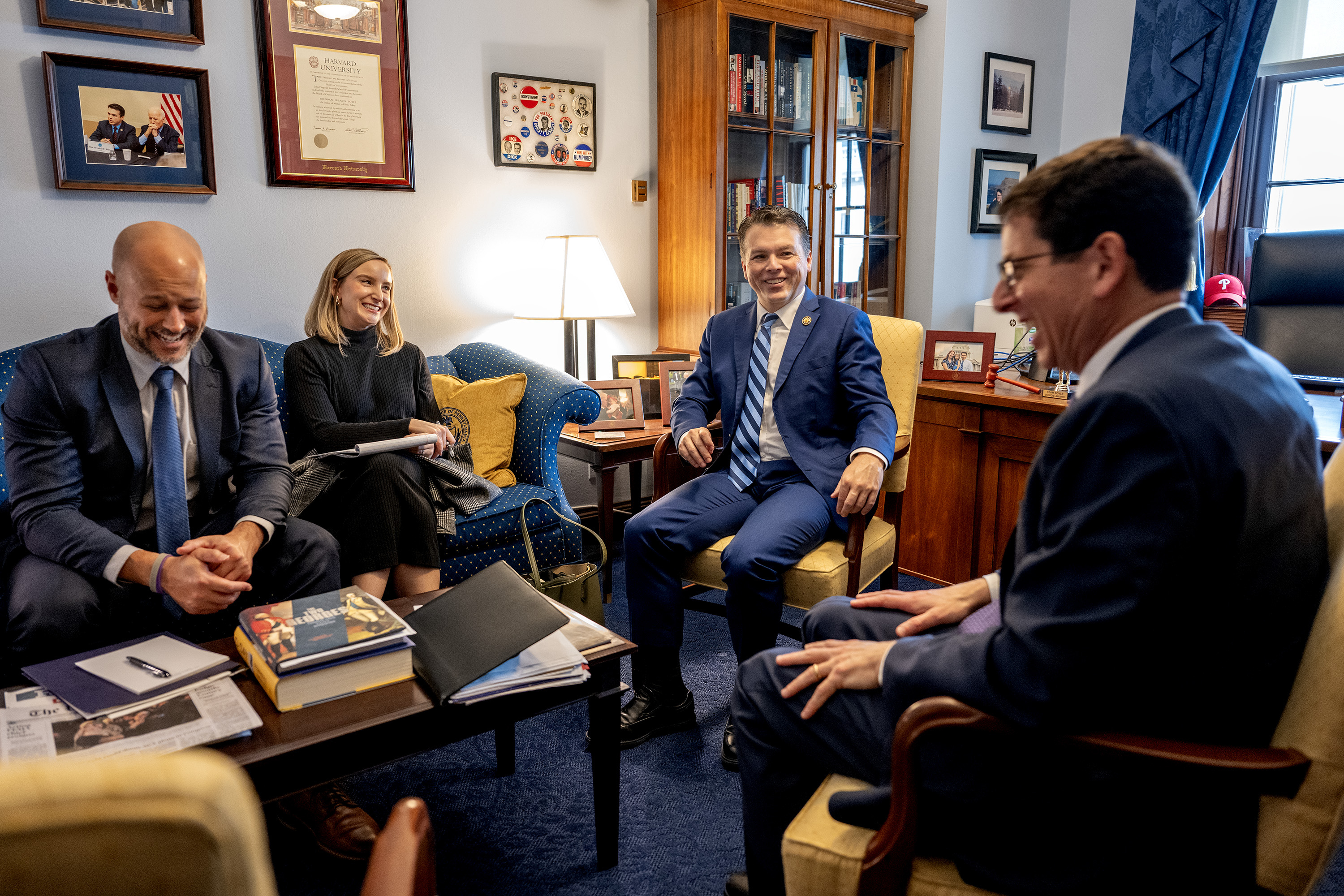
U.S. Rep. Brendan Boyle (center) meets in his Capitol Hill office with Phillip Swagel (right), director of the Congressional Budget Office, following Swagel’s testimony before House Committee on the Budget last month. As Budget’s ranking member, Boyle has been central in shaping Democratic messaging around Republican policies.
‘Scrappy Irish Catholic boys from Olney’
Boyle, who lives in Somerton with his wife and 11-year-old daughter, is an affable, earnest lawmaker in a role that is unapologetically wonky — and high-profile, especially lately.
From Oct. 1 through the end of November — a period including the shutdown — Boyle popped up on TV news more than two dozen times, by his office’s count.
His political beginnings were far less polished. In 2014, Boyle shocked Philadelphia’s political establishment by winning the Democratic primary over a field that included former U.S. Rep. Marjorie Margolies, scion of a powerful political family. Then a 37-year-old state representative, Boyle ran as a blue-collar, antiestablishment pragmatist from Northeast Philly. His ads cast his opponents as out of touch, and he leaned hard on his family’s story: his father, an Irish immigrant, worked at an Acme warehouse and later as a SEPTA janitor; his mother was a school crossing guard. Boyle still keeps his dad’s SEPTA cap on a bookshelf in his Washington office.
That same year, his brother Kevin won a seat in the state House, prompting Philadelphia Magazine to profile the “scrappy Irish Catholic boys from Olney” who were reshaping the party.
A decade later, Democrats are still striving to win back blue-collar voters. Boyle, meanwhile, has traded some of his insurgent edge for the stature of a Hill veteran.As Philadelphia elects a replacement for retiring U.S. Rep. Dwight Evans next year, Boyle will be a key ally for the new lawmaker, and a coveted endorsement during the election, though he has said he does not plan to weigh in. He has been in the thick of some of the year’s biggest fights — leading Democrats through a 12-hour reconciliation markup, testifying at a 1 a.m. Rules Committee hearing, and grinding through an overnight Ways and Means marathon.
His younger brother has had a far more tumultuous path. Kevin lost his state House seatlast year amid long-running mental health struggles.
Boyle declined to discuss the situation beyond saying: “The last five years — almost exactly five years — have been very challenging. And I’ll just leave it at that.”
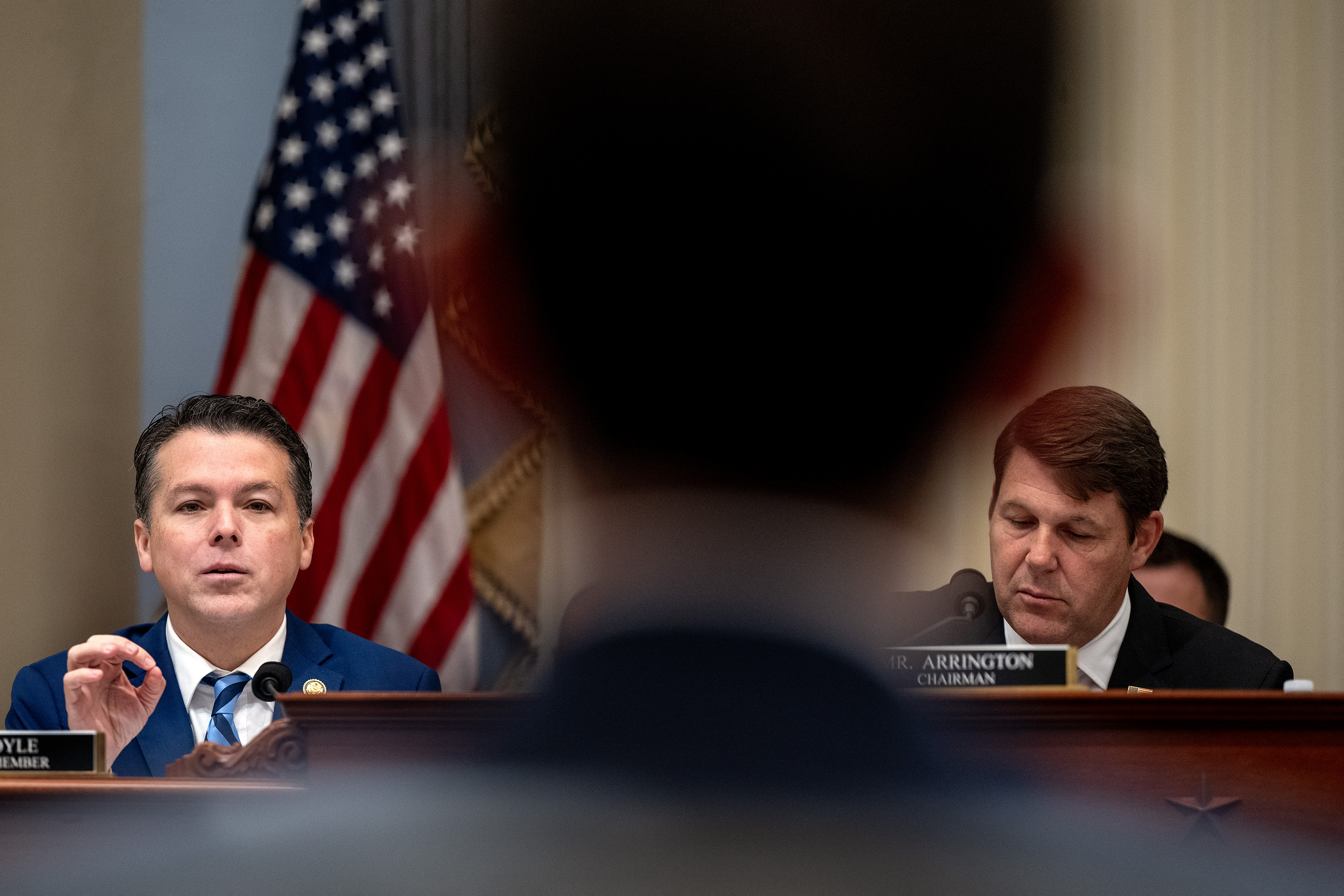
U.S. Reps. Brendan Boyle (left) (D., Philadelphia) and Jodey Arrington (right) (R., Texas) question Phillip Swagel (back to camera), director of the nonpartisan Congressional Budget Office, during a hearing on Capitol Hill in Washington, D.C. Tuesday, Nov. 18, 2025. Arrington chairs the House Budget Committee, while Boyle is the panel’s top Democrat.
In line for the gavel
Before that late November hearing, Boyle had already reached out to fellow Democrats on the committee: Talk about healthcare, he urged them. Talk about affordability. Talk about it ad nauseam.
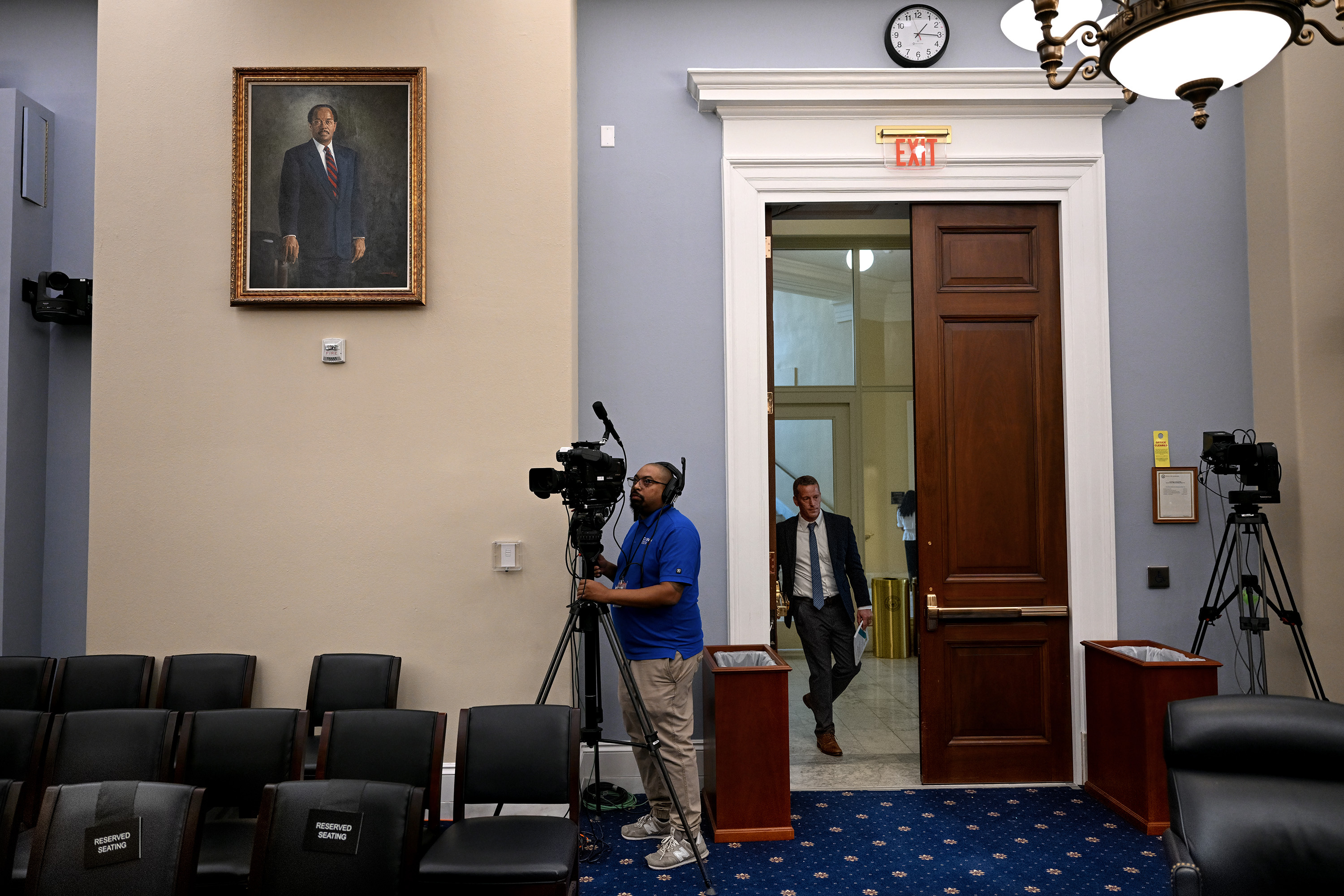
He sat at the dais across from a portrait of Gray in an ornate hearing room, surrounded by paintings of former budget chairs, and delivered his opening remarks.
“The president has stopped calling it the ‘Big, Beautiful Bill.’ He’s stopped talking about the bill altogether,” Boyle said. “… Because it’s not just that healthcare’s become unaffordable in America. It is beef, it is coffee, it’s electricity, almost every staple in the average consumer basket.”
The director of theCongressional Budget Office, Phillip Swagel, was called before the committee that day and fielded questions from both sides. Democrats wanted to know Swagel’s projections on how Trump’s policies would affect everything from the national debt to the price of Thanksgiving dinners, eager for sound bites to send to constituents back home and to pressure Republicans on the healthcare debate.
Republicans were pushing Swagel for an audit, seekingmore transparency on how the nonpartisan agency comes to its projections.
“We need to be able to cut through the politics and the partisanship and figure out where you and your team can do a better job,” said U.S. Rep. Jodey Arrington,the Texas Republican who chairs the committee.
Boyle, whose office uses CBO projections to compile and distribute national and district-level data to Democrats, said he is open to an audit, if performed responsibly and not as a means to “discredit” the agency over numbers Republicans don’t like.
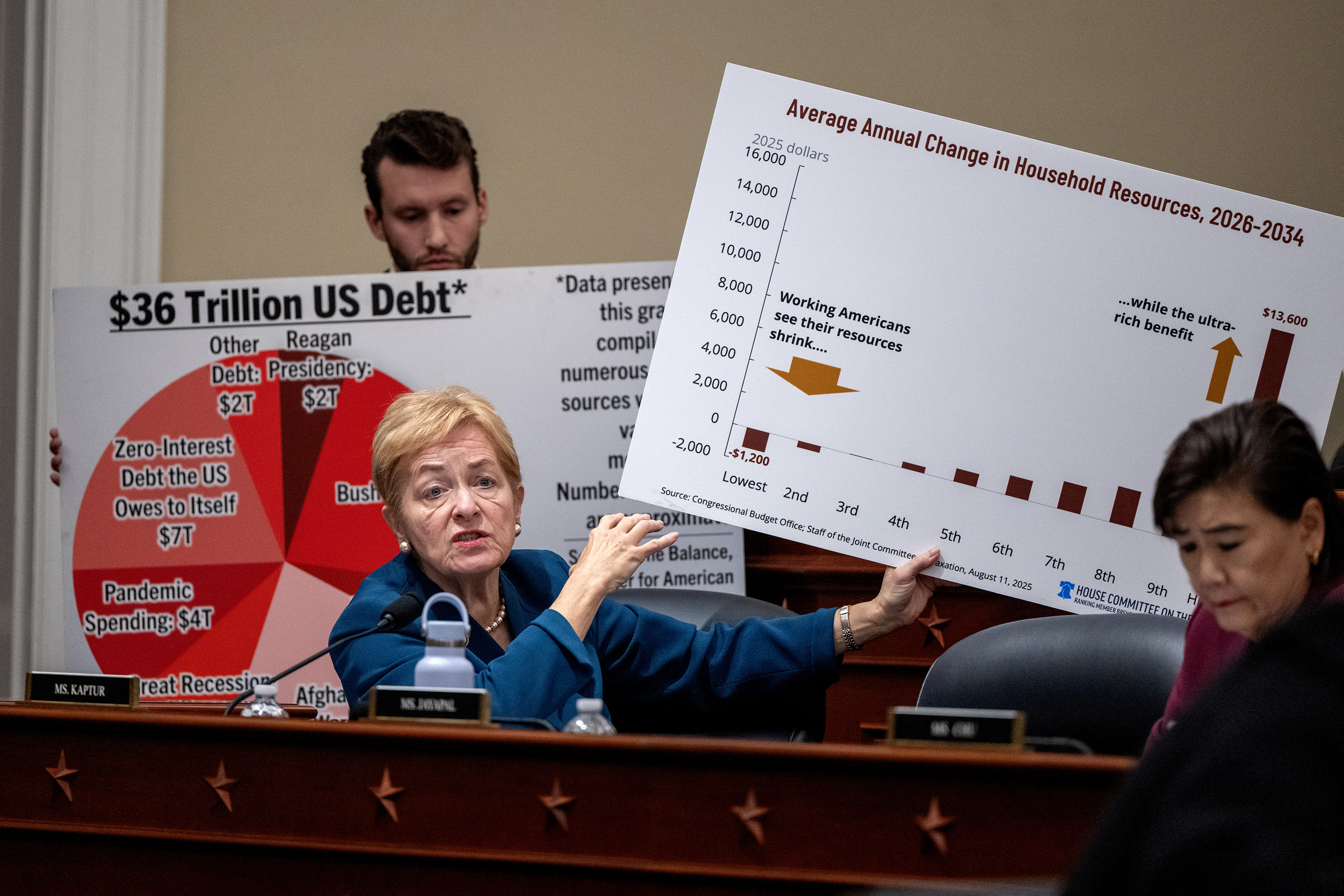
U.S. Rep. Marcy Kaptur, a Democrat from Ohio, brings visual aids to a hearing of the House Committee on the Budget on Capitol Hill in Washington, D.C. Tuesday, Nov. 18, 2025.
Throughout the three-hour hearing, Boyle would sidebar with Arrington, who is retiring next year. The Philly Democrat and the West Texas conservative make an unlikely pair, but the two have bonded across many late-night sessions over having younger children and their college football fanaticism — Boyle for his alma mater, Notre Dame, Arrington for Texas Tech.
“He’s a very good communicator because he’s a really smart and thoughtful guy,” Arrington said. “I always can appreciate, whether I agree or not, with a good communicator. He’s authentic in what he believes and he’ll even say, ‘I grant you it’s not perfect,’ or ‘You make a good point.’”
The midterms will dictate not just the party that controls Congress but also which ideological track the Budget Committee takes. If Democrats win, and Boyle takes the gavel, he plans to put more scrutiny on the administration and aim to regain some of Congress’ control over purse strings that Republicans have ceded to Trump.
Another Pennsylvanian, U.S. Rep. Lloyd Smucker, a Republican who represents Lancaster, has announced he is running to be the top Republican on the committee following Arrington’s retirement. That means regardless of party control, two Pennsylvanians will likely be at the helm of one of the most powerful committees in Congress. Smucker, a fiscal conservative running with Arrington’s backing, said in an interview he would focus on rising national debt and getting a budget resolution adopted. He was a key negotiator for Republicans during reconciliation, helping to get conservative House Freedom Caucus members on board.
Smucker called Boyle someone who is “serious about the budget process, and wants to make sure that it functions.”
“He genuinely cares about strengthening Congress as an institution,” Smucker added.
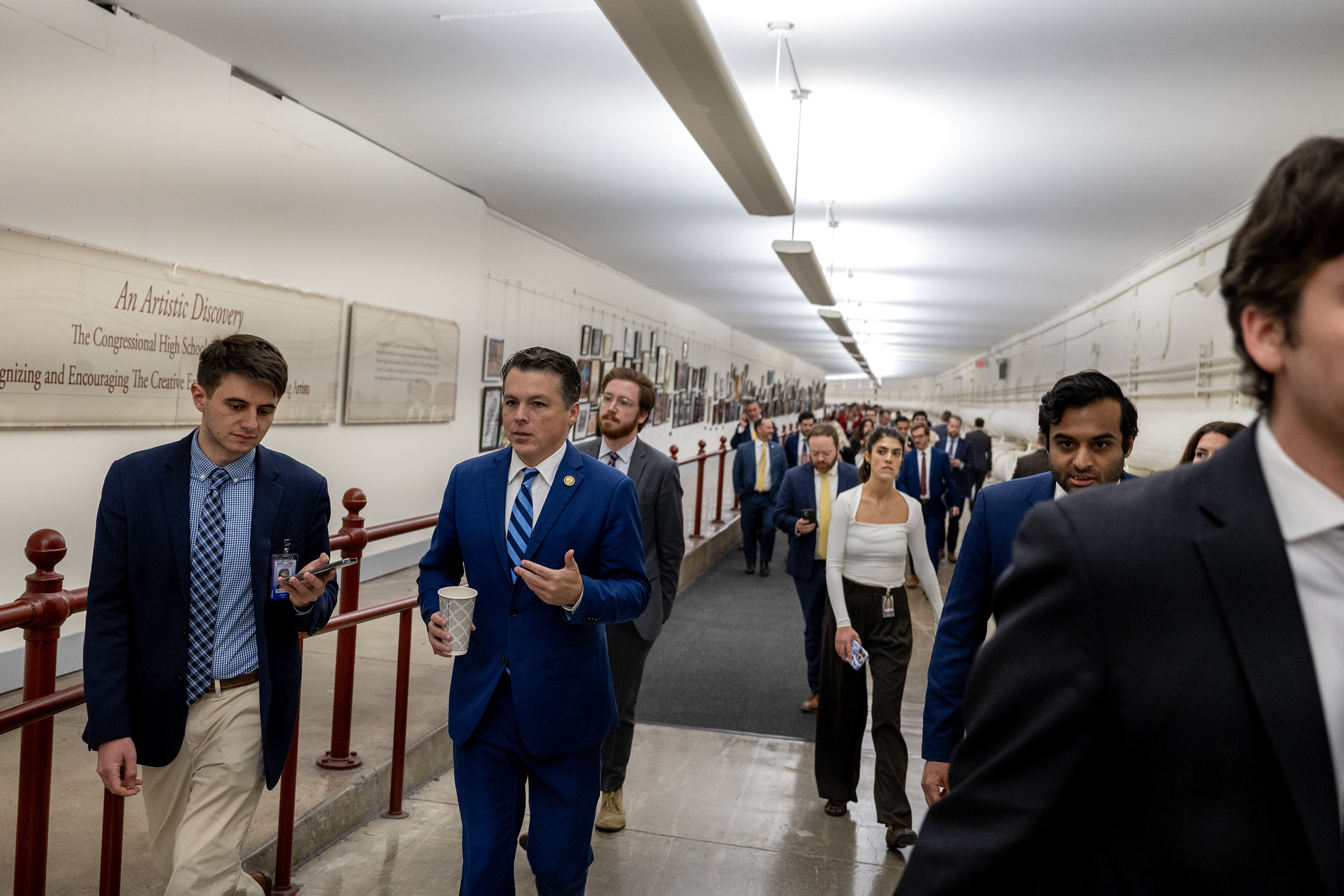
U.S. Rep. Brendan Boyle is interviewed by Charles Hilu (left), a reporter with the Dispatch, as he moves between office buildings on Capitol Hill in Washington, D.C. Tuesday, Nov. 18, 2025.
The road ahead
The longer Boyle stays in the House, in a safe Democratic seat, the harder it is to think about walking away.
In September, Jeffries appointed him the lead Democrat for the congressional delegation to the NATO Parliamentary Assembly. For Boyle, a history lover who has biographies of George Washington on his office coffee table, it’s an exciting opportunity to represent the country internationally as Trump continues to criticize the historic alliance. Boyle would become the leader of the parliamentary assembly delegation if Democrats take control of the House, just as he would take the gavel in the Budget Committee. Past committee chairs include former House Speaker Paul Ryan (R., Wis.), former Defense Secretary Leon Panetta, and former Ohio Gov. John Kasich.
“Some really high-quality, high-caliber people have done that over the last 40 years. So that’s what I’m looking forward to in the near term,” Boyle said. “After that, come 2028, and beyond, we’ll deal with that then. But it is interesting, like the longer you’re here, and if you move up the ranks, then actually it does make it more difficult to leave.”
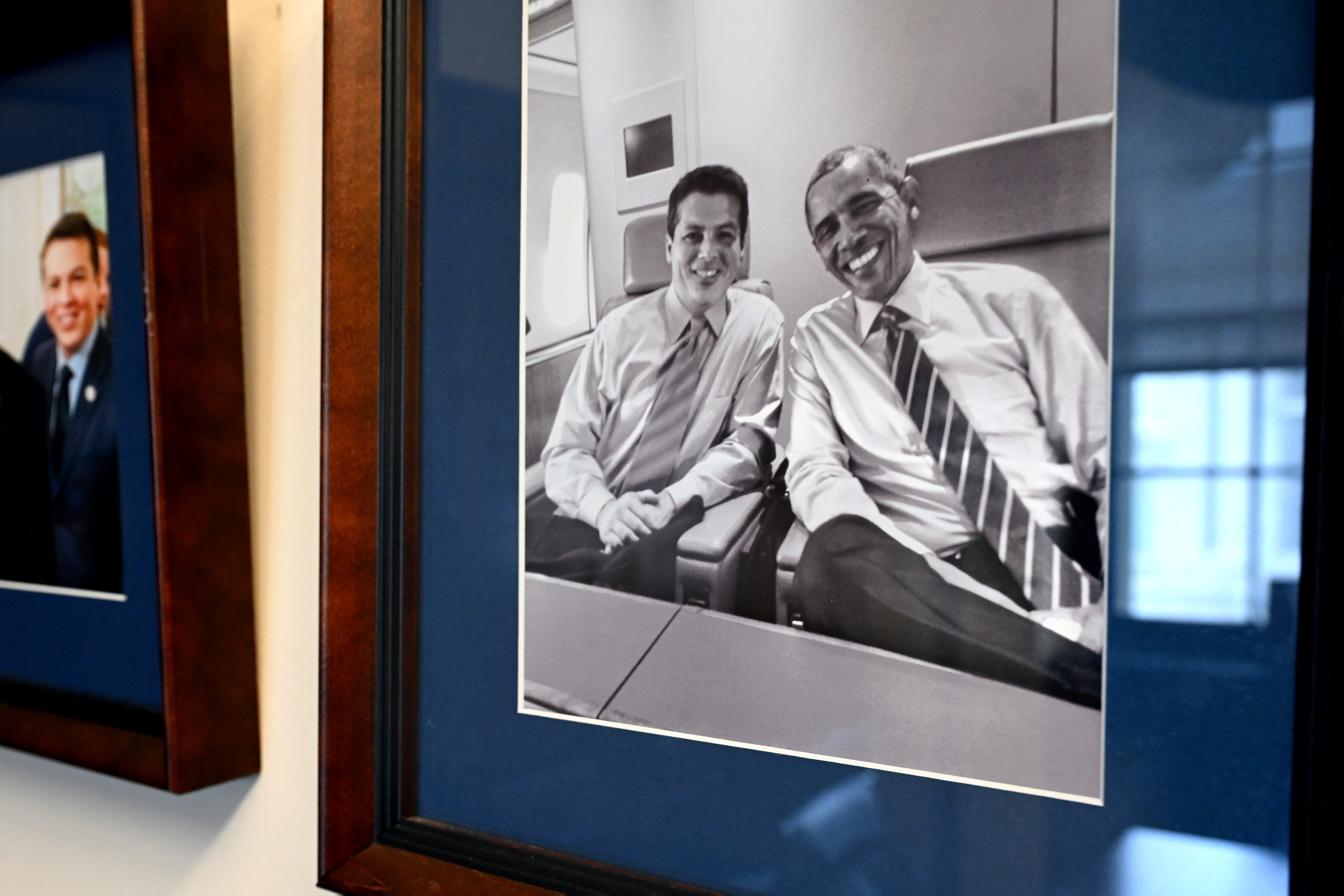
A painting of former U.S. Rep. William H. Gray III hangs in the hearing room of the House Committee on the Budget on Capitol Hill. It’s been 40 years since a Philadelphia lawmaker led a House committee. A photo of U.S. Rep. Brendan Boyle with former President Barack Obama on Air Force One hangs in his office on Capitol Hill in Washington, D.C.
But Boyle has not been shy about airing frustrations with Fetterman, whose term is up in 2028, sparking speculation Boyle could have an interest in a run against him.
Boyle said he avoided criticizing Fetterman until this spring, when the senator’s positions started to directly conflict with the party messaging he was pushing out.
“As I was doing TV opportunity after TV opportunity, what I increasingly found was that the clip they would show before I would be asked the question wouldn’t be a clip of what Donald Trump had said; it would be a clip of what my state’s Democratic senator had said,” Boyle said. “And I obviously would have to combat it.”
Fetterman has embraced an independent streak as a purple-state senator, often willing to work with the GOP. While pleasing to voters eager to see compromise and bipartisanship in a tenuous moment in Washington, it has also alienated some progressives.
Boyle said when it comes to the Senate, “I don’t rule anything in and I don’t rule anything out.”
If he were to run, a challenge could be building his statewide profile. He is still relatively unknown outside Philadelphia, though he has proven to be a prolific fundraiser. Today’s politics also tend to elevate showmen and outsiders, while Boyle has the more traditional cadence of an establishment politician — disciplined, polished, and most compelling when he speaks off-script.
Some local Philadelphia Democrats have criticized Boyle’s voting record on immigration, arguing it has not reflected the interests of the Latino community he represents in his majority-minority district. Boyle voted for the bipartisan Laken Riley Act, which requires the Department of Homeland Security to detain noncitizens who are arrested or charged with certain crimes, often forgoing due process. He was one of 46Democrats in the House along with 12 in the Senate, including Fetterman, to support the GOP-led bill.
“I have the same criticism as I do of Josh Shapiro: I wish he would take a stronger stance on immigration,” said State Rep. Danilo Burgos, who represents North Philadelphia. At the same time, Burgos credited Boyle as being a “good partner in our community” who always returns phone calls and texts.
For now, Boyle keeps an extremely busy schedule. The day of the budget hearing, his schedule stretched over 15 hours. He hustled from a meeting with Social Security and Medicaid experts to a floor vote to release the Jeffrey Epstein files.
Back in his office, where Eagles throw blankets, Phillies pennants, and a painting of Donegal, Ireland, his father’s home county, decorate the space, he sat down for his final meeting of the day.
Gwen Mills, the international president of UNITE HERE,a labor union that represents hospitality workers, wanted advice on how to translate Democrats’ work in Washington to members frustrated with both parties.
“Talk about affordability and how Republicans are making it worse — with the so-called beautiful bill,” Boyle suggested, running through some numbers and data before offering up a simpler sound bite:
“It boils down to life in America is just too damn expensive right now.”
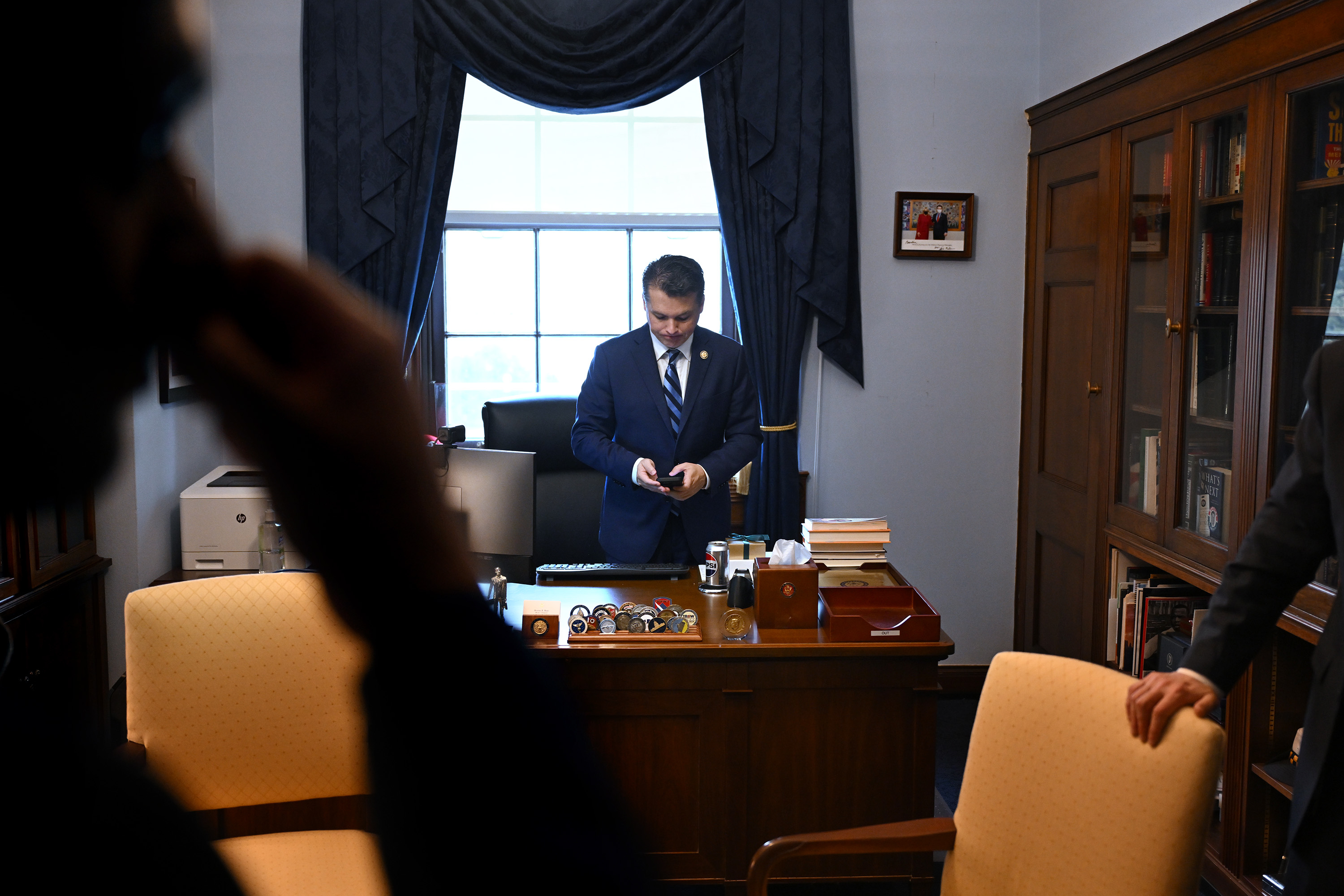
U.S. Rep. Brendan Boyle checks his phone before leaving his office on Capitol Hill in Washington, D.C. Tuesday, Nov. 18, 2025.
Many Americans are deeply unhappy with their financial situation, and with good reason. They are grappling with a serious affordability squeeze.
Prices for many things, from groceries to car insurance, are high and continue to climb. Meanwhile, pay increases are slowing as job growth has stalled and unemployment is on the rise.
Americans’ unease with their finances is apparent in the long-running University of Michigan survey of consumer sentiment. This survey of consumers’ financial well-being has been conducted monthly since the early 1950s, and in the past few weeks, the responses have been about as weak as ever.
The survey likely overstates consumers’ collective gloominess, as political biases are increasingly shaping people’s feelings about almost everything, including their finances. Democrats have been more glum than Republicans since President Donald Trump’s election, whereas the opposite was true under President Joe Biden. Even so, the survey results send a loud and clear message.
The angst over affordability was also front and center in the recent election results. The cost of living was far and away the top concern of voters in New York City’s mayoral race, and in the governors’ races in New Jersey and Virginia. The high and rising cost of electricity, healthcare, and housing were especially prominent in voters’ decisions.
The affordability squeeze has been a long time in the making.
Prices jumped during the COVID-19 pandemic, as global supply chains and labor markets were upended. Then, the Russian invasion of Ukraine drove up food prices, and at the height of the economic fallout from that war, the cost of a gallon of gasoline reached a record $5 in some U.S. locations.
Adding to Americans’ financial pain, the Fed aggressively raised interest rates in an effort to slow the economy down and rein in the high inflation. This exacerbated the affordability squeeze, particularly with the cost of homeownership.
Prior to the pandemic, the typical monthly mortgage payment was no more $1,000. Once the Fed had finished increasing rates, the monthly payment was well over $2,000. Homeownership, a key part of Americans’ definition of financial success, is completely out of reach for most.
Despite all of this, it did appear, coming into this year, that the worst of the affordability squeeze had passed. Inflation was quickly receding and headed back toward the Fed’s inflation target. Fed officials were so confident in this forecast that they began cutting interest rates.
But, alas, the forecast was wrong. The Trump administration’s higher tariffs, highly restrictive immigration policy, and broader de-globalization efforts have upended that outlook.
De-globalization scrambles global supply chains, which raises costs, reduces competition, weakens productivity growth, and leads to labor shortages. Inflation now appears set to remain uncomfortably high for the foreseeable future. The affordability squeeze is intensifying again, leading to renewed anguish among consumers and voters.
De-globalization is also weighing heavily on the job market and incomes, adding to the country’s affordability woes. Job growth has come to a virtual standstill, as businesses, unsure of how the tariffs and other policies will play out, enact hiring freezes. They aren’t all laying off workers — that would be a recession — but they’ve done everything but.
Unemployment remains low, but it is steadily increasing, particularly for younger workers seeking new employment opportunities. Wage growth is thus throttling back.
The upcoming cuts to federal government benefits for lower-income households, included as part of the One Big Beautiful Bill Act, will worsen the affordability problem. Tax subsidies to help pay for the cost of health insurance under the Affordable Care Act have been scaled back, and cuts to the Medicaid program and SNAP, the food assistance program, are looming. As these programs are cut back, the cost of living for families reliant on them will increase.
Congress appears to have taken the election results to heart and seems to be focused on ways to ease the affordability squeeze. Lawmakers are holding hearings on how to reduce the financial burden on Americans from electricity, food, healthcare, and housing costs. But this won’t be easy, as there are no slam-dunk legislative solutions.
Trump has proposed providing a $2,000 stimulus check to families with an annual income of less than $100,000 — similar to the checks sent during the pandemic. Of course, like then, this might merely provide temporary financial relief, as it boosts consumer spending, pumps up inflation, and ultimately worsens the affordability squeeze.
The quickest way to address the affordability squeeze is to relax tariffs and immigration policies. The president has taken this approach on a case-by-case basis, reducing tariffs on bananas, beef, and coffee, and halting some ICE raids on agricultural workplaces that heavily rely on immigrant workers.
However, it remains to be seen if he will further backtrack on his signature economic policies. If not, the affordability squeeze and the tough financial times facing many Americans are sure to persist.
WASHINGTON – A prosecutor on Wednesday dropped all criminal charges in Georgia against U.S. President Donald Trump for interference in the 2020 presidential election, ending a high-profile racketeering case that once seemed like a significant threat to the Republican.
The decision by Peter Skandalakis, a state official who recently took over the prosecution, was a stinging defeat for Fulton County District Attorney Fani Willis, who brought the case in 2023 but then lost control of it amid ethics complaints by defense lawyers.
It was one of four criminal prosecutions that Trump faced in the years since losing his 2020 presidential re-election bid to Democrat Joe Biden. Only one of them — a New York case over a hush-money payment to a porn star during his 2016 campaign — went to trial. Trump was found guilty in that case but has asked for it to be thrown out.
The dismissal highlighted how Trump’s return to the White House this year, a political comeback unparalleled in U.S. history, dismantled a thicket of legal cases that once seemed set to define his post-presidency era.
Trump’s political career had appeared to be over after his false claims of election fraud led a mob of supporters to storm the U.S. Capitol on Jan. 6, 2021, in a failed bid to overturn his 2020 defeat.
Skandalakis said in a court filing that “there is no realistic prospect that a sitting President will be compelled to appear in Georgia to stand trial,” so it would be “futile and unproductive” to push forward with the case.
Skandalakis said his decision, which was approved by a judge on Wednesday morning, “is not guided by a desire to advance an agenda but is based on my beliefs and understanding of the law.”
Steve Sadow, a lawyer for Trump, praised the dismissal, saying the case should have never been brought.
Willis had brought the case against Trump and 18 co-defendants, charging a sweeping criminal conspiracy to overturn Georgia’s 2020 election results after a recording surfaced in the media of Trump asking Georgia’s top electoral official to “find” him enough votes to win the state.
The co-defendants included former Trump lawyers Rudy Giuliani and John Eastman, who like Trump pleaded not guilty.
An appeals court removed Willis, an elected Democrat in Atlanta, from the case last year. The court said she had created an “appearance of impropriety” by having a romantic relationship with the special prosecutor she had hired to lead the case.
Skandalakis heads the Prosecuting Attorneys’ Council of Georgia, a government agency that supports the state’s local prosecutors. Earlier this month, he appointed himself to lead the case, saying he had been unable to find another prosecutor willing to take it over.
Anthony Michael Kreis, a Georgia State University law professor, said Skandalakis’s decision to drop the charges was not surprising. The agency he oversees does not have the resources to prosecute such a complex case with several co-defendants, Kreis said.
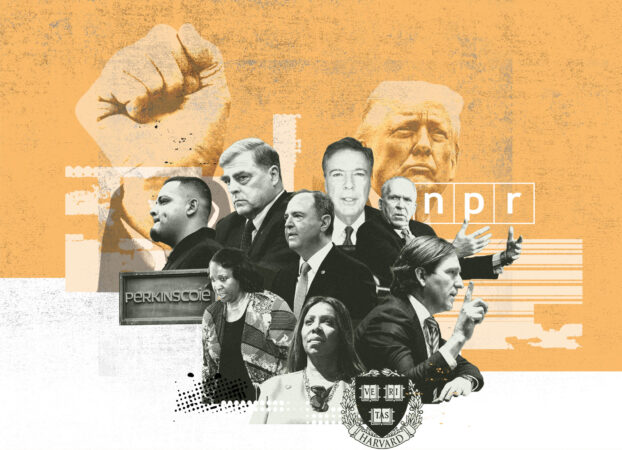
In his second term, Donald Trump has turned a campaign pledge to punish political opponents into a guiding principle of governance.
What began as a provocative rallying cry in March 2023 — “I am your retribution” — has hardened into a sweeping campaign of retaliation against perceived enemies, reshaping federal policy, staffing and law enforcement.
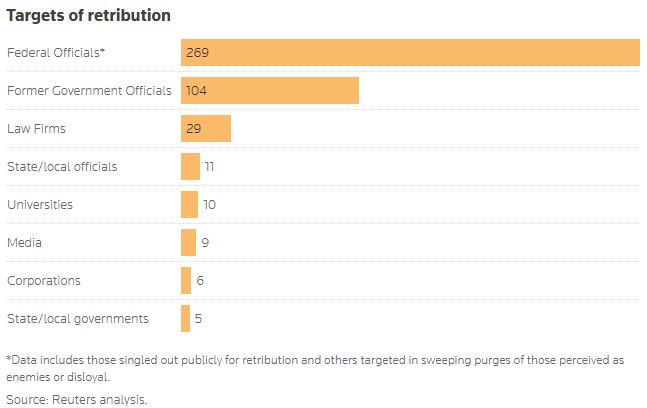
A tally by Reuters reveals the scale: At least 470 people, organizations and institutions have been targeted for retribution since Trump took office — an average of more than one a day. Some were singled out for punishment; others swept up in broader purges of perceived enemies. The count excludes foreign individuals, institutions and governments, as well as federal employees dismissed as part of force reductions.
The Trump vengeance campaign fuses personal vendettas with a drive for cultural and political dominance, Reuters found. His administration has wielded executive power to punish perceived foes — firing prosecutors who investigated his bid to overturn the 2020 election, ordering punishments of media organizations seen as hostile, penalizing law firms tied to opponents, and sidelining civil servants who question his policies. Many of those actions face legal challenges.
At the same time, Trump and his appointees have used the government to enforce ideology: ousting military leaders deemed “woke,” slashing funds for cultural institutions held to be divisive, and freezing research grants to universities that embraced diversity initiatives.
Reuters reached out to every person and institution that Trump or his subordinates singled out publicly for retribution, and reviewed hundreds of official orders, directives and public records. The result: the most comprehensive accounting yet of his campaign of payback.
The analysis revealed two broad groups of people and organizations targeted for retaliation.
Members of the first group – at least 247 individuals and entities – were singled out by name, either publicly by Trump and his appointees or later in government memos, legal filings or other records. To qualify, acts had to be aimed at specific individuals or entities, with evidence of intent to punish. Reuters reporters interviewed or corresponded with more than 150 of them.
Another 224 people were caught up in broader retribution efforts – not named individually but ensnared in crackdowns on groups of perceived opponents. Nearly 100 of them were prosecutors and FBI agents fired or forced to retire for working on cases tied to Trump or his allies, or because they were deemed “woke.” This includes 16 FBI agents who kneeled at a Black Lives Matter protest in 2020. The rest were civil servants, most of them suspended for publicly opposing administration policies or resisting directives on health, environmental and science issues.
Most common were punitive acts, such as firings, suspensions, investigations and the revocation of security clearances.
Reuters found at least 462 such cases, including the dismissal of at least 128 federal workers and officials who had probed, challenged or otherwise bucked Trump or his administration.
The second form was threats. Trump and his administration targeted at least 46 individuals, businesses and other entities with threats of investigations or penalties, including freezing federal funds for Democratic-led cities such as New York and Chicago.
Trump openly discussed firing Federal Reserve Chair Jerome Powell for resisting interest rate cuts, for instance. Last week, he threatened to have six Democratic members of Congress tried for sedition – a crime he said is “punishable by DEATH” – after the lawmakers reminded military personnel they can refuse “illegal orders.” This week, the Defense Department threatened to court-martial one of them, U.S. Senator Mark Kelly, a former Naval officer.
The third form was coercion. In at least a dozen cases, organizations such as law firms and universities signed agreements with the government to roll back diversity initiatives or other policies after facing administration threats of punishment, such as security clearance revocations and loss of federal funding and contracts.
It’s a campaign led from the top: Trump’s White House has issued at least 36 orders, decrees and directives, targeting at least 100 individuals and entities with punitive actions, according to the Reuters analysis.
Trump openly campaigned on a platform of revenge in his latest run for the presidency, promising to punish enemies of his Make America Great Again movement. “For those who have been wronged and betrayed, I am your retribution,” he said in a March 2023 speech. Weeks later, while campaigning in Texas, he repeated the theme. “I am your justice,” he said.
Today, the White House disputes the idea that the administration is out for revenge. It describes recent investigations and indictments of political adversaries as valid course corrections on policy, necessary probes of wrongdoing and legitimate policy initiatives.
“This entire article is based on the flawed premise that enforcing an electoral mandate is somehow ‘retribution.’ It’s not,” White House spokesperson Abigail Jackson said. There is no place in government for civil servants or public officials “who actively seek to undermine the agenda that the American people elected the president to enact,” she added. Trump is abiding by campaign promises to restore a justice system that was “weaponized” by the Biden administration, Jackson said, and “ensure taxpayer funding is not going to partisan causes.”
Trump’s actions have been cheered by his staunchest backers. Right-wing commentator and former Trump advisor Steve Bannon told Reuters the use of government power to punish Trump’s enemies is “not revenge at all” but an attempt to “hold people accountable” for what he said were unfair investigations targeting Trump. More is on the way, he said.
“The people that tried to take away President Trump’s first term, that accused him of being a Russian asset and damaged this republic, and then stole the 2020 election – they’re going to be held accountable and they’re going to be adjudicated in courts of law,” he said in an interview. “That’s coming. There’s no doubt.” There’s no evidence the 2020 election was stolen.
Trump’s allies point to actions former President Joe Biden took upon taking office. After Trump’s supporters attacked the U.S. Capitol on January 6, 2021, in a failed bid to overturn his election loss, Biden revoked Trump’s access to classified information, a first for any former president. Biden also won a court battle to dismiss Senate-confirmed directors of independent agencies serving fixed terms, such as the Federal Housing Finance Authority, and removed scores of Trump-era appointees from unpaid advisory boards.
Yet the scale and systematic nature of Trump’s effort to punish perceived enemies marks a sharp break from long-standing norms in U.S. governance, according to 13 political scientists and legal scholars interviewed by Reuters. Some historians say the closest modern parallel, though inexact, is the late President Richard Nixon’s quest for vengeance against political enemies. Since May, for instance, dozens
of officials from multiple federal agencies have been meeting as part of a task force formed to advance Trump’s retribution drive against perceived enemies, Reuters previously reported.
“The main aim is concentration of power and destruction of all checks against power,” said Daron Acemoglu, Nobel laureate in economics and a professor at the Massachusetts Institute of Technology, which faces an ongoing federal investigation for embracing diversity and equity programs. “Retribution is just one of the tools.”
Dozens of Trump’s targets have challenged their punishments as illegal. Fired and suspended civil servants have filed administrative appeals or legal challenges claiming wrongful termination. Some law firms have gone to court claiming the administration exceeded its legal authority by restricting their ability to work on classified contracts or interact with federal agencies. Most of those challenges remain unresolved.
Investigating foes of Trump
The administration has moved aggressively against officials in the government’s legal and national security agencies, institutions central to investigations of Trump’s alleged misconduct during and after his first term.
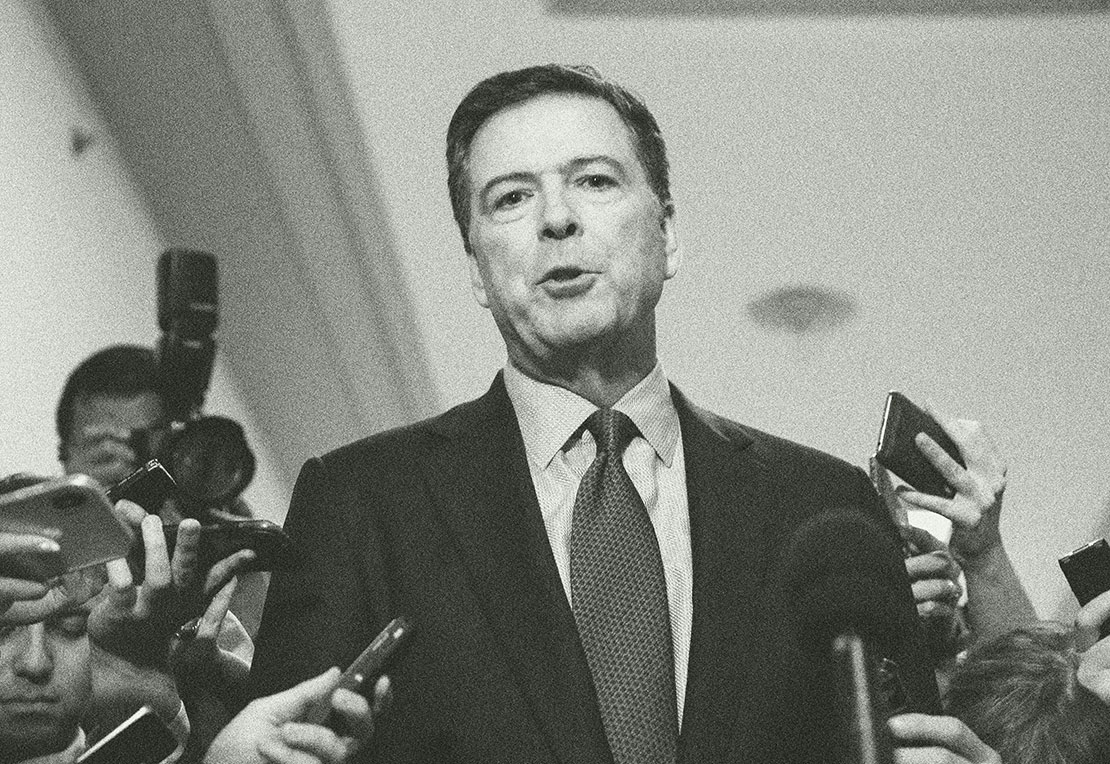
At least 69 current and former officials were targeted for investigating or sounding alarms about Russian interference in U.S. elections. U.S. intelligence agencies concluded soon after the 2016 election that Moscow sought to tilt the race toward Trump, a finding later affirmed by a bipartisan Senate Intelligence Committee report in August 2020. Acts of retribution tied to the Russia probe include the September 25 indictment of former FBI Director James Comey, a break from Justice Department norms meant to shield prosecutions from political influence.
Comey, who led the FBI’s investigation into Trump’s 2016 campaign, was charged after Trump demanded his prosecution. The Justice Department has cast the case as a corruption crackdown. Comey and his lawyers said in court documents that the case was “vindictive” and motivated by “personal animus.” Comey, who pleaded not guilty, declined to comment. A federal judge dismissed the case on Monday, ruling that Trump’s handpicked prosecutor had been unlawfully appointed.
Acts of retribution tied to the Russia probe include the indictment of former FBI Director James Comey. His lawyers say he is the target of a “vindictive” prosecution.
At least 58 acts of retribution have targeted people Trump viewed as saboteurs of his election campaigns, including Chris Krebs, the top cybersecurity official during his first term. Trump fired him in 2020 for disputing claims that the election was rigged. In April, Trump stripped Krebs’ security clearance and ordered a federal investigation into his tenure. Krebs, still asserting that Trump’s defeat was valid, has vowed to fight the probe. He did not respond for this story.
Reuters documented 112 security clearances revoked from current and former U.S. officials, law firms and state leaders – credentials needed for work that involves classified information. In August, Director of National Intelligence Tulsi Gabbard announced she was revoking 37 clearances.
In a response to Reuters posted on X, an agency spokesperson said Gabbard and Trump are working “to ensure the government is never again wielded against the American people it is meant to serve.” She added: “President Trump said it best, ‘Our ultimate retribution is success.’”
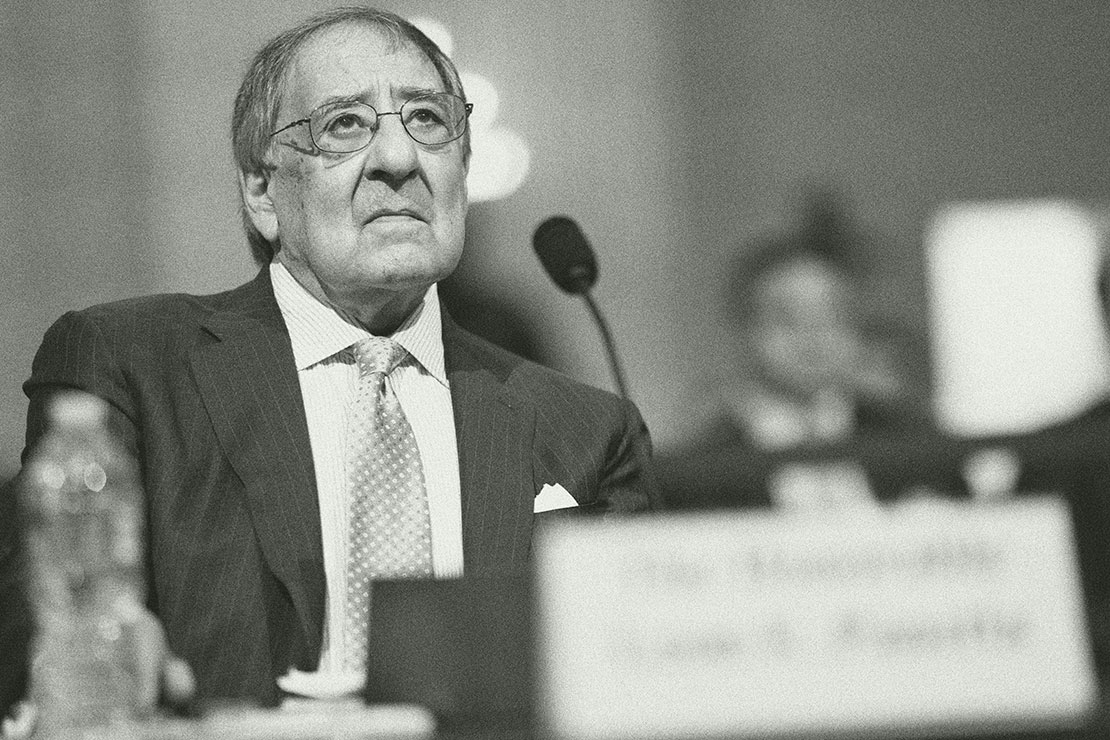
Leon Panetta, CIA director and defense secretary under former President Barack Obama, had his security clearance revoked in January along with others who signed an October 2020 letter suggesting Russia may have been behind reports about emails on Hunter Biden’s laptop. At the time, Joe Biden — Hunter’s father — was Trump’s Democratic rival in the 2020 election. An executive order Trump signed in January claimed: “The signatories willfully weaponized the gravitas of the Intelligence Community to manipulate the political process and undermine our democratic institutions.” Panetta has said he stands by signing the letter.
Panetta told Reuters he had already surrendered his clearance after leaving government nearly a decade ago. Trump’s retribution campaign is hurting CIA morale and wrecking the bipartisan trust that allows Washington to function, Panetta said. “What I worry about is that our adversaries will look at what’s happening and sense weakness,” he said. “This kind of political retribution leads to a loss of trust, which ultimately leads to a failure of governing.” The CIA did not respond to a request for comment.
Former CIA director Leon Panetta had his security clearance revoked along with others who signed a letter suggesting Russia may have been behind reports about emails on Hunter Biden’s laptop.
The revenge effort also reaches deep into the civil service, punishing employees who speak out against Trump’s policies and turning forms of dissent that were tolerated by past administrations into grounds for discipline.
This summer, hundreds of Environmental Protection Agency staffers wrote an open letter protesting deep cuts to pollution control and cleanup programs. The fallout was swift. More than 100 signers who attached their names were placed on paid leave. At least 15 senior officials and probationary employees were told they would be fired. The rest were informed they were under investigation for misconduct, leading to at least 69 suspensions without pay. Many remained out of work for weeks.
“They followed all the rules” of conduct for civil servants, said Nicole Cantello, one of the signers and an officer with the American Federation of Government Employees, a union that represents many affected workers. She called the punishments an attempt to “quell dissent,” stifle free speech and “scare the employees.” In a statement, the EPA said it has “a zero-tolerance policy for career officials using their agency position and title to unlawfully undermine, sabotage, and undercut” administration policy.
At the Federal Emergency Management Agency, about 20 staffers were put on leave and now face misconduct investigations after signing a letter criticizing the agency’s decision to scrap bipartisan reforms adopted years ago to speed disaster relief.
Cameron Hamilton, a Republican who served briefly as acting head of FEMA, was fired in May, a day after telling Congress he didn’t believe the agency should be shut down, contradicting the administration.
Hamilton told Reuters he still supports Trump. But he said too many senior officials are firing people in the name of retribution, trying to impress the White House. “They want to find ways to really launch themselves to prominence and be movers and shakers, to kick ass and take names,” said Hamilton. “They’re trying to show the president ‘look at what I am doing for you.’”
In a statement to Reuters, the Department of Homeland Security, which includes FEMA, said it is building a “new FEMA” to fix “inefficiency and outdated processes.” Employees “resisting change” are “not a good fit,” the statement said.
Dr. Jeanne Marrazzo, former head of the National Institute for Allergy and Infectious Diseases, sees her firing in October — three weeks after filing a whistleblower complaint alleging politicization of research and vaccine policy — as a warning shot. She told Reuters the administration’s purge of dissenting health officials is breeding “anticipatory obedience” — a reflex to comply before being asked. “People know if they push back … this is what happens,” she said. The effect, she says, is an ecosystem of fear: those who stay in government self-censor; those who speak out are branded “radioactive, too hot to handle.”
The Department of Health and Human Services, the agency that oversees NIAID, did not respond to a request for comment.
Federal agency leaders have dismissed a wide array of officials they deemed out of step with Trump’s MAGA agenda, including employees involved in diversity, equity and inclusion initiatives and those working on transgender issues.
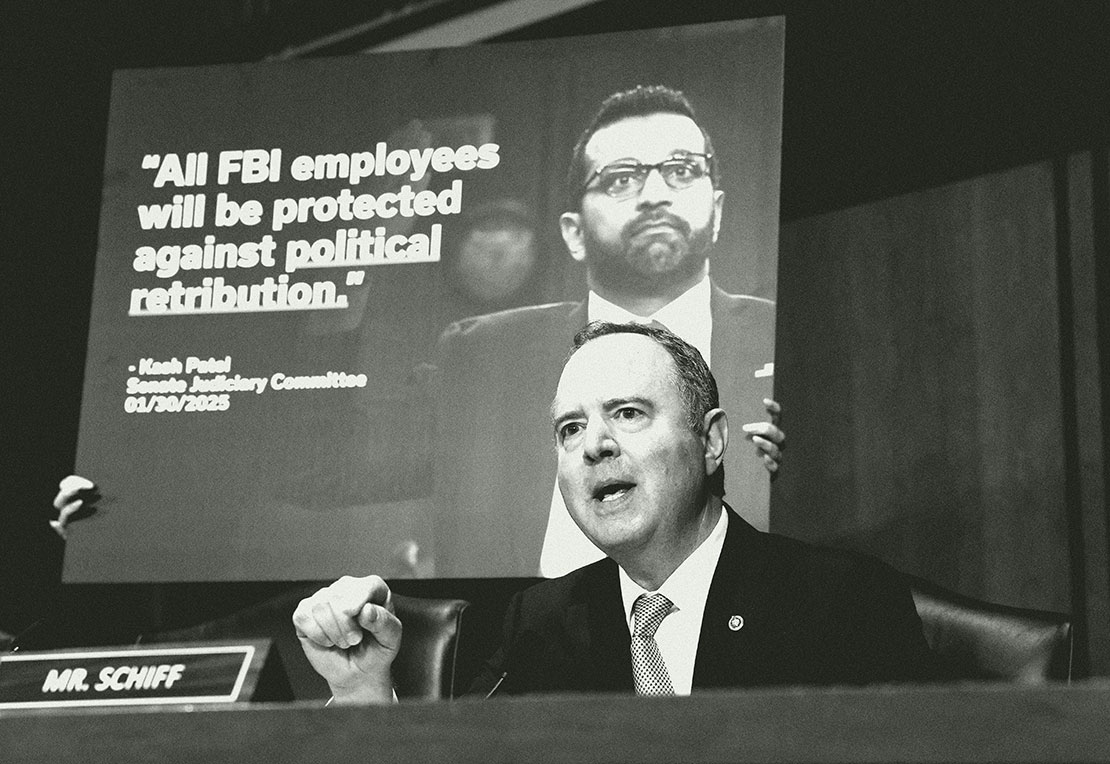
David Maltinsky, a Federal Bureau of Investigation employee, says he was fired by Director Kash Patel for displaying a Pride flag at work — one of at least 50 bureau personnel dismissed on Patel’s watch. Maltinsky sued the FBI and Justice Department, alleging violations of his constitutional rights and seeking reinstatement. The Justice Department has yet to file a formal response.
In his 2023 book, “Government Gangsters,” Patel named 60 people that he said were members of an “Executive Branch deep state” that opposed Trump, including former Democratic government officials and Republicans who served in Trump’s first administration but eventually broke with him. He called for firings and said that anybody who abused their authority should face prosecution. In his 2025 confirmation hearing before Congress, Patel denied that it was an “enemies list.”
Under FBI Director Kash Patel’s watch, at least 50 FBI personnel have been dismissed. In this photo, U.S. Senator Adam Schiff speaks in front of an image of Patel at a Senate hearing on FBI oversight.
Reuters found that at least 17 of the 60 people on Patel’s list have faced some sort of retribution, including firings and stripping of security clearances. The FBI did not respond to a request for comment.
Against perceived foes in the private sector, the administration has wielded financial penalties as leverage. At least two dozen law firms faced inquiries, investigations or restrictions on federal contracting, often for employing or representing people tied to past cases against Trump. Eight struck deals to avoid further action.
Nine media organizations have faced federal investigations, lawsuits, threats to revoke their broadcast licenses and limits on access to White House events. Trump has also suggested revoking broadcast licenses for networks whose coverage he dislikes.
The targets include universities, long cast by the president and his allies as bastions of left-wing radicals.
Officials froze more than $4 billion in federal grants and research funding to at least nine schools, demanding policy changes such as ending diversity, equity and inclusion programs, banning transgender athletes from women’s sports and cracking down on alleged antisemitism amid pro-Palestinian protests. Five universities have signed agreements to restore funding. Harvard University successfully sued to block a freeze on $2.2 billion in federal aid for the school, which Trump accused of “pushing political, ideological, and terrorist inspired” dogma. Harvard declined to comment.
The administration has described the funding freezes and other efforts to force policy changes at colleges and universities as a necessary push to reverse years of leftward drift in U.S. education. “If Reuters considers restoring merit in admissions, reclaiming women’s titles misappropriated by male athletes, enforcing civil rights laws, and preventing taxpayer dollars from funding radical DEI programs ‘retribution,’ then we’re on very different planes of reality,” said Julie Hartman, a spokesperson for the U.S. Education Department.
A historical parallel: Nixon’s enemies
It’s impossible to predict, of course, how far the Trump revenge campaign will go, or whether it will be affected by a recent slide in popular support. Trump has been hurt by public frustration with the high cost of living and the investigation into late convicted sex offender Jeffrey Epstein.
Nixon resigned in 1974 over the Watergate scandal, in which aides to his re-election campaign broke into Democratic Party headquarters and the president himself later directed a cover-up. While in office, he kept a list of more than 500 enemies. But while Trump has conducted his retribution campaign in the open, historians note, Nixon’s enemies list was conceived as a covert tool.
John Dean, chief counsel in the Nixon White House, wrote a confidential memo in 1971 addressing “how we can use the available federal machinery to screw our political enemies.” The planned methods included tax audits, phone-tapping, the cancellation of contracts and criminal prosecution. Yet the execution faltered: IRS Commissioner Donald Alexander refused to conduct mass audits, and most targets escaped serious punishment.
Other recent presidents, to be sure, have been accused of seeking to punish opponents, though on a smaller scale. The Obama administration pursued “aggressive prosecution of leakers of classified information,” the Committee to Protect Journalists said in a 2013 report. Two IRS employees alleged they were retaliated against during the Biden administration for raising concerns about the handling of the tax-compliance investigation of Hunter Biden.
Nixon’s plotting remained a secret until the Watergate hearings exposed it, turning his enemies list into a symbol of presidential abuse. The secrecy reflected a political culture in which retaliation was whispered, not broadcast, and where institutional checks blunted many of Nixon’s ambitions.
Trump’s approach reverses that pattern, historians say. He has openly named his perceived enemies, urged prosecutions in public and framed vengeance as a campaign vow. Some say today’s “enemies list” politics are in that sense farther-reaching than Nixon’s, possibly signaling a shift toward a normalization of retribution in American political life.
Corey Brettschneider, a political science professor at Brown University who has written a book on power grabs by American presidents, said Nixon was ultimately checked and forced to resign by Congress, including members of his own Republican Party. “That’s just not happening now,” he said.
There’s an old saying — well, there ought to be one — that the surest way to jinx something is to write, “I don’t want to jinx it…” My Border Patrol tornado-chasing trip to Charlotte was doomed the moment I posted about it here — frantically canceled when I learned 17 hours before takeoff that the BP had abruptly ditched North Carolina. There is a Plan B but no way will I jinx it a second time.
It’s better to stop Trump’s illegal orders than hope troops will disobey them
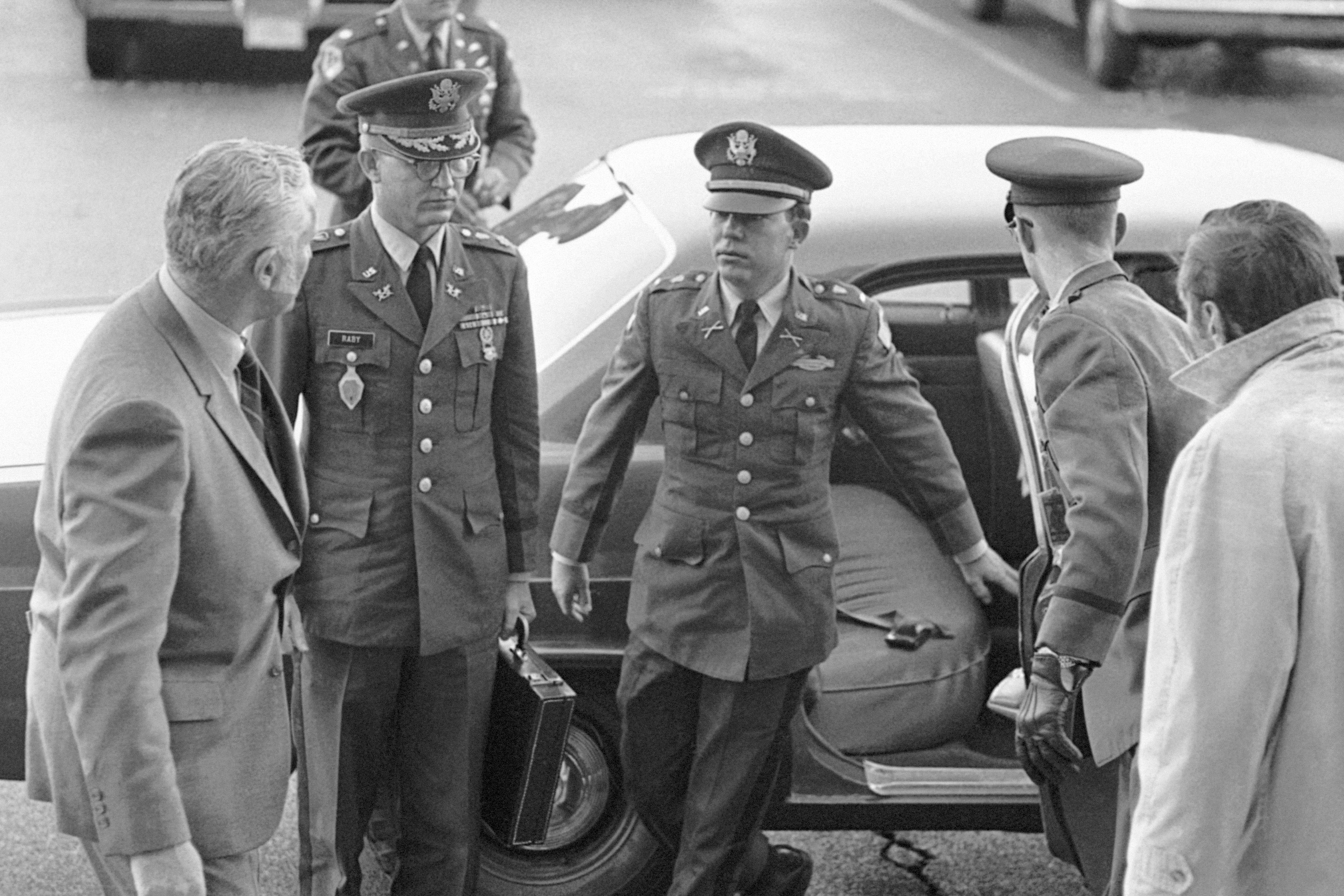
Lt. William L. Calley Jr., center, and his military counsel, Maj. Kenneth A. Raby, left, arrive at the Pentagon for testimony before an Army board of investigation hearing into the My Lai Massacre in December 1969. Calley led the U.S. soldiers who killed hundreds of Vietnamese civilians in the most notorious war crime in modern American military history.
A U.S. Army helicopter pilot named Hugh Thompson Jr. may be the greatest American hero you’ve probably never heard of. On March 16, 1968, Thompson — a warrant officer serving in Vietnam — and his crew were dispatched to support a “search and destroy” mission supposedly targeting the Viet Cong in a tiny hamlet called My Lai.
Instead, the Georgia-born soldier came up upon arguably the most notorious war crime in U.S. history — with thatch hutches ablaze and countless villagers, including women and children, laying dead or dying in an irrigation ditch.
Thompson landed and found the commander on the ground, Lt. William Calley. “What is this?” he asked. “Who are these people?”
“Just following orders,” Calley replied. After some more back and forth, the flustered Thompson replied: “But, these are human beings, unarmed civilians, sir.”
What Thompson and his helicopter crew did next was truly remarkable. Holding Calley and their other U.S. comrades at bay, they shielded a group of Vietnamese women, children and old men as they fled. Eventually, he loaded 11 villagers into the helicopter, and then Thompson and his men thought they detected movement in the ditch. Two fellow solders found a boy, just 5 or 6, hiding under the corpses, “covered in blood and obviously in a state of shock.” After safely evacuating the boy to a military hospital, Thompson reached a lieutenant colonel who ordered Calley to stop the killings.
Near the end of his life, Thompson — who died in 2006 — and two comrades were recognized for their courage and the many lives they saved at My Lai, awarded the Army’s highest award for bravery not in conflict with an enemy (the Soldier’s Medal), as well as the the Peace Abbey Courage of Conscience Award. He even returned to My Lai for an emotional reunion in 1998.
But it wasn’t like that in real time. During the war, a prominent congressman demanded that Thompson be court-martialed. “I’d received death threats over the phone,” he told CBS’ 60 Minutes in 2004. “Dead animals on your porch, mutilated animals on your porch some mornings when you get up.”
A generation after Thompson’s death, the kind of bold action he took that day in 1968 — disobeying what he correctly understood as an illegal order — is yet again on America’s front burner. This time, the debate is fueled by a video from six veterans who now serve as Democrats in Congress ― reminding today’s soldiers about their sworn duty to disobey unlawful commands.
That every expert in military law agrees with this principle hasn’t stopped President Donald Trump or his defense secretary, Pete Hegseth, from going ballistic — calling the Democrats “traitors” or even reposting calls for their death by hanging.
On Monday, Hegseth kicked things up a notch by endorsing a plan for one of the six — Arizona Sen. Mark Kelly, a former astronaut and decorated Navy fighter pilot — to return to active duty, so that he can be court-martialed for taking part in the video. A statement from the Pentagon, which Trump and Hegseth call “the Department of War,” insisted that “orders are presumed to be lawful. A servicemember’s personal philosophy does not justify or excuse the disobedience of an otherwise lawful order.”
Even as the growing controversy dominates the headlines, there is one aspect to the illegal-orders debate that practically no one is talking about. Actions like Thompson’s refusal at My Lai don’t only stand out for the soldier’s gumption. It is also the stuff of peace prizes and 60 Minutes profiles because it is so incredibly rare.
Do your own research. It’s very difficult to find examples in America’s 249-year history of troops disobeying orders because they are believed to be illegal. To be sure, there are famous incidents of soldiers who disobeyed an order and heroically saved lives — but almost all of them were because the command was reckless or just plain stupid, which isn’t the same as illegal or unconstitutional.
It’s not like there haven’t been opportunities. There have been American war crimes from Wounded Knee to Abu Ghraib, what Barack Obama famously called “dumb wars” like the 2003 assault on Iraq, and moments of intense moral agony, like dropping atomic bombs on Hiroshima and Nagasaki. These did produce a few whistleblowers or conscientious objectors, of course, but cases of actually refusing an order are few.
It’s not hard to understand why. Most military orders — even ones later reviled by history — come with some veneer of legality, whether it’s an opinion from a military lawyer or a congressional authorization vote, as happened with Vietnam, Iraq, and other conflicts.
The video recorded by Kelly and the others (including Pennsylvania Reps. Chrissy Houlahan and Chris Deluzio) focuses only on the widely accepted principle that military men and women must follow the law and the Constitution above all else, and doesn’t mention Trump or any specific disputed orders. In interviews, though, Democrats like Kelly and Houlahan have criticized Trump’s ongoing attacks on boats off South America that the regime claims are smuggling drugs.
While almost every expert on military laws describes these attacks — which have killed at least 83 people— as extrajudicial killings lacking legal justification, the Office of Legal Counsel in Trump’s Justice Department has nonetheless written a secret classified memo to justify them. Any officer or lower-level troop ordered to blow up these boats and kill all the people on board hasn’t seen the memo. And they won’t get a medal for saying “no” — at least not in 2025. They will be court-martialed and vilified by MAGA.
New York Times opinion writer David French, a Harvard Law grad who served as an Army lawyer in Iraq, notes the congressional video didn’t advise troops on what exactly is an illegal order, and adds: “Individual service members don’t have sufficient knowledge or information to make those kinds of judgments. When time is of the essence and lives are on the line, your first impulse must be to do as you’re told.”
Not always, as Thompson showed at My Lai, but military matters are rarely that black and white. The Trump regime’s sending of National Guard units and even active-duty military into cities such as Los Angeles may be an unnecessary and inflammatory violation of democratic norms, but experienced judges continue to debate its legality. Expecting the rank-and-file troops to decide is asking a lot.
It is very much in the spirit of Joseph Heller’s World War II novel and its legendary Catch-22: A soldier must disobey an illegal order, yet orders, in the heat of the moment, are almost never illegal.
That doesn’t mean Trump and Hegseth threatening Kelly and the other Democrats with jail and possibly the noose isn’t utterly outrageous. After all, they did nothing more than remind soldiers of their obligation to the law in the same language their drill sergeants use in boot camp.
I do also think — understanding the limitations of a MAGA-fed Congress — that good people of both parties on Capitol Hill should be doing a lot more to invoke the War Powers Act, hold hearings, debate impeachment, and do whatever else they can to prevent Trump’s reckless acts in the Caribbean and elsewhere. In other words, stop illegal orders before they’re given.
That said, as the Trump regime deteriorates, there may come a day when right and wrong feels as obvious as it did that 1968 day in the rice paddies of Vietnam. If, heaven forbid, this government ever ordered troops to put down a protest by firing on citizens, we will need a platoon full of Hugh Thompsons and no William Calleys, “just following orders.”
Yo, do this!
The writer Anand Giridharadas is the best of today’s public intellectuals, with a laser focus on the 1 Percent and the devastating role of income inequality in works such as Winners Take All, which rips apart the facade of modern philanthropy. So who better to pour through the late financier-and-sex-fiend Jeffrey Epstein’s emails and find the true meaning? His recent, masterful New York Times essay — “How the Elite Behave When No One Is Watching: Inside the Epstein Emails” — parses the small-talk and atrocious grammar of America’s rich and powerful to decipher how they rule. It is a must read.
Saturday was the 62nd anniversary of the day that changed America, for bad: the assassination of President John F. Kennedy as his motorcade rolled through downtown Dallas. It was also the day I was savaged by several dozen people on Bluesky for expressing an opinion shared by 65% of Americans: that we haven’t been told the whole truth about what really happened on Nov. 22, 1963. Kudos to ABC News for a new special that aired Monday looking at both sides of the endless controversy — Truth and Lies: Who Killed JFK? — that included skeptics like veteran journalist Jefferson Morley of the excellent site JFK Facts. The one hour-special is now streaming on Hulu.
Ask me anything
Question: Why is the Trump administration uncritically regurgitating the Russian “peace plan”? — @kaboosemoose.bsky.social via Bluesky
Answer: That’s a great question as our president has consistently told us that the “Russia! Russia! Russia!” scandal around Vladimir Putin’s U.S. election interference and his seeming sway over the 45th and 47th president is all a massive hoax. How to explain, then, that the supposedly-Trump-drafted 28-point peace plan to end the fighting in Ukraine was translated from its original Russian, with its details hashed out in Florida by corrupt and contented Trump son-in-law Jared Kushner and Kirill Dmitriev, a U.S.-sanctioned Russian envoy? It’s probably true that liberals were naive during Trump’s first term to believe the strange ties between MAGA and the Kremlin would bring down his presidency, but it’s also true that where there’s smoke, there’s fire. We all want peace in Ukraine, but Trump and his U.S. government simply are not honest brokers.
What you’re saying about…
Last week’s question about the Jeffrey Epstein files, and whether they’ll ever see the light of day despite enactment of the law calling for their release, was kind of open-ended, and thus it drew an array of responses. But most agreed with my view that it’s highly unlikely we’ll see the files, or see very much. “They won’t release them because they are now investigating the Democrats in the files, thus they won’t be able to release them due to the investigation,” Rosann McGinley wrote. “Also they’d be heavily redacted, ‘nothing to see here.’” Added Judy Voois: “I would not be surprised if he declared war on Venezuela just to steer the media and public interest away from continued scrutiny of the Epstein saga.”
📮 This week’s question: The heated reaction I received online about the JFK assassination now has me wondering what newsletter readers think. Do you believe Lee Harvey Oswald was the lone killer of John F. Kennedy, or do you think there was a conspiracy? Please email me your answer and put the exact phrase “JFK assassination” in the subject line.
Backstory on Pennsylvania’s budget deal with the devil
Pennsylvania Gov. Josh Shapiro speaks at a news conference at the United Association Local 524 union building in Scranton, Pa. in March 2024.
Saturday was the 62nd anniversary of the JFK assassination, but on Nov. 22, 2025 it was the entire planet that was under fire. One researcher declared that globally it was the hottest Nov. 22 ever recorded. It didn’t feel that way at my windswept dog park in Delco, but it did from the American Southeast — experiencing a record heat wave — to Tehran, where an epic drought has seen water fountains run dry. And yet the world’s leaders were on a full-fledged retreat from climate action, from the White House, where U.S. CEOs toasted the oil dictatorship of Saudi Arabia at a posh dinner, to Brazil, where a global summit on climate change failed to take on the hegemony of fossil fuels, to Harrisburg.
In a state that’s kowtowed to Big Oil and Gas interests since the days of John D. Rockefeller, Pennsylvania Republicans used the shame of the nation’s longest state-budget impasse to finally ram home their most cherished agenda item: gutting efforts in the Keystone State to work with our neighbors to control the greenhouse-gas pollution behind climate change. The GOP-run state Senate backed Democratic Gov. Josh Shapiro into a corner. Pennsylvania had to withdraw from Regional Greenhouse Gas Initiative (RGGI), a regional pollution-control system, or the money wouldn’t resume flowing to schools and other vital services.
To be clear, the drivers of this giant step backward were state lawmakers who’ve been swimming in Big Oil’s tainted campaign cash for a couple of decades now. But the capitulation, even at political gunpoint, was not Shapiro’s finest hour — especially as the Democrat with apparent ambition for higher office continues to push for polluting and energy-devouring data centers that he claims will boost the economy. As the American Prospect noted in a new piece, Pennsylvania’s environmental retreat came at the same time Virginia was electing a Democratic governor in Abigail Spanberger who’d promised to restore her state to the RGGI. If Shapiro does run for president in 2028, he may struggle to explain this deal to climate-minded voters.
The real problem, though, is that the best way to tackle climate change is by going on offense, with aggressive programs to promote alternative energy such as wind (there seems to be a lot of that around here) and solar that aren’t not only cleaner but a better deal for beleaguered consumers. While Pennsylvania — second only to Texas in natural-gas production — went all in on fracking, a 2024 survey found the commonwealth was 49th on expanding wind power and energy efficiency. With RGGI in the rearview mirror, the Shapiro administration needs to work a lot harder on green energy. That would be good for our governor’s White House dreams, but it would be a lot better for the planet.
What I wrote on this date in 2020
In the late fall of 2020, when I wasn’t trying to warn people that Donald Trump was planning a coup, I turned my attention to the incoming president, Joe Biden — and it’s both fascinating and sad to read how naive we were in the giddy aftermath of Trump’s defeat. In writing about Biden’s early Cabinet picks, the subhead read: “America is seeing the start of something it’s not used to: A White House that’s experienced, qualified … and boring. Could Biden’s ploy work?” NO! The answer turned out to be “no.” But still read the rest: “Biden’s Cabinet is ‘delightfully boring.’ Can reality-TV-addled America deal with it?”
Recommended Inquirer reading
Only one column last week as I spent time both preparing for and then canceling the Charlotte trip that never happened. In that piece, I vented my rage at the lavish White House shindig for a monster: Saudi Crown Prince Mohammed bin Salman, who was behind the brutal bone-saw murder of Washington Post journalist Jamal Khashoggi. The man that Joe Biden all too briefly promised to make “a global pariah” was feted by the CEOs of Apple, Nvidia, GM and just about any big business entity you can think of, in a stunning embrace of corruption that should end the myth of “woke corporations.”
There are two things, more than anything else, that keep local news in America alive: Hometown sports teams, and restaurants. Here in Philly, it was a lousy week for the former but a remarkable moment for the latter, as restaurants in the City of Brotherly Love competed for the very first time for recognition from the world’s ultimate dining survey, the Michelin Guide. In a glitzy ceremony at the Kimmel Center, Michelin bestowed its coveted star on three Philadelphia restaurants and honored more than 30 others — and Inquirer readers were obsessed. Four of the newsroom’s top seven most-read articles online last week were about the Michelin madness — including the bittersweetness of one eatery cited just before its closing, the cheesesteak shop that was honored but not invited, and other various snubs and surprises. The Inquirer has amped up its food coverage this year, and if you live and eat in this region I don’t know how you’d survive without it. If you don’t subscribe, please sign up today.
By submitting your written, visual, and/or audio contributions, you agree to The Inquirer‘s Terms of Use, including the grant of rights in Section 10.
Earlier this month, the Federal Transit Administration ordered SEPTA to inspect its trolley power system after four incidents, including two times trolleys stalled in the Center City tunnel, requiring 415 passengers to be evacuated.
The budget impasse
Shapiro said he was forced to act for the second straight year because Senate Republicans wouldn’t support additional recurring funding for mass transit operations in the state budget.
“They’ve come up with a ton of excuses, but they haven’t come up with the funding,” Shapiro said.
After the governor decided in September that no budget agreement on transit funding was possible, PennDotallowed SEPTA to tap $394 million in state money allocated for future capital projects to pay for two yearsof operating expenses.
The transit agency was facing a $213 million recurring deficit in its operating budget.
Yet the problems with the rail cars and trolleys served to underscore the risks of using capital funds for day-to-day operations.
“A history of chronic underinvestment has led us to this point,” said Chester County Commissioner Marian D. Moskowitz, who is vice chair of SEPTA’s board.
She noted that SEPTA has a much smaller capital budget than other large transit agencies.
$95 million for electrical system upgrades, overhauled propulsion motors and more on the Silverliner IV train cars and the newer Silverliner V models.
$48.4 million to update the overhead catenary wires in the trolley tunnel, along with three new catenary-maintenance cars for the tunnel and along trolley lines, and on long Regional Rail lines.
$51.5 million to upgrade 13 escalators at SEPTA stations, install AI-powered inspection cameras to catch potential problems earlier, and technology improvements at SEPTA’s Control Center
$8 million to install replacement parts for Broad Street Line and Norristown High Speed Line cars.
“These funds are going to make a significant difference in our efforts to overcome the current crises,” SEPTA general manager Scott Sauer said, and to help avoid future ones.
He thanked the governor and pledged “a comprehensive effort to identify potential problems sooner before they grow and lead to delays, cancellations, or shutdowns.”
Shapiro had proposed an increase in the share of general sales-tax revenue devoted to transit subsidies over five years.
Leaders of the GOP-controlled Senate said the $1.5 billion price tag was too high and proposed shifting capital money to operating subsidies for the state’s transit systems and roads — an idea partially reflected in the Shapiro administration’s temporary solution.
“I am glad the Governor continues to take our advice and use existing resources to support public transit,” Senate Majority Leader Joe Pittman (R., Indiana) said in a statement.
“It’s unfortunate that just one year ago, he took $153 million of funding from critical [road] infrastructure projects to fund transit, neglecting the needs of those who use our roadways every single day,” Pittman said.
Republicans also argued that SEPTA had been mismanaged and needs change.
As the next state budget cycle nears, the debate is likely to continue.
“I want you to know I’m going to be a continue to be a governor who supports mass transit, who gives a damn about SEPTA, who cares about those 800,000 people that rely on SEPTA every single day,” Shapiro said.
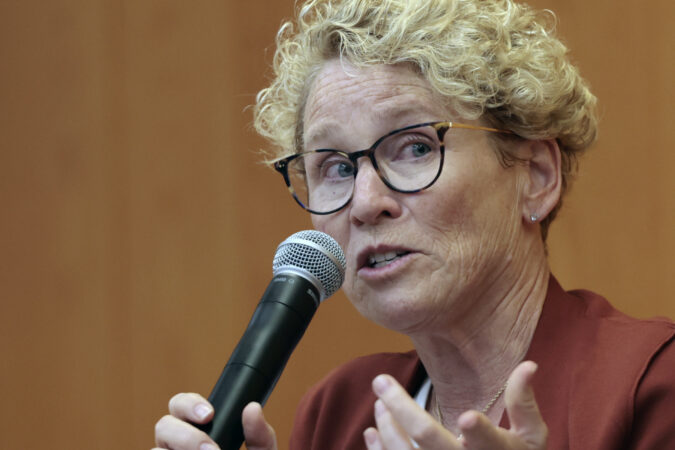
U.S. Rep. Chrissy Houlahan, a Chester County Democrat, said Friday she is “profoundly disappointed” in her Republican colleaguesfor not speaking up after President Donald Trump accused her and five other Democratic lawmakers of sedition.
Houlahan was one of six Democrats in Congress — all militaryveterans or members of the intelligence community — featured in a videourging members of the military and intelligence community to “refuse illegal orders.”
In response, Trump went after the Democrats in a string of posts on Truth SocialThursday, accusing them of sedition that he said is “punishable by DEATH.”
Early Friday evening, a spokesperson for Houlahan posted on the representative’s X account that her district office in West Chester was the target of a bomb threat.
“Thankfully, the staff there, as well as the office in Washington, D.C., are safe. We are grateful for our local law enforcement agencies who reacted quickly and are investigating,” the post said.
A spokesperson for Rep. Chris Deluzio, a western Pennsylvania Democrat also on the video, posted on X late Friday afternoon that the representative’s district offices were targeted with bomb threats as well.
Houlahan lamented at a Friday news conference in Washington that “not a single” Republican in Congress “has reached out to me, either publicly or privately” since Trump’s post.
“And with this, I am profoundly disappointed in my colleagues,” she added.
In addition to calling for the lawmakers to be arrested and tried for sedition, Trump shared posts from supporters calling for retribution against the Democrats, including one that said “HANG THEM GEORGE WASHINGTON WOULD !!” and another calling them domestic terrorists.
“This is not normal political discourse,” Houlahan said Friday alongside other veteran members of Congress. “Indeed, it is, in fact, a explicit embrace of political violence against the opposition.”
“As a member who has spent my entire career calling for civility and decency and building relationships with the other side of the aisle, I’m dumbfounded by the silence,” added the Air Force veteran.
Beyond not reaching out to her specifically, Houlahan broadly said that “not a single Republican member has condemned this call for violence, not publicly, not privately.”
When reached by The Inquirer on Thursday, U.S. Rep. Brian Fitzpatrick (R., Bucks), a former FBI agent, condemned Trump’s rhetoric, but he did so without naming the president
“This exchange is part of a deeper issue of corrosive divisiveness that helps no one and puts our entire nation at risk,” he said. “Such unnecessary incidents and incendiary rhetoric heighten volatility, erode public trust, and have no place in a constitutional republic, least of all in our great nation.”
When asked for clarification, his spokesperson added that “He is 100% opposed to the president’s comments and 100% stands with all men and women who wear the uniform.”
Some Republicans justified Trump’s response by saying the Democrats who made the video were in the wrong — even if the president’s rhetoric was over the top.
House Speaker Mike Johnson (R., La.) said that he did not think the six Democrats committed “crimes punishable by death or any of that,” but criticized the Democrats’ video as irresponsible, Politico reported.
“The point we need to emphasize here is that members of Congress in the Senate [and] House should not be telling troops to disobey orders,” Johnson said. “It is dangerous.”
Karoline Leavitt, the White House press secretary, responded to a reporter asking if Trump wanted to “execute” members of Congress by saying “no,” and criticized the video put out by the veterans.
The video that inspired Trump’s ire did not point to any specific order from Trump as illegal, despite urging troops to resist such an order.
However, the video follows high-profile debates about the legality of Trump’s deployment of National Guard troops in U.S. cities and his ordering of strikes on boats in the Caribbean. Trump alleges that the boats are carrying drugs from Venezuela, but experts have said his claims about them are misleading.
“He has shown time and time again that when he threatens to abuse his power, he acts on it,” Houlahan said Friday at the news conference announcing a bill that would prohibit funds for military force in or against Venezuela without congressional approval.
Houlahan said Congress has not received intelligence on the strikes. She said that Trump’s administration has “repeatedly shown disregard for the military process.”
U.S. Rep. Seth Moulton(D., Mass.), one of the bill’s sponsors,said military leaders who have expressed concern about the legality of the strikes have been “sidelined.” He also pointed out that threatening a member of Congress is against the law.
“So put yourselves in the shoes of a young lieutenant or sergeant who’s in uniform right now watching the commander-in-chief threaten members of Congress to death for telling you to follow the law,” he said. “You’re watching him orchestrate legally dubious military strikes while sidelining military lawyers and commanders who say that those actions may be illegal and could therefore get you prosecuted for following those orders.”
Moulton was not one of the six lawmakers featured in the video, but he shares a similar background, having served four tours in Iraq as a Marine.
He said Congress should learn from its failure to question that war as it confronts the legality of Trump’s strikes in the Caribbean.
“I’ve seen what being in a moral and legal gray area means in war,” he said.
Staff writers Julia Terruso and Robert Moran contributed to this article.
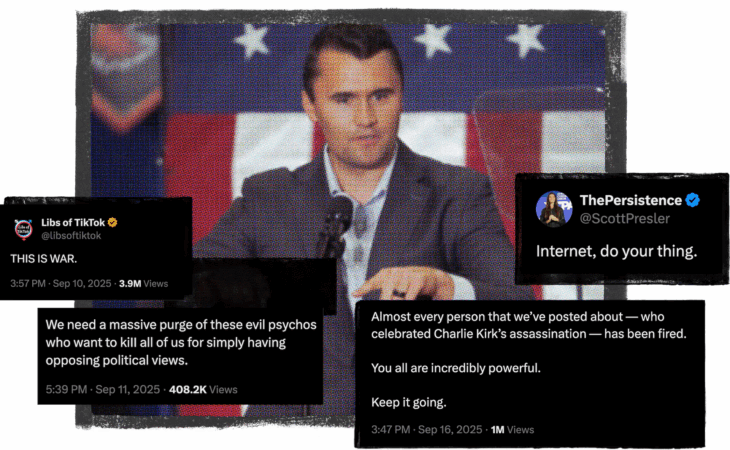
When Lauren Vaughn, a kindergarten assistant in South Carolina, saw reports that right-wing influencer Charlie Kirk had been shot at an event in Utah, she opened Facebook and typed out a quote from Kirk himself.
Gun deaths, Kirk said in 2023, were unfortunate but “worth it” if they preserved “the Second Amendment to protect our other God-given Rights.” Following the quote, Vaughn added: “Thoughts and prayers.”
Vaughn, a 37-year-old Christian who has taken missionary trips to Guatemala, said her call for prayer was sincere. She said she hoped reading Kirk’s words in the context of the shooting might prompt her friends to rethink their opposition to gun control.
“Maybe now they’ll listen,” she recalled thinking.
A few days later, Vaughn lost her job. She was one of more than 600 Americans fired, suspended, placed under investigation or disciplined by employers for comments about Kirk’s September 10 assassination, according to a Reuters review of court records, public statements, local media reports and interviews with two dozen people who were fired or otherwise disciplined.
Some were dismissed after celebrating or mocking Kirk’s death. At least 15 people were punished for allegedly invoking “karma” or “divine justice,” and at least nine others were disciplined for variations on “Good riddance.” Other offending posts appeared to exult in the killing or express hope that other Republican figures would be next. “One down, plenty to go,” one said.
Others, like Vaughn, say they simply criticized Kirk’s politics.
In the pro-Kirk camp, at least one academic was put on administrative leave after threatening to “hunt down” those celebrating the assassination.
This account is the most comprehensive to date of the backlash against Kirk’s critics, tracing how senior officials in President Donald Trump’s administration, local Republican lawmakers and allied influencers mobilized to enforce the Trump movement’s views. The story maps the pro-Trump machinery of retaliation now reshaping American political life, detailing its scale and tactics, ranging from shaming on social media to public pressure on employers and threats to defund institutions. Earlier reports by Reuters have documented how Trump has purged the federal government of employees deemed opponents of his agenda and cracked down on law firms defending people in the administration’s crosshairs.
Americans sometimes lose their jobs after speaking out in heated political moments. Twenty-two academics were dismissed in 2020, the year George Floyd was murdered by a Minneapolis police officer, most for comments deemed insensitive, according to the Foundation for Individual Rights and Expression, a free-speech advocacy group. In 2024, the first full year following the outbreak of the latest Israel-Gaza war, more than 160 people were fired in connection with their pro-Palestinian advocacy, according to Palestine Legal, an organization that protects the civil rights of American supporters of the Palestinian cause.
The backlash over comments about Kirk’s shooting stands apart because of its reach and its public backing from Trump, Vice President JD Vance and other top government officials. It represents a striking about-face for Republicans, who for years castigated the left for what they called “cancel culture” — the ostracism or punishment of those whose views were deemed unacceptable.
Supporters of the firings say that freedom of speech is not freedom from consequence. Standards of behavior should be high for people like doctors, lawyers, teachers or emergency workers who are in positions of public trust, they said.
In a statement, White House spokesperson Abigail Jackson said: “President Trump and the entire Administration will not hesitate to speak the truth – for years, radical leftists have slandered their political opponents as Nazis and Fascists, inspiring left-wing violence. It must end.” She added: “no one understands the dangers of political violence more than President Trump” after he survived two assassination attempts.
Turning Point USA, the youth movement Kirk founded in 2012, said in a statement that it supported the right to free speech, “including that of private employers to determine when a bright line has been crossed and an employee deserves to be terminated.” The organization, however, cautioned that while celebrating or gloating over Kirk’s death was “evil and disqualifying behavior, respectfully disagreeing with his ideas, statements, or values is every American’s right.”
Vaughn is challenging her dismissal in a federal lawsuit filed September 18, seeking reinstatement. As part of the case, she submitted a letter she received from the Spartanburg County School District superintendent that described her remarks as “inflammatory, unprofessional, and inappropriate.” Responding to the lawsuit, the district said Vaughn’ s post “appeared to endorse Mr. Kirk’s murder or indicate that it was ‘worth’ him losing his life to protect Americans’ constitutional rights.”
The punishments have often been driven by social media campaigns that circulate screenshots of the offending remarks, along with the names and phone numbers of employers, and appeals such as, “Internet, do your thing.” What typically follows are hundreds of angry or threatening messages, Reuters found. Several individuals who were targeted said in interviews they were inundated with phone calls. One recalled receiving a call every minute for an entire day. At least two said the harassment was so intense they plan to sell their homes.
Julie Strebe, a sheriff’s deputy in Salem, Missouri, lost her job after posting comments on Facebook about the shooting, including “Empathy is not owed to oppressors.” She later said she viewed Kirk as an oppressor because, in her words, he sought to marginalize vulnerable groups and used his platform to rally conservative white Christians behind “racist, sexist, hateful views.” She said her bosses were besieged with calls for her dismissal and that, at one point, a hand-drawn sign appeared across from her home reading, “Julie Strebe Supports the Assassination of Charles Kirk.”
Strebe said she installed five surveillance cameras at her home and now fuels her car only at night to avoid neighbors. Moving from Salem would mean leaving extended family, but she said the small city has grown too hostile to stay. “I just don’t feel like I could ever let my guard down,” she said in an interview. Strebe’s former employer, the Dent County Sheriff’s Office, declined to comment.
Many Republican officials have embraced the punitive campaign. Some have proposed extraordinary measures, including lifetime bans from social media for those deemed to be reveling in Kirk’s death. The U.S. State Department revoked visas for six foreigners who the agency said “celebrated the heinous assassination of Charlie Kirk.”
Speaking on a special episode of Kirk’s podcast on September 15, Vice President JD Vance urged his listeners to inflict consequences on those celebrating Kirk’s death.
“Call them out, and, hell, call their employer,” Vance said. Vance’s office pointed Reuters to comments made earlier this year in which the vice president said, “where I draw the line is encouraging violence against political opponents.”
Some academics compared the backlash to the “Red Scare,” the anti-Communist purge that peaked in the 1950s, when officials, labor leaders and Hollywood figures were accused of Communist ties. Thousands were investigated in a climate of fear that shaped U.S. politics and culture for a generation. There are “very disturbing parallels,” said Landon Storrs, a University of Iowa history professor.
Several prominent Republicans have voiced unease at the clampdown, especially after the Federal Communications Commission openly pressured broadcaster ABC to suspend talk show host Jimmy Kimmel following a monolog in which he suggested that Kirk’s assassin hailed from the political right. Police haven’t fully detailed the findings of their investigation into suspect Tyler Robinson and his motives. Robinson hasn’t entered a plea to the murder and other charges against him.
Republican Senator Ted Cruz warned on his podcast that letting government decide “what speech we like and what we don’t” sets a dangerous precedent. Silencing voices like Kimmel’s might feel good, he said, but “when it’s used to silence every conservative in America, we will regret it.” His spokesperson declined further comment.
Charlie Kirk, founder of Turning Point USA, speaks in 2022.
‘Massive purge of these evil psychos’
The campaign to punish Kirk’s critics began almost immediately.
About 30 minutes after Trump’s announcement that Kirk had died, right-wing influencers mobilized. Among the first was Chaya Raichik, operator of the widely followed Libs of TikTok account, which had posted on X, “THIS IS WAR,” before highlighting a Massachusetts teacher who had written: “Just a reminder, We’re NOT offering sympathy.”
By night’s end, Libs of TikTok had published or reposted the professional details of 37 individuals, often accompanied by commentary such as “absolutely vile,” “Your tax dollars pay her salary,” or “Would you want him teaching your kids?”
“It’s actually terrifying how many of them are teachers, doctors and military members,” Libs of TikTok wrote the next day. “We need a massive purge of these evil psychos who want to kiII all of us for simply having opposing political views.”
In the week after the shooting, Libs of TikTok shared the names and profiles of at least 134 people accused of celebrating violence or mocking Kirk’s memory, frequently tagging Trump administration officials including Defense Secretary Pete Hegseth and Attorney General Pam Bondi. At times, the influencer posted disciplinary actions taken against specific government employees.
“BREAKING: This marine was fired,” Libs of TikTok posted on September 12, a day after calling out a Marine Corps captain. The officer had responded to Kirk’s death by posting an emoji of clinking beer mugs, according to a screenshot the influencer shared with followers. Reuters could not verify the authenticity of the beer-mug post; the captain declined to comment. Libs of TikTok also reported similar disciplinary actions involving an Army Reserve officer and an Army colonel who had commented on the death on social media.
The Pentagon and the Justice Department issued statements condemning celebrations of Kirk’s death but did not address questions about their relationship with Libs of TikTok.
Right-wing influencer Scott Presler began posting screenshots of Kirk commentary, too.
“Take a screenshot of EVERY single person celebrating today,” he told his followers on September 10. “You bet your behind we will make them infamous.” Over the next week, Presler shared posts on X about 70 people who had commented on the killing, and wrote in one message: “Almost every person we’ve posted about — who celebrated Charlie Kirk’s assassination — has been fired.” Presler didn’t respond to requests for comment.
For many on the right, outraged by celebratory reactions from the left, the wave of firings became a form of catharsis.
“It’s good that they are shamed and humiliated and must live with the repercussions for the rest of their lives,” right-wing podcaster Matt Walsh told his audience as he discussed the firings. “It’s good if they wake up every day until they die wishing they had not said what they said.” Asked for comment, Walsh emailed back: “f**k off.”
On YouTube, video blogger and recovery coach JD Delay expressed glee as he read aloud names of those who had lost their jobs over their remarks.
“I’m having fun! This is so much fun!” he shouted, raising his hands in excitement. Delay told Reuters that he believes in “accountability and consequences” and that “if you publicly say abhorrent things and get fired from your job, I’m going to laugh at you.”
The punishment campaign sometimes veered off course. In at least five cases, people were wrongly blamed for comments made by others. In another case, a website that drew up a blacklist called “Expose Charlie’s Murderers” vanished after taking in tens of thousands of dollars in cryptocurrency donations. Attempts to identify and seek comment from the site’s creators were unsuccessful.
President Donald Trump takes the stage during a memorial service honoring conservative activist Charlie Kirk in Glendale, Arizona, on Sept. 21, 2025.
Several online influencers said they received hundreds — sometimes thousands — of tips from individuals seeking to get Kirk’s detractors fired. Reuters was unable to verify those figures. But at various points, Presler, Libs of TikTok and other right-wing personalities publicly urged tipsters to be patient as they worked through the volume of submissions.
“Can’t keep up with all of you,” Presler wrote on X on September 12. “Post your submissions below & I’ll go through them as I can.”
A day later, the post had drawn more than 2,700 replies.
The tally of more than 600 people punished for criticizing Kirk is likely an undercount. Many companies and government organizations haven’t publicly disclosed terminations or suspensions.
Those punished came from at least 45 states and represented a cross-section of society, from soldiers and pilots to doctors, nurses and police officers.
In Michigan, an Office Depot employee was fired after being filmed refusing to print a poster memorializing Kirk. In Ohio, a Starbucks barista lost her job after she was accused of writing an anti-Kirk message on a cup of mint tea.
Reuters couldn’t determine the identities of the Office Depot worker or the barista. Office Depot and Kroger — the grocery store chain that runs the Ohio Starbucks — condemned the anti-Kirk incidents and said the people involved were no longer employees.
Requests to 21 federal agencies — including Homeland Security, Veterans Affairs and the Defense Department — for the number of suspensions or dismissals tied to the Kirk assassination were either ignored or declined. When the Office of the Director of National Intelligence was contacted, its deputy chief of staff responded on social media, accusing Reuters of trying to generate sympathy “for the ghouls who celebrate his death.”
Educators among the main targets
Teachers, academics and university administrators were among those most frequently punished for criticizing Kirk. More than 350 education workers were fired, suspended or investigated in the days following the assassination, including 50 academics and senior university administrators, three high school principals, two cheerleading coaches and a theology instructor.
The prominence of educators in the backlash may stem from several factors. As leaders tasked with shaping young minds, teachers have long been cast by some conservatives as ideologues who aim to pull their students left. Their status as taxpayer-funded employees made any perceived partisan commentary especially combustible.
In interviews and public statements, at least six teachers cited another reason for speaking out: concern over the frequency of gun violence at schools nationwide — and anger at those, like Kirk, who have championed widespread access to firearms.
Vaughn, the South Carolina kindergarten assistant, said that was front of mind when she went to Facebook to quote Kirk’s 2023 remark dismissing some fatal shootings as the price to pay to protect gun rights. Like other teachers across the country, she said she regularly practiced active-shooter drills at her elementary school and saw fear on her five-year-olds’ faces as they learned how to hide from a gunman.
As she defended her post on the day of Kirk’s death, she told a Facebook friend that she felt “no satisfaction” at the assassination. “Just heartbreak for everyone and anyone affected by gun violence and the hope that one day, enough will be enough.” Speaking to Reuters later, she said, “The one thing I want people to know is that my message was out of concern for the kids.”
Many educators did celebrate Kirk’s death, including a Virginia teacher who wrote, “I hope he suffered through all of it,” and a Texas middle school intern who said the shooting “made me giggle.” Screenshots of both posts were circulated by right-wing influencers. Reuters could not locate the original posts, which may have been deleted or made private. The Virginia teacher was suspended and the Texas intern was fired. Neither could be reached for comment.
While schools that suspended or fired educators cited disruptions to the learning environment, some private employers pointed to a violation of company values or safety concerns as the basis for terminations. Corporations caught up in the backlash gave a variety of explanations: Delta Air Lines CEO Ed Bastian said in a statement some employees’ comments were in “stark contrast” to the company’s values and violated its social media policy, while a United Airlines statement said the company had “zero tolerance for politically motivated violence or any attempt to justify it.”
At least a dozen Kirk critics who took pains to condemn the shooting also found themselves out of jobs or suspended, sometimes after Republican lawmakers got involved.
In the wake of Kirk’s death, Joshua Bregy, a climate scientist at Clemson University in South Carolina, shared another user’s Facebook post that read, in part: “No one should be gunned down — not a school child, not an influencer, not a politician — no one. But am I going to allow people to make a martyr out of a flawed human being whose rhetoric caused notable damage? Not a chance.”
The Clemson College Republicans reposted part of his message, labeling him “ANOTHER leftist professor” and calling for his termination. The post was amplified by right-wing influencers and Republican state lawmakers who threatened to defund the public university unless Bregy was fired.
Clemson initially pledged in a September 12 statement to “stand firmly on the principles of the U.S. Constitution, including the protection of free speech.”
The next day, Trump himself reposted a state lawmaker’s call to “Defund Clemson.” On September 16, after South Carolina’s House speaker and Senate president sent a letter to Clemson’s trustees demanding they “take immediate and appropriate action,” the school fired Bregy. Bregy’s Facebook post was “blatantly unprofessional” and “seriously prejudicial to the university,” Clemson said in a letter informing Bregy he had been dismissed.
Bregy is suing Clemson in a South Carolina federal court in a bid to be reinstated. His lawyer, Allen Chaney, said the academic would have kept his job “but for the really aggressive, coercive tactics of elected officials in South Carolina.”
Clemson, State House Speaker Murrell Smith and Senate President Thomas Alexander did not respond to requests for comment. Clemson has yet to file a response to Bregy’s suit.
In at least six other cases, Republican officials publicly threatened to deprive universities and schools of taxpayer funds unless specific critics of Kirk were fired.
Chaney, who serves as legal director of the South Carolina chapter of the American Civil Liberties Union, said the threats to defund Clemson and others crossed a constitutional line. “The government can’t police speech by pressuring third parties,” he said. Last year, the Supreme Court unanimously held that government officials cannot use their authority to “attempt to coerce” private parties into punishing or suppressing speech they dislike.
The threats to defund schools that resist firing Kirk’s critics were “stunning,” said Paul McGreal, a constitutional law professor at Creighton University Law School in Nebraska. “Government officials are threatening speakers with punishment because they disagree with what they’re saying. These are core First Amendment protections that they’re violating.”
Kirk praised as Christ’s ‘13th disciple’
Since Kirk’s assassination, many Republicans have cast him as a saintly champion of free expression. Evangelical figures have likened him to Saint Stephen, revered as Christianity’s first martyr. One Republican lawmaker told Congress “he’d have been the 13th disciple” had he lived in Biblical times. Trump compared Kirk to the ancient Greek philosopher Socrates, slain President Abraham Lincoln and assassinated civil rights icon Martin Luther King Jr. when posthumously awarding him the Presidential Medal of Freedom.
Kirk’s legacy is complicated, however. He gained fame for debating college students as part of his work with Turning Point. Kirk also advocated criminalizing expression – such as pornography – that clashed with his Christian views. When Black football players started kneeling during the national anthem in protest at police brutality, he backed Trump’s call to strip the National Football League of taxpayer subsidies. The White House later said Trump was making a statement, not a proposal.
Kirk repeatedly denigrated minorities, calling transgender people an “abomination,” warning of “prowling Blacks” in cities, accusing wealthy Jews of stoking “hatred against Whites,” and declaring Islam incompatible with Western civilization. He also dismissed Pope Francis as a Marxist.
Some of those who spoke out against Kirk after his death said they were disturbed by the hagiography.
“I just felt compelled to remind people who he was and what he stood for,” Kimberly Hunt, a human resources worker in Arizona, said in an interview. She had posted a video captioned, “Save your tears for his victims, not him.”
In the video, Hunt cited Kirk’s record of using derogatory language about transgender people and Muslims, before adding that his children “are better off without him.” Hunt was fired soon after. Her employer, an Arizona construction firm, did not respond to requests for comment.
Hunt told Reuters she understood her words sounded harsh but stood by them. She said they reflected Kirk’s stance in a debate last year that if he had a 10-year-old daughter who was impregnated through rape, “the baby would be delivered.”
The retaliation has silenced many voices. Scores of people who posted anti-Kirk comments have since scrubbed or locked their accounts, Reuters found. Others said in interviews that they are pushing back.
Hunt said she has raised more than $88,000 from a GoFundMe campaign titled, “Doxxed, Fired, but Not Silenced.” She said she wants to use the money to further her education, become a content creator, and keep calling out people like Kirk.
“It’s definitely just emboldened me,” she said.
At least 19 lawsuits have been filed against employers who punished Kirk critics, state and federal court records show. At least two plaintiffs have succeeded, including an academic in South Dakota who got his teaching job back.
Karen Leader, an associate professor at Florida Atlantic University, took to social media after Kirk’s death to protest a narrative that he “was a shining inspiration to youth and a noncontroversial figure who just wanted to have open and civil dialog,” she said. “Anyone who’s in higher education knows that it’s not that simple.”
She noted that Turning Point rose to prominence through its Professor Watchlist, a site that encouraged students to report faculty for allegedly holding “radical left” views or being a “terror supporter.”
Kirk had described the Watchlist as an awareness tool, not a blacklist. Those on it have said in interviews, social media posts and public forums that it fostered harassment and intimidation. In 2023, a Turning Point reporter was accused of assaulting an Arizona professor who was on the watchlist after confronting him on camera about his sexuality and shoving him to the ground. The reporter admitted to harassment, assault and disorderly conduct and was ordered to complete a diversion program. A Turning Point cameraman admitted to harassment in the case.
On September 10, Leader began posting Kirk’s past statements on X. She said she made a mistake by incorrectly accusing Kirk of having uttered an ethnic slur and then deleted it. The rest of her posts she said she stands behind, including one highlighting Kirk’s claim that Black Americans were “better” during Jim Crow.
“None of it was me encouraging violence,” Leader said. “I was sharing evidence.”
Jordan Chamberlain, a former staffer of Florida Governor Ron DeSantis, shared screenshots of several of Leader’s posts and tagged her university, asking if it approved of the content. Libs of TikTok shared Leader’s faculty headshot. The university’s president announced she had been put on administrative leave. Her address and phone number appeared online, and menacing messages followed.
In one voicemail reviewed by Reuters, the caller said: “We’re coming to get you. Karen Leader, we know where you work. We’re gonna come to your home as soon as we have your location.” Leader said she has rarely left her apartment since.
She reported the threats to Boca Raton police, which referred the case to campus officers, according to a police report. Florida Atlantic University police said their report could not be released because of an active criminal investigation.
Florida Atlantic University confirmed Leader was one of three academics who were on leave pending investigations. It declined further comment. Chamberlain also didn’t return an email seeking comment.
“Whether my career is over or not, I don’t know,” Leader said. “But my life has changed.”
After being stuck in committee for four years, the Pennsylvania Senate passed the CROWN Act Wednesday with a vote of 44-3.
Passage of the act — an acronym for Create a Respectful and Open World for Natural Hair — means employers and school officials can’t bar people from jobs or schools for wearing their hair as it grows out naturally or choosing styles — box braids, twists, locs, or cornrows — that protect it.
The law applies to all Pennsylvanians, but especially impacts Black people. Black men who opt to wear locs or braids at work and school instead of close cropped Afros are often forced to cut them off.
But Black women, who, are often compelled and required to straighten their naturally curly coils in professional and school settings are the most will benefit the most from the new legislation.
“This law takes discrimination head on,” said Sen. Vincent Hughes (D-Pa.). “Natural hair is beautiful. This law protects Pennsylvanians by abolishing any notion that natural hairstyles are not appropriate in professional, educational, or public settings.”
Black women use scorching hot metal combs, flat irons, or blow dryers to press their manes into smooth styles. The hair remains straight until it gets wet and then it curls back up.
Political strategist and advocate Adjoa B. Asamoah (right) participates on a panel with the Oscar-winning Hair Love filmmakers at the National Museum of Women and the Arts in Washington, DC Feb. 23, 2020.
Some use relaxers. Stylists apply chemicals to the scalp to straighten the hair at the root, causing painful burns. This is a more permanent method, but the chemicals must be reapplied every few weeks when natural hair grows out.
Asamoah worked with attorneys to draft legislation, and champions the bill in legislative houses around the country.
“I shouldn’t have to increase my likelihood of developing cancer to be upwardly mobile. That can’t be the cost,” she said.
Fed up with hair discrimination, Asamoah began working with lawyers on the CROWN Act in 2018.
California, New York, and New Jersey were the first states to pass the CROWN Act the following year. The U.S. House of Representatives passed the CROWN Act in 2020, but it got stalled in the Senate.
Pennsylvania is the 28th state to pass anti-hair discrimination laws joining New York, New Jersey, Delaware, and Maryland. Both Pittsburgh and Philadelphia enacted ordinances banning hair discrimination in 2020, but the Pennsylvania ruling protects people throughout the state.
Gov. Josh Shapiro is expected to sign the bill into law in the coming months.
The Pennsylvania bill amended the Human Relations Act, clarifying the term of race to include traits such as hair texture and protective hairstyles. The House passed the CROWN Act in 2023 but was later assigned to a Senate committee where it lay buried.
It passed the State House again in March, with a vote of 194-8, signaling strong bipartisan support. This time House Speaker Joanna McClinton (D., Phila.) a prime sponsor of the bill, refused to leave its fate up to chance. She worked with Republican Senate president pro tempore Kim Ward to move the bill to the Senate as part of the state’s budget negotiations.
“I told her the CROWN Act was an important piece of legislation for people in all the communities that we serve,” said McClinton, who wears her hair in natural protective styles. “I’m excited about what the future holds for women in the Commonwealth of Pennsylvania who won’t have to face another barrier to succeeding in the work place.
Former first Lady Michelle Obama recently reignited the discussion of Black women’s natural hair during interviews about her book The Look.
Obama didn’t wear braids during Barack Obama’s presidential term because she feared they would be a distraction, she recently told Sherri Shepherd on her daytime talk show.
However, upon returning to the White House in 2022 to unveil her official portrait, she wore braids gathered into a bun at the nape of her neck.
“I wanted to make a statement, ‘Y’all get out of our heads,’” Obama said. “I don’t want any man in any HR department making decisions about what is appropriate, how we look, [to be able to determine] our ability to wear wigs, locs, braids and extensions … Don’t hire or fire somebody based on something you know nothing about.”
Her comments drew ire of Republicans including Megyn Kelly who countered, saying the drama was all in Obama’s head.
That kind of disconnect, Asamoah said, is why the CROWN Act is needed.
“People have been discriminating against Black people’s hair for decades, and yes, it’s still happening,” Asamoah said.
“The important thing is that Black women can no longer be fired, passed over for a promotion, or have a job offer rescinded if we wear our hair in locks, braids, or twists … If someone tells you need to straighten your hair at your job, that’s now a violation.”