Tag: Rutgers University

  • Poverty in New Jersey is three times higher than the federal measure, experts say

    Poverty in New Jersey is three times higher than the federal measure, experts say

    Dana Brown-Toure, 52, says her life is in a place “somewhere between drowning and surviving.”

    A former health aide living on disability benefits, Brown-Toure contends with diabetes that threatens to blind her, while rising bills continue to overwhelm her. Brown-Toure shares an arduous existence with her two children, ages 8 and 21, in the house they rent in Camden, made harder by her former husband’s recent stroke, which hampers his ability to contribute money.

    Still, despite their troubles, the family takes in enough money to place Brown-Toure just above the official federal poverty level.

    That the U.S. government does not consider her to be living in poverty is hard for Brown-Toure to believe. “Life’s a struggle,” she said Monday. “I would say this feels below the poverty line.”

    So would the Poverty Research Institute (PRI) of Legal Services of New Jersey, a statewide legal aid nonprofit that has released a new report asserting that the actual rate of poverty in the state is about triple what the U.S. government calculates.

    That means, the report says, the official number of residents living in poverty in New Jersey in 2024 — the latest statistics available — was close to 3 million, rather than the federal figure of 859,000. Brown-Toure did not want her exact income to be disclosed, but the federal poverty level for a family of three such as hers in 2024 was just over $25,000.

    A person living below the official poverty level can more readily qualify for various assistance programs, such as SNAP (Supplemental Nutrition Assistance Program), Medicaid, Head Start, and school meals. The problem, experts say, is that even people with incomes that are twice the poverty rate need help, according to the Center on Budget and Policy Priorities.

    The government “severely understates poverty for high-cost states like New Jersey,” PRI director Shivi Prasad said.

    New Jersey’s cost of living ranks third-highest among states, behind California and Hawaii, according to the U.S. Bureau of Economic Analysis in the Department of Commerce. It also has the highest real estate property taxes in the United States, according to the Tax Foundation, a nonprofit that analyzes tax policy. The average annual tax bill in the state exceeds $10,000, compared with a national average of around $3,119, the foundation said.

    As the issue of affordability continues to plague Americans, thrusting many deeper into poverty, it’s becoming clear that the government‘s methods to measure deprivation are inadequate, PRI explains.

    The report, released in June and titled “2024 Poverty Data at a Glance: How the Federal Measurement Falls Short for New Jersey,” says that “the hard reality is that poverty remains deeply entrenched with millions left behind — a paradox for a state considered among the wealthiest in the nation.”

    The PRI measures what it calls True Poverty Level, described as the minimum income working families need to afford basic necessities without any public or private support, without making tradeoffs such as eating less to make rent payments.

    The basic flaw of the official federal poverty level, according to the PRI and other experts, is that it is a simplistic standard based on computations from 1964.

    “It’s a super-inadequate measure, like the federal minimum wage of $7.25 an hour,” said Laura Napolitano, a sociologist at Rutgers University-Camden. “We’re looking at a dated calculation that’s been unchanged for years.”

    Back in the mid-1960s, poverty thresholds were derived by taking the U.S. Department of Agriculture’s calculation for the minimum cost of food, then multiplying it by three to account for other family expenses. The thinking was that food was one-third of a family’s budget. Each year, the poverty level is updated to keep up with inflation, but the equation has remained the same for more than 60 years.

    Importantly, Prasad said in an interview, as the decades have gone by, the federal poverty level has not accounted for the actual costs of housing, childcare, food, transportation, healthcare, and other aspects of everyday life. And the federal poverty level does not allow for geographic differences in cost across the nation. For example, the average monthly rent for a two-bedroom apartment in Manhattan ($5,746) is vastly higher than it is in Omaha ($1,441), according to Apartments.com.

    “We look at all these realistic costs to see how much a family really needs to make it,” Prasad said. “We want to see how much you’d need to survive on your own, without help from the government or from family.”

    To determine how much basic survival costs in New Jersey, Prasad noted that an average monthly rent in the state is around $1,800 for a two-bedroom apartment. That would make a year’s rent more than $21,000.

    Now look at childcare, Prasad said, where the maximum monthly rate that can be charged for a toddler is $1,417, according to the New Jersey Department of Human Services, which comes to around $17,000 a year.

    With rent and childcare adding up to almost $40,000 annually, even if you are making $50,000 — almost twice the federal poverty rate for a family of three — “you really don’t have enough to survive,” Prasad said.

    And that says nothing about skyrocketing food costs, she added. The Food Bank of South Jersey reported that over the last four years in Burlington, Camden, Gloucester, and Salem Counties, the number of meals distributed to compensate for increasing food expenses grew by 34%.

    “More of our neighbors are turning to us amid an affordability crisis that’s hitting a high-cost state like New Jersey harder than poverty measures may show,” Jane Asselta, the food bank’s president and chief executive officer, said in a statement.

    For a more detailed analysis of the area the food bank serves, Prasad focused on South Jersey data for The Inquirer. In Burlington County in 2024, the true poverty rate was 27.2%, Prasad said. Similarly, Camden County’s true poverty rate was 38%, while Gloucester County’s sat at 29%. All rates as calculated by the PRI were more than three times the federal poverty levels for the counties in 2024, figures show.

    Ultimately, Brown-Toure said, no matter how the government classifies poverty, the one constant she endures is that life’s hardships are wearing her down.

    “I’m feeling depressed,” she said. “I miss working and my weekly paycheck. And the dream I once had to own a house is all gone.

    “There’s a lot of struggle right now, a lot trauma. It’s hard. And the hardship never stops.”

  • Stephen Starr settles with the National Labor Relations Board over union busting allegations at D.C. steakhouse

    Stephen Starr settles with the National Labor Relations Board over union busting allegations at D.C. steakhouse

    Philadelphia-based restaurateur Stephen Starr and his company, Starr Restaurants, settled with the National Labor Relations Board in May over union-busting allegations at his D.C. steakhouse St. Anselm, according to a copy of the settlement agreement obtained by the Inquirer.

    The move is the latest in a lengthy dispute between Starr Restaurants and D.C. union Unite Here Local 25 at St. Anselm, where staffers voted 51 to 42 in favor of unionizing in February 2025. Now more than 16 months later, Starr restaurants has yet to recognize the union, with more pending litigation leaving St. Anselm workers in limbo.

    Reached on May 25, the settlement resolves a set of unfair labor practice (ULP) allegations that Local 25 filed with the NLRB on behalf of St. Anselm employees in June 2025. They alleged that Starr and a St. Anselm supervisor made promises of improved benefits for workers who voted against the union and directly coerced employees with false information. In one instance, they alleged, Starr interrogated a host about her involvement with Local 25 during a one-on-one conversation.

    Starr “made a lot of promises about sick pay, about vacation pay,” Ana Reyes, a St. Anselm line cook, previously told the Inquirer, recalling a meeting the restaurateur had with staff during the union drive.

    After an investigation, the NLRB’s general counsel found merit in the accusations that Starr Restaurants had violated the National Labor Relations Act, and it pursued charges against the company.

    The settlement is not an admittance of wrongdoing and is similar to the standard penalty Starr Restaurants could have received had the case played out fully, according to James M. Cooney, a Rutgers University labor and employment law professor.

    St. Anselm, Stephen Starr’s D.C. steakhouse.

    The agreement requires Starr Restaurants to post a notice in St. Anselm for 60 days stating that the company will not:

    • “Threaten you that it would be futile” to unionize,
    • Solicit complaints and “imply that we will fix them” in order to discourage union support,
    • Give new or better wages and benefits to discourage unionizing,
    • Or “promise to pay you for previously unpaid leave” to dissuade workers from supporting a union.

    The settlement “allows us to move on and get back to the business of delivering amazing hospitality to our guests,” a spokesperson for St. Anselm said in a statement. “We have vigorously denied, and continue to deny, all allegations listed in the original complaint, and are fully complying with the terms of the settlement while making no admission of violation.”

    The agreement is separate from a second case that Starr Restaurants filed with the NLRB last February objecting to the results of St. Anselm’s union election. It alleges Local 25 organizers bullied and intimidated employees into backing the union.

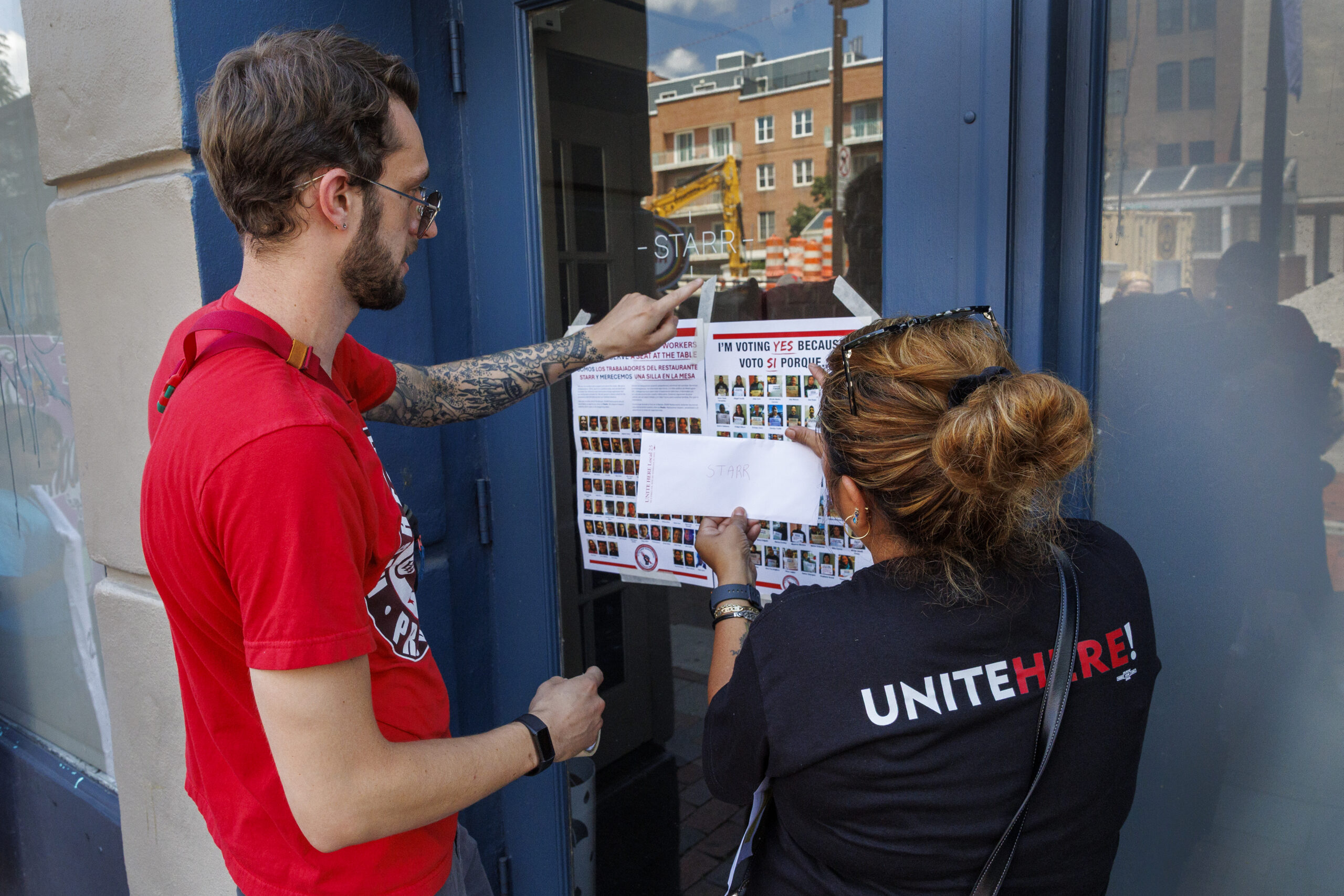
    A delegation of workers pose in front Stephen Starr’s D.C. steakhouse St. Anselm before delivering their union petition in Feb. 2025.

    That case remains open, and a hearing was held in mid-June where the NLRB heard testimony from witnesses on both sides. Unite Here Local 25, which represents more than 7,500 hospitality workers, is optimistic that settlement will open up a path to union recognition.

    “We feel vindicated,” said Paul Schwalb, Local 25’s executive secretary-treasurer. “It’s the same board that’s going to oversee [the unionization case], and we are quite confident — because we did actually follow labor law — that at the end of the day this unit will be certified, and all the objections that Stephen Starr and his many lawyers have filed will be thrown out because they are not true.”

    Legalese that ‘meant nothing’

    The battle between Starr Restaurants and Local 25 began last January, when the union began to organize at three of Starr’s seven D.C restaurants: Pastis, a French bistro; the Parc-inspired Le Diplomate; and St. Anselm, an upscale steakhouse.

    The efforts — which coincided with union drives at two other high-profile D.C restaurants — stood to add 500 members to Local 25. St. Anselm was the only one that voted to unionize. (Local 25 lost the union election at Pastis, and Le Diplomate’s has been suspended indefinitely.)

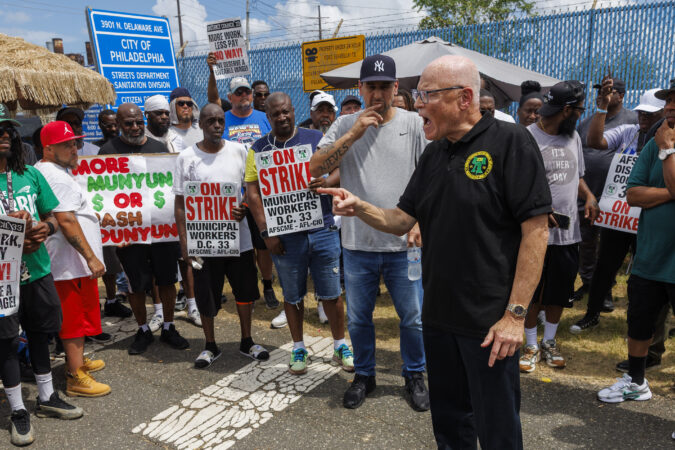
    A picket line outside of Stephen Starr’s D.C. restaurant Le Diplomate, led by Unite Here Local 25 after Starr Restaurants challenged a unionization vote at St. Anselm.

    Almost immediately, relations soured between Starr Restaurants and Local 25. The restaurant group hired anti-union consultants to meet with St. Anselm staff, Washingtonian magazine reported, while other employees told food publication Eater that Local 25 organizers were ambushing them at their homes to sign cards indicating they wanted a union vote.

    Local 25 also called for an ongoing boycott of Starr’s D.C. restaurants — including those where no union efforts were taking place. Top Democrats such as Sen. Bernie Sanders, Rep. Alexandria Ocasio-Cortes, and Sen. Chuck Schumer signed on.

    Legally, the settlement doesn’t state that Starr Restaurants broke any laws or affirm any of the union’s allegations. In practice, however, Cooney said that workers and employees might have a different interpretation.

    Posting a notice “doesn’t sound very intimidating on its face, but employers will sometimes fight tooth and nail over the wording” or try to hide them, said Cooney. “Looking at it from the viewpoint of the common worker, if they see that notice … I think they would see it as an indication that a company violated the law.”

    Starr Restaurants posted the notice required by the settlement inside St. Anselm on June 16 and also emailed a copy to staff.

    Greg Varney (left) and Ana Reyes, both with Unite Here Local 25, outside Starr headquarters at 134 Market St. in July 2025.

    When St. Anselm server Abigail Dunki-Jacobs received the email, it felt like “a bunch of legalese … that meant nothing,” she told The Inquirer. Dunki-Jacobs, who voted against the union, said she hasn’t heard much chatter among her colleagues after it was posted.

    “It just feels like a list of facts to me,” she said. “Nobody even really gives a shit about it.”

    Delays upon delays

    Local 25 organizers and employees who voted for the union also find the settlement meaningless.

    Starr Restaurants “didn’t have to admit to doing anything wrong with the statement they made,” said Ellery Grimm, a member of support staff at St. Anselm who helped organize the union drive. “We’ll be vindicated when we have our contract.”

    St. Anselm’s union election case has sat unresolved with the NLRB for nearly a year and half, which Cooney said was abnormal. The agency tends to prioritize certifying election results over unfair labor practice allegations.

    The NLRB has been beleaguered by delays for more than year, first from the firing of a board member that left the agency unable to issue rulings, and then from a government shutdown that furloughed employees.

    Now, the NLRB faces a staffing and budget shortfall that has made it difficult to catch up on its backlog. In May, the agency transferred roughly 3,500 unassigned cases from regional offices — including Region 5, where St. Anselm’s case is located.

    The delays have caused at least one St. Anselm employee to quit. Bridget Killburn, a baker at the steakhouse, left in April after more than three years at the restaurant. She now works at a bakery in Maryland that she said offered higher pay and more time off — two things she hoped the union would’ve won by now.

    A chef in the kitchen at Le Diplomate, one of Stephen Starr’s three D.C. restaurants that Unite Here Local 25 attempted to unionize.

    “I’m someone who wants a very stable job with good pay, good benefits. At this rate, it felt like I was never going to get those things so I needed to try and find a workplace who would allow me to have them,” Killburn said.

    Schwalb acknowledged that Local 25 hasn’t done any public campaigning at St. Anselm in months, and has abandoned the union drives at Starr’s other restaurants until all litigation is resolved.

    “Rome and the restaurant union — neither one will be built in a day,” he said.

  • Mutant mice resistant to pest control found in Philly, its suburbs, and NYC. Are rats next?

    Mutant mice resistant to pest control found in Philly, its suburbs, and NYC. Are rats next?

    Pest control companies routinely use traps baited with rodenticide to kill rats and mice found in homes, restaurants, and businesses throughout the Philadelphia area, but a recent Rutgers University study suggests those companies face a gnawing problem.

    Researchers discovered that mice in Philadelphia, Trenton, and suburbs like Levittown and New Hope harbor genetic mutations that shield them from standard chemical baits.

    In fact, a majority of house mice sampled from Northeast urban areas, including Manhattan and other New York City boroughs, carried at least one mutation linked to rodenticide resistance — a clear sign that pests are actively evolving to survive common poisons.

    Rats presented a different problem. While they lacked the chemical-resistant mutations found in mice, the study’s author suggests they possess the cognitive sophistication to outsmart and evade traps entirely.

    Lead author Jin-Jia Yu, a postdoctoral researcher in Rutgers’ entomology department, said the findings indicate that pest control companies might need to develop different strategies.

    Yu conducted his research with the supervision of another of the paper’s authors, Changlu Wang, an entomologist in the same department.

    Published in the April issue of Pest Management Science, the peer-reviewed study was launched after frustrated pest control professionals repeatedly approached the Rutgers lab, reporting that rodents routinely survived multiple treatments.

    “For the house mouse, we saw much more mutations rather than Norway rats,” Yu said. Norway rats are the common brown rat often seen in sewers. “Genetic mutation is not that special in these creatures. But we found that the house mouse shows a lot of genetic mutations related to rodenticide resistance.”

    Rodents are a bigger problem in cities

    This study focused on urban rodents. It found that mice in big cities such as Philly and New York had a high frequency of mutations of a certain gene.

    Rodents are a bigger problem in cities than more rural areas. Data cited in the study indicate that an average of 12% of all households experience rodent sightings. But major metropolitan areas reporter higher rates, including Philadelphia (29%), Washington (20%), and Manhattan (15%).

    Yu said that similar studies of mutations in house mice and Norway rats were conducted in Europe and that research in the U.S. has been limited. One study in 2009 did find some rats in England with mutations that made them resistant.

    However, Yu said there had been no such studies in the Northeast.

    It has long been known that rodents developed resistance to the rodenticides developed in the 1950s. So more potent compounds were created in the 1970s and include brodifacoum, bromadiolone, difenacoum, and difethialone.

    The poisons contain anticoagulants that interfere with the activation of vitamin K reductase (VKOR), an enzyme essential for blood to clot. Eating the bait leads to fatal internal bleeding.

    The Rutgers team looked for mutations in the gene known as VKORC1 that makes the enzyme.

    Pest control companies, as well as the Philadelphia Department of Public Health, sent the researchers the tails of caught rodents. Yu said his research was possible only with their help.

    A rare mouse mutation in Philly

    The researchers analyzed DNA from 147 house mice and 143 Norway rats collected in New York, New Jersey, Pennsylvania, and Washington, D.C.

    Among house mice, 84% carried at least one mutation in the VKORC1 gene. Nearly 70% carried mutations known to help mice survive rodenticides.

    Of 24 mice collected in Philadelphia, the majority had a mutation and five had two. One mouse had a rare mutation.

    Of 20 mice collected in Trenton, 10 had two mutations. Lansdale, Levittown, and New Hope had one mouse each with a mutated VKORC1 gene.

    About 35% of the Norway rats also carried mutations. However, scientists do not yet know whether those mutations result in resistance in the rats.

    Mice, Yu said, might be genetically adapting faster than rats because they are curious and more likely to eat unfamiliar food, including rodent bait.

    However, rats will avoid new objects, including live traps, and learn from their encounters.

    In other words, not only are mice mutating to survive, but rats may be learning to avoid entrapment.

    “They’re pretty smart,” Yu said of rats.

  • The sea is higher than we thought and millions more are at risk, study finds

    The sea is higher than we thought and millions more are at risk, study finds

    Climate change’s rising seas may threaten tens of millions more people than scientists and government planners originally thought because of mistaken research assumptions on how high coastal waters already are, a new study said.

    Researchers studied hundreds of scientific studies and hazard assessments, calculating that about 90% of them underestimated baseline coastal water heights by an average of 1 foot, according to Wednesday’s study in the journal Nature. The problem arises far more frequently in the Global South, the Pacific, and Southeast Asia, and less in Europe and along the Atlantic coasts.

    The cause is a mismatch between the way sea and land altitudes are measured, said study coauthor Philip Minderhoud, a hydrogeology professor at Wageningen University and Research in the Netherlands. And he attributed that to a “methodological blind spot” between the different ways those two things are measured.

    Each way measures its own areas properly, he said. But where sea meets land, there are a lot of factors that often do not get accounted for when satellites and land-based models are used. Studies that calculate sea level rise impact usually “do not look at the actual measured sea level, so they used this zero-meter” figure as a starting point, said lead author Katharina Seeger of the University of Padua in Italy. In some places in the Indo-Pacific, the figure is close to 1 meter, or about 3 feet, Minderhoud said.

    One simple way to understand that is that many studies assume sea levels without waves or currents, when the reality at the water’s edge is of oceans constantly roiled by wind, tides, currents, changing temperatures, and things like El Niño, Minderhoud and Seeger said.

    Adjusting to a more accurate coastal height baseline means that if seas rise by a little more than 3 feet — as some studies suggest will happen by the end of the century — waters could inundate up to 37% more land and threaten 77 million to 132 million more people, the study said.

    That would trigger problems in planning and paying for the impacts of a warming world.

    People at risk

    “You have a lot of people here for whom the risk of extreme flooding is much higher than people thought,” said Anders Levermann, a climate scientist at the Potsdam Institute for Climate Impacts Research in Germany, who was not part of the study. Southeast Asia, where the study finds the biggest discrepancy, has the most people already threatened by sea level rise, he said.

    Minderhoud pointed to island nations in that region as an area where the reality of discrepancy hits home.

    For 17-year-old climate activist Vepaiamele Trief, the projections are not abstract. On her island home in the South Pacific archipelago of Vanuatu, the shoreline has visibly retreated within her short lifetime, with beaches eroded, coastal trees uprooted, and some homes now barely 3 feet from the sea at high tide. On her grandmother’s island of Ambae, a coastal road from the airport to her village has been rerouted inland because of encroaching water. Graves have been submerged and entire ways of life feel under threat.

    “These studies, they aren’t just words on a paper. They aren’t just numbers. They’re people’s actual livelihoods,” she said. “Put yourself in the shoes of our coastal communities — their lives are going to be completely overturned because of sea level rise and climate change.”

    Paying attention to the starting point

    This new study is pretty much about what is the truth on the ground.

    Calculations that may be correct for the seas overall or for the land are not quite right at that key intersection point of water and land, Seeger and Minderhoud said. That is especially true in the Pacific.

    “To understand how much higher a piece of land is than the water, you need to know the land elevation and the water elevation. And what this paper says the vast majority of studies have done is to just assume that zero in your land elevation data set is the level of the water — when, in fact, it’s not,” said sea level rise expert Ben Strauss, CEO of Climate Central. His 2019 study was one of the few the new paper said got it right.

    “It’s just the baseline that you start from that people are getting wrong,” said Strauss, who was not part of the research.

    Maybe not so bad, some scientists say

    Other outside scientists said that Minderhoud and Seeger may be making too much of the problem.

    “I think they’re exaggerating the implications for impact studies a bit — the problem is actually well understood, albeit addressed in a way that could probably be improved,” said Gonéri Le Cozannet, a scientist at the French geological survey. Most local planners know their coastal issues and plan accordingly, Rutgers University sea level expert Robert Kopp said.

    That’s true in Vietnam, in the high-impact area, Minderhoud said. Officials there have an accurate sense of elevation, he said.

    The findings come as a new UNESCO report warns of major gaps in understanding how much carbon the ocean absorbs. That report said that models differ by 10% to 20% in estimating the size of that carbon sink, raising questions about the accuracy of global climate projections that rely on them.

    Together, the studies suggest governments may be planning for coastal and climate risks with an incomplete picture of how the ocean is changing.

    “When the ocean comes closer, it takes away more than just the land we used to enjoy,” said Thompson Natuoivi, a climate advocate for Save the Children Vanuatu.

    “Sea level rise is not just changing our coastline, it’s changing our lives. We are not talking about the future — we’re talking about the right now.”

  • Gossiping about the boss? It might be a good thing, per new study

    Gossiping about the boss? It might be a good thing, per new study

    Gossip often gets a bad rap.

    It can be seen as frivolous or hurtful, and not typically encouraged.

    Still, “there seems to be something about it that makes people a little bit giddy, or excited to be gossiping,” says Rebecca Greenbaum, a professor at Rutgers University School of Management and Labor Relations.

    In a recent study, Greenbaum and co-authors focused on the role of gossiping in the workplace. They found that talking about the boss behind their back can present a benefit: bonding among colleagues, and more cooperation. Their findings were recently published in the Journal of Business Ethics.

    The study surveyed hundreds of participants who were asked to report if they had gossiped about the boss that day and how they acted afterward. Colleagues of some of the participants were also surveyed.

    The study results show that on days when employees talked about the boss, they were likely to experience negative feelings such as guilt or shame, and avoid the boss. After gossiping, employees also reported feeling more of a sense of belonging with their colleagues.

    “It doesn’t necessarily mean we’re saying ‘go out and gossip’ because we want you to feel closer to one another,” said Greenbaum. “It’s just that it provides one explanation for why people probably do engage in gossip, because they are getting this benefit from feeling closer to one another.”

    This conversation has been edited for length and clarity.

    What role has gossip typically played in the workplace? Is it positive? Negative?

    In most of the research [until now] … oftentimes it was just looked at more negatively, or it was [discussed] much more in terms of being the victim of gossip. So if I found out someone was speaking poorly about me, how would I feel? I would probably feel angry. I’d feel hurt, I’d feel sad.

    But where [we] really took this in a different direction was focusing much more on the person engaging in the gossip. From that standpoint, not as much research had been done in terms of how people react to their own behavior. So for example, do people really see it as bad? That was one thing we were curious about.

    What do you hope people will take away from the study?

    Keep in mind the boss is someone who can give you rewards, they can punish you — so it’s a little bit more high-stakes to talk badly about a boss compared to maybe just you talking bad[ly] about a coworker or neighbor or something like that.

    We have these emotional reactions sometimes because they serve to protect us. So if you feel … shame and guilt, [for example], it’s telling you that you need to course correct.

    We not only need to protect ourselves individually, but we have this relational need that has to do with our survival too. When people gossip, and then they respond to that gossip by feeling emotionally closer, and like they belong with their group a bit more, that can also facilitate a person’s sense of survival.

    If you have this common enemy, like a boss who’s a jerk to you and he’s mean, sometimes it can feel even better for your sense of belonging to gossip about him.

    Why does it matter if colleagues feel connected to one another?

    Oftentimes people have to engage in teamwork. You need to cooperate, collaborate, come up with creative ideas together, advance some type of project. Even if you aren’t necessarily working together, there’s another big aspect of what we do in organizations, which is not engaging in counterproductive behaviors towards one another. [A colleague might say], “I have a kid at home who’s sick, I was supposed to give this presentation. Can you give it?” If we feel closer with one another, we might be more willing to cooperate with some of those requests that come our way.

    What if you and colleagues like the boss? How do you build that sense of bonding?

    If we have leaders who are good to us, we’re more willing to help them out. There’s basically a role modeling effect where people within the workforce end up treating each other with more dignity and respect too. So if you have a good boss, that’s actually the best scenario, because you don’t have to gossip and experience some of those negative types of emotions.

    Are there any other benefits of having a bad boss?

    I’m asked about this a lot, because I’ve been studying dysfunctional leadership for so long. I know there’s some research out there that shows that, for example, if you do have an abusive boss — that boss who might yell at you, ridicule you, tell you you’re stupid, whatever it may be — sometimes it can get people behaving better, performing better, but it’s short-lived.

  • Intermittent fasting not more effective than conventional dieting, Rutgers researcher says

    Intermittent fasting not more effective than conventional dieting, Rutgers researcher says

    Intermittent fasting, one of America’s most popular diet trends, may be no more effective than simply cutting calories for weight loss, a new review of research shows.

    Researchers found little to no difference in the amount of weight loss across more than 20 studies comparing intermittent fasting, an eating pattern that cycles between periods of eating and fasting, with traditional dietary advice (which calls for restricting calories or the types of foods eaten).

    The findings were published this month in the Cochrane Library, home to evidence reviews that are considered the gold standard for evaluating health evidence.

    “From the results of this review, it doesn’t look like intermittent fasting is any better than regular dietary advice,” said Diane Rigassio Radler, a co-author on the study and a clinical nutrition professor at Rutgers School of Health Professions.

    The data came from 22 randomized controlled trials involving nearly 2,000 participants across Europe, North America, China, Australia, and South America. Interventions ranged from four weeks to six months long, and looked at participants’ outcomes up to a year later.

    In six of the trials, participants were picked at random to either practice intermittent fasting or do nothing. The difference in weight loss between the two groups was so small that it was not considered “clinically meaningful,” Radler said.

    People generally need to lose 5% of their body weight to see health benefits. When the research team pooled the results of studies, they found weight loss from intermittent fasting slightly exceeded that of the group that did nothing, but remained below the 5% threshold.

    “Anecdotally, people have told me that [intermittent fasting] might work for them, but the reasons for doing these systematic reviews is so that you can pull the evidence and make a stronger conclusion based on facts,” Radler said.

    The studies focused on people in the overweight or obese categories as measured by BMI, a calculation of a person’s body fat based on their height and weight. The relevance of the research findings to people in the healthy weight category remains unknown. (While widely used, BMI is often not a good predictor of an individual’s health, as people’s body types can vary widely depending on race, gender, and age.)

    The Inquirer spoke with Radler, who is also a registered dietitian by training, about the findings of the study and its implications, in an interview that was lightly edited for length and clarity.

    What is the theory behind intermittent fasting?

    From a physiological perspective, there’s sound science in terms of why fasting might have an edge over just calorie restriction alone.

    Number one, it involves calorie restriction. It’s thought to increase fat metabolism. There’s some hormonal stuff going on. It may enhance insulin sensitivity. When you’re fasting, you’re going to be breaking down fatty acids, and those can produce a significant source of energy.

    But from the available studies we were able to evaluate, the findings are that intermittent fasting was not really different [in terms of weight loss].

    There’s the theoretical framework, and then there’s what happens when you put it into reality.

    Instead of intermittent fasting, what would you recommend?

    It’s individualized. It depends on where the patient’s at and what they feel that they want to do.

    The cardinal rule of thumb is you create a calorie deficit, and whether that’s with restricted eating or increased energy expenditure (such as through exercise), or a combination of both, you’re looking to achieve calorie restriction over time. Generally, you’re going to probably sustain that for at least 12 weeks, and then look at some outcomes.

    We found that people who work with a registered dietitian on a weekly or every other week basis have the most success in terms of achieving weight management.

    Your study found that intermittent fasting wouldn’t necessarily be effective. But would it be harmful for people to do?

    You have to look at people’s baseline and their other comorbidities if they have any. But generally, we didn’t find that there were adverse effects, according to the studies that measured that as an outcome.

    When you fast, there’s a risk of dehydration and risk of low blood sugar, but generally, the studies that measured the adverse effects didn’t find significant differences.

    Are there any gaps in the research that you think should be looked into further?

    There could be room for more research with a wider diversity of subjects, because most of the studies were in high-income countries. We have to look at some of the cultural differences.

    Also, research with longer durations. We were not able to find studies that went out beyond 12 months of outcomes.

  • Union membership dipped in Pa. and N.J. amid Trump’s anti-labor push, data suggests

    Union membership dipped in Pa. and N.J. amid Trump’s anti-labor push, data suggests

    Following several years of major worker organizing efforts and high-profile strikes, 2025 brought a change in momentum for the labor movement. President Donald Trump’s administration sought to end federal workers’ union contracts and, through a firing, left the National Labor Relations Board without a quorum and unable to make decisions.

    But the percentage of workers who are union members nationwide has stayed pretty steady in the last year, new data shows. And in Pennsylvania and New Jersey, union membership rates fell.

    In 2025, 10% of the country’s total workforce was part of a union, compared to 9.9% in 2024, according to new data from the U.S. Bureau of Labor Statistics. It’s the first time since 2020 that the rate has inched up — albeit slightly — instead of down.

    However, BLS noted, this year’s estimates are not fully comparable to past years because they are based on a BLS survey that is missing October figures due to the government being shut down in October and part of November.

    In the past year, there have been “a lot of kind of anti-labor efforts coming out of the White House,” said Todd Vachon, assistant professor of labor studies and employment relations at Rutgers University.

    Despite those efforts Vachon said, “labor has pretty much maintained the same at the national level. … The Trump attacks haven’t really had any effect yet, at least in the first year.”

    window.addEventListener(“message”,function(a){if(void 0!==a.data[“datawrapper-height”]){var e=document.querySelectorAll(“iframe”);for(var t in a.data[“datawrapper-height”])for(var r,i=0;r=e[i];i++)if(r.contentWindow===a.source){var d=a.data[“datawrapper-height”][t]+”px”;r.style.height=d}}});

    Union membership rates dropped to an all-time low nationwide in 2023 and remained pretty similar in 2024. During those years, roughly one in 10 U.S. workers was part of a union.

    When BLS first started recording this data in 1983, about two in 10 U.S. workers were unionized. There were 17.7 million unionized workers in 1983 and 14.7 million last year.

    Danny Bauder, president of the Philadelphia Council AFL-CIO, speaks at an event supporting federal workers in October.

    Unionizing in N.J. and Pa.

    In New Jersey, 14.7% of workers were unionized last year, and in Pennsylvania, it was 10.9%.

    In both states, that was a decline of around one percentage point from 2024, but BLS noted that state-level data “should be interpreted with caution,” due to the shutdown-related incomplete data.

    window.addEventListener(“message”,function(a){if(void 0!==a.data[“datawrapper-height”]){var e=document.querySelectorAll(“iframe”);for(var t in a.data[“datawrapper-height”])for(var r,i=0;r=e[i];i++)if(r.contentWindow===a.source){var d=a.data[“datawrapper-height”][t]+”px”;r.style.height=d}}});

    Some local labor action highlights from this past year include:

    What happened in labor organizing last year?

    The Trump administration moved to end union contracts for government workers, amid a push to reshape the federal government.

    Some 271,000 federal jobs were cut between January and November. Meanwhile, the union membership rate in the public sector increased by 0.7% nationally in the last year according to the new BLS data.

    Vachon notes that the vast majority of public sector workers are at the municipal level, not federal.

    “The hiring of police, and teachers, and sanitation workers across the thousands of cities around the U.S. more than compensated for [cuts at the federal level], because we see an increase in the public sector,” he said.

    Trump also fired a member of the National Labor Relations Board (NLRB) early last year, which left it without a quorum to issue rulings. In some cases that can slow down the formation of a new union — at the Amazon-owned Whole Foods in Philadelphia, for example.

    The number of union elections overseen by the NLRB declined last year and the overall number of workers involved in those elections dropped too, according to the nonpartisan Center for American Progress.

    “A huge percentage of new union organizing is required every year just to maintain the same level of unionization, because of the churning and the growth of the overall labor force,” said Vachon. “If the labor force is not growing, then you can actually see increases in union density.”

    And unions are being cautious of reaching out to the NLRB under the Trump administration, he notes.

    “There’s a fear [that] if something gets sent up to the NLRB that the ruling is going to set a precedent that makes it even more difficult to organize,” said Vachon. “It’s kind of had a dampening effect in that way.”

  • After a Philadelphia cancer patient ran out of options, a novel T-cell therapy at Rutgers kept her alive

    After a Philadelphia cancer patient ran out of options, a novel T-cell therapy at Rutgers kept her alive

    Jefferson Health oncologist Jennifer Johnson had exhausted all the standard treatment options for her 49-year-old patient with esophageal cancer, who was likely to die within months.

    Surgery, chemotherapy, radiation, and immunotherapy had kept the Northeast Philadelphia woman alive for six years after her diagnosis, but no longer were enough to stop her cancer from spreading.

    Johnson knew her patient needed something novel. She recalled a presentation several years prior at a conference for head and neck cancers, where a doctor discussed an experimental treatment called T-cell receptor (TCR) therapy.

    This type of cancer immunotherapy works by engineering the immune system to fight cancer, and falls into the same family of treatments as CAR-T, or chimeric antigen receptor (CAR) T cell therapy, an approach pioneered at the University of Pennsylvania that has revolutionized treatment for blood cancers.

    She thought TCR therapy’s clever approach could work against solid tumors, where CAR-T had not been effective.

    “I just remember sitting in the room and watching him present, thinking, I’m gonna use that one day,” the oncologist and cancer researcher recalled.

    As it would happen, the approach was being tested in a phase II clinical trial at Rutgers Cancer Institute against tumors just like her patient’s: metastatic cancers driven by a virus called human papillomavirus 16. One of the most common strains, HPV16 causes roughly half of cervical cancer cases worldwide, as well as cancers of the head and neck area, anus, and genitals.

    Cases that reach the metastatic stage like Johnson’s patient often run out of treatment options. Whether T-cell receptor therapy would work was unknown, but the alternatives were expected to fail.

    “Anything that you might offer them would definitely not be expected to make their cancer go away completely and do it for a long time,” said Christian Hinrichs, the oncologist and scientist heading the trial whose presentation Johnson saw.

    But interim results from the first half of the trial showed improvement in six out of 10 patients, whose tumors at least partially shrank. And two of them had no evidence of cancer after treatment.

    Johnson’s patient, Maria Pascale, was one of the two whose promising early results were presented at a medical conference and highlighted in a research abstract in the Journal for ImmunoTherapy of Cancer in November.

    She arrived at the health system in New Jersey in the summer of 2024 in such poor health that her lungs were starting to collapse.

    The therapy has enabled her to celebrate two birthdays, start martial arts classes, reunite with old friends visiting from Argentina, and see her 23-year-old son get engaged.

    “Imagine the wedding, then later the grandkids, I’m always thinking about [that],” she said.

    What is a T-cell receptor therapy?

    In the immune system, T cells act as frontline defenders against viruses, bacteria, and other threats.

    Sometimes, these cells aren’t great at their jobs.

    In the face of cancer, T cells can become exhausted over time, and fail to recognize invaders or mount attacks.

    The idea behind immunotherapy is to transform these regular immune cells into cancer-fighting super-soldiers.

    The Rutgers approach, an engineered TCR therapy, involves collecting T cells from a patient’s blood and genetically engineering them to better target a cancer cell for attack.

    Afterward, the scientists grow more of the enhanced T cells in the lab and infuse them back into the patient.

    The “prototype” for this style of therapy is CAR-T, a treatment that has saved tens of thousands of lives since the first FDA approval in 2017. Scientists have not yet been able to replicate the therapy’s success in blood cancers in solid cancers, although some early stage trials have shown potential.

    TCR therapy is thought to be more promising against the latter cancer type — which is what’s being treated in the Rutgers trial — due to differences in the way the engineered T cells identify cancer cells.

    CAR-T therapy uses what’s called a chimeric antigen receptor, a protein that recognizes a cell as cancer based on what’s on the outside of the cell.

    It’s like knowing you’re at your friend’s house because of a specific doormat or set of house numbers on the exterior.

    TCR therapy uses what’s called a T-cell receptor, which can recognize cancer cells based on what’s inside the cell.

    It’s like knowing you’re at your friend’s house because you can see your friend inside.

    Sometimes cancer cells have more unique identifiable elements on the outside, but other times they don’t. Imagine if multiple houses had the same doormat.

    “That target would be on other cells that aren’t cancer cells and cause lots of toxicity,” said Carl June, the pioneering cancer scientist at Penn who developed the first FDA-approved CAR-T therapy and was not involved in the Rutgers trial.

    That’s been the problem that’s held back CAR-T’s use in solid tumors.

    The target in the Rutgers trial is a protein called HPV16 E7, found inside the cell. In tumors driven by the virus HPV16, it plays a key role in turning a cell into cancer.

    “That’s like going after its Achilles’ heel,” June said.

    Swarming the cancer

    Pascale first arrived at Thomas Jefferson University Hospital in Center City in 2018 after suffering injuries in a car accident.

    Doctors found a mass in the 43-year-old’s neck that turned out to be cancer.

    Surgeons removed the mass, and she was fine until 2021 when doctors, including Johnson, found the cancer at the top of her esophagus.

    They treated her with a combination of chemotherapy and radiation, which worked until March of 2022, when the cancer started appearing in Pascale’s lungs.

    “All bets were off,” Johnson said.

    Doctors gave Pascale chemotherapy and immunotherapy over the next couple of years, but in the spring of 2024, she developed an allergy to one of her chemotherapy drugs.

    Around the same time, the cancer spread to the skin on Pascale’s back.

    That’s when Johnson transferred her care to Hinrichs’ team at Rutgers.

    Pascale started preparations for the treatment in July 2024, spending a couple weeks in the hospital.

    The Rutgers team took T cells from her blood, gave her chemotherapy to knock her immune system down, and then transfused the engineered cells back into her body.

    Within 48 hours, Pascale started feeling horrible.

    “It was painful. It was my whole body, like I had pneumonia,” she said.

    She had trouble breathing as the cells fought the cancer in her lungs. Hinrichs described it as “the T cells swarming the cancer,” leading to an inflammatory reaction.

    The same thing occurred on her back. When Pascale’s sister came over, she saw one of the tumors in her skin was suddenly the size of a lemon.

    Another one appeared red and felt like someone was burning a cigarette on her back.

    The pain continued for three days, and then she felt well enough to go home. Pascale and her sister could see and feel the nodules on her back get smaller, until eventually they were gone.

    Roughly five months later, Pascale’s scans showed no evidence of cancer. As of last month, a year and a half after she received the treatment, that was still true.

    “What’s three days of pain compared with the opportunity that I have to live a lot of beautiful things with my family and friends?” Pascale said.

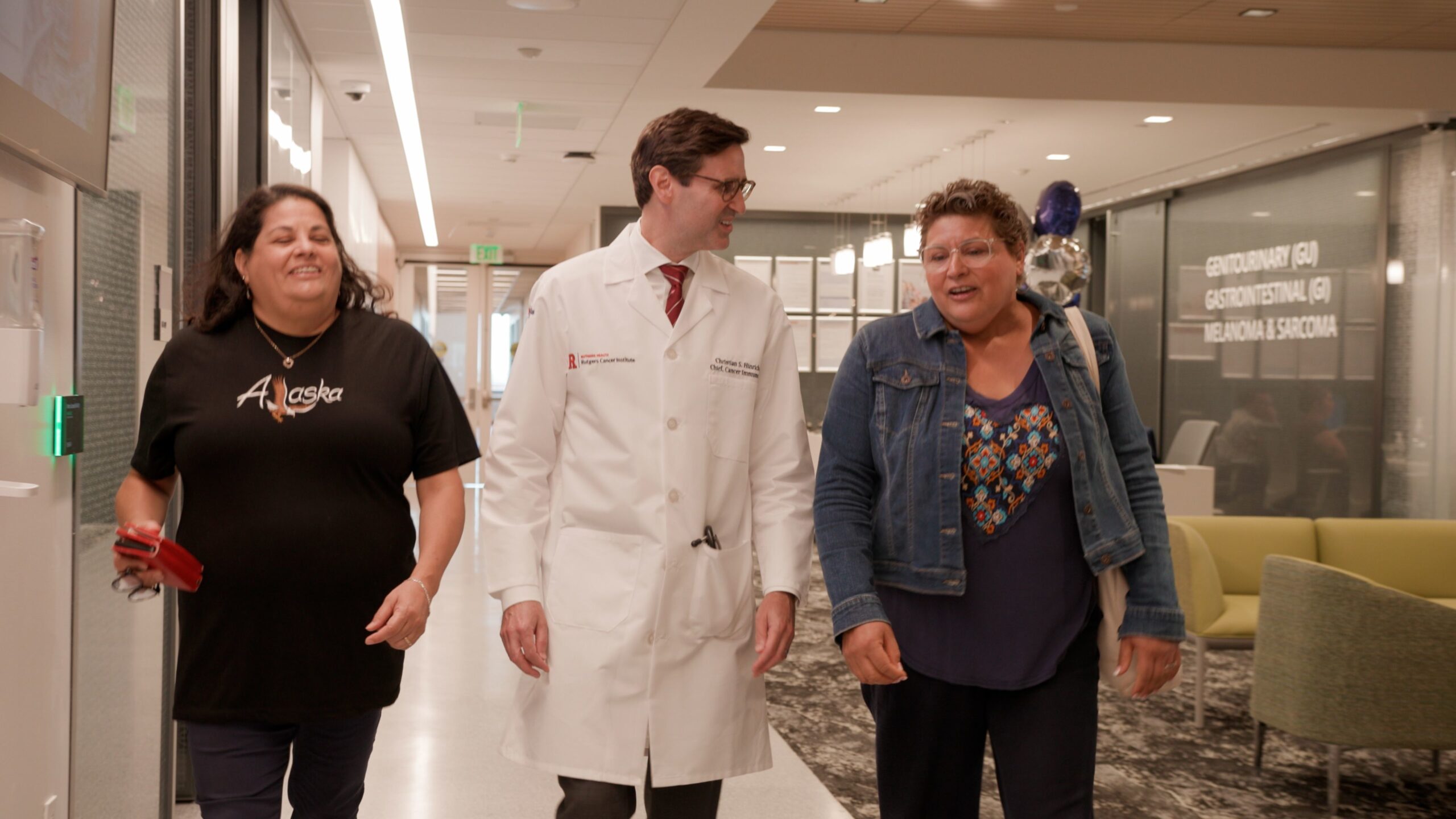
    Maria Pascale walks with her sister Maria Durante and her doctor Christian Hinrichs at Rutgers.

    The future of the treatment

    Hinrichs said his team is working to figure out why two of the patients, including Pascale and a patient with anal cancer, responded better to the treatment.

    He cautioned that it’s too early to draw sweeping conclusions since the sample size is small. (Researchers will seek to recruit another 10 patients for the ongoing trial.)

    The patients who had complete responses will need follow-up scans every few months to make sure their cancers have not returned.

    It will still take years to finish evaluating safety and efficacy. Treatments tested in clinical trials often do not advance to become standard practice.

    June, the Penn scientist, called the trial’s early results promising and noted that there weren’t any major safety problems reported.

    Adverse effects seen in the trial were mainly those caused by the chemotherapy.

    However, the drawback of using TCR therapy is that patients need a certain genetic background for it to work, June said. This is similar to how not every organ donor would be a good match for a recipient.

    The genetic profile chosen for the Rutgers therapy is the most common in America. However, it is less common in Black and Asian people compared to white people.

    Scientists hope it could one day be possible to manufacture the therapy with a warehouse approach, where TCR therapies that work across genetic backgrounds could be mixed and matched.

    “It’s a practical issue that the drug companies face,” June said.

    CAR-T, in comparison, can be used more broadly across different genetic backgrounds.

    What matters most, since the treatment is expensive to make, is that the responses hold up over time, June said.

    (The TCR therapy’s cost has not yet been set, Hinrichs said, since it is currently manufactured individually for each patient.)

    “If they’re long lasting, then it’s really going to be a huge advance because nothing else works in the patients he’s treated,” June said.

    At Jefferson, Johnson is cautiously optimistic about the treatment that has kept her patient alive.

    If the therapy makes it through the rest of the trial process and proves effective, she hopes it could become “another thing in our armamentarium against this type of cancer.” (A type that doctors would hope to see less of since the introduction of the HPV vaccine in 2006.)

    “I can’t tell you how wonderful it is to have a patient responding and living well when you saw things going the wrong way,” Johnson said.

    Editor’s note: This story has been updated to clarify where the research has been presented and a reference to the prevalence of the genetic profile used in TCR therapy.

  • A Philly-area university prof is competing in the Jeopardy! tournament of champions

    A Philly-area university prof is competing in the Jeopardy! tournament of champions

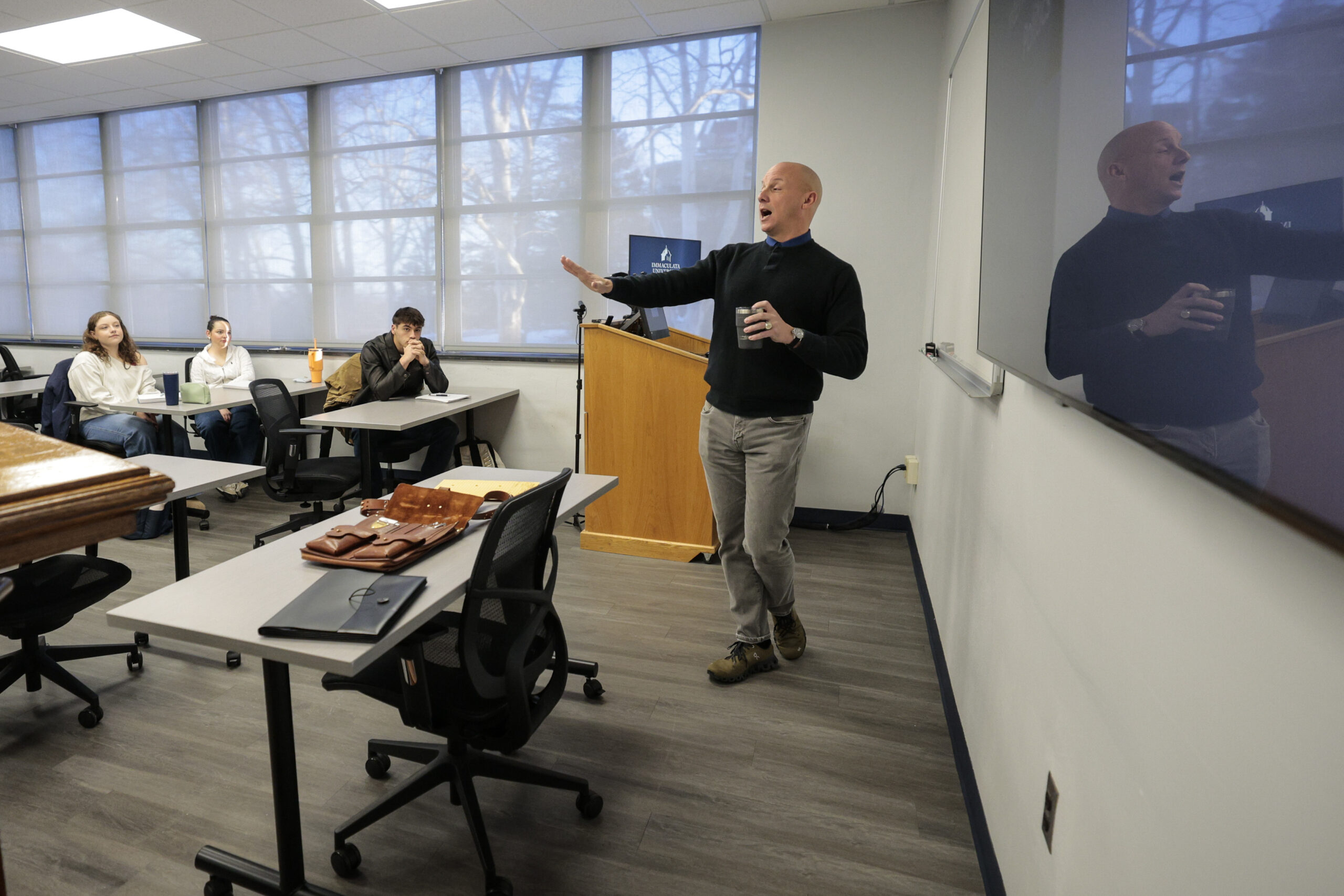
    As Joshua Weikert shared ground rules for quizzes in his early morning international relations class, he sought to put his students at ease.

    “I don’t want you stressing out about these,” he said Tuesday, as the new semester got underway at Immaculata University in Chester County. “I myself was a terrible student.”

    Weikert, 47, of Collegeville, may not have been a star student, but he sure knows a lot.

    The politics and public policy professor will compete on Jeopardy! 2026 Tournament of Champions at 7 p.m. Friday on ABC, having won six games when he was on the show in March.

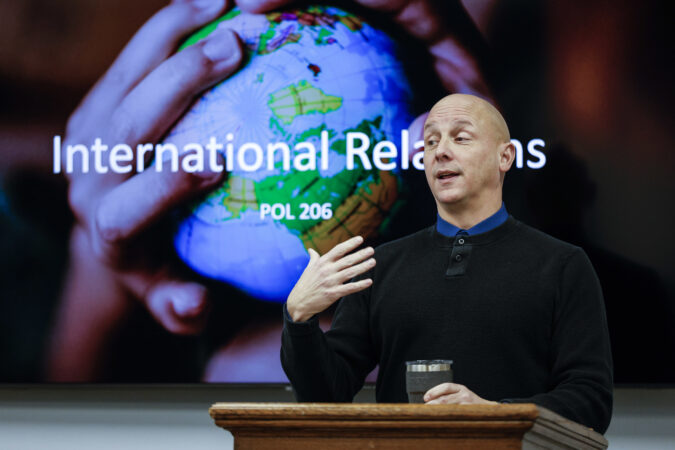
    Joshua Weikert teaches a class in international relations at Immaculata University.

    Over a couple weeks, Jeopardy! shows will feature him vying against 20 other champions, including Allegra Kuney, a doctoral student at Rutgers University’s New Brunswick campus, and Matt Massie, a Philadelphia lawyer who moved to the area in 2024, who also will appear on Friday’s show.

    Friday’s match is a quarter-final, and if Weikert wins, he’ll advance to the semifinals. (Kuney won her quarter-final Tuesday.)

    Weikert won about $103,000 when he competed last year, 10% of which he donated to a memorial scholarship fund named for his late friend, Jarrad Weikel, a Phoenixville man who died unexpectedly at age 40 in 2022. The winner of the champions tournament —which will conclude sometime in early February — will take home a grand prize of a quarter million.

    Weikert will watch the show Friday among family and friends — including his fellow contestant Massie — at Troubles End Brewing in Collegeville, which named one of its beers after him. It’s an English Bitter, one of Weikert’s favorites, called “Who is Josh?”

    At Immaculata, a Catholic college where Weikert has taught since 2016, students and staff are stoked. A campus watch party is planned, President Barbara Lettiere said.

    His appearance last year, she said, has put a welcome spotlight on the school and brought an outpouring of enthusiasm from alumni. On tours, some prospective students and their parents who spot Weikert have recognized him, she said.

    “I never knew that this show was as watched as it appears to be,” she said. “Win or lose, Immaculata wins.”

    Student Ben Divens talks about his Jeopardy-star professor Joshua Weikert.

    Ben Divens, 19, said it’s “jaw-dropping” and “surreal” to know his teacher will compete in the Jeopardy! champion tournament.

    “I knew from the first time I met him he was a super, super smart person,” said Divens, a prelaw major from Souderton.

    “He’s guided us so much in our major already,” added Bailey Kassis, 18, a political science major from Fort Washington.

    “He’s guided us so much in our major already,” student Bailey Kassis said about her professor Joshua Weikert.

    An early gamer

    Weikert said he has watched Jeopardy! ever since he can remember, probably since 1984 when he was 6, and it came back on the air with Alex Trebek as host. He grew up just outside of Gettysburg in a family that loved to play games, he said.

    “We took them very seriously, which is to say that they didn’t just let the kids win,” he said of his parents, both of whom had accounting degrees. “We were destroyed routinely in the games we played.”

    About his performance as a student, he said he often skipped his homework.

    “Just give me an exam,” he said, describing his attitude at the time. “I’ll pass it.”

    He got his bachelor’s degree in international relations from West Chester University, master’s degrees from Villanova and Immaculata, and his doctorate from Temple. He also attended the Defense Language Institute Foreign Language Center, where he studied modern standard Arabic while serving in the U.S. Army.

    Joshua Weikert sets expectations for students as a new semester gets underway at Immaculata University.

    In addition to teaching, he also works as a policy adviser to the Pennsylvania House of Representatives under state Rep. Joe Webster, a Democrat serving part of Montgomery County. He vets legislators’ ideas and offers ideas of his own.

    “The only thing they’ve ever told me no on was [when] I tried to abolish the Pennsylvania Senate,” he said.

    So many bills pass one body, then die in the other, he explained. If there were one legislative body where all House and Senate members served, that might be different, he said.

    Weikert’s office walls are lined with framed newspaper front pages highlighting major events: “Nixon Resigns,” “Nazis Surrender,” “Man Walks on Moon,” “Kennedy Shot to Death.”

    “Every once in a while, I just get up and read one of the stories,” he said.

    He got them from his mother-in-law’s basement and put them up after his wife told him his office needed some decor.

    Weikert’s status as a Jeopardy! champion makes clear he’s a fast thinker. He’s also a fast talker.

    “I don’t really drink caffeine. I just talk this fast,” he told his students.

    His wife, he told the class, tells him to slow down.

    “Keep up,” he tells her, he said.

    The road to Jeopardy

    Since his mid-20s, Weikert has been trying to get on Jeopardy!. Years ago, he got a call from the game show, but he put the caller on hold to get to a quiet place. They hung up.

    “I was like, well, I guess I missed that opportunity,” he said.

    But he kept trying and started taking the online tests, which typically draw 200,000 participants annually. In 2024, he got an email, inviting him to take the test again — and then again under Zoom surveillance.

    Next came a virtual audition and practice game in August 2024. That earned him a place in a pool of about 3,000 people, of whom a few hundred eventually became contestants.

    Weikert got the call last January and was invited to fly to California the next month to compete.

    In reality, his varied interests and life path had already prepared him for the show. He reads a lot. He’s a fan of historical fiction, pop culture, and movies. His work as a public policy scholar helps, too.

    But to try and up his game, he read plots of Shakespeare plays and a book on great operas. He flipped through lists of presidents and vice presidents. His wife, Barbara, a Norristown School District middle school music teacher, read questions to him from old Jeopardy! shows. He knew about 80% of the answers, he said.

    That, however, didn’t stop him from having panic dreams of being on stage and knowing nothing.

    The toughest category for him, he said, is popular music. Movies, history, and politics are his strongest.

    But the hardest questions, he said, are the ones with four or five strong possible answers.

    “Getting a Jeopardy! answer right is more about knowing what it’s not than what it is,” he said.

    Ultimately, he said, it’s impossible to really study for the game show.

    “The odds that something you study would come up is almost zero,” he said.

    It was an intense experience on stage last March, but the staff put contestants at ease, he said. Host Ken Jennings, formerly one of the show’s most successful contestants, told them, according to Weikert: “I promise you something today is going to be a win for you, so just relax and have fun.”

    He has a hard time remembering his winning answers. He readily recalls his dumbest, he said.

    The answer was “sacred cow.” He uttered “holy cow.”

    “Even as it was coming out of my mouth, I knew it was wrong,” he said.

    He’s proud that he only froze on one answer involving lyrics from the B-52’s “Love Shack,” he said.

    There was less pressure competing in the championship match last month, given he was already a winner, he said. But it was harder in that the contestants were the best of the best.

    “During the regular season, it’s a little under a quarter of a second between when you can start to buzz in and when the buzz actually comes,” he said. “In the tournament of champions, that drops to 0.08 seconds.”

    This time, he also prepped by reading children’s books on topics such as basic cell biology, a tip he got from another contestant.

    “It’s the simplest language they can use to convey the information,” he said.

    He also read the book, Timelines of Everything: From Woolly Mammoths to World Wars.

    He most enjoyed the camaraderie among contestants, he said. When filming was over, they hung out in a bar and — watched Jeopardy!.

    “We were yelling out the answers,” he said.

  • Penn graduate student workers could strike next month

    Penn graduate student workers could strike next month

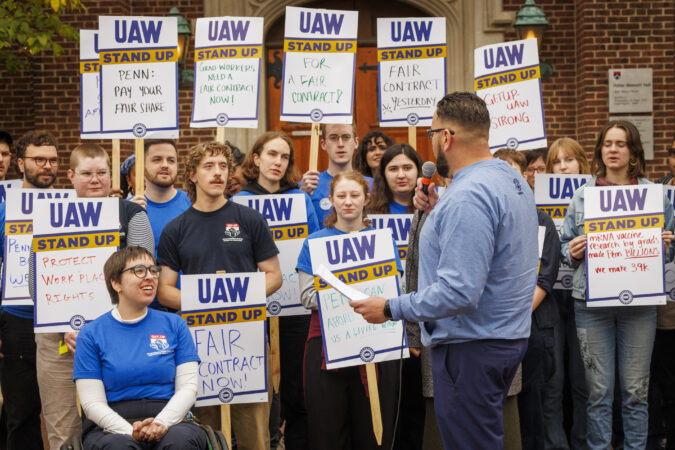
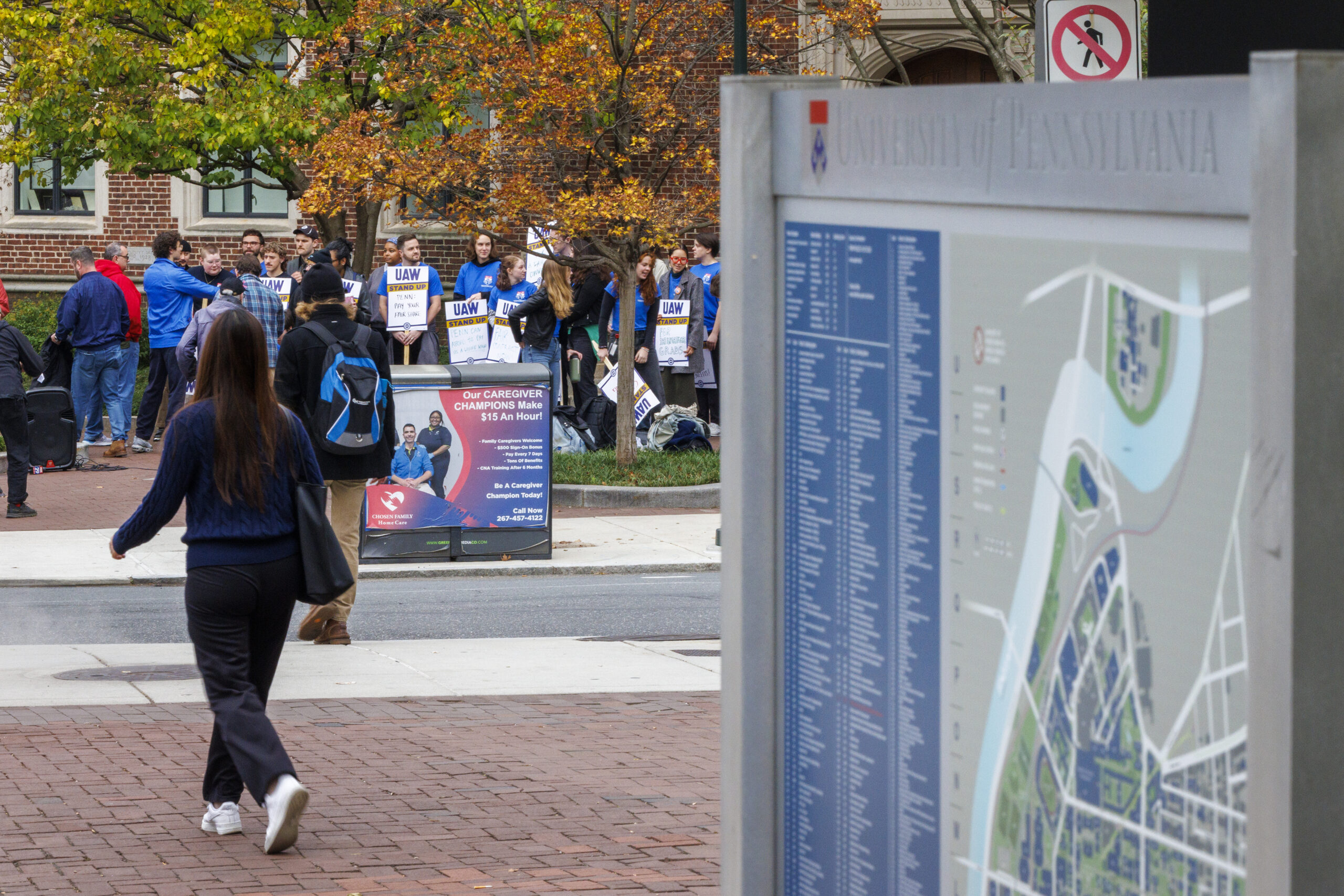
    The union that represents about 3,400 University of Pennsylvania graduate student workers says they will go on strike Feb. 17 if they do not reach a contract deal with the university by then.

    “We love our jobs, but Penn’s administration is leaving us no choice but to move forward with a strike,” said Nicolai Apenes, a Ph.D. candidate and research assistant in immunology, in a statement shared by the union Tuesday. “We are ready to stand up and demand that our rights are respected.”

    Penn’s graduate student workers voted to unionize in 2024. The union has been negotiating with the university since October 2024 for a first contract, and some tentative agreements have been reached on a number of issues.

    Sticking points in bargaining include wages, healthcare coverage, and more support for international student workers.

    In November the teaching and research assistants voted to authorize a strike if called for by the union, which is known as Graduate Employees Together-University of Pennsylvania (GET-UP) and is part of the United Auto Workers (UAW).

    A spokesperson for the University of Pennsylvania said in a statement Tuesday that Penn has engaged in good faith negotiations with the union, and has reached 23 tentative agreements through 39 bargaining sessions with additional sessions planned.

    “We believe that a fair contract for the Union and Penn can be achieved without a work stoppage, but we are prepared in the event that the Union membership strikes,” said the Penn spokesperson. “Efforts are underway to ensure teaching and research continuity, and the expectation is that classes and other academic activities will continue in the event of a strike.”

    “While we hope that Penn comes to the table and negotiates a fair contract for these essential workers, we know that these workers are a powerful force that Penn cannot break,” said Daniel Bauder, Philadelphia AFL-CIO president, in a statement Tuesday. “We are proud to stand with them and the broader Coalition of Workers at Penn as they fight the biggest employer in the region and bring union power to the University of Pennsylvania.”

    Penn, the largest employer in Philadelphia, has seen a wave of student-worker organizing in recent years, including resident assistants, graduate students, postdocs and research associates, as well as training physicians in the University of Pennsylvania Health System.

    The region has also seen a couple other university strikes in recent years. In 2023 graduate workers at Temple University walked off the job for 42 days amid contract negotiations, and in a separate action at Rutgers University, educators, researchers, and clinicians went on strike for a week.

    University of Pennsylvania graduate students hold a press conference and rally calling for a strike vote against the university at the corner of South 34th and Walnut Street, Monday, Nov. 3, 2025.