Tag: School District of Philadelphia

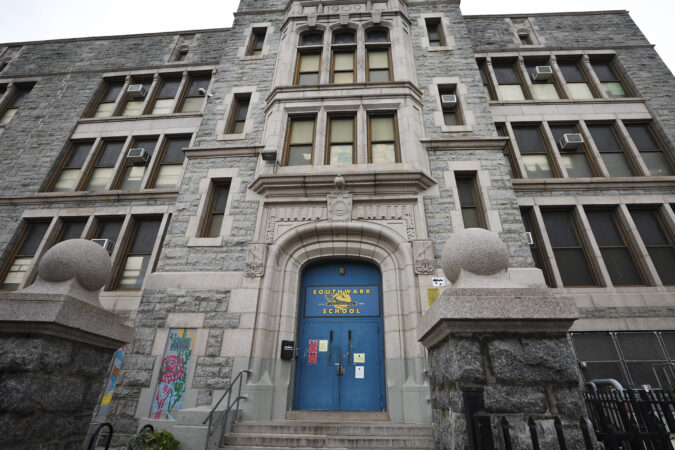
  • Mice, graffiti, and broken bathrooms: Teachers and parents sound an alarm about building conditions at this Philly school

    Mice, graffiti, and broken bathrooms: Teachers and parents sound an alarm about building conditions at this Philly school

    The Philadelphia School District is poised to announce soon which of its aging buildings it will fix up and which it might close, or consolidate, or reimagine in the coming years.

    But teachers and parents at one South Philadelphia elementary school say they cannot wait for help and have appealed to Superintendent Tony B. Watlington Sr., Mayor Cherelle L. Parker, and others.

    “Southwark School is desperately in need of changes,” a letter signed by 300 people and sent to Watlington and Parker on Friday read. “Our children are learning in an unhealthy environment that no child should have to experience.”

    In many ways, Southwark, a K-8 facility constructed in 1905, is a thriving school — it has strong academics, a diverse student body of about 900, a dual language immersion program, and a robust complement of activities. Southwark is a community school, with city-paid resources including free before- and after-school care.
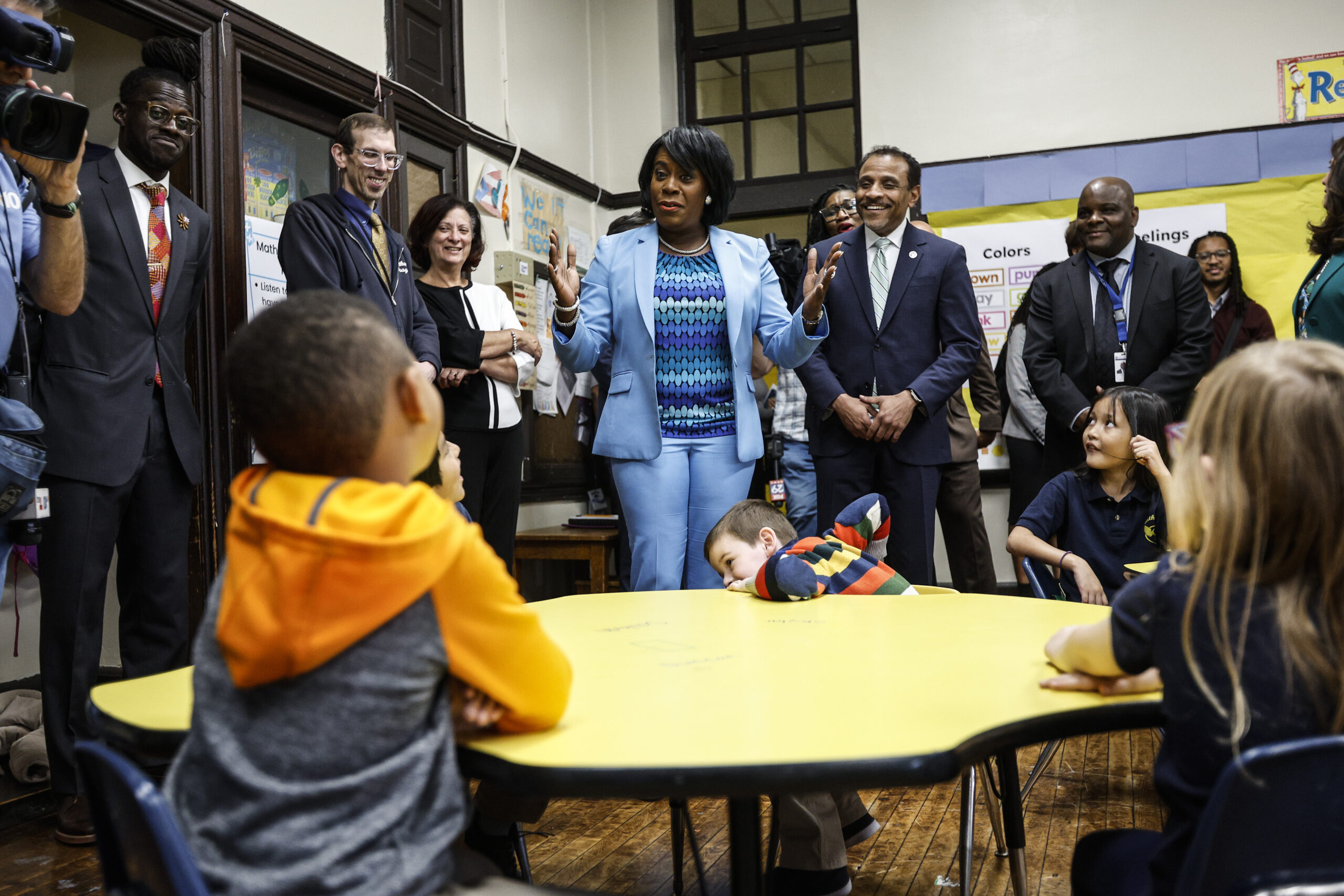
    Mayor Cherelle Parker and Superintendent Tony B. Watlington Sr. visit a classroom at Southwark Elementary to discuss the city’s extended day extended year programming in this 2024 file photo.

    But it also has issues including bathrooms that “break down nearly every day,” the letter said. “The plumbing has gotten so bad that sewage comes dripping down from the ceiling into classrooms.”

    The letter outlined other issues including a rampant bug and rodent problem, a stairwell covered in graffiti and trash, dank hallways, a lack of adequate ventilation, and more.

    “Our children tell us that classrooms feel like prisons because the windows can’t be opened fully and they have opaque coverings,” the letter read.

    Nyera Parks, a Southwark second-grade teacher, said she doesn’t think the community is asking for too much.

    “These conditions are affecting the children’s health, their focus, their sense of safety,” Parks said. “It’s the bare minimum — we’re asking for a clean and safe school.”

    Responding to teacher and parent concerns, district chief operating officer Teresa Fleming said in a letter sent Monday the school system “has already taken concrete action to address conditions at Southwark while continuing to plan for sustained improvement.”

    Fixes Fleming cited include “mass” trapping, plaster and plumbing work, and adjustments to the cleaning staff.

    Some staff have reported “visible improvement in cleanliness and operational response,” Fleming wrote in the letter to State Rep. Elizabeth Fiedler (D., Philadelphia). “At the same time, we recognize that some of Southwark’s challenges are rooted in aging infrastructure and require longer-term planning. My team is developing an actionable plan that includes feasibility reviews of plumbing systems, HVAC needs, and cafeteria kitchen capacity, with attention to major shared spaces, including the gymnasium, cafeteria, and auditorium.”

    Southwark, according to data released by the district this summer, is in “poor” building condition. It is also operating at 104% of its building capacity.

    Fleming said the school “will likely receive facility enhancements” through the forthcoming facilities master planning process.

    ‘It shouldn’t have to be like this’

    The first thing Jennifer O’Shaughnessy, a teacher and part of the morning care staff, does when she gets to Southwark early is pick up trash. Then, when she gets to the cafeteria, where kids will eat breakfast, she grabs wipes to clear the mouse droppings that have accumulated overnight.

    At least once a week, O’Shaughnessy said, “the kids are eating breakfast and we see a mouse come out, and then they’re standing up, screaming. We tell them it’s going to be OK, but it shouldn’t have to be like this.”

    O’Shaughnessy has worked at Southwark for 15 years and is now the upper school coordinator, teaching writing and a elective and supporting other educators. She loves the school so much she sends her own daughter to Southwark.

    But it troubles her that because of the old heating system, the school’s classrooms are either freezing or so hot students sometimes get nosebleeds.

    “I’ve had teachers take their kids into the hallway because it’s too hot in their classrooms,” O’Shaughnessy said. “It’s 80, 90 degrees in there, and you can’t think. And when the heat is not on, it’s freezing and you have students with winter jackets on.”

    City demographics and Southwark’s burgeoning popularity have brought new life to the school, but have also strained the building.

    Bathrooms are a particular issue. The restrooms that get the most use are in the basement, near the cafeteria. But those bathrooms are frequently closed because of plumbing issues and other problems.

    Last month, a student told O’Shaughnessy they couldn’t use the bathroom because no toilets were working. There had been no news of a closure, so O’Shaughnessy went in to investigate.

    “Every toilet was running over,” she said. “I went in there and almost lost my lunch. They had taped off half the stalls because flood water was running over. The other toilets were clogged.”

    O’Shaughnessy had the bathroom shut down, leaving a common problem — there are a few other bathrooms, but not enough to accommodate the large student population’s needs.

    ‘It’s still a mess’

    Appealing to the superintendent and mayor was not the teachers’ and parents’ first move. They worked within the system, staff said, putting in countless work orders and making more direct appeals to district officials.

    Southwark recently got a permanent building engineer — that has helped some, said Justin Guida, the school’s STEM teacher, but the problems can never be rectified by one employee.

    “We get a little Band-Aid here and there, it looks like they helped, but it’s still a mess,” said Guida, who lives in the neighborhood and has worked at Southwark for 10 years. “When the kids complain because of the bathrooms or the food or the bugs or mice, it breaks my heart. The kids say, ‘I love Southwark, but it’s dirty.’”

    Southwark teachers say that school material often get ruined by rodents.

    “We’re growing plants as a science experiment, and the plants get destroyed because they’re getting eaten by the mice,” Guida said.

    Guida knows the district has billions in unmet facilities needs, but the changes Southwark needs are not all costly, he said.

    “Can the windows get uncovered so we can see out them and have natural light come in? Can we clean the fire towers that our kids have to walk through?” he asked.

    Parks, the second-grade teacher, is frustrated by air filters that do not get changed, especially given the high rates of asthma among Southwark children.

    In 2023, Southwark was temporarily closed because of damaged asbestos, with the school split between South Philadelphia High and Childs Elementary. The damaged asbestos was removed, but Parks and others worry about the asbestos that remains in the building.

    Parks attended Southwark as a child and is dismayed that her second graders may not be having the same experience she had as a student. She never had sewage leaking from bathrooms into her classroom, or had lessons interrupted by a mouse scurrying across the floor.

    “I remember feeling safe there,” she said. “Some of the things that I’m seeing in the building now are not how I saw and experienced it when I was there. How are they able to learn and feel comfortable in these types of conditions?”

    Parks and others who signed the letter to Watlington and Parker have asked for fixes including repainting hallways, ensuring every classroom has a working lock, and guaranteeing that stairways and outdoor areas will be regularly cleaned, that every room has air-conditioning and regular air filter changes, and that there are specific plans for long-term bathroom repairs.

    Fiedler said that she appreciated Fleming’s response, but that Southwark’s conditions generally “are a major concern.”

    “We know that there’s many years of deferred maintenance in the School District of Philadelphia and across the commonwealth,” Fiedler said. “I think this is a really good, really sad, and scary example of a place where more needs to be invested.”
  • Sharif Street could become Pa.’s first Muslim member of Congress. But don’t make assumptions about his politics.

    Sharif Street could become Pa.’s first Muslim member of Congress. But don’t make assumptions about his politics.

    When State Sen. Sharif Tahir Street converted to Islam 30 years ago, he already had a Muslim name.

    His father, John F. Street, who would go on to become Philadelphia’s mayor, gave his son a Muslim name when he was born in 1974 despite raising him in the Seventh-day Adventist Church, an evangelical Christian sect in which members of the Street family hold leadership roles to this day.

    As the senator tells it, his father initially considered adopting the name Sharif himself — not because he was considering converting to Islam but because he wanted to embrace the movement of Black Americans reclaiming pre-slavery identities.

    Instead, the elder Street, who had already built a reputation as a rabble-rousing activist, kept his name and dubbed his son Sharif, which in Arabic means noble or exalted one.

    The story would be surprising if it weren’t from the idiosyncratic Street family, which has played a unique outsider-turned-insider role in Philly politics for decades. The late State Sen. Milton Street was the senator’s uncle, and Common Pleas Court Judge Sierra Thomas Street is his ex-wife.

    This year, with Sharif Street a frontrunner in the crowded Democratic primary to replace retiring U.S. Rep. Dwight Evans, the family could make more history: If elected, Sharif Street would become the first Muslim member of Congress from Pennsylvania.

    A Street win would mark another milestone in political representation for Philadelphia’s large Muslim community, an influential constituency that already includes numerous elected officials and power players.

    But in characteristic Street fashion, that potential comes with a twist. Street has relatively moderate views on the conflict in Gaza and would likely stand out from Muslim colleagues in Congress like U.S. Reps. Ilhan Omar (D., Minn.) and Rashida Tlaib (D. Mich.), progressives who regularly denounce Israeli aggression.

    To be sure, Sharif Street, 51, is highly critical of Israeli Prime Minister Benjamin Netanyahu and the war in Gaza. But he is also quick to defend Israel’s right to exist as a Jewish state, favors the two-state solution, and counts many prominent Philadelphia-area Jews among his friends and political supporters.

    “Guess what? Benjamin Netanyahu is not the only leader of a major country in the world that’s committed war crimes, because Donald Trump has done the same thing,” Street said last week at a Muslim League of Voters event. ”But none of us would talk about getting rid of the United States of America as a country.”

    For Muslim voters who view the Middle East crisis as a top political concern, this year’s 3rd Congressional District race sets up a choice between one of their own and a candidate whose politics may more closely align with their views on Gaza: State Rep. Chris Rabb, a progressive who has been endorsed to succeed Evans by the national Muslims United PAC.

    “F— AIPAC,” Rabb said at a recent forum, referring to the American Israeli Public Affairs Committee, which has spent large sums and wielded aggressive tactics to unseat lawmakers it views as antagonistic to Israel. “They are destroying candidates’ lives because they don’t like that we’re standing up to them, that we are actively and consistently acknowledging that there is a genocide in Gaza.”

    Rabb, who is not religious and said he respects all faiths, is hoping that Muslim voters will embrace his stance on the issues.

    “Making history is not the same as being on the right side of history,” Rabb said in a statement.

    ‘Embrace all of the texts’

    Street said his Adventist upbringing immersed him in an Old Testament-rooted Christianity that led to a growing curiosity about all the Abrahamic faiths. As he got older and read more, he realized that he didn’t view Judaism, Christianity, and Islam “as separately as other people do.”

    “I do believe that the Abrahamic religions were all correct. In no way were they all supposed to be separate religions,” he said. “Islam allowed me to embrace all of the texts, which I had already decided to do.”

    Before converting, Street said he was embraced by the Muslim community in Atlanta when he was a student at Morehouse College. He officially converted after returning to Philly to earn his law degree at the University of Pennsylvania.

    Street’s Shahada, the creed Muslims take when joining the faith, was administered by Imam Shamsud-din Ali, his father’s friend. (Years later, Ali was one the elder Street’s associates being targeted by federal investigators when an FBI listening device was discovered in the mayor’s office in 2003. The episode created a firestorm around John Street’s ultimately successful reelection campaign that year, and Ali was later convicted on fraud and racketeering charges.)

    For many Muslim converts, the religion’s dietary strictures, such as abstaining from pork and eating Halal food, take some getting used to, Sharif Street said. That wasn’t a problem for him.

    “Islam has a lot of rules — unless you were Seventh-day Adventist,” he said, referring to the denomination discouraging followers from eating pork, shellfish, and numerous other foods.

    Street said his faith has guided him as an individual and public servant.

    “Islam, for me, focuses on my personal responsibility,” he said, and “the idea that man’s relationship with God is and always was.”

    His views on the unity of the Abrahamic religions also guide his perspective on the Middle East, he said.

    “I recognize that there won’t be peace for the state of Israel without peace for the Palestinian people, but there won’t be peace for the Palestinian people unless there’s peace for the state of Israel at some point,” he said.

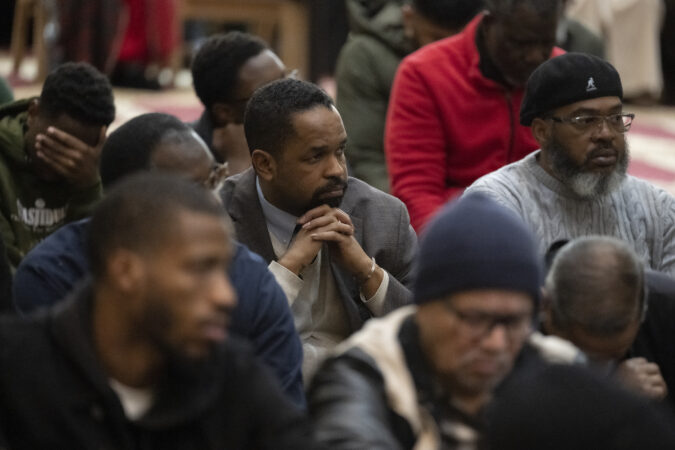
    Sharif Street participates in Friday prayer at Masjidullah mosque recently.

    Like elected officials of other religions, Street’s politics do not perfectly align with the teachers of Muslim leaders.

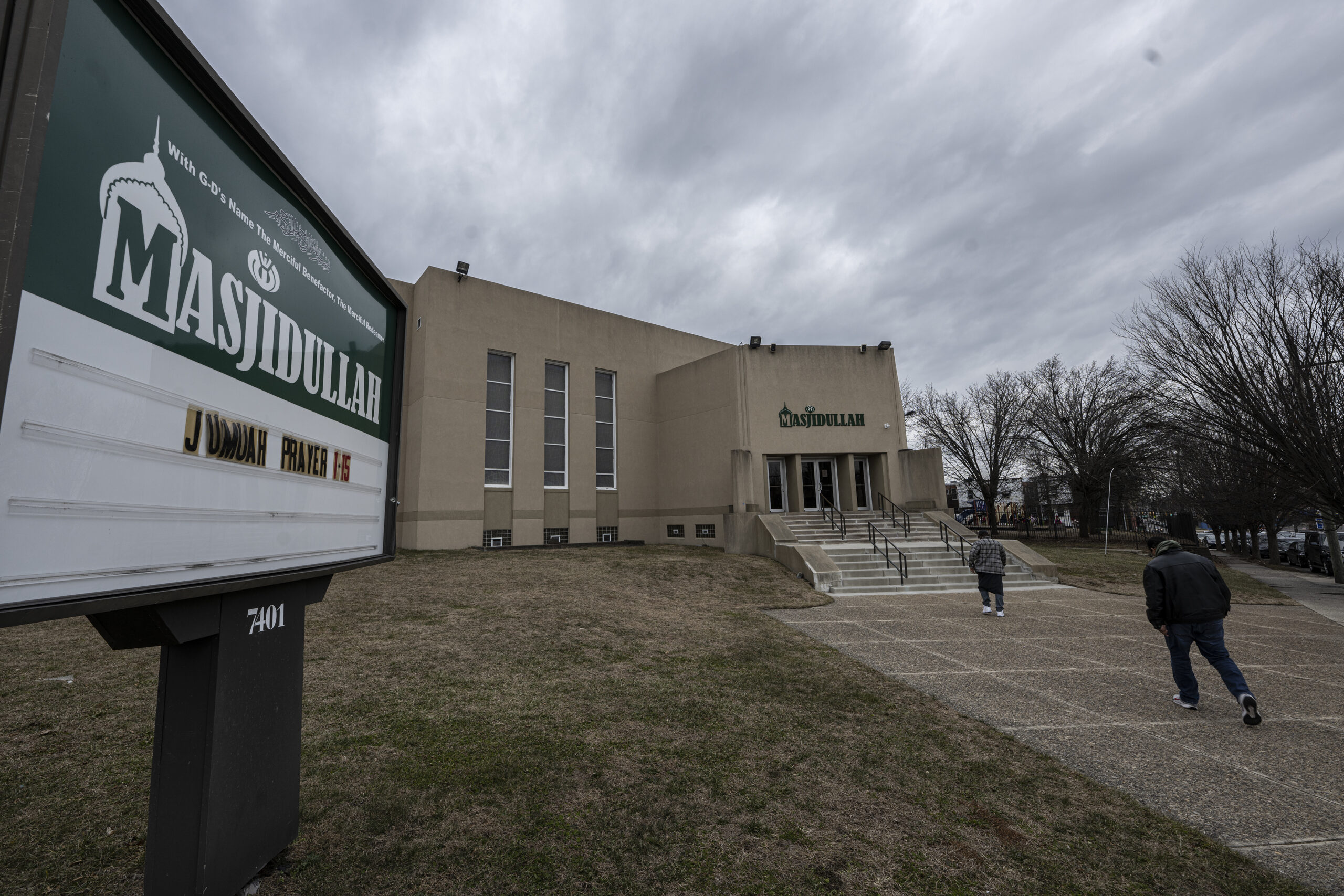
    On a recent Friday, Street attended Jumu’ah, the weekly afternoon prayer service, at Masjidullah in Northwest Philadelphia. A sign at the entrance reminded Muslims that abortion and homosexuality are against Islam’s teachings.

    “Almost every one of Philadelphia’s Muslim political leaders … are all pro-civil rights, including LGBTQ [rights] and pro-choice,” he said. The sign, he said, represented “some members of the faith leadership who are reminding us … that is not the stance of the official religious community.”

    For Street, that type of dissidence hits close to home.

    His father, he said, became Baptist after being “kicked out” of the Seventh-day Adventist Church for officiating a same-sex marriage in 2007 between Micah Mahjoubian, a staffer for Sharif Street, and his husband, Ryan Bunch.

    The Seventh-day Adventist Church in North Philadelphia did not respond to a request for comment.

    ’One of the most Muslim urban spaces’

    Ryan Boyer, who heads the Philadelphia Building and Construction Trades Council and is Muslim, likes to say he’s proud that members of his faith are so integrated into local politics that their religious identities are often overlooked.

    “We’re a part of the fabric,” said Boyer, whose politically powerful coalition of unions has endorsed Street. ”To me, it’s not that big of a deal. We’re here.”

    For Boyer, that means Muslim candidates like Street are judged based on their merits, not their identities.

    “He’s Muslim,” Boyer said of Street. “Well, is he smart? Does he present the requisite skills and abilities to do the job? … The answer is yes.”

    Other Muslim leaders in the city include: Sheriff Rochelle Bilal; City Councilmembers Curtis Jones Jr. and Nina Ahmad; former Police Commissioner Sylvester Johnson; and City Commissioner Omar Sabir, who is Boyer’s brother.

    Philly has also sent several Muslim lawmakers to Harrisburg, including current State Reps. Keith Harris, Jason Dawkins, and Tarik Khan.

    Although the community is less well-known nationally than those in Michigan or Minnesota, Philadelphia has one of the nation’s oldest and largest Muslim populations, with about 250,000 faithful in a city of 1.6 million, according to Ahmet Tekelioglu, executive director of the Council on American-Islamic Relations’ Philadelphia branch.

    By some estimates, Philly’s Muslim community has the highest percentage of U.S.-born followers of any major American city, thanks to the conversion of thousands of Black Philadelphians in recent decades. While many came to the faith through the Nation of Islam movement, a vast majority of Black Muslims in Philadelphia now practice mainstream Sunni Islam, Tekelioglu said.

    Add in thriving immigrant communities from West Africa and the Middle East, and Philadelphia is “one of the most Muslim urban spaces” in the country, he said.

    “Within a few minutes of walking in the city, you come across a visibly Muslim individual,” said Tekelioglu, whose nonprofit group does not make political endorsements. “Halal cheesesteak, ‘the Philly beard,’ and such — these also have overlap with the Muslim community and [the city’s] popular culture.”

    The Middle East and the 3rd Congressional District

    As a lawmaker, Street has been instrumental in forcing the Pennsylvania Interscholastic Athletic Association to allow Muslim girls competing in sports to wear hijabs and in leading the School District of Philadelphia to recognize Eid al-Adha and Eid al-Fitr as official holidays.

    That record is part of why he bristles at the Muslims United PAC’s endorsement of Rabb.

    “We cannot allow other people to hijack our community and hijack our issue because it’s Black people, it’s Muslims dying in Philadelphia right now, and some of these candidates don’t have anything to say about that,” Street said at the Muslim League of Voters event. “Some of them even got some fugazi Muslim organizations to endorse them.”

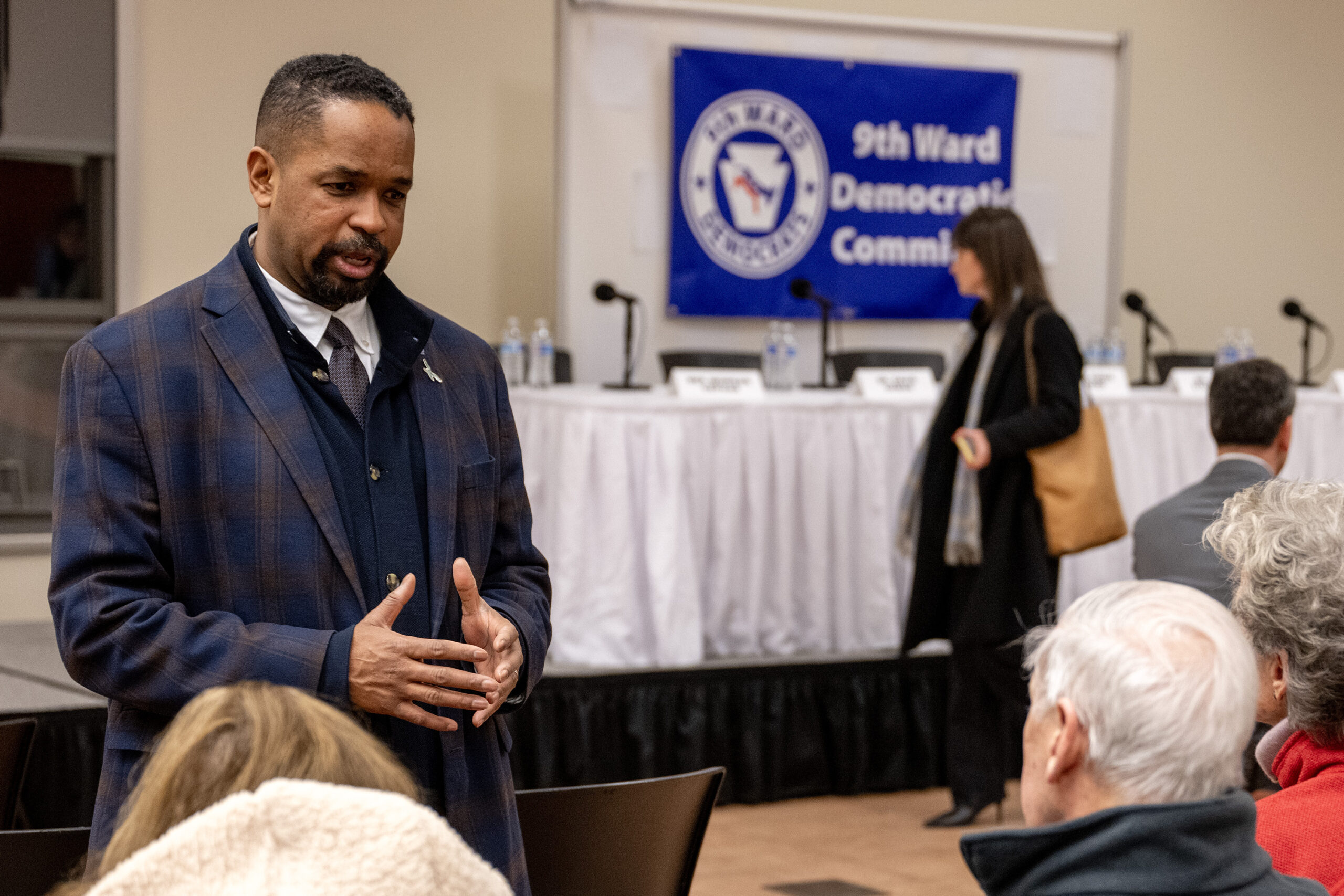
    State Sen. Sharif Street appearing at a forum hosted by the 9th Ward Democratic Committee in December.

    At another recent forum, the 3rd District Democratic candidates were asked whether they support legislation stopping U.S. weapons shipments to Israel after more than two years of conflict that has seen an estimated 70,000 Palestinians die in Gaza.

    Street, who traveled to Israel and Palestine in 2017, said the one-minute response time wasn’t enough to unpack the complicated issues, and none of the other candidates gave straightforward answers — except Rabb, who said he supported the proposal.

    “There are no two sides in this when we see the devastation,” Rabb said.

    In an interview, Street said his comparatively moderate views on the crisis and his relationships with Jewish supporters will allow him to “play a really constructive role” in Congress.

    “We need more people who can talk to both the Jewish and Muslim communities,” he said. “We need people who can have a nuanced conversation and do it with some real credibility.”

    Tekelioglu said he has observed Muslim voters moving away from “identity politics” and toward “accountability-based political stance.” That evolution has accelerated during Israel’s war in Gaza following the Hamas attacks on Oct. 7, 2023, he said.

    “Oct. 7 and everything that’s going on has made everything a bit more clear,” he said. “This doesn’t make it such that the Palestine issue is the main dealbreaker, but overall I see a trend of moving away from the identity politics.”

    The real question, he said, is, “Are they going to represent our interests?”

    Staff writer Anna Orso contributed this article.

  • This Philly charter is starting its own college so kids can graduate with high school diplomas and college credits — for free

    This Philly charter is starting its own college so kids can graduate with high school diplomas and college credits — for free

    A Philadelphia charter school is building its own college.

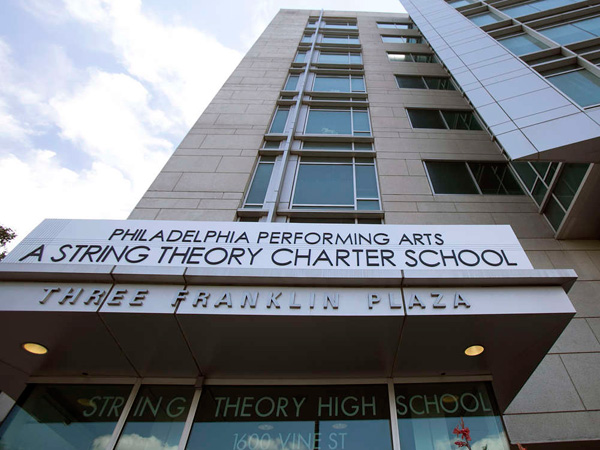
    Students at the Philadelphia Performing Arts Charter School, a K-12 facility of about 2,500 with campuses in South Philadelphia and Center City, should soon be able to graduate with high school diplomas and 60 college credits — for free.

    PPACS is not the only early college in the city — the Philadelphia School District has Parkway Center City Middle College, and other schools allow students to take college courses while in high school. Some schools offer dual enrollment, and a new early college charter will open in the city in the fall.

    But instead of partnering with existing colleges, String Theory, the education management organization that runs PPACS, is in the process of opening its own degree-granting institution.

    String Theory College will focus on design, technology, and entrepreneurship, offering PPACS students more flexibility than prior dual-enrollment partners had, said Jason Corosanite, the college president. Students won’t have to leave the school’s Vine Street campus to attend classes, either.

    “The whole goal is to get all kids prepared for college, with as many college credits as possible,” Corosanite said.

    The college already has Pennsylvania Department of Education approval, and its Middle States Commission on Higher Education accreditation vote is scheduled for March, commission officials said. Once schools are candidates for accreditation, that opens up college transferability, student loans, and Pell grant opportunities, though PPACS students pay no tuition because the school is a publicly funded charter.

    Corosanite said he is confident the school will gain Middle States approval and ultimately be able to offer students associate’s degrees.

    With Philadelphia’s crowded higher education market and a looming college enrollment cliff, it’s fair to question whether the city needs more degree-granting institutions, said Shaun Harper, a professor of education, public policy, and business at the University of Southern California. Some would say it does not.

    But, Harper said, “if this new creation is going to expand access and make higher ed more affordable, I think that is a spectacular thing. We need more innovative models in education that create more seamless pipelines from high school to college.”

    Harper’s research once centered on the experiences of high-achieving Black and Latino boys in New York schools who, once in college, “suddenly they realized that they were not as prepared for college as they had been led to believe by their high school teachers and by the grades they received in high school.”

    That makes Harper consider whether String Theory students “are really going to be pushed to do college-level work, and perform like college students would otherwise be able to perform? I think that is a thing to be concerned about.”

    Ultimately, Harper said, he is intrigued by the model.

    “There’s a real opportunity for [String Theory] to ensure that they are providing the right kinds of professional learning and professional development experiences for these educators, so they amass the skills that will be able to make the curriculum much more complex, much more college-level,” Harper said. “They may have a real shot here at teaching the rest of the nation something that ultimately becomes replicable.”

    High school and college in one stop

    The seeds of the idea trace back to PPACS’ first high school graduates — the Class of 2017.

    When Corosanite and other String Theory officials tracked those students, “some of our best and brightest kids were dropping out of college because of cost,” he said. “It wasn’t because they couldn’t do it. They were looking at the value proposition of these schools and dropping out. I felt the burden of, ‘We’re telling all these kids, yeah, you have to go to college,’ and then they graduate and can’t afford life. How do we solve for that?”

    Enter String Theory College.

    The program is already underway — about 40 students who participated in a pilot program are on track to graduate with college credits in June, and about 40 more are in 11th grade now.

    The college will initially be open only to students enrolled in PPACS. Going forward, every 11th- and 12th-grade honors and Advanced Placement course at the school will be a college-level course, and the PPACS faculty who teach the courses are college faculty.

    Course offerings include multivariable calculus, linear algebra, biotechnology, entrepreneurship, and design.

    Students still have access to the trappings of high school: All non-honors classes are still within the PPACS confines. And students must still meet state requirements for their high school diplomas — they are learning math, but it might be a design-focused math class, for instance.

    “Kids still have their high school experience — they still come to school on time, they still go to the lunchroom with everybody they go to school with,” Corosanite said. “They still see their friends, they still have prom, but they also have college. It makes it a lot easier.”

    There is no budget impact for PPACS, Corosanite said. The school, which as a charter is independently run and publicly funded, pays the college a per-credit hour rate that is roughly equivalent to community college, and that money covers teachers’ salaries and benefits.

    “We’re trying to be as efficient as possible with the classes the teachers have, and the college is in our building,” he said. “We’ve designed it to be cost-neutral. This is not a moneymaker — it’s mission-driven.”

    Going forward, Corosanite dreams of a graduate school of education — String Theory already offers continuing education for teachers — and offering college courses to other schools and districts.

    ‘This is a good opportunity’

    Hasim Smith, a PPACS senior, was pitched on the idea of taking college classes in high school when he was a 10th grader.

    Smith’s dad had heard about the pilot program and urged his son to go for it.

    “He said, ‘This is a good opportunity. I don’t want you to miss out on it,’” Smith said. “I like to challenge myself and do things that other people see as hard. And I like that it’s free — it helps with college costs.”

    Smith was game and now, at age 18, he’s looking forward to collecting his high school diploma and transferring dozens of credits to another college. (He’s already been accepted to 10 and is awaiting more decisions.)

    The courses are challenging, he said, but manageable, especially with his teachers’ support. He’s enjoyed the design challenges in particular, Smith said.

    “We had to learn a lot — it gets really deep. We have to learn about design, and different theories, and entrepreneurship,” Smith said.

    He had always thought he might want to pursue nursing as a career, but his String Theory college experience has him also considering architecture, he said.

    How to apply

    The college-in-a-high-school program has a limited number of slots for students who will be in 10th through 12th grade for the 2026-27 school year, and is accepting applications for those seats and for its incoming ninth-grade class.

    The school’s application deadline is Jan. 30.

  • Kids get free dental care at this Philly school. Officials say it’s a model that could be replicated in schools with empty space.

    Kids get free dental care at this Philly school. Officials say it’s a model that could be replicated in schools with empty space.

    Crystal Edwards didn’t see a dentist until she had a deep cavity at age 10: growing up in a struggling Philadelphia family, the resources to access dental checkups just weren’t there.

    So she jumped at the opportunity to locate a dental clinic in the school where she is now principal, W.D. Kelley, a K-8 in North Philadelphia.

    “This dental clinic is saving lives,” said Edwards.

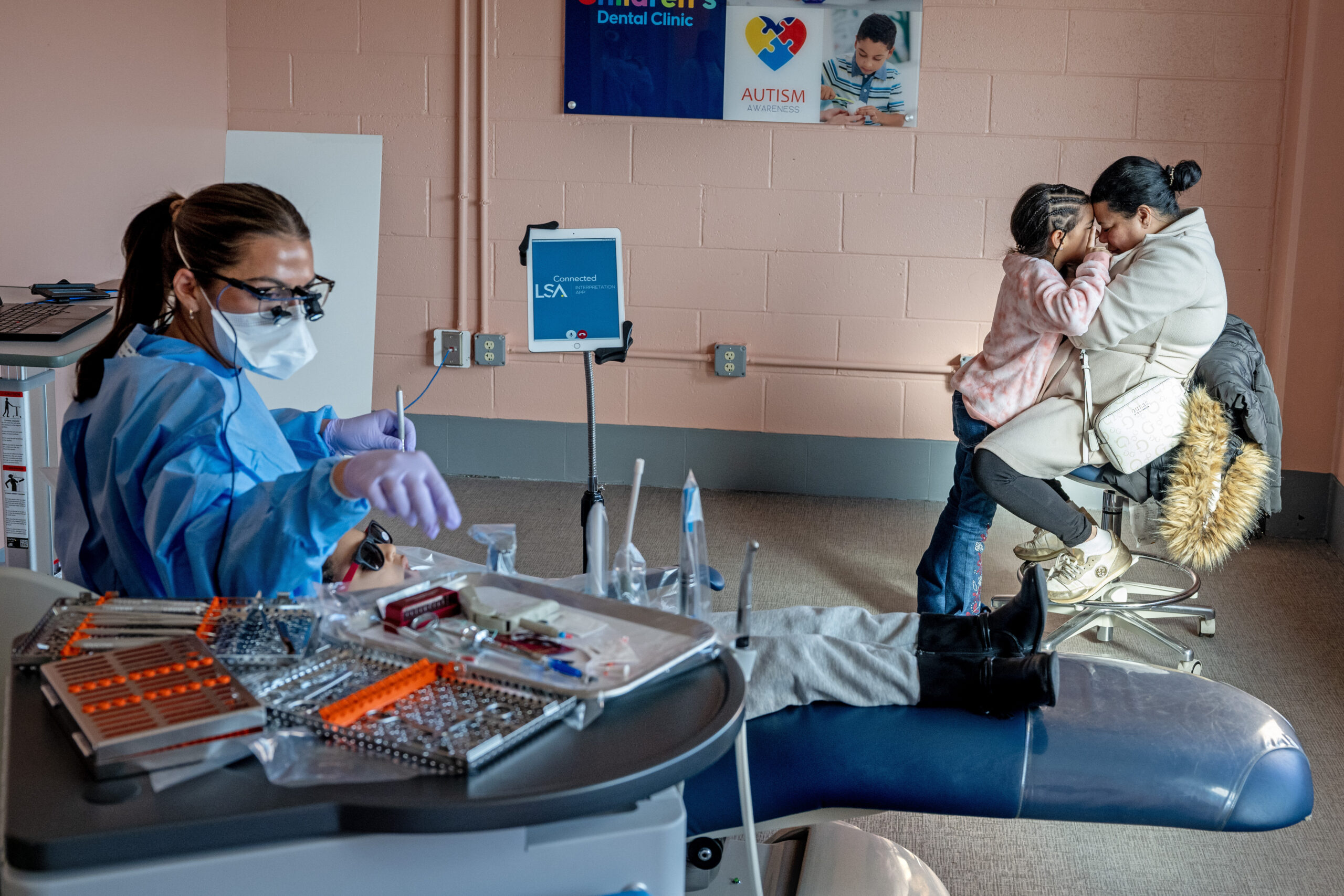
    Tucked into a converted science lab on the school’s third floor, the Dental Clinic at William. D. Kelley, operated by Temple University’s Maurice H. Kornberg School of Dentistry, is nearing its third year of operation. It is open to all Philadelphia children, including those who do not attend Kelley, regardless of insurance status.

    School district officials have pointed to the Kelley clinic as a model as it prepares to make facilities master plan decisions, which will result in closing, combining, and reconfiguring some school buildings. The clinic is an example, they say, of how the system could use available space in some of its schools for public good.

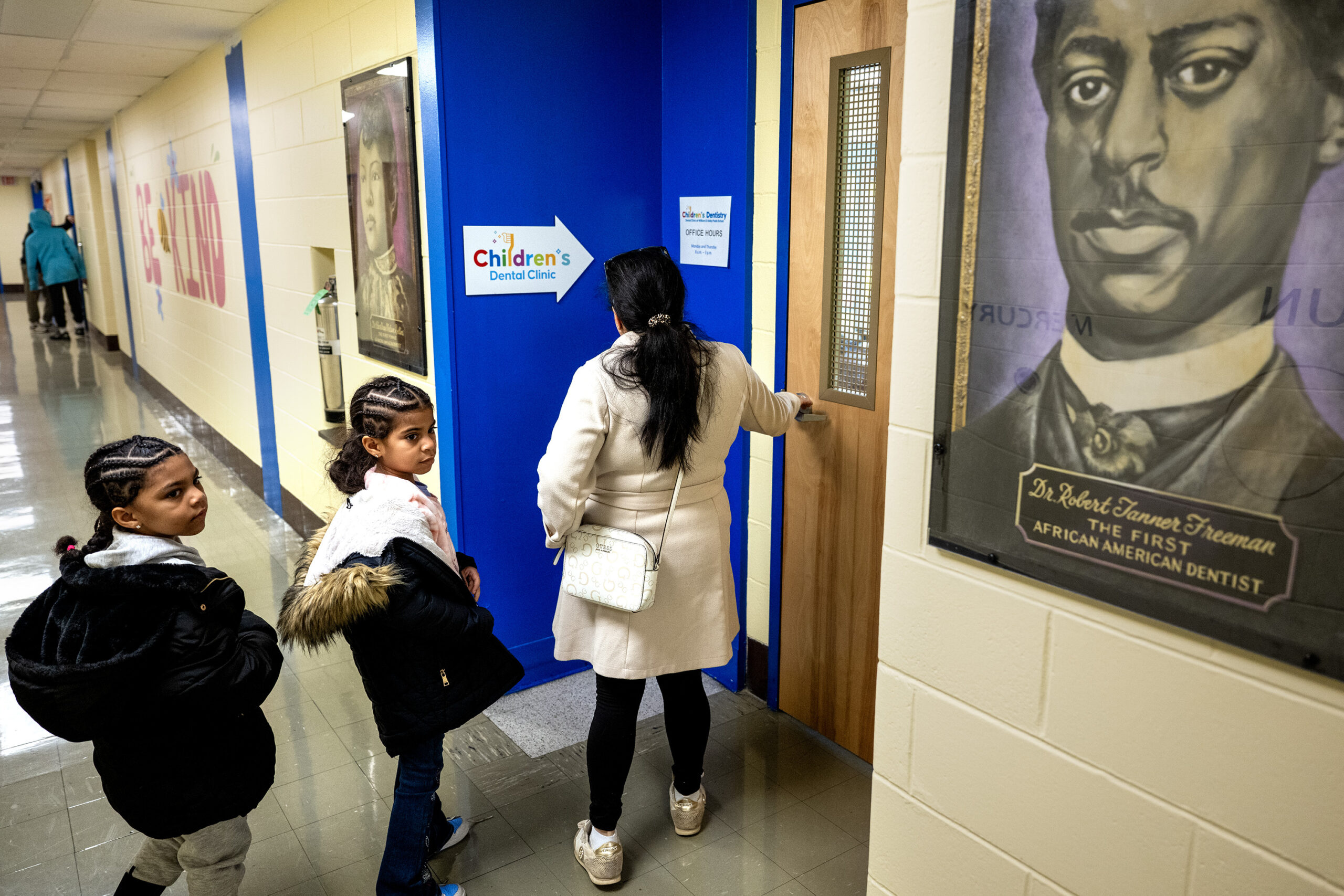
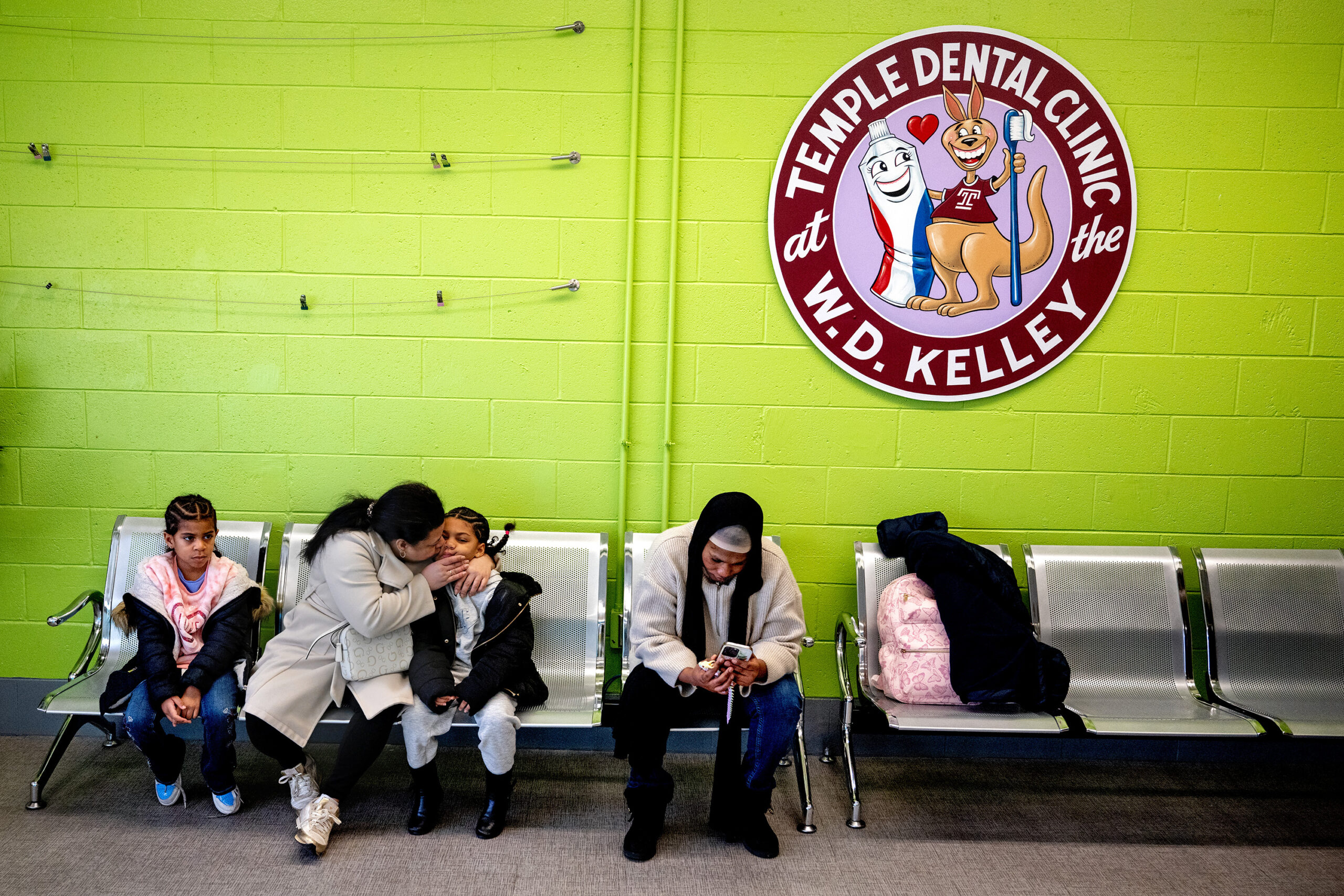
    Soribel Acosta arrives at the Dental Clinic at William D. Kelley public school on Thursday, with her children, Andrea Jimenez (left), 6. And Sayra Jimenez, 7.

    “This is certainly a great example of what can happen when a university partners with a school district to create life-changing opportunities and outcomes for young people,” Superintendent Tony B. Watlington Sr. said in a statement in 2023, when the clinic opened.

    Temple dental school officials said more clinics could follow elsewhere in the city.

    Taking care of every child

    The underlying concept is simple, said Eileen Barfuss, the Temple dental professor who leads the clinic.

    “If your tooth hurts, if you’re not feeling well, you’re not going to learn,” said Barfuss. “In the past, there have been a lot of barriers to care for dentistry that weren’t there for medicine, but preventative care is so important so it doesn’t get to the point of pain.”

    The clinic accepts all comers, including those who are uninsured or underinsured, and sometimes treats students’ parents. (Most, but not all, patients have Medicaid dental, and grants help cover treatment for those without insurance.)

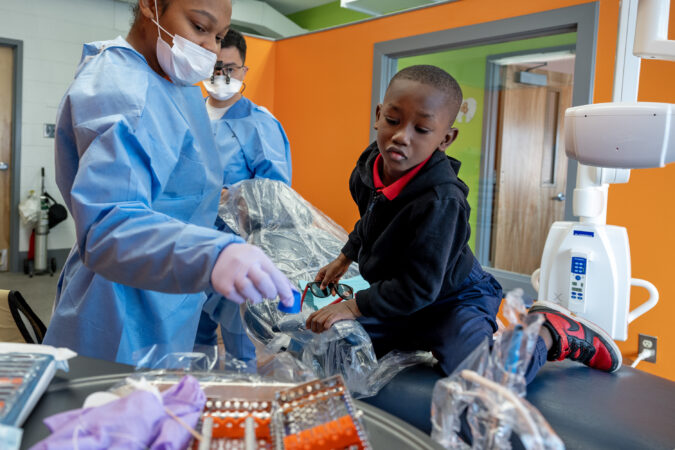
    Temple dentistry student Carly Pandit works on the teeth of Andrea Jimenez, 6, as her mother, Soribel Acosta, entertains sister Sayra Jimenez, 7, waiting her turn in the char at the dental clinic at William D. Kelley public school on Thursday.

    “We try to take care of every child in the Philadelphia School District,” said Barfuss. “There’s a place that they can come and get comprehensive care and establish a dental home.”

    To date, the clinic has seen nearly 700 patients, some of whom are repeat visitors. Patients are treated both by Barfuss and dental students she supervises.

    Students do come from other schools to the clinic; Barfuss said her team does outreach at community events and spreads the word through the district’s school nurses, who often send patients to the clinic. And staff teach lessons in Kelley classrooms on oral health and the importance of seeing a dentist twice a year.

    Being in a school helps normalize the dentist for many kids, who might poke their heads into the clinic to look around and see the friendly dental staff in their scrubs in the hallways, Barfuss said.

    ‘This is a good dentist’

    On Thursday, Fatoumata Bathily, a fourth grader with pink glasses and a bright smile, swung her legs down from a Kelley clinic dentist chair after a successful checkup.

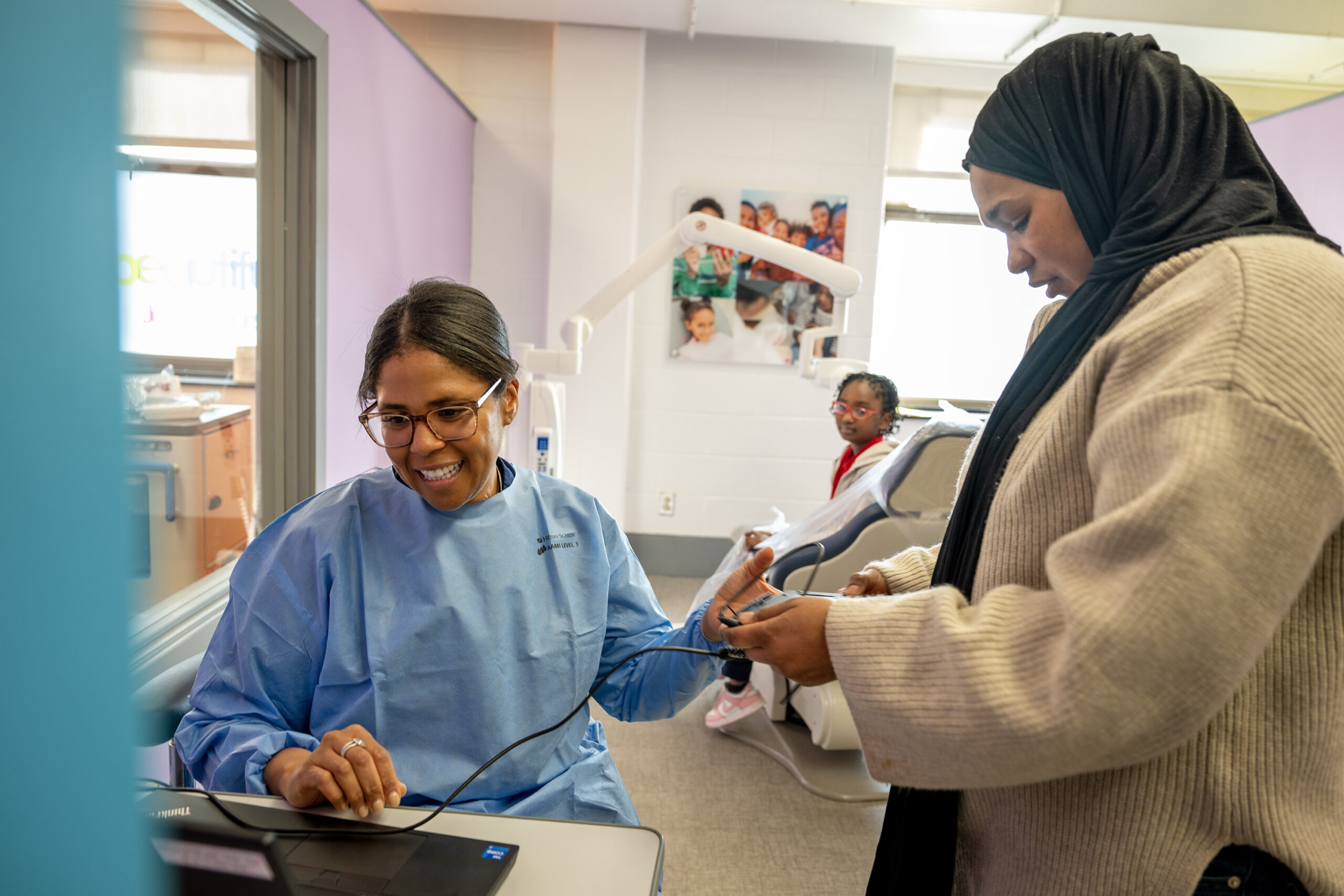
    Eileen K. Barfuss (left), a pediatric dentist and Temple dentistry instructor consults with Fily Dramera after her daughter Fatoumata Bathily (rear), 9, was seen by a Temple student dentist at the Dental Clinic at William D. Kelley public school on Thursday.

    “It’s good here,” said Fatoumata, who attends nearby Robert Morris Elementary, and came for preventive care along with her brother, Abubakr. “This is a good dentist. I like that it’s colorful, and the people are nice.”

    Amid Ismail has wanted to bring such a model to the city since he became dean of Temple’s dental school in 2008. Decades ago, some schools offered dental care via city services, but as funding dried up, those clinics went away, Ismail said.

    Ismail raised the idea of a Temple-district partnership, but it took several years to get off the ground. Edwards, an award-winning principal who takes pride in bringing the community into Kelley, got the vision intuitively, he said.

    Temple paid to transform a large science lab into the dental clinic; the district provides the space and does not charge rent. There are four chairs, including one in a space specifically designed for patients with autism who might need a quieter environment and more room. Rooms are bright and modern.

    “The message to the parents and caregivers is that this is a nice place where all treatment is provided,” Ismail said. “A lot of children do have dental problems, but here we can treat them easily — they miss one class, max, and they don’t have to stay a long time.”

    Soribel Acosta waits for their appointment with her children, Sayra Jimenez (left), 7; and Andrea Jimenez (right), 6, at the Dental Clinic at William D. Kelley public school on Thursday.

    The clinic, which is about to celebrate its third anniversary, just expanded its schedule — it’s open four days a week, and officials eventually hope it will be open five days.

    Edwards fought for the clinic to come to Kelley, and it’s been just the boon she had hoped, she said.

    “This is a historic community that was really devastated and hard hit by the crack and drug pandemic,” said Edwards. “The dental office has really given us leverage on how to serve the community better.”

  • Two new ‘year-round’ public schools, with a special model and resources, are coming to Philadelphia

    Two new ‘year-round’ public schools, with a special model and resources, are coming to Philadelphia

    Two new schools are coming to the Philadelphia School District.

    Both schools, a K-8 and a high school, district officials said Wednesday, will have resources to help eliminate long-standing achievement and opportunity gaps for kids from underresourced communities.

    They’ll be part of the “North Philadelphia Promise Zone,” Superintendent Tony B. Watlington Sr. announced. Watlington said they would be the first schools in the United States to replicate the success of the acclaimed Harlem Children’s Zone, with the blessing of its founder, Geoffrey Canada,who pioneered a model that takes a birth-to-career approach to tackling generational poverty.

    Watlington said the schools would be “true year-round schools.” They would bring a new approach to the new Philadelphia public schools, where prior attempts to replicate the Harlem Children’s Zone blueprint have shown mixed results.

    Harlem Children’s Zone runs charters in New York City, but the proposed Philadelphia schools will be run by the district using the organization’s educational model, which includes extra resources and a longer school day and school year, as well as extensive social service supports.

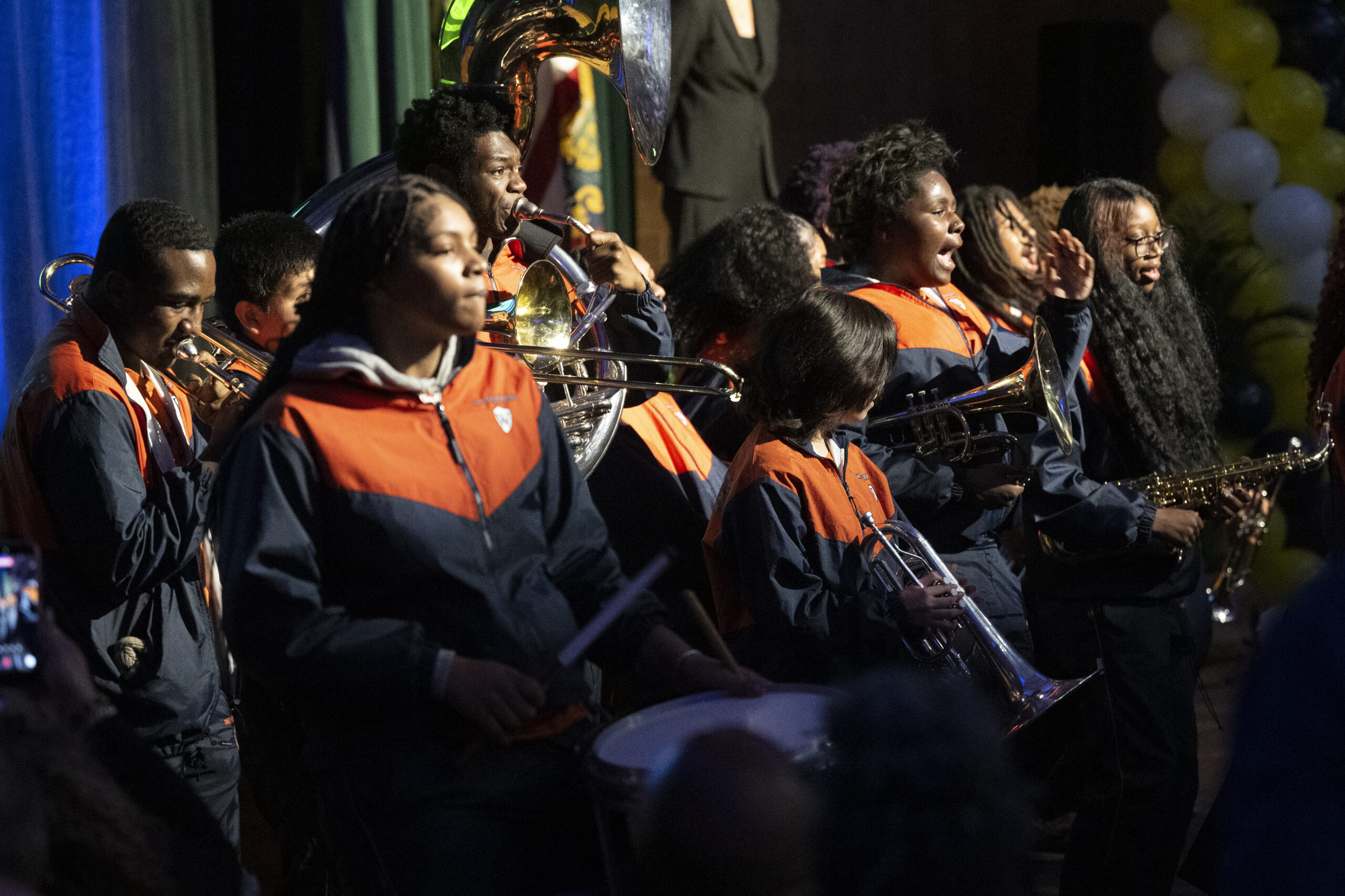
    Members of the West Philadelphia Marching Orange & Blue perform before Philadelphia Mayor Cherelle L. Parker speaks on the state of Philadelphia schools during a gathering at Edison High School in Philadelphia, Wednesday, Jan. 7, 2026.

    “We’re going to be partners in opening these two state-of-the-art schools,” Watlington said at his state of the schools address, held Wednesday at Edison High School in North Philadelphia.

    The district has big hopes for the schools, which officials said will be opened in existing Philadelphia school buildings — no new school structures will be involved.

    “Not only will they get better, but get better faster than our district average. We’re going to make sure the school is staffed with the very best, most effective principals,” Watlington said. “We’re going to ensure that these schools are staffed with the very best, most effective teachers.”

    They will be schools of choice, meaning parents can opt into having their children attend rather than basing enrollment on where students live.

    The schools will also pull in Temple University; Watlington said that via the Temple Future Scholars program, “every single one of these graduates from this K-8 and high school” will be college-ready.

    Many details were not clear Wednesday, including when the schools will open, what the year-round model will look like, the exact relationship with Harlem Children’s Zone, how the schools will be funded, and who will staff them. The district said it could not give more details immediately.

    News of the new schools caught an important partner off guard. Arthur Steinberg, president of the Philadelphia Federation of Teachers, said Watlington’s speech was the first he heard of the initiative.

    “Any changes in working conditions must be negotiated with the PFT,” Steinberg said. “We will not agree to anything that requires members to work additional days or hours.”

    Watlington said the K-8 school will open first, and he has tapped Aliya Catanch-Bradley, the respected principal of Bethune Elementary in North Philadelphia, to lead the efforts to open the North Philadelphia Promise Zone schools.

    Catanch-Bradley said it was too soon to discuss the particulars about the schools, which will be built with significant community involvement.

    But, she said, North Philadelphia is a prime location for the cradle-to-career Harlem Children’s Zone model.

    “We know that it’s not a food desert, because food… deserts are natural,” she said of North Philadelphia. “It is food insecure by design, right? And so, we now know that you have a resource drought there, to which it’s going to take an intentional pouring of all types of resources to wrap around a community, to help expand and become a very successful ecosystem.”

    Philadelphia district officials will take time to study Harlem Children’s Zone, “but also to understand the landscape of Philadelphia, what needs to be augmented to echo the needs of this community,” Catanch-Bradley said.

    Mayor Cherelle L. Parker campaigned on the promise of year-round schools, and her administration has put extended-day, extended-year programs into 40 district and charter schools. But those programs are essentially before- and after-care and summer camps, paid for with city funds and offered free to 12,000 students, rather than traditional year-round education.

    Harlem Children’s Zone schools have longer school days and longer school years. It’s not clear what form the proposed North Philadelphia Promise Zone schools might take, and how these efforts would differ from prior attempts around the country to replicate the success of the Harlem Children’s Zone. Former President Barack Obama in 2010 highlighted the model and selected 20 communities, including Philadelphia, to start “Promise Neighborhood” programs that would improve access to housing, jobs, and education. Those efforts were met with varying degrees of success, and no schools opened in Philadelphia.

    Watlington’s new-school announcement capped a two-plus-hour, pep-rally-style event where he and others underscored progress the district has made in the past year — and since the superintendent came to Philadelphia four years ago.

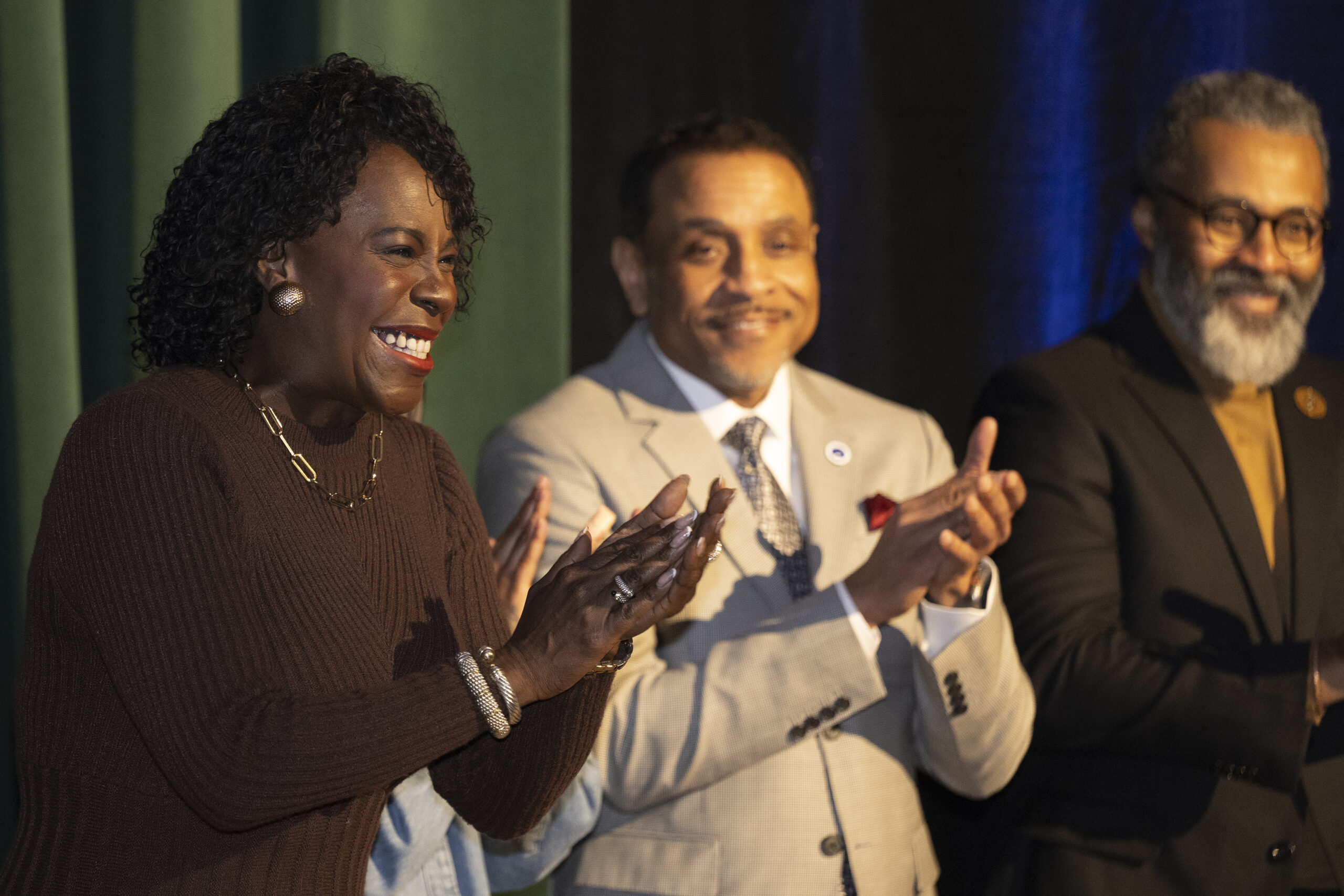
    Philadelphia Mayor Cherelle Parker (left), Superintendent Tony B. Watlington Sr. (center), and school board president Reginald Streater during a ceremony on the state of Philadelphia schools at Edison High School on Wednesday.

    Other news from the state of Philadelphia schools event

    Parker, who led off the event, said she was pleased with the state of schools.

    “The school district has continued to make steady and meaningful progress,” Parker said. “Test scores are rising, attendance is rising. Dropout rates are declining, and those gains are real, and they reflect what happens when we invest in our students.”

    Parker emphasized her desire to have the city take over a list of abandoned district buildings. The school board took the first step in December, voting to authorize Watlington and his administration to begin negotiating with the city to do just that.

    Parker said that some of the buildings have been vacant for as long as 30 years. The district has not yet released a list of buildings to consider transferring, but the mayor said it includes at least 20 former schools.

    “I want you to be clear about what my goal and objective is,” Parker said. “It’s not OK for me to have 20, 21 buildings consistently vacant, red on the school district’s balance sheet, generating no revenue and not at all working at their best and highest use. We’re going to find a way to do what has never been done in the city of Philadelphia before — develop a plan for those persistently vacant buildings.”

    Watlington also ran down a laundry list of accomplishments, including ongoing fiscal stability and improvements on the National Assessment of Educational Progress, known as the nation’s report card.

    He said the district would “retire” its structural deficit completely by 2029-30 though declined to give details.

    He and Reginald Streater, president of the city’s school board, said the district still has a ways to go but has made strides. More than half of all district students still fail to meet grade-level standards in reading and math.

    But, Watlington said, “I can assure you we’re making progress. We’re going to double down. More for our children, not less. More opportunities, more access, more exposure, more good things to come in 2026.”

  • A Philly charter just laid off 17 employees. Students, staff, and parents say it’s a sign of troubling changes at the school

    A Philly charter just laid off 17 employees. Students, staff, and parents say it’s a sign of troubling changes at the school

    Esperanza Academy Charter School laid off 17 employees this month — a move that officials say was necessary amid a challenging financial climate.

    But some Esperanza Academy veterans say the 4% reduction in the workforce — which came with no notice a few weeks before the holidays — is emblematic of troubling recent changes at the Hunting Park charter.

    Ten Esperanza Academy staffers, students, and parents spoke with The Inquirer and detailed concerns about changes at the school in the last year.

    Teachers say morale is low, particularly at the high school, where staff have filed paperwork to form a union for the first time in the school’s history. Student frustration bubbled over recently, with hundreds walking out to express their anger over the loss of teachers, a counselor, an administrator, and more.

    “Students are protesting,” Jarely Cruz-Ruiz, an Esperanza Academy ninth grader, wrote in a letter to the charter’s board of trustees, “because even we see the wrong being done.”

    School officials declined to be interviewed, but in a statement, CEO Evelyn Nuñez said: “Like many academic institutions across the commonwealth and nation, Esperanza Academy is navigating a challenging economic environment.”

    But, Nuñez said, the board and leadership team will ensure “the school will be a source of hope in this neighborhood for years to come.”

    An anchor, changing

    Esperanza has operated a charter school in North Philadelphia since 2000; the school has expanded to encompass grades K-12, and now serves more than 2,000 students in multiple buildings.

    The charter is part of the Nueva Esperanza organization, a sprawling nonprofit “opportunity community,” as its founder, the Rev. Luis Cortés Jr., has described it, a one-stop shop for neighborhood revitalization work, job training, legal services, and more.

    Esperanza opened a brand-new, 73,000-square-foot elementary building on the nonprofit’s campus at the beginning of this school year. Officials, in a statement released after the student walkout, said the project was planned for many years and noted that the broader organization, not the charter school, pays for campus improvements.

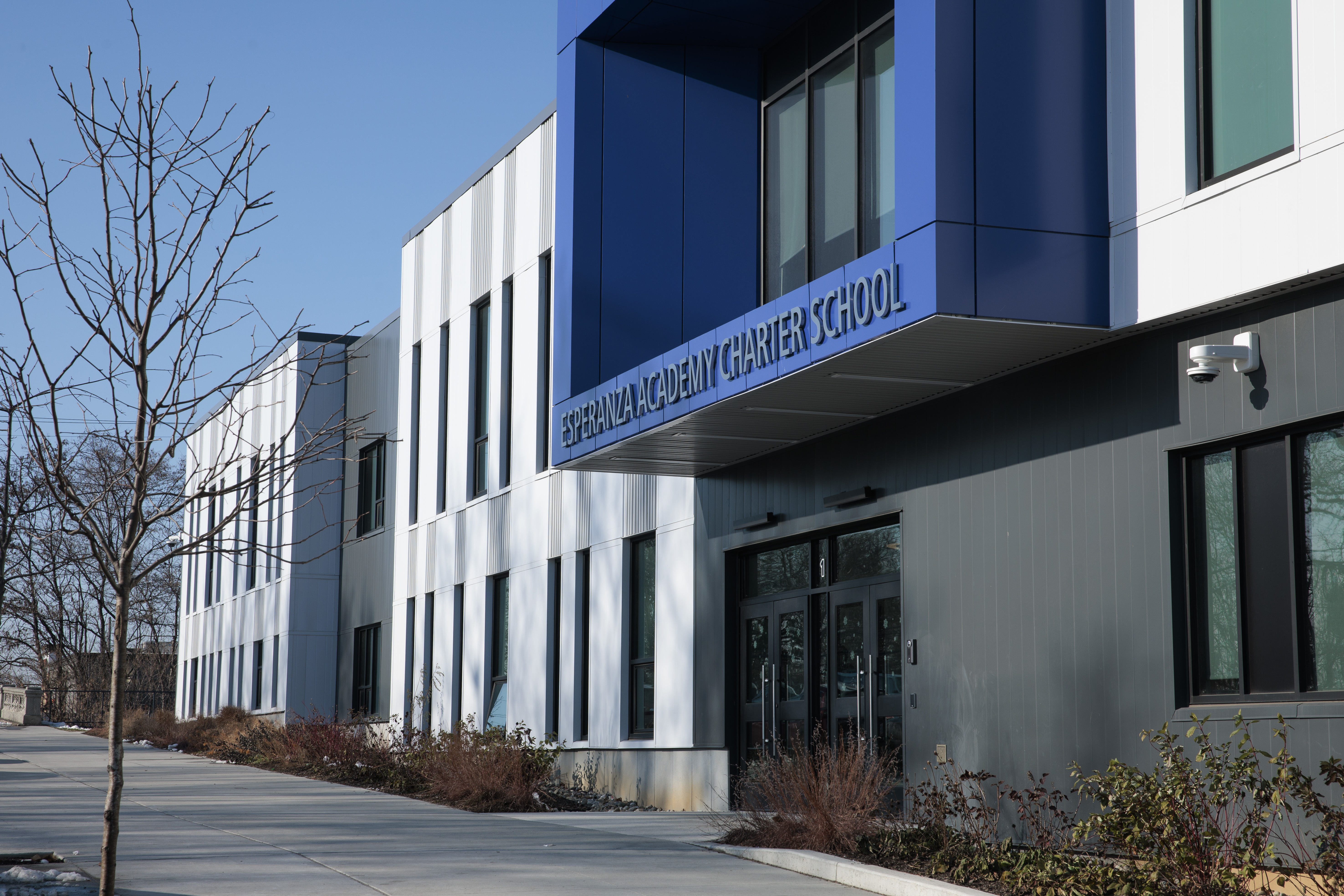
    The exterior of the new Esperanza Academy Charter elementary building at 201 West Hunting Park Ave.

    Esperanza has long been an anchor in the neighborhood and the larger Latino community, a place with a one-big-family feel.

    But Daniel Montes, who came to the school as a climate control officer in 2017 and worked his way up to be a teacher, said shifts began happening about a year ago. Montes was among those staffers laid off recently.

    Nuñez came to the school from the Philadelphia School District last year to become its CEO.

    “Things started to change when we got the new CEO,” Montes said. “I don’t know if it’s when you get a new broom, it sweeps clean.”

    At a staff retreat just before the start of this school year, Cortes, Esperanza’s founder, alluded to coming financial difficulties, said one staffer, who asked not to be named for fear of reprisal.

    “He said, ‘Stuff’s happening, you have to buy in or get out,’” said another staffer, who asked not to be identified because they did not want to be targeted by leaders. “He said it was politically driven [at the national level], and that funds would be tight.”

    ‘Three strikes’

    Tensions began to simmer among high school staff.

    “There are very unilateral changes being put into effect extremely quickly,” said another teacher, who also asked not to be named for fear or reprisal. “We’ve had major changes go into effect on a Monday after a meeting on a Friday. They said, ‘We don’t have subs and you’re going to be covering classes for free.’”

    Montes and others said teachers were frustrated over new schedules, lost prep time, and the order to cover classes without compensation — Esperanza Academy had, in the past, paid teachers for covering classes.

    “It was three strikes,” said Montes.

    “We just did not feel heard,” a third teacher, who also asked not to be named for fear of retribution, said. “We’re out of paper towels, and staples for the printer. The printer’s broken, but they hired six-figure administrators.”

    Most charter schools do not have unionized staff; in October, a majority of Esperanza Academy’s high school teachers signed union authorization cards and chose to affiliate with the American Federation of Teachers.

    Layoffs came Dec. 4, a Thursday, with no warning — some of the affected staff were pulled out midclass and given notice.

    Students weren’t told what was happening, but something seemed off that day, they said. And a basketball game was canceled.

    Those who remained at Esperanza Academy’s high school were told they would be absorbing the job responsibilities of the laid-off workers, including classes, coverages, and special-education caseloads.

    Some teachers got extra classes added to their schedules — with no extra pay. Other classes were combined, with class sizes growing.

    Interventionists — those charged with working with the neediest students — were laid off, and staffers said no plan has been articulated about who will do that work.

    In every staff meeting, teachers said they are reminded that the school’s focus is increasing attendance, boosting the number of students who meet state standards, and decreasing the number of students who score at the lowest levels.

    “How are we doing that if we don’t have any interventionists?” the second teacher said.

    Student protest

    The layoffs stunned students. They mobilized and held a walkout a few days later.

    Hundreds showed up, voicing their displeasure with the cuts and their support for the lost staff. They carried homemade signs and chanted.

    Nuñez acknowledged the walkout in an email to students and families the next day, saying students demonstrated “thoughtful advocacy and respect as they honored the staff members affected by the recent reductions, and we are proud of the way they used their voices to support their school community. School leadership will continue working closely with the [student government] on how we can best support our students as we move through this transition together.”

    Cruz-Ruiz, the Esperanza Academy ninth grader, said the school no longer felt like a family.

    “In this building,” Cruz-Ruiz wrote in her letter to the board, “data matters more than people. You named this school Esperanza. Hope. But hope doesn’t live here, scores do. Reputation does. Those graphs and percentages you stare at do.”

    ‘It’s affected so many of the kids’

    Francesca Castro, mother of an Esperanza Academy 10th grader, said she’s been very pleased with the education her daughter has received since middle school.

    But the layoffs were deeply unsettling, she said.

    “It’s affected so many of the kids,” said Castro. “I’m in the corporate world — I understand sometimes you need to make cuts. But there was no preparation, and it was right around the holidays. Couldn’t we find a different way, see what else we could cut?”

    Montes and other laid-off staff were some of the most important people in the building in terms of relationships with students, Castro said.

    “What worries my daughter and some of the students and parents is: If these changes were made all of a sudden, what other changes could happen?” she said. “Are the athletes going to get less? Are the after-school programs being cut? Are they going to start cutting academics?”

    Officials said in a statement that the layoff decision was not made lightly, and “our priority throughout this process has been to preserve the high-quality learning environment and supportive services that our students and families rely on. We remain fully committed to ensuring that the school year continues with minimal disruption to classrooms, instruction, or student support.”

    Students are aware of the larger changes at the school, said teachers, parents, and staff. They can’t understand why those closest to the students were taken away.

    “We’re broke, but we have all these new administrators, and we just built a new building? Students are savvy to that stuff — they’re angry,” said the third teacher.

    What’s next?

    Wendy G. Coleman, president of the American Federation of Teachers-PA, sent Nuñez a letter Dec. 10 asking Esperanza to formally recognize an AFT-affiliated union at the school.

    The staff wants a salary scale and a voice on working conditions and class sizes, Coleman said.

    “The overwhelming majority of the staff has signed cards,” said Coleman. “That is something I hope the administration of Esperanza will voluntarily recognize so that we can collaboratively bargain their first contract.”

    Esperanza Academy leaders on Friday told the AFT they will not voluntarily recognize the union; Coleman said she will soon file paperwork with the National Labor Relations Board seeking certification.

    “I would hope that we can work together to do this as amicably as possible,” Coleman said. “The staff has spoken, and the likelihood of Esperanza avoiding a union coming is pretty slim.”

  • It’s an open secret that some charter schools push out kids with behavioral problems, Philly principals say

    It’s an open secret that some charter schools push out kids with behavioral problems, Philly principals say

    The trickle begins in the fall, some principals say: Students with a history of behavior or disciplinary problems or other issues show up in Philadelphia School District schools, often from city charters.

    Students switch schools after the start of the school year for many reasons — and changing schools is fairly common in Philadelphia.

    But at times, it seems like some students are off-loaded from charters because they’re tough to educate, according to interviews with a dozen district administrators. In district schools, administrators cannot remove students for such issues.

    Advocates at the Education Law Center have noted that trend, as has the head of the district’s principals union — all of whom call it concerning, especially in a school system with large numbers of needy students and not enough resources to educate them.

    “In October, in November, in December, that’s when we see the counseling out, the threats of expulsion that say, ‘We’re going to expel you, but you can go to a district school and then you won’t be expelled,’” said Margie Wakelin, a lawyer with the Philadelphia-based Education Law Center-PA.

    Cassandra St. Vil, chief executive officer of a group that represents a large number of Philadelphia charters, said she is not aware of any data to support those anecdotal claims.

    “For years, opponents of charter schools have tried to use this message and yet there has never been any evidence to back it up,” said St. Vil, of Philadelphia Charters for Excellence. “And conversely, we hear from charter school leaders the exact same thing, that students come to them.”

    District data show that over the last three years, there has been a steady flow of charter students transferring to district schools throughout the school year. In the 2024-25 school year, for instance, 161 students transferred from brick-and-mortar charters to district schools in September. By June, it was 843 students, just a fraction of the total charter sector.

    window.addEventListener(“message”,function(a){if(void 0!==a.data[“datawrapper-height”]){var e=document.querySelectorAll(“iframe”);for(var t in a.data[“datawrapper-height”])for(var r,i=0;r=e[i];i++)if(r.contentWindow===a.source){var d=a.data[“datawrapper-height”][t]+”px”;r.style.height=d}}});

    Charters educate more than 64,000 Philadelphia students; there are about 114,000 in district schools.

    “While this is not an issue across the entire charter sector, the district is looking at the data, and working with the Charter Schools Office,” Christina Clark, a district spokesperson, said in a statement. “The district is working to analyze enrollment trends across all sectors.”

    Robin Cooper, president of Commonwealth Association of School Administrators, Teamsters Local 502, said many district schools get a stream of students beginning in the fall, after district schools’ budgets are locked in on Oct. 1, then another in the spring, just before state testing. (Students’ scores count for the schools they attended on Oct. 1, even if they switch schools after that date.)

    “They’re not sending the kids who get A’s, the good kids, they’re sending you the kids who might have problems,” said Cooper, who was a longtime district principal before assuming the union presidency. “It negatively impacts your climate, and the charter is getting the money for the student.”

    One district principal, who declined to be named for fear of reprisal, said they recently stopped in a hallway to talk to a student who had just transferred to the district school from a charter.

    “She said, ‘They kicked me out for fighting,’” the principal said. “Here, we can’t kick a student out for fighting. I said, ‘Welcome to our school. I’m in the business of growing children.’”

    Students ‘counseled out’ of charters

    Charter schools — which are publicly funded but privately managed, though authorized by local boards of education — have transformed Philadelphia’s educational landscape since they first came to Pennsylvania in 1997.

    Charters are funded by per-student payments from the school district, but are paid only for the number of days enrolled.

    By law, charters are open to all students, and most operate on citywide lotteries — though some are neighborhood schools.

    A 2017 Education Law Center analysis of the enrollment of special education students in Pennsylvania charters found that “while a number of individual charter schools equitably serve all students, the charter school sector taken as a whole generally underserves these vulnerable student populations.”

    Anecdotally, district principals say in some cases, they see students with behavior problems or learning differences accepted to some charters, but then some of them are “counseled out.” That means they are not officially expelled or forced to leave, but strongly encouraged or pressured to do so after a disciplinary issue crops up.

    In district schools, the bar for expulsion is much higher — for incidents such as using a weapon, or threatening mass violence.

    Wakelin, of the Education Law Center, said she recently spoke to a parent whose child has a significant disability. The parent had multiple conversations with the charter school about the child’s needs. She said the school kept telling the family: We’ll help.

    “And then very recently, the charter school said, ‘You know, you might be better served in a district school that has more resources for a student with autism,’” said Wakelin, who declined to name the school in question.

    ‘It’s no secret’

    After the start of the school year, another district principal said, comes a bump in charter transfers.

    “We see an increase every year,” said the principal, who, like other current and former district administrators who spoke to The Inquirer, asked not to be identified for fear of reprisal. “It’s not talked about, but in the schools, it’s no secret.”

    When new students transfer in, an administrator often asks why they left their old school.

    “Most of them say it’s because they were kicked out of whatever charter school they were at — they got into a fight, or whatever,” the principal said. “And most of the times, it’s things that we can’t move students for in the Philadelphia School District.”

    Lawrence Jones, longtime chief executive officer of the Richard Allen Preparatory Charter School in Southwest Philadelphia, said there is “an urban myth” that charters off-load problem students to district schools and then benefit financially for doing so. (There is a common perception that charters get paid for students based on their Oct. 1 enrollment counts, and keep the money if students go elsewhere, but charters actually get paid for the number of days students are enrolled.)

    “The gain that you could potentially get for dropping those kids, financially and other funding, would be less than if you held onto those students,” said Jones.

    But a third district principal called the issue a particular challenge for neighborhood schools, which already typically tend to have higher concentrations of children with complicated needs. Public schools often get needy students midyear, but no additional funding. Their budgets are projected in the spring, but finalized in the fall.

    “It’s just not fair,” said the third principal. “We’re not getting their best kids.”

    That principal is currently experiencing what they call “the season when we get charter kids,” they said. “They send them to us for discipline issues, uniform violations.”

    ‘A sword that cuts both ways’

    The practice engenders deep frustration, principals say.

    “Public schools can’t turn kids away. It’s not like the charter world where you can say, ‘No, I’m full, have a nice day.’ In public school, you take the kid, crowded or not, and figure it out,” a fourth principal said.

    St. Vil, of Philadelphia Charters for Excellence, which represents 64 schools, disputes that characterization. She noted that nearly 80% of the city’s charter students are Black or Latino, and many have special needs or are English learners.

    “These schools are achieving real success stories for students who too often haven’t thrived in one-size-fits-all settings,” St. Vil said.

    Jones, of Richard Allen Preparatory Charter School, said that while there may be some isolated instances where a charter counsels out a student with difficulties, “it’s a sword that cuts both ways.” Students sometimes come to charters from district schools with inadequate special-education plans, he said.

    Parents enrolling their children at Richard Allen have told him that they were told his school “could provide better services,” Jones said. “I asked, ‘By who?’ And they said, ‘By staff at the former school, the district school.’”

  • Northeast Philly gets another new school: The $88 million Thomas Holme will open in January

    Northeast Philly gets another new school: The $88 million Thomas Holme will open in January

    It’s school-opening season for the Philadelphia School District.

    On Tuesday, officials cut the ribbon on a brand-new Thomas Holme Elementary, a K-8 school in the Northeast. That celebration came exactly a week after the district opened a new middle-school building, AMY at James Martin, in Port Richmond.

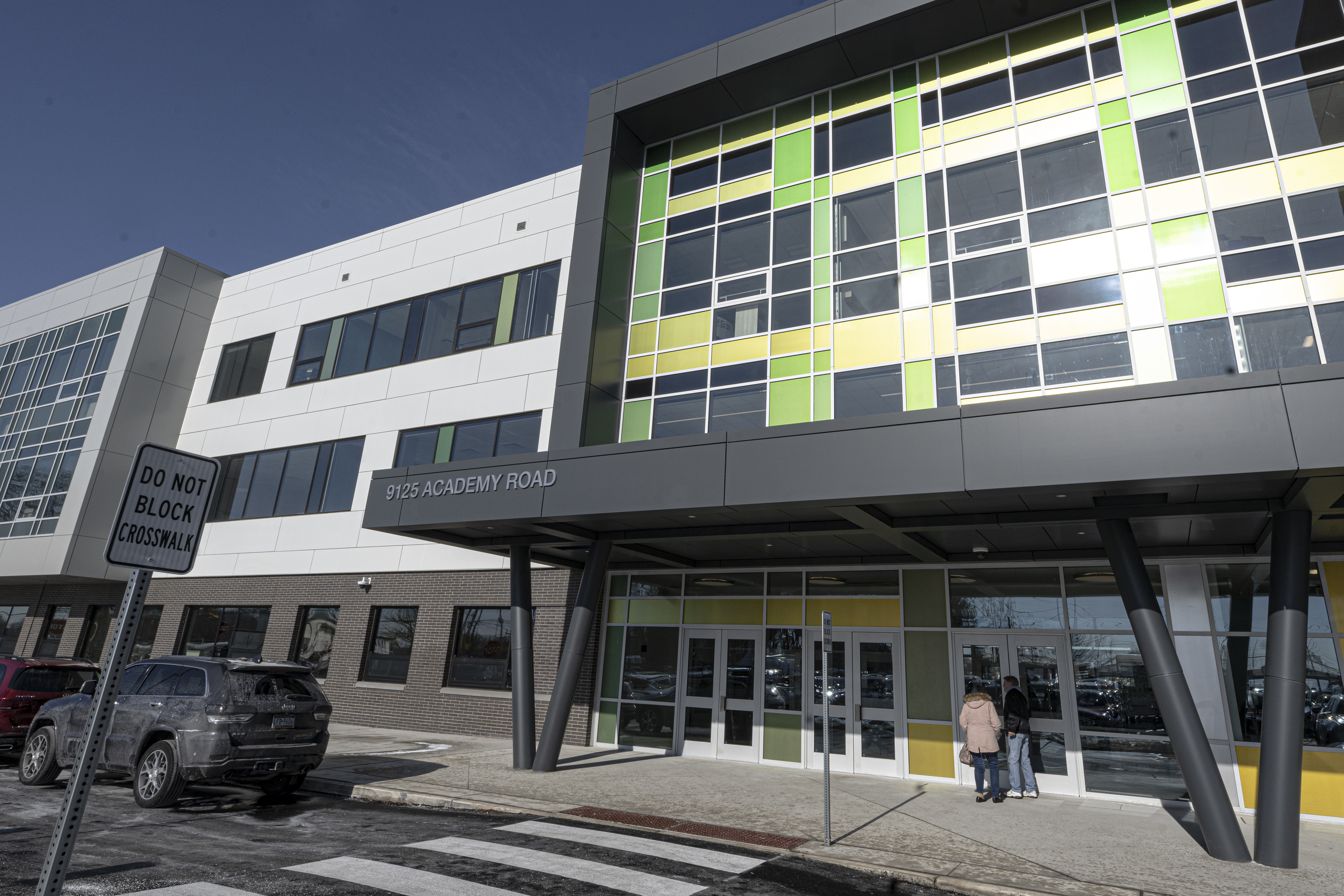
    The $88 million Holme building, on Academy Road, will house 800 students beginning in January. It’s the district’s seventh new building in 10 years.

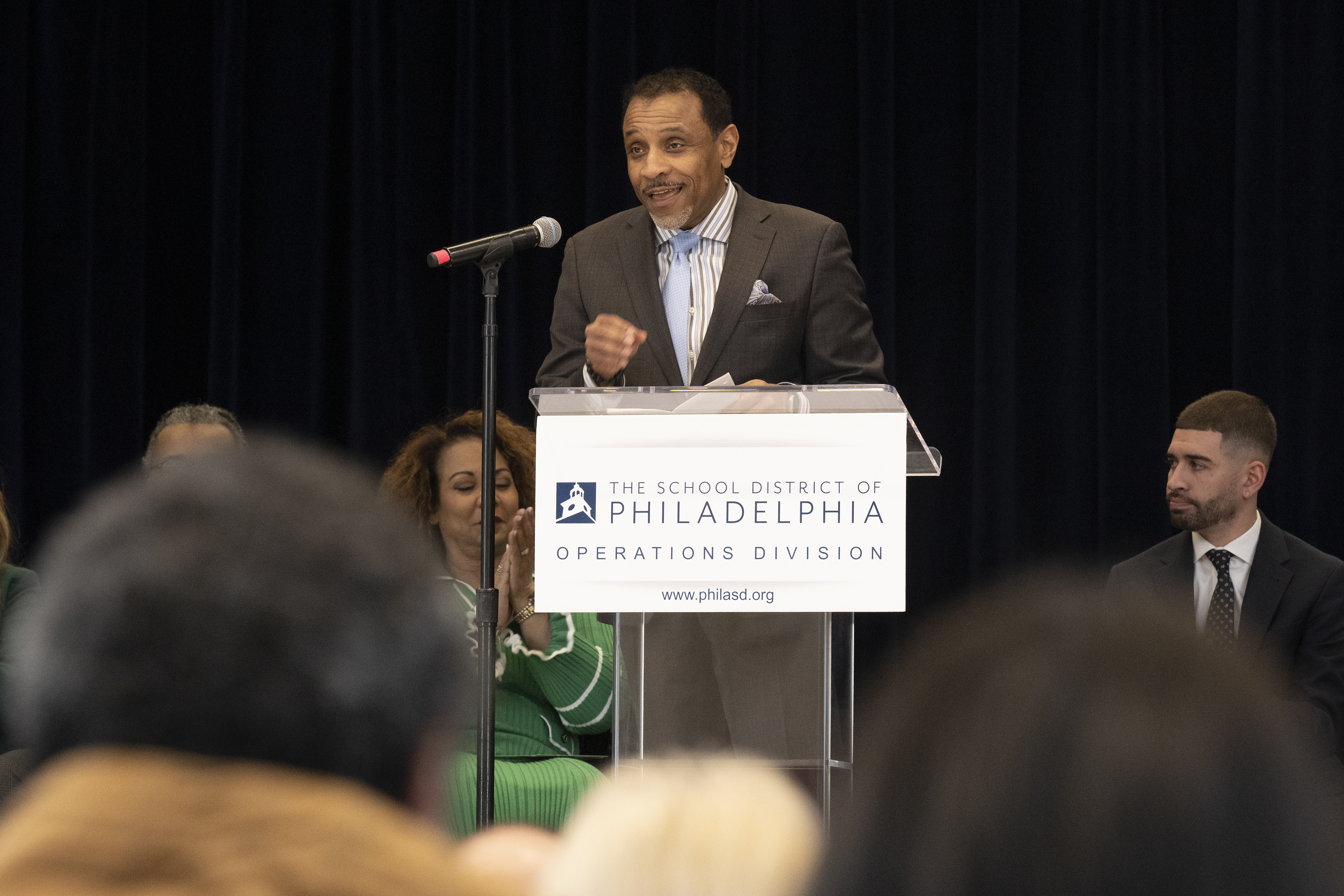
    “I see a place where students will have access to a 21st century education,” Holme principal Micah Winterstein said during a ceremony attended by students, school district officials, and community members. “A place where they feel like school is where they belong, a place where they will have moments each day that inspire.”

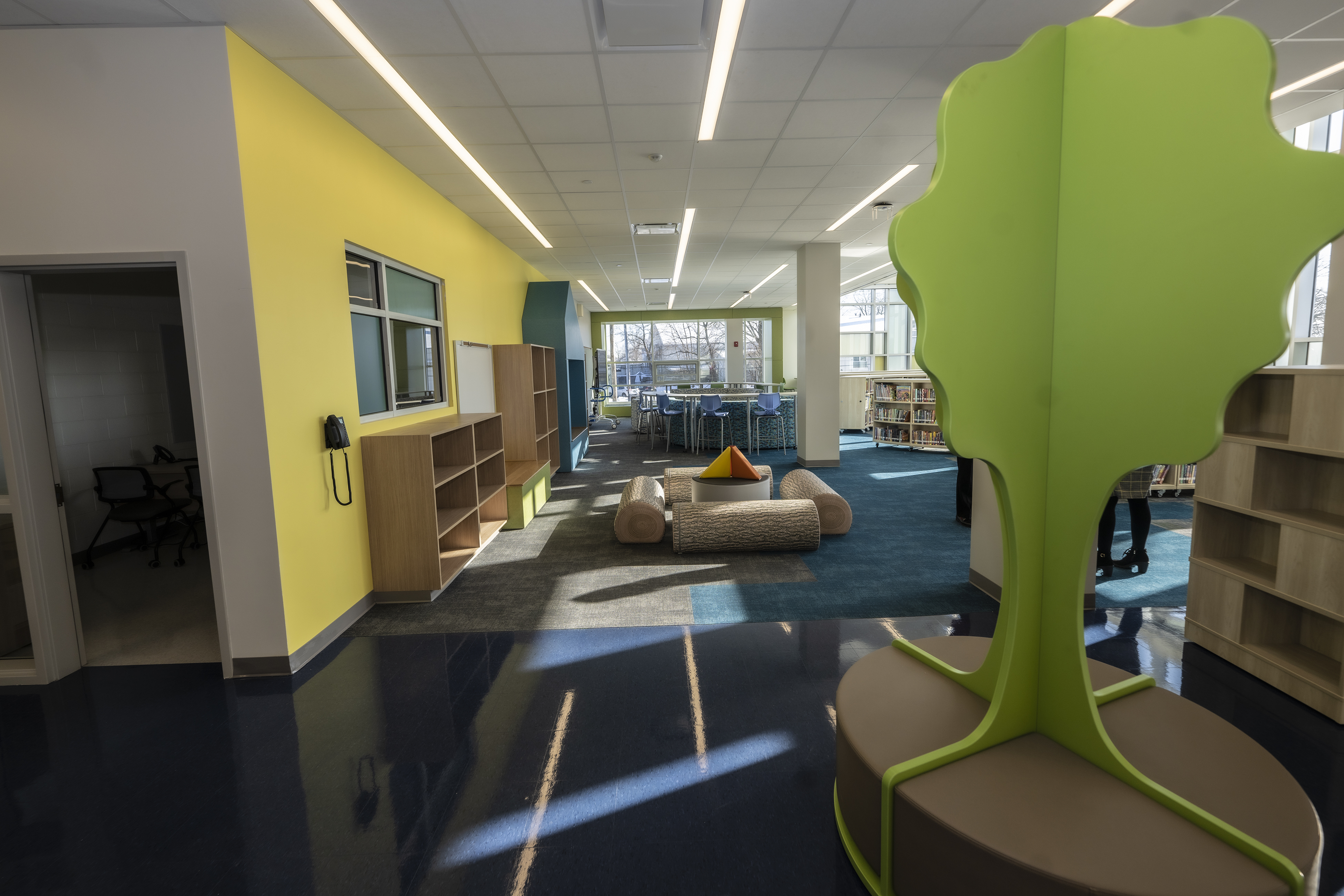
    New furniture at the new Thomas Holme Elementary School.

    Unlike many other sections of the city, where the district’s enrollment is shrinking, the Northeast’s school population is booming — its schools are overcrowded.

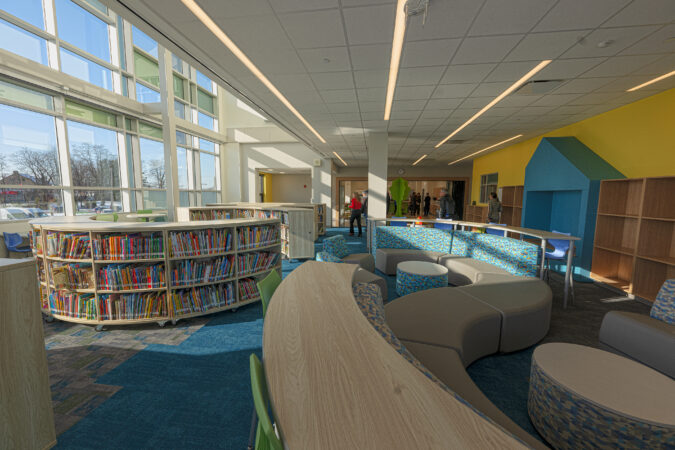
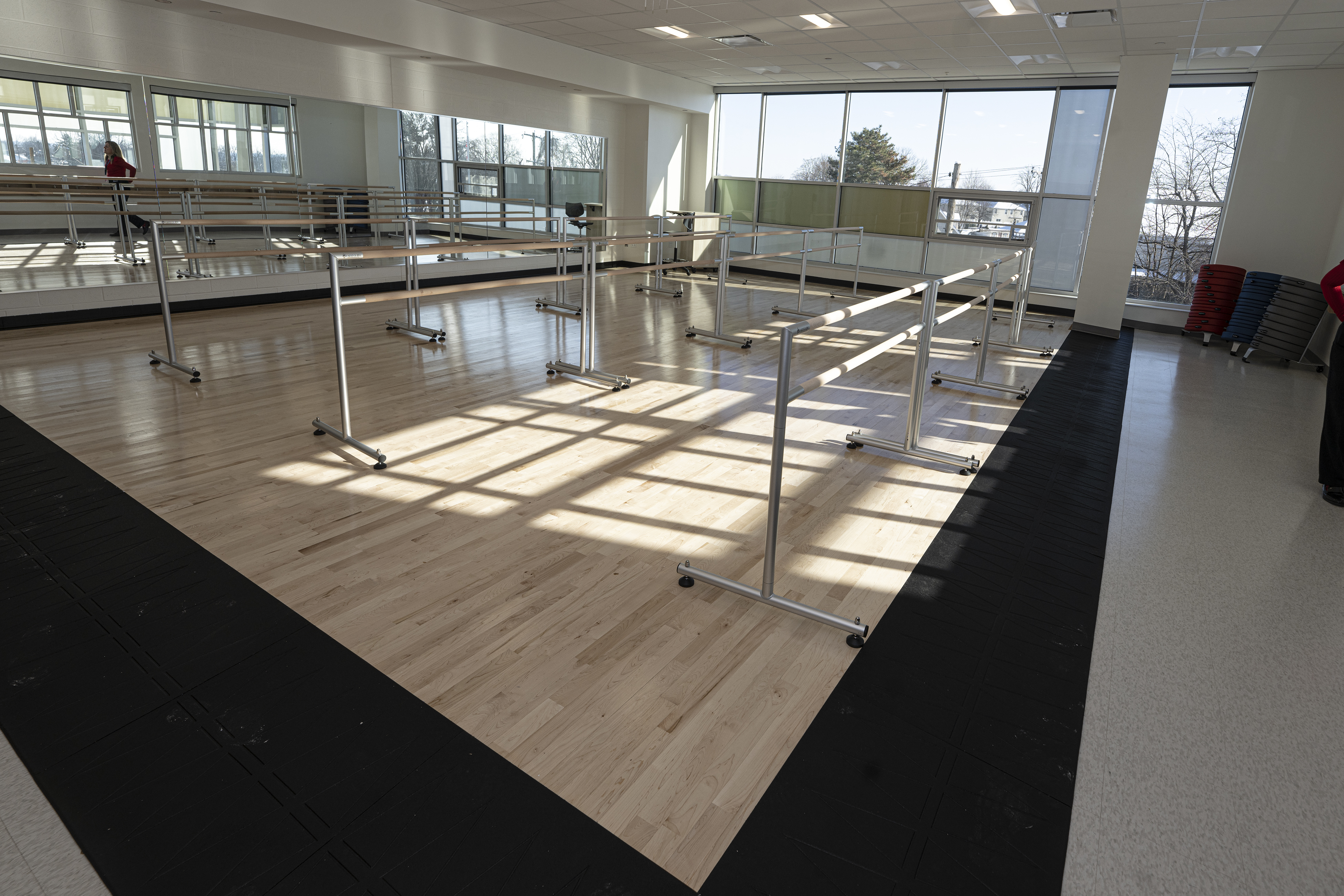
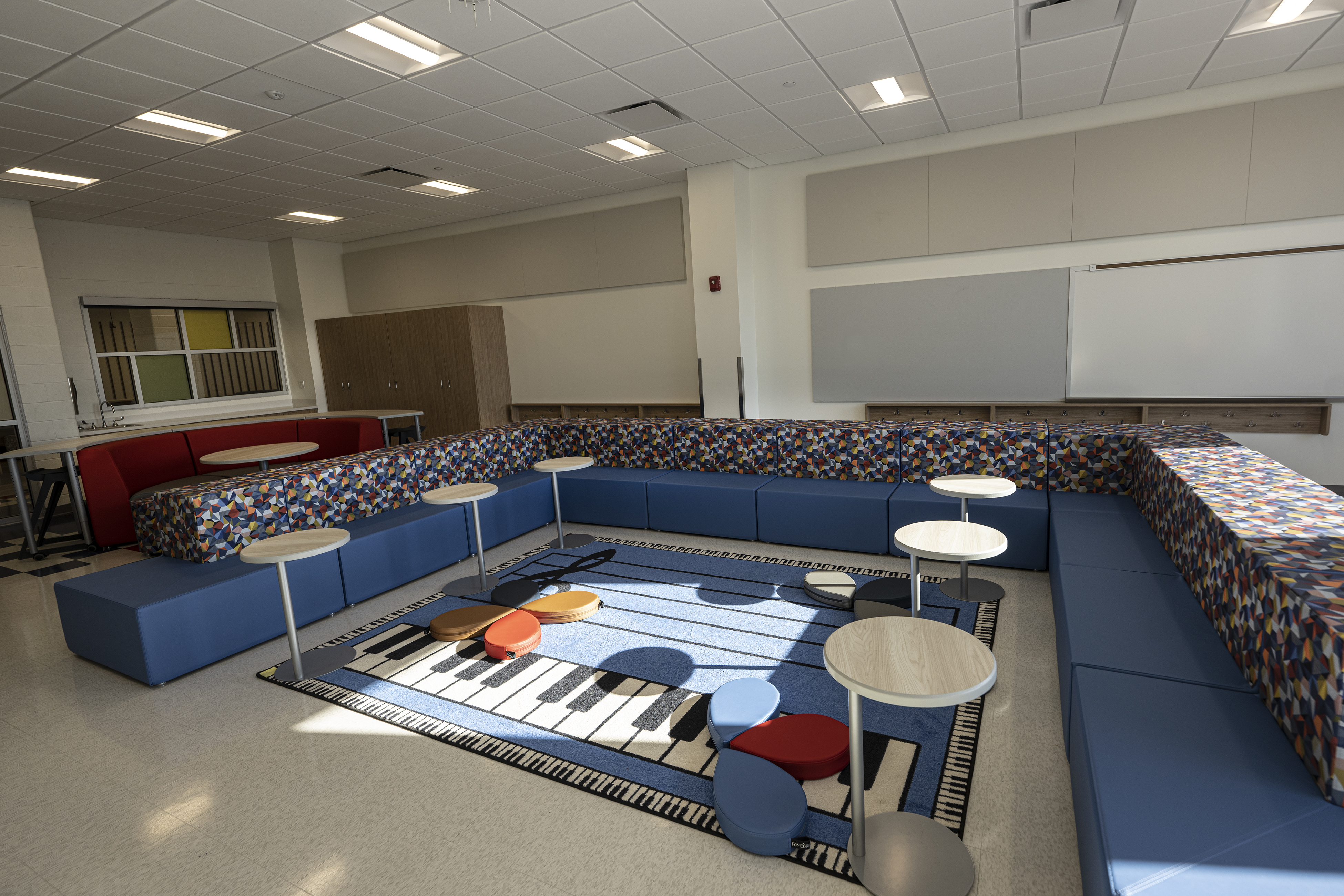
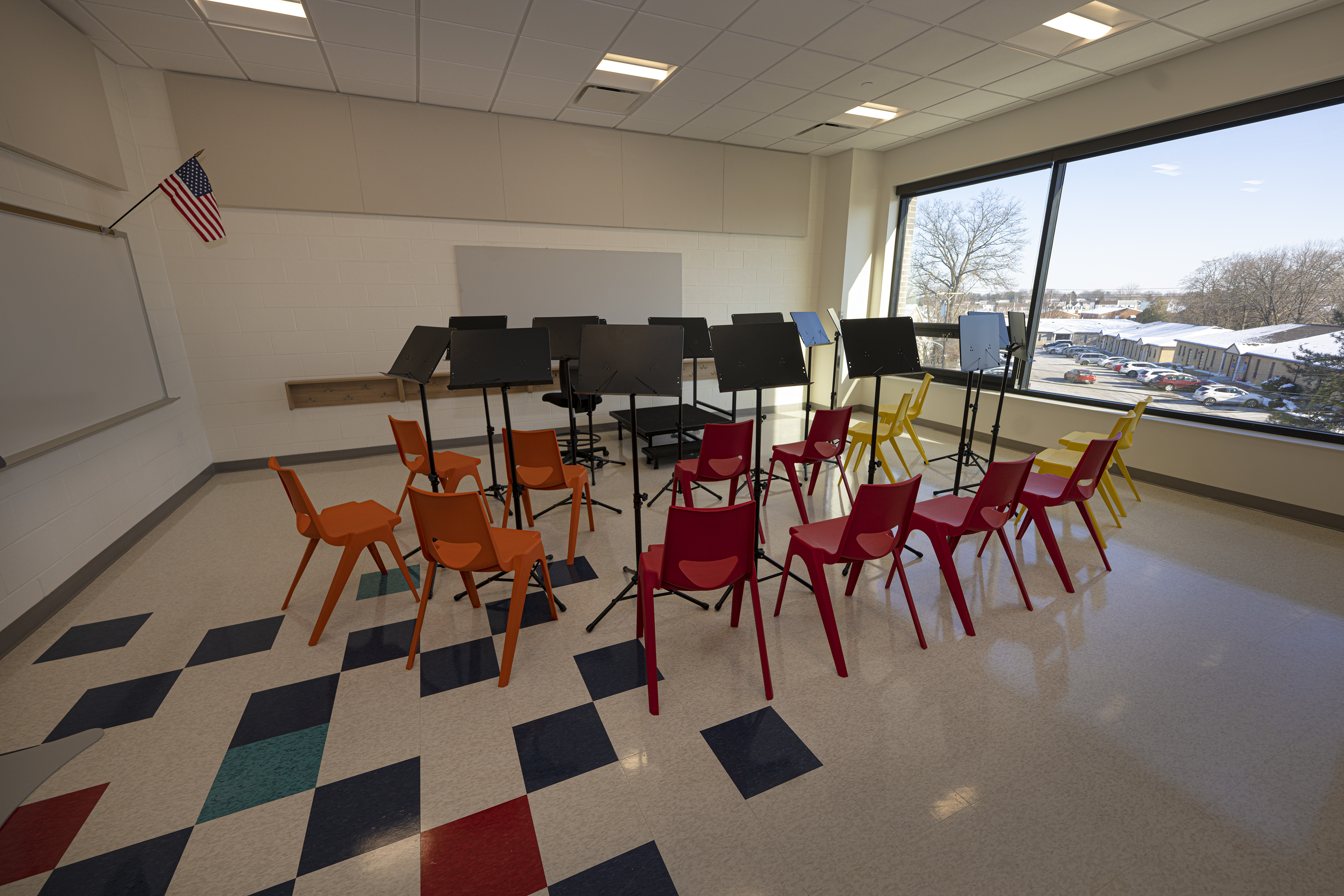
    Holme, named for Pennsylvania’s first surveyor general, outgrew its old building, which was razed to make way for the new 141,000-square-foot structure. Designed with flooding natural light, welcoming learning spaces, and flexible spaces and furniture for more conversational teaching environments, the school includes state-of-the-art music rooms, a bright new gymnasium and stage, science classrooms, an interactive media commons, and a dance studio with a real hardwood dance floor.

    A dance studio at the new Thomas Holme Elementary School has a real hardwood dancefloor.

    “This is the shining star of the school,” said April Tomarelli, an educational facilities planner, during a tour of the sunlit dance studio.

    Smaller details, like the dragon-shaped tiles in the cafeteria to match the school mascot, offer a homey touch, said April Tomarelli, an educational facilities planner, during a tour.

    “Everything was done with intention,” Tomarelli said.

    A music room at the new Thomas Holme School.

    Students had a hand in the design of the new building — they weighed in on the facade, the playground, and the stormwater management system.

    “This school comes from you,” said architect Troy Hill, who helped design the building for Blackney Hayes, adding that the students’ input included more learning spaces, outdoor classrooms, and a space for designing murals.

    The outside of Thomas Holme School in Northeast Philadelphia.

    The new Holme will open as the district nears completion of its long-awaited facilities master plan, which officials have said will call for some school closings and co-locations, as well as building renovations and new construction.

    That plan, once promised by the end of this calendar year, is now expected to be made public in the next few months.

    The average district school building was built 73 years ago, said Reginald L. Streeter, president of the board of education.

    “Most Philadelphia children walk into schools older than their grandparents,” he said.

    Philadelphia School District Superintendent Tony B. Watlington speaks during opening ceremonies for the new Thomas Holme Elementary School on Tuesday.

    At the ribbon cutting, Superintendent Tony B. Wallington Sr. celebrated the fact that, like AMY at James Martin, the new Thomas Holme school was completed on time — and on budget.

    “You’re in a school district that’s been excellent stewards of federal, state, and local tax dollars,” he said, adding that the district has its best investment-grade credit rating in 50 years.

    The school library at the new Thomas Holme Elementary School.

    The state-of-the-art school represents a step towards the district’s aspiration to be the “fastest-improving, large school district in the country,” he said.

    “Not for bragging rights,” he said. “But because the children of Philadelphia deserve it so.”

    Mike Greco, president of Penn Academy Athletic Association, which helped shepherd the project through the community, said he has two grandchildren who will be attending the new school in January. His two children had previously graduated from the old Thomas Holme, which was built in 1950.

    “We needed this,” he said. “We need good things to happen everywhere in this city.”

    A music room at Thomas Holme Elementary School.
  • If Philadelphia wants to be the best sports city, it must fund its student-athletes

    If Philadelphia wants to be the best sports city, it must fund its student-athletes

    The Washington Post recently sparked a familiar debate by ranking the top sports cities in the country — and left Philadelphia off the list. While local journalists rushed to defend our passionate fandom, they missed the most important question: Does our city truly deserve the title of “Best Sports City” if we systematically deny our own children the chance to participate?

    If we believe in the power of Philadelphia sports, it’s time for our professional teams and our famous citizens to commit to making every child a winner by funding athletics in the Philadelphia School District.

    The moral compass of the budget

    My moral compass, forged during my time on the Philadelphia school board (2018-2021), was guided by a simple question: “Who do I believe our students are, and what do I believe they deserve?”

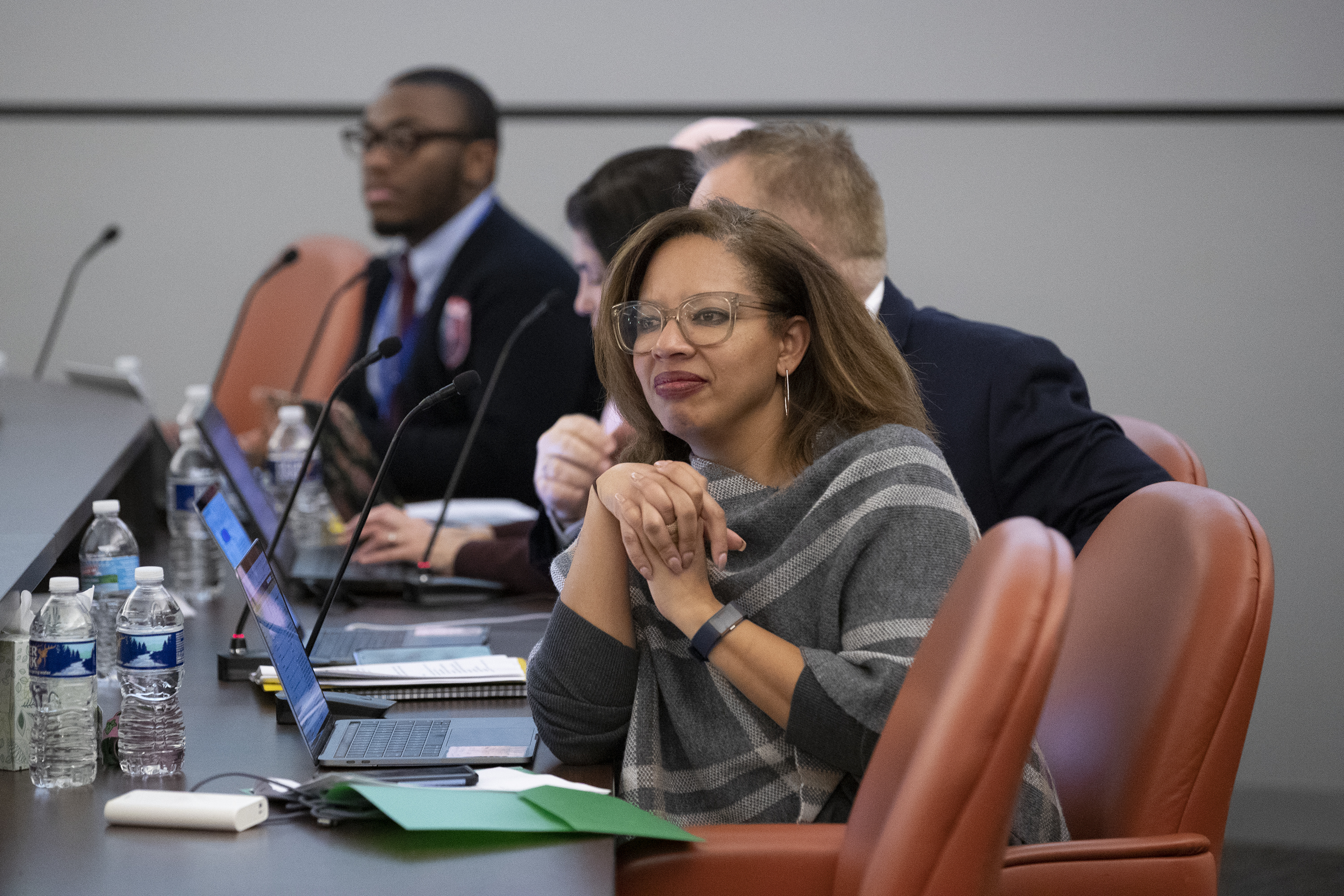
    Angela McIver at the meeting of the Phiadelphia Board of Education in 2020.

    I could not, in good conscience, vote for a budget that answered that question by allocating four times the amount of money for school police than it did for athletics programming.

    I believe funding decisions like these are an indictment of our priorities.

    For our students, the impact of this financial neglect is not abstract — it is a daily indignity. For example, while my children were on the Central High School swim team, the team routinely had to scramble for practice facilities. One of their regular practice pools was a therapeutic pool for children with disabilities, which kept the water temperature above 80 degrees — a condition dangerous for intense athletic training.

    A swim team practices at the Marian Anderson Recreation Center, in South Philadelphia in 2022.

    Across the district, our track teams often have no actual track, forcing students to run laps in crowded school hallways. Our baseball teams must clear rocks and debris off their own fields just to hold a practice session.

    While school districts across this region consistently allocate between 1% and 1.5% of their budget to athletics, Philadelphia allocates a mere two-tenths of 1% (0.2%). Consider the scale: In 2023, when I wrote an op-ed about school budgets for The Inquirer, Lower Merion spent nearly $4 million on athletics for two high schools and three middle schools. Philadelphia spent a mere $9 million for 57 high schools and more than 150 middle schools.

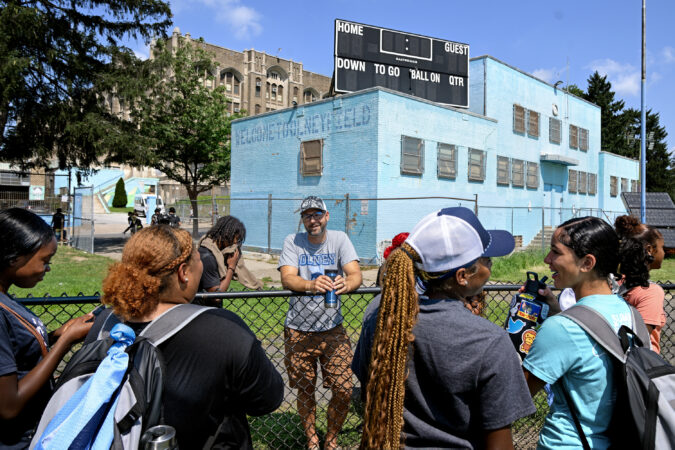
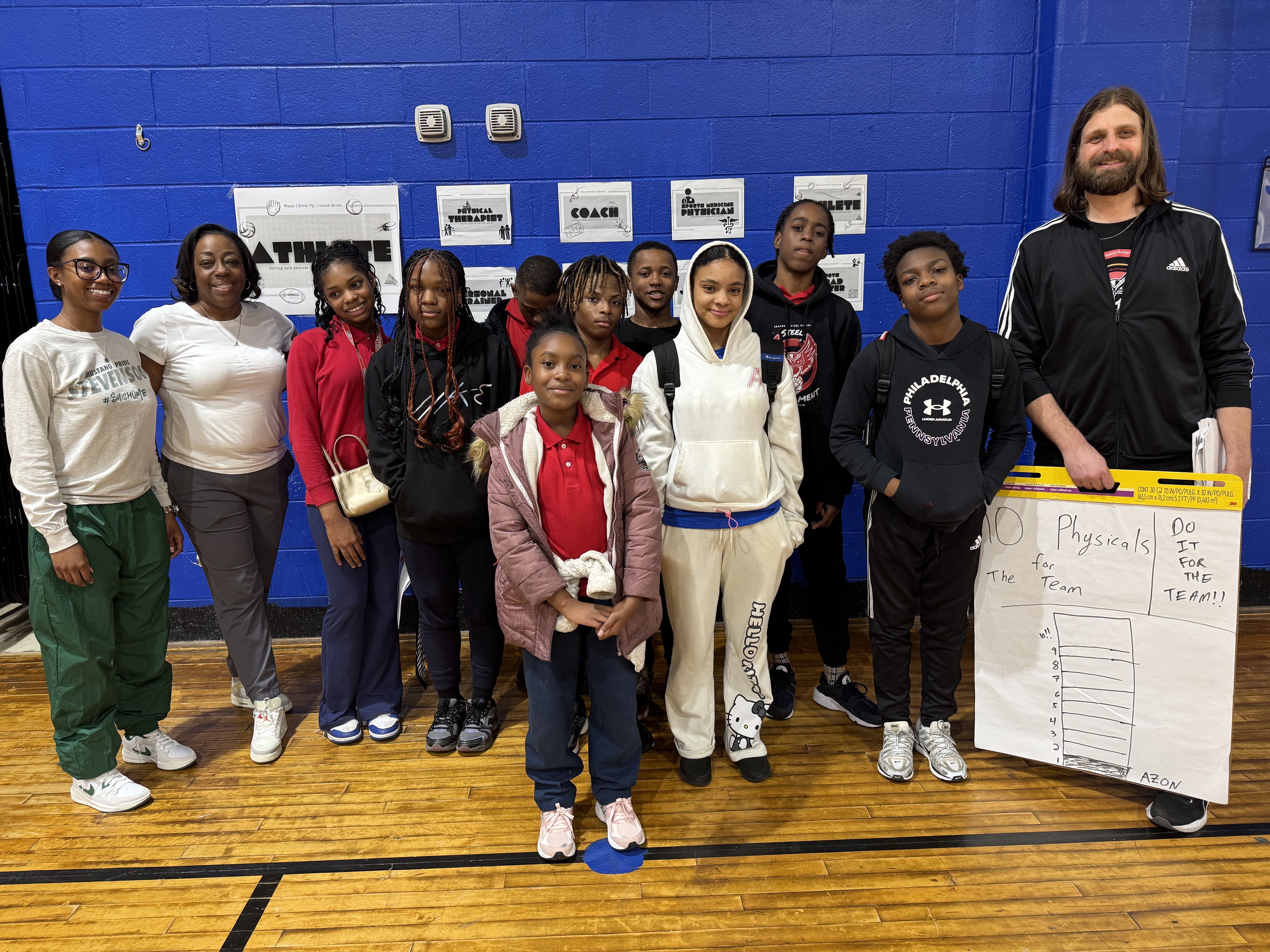
    Students and coaches from Steel Elementary, pictured here in March, were hoping to establish a track team —its first Philadelphia School District-sponsored extracurricular activity.

    If the Philadelphia School District could allocate funding according to the formula used by our neighboring districts, we could transform thousands of students’ lives. Unfortunately, competing financial realities (like the cessation of COVID-19 funding and the critical need to address deteriorating facilities) relegate athletics to the bottom of the priority list.

    A challenge to Philadelphia’s champions

    We know the benefits of participation in sports are profound: lower rates of depression, better mental health, stronger self-regulation, and increased confidence. Investing in athletics develops students’ passions and talents.

    Moreover, in a city grappling with gun violence, the impact is immediate and tangible: it keeps thousands of our students off the streets during the times when they are most likely to become victims of, or engage in, disruptive behavior.

    Unfortunately, the reality is that this funding gap reflects a systemic financial disparity facing our city. I recognize the immense difficulty the current administration faces in allocating dollars while working with far less funding per student than wealthier suburban districts. If Philadelphia truly values its sports identity, it’s time for those who embody that spirit to step up.

    My challenge goes out directly to:

    1. Our professional sports teams (Eagles, Sixers, Phillies, Flyers, Union): If our city’s identity is tied to your success, then your success must be tied to our children. Commit a percentage of your organization’s substantial revenues to help close the school district’s athletics funding gap to finally bring parity with suburban districts.
    2. Our celebrities and ambassadors: Every time Kevin Hart, Quinta Brunson, Hannah Einbinder, or Bradley Cooper says, “Go Birds!” on the red carpet, they use their platform to amplify Philadelphia pride. Now, we need them to use their wallets and voices to amplify opportunity. Commit to a sustained, philanthropic effort to fully fund athletics across our public schools.

    We have amazing, talented children with gifts to share. A true “Best Sports City” doesn’t just celebrate its pros; it gives every child the chance to become one.

    Let’s turn our fanatical passion into foundational funding.

    Angela McIver served as a member of the Philadelphia school board from 2018-2021.

  • A Philly judge’s ruling in a charter case has called into question Joyce Wilkerson’s seat on the school board

    A Philly judge’s ruling in a charter case has called into question Joyce Wilkerson’s seat on the school board

    A judge said this week that arguments questioning the legality of Joyce Wilkerson’s seat on the Philadelphia school board had merit, and directed the board to halt nonrenewal proceedings for two charter schools.

    Philadelphia Common Pleas Court Judge Christopher R. Hall granted a preliminary injunction to People for People Charter School and KIPP North Philadelphia Academy on Monday, saying that a lawsuit against the school board can continue because lawyers had presented sufficient evidence.

    The charters claim that board member Wilkerson — who is perceived to be anti-charter schools — tainted the votes against them this year and should not be on the board.

    City Council declined to approve Wilkerson last year as a school board member, but Mayor Cherelle L. Parker asked her to serve until she named a replacement.

    More than a year later, no replacement for Wilkerson has been named, and she continues to serve. She was, in fact, recently named the country’s top urban educator by the Council for Great City Schools.

    People for People’s initial lawsuit complaint, filed in September, said that Wilkerson is an “illegally and unlawfully seated member of the BOE” and that her participation in the nonrenewal deliberations tainted and ultimately invalidated them.

    The city and the board have said that the city’s Home Rule Charter allows Wilkerson to continue to serve — without Council approval — until a replacement is named.

    Reginald Streater, the school board president, said the ruling overshadows the underlying issues.

    “The board’s decision to begin the process of nonrenewal was on the merits of each board member’s independent assessment of the schools’ outcomes,” Streater said in a statement. Board members’ concerns were aired publicly over months.

    Any delay slows the board’s ability to give the schools full hearings, with testimony and the ability to present evidence, he said.

    “Our schools, families, and children deserve resolution,” Streater said. “We remain committed to transparency and to continuing this work in the best interest of the community.”

    What’s the court case?

    People for People filed a lawsuit in Common Pleas Court asking the court to oust Wilkerson. KIPP North Philadelphia later joined the case; both were nonrenewed in August over sustained poor academics.

    (Nonrenewal does not equal closure, though it is the first step on that path. It triggers an extensive nonrenewal hearing, after which an officer makes a recommendation; then the board votes again on whether to non-renew the school.)

    Lawyers for the charters argued that Wilkerson essentially poisoned the votes, and the judge wrote in his order that there was enough evidence to move forward with the injunction.

    “This leaves the question whether Ms. Wilkerson’s participation in the pertinent BOE meetings without color of right tainted its vote [on the charter nonrenewals]. Plaintiffs have shown it likely did,” Hall wrote.

    Hall’s order means that nonrenewal hearings cannot proceed, but the board had not yet scheduled them.

    What was Wilkerson’s role on the People for People and KIPP votes?

    Wilkerson, Hall noted in his order, “was the first to press” to issue a nonrenewal notice to the schools at a June board meeting, and in August called for a vote on the nonrenewal notice.

    The KIPP North Philadelphia nonrenewal vote passed unanimously; board member Whitney Jones was the only vote against the People for People non-renewal.

    But Wilkerson, a former school board president and School Reform Commission chair, was not the only board member with concerns about the two charter schools.

    Board member Cheryl Harper said People for People is “failing our children. How long do we allow them to keep failing our children? I have an issue with these schools not being able to succeed for our children.”

    Board vice president Sarah-Ashley Andrews cited issues with KIPP North Philadelphia’s “failure to deliver for our students,” specifically calling out its academics and suspension rates.

    Streater, the board president, called KIPP’s performance “unacceptable.”

    What’s next?

    The court case will now proceed, and is likely to drag on for months.

    But Hall’s legal ruling on Wilkerson’s school board seat could mean open season for other parties that are unhappy with decisions the board has made and are willing to challenge those rulings legally.

    As to whether Wilkerson will remain on the board, Parker has staunchly stood by her in the past.

    When the People for People suit was first filed, a member of her administration said she stood by Wilkerson as “an official member of the Philadelphia Board of Education” who “has the full support of Mayor Cherelle L. Parker.”

    What was the reaction?

    Mark Seiberling, a lawyer for People for People, said the ruling was an important one.

    “We are pleased with Judge Hall’s thoughtful and well-reasoned decision following a lengthy hearing at which multiple witnesses from the School District of Philadelphia were called to testify,” Seiberling said in a statement. “We look forward to Ms. Wilkerson’s replacement being nominated and confirmed in accordance with Philadelphia’s Home Rule Charter.”

    City officials had no immediate comment.