The Washington Post recently sparked a familiar debate by ranking the top sports cities in the country — and left Philadelphia off the list. While local journalists rushed to defend our passionate fandom, they missed the most important question: Does our city truly deserve the title of “Best Sports City” if we systematically deny our own children the chance to participate?
If we believe in the power of Philadelphia sports, it’s time for our professional teams and our famous citizens to commit to making every child a winner by funding athletics in the Philadelphia School District.
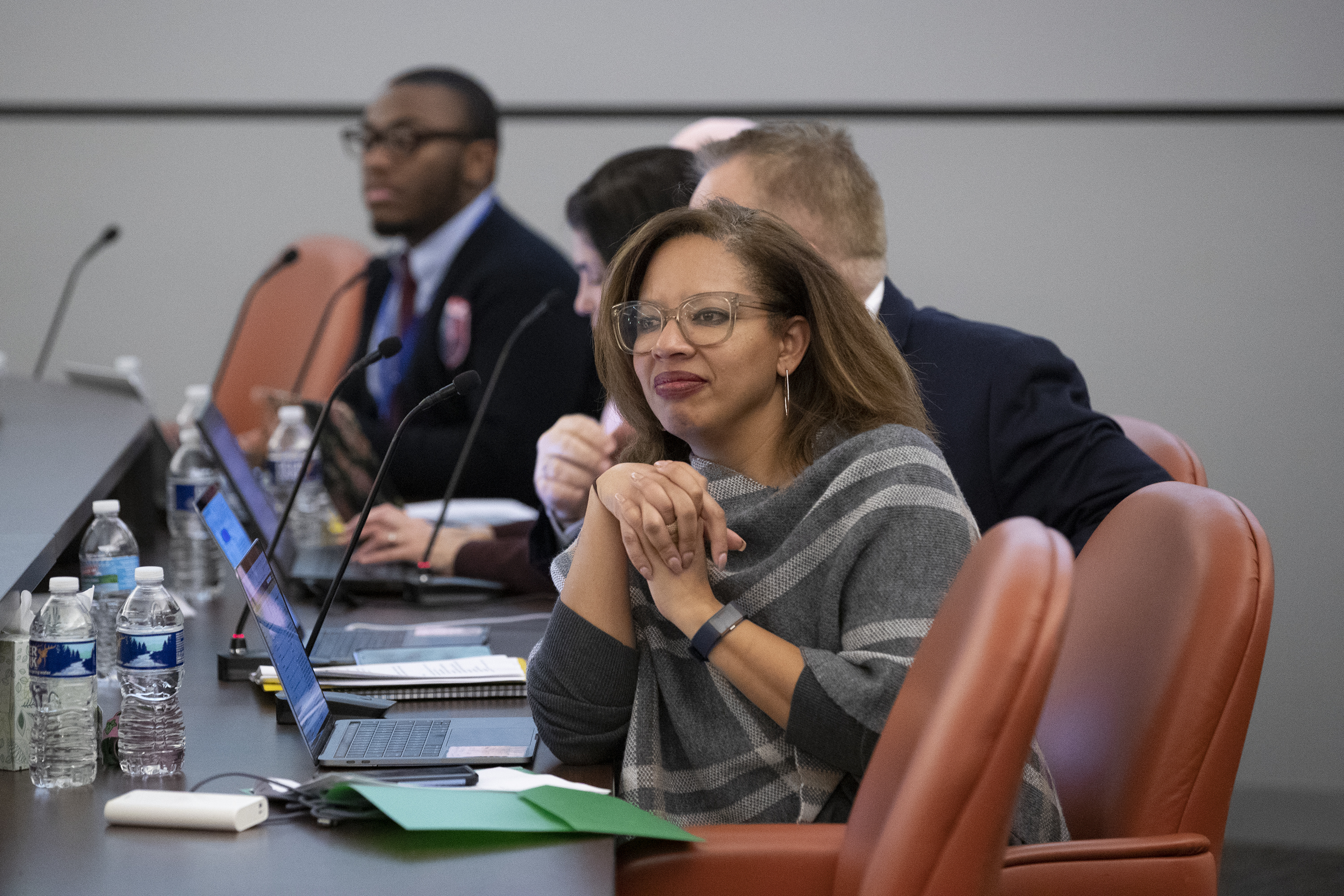
Angela McIver at the meeting of the Phiadelphia Board of Education in 2020.
I could not, in good conscience, vote for a budget that answered that question by allocating four times the amount of money for school police than it did for athletics programming.
I believe funding decisions like these are an indictment of our priorities.
For our students, the impact of this financial neglect is not abstract — it is a daily indignity. For example, while my children were on the Central High School swim team, the team routinely had to scramble for practice facilities. One of their regular practice pools was a therapeutic pool for children with disabilities, which kept the water temperature above 80 degrees — a condition dangerous for intense athletic training.
A swim team practices at the Marian Anderson Recreation Center, in South Philadelphia in 2022.
Across the district, our track teams often have no actual track, forcing students to run laps in crowded school hallways. Our baseball teams must clear rocks and debris off their own fields just to hold a practice session.
While school districts across this region consistently allocate between 1% and 1.5% of their budget to athletics, Philadelphia allocates a mere two-tenths of 1% (0.2%). Consider the scale: In 2023, when I wrote an op-ed about school budgets for The Inquirer,Lower Merion spent nearly $4 million on athletics for two high schools and three middle schools. Philadelphia spent a mere $9 million for 57 high schools and more than 150 middle schools.
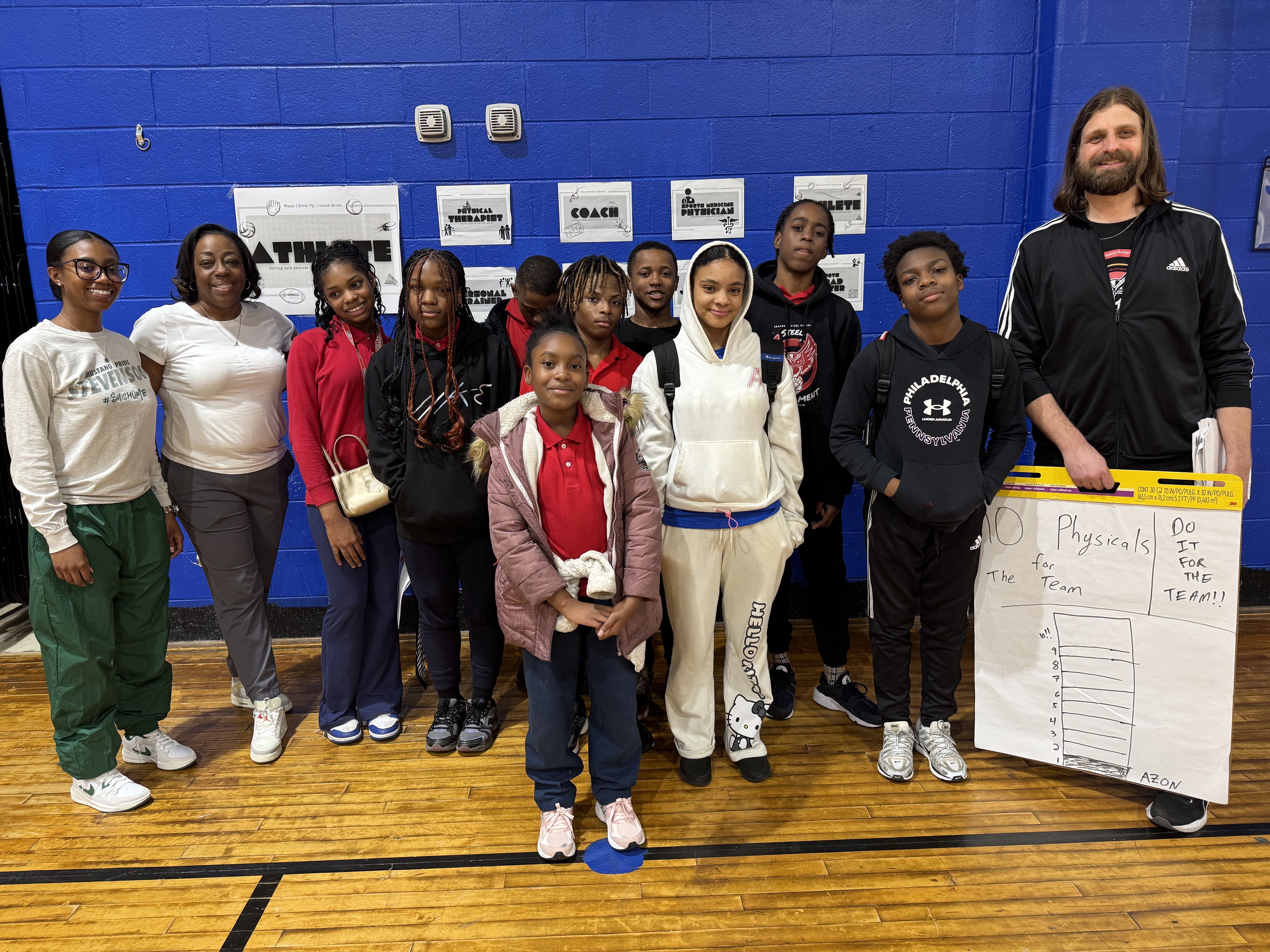
Students and coaches from Steel Elementary, pictured here in March, were hoping to establish a track team —its first Philadelphia School District-sponsored extracurricular activity.
If the Philadelphia School District could allocate funding according to the formula used by our neighboring districts, we could transform thousands of students’ lives. Unfortunately, competing financial realities (like the cessation of COVID-19 funding and the critical need to address deteriorating facilities) relegate athletics to the bottom of the priority list.
A challenge to Philadelphia’s champions
We know the benefits of participation in sports are profound: lower rates of depression, better mental health, stronger self-regulation, and increased confidence. Investing in athletics develops students’ passions and talents.
Moreover, in a city grappling with gun violence, the impact is immediate and tangible: it keeps thousands of our students off the streets during the times when they are most likely to become victims of, or engage in, disruptive behavior.
Unfortunately, the reality is that this funding gap reflects a systemic financial disparity facing our city. I recognize the immense difficulty the current administration faces in allocating dollars while working with far less funding per student than wealthier suburban districts. If Philadelphia truly values its sports identity, it’s time for those who embody that spirit to step up.
My challenge goes out directly to:
Our professional sports teams (Eagles, Sixers, Phillies, Flyers, Union): If our city’s identity is tied to your success, then your success must be tied to our children. Commit a percentage of your organization’s substantial revenues to help close the school district’s athletics funding gap to finally bring parity with suburban districts.
Our celebrities and ambassadors: Every time Kevin Hart, Quinta Brunson, Hannah Einbinder, or Bradley Cooper says, “Go Birds!” on the red carpet, they use their platform to amplify Philadelphia pride. Now, we need them to use their wallets and voices to amplify opportunity. Commit to a sustained, philanthropic effort to fully fund athletics across our public schools.
We have amazing, talented children with gifts to share. A true “Best Sports City” doesn’t just celebrate its pros; it gives every child the chance to become one.
Let’s turn our fanatical passion into foundational funding.
Angela McIver served as a member of the Philadelphia school board from 2018-2021.
A judge said this week that arguments questioning the legality of Joyce Wilkerson’s seat on the Philadelphia school board had merit, and directed the board to halt nonrenewal proceedings for two charter schools.
Philadelphia Common Pleas Court Judge Christopher R. Hall granted a preliminary injunction to People for People Charter School and KIPP North Philadelphia Academy on Monday, saying that a lawsuit against the school board can continue because lawyers had presented sufficient evidence.
The charters claim that board member Wilkerson — who is perceived to be anti-charter schools — tainted the votes against them this year and should not be on the board.
City Council declined to approve Wilkerson last yearas a school board member, but Mayor Cherelle L. Parker asked her to serve until she named areplacement.
People for People’s initial lawsuit complaint, filed in September, said that Wilkerson is an “illegally and unlawfully seated member of the BOE” and that her participation in the nonrenewal deliberations tainted and ultimately invalidated them.
The city and the board have said that the city’s Home Rule Charter allows Wilkerson to continue to serve — without Council approval — until a replacement is named.
Reginald Streater, the school board president, said the ruling overshadows the underlying issues.
“The board’s decision to begin the process of nonrenewal was on the merits of each board member’s independent assessment of the schools’ outcomes,” Streater said in a statement. Board members’ concerns were aired publicly over months.
Any delay slows the board’s ability to give the schools full hearings, with testimony and the ability to present evidence, he said.
“Our schools, families, and children deserve resolution,” Streater said. “We remain committed to transparency and to continuing this work in the best interest of the community.”
(Nonrenewal does not equal closure, though it is the first step on that path. It triggers an extensive nonrenewal hearing, after which an officer makes a recommendation; then the board votes again on whether to non-renew the school.)
Lawyers for the charters argued that Wilkerson essentially poisoned the votes, and the judge wrote in his order that there was enough evidence to move forward with the injunction.
“This leaves the question whether Ms. Wilkerson’s participation in the pertinent BOE meetings without color of right tainted its vote [on the charter nonrenewals]. Plaintiffs have shown it likely did,” Hall wrote.
Hall’s order means that nonrenewal hearings cannot proceed, but the board had not yet scheduled them.
What was Wilkerson’s role on the People for People and KIPP votes?
Wilkerson, Hall noted in his order, “was the first to press” to issue a nonrenewal notice to the schools at a June board meeting, and in August called for a vote on the nonrenewal notice.
The KIPP North Philadelphia nonrenewal vote passed unanimously; board member Whitney Jones was the onlyvote against the People for People non-renewal.
But Wilkerson, a former school board president and School Reform Commission chair, was not the only board member with concerns about the two charter schools.
Board member Cheryl Harper said People for People is “failing our children. How long do we allow them to keep failing our children? I have an issue with these schools not being able to succeed for our children.”
Board vice president Sarah-Ashley Andrews cited issues with KIPP North Philadelphia’s “failure to deliver for our students,” specifically calling out its academics and suspension rates.
Streater, the board president, called KIPP’s performance “unacceptable.”
What’s next?
Thecourt case will now proceed, andis likely to drag on for months.
But Hall’s legal ruling on Wilkerson’s school board seat could mean open season for other parties that are unhappy with decisions the board has made and are willing to challenge those rulings legally.
As to whether Wilkerson will remain on the board, Parker has staunchly stood by her in the past.
When the People for People suit was first filed, a member of her administration said she stood by Wilkerson as “an official member of the Philadelphia Board of Education” who “has the full support of Mayor Cherelle L. Parker.”
What was the reaction?
Mark Seiberling, a lawyer for People for People, said the ruling was an important one.
“We are pleased with Judge Hall’s thoughtful and well-reasoned decision following a lengthy hearing at which multiple witnesses from the School District of Philadelphia were called to testify,” Seiberling said in a statement. “We look forward to Ms. Wilkerson’s replacement being nominated and confirmed in accordance with Philadelphia’s Home Rule Charter.”
Alternative Middle Years at James Martin, in Port Richmond, is all but finished and ready for students to occupy after winter break.
Community members, district officials, and dignitaries gathered Tuesday to take tours and trumpet the new construction, a bright spot in a district grappling with a large stock of aging and sometimes environmentally troubled buildings.
“This is what growth looks like,” said Paula Furman, AMY at James Martin’s principal. The middle school educates 200 students in grades 6, 7, and 8.
Superintendent Tony B. Watlington Sr. and Debora Carrera, the city’s chief education officer, applaud a student performance Tuesday at AMY at James Martin, a new middle school in Port Richmond.
Sarah-Ashley Andrews, the school board vice president, noted that of the district’s roughly 300 buildings, more than 200 were built before 1978.
“Projects like this underscore why continued investment is essential,” said Andrews.
On time, on budget
Inside, the 88,000-square-foot, four-story structure at Richmond and Westmoreland Streets just off I-95 is a marvel: all light and flexible seating, makerspace, “digital flex lab” (think: computer lab), and “gymnatorium” (spiffy gym and auditorium). It has modern science labs, dedicated spaces for instrumental and vocal music, and a killer view of Center City from its rooftop outdoor classroom.
The outdoor space with a view of the Center City skyline at the new AMY at James Martin school.
The school replaces an 1894 structure razed to make way for new construction. It is the Philadelphia School District’s sixth new building in 10 years.
“It is kind of crazy, just the giant leap forward that students will be taking, just in terms of furniture, not to mention the technology,” said Melanie Lewin, a district school facilities planner who led tours of the new building. AMY at James Martin students, who have been temporarily learning in classrooms at Penn Treaty High School, used to learn in a 19th-century building; they’re relocating to a building with built-in charging outlets and “noodle chairs” that let them fidget securely while in class.
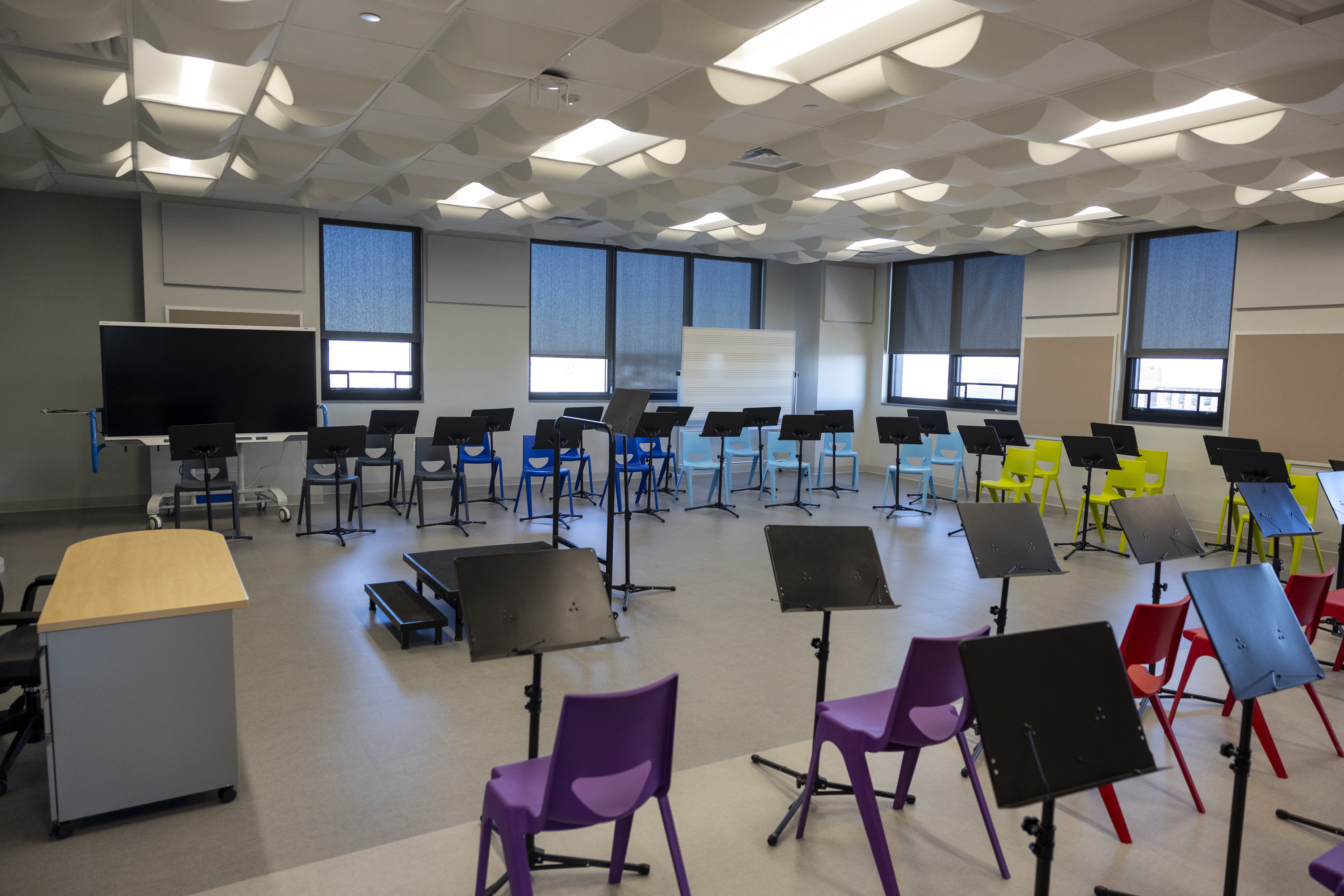
The instrumental music classroom at the new Amy at James Martin School in Philadelphia.
“This school was not just built to look fantastic,” Watlington said. “I want everyone to know that it was built on time and on budget. That is no easy feat when the price of everything is going up — inflation, tariffs, everything.”
Some neighbors showed up at Tuesday’s ribbon-cutting to celebrate. But the process was controversial at first — some protested the loss of the old AMY at James Martin historic site.
City Councilmember Mike Driscoll alluded to the past pain on Tuesday.
“It’s been a struggle, I’ll admit that,” Driscoll said. But, he said, the new school is lovely. “When you see the plans on paper, it doesn’t do it justice.”
A looming facilities master plan
AMY at James Martin’s opening comes with the district approaching a crossroads: Officials are awaiting a years-in-the-making facilities master plan, the first in decades.
While schools in the Northeast and in a few other spots are overcrowded or nearing capacity, schools in many parts of the city are dramatically underenrolled.
Custom cushioned seats in a classroom at the new Amy at James Martin School in Philadelphia.
Officials have said that some schools will likely cease to exist as part of the process, now expected to culminate early next year with Watlington making recommendations to the school board for grade reconfigurations, closures, co-locations, significant renovations, and new construction.
AMY at James Martin, in its current form, is likely to come in under the district’s minimum recommended school size, at 200 students. The school’s capacity is 500, officials said.
But Casey Laine hopes the school count grows by two in January.
One of the bathrooms for students at the new Amy at James Martin School in Philadelphia.
Laine, who lives around the corner from the new AMY at James Martin and attended Tuesday’s ribbon-cutting, is the mother of a sixth and seventh grader who currently attend Bridesburg Elementary.
She’d like her kids, a son and daughter, to transfer to AMY at James Martin if possible.
“This is beautiful,” Laine said. “I’m so excited.”
The Philadelphia school board on Monday signaled its intentions to play ball: Later this week, it will hold a special action meeting to vote on a resolution authorizing Superintendent Tony B. Watlington Sr. and his team to consider handingover a portfolio of unused school buildings to the city.
Watlington, the resolution states, “recommends that, in the best interests of the district and its students, the district explore and pursue negotiations with the city to potentially convey certain vacant and surplus district property.”
Parker, in a statement, said the process was about “public health and public safety” and the school buildings can be used to improve residents’ quality of life.
Officials “cannot let blighted buildings in the middle of residential neighborhoods lie vacant — many of which have been vacant for many years — from two years to over 30,” Parker said. “It’s unconscionable to me that we are in the middle of a housing crisis and we have government buildings sitting vacant for years or even decades. That cannot continue.”
School board president Reginald Streater said that no decisions are final and that public deliberation will still happen at the special meeting at 4 p.m. Thursday. But, he said, the move makes sense with “the board moving toward being much more willing to be intergovernmental partners” with the city.
“Many of these properties have not been used in the last decade or more, and they require a significant amount of upkeep and maintenance,” Streater said. “These properties are unused, for the most part, and unnecessary for K-12 education.”
The district is in the business of running schools, Streater said.
“I do believe that the city possesses considerably more expertise and capacity than the district does regarding property development,” Streater said. “We are an education institution. To build the capacity to do such things is out of our wheelhouse, and economic development would take us out of our lane.”
According to the language of the resolution, the district is urging Watlington to consider all angles — bond obligations, property conditions, financial protection of the district, any legal processes that would need to happen, and more.
The action comes as something of a surprise, happening just a week after what was to be the final voting meeting of the year. Streater said he did not want to add it as a walk-on resolution to the December school board meeting, but wanted to give members of the public time to understand it and provide testimony, if desired.
Giving unused school buildings to the city could further academic outcomes, the school board president said.
“It’s possible,” Streater said, “that conveying these vacant and surplus properties to the city for redevelopment and revitalization could help stabilize and grow the city and district’s tax base … and consequently positively impact future revenues to the district and educational experiences for students.”
Asked for a list of the unused buildings the resolution would cover, school board officials said more internal evaluation is needed before such a list is released.
The possible transfer of district properties to the city comes as officials debate the specifics of one of Parker’s signature initiatives.
The mayor wants to spend $800 million on her housing initiative, Housing Opportunities Made Easy, or H.O.M.E. In a rare sign of division, Council last week allotted more housing funds to the city’s poorest residents over the Parker administration’s objections.
Because of Council’s move, more legislation is now needed to advance H.O.M.E. It will not come until January at the earliest.
Thomas, chair of Council’s education committee, has long been pushing for a school facilities plan.
“It’s unclear to say what this step forward means, but I want to understand how it fits into a larger plan for Philly’s educational institutions,” Thomas said in a statement.
“Without getting into hypotheticals, and due to a lack of communications with City Council, there are a lot of moving pieces and still many questions about what this means and what is the overall plan for the future of our school buildings,” Thomas said.
The board unanimously approved the new contract for the principals union. A deal with the union had been struck last week after the principals spent three months working without a new contract in place.
Board approves the rest of its agenda and adjourns the meeting
And the board approved the rest of its agenda unanimously, too.
Goals and Guardrails happens this time next week, but this is the last action meeting of the year. That’s a wrap!
// Timestamp 12/04/25 6:50pm
Board member Lam requests more information from the district on controls in place to prevent cost overrun with vendors
ChauWing Lam said she’ll support a $43,390 contract with Mothers in Charge for violence prevention services, but has concerns about the cost overrun and controls in place to prevent that.
Superintendent Tony B. Watlington Sr. said there are controls in place, and promises more information.
// Timestamp 12/04/25 6:47pm
Board unanimously approves new contract for principals union
The board also approved CASA’s new contract, also with a 9 to 0 vote.
Board unanimously approves meeting schedule for 2026
Ultimately, the board decides to move forward with its schedule as written: separate action meetings and Goals and Guardrails meetings for 2026.
The vote was unanimous.
// Timestamp 12/04/25 6:35pm
Board moves from speakers into its agenda for voting
That’s the end of the speakers list. Now we’re onto voting.
The board is voting on its 2026 meeting schedule.
Board member ChauWing Lam has concerns about keeping the board’s “Goals and Guardrails” meetings separate from action meetings. She’d like more progress monitoring as part of the board’s action meetings.
Board member Crystal Cubbage says Goals and Guardrails should remain separate. She appreciates Goals and Guardrails happening in a space that’s separate, where she can think about them with a fresh mind.
Board member Whitney Jones concurs with Cubbage, and says perhaps it’s possible to pilot some Goals and Guardrails in one meeting.
Joyce Wilkerson, who was president when Goals and Guardrails was developed, said she supports keeping Goals and Guardrails separate. The board often starts its work at 9 a.m. on board days, she said, and it’s better for them to approach Goals and Guardrails with fresh eyes on a different day.
// Timestamp 12/04/25 6:28pm
Clouden family speaks to the board about the state of Philly schools
Horace Clouden, a retired district employee, wants to know the true number of underperforming district and charter schools.
“Families have no confidence” in district schools, Clouden said. Clouden is a proponent of traditional junior high schools, and believes that K-8 schools are leading to poor academic outcomes.
Mama Gail Clouden (who is married to Horace Clouden) said the district “needs to stop ignoring what we know is happening.”
“We have too many schools where people don’t know how to teach our children,” Mama Gail said.
Mama Gail suggests that the superintendent not just go out to schools for photo opportunities. Go into struggling schools, she said.
Leah Clouden, Mama Gail and Horace Clouden’s daughter, says the district is “warehousing students.”
// Timestamp 12/04/25 6:22pm
Retired teacher speaks in support of Keziah Ridgeway and Ismael Jimenez
Barbara Dowdall, a retired district teacher, said her mother was denied a job as a school librarian because she was Jewish.
She asks: “What is the school district’s lesson to students” when it mistreats educators Keziah Ridgeway and Ismael Jimenez?
// Timestamp 12/04/25 6:20pm
Retired teacher and activist tells board to stop renewing ‘substandard charters’
“More than half of district charter schools are underenrolled,” said Lisa Haver, a retired district teacher and founder of the Alliance for Philadelphia Public Schools.
“It’s not right for this board to renew substandard charter schools” but close neighborhood public schools, Haver said.
// Timestamp 12/04/25 6:17pm
District school psychologist asks the board to halt the facilities planning process
Paul Brown, a district school psychologist, asks for a re-examination of community engagement around the facilities planning process.
The current survey does not “truly capture the needs of Philadelphia,” Brown suggests.
“I’m asking the district to halt the process,” Brown said.
// Timestamp 12/04/25 6:15pm
Schools need more time for student relaxation, parent says
Toya Diggs-Clay, a district parent, says schools need more time for student relaxation and movement. They need better breakfasts and lunches, hygiene bundles going home with kids, and more.
// Timestamp 12/04/25 6:13pm
District speech language pathologist sounds the alarm on lack of pathologists
Tamara Sepe, a district speech language pathologist and parent, sounds the alarm about a lack of speech language and pathologists in the district, and asks for more transparency around the number of SLP positions in the district.
// Timestamp 12/04/25 6:10pm
Teacher wants the board to ‘resist’ the congressional investigation ‘as strongly as you can’
Freda Anderson, a district teacher, said the congressional investigation “is a witch hunt” and “does nothing to protect Jewish people.”
Anderson suggests the board and district “resist as strongly as you can.”
// Timestamp 12/04/25 6:07pm
Teacher tells the board to ‘look closely at which schools have high turnover’
Philip Belcastro, a teacher at Hill-Freedman World Academy, tells the board: “Teachers aren’t leaving students. In some cases, they’re leaving administrators.”
Belcastro: “I’m asking you again to look closely at which schools have high turnover,” and to make it publicly available.
// Timestamp 12/04/25 6:05pm
District educator calls the congressional investigation ‘political theater’
Volin Avelin, an observant Jew, said: “Don’t waste time complying with a redundant investigation.”
In the 1950s, the House Un-American Activities Committee dismissed 26 teachers for alleged Communism. “Learn from this shameful history and stand up for teachers teaching critical content,” Volin Avelin said.
// Timestamp 12/04/25 6:03pm
Schools became underenrolled because of disinvestment, parent tells the board
Melanie Silva, a district parent, tells the board: Schools became underenrolled because of your disinvestment.
Families aren’t ignoring middle schools because of transitions, Silva said, continuing: We’re ignoring them because you under-resourced them.
“We expect investment, not displacement,” Silva said.
// Timestamp 12/04/25 6:00pm
Teacher Keziah Ridgeway tells the board: ‘You are at a crossroads right now, with a national spotlight on you’
“All I’ve ever wanted is to protect students in the ways that I wasn’t protected from the racism that permeates the SDP schools,” Ridgeway said.
“Being a teacher should be heart work,” Ridgeway said. “It’s December and I probably spent $2,000 of our own money on our babies — because they are our babies.”
“You are at a crossroads right now, with a national spotlight on you,” Ridgeway said, asking if the district will “capitulate to McCarthyism.”
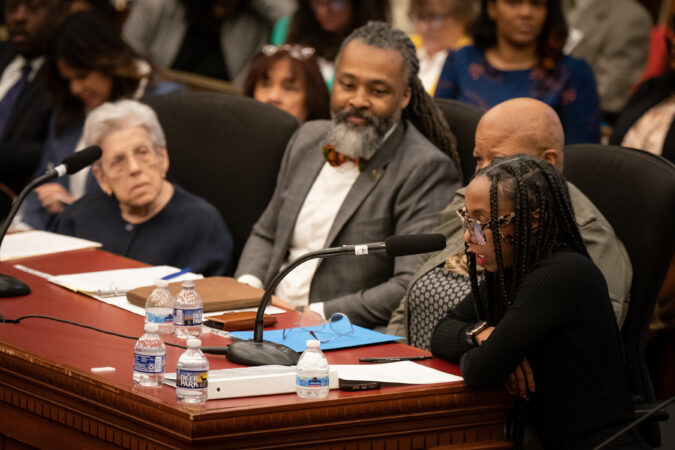
Keziah Ridgeway, a district teacher, speaks to the Philadelphia School Board during meeting on Dec. 4, 2025.
Hannah Gann, a district staff member, then spoke to the district about Ridgeway and other educators: “The baseless attacks on some of Philly’s best Black teachers” is meant to distract them, Gann said.
Allegations of Islamaphobia are just as serious as antisemitism, Gann said. “The district has far more culpability to act when its staff harms students than when its employees feel uncomfortable when they see the word Palestine on a T-shirt,” Gann said.
// Timestamp 12/04/25 5:52pm
District teacher and former teacher each testify in opposition to any school closures
Julian Prados-Frank, a district teacher, is testifying “to oppose any plan that would close schools.”
Schools represent a safe haven for students — sometimes the only place where they get nutritious meals and get social services, Prados-Frank said.
“Our students rely on their schools as a stable refuge,” Prados-Frank said. In his first period math class, many kids miss because of transportation issues. “These kids can’t miss more math,” he said.
Jess Morris-Horowitz, a former district teacher, also tells the board: “The anxiety-inducing phrase ‘school closures’ has been coming for months now.”
The district has spent millions on unnecessary changes, and let buildings languish, she said.
“I’m here to advocate for a focus on human-centered processes and decision-making,” Morris-Horowitz said. School closures will “critically disrupt” students’ and families’ lives.
// Timestamp 12/04/25 5:50pm
KIPP North parent speaks to the board in support of the charter
Pro bono librarian tells the board: ‘School librarians are not expendable.’
Deborah Herskovitz, a district parent who acts as the pro bono librarian at Vare-Washington, which has one of a clutch of “small guerrilla libraries” around the district, wants the board to know that what she provides is not the same has having a certified school librarian. “The district only has about three of those.”
“School librarians are not expendable. They are not extras,” Herskovitz said.
Suburban schools all have school librarians, she said, and these are the schools parents are leaving Philly for.
“Our library is a signal to perspective parents — we value reading here,” Herskovitz said.
// Timestamp 12/04/25 5:41pm
Another Mastery charter parent speaks in support of the school
Amberia Perkins, a parent at Mastery Charter Wister, said her kids love the school, and asks the board to support it.
// Timestamp 12/04/25 5:37pm
There is too much anti-Blackness and racism and not enough consequences, retired teacher says
Kristin Luebbert, a retired district teacher, says she witnessed many instances of racism, anti-Islamic, and anti-Palestinian behavior in the district.
“No consistent effort has been made to make white teachers interrogate their whiteness” and confront racism, Luebbert said.
“This leads to too many teachers and staff upholding racist and anti-Black attitudes,” said Luebbert, who is white.
There is too much anti-Blackness and racism, and not enough consequences, Luebbert said. The district must ensure that the staff that should be nurturing students “is not harming them instead,” she said.
// Timestamp 12/04/25 5:35pm
Teacher shares concerns about ‘politically motivated attacks’ on educators
Thomas Quinn, a district teacher, tells the board: “Right now, Philly schools are under politically motivated attacks.”
Another parent speaks in support of Mastery schools
Shavon Almodovar, a parent with children at Mastery schools, is also praising her kids’ schools. Mastery has pushed her kids to grow, given them challenging and fun content, and has developed her kids in all areas.
// Timestamp 12/04/25 5:30pm
Parent urges the board to consider standing behind KIPP North, rather than nonrenew it
“Our children … [should] be in schools where teachers truly love the work, and not just show up to do the work,” Hazel said.
“If we truly believe in equity … then we have to stand behind the places that are already doing that,” Hazel said. She asks the board to keep KIPP North open. (The board has moved to nonrenew KIPP over academic concerns.)
// Timestamp 12/04/25 5:27pm
Parents speak in support of two Mastery Charter schools
Yolanda Williams, a grandparent at Mastery Charter Clymer, says the school has done wonders for her granddaughter.
“Me, I don’t worry when I drop her off at school because she’s at Mastery. I know she’s fine, I know they’ll treat her right, and I know she’ll get her education,” Williams said.
Joyletta White, a parent at Mastery Charter Gratz, has had a positive experience at Gratz, where her son is thriving.
// Timestamp 12/04/25 5:20pm
Principals union president expresses gratitude to the board for their newly ratified contract
“It was very clear from actions over the weekend that we were heard loud and clear,” Cooper said. “Any time that men will meet with you on a Sunday — on a football Sunday — you know that a contract is in the making.”
There were no raises in the 2016 contract (though principals became 12-month employees again, as opposed to the 10-month employees they had been.) There were just bonuses.
But the board was listening this time, Cooper said. Over half of CASA’s 1,000 members voted on the contract, and 97% voted for it.
“We are partners with the district,” Cooper said. “We try to lead by example.”
“We didn’t get everything that we wanted, but we are leaving feeling heard, and we are leaving with a fair contract,” Cooper said.
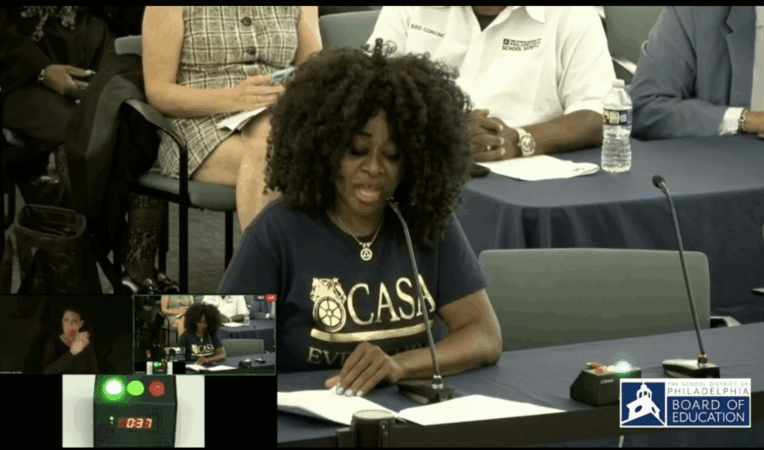
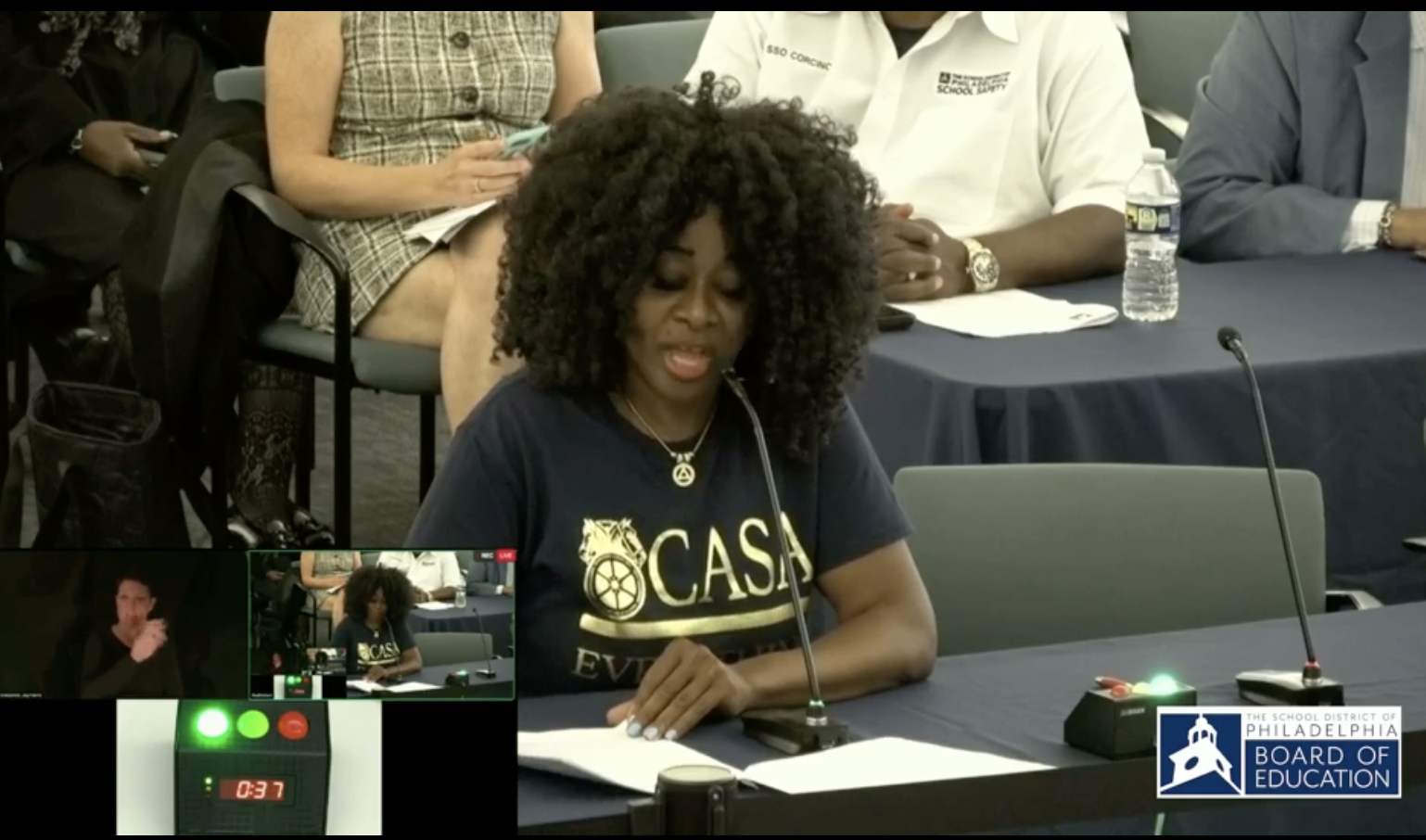
Robin Cooper, president of CASA, the principals’ union, speaks to the Philadelphia school board at a meeting on Dec. 4, 2025.
// Timestamp 12/04/25 5:16pm
Public speakers begin
We’re onto public speakers now.
There’s lots of written testimony defending Keziah Ridgeway and Ismael Jimenez, district educators who were alluded to in an order for a congressional investigation into alleged antisemitism in the district.
Sarah-Ashley Andrews is unanimously reelected as vice president
Andrews is unanimously reelected vice president, 9-0.
Andrews thanks her fellow board members “for your continued trust and support, and the push. I really appreciate the push. Thank you for the opportunity to serve again.”
Streater also responds to his reelection: “This was not a box-checking moment,” and he appreciates that the board still has confidence in him.
Sarah-Ashley Andrews speaks at City Hall on April 2, 2024.
// Timestamp 12/04/25 5:04pm
Board moves on to election of vice president
Sarah-Ashley Andrews is renominated as board vice president.
Cheryl Harper speaks out for her as a hard worker and steadying force, someone who works with students and community members especially well.
Crystal Cubbage says: “She has a great sense of the city and her dedication to the residents of the city in all neighborhoods is admirable. I’d like to see her play an expanded role as our vice president if elected.”
ChauWing Lam, who joined the board at the same time as Andrews, said she admires “the proudness with which she represents this board, her hardworking nature, and the style in which she welcomes those around her, brings people in.”
Streater is now praising Andrews. “It’s been a blessing to see a young powerful Black woman show up in spaces,” he said. Streater said he sees Andrews as a future president. “I’ve seen you in action and I know you’re ready to take it to the next level,” he said.
// Timestamp 12/04/25 5:03pm
Streater is reelected as board president
Streater is reelected 8-0.
But there was a bit of a suprise: Board member Crystal Cubbage abstained from voting.
Reginald Streater spoke at City Hall on April 2, 2024.
// Timestamp 12/04/25 4:57pm
Board prepares to elect its president and vice president for 2026
We’re into the board reorg now. As secretary, Watlington presides. Reginald Streater is renominated quickly.
Streater accepted the nomination “humbly,” he said. He praises the whole board for its work in the past year. “We have demonstrated that steady leadership, not reactionary swings, produces real results,” Streater said.
The board has an enormous job in front of it in the next year: the facilities master planning process, which will bring school closures that will surely be unpopular.
“The responsibility is not lost on me,” Streater said, “and I gratefully accept.”
// Timestamp 12/04/25 4:45pm
Board members respond to superintendent’s report
Board member Cheryl Harper applauds the CASA contract. Principals, Harper said, “are the backbones pushing education in the schools…you deserve the contract, and I’m so happy that you have it.”
Lots of praise for CASA from the board, generally.
Board president Reginald Streater on district principals: “You are first in our line fighting for our babies,” he said.
// Timestamp 12/04/25 4:43pm
The district has made improvements to the school selection process, Watlington says
An update on school selection: The superintendent says the district has made improvements to the process, changes recommended by an outside consultant including optimizing the lottery, ranking and waitlist features, and enabling schools more leeway to select criteria for their best-fit students.
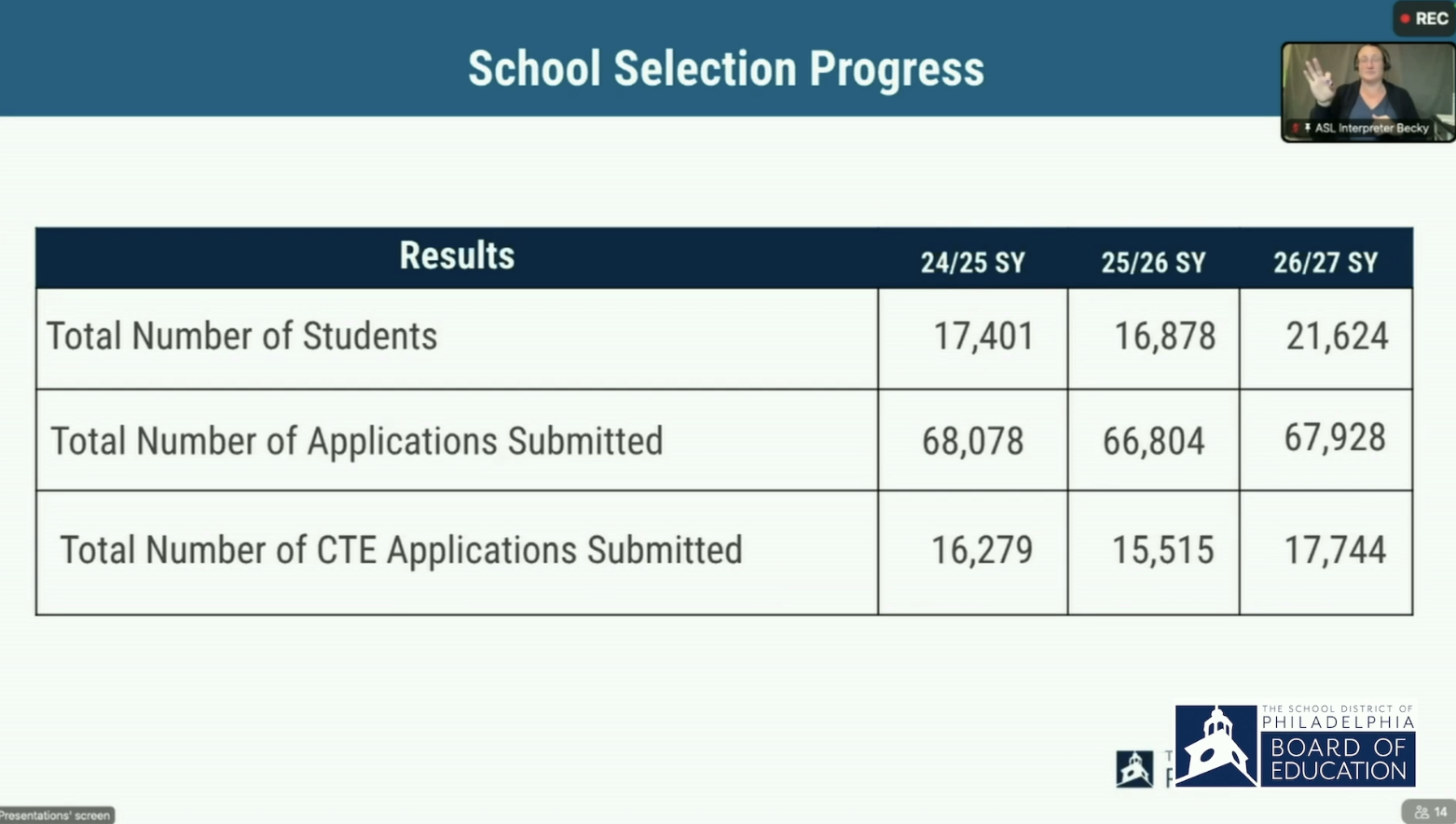
This year, 21,624 students applied to criteria-based schools, up from 16,878 students last school year. There were 67,928 total applications submitted, and 17,744 career and technical education applications submitted (that number is also up).
Superintendent Tony Watlington shared this slide on progress with the district’s school selection process during a school board meeting on Dec. 4, 2025.
// Timestamp 12/04/25 4:37pm
5,000 people have taken the facilities planning survey so far, Watlington shares
An update, now, on the facilities planning process: 5,000 people have responded to the district’s new facilities survey.
“It’s been an honor to work with Teamsters Local 502,” Watlington said, noting principals’ key role in student learning. “We ask the board for your favorable adoption of the contract tonight.”
// Timestamp 12/04/25 4:22pm
Two students share their love for KIPP North
Student speakers are up now.
First is Jovahni Hazel, a student at KIPP North. Jovahni said he never got help at his old school, but he gets lots of help at KIPP. His sister used to hate school, but she loves school at KIPP.
“Kids like me work hard, we try, we show up, we push through things most people never see … Please keep [KIPP] open.” (The board has moved to nonrenew KIPP over academic concerns.)
Timothy Fontaine, another KIPP North student, loves his school. Timothy loves music.
“At KIPP North, they’re really the ones who let me grow with it.”
A drummer, Timothy has had chances to lead music class. The staff has helped him in many ways.
“This school is more than a school to me. It’s my home.”
// Timestamp 12/04/25 4:17pm
Attendance taken as the meeting begins
All nine board members are present at tonight’s meeting.
// Timestamp 12/04/25 4:09pm
Seniors and teacher of the month are honored
Seniors of the month are Juan Aquino of Olney High School and Andre Carter of Parkway Northwest High School for Peace and Social Justice.
Teacher of the month is Cynthia Carr from Swenson Arts and Technology High School.
// Timestamp 12/04/25 4:06pm
Final school board meeting of the year begins
School board meeting, here we go!
The final school board meeting of 2025 is the annual re-organizational meeting, when officers will be elected for 2026.
School board president Reginald Streater kicks the meeting off.
Philly school board to host its monthly action meeting
// Timestamp 12/04/25 3:45pm
The Philadelphia school board is set to host its monthly action meeting — the last of 2025 — starting at 4 p.m.
Among the topics on the agenda is the election of the board’s president and vice president for the coming calendar year.
Uri Monson, Gov. Josh Shapiro’s longtime confidant and Pennsylvania’s budget secretary, is the new executive director of the $80 billion-asset Pennsylvania school pension and investment system, known as PSERS.
The move puts Monson, a former top finance officer for the School District of Philadelphiaand for Montgomery County government while Shapiro was its top elected official, atop the agency responsible for paying retirement checks to half a million current and retired school employees.
Monson has shown “exceptional financial leadership and integrity,” Shapiro said in a statement, citing Monson’s bond refinancing work that shaved state interest costs and helped boost its credit ratings so they are no longer among the lowest of the 50 states.
Zachary Reber, a deputy secretary in Monson’s office with 30 years of state government experience, will become the state’s new budget secretary. Shapiro credited Reber as a top negotiator for the 2025-26 budget, helping clinch the deal with legislators.
At PSERS, Monson will lead a staff of 350. The board picked Monson “because of his extensive public-sector financial experience,” board chair Richard Vague said in a statement that also said Monson’s hiring followed “a nationwide search.”
The new executive director “understands both the financial demands of a pension system and the responsibility” to school staff and retirees, said vice chair Sue Lemmo, a retired teacher.
Monson pledged to work with the board, staff, and other stakeholders — who include taxpayers and pension system members — to ensure “retirement security.”
He holds both a master’s degree in public policy and a bachelor’s degree from Columbia University and a second bachelor’s from the Jewish Theological Seminary of America.
PSERS is one of the most expensive state programs, consuming $5.5 billion directly from public revenues last year, including both state and local property tax funds, plus $1.2 billion routed through school workers’ paychecks.
The system also collects profits from its wide-ranging investments, totaling $5.7 billion last year.
The switch will likelymean a significant pay raise for Monson, who earned $211,000 a year as budget czar, the most of any Pennsylvania cabinet officer and more than the lieutenant governor.
While working as the top budget officer in the state since 2023, Monson oversaw Shapiro’s annual state budget proposals, which guide spending for the next five years.
Republican lawmakers criticized Shapiro’s 2025-26 budget proposal for counting on new revenue streams, such as marijuana taxes, that had yet to be approved by the General Assembly.
Monson’s predecessor at PSERS, Terrill Savidge Sanchez, was paid $317,000 in fiscal 2024. A longtime PSERS employee who also headed the smaller Pennsylvania state workers’ pension system (SERS), Sanchez announced her retirement earlier this year. Chief investment officer Ben Cotton stepped in as interim director after she left.
Sanchez was tapped for the top PSERS job in 2022 after the departure of Glen Grell, a former state representative and lawyer who tripled his legislative paycheck by joining PSERS in 2015.
Grell and other top staffers retired during a federal investigation into the system’s exaggerated earnings and secretive land deals, which was followed by changes in pension investment, financial reporting, audit, and travel practices.
As governor, Shapiro has not attempted such a purge, either at PSERS, where he controls three of 15 trustee seats, or at the SERS state employee pension system, where the governor appoints six of the 11 trustees.
PSERS trustees on their own have scrapped hedge funds and cut back on private-equity funds in recent years, citing high fees and poor returns compared to the rising U.S. stock market.
PSERS, like the state workers’ pension system, was among the first state pension systems to invest heavily in private assets in the late 1990s and 2000s.
PSERS’s private investments underperformed U.S. stocks during the 2010s bull market. Those investment returns, plus rising retirements and pension underfunding in the early 2000s, required higher taxpayer payments in recent years to keep the fund from growing less solvent.
Pennsylvanians now pay 34 cents into the PSERS plan for every $1 in school staff wages.
Some owners of private money managers who solicit top leaders of PSERS and other state pension funds for investments are major political donors at the national level, though an SEC rule has barred them from collecting state and local pension fees after donating to state or local candidates.
U.S. Sen. David McCormick (R., Pa.) was chief executive of hedge fund Bridgewater Associates when it was PSERS’s largest money manager. It oversaw about one-tenth of the state’s investments and collected more than $750 million in Pennsylvania investment fees over the 20 years before PSERS trustees voted to drop hedge funds in 2021.
Staff writer Gillian McGoldrick contributed to this article.
Quinta Brunson wants you to dig into your pocket to make free field trips possible for Philadelphia students.
The actor, writer, and comedian — along with Philadelphia School District officials and the leader of the district’s nonprofit arm — announced the “Quinta Brunson Field Trip Fund” on Tuesday.
District teachers and administrators will be able to apply for money for field trips by completing a short application subject to evaluation by an independent, internal group of educators. Field trip grants will be made twice a year.
“They opened my world, sparked my creativity, and helped me imagine a future beyond what I saw every day,” Brunson said. “Going somewhere new shows you that the world is bigger and more exciting than you believe, and it can shape what you come to see as achievable. I’m proud to support Philadelphia students with experiences that remind them their dreams are valid and their futures are bright.”
“Abbott Elementary” star Quinta Brunson watches the Phillies play the Atlanta Braves during a taping of the show in Philadelphia in August.
Every Abbott Elementary season has featured a field trip episode, including visits toSmith Playground, the Franklin Institute, and the Philadelphia Zoo. Brunson’s fund “will remove the financial barriers that too often limit our children’s access to these enrichment opportunities,” officials for the Fund for the School District of Philadelphia said.
The GivingTuesday launch kicked off with an unspecified donation from Brunson herself.
Kathryn Epps, president and CEO of the Fund for the School District of Philadelphia, said getting students out of their classrooms is crucial.
“We are honored to partner with Quinta to expand these experiences for children in Philadelphia’s public schools, helping them to envision and realize any future they desire,” Epps said.
Tony B. Watlington Sr., Philadelphia School District superintendent, said he was grateful to Brunson.
“We want our students to venture out and bridge what they’re learning in the classroom to engaging, real-world learning experiences,” Watlington said. “This commitment to equitably expanding opportunities for students to have experiences outside of their classroom will help accelerate student achievement and we are becoming the fastest improving, large urban school district in the nation.”
A congressional committee is investigating allegations of antisemitism in the Philadelphia School District.
U.S. Rep. Tim Walberg (R., Mich.) said this week that the House Education and Workforce Committee — which he chairs — would probe “disturbing reports of Jewish students being harassed and subjected to open antisemitism in their classrooms and hallways” in three school systems: Berkeley Unified in California, Fairfax County in Virginia, and Philadelphia.
Walberg and U.S. Rep. Ryan Mackenzie, a freshman Republican who represents the Lehigh Valley, informed Superintendent Tony B. Watlington Sr. of the investigation in a letter sent Monday.
The committee, the lawmakers said, “is deeply concerned” that since the Oct. 7, 2023, Hamas attacks on Israel, it has “received allegations that SDP is rife with antisemitic incidents, including allegations of teachers spreading antisemitism in the classroom and SDP approving antisemitic walkouts that isolate Jewish students.”
Monique Braxton, a spokesperson for the district, said she cannot comment on ongoing investigations.
The Office of Civil Rights found in December 2024 that despite “repeated, extensive notice” of acts of antisemitism and other harassment in its schools, the district did not adequately investigate the claims, take appropriate steps to respond to them, or maintain all necessary records.
Walberg and Mackenzie’s letter said that even after the Office of Civil Rights settlement, antisemitic incidents have continued unanswered.
Allegations of antisemitism against certain educators
The representatives also referred to the district’s director of social studies curriculum, who they said “has been widely condemned by Jewish advocacy groups in light of his ‘pattern of denying the Jewish connection to the Land of Israel, refusing to speak about peace or coexistence, and downplaying the lived experiences of Jewish people in the face of violence.’”
Philadelphia, the letter said, failed “to exercise oversight of antisemitic materials in the classroom.” Officials also took issue with what they said was a partnership between the district and the Council on American-Islamic Relations-Philadelphia. (The organization this summer announced it was available to partner with local schools and administrations to provide religious accommodations and build inclusivity.)
Ahmet Tekelioglu, executive director at CAIR-Philadelphia, said it “takes pride in offering these resources” but had no special partnership with Philadelphia’s school district. Instead, it was broadly offering its educational materials and training to any school, educator, or district, he said.
Tekelioglu dismissed the investigation as the machinations of “wild, right-wing” congresspeople.
“It’s a continuation of McCarthyism, what they are trying to do against colleges,” Tekelioglu said. “They are trying to quell and suppress academic freedom in school districts.”
What are the representatives calling for?
The committee requested documents “to assess SDP’s compliance with Title VI and determine whether legislation to specifically address antisemitism discrimination is needed.”
The district was given a deadline of Dec. 8 to produce documents including an anonymized chart of all allegations of antisemitism against students, faculty, or staff since Oct. 7, 2023; all documents and communications since that date “referring or relating to walkouts, toolkits, workshops, curricula, course materials, educational material, guest speakers, lecture series, partnerships, teacher training, or professional development, referring or relating to Jews, Judaism, Israel, Palestine, Zionism, or antisemitism, in the possession of SDP schools or offices”; and more.
Philadelphia School District principals have a contract — and raises.
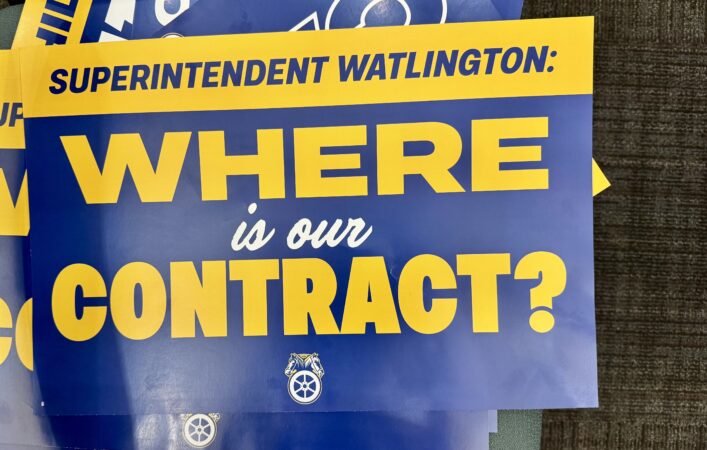
The tentative, four-year deal was struck Monday night, nearly three months after an August contract deadline for the Commonwealth Association of School Administrators, Teamsters Local 502.
It also came days after CASA members publicly called out district officials, accusing them of negotiating in bad faith.
Robin Cooper, president of the nearly 1,000-member union — which represents principals, assistant principals, climate managers, and other administrators — said in a statement that the contract “will provide continued stability for our administrative leaders.
The pact, Cooper said, “affirms the dedication and innovative leadership of CASA administrators, recognizing them as pivotal change agents, who drive both student and teacher success. It also represents a meaningful step toward honoring and uplifting our exceptional leaders by addressing wage compression, providing across-the-board salary increases, and including collaborative language that acknowledges administrators as vital partners in the educational process.”
Details of the contract were not immediately available; neither was the date CASA members will meet to consider ratifying the contract.
“We are pleased to have reached a tentative four-year agreement that both honors the dedication of our CASA members and upholds our commitment to strong financial stewardship,” Superintendent Tony B. Watlington Sr. said in the statement. “This agreement provides the stability, clarity, and momentum we need to continue our strong partnership with CASA and to advance our five-year strategic plan, Accelerate Philly.”
Last week, Cooper rallied her members publicly, appearing at a hearing on district matters before City Council and at a school board meeting to draw attention to CASA’s lack of a contract.
Cooper had said that the main sticking points in the negotiations were related to finances.
“First-year people are making what senior people make,” Cooper said.
City principals — working without a contract for nearly three months — showed up in force Thursday night to urge the Philadelphia School District to take their demands more seriously.
Dozens of administrators waved signs and chanted as their union president addressed the school board.
From the #phled school board meeting – members of CASA, the district’s principals’ union, showed up in force. pic.twitter.com/Xnl5jbIXLl
“When is it time for the district to give back to those who consistently have your front and back?” asked Robin Cooper, president of the principals union. “We get pushed to the background with no mention of our blood, our sweat, and tears in the ongoing transformation of our beloved district.”
Cooper said the district was “negotiating in bad faith.”
CASA — the Commonwealth Association of School Administrators, Teamsters Local 502 — represents just under 1,000 principals, assistant principals, climate managers, and other workers.
The union can’t strike, but Cooper and CASA members have ratcheted up public pressure. On Tuesday, many union representatives attended a City Council hearing, prompting Council members to ask Superintendent Tony B. Watlington Sr. why CASA still has no contract.
Watlington and board president Reginald Streater both said they cannot comment on negotiations in public.
“You are valued, and we’re going to get this done,” Watlington told Cooper and members of CASA.
But Cooper was clearly frustrated, and skeptical. At the last negotiating session, held this week, CASA presented multiple proposals, but the district countered with the same offer it put on the table previously.
CASA’s current contract expired Aug. 31, as did pacts with the Philadelphia Federation of Teachers and School Police Association of Philadelphia — but those two unions reached deals that included raises.
The main sticking points for CASA, Cooper said in an interview, include issues related to wages.
“First-year people are making what senior people make,” said Cooper.
Robin Cooper, president of the city’s principal union, speaks at the monthly school board meeting on Aug. 21.
The union also takes issue with the fact that some workers have to take pay cuts to become administrators — the district’s senior career teachers earn more than assistant principals are paid.
“You can’t have a promotion and make less,” said Cooper, who said she believes that after agreeing to PFT and school police deals, the district “came to the table with whatever was left over.” She also takes issue with the school board paying millions to outside contractors but not settling with CASA.
Her members will continue to show up to work, Cooper said, but CASA isn’t finished showing its muscle.
“I’m not one to be bullied,” said Cooper.
No facilities master plan, but community pushback over what’s to come
In other school board happenings, officials did not present a facilities master plan — expected to include school closings — this month, as originally planned.
Watlington said earlier this week he was extending the timeline to gather more public input around four emerging themes: strengthening K-8 schools, reinvesting in neighborhood high schools, reducing school transitions, and expanding access to 5-12 criteria-based schools.
“We’re committed to not fumbling the football on the 2-yard line,” Watlington told the board Thursday night.
Still, members of the public said they wanted no school closings at all.
“Public education is not a business,” said Deborah Grill, a retired district educator and member of the Alliance for Philadelphia Public Schools. “It is a civic obligation. The school district is not a business to be rightsized.”
The school system has 70,000 excess seats, a large number of old buildings in poor condition, and some schools that are overcrowded. Officials have said they will close schools — but also order colocations and other repurposing, as well as new construction and major renovations — not to save money, but to offer students citywide a more equitable and better education.
Paul Brown, a psychologist in the district, said schools are still dealing with the fallout of mass building closures in 2013.
“We need to keep our schools open,” Brown said. “The goals of efficiency should not come at the expense of our most vulnerable.”
Seeking a better wellness policy
The board also heard impassioned testimony about its wellness policy, which was to be considered at Thursday’s meeting, but was temporarily withdrawn.
Watlington has said he agrees that children should be able to use the bathroom, but said policy shouldn’t dictate it, that it should be left to schools to work out how best to handle things. At a board hearing earlier this month, he also pushed back on parents’ statements that some children wear diapers to school because they fear having accidents without guaranteed bathroom access.
Inella Ray, a Lift Every Voice board member, told the board and Watlington that “we do not want our stories dismissed as lies. Girls wear Depends because they cannot always change their pads. And we must believe them.”
Parents will not “scapegoat, report or target teachers,” Ray said.
“When harm occurs across dozens of schools, it is a policy and leadership issue, not a teacher problem,” Ray said.