Tag: School District of Philadelphia

  • At Philly school board meeting, concerns bubbled up over the school closing process and principals working without contracts

    At Philly school board meeting, concerns bubbled up over the school closing process and principals working without contracts

    // Timestamp 11/20/25 7:23pm

    Recap: Philly school board hears concerns over the principal’s union contract negotiations, potential school closings, the district’s wellness policy, and more

    The Philadelphia School Board held its monthly action meeting at 4 p.m. Thursday. It lasted a little over three hours.

    Here are a few takeaways:

    • Principals showed up to the meeting in full force, urging the board to give them a fair contract after working without one for three months. Principal’s union president Robin Cooper spoke early in the meeting, asking the board: “What about the administrators?”
    • Many parents and members of advocacy group Lift Every Voice Philly spoke to the board about its wellness policy, emphasizing the need for guaranteed bathroom breaks, lunch time, access to recess, and more. Some took issue with Superintendent Tony Watlington’s comments at a meeting earlier in November that some parents could be making claims without evidence.
    • The facilities planning process was also a hot-button issue. Many urged the board not to close schools. The school board and superintendent asked the public to take their survey by Dec. 11 to share their concerns.

    // Timestamp 11/20/25 7:22pm

    Board approves its final item and adjourns the meeting

    And the board approved the Intermediate Unit action item unanimously. The IU item included contracts with various vendors for a school safety grant for non-public schools, worth $1.5 million.

    And now the meeting really is over! The next board meeting will be held in two weeks, on Dec. 4.


    // Timestamp 11/20/25 7:20pm

    Board approves all the items on its agenda

    The board zips through its consent agenda, adopting all items unanimously.

    The board meeting is over — but not really! In a Philly-only quirk, the board is also the board for the Philadelphia Intermediate Unit, which handles some special education matters.


    // Timestamp 11/20/25 7:18pm

    Streater tells the public: ‘We are chronically underfunded’

    Board president Reginald Streater wraps up public comment by reminding the public that “we are chronically underfunded” and said that everything folks asked for “has a cost.”

    But he says the board is listening, even if they don’t say anything.


    // Timestamp 11/20/25 7:17pm

    Retired district staffer speaks out about charter schools

    Lynda Rubin, a retired district staffer and a member of the Alliance for Philadelphia Public Schools, decries charter schools.


    // Timestamp 11/20/25 7:13pm

    Retired Philadelphia teacher urges board not to close schools

    Deborah Grill, a retired Philadelphia teacher and member of the Alliance for Philadelphia Public Schools: “public education is not a business. It is a civic obligation,” she said. “The school district is not a business to be rightsized.”

    “The facilities planning process has been a disaster from the start,” Grill said. A “last-minute” survey will not fix it, she said.

    “No community wants their neighborhood school closed,” she said.

    “You’re failing as a business to give the customer what they want, so my question is: What community are you catering to, because it’s not your school communities?” Grill said.


    // Timestamp 11/20/25 7:11pm

    Community member tells the board the district is ‘dooming these children to slavery’

    Leah Clouden, daughter of Mama Gail and Horace Clouden, tells the board: “K-8 in our urban area do not work.”

    “We need the basics put back in school — phonics and cursive writing,” Clouden said. Without the basics, the district is “dooming these children to slavery.”


    // Timestamp 11/20/25 7:07pm

    Mama Gail Clouden, a regular speaker at school board meetings, calls ‘on the ancestors to fix this’

    Mama Gail Clouden is “calling on the ancestors to fix this” — issues in the district.

    “We have been better, and we’re going to be better with or without you,” Mama Gail says to Watlington. Talking about the district’s accolades is great, but “when the children in my neighborhood aren’t doing well, that’s a problem.”


    // Timestamp 11/20/25 7:03pm

    Retired district building engineer urges board to consider a junior high model

    Horace Clouden, a retired district building engineer, is again emphasizing his belief that restoring a junior high model will improve the entire district.

    Students aren’t prepared for high school coming from a K-8 setting, Clouden said.


    // Timestamp 11/20/25 7:02pm

    Retired district teacher speaks to the board about Ada Lewis

    Barbara Dowdall, a retired district teacher and member of the Alliance for Philadelphia Public Schools, is talking about Ada Lewis, namesake of a now-closed school and a teacher who authored the report that helped integrate Philadelphia schools.


    // Timestamp 11/20/25 6:56pm

    Parent and Lift Every Voice member asks Watlington not to question their group’s honesty as they fight for students’ bathroom rights

    LaTi Spence, a parent of two students at Houston Elementary, stresses that there are no guarantees for student bathroom breaks, and no guidance to teachers on how to make this happen.

    “The superintendent has publicly called parents’ concerns unsubstantiated, said he has never seen a child in a diaper,” Spence said. “Lift Every Voice would never question the superintendent’s honesty. We expect the same good faith in return.”

    “Bathroom accidents are humiliating — ask any child,” Spence said. Parents send girls to school in Depends because they’re not always able to change sanitary pads when they have their periods. “This is a lived experience — this is not a rumor.”

    Parents won’t scapegoat teachers, she said. Watlington has said he knows some children need to use the bathroom multiple times a day. “Right now, the child that needs to use the bathroom seven times a day has no guaranteed right to use it even once,” Spence said.


    // Timestamp 11/20/25 6:55pm

    District parent draws attention to 88 schools with poor/unsatisfactory building scores

    Emily Pugliese, a district parent and staffer at a climate nonprofit, is drawing attention to the 88 schools that received poor/unsatisfactory building scores in the district’s assessment.

    “I hope that you will pause this process even further,” and work with the community to prioritize safety and comfort, and building upgrades.

    “We know the current administration and school board isn’t responsible” for the poor condition of many district schools. But it has a host of organizations and community members ready to help, Pugliese said.


    // Timestamp 11/20/25 6:52pm

    District climate manager asks the board for a fair contract

    Shawn Viera, a district climate manager, tells the board: “Climate managers and other members of CASA deserve a fair contract.”


    // Timestamp 11/20/25 6:49pm

    Lift Every Voice board member and Philly graduate questions Watlington over wellness issues

    Inella Ray, a community member, is questioning Watlington’s assertion from a previous meeting that he never heard a report of a student wearing diapers because they couldn’t use the bathroom.

    Parents from Lift Every Voice have been reporting this issue for years, she said.

    “Girls wear Depends because they cannot always change their pads, and we must believe them,” Ray said.

    Ray was suspended at age 12 because she asked to use the bathroom and was ignored, and when “I took care of my basic needs, my humanity was dismissed,” Ray said.


    // Timestamp 11/20/25 6:47pm

    Olney High principal says district is ‘experimenting’ with charters at the expense of traditional public schools

    Michael Roth, principal of Olney High, said he is not against charters — he used to work for one. But the district is “experimenting” with charters, Roth said, at the expense of traditional public schools.

    The board just approved a dual enrollment school to serve schools in Olney’s zip code, even though Olney offers dual enrollment.

    “Let’s support all students,” Roth said. He tells the board: Get our house in order before authorizing new schools.


    // Timestamp 11/20/25 6:45pm

    Volunteer with the Friends of Bache-Martin shares the value of school libraries

    Barbara O’Connell, a volunteer with the Friends of Bache-Martin, talks about her group’s efforts to run the school library, and how beneficial it’s been to students.

    “The library is creating kids who not only can read, but also will satisfy their curiosity, and that will transport them, and stay with them throughout their lives,” O’Connell said. She urges the board to provide school libraries for all students.


    // Timestamp 11/20/25 6:41pm

    School psychologist tells the board: ‘We need to keep our schools open’

    School psychologist Paul Brown said the facilities planning process overemphasizes efficiency and under-values sustainability.

    “The demographics of my high school is a direct result of the closing of Germantown High School in 2013,” said Brown, who works at Roxborough. There’s “unsustainable stress on our public school system. We need to keep our schools open. The goals of efficiency should not come at the expense of our most vulnerable.”


    // Timestamp 11/20/25 6:40pm

    Lift Every Voice member advocates for guaranteed bathroom and lunch breaks

    Sarah Burgess, a parent at Lea Elementary and a Lift Every Voice member, is advocating for guaranteed bathroom breaks and time to eat lunch.

    “Parents aren’t looking for scapegoats. We’re asking for a system-wide policy,” Burgess said. “I know implementation is easier said than done. I know there can be staffing challenges, and I know there are competing priorities,” but this is an issue we all agree on, she said.


    // Timestamp 11/20/25 6:35pm

    ‘When is things going to change?’ community member asks the board

    Jason Grisby, a community member, said the same issues have plagued city schools for years. “When is things going to change?” Grisby said.

    He also shared concerns about the security of schools. He walked into a city school without being questioned as an outsider, Grisby said. Superintendent Watlington tells Grisby that a security official will speak to him, and no one should be able to walk into a school.


    // Timestamp 11/20/25 6:33pm

    Community members speak to the board about using data to support schools and the importance of family engagement

    Donna Fields, a mother of three former district students and community researcher, urges the board to consider data to support schools.

    Quibila Divine, another community member, said 98% of parents in a North Philadelphia survey felt unwelcome in their child’s school. Meaningful family engagement leads to better student outcomes, Divine said, but teachers are often not trained on how to do this.


    // Timestamp 11/20/25 6:27pm

    Legislative aide for Councilmember Thomas speaks on his behalf in favor of joy campaign

    Zach McGrath, a legislative aide for Councilmember Isaiah Thomas, is reading a statement on behalf of Thomas. He supports Lift Every Voice’s joy campaign and its call for explicit promises for bathroom and water breaks for students.

    “We maintain our support for their five wellness policy recommendations,” Thomas wrote. District-wide solutions are needed for these matters.


    // Timestamp 11/20/25 6:24pm

    Activist tells the board: ‘We don’t need another survey. We don’t need another meeting.’

    Lisa Haver, of the Alliance for Philadelphia Public Schools, criticizes City Council’s recent district hearing. The questions were “insipid,” Haver said.

    “We don’t need another survey. We don’t need another meeting,” Haver said of the facilities planning process.

    She asks the crowd: Does anyone want their school closed?

    “NO,” the crowd yells.


    // Timestamp 11/20/25 6:23pm

    Community member speaks on student access to year-round swimming

    Gloria Presley, of Philly Aquatics, is also calling for indoor, year-round swimming opportunities for all students.

    “We cannot afford to wait any longer,” Presley said. “We cannot afford to turn our backs on Philly youth.”


    // Timestamp 11/20/25 6:19pm

    Roxborough High teacher urges the board not to close schools

    Daniel Reyes, a teacher at Roxborough High and member of Stand Up for Philly Schools, tells the board: “I’m here to advocate against closing schools,” Reyes said.

    Closing schools destabilizes neighborhoods, Reyes said, asking: Why is the process downsizing the district without addressing the effect of charters on the district?

    “We need stable, K-12 systems in all neighborhoods that meet the needs of all students,” Reyes said.


    // Timestamp 11/20/25 6:17pm

    Speakers address the board about student experiences, wellness, school facilities planning, and more

    Jasmine Pearson, a parent of a student at Mastery Simon Gratz High School, tells the board the school is readying her child to graduate.

    Parent Julie Krug urged the board to update its wellness policy to ensure students have access to recess, bathroom breaks, and time to eat their lunch.

    Community member Ryan Pfleger came to the board with a request: Don’t close any schools. He urged the board to reconsider closing buildings and instead invest in communities with underutilized buildings.

    Carrera Wilson-Allure spoke to the board about joy.


    // Timestamp 11/20/25 6:06pm

    CASA chief steward Deana Ramsey says their union is the ‘backbone of district leadership’

    Deana Ramsey, a district principal and CASA’s chief steward, speaks on behalf of the principals.

    The union “is the backbone of district leadership,” Ramsey said. The union represents principals, assistant principals, climate managers, and safety supervisors.

    Dozens of principals in attendance stood up to chant and hold up signs after Ramsey’s comments.

    Board president Streater said the board cannot comment on negotiations, but said he looks forward to a contract. “We’re a family, and sometimes family has disagreements,” he said.


    // Timestamp 11/20/25 5:58pm

    Parents speak in support of Mastery Wister and Mastery Clymer

    Johncarlos Quiles, a parent at Mastery Wister, is saying the school has changed his perspective on charters.

    “When I was in school, the communication was nonexistent between parents and the teachers,” Quiles said. Wister has changed that because families are very involved, he said.

    Wister has helped his son develop into a “super, super kid,” Quiles said. “We’re looking for that [charter] renewal.”

    Ahlizee Wright, a parent at Mastery Clymer, said her son’s school is a “special place.” Her son’s previous school neglected his learning and safety, Wright said.


    // Timestamp 11/20/25 5:56pm

    Head of Philly Aquatics advocates for year-round swimming opportunities

    Charisma Presley, head of Philly Aquatics, is advocating for year-round swimming opportunities for city schools. Marcus Foster and Pickett Pools are the group’s priorities.


    // Timestamp 11/20/25 5:49pm

    Principals turn out in force to the school board meeting, as union president asks: ‘What about the administrators?’

    Philadelphia principals are out in force tonight. Before Robin Cooper, president of the principals’ union, speaks, a chant breaks out. “Who are we? TEAMSTERS? What do we want? A CONTRACT! NOW!”

    Principals in the district have been working without a contract for three months.
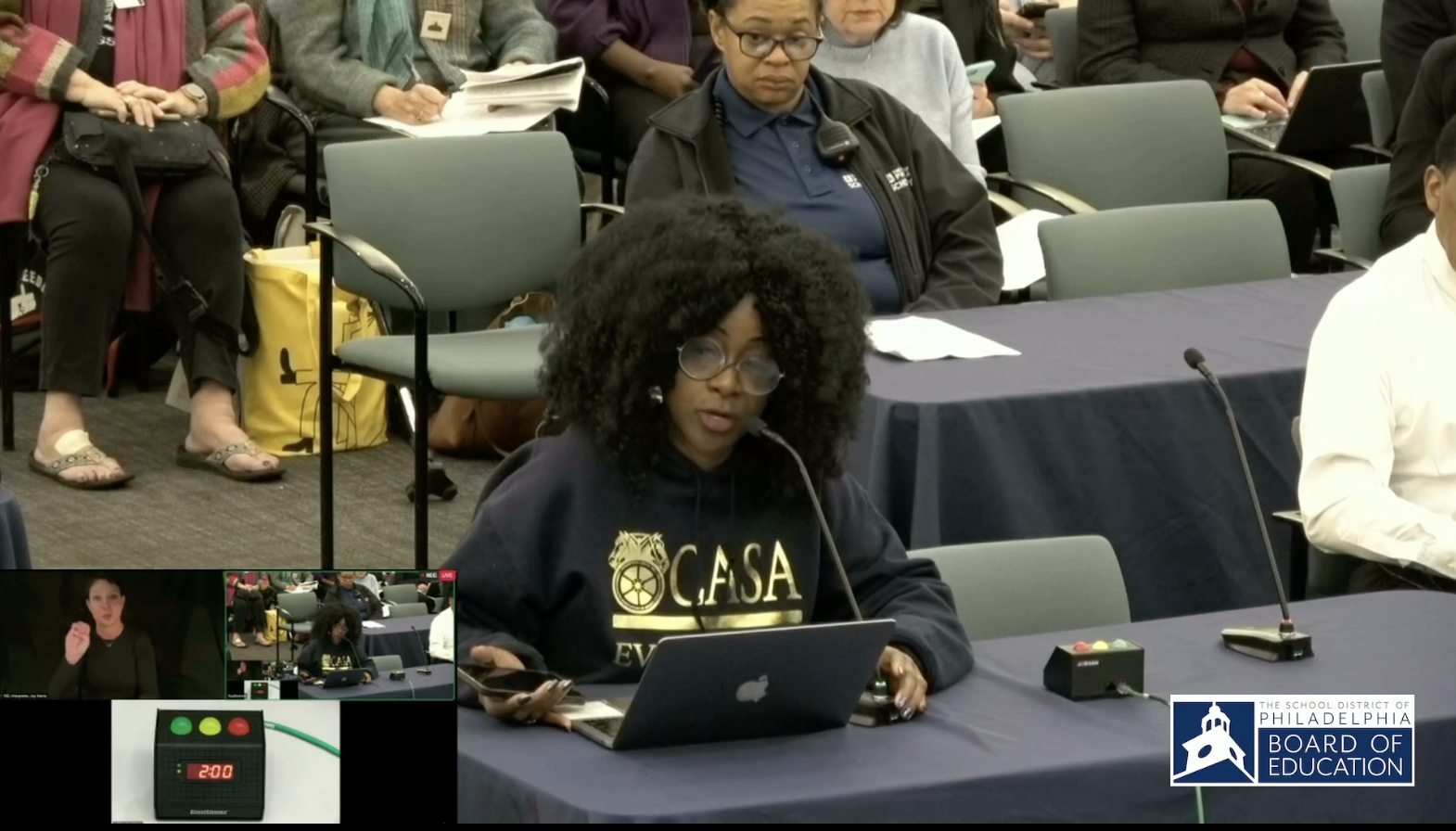
    Robin Cooper, president of CASA, the principals’ union, speaks to the Philadelphia school board at a meeting on Nov. 20, 2025.

    “I stand here in a situation that I’ve never experienced as the president- the proud president of Teamsters Local 502,” Cooper said. “I find myself not advocating for our students, not advocating for public education, not advocating for unconstitutional funding formulas, but rather advocating … to pay leaders their worth.”

    Principals have done everything they were asked for, Cooper said: boosted attendance, improve academics, market schools, advocate for their schools.

    Cooper said the district has asked for professional development funding and more. She suggests the district is not bargaining in good faith.

    “The partnership is often one-sided,” Cooper said. Board meeting after board meeting, the district gives out contracts to outside providers, but refuses to arrive at a contract for its nearly 1,000 administrators, she said.

    Cooper said that CASA is “fighting our own district.” Watlington often asks “what about the children?” CASA is now asking “what about the administrators?” Cooper said.

    “We fight, we partner, we lead, and we have been doing so with no support,” Cooper said. “I have but one ask — if we have been a good partner to the school district of Philadelphia.

    CASA and the district spent 12 hours at the table, Cooper said. They submitted multiple counterproposals, and the district came back with the same proposal. “We have given our blood, our sweat and our tears,” Cooper said.

    “I am expecting a win-win, and I hope that you are too,” Cooper said.

    Superintendent Watlington thanks Cooper and responds: “You are valued, and we’re going to get this done.”
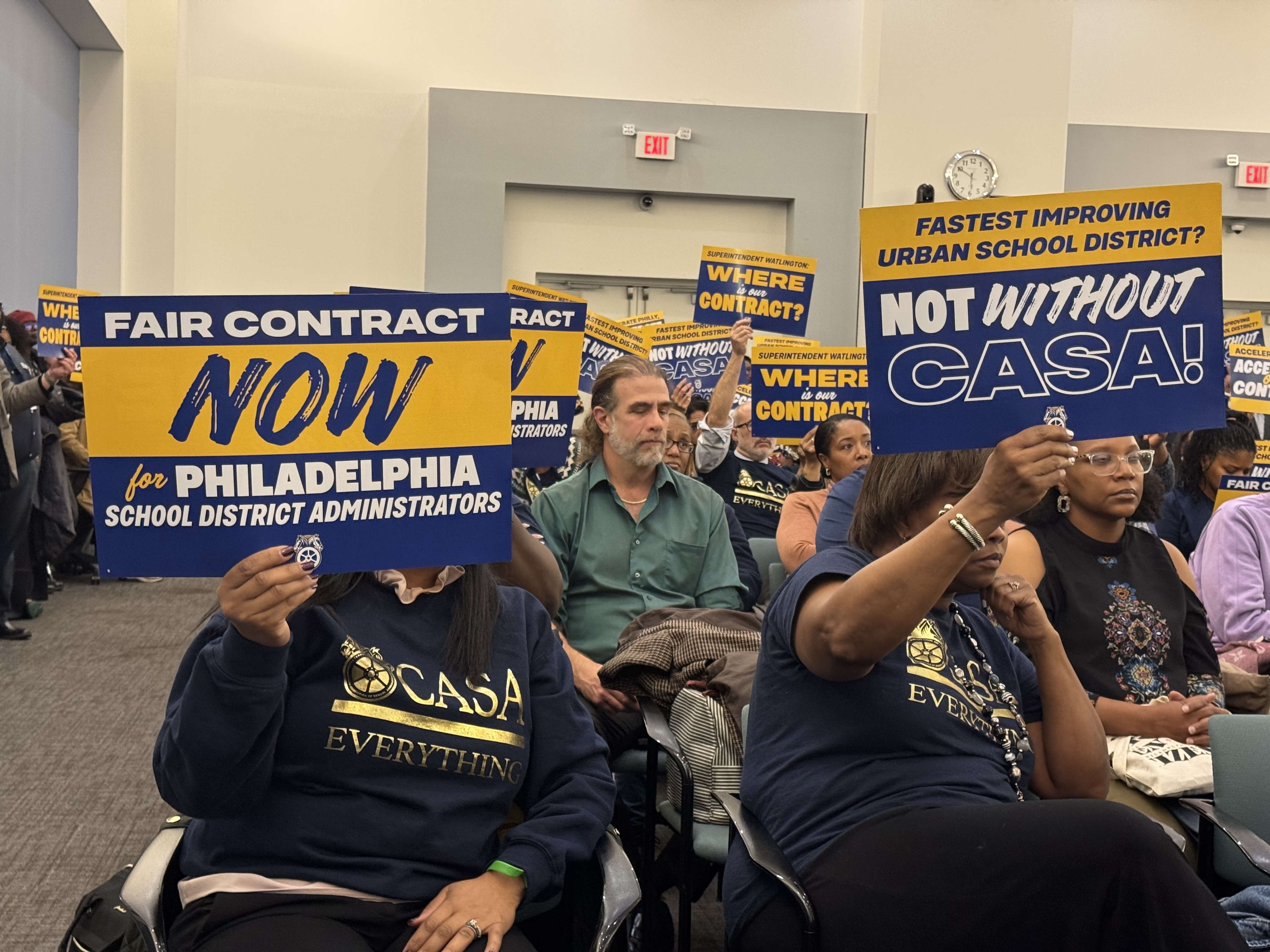
    Principals turned out in force at the Philadelphia school board meeting on Nov. 20, 2025, asking the district for a contract. They have been working without a contract for three months.

    // Timestamp 11/20/25 5:41pm

    Public comment set to begin

    Now we’re onto public comment. Thirty speakers have signed up to testify; there are four speakers on the waiting list.


    // Timestamp 11/20/25 5:38pm

    Streater urges community members to take the survey

    Streater said he completed the survey with his parent hat on — Streater has two children in a neighborhood K-8 school — and said it was easy to complete, finished in about five minutes.


    // Timestamp 11/20/25 5:37pm

    Board member applauds the district’s good financial news

    Board member Joan Stern notes the good financial news.

    “We are very proud of continuing to receive upgrades in our credit rating,” Stern said. The state budget — newly passed — is a help, but the district must be “constantly vigilant about our finances.”


    // Timestamp 11/20/25 5:36pm

    The survey is the public’s last chance to weigh in on facilities planning, board member says

    Board member Wanda Novales reminds the public that this is their last chance to weigh in on school facilities planning before decisions are made, and urges principals to push the surveys out to families.

    She also asks Superintendent Watlington to talk about how this survey is different. He says it’s more open-ended, not ranked.

    “We’re going to consider every bit of the feedback,” Watlington said.


    // Timestamp 11/20/25 5:28pm

    Board member applauds staff efforts on attendance

    Board member Cheryl Harper calls for a round of applause for principals, assistant superintendents, and staff for increases in student and teacher attendance.


    // Timestamp 11/20/25 5:25pm

    District is beginning to receive community feedback from survey

    The current survey, Watlington said, will be open until Dec. 11. The district’s data analysts “may get some external support” to process all the information received in the survey.

    The four themes emerging from feedback to far, Watlington said:

    1. Reinvest in neighborhood high schools.

    2. Expand access to schools with a 5-12 grade span.

    3. Reduce the number of school transitions (from 13 to about 6.)

    4. Increase building utilization.


    // Timestamp 11/20/25 5:20pm

    Watlington says they are committed to getting the facilities planning process right

    “We’re committed to not fumbling the football on the two-yard line,” Watlington said.

    The district wants to get facilities planning process correct and will take “just a little bit more time” to finalize the plan, which will include school closings, officials have said.

    The purpose of the facilities planning process, Watlington said, is to improve education for students citywide — to maximize offerings, to offer 21st-century learning.

    “We do not want to prepare our students for minimum-wage jobs,” the superintendent said.


    // Timestamp 11/20/25 5:19pm

    School district gets a credit rating upgrade

    “Exciting news” on the district’s financial outlook, Watlington said: The district got a credit rating upgrade, its third in three years. It’s now Baa1 rated by Moody’s.


    // Timestamp 11/20/25 5:17pm

    Fewer students have dropped out this year compared to this time last year, Watlington says

    On dropouts:

    In October this year, 384 students dropped out.

    It was 707 students in October of 2024, Watlington said.


    // Timestamp 11/20/25 5:15pm

    Student and teacher attendance is on the rise, Watlington shares with the board

    Good news on student attendance, Watlington said: 79% regular attendance in October — a 3 percentage point increase compared to last year.

    For teachers, 84% of teachers attended 90% or more. That’s up from 79% regular attendance in October of 2024.


    // Timestamp 11/20/25 5:09pm

    Board returns from recess with a poem

    And we’re back. Board president Streater allowed Frantzceska Dorvilien, the Mastery Simon Gratz High School student, to read a poem she wrote about how Gratz helped her on her journey.

    Now we’re on to Superintendent Tony B. Watlington Sr.’s presentation.


    // Timestamp 11/20/25 4:49pm

    Board takes a brief recess

    That’s the end of the student speakers list. The board is taking a five-minute recess because it’s dealing with technical difficulties.


    // Timestamp 11/20/25 4:45pm

    Students from KHSA, home of a student-built library, urge the board to invest in school libraries

    Dayniyah Little, a student at Kensington Health Sciences Academy, is asking for more access to school libraries and librarians.

    KHSA students banded together to open their own library, DreamEscape Library, but they staff it themselves. There are just a handful of certified school librarians in city schools.

    Isabella Le, another Kensington Health Sciences Academy student, says “libraries are a privilege to have in Philadelphia schools.” She’s proud of the DreamEscape library, Isabella said, which helps address the literacy crisis.

    Of libraries, Isabella said: “The absence of them in our schools hinders the possibility to expand literacy at all.”

    “We understand the budget is tight, but withholding libraries is not the answer,” Isabella tells the board.
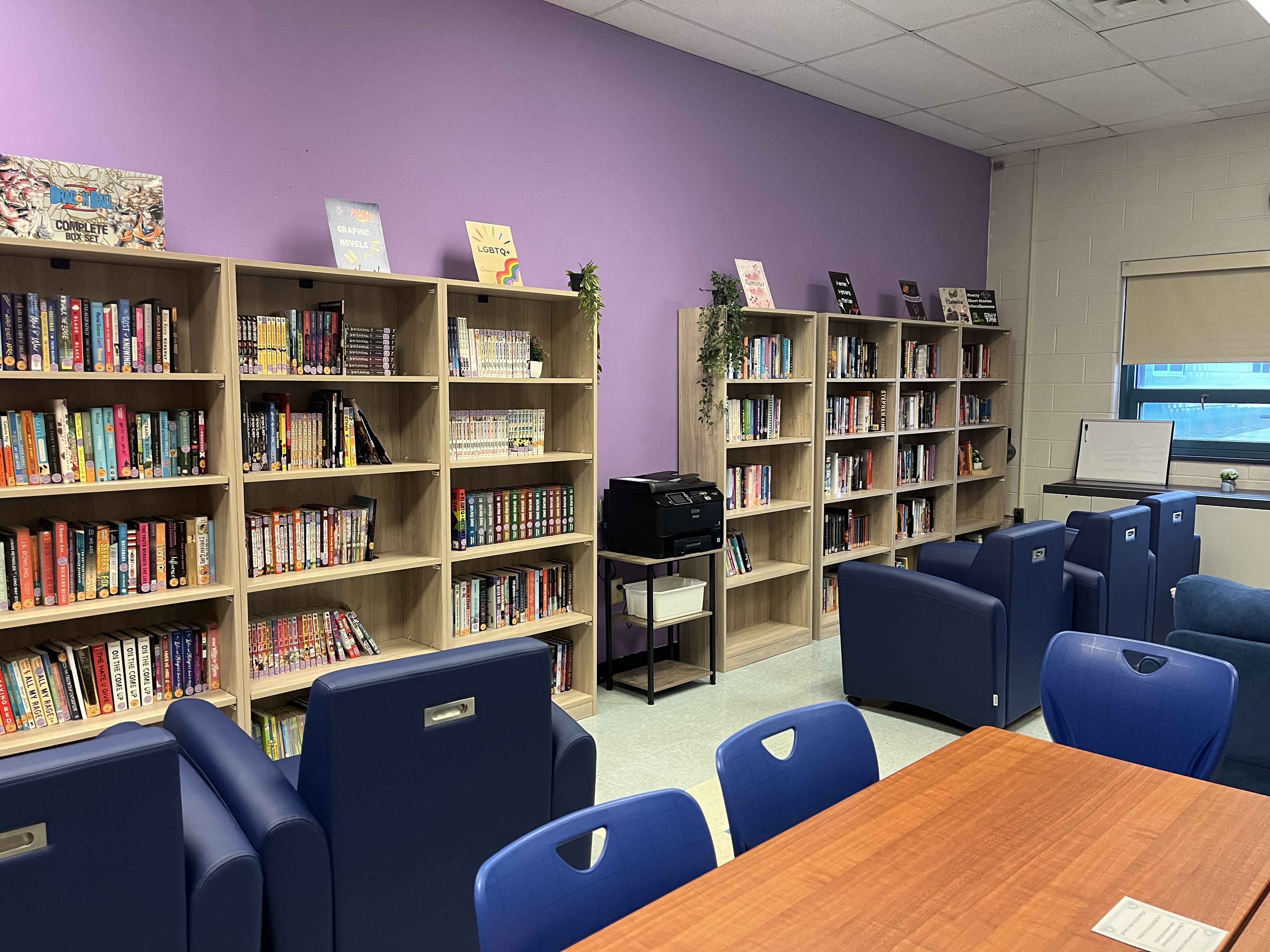
    The brand-new DreamEscape Library at Kensington Health Sciences Academy.

    // Timestamp 11/20/25 4:42pm

    Philly student shares his experience learning to swim and row at Philly Aquatics

    Whitman Dougherty, a Philadelphia student, entertains the crowd with tales of learning to swim and row. He’s a member of Philly Aquatics, a group advocating for year-round swim opportunities for all.

    “Opportunity doesn’t depend on luck. It depends on access,” Whitman says.


    // Timestamp 11/20/25 4:37pm

    Two students speak about their experiences at Simon Gratz High School

    Student speakers are on now.

    The first is Devon Choice, a senior at Mastery Simon Gratz High School. Devon says he’s been challenged and encouraged at Gratz, which offers students myriad opportunities.

    Frantzceska Dorvilien, another Gratz High School student, is testifying in Spanish through an interpreter. Frantzceska has lived in the U.S. for three years, and it hasn’t been easy, she said, but school is a bright spot — her teachers have pushed her to be the best, and supported her, regardless of challenges.


    // Timestamp 11/20/25 4:29pm

    Roll call: All members present but one

    Roll call: All board members are present for today’s meeting except Crystal Cubbage.


    // Timestamp 11/20/25 4:28pm

    Updates from the board’s executive session

    The board met in executive session to discuss several matters, including “property disposition” and confidential charter and investigation matters.


    // Timestamp 11/20/25 4:24pm

    This year’s state budget ‘moves us in the right direction,’ Streater says

    On the state budget, the board president says “this year’s budget moves us in the right direction,” but says the state must move forward more quickly to meet the educational adequacy gap identified by experts.

    “We have made meaningful progress, but Pennsylvania must keep moving toward adequacy so every student in every neighborhood has the resources they need to learn, grow and thrive,” Streater said.


    // Timestamp 11/20/25 4:22pm

    No applications for new charter schools

    Streater says the school board has not received any applications for new charter schools.


    // Timestamp 11/20/25 4:19pm

    Board honors students and teacher of the month

    One of the seniors of the month is Mario Rodriguez of Thomas A. Edison High School, who came to Philadelphia from El Salvador. Streater says he is a strong student with scholarship offers in hand already.

    The other senior of the month is Kateryna Sobolevska. A George Washington High School student who came to the U.S. from Ukraine, she’s an International Baccalaureate student who was chosen for a prestigious Princeton University journalism program.

    Teacher of the month is Takia McClendon of Bethune Elementary.


    // Timestamp 11/20/25 4:16pm

    Streater shouts out board member for recent prize

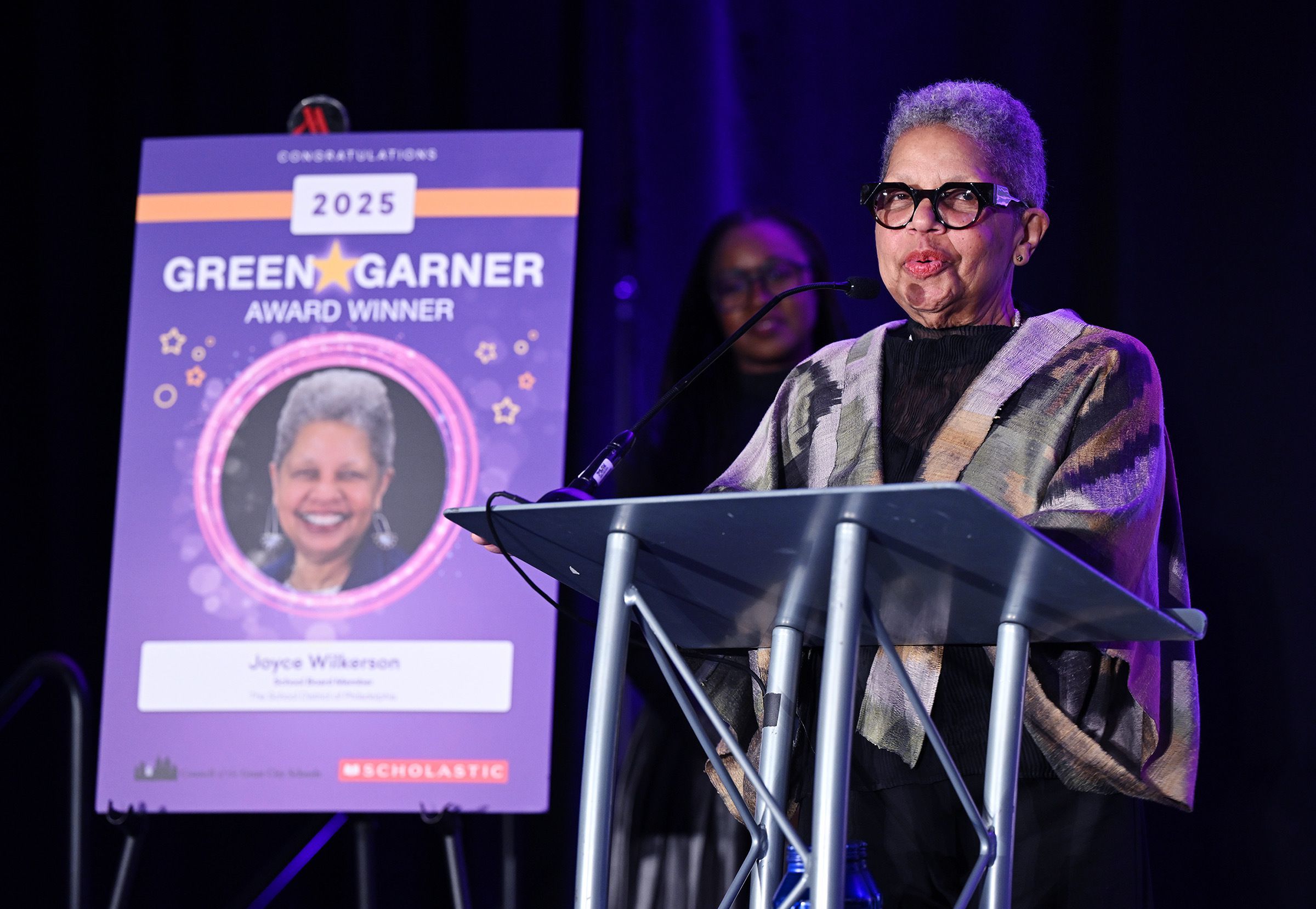
    Board president Streater reminds the crowd that board member Joyce Wilkerson recently won a prize as the nation’s top urban educator.


    // Timestamp 11/20/25 4:06pm

    School board meeting begins

    School board meeting, here we go!

    Board president Reginald Streater is detailing board visits this month: including to MYA (Middle Years Alternative), and spending time at the Council of Great City Schools‘ national conference, held this year in Philadelphia.


    // Timestamp 11/20/25 4:00pm

    Philly school board to host its monthly action meeting

    The Philadelphia School Board is set to host its monthly action meeting on Thursday at 4 p.m.

    There are a variety of issues expected to come up, including concerns over the school closing process and anger from principals who have been working for three months without a contract.

    Follow along for more updates.

  • ‘A Drugcember to Remember’ is coming back to its ‘old local hangout’

    ‘A Drugcember to Remember’ is coming back to its ‘old local hangout’

    Once again, Philadelphia music fans can look forward to a Drugcember to remember.

    Next month, Philly rock band The War On Drugs will renew a tradition that has been on hiatus since 2022. It will perform a trio of fundraising shows to benefit the Fund for the School District of Philadelphia, the nonprofit that raises money and coordinates investments into Philadelphia Schools.

    The Adam Granduciel-led seven piece band, that won a best rock album Grammy for A Deeper Understanding in 2018, will play three nights at Johnny Brenda’s in Fishtown, from Dec. 18-20.

    The 250 capacity club — which the band first played on the venue’s opening weekend in 2006 — is several magnitudes smaller that the amphitheater, arena, and festival stages the Drugs typically plays in venues around the world.

    Drugcember to Remember debuted in 2018 and became an annual Philly three-show tradition through 2022, with the exception of the COVID shutdown year of 2020.

    But it hadn’t taken place since 2022, and seemed in danger of being gone for good, with Granduciel now living on Los Angeles and bassist and original members Dave Hartley in North Carolina.

    Granduciel said in a statement that the return to the treasured tradition is a way to reaffirm its Philadelphia identity.

    The flyer for The War on Drugs’ 2025 ‘A Drugcember to Remember’ benefit shows at Johnny Brenda’s on Dec. 18-20.

    “This has been a year end highlight for me since we started doing it in 2018,” said the guitarist and songwriter who stepped out as a producer in 2025 on Craig Finn’s Always Been and Sam Fender’s People Watching. “Three rock shows at our old local hangout benefiting the Philadelphia School System. This band wouldn’t exist if not for the vibrant Philadelphia music community that has supported us from the beginning and we are very grateful for it.”

    The War On Drugs’ most recent studio album, I Don’t Live Here Anymore, came out in 2021. Last year, they released the in-concert recording Live Drugs Again.

    Its most recent Philadelphia performance was in the summer of 2024, sharing a bill with the National at the Mann Center in Fairmount Park. Besides the Drugcember shows, the only two dates on the band’s schedule are at festivals in Spain and Portugal in July 2026.

    A Drugcember To Remember will raise funds through ticket sales and also the sale of exclusive items though Philadelphia businesses, including Elixr Coffee, Sacred Vice Brewing, Room Shop, Uncle Ron’s Candles, and Kinetic Skateboarding/Nocturnal Skate Shop.

    Ticket for the Johnny Brenda’s shows go on sale at 10 a.m. Friday Nov. 21 at thewarondrugs.net/tour.

  • 3,000 protested conditions for Philly’s Black students in 1967. Here’s how these city kids remembered it.

    3,000 protested conditions for Philly’s Black students in 1967. Here’s how these city kids remembered it.

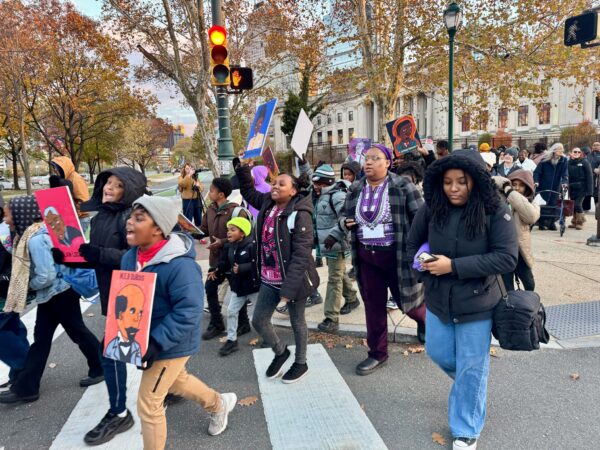
    The students walked together, chanting over the hum of Center City traffic, holding a homemade sign and shouting into a chilly November sky.

    “Hey hey!” they yelled. “Ho ho! Black history will never go!”

    Fifty-eight years to the day after 3,000 youth and their supporters walked out of Philadelphia School District schools to protest conditions for Black students, a clutch of kids from the Jubilee School held a march Monday to commemorate that landmark action, which historians say was a seminal moment both for the city and school integration across the country.

    Miles Matti, a fifth grader at Jubilee, a private school in West Philadelphia, walked with his brother, Theo, a third grader.

    “We’re doing it because those kids had every right to be heard,” said Miles, 10.

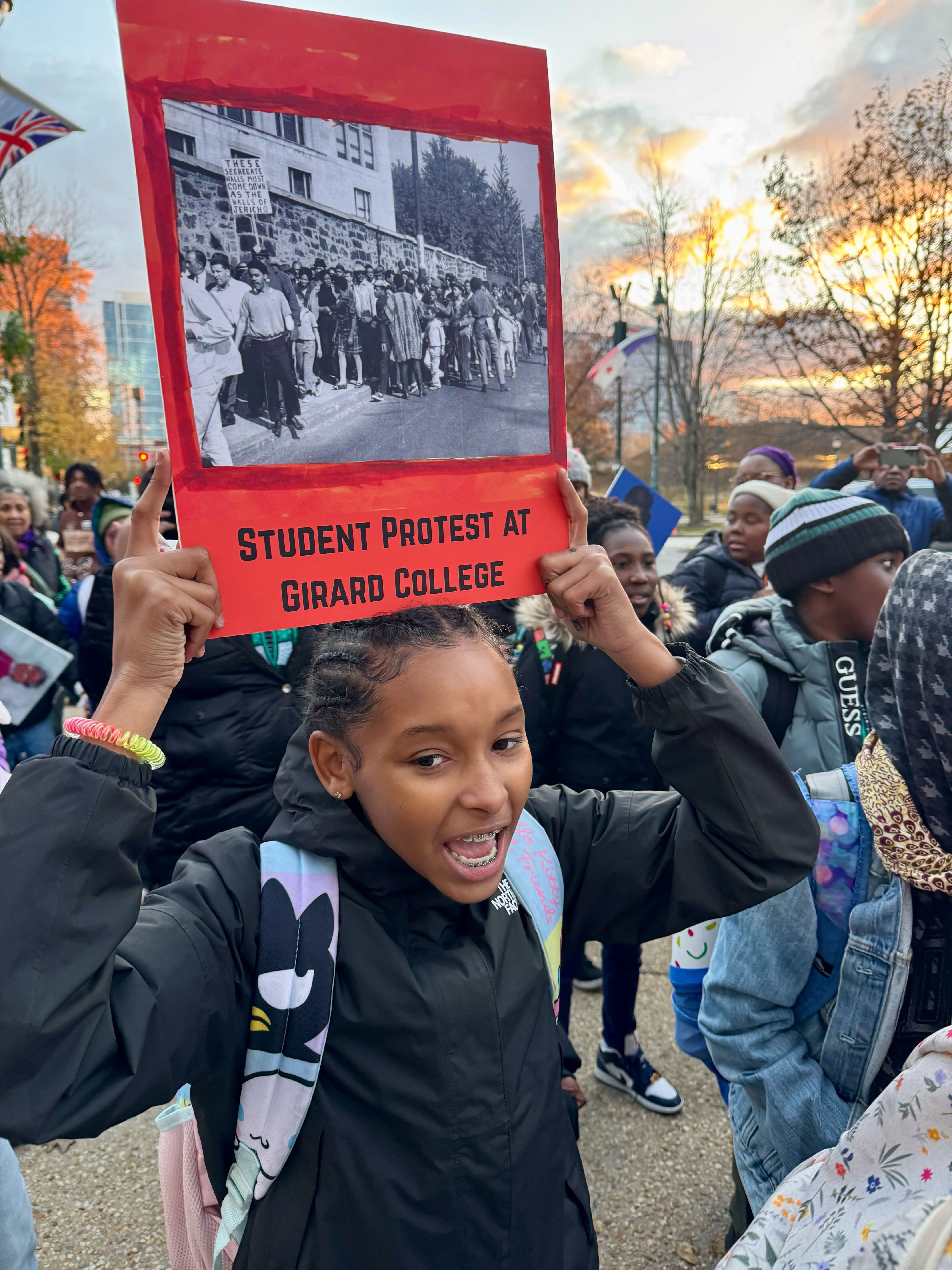
    Students from the Jubilee School walk to commemorate the 1967 Philadelphia student walkout, where thousands of Philadelphia School District students demanded better treatment of Black students.

    The timing of the celebration was important, organizers said — not just on the anniversary of the demonstration, but 20 years after Philadelphia became the first district in the United States to implement African American history as a graduation requirement.

    For months, Jubilee students studied the walkout. They conducted research, wrote poetry, made plans for honoring participants in the demonstration, and mapped a route — from the old School District of Philadelphia headquarters at 21st and the Benjamin Franklin Parkway, to the Free Library’s central branch, where there would be music and stories.

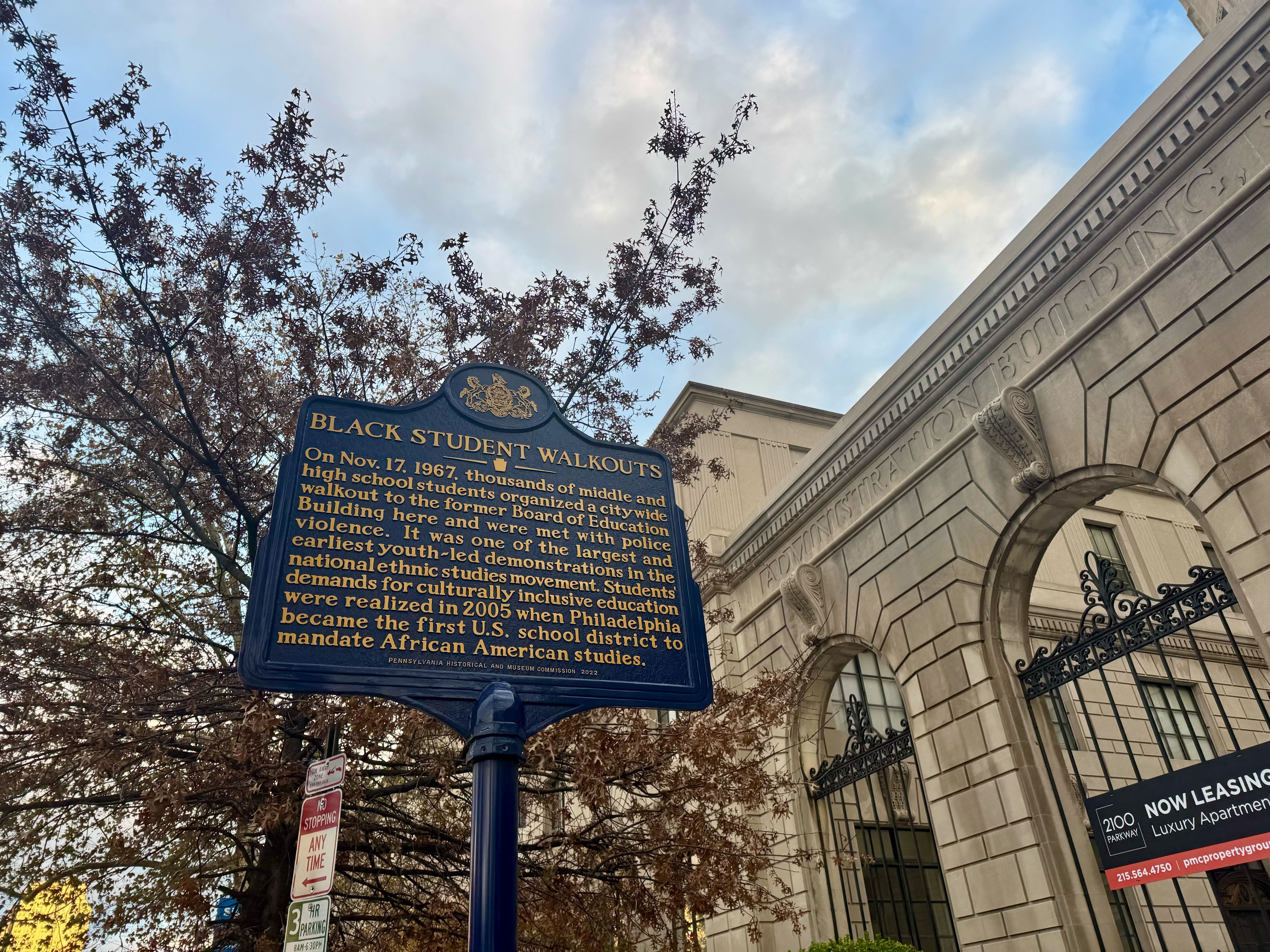
    The group honored four former Masterman students who, in 2020, won approval from the city’s Historical Commission to have a marker permanently erected outside the old district building noting the 1967 walkouts.

    Khaseem Bailey, a sixth grader with a strong voice and energy to spare, led the chants as the group, flanked by teachers, parents, and supporters, made its way down the Parkway.

    It was important to remember, Khaseem said.

    “They were marching for Black rights and student rights,” he said. “And so are we.”

    ‘It was not a flash mob’

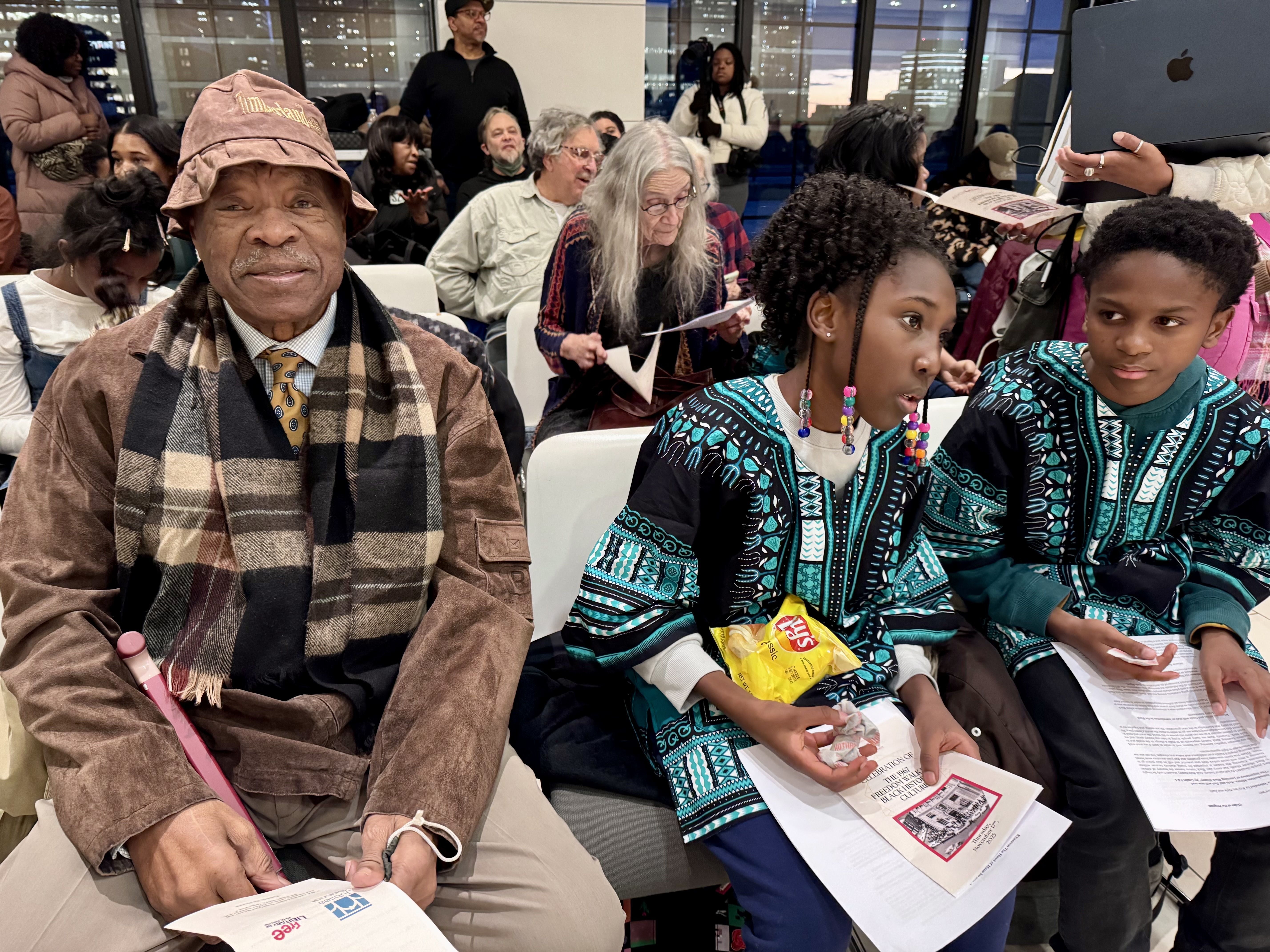
    The Nov. 17, 1967, walkout took 10 years to plan, said Walter Palmer, now 91, and one of the chief architects of the event — a decade spent organizing, teaching nonviolent strategies, training students, pairing them with elders.

    Walter D. Palmer, who helped organize the 1967 Philadelphia student walkout, was honored at a program by students from the Jubilee School, sitting next to him.

    The time seemed right that November. By that point, Black students made up the majority of the district’s pupils, and they attended integrated schools, but conditions were unequal.

    “Black students were harmed for using African names, wearing African clothing,” said Palmer.

    Organizers came up with a list of 25 demands — from allowing students to wear their hair in Afros to infusing Black history in the district curriculum.

    “It was not a mistake,” said Palmer. “It was not a flash mob. There were no cell phones; there were no microphones. These young people, they were just hungry.”

    A historical marker commemorating the 1967 Philadelphia student walkout stands outside the former offices of the School District of Philadelphia, at 21st and Benjamin Franklin Parkway.

    Students pulled fire alarms and poured out of their schools, with many meeting at the School District of Philadelphia headquarters. Representatives were chosen to speak to then-Superintendent Mark Shedd, who took their requests seriously.

    Newspaper accounts described the demonstration as being like a “picnic,” but then-Police Commissioner Frank Rizzo called in 100 officers in riot gear. They began swinging at students and releasing police dogs.

    Fifty-seven people were arrested, and dozens injured, some seriously. The event made national headlines.

    Marilyn Kai Jewett, another walkout participant, told the students their celebration was especially timely.

    “We cannot let anyone whitewash our history,” Jewett said. “We are under attack. We cannot stop — we’ve got to fight until we die. The evil will not prevail. Goodness always prevails. Just keep doing what you’re doing.”

  • School closings are coming to Philly. Here are four themes that are emerging as leaders come closer to decisions.

    School closings are coming to Philly. Here are four themes that are emerging as leaders come closer to decisions.

    Sweeping changes are coming to the Philadelphia School District, with officials promising large-scale school closings, co-locations, grade reconfigurations, and new construction over the next several years.

    The district is launching a survey this week to gain more input into that plan after Superintendent Tony B. Watlington Sr. pushed back a November deadline to announce his recommendations amid concerns from school communities.

    But those working closely on the facilities planning process said Monday that four themes are emerging that will shape the recommendations: strengthening K-8 schools, reinvesting in neighborhood schools, reducing school transitions for students, and expanding access to grades 5-12 criteria-based schools.

    Here’s what to know about each of the themes:

    Strengthening K-8 schools

    “Many school programs with declining enrollment, or which operate in aging buildings, struggle to offer a full range of high-quality classes, activities, enrichment opportunities, and supports,” the district said.

    Students and teachers in K-8 schools need better spaces and staffing and more resources, and the district cannot achieve that in its current configuration — the district has 216 schools but about 300 buildings, many of which are in poor shape. And enrollment is unevenly distributed — some schools, particularly those in the Northeast, are overcrowded, while others have thousands of empty seats.

    Citywide, there are 70,000 excess seats in district schools.

    The district might merge two schools or co-locate multiple schools in a single building, said Claire Landau, a senior adviser to Watlington tasked with steering the facilities planning process. It might also invest in “more suitable buildings.”

    Reinvesting in neighborhood high schools

    “Some neighborhood high schools lack a full range of academic enrichment and post-high school preparation pathways, while some smaller magnet high schools lack extracurricular programs and diverse enrichment opportunities,” the district said.

    Possible outcomes for reinvesting in neighborhood high schools include “targeted building improvements,” partnerships, and theme-based or career-connected programs in the district’s traditional neighborhood high schools.

    Reducing school transitions for students

    “Transitions for schools can be disruptive to learning and community connection. Research supports that students do better when they have fewer transitions between school programs during their pre-K-12 experience,” the district said.

    There are currently 13 different grade configurations in the district; the aim is to shrink that. To achieve this, the district could increase pre-K-8 schools and adjust grade configurations.

    Expanding access to grades 5-12 criteria-based schools

    “Philadelphia community desires schools that allow students to learn in one community from middle grades through high school,” the district said. (Some of those already exist — Masterman, for instance, and GAMP.)

    To achieve that goal, the district could create more seats at existing 5-12 schools, or create new 5-12 pathways, with an eye toward neighborhood equity.

    “This is not going to be a plan that erases or proposes to move away from all of our more traditional middle school grade spans, but we will be looking for opportunities to provide more access to pre-K-through-8 programming and 5-through-12 programming — because of how much support we’ve heard for it from communities across this process as well as what the research shows as far as students doing better in these environments,” said Landau.

    The mayor weighs in

    Mayor Cherelle L. Parker weighed in on the matter at a district hearing before City Council on Tuesday, saying she was in lockstep with Watlington and the school board president.

    “We need to recreate a comprehensive plan for repurposing every underutilized school building in the city of Philadelphia,” Parker said.

    But, the mayor said, “that plan will have to include housing, and that includes housing for public servants and educators who deserve to live in the communities that they serve, along with thinking about access to the repurposing of those buildings, to aid us in our desire to build affordable and workforce housing in the city of Philadelphia.”

  • Stolen phones sparked a fight and ongoing tension at Frankford High

    Stolen phones sparked a fight and ongoing tension at Frankford High

    Tensions are flaring at Frankford High over the school’s cell phone policy and its ability to keep students’ property safe.

    After two fights — including one where a student was so badly injured that city EMTs responded and transported the student to a hospital — a few dozen students took to the school’s hallways Friday, vocally demanding their phones back.

    “We just want to have a say in where our property goes, where our phones go,” said one student, who asked not to be named for fear of being targeted.

    Frankford, like many schools in Philadelphia and across the country, has recently moved to get cellphones out of students’ hands during the school day.

    At first, Frankford used Yondr pouches to secure students’ phones, but those were easily broken, and the costs of the pouches rose.

    Last year, the school installed lockers outside the building, requiring students to deposit phones before the school day started. Students could purchase locks from the school for $5.00, or bring their own locks.

    But “there’s been issues,” said one Frankford staffer, who asked not to be identified for fear of reprisal. “The area where the lockers are floods; it’s not monitored.”

    (School officials said they have alerted district officials about the drainage issue.)

    Some students didn’t love the idea of the lockers, but it wasn’t until last week that significant tensions began simmering after several phones were stolen. School officials said in an email to Frankford staff that five phones were stolen, two from a locker with no lock on it.

    “That caused some serious issues in the building,” the staffer said. “A lot of the students said, ‘You’re forcing us to put our phones there, but you’re not protecting them.’”

    Believing they knew who stole the phones, some students targeted the alleged thief, spurring a fight inside the school. That student was assaulted — beaten so badly that EMTs transported the student to a hospital, according to multiple people with firsthand knowledge.

    “It was so scary,” said the student who spoke on condition they would not be identified.

    Michael Calderone, the school’s principal, addressed the issue with parents in a letter sent home Friday.

    “Two wrongs do not make a right,” Calderone wrote. “This type of retaliation and violent behavior are not tolerated here at Frankford.”

    Another fight happened the next day outside of school — with some students and some nonstudents — but Frankford officials say it was unconnected to the stolen cellphones. (The student and staffer, however, say the general anger at the school over the phone policy has ratcheted up student issues generally.)

    A peaceful student protest planned for Friday turned into a town hall with Calderone. But some at the meeting weren’t satisfied and ultimately a few did protest, walking around the school and chanting about wanting their phones back.

    “It was students screaming in the hallways,” the student said. “They were saying they felt unsafe; they were saying they were unhappy about the phone lockers.”

    Calderone, in the letter sent to families Friday, vowed action.

    “No member of our school community should ever have to worry about their items being taken, especially when the belongings are locked up,” Calderone wrote.

    The principal told parents that the school would provide stronger locks, at no cost to students, and will increase patrols and video surveillance by school security officers. He said he has requested locking gates for either side of the phone lockers.

    ‘Students don’t feel safe’

    The Frankford student said they and others were frustrated by a lack of protection for their phones and poor communication.

    The Friday town hall, the student said, yielded little information. Some students were unruly, the student said, but many were respectful and just wanted answers from the administration. (Calderone described the meeting as productive, and not unruly.)

    Calderone, according to the student, “said he wasn’t able to put the phone lockers inside the building because he didn’t have enough security and kids could just get to their phones if they were inside. That happens anyway with the phones outside.”

    Frankford is a good school where students have opportunities, the student said. But it feels restless over the phone issue.

    “Students don’t feel safe going outside to get their phones,” the student said. “There’s such a big buildup that if you bump into the wrong kid, he’s going to hit you. The fights are just people getting their anger out. We feel like they’re not listening to us.”

    Phones are a distraction, the student said; they feel like learning has improved since phone access was removed during the school day.

    “But the school district says it isn’t responsible for lost, damaged, or stolen goods, and if your mom worked for a year to get you a brand new iPhone 17 and it gets stolen, they’re not buying you a new one,” the student said.

    “Philadelphia is a dangerous place — we need our phones going to school, going home.”

  • Philly school board member Joyce Wilkerson was named the nation’s top urban educator

    Philly school board member Joyce Wilkerson was named the nation’s top urban educator

    Joyce Wilkerson, Philadelphia’s longest-serving school board member, was named 2025 Urban Educator of the Year on Thursday night.

    The Council of Great City Schools — in town for its annual conference — selected Wilkerson for “the nation’s highest honor in urban education leadership.” The award is presented in alternate years to either an outstanding school superintendent or school board member from 81 of the largest urban public-school systems in the country.

    The prize comes at a curious time for Wilkerson — when her very membership on the school board has been legally questioned, after a public battle with some members of City Council on her re-appointment by Mayor Cherelle L. Parker to the board.

    Flanked by Mayor Cherelle L. Parker, left, and Superintendent Tony Watlington, right, Joyce Wilkerson, center, speaks during the announcement of the School District of Philadelphia Board of Education nominees at City Hall last year.

    People for People Charter School filed a lawsuit in Philadelphia Common Pleas Court in September calling Wilkerson an “illegally and unlawfully seated member of the BOE” and asking for her ouster.

    Wilkerson is not an educator by profession — she’s a lawyer who served as former Mayor John Street’s chief of staff. But she was named to the former School Reform Commission in 2016 and became the inaugural school board president in 2018, when the district returned to local control after nearly two decades of state oversight.

    Wilkerson, who also serves as a Council for Great City Schools board member, was hailed by the organization for steady leadership that helped end the Philadelphia School District’s state takeover, and for work that led the board to refocus its efforts on student outcomes. Ray Hart, who leads the Council, called those efforts “a national model.”

    Wilkerson, Hart said in a statement, “has reshaped the educational landscape in Philadelphia through her unwavering advocacy for students, along with her commitment to equity and excellence. Wilkerson’s dedication to strengthening public education has made her one of the most effective school board members in the nation.”

    As part of the prize, Wilkerson receives a $10,000 college scholarship to award to a district student.

    Joyce Wilkerson, Philadelphia’s longest-serving school board member, received the 2025 Urban Educator of the Year award from the Council of Great City Schools, a national organization whose annual conference is being held in Philadelphia this year.

    The People for People case — which came after the board voted to nonrenew the school’s charter over academic concerns — is still pending.

    It stems from a 2024 public fight over Wilkerson’s reappointment to the board. Several key Council members, including Council President Kenyatta Johnson and education committee chair Isaiah Thomas, took issue with Wilkerson.

    Her stance on charters in particular — no new charters were approved during Wilkerson’s school board presidency — rankled some on City Council.

    Council ultimately approved eight of Parker’s nine nominees, but did not act on Wilkerson’s candidacy. The mayor, though, did an end run, asking Wilkerson to serve on the board — essentially filling the seat Council denied her — until she named a successor.

    Parker ‘s administration argues the city charter allows Wilkerson to fully serve as a board member until her replacement is named, and it’s clear that the mayor is in no hurry to pick someone to replace her.

    The Parker administration, when the People for People suit was filed, said Wilkerson remains a full school board member, and said she still has the mayor’s support.

  • Tony Watlington talked about Philly’s ‘groundbreaking academic improvements’ on a national stage. Here are 3 takeaways.

    Tony Watlington talked about Philly’s ‘groundbreaking academic improvements’ on a national stage. Here are 3 takeaways.

    On Thursday, a roomful of leaders from the nation’s largest and most complex school systems stood, sat, and spilled into aisles to hear Superintendent Tony B. Watlington Sr. talk about how the Philadelphia School District has pulled off “groundbreaking academic improvements” in the eighth-largest school system in the country.

    “The nation’s historic biggest poor city for many decades is getting better,” Watlington said. “We are so proud to be accelerating performance, and we are going to put our foot on the gas, and our goal … is to get to the top of the food chain.”

    The discussion came as part of the Council of Great City Schools’ annual conference, held this year in Philadelphia. In addition to the hometown district, the Baltimore, Detroit, and Los Angeles Unified districts were also highlighted.

    Here are some takeaways from the panel that featured Watlington, Sonja Santelises of Baltimore, Nikolai Vitti of Detroit, and Alberto Carvalho of Los Angeles.

    The Philadelphia story: It’s getting better

    Watlington trumpeted the progress made since he arrived in Philadelphia in 2022: improvement in most metrics — fewer dropouts, better graduation rate, better student and teacher attendance, forward motion in most areas as benchmarked against big-city peers on the test known as the “Nation’s Report Card.”

    “We’ve been really drilling down on fourth- and eighth-grade reading and math, and in three of these areas, we’ve seen significant improvement, besting the national average, our peer districts, and, certainly, outperforming the Commonwealth of Pennsylvania,” Watlington said.

    Still, Philadelphia’s students — a diverse group, mostly from economically disadvantaged homes and mostly kids of color — have a long ways to go.

    According to preliminary data recently released by the district, 25% of district students met state standards in reading and 33% in math. (Math scores have been a particular strength of late — fourth-graders’ math scores have jumped 13 percentage points in the last three years.)

    “It’s ebbing and flowing, but over time we ought to see some appreciable improvement in student outcomes, and, yes, it ought to show up on some standardized assessments, even if those assessments are rife with cultural and racial bias,” Watlington said.

    Despite the fact that most city students do not meet the state’s standards in literacy and numeracy, there are more than just glimmers of hope in what the district has been able to accomplish in recent years, Watlington said.

    For years, Philadelphia’s performance was near the bottom of all large urban districts’. But the most recent stats from the National Assessment of Educational Progress show that the district has vaulted from near the bottom to closer to the top.

    And after years of declining enrollment amid a robust charter school ecosystem, the traditional public school system added more than 1,000 students to its rolls last year. About 117,000 children are now enrolled in district schools.

    How did the district make gains? Watlington cited several factors: new, standardized curriculum, professional development for teachers, supporting principals, strengthening family partnerships, and improving instruction.

    “We’re not just trying to serve the middle,” Watlington said. “We’re serving all students, including students who qualify for special education services.”

    Baltimore found literacy leaders in its own backyard

    Funds are scarce and needs are great in Baltimore, as they are in large urban school districts across the country.

    But Santelises, who has been superintendent of the district of 70,000 for nearly 10 years, wanted to focus on building leadership, even without a built-in infrastructure.

    “What we did was we doubled down on leadership is not a title. Leadership is a state of being. Leadership is a focus, so that means leadership is not just who gets to sit the closest to the CEO. Leadership is not who has three letters in his or her name, but leadership is actually what is your ability to identify a problem,” Santelises said.

    Empowering people in schools to see themselves as leaders worked beautifully, Santelises said. Among the strongest leaders?

    “We found actually that our paraprofessionals — majority women of color, majority from low-income neighborhoods — were actually our best literacy tutors when we looked at the data,” Santelises said. “With all due respect to any companies in the room, it wasn’t the new AI technology that got the best results. It wasn’t the newest program you’re going to put on the software. It was actually the women who were closest to our young people and their communities were then viewed as leaders, and frankly got 30 to 40% greater improvement with our first and second graders than any program we purchased.”

    LA super thinks 10% of schools should get 90% of district attention

    Alberto Carvalho, the superintendent of the Los Angeles Unified School District, said that 90% of districts’ time should be spent on 10% of its schools — the lowest performers.

    Leaders must have “the courage to say not every student shall get the same level of funding, the same level of support … they need disproportionately higher levels of funding based on equity indices.”

    (Philadelphia used to have a separate learning network for its lowest performers, with higher amounts of funding and more supports. The district broke up that network in a recent reorganization.)

    When he started in LAUSD in 2022, that school system, the nation’s second-largest, had 800 teaching vacancies. He reduced that number to zero quickly.

    Central office staffers who met Carvalho always told him how much they loved children, he said.

    “During spring break, I asked them to go love children closer to where children were,” Carvalho said. The employees who had teaching credentials were sent into schools to teach. “Yes, there are teacher shortages, but we have more of a talent-distribution problem than a talent problem, always.”

    Carvalho — a former undocumented immigrant who spent 15 years as Miami’s schools leader and had accepted the New York public school chancellor’s job but reneged, he said Thursday, “because I would have killed the mayor” — suggested that incremental progress is not nearly enough.

    “We’re not done, we can’t be done,” Carvalho said. “We have grade levels where reading performance is at 30, 40, 50%, and that means the vast majority of our kids are not learning and reading at grade level — the same for numeracy. Unfortunately, across our country, we often hide ugly truths about our own performance. And as they all said, ‘The first step in true educational reform is critical awareness of where we are.’”

  • Coalition rallies against Philly’s plan to close schools, and says district should halt the process

    Coalition rallies against Philly’s plan to close schools, and says district should halt the process

    Pause the city’s facilities master planning process, a grassroots coalition said Wednesday, weeks before the Philadelphia School District has said it would release a draft of that plan — which will include school closures.

    Superintendent Tony B. Watlington Sr. and school board president Reginald Streater have said the long-promised planning process would be different than the 2013 incarnation, that they would consider the harm done then, and would use an equity lens.

    Watlington in September said “there are no fixed decisions at this point, and the short answer is we can’t answer any of those questions right now about which schools will close, but we can surely say some will.”

    Officials have also said the document — which they promise is on track for delivery sometime this fall, with a school board vote by the end of the calendar year — would also include major renovations, new school construction, and joining some schools into a single building.

    But Councilmember Kendra Brooks, who was a school activist fighting the closures on the front lines 12 years ago, said this process feels similar, despite officials’ assertions that their aim is to organize city schools in a way that best advantages children.

    Philadelphia has complex facilities needs — 70,000 excess seats in schools across the city, some schools that are more than half-empty, and some bursting at the seams. Its buildings are old, and many have environmental problems.

    “This seems like a school closure process,” Brooks said in an interview. “We’ve been here before, and the conversation should be about the future we want for our children — it should include plans for investment, not just closure.”

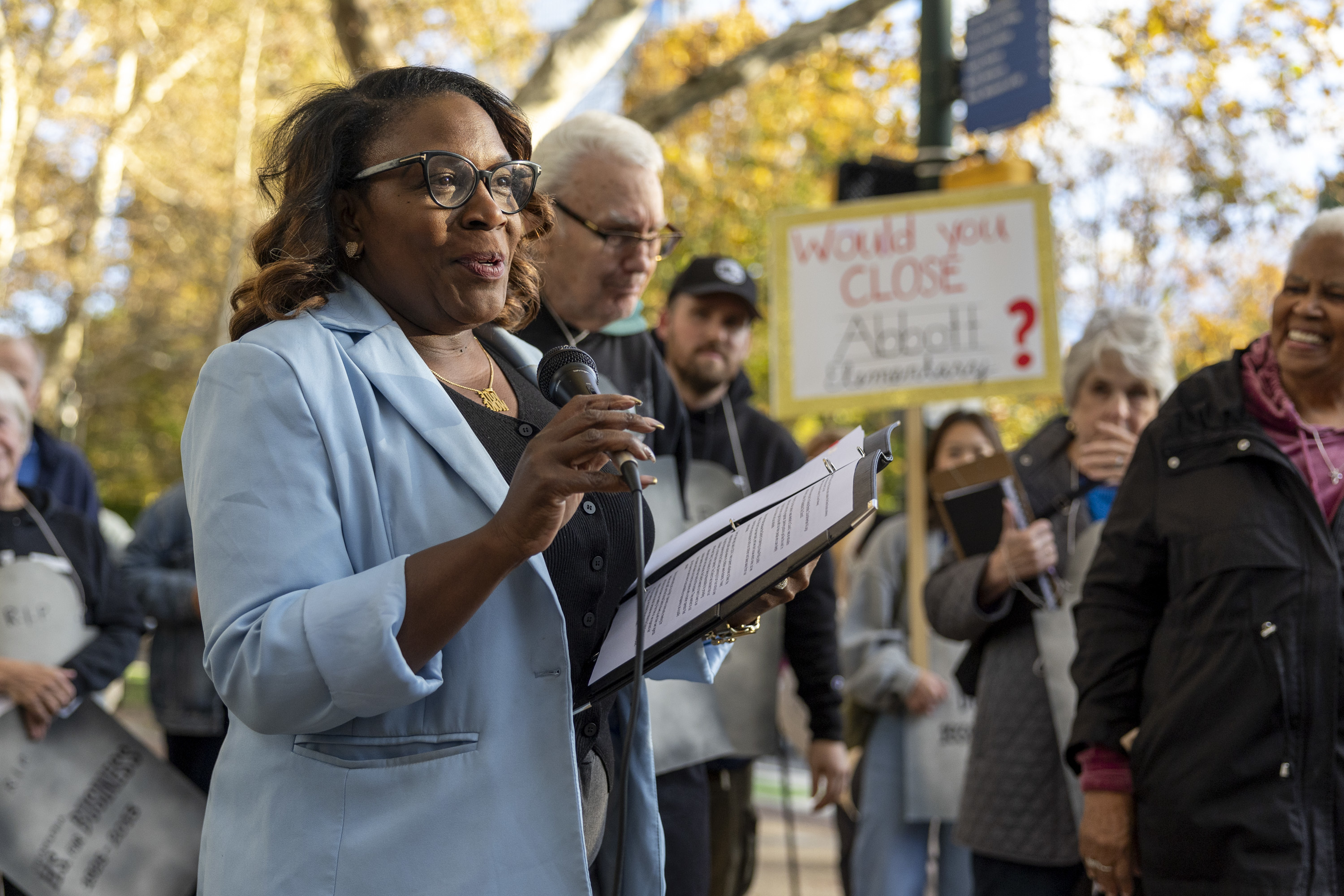
    City Council woman at large Kendra Brooks, speaks in front of parents, teachers, and public school advocates during a Stand Up for Philly Schools event in Philadelphia, on Wednesday, Oct. 22, 2025.

    Brooks joined members of Stand Up for Philly Schools — a coalition of organizations including Parents United for Public Education, the Philadelphia Home and School Council, and Asian Americans United — outside the Barnes Foundation on the Benjamin Franklin Parkway Wednesday night, where members of the Council for Great City Schools met for an opening reception.

    “We are being given an extremely limited set of options about the future of our schools. We are being told that school closures are a foregone conclusion. We’re being told to sign off on a plan that we haven’t even seen,” Brooks said to the crowd of dozens of educators, parents, students and other supporters gathered for the cause.

    “We don’t know how many, we don’t know which ones, but we know that every school closure hurts a community,” she said.

    ‘A big contraction of the school district’

    Those who rallied Wednesday made several demands of the district, which is playing host to the Council for Great City Schools conference. Those asks included pausing the planning process, creating a new strategy for public engagement, and committing at least $250 million annually to keeping district schools well-maintained.

    So far, the process has played out poorly, members of Stand Up for Philly Schools say. There’s been engagement on paper, but many in advisory groups said they felt their work was merely lip service, and community meetings have been sparsely attended.

    The school board has authorized spending over $5 million on contracts for community engagement, the planning process itself, and the construction and hosting of a data warehouse for all facilities information.

    “We feel like we’re not getting the whole picture, we feel like whatever ideas and feedback we gave are not being heeded, and we don’t think there’s enough time in this process,” said Adam Blyweiss, a district parent and teacher who sat on an advisory committee.

    Laurie Mazer, a member of Parents United for Public Education, said the process feels “weird, and rushed.”

    Getting information has ”been a real teeth-pulling exercise,” Mazer said.

    ‘When schools close, communities pay the price’

    It appeared like an early Halloween celebration at the Stand Up for Philly Schools rally.

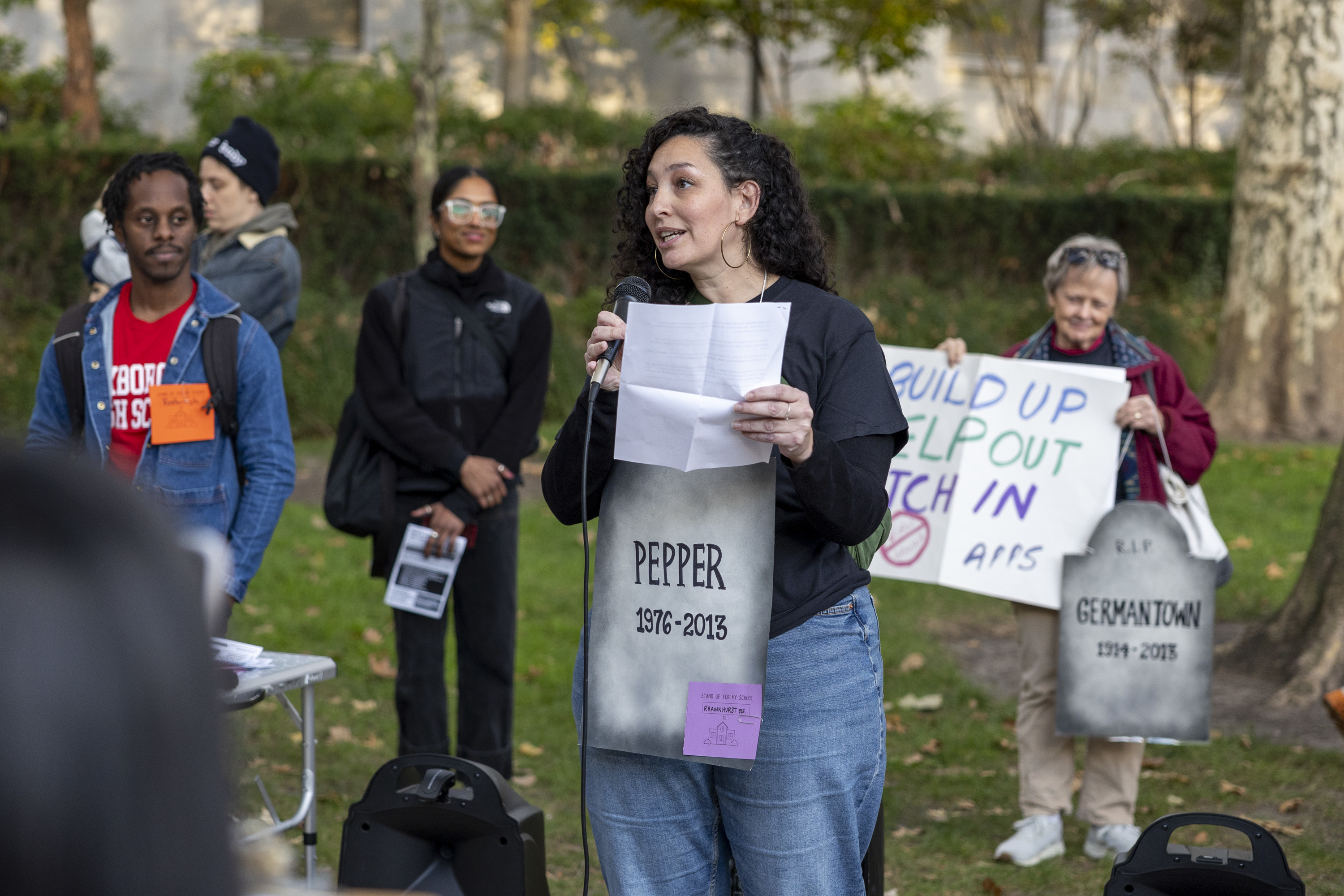
    Coalition members wore tombstone signs around their necks, each representing a Philadelphia public school that was closed during the district’s last closure plan.

    “After months of delays and missing data, it’s clear why so many families don’t trust this process,” said Melanie Silva, the mother to a fourth grader at Rhawnhurst Elementary School in Northeast Philly and a member of 215 People’s Alliance.

    Melanie Silva, mom to a fourth grader at Rhawnhurst Elementary School, speaks during a Stand Up for Philly Schools event in Philadelphia, on Wednesday, Oct. 22, 2025.

    Wearing a tombstone sign around her neck representing George Wharton Pepper Middle School and its closure in 2013, Silva described the overcrowded and under-resourced conditions at her daughter’s school. She said the school’s library was a meeting room, and classrooms were so full there was “no room to breathe.” She said the district ought to invest in its schools rather than close them.

    “We deserve transparency, we deserve trust, and real investment, not excuses,” she said.

    Charles Hudgins, an algebra teacher at Abraham Lincoln High School in Northeast Philly, warned that the district would make problems that schools face today worse by closing more of them. He said that some of his students already travel more than an hour.

    Barbara Dowdall, of Germantown, Retired teacher of 36 years, holds up a sign to show her support for Philadelphia public schools during a Stand Up for Philly Schools event in Philadelphia, on Wednesday, Oct. 22, 2025.

    “The potential and talent of students is being lost every single day because our school system is focused on quality and numbers. The numbers we care about are the number of excellent schools where our children have opportunities to thrive, to think creatively and to pursue their passions,” said Ruth Kuriloff, 17, a senior at Science Leadership Academy at Beeber.

    She and her classmates said students would only be hurt by closing schools to save money.

    “These obvious inequities will not get better by closing schools,” said Jordyn McGriff-Laduna, 17, also a senior at the school. “Quality education should not be a privilege. It should be a promise for all students in all areas.”

  • Discovery of Kada Scott’s body at Germantown middle school has reignited debate over the vacant building

    Discovery of Kada Scott’s body at Germantown middle school has reignited debate over the vacant building

    When it opened in 1973, Ada H.H. Lewis Middle School was a source of deep pride for East Germantown, the kind of state-of-the-art educational facility that only suburban kids had at the time.

    But on Saturday, when police found Kada Scott’s corpse buried in a shallow grave in the woods of the long-ago vacated school grounds, ending a two-week search for the missing 23-year-old Mount Airy woman, the Rev. Chester H. Williams saw only decades of failure.

    “It’s a disgrace,” said Williams, a pastor who runs a neighborhood civic group. “We were very hurt to hear that this happened.”

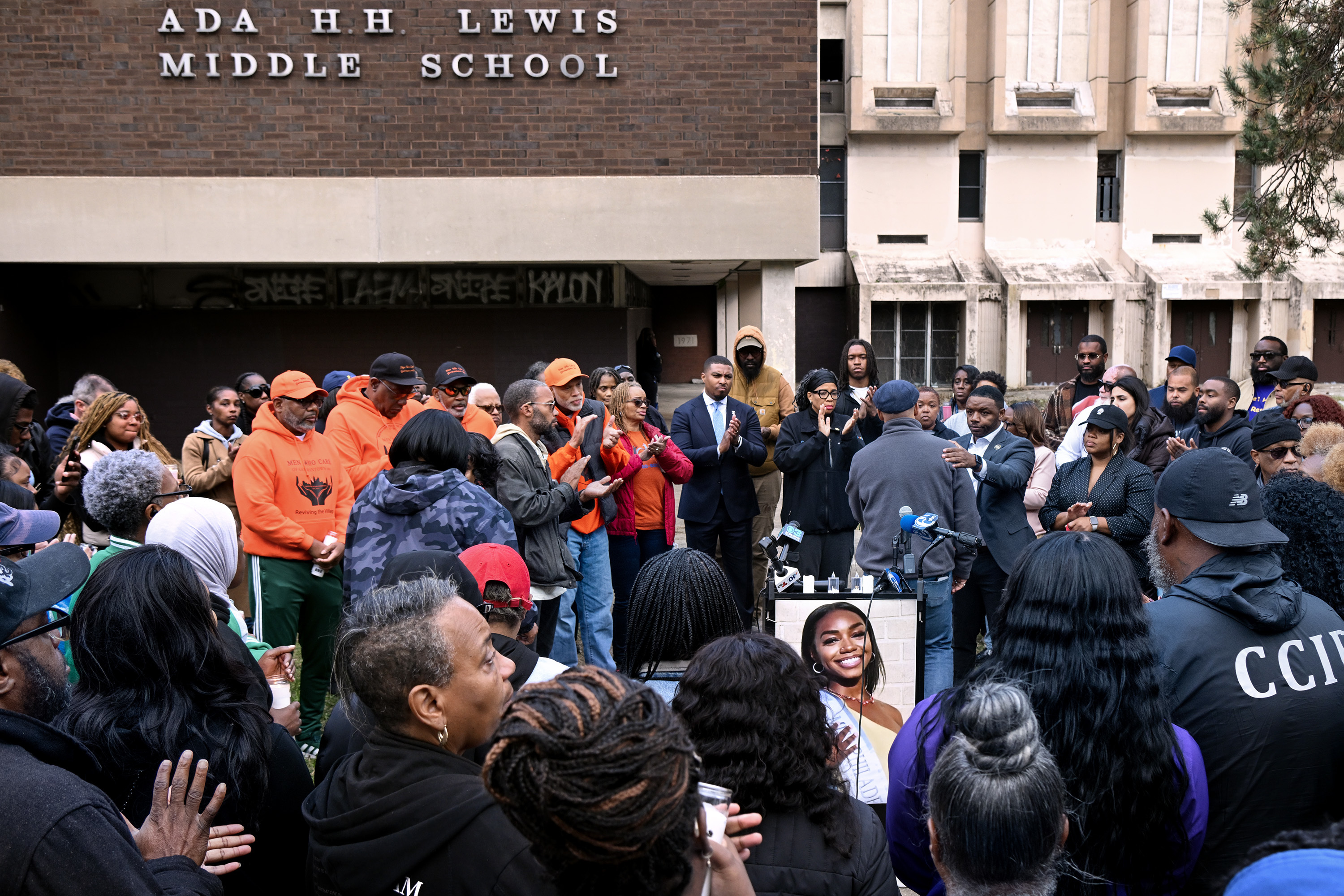
    Community members gather for a candlelight vigil in memory of Kada Scott on Monday at Ada H.H. Lewis Middle School.

    On top of the shock, Scott’s kidnapping and murder has renewed animus in some quarters about the Philadelphia School District‘s failure to repurpose the blighted property, one of dozens of schools shuttered by the district over the last 20 years.

    Since Lewis closed in 2008, local officials and civic leaders said the sprawling seven-acre campus has become a magnet for squatting, illegal dumping, and other criminal activity. City officials have cited the school district 10 times since 2020 for overgrown weeds, graffiti, and piles of trash that blanketed the property, public records show. And four years ago, the district passed on an opportunity to reverse course on the blight.

    A proposal to redevelop the land into new homes, championed by neighborhood leaders like Williams, sat before the school board for approval. But the district abandoned the plan at the eleventh hour without public explanation, which the developer alleged was due to meddling by City Councilmember Cindy Bass — a contention Bass denies.

    “The school district, for some reason, we don’t know why, they put a block on anything being built there,” Williams said.

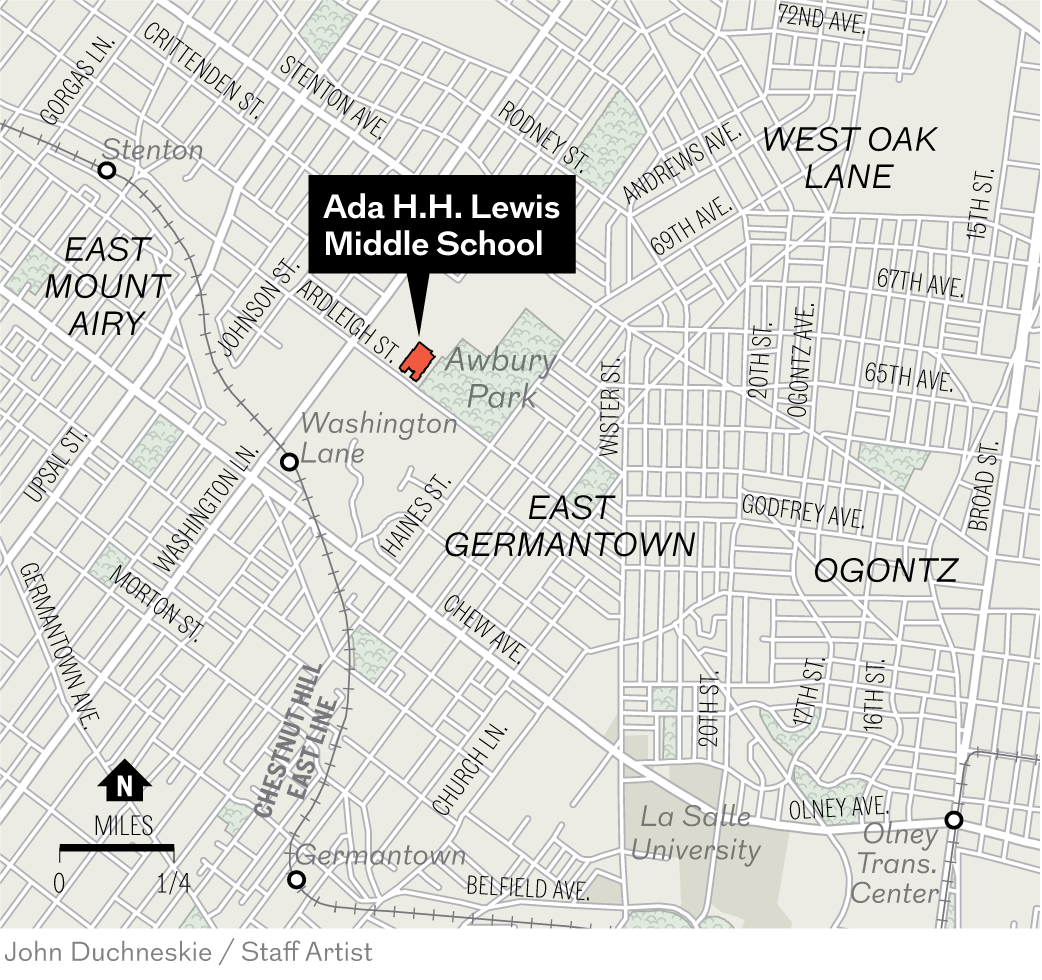
    Map of the former Ada H.H. Lewis Middle School in East Germantown

    Philadelphia Superintendent Tony B. Watlington Sr. extended “deepest sympathies” to Scott’s family and friends in a statement, and said the district’s operations and safety departments will review the vacant-property portfolio “to create and maintain safe and healthy spaces in every neighborhood.”

    While some call Lewis “abandoned,” the district is careful to call the building “vacant,” one of 20 such properties in the district’s portfolio. It says maintenance and inspection logs are kept about work on vacant properties; details were not immediately available.

    The debate over Lewis comes at a crucial time for the district: It is preparing to release recommendations about its stock of 300-plus buildings — and likely add to the list of decommissioned schools-turned-vacant public buildings. The district’s master planning process will contain recommendations for school closures and combining schools under one roof, officials have warned.

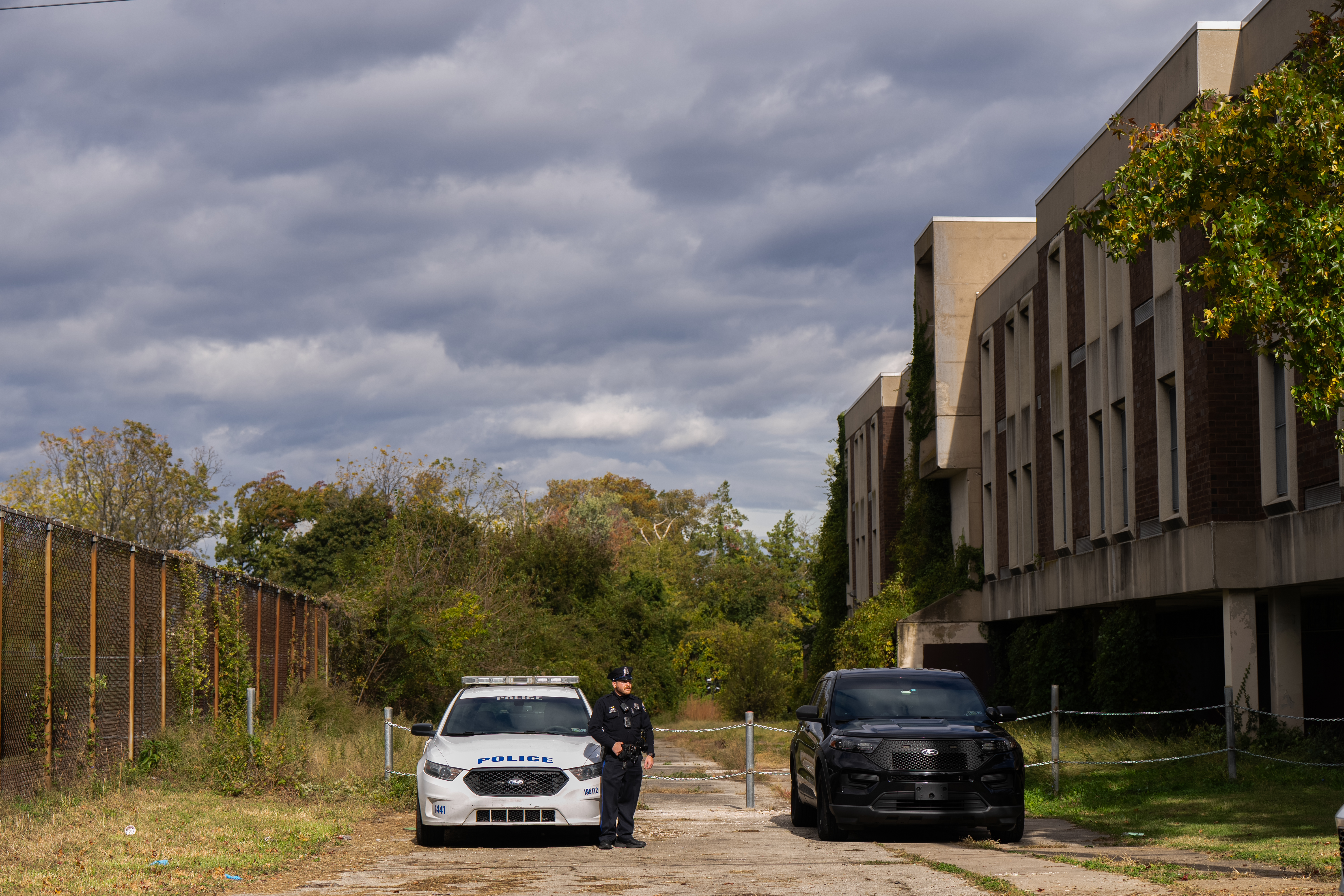
    Police at Ada H.H. Lewis Middle School.

    A fizzled redevelopment

    In 2011, then-City Controller Alan Butkovitz said the district’s vacant buildings were “catastrophes waiting to happen.

    Butkovitz, in a report released that year, said district inaction around such structures was dangerous and noted that the schools were magnets for criminal activity.

    Just before the pandemic hit in 2020, after years of pushback over Ada Lewis, the school district began accepting applications to redevelop the crumbling middle school. Germantown developer Ken Weinstein was one of three developers to place bids. He sought to buy the property for $1.4 million and build 76 new twin homes, at a density that neighbors felt complemented the surrounding area and resolved concerns about density brought by apartment buildings.

    Weinstein said he gathered letters of support from 60 neighborhood residents and elected officials, including U.S. Rep. Dwight Evans and then-State Rep. Stephen Kinsey. The school board seemed eager to move ahead and set a final vote for the proposal in May 2021.

    The vote never happened. The only explanation given that day was that “the Board had concern” about “what the long-term plan is for developing schools for the 21st century,” according to a district spokesperson.

    According to Weinstein, some school board members received calls from Bass asking them to table the vote. Bass has faced criticism for interfering in development projects, including other proposals made by Weinstein, as vacant properties languished for years in her district. Her district includes the Lewis property and parts of North and Northwest Philadelphia, where Weinstein has focused his development work.

    Bass, in an interview Monday, denied meddling in the vote. She acknowledged that she did not support Weinstein’s proposal because of the price of the homes — averaging around $415,000 — which she said would have triggered “immediate gentrification in the neighborhood.” But she said she had no involvement in the board’s reversal.

    “That was up to the school district,” Bass said. “I don’t sit on the school board.”

    While community groups in her district supported Weinstein’s project in 2021, Bass said she objected to market-rate housing as the sole alternative for East Germantown, arguing that it amounted to the district and developers saying “you should just take any old thing just so it’s not vacant.”

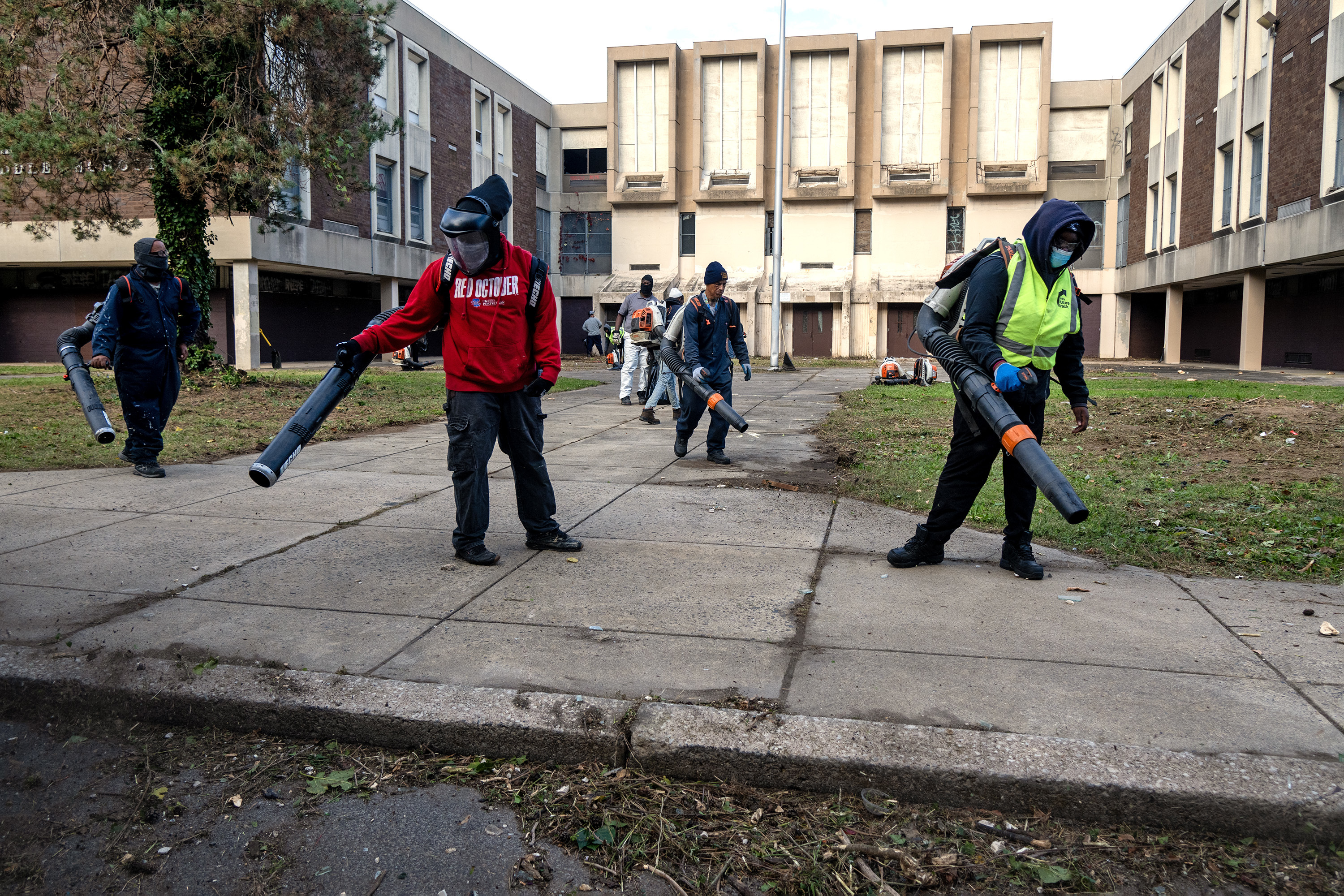
    City workers clean up in front of the vacant Ada H.H. Lewis Middle School Monday, just minutes before the start of a community candlelight vigil in memory of Kada Scott.

    A tragic turn for the property

    In a letter dated Friday, Bass called on the school district to demolish the vacant school, saying she was troubled by the evidence that led investigators to the property during the search for Scott.

    “The continued presence of this unsecured and deteriorating structure is simply unacceptable,” the Council member wrote in a statement, noting the site is now associated with “tragic violence.”

    Cell phone records and tips from the public first led police to the former Ada Lewis school last week, where they found Scott’s pink phone case and debit card, but nothing else. Then, late Friday, police received a new tip saying that they had missed something on their first search of the grounds, and that they should look along the wooden fence that divides the school from the neighboring Awbury Recreation Center. Officers returned to the property Saturday and found Scott’s body, buried in a shallow grave in a wooded area behind the school.

    Prosecutors expect to charge Keon King, 21, with the murder, though police continue searching for others who they believe may have helped dispose of evidence.

    Bass took office in 2012, when the school was already vacant. She said she pushed the school district for several years to take action, as nuisances piled up at the property. She said she still hopes that another “institution” could replace Lewis.

    “I think that having something that the community wants is not hard to figure out,” Bass said. “This is what the community’s interested in — they’re interested in another institution.”

    She said a proposal for a charter school is now in the works, though she said she was unable to provide details.

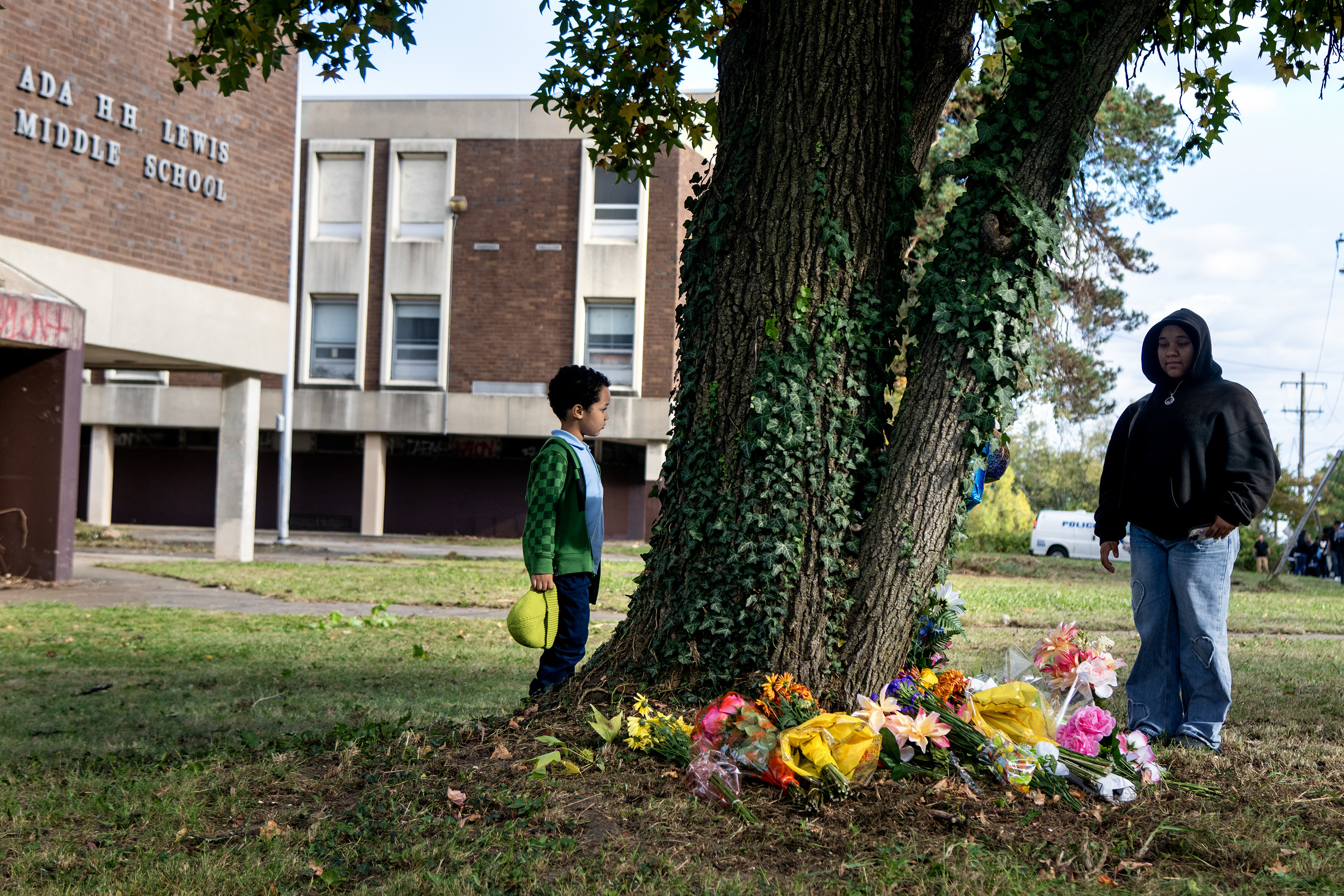
    Julius Peden, 5, and Jaihanna Williams Peden (right), 14, pause at a memorial for Kada Scott on Monday.

    A glut of vacant schools

    The school district still views Lewis as a potential “swing space” — a building that could be used to house students if another district building is closed due to environmental problems.

    There is precedent: The district has used other school buildings for such purposes, like Anna B. Pratt in North Philadelphia, which was also closed in 2013, to house early-childhood programs, and then students from other North Philadelphia schools whose buildings were undergoing renovation.

    Still, it remains unclear how much it would cost to bring the Lewis building back to an inhabitable state.

    The school system currently has about 70,000 more seats throughout the city than students enrolled. Though officials have said their first preference is to have closed schools reused for community benefit, it’s unlikely that all will be able to serve that purpose. And the timetable will surely be slow.

    City officials at times have expressed frustration with the pace at which the district is making decisions about how to manage its buildings. School leaders have said the wait is necessary given the district’s capacity and the need to make correct choices and not rush the process.

    Weinstein said the tragedy that culminated at Lewis reflected the conventional wisdom that blight breeds crime.

    “There’s always consequences to shutting down a proposal that the community supports,” Weinstein said. “In most cases, nothing bad happens. In this case, something very bad happened.”

    Staff writer Ellie Rushing contributed to this article.

  • This Philly charter has been roiled by upheaval and turnover. Now, its renewal is on hold.

    This Philly charter has been roiled by upheaval and turnover. Now, its renewal is on hold.

    For years, Northwood Academy Charter School was a stable Philadelphia charter — the kind of place where teachers and administrators stayed for decades, and children thrived.

    But in the last few years, the school, on Castor Avenue in Frankford, has cycled through dozens of administrators and teachers and test scores have dropped. Academics have suffered, according to interviews with a number of parents and staff, who say the school feels less safe, and staff morale is low.

    The school’s five-year charter expires this year, but Northwood’s renewal is on hold, The Inquirer has confirmed, because the district’s Inspector General’s Office is reviewing information about Northwood. The exact nature of the investigation is unclear.

    The Inquirer spoke to and reviewed testimony from more than a dozen parents and current and former Northwood staff. Nearly everyone interviewed requested anonymity for fear of reprisal; some who spoke out at meetings have received cease and desist letters threatening litigation from a consultant who provides human resources services to Northwood.

    “When we first got there, there was stability at the school — everyone was there since almost the beginning,” one parent said. “Now, in the last five years, we have had 20 administrators change over. The kids can’t get comfortable with the teachers, because they don’t know if they’re going to be there a long time.”

    Northwood, which opened in 2005, educates 800 students in grades K through 8. As a charter, it’s independently run but publicly funded; the Philadelphia school board authorizes its funding but does not manage its operation.

    School officials say the Northwood turnover is not excessive, but rather a function of its board of trustees’ move to steer the school to better outcomes.

    “Our goal here is to just move forward and help our students achieve,” said Kristine Spraga, a longtime board of trustees member who now serves as the board’s treasurer.

    The board’s challenge, human resources consultant Tracee Hunt said, “is getting the person who has that strategic focus, who doesn’t necessarily operate more like a principal than a CEO. What happens is we’ve hired what we thought were great hires, and then if they decide, ‘This is a little bit too much for me, the board doesn’t have any control over that.’”

    The board this month hired former Central Bucks School District Superintendent Steven Yanni to lead the school.

    A pivot point

    Northwood handled human resources in-house in its early days. When a principal left in 2018, there was some unrest among faculty after a number of teachers were shifted around.

    Shortly thereafter, one board member suggested bringing in Total HR Solutions, a New Jersey-based provider that had worked with some other Philadelphia charters, to manage those services.

    That was a pivot point for the school.

    Hunt was charged with examining the school’s practices. She found “a lack of fair and equitable hiring practices,” she said in an interview last week, “a massive amount of nepotism,” and inadequate staff diversity — the school educates mostly Black and Latino students but its staff was mostly white.

    “Through natural attrition, we have the opportunity to have fair and equitable hiring practices so that then you improve in your areas of diversity in just a natural way, versus feeling like you have to displace people,” said Hunt.

    Some current and former staff see things differently. The earlier version of Northwood wasn’t perfect, they said, but it was cohesive, and under Total HR, that changed.

    Adam Whitlach, a longtime Northwood school counselor, said Total HR “came in with the idea of ‘demolish, and re-create something from nothing.’ They were mixing it up for the sake of mixing it up. They treated it like it was a turnaround school, but it wasn’t, there was an existing community. They attempted to sell them a story that our school was failing and racist, but people didn’t believe that.”

    In 2021, the school’s longtime CEO, Amy Hollister, abruptly left Northwood with no notice to the staff and families with whom she had built a strong rapport.

    “It was out of the blue, and then everybody else started leaving,” another Northwood parent said. As with others, the parent asked not to be identified for fear of blowback. Parents began attending board meetings — at one, Hunt stood up, the parent said, “and began to tell us how the teachers want a more diverse school, and that’s the reason why all this upheaval was happening.”

    The parent, who is a person of color, said they were not bothered by the staff’s demographic balance. “Those teachers loved our children. Everybody knew you, you didn’t have to go past security, and they welcomed every parent, every child. There weren’t a lot of discipline issues, because they had relationships with our kids,” the parent said.

    More departures

    Changes accelerated after Hollister left.

    “Parents were grabbing me by the arm and saying, ‘Whitlach, tell me what’s going on here,’” the former counselor said. “The bullhorns came out, the security guards dressed all in black came out.”

    (Whitlach was ultimately fired after 15 years at the school after, he said, he complained publicly about the school pushing staff out. Students walked out in protest of his departure.)

    The departures affected academics too. A third parent said she was frustrated by “no curriculum, no books.”

    Administrations came and went. Audrey Powell came to Northwood as an assistant principal in 2023, following then-CEO Eric Langston, who has since left; Langston left this summer, and Powell resigned soon after.

    The reason for her departure?

    “I just didn’t agree with the direction or the choices of the board,” Powell said. She repeatedly brought concerns to the board that were ignored, she said. In particular, she was alarmed by the board’s relationship with Total HR and Hunt’s “overreach” at Northwood, Powell said.

    “I don’t think there were enough checks and balances,” Powell said. “I feel like [Total HR’s] contract incentivizes there to be turnover — she directly financially benefits from there being turnover.”

    Northwood paid Total HR $1.4 million between 2020 and 2023, according to public records. That included base fees for Total HR’s services, including an HR generalist who works at Northwood but is paid by Total HR, and also per-position search fees for administrative positions and board seats.

    “The constant turnover is a misuse of taxpayer dollars, and it’s a disservice to kids, to the teachers,” said Powell. “There can’t be progress when there is that much turnover. It’s two steps forward and four steps back.”

    Hunt dismissed the notion that she was simply out to make money.

    “We have these contracts that are negotiated,” said Hunt, whose firm works across industries. “Everything that I bring to Northwood, I bring below market rate.”

    The school district’s charter chief, Peng Chao, said Northwood’s spending on human resources appears to be more than is typical.

    “This level of spending is not what we usually see for this type of scope of work,” Chao said. “While we recognize the staffing challenges that schools are navigating, it is important for schools to remain mindful of fiscal constraints as we all work through an uncertain budget environment.”

    Yanni, who began as Northwood’s CEO Oct. 6, said while Total HR provides services, ultimately, hiring and firing decisions rest with the CEO.

    “HR is an adviser to us, so HR doesn’t make the hiring and firing decisions, they provide the guidance from the place of compliance and the law,” said Yanni.

    ‘Beyond frustrated’

    Staff and parent concerns about Northwood are not new. At board of trustees meetings, speakers often give impassioned testimony on the subject.

    At last week’s trustees’ meeting, kindergarten teacher Emily Parico told the board that “something nefarious is going on at Northwood, and you sit by, silent and complicit. Northwood used to be a learning sanctuary. It wasn’t perfect, but it was a place where students, staff, and families felt safe and loved.”

    Parico is the Northwood teachers union’s vice president. Most city charter teachers are not unionized; Northwood’s voted to form a union in 2023 amid turmoil at the school.

    Kim Coughlin, a fourth-grade teacher and the union president, said the school continues to be roiled.

    “Every day, teachers and staff are thinking of walking away, and two just did yesterday,” said Coughlin. “And our families are beginning to look elsewhere, because they feel the shift. The school that we once knew and loved has become unrecognizable.”

    Questions and threats of legal action

    When Langston, the CEO prior to Yanni, left suddenly in August, dozens of families and staff asked the board for answers, but none were forthcoming, said Kevin Donley, the school’s psychologist.

    “I’m beyond frustrated,” said Donley, who’s secretary of the union. “And deeply disappointed by the manner in which the board of trustees has governed our school in recent months and years.”

    At least 50 people sent letters to the board of trustees expressing concern about further turmoil after Langston’s departure, Donley said. As far as he knows, not one person heard back, either in a letter or any kind of message.

    Both Hunt and the board have sent letters threatening some who speak out with legal action; Hunt said she won a legal challenge against one parent who falsely said she had been fired by a previous client. (The client, Hunt said, moved HR services in-house and did not fire her.)

    “It’s not uncommon to have a few naysayers, but eventually when you start seeing the fruit of all this board’s labor, the reason I stick in here is because I watch them stay so focused on the kids,” Hunt said.

    School officials told The Inquirer that the staff and parents who have spoken out represent “a very small number of people who are quite passionate,” but not representative of all staff and parents.

    “I don’t see that the vast majority feel the same,” said Spraga, the board treasurer. “Otherwise, we would have those indicators in things like the engagement surveys, right?”

    Spraga, Hunt, and board president Warren Young said staff and community engagement surveys do not match the sentiments expressed at board meetings.

    New leadership under Yanni

    The Northwood CEO job is Yanni’s first foray into the charter sector; he was previously superintendent in the Lower Merion, Upper Dublin, and New Hope-Solebury school systems. Yanni was terminated as the Central Bucks superintendent last week over allegations that he mishandled child abuse allegations in a special education classroom — a contention he denies.

    Yanni said he’s thrilled to be at Northwood, where class sizes are small — 23, typically — and there’s a feeling of welcome.

    “There’s passion here,” Yanni said. “And it’s not just the staff, it’s the kids too — this is their school. Kids really feel like Northwood is their home, and we have engaged families.”

    Northwood is completely full, with a waitlist of 200 students per grade level, Yanni said, and applications are already coming in for the 2026-27 school year.

    In the 2018-19 school year, 64% of Northwood students met state standards in reading, and 30% in math; in the 2024-25 school year, the last year for which scores are publicly available, 31% of Northwood students hit the mark in reading and 11% in math. In 2018-19, Northwood beat Philadelphia School District scores (35% proficiency in reading, 20% in math) and in 2024-25, the district did better (34% proficiency in reading, 22% in math).

    Yanni said Northwood is a school on the rise and is beginning to implement positive behavioral supports to improve school climate. It’s also in the early days of an academic intervention process to identify and target individual students’ skill gaps.

    “I think we’re going to see dramatic gains this year,” said Yanni.

    Northwood “is a school that people stick with,” he said. And though the city has plenty of choices for families, “we’re going to start a strategic planning process, and really kind of blow the doors off. You hear about KIPP, and you hear about these large charter networks and then there’s little tiny Northwood. How do we make it the beacon, the flagship?”