Tag: Schuylkill

  • Philly’s building plan would close this high-performing magnet. Lankenau is fighting back.

    Philly’s building plan would close this high-performing magnet. Lankenau is fighting back.

    There’s no place in Philadelphia like Lankenau High School.

    It is the city’s environmental sciences magnet school and the state’s only three-year agriculture, food, and natural resources career and technical education program. It’s set amid 400 acres of woods, with neighbors including a vast environmental center and farm that are active partners with the school. Lankenau’s students have access to dual enrollment and an impressive array of internships.

    But Lankenau just landed on the Philadelphia School District’s closing list, one of 20 schools proposed to shutter for the 2027-28 school year as the district grapples with 70,000 extra seats citywide, billions in unmet capital needs, and a desire to modernize and bring equity to student experiences in the school system.

    The Lankenau community is already gearing up for a fight ahead of a school board vote on the proposal, expected this winter. Community members say the school must be saved because it is one of a kind, offering immersive education in agriculture and sciences and boasting a 100% graduation rate that’s rare in Philadelphia.

    Shutting “the Lank” would be a disastrous move, said Jamir Lowe-Smith, a junior at the school. The district’s proposal would merge Lankenau into Roxborough High as an honors program, but you cannot replicate what his school has built anywhere else, Lowe-Smith said.
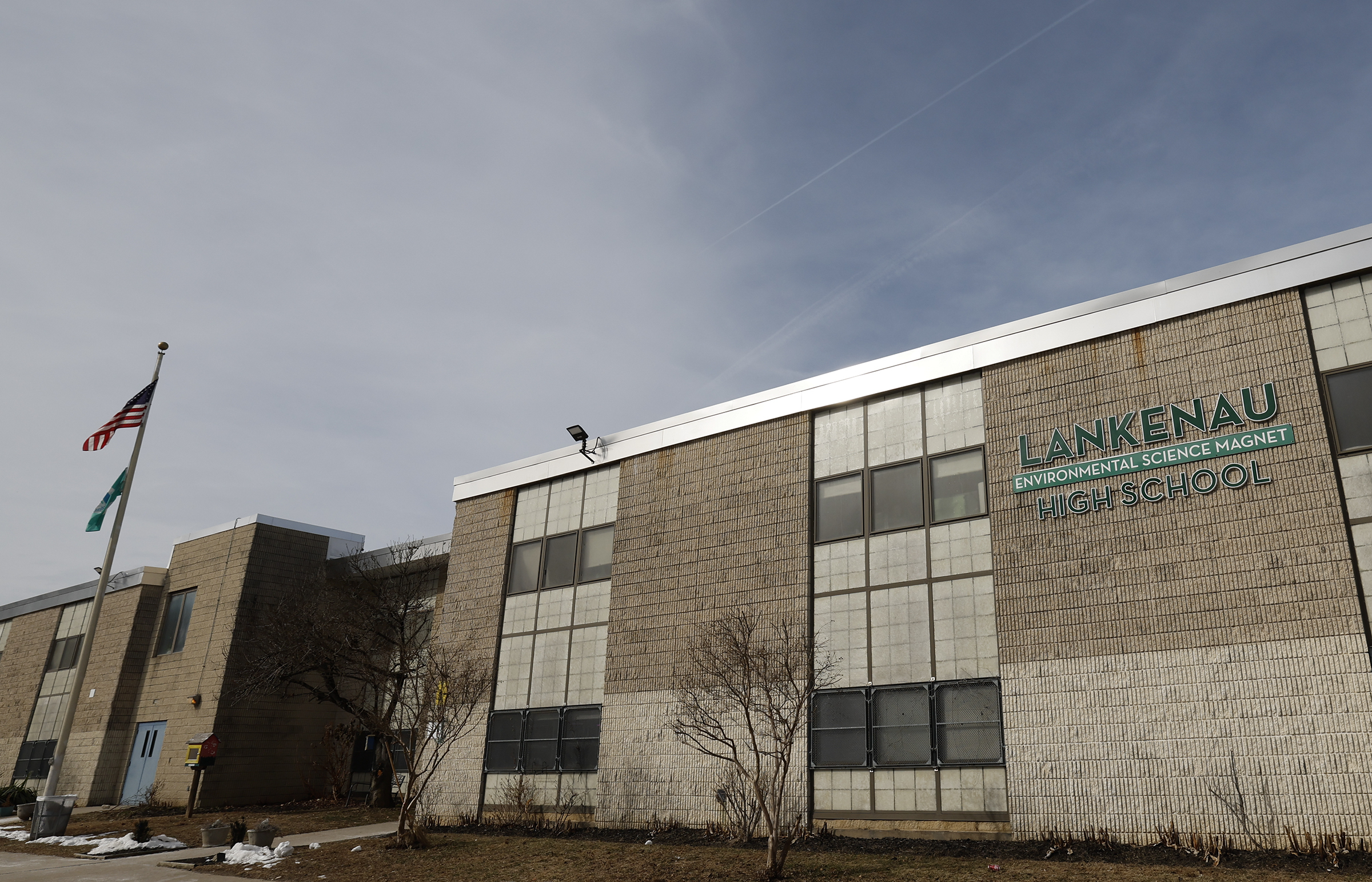
    The Lankenau Environmental Science Magnet High School in Roxborough. The district’s proposal would merge Lankenau into Roxborough High as an honors program.

    “Lankenau takes education to the next level,” said Lowe-Smith, president of the school’s chapter of Junior MANNRS — Minorities in Agriculture, Natural Resources, and Related Sciences — which preps students for jobs in the growing green sciences industry.

    “The environment is beautiful, the woods are — that’s another classroom,“ Lowe-Smith said. ”Nature is like therapy for a lot of people — it changed my life.”

    Being tucked into the woods allows for a Friday advisory bird-watching club at Lankenau and research in a stream that leads directly to the Schuylkill. It lends itself to tick drags — studies of tick species — pesticide classes that will allow students to graduate as certified pesticide applicators, and work with school beehives. Its students engage in innovative project-based learning every day.

    Lankenau students all receive yellow school bus transportation because the campus is not close to any SEPTA routes — adding to the district’s expense to keep it open.

    The school is small — its building, on Spring Lane in Upper Roxborough, is about half full, enrolling about 250 in a building that can accommodate 461. But the recommendations for closing need to be about more than numbers, said State Rep. Tarik Khan, a Democrat whose district includes that area.

    “Respectfully, the recommendation to close Lankenau is one of those things that doesn’t make sense when you look at the full picture,” Khan said. “Right now, it’s a recommendation. Early on, it’s important just to say: This is the wrong decision. I will elevate my voice throughout this process, and I’m not alone.”

    Monique Braxton, a district spokesperson, said the Lankenau recommendation “reflects the district’s commitment to reinvesting in neighborhood high schools as community anchors — a guiding theme of the Facilities Master Plan that received overwhelming support in the recent community survey. This approach expands access to high-quality academic programming and resources across neighborhoods, creating greater opportunity for more students and supporting stronger academic outcomes and postsecondary readiness.”

    Firing on all cylinders

    Lankenau, Khan said, is “firing on all cylinders. The school has so many opportunities for students, so many connections. To take this school out of its environment will break a lot of those connections, will break the cohesiveness.”

    The school lacks a gym. But its students play flag football, hike in the woods, and practice archery. It has a 100% graduation rate, officials say, educating a student body that is primarily Black and brown, with 25% of students requiring special education services.

    Jessica McAtamney, Lankenau’s principal for the last five years, stressed that the school is “doing urban agriculture in a very unique campus setting that is anchored in the space. Agriculture is Pennsylvania’s No. 1 industry. Lankenau is preparing kids to do that. This campus is what allows us to do that.”

    Roxborough High School, by contrast, is in a dense, residential area. Its building, which can hold almost 2,000 students, is about three-quarters empty.

    Like many in the Lankenau community, Erica Stefanovich — who teaches the only Intro to Geographic Information Systems high school course in the city, she believes — was blindsided by word that the school was earmarked for closure.

    “They can say that our building condition is an issue, but how is our building a problem when we have air-conditioning, zero asbestos, and they put a brand-new roof on our school two years ago?” Stefanovich said.

    In 2006, the district actually made plans to expand the Lankenau building, going so far as to contract with an architectural firm to make a model. But those plans went by the wayside as the school system hit rocky financial waters in the early 2010s.

    No slight against Roxborough, Stefanovich said. It does have a park close by, but “we can’t do mussel experiments in that park. We can’t do our internships that our students love. How do we have beehives when there isn’t enough pollinator space around Roxborough High School to have beehives? Our seniors are out of the building 40% of the time; they are off doing things. If we move, we don’t have that.”

    District changes yielded fewer incoming students

    Lankenau used to educate more students.

    Before the district changed its school selection process, in 2021, instituting a centralized lottery in the name of equity, the school had bigger incoming classes. It’s a magnet, meaning students have to have certain grades and test scores to qualify, but in the past, administrators had some leeway to let in students who were close to qualifying if they were a good fit.

    And though district officials said changes to the admissions procedure were necessary to ensure that schools’ demographics mirrored the city’s, Lankenau did not have a diversity problem prior to the changes.

    Lankenau had 106 ninth graders in 2020-21, before the lottery. It dipped to just 28 freshmen in 2023-24, but after a number of parents and administrators raised concerns about the process, some course corrections were made.

    Its numbers are now rising again. Seventy-eight ninth graders entered this school year, and 107 students listed Lankenau as their top choice for the 2026-27 freshman class.

    Even if the proposed school-closing changes go through, Wyntir Alford, a Lankenau 11th grader from West Oak Lane, will be able to graduate from the school as-is — the change is not planned to take effect until the 2027-28 school year.

    But her family was clear: If the closing were happening next year, Alford would have had to transfer.

    “My mom told me her first thought was, ‘There’s no way she’s going to Roxborough.’ She said, ‘The reason we put you in Lankenau is because of all the opportunities and all the nature around.’ I’m not surrounded by any nature at home. So to be able to go to a school like this is a big deal.”

    A student tests a water sample in a Lankenau High school science class in this 2023 file photo.

    Juniper Sok Sarom, a current Lankenau ninth grader, is not sure whether she will transfer to Roxborough if the school board approves the closure recommendation. But she knows she’s happy at a school that gives her plenty of hands-on experience.

    “Our campus — it’s a special learning environment, which you wouldn’t get at any other school, not even Central or Palumbo or SLA,” Sarom said, referring to Science Leadership Academy.

    She and others are gearing up to fight the changes, they said.

    Charde Earley, a Lankenau paraprofessional, dealt with her own sadness the day students found out about the proposed closure, working through tears. And then she marveled at how students pivoted to problem-solving, resolving to write letters and speak at meetings.

    “My motto is, respectfully, ‘Hell, no, we won’t go,’” Earley said. “We’re secluded and we’re safe. You never know what hardship our kids are going through. Imagine what this is doing to our kids.”
  • How Jamie Gauthier charted a new path to power in Philadelphia City Hall

    How Jamie Gauthier charted a new path to power in Philadelphia City Hall

    When Mayor Cherelle L. Parker unveiled her much-anticipated plan to address Philadelphia’s housing crisis last year, there was predictable criticism from the political left. Activists said the proposal drafted by the moderate Democrat would not do enough for the city’s poorest residents.

    Less predictable was that a majority of City Council stood with them.

    Even the Council president, a centrist ally of the mayor, sided with a progressive faction that just two years ago had been soundly defeated in the mayor’s race — but whose new de facto leader in City Hall has proven adept at building alliances across the ideological spectrum.

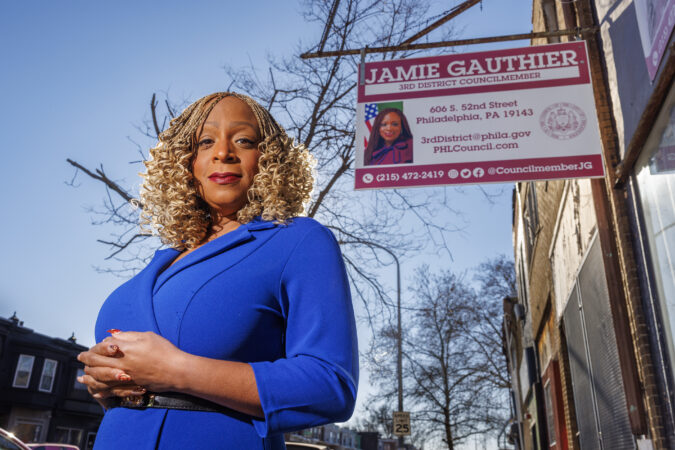
    At the center of that shift was Jamie Gauthier.

    The second-term Democratic lawmaker from West Philadelphia has solidified herself over the last year as a leading voice on Council and a counterweight to Parker. She has worked within the system as opposed to trying to break it, maintaining relationships with power players who disagree with her on policy.

    She counts Ryan N. Boyer — the labor leader who is Parker’s closest political ally — among those who consider her a “thought leader.”

    “Over the last year, what you saw,” Boyer said, “is her modulate her positions to become more practical.”

    Gauthier has generally voted with progressives, including last year when she opposed the controversial Center City 76ers arena proposal. But she has also endeavored to be a team player, at times compromising on ideological battles to focus on priorities in her district.

    Last year, she voted for Parker’s plan to cut taxes for businesses and corporations when other progressives opposed it, because her main priority was securing housing funding. She has not opposed some tough-on-crime efforts in the Kensington drug market, instead allowing her colleagues who represent that area to dictate the policy there.

    She says she is trying to use her political capital where it matters.

    “Why would I take a protest vote and tank a relationship with a colleague when I’m going to need them later?” she said. “I want to win.”

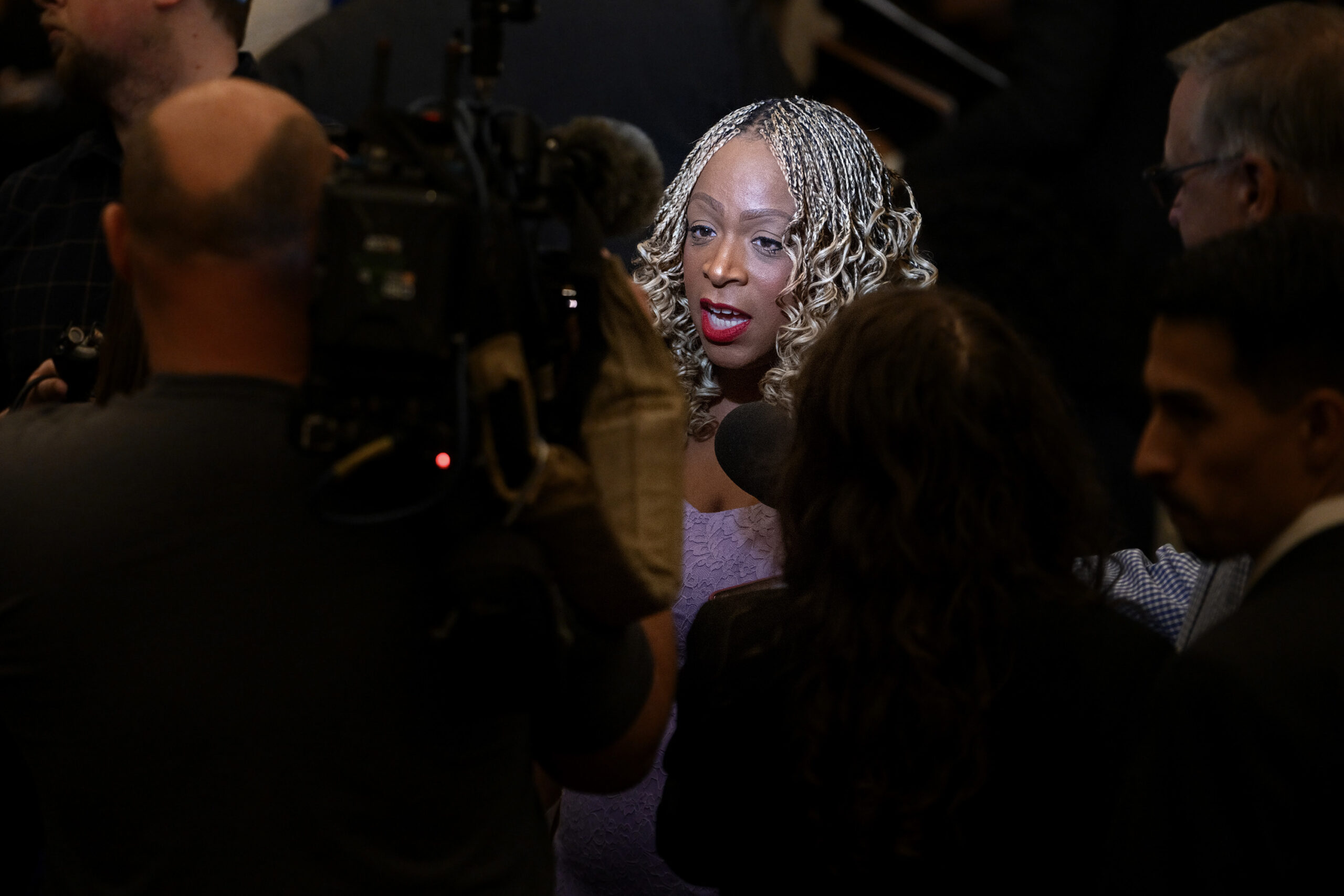
    Councilmember Jamie Gauthier talks with news media following a special session of City Council on March 24, 2025.

    The fact that Gauthier is a district Council member who represents a large swath of the city west of the Schuylkill also gives her cachet with colleagues. Council has a long tradition of honoring how members want their own neighborhoods to be governed.

    Gauthier, who leads Council’s housing committee, has used the influence to make West Philadelphia something of a testing ground for left-of-center policy. Plenty oppose what they see as draconian restrictions on real estate development in her district.

    Others see a progressive champion, and some political observers think Gauthier could amass enough support to run for mayor one day. She doesn’t deny that she has thought about it.

    But for whatever politics Gauthier can navigate in City Hall, she knows she can rise only if she is successful at home.

    ‘Not just a lone actor’

    When Parker took office, Council was in a moment of upheaval. Council President Kenyatta Johnson was the new leader of the chamber, and several prominent voices were gone after they had resigned to run for mayor themselves.

    One was Helen Gym, who was seen as the leader of Council’s left flank. There were questions about who would fill the void once Gym was gone.

    Gauthier, 47, an urban planner by trade, did not come up through an activist movement in the same way Gym did, and was a bit more reserved in her style.

    But she carries the mantle for the same theory of governance: that lawmakers should prioritize the vulnerable, and that what is good for business is not necessarily good for everyone else.

    That set Gauthier on an ideological collision course with Parker, a former Council member who ran for office on a promise to uplift the middle class, a group the mayor believes has been too often ignored.

    It came to a head in the fight over Parker’s Housing Opportunities Made Easy, or H.O.M.E., initiative.

    Parker wanted to set unusually high income eligibility thresholds for some of the programs so that middle-class families could unlock government subsidies they may not otherwise qualify for. A significant portion of Council, meanwhile, wanted the money to go initially to Philadelphians most vulnerable to displacement.

    Parker was clear-eyed about who was leading the charge.

    “Councilmember Jamie Gauthier, she may be comfortable and OK with telling Philadelphia homeowners, working-class Philadelphians, that they have to wait and there is no sense of urgency for them,” Parker said in a December interview on WHYY. “But that is not a sentiment that I support or agree with.”

    Gauthier is quick to point out that she did not work alone, and that one member of a 17-member body cannot accomplish much. Alongside Councilmember Rue Landau, a fellow Democrat and a housing attorney by trade, Gauthier worked for months to win over her colleagues.

    In the end, Council approved a version of the housing initiative closer to Gauthier’s vision.

    Gauthier didn’t think Parker helped her own cause. A “line was crossed,” she said, when Parker took the fight outside City Hall and to the pulpit. Amid negotiations with Council, the mayor went to 10 churches on one Sunday in December to lobby for support, saying her vision was to not “pit the ‘have-nots’ against those who have just a little bit.”

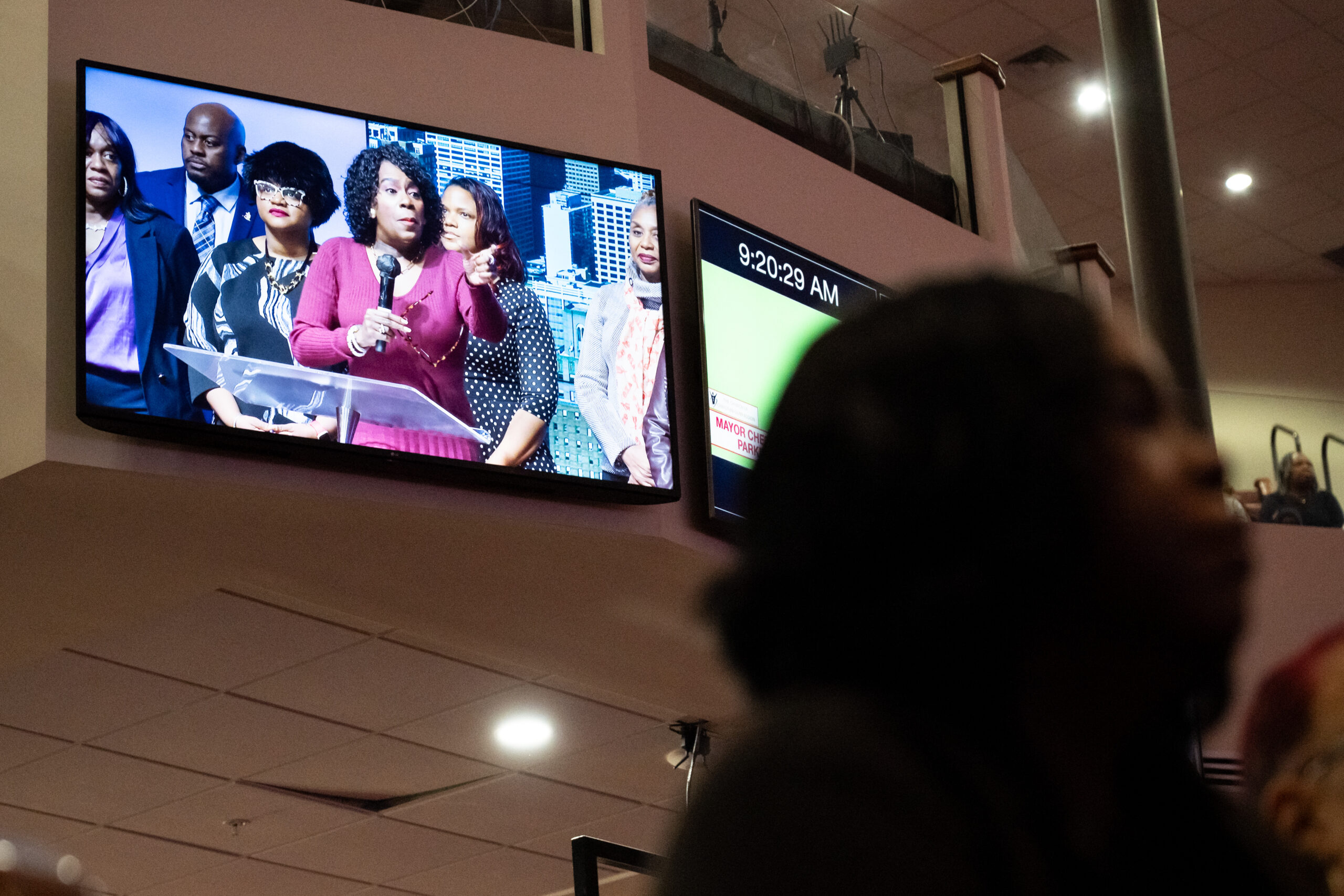
    Mayor Cherelle L. Parker speaks to the crowd at The Church of Christian Compassion in the Cobbs Creek neighborhood of West Philadelphia on Sunday, Dec. 7, 2025. Parker visited 10 churches in Philadelphia on Sunday to share details about her HOME housing plan.

    To Gauthier, the divisiveness was coming from the mayor’s office.

    “I wish the mayor and her administration were more open to other people’s ideas, were more OK with disagreement on policy issues, and more aware of Council as a completely separate chamber of government,” Gauthier said, “as opposed to a body that works for her.”

    That is a candid assessment of the relationship between Parker and City Council from Gauthier. Few lawmakers from the mayor’s own party have criticized her publicly.

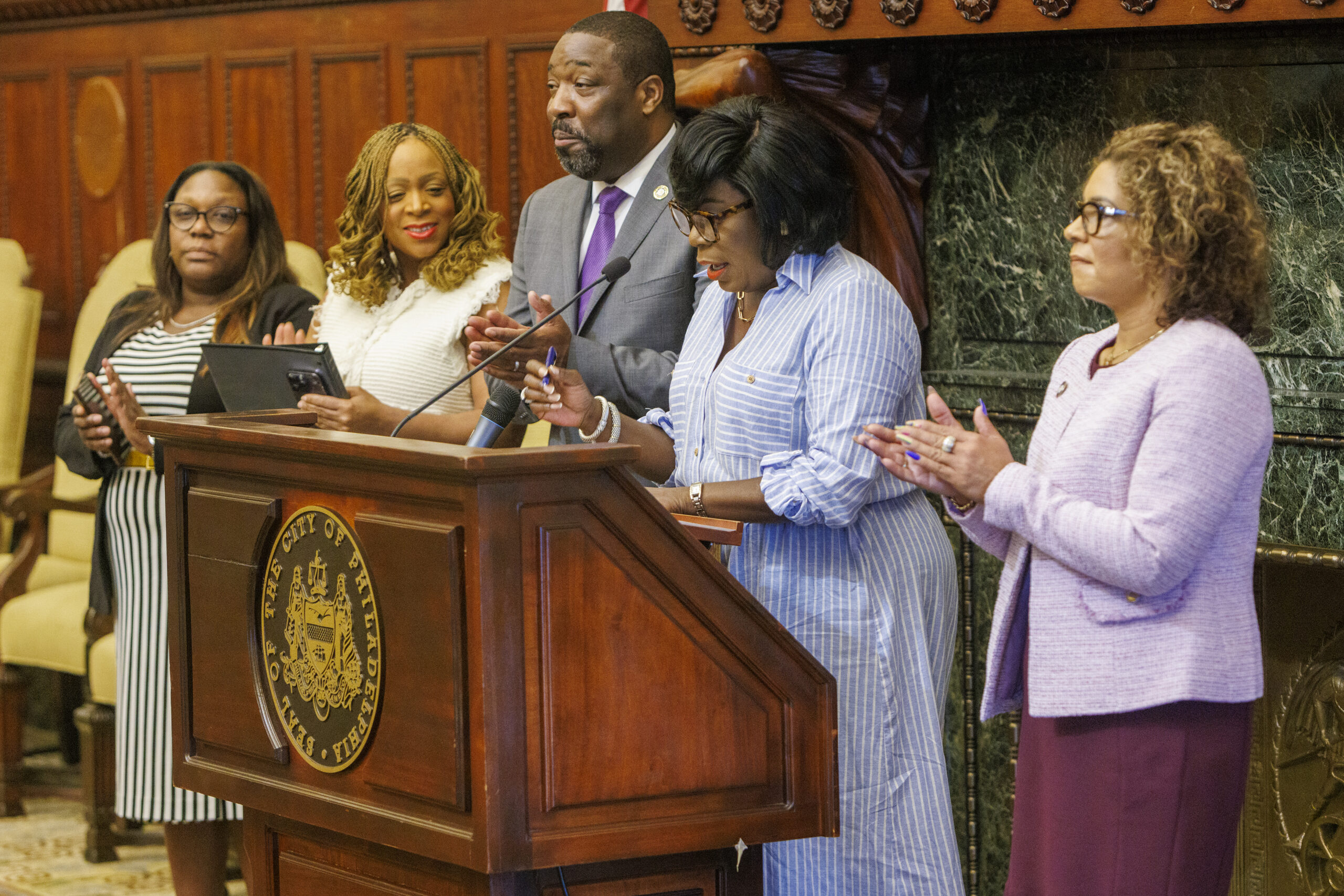
    Philadelphia Mayor Cherelle Parker holds a press conference regarding her first budget flanked by members of city council in her reception room, Philadelphia City Hall on Thursday, June 6, 2024. Council members from left are Kendra Brooks, Jamie Gauthier, council president Kenyatta Johnson, and Quetcy Lozada.

    State Rep. Rick Krajewski, a West Philadelphia Democrat and a progressive who has worked closely with Gauthier, said the fight over H.O.M.E. showed that Gauthier has learned “the diplomacy required to be an effective legislator.”

    “It was a good example of not being afraid of a conflict that felt important to stand up for,” he said, “but then to not just be a lone actor, but organize with other colleagues and allies.”

    Gauthier’s most important ally was Johnson, who negotiated directly with Parker through the process and controls the flow of legislation in the chamber.

    The two go back years. Before Johnson was Council president, he made a point of welcoming new members, a gesture that has always stuck with Gauthier. They worked closely to secure funding for gun violence prevention. And Gauthier said that since Johnson took the gavel, he has been more open to working with progressives than his predecessor was.

    She was also key to Johnson’s ascent. When he was locked in a tight battle for the Council presidency, it was Gauthier who became the ninth Council member to commit to voting for Johnson, allowing him to secure a majority of members and the presidency.

    He does not talk about that publicly. What he will say is that he works in partnership with Gauthier because she understands “the bigger picture in terms of how we move forward as the institution.”

    “I consider her to be a pragmatic idealist,” Johnson said. “She wears her heart on her sleeve, and she really believes in actually doing the work.”

    Creating a testing ground in West Philly

    When Gauthier first ran for office in 2019 against a member of one of Philadelphia’s most entrenched political families, she ran as a good-government urbanist. She railed against councilmanic prerogative, the city’s long tradition of allowing district Council members final say over land-use decisions in their areas.

    She was also supported by real estate interests, some of whom now have buyer’s remorse.

    After Gauthier pulled off a shock win, she arrived in Council and quickly aligned with the progressive bloc. Through her first two terms, she has used councilmanic prerogative often, and has voted with her district Council colleagues so that they can do the same.

    She admits that it is an effective tool for accomplishing her goals quickly.

    Carol Jenkins, a Democratic ward leader in West Philadelphia, said Gauthier’s use of councilmanic prerogative is “part of her maturation.”

    “That’s the power you have,” Jenkins said.

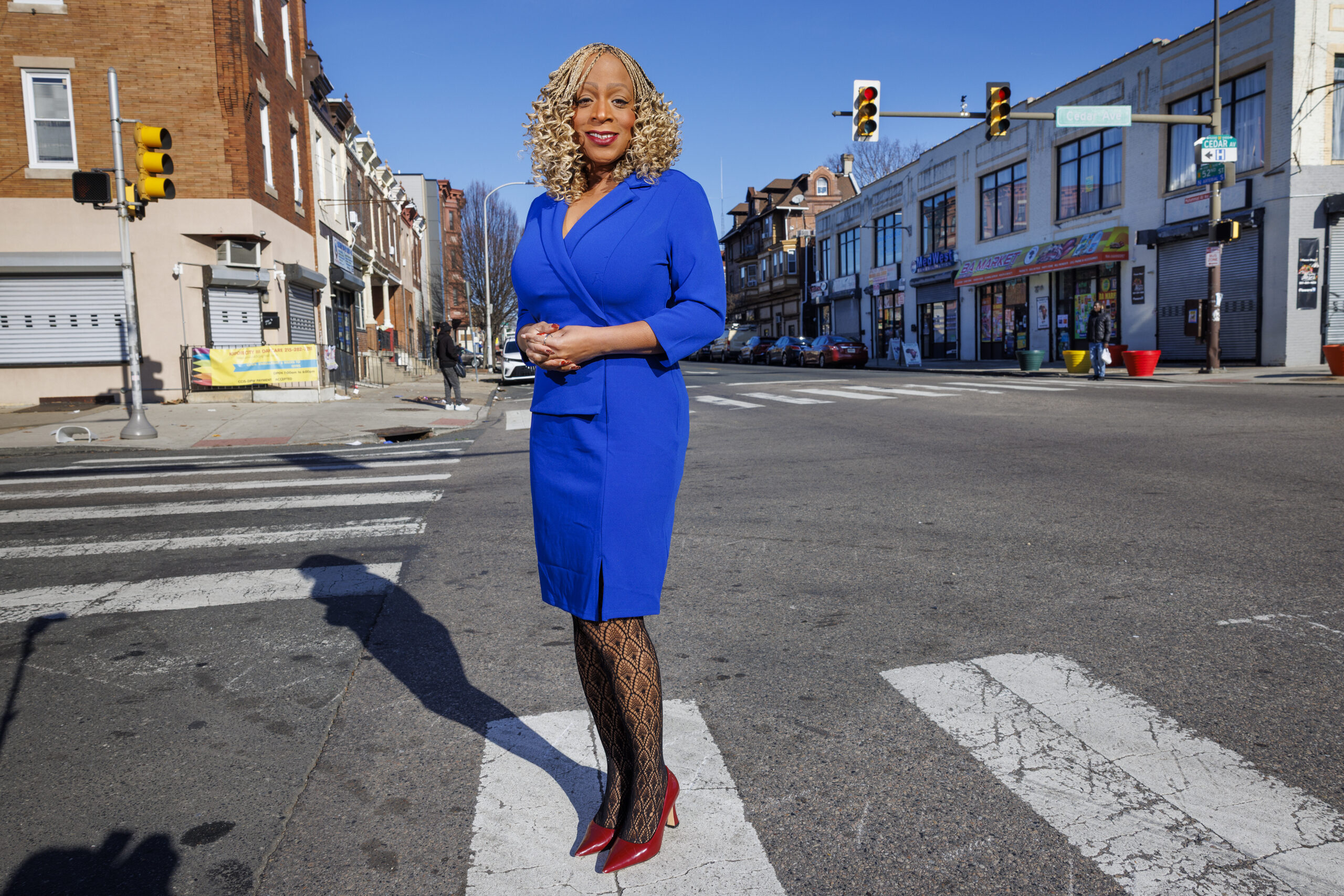
    City Councilmember Jamie Gauthier in her district near 52nd Street and Cedar Avenue in Philadelphia on Monday, Dec. 22, 2025.

    Gauthier has at times used the power in ways that the city’s urbanists and development interests can get behind. She has quickly approved bike lane expansions. And she recently was the only district Council member to allow her entire district to be included in legislation that cuts red tape for restaurants that want to offer outdoor dining.

    However, her most notable use of councilmanic prerogative has been in housing policy, and some developers say her district is now the most hostile to growth in the city.

    In Gauthier’s first term, she championed legislation to create what is known as a Mixed Income Neighborhood overlay. In essence, it requires that developers building projects with 10 or more units in certain parts of her district make at least 20% of their units affordable. That is defined as accessible for rental households earning up to 40% of the area median income.

    For Gauthier, it’s a tool to slow the rapid gentrification of her majority-Black district.

    But developers say that growth has slowed significantly in the areas covered by the overlay since it took effect in 2022. Some have said they avoid seeking to build in the 3rd District entirely. The only major project currently in the works in the area is a parking garage.

    Ryan Spak, an affordable housing developer who said he considers Gauthier a friend, has been among the most outspoken critics of the overlay. He said while Gauthier’s “moral compass is pointed in the right direction, her policies don’t math.”

    “You would never ask a restaurant to give away its ninth and 10th meal for 40 cents on the dollar, with no additional discounts or benefits,” he said, “and expect that restaurant to survive.”

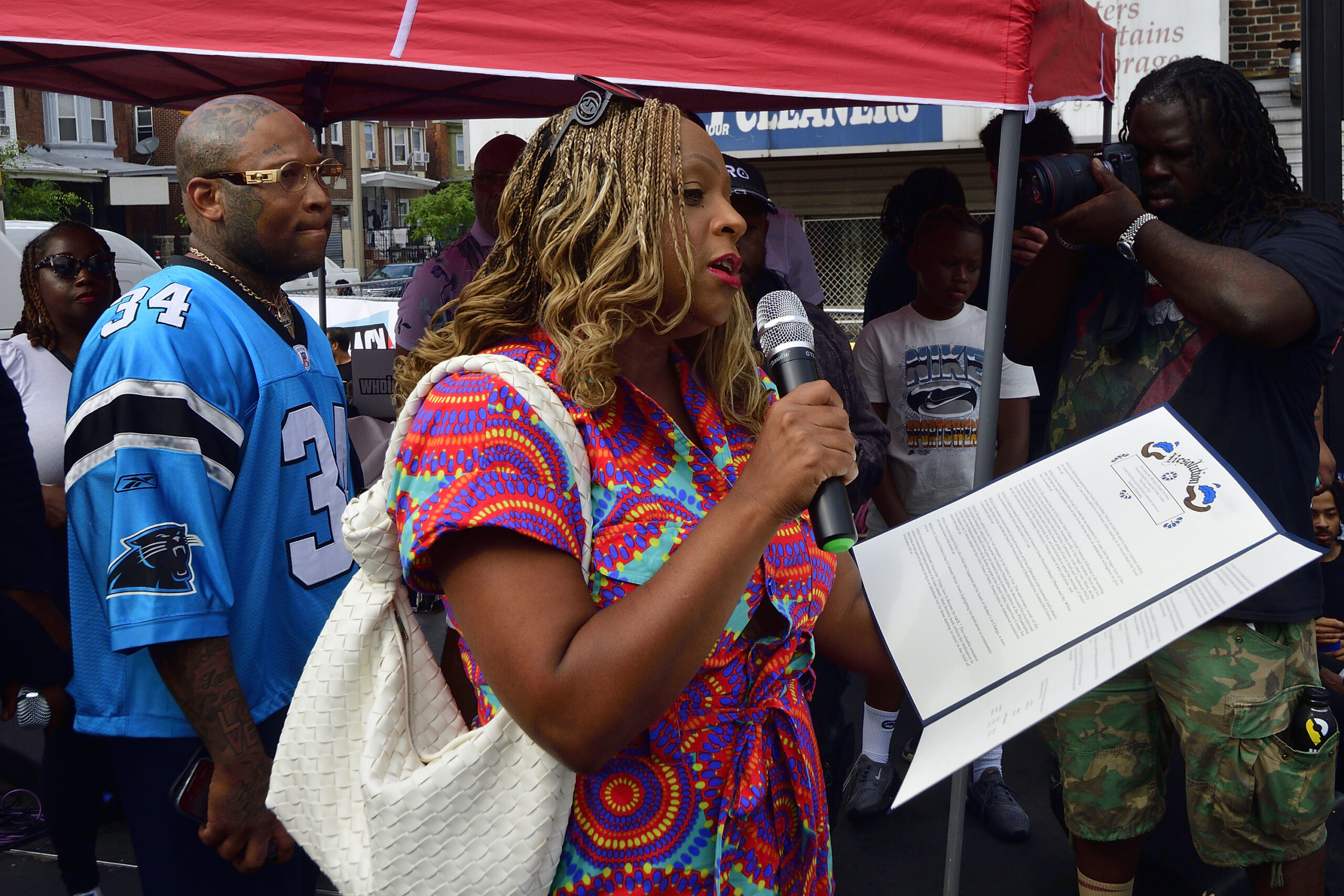
    Councilmember Jamie Gauthier reads out a citation honoring Rapper Mont Brown during a street naming ceremony for the Southwest Philadelphia native at the 13th Annual Stop the Violence Kickback Block Party at 55th Street and Chester Avenue, in Southwest Philadelphia on August 17, 2024.

    Gauthier said she has made adjustments, and she championed legislation to accelerate permitting and zoning approvals. The mandate, she said, is necessary because the market won’t build enough affordable housing on its own.

    “As untenable as it is to them that they can’t make the numbers work, it’s untenable to me that people can’t afford to live here,” Gauthier said. “So we can come together and we can fix that. But I’m not going to move from my position that we have to demand affordability.”

    Mayoral buzz, but no ‘stupid campaigns’

    Gauthier is one of several names that have been floated in political circles as potential candidates for mayor in 2031, which would be Parker’s final year in office if she runs for and wins a second term. Several of her Council colleagues, including Johnson, are seen as potential contenders.

    “I’d be lying if I didn’t say that mayor could be interesting one day,” Gauthier said. “I also don’t believe in stupid campaigns. So I would never do that if I didn’t think I had a path.”

    Boyer said he has counseled Gauthier to pursue moderate policy and avoid being “label-cast” as far left. He said Philadelphia is not Chicago or New York, and he doesn’t see the city electing an uber-progressive to be the mayor any time soon.

    “Philadelphia has always been a real center-left community,” Boyer said, “and just because you’re the loudest isn’t the most popular.”

    The left may have other plans. Robert Saleem Holbrook, a progressive activist, said that Gauthier would be an “ideal candidate” for higher office and that the city’s leftists would back her.

    Probably.

    “So long as she stays true and supportive of progressive ideals,” Holbrook said. “You can’t compromise on your way up.”

  • Joseph R. Syrnick, retired chief engineer for the Streets Department and CEO of the Schuylkill River Development Corp., has died at 79

    Joseph R. Syrnick, retired chief engineer for the Streets Department and CEO of the Schuylkill River Development Corp., has died at 79

    Joseph R. Syrnick, 79, of Philadelphia, retired chief engineer and surveyor for the Philadelphia Streets Department, president and chief executive officer of the Schuylkill River Development Corp., vice chair of the Philadelphia City Planning Commission, former adjunct professor, college baseball star at Drexel University, mentor, and “the ultimate girl dad,” died Saturday, Jan. 17, of cancer at his home in Roxborough.

    Reared on Dupont Street in Manayunk and a Roxborough resident for five decades, Mr. Syrnick joined the Streets Department in 1971 after college and spent 34 years, until his retirement in 2005, supervising hundreds of development projects in the city. He became the city’s chief engineer and surveyor in 1986 and oversaw the reconstruction of the Schuylkill Expressway and West River Drive (now Martin Luther King Jr. Drive) in the 1980s, and the addition of new streetlights and trees on South Broad Street and the upgrade of six city golf courses in the 1990s.

    He was an optimist and master negotiator, colleagues said, and he worked well with people and the system. “You have concepts that seem simple,” he told The Inquirer in 1998. “But when you commit them to writing, they raise all kinds of other questions.”

    In 2000, as Republicans gathered in Philadelphia for their national convention, Mr. Syrnick juggled transit improvements on Chestnut Street and problems with the flags on JFK Boulevard. He also helped lower speed limits in Fairmount Park and added pedestrian safety features on Kelly Drive.

    He beautified Penrose Avenue and built a bikeway in Schuylkill River Park. He even moderated impassioned negotiations about where the Rocky statue should be placed.

    Since 2005, as head of the Schuylkill River Development Corp., he deftly partnered with public and private agencies, institutions, and corporations, and oversaw multimillion-dollar projects that built the celebrated Schuylkill River Trail, renovated a dozen bridges, and generally improved the lower eight-mile stretch of the Schuylkill, from the Fairmount Dam to the Delaware River, known as Schuylkill Banks.

    In an online tribute, colleagues at the Schuylkill River Development Corp. praised his “perseverance and commitment to revitalizing the tidal Schuylkill.” They noted his “legacy of ingenuity, optimism, and service.” They said: “Joe was more than an extraordinary leader. He was a great Philadelphian.”

    Dennis Markatos-Soriano, executive director of the East Coast Greenway Alliance, said on Facebook: “He exuded confidence, humility, and unwavering commitment.”

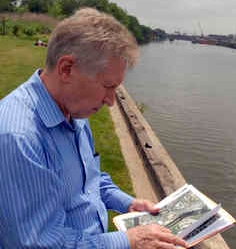
    Mr. Syrnick reviews plans to extend a riverside trail in 2009.

    Mr. Syrnick was a constant presence on riverside trails, other hikers said. He organized regattas and movie nights, hosted riverboat and kayak tours, cleaned up after floods, and repurposed unused piers into prime fishing platforms.

    “Great cities have great rivers,” Mr. Syrnick told The Inquirer in 2005. “Here in Philadelphia, we have Schuylkill Banks.”

    He was a Fairmount Park commissioner for 18 years, was named to the Philadelphia City Planning Commission in 2008, and served as vice chair. He lectured about the Schuylkill often and taught engineering classes and led advisory panels at Drexel. In 2015, he testified before the state Senate in support of a waterfront development tax credit.

    Friends called him “a visionary,” “a true hero,” and “a Philly jewel.” One friend said: “He should be honored by a street naming or something.”

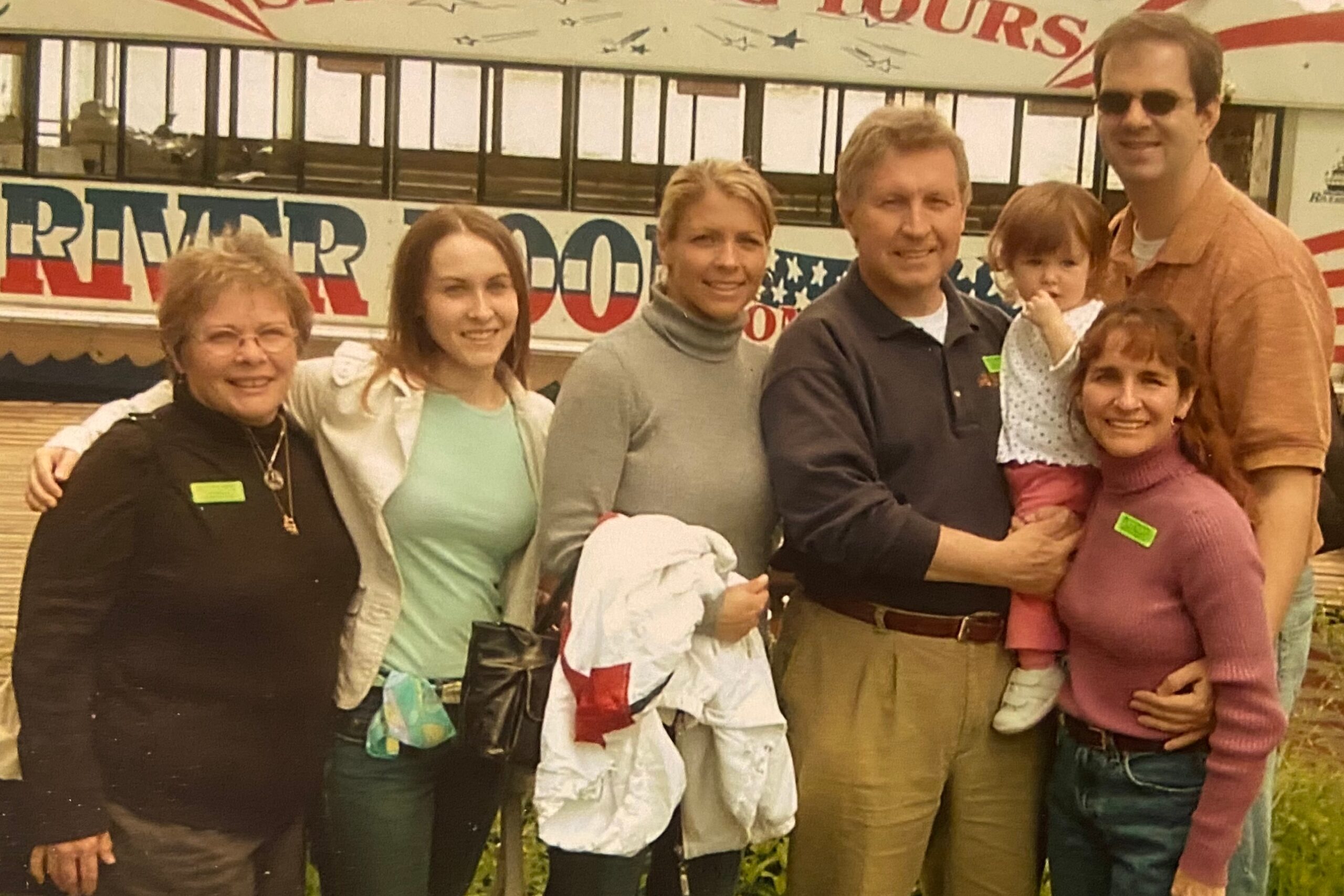
    Mr. Syrnick (fourth from left) and his family pose near a riverboat.

    Paul Steinke, executive director of the Preservation Alliance for Greater Philadelphia, said on Facebook: “He left his native Philadelphia a much better place.”

    Mr. Syrnick was president of the Philadelphia Board of Surveyors and active with the American Society of Civil Engineers, the Engineers’ Club of Philadelphia, and other organizations. At Drexel, he earned a bachelor’s degree in civil engineering in 1969 and a master’s degree in 1971.

    In 2024, Drexel officials awarded him an honorary doctorate for “his visionary leadership in engaging diverse civic partners to revive the promise of a waterfront jewel in Philadelphia.”

    He played second base on the Roman Catholic High School baseball team. He was captain of the 1968 Drexel team and later played against other local standouts in the old Pen-Del semipro league.

    Mr. Syrnick (center in white shirt) had all kinds of way to publicize fun on the Schuylkill. This photo appeared in The Inquirer in 2007.

    Most of all, everyone said, Mr. Syrnick liked building sandcastles on the beach and hosting tea parties with his young daughters and, later, his grandchildren. He grew up with three brothers. Of living with three daughters, his wife, Mary Beth, said: “It was a shock.”

    His daughter Megan said: “It was a learning experience. Whether it was sports or tea parties, he became the ultimate girl dad.”

    Joseph Richard Syrnick was born Dec. 19, 1946, in Philadelphia. He spent many summer days riding bikes with pals on Dupont Street and playing pickup games at the North Light Community Center.

    He knew Mary Beth Stenn from the neighborhood, and their first date came when she was 14 and he was 15. They married in 1970, moved up the hill from Manayunk to Roxborough, and had daughters Genevieve, Amy, and Megan.

    Mr. Syrnick received his honorary doctorate from Drexel in 2024.

    Mr. Syrnick enjoyed baseball, football, and golf. He was active at St. Mary of the Assumption and Holy Family Churches, and he and his wife traveled together across Europe, Africa, the Middle East, and Asia.

    “He was humble,” his daughter Megan said. “He was quiet in leadership. He always said: ‘It’s the team.’”

    In addition to his wife and daughters, Mr. Syrnick is survived by seven grandchildren, his brother Blaise, and other relatives. Two brothers died earlier.

    Visitation with the family is to be from 6 to 8 p.m. Friday, Jan. 23, at Koller Funeral Home, 6835 Ridge Ave., Philadelphia, Pa. 19128, and 9:30 a.m. Saturday, Jan. 24, at Holy Family Church, 234 Hermitage St., Philadelphia, Pa. 19127. A Mass celebrating his life is to follow at 11 a.m.

    Donations in his name may be made to the Basilica Shrine of Our Lady of the Miraculous Medal, 475 E. Chelten Ave., Philadelphia, Pa. 19144; and Holy Family Parish, 234 Hermitage St., Philadelphia, Pa. 19127.

    Mr. Syrnick (left) and his brother, Blaise, enjoyed being around water.
  • Developer’s land swap proposal stirs furor in Limerick, but Delco would gain its first state game land

    Developer’s land swap proposal stirs furor in Limerick, but Delco would gain its first state game land

    A warehouse developer’s proposal to trade land with the state in Limerick Township and beyond has blindsided local officials — and ignited fierce opposition from residents who fear the deal could clear the path for a data center.

    The state would gain 559 acres across three counties, including what would become Delaware County’s first state game lands, according to the proposal on file with the Pennsylvania Game Commission.

    In return, the developer, Limerick Town Center LLC, would secure a 55-acre property in Limerick. That land adjoins an industrial tract the developer already owns, which was formerly the site of the Publicker distillery.

    (function() {
    var l2 = function() {
    new pym.Parent(‘LANDSWAP1-22-26.html’,
    ‘https://media.inquirer.com/storage/inquirer/projects/innovation/arcgis_iframe/LANDSWAP1_22_26new.html’);
    };
    if (typeof(pym) === ‘undefined’) {
    var h = document.getElementsByTagName(‘head’)[0],
    s = document.createElement(‘script’);
    s.type = ‘text/javascript’;
    s.src = ‘https://pym.nprapps.org/pym.v1.min.js’;
    s.onload = l2;
    h.appendChild(s);
    } else {
    l2();
    }
    })();

    Collapse

    Residents flooded an hourslong Board of Supervisors meeting Tuesday night to oppose the land swap, prompting officials to open a second room for the overflow.

    “I’m against the swap,” resident Jeff Schmidt told the board. “It’s a terrible idea, and I need to stop now because a lot of bad words want to come out of my mouth.”

    Connie Lawson, board chair, said that ultimately the state controls the land involved in the swap, not the township.

    Township manager Daniel Kerr told the crowd that the township had little information and had just learned of the proposal last week. But, he said, plans for land involved in the swap would have to go through the township for zoning and planning.

    After hours of listening to residents, the board voted to send a “strongly worded” letter of opposition to the Game Commission.

    Although the developer has not proposed building a data center, the idea has been widely circulated on social media, including in posts by state Sen. Katie Muth. She urged residents who oppose the swap to attend the township meeting Tuesday, as well as a state Game Commission meeting on Saturday.

    Data centers, which house servers used for artificial intelligence, have become a hot topic in recent months, as residents in multiple towns have voiced concerns over their use of land, energy, and water. Meanwhile, political and labor leaders have embraced them as job creators.

    A data center was recently proposed for placement between the Philadelphia Premium Outlets and a nuclear power plant in Limerick, and another was proposed last year in neighboring East Vincent Township at the former Pennhurst State School and Hospital.

    Those two locations are within two miles of the land Limerick Town Center would acquire in the swap.

    “If this swap goes through, we are one step closer to turning our communities into Data Center Alley 2.0,” Muth wrote on Facebook last week. “This land is publicly owned wildlife habitat and forest. It should not be traded away so Big Tech and AI corporations can maximize profits at the expense of our environment and quality of life.”

    What’s involved with the land swap?

    Limerick Town Center LLC is already proposing to build two warehouses totaling 1.9 million square feet in Limerick’s Linfield section. That would be off Main Street and Longview Road, not far from Constellation Energy’s Limerick Clean Energy Center, a nuclear power plant.

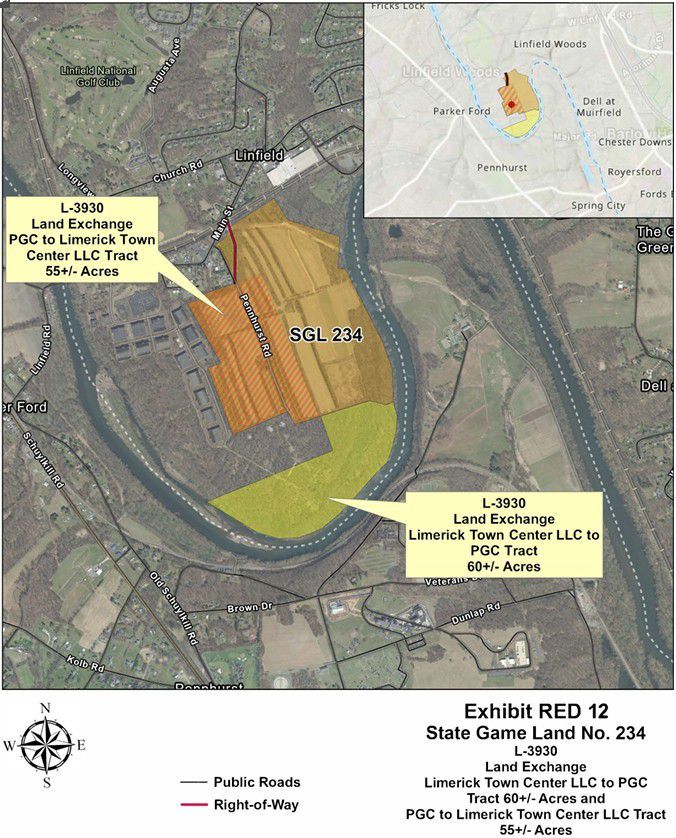
    The proposed swap would give Limerick Town Center LLC state-owned land and a 200-foot right-of-way adjoining the warehouse site, in exchange for the company giving the state property in Limerick and other counties.

    Overall, the company would give the state a total of 614 acres in return for a 55-acre chunk of Game Land 234.

    Included in the 614 acres is a 60-acre parcel it already owns in Limerick that adjoins the southern portion of Game Land 234 near the river.

    Map shows a proposal by Limerick Town Center LLC to give the state 60 acres it owns in Limerick Township in return for the state giving the company 55 acres of State Game Land 234.

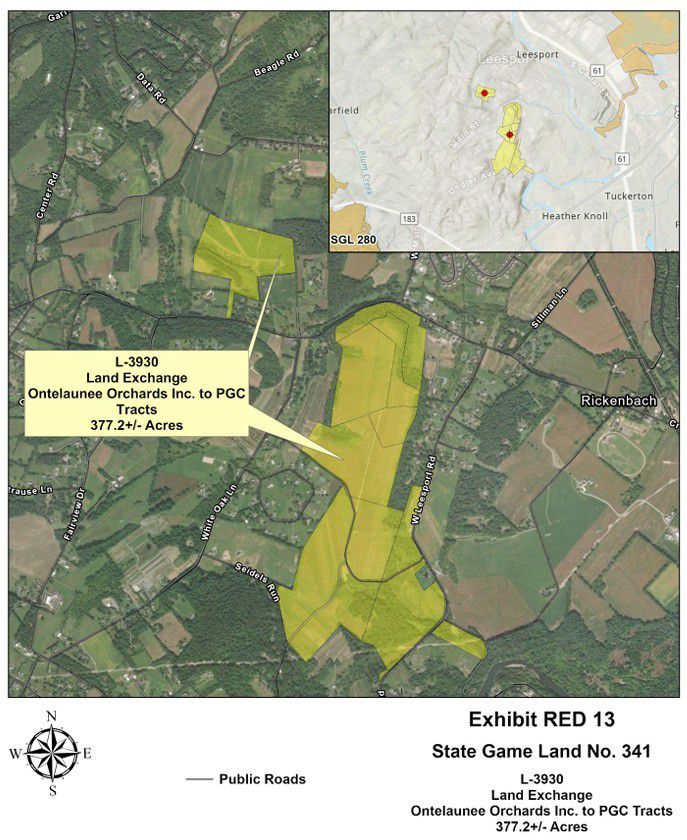
    The company would also give 377 acres in Bern Township, Berks County, to be managed by the state.

    Map shows part of a land swap being proposed by Limerick Town Center LLC. The company is proposing to give the state 377 acres of Ontelaunee Orchards in Bern Township, Berks County, in return for 55 acres of State Game Land 234 in Limerick Township, Montgomery County.

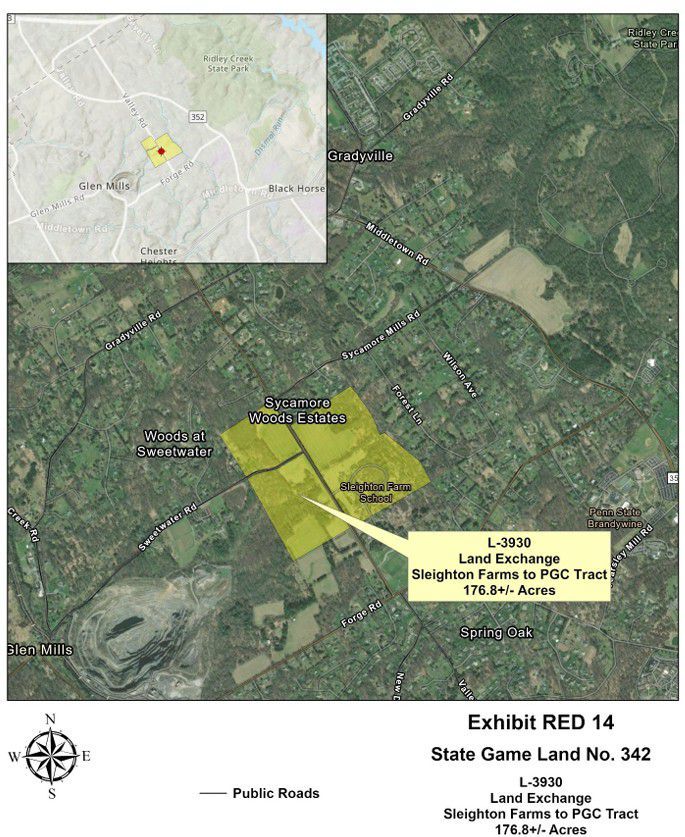
    And the company would give the state 177 acres in Edgmont Township that would become the first state game land in Delaware County.

    Map shows part of a land swap being proposed by Limerick Town Center LLC to acquire 55 acres of state Game Land 234 in Limerick Township, Montgomery County. In return, Limerick Town Center would give the state hundreds of other acres including 177 acres in Edgmont, Delaware County that could be used for a new state Game Land.

    Local concerns

    At Tuesday night’s meeting, resident after resident opposed the plan, citing overdevelopment, traffic, a change in the character of the community, and an impact on wildlife and the environment. Only one man from Berks County, who said he was a hunter, supported the swap.

    Limerick resident Jennifer Wynne told the board she opposes the swap, saying the public hasn’t been given enough information that it would provide “a clear public benefit.”

    “I am also concerned that this transfer may function as a precursor to future high-intensity or industrial development,” she said.

    Michael Poust said he moved to Limerick to escape overdevelopment, and he opposes the land swap.

    “My land is surrounded by the state game lands,” he said. “I bought it there for a reason.”

    Muth, the state senator, lives in neighboring East Vincent and has been part of the fight against a data center proposed for Pennhurst.

    “I highly recommend that you review the path forward to change the zoning in that area,” Muth told the board.

    A view of the former Publicker Distillery tract now owned by Limerick Town Center LLC, which is proposing to build two warehouses on the land. The company is also proposing a land swap with the state to gain 55 acres of adjoining land.

    Edgmont’s response

    Meanwhile, Edgmont Township, Delaware County, could gain new state game land near, but not connected to, Ridley Creek State Park.

    Pennsylvania Game Lands, supported by hunting and trapping fees, are widely used for hunting, hiking, fishing, and birdwatching.

    Ken Kynett, Edgmont Township’s manager, said officials only learned of a land swap on Jan. 16.

    “We got an email from the game commission last week saying we’re interested in acquiring property in your township,” Kynett said. “It was as much a surprise to us as anyone else.”

    Under the land-swap proposal, Limerick Town Center LLC would give the state a 177-acre portion of the old Sleighton Farm School grounds.

    The school, originally set on 300 acres and run by Quakers, was founded to serve “troubled children.” In 1931, it split into two separate schools: the Glen Mills School for boys and the Sleighton Farm School for girls. Eventually, the school became coed and was called simply Sleighton School.

    The school closed in 2001 because of financial difficulties, and the grounds were sold. Elywn, a large nonprofit, owns the land.

    Kynett said he assumed Limerick Town Center LLC is working with Elwyn on the deal. Part of the land is zoned for agriculture, and part is zoned residential.

    He said that keeping the land as open space could be a positive, but the township doesn’t have enough information to know whether to support or oppose the swap.

    “We haven’t really had a chance to discuss it with the board,” Kynett said.

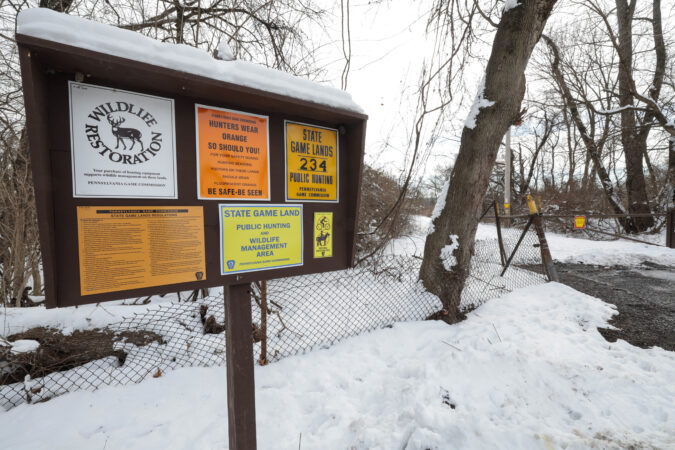
    State Game Lands 234, Main Street and Pennhurst Road, Limerick Twp., Montgomery County.

    Who’s behind Limerick Town Center LLC?

    Limerick Town Center LLC has an address in Madison, Conn., according to Montgomery County land records. The address is linked to a company registered by Christine Pasieka, who is a business partner and the wife of Chris Rahn. The two have made development deals throughout the Philadelphia area for years.

    Pasieka could not be reached immediately for comment on Wednesday.

    Property records show that Limerick Town Center LLC purchased the 197-acre parcel in 2022 for $17 million.

    In 2023, the company applied to build on the Publicker tract, according to county records. The registered agent for Limerick Town Center LLC was Sandra DiNardo, whose family owns a large trucking and cement business.

    DiNardo could not be reached immediately for comment.

  • The Avenue of the Arts to break ground on an ambitious $150 million streetscape to make Broad Street greener

    The Avenue of the Arts to break ground on an ambitious $150 million streetscape to make Broad Street greener

    Lush landscaping and public art will soon line Broad Street, impromptu performances may pop up, and vehicular traffic will be calmed with a new Avenue of the Arts south streetscape about to take shape.

    The project — estimated to take $150 million and a decade to realize — will begin modestly.

    The groundbreaking ceremony was held Wednesday morning in front of the Kimmel Center and was attended by more than 200 dignitaries, including Mayor Cherelle L. Parker, City Council President Kenyatta Johnson, and other members of City Council, state representatives, and officials from groups along the Avenue of the Arts.

    The actual construction is slated to start at the end of January on a small portion of the project: remaking the median strip between Spruce and Pine Streets. That phase is expected to be completed by June.

    In 2027, after the end of an anticipated swell in tourism and street activity during the Semiquincentennial, sidewalk beautification will begin on both the east and west sides of that block.

    Eventually, pending funding, all of the blocks between City Hall and Washington Avenue will be remade.

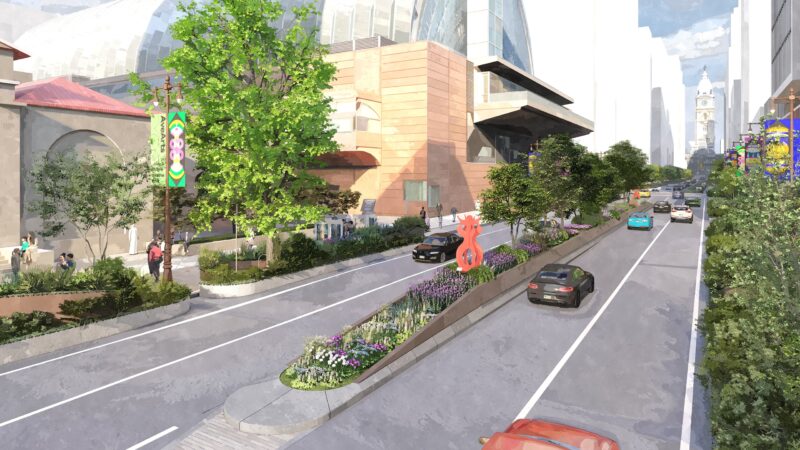
    Looking north toward City Hall, a rendering shows the completed first phase of a South Broad Street streetscape project slated to break ground in January 2026.

    The current streetscape of planters, pavers, and retro light fixtures was designed and installed more than three decades ago. In addition to the wear and tear of the existing scheme, the thinking around public space has evolved since then, said Carl Dranoff, board chair of Avenue of the Arts, Inc., which is overseeing the project.

    “It’s become somewhat aged and dog-eared,” said Dranoff. “In 1993 you didn’t need to have outdoor cafes. We need to activate the street, not just make it palatable. We have the opportunity to really elevate the Avenue of the Arts into one of the world’s great streets.”

    The project was announced in July 2024 at $100 million, but inflation and a more detailed cost analysis has now put the total price tag at about $150 million — $15 million per block. These numbers include not just the planters, lighting, public art, street furniture, and aesthetic elements, but also infrastructure work beneath the surface, said Dranoff.

    “A lot of it is things you don’t see. There’s a lot of underground construction,” he said. “Right now water is leaking from the median strip into the subway concourse. One of the reasons we got support from SEPTA and PennDot and [the Philadelphia] Streets [Dept.], is as we are building the median strips, we are improving deficiencies in the street in each block.”

    In addition, some utilities will have to be moved. One PECO relocation, for instance, will cost the project $250,000, he said.

    Dranoff has a vested interest in the vitality of the Avenue of the Arts. He has led several development projects on South Broad Street, including Arthaus, which is on the same block as the first phase of the new streetscape, and, one block south, Symphony House. He compares the investment in the new streetscape to the ones made in the Pennsylvania Convention Center, Philadelphia Navy Yard, Kimmel Center, and Schuylkill River Trail.

    “If we don’t make investments in the future, which are going to increase revenue and population, we are relegating ourselves to second-place status.”

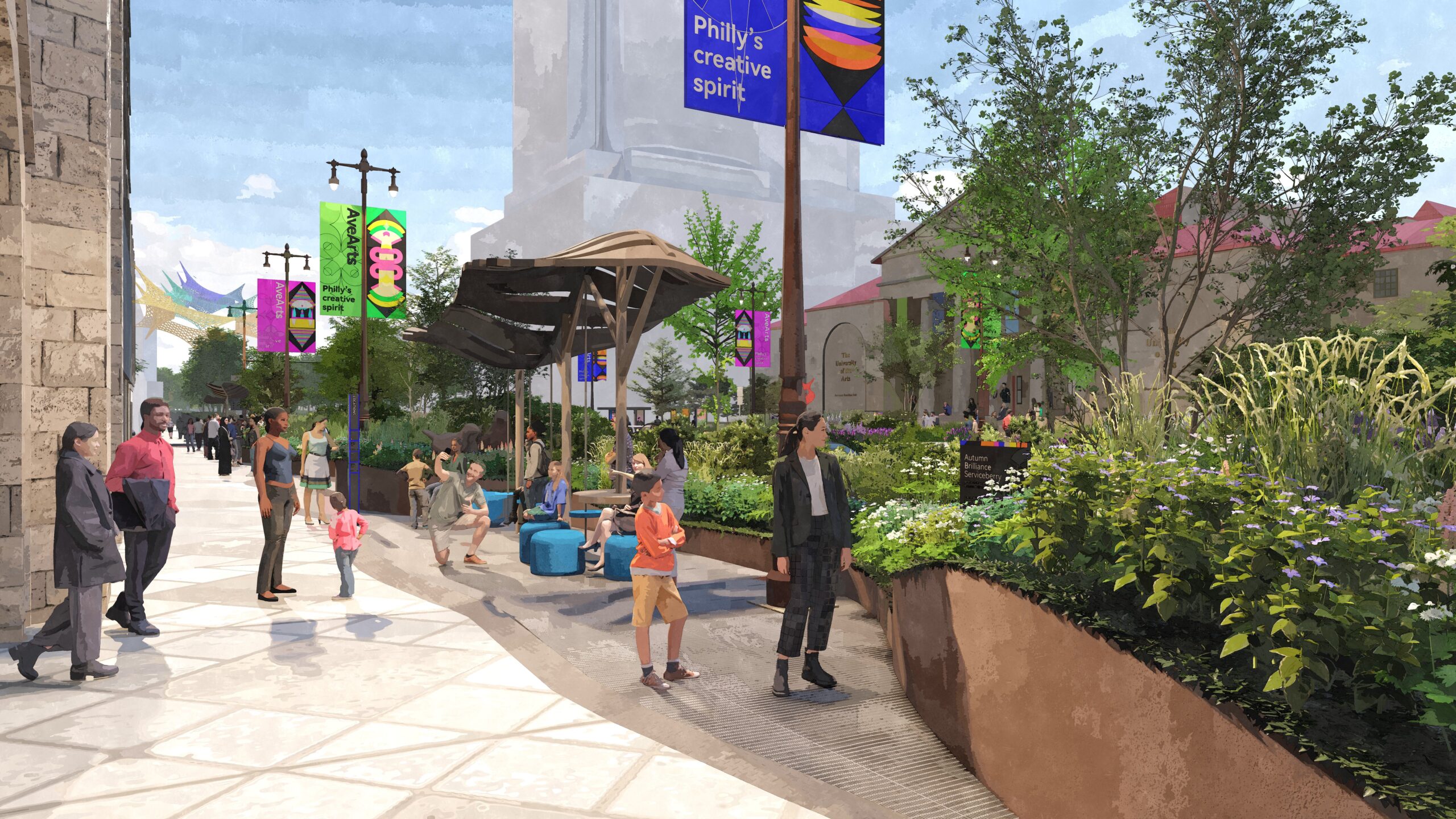
    The new $15 million streetscape in the block from Spruce to Pine, which includes a $1 million endowment fund to underwrite maintenance, native-species plants, a rainwater-collection cistern, lighting, curved raised planting beds, public art, seating, way-finding devices, and artist-designed banners.

    Of the $15 million needed, $5 million has been raised so far: $3 million from the city over two budget years, $1 million from the state, and $1 million from private donors. Other funding requests are pending, which planners call “very promising.”

    A sidewalk garden on the east side of Broad Street between Pine and Spruce Streets is planned for installation in 2027 as part of a new Avenue of the Arts streetscape.

    Dranoff says that construction of the median between Spruce and Pine — which is the block occupied by the Kimmel Center and defunct University of the Arts — won’t cause “a lot of disruption. They’re only working business hours, not on weekends.” Any blocked lanes will be reopened after work is done for the day, he said.

    The next block to be redesigned hasn’t been decided, but it will likely be north of Spruce Street, Dranoff said. “Part of it will depend on funding. If we get a donor, someone whose offices are near the Academy of Music and is donating $15 million for that block to be next, we might accommodate that,” he said.

    Funding for the entire project is expected to be a mix of public money, corporate and individual donations, and foundation support, he said.

    The goal isn’t to have the mile-plus between City Hall and Washington Avenue end up with a streetscape that looks uniform, Dranoff said. Instead, design firms Gensler and OJB Landscape Architecture may come up with different ideas for different blocks.

    “You don’t need a master plan that’s set for 10 blocks. Every block is different, the institutions are different. It lends itself to block-by-block planning tied together by a common theme.”

    Dranoff said once the block from Spruce to Pine is done, it will show the potential, which he expects will spur fundraising to complete the streetscape for the entire Avenue of the Arts south.

    “The difference between now and the first block being finished is, you’re going to be driving down a tree-lined boulevard.”

    The article has been updated with details from the groundbreaking ceremony.

  • 14 events to look forward to in Philly this year that aren’t the World Cup or the 250th

    14 events to look forward to in Philly this year that aren’t the World Cup or the 250th

    You can’t turn around these days in Philly without someone telling you this is going to be a big year for the city, including me. You get it, things are happening, people are coming, but I bet you mostly just want to know how you can either join in on the parties or figure out how much they’re going to annoy you.

    I usually try to temper my expectations — one, because I’ve learned a few things in 18 years here and two, because I like to be pleasantly surprised. But I’ve recently found myself imagining what the big moments will be like: the NCAA Division I men’s basketball tournament in March; the PGA Championship in May; the FIFA World Cup and MLB-All Star games this summer; and the yearlong celebrations marking the 250th anniversary of the signing of the Declaration of Independence.

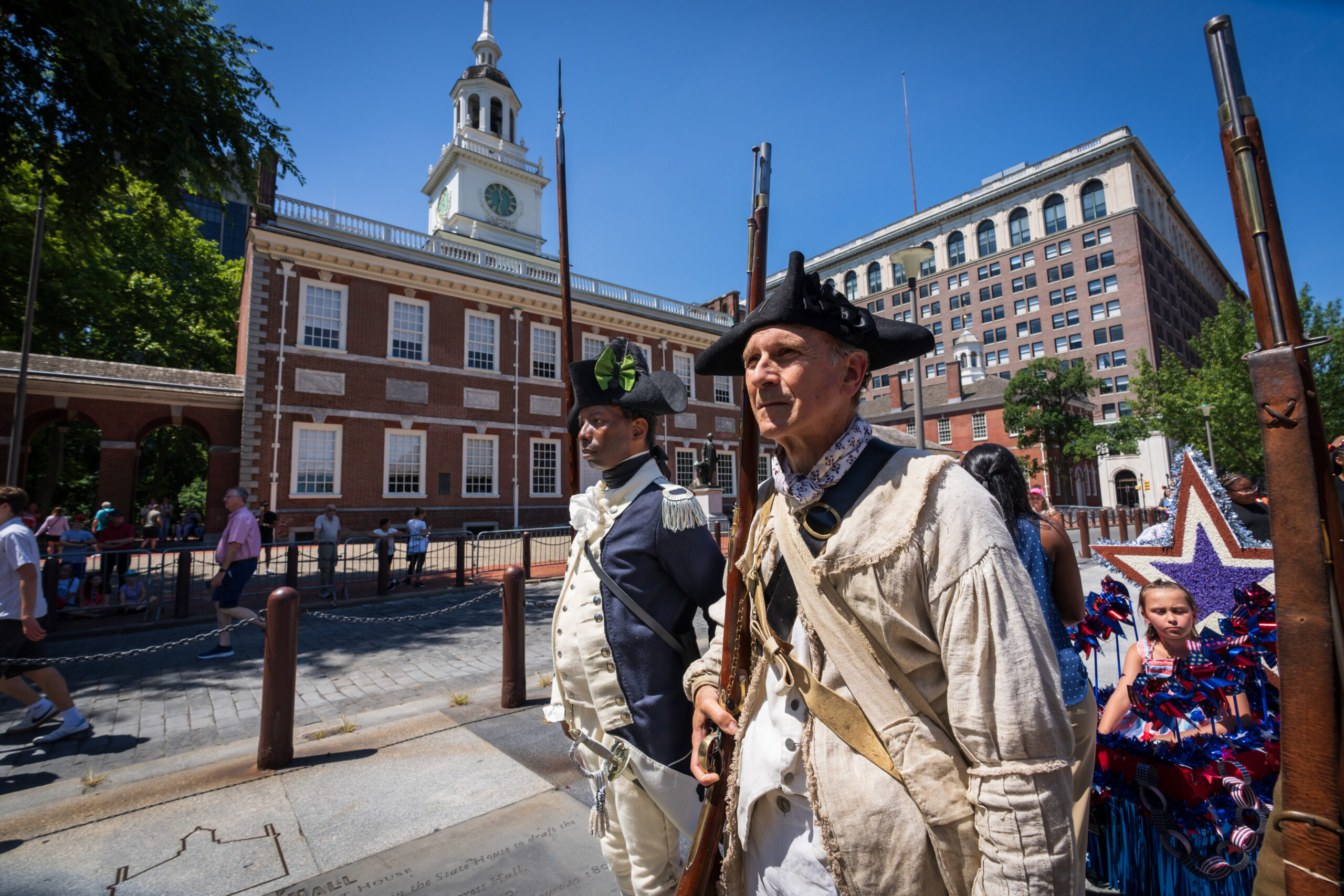
    Antoine Watts, back left, and Michael Clement, front center, participate in the Red, White, and Blue To-Do Pomp & Parade at Independence Hall in 2024.

    I have big hopes and some worries for Philadelphia, just like I do for everything I love.

    And while the stuff above is a lot, it’s not everything going on here this year, not even close. So if you’re seeking alternatives to the big to-dos, looking to keep your calendar full all year long, or just hoping to run into Mark Ruffalo, here are 14 more Philly happenings to look forward to this year.

    (Dates are subject to change. Check related websites for updates.)

    Jan. 30: Philly is Unrivaled

    The first big event features incredible athletes you won’t see in any of the major sporting events I mentioned above: women.

    Unrivaled, a three-on-three format women’s basketball league, is holding a doubleheader at Xfinity Mobile Arena to kick off its first tour later this month.

    Rose BC guard Chelsea Gray (12) drives past Lunar Owls wing Rebecca Allen (9) in their Unrivaled 3-on-3 basketball game Jan. 5 in Medley, Fla.

    The games will undoubtedly hype up fans for when Philly gets its own WNBA expansion team in 2030 and prove to any doubters that Philly is a women’s sports town (we even have a shirt that says it).

    Some tickets remain. The games will also be televised on TNT and truTV.

    Feb. 6 — 22: The Winter Olympics

    The Milano Cortina 2026 Winter Olympics in northern Italy will feature a host of local athletes and at least one famous Philly podcaster. Watching it also doesn’t require you to leave your house, so win-win.

    Four Philadelphia Flyers will be playing Olympic hockey: Travis Sanheim for Canada, Rasmus Ristolainen for Finland, Dan Vladar will represent Czechia, and Rodrigo Abols will take the ice for Latvia.

    People take photos in front of the Milan Cortina Winter Olympics and Paralympics rings, in Cortina D’Ampezzo, Italy.

    Other local athletes will undoubtedly qualify, but I don’t have a full list yet so don’t email me asking why I didn’t mention your cousin-in-law on the U.S. Curling Team.

    Kylie Kelce will also serve as a digital content creator for NBCUniversal’s Creator Collective and she’ll have on-the-ground access to the games to produce social media content.

    Go Birds. Go Team U.S.A.

    Feb. 14: ‘Universal Theme Parks: The Exhibition’

    How much fun can learning about theme parks be without the roller coaster rides, immersive lands, or concession stands? Philly will find out next month when the Franklin Institute premieres: “Universal Theme Parks: The Exhibition.”

    An artists’ conceptual rendering of the Franklin Institute’s “Universal Theme Parks: The Exhibition,” which is slated to open Feb. 14.

    The new exhibit spans eight galleries and tracks the history and world-building of Universal’s theme parks. It was created by the team at the Franklin, who hope it will introduce young visitors to science and tech careers in the theme park industry.

    I’m hoping there’s a section about whatever alien incantation protects the E.T. Adventure ride, which opened in 1990 and is the last remaining original ride at Universal Studios Florida. The high-tech stuff is awesome, but there’s nothing that beats the nostalgia of that flying bicycle ride and the flashlight-fingered alien.

    March 14: Ministry of Awe opens

    The more I hear about the Ministry of Awe the less I understand it, and the more intrigued I become.

    The permanent, six-story immersive art experience helmed by Philly muralist Meg Saligman inside of Manufacturers National Bank in Old City “transforms an abandoned 19th-century bank into a fantastical, seemingly impossible institution that trades in the many enigmatic facets of humanity,” according to its website.

    Guests will be encouraged to question what they value and to wander the multimedia art space, which will lean into a banking theme and includes a room for counterfeiting. Actors will be on hand to enliven their experiences.

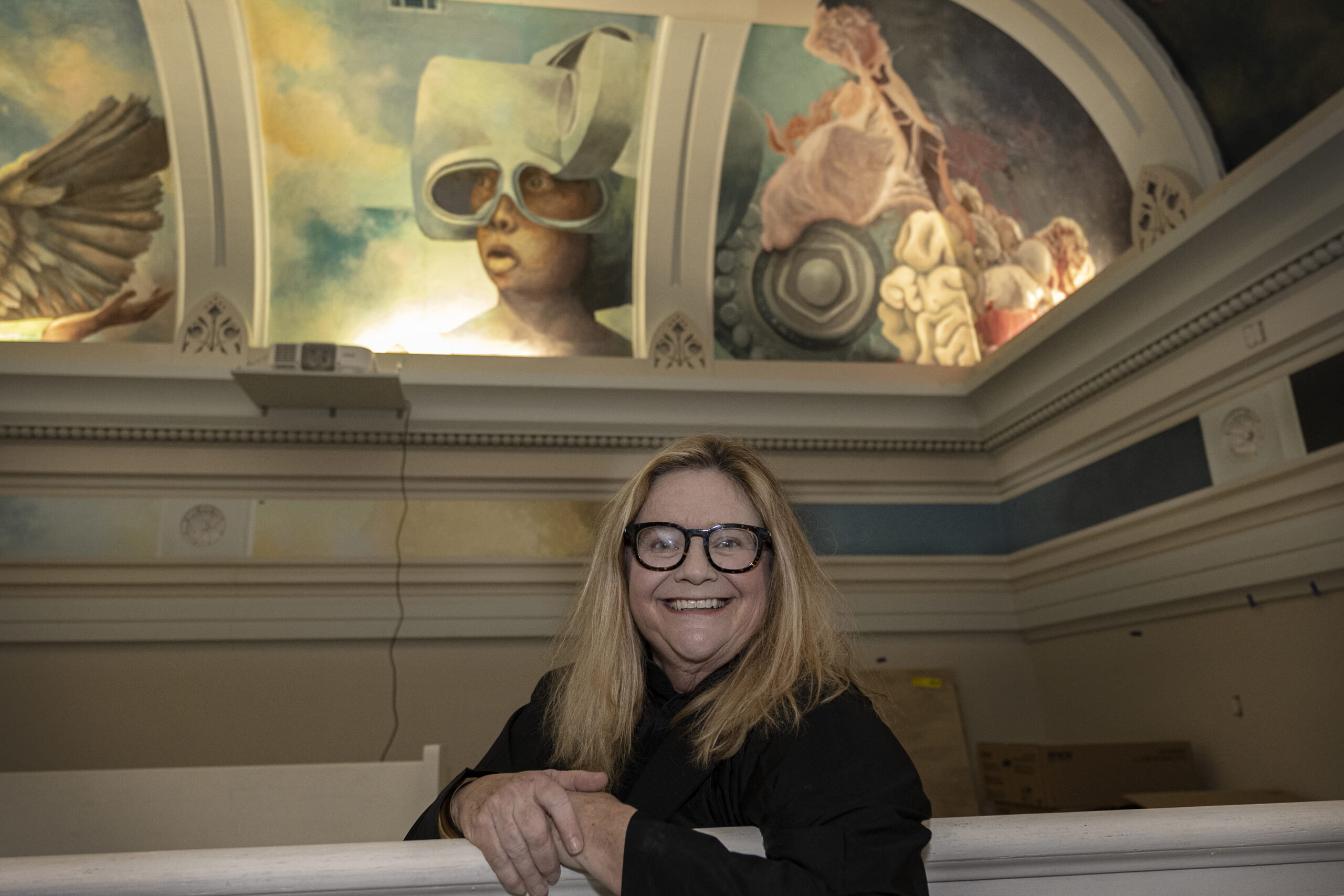
    Muralist Meg Saligman inside of the still-under-construction Ministry of Awe in November. Opening date is March 14.

    “There’s a teller that smells you. You will walk through and be delighted and surprised along the way,” Saligman told The Inquirer.

    The Ministry of Awe says we all already have accounts open there and one thing is for certain, my interest rate is sky-high.

    April 14 — May 31: ‘1776 The Musical’

    There are not many musicals set in Philadelphia and the one thing you can say about 1776 is that it’s one of them.

    The production about the events that led to the signing of the Declaration of Independence never became a juggernaut like Hamilton and didn’t produce any smash songs. But after rewatching the film version last Independence Day, I can safely say it’s still a pretty good musical. Especially if you hate John Adams, or love watching people hate on him.

    While it would have been epic if this production could have been staged at Independence Hall this year, seeing it at the Walnut Street Theatre — the country’s oldest theater, which opened just 32 years after 1776 — is a close second.

    April 16: Cruise ships begin sailing out of Philly

    For the first time in nearly two decades, cruise ships will return to the region this spring, offering locals a chance to seas the day with an aquatic trip abroad.

    Construction of the Port of Philadelphia (PhilaPort) Cruise Terminal began last month in Tinicum Township, Delaware County, at a site adjacent to the Philadelphia International Airport that was formerly known as the Hog Island Dock Terminal Facility.

    (How’s that for a local word salad — a Philly port in Delco at a dock named after the place that may have inspired the word hoagie.)

    A conceptual rendering of the future PhilaPort Cruise Terminal, a 16-acre site adjacent to Philadelphia International Airport.

    Norwegian Cruise Lines has exclusive rights to sail out of the PhilaPort Cruise Terminal through March 2033. According to its website, the first voyage will be a seven-day round-trip to Bermuda.

    Fear not the Bermuda Triangle, my fair Philadelphians, for we’ve weathered far stranger things here following Super Bowl wins, and on an average Tuesday.

    April 18: Monster Jam at the Linc

    If you think the Birds are beasts on their home turf, buckle up, because 12,000-pound trucks are coming to Lincoln Financial Field this spring as part of Monster Jam’s Stadium Championship Series.

    Foam teeth line the front of the Megalodon monster truck at Monster Jam at Lincoln Financial Field in 2023.

    When I hear Monster Jam my first thought is “It’s probably boysenberry,” or “I wonder if it’s as fun as a mash?” but if you have little ones who love things that go vroom — or you do — this auto be wheelie good time.

    May: The Greyhound station reopens

    Slated to come back from the dead this spring like it was Kenny or Jon Snow will be Philly’s intercity bus terminal, formerly known as the Greyhound station.

    The Philadelphia Parking Authority will operate the terminal on behalf of the city, which has gone more than two years without a facility since Greyhound left the terminal at 10th and Filbert Streets in 2023 after 35 years.

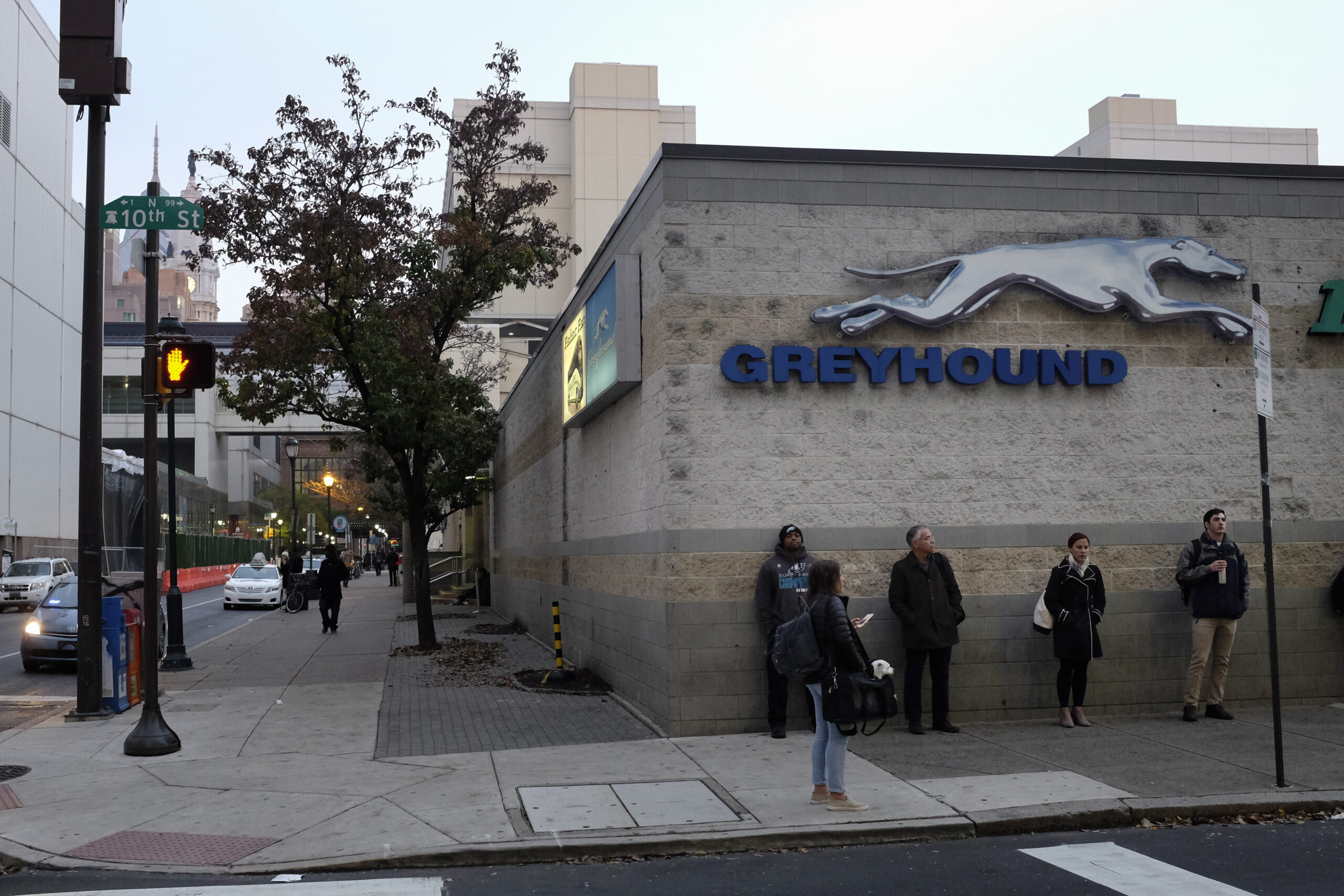
    Corner of the former Greyhound station at North 10th and Filbert Streets in 2018.

    In the aftermath, buses used public street curbs to pick up travelers, who were forced to wait outdoors in the elements and had very little access to basic amenities, like bathrooms. The whole situation was bus-ted and I’ll be glad to see it fixed.

    June 12: ‘Disclosure Day’ premieres

    Filmed in parts of South Jersey last year and featuring Philly’s own Colman Domingo, Disclosure Day is an alien thriller from director Steven Spielberg that I can’t wait to get my tentacles on.

    I love good sci-fi and this one has a screenplay by David Koepp, who also wrote the screenplay for Jurassic Park, one of my favorite movies of all time. The trailer for Disclosure Day is intriguing, unsettling, and reveals little about the plot, but I already find the movie authentic: If aliens were to land anywhere, South Jersey seems like a fitting place.

    At the end of the trailer, a nun says “Why would He make a vast universe yet save it only for us?” which hearkens to a famous Carl Sagan quote: “The universe is a pretty big place. If it’s just us, seems like an awful waste of space.”

    Aug. 30: Philadelphia Cycling Classic returns

    If there’s one thing Philadelphians love doing, it’s partying while watching other people exercise and this year they’ll get to do it again at the Manayunk Wall when the Philadelphia Cycling Classic returns after a 10-year hiatus.

    Held for 30 years before it was canceled in 2016 due to lack of sponsorship, the race follows a 14.4-mile course from Center City to Manayunk, where cyclists must climb the “Manayunk Wall,” a stretch of Levering Street with a 17% gradient.

    Women cyclists pedal up Levering Street, aka the “Manayunk Wall,” during the Liberty Classic TD Bank International Championship race in 2011. The race is returning this year as the Philadelphia International Cycling Classic.

    Back in the day, people partied like it was Two Street on New Year’s along the route in Manayunk, particularly at the Wall. As bikers cycled through the course, spectators cycled through kegs and cowbells, with some folks on Levering Street charging admission to their house parties and others hanging beer banner ads on their porches for a fee.

    Also slated in 2026, but dates remain unknown:

    A conceptual rendering of FloatLab, set to be installed at Bartram’s Garden on the Schuylkill in 2026.
    • Opening of Mural Arts’ FloatLab: Located in the Schuylkill at Bartram’s Garden, FloatLab is a 75-foot installation and environmental center that will be “a convergence of art, architecture, and nature,” according to its creator, J. Meejin Yoon. The sloped, ADA-compliant circular platform, which allows visitors to look eye-level at the river while standing in it, will serve as both an educational and artistic space.
    • Gimme my Philly money: To mark the nation’s 250th, the U.S. Mint is releasing quarters with Independence Hall and the Liberty Bell on them this year and I’m going to need some of those for my piggy bank. Just to be clear, this does not change the fact that I’m still salty at the Mint for stopping penny production. What will people put in their loafers? How will Penny from Pee-Wee’s Playhouse see? It’s just cents-less.
    This new design for the quarter commemorates the U.S. Constitution and depicts Independence Hall in Philadelphia, where the Declaration of Independence and U.S. Constitution were signed. The other side of this quarter has a depiction of President James Madison.

    Rumored in 2026, but in no way confirmed:

    From left: Thuso Mbedu (Aleah Clinton), Fabien Frankel (Anthony Grasso), Alison Oliver (Lizzie Stover), and Mark Ruffalo (Tom Brandis) in “Task.”
    • Task season 2: The Delco-set HBO thriller starring Mark Ruffalo was renewed for a second season and I’m hoping they start filming around Philly’s weirdest suburb this year (though creator Brad Ingelsby may have to write the script first). While it’s unclear if Ruffalo will reprise his role as FBI agent Tom Brandis, one of my resolutions this year is to frequent more local hoagie shops in the hopes of running into him, but also because I love hoagies.
    • Stranger Things spinoff?: Philly was named-dropped in the finale of the beloved sci-fi show, which got fans hypothesizing that the home of one of the greatest urban legends of all time — the Philadelphia Experiment — might be the setting for one of the confirmed spinoffs. Or it could just be subliminal advertising for Netflix House Philadelphia (which is actually in King of Prussia). An Instagram post from the show and Netflix on Wednesday only fueled rumors, with its caption: “meet me in philly.”
  • Josh Shapiro’s reelection campaign in Pennsylvania starts now — but 2028 looms large

    Josh Shapiro’s reelection campaign in Pennsylvania starts now — but 2028 looms large

    He’s running.

    Gov. Josh Shapiro officially announced his widely expected reelection bid for Pennsylvania governor Thursday, as speculation over a 2028 run for president continues to build. The question now: How will the Democrat’s rumored presidential ambitions bolster or detract from his must-win election at home in 2026?

    Shapiro will kick off his reelection campaign with not one but two rallies — first stopping in Pittsburgh, then in Philadelphia. In a campaign video posted to social media Thursday morning, he touted his three years of leading a divided legislature and his bipartisan achievements in a politically split state, via a campaign that has already amassed a record $30 million war chest.

    He coasted to victory in 2022, elevating his profile within the national Democratic Party, and is not expected to face a primary challenger. In the general election, he will likely face Republican State Treasurer Stacy Garrity, who largely consolidated GOP support early.

    But that’s not the only race on the line in November.

    Shapiro, whose campaign declined to comment for this article, has been elusive when asked directly about plans to run for president. But in the last year, he’s taken bold steps to build a national profile, while quietly making moves behind the scenes that signal bigger political aspirations. He’s expanded his public affairs team, planned a book tour for the end of January, and sat for interviews with national magazines like the Atlantic, which published an extensive feature on him late last year. Last month, he and Democratic presidential candidate kingmaker U.S. Rep. Jim Clyburn (D., S.C.) discussed the pioneering Black lawmakers’s new book on a stage in Philadelphia. Earlier in December, he and Utah Gov. Spencer Cox, a Republican, discussed curbing political violence with NBC News host Savannah Guthrie, a conversation that highlighted Shapiro’s emphasis on bipartisanship.

    At home, he’s a local political celebrity, boasting approval ratings between 52% and 60%. But outside the Keystone State, he has yet to become a household name.

    As Shapiro looks to potential parallel runs, he’ll need to continue to build a national profile without outwardly focusing too much on the presidential picture.

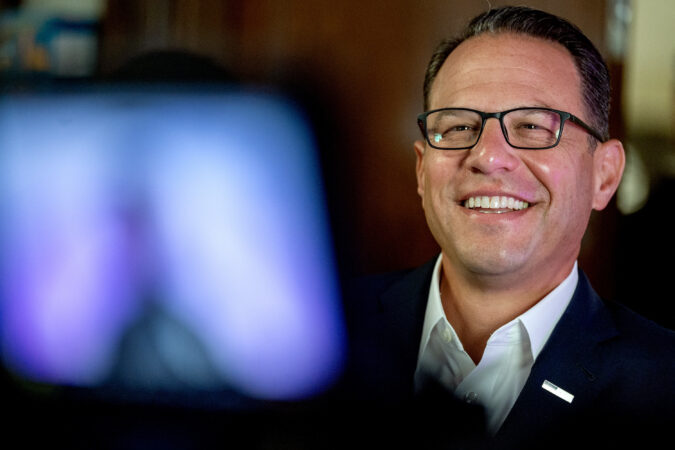
    Gov. Josh Shapiro is interviewed by TV news in the spin room at the Convention Center following the debate between former President Donald Trump and Vice President Kamala Harris Tuesday, Sept. 10, 2024.

    “The challenge, of course, is you have to take care of your next election first,” said Christopher Borick, a pollster at Muhlenberg College. “Of anything he does, he knows this is the most important thing for his potential success in 2028 if he was to run.”

    The former Pennsylvania attorney general, Montgomery County commissioner, and state representative has never in 20 years suffered an electoral defeat. Being passed over for Vice President Kamala Harris’ running mate in 2024 kept that winning streak alive.

    In the governor’s race, Shapiro will likely face a more formidable opponent in Garrity than he did in state Sen. Doug Mastriano (R., Franklin) in 2022, but he’ll also be running in a far more favorable political atmosphere for Democrats amid souring attitudes toward President Donald Trump and the GOP. If he can retain the governor’s mansion decisively and bring a ticket of Democrats vying for the statehouse and Congress to victory with him, that’s a narrative that could be strong in a Democratic presidential primary.

    “Having a win, and maybe an impressive one in Pennsylvania, the key swing state heading into that cycle, is about as big of a boost as any that you can have,” Borick added.

    Running local

    The 2028-curious Democrats include several other sitting governors generating buzz: California’s Gavin Newsom, Kentucky’s Andy Beshear, Maryland’s Wes Moore, Michigan’s Gretchen Whitmer, and Illinois’ JB Pritzker. Shapiro has formed alliances with several of them.

    But unlike some of his peers, Shapiro hasn’t been a frequent guest on cable news or podcasts with national reach.

    That’s not to say he hasn’t made moves toward a potential presidential run.

    On Oct. 4, 2024, nearly a month before Harris lost the presidential election to Trump, Shapiro confidentially requested that the state ethics commission determine whether he would violate any state ethics laws for accepting royalties from a book about his life in public service, according to the filing.

    Pennsylvania Gov. Josh Shapiro (right) and Michigan Gov. Gretchen Whitmer before the Eagles played the Detroit Lions at Lincoln Financial Field on Sunday, Nov. 16, 2025, in Philadelphia, PA.

    His book, Where We Keep the Light, will publish later this month, recounting his political upbringing, his vice presidential vetting, and the firebombing of his home last year. He’s not alone. Harris published a memoir about the 2024 election last year, and Newsom is due out with Young Man in a Hurry: A Memoir of Discovery in February.

    But in the coming months, several Democratic strategists predict Shapiro will be squarely focused on the governor’s race he has to win in Pennsylvania — simultaneously proving he has what it takes to capture the vote of the nation’s most important swing state.

    “He’s such a careful politician. He’s not taking anything for granted,” said former Gov. Ed Rendell, a Democrat who also once faced scrutiny for having potential presidential ambitions.

    Shapiro is likely to follow the same campaign playbook in Pennsylvania as he did in 2022: Stump in every region of the state, including areas where Democrats don’t usually show up. That helped him run down the margins in longtime GOP strongholds like Lancaster or Schuylkill Counties toward his resounding victory over Mastriano. Those stops in most of Pennsylvania’s 67 counties won’t give him as much time to visit South Carolina, Iowa, and New Hampshire, as the other Democratic presidential hopefuls start their sojourns.

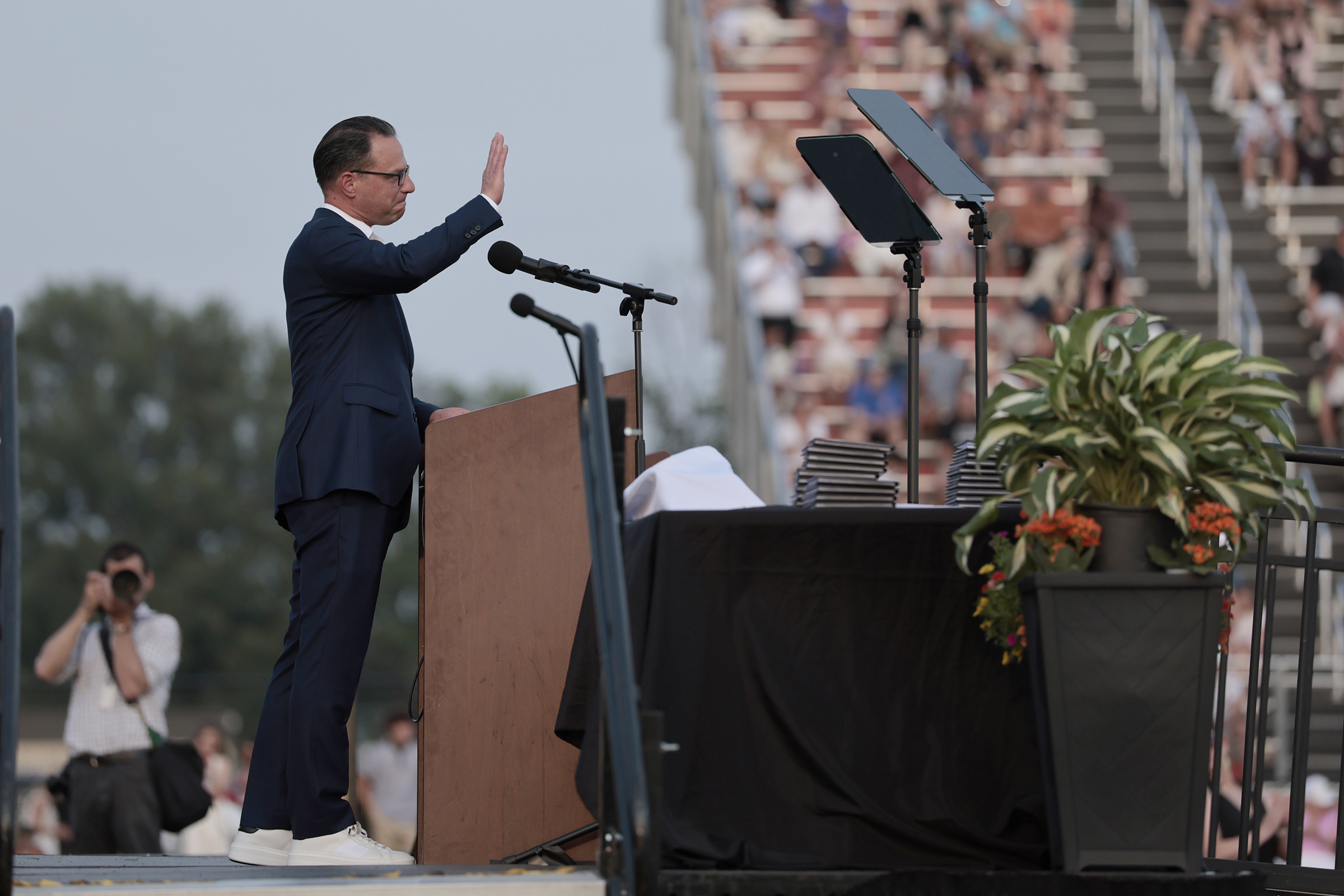
    Pennsylvania Governor Josh Shapiro waves goodbye to the crowd after speaking during graduation ceremonies at Pennsbury High School in Fairless Hills on Thursday, June 12, 2025.

    “The No. 1 caveat is stay focused on the race you’re running,” echoed Alan Kessler, a national fundraiser based in Philadelphia who has supported and fundraised for Shapiro.

    Still, the campaign is likely to generate attention beyond the Keystone State.

    Shapiro will still court donors in blue states as he fundraises for reelection, Kessler added.

    Come November, he will be the only governor with rumored 2028 aspirations up for reelection in a swing state. And his brand as a popular, moderate Democratic governor trying to restore trust in government — as well as his potential to help boost Democrats down ballot — will easily capture a wider audience and bring national media into Pennsylvania.

    As Democrats seek to flip control of the U.S. House in 2026, targeting several congressional districts in the state, the election may once again come down to Pennsylvania, and in turn, increase the spotlight on Shapiro. The governor is widely seen as someone who can boost the congressional Democratic candidates also on the ballot, having won three of the four districts that Democrats are targeting in the state by double digits in 2022.

    “Every single Democrat that I know that’s running for office in 2026 in Pennsylvania wants the governor to campaign with them,” Democratic state party chair Eugene DePasquale said.

    Preparing for an onslaught

    Republicans have targeted several weaknesses to try to erode Shapiro’s popularity in Pennsylvania and boost Garrity. They point to a lack of rigorous electoral challengers in his past. They question his record of “getting stuff done” — his oft-repeated motto — including three late state budgets. And they’ve harped on a lack of transparency as governor, including claims he used tax dollars for political benefit as well as a sexual harassment scandal involving a former top aide. They’ve also criticized his support for Minnesota Gov. Tim Walz, who recently dropped his third gubernatorial bid following a fraud scandal among the state’s Somali refugee population totaling $1 billion, according to federal prosecutors.

    Among the emerging attacks: Republicans want to highlight Shapiro’s presumed presidential ambitions, as they try to cast him as an opportunist more interested in a future White House bid than the problems of everyday Pennsylvanians.

    “Josh Shapiro is more concerned with a promotion to Pennsylvania Avenue than serving hardworking Pennsylvanians,” Garrity said in a statement, noting the state fared poorly in U.S. News and World Report rankings on the economy and education. “In the military, I learned the importance of putting service before self. Pennsylvanians are the hardest-working, most compassionate, strongest people in the nation, and together we will return Pennsylvania to our rightful place as a national and global leader.”

    State Treasurer and Republican candidate for governor Stacy Garrity holds a rally in Bucks County Sept. 25, 2025 at the Newtown Sports & Events Center.

    There are lingering missteps that could come up in a reelection campaign or afterward. He was unable to secure a long-term funding stream for mass transit, requiring him to use capital funds to keep SEPTA operating. He has yet to follow through on his support for school vouchers, a GOP-selling point for him that angered the powerful teachers’ unions in the state. And he’s faced questions over a number of actions his administration has taken, including $1.3 million in security improvements to his personal home following the attack on the governor’s residence in Harrisburg, his use of the state plane, and his transparency in open records requests, among others.

    Mastriano, the far-right Republican state senator who announced Wednesday he won’t run for governor, said in a statement earlier this week that Shapiro “owes [Pennsylvanians] straight answers” over his use of the state plane, security updates to his personal home in Abington Township, and more.

    “Pennsylvanians deserve accountability, not ambition,” he added, making a nod to Shapiro’s potential longer-term plans.

    House Speaker Joanna McClinton, back center left, Gov. Josh Shapiro, front center, and State Rep. La’Tasha D. Mayes, right, celebrate the signing of the CROWN Act, which prohibits discrimination based on a person’s hair type, during a press conference at Island Design Natural Hair Studio, in West Philadelphia, November 25, 2025.

    Borick, the pollster, was skeptical that attacks on Shapiro’s potential wider ambitions could reverse his largely positive public sentiment.

    “If that’s all they got, they don’t got a lot.”

    Republicans insist they see a path to victory for Garrity in a politically divided state with months to go until the election. But behind the scenes, some Republicans are already acknowledging the goal is to lose by less and prevent big losses in state legislature or congressional races.

    If Shapiro does look poised to cruise to victory, it might mean less media attention on the race, and it could mean he’s less vetted ahead of a much bigger stage.

    “I think Josh is better served if the [Republican Governors Association] puts $100 million into this race because then it’s nationalized,” said a Democratic political strategist based in Pennsylvania who did not want to be named speculating on Shapiro’s presidential run. “If it’s a cakewalk, CNN’s not gonna cover it …If he wants to be governor for another four years, he should pray for a cakewalk. If he wants to be president, he should pray for a difficult campaign.”

    Florida Gov. Ron DeSantis, for example, the strategist noted, cleaned up in his 2022 reelection, but failed to gain traction in the GOP presidential primary that Trump dominated.

    Beyond 2026

    Shapiro speaks Pennsylvanian very well. Raised in Montgomery County, he’s lived here almost all of his life, and has built an image as a popular moderate focused on problem-solving in a purple state. That’s earned him the support of about 30% of Trump voters in the state.

    But winning a general election in Pennsylvania is different than winning a Democratic presidential primary.

    He’s tried not to alienate the MAGA base, focusing on issues with bipartisan appeal like funding for apprenticeship and vocational-training programs. He’s taken on Trump in court, but has picked his personal battles with the president more carefully.

    But being a strategic, self-described “progressive pragmatist” can end up alienating voters on both sides.

    Gov. Josh Shapiro leaves after an event at the Port of Philadelphia Thursday, Apr. 10, 2025, the day after President Trump paused some tariffs.

    Becky Carroll, a Democratic political consultant in Chicago who has worked with Pritzker, said Shapiro seems less on the radar of voters in the Midwest. As she’s followed Shapiro’s career, she said she sees a “damn fine governor,” but someone who’s taken a more muted approach to Trump than blue state governors like Pritzker and Newsom.

    When it comes to a Democratic primary, candidates may be judged in part on their pushback to Trump, she said. “I think we’re in a moment where you can sulk in a corner and hope it’ll all go away or fight …,” Carroll said. “And if you’re gonna put yourself out there for a primary battle, you better show you have battle scars to prove you can fight for the most vulnerable in the country right now.”

    Gov. Josh Shapiro is interviewed by TV news in the spin room at the Convention Center following the debate between former President Donald Trump and Vice President Kamala Harris Tuesday, Sept. 10, 2024.

    But other national strategists see Shapiro’s moderate appeal as a potential asset in 2028. Jared Goldberg-Leopold, a former communications director for the Democratic Governors Association, thinks Shapiro’s biggest asset is his electoral track record in a state the nation knows is critical on the path to the White House. Primaries have previously been won by moderates whom the party thinks have the best chance at winning the general.

    But the first step, Goldberg-Leopold stressed, is the governor’s race ahead.

    “It would be easy for the Eagles to look past the 49ers to the next week of playoffs, but they’ve gotta focus on only one thing. And the same is true for the governor,” he said. “You can only prepare for what’s ahead of you, and the way people get in trouble in politics is planning too many steps ahead.”

    Staff writer Katie Bernard contributed to this article.

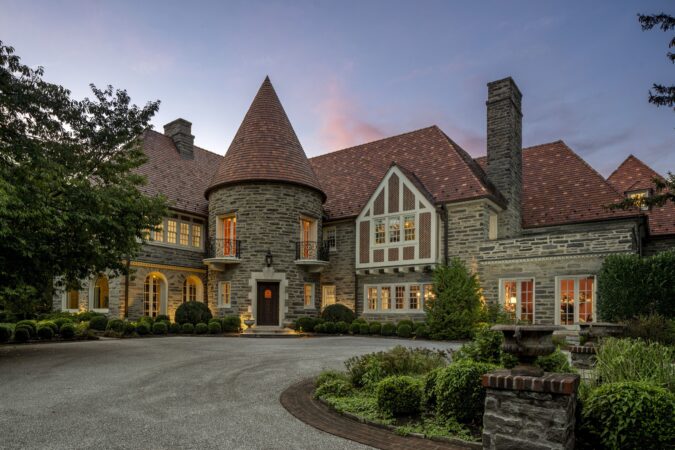
  • For $9.9 million, you can own this Lower Merion mansion and a bonus house next door

    For $9.9 million, you can own this Lower Merion mansion and a bonus house next door

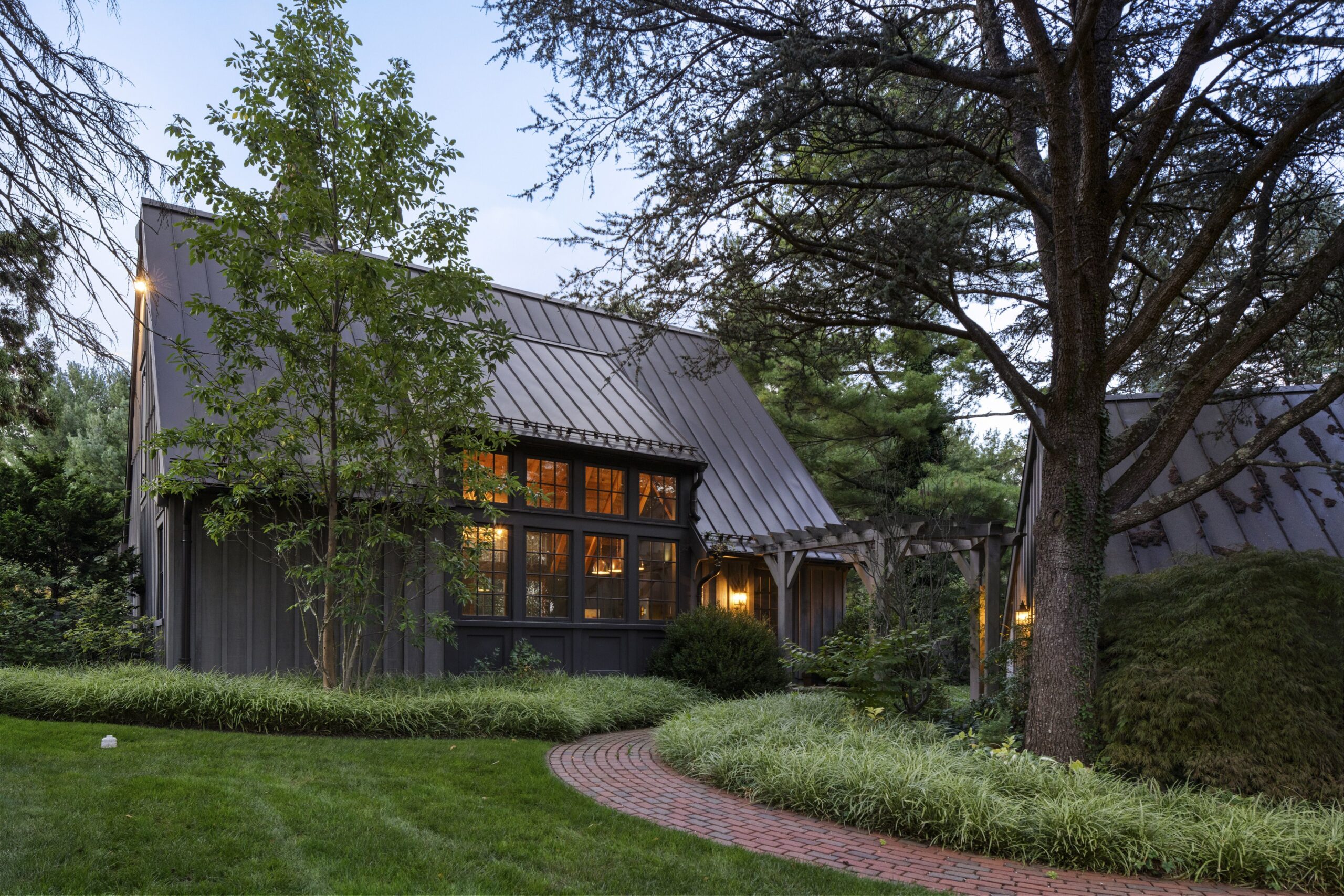
    On Creighton Road in Lower Merion, it’s not unusual for residents to buy the house next door.

    The owners of the 3.85-acre property at 648 Creighton Rd. did just that when they purchased the home but wanted a pool. They decided to put one on the neighboring property.

    Now, the properties are being sold as a package deal.

    The century-old main house with seven bedrooms, seven full bathrooms, and three half bathrooms is available for $7.9 million. And the one-bedroom, one-bathroom carriage house next door that was rebuilt in 2015 is on the market for $2 million.

    Creighton Road “has become the estate street,” said listing agent Lavinia Smerconish with Compass Real Estate.

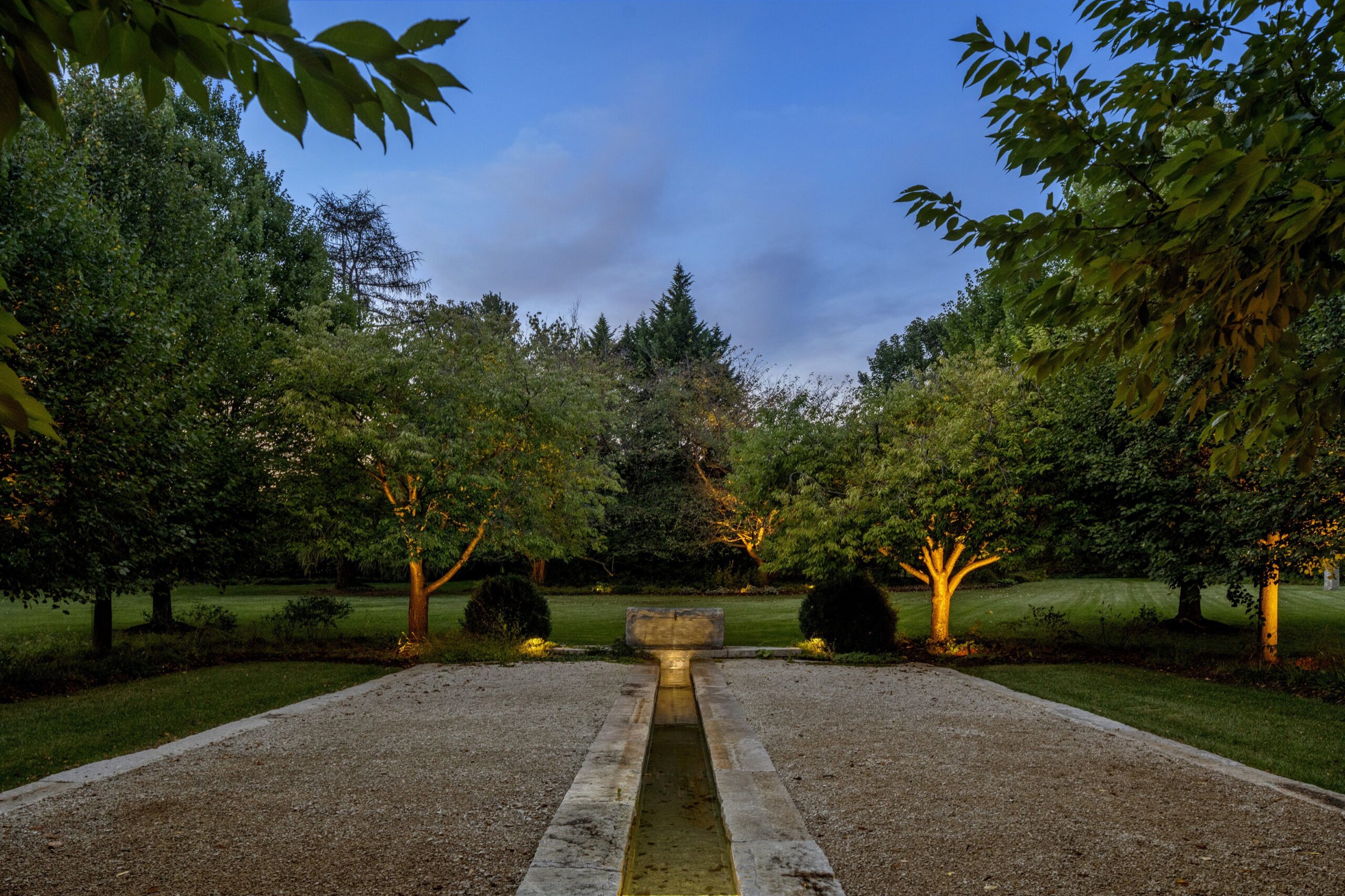
    The property is 3.85 acres and includes a sprawling yard.

    The owners are open to selling their properties separately, but they won’t sell the carriage house before the main one in case a buyer wants both.

    The fieldstone main house is 11,418 square feet. It used to have a series of small rooms for staff and a giant entrance that looked like a banquet hall that no one knew what to do with, Smerconish said. A previous owner reimagined the home with larger rooms, more natural light, and more functional space.

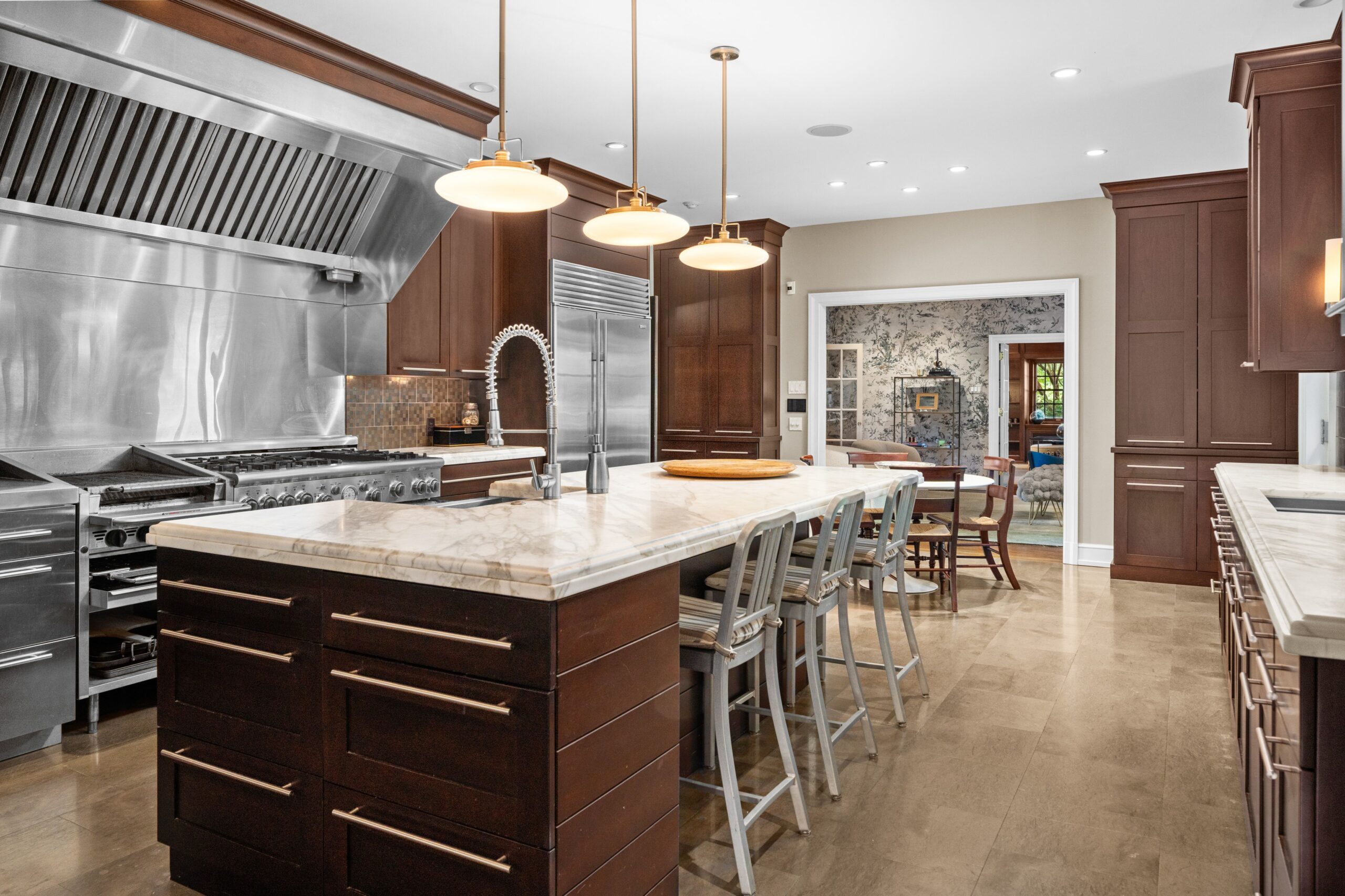
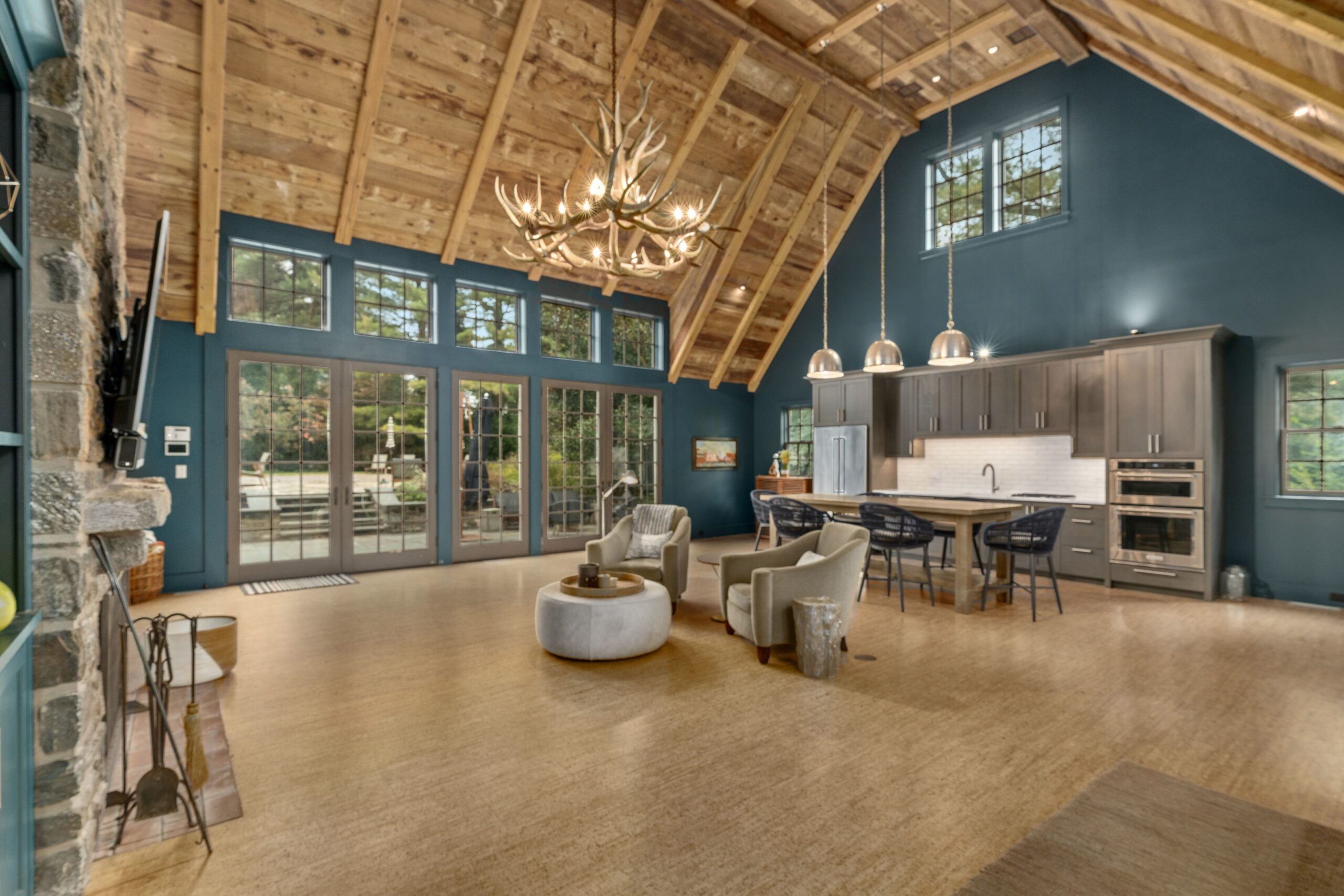
    The home has a commercial kitchen with a large island with seating.

    The front door opens to an entrance tower with a chandelier and winding staircase. Living and dining rooms branch off from the foyer with the family room straight ahead.

    The home has a commercial kitchen with an island with seating. The property includes an exercise room, solarium, four fireplaces, suite above the attached garage for guests or a nanny, sprawling yard lined with trees and hedges, terraces, and detached garage. The sitting room off the primary bedroom could be kept as is or turned into a huge closet, Smerconish said.

    “It’s just an extraordinary house,” she said.

    The finished basement alone spans 1,538 square feet. According to an annual report by the National Association of Realtors, the median size of homes purchased by first-time buyers in the United States is 1,600 square feet.

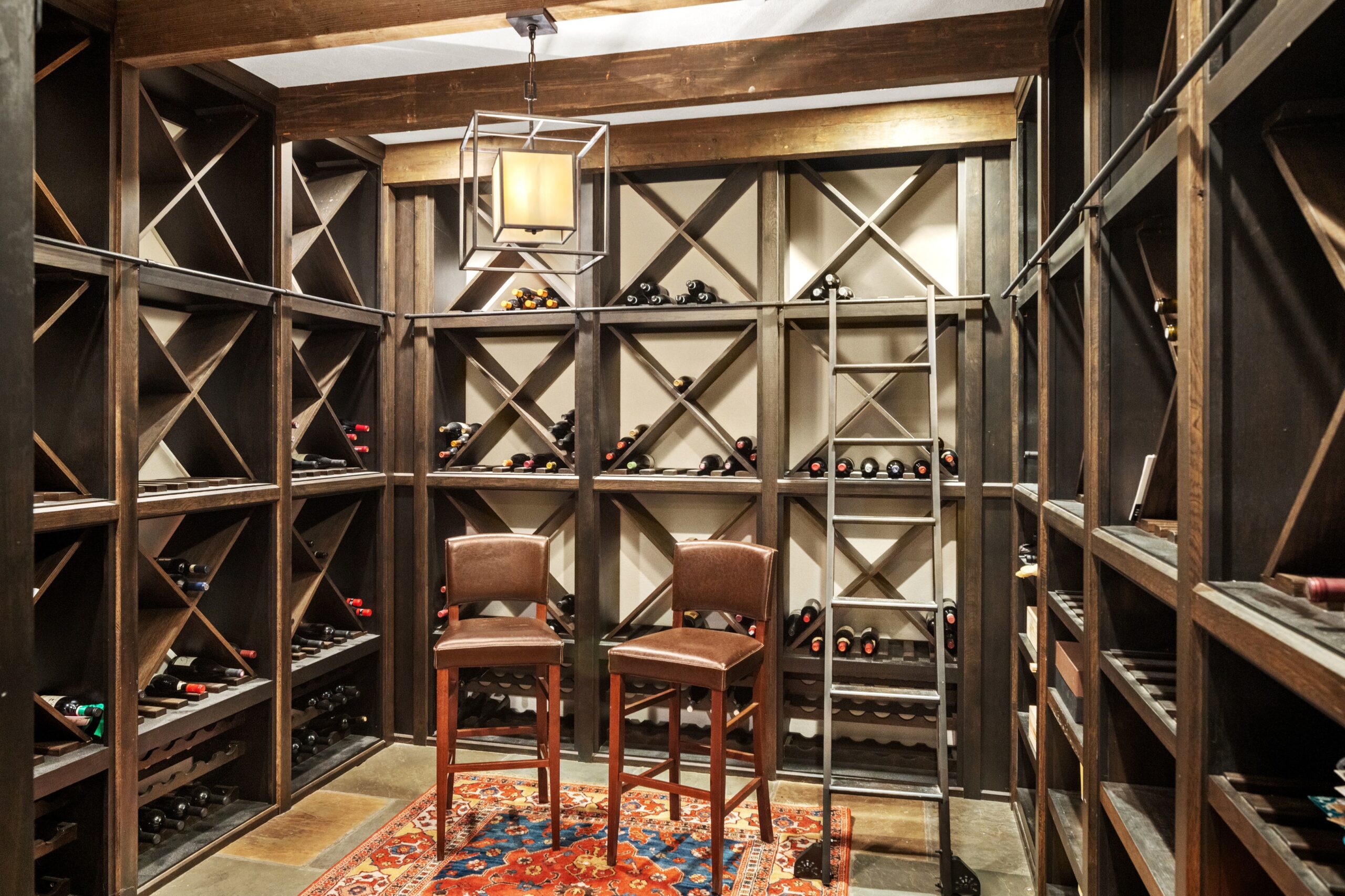
    The finished basement spans 1,538 square feet and includes a wine cellar.

    The basement includes a sports bar with TVs, wine cellar for up to 3,000 bottles, movie room, gym, and bathroom.

    The property “is both impressive and cozy at the same time,” Smerconish said.

    The carriage house on the market for $2 million on Creighton Road in Lower Merion is being sold as a package along with the $7.9 million house next door.

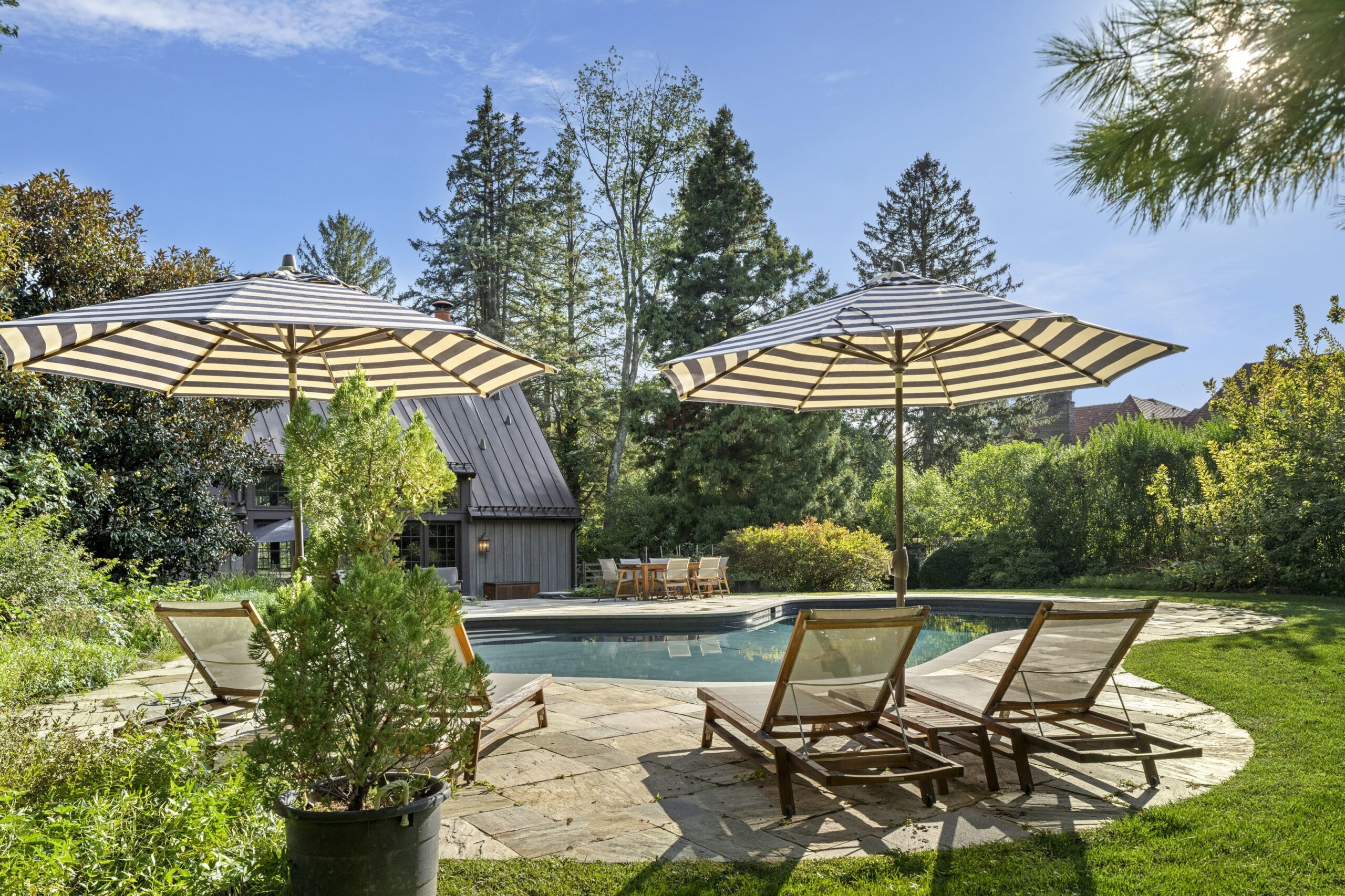
    The carriage house next door spans just over 1,000 square feet on an almost one-acre lot. It has a bedroom, bathroom, laundry room, eat-in kitchen, and living room. A flagstone patio leads to the heated saltwater pool.

    The properties are walking distance from the Appleford estate, which is an event venue, bird sanctuary, and arboretum with gardens and walking paths. They are minutes from Villanova University and Stoneleigh, a public garden of the nonprofit Natural Lands.

    And they’re also minutes from the Schuylkill Expressway and I-476.

    The carriage house includes a kitchen, bathroom, and bedroom.

    The properties were listed for sale on Dec. 5. Now that the holidays are over, Smerconish said, she will start accepting appointments to tour them. She said photos of the main house especially don’t do it justice.

    “You get more with a physical tour and experiencing it,” she said.

    Flagstone surrounds the carriage house’s heated saltwater pool.
  • Schuylkill Trail sinkhole repaired, area reopened for Christmas Eve ‘as a holiday present’

    Schuylkill Trail sinkhole repaired, area reopened for Christmas Eve ‘as a holiday present’

    A segment of the Schuylkill River Trail that has been closed since October because of a sinkhole has been repaired, and reopened just in time for Christmas Eve.

    Joe Syrnick, executive director of the nonprofit Schuylkill River Development Corp. (SRDC), said Wednesday afternoon that repairs finished earlier in the day.

    Just days ago, Syrnick told The Inquirer that work may begin soon, perhaps early in the new year.

    But, he said Wednesday, the weather cooperated enough this week that a crew was able to complete the work over a few days, “as a holiday present for our trail users.”

    This week, the hole was filled and paved. It reopened about 1:30 p.m. Wednesday after the paving had cooled.

    “It’s open and people are already using it,” Syrnick said. “People are happy.”
    Some cleanup is still needed around that area, he noted, and fencing needs to be removed. That should be finished by Friday or Monday, Syrnick said.

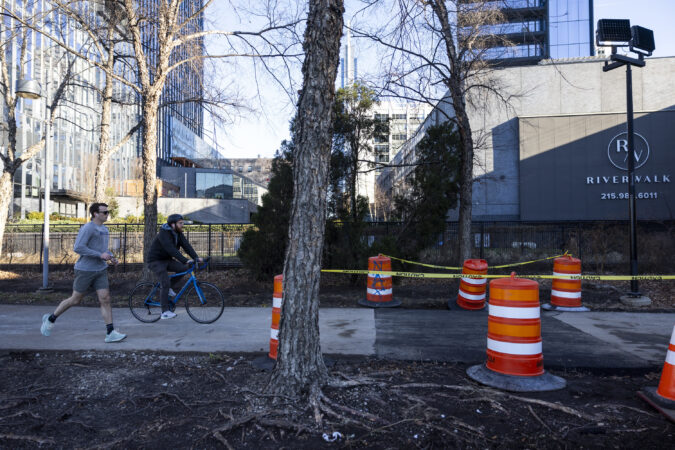
    The Schuylkill River Trail is now open between JFK Boulevard and Race Street in Philadelphia, Pa., on Wednesday, Dec. 24, 2025.

    The sinkhole occurred between Race Street and JFK Boulevard, just north of the SEPTA Bridge, after it formed beneath the asphalt. The trail runs along Schuylkill Banks, a portion of the Schuylkill River Trail.

    The SRDC works with the city to revitalize the Schuylkill corridor from the Fairmount Dam to the Delaware River, the eight-mile stretch known as Schuylkill Banks.

    The sinkhole repair presented a problem that stemmed from a steel bulkhead that was built for the trail in 1995. The bulkhead helped extend land farther into the river and create more parkland.

    But gaps developed in a seal between the bulkhead and concrete sewer infrastructure. Those gaps allowed soil to seep away with the tide, eventually washing away enough to create a sizable hole.

    Syrnick said the SRDC and the Philadelphia Streets, Parks and Rec, and Water Departments worked together to come up with a solution.

    So workers had to seal the gaps.

    The weather was clear enough this week that crews were able to pour concrete to fill part of the hole and backfill it before paving it Wednesday.

  • The lower Schuylkill is up for Pennsylvania’s River of the Year. Voting is open.

    The lower Schuylkill is up for Pennsylvania’s River of the Year. Voting is open.

    The lower Schuylkill winds 36 miles from Phoenixville in Chester County to its tidal meeting point with the Delaware River at Philadelphia’s Navy Yard, sheltering more than 40 species of fish along the way.

    In Center City, the river doubles as a striking urban backdrop, bordered by a trail that can draw thousands of hikers and cyclists daily.

    This year, the waterway is vying for the title of Pennsylvania’s River of the Year, an annual competition spotlighting the state’s most significant waterways.

    Online voting, which began Dec. 9, runs through Jan. 16, giving Pennsylvanians the chance to select the 2026 winner from three contenders: Chillisquaque Creek, the Conestoga River, and the lower Schuylkill in the Philadelphia region.

    The River of the Year program is administered by the Pennsylvania Organization for Watersheds and Rivers, with funding from the Pennsylvania Department of Conservation and Natural Resources (DCNR).

    The contest is meant to draw public attention to rivers and their environmental importance. The winning river’s nominating organization receives a $15,000 DCNR grant to fund yearlong celebrations, including paddling events and community activities. The DCNR produces a commemorative poster in honor of the river.

    Jackson Quitel, river programs coordinator for the nonprofit LandHealth Institute, said his organization nominated the Schuylkill along with a plan to educate the public “in the many wonders in this unique body of water.”
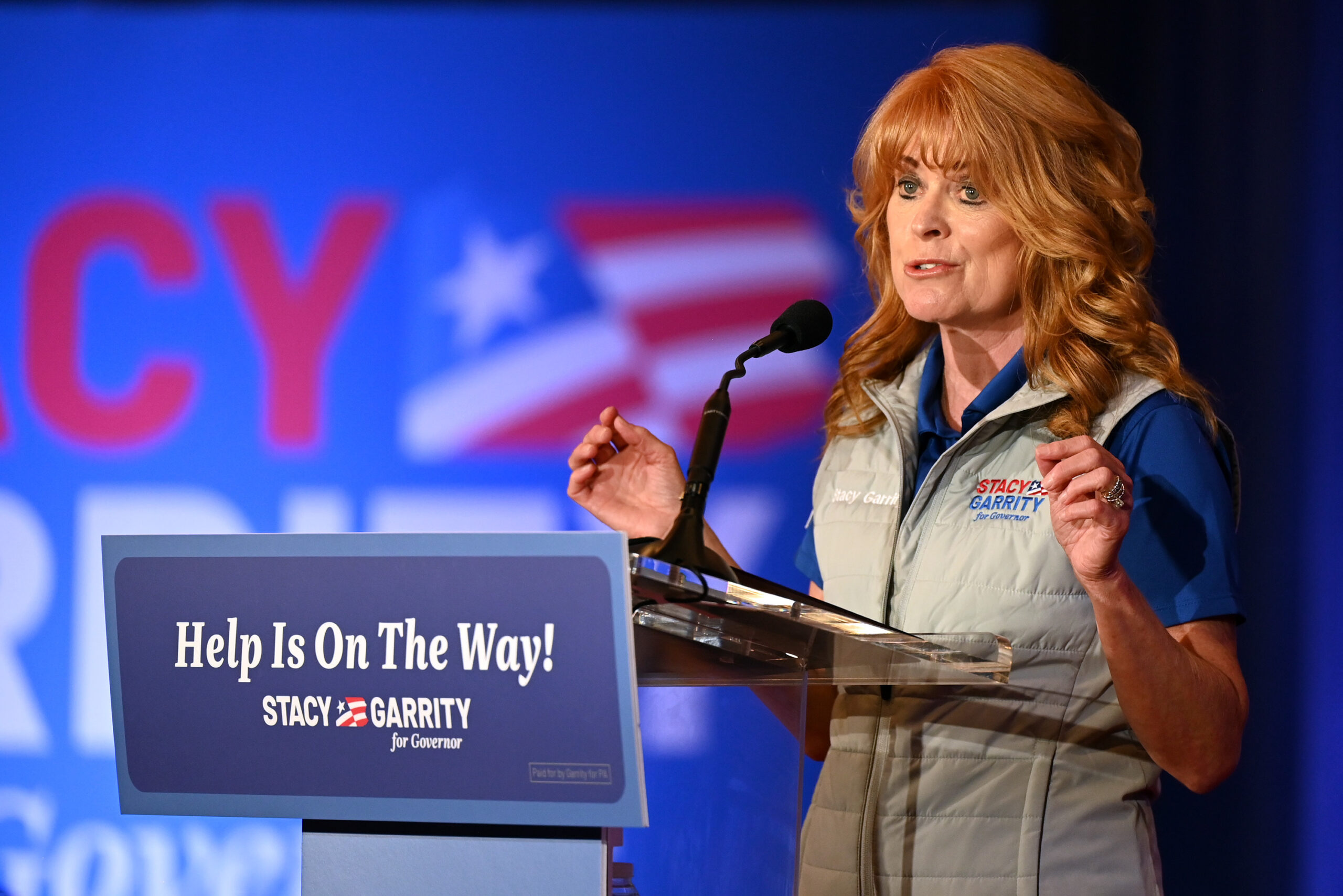
    “While the Schuylkill River is widely known, not many people are aware of the immense recreational activities and ecological wonders that are present on the river today,” Quitel said.

    The LandHealth Institute helps increase awareness of the river through guided walks, fishing, and kayaking, taking more than 500 people out on the water in 2025. If the Schuylkill wins, Quitel said, it would allow the group to double its reach.

    Joe Syrnick, executive director of the nonprofit Schuylkill Development Corp., which helped develop the Schuylkill Banks trail along the river, called the river “a great asset to the region.”

    “It would be nice to see it get the recognition it deserves,” Syrnick said.

    Once a vital waterway for the Lenni-Lenape, the river later endured severe pollution from upstream coal mining and industrial waste, eventually rebounding through years of efforts, including the protections of the federal Clean Water Act.

    The Schuylkill became the nation’s first municipal‑scale water system through Fairmount Water Works and continues to provide drinking water to 1.5 million people through two intakes along its banks.

    The Schuylkill River Trail, a continuous corridor running alongside most of the lower Schuylkill, has broadened access to the river’s views for residents, giving them more insight into a river many were once cut off from.

    Most recently, the Schuylkill Banks section in Center City debuted a new $48 million cable‑stayed, pedestrian‑only bridge, anchoring a trail extension known as the Christian to Crescent Trail Connector. The 2,800‑foot segment delivers sweeping, unobstructed views of the river.

    The DCNR describes the lower Schuylkill as an “urban oasis surrounded by bustling roads and a backdrop of a gorgeous skyline.”

    Pennsylvania has 25 rivers. Of those, six are federally designated as wild and scenic and 13 are state-designated scenic rivers.

    Contest nominees can also include tributaries within river watersheds. For example, Chillisquaque Creek is a 20 mile-long tributary of the Susquehanna River’s west branch. It flows through Northumberland and Montour Counties.

    The Conestoga, meanwhile, feeds Chesapeake Bay.

    Overall, Pennsylvania has 85,000 miles of waterways, which is the highest stream density in the continental United States.

    The Delaware was the 2025 river of the year.