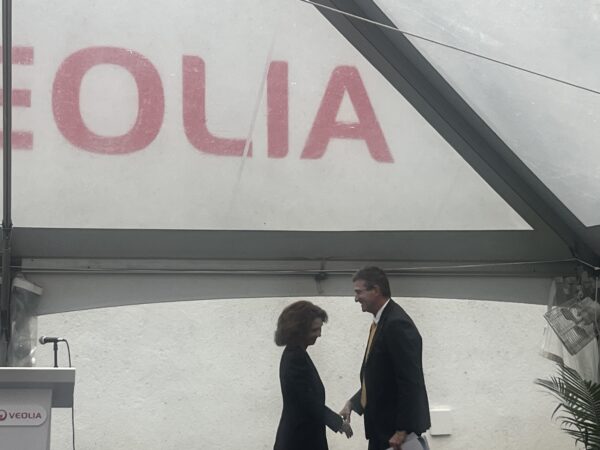
Clean Earth, based in King of Prussia, serves manufacturers such as Boeing, Merck, computer-chip makers, and hospitals. Veolia operates local water utilities in towns across the U.S., including a slice of Delaware County and northern Delaware.
Clean Earth employs around 1,800, and already uses Veolia incinerators to burn hazardous medical waste and other refuse. Enviri bought that business for $625 million in 2019. Veolia says it plans to cut $120 million in spending as it integrates Clean Earth, to make the deal more profitable.
Combined with Veolia’s existing hazardous-waste business, Veolia says it will be among the largest businesses of its kind. Veolia also bought medical-waste companies in New England and California earlier this year, and it has incinerators in Texas, Illinois, and Arkansas.
Clean Earth includes tar-contaminated soil collection treatment centers on the Schuylkill in Southwest Philadelphia; in Morrisville, Bucks County; and New Castle, Del.; and a hazardous-waste and chemical disposal site in Hatfield, Montgomery County, among 82 waste-management and 19 federally-permitted treatment sites, along with hundreds of trucks. Veolia has industrial facilities in Bridesburg and Pennsauken, among other area locations.
Veolia will pay cash worth around $15.50 a share, or $1.3 billion, to Enviri shareholders for Clean Earth; plus $1.35 billion to pay down some of Enviri’s debt load; and around $400 million to help finance Enviri as it restructures as a smaller company and issues new shares. Both boards have approved the deal, pending a vote by Enviri shareholders next spring.
The price to shareholders is a premium to Enviri’s recent share value, and triple what it was worth at its recent low in March. But it’s also less than the stock was worth as recently as 2022, before the company changed its name from Harsco and moved from central Pennsylvania to Philadelphia, where its leaders said it’s easier to recruit engineers and managers.
The sale leaves Enviri with two remaining business lines: steel-mill slag management and railroad track equipment and maintenance. The latter business faces large environmental expenses, and Enviri had earlier tried to sell it.
After selling Clean Earth to Veolia and reducing management costs, Enviri will spin off the remaining businesses into a new company, under the same name.
Announcing the deal, Enviri chief executive F. Nicholas Grasberger also said he’ll be stepping down from the company’s top job, to be succeeded by Russell Hochman, a ten-year Enviri veteran who already serves as the company’s senior vice president, top lawyer, and compliance officer.
F. Nicholas Grasberger, chairman & CEO of Enviri, at the company’s Philadelphia headquarters in 2023. He will be stepping down as the company sells its hazardous-waste division to France’s Veolia.
The restructured Enviri will have more cash to invest in its businesses and lower finance costs, Grasberger said in a statement. He praised successor Hochman’s “deep business acumen and proven ability to navigate mergers and acquisitions, regulatory matters, and transformation efforts.”
The boost in Enviri’s capital “will create enhanced opportunities” for both slag and rail, Hochman said in a statement.
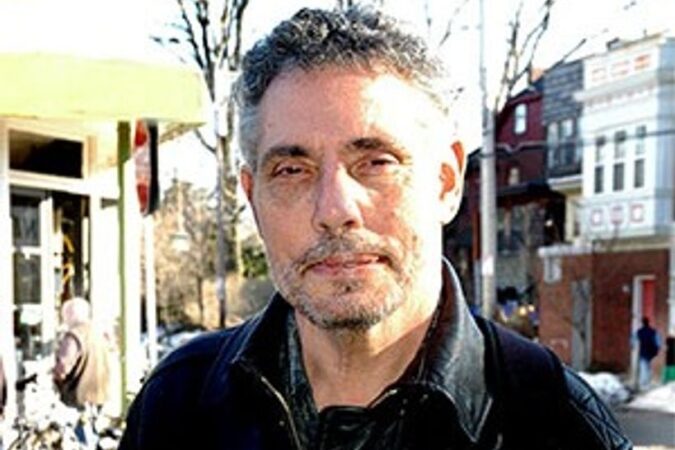
Hal Sirowitz, 76, of Philadelphia, internationally acclaimed performance poet, former poet laureate of Queens, N.Y., author, mentor, retired special education elementary school teacher, and passionate Parkinson’s disease advocate, died Friday, Oct. 17, of complications from Parkinson’s at KeystoneCare Hospice in Wyndmoor.
Born in Manhattan to an expressive and overprotective mother, Mr. Sirowitz moved to Queens after college and, motivated by his early work with an inspirational young student, spent 23 years, until his retirement in 2003, as a special education elementary school teacher in New York.
“He saw the impact he had on that student and realized the impact he could have,” said his wife, Minter Krotzer.
He was a good listener and a lifelong reader and writer, and, in 1979, at 30, he started reciting his own writing in poetry events at New York cafes and theaters. He found that poignant poems, dark yet amusing, about his larger-than-life mother, Estelle, resonated with people.
“Everyone either has a mother or is a mother, and they identify right away,” he told Newsday in 1998. By 1993, he was a favorite on the local poetry circuit and traveling to regional and national competitions.
On Mother’s Day in 1996, his first book, Mother Said, was published to great acclaim. He went on to write four more books and to serve as poet laureate of Queens from 2001 to 2004.
Until recently, when Parkinson’s made it impossible, Mr. Sirowitz performed his poems in his signature deadpan delivery, with perfect pauses and pacing, and his engaging New York accent. He spoke at colleges and conferences, bookstores and libraries, museums and workshops.
He guested on national radio and TV shows, and read during visits to Israel, Finland, Iceland, and elsewhere around the world. Many of his poems, such as “Chopped Off Arm” and “Crumbs,” are about the angst and guilt he felt as a boy under the thumb of his always-worried mother. Later, he wrote about Parkinson’s, too.
In “Crumbs,” he said: “Don’t eat any more food in your room,/Mother said. You’ll get more bugs./They depend on people like you./ Otherwise, they would starve./But who do you want to make happy,/your mother or a bunch of ants?/What have they done for you?/Nothing. They have no feelings./They’ll eat your candy. Yet/you treat them better than you treat me./You keep feeding them./But you never offer me anything.”
“There must be a need for people to read funny sad poems about parents,” he told the Schuylkill Valley Journal. He told the New York Times in 1996: “I feel almost like I’m a conduit for my mother. I’m giving her her voice.”
His poems inspired music composers and filmmakers, and were read in public by other literary notables. They appeared in anthologies, magazines, and journals, and were translated into 13 languages.
He earned fellowships from the National Endowment for the Arts and the New York Foundation for the Arts, and he won the 2013 Nebraska Book Award for poetry. Colleagues called him “legendary,” an “icon,” and the “Maestro from Flushing.”
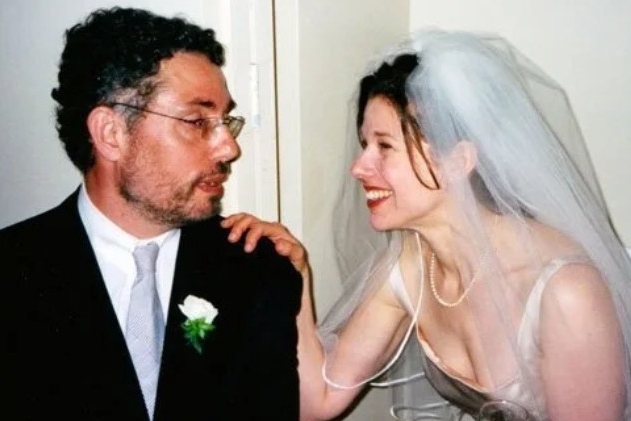
Mr. Sirowitz and his wife, Minter Krotzer, married in 2002.
One colleague said in a tribute: “Hal was a true inspiration. I relished his humor and perseverance.” Another said: “I often felt his poems were one-minute telescopes of therapy sessions.”
He told the Schuylkill Valley Journal: “To me, one purpose of being a writer is to show others that it’s good to express yourself. You create your own personal history by the poems and stories you write.”
Mr. Sirowitz was diagnosed with Parkinson’s in 1997 and, with his wife, became a vocal advocate and activist for others dealing with the disease. He spoke at medical centers and to support groups about having Parkinson’s. His wife talked of being his caregiver.
In 2015, she wrote in The Inquirer: “Through poetry he had been able to forge a way through the illness and make art from the experience. … Keeping on with the writing of poetry is a way of saying ‘so there’ to the Parkinson’s. ‘I’m still at it.’”
Mr. Sirowitz told the Schuylkill Valley Journal: “My life has been a struggle against limitations, like the Parkinson’s. But it also provided me definitions. I know who I am.”
Harold Sirowitz was born March 6, 1949. He grew up between two sisters, Lauren and Iris, on Long Island, N.Y., and confronted a stutter and other speech issues when he was young.
He was a soccer star in high school and earned a bachelor’s degree in English literature at New York University in 1972 and a master’s degree in education at Hofstra University.
He met fellow writer Minter Krotzer at a book party in 2000, and they married in 2002. They lived in Brooklyn before moving to West Mount Airy in 2007, and she was his longtime editor, collaborator, and caregiver.
“He had this childlike wonder about things,” his wife said. “He had a real sweetness and a connection with people.”
Mr. Sirowitz was a runner and a hiker, and he quit his beloved New York sports teams to follow the 76ers, Eagles, Phillies, and Flyers. He especially enjoyed reading and spent one summer digesting the entire works of William Shakespeare.
“He was a fighter, and people called him the ‘ultimate mensch,’” his wife said. “He said he had no regrets and did what he set out to do in life. It was amazing to witness someone so heroic.”
In addition to his wife and sister Lauren, Mr. Sirowitz is survived by other relatives. His sister Iris died earlier.
A private service was held in October. A public celebration of his life is to be held later.
Donations in his name may be made to the Parkinson Council, 520 Carpenter Lane-COMM, Philadelphia, Pa. 19119; and KeystoneCare Hospice, 8765 Stenton Ave., Wyndmoor, Pa. 19038.
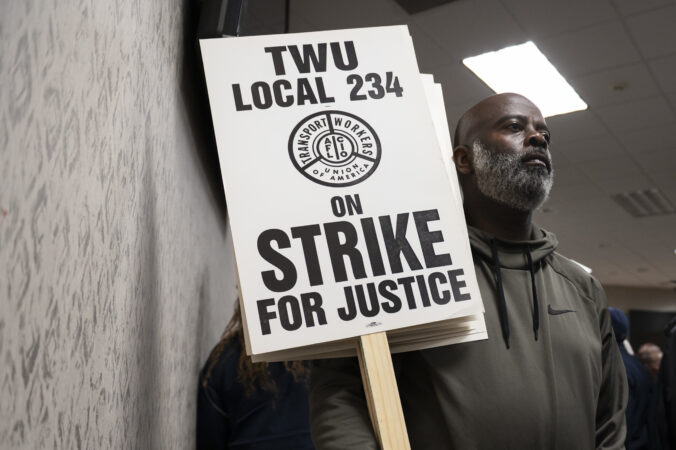
Members of the Transport Workers Union Local 234 on Sunday, Nov. 16 voted to authorize a strike if union and SEPTA negotiators can’t reach an agreement on a new contract.
Shortly before the current contract ran out at 11:59 p.m. on Nov. 7, TWU’s new president, Will Vera, urged union members to stay on the job. In an unusual move, he delayed a strike vote at the time of contract expiration, saying he had hope that a deal could be reached without the usual brinksmanship.
“We’re asking you to please continue to come to work and put money aside. We want you to be prepared in case we have to call a work stoppage,” he told members in a video at the time.
Local 234 leaders say they’re prioritizing a two-year deal with raises and changes to what the union views as onerous work rules, including the transit agency’s use of a third party that Vera said makes it hard for members to use their allotted sick time.
In a statement, SEPTA said it was aware of the authorization vote and is committed “to continue to engage in good-faith negotiations, with the goal of reaching a new agreement that is fair.”
2023 Fraternal Order of Transit Police Lodge 109 (three days)
SEPTA police officers walked off the job after bargaining with the transit agency for almost nine months, largely over the timing of a 13% pay raise for members. The agreement, partially brokered by Gov. Josh Shapiro, came amid heightened fears about safety on public transit and a funding crisis for SEPTA.
TWU Local 234 walked off the job for six days; the biggest issue was retirement benefits. SEPTA’s contributions toward union members’ pensions did not rise in tandem with wages when workers made more than $50,000. Managers’ pension benefits were not capped. The union also wanted to reduce out-of-pocket health-care costs and win longer breaks for bus, trolley, and subway operators between shifts and route changes.
SEPTA and the union reached an agreement Nov. 7, the day before the general election. Democrat Hillary Clinton’s presidential campaign was worried about voter turnout, and the city sought an injunction to end the strike. It proved unnecessary.
Talk about leverage. TWU was ready to strike just before the first home game of the World Series between the Phillies and the New York Yankees. Gov. Ed Rendell pushed the two sides to continue talking, and the transit workers waited to walk out until three hours after the end of Game 5, the last in the series played at Citizens Bank Park.
It was a bitter strike, coming just a year after the stock market’s meltdown started the Great Recession. TWULocal 234 President Willie Brown called himself “the most hated man” in Philadelphia. Mayor Michael Nutter was harshly critical. Brown called him “Little Caesar.”
The strike was settled Nov. 7 with a deal on a five-year contract. Transit workers got a $1,250 bonus, a 2.5% raise in the second year, a graduated increase in SEPTA pension contributions from 2% to 3.5%, and the maximum pension benefit was raised to $30,000 from $27,000.
2005: TWU Local 234 and United Transportation Union Local 1594 (seven days)
Negotiations collapsed mostly over SEPTA’s insistence that workers pay 5% of medical insurance premiums. At that point, the authority paid 100% of the workers’ premiums for family coverage.
In the end, it was solved by Gov. Rendell, a Democrat who had been Philadelphia mayor in the 1990s. He agreed to give promised state money to SEPTA early, so it could pay premiums in advance, reducing its costs.
In the resulting four-year deal, the unions had to pay for 1% of their medical premiums. They also received 3% yearly raises.
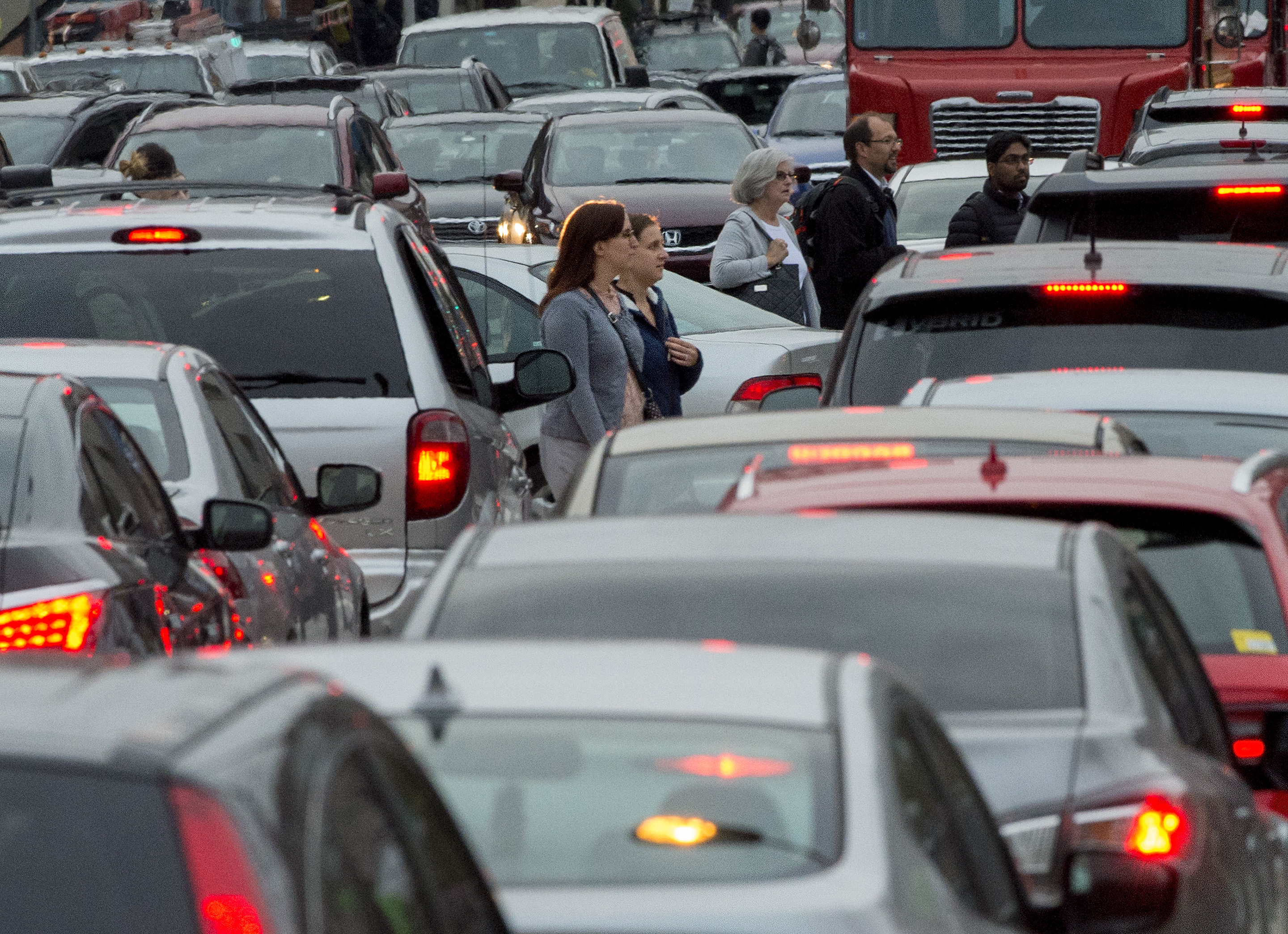
Pedestrians and cars in a chaotic dance at the intersection of Market and 30th Streets during the afternoon commute on the first day of the SEPTA city workers’ strike Nov. 1, 2016.
1998: TWU Local 234 (40 days)
City transit workers’ contract expired in March, but they did not strike until June — and then stayed out for 40 days. The two sides reached an agreement in July, but it fell apart. TWU members had returned to their jobs and kept working under an extension of their old contract. A final agreement was signed Oct. 23.
The union agreed to SEPTA’s demand that injured-on-duty benefits be limited. The old contract gave them full pay and benefits while on leave after a work injury. SEPTA wanted to hire an unlimited number of part-time workers. The union agreed to 100 part-timers to drive small buses.
SEPTA’s chief negotiator was David L. Cohen, famous for reining in unions representing city workers during Philadelphia’s bankruptcy in 1992, as Rendell’s mayoral chief of staff.
A two-week strike stilled city buses, trolleys and subways until an agreement was reached April 10. Transit workers would get 3% raises per year over the three-year span of the new contract, as well as increases in pension benefits and sick pay.
The union agreed to several cost-reduction measures, including a restructuring of SEPTA’s workers compensation policies.
Mayor Ed Rendell, a villain to many in labor for winning givebacks from city unions in 1992, pushed SEPTA to offer more generous terms to TWU than it had initially. Cohen, who was his chief of staff, crunched the numbers to make it work. Three years later, out of the city administration and working as a lawyer, he was hired as SEPTA’s chief negotiator.
1986: TWU Local 234 (four days) and UTU Local 1594 (61 days)
When TWU struck the city transit division in March 1986 over a variety of economic issues and work rules, some bus drivers pulled over mid-route and told passengers to dismount, The Inquirer reported.
Members were particularly incensed at what they considered SEPTA’s draconian disciplinary procedures. Union leaders said the issue was a basic lack of respect. The strike was settled in four days.
Drivers for 23 suburban bus routes, two trolley lines in Delaware County and the Norristown High-Speed Line — all members of the United Transportation Union — struck for just over two months, affecting about 30,000 passengers a day.
Employees in what was then known as SEPTA’s Red Arrow Division — after the private transit company that used to own the routes and lines — made considerably less than their city counterparts and had weaker pension benefits. They won raises and pension changes that brought them closer to parity.
1983: Regional Rail (108 days)
Thirteen separate unions walked off the job on the commuter rail lines that SEPTA had taken over at the beginning of the year from Conrail, successor to the bankrupt Pennsylvania and Reading Railroads.
In addition to wages, a key issue was SEPTA’s demand that union train conductors accept pay cuts. The authority had already cut the number of those workers by more than half.
Eventually SEPTA reached deals with a dozen of the unions. The 13th local, which represented 44 railroad signalmen, held out longer. Main issue: Whether SEPTA had the right to contract with outside firms for some types of signal work.
The Regional Rail strike remains SEPTA’s longest work stoppage since 1975.
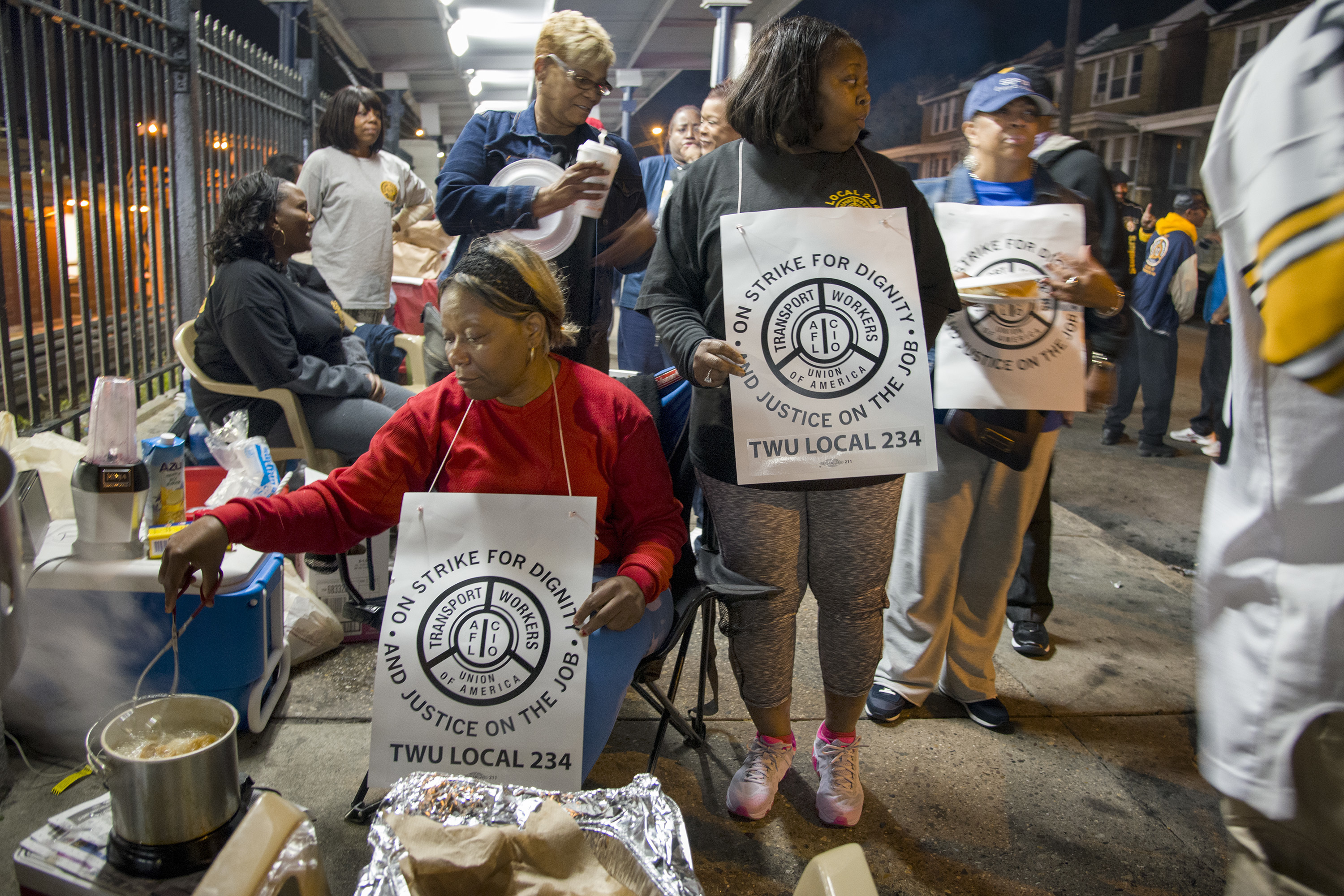
Joyce Woodford (center), a 25-year veteran cashier on SEPTA’s Broad Street Line, serves up fried fish for her fellow striking cashiers outside the Fern Rock Transportation Center during dinnertime on the third day of the SEPTA strike in 2016.
1982: TWU Local 234 (34 days)
About 36 suburban bus drivers and mechanics operating routes primarily in Montgomery County, and some routes in Bucks, won an 8.5% wage increase over three years.
The bus routes were the descendants of the Schuylkill Valley Lines and the Trenton-Philadelphia Coach Lines, which SEPTA acquired in 1976 and 1983, respectively. Service has grown, and the collection of bus routes is known as the Frontier Division today.
1981: TWU Local 234 (19 days) and UTU Local 1594 (46 days)
Transit workers shut down buses, trolleys and subways in the city on March 15, seeking job security in the form of a no-layoff clause, wage increases and a bar on SEPTA hiring part-time workers.
And the Red Arrow division went out for 46 days seeking higher wages and better medical benefits. SEPTA also backed down a demand for permission to hire private contractors for some work on the suburban buses, trolleys, and the Norristown High Speed Line.
1977: TWU Local 234 (44 days)
After a bitter strike, union members who run the city transit division got higher wages and more benefits, after rejecting an arbitrator’s proposed contract that was portrayed in news reports as generous.
A furious Mayor Frank Rizzo told reporters the strike “can last 10 years for all I care.” He said of the union’s rejection of the earlier offer: “It is outrageous, and I hope the people won’t forget it.”
1975: TWU Local 234 (11 days)
Transit workers, concerned about the ravages of inflation, wanted a clause giving them cost-of-living increases and enhancements to health-care benefits. Those were granted after Rizzo agreed to add $7.5 million to the city’s annual SEPTA contribution. Perhaps that’s one reason the mayor was so annoyed two years later.
Staff writer Erica Palan contributed to this article.
Philadelphia discharges 12.7 billion gallons of raw, diluted sewage into the Delaware River’s watershed each year, with Camden County adding to the mix, according to a new report.
That’s a problem, say the report’s authors at the nonprofit advocacy groupPennEnvironment. Philadelphia and Camden border the river, and significant recreational potential is blocked forpart of the year because of pollution from both, the authors say.
A waterway can remain unsafe for recreation for up to 72 hours after an overflow. That suggests local waterways could be unsafe for recreation up to 195 days per year, or more than half the year.
Five decades after the Clean Water Act mandated that waterways be made safe for swimming and fishing, combined sewer overflows (CSOs) continue to pollute during wet weather when untreated sewage and runoff surge into nearby creeks and rivers, creating the potential to sicken recreational users.
David Masur, executive director of PennEnvironment, said the group included Camden County in its most recent report“to get a more holistic view.”PennEnvironment’s first report on CSOs in 2023focused only on Philly.
The pollution “affects the waterway, the environment, and public health,” Masur said. “The river is the border between the two states, and people on both sides use it a lot.”
PennEnvironment acknowledges that both Philly and Camden County have programs to reduce overflows and is calling on federal officials for increased funding to put proper infrastructure into place.
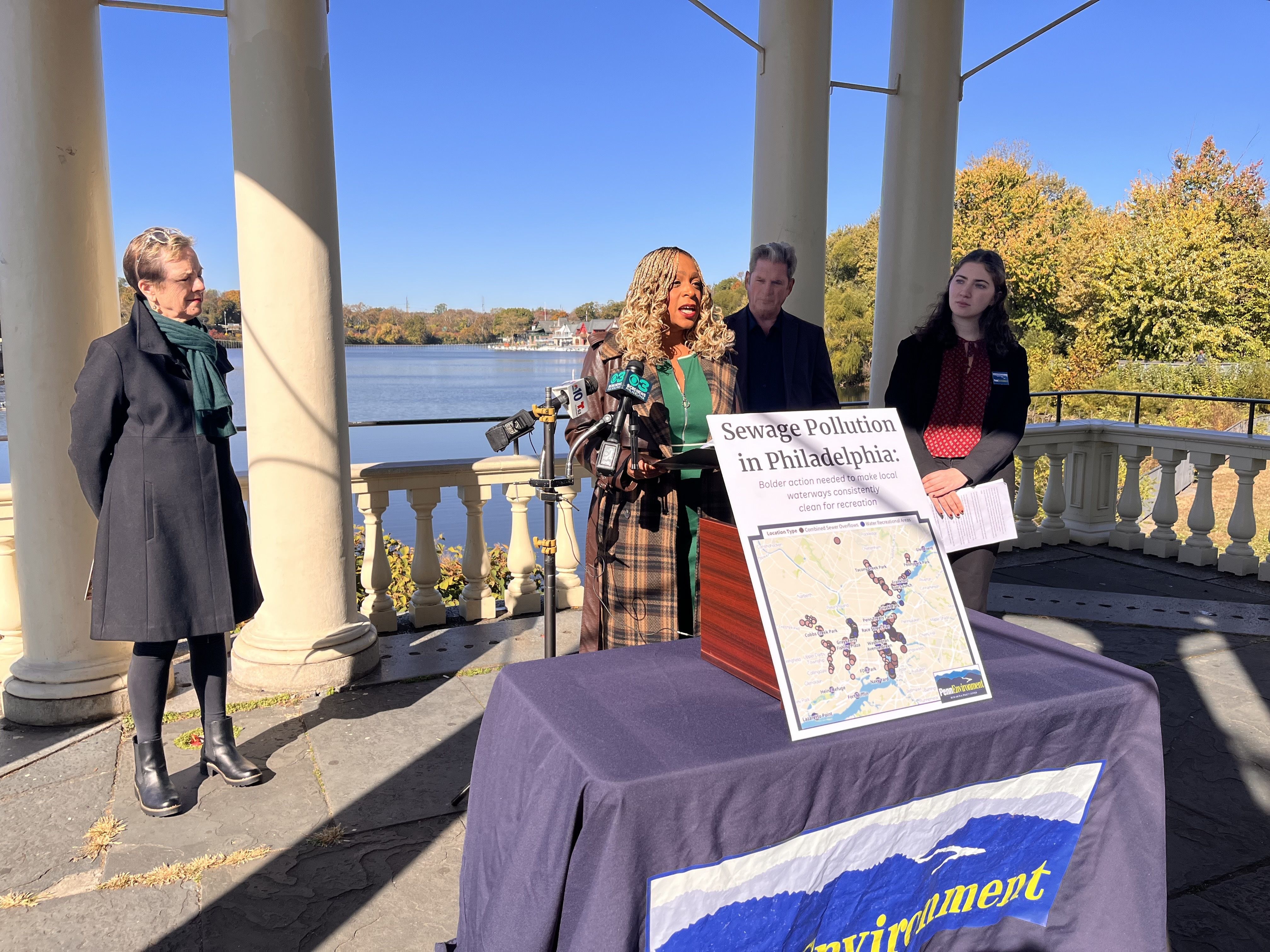
Philadelphia Council member Jamie Gauthier (center) spoke Monday about PennEnvironment’s report on pollution from combined sewer overflows. To her left is Margaret Meigs, president, Friends of the Schuylkill Navy. And to her right is Tim Dillingham, senior adviser, American Littoral Society, and Hanna Felber, clean water associate at PennEnvironment Research & Policy Center.
Frequent overflows, high volume in Philly
Roughly 60% of Philadelphia is served by a combined sewer system, which has 164 outfalls — really large metal or concrete openings — that discharge pollution into waterways. A CSO system uses a single pipe to collect and transport sewage from homes and businessesas well as stormwater runoff from streets and sidewalks.
During dry weather, the system can handle the volume before safely releasing it back into the rivers. But during heavy rainfall, thesystem discharges untreated, though highly diluted, sewage mixed with stormwater directly into waterways.
Despite the Philadelphia Water Department’s ongoing Green City, Clean Waters project — a 25-year plan focusing on green infrastructure to reduce overflows — the frequency and volume remain alarmingly high, the report states.
Overall, CSOs dumped an average of 12.7 billion gallons of raw sewage mixed with polluted stormwater per year into local waterways from 2016 to 2024, the authors of the report stated. They included an online map to show the location of the outfalls and annual overflow.
Half the sewage came from just 10 CSOs.
window.addEventListener(“message”,function(a){if(void 0!==a.data[“datawrapper-height”]){var e=document.querySelectorAll(“iframe”);for(var t in a.data[“datawrapper-height”])for(var r,i=0;r=e[i];i++)if(r.contentWindow===a.source){var d=a.data[“datawrapper-height”][t]+”px”;r.style.height=d}}});
Still, the numbers are a slight improvement over the 15 billion gallons a year released into local rivers, as PennEnvironment reported in 2023.
Philadelphia gets its drinking water from the rivers, but the CSOs are downstream of the city’s treatment plants on the Delaware and the Schuylkill.
The reportused publicly available data to show that five of six waterways in Philly produced at least one overflow 65 times or more per year on average between 2016 and 2024. Those were the Delaware River, the Schuylkill, and Cobbs, Frankford and Tacony Creeks.
In better news: The average volume of overflow per inch of precipitation declined by about 16% from previous periods, but progress is slow and threatened by increased rainfall and rising sea levels due to climate change, the authors say.
PWD could not be reached for comment.
window.addEventListener(“message”,function(a){if(void 0!==a.data[“datawrapper-height”]){var e=document.querySelectorAll(“iframe”);for(var t in a.data[“datawrapper-height”])for(var r,i=0;r=e[i];i++)if(r.contentWindow===a.source){var d=a.data[“datawrapper-height”][t]+”px”;r.style.height=d}}});
Camden County
The report also found persistent overflows in Camden County. The cities of Camden and Gloucester, along with the Camden County Municipal Utilities Authority (CCMUA), operate combined sewer systems that frequently overflow into the Delaware River and its tributaries, including the Cooper River and Newton Creek.
The report found that systemson the Camden County side of the river overflowed into local waterways an averageof 76 days per year from 2016 to 2024.
window.addEventListener(“message”,function(a){if(void 0!==a.data[“datawrapper-height”]){var e=document.querySelectorAll(“iframe”);for(var t in a.data[“datawrapper-height”])for(var r,i=0;r=e[i];i++)if(r.contentWindow===a.source){var d=a.data[“datawrapper-height”][t]+”px”;r.style.height=d}}});
The highest-frequency outfall for the Cooper River released sewage for an average of 118 days annually during that period.
The Delaware River received sewage overflows for an average of 94 days annually from its highest-frequency outfall.
The authors said gaps in data leave them unable to show the total volume of diluted sewage releasedfrom Camden. But they said that the amount of “solids/floatables” collected at each outfall is an indicator a waterway is polluted.
Dan Keashen, a spokesperson for Camden County, said officials have been making strides.
He said that crews recently cleaned 30 miles of pipe and that a $26 million project is underway to physically separate the combined sewer service area of Pennsauken that flows into Camden. Officials are also studying how to better achieve compliance for the largest outfall in the system, a project estimated to cost $40 million to $150 million when complete.
What can be done?
The report concludes that current plans by Philadelphia and Camden County are insufficient to achieve the goal of a clean Delaware River watershed.
The report was written by John Rumpler, clean water director for Environment America, PennEnvironment’s parent organization, and Elizabeth Ridlington, associate director of the Frontier Group, a nonprofit research group that is part of the Public Interest Network, an environmental advocacy organization.
The authors call for officials to accelerate action to end all sewer overflows, set a hard deadline, and find new ways to pay for necessary infrastructure upgrades.
Philadelphia CouncilmemberJamie Gauthier, chair of the committee on the environment, called overflows “a public health crisis” and urged PWD’s new commissioner, Benjamin Jewell, to act. She said elected officials in Harrisburg and Washington also need to step up.
PWD is separately under pressure by a new Environmental Protection Agency regulation that seeks to improve the amount of dissolved oxygen in the Delaware by ordering a large-scale reduction of ammonia at the city’s three water pollution control plants. PWD estimates that the price for compliance is $3.6 billion and would cost households an additional $265 annually on their water bills.
The authors of the PennEnvironment report concede the CSO task is daunting. But they say Portland and Boston faced similar situations, invested in infrastructure, and managed to make CSO overflows infrequent. Washington, D.C., they said, is on track to reduce sewage overflows by 96% in 2030.
Hanna Felber, a PennEnvironment advocate, said that PWD needs to use creative funding, such as floating longer-term bonds to finance projects, and that its engineers need to find more creative solutions, such as installing larger stormwater tunnels that flow separately from sewage.
“Unfortunately, our new report on sewage pollution in Philadelphia shows that on far too many days each year, the Philadelphia Water Department’s pipes and sewer systems dump huge volumes of raw sewage into our beautiful waters, harming our environment and depriving the public of a safe place to fish, boat, and float,” Felber said.
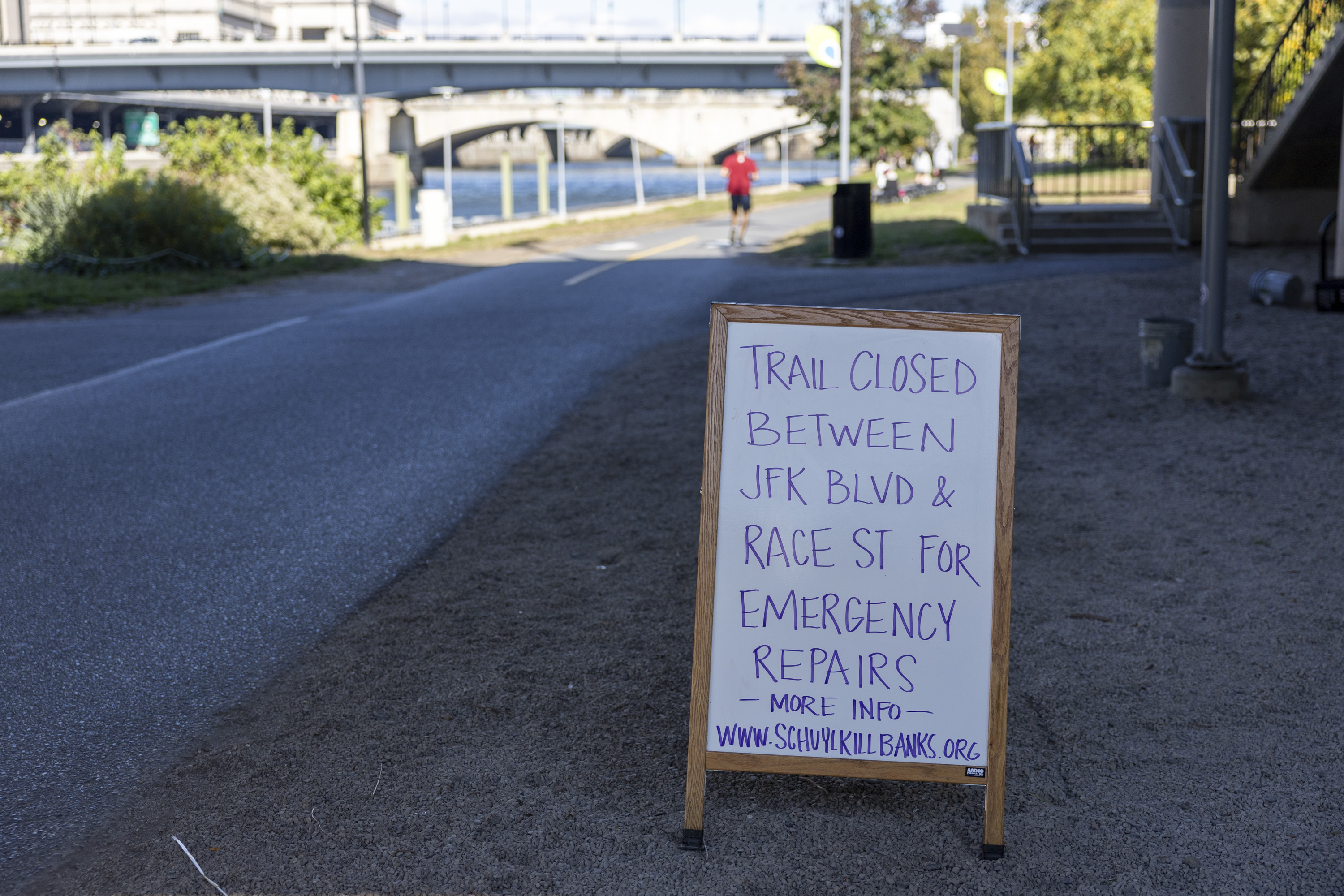
A portion of the popular Schuylkill River Trail in Center City has been closed and fenced off indefinitely after a “chasm”-sized sinkhole formed under the asphalt.
The trail is closed between Race Street and JFK Boulevard, just north of the SEPTA Bridge, according to the Schuylkill River Development Corp. (SRDC), a nonprofit that has helped revitalize the section of the trail known as Schuylkill Banks.
The SRDC said that it is working with Philadelphia Parks and Recreation, the Philadelphia Water Department, and engineers “to figure out what caused the large cavity to form and what is needed to make the necessary repairs.”
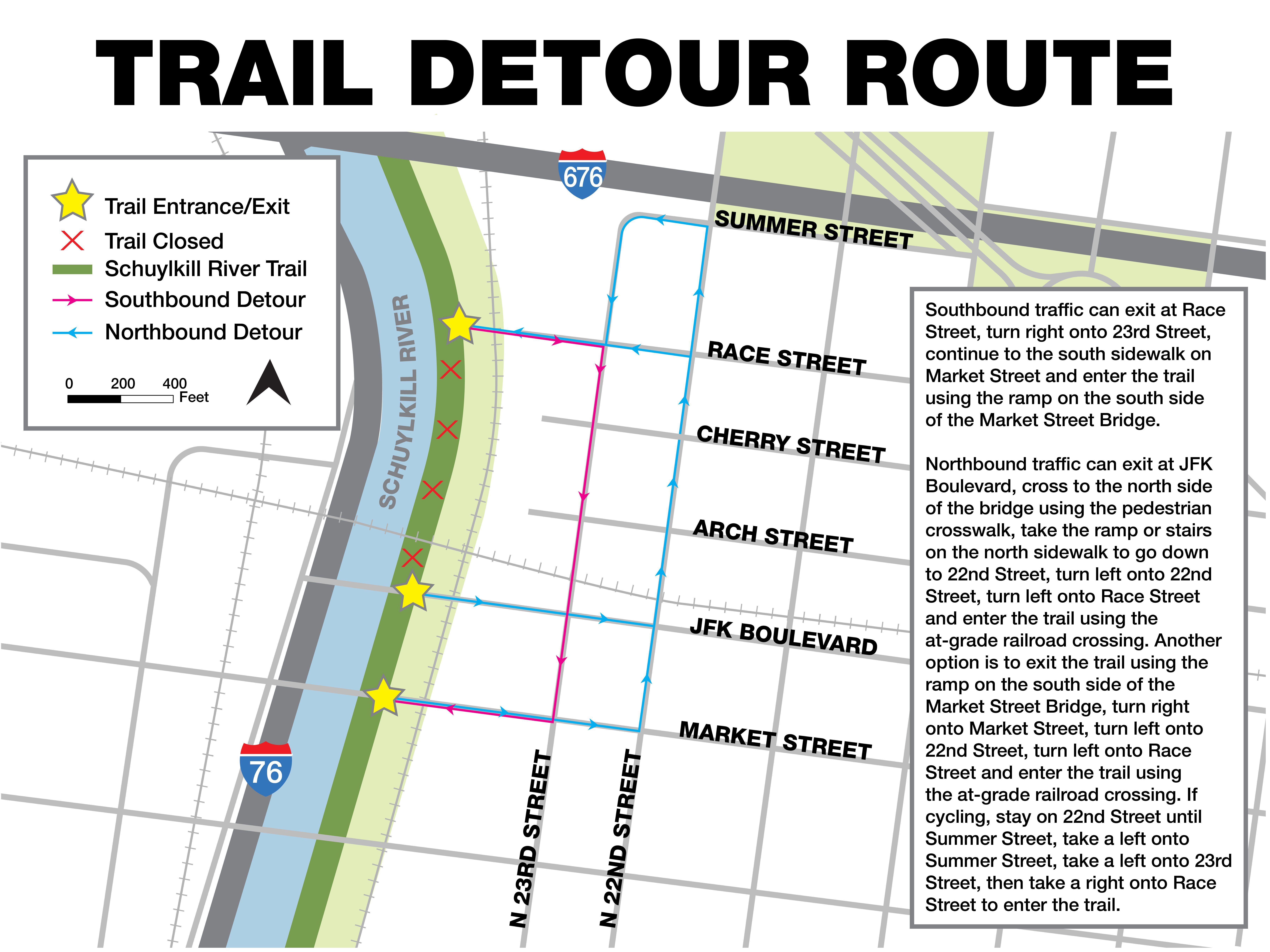
It has posted a map of a detour that can be used until repairs are made.
A map of a detour for the Schuylkill River Trail closure between Race Street and JFK Boulevard, which closed for emergency repairs after a sinkhole appeared Oct. 23, 2025
.
Joseph Syrnick, president and CEO of the SRDC, said the hole first came to the attention of his staff when a trail user reported it last week. At first, it appeared to be only a small hole, Syrnick said.
“By the time we got to it, it was about the size of a cantaloupe,” he said. “And then within a short time, it opened up the size of a small pumpkin. We immediately barricaded it off and made it safe.”
Syrnick said the hole was covered with plywood and cones were placed around it to block access by trail users. Crews began to explore the hole more thoroughly.
“We stuck our heads down there through the hole the size of the pumpkin, and saw a huge void. It’s like 8 by 10 [feet]. You could park a car down there — almost. So this has obviously been going on for a long time and luckily we caught it before it collapsed.”
Syrnick called it a “chasm” under the asphalt.
On Friday, SRDC hired an engineer, and then brought in the water department. The decision was made to block off the trail completely.
Although part of the trail remained covered, it took until Monday to put fencing and signs in place, completely sealing off any access.
“Theoretically, it could have collapsed,” Syrnick said.
Syrnick did not have a time frame for when the trail would reopen. He said his team needs to find the cause first. A repair could mean minor or major construction.
A sign warning people that part of the Schuylkill trail is closed for repairs between JFK Boulevard and Race Street after a sinkhole was discovered.
“I think we’re lucky finding this in the middle of fall, heading in the winter,” Syrnick said, “which is way better than finding it in the middle of spring, heading in the summer.”
Brian Rademaekers, a spokesperson for the water department, said it is working with SRDC to investigate the cave-in along the trail at Arch Street.
Rademaekers said crews will use dye to trace the source in an effort to determine a possible cause. He said that the nontoxic dye may cause discolored water in the Schuylkill, but that it is not a threat to people or wildlife.
“Once the results from this testing are evaluated,” Rademaekers said, “the PWD will work with SRDC to determine next steps needed to reopen the trail. Trail users should follow signage and advisories issued by the SRDC.
Rademaekers said the water department would not likely have an update on the situation until at least Friday.
Three large stand-alone parking garages have been proposed in Philadelphia this year, unusual projectsin a city where parking operators have long complained that high taxation makes it difficult to run a business.
The latest is a 372-unit garage near Fishtown and Northern Liberties at 53-67 E. Laurel St. near the Fillmore concert hall and the Rivers Casino.
“There’s been about 2,500 units that have come online within a 5- to 10-minute walk” of the planned garage, said Aris Kufasimes, director of operations with developer Bridge One Management. “When you’re building those on 7-1 [apartments to parking spaces] ratios, that leaves a massive hole. Where is everybody going to put their vehicles?”
Despite central Philadelphia’s walkability and high levels of transit access, two other developers have made similar calculations this year.
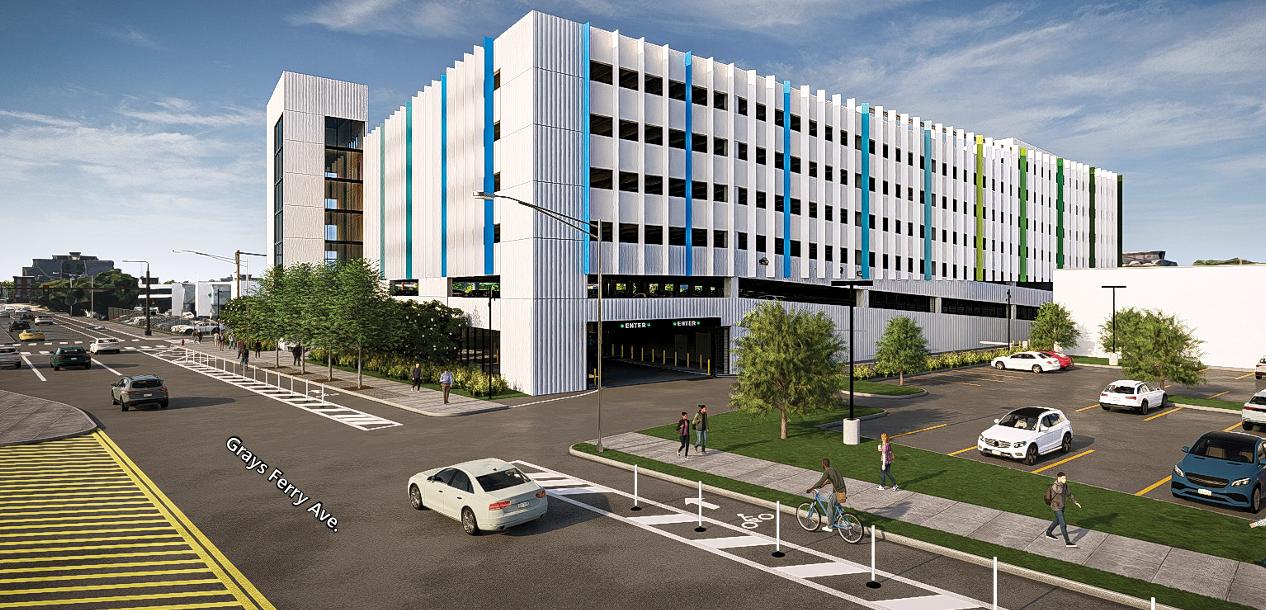
In the spring, Children’s Hospital of Philadelphia (CHOP) revealed plans for a 1,005-space parking garage in Grays Ferry along with a shuttle service to spirit employees to the main campus a mile away.
In August, University Place Associates unveiled plans for a 495-unit garage. About a fourth of it will be reserved for the use of the city’s new forensic lab, but the rest will be open to the public.
All three projects have baffled environmentalists and urbanists, who thought Philadelphia was moving away from car-centric patterns of late 20th-century development.
It’s also surprised parking operators in the city, who say national construction cost trends and high local taxation make it difficult to turn a profit.
Legacy parking companies in Philadelphia like E-Z Park and Parkway Corp. have been selling garages and surface lots for redevelopment as anything other than parking. They say the city has lost 10,000 publicly available spaces in the last 15 years, bringing the total to about 40,000 in Center City.
“I don’t think I’ll ever build another stand-alone parking facility,” said Robert Zuritsky, president of Parkway Corp. and board chair of the National Parking Association. “It doesn’t make any sense.”
Zuritsky and other parking companies have long noted that operators in Philadelphia, who often have unionized workforces, get hit with parking, wage, property, and the Use and Occupancy Tax.
When combined with the soaring cost of building new spaces across the nation, it’s difficult to turn a profit in Philadelphia.
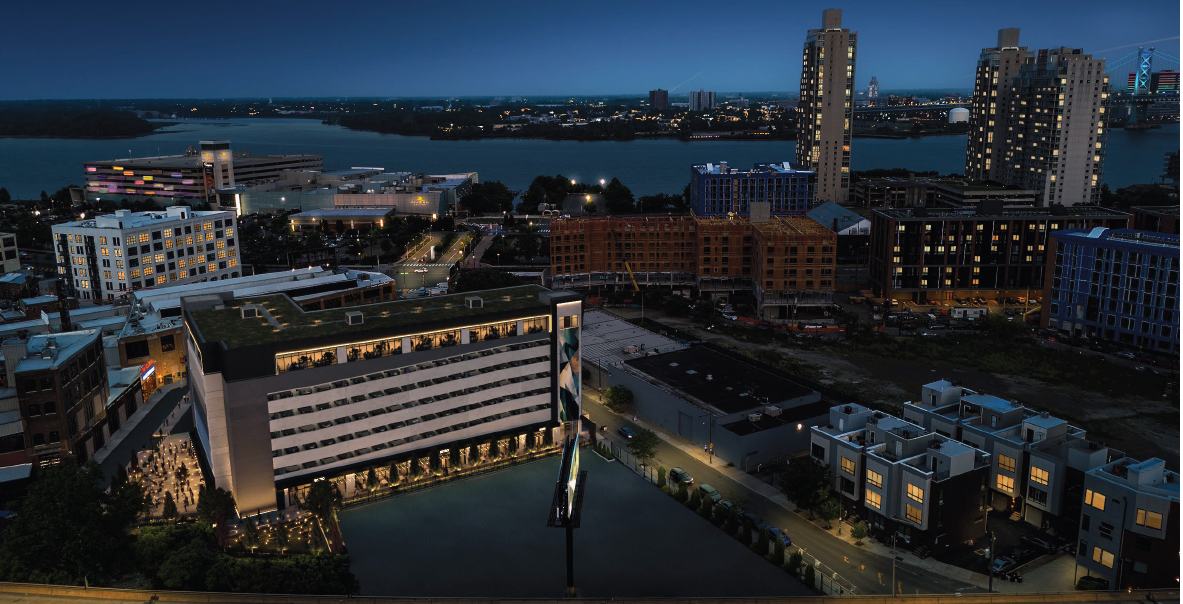
A rendering of the Fishtown garage, looking towards the Delaware River.
Zuritsky says it costs $60,000-$70,000 a space to build an aboveground lot in today’s environment and $100,000 to $150,000 below ground.
“It’s like building a house for a car,” he said.
Depending on hyperlocal peculiarities, Zuritsky says that taxation in Center City can eat up to 60% of the money they bring in and that to profit from new construction, an operator would have to charge $3,000 per space a month.
“I wish people luck, the ones that are moving in,” said Harvey Spear, president of E-Z Park. “Between taxes, insurance, and labor, it comes to, like, 70-some percent of what we take in. We have more equipment now that does away with a lot of labor; we’re trying to compensate with that.”
Urbanist and environmental advocates, meanwhile, have condemned the new garage projects, arguing that they will add to carbon emissions, air pollution, and traffic congestion.
“A massive parking garage less than half a mile from the El [in Fishtown] is the wrong direction for any city that claims to take climate action seriously,” said Ashlei Tracy, deputy executive director with the Pennsylvania Bipartisan Climate Initiative. “SEPTA is already working to get more people out of cars and onto transit, but projects like this one and the one from CHOP only make that harder.”
Here are the parking projects in the pipeline.
Fishtown: 372 spaces
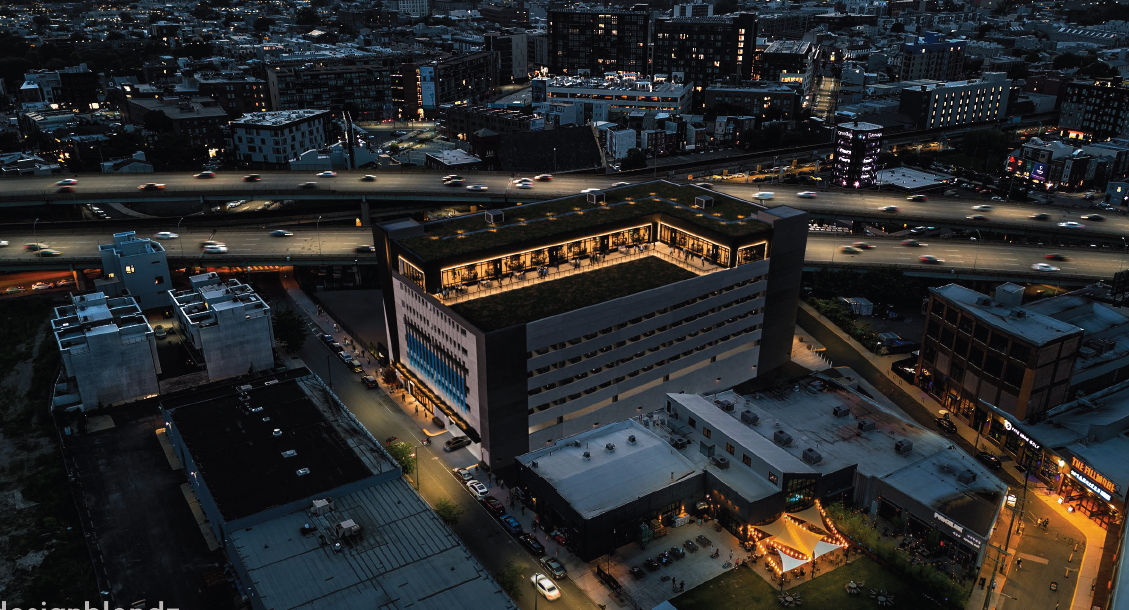
The garage, with architecture by Philadelphia-based Designblendz, doesn’t just contain parking. It includes close to 14,000 square feet of commercial space on the first floor, which the developer hopes to rent to a restaurant — or two — on the edges of one of Philadelphia’s hottest culinary scenes.
Another over 16,000-square-foot restaurant space is planned for the top floor, with views of the skyline and river. Both the top and bottom floors also could be used as event spaces.
Kufasimes says that this aspect of the project could partly offset the kinds of costs that parking veterans warn of.
“Our due diligence team went through those numbers and vetted them pretty thoroughly: The returns are what they needed to be,” Kufasimes said. “It’s got a multifunction of income streams, so we think that that really will help play a larger role.”
Kufasimes also said a parking garage made sense in an area that’s seen more development than almost any other corner of Philadelphia. When investors purchased the land at 53-67 E. Laurel St. and approached his company for ideas, they met with other stakeholders in the neighborhood and determined parking would be appreciated.
“It wasn’t necessarily all about the profit,” Kufasimes said. “A lot of people this day and age, that is their number-one goal. If this is a slightly lower return in the long run but can be better accepted by the community as a whole, we think that actually raises the value of the asset.”
An overhead-perspective rendering of the Fishtown garage.
At an October meeting of the Fishtown Neighbors Association, that argumentappeared to pay off. Unlike most community meetings where a large new development is proposed, there were no adamant opponents of the project. The project also includes a 20,000-square-foot outdoor space, a green roof, and a to-be-decided public art component. All of that helped, too.
“It’s nice seeing a parking garage, of all things, be as pedestrian-friendly and thoughtful as this,” one speaker said during the Zoom meeting.
Dubbed University Place 5.0, it largely exists because of a major expansion of the municipal bureaucracy west of the Schuylkill.
For years the city has sought a new location for its criminal forensics laboratory. The debate became heated in City Hall, with numerous Council members making the case for locations within their districts.
Councilmember Jamie Gauthier pushed for its location in University City Place 3.0, a newly built, state-of-the-art life sciences building that was coming online just as its intended industry was slowing down in the face of higher interest rates.
To get the crime lab, Mayor Cherelle L. Parker’s administration said the police department would need ample parking. That’s where the new garage comes in.
In June, Gauthier passed a zoning overlay that cleared away the regulatory hurdles to the project. Six weeks later, the developers revealed University City Place 5.0, which has 29 parking spaces on the ground floor reserved for official use by forensics vehicles and 100 spaces reserved for city employees.
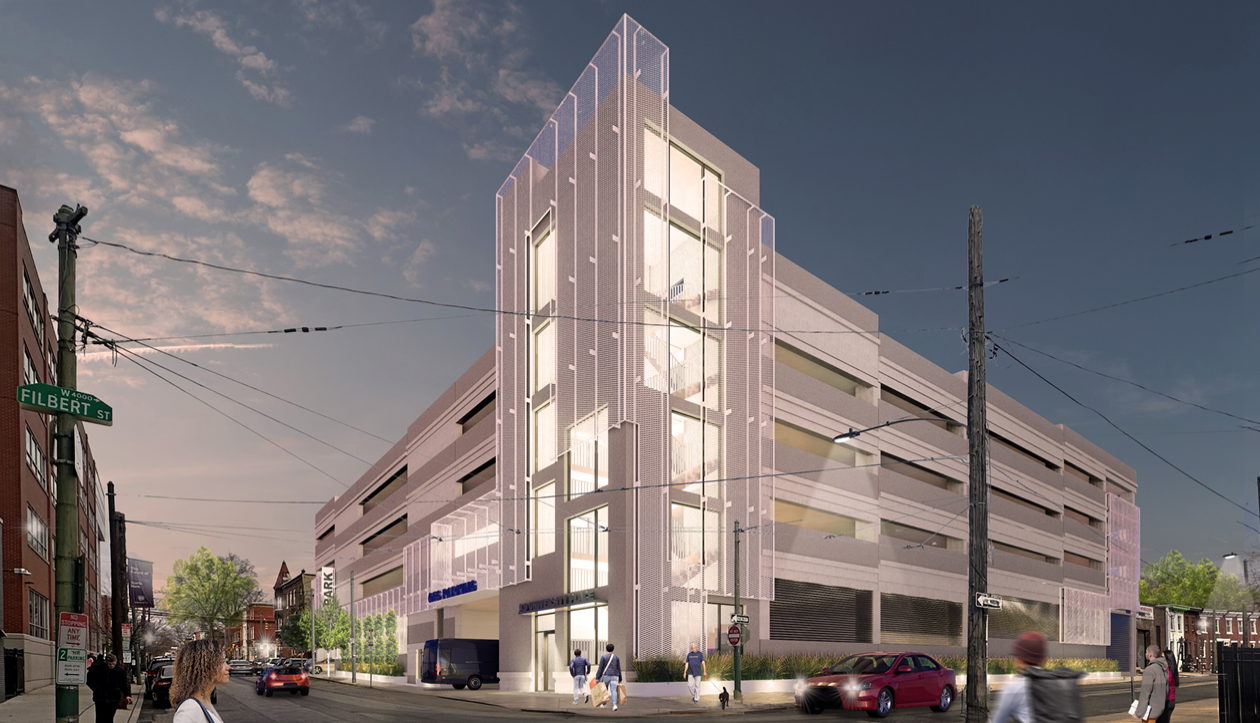
A rendering of the proposed University City parking garage as seen from 42nd and Filbert Streets.
Designed by Philadelphia-based ISA Architects, the garage is also meant to serve University Place Associate’s other large developments in the area. Akin to the Fishtown garage, they have also sought to make the development pedestrian friendly, with a dog park, green space, and public art.
The local community group, West Powelton Saunders Park RCO, also embraced the proposal.
“The community met regarding this project back in August, and … they were all in support of this project,” Pamela Andrews, president of the West Powelton Saunders Park RCO, said at the city’s September Civic Design Review meeting. “We have a tremendous problem with parking, and the community members felt this was a much needed and welcome addition.”
Grays Ferry: 1,005 parking spaces
CHOP’s thousand-car parking garage by far has been the most controversial of the proposals. But it also makes the most economic sense for the owner. Unlike the other garages — or those owned by Parkway and E-Z Park — it will be owned by a nonprofit and exempted from many of the taxes that make it so expensive to own parking in Philadelphia.
A rendering of the new parking garage CHOP plans for Grays Ferry.
The hospital purchased the property at 3000 Grays Ferry Ave., next to the Donald Finnegan Playground, for almost $25 million last year.
The seven-story development, which, plans show, would have far fewer amenities than its University City and Fishtown counterparts, is meant to serve CHOP’s new research facilities in Fitler Square and the new patient tower set to open in 2028.
“We recently secured permits and have begun construction on the new parking garage at 3000 Grays Ferry Ave.,” a CHOP spokesperson said. “The full construction is expected to go through the fall of 2026. CHOP continues to engage with the community by providing support, timely updates and addressing feedback during construction.”
At the time of its unveiling, CHOP argued that the massive garage was needed as SEPTA threatened to become unreliable due to a political funding crisis in Harrisburg. But detractors appeared almost immediately to denounce the hospital for worsening air quality in a lower-income neighborhood that is already a hot spot for asthma.
There are no regulatory hurdles to the development, but changes in the political or economic landscape could make it difficult to embark on a large capital project. Notably, the University of Pennsylvania proposed an 858-space garage in 2023 for the nearby Pennovation Center and has never broken ground.
2025 Toyota Corolla FX vs. 2025 Buick Envista Avenir: Two options to avoid being spendy.
This week: Toyota Corolla
Price: $29,089 as tested. Convenience Package added blind-spot monitor and cross-traffic alert for $530; black roof, $500; and connected services trial, $325.
Conventional wisdom:Motor Trend liked the “$27,785 base MSRP, cool black accents, and bigger, more readable screen”; on the down side, it was “not particularly quick,” the “engine drones,” and it’s a “dated cabin.”
Marketer’s pitch: “Introduce fun to every day.”
Reality: You’re going for the fun angle, Toyota? Really, now?
What’s new: The Corolla adds a new FX model for 2025, which pays homage to the old FX16, something I’d never heard of before writing this. Still, I feel I can say with confidence, it doesn’t live up to that.
Not so new: How thankful I am to have two small, inexpensive cars to test. They’re a rare treat among model lineups and even rarer among vehicles I get to test, and readers are clamoring for them. Manufacturers want to make money selling you expensive things we don’t really need.
The Corolla is a sedan and the Envista is a crossover, so very different directions indeed.
Up to speed: The Corolla is not winning any races. The 2.0-liter four-cylinder engine creates 169 horsepower and gets to 60 mph in 8.2 seconds, according to Motor Trend.
Still, I was pleased enough with most of the performance, though I was traveling solo through almost all of it. A packed car would suffer a bit of malaise under the extra strain.
Shiftless: The continuously variable transmission in the Corolla saps power as much as any. The gearless setup offers infinite ratios in theory but in actuality some examples make hill-climbing and hard acceleration something you’d just rather avoid. The Corolla’s version sits about in the middle, not the worst or the best.
On the road: The Corolla has never been anything like fun, although the XSE version gets close. The FX model doesn’t get there, though, although handling is small-car good. Still, you won’t confuse it witha Golf or Mazda3.
Driver’s Seat: Sturgis Kid 1.0 once purchased a new Scion iM (the Corolla Hatchback before it was called that) based solely on the dreamy front seats. Every time I borrowed that car, I noted how comfortable it was.
The Corolla FX tested had sport fabric-trimmed seats with orange stitching that matched that feel. They were soft but supportive seats andmade all the Schuylkill Expressway stop-and-go feel lots better.
The Corolla also benefits from the simple gauge setup that Toyota offers in its base models. Changing the screen to fit your needs is simple with the steering wheel controls.
The interior of the 2025 Toyota Corolla adds a 10.5-inch infotainment screen, and the seats remain among the most comfortable among all sizes of vehicles, not just small cars.
Friends and stuff: The rear seat is pretty good for a small car. Headroom is dear — my head doesn’t hit the ceiling but it’s close — while legroom and foot room are nice. The door requires care when getting in and out because it’s a bit of a squeeze.
The middle seat passenger will be perched on a narrow cushion and a tall floor hump, and will be permitted to throw small food items at everyone else, or to at least choose the evening’s movie later.
Cargo space is 13.1 cubic feet. The seat folds to create a pass-through.
Play some tunes: The new 10.5-inch touchscreen helps with navigating through the sources and whatnot. But somewhere a designer is patting themselves on the back for the sleek control panel, which trades a volume dial for pushbutton -/+ system. Boo!
The stereo offers pretty good playback, especially by Toyota standards, about an A- or B+.
Keeping warm and cool: Kudos for the simplest controls I’ve seen in a long time — one dial for air speed, another for temperature, and silver buttons for everything else.
Fuel economy: I averaged about 32 mpg in an unusual array of Mr. Driver’s Seat testing. A very stop-and-go round trip to Center City figured mightily into the week. Otherwise it was mostly highway and side roads.
Where it’s built: Blue Springs, Miss.
How it’s built:Consumer Reports predicts the Corolla reliability to be a 5 out of 5. (Like, duh.)
Megan Heiken recently bought a home near the former Pennhurst State School and Hospital, once a center for people with developmental disabilities that now operates as a popular haunted Halloween attraction.
A new plan to convert Pennhurst into a massive data center has outraged and mobilized local residents, as well as people in neighboring communities in an area known for rolling hills, farms, and an overall rural character.
Heiken launched an online petition urgingher Chester County neighbors and East Vincent Township officials to “work together toward a solution that preserves the Pennhurst property, honors its history, and protects the environment and quality of life for all who live, work and visit here.”
The petition had 1,825 signatures as of Friday.
“I made this move to be out in an area with more space, more nature,” Heiken said. “The fact that the owner just wants to plow it over and swap in a data center is kind of alarming.”
Her sentiments are widely shared. The board of supervisors and planning commission in East Vincent have hosted public meetings on the issue that stretched for hours as residents from Spring City to Pottstown voiced objections.
Data centers require a large-scale way of cooling computing equipment and are often dependent on water to do that. The amount of water they use can be about the same as an average large office building, although a few require substantially more, according to a recent report from Virginia, which has become a data center hub.
Steve Hacker, of East Vincent, told the board that his well had already gone dry, as has his neighbor’s, even before a data center has been built. He’s concerned about where the data center would get its water.
State legislators and local governments are scrambling to rewrite local laws as most have no local zoning to accommodate data centers or regulate them.
window.addEventListener(“message”,function(a){if(void 0!==a.data[“datawrapper-height”]){var e=document.querySelectorAll(“iframe”);for(var t in a.data[“datawrapper-height”])for(var r,i=0;r=e[i];i++)if(r.contentWindow===a.source){var d=a.data[“datawrapper-height”][t]+”px”;r.style.height=d}}});
1.3 million square feet
Pennhurst‘s owner has not yet filed a formal application to develop the site, but an engineering firm has submitted a sketch of a preliminary plan to East Vincent Township to develop 125 acres for use as a data center.
The land is owned by Pennhurst Holdings LLC, whose principal is Derek Strine.
Strine deferred comment to a spokesperson, Kevin Feeley.
“Pennhurst AI is aware of the concerns expressed by the residents of East Vincent Township, and we are committed to working through the Township to address them,” Feeley wrote in an email. “What we propose is a facility that would be among the first of its kind in the United States: a state-of-the-art data center project that would address environmental concerns while also providing significant economic investment, jobs, and tax rateables as well as other benefits that would directly address the needs of the community.”
Feeley said Pennhurst AI plans to continue “working cooperatively with the Township.”
The sketch calls for five, two-story data center buildings, a sixth building, an electrical substation, and a solar field. Together, the buildings to house data operations would total more than 1.3 million square feet.
The plan states that a data center is an allowable use within the Pennhurst property because the land is zoned forindustrial, mixed-usedevelopment. Township officials have agreed a data center would be allowed under that zoning.
The grounds are bordered by Pennhurst Road to the west. The Schuylkill lies down a steep gorge to the east and north. The property is near the border of Spring City, which is just to the south.
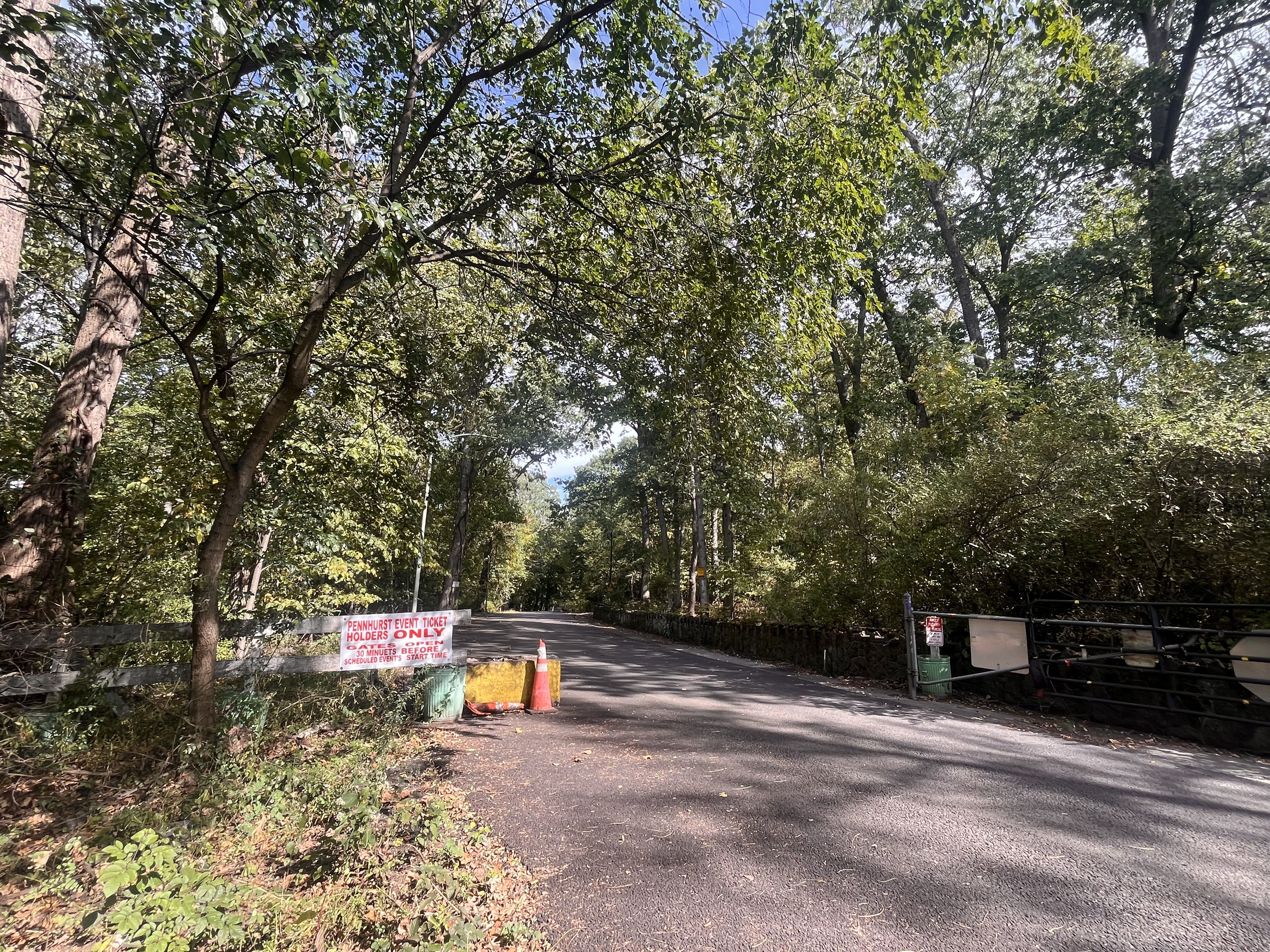
A view of the entrance to the Halloween attraction at the former Pennhurst State School and Hospital grounds in East Vincent Township, Chester County.
What’s Pennhurst?
Pennhurst State School and Hospital, known today as Pennhurst Asylum for its Halloween attraction, has had a long and troubled history. It opened in 1908 to house individuals with intellectual and developmental disabilities. It became severely overcrowded by the time it closed in 1987.
A 1968 documentary Suffer the Little Children highlighted abusive and neglectfulpractices, and resulted in legal actions and a landmark disability rights ruling in 1978 that declared conditions as “cruel and unusual punishment.”
The last patient left Pennhurst in 1987, and the facility sat abandoned until it was purchased in 2008 and converted into a Halloween attraction despite protests from various advocacy groups.
The Halloween attraction has continued and operators say it shows sensitivity toward those once housed at Pennhurst. Separately, visitors can take historical tours of the exteriors of 16 buildings and learn about people who lived and worked there. The site also has a small Pennhurst history museum.
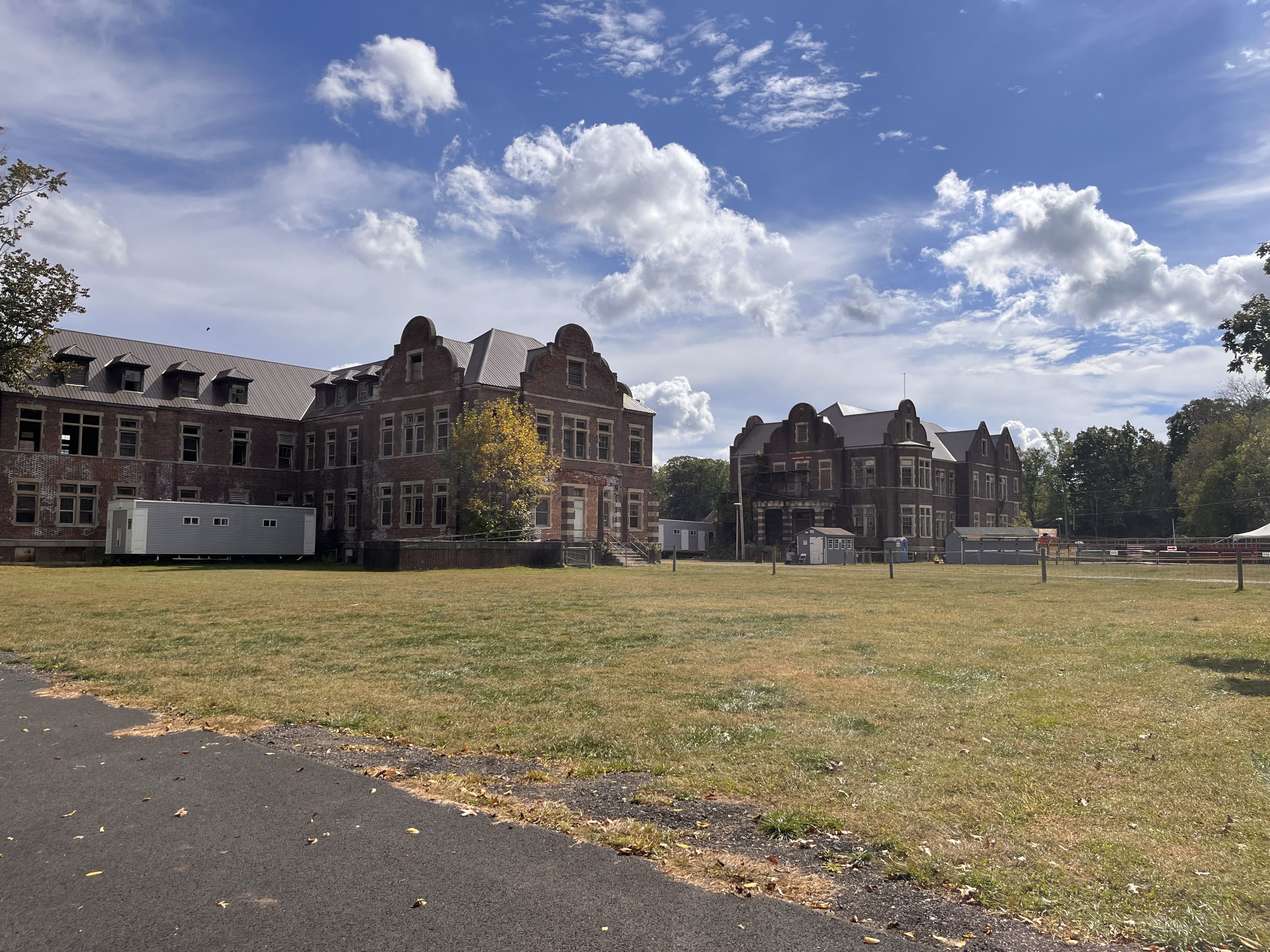
A view of the vacant buildings on the former Pennhurst State School and Hospital grounds in East Vincent Township, Chester County.
Contentious meetings
In recent months, East Vincent officials have raced to draft an ordinance that would govern data centers by limiting building heights, mandating buffers, requiring lighting, noting the amount of trees that can be cut down, and other restrictions.
At two contentious meetings in September, residents and the board of supervisors argued about the draft ordinance’s specifics. Residents said the ordinance did not incorporate some community-suggested safeguards aimed at preserving the township’s rural character.
Residents asked how much water the data center would consume, how much power it would need, and how much noise it would generate.
Pennhurst’s zoning was changed in 2012 from allowing onlyresidential development to permitting industrial and mixed-use buildings. Township Solicitor Joe Clement told residents that it is difficult for the municipality to argue that a data center would not fit within that zone.
“If there’s a use that is covered by the zoning ordinance, we can’t stop that use,” board vice chairMark Brancato explained at a Sept. 18 meeting.
Officials said the draft ordinance was not specifically aimed at the Pennhurst site but was meant to broadly govern any data centers proposed in the township.
“What we’re trying to do is to come up with a set of reasonable guidelines, guardrails, and conditions in the new zoning ordinance that will … provide as much protection as we possibly can for the residents,” Brancato said. ”We are committed to protecting and preserving the rural character of the township.”
Township meetings, some of which have lasted hours, have been marked by raised voices and emotional appeals.
“Our whole community is kind of anxious about the thought of this new data center,” Gabrielle Gehron, of Spring City, said during one meeting. “I’m confused about whether we are or not doing something to prevent that from happening.”
Pa. State Rep. Paul Friel, and State Sen. Katie Muth, both Democrats from East Vincent, have spoken at meetings. Muth noted that Strine received a $10 million grant and loan package from the state in 2017 to prepare the site for “a large distribution facility” and other industrial structures, new office development, and the renovation of six existing buildings for additional commercial use, amid ample open space, according to a funding request provided by the governor’s office.
Muth fears Strine is paving a path to clear the data center for development and sell the property — after benefiting from tax dollars.
“These are not good things to live next to,” Muth said of data centers.
The board tabled the draft ordinance on Sept. 22 after receiving legal advice that they still had time to incorporate more residents’ concerns.
Beyond Pennhurst
Other municipalities in Pennsylvania face a similar issue: Most don’thave existing zoning for data centers. However, state law mandates that municipalities must provide zoning for all uses of land — just as state and federal officials are ramping up plans to embrace the centers.
Plymouth Township is dealing with pressure as Brian J. O’Neill, a Main Line developer, wants to turn the Cleveland-Cliffs steel mill into a 2 million-square-foot data center that would span 10 existing buildings. The Plymouth Township Planning Commission voted against the project given resident backlash. The plan goes to the zoning board later this month.
And Covington and Clifton Townships in Lackawanna County in the Poconos are also dealing with zoning issues and widespread opposition regarding a plan to build a data center on 1,000 acres.