One of the family leaders of the Santucci’s Original Square Pizza empire was sentenced Monday to one day in jail and 18 months of supervised release for significantly understating the business’ earnings over the course of several years, causing him and other company officials to underpay taxes by nearly $1.4 million.
Frank Santucci Sr., 67, who had taken over the family business from his parents nearly 50 years ago, said he was “embarrassed” and “deeply sorry” for his actions, which federal prosecutors described as a long-running cash skimming operation. He pleaded guilty last year to charges of tax evasion and filing false tax returns.
“I spent my life trying to be an honest man,” Santucci said Monday during his sentencing hearing in federal court, “and knowing I fell short of those values is something I deeply regret.”
Prosecutors said in court documents that Santucci was a company patriarch who had “informal bookkeeping responsibilities” at the family’s pizza shops in South Philadelphia, Roxborough, and on North Broad Street. The restaurants are well-known for offering square, thick-crust pies with layers of sauce and toppings piled on top of cheese.
Although the business had for years employed a cash-only policy, prosecutors said, Santucci began keeping two sets of books as the company began using an electronic point-of-sale system in 2017. One of the sets of records included details for issues like payroll and expenses, which Santucci showed to his tax accountants, prosecutors said, and the other — which Santucci concealed from his accountants — is where he deposited some of the restaurants’ cash earnings.
As a result, prosecutors said, Santucci understated the shops’ earnings by about $5 million between 2015 and 2018. And that caused him to underpay his personal taxes by nearly $400,000, they said, while his co-owners underpaid theirs by about $700,000, and the business underpaid employment taxes by about $300,000.
Santucci — who was the only person charged in the case — has already repaid his personal tax bill, said his attorney, Richard J. Fuschino Jr. And Fuschino said Santucci was a man whose life had otherwise been defined by his hard work at his namesake shops, and an unerring dedication to his family and community.
“Mr Santucci is, on the whole of it, as good as [people] get,” Fuschino said.
Assistant U.S. Attorney Patrick Murray did not disagree that Santucci supported his family, and said it was notable that he had accepted responsibility for his crimes. But he said Santucci nonetheless engaged in a long-running scheme that deprived the IRS of revenue and, by extension, allowed Santucci’s business and relatives to keep more money than they were entitled to.
U.S. District Judge Karen S. Marston did not discount the seriousness of the crimes, but said Santucci’s age, health concerns — he suffered two strokes in recent years — and his role as a grandfather who is actively involved in caring for his young grandchildren all factored into her sentencing decision. She said his day in custody would be Monday and also ordered him to perform 300 hours of community service.
“I do believe that Mr. Santucci has shown the remorse that’s necessary in this particular case,” she said.
The Santucci’s pizzerias and their many franchise locations remain in operation and were not impacted by the case, Fuschino said.
The New York-style bagel shop, which currently has locations in West and South Philadelphia, is bringing its fresh bagels, smoked meats, egg sandwiches, and unique schmears to 273 Montgomery Ave.
The Main Line outpost is expected to open this summer.
While the new storefront marks a major expansion for the local bagel shop, it’s also a homecoming for cofounders and brothers Brett and Kyle Frankel, who grew up in Bala Cynwyd.
“We know the area very, very well,” Brett Frankel said.
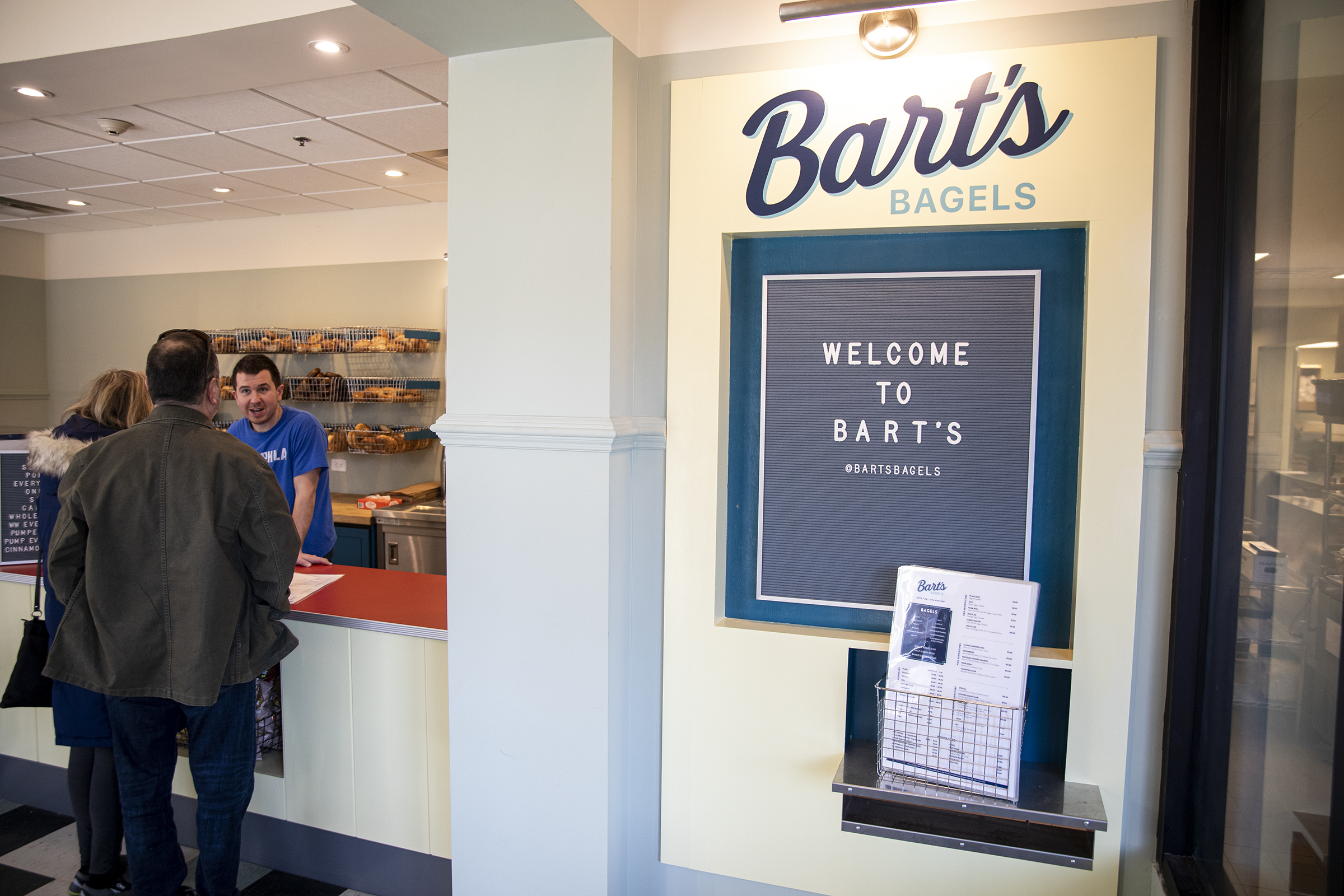
Brett Frankel, co-owner of Bart’s Bagels, helps customers at Bart’s Bagels on Wednesday, Jan. 22, 2020. Bart’s is expanding to Bala Cynwyd later this year.
Brett, 34, and Kyle, 41, both Lower Merion High School graduates, grew up a five-minute walk from their newest location. Brett Frankel says he remembers hanging out at the soon-to-be Bart’s Bagels storefront after middle school, back in the days when it was Bravo Pizza.
Main Line patrons will be able to expect all of the same kettle-boiled bagels and fixins’ that Bart’s is known for, from pumpernickel bagels to pastrami smoked salmon and beet-horseradish cream cheese.
While Bart’s city-based locations are grab-and-go only, there will be a few seats in the new Bala Cynwyd shop.
The unique part of Bart’s, Brett Frankel said, is that patrons can see bagels being made in front of them through the open kitchen.
“You’re kind of immersed in it,” he said.
The Frankels say their love for good bagels was forged through regular trips to New York’s Upper West Side to eat at the famed Zabar’s and H&H Bagels.
Looking to get their fix closer to home, Brett Frankel taught himself how to make bagels while working as a business analyst for a software company. He traveled to Denver, New Jersey, and Detroit to learn the ins and outs of the bagel industry.
Bart’s started as a wholesale operation in late 2019, selling to Di Bruno Bros., Middle Child, Elixr Coffee, White Dog Cafe, and other local restaurants. The Frankels brought chef Ron Silverberg on board, and they opened the first Bart’s in West Philly in January 2020. Their South Philly location opened in July 2024.
Bart’s is not the only new bagel place coming to Lower Merion this year.
This suburban content is produced with support from the Leslie Miller and Richard Worley Foundation and The Lenfest Institute for Journalism. Editorial content is created independently of the project donors. Gifts to support The Inquirer’s high-impact journalism can be made at inquirer.com/donate. A list of Lenfest Institute donors can be found at lenfestinstitute.org/supporters.
A longtime Philadelphia resident who was arrested by ICE at a routine immigration appointment has been deported to Indonesia, his family said.
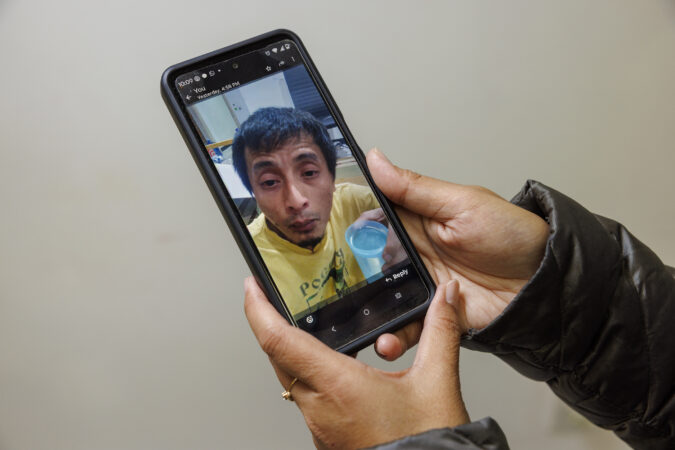
Rian Andrianzah, 46, walked into a Philadelphia office of U.S. Citizenship and Immigration Services on Oct. 16, expecting to be fingerprinted and photographed and sent home, but instead was taken into custody and placed in detention.
On Christmas night he was flown to Jakarta, the Indonesian capital, leaving behind his wife, also of Indonesia, and two children who are American citizens.
The case angered the city’s Indonesian community ― and placed Andrianzah among a growing number of immigrants who have shown up for routine immigration appointments or check-ins, only to be handcuffed and taken into detention.
Green-card applicants, asylum-seekers, and others who have ongoing legal or visa cases have been unexpectedly detained in what lawyers and advocates say is a Trump administration strategy to boost arrests and deportations.
“It’s frustrating, because we’re going to be able to bring him back in the next few months,” said Philadelphia immigration attorney Christopher Casazza, who represents Andrianzah and his family. “They deported him simply [to gain] a statistic.”
He expects Andrianzah could be able to return to the United States in the summer, via a legal process that could grant status to his wife and, through her, to him.
Andrianzah’s wife, Siti Rahayu, 44, has a strong case to be awarded a T visa, the family’s lawyer said. That visa offers permission to live in the U.S. and a path to permanent residency and citizenship. As her husband, Andrianzah would receive those same benefits under her visa, said Casazza, of the Philadelphia firm Palladino, Isbell & Casazza LLC.
Rahayu said in a text message that she was distressed and not up to discussing her husband’s deportation. Others said his removal hurts the family and the community.
“Rian’s absence means a family without their father and our community without a friend,” said Kintan Silvany, the civic-engagement coordinator at Gapura, which works to empower local Indonesian Americans. “A warm, friendly face will no longer be seen at our annual festivals and cultural events. ICE has taken a beloved member who helped us and the folks around him.”
Andrianzah, meanwhile, like other deportees faces a return to a homeland transformed by time, where family ties have dwindled and emotional and financial hardship looms, his lawyer said.
Immigration and Customs Enforcement officials were unable to immediately reply to a request for comment.
A T visa can be available to people who have been victims of human trafficking. It offers a near-blanket waiver on past immigration violations. Authorities say the issuance of T visas offer protection to victims while enhancing the ability of law-enforcement agencies to detect and prosecute human trafficking.
Andrianzah legally entered the United States on a visitor’s visa in February 2000, but did not return to Indonesia before it expired. He was placed in removal proceedings in 2003, and a judge issued a final order of deportation in November 2006. His appeal was denied two years later.
The removal order was never enforced, as had been common for those the government then saw as low-priority immigration violators. Some people with final orders have lived in the U.S. for decades.
Since then Andrianzah worked factory and warehouse jobs, and married. He and his wife made a home in South Philadelphia and became parents of a son, age 8, and a daughter, 15, both U.S. citizens.
Andrianzah and his wife went to USCIS that October day as part of her T-visa application. In an interview with The Inquirer, Rahayu said she was sent to the U.S. in 2001 by relatives who saw her as a means to pay off a debt, delivering her to an underground organization that puts people in low-paying jobs, then keeps them working indefinitely. Her work would help pay the debt owed by her relatives.
Rahayu said that on Oct. 16, she completed her own biometrics appointment, then grew concerned when her husband did not appear. She soon learned he had been arrested.
Some immigrants are required to appear every couple of weeks, some once a month, others once a year. The appointments help immigration officials keep track of people who in the past have been low priorities for deportation.
Biometrics appointments are usually brief sessions at which the government captures fingerprints, a passport-style photo, and a signature. The immigrant may also be asked to provide information like height and weight.
Despite the fresh risk of being arrested on the spot, immigrants have little option except to show up. Many types of immigration applications require in-person appearances. And failure to appear for a required ICE appointment can by itself result in an order for removal.
When Jennifer Kinka was pregnant with her first child, she stood in the aisle of Babies R Us with a registry sheet, looking over the wall of plastic consumables the company deemed required for having a baby. What she saw was waste.
“I was just like, this is crazy that there’s no system for this,” Kinka said. “There’s no problem-solving around how this is happening and how we could do this better.”
After a few more years, her second pregnancy, and a small inheritance from the loss of her terminally ill parents, Kinka was able to implement her solution: The Nesting House, a kids’ consignment shop based in Mount Airy that she founded 15 years ago.
Shoppers across Philadelphia, including parents buying for their children, are increasingly forgoing new items in favor of secondhand and lightly used in an effort to save money and live more sustainably.
Chris Baeza, associate program director of Fashion Industry & Merchandising at Drexel University, asks her students each semester who shops in the secondhand market. While five years ago she might have had a single student raise a hand, now it’s nearly all of them.
The global secondhand apparel market grew by 15% in 2024, according to online consignment store ThredUp’s annual report, and it’s expected to continue growing each year. ThredUp estimates that the resale apparel market is growing 2.7 times faster than the overall apparel market.
For Abby Sewell, a South Philadelphia mom of two, secondhand clothing and furniture was a mainstay of her childhood, when she spent weekends trash picking and combing through yard sales to find reusable items. Her father is artist Leo Sewell, who built a replica of the Statue of Liberty’s arm and torch at the Please Touch Museum.
“I just know how much there is out in the world,” said Sewell, who also describes herself as an environmentalist. “There’s just so much kids clothes that it kills me to buy something new when I know there’s like 50 pairs of 2T leggings in someone’s basement.”
A dramatic shift toward secondhand not only coincided with the proliferation of social media but followed the 2013 Rana Plaza factory collapse in Dhaka, Bangladesh, that killed more than 1,000 people. People began to wonder how their clothing was being made, and the conditions laborers were under, Baeza said.
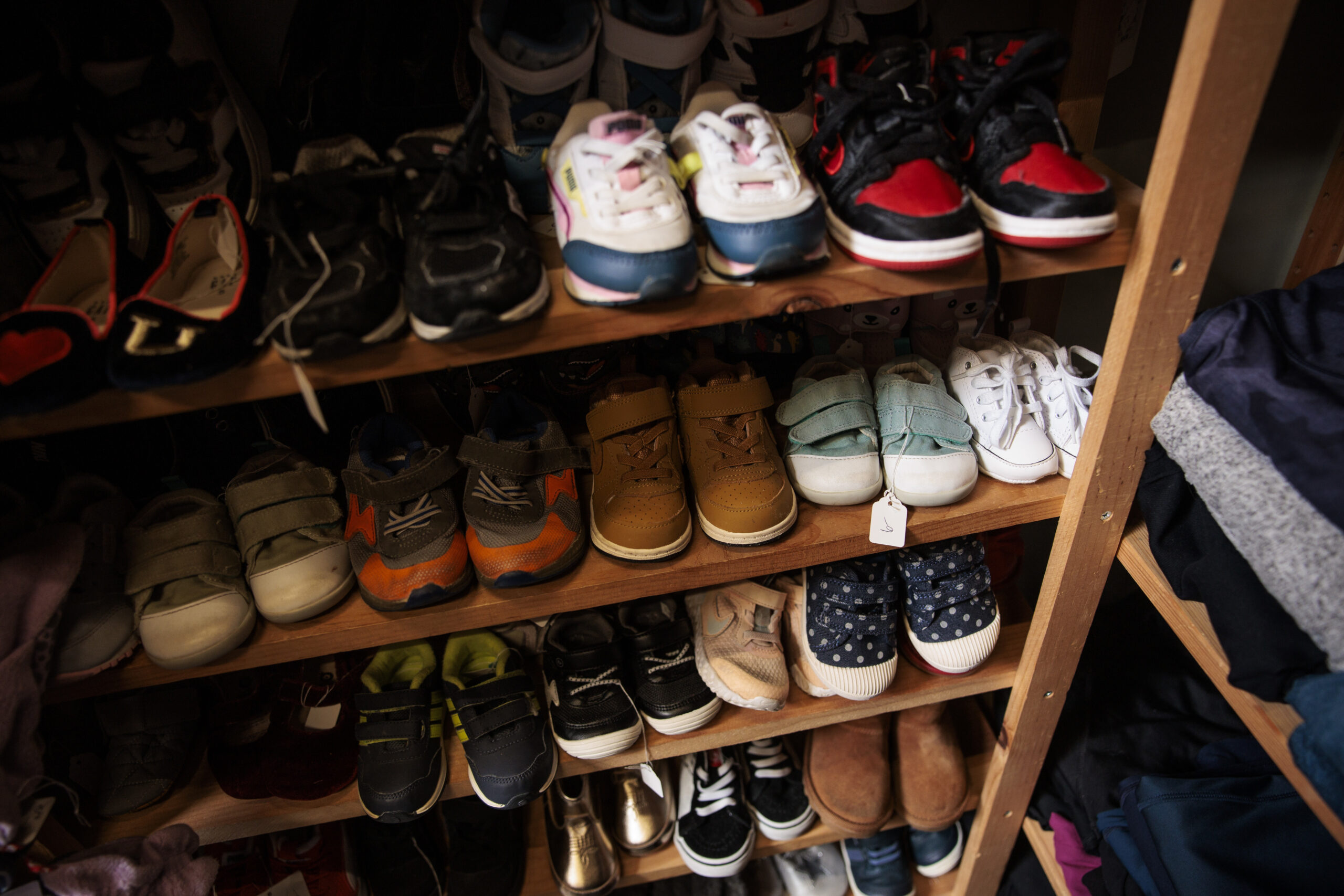
Used baby shoes on display at the Nesting House.
Next came the broader revelation of textile waste — pictures and video of clothing from the United States washing up on the shores of African countries — which plays into the interest in the secondhand market, she said.
“This was stuff that we just throw away, or we put in a drop box [thinking] it’s going to a good cause,” Baeza said. “They’re actually packing stuff up, and it’s a commodity they’re selling abroad.”
While Beaza teaches her students to scrutinize the marketing of sustainable fashion and to understand secondhand may not be the be-all-end-all of building circularity into the industry, she gets the sense they want to be part of what she describes as a renaissance period.
“They want to be part of the solution, not the problem,” Baeza said.
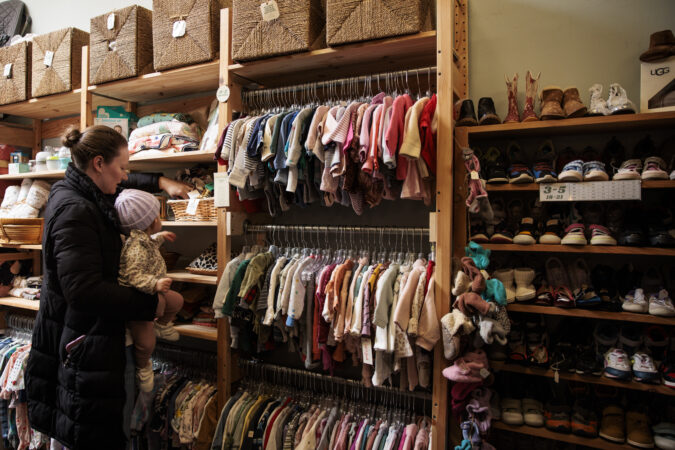
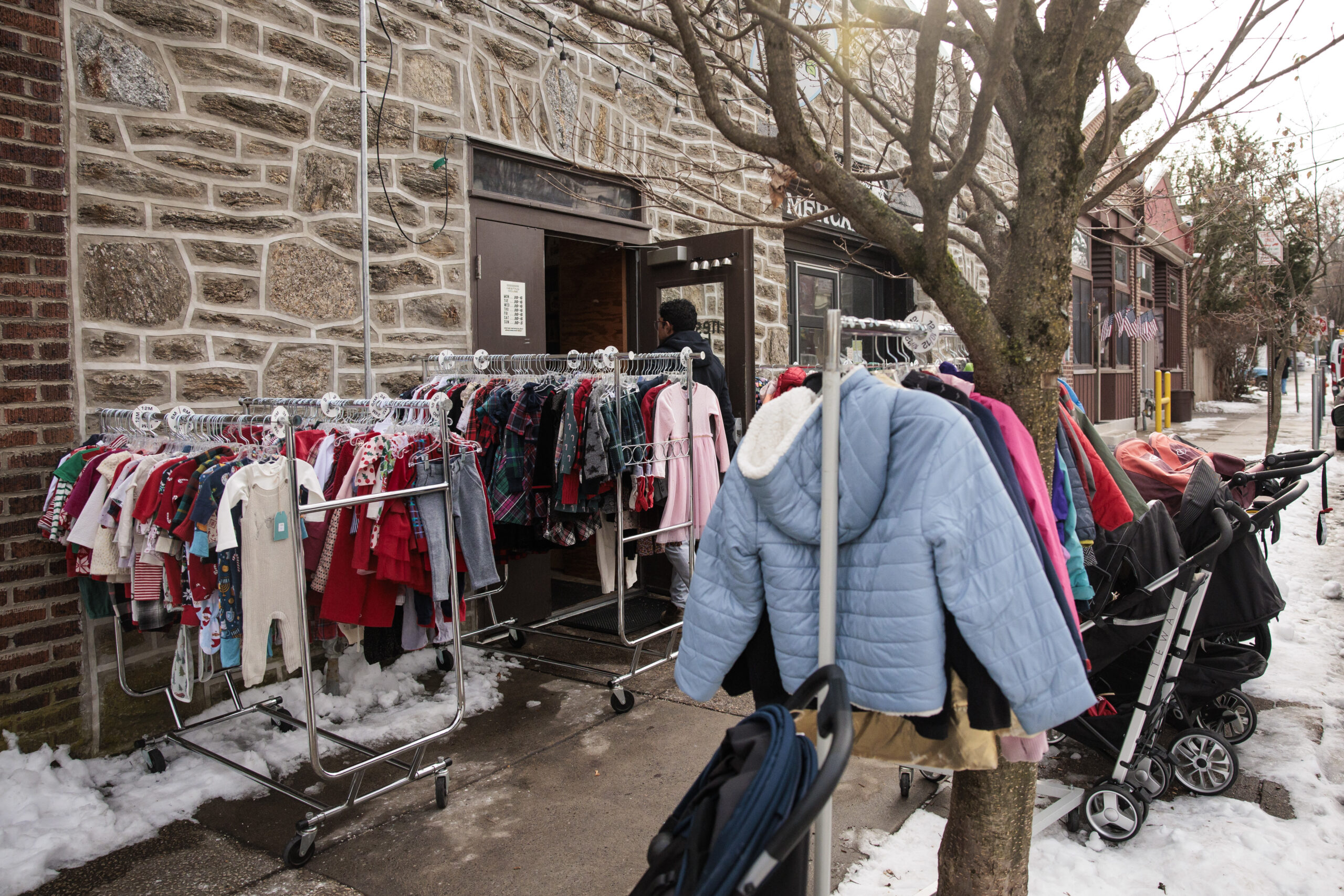
Childrens clothes on display outside the Nesting House.
Sewell prefers to shop thrift and consignment around her neighborhood and frequents stores like Lilypad and 2A. She also goes to annual church sales in the suburbs and uses eBay for more specific items — a specific kind of sleep sack that works for her 1-year-old or an item in a specific color or fabric for her 4-year-old.
“I’m still shocked to this day when I learn that other parents still are buying mostly new clothes for their children,” Sewell said. “I think I’m on a very different end of the spectrum, and I always have been as a consumer.”
Lilypad, which began as a play space on Broad Street, expanded to include a small thrift shop in its basement after the COVID-19 pandemic sidelined its twice-yearly City Kids consignment events. The nonprofit sells only donated items at its shop, now located in East Passyunk, to support charging an affordable annual membership to its play space.
Lilypad board member Maria Hughes said the number of people actively seeking out secondhand clothing for their kids, particularly babies, has increased exponentially over the last several years. The store sees more pregnant people, who don’t want to go through the process of building a registry. Hughes added that there are also more grandparents and grandparents-to-be shopping at Lilypad now.
“They’re not going to Marshalls and buying the things,” Hughes said. Instead they’re opting for pre-owned items “either at the directive of their children or because they believe now.”
Kinka said the early days of the Nesting House “felt like it was mission work.”
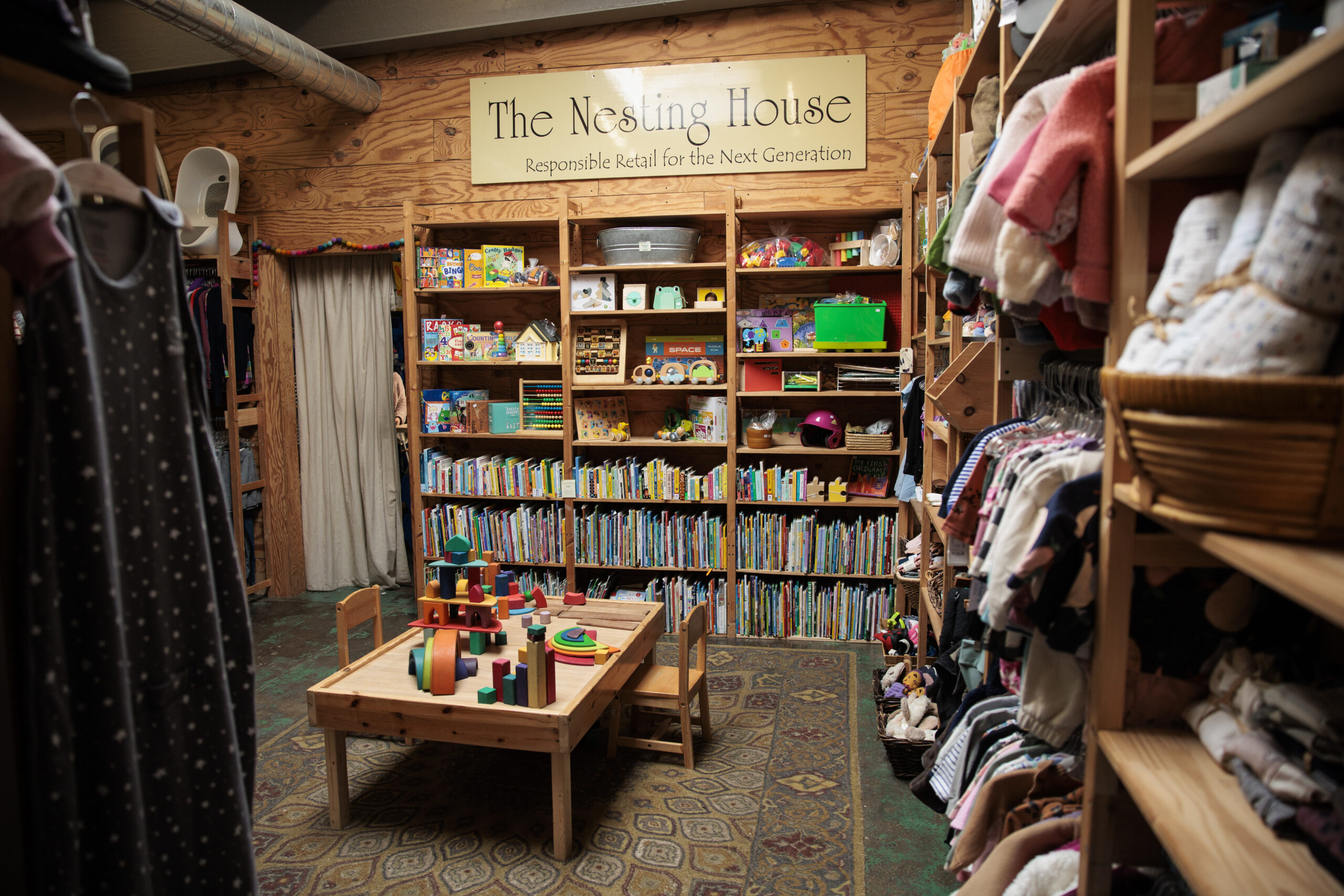
Used baby goods and books on display at the Nesting House.
“Nobody understood what we were doing,” Kinka said. “People would come in very confused. They would oftentimes refer to us as a thrift store.”
Eventually people saw the store as a sound economic choice: get high-quality children’s clothing at a great price. But she has seen “a huge shift” over the last five years.
“It’s this current generation,” Kinka said. They’re on board with the concept “before they come. They’re ready for us.”
The house: A 784-square-foot rowhouse in Newbold with two bedrooms and one bath, built in 1920.
The price: Listedand purchased for $249,000
The agent: Allison Fegel, Elfant Wissahickon
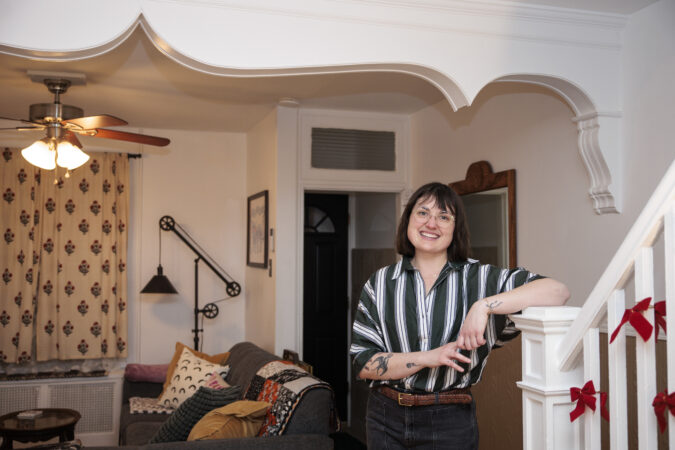
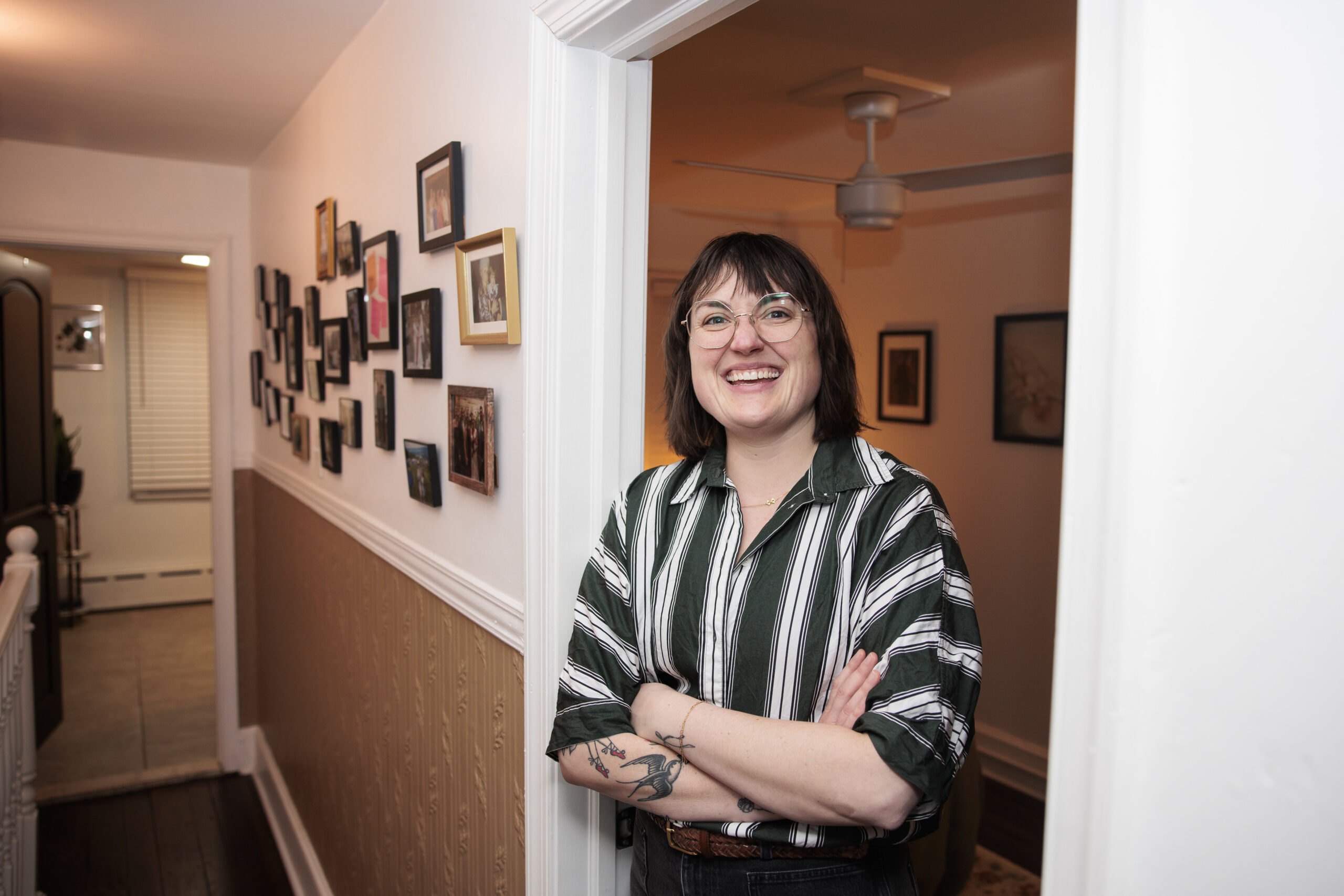
Miles in her two-bedroom home.
The ask: The only good thing about Emily Miles’ old apartment was the price. Miles was making a “nonprofit lawyer salary” and trying to save money. But “it was terrible,” Miles said. Disgusting even. And by November 2024, she’d had enough.
Owning a home felt aspirational, if vague. “It was always something I wanted to do,” she said. “But I didn’t know when I’d be able to do it.”
It didn’t seem like the right time. Miles had student loans. She was bartending in the evenings to make ends meet. Nevertheless, she decided to check out the market and searched for an agent with grant experience. She kept her house wish list short: three bedrooms, outdoor space, and central heat and air.
The search: Miles had no sense ofbudget until her lender preapproved her for about $310,000. From there, her agent began sending her listings across the city, including large homes far from the neighborhoods Miles associated with Philadelphia.
“They were still in Philadelphia County, but not really Philly as you think of it,” Miles said. West Philadelphia, where she was living, was not affordable. Other neighborhoods lacked reliable transportation.
Between late November and January, Miles saw 30 to 40 homes. “They were a lot of flips, and I didn’t want that,” she said.
Eventually, Miles found a place and made an offer. But during the inspection, theydiscovered damage to the front door that indicated someone had kicked it in, and Miles decided to walk away. She was out $1,500. “My pride was hurt a little bit,” she said.
Miles took a brief break, then started attending open houses on her own. That’s how she found the one, a little less than a month after she backed out of the first house.
Miles liked the house’s original features and character, such as the arched framing of the living room.
The appeal: The house Miles ultimately bought — a two-bedroom, one-bath, 780-square-foot rowhouse in South Philadelphia — checked none of her original boxes. “The big LOL about the whole thing is that I ended up with something I didn’t want at all,” she said. It had radiator heat. No air-conditioning. Less space than she planned. The house had been a rental for more than a decade. Carpet covered original features. Paint concealed years of wear. “It was a real landlord special,” Miles said. But when she stepped inside, something clicked. “I walked in, and I could see it,” she said. “It’s full of character.”
The deal: Miles stumbled into the house she would buy while walking to a bar with her boyfriend on a Friday night. The listing price was $249,900. She offered the asking price the following morning.
The seller took days to respond but eventually accepted her offer after no one else made a bid.
When the inspection revealed issues, Miles asked for $5,000 to $7,000 in credits. The seller countered with zero. “He redlined all my stuff,” she said. “So I re-redlined all of his stuff.” The back-and-forth ended with $2,000 in seller’s credit. “Which is better than zero,” Miles said. “I’m pretty proud of that.”
Miles filled her home with vintage furniture she found at local thrift shops. Her cat, August, has his own bed.
The money: Miles had about $20,000 saved from her time before law school, when she worked as a human resources manager in New York City. She had an additional $10,000 from the Philly First Home program, $2,000 from the seller’s credit, and $1,000 from her Realtor’s Building Equity program.
Her lender approved her to put down only 3%, so she made a $7,500 good-faith deposit and brought $1,500 to closing. Miles’ credit score and salary qualified her for a 5.75% interest rate at a time when average rates hovered closer to 7%.
Her monthly mortgage payment is about $1,800 and includes $120 for private mortgage insurance, which she must pay until she reaches 20%. She recently applied for a Philadelphia homestead exemption, which reduces the taxable portion of your house by $100,000 if you use it as your primary residence, and expects her monthly payment to drop closer to $1,700 as a result.
The move: Miles closed on March 19 and moved on April 29. She broke her lease without penalty. “I had been complaining about it being a bad apartment for months,” she said, “so I think they were just happy to be rid of me.”
Miles had to get rid of a lot of her stuff because her new house was so much smaller than her apartment. “I downsized quite significantly,” she said. She also discarded stuff that wouldn’t fit through the house’s small, 30-inch doorway, like her couch. “Luckily, I had some foresight and got rid of it before I moved it over,” she said.
Miles installed new lighting and faucets to make her home feel less like a rental.
Any reservations? Miles wishes she knew that refinished floors can take weeks to fully cure. She had to sleep on the living room floor while she waited for the fumes to fully dissipate upstairs. “It was just my cats and me on the ground for about a month,” she said. Still, she doesn’t have any regrets. “Live and learn,” she said.
The bathroom in Emily Miles’ Newbold home.
Life after close: Miles used the money her parents had saved for her wedding to make a few cosmetic updates. She fixed the back patio, refurbished the upstairs floors, and replaced light fixtures and faucets so that the house felt less like a rental. She put in a new boiler, too. And filled the house with vintage furniture she thrifted locally. “Stuff that fits the vibe of the house,” she said.
For the first time in more than half a century, Philadelphia has recorded fewer than 225 homicides in a single year.
In 2025,222people were killed — the fewest since 1966, when there were a fraction of as many guns in circulation and 178 homicides.
It is a milestone worth commemorating — and mourning: Violence has fallen to its lowest level in decades, yet 222 deathsin a single city is still considered progress.
window.addEventListener(“message”,function(a){if(void 0!==a.data[“datawrapper-height”]){var e=document.querySelectorAll(“iframe”);for(var t in a.data[“datawrapper-height”])for(var r,i=0;r=e[i];i++)if(r.contentWindow===a.source){var d=a.data[“datawrapper-height”][t]+”px”;r.style.height=d}}});
The drop mirrors a national reduction in violence and follows years of sustained declines after Philadelphia’s annual homicide totals peaked during the pandemic, and it reflects a mix of likely contributing factors: Tech-savvy police are solving more shootings, violence prevention programs have expanded, and the city has emerged from pandemic instability.
No single policy or investment explains it, and officials caution that the gains are fragile.
“The numbers don’t mean that the work is done,” said Adam Geer, the city’s director of public safety. “But it’s a sign that what we’re doing is working.”
The impact is tangible: fewer children losing parents, fewer mothers burying sons, fewer cycles of retaliation.
“We are saving a life every day,” District Attorney Larry Krasner said.
Still, the violence hit some. Victims ranged from a 2-year-old girl allegedly beaten to death by her mother’s boyfriend to a 93-year-old grandfather robbed and stabbed in his home. They included Ethan Parker, 12, fatally shot by a friend playing with a gun, and Said Butler, 18, killed just days before starting his first job.
Police say street-level shootings and retaliatory violence fell sharply, in part because some gang conflicts have burned out after key players were arrested or killed. Killings this year more often stemmed from long-standing drivers — arguments, drugs, and domestic violence — and were concentrated in neighborhoods that have borne the brunt of the crisis.
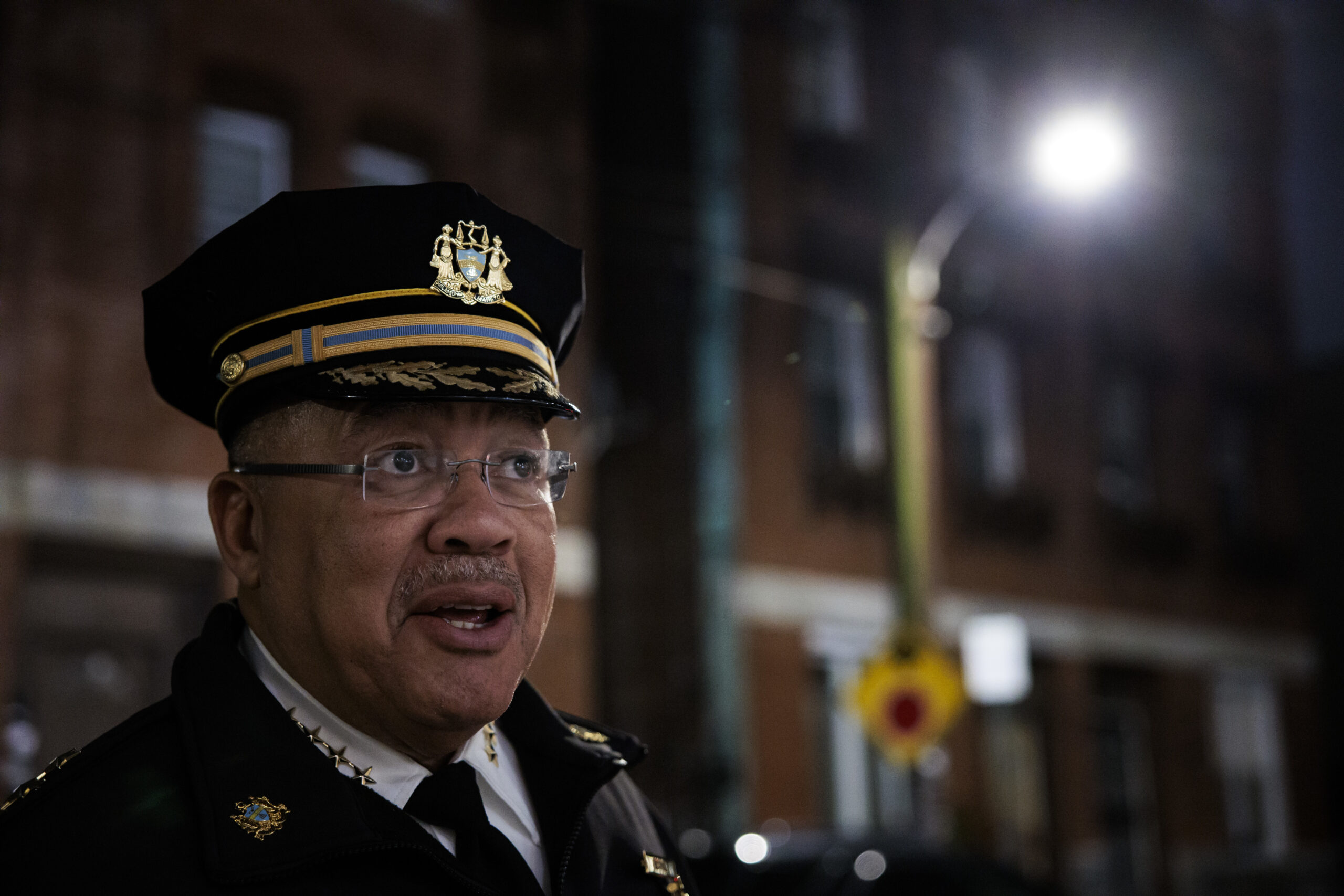
“These same communities are still traumatized,” said Police Commissioner Kevin Bethel. “One gunshot is a lot. We can’t sit or act like we don’t see that.”
window.addEventListener(“message”,function(a){if(void 0!==a.data[“datawrapper-height”]){var e=document.querySelectorAll(“iframe”);for(var t in a.data[“datawrapper-height”])for(var r,i=0;r=e[i];i++)if(r.contentWindow===a.source){var d=a.data[“datawrapper-height”][t]+”px”;r.style.height=d}}});
The number of domestic-related killings nearly doubled this year compared with last, making up about 20% of homicides, Geer said. The disappearance and killing of Kada Scott, a 23-year-old woman from Mount Airy, was among them, and led to a citywide outcry and renewed scrutiny of how authorities handle violence against women.
And mass shootings on back-to-back holiday weekends — 11 people shot in Lemon Hill on Memorial Day, and 21 shot in a pair of incidents in South Philadelphia over July Fourth — left residents reeling.
<iframe title="Philadelphians’ Perceptions of Safety at Night" aria-label="Line chart" id="datawrapper-chart-GRrTN" src="https://datawrapper.dwcdn.net/GRrTN/1/" scrolling="no" frameborder="0" style="width: 0; min-width: 100% !important; border: none;" height="556" data-external="1"></iframe><script type="text/javascript">window.addEventListener("message",function(a){if(void 0!==a.data["datawrapper-height"]){var e=document.querySelectorAll("iframe");for(var t in a.data["datawrapper-height"])for(var r,i=0;r=e[i];i++)if(r.contentWindow===a.source){var d=a.data["datawrapper-height"][t]+"px";r.style.height=d}}});</script>
The progress comes even as the police department remains 20% below its budgeted staffing levels, with about 1,200 fewer officers on the force than 10 years ago.
The city’s jail population has reached its lowest level in recent history. It dipped below 3,700 in April for the first time in at least a decade, and remains so today.
And arrests citywide, particularly for drug crimes, have cratered and remain far below pre-pandemic levels, mirroring a nationwide trend.
Experts say the moment demands persistence.
“We can’t look at this decline and turn our attention to other problems that we have to solve. We have to keep investing and keep pushing to get this number even lower, because it could be even lower,” said Jason Gravel, an assistant professor of criminal justice at Temple University.
‘Unheard of’ clearance rates
After shootings exploded during the pandemic, and Philadelphia recorded 562 homicides in 2021 — the most in its history — violence began to decline, slowly at first.
But then, from 2023 to 2024, killings fell by 35% — the largest year-over-year reduction among U.S. cities with the highest homicide rates, according to an analysis by Pew.
The decline continued into 2025.
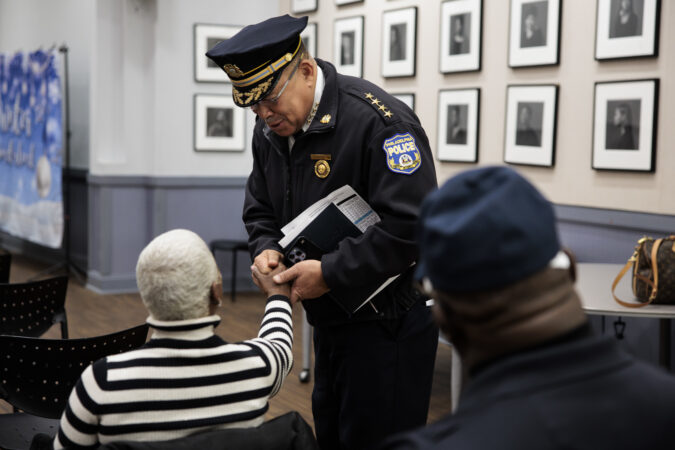
Police Commissioner Kevin Bethel arrives at a North Philadelphia community meeting on Dec. 2.
Bethel has pointed to a host of potential reasons for the decline: the reopening of society post-pandemic — kids returned to school and adults reconnected with jobs, courts, and probation officers — as well as police resources focused in hot spot crime areas and improved coordination among city leaders.
Most notably, he said, detectives are making more arrests in nonfatal shootings and homicides. Experts say that arresting shooters is a key violence-prevention strategy — it prevents that shooter from committing more violence or from ending up as a victim of retaliation, sends a message of accountability and deterrence, and improves the relationship between police and the community.
The homicide clearance rate this year ended at 81.98%, the highest since 1984, and the clearance of nonfatal shootings reached 39.9%.
“That’s unheard of,” said Geer, the public safety director. “The small amount of people who are committing these really heinous, violent crimes in our neighborhood[s] are being taken off the street.”
window.addEventListener(“message”,function(a){if(void 0!==a.data[“datawrapper-height”]){var e=document.querySelectorAll(“iframe”);for(var t in a.data[“datawrapper-height”])for(var r,i=0;r=e[i];i++)if(r.contentWindow===a.source){var d=a.data[“datawrapper-height”][t]+”px”;r.style.height=d}}});
Still, more than 800 killings from between 2020 and 2023 remain without an arrest, according to an Inquirer analysis.
That has had a significant impact on the police department’s relationship with the community over the years, something Bethel has sought to repair since he was appointed commissioner in 2024.
In 2025, he created an Office of the Victim Advocate, hired a 20-person team to communicate with and support victims, and hosted 35 meetings with residents of the most challenged neighborhoods.
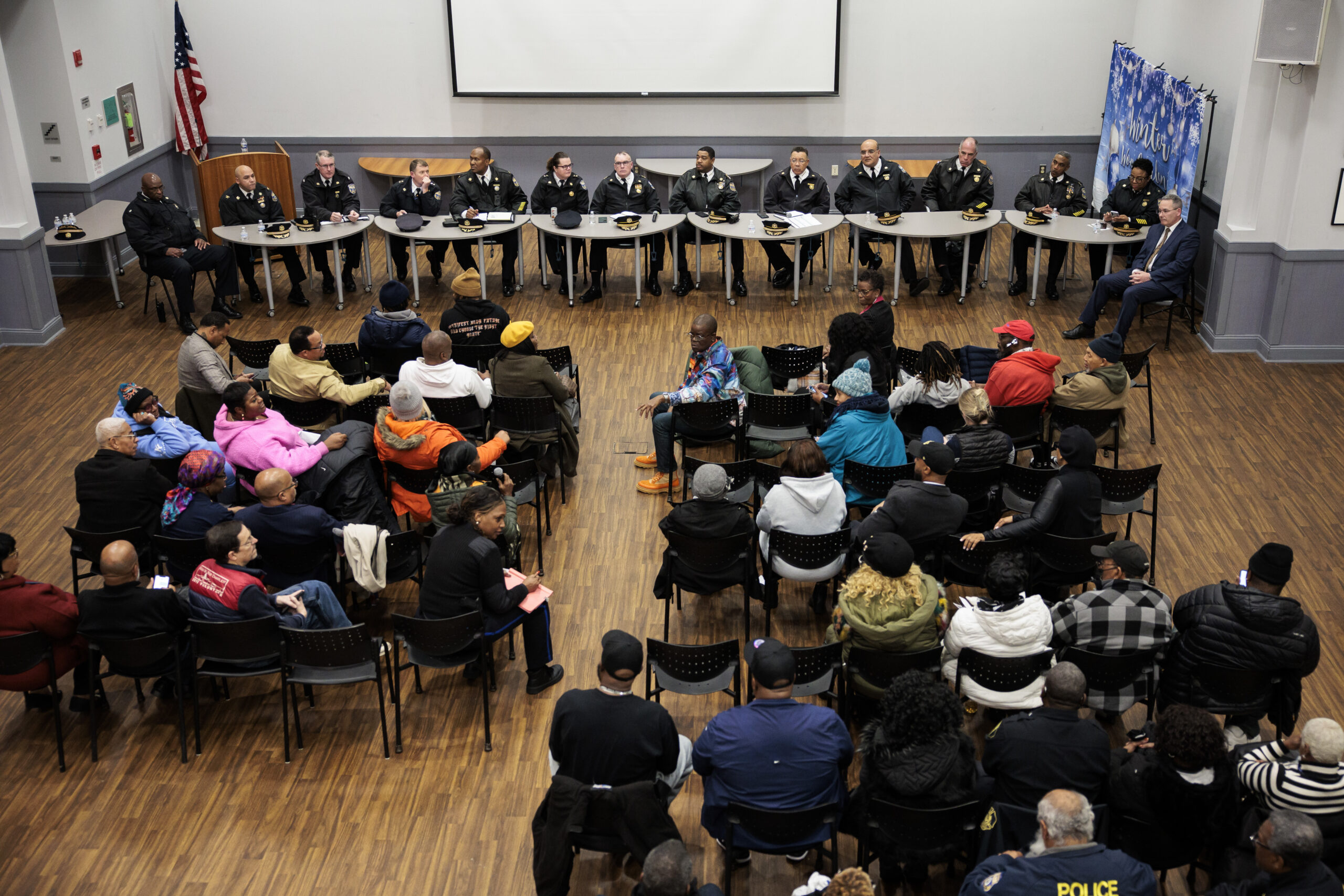
A few dozen community members gathered with top police brass in North Philadelphia on Dec. 2.
Yet Bethel has grappled with the challenge of convincing residents that the city is safer today than four years ago, while questioning whether today’s gains can outweigh years of devastation.
That challenge was on display on a recent cold December night, as Bethel gathered with a few dozen residents inside a North Philadelphia church and asked what they wanted him to know.
Person after person stood and told him what gun violence had taken from them in recent years.
My son. My brother. My nephew.
Both of my sons.
Investing in violence prevention
The city’s network of violence prevention strategies has expanded greatly since 2020, when the city began issuing tens of millions of dollars in grants to grassroots organizations.
Early on, the city faced criticism that its rollout of the funds was chaotic, with little oversight or infrastructure to track impact. Today, Geer said, the city has stronger fiscal oversight, better organizational support, and a data-driven approach that targets neighborhoods experiencing the most violence.
In 2024,Community Justice, a national coalition that researches violence-intervention strategies, said that Philadelphia had the most expansive violence-prevention infrastructure of the 10 largest U.S. cities. When evaluating 100 cities, it ranked Philadelphia as having the third-best public-health-centered approach to preventing violence, falling behind Washington and Baltimore.
Geer said the work will continue through 2026. Starting in January, the city will have a pool of about $500,000 to help cover the funeral expenses for families affected by violence.
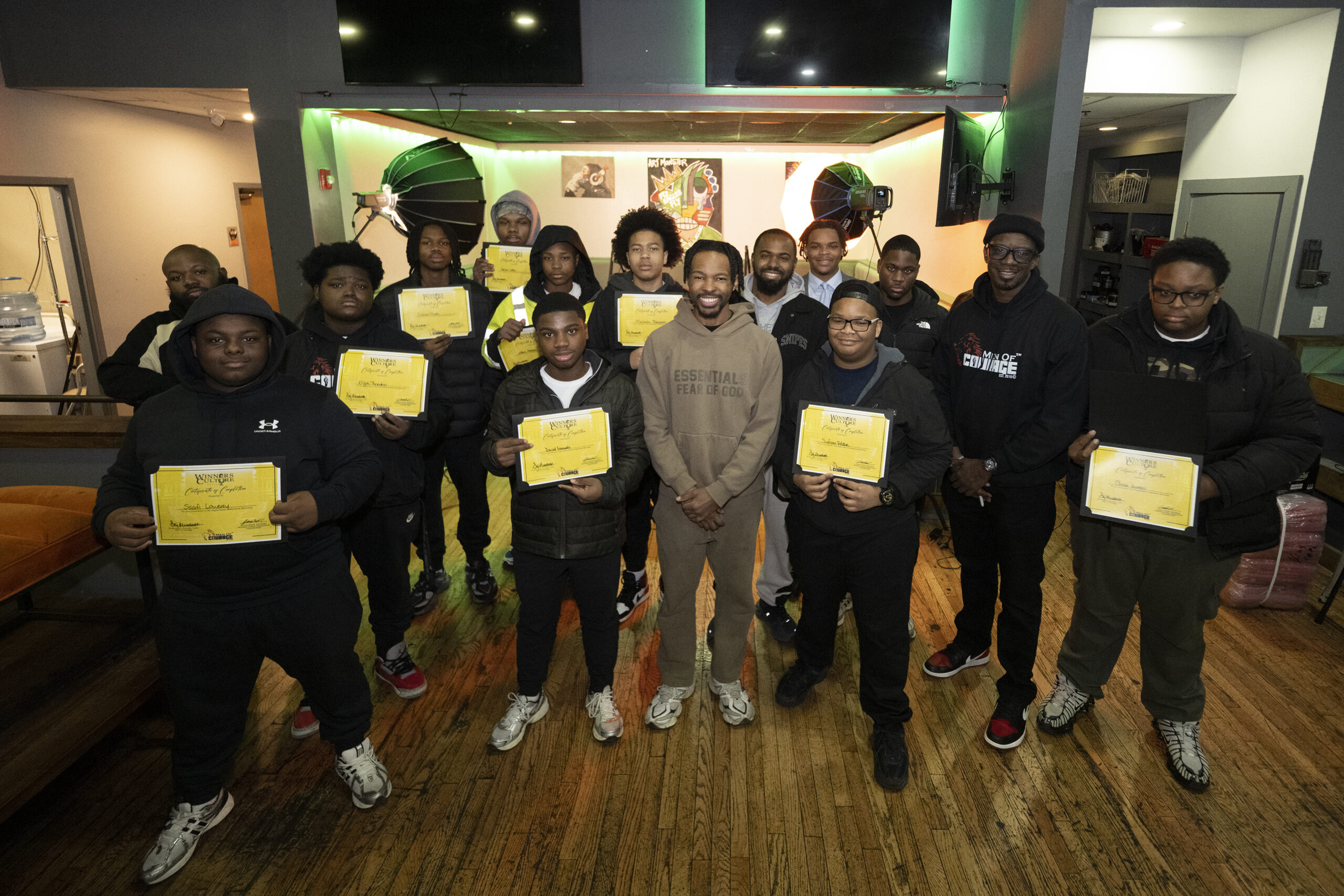
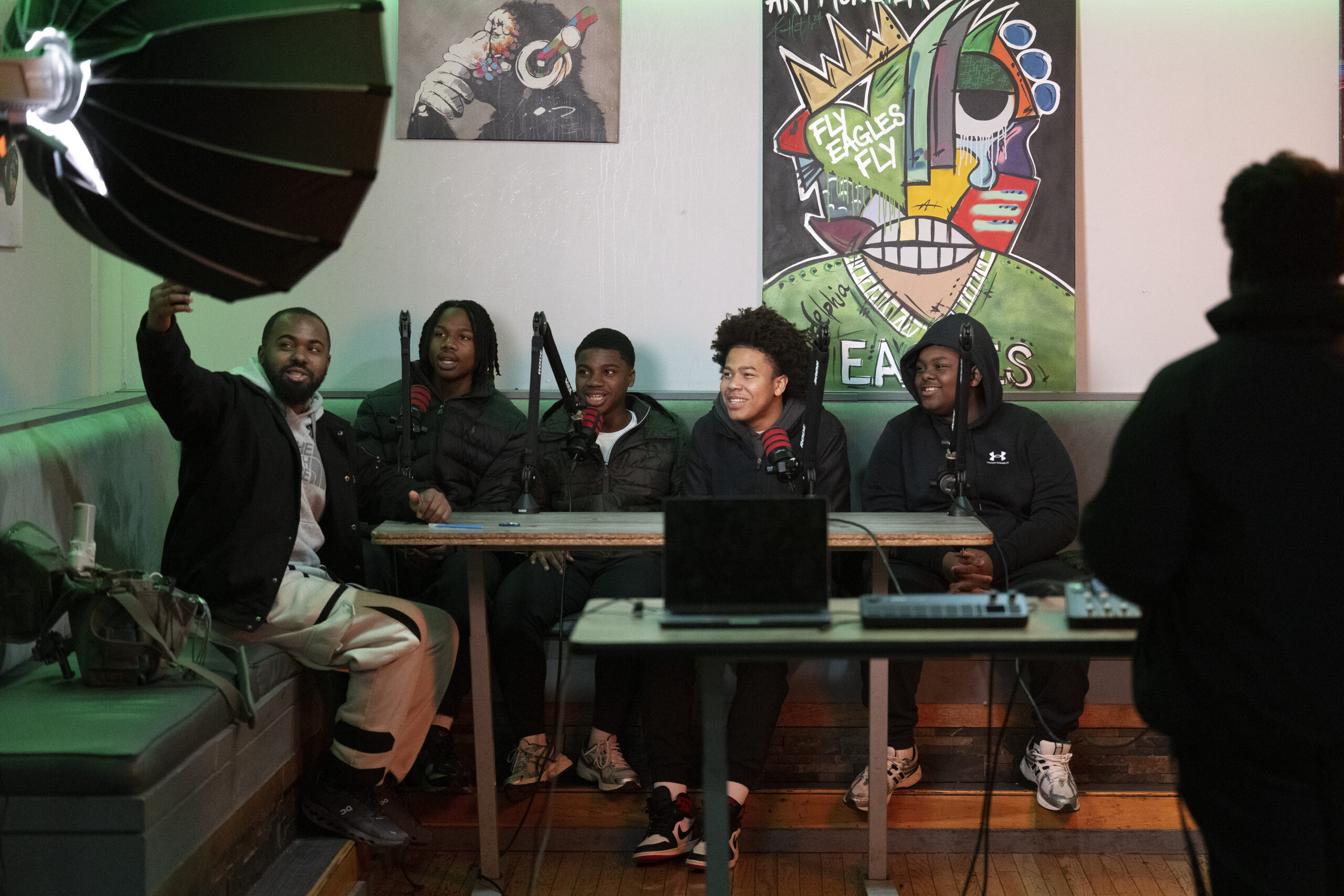
Members of Men of Courage pose with the certificates of accomplishment after completing a 16-week program on multi-media work and podcasting, one of multiple programs the community organization uses to help Black teens build their confidence.
One of those organizations that has benefited from the city’s funding is Men of Courage, a Germantown-based group that mentors young Black men ages 12 to 18 and focuses on building their confidence, resilience, and emotional intelligence.
“We want them to know that one decision can affect your entire life,” said founder Taj Murdock. “Their environment already tells them they’ll be nothing. … We have to shift their mindsets.”
Arguments are a leading cause of shootings, and teaching teens how to de-escalate conflicts and think through long-term consequences can prevent them from turning disputes violent, he said.
Isaiah Clark-White, second to left, and David Samuel, middle, pose for a photo with other members of Men of Courage before recording a podcast.
Isaiah Clark-White, 16, a sophomore at Hill Freedman World Academy in East Mount Airy, said that in his three years working with Men of Courage, he has grown more confident and has improved his public speaking.
And David Samuel, 15, of Logan, said he has learned how to better control his emotions and identify those of the people around him. Both said they feel safer today than three years ago, but remain vigilant of their surroundings.
Samuel said his dad watches the news every day and talks about the overnight crimes and shootings.
“He’s always telling me,” he said, “‘David, I don’t want this to happen to you.’”
Seeing the Mummers’ New Year’s Day parade became something of a running joke to Avril Davidge and her family.
You see, they live in Wales and Davidge is now a 93-year-old grandmother who rarely leaves her flat. She didn’t have a passport, nor had she been on a plane in 30 years. She’d never been to the United Statesand she jokes she could die tomorrow.
But after going down a YouTube rabbit hole and becoming what can only be described as obsessed with the tradition two years ago, she would often say things like “when we go to Philadelphia” or “when I see my Mummers.”
“It’s done a lot for me,” Davidge said. She had her granddaughter set her Mummers YouTube videos on autoplay since she can’t figure out the search function.“Even having breakfast, I put it on. It starts the day right for me.”
While the Mummers Parade can draw drastically divergent opinions at home, where some see it as a beloved multigenerational tradition and others paint it as an excuse for people to get drunk on Two Street, Davidge sees it as a connection to her late husband. She doesn’t know anyone in Wales who has even heard of Mummery, but deep in her heart, she knows it’s something her husband of 70 years would have loved. He died two years ago and she discovered her first Mummers video weeks later.
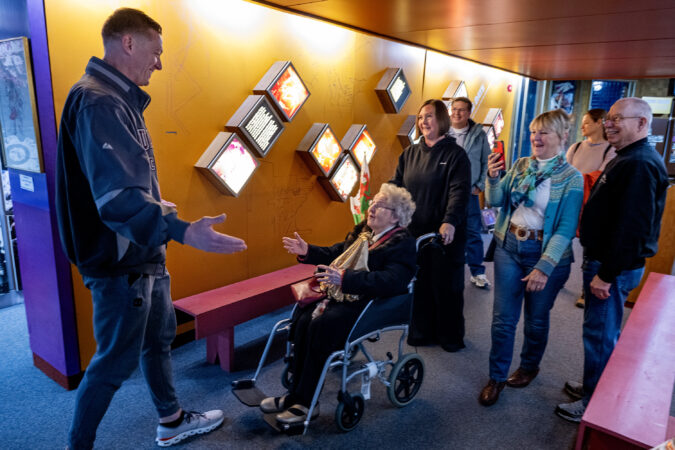
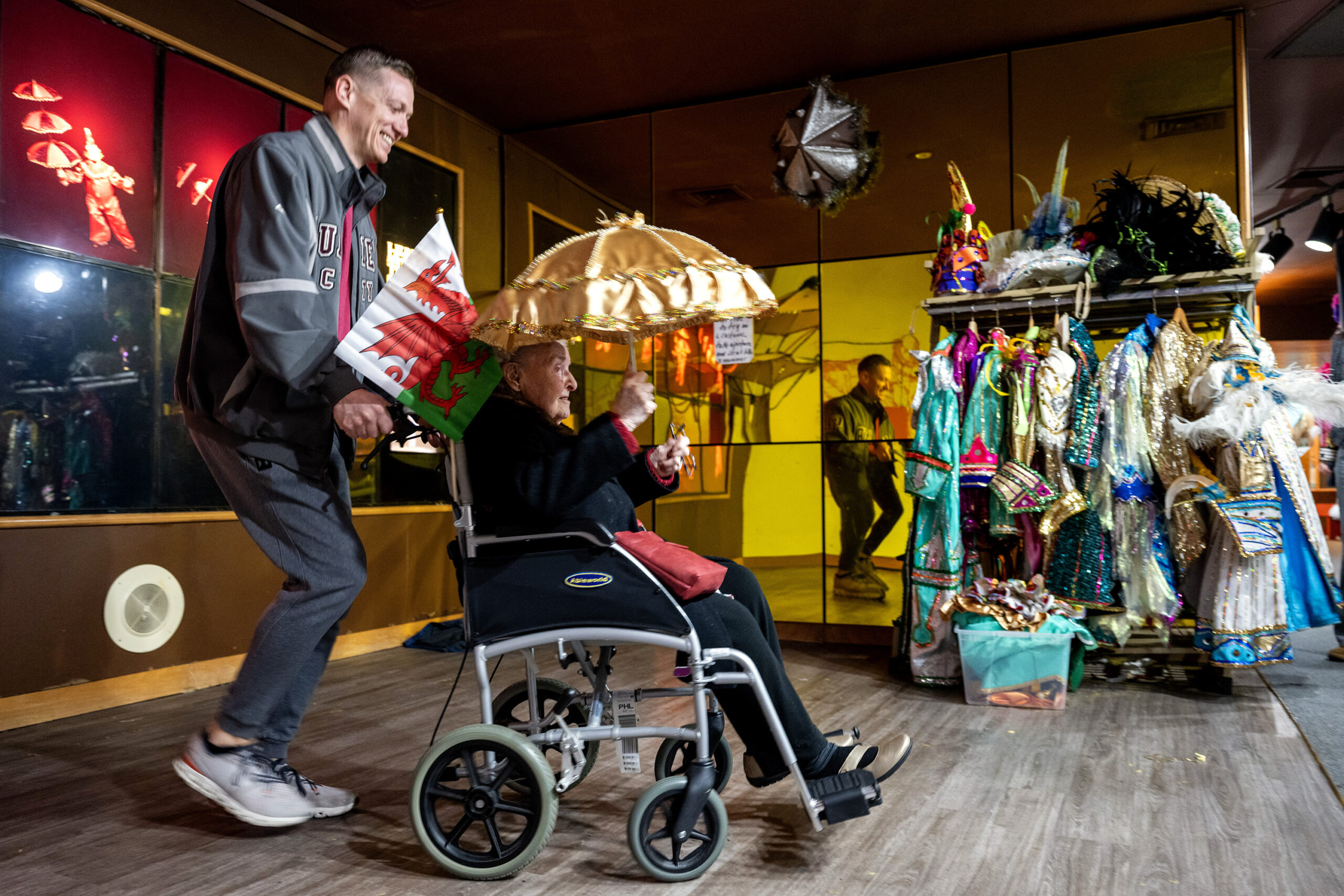
Quaker City String Band Captain Jimmy Good pushes the wheelchair of “Queen Mumm” Avril Davidge doing a Mummers strut. Davidge is a 93 year old Welsh grandma who came to the United States for the first time to see the Mummers.
Eventually, her family decided to give Davidge the trip of a lifetime to witness the 10,000-person spectacle that has ushered in the new year for Philadelphians for 125 years.Davidge will be among the many spectators watching the Mummers Parade take Broad Street on Thursday.
Using the power of social media and propelled by her family, Davidge landed Tuesday at Philadelphia International Airport, greeted by a Rocky statue — another bit of culture she loves. On Wednesday she was surprised with a trip to the Mummers Museum in South Philadelphia, where she delighted in a private tour: Yes, they’re real ostrich feathers on the costumes, and one of the more elaborate costumes can weigh 150 pounds.
Then she met Jimmy Good, captain of the Quaker City String Band, and a personal favorite of Davidge’s. Her family said Davidge often quiets them down with a “my Jimmy is on.”
“I’ll never forget this,” she told Good, complimenting what she called his beautiful smile and showing him her golden shoes, a nod to dem golden slippers. “Never.”
The two even strutted in the museum, Good pushing Davidge in her wheelchair as she lifted a gifted satin umbrella.
It was a scene Davidge’s family could hardly believe was playing out. Just a few weeks ago, they thought Davidge was at death’s door.
Divine intervention brings the Mummers to Wales
When Davidge’s husband died, she was “feeling low,” as she calls it.
Then the YouTube algorithm, programmed by her granddaughter to show her United Kingdom marching bands, showed her a clip of the Quaker City String Band performing “Make Believe,” a song Davidge and her husband loved. Her family felt it was almost a form of divine intervention.
Something about the string bands, the costumes, the performances offered a comfort Davidge needed. Soon, the Mummers were all she was watching and she quickly developed an encyclopedic knowledge of the longtime Philadelphian tradition.
The 1999 Quaker City String Band theme of “Reflections of Old Moscow” is a legendary performance, Davidge said, and then-captain Bob Shannon Jr. remains her all-time favorite.
She was in awe as she learned Shannon stood at 6-foot-10; the old YouTube clips are grainy and don’t do the performances justice.
Connecting Philly and Wales through social media
Davidge’s love for the Mummers has been contagious, family members say, not that they’ve had much of a choice.
Last year, Fiona Smillie-Hedges, Davidge’s granddaughter, asked a friend, American expat Wendy Ratcliffe, if she had heard of the Mummers.
Ratcliffe, whose maternal side of the family is scattered around Southeastern Pennsylvania, was floored.
“I said, vast swaths of the country would have no idea what you’re talking about,” she said.
When Ratcliffe’s family visited her, they brought a Mummers mug and other Philly merch for the grandmother they had heard so much about. The mug is not for use and remains propped in front of Davidge’s television.
Last Christmas, Davidge even got a Mummers book, which she calls her bible.
By 2025, the joke of going to Philly felt more like an inevitability. Smillie-Hedges, 38, tried to figure out how to maximize the experience and took to TikTok and Instagram to get some advice. She needed to know how people kept warm, how to get a good view of the string bands, and where to stay.
Soon she was in touch with Jim Donio, host of the String Band Sessions podcast, a longtime Mummer who led the broadcasts from 1985 to 1987.
Donio arranged for the museum tour and asked Good to set some time aside to meet Davidge.
“I need[ed] to step in here and do what I can to make this dream happen and make this dream come true,” Donio said.
But as Donio — who calls Davidge “Queen Mumm” — worked stateside, Davidge caught some sort of virus a few weeks ago, which at her age can be deadly.
Davidge said she thought she wouldn’t make it.
But Smillie-Hedges said the family used the Philadelphia trip to motivate her into eating and staying positive.
“She’s worked very hard to be here, to be well enough,” Smillie-Hedges said. “Every time I was like, you must eat this, you must drink that. Come on, Rocky training for Philly.”
On Wednesday, Davidge was all smiles. Her hotel overlooks Broad Street should she get cold and need to duck in for warmth. Unbeknownst to her, Donio also arranged for a golf cart to get her, Ratcliffe, Smillie-Hedges, and Davidge’s daughter Kay Hedges to their VIP seats by the judges’ table.
The whole trip feels implausible to the family, yet the only natural outcome.
“[Davidge] didn’t find the Mummers until it was literally a couple of weeks after my granddad had passed,” Smillie-Hedges said. “I swear it was meant to be.”
Philadelphia theaters have weathered a difficult year as arts organizations across the region faced deep cuts in federal funding. The numbers paint a somewhat bleak picture: The state lost $1,463,000 from the National Endowment of the Arts alone, and though some attendance figures have risen from last year, the performing arts sector has struggled overall to recapture prepandemic audiences.
This year, despite challenges, Philly’s scrappy, beloved, and award-winning theater community kept showing up and showing out on local stages with incredible productions and exciting world premieres.
Here are few of our favorites from 2025.
‘La Otra’ from 1812 Productions
Written and directed by Tanaquil Márquez, this Fringe Festival world premiere from 1812 Productions was a heartwarming comedy about three estranged sisters reuniting for their father’s 80th birthday party in Colombia. The real drama all happened in the kitchen as cousins played pranks, sisters bickered endlessly, and at one point the set exploded in a burst of tropical vines that broke into the realm of magical realism. The show fired on all cylinders, from the versatile cast in multiple roles, to its engrossing production design, to the sharp trilingual dialogue that echoed the rhythm and intimacy of a big family much like my own. (The clever use of subtitles ensured that no one got lost in translation, from English to Spanish to Vietnamese.) I laughed a lot, especially thanks to the standout performance from Yajaira Paredes. We named it one of the works with a high chance of post-Fringe Fest success, so here’s hoping to see it back on our stages soon.
Valeria Diaz (Madeleine Garcia) and Professor Qiu (Justin Jain) in InterAct Theatre Company’s “Quixotic Professor Qiu.”
‘Quixotic Professor Qiu’ from InterAct Theatre Company
Another promising world premiere came from playwright Damon Chua with this tense, small InterAct production following a Chinese American mathematics professor accused of being a spy. Inspired by actual instances of academics suspected of espionage, the drama provided a provocative and chilling reflection of the U.S. government’s targeting of immigrants amid the ever-encroaching creep of censorship. As the titular Qiu, Justin Jain played a convincingly aggrieved intellectual who finds the entire investigation absurd. But he’s essentially left helpless at the whims of law enforcement hell-bent on punishing him, regardless of the facts. The minimalist set centered our attention on the high stakes he faces trying to clear his name, with moody lighting that heightened our sense of dread. By the end, Jain breaks the fourth wall to underscore the message: “That’s the world we live in. That’s the world you live in.”
‘King Hedley II’ at Arden Theatre Company
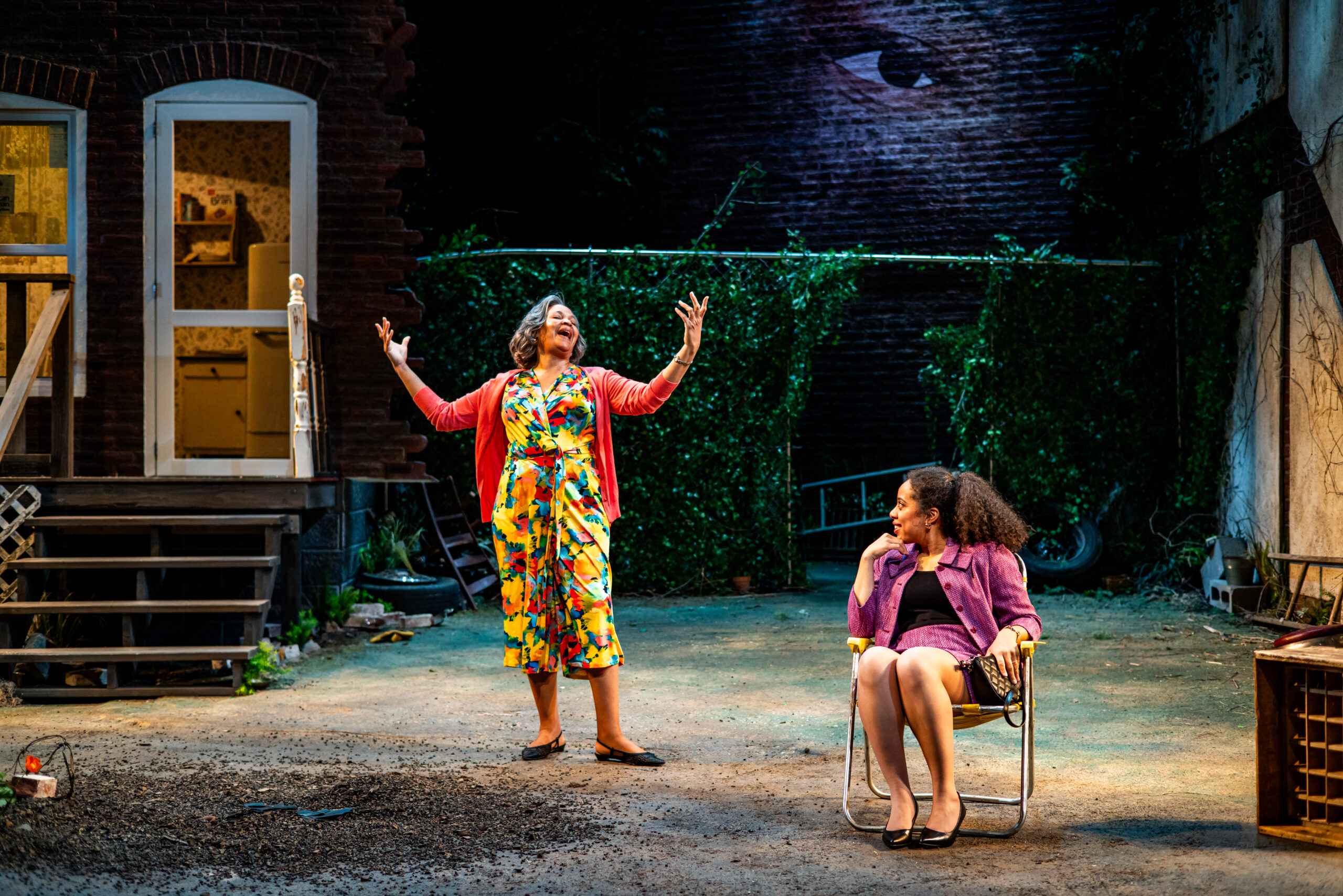
The Arden’s commitment to staging all of August Wilson’s Century Cycle plays is a laudable effort and each production is a major theatrical event. James Ijames directed this run with Akeem Davis playing the titular King, a struggling, formerly incarcerated man released at the height of the 1980s recession. The story depicts a harsh reality for the Black family at the center, played deftly by a well-rounded cast that pivots from warmth to fury to humor. It was not an easy watch — the tragic ending left me in tears — but it was a vital story that felt relevant, urgent, and timeless.
Ruby (Kimberly S. Fairbanks) and Tonya (Taysha Marie Canales) in Arden
Theatre Company’s 2025 production of August Wilson’s “King Hedley II.”
‘Back to the Future: The Musical’ at Academy of Music
At the risk of being a little corny, I had a blast seeing one of my favorite classic movies adapted into a musical — mainly because the much-hyped time-traveling DeLorean was genuinely as impressive as promised. I went in thinking that the car bit would be too gimmicky, but I was proven so wrong in the best way: The masterful production design featured illusions that (tiny spoiler) made the car fly in the air. I gasped! The show also delivered transportive scenery alternating between the 1980s and 1950s, amplified by captivating group choreography and great singing. There were certainly some questionable choices, like leaning into the whole Marty-tries-avoiding-incest plot and songs that try but fail to give depth to Marty’s family. But overall, it was a lot of fun.
‘The Goldberg Variations’ at Fringe Arts
Every year, Philly’s Fringe Fest delivers some of the strangest and most shocking productions with dazzling results. This was the craziest production I saw onstage this year and I’m still obsessed. It started as a petty PowerPoint presentation as the star/creator Clayton Lee explained that all his ex-boyfriends look like wrestler Bill Goldberg. It shifted into an interactive experience as Lee interviewed someone in the audience, flirting with him and asking sexually explicit questions. Then it evolved again into a wrestling ring, where Lee invited Goldberg doppelgängers (who were incognito in the audience) to the stage for a smackdown, complete with BDSM contraptions and a lot of body oil. It was a wild show that had the audience in sidesplitting laughter one moment and stunned silence the next.
‘Snow Queen’ at Wilma Theater
This year, the Wilma presented its first production for all ages in this adaptation of Hans Christian Andersen’s 1844 fable (from which Disney’s Frozen also draws inspiration). Seeing a weekday matinee was such a treat because the rows were filled with eager schoolchildren who responded to the actors with infectious enthusiasm. The sprawling fairy tale features a terrifying ice queen who turns hearts cold and kidnaps a young boy named Kai. His determined friend Gerda goes on a quest to save him after he has been brainwashed. Directed by Yury Urnov, the show spotlights delightful characters with an inventive and quirky production and costume design. The heartfelt, whimsical story about the power of good over evil was a visually dazzling experience, complete with musical talent and a wonderful cast.
Michael Aurelio and Ethan Check in Quintessence Theatre Group’s “Giovanni’s Room.”
‘Giovanni’s Room’ from Quintessence Theatre
It may surprise people to learn that the first-ever authorized stage adaptation of James Baldwin’s classic 1956 novel Giovanni’s Room held its world premiere right here in Philadelphia. It’s certainly something to brag about: It took nearly 20 years, two rejections, and several rewrites, but actor/playwright Benjamin Sprunger and director/playwright Paul Oakley Stovall made it happen at Quintessence Theatre. The story centers on a closeted gay American who falls in love with a brash Italian bartender in Paris — and it’s no spoiler to say it ends in tragedy. The slim novel was one of Baldwin’s most popular and groundbreaking works, providing rich source material for a play. Onstage, it was a lyrical production with spellbinding light design and fascinating choreography; it was an excellent first run and I hope to see it progress in future productions, too.
To escape the soldiers, Mai Ngoc Nguyen swam across the Mekong River as Laotian snipers on the riverbank fired into the water. She and four others fled Laos together, but only Nguyen made it to safety in Thailand. The rest drowned before they could reach the opposite shore.
On her first night in Philadelphia, Kahina Guenfoud, an Algerian immigrant eight months pregnant with her first child, was exhausted. When it was time to sleep, she pulled what she could out of her single suitcase and tried to get comfortable on the floor of an empty house.
To this day, Thoai Nguyen remembers how he, his parents, and seven siblings were airlifted from South Vietnam to an aircraft carrier in the ocean. As the North Vietnamese moved into the area at the end of the Vietnam War, there would have been no mercy for his father, who had worked for the American government.
Every immigrant has a story and SEAMAAC can hold them all, serving the city’s low-income and immigrant community in more than 55 languages from its headquarters in South Philadelphia — just blocks from where Guenfoud spent her first night. Thoai Nguyen, the chief executive officer, still lives nearby in the South Philadelphia house where his family found refuge in 1975.
The majority of people who work for SEAMAAC (Southeast Asian Mutual Assistance Associations Coalition) are immigrants in an organization that began in 1984 by serving people from countries like Vietnam and Cambodia and now assists all low-income and marginalized people, including immigrants from Asia, Africa, Europe, and South and Central America.
A half century ago, Thoai Nguyen, his parents, and seven siblings were airlifted from South Vietnam to an aircraft carrier in the Pacific. Today, he is SEAMAAC’s chief executive officer.
“It’s about the feelings,” Guenfoud, SEAMAAC’s adult literacy and access coordinator, said. “We feel what they feel. We have all left our families. We still have that emptiness inside.”
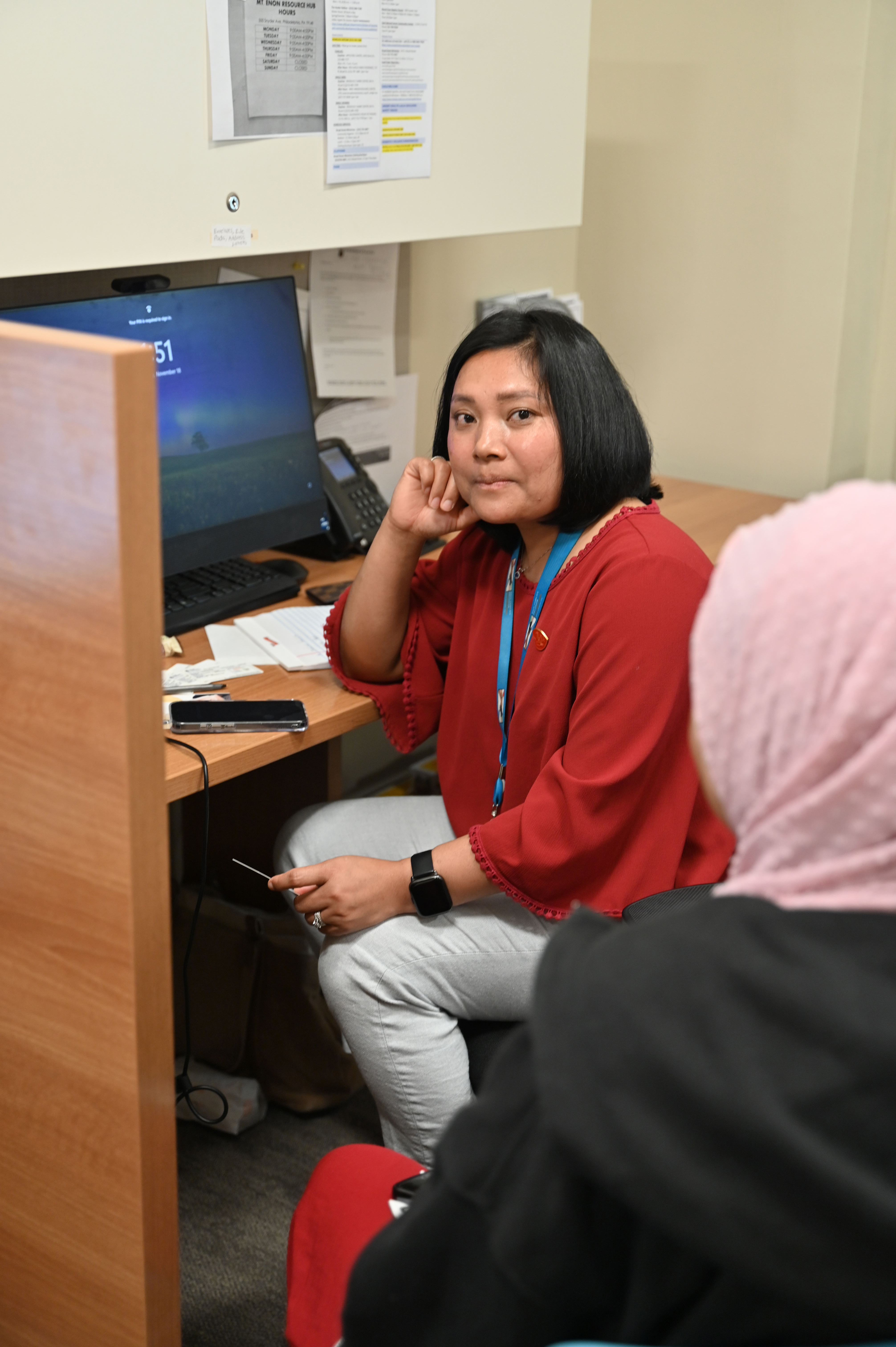
It’s why staffer Biak Cuai, SEAMAAC’s outreach worker to Philadelphia’s Burmese community, keeps her phone next to her bed at night. Everyone has Cuai’s number and they call when there is an emergency. “They call me and ask me to call 911: `My stomach hurts and I can’t breathe.’”
The hour doesn’t matter, she said, because she understands.
Many of the people who come to Philadelphia from what is now known as Myanmar are illiterate in their own language because education is no longer readily available back home, Cuai said. Here, even the basics, like opening a bank account, using email, or dealing with paperwork from their children’s schools, seem insurmountable.
“They come here because they feel America is the top country in the world, but the problem is that everything is new and unfamiliar,” she said. “They have fear. They are scared.
“I feel the same way because I am an immigrant,” she said.
Biak Cuai, SEAMAAC’s outreach worker to Philadelphia’s Burmese community, works with a client.
“I prayed to my God to guide me to my dream job, so I can serve my people,” she said. “They knock on my door. I tell them, ‘if you have any problem, you can reach out at any time.’”
The stories are dramatic and the help is real.
In broad strokes, SEAMAAC provides education with classes in digital literacy and English as a second language (although for most immigrants, it’s English as a third, fourth, or fifth language).
“It’s about feeling and belonging,” Guenfoud said. “When you learn English you learn the culture, and if you learn the culture, you belong in this country. You’ll find your place here.”
There’s social work and legal assistance to help people obtain benefits or apply for citizenship. A separate stream of funding finances SEAMAAC’s support for children who are missing school due to difficult family situations.
SEAMAAC works with domestic violence survivors and has co-produced a short, animated film offering hope and support in 10 languages — Lao, Cantonese, Hakha Chin, Nepali, Bahasa Indonesia, and Khmer, among others.
Laura Rodriguez, from Colombia, discusses food for the Thanksgiving holiday during an English as a second language class at SEAMAAC. Seated behind her is Leo Boumaza, from Algeria.
Art therapy helps survivors cope with trauma. A domestic violence survivors group produced a collection of mosaics, each with a teacup, surrounded by shards of glass. What was broken, explained Christa Loffelman, health and social services director, can become something beautiful.
Many of the people who come to SEAMAAC have experienced trauma. “Everyone’s been through multiple layers of trauma,” she said. “You are displaced from your home country — not by choice — and you are going to a refugee camp in a different country. Their entire system has been disrupted.”
Traditional Western-style talk therapy doesn’t help. For one thing, the language isn’t there, and secondly, it’s not part of many cultures. What has worked, Loffelman said, is expressing feelings through art, and being together while doing it.
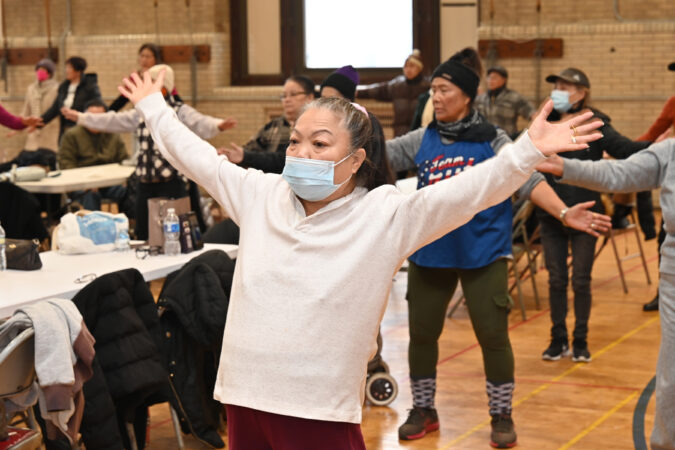
To counter the social isolation of seniors, SEAMAAC organizes meetings of “the Council of Elders.” They gather in a drafty gym at the Bok building, a former high school in South Philadelphia where SEAMAAC offers classes and counseling.
Often, the elders practice qigong, a form of movement meditation, or on a less esoteric level, enjoy multicultural bingo. Languages may be different, but when someone holds up a G-32 poster, everyone understands. If they don’t, Mai Ngoc Nguyen, a volunteer who can speak Laotian, Thai, Vietnamese, and English can help.
She has experienced plenty of trauma and heard plenty of traumatic stories. She’ll never forget the mother who gave her baby medicine so it wouldn’t cry in a boat carrying refugees away from their country. The boat capsized. The baby drowned.
“She comes into the refugee camp and she became crazy, yelling `Where is my baby?’ Her brain got messed up” and she never recovered.
Luckily for Mai Ngoc Nguyen, then age 12, she was a strong swimmer and ready to cross the Mekong as she made her escape. But she had to kick away a friend who was clinging to her, dragging her under. Her friend never made it to the opposite shore.
“If you ask me, I’ll talk about it,” she said. “But if you don’t ask, I won’t talk.”
But she will joke, saying that she knows the Mekong alligators didn’t get herbecause they knew she needed to help her family back home.
It’s a lot of trauma, but every day at SEAMAAC isn’t full of anxiety. The elders coming out of the gym after bingo were smiling. And in a nearby classroom, students practicing their English last month traded jokes as they learned about Thanksgiving.
Fatma Amara, from Algeria, has been here long enough that she’ll serve a turkey on Thanksgiving, but the apple pie she makes will be Algerian, with seasoned apples layered among thin sheets of dough.
For her, SEAMAAC is more than a language class.
“At first, you feel lonely. You’re anxious. It’s stressful,” said Amara, who works in a hospital and is getting better and more confident with her English. “I take the classes, and we talk together and I feel better.
“Thanksgiving is my favorite holiday in America. It’s an international holiday. It’s about food and God and family,” she said. “You thank God for all you have.”
For all the blessings SEAMAAC provides, these days, funding is a struggle.
In 2024, SEAMAAC learned that the federal government had approved its application for a $400,000 multiyear federal grant to improve digital “equity.” But after President DonaldTrump took office, federal staffers targeted “equity” programs. “That’s $400,000 we’ll never see,” said Thoai Nguyen, the executive director. “We would have had some of that money by now.”
Federal cuts since Trump took office have slashed SEAMAAC’s budget by 20%, he said. Hunger relief programs had to be curtailed, with 1,500 families who relied on SEAMAAC for food losing that lifeline.
“We’re in a moment,” he said, “where intentional cruelty is considered an acceptable form of political discourse.”
This article is part of a series about Philly Gives — a community fund to support nonprofits through end-of-year giving. To learn more about Philly Gives, including how to donate, visit phillygives.org.
For more information about Philly Gives, including how to donate, visit phillygives.org.
About SEAMAAC
Mission: To support and serve immigrants and refugees and other politically, socially, and economically vulnerable communities as they seek to advance the condition of their lives in the United States. Services include ESL classes, job readiness, domestic violence survivor support, services for low-income elders, food assistance, public benefit counseling, health and nutrition education, and civic engagement.
People served: 8,000 families
Annual spend: $3,360,401 in fiscal year 2024
Point of pride: SEAMAAC plans to increase our impact to serve even more Philadelphians at its new South Philly East (SoPhiE) Community Center on Sixth Street and Snyder Avenue, scheduled to open in December 2026. In January, SEAMAAC, partnering with the American Swedish Historical Museum, will welcome visitors to “Indivisible: Stories of Strength,” an art exhibition showcasing the art and stories of South Philadelphians.
You can help: SEAMAAC provides many volunteer opportunities through our work in beautifying and improving Philadelphia’s neighborhoods through our work in urban gardening, tree planting, neighborhood and public park cleanings, and beautification of public schools and places of worship. Additional opportunities are available through our civic engagement and neighborhood unity events as well as by delivering groceries in our hunger relief efforts.
$40 provides shelf stable foods for a family impacted by the SNAP shutoffs for one week.
$50 provides holiday presents for two children.
$100 helps maintain one plot in SEAMAAC’s community garden for an entire growing season, providing tools, culturally appropriate seedlings, and soil.
$100 covers the full cost of supplies for one youth participant in SEAMAAC’s summer programs — giving young people the tools they need for career and college readiness.
$200 covers four hours of ESL instruction.
$250 provides 50 elders with a freshly made breakfast.
$250 provides a family with emergency food, hygiene items, diapers, and social service support for one month.
$300 supports a domestic violence survivor moving into safe housing, by covering the cost of utility hookups and household supplies.
$300 provides ingredients and cooking supplies for a nutrition education workshop.
$1,000 covers the full cost for one high school student to participate in SEAMAAC’s eight-week summer career exploration program.
This year marks the 125th anniversary of the Philadelphia Mummers Parade, that colorful, boisterous procession that has come to define New Year’s Day in the city.
The festivities kick off at 9 a.m. on Thursday, Jan. 1, as more than 10,000 performers take to the streets for a daylong celebration USA Today readers recently hailed as the nation’s best holiday parade.
From parking to road closures to how to go about watching, here’s everything you need to know ahead of time.
Kasey McCullough kisses her son Finn, 5, after his appearance with Bill McIntyre’s Shooting Stars during their performance in the Fancy Brigade Finale at the Convention Center Wednesday, Jan. 1, 2025, part of the Philadelphia Mummers New Year’s Day parade. Their theme is “Legends of the Secret Scrolls.” Finn’s dad, Jim McCullough also performed, his 40th year with the Mummers. They are from Washington Twp.Washington Township, N.J.
Mummers Parade route
The mile-and-a-half route begins at City Hall, before heading south down Broad Street to Washington Avenue in South Philadelphia.
How to watch the 2026 Mummers Parade
Watch the Mummers Parade in person
The parade is free to attend. Those hoping for a more intimate experience, however, have a few options:
Reserved bleacher seats located near the judging stand just west of City Hall are available for $25 at visitphilly.com.
Additionally, tickets to the Fancy Brigade Finale — held at 11:30 a.m. and 5 p.m. inside the Convention Center — range from $28 to $43. Tickets are available at visitphilly.com or during business hours at the Independence Visitor Center.
Watch the Mummers Parade from home
The parade will be broadcast from 9 a.m. to 5 p.m. on:
Cable/Satellite: On Channel 2 (MeTV2) or Channel 69 (WFMZ). Available on Comcast, Fios, DirecTV, Dish Network, Service Electric, Astound, and Blue Ridge Cable.
Mobile: On the WFMZ+ Streaming app, available through your Apple or Android devices.
Members of the Saints wench brigade step to the judges’ stand during the 124th Mummers Parade on Wednesday, Jan. 1, 2025.
What is the Mummers Parade?
In short, it’s the longest continuously running folk parade in the country. Some 10,000 elaborately dressed performers take part in the celebration each year, part of dozens of groups spread across several divisions.
Fancies: Painted faces and elaboratecostumes.
Comics: Satirical comedy skits aimed at public figures, institutions, and current events.
Wench Brigades: Known for traditional Mummers costumes, including dresses, bloomers, and bonnets.
Fancy Brigades: Theatrical performances. (The Fancy Brigade Finale takes place on New Year’s Day with a pair of ticketed performances at the Convention Center at 11:30 a.m. and 5 p.m.)
String Bands: Marching musicians playing an assortment of string and reed instruments.
Mummers Parade performers
Fancy Division
Golden Sunrise
Wench Brigade Division
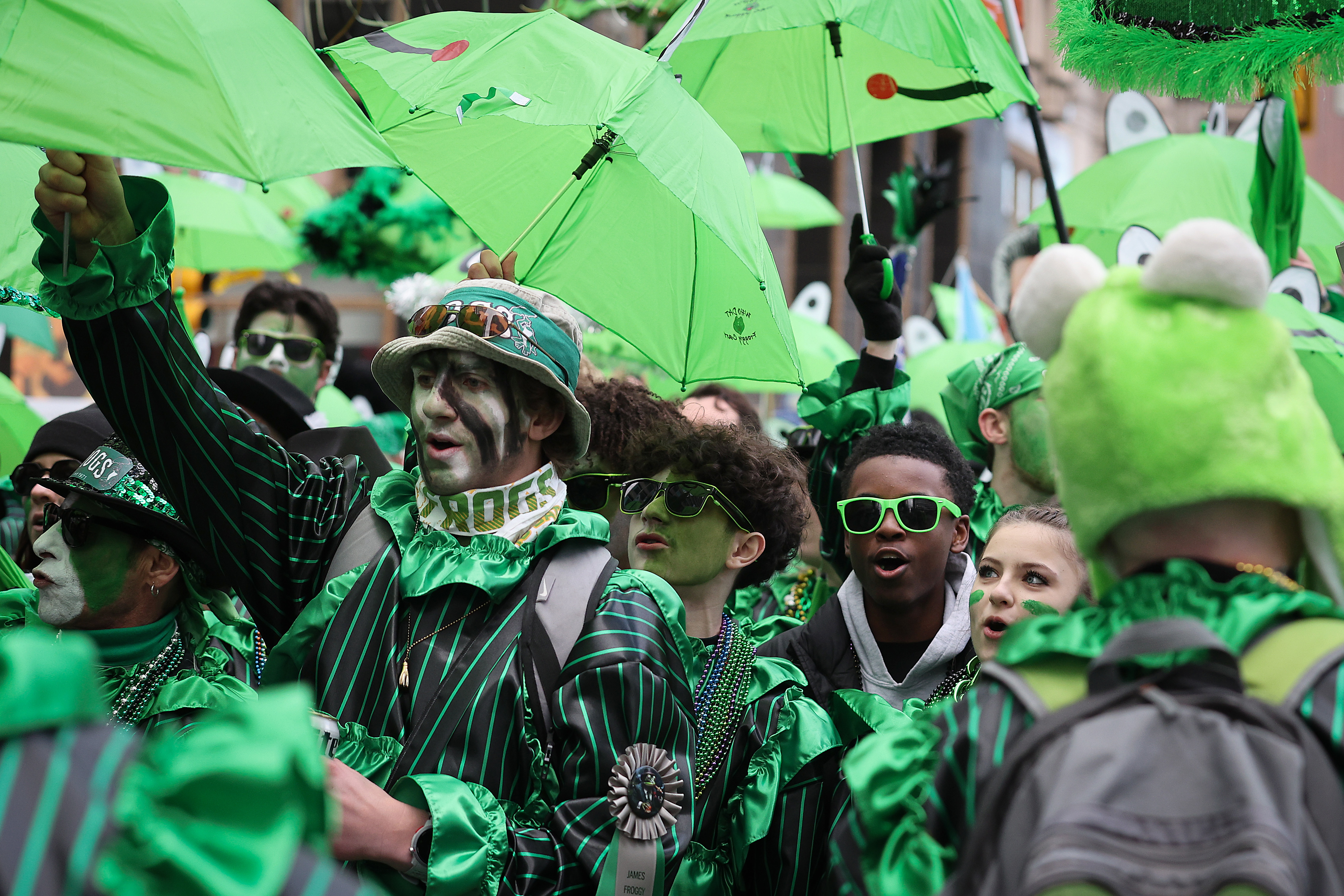
Froggy Carr
Pirates
Americans
Cara Liom
MGK
O’Malley
Oregon
Saints
Riverfront
Bryson
Comic Division
Mother Club: Landi Comics NYA
Philadelphia Pranking Authority
Mayfair Mummers
Barrels Brigade
The Jacks
Mother Club: Rich Porco’s Murray Comic Club
Holy Rollers NYB
Vaudevillains NYB
Trama NYB
Wild Rovers NYB
Mollywoppers NYB
Merry Makers NYB
Misfits NYB
Fitzwater NYB
Funny Bonez NYB
Top Hat NYB
Fiasco NYB
Golden Slipper NYB
B. Love Strutters
Madhatters NYB
Tankie’s Angels NYB
The Leftovers NYB
Finnegan NYB
Mother Club: Goodtimers NYA
SouthSide Shooters NYA
Jokers Wild NYB
Hog Island NYA
Pinelands Mummers NYB
Happy Tappers NYB
Two Street Stompers NYB
Gormley NYB
Jesters NYB
Lobster Club NYB
South Philly Strutters NYB
Jolly Jolly Comics NYB
String Band Division
Duffy String Band
Durning String Band
Quaker City String Band
Fralinger String Band
Uptown String Band
Avalon String Band
South Philadelphia String Band
Aqua String Band
Greater Kensington String Band
Woodland String Band
Polish American String Band
Ferko String Band
Hegeman String Band
Jersey String Band
Members of Froggy Carr chant as they strut to Market Street during the 124th Philadelphia Mummers Parade on Wednesday, Jan. 1, 2025.
Mummers Parade-day hacks
Navigating the heavily attended event can require a bit of planning, with entire Reddit threads devoted to parade-day tips — including the best places to park and how to access elusive public restrooms throughout the day.
A few things to keep in mind: The parade is accessible through SEPTA Regional Rail, bus, subway, and trolley lines. And though parking is free because of the holiday, it’s expected to be scarce.
While the heart of the action takes place near City Hall and Dilworth Park, performance areas will also be located along the parade route — at Broad Street at Sansom, Pine, and Carpenter Streets.
Starting at 11 a.m., meanwhile, parade attendees can gather at the staging area for the string bands to watch the performers prepare. (The staging areas are located at Market Street between 17th and 21st Streets and JFK Boulevard between 17th and 20th Streets.)
Also good to remember? Dress warm, bring a lawn chair (they’re permitted), and pace yourself — it has the potential to be a very long day.
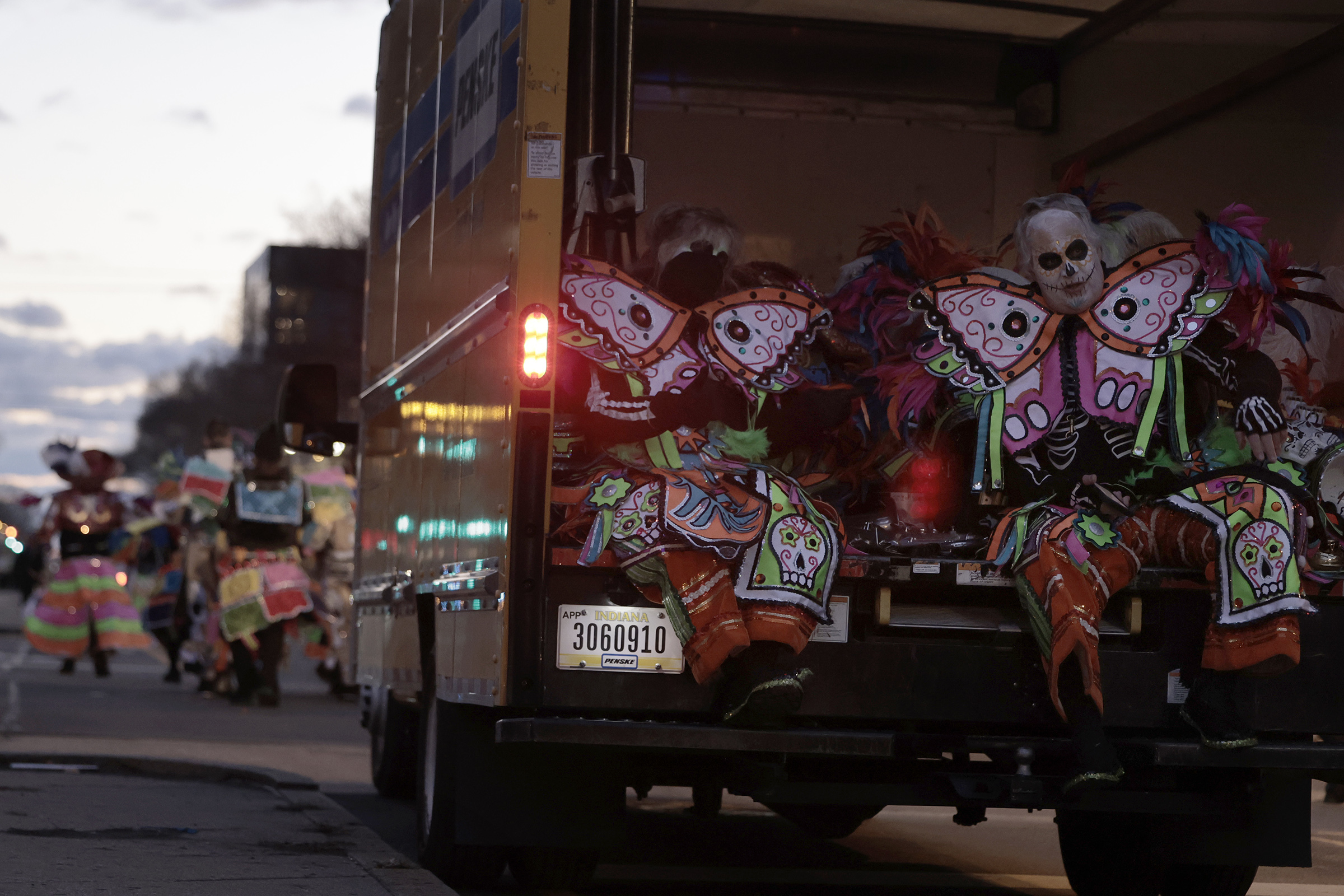
Ferko String Band tenor sax players Renee Duffy of Deptford (left) and Tom Garrity of Berlin take a break from the parade as they ride in the bands truck on South Broad Street during the Mummers Parade in Philadelphia on New Year’s Day, Wednesday, Jan. 1, 2025.
Mummers Parade road closures and parking restrictions
Friday, Dec. 26, 2025
No parking from 6 p.m. on Dec. 26 through 6 p.m. on Jan. 2, on the east curb lane of 15th Street from JFK Boulevard to South Penn Square.
Saturday, Dec. 27, 2025
No parking from 6 p.m. on Dec. 27 through 7 a.m. on Jan. 2, on the west side of 15th Street from Arch Street to Ranstead Street. Street and sidewalk vendors will also not be permitted to park in this area.
Monday, Dec. 29, 2025
15th Street will be closed to southbound traffic at JFK Boulevard. Closure begins at 8 a.m. on Dec. 29 and runs through 7 a.m. Jan. 2.
Market Street eastbound will be closed to traffic at 16th Street from 8 a.m. on Dec. 29 through 7 a.m. on Jan. 2.
Tuesday, Dec. 30, 2025
No parking on the following streets from 4 a.m. on Dec. 30 through 6 p.m. on Jan. 1:
Market Street from 15th Street to 21st Street (both sides)
JFK Boulevard from Juniper Street to 20th Street (both sides)
15th Street will be closed to southbound traffic at JFK Boulevard. Closure begins at 7 a.m. on Dec. 30 and runs through 7 a.m. Jan. 2.
Wednesday, Dec. 31, 2025
Market Street will be closed to vehicle traffic from 15th Street to 21st Street from 10 a.m. to 3 p.m. on Dec. 31. Market Street will reopen at 3 p.m. and traffic will be permitted to travel eastbound on Market Street to 15th Street and continue southbound on 15th Street.
Thursday, Jan. 1, 2026
The following streets will be closed to vehicle traffic beginning at 3 a.m. on Jan. 1 through the parade’s conclusion:
15th Street from Arch Street to Chestnut Street
Market Street from 15th Street to 21st Street
These streets will be closed to vehicle traffic beginning at 6 a.m. on Jan. 1 through the conclusion of the parade:
Benjamin Franklin Parkway from 16th Street to 20th Street
North Broad Street from Cherry Street to JFK Boulevard
16th Street from Chestnut Street to Race Street
17th Street from Benjamin Franklin Parkway to Ludlow Street
18th Street from Ludlow Street to Race Street
19th Street from Benjamin Franklin Parkway to Chestnut Street
1500 block of Ranstead Street
1300 block of Carpenter Street
1000 block of South 13th Street
Chestnut Street from 15th Street to 18th Street (north side)
Cherry Street from 15th Street to 17th Street
Arch Street from 15th Street to 17th Street
Washington Avenue from 12th Street to 18th Street
Broad Street will be closed to vehicle traffic from South Penn Square to Washington Avenue on Thursday, Jan. 1, beginning at 7 a.m. through the conclusion of the parade.
Vehicle traffic will not be permitted to cross Broad Street during the parade.
Additional Parking Restrictions
No parking from 2 a.m. to 6 p.m. on Thursday, Jan. 1 (on both sides of street unless otherwise noted):
Broad Street from Cherry Street to Ellsworth Street
Juniper Street from JFK Boulevard to East Penn Square
South/East Penn Square from 15th Street to Juniper Street
Benjamin Franklin Parkway from 16th Street to 20th Street
Logan Circle (north side)
16th Street from Chestnut Street to Race Street
17th Street from Benjamin Franklin Parkway to Ludlow Street
18th Street from Ludlow Street to Race Street
19th Street from Benjamin Franklin Parkway to Chestnut Street
1500 block of Ranstead Street
1300 block of Carpenter Street
1000 block of South 13th Street
Chestnut Street from 15th Street to 18th Street (north side)
Cherry Street from 15th Street to 17th Street
Arch Street from 15th Street to 17th Street
Washington Avenue from 12th Street to 18th Street
SEPTA detours
SEPTA hasn’t updated their schedule for the parade yet, but bus detours, alerts, and information can be found on SEPTA’s website.
Inspired by traditions brought to Philly by Swedish, Finnish, Irish, German, English, and African immigrants, the annual event has grown to feature thousands of costumed performers competing in a colorful, unique, and family-friendly daylong affair.
Despite past funding issues and occasional controversy, the Mummers Parade today stands as one of the city’s quintessential events, celebrated by locals and embraced by Philly royalty; former Eagle Jason Kelce memorably donned a traditional Mummers outfit for the team’s Super Bowl parade in 2018, and actor Kevin Bacon, along with brother Michael, has helped fundraise for the event.