Philadelphia police are seeking to question two men in connection with the death of an American Airlines flight attendant who investigators believe was attacked inside his South Philadelphia home last week, then fell — or was thrown — out of his third-floor window.
Amadou Thiam, 50, was found lying naked on the pavement behind his home, on the 2400 block of Federal Street, with severe injuries to his face, neck, and body on the night of Nov. 10, police said. He was rushed to Penn Presbyterian Medical Center, where he later died from his injuries, they said.
The medical examiner has not yet determined the cause or manner of Thiam’s death, but homicide detectives are investigating, said Deputy Police Commissioner Frank Vanore. Vanore stopped short of saying Thiam was attacked, pending the coroner’s decision, but law enforcement sources familiar with the investigation said Thiam’s injuries, coupled with witness interviews and evidence recovered inside his home, suggest he was assaulted.
Residents of the Grays Ferry block this week recalled the harrowing moments when they found Thiam — and the chilling departing words of the men police are now looking to question.
Two neighbors, who asked not to be identified for fear of reprisal, said they heard loud noises coming from Thiam’s condo around 6:30 p.m. last Monday but assumed he was having guests over.
Then, they said, they heard a loud crash behind the building.
Shortly after, they said, they saw two men walk out of Thiam’s home.
“Is everything OK?” one neighbor recalled asking the men. “They just kind of chuckled and said, ‘We hope so.’”
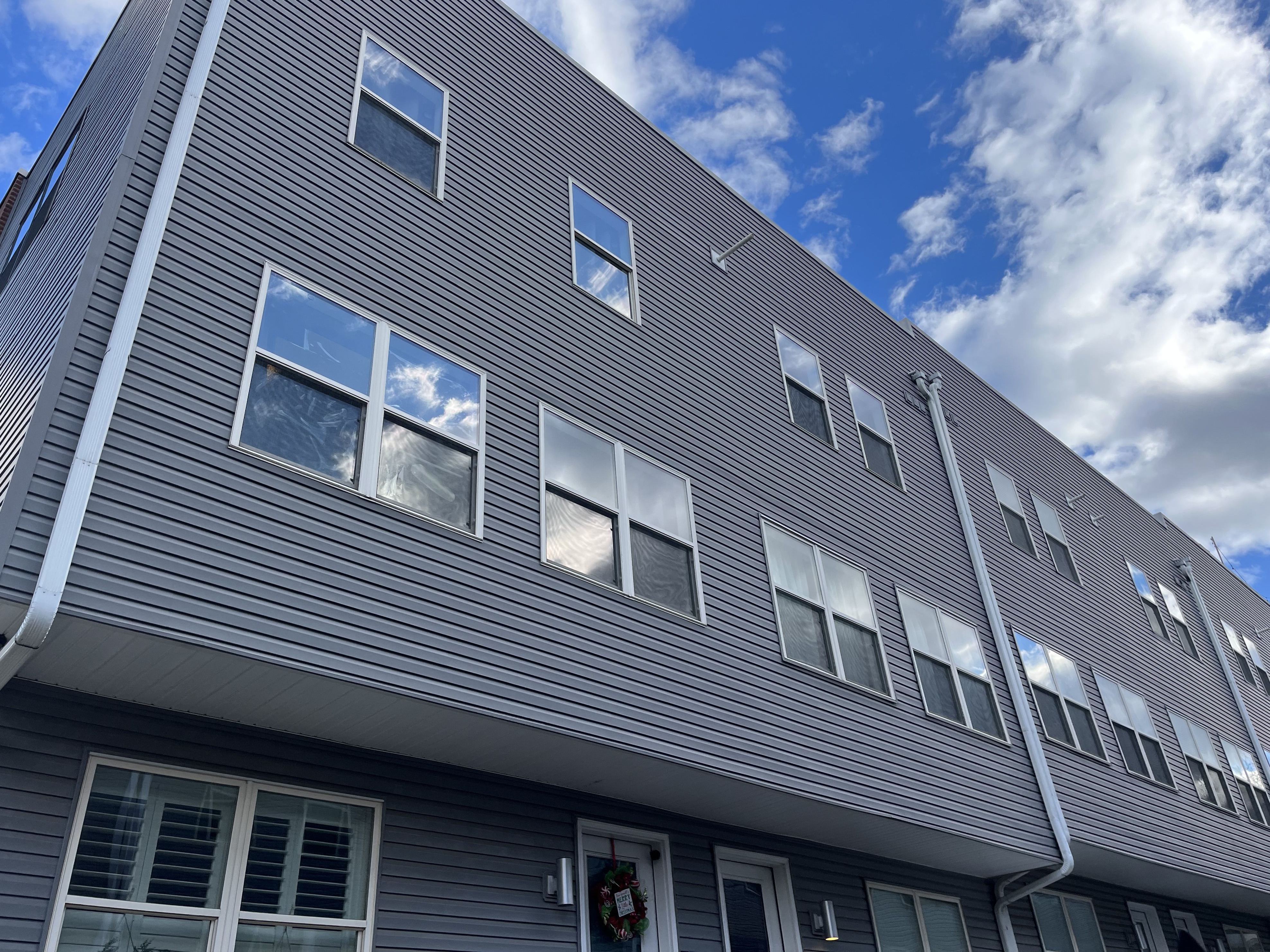
Amadou Thiam lived on the 2400 block of Federal Street. This image shows the third-story window, second from left, from which neighbors say Amadou Thiam fell on Nov. 10.
The neighbors said they approached Thiam’s door, which was left cracked open, and found blood smeared across his kitchen and third-floor bedroom. Thinking Thiam was not home, they called the police to report a burglary.
As the couple waited for police, they said, they noticed a stream of blood on the sidewalk outside. And then, they said, they saw Thiam’s body on the pavement.
Vanore said it was not clear how Thiam ended up on the ground, but police believe he went through a third-story window.
“We still don’t know if he fell or was thrown,” he said.
Thiam suffered injuries throughout his body, including fractures to his face, ribs, and skull, Vanore said.
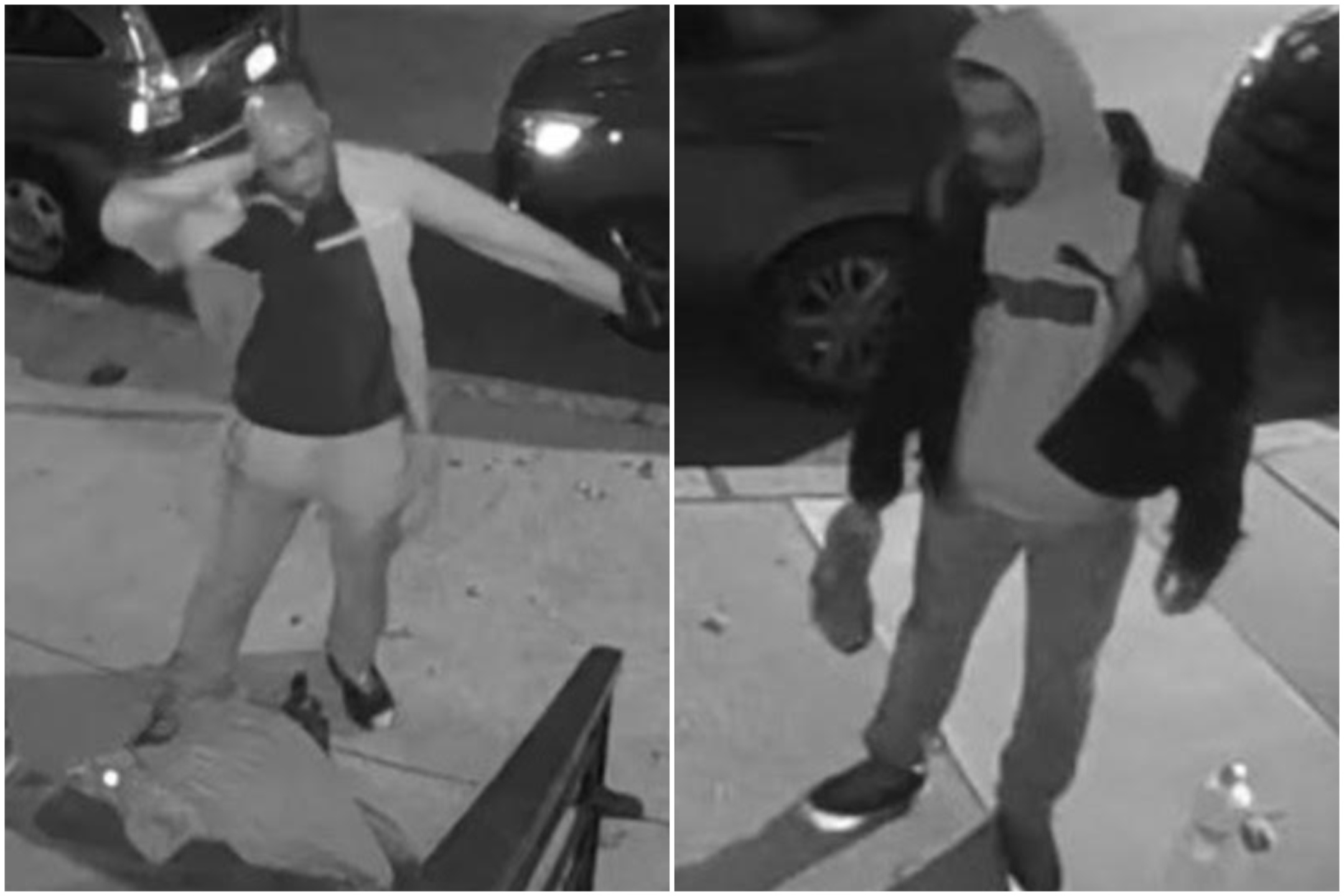
Detectives have recovered video from the block showing two men — one older, one younger — in the area around the time Thiam’s body was found, he said.
Vanore described one of the men as a thin Black male wearing a black leather jacket over a red hoodie and jeans and carrying a bag. The second man, he said, was older, bald, and wearing a gray jacket.
Philadelphia police are seeking to question two men who they believe could be connected to the death of Amadou Thiam in South Philadelphia last week.
“We’re looking to talk to them to see if they had anything to do with this,” he said.
Law enforcement sources, who asked not to be identified to discuss an ongoing investigation, said the men appeared to be carrying clothes out of the building. There were no signs of forced entry into Thiam’s home, the sources said.
Relatives of Thiam, who was originally from Côte d’Ivoire, could not be immediately reached.
His Instagram account showed a man who enjoyed exploring the world: standing before Hôtel de Paris Monte-Carlo and the Arc de Triomphe in Paris, and eating in Key West, Fla., and Las Vegas.
His death has shocked many who knew him, including his colleagues at American Airlines.
A spokesperson for the airline did not respond to a request for comment. But in a memo shared online, an operations manager for the Philadelphia region said Thiam had worked as a flight attendant with the airline since 2011 and, as a French speaker, he frequented international flights to Paris and Zurich.
“His presence and natural charisma was always something felt throughout a room,” the employee wrote. “He was a loyal friend whose kindness, positive attitude, and radiant smile touched everyone around him.”
John Stanley, a fellow American Airlines flight attendant, said that every July, there is a benefit for flight attendants at Voyeur, a nightclub in the Gayborhood, with dancers and drag performers. He recalled how one year, Thiam dressed up as Glinda from Wicked and performed for the crowd.
“He was as well-liked a flight attendant in Philadelphia as I know exist,” Stanley said.
Thiam’s neighbors also said he was exceptionally friendly, and loved to dress in eccentric clothing. He was also a dog lover, a passion that neighbor Nicole Colamesta said they bonded over.
“Everybody is having a really hard time processing it. This is a really quiet block. Everybody just looks out for each other here,” Colamesta said. “You can’t stop thinking about it because it’s right in our backyard.”
Police asked anyone with information to contact homicide detectives at 215-686-3334 or to call the police tip line at 215-686-8477.
Staff writer Maggie Prosser contributed to this article.
Philadelphia police have arrested a man suspected of killing one person and injuring another in a shooting last month near the sports complex at Broad Street and Packer Avenue in South Philadelphia.
Abou Keita, 22, was arrested Monday on the 2200 block of South Felton Street in Southwest Philadelphia, where police found him inside a parked vehicle. He was taken into custody and has been charged with murder, attempted murder, aggravated assault, and other offenses in connection with the Oct. 9 shooting, officials said.
That incident unfolded just after 6:10 p.m., when police responded to reports of a shooting near the intersection of Packer Avenue and Broad Street. Responding officers found an Audi sedan with 15 bullet holes just south of the intersection, police said.
Police also discovered Hasson Mason, 23, laying in the street with multiple gunshot wounds to his face and body just north of the intersection on Broad. He was taken to Thomas Jefferson University Hospital, where he was pronounced dead.
Another victim, also a 23-year-old man, was found in front of Chickie’s & Pete’s, a popular restaurant near the sports complex on the 1500 block of Packer Avenue, with gunshot wounds to the torso. The victim, whom police did not identify, was taken to Penn Presbyterian Medical Center, where he was listed in stable condition.
Officials previously told The Inquirer that spent shell casings and a discarded ammunition magazine were discovered near the two shooting scenes. The Audi sedan police discovered struck another car on Broad Street, but the driver in the second vehicle was not harmed, police said.
Police have not said what may have led to the shooting.
Axalta, the Philadelphia-based automobile paint and coatings maker, is set to be acquired by AkzoNobel NV, the Netherlands-based maker of Dulux and other paint and coatings brands, in an all-stock deal worth $6 billion.
Both companies have plants in the Philadelphia area, among other locations worldwide.
AkzoNobel, which employs around 34,500, almost three times Axalta’s 12,600, last year promised to update its powder coatings plant near Reading. AkzoNobel also has a Sikkens vehicle refinishings plant near Malvern.
“The last few years have been really challenging,” Axalta CEO Chris Villavarayan told investors in a morning conference call. “The market has gone sideways at best. Coatings demand is still below 2019 levels. At some point there’s going to be some kind of recovery.”
He predicted that sales will benefit as soon as next year as auto, shipbuilding, and other cyclical markets rebound, and that the merger will help boost sales of both companies’ products, after cutting costs.
AkzoNobel CEO Greg Poux-Guillaume will head the combined company, with sales totaling around $17 billion a year, across 160 countries. Poux-Guillaume said in the conference call that’s large enough to earn it a listing on the S&P 500, like rival PPG.
Poux-Guillaume said the combined company will maintain Axalta’s main office in Philadelphia as a second headquarters.
AkzoNobel shares slipped around 3% to $55 on Tuesday. Axalta shares closed down 0.64% to $28, well below the $30 to $40 range where the stock traded last winter.
The deal, if completed on schedule by early 2027, ends years of Axalta merger talks that began soon after its 2013 spinoff from the DuPont Co., with Axalta periodically discussing possible deals with competitors including PPG and Kansai, as well as AkzoNobel. AkzoNobel’s Dulux is also a former DuPont brand.
“The stars have finally aligned for this longtime proposed transaction,” said Georgina Fraser, a stock analyst at Goldman Sachs, during the companies’ conference call with investors.
“The industrial logic has been very clear,” Poux-Guillaume said: combined, the company, whose new name hasn’t been chosen, can push more AkzoNobel products in the Americas and other areas where Axalta sales are concentrated, while Axalta paints can find bigger markets in Europe and Asia.
Axalta CEO Villavarayan will serve as deputy CEO in charge of cost-cutting $600 million from current expenses by 2030. Villavarayan said the company would also spend $400 million a year on research and development, enough “to drive growth.”
Rakesh Sachdev, a senior adviser at New Mountain Capital and Axalta’s chairman who served as interim CEO before Villavarayan took the job in 2022, will serve as chairman of the combined board, with four directors from each company and three outsiders. AkzoNobel shareholders will hold around 55% of the combined company’s shares.
The turning point in Pennsylvania’s budget impasse, by Gov. Josh Shapiro’s telling, came just before Halloween, when he and leaders in Harrisburg gathered in his stately, wood-paneled office to meet twice daily to hash out a deal to end the bitter, monthslong stalemate.
The long grind eventually led to compromises 135 days in, and a deal Shapiro said he thinks is far better than what national Democrats, hoping to extend healthcare subsidies, got in Washington at the end of the federal shutdown.
“Sometimes you’ve got to show that you’re willing to stay at the table and fight and bring people together in order to deliver,” Shapiro told The Inquirer in an interview Friday, touting the state budget agreement finally signed that week.
“I think it’s a stark contrast, frankly, with what happened in D.C., where they didn’t stay at the table, they didn’t fight, and they got nothing,” he said.
Washington is controlled by Republicans, while in Pennsylvania, Democrats control the state House and governorship, and Republicans hold a majority in the Senate.
Both state and federal budgets were signed the same day, offering Pennsylvanians relief from more than a month of government dysfunction at two levels. But for Shapiro — an exceedingly popular Democratic governor facing reelection in 2026 as whispers swirl over his potential 2028 presidential ambitions — the moment was bigger than a procedural win. In the end, Shapiro, preaching his oft-used slogan of “getting things done,” cast the outcome as proof he can muscle through gridlock of a divided legislature, cut deals under pressure, and hold firm where others cave.
So what if it took almost five months? Shapiro argues. At least he didn’t fold.
“I would have hoped to have gotten this budget done, you know, 100 or so days earlier,” Shapiro said, putting pen to paper in the state Capitol building’s baroque reception room last week. “But I think what you also saw was the result of having the courage to stay at the table and keep fighting for what you believe in. And we got a lot more than we gave in this budget.”
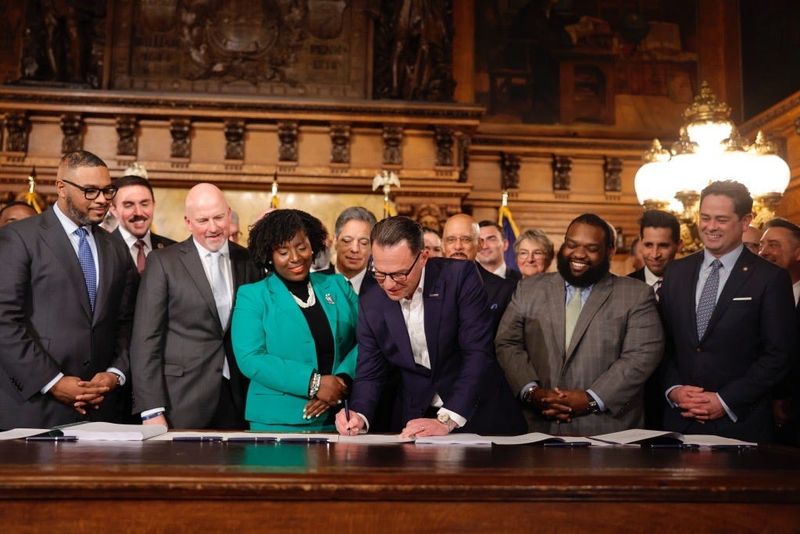
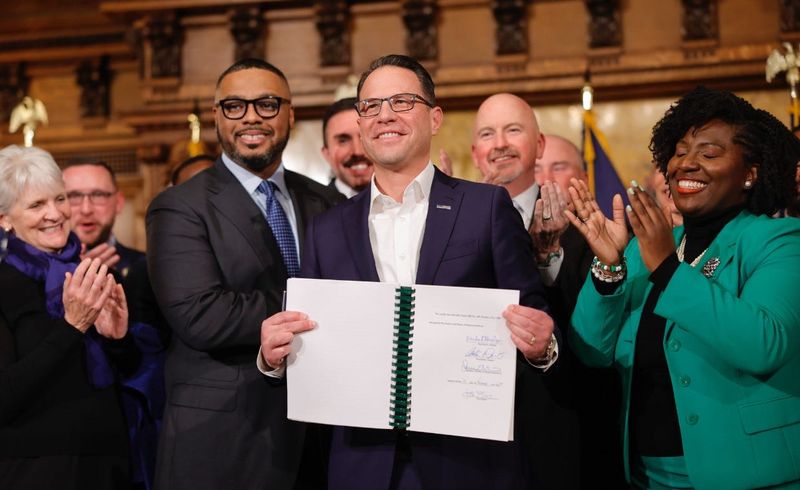
Gov. Josh Shapiro signs the fiscal year 2025-26 budget surrounded by General Assembly members on Nov. 12 at the Capitol in Harrisburg. The state budget had been due June 30, and Pennsylvania the final state in the country to approve a funding deal.
Critics are quick to note it took the self-proclaimed dealmaker so long to get a deal. Counties, school districts, and nonprofits struggled through four months without state payments while officials remained at loggerheads.Pennsylvania was the last state in the nation to pass a spending plan for the 2025-26 fiscal year.
“He’s five months late. He’s the governor of the fifth-biggest state in the country and the last state to get a budget done,” GOP consultant Vince Galko said. “It’s not a failing grade because it got done, but it’s still a D.”
‘A tremendous cost’
The $50.1 billion budget includes several key priorities for Shapiro and Democrats: significant increases in public education funding, a new tax credit for lower- and middle-income residents, continuation of a popular student-teacher stipend, and other economic and workforce development initiatives.
House Speaker Joanna McClinton (D., Philadelphia) heaped praise on Shapiro during a Monday news conference celebrating the budget’s new Working Pennsylvanians tax credit. “I am grateful that here in Harrisburg we have a hero among us for working families, and his name is Josh Shapiro.”
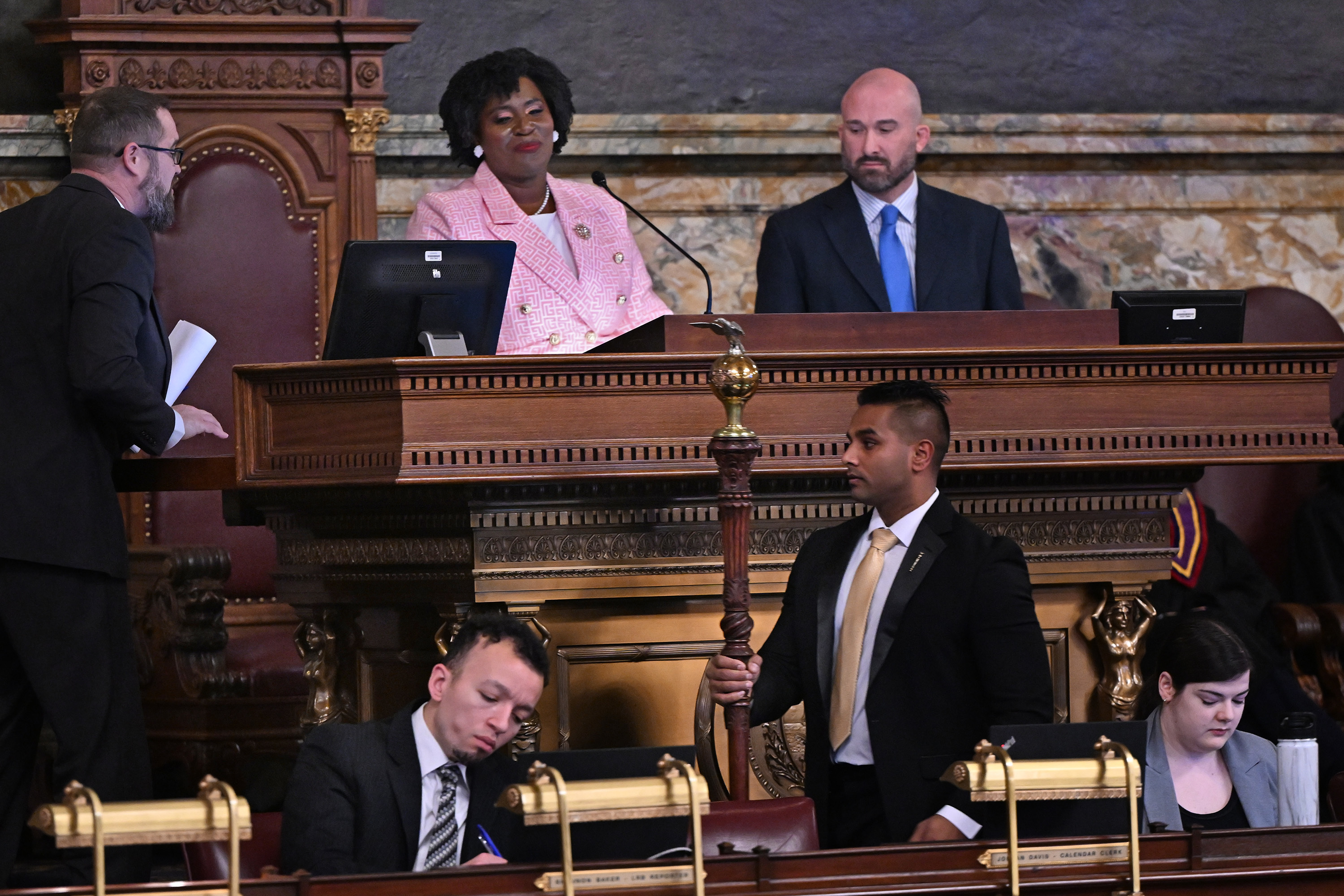
State Rep. Joanna McClinton (D., Philadelphia) is on the rostrum in the House chamber on Jan. 7 after she was reelected speaker of the House despite an initial 101-101 tie vote along party lines.
State Sen. Nikil Saval, a progressive lawmaker who represents part of Philadelphia, was one of a handful of Democrats to vote against the bipartisan Pennsylvania budgetbill that was largely lauded by Democrats and Republicans in Harrisburg and beyond. Saval applauded the school funding, anti-violence grant funding, and childcare support but slammed the absence of transit funding and Democrats’ agreement to end their pursuit to join a key climate program.
“Unfortunately, it comes at this tremendous cost,” he said.And ultimately, Saval said, the finished product didn’t seem to justify the time it took to get there.
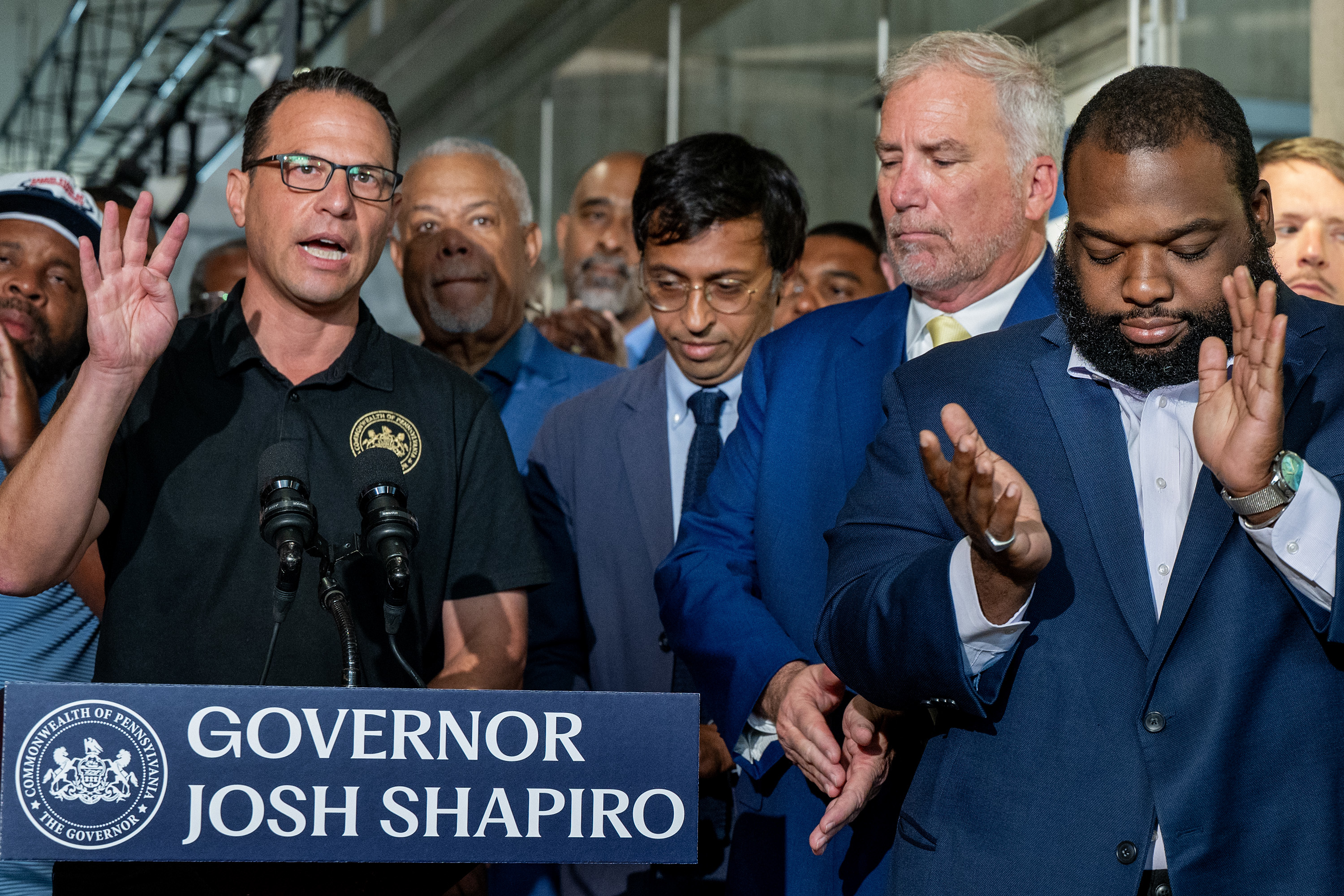
Gov. Josh Shapiro visits SEPTA headquarters on Aug. 10 to discuss funding for the transit agency. To his right, from left, are state Democratic legislators Sen. Anthony H. Williams; Sen. Nikil Saval; Rep. Ed Neilson; and Rep. Jordan Harris.
It was not just transit funding that took a back seat to get the budget deal over the line. To thedelight of Republicans — and the chagrin of some progressive Democrats and the climate-conscious — the deal also pulled the state out of the Regional Greenhouse Gas Initiative, a cooperative among states to reduce carbon emissions.
“For years, the Republicans who have led the Senate have used RGGI as an excuse to stall substantive conversations about energy,” Shapiro said. “Today, that excuse is gone.”
The powerful Pennsylvania Building and Construction Trades Council had lobbied heavily for lawmakers to walk away from the initiative, and it was a top win for state Republicans, who have long said the state should not join the multistate cap-and-trade emissions program they see as hamstringing Pennsylvania’s energy industry from accessing the state’s plentiful natural resources.
‘Two-a-days’
Shapiro said he spent months “running back and forth” to broker a deal between Senate Majority Leader Joe Pittman (R., Indiana) and House Majority Leader Matt Bradford (D., Montgomery). The three met on-and-off in private talks, attempting to hammer out a compromise between the Democratic House and Republican-controlled Senate. But the week of Oct. 27, more than four months into the stalemate, Shapiro said a “breakthrough” finally came when he broadened the talks to include McClinton and Ward.
Minority leaders Rep. Jesse Topper (R., Bedford) and Sen. Jay Costa (D., Allegheny) also joined the group, as it became clear that neither of the tightly controlled chambers would have the votes needed to pass a final budget deal.
The group met twice daily in a conference room in Shapiro’s office. Shapiro, always a fan of the sports metaphor, called the meetings “two-a-days.”
“We would come in the morning, go over the issues. We’d have our homework for a few hours, then come back in the afternoon and talk about, you know, the progress that we made,” Shapiro said. Coming out of that week, the governor said, leaders “had a clear direction on where we were going to go.”
Pennsylvania Lt. Gov. Austin Davis and Gov. Josh Shapiro show a budget document moments after it was signed Nov. 12 while surrounded by legislators at the state Capitol. A deal struck Nov. 12 ended a budget delay that lasted more than four months.
At the negotiating table, Shapiro served as “referee and facilitator” between House Democrats and Senate Republicans, McClinton said in an interview Monday.
“The man is nothing if not dogged and determined,” Bradford said of Shapiro last week.
Two officials in the closed-door talks said Topper’s presence, as the House minority leader who understands House Democrats and Senate Republicans, helped change the dynamic and got leaders on track toward a deal. Other officials in negotiations noted that once the state’s two top leaders — McClinton and Ward, who are both the first women to serve in their roles — the breakthrough deal swiftly came together.
Topper, for his part, didn’t try to take credit for striking the final budget deal, calling himself “a neutral arbiter” and “someone all sides can trust to have an honest dialogue.”
There were other signs of tensions easing as the legislators worked through the fall. Ward, a top critic of Shapiro since he reneged on a promise he made over school vouchers during his first budget negotiations, joined the conversations. The two had not met in person since 2023, and had barely communicated. Suddenly, they were sitting across from one another.
Kim Ward, president pro tempore of the Pennsylvania Senate, talks with her chief of staff Rob Ritson in her office Tuesday, Jan. 17, 2023, before heading out to preside over the swearing-in of Lt. Gov. Austin Davis in the Senate chambers.
Ward said her criticisms of Shapiro still stand — she wants him to be more transparent, among other disagreements. But she described the conversations as “very cordial, very professional.” And there were moments of levity that helped, said the top Republican leader in the Senate, who is known for her wry humor.
“He did leave me a sugar sprinkle heart [cookie] one day at my seat, and I told him, ‘You know, I’m too old for you, and we’re both married,’” she joked.
“I can’t understand why all these legislators think they did a great job,” she said on The Conservative Voice radio program, breaking with GOP leaders, like Ward and Pittman, who lauded the deal. “… Next year, they’re going to have to dip into the Rainy Day Fund to plug a budget, and then taxes are going to go up.”
Because of how long this budget took to finalize, Shapiro will already need to introduce his next budget in just three months, and in proximity to the 2026 midterms and Pennsylvania governor’s election. But it’s unclear whether those negotiations will be as fraught, given budgets tend to get resolved faster in election years with both parties eager to focus on the campaign trail.
“In this day and age, I would not downplay the fact that there was compromise,” said Berwood Yost, a pollster with Franklin and Marshall College. “People want their problems solved. They want politicians to do things that help their everyday lives and that, for most people, means some kind of compromise. Getting this problem solved fits with his narrative.”
Galko, the GOP consultant, looked further ahead to a potential 2028 presidential election. The budget impasse, he said, could provide material for Democratic rivals on the national stage. The possible field is filled with other governors, several from blue states, like Gov. JB Pritzker of Illinois and Gov. Gavin Newsom of California, where in-state dealmaking is easier among a uniform legislature.
“If he’s unable to negotiate with the Pennsylvania Senate, what’s he gonna do when he goes up against China or Russia?” Galko asked, previewing the possible attack.
Ultimately, history suggests Shapiro’s political success is likely to hinge less on the nuts and bolts of a budget only some Pennsylvanians — and even fewer outside Pennsylvania — are familiar with, and more on his ability to bolster his image as a bipartisan governor in a purple state.
On Friday morning in South Philadelphia, Shapiro sported a bomber jacket while posing for selfies with Eagles fans, nodding along to a rock band’s cover of “Santeria” in a tent outside the Xfinity Mobile Arena at an event hosted by radio station WMMR.
Casually, almost as a throwaway line, Shapiro mentioned to radio hosts Preston and Steve during an interview that he planned to bring Michigan Gov. Gretchen Whitmer — a fellow swing-state governor seen, too, as a possible 2028 Democratic contender — as his guest to the Eagles-Lions game at the Linc that Sunday.
“She actually said, ‘Is it OK if I wear Lions stuff?’” Shapiro told the kelly green-clad crowd in Philadelphia, riffing on the friendly football rivalry — the undercurrents of national politics left unspoken. “And I’m like, ‘No problem. You’re on your own in the parking lot. I can’t protect you.’”
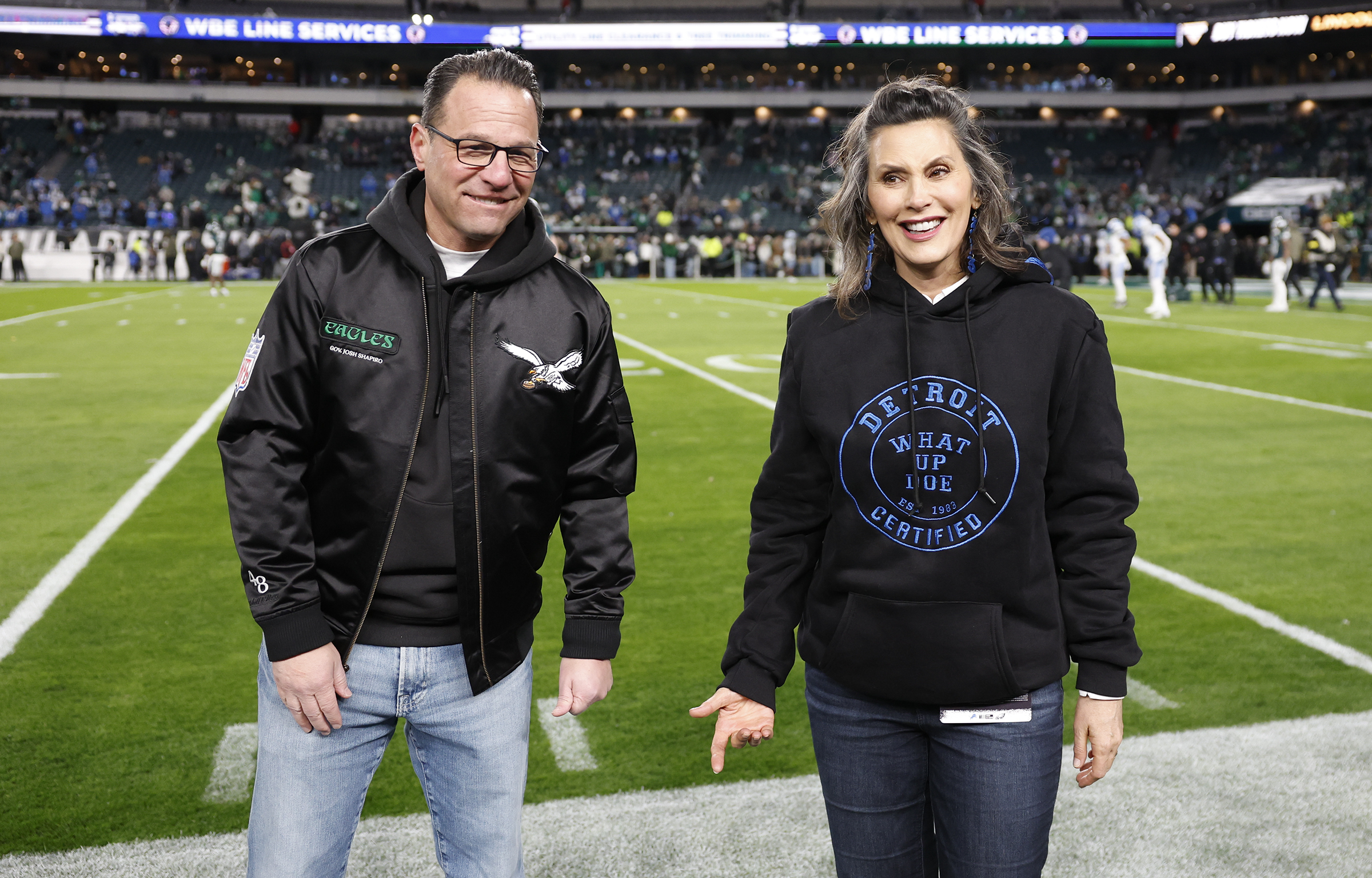
Michigan Gov. Gretchen Whitmer joined Pennsylvania Gov. Josh Shapiro at Sunday’s game between the Eagles and Detroit Lions at Lincoln Financial Field.
The event was a food drive but also served as a tribute to the station’s beloved late host, Pierre Robert. Shapiro brought along a commendation from the governor’s office for the occasion.
“He created community, created joy, brought people together,” Shapiro said of Robert. “You think about just how divided we are as a world, there’s a few things that still bring us together, right?”
“By the way, I’ve learned those lessons. That’s what I try and do governing with a, you know, divided legislature.”
Music and sports, the governor mused before the crowd of Philadelphia fans, are two things that bridge the gap. “Go Birds,” he added with a grin.
Staff writer Katie Bernard contributed to this article.
Philly theater darling James Ijames, the Pulitzer Prize-winning playwright of Fat Ham, will return to local stages with a special spotlight next spring, with a slate of three plays running at three theaters.
Recognizing this scheduling synergy, the venues are partnering to offer a three-ticket pass, called “The Citywide James Ijames Pass.”
The first collaboration of its kind dedicated to a contemporary playwright, the pass covers the Philadelphia premiere of Good Bones at the Arden Theatre (Jan. 22 to March 8), The Most Spectacularly Lamentable Trial of Miz Martha Washington at the Wilma Theater (March 17 to April 5), and the world premiere of Ijames’ latest work, Wilderness Generation, at Philadelphia Theatre Company (April 10 to May 3).
Ijames wrote all of these plays in South Philadelphia, which he considers his artistic home. This year, he left his teaching position at Villanova University to run the playwriting program at Columbia University. While that means he’s spending most of his time in New York now — though his husband, Joel Witter, still works for the Philly school district — Ijames says Philadelphia is “still very much a place where I want to continue to make art.”
“I’ve lived in Philly more than I’ve lived anywhere in my life, so it is incredibly special to me,” said the Tony-nominated playwright, a founding member of the local playwriting collective Orbiter 3.
After growing up in North Carolina and attending Morehouse College in Atlanta, Ijames got his MFA in acting at Temple University. He performed on stages all over the city, including at the National Constitution Center, People’s Light, and all three theaters featured in the pass.
It was during the 2012 production of Angels in America at the Wilma where he wrote Miz Martha Washington, one of his earliest plays, in the dressing room. Ijames went on to serve as one of three co-artistic directors of the Wilma, which premiered the digital production of Fat Ham — his incisive and irreverent queer reimagining of Hamlet — that earned him the 2022 Pulitzer Prize.
Flashpoint Theatre Company’s Barrymore-nominated “The Most Spectacularly Lamentable Trial of Miz Martha Washington.” From left: Darryl Gene Daughtry Jr., Steven Wright, Taysha Canales, and Jaylene Clark Owens surround Nancy Boykin as Martha Washington.
Photo by Ian Paul Guzzone.
In the sharp satire Miz Martha Washington, the titular first lady is on her deathbed, surrounded by the people she and her husband enslaved. With freedom inching closer — George Washington’s will promised them liberty upon his widow’s death — the Black characters appear in various hallucinations, putting Martha and her family on trial.
The play will come back to town amid Philadelphia’s celebrations for the 250th anniversary of the nation’s founding, apt timing for a sharp satire on the Founding Fathers’ legacy of slavery.
“I think we were all kind of hoping that the world and the politics would be a little different when we first started thinking about it,” said Ijames. “But I always say, we have to look at the history directly in the face and, from that, try to imagine something different.”
Good Bones is a more contemporary story about the development of a new stadium that stands to disrupt a city neighborhood (sound familiar?). The upper-class newcomer, haunted by those who were pushed out, gets into fiery debates over gentrification with her contractor.
The Philly premiere will be directed by Ijames’ longtime friend and collaborator Akeem Davis, who starred in the Ijames-directed production of August Wilson’sKing Hedley II at the Arden earlier this year.
Arden Theatre producing artistic director Terry Nolen hopes audiences will come out to cheer on a “hometown hero.”
“Philly audiences love Philly artists, and there is so much pride for James’ success,” Nolen said in a statement.
Philly playwright James Ijames attends the 76th Annual Tony Awards at United Palace Theater on June 11, 2023, in New York City. His play “Fat Ham” had five nominations, including best play. (Photo by Cindy Ord /Getty Images for Tony Awards Productions)
The playwright’s newest work, Wilderness Generation, examines the relationships between cousins as Ijames, who’s close to his own cousins, wanted to spotlight that kind of family dynamic. Five cousins reunite at their grandmother’s house in the South to help her downsize; while there, they unpack a painful family history and confront the damage of their relatives’ behavior as they try to forge a future together.
Ijames wrote the work with Philadelphia Theatre Company co-artistic directors Taibi Magar and Tyler Dobrowsky in mind. Though Ijames has performed at PTC before, this world premiere marks the first time a play he wrote will grace its stage.
“I am where I am because a lot of theaters in Philadelphia took a chance on me,” said Ijames. He hopes future collaborations can highlight more “really brilliant folks” writing new plays in Philly.
“I hope a thing that happens as a result of this is a Jackie Goldfinger package one day, a Michael Hollinger package, an Erlina Ortiz package, [and] an AZ Espinoza package.”
The three-play pass costs $130, about $43 per ticket, and includes preferred seating, flexible ticket changes, parking discounts, and member benefits at each theater, as well as exclusive swag — a yellow beanie, inspired by Ijames’ personal style. Passes are available online or at the TKTS booth at the Independence Visitor Center.
The companies that own the 76ers and Flyers earlier this year made a high-profile commitment to help transform the long-distressed East Market Street corridor.
The first development to come out of that promise? Perhaps a mini-soccer pitch. Or a pop-up beer garden.
The teams recently hired a contractor to demolish buildings they own on the 1000-block of the beleaguered thoroughfare with the goal of eventually erecting a major development that could help revitalize the area.
But, until then, City Councilmember Mark Squilla said Friday the teams and city leaders hope to “activate” the lots slated for demolition with “pop-up” opportunities related to the FIFA World Cup and the nation’s 250th birthday being hosted in Philadelphia next summer.
“The goal was: If they could demolish it by then and fill it, we could program an open space on 1000 Market Street,” Squilla said, tossing out the soccer pitch and beer garden ideas as examples. “This will give us an opportunity to try to do something special for 2026 while we’re doing a longterm plan for East Market.”
(function() { var l = function() { new pym.Parent( ‘sixersbuild__graphic’, ‘https://media.inquirer.com/storage/inquirer/ai2html/sixersbuild/index.html’); }; if(typeof(pym) === ‘undefined’) { var h = document.getElementsByTagName(‘head’)[0], s = document.createElement(‘script’); s.type = ‘text/javascript’; s.src = ‘https://pym.nprapps.org/pym.v1.min.js’; s.onload = l; h.appendChild(s); } else { l(); } })();
Jacklin Rhoads, a spokesperson for the teams’ development venture, said Friday the demolitions come as the partners “continue to make progress towards future development on East Market Street.”
“The demolition of these vacant storefronts improves the streetscape and will give us the ability to work with community partners to activate the site ahead of groundbreaking,” Rhoads said. “We are committed to working with the City to help jump start the revitalization of Market East and this is the next step in that process.”
The teams’ commitment to work together as Market East boosters stems from the controversial and since-abandoned proposal by the 76ers’ owner, Harris Blitzer Sports & Entertainment, to build an arena in Center City.
The basketball team had pitched that proposal as an opportunity to rejuvenate the blocks east of City Hall. But when the plan crumbled in January — in no small part due to opposition from the Flyers’ owner, Comcast Spectacor — the teams vowed to work as partners both on a new arena in the South Philadelphia stadium complex as well as on a joint development venture for East Market Street.
The Sixers and Flyers recently hired a joint venture of New York-based Turner Construction Co. and Indiana-based AECOM Hunt to manage construction of the arena, which will be home to the city’s NBA and NHL teams and its planned, as-yet-unnamed WNBA team.
And the teams have hired Philadelphia- and Norristown-based contractor Pride Enterprises Inc. to demolish the vacant storefronts they own on East Market Street in Center City.
Tearing down and popping up
Demolitions are so far only planned for part of the 1000-block, across the street from where the Sixers had previously envisioned building their new home.
HBSE and Comcast Spectacor — a subsidiary of the Philadelphia-based entertainment, cable television, and internet giant — bought properties on East Market Street in a series of transactions totaling $56 million earlier this year. The buildings were formerly home to Rite Aid, Reebok, and other stores totaling 112,000 square feet.
The properties currently slated for demolition are 1000-1024 E. Market St. That includes most of the former stores on the block’s south side. The teams also own 920-938 E. Market St., the western half of the adjacent block, but those properties are not currently planned for tear-downs.
The teams’ plan to flattenthe stores, making the space temporarily available for events related to the FIFA World Cup or the nation’s 250th anniversary next summer.
Squilla said an East Market task force will be announced soon, and that group would have input on what happens at the site assuming it is demolished in time for the 2026 celebrations.
After that, the teams will redevelop the properties, although plans aren’t finalized, Rhoads said. The teams declined to provide any details about the redevelopment project’s ambitions or scale.
The city Department of Planning & Development did not respond to a request on the status of the development plans.
The neighborhoods around East Market, a thriving department store district that has languished for decades, have recently begun to rebound with the development of hundreds of apartments and neighborhood retail to serve new residents.
Stadium construction vets tapped for South Philly arena
The new arena in South Philly will replace the Flyers and Sixers’ current home at the recently renamed Xfinity Mobile Arena, which was known as the Wells Fargo Center until this year.
Currently, Comcast Spectacorowns the building, and the 76ers pay rent. For the next facility, the teams will be joint owners.
The teams have tapped an outfit with ample experience in stadium and arena construction for the job. Over the past 20 years, Turner-AECOM Hunt joint ventures have built the Barclays Center in Brooklyn, the SoFi Stadium and Intuit Dome in Los Angeles, State Farm Arena in Atlanta, and Nissan Stadium in Nashville.
In Philadelphia, they built the Eagles’ Lincoln Financial Field, the FMC Tower, the One uCity Square office building in University City, and the Chubb Center in Center City, the insurance company offices set to open next year.
For the South Philly project, the partners, doing business as PACT+, have brought on Philadelphia-based union contractors to do much of the work, including Black-owned general construction company Perryman Construction, construction manager Hunter Roberts Construction Group, and Camfred Construction.
The teams haven’t said how large the arena will be. HBSE and Comcast Spectacor in June hired a design team at the firm Populous and Moody Nolan.
David Adelman, the Philadelphia student housing developer and investor who chairs the teams’ development venture, in a statementpromised “the most technologically advanced and fan-focused sports and entertainment venue.”
Adelman earlier said the new arena will open in 2030, and the WNBA team will play its first game there.
The project “is a chance to build something that becomes part of Philadelphia’s fabric,” said Turner’s Philadelphia-based vice president, Dave Kaminski, in a statement.
Jason Kopp of AECOM Hunt promised “cutting-edge amenities for athletes, performers, and visitors.”
Although the teams are making moves related to the new arena, they don’t yet appear to have shared much of their plan with City Council President Kenyatta Johnson, whose 2nd District includes the South Philadelphia stadium complex.
Building an arena at that location will likely require involve fewer legislative and bureaucratic hurdles than the 76ers’ abandoned Center City proposal. But in Philadelphia, Council members hold enormous sway over their districts, and the teams will likely need Johnson’s support if they want a smooth approval process.
Johnson was asked Thursday what the teams need to do to meet their proposed timeline for opening the arena in 2030.
“I have no idea,” Johnson told reporters. “That’s not even on my radar at the moment.”
Staff writer Mike Newall contributed to this article.
Despite the public fall from grace, the voter said he missed John Dougherty’s leadership in Philadelphia, adding that he believed Dougherty had been good for workers in the city. They are brothers, Kevin Dougherty confirmed.
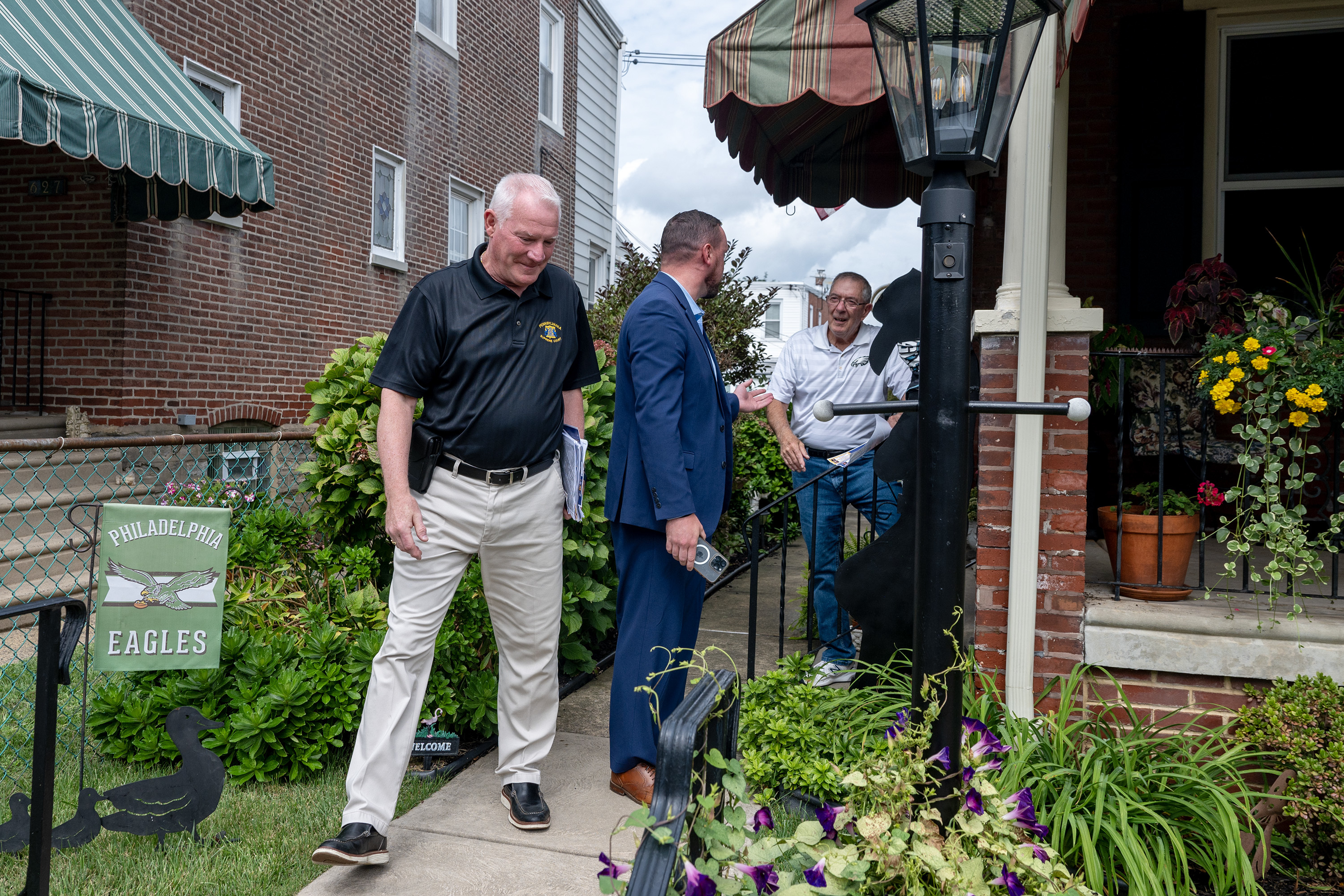
Justice Kevin Dougherty (left) canvasses with his son, State Rep. Sean Dougherty (center) in Fox Chase Sunday Sept. 7, 2025, stopping at the home of a voter. The elder Dougherty is one of three Pennsylvania Supreme Court justices up for retention.
But in this year’s unusually high-profile state Supreme Court retention race, the connection has, in some circles, become unavoidable. Republicans seeking to oust Kevin Dougherty and two of his colleagues, all initially elected as Democrats, have sought to tie the judge to his brother’s misdeeds. The justice, a son of South Philadelphia who previously led Philadelphia’s Family Court, has sought to distance himself, and has seen the continued support of labor unions in his retention campaign.
“Over the course of 25 years as a judge, including ten years as a Justice on the Supreme Court, Justice Dougherty has had the privilege and the benefit of meeting a multitude of Pennsylvanians including the working men and women of organized labor,” Shane Carey, Kevin Dougherty’s campaign manager, said in a statement. “Our campaign is proud to receive their support, as well as the support from almost 5,000 other individual donors.”
How Johnny Doc helped elect his brother to the Supreme Court in 2015
Kevin Dougherty didn’t choose to be related to one of the city’s most prominent power brokers, but he certainly benefited from his brother’s former union’s help, with significant support from the politically powerful Local 98 during his 2015 campaign for the state bench.
Local 98, where John Dougherty was the longtime business manager, contributed more than $620,000 during Kevin Dougherty’s 2015 campaign for the Pennsylvania Supreme Court. Local 98’s spokesperson at the time also served as Kevin Dougherty’s campaign manager and appears from campaign finance filings that year to have been paid by Local 98. The union also spent more than $480,000 on in-kind contributions for “professional services,” mailers, merchandise,and more.
Justice Kevin Dougherty talks with volunteers before they head out the canvass in Fox Chase Sunday Sept. 7, 2025. Dougherty is one of three Pennsylvania Supreme Court justices up for retention.
Kevin Dougherty is the only justice up for retention from Southeastern Pennsylvania. The other justices, Christine Donohue and David Wecht, live in Pittsburgh. They will each appear on the November ballot with no party and no home county. Voters will simply be asked “yes” or “no” whether each individual justice should be retained for another term.
Republicans working to oust the three justices this year have tried to leverage Kevin Dougherty’s past support from his brother to encourage voters to oppose his retention.
Scott Presler, an influencer aligned with President Donald Trump who has more than 2.4 million followers and runs a political action committee aimed at registering Republican voters, posted an AI-generated image of John Dougherty behind bars, tying, without evidence, Local 98’s contributions to Kevin Dougherty’s 2015 campaign to his brother’s convictions.
“Coincidence?” Presler wrote.
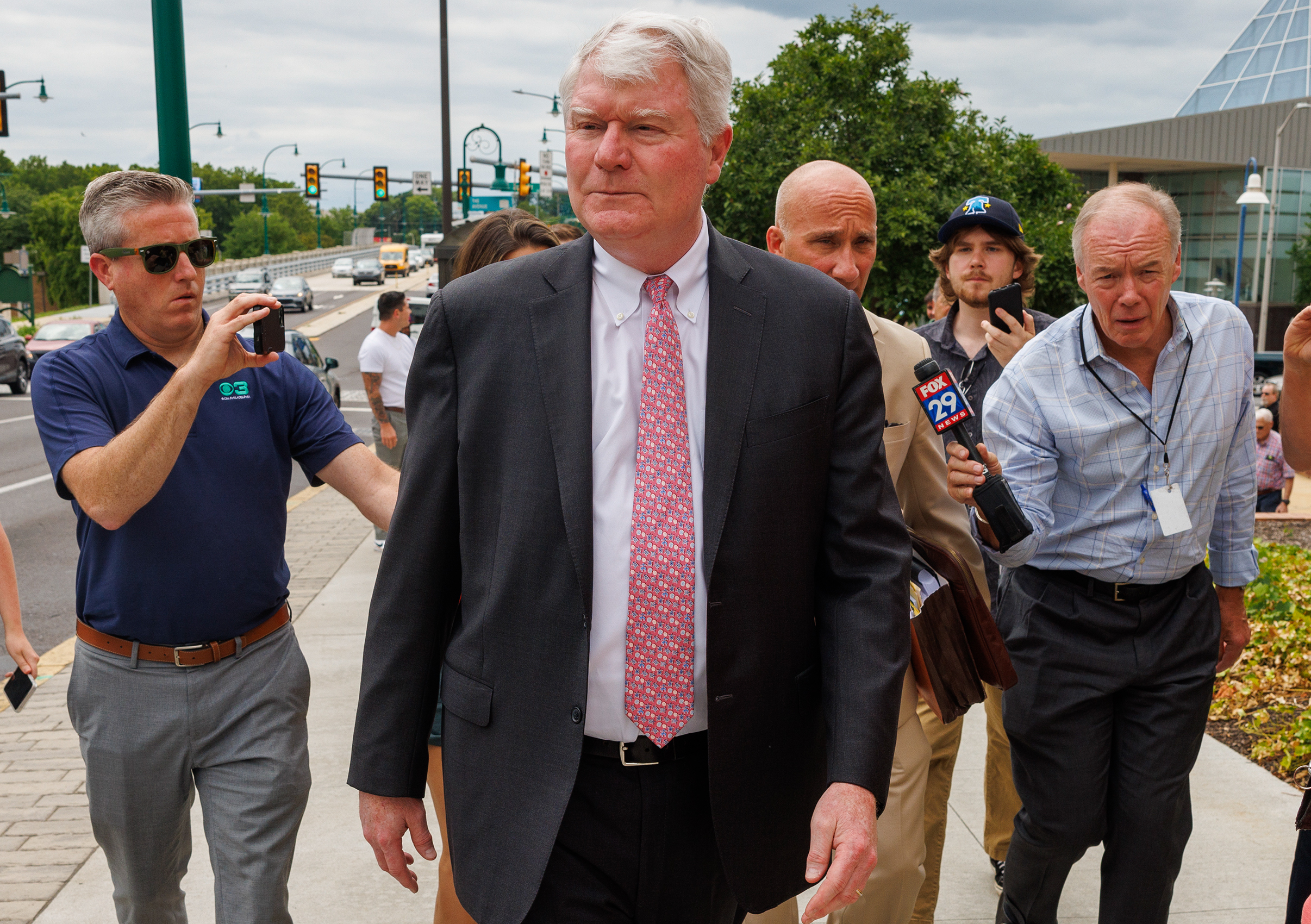
Johnny Dougherty, the former IBEW business manger, and his attorney Gregory J. Pagano as they leave the U.S. District Court, Reading, Pa. on the day he was sentenced to 6 years in prison Thursday, July 11, 2024.
For months, the conservative influencer has posted on social media urging followers to vote against retaining Kevin Dougherty and his colleagues, citing the times his name was mentioned during John Dougherty’s trials, such as when prosecutors alleged the justice received free home repairs or snow removal on the union’s dime. Kevin Dougherty’s lawyer at the time of the embezzlement trial said the judge never knowingly accepted services paid for with union funds.
While door-knocking in September, Kevin Dougherty dismissed attacks against him related to his brother as “misinformation,” noting his decades-long career as a judge.
Kevin Dougherty, 63, spent more than a decade as a Common Pleas Court judge in Philadelphia before his election to the state Supreme Court. During his tenure on the state’s highest court, he has authored majority opinions and is leading a statewide initiative to improve how Pennsylvania’s judicial system interacts with people with behavioral health issues.
“I spent close to a quarter of a century being a judge,” Dougherty said on a sidewalk in Northeast Philly. “I just don’t accept people’s comments and judgment. I want to know what the motive behind those comments are. Some of these comments are just partisan … and I believe in my reputation.”
The justice should be vetted on his own merits, said John Jones, a former U.S. District Court judge for the Middle District of Pennsylvania who was appointed to the bench by former President George W. Bush.
“You can pick your friends, but you can’t pick your relatives,” Jones, now president of Dickinson College, added. “You have to judge the justice on his own merits. This is not a country where we favor guilt by association.”
Kevin Dougherty still has broad union support, including from Local 98
With John Dougherty no longer at the helm of Local 98, labor unions in Pennsylvania this year still overwhelmingly supported the justice for retention, contributing $665,000 to Kevin Dougherty’s campaign as of September. While trades unions contributed the most of any interest group to all three justices — for a total of $903,000 as of the latest filings — Kevin Dougherty is the largest beneficiary of that support.
Among those contributors: Local 98. The union, which has reorganized and distanced itself from John Dougherty since he was first convicted in 2021, gave $70,000 to Kevin Dougherty’s retention campaign.
“IBEW Local 98 does not support candidates based on personal relationships,” said Tom Lepera, Local 98’s political director, in a statement. “We support candidates who understand and stand up for the needs of working men and women in organized labor. Justice Dougherty, along with Justices Donohue and Wecht, have consistently demonstrated their commitment to protecting the rights and interests of middle-class workers across this commonwealth.”
Kevin Dougherty’s campaign did not respond to several questions this weekabout his brother’s role in his 2015 campaign or whether his brother’s reputation has influenced the retention campaign.
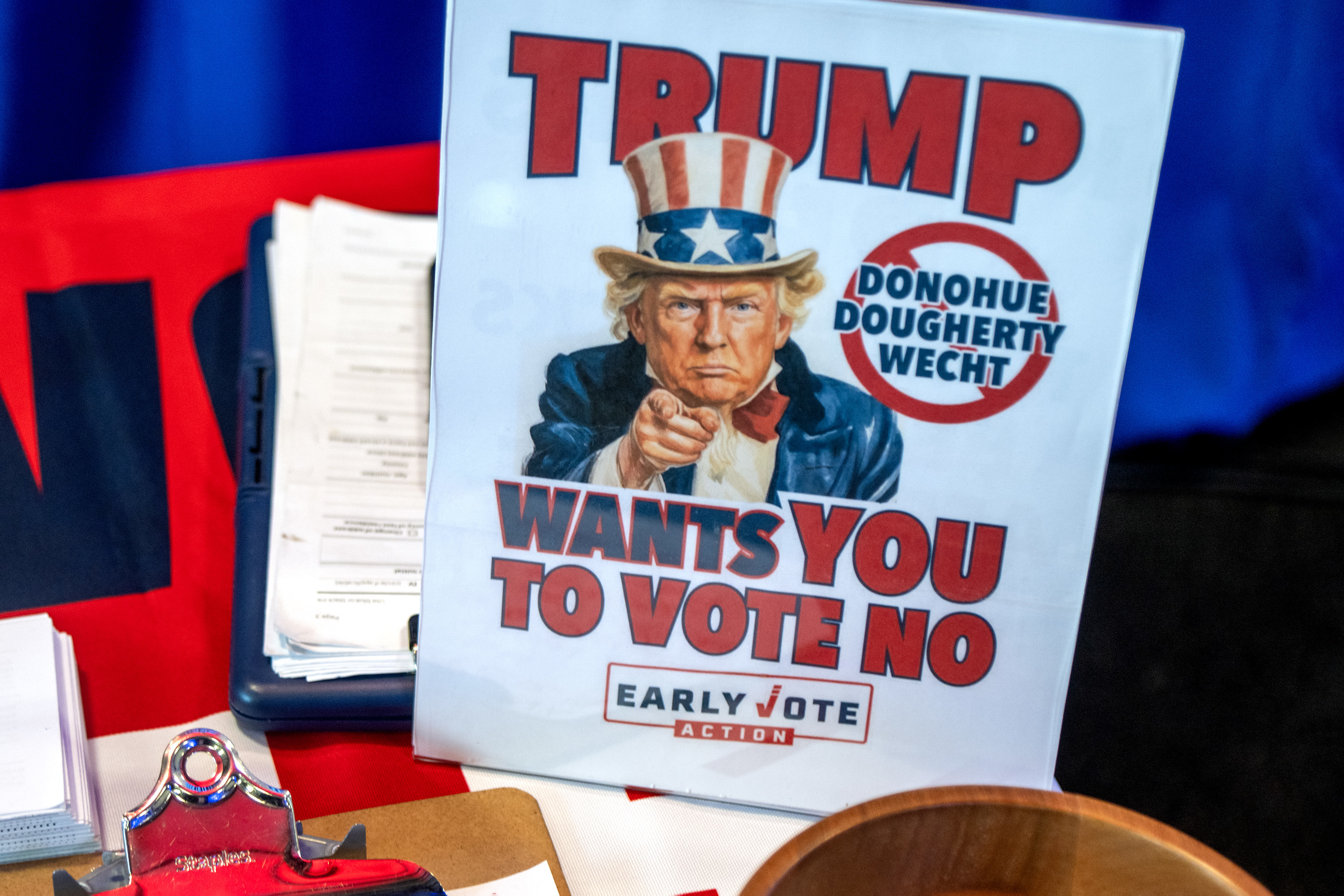
Anti-retention material featuring President Donald Trump as Uncle Sam was on display at Republican rally in Bucks County last month headlined by Treasurer Stacy Garrity, a candidate for governor. The material is from Early Vote Action, a group led by GOP influencer Scott Presler.
Union leaders insist their support for Kevin Dougherty this year has nothing to do with his brother and is a reflection of his quality work in the judiciary. Labor unions often support Democratic candidates, who are often seen as more beneficial to unions and their priorities.
“It’s about keeping good judges on the bench,” said Ryan Boyer, leader of the Philadelphia Building and Construction Trades Council, an umbrella organization of local trades unions once commanded by John Dougherty. This year, the building trades gave just over $33,000 to each justice.
“We don’t live on Mars where we don’t know that sometimes familial connections can be there,” Boyer said, “and they try to exploit those things.”
Nonpartisan and Democratic groups favor Dougherty’s tenure on the bench
Like his colleagues running for retention, Kevin Dougherty has earned broad support from nonpartisan and partisan groups alike.
Lauren Cristella, CEO of the Committee of Seventy, the Philadelphia-based good-government group, noted that the justice was never charged or found guilty of wrongdoing.
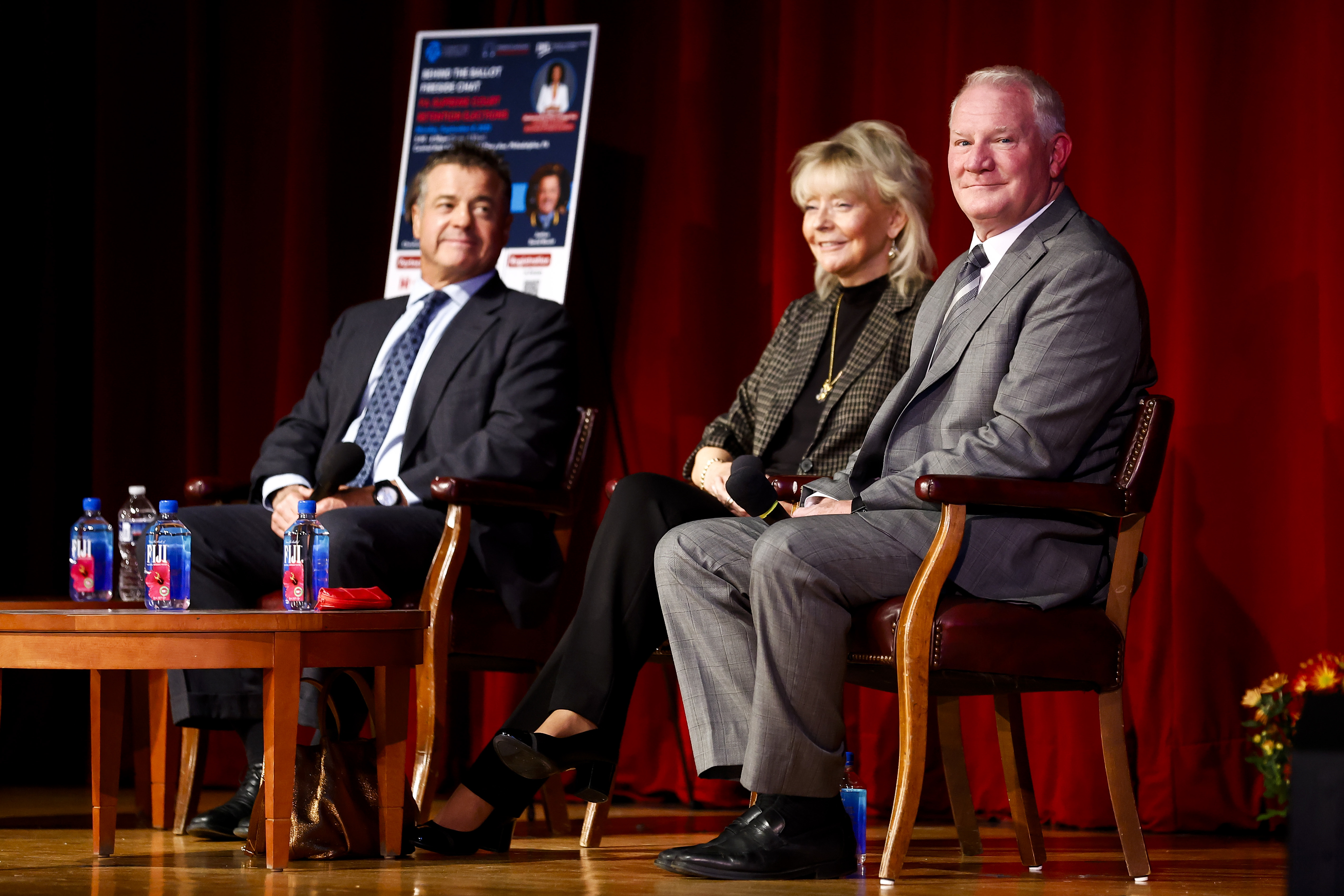
Justices David Wecht, Christine Donohue and Kevin Dougherty sit onstage during a fireside chat at Central High School on Monday, Sept. 8, 2025 in Philadelphia.
“The Committee of Seventy relies on the findings of law enforcement and professional oversight organizations, such as the Bar Association, when evaluating judicial candidates. This year, the Pennsylvania Bar Association has evaluated Justice Dougherty and recommended him for retention. Our focus remains on transparency, accountability, and maintaining public trust in Pennsylvania’s courts,” Cristella said in a statement.
Dougherty and his fellow justices have also gained the support of Gov. Josh Shapiro, Pennsylvania’s popular Democratic governor, who in a fundraising email to Pennsylvania Democrats on Thursday urged voters to mark “yes” on retaining Dougherty, Donohue, and Wecht.
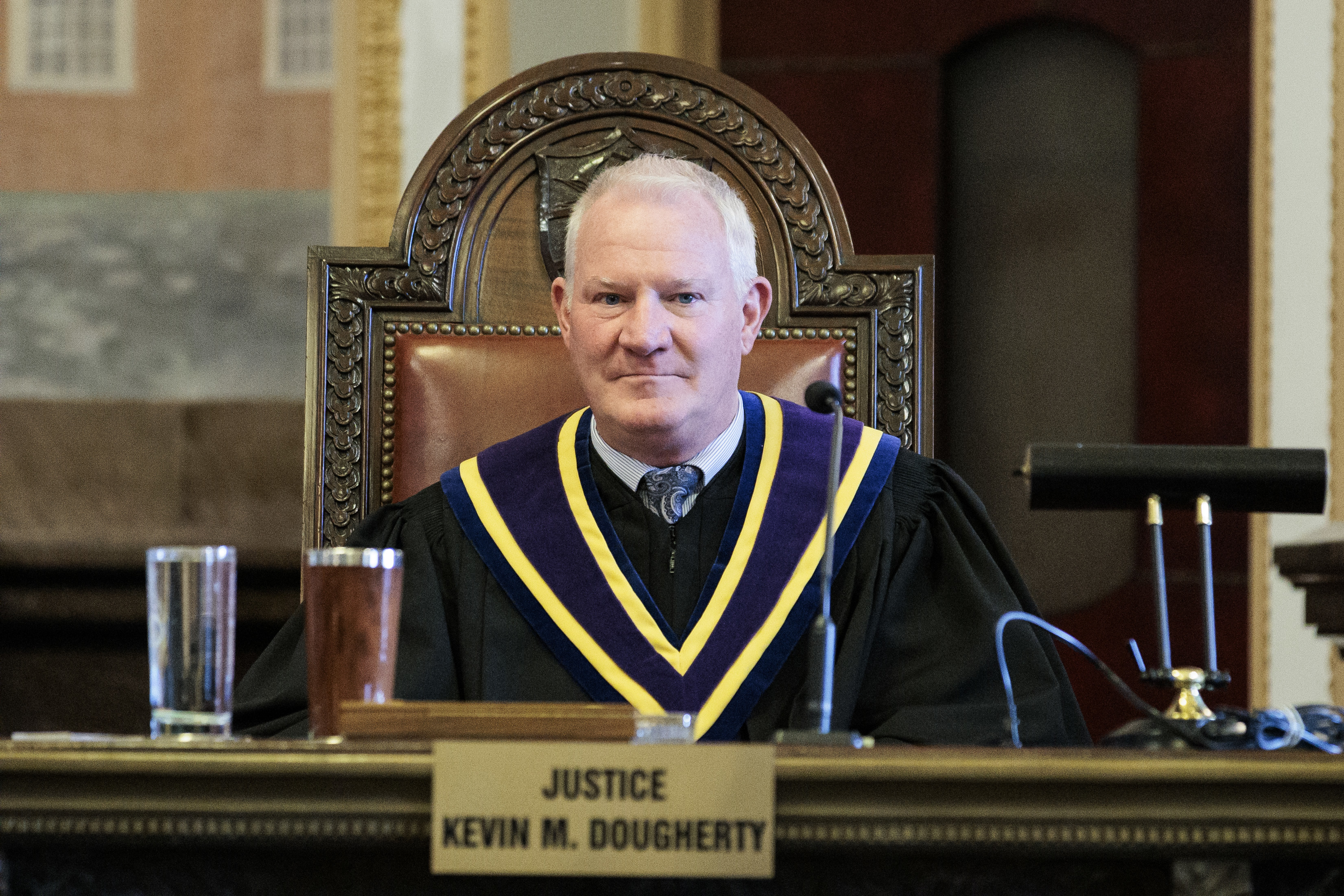
Justice Kevin M. Dougherty listens during a Courtroom Dedication Ceremony at the Supreme Court Courtroom in Philadelphia City Hall on Tuesday, Sept. 9, 2025 in Philadelphia.
“The threats to our freedoms are coming from all directions, and we need a Court that stands up for what’s right,” Shapiro said in the email. “Justices Donohue, Dougherty, and Wecht have proven that we can count on them to protect freedom, reproductive rights, and the rule of law.”
In a statement to The Inquirer, Kevin Dougherty didn’t mention his brother by name.
“With regard to my personal relationship I love my big brother. For obvious reasons, my brother is not participating in my Retention campaign,” he said.
South Philadelphia is set to get a new supermarket in early 2026.
New York-based Met Fresh is on track to open its first Philly location in January inside the former Walgreens at Broad and Snyder Streets, said owner Omar Hamdan.
The 13,000-square-foot supermarket will include a pharmacy, a fresh-cut produce department, and a deli counter, Hamdan said, and will offer free grocery and prescription delivery to area seniors. It is also applying for a license to sell beer and wine.
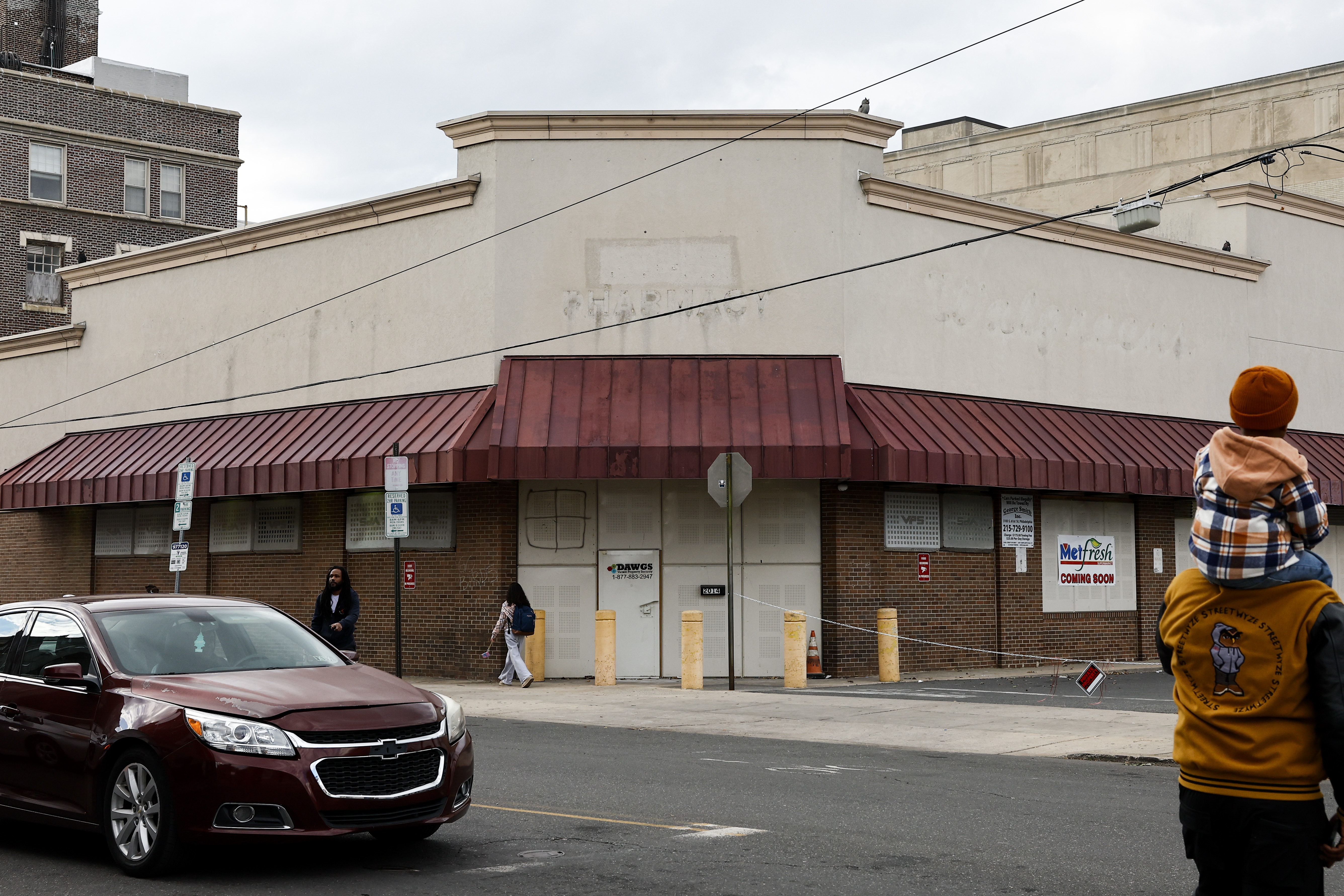
The former Walgreens at 2014 S. Broad St., where Met Fresh’s first Philly location is set to open in early 2026, photographed on Wednesday.
“We try to bring the human factor back into the market,” Hamdan said, adding that the company’s philosophy hearkens back to a simpler time: “That store owner who had the apron and was sweeping outside of his store, who said ‘good morning’ to everyone? That is what we do.”
Met Foods, a family-owned company, has been operating markets in New York City for 15 years, Hamdan said. It currently has locations in the Bronx, Brooklyn, Queens, Staten Island, and northern New Jersey.
When the South Philly grocer opens, it will mark Met Fresh’s first location outside the New York City area, Hamdan said.
Since then, Hamdan said they continued to look for potential Philadelphia locations. The store at 2014 S. Broad Street seemed like “a perfect fit,” he said, due to the area’s walkability, dense population, and a demand for more grocery stores and pharmacies.
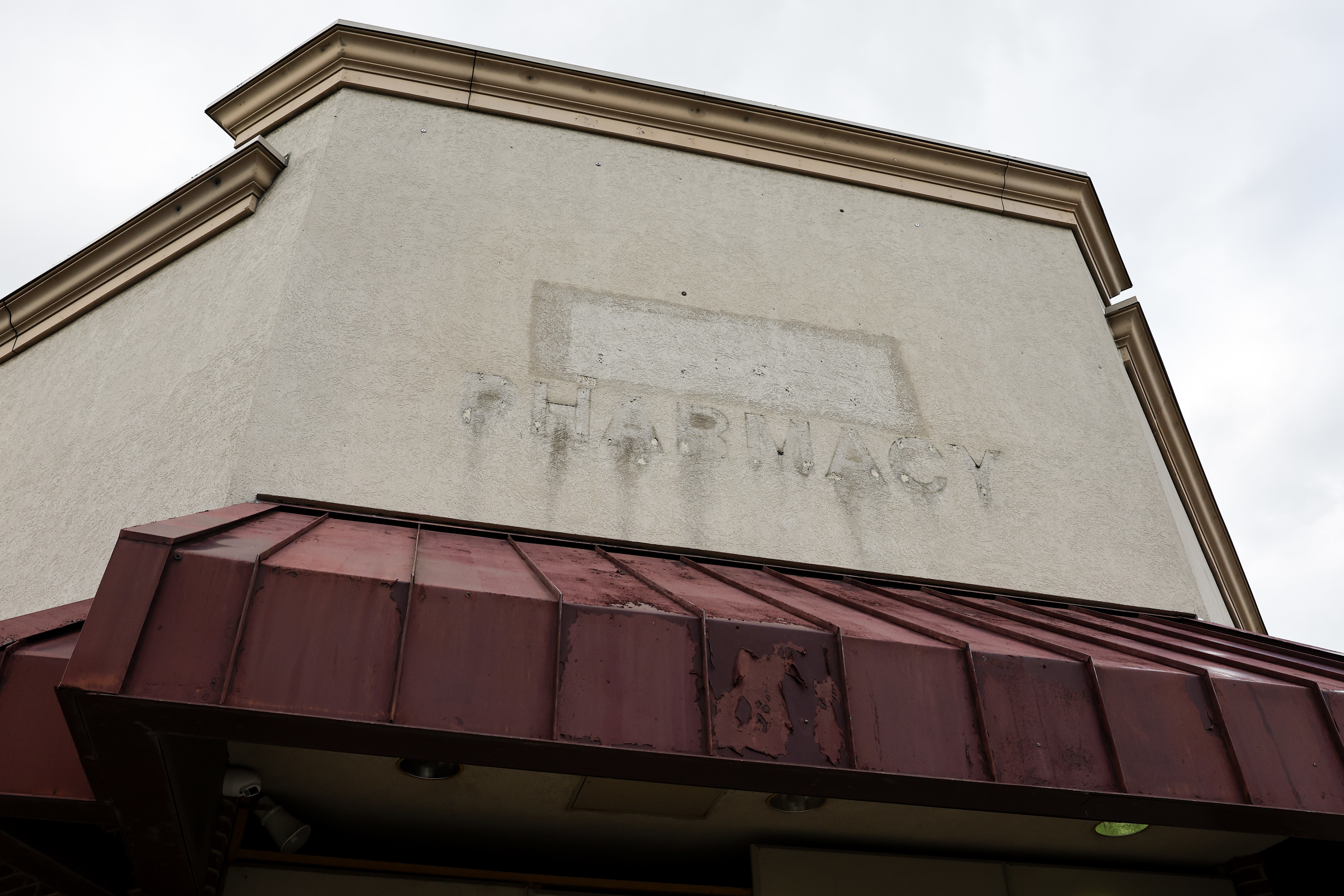
The “pharmacy” lettering is seen on a former Walgreens on South Broad Street, where Met Fresh plans to open a supermarket in early 2026 after “extensive” renovations, its owner said.
From the Broad Street store, the nearest supermarket is seven-tenths of a mile away. As for chain pharmacies, the Walgreens closed last year, and a Rite Aid across the street shuttered this summer as the Philly-based company went out of business. So the nearest large drugstore is a CVS off Passyunk Avenue, also seven-tenths of a mile away.
The Met Fresh will soon start hiring in South Philly, with Hamdan noting that his stores typically need 30 to 40 part- and full-time employees from the surrounding communities. The new location will open after “extensive” renovations, Hamdan said, and once the team gets ahold of refrigeration equipment, which has been impacted by tariffs on steel and aluminum.
Hamdan said he’s excited for Philly consumers to be introduced to Met Fresh, calling the Broad Street spot “a test pilot to see how we do in the Philly market.”
The spirits of the pets come first, treading home on soft, shadowy paws, making their way by the light of altar candles and guided by the eternal tie of love.
They are welcomed with offerings of favorite treats and fresh water, and by the careful placement of old toys and worn collars that have become cherished mementos.
It’s a new tradition connected to the Day of the Dead, the ancient Mexican holiday where people honor and celebrate the lives of family members at a time when the wall between worlds melts.
Now, in Philadelphia and elsewhere, people have begun to recognize not just human relatives but those with wings and whiskers, the departed dogs, cats, birds, and other animals that enriched their lives. And who, like family, continue to be mourned and missed.
The souls of pets are said to return on Oct. 27, a few days before the Dia de Muertos on Nov. 1 and 2.
“The day,” said Gerardo Coronado Benitez, manager of the Association of Mexican Business Owners of Philadelphia, “is not about death, but about celebrating and remembering people, keeping memories alive. Of course many people want to keep alive the memories of their pets.”
He is helping organize a big Day of the Dead event at the Italian Market on Nov. 2, where people will be able to place photos of relatives and pets on a community ofrenda ― a decorated altar ― at Ninth Street and Washington Avenue.
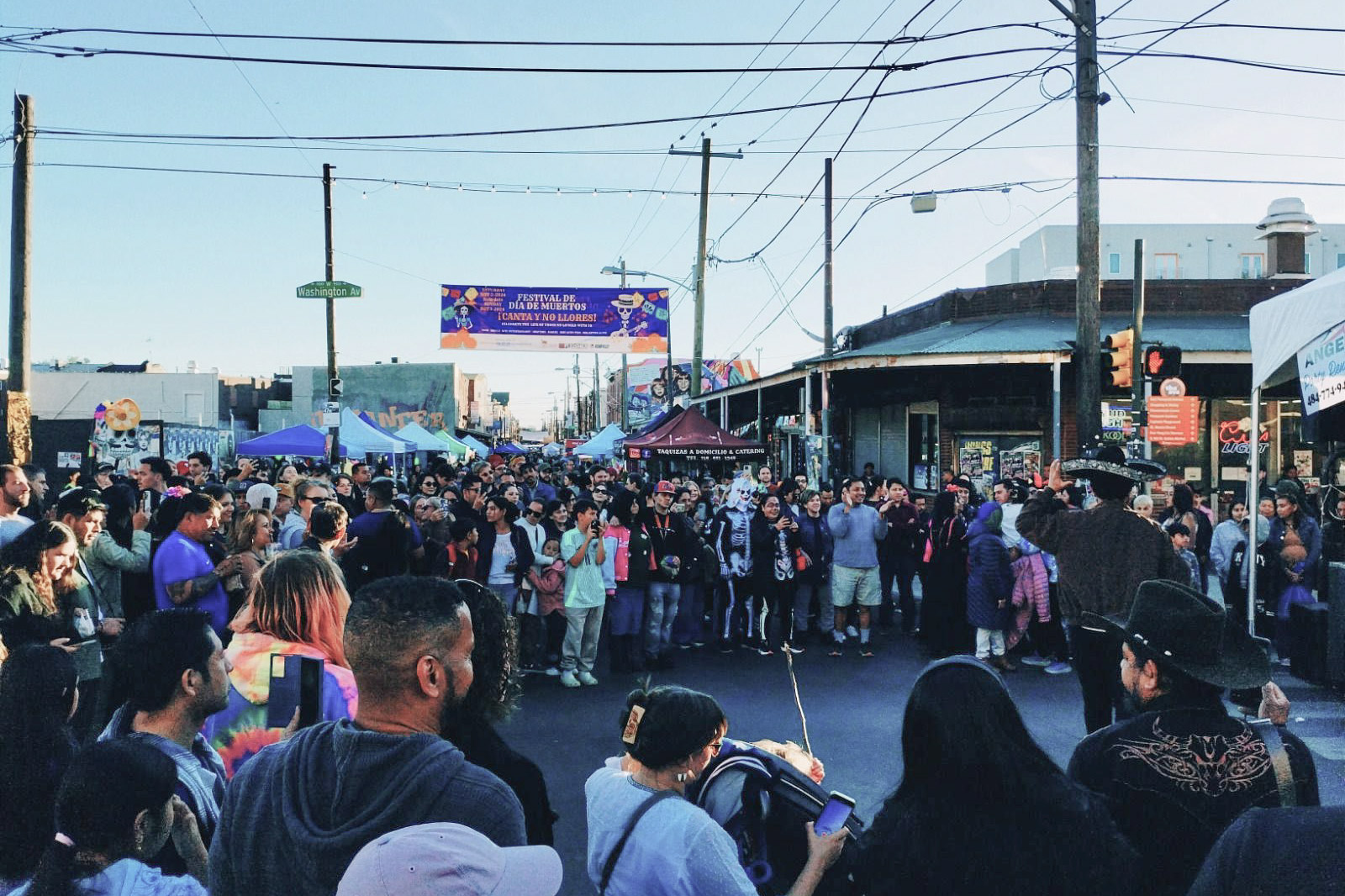
A crowd gathers at last year’s Day of the Dead celebration at the Italian Market in South Philadelphia.
Others have set up altars in their homes. These ofrendas may be adorned with traditional marigolds, with candy skulls, paper skeletons, and photographs. But they may also feature a snatch of fur or a whisker left behind.
Genesis Pimentel-Howard created an ofrenda for her cat, Mobi, on a bedroom shelf of the West Philadelphia home she shares with her husband, Yaphet Howard.
It’s hard for her to talk about Mobi, who died suddenly in May at only 4 years old.
He was, she said, an adorable menace. Mobi loved to poke at and play with the couple’s other cat, Sannin, though Sannin didn’t always appreciate the attention.
Mobi sometimes stole food from the trash. And he managed to push over and break Pimentel-Howard’s flat-screen TV. Still, she said, he followed her everywhere. She couldn’t even use the bathroom without him trailing her inside.
“A sweet momma’s boy,” she said. “Always next to me.”
On the ofrenda, Pimentel-Howard placed her grandmother’s pearls. And photos of her family dogs, Ella and Red, and her hamster, Shia LaBeouf. She added a shadow box that holds Mobi’s collar and an impression of his paw.
“I’ll stay up as late as Ican to welcome him,” she said. “I like to think he’ll be around.”
Genesis Pimentel-Howard lights a candle for her late cat, Mobi, beside a lovingly crafted ofrenda in her Philadelphia home on Monday. The altar glows with candlelight, welcoming the spirits of her beloved departed pets. The ritual is part of a growing tradition tied to Día de los Muertos.
The roots of the Day of the Dead go back 3,000 years, to Aztec and Mayan traditions. It is celebrated not only in Mexico but also in wider Latin America and in communities across the United States.
Dogs have always played an important role. The ancients considered them sacred, guides that led souls through the afterlife. They revered the Mexican Hairless dog, the Xoloitzcuintle, or Xolo for short.
It’s a Xolo dog, Dante, that guides Miguel to meet his ancestors in Coco, the popular animated Disney movie. And it’s a song from the movie, “Remember Me,” that has become the soundtrack for countless social media posts about departed pets.
In Philadelphia, the Italian Market festival welcomes all who wish to take part in its Day of the Dead event to South Ninth Street between Federal and Christian Streets from 11 a.m. to 5 p.m. on Nov. 2
The Fleisher Art Memorial in South Philadelphia also will hold a big Day of the Dead celebration. Everyone is invited to help with final preparations for the ofrenda from 2 to 9 p.m. on Oct. 31, and to come to the Day of the Dead event the next day.
“The animals, that’s family, too,” said María De Los Angeles Hernández Del Prado, the artist who led the creation of the Fleisher’s large, three-part ofrenda, which includes a section devoted to pets. “They’re the same as us, they just don’t talk the same language.”
Pimentel-Howard knew after Mobi died that she would find a way to honor him, along with the other animals she has loved.
“You don’t know what it’s like to lose an animal,” she said, “until you’ve lost one.”
There’s a smoke shop in North Philly peddling recreational drugs across the street from a daycare. A West Philly storefront that sells loose cigarettes on a residential block. A convenience store in Spring Garden that advertises urine to people looking to pass a drug test.
These are among the so-called nuisance businesses that City Council members and neighborhood association leaders cited Monday as lawmakers advanced legislation to make it easier for the city to shut down stores that sell cannabis and tobacco products without licenses.
And legislators said their next target could be the landlords who rent space to those businesses.
“We have to work with our city departments and our state partners to clamp down on these businesses,” said City Council Majority Leader Katherine Gilmore Richardson, who represents the city at-large. “We’re just being inundated.”
Members of Council’s Committee on Licenses and Inspections passed two bills Monday that city officials say seek to close loopholes store owners exploit to avoid being cited for failing to obtain proper permits.
In introducing the legislation earlier this year, Gilmore Richardson cited an Inquirer report about Pennsylvania’s unregulated hemp stores, which sell products advertised as legal hemp that are often black market cannabis or contaminated with illicit toxins.
One bill makes it easier for the city to shut down nuisance businesses by removing language that classifies some violations as criminal matters, requiring that the police investigate them as crimes rather than civil violations that are quicker to adjudicate.
The second piece of legislation makes it illegal for businesses to essentially reorganize under a new name but conduct the same operations as a means of evading enforcement.
Both pieces of legislation could come up for a full vote in the Democratic-dominated City Council in the coming weeks. Members of Mayor Cherelle L. Parker’s administration testified in favor of them, meaning the mayor is likely to sign both.
A smoke shop in South Philadelphia.
Neighborhood association leaders also testified Monday in favor of the changes, but several said more aggressive enforcement is needed. They said smoke shops in particular have popped up throughout their commercial corridors, as have convenience stores that don’t even have licenses to operate as businesses, let alone sell recreational drugs.
“We’ve seen firsthand the selling of illegal drug paraphernalia and [loose cigarettes], many of which children walk past in order to get to the candy bars and seniors walk past to get to the milk,” said Heather Miller, of the Lawncrest Community Association. “We need to address this.”
Elaine Petrossian, a Democratic ward leader in Center City and a community activist, called for “much” higher fines and penalties for landlords. She cited progress the municipal government has made in New York City, where authorities cracked down on building owners who knowingly rented space to tenants selling cannabis or tobacco without licenses to do so.
Several lawmakers said they’d support a similar approach. Councilmember Mark Squilla, who represents a district that spans from South Philadelphia to Kensington, said landlords must be held “more accountable.”
“If they had some skin in the game, maybe they’d think twice about renting to an illegal operation,” he said.
Councilmember Jamie Gauthier, who represents parts of West Philadelphia, agreed. She said she recently attempted to meet with a building owner who rents space to a problematic smoke shop in her district, but was rebuffed.
“He was like, ‘These people pay me rent, and that’s the extent to which I basically care,’” Gauthier said. “We need something that forces property owners to be more accountable than that, because neighbors are suffering.”
Staff writers Max Marin and Ryan W. Briggs contributed to this article.