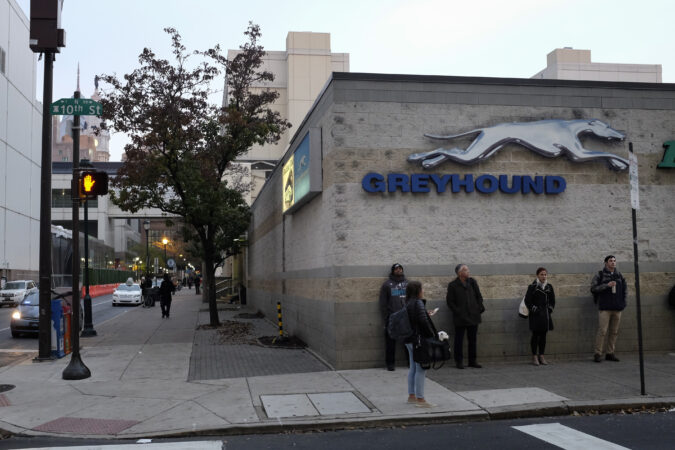
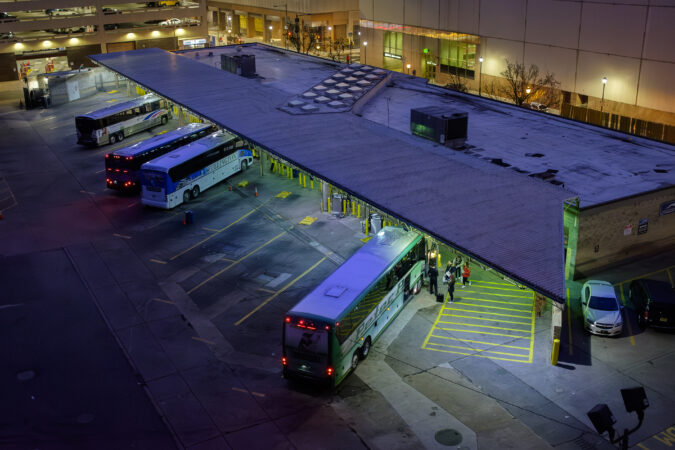
City Council passed legislation Thursday to restore the abandoned Greyhound terminal on Filbert Street as Philadelphia’s new intercity bus station in time for an expected flood of tourists in 2026.
Under the measure, the Philadelphia Parking Authority will operate the station on behalf of the city, collecting fees from bus companies to pay costs.
A refurbished facility is scheduled to open in May 2026, which would resolve more than twoyears of chaos after Greyhound ended its lease, forcing the city to allow the bus companies to operate at the curbs of public streets with few amenities and no shelter for riders.
The saga was embarrassing, and it became more untenable for city leaders with Philadelphia set to host celebrations of the 250th anniversary of the Declaration of Independence, and a round of international FIFA World Cup soccer matches.
The plan came together over the last few months as at least three city departments collaborated and reached an agreement with the parking authority. Mayor Cherelle L. Parker’s administration sent a bill to Council.
Councilmember Curtis Jones Jr. said in a Finance Committee hearing last week that he found the speed of “galvanized” departments working together impressive.
“You can’t put that genie back in the bottle. I know you can cooperate now, and that’s going to be the expectation from now on,” Jones said.
Greyhound ran the terminal at 10th and Filbert Streets for 35 years but ended its lease in June 2023 as the bus line (and its corporate parent) began shedding real estate and leases in the U.S. to cut costs.
First, the buses operated along the 600 block of Market Street. Since November 2023 they have loaded and unloaded passengers in the open along Spring Garden Street.
“This is an opportunity that kind of came from the heavens,” said Mike Carroll, the city’s assistant managing director for transportation.
Bus companies would pay a $40 fee for each stop in the city until the terminal is open, when it would be increased to $65. A smaller number of buses subsidized by the Pennsylvania Department of Transportation under a program to provide rural service would pay $16 a stop.
Operating the renovated terminal will cost $4.7 million to $4.8 million annually, Carroll said.
City officials say they plan to keep researching other possible locations for an intercity bus station but note the lease provides stability.
PPA will provide 24-7 security, 16-hour daily custodial coverage, maintenance staff, and an on-site program manager under terms of an intergovernmental agreement with the city that is part of the legislation.
It also will be responsible for enforcing rules, such as one that will require buses to bypass the heart of Chinatown.
Since the parking authority regulates rideshare and taxi services, its enforcement officers will help keep traffic flowing around the station, officials said.
Councilmember Nina Ahmad pressed city officials to plan for retail tenants and other ways to generate municipal revenue.
“There’s an element of rush,” Ahmad said during the Dec. 3 hearing. “I understand the urgency, but I hope we don’t overlook things that we should be doing to make it really a transit-oriented development.”
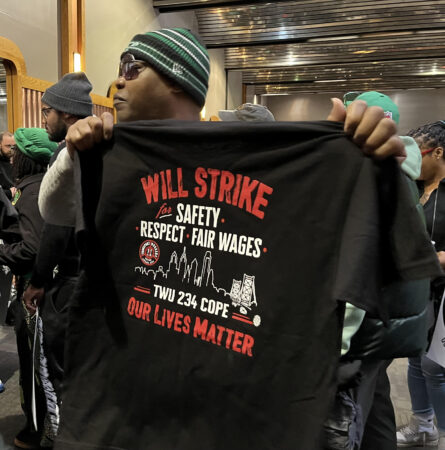
Transport Workers Union Local 234, SEPTA’s largest union, may soon strike, according to president Will Vera.
At a Friday afternoon news conference at TWU headquarters in Spring Garden, Vera said his “patience has run out,” and he said the union’s executive committee was meeting to decide when to call a strike.
“I’m tired of talking, and we’re going to start walking,” said Vera, who was elected president in October.
Local 234’s latest contract expired Nov. 7, and the 5,000-member local voted unanimously on Nov. 16 to authorize leaders to call a strike if needed during contract negotiations.
The union represents bus, subway, and trolley operators, mechanics, cashiers, maintenance people, and custodians, primarily in the city.
John Samuelsen, president of TWU International and former president of NYC’s local, joined Vera at the news conference.
“A strike is imminent,” Samuelsen said. “SEPTA is the most incompetent transit agency in the country … SEPTA is triggering a strike.”
In an email sent Friday evening, Samuelsen called on leaders and staff members of TWU locals to travel to Philadelphia to help Local 234 in the event of a strike.
Andrew Busch, spokesperson for SEPTA, said negotiations were “at an impasse,” noting that the negotiating committees met only twice this week. He said SEPTA’s leaders hoped TWU would “take us up on the offer to continue to talk so we can avoid a strike and the massive service disruption it would cause.” No meetings are scheduled for the weekend as of Friday evening.
Vera agreed there was room for the two groups to keep talking, if SEPTA provided “a fair and reasonable” contract proposal.
The union says it is looking for a two-year deal with raises and changes to what it views as onerous work rules, including the transit agency’s use of a third party that Vera said makes it hard for members to use their allotted sick time.
SEPTA officials have signaled they are open to a two-year deal as a step toward labor stability.
In recent weeks, TWU and SEPTA have been negotiating contributions to the union’s healthcare fund. Pensions have arisen as a sticking point.
Union sources told The Inquirer that TWU leaders are increasingly frustrated with the pace of negotiations.
Vera said the executive board meeting began at 4:30 p.m. on Friday. He hoped the board would reach a decision on when members would walk off the job.
TWU last went on strike in 2016. It lasted for six days and ended the day before the general election. Democrat Hillary Clinton’s presidential campaign was worried about voter turnout, and the city sought an injunction to end the strike. It proved unnecessary.
SEPTA’s financials
TWU’s contract negotiations are happening as SEPTA is emerging from what it has called the worst period of financial turmoil in its history.
Like many transit agencies, SEPTA was facing a recurring deficit due to inflation, fewer federal dollars, and flat state subsidies. It reported a $213 million recurring hole in its operating budget.
Following a prolonged and contentious debate over mass transit funding in the state budget, Gov. Josh Shapiro in September directed PennDot to allow SEPTA to tap $394 million in state money allocated for future capital projects to pay for two years of operating expenses.
And last month, he allocated $220 million to SEPTA, the second time in two years he’s flexed state dollars to support the financially beleaguered transit agency. While the $220 million is expected to go primarily toward capital expenses related to Regional Rail, the move helps SEPTA’s overall balance sheet.
What riders should know
SEPTA riders are no strangers to service disruptions.
It was a step toward ending a two-year civic struggle to find a site for long-distance buses and their passengers. The renovated station could be ready for a series of big national and international events expected to draw millions of visitors next year.
“A lot of people are going to be coming here for the first time, and when they’re in that station, they’re going to get their first taste of Philadelphia — and we want to make sure it’s a good one,” said Councilmember Mike Driscoll, who sponsored the bill on behalf of the Parker administration.
The city will host events in 2026 for the 250th anniversary of the Declaration of Independence, as well as FIFA World Cup soccer matches and the Major League Baseball All-Star Game, among others.
Greyhound ran the terminal at 10th and Filbert Streets for more than three decades but ended its lease in June 2023 when the business model of its parent company, Flixbus, called for divesting from real estate and moving toward cheaper curbside service in many U.S. cities.
Since November 2023, customers of Greyhound, Peter Pan, and other interstate bus carriers wait, board, and arrive at curbside along Spring Garden Street in Northern Liberties — with no shelter from the weather and few amenities. It also has proved a nuisance to nearby businesses.
Before that, the buses operated at curbside on Market Street between Sixth and Seventh Streets.
The city senses that over the long term the owner anticipates selling the property, said Michael Carroll, assistant managing director for the Philadelphia Office of Transportation and Infrastructure Systems.
“That’s the sweet spot, long enough that there’s a meaningful basis to invest in improvements and solve the problems,” Carroll told the committee.
“At the 10-year mark, decisions will have to be made about whether this is a site that forever works best in Philadelphia, or whether there’s a better site,” he said.
The unanimous Finance Committee vote came after it amended the measure to adjust the fees bus companies would be charged to stop in Philadelphia.
Each stop in the city would cost $40 until the bus terminal is open, when it would move to a $65 fee. A smaller number of buses subsidized by the Pennsylvania Department of Transportation under a program to provide rural service would pay $16 a stop.
Committee members also asked for suspension of a procedural rule so that all 17 lawmakers could consider the bill Thursday and clear the way for final passage before the holidays.
In the agreement with the city that is part of the bill, PPA would run the terminal; assess the fees on bus carriers for the use of the facility and any street loading zones, such as those in University City; and handle enforcement.
The Filbert Street proposal includes specific requirements designed to address concerns particularto Chinatown.
For instance, the streets department would change traffic patterns so buses are routed to the station via Market Street instead of driving through the heart of the neighborhood as they did in the past.
John Mondlak, first deputy and chief of staff of the city planning department, said that the through traffic had long been a chief complaint of residents and business owners in Chinatown.
This story has been updated to include the name of the firm that owns the former Greyhound station.
The four roommates have hosted costumed Halloween parties for more than 80 people in their Spring Garden residence. Last year a guest came as a nun and another came as Jesus. They were, after all, visiting a church.
Philadelphia Architecture in the 19th Century, described the city’s Spring Garden neighborhood as: “Houses, Quaker in Excelsis with pocket handkerchiefs of terraces and here and there a reticent church where one could sleep comfortably through hour-long sermons.”
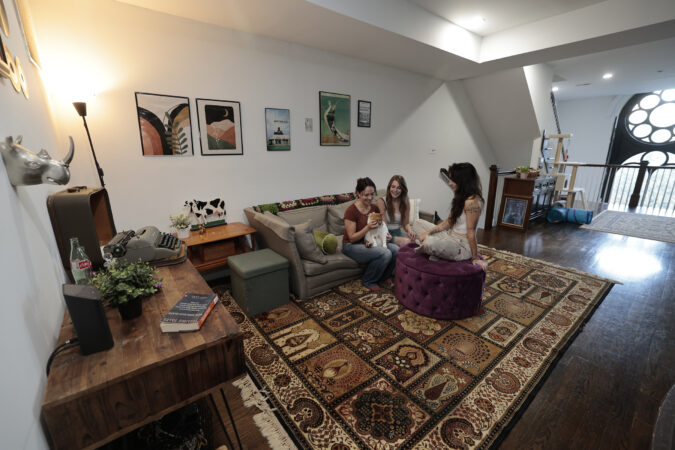
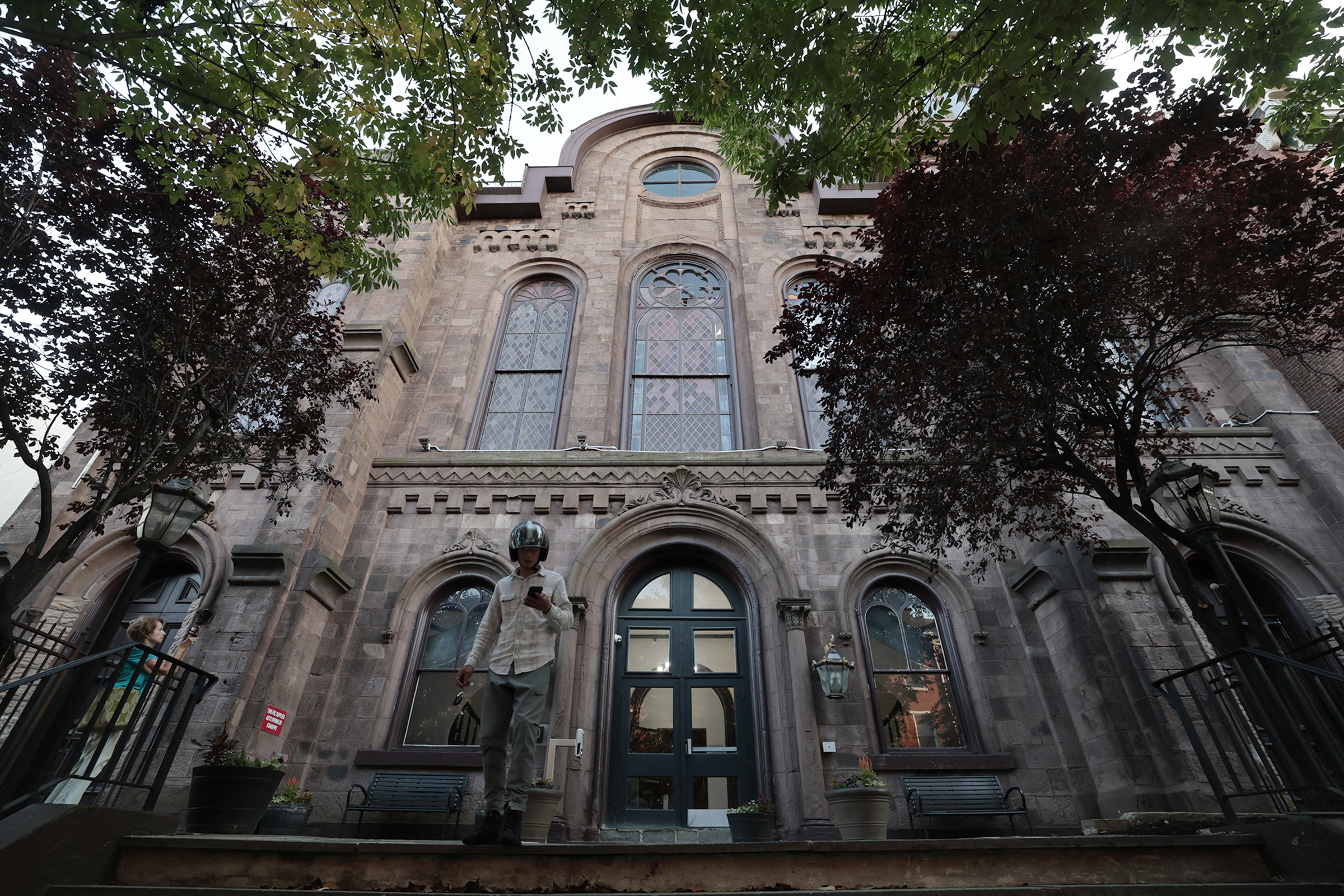
In that neighborhood, decades later, Corwynne Peterson, Riley Sperger, Ashlee Propst, and Magdalena Becker share a four-level unit in what was once Christ Reformed Church. The Romanesque-style brownstone place of worship was built in 1860 in the middle of a block of terraced houses.
Times changed, the church’s congregation dwindled. The increasingly deteriorating building was used for several years as a recreation center and for after-school programs. Then in 2003 it was purchased by the Regis Group, a property development company.
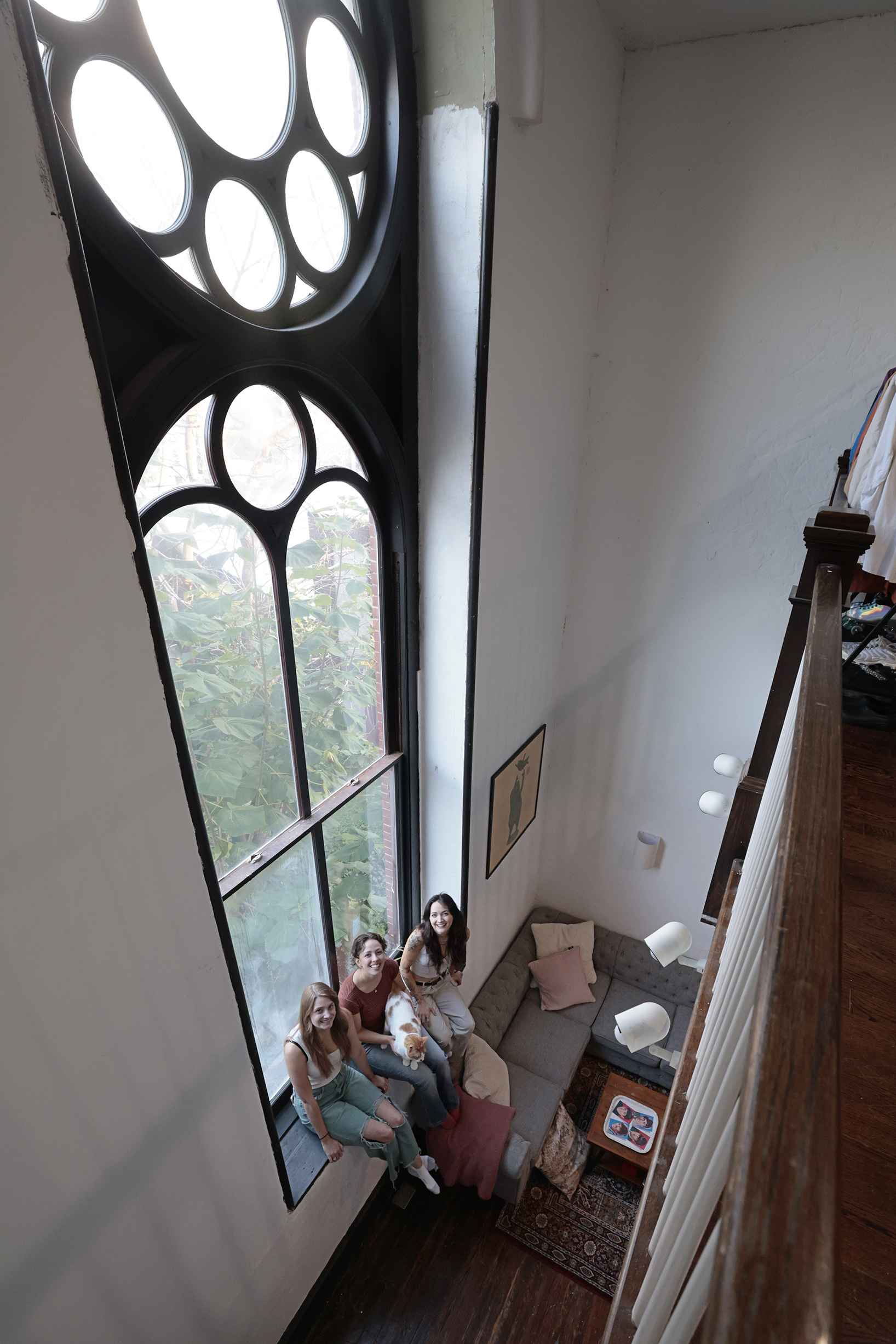
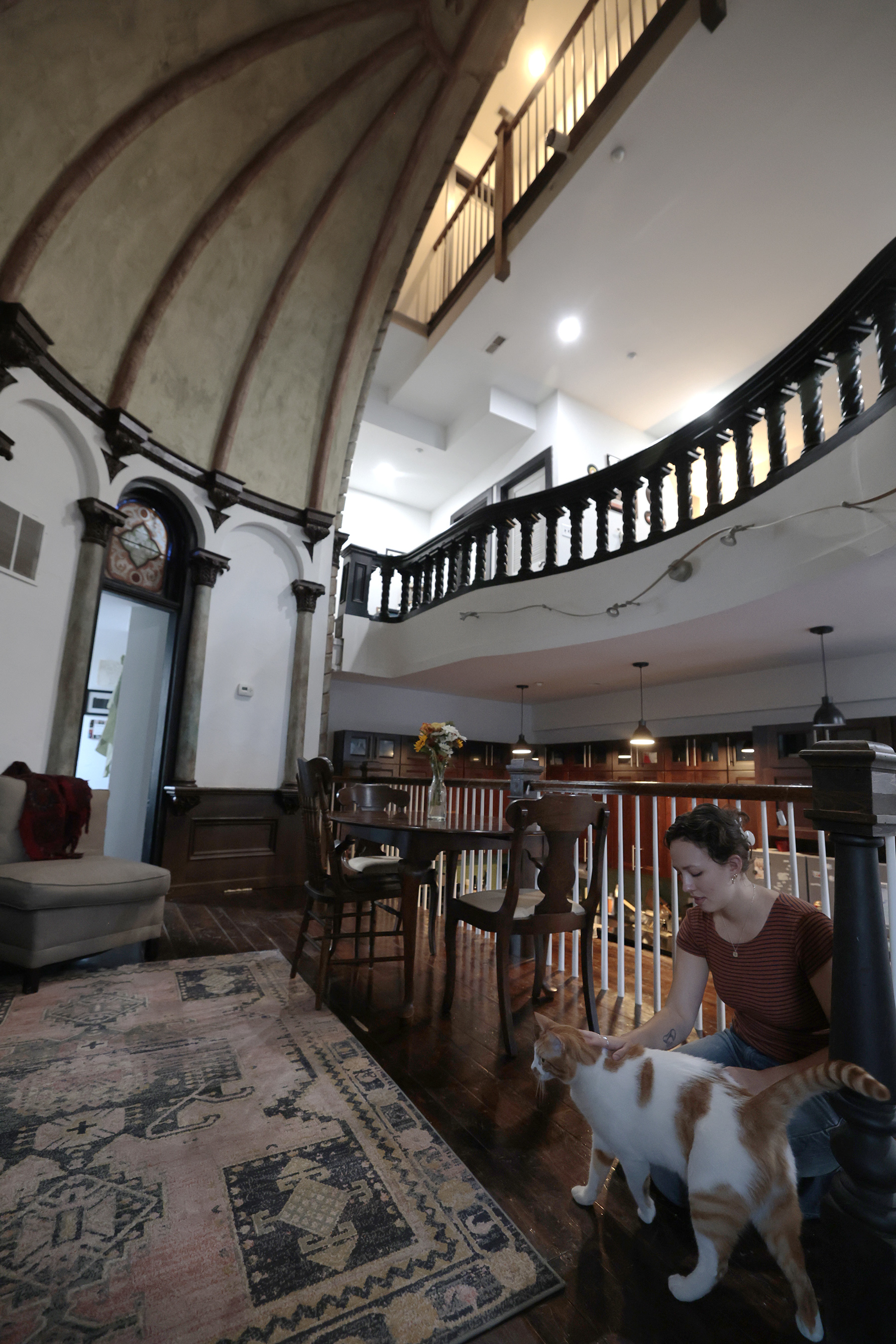
As seen looking down from the third floor, (from left) Ashlee Propst, Corwynne Peterson, cat Hugo, and Magdalena Becker sit on the window sill in their apartment, formerly a church.Peterson shares some affection with her cat, Hugo, on the former church altar.
Regis converted the church into 17 multilevel rental units, preserving the soaring ceilings, decorative plaster moldings, several leaded glass windows, and pine flooring. The eclectic decor includes whitewashed brick interior walls, new skylights and ceiling fans, exposed pipes and beams. Remnants of ecclesiastical patterned wallpapers still cover the wall near a door leading to the communal courtyard.
For Halloween the roommates screen It’s the Great Pumpkin, Charlie Brown on the columned dome of what was the church sanctuary. At the top of the dome is a painted gold cross and crown, symbolizing the reward in heaven (crown) after trials on earth (cross).
Peterson said she and her three roommates, all women in their 20s, call the sanctuary “the stage.”
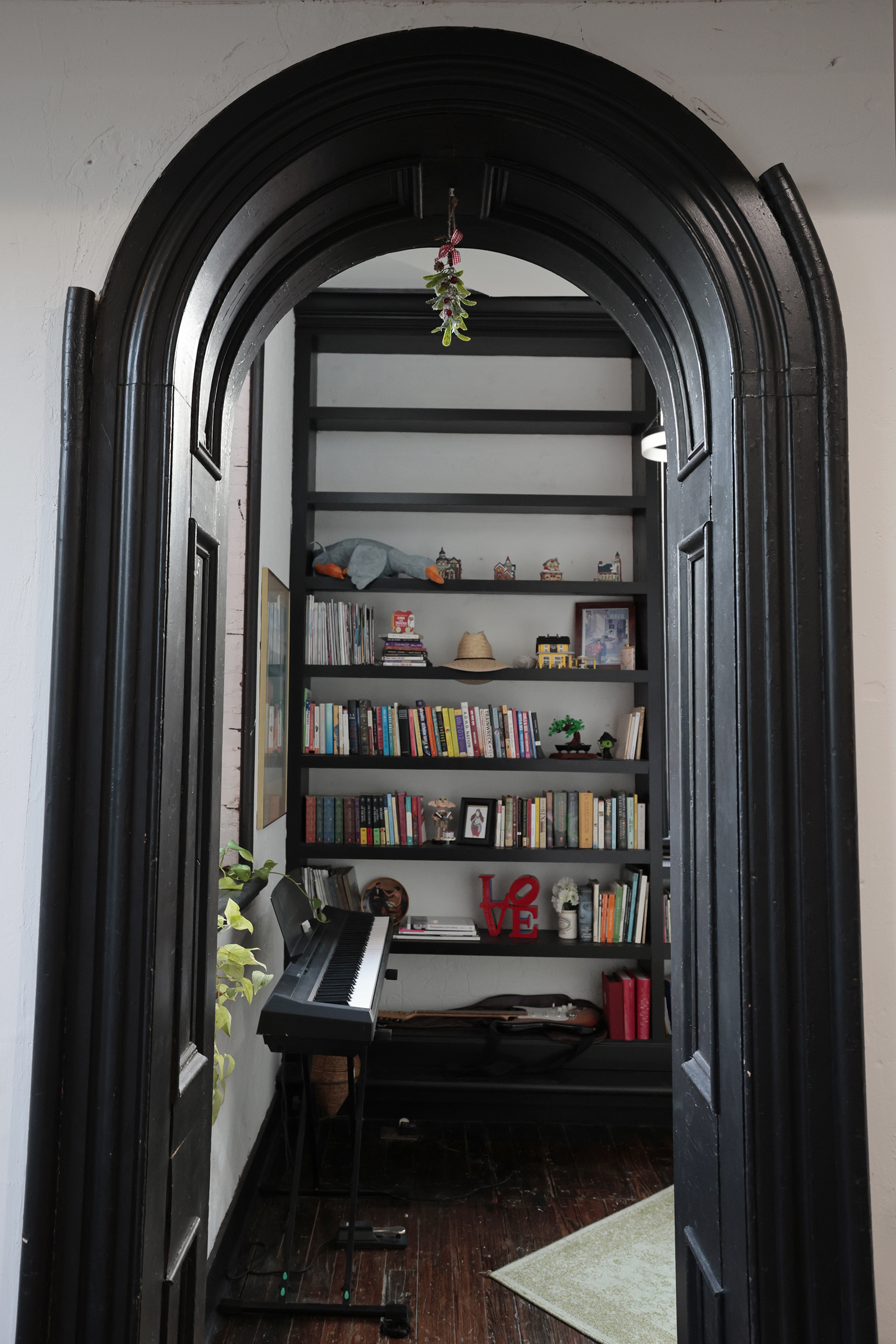
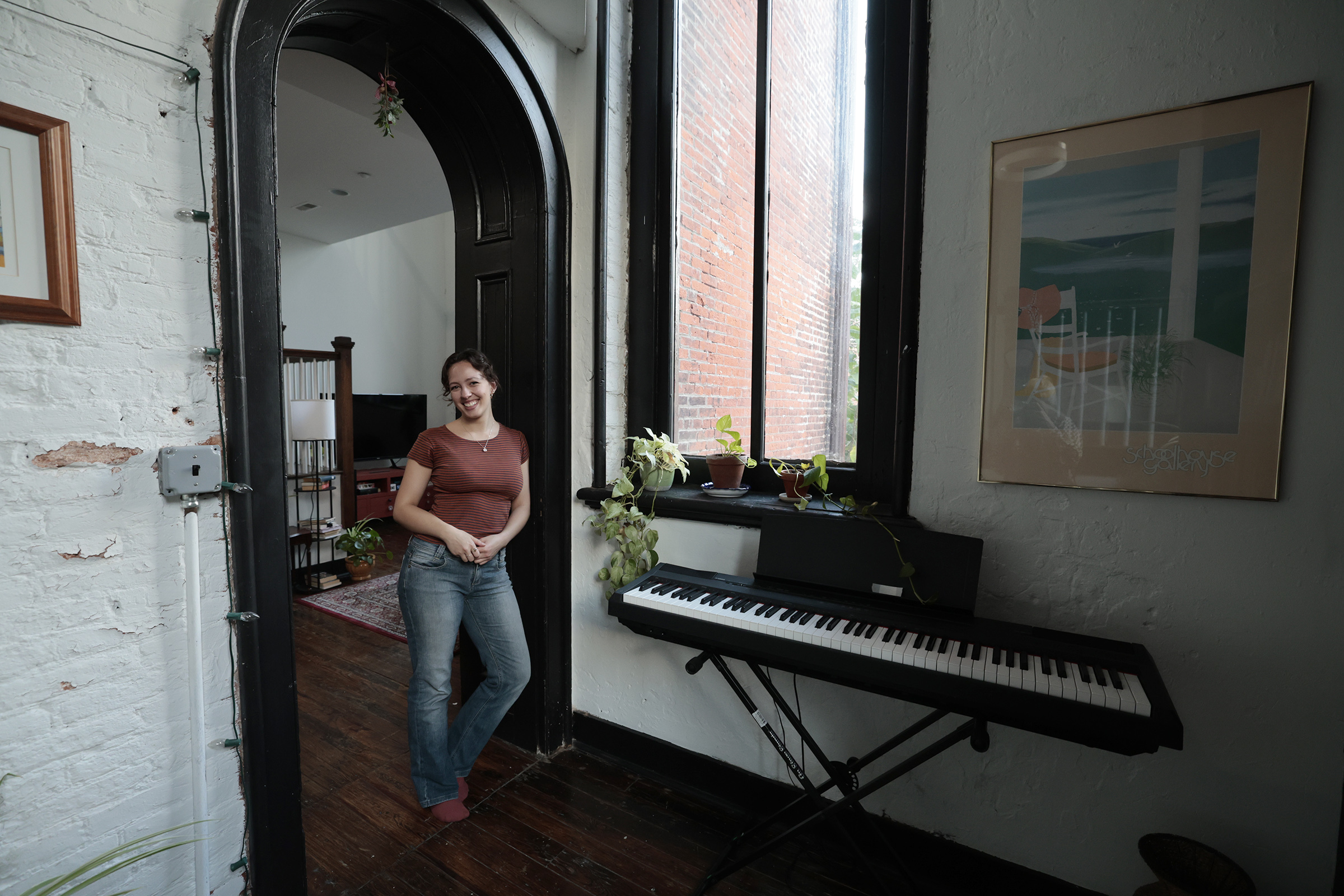
The sanctuary, furnished with a dining table and chairs, is on a raised platform a few steps above the living room, kitchen, powder room, and “library,” with bookshelves and Peterson’s piano keyboard.
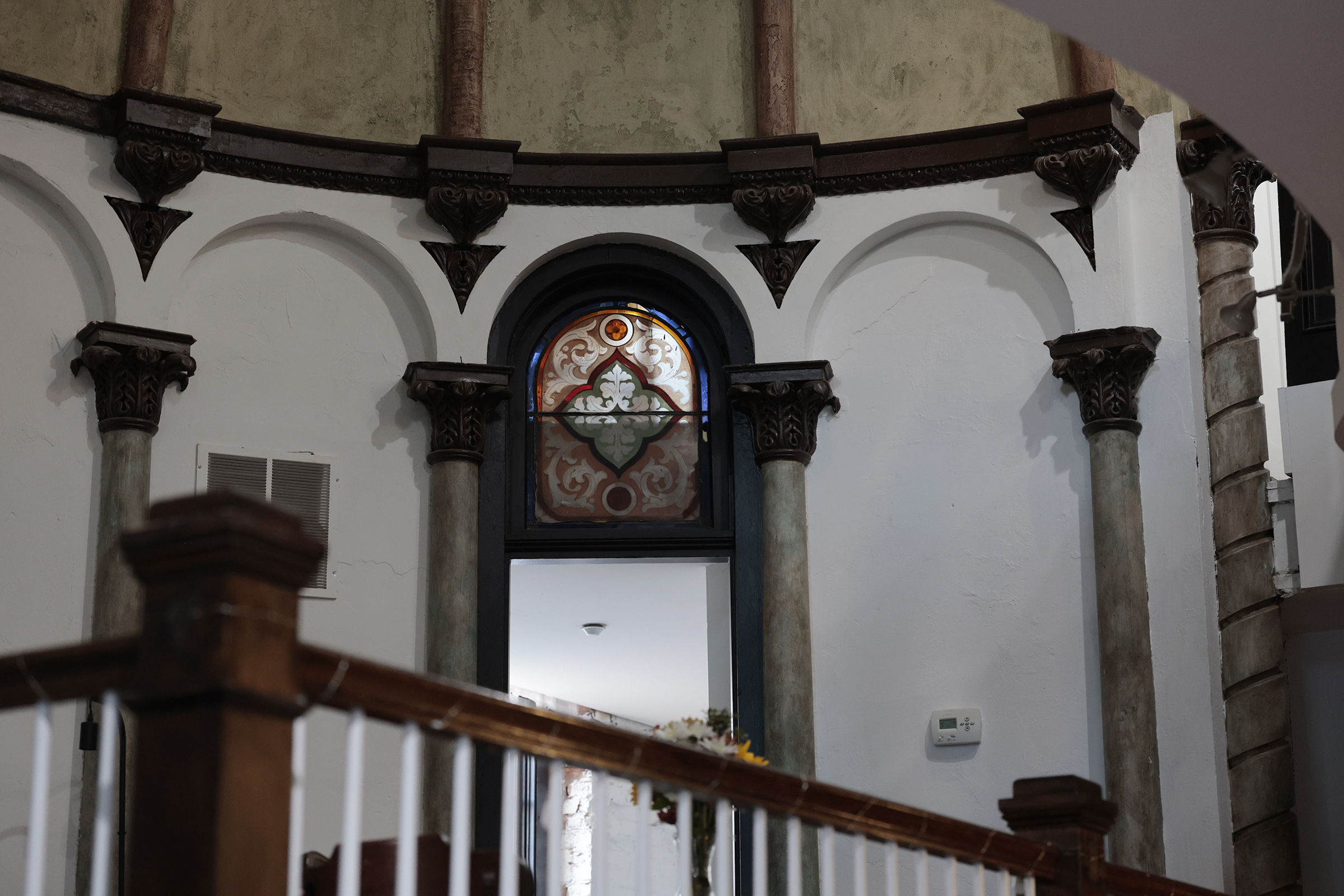
The exterior of the Homes at Chapel Lofts, built in 1860 as the Christ Reformed Church.The remaining original stained-glass window in the apartment.
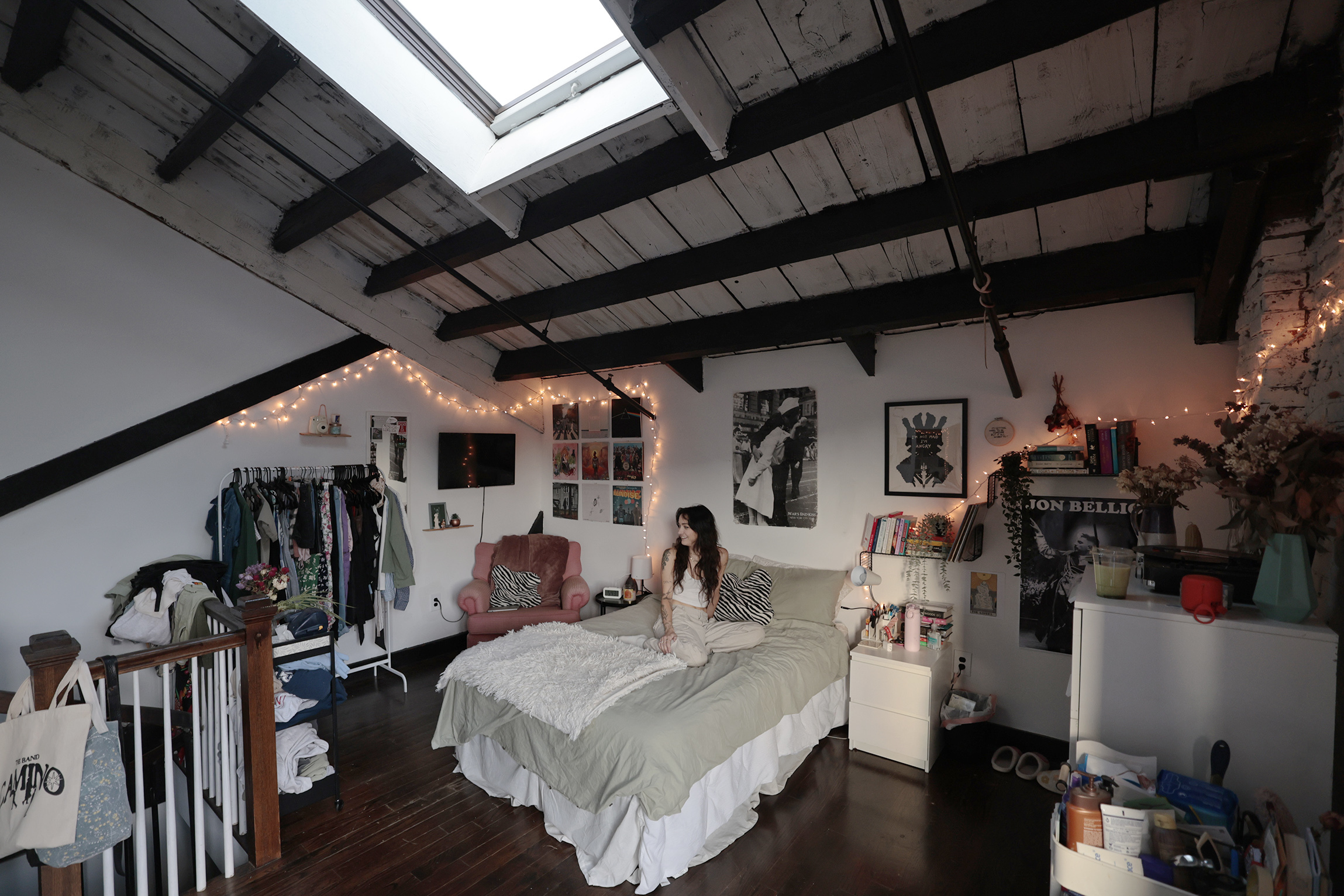
On the next level are Peterson’s and Sperger’s bedrooms, a bathroom, and a sitting area. Both women work as restaurant servers.
An ornately carved oak banister between the bedrooms and overlooking the sanctuary might have once been the church’s Communion rail.
Propst, a research specialist at the University of Pennsylvania’s Perelman School of Medicine, has the largest bedroom and a private bath on the third level, where there is also a washing machine and dryer the women share.
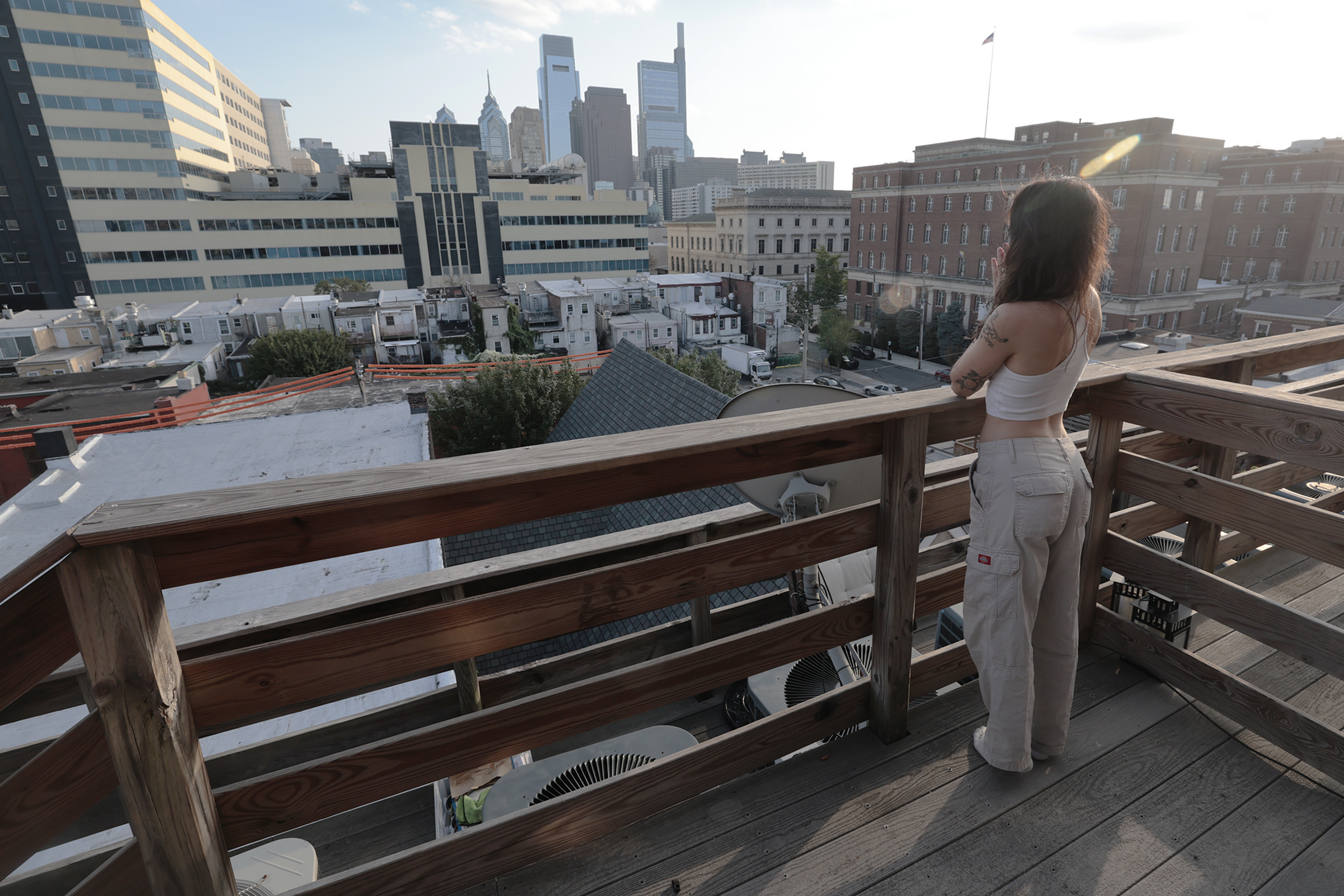
Up a spiral staircase on the top level is Becker’s bedroom, adjacent to a rooftop deck. She shares a bathroom with Peterson and Sperger two flights down.
Entranceway to the apartment’s library.
A pair of silver stiletto-heeled boots decorate a shelf at the bottom of the stairs. Becker is a writer for Static Media and a dancer, “which is why I have a lot of shoes,” she said.
The roommates separately found the converted church on Facebook, moving in at different times over the last 2½ years. They collaborated on the furnishings, sourcing the gray sectional in the living room, the gray sitting-area sofa and purple ottoman, and other furniture on Facebook Marketplace. Their parents and grandparents contributed oriental rugs.
The vintage typewriter, which sits on a desk gifted by a neighbor, was a prop from a play in which Peterson performed. The Vanya poster is from an Off-Broadway, one-man show of the same name autographed for Peterson by the star, Andrew Scott.
Magdalena Becker in her fourth-floor bedroom, with sun beaming through the skylight above.
Abstract nature prints came from Etsy, and a Vogue magazine cover, old records, and other art displayed on the walls were purchased at thrift stores. The women’s colorful clothes hang on racks.
Light streams from a tall window comprising various shapes of clear glass, which replaced disintegrating leaded glass. Some of the arched doorways still have stained-glass transoms.
The roommates admit they don’t do much communal cooking. They each have their own shelves in the fridge and in the chestnut kitchen cabinets.
Magdalena Becker stands on the south-facing deck just off of her fourth-floor bedroom.Corwynne Peterson stands in the doorway of the library with her piano keyboard.
But they do host parties together. Besides the Halloween festivities there was a birthday party for Sperger in September.
For Christmas celebrations, the sanctuary sparkles with green and red lights.
The women also share affection for the only male in residence, Peterson’s orange and white cat, Hugo. And he is fond of all of them.
Is your house a Haven? Nominate your home by email (and send some digital photographs) at properties@inquirer.com.
This week in Philly music kicks off in Fishtown with six-time Grammy nominee Leon Thomas, continues in Atlantic City with a Brandy and Monica throwback pop double bill, and continues in North Philly with rising R&B singer and Justin Bieber producer Dijon.
Austin, Texas, hard rock band Die Spitz play the First Unitarian Church on Wednesday.
Wednesday, Nov. 19
Die Spitz
The music gets started on Wednesday with the four women of Austin, Texas. hard rock foursome Die Spitz, who recorded their unrelenting new album Something to Consume at Studio 4 in Conshohocken with producer Will Yip. Boone, N.C., queer punk duo Babe Haven opens. (8 p.m., First Unitarian Church, 2125 Chestnut St., r5productions.com)
Leon Thomas
There weren’t a lot of surprises among the big names with the most nominations when the Grammys were announced this month. Kendrick Lamar and Lady Gaga topped the list, but Leon Thomas, who got six nods along with Bad Bunny and Sabrina Carpenter, was the surprise underdog.
The crooner and producer, who got his start as a Broadway child actor and star of Nickelodeon’s Victorious, is up for album of the year for Mutt, as well as best new artist and R&B performance for his viral NPR Tiny Desk version of the album’s title song — in which he compares himself unfavorably to a dog. His “Mutts Don’t Heel” tour comes to the Fillmore on Wednesday. (8 p.m., the Fillmore, 29 E. Allen St., livenation.com)
Also: There’s live music at Old City vinyl listening room 48 Record Bar. James Everhart of Cosmic Guilt teams with New York songwriter Keenan O’Meara on Wednesday; Hannah Taylor sings and Jake Zubkoff plays keys on Sunday.
Hannah Cohen plays Johnny Brenda’s on Thursday. Her new album is “Earthstar Mountain.”
Thursday, Nov. 20
Hannah Cohen
Hannah Cohen’s Earthstar Mountain is a dreamy, pastoral album that also delivers a sweet kick. She recorded it with producer partner Sam Evian at their studio in a barn in upstate New York. With Sufjan Stevens and Clairo guesting, it’s a 2025 standout releaser. (Salami Rose Joe Louis opens. 8 p.m., Johnny Brenda’s, 1201 Frankford Ave., johnnybrendas.com)
The New Mastersounds
British funkateers the New Mastersounds are saying goodbye — at least for a while. The band whose tight Hammond organ-heavy soul-jazz sound bears the influences of Philly keyboard greats Jimmy Smith and Jimmy McGriff, plays its “Ta-Ta for Now” tour on Thursday. (8 p.m., Ardmore Music Hall, 23 E. Lancaster Ave., Ardmore, tixr.com)
Now, Gallo has a new album that takes him in a more personal direction, called Checkmate, his second on the Kill Rock Stars label. It’s filled with subtly evocative folk-flavored, even jazzy, music that detours from the bruising garage rock he’s become known for. Gallo plays Free at Noon at Ardmore Music Hall. (Noon, Ardmore Music Hall, eventbrite.com)
Brandy and Monica performing in Indianapolis in October on “The Boy Is Mine Tour,” which comes to Atlantic City’s Boardwalk Hall on Saturday.
Bar Italia
This month’s edition of David Pianka’s Making Time dance party has an intriguing live band headliner in Bar Italia, the London-based trio named after an iconic Soho coffee bar. The band’s new album, Some Like It Hot, wears the influence of Brit-pop band Pulp on its sleeve. New York rock band Voyeur also plays, along with sets by Dave P., Mario Cotto, Shai FM, and K Wata. (9 p.m., Warehouse on Watts, 923 N. Watts St., wowphilly.com)
Stinking Lizaveta
Longstanding West Philly doom metal trio Stinking Lizaveta‘s name was inspired by a character in Fyodor Dostoevsky’s The Brothers Karamazov. The band released its 1996 album Hopelessness and Shame — recorded by the late Steve Albini — on vinyl for the first time this March. On Friday, they headline Johnny Brenda’s with Deathbird Earth and Channls. (8 p.m., Johnny Brenda’s, 1201 Frankford Ave., johnnybrendas.com)
Tom Morello
Rage Against the Machine guitarist Tom Morello plays the Music Box at the Borgata in Atlantic City. It will be an agit-pop act of resistance in a hotel casino within earshot of chiming slot machines. Morello’s repertoire is made up of roiling Rage songs, Woody Guthrie, MC5, and John Lennon and Yoko Ono covers, plus originals in his rabble-rousing folk singer mode as the Nightwatchman. He’ll have a full band behind him, plus the help of San Diego hip-hop group the Neighborhood Kids as his special guests. (9 p.m., Music Box at the Borgata, 1 Borgata Way, Atlantic City, ticketmaster.com)
Saturday, Nov. 22
Mo Lowda & the Humble
Philly quarter Mo Lowda & the Humble closes out a five-month North American tour for its new album, Tailing the Ghost, with a hometown show. (8 p.m., Union Transfer, 1026 Spring Garden St., utphilly.com)
Brandy and Monica
Back in 1988, Brandy and Monica played out a feud over a dude in the worldwide hit “The Boy Is Mine,” which was cowritten and coproduced by South Jersey’s Rodney “Darkchild” Jerkins. Twenty-seven years later, the pop-R&B singers are on a concert tour together that also features Destiny’s Child’s Kelly Rowland, Muni Long, and 2025 American Idol winner Jamal Roberts. The tour is presented by the Black Promoters Collective. (8 p.m., Jim Whelan Boardwalk Hall, 2301 Boardwalk, Atlantic City, boardwalkhall.com)
Grammy-nominated singer and producer Dijon plays the Met Philly on Sunday.
Sunday, Nov. 23
Dijon
Dijon released his debut Absolutely in 2021 and has quickly made his mark. He regularly works with Mk.gee, the guitarist and songwriter with whom he shares a twitchy, low-fi sensibility. He’s also teamed with Bon Iver and Justin Bieber and is up for producer of the year and album of the year at the Grammys. Sometimes, he sounds like Prince.
His new album Baby! is a joyous, shape-shifting adventure. Two measures of how hip he is at the moment: He’s among the musicians with roles in Paul Thomas Anderson’s One Battle After Another, and on Dec. 6 will be musical guest on Saturday Night Live. He plays the Met Philly on Sunday. (8 p.m., Met Philly, 858 N. Broad St., ticketmaster.com)
Amy LaVere and Will Sexton
Memphis wife-and-husband duo Amy LaVere and Will Sexton are Americana artists who specialize in a brand of smoky Southern noir, perhaps best exemplified by LaVere’s “Killing Him,” about trying to rid oneself of a bad boyfriend only to find that he comes back to haunt you. (8 p.m., 118 North, 118 N. Wayne Ave., Wayne, tixr.com)
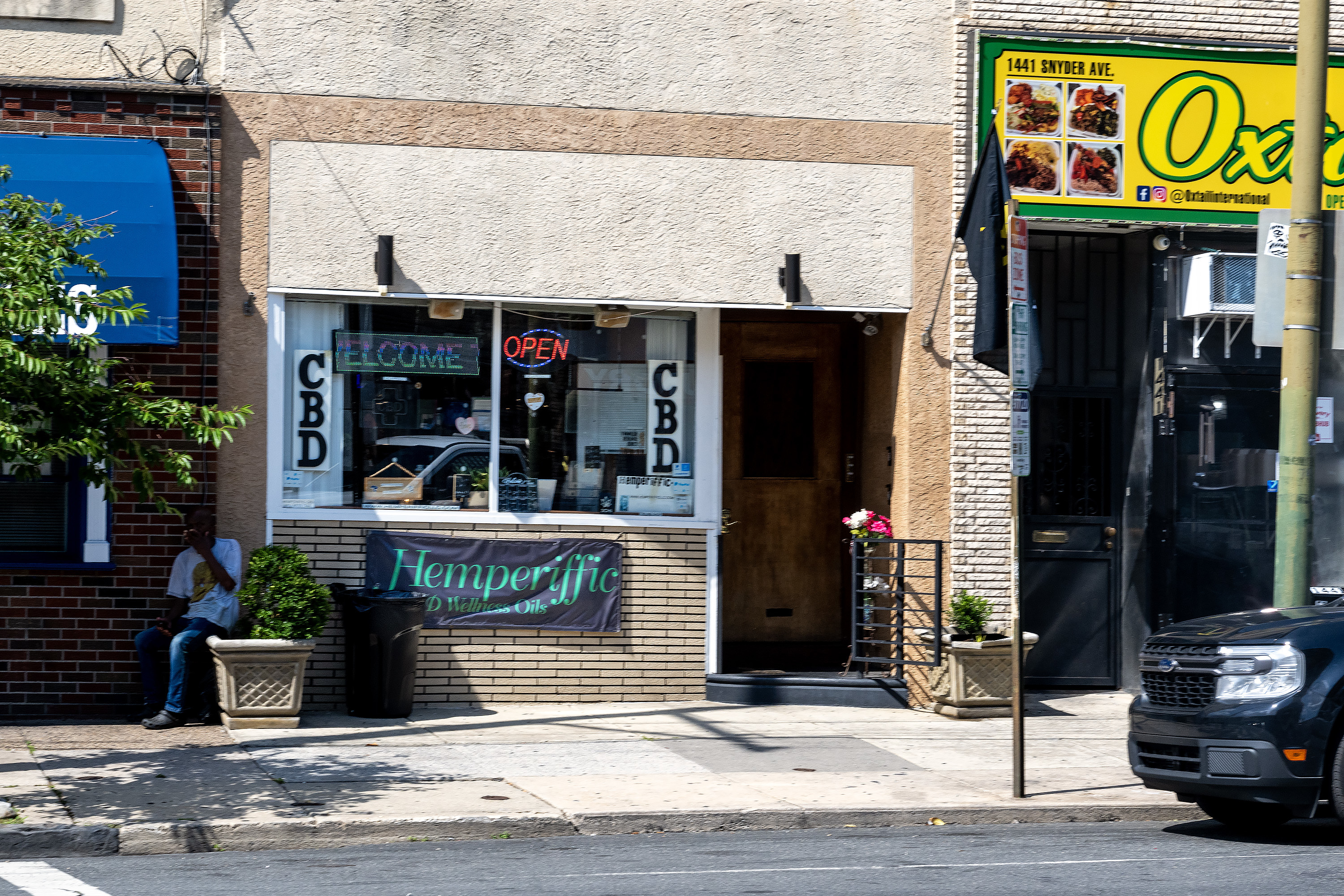
There’s a smoke shop in North Philly peddling recreational drugs across the street from a daycare. A West Philly storefront that sells loose cigarettes on a residential block. A convenience store in Spring Garden that advertises urine to people looking to pass a drug test.
These are among the so-called nuisance businesses that City Council members and neighborhood association leaders cited Monday as lawmakers advanced legislation to make it easier for the city to shut down stores that sell cannabis and tobacco products without licenses.
And legislators said their next target could be the landlords who rent space to those businesses.
“We have to work with our city departments and our state partners to clamp down on these businesses,” said City Council Majority Leader Katherine Gilmore Richardson, who represents the city at-large. “We’re just being inundated.”
Members of Council’s Committee on Licenses and Inspections passed two bills Monday that city officials say seek to close loopholes store owners exploit to avoid being cited for failing to obtain proper permits.
In introducing the legislation earlier this year, Gilmore Richardson cited an Inquirer report about Pennsylvania’s unregulated hemp stores, which sell products advertised as legal hemp that are often black market cannabis or contaminated with illicit toxins.
One bill makes it easier for the city to shut down nuisance businesses by removing language that classifies some violations as criminal matters, requiring that the police investigate them as crimes rather than civil violations that are quicker to adjudicate.
The second piece of legislation makes it illegal for businesses to essentially reorganize under a new name but conduct the same operations as a means of evading enforcement.
Both pieces of legislation could come up for a full vote in the Democratic-dominated City Council in the coming weeks. Members of Mayor Cherelle L. Parker’s administration testified in favor of them, meaning the mayor is likely to sign both.
A smoke shop in South Philadelphia.
Neighborhood association leaders also testified Monday in favor of the changes, but several said more aggressive enforcement is needed. They said smoke shops in particular have popped up throughout their commercial corridors, as have convenience stores that don’t even have licenses to operate as businesses, let alone sell recreational drugs.
“We’ve seen firsthand the selling of illegal drug paraphernalia and [loose cigarettes], many of which children walk past in order to get to the candy bars and seniors walk past to get to the milk,” said Heather Miller, of the Lawncrest Community Association. “We need to address this.”
Elaine Petrossian, a Democratic ward leader in Center City and a community activist, called for “much” higher fines and penalties for landlords. She cited progress the municipal government has made in New York City, where authorities cracked down on building owners who knowingly rented space to tenants selling cannabis or tobacco without licenses to do so.
Several lawmakers said they’d support a similar approach. Councilmember Mark Squilla, who represents a district that spans from South Philadelphia to Kensington, said landlords must be held “more accountable.”
“If they had some skin in the game, maybe they’d think twice about renting to an illegal operation,” he said.
Councilmember Jamie Gauthier, who represents parts of West Philadelphia, agreed. She said she recently attempted to meet with a building owner who rents space to a problematic smoke shop in her district, but was rebuffed.
“He was like, ‘These people pay me rent, and that’s the extent to which I basically care,’” Gauthier said. “We need something that forces property owners to be more accountable than that, because neighbors are suffering.”
Staff writers Max Marin and Ryan W. Briggs contributed to this article.