Tag: Temple University

  • For almost 40 years, Esperanza has served ‘the least of these’ and those who ‘just need a break’ | Philly Gives

    For almost 40 years, Esperanza has served ‘the least of these’ and those who ‘just need a break’ | Philly Gives

    Talk to most nonprofit chief executives, and they’ll be able, on cue, to recite a heartwarming story about someone their organizations helped.

    And the Rev. Luis Cortés Jr., Esperanza’s founder and chief executive, can do it, too.

    But he’d rather talk about a sin he committed as a little boy — a sin that impacted his thinking for a lifetime and allowed him to understand how to build a $111.6 million organization with 800 employees that educates, develops, uplifts, and houses 35,000 people a year in the heart of North Philadelphia’s predominantly Hispanic Hunting Park neighborhood.

    When Cortés was 12, he stole a Snickers candy bar from the bodega his father owned in New York City’s Spanish Harlem.

    Oh, his father figured it out, and quickly, too, because he began to ask little Luis some important questions:

    Did the 12-year-old know how many Snickers bars the bodega would have to sell to break even — not only on the box of Snickers, but on the taxes and utilities for the entire store? More importantly, how many Snickers bars would be required to turn a profit — a profit that could be reinvested?

    “You need to understand finance, whether it’s a box of Snickers or a multimillion-dollar bond to build a school. Where is the money coming from, and what’s the repayment structure?” Cortés said.

    Outside, as he spoke, a crane moved materials in what will soon become a new culinary school.

    “Understanding finance is important, and understanding culture is important, and you have to understand the relationship between the two.”

    So, yes, Cortés can and did tell the story about the mother who came to Esperanza to learn English skills, who got help to get a job and a house, who sent her daughter to Esperanza’s charter school and to Esperanza’s college, and now that same daughter is getting a house thanks to Esperanza’s mortgage counseling help.
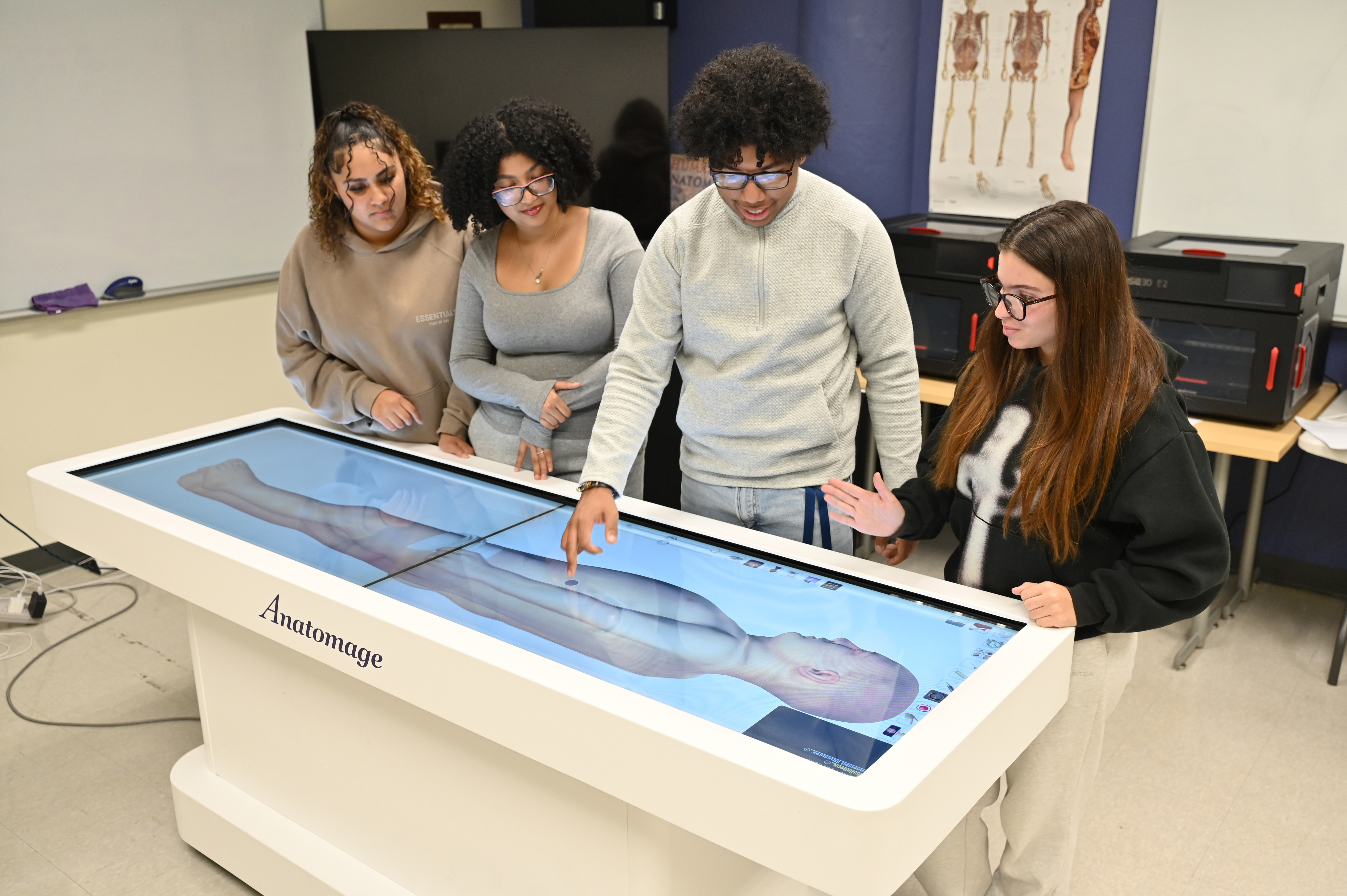
    Students Jayliani Casioano, Oryulie Andujar, Derek Medina, and Natalia Kukulski use an interactve anatomy table. The students are members of is the Health Occupations Students of America (HOSA).

    All good. But this is what Cortés really wants people to know:

    “If people trust us with their funds,” he said, “we’re putting the money into institutions, and institutions build culture.”

    That’s why Esperanza has a K-12 charter school, a cyber school, a two-year college that’s a branch campus of Eastern University, a 320-seat theater, an art gallery, computer labs, an immigration law practice, a neighborhood revitalization office, a CareerLink office for workforce development and job placement, a music program, a youth leadership institute, housing and benefit assistance, and a state-of-the-art broadcasting facility.

    Cortés even likes to brag about the basketball court. “Three inches of concrete, maple wood flooring, fiberglass backboards — NBA standards.”

    “Think about Paoli. It has a hospital, a public school, a theater. Paoli has all of that, and it’s understood that that’s the quality of life. We have to have access to those same things at a different price point,” he said. “Notice I didn’t say different quality. I said different price point.

    “We want to create an opportunity community, where people can have a good life — with arts, housing, healthcare, financial literacy, education, all those pieces — regardless of your family income,” he said.

    “What’s important here and what’s different is that in all our places, all our facilities are first class,” Cortés said.

    “I grew up in a low-income community where people were always telling you to step up, but step up to what?” he asked. “Where is the vision? What is possible to even have? How can anyone know unless they can see it?”

    So, when people from the community visit Esperanza, “you can see that you can have the best facilities with state-of-the-art equipment. As a provider of services, we have to step up,” he said, in turn always giving people the tools and resources they need to step up.

    For example, on Citizenship Day, Sept. 20, Anu Thomas, an attorney and executive director of Esperanza’s Immigration Legal Services, trained a dozen volunteer lawyers and law students on the fine points and recent pitfalls in the process of applying for citizenship.

    Soon, the room was crowded with people coming for help.

    Watching from the sidelines was Charlie Ellison, executive director of the city’s Office of Immigrant Affairs, who noted that an estimated 60,000 legal residents of Philadelphia are eligible to apply for citizenship.

    “Clinics like these are critically important to helping people who might be facing barriers,” including the cost of getting legal help. “This bridges a lot of gaps. It’s a vital mission, now more than ever,” he said.

    For Neury “Tito” Caba, a men’s fashion designer, tailor, and director of green space at Historic Fair Hill, citizenship help from Esperanza was a family affair. Through Esperanza, he, his grandmother, and his mother all became citizens.

    “Now I can vote, and that’s the most positive thing I can do,” he said. “And also, things being the way they are, it gives me some sort of protection.”

    Fashion designer Neury “Tito” Caba talks about his citizenship experience at Esperanza.

    Earlier this fall at Esperanza’s CareerLink branch, counselor Sylvia Carabillo helped Luis Rubio on the computer. He was trying to extend his unemployment benefits and looking for a job as a security guard. Agueda Mojica was being tutored in Esperanza’s most popular workforce class: Introduction to Computers.

    “I want to become more independent to be able to do anything on a computer,” she said in Spanish, speaking through a translator. “I was always working and never had time to learn.”

    Much of Esperanza’s staff is bilingual in Spanish, but to help people from the neighborhood, Esperanza also hired counselors who speak Ukrainian and Kreyòl for Haitians who live nearby.

    In Esperanza College classrooms a few weeks ago, Esperanza Academy high schoolers enrolled as college students had just finished a chemistry exam. When they graduate from high school, they’ll already have associate degrees on their résumés.

    For them, Esperanza represents a future.

    There’s Oryulie Andujar, 18, who wants to study sonography because an ultrasound technician found a cyst in her mother’s uterus. “We could have lost her. That was very impactful for me.”

    Jayliani Casiano, 17, wants to go into anesthesiology. The oldest of seven, she witnessed her mother giving birth to several younger siblings. “She was in a lot of pain. It was interesting. I want to do everything after seeing her through that process.”

    Derek Medina, 18, said the opportunity to go to college “made me rethink my whole life.” He had been getting into trouble in school, but now wants to combine a love of mathematics and a desire to help people by going into the field of biomedical engineering.

    Recently, on Nov. 14, Esperanza College hosted its Ninth Annual Minorities in Health Sciences Symposium, designed to acquaint high schoolers with medical careers.

    Construction will soon begin to convert a former warehouse space into a center to teach welding and HVAC in an apprenticeship program.

    Next month, it’ll be time for “Christmas En El Barrio” with music, food, and community in Teatro Esperanza — admission is free. In January, the Philadelphia Ballet will perform there. Tickets are $15 and free for senior citizens and students.

    “My worst seat — in Row 13 — would be $250 at the Academy of Music,” Cortés said. He wants to offer the arts at a price and a time available to a mother of three, who may not be able to afford even the cheapest seats in downtown venues, plus bus fare, “and heaven forbid the child wants a soda,” Cortés said.

    All this adds up to culture, which brings him back to the Snickers bar, and not just breaking even, but investing.

    Other groups, Cortés said, had to build their own institutions when mainstream organizations put up barriers. Howard University helped Black people, Brandeis served Jewish people, and Notre Dame provided education to the Irish.

    Building an institution is his investment goal with Esperanza, and he takes as his mentors famous Philadelphia pastors such as the Rev. Leon Sullivan, who founded Progress Plaza in North Philadelphia, and the Rev. Russell Conwell, the Baptist minister who founded Temple University.

    “Philadelphia has a tradition that its clergy don’t just do clergy things,” he said, admitting that he doesn’t have the patience for a more traditional pastor’s role. “As clergy here, it’s understood that we snoop around everything.”

    Cities sometimes brag that their poverty rates have declined, he said, when in reality, rates have declined because people with low incomes were forced to move away.

    Philadelphia, he said, has a chance to be different — to lower the poverty level both by raising people’s incomes and improving their standards of living. “There should be Esperanzas in every neighborhood,” he said.

    “How can we focus on helping the people who just need a break?” Cortés said, referencing Jesus’ admonishment to “help the least of these.”

    “This city has the opportunity to make this a win-win,” he said, “to show the rest of the country and Washington, D.C. — especially Washington, D.C. — that people who are different, and people who are `the other’ can be supported, so that they are not only part of the fabric of the city, but economic drivers of the city.”

    This article is part of a series about Philly Gives — a community fund to support nonprofits through end-of-year giving. To learn more about Philly Gives, including how to donate, visit phillygives.org.
    For more information about Philly Gives, including how to donate, visit phillygives.org.

    About Esperanza

    People Served: 35,000

    Annual Spending: $111.6 million across all divisions

    Point of Pride: Esperanza empowers clients to transform their lives and their community through a diverse array of programs, including K-14 education, job training and placement, neighborhood revitalization and greening, housing and financial counseling, immigration legal services, arts programming, and more.

    You Can Help: Esperanza welcomes volunteers for community cleanups, plantings, and other neighborhood events. Some programs also need volunteers with specific skills (lawyers, translators, etc.).

    Support: phillygives.org

    What Your Esperanza Donation Can Do

    • $25 covers the cost of one private music lesson for a young student through our Artístas y Músicos Latinoamericanos program.
    • $50 provides printing and distribution of 30 “Know Your Rights” brochures to immigrant families.
    • $100 pays for five hours of training for a new mentor fellow at the Esperanza Arts Center, preparing a young person for a career in arts production through hands-on learning.
    • $275 funds the planting of one street tree in a neighborhood that desperately needs additional tree cover to address extreme heat.
    • $350 covers tuition and books for one English as a second language student at the Esperanza English Institute.
    • $550 supports the cost of the initial work authorization for an asylum-seeker.
  • Tracking the sharp drop in Philadelphia health systems’ operating margins after COVID-19

    Tracking the sharp drop in Philadelphia health systems’ operating margins after COVID-19

    The worst of the coronavirus pandemic that started nearly six years ago is well in the past, but Philadelphia’s biggest nonprofit health systems are still contending with the financial disruption unleashed by the virus that led to thousands of deaths in the area.

    Operating conditions for hospitals started improving in 2023, but “the slope of the recovery is a bit more shallow than a lot of health systems had planned for,” said Mark Pascaris, a senior director at Fitch Ratings, one of three major credit ratings agencies.

    Patients have returned, but the pandemic led to a resetting of expenses for labor and supplies at a higher level, Pascaris said. “That’s been the challenge over the last two or three or four years now, trying to manage through a very challenging expense situation,” he said.

    To show how the financial landscape has changed, The Inquirer compiled financial data for the region’s six biggest health systems that have fiscal years ending June 30 each year. The analysis compared average operating profits in three years before the pandemic (fiscal years 2017-19) to the results in most recent three years (fiscal years 2023-25).

    All six systems showed a substantial drop in a measure of earnings that excludes certain accounting expenses and interest costs. This slice of financial results is known as earnings before interest, depreciation, and amortization. Abbreviated as EBIDA, it’s a primary indicator watched by influential credit ratings agencies.

    window.addEventListener(“message”,function(a){if(void 0!==a.data[“datawrapper-height”]){var e=document.querySelectorAll(“iframe”);for(var t in a.data[“datawrapper-height”])for(var r,i=0;r=e[i];i++)if(r.contentWindow===a.source){var d=a.data[“datawrapper-height”][t]+”px”;r.style.height=d}}});

    The experience of Children’s Hospital of Philadelphia clearly illustrates what has happened: The organization’s aggregate revenue in the most recent three fiscal years was 58% higher than it was in the three years that ended June 30, 2019, but its EBIDA climbed only by half a percentage point.

    “Hospitals and healthcare systems across the country continue to face significant headwinds, driven by reimbursement challenges, increased supply and labor costs, uncertain governmental pressures, and the continued ripple effect of the pandemic,” CHOP said in a statement.

    Officials at ChristianaCare, Main Line Health, and Temple University Health System echoed CHOP’s remark.

    “Margins were far better prior to the pandemic, largely due to lower supply and labor costs,” Main Line’s chief financial officer Leigh Ehrlich said. “Those costs rose sharply during the pandemic and continue to rise.”

    ChristianaCare’s CFO Rob McMurray noted: Not only have Medicare and Medicaid rates not kept up with inflation, but more people have those government forms of insurance for people 65 and older and for low-income people.

    The nonprofit is expanding from its base in northern Delaware to Southeastern Pennsylvania and is expanding alternative formats, such as hospital-care-at-home and micro hospitals, to reduce costs, McMurray said.

    A significant worry for Temple University Health System is the impact of the 2025 budget reconciliation bill, sometimes called the One Big Beautiful Bill Act. The North Philadelphia nonprofit estimates that Medicaid cuts in that law will cost it $519 million over the next 10 years, said Jerry Oetzel, the system’s CFO.

  • James Ijames may be teaching at Columbia, but he never wants to stop making art in Philly

    James Ijames may be teaching at Columbia, but he never wants to stop making art in Philly

    Philly theater darling James Ijames, the Pulitzer Prize-winning playwright of Fat Ham, will return to local stages with a special spotlight next spring, with a slate of three plays running at three theaters.

    Recognizing this scheduling synergy, the venues are partnering to offer a three-ticket pass, called “The Citywide James Ijames Pass.”

    The first collaboration of its kind dedicated to a contemporary playwright, the pass covers the Philadelphia premiere of Good Bones at the Arden Theatre (Jan. 22 to March 8), The Most Spectacularly Lamentable Trial of Miz Martha Washington at the Wilma Theater (March 17 to April 5), and the world premiere of Ijames’ latest work, Wilderness Generation, at Philadelphia Theatre Company (April 10 to May 3).

    Ijames wrote all of these plays in South Philadelphia, which he considers his artistic home. This year, he left his teaching position at Villanova University to run the playwriting program at Columbia University. While that means he’s spending most of his time in New York now — though his husband, Joel Witter, still works for the Philly school district — Ijames says Philadelphia is “still very much a place where I want to continue to make art.”

    “I’ve lived in Philly more than I’ve lived anywhere in my life, so it is incredibly special to me,” said the Tony-nominated playwright, a founding member of the local playwriting collective Orbiter 3.

    After growing up in North Carolina and attending Morehouse College in Atlanta, Ijames got his MFA in acting at Temple University. He performed on stages all over the city, including at the National Constitution Center, People’s Light, and all three theaters featured in the pass.

    It was during the 2012 production of Angels in America at the Wilma where he wrote Miz Martha Washington, one of his earliest plays, in the dressing room. Ijames went on to serve as one of three co-artistic directors of the Wilma, which premiered the digital production of Fat Ham — his incisive and irreverent queer reimagining of Hamlet — that earned him the 2022 Pulitzer Prize.

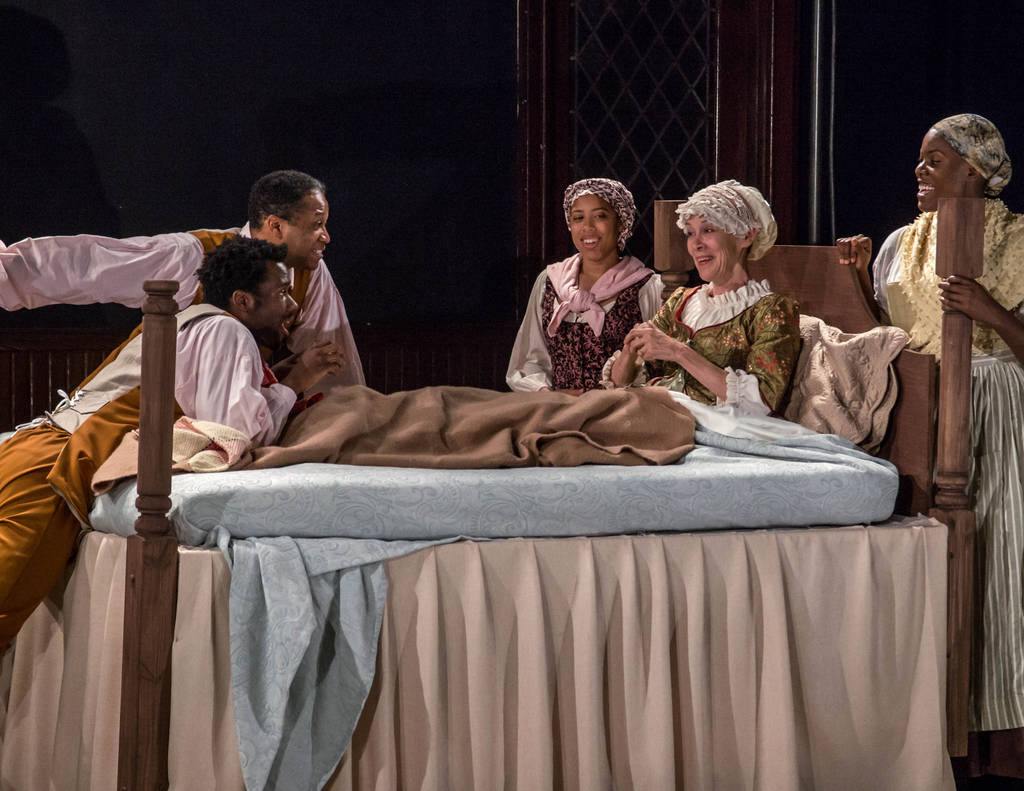
    Flashpoint Theatre Company’s Barrymore-nominated “The Most Spectacularly Lamentable Trial of Miz Martha Washington.” From left: Darryl Gene Daughtry Jr., Steven Wright, Taysha Canales, and Jaylene Clark Owens surround Nancy Boykin as Martha Washington.
    Photo by Ian Paul Guzzone.

    In the sharp satire Miz Martha Washington, the titular first lady is on her deathbed, surrounded by the people she and her husband enslaved. With freedom inching closer — George Washington’s will promised them liberty upon his widow’s death — the Black characters appear in various hallucinations, putting Martha and her family on trial.

    The play will come back to town amid Philadelphia’s celebrations for the 250th anniversary of the nation’s founding, apt timing for a sharp satire on the Founding Fathers’ legacy of slavery.

    “I think we were all kind of hoping that the world and the politics would be a little different when we first started thinking about it,” said Ijames. “But I always say, we have to look at the history directly in the face and, from that, try to imagine something different.”

    Good Bones is a more contemporary story about the development of a new stadium that stands to disrupt a city neighborhood (sound familiar?). The upper-class newcomer, haunted by those who were pushed out, gets into fiery debates over gentrification with her contractor.

    The Philly premiere will be directed by Ijames’ longtime friend and collaborator Akeem Davis, who starred in the Ijames-directed production of August Wilson’s King Hedley II at the Arden earlier this year.

    Arden Theatre producing artistic director Terry Nolen hopes audiences will come out to cheer on a “hometown hero.”

    “Philly audiences love Philly artists, and there is so much pride for James’ success,” Nolen said in a statement.

    Philly playwright James Ijames attends the 76th Annual Tony Awards at United Palace Theater on June 11, 2023, in New York City. His play “Fat Ham” had five nominations, including best play. (Photo by Cindy Ord /Getty Images for Tony Awards Productions)

    The playwright’s newest work, Wilderness Generation, examines the relationships between cousins as Ijames, who’s close to his own cousins, wanted to spotlight that kind of family dynamic. Five cousins reunite at their grandmother’s house in the South to help her downsize; while there, they unpack a painful family history and confront the damage of their relatives’ behavior as they try to forge a future together.

    Ijames wrote the work with Philadelphia Theatre Company co-artistic directors Taibi Magar and Tyler Dobrowsky in mind. Though Ijames has performed at PTC before, this world premiere marks the first time a play he wrote will grace its stage.

    “I am where I am because a lot of theaters in Philadelphia took a chance on me,” said Ijames. He hopes future collaborations can highlight more “really brilliant folks” writing new plays in Philly.

    “I hope a thing that happens as a result of this is a Jackie Goldfinger package one day, a Michael Hollinger package, an Erlina Ortiz package, [and] an AZ Espinoza package.”

    The three-play pass costs $130, about $43 per ticket, and includes preferred seating, flexible ticket changes, parking discounts, and member benefits at each theater, as well as exclusive swag — a yellow beanie, inspired by Ijames’ personal style. Passes are available online or at the TKTS booth at the Independence Visitor Center.

  • Going green: Why frogs are appearing at ICE protests

    Going green: Why frogs are appearing at ICE protests

    The frogs are all over social media, playing and prancing in front of the ICE building in Portland, Ore. The demonstrators in big, green inflatable costumes have grown from local oddity to symbol of the resistance, undermining President Donald Trump’s claim that “war ravaged” Portland is under siege by “domestic terrorists.”

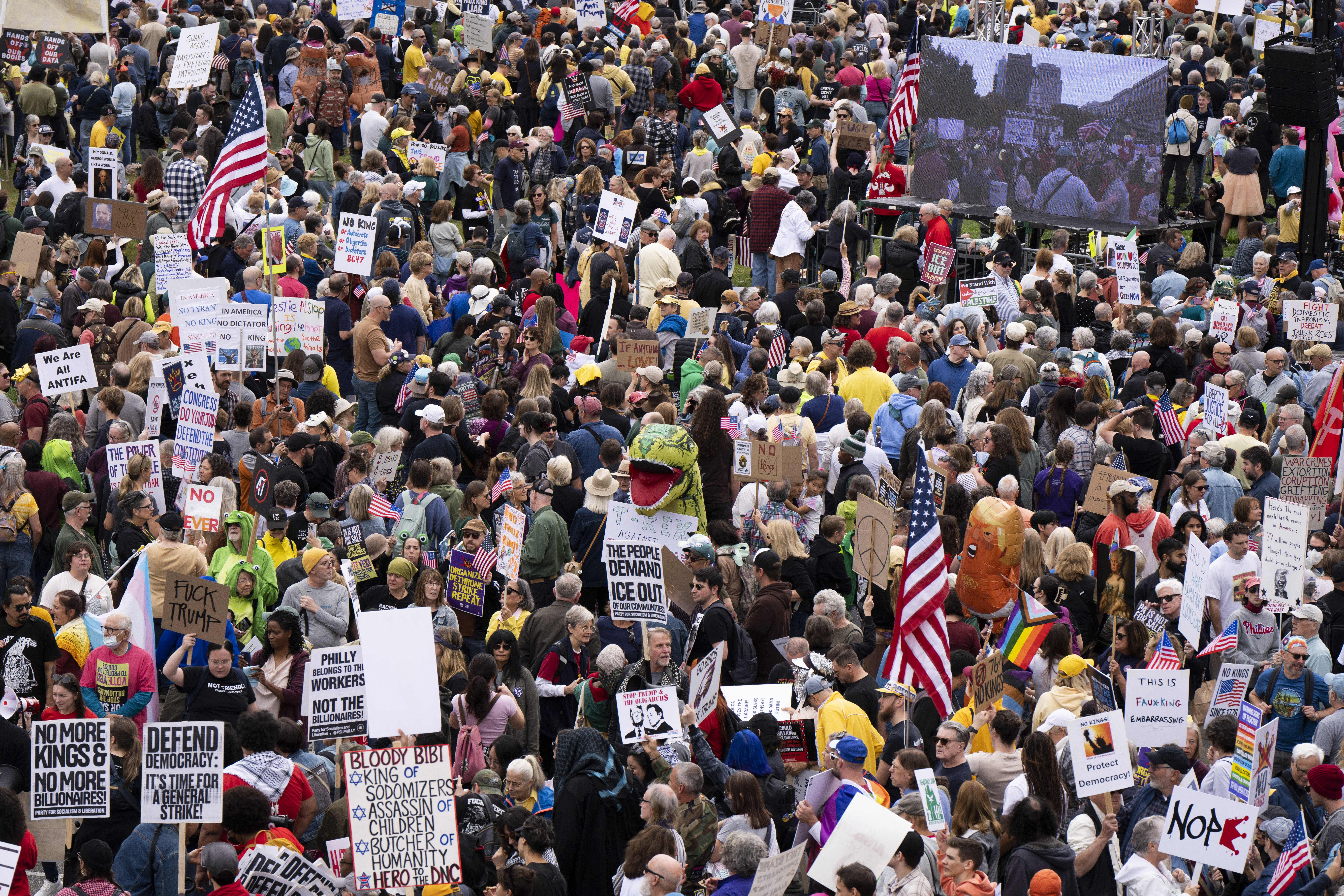
    Protests that started with a single amphibian have in recent weeks expanded into full ponds, particularly after a viral video showed officers pepper-spraying a demonstrator through the air-intake of his costume. The frog corps there has been joined by a shark, giraffe, chicken, and raccoon, and during the recent nationwide “No Kings” marches expanded its web-toed footprint to places including Philadelphia.

    Demonstrators gather for a ’No Kings’ rally in Philadelphia on Saturday, Oct. 18, 2025.

    Why has the frog become so popular?

    People following the news on the internet and TV see the paramilitary might of helmeted ICE agents arrayed against … frogs. And unicorns. And other dancing creatures.

    For demonstrators, it’s a way to make the other side look ridiculous by embracing ridiculousness ― a staple of effective political street theater, said Temple University professor Ralph Young, an expert on protest and dissent.

    “Trump saying Portland is occupied by terrorists, it’s so over the top,” Young said. “How do you respond? I guess you put on a frog outfit.”

    What has made Portland a center of immigration protest?

    Demonstrators oppose Trump’s effort to deport millions of people. And Portland has long been a target of the president, who last week again falsely claimed that the city was “burning down.”

    He wants to deploy National Guard troops in response to the protests outside the city’s Immigration and Customs Enforcement facility. An appeals court last week reversed an earlier ruling and said that deployment could proceed.

    Wearing animal costumes “dismantles their narrative a little bit,” chicken-suited protester Jack Dickinson told Willamette Week. “[Homeland Security Secretary] Kristi Noem is up on the balcony staring over the ‘Antifa Army’ and it’s, like, eight journalists and five protesters and one of them is in a chicken suit.”

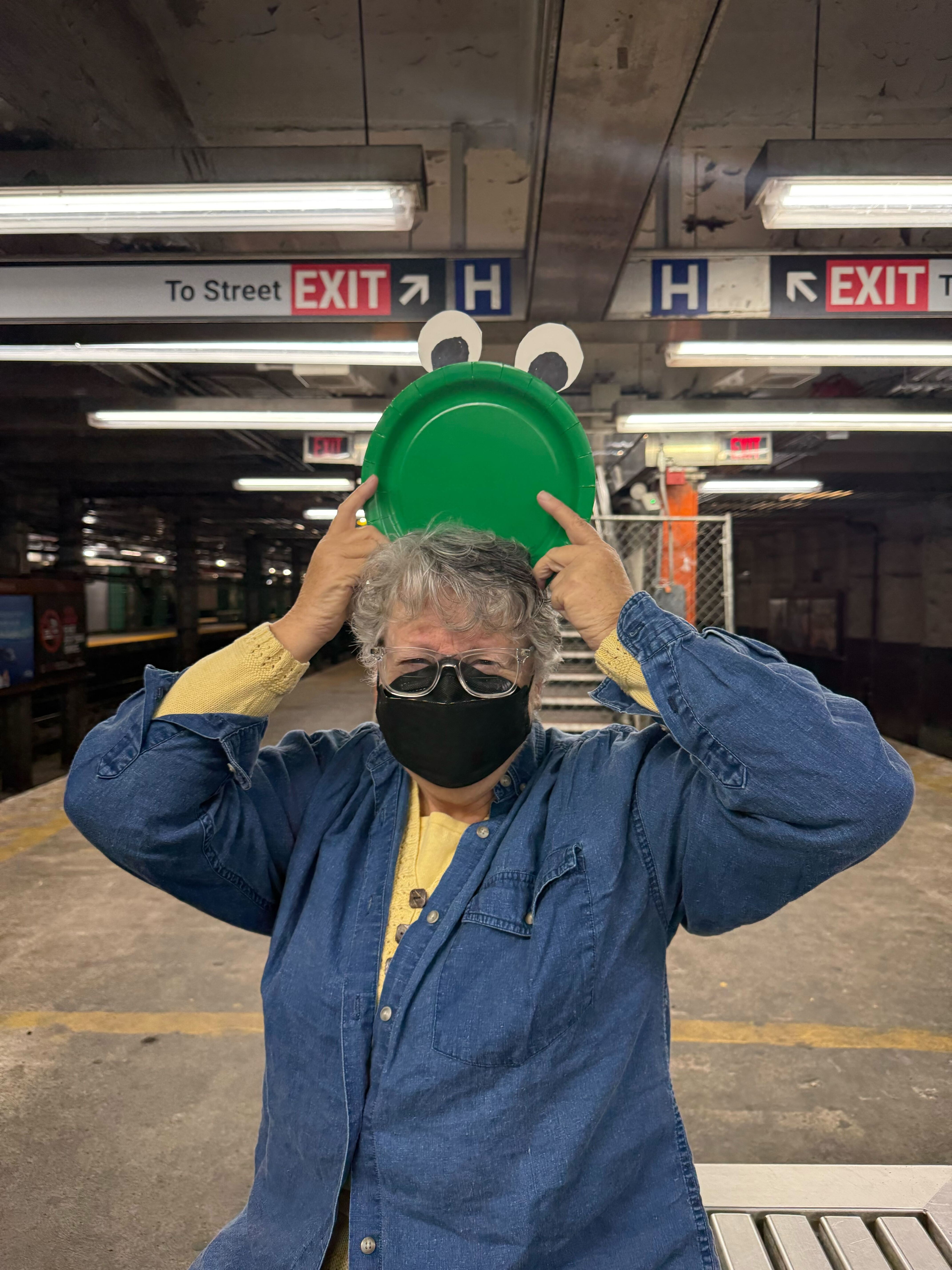
    Laura Murphy, 74, wears a handmade tiara inspired by a Portland, Oregon, protester’s frog costume, on her way to the No Kings protest on Oct. 18 in Philadelphia.

    Where did the idea for the frogs come from?

    The frogs, Temple’s Young said, come out of a court jester tradition. In ancient times, jesters could speak to the king in ways that might get someone else beheaded. They offered what others might be unwilling to say ― the truth, cloaked in humor.

    Since that time there have been many other instances of truth-in-comedy protests.

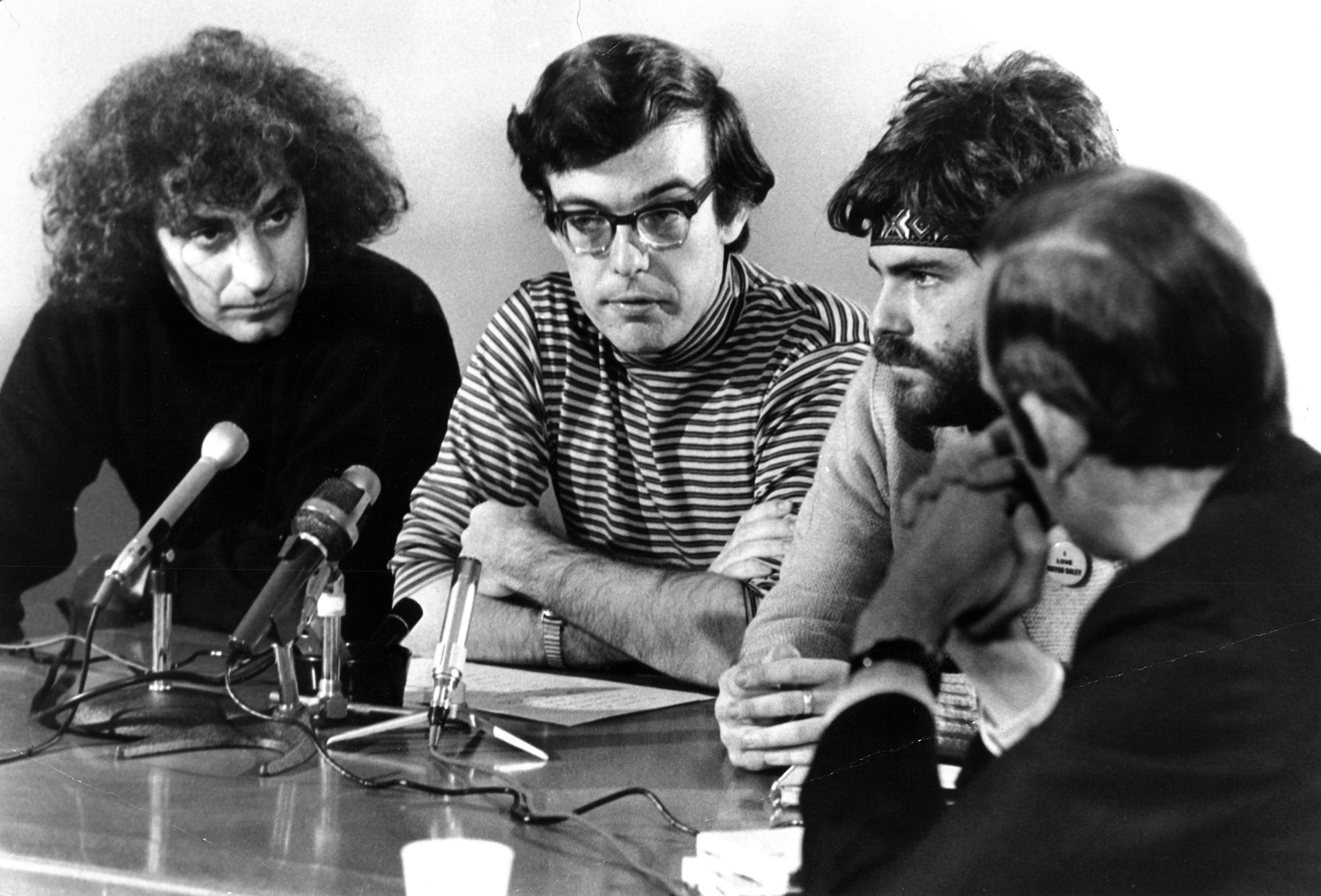
    At the 1968 Democratic National Convention, the Youth International Party, the Yippies, nominated a 145-pound pig for president. Pigasus, sarcastically named for the winged horse Pegasus, served to protest the political establishment and the sorry choice many voters felt they faced in choosing between Richard Nixon and Hubert Humphrey. The pig’s campaign slogan: “If we can’t have him in the White House, we can have him for breakfast.”

    Here on trial as part of the Chicago Seven, Abbie Hoffman (left) and Jerry Rubin (right), with beard and headband, helped nominate a pig for president. In center in striped shirt is defendant Rennie Davis. They’re picture here on Oct. 23, 1969, at the Federal Building in Chicago.

    The same year, the New York Radical Women attracted huge news coverage at the Miss America pageant when they dumped bras, makeup, and girdles into a “Freedom Trash Can” set up on the Atlantic City Boardwalk. The demonstrators were labeled “bra-burners,” though organizers insisted no bras were actually burned.

    Have frogs been spotted in Philadelphia?

    Yes, including at the recent “No Kings” protest that drew thousands onto city streets. One person carried a sign endorsing “Amphifa,” or “Amphibians Against Fascism.”

    Frogs are appearing on posters and T-shirts in a variety of poses: Raising the U.S. flag at Iwo Jima, with the help of a chicken and a unicorn. And as the subject of the famous Barack Obama campaign portrait, this one captioned not “HOPE” but “HOP.”

    So far the ICE field office in Philadelphia has not been the target of sustained protests, though the exterior of the building is now guarded by heavy concrete blocks. The group No ICE Philly plans to hold an all-day, Halloween Eve demonstration on Thursday, complete with costumes, live music, art, and free food.

    A demonstrator wearing a frog costume stands outside a U.S. Immigration and Customs Enforcement facility on Tuesday, Oct. 7, 2025, in Portland, Ore. (AP Photo/Ethan Swope)

    Is it true the frogs are meant as a biblical reference?

    Let’s not get carried away. But, yes, some people have posted social media photos of the Portland frogs captioned with a verse from Exodus 8:2-6: “If you refuse to let them go, I will bring a plague of frogs on your whole country. … The frogs will jump on you, on your people, and on all your officials.”

    Staff writer Michelle Myers contributed to this article.

  • How three Philadelphia-area health systems changed accounting practices and boosted profits

    How three Philadelphia-area health systems changed accounting practices and boosted profits

    Amid persistently higher costs, three Philadelphia-area health systems have cut expenses over the last two years by changing how they account for investments in facilities and equipment. The change significantly boosted operating income in all three cases.

    ChristianaCare and Main Line Health are now spreading the cost of buildings and building improvements over as many as 80 years, they said in their fiscal 2025 audited financial statements. That is double the maximum number of years they previously used to calculate what accountants call depreciation expense. Thomas Jefferson University made a similar change last year.

    All three health systems use PricewaterhouseCoopers LLP as their auditor. The firm, which did not respond to a request for comment, also has Philadelphia health-system clients that have not extended their depreciation schedules.

    The term depreciation expense refers to the way hospitals and other businesses allocate the cost of a building, a piece of equipment such as an MRI machine, or even software to manage patient records across the number of years the asset is likely to be used.

    It’s a noncash expense because the money used to make the purchase is recorded elsewhere in the financial statements. Several financial and accounting experts said the change could be seen as cosmetic.

    “It’s not affecting operations. It’s not increasing their revenues. It’s not decreasing their cash expenditures. It is purely a bookkeeping entry,” said Steven Balsam, a professor of accounting at Temple University’s Fox School of Business.

    Main Line Health

    At Main Line, the extended depreciation schedule reduced the expense by an estimated $37.5 million. That helped the system achieve a small, $4 million operating profit for the first time since fiscal 2021, when federal COVID-19 aid buoyed hospitals.

    Without the depreciation savings, Main Line would have had an operating loss of $33.5 million in the year that ended June 30, compared to a $61 million operating loss in fiscal 2024.

    Asked for comment, Main Line’s chief financial officer Leigh Ehrlich noted that the system’s financial performance had improved, thanks to “increased patient volumes and continued focus on expense management.”

    Excluding noncash depreciation and amortization in each of the last two years, Main Line’s operating income improved to $127.8 million from $96.7 million.

    ChristianaCare

    ChristianaCare reviewed the depreciation schedules of fixed assets “as part of our ongoing commitment to maintain accurate and reliable financial reporting,” the nonprofit’s chief financial officer Rob McMurray said in an email. The result was a $24.4 million reduction in depreciation expense.

    The review also resulted in a $9 million write-off of unspecified assets, which meant that in fiscal 2025 the benefit to operating income was $15 million, McMurray said.

    ChristianaCare’s operating income in the year that ended June 30 was $35.5 million, or $20.5 million without the accounting change. The organization had $126.2 million in operating income in fiscal 2024.

    Thomas Jefferson University

    Last year, Thomas Jefferson University opened its $762 million Honickman Center in Philadelphia. Normally, taking a building like that into service would increase depreciation expense.

    Instead, Jefferson’s depreciation expense fell by $68 million, according to its audited financial statement for the year that ended June 30, 2024. The decline happened after Jefferson opted to spread the cost of all buildings and building improvements over as many as 70 years, according to the depreciation schedule in its financial statement.

    Even with the depreciation change, Jefferson’s operating income in fiscal 2024 was extremely narrow, at $1.34 million on nearly $10 billion in revenue that year.

    The benefit of lower depreciation expense continued in fiscal 2025, as it will in future years for ChristianaCare and Main Line.

    Depreciation expense at other local systems

    Most Philadelphia-area health systems use a schedule for depreciating buildings and building improvements that maxes out at 40 years, an Inquirer review of financial statements found.

    “You’re constantly modernizing your facilities to allow for the delivery of medicine based on current times,” Temple University Health System chief financial officer Jerry Oetzel said in an interview. “Who knows 15 years from now? We don’t have clear insight, but it’s probably going to be more home care.”

    That’s why Temple hasn’t adopted a longer depreciation schedule. “It’s just a savings in operating expenses without the benefit of any cash behind it,” Oetzel said.

    Editor’s note: This article has been updated to remove a reference to American Hospital Association guidelines.

  • Medicare coverage for telehealth suspended as result of government shutdown

    Medicare coverage for telehealth suspended as result of government shutdown

    Steve Hirst relies on virtual visits with his urologist, whose office is an hour away from his Broomall home, to stay on top of his treatment plan and renew medications.

    But earlier this month Hirst, 70, got a notice from his doctor’s office informing him that it could no longer schedule telemedicine visits for patients like him who have Medicare because of new federal policy changes.

    Medicare began covering telemedicine services during the COVID-19 pandemic and has maintained the popular offering through temporary waivers approved by Congress since. But the most recent of those waivers expired at the end of September when Congress failed to reach a budget deal and the government shut down.

    The change specifically affects traditional Medicare, which is administered by the government for people 65 and older and some with disabilities. People with Medicare Advantage plans, which are administered by private insurers, should check with their plan.

    Medicare coverage for virtual visits for mental health was made permanent after the pandemic and are not affected by the shutdown.

    Some of the Philadelphia area’s leading health systems, including Temple Health and Penn Medicine, have said they are continuing to provide telehealth services to people with Medicare and temporarily suspending billing for those services, with hope that coverage will be reinstated when a budget deal is eventually reached.

    But smaller provider practices may not have the luxury of delaying payment for thousands of dollars in services for an indefinite period of time.

    With the government shutdown in its third week, Republicans and Democrats seem no closer to reaching a deal. The next vote is scheduled for Monday evening, though no deal is expected.

    Another health policy issue — tax credits for people who buy insurance through Affordable Care Act marketplaces, including Pennie in Pennsylvania — has been a major sticking point in the ongoing federal budget debate. Democrats want the enhanced subsidies extended permanently as part of the budget deal, and Republicans have refused, arguing that lawmakers could address the issue separately, before the subsidies expire at the end of the year.

    Meanwhile, the waiver’s expiration has left Hirst and others who are covered by Medicare unsure how they will access needed health services.

    Telehealth’s rise

    Telehealth rose in popularity during the COVID-19 pandemic, when people were urged to avoid hospitals unless they were having an emergency and when most routine procedures were canceled.

    The approach was especially helpful to older adults and people with disabilities, who needed to stay in contact with doctors for ongoing treatment and who were considered particularly vulnerable to severe illness from COVID-19.

    After the pandemic ended, many private insurers, Medicaid, and Medicare permanently adopted telehealth coverage for certain services, such as mental health, because of its popularity during the pandemic.

    Medicare has used temporary waivers to continue telehealth coverage for other types of doctors’ visits.

    Beyond patient popularity, research has found that telehealth visits can be as effective as in-person visits for certain types of care, such as palliative care for cancer patients, while improving access to patients with transportation challenges.

    Philadelphia health systems respond

    Philadelphia’s largest health systems said they are optimistic that coverage will be reinstated — either by a new temporary waiver or a permanent change — when Congress reaches a new budget agreement and the shutdown ends.

    Temple Health will continue to provide telehealth services to Medicare patients for the next three weeks, in anticipation of Congress reaching a deal.

    Penn Medicine has not billed Medicare patients for telehealth visits since the shutdown began and has paused its process for filing claims until the government reopens, a spokesperson said.

    “Congress has been vocal in its support of telehealth and its value, and we are hopeful that legislation will be passed to ensure permanent Medicare telehealth coverage and flexibilities once the government reopens,” Penn said in a statement.

    Main Line Health has been reaching out to affected patients to help them change previously scheduled virtual visits into in-person appointments or reschedule virtual visits that can be put off.

    Jefferson Health did not respond to a request for comment in time for publication.

    Patients in limbo

    Hirst drives into Philadelphia to see his urologist in person once a year. Every three months, he has a virtual visit to check in and renew prescriptions.

    Driving to Philadelphia for every appointment would be inconvenient, but Hirst will probably do it “for now,” he said.

    But he worries about older adults and people with disabilities who can’t safely drive to the doctor’s office, and for whom virtual care is a lifeline. They could end up putting themselves or others at risk being on the road when they shouldn’t be. Or they may end up skipping needed care because they don’t have a ride.

    “It makes no sense,” Hirst said.

  • Federal shutdown may bring a halt to food assistance for half a million Philadelphians

    Federal shutdown may bring a halt to food assistance for half a million Philadelphians

    Nearly 2 million Pennsylvanians — including 500,000 Philadelphia residents — won’t receive SNAP benefits in November if the federal government shutdown continues, state officials said.

    The Supplemental Nutrition Assistance Program provides $366 million a month to low-income people in the state, according to the Pennsylvania Department of Health and Human Services (DHS). Most households that receive SNAP benefits consist of elderly people, children, or individuals with disabilities, according to hunger experts.

    This is the first federal shutdown in at least 20 years in which SNAP will not be made available, said George Matysik, executive director of the Share Food Program, a food bank that serves 500,000 people living in the region.

    “It’s like a horror movie where the call is coming from within the house,” Matysik said in an interview last week. “Our own federal government is making the choice to take benefits from Pennsylvanians,” who are among 42 million people nationwide who participate in the program.

    In Philadelphia, Share has seen a 120% increase in food need over the last three years, Matysik said. “And that was with SNAP,” he added, saying the city faces a greater food crisis now than it did during the pandemic.

    In an email Monday, the Pennsylvania DHS blamed Republicans “who control the U.S. Senate, the U.S. House, and the White House” for failing to pass a budget and causing the current difficulties Americans endure.

    “We urge Republicans in Congress to reopen the government and protect vulnerable Pennsylvanians at risk because of this inaction,” the email said.

    Gov. Josh Shapiro’s office could not be reached for comment. In May, Shapiro said that the commonwealth would be unable to replace lost funding for SNAP should the federal government fail to pay.

    The U.S. Department of Agriculture, which administers SNAP, did not return calls for comment. The White House issued a statement that the shutdown is affecting personnel in its press office, delaying responses. The statement blamed Democrats for the government’s closure: “Please remember this could have been avoided if the Democrats voted for the clean Continuing Resolution to keep the government open.”

    To receive SNAP benefits, individuals carry EBT (electronic benefits transfer) cards that are loaded monthly with the amounts to which they are entitled.

    The shutdown began Oct. 1 after Congress could not reach a compromise to allow funding to continue. The region’s 46,000 federal workers found themselves without paychecks. The Trump administration, meanwhile, began laying off federal workers, with a goal of sacking 4,000 of them. A federal judge in California intervened to halt the layoffs. A hearing is scheduled for Tuesday.

    Like other states, New Jersey faces the same funding difficulty. If the federal government remains closed by Nov. 1, about 800,000 people will be without SNAP benefits.

    Elderly people who rely on SNAP will suffer throughout Pennsylvania because, for them, “food is medicine,” said Allen Glicksman, director of research at the Eastern Pennsylvania Geriatrics Society in Newtown Square. “Without it, there’s the chance of a health catastrophe that will cost more money in Medicaid and in emergency room visits.”

    There are 234,638 Philadelphians age 65 and older, 104,972 (45%) of whom live below the federal poverty line ($21,150 for two individuals in a household), Glicksman calculated.

    Brian Gralnick, executive director of the Center for Advocacy for the Rights and Interests of Elders (CARIE) in Center City, agreed. “Consequences will be devastating. Without federal government dollars, ending or even addressing hunger in the region will be as successful as draining the Delaware River using Eagles helmets.”

    For children, the potential shortage of SNAP benefits will be no less calamitous, said sociologist Judith Levine, director of the Public Policy Lab at Temple University.

    “Food is a necessary element for brain development and growth,” she said. “And there’s a clear connection between hunger and the ability to perform in school.

    “This is a complete crisis we are facing.”

    One in four Philadelphia children experiences food insecurity — lack of enough food over the course of a year to live a healthy life — according to a City Council report.

    In the neighborhoods, the word about the halt to SNAP benefits is circulating. Fear and confusion had already been growing after the Trump administration announced changes to the SNAP program that would make it more difficult for some people to access benefits.

    Among the changes: Some SNAP recipients ages 18 to 54 who are able to work and do not support a child under 18 are now required to report at least 20 hours of work, training, or volunteering per week, or 80 hours per month, to keep their benefits.

    Despite the revisions to the program, however, many people these days are more worried about what happens if SNAP halts.

    “People are very anxious about that,” said Pastor Tricia Neal, director of the Feast of Justice food pantry at St. John’s Lutheran Church in the Northeast.

    “The anxiety level is driving more people to come here, and, because we serve 5,500 households, we are well beyond the capacity of what we can support. It’s really horrendous to look at what’s happening here.”

    That much is clear, according to Rosemary Diem, who tries to stave off hunger for her and her husband by combining SNAP benefits with visits to Feast of Justice.

    “Everything at the pantry is running low,” said Diem, 60, who is disabled, as is her husband, Joseph, 63. “I see us getting hurt without SNAP. There won’t be money for milk and eggs.

    “How am I going to get through?”

  • State Sen. Sharif Street has early fundraising lead in Philly congressional race, but his competitors are close behind

    State Sen. Sharif Street has early fundraising lead in Philly congressional race, but his competitors are close behind

    State Sen. Sharif Street has an early fundraising lead over his competitors in next year’s Democratic primary for a storied Philadelphia congressional seat, according to new campaign finance reports.

    But the race is in its early stages, and candidates who entered the race after Street still have plenty of time to catch up before the May 2026 primary.

    Street, the son of former Mayor John F. Street, entered the race for Pennsylvania’s 3rd Congressional District in early July, days after U.S. Rep. Dwight Evans (D., Philadelphia) announced he would not seek reelection. Street’s campaign launch coincided with the beginning of the campaign finance reporting period, allowing him three full months to solicit contributions and seek endorsements.

    He took in about $352,000 from July 1 through Sept. 30, according to the Federal Election Commission. His campaign spent $33,000 during that time, and he finished the period with $372,000 in cash on hand, which is also the most of any candidate in the race. (Street’s cash reserves are higher than his fundraising because he carried over money from a previous campaign account.)

    “Our strong fundraising results put us in a commanding position,” Street campaign manager Josh Uretsky said in a statement. “We’re building a strong campaign that will hit every neighborhood in the Third District by leveraging our broad-based coalition.”

    window.addEventListener(“message”,function(a){if(void 0!==a.data[“datawrapper-height”]){var e=document.querySelectorAll(“iframe”);for(var t in a.data[“datawrapper-height”])for(var r,i=0;r=e[i];i++)if(r.contentWindow===a.source){var d=a.data[“datawrapper-height”][t]+”px”;r.style.height=d}}});

    State Rep. Chris Rabb, an anti-establishment progressive, who raised $257,000, also announced his campaign in July.

    Rabb’s haul was notable for a candidate with little support among Philadelphia’s established political organizations, such as the deep-pocketed building trades unions that endorsed Street this week. As he has in past runs, Rabb said he is eschewing contributions from corporate-backed political action committees, and tapping into a national network of progressive small-dollar donors.

    “This is a robust, grassroots campaign that’s fueled and funded by a growing movement of Philadelphians and citizens far & wide who want a bold, independent-minded and accountable Democrat to represent the bluest congressional district in the nation,” Rabb said in a statement.

    His campaign spent $76,000, and carried forward $181,000.

    State Rep. Morgan Cephas, a West Philly Democrat who chairs the Philadelphia delegation to the state House, collected $156,000 in contributions, a respectable sum given that she entered the race about a month before the reporting deadline. Her campaign spent $37,000 and had $119,000 in cash.

    In a statement, Cephas said “the excitement about our campaign is palpable.”

    “I understand the problems of Philadelphia because I’ve lived them for the last 41 years,” Cephas said. “Together we can deliver real results for our community.”

    Political outsiders aim to shake up race

    David Oxman, a physician who lives in South Philadelphia, brought in $107,000, spent $35,000, and had a healthy $332,000 in the bank.

    “Since day one, this campaign has been fueled by healthcare professionals, small business owners, and working families across Philadelphia who are ready to take power back from leaders bought by corporate interests,” Oxman said in a statement.

    David Oxman, an intensive care doctor and medical school professor at Thomas Jefferson University Hospital, is running for Congress. Oxman, 58, of Bella Vista, joins a race that includes State Reps. Sharif Street and Chris Rabb to replace retiring U.S. Rep. Dwight Evans.

    The campaign for Temple University professor Karl Morris raised $28,000, spent $26,000, and had $12,000 in cash on hand.

    “As a scientist, teacher, and a non-politician running an outsider campaign, my focus is on connecting with everyday Philadelphians,” Morris, a computer scientist, said in a statement. “Career politicians and the donor class want politics as usual. I’m prepared to make sure everyone in Philadelphia receives equal benefits and equal protections.”

    One notable candidate, physician Ala Stanford, entered the race after the close of the reporting period and has not yet submitted a campaign finance filing. Stanford was a founder of the Black Doctors COVID-19 Consortium and has been endorsed by Evans.

    “In just a few weeks in the race, Dr. Stanford has generated significant momentum — in contributions, volunteer engagement, and community enthusiasm,” Stanford campaign manager Aaron Carr said in a statement.

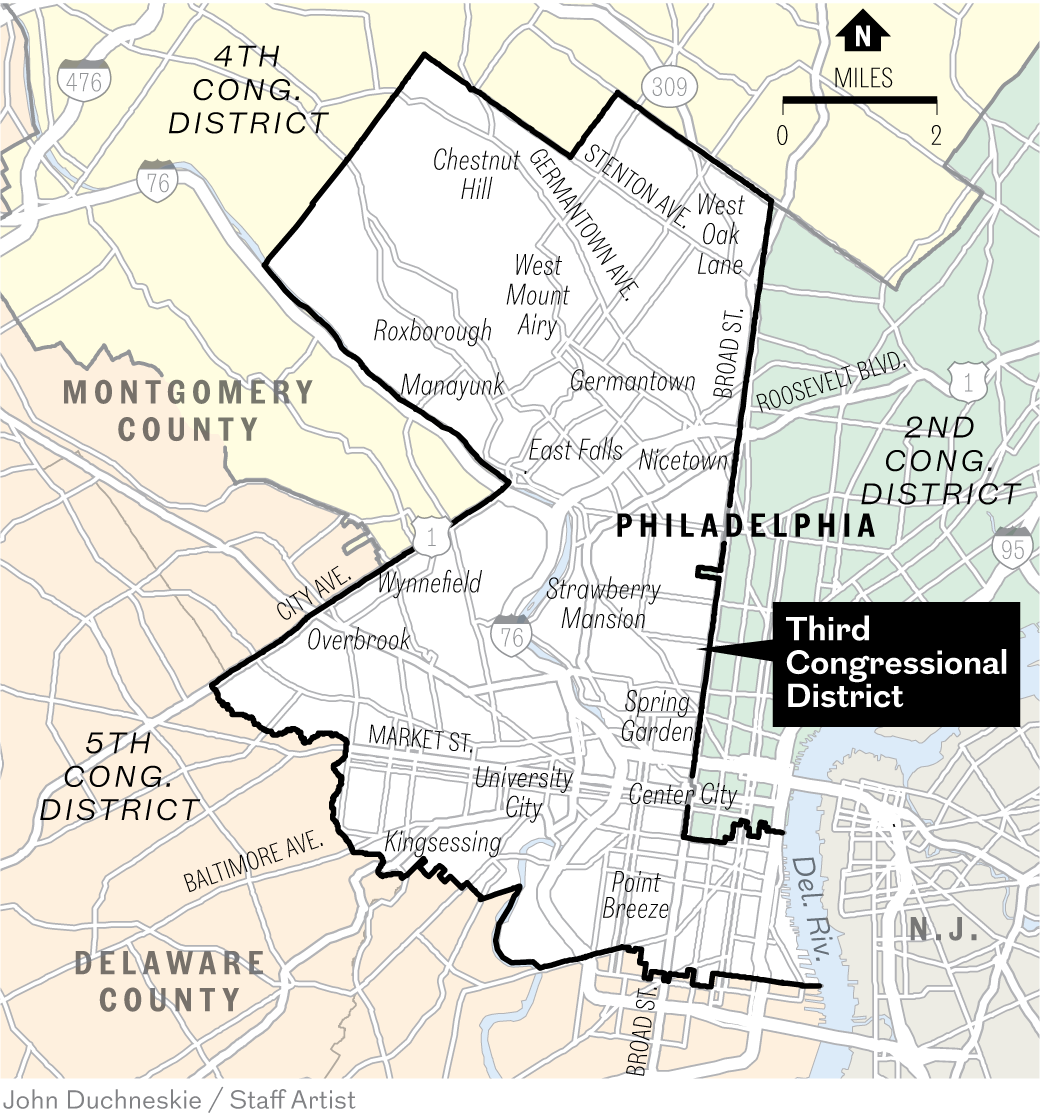
    Pennsylvania’s 3rd Congressional District, which includes parts of North, Northwest, West, and South Philadelphia, is one of the most Democratic seats in the nation. With Evans retiring from the seat he has held for nearly a decade, the field could still be in flux as more Philly politicians eye the potentially once-in-a-generation ticket to Washington.

    Map of Pennsylvania’s Third Congressional District.

    While the race remains competitive, Street’s early fundraising lead will help cement his status as the favorite of the local political establishment. Democratic City Committee chair Bob Brady said this week that party ward leaders will likely vote to endorse Street after this year’s election cycle wraps up next month.

    “We’re fully prepared to take advantage of this early lead,” Uretsky said.

    Brian Fitzpatrick outraises competitors in Bucks County congressional race

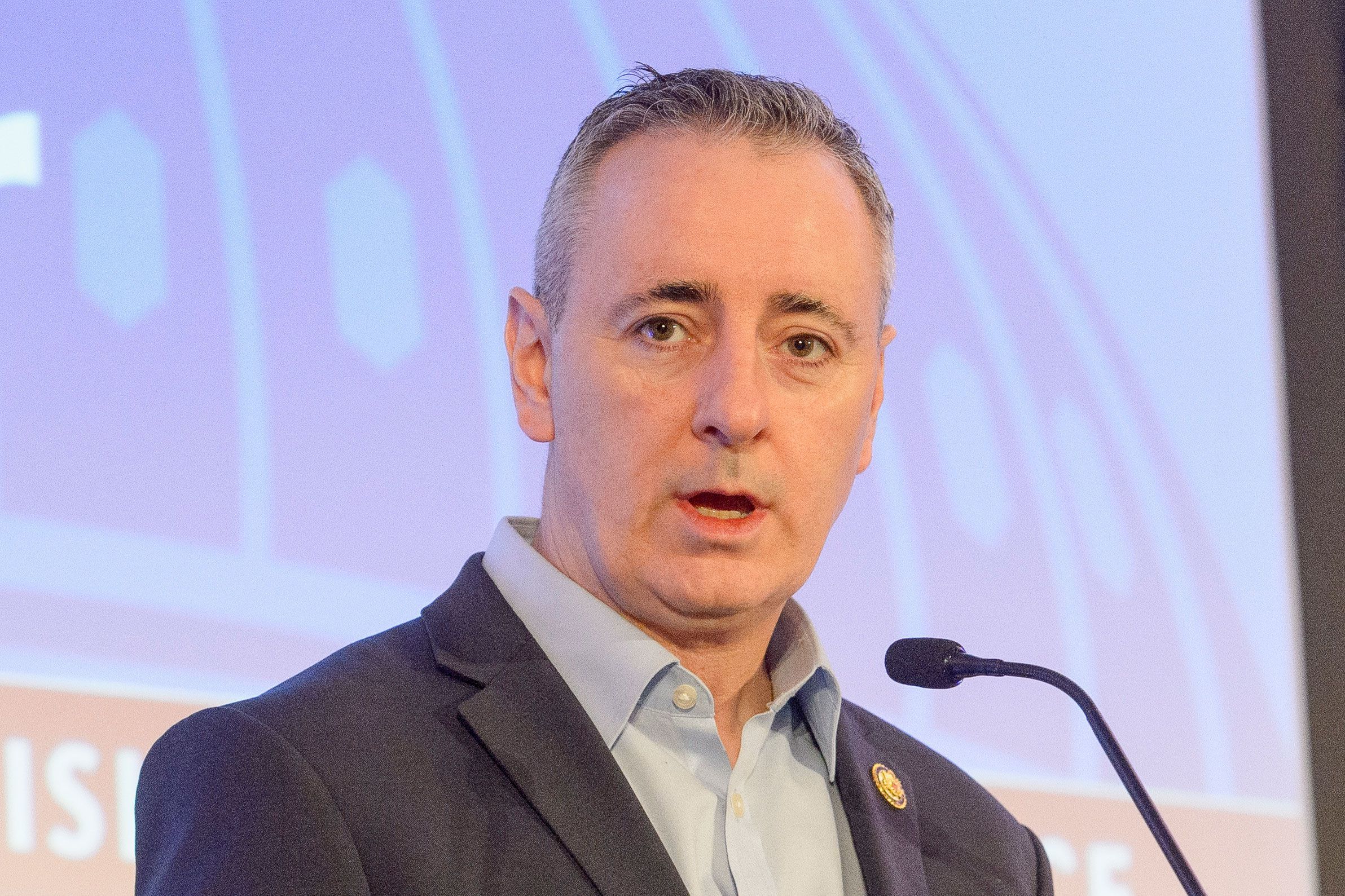
    In Pennsylvania’s 1st Congressional District, where Democrats have made ousting Republican U.S. Rep. Brian Fitzpatrick a top priority, the incumbent outraised his leading Democratic challenger by a nearly 4-1 ratio, bringing in $886,049 this quarter.

    Rep. Brian Fitzpatrick (R., Bucks and Montgomery) speaks during the opening session of the National Treasury Employees Union (NTEU) Legislative Conference in Washington in March.

    Unlike the deep-blue 3rd District, the fate of the 1st District will likely be decided in next year’s general election, and not the primary. The district, which includes all of Bucks County and a part of Montgomery County, is the only Philadelphia-area congressional seat represented by a Republican.

    Democratic County Commissioner Bob Harvie announced plans to challenge Fitzpatrick earlier this year.

    Harvie, viewed as the favorite to win the Democratic nomination, raised $217,745 last quarter. The other Democrat in the race, attorney Tracy Hunt, raised $36,692.

    This suburban content is produced with support from the Leslie Miller and Richard Worley Foundation and The Lenfest Institute for Journalism. Editorial content is created independently of the project donors. Gifts to support The Inquirer’s high-impact journalism can be made at inquirer.com/donate. A list of Lenfest Institute donors can be found at lenfestinstitute.org/supporters.

  • Temple’s College of Public Health has a new building where students can simulate patient interactions in a restaurant, ER, or rowhouse

    Temple’s College of Public Health has a new building where students can simulate patient interactions in a restaurant, ER, or rowhouse

    For years, students at Temple University’s College of Public Health trekked to classes and met professors across two campuses and 10 buildings in North Philadelphia.

    That changed this school year when the college finally moved into its own building, the first dedicated to public health since its founding in 1966.

    Paley Hall is an expansion and renovation of the former Samuel L. Paley Library, which sat at the heart of Temple’s main campus on North Broad Street.

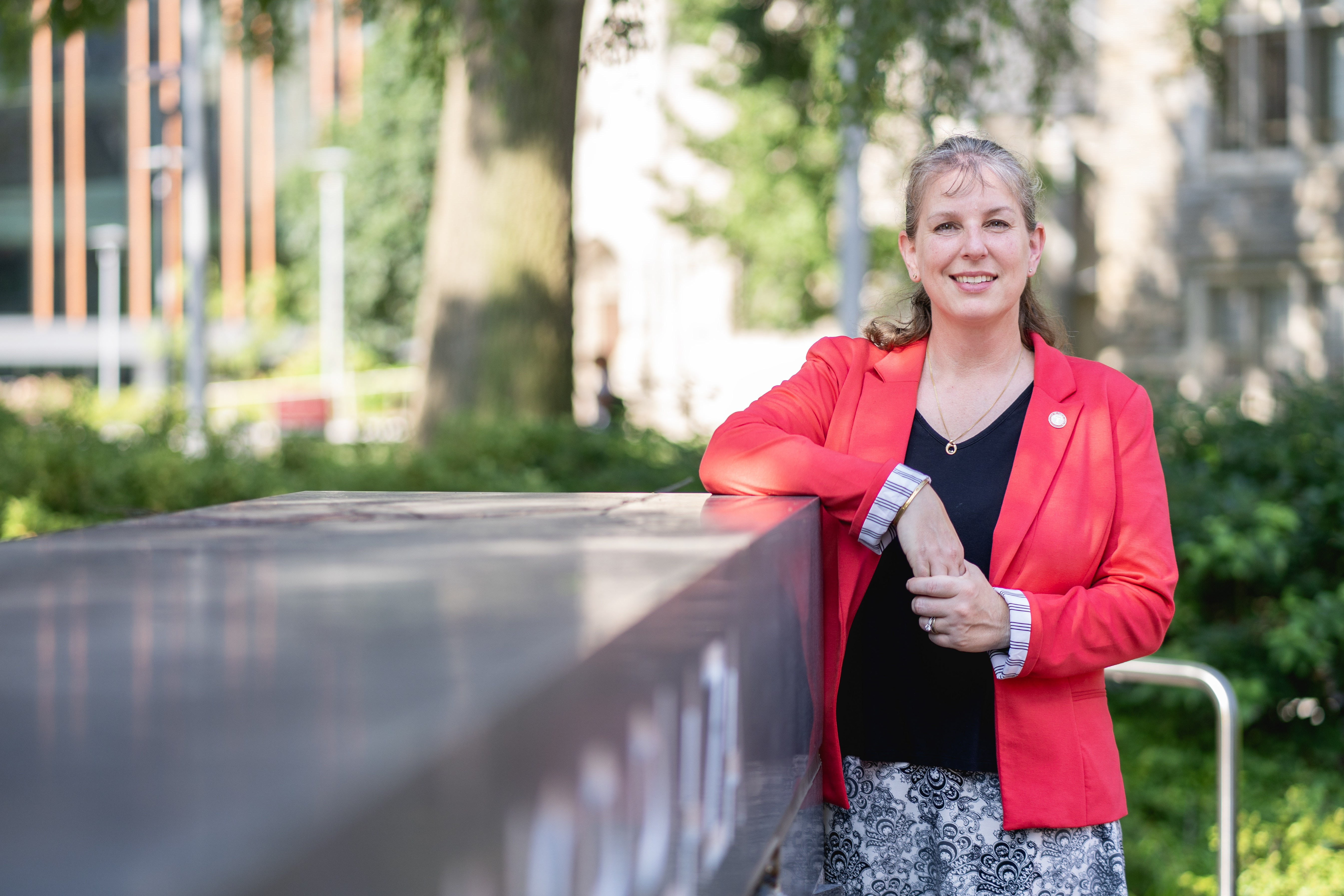
    Jennifer Ibrahim, the college’s dean, spoke with The Inquirer about the new building and amenities designed for public health studies, including a “simulation” space with a replica park, restaurant, emergency room, and even a rowhouse where students can act out interactions with patients. The interview was lightly edited for length and clarity.

    Why did Temple pick the former Paley library for the new College of Public Health building?

    About eight years ago, we started the conversations about renovating Paley to become the new home of the School of Public Health. It’s at the center of campus, and public health has so many collaborations with medicine, with dentistry, with public policy, with law, that it felt really special and appropriate, given how collaborative and interdisciplinary we are.

    Once Paley Hall was gutted, the beauty of the building was that it was created to hold books — to bear the weight of books. That allowed us to add two more floors and extend an east wing and a west wing, significantly increasing the square footage, and that made the building large enough for our different academic units to move into.

    How does consolidating academic departments into one space help students and faculty?

    We have so many different disciplines — public health, social work, nursing, speech, physical therapy, occupational therapy, athletic training, recreational therapy. And we have been in as many as 11 buildings over the history of the college on the main campus, but also on the health science campus [farther north on Broad Street]. It’s not that far, but it does create challenges for collaboration.

    Jennifer Ibrahim, dean of Temple University’s College of Public Health, spoke with The Inquirer about the college’s new headquarters on Temple’s main campus.

    That ability to bump into one another in the same physical space — just having those impromptu conversations brings a warmer human element to the interactions that we have.

    What are some of the amenities in the new building?

    There’s a couple of interesting spaces in the building. We have four classrooms in the building, and then we have the Aramark Community Teaching Kitchen, which is a kitchen space with capacity for 24 students to be learning.

    The simulation center is at the heart of it. This was a collaboration from faculty across all of our disciplines.

    When individuals have an acute injury, or a chronic condition, what we aim to do is get them back into the community and back into their social support system.

    So about 40% of our simulation center is a community. There’s an ambulance bay, there’s a park, there’s a restaurant, there’s a corner grocery store, there’s a replica rowhouse, there’s a street, there’s a sidewalk — all of that allows students to practice safely before they go out and work with our community partners, to learn and to receive feedback.

    The other half of our simulation center is more traditional. We have an inpatient and an outpatient area where students will be interacting with simulated patients as well as mannequins to help them learn [bedside manner].

    We’re really excited for our disciplines to come together and get creative about ways that we can better prepare students for what it’s going to be like when they enter the workforce. We also feel that we have an obligation to our local and regional workforce, that we are putting out the best-prepared students to hit the ground running.

    What does Temple’s investment in a project like Paley Hall say about its commitment to public health as a profession?

    We know that there is an evidence base for what works and what doesn’t work.

    We have an obligation to educate the public.

    We have an obligation to conduct research to advance the evidence of what we know does and does not work.

    We have an obligation to develop policy with our elected officials to figure out what can we do to protect the population in any way that we can.

    I think Temple’s investment in this space is a statement about the importance of public health and health professionals more broadly.

    Now is the time that we have to double down on our investments in public health, and Temple has done just that.

  • Temple’s been part of several high-profile crime incidents recently. President John Fry is getting high marks for communication.

    Temple’s been part of several high-profile crime incidents recently. President John Fry is getting high marks for communication.

    It was a tough two-and-a-half-week period: Students accused of impersonating ICE agents. One student accused of shooting and killing another. A student stabbing a former student 13 times. And a student falling from a light pole during a post-Eagles celebration and dying from his injuries.

    These high-profile incidents involved Temple University students and three of the four occurred on or near campus, posing another test for new president John A. Fry.

    Some say they are gratified that the administration communicated swiftly and thoroughly about the incidents, which wasn’t always the case in the past.

    “That’s been really great to have such a quick turnaround time,” said Ray Epstein, president of student government. “Even if it is the middle of the night, we are getting an email immediately.”

    After Chase Myles, a 20-year-old student from Maryland was shot and killed at about 11 p.m. Feb. 6, Fry notified the campus in an email at 3:46 a.m., and just hours later was on a plane back to campus from an alumni event in Florida so he could be on the ground to talk to the victim’s parents and help coordinate the response.

    By contrast, it took nearly twice as long for the university to get out an email about the shooting death of Samuel Collington outside his off-campus residence in November 2021 even though that happened in the daytime. The email did not come from then-president Jason Wingard, but rather from then-safety chief Charles Leone. The attack put the campus on edge and stirred fear in the Temple community among students, parents, and staff — and social media posts circulated with the hashtag “Where’s Wingard,” who later resigned after less than two years on the job.

    Donna Gray, Temple’s campus safety services manager for risk reduction and advocacy services, greets Temple president John A. Fry during his first day of work Nov. 1.

    That incident ― which happened as part of an attempted robbery and carjacking ― was different in that it involved random violence by a stranger in the neighborhood.

    But even the Temple police officers’ union, which has been critical of university leadership in past years, has noted Fry’s efforts in dealing with the recent multiple incidents.

    “He seems to be handling it well,” said Sean Quinn, president of the Temple University Police Association. “Without a doubt, as soon as these things happen, he’s right on top of it.”

    Fry, who became Temple’s president Nov. 1, said his approach is two-pronged.

    “It is up to us to tell the bad news first, personally to all of our community,” he said. “Number two is just to keep a steady stream of communications following that even when there is not a whole lot to say. It’s worth checking in.”

    Parents on the university’s family council said they are confident in the university leadership’s handling of the incidents, too.

    “It seems like there are the right people in place,” said Allison Borenstein, a Temple alumna whose son, a sophomore, attends the university. “They handled it well, and I think they are on it.”

    Borenstein, an event planner at a synagogue who lives in Cherry Hill, noted such incidents could happen near any college campus and said she feels that Temple sometimes gets an unfair rap.

    “There’s nothing that the school could have done in advance,” she said.

    Emma Legge, an alumna and parent of a senior who lives in New York, said she feels she is kept informed, and she checks in with her son after receiving a communication.

    “I do feel as a parent that Temple is doing what it can within the city of Philadelphia to manage what happens,” said Legge, who got both her bachelor’s and master’s degrees at Temple and met her husband, also a twice Temple alumnus, there. “I have a lot of confidence in the university and the people who are on board.”

    Philadelphia Police Commissioner Kevin J. Bethel and Jennifer Griffin, Temple University vice president for public safety, after graduation ceremonies for the Police Academy Class #402, new officers of the Philadelphia Police Department and Temple University Police Department, at Temple’s Performing Arts Center in June.

    That includes Jennifer Griffin, vice president for public safety, she said.

    “I feel very reassured by the measures police are undertaking to be involved in the neighborhood and be involved with students,” said Legge, who works in student affairs administration at a New York college.

    Griffin said after the recent incidents, she met with the student safety advisory committee and its members said they appreciated the accurate and timely information, which she said she has always aimed to provide since starting at Temple about two and a half years ago.

    “We hope it decreased anxiety,” she said.

    Of Fry, she said, “I thought he handled all the incidents with thoughtfulness and decisiveness and direction that I would expect from somebody with his level of experience.”

    The police union has been critical of Griffin, even calling for her to resign or be fired over staffing issues. University leadership has backed Griffin.

    Quinn said the union now is trying to work things out, noting that the university is amid a police staffing study conducted by an external company.

    “I just don’t want to come to work every day feeling like I’m butting heads,” he said. “I actually would like to work with whoever I have to work with to see if we can accomplish things.”

    Fry said he expects to have the results of the staffing study in a couple months. He said he’s pleased with the work campus police do, noting he had gone on ride alongs with them and wants to make sure they have enough help.

    Ray Epstein, Temple student government president.

    While Epstein, the student government president, endorsed the university’s handling of communication about the recent shooting, she said it also should have issued an alert after a report about a student placing hidden cameras in a fraternity bathroom in late November and recording people without their knowledge. Instead the campus learned of it through social media earlier this month, she said. The student has been arrested and charged in that case.

    “I was not sure when or if the fraternity/university would ever disclose this incident, but I wanted to inform everyone in case this was never announced,” someone posted on a Temple Reddit page, with court documents about the case.

    “Maybe it’s perceived by campus safety as not being an ongoing threat,” Epstein said. “I’d argue that it is because when these things happen in a house, you can’t possibly know until an investigation is concluded who all was involved.”

    Griffin countered that the investigation was handled swiftly, the individual was identified and arrested, and there was no ongoing threat to the community. A Temple alert is sent when there is an immediate threat to the community, she said.

    In this case, people who lived in the house notified law enforcement after the equipment was found, the equipment was taken and the individual who put it there was identified, she said.

    “The people who called in the cameras were cooperative,” she said. “It was an isolated incident at an off-campus residence … and student affairs reached out to those who were impacted.”