When St. Joseph’s coach Cindy Griffin recruited Gabby Casey out of Lansdale Catholic High, she compared Casey to Susan (Moran) Lavin, who scored 2,340 points, the most by any men’s or women’s basketball player for the Hawks, from 1998 to 2002.
Casey set the scoring record for the boys’ and girls’ teams at Lansdale Catholic, and her natural scoring knack intrigued Griffin. The Hawks’ culture drew the 5-foot-9 guard, who joined St. Joe’s during the 2023-24 season.
Her role gradually increased each year, and now as a junior, Casey has St. Joe’s fighting for a top-four seed and double bye in the Atlantic 10 tournament. She leads the Hawks in points, rebounds, and steals and prides herself on being a well-rounded player and leader for her teammates.
“I felt that over the summer I had to put in a lot of extra work and come in more confident than I ever had before because I knew I was going to have a much bigger role,” Casey said. “I knew I was going to score in order for us to win, and that has really been the fun part for me. Scoring and then getting to lead the girls is so easy.”
Casey played sparingly off the bench as a freshman, averaging 13.2 minutes. Last season, she was elevated into the starting lineup but was a secondary scorer, averaging 7.7 points. The Quakertown native has been an example for her teammates.
“That used to be the natural progression,” Griffin said. “Kids stay, and they reap the benefits of their work, and when it’s their time, it’s going to be their time. I think Gabby is a great example of that, just staying the course and being where her feet are. She loves being around our team and our culture, and being able to step into that leadership role is really nice to see.”
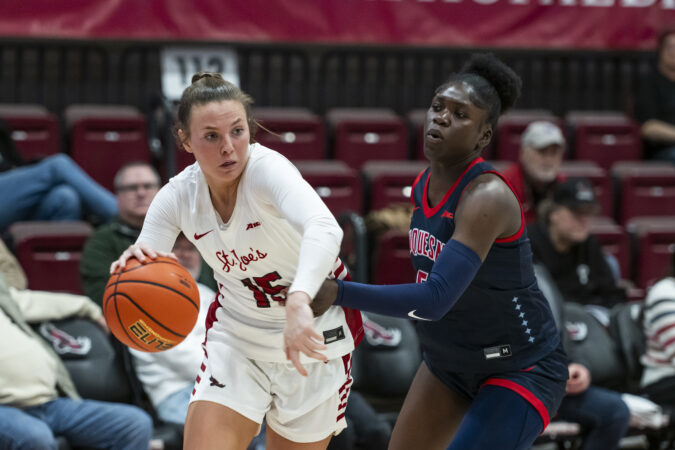
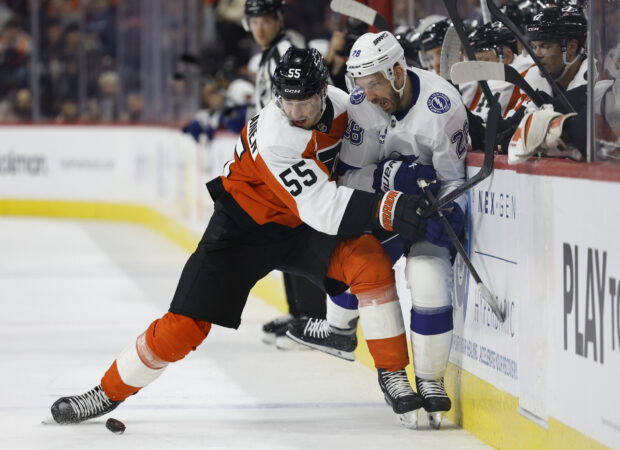
Gabby Casey (center), shown last Wednesday against Duquesne, has made 62 three-pointers this season.
Casey has embraced leading a St. Joe’s team that lost a lot of experience from last season’s team, which won 24 games. In Griffin’s eyes, Casey has carried on the lessons that she learned from past team leaders.
She has filled the leadership role seamlessly, guiding the Hawks to a 19-9 record with one regular-season game, at home against third-place Richmond (2 p.m., ESPN+) remaining.
“[I try to] bring consistency in just showing up every day with the same mindset and same goals,” Casey said. “Then also creating an environment where everyone feels welcomed and feels like this is a place they want to be every day.”
Casey always possessed the ability to score, which was evident from her high school days, and has put it on full display this season. She is averaging 16.0 points, good for third in the A-10, while shooting 48% from the field.
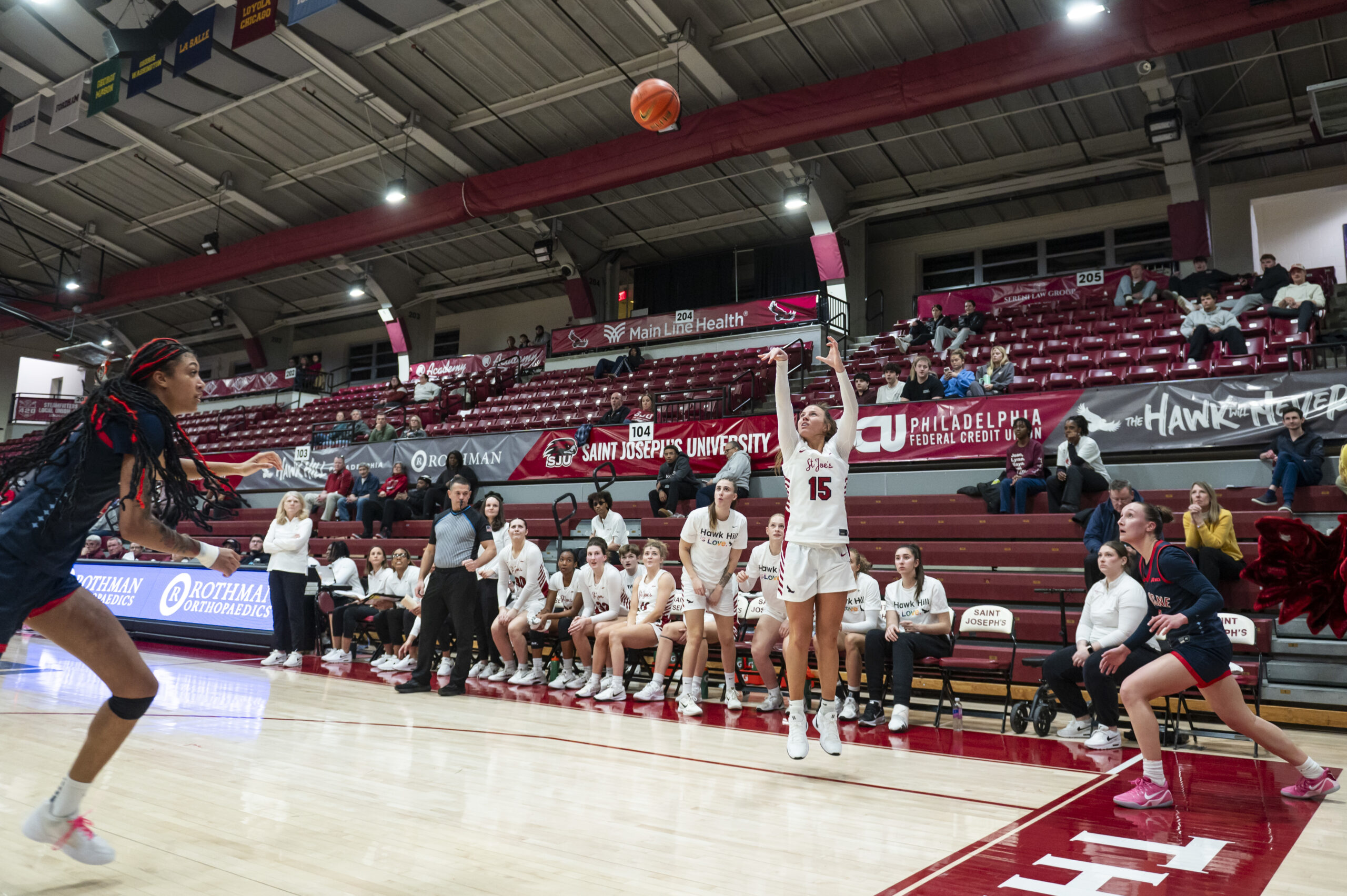
Her favorite way to score is a turnaround jumper, but she also can get to her spots in the midrange for pull-up jumpers. Casey also is a threat from three and leads the team with 62 triples.
However, her on-court impact goes beyond scoring. She is St. Joe’s top rebounder with 6.4 per game, tied for second in assists (3.1), and is first in steals (1.6). When Casey is struggling to score, she still finds ways to help her team compete.
“She’s multidimensional. It’s not just about scoring, it’s how she impacts the game,” Griffin said. “I go back to her freshman year, when we beat Villanova on our home court, and the trajectory of the game changed when Gabby came in and got a couple of steals. It changed the game, and that’s her impact. She’s gritty, tough, and competitive.”
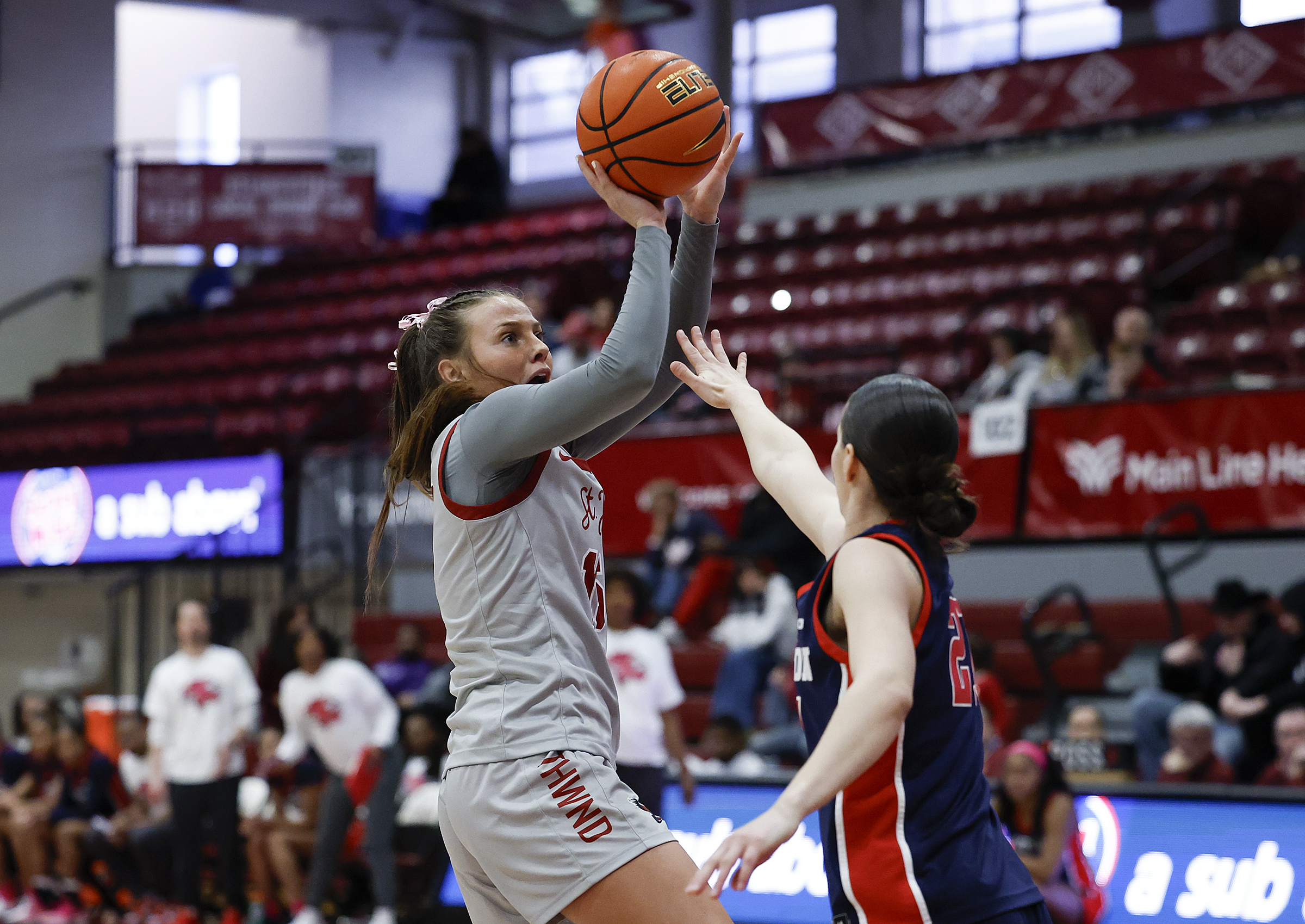
St. Joe’s guard Gabby Casey (left) is averaging 16.3 points this season.
Now, Casey aims to lead St. Joe’s to success in the conference tournament.
“These practices are going to be key to dialing in on the little things that we have to fix throughout the rest of the year,” Casey said. “We have to really focus on the little details that will give us the edge because A-10 play is going to be hard.”
A 36-story apartment tower planned for 1341 S. Christopher Columbus Blvd. in South Philadelphia has secured a $150 million senior construction loan, New York-based developer Brevet Capital announcedTuesday.
The financing from Mexico City-based Banco Inbursa is an important step for the 620-unit tower project, which is expected to break ground in the first quarter of 2027.
Construction on the project Brevet Capital calls “Wharton Piers” is anticipated to last two years, finishing in the first quarter of 2029.
At a meeting of the Pennsport Civic Association in October, Brevet Capital representatives said that the company hoped to develop two further residential towers on the site, which sits between the Delaware River and the neighborhood. Future high-rises may be taller than the 380-foot tower financed byBanco Inbursa.
“Wharton Piers represents the first phase of a larger master plan that has the potential to support significant additional development over time,” said Mei-Li da Silva Vint, head of Brevet’s real assets group, in a statement.
Brevet declined to comment on what proportion of the project’s total cost would be covered by the loan.
This development site has a long history of ambitiousbut ultimately unrealized proposals, which makes the construction loana noteworthy sign of Brevet’s intent.
In 2023, New York-based Silverstein planned a two-tower project. Before theCOVID-19 pandemic, Maryland-based developer Jeffery Kozero’s K4 Associates presented a 2,000-unit project spanning 10towers. The K4 plan, in particular, was met with skepticism by neighborhood groups and urban planners.
“We’re happy to see a meaningful development of this property in a way that seems to respect the collective vision for the waterfront,” Patrick Fitzmaurice, president of the Pennsport Civic Association, said of the Brevet Capital project.
In exchange for building taller and denser than the land’s zoning allows, Brevet will pay into the city’s housing trust fund — which supports affordable development — and will repair and maintain the Delaware River Trail down to Reed Street.
Conditions along the bike and pedestrian trail have deteriorated below Washington Avenue, with cracked pavement and unkempt weeds. People have also been camping along the path, and moving between the patchwork of properties owned by different entities to avoid sweeps by the city.
“Our focus is on executing this initial phase to a high standard while creating a vibrant, publicly accessible waterfront,” da Silva Vint’s statement reads.
Most of the current tower proposal’s apartments will be on the smaller side, with half of them one-bedroom units and a further 35% being studios.
For parking, 187 spaces will be locatedon the third through fifth floors, with space for a further 100 vehicles on a neighboring surface lot.
A rendering that includes the other two towers Brevet has also proposed for the site.
When the project was presented to the Pennsport Civic Association in October, neighbors called for more parking. But the developer’s representatives noted that many new apartment towers don’t have full garages.
The project will also include 15,000 square feet of amenity space on the fifth floor, including a pool, and a mix of commercial and office space on the ground floor.
A neighboring one-story building will be built with the project, featuring an additional 20,650 square feet of retail space. Brevet representatives told the civic association that the smaller building would serve as a “place holder” for a future tower.
“Closing this financing is an important milestone for the development of Wharton Piers and reflects continued momentum behind a project that we believe will be transformational for Philadelphia’s waterfront,” said Douglas Monticciolo, CEO and founder of Brevet Capital, in a statement.
Brevet Capital has built real estate projects in major markets of Florida, Texas, and California. Wharton Piers would be its firstdevelopment in Philadelphia.
For years, Cathleen “Cat” Brown, a Philadelphia obstetrician and gynecologist, would listen to patients complaining of hot flashes, brain fog, and painful sex and prescribe estrogen as a safe option for easingtheir menopausal symptoms.
But when the women read the drug label and pharmacy package insert, they’d recoil at a “black box” warning, Brown said. The bold, black-bordered alert warned women that estrogen may put them at higher risk of breast cancer, cardiovascular disease, stroke, and dementia.
“It was making liars out of doctors,” Brown said.“It frankly scared the crap out of patients, and it really caused distrust between the patients and the providers.”
Newer scientific research shows that the benefits of hormone replacement therapy, or HRT, far outweigh the risks for most women, experts say, particularly those who are younger than 60 or within 10 years of menopause.
More recent evidence also suggests that estrogen can reduce the risk of breast cancer, cardiovascular disease, Alzheimer’s, bone fractures, and cognitive decline, extending women’s lives by about 10 years.
In November, FDA Commissioner Martin Makary announced that the agency was taking steps to remove the black box warning on hormone treatments for women.
“We are going to stop the fear machine steering women away from this life-changing, even life-saving treatment,” Makary said at a news conference.
Brown, an ob-gyn at Jefferson Abington Hospital, said the FDA’s reversal will lead tomore medical schools teaching doctors how to treat menopause and provide women with more access to hormone therapies.
“It’s causing kind of a tidal wave in the medical community,” Brown said. “It was a relief to see the FDA catching up with the science.”
The Inquirer spoke with Brown, who also serves as the medical director for a national menopause telehealth provider calledWinona, about the FDA’s shift on HRT and what that means for aging women. This conversation has been edited for length and clarity.
What prompted the FDA warning on estrogen treatments?
The black box warning was one of the aftereffects of the whole Women’s Health Initiative study released in 2002. They basically published the results before they really had a chance to have it peer-reviewed and really analyze the data, and it went all over the news, and suddenly there was this widespread panic. Doctors across America got scared. Patients got scared, and everyone was taken off their HRT.
Why was the 2002 study misleading?
In that study, they were giving HRT to much older women, like in their late 60s, who weren’t great candidates to start it. They were also using different forms of HRT than we’re using now, so a lot of more synthetic hormones. The most popular one back then was Premarin, which came from a pregnant mare’s urine, so horse estrogens.
We were also giving these women higher doses of hormones, and it was causing more medical problems.
What has changed since?
Now we really lean toward giving you bioidentical hormones, like the same compounds that your ovaries were making on their own. It’s much safer. Our body processes it better, and we’re able to use lower doses to have the same effectiveness than those old synthetic hormones that they had to do at higher doses before. We also learned from that study that there’s a magic window — the safest time to initiate hormone replacement therapy is within 10 years of a woman going through menopause.
What led to the FDA’s reversal?
So the FDA held an expert panel last July. They invited all these experts on hormone therapy to speak and basically give their justification for why that black box warning needs to be removed. It’s really been a disservice to women, because all the women who were taken off HRT ended up with bad osteoporosis, weak bones, and more medical problems from the loss of estrogen from their bodies.
They also talked about the fact that we should not have this black box warning on estrogen products, especially estrogen vaginal cream, which is so safe that it really could be over the counter. For women in nursing homes, a little bit of vaginal estrogen could have prevented recurrent urinary tract infections. So many women die of urinary sepsis and bacteremia that has come from a UTI. Topical vaginal products also significantly improve sex life for women.
What is HRT?
We’re actually starting to call it hormone therapy, because we’re not trying to replace your levels back to what you were making on your own in your 20s or 30s. It’s about giving you enough dosage of hormone to give you the health benefits and mitigate bothersome symptoms and help women with that menopausal transition.
When we are aging, within our 40s and into our 50s, we lose estrogen at a dramatic rate. We also have testosterone in our bodies as women and that drops, too. That fluctuation of hormones causes this whole litany of symptoms, like hot flashes, night sweats, brain fog, joint pain, dry skin, brittle hair, hair loss, so many things.
Estrogen is a powerhouse hormone that keeps all the tissues in our body healthy.
Why is this a win for women’s health?
More women are demanding better and not wanting to go gently into old age and suffer anymore. This is also pushing more medical education institutions to start infusing menopause into the curriculum.Women’s health has never been in the forefront.
It’s always been something we do secretly and quietly, which I think is kind of a parallel to the gender disparities in the world, like once we’re done childbearing and we’re no longer in our fertile peak, it’s like we’re less important to the world, and nobody wants to focus on it. This is causing a trend where more women are going to get educated and more doctors are going to start learning.
Nick Sirianni praises new Cowboys defensive coordinator Christian Parker
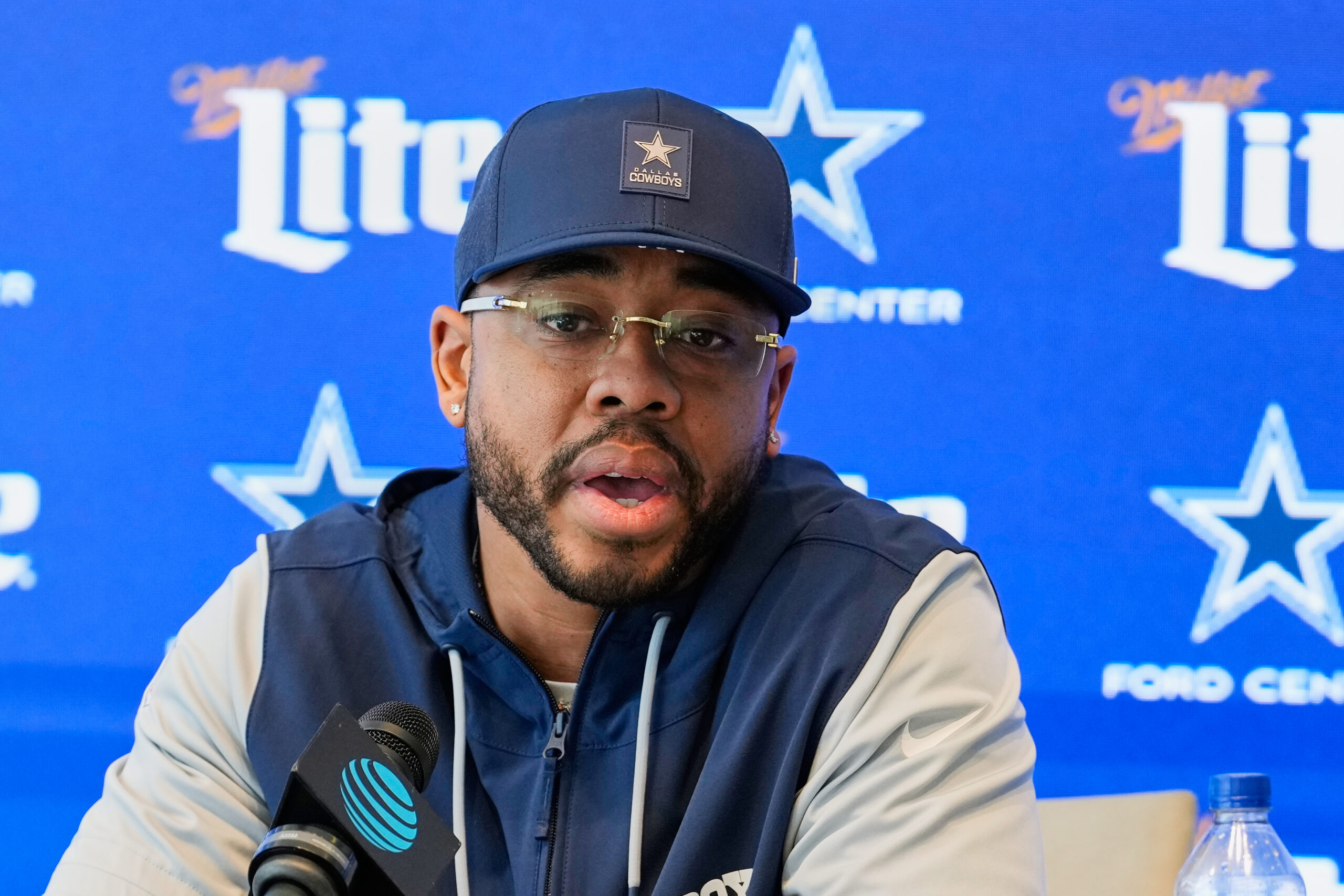
Christian Parker during a news conference last week with the Cowboys.
Former Eagles defensive assistant coach Christian Parker reportedly beat out eight other contenders to land the Dallas Cowboys’ vacant defensive coordinator position.
“Every impression we had with CP just left us wanting more,” Cowboys head coach Brian Schottenheimer told reporters at a news conference last week. “The conviction that he has, but curious, his calm demeanor, just the way he carries himself, is awesome … It became very clear he was the guy for the job.”
Speaking to reporters at the NFL scouting combine Tuesday, Eagles head coach Nick Sirianni called Parker “a phenomenal football coach,” crediting him with “a lot” of the team’s player development success.
“I think the world of him and wish him the best,” Sirianni said, “with the exception of two games each year.”
Howie Roseman: Brandon Graham ‘always welcome in Philadelphia’
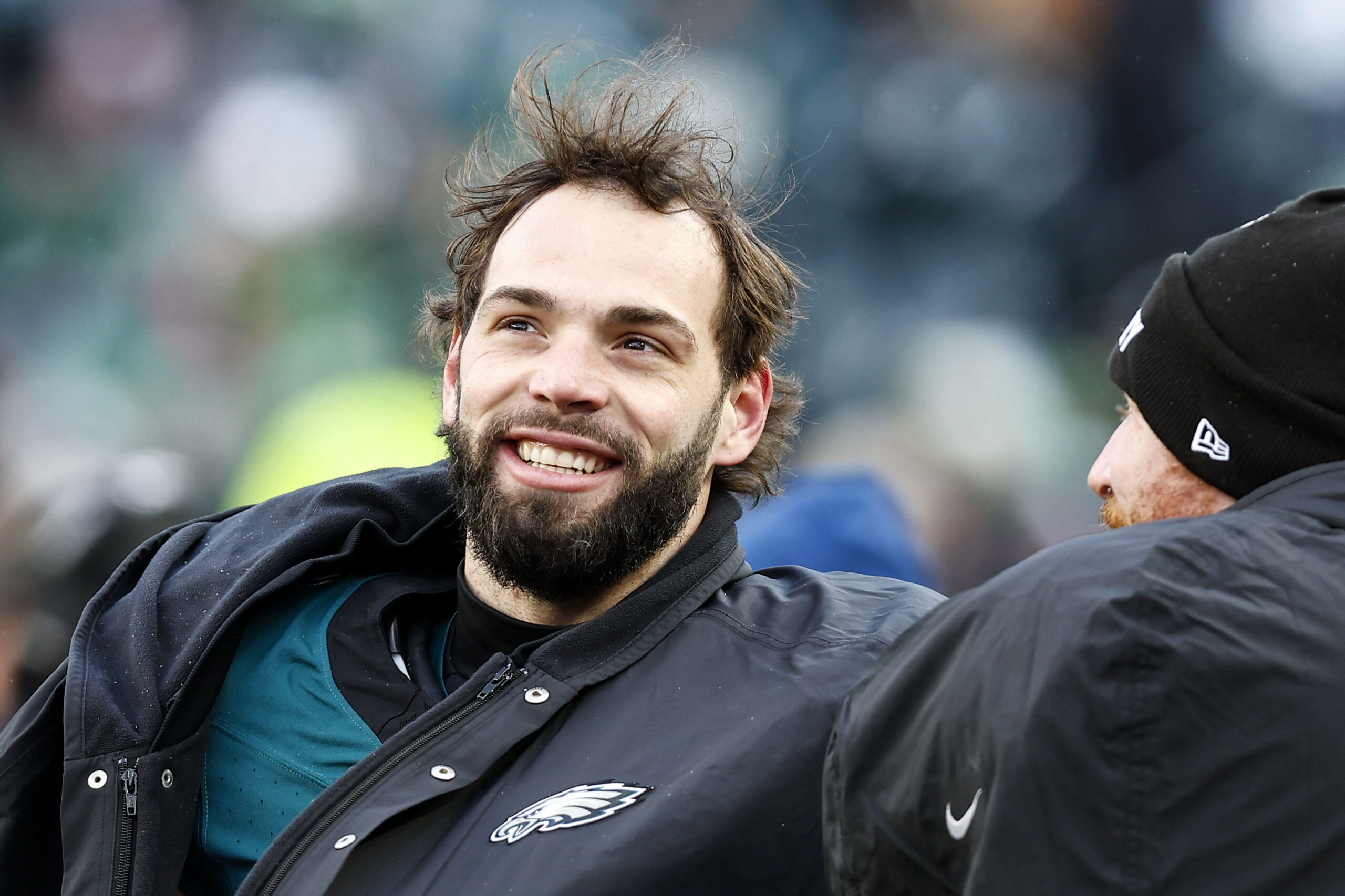
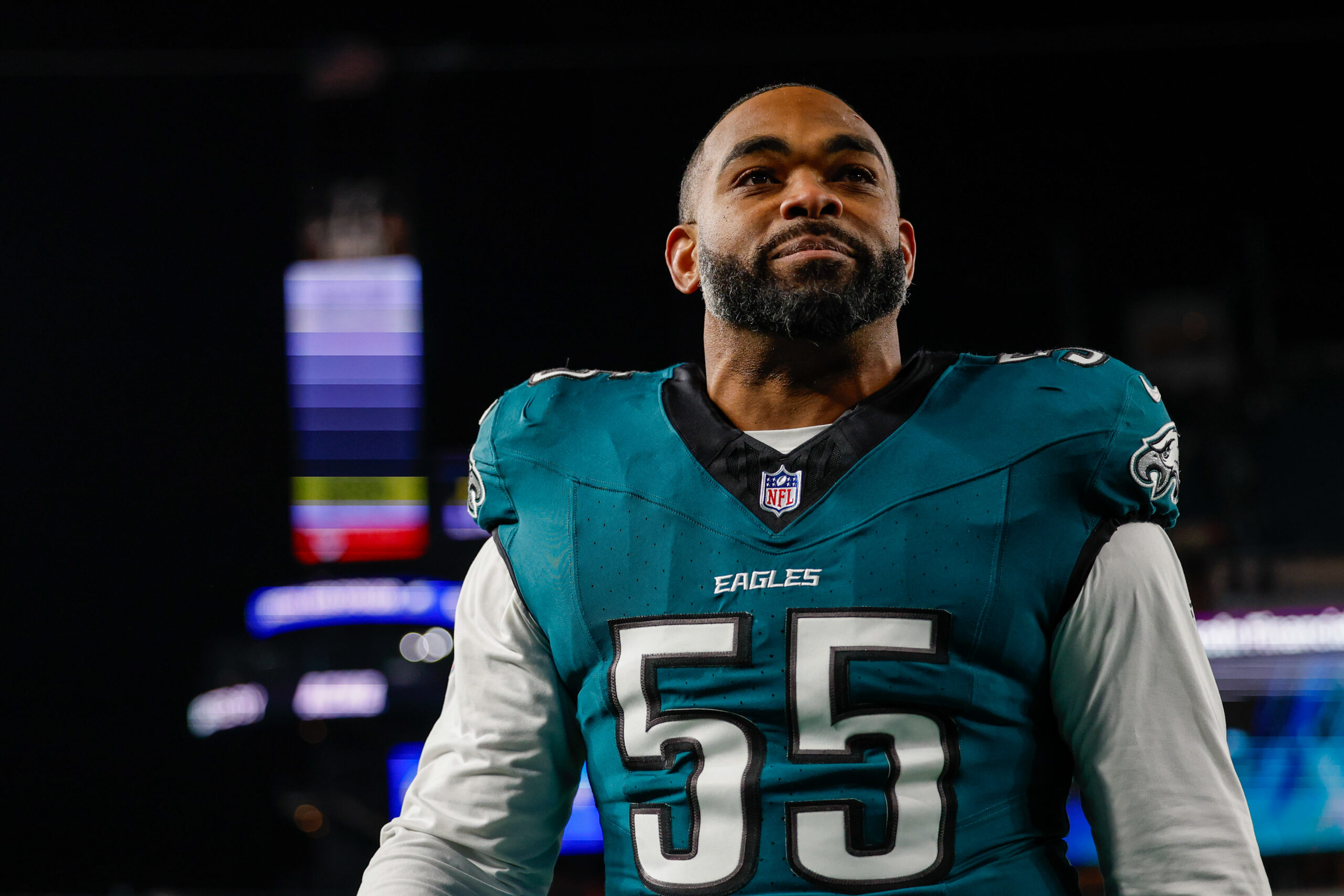
Brandon Graham un-retired to play for the Eagles last season.
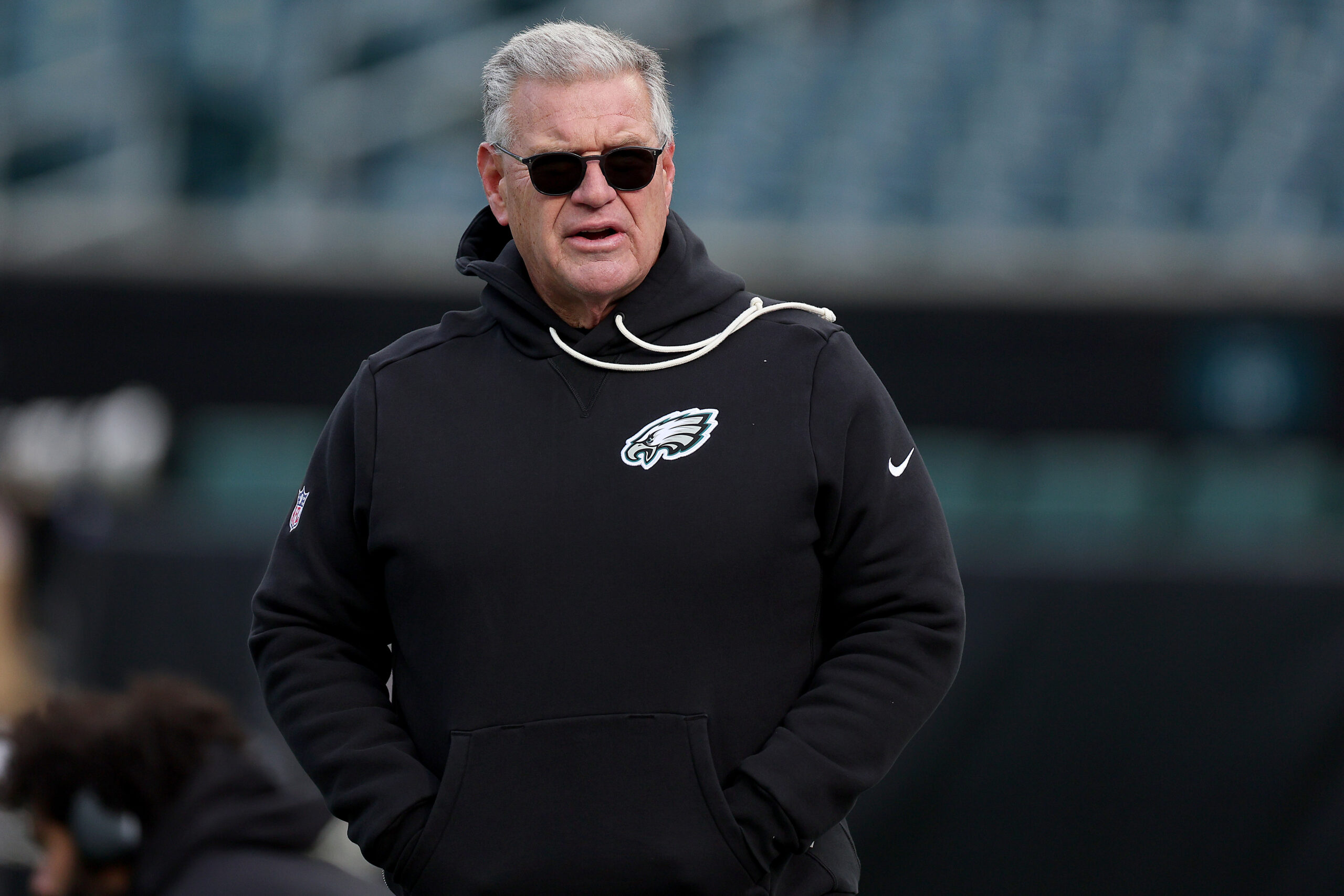
Eagles GM Howie Roseman praised veteran defender Brandon Graham, who unretired to rejoin the Birds for a 16th season.
But Roseman didn’t say whether Graham, 37, would be back with the squad this season.
“Brandon Graham is always welcome in Philadelphia, obviously,” Roseman told reporters at the NFL Scouting Combine Tuesday. “When I think about what he’s done for us as a player, as a person, and then last year when he came back, the versatility he showed … future Eagles Hall of Famer.”
Eagles head coach Nick Sirianni shared Roseman’s sentiment when asked about Graham at the combine Tuesday.
“I’m not going to say it’s a ridiculous question, but of course, you want guys back like that,” Sirianni said.
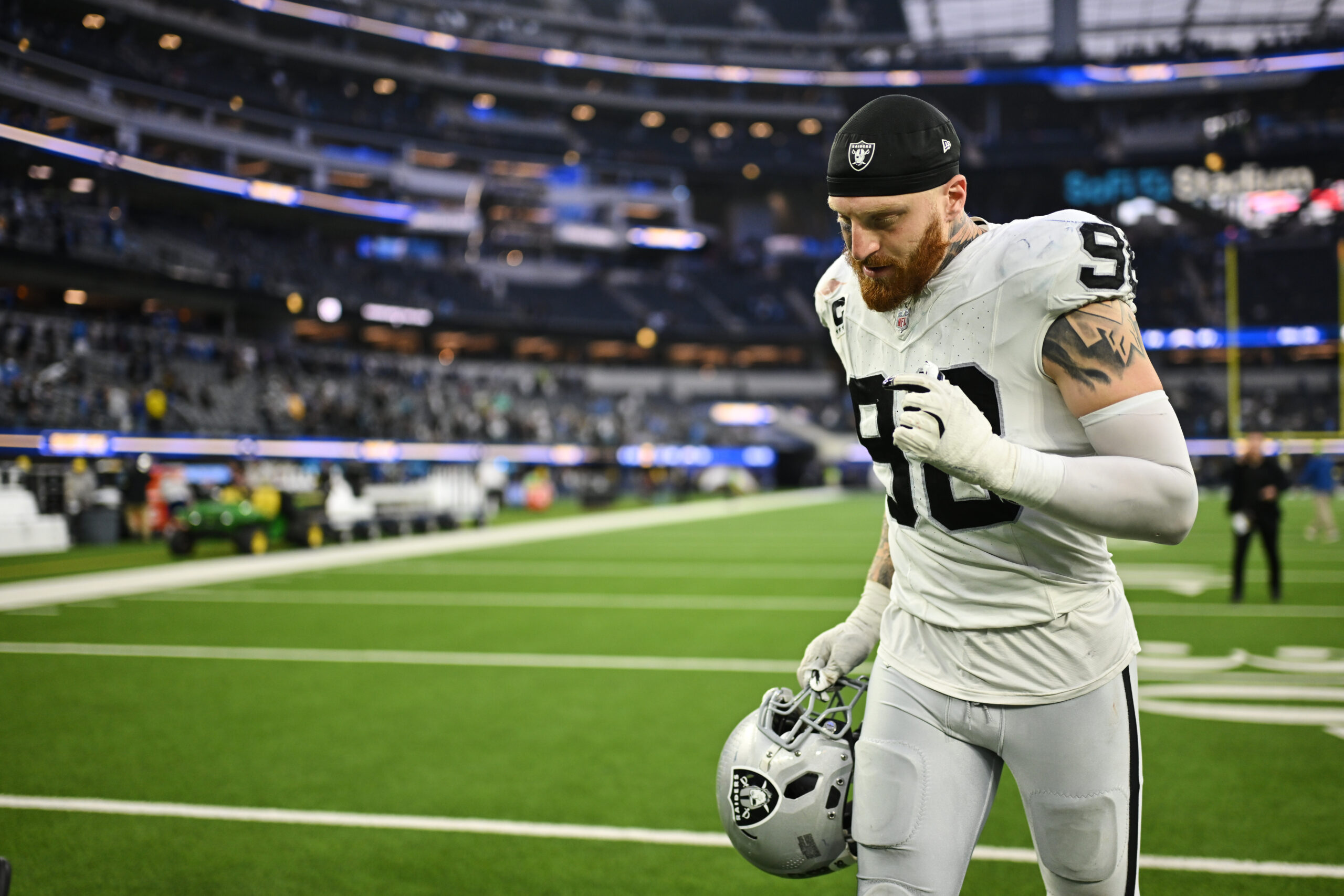
Maxx Crosby said he loved playing in the hostile environment of Lincoln Financial Field.
The Las Vegas Raiders are planning to keep star edge rusher Maxx Crosby despite the trade talk around the five-time Pro Bowl pick, general manager John Spytek said Tuesday.
“Maxx is an elite player. I’ve been very upfront from the start since I got here, that we’re in the business of having really good players on the team, and we need a lot more of them,” Spytek said at the NFL scouting combine in Indianapolis.
Crosby has been rehabilitating from left knee surgery he underwent three days after the regular season ended, as speculation about his status has persisted following an NFL-worst 3-14 record for the Raiders and the firing of coach Pete Carroll after just one year on the job.
Crosby said earlier this month he doesn’t want out and that the unsubstantiated reports suggesting he does make him laugh. His future with the club that drafted him in the fourth round out of Eastern Michigan in 2019 became a subject when he was placed on injured reserve with two games left against his wish, preferring to play out the season. Crosby, who has 69½ sacks in seven years, had a career-high 28 tackles for loss in 2025.
— Associated Press
// Pinned
// Timestamp 02/24/26 2:33pm
Watch: Nick Sirianni, Howie Roseman speak at the NFL scouting combine
// Timestamp 02/24/26 2:03pm
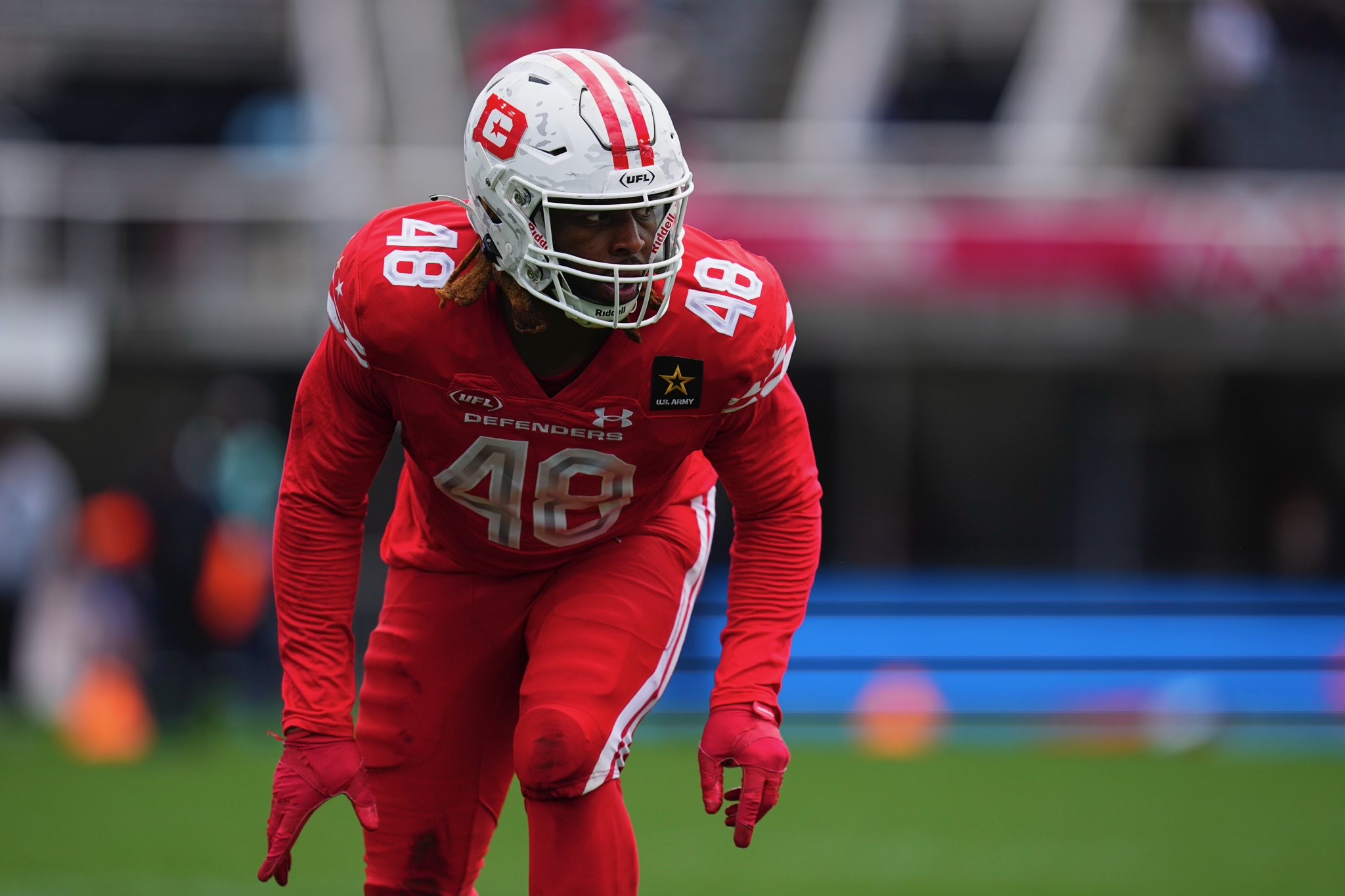
New UFL rules include a four-point field goal and Tush Push ban
Andre Mintze, a Philly native and former Imhotep standout, plays for the DC Defenders.
While all eyes are on the NFL scouting combine, don’t forget about the United Football League.
In case you’d forgotten, the upstart, eight-team spring football league is the re-branded result of a merger between the XFL and USFL in 2023.
Ahead of its third season, the UFL announced some interesting new rules Tuesday, including a ban of the Tush Push, something the NFL hasn’t been able to get through.
It doesn’t look like this will be the year, either. NFL competition committee co-chairman Rich McKay said on ESPN Sunday he’s not anticipating any challenges to the Tush Bush this offseason.
“There’s no team proposal that I’ve seen from it,” McKay said. “So, I wouldn’t envision it. But you never know.”
Here is a full rundown of the UFL’s new rules. Their season begins March 27, and will feature three new teams — the Columbus Aviators, Louisville Kings, and Orlando Storm.
Four-point field goal: Any successful field goal from 60 yards or farther will now be worth four points. Regular fields goals will remain three points.
No punting rule: Punts will no longer be allowed from anyone inside an opponent’s 50-yard-line. The only exception is with less than two minutes remaining before halftime or the end of the game.
Elimination of the Tush Push: No more pushing quarterbacks from behind in the UFL.
New overtime rules: Teams will have three alternating attempts to score from the five-yard line. If the score remains tied, teams will continue to alternate attempts until a winner is determined.
‘He’s going to be a huge asset’: Dolphins head coach praises Kevin Patullo
Former Eagles offensive coordinator Kevin Patullo.
Following a Zoom interview with Kevin Patullo, new Dolphins head coach Jeff Hafley was so impressed he knew he wanted to bring the former Eagles offensive coordinator down to Miami.
Speaking to reporters Tuesday at the NFL scouting combine, Hafley said Patullo’s knowledge goes beyond just the offense and extends to “game management” and “situational football”
“I got off the Zoom and I said to [Dolphins offensive coordinator Bobby Slowik], ‘We’ve got to try and hire this guy,’” Hafley said. “He had other opportunities and other options.”
The Dolphins indeed landed Patullo, whose brief tenure with the Eagles saw both the passing and running game regress. The Eagles’ offense finished the season ranked No. 19 in scoring and No. 24 in yards, down from No. 7 and No. 8 in those respective categories in 2024.
How long will the scouting combine remain in Indianapolis?
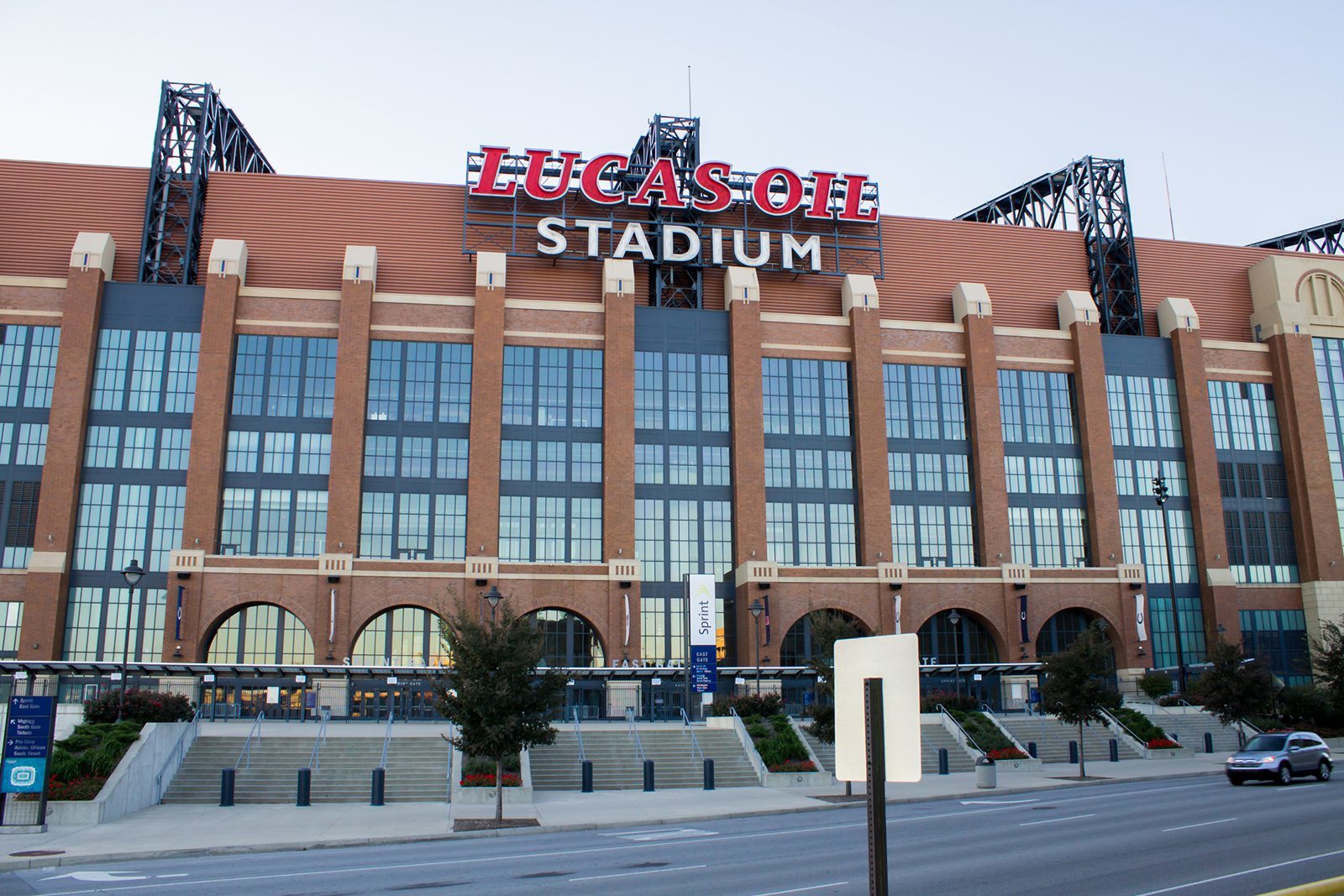
Lucas Oil Stadium in Indianapolis will host the NFL scouting combine through 2028.
That’s the perennial question.
Indianapolis, which has hosted the combine since 1987, will continue as the event’s home through at least 2028, the NFL announced last month.
Despite other cities placing bids to host the event, the NFL has continued to stick with the combine’s roots. The league has also placed the desires of scouts and coaches — who enjoy the convenience of the Circle City’s downtown setup — over expanding the combine into a TV event the way the league has done with the NFL draft.
“For more than three decades, Indy has proven to be the best host city, efficiently moving prospects, team owners, coaching staff, medical personnel, and national media seamlessly through the city,” Colts Chief Operating Officer Pete Ward said in a statement.
How does this year’s draft class stack up with the Eagles’ needs?
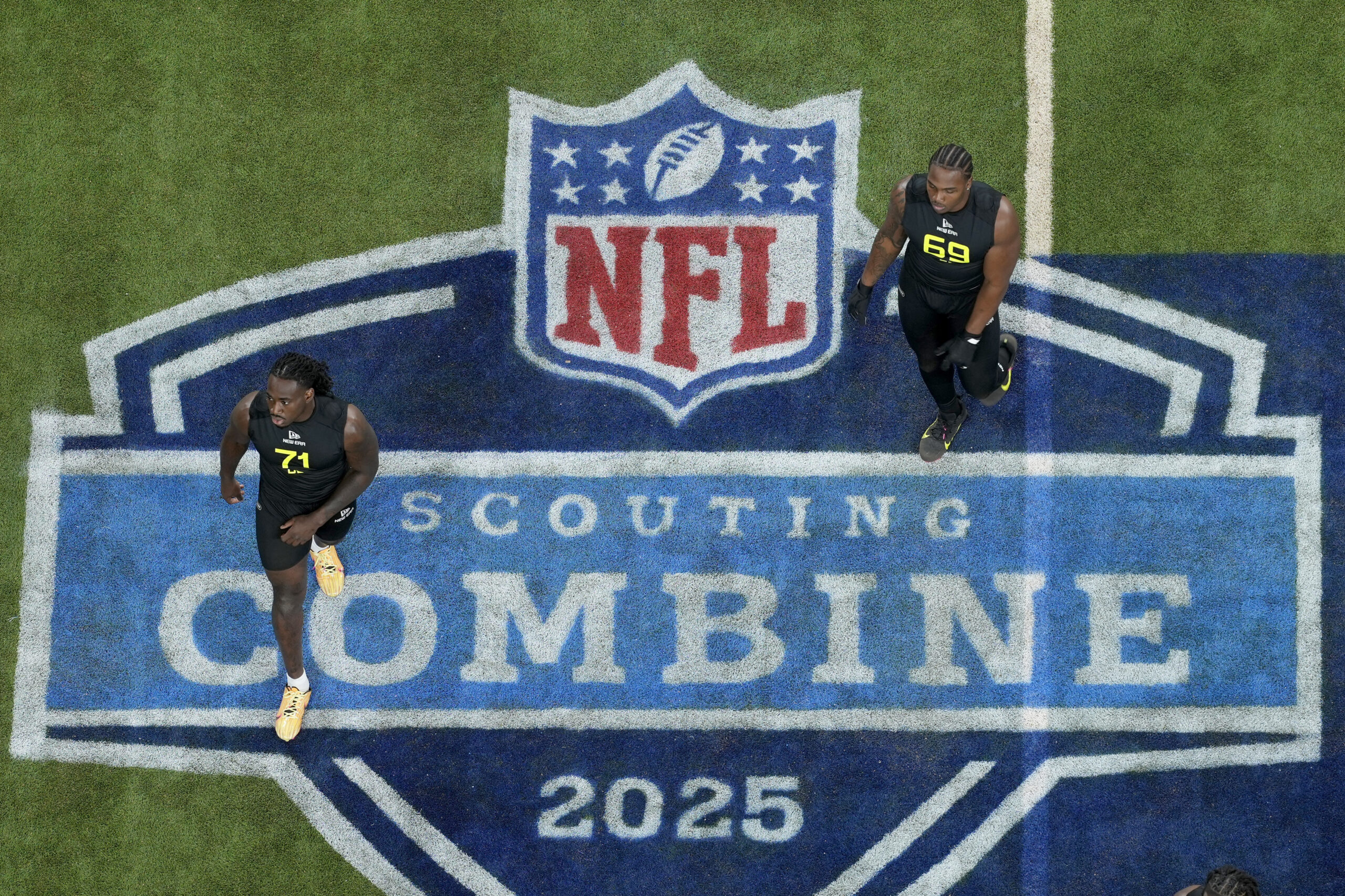
The NFL world is descending on Indianapolis again this week for the NFL scouting combine.
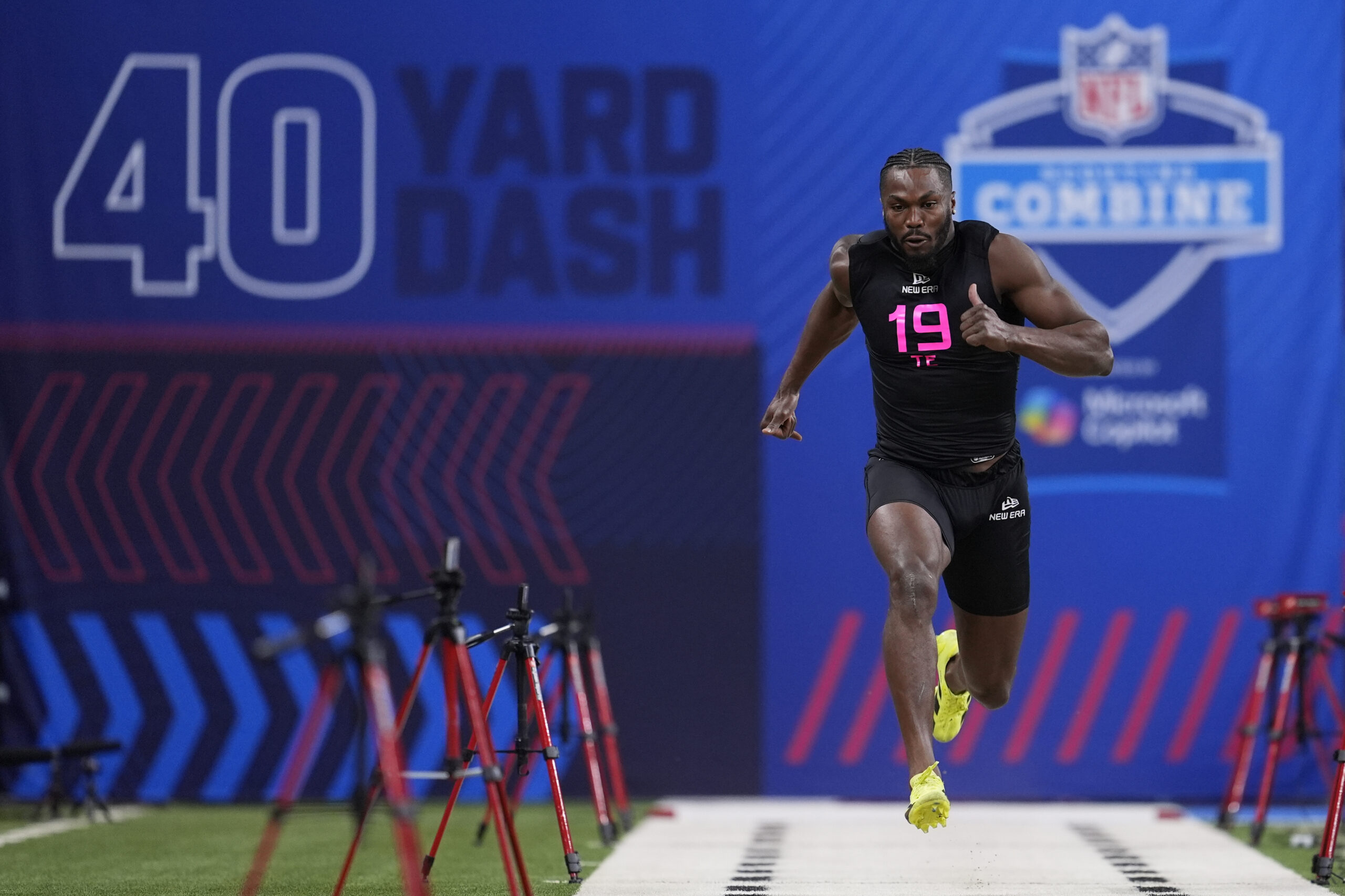
This week, 319 college football prospects will descend on Indianapolis for the annual NFL scouting combine, where they will be tested physically, mentally, and medically, interviewed by NFL front office personnel, and will speak with hundreds of media members.
This latest step in the 2026 NFL draft process allows teams to home in on the next crop of players who will fill their franchises. All 32 teams will have 45 “formal interviews,” which last just under 20 minutes, can include watching film or any questions teams want to ask a prospect, and typically take place in the Lucas Oil Stadium suites.
The first direct touch point with prospects happened at last month’s Shrine and Senior Bowl games. NFL teams will utilize this next piece of the puzzle to identify which prospects match their team needs.
Here is how we’re ranking the combine position groups from strongest to weakest. Click through to read how they could help the Eagles address some roster needs:
‘We’ll continue to move on’: What’s next after Jeff Stoutland’s surprising exit?
Jeff Stoutland announced his departure from the Eagles earlier this month.
Two months after the Eagles hired Jeff Stoutland, they drafted Lane Johnson with the fourth overall pick in the 2013 NFL draft. Howie Roseman had his cornerstone offensive lineman, one whom Stoutland helped develop into a future Hall of Fame right tackle.
Stoutland was in the room with — and in the ear of — Roseman in the years that followed, even after the coach who hired Stoutland, Chip Kelly, left town. Stoutland survived 13 seasons and three coaching staffs in large part because he was arguably the best offensive line coach in football, but he also shared similar philosophies with Roseman.
“In 13 years, I probably couldn’t get on one hand our disagreements,” Roseman said during a session with Eagles beat writers on Friday, a few weeks after Stoutland announced his departure from the Eagles. “We looked at offensive line play very similarly.”
The offensive line, which took a step back in 2025 thanks to multiple injuries, has quickly gone from a position of strength and certainty to one that may soon need to be overhauled. The Eagles have been due to draft and develop Johnson’s eventual replacement, but now they may have big holes in the interior sooner than they anticipated.
It’s a crucial offseason for Roseman to address multiple spots on the depth chart, not just the offensive line, and retooling the offensive front now comes without the help of Stoutland.
“I probably could have 50 stories on our draft process and how we went through them,” Roseman said. “I miss him. … We’ll continue to move on. I feel like we have a really good group of people here. I feel confident in our ability to evaluate, but at the same time understanding how important he was to the process of adding good players and then developing those good players.”
Falcons GM Ian Cunningham told 92.9 The Game in Atlanta that the team plans to release Kirk Cousins on the first day of the league year, Wednesday, March 11.
Ertz, 35, turned around his career as a reliable target for Jayden Daniels, but the tight end’s contract with the Commanders is up this season. It remains unclear whether he’ll remain in Washington or become a free agent.
The Birds have marketing rights in Brazil and played there two seasons ago, but the NFL generally avoids scheduling divisional matchups in international games (though it’s already bucking that trend with 49ers-Rams in Australia, plus the Chiefs have played the Chargers, an AFC West foe, twice on foreign soil).
There’s also London, but even though the Birds are scheduled to play a road game against the Jaguars, it seems unlikely the NFL would want to waste the ratings potential of the Eagles on a game with a 9:30 a.m. Philly kickoff.
Nick Sirianni, Howie Roseman to speak more ahead of NFL scouting combine
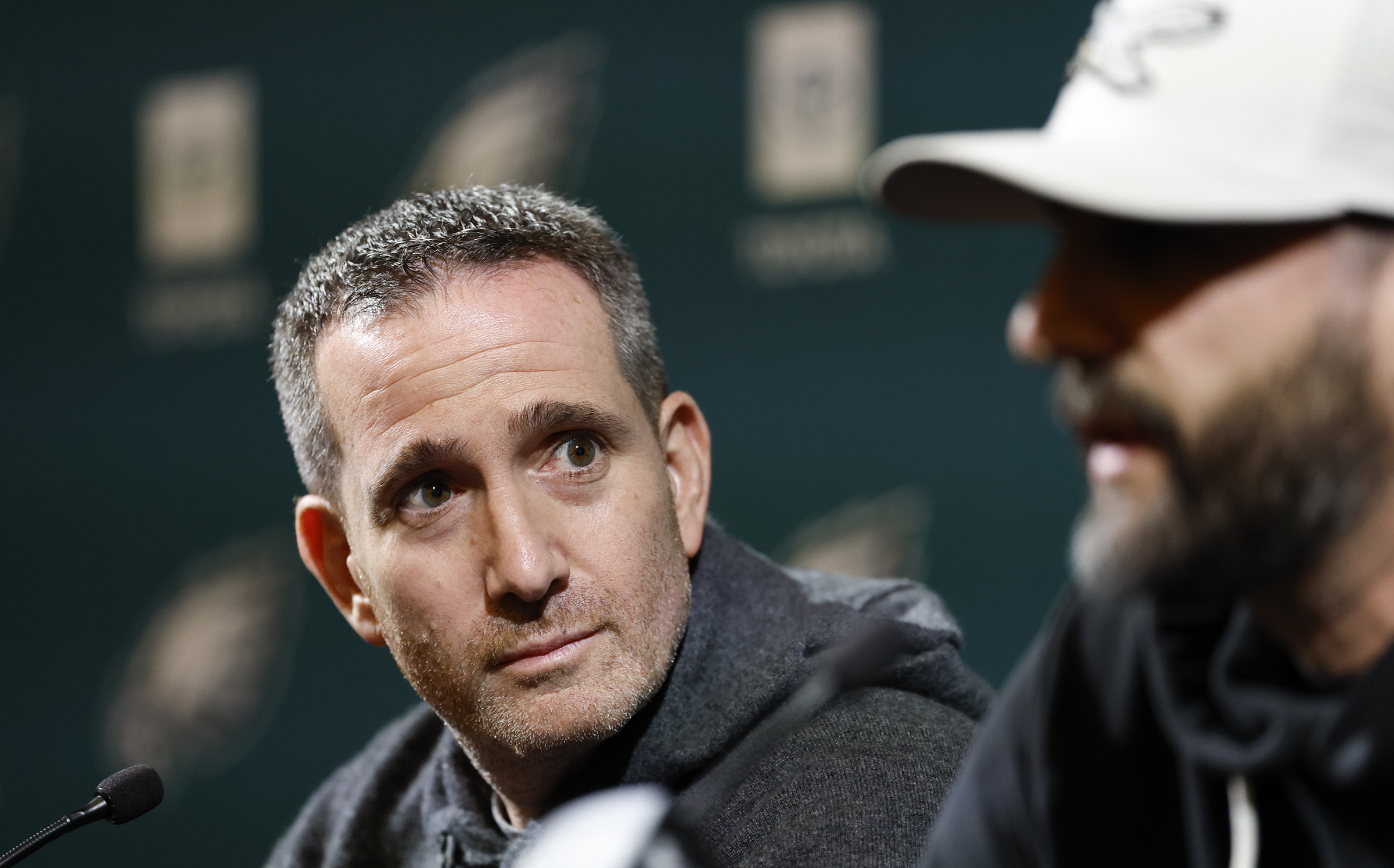
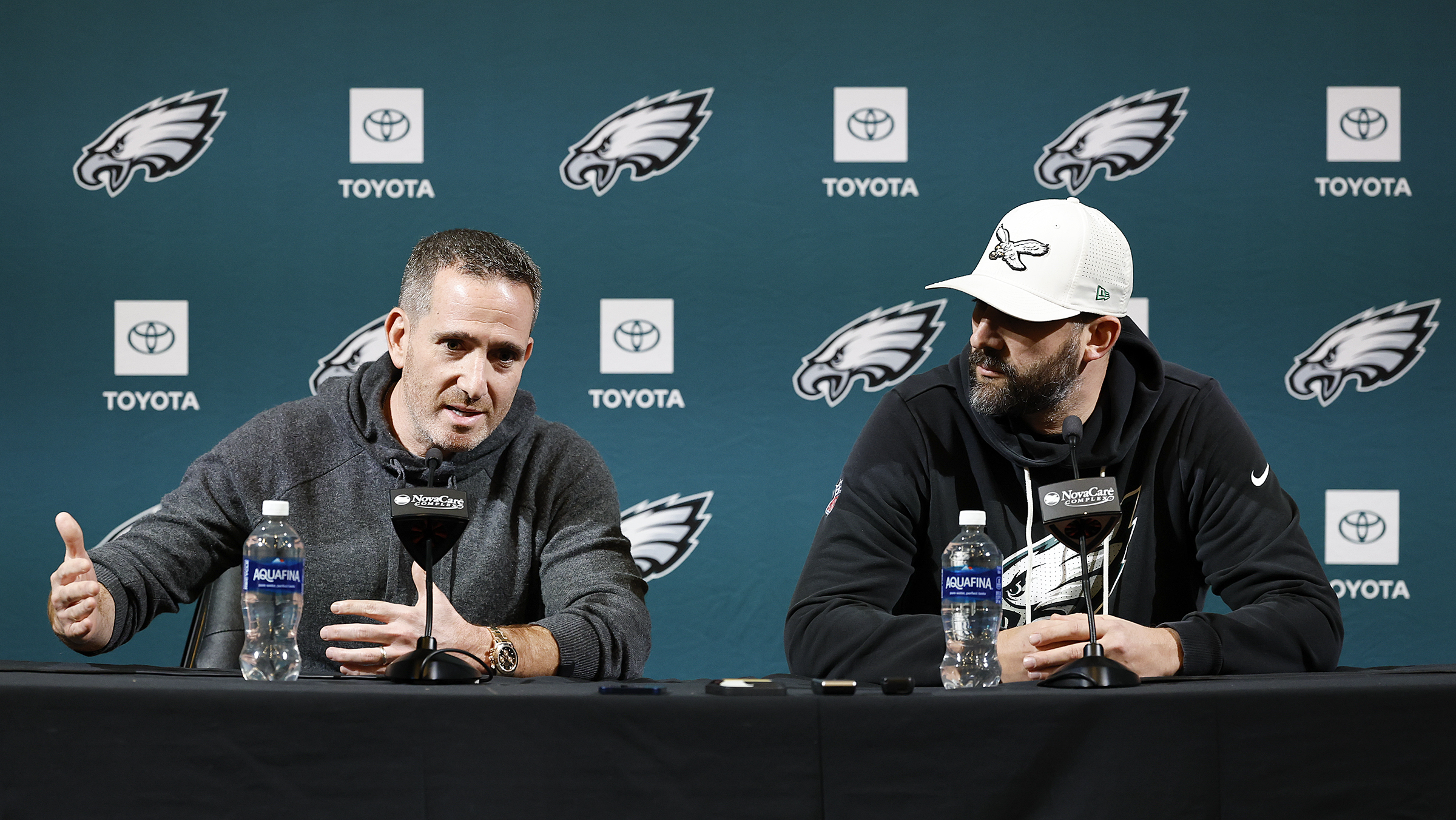
Howie Roseman (left) and Nick Sirianni will speak to reporters Tuesday.
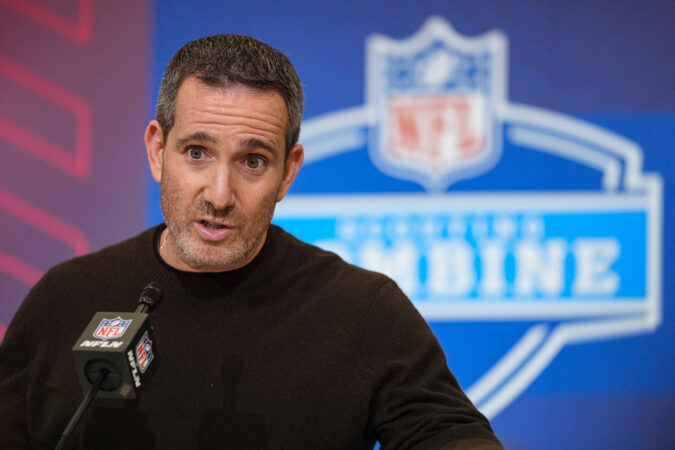
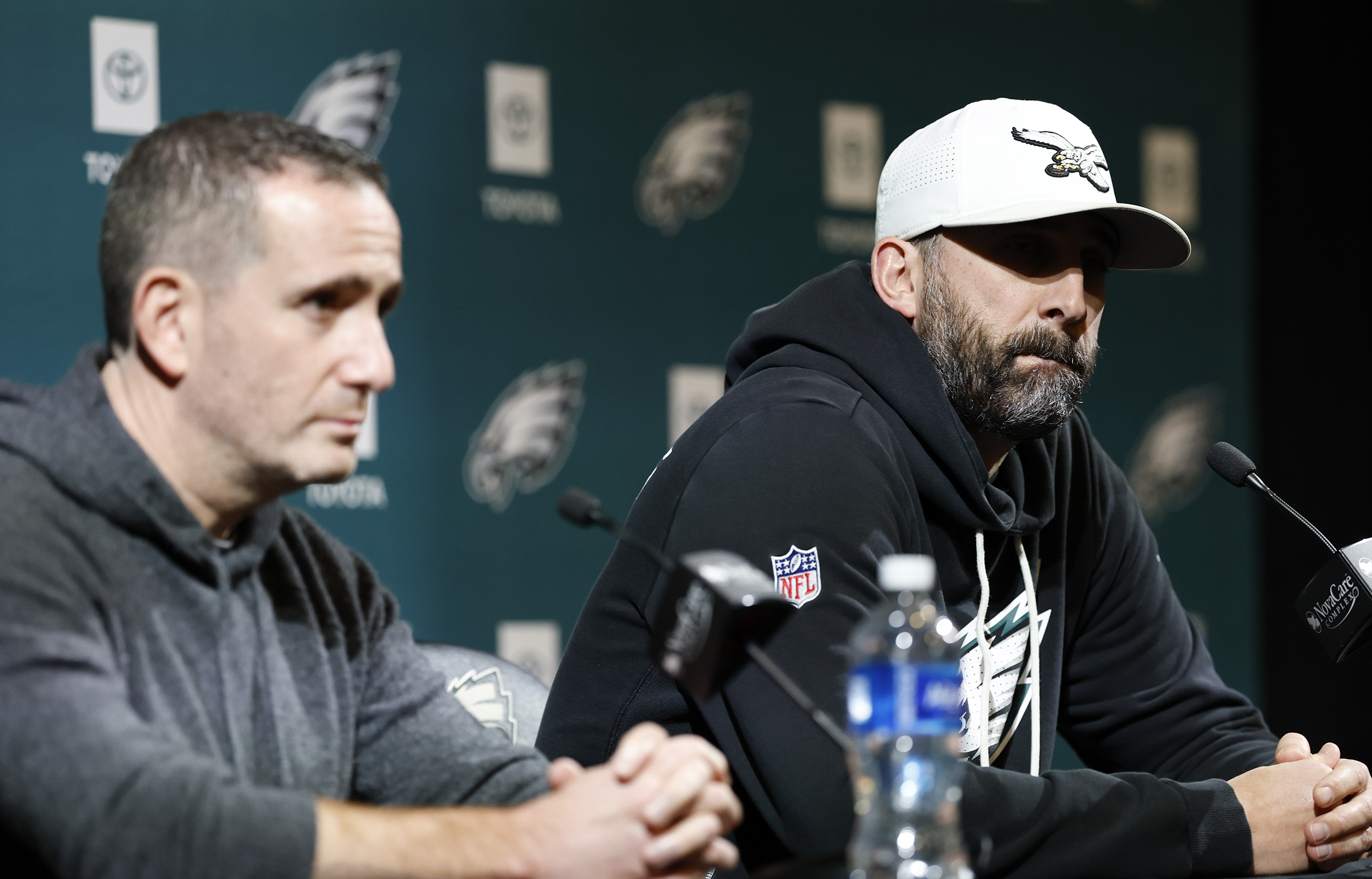
Eagles head coach Nick Sirianni and general manager Howie Roseman will speak to reporters Tuesday afternoon ahead of the scouting combine.
Roseman is slated to take the podium at 2:45 p.m., followed by Sirianni at 3 p.m.
While most of the focus will likely be on whom the Eagles might take in the upcoming NFL draft, Sirianni and Roseman will undoubtedly face questions about a host of issues, including the future of A.J. Brown.
Sirianni and Roseman spoke to Eagles reporters Friday. Here’s what they learned.
Sean Mannion will be calling plays for the first time under intense scrutiny in Philadelphia.
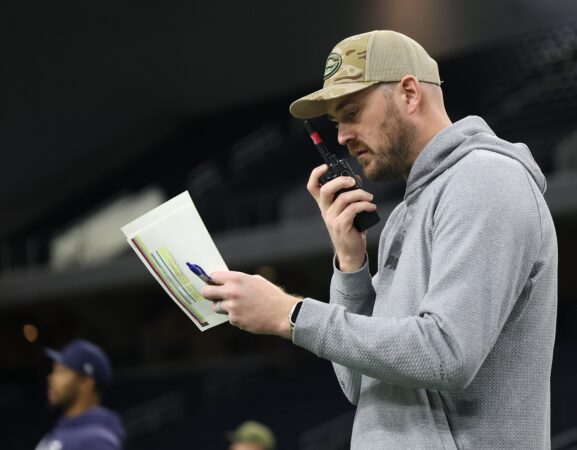
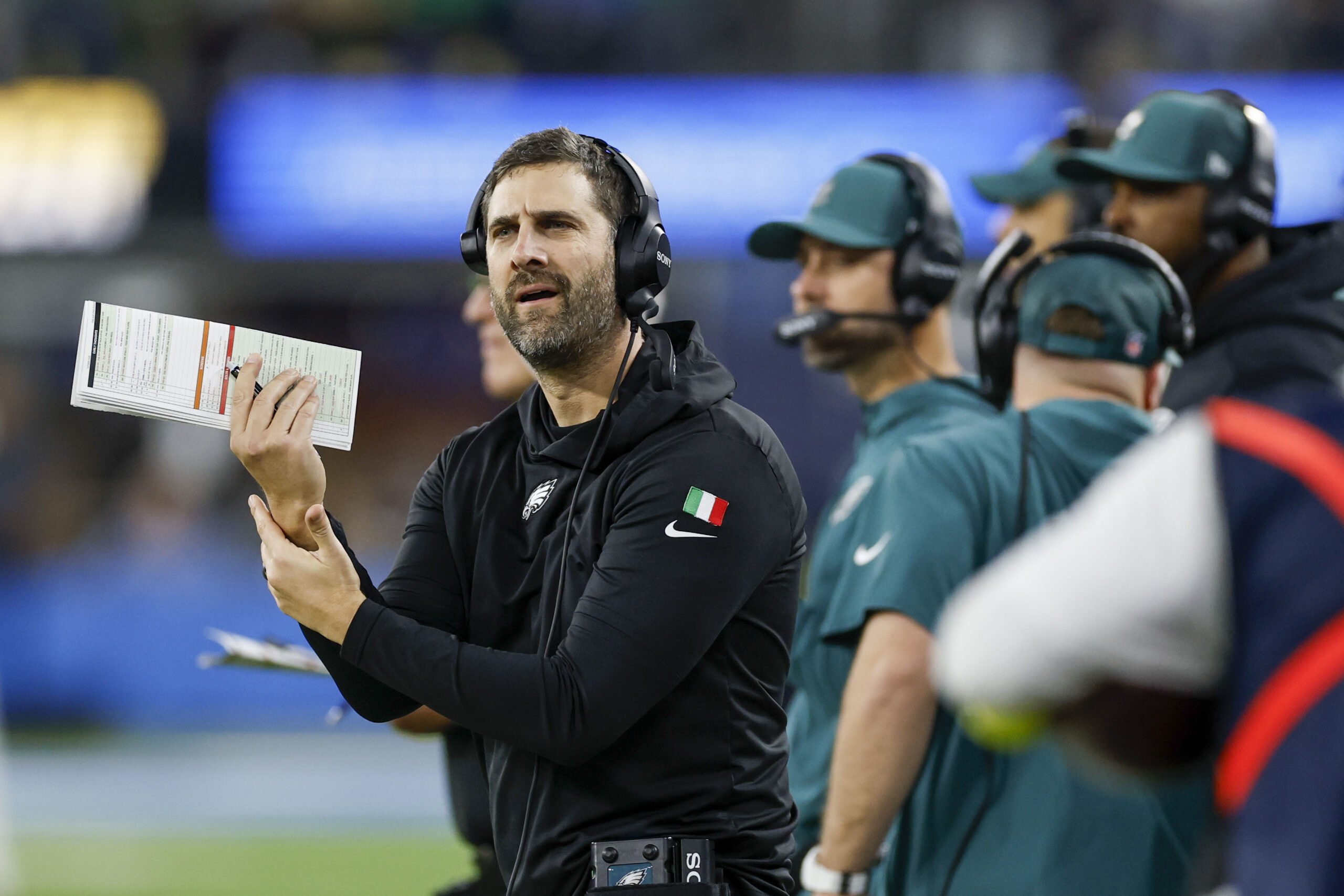
Nick Sirianni sat perched back in a chair with his feet up in UGG slippers. The Eagles coach looked as relaxed as he has in over a year, and certainly since a tumultuous 2025 season ended with him having to oust consigliere Kevin Patullo as offensive coordinator last month.
Sirianni met with reporters at the newly named Jefferson Health Training Complex on the Friday before the NFL combine. He and general manager Howie Roseman normally answer questions with locals in Indianapolis before they hit the combine podium. But with so much change already — and more to come — the Eagles opted for the more familiar setting of their draft room to address pertinent matters about the team.
Sirianni and the more upright Roseman spoke separately, each for around 40 minutes. They tackled subjects ranging from wide receiver A.J. Brown’s uncertain future to longtime offensive line coach Jeff Stoutland’s departure. But a significant portion of their availability — especially the coach’s — was spent on new offensive coordinator Sean Mannion.
Why did Sirianni hire the inexperienced former Packers quarterbacks coach? Why was the search drawn out? How much did wanting the Shanahan-McVay offense factor into the decision? What did Sirianni like about the scheme? How much autonomy will Mannion have? How will quarterback Jalen Hurts and other returning players adapt to the new system? And how will the changes affect evaluations of Brown and future Eagles?
Sirianni was light on details — how could he not be with so many unknowns — but he and Roseman did provide enough information to allow for informed perspective on Mannion, the new scheme and what could be an inflection point for the coach, his quarterback, and the Eagles overall.
Here are 10 takeaways about the offense from Friday’s interviews:
Four players the Eagles could be watching at the NFL Scouting Combine
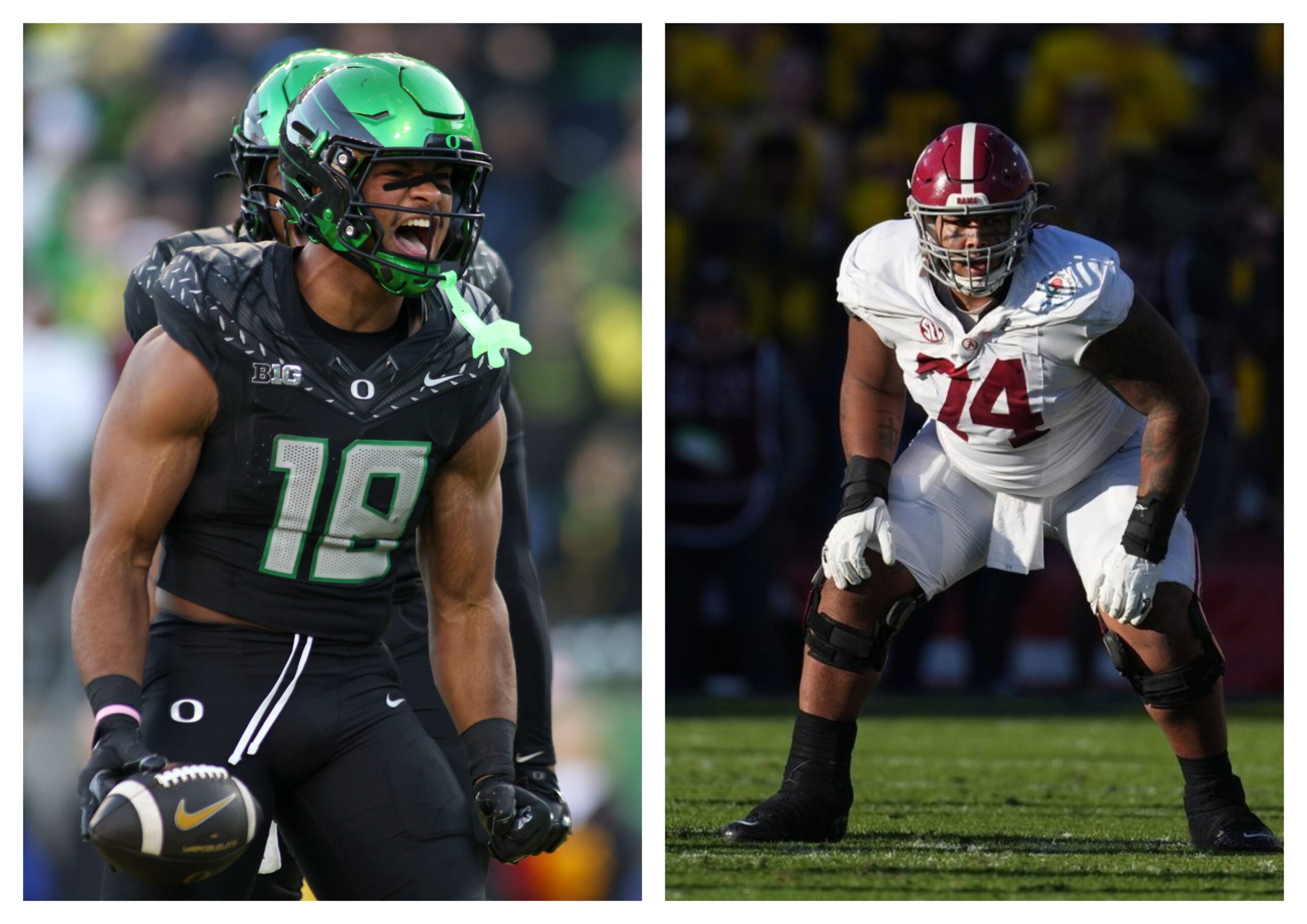
Will the Eagles be in position to fill a need with Oregon tight end Kenyon Sadiq (left) or Alabama offensive lineman Kadyn Proctor?
When evaluating NFL prospects, a player’s past performance is often the best predictor of future performance. The same can be said for the act of scouting itself.
Howie Roseman, who began serving as Eagles general manager in 2010, has an extensive draft history that can be used to project his future prospect preferences. Roseman has had personnel control during 15 draft cycles, not including 2015 when Chip Kelly was in charge of those decisions. Those 15 draft classes offer windows into Roseman’s valued traits and abilities at each position.
For years, the Eagles’ player personnel department has been gathering information about the 2026 draft class. At the scouting combine next week, Roseman and his staff will continue to learn about the scores of NFL hopefuls and determine their prospective fit within the organization.
What can the Eagles’ draft history tell us about the questions they will seek to answer about some of the top prospects at three positions of need next week?
Offensive line
Kadyn Proctor, Alabama: The 6-7, 366-pound tackle stands out for his movement skills at his hulking size. Proctor has the skill set to line up at guard, too, giving the Eagles another interior option with Lane Johnson returning for a 14th season.
Max Iheanachor, Arizona State: The 6-6, 330-pound tackle is a rawer prospect than Proctor, beginning his football career in junior college only five years ago. Iheanachor has the requisite size and quickness at the position, though, and he could continue to improve his draft stock with eye-catching numbers at the combine.
Tight end
Kenyon Sadiq, Oregon: The 20-year-old is the consensus top tight end in this year’s draft class who could come off the board within the Eagles’ range (potentially earlier) at No. 23 overall. His speed and athleticism are his strengths, and excels at making plays with the ball in his hands, which could be a benefit to the Eagles in the screen game.
Cornerback
Avieon Terrell, Clemson: The 5-11, 180-pound cornerback is relatively undersized at the position, but regardless of his size, Terrell has solidified himself among the top cornerbacks in this year’s draft class with his smart instincts and competitive spirit. He also has inside-outside versatility if the Eagles ever decide to move Cooper DeJean outside full-time. If Terrell tests well at the combine, he could get his foot in the door of the late first round.
NFL salary cap getting another big increase. Here’s where the Eagles stand.
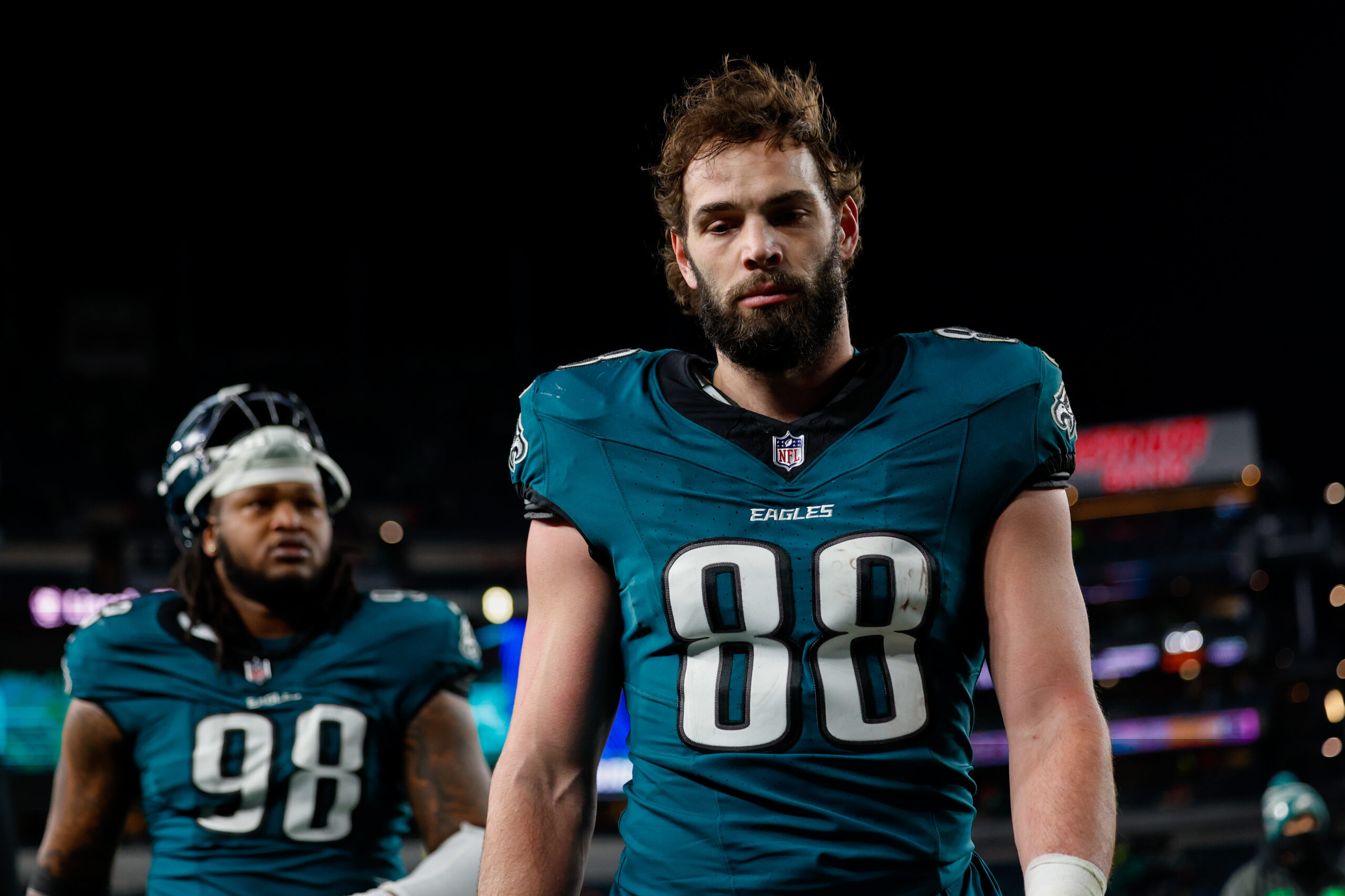
The Eagles will have to make a decision on pending free agent Dallas Goedert.
The NFL salary cap just keeps going up and up.
The 2026 NFL salary cap is projected to land somewhere between $301.2 million and $305.7 million per team, a big jump from last season. At a minimum, it’s an increase of $22 million compared to 2025’s cap of $279.2 million, offering Howie Roseman and the Eagles some much-needed breathing room.
The Eagles have 21 pending free agents, including tight end Dallas Goedert, safety Reed Blankenship, linebacker Nakobe Dean, and edge rusher Jaelan Phillips.
“As for which players the Eagles will prioritize, it’s not hard to imagine them wanting to rework something with Goedert before they look elsewhere for a tight end,” Eagles beat writers Olivia Reiner and Jeff Neiburg wrote last month. Phillips will be at or near the top of the priority list, too. The Eagles are thin at edge rusher and could use an impact player like Phillips at the top of the depth chart to pair with Jalyx Hunt and Nolan Smith.
Princely Umanmielen (left) and Bradyn Swinson at last year’s NFL scouting combine.
Tomorrow’s potential draft picks will be on display this week in Indianapolis as the NFL scouting combine gets underway.
What once was a scouting event held far away from television cameras has morphed into one of the NFL’s tentpoles, drawing multiple days of live coverage on the NFL Network.
Compensatory picks have not yet been finalized, but the Eagles know where they’ll be picking in the first three rounds.
Currently, the Eagles have five total picks in the draft, which is slated to begin April 23 in Pittsburgh.
The Birds are also expected to receive three compensatory picks, awarded for high-profile free agency losses that include Milton Williams (Patriots), Josh Sweat (Cardinals), and Mekhi Becton (Chargers).
Over the Cap projects the Eagles will land one third-round pick (for Williams), one fourth-round pick (for Sweat), and one fifth-round pick (for Becton).
In the 1990s, before Michael Dennis was a filmmaker, screening host, or archivist, he worked at the Video Library, the fabled video store in Mount Airy. He remembers the 1989 film Riverbend being on the shelves, but he had never watched it.
Dennis, who founded the Philadelphia-based production company Reelblack in 1999, finally got around to watching the film in 2019. Charles Woods, Dennis’ mentor and podcast cohost, had asked him to transfer a VHS copy of the film to digital. He wanted to post the film on Reelblack TV’s YouTube channel.
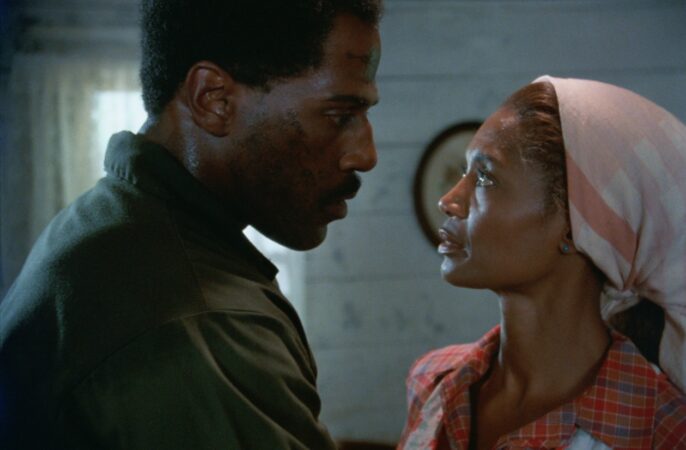
Riverbend, directed by Sam Firstenberg, is set in 1966 and tells the story of a group of Black Vietnam veterans who lead an uprising against a racist sheriff in a small Southern town. It’s an action-adventure film, in the tradition of the Rambo and Missing in Action series, firmly rooted in the B-movie style of the late 1980s — complete with a synthesizer-heavy musical score — but with much more of a social message than was typical of that time.
The film had only a perfunctory theatrical release and was released on VHS in 1990. In its brief run, the film opened only in New York, Texas, and Florida. But now, it has gotten an unlikely revival in Philadelphia, a city where it was never shown.
“The film itself is very revolutionary in some respects,” Dennis said. “I mean, it’s a genre picture, of course, but the theme is very revolutionary … and I was interested to talk to Sam about how the movie actually got made because it’s so different from most American films, nearly all American films.”
A few months after he posted the film on YouTube, Dennis received an email from Firstenberg, a B-movie stalwart whose credits also include American Ninja, American Samurai, and Breakin’ 2: Electric Boogaloo.
“I thought it was going to be a cease-and-desist letter, but instead he said, ‘No, you’re doing this movie a great service because it’s an orphan film and it was financed independently, and it’s basically lost,’” said Dennis, who teaches a course on race and ethnicity in American Cinema in Temple’s Film and Media Arts Department.
During the COVID-19 lockdown, Dennis saw a 35 mm print of Riverbend being sold on eBay by a seller in South Africa. He put in a winning bid for the print that’d take months to reach him.
Dennis considers himself an archivist, although he hadn’t previously mounted a full-scale restoration of a film before. But in keeping with Reelblack’s long-stated mission of encouraging the appreciation of Black film, especially rarer ones, he sought to restore Riverbend.
The eBay print, he said, had “every scratch known to mankind on it.” It was also missing seven minutes of material. Replacing the missing scenes with materials from the VHS, calling it a “sort of grindhouse cut,” Dennis gave the film its first public screening in decades at the Denton Black Film Festival in Texas in 2024. There, he met Valerie Vance, the widow of the film’s screenwriter and producer, Sam Vance.
“We were trying to find out where [Riverbend’s] negative was,” Dennis said, “And we had no luck because all the labs had closed and have become different companies.”
He got in touch with Dennis Doros, who runs the Missing Movies Instagram account and Milestone Films, a company known for rescuing “lost films.” Within days, the film assets were located at the film lab FotoKem, with Amazon/MGM paying the bills to host it.
Missing Movies, Vance, and Realblack worked out a deal to acquire the film’s negative and other assets.
The film then traveled to Norristown, where it was restored at Reel Revival, a company that provides scanning services. Austin Squitieri, its proprietor, started by scanning and digitizing the Riverbend negative. What followed was a painstaking process of digital repair, which included dirt removal, some Photoshopping, and final assembly of the edited footage.
Squitieri had not seen the film before working on the restoration, although he had heard of it.
“It’s a fun title,” he said. “It tackles something serious, and you can tell it was made passionately, as some of the more niche films tend to be.”
After premiering at the American Cinematheque Aero Theater in Los Angeles last October, the restored version of Riverbend is now headed to Philadelphia. The film will screen at Film Society East on Thursday and will be released on Blu-ray on June 27, through a new label called Reelblack Renaissance.
“There’s so many great Black independent films that are in danger of being lost or forgotten,” Dennis said. Reelblack Renaissance’s mission is “to restore them, reclaim them, and represent them in the Blu-ray and streaming market.”
Firstenberg, 76, will be on hand for the Philadelphia premiere.
“He tours the country supporting his body of work. And, this is like rescuing a lost child for him,” Dennis said.
Nick Sirianni sat back in a chair with his feet up in UGG slippers. The Eagles coach looked as relaxed as he has in over a year, and certainly since a tumultuous 2025 season ended with him having to oust consigliere Kevin Patullo as offensive coordinator last month.
Sirianni met with reporters at the newly named Jefferson Health Training Complex on the Friday before the scouting combine. He and general manager Howie Roseman normally answer questions with locals in Indianapolis before they hit the combine podium. But with so much change already — and more to come — the Eagles opted for the more familiar setting of their draft room to address pertinent matters about the team.
Sirianni and the more upright Roseman spoke separately, each for around 40 minutes. They tackled subjects ranging from wide receiver A.J. Brown’s uncertain future to longtime offensive line coach Jeff Stoutland’s departure. But a significant portion of their availability — especially the coach’s — was spent on new offensive coordinator Sean Mannion.
Why did Sirianni hire the inexperienced former Packers quarterbacks coach? Why was the search drawn out? How much did wanting the Shanahan-McVay offense factor into the decision? What did Sirianni like about the scheme? How much autonomy will Mannion have? How will quarterback Jalen Hurts and other returning players adapt to the new system? And how will the changes affect evaluations of Brown and future Eagles?
Sirianni was light on details — how could he not be with so many unknowns? — but he and Roseman did provide enough information to allow for informed perspective on Mannion, the new scheme, and what could be an inflection point for the coach, his quarterback, and the Eagles overall. Here are 10 takeaways about the offense from Friday’s interviews:
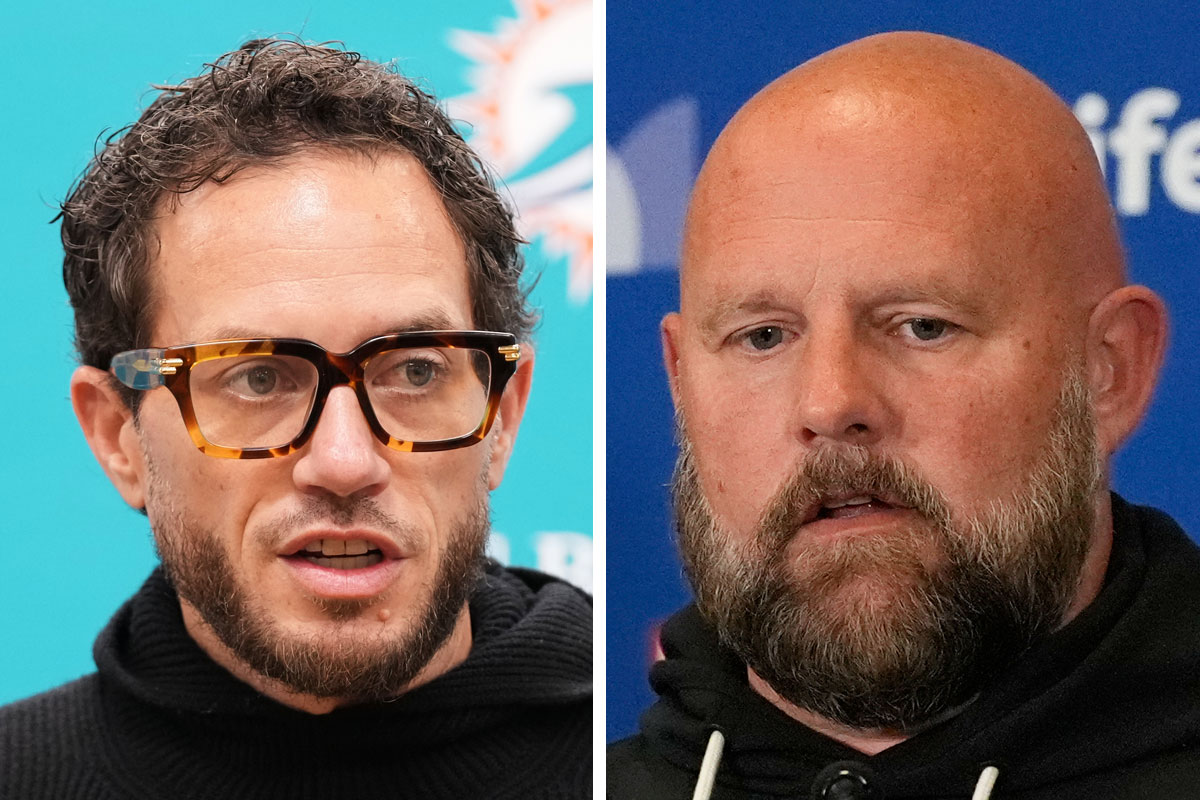
1. The Eagles pivoted in their approach to the OC search after it became obvious that Mike McDaniel and Brian Daboll wanted to explore other opportunities.
Former Dolphins coach Mike McDaniel (left) and former Giants coach Brian Daboll.
Sirianni didn’t confirm Inquirer reporting that McDaniel and Daboll were leading candidates, but he said he entered the offensive coordinator search looking for a veteran play-caller.
“I went into it … like I’d like for somebody to have some of the experience that’s done this,” Sirianni said. “Obviously, Sean has not had experience calling the plays. That, to me, was [secondary]. Like, we got into it and that kind of changed. I’m like, ‘No, this is the best guy for the job.’”
Sirianni also said he went into the process most interested in the Shanahan-McVay scheme, which would suggest that McDaniel was the primary target. Daboll comes from another system of offense, but he worked previously with Hurts at Alabama and would have checked other boxes. McDaniel went to the Chargers, while Daboll was hired by the Titans.
We’ll never know if the Eagles would have offered either McDaniel or Daboll the position, but clearly the search shifted into another phase. Sirianni said he interviewed a total of 17 candidates and that seven reached the second round. Only four of the final seven names — Josh Grizzard, Jim Bob Cooter, Jerrod Johnson, and Mannion — became public.
Mannion’s first interview was virtual, while the second was in person. Sirianni said that once he got him in the building, it confirmed his initial impression that the 33-year-old former quarterback was the guy for the job even though he had never called plays.
“What I was really looking for was the detail in which everything was explained to me, because the detail is so critical, conviction on what they believed and why they believed in it, and the vision and conviction of that how they went about it,” Sirianni said. “Like, OK, you haven’t called plays, but how do you go about thinking about calling plays in this particular area, like the vision for the offense, the vision and the conviction for how you would call it?”
2. Sirianni led the search and made the final decision — a fact that was made abundantly clear.
Eagles head coach Nick Sirianni listens to questions from media members with general manager Howie Roseman on Jan. 15.
Roseman, who touted Sirianni’s credentials as a CEO-type coach last month, made light of outside perception that he and owner Jeffrey Lurie hold strings over a powerless Sirianni when asked why he made those unprompted comments.
“Hold the strings, like during the games?” Roseman said. “Am I in his ear?”
Roseman, of course, remains one of the more entrenched figures in his position after two Super Bowl titles and 10 playoff appearances in 16 seasons as GM. He has final say over both the 90- and 53-man rosters and his influence with Lurie also can’t be overstated.
Roseman is also one of the most resourceful executives in the NFL. He helped Sirianni identify Mannion as a budding prospect.
“As you talk to people around the league, and they described him and his future, it became somebody that we really felt like we needed to talk to,” Roseman said. “It’s just his name kept coming up as we were doing things and as we were talking about the way that we were kind of moving from an offensive perspective.”
Sirianni, who spoke before Roseman, talked about a collaborative approach but identified himself as the “point man” in the search.
“The coaches that we bring in here always going to fall on me, right?” Sirianni said. “And I have to make those final decisions.”
Were the Eagles powers-that-be trying to empower their coach in giving him ownership over the coaching changes, or were they distancing themselves from the moves? Maybe only Lurie and Roseman can answer that question.
3. The Eagles are hoping Mannion will be the offensive coordinator version of Sirianni.
Nick Sirianni’s 2021 hire was an outside-the-box choice. Is Sean Mannion another diamond-in-the-rough choice?
The Eagles have had unprecedented success under Sirianni. They have a Super Bowl MVP in Hurts. They have Pro Bowl-caliber offensive players at multiple spots. And yet, there were rumblings that some OC candidates didn’t consider the job as desirable as other vacancies.
While previous coordinators Shane Steichen and Kellen Moore parlayed winning into promotions, Brian Johnson and Patullo were out after just one season at the helm. The position comes with both internal and external pressures. There’s also a question of Sirianni’s permanence in Philly and how Hurts has factored into coordinator turnover.
The Bears’ Declan Doyle, for instance, declined an interview request and reportedly told the Eagles he was staying in Chicago, even though he doesn’t call plays. Not long after, he took the offensive coordinator job with the Ravens, although it should be noted that he will work under defensive-minded coach Jesse Minter in Baltimore.
“All that really matters,” Sirianni said, “is the guy that you end up picking for the job and his excitement and willingness to be there.”
Sirianni might feel some kinship with Mannion, who didn’t interview for any of the other 14 coordinator openings this offseason. Sirianni, too, was an under-the-radar choice who surfaced late in the process when the Eagles tabbed him to be coach.
While Mannion had no other bites this offseason, like Sirianni five years ago, it doesn’t mean he won’t pan out.
4. It was the Shanahan-McVay scheme that led the Eagles to Mannion.
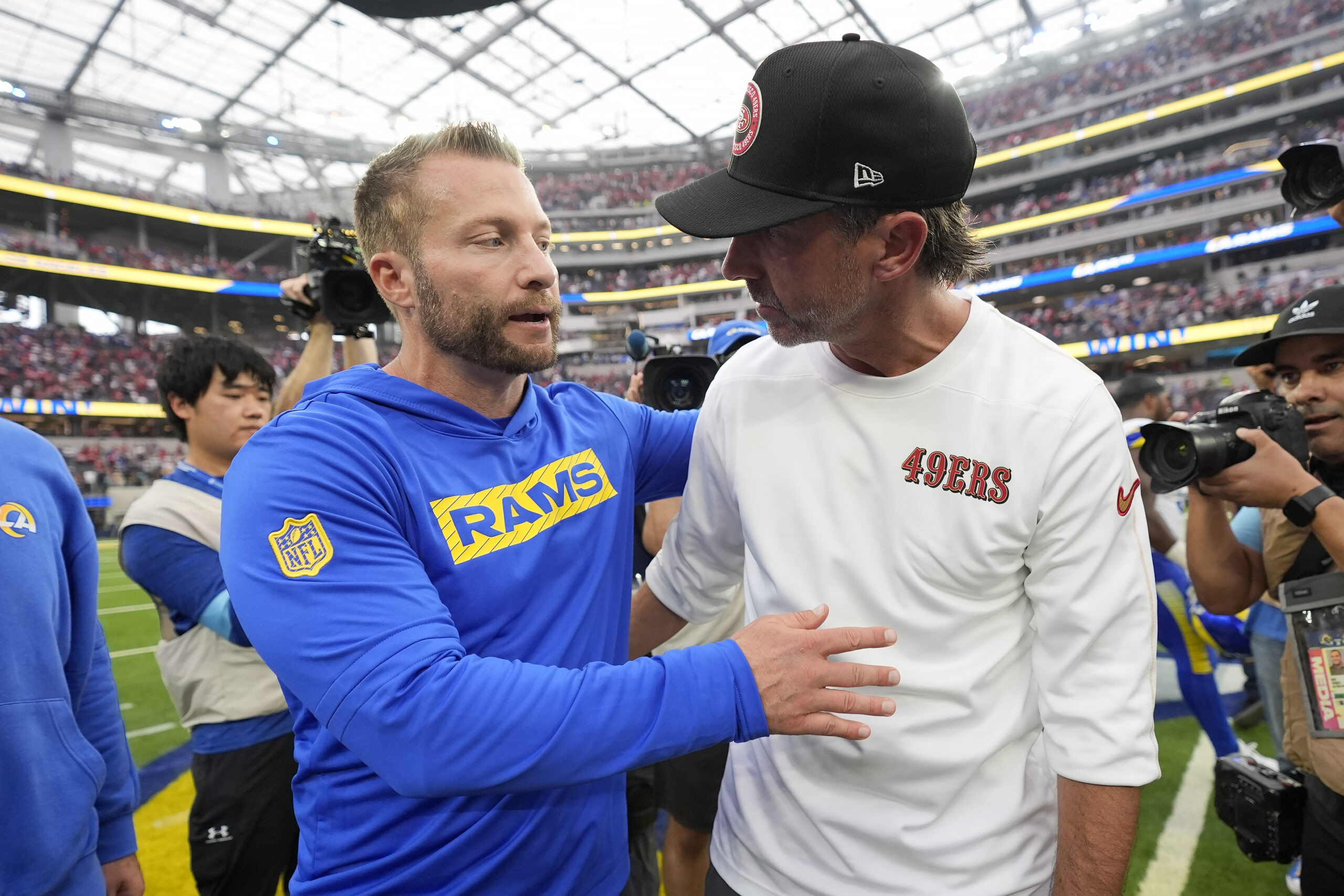
The schematic principles favored by Sean McVay (left) and Kyle Shanahan held increasing appeal for Nick Sirianni as he went through the OC process.
Sirianni interviewed coaches with backgrounds and experience in various offenses, but one scheme stood out more than others.
“It was in my forefront of my mind to say, ‘I’m interested in this,’” Sirianni said of the Kyle Shanahan-Sean McVay scheme. “But I didn’t necessarily say, ‘I have to have this.’ And then as the process went forward that’s where I kind of got to with that.”
The Shanahan-McVay system is often run-based that utilizes a wide-zone blocking scheme. It often marries the run with the pass through under-center play action. It features motion and misdirection. And it uses all the above to create space in the passing game for easy reads, yards after the catch, and explosive plays downfield.
While there were some commonalities between Sirianni’s and Moore’s schemes which allowed for a relatively easy transition, and maybe prevented the latter from fully implementing his offense, the Shanahan-McVay system is significantly different than Sirianni’s on early downs.
“Third down, red zone, backed up, four-minute [offenses] — a lot of those things are pretty similar in the thought process of people,” Sirianni said. “It’s the first- and second-down run, play action where people are a lot different and have different philosophies. And … that’s where I see just it’s going to be a little bit of a change there, but we’ve got good players.”
5. Improving the run game was paramount in choosing the new coordinator and scheme.
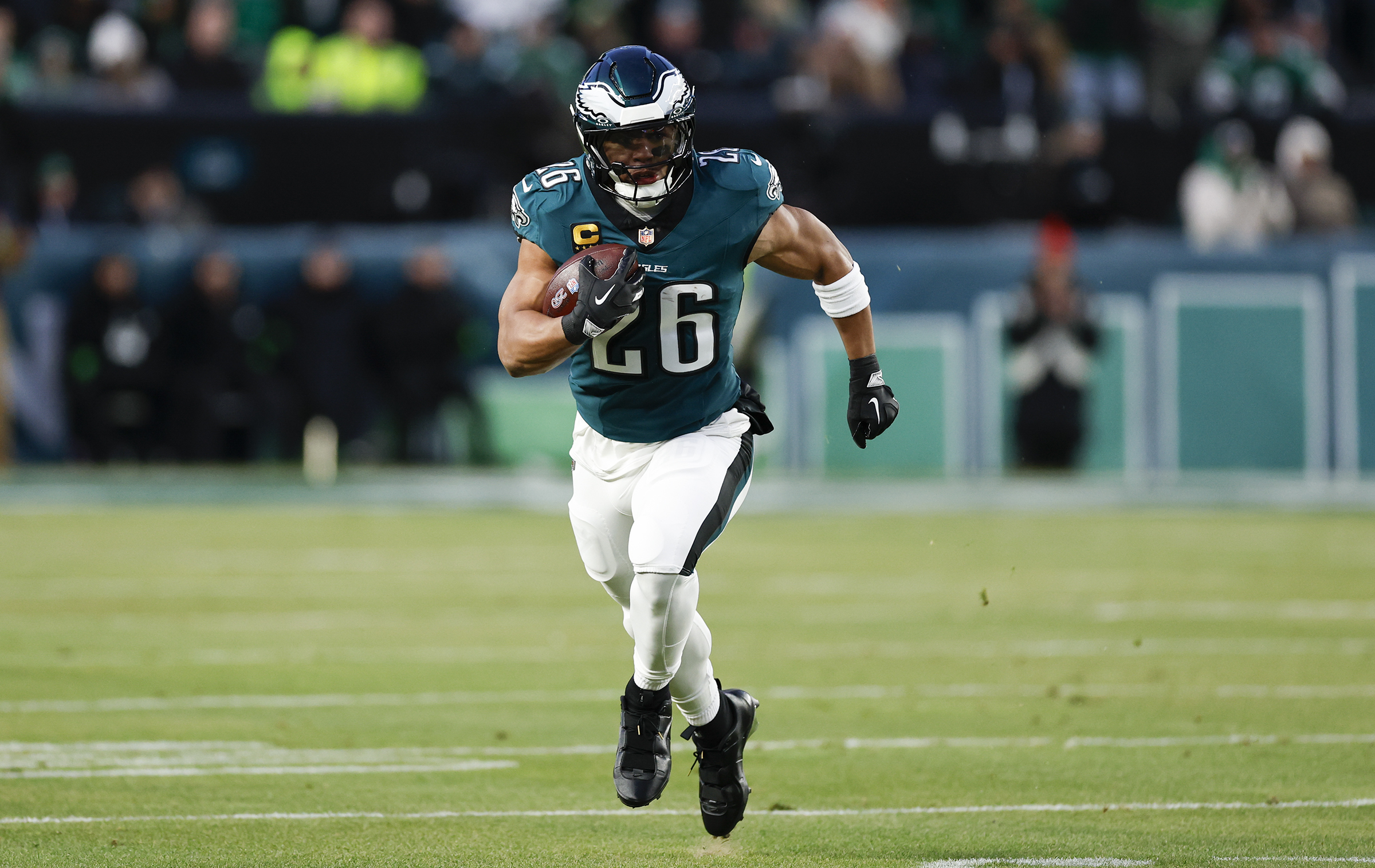
Could a Saquon Barkley renaissance be in store in the new Eagles offense?
There’s no question the Eagles’ passing offense was substandard and there needs to be more sophistication in the operation. But when Sirianni’s teams have had their greatest successes, it’s been behind a dominant running attack.
The Eagles were bound to face challenges after Saquon Barkley’s historic campaign in 2024. Injuries on the offensive line didn’t help matters. But when opponents devoted their efforts to stopping the run with increased numbers in the box, the Eagles struggled to adjust and make defenses pay through the air.
Sirianni equated how the Shanahan-McVay rushing offense handles defensive intricacies with how some passing offenses have adapted to modern coverages.
“You’ve seen a lot of teams that have done things where they’re reading pure progressions to handle all the junk that is being thrown at you by the defense,” he said. “This version of the run game is kind of in that mix, as well. It’s the run-game version of it.
“There’s a lot of junk that’s being thrown at you. This handles a lot of it.”
6. The run-blocking scheme changes were probably the chief reason Stoutland resigned.
Jeff Stoutland’s O-line alignment principles would not have meshed easily with Sean Mannion’s scheme.
The most significant change in the running game will come with the offensive line. The preferred wide-zone blocking scheme of the Shanahan-McVay offense is much different than the mid-zone scheme Jeff Stoutland employed with the Eagles for 13 seasons.
Stoutland was also the run game coordinator since 2018, but the alteration meant that he wouldn’t have returned in that role. Sirianni confirmed that he wanted Stoutland back, although the 64-year-old assistant would have had to teach his O-linemen a new run-blocking technique.
At its most elemental, wide-zone blocking has offensive linemen fire off the ball and block at an angle to create cutback running lanes. Mid-zone blocking has O-linemen more under control, perhaps required to win more at the point of attack and shuffle in their assignments.
One is not better than the other, they’re just different. The Eagles think their returning O-lineman can block in any scheme, but there will be an adjustment. The change could benefit an athletic center like Cam Jurgens, or it could hinder a cinder block like left guard Landon Dickerson.
“Will there be maybe a little bit more emphasis on movement and athleticism?” Roseman said. “Maybe a click. Maybe.”
Roseman was talking about how the new scheme may affect his evaluations in the upcoming draft. Right tackle Lane Johnson is returning for a 14th season, but the Eagles could be searching for his successor.
Stoutland was as involved as any coach in the pre-draft process and through his prioritization of “critical factors” helped the Eagles land Johnson, Dickerson, Jurgens, and left tackle Jordan Mailata, a former rugby player.
“We’re looking for a lot of the same things,” Roseman said, “with a lot of the same — a shout-out to Stout — critical factors that we’ve always been looking for.”
7. Hurts may actually run even less in the new offense.
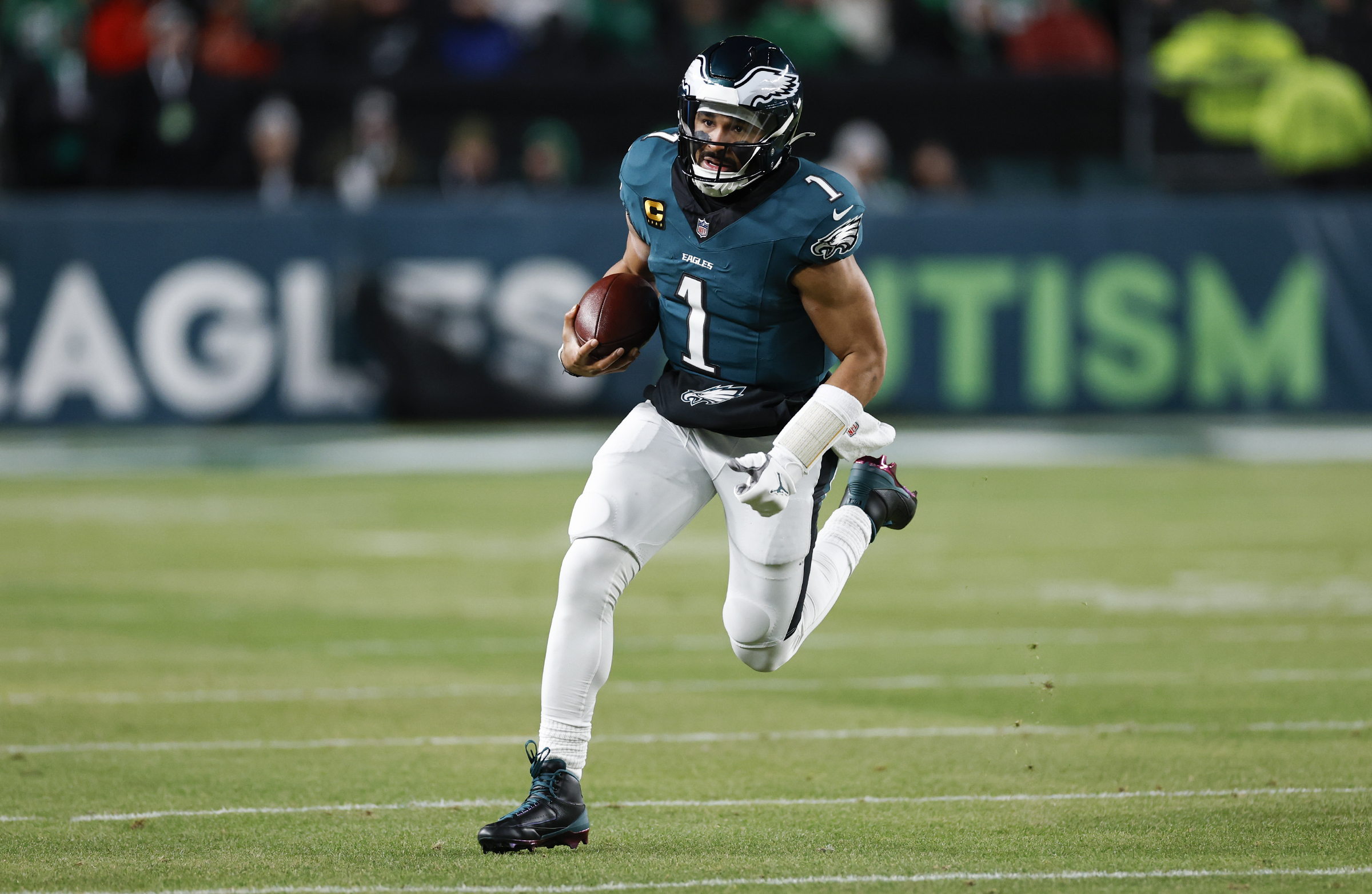
Jalen Hurts might run less in the Sean Mannion scheme.
Hurts’ history with different offensive coordinators and play callers dating back to college is a fact that has been repeated so frequently at this point it’s almost not worth mentioning, especially for a quarterback entering his seventh NFL season.
He has admitted that having first-year success with Moore should give the discourse less meaning. The scheme has also been relatively similar during the Sirianni-Hurts partnership. There has been a natural progression with his coaches asking him to do a little more under center, off play action, and with motion.
“He’s shown that he can do all these things,” Sirianni said. “I think what’s awesome about Jalen is he’s shown he can do a lot of things really well. … The great thing about great players is they can usually fit to any scheme.”
And yet, the Eagles have never majored in any of the above. Was that on Sirianni and his coordinators, or was it on Hurts? How much did Stoutland’s preferred run scheme prevent the offense from evolving? All of the above were likely factors.
Whatever the answer, change is coming. Hurts should be on board, especially if he wants to run less and desires more schemed-up layups in the passing game. With less shotgun, there won’t be as many designed quarterback run opportunities.
It remains to be seen whether less of Hurts on the ground is a good thing. It wasn’t last season. There are ways to incorporate some quarterback runs into the Shanahan-McVay scheme, but there will likely be fewer zone reads and run-pass option plays.
8. Sirianni left plenty of wiggle room for carryover from the previous offense.
Nick Sirianni will continue to have a voice on offense, as he has had in all previous iterations of the attack.
While some Sirianni critics may have short attention spans, he has presided over an offense that has often been among the best in the league. And in winning a Super Bowl last year he was able to retain some of the better parts of his scheme and incorporate it with Moore’s.
He said the same will happen with Mannion.
“I think that some of the things that you can sprinkle in from the things that we’ve done, it’ll just be a good mesh of different things,” Sirianni said. “You want to have something that you can [hang] your hat, which I think that we’ve always had, but then adapt that to different things that your players do well.”
The best coaches scheme to their players’ skill sets. In 2021 and 2024, the Eagles installed pass-based offenses before switching at midseason to feature the run. Some of that had to do with Hurts’ limitations as a dropback passer, but also to emphasize his mobility, a dominant O-line, and Barkley.
It would be foolish for Sirianni to commit to anything, although the Shanahan-McVay offense will initially be the scheme the Eagles hang their hats on. But there won’t be a complete whitewash.
“Its ever-evolving,” Sirianni said. “Shoot, you might end up saying, ‘Hey, I wanted to be an outside zone team, but it looks like we’re going to be a little bit more of a gap team, or vice versa, right?’ And it could be the same with, ‘Hey, I wanted to be a little bit more play action, but it looks like we’re going to be a little bit more naked and move the pocket and stuff like that.’”
Mannion won’t have autonomy like defensive coordinator Vic Fangio. How could he with no experience? The offensive-minded Sirianni will obviously be involved at some level. But he wants Mannion to ultimately be responsible for running the offense.
“I know that the most important thing that I need to do is be the head football coach of the football team, not the offensive coordinator for the Philadelphia Eagles,” Sirianni said. “I need to be the head football coach in charge of everything. It’s setting that vision, all the different things that go into it.
“But I’ve had a lot of experience in putting together an offense, so I’m here as a resource for him in that aspect.”
9. Mannion will work closely with Hurts.
Sean Mannion’s experience as an NFL quarterback could help ease communication with Jalen Hurts.
Mannion’s pedigree as a quarterback played some role in his hiring. Hurts had his best seasons under former quarterbacks in Steichen and Moore. Mannion has been credited with assisting the development of Packers starter Jordan Love and the reclamation of backup Malik Willis.
Hurts has a strong personality, so it’s no guarantee that Mannion’s playing experience or his relative youth will translate to a harmonious relationship. That could go in any direction. But Mannion’s former teammates and coaches have been unanimous in their praise of how he comports himself.
As for Hurts’ actual position coach, the Eagles opted to move pass game coordinator Parks Frazier to quarterbacks coach and let Scot Loeffler go. Sirianni said he wanted some continuity, but also pointed to Frazier’s one season working in the Shanahan-McVay scheme with the Dolphins under McDaniel.
Grizzard offered Sirianni the chance to keep a runner-up for the job who also has experience in the system and one year of play-calling under his belt. While he could be viewed as a backup if Mannion struggles, the Eagles were likely more focused on having an in-house replacement to guard against what happened after Steichen and Moore left.
New tight ends coach/run game coordinator Ryan Mahaffey and offensive line coach Chris Kuper were Mannion hires and will be instrumental in installing the new wide zone blocking scheme.
10. The new scheme probably won’t increase the likelihood that Brown wants to stay in Philly.
Change is coming to the Eagles offense, but it’s not necessarily the kind of change that will make A.J. Brown happier.
Roseman will ultimately do what’s best for the team even if Brown no longer wants to be an Eagle. Brown has expressed his love for Philly, but that doesn’t necessarily mean he wants to return if the passing game is going to remain secondary.
Brown could envision a scenario in which the Shanahan-McVay scheme improves Hurts as a thrower and gives the receiver opportunities to use his skills after the catch. But if the running game remains the focus, he may not get the targets he desires.
Replacing Brown wouldn’t be easy, even if receiver DeVonta Smith has a more prominent role. The free-agent market is light at the position. And while the draft is said to be deep, there are few Day 1 starters at receiver. The Eagles also have other needs.
Roseman may need to replace all three of his top tight ends with Dallas Goedert, Grant Calcaterra and Kylen Granson slated for free agency. The Shanahan-McVay scheme favors hybrid tight ends who can run-block.
“I would say that the tight-end position starts with me in evolving,” Roseman said. “I think that from my perspective, I’ve always had an affinity for kind of the receiving tight ends. I think that that’s shown in my work.”
It certainly showed this past season. Goedert, Calcaterra, and Granson were detrimental to the running game. They weren’t the only ones.
Two months after the Eagles hired Jeff Stoutland, they drafted Lane Johnson with the fourth overall pick in the 2013 NFL draft. Howie Roseman had his cornerstone offensive lineman, one whom Stoutland helped develop into a future Hall of Fame right tackle.
Stoutland was in the room with — and in the ear of — Roseman in the years that followed, even after the coach who hired Stoutland, Chip Kelly, left town. Stoutland survived 13 seasons and three coaching staffs in large part because he was arguably the best offensive line coach in football, but he also shared similar philosophies with Roseman.
“In 13 years, I probably couldn’t get on one hand our disagreements,” Roseman said during a session with Eagles beat writers on Friday, a few weeks after Stoutland announced his departure from the Eagles. “We looked at offensive line play very similarly.”
The Eagles, with Stoutland as offensive line coach, consistently had one of the best units in the league, and the two Eagles teams that won Super Bowls did so behind dominant offensive line play. But change is on the way, not just along the offensive line but for the offense as a whole. The Eagles have a new coordinator, Sean Mannion, and multiple new coaches working under him, including new offensive line coach Chris Kuper.
The line, meanwhile, is at a somewhat critical juncture. Johnson, who missed half of last season, turns 36 in May and didn’t decide until last week to make his return for the 2026 season official. It’s unclear how much longer Landon Dickerson, a second-round pick in 2021 whom Stoutland developed into a three-time Pro Bowler, will play football. The 27-year-old has undergone multiple surgeries since college and played through an abundance of pain in 2025. Cam Jurgens, 26, whom the Eagles drafted in the second round in 2022 to replace Jason Kelce, recently flew to Colombia to receive stem cell treatments, apparently to help deal with the lingering impacts of a back injury and subsequent pain that limited his effectiveness in 2025.
The Eagles offensive line will enter 2026 with questions about its health and ability to adjust to a new coaching regime.
The offensive line, which took a step back in 2025 thanks to those injuries, has quickly gone from a position of strength and certainty to one that may soon need to be overhauled. The Eagles have been due to draft and develop Johnson’s eventual replacement, but now they may have big holes in the interior sooner than they anticipated. It’s a crucial offseason for Roseman to address multiple spots on the depth chart, not just the offensive line, and retooling the offensive front now comes without the help of Stoutland.
“I probably could have 50 stories on our draft process and how we went through them,” Roseman said. “I miss him. … We’ll continue to move on. I feel like we have a really good group of people here. I feel confident in our ability to evaluate, but at the same time understanding how important he was to the process of adding good players and then developing those good players.”
The interviews with Roseman and Nick Sirianni last week offered the general manager and head coach their first chances to comment publicly on Stoutland’s exit and respond to some of the reporting that happened surrounding it.
The Inquirer’s Jeff McLane reported that Stoutland, who was also the run game coordinator, had his influence on the running game lessened during the season last year. And while the Eagles wanted to keep Stoutland in the building as the offensive line coach, he likely wasn’t going to keep the run game coordinator title. Plus, Mannion is bringing with him a new scheme that would change some of the things Stoutland has been teaching.
Sirianni said he doesn’t “get too wrapped up into what’s reported.” The head coach was more involved in all phases of the offense throughout this past season as it sputtered under first-year coordinator Kevin Patullo, Sirianni said, including the running game.
“We still went about our process the same,” Sirianni said. “There was obviously different things that we did and a different process in the sense of we were all together doing it in there. … Stout still had a lot of ideas. It’s always been collaborative in everything that we’ve done here.”
Eagles center Cam Jurgens with offensive line coach Jeff Stoutland after the Eagles beat the Washington Commanders in December.
There was, perhaps, even more collaboration when Sirianni made changes last season. Rather than having separate pass pods and run pods, the units worked together, especially when the offense shifted to some more under-center looks and worked in play-action calls. Sirianni said he anticipates more of the same under Mannion.
It’s unclear what the Mannion offense will look like, but while the 33-year-old has never been a play-caller, he has tentacles of influence from offenses run by Sean McVay, Matt LaFleur, and Kyle Shanahan. As it relates to the running game, that means more outside zone concepts as opposed to the inside zone runs more prevalent with the Eagles in recent years.
The offensive coaching staff Sirianni assembled under Mannion comes from various backgrounds, and the scheme will likely be a mix of different ideas, all of which are still coming together as the Eagles begin assembling the 2026 roster in earnest. Sirianni noted that things like third-down offense, red-zone offense, and four-minute offense may look pretty similar. It’s the first- and second-down runs and play actions that may look a lot different.
For the offensive line, there will likely be big changes to blocking assignments and strategies.
“Good players can play and fit in many different schemes,” Sirianni said when asked how big of an adjustment the line will face. “I know how good of players we have there at the position, and I know if we asked them to do the Navy triple option they’d be good at that. I do think it translates there. Obviously there’s always going to be [a] learning curve of everything, but that’s what your OTAs are for, that’s what your offseason’s for, that’s what your training camp is for, to get yourself ready for that.”
All of it will come with a new voice, Kuper’s, in charge. Stoutland was revered in the offensive line room.
Chris Kuper will bring eight years of experience as an NFL offensive lineman to the Eagles coaching staff.
“Obviously we wanted him to stay and be involved in this … I don’t want to say rebuild … reclassification, however you want to say it,” Sirianni said of Stoutland. “At the end of the day, Stout got to where he was and I obviously wish him the best and am going to deeply miss him because he’s done so many things that have helped us throughout his time here.
“Just like you always want good players around, you always want good coaches around.”
Ultimately, it will be the players who decide the trajectory of the offensive line moving forward.
While Roseman and Stoutland’s success stories are plenty, there have been a few misses. The biggest success story, turning Jordan Mailata from a 2018 seventh-round rugby-playing project into an All-Pro, helped offset missing on Andre Dillard in the first round in 2019.
Dillard’s selection was the last time the Eagles used their first-round pick on an offensive lineman. That could change in April. Roseman expressed confidence that Johnson, Dickerson, and Jurgens still have “incredible ability to affect our football team going forward,” but the Eagles are surely planning for the future.
“Is it a priority position? Always,” Roseman said.
Eagles general manager Howie Roseman expressed that improving the offensive line is an ongoing priority.
As the roster stands, there are no obvious replacements for the injured and older trio of linemen. Johnson’s spot would be the obvious priority in the short-term future. Swing tackle Fred Johnson is a free agent. The only tackles on the roster behind Johnson and Mailata slated to be in camp this summer are last year’s sixth-round picks, Myles Hinton and Cameron Williams; Hollin Pierce, who was on the practice squad last season; and John Ojukwu, who went undrafted in 2023 and accumulated 428 offensive snaps with the Tennessee Titans over the last three seasons.
The interior isn’t much deeper. The Eagles drafted center Drew Kendall in the fifth round last season, then claimed Willie Lampkin off waivers after camp. Practice squad member Jake Majors was re-signed to a futures deal after the season. Kendall saw limited action as a rookie and Lampkin spent the season on injured reserve.
The Eagles need reinforcements. They also need to plan for 2027 and beyond.
“You’ve got to have continual depth at that position, good depth, guys who can play at a high level, and you’ve got to develop guys at that position,” Roseman said. “We’re always trying to balance that, what we have now and what we’re looking for going forward. When we’re building an offensive line, we’re not just saying, ‘We’ve got five starters, we’re good to go.’ We’re looking at the depth behind those guys, guys who can play, because in all our best years we’ve had to have guys step in and play for a long period of time.”
For the first time in 13 years, they’ll navigate it all without Stoutland.
As he made the rounds at Super Bowl Radio Row two weeks ago, A.J. Brown didn’t sound like a player ready to demand a trade out of Philadelphia. But Nick Sirianni and Howie Roseman — even while praising Brown — don’t seem willing to shut the door on any possibilities surrounding the 28-year-old receiver.
At their annual pre-combine news conference with local writers on Friday, both Sirianni and Roseman were directly asked whether Brown would be back with the Eagles next season. While both expressed their affinity for Brown as a player and a person, neither outright said that he will definitely return.
“I can’t guarantee how anything’s going to play out into next season,” Sirianni said. “I can’t guarantee that, I mean, I’m thinking I’m going to be the head coach next season, but you can’t guarantee anything past tomorrow.”
Still, neither Sirianni nor Roseman indicated the Eagles were actively shopping Brown. After stating his inability to speak definitively about Brown’s future, Sirianni referenced the response given by Roseman in January following the team’s wild-card exit, when he was asked if he was open to trading Brown.
Roseman said at the time, “It is hard to find great players in the NFL and A.J.’s a great player. I think from my perspective, that’s what we’re going out and looking for when we go out here in free agency and in the draft is trying to find great players who love football, and he’s that guy.”
On Friday, Sirianni echoed Roseman’s remarks, calling Brown a “great player,” a “good teammate,” and a “good person.” The sixth-year Eagles head coach said he wants Brown in Philadelphia and he believes the receiver wants to stay, too.
Roseman also reiterated his January response, repeating that “it’s really hard to find great players” and “A.J. is a great player.”
“I think that from my perspective, we’re looking to improve in all areas, and you don’t do that by subtracting,” Roseman continued.
Howie Roseman (left) and Nick Sirianni did not shut the door on the possibility that A.J. Brown could be moved this offseason.
But the Eagles wouldn’t be giving up Brown — or any player under contract — without a return. The new league year begins March 11 at 4 p.m., marking the beginning of free agency and the trading period. In the next two weeks, prospective suitors could put together trade packages to persuade Roseman that he wouldn’t be subtracting from his roster by parting ways with any of his players, Brown included.
When asked if he would go into the new league year listening to offers on Brown specifically, Roseman gave a general response about all of his players, not just the star receiver.
“I think you go into the league year listening to offers for everything and anything,” Roseman said. “I don’t think that you can go into any conversation with anyone and just shoot things down without hearing what they have to say, because you never know. You never know on any player.
“If someone’s going to give you something that you didn’t anticipate and you won’t even have the conversation, I don’t think you’re necessarily doing your job or really servicing the team that you’re with. You never know what someone’s willing to do. Certainly, we’ve been in situations where there are guys that we didn’t anticipate trading, that we got an offer that was too good, and then you balance it with what you can get there.”
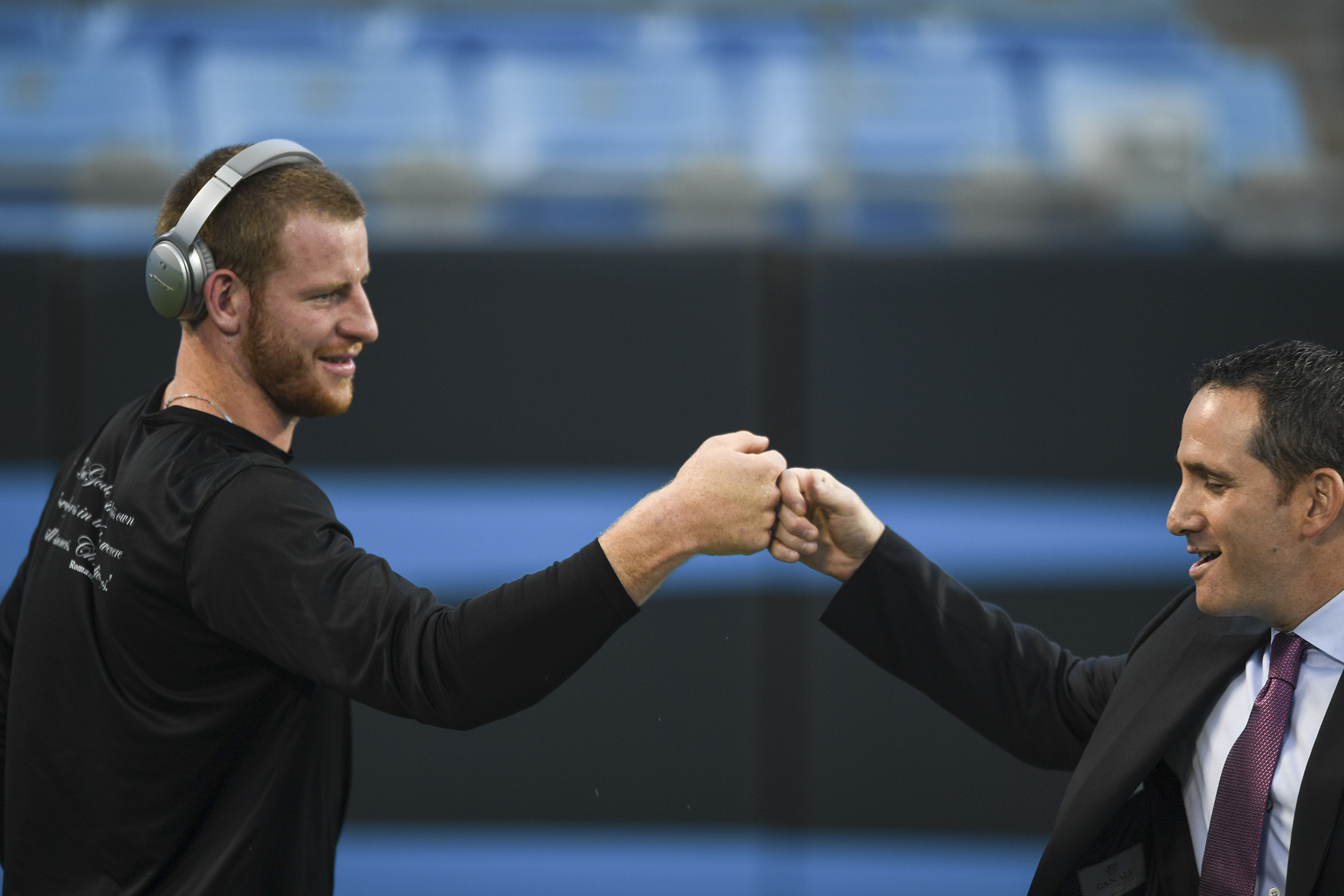
Howie Roseman dealt a disgruntled Carson Wentz (left) in 2021, offering some precedent for a Brown move.
Ultimately, Roseman wields the power to add or subtract personnel from the roster as he sees fit. How do player desires factor into the equation? The 50-year-old general manager previously jettisoned a highly-paid player with frustrations surrounding his role with the team when he traded Carson Wentz to the Indianapolis Colts in 2021.
Every situation is unique. Earlier in the season, Brown voiced his displeasure with the offense and his role within it on multiple occasions, both in conversations with the media and through various online forums, from his own social media accounts to a Twitch livestream.
Brown’s frustrations were seemingly validated to some extent, as the offense never reversed course from its season-long skid on the heels of a Super Bowl win the year before. But while speaking publicly for the first time in two months on Micah Parsons’ podcast during Super Bowl week, Brown appeared optimistic when asked about the new-look offensive coaching staff headlined by offensive coordinator Sean Mannion, saying, “I’m excited for the season. I’m excited for what’s to come.”
He noted that “sometimes change is not a bad thing.” Brown also reflected on his trade to the Eagles in 2022, saying that “Philly welcomed me with open arms” and calling the city his home.
Sirianni and Roseman were asked about Brown’s desire to remain with the Eagles. While Sirianni said his “expectation” is that Brown wants to be in Philadelphia, Roseman adhered to his standard protocol of declining to reveal the details of his conversations with any player.
Roseman also spoke generally when asked how a player’s personal wishes impact his decision to execute a trade.
“I think that any trade that we’ve made, we’ve done because we felt it was the right thing to do for the Philadelphia Eagles,” Roseman said. “I can’t remember any time that I’ve done anything that when I did it, I didn’t think was in the best interest of the team. It’s always going to be about the team. It’s always going to be about our players. If I start doing things that are about individuals as opposed to the team, I’m not doing my job.”
Jordan Davis (left) and Jalen Carter could both be candidates for extensions this offseason.
Extensions incoming?
Brown’s future is just one piece of the Eagles’ roster-building puzzle this offseason. Roseman also must decide which key players will be part of the Eagles’ long-term plan, especially as young defensive standouts such as Jordan Davis, Jalen Carter, Nolan Smith, and Moro Ojomo become eligible for extensions.
Davis, 26, and Ojomo, 24, are headed into the final years of their rookie contracts. Carter, 24, and Smith, 25, could have their fifth-year options exercised this offseason. Roseman could attempt to sign any of those players to team-friendly extensions early and prevent them from eventually testing the open market.
Additionally, Jalen Hurts could be a candidate for an extension. The 27-year-old quarterback is set to account for a team-high 10.1% of the Eagles’ salary cap in 2026, according to Over The Cap. An extension could lower that figure, giving Roseman more space to sign and extend others in the immediate future.
While Roseman declined to go into specifics about the contracts for all five players, he emphasized his longstanding philosophy of retaining homegrown players.
“Everything that we’re trying to do here is build sustained success,” Roseman said. “And how do you do that? … You’ve got to draft well, and then hopefully you’re re-signing and extending your own players, and you’re sprinkling on top additions. That’s going to be the priority for us.
“We have a lot of good players here that are going to come up this year, next year, and we’re going to try to keep as many as we can and continue to try to improve the team and understanding that there’s probably not a scenario where every single one of them can stay here.”
Linebacker Jaelan Phillips is a pending free agent who won praise from Howie Roseman after being obtained as a rental at the trade deadline last year.
Free-agent Phillips?
Jaelan Phillips isn’t one of those homegrown players. Roseman acquired him at the trade deadline from the Miami Dolphins at a premium for a player on an expiring contract, giving up a 2026 third-round pick.
Still, he is one of the major dominoes that could dictate the trajectory of the Eagles’ offseason moves. At 26 years old, Phillips is arguably the best edge rusher in the free-agent class and he is likely set for a hefty pay raise in the coming weeks.
Roseman has plenty of criteria to consider before deciding whether he would attempt to woo Phillips back to Philadelphia. With any player, Roseman said he factors in character, medical history, level of play, age, and scheme fit when considering a potential extension.
The trade of a third-round pick isn’t one of those factors. Roseman said he gave up what he thought was necessary to acquire a player to help the Eagles compete for a championship last season.
Even though the Eagles didn’t reach the pinnacle, their rental of Phillips gave them a positive, hands-on experience with a player they’ve held in high regard, which could influence their desire to try to retain him.
“Obviously, we do a lot of work on these players coming out, and we knew what kind of person Jaelan Phillips was from the time we spent with him in the pre-draft process, and it was confirmed throughout our time with him in Philadelphia,” Roseman said. “Unbelievable worker, unbelievable leader, incredibly talented player who cares desperately about winning.”
Howie Roseman acknowledged that his affinity for receiving tight ends, including Grant Calcaterra (left) and Dallas Goedert, might have limited the Eagles as a blocking team last season.
Transforming the tight end corps
Like Phillips, Dallas Goedert, Grant Calcaterra, and Kylen Granson are set to become free agents at the start of the new league year. With the offense charting a new course under Mannion, Roseman also could take a new direction with the team’s tight ends.
Last year’s group was deficient in blocking prowess. The 31-year-old Goedert has typically been a more well-rounded weapon, but he took a step back in the blocking game this past season. He was more effective as a red-zone threat, scoring 10 of his career-high 11 touchdowns inside the opponent’s 20-yard line. Calcaterra and Granson were most impactful when contributing as receivers, too.
Any of those players could theoretically return on new deals, but Roseman still expressed a need to expand the skill sets within the corps.
“I would say that the tight end position starts with me in evolving,” Roseman said. “I think that, from my perspective, I’ve always had an affinity for kind of the receiving tight ends. I think that’s shown in my work.
“You’ve got to be cognizant of the fact that at some levels, the game has changed. And so there’s certainly room for both of those spots. I think when you look at our room this year, probably needed more of a diverse skill set at that position.”
Could Tanner McKee be an attractive trade option for teams given the uninspiring draft and free-agent classes at QB?
McKee’s market
It’s a bad year to be a quarterback-needy team. This year’s draft class is relatively thin after Fernando Mendoza, the likely first overall pick by the Las Vegas Raiders. The top quarterback set to become a free agent is Malik Willis, the Green Bay Packers backup who has started six games over the course of his four-year career.
The trade market might be the most viable solution for teams to address their quarterback needs. Could Tanner McKee draw interest? The 25-year-old backup quarterback has one year left on his rookie deal.
McKee has had strong preseason outings and acquitted himself well in both Week 18 starts over the last two years. If teams believe he has QB1 potential, his market could materialize at the start of the new league year.
“I can’t speak to what everyone else thinks of our players,” Roseman said. “I know what we think of our players. That’s always been a position that we’ve put a great deal of priority on, to have a backup quarterback that we have a lot of confidence in, and we have a lot of confidence in him.”
Roseman reiterated the stance he took when asked about listening to offers for Brown.
“My job is to listen to anything about anyone,” Roseman said. “Whether I pull the trigger is a totally different story.”
Brad Keller sat at a gate at Philadelphia International Airport, awaiting a flight home after signing with the Phillies, when his phone rang with an invitation to join the most talented American baseball roster ever assembled.
And in that moment, on a cold day in December, it must have dawned on Keller how much his life had changed.
A year ago, Keller was in spring training with the Cubs, trying to make the team as a nonroster invitee on a minor-league contract. But after a dominant 2025 season (2.07 ERA in 68 appearances), he’s one of the best setup relievers in the sport, earning a two-year, $22 million contract from the Phillies and a spot in Team USA’s bullpen for the upcoming World Baseball Classic.
Keller, 30, sat down last week with Phillies Extra, The Inquirer’s baseball podcast, for a wide-ranging conversation about his first few weeks in Phillies camp, wearing the stars and stripes, why he believes he’s more than a one-year bullpen wonder, and more.
Here are a few excerpts. Watch the full interview below and subscribe to the Phillies Extra podcaston Spotify or Apple Podcasts.
Q: What makes you confident that you can take the terrific year you had in 2025 with the Cubs and build on it?
A: I think that’s exactly it, just continuing to build on it. I have a good set of cues that I was using all year last year, kind of even when I went through some ruts and things like that, that kind of got me out of it pretty quickly. So, just trust the work that I put in, trust the process. I know the relieving lifestyle. It’s not always going to be perfect, but ultimately we’re just trying to do our job out there. And just try to put up a zero. It might be [with] some runners on, might have to battle through some traffic, but ultimately our job is to put a zero up and pass it on to the next guy. So, just building on what I did last year and continue to get better.
Going into spring this year, we’re still working on some things. Last year, my sweeper at times was a little not as consistent as [I was] hoping it to be. So this year it has kind of been my point of emphasis, going through spring, just kind of nailing that in, really [homing] in, when I want it for a strike, when I want it for a ball, things like that. There’s always things to work on. And I’m not just trying to sit there and just be like, ‘OK, last year’s last year.’ There is still even things last year that I would like to get better at going into this year. And so there’s always work to be had.
Brad Keller emerged as a key arm in the Cubs bullpen last season, posting a 2.07 ERA in 68 games.
Q: From what I heard in the offseason, there were some teams that looked at you as a potential starter. What can you tell me about your free agent experience and why you chose to continue down the path as a reliever?
A: … I had a couple of teams reach out this year that were like, ‘Hey, we think that there’s a chance that you could still do it, and we believe that you could still be a starter.’ And I told them, ‘Yeah, I’m down to start. That’s great.’ But I loved the bullpen last year. There was nothing like the adrenaline rush that you would get going into a game, big moment, big situation, like getting out of it, pitching in the playoffs, coming into big games like that. That gives me chills thinking about it, because it was just such a special experience.
And so part of me was like, ‘I don’t want to give that up.’ And I know even when we were talking about the starter route, it was like, ‘There was always the fallback plan, and if it doesn’t work out, we’ll still just put you in the bullpen.’ But I had success with it last year. I had success with it in the past, beginning [of] my career, so maybe we should just dive full in because at the beginning of the last year, even when I was in the bullpen, I was still the two-inning guy, still the long guy. So it was still always like am I going to start?
… So finally, when I felt like I put all those to the side and just commit to being in the bullpen, commit to being a reliever, that’s when I feel like my season kind of changed. Going into free agency I was like, let’s just commit to this. I really enjoyed it. It’s not like something that I was on the fence about. Once I was all in, I was like, this is a lot of fun. And I had a good group of guys last year that really kind of showed me the ropes, especially transitioning into just a completely different role, being able to be ready every single day vs. one every five days or so. So that helped out a ton.
Andrew Painter, 22, is expected to crack the Phillies’ rotation in 2026.
Q: You were 22 and you skipped over triple A when you made your major league debut in 2018 and you had a really good year for the Royals. The Phillies are most likely going to give a 22-year-old rookie, Andrew Painter, a spot in the rotation. What do you remember about being in his position, and what’s your advice for him?
A: I think the most important thing is just don’t try to make it more than what it is. It’s still the same game. You’ve still got to throw the ball 60 feet, 6 inches. … The lights are brighter. Obviously you’re facing guys that you’ve seen on TV, or you’ve heard the name a million times, but it’s the same game. You’ve just got to put on that competitive hat and just go to work. And it’s obviously intimidating when you’re 22 and you’re facing a bunch of guys.
But for me, I was just trying to be a sponge my rookie year. Just try to soak in as much information as I could. Good, bad, obviously, you got to filter out that stuff, but you just try to enjoy every moment. It’s such a short time in our lives. A career span is so short in the grand scheme of things. So just try to make the most of it. Try to make all the memories. Try to soak in all the information.
We have a lot of veteran guys on our team, hitters, pitchers, especially in our starting staff. He’s got a lot of guys around him that he can lean on, which is really cool — [Aaron Nola], [Zack] Wheeler and [Jesús] Luzardo, and those guys. That’s just awesome to learn from and follow suit with those guys. But I think just enjoy it. It’s a once-in-a-lifetime opportunity. And like I said, it goes by fast. This is Year 9 for me, and I feel like I remember myself as a rookie walking into the clubhouse for the first time. So it’s fun, but … it’s still the same game.
Watch the entire interview for Keller’s thoughts on the Phillies bullpen, playing for Team USA in the World Baseball Classic, and meeting new teammate Kyle Schwarber at the College Football Playoff national championship game in Miami.
The NHL trade freeze thawed at 11:59 p.m. on Sunday, and general managers have until 3 p.m. on March 6 to decide if their team is a buyer or a seller.
Flyers president Keith Jones and general manager Danny Brière have long said “the players will decide” which route they take during the team’s rebuild, but Brière expects this deadline to be a quiet one.
That doesn’t mean trades won’t happen between now and the buzzer, as the Flyers still have five games to sway brass one way or the other.
We broke the Flyers’ roster into five categories, ranging from the players most likely to be traded to those who are considered untouchable.
Which Flyers are trade bait?
Two seasons ago, pending unrestricted free agent defenseman Sean Walker was widely expected to be on his way out, and he was eventually dealt to the Colorado Avalanche in a package that included a 2025 first-round pick. Last season, after years of speculation, glue guy Scott Laughton was shipped north to Toronto for Nikita Grebenkin and a 2027 first-round pick.
But for the first time in Brière’s tenure, no player is a slam dunk to be traded.
Rasmus Ristolainen, D: If the Flyers trade anyone, all signs point to the 31-year-old Ristolainen. There are several appealing aspects regarding the 6-foot-4, 208-pound blueliner for playoff-bound teams. Finally healthy, the Finn is coming off an impressive performance at the 2026 Milan Cortina Olympics, where he showcased a physical, two-way game while posting three assists, a plus-9 rating, and earning a bronze medal. A more tantalizing tidbit is that he wouldn’t be a one-and-done rental; Ristolainen has term, with one more year at a relatively cheap $5.1 million. Various reports on Monday indicate that there will be suitors.
Emil Andrae, D: In the last month, a question has arisen: Where does Andrae actually fit? Limited in stature but not in heart and drive, the 24-year-old Swede is an exciting puck-mover but also prone to miscues. Scratched the last five games before the Olympic break, it’s not clear whether the Flyers are looking to move him, but a change of scenery might suit all involved..
Flyers defenseman Emil Andrae seems like a player who is a little stuck. Could the Flyers opt for a change-of-scenery trade?
Carl Grundström, LW/RW: Acquired in early October in the deal that sent Ryan Ellis’ contract west, Grundström has brought speed, quickness, and a great shot to the Flyers’ fourth line. As assistant coach Todd Reirden said on Sunday: “He’s been such a good add for our team this year. Been able to help us in a number of different ways, whether it’s penalty kill or sliding up and down anywhere from the fourth line to the second line.” If the Flyers are selling, could he recoup a mid-round draft pick?
Nic Deslauriers, LW: The veteran will be an unrestricted free agent this summer and recently told The Inquirer that he thinks he has another year or two in him. A good locker room guy, he has the playoff intangibles of being a hard-working forward who plays the body with authority and can patrol the ice. Brière is known to do right by veteran players — i.e., Erik Johnson and Scott Laughton — so maybe it’s Deslauriers turn.
Noah Juulsen, D: Someone coach Rick Tocchet knew from his days in Vancouver, the blueliner is a capable depth defenseman that might provide depth for a contender.
Which Flyers could be in play for the right price?
Owen Tippett, LW/RW, and Bobby Brink, RW: It’s unlikely — for the moment — but the Flyers are going to need to start making space for young wingers like Porter Martone. And while the Flyers assuredly wouldn’t want to subtract either player from their lineup, Tippett and Brink are players other teams might want. Tippett, who has a 10-team no-trade list beginning on July 1, has officially become the guy everyone expected, using his speed, skill, and physicality to become a true power forward. Small in stature, Brink is a two-way player who has built a solid foundation to his game and can slide into any system.
With a glut of wingers, could the Flyers look to move Owen Tippett in a package for a center or a defenseman.
Noah Cates, C/LW: This one has an even lower probability, but Stanley Cup teams are always looking for third-line centers who play a checking role while also chipping in offensively. Cates has shown he can shut down the game’s best, and contenders assuredly wouldn’t mind adding someone as fundamentally sound as the Minnesotan.
Sam Ersson, G: Inconsistent is a good word to describe Ersson, who has had stretches of brilliance but also long stretches of struggle — notably the latter this season. Could the Flyers trade the pending restricted free agent? Anything is possible, especially with the decision of whether or not to extend him a qualifying offer on the horizon. But as of today, the young goalies in the system aren’t ready for the leap to the NHL, so it’s foreseeable that he’s sticking around for now at least.
Garnet Hathaway, RW: Although he has struggled this year to put the puck in the net and has been a healthy scratch for nine games, Hathaway has intangibles that playoff-bound teams want at the deadline — like penalty killing ability and a gritty, edgy game that gets under opponents’ skin. That formula helped the Florida Panthers win back-to-back Cups and is why Hathaway been moved to contenders at previous deadlines.
Nick Seeler, D: There’s been a bit of a buzz around the hard-nosed blueliner in the press box from visiting scouts. A solid defenseman who blocks shots and provides physicality, Seeler could be the perfect depth guy for a team heading for a deep playoff run. The only thing is, he would have to waive his no-trade clause, which does expire on July 1.
Which Flyers are unlikely to be traded?
Sean Couturier, C: The Flyers captain has a no-movement clause and a likely unmovable cap hit of $7.75 million for the next four years. With a cheaper and short-term contract he might be enticing to a playoff team as the 33-year-old center’s analytics are still solid, and what he does in the faceoff circle could change the course of a game. But the contract is probably a nonstarter for most teams.
Jamie Drysdale and Cam York, D: Teams need guys like Drysdale and York to round out their defense, as both are young with offensive upside and solid defensive games. York has a team-friendly contract at $5.15 million for the next five years, while Drysdale is a restricted free agent. While there might be interest, the Flyers need both players to hit on their potential.
Christian Dvorak, C: Inked to a shiny new deal, the Flyers are less inclined to trade a guy they just promised four years to. But, if they were to do it, they need to do it now, as Dvorak received a no-trade clause the first two seasons and a modified no-trade the last two that kicks in on July 1.
Flyers center Christian Dvorak is presumably off the market now after signing a five-year extension in January.
Nikita Grebenkin, LW: A key part of the swap for Laughton at the last trade deadline, the Flyers like what the young Russian brings. A gritty but skilled winger, Grebenkin is a work in progress; however, the upside and potential could be too good to part with this soon.
Which Flyers would only get traded for a star or massive haul?
Tyson Foerster, LW/RW: Since Foerster, 24, went down with a likely season-ending injury in December — a yellow non-contact jersey has been in his locker during the Olympic break — it’s become more evident just how important the Canadian is to the roster. Prior to his injury, Foerster seemed to be trending close to “untouchable” given his goal scoring and defensive acumen.
Denver Barkey, LW: Expected to be in the minors this season, Barkey was recalled in late December and has been not just a revelation but a reminder that not every guy needs to “marinate.” The Flyers do not want to lose the 20-year-old rookie and his high hockey IQ, but he could be a key part of a larger deal to land that center or top-pair defenseman the team covets.
Who on the Flyers is untouchable?
Matvei Michkov, RW: Brière on Feb. 3: “One thing I can tell you, first of all, is: Matvei Michkov is not going anywhere. Let’s make that clear. OK. Matvei is going to be here for a long time.” Despite a difficult season, Michkov remains one of the most important pieces to the Flyers’ rebuild.
Trevor Zegras, C/LW: It took the Flyers some patience to get Zegras, 24, from the Anaheim Ducks, and they are not partying with him now. The only question is how much the restricted free agent, who has 20 goals and 49 points in 56 games as a Flyer, will make when he inks his new contract.
The Flyers have long coveted an offensive game-breaker like Trevor Zegras. Now, they have to pay the restricted free agent.
Travis Sanheim, D: Coming off an impressive silver-medal-winning twirl with Hockey Canada, Sanheim is among the team’s untouchables right now. The blueliner has a unique combination of size and skating ability, which he just showcased on the international stage. Sanheim, who turns 30 next month, also has a full no-trade clause through the 2026-27 season, and a modified 12-team clause for the remaining four years of his deal.
Travis Konecny, RW: Currently in Year 1 of an eight-year extension signed two summers ago, with a no-movement clause through 2031, Konecny has become not only the team’s top scorer but a leader. Before the Olympic break, it felt like the soon-to-be-29-year-old strapped the Flyers to his back and tried to will them to victory — on a bruised and battered body, no less. The time off has helped the winger recoup, and he is on pace to achieve yet another career year.
Dan Vladař, G: The goalie needed someone to believe in him and give him the chance to carry the workload. He has paid the Flyers back two-fold with a top-20 save percentage and the 10th-best goals-against average in the NHL. He has an eight-team no-trade clause, but there is no doubt the netminder is sticking around given the Flyers’ checkered history between the pipes.