Tag: topic-link-auto

  • Immigration lawsuits are dominating Philly’s federal courthouse as ICE push continues

    Immigration lawsuits are dominating Philly’s federal courthouse as ICE push continues

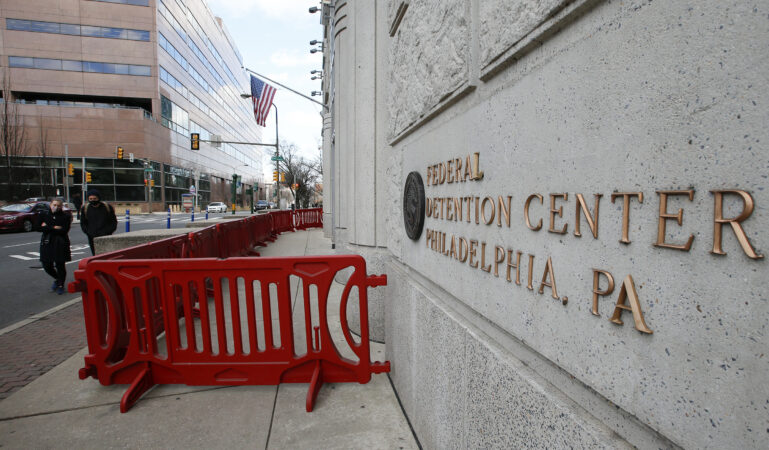
    Philadelphia’s federal courthouse has become awash in lawsuits filed by undocumented immigrants challenging the government’s attempts to detain them, an Inquirer review has found, the latest example of how the mass deportation push by President Donald Trump’s administration has been affecting the nation’s legal landscape.

    Through six weeks this year, court figures show, 168 such lawsuits have been filed in Pennsylvania’s Eastern District Court, up from 115 in all of 2025.

    By contrast, only 11 such suits were filed between 2020 and 2024, meaning a new practice of litigation dominating the region’s federal court practically sprung up overnight.

    <iframe title="An Unprecedented Rise In Release Petitions" aria-label="Column Chart" id="datawrapper-chart-Ze5f9" src="https://datawrapper.dwcdn.net/Ze5f9/1/" scrolling="no" frameborder="0" style="width: 0; min-width: 100% !important; border: none;" height="499" data-external="1"></iframe><script type="text/javascript">window.addEventListener("message",function(a){if(void 0!==a.data["datawrapper-height"]){var e=document.querySelectorAll("iframe");for(var t in a.data["datawrapper-height"])for(var r,i=0;r=e[i];i++)if(r.contentWindow===a.source){var d=a.data["datawrapper-height"][t]+"px";r.style.height=d}}});</script>

    U.S. District Judge Paul S. Diamond wrote in a recent court filing that these lawsuits, known as habeas petitions, now represent more than one in six civil suits filed in the district.

    In other jurisdictions, the surge has become so pronounced that judges and attorneys say they’re struggling to keep up. In New Jersey, the region’s chief judge last week issued new procedures for filing and litigating the petitions, writing: “The volume and timing of these filings is creating a substantial burden on the Court’s ability to expeditiously docket, assign, and address” them.

    And in Minnesota, a federal judge took the highly unusual step of holding a Justice Department attorney in contempt for failing to follow orders about the terms of an immigrant’s release.

    In Philadelphia, nearly all of the increase in habeas petitions appears tied to the Trump administration’s decision last summer to mandate detention for virtually every undocumented immigrant encountered by authorities. ICE and other agencies are now confining people who would have previously been eligible to remain in the community while their cases wound through the immigration system, such as people who have been in the country for years, or those who have not complied with ICE’s instructions while living here.

    “It was not a big part of our work up until about six months ago,” said Chris Setz-Kelly, a managing attorney with HIAS Pennsylvania, a nonprofit that provides legal assistance to immigrants.

    For decades, Setz-Kelly said, there had been a clear understanding about who was or was not eligible to be released on bond once they were picked up by ICE. But he said that changed under mandatory detention, which also says anyone who is newly detained should be denied a bond hearing.

    And the petitions represent just the tip of the iceberg, the attorney said, as many detained immigrants don’t have representation or leave the country during the process.

    “It had really dire consequences to the community,” Setz-Kelly said.

    The number of people in immigration detention has since grown from about 50,000 people in June, to nearly 70,000 people at the start of this year, federal data show.

    ‘The border is everywhere’

    Trump’s administration has been clear about its desire to increase deportations. And it has scored one legal victory in a higher court so far while defending its mandatory detention policy in court.

    Earlier this month, a three-judge panel in the Fifth Circuit Court of Appeals ruled the policy was legal and could be applied in Louisiana, Mississippi, and Texas.

    The government’s main argument in that case was that every undocumented immigrant is, in legal terms, “seeking admission” to the United States, despite a longstanding interpretation that the phrase only applied to people who had recently crossed the border without proper paperwork.

    “The everyday meaning of the statute’s terms confirms that being an ‘applicant for admission’ is not a condition independent from ‘seeking admission,’” the majority opinion said.

    Two Fifth Circuit judges agreed with the government’s position.

    The one who dissented, U.S. Circuit Judge Dana M. Douglas, wrote that the government’s interpretation contradicted the basics of immigration law and, in effect, would create a situation in which “the border is now everywhere.”

    A ‘trap’

    The ruling in the Fifth Circuit — based in New Orleans, and widely considered one of the most conservative courts in the country — has done little to change the views of judges in Pennsylvania’s Eastern District Court.

    This region’s federal judges have consistently criticized the government’s mandatory detention policy over the last eight months, ruling in favor of nearly every immigrant seeking to be released from confinement.

    Some judges have quoted Greek mythology to describe what they’ve cast as an unending attempt by the Trump administration to continue defending a policy that has been resoundingly rejected in court. The region’s chief judge even wrote that “the law is piled sky high against the government’s position.”

    Diamond, in an opinion this month, wrote that he’d reviewed 201 recent decisions in the district involving habeas petitions, and found that judges in every case had rejected the government’s view that mandatory detention — with no opportunity for bond — was both warranted and legal.

    U.S. District Judge Karen Spencer Marston, a Trump appointee, wrote in a recent decision that she was “unpersuaded” by the Fifth Circuit’s ruling as she agreed to free an undocumented immigrant from custody.

    Still, government attorneys have appealed dozens of those losses to the region’s Third Circuit Court of Appeals. Experts believe the effort is part of a Justice Department attempt to create opposing appellate rulings and propel the question of the policy’s legality to the U.S. Supreme Court, which has a conservative majority.

    “I think they’re just trying to tee up the right cases,” said Chris Casazza, a Philadelphia-based immigration attorney who has filed more than 60 habeas petitions in recent months. “They’re hoping the Supreme Court is going to rubber stamp this.”

    In the meantime, judges in Philadelphia are continuing to confront and rule on dozens of petitions in an emerging area of law.

    This week, in a blistering opinion, U.S. District Judge Gail A. Weilheimer wrote that ICE had set up a “trap” for “thousands of non-citizens,” who are required to file forms, attend check-ins, or apply for asylum to receive permission to stay in the country.

    But under mandatory detention, Weilheimer wrote, those applicants will now get arrested and taken to a detention facility for the duration of their removal proceedings, which could take months or years.

    The judge compared the situation to the government handing immigrants a bow and instructing them to shoot an arrow at a tree.

    If anyone hits it, Weilheimer said, “the Government will look at the mark, paint a target to the left of it, and accuse them of missing.”

    Correction: This story has been updated to correct the spelling of Chris Setz-Kelly.

  • Johnny Gaudreau’s dream was to be an Olympian. His family lived it for him, in a moment fit for a ‘movie.’

    Johnny Gaudreau’s dream was to be an Olympian. His family lived it for him, in a moment fit for a ‘movie.’

    In May 2024, Johnny Gaudreau reached out to his father, Guy. He’d recently wrapped up his 10th full NHL season, with the Columbus Blue Jackets, but he had a bigger goal in mind.

    For the first time since 2014, NHL players would be allowed to compete in the 2026 Winter Olympics.

    Gaudreau had already started conditioning, and wanted to do more. So, he went to his first coach.

    “He said, ‘Dad when I come home, we really have to push it,’” Gaudreau’s sister, Katie, recalled Sunday. “‘I really want to make the Olympics.’”

    From May through August, Johnny and Guy drove from their Shore house in Avalon — where their family spent the summer — to any rink in the area that would give them an hour of ice time.

    These weren’t always quick trips. Hollydell Ice Arena was about 60 miles away. Pennsauken Skate Zone was a little farther than that.

    But Gaudreau knew this was his chance to achieve a lifelong dream. So he put in the extra work, sometimes getting additional conditioning in before his father arrived to the rink.

    He was, by his own admission, “not impressed” with what shape he was in at the start. But by the end of the summer, he’d improved.

    Guy saw it himself. In August, he turned to his wife, Jane.

    “I think he might make the team,” he told her. “He’s in the best shape of his life.”

    The Gaudreaus started thinking about a future trip to Milan, where the Olympics would take place.

    Katie, who was set to get married in late August 2024, was already planning a honeymoon there, and joked that it wouldn’t make sense to go twice in a short span.

    She began sketching out the conversation with her supervisors at Oldmans Township School, where she works as a first-grade teacher.

    But all of this excitement and hope came to an unceremonious halt on Aug. 29, 2024.

    Johnny and his brother, Matty, were at home in Oldmans Township for Katie’s wedding the following day.

    They were hit by an alleged drunk driver while riding bicycles on County Route 551. The brothers were severely wounded and both died at the scene. Johnny was 31 years old, and Matty was 29.

    Ever since they died, their family has been trying to honor their legacy. Jane and Guy have attended multiple ceremonies to honor their late sons.

    After some initial hesitation, Jane and Guy Gaudreau made the trip to Italy to honor their son and root on his former Team USA teammates.

    In 2025, they started the annual Gaudreau Family 5K, an in-person and virtual road race to raise money for the Gaudreau Family Foundation.

    But last week, they received a special opportunity to celebrate Johnny’s ultimate goal.

    On Tuesday, a representative for USA Hockey asked the Gaudreau family if they’d want to attend the semifinal game against Slovakia on Friday. They were also invited to Sunday’s gold-medal game, if the Americans qualified.

    Initially, Guy and Jane said no. Katie and her sister Kristen weren’t able to make it, and they didn’t want to travel without them.

    It also seemed bittersweet to attend an Olympic semifinal or final without their late son.

    But on Wednesday morning, Jane had a change of heart.

    “My mom was like, ‘I really didn’t sleep,’” Katie said. “‘I think John would want us to go. I think we should go.’”

    A staple of Team USA

    Throughout his career, Gaudreau was a staple of USA Hockey. He’d been involved in development camps since he was a teenager.

    He’d competed in international tournaments since 2010, when he was a member of the Under-18 select team.

    In the 2013 World Junior Championship, Gaudreau led the tournament with seven goals en route to a gold medal.

    The forward continued to establish himself as a key player on the senior team, setting a number of offensive records despite never competing at an Olympics.

    He still holds the mark for the most points (43) and assists (30) by any American in IIHF men’s World Championship history.

    “He does his best, I swear, in a Team USA jersey,” Katie said.

    His Olympic enthusiasm went beyond tournament play. The Gaudreau family watched the movie Miracle, about the 1980 U.S. Olympic hockey team, so many times, they could recite it by heart.

    It was always playing in their minivan, as they traveled up and down the East Coast for Johnny and Matty’s hockey tournaments.

    As the years passed, and Gaudreau continued to solidify himself as an NHL star, the idea of him making an Olympic team seemed less of a dream and more a reality.

    Team USA confirmed as much after Johnny passed. Last year, at the Four Nations Face-Off, an official told Guy that “John would have had a spot on the team.”

    “Any hockey player growing up, of course they want to make it to the NHL, but the Olympics is really the big thing,” said Katie. “And it’s always been a dream of John and Matthew’s. And we knew it was a tangible dream.”

    So, when Team USA made the initial offer to fly the family out to Milan, Jane and Guy were hesitant.

    They knew going to a game or two would be an emotional experience. Katie knew this, too. But she encouraged her parents to at least try.

    Guy Gaudreau, a longtime coach in South Jersey, has spent time on the ice as a guest of Team USA over the past two years.

    “I said, ‘If you get there, and you go to the first game, and it’s entirely too hard, you don’t have to go back,’” Katie said. “‘You don’t have to go. You can leave. But if you’re watching the game at home, you can’t be there.’

    “‘So this is a once-in-a-lifetime opportunity to honor the boys. And keep their legacy alive. And that’s what we do, every day. We wake up and we just want to honor the boys’ legacy.’”

    Jane and Guy decided to go. They met Johnny’s widow, Meredith, in Atlanta, with her two oldest children, Noa and Johnny Jr.

    Together, they flew to Milan, where they attended Friday’s game against Slovakia and Sunday’s gold-medal game against Canada.

    Katie and Kristen watched from their parents’ house in South Jersey with family and close friends. They knew that the players had hung up Johnny’s USA jersey in their locker room, and hoped that he would be celebrated if they won.

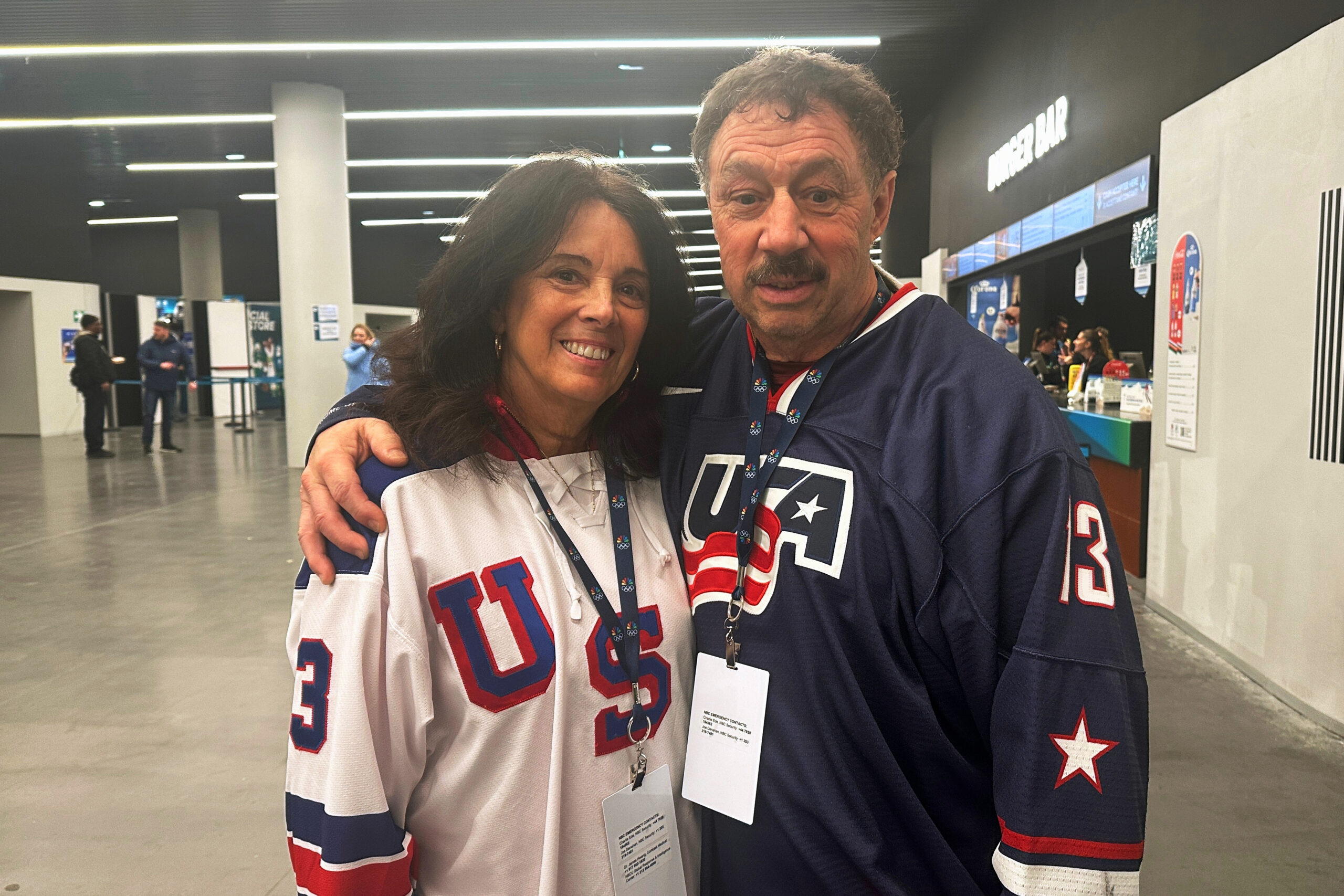
    But they weren’t sure what would happen when the United States beat Canada, 2-1, in overtime. Katie and her sister were “in tears” when Auston Matthews, Matthew Tkachuk, and Zach Werenski carried Gaudreau’s No. 13 jersey as they glided across the ice.

    The next few moments exceeded the family’s expectations. Meredith, who was watching in the stands with her two oldest kids and in-laws, received a call from a Team USA official.

    He put her in touch with Tkachuk, who asked if she could bring Noa and Johnny Jr. down to the ice.

    Two players, Dylan Larkin and Werenski, skated off the rink, with gold medals hanging around their necks.

    They met Meredith at the bottom of the stands, scooped up Noa and Johnny Jr., and carried them back out for a team photo.

    Noa sat on Werenski’s lap. Johnny Jr. — who was celebrating his second birthday — sat on Larkin’s.

    “I was like, ‘There’s no way they’re going to do that. There’s no way,’” Katie said. “When they did that, I lost it. I’m so proud. I’m so happy that the kids got to experience that, because this is what John wanted. The team did an amazing job.”

    United States forward Dylan Larkin (21) holds Johnny Jr., the son of the late player Johnny Gaudreau, in the team photo after the gold-medal game.

    It’s a memory the Gaudreaus will hold close. They know that tomorrow, people will go to work, and get on about their days, and a fresh news cycle will take hold.

    But a year and a half later, Team USA still hasn’t forgotten about Johnny and Matty Gaudreau. And for that, their family is grateful.

    “Every time I think, ‘All right, now it’s time to move on, we’re not going to have all this support’ — they don’t [move] on,” said Katie. “This is a history book [moment] that there will be a movie about.

    “And in that movie, Noa and Johnny will be on the ice.”

  • The 2026 breakouts the Phillies need, starting with Aidan Miller

    The 2026 breakouts the Phillies need, starting with Aidan Miller

    Aidan Miller on the Phillies roster on opening day? Don’t count on it. But don’t completely rule it out. And don’t mark your calendar too far into the future. The April showers could bring a lot more than flowers this year.

    Two weeks into spring training, the Phillies aren’t going out of their way to disguise their hopes for their top prospect. The whole organization seems to understand that a certain degree of aggression is required in order to overtake the Dodgers in the National League and survive the Mets and Braves in the NL East. Bryce Harper made some news Sunday in an interview with Tom McCarthy and Ruben Amaro Jr. during the broadcast of the Phillies’ Grapefruit League game against the Pirates. Harper implied that Miller is battling an injury, jokingly saying that he wants to see the prospect “get off his butt and get in the game, that’d be nice. I need him to get healthy.”

    It was later revealed that Miller has been battling some back soreness. But the important part of Harper’s comment was his overarching point.

    “He could help us by the end, obviously,” the Phillies superstar said.

    The path of least resistance is the wisest path for now. Start Miller in the minors. Get him some time at second and third base in addition to shortstop. Evaluate the big league lineup over the first couple of months of the season, with a particularly keen eye paid toward Alec Bohm and Bryson Stott. Let the facts on the ground make the decisions for you.

    The important thing for the Phillies is not to fight those decisions should they become obvious. Miller is a special enough bat to warrant stepping outside your defensive comfort zones. He’ll be 22 years old by June 9. Over the last three seasons, 49 hitters have logged at least 200 plate appearances at the age of 22 or younger. That includes game-changers like Julio Rodríguez, Elly De La Cruz, James Wood, Corbin Carroll, and Gunnar Henderson.

    Miller is in the same class of prospects as those hitters. If he starts this season the way he finished 2025 — hitting .356 with 23 extra-base hits in his last 39 games — the Phillies will need to find a spot for him. Every day they wait will be a wasted one. They are at a point in their trajectory where they will need something unforeseen to happen in order for their lineup to produce at even 2022 levels. Miller is both the most likely candidate and the one who can move the bar the furthest north.

    Some others who still have some degree of upward mobility:

    Brandon Marsh

    Marsh is an interesting case. The gap between public perception and actual production is wider than for any player on the Phillies roster. In fact, it might be wider than for any athlete in the city. Look at Marsh’s final 2025 numbers compared with some randomly selected players:

    • Jackson Chourio: .270/.308/.463, 112 OPS+, 21 HRs, 589 PAs
    • Jackson Merrill: .264/.317/.457, 112 OPS+, 16 HRs, 483 PAs
    • Harrison Bader: .277/.347/.449, 117 OPS+, 17 HRs, 501 PAs
    • Steven Kwan: .272/.330/.374, 96 OPS+, 11 HRs, 693 PAs
    • Marsh: .280/.342/.443, 114 OPS+, 11 HRs, 425 PAs
    Brandon Marsh figures to platoon in left field with the righty-hitting Otto Kemp.

    Most interesting is the side-by-side comparison to Kwan, who was a hot trade-deadline name connected to the Phillies last summer. Marsh outproduced the Guardians’ veteran in virtually every category. Yet people would feel a lot differently about the Phillies’ outfield outlook for 2026 if it was Kwan in there instead of Marsh.

    This isn’t a one-year phenomenon, either. In the three years since the Phillies acquired Marsh from the Angels, his 115 OPS+ ranks 28th out of 106 MLB outfielders with at least 800 plate appearances. That’s higher than Chourio and Kwan and also Jazz Chisholm, Jurickson Profar, and Taylor Ward, to name a few.

    The lack of enthusiasm for Marsh isn’t entirely irrational. In the last two postseasons, he has reached base three times in 28 plate appearances over eight games. His left-handed bat is an inconvenience when attempting to construct a batting order around Harper and Kyle Schwarber. He hasn’t been the plus defender in center field that many expected when the Phillies acquired him. With a middling 39 home runs in 1,373 plate appearances over the last three seasons, he doesn’t bring prototypical corner-outfield power. Long story short, he hasn’t been the player the Phillies are sorely missing: a right-handed power bat who can hit behind Harper and/or Schwarber.

    Marsh can’t do anything about the fact that he hits left-handed. But he does bring some positive uncertainty on the upper end of the range of outcomes. He made some noticeable improvements in his bat-to-ball game in 2025, raising his contact rate from 74.7% to 78.3%, according to FanGraphs. Much of that jump came out of the zone. He swung at more pitches out of the zone (30.5%, up from 26.1% in 2024) but also connected on more of those pitches (56.3%, up from 51.4%). The result was less power and fewer walks, but also fewer strikeouts and more base hits. All in all, the tradeoff was positive one vs. 2024. The question now is whether he can add on a little more power in the zone.

    Marsh finished last season on a serious upswing. After a brutal first six weeks of the season, he hit .299 with an .835 OPS over his last 107 games. His last two months were especially spicy, with a .325/.367/.584 batting line and eight home runs in 166 plate appearances from July 28 to the end of the regular season. During that stretch, he ranked seventh among outfielders in weighted on-base average (.401) and sixth in slugging percentage (.584) with a home run pace of about 25 per 162 games.

    Justin Crawford slashed .334/.411/.452 in triple A last season.

    Justin Crawford

    Obvious, yes, especially now that it seems he has a spot locked up on the opening day roster. It would be a huge boost if Crawford could somehow bring his .334/.411/.452 triple-A batting line to the majors without much drop-off. Hello, leadoff spot. We’ll worry about lefties later.

    But that’s not the real game-changer of a scenario. No, the one the Phillies can dream of is the one Crawford hinted at in his first at-bat of the spring, a double off the center-field wall off of big league lefty Eric Lauer. What if Crawford finally starts to develop the power suggested by his frame and his pedigree?

    It’s awfully hard for a big league hitter to swing his way on base as routinely as Crawford did in the minors. But the Phillies would gladly sacrifice some of that average for some of the pop that his papa had during his prime. Carl Crawford’s power started to come at the age of 22, in his third season in the majors. That was his first All-Star season for the Rays, when he led the majors with 19 triples and also hit 11 home runs for a .450 slugging percentage that would continue to improve throughout his early 20s.

    Justin has his dad’s frame. He has a similar swing. He finished last season with just 34 extra-base hits in 506 plate appearances. But the jump is going to come, as long as he can make big-league contact.

    The moral of the story: There is upside on this Phillies roster. It only means so much. We’ve seen that with Bohm and Stott over the last few seasons. But Miller and Crawford offer plenty of reason to hope. At the very least, the Phillies seem to understand that they could be necessities.

  • Carli Lloyd’s return to Fox’s World Cup coverage comes with goals for herself and the USMNT

    Carli Lloyd’s return to Fox’s World Cup coverage comes with goals for herself and the USMNT

    In 2022, Fox Networks threw Carli Lloyd into the proverbial fire — on the other side of the world.

    Barely a year removed from her own retirement from professional soccer, the Delran native was announced as one of the primary studio analysts for the network’s monthlong coverage of the FIFA World Cup in Qatar.

    She handled it all in stride, finding her voice while taking cues from longtime on-air personalities Rob Stone and Alexi Lalas, but it was the first time she’d be a consistent presence, and a different look from what’s customary, with her observations of each match being critiqued and analyzed by soccer fans all over the world.

    From left, Fox Sports soccer broadcasters Carli Lloyd, JP Dellacamera, and Alexi Lalas speak at the United Soccer Coaches Convention in Philadelphia last month.

    “It was a lot to learn really fast, a lot to take in,” Lloyd recalled during the United Soccer Coaches Convention in Philadelphia last month. “But I was fortunate enough to learn from guys like Alexi and [Fox commentator] Stu [Holden] who helped me along the way really feel confident and like I can really do this.”

    Lloyd did it well enough that she’ll be among Fox’s lead crew of studio analysts once again for the 2026 World Cup as the tournament makes six stops through Philadelphia as part of a 104-match schedule this summer.

    It’s a task she says she’s “ready and excited for” after getting her feet wet in 2022, in addition to the commentary she’s been able to provide in the years since — some of which along the way stirred up a bit of controversy.

    But a new year finds the tournament on home soil, with the United States hosting the bulk of scheduled matches, also spread across Canada and Mexico. It’s the perfect time for the United States to return to the biggest stage and show the world just how far it has evolved as a soccer nation, Lloyd says.

    “I wouldn’t say there’s immense pressure in winning the World Cup,” Lloyd said. “But there’s the pressure to show the country that they are there to compete and they’re going to fight, and they’re going to give everything they have for our country.”

    Made to inspire

    Lloyd can recall being a 12-year-old girl watching the 1994 World Cup, the last time the men’s edition was held in America. That tournament, she recalled, sparked her excitement and love for the sport.

    Follow that up with the unforgettable 1999 women’s edition, also hosted in the States, and those two moments galvanized the idea that Lloyd would do all she could to pursue it as a career.

    The World Cup, Lloyd says, has that effect.

    Carli Lloyd celebrates scoring her third goal against Japan in the 2015 women’s World Cup final in Vancouver.

    “I don’t think we all know yet just how massive this is going to be, and the impact that it’s going to have on generations to come,” Lloyd said. Those 1994 and 1999 World Cups “jump-started my dream; they were life-changing for me. But I think it’s only going to be massive in the United States of America if our team shows up with that grit and that fight and that mentality.”

    But it’s not just on the fans’ side. Lloyd said U.S. manager Mauricio Pochettino’s decision to leave a lot of the USMNT’s bigger names off the roster for the Concacaf Gold Cup, deciding to bring top American talent from Major League Soccer and elsewhere — like the Union’s Quinn Sullivan and Nathan Harriel — was an eye-opening experience for those players who might work a bit harder to remain on Pochettino’s radar.

    “For me personally, I think the Gold Cup was the turning point for this team, leaving a lot of those well-known players off the roster,” Lloyd said. “I think it was the best thing that could have happened to this team going into this World Cup. It gave a lot of the non-European [American] players the confidence, the belief, and [allowed Pochettino] to instill the culture he wants to build.”

    U.S. manager Mauricio Pochettino, second from left. Carli Lloyd said the manager’s decision to bring fresh faces into the national team last summer and in the November cycle reinvigorated the team ahead of the World Cup.

    Games and opportunity

    Lloyd compared all of that to the success U.S. women’s coach Emma Hayes achieved in a short span, becoming the change that was needed after the Americans’ shocking exit at the 2023 women’s World Cup.

    There’s no reason, she says, that Pochettino can’t find similar success — despite being off to a noticeably slower start.

    “Obviously, the 2023 [women’s] World Cup didn’t end well,” Lloyd said. “The team needed change and almost needed to be blown up in order to be rebuilt again. Emma Hayes comes in. A lot of players retire. She selects different rosters, and they instantly change the culture, the mentality, the pride of wearing the jersey again, and that happened very quickly.

    “But with the men’s team, I feel like it took a lot of time, and I don’t know why it took time. Maybe it was the language barrier [between] coach and the team, and the lack of games and opportunities that they had together.”

    The U.S. seemed to find continuity during November’s qualifying cycle with a pair of exhibition wins, against Paraguay in Chester and a 5-1 rout of Uruguay in Tampa, Fla., to close the year.

    Pochettino will call up a number of players for matches against Belgium on March 28 (3:30 p.m., TNT, Peacock) and Portugal on March 31 (7 p.m., TNT, Peacock), in what will surely be a final audition for many on that roster.

    Both matches will be in Atlanta, home of U.S. Soccer’s new multimillion-dollar national training center. Lloyd noted that the investment and the caliber of nations the U.S. is bringing in show a commitment to improvement on the global stage.

    Now, it’s up to the players to cash in, she says.

    “I think we saw that fight [during this last FIFA window] in November,” Lloyd said. “You can see there’s a different tone within this group. And I’m glad that they found it when they did. There were some big wake-up calls for some players … and I think that’s all we’ve been wanting to kind of see, these guys having the pride when you put on that jersey. And they sure showed that those last two games in November.

    “It’s not a vacation when you come into the men’s national team anymore. There should be an excitement around it where you want to come in and lay your body on the line and do everything possible for the team and for your country.”

  • A coach, a promise, and chicken and rice: How Father Judge became king of the Catholic League

    A coach, a promise, and chicken and rice: How Father Judge became king of the Catholic League

    Jim Reeves, scissors in hand, directed traffic Sunday afternoon as each Father Judge player climbed the ladder at the Palestra to cut the net twine by twine after the Crusaders won their second straight Catholic League boys’ basketball title.

    Finally, the net was hanging by just a few threads.

    “Where’s Coach?” Reeves shouted over the crowd still buzzing from a 55-52 win over Neumann Goretti.

    And there he was: Chris Roantree, the former Judge power forward and linebacker who played college football and got his start coaching basketball by shepherding fifth graders at the Rhawnhurst Recreation Center.

    Roantree promised Judge’s president in 2021 that the Crusaders — who often just felt like a team on the schedule — would win a Catholic League title in five years if he was hired. Judge had not won since 1998, but Roantree had a plan. The job was his.

    Roantree followed through last February in season No. 5 and climbed the ladder on Sunday to cut the nets down for a second time, proving that last year was more than just a good story.

    Father Judge’s Max Moshinski (center) begins the celebration with teammates after the win over Neumann Goretti.

    The Catholic League has long been dominated by schools like Roman Catholic and Neumann Goretti, which Roantree called Sunday “the blue bloods.” But the team dressed in Columbia Blue — the same program that won just one Catholic League game the season before Roantree arrived — is suddenly at the head of the table.

    “Our goal was to try to be one of those programs like Neumann and Roman and build a legacy,” senior Max Moshinski said. “We’re at the top of the mountain now. When we first got here, we knew it would be a tough climb, but we knew if we showed up every day and put the work in, then we’d eventually get there. I think you can say we did that. We’re at the top of the mountain and now we need to stay here and keep getting back here.”

    A five-year plan

    Father Judge was looking for a new head coach in the spring of 2021 when Reeves pushed Roantree, his teammate on the 1998 championship squad, to go for it.

    They met with Judge’s president, Brian King, at Reeves’ home in the Far Northeast and Roantree detailed his plan at the dining room table. In four years, the Crusaders would play at the Palestra in the Catholic League semifinals. In five years, they’d win a title. Both of those came true.

    But not even Roantree could promise that Year 6 would bring a second straight title for a program that was often an afterthought.

    “We said we could do it, but to do it is different,” said Reeves, now an assistant coach. “To go back-to-back is just crazy. People go back-to-back, but to be where we were to where we are now is crazy. It’s unheard of.”

    The Father Judge coaches (right) celebrate winning a second straight PCL title.

    A 1998 Catholic League championship shirt hung behind the register for years at Marinucci’s on Brous Avenue, the deli owned by Reeves’ mother. It hung almost as proof that Judge did actually win a title before.

    The Crusaders had some moments since that 1998 championship, but it was hard to ever group Judge with teams like Roman and Neumann Goretti. The Crusaders were in a different tier. But the new coach believed.

    “It’s the players, man,” Roantree said. “Everyone talks about coaches and what makes you a good coach. But at the end of the day it’s about Jimmys and Joes. Them buying into our culture. When we first got here, we talked about the Palestra and everyone thought we were crazy. The players thought we were crazy. But then it continued to build. Then guys came through, accepted the culture, and accepted being coached hard. We coach these guys hard and they buy in. It’s not easy.”

    Father Judge fans after their team won the Catholic League final at the Palestra.

    Winning back-to-back titles was not the plan when Roantree returned home from Lycoming College and started coaching at the rec center. But he quickly fell in love with coaching, realizing he can have an impact on kids like Bill Fox did for him at Judge in the 1990s.

    He soon started coaching AAU and then joined Archbishop Wood’s staff as an assistant for eight seasons to John Mosco. He coached Collin Gillespie and helped navigate the underdog’s journey to Villanova. Roantree was back at Judge in June 2021 with a five-year plan. But he still needed his Jimmys and Joes.

    He swayed Derrick Morton-Rivera, the Temple-bound guard who lives in Mayfair but could have gone to Neumann Goretti like his father. He spotted Moshinski at a St. Albert the Great CYO game and asked him to give Judge a chance. Rocco Westfield’s parents went to Archbishop Ryan and he can walk to that school from his home in Morrell Park. But Westfield went to Judge to play for Roantree, who seemed to attend all of his youth games.

    “I really trusted them,” Westfield said. “Now we’ve won back-to-back titles. Why not come to Judge?”

    Father Judge’s Derrick Morton-Rivera reacts after hitting a three-pointer on Sunday.

    Judge’s win total increased in each of Roantree’s first five seasons before the Crusaders broke through last year for their first title in 27 years. Their rise to the top of the league was not an overnight sensation — “A lot of roller-coaster rides,” Reeves said — but there’s no denying now that the school on Solly Avenue long known for soccer players is now a basketball power.

    “There’s some guys who are waking up at 6:30 a.m. to get to school on time,” Roantree said. “They want to be a part of something special and I think we have something special. … These dudes will live on forever and rely on these friendships for the rest of their lives.”

    Chicken and rice

    The gatherings started with just a few players as the teenagers needed a place to hang on Friday afternoons before they played a game that night. Soon, Margaret Westfield was cooking for the whole team.

    “Chicken and rice,” her husband John said.

    The players ate on Fridays in the Westfields’ kitchen and then sprawled out around the house for their pregame nap as the rowhouse became like a hostel.

    “We have people on the couches, upstairs, downstairs,” John Westfield said.

    The players who came to Judge to play for Roantree bonded over chicken and rice, coming together to become the unlikely kings of the Catholic League.

    “It’s a special bond,” Rocco Westfield said. “We’re always with each other. I mean, I love these guys.”

    Neumann Goretti’s Marquis Newson (10) pauses after Father Judge halted the Saints on a possession.

    This season wasn’t easy — Morton-Rivera was on crutches in the start of the season and the Crusaders lost to Neumann Goretti earlier this month — but Judge was there on Sunday at a sold-out Palestra.

    The postseason included wins over Roman, Wood, and Neumann Goretti to capture the title. The Crusaders won their second straight title by knocking off the class of the Catholic League, leaving no doubt that they are for real.

    “That class that Chris brought in was the turning point,” John Westfield said. “That was the turning point to put it on the map. There was a guy tonight who said something to me: ‘Thanks for sending your son to Judge and helping put Father Judge basketball back on the map.’ Just a random fan. That’s what it means to people.”

    The net fell from the rim Sunday afternoon after Roantree trimmed the final threads. He waved it over his head as the student section — a few hundred crazies dressed in blue — roared.

    The coach tossed the net to Morton-Rivera, who will likely be remembered as Judge’s all-time player. A second title was complete. And then the student section turned the page to next season, chanting, “Three-peat.” That’s what happens when you become the king.

    “We have a bunch of dudes who bought into one common goal,” Roantree said. “We always talk about team success drives individual success. We bought into that one goal. You look into everyone’s goal sheet at the beginning of the year and there was one goal on there for our team goal: Cut the nets down at the Palestra.”

  • Republicans continue to sow distrust in elections. The SAVE America Act won’t change that.

    Republicans continue to sow distrust in elections. The SAVE America Act won’t change that.

    It is not unreasonable for people to be concerned about voter fraud or noncitizens voting. Not because it happens at a scale that could swing an election — researchers say it is so rare as to be statistically insignificant — but because Republican leaders have been pounding on that drum for so long that some can’t help but sway to the beat.

    As U.S. Sen. Dave McCormick recently reminded, more than half of Americans worry about fraud at the polls.

    “We have a duty to root out the source of this distrust and restore the integrity of our democratic process,” McCormick said, speaking on the Senate floor in defense of the SAVE America Act, the GOP’s latest effort to restrict voting.

    If Pennsylvania’s junior senator will allow me, I think I’ve cracked the case.

    Casting doubt on election security did not begin with Donald Trump and his bombastically false claims of hacked voting machines and millions of illegal immigrants voting. It started long before that, with “traditional” Republicans like McCormick legitimizing allegations of widespread fraud.

    Under President George W. Bush, Attorney General John Ashcroft warned that “votes have been bought, voters intimidated and ballot boxes stuffed” at a 2002 Voting Integrity Symposium. Yet, bringing the power of the U.S. Department of Justice to investigate these allegations resulted in few prosecutions by the time Bush left office.

    After 2013, when the U.S. Supreme Court removed a provision of the Voting Rights Act, thereby ending federal supervision of nine states with a history of racial discrimination, there was a slew of voting restrictions pushed by Republicans under the guise of voter integrity.

    By the time Trump came along, GOP voters were more than primed to believe that an election could be stolen, with the nadir being the Jan. 6, 2021, attack on the U.S. Capitol.

    Having learned no lessons from what happened, Republicans continue to stoke doubt about elections.

    McCormick shamelessly used a November incident in Chester County, where independent and unaffiliated voters were left off the county’s poll books, to allege that “registered voters were turned away at the polls. And an unknown number of unverified voters cast regular ballots.”

    There is no evidence that either of those claims is true.

    What happened in Chester County was human error that was corrected later that day. In the meantime, anyone who wanted to vote but was not in the poll books was asked to fill out a provisional ballot that would later be verified for eligibility.

    Elections are run by people, and mistakes happen. There are 3,069 counties in the U.S. in charge of administering elections. It’s a testament to the dedication of local officials that voting is as smooth and secure a process as it is.

    McCormick is a smart man. He likely knows the facts. He also knows that nothing included in the SAVE America Act would have prevented what happened in Chester County.

    What is included in the legislation requires people to show proof of citizenship when registering to vote and produce ID when casting a ballot. It stiffens penalties against election officials for registering voters without proof of citizenship, and forces states to submit their voter rolls to the U.S. Department of Homeland Security to ensure only citizens are registered.

    All of that seems reasonable, but seeing as how folks like McCormick are using deception in its promotion, you will forgive me for being skeptical. I don’t buy the catastrophism coming from Democrats, either, but there are valid objections.

    For example, some people who could otherwise vote do not have ready access to the documents required in the law — that’s about 20 million Americans, according to some estimates. That the proposal would take effect immediately, just in time for the midterm elections, guarantees that millions would be disenfranchised.

    Information sharing with DHS is also problematic, as the tool used to identify potential noncitizen voting registration “keeps making mistakes,” according to a ProPublica/Texas Tribune investigation.

    None of these issues is insurmountable. Instead of blocking legislation like the SAVE America Act, Democrats should fight to improve it.

    For example, if you need documentation to exercise your rights, then that documentation should be free, and requirements should be implemented after a reasonable grace period. Any mandate should come with the funding to ensure every American has access to their birth certificate, or that every citizen can easily obtain a passport. Congress should also make Election Day a holiday, while they’re at it.

    Ironically, voter suppression efforts, which traditionally fall hardest on communities of color, come from the idea that the changing face of America would turn away from Republicans. Put another way, this line of thinking suggests that as the U.S. barrels toward becoming a majority-minority nation, the GOP would be at a disadvantage.

    But some high-turnout elections, including the 2024 contest that put Trump back in the White House, have shown that less frequent voters — i.e., those least likely to jump through the hoops put up by something like the SAVE America Act — back Republicans.

    Instead of making up stories and assuring the long-term erosion of democracy for short-term political gain, McCormick and his GOP colleagues should partner with Democrats to make elections secure and voting easy.

  • Penn expert says whether to take antidepressants during pregnancy is a ‘risk-risk conversation’

    Penn expert says whether to take antidepressants during pregnancy is a ‘risk-risk conversation’

    When Sarah Bynum was pregnant with her first child in 2017, her primary care doctor suggested she stop taking her antidepressant.

    He told her there wasn’t enough research to justify staying on the medication.

    By the time she delivered her daughter, the Delaware County woman’s anxiety was so bad that she decided never again to go through a pregnancy without her antidepressant.

    Bynum, who has taken medication for anxiety since she was a teenager, is one of the nearly 18% of women in the U.S. on an antidepressant. She takes a drug known as an SSRI, the most common class of antidepressants, which medical societies generally consider safe to use during pregnancy.

    Still, roughly half of women taking an antidepressant discontinue their use of the medication while pregnant, according to a 2025 study in the medical journal JAMA Network Open.

    Kelly Zafman, an OB-GYN at the Hospital of the University of Pennsylvania, decided to research the issue that has also recently been under discussion on the federal level. She’s observed that patients often get mixed-messaging from providers.

    “The other side of the conversation that gets missed is this risk of not continuing medications,” said Zafman, who is in her final year of fellowship training in maternal-fetal medicine.

    Preliminary findings from her research showed the risk of a mental health emergency nearly doubled in women who discontinued SSRIs or SNRIs (another popular type of antidepressant), compared to those who stayed on their medication. She presented the unpublished results this month at the meeting of the Society for Maternal-Fetal Medicine.

    The analysis used data from 1,462 privately insured Pennsylvania women with active antidepressant prescriptions who gave birth between 2023 and 2024. While pregnant, 81% of them stopped or interrupted usage.

    Zafman said the highly personal decision comes down to factors such as the patient’s prior pregnancies, mental health history, and how well-controlled their symptoms are.

    Ultimately, the potential risks have to be weighed against those of untreated depression or anxiety.

    “It’s really a risk‑risk conversation,” Zafman said.

    Evolving research

    The American College of Obstetrics and Gynecologists discourages discontinuing antidepressants based on pregnancy alone, highlighting the risks of untreated mental health conditions. Studies have linked uncontrolled depression during pregnancy with preterm birth, low birth weight, higher suicide risk, and impaired mother-infant attachment.

    Research on the safety of antidepressants in pregnancy continues to evolve. Some potential risks identified in older research appear overstated when compared with more recent, better-designed studies, Zafman said.

    She cited as an example a rare but serious condition called persistent pulmonary hypertension — which causes a breathing issue — for which scientific evidence remains conflicting.

    “There’s definitely an association, but it’s not totally clear how causative it is,” Zafman said.

    Another concern, neonatal adaptation syndrome, tends to involve mild difficulties with feeding and breathing that resolve within days. Medical intervention is rarely required, and the treatment essentially is to cuddle and feed your baby, Zafman said.

    While antidepressants potentially pose risks in pregnancy, she said, overall, the risks of long lasting effects are “extraordinarily low.”

    A personal decision

    Bynum, a patient at Penn Medicine, was not on antidepressants during her first pregnancy. (She was not part of this particular study but has participated in other research with Zafman.)

    Five months into the pregnancy, she learned her daughter would be born with a congenital heart defect that would require monitoring, and later, surgery.

    Family and friends tried to help her, but they weren’t able to calm her heightened anxiety the way her medication usually would.

    When she became pregnant with her second child, she knew she wanted to have a “more mentally healthy pregnancy.”

    “I needed to be mentally and physically present not just for myself, but my daughter,” she said.

    She asked her OB-GYNs if she could continue on her antidepressant, Paxil. They weren’t sure.

    She turned to the fetal heart experts at Children’s Hospital of Philadelphia, who looked into the medical evidence and told her it was fine to continue taking her antidepressant.

    Sarah Bynum decided she would not go without her antidepressant for future pregnancies.

    Bynum has since had three healthy pregnancies while taking the antidepressant.

    She felt it was the right decision.

    “I need to focus on having a healthy pregnancy with as minimal stress as possible,” Bynum said. “And if that means taking a medication, that’s what’s gonna work.”

    Editor’s note: This story has been updated to clarify a quote by the researcher.

  • Union membership dipped in Pa. and N.J. amid Trump’s anti-labor push, data suggests

    Union membership dipped in Pa. and N.J. amid Trump’s anti-labor push, data suggests

    Following several years of major worker organizing efforts and high-profile strikes, 2025 brought a change in momentum for the labor movement. President Donald Trump’s administration sought to end federal workers’ union contracts and, through a firing, left the National Labor Relations Board without a quorum and unable to make decisions.

    But the percentage of workers who are union members nationwide has stayed pretty steady in the last year, new data shows. And in Pennsylvania and New Jersey, union membership rates fell.

    In 2025, 10% of the country’s total workforce was part of a union, compared to 9.9% in 2024, according to new data from the U.S. Bureau of Labor Statistics. It’s the first time since 2020 that the rate has inched up — albeit slightly — instead of down.

    However, BLS noted, this year’s estimates are not fully comparable to past years because they are based on a BLS survey that is missing October figures due to the government being shut down in October and part of November.

    In the past year, there have been “a lot of kind of anti-labor efforts coming out of the White House,” said Todd Vachon, assistant professor of labor studies and employment relations at Rutgers University.

    Despite those efforts Vachon said, “labor has pretty much maintained the same at the national level. … The Trump attacks haven’t really had any effect yet, at least in the first year.”

    window.addEventListener(“message”,function(a){if(void 0!==a.data[“datawrapper-height”]){var e=document.querySelectorAll(“iframe”);for(var t in a.data[“datawrapper-height”])for(var r,i=0;r=e[i];i++)if(r.contentWindow===a.source){var d=a.data[“datawrapper-height”][t]+”px”;r.style.height=d}}});

    Union membership rates dropped to an all-time low nationwide in 2023 and remained pretty similar in 2024. During those years, roughly one in 10 U.S. workers was part of a union.

    When BLS first started recording this data in 1983, about two in 10 U.S. workers were unionized. There were 17.7 million unionized workers in 1983 and 14.7 million last year.

    Danny Bauder, president of the Philadelphia Council AFL-CIO, speaks at an event supporting federal workers in October.

    Unionizing in N.J. and Pa.

    In New Jersey, 14.7% of workers were unionized last year, and in Pennsylvania, it was 10.9%.

    In both states, that was a decline of around one percentage point from 2024, but BLS noted that state-level data “should be interpreted with caution,” due to the shutdown-related incomplete data.

    window.addEventListener(“message”,function(a){if(void 0!==a.data[“datawrapper-height”]){var e=document.querySelectorAll(“iframe”);for(var t in a.data[“datawrapper-height”])for(var r,i=0;r=e[i];i++)if(r.contentWindow===a.source){var d=a.data[“datawrapper-height”][t]+”px”;r.style.height=d}}});

    Some local labor action highlights from this past year include:

    What happened in labor organizing last year?

    The Trump administration moved to end union contracts for government workers, amid a push to reshape the federal government.

    Some 271,000 federal jobs were cut between January and November. Meanwhile, the union membership rate in the public sector increased by 0.7% nationally in the last year according to the new BLS data.

    Vachon notes that the vast majority of public sector workers are at the municipal level, not federal.

    “The hiring of police, and teachers, and sanitation workers across the thousands of cities around the U.S. more than compensated for [cuts at the federal level], because we see an increase in the public sector,” he said.

    Trump also fired a member of the National Labor Relations Board (NLRB) early last year, which left it without a quorum to issue rulings. In some cases that can slow down the formation of a new union — at the Amazon-owned Whole Foods in Philadelphia, for example.

    The number of union elections overseen by the NLRB declined last year and the overall number of workers involved in those elections dropped too, according to the nonpartisan Center for American Progress.

    “A huge percentage of new union organizing is required every year just to maintain the same level of unionization, because of the churning and the growth of the overall labor force,” said Vachon. “If the labor force is not growing, then you can actually see increases in union density.”

    And unions are being cautious of reaching out to the NLRB under the Trump administration, he notes.

    “There’s a fear [that] if something gets sent up to the NLRB that the ruling is going to set a precedent that makes it even more difficult to organize,” said Vachon. “It’s kind of had a dampening effect in that way.”

  • Philly’s school closure plan targets middle schools. Here’s why the district is moving away from them.

    Philly’s school closure plan targets middle schools. Here’s why the district is moving away from them.

    The Philadelphia School District is walking away from middle schools — mostly.

    Of the 20 schools Superintendent Tony B. Watlington Sr. has recommended to close, six are middle schools — AMY Northwest, Conwell, and Stetson in Kensington; Harding in Frankford; Tilden in Southwest Philadelphia; and Wagner in West Oak Lane.

    The district plans to expand elementary schools to take in those students in most cases, and Conwell, a magnet middle school, would send students to AMY at James Martin.

    “Our research does not say that traditional middle school children in Philadelphia perform better academically than K-8 students,” Watlington said when he rolled out his tentative plan in January. “Nationally, and in Philadelphia, there’s a mixed bag.”

    While the school district says the K-8 model reduces transitions for students and helps maximize resources, critics of the district’s plan say closing middle schools will uproot their children and abandon successful schools.

    Education experts, meanwhile, say instructing middle school-age students has long been a complex and controversial issue — and it’s a debate that Philadelphia district officials are reigniting with their sweeping facilities proposal.

    Among the top complaints from critics of the plan: The pivot isn’t absolute. Though many middle schools are disappearing, Philadelphia will still have 13 standalone middle schools and secondary-middle schools if those six close. And some will even grow.

    Middle-grades students from Masterman, the popular and elite city magnet, would take over the closing Laura Wheeler Waring school building in Spring Garden “to expand access” to Masterman, officials said.

    The district is also adding a new Academy at Palumbo Middle School to give students a feeder pattern into the South Philadelphia high school magnet. The new middle school will co-locate with Childs Elementary in Point Breeze.

    And in the Northeast, where schools are bursting at the seams, two standalone middle schools — Castor Gardens and Baldi — will be untouched. So will a handful of others, including Roberto Clemente in North Philadelphia, Feltonville School of Arts and Sciences, Grover Washington in Olney, AMY at James Martin in Fishtown, and MYA and Science Leadership Academy Middle School in West Philadelphia.

    Why is the district targeting middle schools?

    Though officials said the facilities plan is not driven by finances, it’s clear that the underfunded school system needs to shrink its footprint.

    With 70,000 empty seats citywide and an inequitable distribution of programs and opportunities, system officials say they need to make changes to do better for all kids.

    “We can more efficiently distribute our limited resources in a K-8 model by operating 13 grade spans as opposed to six,” Watlington told City Council at a hearing on March 17. “This is an efficiency issue.”

    At present, the district has 13 different grade spans throughout its schools — from a single K-2 to K-4s, K-5s, K-8s, 5-8s, 6-8s, and others. It is proposing shrinking, mostly, to six different grade bands, and emphasizing K-8 or 5-12 as preferred models.

    Students, teachers, and supporters rally before a community meeting at John B. Stetson Middle School this month. It’s one of six middle schools that is slated for closure.

    Officials say they’re also relying on feedback received in surveys taken and meetings held prior to the plan’s release, despite critics’ worry that the feedback was crafted to give the district the answers it wanted.

    Hilderbrand Pelzer III, an associate superintendent, told a crowd of more than 100 people gathered at a Stetson Middle School meeting this month that in the surveys, families told the district they wanted to minimize transitions.

    “Think of safety in the sense that young people should remain in one place longer, pre-K to 8,” Pelzer said. “Hence why we want to recommend some of our K-4s, K-5 schools grow to K-8. Now that may not be the answer you want to hear, but the voices that have informed that have allowed us to make that a recommendation.”

    But critics of the district’s plan say they worry that the feedback was crafted to give the district the answers they wanted. And the audience at Stetson that day pushed back: Minimizing transitions is not what they want. They want their middle school to stay at their current school.

    “Why can’t you inform recommendations from people at Stetson?” one person shouted.

    The long and thorny history of middle schools

    Wrestling with where middle-grades learners should attend school is nothing new, said Penny Bishop, dean of Boston University’s Wheelock College of Education and Human Development.

    “We have been struggling to figure out how to provide appropriate schooling for this age group for well over a century,” Bishop said. “It’s a question with a long and thorny history” dating to the 1800s, she said, with much back and forth.

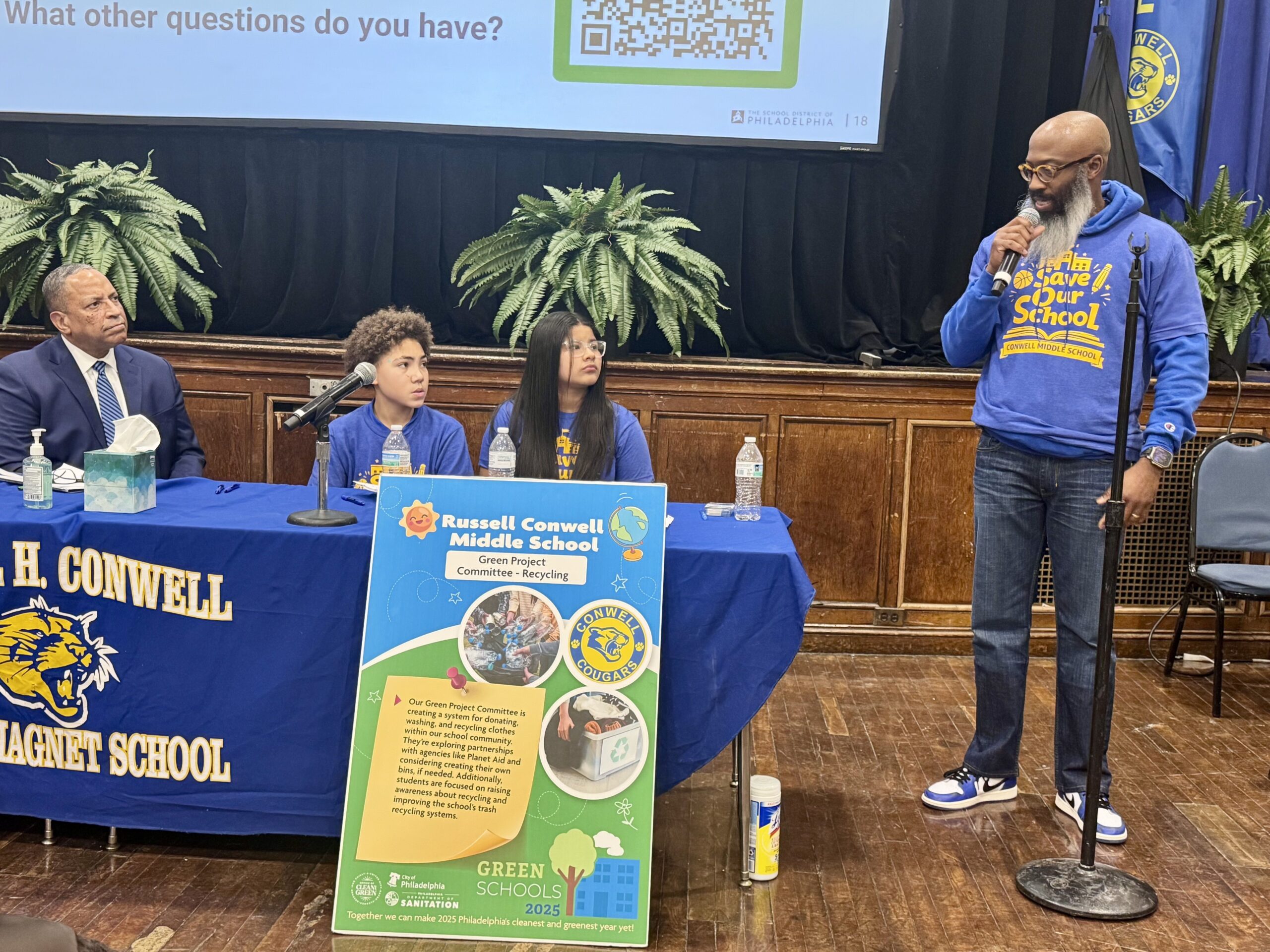
    Philadelphia School District Deputy Superintendent Oz Hill (left) and student moderators listen to Andre Sanford-Adams, Conwell Middle School’s health and physical education teacher, speak during a recent community meeting about why he thinks it’s a mistake to close Conwell.

    Many of Philadelphia’s middle schools began as junior highs. Middle schools as a concept first surfaced in the United States in the 1960s and took off in the 1980s as part of an explicit attempt to create schools “designed based on the developmental needs of this particular age group, as opposed to saying, they’re short high schoolers or they’re tall elementary students,” Bishop said.

    But tweens and early adolescents can be a tough age group to educate well, and middle schools got a bad rap among some, said Bishop. As school choice and shifting birth rates caused belt-tightening in some places, some districts began to shift grade configurations.

    Boston recently shut its last standalone middle school as that district contracted amid enrollment losses, for instance.

    Both Bishop and Katie Powell, director for middle level programs at the Association for Middle Level Education, said that research doesn’t support one kind of grade configuration or another.

    “What matters most for middle school-age students is that we understand that they are going to need a different experience than their elementary counterparts in a K-8 building, and having a defined middle school, even within that K-8 school — that’s what tends to be most successful,” Powell said.

    And, Bishop said, “a lot of this is tied up in the degree to which the leadership understands the developmental needs of the students.”

    At a recent meeting at slated-to-close Wagner Middle School, Kim Newman, another Philadelphia associate superintendent, vowed that the district will spend time and resources planning thoughtful transitions as grade configurations change.

    Adding middle grades to elementary schools hasn’t always been done well in the district, Newman said.

    “In the past, what we’ve done is said, ‘Let’s just add some furniture and books, great,’ grow a grade each year, and that’s really not what children need,” said Newman.

    She said she hopes receiving schools and closing middle schools will work together on what middle-grades learners need in the newly expanded elementary schools.

    Philly skepticism

    Claire Andrews has taught at Wagner Middle School for 40 years — years ago, it had 1,000 students, but today, fewer than 300 are enrolled.

    In the past, “we had opportunities for students, and as the years have gone on, they have just disappeared,” Andrews said. “Over the years, everything has just been pulled away.”

    Wagner Middle School is one of six middle schools that is facing potential closure in Philadelphia.

    Andrews, like others in the city, raised questions of equity.

    “Are they closing schools in the Northeast?” Andrews said.

    Councilmember Isaiah Thomas, chair of City Council’s education committee, highlighted Philadelphia’s complicated middle school position at a Council hearing last week.

    The district’s talking points around middle school sound good, he said. But he questioned decisions to expand middle grades at magnet schools, like Masterman and Carver High School of Engineering and Science, while closing a number of neighborhood middle schools.

    “I want us to have nuanced dialogue around where we are and what we need to do,” said Thomas, who has spoken out against closing Conwell, of which he’s an alumnus. “And I also recognize that there’s pushback on every decision you made. I understand that we have to make tough decisions somewhere else, there is no real facilities plan, and we do need a plan.

    But the reality is that we’re still not sending the right message to people, and I think our position around middle school is problematic.”

    Watlington stressed the research around middle schools and the surveys.

    The superintendent said the district is committed to modernizing and expanding receiving schools, where needed, and was not just focused on the Northeast.

    “We absolutely will not present a plan that just pushes resources in parts of the cities that’s growing fastest,” Watlington said. “I think this is as strategic a plan as we could create.”

  • As ICE enforcement intensifies, one man works to keep undocumented families fed in Bensalem

    As ICE enforcement intensifies, one man works to keep undocumented families fed in Bensalem

    On an icy, 13-degree Saturday morning in January, José Hernández sat in his pickup truck outside a Bensalem church, waiting for his phone to ring.

    It didn’t take long.

    Calls, texts, and emails have become constant, as Hernández, a machinist by trade, has become a crucial connection for many township residents who are living in the United States without official permission.

    What started as a simple good deed, delivering groceries to a few people worried about attracting ICE attention, has for Hernández, 61, become a full-time, unpaid job. Worry has hardened into fear amid the Trump administration’s dramatic escalation in immigration enforcement, leaving some people afraid to leave their homes.

    Hernández’s weekend rounds ― picking up people’s grocery orders at stores, bringing the food to their homes, always with a glance over his shoulder ― ensures sustenance for families for whom discovery would mean arrest, separation, and likely deportation.

    About 14% of the Bucks County township’s 63,000 residents are Latino. Among immigrants, everyone has a friend or family member who has been arrested by ICE and not seen again. And many fear that they’ll be next.

    Connie and Ivan came from Mexico over two decades ago. Fear of being detained by ICE has led them to turn to Hernández for food-delivery help.

    “They come out to pick up their order and you can see the fear in their faces,” Hernández said. “Many people come out saying, ‘Please hurry up, los del Hielo can be here any second.’”

    That’s what some community members call ICE agents — los del Hielo, meaningthe iced ones.” There are other names too, like el Escalofrío (“the chills”) and los Helados (“the frozen ones”).

    The nicknames come not from anger but from anxiety — fear that even speaking aloud the words Immigration and Customs Enforcement could summon danger.

    “We try to only go out when the darkness of the night protects us,” said an Ecuadoran mother, 32, who declined to provide her name for fear of arrest. “It’s a false sense of safety, but we must hold on to it.”

    Hernández recently delivered two bags of groceries and a birthday cake to her home, as her son was turning 12.

    “When I am in school,” the boy said, “the only thing I think about is if dad will make it home today. I wait all day, and then he comes, and I am happy he is still here. I am learning that being an American means that I have to be worried for the people I love.”

    A third of his immediate family ― an uncle and two cousins ― was arrested in November and December.

    José Hernández works to deliver groceries to local undocumented immigrants.

    Today an estimated 14 million people live in the United States without government permission, including about 76,000 in Philadelphia.

    Intensified ICE enforcement in the region and the nation has altered their lives ― exactly as the Trump administration intended when it promised to carry out the largest deportation program in U.S. history.

    For undocumented residents, freedom is no longer guaranteed by living quietly, obeying the law, and staying off the government radar. Now, discovery of having entered the country without approval, a civil violation, often means the end of an American life built across years.

    As a result, people are staying indoors.

    Many have stopped going to the doctor. And to church. They keep their children home from school when news of ICE activity surges. Businesses have had to temporarily close when workers stay away.

    ICE officials did not reply to requests for comment.

    In 2025, the agency detained 307,713 people in the U.S. ― detentions closely mirror arrests ― compared to 93,342 in 2024.

    That’s more than a 230% increase.

    Today more and more of those arrested face no criminal charges, even as the Trump administration pledges to deport “the worst of the worst.”

    Hernández uses his own money, earned from his job as a machinist, to pay for gas for deliveries.

    Hernández didn’t plan to be doing this work, spending his weekends traversing Bensalem.

    A decade ago he founded a group called Movimiento Guadalupano, a committee to organize Catholic activities. That grew into a broader support group for Latinos, and now he’s one of four volunteers who have become a central source of assistance and information on ICE activity.

    “Don’t go out today,” the Movimiento website warned on a recent weekend. “Volunteers will deliver your groceries from Hispanic stores to your home free of charge.”

    Hernández is a U.S. citizen, born in this country. He carries no fear of ICE, but plenty of worry that people in the Latino community will struggle without reliable food deliveries.

    In the truck, Hernández’s phone rang.

    Soon he was parked and walking through the doors of a Bensalem store stocked with traditional Mexican foods. He looked around, to be sure he wasn’t followed, but also so he could update Movimiento’s Facebook page if he saw ICE agents.

    A married couple shopping at the store recognized him and said hello ― Hernández had brought groceries to their home, bags of chorizo, tortillas, milk, cereal, and coffee.

    “Having the groceries delivered has been a huge relief,” said the man, Ivan, 44, who declined to provide his surname for fear of being identified to ICE. “We don’t have to choose between risking ourselves and feeding our children.”

    Maira wasn’t acquainted with Hernández, as her sister usually delivers her groceries. A recent medical emergency made it impossible, and with her family of four running out of food, she dialed the number Movimiento listed for delivery.

    Bensalem has been their home for 24 years, the couple explained, but their efforts to obtain legal status have failed. Meanwhile personal disaster has crept close.

    In December, at a construction site where he worked, Ivan said, two coworkers left for lunch and never returned. He later learned they had been arrested by ICE.

    “It’s just very difficult to be in a country that we know isn’t ours,” said Ivan’s wife, Connie, “but we love it as if it were.”

    A clerk interrupted: Hernández’s food order was ready. He grabbed the bag and headed out, Ivan watching him as he left.

    “He could be at home with his family, instead, he is helping,” Ivan said. “He brings a little bit of peace in this environment, like we still are a community.”

    Ten minutes later, Hernández slowed his truck near a row of houses, looking for anyone who might seem like they were waiting.

    A woman at a doorway froze when their eyes met.

    “Did you order a delivery?” Hernández called to her from the truck, watching relief come over her face.

    “You scared me,” she said, explaining that his car looked like one driven by a man who phones ICE to report people.

    The woman, who asked to be identified only by her first name, Maira, because she worried about immigration enforcement, said her husband hasn’t left the house since late November, when he barely escaped an ICE raid at a Norristown construction site. She still goes to work each morning, once she and her sister, who is a U.S. citizen, check the Movimiento site for a safe route.

    “I feel like crying all the time,” said Maira, 48. “I feel like a fugitive without having done anything, but I still have to keep working and paying taxes.”

    A receipt attached to a bag of groceries that José Hernández will deliver to local undocumented immigrants in Bensalem.

    After 25 years, she said, she thought she was part of Bensalem. That changed when a neighbor complained there were “too many cars” on Maira’s driveway when her sister visited. After that, she said, she stopped hosting family gatherings, concerned that the neighbor would call ICE.

    Hernández handed her the groceries and turned to leave.

    Maira tried to give him a $5 bill.

    “No, no, no,” he said. “How can I be of help if I charge you?”

    Hernández likes to think he brings more than groceries, that with him comes a kind word, a smile, and maybe even some hope. Don José, as folks call him, says his worry is not the weight of the bags or the length of the checkout lines in stores.

    “I am scared,” he said, “that we will get used to this [ICE enforcement], that it will be so normalized that people stop helping one another.”

    As the day wound down, Hernández’s wife phoned to see how he was doing. He drove to a nearby Walgreens pharmacy to check out a report that ICE agents were in the parking lot. They weren’t.

    His phone rang.

    “Hi, is this Don José?” a young man asked, apologizing for calling. “I really need your help with a delivery.”

    “Don’t worry, place your order,” Hernández replied. “I will be right there.”