The Defender Association of Philadelphia has launched a new initiative to help people facing immigration consequences both inside and outside the criminal-justice system.
The move comes as the Trump administration pursues aggressive new enforcement, where even minor legal cases can put undocumented city residents at risk of detention, family separation, or deportation.
The agency’s Immigration Law Practice is expected to grow to up to 11 staff members. Its creation is to be officially announced at a news conference on Wednesday.
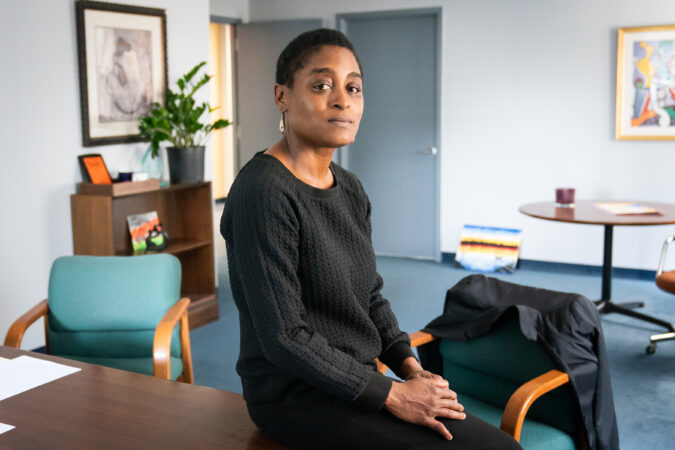
“This is necessary right now,” Chief Defender Keisha Hudson said in an interview. “We’re going to have to sustain this work and expand this work if we’re going to meet the moment.”
The practice will be led by veteran immigration attorney Lilah Thompson, who often represents migrants facing complex legal challenges. She said the work would be done in collaboration with trial attorneys, social workers, and mitigation specialists to shape defense strategies that protect clients and their families.
One area of concentration will be on clients who are in immigration detention despite having no criminal charges, another on people who could face serious immigration repercussions because of what are often minor offenses.
In Philadelphia, attorneys say, people have been arrested by Immigration and Customs Enforcement as they’re enrolling in diversionary programs or heading to court to plead not guilty.
The Trump administration maintains it is arresting dangerous immigrants, though figures show 74% of all those held in detention have no criminal convictions.
A challenge is that those cases must be filed individually, and many of those in detention have neither a lawyer nor the money to hire one.
The new practice consolidates and builds on work that was done at the Nationalities Service Center and the Pennsylvania Immigrant Family Unity Project, or PAIFUP.
Thompson said the immigration practice will make sure that clients have accurate information, strong advocacy, and a chance to protect their futures.
“The work changes every day, with the twists and turns of this administration, and the cruelty it inflicts on noncitizens,” she said. “We have to respond to the moment.”
Crystal Edwards didn’t see a dentist until she had a deep cavity at age 10: growing up in a struggling Philadelphia family, the resources to access dental checkups just weren’t there.
So she jumped atthe opportunity to locate a dental clinic in the school where she is now principal, W.D. Kelley, a K-8 in North Philadelphia.
“This dental clinic is saving lives,” said Edwards.
Tucked into a converted science lab on the school’s third floor, the Dental Clinic at William. D. Kelley, operated by Temple University’s Maurice H. Kornberg School of Dentistry, is nearing its third year of operation. It is open to all Philadelphia children, including those who do not attend Kelley, regardless of insurance status.
School district officials have pointed to the Kelley clinic as a model as it prepares to make facilities master plan decisions,which will result in closing, combining, and reconfiguring some school buildings. The clinic is an example, they say, of how the system could use available space in some of its schoolsfor public good.
Soribel Acosta arrives at the Dental Clinic at William D. Kelley public school on Thursday, with her children, Andrea Jimenez (left), 6. And Sayra Jimenez, 7.
“This is certainly a great example of what can happen when a university partners with a school district to create life-changing opportunities and outcomes for young people,” Superintendent Tony B. Watlington Sr. said in a statement in 2023, when the clinic opened.
Temple dental school officials said more clinics could follow elsewhere in the city.
Taking care of every child
The underlying concept is simple, said Eileen Barfuss, the Temple dental professor who leads the clinic.
“If your tooth hurts, if you’re not feeling well, you’re not going to learn,” said Barfuss. “In the past, there have been a lot of barriers to care for dentistry that weren’t there for medicine, but preventative care is so important so it doesn’t get to the point of pain.”
The clinic accepts all comers, including those who are uninsured or underinsured, and sometimes treats students’ parents. (Most, but not all, patients have Medicaid dental, and grants help cover treatmentfor those without insurance.)
Temple dentistry student Carly Pandit works on the teeth of Andrea Jimenez, 6, as her mother, Soribel Acosta, entertains sister Sayra Jimenez, 7, waiting her turn in the char at the dental clinic at William D. Kelley public school on Thursday.
“We try to take care of every child in the Philadelphia School District,” said Barfuss. “There’s a place that they can come and get comprehensive care and establish a dental home.”
To date, the clinic has seen nearly 700 patients, some of whom are repeat visitors. Patients are treated both by Barfuss and dental students she supervises.
Students do come from other schools to the clinic; Barfuss said her team does outreachat community events andspreads the word through the district’s school nurses, who often send patients to the clinic. And staff teach lessons in Kelley classrooms on oral health andthe importance of seeing a dentist twice a year.
Being in a school helps normalize the dentist for many kids, who might poke their heads into the clinic to look around andsee the friendly dental staff in their scrubs in the hallways, Barfuss said.
‘This is a good dentist’
On Thursday, Fatoumata Bathily, a fourth grader with pink glasses and a bright smile, swung her legs down from a Kelley clinic dentist chair after a successful checkup.
Eileen K. Barfuss (left), a pediatric dentist and Temple dentistry instructor consults with Fily Dramera after her daughter Fatoumata Bathily (rear), 9, was seen by a Temple student dentist at the Dental Clinic at William D. Kelley public school on Thursday.
“It’s good here,” said Fatoumata, who attends nearby Robert Morris Elementary, and came for preventive care along with her brother, Abubakr. “This is a good dentist. I like that it’s colorful, and the people are nice.”
Amid Ismail has wanted to bring such a model to the city since he became dean of Temple’s dental school in 2008. Decades ago, some schools offered dental care via city services, but as funding dried up, those clinics went away, Ismail said.
Ismail raised the idea of a Temple-district partnership, but it took several years to get off the ground. Edwards, an award-winning principal who takes pride in bringing the community into Kelley, got the vision intuitively, he said.
Temple paid to transform a large science lab into the dental clinic; the district provides the space and does not charge rent. There are four chairs, including one in a space specifically designed for patients with autism who might need a quieter environment and more room. Rooms are bright and modern.
“The message to the parents and caregivers is that this is a nice place where all treatment is provided,” Ismail said. “A lot of children do have dental problems, but here we can treat them easily — they miss one class, max, and they don’t have to stay a long time.”
Soribel Acosta waits for their appointment with her children, Sayra Jimenez (left), 7; and Andrea Jimenez (right), 6, at the Dental Clinic at William D. Kelley public school on Thursday.
The clinic, which is about to celebrate its third anniversary, just expanded its schedule — it’s open four days a week, and officials eventually hope it will be open five days.
Edwards fought for the clinic to come to Kelley, and it’s been just the boon she had hoped, she said.
“This is a historic community that was really devastated and hard hit by the crack and drug pandemic,” said Edwards. “The dental office has really given us leverage on how to serve the community better.”
On the same day President Donald Trump’s administration targeted ultra-processed foods in its new federal nutrition guidelines, Penn researcher Alyssa Moran published an academic journal article explaining why they’re hard to regulate.
For starters, there’s no consensus on how policymakers should define the term, she and two coauthors said in a Nature Medicine commentary piece. (The publication timing was a coincidence, but she welcomed the attention to an underestimated challenge.)
Ultra-processed foods are generally understood to be those with industrially produced ingredients not found in home cooking, but experts have long debated how best to classify the foods for regulation. The wording would need to encompassall the possible variations, without beingso rigid that the industry finds loopholes.
The U.S. Food and Drug Administration and the Agriculture Department have said they are working on developing a federal definition to provide“increased transparency to consumers about the foods they eat.” It’s a key goal of the nation’s top health official, Robert F. Kennedy Jr., who blamesultra-processed foods for the United States’“chronic disease epidemic.”
This is the first time U.S. dietary guidelines have explicitly called out ultra-processed foods, also called highly processed foods, and told Americans to limit consumption, Moran said. The guidancewas part of a broader update by the Trump administration the first week of January that flipped the longstanding food pyramid on its head to promote consumption of whole foods, proteins, and some fats.
Though health experts questioned changes, such as the vague guidance on drinking alcohol, the crackdown on ultra-processed foods mirrorswhat many health organizations and consumer advocacy groups have been saying for years.
“I thought it was a bold move, and I was glad to see it,” she said.
Moran talked with The Inquirer about what people should know about ultra-processed foods and the challenges that remain in regulating the products.
This conversation has been lightly edited for length and clarity.
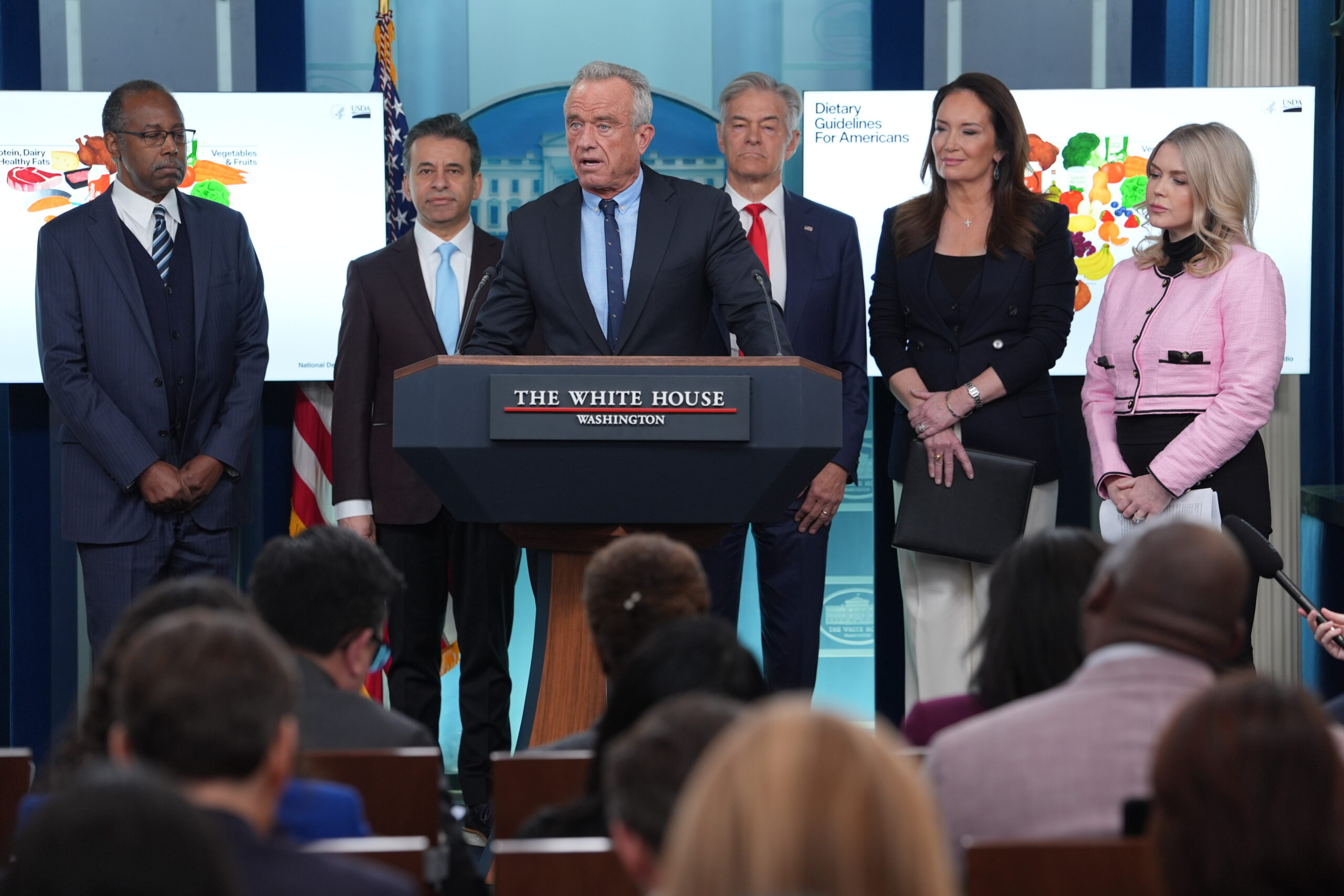
Health & Human Services Secretary Robert F. Kennedy Jr. speaks during a press briefing with leading health officials and nutrition advisors at the White House in early January.
What are ultra-processed foods?
It’s a term that’s been used for decades and has been used, I think, interchangeably with ‘the Western diet’ or ‘junk foods’ or ‘highly processed foods.’
Most foods are processed in some form, whether it’s physical processing, like slicing fruit before you eat it, or adding some chemical preservatives to foods that increase food safety. What changes with ultra-processing is the intent of the processing.
With ultra-processing, the intent isn’t just to make the food safer or to extend shelf-life. It is to make it more cosmetically appealing and more likely to be overconsumed by individuals. They’re formulated in a way that makes them addictive, and they’re also aggressively marketed.
What does it mean to make a food ‘cosmetically appealing’?
It’s the overall sensation of eating the product.
Companies are manipulating levels of highly palatable ingredients like sugar, salt, and fat to be at levels that are not naturally occurring and that are extremely palatable to consumers.
They also add additives that enhance the naturally rewarding properties of things like sugar, salt, and fat. Some additives are added to food, for example, to mask a bitter flavor or prevent an aftertaste. They also add emulsifiers to change the mouth feel of a product. They pay attention to how the product sounds — even the crunch of a product when you’re chewing it — and add dyes to make them more visually appealing, especially to kids.
There are all kinds of strategies that can take advantage of all of the senses to make the product almost irresistible.
Why is there so much debate over how to define the products?
The current administration has talked more than any prior administration about potentially limiting the production, marketing and sale, and availability of ultra-processed products. So, to be able to formulate policy to limit intake of these products, we have to be able to identify them.
Many people have proposed going down the route of defining ultra-processed foods according to a list of additives. And there are many reasons why I don’t think that’s a good approach.
What are the reasons?
We need to really be thinking about how companies are going to respond to whatever definition we create.
If we use a list of specific additives that makes something ultra-processed, companies are going to look at that list and they’re going to say, ‘How can we get around this. How can we skirt regulation?’ They’re either going to increase their use of additives that exist already but aren’t on that list, or they’re going to create new additives with very similar structures and functions as the existing additives.
We see this happen all the time with commercially regulated products. When policies tax sugar, we see that companies increase their use of non-nutritive sweeteners, so the food supply is just as sweet, if not more. When Red Dye No. 2 was banned (in 1976), companies created Red Dye No. 3, which is almost identical and was also banned (in 2025), but 50 years later.
Plus, we have hundreds of thousands of products on the marketplace and there are constantly new ones being added. And currently under FDA policy, companies don’t even need to notify the FDA when they add new ingredients to the food supply. So we don’t even have a complete list of every single additive in the food supply right now.
What approach did you propose in your Nature article on this topic?
Right now, it has been proposed to use a list of ingredients that would make a food ultra-processed. Everything else is non-ultra-processed.
Our recommendation is really to flip that.
We would say, ‘Here are all of the ingredients that make a food non-ultra-processed. Everything else is ultra-processed.’
There are very few additives that make a food non-ultra-processed. The purpose (of the additive) would have to be for food safety or preservation, and that’s one reason why this is also a much simpler approach. Our approach is saying, for example, your yogurt is considered non-ultra-processed if it contains things like milk, live cultures, fruit, nuts, seeds, and honey, as well as some preservatives, vitamins, and minerals.
If it has anything else, it’s an ultra-processed food and is in scope for regulation. Then, if companies introduce new additives, they’ll still be considered ultra-processed because they still fall into the ‘everything else’ bucket.
Are there any other challenges that you see in terms of regulating the industry?
The biggest one is the pushback from the food industry. They spend a lot of money fighting against policies to regulate production, marketing, and sale. We see it with sweet and beverage taxes that have been enacted in Philadelphia and other places. We see it with front-of-package labeling, which the FDA had been trying to pass.
The lack of resources at our federal agencies is another barrier. This administration, early on, really dismantled the FDA, which I think would be the main regulatory body involved in creating this definition and potentially developing policy to regulate these products.
If we don’t have people at those agencies, and they don’t have the resources they need to do their work, you could have a law on the books, but it’s not going to go anywhere.
What are your tips for consumers?
Shop on the grocery store perimeter and avoid the center aisles. Avoid ingredients that aren’t familiar to you.
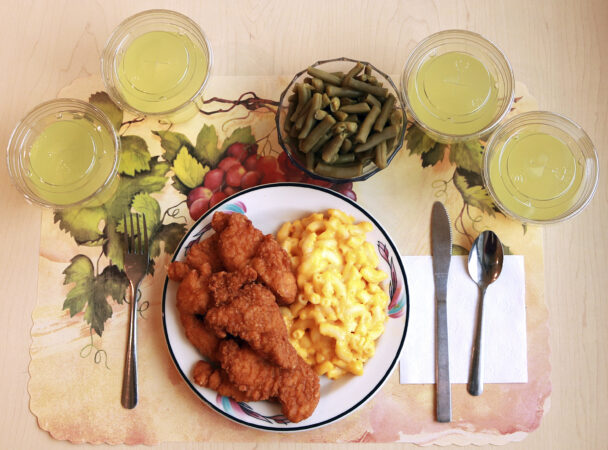
Classic examples of ultra-processed foods are box macaroni and cheese, many frozen pizzas or frozen prepared meals, and many boxed cookies, candies, cakes, and packaged foods.
I would never tell consumers in this environment that you have to avoid every single ultra-processed food to be healthy. These products are everywhere. They’re cheap. They’re super convenient. Many people don’t have access to minimally processed whole foods.
That’s why I think policy is so important — policies that both put limits on ultra-processed foods, but also promote and incentivize the production and sale and marketing of non-ultra-processed products.
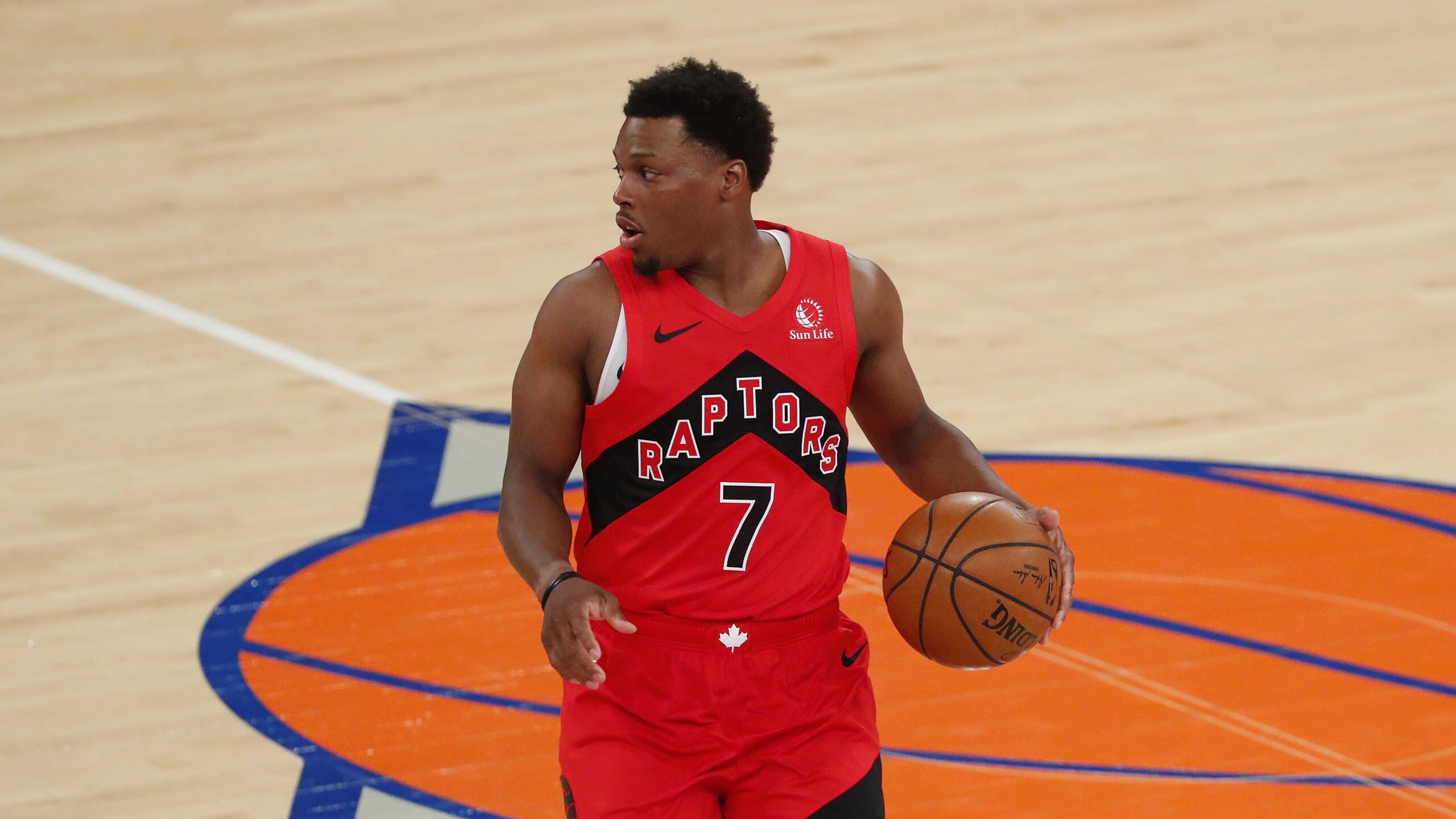
TORONTO — Trendon Watford’s eyes widened as he walked into Scotiabank Arena’s visitors’ locker room and noticed the media scrum surrounding Kyle Lowry’s locker. Teammates Justin Edwards and Jared McCain joined the back of the crowd, with McCain pulling out his cell phone to pretend to ask a question.
“This is why I’m here,” Lowry quipped to those gathered.
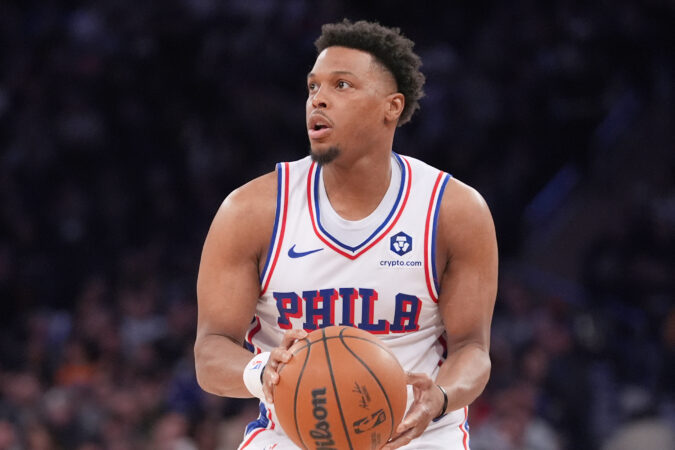
The scene was warranted. This could be Lowry’s final visit as a player to Toronto, where the North Philly native and former Cardinal Dougherty and Villanova star became a Raptors franchise legend and NBA champion. And the 76ers’ back-to-back against the Raptors — they lost a 116-115 overtime heartbreaker Sunday night — represents another bridge between the city that Lowry now calls his second home and his hometown Sixers, the team with which he is likely to wrap up his NBA career primarily as a mentor on the bench and behind the scenes.
“You’ve got to find ways to challenge yourself,” Lowry said when asked about his role before Sunday’s game. “And the challenge for me is to try to help these guys every single day. … It’s just finding that niche and helping people get better — and me being in a place where I’m happy.”
The 39-year-old Lowry went into last offseason with a public declaration that he wanted to play one more season to reach the “massive accomplishment” of 20 in the NBA. Only 12 players have achieved that benchmark in league history, including two who stood 6-foot or shorter (Lowry and Chris Paul). His sons, Karter and Kameron, who are still based in Miami following Lowry’s post-Raptors tenure with the Heat, signed off on him pursuing that milestone.
Yet when asked before the Sixers departed for Toronto late Friday if he expected this to be a farewell trip of sorts, Lowry’s tone shifted to “I don’t know, honestly.” It is possible that the Sixers (21-16) could return to Canada after these consecutive regular-season matchups because, if the playoffs began Monday, the 24-16 Raptors would be their first-round opponents. Lowry also believes his leadership is “immensely important to what this organization is trying to do.”
“You’ve got to be able to kind of take yourself out of it sometimes,” Lowry said, “and be able to say, ‘OK, how can I pay it forward a little bit?’ … It’s that balance of I know I’m not on the court, so I can’t yell at them and curse at them. But I can say, ‘Hey, these are the things that I see. Let’s try to do that.’”
Kyle Lowry played nine seasons in Toronto (2012-21), winning a title in 2019 and being named to six All-Star teams.
It is a transition that those who knew Lowry in Toronto — where he was a six-time All-Star and a notoriously tenacious point guard — might be surprised he has so wholeheartedly welcomed. Though he became a starter after joining the Sixers off the 2024 buyout market, Lowry’s minutes dramatically diminished while hampered by a lingering hip issue for the bulk of last season. He has played in 42 total minutes across five games this season, receiving a rousing reaction from teammates when he buried a three-pointer in his debut at the Brooklyn Nets in November.
Survey those same teammates about Lowry’s daily influence, and faces typically light up.
Rookie VJ Edgecombe can count on Lowry to “keep it real,” including during a pressure-releasing pep talk before Edgecombe scored 34 points in his NBA debut at the Boston Celtics. Quentin Grimes said Lowry’s diligent workout routine — he is still the first Sixer on the floor for his pregame shooting nearly three hours before every game, and puts in extra individual work before and after practices — provides a blueprint on how to prepare as his own career progresses.
And though star Tyrese Maxey jokingly calls Lowry “old as hell,” he also views the veteran as “like, my leader. He comes to me and leads me, and I try to lead the team.” Lowry fosters this relationship while regularly rebounding and screening for Maxey during workouts, and when he calls the 25-year-old “at least three or four times a day,” Maxey said.
“I couldn’t do this without him, honestly, right now,” said Maxey, who finished Sunday ranked third in the NBA in scoring at 30.9 points per game and has entered the MVP conversation.
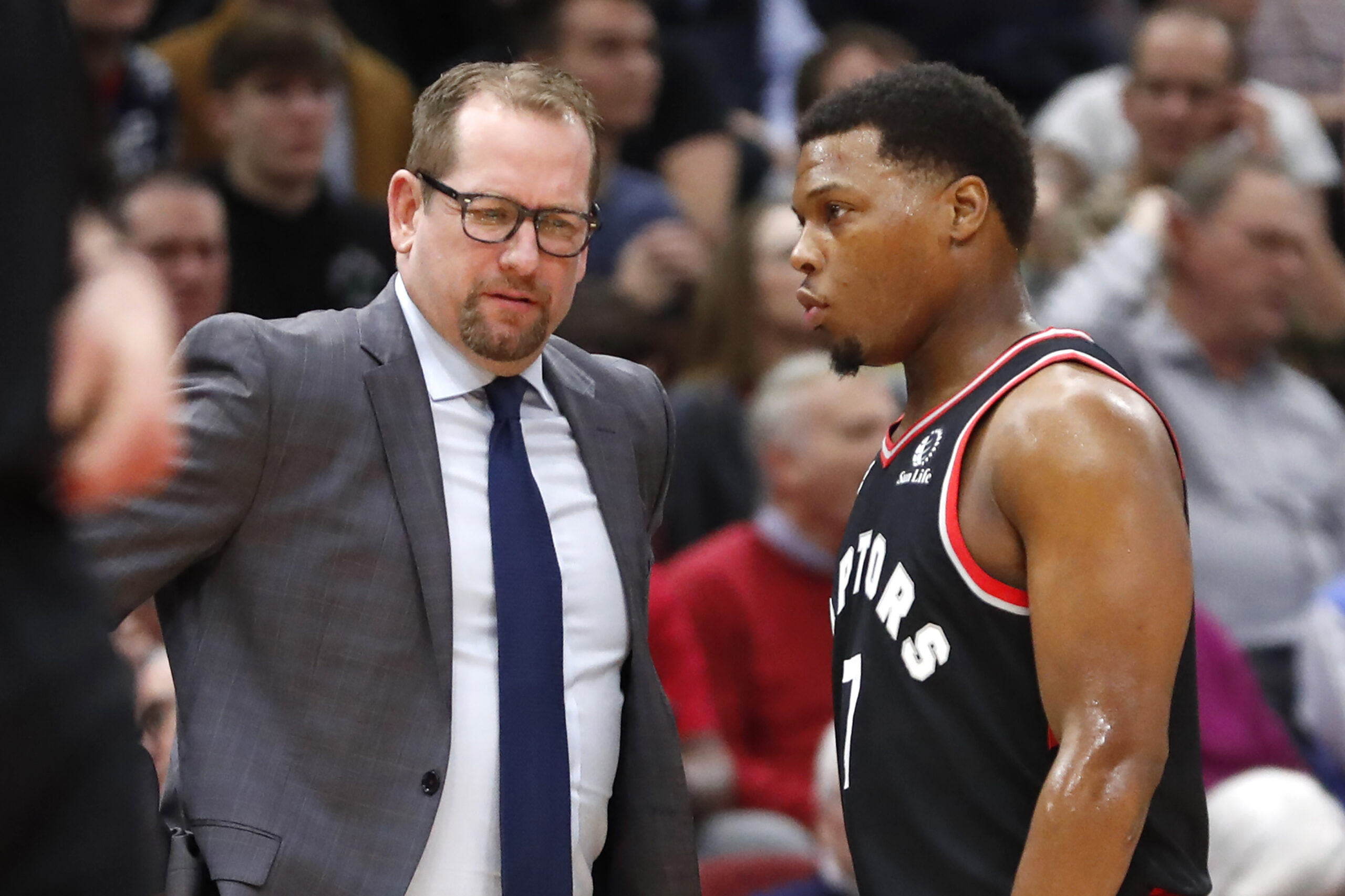
Even Sixers coach Nick Nurse, who also led Lowry’s Raptors teams, said the point guard has “talked me off the ledge a couple times” during games this season. Nurse views Lowry as a valuable conduit between the players and the coaching staff, providing insight on when the Sixers might need a day off from practice or should be pushed.
“There’s times when I’ll be leaning on him,” Nurse said. “He’ll get behind me and say [to teammates] … ‘This is what it takes.’”
The relationship between Nick Nurse and Kyle Lowry is extensive and built on trust.
Before Sunday’s game, Nurse said that he would speak to Lowry about his desire to hit the floor inside Scotiabank Arena again. Lowry acknowledged he would “love to get in there for the fans, and help my team,” but stressed that winning was the top priority. There was no appropriate opportunity for Lowry to enter during Sunday’s down-to-the-wire overtime defeat.
Still, Lowry remained active from the bench. He jetted onto the court to greet Maxey after he drilled a three-pointer with 20.1 seconds remaining in regulation. He stood between Nurse and assistant Bryan Gates during an overtime discussion. And after Kelly Oubre Jr. attempted what he described as a “terrible” inbounds pass to Edgecombe that became a critical crunch-time turnover, Lowry pointed out that Grimes also had leaked open.
“He’s been there, done that,” Oubre said of Lowry. “Been at the highest level. For him to be so engaged and allow him to use his IQ to help us grow ours, it’s amazing. He’s definitely a huge leader on this team, and his voice is always heard.”
Doug Smith, the longtime Raptors beat writer for the Toronto Star, suggested in an article that Nurse should put Lowry in Monday’s starting lineup so he can bask in a pregame introduction here one last time. When asked how it will feel to see his No. 7 raised into the rafters someday, Lowry’s response was, “Y’all ever seen me cry?”
He walked into the arena Sunday wearing a signed jersey from Maple Leafs star Auston Matthews, a tribute to the player and the city. He confirmed that, whenever the time comes, he would sign a one-day contract to retire as a Raptor.
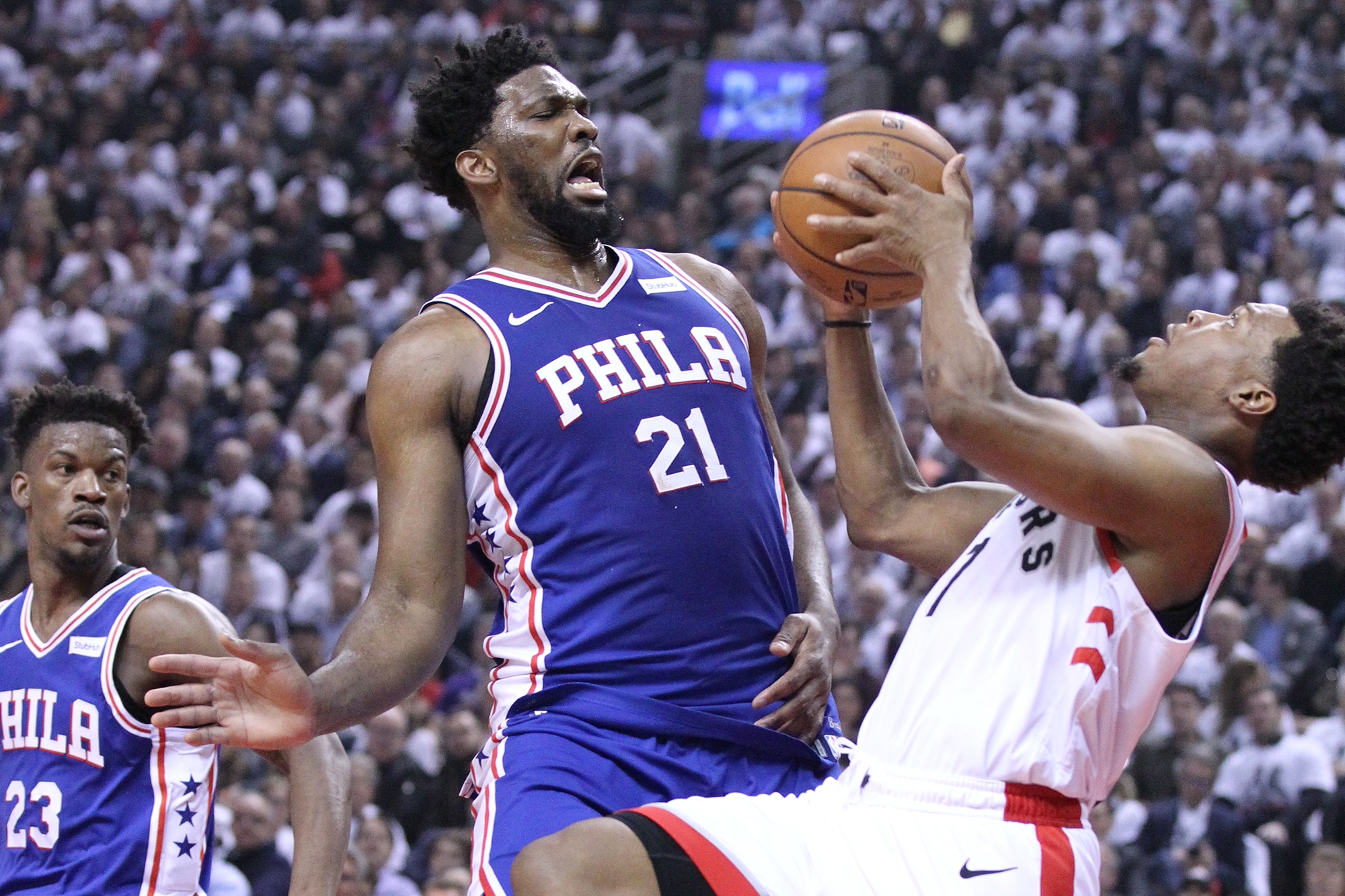
Veterans like Joel Embiid (21) know the impact Kyle Lowry has made during his 20 seasons in the NBA.
And his forever connection to Toronto was clear when Joel Embiid tried to land a playful jab inside Friday’s postgame locker room in Orlando. Hours before the Sixers’ flight across the border, Embiid interrupted an interview with Lowry by asking, “Why are they talking to you?” in an exacerbated tone.
“Where you lost Game 7 at,” said Lowry, referencing the Sixers’ crushing playoff defeat to the eventual-champion Raptors in 2019.
“Talking about how great of a cheerleader you are?” Embiid countered.
“Yes, basically,” Lowry responded.
“He’s a great cheerleader,” Embiid conceded.
Because right now, Lowry is a Sixer. And when asked about how enthusiastically those teammates describe Lowry’s impact in his 20th — and, potentially, final — NBA season, his emotions again bubbled to the surface.
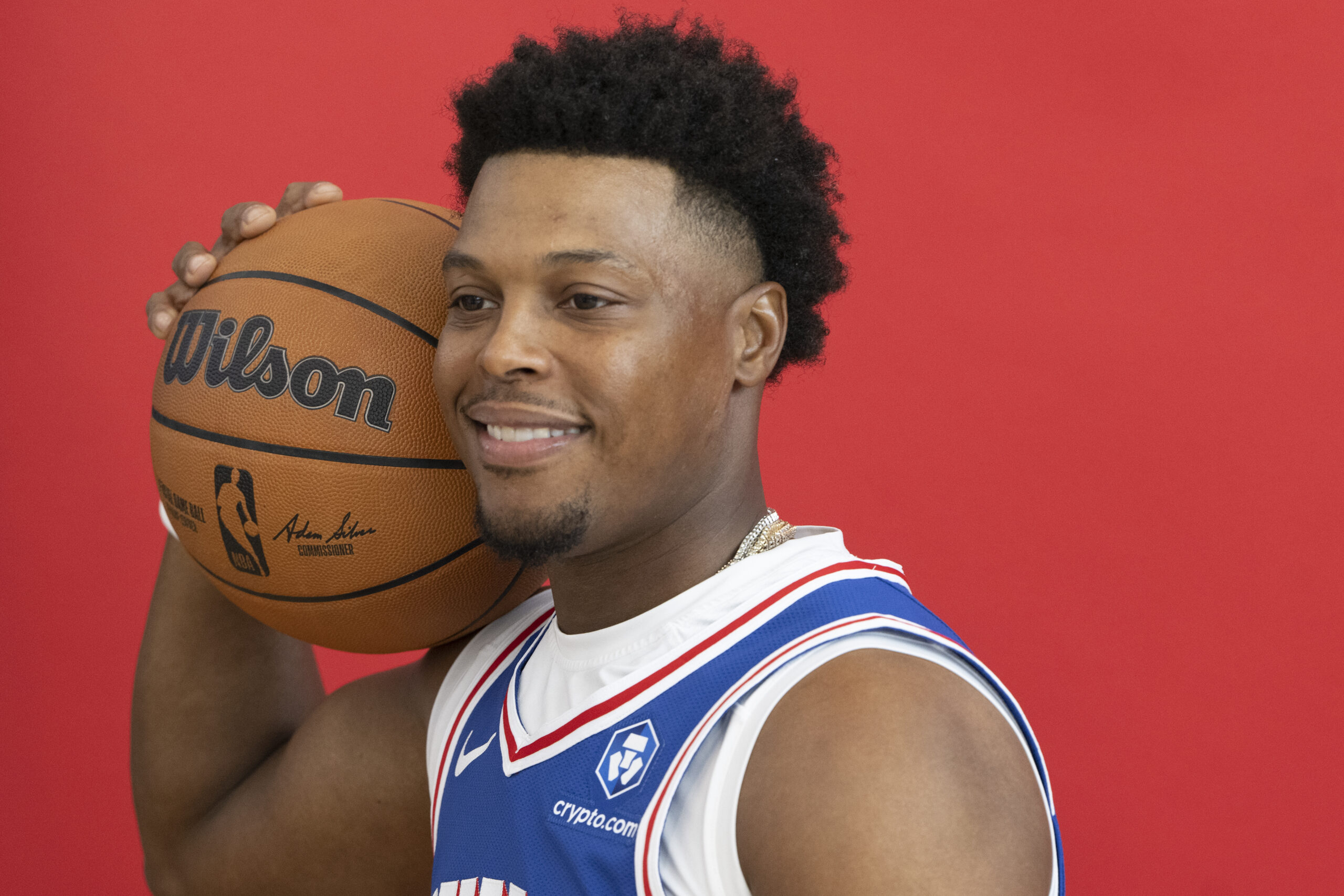
Kyle Lowry could be finishing a storied career with a mentor role on a possible playoff team.
“It means a lot, to be honest,” Lowry said. “Because I really give to them the purity of how I feel about them. Like I said, sacrifice. I don’t care about myself as a basketball player. I know in my career what I’ve done. And what I’ve done is I’ve given everything to this game. Everything I could possibly give to this game, physically and mentally.
“You see me every day with these guys. I cheer for them. I clap for them. I help coach them from a player’s perspective. I try to give them things in life. I try to help them out, just overall, in general.
“I guess it’s a testament to how they feel about me. I’m the ancient man in this locker room. I embrace it, and they embrace me.”
Kevin Patullo is as good as done. A.J. Brown’s future is murkier.
But whatever happens to the offensive coordinator and the team’s top receiver, some form of significant change is coming to the Eagles offense after a season of frustration ended fittingly with another bipolar performance on Sunday.
Patullo will be the easiest to cut off, not because he was solely responsible for the regression or even for the substandard play calling that doomed the Eagles in their 23-19 loss to the 49ers in the playoffs, just as it had throughout most of the 2025 regular season.
Most players, including tackle Jordan Mailata, publicly supported the first-year coordinator on Sunday. They pointed the finger at themselves and their execution, or lack thereof. But the powers that be, as Mailata noted, can’t just wipe out the bulk of the highest-paid offense in the NFL.
“It’s easier to blame somebody who gets paid less than your starting people, right?” Mailata said. “And everybody knows that. Everyone in this [expletive] locker room — even you [reporters] know that. But the story makes better sense if we’re pointing to somebody else than not the players.”
Brown might seem the logical piece to move considering how his drops against San Francisco seemed indicative of an apathetic season by his standards. General manager Howie Roseman isn’t normally fond of trading Hall of Fame talent, and Brown’s contract may make it difficult to move the 28-year old.
But the Eagles will need to find ways to clear salary-cap space with salaries for quarterback Jalen Hurts and others on offense increasing and young homegrown players on defense, including defensive tackles Jalen Carter and Jordan Davis, slated for extensions.
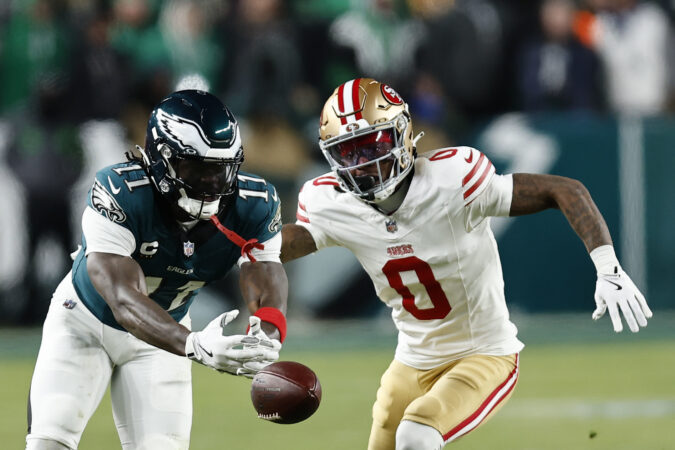
Getting rid of Brown may send a message. But for as great as fellow receiver DeVonta Smith can be, most defenses still spent each week in 2025 devising coverages to cloud Brown. He didn’t have his best season by any stretch, and sometimes ran poor routes and couldn’t pull in grabs he normally makes.
He let two of Hurts’ downfield throws slip off his hands on Sunday.
“He’s got the best hands I’ve ever seen,” Eagles coach Nick Sirianni said. “The way he catches the ball, the amount of different types of catches that he’s made. When you get as many targets as he does, you’re going to have some drops. Not ever using an excuse, but the ball moves differently in the wind.”
Brown declined interview requests after the game, much like he has for the last month. He got into a brief altercation with Sirianni on the sideline in the second quarter when the coach yelled for him to get off the field after a three-and-out.
“I love A.J. I think he knows how I feel about him,” Sirianni said. “I have a special relationship with him. We’ve probably [gone] through every emotion you can possibly have together. We’ve laughed together, we’ve cried together, we’ve yelled at each other. We’re both emotional.”
Brown’s emotions have sometimes gotten the best of him. He’s admitted to mistakes he’s made when using social media to voice frustrations with the offense. He’s among the most-liked players in the locker room. But a change of scenery may be best as he enters the latter stage of his career.
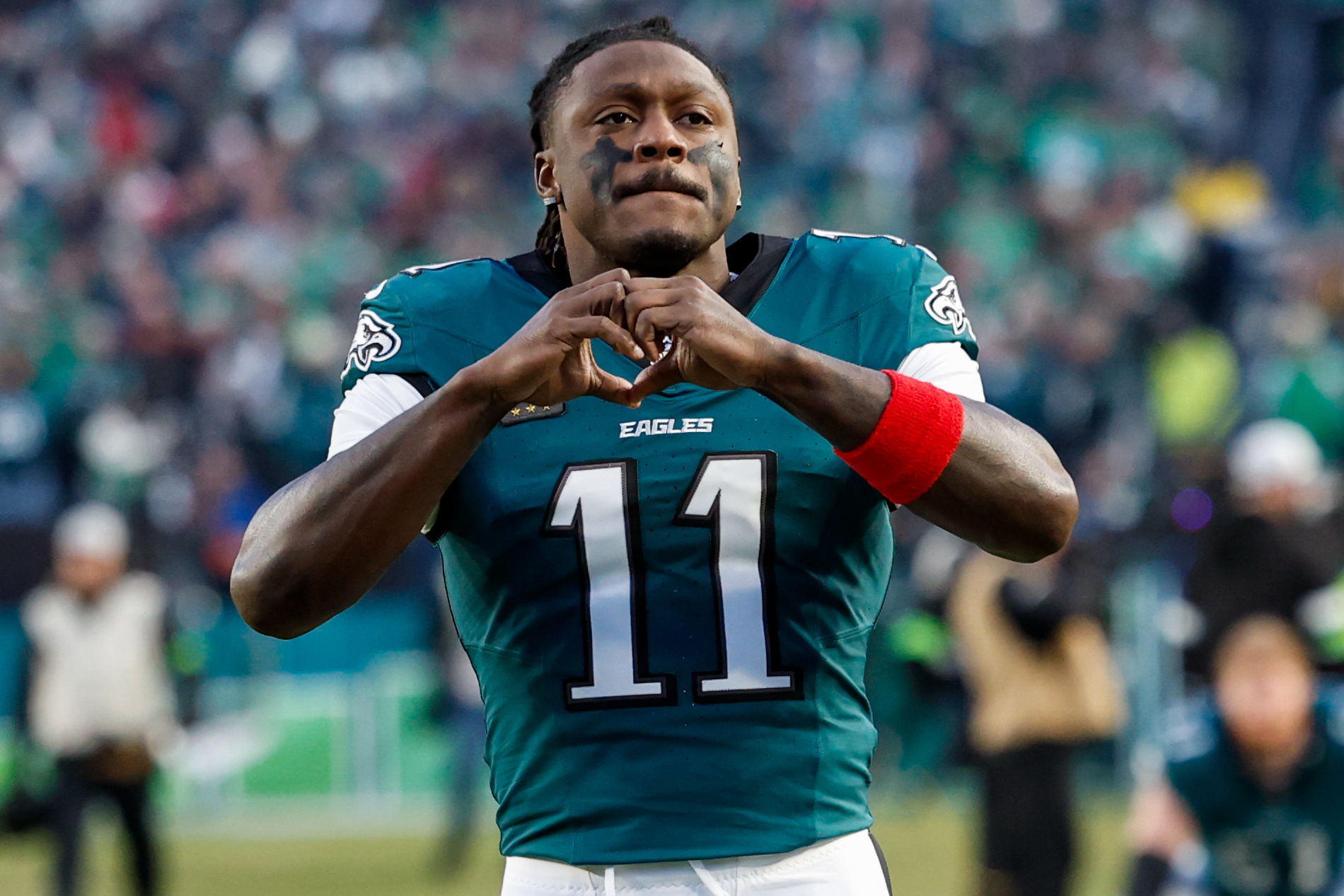
A.J. Brown logged another 1,000-yard season, but it was a tumultuous year for the star wide receiver.
Sirianni and Hurts aren’t going anywhere, nor should they. But they face another crossroads just two years after the Eagles offense underwent its first facelift. Sirianni fired coordinator Brian Johnson, certainly with input from owner Jeffrey Lurie and Roseman, and Kellen Moore was brought in to spiff up the system.
Johnson was more of a Hurts guy, not that Sirianni took pleasure in ending his tenure in Philly. But Patullo has been with the coach since their days with the Colts. They’re kindred spirits in football and friends away from it. But even Sirianni can’t deny that Patullo was in over his head.
“There will be time to evaluate everybody’s performance,” Sirianni said when asked about his coordinator’s future.
If the Eagles weren’t coming off a Super Bowl, maybe Patullo could have been given more time to learn on the job. Maybe Sirianni has built up enough clout to hold off Lurie/Roseman. But precedent suggests that the Eagles will move fast, and that they already have possible replacements lined up.
Who could be next? Mike McDaniel? Kliff Kingsbury? Brian Daboll? Nate Scheelhaase? Todd Monken? Frank Reich? Whoever it is, it should be someone with a pedigree of improving quarterbacks, and preferably one who actually played the position.
Hurts didn’t evolve this season. He ran less and it not only made him less dynamic, but it gave defenses one less option to worry about in the running game. And it made his deficiencies in the drop-back passing game more glaring.
“I think I’m always growing,” Hurts said when asked about working with Patullo. “I’m always taking in my experiences and learning from everything that we go through. I think it’s tough to single out one individual, especially in a moment like this.
“We’ve all got to improve and that’s how I look at everything that we go through.”
Hurts didn’t play poorly in windy conditions at Lincoln Financial Field. In fact, it was a very Hurtsian performance. He made some good throws. He didn’t turn the ball over while his counterpart, Brock Purdy, tossed two interceptions.
But Hurts’ arm lacked the velocity to cut through the breeze at times. He left clean pockets far too early. And he failed again to deliver a game-winning drive. He may play by far the most important position on the field, but the Eagles’ struggles Sunday and all season weren’t all on his shoulders.
And the same applies to Patullo. How much was he handcuffed by Sirianni’s emphasis on not giving the ball away? The Eagles led, 13-7, midway through the second quarter. But the offense failed to generate a first down on four of its next five possessions against a 49ers defense that was down to its fourth and fifth linebackers.
There were dropped passes, penalties, missed blocking assignments, and Hurts throwaways over that span. There were also conservative calls like running on second-and-18, or Hurts keeping on third-and-13. Sirianni was aggressive on two fourth downs in the first half. He seemed to settle for field goals after the break.
“If it goes the way you want it to go in the first half and then not the second half, I think that’s the go-to of people [thinking] you take your foot off the gas,” Sirianni said. “But we were playing more balanced, got the run game going a little bit, trying to mix our play-actions in, trying to get our passes in to create explosives.
“At the end of the day, we didn’t create enough explosives.”
49ers coach Kyle Shanahan, meanwhile, dialed up four pass plays that gained 27 yards or more, including a double-reverse trick play that had receiver Jauan Jennings hitting running back Christian McCaffrey for a 29-yard touchdown on the first play of the fourth quarter.
Gadget plays aren’t going to solve core offensive problems. But the Eagles offense, overall, wasn’t diverse enough. There weren’t enough passing concepts that utilized the middle of the field. There weren’t enough layups for Hurts schemed off under center play-action plays.
The offense moved too slowly in its pre-snap operation and it crippled an already battered offensive line in the running game. Left guard Landon Dickerson admitted after the game what was obvious: He was playing through multiple injuries. Center Cam Jurgens never looked fully recovered from offseason back surgery.
Right tackle Lane Johnson missed the final eight games with a Lisfranc foot injury. He practiced last week, but his replacement, Fred Johnson, said he found out Saturday that he would be starting instead.
“That’s not normal,” Fred Johnson said. “Lane came out this week and prepared like he was a starter. He tested it this week with his reps. Saturday he just felt like he wasn’t ready.”
But the Eagles, for the most part, were healthy. They returned 10 of 11 starters from a Super Bowl-winning offense. The only new cog was Patullo, so he bore the brunt of blame. But Mailata said that was “very unfair.” Dickerson said he did a “tremendous job.”
The offensive linemen also acknowledged Patullo’s inexperience.
“I think he improved over the year,” Fred Johnson said when asked about Patullo. “That’s about it.”
There was some individual grumbling about the play calling from various corners of the locker room over the course of the year. But it never rose to the level it did when Sirianni demoted former defensive coordinator Sean Desai midseason in 2023.
Despite Sirianni’s claim last week that the Eagles had found an identity, it never really materialized. They wanted to ride Saquon Barkley and the running game much as they did en route to the Super Bowl a year ago. But it just ended up being a rinse-and-repeat offense for most of the season and again on Sunday: some glimmers of hope in the first half, darkness thereafter.
“It’s been a common theme for us this year,” Barkley said. “We haven’t done a good enough job of playing complete football, putting two halves together. Sometimes you get into this moment and [believe] we’ll just figure this out. And it just caught up to it.
There’s a word for doing the same thing over and over and expecting the same results. It could be used to describe the furor in Philly whenever an offensive coordinator fails to succeed. Patullo will likely suffer a fate because Eagles leaders won’t want to be labeled as such for sticking with him.
There’s a strong argument for making a move. But there’s change every season.
“There’s a lot of great guys in this locker room on this team, lot of great coaches, a lot of great people upstairs,” Dickerson said. “Every team’s got a one-year expiration on it, so this team will never be put together again.”
Multiple things can be true at the same time. They usually are when a team’s season ends the way the Eagles’ did on Sunday.
It takes a special kind of bad to lose this limply. It is a collective bad, an existential bad, a bad that raises all kinds of hard questions that a team must confront head-on and wrestle with in the darkness. That is true even of a team that is less than a year removed from winning a Super Bowl. In fact, it is especially true for such a team.
The bad that the Eagles were in a 23-19 loss to the 49ers is a disconcerting bad. It is a bad that shakes you to your core, a bad so bad that you spend an entire season desperate to disbelieve it.
More than anything, it is a bad that is nearly impossible to achieve if your quarterback is doing the things he needs to do.
Jalen Hurts did not do those things for the Eagles on Sunday. His counterpart did them for the 49ers. That is why the Eagles are headed home. It is why the 49ers are headed to Seattle. The difference in this particular playoff game was the same as it is in most of them. One team had a quarterback who rose above his circumstances. The other did not.
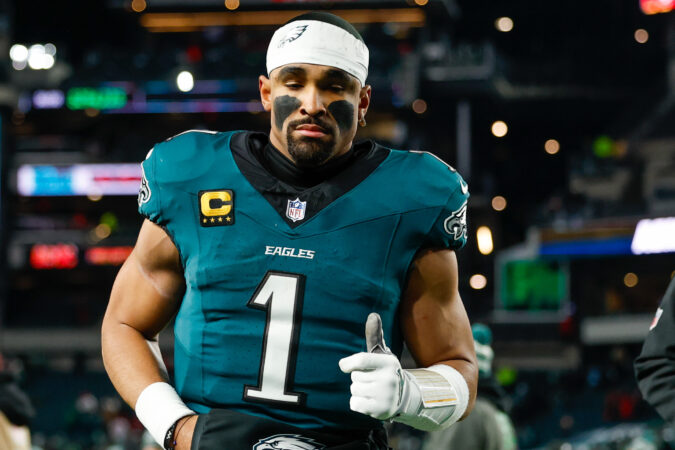
“It starts with me and ends with me,” Hurts said afterward.
Whether or not he truly believed those words, he was correct.
A team that cannot, or will not, put pressure on a defense in the intermediate-to-deep part of the field is a team whose luck will eventually run out. Whether Hurts can’t or won’t doesn’t matter at this point. He didn’t, and that’s that. He completed just three passes that traveled more than 10 yards in the air, on 11 attempts. Those three completions gained a total of 38 yards. He was 17-for-20 on his short throws.
Compare that to Brock Purdy, who was dealing with an offense that lost its last blue-chip pass-catching weapon when tight end George Kittle tore his Achilles tendon with six minutes left in the second quarter. The game should have been over then, one of several moments when that was the case. That it wasn’t is largely a testament to Purdy, whose poise and patience and intentionality were on display against an Eagles defense several calibers above that of the practice-squad Niners.
San Francisco’s game-winning 66-yard touchdown drive late in the fourth quarter featured a 16-yard completion to Demarcus Robinson and a 5-yard scramble, both for first downs, to help set up his 4-yard touchdown pass to Christian McCaffrey with just under three minutes remaining. A couple of possessions earlier, he found fullback Kyle Juszczyk of all people for a 27-yard gain that set up a trick play touchdown on an end-around pass from wide receiver Jauan Jennings to McCaffrey.
There was a 14-yard pass to backup tight end Jake Tonges on third-and-14 late in the second quarter, a 45-yarder to Jennings earlier in the period, and a 61-yarder to Robinson that set up a touchdown on the 49ers’ opening drive.
Purdy’s numbers on throws longer than 10 yards: 8-of-13, for 178 yards. His two interceptions were the cost of doing business.
“You’ve got to be able to be explosive,” Eagles coach Nick Sirianni said. “It’s really hard to dink and dunk down the field. It’s really hard to get behind sticks with negative plays. You’ve got to be able to create explosives. Again, at the end of the day, there were a lot of elements [where] you end up with a loss, and we haven’t had this feeling of ending our season since 2023 with the loss. That’s why it hurts because it’s been a while. But yeah, at the end of the day, we need to find ways to be more explosive. Again, that starts with me.”
Sirianni is right. Everything starts with him. But it ends wherever the quarterback takes it. The ball is in his hands. The clock is in his head. He is the one who decides how long to continue looking down the field. Whatever the game plan, whoever the play-caller, a quarterback almost always has the ability to force the issue. That’s especially true for a quarterback with Hurts’ ability to buy time and gain yards with his legs. He gained 14 yards on five carries against the 49ers. Purdy gained 24 on nine.
“Well, I think finding a rhythm and whatever you define aggression as, maintaining the fluidity and the flow throughout four quarters of the game, so I think there’s opportunity for us to improve in that,” Hurts said. “Just finding a rhythm. Ultimately it is just all something that you either learn from it or you don’t.”
One thing people lose sight of while focusing on the play-calling is that the quarterback sets the rhythm. He is the orchestra conductor. The great offenses are almost always a reflection of their quarterback. It wasn’t Tom Moore’s offense or Todd Haley’s offense or Charlie Weis’ offense: it was Peyton Manning’s and Ben Roethlisberger’s and Tom Brady’s. It’s no coincidence that the energy of this Eagles offense as a collective often resembles Hurts’ individual demeanor.
Nobody should have to apologize for pointing out these things. High standards are not unfair. The only way to fix an offense as bad and boring and listless as the Eagles’ is to be unflinchingly honest about its component parts. The quarterback is inseparable from the play-caller. The right guy for the second job is a guy who can make it work with the guy in the first one. The next Eagles play-caller will be getting a quarterback who does not have elite size, or arm strength, or pocket presence, and who no longer makes up much of that difference with his ability to create on the run.
Hurts didn’t get much help from his pass-catchers on Sunday. He didn’t get as much help from his play-caller as Purdy got from his. The Eagles will need to fix both of those things this offseason. Hurts isn’t, and shouldn’t be, going anywhere.
That said, Hurts is who he is. Who he was on Sunday is the guy he has been all season, and most of the last 2½ seasons, if we’re being honest. It worked when the Eagles had an overwhelming talent advantage at all of the other positions. If that is no longer the case, they need to figure out a new formula.
“Might makes right,” “Greed is good,” “omertá,” phrases that offend human decency and American dignity.
The MAGA government and its enablers have embraced these odious concepts. The Republican regime deploys the U.S. military and hooded secret police to terrorize American cities, murders foreign civilian sailors, invades a sovereign nation to capture its leader, schemes to steal a foreign nation’s oil reserves, plots invasion of our ally’s territory in Greenland, and threatens the sovereignty of Canada. Who offers a rationale?
Steven Miller gleefully articulates MAGA principles: We do these things because we can. When MAGA sends military troops to invade our cities, attack foreign nations, steal foreign assets, or kill foreign civilians, corrupt and co-opted MAGA forces simply cannot be stopped.
Is this our new U.S.? A brutish gangster nation? Do threatened civil rights at home, broken alliances abroad, transactional collusion with international criminals, dictators, and despots comport with our heritage?
How can we restore the noble legacy of the Greatest Generation? Make decency at home and abroad our national goal? Prioritize the rule of law and accountability? When will U.S. power again be directed to support democratic ideals, international cooperation, and civil/human rights?
What world will we pass to our progeny?
Mike Shivers,Altoona, Pa.
World of MAGA first
The attack on Venezuela and the removal of former President Nicolás Maduro and his wife, together with administration statements thereafter, have at least given us a better understanding of what “America First” means and what it does not mean. America First does not mean doing anything for ordinary American people; it means doing everything for President Donald Trump’s family, his cronies, and major corporations.
It does not mean helping Americans who are hungry or have problems accessing medical care.
If it meant that, the administration would not be cutting back on SNAP benefits and acting to take away the health insurance of millions who were on Medicaid or had insurance through the Affordable Care Act. It does not mean helping Americans who have trouble affording high prices. If it meant that, the administration would not have raised prices through tariffs and failed to take any other action to rein them in.
What it does mean is imposing American “rule” and hegemony over any country, at least in the Western Hemisphere, with whose policies we disagree and to whose resources we want access.
So we remove Maduro and not his regime and expect to be able to coerce that regime to allow American energy companies to exploit Venezuelan oil. The administration also seeks to attack or coerce other countries in the region, including Panama, Colombia, and Greenland.
This is not about helping the American people, much less the Venezuelan people. It is about enabling Trump and his henchmen to strut about on the world stage. And it is about making money for Trump’s family, his cronies, and corporations that do his bidding. Trump is making unconstitutional use of the U.S. military to achieve these goals. According to opinion polls, the American people do not support this mob boss-style imperialism. It is time for Congress, especially Republicans in Congress, to stand up and prevent further unauthorized and unconstitutional military ventures.
Matthew Lawry, Elkins Park
Join the conversation: Send letters to letters@inquirer.com. Limit length to 150 words and include home address and day and evening phone number. Letters run in The Inquirer six days a week on the editorial pages and online.
ARIES (March 21-April 19). No need to stare into the mist and wait for answers to materialize because you already see the future you want, and it’s crystal clear. Making it real will involve many steps, and the first one can start anywhere. Pick a step, any step, and then watch what happens next.
TAURUS (April 20-May 20). You’re so good at planning right now, why stop at designing your own experience? Other people would gladly pay you for a winning plan. Your true genius is in tailoring the blueprint to the resources available.
GEMINI (May 21-June 21). Instead of counting the number of tasks on your list today, count the number on someone else’s list. Thinking about the duties or the leisure of others will give you the perspective that helps you nestle into your own groove, glad that it’s yours.
CANCER (June 22-July 22). Someone who gave you a treasure may now want it back. As always, you’re inclined to do what is fair, not what is easy. And anyway, the best things cannot be returned even if you wanted to: time, love and the truth.
LEO (July 23-Aug. 22). People say there are no bad questions. Still, some questions move you forward faster than others. You’ll skip the fluff and flattery and zero in on the precise details at the heart of the matter. This frees up progress.
VIRGO (Aug. 23-Sept. 22). You have been known to overcome physical discomfort by framing it as the price of fitness, fashion or responsibility. Similarly, you will endure a degree of injury to the ego in the name of love, harmony and emotional maturity.
LIBRA (Sept. 23-Oct. 23). Your habits may feel a bit boring to you today, only because familiarity has dulled your emotional response. Spending time with someone who has a completely different style will stir the energy, and you’ll do the same for them.
SCORPIO (Oct. 24-Nov. 21). You’re not meant to stick with everything you try. It’s so relatable to outgrow interests, clothes and even relationships. But now it’s time to focus on what you keep carrying forward year after year — the gold of your character that everyone else sees, too.
SAGITTARIUS (Nov. 22-Dec. 21). Be wary of grandiosity. When the pendulum swings the other way, grandiosity turns into something else — usually absence — as a person realizes there’s no way they can make good on delusion-based promises.
CAPRICORN (Dec. 22-Jan. 19). You’re brimming with creative potential today, and there are multiple ways to apply it. Decide what most needs your clever fix, your beautiful twist or your inventive hand. Then get to work, and in two hours things are already different.
AQUARIUS (Jan. 20-Feb. 18). You’re like a reporter for a highly reputable publication that thoroughly checks the facts. Every bit of information that comes your way warrants further investigation. Reserve all conclusions for the final edit.
PISCES (Feb. 19-March 20). Somehow, it is socially acceptable to feel sorry for others, why not yourself? Microdoses of self-directed pity and sympathy just acknowledge the injustice of an experience and give you a foundation to push off from.
TODAY’S BIRTHDAY (Jan. 12). This is your Year of Code Cracking in which you figure out the problems that once perplexed you. Mysteries get solved, tests are passed, closed doors swing open, and suddenly you’re in the realm you were aiming for. How? You listen well and you’re persistent. You keep trying things until the puzzle comes together. More highlights: three financial bonuses, hot tickets with fun people and family coming together for fortifying causes. Aries and Virgo adore you. Your lucky numbers are: 4, 33, 29, 1 and 10.
DEAR ABBY: My son married a lovely woman, “Noelle,” two years ago. They live a couple of hours away and have a 1-year-old son, my third grandchild. Noelle’s parents live 10 miles from my home. She and the baby go there nearly every weekend but NEVER come by mine. I haven’t seen them since the baby’s birthday five months ago.
My daughter lives down the street from Noelle’s parents. She wasn’t invited to the baby’s first birthday even though she’s the mother of his cousins, so I took her children with me. There were other people there, mostly adults and her cousin’s baby.
We are not horrible people. There has never been any ugliness between any of us. I’m very hurt because they don’t recognize me as a grandmother or any of us as part of the family. My son’s father has never been allowed to meet the baby, and I don’t think he’s even met Noelle.
I have asked my son and daughter-in-law to bring the baby, leave him for the day or even overnight so we can spend some time and get to know him, but it never happens. What can I say to make them understand how much they are hurting the family and the baby by avoiding us? I don’t want to make it worse.
— DISAPPOINTED GRANDMA IN TEXAS
DEAR GRANDMA: This is a subject you should discuss with your son, who appears to be clueless or entirely ineffectual. Does he recognize what has been happening — that his parents have been pushed entirely out of the picture? If the answer to that question is yes, perhaps he can shed some light on why. If the answer is no, tell HIM how this has made you feel. If you do, perhaps he will assert himself. Better late than never.
** ** **
DEAR ABBY: One year ago, my heart was torn out of my chest when my wife died after a five-year battle with stage-4 breast cancer. It was the beginning of the end of my world. I’m alone now. We have two cats I still take care of and all the daily chores of a normal household.
I have tried looking at dating sites, and I see a couple of women I might be interested to know. Here’s where I need a female stranger’s perspective: I still hurt inside, and I know I will for some time. I also feel that if I have someone to talk to, it’ll be the personal therapy I need to help get me back on track. However, I also feel that if I start dating, it will be like I’m cheating on my wife, and the hurt comes back. What am I supposed to do?
— CONFLICTED IN CALIFORNIA
DEAR CONFLICTED: Please accept my sympathy for the loss of your wife. If you feel you need a woman’s perspective, find a female licensed psychotherapist to help you get back on track. If you do this, you are less likely to dump your guilt and grief on someone who might take advantage of it or be driven away by it. If you can’t afford a therapist, joining a grief support group may help you expiate any guilt you feel about going on with your life.
The Sixers (21-16) were trending in the right direction after winning two straight and five of their last six games heading into this matchup. And with Tyrese Maxey scoring a game-high 38 points, they appeared capable of overcoming the huge absences of Joel Embiid (left knee injury management/left groin soreness) and Paul George (left knee soreness).
But an inability to close out the game reared its ugly head.
Maxey hit a what appeared to be a 29-foot dagger three-pointer to give the Sixers a 107-103 cushion with 20.1 seconds left.
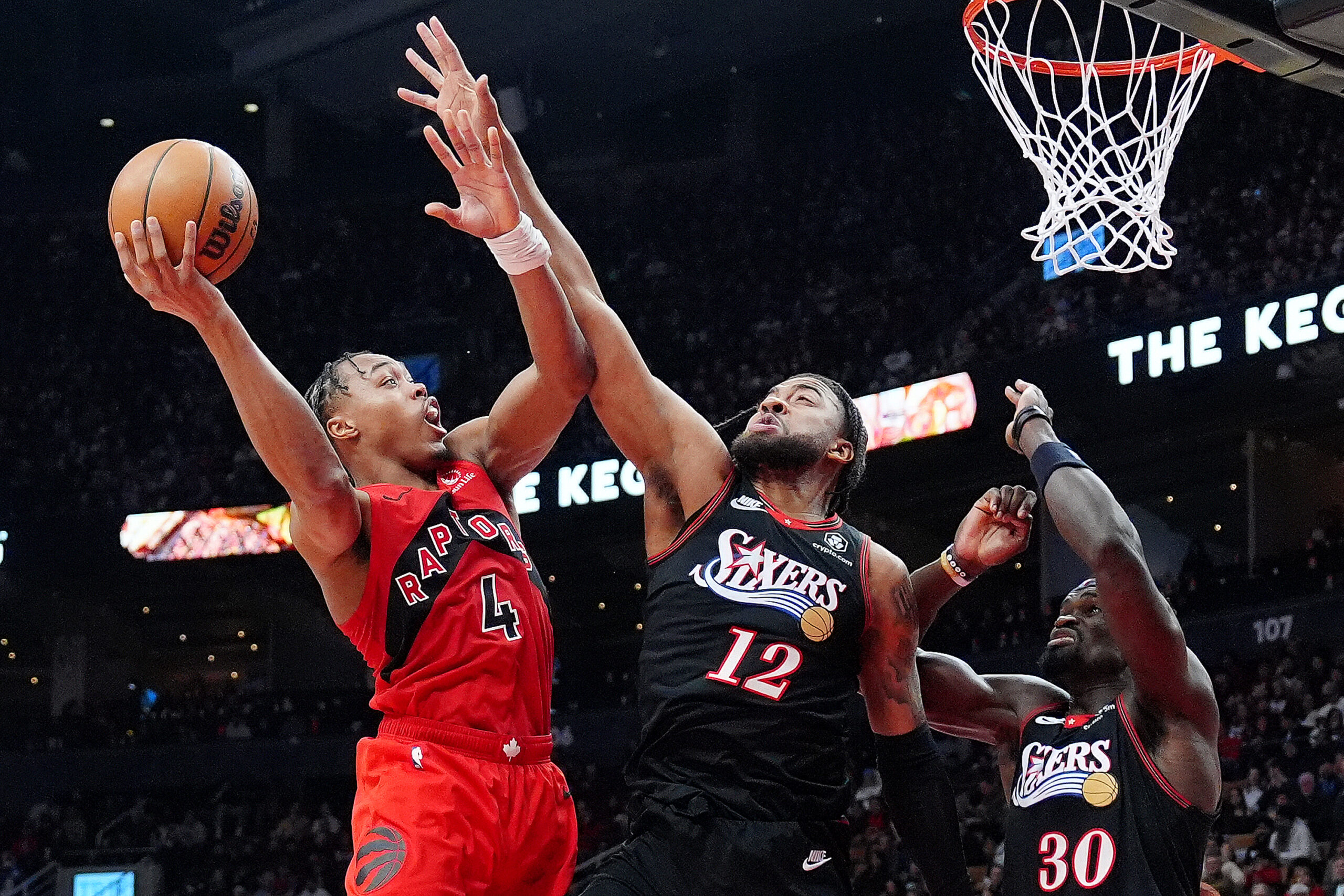
However, they failed to inbound the ball. The Raptors (24-16) won two challenges and made two baskets to force overtime.
The Sixers built a 112-108 lead with 2 minutes, 23 seconds remaining in overtime. But the Raptors responded with a 7-0 run to take a 115-112 lead after the Sixers missed two shots and committed a costly turnover.
Toronto Raptors forward Scottie Barnes (left) led the team in points with 31 against the Sixers.
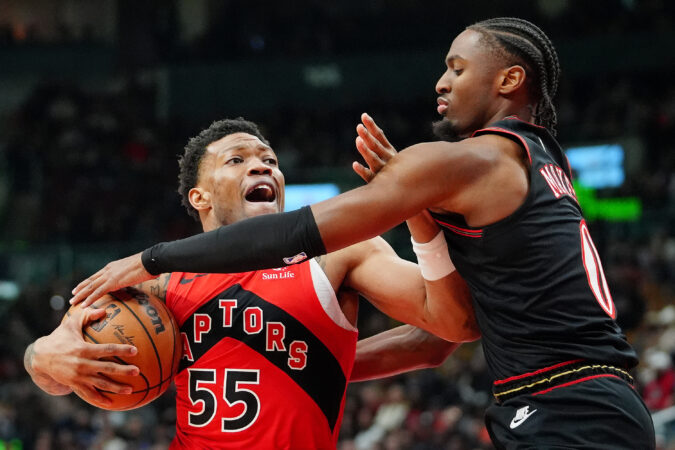
VJ Edgecombe made a 30-foot three-pointer to knot the score at 115. However, Scottie Barnes got away with initiating contact with Oubre, who was called for a foul, on a drive with 0.8 seconds left.
Barnes, who finished with 31 points, eight assists, and seven rebounds, made the first foul shot and intentionally missed the second to win the game.
The Sixers committed 22 turnovers and made just 8 of 31 three-pointers. But they were ultimately doomed by poor late-game execution. Something they need to correct.
“We just got to be better, be more disciplined and stay together in those moments where we’re facing a little bit of adversity, because we both made runs,” Oubre said to reporters. “But you know, theirs was the final shot.”
Barnes will get the credit for winning Sunday’s game. However, the Raptors backcourt of Immanuel Quickley and Jamal Shead had their way with the Sixers guards. Quickley finished with 20 points and seven assists, while Shead had 22 and six assists.
The duo had several downhill drives in the lane. If they couldn’t score, they kicked the ball out to teammates. Late in the game, Shead and Quickley drove the lane. Once the Sixers provided help defense, the guard would dump the ball off to a big man for a dunk.
“We just got out of position on some of that,” coach Nick Nurse said to reporters. “I felt we went to help a little too early, and obviously left too big a passing lane for those dumboffs late.”
But it started with the Sixers guards needing to do a better job of keeping opposing perimeter players in front of them.
Before missing 22 games with a sprained left knee ligament, Oubre was the quiet assassin for the Sixers. The 6-foot-8 small forward averaged 16.8 points, 5.1 rebounds, and 1.1 steals in his first 12 games. In addition to excelling when the ball was moving, Oubre did a solid job of guarding the opposing team’s best perimeter player.
He returned on Wednesday and provided solid defense that night against the Washington Wizards and again on Friday vs. the Orlando Magic. However, he averaged one point on a combined 1-for-9 shooting in those two games.
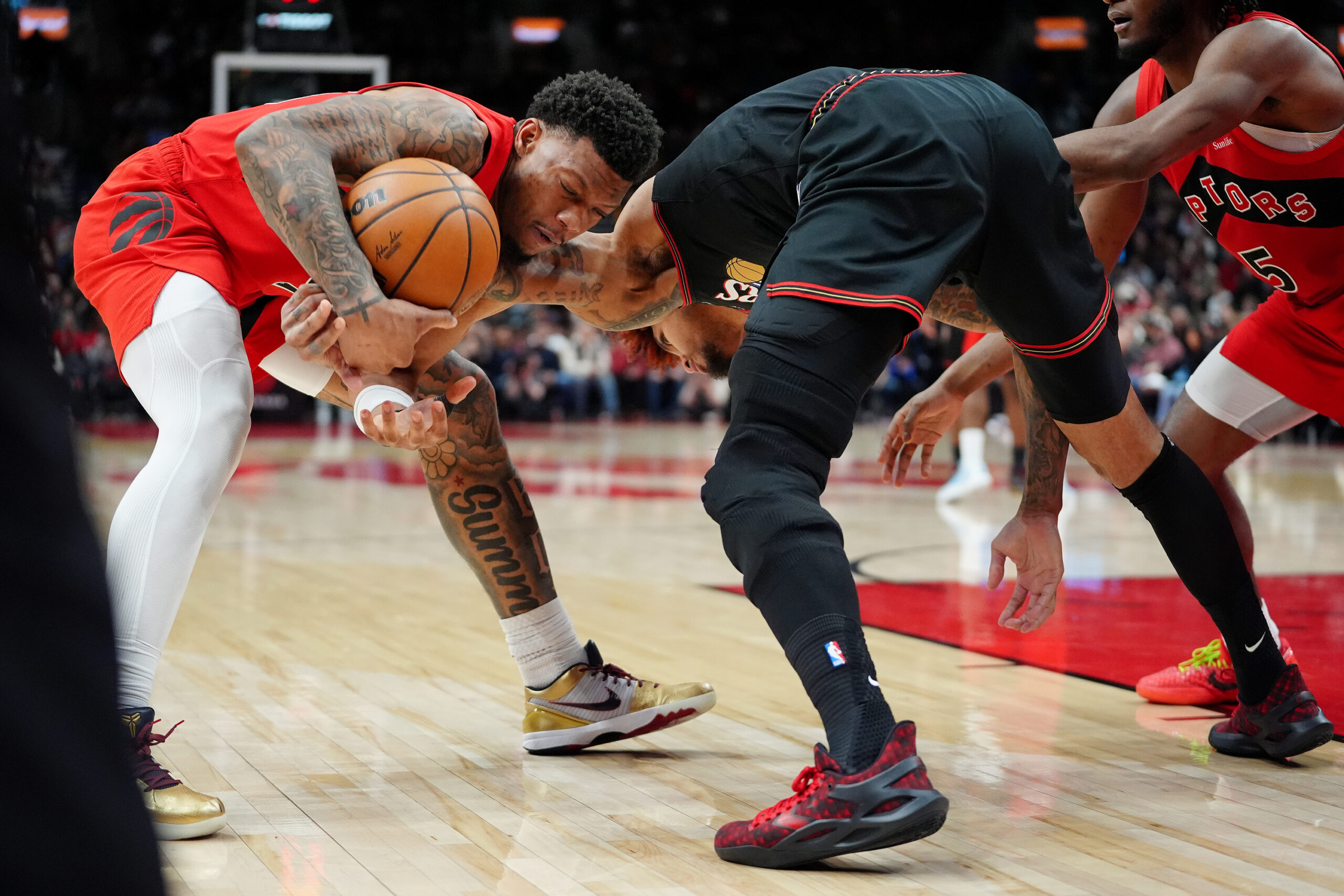
Toronto Raptors guard Alijah Martin, left, strips the ball from Sixers’ Kelly Oubre Jr. during overtime.
He had the complete package against the Raptors.
Oubre finished with 13 points on 5-for-10 shooting to go with five rebounds and season highs of four steals and three blocks in his third game back. Nine of his points came in the third quarter.
“He hasn’t really scored much since being back, so that’s obviously nice to see,” Nurse said. “He even hit a three, but had some really nice drives. He had a couple of good blocks and steals as well, which is why we ended up playing him as much as we did down the stretch.”
He’ll go back to being an X-factor if he can keep this up.
“It definitely felt good,” Oubre said. “It’s just, I think I could be better. I got blocked because I’m not trusting myself and the work that I put in.
“So you know, just watching film, continue to just show up every day and get better. That’s all I can do. But it definitely felt good to get some run.”