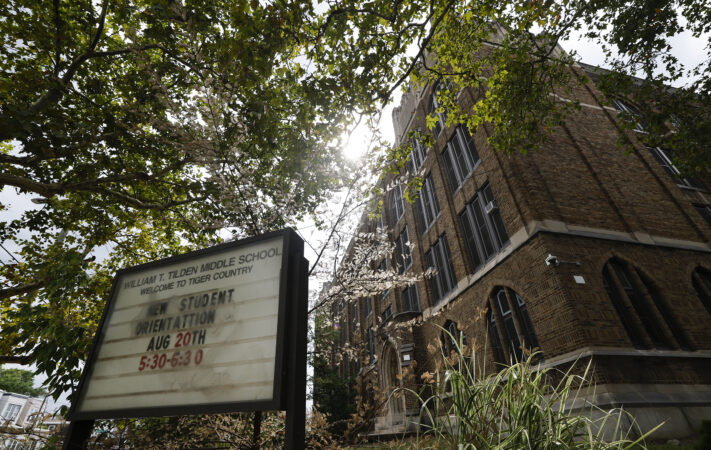
Students streamed out the front doors of William T. Tilden Middle School on a recent Friday afternoon, past the “Welcome to Tiger Country” sign at the corner. As they shouted to friends and threw snowballs to celebrate the weekend, they were dwarfed by the massive brick school building behind them.
That building, which spans half a city block in Southwest Philadelphia, is a primary reason the Philadelphia School District has proposed closing Tilden alongside19 other schools.
Capable of holding roughly 1,400 students, Tilden had only 266 enrolled last year, the district said. That means it is at just 18.5% capacity — the second-lowest of all the schools tapped to close, according to an Inquirer analysis. While enrollment in the school district overall has increased in the last four years, it has declined at Tilden, with just 24 students in this year’s fifth-grade class, district data shows.
The district has rated Tilden’s building as “poor” when it comes to being safe and accessible, meeting environmental standards, and having modern technology. Tilden is also one of six middle schools that Superintendent Tony B. Watlington Sr. has proposed closing in an effort to shift the district’s focus to the K-8 model.
Unlike some of the otherschools on the chopping block, the Tilden community so far has not mounted an organized fight against its closure as the school board prepares to vote this winter on Watlington’s recommendations. Just a dozen employees and residents showed up to an in-person meeting on a frigid Saturday morning earlier this month to discuss the school’s possible closure, according to Chalkbeat Philadelphia, and about 30 attended a virtual meeting about Tilden a few days later. There is no online petition to keep it open, as there are for manyother schools slated for closure.
Students who were set to graduate before the proposed changes would take effect said in interviews outside the school that they did not care much about the possible closure, though some adults expressed more concern.
“This school has had, and still does have, excellent community programs,” said Tilden teacher Cheryl Padgett through tears at the virtual meeting.
The district’s draft facilities plan recommends that in the fall of 2027, Tilden stop accepting new fifth graders, and then gradually phase out its remaining classes, closing for good in 2030.
All of Tilden’s current students would be able to graduate from the school under the proposal; new students who would have attended Tilden for middle school will instead stay at Patterson, Catherine, and Morton — the elementary schools that currently feed into Tilden. The district said all three of those schools would receive increased investment as they add grades and become K-8 schools.
Tilden is in a neighborhood deemed especially vulnerable by the district, which ranked it as “high risk” to account for its experience with previous school closures, as well as its high poverty rate, lack of publictransportation, and language barriers. (The district’s top vulnerability ranking is “very high risk.”)
Tilden’s building would eventually be repurposed as a sports facility for Bartram High and the broader neighborhood under the plan.
At the virtual meeting, community members worried that the buildings slated to become K-8 schools are not equipped for older children, and that younger students would be exposed to problematic behavior from older kids.
Some community members said they feared that changes resulting from the district’s plan, which spans a 10-year period, would not come soon enough.
“Do something now,” said Mama Gail Clouden, a longtime community activist. “While you’re talking about ‘in two years,’ and what you’re planning to do — right now, children and parents and staff are suffering in these schools.”
Tilden also has received additional support and funding from the city’s tax on sweetened beverages through the community schools program pioneered by former Mayor Jim Kenney.
“Our kids can succeed,” Kenney said at a 2017 news conference at Tilden announcing funding for the first group of schools. “They can meet their potential if we give them the resources.”
Asa community school, Tilden’s building serves as a center for such resources: The school hosts a food pantry every Friday, and families can access case management and utility and housing assistance and other supports through a partnership with Methodist Services.
“These kids, they have a way of growing on your heart,” said Wanellie Cummings, an attendance case manager with Methodist Services assigned to Tilden.
Cummings works with kids who have three or more absences to try to address any barriers at home that might prevent them from getting to school. She said she has not heard much from her clients about the potential school closure, though she did worry about Tilden’s food pantry closing.
“When you take that away from a community, what’s left? If those grandmoms and grandpops have to go somewhere else to get food …,” she said.
The district has said it would spend the 2026-27 year planning for how to maintain the resources now offered at Tilden.
When Aaron Deary, partner and general manager of R&D cocktail bar in Fishtown, began formulating his “liquid love letter” to Philly in honor of our nation’s 250th anniversary this year, he set out to challenge his bartenders in a new and novel way.
Seems appropriate, given that Philadelphia finds new and novel ways to challenge each of us every day.
Typically the mixologists at R&D receive cocktail projects that are flavor-focused, but for the bar’s latest themed menu, “Ripoff & Duplicate,” Deary asked them to create 13 drinks based on the stories, legends, and places that make Philadelphia Philly — from the murder of a meddling Canadian robot to the city’s long history of choking in big moments.
Bartender Eddie Manno makes cocktails at R&D.
The concoctions are presented in a 10-page glossy magazine-like menu designed by Deary that features cheeky Philly tidbits, tips, and neighborhood recommendations.
“We obviously had to put some funny things in there, too, because that’s our city and we wanted to show off some of the more ridiculous sides of Philadelphia that we all love,” Deary said.
While the new menu is the first of its kind for the bar, Deary said they plan to do other iterations throughout the year featuring different Philly neighborhoods and events. So while a dumpster pool drink didn’t make the cut this time, there’s still hope yet.
The Casting Bait (a tropical sour with Vietnamese gin, mangosteen, ginger, guava, and lime) at R&D.
“There were a few of them that came up and ones that I was a wee bit too scared to jump into, but you never know, you might see them in summertime,” Deary said.
Can Philadelphia’s stories be conveyed in a cocktail glass, and, if so, do they taste good? Inquirer food writer Kiki Aranita joined me at R&D last week to find out. We chatted about our experience the next morning. — Stephanie Farr
Kiki Aranita, food and dining reporter
Looking at some of the cocktail descriptions, I won’t lie — I was initially skeptical. There was nutmeg paired with watermelon, cream cheese paired with white chocolate. It takes a sort of mad genius (or 10 of them) to come up with those flavor combinations and have them be good.
I believe the technical term is “wackadoodle.”
Stephanie Farr, Philly culture columnist
Agreed. What I loved was how the drinks were created. Aaron told us they came up with the Philly reference for the drinks first and then created different challenges for the bartenders to invent them. For the HitchBOT, the rule was to create a drink made with ingredients from each of the countries HitchBOT went to before being murdered in Philly. So there’s a gin from Holland, a German herbal liqueur, a Philly orange liqueur, and Canadian maple syrup.
Longing for Awnings and the Art of the Choke.
For the Art of the Choke, an ode to all the times Philly’s choked in major moments over the years, the rule was to create a drink using ingredients that spelled out J-A-W-N, so there’s Jamaican rum, artichoke amaro, watermelon, and nutmeg.
The best analogy I can think of is it was like these bartenders were given amazing writing prompts and came up with great liquid stories.
Kiki Aranita
HitchBOT was made blue by blue Curacao. It was the most visually stunning of all the drinks, which showed shocking restraint in terms of garnishes and presentation.
It’s one of the less sweet sours I’ve had and it had Jagermeister in it, which gave it a surprising, herbaceous balance.
The Hitchbot (a blue sour with Dutch gin, Jagermeister, maple, and lemon).
Stephanie Farr
I think the Crum Bum was really interesting. It’s listed on a menu page that tells about Philly’s history with pretzels and baseball, but it’s a pretty clear nod to the infamous incident where KYW reporter Stan Bohrman approached a then-retired Frank Rizzo to ask why city police were acting as his private security detail. In turn, Rizzo called him a “Crum Bum.” I love getting to introduce that legendary Philly moment to people who haven’t seen it yet. And as I said, as a reporter, it’s good to be hated by the right people, and Rizzo is definitely someone you want to be hated by.
Also that drink came with a sidecar of pretzels, and it smelled like pretzels and Philly and love. It was a little strong for me though.
Kiki Aranita
We had to ask for seconds of pretzels at this point.
Stephanie Farr
I mean, that is a Philly drink. I want all my cocktails to come with a sidecar of pretzels from now on.
The Crum Bum, a tequila old fashioned with genever, burnt honey, pretzel and mustard spices.
Kiki Aranita
I have to say — a lot of the drinks sounded weird but didn’t taste weird. They were straightforward, balanced, and really lovely.
Stephanie Farr
As you noted, there was a lack of garnishes overall, aside from a few twists. Do you think that was the right call? I don’t know why I was expecting them to come with a Tastykake on the rim or something. That being said, I did not miss the garnishes once I dove into the drinks.
Kiki Aranita
I’m not a native Philadelphian … and I’ve never had a Tastykake. I’m glad my first one didn’t have to be shoved into a cocktail last night.
No component was ever too much. Longing for Awnings, an ode to South Philly, had lingering spice (but not too much!) from serrano pepper and beautiful body from tomatillo (but also not too much! It didn’t taste like salsa).
I also loved the Kompleta martini, which I found really smart and a great way of using Polish bison-grass vodka (not the easiest to find and rarely seen except in Polish restaurants) with Italian Nonino bitters. It tells the story of major immigrant groups coming to Philly in a really thoughtful way.
The Kompleta Martini with bison grass vodka, Italian bitters, and Islay gin.
We also found that embedded in all the Philly history, there were personal stories, the fingerprints of previous bartenders and bar managers who left their mark on R&D. For instance, Resa Mueller, who used to run the bar there — her citywide is a pet-nat and room-temperature gin. You can go and order that off this Very Philly Menu.
Stephanie Farr
And how about that menu? It’s beautiful and cheeky — part neighborhood guide, part Philly history, part urban legend and also still a menu.
In a small guide to Bella Vista in the menu, for instance, it says to go to Angelo’s but “don’t pee on the street” and it also reads “Magic Gardens, mushrooms,” without any context. I’m pretty sure they don’t sell mushrooms at the Magic Gardens, so I can only assume what they’re talking about here.
Kiki Aranita
They self-deprecatingly describe these cocktails as gimmicky, but they’re really not. They lead with flavor and balance first, and gimmick second.
Reading through the menu (it’s basically a graphic novel) and tasting through the cocktails that were odes to different neighborhoods (though unfortunately not mine), made me feel a lot of Philly pride. You really see how vast our bank of flavors, spices, produce, and dishes is.
And in the hands of nerds, it was so much fun to see what they came up with.
I do have to recommend for our readers, though, that they should not attempt to try all the cocktails solo. Bring a group. There are so many cocktails.
Stephanie Farr
I think the menu also illustrates how vast our stories are but also how we have a shared sense of culture as Philadelphians — moments we all remember and some we can never forget, like when Philadelphians caught babies thrown from the window of an apartment building fire, “unlike Agholor.”
Sue Altman showed up at a state Senate hearing in late 2019 to confront George E. Norcross III and was dragged out by state troopers. Six years later, she is using that incident as an example of why New Jersey voters should send her to Congress.
“If anything can prepare you for a dogfight that Washington politics is, it’s Jersey politics,” said Altman, one of more than 15 Democrats vying to succeed retiring U.S. Rep. Bonnie Watson Coleman in a reliably blue Central Jersey seat.
Altman, 43, recently resigned after serving for the last year as state director for U.S. Sen. Andy Kim, a South Jersey Democrat who has also challenged the state’s machine politics. Before that role, she unsuccessfully ran for Congress in 2024 in a swing district thatborders Coleman’s district.
She made a name for herself as a progressive activist in Camden, where she fought former Republican Gov. Chris Christie as the state began its takeover of the city’s public schools, vocally criticized power brokers like Norcross, and leda legal effort to abolish the county line from New Jersey ballots before Kim took it to the finish line in 2024.
“My time in Camden was extremely important, and in many ways shapes the work that I did in the state from that point forward,” she said.
WhileAltman built her progressive credentials in Camden, she has most recently lived in Lambertville andwill be relocating northeast to Bridgewater to move in with her long-term boyfriend, who lives just outside the district’s boundaries.
“I think what the electorate is hungry for and what the party needs are people who are going to challenge power,” she said. “I’ve done that my whole career.”
Altman, who grew up in Central Jersey, playedprofessional basketball in Ireland and Germany after graduating from Columbia University. She earned two master’s degrees from Oxford University before landing in Camden in 2014.
She garnered attention in the city for going back and forth with Christie for roughly six minutes at a public meeting in which they tossed a microphone in the air to each other.
Altman drew national attention that year after she was dragged out of the hearing in Trenton on a corporate tax incentive program Norcross defended,drawing a message of support from U.S. Sen. Elizabeth Warren (D., Mass.). Activists used images of the incident to bolster their argument that unelected power brokers like Norcross hold outsize influence in New Jersey, though Norcross later said he did not believe she should have been thrown out.
Camden Mayor Vic Carstarphen, a Democrat, criticized Altman for what he called her “singular focus” on “trying to tear down” Norcross during her time in Camden for her own “self-promotion.”
“She created a lot of chaos in the city, and ran amok throughout the city,” Carstarphen said Tuesday.
In 2021, Altman led the legal strategy in the first major lawsuit against the county line, the old ballot that was advantageous to party-endorsed candidates. The fall of the line has led to more competitive primaries, including her own.
She went on to unsuccessfully challengeincumbent Republican U.S. Rep. Tom Kean Jr., losing by more than five percentage points in 2024.
Altman said dealing with immigration cases while working in Kim’s office partially inspired her to run again. She said Democrats should replace U.S. Immigration and Customs Enforcement with “full comprehensive immigration reform” while also securing the border.
Neither Kim nor the Working Families Party has weighed in on the race.
Altman warns that the country is at “one of the most vulnerable points” in its history with Trump in office for a second time.
“We have a very short window of time to prove to the rest of the country that Democrats in power can deliver for people and hold Trump accountable, but not get overwrought with the politics of it,” she said.
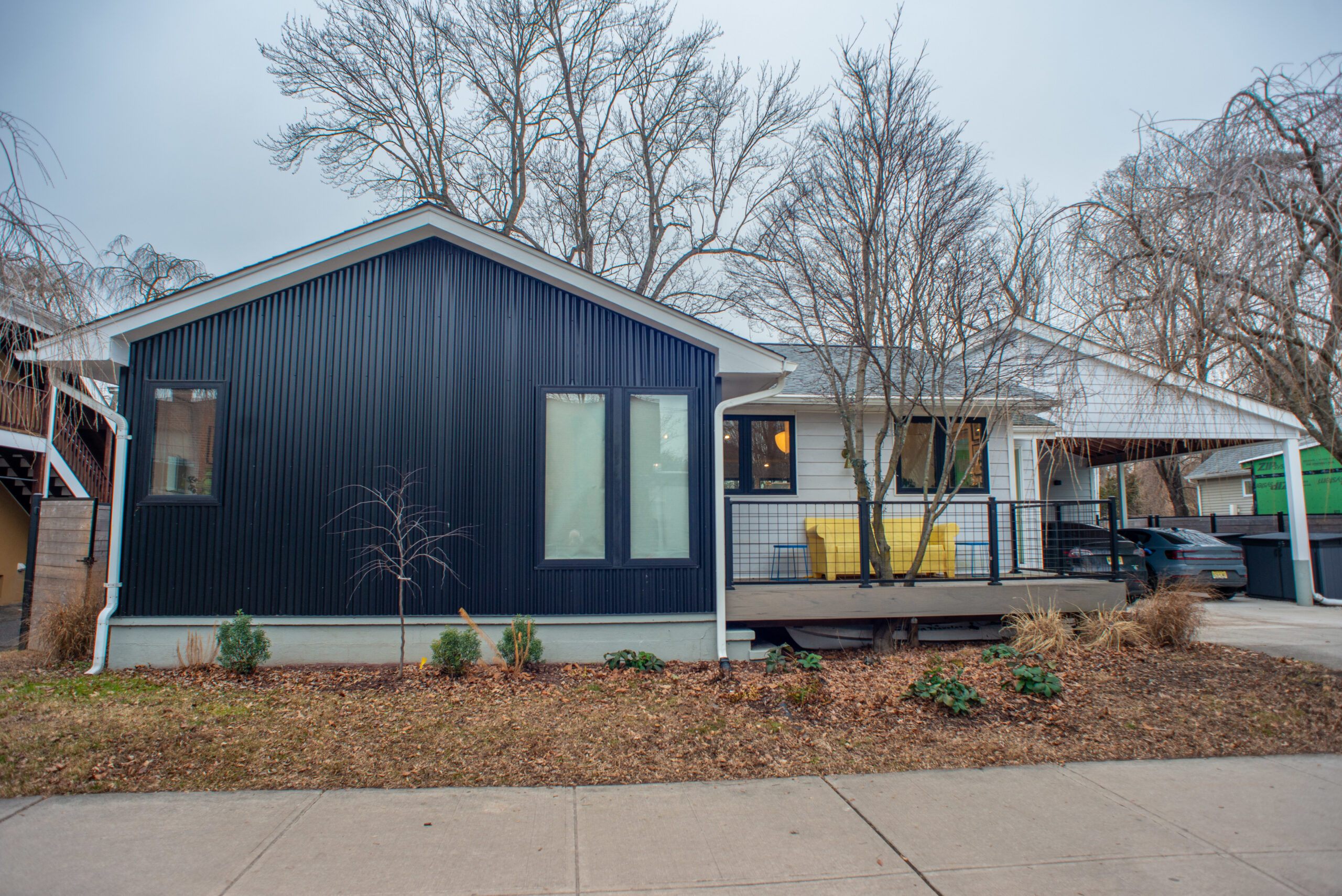
As their family grew, Lauren Braun-Strumfels and Kyle Strumfels felt the walls of their 1895 rowhouse in Lambertville, N.J., closing in on them. With two kids, the 16-foot wide, one-bathroom house left a lot to be desired.
They pined after the neighboring standalone house built in the 1970s, an abnormality for the Victorian-era town that attracts antiques lovers to Hunterdon County year-round. Even though maintenance had been deferred for decades, the house sat on an unusually roomy lot for the dense, walkable downtown. The couple, unafraid of a renovation, had a vision for what it could become.
But creating the California modern-inspired ranch house they live in today was not nearly as straightforward. First, buying the house proved challenging.
The exterior of Kyle Strumfels and Lauren Braun-Strumfels’ home in Lambertville, N.J.
“When we finally got to the table and signed the deal, [the seller’s] lawyer said, ‘I thought she was gonna go breach of contract, like, three times!’” Braun-Strumfels, 46, said. The couple felt it on their end, too, as they helped guide their neighbor through the sale. “It was very stressful and very intense.”
They closed for $290,000 in August 2017. The young family moved into the two-bedroom house on Feb. 4, 2018, the day the Eagles won the Super Bowl, recalled Strumfels, 47. Their two kids, now 12 and 9, shared one room while the couple had the other. Everything needed updating.
“With the rowhouse, there were certain things that we just wouldn’t want to do to it, historically, to preserve the character,” Braun-Strumfels said. “This house was a total blank slate. It was neither historic nor attractive, so we felt like we could really transform it.”
In the first of their two major renovations, they funneled $150,000 into moving the kitchen to the front of the house, bumping the back wall of the house out to add more living space, and adding a Jack-and-Jill bathroom connecting the two original bedrooms on top of less exciting but no less important mechanical upgrades. They lived that way for a few years but always knew there was more work to do.
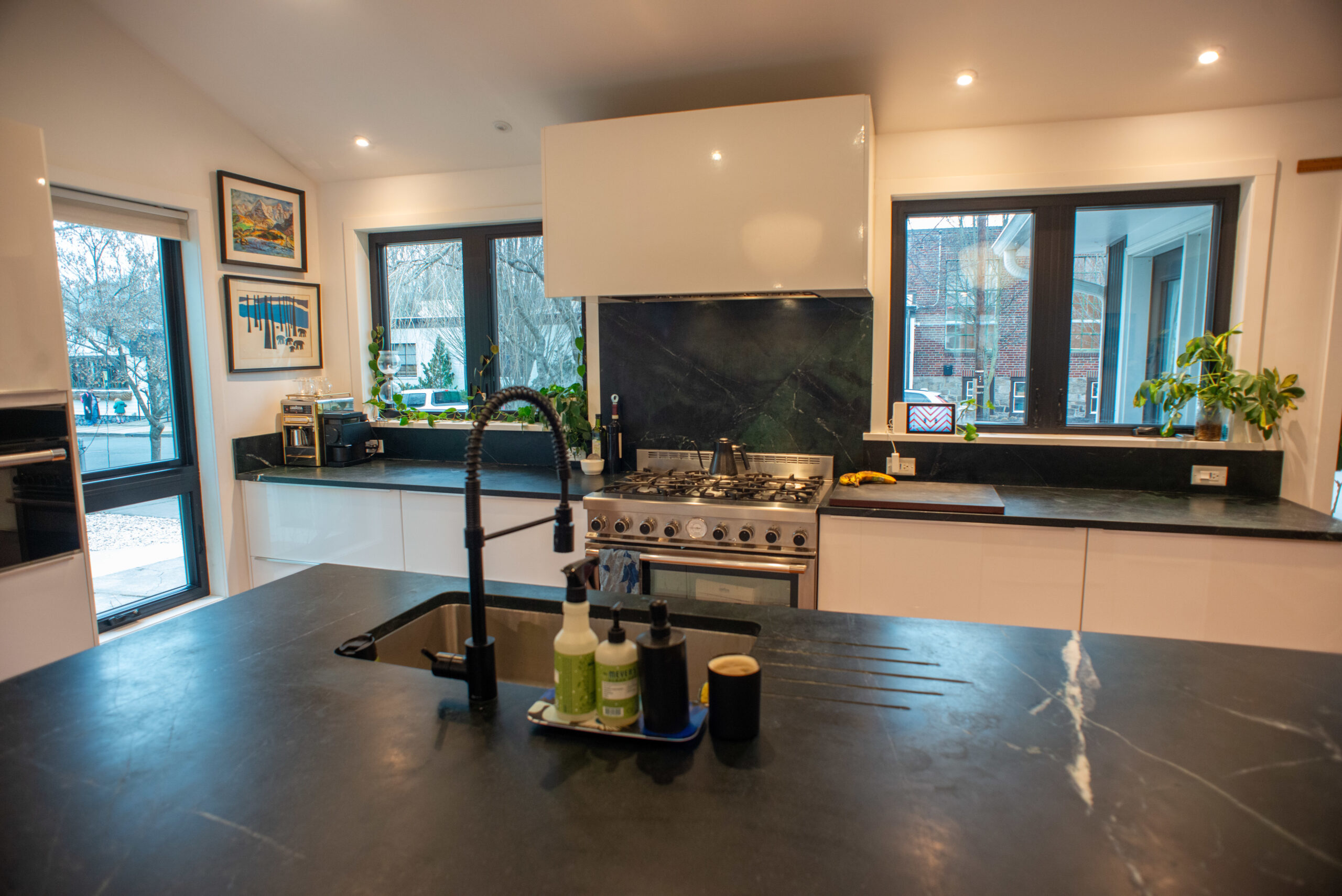
The kitchen, which was relocated in the first round of renovations.The main bathroom.
The second renovation didn’t go quite as smoothly.
The couple began pursuing a $300,000 construction loan in 2018 that didn’t close until 2020, thanks to a zoning snafu. The amount was intended to leave a nice cushion for finishing details, but by the time the loan was theirs, the pandemic had driven up lumber costs and “our whole budget got eaten by two-by-fours,” Braun-Strumfels said. Their tile budget was whittled down to about $1 per square foot in the bathrooms, meaning Braun-Strumfels had to let go of her plans for elaborate tile and countertops.
They also had to part with one architect who didn’t quite get the couple’s vision. They then hired Princeton-based architect Peter Wasem.
The hallway near the entrance features a large painting that contrasts with the green front door.
Ultimately the renovation added 1,000 square feet for a new entry as well as what they call an “adult wing,” with a walk-in closet that leads to an en suite bathroom. Through a stroke of smart design, the en suite’s water closet doubles as a powder room, creating a circular flow through the wing.
Coming from their rowhouse, which only had two exposures, it was important to Braun-Strumfels and Strumfels to take advantage of the roomy lot’s natural light. The primary bedroom is lined in windows — with a partial view of their old property. Their living room addition also has a large window overlooking the backyard.
The primary bedroom has two-story windows, high ceilings, and a living space.
The original front porch was enclosed to become a shared office for Braun-Strumfels, an associate professor of history at Cedar Crest College, and Strumfels, a senior vice president of ESG and climate at Macquarie Group. A new carport gives the house a distinctly mid-century touch.
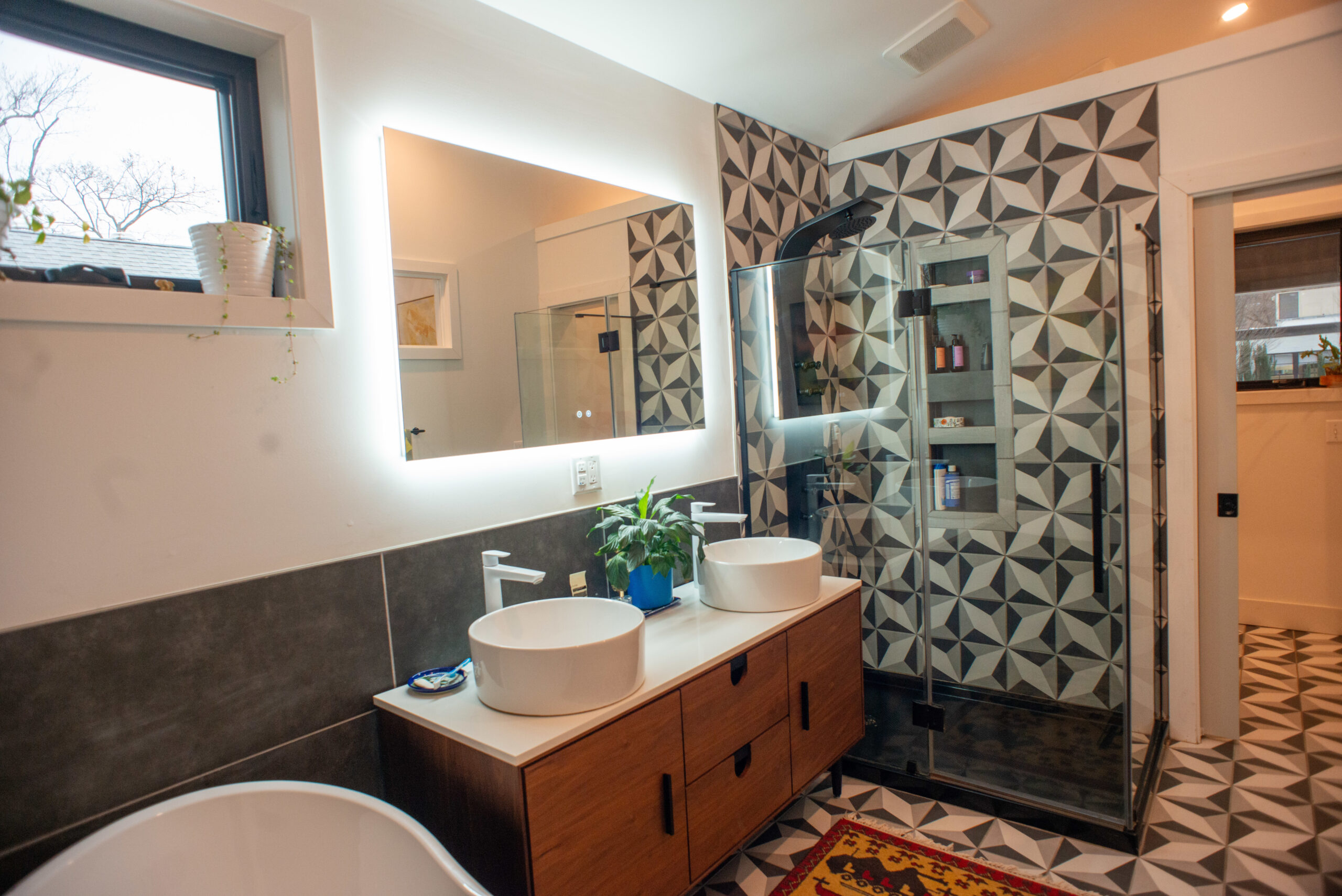
The result of the renovations is an open-concept house where the couple’s eclectic furniture, wares, and finishes can live in harmony. Their collection of mid-century furniture and wares from local joints like Rago Auctions coexists with original art, including Strumfels’ favorite piece from Philadelphia’s Material Culture. And that’s on a backdrop of modern finishes like sleek soapstone countertops and Herman Miller pendant lighting over the oversized kitchen island.
“Sometimes I wondered if people would be mad we stuck a modern house in the middle of this town, but people seem to really like it,” Strumfels said. Folks in the area can be very resistant to change, Strumfels said, but “we get a lot of nice feedback.”
Mid-century furniture and original art coexist in an eclectically decorated home.
They have no plans to move, but Braun-Strumfels said they do harbor a hope of someday returning to Philadelphia, where they lived for a year before moving to Lambertville.
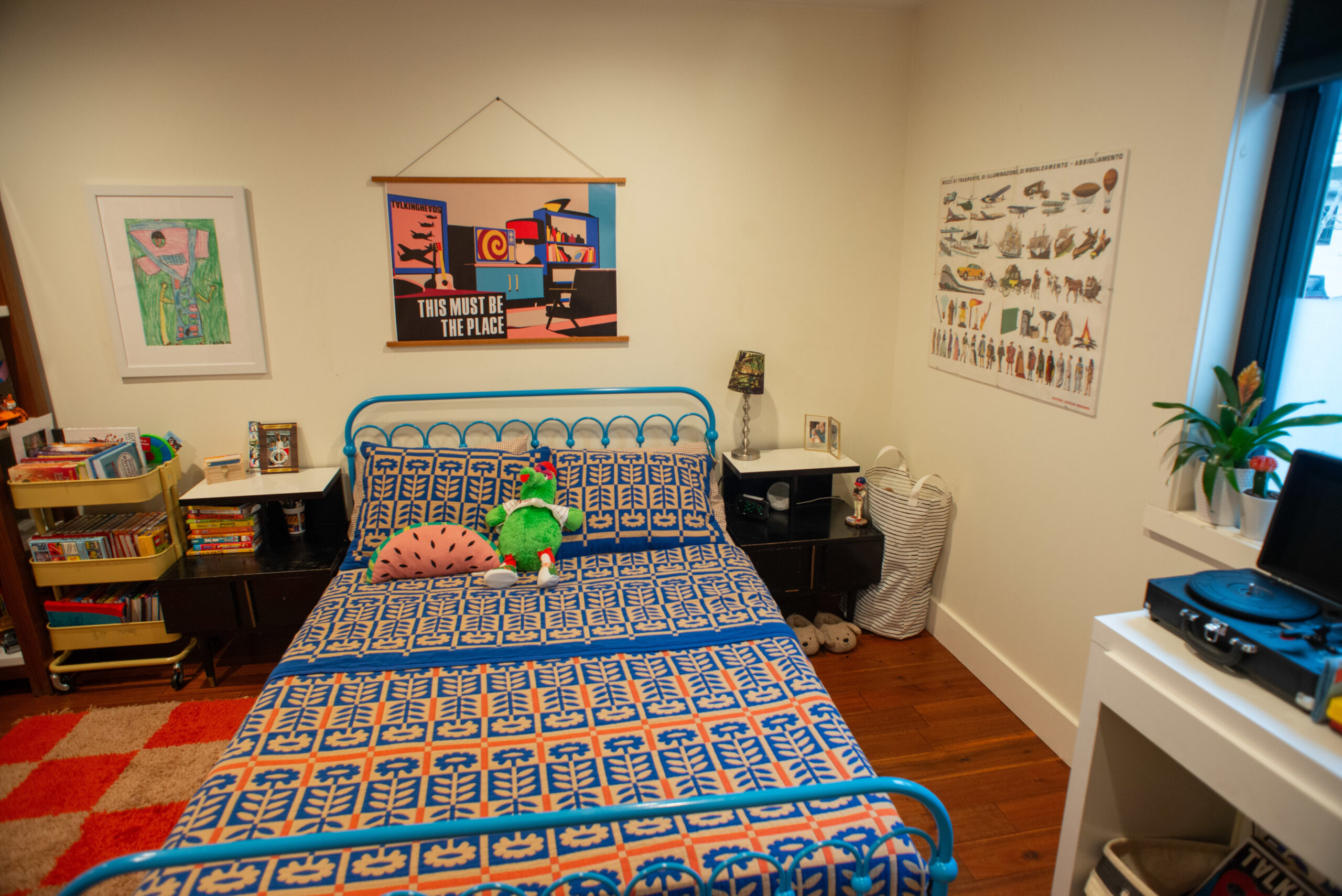
Paintings hang on the wall.One of the children’s bedrooms.
“We have our little pipe dream that we might retire eventually, get a little spot in the city, go back and forth,” she said.
But for now, they’re finally perfectly at home.
Is your house a Haven? Nominate your home by email (and send some digital photographs) at properties@inquirer.com.
Next week, 319 college football prospects will descend on Indianapolis for the annual NFL scouting combine, where they will be tested physically, mentally, and medically, interviewed by NFL front office personnel, and will speak with hundreds of media members.
This latest step in the 2026 NFL draft process allows teams to home in on the next crop of players that will fill their franchises. All 32 teams will have 45 “formal interviews,” which last just under 20 minutes, can include watching film or any questions teams want to ask a prospect, and typically take place in the Lucas Oil Stadium suites.
The first direct touch point with prospects happened at last month’s Shrine and Senior Bowl games. NFL teams will utilize this next piece of the puzzle to identify which prospects match their team needs.
Here is how we’re ranking the combine position groups from strongest to weakest — and how they could help the Eagles address some roster needs.
Ohio State cornerback Davison Igbinosun (1) is a potential target for the Eagles beyond the first round.
1. Cornerbacks
It’s a good year to add a secondary player, whether they play outside corner, nickel, or safety. But outside and boundary corners, specifically, will be plentiful from the first round to Day 3 of the draft.
This is a position the Eagles could address early, but not one that will likely be prioritized in the first round. Among the early projected draft picks at the position are LSU’s Mansoor Delane, Tennessee’s Jermod McCoy and Colton Hood, Clemson’s Avieon Terrell, and South Carolina’s Brandon Cisse.
Finding a corner to develop into a starter opposite of Quinyon Mitchell — assuming they don’t bring back Adoree’ Jackson, who is set to be a free agent — should be among the Eagles’ objectives. Keep an eye on San Diego State’s Chris Johnson, Ohio State’s Davison Igbinosun, Arkansas’ Julian Neal, Georgia’s Daylen Everette, and Texas A&M’s Will Lee as players who could interest the Eagles.
Ole Miss wideout Harrison Wallace III (2) could be a depth or slot option for the Eagles.
2. Wide receivers
There is always a healthy stable of receivers entering the draft, and 2026 is no different. The Eagles, of course, won’t be drafting a wide receiver early — unless they trade A.J. Brown before the draft — but they will need to add more depth to the room regardless.
The top of the class is led by Ohio State’s Carnell Tate, Arizona State’s Jordyn Tyson, and USC’s Makai Lemon, but the receivers heading to the combine feature several skill sets.
The Eagles’ WR3 spot is a potential question mark heading into next season with Jahan Dotson heading into free agency. Players like Ole Miss’ Harrison Wallace, Baylor’s Josh Cameron, Georgia Tech’s Eric Rivers, and Clemson’s Antonio Williams are players to keep an eye on that can occupy either a slot role or have moved around the formation in their collegiate careers and could fit in a depth role for the Eagles.
Would Penn State defensive end Dani Dennis-Sutton (33) be a fit for the Eagles’ pass rushing group?
3. Edge rushers
There is an abundance of edge rushers worth drafting in this class, with Miami’s Rueben Bain, Texas Tech’s David Bailey, and Auburn’s Keldric Faulk as the top names. With Jaelan Phillips and Azeez Ojulari set to become free agents and Brandon Graham’s status unknown for 2026, the Eagles’ edge rusher room desperately needs more depth.
The versatile edge rusher types might interest the Eagles more in this class, though, to complement the relatively light-body types in the edge rusher room currently. Alabama’s LT Overton, Florida’s Tyreak Sapp, and Penn State’s Dani Dennis-Sutton are all players who are bigger in size and have the ability to play from three-techniques out to true pass rusher alignments.
As for developmental pass rushers, keep an eye on Michigan’s Jaishawn Barham, Western Michigan’s Nadame Tucker, and Boston College’s Quintayvious Hutchins as late Day 2 and early Day 3 options as pure pass rushers.
Christen Miller (52) is another Athens-to-South Philly possibility for the Eagles.
4. Interior D-line
As the Eagles and Seattle Seahawks proved in the last two Super Bowls, an interior pass rush presence matters a whole lot, and the NFL has a deep group of prospects to choose from in this class.
There are run stuffer types such as Texas Tech’s Lee Hunter, Ohio State’s Kayden McDonald, Iowa State’s Domonique Orange, and Georgia’s Christen Miller, and twitchy pass rushers including Clemson’s Peter Woods and Florida’s Caleb Banks.
Jalen Carter and Jordan Davis could soon get extensions from the Eagles, but adding more bodies to have a deeper rotation and talent level in the room would only help keep those players fresh. Michigan’s Rayshaun Benny, Missouri’s Chris McClellan, and Texas A&M’s Tyler Onyedim are a few Day 2 and 3 options to keep tabs on.
Eric Gentry is a local product who might be of interest to the Eagles.
5. Linebackers
The Eagles linebacker room became a strength of the defense over the last few seasons and they won’t need to expend an early-round pick on one. But this class has three first-round caliber players at the position: Ohio State’s Arvell Reese and Sonny Styles and Georgia’s CJ Allen.
The Eagles could lose Nakobe Dean to free agency this offseason, but still have Jihaad Campbell and Zack Baun penciled in as starters. There are two players in this class with Philly-area ties: USC’s Eric Gentry, the former Neumann Goretti standout, and Missouri’s Josiah Trotter, the younger brother of Jeremiah Trotter Jr. Josiah Trotter and Gentry are both expected to get drafted.
North Carolina State tight end Justin Joly (7) could be an intriguing target for the Eagles.
6. Tight ends
Put a big circle around this group, because tight end is one of the pressing needs for the Eagles. Dallas Goedert, Grant Calcaterra, and Kylen Granson are all set to be free agents, and regardless of whether any of those players return, the room needs more talent in it.
Oregon’s Kenyon Sadiq is at the top of the class, and likely the only tight end to go in Round 1. But this class is strong on Day 2 and 3.
Ohio State’s Max Klare, NC State’s Justin Joly, Georgia’s Oscar Delp, and Baylor’s Michael Trigg are all receiving tight end prospects worth taking on Day 2. Players who can thrive in-line as blockers and have some receiving chops as well include Ohio State’s Will Kacmarek, Penn State’s Khalil Dinkins, Texas A&M’s Nate Boerkircher, and Indiana’s Riley Nowakowski, who can also play fullback.
Other later names, including Utah’s Dallen Bentley, Ole Miss’ Dae’Quan Wright, and Stanford’s Sam Roush are developmental options on Day 3 and could fill roles as second or third options in multi-tight end formations.
Could Xavier Nwankpa (1) join Cooper DeJean as another ex-Hawkeye in the Eagles secondary?
7. Safeties
This is a position that probably needs more attention than it generally gets, considering Reed Blankenship and Marcus Epps are soon-to-be free agents. Drew Mukuba and Sydney Brown are the only players under contract for next season who have taken significant snaps at the position.
This is a strong safety class, led by Ohio State’s Caleb Downs, who is also one of the best players in the draft class. Quinyon Mitchell’s alma mater, Toledo, has another early-round pick in Emmanuel McNeil-Warren, and there are plenty of coverage specialists such as USC’s Kamari Ramsey, LSU’s A.J. Haulcy, and Arizona’s Genesis Smith.
Since Blankenship played more near the line of scrimmage, the Eagles could be looking to pair that skill set with Mukuba, and players including Penn State’s Zakee Wheatley, Oregon’s Dillon Thieneman, and Iowa’s Xavier Nwankpa fit the bill.
Kadyn Proctor (74) is generating buzz as a possibility along the Birds’ offensive line.
8. Offensive linemen
This is the spot the Eagles need to upgrade most heading into next season, yet it’s among the weakest groups in this class in terms of starting caliber players. Still, there are players that will interest the Eagles.
The player most commonly linked to the Birds is Alabama’s Kadyn Proctor, a massive offensive lineman with unique athleticism at 6-foot-7, 366 pounds. Is he a tackle or guard? That debate could get settled at the combine next week.
The other top offensive linemen are Utah’s Spencer Fano and Caleb Lomu and Miami’s Francis Mauigoa. Fano and Mauigoa are also players that could move to the interior at the NFL level. Georgia’s Monroe Freeling, Arizona State’s Max Iheanachor, and Clemson’s Blake Miller are the next group of fringe first-round players who will strictly be tackles in the NFL and could serve as potential heirs to Lane Johnson whenever he retires.
As for interior offensive line, Penn State’s Olaivavega Ioane is the only true guard prospect that is Round 1 worthy. The Day 2 prospects like Texas A&M’s Chase Bisontis, Oregon’s Emmanuel Pregnon, Georgia Tech’s Keylan Rutledge, and Notre Dame’s drop-off could be players the Eagles have interest in, especially with Landon Dickerson’s uncertain future.
The overall O-line class has a steep drop-off after the starting-caliber players, so if the Eagles want one, they’ll need to draft one early.
9. Running backs
The Eagles seem set at the running back position for now with Saquon Barkley, Tank Bigsby, and Will Shipley. A quick glance at the running back invites at the combine shows a relatively limited group to pick from.
There’s only one running back right now that has first-round consideration, and that’s Notre Dame’s Jeremiyah Love. Beyond him, the next running back could wait a full one or two rounds before hearing their name called in the 2026 draft.
Illinois quarterback Luke Altmyer is a potential developmental QB the Eagles might evaluate.
10. Quarterbacks
As we alluded to in the All-Star game takeaways, this is not a strong quarterback class and it’s reflected in the number of combine invites. Indiana’s Fernando Mendoza is the projected top pick, but beyond him, the class is wide open. Alabama’s Ty Simpson could go in Round 1, but the gap between the second and third quarterback taken in this class could be very wide.
The class overall lacks starting caliber players, and the sweet spot of the class is likely between Rounds 3-6. The Eagles could draft one to develop since Sam Howell is a free agent and Tanner McKee could move on over the next year via trade or free agency.
Some players attending the combine that could make sense for the Eagles include Kansas’ Jalon Daniels, Arkansas’ Taylen Green, and Illinois’ Luke Altmyer.
As the Main Line contends with the recent abrupt closure of Di Bruno Bros. markets in Ardmore and Wayne, ahomegrown Italian-specialties purveyor — just as storied as its South Philly-rooted counterparts — remains open for business.
On the day before Valentine’s Day, shoppers at Carlino’s Market on County Line Road tucked heart-shaped macarons and chocolate-dipped cannoli into baskets already full with marinara sauce, freshly packed chicken cutlets, and imported cheese. Regulars stopped by for their pre-weekend deli orders, and shoppers took refuge from the cold amid aisles of driedpasta and prepared foods.
Carlino’s is an Ardmore institution, founded in 1983 as a small, family-owned pasta shop serving Lower Merion’s Italian community. In the decadessince, the market has grown into a suburban powerhouse, supplying Ardmore, West Chester, and the surrounding towns with prepared foods, baked goods, and high-end groceries seven days a week.
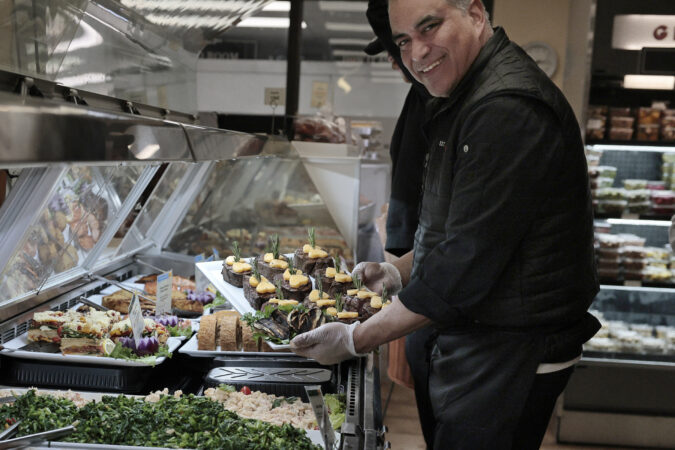
The Carlino’s brand has started to transcend its Ardmore roots: In recent years, the family-run operation has expanded its wholesale business to hundreds of grocery stores, from New York to Delaware and as far as Texas. Even as the company grows, its second- and third-generation leaders remain grounded in its origins as a mom-and-pop shop.
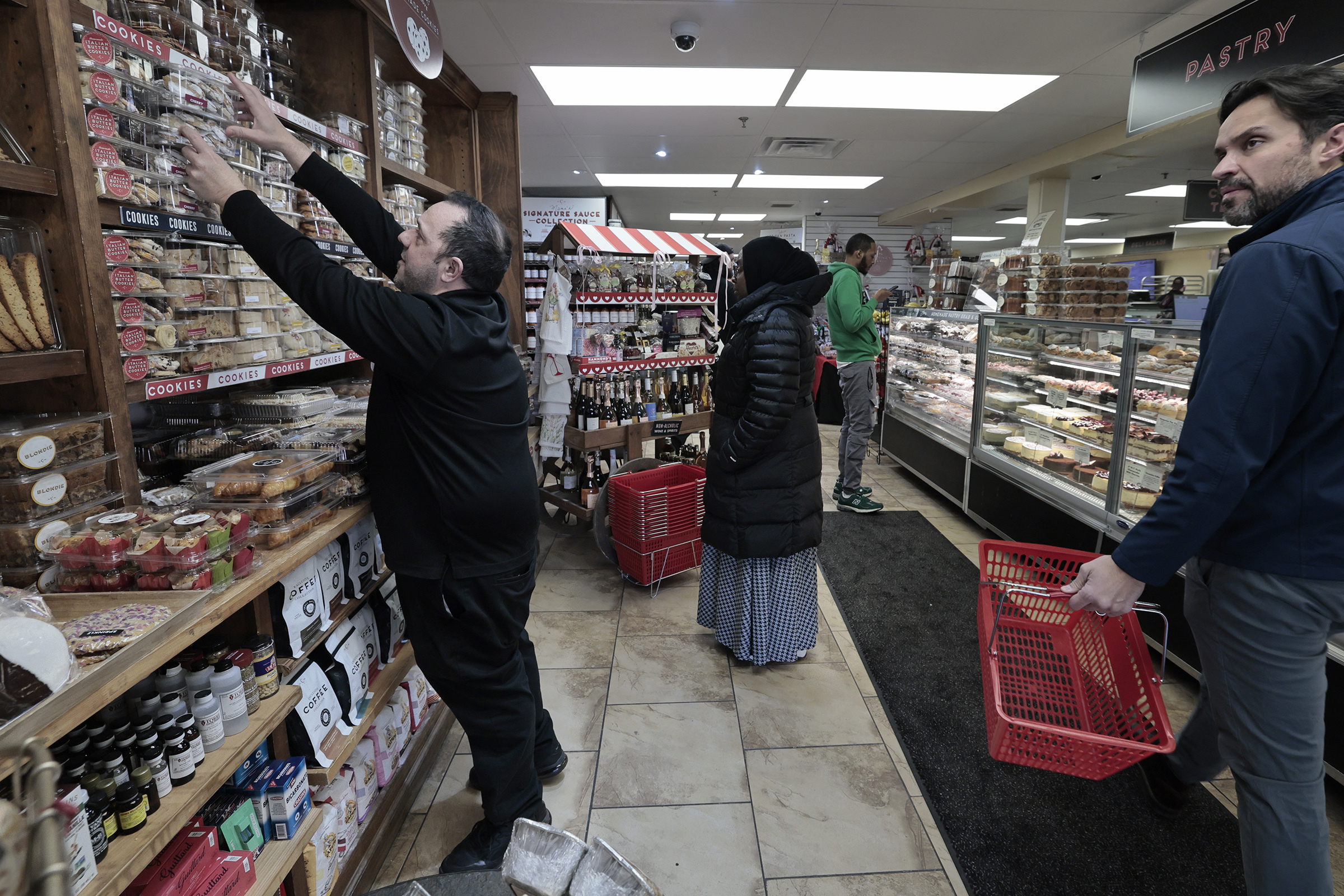
Carlino’s Market general manger Bruno DiNardo (left) restocks cookies, pastries and treats, all homemade, at Carlino’s Market in Ardmore on Friday, Feb. 13, 2026.
From Abruzzo to Ardmore
Carlino’s was founded by Nicola and Angela Carlino, who left Abruzzo in 1968 to move to the United States with their two sons, Pasquale (“Pat”) and Carmen. In Abruzzo, the Carlinos tended to olive groves and grape vineyards and raised livestock on Nicola’s family farm. They left in search of better opportunities for their sons, landing in Ardmore, where Nicola initiallyworked as a bus driver and groundskeeper at Mitchell Prep, a private school, while Angela sold cookies, fresh pastas, and sauces out of their home.
When Mitchell Prep closed in the early 1980s, Nicola and Angela decided to take a chance on a family business. They opened Carlino’s Homemade Pasta in a former barbershop on East County Line Road in South Ardmore — at the time, an Italian American enclave. Residents in search of a taste of home regularly patronized Carlino’s, and the family started wholesaling some products to local restaurants and casinos.
According to Pat Carlino, 63, now the company’s CEO, it’s easy to take the Philly area’s formidable Italian-food scene for granted. But when his parents opened Carlino’s in the 1980s, Pat said, you could barely find marinara sauce in the grocery store. No one knew what tiramisu was, or how to tell the difference between high-quality Parmigiano Reggiano and grocery-store sprinkle cheese. Mention of ciabatta would prompt blank stares.
Carlino’s was “an education to the public,” he said.
Customers look over some of the homemade soups, salads and ready to go meals available at Carlino’s Market in Ardmore on Friday, Feb. 13, 2026.
As time went on, the store expanded, subsuming other houses on its block, and shifted to a retail focus. The family renamed it Carlino’s Market andexpandedofferings to include baked goods, pizza, sandwiches and wraps, imported meats and cheeses, and groceries like sauces, olive oils, and coffee. By the mid-1990s, Carlino’s selection and specialties — handmade ravioli, freshly stuffed sausage, garden-grown bruschetta on house-baked bread, tiramisu cake, and more — attracted savvy customers from as far as New York City and Washington, D.C.
In 2022,Carlino’s began wholesaling its sauces, dry pastas, and pestos — which you can now find at other small, local retailers like Riverwards Produce and Kimberton Whole Foods, as well as large grocery chains like Wegmans and Giant. Carlino’s products are available in parts of Pennsylvania, Delaware, New Jersey, Maryland, Virginia, Washington, D.C., Florida, Texas, New York, and Massachusetts, and will soon be on shelves in California and the Chicago area.
While Carlino’s business is growing, Pat said his core customers are still people he knows—“people that I grew up with.”
Carlino’s also remains a family operation. Pat and his wife, Laura, are the company’s top executives, and their children — now the third generation of Main Line Carlinos — help manage marketing, wholesaling, importing, and manufacturing.
Talking about Carlino’s products, a word Pat comes back to regularly is “clean.”
Before influencers and foodies popularized the idea of “clean eating,” Carlino’s was doing it, Pat said. Nicola cooked with fresh tomatoes, cucumbers, and herbs he grew in his Ardmore garden. Pat said Carlino’s continues to rely on fresh produce, organic flour, and high-quality olive oil and French butter.
“Things that are trending now, we were doing 40 years ago,” Pat said.
“You can pick up anything and it’s clean,” he added, just like how your grandma would make it (or at least how a Carlino grandma would).
This suburban content is produced with support from the Leslie Miller and Richard Worley Foundation and The Lenfest Institute for Journalism. Editorial content is created independently of the project donors. Gifts to support The Inquirer’s high-impact journalism can be made at inquirer.com/donate. A list of Lenfest Institute donors can be found at lenfestinstitute.org/supporters.
When Sen. Dave McCormick stood on the Senate floor to call for nationwide rules mandating proof of citizenship and photo identification for voters, he invoked a drama that had played out three months earlier in Chester County.
The county had mistakenly left all third-party and unaffiliated voters off the Election Day voter rolls, creating a chaotic scene in which more than 12,000 voters were forced to cast provisional ballots, which take more time to count as officials must verify the eligibility of each voter. A subsequent investigation by a law firm hired by the county attributed the issue to human error and insufficient oversight.
“Every time Americans hear about election problems like Chester County’s, they rightly question the integrity of our electoral process,” McCormick said.
But in his recounting of events, the Pennsylvania Republican gave incomplete and inaccurate information about Chester County’s election error.
What did McCormick say about Chester County?
Americans, he said, overwhelmingly believe there are problems with U.S. elections, and he argued that has been demonstrated for them on multiple occasions, including in November when Chester County omitted more than 70,000 third-party and unaffiliated voters from its Election Day pollbooks.
“Registered voters were turned away at the polls. And an unknown number of unverified voters cast regular ballots,” McCormick claimed.
But there is no evidence that voters were turned away or that ineligible voters cast ballots. McCormick’s office did not respond to questions.
Were voters turned away?
According to county officials, no voter who wanted to vote was turned away.
Instead, for most of the day voters were offered the opportunity to vote by provisional ballot while county and state officials worked to get supplemental pollbooks distributedto polling places across the county.
Some voters did testify at county election board meetings that they voluntarily left their polling place when their name was not in the pollbook but that they returned later in the day when they could vote on machines.
Did unverified voters cast ballots?
There is no evidence that ineligible voters cast ballots. The identity and eligibility of all voters who cast ballots were verified, county officials said.
When the pollbook issue was discovered on Election Day, Chester County officials initially recommended that poll workers ask voters not included in the pollbook to sign the pollbook manually and vote as normal, according to the independent investigation of the incident.
To ensure those voters were eligible to vote, county officials said, poll workers were instructed to follow a detailed process that included verifying voters’ eligibility in the full voter list and verifying their identity with photo identification.
The Chester County Republican Committee has disputed the county’s version of events, contending that photo ID was not checked for all voters who wrote their names into pollbooks and that poll workers were unable to verify voters’ identities using signature matching.
Around 7:40 a.m., less than an hour after polls opened, Pennsylvania Department of State officials recommended the county shift to asking voters to cast provisional ballots to eliminate the risk of an ineligible voter casting a ballot, thereby invalidating the election.
A county spokesperson said there is no evidence that ineligible voters cast ballots during November’s election.
Whether voters wrote their names into a pollbook or cast a provisional ballot, “the identity and eligibility of each individual was verified by the poll workers,” said Chester County spokesperson Andrew Kreider.
Would the SAVE Act have changed anything?
The SAVE Act is a collection of election policies proposed by congressional Republicans that would require proof of citizenship to register to vote and mandate all voters show photo ID at the polls.
Such requirements would not have prevented Chester County’s error, which investigators determined was a clerical error resulting from inexperienced staff with insufficient training and oversight.
“Sen. McCormick was ignoring the facts and feeding into this larger narrative that our elections can’t be trusted and just feeding into the president’s narrative that there’s something wrong with Pennsylvania elections,” said Lauren Cristella, the CEO of the Committee of Seventy, a Philadelphia-based civic engagement and good-government organization.
In addition to Chester County, McCormick pointed to his own experience in close elections — both his 2022 primary loss and his 2024 general election win — as a reason he supports the bill’s proof of citizenship and voter ID requirements.
The policy, which passed the Republican-led U.S. House, still faces an uphill battle in the U.S. Senate, where it would need 60 votes to advance. It has faced significant opposition from Democrats who say it would needlessly make it harder for people to vote.
The proof of citizenship requirement, critics say, would place a higher burden on married people whose last names no longer match their birth certificates.
“At the time, the industry was largely reactive and built around moments of crisis,” he said.
It now has 630,000 active members, who can choose from lightweight medical alert devices worn as a necklace or on the wrist. One of them, which looks like any other smartwatch on first glance, allows users to track health and activity stats.
The company employs more than 600 people and is approaching $250 million in annual revenue. Gross said it is poised to step in as aging-in-place becomes an urgent challenge facing families, healthcare systems, and policymakers.
“Caregiving is now widely recognized as a public health, workforce, and economic issue, not just a personal one,” Gross said. “Burnout, anxiety, and sleep deprivation are increasingly common, yet caregivers are still underserved by technology that focuses almost entirely on emergencies instead of daily reassurance and support.”
From peace of mind to longevity
Gross founded Medical Guardian based on a “simple but deeply personal belief” that “people deserve to age with confidence, dignity, and the freedom to live life on their own terms,” he said.
That was informed by his family’s experience with Gross’ grandmother, Freda, a retired nurse who lived alone later in life and experienced frequent falls. “She was fiercely independent, but those moments created real anxiety for our family,” he said.
She became Medical Guardian’s first member.
The MGMini Lite by Medical Guardian.
“People who are older, frail, or have a disability or chronic illness” need to be able to easily, reliably contact family or emergency services, said Richard C. Wender, who chairs the Department of Family Medicine and Community Health at the University of Pennsylvania’s medical school.
He recommends choosing a system that’s affordable and delivers on promises made. These services can offer more independent options for vulnerable individuals.
“Most people want the same things as they get older, as they did before: control over their daily lives, privacy, and the ability to remain in their own homes and communities for as long as possible,” Gross said. “When done thoughtfully, connected health and safety tools can remove barriers rather than impose them.”
People often find Medical Guardian through referrals from adult children, caregivers, clinicians, and community organizations, Gross said. He noted that such decisions are “often made collaboratively, and our approach is designed to reflect that reality.”
The company also does direct-to-consumer marketing, as well as social media advertising and influencer outreach. And it works closely with health plans, providers, senior living operators, and state programs focused on helping aging adults remain safely at home.
“That blend of consumer and healthcare channels mirrors how aging and caregiving actually happen, in real homes, with real families, over time,” Gross said.
Gross says Medical Guardian members have shared feedback that their devices’ biggest impact is not a dramatic moment, but the everyday reassurance.
Medical Guardian’s MGMini device, which is worn around the neck.
“Feeling steady taking a shower, walking outside without hesitation, or knowing help is there if something feels off,” Gross said. “Those small moments of confidence shape how people experience independence.”
With that in mind, one of the company’s goals is to support people earlier — before a fall, a health scare, or a rushed decision.
“Our services often come years before in-home care or assisted living, which gives us the opportunity to build trust while people are still living independently and confidently,” he said.
Medical Guardian also has wellness advocates, many of whom have social work backgrounds, as well as emergency response specialists and care teams.
“Our platforms use data, automation, and intelligence to notice patterns and surface insights, but when something matters, a real person is always involved,” Gross said.
Philly-based medical device competes with Big Tech watches
Many of the people answering Medical Guardian’s emergency calls, building its software, supporting members, and working with health plans are doing so from Philadelphia, where the company is headquartered. More than half its employees are based in the area.
Geoff Gross, CEO of Medical Guardian, in the Technology Product Innovation Lab at the company’s Center City Philadelphia office.
“We’ve built and scaled this company in Philly, and that matters to us,” Gross said. “There’s a strong work ethic here, a deep healthcare ecosystem, and a sense of community responsibility that aligns with our mission.”
Some of Medical Guardian’s partners are based in the region — such as AmeriHealth Caritas, Independence Blue Cross, and Jefferson Health.
Some may feel that an Apple Watch can do as much as one of Medical Guardian’s devices by providing vital stats, location tracking, and communication capabilities. But Gross said Medical Guardian’s products offer a unique alternative.
“Many of our members do not want dozens of apps or daily charging. They want something reliable, intuitive, and built for real life, especially in moments when clarity and speed matter,” he said.
Gross cited that Medical Guardian can monitor location and, when appropriate, biometrics like oxygen levels or blood pressure. That’s not meant to overwhelm people with data but to create meaningful context for families and care teams.
“For many older adults,” he said, “that focus on usefulness over features is more appealing than a general-purpose smartwatch that tries to do everything.”
Enrique Fuentes counted on the $250 he received monthly in federal nutrition assistance to cover the cost of groceries. That changed last month.
Fuentes works three days a week as a technician assisting therapists who help autistic children and adults, ages 3 to 22. He is one of an estimated 3 million able-bodied Americans who do not work enough hours to qualify for the Supplemental Nutrition Assistance Program (SNAP) under a law signed by President Donald Trump.
“They cut me off because you need to work more than 20 hours a week to get benefits, and I didn’t have those hours,” said Fuentes, 27, who lives in Philadelphia. “I wasn’t even aware of that stipulation.”
Roughly 4 million Americans are expected to lose SNAP benefits in 2026 under the One Big Beautiful Bill Act. Many of them do not meet work requirements added to the anti-hunger program under the legislation, which paid for Trump’s tax cuts with cuts to SNAP and Medicaid.
In Pennsylvania, around 144,000 SNAP recipients could see benefits cut this year — an estimated 45,000 in Philadelphia and 12,000 in its collar counties, according to Pennsylvania Department of Human Services estimates.
Without enough food, Fuentes, who has an associate’s degree in psychology, felt overwhelmed, he said. He is consulting Community Legal Services, which serves people in poverty, for help.
“I fell into a downward spiral. It’s been upsetting,” he said.
“Lots of people didn’t know the rules, thinking the winds of Washington don’t affect them. But they do.”
Since January, advocates say, they have begun to hear from increasing numbers of people suddenly being removed from the program.
“The White House is rifling through our pockets for lunch money,” said George Matysik, executive director of the Share Food Program, a major provider of food to hundreds of pantries in the region. The cuts constitute “a rounding error for the federal government but [the money is] a lifeline for working-class families,” he added.
Asked for comment on criticism of the SNAP cuts, a White House spokesperson did not address the program. Instead, the spokesperson praised Trump for helping U.S. families by “fixing” former President Joe Biden’s “broken economy.”
The spokesperson saidthat benefits meant for American citizens are “no longer supporting illegal aliens.” But undocumented immigrants have never been eligible to receive SNAP benefits, according to the American Immigration Council,a group that provides legal services to immigrants.
Policy changes under Trump’s law
Because the new law revises categories of SNAP recipients — many of which will go into effect at different times — people are uncertain about what they may lose and when. Others who have already seen reductions say they are growing apprehensive because they don’t know whether the law is the reason, or whether bureaucratic adjustments or errors are the cause.
“Will all this change result in mass panic?” wondered Cailey Tebow, an education outreach coordinator for AmeriCorps VISTA, a national service program designed to alleviate poverty. Tebow works with low-income individuals in Northeast Philadelphia. “It’s scary to think what will happen when people realize what’s being taken from them.”
Hoa Pham, deputy secretary of the Office of Income Maintenancein the Pennsylvania Department of Human Services, which administers SNAP in the state, is more hopeful. She said she believes the efforts her department has been making will help Pennsylvanians understand SNAP revisions and will “avoid chaos.”
One category of potential confusion is the change in work requirements.
Until Trump’s spending plan rewrote the rules, groups of low-income people in Pennsylvania and other states were exempt from a long-standing requirement that childless adults without disabilities and under the age of 54 work, volunteer, or go to school 20 hours per week in order to be eligible for SNAP benefits.
The work stipulation had been waived for decades because of high levels of poverty and hunger, as well as diminished job opportunities in Philadelphia and elsewhere in the state.
Under the new policy, childless, able-bodied adults — whose age limit has now been increased to 64 — can be exempt from the work requirements only in areas with at least 10% unemployment — a rate of joblessness considered catastrophic, experts say. In November, Philadelphia’s unemployment rate was 4.8% and other areas in the region saw similar or lower rates.
“Work requirements in SNAP will put forward a substantial amount of bureaucracy that Pennsylvanians have to contend with,” Pham said. “It could kick many people off SNAP. The impact to people could be severe.”
She added that reducing SNAP rolls should not be construed as a savings for taxpayers, as Trump and other Republicans have long argued. That is because food insecurity exacerbates health problems, which will add other costs in the long term, Pham said.
“That will just drive up healthcare and insurance costs,” she said.
‘Life is already crumbling’
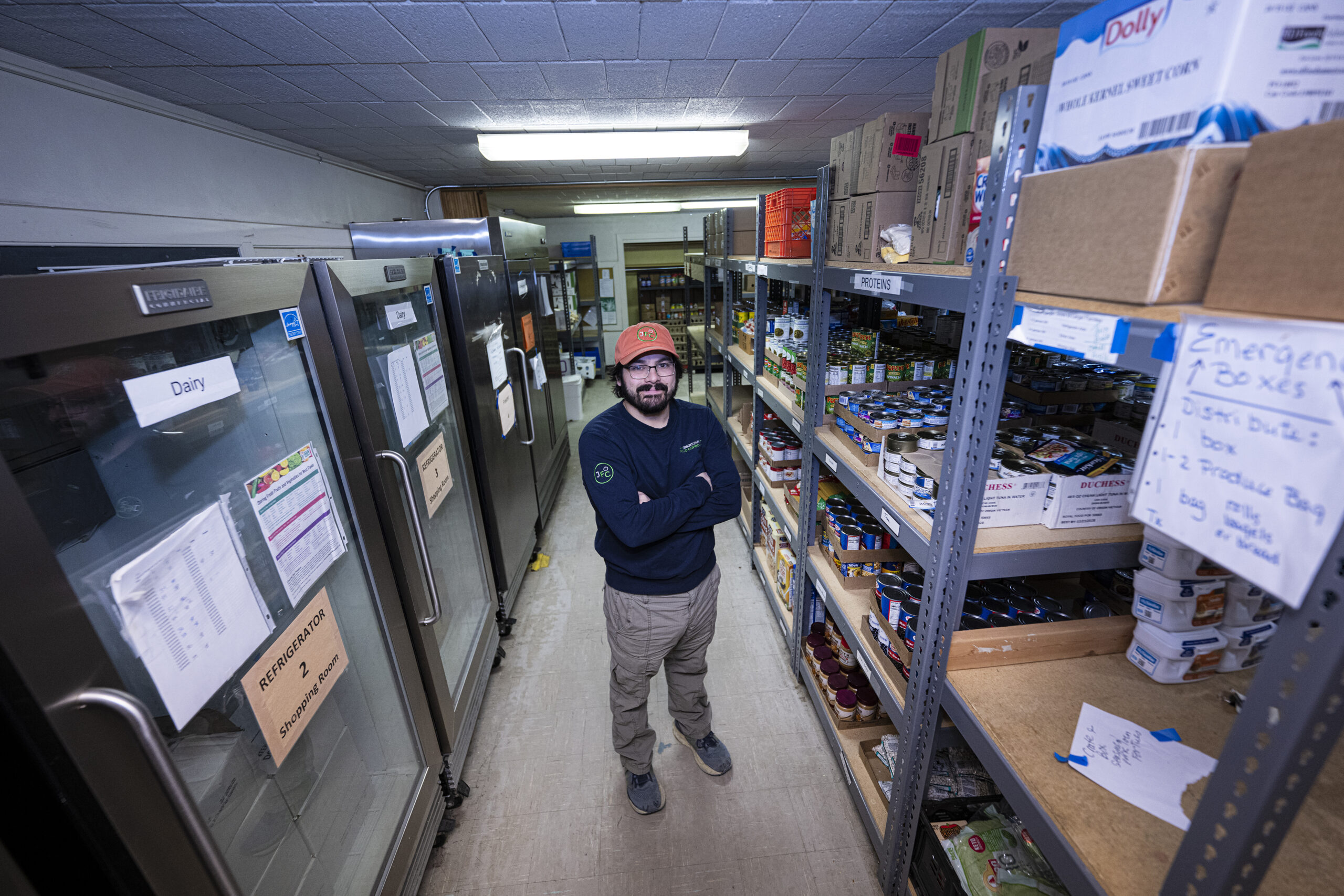
At the Jenkintown Food Cupboard last week, “anxiety about what will happen is growing,” said Nicolino Ellis, the executive director. “But bellies are already aching from hunger. Life is already crumbling today.”
Nicolino Ellis, executive director of the Jenkintown Food Cupboard, in the warehouse.
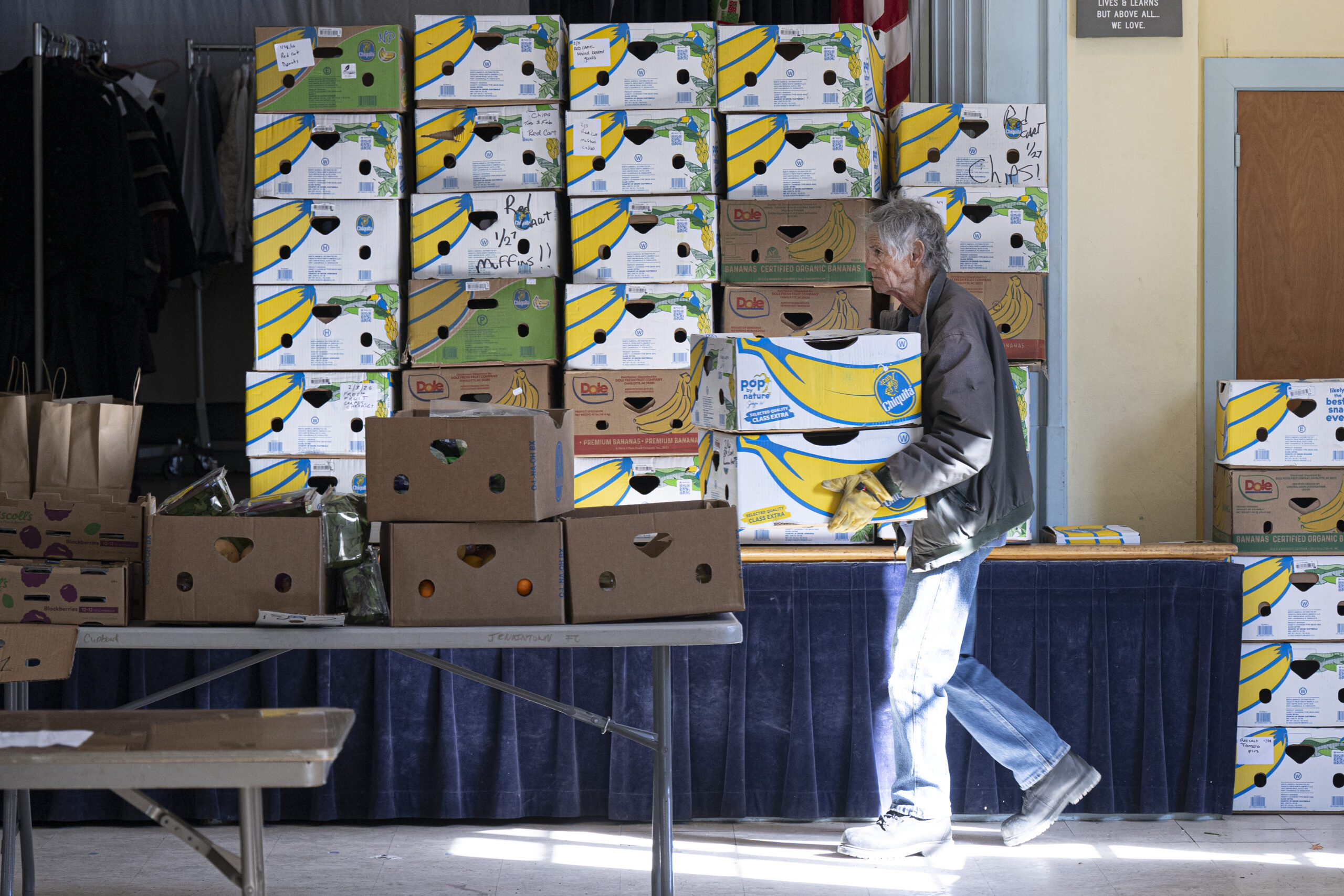
Outside the cupboard at the Jenkintown United Methodist Church, food was distributed in a driveway to clients who drove up in cars. A phalanx of volunteers slid bags of perishables and shelf-stable foods into trunks and back seats.
As SNAP benefits dry up while food prices soar, cupboards like this one become overburdened. But they are a less efficient means of feeding Americans in need, according to Stuart Haniff, CEO of the nonprofit Hunger-Free Pennsylvania.
“For every single meal distributed at a food pantry,” he said, “SNAP provides nine. And need in Philadelphia increased 140% over the last two years.”
A Jenkintown Food Cupboard volunteer works to set up food distribution.
Shelley Gaither is one of the hundreds of people receiving groceries from the pantry.
Gaither, 51, is a former data analyst with an MBA who suffered a disability that caused her to stop working at a Malvern finance company 13 years ago. She now collects Social Security Disability Insurance and lives with her three sons, ages 6, 9, and 18, in Cheltenham.
Gaither said that in January, her SNAP payment dropped from $400 to $200. “I don’t know if it was a new formula from the government cutting me back, or some other reason,” she saidin a phone interview. “No one told me why. It’s not supposed to happen when you have a disability. It’s crazy.”
Whatever caused the cut, Gaither said, she is in trouble, and worried the benefit will shrink even further.
“Now, the money I used to pay for electricity and water has to go for food,” she said. “This makes surviving more difficult.”
A project to expand the Chester Valley Trail and repair the historic Downingtown Trestle Bridge, which has spent decades largely untouched, will kick off soon, Chester County officials said.
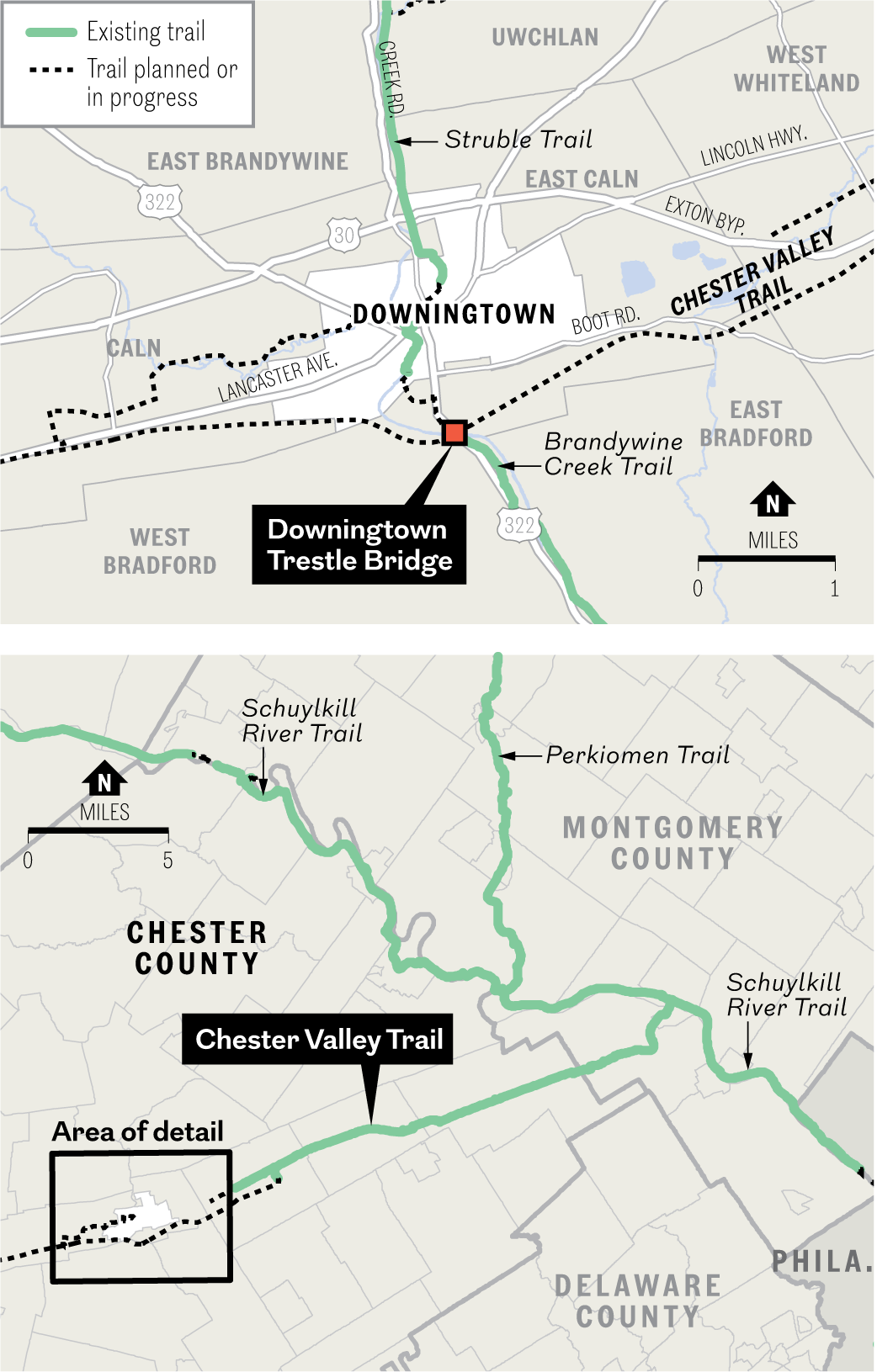
It’s part of a larger effort to expand the sprawling Chester Valley Trail, a 19-mile rail trail that runs through Chester and Montgomery Counties, from Exton to Atglen.
“The bridge is a really key part of it, because it’s multimodal,” said George Martynick, director of Chester County’s facilities and parks department. “Without that bridge, I really don’t know what we’d do with this project. It is the keystone of that project. It’s a big job.”
As the county kicks off the project, people can expect to see inspections taking place on the bridge in the coming months. The trestle will get a full inspection to make sure it meets federal standards, Martynick said. Design is slated to begin in the next year, and the rehabilitation and extension should be completed in five to seven years, he said.
The bridge stretches 1,450 feet long and more than 130 feet high over the east Brandywine River. Known as the “Brandywine Valley Viaduct,” “Downingtown High Bridge,” or “Pennsylvania Railroad Freight Bridge”— but colloquially called the Downingtown Trestle Bridge — it was constructed in the early 1900s, according to the Downingtown Area Historical Society.
“This is taking on something much bigger than I think a lot of people understand,” Martynick said.
Map of the Downingtown Trestle Bridge and the Chester Valley Trail in Chester County.
The Trestle Bridge has been out of commission since the 1980s, with the track removed. Since then, the bridge has sat abandoned, and has had atroubled history. Security measures were added to prevent people fromaccessing it, and netting was put on it to keep debris from falling off it.
The county completed a drone inspection before it took ownership of the bridge last year.
In May, the county commissioners voted to purchase a portion of the former Philadelphia and Thorndale railroad corridor from the Pennsylvania Department of Transportation for $1.
Other than some growth and weeds, “it’s in fairly good shape,” Martynick said.
The county has received three grants for the project — two from the state department of conservation and natural resources, each for $500,000, and a Delaware Valley Regional Planning Commission grant for $200,000, said Brian Styche, the multimodal transportation planning director for the county’s planning commission.
The county is matching both of the conservation and natural resources grants, for a total of $2.2 million in funding toward the bridge’s design.
“It’s a good project. It’s going to take a lot of time and effort and a lot of patience, but it will be a pretty impressive project for the community,” Martynick said.
It’s a personally important project, too: Martynick applied to work in the county’s parks department because of his love of the trail.
“I love it,” he said. “It’s a very, very special trail.”