A 19-year-old man has been charged with murder in the death of another teen last summer in the East Germantown section of Philadelphia, police said Tuesday.
Tayvone Bibbs was taken into custody on Tuesday by a fugitive task force in connection with the shooting death of 19-year-old Michael Allen on July 3, 2025, police said.
Just after 5:30 a.m. that day, police responded to a report of a person with a gun on the 200 block of East Rittenhouse Street and found Allen lying in the street with a gunshot wound to his face. Medics pronounced him dead at the scene.
Police did not offer a possible motive for the killing or mention any other arrests.
Two weeks after Allen’s death, police released surveillance video of the minivan used in the shooting. Police noted in the video that the vehicle had at least three occupants.
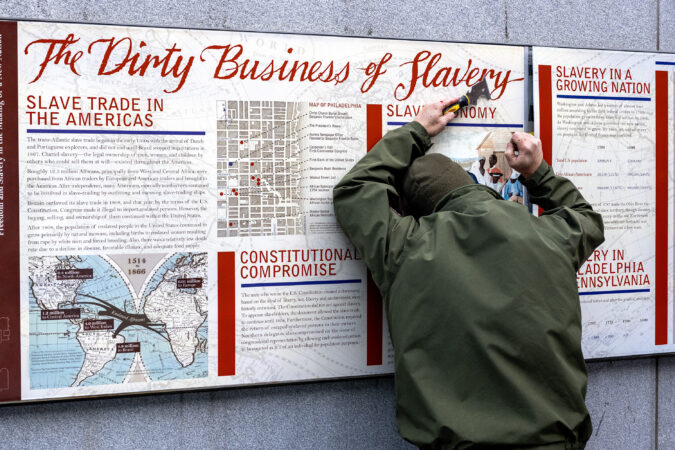
The U.S. attorneys representing the federal government argued previously that the White House has full discretion over the exhibits in national parks, an argument U.S. District Judge Cynthia M. Rufe called “dangerous” and “horrifying” during last month’s hearing.
The notice of appeal to the U.S. Court of Appeals for the Third Circuit at this stage does not require a brief arguing what the government says the judge got wrong when she issued the injunction. But the Department of the Interior and the National Park Service said in a statement Tuesday that the agencies “disagree” with the injunction.
“The National Park Service routinely updates exhibits across the park system to ensure historical accuracy and completeness,” the statement said. “If not for this unnecessary judicial intervention, updated interpretive materials providing a fuller account of the history of slavery at Independence Hall would have been installed in the coming days.”
Neither agency responded to a request for more information on the plan for alternative panels. The White House did not respond to a request for comment.
Rufe on Monday granted Philadelphia’s request for an injunction requiring the full restoration of exhibits removed from the President’s House on Jan. 22. She further enjoined the federal government from making any changes to the site without the agreement of the city.
The panels that tell the stories of the nine enslaved African people who lived in President George Washington’s house must be displayed again swiftly, the judge said in her 40-page opinion.
The order directs the agencies to comply “immediately” and “forthwith” but does not include a specific deadline.
“Each person who visits the President’s House and does not learn of the realities of founding-era slavery receives a false account of this country’s history,” wrote Rufe, who was appointed by former President George W. Bush.
In addition to the appeal, the federal government will need to ask for a stay on the order or risk not complying with Rufe’s injunction.
Parker addressed the injunction in a video Tuesday celebrating the ruling as a “huge win for the people of this city and our country.”
“This summer Philadelphia will lead a litany of Semiquincentennial celebrations in honor of America’s 250th birthday, and please know that we will do so with a great deal of pride,” Parker said. “A pride that comes from acknowledging all of our history, and all of our truth, no matter how painful it may be.”
Philadelphia’s lawsuit was the first in the nation challenging the removal of exhibits from national parks in accordance with President Donald Trump’s March 2025 executive order, which instructed the Interior Department to remove any content or displays that “inappropriately disparage Americans past or living.”
The federal government violated a 2006 cooperative agreement between the National Park Service and the city when it dismantled the exhibits without notice in what amounted to an unlawful “arbitrary and capricious” act, Philadelphia’s lawsuit said. Rufe found that the agreement is still binding.
As the city’s litigation proceeds following the injunction, it is not the only effort to address changes to historic exhibits on federal parks.
A lawsuit filed Tuesday by park conservation advocacy groups in Massachusetts federal court says that removals of the type that took place in Philadelphia violate “Congress’s clear instructions.”
The suit asks a federal judge to order the Interior Department and National Park Service to “cease all unlawful efforts to remove up-to-date and accurate historical or scientific information from the national parks, and order that interpretive materials that have been removed pursuant to the unlawful Order be restored.”
It’s 23,040 minutes and a handful of hours. It’s five games.
But how do you measure a year?
In goals? In saves? In shifts?
How do the Flyers’ decision-makers measure this season? That’s the question as president Keith Jones and general manager Danny Brière figure out what to do as March 6’s 3 p.m. trade deadline ticks closer.
For the players who hit the ice Tuesday for the first allowed practice after taking 11 days off for the Olympic break, they are focused on closing out strong, beginning on Feb. 25 against the Washington Capitals (7 p. m., NBCSP).
“I don’t think there’s any emphasis on the games before the deadline, [it] doesn’t change anything for us,” winger Travis Konecny said. “We’re just looking to get back on track, kind of back to the way we were playing at the start of the season.”
The last time the Flyers were in playoff position was Jan. 12. They sat in third place in the Metropolitan Division, but since then, they have won only three of 12 games (3-6-3) and posted the fifth-worst points percentage (.375) in the NHL.
With 26 games left on the schedule, and just five until the trade deadline, time isn’t just ticking on what management will do but also ticking on the season. The Flyers enter the last stretch eight points back of both the Boston Bruins, who hold the second wild card in the Eastern Conference, and the New York Islanders in the Metropolitan Division. The Flyers have a game in hand in Boston and two on the Islanders.
“Two division opponents right when we get back, huge back-to-back,” said center Noah Cates, regarding playing the Capitals and New York Rangers on consecutive nights (8 p.m., ESPN).
“So, yeah, definitely the urgency, the compete level needs to be up, everything. Definitely huge for us to get back into shape and our structure, different things that were lacking before the break. And get reset and refocused and dialed in for huge games in February and then in March.”
Tuesday marked the start of pseudo-training camp, with seven practices over the next eight days at the Flyers Training Center in Voorhees.
President Keith Jones and GM Danny Brière are in an interesting spot with the trade deadline less than a month away.
Things started slowly as the players worked on getting their hands back, touching the puck for the first time in a while, and skating. Some of the drills included a small area game of keep away, with one fewer puck than the players, and someone ending up as the last man standing, and another where the players had to pass between pylons a certain number of times before being able to shoot on goal.
As the day wore on, the intensity ratcheted up — without contact — and it ended with a conditioning bag skate.
“I think you realize where we’re at in the standings, where things are schedule-wise. Right now is part of the process, and today was part of the process of getting ourselves back up to speed,” assistant coach Todd Reirden said. Reirden spoke with the media with Rick Tocchet still in Italy as an assistant coach for Hockey Canada.
“Every drill was done with a purpose and with a reason behind it to be able to get the players executing as high a pace as they possibly could, conditioning at the end, and then tomorrow, we’ll go after certain areas of our structure to improve.”
One guy the Flyers will be relying on is Konecny, who has 37 points in the past 35 games, including nine points in five games heading into the break. Banged up and playing through it — he tallied a hat trick as he gutted out and grimaced through a demoralizing loss to Columbus on Jan. 28 — the alternate captain has impressed everyone, including Reirden.
“I had a good break, got a chance to reset, get my mind in a different spot. Kind of realize where we’re at as a team and what we need to do finishing the season here. For me, just getting to the top of my game, where I need to be to help our team, and I think everyone is in the same spot,” Konecny said.
But he’s also looking ahead. Konecny, who said after the loss in Boston to the Bruins before the break that “I’m tired of missing the playoffs,” looks at the standings every day.
“I think it’s disappointing every year if you miss it,” he said on Tuesday. “I think what’s gotten everyone to this point is everyone’s a competitor, everyone wants to compete in the big games. … It’s not going to be like the end of the world if it didn’t happen; I’d be frustrated.
“But I know that the team we’re building, what we have, the plan, we’re going to be a playoff team, and I’m not worried about that. I know everyone believes in that in this locker room, so we keep on pushing. Hopefully, it happens, and we’re going to give everything to get there, and if it doesn’t, we re-evaluate and get better in the summer.”
Breakaways
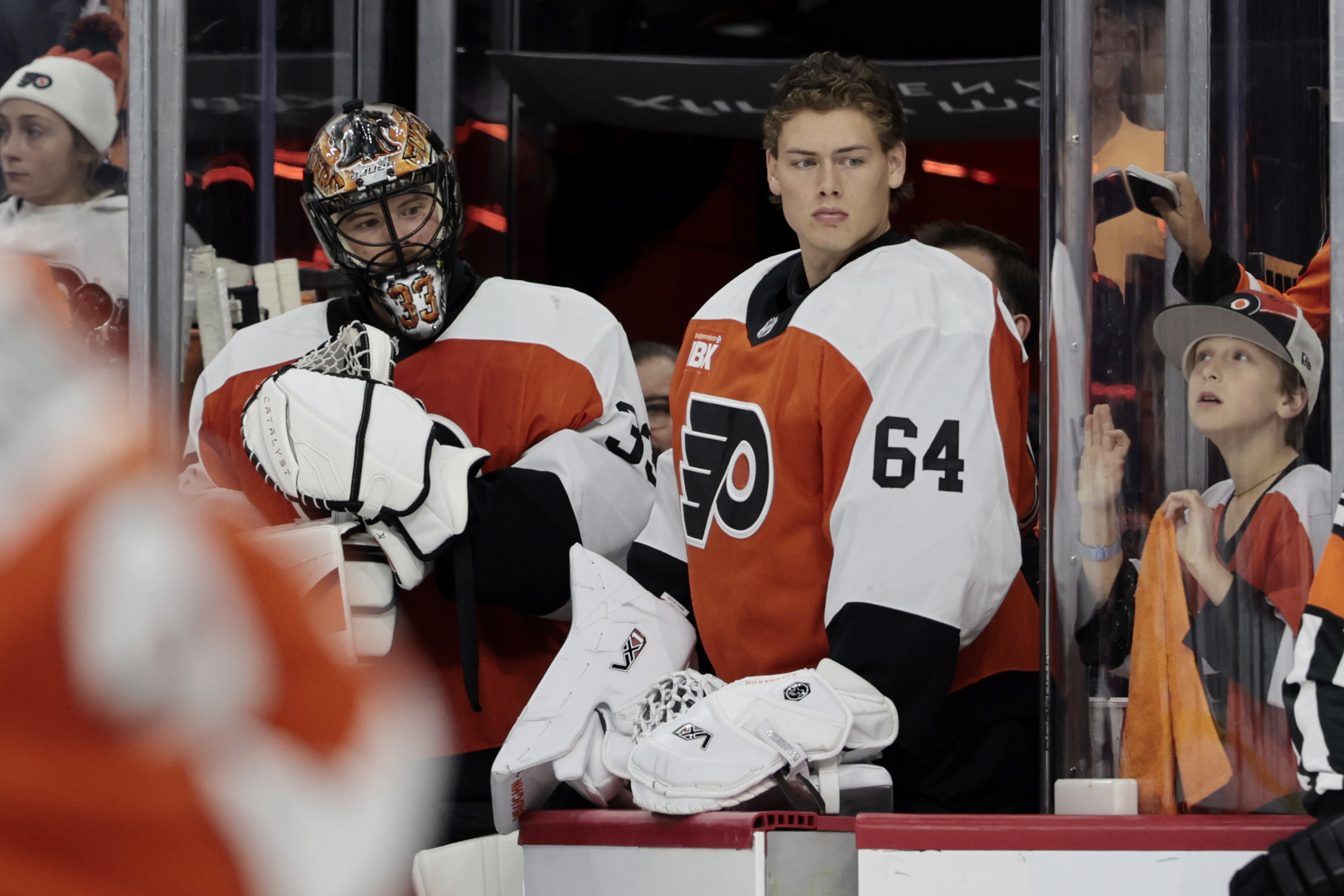
Goalie Carson Bjarnason was recalled from Lehigh Valley of the American Hockey League on Tuesday to give the Flyers two goalies with Dan Vladař at the 2026 Milan Cortina Olympics. … According to Reirden, defensemen Oliver Bonk and Hunter McDonald will also join the Flyers with Rasmus Ristolainen and Travis Sanheim in Italy playing for Finland and Canada, respectively, and the Phantoms off until Friday in Hershey. McDonald was with the Flyers across the weeklong trip to Las Vegas, Salt Lake City, and Denver, but did not play. Bonk joined the Phantoms in early December after missing training camp and the start of the season with an upper-body injury. He has six points in 22 games.
Youngster Carson Bjarnason (right) is up to practice with the Flyers while Dan Vladař is at the Olympics with Czechia.
Carver Engineering & Science’s buzzer-beating attempt to overturn a ban from the Public League boys’ basketball playoffs was swatted away on Tuesday as a common pleas court judge denied the team’s plea for an emergency injunction.
The Engineers seemed to be on track to play Tuesday night in the Public League semifinals until last Thursday’s quarterfinal game was halted after opposing fans ran onto the court. E&S led Constitution by 12 points with 1 minute, 11 seconds remaining when the referee called off the game.
A skirmish started when a Constitution player shoved an E&S player. The situation spiked when fans — the referee said they were from Constitution’s bleachers — stormed the court and moved toward E&S players. The reserves from E&S then left the bench and walked onto the court. There were no punches thrown by players from either team.
The Public League ruled that E&S, despite being 71 seconds from advancing, would forfeit the game since its entire bench entered the court, which league president Jimmy Lynch said is a violation of the league’s unsportsmanlike conduct policy. The league’s rules say that a team must forfeit once their “entire bench” enters the field of play.
Constitution was awarded a 2-0 victory and a berth in the semifinals.
E&S argued that its players only came onto the court after opposing fans did first and were there to make sure their teammates were safe. An appeal to the league fell short on Sunday night so they went Tuesday afternoon to City Hall to take its case in front of judge Christopher Hall, hours before Constitution played Imhotep Charter at La Salle.
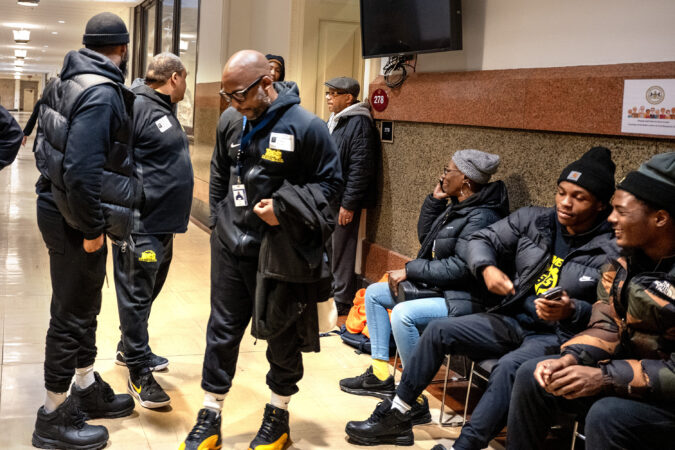
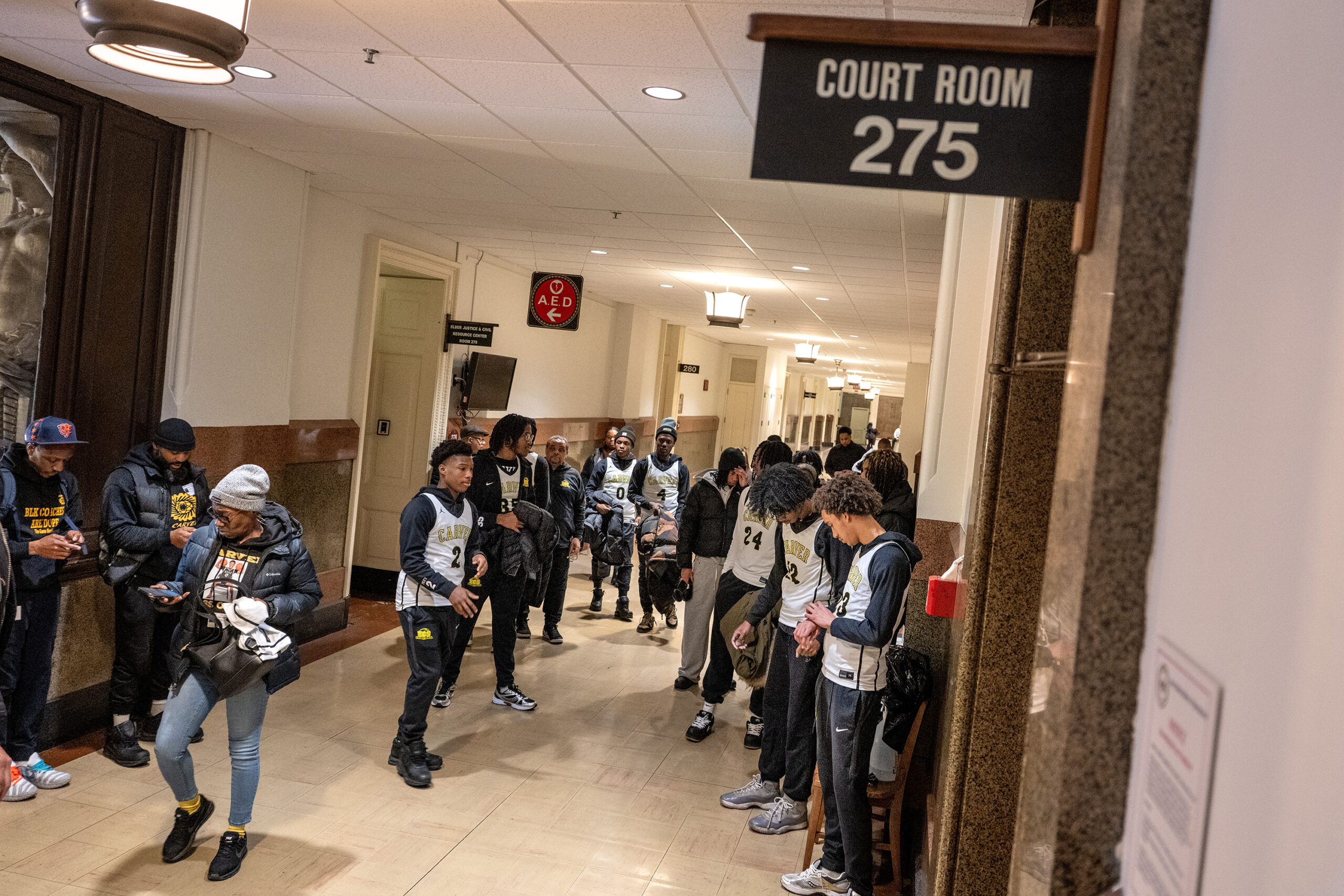
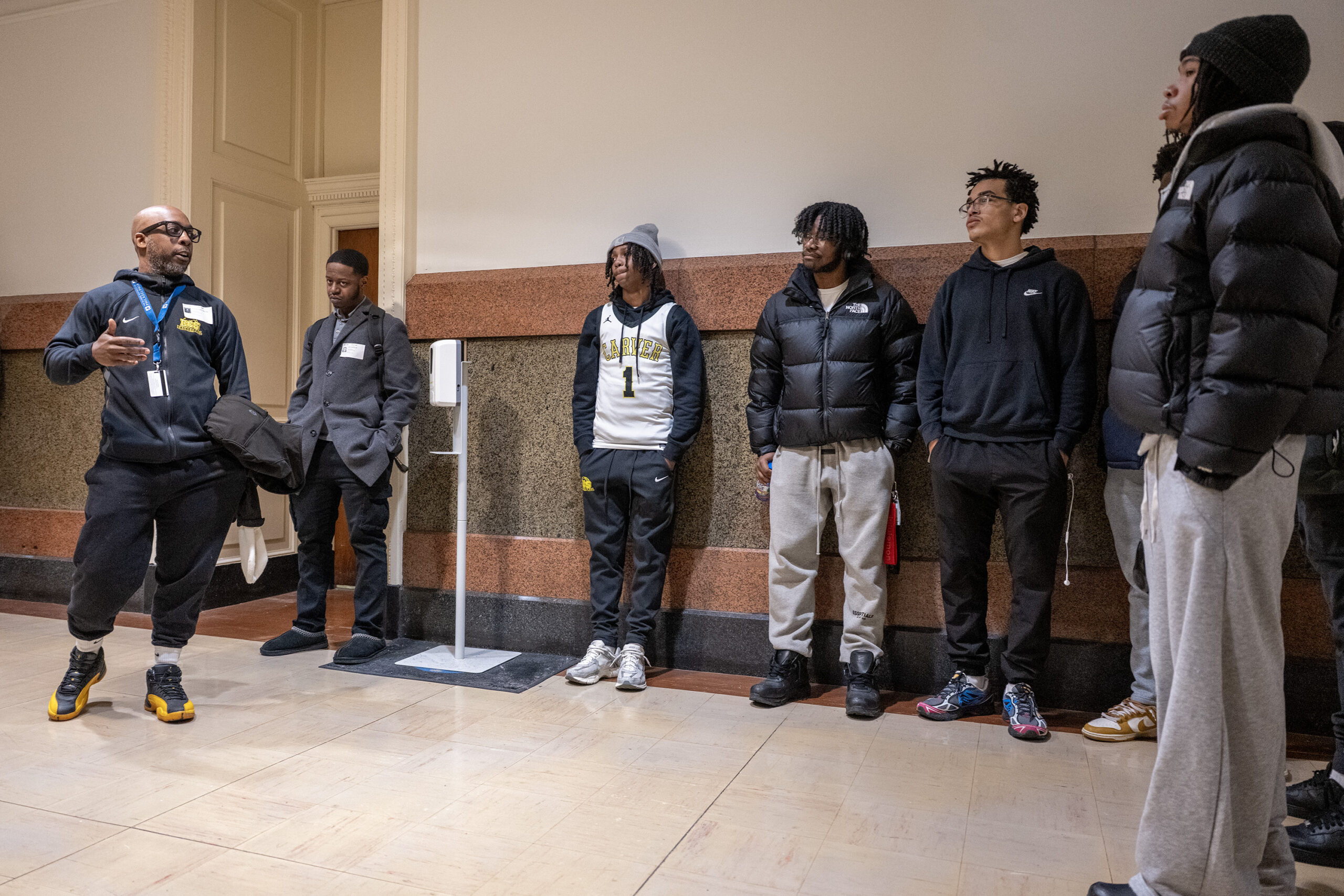
Carver Engineering and Science High School players and coaches wait outside courtroom 275 on Tuesday.
The E&S players wore their uniforms to court and were joined by coaches and alumni. They asked for an injunction to stop Tuesday night’s semifinal and allow them to play Imhotep Charter later this week. A lawyer presented their case.
“Finding a lawyer to argue this in 24 hours was extremely difficult,” said Miya Brown, a mother of an E&S player. “It was not an easy task. We didn’t even start off with all the proper information. We didn’t have the ref’s statement. They did. We didn’t have the full report. They did. We started off at a disadvantage. But the lawyer tried. The judge pretty much explained to the boys that while this is a harsh reality for us, that when you file an emergency injunction, it has to be that this decision causes irreparable harm and damage.”
Carver Engineering and Science head boys’ basketball coach Dustin Hardy-Moore (left) talks with his players outside courtroom 275 on Tuesday.
E&S will continue its season later this month in the PIAA District 12 tournament but its bid for the school’s first Public League title ended in City Hall Room 275.
“It’s just a disservice,” Brown said. “Not just for this game but for the safety of the athletes. What are you teaching? What is the Philadelphia Public League representing when it comes to the safety of the student athletes? Our student athletes are still disappointed but we’ll continue to encourage them and continue to support them. We’re going to get them ready for states.”
A defiant Stephen Colbert blasted CBS on Monday for killing an interview with a Texas Democrat, blaming arcane rules being enforced by the Trump administration.
“He was supposed to be here, but we were told in no uncertain terms by our network’s lawyers, who called us directly, that we could not have him on the broadcast,” Colbert said of State Rep. James Talarico, who is running in the Democratic primary for a U.S. Senate seat in Texas.
CBS issued a statement claiming they didn’t prohibit him from running an interview.
“The Late Show was not prohibited by CBS from broadcasting the interview with Rep. James Talarico,” the statement read. “The show was provided legal guidance that the broadcast could trigger the FCC equal-time rule for two other candidates, including Rep. Jasmine Crockett, and presented options for how the equal time for other candidates could be fulfilled. The Late Show decided to present the interview through its YouTube channel with on-air promotion on the broadcast rather than potentially providing the equal-time options.”
The decisioncomes down to something known as the equal-time rule, a federal requirement put into law in 1934 that requires broadcast stations like CBS to provide comparable airtime to political opponents during an election. Cable networks like Fox News and Comedy Central, home to The Daily Show, are not bound to those rules, allowing them to be as partisan as they choose.
News programs on broadcast TV (such as Meet the Press and Face the Nation) are exempt from the rule, and the Federal Communications Commission has not enforced it on late-night shows since 2006, when it ruled then-California gubernatorial candidate Arnold Schwarzenegger’s appearance on The Tonight Show with Jay Leno qualified as a “bona fide news interview.”
The move was criticized by FCC commissioner Anna Gomez, a Democrat appointed by former President Joe Biden, who called it “an escalation in this FCC’s ongoing campaign to censor and control speech.”
Colbert said CBS prohibited the interview with Talarico from airing Monday night. Instead, it was posted in its entirety on Colbert’s YouTube channel.
“At this point, [Carr has] just released a letter that says he’s thinking about doing away with the exemption for broadcast for late night. He hasn’t done away with it yet,” Colbert said. “But my network is unilaterally enforcing it as if he had.”
Talarico told Colbert that Trump and Republicans ran against cancel culture during the last election, but now the current administration is “trying to control what we watch, what we say, what we read.”
“And this is the most dangerous kind of cancel culture, the kind that comes from the top,” Talarico said. “Corporate media executives are selling out the First Amendment to curry favor with corrupt politicians.”
Bill Carter, who covered late-night television for decades at the New York Times and currently writes for the website LateNighter, called CBS’s capitulation “shameful,” especially since the FCC has not moved yet to enforce the rule.
“Trump’s intention is to mute free speech of his critics, and he’s found the rule in the FCC and decided he can do this,” Carter said. “And he’s got the broadcasters cowed a bit.”
“Let’s just call this what it is: Donald Trump’s administration wants to silence anyone who says anything bad about Trump on TV, because all Trump does is watch TV,” Colbert added.
How was Josh Shapiro able to appear on Colbert’s show?
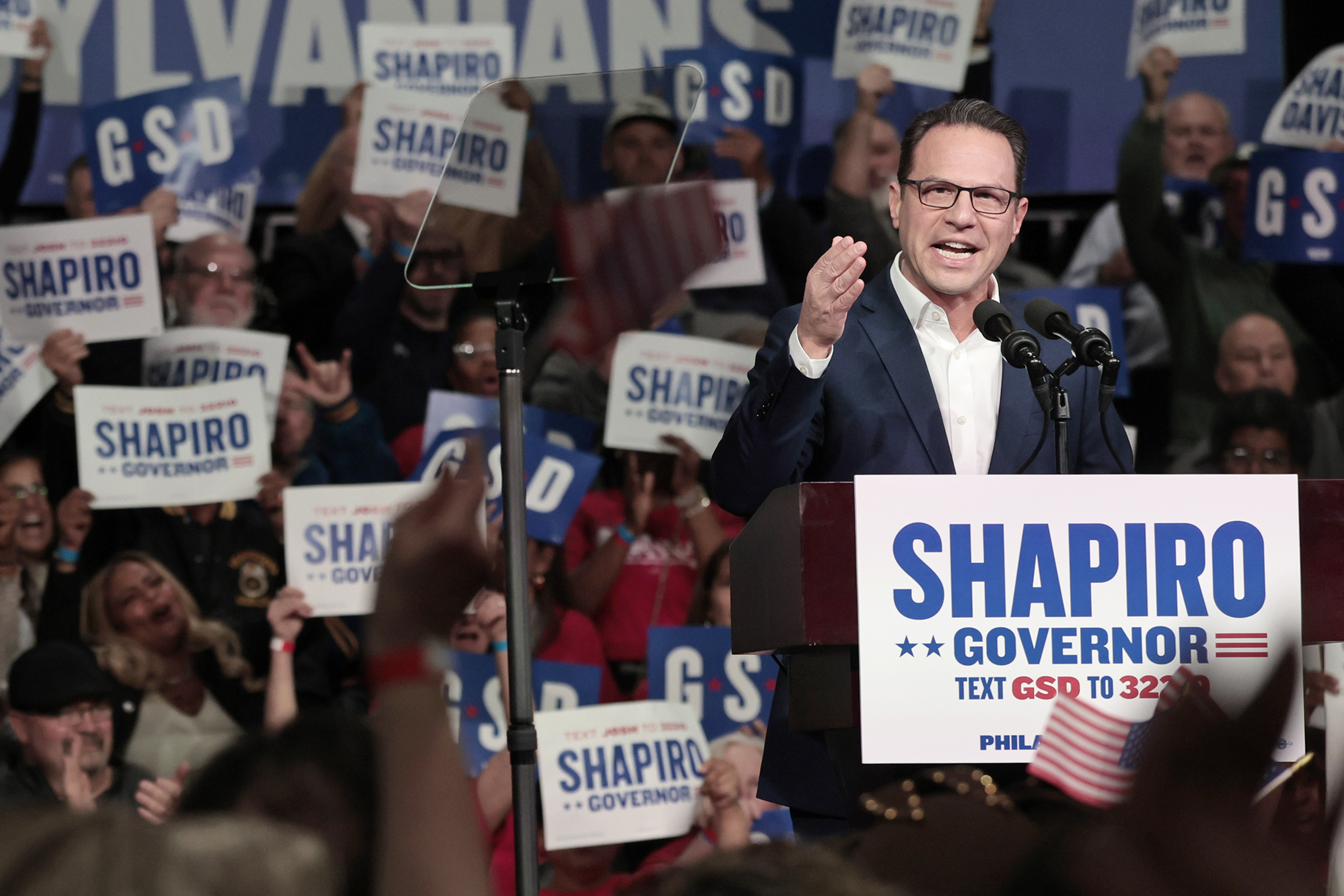
Governor Josh Shapiro announced his re-election campaign weeks before appearing on Colbert’s show last month.
Shapiro was able to appear not only on Colbert’s show, but also on ABC’s daytime talk show The View, which has also found itself a target of the FCC under Carr.
“I think it’s worthwhile to have the FCC look into whether The View, and some of these other programs that you have, still qualify as bona fide news programs and therefore are exempt from the equal opportunity regime that Congress has put in place,” Carr said in a September interview with conservative CNN commentator Scott Jennings.
It’s also why U.S. Sen. Jon Ossoff’s forthcoming interview with Colbert is still slated to air on the network Wednesday. While Ossoff (D., Ga.) has announced he is running for reelection in Georgia, the window for candidates to officially file paperwork for their primaries does not open until March 2.
Neither CBS nor Ossoff’s campaign has commented on the interview.
The equal-time rule also applies to radio broadcasts, where conservative talk shows are among the most dominant formats and regularly feature Republican candidates for office during election years. Then-candidate Trump did multiple interviews on 1210 WPHT in Philadelphia during the 2024 election.
Carr has said he does not plan to enforce a stricter equal-time rule on radio stations the way he has for television networks, claiming in a news conference last month there wasn’t a similar bona fide news exemption “being misconstrued on the radio side.”
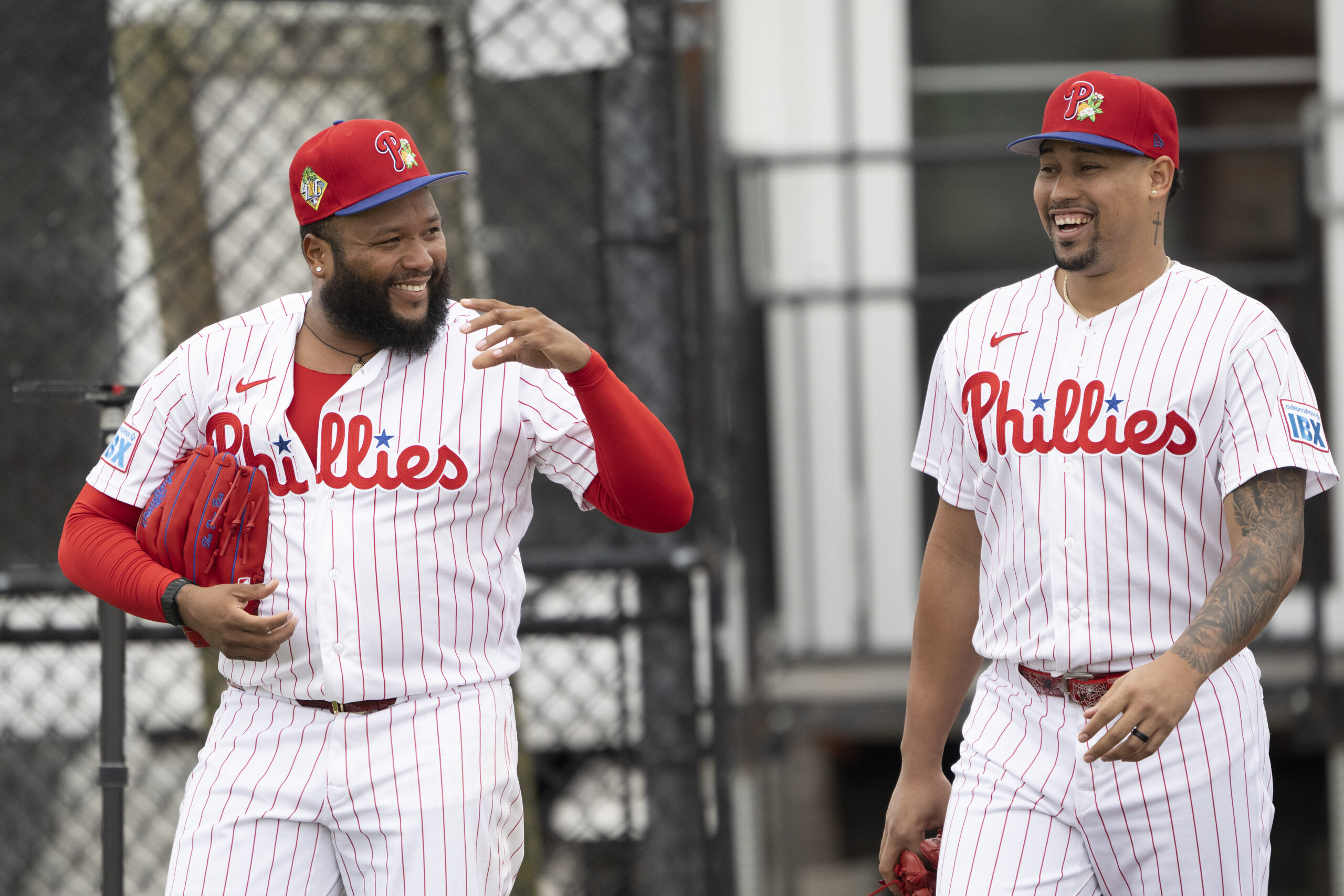
CLEARWATER, Fla. — During Tuesday morning’s bullpen sessions at the Phillies’ Carpenter Complex, José Alvarado and Jhoan Duran were pitching at opposite flanks of the seven-pack of mounds.
It was an early look at likely the two hardest-throwing relievers in the Phillies’ 2026 bullpen, who only were able to team up for exactly 24 days last season. The Phillies acquired Duran at the trade deadline in July, while Alvarado was away from the team serving an 80-game suspension for a positive performance-enhancing drug test.
He returned in August, but only pitched in eight games before a left forearm strain ended his season. He was ineligible for the playoffs due to the PED suspension.
Now healthy and back in camp, Alvarado does not want to dwell on the past.
“I know everything that passed last year, I want to say last year is over,” Alvarado said. “I prepare for coming healthy in this spring. I’m so happy for me, what I see in this spring now. Keep working hard and never give up.”
This winter, the Phillies picked up the $9 million club option on Alvarado’s contract for 2026. The 30-year-old lefty will be a free agent after this season.
Alvarado said he ramped up slower with his throwing program this offseason, with fewer bullpen sessions and live at-bats than he’s typically done by this point. According to Phillies pitching coach Caleb Cotham, that was planned out of caution for Alvarado’s forearm.
“I wouldn’t use the word behind, but it’s just more intentional with the build-up,” Cotham said. “He’s normally overly prepared. Now it’s just more a normal build-up.”
Alvarado is also planning to represent Venezuela at the World Baseball Classic in March, which will help accelerate his ramp-up.
At this point in the spring, bullpen sessions aren’t so much focused on velocity, since pitchers are still building up and, in some cases, experimenting. Alvarado has been working on his four-seam fastball. He relies almost exclusively on his sinker-cutter mix, but in past springs, he has also toyed with bringing back his curveball and four-seamer, both of which he threw more when he first broke into the big leagues.
So far, they haven’t really stayed in his arsenal when the regular season starts. In a limited sample size of 26 innings due to his abbreviated 2025 season, Alvarado threw 22 curveballs (4.8% of his pitches) and six four-seamers (1.3%). When he did throw the four-seam, it averaged 99.6 mph.
The Phillies are planning to have José Alvarado (left) and Jhoan Duran as a late-inning, 1-2 punch out of the bullpen.
“I’m not very confident on that pitch, because when it’s game time, it’s different energy. It looked good,” Alvarado said of his four-seam after a recent bullpen session. “ … Every result I see right now is good. I am in a good spot right now; I need to keep it like that.”
Will the four-seam stick around this time?
“I think a lot of times things that stick are things that work,” Cotham said. “So I think the avenue for me in getting it to stick is he’s got to feel good with it, but it’s also got to work. And we got to work to help him, and find the spots with [catcher] J.T. [Realmuto] and when not to throw it.”
The four-seam can give Alvarado another tool for certain right-handed hitters who handle sinkers well. Cotham also said that working on the four-seam can also help Alvarado fine-tune his other, bread-and-butter fastball.
“It’s also a nice way to keep the sinker calibrated, because he can feel the difference in the four-seam, sinker,” he said. “He’s a guy where the sinker can fly similar to a four-seam sometimes. So actually keeping those both in practice helps keep the sinker going.”
The Grapefruit League, which starts for the Phillies on Saturday, will provide an opportunity for Alvarado to mix in the four-seam to test it out in games.
“Alvy’s a guy where … there’s a lot of feel to his game and wanting to feel the delivery,” Cotham said. “So if he feels good with it, what I tell him is, I’m in. It’s just a matter of when and why, where we use it.”
Extra bases
Brandon Marsh was a full participant in batting practice Tuesday after a cut on his foot limited him the day before. “He’s full go,” Thomson said.
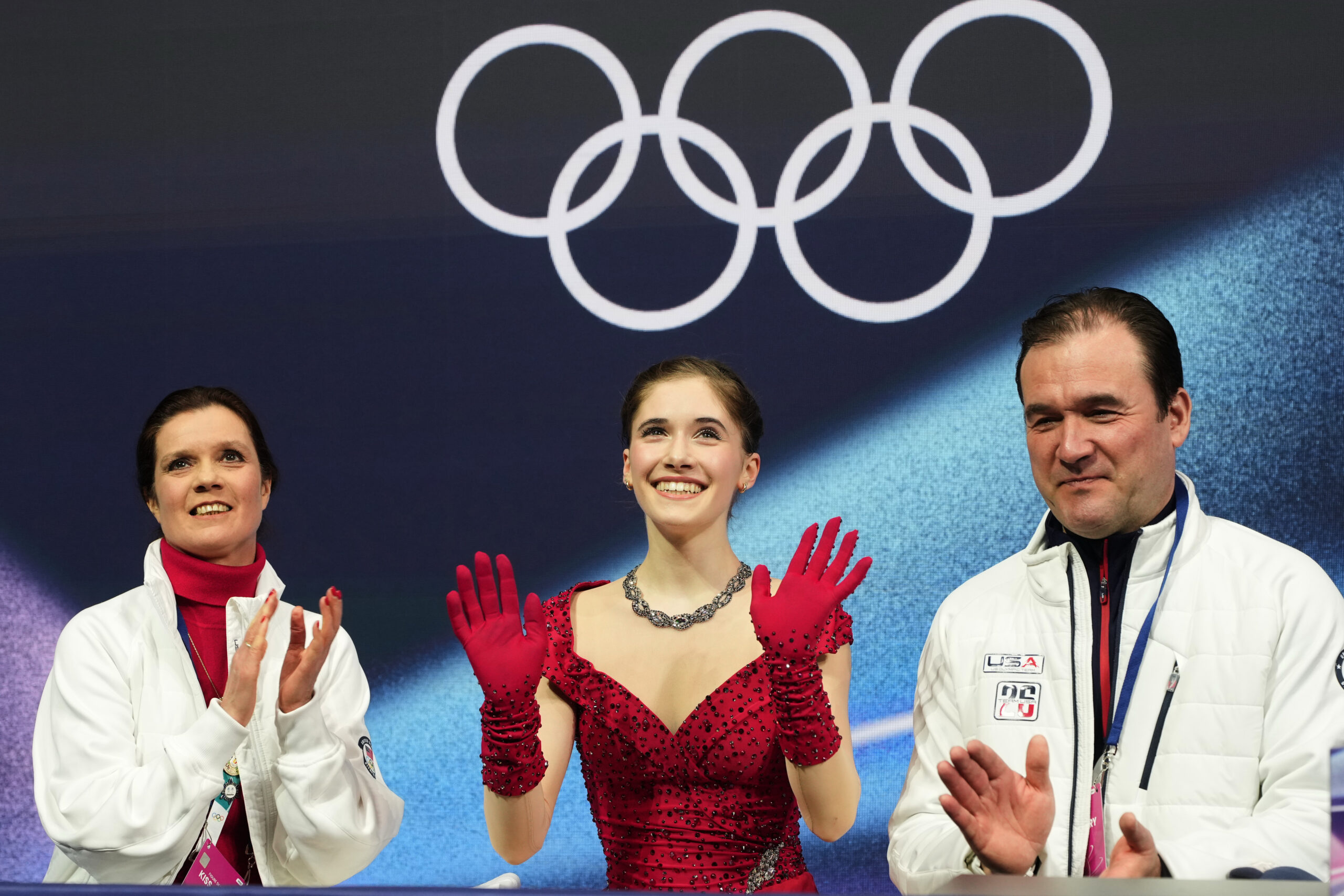
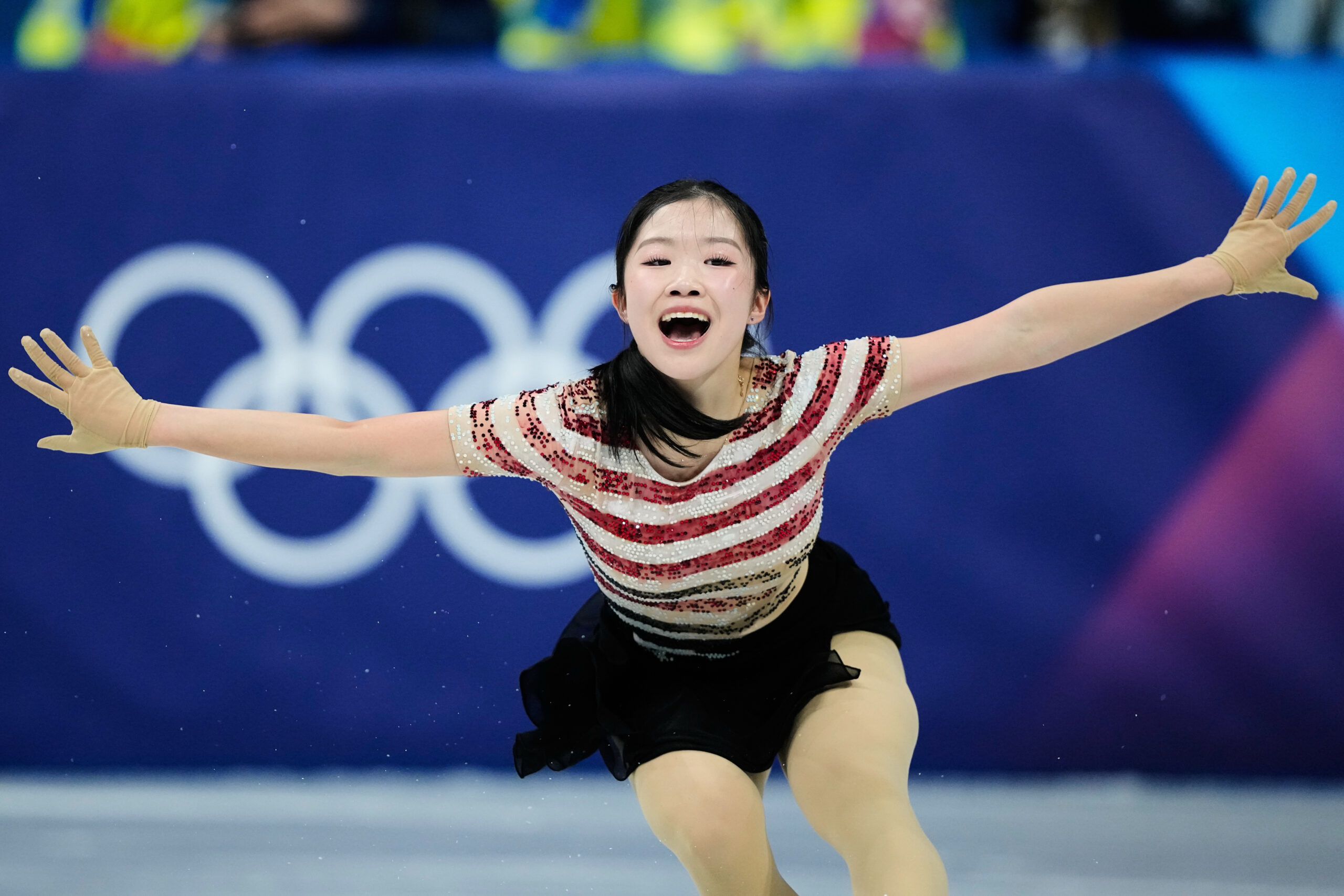
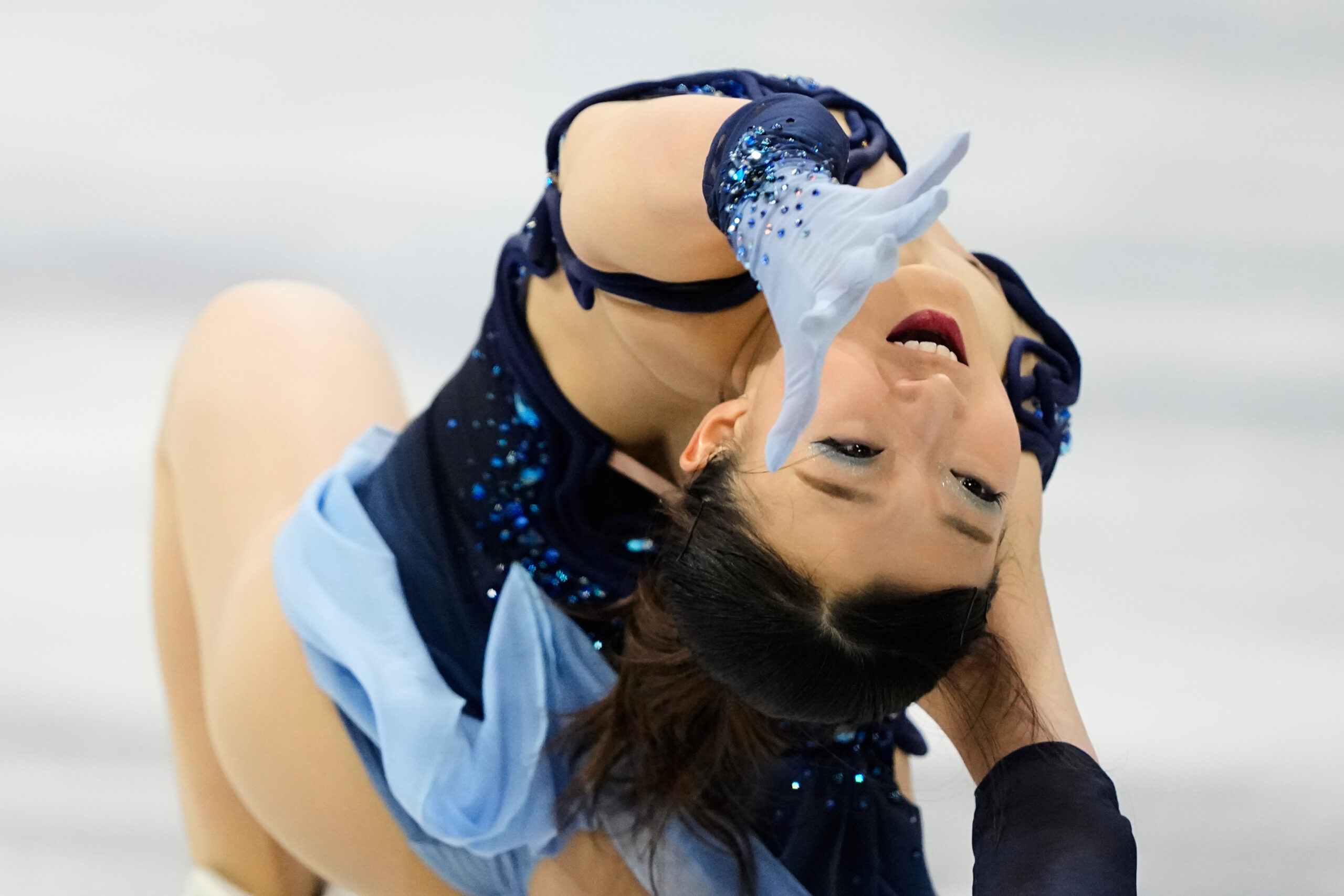
MILAN, Italy — South Jersey figure skater Isabeau Levito, 18, landed in eighth place in Tuesday’s short program at the 2026 Winter Olympics.
Competing in her mother’s hometown, just minutes from where her grandmother still lives, Levito, who lives and trains in Mount Laurel, started her short program a little tight but landed all of her elements.
“I feel very good,” Levito told NBC after she skated. “I feel like I skated with the elegance I wanted to skate with. And I’m very glad my Olympic debut looked like that. I feel very confident and just very happy with myself right now.”
Levito’s program, to a compilation of sassy songs from Sophia Loren movies, opened with a triple flip-triple toe loop combination. Then she moved on to a double Axel and a flying camel, which got a Level 4, the highest. Her first three elements got positive grades of execution.
Next came her triple loop, which was judged to be a quarter-rotation short. Five of the nine judges gave her a minus-1 grade of execution and one gave her a minus-2.
South Jersey’s Isabeau Levito placed eighth in women’s short program.
The second half of Levito’s program included a step sequence, which was called at a Level 3 rather than the Level 4 she usually has received.
She then skated combination spin that received a Level 4 and grades of execution up to plus-5, the highest available. She wrapped up with a layback spin into a Biellmann that received a Level 4 and plus-3 and plus-4 grades of execution.
South Jersey’s Isabeau Levito receives her scores following the short program accompanied by her coaches, Yulia Kuznetsova (left) and Slava Kuznetsov.
Her score was a 70.84, nearly three points lower than her season’s best, which she skated at the Grand Prix of France.
However, Levito’s program components (or artistic mark) was the fourth-highest of the night. Only Japan’s Kaori Sakamoto and Mone Chibe and American Alysa Liu placed higher.
Many on social media thought Levito was underscored.
On the technical side, Levito was not alone in the small mistakes. Most of the women had some rotation issues, although most skated fairly clean.
Ami Nakai of Japan won the women’s short program figure skating at the Winter Olympics.
Japan’s Ami Nakai, the youngest skater in the competition at age 17 (which now is the youngest age allowed in international figure skating at the senior level), won the short program. She opened with a clean triple Axel, and she received positive grades of execution on all of her elements, making her the only woman with a clean score sheet. Her step sequence and spins received Level 4 grades of execution. She earned a season-best 78.71.
Sakamoto has been the sentimental favorite this year after placing third in the 2022 Winter Olympics in Beijing (and notably being the only happy one on the medal stand, after much drama with the Russian women over doping allegations and placements). Sakamoto also has won the World Championships three times after being displaced last year by Liu. She helped lead Japan to a silver medal in the Olympic team event for the second time in a row last week.
Sakamoto has said this will be her last year competing, and her short program is to “Time To Say Goodbye,” by Sarah Brightman and Andrea Bocelli.
Kaori Sakamoto of Japan competes is in second after women’s short program figure skating at the 2026 Winter Olympics, in Milan, Italy.
She received an exclamation mark on her opening triple Lutz, meaning it was not clear whether she took off on the required outside edge or had shifted to an inside edge. Her triple flip-triple toe loop combination also was called a quarter of a rotation short.
She is less than a point behind Nakai, earning 77.23 for her short program.
The highest-placing American woman of the night was Liu, who wound up in third place. She repeated last year’s winning short program, to “Promise,” by Laufey. After she skated, she said she was unconcerned with placements but was more excited to have people see her work and to have her siblings and friends in the audience, most of whom had never seen her compete.
Liu received all positive grades of execution, mostly plus-3 to plus-5, except for her triple Lutz-triple loop combination (a particularly difficult one, therefore worth more points), which was called a quarter short. Her score was 76.59.
Amber Glenn, the three-time U.S. champion, started her program (to Madonna’s “Like a Prayer”) strong with a triple Axel that received up to plus-3 grades of execution. (She and Nakai were the only women of the night to attempt the jump.)
Her triple flip-triple toe loop combination was called a quarter short. But she made a big mistake in the middle of the program when she doubled her intended triple loop. A solo triple jump is a required element in the short program, so the double loop received no points. She finished strong with a Level 4 step sequence and two Level 4 spins, but Liu, watching on a monitor in the mixed zone, wondered if Glenn had changed the program on the fly after a mistake.
Glenn’s score was 67.39, well below her season’s best of 75.72, and she was in 13th after the short program.
The short program also included the return of two Russian women, skating under a neutral flag. Viktoriia Safonova was the first to skate and was not among the top 24 (of 29) skaters who qualified for Thursday’s free skate.
The other Russian woman, Adeliia Petrosian, skated second and has been considered a medal contender. She scored a strong 72.89, which would not be topped until the 18th skater performed. That was by Nakai, the eventual winner.
Levito, Liu, and Glenn call themselves the Blade Angels, modeled somewhat on women’s Olympic gymnastics teams, which give themselves names, and somewhat on Charlie’s Angels.
Liu and Glenn shared in last week’s Olympic gold medal in the team event. Only up to two skaters from each team could be chosen for the women’s section. Levito, who has said she has flown somewhat under the radar since suffering an injury last year and missing part of the season (but came back to place fourth at the world championships in Boston), was not selected to compete. Only those who skate share in the medal.
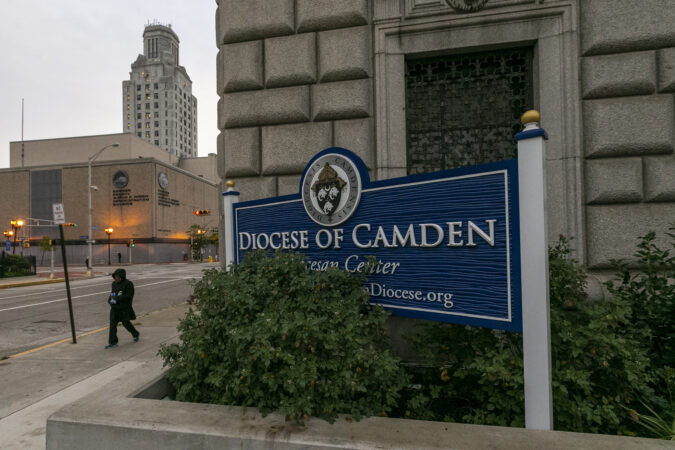
The Diocese of Camden has agreed to help pay $180 million to more than 300 people who said they were sexually abused by clergy members, the diocese and lawyers for the survivors announced Tuesday.
If the arrangement is approved by a federal judge, it would represent one of the largest sex-abuse settlements involving the Roman Catholic Church in United States history.
The diocese had previously agreed to pay $87.5 million to people who sued over clergy sex abuse in South Jersey. But the arrangement announced Tuesday is considered a supplement to that settlement, officials said, and would include contributions from other church affiliates and insurance companies that had not yet agreed to resolve their roles in some complaints.
The plan is subject to approval by the U.S. Bankruptcy Court, Camden Bishop Joseph A. Williams said. If that happens, the money will be made available to resolve all claims of abuse.
Williams called the potential resolution “long overdue,” adding: “To each one of those survivors, I would like to say: Thank you for your courage in coming forward. Without your bravery and persistence, this new day would not have dawned. I am profoundly sorry for what you have suffered.”
Greg Gianforcaro, one of the lawyers for the plaintiffs, said: “After decades of being ignored and dismissed, survivors of sexual abuse in the Diocese of Camden have finally reached a measure of accountability. Their persistence in standing up to those who harmed them made this moment possible.”
The development is the latest chapter in a long-running scandal that has had significant ramifications for the diocese, which serves nearly half a million Catholics in Atlantic, Camden, Cape May, Cumberland, Gloucester, and Salem Counties.
In 2020, it filed for bankruptcy protection after a new state law expanding the statute of limitation on sex-abuse claims led to dozens of lawsuits against the church. Some of the accusations dated back decades.
Over the next several years, advocates accused the diocese of seeking to dodge accountability for its past misdeeds. And just last year, survivors said they were outraged that the diocese had been secretly opposing the state attorney general’s attempt to empanel a grand jury to investigate decades of clergy abuse statewide.
Williams — who took over last spring as Camden’s bishop — ultimately reversed course on that issue, saying he wanted the diocese to work with prosecutors to help ensure a comprehensive and constructive investigation.
The bankruptcy case, meanwhile, had been mired in litigation since 2024, when the U.S. Bankruptcy Court approved a reorganization plan proposed by the diocese and a settlement committee that included its intent to pay survivors $87.5 million. But that total did not include money from insurance companies and other parties to certain lawsuits, who continued to hold out and litigate their roles in the matter.
Tuesday’s agreement, if approved, would end that ongoing stalemate, officials said. Trusha Goffe, one of the victims’ attorneys, said that there is no time frame by which the court must approve the deal but that, if approved, it would represent “the final step in a long and hard-fought legal battle.”
“This achievement belongs to the survivors, whose courage in endlessly standing up for truth and accountability is nothing short of triumphant,” Goffe said.
Williams, meanwhile, said he was “profoundly sorry” for what the victims had endured throughout the years, calling clergy abuse a “grave sin and a devastating betrayal of the trust you placed in the church that you loved.”
“I cannot remove the scars you carry nor restore the innocence you lost,” he said, “but on behalf of my predecessors and the faithful of Camden, I can say clearly and without reservation: We believe you, we are sorry, and we are committed to walking a different path going forward with you, God willing, at our side.”
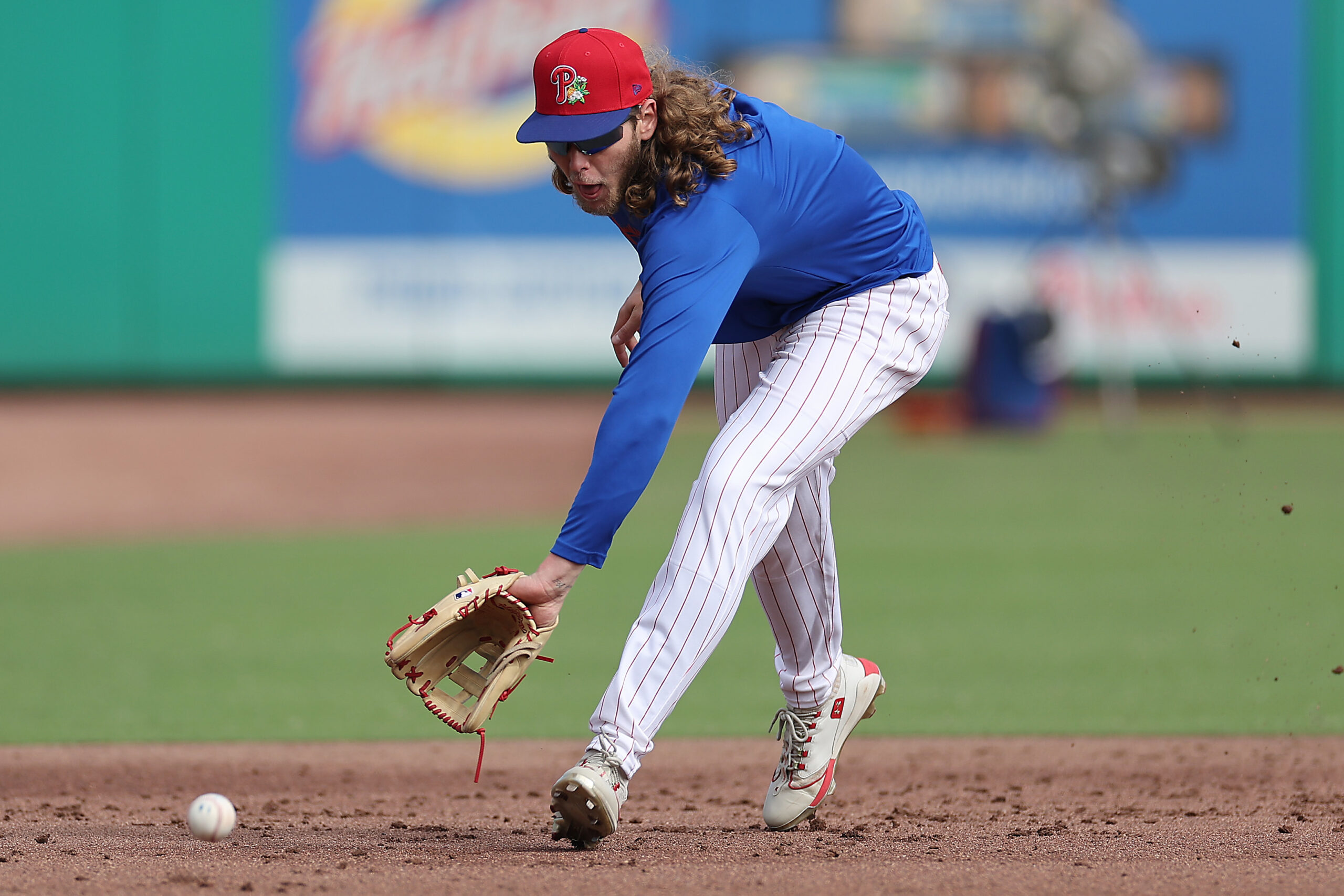
CLEARWATER, Fla. — Six years into his major-league career, Alec Bohm knows exactly who he is as a player.
Also, who he’s not.
“In the grand scheme of things,” Bohm said here Tuesday, “you think about it, I’m prototypically not your average cleanup hitter. Body type-wise, yeah. But the way my game is, I guess, is not that of a typical [No.] 4 hitter.”
Bohm has thought about it. A lot. Because he does look the part — 6-foot-5, with shoulders that block the sun and never-ending arms and legs. But he hasn’t hit more than 20 homers or slugged .450 in a full season.
And yet, guess the Phillies‘ most frequent cleanup hitter over the last two seasons — and the leading candidate to reprise the role on opening day of Bohm’s last year before free agency.
Rob Thomson hasn’t settled on the order but wants Trea Turner, Kyle Schwarber, and Bryce Harper to bat in the first inning. And whether Schwarber and Harper bat second and third, or vice versa, the cleanup hitter will be tasked with protecting one of the Phillies’ feared lefty sluggers.
Thomson has mentioned new right fielder Adolis García and J.T. Realmuto as options. But he noted that Bohm “would have taken down most of the at-bats” in the cleanup spot if not for two stints on the injured list. He was the cleanup hitter 102 times — and an All-Star — in 2024.
Phillies third baseman Alec Bohm hasn’t hit more than 20 homers or slugged .450 in a full season of his career.
Get ready, then, for one more round of the familiar gripe about the Phillies’ atypical cleanup hitter, notably that someone as big and strong as Bohm doesn’t hit more balls over the fence.
“Anybody that says that has no [bleeping] clue how hard this game is and how good the pitching is at this point,” Bohm said. “Would you rather me swing at stuff that’s bouncing in front of the plate and strike out 180 times and get you 25 to 30 home runs so you feel better about it? Or do you want me to hit .280 and drive in 80 to 90 to 100 runs and hit 40 doubles and do it that way?
“To me, that’s more productive than me walking up there and striking out 190 times. That’s not my game.”
Bohm concedes that his game was “down last year.” He opened the season in a 9-for-60 tailspin with one extra-base hit through 14 games. He missed 27 games after the All-Star break with a cracked left rib and 11 in September with a cyst in his left shoulder that needed to be drained.
And after back-to-back 97-RBI seasons in which he was 11% more productive than league average based on OPS-plus, he backslid to 18 doubles, 11 homers, and a .741 OPS, 2% more productive than league average.
The Phillies shuttled Nick Castellanos, Realmuto, and Bohm through the cleanup spot, behind Harper. Phillies cleanup hitters combined for a .720 OPS, 20th in the majors. And Harper saw the lowest rate of pitches in the strike zone (43%) of anyone who qualified for the batting title.
Coincidence? Somewhat. Harper saw 42.6% of pitches in the zone through his first six Phillies seasons (2019-24). He has long contended that teams take extreme care in how they pitch to him no matter who bats behind him.
“There’s a lot of situations throughout the game, especially later in the game, where they’re obviously not going to let the franchise player beat them,” Bohm said. “You’ve got a righty on the mound, who in their right mind would let Bryce beat them?”
When Phillies third baseman Alec Bohm was an All-Star in 2024, he batted in the cleanup spot 102 times.
Maybe it would make the decision to pitch around Harper more difficult if Schwarber batted behind him, so Thomson is mulling that arrangement.
“But if Schwarbs is sitting there [in the No. 3 spot], the same thing’s going to kind of happen, right?” Harper said. “So, whoever’s in that four spot is going to have a big job to do.”
Bohm believes he’s up for it, even if his homer total doesn’t rise far above his 14.8 average over the last four years.
“For me, it’s not necessarily putting up a certain number of home runs,” Bohm said. “It’s just, am I executing with runners in scoring position? Am I driving in runs? Am I putting tough at-bats up there?
“The protection [of Harper or Schwarber] aspect of it, the way I want to go about it just being a good situational baseball player. The home runs, the damage, the doubles, all that stuff is going to come. But it’s not going to come as frequently if I’m up there trying to force it.”
Bohm’s best work over the years has come with runners in scoring position, largely because he makes more consistent contact than most hitters in the Phillies’ lineup. Even last year, his strikeout rate (16.3%) was well below major-league average (22.2%).
It’s one of the attributes cited by Thomson as a reason to like Bohm in the cleanup spot.
“If there’s runners out there, he’s going to put the ball in play,” Thomson said. “Typically, he hits a lot of doubles. And I love doubles. I love home runs, but I love doubles as well because that clears the bases.”
Phillies right fielder Adolis Garcia (left) is another candidate to bat in the cleanup spot.
And Bohm has millions of reasons to capitalize on another opportunity to fill the cleanup role. He’s eligible for free agency after the season, which he said feels “really far off in the distance.”
Bohm’s successor may be only a few lockers away in the spring-training clubhouse. Top prospect Aidan Miller will play third base at times this year. And the Phillies discussed moving on from Bohm in each of the last two offseasons. They nearly signed free-agent infielder Bo Bichette last month, a move that would’ve corresponded with trading Bohm.
But for as long as he’s here, Bohm believes he can handle batting behind Harper or Schwarber.
“I can do things in a different way to create runs and not let the other team go, ‘We got through Kyle, now just walk Bryce, and we should be home free,’” Bohm said. “What I do is put the ball in play to where I’m not a hole behind a very important piece of our lineup.”
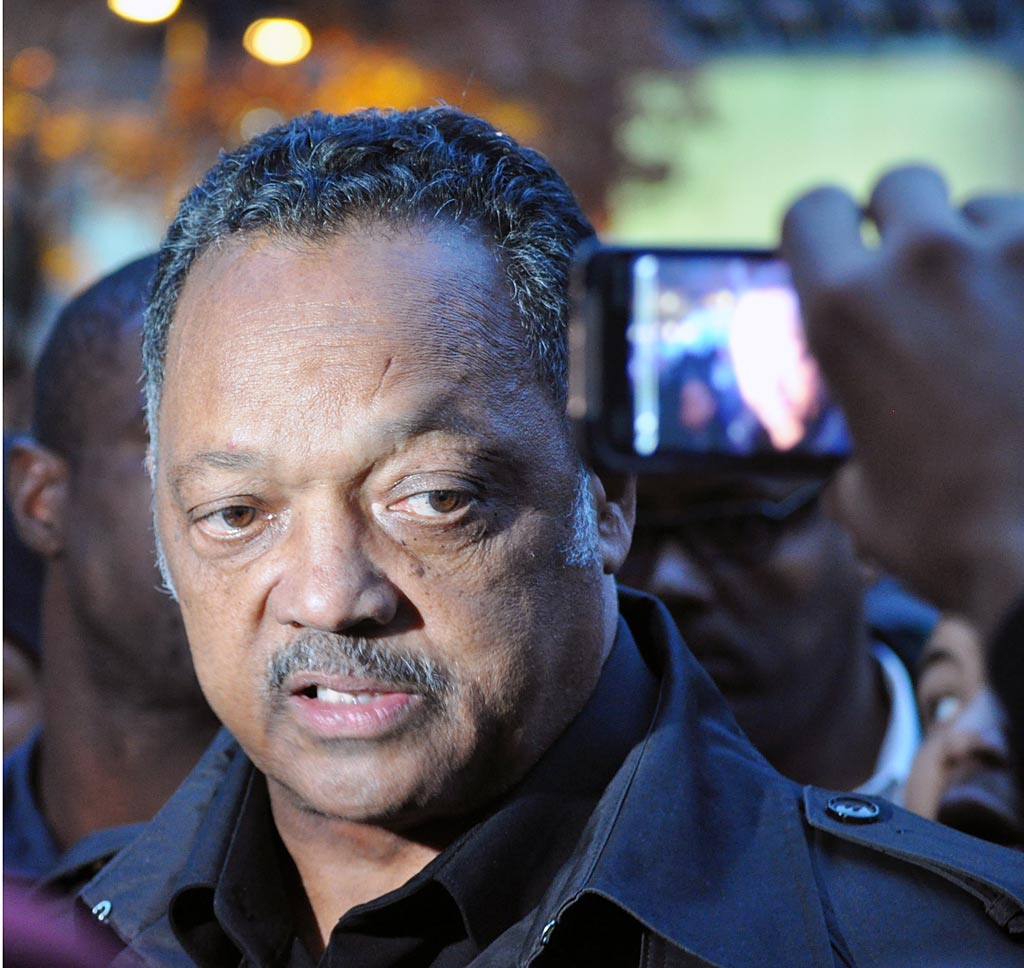
The Rev. Jesse L. Jackson, a civil rights icon and a regular presence in Philadelphia who energized Black voters both locally and nationally for more than five decades, died Tuesday at his home in Chicago following a prolonged battle with a rare neurological disorder. He was 84.
“Jesse Jackson will be remembered in Philadelphia as a civil rights hero, and a leader in terms of independent Black politics nationwide,” said former Councilmember W. Wilson Goode Jr., the son of Philly’s first Black mayor, W. Wilson Goode Sr. “He loved Philadelphia, and Philadelphia loved him.”
A native of Greenville, S.C., Rev. Jackson initially rose to prominence in the mid-1960s, when he joined the 1965 voting rights march that the Rev. Dr. Martin Luther King Jr. led from Selma to Montgomery, Ala. In the years following King’s assassination in 1968, Rev. Jackson largely came to be considered his successor.
Rev. Jackson would go on to become a prominent Black political and cultural leader in his own right, with his lengthy time in the public eye including presidential runs in 1984 and 1988. His visits to Philadelphia date back to the 1970s, and run the gamut from time in town supporting his own presidential campaigns — though neither of which were successful in the ‘80s — to appearances at the Democratic National Convention in 2016.
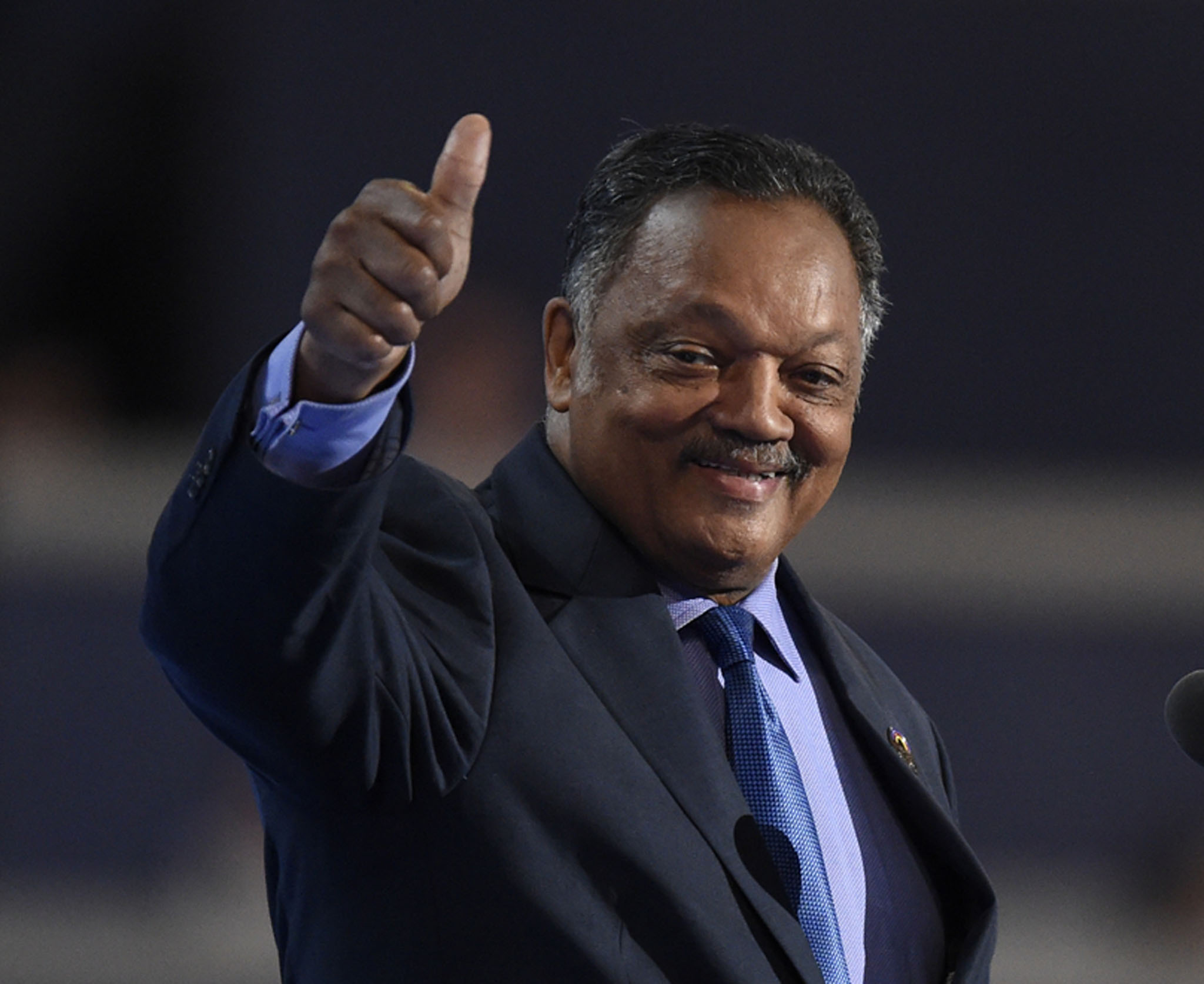
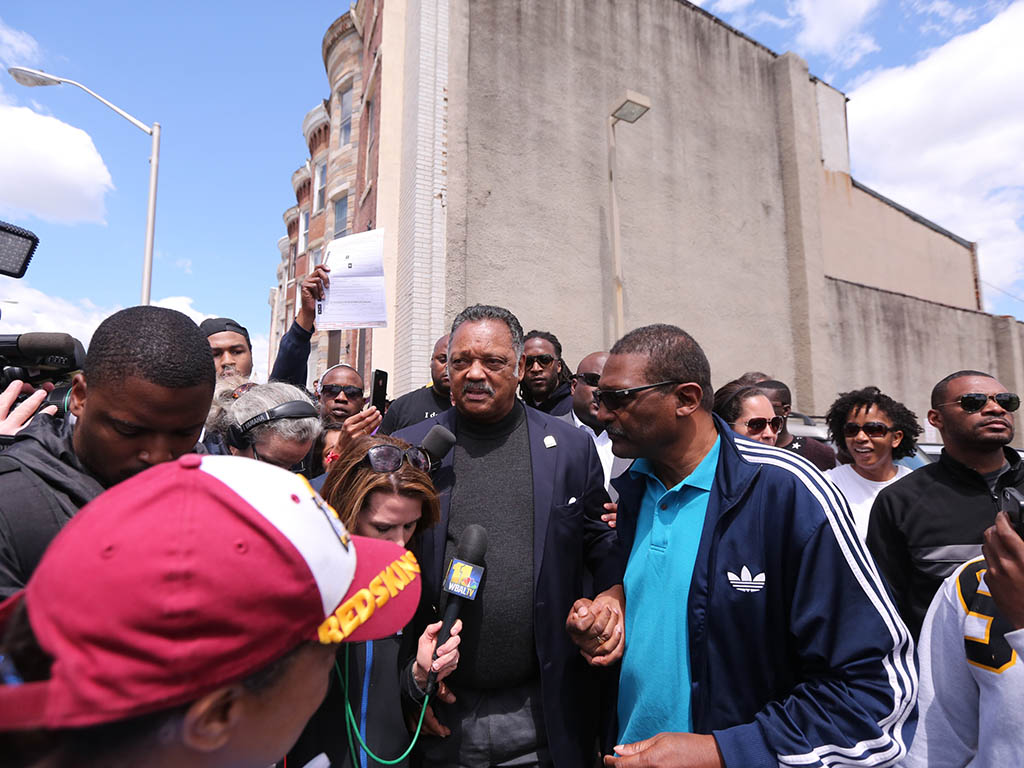
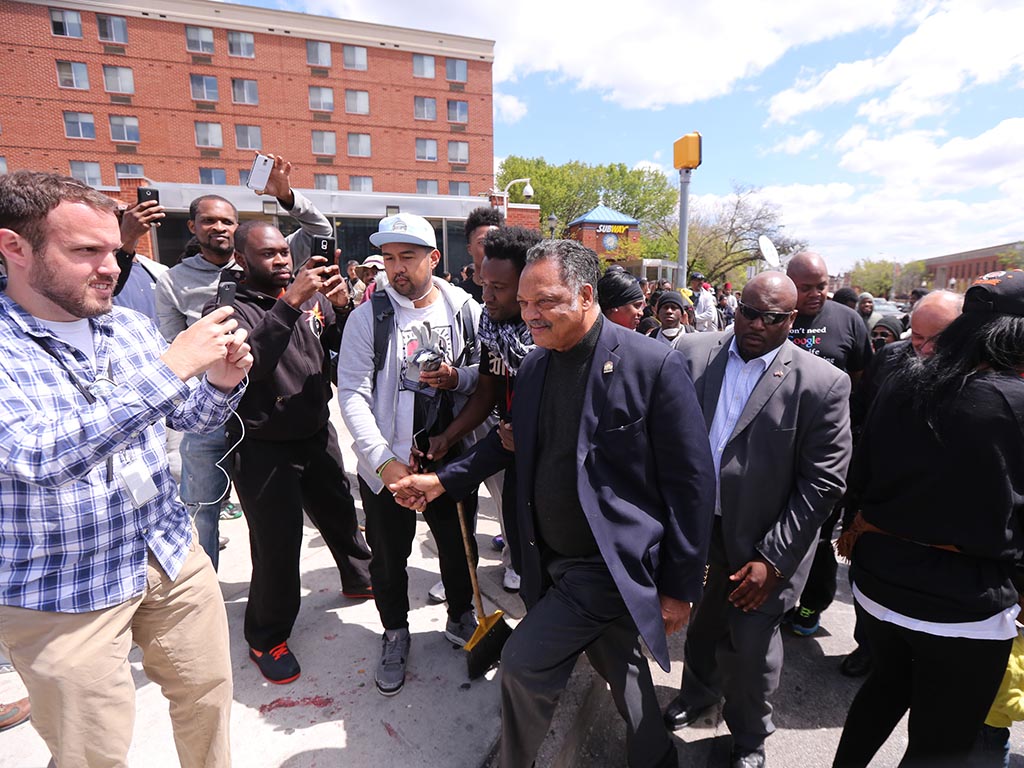
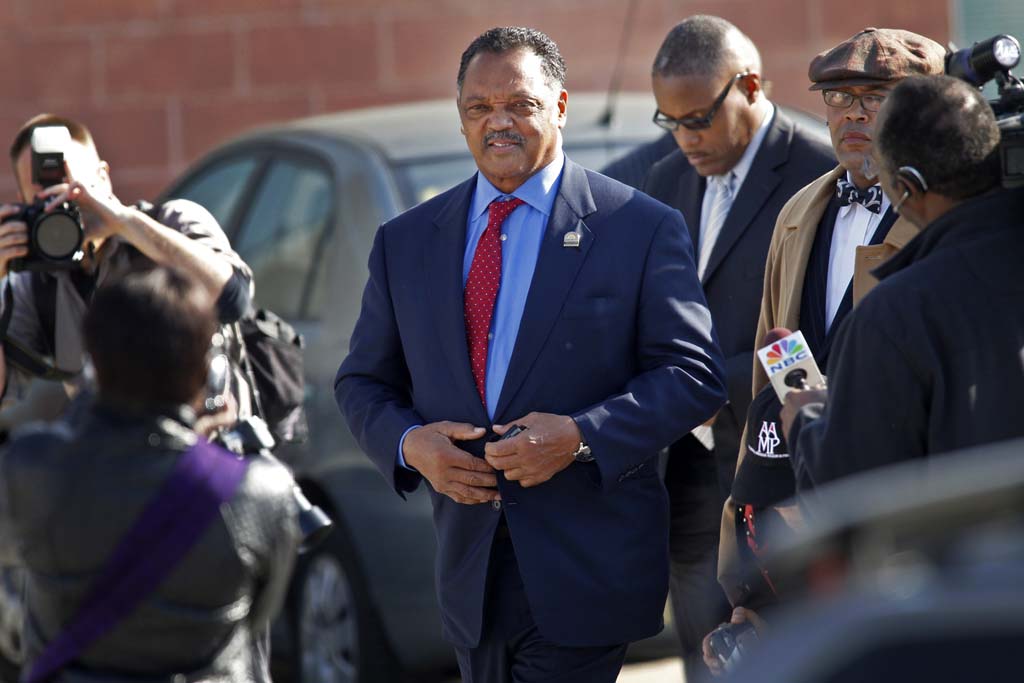
The Rev. Jesse Jackson, founder and president of the Rainbow/PUSH Coalition, acknowledges the cheers of delegates as he walks to the podium to deliver remarks on the third night of the Democratic National Convention in Philadelphia on July 27, 2016.Hillary Clinton supporters and the Rev. Jesse Jackson (right) on the fourth day of the Democratic National Convention at the Wells Fargo Center on July 28, 2016.The Rev. Jesse Jackson visits Baltimore’s turbulent intersection of West North Avenue and Pennsylvania Avenue on April 28, 2015.
Across that time, Rev. Jackson served as a sort of rallying figure for Black Philadelphians at large, who largely supported his candidacy during his presidential runs, despite him failing to secure the Democratic nomination statewide. Still, his impact for Black voters both in Philadelphia and nationally remains everlasting.
“That was the Rosetta stone to everything Jackson was trying to achieve,” said former Daily News scribe Gene Seymour, nephew of legendary People Paper columnist Chuck Stone. “We aren’t to be ignored or dismissed or cast aside — we matter.”
In that sense, Goode Jr. said, Rev. Jackson will remain a political icon who inspired the nationalization of Black political empowerment.
“Jesse Jackson is also a cultural icon in terms of telling people to be proud of being Black, and telling themselves, ‘I am somebody,’” Goode Jr. said, referencing Rev. Jackson’s famed refrain. “That is something that was indelible in the soul of Black people across the nation and world, and in Philadelphia here as well.”
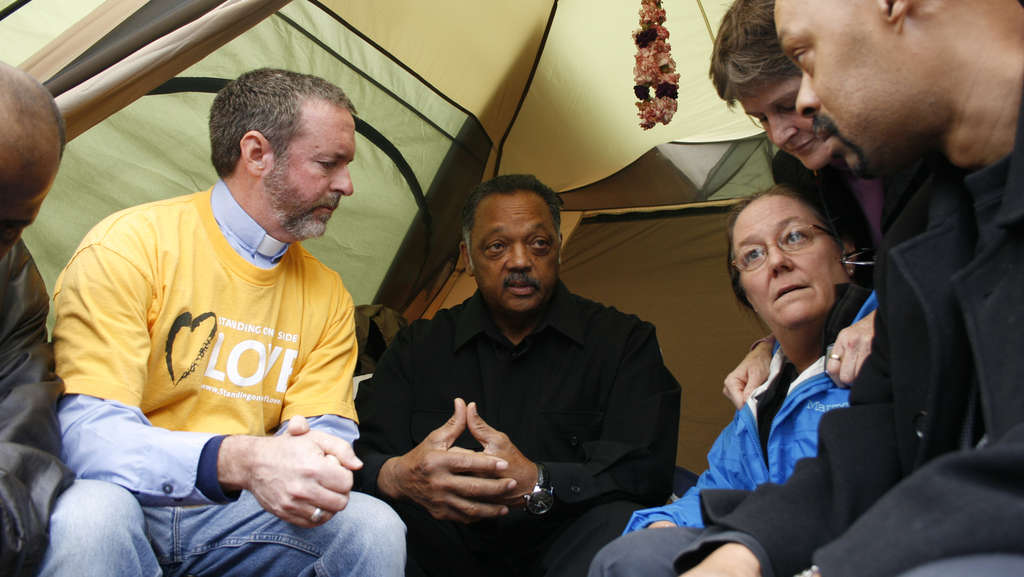
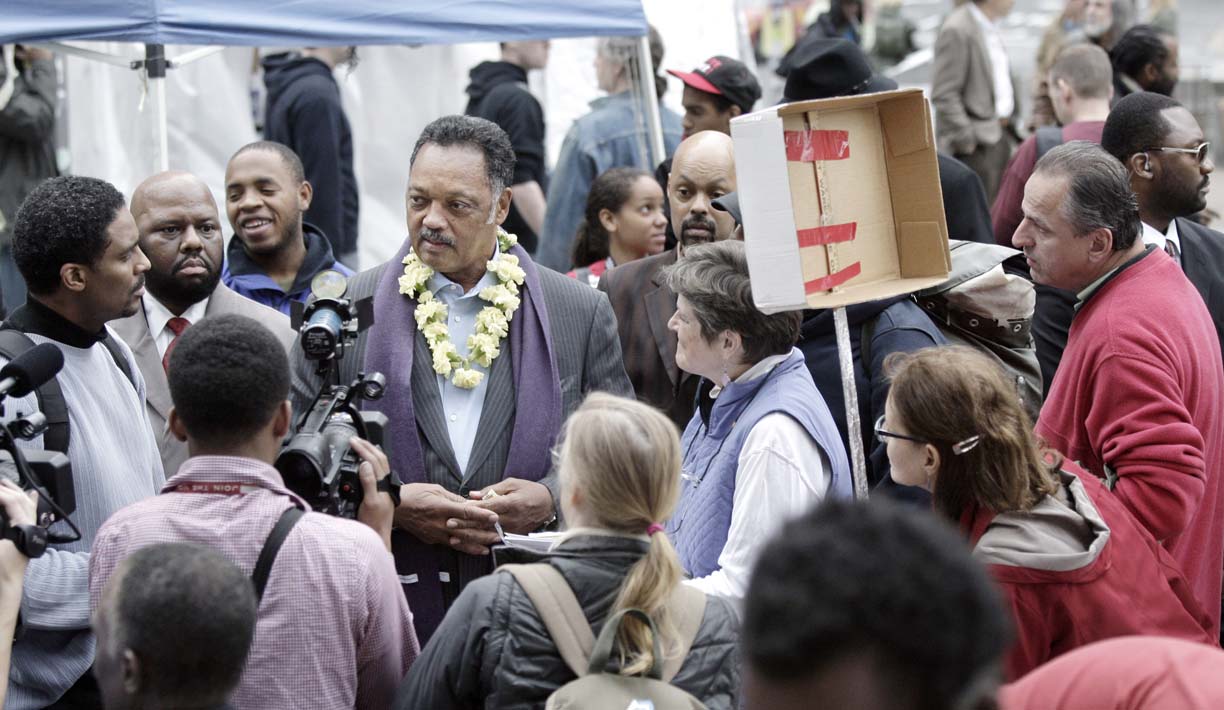
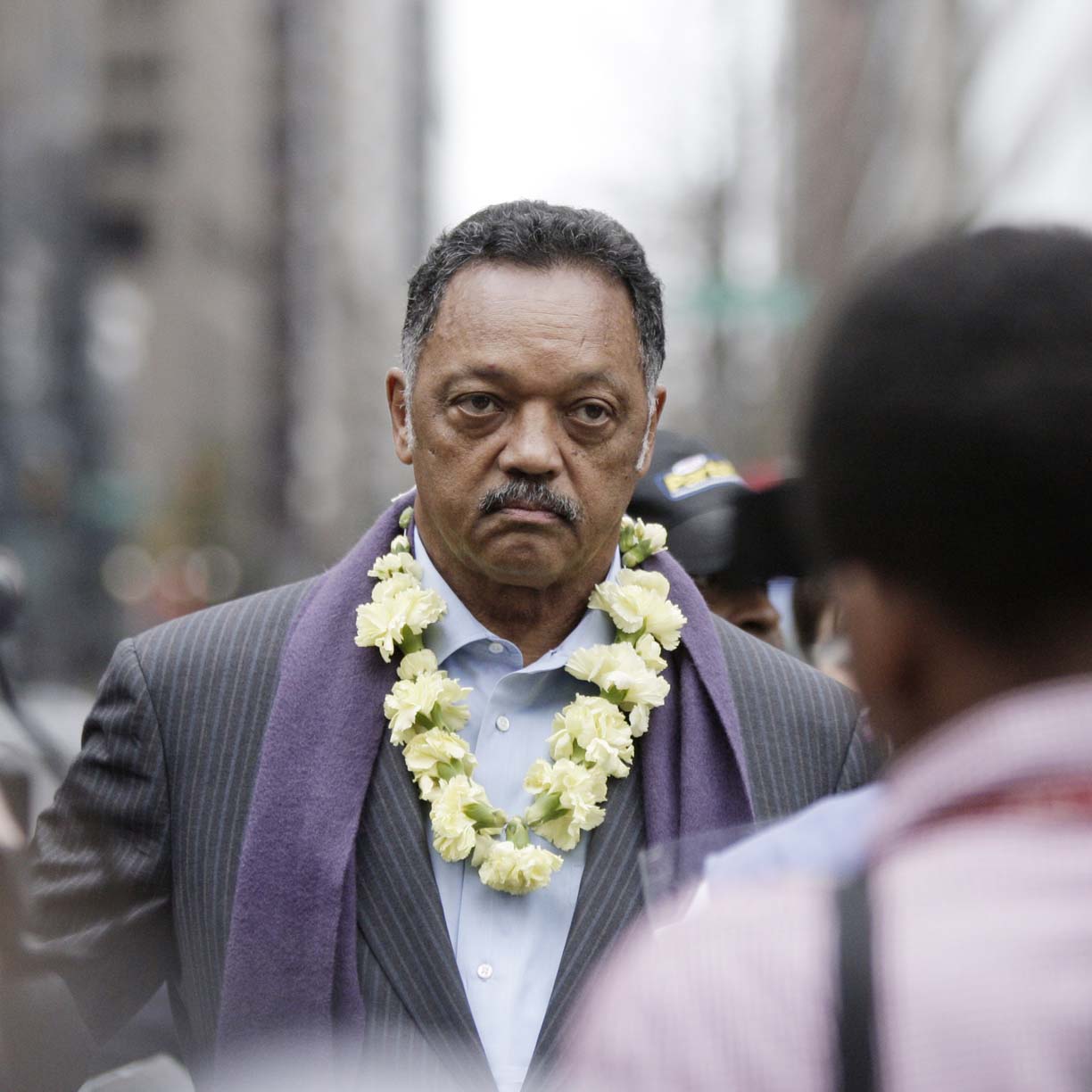
The Rev. Jesse Jackson visits the turbulent intersection of West North Avenue and Pennsylvania Avenue in Baltimore on April 28, 2015.The Rev. Jesse Jackson visited Occupy Philadelphia protesters on Nov. 13, 2011. He told them to “never surrender.”The Rev Jesse Jackson at Joe Frazier’s funeral at Enon Tabernacle Baptist Church on Cheltenham Avenue in Philadelphia on Nov. 14, 2011.The Rev. Jesse Jackson (center) visits the Interfaith tent, donated by Quakers, to talk to the Rev. Peter Friedrich (left) and (from right) Phillip Hall, Hollister Knowlton, and Joyce Moore in 2011.
Though Philadelphia’s Black community generally was supportive of and receptive to Rev. Jackson’s messaging historically, Seymour said, he maintained something of a complicated relationship with the city’s prominent politicians. Wilson Goode Sr., for example, officially supported Walter Mondale and Michael Dukakis for president in the 1980s. At least in 1988, Seymour said, Rev. Jackson likely had “the people’s hearts,” despite lacking the official nomination.
Wilson Goode Sr. was not immediately available for comment.
“His presidential campaigns in 1984 and 1988 reshaped American politics,” said the Rev. Gregory Edwards, of the Philly-based POWER Interfaith, in a statement. “Those campaigns widened the political imagination of this country and helped cultivate a generation of Black elected leaders.”
Rev. Jackson’s relationship with Goode Sr. was somewhat complicated following the 1985 MOVE bombing, which brought the civil rights leader to tour the ruins of the 6200 block of Osage Avenue in its aftermath. Rev. Jackson urged a congressional investigation into the incident, which he called “excessive force,” but avoided criticizing Goode directly in subsequent meetings. Goode, meanwhile, said that the city would cooperate with any groups investigating the incident, The Inquirer reported at the time.
“He was not happy with what happened in ‘85 with MOVE,” Seymour said.
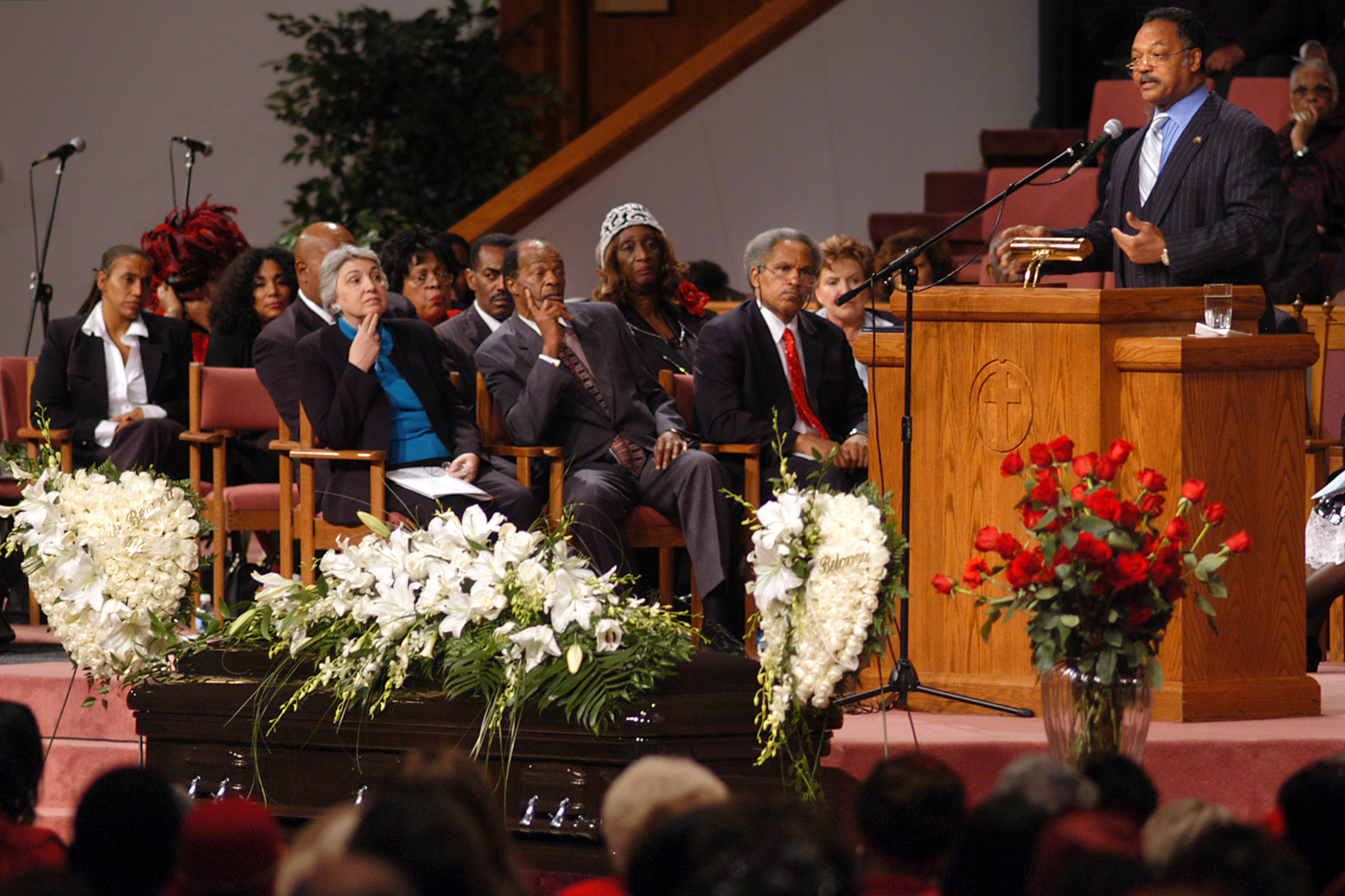
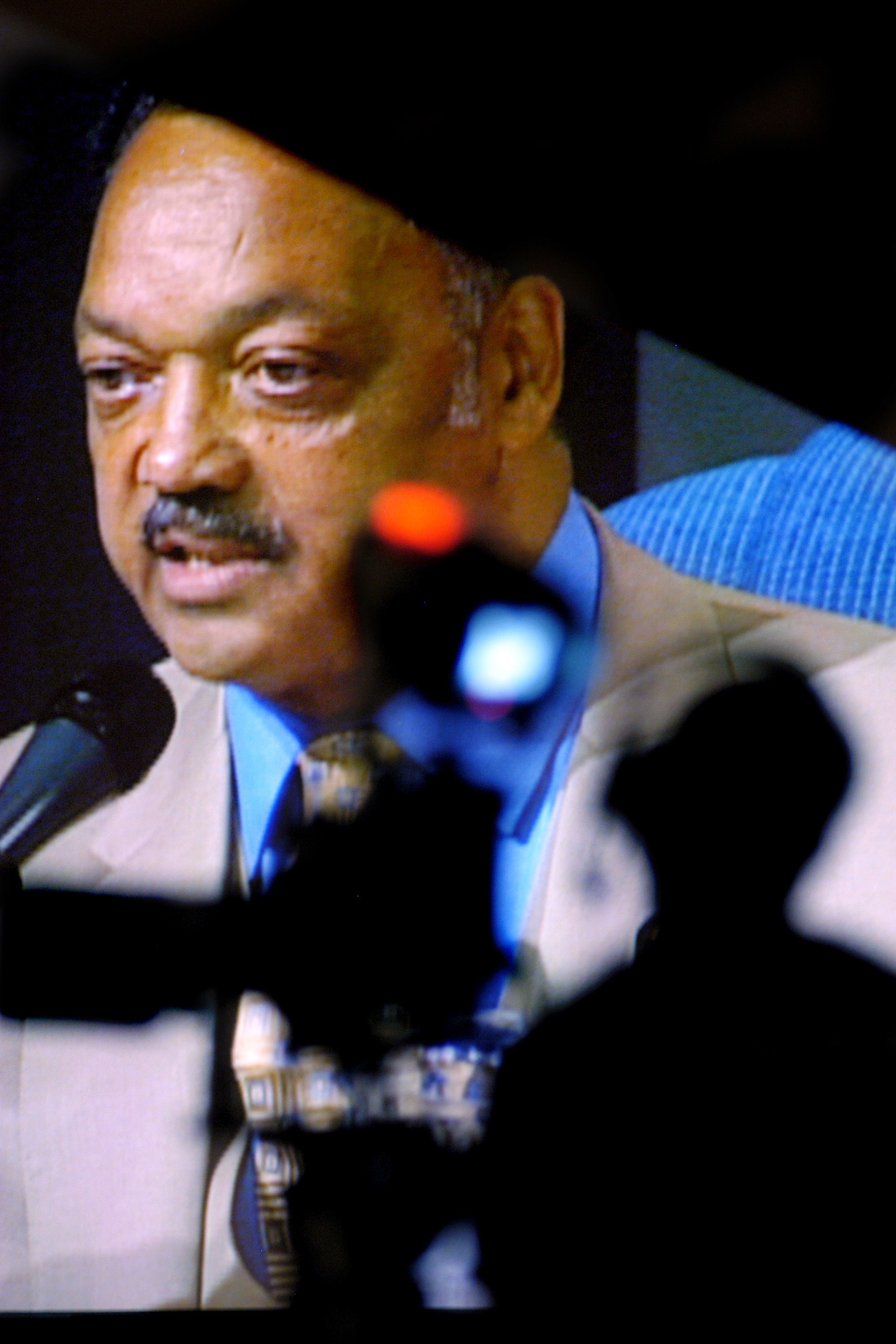
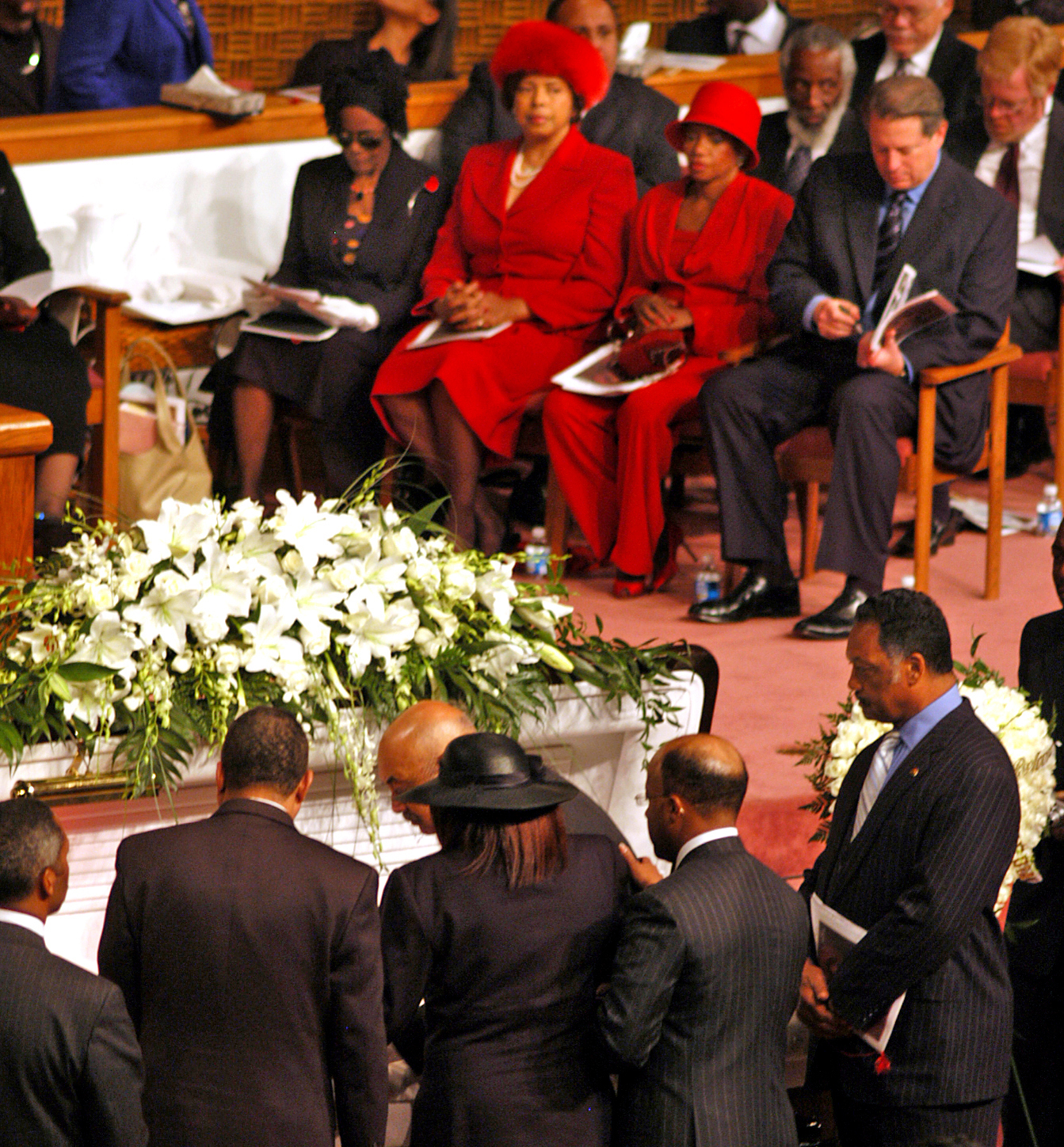
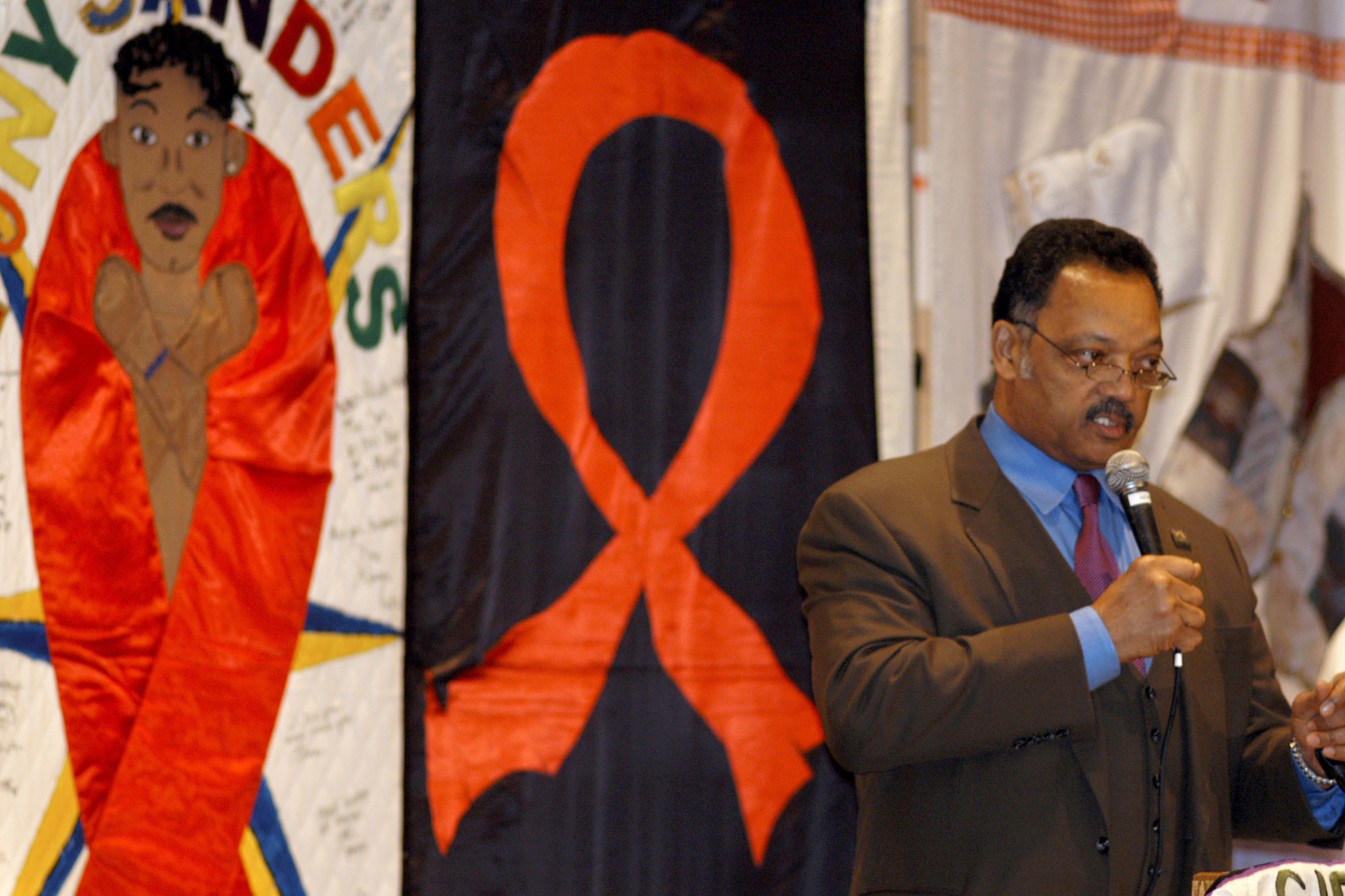
The Rev. Jesse L. Jackson speaks during during funeral services for civil rights activist C. Delores Tucker at Deliverance Evangelistic Church on Oct. 21, 2005. Seated in front row behind him, left to right are Eleanor Smeal, president of the Feminist Majority Foundation; Marion Barry, former mayor of Washington, and Philadelphia Mayor John Street. Rev. Jackson is projected live on a large screen monitor (camera operator in foreground) as he participates in a panel discussion laying out a legal and political strategy for fulfilling Brown v. the Board of Education, at the annual NAACP meeting on July. 14, 2004 at the Convention Center. Her family stands by as husband (partially hidden) William T. Tucker covers the body of civil rights activist C. Delores Tucker in her casket at the beginning of funeral service at Deliverance Evangelistic Church on Oct. 21, 2005. At right is the Rev. Jesse L. Jackson, founder and president of the Rainbow Coalition/PUSH, who later delivered the eulogy. Seated in rear at right is former Vice President Al Gore. AIDS quilt panels flank the podium as the Rev. Jesse Jackson speaks at an African American AIDS conference at the Wyndham Franklin Plaza Hotel on Feb. 28, 2005.
Still, Rev. Jackson often served as a defender of Philadelphia’s famed Black figures. In 2011, for example, Rev. Jackson spoke at the funeral of legendary world heavyweight boxing champion Joe Frazier, who had long competed with the fictional Rocky Balboa for recognition. As Jackson put it at the time, Frazier was the “real champion,” not the “Italian Stallion.”
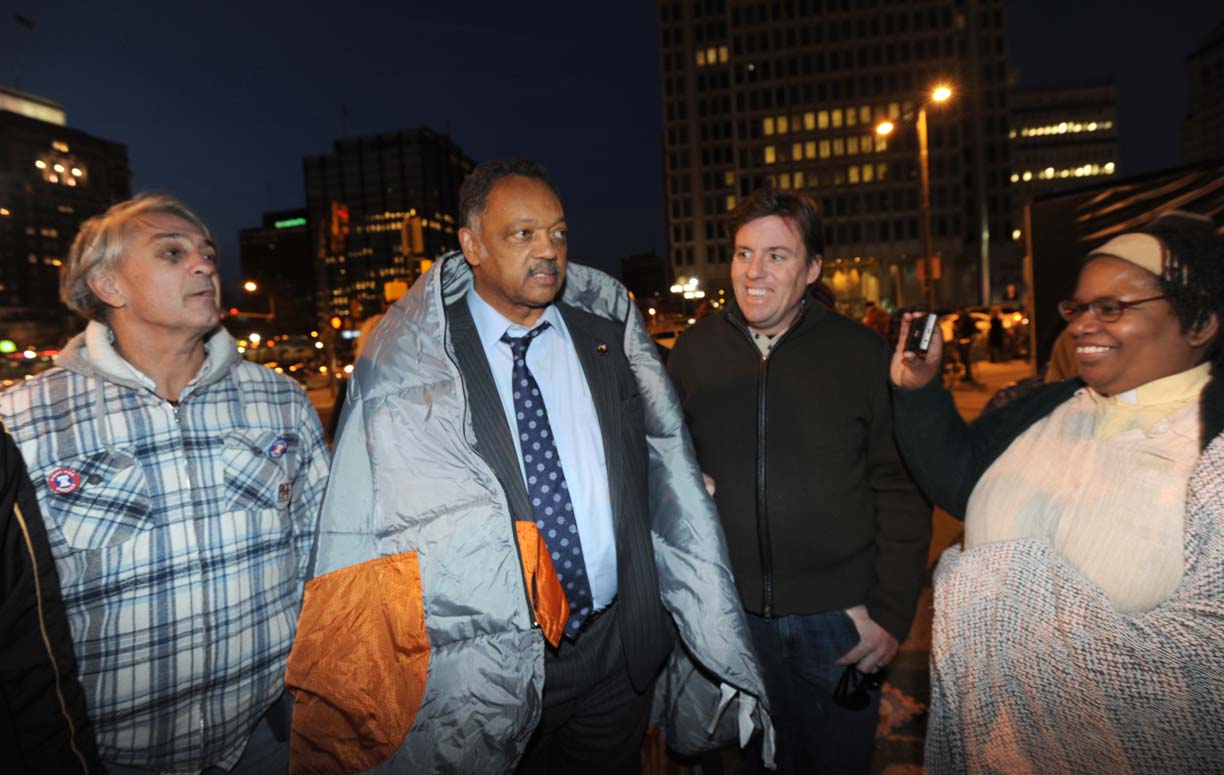
The Rev. Jesse Jackson, who has a sleeping bag draped around his shoulders, is talking and praying with Occupy Philadelphia demonstrators: Brad Wilson (from left); the Rev. Bill Golderer, pastor of Broad Street Ministry; and Donna Jones, pastor of the Cookman Baptist Initiative.
“If you were of importance as a Black person in America during the time [Jackson] was in the public eye,” Seymour said, “he was there to speak on your behalf.”
Goode Jr.’s most prominent memory of Rev. Jackson, meanwhile, dates back to the mid-1980s, when he was a student at the University of Pennsylvania. At the time, he said, Rev. Jackson attended a National Black Student Union conference following an invitation from its organizers, Goode Jr. included. It was, Goode Jr. said, an inspiration.
“It meant a lot to us,” Goode Jr. said. “Not just Black leaders at Penn, but across the nation, who were gathered there.”
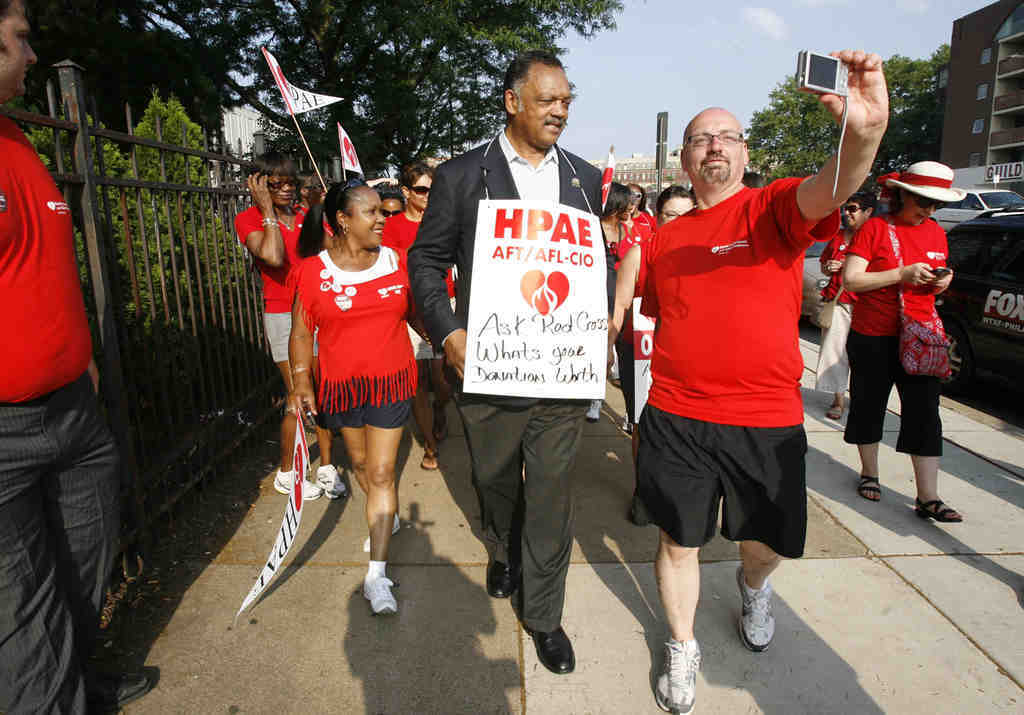
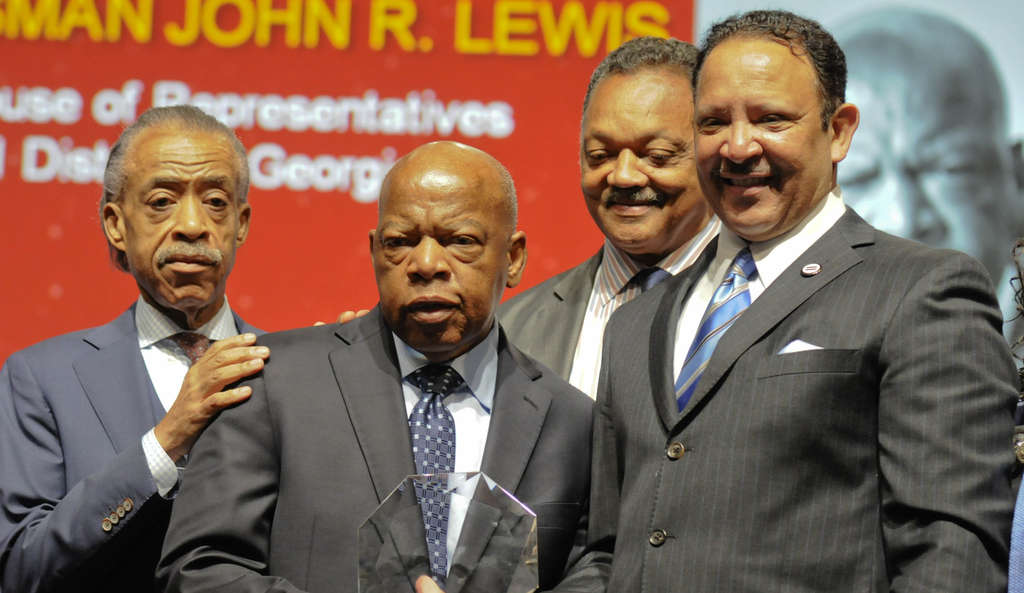
Striking Red Cross worker Lenny Lerro takes a picture of himself with the Rev. Jesse Jackson as they walk the picket line in 2011 on Spring Garden Street in Philadelphia.Rev. Jesse Jackson visits with folks at Occupy Philadelphia, just outside City Hall on Nov. 20, 2011.The Rev. Jesse Jackson visits with folks at Occupy Philadelphia, just outside City Hall on Nov. 20, 2011.U.S. Rep. John Lewis (second from left) is presented with the Civil Rights Champion Award in 2013 by (from left) the Rev. Al Sharpton, the Rev. Jesse Jackson, and Marc Morial, president of the Urban League.