Living in the Fox Chase Manor neighborhood in the mid-1990s, Linda and Mike Tobin admired the location of houses across the street. So in 1997, they decided to buy one and enlarge it.
They raised their two children there and sent them to the Abington School District. But now the children are grown up and have moved to Cherry Hill, where Linda is from, so the Tobins will follow them there.
Mike installs telecommunications systems for businesses, and Linda is a retired telecommunications professional.
The primary bedroom.
Mike said they were particularly attracted by “the quaintness of the neighborhood, the big oak trees,” and township-residents-only Alverthorpe Park, with its variety of athletic facilities.
So they undertook a major renovation of the house on one of the larger plots of Fox Chase Manor, with a two-car attached garage and driveway parking for four more cars.
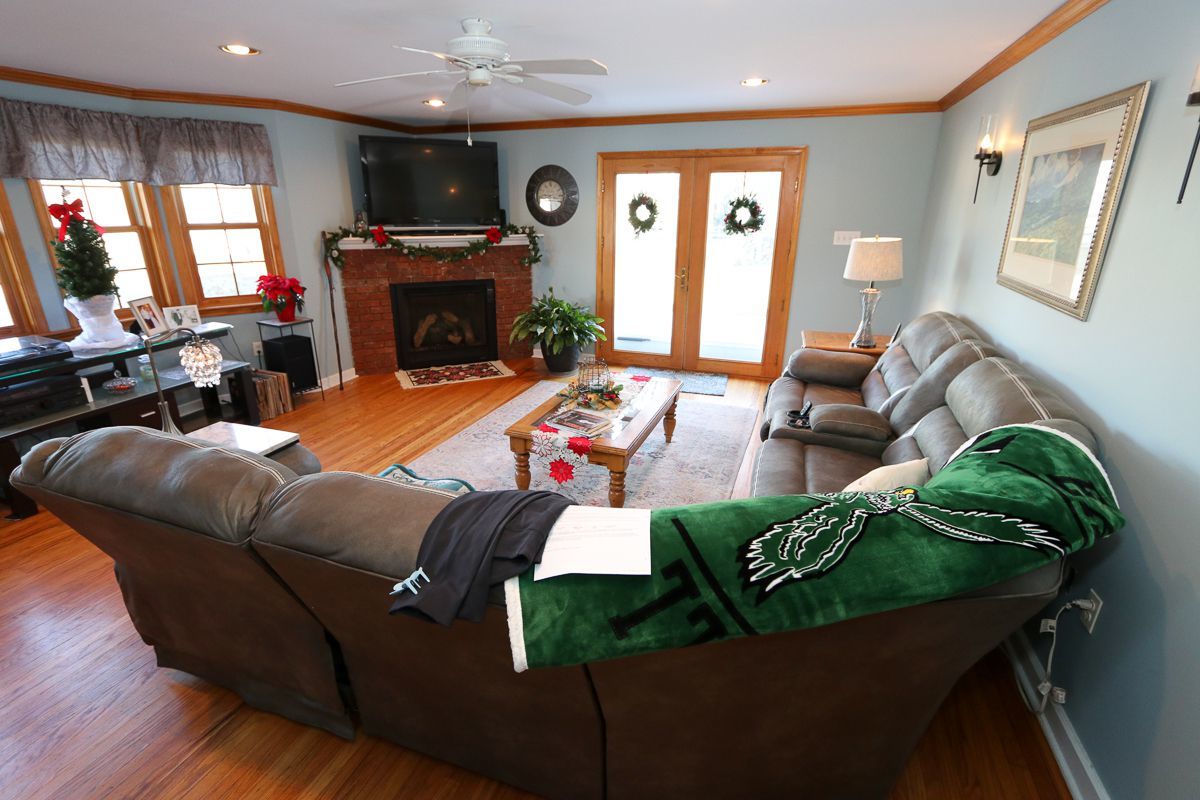
The family room has a gas fireplace.
The renovation comprised an expanded eat-in kitchen, first-floor powder room, and a family room with a gas fireplace and a large patio.
The second level was expanded for the house to have four bedrooms, two full bathrooms, and a laundry room.
Entrance to the house is through a covered front porch into the foyer, living room, and formal dining room.
The dining room.
The second level has the bedrooms, and the primary bathroom has a stall shower and walk-in closet.
The partially finished basement has heat.
There are hardwood floors in most of the home, and tile in the kitchen and bathrooms.
A covered front porch at the entrance to the house.
The roof was replaced in 2015 and there is 200-amp electric throughout.
The house is close to Huntingdon Valley Shopping Center and a Giant supermarket.
It is listed by Don Rowley of Coldwell Banker Hearthside Realtors for $599,900.
Now that the regular season has concluded, the real fun can begin.
The No. 3-seeded Eagles are set to host the San Francisco 49ers at 4:30 p.m. Sunday in the wild-card round. The No. 2 seed was up for grabs with the Chicago Bears’ loss to the Detroit Lions, but the Eagles couldn’t win the regular-season finale against the Washington Commanders with their backups.
That loss, and Nick Sirianni’s decision to rest the starters in Week 18, is in the past now. After finishing the regular season 11-6, the Eagles get to start anew in the postseason.
Here’s what we know (and what we don’t) about the Eagles going into Sunday’s wild-card game:
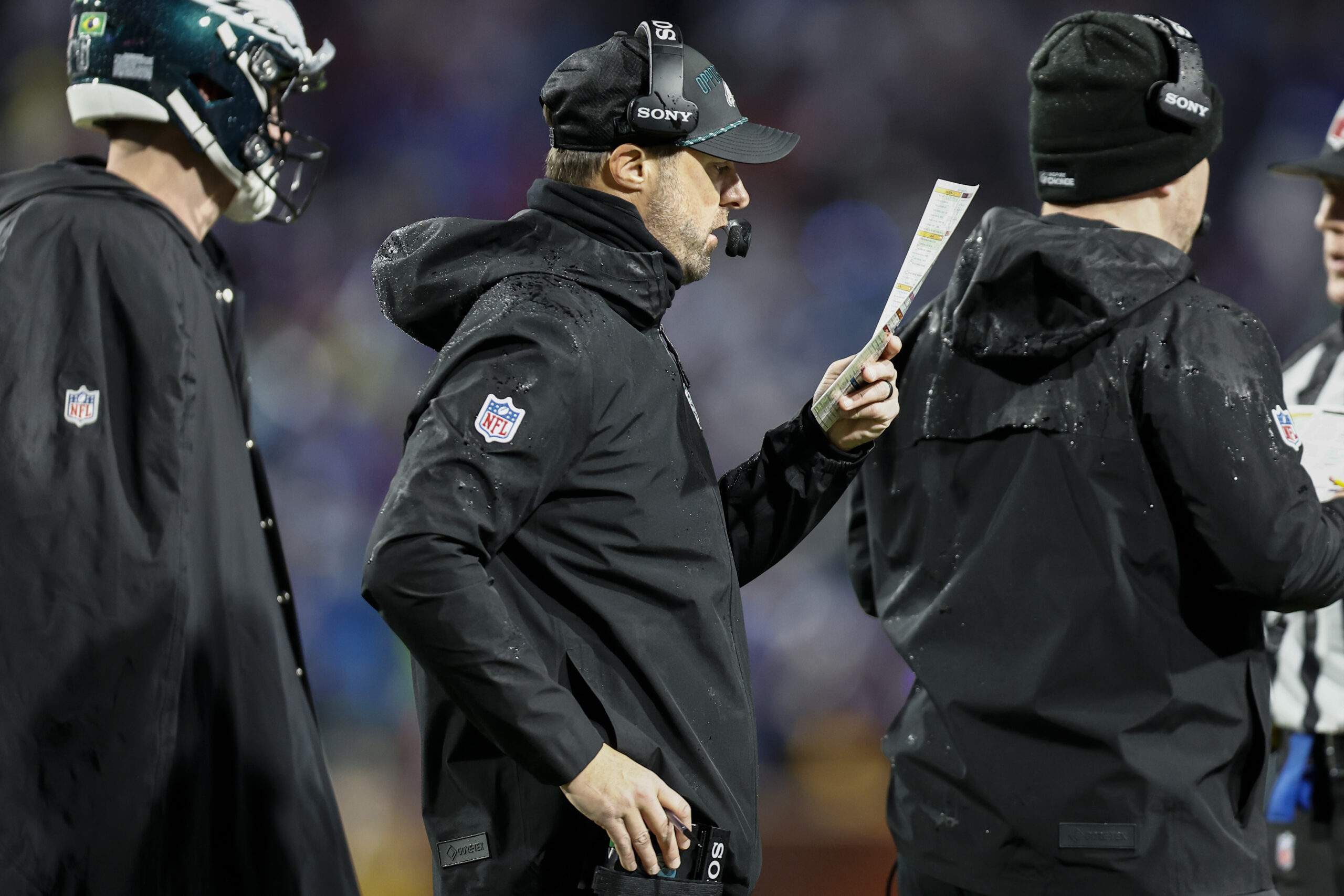
Can offensive coordinator Kevin Patullo dial up the plays that can take advantage of the 49ers’ shortcomings?
An ideal matchup?
For all of the discussion leading up to the season finale about whether to rest or play the starters with the hopes of facing the No. 7-seeded Green Bay Packers, the Eagles might have drawn an ideal opponent in the wild-card round.
The 49ers have one of the weaker defenses among the NFC’s playoff teams, which could be a gift to a shaky Eagles offense. San Francisco’s defense has suffered significant injury-related attrition this season. Inside linebacker Fred Warner and edge rushers Nick Bosa and Mykel Williams suffered season-ending injuries earlier in the year, which have proved to be significant losses for defensive coordinator Robert Saleh’s group.
Their pass rush is practically nonexistent. The 49ers rank second-to-last in the league in quarterback pressure rate (26.7%), according to Next Gen Stats. Bryce Huff — remember him? — is tied for the team lead with four sacks. Bosa, who suffered a torn ACL in Week 3, still ranks third on the team with two sacks.
Their inside linebacker corps is suspect in coverage. In the Week 18 loss to the Seahawks, 49ers inside linebackers conceded 126 of Sam Darnold’s 198 passing yards, according to Pro Football Focus. Darnold picked on Tatum Bethune, who left the game injured and was ruled out for the postseason on Monday, the most (six receptions allowed on seven targets for 78 yards).
The 49ers should provide a welcome first-round matchup for the Eagles offense. After all, if we’ve learned anything this season, it’s that Kevin Patullo’s play-calling has been generally lackluster.
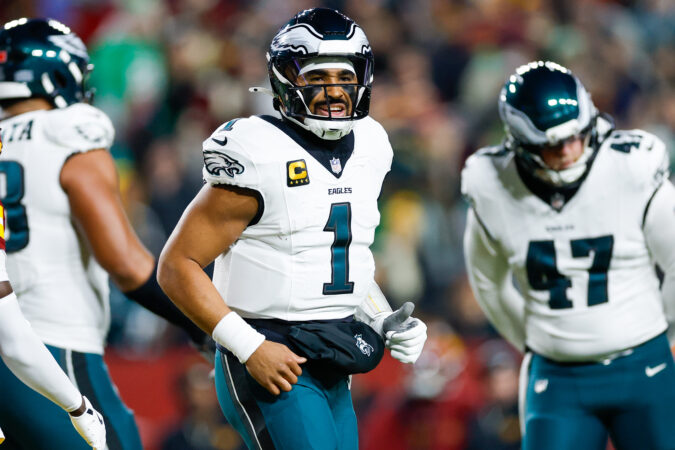
His shortcomings took center stage Sunday in the loss to the Commanders in various situations, especially toward the end of the game when the Eagles abandoned the efficient, Tank Bigsby-led running game and put the contest on Tanner McKee’s arm to no avail. McKee’s inability to make plays out of structure served as a reminder that Jalen Hurts has often put a Band-Aid over otherwise dead plays with his knack for extending them.
Can the Eagles offense, with or without the help of Patullo, take advantage of the 49ers’ weaknesses?
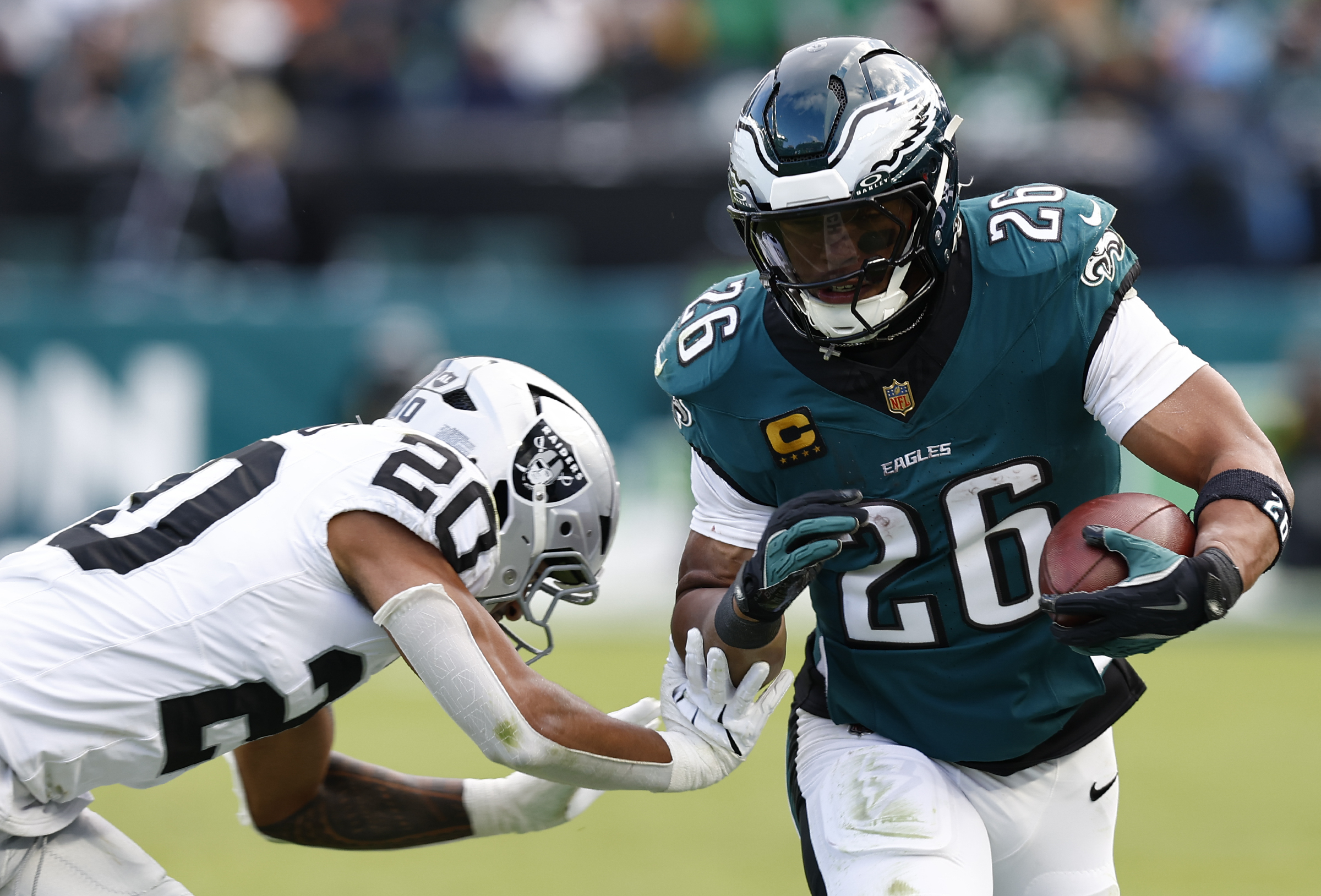
Saquon Barkley has seen an uptick in production over the past month.
On the run
The good news for the Eagles offense doesn’t end there — the 49ers have been porous against the run, too.
The Seahawks, led by the tailback duo of Kenneth Walker and Zach Charbonnet, combined for 180 yards and a touchdown on 39 carries against the 49ers on Saturday, marking San Francisco’s worst performance against the run this season. According to Next Gen Stats, Walker and Charbonnet combined for 141 yards and a touchdown on under-center runs.
Over the last two weeks, opposing teams have been generating plays of at least 20 yards against the 49ers at will. In Week 17, the Bears had seven plays of at least 20 yards, six of which were passing plays. The Seahawks had four, two of which came on the ground. Missed tackles plagued the 49ers — according to Next Gen Stats, Walker and Charbonnet each forced seven missed tackles.
That ought to be Saquon Barkley’s music. The 28-year-old running back has been making the most of an increased workload lately. In December, Barkley averaged 4.88 yards per carry and 100 yards per game, the latter being his best clip on a monthly basis this season. He also had 20.5 carries per game, his greatest share on a monthly basis, too.
Could the Eagles lean into the under-center running game against the 49ers? When they have, Barkley has been successful. He has averaged 4.9 yards per carry (531 yards on 108 attempts) on under-center runs this season, compared to 3.6 yards per carry (489 yards on 134 carries) on shotgun runs and 3.2 yards per carry (120 yards on 38 attempts) on rare runs out of pistol.
After a week off, and with the potential of getting Lane Johnson back into the mix for the first time since November, the entire Eagles rushing unit should have no excuses against a struggling 49ers defense.
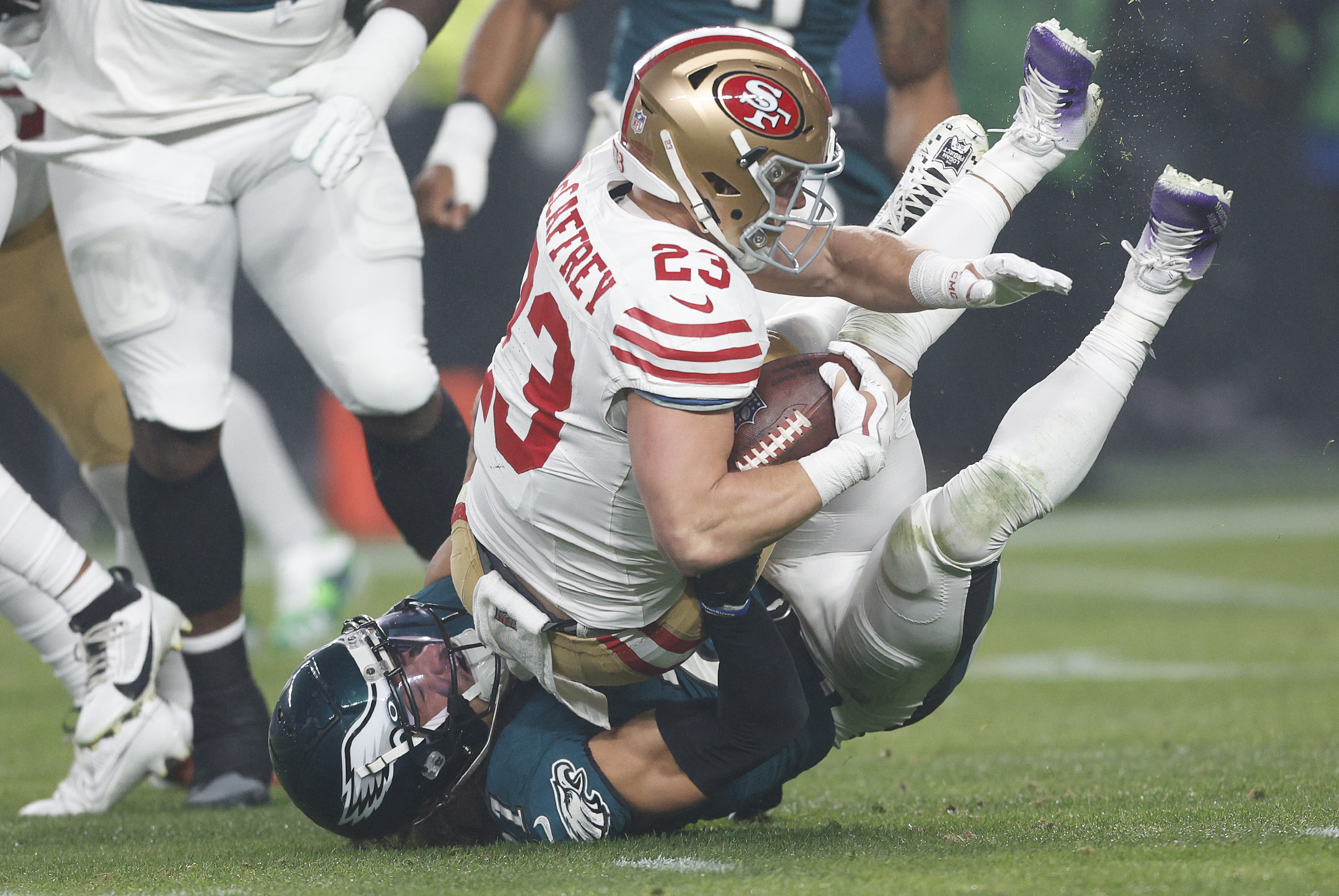
The dangerous Christian McCaffrey will be a challenge for Vic Fangio and the Eagles defense.
McCaffrey mania
Brock Purdy has fared well since his Week 11 return from injury, racking up 1,581 passing yards (No. 12 in the NFL among quarterbacks with at least 100 attempts) and 16 touchdowns (No. 3) while completing 70.6% of his attempts (No. 2) in that span.
But he isn’t the star of the 49ers offense. Christian McCaffrey is the 49ers’ greatest weapon, both in the running game and in the passing game. He has shouldered a staggering workload this season, with a league-high (and a single-season career-high) 413 touches through 17 starts.
He’s made the most of those touches. McCaffrey has 2,126 all-purpose yards, which ranks fourth in the NFL. That total is the second-greatest of his career, only behind his output in 2019 (2,392) as a member of the Carolina Panthers.
Even at age 29 and coming off a lost 2024 season due to injury, McCaffrey remains one of the most elusive players in the league. Going into Week 18, McCaffrey had forced a league-high 112 missed tackles across his touches, according to Next Gen Stats.
Still, he didn’t generate a single missed tackle against the Seahawks, who boast one of the best run defenses in the league. His fourth-quarter red-zone drop, which led to a Seahawks interception, also helped quash the 49ers’ attempt at a comeback on Saturday.
Keeping McCaffrey at bay will be the key to an Eagles victory. He has 10 games with at least 115 yards from scrimmage, the most of any player this season. The 49ers are 9-1 in those games. Reinforcements are on the way for the Eagles, with Nakobe Dean — one of their best defenders against the run — likely to return from a two-week injury layoff.
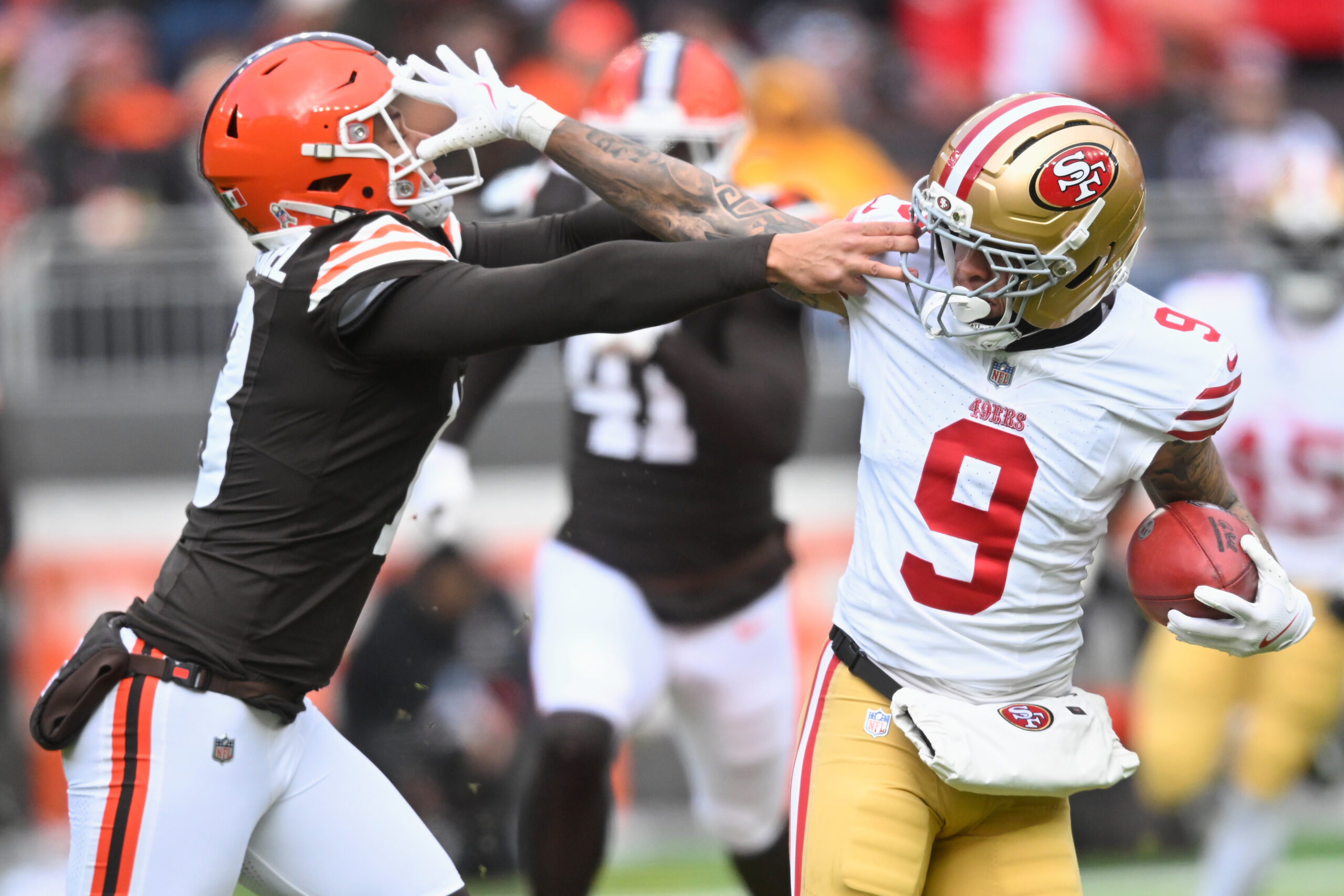
Skyy Moore (9) has helped the 49ers win the field-position game throughout the 2025 season.
Special-teams stars
The 49ers’ best phase is arguably their special-teams unit.
Yes, the unit that muffed a punt and missed an extra point in the 49ers’ Super Bowl LVIII loss to the Kansas City Chiefs two seasons ago is now one of the strongest in the NFL.
Kicker Eddy Piñeiro is at the center of that turnaround. Piñeiro, whom the 49ers signed after Jake Moody struggled in the season opener, has been practically flawless on field goals this year. He has made 28 of 29 attempts (96.6% made, tied for the league lead among kickers with at least 20 attempts). His lone miss came on a 64-yard attempt three weeks ago.
The Niners have thrived in the return game, too. Skyy Moore ranks 10th in the NFL in yards per kick return (27.5; the league average is 25.9) and No. 9 in yards per punt return (11.6; the average is 10.2). The 49ers are tied for second in the NFL in average starting field position (their own 32.5).
The Eagles can’t afford to make mistakes on special teams because the 49ers have been so sound. Jake Elliott has been the most inconsistent piece of the group, as he has made just 74.1% of his field-goal attempts, which is the second-worst rate among kickers with at least 20 attempts this season.
Danny Brière has officially been the Flyers’ full-time general manager since May 11, 2023. In the two-plus years since, he has made 27 trades, with most involving draft picks or swapping players in the AHL.
But that doesn’t mean there haven’t been splashy deals. And two of the biggest ones are with a little guy he doesn’t hate working with, Pat Verbeek of the Anaheim Ducks.
As the Flyers get set to host the California team, let’s revisit them:
Who was involved in the Flyers-Ducks trades?
Trade 1: Jan. 8, 2024
Flyers received: Jamie Drysdale and a second-round pick in the 2025 NHL draft
Ducks received: Cutter Gauthier
Trade 2: June 23, 2025
Flyers received: Trevor Zegras
Ducks received: Ryan Poehling, a second-round pick in the 2025 NHL draft (Eric Nilson), and a fourth-round selection in the 2026 draft.
As for Gauthier, Flyers fans may want to look away.
Selected with the No. 5 overall pick in 2022, Gauthier never played for the Flyers after forcing a trade out of Philly.
“We tried to give him space,” Brière said the night the trade was made. “We tried to get in touch with him many times. They would not communicate, as far as the Gauthier side. So at some point, we had to make a decision.”
Why? No one knows.
“It wasn’t one specific reason why I asked for a trade,” Gauthier said on a Zoom with Anaheim’s media after the trade. “It was multiple, [recurring] issues that I’d seen over the past year and a half, two years of being under the Flyers organization. It kind of hit me all at once, thinking, ‘I can’t move forward with this, and I really need to step up for myself and see what’s best for my future,’ and that’s what I did.”
Last season, Gauthier notched 20 goals and 44 points in 82 games, finishing fifth in Calder Trophy voting with 92 votes — well behind fourth-place finisher Matvei Michkov — and was named to the All-Rookie Team. Amid that, he returned to a city that did not show him any brotherly love on and off the ice in a 6-0 thrashing by the Flyers last January.
Cutter Gauthier, once the Flyers’ top prospect before forcing a trade, has 19 goals this season for Anaheim.
This season, he already has 19 goals and 39 points in 42 games for an upstart Ducks team that is tied for third in the Pacific Division. Gauthier, who turns 22 this month, is on pace for 37 goals and 76 points.
In October, Gauthier had an eight-game point streak, helped by his first NHL hat trick against the Florida Panthers. He skates on the left wing of the Ducks’ top line, alongside Leo Carlsson and Alex Killorn, while also getting time on the second power-play unit, where he has tallied four power-play goals and eight points.
Poehling, a first-round pick in 2017 for the Montreal Canadiens, resurrected his career in Philly after being signed to a one-year, bet-on-himself deal on July 1, 2023.
The speedy center, who collected 28 points in 77 games that season, became a favorite of then-coach John Tortorella and earned himself a two-year extension on Jan. 26, 2024. The following season, despite being impacted by injury, he set career highs in goals (12) and points (31) in 68 games with the Flyers.
Across his two seasons, Poehling was heavily relied on to kill penalties. He skated the second-most shorthanded minutes among forwards (235 minutes, 17 seconds). He tied Scott Laughton and Garnet Hathaway for second on the team with three shorthanded goals during that time frame and tied Hathaway, with whom he was often paired, for third with five shorthanded points.
Poehling, who has two goals and 14 points this season, has eight points across his last 12 games while centering Anaheim’s fourth line with Jansen Harkins and tough guy Ross Johnston.
What happened to Drysdale and Zegras?
In summation, two words: good things.
The two buddies have been key to the Flyers’ good vibes this season, with Zegras leading the team in goals (15), points (39), power-play goals (five), and power-play points (12) through 40 games.
While Zegras has officially put his last two years in Anaheim behind him, Drysdale has quietly shifted from being just a purely offensive blueliner who is questionable on defense to a guy who can play a complete 200-foot game.
Jamie Drysdale, who is still just 23, has improved defensively in his first year under Rick Tocchet.
With Drysdale paired with Emil Andrae since Nov. 22, the two have skated more than 300 minutes together and have been on the ice for 18 goals by the Flyers and just nine against.
So does Drysdale like being the veteran on the pairing with Andrae, who is the same age as him (23) but has played 182 fewer NHL games?
“A little bit, I do, yeah, I like it,” Drysdale said. “I love playing with Emil. He’s got a good mind, and I think that we have similar mindsets as well on and off the ice. And it’s good to build off each other.”
Drysdale is known to be a quiet guy, but he says he’s been more chatty on the ice, which is important as the veteran in the pairing. And a lot of it is to remind himself what to do, too, which seems to be working.
He takes a lot of pride in his trajectory, noting that the defensive side is “coming to me more naturally now.” And while Drysdale’s power-play time is up and down, coach Rick Tocchet likes that he is consistent at five-on-five and is very good at following his philosophy of skating forward to defend.
“Well, I had heard a lot of different things, but what’s his identity?” Tocchet said when asked what he knew of Drysdale before coming to Philly. “And I didn’t really know that, but I know the one thing is that he came to camp in really good shape and he wanted to shake the tag that he wasn’t a good defensive player.
“So he corrected those two things, right? Came in great shape. He’s been really good [at] defending, so now we’re going to ask him [for] a little more offense eventually, but that’s a work in progress. I don’t want him to suffer in his other parts of the game to try to get the other part. I think he’s just got to chip away at that part, and he’s a very coachable kid.”
What is the trade grade today?
Originally, our Drysdale-Gauthier trade received an A-minus grade, and the Zegras trade an A. Today, almost two years after the former and just over six months after the latter, it’s an overall A.
Why?
Although Gauthier would rank No. 2 in scoring on the Flyers behind Zegras across several categories and has a promising career ahead of him as a goal scorer, the forward made it clear he didn’t want to play in Philly. So why keep a malcontent?
Trading him away became inevitable, and it made sense to bring in another young guy with pedigree like Drysdale, who has not only shown a stark improvement — and a desire to do that — but is good in the room. He has become a key defenseman for the Flyers while skating an average of 21:35, tying his career high from 2023-24. And he has worked so well with Andrae that the Swede has finally become an everyday defenseman on a pairing earning top-four minutes.
And what can one say about Zegras? The New York native has been a revelation on the ice and in the locker room.
Those 39 points in 40 games are setting him up to demolish his previous career highs — he’s on pace for 31 goals and 80 points — set in 2022-23, before then-Ducks coach Greg Cronin moved him to the wing. Is he playing the wing in Philly? Sure. Is he also playing some center? Absolutely. And he’s in a spot where he’s able to shine with his creativity and awareness while also having buddies like Drysdale, Cam York, and linemate Christian Dvorak around.
Flyers players and close friends (from left) Trevor Zegras, Cam York, and Jamie Drysdale have had a strong season since being united.
“You’re always looking for high skill level, talented players, and at the time, he was a distressed asset. … You have to be thoughtful and a little bit lucky, and provide an environment where the player can shine,” Flyers president Keith Jones recently told The Inquirer.
“He’s done a great job,” Jones added. “It’s really proof of Danny’s willingness to wait for the right time, and he was really patient on this one. It’s been well-documented that it was a long process. Trevor kind of fit what we were looking for, and he has been all that and more with what he’s done for us.”
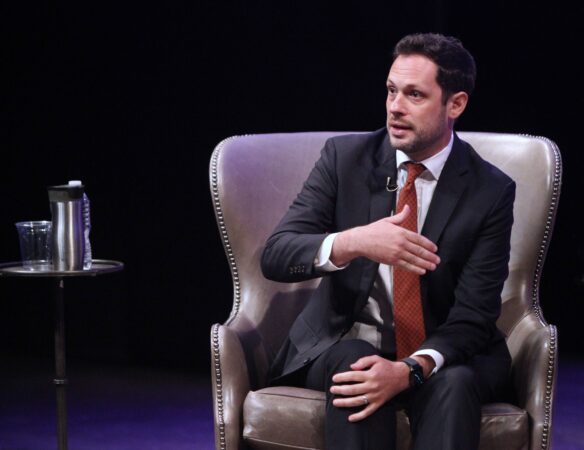
New Jersey Gov. Phil Murphy’s digital innovation office has been madeapermanent cabinet-level office in what appears to be the first move of its kind in the nation as the role of artificial intelligence increases in government.
Murphy created the New Jersey State Office of Innovation in 2018 to improve digital innovation in state government.
And now it’ll remain a fixture in New Jersey after he leaves office, following Murphy’s signing Monday of a bill that turns the office into an authority within the Treasury Department.
Gov.-elect Mikie Sherrill, who will be inaugurated on Jan. 20, will oversee the new authority. Sherrill supports the office, but even if she didn’t, the new law means a governor can’t just get rid of it.
Georgetown University’s Beeck Center, which tracks these efforts nationally, has identified 17 states with digital innovation offices, including Pennsylvania. But the university and Murphy’s office say New Jersey is the first to codify a cabinet-level position of its kind into law.
The new law also helps the office fund projects between departments more easily and opens up the possibility of revenue streams such as by selling its technology to other state governments or local governments within the state, said Dave Cole, a Haddonfield resident who leads the department. The law also requires a board of directors appointed by the governor.
The state innovation office has worked with almost every state agency to identify problems that can be fixed with technology in an effort to make government services more efficient, Cole said.
In one example, it helped the Department of Labor redesign emails for its unemployment program, which had used decades-old design technology and hard-to-understand legalese that was slowing down the claim process because it wasn’t user-friendly.
In another, the office used machine learning to identify 100,000 students eligible for summer food assistance who weren’t getting it.
The office has also modernized call centers and even created an internal AI chat bot for state employees that helps draft emails, summarize documents, and analyze public feedback — shaving days off the process of aggregating public comments.
Employees are told repeatedly that AI is a tool and that human review is still needed, Cole said.
“The person that’s using the AI needs to be accepting responsibility for the use of and any dissemination of information after they’ve reviewed it,” he said in an interview.
The office was awarded what it called a “first of its kind” grant last month to utilize AI in government.
Cole, 40, said his team’s approach to AI is to make bureaucratic processes more efficient, like summarizing fraud information, generating memos, and matching disparate data sets.
“Our purpose isn’t to solve an AI problem as much as it is to solve a resident problem, a business owner problem — sometimes, when we work with higher education, an institutional problem,” he said. “And often AI, more recently, emerges as a tool that can help us through that.”
The bill passed by 29-8 in the Senate with three members not voting on Dec. 22 and by 61-13 in the Assembly on Dec. 8, with four members not voting and two abstentions.
Sherrill said she will keep Cole in his position as she puts together her administration.
“I look forward to working with Dave as we modernize the way New Jerseyans access state government services and build a government that works for everyone,” Sherrill said in a statement.
Cole, a Rutgers grad, worked with data and analytics as an organizer for former President Barack Obama’s 2008 presidential campaign before developing the White House website and online petitions as part of the presidential administration.
That work was simpler than the projects he does now given the rapid development of AI — but reached the same goal of increased civic engagement, he said.
After his work there, Cole then pivoted to the private tech sector and made an unsuccessful bid for Congress in South Jersey in 2016 before joining the state’s innovation office in 2020 to help with pandemic vaccine distribution before eventually rising to chief innovation officer a year ago, replacing Beth Noveck, who now works as the chief AI strategist in the same office.
“Generally speaking, there’s a lot of pain. There’s a lot of unsolved problems. There’s a lot of improvements that we need to see,” Cole said. “And so if we understand how to effectively leverage technology, we can do good there, but we have to be careful with anything like this.”
One project Cole is looking forward to this year is building the option for residents to use one online account for various government agencies and allowing for their data to be shared across departments to pre-populate forms.
Not only can that simplify processes for residents who choose to participate, but it can make it easier for government agencies to recommend different government programs by getting information about applicants it wouldn’t otherwise receive, he said.
“Having that information allows us to do really interesting things, like ‘You’re enrolled in this program, did you know you may also be eligible for this other program?’” he said. “This has been for a long time, I think, sort of a dream of folks who do this kind of digital technology work to recommend and automatically enroll people in benefits based on their eligibility.”
Working with Sherrill to cut through red tape
Sherrill campaigned on “cutting through that red tape and bureaucracy.” When asked to elaborate by The Inquirer at a mid-November campaign appearance in South Jersey, she said “a lot of it is just putting stuff online.”
She also said she wants to address redundancies for residents who need to go through different government organizations and find out they have more steps than they initially thought.
“I’ve heard too many stories of people who do the five steps they need to get a permit, and they go back and they go, ‘Well, here’s five more,’” she said in November. “So there’s not a lot of clarity, transparency, or accountability in getting through this process.”
That’s the kind of work the innovation office has been doing through business.nj.gov, a centralized website for starting and growing a business, and Cole looks forward to doing more of it in partnership with Sherrill.
New businesses that use the website launched an average of a couple of weeks sooner than those that didn’t, Cole said.
“It has many agencies, permits, and licenses integrated in it, but not all,” he said.
“And one of the challenges is that agencies have many priorities about the things that they need to work on at a given point in time, so I think the governor-elect’s focus on this could allow more clarity there,” he added.
This article has been updated to reflect the office is cabinet-level.
The number of people doing gig work has increased significantly over the past few years. It was more than 76 million people in the U.S. last year, according to recent reports.
And the work can pay well. Almost 5 million freelancers are earning more than $100,000 per year, according to freelancer site Upwork. These side gigs can include everything from driving an Uber and running an Airbnb to managing websites, tutoring, or even walking a dog.
Benefits to this kind of work include flexibility, control, independence, variety, and the ability to make extra money outside a day job.
But having a successful side gig isn’t easy.
Marketing yourself and getting work is a topic for a different day. But before you get to that — and yes, you will need to — here are a few things you should know.
It’s a business
Your side gig is a business, so make sure you’re treating it like one. You are an independent contractor and the company owner.
You will need to track your costs and revenues separately from your personal life. You should probably have a separate bank account so funds aren’t intermingled.
You may need insurance. This not only gives your business credibility, but it also makes it easier for companies to hire you as an independent contractor rather than classifying you as an employee.
A proper contractor is “really someone already running their own business — they provide the service to a number of other companies,” said Sarah Holmes, a small-business attorney based in Ardmore.
It helps to set up a corporation or limited liability company, said Jeff Burke, a partner at law firm McElroy Harvey in West Chester.
“If you set up a corporation or an LLC and you’re doing a business-to-business contract, you are way more likely to pass muster,” Burke said. “A freelancer should have some written proof — business cards, advertisements, websites — that shows you’re actually out in the marketplace.”
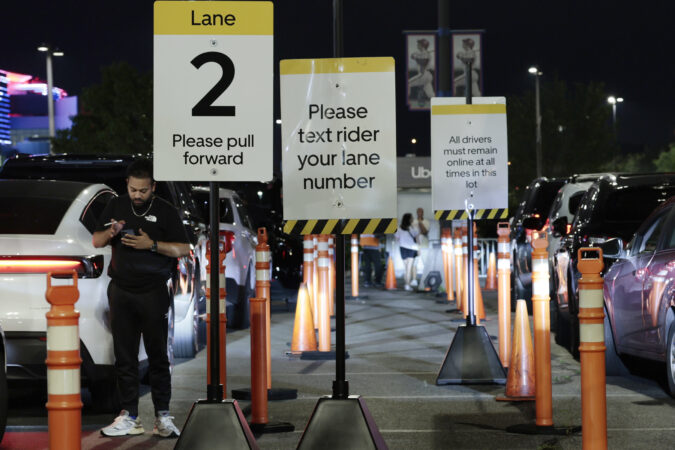
No matter what the business, you always have to remember that “you’re the owner,” Uber and Lyft driver Joseph Casasanto told me.
“As drivers, we are independent business contractors,” he says. “So that means everything is our responsibility, like gas, oil changes, alignments, tires, repairs, miles, depreciation, etc.”
Don’t ignore the paperwork
As a business, you’ll need to make sure you’ve filed the right paperwork and take your taxes seriously. This means either reporting your income and expenses on the Schedule C to your individual tax return or setting up your business separately as an LLC, corporation, or other entity recognized for both federal and state purposes.
Because your customers don’t withhold taxes like an employer does, you’ll need to pay in estimated taxes to avoid penalties and interest for underpaying throughout the year.
Experienced freelancers, like part-time Uber driver Jason Napolitan, are scrupulous about tracking their expenses separately and keeping good tax records.
“My expenses are not only the obvious ones like gas and insurance but also tires and wear and tear on my vehicle.” he said. “For example, I always make sure to track my mileage for the IRS allowance given on my taxes.”
As a freelancer, you should have an agreement in writing that stipulates the services provided and is clear about your role, so that you’re in compliance with federal and state worker classification rules.
Guidance around independent contractor rules has been shifting, said Josh Ganz, a labor and employment attorney at Duffy North in Hatboro. But there is a baseline to follow.
Important questions to consider, he said, are: “Is your client or customer controlling your entire day? Do they tell you where to be and provide the tools for you?”
Set boundaries
Having a side gig should never affect your primary job. Make sure you have clear boundaries and there are no conflicts so you don’t get into trouble with your primary employer.
Running a side gig means you’ll have a lot to juggle between your personal life, your job, and your business. So it’s important to create a schedule. Your customers will want to know when you’re available and so will your family.
It’s important to set goals as to how much you want to earn and stick to those parameters. It’s easy to get caught up in doing the extra work but it can also quickly take up your time.
“If you want to do this full time, you have to set goals,” Lyft driver Kendra Brigman said. “You have to have a good attitude when you’re doing your side gig and provide great service. But your availability is also very important.”
Be smart about pricing
If you’re doing freelance work for an established company like Uber or Lyft, those rates are usually set for you. Others, like Airbnb, can suggest rates based on your local market. But the rest will be up to you.
Setting a price too low may set a precedent that becomes unprofitable over the long term. Charging too much may turn off potential customers. You’ll need to research the competition and make a few mistakes over time to learn the right balance.
It’s also important to know your limitations.
For example, Airbnb host Julie Seda said, “We are always up-front to prospective guests that our house is not suitable for people with mobility restraints.”
Lyft driver Brigman said knowing your pricing and comparing it with what you’re being asked to do can make a big difference, and it’s important to figure out what’s worth your time.
“Sometimes the miles requested doesn’t equate with the amount of money I would like to earn,” she said. “I’ve learned to turn down those jobs.”
David Robertson, 40 and unemployed until July, put out a fire in the sixth inning of the Phillies’ first playoff game of 2025, but he hadn’t pitched an “up-down” all season — ending one inning and beginning another. With a one-run lead, Rob Thomson sent him back out for the seventh. Robertson hit one batter and another singled. Thomson then brought in Matt Strahm, who hadn’t inherited a runner in six weeks. Strahm got two outs, then gave up a three-run homer. The Phillies lost Game 1 of the NLDS to the Dodgers.
Two nights later, with a slow runner on second base and nobody out in the ninth inning of a one-run game, Thomson directed Bryson Stott to bunt. Twice. The Dodgers ran a “wheel” play and nailed the runner at third. The Phillies lost Game 2 of the NLDS.
These are the latest blemishes on Thomson’s thin resumé. He was elevated from longtime major league bench coach to first-time manager in June 2022, and the Phillies have at least played to the level of their payroll ever since, but they’ve faltered in the fall. Fairly or not, from pulling Zack Wheeler early in Game 6 of the 2022 World Series to not pinch-hitting early for Johan Rojas in Game 7 of the 2023 NLCS, the popularity of the affable, accountable skipper has steadily waned.
Enter Donnie Baseball.
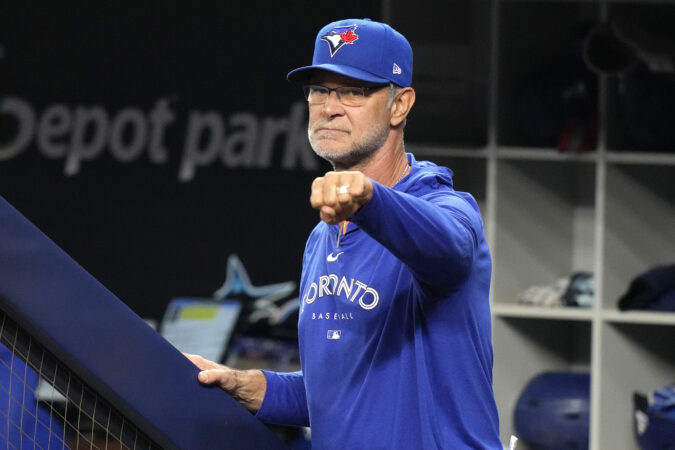
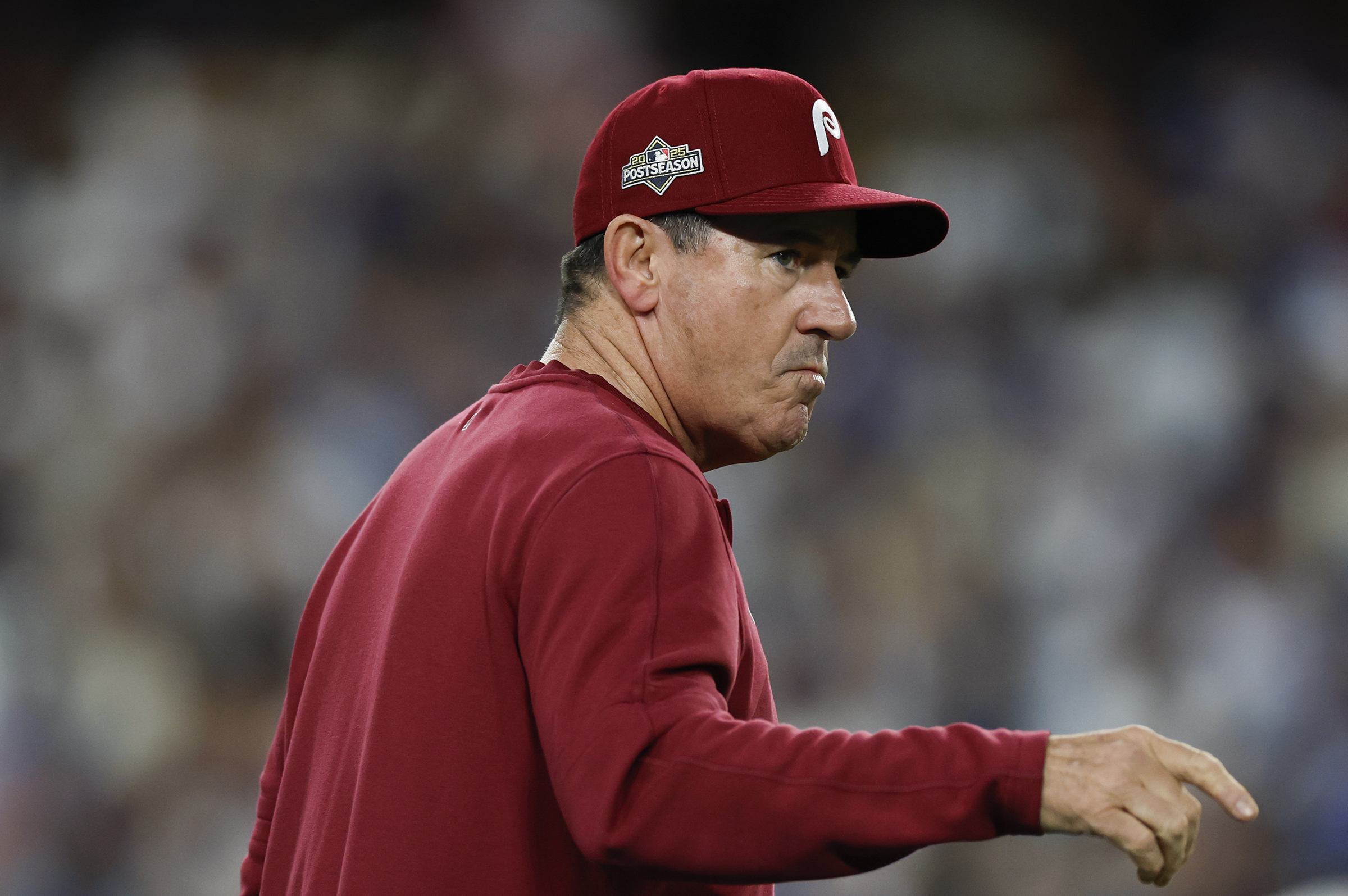
After an intense, two-month recruiting effort, the Phillies on Monday hired Yankees legend Don Mattingly, 64, to replace Mike Calitri as bench coach. Immediately after the four-game NLDS loss to the Dodgers, the Phillies reassigned Calitri to the post of major league field coordinator, which means he’ll retain his myriad administrative duties as they pertain to scheduling and number-crunching. But he no longer will be Thomson’s chief lieutenant; no longer the voice of reason in tight situations.
Phillies manager Rob Thomson will have an experienced bench coach in the dugout with him in 2026 with the addition of Don Mattingly.
That louder, deeper voice will belong to Mattingly.
Thomson was asked Monday if some of his playoff missteps might have been averted had Mattingly been on the bench, protesting.
“Possibly,” Thomson replied. “Possibly. You never know.”
“Missteps” might be unfair, but Thomson has addressed each one with honest reevaluation. His authenticity and his absence of ego are part of his charisma.
Charisma doesn’t win World Series.
Anyway, the dugout’s charisma just grew by a factor of 10.
For a decade, Mattingly was the face of the Yankees, then the biggest sports franchise in America. His .307 career average, .830 OPS, and nine Gold Glove awards make him a logical Hall of Fame candidate who has been cursed by a largely illogical voting bloc. With a husky build, full mustache, and thick, full head of dark hair, he was an archetype of a baseball player for a generation. Even today, as the cleft in his chin grows deeper with age, he looks like a movie-star version of a once-great athlete.
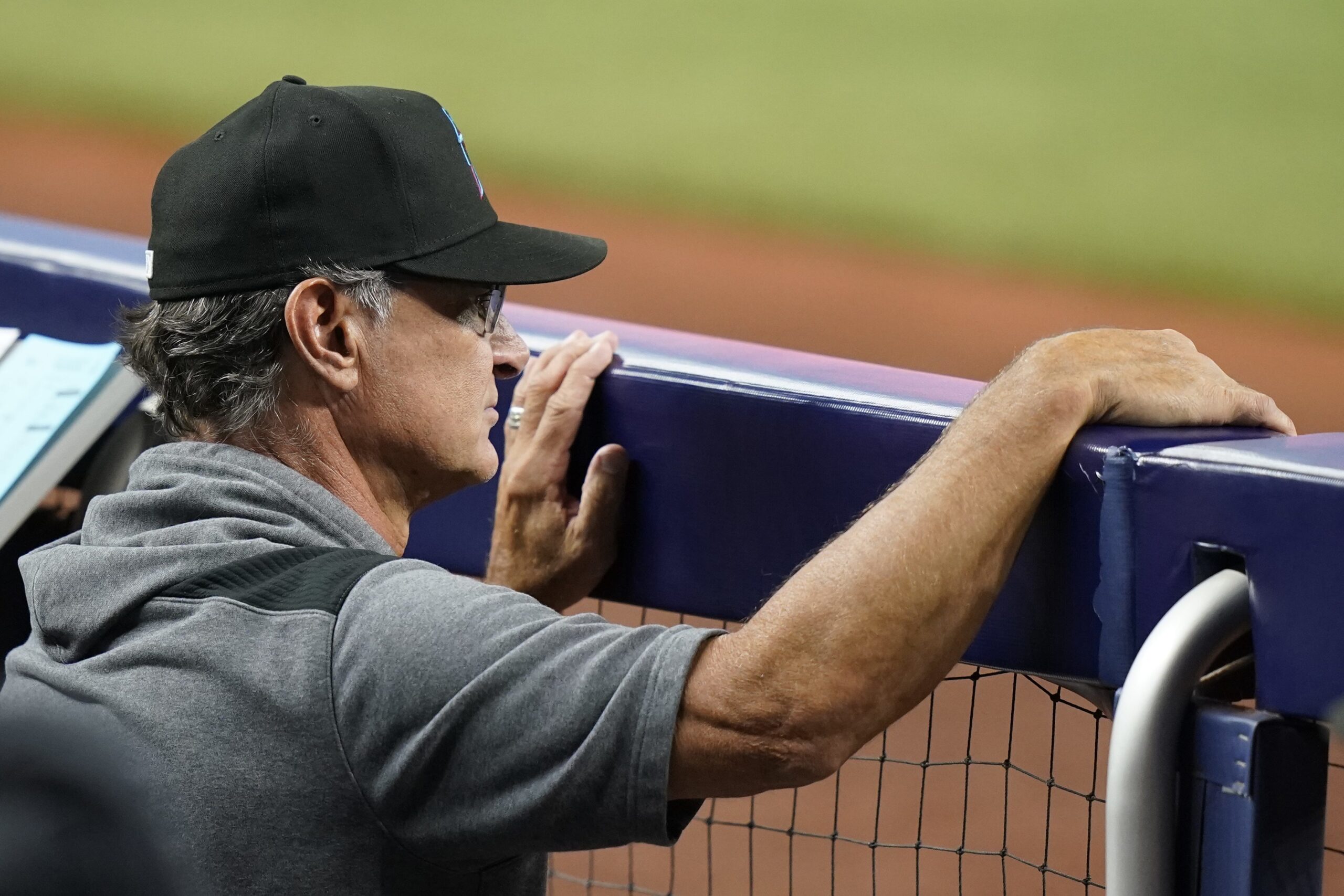
He managed the Dodgers to the playoffs three times and the Marlins once, in 2020, when he was National League Manager of the Year. He has coached for the Yankees, Dodgers, and, for the last three seasons, for the Blue Jays, who lost the World Series to the Dodgers in seven games. Mattingly expected Game 7 to be the last of his career.
But Phillies president Dave Dombrowski was on the phone the next day, and the day after that, and so forth. Finally, Mattingly agreed.
From now on, every decision — who pitches the eighth inning, who sits for a defensive replacement, who steals and who sacrifices — will go through a man with credentials Thomson simply doesn’t have.
Don Mattingly managed the Marlins for seven seasons after leading the Dodgers for five.
“We can now blame Don for it,” Thomson joked.
Mattingly might have agreed to support Thomson for the next two seasons, but he agreed to much more than just making sure that Topper doesn’t bunt again in the ninth with nobody out.
Superstar Don
Mattingly immediately validates a coaching room full of excellent, but anonymous, teachers of the game. With a roster that includes Bryce Harper, Kyle Schwarber, Trea Turner, and Wheeler, in a game in which nothing carries more weight than having withstood the brightest lights yourself, this cannot be overstated.
“He’s a great sounding board for our stars because he’s been there and done all these things,” Thomson said. “The rest of us really can’t [say] that.”
Sheriff Don
One of the most important services a bench coach provides is as a buffer between a manager and the players or as an enforcer who snuffs sparks before they become fires. It’s doubtful that Nick Castellanos’ insubordination or Strahm’s frequent criticisms would have proliferated if Mattingly had been around the clubhouse.
Manager Don
Asked if he ever wanted to wear the skipper hat again, Mattingly was steadfast and insistent in his reply.
“I feel like those days have passed me by; I don’t have any aspirations to manage,” Mattingly said. “I don’t think I have the energy for that anymore.”
If the Phillies stumble early in 2026, or if, heaven forbid, something incapacitates Thomson, Mattingly will be the obvious choice to replace him. You simply don’t take a job as bench coach without the understanding that you will manage the team in case of dismissal or emergency. Also …
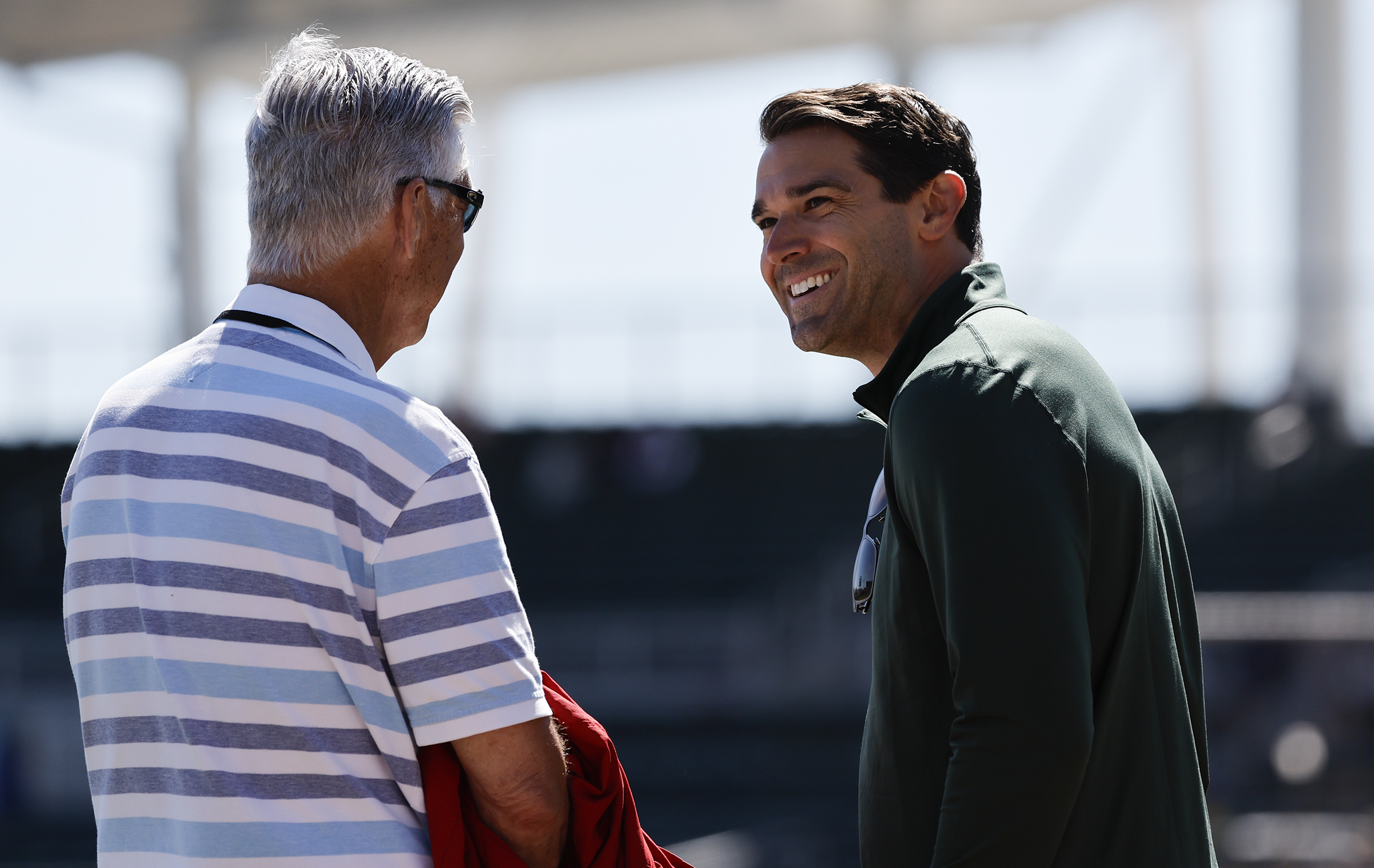
Preston Mattingly (right) with Dave Dombrowski, is going into his second season as Phillies general manager.
Daddy Don? Spy Don?
The Phillies and Mattingly want us to believe that the presence of Preston Mattingly as the Phillies’ general manager is almost entirely coincidental to their pursuit of him and of him delaying retirement. Mattingly swore that, even though Press is his son, he never would betray the sanctity of the dugout and clubhouse to the front office.
“I’m not a voice running upstairs to talk about anything and everything,” Don said, clearly aware that some organizations are run in exactly that manner. “I came from a different era where that is not something that happens.”
That said, after more than four decades of playing and working in the majors, Mattingly admitted that he has envisioned the sweetness of winning the first World Series with his son as his boss.
“To be able to do that with him would be incredible,” Don said.
Incredibly difficult.
In fact, even chiming in on Thomson’s occasional cockeyed decisions, and even riding herd over a roster full of coddled princelings, maintaining a normal father-son relationship while balancing a strictly professional GM-bench coach relationship will be the hardest part of old Don Mattingly’s new job.
After victories over DePaul and Butler last week moved Villanova to 12-2 this season with a perfect 3-0 start to Big East play, it was fair to wonder whether the Wildcats would see their name in the Associated Press top 25 rankings Monday for the first time since November 2023.
If only they ranked 26 teams.
Villanova was just outside the rankings released Monday afternoon. The Wildcats fell just five ballot points shy of 25th-ranked Central Florida for the final spot.
Relatively meaningless rankings release aside, Villanova is playing really good basketball right now. The Wildcats have won five consecutive games. They were a slight road underdog at Butler on Saturday and won by 18. They flipped the script in the second half one game earlier and beat DePaul on New Year’s Eve. They controlled the second half and won comfortably at Seton Hall before the holiday break. And they rallied in overtime to beat Wisconsin in a neutral-site game in Milwaukee on Dec. 19 that was effectively a road game.
“We’re battle-tested,” first-year Villanova coach Kevin Willard said after the road win at Seton Hall, his old stomping grounds. His team spent its next two outings proving his words wise.
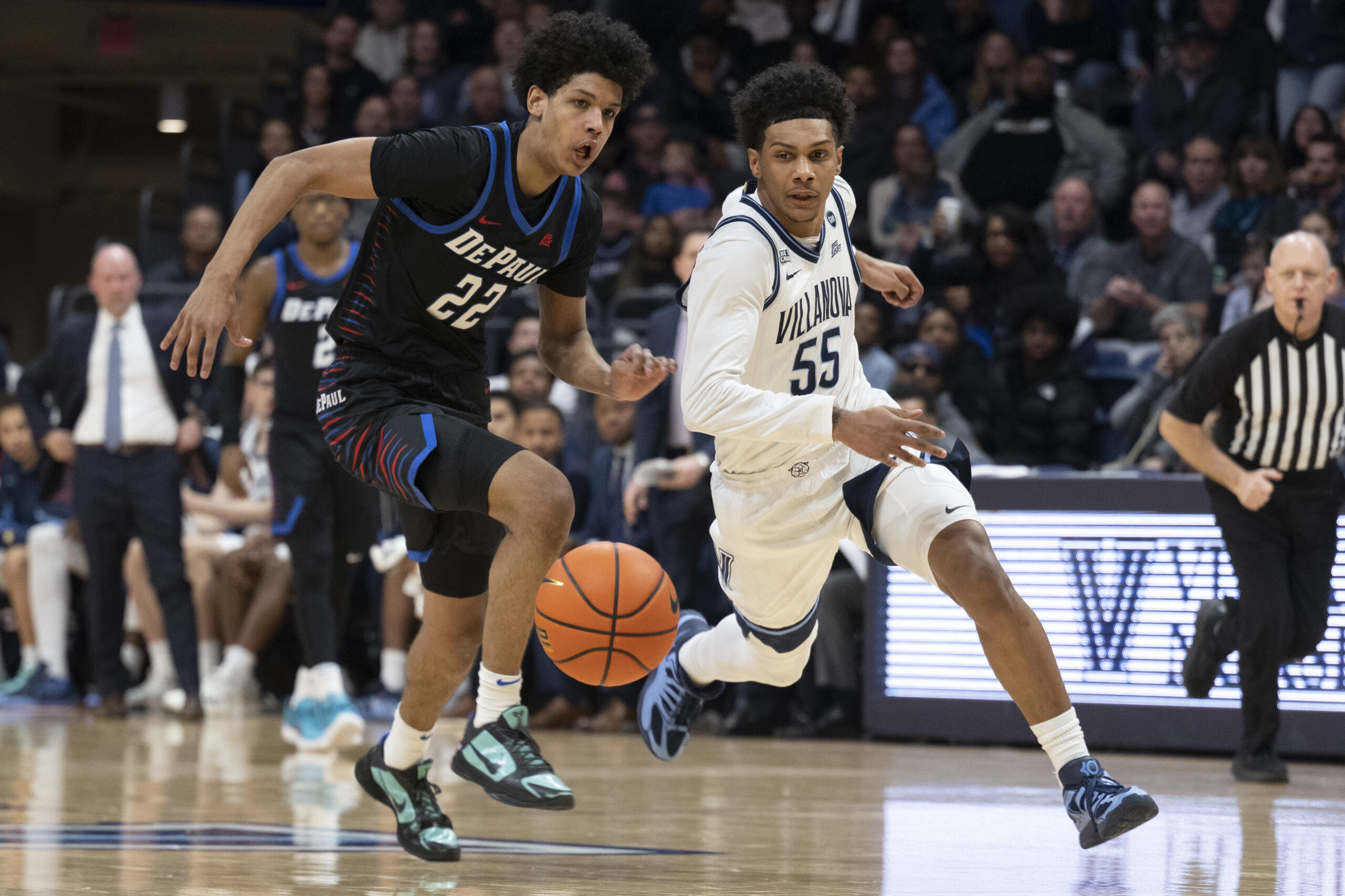
Villanova’s Acaden Lewis chasing a loose ball against DePaul. He is averaging 12 points a game.
Villanova entered Monday rated 17th in the NCAA’s NET rankings and 21st in the KenPom metrics. Further, ESPN bracket guru Joe Lunardi had the Wildcats slotted in as a No. 6 seed in his latest Bracketology out Tuesday morning. Villanova is comfortably a tournament team through 14 games.
A season with limited expectations, in Willard’s first year after taking over for Kyle Neptune, has gone about as well as one could reasonably hope. The Wildcats have two losses to teams ranked in the top 10 in the country. They are 2-2 in Quad 1 games and 10-0 in the rest.
With 17 games to go — all of them Big East contests — has what some would have considered a rebuilding year turned into NCAA Tournament or bust?
Defying the expectations
It’s worth starting with the idea that preseason expectations in this new college hoops landscape are a bit unserious. The amount of player turnover that happens on a year-to-year basis make projecting records a bit like throwing darts after being over-served at the local dive.
KenPom metrics had Villanova rated 50th before the season started. Lunardi had the Wildcats on the bubble in his preseason Bracketology. Villanova rising 29 spots at KenPom has the Wildcats among the biggest climbers from preseason expectations to current performance.
But while the outsiders were unsure about Villanova, Willard himself was assertive about where he thought the 2025-26 season could go.
“We got to win,” Willard told The Inquirer in June. “From my perspective, laying the groundwork for the future and what we’re doing is extremely important. That’s more important than winning.
“But we got to win. I expect to win. We spent a good number on this roster. I think we have a really good roster.”
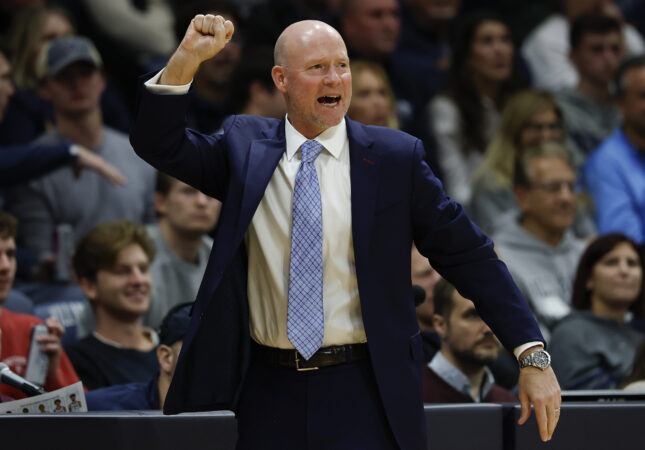
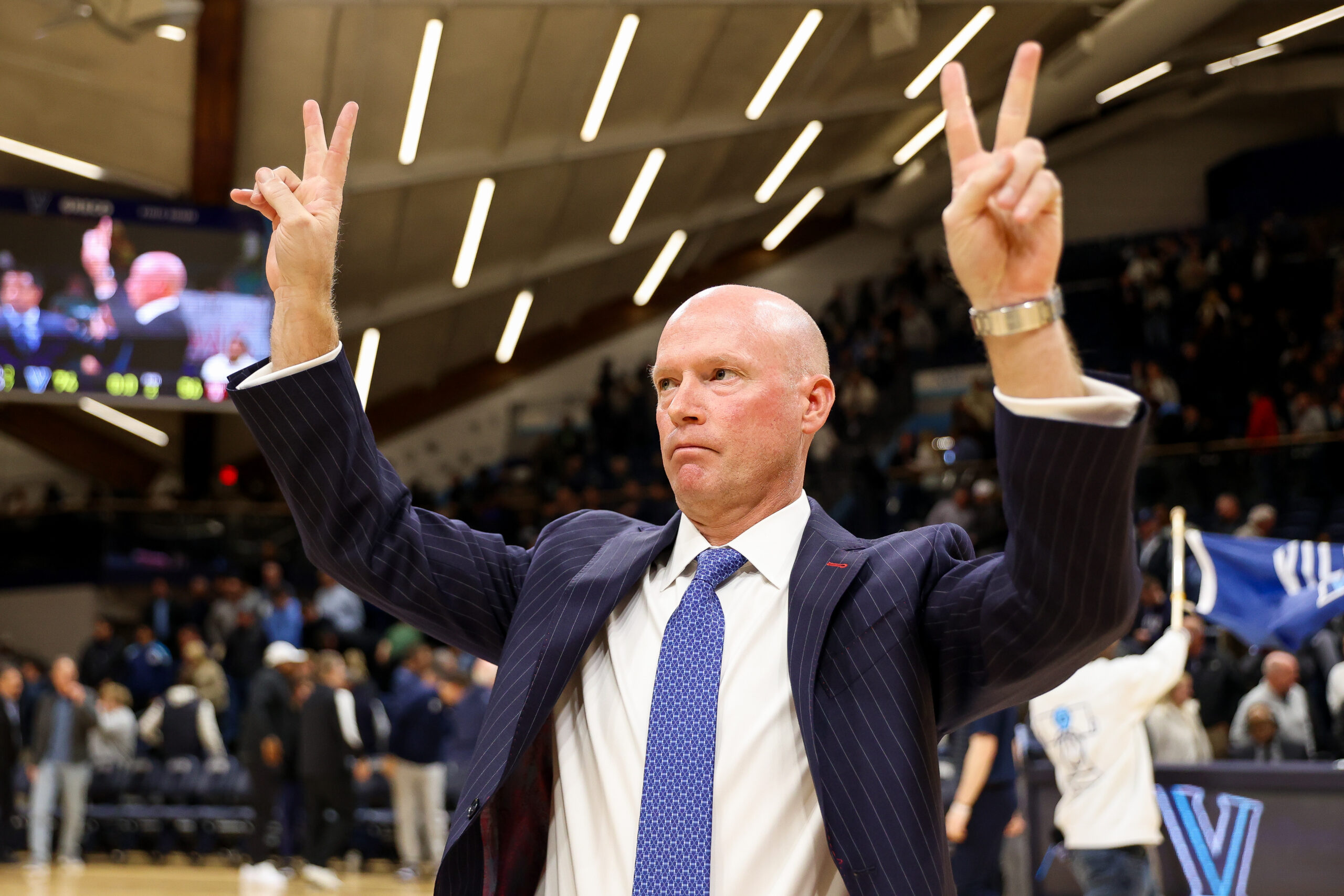
Coach Kevin Willard has Villanova off to a 12-2 start, including 3-0 in Big East play.
Missing the tournament while rebuilding for the future was “not my plan,” Willard said.
“There’s difficulties [in] taking over and really starting over and doing all that, but this is where my ego comes in a little bit,” he said. “I think we’ve done a pretty good job in years past of doing that and I think we’ve done a really good job of putting together a good roster that I expect us to win games, yeah.
“I don’t look at Year 1 anymore like you have a two-year grace period. I think that’s [BS] nowadays. I didn’t take this job and say, ‘I now get two years where I don’t have to work.’ We’ve got to produce.”
So far, so good.
How they’re doing it
The roster Willard put together has been better than many expected. The Wildcats start a freshman, a redshirt freshman, a redshirt sophomore, a junior, and a senior. That’s a pretty young roster in the modern college basketball world. KenPom metrics have Villanova ninth among the 11 Big East teams in experience. The Wildcats rank 256th in KenPom’s minutes continuity metric.
Point guard Acaden Lewis has excelled in his freshman season and is up to 12 points, 4.9 assists, 3.6 rebounds, and 1.9 steals per game against just 1.6 turnovers. Redshirt sophomore Bryce Lindsay, a James Madison transfer, leads Villanova with 16.9 points per game and is shooting 44.7% from three-point range. Senior big man Duke Brennan, a Grand Canyon transfer, is at 12 points and 11.3 rebounds per game. He’s the fifth-best rebounder in the country.
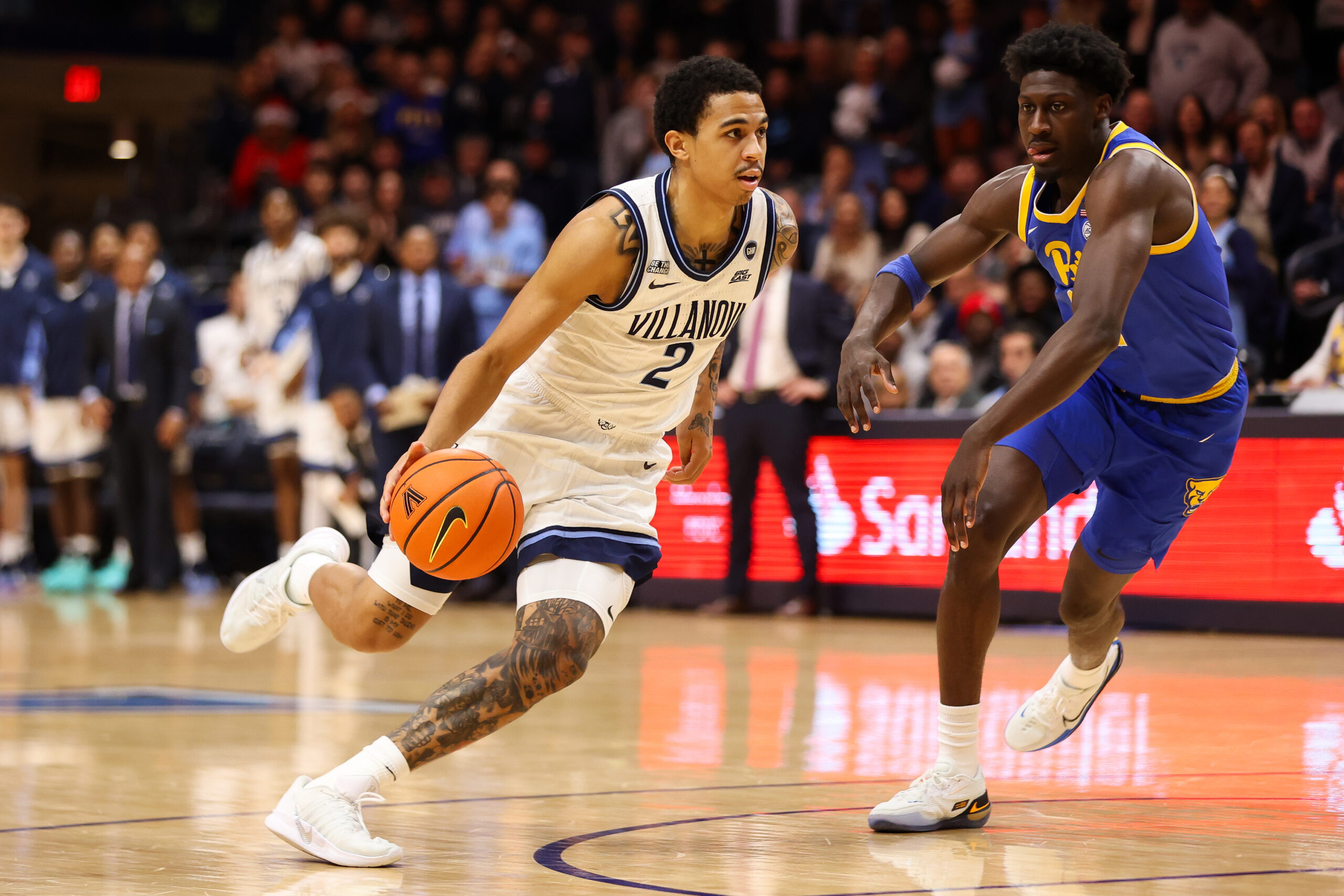
Bryce Lindsay leads Villanova with 16.9 points per game.
Junior Tyler Perkins (10.9 points, 5.1 rebounds), the lone returner to the roster with game experience, has played well at both ends. And redshirt freshman forward Matt Hodge rounds out a starting five that all average double figures with 10.8 points and 4.4 rebounds.
Willard talked before the season about a deep roster and how he wanted to play as many as 10 guys. But injuries and slower development have led to a shortening of the bench. Villanova played just eight players Saturday vs. Butler.
Willard has also adjusted his own coaching preferences. Villanova shoots a three-pointer on 46.4% of its shot attempts, which ranks 48th in the country, far more than any other team Willard has coached (this is his 19th season as a head coach). The next closest was 41.7% by his 2012-13 Seton Hall team. Last year’s Maryland team, by comparison, took a three-pointer on 35.3% of its shots. (The Terrapins had a star big man, Derik Queen.)
A shorter-than-expected bench has also forced Willard to play a little slower than he usually likes. The Wildcats are 352nd out of 365 Division I teams in KenPom’s adjusted tempo metric. Maryland, meanwhile, was 66th last season.
Willard has also been working wonders in the second half of games. Villanova outscored Butler, 43-34, in the second half on Saturday. The Wildcats have been outscored in a second half just once this season, their overtime victory over Wisconsin.
Tournament talk
So, back to the question at hand: NCAA Tournament or bust? The analytics site Torvik had Villanova’s NCAA Tournament chances at 96.9% on Monday. Missing the dance at this point would be a disappointment and would require a major collapse.
While Villanova’s marquee wins are over Seton Hall (41 NET), Butler (46), and Wisconsin (63), getting through the nonconference slate without a hiccup against a lesser opponent was a big deal.
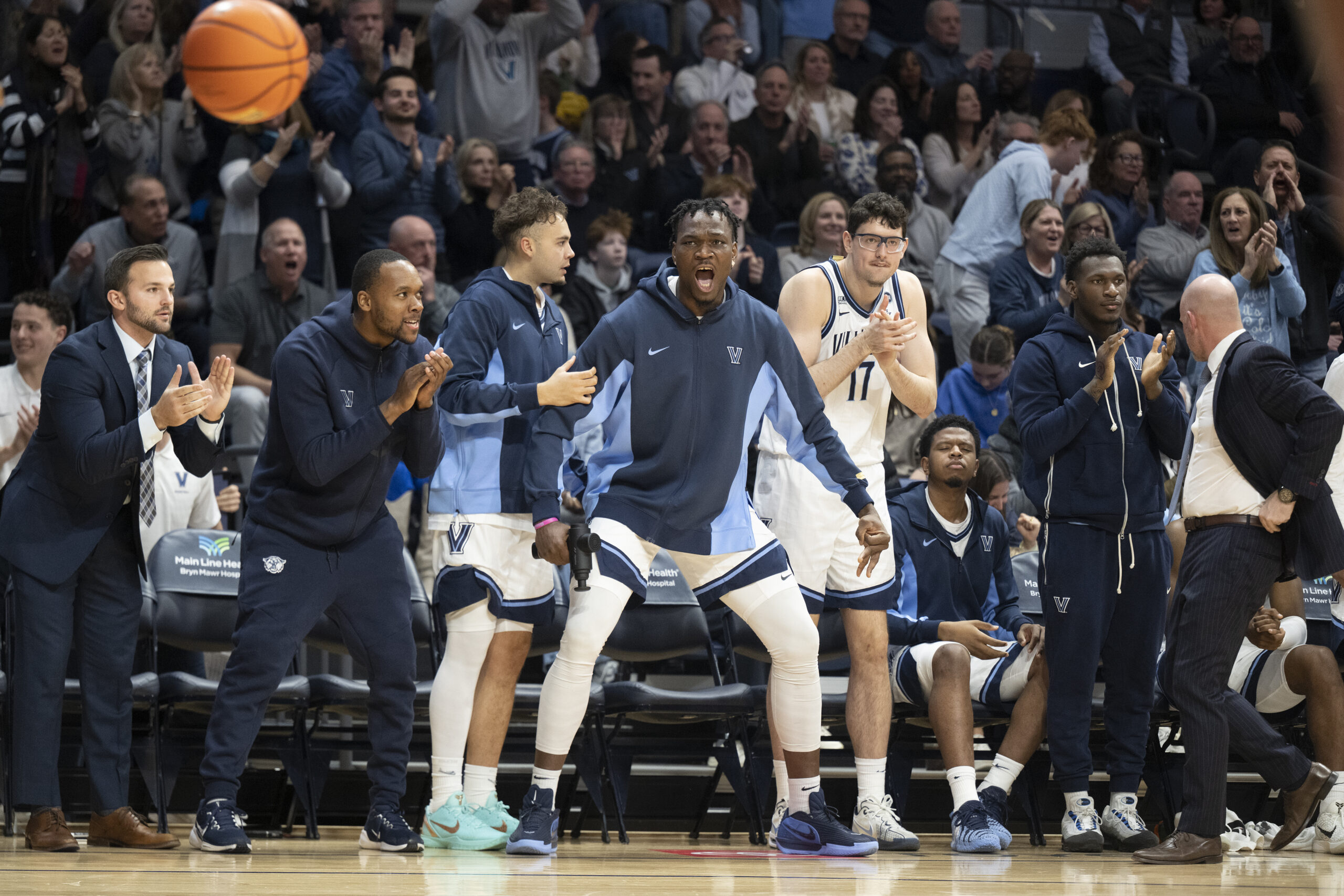
Villanova’s bench reacts after a three-point play against DePaul on Dec. 31.
A 3-0 start in Big East play, including two wins on the road, makes it pretty hard to imagine Villanova slipping up to a degree that would bump the Wildcats out of the tournament field — even if there are still four games to go against No. 4 UConn and a St. John’s team that is underperforming but will still provide a big challenge.
Up next is a home game Wednesday vs. Creighton. The Bluejays were 44th at KenPom and 52nd in the NET rankings on Monday. It’s a Quad 2 game, and after that is a Quad 3 game on the road at Marquette.
Slip-ups in one or both would change the math a little bit. But right now, all roads seem to lead from the Main Line to meaningful basketball in March.
Editor’s note: Jeff Neiburg is an AP top 25 men’s basketball voter. He had Villanova ranked 21st on his ballot this week.
Jan. 6, 2021, should be a date that lives in infamy, like Dec. 7, 1941, and Sept. 11, 2001.
But five years after an angry mob stormed the U.S. Capitol, Donald Trump’s insurrection marches on.
Instead of accountability, Trump parlayed the grotesque events that unfolded on Jan. 6 into an incomprehensible return to power and profiteering.
And ever since, Americans have been forced to endure one battle after another.
It began with Trump rewarding the Jan. 6 insurrectionists by pardoning more than 1,500 attackers who were convicted or charged with crimes, including many who beat police officers and some who have since been charged with new crimes.
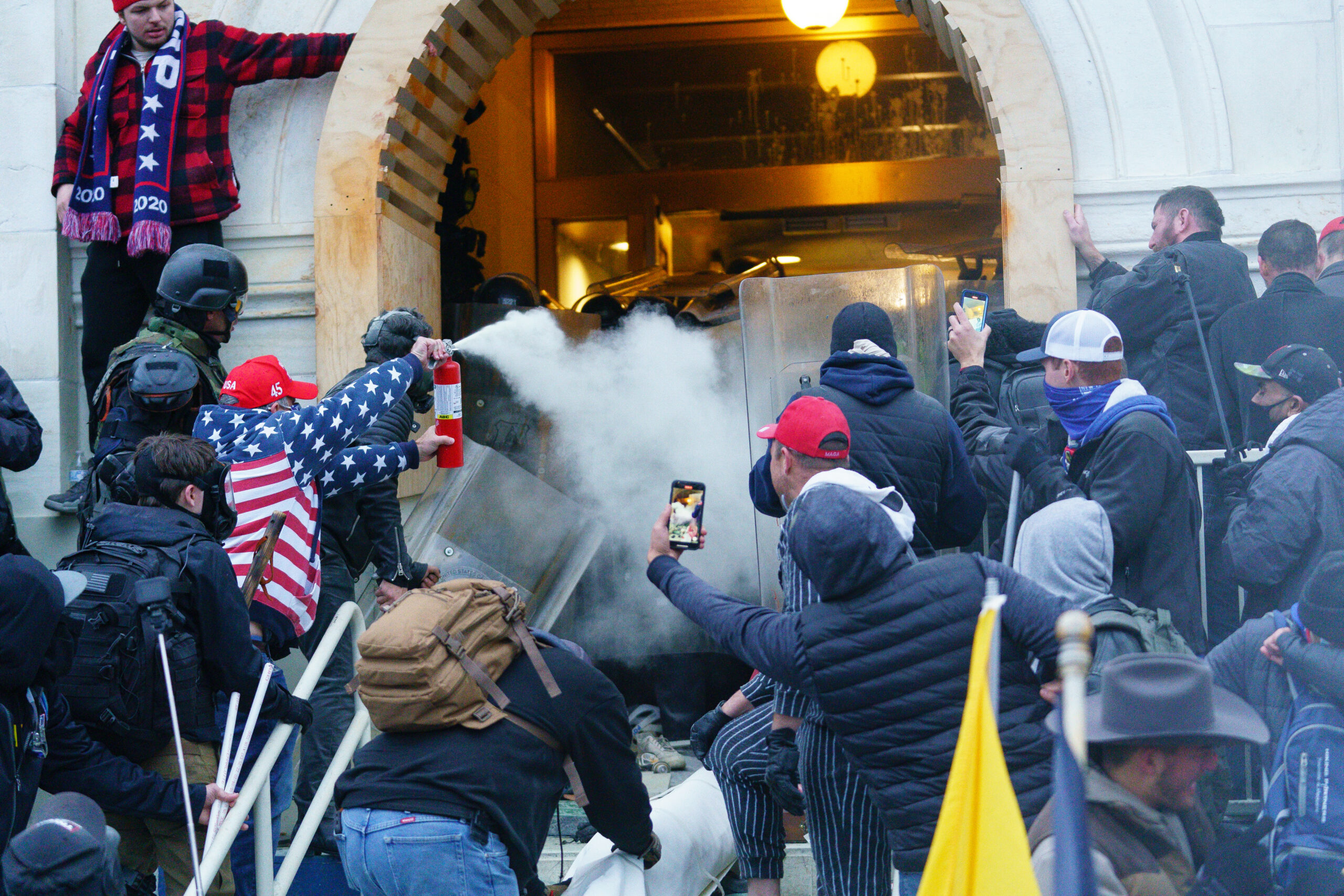
Rioters clash with police to try to gain entry to the U.S. Capitol building during the insurrection on Jan. 6, 2021.
Trump has continued to attack the government he swore an oath to protect, causing grave and lasting damage.
Elon Musk’s chain saw-wielding assault on federal agencies failed to root out much fraud or waste, but it did cause massive disruptions to many departments while upending the lives of more than 300,000 workers who lost their jobs.
Trump sicced the U.S. Department of Justice on political enemies, marshaling flimsy criminal cases against them while pardoning cronies. The rule of law — a cornerstone of American democracy — remains under assault.
Meanwhile, the FBI shifted away from investigating terrorist groups and is now said to jokingly stand for Foolish, Belligerent, and Incompetent.
Trump unleashed Robert F. Kennedy Jr. to “go wild” on health, medicine, and food. Since taking over the U.S. Department of Health and Human Services, Kennedy, who has no medical training, has canceled billions of dollars in contracts for medical research, fired thousands of workers, upended vaccine policies that saved millions of lives, and embraced discredited and fringe theories.
Pro-Trump protestors grapple with police outside the U.S. Capitol on Jan. 6, 2021.
Trump has also launched unprovoked attacks overseas, increasing tensions with allies and adversaries while likely inspiring future terrorists.
He ambushed Ukrainian President Volodymyr Zelensky, an ally, in the Oval Office, while rolling out the red carpet for Russian leader Vladimir Putin, a wanted war criminal. Instead of aiding Ukraine, Trump is abetting Russia — an epic blunder that risks the peace in Europe that American soldiers helped to secure in World War II.
Trump endorsed Israel’s demolition of Gaza and bombed Iran’s nuclear facilities, a move U.N. Secretary-General António Guterres called a “dangerous escalation in a region already on the edge — and a direct threat to international peace and security.”
Trump has illegally bombed small boats in Central and South America, summarily killing more than 100 alleged drug smugglers without presenting any evidence or trials.
Over the weekend, Trump approved a plan to snatch Venezuelan President Nicolás Maduro and his wife and bring them to the U.S. to face criminal charges.
Trump supporters take a selfie at the U.S. Capitol during the insurrection on Jan. 6, 2021.
While no one is shedding tears for Maduro, Trump has no clear plan — or total control — for what comes next. Trump claims the U.S. is going to run Venezuela and take charge of its oil, while spouting loose talk about invading Cuba, Colombia, Mexico, and Greenland.
That sounds like imperialism run amok.
The U.S. is headed into dangerous and uncharted territory because of the failure of Congress, the courts, and voters to hold Trump accountable. The upshot has been to breed further lawlessness.
Trump was impeached for inciting the Jan. 6 riot. But then-Senate Leader Mitch McConnell and most other Republicans in Congress — in a gross dereliction of their sworn duty — voted against convicting him even though many said he was liable.
Trump was also criminally indicted for his role in attempting to overturn the 2020 election, which led to the Jan. 6 insurrection. The case was dropped after he was reelected, but special prosecutor Jack Smith recently told the House Judiciary Committee that a conviction was likely since there was “proof beyond a reasonable doubt.”
Trump brought out the worst in America on Jan. 6. Five years later, the damage continues to grow.
Candria (with sunglasses) and Cynthia Crisp speak with another Trump supporter holding a Confederate flag near the Washington Monument, on Jan. 6, 2021.
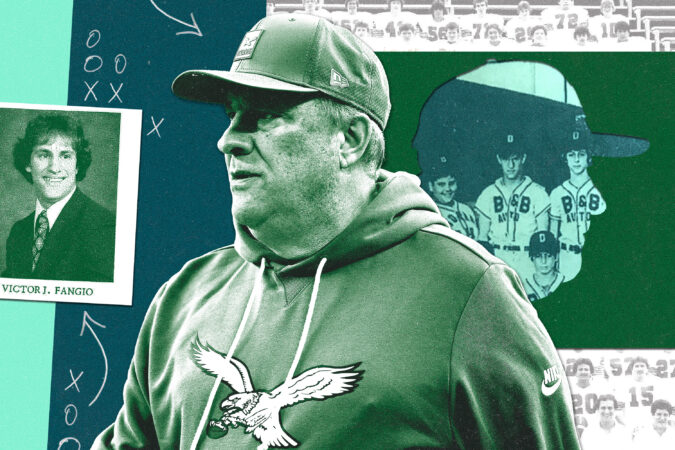
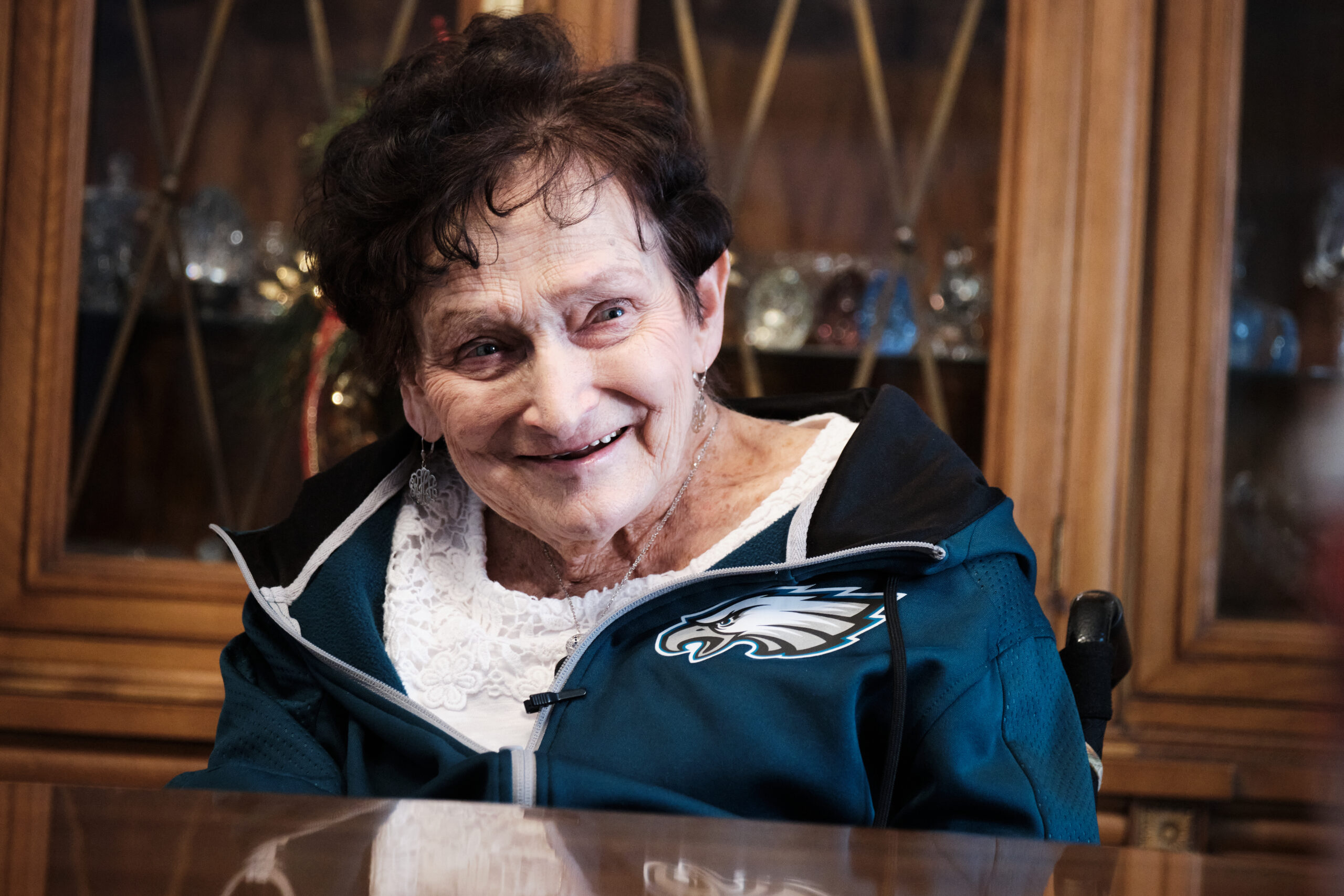
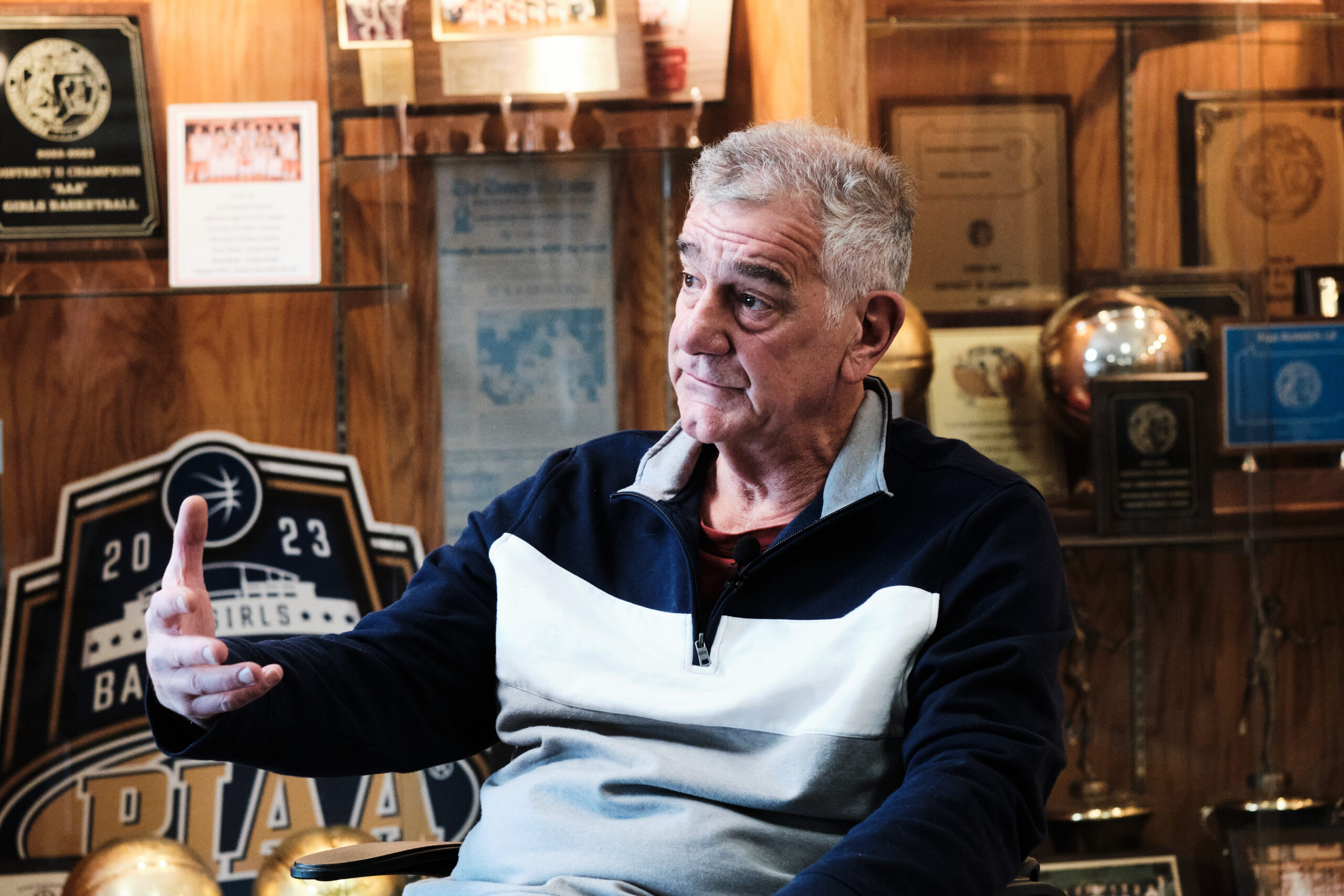
DUNMORE, Pa. — Roseann Henzes is 89years old and watching the Eagles is the highlight of her week. This is not because of the players, the head coach, the general manager, or the famous security officer.
It is because of Vic Fangio, whom she has known since he was 14, when he played high school football for her late husband, Jack Henzes.
A day before the game, the octogenarianwill text the defensive coordinator “good luck.” From her wheelchair in Dunmore, she’ll take in every snap, paying close attention to moments when the camera pans to the coaching booth.
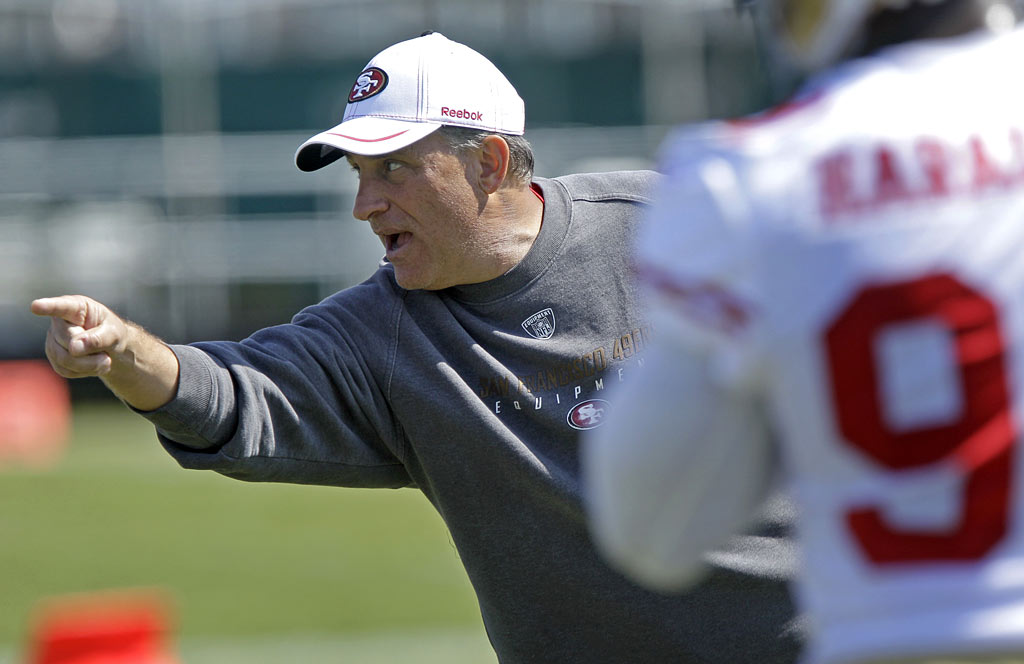
Fangio wears the same expression he did in the 1970s: stern, focused, and endearingly gruff. Win or lose, Henzes sends him a message afterward. He usually replies, with his typical brevity.
“I get one-word answers,” she said with a laugh. “‘Thanks,’ or ‘appreciate it,’ maybe. No time to chitchat.”
Roseann Henzes still communicates with Vic Fangio more than 40 years since he last coached under her husband, Jack.
Some coordinators are toughened by long hours and stressful seasons, but the people of Dunmore say this is how Fangio has always been. Even as a young safety, he was hard-nosed and meticulous, a player who devoured film and grasped concepts on the first try.
Fangio showed an ability to be in the right spot at the right time, or, better yet, anticipate what the opposing offense would do next. These instincts only sharpened in 1979, when he was hired by Jack Henzes as linebackers coach at Dunmore High School, his alma mater, about 120 miles north of Philadelphia.
It was an opportunity that laid the foundation for the rest of his career. Henzes became a mentor to Fangio, whom he saw as a kindred spirit. He taught his pupil how to work, how to coach, and how to get the most out of his team.
They took pride in the minutiae, drilling players on everything from proper footwork to hand placement. This translated into success: After losing seasons in 1976 and 1977, and a bounce-back 10-win season in 1978, Fangio and Henzes went 21-13 over their three years coaching together.
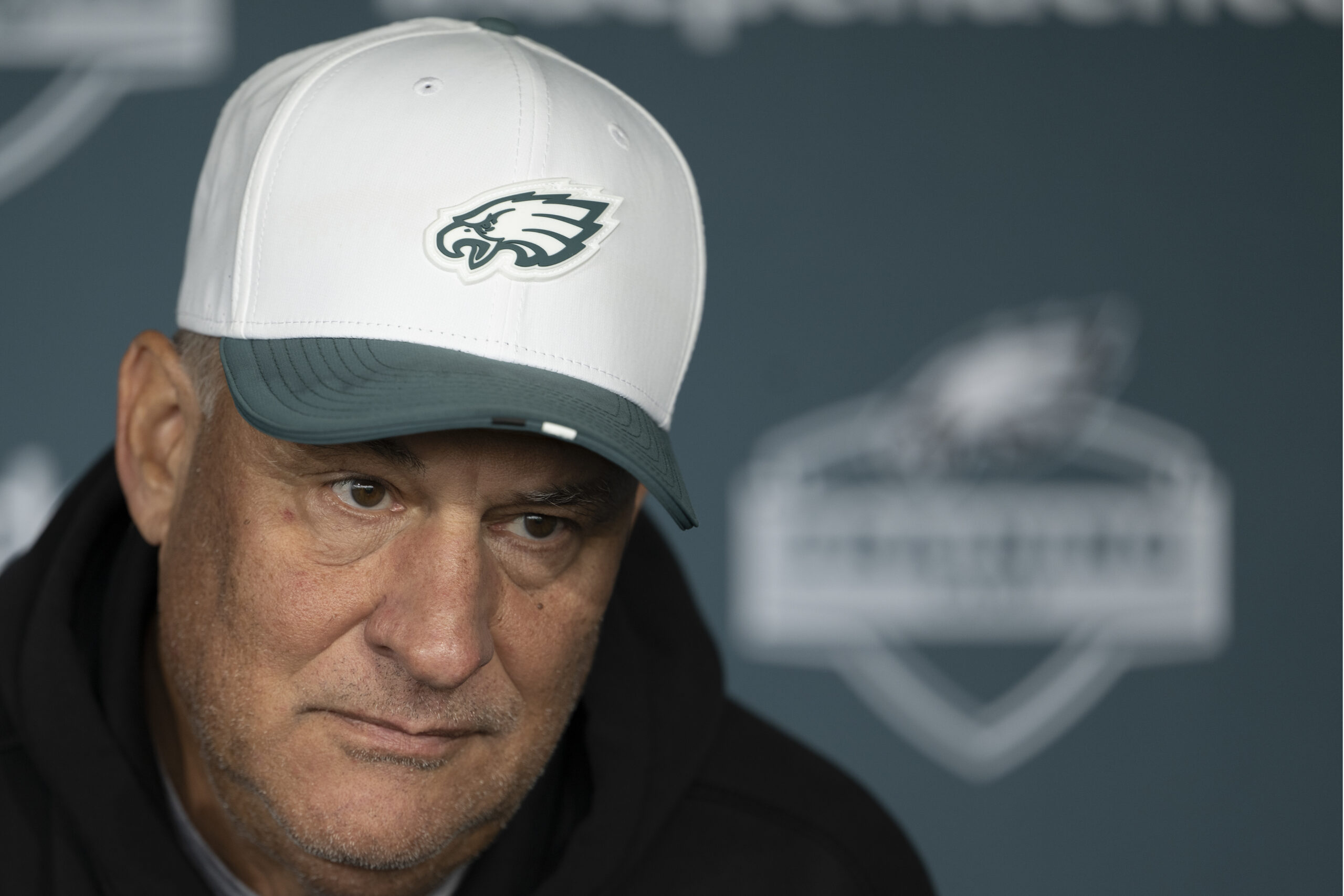
The Eagles defensive coordinator has accomplished a lot since then — including a Super Bowl championship in which he had a crucial role — but locals still see the same understated guy.
To Roseann Henzes and the Dunmore community, he will always be the kid who umpired Little League games for fun. Or the high school coach who tended bar at Ragnacci’s for extra money — despite his reticent nature.
“I just laugh when they show him in the [coaches’] box,” said Tony Donato, Fangio’s former neighbor. “The same expression on his face. Doesn’t crack a smile. I think he’s saying, ‘I don’t want this camera on me at all.’”
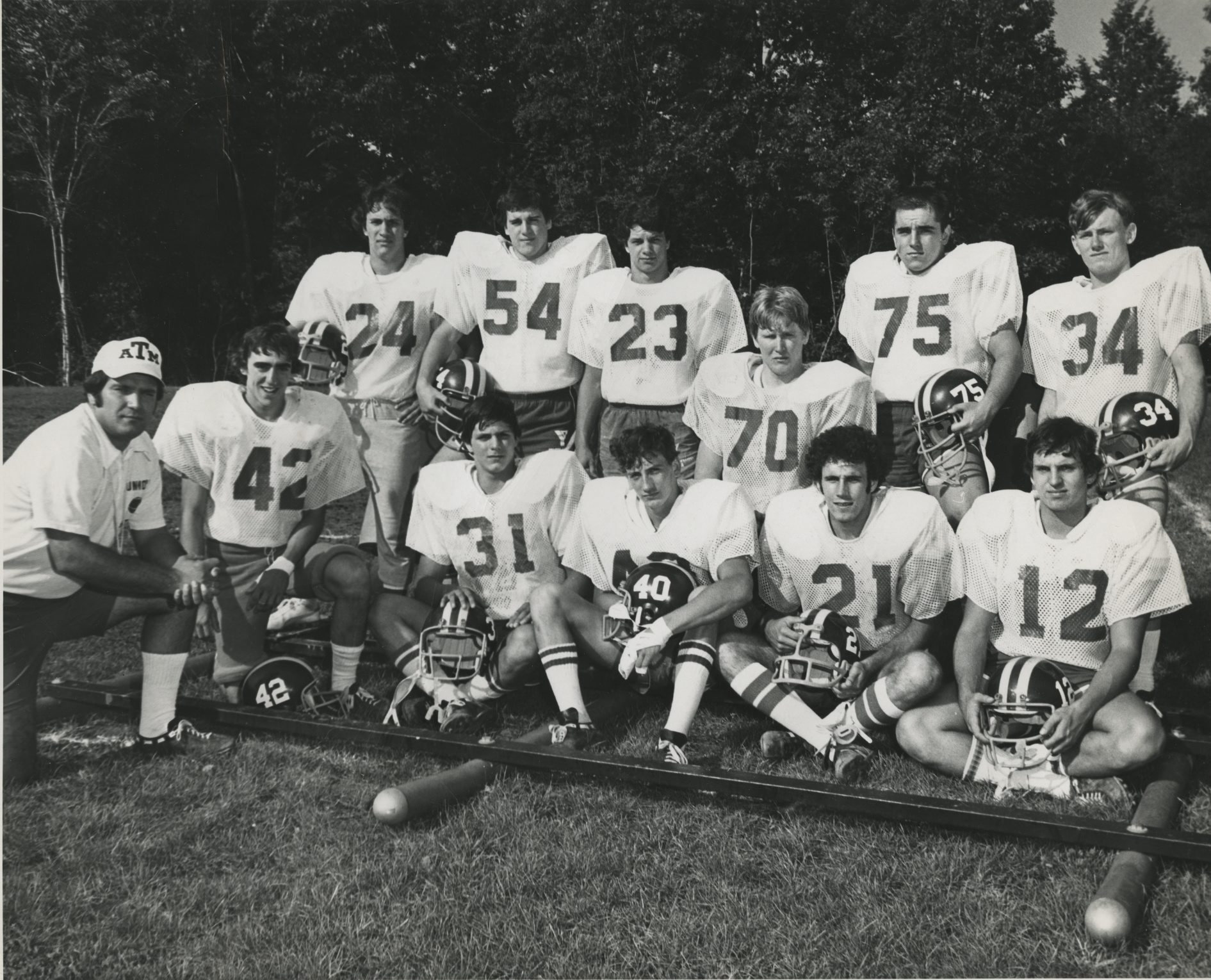
Dunmore coach Jack Henzes with his 1975 team. Vic Fangio is standing second from right.
A player known as ‘Hector’
Fangio spent his formative years in Dunmore, a borough of about 14,000 people just outside of Scranton. His mother, Alice, was a housewife and, later, a secretary at the local high school. His father, Vic Sr., owned a tailor shop.
From a young age, Fangio was immersed in sports. He played baseball in the spring, football in the fall, and basketball in the winter. As if that wasn’t enough, Fangio began umpiring in Dunmore’s Little League, where Vic Sr. served as a coach, in the early 1970s.
He was only a teenager, but he displayed a breadth of knowledge that commanded respect.
Bob Holmes, who played for Fangio from 1979 to 1981, experienced this firsthand. He met his future football coach in the batter’s box. The umpire showed no mercy.
“He called balls and strikes,” Holmes said. “And if you were just this kid sitting up there, and you’d watch one go by, he’d punch you out like it was a major league game. Off to the side, fist out, you’re done. Out you go.”
Locals assumed Fangio would work in sports. Some wondered if he’d become an umpire, following in the footsteps of Dunmore resident and Baseball Hall of Famer Nestor Chylak.
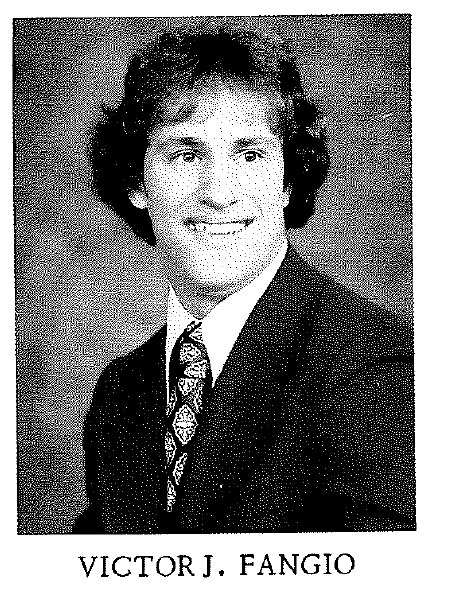
Vic Fangio’s senior yearbook photo at Dunmore High School in 1976.
But after Fangio was introduced to Henzes, his love for football became clear. He played for the freshman team in eighth grade, with a voracious appetite to learn. Bill Stracka, Fangio’s coach in 1971, said the middle schooler would bring him NFL concepts to implement.
“Every once in a while he’d say, ‘Could I talk to you before we leave?’ And I’d say, ‘Sure,’” Stracka said. “He’d say, ‘Well, last night, I was watching part of the game, and I saw something that I’d really like to explore here. I think I could do it.’
“Whenever we talked about things, it was like that. He was very, very aware.”
Fangio joined the varsity team in 1973, and was taken by Henzes’ understanding of the sport. Henzes was taken by Fangio, too. Roseann said her husband would talk about the safety “all the time,” and eventually introduced her to Fangio when he was a sophomore.
She was struck by how similar they were, down to their demeanor. Both Fangio and Henzes were quiet. Both had a borderline obsession with the game, spending long days and late nights studying film.
Because of all this work, they could predict an opposing offense’s next move. Joe Carra, a former linebacker at Dunmore, remembered one game in 1973 against Valley View, which Dunmore hadn’t beaten in years.
With Fangio on the field, they achieved the improbable. He intercepted a pass late in the fourth quarter and returned it 40 yards for a backbreaking touchdown en route to a 33-27 win.
“He would play right behind me, and he was always in the right position,” Carra said. “That’s why he had a bunch of interceptions.”
Together, Henzes and Fangio elevated the program to new heights. After a lackluster freshman season in which it went 5-4-2, Dunmore posted a 28-6-1 record over its next three years with three Big 11 Conference championships.
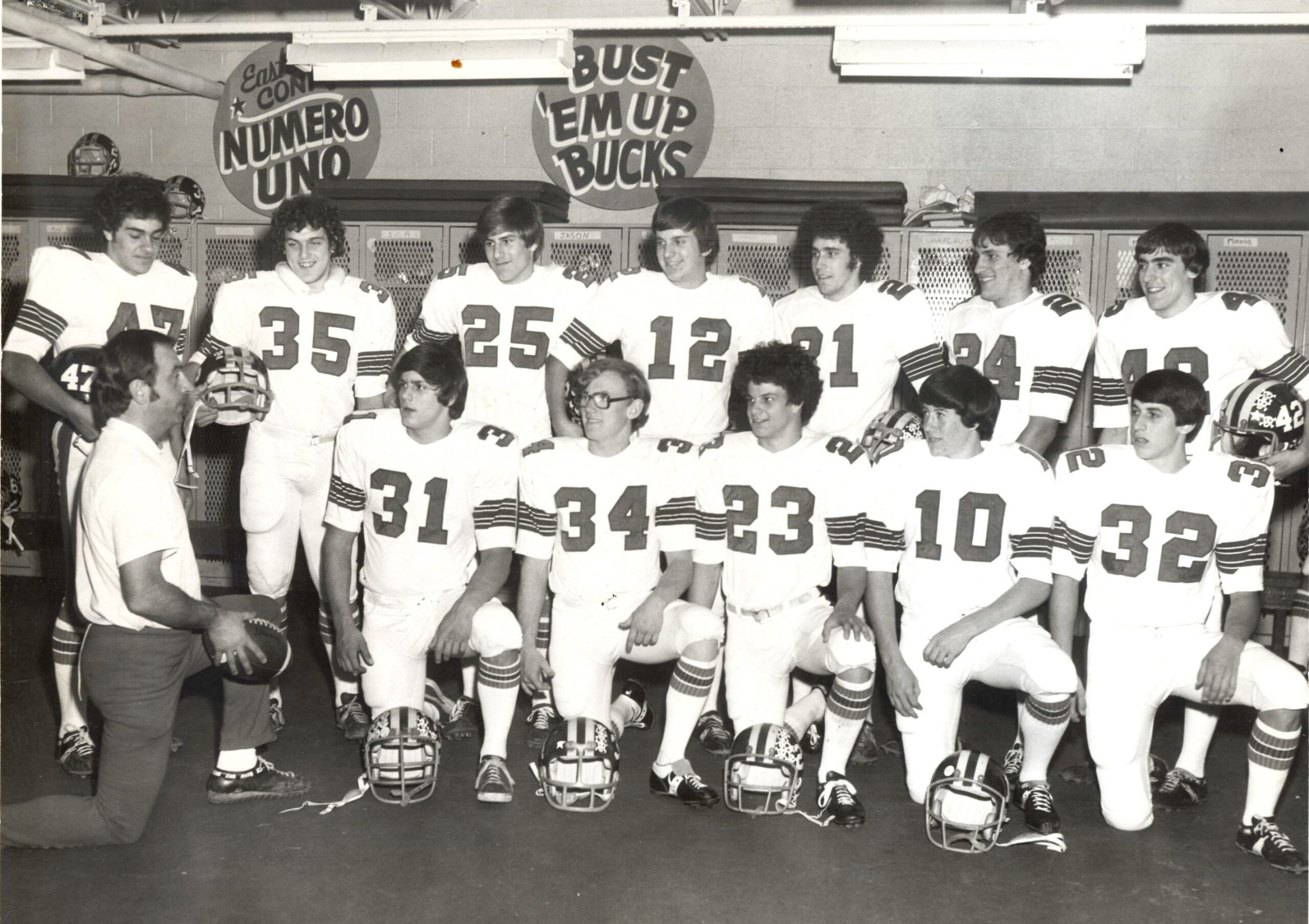
Senior players on the 1975 Dunmore High School football team that won the Big 11 championship, including Vic Fangio (24), back row left.
At some point during this span, Fangio was given an unusual nickname among a select group in his hometown: “Hector.” Carra recalled that it was assistant coach Paul Marranca who first coined it (although Marranca’s memory of this is hazy).
In Carra’s telling, one day in practice, Marranca was trying to get his players in position and mistakenly yelled “Hector” instead of “Victor.” The moniker stuck.
“We all laughed under our breath,” Carra said. “Coach Henzes would have made us run if he thought we were laughing at him.”
Fangio graduated in 1976 and attended nearby East Stroudsburg, where he attended coaching clinics. By 1979, he’d gotten his first coaching job, overseeing linebackers under Henzes at Dunmore, while finishing his senior year of college.
He stayed for three seasons, working as defensive coordinator in 1980 and 1981. The first stop of his career shaped his philosophy for decades.
“Everything he got came from Coach Henzes,” Carra said. “He went further with the detail. He learned toughness. He learned hard work.”
Though not known for his ebullient manner with people, Vic Fangio once worked as a bartender in Dunmore.
Coach by day, bartender by night
It didn’t take long for players to realize their new coach was advanced for his age. Dunmore had previously been running base defenses. After Fangio was hired, it started incorporating stunts and blitzes.
“We had no idea what we were doing,” former safety Paul Sheehan said via email.
The coach would challenge them schematically, but also would harp on fundamentals. Fangio had rules for every position group. The players first had to line up correctly. Then, they needed to know their coverages. They’d have to use their hands, stay square, and tackle properly.
Any mistakes would be pointed out in film review on Monday — even with players outside of his purview.
“He would stop the film and run it back 18 times to make a point,” Holmes said. “If [he] were critiquing our offensive line, he would critique their stance. ‘Your foot’s too far.’ ‘You just got beat off the corner because your foot wasn’t far enough.’ Or balance. The littlest of things.
“You’re sitting there, and you’re like, ‘Oh my gosh.’ You can’t wait to get out of there. But everything was important.”
It was here that Fangio’s attention to detail really shone. FormerlinebackerJack Miles remembered one day in 1980 when they were reviewing footage of an upcoming opponent. The coach paused the film, then rewound it.
He pointed to the hash marks.
“He [noticed] that if both receivers were outside the hashes, they’d run the ball,” Miles said. “If one receiver was inside the hash mark and the other one was outside, that was their throwing formation. Sure enough, he was correct.”
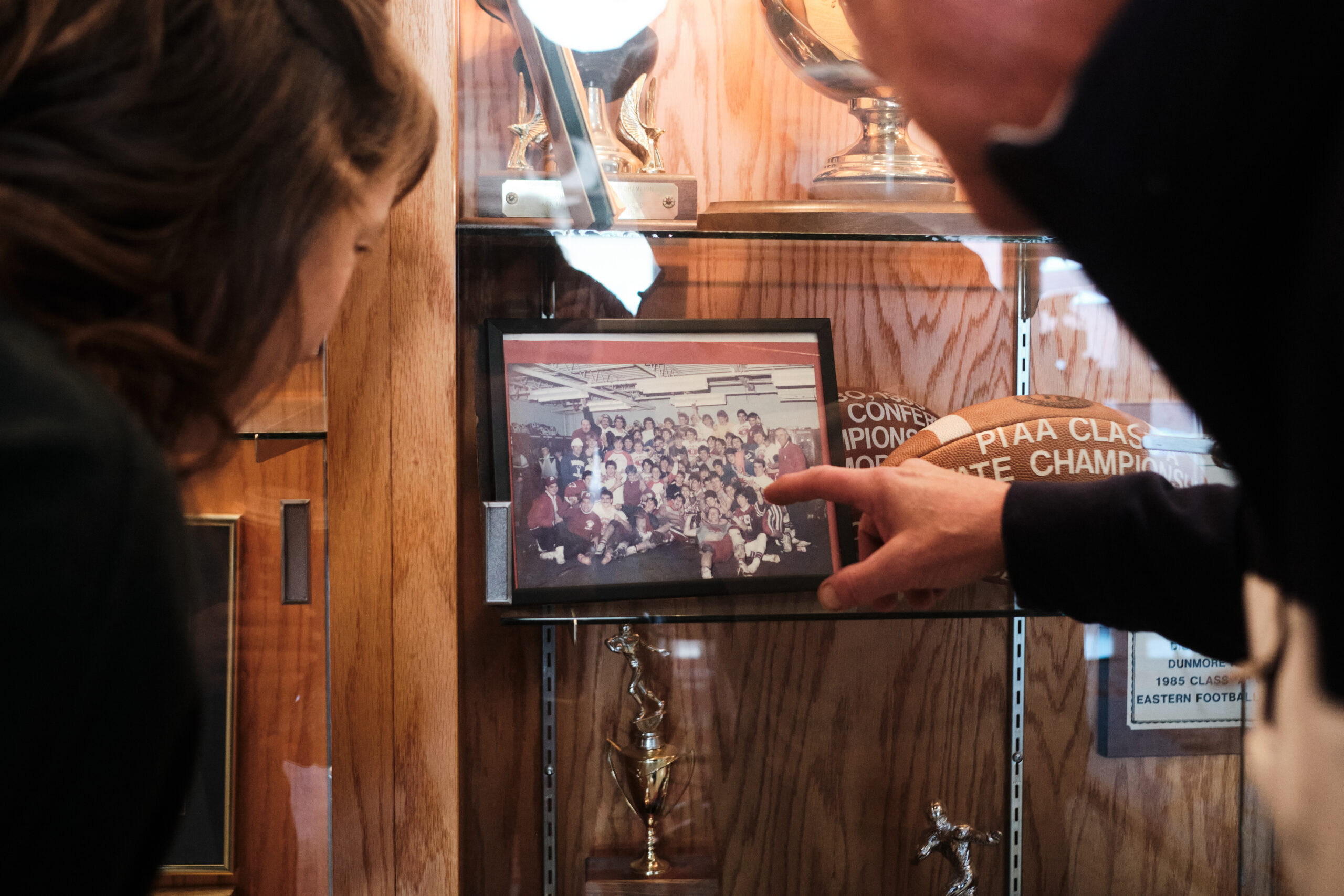
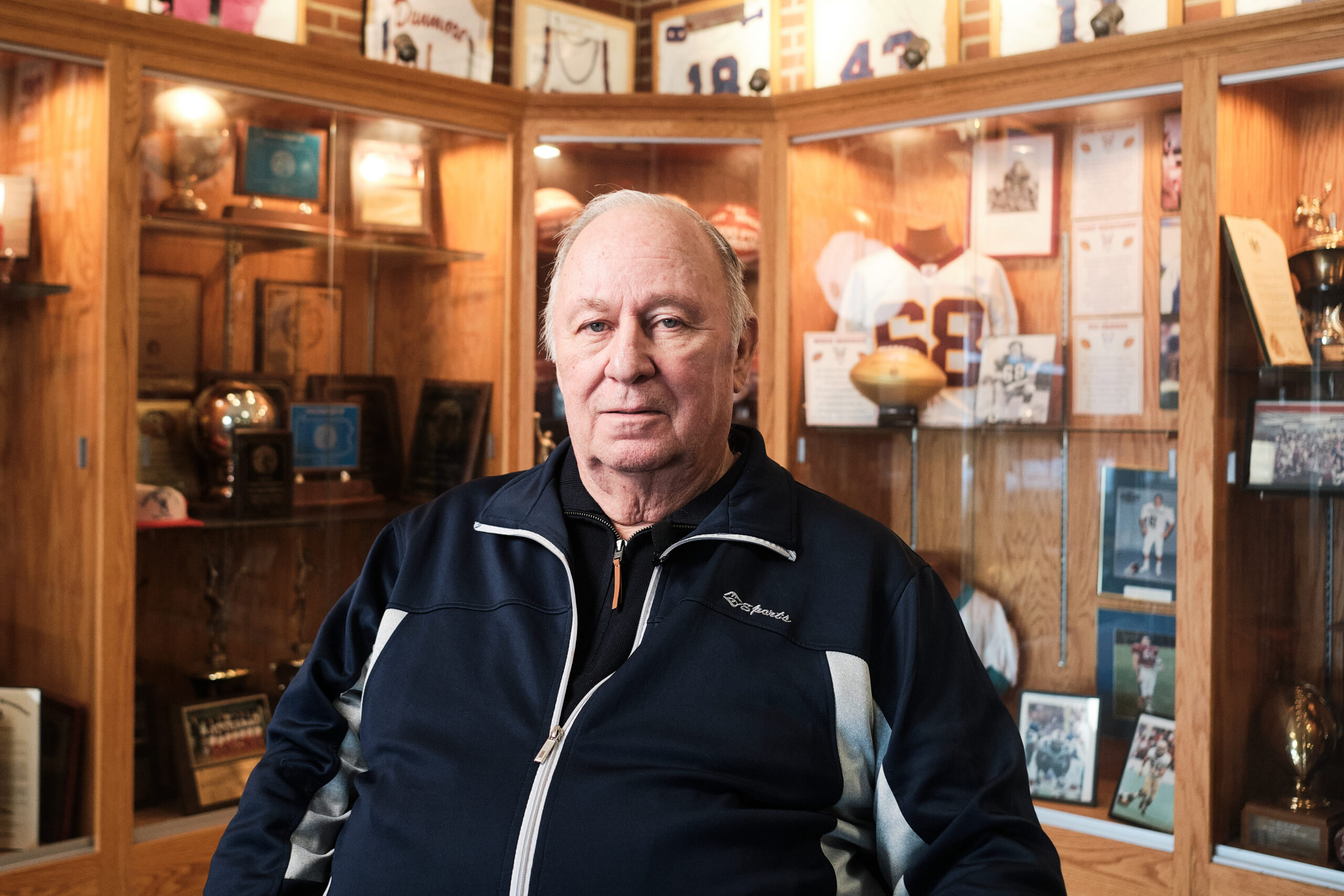
A photo of Vic Fangio’s high school team hangs in the trophy case at Dunmore High School.
Fangio was just as thorough on the field, equipping his players for every situation. Defensive backs would practice “high-pointing” the football, catching tipped passes, and taking efficient angles while pursuing ballcarriers.
Before long, Dunmore was running sound, but unpredictable, defense — one that proved difficult to dissect. Fangio’s unit would use four-man, five-man, and six-man fronts, all with four or five different plays apiece.
He occasionally reminded the players of his impact. On a Monday after a big win against Valley View, Fangio ran back a clip of Miles making a tackle untouched. Then, he ran it again. And again.
Fangio looked at the linebacker.
“He says, ‘Did anybody touch you?’” he said. “And I said, ‘No, Coach.’ And he says, ‘Aren’t you going to say thank you?’”
For Miles, getting a laugh out of Fangio was a point of pride. He was famously reserved, and not only at practice. Bobby Ragnacci, who coached Dunmore’s offensive line, hired Fangio to work at his family’s restaurant in the early 1980s.
Jack Miles shares fond memories of Vic Fangio’s work as an assistant coach under Jack Henzes at Dunmore.
He needed a bartender, and Fangio needed some extra money. So one night a week, the future Eagles defensive coordinator served 25-cent drafts and two signature cocktails: the Blue Moon and the Blue Hawaiian.
Pouring beer into a glass wasn’t an issue. Making small talk was.
“Well, he was no Tom Cruise, flipping bottles and stuff,” Ragnacci said. “But he was very efficient. And very honest. Certainly didn’t give away any free drinks.
“He was a good listener. Not much feedback.”
Added Holmes: “Not particularly good. He was probably drawing plays or something.”
Despite his taciturn demeanor, Fangio showed how much he cared. Holmes struggled in high school. He didn’t play a full season in his sophomore year because he became academically ineligible.
He was in a car accident in his junior year, which prolonged his time off the field, and finally returned to the team in 1981, his senior year.
Holmes remembered Fangio giving a speech to set the tonefor offseason workouts. He made a reference to “the players who weren’t here” in years past.
The tailbacktook notice.
“I think what he was saying to me, without saying it, was that we value you,” Holmes said. “‘We missed you last year. But I don’t want you to just sit there on the bench and hear me talk. I want to draw [your] attention. Because we feel you’re going to be an important part of our team.’”
To those around them, the parallels between Fangio and Henzes were obvious. They were defense-minded coaches who led with high expectations and tough love.
They possessed a savant-like ability to draw up plays, not because of clairvoyance, but hard work.
“Coach [Henzes] never felt like he was too smart for the game,” Holmes said. “He was always trying to learn new things. And I think he probably instilled that in Victor.”
Vic Fangio has never forgotten Dunmore amid his nationwide travelogue within the NFL.
Faxing defense to Dunmore
In the early 1980s, Fangio told Henzes he wanted to coach at the next level. Henzes urged his pupil to leave as soon as possible. He did, taking a job as defensive coordinator at Milford Academy in Connecticut in 1982.
After working as a graduate assistant at the University of North Carolina in 1983, Fangio was hired by Jim Mora as a defensive assistant for the USFL’s Philadelphia/Baltimore Stars from 1984-85.
He entered the NFL in 1986, joining Mora’s New Orleans Saints as a linebackers coach. He stayed there for the next eight years, leading one of the greatest linebacker units in history, the “Dome Patrol.”
Despite his busy schedule, Fangio always made time for his hometown. He often would provide tickets to family and friends from Dunmore. If they came to visit, he’d make sure to see them.
In the 1990s, Stracka and his wife traveled to New Orleans for a conference. They decided to let Fangio know, and he invited them to tour the Saints facility.
The couple walked the grounds, and afterward, Fangio offered to show them his office.
Stracka and his wife were aghast by what they saw.
“What’s the matter?” Fangio asked.
“Well, you must have 1,000 sheets of paper in here,” Stracka replied.
The linebackers coach was unfazed. He looked at the papers, stacked up around his desk, and went through each pile one-by-one.
“Well, that’s for linebackers,” he explained matter-of-factly, “and this one’s for this, and …”
Bill Stracka is among the Dunmore associates who kept a connection with Vic Fangio throughout his coaching rise.
Despite the fact that Henzes and Fangio were about 1,200 miles apart, they still talked on a regular basis. This continued at all of Fangio’s NFL stops: Carolina, Indianapolis, Houston, Baltimore, San Francisco, Chicago, Denver — where he was the Broncos’ head coach — and Miami.
Henzes would ask his pupil for advice on schemes and how to attack upcoming opponents.
Fangio would draw up plays and fax them to the guidance office at Dunmore High School. Sometimes, he’d call Henzes back at the field house, where the coach’s office was located, to talk to him directly.
“You’d hear the phone ring, and somebody would pop out, and they’d say, ‘It’s Coach Fangio,’” said former fullback Kevin McHale, who played for Henzes in the 1990s. “And he would say, ‘Excuse me for a second, I’ve got to talk to Victor.’ It was like the president was calling him.”
McHale said Fangio often would respond to his former coach that day. If he wasn’t able to reach him at his office, he’d try calling Henzes at home.
Roseann usually would pick up the phone. A self-described “talker,” she would try to engage the coach in conversation.
“All I do is ask questions,” she said. “How are you? What did you do? Where are you going? Where have you been? How’s the kids?
“And I would get one-word answers, right? And I always joke that I could talk to a wrong number — and I could — but that was tough. It was really tough.”
She’d pass the phone to her husband, who would jot down Fangio’s X’s and O’s with a paper and pen in hand. Every once in a while, she’d hear his end of the conversation.
“He’d say, ‘Well, I can’t do that, because I don’t have the personnel that you have,’” Roseann said. “But he’d get the ideas from him anyway.”
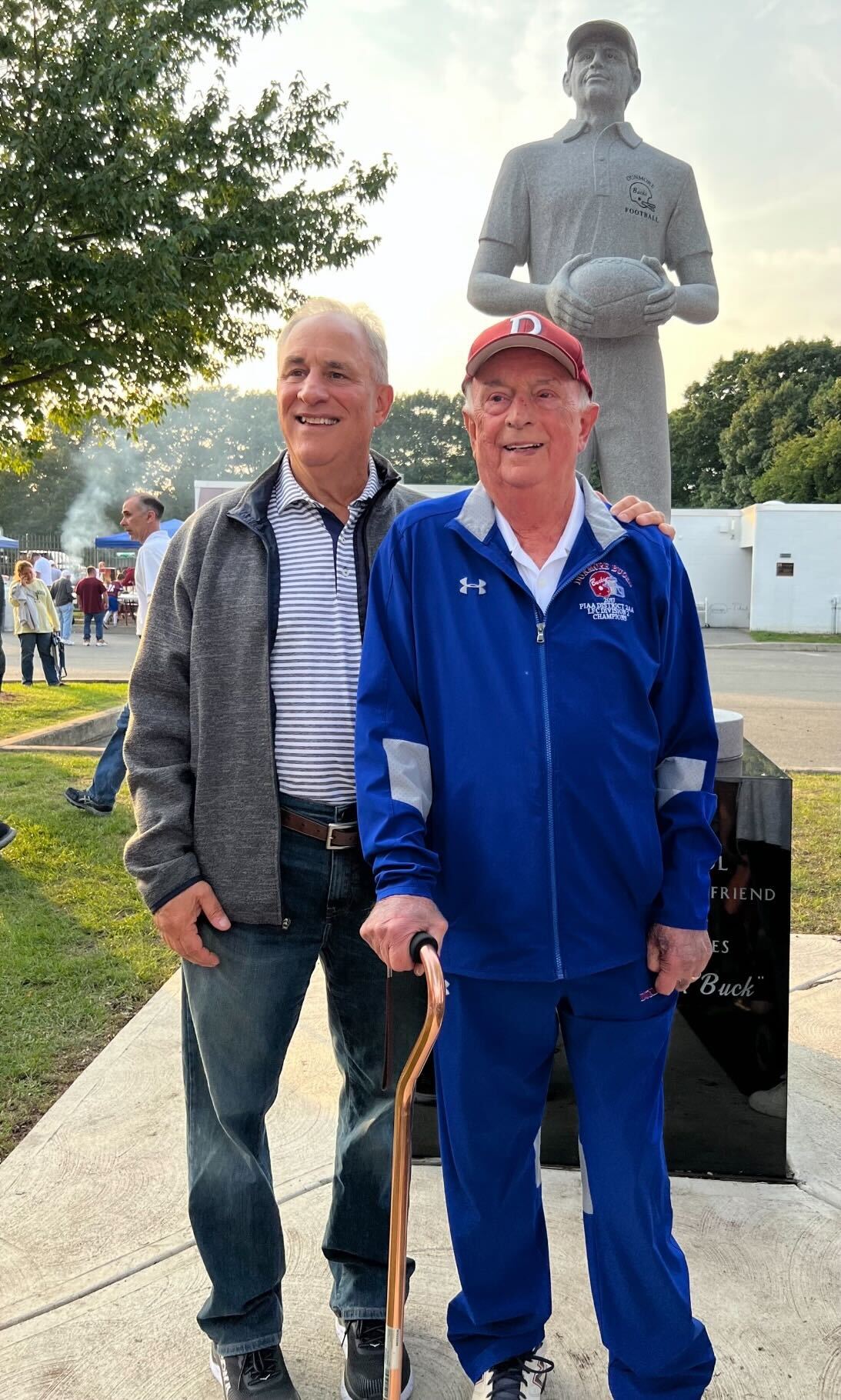
Vic Fangio honored his high school coach, Jack Henzes, by accompanying him to his statue unveiling.
Fangio continued to help his former coach until he retired from Dunmore in 2019. Aside from his role as Henzes’ unofficial defensive consultant, he also visited him in person, taking the coach to lunch at Ragnacci’s or talking to his high schoolers over the summer.
In turn, Henzes would use Fangio as a model for his players. If he saw someone acting out of line, he’d muse that they wouldn’t see “Victor’s guys” doing the same thing. The coach bought NFL Sunday Ticket so he could watch all of Fangio’s games. Any lessons he learned, he relayed back to his team.
In 2022, Dunmore High School built a statue dedicated to Henzes, the third-winningest high school football coach in state history. Fangio, who was working as a consultant for the Eagles at the time, showed up to surprise his mentor.
About a year later, in the summer of 2023, he made an impromptu stop at the Henzes household.
It was the last time Fangio would see his former coach. The mentor and the mentee sat together in the back room, talking about football and family. Henzes died two weeks later, at 87.
Dunmore High School’s current football coach, Kevin McHale, says Vic Fangio maintains firm ties to the high school where it all started for the esteemed NFL coordinator.
“V-I-C”
In the lead-up to Super Bowl LIX, Dunmore’s football team watched every Eagles playoff game and Fangio news conference from its weight room.
McHale, who was named the Bucks’ head coach in 2019, would break down Fangio’s defense after each matchup, pointing out how his players performed on the biggest stage.
The teenagers looked on in awe as a man who’d once walked the same halls they did put on a defensive master class. The Eagles’ Super Bowl victory filled Dunmore with pride. In a way, it felt like his hometown had won, too.
Fangio’s former players could see traces of their high school coach in Philadelphia’s defense. The personnel was more advanced, of course, but the foundation was the same: sound fundamentals, attention to detail, and unpredictable pressures.
Holmes observed how Zack Baun tackled and thought back to Fangio’s rules: head across the body, driving through the ballcarrier, proper angle of pursuit. It all seemed familiar.
“When we watch the Eagles now, we’re like, ‘Hey, we recognize that,’” he said.
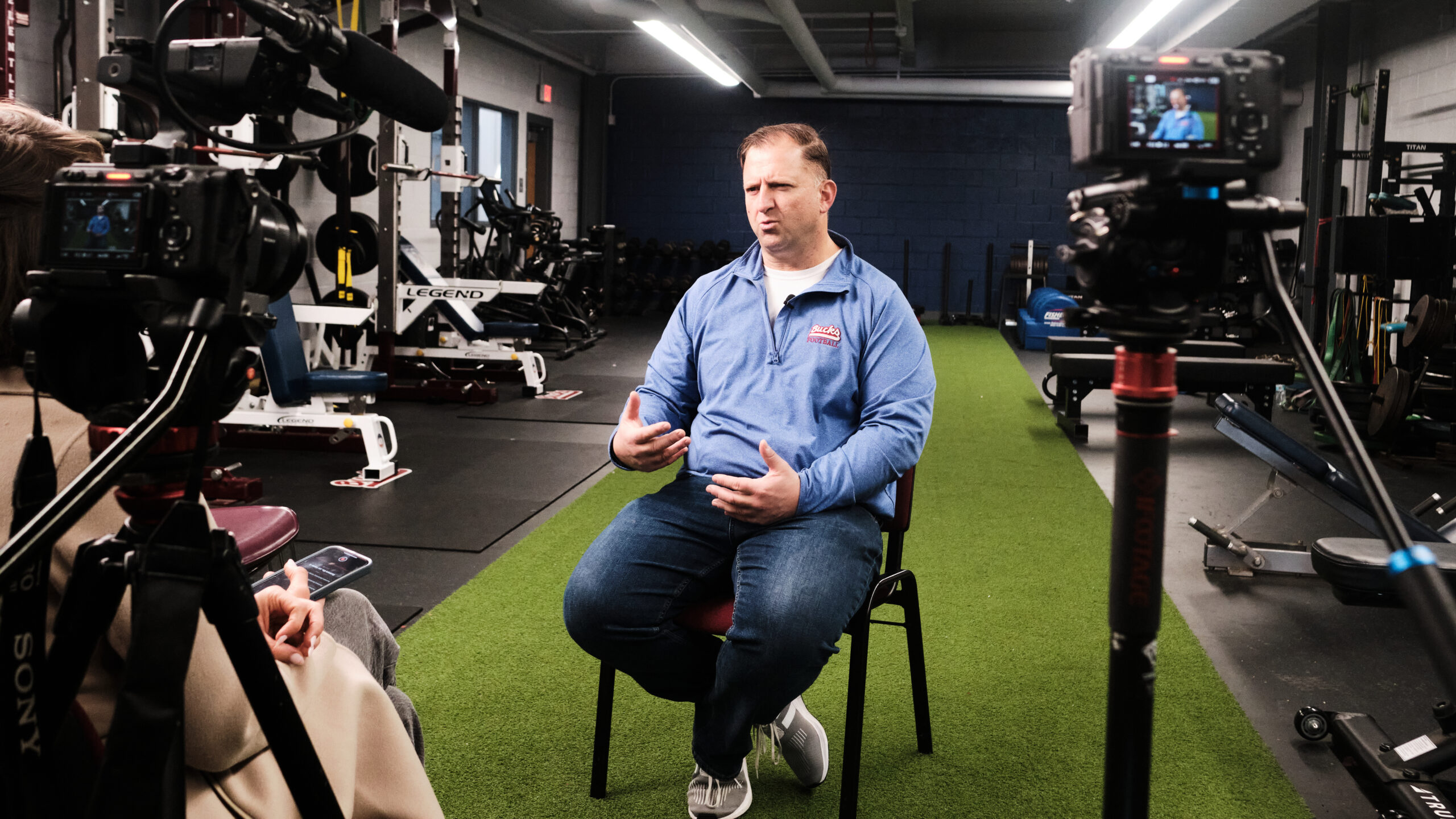
A few weeks after the Super Bowl, Fangio returned to Dunmore. McHale had heard he’d be around, and reached out to the defensive coordinator to see if he would talk to his team.
Fangio agreed. On Feb. 28, he met the players in their locker room and stayed for an hour and a half, answering every question they had. Some were technical — asking Fangio how he developed the defense’s approach to Patrick Mahomes — and some were more trivial in nature.
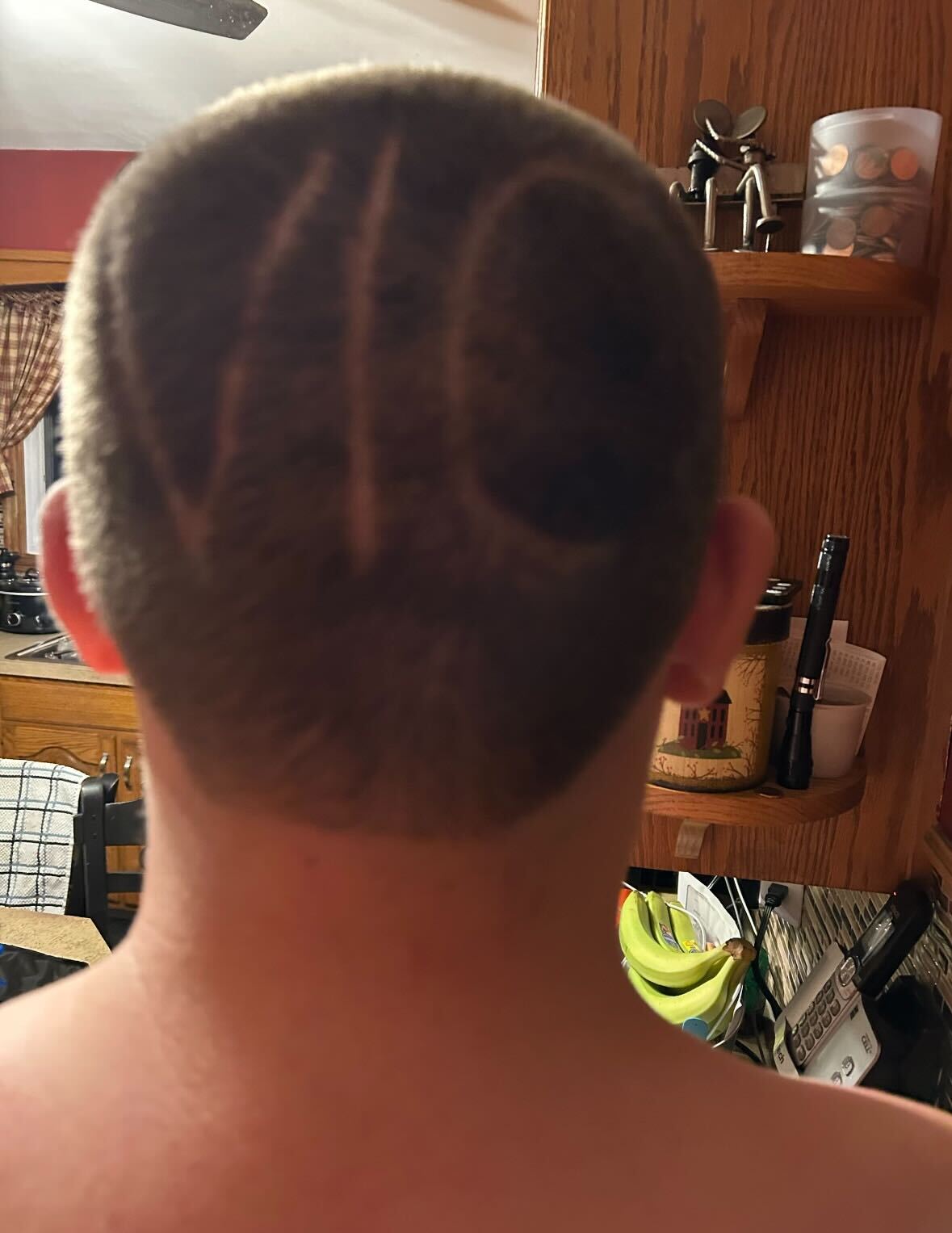
At one point, McHale paused the Q&A. He asked Fangio if he’d ever met anyone who had shaved his name into the back of his head.
Fangio said no.
“Well,” McHale said, “we’ve got a kid right here.”
He motioned to right tackle Drew Haun, who turned around to reveal a big “V-I-C” etched into his buzz cut.
This got a smile out of Fangio.
Dunmore right tackle Drew Haun honored his school’s most famous football alumnus before a Vic Fangio visit to campus.
“I think he liked it,” the freshman said.
McHale is not in contact with Fangio as much as Henzes was, but he consults him from time to time. And if the defensive coordinator doesn’t reply right away, his concepts arenever far.
All McHale has to do is go to his home office in Dunmore. There, on a bookshelf, is a manila folder full of faxes; a trove of wisdom from a coach who will always be known as “Victor” or “Hector.”
What possible reason could justify the attack on Venezuela and the kidnapping of its president? Does Venezuela represent any threat to the United States? No. Is Venezuela under Nicolás Maduro an oppressive regime? Yes. But then why revoke asylum status for fleeing Venezuelans? Is the Maduro regime not bad enough to provide asylum, but bad enough to invade and oust the government? Is Maduro a bad man? Many would say yes — but many also would say the same about Donald Trump. Should a foreign country kidnap him? What is it that makes Honduran drug dealers eligible for a presidential pardon, but not Venezuelan drug dealers? Adolf Hitler and Benito Mussolini invaded Czechoslovakia and Ethiopia, respectively, for colonial expansion — a flimsy reason, but at least a reason. Perhaps our wannabe dictator wants to convict Maduro and then pardon him upon payment of a large bribe. That would at least make some sense.
Barry Lurie, Philadelphia
Wrong message
With regard to the Trump administration’s invasion of Venezuela, what message does that send to China and its desire to control Taiwan? Also, it goes far to legitimize Vladimir Putin’s rationale for invading Ukraine. Once again, an impulsive, poorly thought-out action by this incompetent administration.
Michael Walsh,Elkins Park
Right message
The pearl-clutching and bedwetting the Democratic Party devolves into when President Donald Trump says or does anything is predictably laughable. Venezuelan dictator Nicolás Maduro is arguably responsible for magnitudes more American deaths than Osama bin Laden, yet when he was tracked down and killed under the Obama regime, it was roundly celebrated and applauded. Spare us your pious and self-righteous moral indignation and get with the program.
Daniel J. Gribben, retired, Steamfitters Local 420, Philadelphia
Remembering Jan. 6
Today marks the fifth anniversary of that fateful day, Jan. 6, 2021, when there was an attack on the U.S. Capitol, a day when our democracy might have fallen. To use Franklin Delano Roosevelt’s words about Dec. 7, 1941, the attack on Pearl Harbor, Jan. 6, 2021, is a date that will — or at least should — “live in infamy.” It’s a day when our democratic republic buckled but did not break. It’s also a day President Donald Trump has tried to, if not erase from our history, at least whitewash into being viewed as something it demonstrably does not represent. Mr. Trump views it as “a day of love” when his supporters rose in glorious defiance of authority to pay homage to him. One concrete indicator of how Mr. Trump feels about that day, and those who perpetrated the attack, is that he granted clemency to virtually everyone who participated in that act of insurrection.
How Mr. Trump interprets Jan. 6 further demonstrates that he views adhering to the rule of law and the spirit of our Constitution as merely inconvenient obstacles for him to circumvent when it furthers his personal or political agenda. So, today, Tuesday, Jan. 6, is a day we, the American people, must never forget. It should serve as a vivid reminder that the preservation of our democratic republic is not ordained by God to continue forever. Rather, it’s the responsibility of the citizenry — that’s you and me — to feed it, nourish it, and actively seek to keep it alive.
Ken Derow,Swarthmore
Join the conversation: Send letters to letters@inquirer.com. Limit length to 150 words and include home address and day and evening phone number. Letters run in The Inquirer six days a week on the editorial pages and online.