Tag: topic-link-auto

  • Sheetz opens its first store in Wawa land, right across from a Wawa

    Sheetz opens its first store in Wawa land, right across from a Wawa

    Sometimes Sheetz happens, and at 8:02 a.m. on Thursday it happened in Montgomery County, when the chain opened its first convenience store in what’s long been undisputed Wawa territory.

    The store — which is directly across from a Wawa on West Ridge Pike near Lewis Road in Limerick Township — opened not with a Boom Boom, but with a whisper.

    Unlike a Wawa grand opening — where fans often queue up well before the doors open and the line to get in wraps around the building — there was just David Swartz waiting outside for the opening, bundled up in his folding rocker chair.

    Swartz, 36, of Collegeville, who arrived an hour before the opening, was surprised to find himself the only one in line, as were the gaggle of Philadelphia reporters who far outnumbered him and peppered him for interviews.

    A self-identified “diehard Wawa fan,” Swartz said he came to Sheetz’s opening for the food.

    “There’s nothing you can get here that isn’t delicious,” he said. “I love Wawa but they need different stuff and that’s what Sheetz is here to do, they’re here to deliver that.”

    Slushies, plushies, and more

    Once the doors opened, folks who’d been waiting in their cars started to file in, forming a line for the coffee, which was free all day (the Wawa across the street offered free coffee on Thursday, too). Other customers explored the touch-screen menus, checked out the prepared food offerings, and browsed the aisles.

    Inside, Swartz poured himself a slushie and ordered a hot dog, nachos, and fish tacos with fries — at 8:15 a.m. He also picked up three Hello Kitty plushies for his girlfriend. Wawa, he pointed out, does not sell plushies.

    “My girlfriend is going to be very happy when I come home with these,” he said.

    Inside the store after being the first to enter, Dave Swartz of Collegeville organizes his plushie toys and frozen drink as the first Sheetz store opens in the Wawa territory Thursday in Limerick Township.

    Elsa Ortiz, 54, drove an hour from Philadelphia to pick up a hoagie (or “Subz” as they call them at Sheetz) for her boyfriend.

    “Sheetz is definitely better than Wawa for him,” she said. “Right now I’m neutral, but today I am a Sheetz girl.”

    Ortiz said the store being across from a Wawa is very on brand for the Philadelphia region.

    “The rivalry is just like Philly, with its rivalries and everything else,” she said. “Still, go Eagles! I’m still Eagles!”

    There are some rivalries you can play both sides of, and some you can’t.

    Shortly after 9 a.m., when giveaways for gift cards and Sheetz schwag began, the store became so packed with people it became a real Sheetz show and the line outside for freebies stretched down the building. The residents of the Delaware Valley may rep hard and local, but they also won’t say no to a free T-shirt.

    The expansions

    While opening a Sheetz across from an existing Wawa may seem like the new guy in town is throwing down the gauntlet, it’s actually a move taken out of Wawa’s own playbook. In 2024, when the Delaware County-based chain opened up its first store in central Pennsylvania — what was traditionally Sheetz country — it did so within eyeshot of an existing Sheetz.

    For decades, the urban lore in Pennsylvania was that there was a gentleman’s agreement regarding unspoken boundaries between Delco-based Wawa in the southeastern corner of the state and Blair County-based Sheetz, in south-central Pennsylvania.
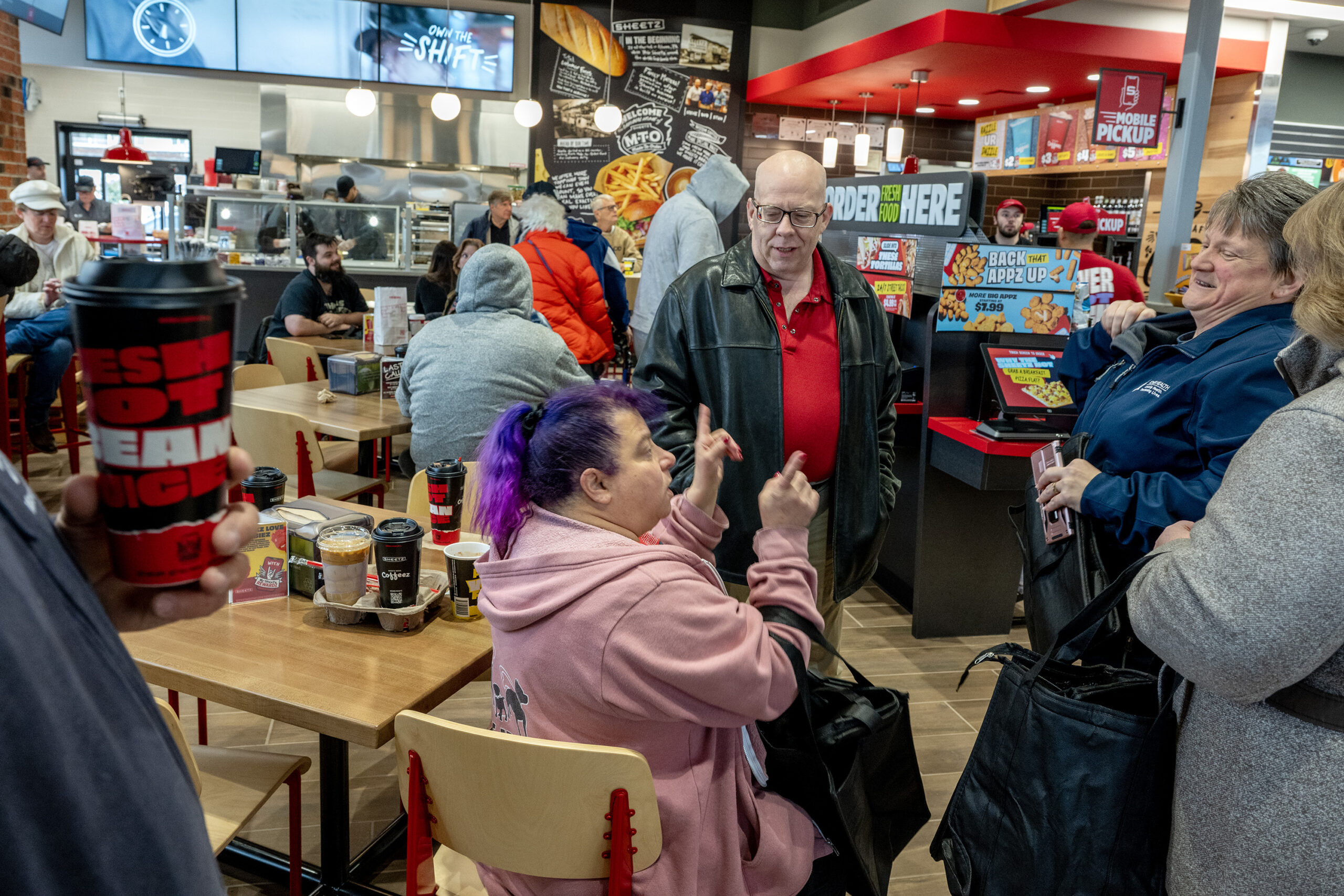
    Amy Rudolph (seated) of Collegeville holds court with fellow grand opening patrons as she recounts her story of being #2 in line as the first Sheetz store opens in the Wawa territory Philadelphia suburbs Thursday, Feb. 12, 2026 in Limerick Township.

    But that’s all it was — lore (New Jersey has its own devil, we had to come up with something) — and as both chains began rapid expansions in the 2010s, it seemed inevitable they’d cross over to each other’s markets at some point. In fact, Wawa and Sheetz have coexisted in several markets already for some time, including right here in Pennsylvania, in Berks and Lehigh Counties, according to Wawa spokesperson Lori Bruce.

    Today, Wawa has 1,193 stores in 13 states and Washington, D.C., and more than 95 store openings planned for this year. Ten stores have gone up in central Pennsylvania in the last two years, with 40 more planned over the next five, Bruce said.

    Sheetz, meanwhile, has more than 800 stores in seven states. Previously, its closest store to Philadelphia was in Berks County, but now that it has officially moved into the Philly suburbs, it doesn’t appear it plans to slow down. Sheetz stores have been proposed in Chester County and even in Delco, at Painters Crossing shopping center in Chadds Ford, just five miles down the road from Wawa’s headquarters.

    Now that could get Sizzli.

    A rivalry?

    Representatives of both chains deny they are rivals and point out that they have worked together to support various nonprofits.

    Adam Sheetz, executive vice president of Sheetz, said it has been a friendly competition for decades.

    “They’re one of the best retailers in the country, certainly one of the best in our industry, and we have great respect for them and competing with them has just made us better over the years,” he said.

    Bruce agreed.

    “We’re fortunate to have always had a respectful and friendly relationship with the folks at Sheetz,” she said. “And, while we have always embraced healthy competition at Wawa, when we think about competitors, we tend to think about challenging ourselves to make sure we are meeting the needs of our customers and communities.”

    Folks may eat on trash cans at Wawa, but you’ll never hear Wawa officials talking trash on Sheetz. Wawa fans, on the hand, are a whole other hoagie roll.

    Craig Scott (left) of Wayne and Dave Swartz (right) of Collegeville have breakfast as the first Sheetz store opens in the Wawa territory in Limerick Township.

    The low-stakes rivalry between the stores’ fans has resulted in memes, debates, op-eds, and even a forthcoming documentary, Sheetz Vs. Wawa: The Movie.

    When news of the impending Sheetz opening spread last month, cheeky comments by Wawa fans on social media included “We are all protesting this,” “sheetz is temu wawa,” “Sheetz is fire, but Wawa is for life,” and “this is my heated rivarly [sic].””

    But local officials said they didn’t hear of any pushback on the Sheetz.

    Patrick Morroney, a Limerick Township supervisor, has never been to a Sheetz but said he’s pro-business and welcomed Sheetz opening a store in the community.

    “I think that people are going to find their niche between Wawa and Sheetz,” he said.

    Jamila Winder, chair of the Montgomery County commissioners, said she frequented Sheetz while going to Pennsylvania State University and having the company open a store in Montco is “nostalgic” for her.

    “Even though Wawa has dominance here in Montgomery County and the region, we always welcome new businesses because that creates economic drivers, job opportunities for both, and it just gives people options to choose from,” she said.

    The opening

    During his remarks at the opening ceremony, Neil Makhija, vice chair of the county commissioners, took a different approach and leaned into the playful rivalry by putting on a Wawa hat while speaking to the crowd.

    He called the opening a “complicated day” for him and many people in Southeastern Pennsylvania.

    “I thought, ‘What is happening to our community? Do we need a stronger border security policy in Montgomery County? Should we build a wall and make Delco pay for it?’” he said to laughter from the crowd. “[But] here in Montgomery County we’re welcoming, we’re inclusive, and we’re hungry and I think we’re OK with a little competition.”


  • The Sixers’ best players should benefit from the NBA All-Star break — but not everyone will be off

    The Sixers’ best players should benefit from the NBA All-Star break — but not everyone will be off

    The NBA All-Star break has finally arrived for the Sixers, and it couldn’t have come at a better time for the team’s three most important pieces: Joel Embiid, Tyrese Maxey, and VJ Edgecombe.

    “I think everybody’s looking forward to it,” coach Nick Nurse said of the time off. “I think we need it. It’ll be pretty good timing for us.”

    Yes, Wednesday’s 138-89 loss to the New York Knicks was embarrassing, but despite the Sixers’ ups and downs this season, they are firmly in a playoff spot. Still, the Sixers need a physical and mental reset, even if some of their stars won’t be entirely off.

    Maxey will be heading to Los Angeles as an All-Star Game starter, with Edgecombe in tow to play in the Rising Stars game. But Embiid will have a full, much-needed weeklong break.

    Embiid missed his second consecutive game Wednesday with right knee soreness. Quentin Grimes also missed Wednesday’s game, while Dominick Barlow, who missed the final game of the road trip at Portland, returned to play 30 minutes, 37 seconds on Wednesday.

    Nurse said before Wednesday’s game that there was “not a ton of concern” about Embiid’s knee long-term.

    Joel Embiid has missed the Sixers’ last two games with right knee soreness.

    Embiid has appeared in 31 of the Sixers’ 54 games so far this year, skipping one leg of back-to-backs and missing most of November. But since that month, Embiid has quickly rounded back into form.

    “He’ll still tell you that he’s — I don’t know, you can have him tell you — but still not near 100%, not close,” Nurse said. “I think that’s encouraging because he’s starting to look pretty good again in a lot of different areas.”

    Some might consider Embiid’s exclusion from the All-Star Game a snub, but because of the break, the Sixers don’t play again until Feb. 19.

    That’s a full week for Embiid to stay off his knee and recover while the Sixers can stay locked into their sixth-place spot in the East. Since January, the Sixers are 12-5 with Embiid in the lineup, and 1-5 without him.

    “It’s hard,” Maxey said of playing without Embiid. “You go from one way to play without him early in the season, he comes back, you’ve got to play that way, then play a different way when he’s there — which is OK, it’s fine. It’s the reality of it, and we’ll be all right. I think he’ll be here more than he isn’t here when we get back, and we’ve just got to maintain those games that he’s not there.”

    It’s not just Embiid who can benefit from the time off. Edgecombe will be competing in the Rising Stars event at All-Star Weekend, but the rookie, who has played in 50 of the Sixers’ 54 games, will get a brief, needed reprieve from the grind of the NBA schedule.

    “He’s never played these type of minutes in his life,” Maxey said. “Even playing a 40-minute basketball game in college is way different than this. … We’re asking him to do a lot, so he’s probably definitely tired, but it’s OK. This is what the break is for.”

    Rookie VJ Edgecombe has already played in 17 more games than he did all of last season at Baylor.

    Entering the final game before the break, Edgecombe averaged 35.4 minutes, the most of any rookie, and ranked ninth in the NBA. Edgecombe played just 33 games at Baylor last year.

    Edgecombe ended Wednesday night with 14 points on 6-for-16 shooting, displaying his incredible physical tools and his recent shooting woes. Early in his career, Maxey learned how seriously he needs to take recovery in order to keep playing big NBA minutes.

    “I used to be like, ‘I don’t need treatment.’ I thought I was Superman,” Maxey said.

    He’s making sure Edgecombe is taking that feedback.

    But there might not be anyone on the team who needs rest more than Maxey. He has taken on the role as the Sixers’ top offensive option, and he is playing a career- and league-high 38.6 minutes per game.

    Maxey has also made 52 starts and played the most games of anyone on the Sixers. He scored 32 points in 32:07 on Wednesday but sat for the entire fourth quarter of the blowout. He’ll get a little less rest than his teammates, since he’s making his first All-Star Game start — and taking part in Saturday night’s three-point contest — but said he still would make plenty of time for relaxation.

    “I just want to get out there and just chill, sit in my hotel room, relax, get some good weather,” Maxey said. “I’ll get some relaxation and be good to go by Thursday.”

  • ‘She was struggling alone’: Family mourns Bucks County woman killed after reporting a sexual assault

    ‘She was struggling alone’: Family mourns Bucks County woman killed after reporting a sexual assault

    When Yuan Yuan Lu’s boyfriend sexually assaulted her in his Pennsport home last week, her cousin said, she broke up with him and went to the police.

    The 28-year-old Bucks County woman thought she was doing the right thing by reporting the crime, her cousin Natalie Truong said.

    “She told me how safe she felt, how much better she felt opening up and telling the cops her story,” said Truong, who spent time with Lu the evening she reported the assault.

    That was the last time Truong saw Lu alive.

    On Sunday, less than 12 hours after Lu called police to say that her ex-boyfriend, Yujun Ren, had attacked her, police said, Ren, 32, stalked her. He followed her to her home in Levittown, police said, approached her as she sat in her car outside her house, and shot her in the head, killing her.

    Lu’s death shook her loved ones and led to calls on social media for increased awareness of intimate partner violence.

    Truong said Lu leaves behind dreams unfulfilled. Lu grew up in a small village in south China, and moved to the United States with her father in 2009 to seek a more prosperous life.

    In Philadelphia, she attended Constitution High School, perfected her English, and always kept her friends abreast of her latest entrepreneurial pursuits, Truong said.

    Lu went into the food business with friends, cooking homemade Asian cuisine and selling it in carts on local college campuses, and later worked in a bubble tea shop and at a nursing home.

    Yuan Yuan Lu loved to eat at Philadelphia’s restaurants, according to her cousin, Natalie Truong.

    She loved her pets — a corgi named Dundun and a cat named Milk Cap, after a creamy bubble tea topping. Lu and Truong frequented Philadelphia restaurants, most recently dining together at Kalaya in Fishtown, and took day trips to places like New Jersey’s Swaminarayan Akshardham, the second-largest Hindu temple in the world.

    Despite the cousins’ close relationship, Truong said, Lu did not share a lot of details about her personal life, perhaps not wanting to trouble others with her concerns.

    Truong said Lu did not talk a lot about her relationship with Ren, whom she had met at her nursing home job and had dated for about a year. Truong’s perception of the relationship changed the night her cousin opened up about Ren’s behavior, she said.

    “She was struggling alone for a while,” Truong said, adding that initially, Lu “liked him, so we all trusted her judgment.”

    On Sunday, the day after Lu reported the assault, Ren turned himself in to police in Middletown Township, and officers discovered Lu’s body in her white Hyundai shortly after noon, authorities said. He was charged with murder, stalking, and a firearms crime.

    Ren told police that Lu had said “hurtful things” to him that day and that, in an attempt to scare her, he had brandished the firearm, which he said accidentally discharged. He was licensed to own the weapon, according to the affidavit of probable cause for his arrest.

    Ren’s aunt later turned in her nephew’s 9mm handgun — a weapon Lu had told police he “carried everywhere,” leading her to fear for her safety, the affidavit said.

    Truong said she wished law enforcement had had more time to investigate the sexual assault before Lu was killed. Her death was tragic, her cousin said, a life ended all too soon.

    Lu’s father had recently left Philadelphia to join his wife and son in China. Truong has started a GoFundMe campaign to raise money to help the family with funeral expenses and to pay for travel to Philadelphia to attend the service.

    As the family mourns Lu’s death, Truong said, they are hopeful that law enforcement officials will hold her killer accountable.

    “We just want her to get the justice that she deserves, because she’s a really kind person,” Truong said. “She never thought this would happen to her — because you would never think someone you love can hurt you like that.”

    Yuan Yuan Lu poses with her corgi, Dundun, and her cat, Milk Cap.
  • Cameras will soon enforce speed limits in five Philly school zones

    Cameras will soon enforce speed limits in five Philly school zones

    Philadelphia drivers are about to get a new incentive to obey the flashing caution lights and 15 mph speed limit near schools.

    On Tuesday, the Philadelphia Parking Authority plans to turn on automated speed-enforcement cameras in five school zones, targeted because they have had a relatively high rate of crashes. All are on major roadways.

    Violators will get warnings until April 20, when the cameras start enforcing the law. Driving 11 miles faster than the school-zone speed limit will carry a $100 fine.

    “The goal is to protect students,” said Rich Lazer, executive director of the PPA. “Speed cameras work. They reduce dangerous behavior.”

    Roosevelt Boulevard has seen a 95% reduction in speeding violations and a 50% reduction in pedestrian-involved crashes since cameras went up in 2020.

    The high-priority school zones were selected based on an analysis of Pennsylvania Department of Transportation crash data by the Philadelphia Office of Transportation and Infrastructure Systems.

    From 2019 through 2023, the five locations recorded 10 crashes in which a person was killed or seriously injured, and 25 pedestrian crashes, as well as several speed-related vehicle-on-vehicle crashes, the PPA said. (Victims included people of all ages; it was not clear how many were students.)

    (function() {
    var l2 = function() {
    new pym.Parent(‘SKLZONECAMS’,
    ‘https://media.inquirer.com/storage/inquirer/projects/innovation/arcgis_iframe/SKLZONECAMS.html’);
    };
    if (typeof(pym) === ‘undefined’) {
    var h = document.getElementsByTagName(‘head’)[0],
    s = document.createElement(‘script’);
    s.type = ‘text/javascript’;
    s.src = ‘https://pym.nprapps.org/pym.v1.min.js’;
    s.onload = l2;
    h.appendChild(s);
    } else {
    l2();
    }
    })();

    “We have tried many traffic-calming methods to stop people from driving dangerously fast in school zones, but many drivers still speed,” said Michael A. Carroll, a deputy managing director for the city who is in charge of OTIS.

    “Speeding is the No. 1 cause of fatal crashes,” he said. The cameras will protect students walking to and from school, as well as crossing guards, “who often put their lives at risk,” Carroll said.

    Automated speed enforcement remains controversial, despite studies that show it is effective, particularly on major urban roadways like the Boulevard.

    The cameras are also popular in dense cities.

    Recently, the Trump administration’s Department of Transportation restricted cities from using federal road safety grants for cameras that enforce speed limits and other traffic laws, unless they are in work or school zones.

    The Pennsylvania legislature, historically skeptical of automated enforcement, in 2024 gave Philadelphia permission to use school-zone cameras through Dec. 31, 2029, on a trial basis.

    There was some hesitation last March when City Council considered an ordinance to authorize the cameras. Three members held up the measure in committee, expressing concerns about a “money grab by the city.” The members also said they did not have enough information about the bill.

    After they met with Councilmember Isaiah Thomas, the chief sponsor, the legislation was enacted.

    “Everybody thinks it’s a money grab, but it’s really not,” Lazer said. “Resources are stretched; police are dealing with a lot of things. … If we can use technology, and it works, why not? Don’t speed, and you won’t get a violation.”

    Unlike the speed cameras on the Boulevard and those along 13 miles of Broad Street since November, the school-zone units deployed by the PPA are squat and at street level.

    Some people say they look like mailboxes or small refrigerators.

    They are meant to be portable, PPA officials said, so that cameras can be moved to other schools with problems, as long as they are operating in only five school zones at any one time.

    That limit is fixed by state law. Cameras can operate only when school zones are active, meaning weekdays when students are arriving in the morning or departing in the afternoon.

  • La Salle’s loyal baseball community restored the program. Now it’s time to get it ‘back on the map.’

    La Salle’s loyal baseball community restored the program. Now it’s time to get it ‘back on the map.’

    Kevin Ibach reached a milestone as Tampa Bay Rays assistant general manager in September 2020. The Rays defeated the Toronto Blue Jays in the wild-card round, marking the first time in Ibach’s 20-year career in baseball that he made it past the opening round. Before the team opened its next series against the New York Yankees, though, Ibach received news that crushed his mood.

    La Salle, his alma mater, was shutting down its baseball program after the 2020-21 school year. Ibach played middle infield for the Explorers from 1996-2000, but the program that helped forge his baseball career was suddenly on its way out.

    The Rays reached their second World Series that year, but the success was stained for Ibach.

    “I have a ring to this day from that journey and at the same time, it was the low point,” Ibach said. “A program that I cared so much about. Four years that were instrumental in my life and my development that probably led me to my job today. Getting that email that they were shutting the doors was pretty disheartening.”

    When Ashwin Puri took over as La Salle’s athletic director in July 2023, he ensured that those doors did not stay closed. With a three-phase plan centered on facility upgrades, fundraising and fan experience, Explorers baseball was officially welcomed back in April 2024, targeting a return this year.

    “What I soon realized after being here for two or three months was that every other conversation was about baseball,” Puri said. “I don’t know if it was fate or chance, but I felt an amazing sense of pride and connection to the university. A lot of people love baseball and care about baseball.”

    La Salle spent 2025 preparing to throw its first pitch in four years. Now, the program’s return is right around the corner. The Explorers will open their season against Maryland Eastern Shore on Friday (2 p.m.) at Hank DeVincent Field.

    La Salle baseball players practicing Wednesday at Hank De Vincent Field.

    Coach David Miller constructed a roster that is ready to write a new chapter of La Salle baseball while remembering the history that brought the Explorers to this point.

    “It’s going to be a lot of hard work that everybody collectively did to make this happen,” Miller said. “That first pitch, hopefully that first win, it’s going to be a great day for La Salle athletics.”

    Bringing a vision to life

    The main step in getting the program off the ground was improving the stadium and facilities while raising the necessary funds. An alumni advisory board formed to lead the operation helped focus on alumni outreach, and after a few months the progress in donations became notable.

    “When baseball came back, there was a small group of us that were excited to have the program back,” said Bill Watts, who played at La Salle from 1991-94 and serves on the advisory board. “Ashwin reached out and asked, ‘Would you be willing to be part of the rising here?’ I thought about it for a while and talked it over with some of my teammates and decided if we did it, we needed to do it the right way.”

    The feedback and excitement from alumni have been encouraging. More than 200 former players and alumni attended a “La Salle first pitch” dinner as an official welcome back for the program. While the program may have taken a few years off, the history and tradition carried on.

    The Explorers held alumni games in 2023 and 2024 at Hank DeVincent Field. La Salle made its conference tournament nine times before the program shut down. In its last season, La Salle finished with 32 wins, the most in program history.

    It is important, Puri said, that the program’s history is remembered in a new era.

    “I think history is a big part of it, but we also want to do things a little different this time,” Puri said. “We are going to take baseball very seriously. We are going to invest and we want to compete.”

    Building the team

    To put a team back on the field, Puri and the advisory board knew it started with one man: Miller.

    Miller was named La Salle’s head coach in 2018 and had the Explorers on an upward trajectory before the program shut down. They went 14-41 in his first season, then improved to 25-31 in 2019. After a shortened 2020 season, Miller led La Salle to one of its best performances in program history in 2021, finishing 32-21. Miller was named Atlantic 10 coach of the year and believed he was on the verge of accomplishing something special.

    That momentum was halted when the program shut down.

    Miller coached at Manhattan for two years before he got the offer to return to La Salle. Despite having to take a year off from coaching in 2025, the former Penn Charter coach decided it was worth it.

    David Miller returned to La Salle as the head coach, after serving at the helm for four seasons before the program was cut.

    “There’s just something about this place that draws me,” Miller said. “It’s like home to me. When my time is up here, I want La Salle baseball to be a destination baseball program in the northeast. And I don’t see why we can’t be.”

    With Miller back at the helm, the next step was putting the roster together. It was no easy task, considering he was starting from scratch.

    La Salle netted the 17th-ranked recruiting class by Perfect Game in 2025, bringing in 36 commitments. Next, its attention turned to the transfer portal.

    The Explorers brought in seniors who were looking for one more season to play college baseball or underclassmen seeking a fresh start. For utility man Chase Swain, a transfer from West Virginia, playing at La Salle brings his college career full circle.

    “I was committed here for like two years in high school,” said Swain, who played at Woodstown High. “… [The program getting cut] threw everything into a tailspin for me, recruiting-wise. So this place coming back, it was always in the back of my mind. I wonder what it would have been like there. I stayed loyal and the second that they brought it back, it was like a light bulb went off in my head, and I thought I would really enjoy playing there.”

    Underdog mentality

    With a completely new team, the players understand that expectations from the outside are low. The Explorers know a restarted program won’t be picked as a preseason favorite in the Atlantic 10 Conference, but they are using that as a chip on their shoulders and carrying an underdog mentality into the season.

    Because of the weather, La Salle has been forced to travel about an hour away to find an indoor facility for practice. The team has embraced the challenges.

    La Salle coach David Miller says his team is “more excited now than ever to play.”

    “I think we can take the motivation of being a gritty program because we don’t have all the facilities and everything that a lot of other schools have in Division I baseball,” said shortstop Justin Szestowicki, a transfer from Elon out of Kingsway High. “But I think we take that as an advantage. We have more of a chip on our shoulder, just knowing that, based on our opportunities to create a grittier play style, instead of just being taken care of all the time, we have to take some accountability for ourselves to be successful.”

    The players and coaches counted down the days until Friday, when they can say La Salle baseball is back and the two-year rebuilding process has come to fruition.

    Miller is ready to show the college baseball world who the Explorers are.

    “You’re seeing all these high-profile fans from Tennessee and LSU saying, ‘La — who?’” Miller said. “And we embrace that. That’s now my hashtag for the year. We’re going to show you who it is. These kids are more excited now than ever to play, because all the vision that we talked about, and getting them to see what’s coming, is here.”

    Ibach added: “I think that a lot of players who will be playing can take that inspiration to show the world, show the city, that La Salle baseball’s back on the map.”

  • Medicaid insurer AmeriHealth Caritas is closing its PerformRx PBM at the end of this year

    AmeriHealth Caritas, one of the nation’s largest Medicaid insurers, is closing its in-house pharmacy benefits manager, PerformRx, by the end of this year, the Newtown Square company said in an announcement to employees Wednesday.

    Health insurers effectively subcontract with pharmacy benefit managers to oversee drug benefits. They have become increasingly powerful cogs in healthcare and face new restrictions under a law signed by President Donald Trump this month.

    OptumRx, a unit of UnitedHealth Group Inc. and one of the three largest PBMs, is scheduled to take over for PerformRx on Jan. 1. OptumRx already provides PBM services to the majority owner of AmeriHealth Caritas, Independence Health Group. Independence is best known for its Independence Blue Cross business.

    “This decision reflects evolving market and regulatory landscape, not the performance or dedication of our PerformRx leadership or associates,” the AmeriHealth Caritas announcement to staff said.

    Caritas said in a statement to The Inquirer that it expected a “limited impact on jobs, with many functions remaining in-house to support the same high-quality experience for members and providers.”

    The company did not elaborate on the market and regulatory changes that precipitated the decision to close PerformRx, which Caritas formed in 1999. PerformRx has contracts in 13 states, including Pennsylvania and Delaware, according to the Caritas website.

    One of those states is California, where a new law took effect Jan. 1 that prohibits PBMs from charging health plans, including Medicaid plans, more than they pay the pharmacy for a drug. PBMs are still allowed to change a flat administrative fee in the state.

    Independence owns 61.3% of AmeriHealth Caritas. Blue Cross Blue Shield of Michigan owns the rest. Caritas accounted for about three-quarters of Independence’s $32 billion in revenue in 2024. The former CEO of AmeriHealth Caritas, Kelly A. Munson, succeeded Gregory E. Deavens in the top job at Independence last year.

  • A wordplay-forward California cabernet sauvignon that’s ripe and fruity

    A wordplay-forward California cabernet sauvignon that’s ripe and fruity

    Much of the communication that takes place in the wine world is in code. Words are used that may seem to mean one thing, but actually signal another. This wine unpacks an expert-level wine concept (as its name indicates), and its lesson is quite helpful for those who’d like to be able to navigate their wine options with more confidence.

    While the name Textbook cabernet sauvignon might seem innocuous, it’s a clever play on words — suggesting that this wine is a good example of the classic style associated with that particular grape. This is a reference to what experts call “varietal correctness” in wine, a concept that is rarely encountered in other corners of the food world. After all, most of the time, a tomato tastes like a tomato, a cheddar cheese like a cheddar, and so on. However, there is considerable style variance found in wines made using the same grape. Not only can they taste quite different based on where they are grown, but that flavor can also be manipulated dramatically in the winemaking process.

    So what is the “correct” way for cabernet sauvignon to taste? A century ago, all wines of quality came from Europe, from regions that each grew their own native grape varieties, with cabernet sauvignon hailing from the Bordeaux region of France. So when vintners aim to produce a classically styled version of this grape, they aim for Bordeaux-style characteristics, and that is what the sly branding here conveys.

    While this California wine is far riper and fruitier than a Bordeaux, thanks to the climate and terrain of the Paso Robles region, it does display a French-inspired restraint in its styling. Compared to its closest competitors, it feels a touch lighter on the palate, tastes a smidge drier on the tip of the tongue, and has a bit more of the tartness and slight bitterness found in French cabernet sauvignon. The overall effect is to give the wine a flavor profile closer to that of fresh blackberries than of baked blackberry desserts, making it quite food-friendly and especially well-suited to foods containing peppers, tomatoes, or olives.

    Textbook Cabernet Sauvignon

    Textbook Cabernet Sauvignon

    Paso Robles, California; 13.9% ABV

    PLCB Item #100034407 — on sale for $22.99 through March 1 (regularly $27.99). No alternate retail locations within 50 miles of Philadelphia.

  • My opioid addiction-related weight loss drew praise. Regaining during recovery? Not so much.

    My opioid addiction-related weight loss drew praise. Regaining during recovery? Not so much.

    A normal, healthy weight for me was 120 pounds. In the late 1990s, before addiction reshaped the course of my life, I was a model — someone whose world revolved around silhouettes, styling, and self-expression through fashion.

    My metabolism kept me effortlessly consistent in size, my confidence steady, my presence bold. In Philadelphia, style carried currency, and I spent mine generously. I was known — and crowned — as the “Queen of Fashion,” a title that suggested a life stitched together with glamour, ease, and admiration.

    I hired two of my very own fashion designers, and they made leather tops and pants specifically for me. I shopped at the most exquisite stores on South Street for shoes, clothes, and designer sunglasses. I kept my hair done and went to a nail salon in Center City on a regular basis — all part of the architecture of how I showed up.

    Chekesha Lakenya Ellis was a 29-year-old model in 2000, the year her addiction to opioids began.

    I looked healthy, controlled, and admired, even as addiction was quietly taking hold. I looked like someone who had mastered the runway. No one knew that soon I would be fighting a battle that fashion couldn’t tailor, metabolism couldn’t manage, and praise couldn’t heal.

    No one knew the story would shift from being known for how well I wore clothes to how bravely I rebuilt the body inside them.

    By 2001, that admiration extended beyond aesthetics. I worked as therapeutic support staff — a job that demanded attentiveness, emotional intelligence, and care. I delivered it well. My clients felt seen. My coworkers felt supported. Respect followed me into rooms before I even sat down.

    On the surface, my life looked like momentum — until prescription opioids quietly stepped in and dismantled the foundation beneath it.

    I became what many called “functional” — a person whose addiction was masked by productivity, routine, and public reliability. But functionality is not the absence of illness. It is often the art of hiding it. And I practiced that art for nearly a decade.

    Chekesha Lakenya Ellis during the self-described “party era” at the beginning of her opioid addiction in 2001, after a dramatic weight loss when she went from a size 5/6 to a 1/2 very quickly. The weight disappeared, she said, and the applause appeared.

    I went from a size 5/6 to a 1/2 very quickly — a dramatic drop that unfolded faster than most narratives could keep up. The weight disappeared. The applause appeared. The concern stayed absent. People praised the result without recognizing the cause.

    Compliments met me at the door before questions ever did: You look amazing. You’re so small now. What are you doing?

    Chekesha Lakenya Ellis in 2008 in active addiction at a party. “I was very frail,” she remembered.

    But I wasn’t doing anything admirable. I was enduring something dangerous. The shrinking they celebrated was not transformation. It was toxicity — a body under neurological attack, nutritional depletion, depression, and a decade-long prescription opioid addiction that pulled more from me than pounds. It eventually cost me my hearing.

    As my body grew smaller, the praise grew louder. At the same time, as I declined medically, physically, mentally, and emotionally, the world grew quieter about the part that mattered. They applauded the appearance of wellness while I was privately collapsing.

    Skinny equaled praise to them.

    To me, it was evidence that I was fading.

    In 2010, recovery finally became my rescue. It demanded rebuilding, not shrinking — a process slower, quieter, and far less visible than what the world celebrates.

    Chekesha Lakenya Ellis in 2010, her first year in recovery. Weight gain can mean restoration, healing, and survival, Ellis says. It deserves compassion and applause, but is rarely celebrated the way weight loss is.

    As my brain healed from the damage of long-term opioid use, my body began reclaiming the signals addiction had silenced: appetite, rest, regulation, safety, nourishment. The pounds I regained were not a reversal of progress. They were proof of it.

    There was no applause for that rebuilding. No celebration for the return of sleep, nourishment, or neurological stabilization. The world didn’t honor restoration because restoration didn’t look like reduction. It looked like progress that challenged how we measure wellness.

    At times, rebuilding invited commentary that echoed the same shallow math that once praised me: You used to be so small. Are you OK? The irony was painful. The same shrinking that was celebrated when it was harming me was questioned when it was saving me.

    Today, the cultural conversation around weight has grown louder, faster, more pharmaceutical, and more celebrated. Medications that promise shrinking have become shorthand for “wellness” in the public imagination.

    But in recovery communities — including those quietly healing in our own region — weight gain often signals restoration. It signals life returning to a body that nearly didn’t survive the war addiction waged on it.

    Bodies in crisis don’t need applause for shrinking. They need care for surviving. And bodies in recovery don’t need shame for rebuilding. They deserve compassion.

    Recovery doesn’t always show up as loss. Sometimes it shows up as strength. Sometimes it shows up as nourishment. Sometimes it shows up as life returning to places addiction tried to erase.

    Chekesha Lakenya Ellis in 2024. As she recovered from addiction and regained weight, she says people would say: You used to be so small. Are you OK? The irony was painful. The same shrinking that was celebrated when it was harming me was questioned when it was saving me.

    If you or someone in your life is walking the path of recovery, understand this: Healing does not always match what society rewards. Progress may look unfamiliar or misunderstood. A body that is stabilizing is not disappearing — it is reclaiming itself.

    Culture may applaud reduction. Recovery teaches something different: renewal, resilience, and the quiet work of staying alive.

    That work matters. And it deserves dignity and recognition.

    Chekesha Lakenya Ellis is a certified peer recovery specialist. The Burlington County resident uses Facebook to raise awareness about addiction and recovery.

  • Brandywine Realty Trust is opening a $60 million hotel in Radnor

    Brandywine Realty Trust is opening a $60 million hotel in Radnor

    Brandywine Realty Trust plans to open a 121-room Marriott Tribute Portfolio hotel this spring in Radnor.

    The company is the region’s largest office building owner, and the five-story project at 165 King of Prussia Rd. is meant to cater to their tenants in the suburbs.

    Dubbed The Brandywine, it cost $60 million to develop and will include an expansive roof deck and two restaurants with almost 260 seats between them.

    The 80,000-square-foot hotel will be in the midst of the company’s 2.1 million square feet of holdings in Radnor, its largest suburban cluster.

    “We were constantly hearing from our tenant base that as they were bringing people in from out of town, there was no real high-end, luxury hotel for them to spend time in,” said Jerry Sweeney, Brandywine’s CEO.

    Brandywine’s other large suburban office holdings are in King of Prussia and Conshohocken.

    “We saw a real window of opportunity to really upscale the hospitality experience available on the Main Line,” Sweeney said. “That’s very important to us because we have 3 million plus square feet of office space in the Pennsylvania suburbs, and over 2 million is concentrated within walking distance of this hotel.”

    Sweeney estimates that over a quarter of the hotel’s business will come from Brandywine’s tenants in their Radnor office buildings, which include Lincoln Financial Group, Arkema, and Penn Medicine among many others.

    In Brandywine’s second-quarter earnings call last year, Sweeney said he anticipates additional demand will be drawn from the seven colleges, including Villanova University, that are within a five-mile radius and from nearby healthcare facilities.

    The Brandywine is expected to be open in time for graduation this year, and the company anticipates a boost from sporting events and celebrations this summer, which include World Cup games, a PGA tournament, the MLB All-Star Game, and the 250th anniversary of the United States.

    The hotel’s ground floor will include the 114-seat Merrick’s Tavern, serving regional American dishes, a cocktail list anchored by bourbon and rye, local beer, and what is billed as a wine program. It’s intended for everyday dining and groups.

    The 145-seat Pomelo Rooftop Terrace will operate year-round, serving botanical-forward cocktails and a locally sourced menu.

    Merrick’s Tavern is named after Samuel Vaughan Merrick, the first president of the Pennsylvania Railroad and a founder of the Franklin Institute.

    “With this hotel we really used the historical evolution of the Main Line as a theme, which is tied to the history of the Pennsylvania Railroad,” Sweeney said. “Even some of the motif and interior space designs we have are very reminiscent of the great age of American railroads, where travel was upscale.”

    A rendering of Merrick’s Tavern within Brandywine Realty Trust’s new hotel, opening this spring in Radnor.

    The hotel is next to the Radnor stop on SEPTA’s Norristown High Speed Line and close to two Regional Rail stations.

    The building’s architect is the DLR Group, while interior design is by Restoration Hardware and Bergmeyer. The Brandywine will be operated by Aimbridge Hospitality.

    As part of the Marriott Bonvoy Tribute portfolio, the brand is a boutique hotel within the larger chain, which allows more flexibility for decor and furnishings.

    Brandywine Realty Trust has developed hotels before, notably the AKA University City in the FMC Tower, in partnership with Korman Communities.

    “For us, it was really brand building, expanding our tenant service program to our tenants and creating more connective tissue between us and our customers,” Sweeney said.

    “We saw a great window of economic opportunity to build a high-end hotel that was positioned along two interstates, two train lines that would appeal to a much broader base of customers beyond just the Brandywine universe,” he said.

    The Brandywine will be just the latest hotel added to the Main Line.

    New venues have been opening in recent years in municipalities like Newtown Square and Conshohocken.

    “It wasn’t all that long ago when you just had the [65-year-old] Radnor hotel, but wherever there’s a big business presence, you’re going to need hotel rooms,” said Ed Grose, CEO of the Greater Philadelphia Hotel Association. “These aren’t your typical limited-service hotels. They’re nice. They’re hotels that cater to businesses that are also growing in that area.”

  • Philadelphians deserve safe and healthy homes

    Philadelphians deserve safe and healthy homes

    The Department of Licenses and Inspections didn’t mince words when it declared the 144-unit Upsal Gardens complex an “unsafe structure.”

    Foundation separation. Cracked masonry. Failing floor joists. A building so compromised that city officials said it posed “immediate danger” to human life.

    That violation is just the tip of the iceberg. I know this because I have lived it. On Aug. 23, my wife noticed a large crack forming in our living room ceiling. We alerted management through their portal, and I went to their on-site office to report it. Less than 24 hours later, at 12:06 a.m., the entire ceiling collapsed.

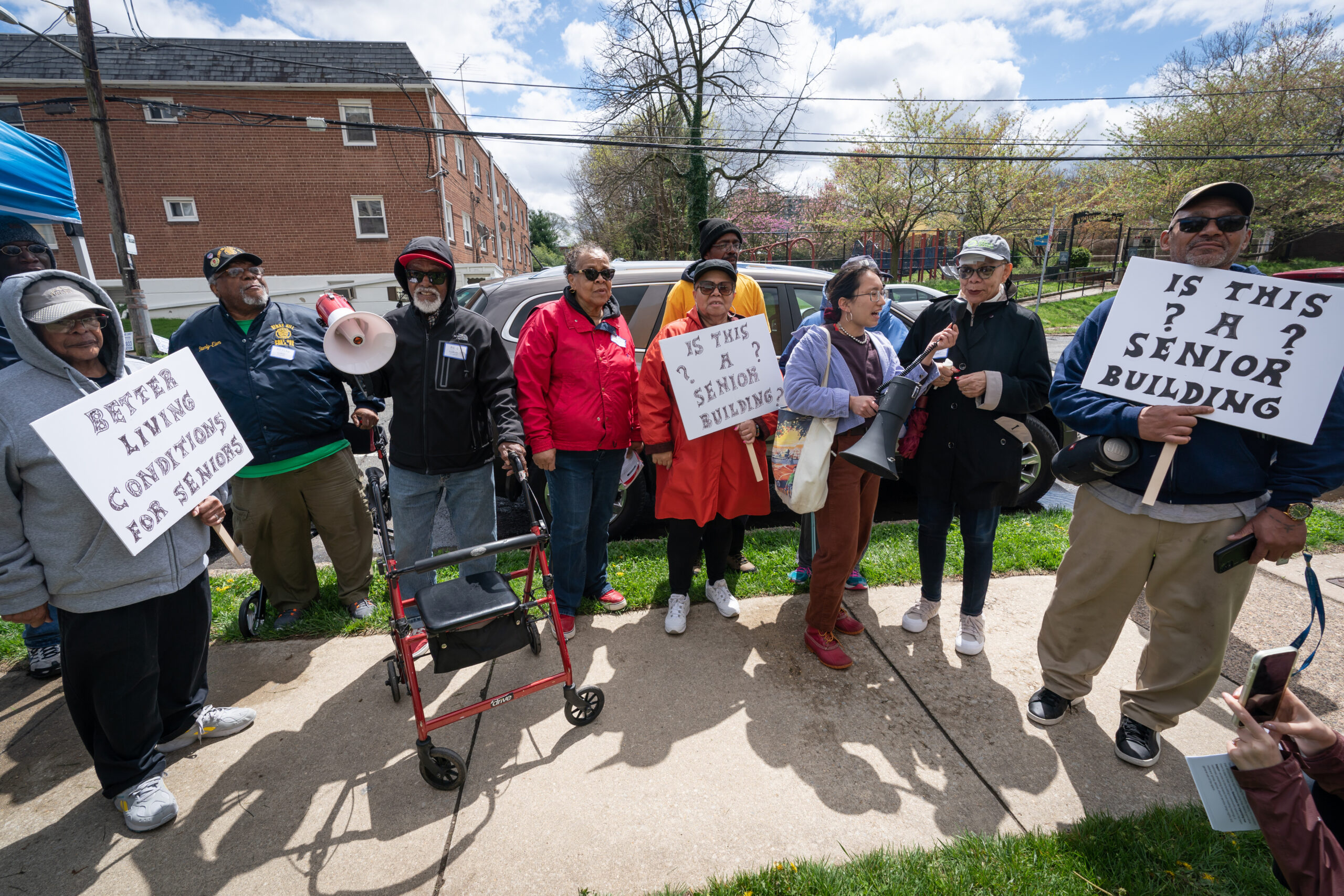
    Residents speak during a demonstration organized to protest against the living conditions at Brith Sholom House apartments in Philadelphia in April 2024.

    Fortunately, we had renters’ insurance. While management took their time deciding what to do, we stayed in the apartment under the exposed ceiling until our insurance finally booked us a hotel. After two days of waiting, we were moved temporarily so repairs could be made. But that displacement came with costs: For eight days, we paid out of pocket for meals and essentials while living in the hotel.

    Nevertheless, when we returned home, a notice was taped to our door: “Overdue rent.”

    Management knew we were displaced because of conditions they failed to address. And still, they badgered us for late rent — as though the collapse was an inconvenience to them, rather than a danger to us.

    A citywide crisis

    Unfortunately, my story isn’t unusual. My neighbors have filed a class-action lawsuit against the owners and managers of the property due to the complex-wide dangerous conditions described in an “unsafe structure” L&I violation. This lawsuit reflects a mounting rental safety crisis across Philadelphia.

    In West Oak Lane, tenants at Bentley Manor filed a similar lawsuit after their building was deemed unsafe while rent was still being collected. Upsal Gardens, Bentley Manor, Brith Sholom, Phillip Pulley and SBG Management, 8500 Lindbergh Blvd., ABC Capital. These are different buildings with different owners, managers, and business models, but nonetheless an all too similar story: Tenants forced to live in deplorable conditions while predatory landlords keep turning a profit.

    Philadelphians deserve safe and healthy homes, tenants deserve roofs and ceilings that are secure, floors that don’t buckle, and air that doesn’t make their children sick. We have laws on the books intended to address these issues.

    But a combination of loopholes, insufficient funding, and lack of enforcement leaves renters without a clear means to enforce those laws, placing many renters between a rock and a hard place: pay for unsafe housing, risk retaliation for withholding rent, or absorb the costs of displacement.

    Renters aren’t completely powerless, though. This year, we’ve seen that when renters come together, they win. This spring, City Council took the first steps toward addressing the city’s rental safety crisis by creating a fund for tenants displaced because of unsafe conditions. But that fund sat empty for months, until a coalition of housing justice advocates successfully lobbied for Mayor Cherelle L. Parker’s H.O.M.E. Plan to fund it.

    Dangerous, uninhabitable

    Still, there is much more work to be done. The vast majority of renters continue to live in units that have never been inspected. Landlords continue to demand rent for rental units with dangerous, uninhabitable conditions. Renters continue to acquiesce to those conditions out of fear of retaliation.

    The Safe Healthy Homes (SHH) campaign, led by OnePA, Renters United Philadelphia, Philly Thrive, and the office of Councilmember Nicolas O’Rourke, provides commonsense answers to these issues: protecting renters who speak up about unsafe conditions from landlord retaliation, authorizing proactive L&I inspections, and requiring proof of code compliance to evict or collect rent. These are all things we would assume are happening already, but this package adds the critical enforcement provisions that have been missing.

    Safe housing is not a perk — it is the bare minimum, and City Council’s Housing Committee had a long-overdue hearing for the SHH package tentatively scheduled for Tuesday.

    I encourage you to let the members of the committee know how you feel about having safe and healthy homes for tenants across our city.

    B. Cincere Wilson is the chief operations officer of Myra’s Kids Inc., a nonprofit serving justice-impacted and high-risk youth. He lives in Philadelphia and works in New York City.