The dip into 30-degree weather means it’s time for chunky sweaters, hot drinks, and cozy seating.
While dining indoors may seem cozy with temperatures dropping, the search for suitable outdoor dining continues. With the flu and respiratory viruses running amok, some still prefer to sit outdoors.
The city still has plenty of comfy, heated outdoor seating despite changes in regulations. Here is a list of bars and restaurants setting up outside.
Covered seating with built-in heaters will keep you comfortable in cold weather at Bridget Foy’s. Order a hot toddy to accompany entrées that run $15 to $36.
Sit at one of five tables on the outdoor patio and sip on a Where There’s Smoke ($16), mezcal with oak smoked salt and maple syrup and mole bitters. Or try their $6 nonalcoholic red wine with pomegranate, strawberry, fig, and black walnut, called Luther Vandross. Standing heaters will keep you warm, but if you’re looking for a firepit, head to the lounge area by the L-shaped couch.
📍 382 E. Elm St., Conshohocken, 📞 610-234-0561, 🌐 barsera.com
A firepit and propane heaters keep diners warm as they sip on a pear martini ($15), a blackberry raspberry liqueur-infused bourbon ($16), and more. There is a tent set up for heated enclosed seating.
Head to the rooftop for views of Chestnut Street, open Monday through Sunday. Standing outdoor heat lamps and mounted heaters offer cozy dining. Bites and cocktails are $6, plus wine is $5 and beer is $4 during happy hour.
Roast s’mores, toast with European beers, and enjoy snacks near the large fire pits in the outdoor garden. Propane heaters at every table also keep you warm as you sip on hot cider (spiked if desired) and mulled wine. Drinks are $8 to $15, and dishes are $8 to $18. S’mores kits are available for $4.
At the historic Wayne Hotel, you can have brunch, lunch, or dinner, or order a cocktail or two, while enjoying the warmth of Rosalie’s enclosed porch with heaters. Sip on the Fireside Chat ($16) with cinnamon milk-washed bourbon, apple cider, lemon, cinnamon, and walnut, or the Spiced Pear Spritz ($17) with vodka, spiced pear liqueur, brut, lemon, honey, and ginger. Munch on hot Italian sausage pizza and wild boar Bolognese lasagna.
Order a round of hot cider (spiked if you’d like), coquito, or creamy hot chocolate (can also be spiked) for your friends in Silk City’s fully tented 3,000-square-foot garden. Get comfortable on furniture crafted in Lancaster as industrial-grade hot air and electric heaters spread warmth throughout the space . Additional cocktails are $13 to $16.
Spotlight PA is an independent, nonpartisan, and nonprofit newsroom producing investigative and public-service journalism that holds power to account and drives positive change in Pennsylvania. Sign up for our free newsletters.
HARRISBURG — In November, Pennsylvania Department of Aging Secretary Jason Kavulich found himself in the hot seat.
He was testifying before a legislative committee on his department’s oversight of 52 county-based Area Agencies on Aging that protect vulnerable older adults from abuse or neglect.
Reading from prepared remarks, Kavulich asserted that under his watch, the department has ushered in an era of modernization and change.
He said the system his agency now uses to determine the quality of protective services is more accountable and gives real-time feedback so any problems can be speedily fixed. He also testified that the department is the most transparent it has ever been, saying that it places an unprecedented amount of data on its website about whether counties are following state requirements for quickly and efficiently investigating abuse and neglect allegations — and keeping older adults safe.
Many of those older adults lack financial resources for alternative care or a network of family and friends to watch out for them — they rely on the system to remain safe.
Protective services work is emotionally and physically taxing. Many caseworkers juggle high workloads, often for little money. Turnover is high, making it difficult to retain qualified, experienced people. Even the most hardened critics of the state’s protective services system acknowledge the difficulty of the work.
Still, new data show that many counties continue to fail in some of the most important areas of older adult protective services.
Critics of Kavulich’s administration, including former protective or aging services staffers at the department, believe many of his changes have relaxed oversight of the county agencies and weakened efforts to ensure they follow rules and keep older adults safe.
These critics note that Kavulich once helmed a county aging agency and later presided over the association that represents their interests. That background, they believe, makes him sympathetic to the very agencies his department is supposed to oversee.
At least one employee is suing him and the department, alleging retaliation for raising alarms about transparency problems and elder abuse system failures.
Most alarmingly, hundreds of older adults continue to die while their abuse and neglect cases are actively being investigated by their local aging agency, according to data provided to Spotlight PA by state aging officials.
“Has he made changes? Yes,” said Sheri McQuown, a former Department of Aging specialist who monitored the quality of protective services by counties, including the one Kavulich once led. “Do those changes benefit older adults? No. They benefit the [counties].”
A new monitoring system
Appointed by Gov. Josh Shapiro in 2023, Kavulich has repeatedly asserted that he inherited a deeply flawed system for assessing how well counties investigate abuse and neglect allegations and provide services to keep older adults safe.
He called the system subjective, said it was riddled with inconsistencies, and claimed that it did little to help counties correct problems or improve their performance.
This year, he replaced it with a new monitoring system, called the Comprehensive Agency Performance Evaluation, or CAPE.
Under CAPE, counties are assessed and scored in five main categories, and those results are published online — the first time the department has made that information easily accessible.
CAPE, Kavulich has said, allows the department to drill down on specific problems and help counties in the areas where they are struggling the most, including through training opportunities.
“Accountability is about improvement, not punishment,” Kavulich said at a state Senate hearing in November.
Earlier this year, Spotlight PA obtained copies of the forms and scoresheets the department used to monitor counties both before CAPE and after. Those records show the prior monitoring system assessed counties using a wide range of measures drawn from state regulations.
For instance, it assessed counties on how quickly they met in person with an older adult suspected of being in danger of abuse or neglect. It also monitored them on how quickly the investigation was completed.
Denise Getgen, the department’s former director of protective services, oversaw the agency’s previous monitoring system until her tenure ended in 2023 and rejected Kavulich’s assertion that it was flawed. It was “absolutely based on the law and regulations and our policy documents at the time,” she said.
In fact, Getgen said, the department provided the county aging agencies with paperwork that cited the specific regulation, policy, or law for every point on which they were being monitored.
Kevin Longenecker, who headed the department’s division of housing and aging services before he retired in 2021, echoed Getgen’s assessment of the legacy system. He said the assertion that it was haphazard and subjective “couldn’t be further from the truth.”
“It was the most consistent monitoring we had,” he said.
Former department employees interviewed by Spotlight PA assert that CAPE makes it easier for counties to receive passing grades.
That is because in implementing CAPE, the department did away with the previous weighted scores, meaning local aging agencies are no longer graded more harshly for serious investigative failures. Under CAPE, the department equally scores relatively minor problems — such as poorly kept paperwork — and more serious deficiencies, such as failing to swiftly complete abuse and neglect investigations.
Unlike the previous monitoring system, CAPE does not designate counties as compliant or noncompliant with state regulations. Nor does it assign them an overall score. Instead, it uses a percentage system to score the counties in each of the five main categories — they must score at least a 75% to avoid additional scrutiny from the department.
Since CAPE went into effect earlier this year, 16 county aging agencies have been monitored. Of those, 12 received less than 75% in the “risk mitigation and safety” category, according to department data.
It is one of the most important categories — and one that used to be weighted more heavily.
State aging officials describe it this way on the department’s website: “Risk mitigation for the older adult involves assessing their individual needs, coordinating support services, and implementing protective actions to ensure safety. The goal of risk mitigation and safety is to enhance the older adult’s well-being and protect them from further harm.”
In an email, department spokesperson Karen Gray said criticism that CAPE is more lenient on the counties has “no basis in fact.”
“In fact, some AAAs have not met the department’s minimum compliance threshold of 75% in certain categories, clearly showing the new system is working and readily identifying issues — not masking them within an overall score like the previous system allowed,” she said.
When asked whether the department was concerned that the majority of counties monitored so far were falling short in the risk mitigation category, Gray did not respond.
More public data
The department has made good on Kavulich’s promise to make more data about his agency’s work — as well as the work of the county aging agencies — available to the public.
The department now publishes data on its website on how well counties are complying with state rules that mandate caseworkers make “every attempt” to meet face-to-face with an older adult within 24 hours of receiving an emergency or priority report of suspected abuse or neglect.
That is a metric that the majority of counties have, at least since 2017, met with success.
The agency also began posting data about whether counties complete abuse and neglect investigations — and provide services to help an at-risk older adult, if an allegation is substantiated — within 20 days of receiving a report. (Kavulich, as well as representatives of the county’s aging agencies, have asserted that the 20-day deadline is a goal. State regulations say counties “shall make all reasonable efforts” to complete investigations of reports of need in that time frame, “and, in cases of abuse and neglect, at least within 20 days of the receipt of the report.” The Office of State Inspector General has described it as a legal requirement.)
Still, the 20-day compliance data on the department’s website exclude instances where caseworkers were unable to locate an older adult — a change from past practice, when those cases were included. That makes it difficult to determine whether counties have, as the department has asserted, made improvements. It also makes it impossible to compare their performance with past years.
Asked about the change, Gray said the department isn’t excluding those data — instead, it is “no longer including” them in its calculations.
But, she said, the information is still tracked. And the department has a directive that spells out multiple steps counties must take before determining someone can’t be located, including contacting the person’s family and friends and monitoring their residence and frequented locations.
The 20-day deadline is an area in which many counties have historically fared poorly.
A Spotlight PA analysis of compliance data between 2017 and 2024 found that, in the best year, nearly a third of total cases investigated annually by the 52 county agencies either missed the 20-day deadline or contained faulty paperwork that made it impossible to determine how they performed. Some years were far worse — nearly half didn’t meet the requirement.
The 20-day compliance data posted on the department’s website does not permit the public to calculate the percentage of overall cases in which the deadline was missed, although it does provide overall monthly scores for each of the 52 agencies. It also doesn’t break down how many days past the deadline an investigation dragged on. Spotlight PA’s analysis found that investigations at times blew the deadline by months or even more than a year.
The data also do not include the number of older adults who died while their abuse and neglect cases were actively being investigated. In 2018, 888 people died while counties looked into allegations they were being abused or neglected. In 2023 — the last year of complete data — that number was 1,511, a 70% increase over just five years.
The association that represents county aging agencies has argued that those numbers don’t tell the whole story, and that the data are skewed in part by the dramatic impact of the pandemic on the well-being of older adults.
Yet the number of deaths hasn’t dropped dramatically in the years since. Preliminary data show that 1,364 older adults died while under the care of the system in 2024.
A whistleblower suit
Just before Thanksgiving, a longtime employee of the state Department of Aging sued the agency and Shapiro in federal court, alleging retaliation and harassment for sounding the alarm about the state’s failures in protecting older adults from abuse and neglect.
Aging Services Supervisor Richard Llewellyn alleges department brass thwarted his efforts to assist investigations by outside agencies, including the Office of State Inspector General, into the quality of older adult protective services around Pennsylvania.
Llewellyn also alleges that top department officials purposely suppressed or manipulated data to shield problems when responding to public records requests, including in response to one by Spotlight PA. Llewellyn alleges that Deputy Aging Secretary Jonathan Bowman even bragged about his ability to exploit loopholes to dodge having to turn over complete and accurate data.
Llewellyn alleges that when he objected to and later reported the alleged wrongdoing to other state officials, he was subjected to a campaign of retaliation, including targeted administrative complaints and investigations.
He was also stripped of work duties — notably, gathering accurate information in response to Right-to-Know requests.
In his lawsuit, Llewellyn describes a culture of intimidation and retaliation in violation of the First Amendment as well as the state’s Whistleblower Law.
Gray said the department cannot comment on personnel matters or pending litigation.
Llewellyn has been suspended from his position since July, the result of a human resources complaint being filed against him. In all, Llewellyn has been subjected to five complaints in the space of 13 months, and so far has been cleared of wrongdoing in two.
In an interview, Llewellyn said he was never told who filed the complaints, but believes they are part of a concerted effort to intimidate him, hamper criticism, and prevent the system’s problems from being aired publicly.
Llewellyn said he hopes that, as a result of his litigation, the retaliation that has upended his professional life comes to an end.
He also said he hopes it sheds light on what he believes is “outright fraud” by department executives.
“And I hope it helps shed light on the fact that the changes made by Secretary Kavulich benefit the [county aging agencies] and not older adults,” he said. “Because that is what is happening.”
BEFORE YOU GO … If you learned something from this article, pay it forward and contribute to Spotlight PA at spotlightpa.org/donate. Spotlight PA is funded by foundations and readers like you who are committed to accountability journalism that gets results.
After two consecutive wins over strugglingteams, the Eagles are headed to Highmark Stadium to take on the Buffalo Bills in Week 17. Heading into the matchup, the Eagles are slight 1.5-point underdogs.
Here’s how experts in the local and national media are predicting Sunday’s game …
Inquirer predictions
We start with our own beat writers. Here’s an excerpt from Olivia Reiner’s prediction …
To see how our other beat writers are predicting this one, check out our full Eagles-Bills preview here.
National media predictions
Here’s a look at who the national media is picking for Sunday’s game …
ESPN: Only two of 10 panelists are picking the Birds straight up.
CBS Sports: Three of seven experts are leaning towards the Eagles.
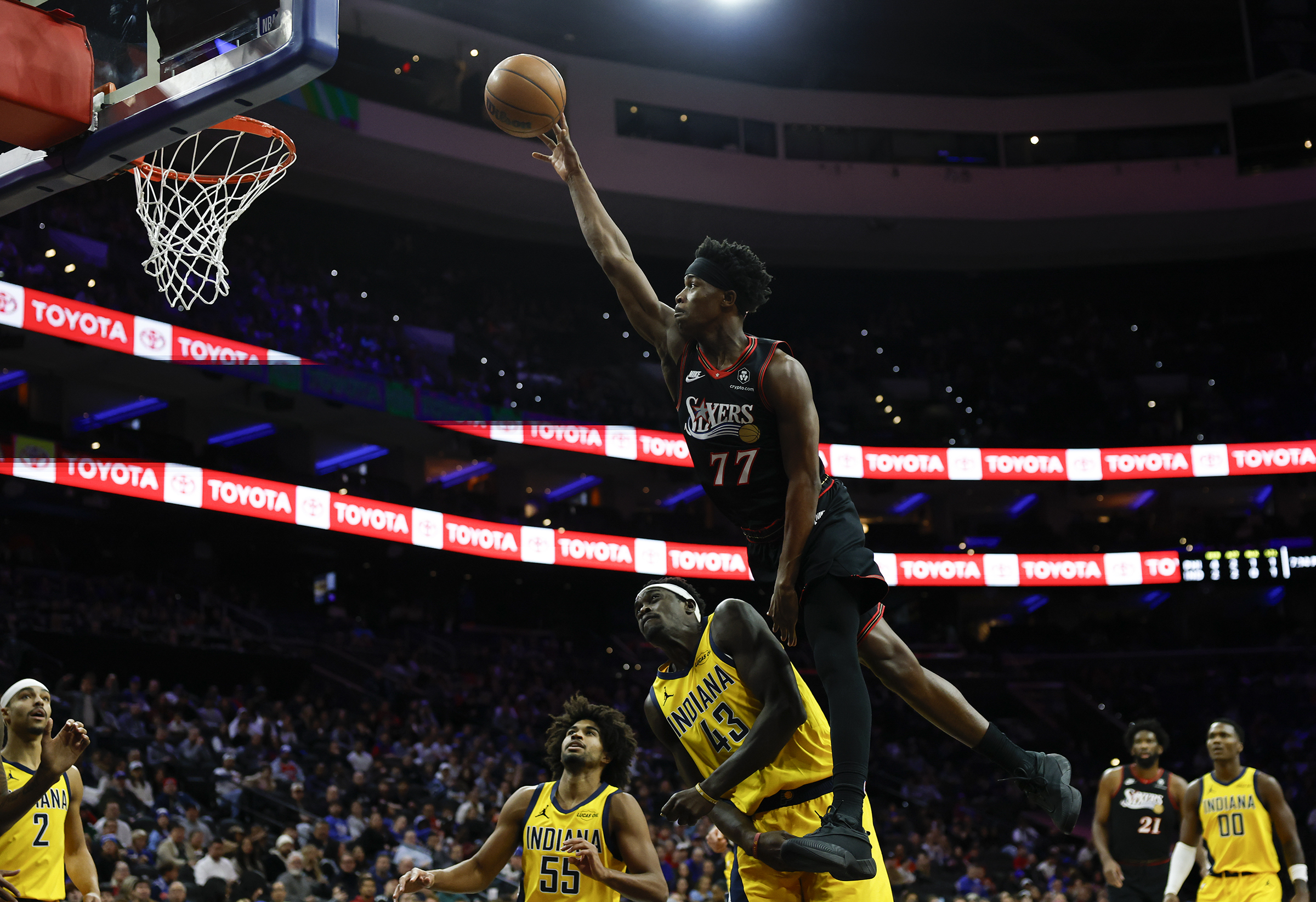
Bombarded with injuries and illness, the Sixers have yet to play with a full roster. But they’re 16-12 and in fifth place in the Eastern Conference. The Sixers are 1½ games behind the third-place Boston Celtics, whom they defeated twice this season. And their signature win was Dec. 19’s 116-107 road victory over the second-place — and NBA Cup champion — New York Knicks.
But with offseason uncertainty surrounding Embiid and George following left knee surgeries, the safe preseason projection for the Sixers was the NBA Play-In Tournament.
The uncertainty surrounding Sixers center Joel Embiid at the beginning of the season has worn off as the longtime center settles in following offseason knee surgery.
We may get a better idea of how good they are during the upcoming post-Christmas, five-game road trip. The Sixers open the road trip on Friday against the Chicago Bulls, who are riding the conference’s longest winning streak at four games despite having a 14-15 record.
Then, on Sunday, they face the defending NBA champions and the best team this season, the Oklahoma City Thunder. After facing the Thunder (26-5), the Sixers will play the Memphis Grizzlies on Tuesday and the Dallas Mavericks on New Year’s Day. They’ll conclude the five-game trip with a rematch against the Knicks (21-9) on Jan. 3.
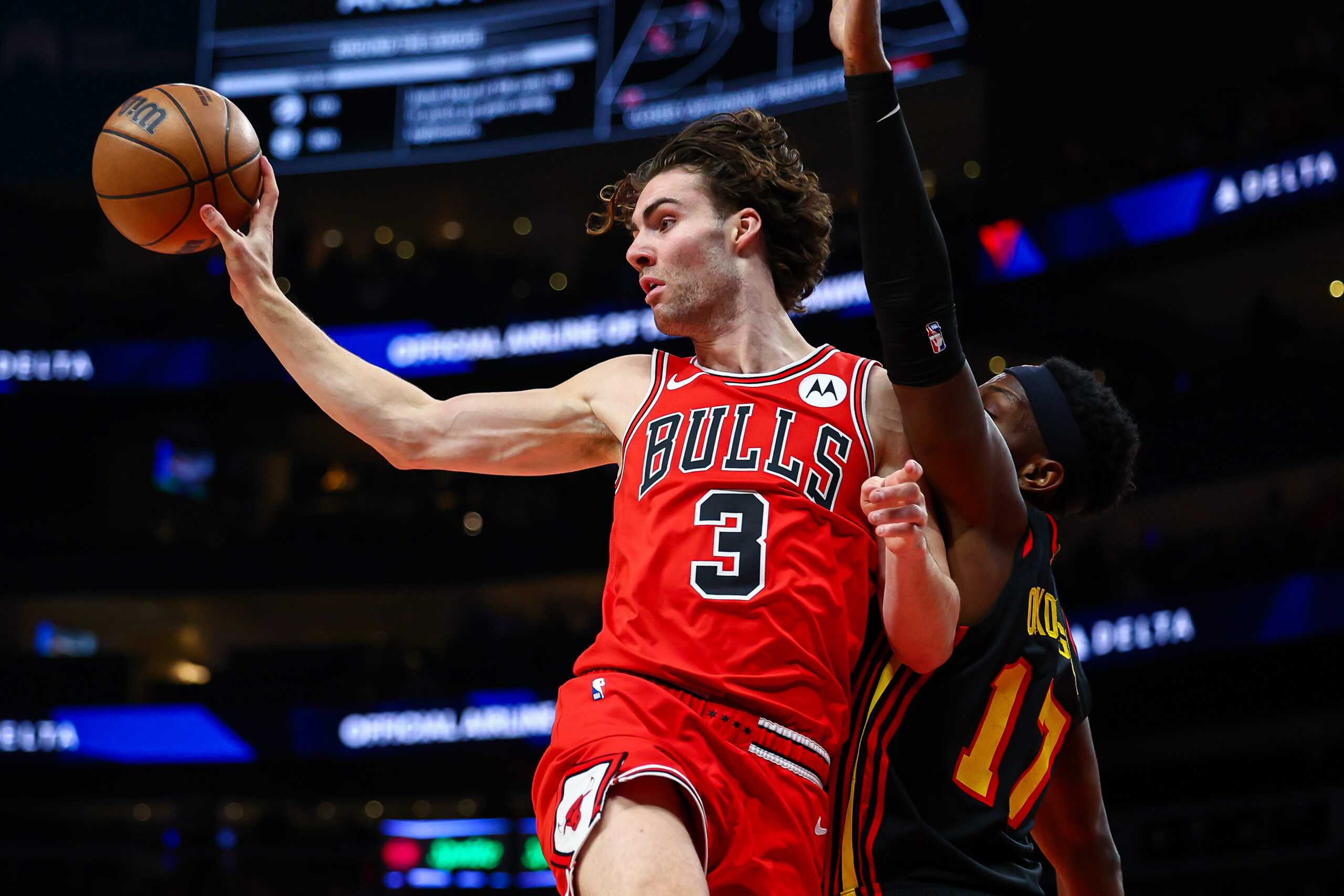
Chicago Bulls guard Josh Giddey had 29 points, 15 rebounds, and 12 assists in a 113-111 victory over the Sixers on Nov. 4.
Like the Bulls, the Grizzlies (14-16) and Mavericks have shown recent improvement. Dallas (12-20) is 7-5 after opening the season 5-15. The Mavs also won their last five home games.
“It will be a good test to play some really good teams,” George said of the road trip. “It will for sure be a test for us. But we’ve been playing great basketball, despite this loss [Tuesday night to the struggling Nets],”
Before that loss, the Sixers had won six of eight games, with their two losses coming to the Los Angeles Lakers (Dec. 7) and Atlanta Hawks (Dec. 14).
“So we’re playing pretty good basketball,” George said. “[Tuesday] was one of those nights we were a little bit flat. And we’ll pick up the pieces and keep it moving.”
But George doesn’t see this as a defining road trip because the Sixers still don’t have their full complement of players.
Embiid is not expected to play in every game of this road trip because of management of injuries to both knees and soreness. Kelly Oubre Jr. (LCL sprain in his left knee) and Trendon Watford (adductor strain in his left thigh) remain sidelined. And VJ Edgecombe, Dominick Barlow, and Quentin Grimes were sidelined against the Nets (9-19) with illnesses.
Embiid, Edgecombe, Barlow, and Grimes are listed as questionable for Friday’s game
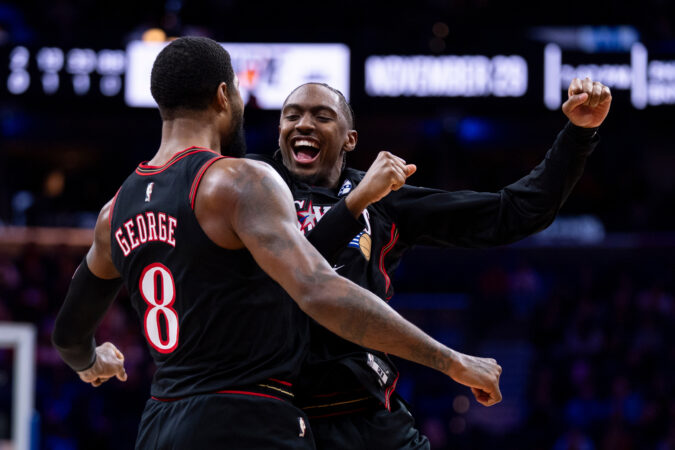
“As far as defining us, it’s still early,” George said. “We’re playing good basketball. Our record doesn’t indicate how well and challenging it’s been. We haven’t had a full roster at any point this season. Whether I’ve been down to start the season, myself and [Watford]. I come back, Kelly goes down. You know, Joel has been injured. Tyrese has been sick.
“So we really haven’t had a full roster. So it’s hard to tell what we are, who we can be.”
Sixers standout rookie VJ Edgecombe missed Tuesday’s game with an illness.
But the Sixers are eager to avenge their 113-111 loss to the Bulls on Nov. 4 at the United Center, when they blew a 24-point lead.
The Sixers relied heavily on Maxey and Embiid, either in the two-man game or in one-on-one situations, that night. The problem was that neither player could get anything going down the stretch, as the Sixers missed their final 11 shots from the floor.
Maxey finished with a game-high 39 points. However, he had eight points on 2-for-8 shooting in the fourth quarter. Embiid was worse. He was held scoreless on 0-for-5 shooting in the frame. That came after he scored two points on 1-for-5 shooting in the third period, and he finished with 20 points on 7-for-21 shooting.
The Bulls went ahead 113-111 on Nikola Vučević’s game-winning three-pointer with 3.2 seconds left. It was their only lead of the game.
The Sixers must maximize everyone’s talent and move the ball if they expect to be competitive. They must also find a way to contain Josh Giddey, who had 29 points, 15 rebounds, and 12 assists in that meeting. The guard is averaging 16.6 points, 10.6 rebounds, and 7.8 assists in the last five games against the Sixers, along with that triple-double.
Chicago Bulls and former Sixers center Nikola Vučević has consistently been a strong contributor against his former team.
Meanwhile, Vučević has tallied five double-doubles and one triple-double across his last 10 games against his former team. In addition to containing the duo, the Sixers will look to snap a three-game series losing streak.
They also believe this 10-day road trip will benefit team growth.
The trip will “get us out of our home market and be with each other on the plane, on the team bus, at the hotel, like, actually get a chance to do a few things together, too,” Andre Drummond said. “We have a couple of days in between games, too. So I know we’ll set up some team activities and really continue that bonding experience that we’re feeling right now.”
And we may get a better idea of how competitive the Sixers are, even while being undermanned.
There were some signs that the Phillies and Matt Strahm weren’t long for this world. Small ones. The kind you see in a lot of relationships between headstrong people. Certainly nothing that suggested things were fractured beyond repair. Still, there was enough smoke to at least dampen the surprise when the Phillies decided to trade their versatile setup man to the Kansas City Royals last week.
Whatever the rationale for trading Strahm, his departure reopens a major question that appeared to be solved when the Phillies signed veteran high-leverage righty Brad Keller:
Will that Thomson have enough depth at the back of his bullpen to avoid another season of Russian roulette in the sixth and seventh innings?
We tend to focus on the eighth and ninth innings when assessing the strength of a team’s bullpen. But when you look at the game’s truly elite units, you’ll usually find that they are just as dominant in the bridge to their setup/closer combo. Think about the 2008-era Phillies. Ryan Madson and Brad Lidge were one of the best setup/closer combos in the game. But think about all of the big outs you saw from guys like Chad Durbin and J.C. Romero in situations that were just as pivotal as the ones Madson and Lidge would face.
A more recent example is last year’s San Diego Padres. The most dominant bullpen in the majors by a wide margin in 2025, San Diego relievers ranked ninth in the majors in total batters faced in the seventh inning while also allowing the fourth-fewest runs. The correlation between those two numbers makes sense: the better a manager’s options in the seventh inning, the more likely he is to go to that option rather than attempt to stretch his starting pitcher. Same goes for the sixth.
Those were the innings that killed the Phillies in their NLDS loss to the Los Angeles Dodgers. Eight of the 13 runs that the Phillies allowed over four games came in the seventh inning. Another two came in the sixth inning.
Not all of those runs were charged to the bullpen. But that’s not the whole story. Think about the seventh inning of Game 2, when Thomson stuck with Jesús Luzardo rather than going to his bullpen. Luzardo allowed two runners to reach base, both of whom ended up scoring off Orion Kerkering, who then allowed two runs of his own.
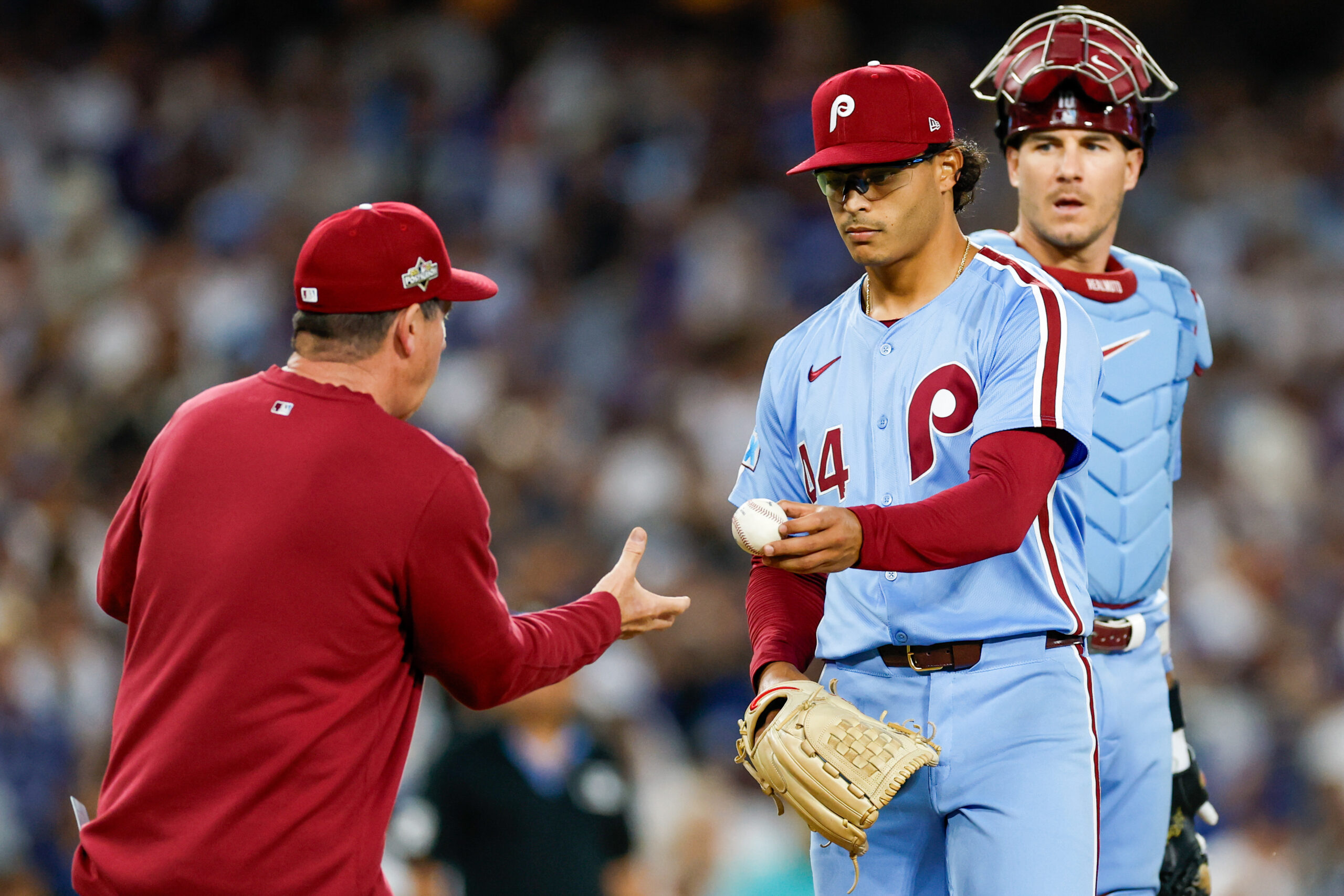
Phillies manager Rob Thomson has been forced to lean on his starters because of a thin bullpen.
A similar situation unfolded in the seventh inning of Game 4. Cristopher Sánchez took a 1-0 lead into the bottom half of the frame but allowed two of three batters to reach before Thomson pulled him. In fact, that game was Exhibit A for why a team needs at least three, and ideally four, arms who can thrive in situations where the outcome is in the balance. Not only did Thomson use closer Jhoan Duran in the seventh, and for five outs, he went to Luzardo for five outs in extras. The only other actual reliever who pitched in the first 10 innings: Matt Strahm.
In that context, it sure looks puzzling that the Phillies decided to trade Strahm for a middle reliever with a light big league track record (Jonathan Bowlan). How does a guy go from being a manager’s second-most-trustworthy option in a do-or-die postseason game to superfluous in barely two months?
Here was the explanation from Dave Dombrowski, who pointed out the presence of fellow lefties José Alvarado and fly-ball on the roster.
“We didn’t necessarily think we needed all three,” the Phillies’ president said. “[Strahm is] a year away from free agency. We were able to get a guy that we liked who has six years of [club control], and we think can help us right away. So you have to give to get. And we still feel good with our left-handers in the bullpen.”
Which is all well and good. Except, the Phillies never looked at Strahm like a typical lefty. He was even more effective against righties, in fact, with a .585 OPS against in 2025.
While the Phillies may like Bowlan, who has an impressive frame and an intriguing pitch mix as well as six more years of club control (albeit at the age of 29), Strahm’s presence in trade rumors over the last several weeks suggests the Phillies weren’t necessarily targeting the Royals’ righty. The driving force in this trade was that the Phillies were ready to move on from Strahm.
For some justifiable reasons.
Most conspicuous were Strahm’s comments after Kerkering’s fielding error in the Phillies’ NLDS elimination loss to the Dodgers, when he suggested that the team didn’t do enough pitcher’s fielding practice. A few days later, Dombrowski disputed Strahm’s characterization, going so far as to point out that Strahm did not participate in the PFP drills the team did have before the NLDS.
Not exactly bridge-burning stuff, there. But Strahm also showed some signs of decline in his age-33 season. When he was a well-deserved All-Star in 2024, he struck out a third of the batters he faced while walking 4.6% of them. Last year, both of those metrics worsened. He still struck out a solid 27.3% of batters, but his walk rate rose by almost 50%.
In fact, Strahm’s underlying results declined across the board, a clear indication that his stuff had diminished. Always a fly-ball pitcher, Strahm’s ground-ball rate plummeted by nearly a third in 2025, dropping from 31.9% to 23.8%. That decline correlated with a noticeable drop in life on his fastball, with his average velocity falling from 93.4 in 2024 to 92.3 in 2025, per Statcast.
Only four relievers in the majors have logged more than his 212⅔ innings since the Phillies signed him in 2023, three of them are younger than Strahm.
Phillies pitcher Matt Strahm yells into his glove after the Los Angeles Dodgers score three runs in the seventh inning in Game 1 of the NLDS.
There’s a realistic chance that this move looks like a nothingburger at worst by the end of next season.
Make no mistake, though. It’s a move that weakens the Phillies bullpen in the short term. Mostly, it puts a lot more pressure on Duran, Keller, and Alvarado to remain healthy and effective. If all three pitch to their potential, the Phillies will be plenty OK in tight games. But Alvarado is in his decline phase and is coming off a season where he missed 80 games and the postseason because of a PED suspension. Keller could be a one-year wonder. Behind them is Kerkering, who has yet to blossom into the high-leverage ace the Phillies envisioned and who will have to overcome the psychological trauma of his debilitating mistake in Game 4 of the NLDS.
No team would be comfortable with those kind of question marks in the ninth inning. But the seventh can be just as important, particularly when your roster is built around its starting rotation. Last year, Phillies relievers allowed the fifth-most runs in the majors in seventh innings, despite facing the fewest batters (513, or 101 fewer than the Padres). It has been a long-running theme under Dombrowski. Since 2021, the Phillies’ bullpen has the ninth-highest seventh-inning ERA in the majors (4.46), per FanGraphs.
Trading Strahm was a defensible move. But it could easily become one that Dombrowski regrets.
There is one more game separating Penn State from the Matt Campbell era, after the longtime Iowa State coach was hired by the program earlier this month.
In one week, the transfer portal for college football will open, and Campbell’s staff at Penn State is starting to take shape, with several familiar names from the coach’s tenure in Ames, Iowa.
Last week, Noah Pauley was named Penn State’s wide receivers coach and Jake Waters came aboard as the quarterbacks coach. The week before that, Taylor Mouser was announced as the offensive coordinator and tight ends coach, while Deon Broomfield (secondary) and Ryan Clanton (offensive line) also joined the staff.
Much of the defensive staff must still be filled out, especially after Jon Heacock, who was expected to follow Campbell from Iowa State to Penn State, decided to retire. The Nittany Lions reportedly are interested in former letterman D’Anton Lynn, who has been the defensive coordinator at Southern Cal the past two seasons. Adding Lynn, whose defense this year ranked inside the top 50 in points and yards allowed, would help solidify a staff with a strong nucleus.
Iowa State offensive coordinator Taylor Mouser will fill the same role at Penn State.
Mouser’s offense at Iowa State was better statistically in 2024 than 2025, but this year was only his second season as the play caller. Clanton, who played at Oregon under Chip Kelly, has been successful developing offensive linemen. While at Northern Iowa, he was instrumental in helping Trevor Penning become a first-round pick in the 2022 NFL draft and aided Jalen Travis, who was selected in the fourth round of the 2024 draft, at Iowa State.
Bloomfield has developed a couple of secondary players into NFL draft picks (T.J. Tampa in 2024, Darien Porter in 2025), while Pauley has similarly had success in the growth of his receivers, with Jaylin Noel and Jayden Higgins getting drafted earlier this year. Pauley also was key in Christian Watson’s development at North Dakota State.
Waters, meanwhile, has worked closely the past two years with quarterback Rocco Becht, who recently entered the transfer portal.
Campbell’s staff is a mix of experienced coaches and others who have transitioned from analysts to position coaches. But there has been plenty of staff turnover, even as interim coach Terry Smith was retained, along with assistant quarterbacks coach Trace McSorley.
Among those who have departed are defensive line coach Deion Barnes, the North Philly native who was vital in developing the likes of Abdul Carter, Chop Robinson, and Odafe Oweh. Barnes took the same job at South Carolina, alongside former Temple coach Stan Drayton, who coached running backs at Penn State and will do the same for the Gamecocks as running backs coach and assistant head coach for offense.
Former defensive coordinator Jim Knowles, also a Philly native, is heading to Tennessee at the same position, and offensive coordinator Andy Kotelnicki is not returning next season, although he will coach in the Pinstripe Bowl. A few others followed James Franklin to Virginia Tech, including Ty Howle, Danny O’Brien, and Chuck Losey.
While Campbell has brought in some of his own guys, he will need to continue to look externally to fill out the rest of his staff, which likely will happen over the next couple of weeks.
Iowa State quarterback Rocco Becht (3) was a player whom new Penn State quarterbacks coach Tyler Waters helped develop.
Flipping commits and bringing in transfers
Penn State signed just two players in the 2026 recruiting class, so it was natural that once Campbell was hired, that number would change. And it has in recent days.
Offensive linemen Mason Bandhauer and Pete Eglitis were among the seven players who previously committed to Iowa State and flipped to Penn State, bringing their 2026 recruiting class to nine players and counting.
And more reinforcements could be on the way via the transfer portal. Along with Becht, former Iowa State running back Carson Hansen and wide receivers Brett Eskildsen and Xavier Townsend have entered the portal.
Becht seems like a natural fit in Happy Valley, considering his experience, familiarity with staff, and the high-profile nature of the games Penn State will play, though there will be a considerable number of suitors. The ex-Iowa State quarterback has thrown for over 9,000 yards and 64 touchdowns in 39 starts.
Campbell likely will try to reconnect with some of the players he coached at Iowa State, but he also will need to recruit the players currently on Penn State’s roster. A number of key contributors, including edge rusher Chaz Coleman and defensive backs A.J. Harris and Elliot Washington, headline those who have announced their intention to enter the portal. Several starters from the 2025 season also will be making the jump to the NFL.
The new staff has its work cut out for them as they continue to build out the rest of the team for next year and beyond. But first, the rest of the staff remaining from the 2025 team will focus on beating Clemson on Saturday (noon, 6abc) to salvage what was a lost season in early October.
Penn State running back Kaytron Allen (13) and interim coach Terry Smith will look to end the season on a high with a win over Clemson in the Pinstripe Bowl.
Games of the week
Amid a holiday weekend of college football, there are two games with local flair certainly worth watching. Enjoy.
Pinstripe Bowl: Penn State vs. Clemson (Saturday, noon, 6abc)
It’s a chance for the Nittany Lions to end a rough year by their standards on a high note against a quality Power 5 opponent. Motivation? Penn State enters the game as three-point underdogs. It’s a test for fresh-faced Nittany Lions quarterback Ethan Grunkemeyer, but the must-watch player on offense will be in running back Kaytron Allen as he continues a season-ending climb to the top of the Big Ten history books. Fun fact: Despite being two of the oldest programs in college football, this will only be the second time these teams face off.
Missouri quarterback and Spring-Ford alum Matt Zollers, left, will lead the Tigers in Saturday’s Gator Bowl.
Gator Bowl: Virginia vs. Missouri (Saturday, 7:30 p.m. 6abc)
Saturday will provide another chance to see Spring-Ford alumnus Matt Zollers lead the Missouri offense after Mizzou starting quarterback Beau Pribula announced his intent to leave the school. In six games this season, Zollers, the freshman backup, threw for 402 yards, four touchdowns, and an interception and won four of the six games in which he played. The Tigers hope he can keep that energy while entering the game as four-point favorites.
Porter Martone just wrapped up his first semester at Michigan State as a general studies major. So what was the best course he took? “Personal finance,” the 19-year-old freshman said.
Well, that’s not a bad one to master, considering that the winger will be raking in the big bucks soon if he maintains his stellar play on the ice.
Selected sixth overall by the Flyers in the 2025 NHL draft, Martone is now lighting up men’s college hockey. His 11 goals are tied for the second-most by a freshman.
In 16 games for the third-ranked Spartans (12-4-0), Martone has 20 points and is tied with Pittsburgh Penguins prospect Zam Plante, the son of former Flyers forward Derek Plante, for 17th in the country in points per game (1.25) .
“I think my season has gone really well. I think it was definitely an adjustment going to college hockey … [and] I feel like I’ve matured a lot as a person,” he told The Inquirer last week via Zoom while attending Hockey Canada’s World Junior camp in Niagara Falls, Ontario.
“You’re living on your own now, you learn how to cook your own meals, you’ve got to manage your classes, practices, like lots of different things, so I think that’s been great.
“And then I think, overall, just me really getting in the weight room, I think I’ve noticed a big difference on the ice, just be able to sustain energy throughout the whole game and be effective three periods instead of maybe only two last year, and I think just becoming more of a power forward that I need to be.”
Back to school
It was quite a shift for Martone to choose college hockey. He notably opened the start of Flyers development camp five days after he was drafted, stating: “I want to give it my all and try to earn my spot in the opening-night roster.” But 21 days later, he announced he was heading to East Lansing, Mich.
“It was really hard,” he said of the decision, “just because you obviously want to go to NHL training camp and try to maybe make the NHL. And it’s tough because the CHL and Brampton [of the Ontario Hockey League] did so much for me — and I can’t thank them [enough] for my development — but in kind of sitting down with the Flyers and my agents and my parents, I thought this was the kind of the next step in my hockey journey.
The Flyers believe Porter Martone’s combination of size and skill can make him an elite winger at the next level.
“I feel like this is going to help me be the best player when I am in my prime, five to 10 years down the road.”
Flyers fans should like the idea of him thinking ahead. And, yes, while he is focused on helping the Spartans win their first national championship since 2007, he is open to swapping green for orange in April.
But for now, his feet are firmly planted at Michigan State, toward which fellow 2025 draftee Shane Vansaghi, now a sophomore, did nudge him. Martone also made a couple of visits to the campus and met with coach Adam Nightingale. He liked the culture and thought Will Morlock, the director of athletic performance for hockey, was a “game-changer.”
“[Nightingale] was telling me that nothing is going to be given to you, and I think that’s big in my family, you’ve got to work for things, so I really trusted his process,” Martone said.
“… And a big thing [Morlock] says, we have all these expensive machines, but it’s kind of the work you put in. So I think just Michigan State is very blue collar and hardworking, and that’s something that me and my family kind of strive to be ever since I was a little kid.”
Blue collar, hardworking. Martone already sounds like a Philadelphian.
Aside from his work on the ice, Martone has spent much of his first few months at Michigan State putting in the work in the gym. Facing players older than him — “those guys are so strong, and they’ve got man strength,” he said — he has dropped body fat and, while he’s “not working out to become a bodybuilder,” he has gained around eight pounds of muscle.
Martone, who is listed as 6-foot-3, 210 pounds by Michigan State, is building his body to sustain a grueling 82-game NHL schedule, and, hopefully, beyond. He feels like he’s becoming a 200-foot player while being reliable all over the ice, but if the Spartans need a goal or a big play offensively, he can do that, too. And he is working on his speed and power.
“His biggest challenge, and what we’ve talked about, is his pace,” Flyers assistant general manager Brent Flahr said. “He was a really good junior, obviously, but he could slow things down all the time and kind of do what he wanted.
“In the college game, he’s playing against older kids, bigger, stronger, faster, and the way they practice, the way they play games, it’s all out and all full speed. So I think it’s forcing him to move his feet.
Team Canada defeats Denmark 13-2.
Porter Martone totaled 4 points (2G, 2A), and Jett Luchanko had 2 points (1G, 1A).
“Obviously, you can’t teach the brain he has, the skill set he has, and the size and whatnot. I think even he’s the first one to tell you he’s in better shape. He’s playing faster. And I think it’ll really help him adjust to the pro game faster.”
Flahr called Martone a quick study who “has the ability to process the game at the level that a lot of guys can’t.” This season, Martone has been working on his footwork and speed on and off the ice by doing jumping and sprinting drills. He speaks often with the Flyers director of player development Riley Armstrong.
“I think probably every weekend there’s almost been a Flyers development guy there at one of our games,” he said, name-checking Armstrong, John LeClair, and Chris Stewart as attendees. “… I do video with Riles a lot, almost every week after my weekends, and kind of just fine-tune some things, see some things that they want me to improve. They’ve been really good with me and kind of always very straightforward with what they want to see from me.
“They’re a very good development staff, trying to add different things to my game, but also let me play it and be the player I am.”
Porter Martone, right, is expected to be one of Canada’s biggest stars at the upcoming World Juniors.
Power forward
Martone is, and is developing into, a power forward on the right wing. Armstrong and Martone chat about building his overall offensive game and being more powerful with his skating. But they also delve into the specifics.
“It’s a lot of wall play; as a winger in the NHL, that’s huge,” Martone said. “Offensive zone, when you’re creating space for yourself behind the net, picking pucks off the wall, and then overall, just neutral zone, just playing with pace through the middle of the ice. Be a hard player for defenders to stop off the rush as well.”
That will also come in handy as he dons the maple leaf for the third time in a year beginning on Dec. 26. Hockey Canada’s roster usually skews older, but Martone will be playing at the World Juniors for the second time in his short career. Last year, Canada, which also had Flyers prospects Jett Lucahnko, Oliver Bonk, and Carson Bjarnason on the roster, lost in the quarterfinals in Ottawa.
“I feel like just on my case, but kind of all of Canada has a bit of unfinished business, and we kind of want to come back and really show what we can do,” said Martone, who will be playing alongside Luchanko and will serve as the team’s captain.
Flyers first-round picks Jack Nesbitt (left) and Porter Martone battle during a drill on the first day of the team’s development camp on Wednesday.
He will face Finland’s Max Westergård and Heikki Ruohonen, who will wear an “A,” in Group B action and in the playoffs could see Sweden captain, Jack Berglund, and his friend Vansaghi, who will be suiting up for Team USA.
But Martone also has represented Canada on the senior men’s world championship stage, skating alongside Tyson Foerster, Travis Sanheim, and Travis Konecny last year.
“Oh yeah, I was all in,” Konecny said in November when asked if Flyers brass checked in with him about possibly drafting Martone.
“I said, ‘That’s a guy you can work with. That’s a guy that’s going to compete; that’s a guy that’s willing to learn, become a pro, play the right way.’ You don’t really always get that information before the draft. And then on top of that, I mean, I think he can develop into a really special player.”
While he waits to join them in a locker room, Martone tunes in and watches “almost every game” the Flyers play. He also sees the orange and black jerseys at his games. “I’m excited to wear that jersey myself,” he said.
So, does it make him hungry to get there?
“Obviously, when you watch them, you just kind of can’t wait till you’re there, and you want to help them any way you can. And, definitely, watching the games, you dream of that day when you do get to play your first NHL game and join the Philadelphia Flyers. So when that day comes, you know, I’ll be super excited.
“It is cool to see the support of the fan base. And I know the Flyers fans are very passionate. … I can’t wait to play in front of them.”
Porter Martone says he “can’t wait” to play for the Flyers whether that is this year or next year.
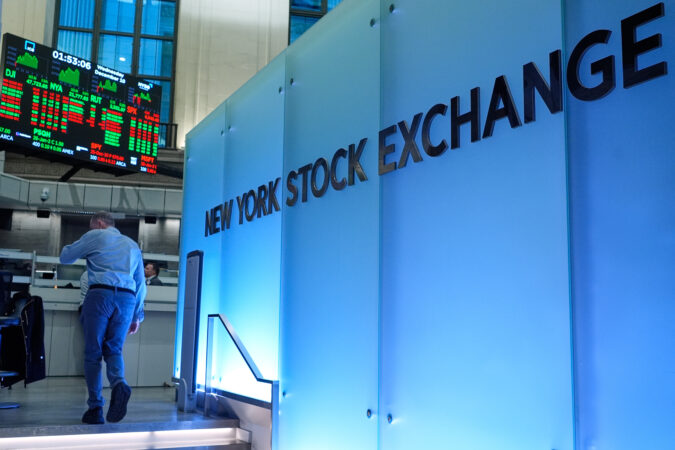
The answer to this question is a big deal for the approximately one-third of well-to-do Americans who own most of the stock. However, it also matters to the broader economy and thus by extension to the majority who don’t.
All of the ingredients that go into making a bubble are evident. Most important, stock prices have been on a tear. Prices never move in a straight line, but they’ve rocketed more or less straight up over the past decade, more than doubling since the COVID-19 pandemic.
This amount of price growth has happened in only three other decades since the late 1800s, when the Dow Jones Industrial Average index, comprising the 30 largest publicly traded companies, was first published. Those decades were the 1920s, the 1950s, and the 1990s.
The roaring 1920s, of course, ended terribly in the 1929 stock market crash, which ushered in the Great Depression of the 1930s. That was clearly a bubble.
In the 1950s, stock market gains were powered by U.S. companies’ dominance of the global economy after World War II. This included companies such as General Electric, AT&T, General Motors, U.S. Steel, and DuPont. That wasn’t a bubble.
And then there was the 1990s internet craze, which ended soon after Y2K with a dramatic decline in stock prices. No question: That was a bubble.
The internet was a game-changing technology that resulted in enormous productivity gains and ultimately generated significant profits. However, investors had discounted all this and much more. Stock market valuations — stock prices relative to corporate earnings — surged.
Valuations aren’t quite as lofty today as they were in the late 1990s, but they are close. And they are still on the rise. My favorite valuation measure is the ratio of the value of all publicly traded stocks, as measured by the Wilshire 5000, to economy-wide corporate profits from the Bureau of Economic Analysis.
In the 75 years for which this valuation measure can be calculated, stock prices have averaged 12 times corporate profits, a 12-1 ratio. Currently, the ratio is 20-1. The only other time valuations have been higher was at the height of the Y2K bubble, when the measure briefly spiked to 24-1.
But perhaps today’s extraordinary stock market valuation is justified. After all, this largely reflects the investors’ optimism about the large artificial-intelligence companies. These so-called hyperscalers are nothing like many of the fly-by-night internet companies (think Pets.com) that inflated the Y2K bubble.
This is undoubtedly the case, but like those internet companies, the stock prices of today’s AI companies are being juiced up by investor speculation. That is, an increasing number of investors are piling into these stocks, driven by the simple logic that since their prices have risen a lot, they will continue to rise. This momentum will continue, and if it doesn’t, they will be smart enough to recognize this and find other unwitting investors to buy their stocks before the bottom drops out.
Another form of arguably accidental speculation may also be taking hold in the stock market via the fast-growing index funds. These funds passively track a market index, like the Standard & Poor’s 500, by holding stocks in the same proportion as the index. The goal is to match the market’s performance. Index funds offer the benefits of diversification and low fees but aren’t based on an analysis of the underlying companies’ strengths.
Thus, if the stock price of a company is rising, it will attract more investments from index funds, and its price will rise even further. There is no argument that AI-chip juggernaut Nvidia’s stock price should be up significantly, for example, but it has increased substantially more due to this self-reinforcing dynamic.
The soaring stock market has been a powerful tailwind to the entire economy.
The wealthy, who own the bulk of the stocks, are now much wealthier and spending accordingly. In the past year alone, stock wealth has increased by nearly a staggering $10 trillion. This newfound wealth supports a significant amount of spending, which, in turn, supports a substantial number of jobs.
This brings into clear relief a significant threat to the economy. If the stock market is a bubble and it bursts, wiping out this wealth, consumer spending will suffer a significant blow, triggering a recession. This is precisely what happened after the bursting Y2K bubble.
So, is the stock market a bubble?
Well, if it isn’t, it soon will be if the current trends continue for much longer. The final ingredient for a bubble is that nearly all the naysayers are silenced. That happens when they’ve called out the bubble for so long, they are no longer considered credible. Any skepticism is thrown to the side, and the bubble inflates more.
We aren’t there yet. There are still too many naysayers like me.
The Eagles won the Super Bowl, of course, and the Phillies captured the NL East title before falling out of the playoffs in excruciating fashion. These were the biggest stories for Philadelphia fans in 2025, but there was much more.
Dazzling rookie VJ Edgecombe brought new hope for the Sixers, while the downtrodden Flyers showed new fight under coach Rick Tocchet. The city’s iconic events, the Broad Street Run and the Philadelphia Marathon, were as thrilling as ever. The PGA Tour paid a visit this summer. And the NCAA wrestling championships brought a different vibe to the city.
The Inquirer’s photographers were there to capture it all. Here’s a look at our best photos of 2025.
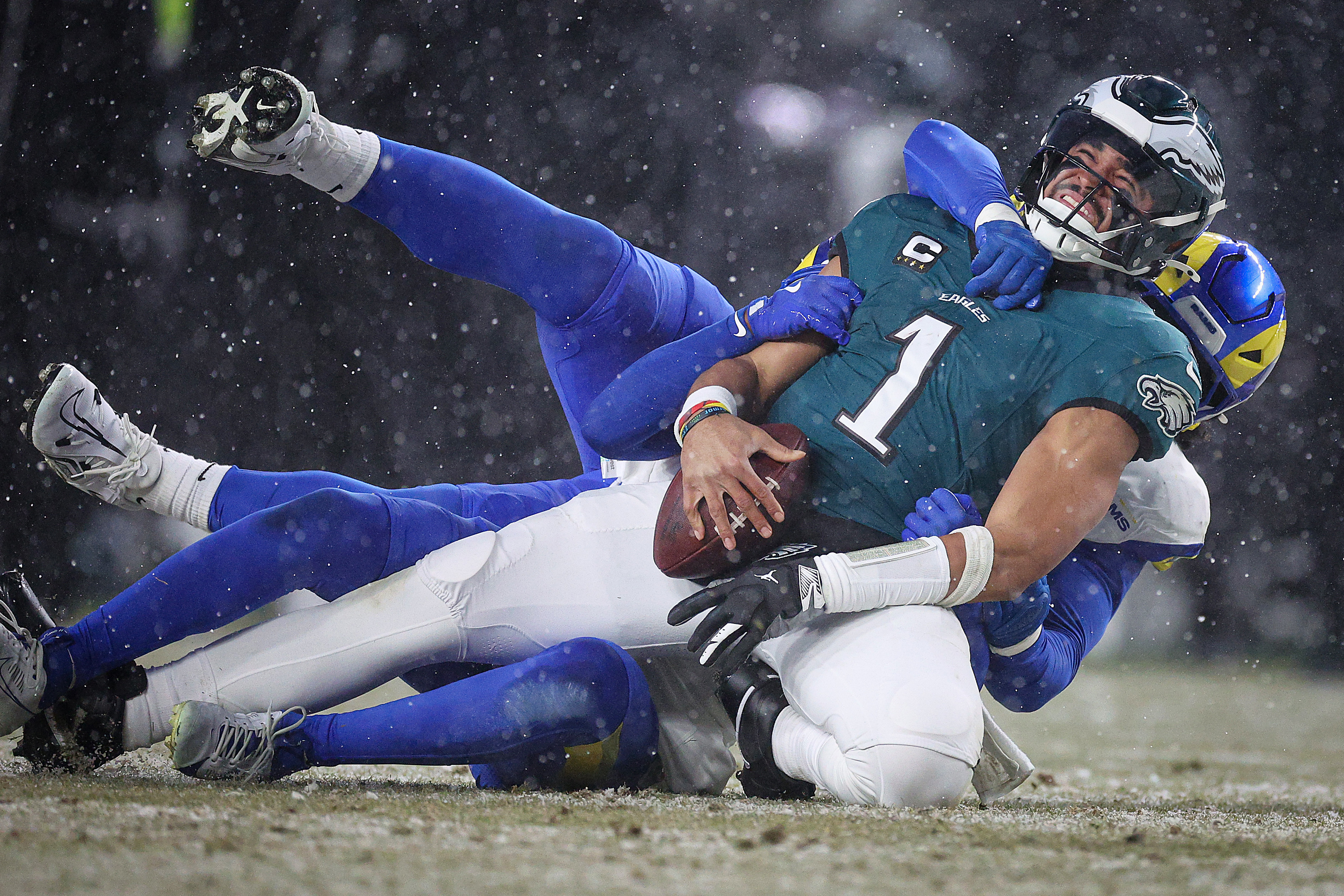
Eagles quarterback Jalen Hurts is sacked by Rams safety Jaylen McCollough during their playoff matchup on Jan. 19. The Eagles won, 28-22.A reveler climbs a pole on Broad Street near City Hall as Eagles fans celebrate the NFC championship rout of the Washington Commanders on Jan. 26.
A tailgater makes use of a personal porta-potty in a Lincoln Financial Field parking lot on Jan. 19. Eagles coach Nick Sirianni gets a Gatorade shower from DeVonta Smith and A.J. Brown late in the Super Bowl rout of the Kansas City Chiefs.Eagles players are reflected in the Lombardi Trophy after the 40-22 win against the Chiefs in Super Bowl LIX on Feb. 9.Fireworks fly at the Art Museum at the conclusion of the Super Bowl LIX victory parade on Feb. 14.Imhotep Charter star RJ Smith (1) celebrates with his teammates after they beat Samuel Fels High, 71-66, in the Public League championship game on Feb. 23. Fans sramble to avoid a foul ball during a Phillies spring training game against the Tampa Bay Rays on Feb. 25 in Port Charlotte, Fla.St. Joseph’s guard Laura Ziegler (left) is mobbed by Paula Maurina (right) and teammates after her game-winning shot against Richmond in the Atlantic 10 semifinals on March 8.La Salle’s retiring basketball coach, Fran Dunphy (left), receives a six-pack of beer and other mementos from St. Joseph’s coach Billy Lange on March 8.
Brandon Graham hugs his daughter Emerson after his retirement announcement at the NovaCare Complex on March 18. The Eagles defensive end unretired and is playing again this season. Oklahoma State heavyweight Wyatt Hendrickson celebrates after defeating Olympic gold medalist Gable Steveson of Minnesota during the NCAA wrestling championship at the Wells Fargo Center on March 22.Minnesota Timberwolves guard Anthony Edwards grabs a rebound between a fallen Quentin Grimes and Adem Bona of the Sixers on April 5. Eagles running back Saquon Barkley looks at President Donald J. Trump during the Super Bowl champions’ visit to the White House on April 28.
Runners pass a beer sign near Windrim Avenue during the Independence Blue Cross Broad Street Run on May 4.PGA player Keegan Bradley hits a challenging shot from a hill at the par-4 17th hole during the Truist Championship at the Philadelphia Cricket Club on May 9. Bradley shot a double bogey on the hole.
Edmundo Sosa of the Phillies is tagged out at the plate by Reds catcher Tyler Stephenson during the fourth inning on July 4. Baseball’s greatest entrance: Newly acquired closer Jhoan Duran making his Phillies debut to finish off the Detroit Tigers at Citizens Bank Park on Aug. 1.
Phillies shortstop Trea Turner leaps into the celebration after his game-winning hit against the Braves. The Phillies beat Atlanta, 3-2, in 10 innings on Aug. 30.Wendy Cooper of Reading takes in the scene at the TrueFan tailgate party before the Eagles played the Cowboys at Lincoln Financial Field on Sept. 4.Phillies outfielders Nick Castellanos and Harrison Bader greet each other with their ring fingers before a game against the Mets on Sept. 9.Kyle Schwarber acknowledges the crowd at Citizens Bank Park on Sept. 9 after he hit his 50th home run of the season in a game against the Mets.Phillies reliever Orion Kerkering shows his dejection as the Dodgers celebrate their series-clinching playoff win on Oct. 9 in Los Angeles.
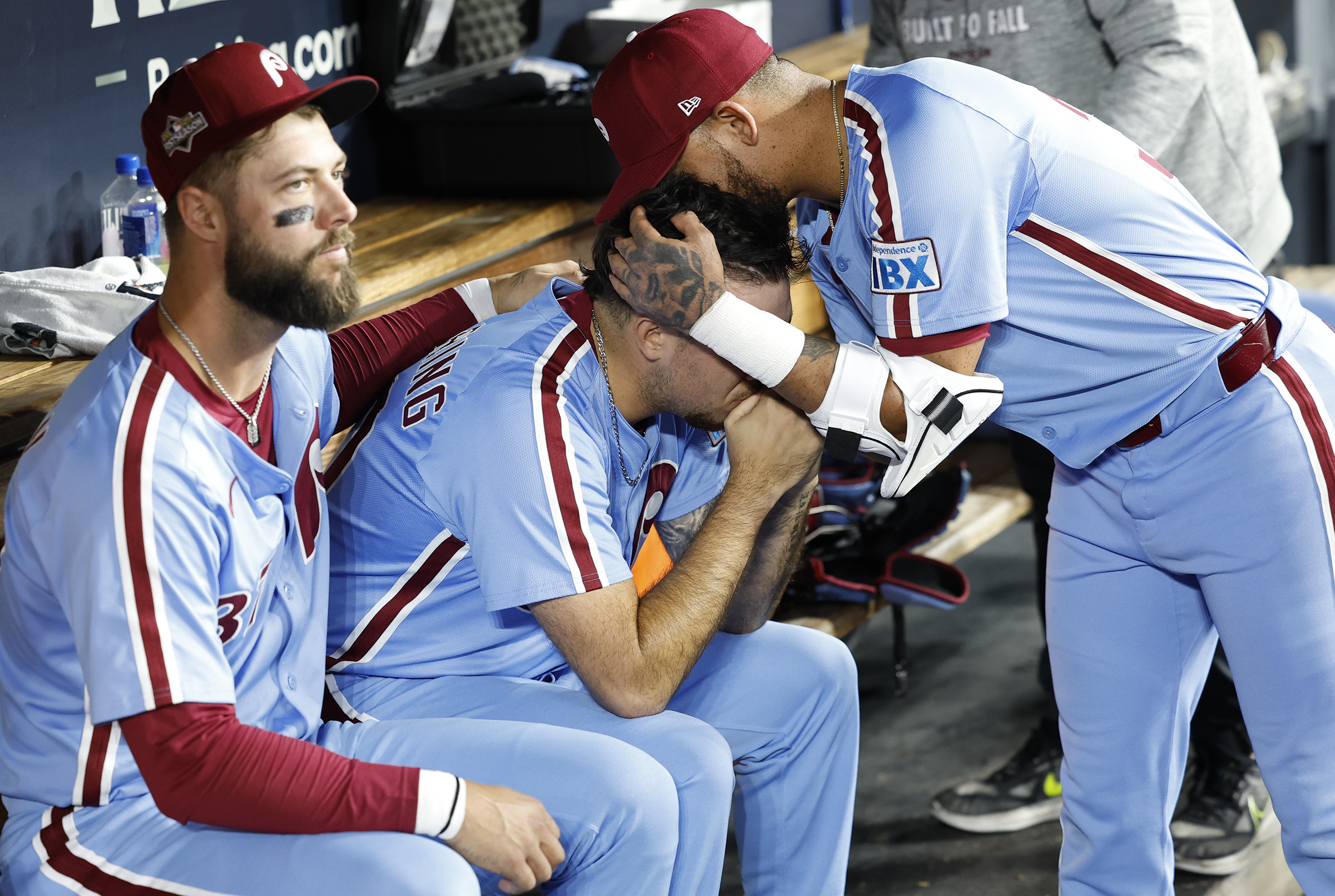
Weston Wilson (left) and Edmundo Sosa console Orion Kerkering after the reliever’s 11th-inning error handed the Dodgers a walk-off win in the NL Division Series. Temple’s Peter Clarke reacts after quarterback Blake Horvath’s 51-yard touchdown run lifted Navy past the Owls, 32-31, on Oct. 11 at the Linc. Au’vion Horton hangs on during the bull riding event at the 8 Seconds Rodeo inside the Liacouras Center on Oct. 11. Flyers captain Sean Couturier leaps over Florida Panthers goaltender Daniil Tarasov during the team’s 5-2 win over the defending champs on Oct. 13.The Eagles defense celebrates after linebacker Jalyx Hunt’s interception return for a touchdown against the Minnesota Vikings on Oct. 19. Eric McGarry of Manayunk talks to his wife, Gwen Jones, on the phone after finishing the Philadelphia Marathon on Nov. 23. It was his first marathon and he was most excited about running through his neighborhood, where his wife and friends were there to cheer him on.Central High’s players celebrate after they won the annual Thanksgiving Day rivalry game against Northeast, 22-14.
Donald Trump’s first year back in the White House has brought only one surprise: the speed with which he has upended the American Experiment. This board spent 2024 warning of the dangers a second Trump administration could bring. It was hardly soothsaying.
Sadly, Trump’s 2025 performance has reminded many voters that his undeniable luck, charisma, and bravado may be entertaining, but the reality of governance demands more. The office of the presidency demands more.
For his second term, no longer constrained by the guardrails the conservative establishment placed on his first presidential stint, and surrounded by sycophants and incompetents, Trump has wasted no time trying to live out his authoritarian fantasies while being unable to keep the trains running on time.
Indeed, he is very much the man whose administration helped give the world a COVID-19 vaccine in record time before bowing to anti-vax conspiracy theories that ultimately cost American lives.
Instead of allowing inflation to continue to abate and the U.S. economy to live up to its label as “the envy of the world,” he haphazardly and likely illegallyinstituted tariffs on global trading partners that amount to a tax on American consumers. Rather than sitting back and taking credit for curtailing immigration at the southern border, which concerned a large number of voters, he’s lost public support as masked federal agents abuse, harass, and intimidate immigrants and citizens alike.
Trump’s signature legislation, the One Big Beautiful Bill Act, is set to make the rich richer and the poor poorer, all while a shrinking middle continues to lose faith in America’s institutions — some of which have willingly acquiesced to whatever Trump demands.
But while Trump has failed to make life better for everyday people, he has been successful in enriching himself, his family, and his cronies. He has captured the U.S. Department of Justice and the FBI, pushing them to pursue his perceived political enemies; used the U.S. Department of Homeland Security to implement cruel immigration policies and as a de facto secret police; and devastated America’s standing in the world by destroying the U.S. Agency for International Development, which helped generate enormous goodwill while improving the lives of millions of people around the globe.
The following appraisal of Trump’s presidency so far is not a “we told you so,” because we are all in this together. It is a reminder that those of us who value democracy and the rule of law must continue to stand fast and push back in defense of the ideals that fueled our nation’s founding and the rights and obligations codified in the Constitution.
As 2025 ends and a new year begins, we must not allow the avalanche of outrages to numb us to the fact that Trump remains unfit for office.
Donald Trump and his administration have attacked judges and maligned the courts, while the president has used his pardon power to eliminate accountability for his political allies and business interests.
Pardoned lawlessness
As far as ominous indicators of dire times ahead, “Abandon hope, all ye who enter here” is difficult to beat. But Trump’s blanket pardon of the roughly1,600 people involved in the attack on the Capitol comes in a close second.
Signed shortly after he took power, among a raft of other troubling executive orders, the clemency shown to the insurrectionists — including those who brutally assaulted law enforcement officers — showed the administration had no interest in accountability for its political allies nor any true concern for the rule of law.
Among Trump’s biggest abuses of presidential power are pardoning Rudy Giuliani and dozens of others accused of trying to overturn the 2020 election, campaign donor and convicted fraudster Trevor Milton, cryptocurrency kingpin Changpeng Zhao, and former Honduran President Juan Orlando Hernández, who had been sentenced to 45 years in prison for drug trafficking.
But why wait for a pardon when the president can simply pressure Justice Department lawyers to drop the corruption case against New York Mayor Eric Adams, or dismiss allegations that Trump border czar Tom Homan took $50,000 from FBI agents posing as business executives.
It is part of the administration’s stifling hypocrisy that while it righteously claims to seek justice by going after people like former FBI Director James Comey or New York Attorney General Letitia James, or labels all undocumented immigrants as criminals, it brazenly ignores due process — a bedrock principle of the American legal system.
If there are bright spots in a U.S. justice system in which the attorney general operates more like the president’s lawyer than a servant to the American people, it’s that grand juries remain independent, refusing to indict on trumped-up charges. And the courts — run by judges appointed by presidents of both parties, including some by Trump himself — are still a bulwark against the administration’s abuses.
Donald Trump allowed billionaire Elon Musk to fire hundreds of thousands of government workers as head of the so-called Department of Government Efficiency. It is estimated that DOGE’s dismantling of the U.S. Agency for International Development has already led to the deaths of nearly 700,000 people.
Costly savings
The Department of Government Efficiency was Elon Musk’s chance to eliminate the U.S. Agency for International Development, an agency he called a “criminal organization” that needed to die. That the tech billionaire’s passion to eliminate USAID dovetailed with a bullet point in the conservative blueprint for Trump’s second term was likely welcomed by the administration.
Musk, who spent $250 million to help get Trump elected, was the public face of DOGE and promised to eliminate $2 trillion in government spending by identifying and eliminating waste, fraud, and abuse. What he did was bring in a squadron of techies more versed in crunching code than in carefully evaluating government services.
The chaos that followed meant not only the dismantling of USAID — which, as of Dec. 22, was estimated to have led to almost 700,000 deaths, more than half of them children, through the elimination of health and nutrition programs — but the firing or early retirement of nearly 300,000 federal employees.
DOGE also terminated more than $2.6 billion in contracts at the National Institutes of Health tied to medical research and clinical trials, leading to setbacks that may impact Americans’ health for generations.
So what was the result of DOGE’s actions? How much of that promised $2 trillion will show up on the positive side of the government’s ledger? According to an analysis by the libertarian Cato Institute, DOGE had no noticeable effect on the trajectory of government spending.
It did reduce the federal labor force, with savings that may amount to about $40 billion annually. That’s a lot less than it sounds when you consider it’s equal to 0.57% out of around $7 trillion in U.S. spending.
In his campaign for the president, Donald Trump promised he would lower consumer prices. A dubious pledge under most circumstances was made worse by policies, including the chaotic application of tariffs, that threaten the economy as a whole.
Self-inflicted decline
Looking at the data, it was easier to see why Vice President Kamala Harris did not distance herself from President Biden’s economic policies in her 2024 run for the White House. After all, after suffering through the pandemic like the rest of the world, the U.S. economy was bouncing back faster and stronger than that of other developed nations.
Unfortunately for Harris, to many voters, “Bidenomics” did not mean higher wages, lower unemployment, record stock market gains, and that post-pandemic inflation was starting to ease. It certainly didn’t mean billions in investment in infrastructure projects or in domestic production of critical semiconductors through the CHIPS and Science Act.
It meant the high cost of a dozen eggs.
Trump took advantage of the bad economic vibes and pledged to lower prices on Day One if elected. This was a dubious promise under most circumstances. Considering the president’s signature economic policies — indiscriminate tariffs and mass deportations — were destined to actively hurt consumer prices, it was political malpractice.
It is no wonder, then, that people have begun to sour on Trump’s economy, with the latest polling finding 57% of Americans disapprove. People are worried about losing their jobs, as unemployment has increased, and household debt levels are at record highs.
The impact of the president’s tariffs, which are taxes paid by the importer, not the exporter, is gradually being felt on the price of goods. Meanwhile, the administration’s crackdown on immigration, both legal and illegal, is hurting industries that depend on immigrant labor, including construction, agriculture, and health services.
According to the administration, fewer immigrants in jobs means more jobs for native workers, but so far, that result has not materialized. Instead, the projected economic impact of mass deportation on the labor force and consumer market (i.e., fewer people in the country purchasing goods and services) could reduce the U.S. gross domestic product — a common measure of economic growth — by 4.2% to 6.8%, according to the American Immigration Council. On the low end, that would be similar to the impact of the Great Recession on GDP.
Trump also promised to reduce energy prices by half within 18 months of taking office. The growing demand from data centers and the administration’s continued efforts to delay or kill renewable energy projects make it unlikely he will be able to deliver.
Trump infamously said his tariffs meant kids would get “two dolls instead of 30” come Christmas, but even that may have been optimistic, as data find more Americans are relying on installment or buy-now-pay-later plans to cover their holiday shopping.
The president, who had called Americans’ affordability concerns a “fake narrative” and a “con job,” backtracked in a prime-time speech on Dec. 18 in the most Trumpian way possible: He lied.
Trump falsely blamed immigrants for driving up the cost of housing, claimed gasoline is $2.50 a gallon “in much of the country,” and took credit for the mathematically impossible “400, 500, and even 600%” reduction in the cost of some prescription drugs, and for securing $18 trillion in investments in the U.S.
“Inflation has stopped, wages are up, prices are down, our nation is strong,” Trump said.
Donald Trump’s immigration enforcement agencies are seeding terror in communities while his administration’s immigration policies are unashamedly bigoted.
Anti-American sentiment
The Trump administration does not like immigrants. Period.
It does not like those who crossed the border illegally in search of a better life, nor those who are fleeing persecution and are seeking asylum in the land of opportunity. It does not like those who come here to study in America’s universities, nor those who want to fill jobs in fields in which there are not enough native-born workers.
The administration is looking for any excuse — any one example it can point to — to paint all immigrants as rapists, as murderers, as garbage. Any excuse to shut the golden door that has welcomed people from across the world to the benefit of a nation that is as dynamic as it is diverse.
What Trump and the ethnonationalists who surround him fail to understand is that the United States is an ideal — one so strong it has held disparate groups of people together for almost 250 years. The secret to America’s success is that everyone has the right to life, liberty, and the pursuit of happiness.
Perhaps that’s why the administration’s immigration enforcement feels so wrong to so many. Why it’s losing support even among those who voted for Trump.
That is why people are standing up against Trump’s tactics. They are organizing and pushing back, peacefully, against people being snatched up off the streets, against neighbors being intimidated, families split apart, cities roiled by chaos of the government’s own making.
Because while the administration may not like immigrants, America does.
Donald Trump called the very real threat of climate change a “con job.” His administration’s policies not only ignore efforts to mitigate the problem, they actively seek to make it worse.
Climate of denial
The American people’s concern about affordability is at least not the biggest “con job,” according to Trump. That distinction belongs to climate change, humanity’s era-defining challenge that the president has long called “a hoax.”
Speaking to the United Nations in September, Trump said predictions about the impact of a warming planet “were made by stupid people that have cost their countries fortunes and given those same countries no chance for success.”
Never mind that the effects of climate change are already evident in rising sea levels, increasing temperatures, and more frequent extreme weather events such as wildfires and flooding.
Not content with simply ignoring decades of science that prove greenhouse gas emissions caused by human activity are negatively affecting the planet, the Trump administration has swiftly moved to defund climate research, reverse U.S. climate change mitigation efforts, and impede the development of clean energy sources.
On Monday, the government suspended all large offshore wind farms under construction, citing “national security risks.” It was the latest example of Trump using regulatory red tape to hinder these kinds of projects to the detriment of both the environment and clean energy jobs.
Trump and his allies in Congress have also eliminated subsidies for solar panels, wind turbines, and electric vehicles — all while promoting fossil fuel use, including oil, gas, and coal.
While Trump’s climate and energy policies are a danger to the entire world, his administration’s policies also put Americans at risk in their own backyards. The Environmental Protection Agency has rolled back multiple efforts to promote clean air and water, including limits on toxic pollutants from coal-fueled power plants, greenhouse gas emission limits from coal- and gas-fueled power plants, and delayed timelines for water utilities to remove some “forever chemicals” from drinking water.
As Trump tries to leave a legacy by demolishing part of the White House to build a $300 million ballroom or emblazoning his name atop the Kennedy Center, it may be his shortsighted gutting of climate and environmental rules that truly leaves a mark for the ages.
Since retaking the White House, Donald Trump has added billions of dollars to his personal wealth, much of it through crypto and other digital currency schemes.
Shameless enrichment
The man who once couldn’t make money off a casino is $3.4 billion richer since he took office on Jan. 20. He did this, as reported in a comprehensive piece by the New Yorker’s David D. Kirkpatrick, by ignoring conflicts of interest and gauchely trading on the prestige and power of the U.S. presidency for personal gain.
The corruption is so flagrant and transparent that many voters perhaps think this is normal. But while there is likely nothing illegal in what is known about the president’s business ventures, no clear evidence of any quid pro quo, there is nothing ordinary or ethical about what Trump and his associates are doing.
For example, potential access to Trump at his Mar-a-Lago club now comes with a $1 million initiation fee — up from $100,000 in 2016. In May, the president hosted a gala at a Virginia golf club for the biggest buyers of his meme coin, an intrinsically worthless digital token for which the 220 attendees at the event shelled out $148 million. The venture, along with a separate $MELANIA meme coin, reportedly netted the Trumps $385 million.
Cryptocurrency is where Trump and his family are profiting the most.
The digital currency, which can be traded without relying on banks to verify transactions — or regulate or report them — has so far earned the Trump family billions. It is here where some of the most egregious conflicts of interest are made manifest, as individuals and foreign governments with interests before the United States, including government regulation of crypto itself, have made large investments that end up in Trump’s coffers.
Shortly after Trump won the election, a Chinese billionaire accused of fraud invested $30 million in World Liberty Financial, a Trump family cryptocurrency interest. In May, an Abu Dhabi, United Arab Emirates-backed investment firm put $2 billion into the company.
While Trump’s two sons strike lucrative business deals around the world, Trump’s foreign policy seems to be dictated by his drive for fortune. A plan for the “Gaza Riviera” was tied to the end of the war between Israel and Hamas, while either mineral deals from Kyiv or business ventures in Russia have become part of the calculus around the war in Ukraine.
In his short time back in the White House, Trump has shown that the presidency of the United States is open for business.
The U.S. Department of Justice, which seems to otherwise have no trouble doing Donald Trump’s bidding under Attorney General Pam Bondi, continues to drag its feet in releasing the Jeffrey Epstein files mandated by Congress.
Protecting the powerful
Among the promises Trump made in his bid for the White House in 2024, releasing the investigation files regarding convicted sex offender Jeffrey Epstein should have been the easiest to fulfill. Yet, more than a year later, it took an act of Congress to force the Department of Justice to release the files — or at least some of them, at least partially.
The documents made available recently were criticized by lawmakers and victims as incomplete and full of heavy redactions, with some of the published material quickly taken down over unspecified administration concerns.
Epstein, who took his own life in 2019 inside a federal jail cell, was accused of exploiting or abusing hundreds of women and girls over decades, procuring them for his famous friends, who included financial titans and political leaders.
Despite the president’s denials, he and Epstein once shared a friendship, reportedly bonding over the pursuit of women. There are videos and photos of them together, and Trump repeatedly flew on Epstein’s plane (known as “the Lolita Express”), though the president claimed he “never had the privilege” to visit Epstein’s notorious island.
The island, Little St. James, was once described by government officials as “the perfect hideaway and haven for trafficking young women and underage girls for sexual servitude, child abuse and sexual assault.”
The Trump administration’s efforts to delay and obfuscate regarding the files remain an affront to justice and decency. Survivors of the horrors perpetrated by Epstein and the rich and powerful he catered to deserve a public accounting of what happened to them, and there must be accountability for those who participated.
If the president has nothing to hide, if the “privilege” was indeed never his, then whose was it? Whom is Trump protecting?